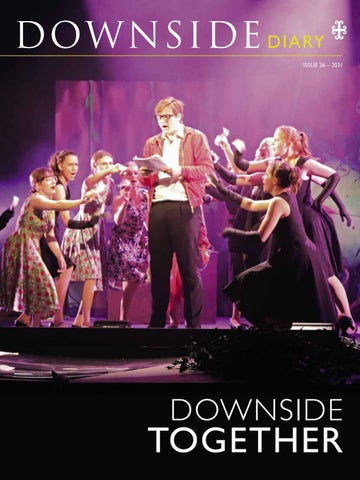
downsidE DIARY ISSUE 26 – 2021
DOWNSIDE
TOGETHER
downsidE DIARY
CONTENTS REGULARS 04 FROM THE HEAD Welcome from Mr Hobbs 06 AT THE TOP Meet our new Heads of School
SPECIAL FEATURES
26 FAITH IN A PANDEMIC Challenges faced and lessons learnt from the pandemic
09 STRENGTH TO SPEAK UP Opportunities for pupils to have their say about the running of the School 28 OUTDOOR ADVENTURE The benefits of learning away from 10 KEEPING THE FAITH the classroom Sixth Former Owain Daley on the importance of Lectio 35 TRADITIONS The Dash, May Morning Madrigals and 11 OUR SPIRITUAL SELVES more – our beloved School traditions The five communities that support the spiritual life of our School 38 CCF REBADGING Renewing our CCF’s affiliation with the 12 3 DAYS IN JUNE Irish Guards Bake off, music videos, a pilgrimage and more: winding down to the end of 40 INCLUSION & DIVERSITY the Summer Term Standing in solidarity as an international, diverse community 22 FROM STEM TO STEAM The importance of the Arts from Head 47 FEELING HOT? of Academic Music Jonnie Bridges The St Francis Science Club working together to help Downside become 24 COUNTRY LIVING more sustainable Fresh air, bags of space and calm – all beneficial for academic and personal 50 LEADING THE WAY development Leadership opportunities at Downside
2021
20 EPQs Crispr gene-editing, faith schools and the Rubik’s Cube 32 TEACHER PROFILE: A PASSION FOR LANGUAGE Belen Iglesias on her love of languages and school partnerships
08 ROOM WITH A VIEW The view from the School Pavilion across the pitches, and beyond
42 MIXED MEDIA GCSE and A level Art submissions
14 REFLECTIONS Pupils and staff reflect on their time at Downside
48 FROM THE ARCHIVES: Working together to provide food for the community during WWI and WWII
68 PERFORMING ARTS The Virtual Christmas Carol Service, Singin’ in the Rain Jr, Music for a Summer’s Evening and more 72 MEETING MR McLEAN Former Roberts’ House Master is interviewed by some of the Horizon editorial team 74 FROM THE ARCHIVES: Together in life and death
52 OUR YEAR OF SPORT How Downside has kept its love of sport strong through the pandemic 56 KEEPING SPIRITS HIGH A whole-School approach to pastoral care 58 NOURISHING MINDS Feeding bodies and minds – heathily and sustainably 60 THE GAME OF KINGS Chess: raising IQs, exercising both sides of the brain and stimulating creativity 62 HOME FROM HOME Three overseas pupils speak about their experience of studying in the UK 64 STRATEGY FOR SUSTAINABILITY The School’s plans for increased sustainability 76 FORCES FAMILIES AT DOWNSIDE Sixth Former Sophia Burton on why Downside is a good choice for Forces families
The Creative Team EDITOR Beck Ward Murphy, Downside School CREATIVE DIRECTOR Tim Mercer, Mercer Design DESIGN Reuben Wakeman, Mercer Design www.mercerdesign.co.uk PRINT Gemini West, Bristol gemini-print.co.uk/west
© 2021 Downside School Stratton-on-the-Fosse, Radstock, Nr Bath Somerset, BA3 4RJ Registered Charity No: 1184700 Downside parents who would like to obtain copies of the photographs in this edition should contact the Marketing Manager, Beck Ward Murphy: +44 (0)1761 235151 news@downside.co.uk Admissions: +44 (0)1761 235103 admissions@downside.co.uk www.downside.co.uk
FROM THE HEAD… Wrestling with the challenges of the past year has undoubtedly strengthened the bonds of our community and given us a deeper appreciation of the value of working together and the true meaning of unity. I was recently introduced to the writing of Richard Rohr, a Franciscan priest and author based in New Mexico, whose daily meditations I highly recommend. His thoughts on unity, which I have adapted and edited slightly, are extremely helpful: Unity is not the same as uniformity. Unity, in fact, is the reconciliation of differences, and those differences must be maintained. We must actually distinguish things and separate them, usually at a cost to ourselves, before we can spiritually unite them. St. Paul made this universal principle very clear in several of his letters. For example, in his letter to the Corinthians, when he says, ‘There is a variety of gifts, but it is always the same Spirit. There are all sorts of services to be done, but always the same Lord, working in all sorts of different ways in different people. It is the same God working in all of them’. We see this beautiful diversity and yet unity in the world around us on a daily basis. It is not the simplistic belief that ‘everything is one’. Rather, we should be seeking the hard fought and much deeper ‘unity of the Spirit, which was given us all to drink’, which St. Paul goes on to speak of in that same letter to the Corinthians. We are asked to study, pray, wait, reconcile, and work to achieve true unity – not a foolish and boring uniformity, where we try to make everyone and everything the same, which is rather undesirable and even unholy. In fact an obsession with uniformity can ironically end up promoting division and conflict.
EDITORIAL 4
Editorial
This is the unity we seek and which we truly cherish. As the well-known cliché goes, ‘there’s no ‘I’ in team’, and, as the joyous performances of this year’s School musical, Little Shop of Horrors, in May demonstrated magnificently, nor is there an ‘I’ in cast, crew, or band. Downside was one of the first schools in the country to create a ‘live’ performance for a ‘live’ audience, overcoming the challenges presented by the Covid restrictions and all the early rehearsals having to be carried out online. If ever anyone were seeking an example of unity or evidence that ‘there is a variety of gifts, but always the same spirit and all sorts of services to be done, but always the same Lord, working in all sorts of different ways in different people’, that production of Little Shop of Horrors provided it. Different parts, different talents, different jobs,
not uniformity, but absolute unity. Every person involved was doing their best, motivated by the joy of playing their part, big or small, on stage or behind the scenes, having fun, without fear of getting it wrong. Even the audience was united, smiling, relaxed, willing success, not seeking to find fault. It provided a perfect metaphor for our community here at Downside. Each individual is uniquely gifted, each with our own part to play. The community is diminished if any one of us does not play our unique and distinct part, and give of our self, in all our wonderful imperfection, by the way. We may be asked to be centre stage sometimes but at other times our role is to be part of the chorus. It might be that our gift is to make others look good by providing the lighting or helping with their costumes, or our job may be to provide the vital musical accompaniment. This metaphor is applicable to every aspect of our lives here at Downside. As pupils and staff gather for lessons or tutor periods, physically in the classroom or online, as has been necessary at times this year, each person has an essential role to play and a vital contribution to make. It is a whole community effort and one in which each one of us must be actively and joyfully engaged, having fun, unafraid to display our ignorance or make mistakes in the shared search for knowledge and understanding. Our community is rich and diverse. There is room for everyone and we cannot function without one another. We think of the people who support us in our daily needs, those who feed us and clean for us, those who support us spiritually and pastorally, who lift us up when we’re feeling down, or give us confidence as we try something unfamiliar or new or who simply make us laugh. At a time when the effects of the pandemic are still causing disruption and dislocation on a global scale and a spotlight continues to be shone on issues of discrimination and inequality which persist in our society. It is more important than ever that we accept the role we have been called to play and offer our unique and distinct contribution to our community and to society more broadly to build unity not by striving for uniformity but by celebrating and respecting diversity and difference.
OUR COMMUNITY IS RICH AND DIVERSE. THERE IS ROOM FOR EVERYONE AND WE CANNOT FUNCTION WITHOUT ONE ANOTHER.
5
AT THE
Katharina Lützenkirchen, Head of School 2020/21 Downside has been a time that I will cherish forever. As a welcoming and kind community, the School has always encouraged me to grow both academically and as a person. I have caught myself calling Downside ‘home’ more than once and I cannot deny that it feels like it is my second home. It was, therefore, very painful to see how lockdowns have shortened my time physically spent at Downside. Nonetheless, being away from the School has made me appreciate the community even more and allowed me to form even closer friendships.
TOP WE ARE DELIGHTED TO PRESENT THE NEW HEADS OF SCHOOL FOR THE NEW ACADEMIC YEAR 2021/22 – STEPHANIE JEDY-AGBA AND JOSEPH DAY. Stephanie, Caverel House During my six years at Downside, I have been able to fulfil my academic, musical, and spiritual potential as well as learn various skills in other aspects of School life. The School community is something I, as well as many other students, highly value. Therefore, as Head of School, I would like to give back to the community that has supported me so greatly. Downside has encouraged me to challenge myself, for which I am tremendously grateful as it has enabled me to thrive as an individual and aim to accomplish great things. Participating in various co-curricular
Joseph, Roberts House Since joining Downside in the Third Form, I have been consistently enriched by the community which exists here. Downside is steeped in this sense of community, and it is impossible to go a day without noticing its presence. The entire School benefits from this in many ways, from Lectio Divina to the various academic societies to the sports team – all of which are bound together by this sense of community. As Head of School I hope to maintain this and
activities such as debating, sports and Spanish language leadership have really helped enhance my communication, public speaking, relationships with my peers, and ability to work well in a team. Taking part in numerous Abingdon debates has allowed me to gain many skills that are applicable in various aspects of life. I believe that it has been one of my most valuable experiences at Downside, therefore, as Head of School, I would like to actively encourage the Junior Abingdon Society, helping students at a young age to strengthen their confidence and persuasion abilities.
thus allow all students, new and old, to receive from it all the benefits that I have. The abundant opportunities afforded by a Downside education have helped me immeasurably during my time here. My public speaking confidence has been improved by the Abingdon Society, my faith deepened by Lectio, and my physical limits pushed by the Gold Duke of Edinburgh Award. As we emerge from the
I would say that the highlights of Downside are the strong friendships that are built, the incredible community, and the spiritual life that is unmatched anywhere else. I hope to transfer everything that I have learnt into a future career in Law and continue to strengthen my faith. ‘As Head of School I would like to promote inclusivity and ensure that everyone feels valued in the community. I would like to focus on the wellbeing of each individual and give them the ability to excel and achieve success, encouraging them to make the most of their time at Downside.’
Stephanie Jedy-Agba
Nicholas Hobbs, Head of School 2020/21 I have been at Downside for five years. Through this time, I can confidently say that the School has moulded my outlook on life and given me confidence and faith, while also providing me with a community to be a part of like no other. Having had siblings here since 2009 I can truly say the School has changed for the better in all areas of Downside life. One thing, however, that does not change is the welcoming and embracing nature of the School. I am saddened that I am leaving Downside after so many years, however it’s not the School that I will miss but the people that make up the School community.
Covid-19 pandemic, these opportunities will only become more numerous. It will be an extremely exciting time for the School as we get back to the old way of life and long-lost activities finally return. I am very much looking forward to that time and hope in my position to organise and oversee the return of many staples of Downside life including live concerts, guest speakers and much more.
Joseph Day
6
At the Top
To represent the School as Head Girl has been a great honour to me. I know that Stephanie and Joseph will make full use of this opportunity. Their cards look a bit brighter than ours were at the start of the year so I hope they will get the full experience of their Upper Sixth year. My piece of advice to them is to stay passionate about their job. It might seem like a lot from time to time, but the work will pay off and make Downside an even greater place than it already is. I wish you all the best and hope you re-unite our community as it is leaving restrictions behind.
I would like to wish Stephanie and Joseph the best of luck and encourage them to make the most of the opportunity that they have been given and provide their own legacy while changing the School for the better. They have been gifted the opportunity coming out of the pandemic. It’s one I am very envious of and I wish I could take it on for another year.
7
STRENGTH TO SPEAK UP Supporting our pupils to have a voice and truly listen to what they say are a key part of life at Downside. We believe that all our pupils should have a platform from which to express themselves and to stand up for what they believe in. This supportive environment allows pupils to speak for themselves and confide in their peers and staff about what they really feel and want. Having a voice can also be in the form of debate, undertaking projects to improve the School’s aim for a zero-carbon footprint, or even suggesting dishes for meal times.
Room with a
VIEW
Anyone who has watched a Downside cricket match from the upper terrace of the School Pavilion can’t fail to be inspired by the views over the sports pitches and beyond.
The Society is currently available for Fourth to Sixth Form pupils, however, from January 2021, the Junior Abingdon Society started for younger pupils. Junior Abingdon provides our younger pupils with an introduction to competitive debating, helps them hone the skills required to present an argument with sound reasoning and poise, and learn about a range of debating formats, styles and techniques.
The pitches are at their most resplendent from mid-spring into the summer months. They are flanked by beautiful Somerset countryside and have the magnificent Downside Abbey, School and a bank of ancient trees behind them, providing a poetic and impressive backdrop. The stuff of legends: Downside match teas
The Pavilion was built in 1929 and opened in 1930 in time for the visit of the Australian Ashes team. It suffered damage in 1943 when it was struck by a Hawker Sea Hurricane Mk IB. Tragically, the air crash killed the pilot and nine Downside pupils. The Pavilion was later rebuilt and a plaque erected to remember those who lost their lives in the crash. Downside’s Pavilion provides the perfect spot from which to enjoy many a sporting fixture, to catch up with fellow parents and, of course, to enjoy the famous and delicious Downside match teas.
8
Room with a View
The Abingdon Society & Junior Abingdon Society The Downside Abingdon Society is the oldest debating society of any school in the country. It provides a forum for pupils to discuss topical and pertinent issues at an intellectual level, and is ideal preparation for any aspiring university candidate.
Inter-House Debating This competition is one of the debating highlights of the School year. In 2020-21 motions included ‘This House would be progressive’, ‘This House does not miss Harry and Meghan’ and the final, which was a three-way event, on the topic of ‘Which is the greatest threat to humanity – a pandemic, Artificial Intelligence or climate change?’ More details on the 2020-21 competition can be found in The Raven. The benefits of debating, not only in terms of pure academics, but also in young people’s engagement with the wider world are numerous: debating can help to improve critical thinking skills,
For this year’s Inter-House Debating Competition Aristo Chan was named the best debater of the term, and of the final as an individual. He’s calm, comfortable debater with a clear way of expressing well-informed and logical arguments. Given that he is only in the Fourth Form debating against, in some cases, Upper Sixth Formers, this is extremely impressive
boost self-confidence, develop complex cognitive abilities and increase information retention. The Van Zeller Society The Van Zeller Society encourages intellectual curiosity in the Third and Fourth Form academic scholars. Each week, one member presents a short paper on a subject of their choice, followed by questions and discussion of current affairs. School Council The pupil-led School Council is an opportunity for pupils to articulate what they want to happen in School, and to suggest ideas for keeping the community busy and vibrant. Along with other pupils from around the School, the Council also makes suggestions to the Catering Manager regarding menu options at meal times. The Catering Team hold tasting sessions each term, where pupils have the chance to try something that may be completely new to them. The tasting dish with the most votes gets added to the menu for the following term.
Downside Cricket Pavilion. Acrylic on canvas by Bath-based artist Rachel OM Wright. www.rachelomwright.com
Strength to Speak Up
9
KEEPING THE
FAITH
RECENT SIXTH FORM LEAVER OWAIN DALEY SHARES HIS THOUGHTS ON LECTIO AND HOW IMPORTANT IT WAS FOR HIM TO BE ABLE TO EXPLORE HIS FAITH WHILST AT DOWNSIDE.
Lectio Divina is a special way of reading the Bible which allows us to meet Christ. Whilst there are many different ways to read the Bible (for example we can read it in an academic capacity), Lectio Divina is unique as we read the scriptures because we want to encounter the person that is Jesus Christ. The incredible power of this is that we come to know Christ for ourselves. This is summed up beautifully in the book of Job: ‘I had heard of you by the hearing of the ear, but now I see you.’ (Job 42:5) Owain was awarded the Gregorian Medal this year for his service to the School.
WE CAN NEVER SIT BACK AND SAY WE’RE DONE, THERE IS ALWAYS MORE WORK TO BE DONE. THIS IS NOT A DAUNTING THING, BUT RATHER SOMETHING GLORIOUS.
The contrast presented here between having heard and having seen reminds me of the difference between having been told about Christ and discovering him for ourselves. The encounter that Lectio offers us allows us to discover for ourselves all that we have been told about Christ. I’ve been raised in a Catholic family, always gone to Mass on Sundays, and am no stranger to saying prayers. However, when I arrived at Downside and was introduced to Lectio by the Manquehue, I was able to take on this faith for myself, and make it part of myself, through the gradual discovery of the person of Christ. It is important to stress here how this was for me, and is for vast majority of people, a gradual discovery. The rhythm of our world today demands that things happen fast. Lectio is much more often about the little things,
the small steps. Each time we encounter Christ in prayer we come to know something very small of him. The more we encounter Christ, the more we come to know him and the closer we become. We have to enter into Lectio with patience and trust, trust that Christ will allow us to know him in his own time, in the way that he knows is best for us. It’s also worth saying that there is not, in this world, an endpoint to the journey. We can never sit back and say we’re done, there is always more work to be done. This is not a daunting thing, but rather something glorious. There is always a further and greater joy on offer. I have also found that, in a sense, it is not only Christ we meet in Lectio, but also ourselves. We discover ourselves in relationship with God. In doing this we gain knowledge of ourselves on the most fundamental levels of our creation, as God created each one of us to be in relationship with him. At Downside, I was first introduced to Lectio on retreat. As I gradually came to know Christ more, I started to take up a role as a Lectio leader, joining the St. John community and Lectio became part of my daily prayer. The Manquehue practice of Lectio in groups has meant that this journey of discovery is something I have travelled alongside other people. This gives incredible strength to our School community as we relate, not only to each other, but also to Christ.
• READ • MEDITATE • PRAY • CONTEMPLATE • 10 Keeping the Faith
OUR SPIRITUAL SELVES DOWNSIDE HAS FIVE SPIRITUAL COMMUNITIES THAT SUPPORT THE SCHOOL IN DIFFERENT WAYS: ST LUKE, ST JOHN, ST FRANCIS, ST TERESA AND OSCAR ROMERO. St John: acts as the ‘mother community’ for Lectio leaders in the Fifth and Sixth Forms Members are given support on spiritual formation, Benedictine leadership and developing spiritual friendship. The leaders are chosen and are invited by the St Scholastica Community and are drawn from the different Lectio groups. What is looked for is an openness to learn and a willingness to assist younger pupils in their spiritual and faith journeys.
St Luke: plays a key role for the prayer, liturgy and sacramental life of the School. The Community includes a Lower Sixth Former from each House who leads their House for times of liturgy, for example in House prayers, House Reconciliation Services, House Masses and Sunday Mass Duties. The St Luke Community arranges Nightfever each year. The event is a time of prayer and peace including adoration of the blessed sacrament, supported by music from the St Scholastica Community, and includes times of silence and the lighting of candles.
St Francis: inspired by Pope Francis’ encyclical Laudato Si’, the goal of the St Francis Science Club is to use STEM skills to help make the School more sustainable and reduce its carbon footprint. (see page 65)
St Teresa: aims to bring awareness of a Christ-centred service within the School community. This is either by advertising and promoting a culture of service or by spearheading fundraisers for charities. During each meeting, projects and service in the School are discussed and put into action. The Community’s highlights throughout the academic year include a ‘Month of Service’, which raises the awareness of service in the School, charity movie nights and a winter sleep out at the School for local charity Help For Homeless. Visit the School’s YouTube channel to listen to the St Teresa Community podcast.
Oscar Romero: a youthful, faith-based movement led by Downside pupils. With the support of Mr O’Rourke, pupils discuss their key aims of identifying and promoting the importance of faith in sport at Downside based on our Benedictine values. Sport carries such huge importance and influence here; there are opportunities to take part in a variety of sporting activities every day of the week, from rugby and cricket to golf and kayaking. During such a unique and challenging time, the importance of celebrating all aspects of our community is becoming more and more important. The Oscar Romero Community will look to play an important role in supporting this through weekly celebrations, House tournaments and the ultimate goal of reaching out to the wider community. Follow the Oscar Romero Community on Instagram.
Our Spiritual Selves
11
DAYS IN JUNE
EVERY YEAR, AT THE END OF THE SUMMER TERM, PUPILS HAVE THE OPPORTUNITY TO TAKE PART IN ‘3 DAYS’ – A CO-CURRICULAR ACTIVITY PROGRAMME INCLUDING SPORT, THE ARTS, OUTDOOR ADVENTURE AND SERVICE. IT’S A GREAT WAY TO UNWIND AS WE COME TO THE END OF THE BUSIEST TERM OF THE SCHOOL YEAR. This year pupils enjoyed paddle sports, monoprinting, sports camps, a bake off, starters’ sign language, a trip to Longleat, a pilgrimage to Glastonbury and Singin’ in the Rain Jr (see page 69), amongst other activities. Some pupils also offered a ‘Helping Hand’ service for jobs around the School including gardening and trophy polishing.
For the pilgrimage, some of the Upper Sixth Form, the Lay Chaplain, and members of the St Scholastica Community walked the 18 miles to Glastonbury Tor with plenty of stops along the way in rural churches to reflect on the Gospel of Mark. Several pupils created music videos featuring some of their favourite spots around Downside including the Worth Lawn, the Main Hall Mirror and the monkey puzzle tree! Kingfisher (Caspar, Max, George and Dylan) performed I Predict a Riot by the Kaiser Chiefs, and Sebastian Hall performed Chills by Lucas Renney, accompanied by fellow Sixth Formers Daisy on bass, and Caspar who delivered a powerful guitar solo towards the end of the piece. Zara and Phoebe produced thoughtful ballads – Yellow by Coldplay and Lifeline by Reuben Gray.
12 3 Days in June
13
REFLECTIONS FIRST IMPRESSIONS, DOWNSIDE LIFE AND WITH THE THEME OF THIS YEAR’S DIARY BEING ‘DOWNSIDE TOGETHER’, WE ASKED A FEW MEMBERS OF OUR SCHOOL COMMUNITY TO REFLECT ON THEIR TIME AT DOWNSIDE.
Sixth Formers Alexander Harwood & Charlotte Walker both joined Downside in the First Form. What were your first impressions of Downside? CW: Coming from a little village primary school, I was in awe of the size and beauty of the School; I remember thinking it looked almost like Hogwarts! As for the School community, I felt very welcomed from the start and quickly learned that there was always someone willing to help me. AH: Coming from a very small prep school to what at the time seemed like a massive building of mature students was very scary. But it only took a day to realise how welcoming the School is, and to see the atmosphere of a really close community. How have you grown as a person through your years at Downside? CW: I certainly feel like I have matured
and learned to face challenges as I have grown older and moved up through the School. I have become more confident, which is definitely thanks to all the opportunities I have been given, for example to perform in the choir and theatrical productions. On top of this, I have found my passion in life – modern languages – and learned my strengths and weaknesses. Spiritually, Lectio Divina and annual retreats have been a huge part of my personal growth, bringing me closer to my faith and my friends. The Manquehue Community have been a huge part of my life, being a group of friendly faces who are always open to talk; I am eternally grateful to them all. AH: Downside has allowed me to make mistakes but also to learn quickly from them. The Benedictine values we hold at the School have been invaluable to the past seven years of my life. They have taught me a lot about how to live it so that you can make not only great
DOWNSIDE HAS AN UNMISTAKABLE IDENTITY WHICH I WILL TREASURE FOREVER. Charlotte Walker
14 Reflections
relationships with people, but, for me, a newer, greater one with God. What will you remember most about your time at Downside? CW: There is so much I could say, but one thing I will never forget are the School traditions. The Christmas Dash is one of my favourites, as is the annual Carol Service, which I hope I can return to watch as an OG in the future. The inter-House competitions such as the singing contest and athletics day are always the highlight of my year and I will definitely miss them. Feast day Masses and dinners, toast in the evenings, trips to the Co-op… Downside has an unmistakable identity that I will treasure forever. AH: I will always cherish the relationships that I have made and the experiences I have had: the time I fell over a tennis net and had everyone on the court in stitches; the roaring sound of singing voices in hymn practice that fill the Abbey Church; or the countless opportunities when I got to sing in the choir and perform on stage. It is impossible for me to pick out one moment because there are so many memories to pick from.
Alex in his Navy CCF uniform
The Harwood brothers ‘back in the day’ L-R: Ben, William (B15 & Head of School 2015/16) and Alex
Alex playing Seymour in the 2021 production of Little Shop of Horrors
Charlotte singing in the Abbey Church at the 2021 Leavers’ Mass
Charlotte and her younger sister Annabel at their 2014 confirmation with the then Bishop of Bath & Wells, The Right Reverend Peter Hancock, and Downside's own Dom James
Charlotte (right) at the Junior Prize Assembly in 2016 with friend Toto
15
How did you manage to keep engaged during the second lockdown? CW: Lockdown was certainly tough, but I found ways to stay positive and keep engaged such as dog walking which helped to clear my head of the stresses of lockdown. I also enjoyed cooking and baking as a creative outlet of sorts (and of course I enjoyed eating my culinary creations!). I baked cookies for some elderly neighbours, who often feel isolated in these hard times, and it was nice to bring them a bit of joy. Virtual House assemblies and hymn practice every Friday helped me stay connected to the School community. AH: It’s fair to say that the past year in lockdown has not been great for anybody. However, the School was somehow able to keep our close-knit community together even when we were hundreds of miles apart. Lectio Divina played a big role during remote learning where prayer and friendship proved so valuable. The theme of this year’s Diary is ‘Downside Together’. What does that mean to you? CW: To me it means that, even though times are tough, the School community is as united as ever, even when we are apart. We look out for each other and support one another when the going gets tough. Since day one, Downside has been a welcoming and loving community in which I have made so many friends from all over the world. Even though we have our differences, we are together as one school community. AH: I have always said that Downside has its own unique culture, and that culture is one that only our community understand. I think that is what ‘Downside Together’ is, sharing our thoughts on our experiences because of this cherished culture we have.
16 Reflections
School Librarian, Ms Craig, reflects on her school days, coming to Downside and her work in the Petre Library.
stuck in my throat and had to make a dramatic, unscripted escape. Learning seemed like the best adventure.
What was school like for you? Looking back I now realise that my primary school was an amazing place with an imaginative, creative headmistress. We had classes of 40, yes, 40 but I guess we were all small so it didn’t feel crowded. We did weird and wonderful projects: I remember one performance where I hid inside a cardboard replica windmill to deliver a speech, got a pineapple chunk
I loved school and being challenged to see and show what I could do. I didn’t miss a single day in seven years. The trouble was my girls’ grammar school didn’t have very high expectations. We were supposed to be the academically gifted of the area yet a miserly eight girls from my year of 90 went to university and only two of those were, like me, the first generation in their family to go on to higher education.
Education is not fair, society is not fair. I’ve come to realise that fairness and equal opportunities for all are important to me. That’s why, in March 2018, I spoke in the Abbey about the fight for equal rights and will continue to call out sexism, racism or classism wherever I encounter it. I was grateful to colleagues and pupils of both sexes who thanked me for raising the issue and was saddened by stories of their own experiences in education and beyond. I want to be proactive too and work to provide wider access to the kind of opportunities enjoyed by pupils at Downside. At our one-day Gothic conference last year we welcomed 39 A level students from the local area and I believe the experience for our pupils was enhanced because of this. How has the library changed? The Petre Library used to be the School Theatre. I love that because the theatre was my happy place and somewhere I worked for years. A brilliant English teacher used to take us on school trips to theatres like the Cockpit and Mermaid in London. The arts are essential, as we have come to appreciate over the past year. When I arrived there were just too many books in the library; I know that sounds odd, but you had to fight to get a book off the shelves. That has changed. The library is moving forwards with the webpage and full catalogue now available 24/7. I am particularly happy that we have been able to catalogue the excellent collections from the Art Department and the History of Art Department in the past couple of years.
Ms Craig has helped the Downside library – and events associated with it – to evolve beyond all expectations
The choice of book titles now reflects different voices. In fact, following the explosion of writing for young adults
we now have several hundred titles to appeal to this demographic. I signed up to the Everybody In charter to try to make sure that our readers can see themselves in the stories available to them from the Petre Library. What plans for the future? The Library is constantly changing and I’d like to see it grow. At Downside, we could offer a variety of spaces to read and work. You know what? I want to take over the Old Gym and replace it with a three-storey structure. On the ground floor you would find a café, enticing displays and tons of fiction; the first floor would be an interactive, flexible space for group work while on the top floor you could get engrossed in research at a workspace of your own or curl up on a window seat, gaze over the grounds and disappear into a fantasy world. I imagine a kind of Guggenheim with books. House Master and Teacher of Geography, Mr Dolman, reflects on his school days, being a House Master and what it’s like being father to four girls in lockdown. What were your school days like and how do they compare to being educated at Downside? As I approach 30 years in the teaching profession, I do occasionally think about and reflect on my own education and how it compared to Downside. On the whole I was incredibly happy at school; I was fortunate enough to attend a traditional all boys’ boarding prep school and, despite some initial homesickness, I relished all the sport and freedom at weekends although occasionally we were given cold baths and the slipper for poor behaviour! On one level, my
secondary education was very similar to Downside; I attended an independent co-educational school which prided itself on a holistic education. Like Downside, there was a strong sporting tradition and a multitude of co-curricular activities, CCF and Duke of Edinburgh. In addition, the House structure was very competitive and I made a number of life-long friendships. Looking back on my school days though, I would say that an essential ingredient that was missing was a focus on Christian values. It was at Prior Park College (my first teaching job) that my faith was strengthened and that I was received into the Catholic Church. Having then been a House Master at Worth and now at Downside, I feel strongly that a school with a distinctive Benedictine ethos not only better prepares students to cope with the complexities of life beyond school but essentially provides them with a framework for successful community living – a crucial bedrock for their relationships with others in years to come. What’s the secret to being a (good) House Master? I wish I knew what the magical ingredients were to make a good House Master! I have certainly been around long enough to have ‘cut my teeth’ so to speak, having worked in a number of Catholic boarding and day houses. Like being a parent for the first time, all the preparation and training cannot fully prepare you for what really lies in ahead when looking after a boarding house of about 60 adolescent boys. In my early days, starting out as a House Master, I remember well a colleague who became a close friend saying “of course take your job seriously but not yourself ”. As a House Master, like a
17
others’ needs, we focus less on our own personal targets and ambitions. It is the little courtesies that matter: small marks of consideration, thinking of each other and being sensitive to others needs. The challenge of the Powell House Master is to instil these core values. I am delighted that during my tenure as Powell House Master, a number of the Heads of House have been awarded the Gregorian Medal for outstanding service to the School: Harry McGinnis (B14), Felix Rusby (R15), Tom McGinnis (16), Freddie Wright Morris (B18) and Laurence Lundy (R19); all highly impressive young men who have been utterly selfless and outstanding role models to the younger boys.
Jonathan enjoying a relaxing bike ride around the campus
parent, it is important not to ‘sweat the small stuff ’ and to remember that you are acting in loco parentis, with the incredible privilege of looking after other people’s children, aiming to provide a caring, loving and trusting atmosphere. In my opinion, the best thing you can give young adults is time, which is increasingly demanding with the speed of life nowadays with emails and online lessons. I like to think I am approachable, can have a laugh and take a joke but that being consistent and fair is also really important especially when dealing with boys as young as 11 up to the age of 18. A strong boarding and day house
should have room for the less able, the gifted and the eccentric, valuing all talents present. The House Master must reconcile the needs of each pupil with those of the community: a Benedictine school nourishes the gifts of the individual and puts them at the service of all. As a House Master, it is important to not only lead by example, but to show compassion and, of course, when dealing with the younger members of your boarding house, to have patience! The three core Benedictine values that I have tried to instil in the boys at Downside have been worship, humility and service. By reminding ourselves of
BY REMINDING OURSELVES OF OTHERS’ NEEDS, WE FOCUS LESS ON OUR OWN PERSONAL TARGETS AND AMBITIONS. Jonathan Dolman
18 Reflections
How have you managed to keep pupils engaged during lockdown/ remote learning? I take my hat off to the teaching staff at Downside. Like many teachers across the country, I have had to upskill ‘on the job’ which has not only been daunting and stressful but also extremely rewarding. Whilst the younger generation is more adept at coping with change, as a parent I have seen how hard it has been for adolescents to be removed from their friends at a formative time in their relationships. In Powell, I have been fortunate to have had some incredibly dedicated and committed tutors who have been in regular contact with their tutees on a daily basis providing the pastoral welfare which is a central part of the Downside experience. Mr Pollard has been an outstanding Deputy House Master, who has always been there when times have been challenging. In addition, both the Head and Deputy Head of House (Owain Daily and Michael Keeley) have been invaluable; being available to listen to the boys’ concerns and chivvy
them along when necessary. I know that Owain and Michael’s weekly ‘kahoot’ quiz on a Friday afternoon during the weekly House assembly was much appreciated. The House assembly has been a time when the whole House has worshipped and pupils have shared their own experiences of how they contributed during the month of Service in Lent. A number of boys read poetry, stories, and took part in a photography competition. You have four daughters. How was lockdown at home with them? During lockdown, it was rather surreal to have an empty boarding House, no boys to look after and to be at home
with a houseful of girls! As a father of four daughters, whose ages range from 12 to 21, I have seen at first-hand how challenging lockdown has been for young people. They have, however, been able encourage one another in the harder moments and gained tremendous support from all their friends through various social media platforms. My wife Clare was also a pillar of strength for all of us. Whilst there has been the occasional disagreement (which families don’t?!), we have got on really well. We probably played more card and board games than we would otherwise have done although I have struggled to contribute to their ‘tiktoks’, in-jokes and conversations about boyfriends! However, with all my
daughters at home it has been wonderful to spend some quality time together which would not have been possible out of lockdown as Anna and Olivia (my two older daughters) would have been at university. I am hoping my culinary skills have gone up in their estimation, as I have had a little more time to cook some family meals!
The Dolman family
19
EPQs
OUR SIXTH FORM EPQ (EXTENDED PROJECT QUALIFICATION) WRITERS ALWAYS GIVE US A WIDE RANGE OF THOUGHT-PROVOKING ESSAYS, EXPLORING THE MANY QUESTIONS THEY HAVE ABOUT THE WORLD ABOUT THEM.
EXTENDED PROJECT QUALIFICATIONS
CRISPR GENE-EDITING CASPAR CLOTHIER, ACADEMIC SCHOLAR Known for his amazing guitar playing at many a Downside music event, one of Sixth Former Caspar Clothier’s other passions is science, and he chose the topic of CRISPR gene-editing for his EPQ.
I LIKE THE PARTS OF SCIENCE WHICH SEEM SURREAL BECAUSE THEY HIGHLIGHT HOW UNDERLYING NATURAL LAWS ARE SO FAR-REACHING.
DO FAITH SCHOOLS INCREASE SEGREGATION AND MONOCULTURALISM IN OUR SOCIETY? SOPHIE WORRALL, ACADEMIC, SPORT & MUSIC SCHOLAR The theme of my EPQ is the effects of faith schools in modern-day British society. It highlights their importance, and the issues around whether they have the capability to increase monoculturalism in our society today. Having always attended a Catholic school, I am interested in understanding why our education system is highly dominated by schools of faith and the impact they have on our culture. I shall also address how faith schools differ from non-faith schools and how this affects the students that attend these schools. My faith takes up a big part of my life, so I want to explore how a Catholic education benefits me and others who also attend a school dedicated to a specific religion. There is an on-going debate questioning the relevance of faith schools in the UK, especially as it is considered to be a multicultural country. With over 100 different faiths or belief systems followed by Britons, I question whether our society has become more divided due to schools that practise an individual faith and if it would be more beneficial to eliminate such schools. I aim to discuss all predominant faiths in the UK, not just focussing on my own, in order to have a wider understanding of our culture. I think that it is important to recognise the diversity of faiths that take place in our country and how we can develop these faiths in our education system.
CRISPR is an economical and powerful gene-editing tool. Its origin lies in the natural adaptive immunity of bacteria, and enables DNA to be cut at precise locations, allowing for its accurate and targeted renewal or replacement.
HOW MATHEMATICS CAN HELP TO SOLVE THE RUBIK’S CUBE
From Caspar: ‘I chose this topic because of its surreality. Gene-editing has a place in dystopian literature which often makes people fearful of it but, at the same time, dismissive that is ever likely become part of our lives. I like the parts of science which seem surreal because they highlight how underlying natural laws are so far-reaching that they give rise to phenomena and applications that we would consider supernatural.
I have chosen this topic because of my interest in the Rubik’s Cube’s complexity in thinking outside the box and exercising our brain muscles, especially in our thinking and reaction time. The conversation in search of its solutions has been around for many years, that of returning the cube with all of its faces as the same colours or shapes. It is very convenient how mathematics is the basis of all logical thinking and reasoning, which is very much connected to puzzle and problem solving. I have been asked thousands of times since the day I have learnt the solution for this puzzle: ‘How is it possible to memorise all the algorithms to solve it in just a short matter of time?’. Along with many other reasons, I have been motivated to demonstrate how we can solve a Rubik’s Cube using mathematical reasoning and theories to understand where all these complicated algorithms and formulas come from, which can be mainly resolved in Group Theory (the study of algebraic structures known as groups).
Gene-editing will be an integral part of our descendant’s lives, thanks to the ease of use and cost-effectiveness of CRISPR. This technology could be used to cure illnesses ranging from Sickle Cell Anaemia to Leukaemia in a clinical environment, not to mention paving the way for other techniques such as the use of pig organs in transplants. However, its applications (especially those involving embryos) have ethical issues that must be discussed, and its ease of use means that it could be abused to terrible effect – potentially leading to a novel-esque dystopian world, which is why this is topic should be written about. The best way to ensure that this technology is used ethically is for there to be public dialogue and oversight.’ Caspar is now reading Chemistry at the University of St Andrews.
JIMMY CHOW, ACADEMIC SCHOLAR
An EPQ aims to develop the skills required to study independently at university and is offered to all Lower Sixth Form pupils. They choose their own topic, research the subject and then produce a dissertation of 5-8,000 words, fully referenced, with critical analysis and a bibliography. Our pupils receive some guidance in lessons and have the support of their tutor but, to develop independent skills, they work mainly on their own. Once their research is complete, pupils conduct a formal presentation and then are questioned in detail. EPQs are well regarded by Russell Group universities, and can form part of a UCAS application.
20 EPQs
21
FROM STEM TO
STEAM
THE IMPORTANCE OF THE ARTS IN EDUCATION ALL CHILDREN ARE BORN ARTISTS.
Pablo Picasso
cannot ignore that we have numerous intelligences, but perhaps there isn’t the time to discuss Gardner’s Theory of Multiple Intelligences…
By Jonnie Bridges, Head of Academic Music, 2019-21
FOR MANY YEARS, STEM SUBJECTS HAVE BEEN VALUED ABOVE OTHERS BY SOME INSTITUTIONS; TEACHING SCIENCE, TECHNOLOGY, ENGINEERING AND MATHEMATICS ARE HOW WE WILL PRODUCE TOPQUALITY LEARNERS WHO HAVE MINDS CAPABLE OF INNOVATING AND LEADING BUSINESS AND INDUSTRY TO NEW HORIZONS. There is no doubt that, taught effectively, these subjects are hugely important to young people across the globe, as the critical-thinking and analytical skills required to succeed in today’s society are promoted within. These ‘hard’ skills make a learned and logical-minded individual, but let’s not forget about the ‘soft’ skills required in many walks of life.
22 From STEM to STEAM
Soft skills are deemed to be those which aren’t measurable through common means of testing; team-work, etiquette, communicating, listening and analysing are a few examples of soft skills which are increasingly important in the modern world. This is where the Arts contribute. ‘STEAM’ is the new STEM and STEAM means a well-rounded individual; someone who can analyse, create, listen, interpret and problem-solve within the context of a team. These are the qualities which, when possessed by an individual, make a highly admired and desirable person. In recent years, there has been pressure on school leaders to reduce the amount of curriculum time for creative subjects, resulting in the side-lining of softer skilled subjects such as music, art and drama. Creative subjects have also had a stigma attached to them; creative subjects are for a certain ‘type’ of person who may not be very successful in maths or may not enjoy the sciences (try telling this to Einstein or Heisenberg who were accomplished
Downside Abbey Church is the perfect venue to showcase the atmospheric sound of the Schools Schola Cantorum
violinists and pianists, respectively). The point here is that we are pigeon-holing ourselves as ‘one or the other’ which is surely wrong. In an ideal world, equal emphasis is put on all aspects of STEAM subjects; the analytical, the logical and the creative so that one individual can achieve in all areas. The individual who understands exponentials and logarithms but is also willing to take on the lead role of Macbeth is probably one who has a great memory, a logical mind and is brave enough to perform on-stage to a critical audience of their parents and peers. I think these skills are commendable. Pablo Picasso had it spot-on when he said “all children are born artists”. The problem comes when we teach the art out of them. Without an emphasis on our Arts subjects, we deny students the chance to develop this inherent creativity. Einstein once said “the true sign of intelligence is not knowledge but imagination”. Now, whether we agree with this or not, one
Putting aside for one moment that music is one of the oldest taught subjects, the Arts have an incredibly important role to play in a student’s education and shouldn’t be overlooked as ‘additional’ or ‘extracurricular’. A painter or a pianist who has finely trained motor skills could make a stable-handed electronic engineer; a director or an actor could have the oracy skills to make a fine barrister; a creative
Jonnie at the 2020 Remembrance Service
writer could make the imaginative problemsolver for any company. For each of these examples, one requires knowledge provided from our STEM subjects and the skills which are promoted in the Arts subjects in greater quantities than anywhere else.
hours analysing a score to understand the composer’s intentions, realise the harmonic and rhythmic elements, be able to communicate this to a room of 100+ musicians with confidence and authority and be able to count to (at least) four! Not for the faint of heart…
In order to be successful, musicians must have discipline in practise, resilience in performance (particularly if it doesn’t go as planned!) and are encouraged to reflect on their own work regularly. Successful conductors are possibly the most analytical of musicians as they must spend
An education without music, dance, drama, physical education and design is an education which strips young people of the chance to become more developed individuals and in an age which is all about individuality, we cannot afford to let this happen.
Performing in the Downside Function Band
23
COUNTRY LIVING
IT’S NO SECRET THAT, SINCE THE PANDEMIC HIT, MORE AND MORE FAMILIES ARE LOOKING AT THEIR LIFESTYLES – WHERE THEY LIVE, WHERE THEY WORK, HOW THEY WORK, AND WHERE THEIR CHILDREN GO TO SCHOOL.
24 Country Living
Moving to a location where there is more fresh air and more green, open spaces has become a number one priority for many families who have the means to make such a move. Larger gardens, less pollution, less over-crowding, a simpler life to concentrate on community and family matters – these are all important factors that relocators are considering. A move to the country certainly doesn’t mean second best for schooling – good news for staunch city dwellers wanting to make a choice without compromising on the education of their children. For example, Downside is set in a 500-acre safe and transformative campus, perfect for giving your child space to flourish academically, emotionally and spiritually. The School has plenty of outdoor space
for pupils to enjoy a wide variety of curricular and co-curricular options (mountain biking, archery, sports, bush craft, to name but a few) as well as the space to simply relax with friends away from the classroom. It’s well documented that spending time surrounded by nature can have a significant effect on children’s wellbeing, academic success and overall happiness. Since the pandemic, Nature Deficit Disorder has been something for us all to consider increasing awareness of the deep human need for nature connection. Indeed, it is adding a greater sense of urgency for children, families and communities to better connect with the beauty of the natural world around them and appreciate the effect that country living might have on them.
25
FAITH
IN SCHOOLS, RELATIONSHIPS BETWEEN TEACHERS AND PARENTS AND CHILDREN DEEPENED IN A COMMUNITY OF MUTUAL SUPPORT.
IN A PANDEMIC WHERE HAS GOD BEEN IN THE PANDEMIC? WHAT CHALLENGES AND LESSONS DOES THE PANDEMIC HOLD FOR THE BELIEVING CHRISTIAN, FOR THOSE OF OTHER FAITHS AND FOR THOSE WHO PROFESS NONE? The UK government has promised a review for some time of how the UK’s response to Covid-19 has been handled. This is unlikely to include religious and faith elements. We need to understand reactions to the pandemic from across the world’s faith spectrum, but my beliefs about God and suffering cannot in the end be other than those of someone trying to see matters as a Catholic Christian.
By Dr Giles Mercer, Chair of Governors
…THE PANDEMIC HAS PUSHED THE BOUNDARIES OF OUR MORAL UNDERSTANDING, OUR COMPASSION, AND GIVEN US ABUNDANT EVIDENCE OF EXTRAORDINARY GENEROSITY OF SPIRIT.
26 Faith in a Pandemic
This means that, first, God must not be blamed for the pandemic, any more than God should be blamed for the two other mega-crises that have been afflicting our times, the economic crisis (aggravated by the 2008 crash) and the climate crisis (with long-term causes and accelerating consequences). These three crises are deeply linked and they together worsen humanity’s other perennial problems of wars and violence, drug addictions, illnesses as yet incurable, gross inequalities of wealth, over-stretched health services, over-crowded prisons, poor housing, and many other problems, which affect us all, directly or indirectly. Had the imperatives of the Kingdom of God been consistently and thoroughly applied by enough people over a long enough time, I believe the
world would be vastly better. God must not be blamed for a coronavirus brought about and spread by human error, human weakness and human misjudgements. At the same time, we can thank God that he has given to scientists and doctors, whether they acknowledge this or not, the talents to build up their body of knowledge to produce vaccines. To heal is to share an aspect of God’s Kingdom. Each pandemic is different, but I understand that scientists and others had been making plans for a pandemic such as Covid-19 for much of this century. I hope a review will tell us how much attention was paid to these preparations by governments: ‘fortune favours the well prepared’ in the words of the great Louis Pasteur. Secondly, I believe that God – Father, Son, and Holy Spirit – has always and everywhere been present alongside us during the pandemic. Jesus accompanies – and wants to be recognised by – the suffering, the dying, the bereaved, the fearful, the health workers, by all of us, just as he accompanied the frightened and dejected companions on the road to Emmaus and is present with us – lives in us – in his sacraments and in his Word.
God never leaves us. God is with us most closely at times of greatest suffering and he is closest to those who suffer most, physically and mentally (and mental health problems, sadly, have risen dramatically, as have incidents of domestic abuse). Those in care homes have suffered grievously and longed achingly to be shown love. Thirdly, the pandemic has pushed the boundaries of our moral understanding, our compassion, and given us abundant evidence of extraordinary generosity of spirit. We have seen examples of heroic selflessness, mixed with the utter devotion to patients demonstrated over long months by health workers. One of my former pupils, a young doctor, was given the heart-rending job of informing families when a relative died. After a few weeks, he reached exhaustion, understandably. Another doctor and former pupil, working on a Covid ICU in Warrington, emailed me during a short break. After cheerfully sharing a school memory, he said his faith, his relationship with God, and his family’s support were the only things to give him strength and perspective. Generally, it seems, family life has grown stronger. In schools, relationships between teachers and parents and children deepened in a community of mutual support. Downside’s remote learning programme showed us the huge health of our community,
which emerged ever stronger during lockdowns. Remote worship and prayer were embraced, but made the longing for normality (perhaps refreshed) all the greater. Teachers and support staff regularly walked the second mile. Pupils generally remained remarkably positive even through the uncertainties of examinations. Nationally, the poorest, as ever, were hardest hit, with lack of computers for online learning. Volunteering in churches and community support-groups soared. When my wife had Covid in March 2020, neighbours’ practical kindness was almost overwhelming. Everywhere, rich seams of generosity seemed to open up. ‘The way to God’, Maria Skobtsova, the Orthodox saint said, ‘lies through love of people; there is no other way.’ Has the pandemic allowed anyone to marginalise life’s deepest challenges? A great strain during the pandemic, it has often been said, has been the relentless uncertainty. For too many, uncertainty was realised dreadfully with failed businesses or unemployment or, above all, with bereavements. For those on furlough, the uncertainty of wondering whether there would be work at the end of it has perhaps been more stressful than at least the certainty of work, even if remotely. Humanity has been united in a kind of solidarity of uncertainty. Wherein do we
find ultimate certainty? For Christians, the great hymn has the simple answer: ‘O thou who changest not, abide with me.’ For the rest, ‘earth’s joys grow dim, its glories pass away; change and decay in all around I see.’ Christian faith during (and after) the pandemic ultimately comes down to the greatest matters; suffering, love, sacrifice, and immortality. Can those without faith suppress these unsettling matters? The pandemic, in degree and scale, has massively increased suffering and our perennial need for love. The Christian interprets the mystery of suffering as fruitful and making some sense only when it becomes a willing participation in the suffering of Christ, the vine from whom we are the branches, some sharing in the Cross that leads to resurrection. At the death of Lazarus ‘what causes Christ to weep is the sight of humanity weeping . . . Having wept, he goes up to Calvary to work our redemption . . . By virtue of this sacrifice, our tears are transformed’ (Erik Varden O.C.S.O.). It is love that conquers all.
27
R O O D T OU ENTURE ADV Water sports, for example, can improve your child’s long-term mental and physical health in many ways. Challenging and fun, water sports increase self-esteem and reduce anxiety and stress. The water resistance helps burn fat and build muscle tone, and these types of sports enhance eye/hand and large muscle coordination. Not to mention that water confidence is an important life skill. Downside offers a wide range of outdoor adventure opportunities including the Duke of Edinburgh’s Award scheme, paddle sports, sailing, the termly shooting competition for senior pupils, air rifle shooting for younger pupils, archery, paintballing, bushcraft and survival skills, and mountain-biking.
OUTDOOR ADVENTURE ACTIVITIES CAN MAKE A SIGNIFICANT CONTRIBUTION TO THE PERSONAL DEVELOPMENT OF YOUNG PEOPLE; BENEFITS SUCH AS INCREASED CONFIDENCE, SELFESTEEM AND SOCIAL AWARENESS, IMPROVED TEAMWORK, PROBLEM-SOLVING SKILLS, FITNESS AND HEALTH – ALL OF WHICH HAVE A POSITIVE INFLUENCE ON ACADEMIC STUDIES.
28 Outdoor Adventure
I HAD AN AMAZING [WATER SPORTS] WEEKEND. THE INSTRUCTORS WERE SO HELPFUL AND INFORMATIVE. I LEARNT SO MUCH AND THEY EXPLAINED THE BASICS IN A VERY CLEAR WAY. THERE WERE REALLY GOOD VIBES ALL DAY… Sixth Former Lara
29
Most of the School‘s adventure activities take place on our spacious 500-acre rural campus. Sailing and paddle sports usually take place at Cheddar Reservoir and on the River Avon. Younger pupils also learn kayaking skills in the School’s indoor pool. There are also off-site adventure trips including the Ten Tors challenge, Skern Lodge activity centre in Devon, and Go Ape in the New Forest. These activities are open to boarders and day pupils alike. There is no cost to parents for any co-curricular activity organised on the School site, meaning that pupils are free to explore a wide range of co-curriculum options, learn new skills, challenge themselves and, hopefully, develop a life-long passion, whether it be kayaking, knitting or conservation!
The newly-formed Junior Explorers Club is an opportunity for First and Second Form pupils to dip their toes into a wide variety of adventurous and outdoor learning opportunities, from survival skills to leadership training. The club helps to develop confidence, initiative, self-confidence, teamwork and courage.
30 Outdoor Adventure
31
TEACHER PROFILE
A PASSION FOR LANGUAGE BELEN IGLESIAS HAS BEEN TEACHING LANGUAGES AT DOWNSIDE FOR 18 YEARS. SHE HAS A PASSION FOR ALL THINGS LANGUAGE-RELATED. AS WELL AS TEACHING DOWNSIDE PUPILS, SHE ALSO WORKS ON THE SCHOOL’S LANGUAGE OUTREACH PROGRAMME FOR LOCAL PRIMARY SCHOOLS. What brought you work at Downside? I finished my degree at Bristol University after having been awarded an Erasmus scholarship. After completing my PGCE I remained in Bristol and secured two parttime jobs – at Redland High School and Clifton High School – as well as teaching Spanish to undergraduates at the Bristol University Language Centre. After two years, even though I was really happy in Bristol and the variety of the jobs, I was doing, I decided that it was time to find a full-time job. I was prepared to travel anywhere as I did not have any family commitments but when I saw the job advert at Downside, it was perfect. I was really attracted by the amazing grounds, the sense of community, the Catholic ethos and its long history.
32 A Passion for Language
What was your senior school like? I went to an all-girls convent school from aged three to 18; I was very happy there just as I am now at Downside. It went co-educational when I was 13 but it remained predominantly girls whilst I was there. I formed very strong friendships and I still see my school friends when I go to Spain. Although there were around 2,000 pupils, there was a strong sense of community and the teachers were highly dedicated. Do you have memories of a favourite teacher? I have particularly fond memories of the Head Mistress, Sor Natividad, who was also my history teacher. She was stern and very strict but instilled in pupils a real love of learning and really promoted independent learning and research skills. I remember completing numerous projects that we then had to present to the class and the first part of her lessons always consisted of independent work, individual reading and research. I think she was
rather revolutionary in her approach. I also remember my Latin and Spanish Literature teacher. I did those three subjects for A level so I really think those teachers played a big part in my love of literature and languages as well as develop an admiration for the job teachers do. How many languages so you speak? I studied French and Portuguese as part of my degree and I am bilingual in Spanish and Galician (the regional language spoken in the area I am from) and of course English! Why are modern foreign languages so important – in your view? Where can I start? I cannot emphasise strongly enough the importance of learning foreign languages. Languages open your eyes to other cultures and I truly believe you become more rounded as a person and more open minded if you learn languages, not to mention the transferable skills that languages offer you: problem solving, resilience, confidence and analytical skills, just to mention a few.
Mrs Iglesias, back row, second from the right at the December 2020 Languages Day with pupils and staff from Sandroyd and Farleigh prep schools
Never underestimate where languages will take you and what career opportunities they can offer you. For example, I have recently read that if you want to be a player care officer for Manchester United you need to be fluent in French and Spanish, or if you want to be an astronaut with the European Space Agency having a good knowledge of a second language is mandatory. The other message I would like to send is to never be put off by the challenge of learning languages. My husband Paul was told by his Spanish teacher he had the worst accent she had ever heard, and that he would not have a chance doing
it for GCSE. He is now fluent in Spanish and uses it for work when dealing with customers from South America and Spain. 88% of job recruiters say speaking more than one language is critical to business success. Never, ever give up! Throughout the years, it has also been lovely to receive numerous e-mails from pupils I taught who are now working in Spain (some of them with Spanish girlfriends) who say they could not have even got the job without having learnt the language at school. The health benefits of learning languages are also evident. Actively speaking two languages delays the onset of mild
cognitive impairment. Language learning is key to the UK’s post-crisis recovery. The British Academy, the British Council, Universities UK and the Association of School and College Leaders have said that languages are crucial not just for the development of students but for the country and its finances too. Have your teaching methods changed under the School’s remote learning programme? Remote learning has helped me emphasise the importance that building relationships with pupils, as well as giving feedback, has in the learning process. In the classroom, you are constantly getting feedback from pupils’
NEVER UNDERESTIMATE WHERE LANGUAGES WILL TAKE YOU AND WHAT CAREER OPPORTUNITIES THEY WILL OFFER YOU.
33
reactions. This crucial aspect of teaching has been more difficult online and I have missed the interaction that being in the classroom brings when I teach. However, I am still in awe of the resilience our pupils have shown in these difficult times during lockdown. I always like to try new teaching methods and obviously improve them but I would say keeping things simple during remote learning and doing short tasks has really helped as online lessons are significantly more intense and require a higher level of concentration than those face to face. Tell me more about the outreach work you and the Sixth Form do to local primary schools? I started taking Sixth Form pupils to teach Spanish and then French at St Benedict’s Primary School in 2013 where we have helped and contributed to the delivery of their languages programme. The benefits our pupils get from leading language
lessons are second to none and I think it has helped them appreciate the job of a teacher even more! More recently we have been expanded our outreach programme to Kilmersdon Primary School and the Head Master, Mr Stephen Bamford, has been particularly supportive of the initiative. I have been really impressed with the commitment our Downside pupils have shown when undertaking the activities delivered in the Year 5 class with the support of their classroom teacher, Mrs Cousins.
quizzes on cultural issues is really exciting. I do think the earlier you start learning languages the better and it just shows what fun it is to learn modern languages. To see a young person’s real sense of achievement when they are able to translate a passage from a children’s book or when they learn a fun fact about a foreign country is pretty special. I also think young pupils really look up to older pupils and learning and experiencing languages through them and being guided by the older pupils makes it even more relevant to them.
Languages Day is an ‘experience’ event held at the School offering prep and primary school children an exciting opportunity to explore other languages. Why do you think they are so popular? I think having prep or primary school children in Downside and exploring the world of languages via translation or via
TR ADITIONS IT’S THE LITTLE TRADITIONS THAT MAKE DOWNSIDE SO LOVELY – Tatler Schools Guide
SCHOOL TRADITIONS ARE SPECIAL AND UNIQUE TO EVERYONE, AND HELP TO BUILD COMMUNITY AMONG PUPILS AND STAFF. MANY ADULTS CAN STILL CLEARLY REMEMBER AT LEAST ONE SCHOOL TRADITION FROM THEIR SCHOOL DAYS – HOPEFULLY WITH FOND MEMORIES! WHEN A SCHOOL TRADITION IS SOMETHING UNIQUE TO YOUR SCHOOL – IT CAN TAKE ON EVEN GREATER SIGNIFICANCE.
Downside Dash The celebrated Christmas Dash is unique to Downside. It’s one of our more unusual School traditions, and one of the most popular Inter-House events of the year. The Dash happens on the same day as the School’s Christmas Carol Service and Christmas Fair, marking the end of the Michaelmas Term. Each House has runners that complete an athletics course and an ‘eater’ who has to eat a combination of foods as quickly as possible including items such as chocolate-covered sprouts and cheese crackers. Oh – and one of the Smythe Sixth Formers always runs the course in a yellow Ali G tracksuit!
Belen relaxing with Roberts House Master (2019-21) Mr McLean and Head of Maths Dr Tapia at the 2021 Music for a Summer’s Evening event
34 A Passion for Language
Traditions
35
May Morning Madrigals Every May the Downside Schola Cantorum (the oldest Roman Catholic school choir in the UK) climb to the top of the Roberts Tower to perpetuate the 500-year-old tradition of singing Madrigals to the rising sun welcoming the arrival of spring. There are few better ways to start off the month of May than with Madrigals in the early morning spring sunshine followed by the traditional post-Madrigals bacon sandwich! This is not a tradition unique to the School; singing the Madrigals originated in Oxford. The precise origins of the Oxford May Morning Madrigals are uncertain, but the tradition is thought to
date back to at least 1509, when Magdalen College’s Great Tower was completed.
Michaelmas Matilda (the ‘MM’) Again, unique to Downside, this is a relatively new tradition that started in the 2020 Michaelmas Term.
At this year’s Madrigals, amid delightful spring birdsong, the glorious sound of well-known favourites such as Sumer is icumen in, April is in my Mistress’ Face, and Now is the Month of Maying echoed down to the spectators in the School’s main quad below. Downside pupils and staff sang with gusto at being able to perform together again in person as much as celebrating spring. Sixth Former Owain Daley rounded off the Madrigals with a rousing rendition of Itchy Fingers on the bagpipes.
‘Matilda told such Dreadful Lies, It made one Gasp and Stretch one’s Eyes; Her Aunt, who, from her Earliest Youth, Had kept a Strict Regard for Truth, Attempted to Believe Matilda: The effort very nearly killed her, And would have done so, had not She Discovered this Infirmity…’
Hilaire Belloc’s cautionary verse Matilda, which he wrote in 1907, has now become a new Downside tradition – the Michaelmas Matilda (or the MM for short!). Every year on National Poetry Day our First Formers are challenged to learn the poem and perform it for fellow pupils and staff. The pupils work with School Librarian Ms Craig to learn the poem, and Head of Drama, Ms McGarry, to bring the poem to life through expressive, dramatic actions. The choice of the poem is not random: Belloc‘s son, Louis (C1915), attended Downside and his grandson, Dom Philip Jebb, was a monk and Head Master here.
Downside Wall Game We are proud to still keep the tradition of the Downside Wall Game alive. The Downside Wall is a massive structure, some 12 metres high by 30 wide, comprising two playing walls, each with angled wings, and an open-fronted shelter forming a sort of distance-piece between them. The Downside Wall Game is an outdoor racquet sport that has been played by pupils at Downside since 1820. It bears some similarities to Fives, however, it is played with a solid wooden bat rather than one’s hand. By the end of the 19th century the Wall Game had become a Downside favourite. More recently, former House Master of Roberts, Mr McLean, made new bats with some of the Roberts boys. Mateusz Kapustka (R20), Head of School 2019/20, (picture left) is particularly proud of his self-crafted Downside bat. It sits, with other items of his Downside memorabilia, on a shelf in his room at Glasgow University, where he is reading Economics.
36 Traditions
37
Stephen Preston (R38). Until his death in 1984, Fr Dolly still carried an Irish Guards officer’s blackthorn stick when out for a walk in his monastic habit. Regimental Sergeant Major Thomas Cahill, Distinguished Service Medal, Croix de Guerre, was the senior Non-Commissioned Officer of the 1st Battalion throughout the majority of the First World War, including the Battles of the Somme and Passchendaele, before serving for several years as a Yeoman of the Guard at St James’ Palace. He finally retired to Downside, where he served as senior instructor to our contingent for many years until his death from throat cancer in 1940. He is buried here, in the churchyard of St Benedict’s, having been given a full military funeral in the Abbey Church by Downside cadets.
CCF REBADGING
Our links to the regiment have remained strong now for over a century, with several OGs currently serving in the 1st Battalion, and the sons of other serving or retired officers here in the School. Few schools can claim to have provided so many officers to a single regiment over such a long period of time, and so it is with great pride and affection that the Army section of the Downside CCF assumes the headdress of the Household Division in reflection of our renewed affiliation. The Corps of Drums will wear the regiment’s cap badge and drum emblazoning too, with the kind permission of the Regimental Council. We hope that this will mark the beginning of a new era of even closer co-operation, and perhaps some of our pupils who were on parade at this event will one day join the battalion, as so many Downside cadets have done before.
THE DOWNSIDE CCF HELPS ENABLE THE DEVELOPMENT OF PERSONAL RESPONSIBILITY, RESILIENCE, LEADERSHIP AND SELF-DISCIPLINE, AND GIVES PUPILS WITHIN THE SCHOOL THE SKILLS AND SELF-CONFIDENCE TO TAKE CHARGE OF THEIR LIFE. Sophia, Sixth Former
14TH JUNE 2021 WAS AN HISTORIC AND NOTEWORTHY DAY IN THE LONG HISTORY OF THE DOWNSIDE CCF – THE ARMY SECTION’S REBADGING TO STRENGTHEN THEIR AFFILIATION TO THE IRISH GUARDS. Since the establishment of the Irish Guards in April 1900, Benedictine schools have provided them with a vast number of officers. A quick glance at the photographs in the School’s Science corridor shows that Downside’s Catholic faith meant that a large proportion of OGs killed in the First World War were serving with Irish regiments and, after Irish independence in 1922, more and more Downside boys joined the Irish Guards in particular. Some members of our community have spent whole lifetimes with the regiment; Dom Rudesind Brookes, known as Fr Dolly, fought with the regiment in
38 CCF Rebadging
the trenches of the First World War alongside an extraordinary 26 OGs who were serving in the 1st and 2nd Battalions. He resigned his commission to become a monk at Downside in 1924. At the outbreak of the Second World War he was serving as House Master of Roberts, but he persuaded the Abbot to allow him to rejoin the Army. This time as a Chaplain, and he spent four years as Chaplain to the 1st Battalion, Irish Guards, winning a Military Cross and OBE along the way. He even buried several of his former pupils who were killed in action during that period, such as Lt Patrick Da Costa (S37) and Lt The Honourable
39
around the world and have theme days to showcase traditional dishes.
INCLUSION
&
By Claire Murphy, Director of Pastoral Care
DIVERSITY
40 Inclusion & Diversity
Pupil voice is a vehicle for sharing opinions, voicing concerns, celebrating the community and giving feedback. (see also p9) House Councils and the School Council members are elected and meet regularly and are active in driving innovation and change to benefit every member of the community. Pupils gave feedback about their co-educational experience last year and proposed changes to the uniform, library resources, tutoring and sport to ensure equal opportunities for all. The pupils themselves are often the changemakers, and last year a group of pupils put up displays of posters of notable figures and role models to celebrate Black History Month. In Caverel, pupils talked about women who have made an impact on the world and senior pupils who wanted to explore equality and diversity formed a group to looked at different areas of the School during the 3 Days in June activity time and provide a vehicle for positive change. Outreach and service help pupils to recognise the challenges facing the wider
community and engage positively with groups of people they wouldn’t ordinarily reach. The St Theresa Community learned about the homeless in our local area and slept outside to raise money for a homeless charity. Sixth Form pupils will resume the Soup Run this year, helping to serve the homeless food in Bath and learning the value of every member of society and their responsibility and call to service and action. We have a diverse curriculum which uses examples and role models to reflect society. Teaching and learning are exciting, creative and varied, using a wide range of resources and learning methods. There are high expectations for each pupil and individual support is given through tutoring, teaching and learning support to enable each individual to achieve their potential and develop their talents and gifts. To this end, the pupils receive a holistic education which develops them emotionally, physically, intellectually, socially and spiritually. Personal, Social, Health and Economic (PSHE) Education is not a standalone lesson in the timetable but is woven throughout the school and explores themes
such as relationships, families, stereotypes and discrimination. The broad co-curricular programme is accessible to every pupil and if someone sees an opportunity for a new activity, they are encouraged to pursue it. Provision is made so that every pupil is able to access every part of school life to equip them for a full and fulfilling future. The pupils themselves are the bright lights of Downside School and our pupil leaders are excellent role models. With leadership comes responsibility and our focus is on servant leadership and living life for the good of others. Concern for the individual is one of eight Benedictine values which we reflect on and embrace. It is at the heart of all our pastoral care and never more obvious than in the Houses where each individual is valued for who they are and what they bring to the community. Pupils from different backgrounds and beliefs live and work together in respectful, safe and caring communities. Positive, empathetic and compassionate relationships are built and strengthened; many will last a lifetime.
DOWNSIDE SCHOOL, QUITE SIMPLY, IS GROUNDED IN LOVE. WE ARE A CATHOLIC, BENEDICTINE SCHOOL WITH VALUES THAT ARE MEANINGFUL AND RELEVANT TO EVERYONE OF ANY FAITH AND OF NONE. We constantly seek ways to recognise and celebrate the breadth and richness of our community and every single member of the community is focused on the needs and wellbeing of others. As a community, we maintain a growth mind-set and are outward-looking, reaching out to those beyond our community, and stand in solidarity with those in need.
The School is a vibrant international community with pupils and staff from 26 countries around the world which provides us with endless opportunities to celebrate our cultural diversity. The international committee has introduced us all to different traditions, from Dia del Muertos to Chinese New Year. The caterers enjoy nothing more than exploring foods from
PROVISION IS MADE SO THAT EVERY PUPIL IS ABLE TO ACCESS EVERY PART OF SCHOOL LIFE TO EQUIP THEM FOR A FULL AND FULFILLING FUTURE.
41
Elinor Perkins, Sixth Form
Sofia Siemens, Fifth Form
Florence Reed, Fifth Form
MIXED MEDIA
Theo Durante, Fifth Form
Chloe Blackmore, Fifth Form
THE GCSE AND A LEVEL ARTWORK PRODUCED IN AND OUT OF THE SECOND LOCKDOWN REFLECTS THE DIVERSE RANGE OF CREATIVE APPROACHES FROM OUR YOUNG ARTISTS. ALL OUR PUPILS ARE ENCOURAGED AND SUPPORTED TO EXPLORE NEW SKILLS AND TECHNIQUES, AND TO EXPRESS THEMSELVES ARTISTICALLY, WHETHER IT BE FOR DIGITAL ART, SCULPTURE OR TEXTILE DESIGN. Fred Mulcahey, Fifth Form
Creative types have a range of facilities at the School including a Mac Studio for digital design, a print screen room and a 3D laser cutter. Artists are encouraged to get out and about the School grounds and draw on the beauty of the campus and its flora and fauna for their creative endeavours. The Art Department is also open on weekends during term time, and all pupils are welcome to use it – whether they are studying Art at GCSE or A level or not.
Pui Yin Huang, Fifth Form
Ruby Morling Ritchie, Fifth Form David Leung, Sixth Form
42 Mixed Media
43
Valerie Kwong, Fifth Form
Annabel Walker, Fifth Form Charlie Sheehan, Sixth Form
Clover Baytun-Coward, Fifth Form
Sofia Siemens, Fifth Form Scarlett Ridge, Fifth Form Charlie Sheehan, Sixth Form
Ryan Wu, Fifth Form
Edward Preston, Sixth Form
44 Mixed Media
Laila Akenzua Al-Kareem, Fifth Form
45
David Leung, Sixth Form
Amelia Evans, Sixth Form
FEELING HOT? Valentina Aiello, Fifth Form
The School’s screen printing equipment was bought with generous donations to the Downside Annual Fund
AS PART OF OUR COMMITMENT TO HOW THE SCHOOL COULD IMPROVE ITS CARBON FOOTPRINT, THE FOURTH FORM ST FRANCIS SCIENCE CLUB HAVE BEEN USING THEIR STEM SKILLS TO ASSIST THE SCHOOL AND ITS LEADERSHIP TEAM IN MAKING DOWNSIDE MORE SUSTAINABLE. They engaged the School’s on-site business partner, ScienceScope, to assist them in their investigative work. ScienceScope provided new IoT (Internet of Things) sensing technology to the club and explained how the sensors work and how to interpret the data that they gather. The club’s first investigation was to study temperatures over the period of a week in eight classrooms across the School to assess user comfort levels and potential energy usage improvements. The pupils worked with Science Teacher Mrs Alcantara and ScienceScope to decide the location for each sensor to maximise the accuracy of the results. They also set up a QR-code user feedback survey in the form of a poster in each room. At the end of each lesson, during testing week, the users of the classrooms completed a short two-question survey to
46 Mixed Media
feed back their comfort during the lesson. The club collected the temperature and user feedback data using ScienceScope technology, and then analysed the results to try to highlight any problem areas for classroom comfort along with energy saving/ wastage opportunities. The pupils also interviewed the School’s Head of Estates to help give them an understanding of the how the heating system works in different areas of the School. Finally, the pupils presented their findings to Mr Randall, the Deputy Head, which included the identification of an area of heat wastage in a void above one of the science classrooms. Insulation has now been installed to reduce this. The club also asked Mr Randall for his thoughts on how the School could improve its carbon footprint moving forward. Mr Randall provided some helpful insights into some of the School’s top-level strategy to reaching net zero, and suggested that they next test temperatures and comfort levels in the Boarding Houses. The Club will start this phase of their work in the 2021 Michaelmas Term to further help Downside make further changes for a more sustainable future.
Feeling Hot?
47
the pupils worked the land to provide food during the Great War and Second World War, and also preparation of the site for the building of the new cricket pavilion in the early 1930s. We can also see pupils levelling the ground for what is labelled in the album as the ‘new croquet lawn’ at the back of the Roberts Tower in the 1930s. How much croquet was played is perhaps something we may learn in due course! Today the area is used by the pupils of Roberts to grow fruit and vegetables – good to see some things don’t change.
Pupils haymaking in 1918
FROM THE ARCHIVES ALL GROW AT DOWNSIDE
LONG BEFORE THE NORMALITY OF ‘SAME DAY’ OR ‘NEXT DAY’ DELIVERIES, SUPPLY CHAINS AND THE ABILITY TO HAVE FOOD DELIVERED ON A REGULAR BASIS, THERE WAS THE NEED TO BE SELF-SUFFICIENT.
Pupils, a teacher and a monk in the fields 1939
By Steve Parsons, Downside Abbey Outreach Officer
In a place such as Downside, with hundreds of pupils, a large monastic community and staff, using School land to provide food was a necessity. This need only strengthened during both World Wars as German U-boats threatened Britain with starvation.
The practice of getting the pupils of Downside to help with the manual labour was also seen as character building and a very important lesson in life. In a letter to a parent in the early 1920s, Head Master Dom Sigebert Trafford stated that while Downside offered an excellent intellectual programme, the school also believed in extracurricular activities such as the OTC (Officers’ Training Corps – now called the CCF), walking, sports and manual labour as being beneficial to creating well rounded young men to send out into the world.
Pupils haymaking in 1918
Pupils helping lay the lawn behind Roberts Tower c.1932
48 From the Archives
To find out more about the Abbey archives which detail the history of the Abbey and the School, please contact Steve Parsons: sparsons@downside.co.uk
The photographic archives of the Abbey are a fascinating insight into the history of Downside, covering everything from the construction of the site we see today to visits from prominent sports stars and members of the royal family. Here we show case images of pupils taking a key part in not only the growing of crops and vegetables, but also in the development of the landscape of their school – working together to sustain Downside both physically and in terms of its built environment. These photos illustrate how
Pupils digging on the playing fields, helping to do some work for the building of the cricket pavilion c.1932
Monks and pupils cutting hay outside the Petre Pool 1915
49
LEADING THE WAY
LEADERSHIP AT DOWNSIDE CAN BEST BE DEFINED AS THE ABILITY TO BRING OUT THE BEST IN OTHERS. THE SCHOOL OFFERS PLENTY OF OPPORTUNITIES FOR LEADERSHIP, PARTICULARLY AT SIXTH FORM. Sixth Formers are expected to be effective ambassadors for the School and to help with a range of activities, from charity work to prefect duties, Lectio leaders to sports ambassadors. Our experience shows that Sixth Formers enjoy these opportunities and show commitment, good humour and consideration for others in their leadership opportunities.
Upper Sixth Teachers During June, after their A levels, Sixth Formers who were still at the School enthusiastically helped out in classrooms. They used skills and knowledge learnt during their A level studies to teach younger pupils across a variety of subjects including Design, Drama and Languages.
CCF Leaders The Combined Cadet Force (CCF) has always been an integral part of life at Downside. It exists to enable the development of personal responsibility, leadership and selfdiscipline. Sixth Former Daisy Marsh joined the Downside CCF in Third Form, and, by the time she left Sixth Form in 2021, was Company Sergeant Major. From Daisy: ‘My responsibility is to supervise the Third Form. For me the personal benefits of being in CCF are learning, leadership, communication and map reading skills.’
Language Leaders Available nationally, the Language Leader Award helps pupils learn to lead, using language teaching as the medium. Throughout the year-long programme they develop their leadership skills, growing in confidence and enhancing their future careers. Although they have not been able to go into other schools due to Covid restrictions, two of our language leaders, Sixth Formers Stephanie and Madeleine, have done a sterling job providing languages support and teaching to younger Downside pupils. After observing language lessons taught by language teachers, Stephanie and Madeline delivered a presentation to Third Form pupils on ‘Why study Spanish?’, helped to support Third and Fourth Form pupils with prep, and ran mini activities in Fourth Form Spanish lessons.
50 Leading the Way
51
By
RT O SP ch Ri
d ar
OUR YEAR OF
s ne Jo
,D
c ire
fS ro to
rt po
What did we learn during this pandemic? We learned very quickly that schools look, sound and feel very different without sport. We appreciated more than ever that physical activity and the involvement of pupils at Downside in sport is central to their health, learning and connectedness and an essential aspect of community life at the School. Whilst the key message throughout this challenging period of our lives was often to be grateful for what we could do, rather than what we could not, it is fair to say that many of us missed sport more than we could ever have imagined. The great sporting ‘half-time’ of 2020/2021 also provided us with an opportunity to pause and consider the real significance of school sport. Its physical outcomes became even more obvious as we spent days in front of a screen. The short term physical fitness and health of our pupils (and staff) became our focus in the early stages of lockdown, as we found new and innovative ways to engage with our pupils. Hundreds signed up to the Strava app as the School community collectively covered thousands of miles by walking, running and cycling. Online weekly workouts were led by Games staff and skills challenges were set on Instagram and Twitter, much to the amusement of pupils (and some watching parents!).
THE LAST YEAR OF SPORT AT DOWNSIDE HAS FACED CONSIDERABLE CHALLENGES, AS WITH ANY OTHER SUBJECT ON THE CURRICULUM. DESPITE THAT, THE SPORTS COACHES WORKED HARD TO ENSURE THAT THE SPORTS PROGRAMME REMAINED INCLUSIVE, AND THAT ALL PUPILS HAD ACCESS TO A VARIED FITNESS PROGRAMME TO KEEP THEM FIT AND ENGAGED IN AND OUT OF THE SECOND LOCKDOWN.
When you spend all your life living and working alongside them, it is often hard to understand what teenagers say. Their lexicon is constantly changing. For example, ‘sick’ is, apparently, a good thing most of the time, which seemed even more incongruous during a pandemic! This last year was no exception. Not only did terms like ‘lockdown’, ‘remote learning’ and ‘social distancing’ take their place in common language, we had to find entirely new ways to listen to, understand and encourage young people to engage in physical activity and sport. There were no Games lessons for nearly six months. Face-to-face sports coaching was replaced by Zoom calls and MS Teams groups. Playing sport with our friends was replaced by online workouts and social media challenges. There were no inter-school fixtures played at Downside for over 13 months, and, when they finally resumed in April 2021, they looked very different indeed.
52 Our Year of Spor t
[THE PANDEMIC] HAS OFFERED US ALL THE OPPORTUNITY TO CONSIDER WHAT WE WANT FROM OUR TIME TOGETHER AND WHY WE DO THE THINGS WE DO.
53
However, as the time apart from each other passed, we were reminded of the real importance of school sport. It was the significance of mental health and the socialisation benefits sport offers our pupils which defined our year of sport. Self-esteem, belonging, selflessness, empathy, autonomy, mastery and purpose. All are the undoubtedly positive outcomes pupils at Downside acquire from participation in sport, and it was these which became the focus of our work. Downside Sport has long been associated with a culture of development. Pupils have long understood that they are responsible for their preparation and performance, but they cannot always control the outcome or result. Whilst many openly longed for the resumption of competition, pupils soon realised that they were responsible for defining their own success criteria. The relationships they built on the sports fields and the character they developed through sporting endeavour were not negatively influenced by the absence of competition. Pupils had the space to learn, time to grow and build confidence and trust in not just themselves, but in those around them. The learning, the growth, the connectedness and community spirit which was on show was uplifting and will hopefully leave a legacy. This strength of sporting culture nurtured over the last year will not harm future performance, it will only improve it. Whilst much of our lives has been disrupted, the pandemic has provided greater clarity concerning the value of sport. It has highlighted the value pupils get from taking part in physical activity. It has offered us all the opportunity to consider what we want from our time together and why we do the things we do. We can look with confidence to the future, safe in the knowledge that our year of sport at Downside will have positively influenced change in participation for all. This is the lasting success of our sports provision this year and the values learned will hopefully last a lifetime, not just 12 months.
54 Our Year of Spor t
55
KEEPING SPIRITS HIGH
The House structure has been carefully developed to care for day and boarding pupils at every stage of their time at Downside, to provide them with the opportunity to form life-long friendships and to grow in self-confidence and resilience. This tight-knit community enables pupils to learn to live alongside and support each other with a spirit of compassion and understanding. This naturally encouraging environment, guided by our dedicated staff, results in a hugely special atmosphere, and one where Downside really does become a home from home.
PASTORAL CARE IS, BY DEFINITION, ‘SUPPORT FOR AND COMMITMENT TO ENHANCING THE SOCIAL, EMOTIONAL, PHYSICAL AND MORAL WELL-BEING OF ALL MEMBERS OF THEIR SCHOOL COMMUNITY.’ It involves supporting and encouraging young people academically, physically, emotionally and spiritually, whilst at the same time striving to create and maintain a community where all involved feel happy, secure, confident and, above all, valued for who they are. At Downside we operate a whole-School approach to pastoral care, resulting in an atmosphere that is conducive for learning and promotes tolerance, resilience, inclusivity, fairness and equal opportunities for all. Where pastoral care is most strongly visible at Downside is in the Houses which are shared by both day and boarding pupils. School life doesn’t stop with the bell signalling the last lesson of the day; we pride ourselves on the on-going care that we provide beyond the classroom, too.
Our pastoral care also takes up a strong residence in the spiritual world. We have a full-time Chaplaincy team who are on hand to lead and nurture our pupils’ spiritual understanding via prayer, retreats, Lectio Divina, House Masses and Reconciliation Services. Effective pastoral care is undoubtedly linked to academic engagement and success. Every year, our pupils go on to achieve hugely impressive results. Whether that is excellent exam results, making the sports teams, forging remarkable friendships, experiencing new activities for the first time or securing high profile university places.
56 Keeping Spirits High
57
WE HAVE BUILT A RELATIONSHIP OF TRUST WITH THE PUPILS THAT MAKES THEM RECEPTIVE TO NEW IDEAS AND CONCEPTS.
Vegan miso, soy and honey aubergine
Pupils still enjoy treat nights alongside healthy eating options
NOURISHING MINDS
By Sarah Kieck, Head of Catering AS DOWNSIDE’S CATERERS WE TAKE OUR RESPONSIBILITY TOWARDS NUTRITION AT THE SCHOOL SERIOUSLY. THE WELFARE OF ALL THE PUPILS IS AT THE HEART OF EVERYTHING WE DO EVERY DAY. WE ENGAGE WITH PUPILS OF ALL AGES TO PERFECT THE BALANCE BETWEEN HEALTHY CHOICES AND TREATS – AND WE LOVE THEIR FEEDBACK. WE HAVE BUILT A RELATIONSHIP OF TRUST WITH THE PUPILS THAT MAKES THEM RECEPTIVE TO NEW IDEAS AND CONCEPTS.
We work with Bristol-based fruit and vegetable suppliers to promote British produce
58 Nourishing Minds
Overnight oat pots – delicious and nutritious
Clearly a winning lunch for Leo!
Last term, a highlight was the time spent with the First Form, as part of their week ‘The Future of Food’. This included time spent with our nutritionist focussing on wellbeing and nutrition. The pupils looked at what food they put on their plate and what they need for a balanced meal, along with how their choices effect their performance throughout the day. We regularly invite in our suppliers in for pupils to have the opportunity to talk to them, and for our suppliers to meet their customers! Last term, two of our local suppliers – fruit and vegetable supplier Total Produce and meat supplier Ben Creese – visited us and held demonstrations focussing on local and seasonal food as well as some tempting
Sushi tasting table
The First Form’s ‘Future of Food’ project
super foods. Tasty samples always help, but showing things that may be new to them (Cheddar strawberries!), along with foods that they love is always a good place to start. Building on last term, we are launching our ‘Healthy Eating Tree’ concept with the First Form. The aim is to educate pupils about how to eat healthily via the medium of a flourishing tree. The leaves on the tree represent the completion of different healthy eating challenges which include try something new, eat a rainbow, eat wholegrains and stay hydrated. Logos on the menus identify the healthier options if pupils wish to know straight away, but idea is that they should learn which
Holroyd Howe’s ‘Healthy Eating Tree’
foods are healthier and understand how their daily choices all fit together as a whole. We are proud of the fact that our menus are in a constant state of flux; ever developing and evolving. Not only in response to the seasons but also based on the feedback we receive. This feedback comes from the pupils themselves via our regular Pupil Council meetings that catering staff attend. This means that, at Downside, pupils see their feedback being taken seriously and feel included in the creation of a nutritionally balanced menu. This input also helps to generate interest and appreciation for the food on their plate. Our pupils understand where their food comes from and who cooks it, resulting in eating it a far more enjoyable and rounded process.
59
THE GAME OF KINGS
AS WELL AS BEING HEAPS OF FUN, CHESS – THE GAME OF KINGS – RAISES IQ, INCREASES PROBLEM-SOLVING SKILLS, IMPROVES MEMORY, EXERCISES BOTH SIDES OF THE BRAIN, STIMULATES CREATIVITY AND IMPROVES CONCENTRATION ALL ESSENTIAL FOR ACADEMIC SUCCESS ACROSS A RANGE OF DISCIPLINES. During lockdown and whilst social distancing, games like chess helped to keep friends and families connected and kept mental health ticking over, occupying the mind in a positive way. The Downside Chess Club continued online throughout the January lockdown and for pupils still learning from home. Once we were all back together at the School, chess players from all Houses battled against each other in the Inter-House Chess Competition. Adding to the fun of this popular event, games were played on the larger-than-life chess set (thanks to donations to the Downside Annual Fund) outside in the School’s Main Quad. The weather was particularly kind for all of the games! Chess Club is one of over 100 co-curricular activities available at Downside. The range of options includes sports, games, outdoor adventure, arts and crafts, performing arts, service and outreach.
Chess stimulates the growth of dendrites, the bodies that send out signals from the brain’s neuron cells. With more dendrites, neural communication within the brain improves and becomes faster
Downside understands the benefits of playing chess to increase competence in reading and mathematics
60 The Game of Kings
61
M O R F OME
E M HO
H
CONCHI MANSO DUFFY, SPAIN
62 Home From Home
WE WORK IN PARTNERSHIP WITH FAMILIES TO ENSURE THAT ALL PUPILS FEEL AS THOUGH DOWNSIDE IS THEIR SECOND HOME. THIS IS PARTICULARLY IMPORTANT FOR BOARDERS, SOME OF WHOM HAVE TRAVELLED A LONG WAY FROM HOME TO EXPERIENCE A CATHOLIC BENEDICTINE EDUCATION IN A BRITISH BOARDING SCHOOL.
JIMMY CHOW, ACADEMIC & MUSIC SCHOLAR, HONG KONG
Seven years ago I decided to study abroad, leaving Hong Kong to move to a completely different place and surroundings to start a new school life. I think for most overseas students, homesickness is a major concern, however, both Downside boarders and day pupils, from overseas and the UK are very friendly and welcoming. For me, homesickness faded away in just a short matter of time. Studying abroad brought many challenges but also key skills in life. For most overseas students, English might not be their mother-tongue. This can present challenges in lessons at first. However, learning English has not been difficult with the aid of teachers, in the EAL (English as an Additional Language) Department. From my own experience, the decision
Having the honour of studying at Downside has been a truly life-changing experience for me. Living in a foreign country, surrounded by people from all around the world, has exposed me to new cultures and ways of thinking, making me a more open-minded and well-rounded person. Time has flown by since I arrived at Downside in the Lower Sixth and not a day goes by where I do not feel fortunate to be here; it is a wonderful place with so many kind people.
to any international student who has the chance to study here.
Downside has so very much to offer and has truly encouraged my passions as well as creating many new ones, from fencing to learning to play the trombone. I have tried so many new things that I would have never had the chance to do in Spain. I would sincerely recommend Downside
I will always be indebted to Downside for giving me the opportunity to learn so many invaluable skills, meet incredible people and prepare me for life beyond school. The connection between everyone at Downside is something I will hold onto for the rest of my life.
I have become familiar with the British education system and its standards which has truly strengthened my pursuit of higher ambitions. Hence, I relish the opportunity to study French and Law at University. My dream would be to study in multiple countries as choosing between Spain and the UK would be a hard decision for me.
STEPHANIE JEDY-AGBA, MUSIC, CHORAL & ACADEMIC SCHOLAR, NIGERIA
I arrived at Downside in the First Form (Year 7), having lived all my life in Nigeria. I was not very familiar with the environment, and it took me time to get accustomed to everything. I was worried about leaving the comfort of my own home, moving to a completely new country, and being away from my parents for such long periods of time. Now, however, I am confident in saying Downside is like a second home to me. When asked to describe what Downside means to me, I simply cannot say it enough in words. Apart from being welcomed so quickly into the community, I have gained an immense amount of academic, musical, sporting and most importantly, spiritual enlightenment. A year before I joined the School, I was given a tour along with my parents and two of my brothers who also joined the School. From that moment, it was clear that Downside was the right place for me. I was quickly able to get involved in Downside life, discover my passions and explore my talents. During my time at the School, I
that I made to study abroad is not a regret. I think a lot of teenagers in our generation don’t have the ability to be independent, to learn time management and organisation skills. Acquiring an education abroad, especially in a boarding school, means that you have to learn key skills such as these that are very important in the long run. Next year, in September 2022, I hope to study Civil Engineering at Imperial College London (ICL) or University College London (UCL). At the moment I am studying Mathematics, Further Mathematics and Physics. I have also completed my EPQ (Extended Project Qualification) with the title ‘How mathematics can help to solve the Rubik’s Cube?’ which is a subject I am very interested in (see p21).
have been awarded academic and music scholarships which have undoubtedly helped me thrive as an individual. With all this in mind, after Sixth Form, I intend to go to university in the UK where I hope to study Law and Spanish, and hopefully attain a Master’s degree in a similar field. As an overseas student, keeping in contact with family remains highly important. I have been able to do so with ease, frequently messaging them and speaking to them over the phone. Feeling homesick nevertheless, is normal and affects a lot of students. However, with the help of the friendly staff and supportive students I was able to overcome this. I strongly believe that Downside is the right place for overseas families as, not only does it provide a strong sense of stability, but it also offers a deeply welcoming community that is unmatched anywhere else. Downside’s impeccable values and ethos reflect greatly on each student, and the focus on concern for the individual means that everyone’s beliefs are highly respected.
63
STRATEGY FOR SUSTAINABILITY
By Mike Randall, Deputy Head
SUSTAINABILITY IS ABOUT THE FUTURE. LIVING SUSTAINABLY MEANS MAKING SMALL SACRIFICES NOW FOR THE SAKE OF THE PEOPLE WHO ARE GOING TO LIVE ON OUR PLANET FOR (HOPEFULLY) THOUSANDS OF YEARS IN THE FUTURE. As a civilisation, our current way of life is, in many ways, unsustainable. This is because we cannot continue in the way we are now indefinitely into the future; we simply cannot sustain it. We are dependent on fossil fuels, which will run out (perhaps not too far in the future); we produce more carbon dioxide than the natural carbon cycle of our planet can support, leading to climate change; and we produce and
distribute food in such a way that there are such stark inequalities in different parts of the world that lead to massive food wastage, an obesity crisis in some areas and starvation in others. Sustainable development is a way of looking for solutions to these environmental concerns. At the heart of this is the search for equity across the generations, ensuring that generations in the future have access to the same resources, and therefore quality of life, as we do now. But it also encompasses the idea of equity within the generations – so it looks for a way of spreading out resource use more fairly between different countries, whether developed or developing. The term ‘sustainable development’ was first coined by the UN World Commission on Environment and Development in 1987. Its chair, Gro Harlem Brundtland, defined it as development which ‘meets the needs of the present without compromising the ability of future generations to meet
Gro Harlem Brundtland served three terms as Prime Minister of Norway and as Director-General of the World Health Organisation from 1998 to 2003
64 Strategy for Sustainability
65
SUSTAINABLE DEVELOPMENT … IS ABOUT THE SEARCH FOR EQUITY (FAIRNESS) ACROSS THE GENERATIONS – ENSURING THAT GENERATIONS IN THE FUTURE HAVE ACCESS TO THE SAME RESOURCES, AND THEREFORE QUALITY OF LIFE, AS WE DO NOW.
as more of a luxury than an everyday necessity. Do you need to be driven, can you organise car-pooling, where you share a car with your friends or family? Insulation: investing in double-glazing, and better wall and loft insulation will mean less energy will be lost in heating; it will also save money on energy bills.
Arguably our most difficult challenge is that of reducing our energy usage. Old buildings were not built with energy efficiency in mind...
their needs’. The UN now points to three differing strands to sustainable development: economic development (i.e. growth, particularly in those countries whose economies are currently classed as developing); social development (i.e. an improving quality of life for all citizens of the earth, whatever their background, race or class), and environmental protection, which is probably the idea of sustainability we are most used to. The Pope has also written about the Catholic Church’s response to this in Laudato Si’ and how we, as a Catholic community, should respond.
66 Strategy for Sustainability
How can such an ambitious project be realised? Can it ever be realised? Obviously, a lot of this issue can only be solved on an international, political scale. But personal choices can have a huge impact. First Form pupils undertook a week of activities in the Summer Term to look at the future of food. Mr Hobbs and I had the pleasure of listening to what they learnt and their ‘Big Little Ideas’ for change. Every member of this community and every member of the community of humanity has a responsibility to think about what they can do, too.
Here are some of the big little ideas you can adjust in your everyday life which will cut down your carbon use. Recycling waste instead of throwing it in the bin, and putting leftover food in the compost bin in house instead of throwing it away. The First Form measured the waste from the School’s Refectory and found that nearly 10kg of food was wasted from one sitting! Using public transport, cycling and walking whenever possible. Cars are huge emitters of greenhouse gases and use oil, and we are going to have to shift to seeing them
Encourage your parents to buy efficient machines: buy hybrid cars if you can, and look for washing machines and dishwashers that are marked with the fuel efficiency sticker. When using the washing machine, turn it down to a 30-degree cycle. And when you’re replacing the boiler, switch to a fuel-efficient one (this will save money again!). Eat less meat, particularly beef. Huge swathes of rainforest are cut down every day to make grazing space for cattle that consume vast amounts of food and pass out tonnes of methane (a potent greenhouse gas) before they are slaughtered. Then they are transported thousands of miles to arrive in our supermarkets. The whole process is carbon-intensive and wasteful in a way that producing vegetables is not. You don’t have to go vegetarian; just cut down on meat to once a week, and drink less milk. If you want to go further, there are other things our pupils can do to help. They can
join the St Francis Science Club Community. This community looks at ways pupils can have a positive impact on sustainability and have a voice in the school strategy for sustainability. Pupils could campaign and write to their MP. Show governments that this is the most important issue we as a civilization have ever faced, and we will not let it be brushed aside. Try calculating your own ‘carbon footprint’ on a carbon calculator (you can do this online), and start to work on bringing that footprint down. Another thing you could look at is ‘carbon offsetting’ flights and highcarbon activities. If they can’t be avoided – this is where you pay to have the carbon you produce ‘offset’ by planting a tree elsewhere. As a School, we are developing a sustainability strategy to reduce our carbon footprint and to improve our sustainability. We committed to zero single use plastics in the school two years ago and achieved this before Covid meant we had to reintroduce them. We will ensure this commitment is restored as soon as legislation allows us. We introduced compost bins in the Houses to recycle food waste. We continue to with our caterers to reduce food miles and make our menus more sustainable. Arguably, our most difficult challenge is that of reducing our energy usage. The older buildings at Downside were not
built with energy efficiency in mind... We are working with Historic England to find ways to insulate the Grade II listed buildings better to reduce energy wastage. Secondary glazing options and alternatives to gas are all being considered to reduce the impact of the School. As technology improves so can our sustainability. We are all going to have to make adjustments to our lifestyles to cut down on our consumption. They’re small sacrifices, like the ones you make before an exam; but the good they will do for the environment, and our fellow human beings in the long term, make them worthwhile. And they’re sacrifices that will save you money and make you feel healthier – so not all that bad! Finally, some people say to me, “It’s too big a problem”. “What difference can I make”? To them my reply is: if someone had told me two years ago that something as small as a virus would bring the whole world to a standstill in a global pandemic, and then the world community would come together and be able to develop a vaccine, from scratch, to this virus we had never seen before, and that it be 90%+ effective and that we could roll out such an effective vaccination programme and that the G7 would commit one billion doses to developing countries I would have told them they were crazy, that it was too big a problem. How wrong I would have been.
67
G N I M R O F R PE S T R A
ONCE AGAIN ANOTHER LOCKDOWN AND COVID-RESTRICTIONS DID THEIR BEST TO HAMPER OUR PERFORMING ARTS EVENTS – BUT THEY DIDN’T WIN. ONLINE REHEARSALS, A VIRTUAL CAROL SERVICE, MUSIC LESSONS VIA TEAMS… WHERE THERE’S A DIGITAL WILL, THERE’S A WAY. TECHNOLOGY – WITH PLENTY OF HARD WORK AND ENTHUSIASM – ALLOWED DOWNSIDE TO PERFORM TOGETHER AND CONTINUE TO CELEBRATE THEIR LOVE OF THE ARTS THROUGHOUT THE YEAR…
ISTMAS R H C L VIRTUAOL SERVICE CAR
Pre-recorded (following Covid-safe guidelines) and streamed to families, Old Gregorians and friends, the virtual Carol Service was just as poignant, atmospheric and as enjoyable as ever. Thanks to technology, we filmed many of the performances in front of green screens and then projected the singers and musicians into the Abbey Church which, at the time of recording, was not open to visitors. Music was performed by pupils and staff including the Schola Cantorum, Boys’ Chamber Choir, Girls’ Chamber Choir, the CCF Pipe & Drums Band, a virtual Parents’ Choir and an OG Choir.
INTERHO COMPEUSE MUSIC TITION
The Downside Inter-House Music Competition has always been a hotly-contested event. Performed in year group bubbles, the 2020 event took place over several days and included, amongst others, a pirate fiesta Drunken Sailor from Powell, a show-stealing Here Comes the Sun from Isabella and Caverel’s very classy performance of Valerie by Amy Winehouse. Barlow attempted to connect with their inner boyband performing I Want it That Way, Smythe gave us a theatrical and beautifully costumed operatic Bella Ciao!, and Roberts provided a wonderful and hugely entertaining performance of The Misty Mountains Cold complete with fully costumed dwarves, a hobbit and Gollum. Isabella were the final victors, but huge congratulations goes to all the pupils for the work they put into their rehearsals, and to the prefects, performing arts and House staff who mentored and supported the performers.
During lockdown, Third Form budding actors created, recorded and edited their own plays based on the theme of everyday objects, complete with their own effects.
68 Performing Ar ts
FORM THIRD PLAYS RADIO
SINGIN THE R A ’ IN IN J R In just a few days, some of our younger pupils rehearsed Singin’ in the Rain Jr from scratch and performed it to fellow pupils and staff. Lina (Eva) was hilarious as she ‘perfected’ “ta, tay, te, toe, too” in elocution lessons and then attempted to pull off her first ‘talkie’ in a high-pitched whine. Don (Alessandria) and Cosmo (Seth) were most entertaining with Moses Supposes, and Kathy (Ottilie) delighted us with her rendition of You are my Lucky Star. The four leads were very ably supported by other talented pupils from the First to Third Forms; sound and lighting was managed by Inigo (First Form) and Boris (Second Form). Sixth Former Alex directed the show with fellow Sixth Formers Marianna and Gioia taking care of the choreography.
69
May 2021 saw the return of live theatre to Downside. We were one of the first schools in the country to create a ‘live’ performance for a ‘live’ audience. Rehearsals began in January during lockdown, with pupils joining online from all over the world. Pupils adapted extremely well to this new way of rehearsing and the challenges that learning a dance routine via a computer screen, in their own homes, with often intermittent WiFi signals, would create. Little Shop was an exhilarating show magnificently brought to life by a totally committed and very creative cast, expert supporting production team and a brilliant live band.
SHOP LITTLE RRORS OF HO
MU SUMMESIC FOR A R’S EVE NING To mark the end of the academic year, ‘Music for a Summer’s Evening’ is always a fun and relaxing celebration of music and dance. This year, the range of performers included the School’s Concert Band, some amazing drumming skills from the Drum Line, soul and funk from the Downside Function Band and, new for this year, The Educators – a group consisting entirely of teachers with Head Mr Hobbs on drums for some of the numbers. One of the most moving performances of the evening was a live, solo performance of Yellow (Coldplay) by Third Former, Zara. Between the live music acts, we were treated to two fast-paced, polished dance acts, followed by music videos made by pupils as part of their ‘3 Days’ activity programme.
Downside is renowned for the high quality of its performing arts, and offers pupils over 40 different arts activities and lessons. Arts facilities include the magnificent Downside Abbey Church, a 450-seat theatre, a recording studio and a Mac Studio dedicated to music. The School also offers music, choral and drama scholarships.
70 Performing Ar ts
71
DOWNSIDE IS JUST SO FRIENDLY, AND I THINK ITS PARTIALLY THE SIZE, SO EVERYONE KNOWS WHO EVERYONE IS AND, WHEN I ARRIVED, PEOPLE WOULD SMILE AT ME AND SAY HELLO, EVEN THOUGH I’D NEVER MET THEM BEFORE.
yes, you do meet people all around: from all the different colleges and doing all sorts of subjects.
MEETING MR McLEAN L-R: Deputy Head of Roberts House (2019-20) Laurence, Mr McLean and Head of Roberts House and Head of School (2019-20) Mateusz
THE DALAI LAMA… TIBET… OXFORD… FORMER HOUSE MASTER OF ROBERTS MR McLEAN IS GRILLED BY SOME OF THE HORIZON JOURNALISTS: JESSICA VON DER SCHULENBERG, ARCHIE PATCH, LYDIA GRECIAN AND MAX WATTS. Q: What was your experience at Oxford like? A: Oxford was fantastic in every way. It was a really great place to be because there’s always, even in the best schools, an element of it being uncool to be keen. But, when you’re at university, everyone is there because they’ve chosen the subject that they love. You were in a small community of about 300 in your college, and it’s a
As a boy: who would have guessed he would join The Navy?!
72 Meeting... Mr McLean
beautiful place; the whole city is full of wonderful Medieval buildings. You’ve also got evensong in the chapel on Sundays, drinks parties, and all the rest. Q: Is it a welcoming environment? A: Yes, I found it very welcoming, because everyone’s happy to be there. Oxford and Cambridge both have the most rigorous selection process of any universities in the
Mr McLean at Oxford, 2011
country so, if they’ve let you in, they’re pretty certain they want you. And so, once you get into that work routine – as there’s At Oxford, 2011 a lot of work to do – it’s great. It’s also welcoming because the main method of teaching, for humanities at least, is tutorials. So, it’s not lectures; I went to very few lectures, as in tutorials you just write an essay and then discuss it with your tutor one-to-one. It’s a welcoming, very cohesive, coherent, little, academic community. Q: Would you make friends with people doing just your subject, or would you make more of a range of friends all doing different subjects? A: Both: I had the advantage of being the bar manager, so I met lots of people very quickly. In a college that’s so small, you generally get to know who everyone is, and you also have friends in lots of other colleges. There are 38 colleges in the university – I decided to see how many of them I could get invited to have dinner at, and I managed to be invited to 31 out of 38, and out of them eat at six high tables, which is where the fellows eat. So,
Q: Who’s the most prestigious person you’ve ever met? A: Probably the Queen; she visited a ship which I was on when I was a 19-year-old midshipman. There’s also the Dalai Lama – in both of my old schools. I used to take students to northern India where we would teach English to Tibetan refugees. Because the 13th Dalai Lama, who died in 1933, had sent four Tibetan boys to my old school in 1913, we had a link with the current Dalai Lama – and with Tibet. So, we were given a
15-minute audience with the Dalai Lama, but he sat down in an armchair and chatted to us for an hour and a half, which made me miss a meeting with the Tibetan education minister. There’s no better excuse for missing a meeting with the Tibetan education minister than to say, “Sorry, I was with His Holiness.” Q: Do you prefer Downside or your old school, Rugby? A: Downside. Downside is just so friendly, and I think its partially the size; everyone knows who everyone is. When I arrived, people would smile at me and say hello, even though I’d never met them before – it’s just because they knew I was a
Meeting the Dalai Lama
new member of staff. On the first day of inset, when I met the rest of the staff, it happened to be my birthday. When people realised it was my birthday that morning, by the end of the day there was a card signed by all the teachers and two birthday cakes. So, Rugby might have grand buildings and a budget the size of Bournemouth, but Downside is just so kind. Horizon is a pupil-led magazine club for budding young journalists.
The unveiling of the Roberts' window, commissioned by Mr McLean and created by Art Teacher Mr Clarke. L-R: Mr Clarke, Abbot Prior, Dom James, Mr McLean
73
FROM THE ARCHIVES TOGETHER IN LIFE AND DEATH
By Steve Parsons, Downside Abbey Outreach Officer
LOOK AT IT, LOOK AT IT! MY POOR, POOR BOYS. WILL THERE BE ANY OF THEM LEFT, I WONDER, WHEN THIS GHASTLY WAR IS OVER.
L–R: John Dame and Wilfrid Cary-Elwes with classmate Richard Stokes in an image taken by Dom Sigebert Trafford in 1915 Dame and Cary-Elwes with members of the CCF in the Quad in 1915. All in this picture served in the Great War, and three would be killed
parents promised him he could join up as soon as he was able, while Dame was to see out the School year. John Dame originally joined another regiment before taking a commission in the Irish Guards, where his friend Cary-Elwes was already an officer. Before they left for France in September 1917, both returned to Downside for a final visit while Dame also joined the School on a harvest camp in Norfolk. They even brought a group of officers of the Irish Guards to Downside for a cricket match in June 1917, four of them OGs. The Raven for July 1917 states the School won the cricket match but lost the ensuing tennis tournament. ALL OF THE 109 DEATHS OF DOWNSIDE OGs IN THE GREAT WAR WERE A TRAGEDY AND EACH ONE WAS KEENLY FELT HERE AT THEIR OLD SCHOOL. DOM LEANDER RAMSAY, HEAD MASTER 1902-18, WAS FOUND ONE DAY IN FRONT OF THE BOARD IN THE ABBEY CHURCH WITH THE NAMES OF THOSE WHO HAD DIED EXCLAIMING “LOOK AT IT, LOOK AT IT! MY POOR, POOR BOYS. WILL THERE BE ANY OF THEM LEFT, I WONDER, WHEN THIS GHASTLY WAR IS OVER.”
74 From the Archives
Yet two of those who died elicit a little more emotion when we look at their friendship and their close bond which ended in their deaths on the same day at the same battle. Wilfrid Cary-Elwes (B15) and John Dame (R16) were both born in 1898 and came to Downside in 1913, Cary-Elwes joining Barlow and Dame, Roberts. Both were good at sports, excellent students and heavily involved in the religious life of their School. Obviously close friends, the photo archives of the Abbey are filled with images of them playing tennis, walking, rowing, as part of
On 27th November 1917 the Irish Guards made an attack at Bourlon Wood, as part of the battle of Cambrai. Rudyard Kipling, in his work ‘The Irish Guards in the Great War’ stated that the attack was a massive failure and notes the death of Wilfrid Cary-Elwes, killed as he reached the objective. Yet there is no mention of John Dame, though in a letter from the Guards commanding officer, Lt. Col. Alexander (who would go on to liberate Rome as a general in the Second World War with a Downside monk as his personal chaplain), he states Dame was seen to have been wounded. It was hoped Dame would have been taken prisoner by the Germans, though this was not to be. As the ground continued to be fought over for
some time, neither body was ever found and the names of the two best friends are found on the Cambrai War Memorial as well as the memorials at Downside.
Cricket was a key part of the two boys’ time at Downside. Here they are pictured with Richard Stokes, Dom Bruno Hicks and Osmund StapletonBretherton with the old Cricket Pavilion behind them, 1915
Dame and Cary-Elwes playing tennis outside Old House in 1915
For such short lives, it was a consolation to both families that the two boys had such a close bond with each other and that they had died on the same day. A friendship made at Downside that lasted until their premature deaths. To find out more about the Abbey archives which detail the history of the Abbey and the School, please contact Steve Parsons: sparsons@downside.co.uk
the sacristy team and also in the Officers’ Training Corps (OTC) – now called the Combined Cadet Force (CCF). They shared a strong friendship and formed a bond with a close circle of friends. When the Great War began in 1914, those pupils old enough to immediately began to leave the School to join up. For Cary-Elwes and Dame this moment would not occur for some time; CaryElwes leaving for Sandhurst in December 1915, and John Dame following in July. According to the archives, Cary-Elwes’
The two as part of the Sacristy team in 1914 taken in the Lady Chapel
75
FORCES FORCES
Sophia, second from the right, at the School's 2020 Remembrance Service
FAMILIES AT DOWNSIDE
Oliver Cattermole’s father is Brigadier Ben Cattermole who serves with the Royal Scots Dragoon Guards
CJ Rapoo, far left, on parade. His father is the Commanding Officer of 1st Battalion Irish Guards in Aldershot. His mother is with the Household Cavalry Mounted Regiment in Hyde Park Barracks, London
Charlie (second left) and Caspar (second right) with their father, Brigadier Paul Hayhurst (Army Air Corps), and cousins Anna and Harvey
FOR MANY FORCES FAMILIES WHERE BOTH OR EITHER PARENT IS DEPLOYED AROUND THE WORLD, BOARDING SCHOOL IS A GREAT CHOICE AND PROVIDES A SETTLED AND SUPPORTIVE EDUCATIONAL ENVIRONMENT FOR CHILDREN.
Sixth Former Sophia boards at the School, as does her brother, and their father is Lt Col Shane Burton, who is currently working at the UK Ministry of Defence.
individual to grow and discover who they can be.
At Downside, we understand this. We provide an all-encompassing education with appropriate levels of spiritual, moral and round-the-clock pastoral care to support pupils when needed. There also are many members of our pastoral staff who have first-hand experience of the services – whether as ex-service personnel themselves or as a member of a Forces family. There is a strong network of support and lots of activity to keep your child busy at weekends. There is also additional bursarial support available, on top of the MoD discount.
Sophia writes: ‘I started boarding at Downside in the Second Form (Year 8) and my younger brother, Joseph (now aged 15), started three years later after a posting in Brunei. I originally chose Downside, along with my parents, because of the inclusive family environment we sensed when we visited the School. We loved the nurturing atmosphere within the boarding Houses, and the spectacular grounds! It was important for me that Downside was predominantly a boarding school, not just a day school that offered boarding. There is a wide array of activities and challenges during the week as well as on the weekends for the boarders to keep busy. Downside provides the physical room, headspace, support and encouragement to help each
Downside has many ties with the Armed Forces and the Downside Combined Cadet Force (CCF) helps enable the development of personal responsibility, resilience, leadership and self-discipline and gives pupils within the School the skills and selfconfidence to take charge of their life. This helps to give me a strong sense of home which is particularly important for pupils coming from Forces families. Being the eldest child in a Forces family has left me with a strong sense of self. My happy, formative experiences at Downside have left me with high moral standards which I try to live by. Downside has a strong Catholic Benedictine ethos that is developed within both staff and pupils. I am grateful for having the opportunity to attend such a nurturing and encouraging school.’
Angus, centre. His father, James Christie serves in the Royal Regiment of Scotland, and is the Defence Attaché in Mogadishu, Somalia
76 Forces Families at Downside
77
WA N T TO P ROT E C T O U R WO R L D ?
YOU HAVE ENDLESS OPPORTUNITIES We give you the strength to make a difference
A R R A N G E YO U R V I S I T W W W. D OW N S I D E . C O. U K DOWNSIDE SCHOOL