Volume 12, Issue 2
summer 2015
Security Shredding News Serving the Security Shredding & Records Storage Markets
Visit us online at www.SecurityShreddingNews.com
ATTENTION: READERS !
Are you looking for Products, Equipment or Services for your business? If so, please check out these leading companies advertised in this issue:
Collection & Storage Containers Bomac Carts – pg 5 Equipment Financing TransLease Inc – pg 8
Underground Vaults & Storage Adds Document Destruction Services
Lock & Locking Systems Lock America Intl. – pg 6 Mobile Truck Shredders Alpine Shredders Ltd – pg 7 Shred-Tech Limited – pg 5
By P.J. Heller
Moving Floor System Keith Manufacturing – pg 12 Stationary Shredders & Grinders Allegheny Shredders – pg 2 Shred-Tech Limited – pg 5 Trade Associations MSA (Mobile Shredding Association) – pg 6 NAID (National Association of Information Destruction) – pg 8 R2RIOS / ISRI – pg 11 Web Design Chachka Group – pg 7
B
PRSRT STD U.S. Postage
PAID
Mentor, OH Permit No. 2
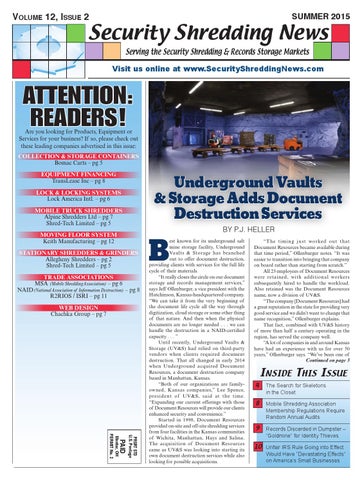
est known for its underground salt mine storage facility, Underground Vaults & Storage has branched out to offer document destruction, providing clients with services for the full life cycle of their materials. “It really closes the circle on our document storage and records management services,” says Jeff Ollenburger, a vice president with the Hutchinson, Kansas-headquartered company. “We can take it from the very beginning of the document life cycle all the way through digitization, cloud storage or some other thing of that nature. And then when the physical documents are no longer needed . . . we can handle the destruction in a NAID-certified capacity . . . ” Until recently, Underground Vaults & Storage (UV&S) had relied on third-party vendors when clients required document destruction. That all changed in early 2014 when Underground acquired Document Resources, a document destruction company based in Manhattan, Kansas. “Both of our organizations are familyowned, Kansas companies,” Lee Spence, president of UV&S, said at the time. “Expanding our current offerings with those of Document Resources will provide our clients enhanced security and convenience.” Started in 1998, Document Resources provided on-site and off-site shredding services from four facilities in the Kansas communities of Wichita, Manhattan, Hays and Salina. The acquisition of Document Resources came as UV&S was looking into starting its own document destruction services while also looking for possible acquisitions.
“The timing just worked out that Document Resources became available during that time period,” Ollenburger notes. “It was easier to transition into bringing that company on board rather than starting from scratch.” All 23 employees of Document Resources were retained, with additional workers subsequently hired to handle the workload. Also retained was the Document Resources name, now a division of UV&S. “The company [Document Resources] had a great reputation in the state for providing very good service and we didn’t want to change that name recognition,” Ollenburger explains. That fact, combined with UV&S history of more than half a century operating in the region, has served the company well. “A lot of companies in and around Kansas have had an experience with us for over 50 years,” Ollenburger says. “We’ve been one of
Continued on page 3
Inside This Issue 4
The Search for Skeletons in the Closet
8
Mobile Shredding Association Membership Regulations Require Random Annual Audits
9
Records Discarded in Dumpster – “Goldmine” for Identity Thieves
10 Unfair IRS Rule Going into Effect Would Have “Devastating Effects” on America’s Small Businesses
www.alleghenyshredders.com
2 Security Shredding News Summer 2015
solutions@alleghenyshredders.com
Security Shredding News
Underground Vaults & Storage Adds Document Destruction Services Continued from page 1
PUBLICATION STAFF Publisher / Editor Rick Downing Contributing Editors / Writers P.J. Heller Ann C. Logue Sandy Woodthorpe Production / Layout Barb Fontanelle Christine Pavelka Advertising Sales Rick Downing Subscription / Circulation Donna Downing Editorial, Circulation & Advertising Office 6075 Hopkins Road Mentor, OH 44060 Ph: 440-257-6453 Fax: 440-257-6459 Email: downassoc2@oh.rr.com www.securityshreddingnews.com
For subscription information, please call 440-257-6453 Security Shredding News (ISSN #1549-8654) is published bimonthly b y D o w n i n g & A s s o c i a t e s. Reproductions or transmission of Security Shredding News, in whole or in part, without written permission of the publisher is prohibited. Annual subscription rate U.S. is $19.95. Outside of the U.S. add $10.00 ($29.95). Contact our main office, or mail-in the subscription form with payment. ©Copyright 2015 by Downing & Associates. Printed on Post-Consumer Recycled Paper
the only, and certainly the largest, Kansas-based this time,” Ollenburger says. “We are definitely in storage companies and we have had interactions and an acquisition mode. We’re looking to continue to done business with a lot of companies and groups in grow our footprint.” the state through our storage business. I think there’s The company is also looking at technology as some name recognition and trust that we’ve built up a way to grow, such as creating data centers in some over that time span. Also, we inherited a great deal of of its underground facilities. good will when we purchased Document Resources.” “We’re at the early stages of that analysis but After the acquisition, UV&S embarked on we think there’s some opportunity to get beyond a major $1.7 million expansion plan in Wichita, just paper storage and into digital storage more so consolidating its existing records center and the than we have been,” Ollenburger says. “As a smaller Document Resources facility into a new 150,000company, we’re pretty nimble, and as opportunities plus square foot building. About 25,000 square present themselves, regardless of what they may feet is dedicated to the document be and what they may look like, destruction operations center. The we can react pretty quickly. You The company upgrade included installation of a never know where a road might operates in nine new shredder and auto-tie baler, lead us and I think our company both of which became operational Midwest locations, is well positioned, both from a June 22. leadership standpoint and from including its “The new shredding equipment a financial standpoint, to be able functions at a level that will increase to move quickly and react when underground the speed and efficiency of our present themselves.” storage facilities in opportunities shredding capabilities as much as The company operates in nine 60 percent,” Spence notes. “The Kansas City, Mo., Midwest locations, including its need for local, secure destruction underground storage facilities in of documents is continuing to grow and Louisville, Ky. — Kansas City, Mo., and Louisville, and our goal is to meet that need at both limestone mines Ky. — both limestone mines — and the highest levels of safety, security salt mine some 650 feet below — and its salt mine its and output.” the earth’s surface in Hutchinson, Smaller size shredders are some 650 feet below KS. Items stored in the mines in located in Manhattan, where the addition to documents include Document Resources facility the earth’s surface in such things as artwork, movie has since been moved to a larger props, museum artifacts and Hutchinson, KS. building, and in Hays. The motion picture film elements. The Document Resources division also operates five company boasts thousands of satisfied clients from mobile shred trucks along with 13 other vehicles to more than 24 countries. service clients. Ollenburger says that while many customers “A majority of our clients tend to opt for the talk about customer service, he believes this is really off-site shredding back at our facility,” Ollenburger what sets UV&S apart from the competition. notes, adding, “We are prepared and willing and able “We know when clients want something, they to do whatever the client requires.” want it,” he says. “We work very hard to get that The growing demand for shred services is information to them quickly so they can make a confirmed by Document Resources statistics. In decision. Sometimes we’re not always the best fit for 2013, one year before the acquisition by UV&S, it what they’re looking for, but the majority of the time processed approximately 5 million pounds of paper; we seem to be providing them exactly what they’re the following year the division processed 7 million looking for at a fair price. People like to do business pounds. Totals so far this year are ahead of 2014, with us. That serves us well through all our platforms.” according to company officials. UV&S was founded in 1959 by a group of Document destruction services are primarily Wichita businessmen who came up with the idea of aimed at customers in Kansas, although a shredding underground records storage for security purposes facility was added to UV&S’s storage center in at the height of the Cold War era. The company Kansas City, Mo. Plans are in the works to set up a today, with some 125 employees, remains closely full-scale document destruction transfer station at its held by the original founding families, some now Oklahoma City facility and to expand that model to second- and third-generation. other storage locations, including one in Kentucky. “That family-run business model has served us Utilizing that “spoke and hub” model for well for over 50 years,” Ollenburger says. “We’re getting the children and grandchildren document destruction will allow the company to that still refer back to their parents’ or grandparents’ expand into a variety of markets, Ollenburger vision and long-term plans for this company,” adds predicts. “Our long term goal would be to continue Ollenburger, who has been with UV&S for five years. to add both storage and document destruction “It’s fun to listen to the historical perspective through facilities around the Midwest,” he says. their eyes and use that as a guiding reference for where Among possible areas for expansion: Nebraska, this company could go ... It still feels like a pretty Colorado, Texas and Arkansas. small family-run business although our footprint is “We’ve looked at opportunities all around the getting pretty large across multiple states.” country but they haven’t been the right fit for us at
Security Shredding News Summer 2015
3
Security Shredding News
The Search for Skeletons in the Closet By Ann C. Logue
D
ue diligence, in a legal or business context, is the process of investigating the parties involved in a pending agreement to ensure none has hidden information pertinent to the agreement. It’s the search for skeletons in the closet. In electronics recycling, the potential skeletons could be cathode-ray tube televisions stockpiled in a storage facility, improper handling and packaging of lithium-ion batteries for recycling, or a container of circuitboards shipped for recycling through a port in a country that bans such material. Performing due diligence in electronics recycling requires looking at the past, present, and ongoing behavior of companies you do business with to ensure they’re complying with applicable laws, regulations, or business agreements. This tracking must continue to that company’s downstream customers who purchase the electronic devices, their parts, and their scrap commodities—and to service providers who manage focus materials that require special handling or disposal. The downstream tracking ends only with the consumer of the scrap commodity, the company that sells the used electronic product or part to its next user, or the facility that accepts focus materials for disposal. This downstream due diligence, which began primarily as a requirement imposed by government, institutional, and large corporate suppliers of electronics for recycling, has led to real improvements in environmental, health and safety, and trade practices, industry participants say, but at a significant cost to electronics processors. Over the past decade, groups with an interest in electronics recycling have come up with ways to ease the process, most notably certification to one or more standards. The need for downstream due diligence is not going away. The good news is that most companies involved in electronics processing are familiar with the requirement, so they are not taken off guard by the request for information, nor should they consider such requests odd or unreasonable, says Darrell Kendall, director of the Recycling Industry Operating Standard™. (ISRI established RIOS™ and R2/RIOS™, which combines RIOS with the R2 standard for electronics recyclers from Sustainable Electronics Recycling International in Boulder, Colo.) The growing prevalence of certification should make the downstream due diligence process easier in the future, Kendall says. He estimates that certified companies now handle a vast majority of U.S. scrap electronics, and that proportion is likely to increase. When your company gets certified to one or more of the standards for electronics recyclers, you undertake a process of proving to a third-party auditor that your operations meet the requirements of that standard. Most certifications must be renewed every few years to ensure your practices remain in compliance. “Certification is a significant investment,” Kendall says, but increasingly suppliers are requiring it. (For the most common certifications in electronics processing, see “A Quick Look at the Standards” on page 5.) Your certification often meets the due-diligence requirements of your upstream suppliers, but it does not make it any easier for you to conduct due diligence on downstream vendors. Certification might even require greater due diligence—more documentation or more frequent audits—than your suppliers require. The benefit comes when your downstream vendors get certified, too. The hope is that downstream vendors will see the benefit of third-party certification to get access to suppliers that require it or prefer it to conducting some or all of their own due diligence.
Paper and In-Person Reviews
H
OBI International (Dallas) has been providing electronics recycling services to businesses since 1992, and it was performing downstream due diligence long before certification became the norm, says President Craig Boswell. Even when its downstream vendors are certified, it often conducts additional due diligence because one of the services it offers is reporting on corporate sustainability goals or specific compliance issues a client may face. HOBI’s staff starts its due diligence by sending an initial questionnaire to downstream vendors asking them to provide documentation of their environmental,
4 Security Shredding News Summer 2015
Electronics processors have been conducting due diligence on their downstream vendors for years. As more downstream firms get certified, the process should become easier, but recyclers must remain vigilant. safety, and health systems, such as their emergency response plans and focus material plans; their compliance with environmental and health and safety requirements; and their downstream vendors, Boswell says. Companies that present good information at this stage warrant a site visit. Some due diligence can and should be done without contacting the downstream vendor, these companies say. For example, Kelley Keogh, managing director and cofounder of Greeneye Partners (Santa Rosa, Calif.), recommends searching the U.S. Environmental Protection Agency’s Enforcement Compliance and History Online site, or ECHO (echo.epa.gov), which contains data for 800,000 facilities on their permits, inspection dates and findings, violations, enforcement actions, and penalties assessed, along with substantial additional information. OSHA has a website that allows you to review facilities’ recent health and safety violations, she adds, and many states and some countries also maintain online databases of environmental violations, health and safety problems, and transportation issues. Not every country makes finding such information as easy as a few keystrokes, but it’s also not impossible, she says. Official forms are difficult to fake, but nonstandard items, such as bills of lading, could be counterfeited if a company had impure motives, however. Due diligence doesn’t require that you conduct site visits or on-site audits, but many in the industry highly recommend them. A visit to a downstream vendor should include a look at the company’s health and safety practices, on-site waste generation and management, reuse and refurbishment activities, inventory control and storage, site security, and recordkeeping. Over time, “you get a fairly good understanding of what to look for, and you get a pretty good understanding of where [companies] hide the skeletons,” Boswell says. The biggest surprise on these visits, he says, is when a vendor sends a great audit package—providing all the requested documents—but the site’s appearance and operations don’t show the same care and attention as the paperwork did. Wm. Miller Scrap Iron & Metal Co. (Winona, Minn.), which handles metal and electronic scrap, conducts audits of its scrap suppliers and customers. “We try to do [audits] on both ends so we know the quality of the materials we are buying as well as how our downstream vendors process [them],” says Jeremy Miller, chief financial officer. In many cases, Miller says, downstream companies also need to audit his company to ensure that it appropriately handled whatever it shipped to them. Given that few electronics recyclers are either at the very beginning or the very end of their supply chain, being audited is a fact of life, he says, estimating the company gets five to 10 visits each year from other links in its supply chain plus annual audits that are part of the company’s R2/RIOS certification. “We welcome audits. We’re very proud of our operations,” Miller says. He views the process as one of building strong relationships with customers and suppliers, part of a corporate culture he credits with allowing his family business to have succeeded for more than a century.
Common Obstacles
P
erforming due diligence on your direct suppliers and buyers tends to be easier than researching the second, third, or further company down the supply chain, but following the entire length of the material chain is important. “That’s where the problems are, and that’s where you have the cost,” Boswell says. Sometimes a partner in the chain is sending material to a noncompliant company but does not want its customers to know that, thus it will object to providing information or allowing a visit, conceal that information, or falsify its records, Kendall says. The biggest objection recyclers hear is regarding proprietary information. The proprietary argument has two parts, Boswell says. The first is the concern that the due diligence will expose a trade secret, most likely when companies find new markets or develop new ways to process materials. Given how quickly new electronic products enter the market and uses of old electronics change, new markets and processes are not uncommon. When facing that objection, Boswell says, his response is, “We don’t want to know the process. … We just want to understand the results.” HOBI’s
Continued on page 6
Security Shredding News A Quick Look at the Standards Recycling Industry Operating Standard™ • • • •
Established in 2004 by ISRI Emphasis is on quality, environmental protection, and health and safety For recyclers of paper, metal, plastics, rubber, glass, or textiles Integrated with ISO 9001, ISO 14001, and OHSAS 18001 www.certifymerecycling.org
R2 Standard for Responsible Recycling
• Established in 2008 by a group of electronics manufacturers, recyclers, and other stakeholders with the input of the U.S. Environmental Protection Agency • Managed by Sustainable Electronics Recycling International www.sustainableelectronics.org
R2/RIOS™
• Established in 2009 by ISRI by combining the R2 standard with the RIOS standard www.certifymerecycling.com
e-Stewards®
• Established in 2009 by the Basel Action Network • Integrated with ISO 14001 and coordinated with OHSAS 18001 www.e-stewards.org
ISO 14001
• Established in 2004 by the International Standards Organization and undergoing revision • Current standards emphasize environmental management systems; revised standards will emphasize environmental performance www.iso.org/iso/iso14000
ISO 9001
• Established in 1987 by ISO and revised standards expected later this year • Addresses quality management systems www.iso.org/iso/iso_9000
OHSAS 18001
• Established in 1999 by the British Standards Institution • Addresses occupational health and safety • Will be replaced by a new standard, ISO 45001, in 2016 www.bsigroup.com/en-GB/ohsas-18001-occupational-health-and-safety
Collecting Sorting Recycling Phone:262.882.1227 Fax: 262.882.3389 www.bomaccarts.com
www.shred-tech.com www.shred-tech.com
Security Shredding News Summer 2015
5
Security Shredding News
The Search for Skeletons in the Closet
Continued from page 4
staff members will sign nondisclosure agreements in certain circumstances, such as when it’s essential that they see the specifics of a new processing technique. The second concern downstream vendors often voice is that when you get the list of their customers, you’ll cut out the middleman and take your business directly to the next step in the chain. Boswell says this is not much of an issue for HOBI, given its size, but it can be an issue for smaller companies. As certification becomes more prevalent, this objection will become less common, he adds. When downstream materials are exported, the due diligence requirements become even tougher. Shipped materials need to comply with the laws, international agreements, and regulations of their origin and destination ports as well as every port in between. If a shipment from the United States headed for France stops at the Port of Montréal, for example, then the materials in the shipment have to comply with laws in
both Canada and the European Union. “In America, it is not illegal to export anything,” explains Joe Clayton, vice president of sales for MRP Co. (Baltimore), although the EPA regulates the export of cathode-raytube devices. “In other countries, it may be illegal to import things.” Metals travel freely in most of the world, Clayton says, but electronics equipment does not. For example, some countries do not accept imports of used circuitboards. Others have laws limiting the age of used, functioning equipment they will accept—and the clock keeps ticking when the material is in transit. More than one recycler has faced a crisis, Clayton points out, after shipping electronic equipment that was less than four years old when it left the United States, but it had passed that cut-off age when it arrived at its destination. Part of due diligence work for companies that export is documenting the details of such exports and confirming they are in compliance.
STRONGER TOGETHER
1st Annual MSA Conference Embassy Suites Hotel | Charlotte, NC 28217 | Oct 10, 2015
Conference Registration Now Open
Consultants and Other Resources
H
OBI’s environmental, health, and safety manager conducts most of the company’s due diligence site visits, which are annual for its primary downstream partners. It and many other companies use consultants for some overseas visits to downstream traders and processors. Consultants can reduce the work involved and can be less costly than doing the work yourself, recyclers say. Greeneye Partners is one of several consulting firms that prepare due-diligence reports for electronics recyclers, including reports that require overseas travel. By working for several clients at once, consultants often can undertake such travel more cost-effectively than each recycler going on its own. Ideally, the consultants’ familiarity with electronics processing in the countries they’re visiting will allow them to better address cultural issues that might affect the visit. Greeneye Partners’ auditors visit some sites annually and overseas smelters every three years, Keogh says. She recently returned from India, where she visited the world’s only CRT glass furnace still in operation, she adds. More certification of downstream vendors overseas also will ease the due diligence burden somewhat. SERI plans to expand the market for its R2 certification program internationally this year, starting with companies in Latin America and Asia, says Sharada Rao, director of quality. Within the United States, a good resource for ISRI members is the association’s Superfund Recycling Equity Act Reasonable Care Compliance Program reports. The reports, which document scrap consumers’ environmental compliance with federal laws and regulations, cost as little as $25 each. Keogh says she’s surprised more companies don’t take advantage of this service, as it greatly simplifies the due-diligence process. One start-up company has a novel approach to easing downstream vendors’ concerns about sharing proprietary information. The mission of DownStream Security (Cleveland) is to help scrap companies track their inventory and ensure that all of their downstream vendors hold either R2 or e-Stewards® certification—without revealing those companies’ names to their upstream clients. “We’ve worked with
Continued on next page
Now Even More Options for Customers Who Want Their Own Key Codes! Lock America Adds More New Key Codes for Padlocks and Console Locks.
Conference Sponsors
• Give your drivers and customers a single key that fits all the locks at a site. • Ask your console or bin supplier for new available key codes, or contact Lock America directly.
One Key Can Now Operate All Your Locks!
www.MobileShreddingAssociation.com
6 Security Shredding News Summer 2015
Tel: (951) 277-5180 Fax: (951) 277-5170 www.laigroup.com
800-422-2866
9168 Stellar Court Corona, CA 92883 sales@laigroup.com
Security Shredding News Continued from previous page a lot of companies in the R2 process,” says Bo Lurch, the company’s vice president. “We’ve all sat around and complained about the same things.” Certification registrars such as Perry Johnson Registrars (Troy, Mich.), SGS (Geneva), and Orion Registrar (Arvada, Colo.) do not yet support the idea of a private data repository, Lurch says, but he and company president Scott Brainard think they can make the case for a completely confidential database that standards organizations such as SERI will support. The registrars will have access to all the information stored on DownStream Security’s database during each client audit, he explains. The company is testing the system with local, private e-scrap companies in Ohio and plans to demonstrate it at the E-Scrap Conference in September, Lurch says.
Constant Vigilance
T
he due-diligence process is just that—a process—which means it’s ongoing. “All certifications are event-based audits,” Clayton says. “An ISO certification is of the day that the auditor was there.” That’s the greatest risk in due diligence: Things change all the time, for all sorts of reasons. A common problem, Kendall says, is that a downstream company changes one of its vendors and does not notify the upstream companies. “That’s absolutely a game-changer in terms of the business relationship,” he says: It not only knocks the upstream company out of compliance, but it also might indicate that the downstream company isn’t always doing the right thing. Some problems only become evident over time. An electronics processor might have a few CRTs on site on the first visit, which is reasonable. After several visits, it will become clear whether the company has a problem with CRT accumulation. (The EPA and some states regulate the storage of intact and broken CRTs as well as CRT glass; storing such material beyond specified volumes and time frames can trigger hazardous waste regulations.) That’s why annual site visits and certifications matter. SERI plans to increase its audits of certified firms to ensure they adhere to the R2 standards after they achieve certification, Rao says. “Unless we have some rigorous oversight, recyclers won’t respect it.” Although recyclers rely on certification as evidence that a buyer or seller is following proper procedures, they will need to verify that the certification is current. Even when you perform an on-site audit, “window dressing” is a risk. A company might move excess volumes of CRTs to a storage locker, hand out personal protective
equipment to show a concern for safety, and clean up the processing facility the day before an auditor visits, for example. Kendall says window dressing takes effort— effort companies could have put into bringing a site into compliance. Nevertheless, it has happened, he says, which makes frequent audits important. It’s more difficult to pull off the act many times or on short notice. Boswell says it’s difficult to get window dressing past a proper auditor, in part because so much of the documentation required for certification or due diligence is standard. That doesn’t mean it doesn’t happen. “If [a company is] willing to lie to me and defraud me, that can be difficult to detect,” he says. And that, ultimately, is a risk of being in business. By this point, almost all U.S. electronics recycling businesses have encountered the certification or due diligence process, as have many outside of the United States. Some still need to be convinced that there is a business reason for adopting such practices. Over the long run, Rao says, smaller operators that do not do so will get out of the market. There will be fewer and fewer recycling firms run by one person in a garage, and that will reduce the risk to the industry, she says. Whether you’re conducting due diligence for certification or just as a good business practice, it’s the right thing to do for workers and communities, recyclers say. It can be a hassle, but it can prevent greater future hassles. A due-diligence report is the starting point in a relationship, not an endpoint, Clayton notes. “Some people trust,” he adds. “Some people trust but verify.” Ann C. Logue is a freelance writer based in Chicago. This article originally appeared in the March/April 2015 issue of Scrap magazine. Reprinted with permission from Institute of Scrap Recycling Industries (www.isri.org).
www.chachkagroup.com chachka@chachkagroup.com Security Shredding News Summer 2015
7
In the News Mobile Shredding Association Membership Regulations Require Random Annual Audits
A
s of January 2015, the Mobile Shredding Association (MSA) upgraded its membership model to be comprised of only certified members. MSA explains that with membership certification there is the responsibility of members to demonstrate they meet the certification regulations. Hence, MSA performs unannounced audits on its members to ensure membership certification regulations are maintained at all times. “Because onsite mobile shredding is a closed loop process and allows the shredding client to view the destruction of their records, MSA certification audits are not as cumbersome and expensive as competing certifications which attempt to certify all methods of records destruction including offsite shredding. Clearly, if the shredding process itself is secure in that it is confined to onsite shredding, security elements are narrowed in scope to personnel, equipment, and safeguards such as insurance, and employee confidentiality agreements” states MSA Executive Director Trace Hartridge. “This is the whole platform of the Mobile Shredding Association; not only is mobile shredding the most secure method of records destruction, but it is also the most efficient way to certify and audit.” All certified members of the Mobile Shredding Association, during the application process, certify that their company will consent to unannounced, random audits conducted by MSA as a condition of membership. If the member company is selected for an audit, they agree to immediately make available current proof of all of the requested documentation to prove that they meet certification regulations. If a company is unable to provide proof of the required documents during an annual random audit, their membership/certification will be revoked and removed from the MSA website pending further review. During this review stage, MSA members will have 10 days to successfully demonstrate they meet the required regulations. The membership will be terminated if they do not successfully complete the audit during the 10 day window. If terminated, the shredding company must immediately relinquish all claims and benefits of membership.
www.transleaseinc.com
tlee@transleaseinc.com
Advertise in Security Shredding News, call 440-257-6453.
Save the Date! SM
Shred School is making five more stops in 2015. You will learn about legislation, sales best practices, marketing and social media strategies, NAID resources, and much more at this two-day industry workshop.
SM
July 22-23 Chicago, IL
A member education service of NAID
SM
San Diego, CA
www.shredschool.com
8 Security Shredding News Summer 2015
Columbus, OH July 22-23 Aug. 26-27 Sept. 23-24 Oct. 21-22 Nov. 18-19
Oct. 21-22
Shred your competition by registering for a Shred School workshop today!
Aug. 26-27
Sept. 23-24
San Antonio, TX
Nov. 18-19 Orlando, FL
Chicago, IL Columbus, OH San Antonio, TX San Diego, CA Orlando, FL
In the News Mobile Shredding Association to Hold Elections in the Fall MSA Will Hold Fall Elections for Members to Fill Open Board Seats for the 2016 -2017 Term
I
n its ongoing commitment to offer the shredding industry an association that is owned and managed by independent shredding companies, the Mobile Shredding Association (MSA) is seeking nominations from its members for its upcoming election. The current Interim Board of Directors was established to govern the early development of MSA, and have worked hard to help MSA achieve early milestones such as seeking non-profit status, implementing an all certified membership model, and charting its future course of direction. “I am extremely pleased with the governance and direction the interim Board of Directors has provided our organization during our startup years. Not only do they represent over 50 years combined experience in the shredding industry, but they have brought a wealth of business experience from other professions across the country to the table as well,” says Trace Hartridge, CEO of MSA. Moving forward, in order to ensure Board continuity, the Directors seats will be staggered – serving terms of two years each. During the elections this fall, MSA will be seeking to initiate the staggered seats by replacing a portion of the interim seats with elected Directors. Elections for the 2016 - 2017 term will be held at the fall conference, being held in Charlotte, N.C. on October 15. Members may cast their vote on the day of the election, or email their vote during the week prior to the 2015 Conference. For more information on the elections, or to receive the Member Nomination Form, email MSA at: membership@ mobileshreddingassociation.com.
Records Discarded in Dumpster – “Goldmine” for Identity Thieves
R
ichmond, KY – Hundreds of patient records from a radiologists’ office were found in a dumpster at a rental storage facility here, according to DotMed.com. A man visiting his storage unit discovered the records and took the boxes to Baptist Health Hospital, which is located nearby. Names, social security numbers, credit card information were on the files determined to have belonged to Richmond Radiology. The medical group closed its doors about 15 years ago and the file boxes were moved to a unit at AAA Rent-A-Space. The unit was abandoned in July 2011 and had been emptied this year, according to local news reports. According to a Baptist Health spokesperson, the hospital is storing the records in a secure location and has contacted a representative from Richmond Radiology. An OCR investigation is pending. When health care practices close, responsibility for protecting confidential patient records continues. HIPAA requires that records be kept for six years before being destroyed.
Comprenew Drives Michigan e-Recycling Market
G
rand Rapids, MI – Electronics recycler and refurbisher, Comprenew, is helping to ensure the resting place for old TVs, monitors, computers and other gear is not in the landfill, backyards or vacant dumping grounds, according to a WoodTV.com story. Once a designated IBM mainframe recycler, Comprenew turned nonprofit and now helps Michigan residents recycle their old electronics. Grant money from Michigan’s Department of Environmental Quality, has enabled the organization to add 10 new drop off sites this year to its 19 existing sites. Comprenew also operates four retail stores/repair centers where people can purchase refurbished electronics, including computers and printers, even vintage stereo components. The work of gutting the electronics and sanitizing memory drives is done by volunteers who are trained through a workforce development program run by the company. According to its website, the program provides jobs and mentoring opportunities for high risk innercity youth.
Mark Your Calendar!
November 4 - 5, 2015
Palais des Congrès, Montréal, QC Canada Canada’s ONLY trade event serving the waste, recycling and public works markets
Where key buyers from all segments of the industry find the latest innovations. Composting • Construction & Demolition Waste • Scrap Recycling • Infrastructure Redevelopment / Public Works • Incineration / Gasification / Thermal Technologies • Landfill • MRFs / Transfer Stations / Storage / Containers • Recycling • Waste Treatment / Disposal • Software / Technology • Trucks & Transportation Equipment
WANT TO KNOW MORE? CONTACT ARNIE GESS +1.403.589.4832 Arnie.Gess@CWRE.ca www.CWRE.ca
co-located with
Security Shredding News Summer 2015
9
In the News Consulting Subsidy Available for First-time Certifications
T
he NAID Board of Directors has approved a program to assist first-time certification applicants by subsidizing the use of approved consultants. Effective July 1, NAID will now provide a subsidy to members that retain an approved consulting firm to help them apply for and obtain NAID AAA Certification. The program was launched in response to member feedback indicating they would move forward if such counsel were available. To date, JT Environmental is the only consulting firm that has applied to participate. According to the Jason Teliszczak, CEO at JT Environmental, the subsidy is enough to cover most, if not all, of the costs of their basic NAID package. “NAID’s certification program is pretty straightforward, with many of the forms and template already provided,” said Teliszczak. “Because of our extensive involvement in helping others achieve this certification, we have a suite of services and documents that make the process easy and seamless.” There are a limited number of subsidies available in any one year. Non-certified members interested in participating are encouraged to contact NAID.
Prepare for OCR Phase Two HIPAA Audits
W
ashington, D.C. – As the Department of Health and Human Services Office for Civil Rights (“OCR”) works to finalize the procedures for its “Phase Two” HIPAA audits, health law attorney Daniel J. O’Brien urges business associates to review their security procedures and policies. Writing in the Benesch Health Law blog, O’Brien says, “If you are a covered entity or business associate, this delay in the launch of Phase Two audits provides a great opportunity to conduct a comprehensive assessment of your current HIPAA compliance program.” “This means doing much more than just checking boxes and having an old binder of policies and procedures on your shelf. Instead, covered entities and business associates need to take real action, such as reviewing the audit protocol from the pilot program and applying it to your organization, conducting a risk assessment, engaging a dialogue with your compliance officer, and reviewing/ updating training materials, among others. Being proactive now will go a long way towards easing the burden of Phase Two audit, should your organization be selected.” Phase Two was to have been activated before the end of 2014. O’Brien thinks the delay may be the result of behind schedule implementation of the technology that OCR will use to collect audit-related documentation from covered entities and business associates via a web portal. An official date for the launch of Phase Two audits has not yet been announced.
ISO Audits Can Substitute NAID Scheduled Audits
T
he National Association for Information Destruction (NAID) Board of Directors has approved a provision of the certification program that allows members to replace the scheduled audits with ISO audits under certain conditions. “This will have less impact in North America,” said NAID CEO Bob Johnson. “But it could be a big advantage for members in other regions where ISO audits are commonly required for other reasons ITAD service providers who use ISO auditors can also benefit.” To replace NAID scheduled, onsite audits, ISO auditors must agree to evaluate policies and procedures, the physical environment, and records documenting compliance with the NAID AAA Certification Program specifications. ISO auditors will have to verify with NAID that the standard is integrated into procedures manuals and provide NAID with a copy of the audit results. “Requiring a scheduled audit prior to awarding certification and periodic audits afterward, is a critical aspect of our program,” said NAID Certification Rules Chair Eric Haas. Regardless of which option is used for the schedule audits, NAID says it still requires certified members undergo unannounced, random audits. The advantage for those already undergoing ISO audits is that the application fee is significantly lower and they can save time and resources by avoiding two separate audits.
10 Security Shredding News Summer 2015
NY Local Governments: “Let Manufacturers Pay for e-Waste Recycling”
L
ockport, NY – Two New York state localities fed up with the burden of dealing with e-waste are fighting back, according to a WKBW.com report. Niagara and Orleans counties have urged New York’s state government to amend its e-waste law and shift the main responsibilities back to manufacturers. The municipalities have banded together to force legislators to look at ways in which the state’s Electronic Recycling and Reuse Act, is not working. Since New York’s “E-Waste” law took effect January 1, 2015, the volume of old electronics - especially cathode ray tube TVs and monitors - being turned in during community recycling drives has increased dramatically in recent years. The current law prohibits residents from placing e-waste out for curbside trash pickup. Now, the localities are in a bind because they are not equipped or funded to deal with the amount of waste people are bringing to collection sites. The Niagara-Orleans Regional Alliance (NORA) is has sent a resolution to Governor Andrew Cuomo and the State Legislature calling for an amendment to the law.
Unfair IRS Rule Going into Effect Would Have “Devastating Effects” on America’s Small Businesses In Light of Bipartisan Legislation Introduced in Congress, NASE Calls on Treasury to Immediately Delay Rule until End of the Year
W
ashington, D.C. – A new Internal Revenue Service (IRS) policy imposing a $100 a day fine per employee on small businesses that offer traditional health reimbursement accounts (HRAs) went into effect July 1, 2015 and the consequences could be crippling for America’s smallest employers. The National Association for the Self-Employed (NASE), the nation’s leading advocate and resource for the self-employed and micro-business community, is calling on the U.S. Treasury Department to immediately delay the policy until the end of the year in order for bipartisan legislation to pass through Congress to remedy the situation. “Currently in Congress bipartisan legislation has been introduced that would fix this unintended consequence of the Affordable Care Act,” said Katie Vlietstra, NASE’s Vice President for Government Relations and Public Affairs. “The Treasury Department should immediately announce a delay in this rule until the end of the year in order for the legislative process to work and for small businesses to be spared the devastating effects this IRS rule could have across America’s Main Street.” In February, the U.S. Department of the Treasury’s announced a delay in the enforcement of the technical guidance issued in September 2013 regarding Health Reimbursement Arrangements (HRAs), a key health care tool for America’s smallest employers. The February delay expired July 1, 2015 and fines could begin to be imposed on businesses not meeting the requirement for group coverage plans that provide health care assistance for their employees through the use of traditional HRA accounts. The bipartisan Small Business Healthcare Relief Act introduced last week in Congress by Reps. Charles Boustany (R-La.) and Mike Thompson (D-Calif.) in the U.S. House and Sens. Charles Grassley (R-Iowa) and Heidi Heitkamp (D-N.D.) in the U.S. Senate would provide a remedy to this situation by enabling small businesses to continue to use Health Reimbursement Arrangements (HRAs), which allow employers to provide pre-tax dollars to employees to pay for medical care and services. Vliestra concluded, ““Health Reimbursement Accounts have historically been a very powerful and effective tool for the small business community. HRA’s allow small business owners to do the right thing by helping provide financial assistance to their employees for qualified health care expenses. Which should be applauding them for wanting to help their employees access affordable health care coverage, not punish them with arbitrary IRS policies that could cripple their business.” When the technical guidance was originally issued back in 2014, NASE provided comment on the guidance stating that, “the technical guidance misinterprets the intent of the ACA as it relates to these types of tools (HRAs) used to provide financial support to employers with less than 50 employees.”
IS YOUR RECYCLER CERTIFIED? Do the right thing. Work with an R2/RIOS™- certified facility. The R2/RIOS™ difference is that reuse and recycling are the primary objectives in the lifecycle of electronics. This means fewer materials are sent to landfills. Further, R2/RIOS™ helps protect the environment by extending the life of equipment, parts and components. Tested, functional equipment is sent back into the marketplace for reuse.
As a company partnering with an R2/RIOS™-certified facility, you can have the confidence your electronics are being recycled with the highest regard for the environment and the health and safety of employees and the public. www.certifymerecycling.org/partner To find an R2/RIOS™-certified partner, visit: certifymerecycling.org/partner. www.certifymerecycling.org/partner
Each certified facility aims to protect a customer’s brand by: •
Requiring proper data destruction to wipe out confidential information
•
Holding the highest standards for data protection, such as those mandated by HIPAA regulations
•
Offering the sole program that combines quality, environmental, health and safety requirements into a single management system
Security Shredding News Summer 2015 11
POWERFUL
KEITH Drive Unit
SAFE
No Tipping To Unload
FAST
Unloads In Under 5 Minutes
SEE IT WORK
Scan code or visit: www.youtube.com/user/KeithMfgCo youtube.com/user/KeithMfgCo
IT’S WHAT WE DO
™ If you want a fast RELIABLE and efficient SELF-UNLOADER, the KEITH® WALKING FLOOR® is the solution for you. With a load CAPACITY of up to 16 ton*, the system stores shredded documents and AUTOMATICALLY unloads them once the truck reaches a secure location.Your truck is your CHOICE. Make sure the unloader is KEITH. *KMD 300
www.keithwalkingfloor.com
1-800-547-6161 2015 KEITH Mfg. Co. KEITH, KEITH logo and WALKING FLOOR are registered trademarks of KEITH Mfg. Co. Manufactured under license.