Volume 11, Issue 2
apr-jun 2014
Security Shredding News Serving the Security Shredding & Records Storage Markets
Visit us online at www.SecurityShreddingNews.com
ATTENTION: READERS ! Are you looking for Products, Equipment or
Services for your business? If so, please check out these leading companies advertised in this issue: Collection & Storage Containers Bomac Carts – pg 9 Jake, Connor & Crew – pg 6 Equipment Financing TransLease Inc – pg 7
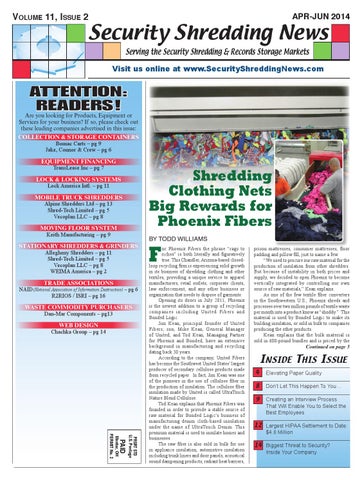
Shredding Clothing Nets Big Rewards for Phoenix Fibers
Lock & Locking Systems Lock America Intl. – pg 11 Mobile Truck Shredders Alpine Shredders Ltd – pg 13 Shred-Tech Limited – pg 5 Vecoplan LLC – pg 8 Moving Floor System Keith Manufacturing – pg 9 Stationary Shredders & Grinders Allegheny Shredders – pg 11 Shred-Tech Limited – pg 5 Vecoplan LLC – pg 8 WEIMA America – pg 2 Trade Associations NAID (National Association of Information Destruction) – pg 6 R2RIOS / ISRI – pg 16 Waste Commodity Purchasers Dan-Mar Components – pg13 Web Design Chachka Group – pg 14
By Todd Williams
F
PRSRT STD U.S. Postage
PAID
Mentor, OH Permit No. 2
or Phoenix Fibers the phrase “rags to riches” is both literally and figuratively true. This Chandler, Arizona-based closedloop recycling firm is experiencing solid growth in its business of shredding clothing and other textiles, providing a unique service to apparel manufacturers, retail outlets, corporate clients, law enforcement, and any other business or organization that needs to dispose of garments. Opening its doors in July 2011, Phoenix is the newest addition to a group of recycling companies including United Fibers and Bonded Logic. Jim Kean, principal founder of United Fibers; son, Mike Kean, General manager of United; and Tod Kean, Managing Partner for Phoenix and Bonded, have an extensive background in manufacturing and recycling dating back 30 years. According to the company, United Fibers has become the Southwest United States’ largest producer of secondary cellulose products made from recycled paper. In fact, Jim Kean was one of the pioneers in the use of cellulose fiber in the production of insulation. The cellulose fiber insulation made by United is called UltraTouch Nature Blend Cellulose. Tod Kean explains that Phoenix Fibers was founded in order to provide a stable source of raw material for Bonded Logic’s business of manufacturing denim cloth-based insulation under the name of UltraTouch Denim. This premium material is used to insulate homes and businesses. The raw fiber is also sold in bulk for use in appliance insulation, automotive insulation including trunk liners and door panels, acoustical sound dampening products, radiant heat barriers,
prison mattresses, consumer mattresses, floor padding and pillow fill, just to name a few. “We used to procure our raw material for the production of insulation from other shredders. But because of instability in both prices and supply, we decided to open Phoenix to become vertically integrated by controlling our own source of raw materials,” Kean explains. As one of the few textile fiber converters in the Southwestern U.S., Phoenix shreds and processes over two million pounds of textile waste per month into a product know as “shoddy.” This material is used by Bonded Logic to make its building insulation, or sold in bulk to companies producing the other products. Kean explains that the bulk material is sold in 600-pound bundles and is priced by the
Continued on page 3
Inside This Issue 4
Elevating Paper Quality
8
Don’t Let This Happen To You …
9
Creating an Interview Process That Will Enable You to Select the Best Employees
12 Largest HIPAA Settlement to Date: $4.8 Million 14 Biggest Threat to Security? Inside Your Company
25 YEARS
Contact a WEIMA Regional Sales Manager to View In-Stock Inventory
CUSTOMIZED
DESTRUCTION READY TO DELIVER INCREASING SPACE THROUGH WASTE REDUCTION 888-440-7170
www.weimaamerica.com WEIMAAMERICA.COM
Info Request #131
2 Security Shredding & Storage News. Apr-Jun 2014
INFO@WEIMAAMERICA.COM
Security Shredding & Storage News
Shredding Clothing Nets Big Rewards for Phoenix Fibers
Continued from page 1
PUBLICATION STAFF Publisher / Editor Rick Downing Contributing Editors / Writers Steven Branstetter Ken McEntee Jay Wallus Todd Williams Production / Layout Barb Fontanelle Christine Pavelka Advertising Sales Rick Downing Subscription / Circulation Donna Downing Editorial, Circulation & Advertising Office 6075 Hopkins Road Mentor, OH 44060 Ph: 440-257-6453 Fax: 440-257-6459 Email: downassoc2@oh.rr.com www.securityshreddingnews.com
For subscription information, please call 440-257-6453 Security Shredding & Storage News (ISSN #1549-8654) is published bimonthly by Downing & Associates. Reproductions or transmission of Security Shredding & Storage News, in whole or in part, without written permission of the publisher is prohibited. Annual subscription rate U.S. is $19.95. Outside of the U.S. add $10.00 ($29.95). Contact our main office, or mail-in the subscription form with payment. ©Copyright 2014 by Downing & Associates. Printed on Post-Consumer Recycled Paper
pound. He adds that the price for shoddy has remained stable for the past 15 years or so. Kean says the raw material, in the form of uniforms and other clothing, is sent to the Arizona plant in 20ton truckloads on pallets, where it is first hand‑sorted according to fabric type. The material is then machine cut into one-inch by one-inch squares. The cut cloth is then shredded, baled and stored until sold or sent to Bonded Logic for insulation manufacturing. The 90,000-square-foot facility is home to 40 employees who run three shredder lines, operating three shifts, five days per week. The facility processes two tons of textiles per hour. According to Larry Williams, Director of Marketing and Sales at United Fiber, clothing is sent to Phoenix by the truckload from all over Arizona as well as other locations across the country for shredding. Before this happens however, a proprietary process removes all button, zippers and tags. The material must be dry and unsoiled. “Our process of removing these items from the clothing is important because recycling of post consumer clothing has been difficult due to this contamination issue,” Kean adds. In addition to removing these items, Phoenix also recycles all the cardboard, paper and plastic packaging that was used to wrap new clothing, such as shirts. About 50 percent of the shredded cloth is sent over to Bonded Logic’s 120,000-square-foot plant for manufacturing into insulation and the other half of the material is sold for other purposes. To Williams, shredding clothing is as important as shredding documents. “If you shred your documents, then why not do the same with your uniforms? Companies are beginning to realize that uniforms can help people gain access to places they shouldn’t be. For example, there was a case where Somali pirates hijacked a ship wearing stolen uniforms to gain access,” he recounts. Williams says some of their biggest clients are entities such as the US Postal Service, United Parcel Service, IKEA, Bank of America, Pets Mart and Brinks, just to name a few. Phoenix does a brisk business in shredding damaged garments, obsolete fabrics, counterfeit clothing or product recalls. It also has started accepting linens from hotels and resorts. In addition to corporate clients, Phoenix gets tons of donated material through its partner Cotton, Inc. that runs a program called Blue Jeans Go Green. This program, started in 2006, garners old blue jeans from collection boxes all over the country and then ships the material to Phoenix for shredding and processing into insulation at Bonded Logic. A portion of this UltraTouch Denim insulation is then donated to Habitat For Humanity as well as to grants awarded to civic institutions. Kean notes that at the end of 2013, the Blue Jeans Go Green program received its one-millionth piece of donated denim. To date, the project has diverted 600 tons of denim from landfills and donated over 250,000
Photos courtesy of Phoenix Fibers. square feet of insulation to Habitat For Humanity affiliates and grant award recipients. “One of the best things about our business as well as the Blue Jeans Go Green program is keeping all that clothing out of landfills. It costs $30 to $100 per ton to put it in a landfill. This is also much better for the environment,” Kean says. Recently Phoenix, United and Bonded became involved in a program that has proved to be very effective and could be considered a model residential recycling program for the rest of the country. The small town of Queen Creek, Arizona is the first city in the nation to operate a municipal curbside clothing recycling initiative. Williams explains that Queen Creek residents are able to recycle materials like clothing, towels, sheets, blankets and shoes by putting them in a special bag placed into their regular curbside recycling bin. The textiles are taken to Phoenix for shredding then to Bonded Logic for manufacturing of insulation. Williams says he believes residential programs like this can work all over the country and are needed. “This is a major next step in recycling, and has the synergy to make a real impact. The town of Queen Creek earns back payment on the tonnage and that helps to pay for waste disposal and Boys & Girls Club of Queen Creek services, and it keeps rates down for residents,” he adds. On the commercial end of the business, notes Williams, customers who need fabric disposed have very few options. Obviously, one is to send it to a shredder company like Phoenix, dispose of it in landfills or send it to a third world country. He notes most companies are shying away from the third option because of negative branding issues associated with shipping clothing overseas With 12 million tons of textile waste being generated in North America each year (68 pounds per household), the EPA estimates that 5 percent of all landfill waste is comprised of textiles. And, notes Williams, states like California are putting even tighter restrictions on landfills, making textile disposal very difficult. Kean says tighter restrictions on landfills by states and the growing demand for reliable and less expensive products, has helped drive his family’s recycling businesses. “This isn’t a granola type environmental thing. This is a real business that has an impact on the environment,” says Kean. “Word of mouth and individual knowledge of the industry has led us to a very steady growth in our company. I see this continuing,” he adds.
Security Shredding & Storage News. Apr-Jun 2014
3
Security Shredding & Storage News
Elevating Paper Quality Paper recyclers hope revised processing practices, new equipment, and clearer specifications can improve the quality of their recovered fiber and reverse some of the recent declines in export demand. By Ken McEntee
I
n June 2012, Chinese authorities arrested seven people on charges of importing more than 4,000 tons of toxic waste mixed with recovered paper. Chinese customs officials reportedly developed respiratory and skin infections after inspecting a 30-container load of “waste paper” that was tainted with household chemicals. Officials sent the containers back to the Netherlands, where they had originated. For China, it was the breaking point. The country continued to grow as the manufacturing center of the world—and the dominant market for recovered paper from which to make containerboard packaging—yet it had become the dumping ground for contaminated fiber that mills in the United States and Europe wouldn’t accept. In early 2013, China implemented what became known as “Operation Green Fence” to strictly enforce laws that had been on the books for years regarding import quality, customs duties, and smuggling. Chinese environmental and customs officials subjected inbound scrap paper, plastic, and metals to close scrutiny for contaminated or prohibited materials. In effect from February to November 2013, Green Fence resulted in extensive—and expensive—rejections of unacceptable paper fiber and other recyclable commodities. The Chinese government sent rejected loads back to their country of origin at the expense of the shippers, who also were on the hook for demurrage and reloading charges. “It put us and everybody else on high alert,” says Jimmy Yang, owner of Newport CH International (Orange, Calif.). Green Fence was China’s response to U.S. and European scrap recyclers who had, for much of the past decade, perceived that market as the place to send materials for which they couldn’t find domestic buyers. “It was quite right for China to impose its own restrictions on quality control—that was its way of telling the world that there is a difference between what you think we should accept and what we think we should accept,” says Ranjit Baxi, founder and managing director of J&H Sales International (London). “It isn’t only China,” he adds. “Mills in countries like India and Indonesia also are crying out, saying they have specifications about the fiber they are going to buy. But the suppliers are only sending them what they deem to be fit.” Although the program sent shock waves through the industry, many exporters today think Green Fence was, in retrospect, a good thing for the paper recycling industry. They say it served as a wake-up call that has spurred those in the paper recovery chain to improve the overall quality of the recovered fiber supply—which has benefited both domestic and foreign mills.
The U.S. Quality Problem
T
he bulk of U.S. paper China rejected was from single-stream residential collections, exporters say. “Collections from the commercial stream have been well-tended-to for many years, but to meet the growth in demand from China, Europe and America had to look at the community recycling stream for additional volume,” Baxi says. “America resorted to single-stream immediately as the most convenient and cost-effective method of collecting—people can put everything into [one bin].” Procurement officials and plant managers at North American newsprint mills have been complaining about contamination in their feedstock since municipal curbside collection programs took hold in the 1980s and 1990s. The advent of singlestream has intensified the problem, they say, because paper gets thrown in the bin with metal, plastic, and glass. The latter is the most serious concern because tiny glass fragments can cause substantial damage to the equipment used to turn recovered fiber into new paper. “Certainly single-stream is one of the reasons for the drop in quality,” Baxi says. “Single-stream collection is going to have to be looked at very carefully if it is going to be expected to produce quality fiber that mills can use.” Recycling collectors and others have advocated for single-stream collection, asserting that it increases overall collections and reduces costs. In February, the U.S. Environmental Protection Agency (Washington, D.C.) published a surprising statistic, however: The U.S. recovery rate of recyclables from the municipal solid waste stream declined slightly, from 34.7 percent in 2011 to 34.5 percent in 2012. The
4 Security Shredding & Storage News. Apr-Jun 2014
recovery rate for postconsumer paper dropped 1 percentage point, from 65.6 percent in 2011 to 64.6 percent. This decline occurred despite continued growth in singlestream recycling programs. The irony wasn’t l o s t o n Va l e r i e Androutsopoulos, principal of Vangel, a paper recycling company in Baltimore. “If singlestream is supposed to make recycling so easy, shouldn’t we be seeing a huge increase in the recovery rate as single-stream gains more traction?” she asks. “So now we’ve dirtied up all of the fiber with single-stream, and what did we get out of it?”
Cleaning Up Their Act
S
ome paper recyclers and brokers say single-stream collection doesn’t inevitably lead to poor-quality paper. “The problem was that as inbound levels of material increased, there was a strong emphasis on pushing volume through facilities—a lot of these [materials recovery facilities] were being pushed beyond capacity, especially when some additional, smaller communities began to feed into existing MRFs,” says broker Leno Bellomo, president and chief operating officer of Berg Mill Supply Co. (Los Angeles). “They were overcharging the lines with material,” he says. “You can’t expect sorters to handle the increased belt speed and the levels of contamination, and certainly the mechanical sorting equipment doesn’t have the capability to do it all.” With the right incentives, recyclers say, MRFs can improve their separation to create a cleaner product—and that’s exactly what they have started to do. In March, The Paper Stock Report (which I edit and publish) surveyed buyers and sellers of recovered paper about fiber quality in today’s market. Out of 81 respondents to the nonscientific, online survey, 33 percent identified themselves as mill buyers or mill operations officials, with the rest consisting of packers, brokers, exporters, and MRF operators. More than 77 percent agreed that Green Fence resulted in necessary changes in the quality of recovered fiber packed in the United States. “Something had to be done,” Bellomo says. “Green Fence certainly was the impetus for processors to better manage the burden depth on conveyor belts and to slow belt speeds to better manage the contaminants that might slip through into the finished product, such as resins, film, and nonfiber products. As a result, they ended up with some far cleaner products than they had before.” Prior to Green Fence, “the corporate single-stream systems were run for throughput, not quality, and thus [paper with] 30-percent contamination was being sent,” one anonymous respondent commented. “China was its own worst enemy for allowing it to happen for several years before the crackdown.” Although Waste Management (Houston) is a large recycling corporation, “we’re not sending that kind of contamination to China, as a rule—not even close to that— and we’re not getting feedback that we’re sending that kind of contamination,” says Michael Timpane, director of municipal recycling and diversion. In 2013, Waste Management processed about 12 million tons of recyclables through 146 MRFs, 48 of which are single-stream facilities. “Single-stream is clearly a more-than-acceptable trade-off for customers interested in recycling the most material—from 30 percent up to 100 percent more volume per program—as well as efficiency and convenience,” Timpane says. “It’s the most effective collection—in terms of overall system cost and recyclables yield—of any residential or commercial methodology.” As for the EPA’s data that the recovery rate has declined, several factors attributed to that decrease, Timpane says, including that—according to the EPA—
Continued on next page
Security Shredding & Storage News Continued from previous page
per-person waste generation has been declining since 2005, packaging materials are more efficient and weigh less, and “recycling reflects the economy. So this decline is not surprising given the poor market conditions and the sluggish economy.” Waste Management did not experience significant downgrades or rejections due to Green Fence, Timpane says. However, following that initiative, the company “had to reduce prohibitive material and contamination, both from nonrecyclable materials in paper [and from] paper grades mixed with unacceptable levels of other grades of recyclable paper and containers,” he says. One processing solution was to slow down the system to give sorters more time to pull contaminants off the belts. “The Green Fence system also [resulted in our adding] several quality checks in the value chain, from inbound audits to understand customer quality, to on-site mill inspections at MRFs, to frequent pre- and postshipment inspections at export destinations,” Timpane says. “Feedback from these audits allowed [us to make] sorting adjustments to improve quality. “Green Fence had a real impact on our and everyone else’s costs in the industry,” Timpane adds. “Previous standards accepted for the last 10 years in the export market were no longer accepted. We were affected less than many, but we were affected. We did not recover all of the additional costs caused by Green Fence in 2013; however, our expectation for this year is to recover those expenses.” Since Green Fence, Berg Mill Supply also has worked closely with its suppliers to upgrade their level of quality and reduce contamination. “We have spent an enormous amount of time with our client base and have put boots on the ground at their facilities to help them work through this,” Bellomo says. Members of the company’s sales staff visit clients weekly and work with the plant and operating managers to review inbound material as well as baled material before it ships, and the company has hired inspectors from the North American offices of the China Certification and Inspection Group Co., known as CCIC (West Covina, Calif.), to prequalify paper fiber shipments. “Prequalifying the material doesn’t necessarily mean that material will pass customs when it lands at its Chinese port, but it is a way of reducing the risk,” Bellomo says—and it is making a difference. “What we have seen coming out of those facilities during the third and fourth quarters of last year was a big improvement. The number of claims on quality were significantly reduced.” Like Berg, Newport CH International also took proactive measures to ship cleaner bales. “We had to crack down on our suppliers,” Yang says. “We had to hire more inspectors to go to their plants and inspect their material. We had to spend more
time monitoring pictures of the bales.” The company also decided to cut ties with some suppliers that were not on board with improving their stock, but Yang says some have since cleaned up their acts and made their products exportable. The increased attention to sorting out contaminants presents additional costs, but companies say they are able to justify them. “Labor costs have risen slightly with production somewhat impacted; however, the end result eliminates costly claims and the potential long-term black mark against a facility’s material,” Bellomo says. At least one municipal facility reports investing in new separation equipment to improve paper quality. In West Palm Beach, Fla., the county’s solid waste authority upgraded the equipment at its MRF to what it calls a “paper cleaning system.” The high-capacity equipment can remove 99.75 percent of glass and other fines from its ONP and mixed paper grades with trommel-screening technology, according to RRT Design & Construction (Melville, N.Y.), which designed the system. Even though the county’s municipal recycling collection program is not single-stream, the MRF removes 10 tons of glass every eight hours of runtime, the firm says. Sandy Rosen, CEO of Great Lakes Recycling (Roseville, Mich.) and president of ISRI’s Paper Stock Industries Chapter, says the quality of material that comes out of single-stream MRFs will depend on the equipment a facility uses, but more important, how it uses it. Great Lakes Recycling operated two MRFs before selling them to ReCommunity Recycling (Charlotte, N.C.) in 2011. “Some equipment manufacturers are better than others—they will tell you what their systems have done [to remove contaminants] in certain installations, but it is usually more a matter of how the system is operated,” Rosen says. “My experience is that the equipment dealers have given me very accurate representations of what their machines were capable of, but I don’t believe any systems are able to give you a high throughput at the same time as a very good sort and do it efficiently.” Bellomo believes that machinery alone will not provide an adequate sort to produce a quality fiber pack. “You have to have some manual sorting,” he says. “Even with the technology of disk screens, magnets, eddy currents, and optical sorters, you still need to employ the human element.”
Revising the Specifications
R
osen hopes revisions to the PSI paper stock specifications will help reduce disputes over quality. About half of all respondents to The Paper Stock Report survey said the PSI specs serve as a general guideline for transactions and
Continued on page 6
www.shred-tech.com
Info Request #157
Security Shredding & Storage News. Apr-Jun 2014
5
Security Shredding & Storage News
Elevating Paper Quality Continued from page 5
www.jakeconnorandcrew.com
Info Request #105
are widely superseded by the specification of particular mills. Further, 59 percent of all respondents said the specs reflect the realities of the recovered paper available in today’s market, while 41 percent said they do not. Rosen agrees that the specs often do not reflect market realities. He plans to have the PSI Specifications Committee rewrite the grade definitions for Nos. 6, 7, and 8 newspapers, as a start. “In my opinion, [the specs] are completely irrelevant as they are written. I don’t think there is a grade out there that represents the majority of the news being packed today,” Rosen says. “There is a 4 percent limit on outthrows and prohibitive materials for No. 6 ONP and a 2 percent limit for No. 8 deinking news. There is no single-stream plant in the world that can pack a news pack with just 4-percent contamination,” he points out. “Buyers see a specification that says prohibitive materials may not exceed 1 percent for No. 8 news, when most of the material they get is more like 10 percent [prohibitives]. My feeling is if we are going to have specs, let’s have them be consistent with what is in the market.” New ONP specs could include distinctions for the origin of the paper: singlestream, dual stream, and collection-program or paper-drive news, for example, Rosen says. “I don’t think the descriptions—regular news and deinking news—are really valid because that’s not what they are,” he says. “In reality, No. 6 is dirty news; No. 8 is cleaner news; and No. 9 is the real clean news because it’s the undistributed papers.” The PSI Specifications Committee also might address OCC and office paper grades, Rosen says. “There has been some concern about increased Asian fiber content in OCC, so that’s something that they’ll have to take a look at,” he says. The concern is that the fiber in the Asian OCC (which is a certain type of box, and not every box made in Asia is Asian OCC) tends to be shorter than in kraft, the common OCC paper, and shorter fiber results in weaker sheet strength, Rosen explains. Mills that want to produce strong sheet strength and thus reject Asian OCC would likely get less finished product per ton purchased, and the residue disposal is increased. “I also think the sorted office paper grades need to be looked at,” Rosen says. “There have been some changes in those grades, especially with the growth of new technologies that allow mills to handle the contaminated office paper that comes with document destruction, and [they are] going by a lot of different names, like sorted office paper and dirty office waste—and some mills have their own packs,
Continued on next page
www.naidem.org 6 Security Shredding & Storage News. Apr-Jun 2014
Security Shredding & Storage News Continued from previous page like Kimberly Clark’s [office pack].” The current specifications identify two office paper grades: No. 36, unsorted office paper, includes shredded paper. Prohibitive materials may not exceed 2 percent, and outthrows plus prohibitives may not exceed 10 percent. In No. 37, sorted office paper, prohibitive materials cannot exceed 1 percent, and outthrows plus prohibitives may not exceed 5 percent. Rosen hopes to have a draft of the proposed revisions for PSI Chapter members to review by the fall, with final adoption by the ISRI board of directors in spring 2015. Between those two events, PSI also plans to hold a conference (date and location to be determined) where ISRI members and nonmembers can offer feedback on the specs before they go to the board for approval.
The Unanswered Question
U
.S. recovered paper exports to China were down about 7 percent from 2012 to 2013, from 15.6 million to 14.6 million short tons, according to the U.S. Department of Commerce (Washington, D.C.). Chinese recovered paper imports from all sources in 2013 dropped 3 percent, to 32.2 million short tons, according to China’s General Administration of Customs (Beijing). Most traders believe the decline was more likely attributable to global economic conditions, which reduced China’s demand for containerboard, than it was to Green Fence. U.S. scrap paper exports to China have declined in three of the last four years, falling 9 percent from 2009 to 2010, rebounding 23 percent in 2011, then falling 1 percent from 2011 to 2012 in addition to the 7 percent decline last year. “Green Fence may have caused a lull in exports for a couple of weeks, but another important influencing factor was also the general economic weakness in 2012 and 2013,” Baxi says. “China is the global manufacturing center. When demand for [Chinese] products declines, [China has] less need for packaging.” The unanswered question is, without that reduction in fiber demand, could China have successfully implemented Green Fence? And when global economic conditions improve, boosting the demand for corrugated packaging, will China continue to be choosy about the recovered fiber it imports? Baxi believes so. “We have seen new sources coming online to provide fiber to China, and at the same time [Chinese] domestic collections are also on the rise, so I don’t predict any compromise in quality,” he says. “In fact, I think quality will be the biggest factor for the buyer to determine what region he wants to buy fiber from because he now has more sources than before.” Countries such as South Korea, India, and Indonesia also are increasing their domestic collections, Baxi says. “It all comes down to fiber yield,” he adds. “If the amount of contamination or moisture increases in the fiber that people are exporting, the buyer is going to find it difficult to use it because it increases his cost of production.” If Baxi is right, U.S. paper suppliers will have to be vigilant because the municipal market is sold on the single-stream collection concept. “Municipalities have pushed hard over the past five years to use single-stream to increase landfill diversion by adding marginal materials” to what they collect, Timpane says. “Out of the thousands of cities that offer single-stream, less than a half-dozen have abandoned the practice, while more than 150 cities have added it in the last five years.” “Green Fence was a request from the Chinese government to enforce existing regulations to improve quality, which Waste Management takes seriously,” he says. “We are committed to our markets to make acceptable material.” But any recycling program will have challenges enforcing quality if it doesn’t precede that by educating residents on the merits of recycling, Timpane says. “We’re all in this boat together. You do get more nonrecyclables, so you have to sort more, but single-stream recycling is an effective method of collection that allows us the best chance to recycle the most items,” he adds. “It’s up to municipalities, recyclers, packagers, and recycled commodity users to work with their customers to educate them on the need for acceptable commodity quality in the national recycling system.” Unlike Timpane, Androutsopoulos is skeptical that paper quality will improve in the long term. “I hope the mills keep up the pressure and force everybody to keep sending a clean pack, but I don’t think the quality is going to get better with singlestream,” she says. “The mills will do what they need to do to stay in business, and if that means substituting virgin pulp for recovered fiber, that’s what is going to happen.” Yang, however, is more optimistic. “Ever since Green Fence was implemented, quality has improved and claims have dropped,” he says. “Keeping it going will take the work of everybody working together, from the MRFs to the brokers to CCIC and the mills. I think people realize that maintaining quality of supply is good for the industry. It’s less risk and fewer headaches for everybody.” Ken McEntee is editor and publisher of The Paper Stock Report and Paper Recycling Online (www.recycle.cc), based in Strongsville, Ohio. This article originally appeared in the May/June 2014 issue of Scrap magazine (www.scrap.org). Reprinted with permission.
What About Europe?
R
eferencing incidents like the toxic waste shipment from the Netherlands, mentioned in this article, several brokers interviewed for this story note that the Chinese consider European shipments a larger quality problem than those from U.S. suppliers. “All of the Chinese mill groups that I spoke to told me that the Europeans were the biggest culprits,” says broker Leno Bellomo, president and chief operating officer of Berg Mill Supply Co. (Los Angeles). “Some of the big buyers were pulling out [of] European mixed paper markets for some time before Green Fence.” European paper quality problems are less likely to be due to collection methods, say those who study the industry. Although single-stream is on the rise in Europe, it’s less prevalent than in the United States, according to Bill Moore, president of Moore & Associates, a paper recycling consulting firm in Atlanta. Single-stream collection in Europe “varies widely by country. For example, the [United Kingdom] has a much higher level of mixed or single-stream collection than, say, Austria or the Netherlands,” Moore says. Ilpo Ervasti, an associate leading adviser for Indufor Oy, a forestry consulting company in Heslingfors, Finland, and a Ph.D. student at Aalto University in Esbo, Finland, points out that while it’s common to think of Europe as a uniform region, “it instead consists of several different countries with different collection practices and industry infrastructure.” Rather than the collection method, it’s the European paper fiber itself that’s different from what’s used in North America. “In general, European recovered paper is lower quality than North American material when it comes to fiber length, [which is] an important parameter,” Moore says. “It has to do with how many times a fiber or recovered paper is recycled because the fiber breaks down with multiple uses.” Moore adds that for a time there was a feeling that Asian countries, especially China, could use lower-quality recovered paper, more so than European mills, because the newest wave of Chinese mills was built to do so. The Dutch shipments that were highly contaminated were limited in number, but they did reportedly touch off Green Fence—not due to poor quality fiber, however, but to garbage contamination, Moore says.
tlee@transleaseinc.com
www.transleaseinc.com
Info Request #160
Security Shredding & Storage News. Apr-Jun 2014
7
Security Shredding & Storage News
Don’t Let This Happen To You … By Jay Wallus
I
’m big on numbers - especially marketing numbers - and here’s a whole bunch for you … In 2007, The National Association of Mortgage Brokers told its members: “80 percent of your clients cannot even remember your name” and - ready for this – “Only the funeral industry has fewer repeat customers!” OUCH! Now ... yes it was 7 years ago, but I honestly don’t think that the numbers have changed that much since then. There will always be the top 20 percent of the industry (the 80/20 rule) that does what they’re supposed to do and stay in touch, etc. In fact, I know of some GREAT mortgage brokers and real estate attys that are ALWAYS reminding and appreciating both their clients and referral sources ... it’s absolutely no surprise to me that they are in the top 5 percent of their industry. For those of you in the shredding industry who are laughing at this … you really shouldn’t be. Although the above mentioned statistic was directed at mortgage brockers, most shredding salespeople and business owners are similarly guilty of protecting and safeguarding their hard earned assets, a.k.a. their clients. Shredding salespeople and business owners of all shapes and sizes often times dig in their heels and will defend to the death to me that “My customers know me and everything I do” or my favorite: “Of course they’ll come back to me when they need a purge.” To be perfectly honest … the answer to those statements (in order) is: They definitely don’t, and no, they probably won’t.
How do I know? Check this one out: We recently completed our second (not first - second) annual purge of 425 boxes at a car dealer that has a scheduled service with a competitor. My competitor apparently didn’t call the client to check-in, and now I’m just timing the “out clause” on their service agreement so we can fire off a letter to cancel their service and bring our containers in (four cabs, once every 4 weeks @ $169.95 OFFSITE). And, they have NO CLUE that they’re
about to lose it - that’s the scary part! We got into the account with a box of brownies and a card followed up with two calls ($7.97). When I went in and met with the GM, he told me that he had NO relationship with my competitor, and consequently I got the first purge. When I sent out the thank-you card after the purge, it was a GIGANTIC one (8.5 x 11 - for $3.50) with a panoramic picture of our office staff, taken with my iPhone, spread across the inside with voice bubbles coming out of our mouths saying “Thank you Peter!” When he received it, he called me and said to come in and take a look at the scheduled service contract for the containers. I went in and he had copies made for me to look at and read over. At that point, it was over for my competitor, they didn’t have a chance. With a nice account like that, wouldn’t you at least call once a year to say, “How are things, when should we schedule our annual purge?” I guess not. I’ve found, by talking with many of you, that FAR TOO MANY of you have shockingly low rates of repeat purge, as well as referral business. Why? Two major reasons: 1. You don’t stay in touch 2. If you do, you don’t make an emotional and personal connection with them So, you have a couple of choices here ... you can start building an emotional connection with your customers, or risk losing customers to a guy who’s secret weapon is an iphone camera and a box of brownies. The choice - as always - is up to you … Jay Wallus is an “in the trenches” salesperson in the shredding industry with an unusually creative mind when it comes to marketing to his prospects and clients. He’s happy to help others in the shredding industry by sharing what he’s developed. He can be reached at jay@jaywallus.com.
Brought To You By America’s Most Trusted Secure Destruction Expert! (336) 285-0021
www.vecoplanllc.com vecoplanllc.com Info Request #116
8 Security Shredding & Storage News. Apr-Jun 2014
Security Shredding & Storage News
Creating an Interview Process That Will Enable You to Select the Best Employees By Steven Branstetter
W
e have all heard the saying “there is more than one way to skin a cat”. This idiom can be used in all walks of life, including how you choose to interview a candidate. I will agree there is no right or wrong way, but there are a few things you should consider. The first thing you need to do is outline the steps that you choose to follow and stick with the plan. By sticking to your interview outline, you will be sure that emotions and situations have little effect on your decision. I personally like a three step interview process, and, depending on the position, it could be adjusted. So let’s get started! The first interview is kind of like a first date. Both sides want to put their best foot forward and make their best impression. The first interview is an opportunity for you to see how the candidates present themselves. Did they wear a suit, did they bring copies of their resume, did they do research on the company, and did they arrive on time? These are all signs that you as a manager need to pick up on to judge the interest level of the candidate. You should never get into too many details on the first interview, as this is a prime time to sell your company and the position they are interviewing for. I would encourage you to show the candidate around your office or facility and get them excited about the position. It is very important that you never hire on a first interview. This can lead the candidate to thinking that things at your company come too easy and complacency will be sure to set in soon. After a first interview it is very important to see what type of follow up your candidate shows you, such as thank you emails, follow up phone calls, and thank you notes. This will help you determine the level of professionalism in a candidate and their desire for the position. The second interview is to me the most important interview. This is now your second look at a candidate and it is important to compare their performance with the first interview. During this interview you will be able to really buckle down and ask the need to know questions and should ultimately be close to a decision. Some companies will often use a Personality Assessment around this step, but I strongly disagree with this approach. I have seen seasoned professionals fail these tests and kids right-out-of-school, with no experience, pass them with flying colors, so save yourself the money and bypass this type of testing. During the second interview I like the candidate to spend some time on the sales floor or go on a ride along. This will give the candidate a true day in the life to ensure they know what they are getting themselves into. It is also a chance to see the candidate in a different setting, and to get a better idea of what they would be like if you brought them on with your company. One of the benefits to this is that the candidate will have to spend multiple hours with your company, and if they are putting on a show you will be able to see right through it. I like to wrap-up the ride along with a one-on-one interview before the candidate leaves. This is normally the last time to clear up any question that you might have. Once this is done you should be ready to make your decision. The third and final interview is also very important. By bringing the candidate back in for a third time you get to see, one more time, how they present themselves. This is a time to talk compensation. I have always found it better to go over the compensation plan face-to-face to ensure there are no questions or concerns. Too many times, when a company presents an offer over the phone or in an email, there are questions that need to be addressed. This will also give you more control if a candidate wishes more compensation. Often times candidates do not want to make a decision right on the spot; requesting some time to think about the position. This is a very simple wish to grant, but be sure you set a firm decision date. Also, make sure that all the basics are covered, such as: start dates, training schedule, benefits, and HR paperwork. However you choose to interview candidates is completely up to you. I hope this article has aided in giving you some direction into creating or adjusting your interview process. The goal is to find the best people you can to work for your company. Steven Branstetter is the Training and Development Manager at Crawford Thomas, a nationwide executive recruiting firm based in Orlando, Fla., with offices in Houston, Dallas, Atlanta and Washington, D.C. He has extensive knowledge with recruiting in the information destruction industry for both OEMs and independent dealerships. Branstetter can be contacted 321-257-0811 and steven.b@crawfordthomas.com.
Collecting Sorting Recycling Phone:262.882.1227 Fax: 262.882.3389 www.bomaccarts.com Info Request #133
www.keithwalkingfloor.com
Info Request #117
Security Shredding & Storage News. Apr-Jun 2014
9
In the News Attorney’s Tips on HIPAA Business Associate Agreements
O
akland, CA — Legal, accounting and consulting services, and any contractors who provide services to entities covered by the 2010 HITECH Act – and their subcontractors – need to remember to have in place a BAA, a Business Associate Agreement, reminds attorney, Rebecca J. Kurland. As defined in HIPAA, a business associate is any person (in its broadest sense, to include companies) who “creates, receives, maintains, or transmits protected health information for a function or activity,” in other words, a service, performed on behalf of the covered entity. Not having a BAA in place is a HIPAA violation in and of itself. Covered services include claims processing, utilization review, quality assurance, billing, benefit management and practice management, legal, accounting and any other consulting services that will require the contractor to have access to health information. The prime contractor business associate must have a HIPAA-compliant BAA in place with each subcontractor who will receive and use or disclose health information to perform their services. According to Kurland, a BAA is an essential instrument to be considered for every business relationship in which information from medical records may be accessed by someone who is not involved in the patient’s treatment and who is not part of the health care provider’s workforce. If a regular business agreement does not adequately cover the terms required by HIPAA, or if the agreement does not spell out the risks and costs of HIPAA compliance and response to a possible violation, having a BAA in place is the best course of action. It’s not enough to state generally in the primary agreement that each party will comply with HIPAA, Kurland warns. The HIPAA Privacy Rule sets out the mandatory and optional clauses to be contained in each BAA. The BAA must first specify the permitted and required uses and disclosures of health information in the business associate’s possession. This can be accomplished by cross reference to the underlying business agreement. In addition, the business associate must agree to do all of the following: • Not use or further disclose the information other than as permitted by the BAA. • Use appropriate safeguards and comply with the HIPAA Security Rule in order to prevent disclosure of the information other than as provided by the BAA. • Report to the covered entity any breaches of unsecured health information or other use or disclosure not provided for by the BAA.
Canada’s ONLY tradeshow serving the waste, recycling and public works markets
November 19 - 20, 2014 International Centre, Toronto, ON Where key buyers from all segments of the industry find the latest innovations. Composting • Construction Demolition Waste • Scrap recycling • Infrastructure redevelopment • Public Works • Incineration Gasification / Thermal Technologies • Landfill • mrFs / Transfer Stations Storage / Containers • Natural Gas Vehicles • Compressed Natural Gas • recycling • Waste Treatment / Disposal Software Technology • Trucks / Transportation equipment WaNT TO kNOW mOre? Call: 403.589.4832 Email: arnie.gess@cwre.ca Visit: www.cwre.ca co-located with
10 Security Shredding & Storage News. Apr-Jun 2014
• • • • • •
Ensure that its subcontractors agree to the same restrictions and conditions that apply to the business associate under the BAA. Make health information in its possession available for delivery to the patient or for amendments agreed to by the covered entity. Maintain and make available information about the business associate’s disclosures of the information outside of its own workforce. Agree to comply with any Privacy Rule requirements governing functions the business associate performs in the covered entity’s place, such as dealing directly with patients in administrative matters. Make its internal practices, books and records relating to its use and disclosure of health information available for inspection by HHS. At the termination of the underlying business contract, return or destroy all of the covered entity’s health information in its possession, except where it cannot feasibly do so.
Finally, the BAA must explicitly allow the covered entity to terminate the contract under which the business associate receives health information, if the covered entity determines that the business associate has violated a material term of the BAA. HIPAA’s Privacy Rule and the Security Rule dictate who may receive health information without the patient’s written authorization, and for what specific purposes, and what steps the covered entity or business associate must take to protect the information from loss and improper disclosure. Workplace policies, procedures and training for security of health information also are required under the Rules, and the BAA should allocate between the parties the responsibility for avoiding unauthorized disclosures of health information and for mitigating the effects of unauthorized disclosures when they do occur. As for risk allocation, the stakes have increased greatly with the promulgation of the Breach Notification Rule, which mandates notification to individual patients when loss or improper disclosure of their information has occurred, as well as public notice and reporting to OCR if the breach involves the records of 500 or more patients. In addition to mandating public reporting, the HITECH Act substantially increased the penalties for HIPAA violations. OCR has posted a “model” form of BAA on its website in the hopes of easing the administrative burden of getting them all prepared and executed.
In the News Vecoplan Names Brett Smith National Sales Manager – Paper, Secure destruction, Printing
B
rett Smith has joined Vecoplan LLC, a leading provider of shredding machines and technologies, as National Sales Manager – Paper, Secure Destruction, Printing. In his new position Mr. Smith will be responsible for overseeing business development of Vecoplan Shredding Systems in the Document Destruction and Printing industrial sectors. Smith will also act as a liaison between customers and Vecoplan’s R&D engineering team, in the constant improvement of technologies for Vecoplan’s secure destruction and recycling machinery, as well as working with the marketing department to introduce these innovations to the marketplace.
Board Taps New Director for Certification Rules Committee Chair
T
he National Association for Information Destruction (NAID) Board of Directors has approved the appointment of Eric Haas to the Certification Rules Committee chair. Haas, who is a principal at A.R.M.S. in Appleton, Wis., also serves as a director on the NAID board. The committee is responsible for continually evaluating the data security and regulatory environment around the world in order to make sure NAID’s certification program is aligned with the evolving requirements. “We need to make sure that NAID certification continues to validate that service providers meet all the requirements that customers are responsible to verify under the law,” said Haas. “So, not only will it continue to verify that appropriate security is in place, it also provides a practical way for clients to comply with their vendor selection requirements.”
Now Even More Options for Customers Who Want Their Own Key Codes! Lock America Adds More New Key Codes for Padlocks and Console Locks. • Give your drivers and customers a single key that fits all the locks at a site. • Ask your console or bin supplier for new available key codes, or contact Lock America directly.
Valparaiso Paper Recycling Plant Under Construction
V
alparaiso, IN — Pratt Industries has broken ground for a $260 million, 250,000-square-foot paper recycling plant here, reports PostTrib.Suntimes.com. Promoted by Pratt as the most technologically advanced, environmentally friendly, 100-percent recycled paper plant built to date, the facility will add at least 100 full-time jobs when it opens next year. The company’s existing corrugated box plant in Valparaiso employs about 400 people. Pratt says the plant’s construction will create 1,450 jobs. “This is the kind of day mayors dream for, such an investment in the city,” Mayor Jon Costas said, adding that Pratt is the biggest employer in Valparaiso. Incentives from the Indiana Economic Development Corporation (IEDC) include up to $1.2 million in performance-based tax credits and $200,000 in training grants. The Indiana natural gas and electric utility, NIPSCO, offered about $15 million in incentives, and the Northwest Indiana Regional Development Authority pledged $1.4 million.
Ready to offer on-site hard drive destruction? Allegheny Hard Drive Shredder
Your Truck
Generator Compartment Soundproof Enclosure
Bring us your truck.... And we’ll get you started!
I
F YOU WANT TO PROVIDE ON-SITE DESTRUCTION of hard drives and e-scrap for your customers, Allegheny has your total solution. Just pull up with your truck and we’ll install a complete destruction package, which includes our rugged Allegheny Hard Drive Shredder with a generator, soundproof enclosure, lighting, ventilation – everything you need to get started right away. So don’t wait any longer—give us a call and let’s get going!
800-245-2497
https://www.facebook.com/ alleghenyshredders
One Key Can Now Operate All Your Locks! Old William Penn Hwy East, Delmont, PA 15626-0080 800-245-2497 • solutions@alleghenyshredders.com www.alleghenyshredders.com
Tel: (951) 277-5180 Fax: (951) 277-5170 www.laigroup.com
800-422-2866
9168 Stellar Court Corona, CA 92883 sales@laigroup.com
Info Request #152
Our FREE Buyer’s Guide can save thousands of dollars!
https://twitter.com/ AlleghenyShred
© Copyright 2014 Allegheny Paper Shredders Corporation
Info Request #106
Security Shredding & Storage News. Apr-Jun 2014 11
In the News Cintas Corporation Announces Agreement with Shred-it
Largest HIPAA Settlement to Date: $4.8 Million
C
W
intas Corporation recently announced an agreement with the shareholders of Shred-it International Inc. to combine Cintas’ Document Shredding business with Shred-it’s Document Shredding business. Under the agreement, Cintas and Shred-it will each contribute its document shredding business to a newly formed partnership that will be owned 42% by Cintas and 58% by the shareholders of Shredit. The combined entity will operate under the Shred-it brand and is expected to have annual revenues in excess of $600 million. In addition to its 42% ownership of the partnership, Cintas will receive approximately $180 million in cash at the closing of the transaction.
Business Records Management Acquires ABC Mobile Shredding
B
usiness Records Management LLC (BRM) announced recently that it has acquired the document destruction, and the related assets of ABC Mobile Shredding, Inc. According to the company, this acquisition enhances BRM’s position as a regional leader in the information management industry by complimenting its long history of providing compliant information management solutions and outstanding customer service. According to BRM, the acquisition of ABC Mobile Shredding, Inc.is part of a larger strategy to improve and expand BRM’s business in the Information Management Industry. Founded in 1986, BRM operates numerous secure facilities in Pittsburgh, Erie, Johnstown and now Ohio and provides information management services to organizations throughout Western Pennsylvania, Ohio, West Virginia and parts of Maryland and New York. The company offers a variety of information management services including physical document storage, secure destruction, data tape management, electronic vaulting, data center backup services, and document imaging.
ashington, D.C. — New York-Presbyterian Hospital and Columbia University have agreed to settle with The Department of Health and Human Services for sanctions totaling $4.8 million, according to an article on HealthcareInfoSecurity.com (Security Media Group). The settlement is related to a 2010 HIPAA joint breach report involving 6,800 patient records held in an unsecured database on a shared network. Patient information that was breached included health status, vital signs, medications and laboratory results. The hospitals submitted a joint breach report to HHS Office for Civil Rights. OCR investigators reported a lack of a risk analysis and failure to implement appropriate security policies. NY-Presbyterian (NYP) has paid OCR $3.3 million, while Columbia University has paid $1.5 million. In addition, the entities are developing a corrective action plan that includes performing a risk analysis, developing a risk management plan, revising policies and procedures, training staff and providing progress reports to OCR. The breach report was filed jointly because Columbia University faculty members serve as attending physicians at NY-Presbyterian. The arrangement includes a shared data network and a shared network firewall, which is administered by employees of both entities. According to OCR, the shared network links to NYP patient information systems containing electronic protected health information. The breach occurred when a physician employed by the university attempted to deactivate a personally owned computer server on the network containing information on hospital patients. The deactivation resulted in ePHI being accessible on Internet search engines. The entities learned of the breach after receiving a complaint from an individual who found the ePHI of the individual’s deceased partner online, a former patient at NYP, on the Internet. “When entities participate in joint compliance arrangements, they share the burden of addressing the risks to protected health information,” says Christina Heide, acting deputy director of health information privacy for OCR. “Our cases against NYP and CU should remind healthcare organizations of the need to make data security central to how they manage their information systems.”
Product/Equipment Profiles NewGen Shredders from Vecoplan
V
ecoplan now offers their NewGen series of shredders with direct drives to their cutting rotors. This not only increases torque but also eliminates drive belts. With no drive belts to tighten or replace, maintenance time and costs are decreased proportionately. Swing-up screens, on NewGen shredders, provide a huge access portal to wear parts for quick and easy maintenance, as well as for clean out when changing the type of material being processed. NewGen models come equipped with externally adjustable bed knives, allowing you to easily maintain optimal cutting tolerances. This is especially important when shredding plastic films, paper, wood veneers, and other thin materials. These bed knives are also reversible to deliver twice the wear life. NewGen shredders also incorporate double sidewalls into their design. This feature virtually eliminates thermal transfer between the rotor and the bearings, decreasing wear and increasing the machine’s durability. For more information visit www.VecoplanLLC.com, contact info@VecoplanLLC.com or call 336-861-6070.
12 Security Shredding & Storage News. Apr-Jun 2014
Shred-Tech® Proudly Introduces the STS Single Rotor Shredders
S
hred-Tech Corporation recently introduced its new line of STS Single Rotor Shredders. Through a new partnership, Shred-Tech will be importing machine components from Chinese manufacturer Genox Corporation of Guangzhou. Assembly into shredders and recycling systems will be completed at Shred-Tech’s manufacturing facilities in Cambridge, Ontario and Apex, North Carolina. The entire STS Single Rotor Shredders lineup, ranging in size from 25 to 400hp, will include Shred-Tech’s worldwide warranty coverage, maintenance programs and after sales service. Spare parts will be stocked and supplied in both Shred-Tech’s North American facilities as well as their 12 mobile service units strategically located across the continent. In addition, STS Single Rotor Shredders will be available to test customers’ product applications at ShredTech’s test facility in Cambridge, Ontario. For additional information, contact Shred-Tech at 1-800-465-3214, email shred@shred-tech.com, or visit www.shred-tech.com.
In the News Compliance Audits Resume, Breaches Top 1000 Incidents Since 2009
W
ashington, D.C. — The OCR has slated about 350 entities covered under the HIPAA Omnibus Rule for audits that get underway next fall, reports a HealthcareInfoSecurity.com article. About 800 covered entities and 400 business associates will receive pre-audit surveys from the agency as it rolls out its compliance program under the Omnibus Rule, which went into effect last year. The Omnibus Rule extends to business associates of covered entities. OCR officials say the audits of covered entities and business associates will focus on specific areas of HIPAA compliance. For covered entities, that includes 100 audits focused on the HIPAA privacy rule, especially privacy notices and compliance with individuals’ right to access their protected health information; 100 audits on compliance with the HIPAA Omnibus breach notification rule; and 150 focused on the security rule, especially risk analysis. The business associates’ audits are expected to focus on compliance with the risk analysis and breach notification requirements.
Document Shredding Company Victim of ID Theft Ring
F
ort Worth, TX — Bank account records that were to be shredded were stolen and then sold by a Cintas Document Management employee here, according to court documents, reports an article on the Dallas-Fort Worth NBC News website, NBCDFW.com. Local law enforcement told the NBC affiliate that thousands of bank records were stolen and the total loss may be in the millions of dollars. Police investigating the case traced what turned out to be a theft ring to Patrick Doucet, who worked for Ohio-based Cintas. The company serves customers in the insurance and financial services industries. A police raid of the house turned up computers, cell phones and other items after investigators said they found a victim’s check in Doucet’s trash. According to the search warrant, however, the investigation started in Henry County, Georgia last January. Fort Worth detectives said they confirmed Doucet was a truck driver for Cintas and that the thefts involved Cintas’ customers on his route. The thieves were able to steal the identities of individuals who had written checks to pay for insurance premiums and other bills. Investigators told the media they had confirmed that one of the companies, Allstate, was one of the businesses on Doucet’s route. Fraudulent checks were found to have originated in Georgia, Washington and Ohio. Allstate is the only Cintas client mentioned in the search warrant.
www.alpineshredders.com Info Request #101
ATTENTION: DOCUMENT DESTRUCTION CONTRACTORS! Help Your Customers Find a Home for Their Outdated Electronics Do what many ‘leading recyclers’ have done ... Partner with Dan-Mar and turn your scrap into cash! Precious metal value is going up and so is the demand for electronic scrap. As a global leader in asset recovery, Dan-Mar is ready to present you with fresh thinking on how you can maximize your profits. Call Dan-Mar today! ph: 631-242-8877 • fax: 631-242-8995 150 West Industry Court, Deer Park, NY 11729 e-mail: smartini@dan-mar.com • www.dan-mar.com
The Name to Trust in Surplus™
Dan-Mar Buys: • • • • • • • • •
Precious Metal Military Electronics Semiconductors Components Scrap PC Boards Telecommunications Integrated Circuits Networking & Test Equipment E-Scrap
Info Request #114
Security Shredding & Storage News. Apr-Jun 2014 13
In the News Biggest Threat to Security? Inside Your Company
L
ondon, England — Your company’s biggest threat to security may be employees, not necessarily cyber weaponry, according to a poll of Infosecurity Europe 2014, IBTimes.co.UK reports. More than a third of the 79 attendees polled at the British Standards Institution (BSI) conference viewed employees, disgruntled or simply negligent, as most responsible for security breaches. Cyber-attacks (19%), followed by “bring your own device” to work policies (15%) were the next highly rated threats. Suzanne Fribbins, risk management expert at BSI, said: “It’s no surprise to see insider threats as the biggest risk to information security as employees will always be the one thing that cannot be controlled. “Employees don’t necessarily have to be malicious to put a company at risk; they may just not understand the possible risks associated with their actions. Research has shown that effective staff training can halve the number of insider breaches, by ensuring employees understand the importance of information security and their role in protecting businesses critical information.” IT Security Guru, Tom Cross, director of security research at Lancope, said that it is important to differentiate between three main classes of insider threat: negligent insiders; malicious insiders; and compromised insiders. Each requires a distinct response within an information security program. The conference survey found that 52% of respondents had implemented an internal information security policy, while 47% had provided staff training. Employee training, Fribbins says will increase adherence to security procedures, in addition to building awareness, both of which are essential to risk management. Using good sense can’t be understated, either. Cross recommends supplying fake datasets for developers who are creating new applications. Regarding the ISO 27001 standard, Cross said: “Compliance frameworks like ISO 27001 can help you organize your information security program and explain the actions you are taking to management as being consistent with best practices. However, robotic compliance with standards should not be the driver of your information security efforts, as inevitably a minimal effort to meet standards compliance will leave important gaps in your defenses. You should focus on protecting the organization first by addressing the most important attack vectors, and then align those efforts to standards as a secondary step.”
More Than 20 Professionals Earn Their CSDS in Phoenix
A
t the NAID 2014 Annual Conference in Phoenix, Ariz., 23 secure destruction professionals joined the ranks of other Certified Secure Destruction Specialists (CSDS). The following individuals can now display “CSDS” as a professional title with their names: • • • • • • • • • • • • • • • • • • • • • •
Adam Ball, CSDS, Stevens & Stevens BRM, Inc. Andrew Sokol, CSDS, recordShred, Inc. B. Richard Walling, CSDS, Stevens & Stevens BRM, Inc. Brian W. Day, CSDS, Keystone Mobile Shredding, Inc. Brian Wadsworth, CSDS, Document Destruction and Recycling Services Cameron Abbaticchio, CSDS, Turn Secure Shredding Charles Sowers, CSDS, DHS Worldwide Software Solutions Gary M. Wright, CSDS, Williams Data Management Jason McMillen, CSDS, Garner Products, Inc. Jeremy Brown, CSDS, Shred Alaska, Inc. Jeremy Hollins, CSDS, Environmental Integrity Co., LLC Jim McCarthy, CSDS, Shred Works, Inc. Kathryn McAlevy-DeSocio, CSDS, Gone for Good Birmingham Kristina Dearborn, CSDS, Environmental Integrity Co., LLC Kristjan Backman, CSDS, Phoenix Recycling, Inc. Kyle Taylor, CSDS, Shred Works, Inc. Kyle Visser, CSDS, Shred Tec, LLC Patrick DeVries, DeVries Information Management Patti Bowles, CSDS, Phoenix Recycling, Inc. Rebecca Blaisdell, CSDS, DHS Worldwide Software Solutions Ryan Feber, CSDS, CloudBlue Technologies Ryan W. Landmesser, CSDS, PC Recycler Securis.com
All of the individuals who took the exam in Phoenix successfully earned their CSDS accreditations. The highest score was a 99% on the regular CSDS exam and a 99.6% on the Canadian CSDS exam. The CSDS exam consists of 300 questions about data protection legislation, physical security, risk management, operations and records management. It establishes an individual’s competency in seven subject areas. “Congratulations to everyone,” said NAID CEO Bob Johnson. “Passing this exam means that individual has a working understanding of a wide range of industry issues that requires a lot of studying.”
New $250 Million Recycling Facility to be Built in New York State
C
www.chachkagroup.com chachka@chachkagroup.com
14 Security Shredding & Storage News. Apr-Jun 2014
astleton, NY — A state-of-the-art recycling plant will be built on the site of an abandoned paper mill in eastern New York State, according to articles on BizJournals.com and TroyRecord.com. Castleton Paperboard LLC, an affiliate of MiniMill Technologies of Syracuse, has purchased the 102-acre Fort Orange Paper mill property from Rensselaer County for $600,000. The Fort Orange Paper Company, a long-time local business, had been shut down in 2000, due to environmental violations, including asbestos-contaminated materials, antiquated septic tank systems, oil-soaked wood flooring and switches containing mercury. The property was acquired by the county after the mill closed. “The facility has been unattended for 15 years,” said Bernie Corbishley, CFO of MiniMill Technologies. “It needs to be taken down.” The property must be remediated before building can commence, however. Once the state Department of Environmental Conservation inspects and tests the site for any remaining contamination and then completes its report, Castleton Paperboard will be granted full access to begin construction. A portion of funds to support the redevelopment will come from New York State’s Brownfield Cleanup Program The construction project will create approximately 400 jobs for about 18 months, and the new factory will then employ 70 to 80 factory workers and managers, according to Rensselaer County government officials. The Castleton Paperboard subsidiary was launched specifically to take over the former Fort Orange Paper site. MiniMill is a global company with operations in India that focuses on the packaging and tissue manufacturing industries.
SAVE THE DATE!
MW SS| 2014
CONFERENCE
2014 Security Shredding & Medical Waste Conference Atlanta, GA • November 18-20, 2014 Cobb Galleria Centre
Why is the Security Shredding & Medical Waste Conference & Expo a Must-attend Event? • • • • •
Learn from experts in your industry Uncover new opportunities Network with your peers See what’s new Expand your business
We’ll Show You How to Generate New Revenue and Increase Profitability Building on 2013’s successful launch, Security Shredding & Medical Waste 2014 will feature equipment and product companies that supply to both the document shredding and medical/pharmaceutical waste industries. This event will include an exceptional lineup of educational sessions designed to give you the insight and tools that you need to generate new revenue and increase profitability.
Call for Papers Deadline Extended to June 30th! Experienced professionals are invited to participate in the conference. Submit your idea online at www.ssmwexpo.com for consideration. With questions, contact Eric Skates at: eric@semcoproductions.com or call (678) 822-9812. For information about exhibiting or attending the show, email Tim Fearney at: tim@semcoproductions.com or call: (678) 822-9804.
www.ssmwexpo.com WWW.SSMWEXPO.COM In Cooperation With
Managed By
P R O D U C T I O N S , I N C.
A MINING MEDIA COMPANY
Security Shredding & Storage News. Apr-Jun 2014 15
IS YOUR RECYCLER CERTIFIED? Do the right thing. Work with an R2/RIOS™- certified facility. The R2/RIOS™ difference is that reuse and recycling are the primary objectives in the lifecycle of electronics. This means fewer materials are sent to landfills. Further, R2/RIOS™ helps protect the environment by extending the life of equipment, parts and components. Tested, functional equipment is sent back into the marketplace for reuse. Each certified facility aims to protect a customer’s brand by: •
Requiring proper data destruction to wipe out confidential information
•
Holding the highest standards for data protection, such as those mandated by HIPAA regulations
•
Offering the sole program that combines quality, environmental, health and safety requirements into a single management system
As a company partnering with an R2/RIOS™-certified facility, you can have the confidence your electronics are being recycled with the highest regard for the environment and the health and safety of employees and the public. www.certifymerecycling.org/partner To find an R2/RIOS™-certified partner, visit: certifymerecycling.org/partner. www.certifymerecycling.org/partner