Vol. XX No. 5
September / October 2026
Serving Soil, Mulch, Compost & Firewood Producers www.SoilandMulchProducerNews.com
Attention Readers !
NEWS
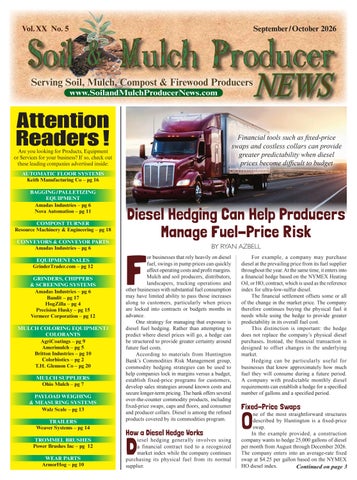
Financial tools such as fixed-price swaps and costless collars can provide greater predictability when diesel prices become difficult to budget
Are you looking for Products, Equipment or Services for your business? If so, check out these leading companies advertised inside: AUTOMATIC FLOOR SYSTEMS Keith Manufacturing Co – pg 16 BAGGING / PALLETIZING EQUIPMENT Amadas Industries – pg 6 Nova Automation – pg 11 COMPOST TURNER Resource Machinery & Engineering – pg 18 CONVEYORS & CONVEYOR PARTS Amadas Industries – pg 6 EQUIPMENT SALES GrinderTrader.com – pg 12 GRINDERS, CHIPPERS & SCREENING SYSTEMS Amadas Industries – pg 6 Bandit – pg 17 HogZilla – pg 4 Precision Husky – pg 15 Vermeer Corporation – pg 12 MULCH COLORING EQUIPMENT / COLORANTS AgriCoatings – pg 9 Amerimulch – pg 5 Britton Industries – pg 10 Colorbiotics – pg 2 T.H. Glennon Co – pg 20 MULCH SUPPLIERS Ohio Mulch – pg 7 PAYLOAD WEIGHING & MEASURING SYSTEMS Walz Scale – pg 13 TRAILERS Weaver Systems – pg 14 TROMMEL BRUSHES Power Brushes Inc – pg 12 WEAR PARTS ArmorHog – pg 10
Diesel Hedging Can Help Producers Manage Fuel-Price Risk
F
BY RYAN AZBELL
or businesses that rely heavily on diesel fuel, swings in pump prices can quickly affect operating costs and profit margins. Mulch and soil producers, distributors, landscapers, trucking operations and other businesses with substantial fuel consumption may have limited ability to pass those increases along to customers, particularly when prices are locked into contracts or budgets months in advance. One strategy for managing that exposure is diesel fuel hedging. Rather than attempting to predict where diesel prices will go, a hedge can be structured to provide greater certainty around future fuel costs. According to materials from Huntington Bank’s Commodities Risk Management group, commodity hedging strategies can be used to help companies lock in margins versus a budget, establish fixed-price programs for customers, develop sales strategies around known costs and secure longer-term pricing. The bank offers several over-the-counter commodity products, including fixed-price swaps, caps and floors, and consumer and producer collars. Diesel is among the refined products covered by its commodities program.
How a Diesel Hedge Works
D
iesel hedging generally involves using a financial contract tied to a recognized market index while the company continues purchasing its physical fuel from its normal supplier.
For example, a company may purchase diesel at the prevailing price from its fuel supplier throughout the year. At the same time, it enters into a financial hedge based on the NYMEX Heating Oil, or HO, contract, which is used as the reference index for ultra-low-sulfur diesel. The financial settlement offsets some or all of the change in the market price. The company therefore continues buying the physical fuel it needs while using the hedge to provide greater predictability in its overall fuel cost. This distinction is important: the hedge does not replace the company’s physical diesel purchases. Instead, the financial transaction is designed to offset changes in the underlying market. Hedging can be particularly useful for businesses that know approximately how much fuel they will consume during a future period. A company with predictable monthly diesel requirements can establish a hedge for a specified number of gallons and a specified period.
Fixed-Price Swaps
O
ne of the most straightforward structures described by Huntington is a fixed-price swap. In the example provided, a construction company wants to hedge 25,000 gallons of diesel per month from August through December 2026. The company enters into an average-rate fixed swap at $4.25 per gallon based on the NYMEX HO diesel index. Continued on page 3
Colorant is our core. And it’s more brilliant than ever. High-caliber colorant, profit-piling machines, mulch know-how that drives efficiencies — these things run deep. And now, with the support that comes with being a Sika brand, what makes us Colorbiotics will only flow stronger and brighter.
See how we do it by subscribing to Mulch Matters.
2
Soil & Mulch Producer News September / October 2026
Soil & Mulch Producer NEWS
Diesel Hedging Can Help Producers Manage Fuel-Price Risk Continued from page 1 Under the arrangement, the customer agrees to pay Huntington the fixed $4.25 rate for the hedged volume. Huntington, in turn, pays the customer the market price based on the average daily NYMEX HO price for the applicable month. The company still purchases its physical diesel from its normal supplier at the market price. The financial settlement between the company and Huntington is what creates the effective fixedprice result. The mechanics become clearer when looking at the monthly settlements. In Huntington’s example, the fixed price is $4.25 per gallon. If the average monthly market price rises above $4.25, Huntington pays the customer the difference. If the market price falls below $4.25, the customer pays Huntington the difference. For example, if the monthly average is $4.40, the $0.15-per-gallon difference produces a $3,750 payment to the customer on 25,000 gallons. If the average is $4.20, the customer owes $0.05 per gallon, or $1,250.
www.SoilandMulchProducerNews.com
PUBLICATION STAFF Publisher / Editor Rick Downing
Contributing Editors / Writers Ryan Azbell • Robert LaGasse Sandy Woodthorpe
Production & Layout
Christine Mantush Kolar
Advertising Sales Rick Downing
Subscription / Circulation Donna Downing
Editorial, Circulation & Advertising Office 6075 Hopkins Rd., Mentor, OH 44060 Ph: 440-257-6453 Email: downassoc2@oh.rr.com
Subscription information, call 440-257-6453. Soil & Mulch Producer News is published bimonthly by Downing & Associates. Reproductions or transmission in whole or in part, without written permission of the publisher, is prohibited. Annual subscription rate U.S. is $19.95. Outside of the U.S. add $10 ($29.95). Contact our main office, or mail-in the subscription form with payment. Copyright 2026 by Downing & Associates Printed on Post-Consumer Recycled Paper
©
The result is that the financial settlement moves in the opposite direction of the physical fuel price, helping bring the company’s effective cost back toward the fixed hedge price. For a business trying to establish a reliable operating budget, that predictability can be more important than attempting to capture every possible decline in diesel prices.
Costless Collars Provide a Price Range
A
second strategy outlined by Huntington is a costless collar. Rather than establishing one fixed price, a collar establishes both a ceiling and a floor. In the example, a distribution company wants to hedge 100,000 gallons per month from January through June. It establishes a collar with a $2.60-per-gallon ceiling and a $2.25-per-gallon floor, based on the NYMEX Heating Oil index. The structure provides protection if diesel prices rise above the $2.60 ceiling while allowing the company to participate in lower prices within the established range. The collar requires no upfront option premium in the example. If the average monthly diesel price remains between $2.25 and $2.60, there is no settlement with the bank. If the average price rises above $2.60, Huntington pays the company the difference above the ceiling. If the average price falls below $2.25, the company pays Huntington the difference below the floor while simultaneously benefiting from purchasing physical diesel at the lower market price. The result is a defined range of potential effective fuel costs rather than a single fixed price. In the presentation’s settlement example, the January average price is $2.20, below the $2.25 floor, resulting in a $0.05-per-gallon payment by the company. In April, the average reaches $2.65, above the $2.60 ceiling, resulting in a $0.05-pergallon payment to the company. May’s $2.75 average produces a $0.15-per-gallon payment.
What Does Hedging Accomplish?
F
or a fuel-intensive business, the primary benefit of hedging is cost predictability. Consider a mulch producer that knows it will consume roughly 30,000 gallons of diesel each month during its peak production and delivery season. A sharp increase in diesel prices can affect harvesting, grinding, loading, trucking and delivery costs simultaneously. If the company has quoted prices to customers based on a particular fuel-cost assumption, an unexpected increase can squeeze margins.
A hedge can help the company establish a more predictable fuel-cost component when setting those prices. Hedging can also support longer-term customer contracts. If a company can better estimate its future fuel costs, it may be more comfortable offering customers pricing for a defined period rather than relying on fuel-price assumptions that could quickly become outdated. Huntington identifies several potential uses for commodity hedging, including locking in margins against a budget, creating fixed-price programs for customers, developing growth and sales strategies around known costs and securing strategic long-term pricing.
Hedging Isn’t a Bet on Fuel Prices
T
he objective of a properly structured hedge is not necessarily to achieve the lowest possible fuel price. That distinction is important. If diesel prices decline after a company locks in a fixed-price hedge, the company may effectively pay more than it would have without the hedge. Conversely, if prices rise substantially, the hedge can offset some of the increase. The trade-off is therefore price certainty versus the ability to fully benefit from favorable price movements. A fixed-price swap provides the greatest degree of certainty but limits the benefit from falling prices. A collar provides a range: the company receives protection above the ceiling but accepts exposure below the floor. For companies considering hedging, the starting point should therefore be the business’s fuel-consumption profile, budgeting requirements and tolerance for price fluctuations—not a prediction about whether diesel prices will rise or fall.
Understanding the Basis Risk
A
nother consideration is that a financial hedge based on NYMEX HO does not necessarily move in perfect lockstep with the price a company pays its local fuel supplier. The NYMEX HO contract serves as the reference price in the examples presented by Huntington. The actual price paid for physical diesel can also reflect transportation costs, regional supply conditions, supplier margins and other factors. As a result, companies should understand how closely their actual fuel costs track the index being used for the hedge and how the hedge volume corresponds with their expected consumption.
September / October 2026
Continued on page 4 Soil & Mulch Producer News
3
Soil & Mulch Producer NEWS
INDUSTRY NEWS Viably Acquires Harp Renewables, Expanding Global Organics Processing Capabilities
V
Diesel Hedging Can Help Producers Manage Fuel-Price Risk Continued from page 3 The objective is to construct a hedge that reasonably matches the company’s actual exposure.
A Tool for Managing Margins
iably LLC, a waste and recycling solutions company serving operators across North America and beyond, recently announced the acquisition and integration of Harp Renewables Ltd., an organics processing technology company with an established global installed base. The transaction became effective July 30, 2026, and brings Harp Renewables’ technology, intellectual property, customer relationships, installed base, inventory, and commercial opportunities into the Viably business. “This is an opportunity to bring proven organics processing technology and deep technical expertise into a business built around helping customers get more value from their material streams,” said Brandon Lapsys, President, Viably. “Integrating Harp into Viably strengthens our ability to put that belief to work for customers while building a stronger platform for this technology and the people behind it.” Harp Renewables has developed technology focused on the processing of organic materials, supported by intellectual property, manufacturing expertise, and equipment operating across global markets. For Viably, the acquisition represents a strategic expansion of its organics capabilities and supports the company’s continued evolution from an equipment distributor into a broader waste and recycling solutions partner.
F
or mulch, soil and compost businesses, diesel is often a significant operating expense that touches multiple parts of the supply chain. Production equipment, loaders, grinders, trucks and delivery fleets can all contribute to fuel consumption. That makes fuel-price volatility more than a line item on the income statement. It can influence product pricing, customer contracts, production decisions and ultimately margins. Diesel hedging offers one way to bring greater certainty to that exposure. The key is to view the hedge as a risk-management tool rather than a trading strategy. Companies need to determine how much diesel they are likely to consume, over what period, and what level of price certainty they need. They also need to understand the financial obligations and potential costs associated with the selected hedge structure. Huntington’s presentation notes that its materials are provided for informational or illustrative purposes and that commodity rates and products are subject to change. It also advises that companies consult their own accounting, legal and tax advisers regarding those matters. For businesses whose profitability can be materially affected by diesel prices, however, understanding the mechanics of hedging can be an important step toward managing one of the industry’s most unpredictable operating costs. Ryan Azbell is the Director, Commodities, at Huntington National Bank. He can be reached at 614-480-6048 or Ryan.D.Azbell@huntington.com.
hogzilla@cwmill.com 4
Soil & Mulch Producer News September / October 2026
www.hogzilla.com
service@chromascape.com www.chromascape.com
September / October 2026
Soil & Mulch Producer News
5
Soil & Mulch Producer NEWS
Compost Shows Strong Potential for Oil-Contaminated Soil Remediation
Study finds mature compost outperformed chicken and sheep manure in breaking down petroleum hydrocarbons and maintaining soil nutrient balance
M
ature compost may offer an effective tool for restoring petroleumcontaminated soils, according to a new study from researchers at the University of Duhok in Iraqi Kurdistan. A recent article on bioengineer.org reported that the research compared compost with chicken manure, sheep manure and other bioremediation approaches for treating crude-oil-contaminated calcareous soil. After 60 days, the compost-amended soil achieved a 75.5% reduction in total petroleum hydrocarbons (TPH)—the highest reduction among the treatments evaluated. Sheep manure achieved a 67.9% reduction, while aeration and watering alone reduced TPH by 31%. Natural or “intrinsic” bioremediation resulted in a 22.4% reduction. The findings are particularly relevant to the use of organic amendments in difficult-to-remediate soils, where providing microorganisms with a sustained supply of carbon and nutrients can help accelerate the breakdown of petroleum compounds.
The researchers attributed compost’s stronger nitrogen retention to its more stable organic matter. Unlike the readily available nutrients in fresh manure, mature compost contains more resistant carbon compounds and humic substances that decompose more slowly. That distinction appears to be important in bioremediation. Microorganisms responsible for degrading hydrocarbons require nitrogen and other nutrients to maintain their activity. If those nutrients are rapidly depleted, petroleum degradation can slow. The compost treatment also maintained the most favorable C/N ratio throughout the study. Its ratio increased from 13.41 at the beginning of the experiment to 22.60 after 60 days, remaining within the range considered favorable for microbial activity. The C/N ratio of sheep manure increased to 38.31, while chicken manure reached 59.75. Untreated contaminated soil exceeded 100.
Compost Maintains a More Stable Nutrient Balance
C
T
he researchers focused on several indicators of soil health during the 60day experiment, including total nitrogen, total organic carbon, organic matter and the carbon-to-nitrogen (C/N) ratio. Nitrogen retention was one of the biggest differences among the organic amendments. Compost initially contained 0.801% total nitrogen and retained 0.301% after 60 days—a 37.6% decline. By comparison, nitrogen declined 76.5% in the chicken-manure treatment and 62.4% in the sheep-manure treatment.
6
Soil & Mulch Producer News September / October 2026
Organic Carbon Provides Another Advantage
ompost also maintained the highest level of total organic carbon among the treatments. The compost-amended soil declined from 6.93% total organic carbon to 4.22% over the 60-day period, a reduction of 39.2%. Sheep manure declined by 36.7%, while chicken manure lost 54.6% of its initial organic carbon. The researchers suggest that compost’s relatively stable carbon fraction provides a more sustained environment for microbial activity than the more readily degradable organic compounds found in fresh manures.
Continued on next page
Soil & Mulch Producer NEWS Continued from previous page This characteristic could be particularly important when compost is used as a soil amendment for remediation rather than simply as a short-term source of nutrients.
Manure Provides Nutrients—But They May Not Last
T
he study also highlights a potential trade-off with high-nitrogen amendments such as poultry manure. Chicken manure supplied the highest initial nitrogen concentration of the amendments tested. However, much of that nitrogen was lost during the treatment period, and the C/N ratio ultimately increased to a level indicating substantial nitrogen limitation. The researchers point to the rapid decomposition of nitrogen-rich compounds and potential ammonia volatilization during the thermophilic phase as contributing factors. Sheep manure performed better, achieving a 67.9% TPH reduction and showing more balanced nutrient dynamics. However, its final C/N ratio also moved beyond the range considered optimal for sustained microbial activity. For compost producers, the comparison underscores an important distinction between nutrient concentration and nutrient availability over time. A material with a high initial nitrogen content may not necessarily provide the most effective long-term nutrient supply for biological soil treatment.
Potential Market for Remediation Applications
T
he study was conducted using heavily contaminated calcareous soil from the Kwashe industrial area of Iraqi Kurdistan, where crude oil and petroleum products have contaminated soils around numerous small refineries. Researchers collected contaminated clay-loam soil and established treatment piles using different remediation approaches. The piles were maintained at approximately 80% of their water-holding capacity and turned periodically during the experiment. Temperatures reached approximately 55°C to 65°C during the thermophilic phase.
While the research was conducted under specific conditions and should not be interpreted as proof that every type of compost will perform similarly on every contaminated site, the results provide additional evidence of the potential value of mature compost in soil remediation. The researchers found a strong relationship between nitrogen retention and petroleum hydrocarbon reduction, with a correlation coefficient of 0.82. They concluded that maintaining adequate nitrogen availability was an important factor in sustaining hydrocarbon-degrading microbial activity. The study did not directly measure microbial populations, however, and the researchers note that the 60-day experiment represents the active treatment period rather than long-term soil recovery.
A Broader Role for Finished Compost
F
or the compost industry, the research points to a potential application beyond traditional soil amendment and horticultural markets. Mature compost’s combination of stable organic matter, carbon and slowly available nutrients could make it useful as part of biological remediation strategies for petroleum-contaminated soils. Its performance in this study also suggests that compost maturity and nutrient-release characteristics may be important considerations when selecting organic amendments for remediation projects. The researchers ultimately identified compost as the most effective of the amendments tested, based on petroleum hydrocarbon reduction, nitrogen retention, organic carbon and C/N balance. The findings add to a growing body of research examining how compost and other organic materials can be used to improve contaminated soils while simultaneously adding organic matter and supporting biological activity. Source: Hasan, S.Q., Umer, M.I. and Hussien, R.O., “Dynamics of some bioremediation techniques indices in calcareous oil-contaminated soil,” Discover Soil, 2026. DOI: 10.1007/s44378-026-00263-4.
sales@ohiomulch.com September / October 2026
Soil & Mulch Producer News
7
Soil & Mulch Producer NEWS
News From The Mulch & Soil Council BY ROBERT LAGASSE, EXECUTIVE DIRECTOR
Consumer Lawn & Garden Markets Show Renewed Momentum in 2026
The Mulch & Soil Council national consumer survey findings and multi-year market estimates point to stable buyers, stronger near-term demand and a sizable, combined consumer marketplace.
T
he Mulch & Soil Council’s July 2026 national consumer survey provides an encouraging view of demand across two essential lawn and garden categories. Among Americans with a yard or garden, mulch purchase activity is strengthening and soil purchasing remains widespread. When those findings are applied to the market-estimate models supplied with the survey, the combined consumer market reaches an estimated $18.52 billion in 2026—up about 10.1% from 2025, although still approximately 4.4% below the comparable 2023 estimate.
Mulch: A Stable Core of Buyers and a Modest 2026 Gain
T
he national survey found that 37% of yard or garden households purchased mulch in 2025. For 2026, 43% said they had already purchased or intended to purchase mulch, suggesting stronger seasonal demand. Regional differences were limited: 2026 purchase intent ranged from 41% to 45%, with the West highest at 45%. The South had led 2025 purchasing at 40%, but no region was dramatically separated from the national pattern. The category is anchored by repeat customers. Thirty-two percent purchased mulch in both 2025 and 2026, while 52% bought in neither year. Only 16% changed their purchase behavior between the two periods. This consistency is commercially significant: the industry is not rebuilding demand from scratch each season, but serving a durable buyer base while competing for a smaller group of entrants, returners and occasional users. Bagged mulch remains the most common format. Among mulch buyers, 63% typically buy only bags, 20% buy both bagged and bulk mulch, and 17% buy only bulk. A typical bagged buyer purchases 11.4 bags, with a median of eight; about two-thirds buy 10 bags or fewer. Bulk buyers average 10.1 cubic yards, with a median of eight cubic yards, and most purchases fall between six and 15 cubic yards. These results reinforce the importance of both retail convenience and bulk delivery: bagged products reach the broadest audience, while bulk orders account for much larger volume per buying household. The market model estimates 2026 consumer mulch volume at 129.1 million cubic yards and value at approximately $4.97 billion. That represents a 2.4% value increase over 2025, following an essentially flat 2024-to-2025 period. The 2026 estimate remains about 7.0% below the 2023 value estimate, but the recent direction is positive. Within the model, bagged mulch accounts for about 321.3 million two-cubic-foot bags, or 23.8 million cubic yards, while bulk mulch contributes approximately 105.3 million cubic yards. The model values bagged mulch at $54 per cubic yard—equivalent to $4 per two-cubicfoot bag—and bulk mulch at $35 per cubic yard.
Soils: Broad Participation and a Stronger Modeled Rebound
S
oil purchasing reaches a larger share of yard and garden households than mulch. Half of these households reported buying soil in 2025, and 49% had bought or planned to buy in 2026. Because 7% were still undecided, the 2026 result should be read as purchase activity plus intent—not a final yearend sales measure. Regionally, planned demand ranged from 47% to 55%, with the West again recording the highest level. Repeat purchasing is also strong in soils. Forty-one percent bought in both years, 43% bought in neither, and only 16% changed behavior. Among 8
Soil & Mulch Producer News September / October 2026
buyers, 67% typically purchase only bagged soil, 21% purchase both bagged and bulk, and 12% purchase only bulk. Bagged buyers average 7.3 bags, with a median of five. Bulk buyers average 10.7 cubic yards, with a median of 9.4 cubic yards. Potting soil leads the category, accounting for 45% of buyers’ most frequent purchases, followed by garden or landscape soil at 33% and topsoil at 22%. Use occasions are diverse and overlapping: 54% use soil in indoor or outdoor containers, 52% for general landscaping, 46% in raised garden beds and 36% for filling holes. This breadth gives the soils category multiple points of entry and supports merchandising by project as well as by product type. The soils model estimates 2026 consumer volume at 125.5 million cubic yards and market value at $13.55 billion. That is a 13.3% value increase from 2025 and brings the estimate to within 3.4% of the 2023 level. Modeled bagged sales rise to roughly 251.5 million two-cubic-foot bags, or 18.6 million cubic yards, while bulk volume reaches approximately 106.8 million cubic yards. The workbook applies a value of $108 per cubic yard to both formats, equivalent to $8 per two-cubic-foot bag for packaged soil.
Combined Industry Outlook: Scale, Recovery and Opportunity
T
ogether, mulch and soils represent an estimated 2026 consumer market of $18.52 billion and approximately 254.6 million cubic yards. The combined value increased by about $1.70 billion from the 2025 model, while combined volume rose approximately 6.9%. Estimated sales of two-cubic-foot bags across the two categories increased from about 500.2 million units in 2025 to 572.8 million in 2026, a gain of roughly 14.5%. Several strategic messages emerge for MSC members. First, the market is supported by a large and consistent base of repeat buyers. Second, bagged products remain the primary point of access for consumers, but bulk products dominate modeled cubic-yard volume. Third, soil demand is spread across containers, landscape projects, raised beds and basic property maintenance, reducing dependence on any single use. Finally, regional differences are generally modest, suggesting that national programs can be built around common consumer behavior while still allowing seasonal and regional adjustments. The central outlook is therefore one of resilience and renewed momentum. The 2026 estimates have not fully returned to the 2023 modeled peak, but the recent improvement—particularly in soils—shows substantial consumer engagement and a meaningful recovery from 2025. For producers and retailers, the opportunity lies in retaining dependable annual purchasers, converting undecided gardeners, promoting project-based soil use and ensuring that both bagged and bulk channels are positioned for the distinct ways consumers buy.
About the Data
S
urvey source: TechnoMetrica online national survey for the Mulch & Soil Council, conducted June 29–July 2, 2026, with 1,473 U.S. adults age 18 or older and a reported credibility interval of ±2.8 percentage points. Sixty-seven percent of respondents reported having a yard or garden. Market estimates are derived from the supplied “2026 Mulch Volume Est” and “2023-26 Soils Survey” workbooks. They are modeled consumer-household estimates based on survey incidence, household counts, average purchase quantities, format shares and stated price assumptions; they are not audited industry sales totals. Percentages and totals may vary slightly because of rounding. The soil model’s 2026 bulk-volume inputs differ slightly from the rounded figures displayed in the survey presentation; this article reports the workbook’s modeled totals as supplied.
Continued on page 10
AI Systems
for Mulch Equipment Orion 1000+ Colorizer The future of mulch equipment Whether you bag or bulk, the Orion 1000+ is engineered to meet your every need with unparalleled efficiency and reliability
Learn More
AgriCoatings Mulch Colorant Vibrant. Consistent. Dependable Premium colorant solutions designed to perform with Orion equipment for rich, long-lasting, naturally beautiful mulch.
Exceptional Throughput
Engineered for consistent, highvolume performance
AI-Powered Precision
Real-time monitoring and adaptive control for optimal color accuracy
Reliable by Design
Durable construction and intelligent diagnositcs for maximum uptime
Equipment Solutions + Mulch Colorant AgriCoatings focuses on developing high-quality mulch colorants, while NEXT-GEN provides the specialized equipment and support to apply them. Together, we deliver innovative colorant solutions backed by dedicated equipment expertise.
September / October 2026
Soil & Mulch Producer News
9
Soil & Mulch Producer NEWS
News From MSC
Continued from page 8
UPDATE: Extended Producer Responsibility Regulations EPR Packaging Costs Are Here — Producers Should Act Now
CAUTION: If your company sells packaged products in or into California, Oregon, or Colorado, EPR obligations may attach even when the company has no facility in that state. Pending litigation does not generally excuse registration, reporting, fee payment, or other current requirements. Ignoring this issue could be costly!
The Immediate Risk
E sales@armorhog.com
www.armorhog.com
xtended producer responsibility (EPR) laws shift significant packaging end-of-life costs from government recycling systems to the companies legally treated as “producers.” For the mulch and soil sector, covered material can extend well beyond the printed retail bag. Stretch film, shrink wrap, pallet wrap, corner boards, and other secondary or transport packaging may also require identification, weight reporting, and fees. Producer status can depend on brand ownership, manufacturing arrangements, importation, and the state-specific chain of commerce; it should not be assumed that who physically makes or ships
the product is the responsible “producer” under individual state laws. This is especially consequential for heavy, moisture-sensitive horticultural products. Flexible polyethylene bags and films protect product integrity but may be classified in higher-cost or difficult-to-recycle categories because of material structure, collection limitations, or residual product contamination. Small per-pound charges can therefore become a material cost when multiplied across millions of bags and thousands of pallets.
Three States, Three Active Compliance Programs
OREGON — fees and enforcement are already active. Oregon’s Recycling Modernization Act began operating in July 2025. Covered producers generally must register with an approved producer responsibility organization (PRO), report covered product supply, and pay membership fees. Oregon DEQ states that failure to register or join a PRO can be a Class 1 violation carrying fines of up to $25,000 per day. A federal-court injunction has provided narrow relief for certain members of the National Association of Wholesaler-Distributors, but it is not a general suspension of the law. COLORADO — producer fee obligations began in 2026. Colorado approved Circular Action Alliance’s (CAA) statewide program plan in December 2025. Covered producers must report the types and quantities of packaging and paper supplied into the state, and dues fund the collection, sorting, and processing system. Producers should confirm that their reporting captures both primary retail packaging and applicable secondary or transport packaging. CALIFORNIA — final regulations are effective and 2027 is the critical market-access year. California’s SB 54 regulations took effect May 1, 2026. Producers must pursue participation in the CAA plan, individual compliance, or an applicable small producer exemption. California’s program includes plastic source-reduction and recyclability or compostability mandates, escalating recycling targets, and substantial enforcement authority. Current lawsuits challenge aspects of the regulations and the statute, but neither case should be treated as permission to stop compliance planning.
Budget for the Full Packaging System
U
info@brittonindustries.com 10 Soil & Mulch Producer News September / October 2026
sing the assumptions developed for the accompanying industry analysis— approximately 10 retail bags per pound of film, 60 bags per pallet, and 1.5 pounds of pallet wrap—a conservative planning illustration for difficult-torecycle or nonrecyclable LLDPE is approximately: • $13.43 per pallet in California, • $7.65 in Oregon, and • $5.55 in Colorado.
Continued on next page
Soil & Mulch Producer NEWS Continued from previous page These figures are budgeting estimates, not invoices or guaranteed fee rates. Actual liability depends on the responsible producer, reporting year, material category, weight placed in each state, exemptions, fee schedules, and eco-modulation.
Actions Producers Should Take Now •
Confirm the obligated producer for every brand and sales channel, including private-label and contract-packaging arrangements.
•
Inventory packaging by component and material—not merely by SKU— including retail bags, stretch or shrink film, pallet wrap, corner boards, labels, and other secondary packaging.
•
Measure and document actual component weights, resin types, structures, recycled content, annual state sales, and the assumptions used to allocate packaging among California, Oregon, and Colorado.
•
Reconcile registrations, producer agreements, reports, invoices, and exemptions with CAA and each state agency; correct missed deadlines promptly.
•
Test practical source-reduction, downgauging, recyclable-design, and reuse options first on transport packaging, while preserving moisture barriers, load stability, safety, and product performance.
•
Build EPR costs into pricing, customer contracts, private-label agreements, and annual budgets; do not assume fees may be separately itemized or passed through in the same manner in every state.
MORE OUTPUT. LESS LABOR. The automation partner for mulch, soil, rock & compost producers.
Increase Throughput Reduce Labor Costs Improve Uptime
Bottom line: Waiting for litigation, final fee adjustments, or customer direction creates unnecessary risk. Producers should document their packaging footprint now, verify who is legally responsible in each state, and budget for costs that may materially affect already-thin margins. This article is cautionary industry information, not legal advice. Companies should consult qualified counsel or an EPR compliance specialist regarding their facts.
When Dirt Becomes a $2 Million Problem
F
or soil and mulch producers, properly identifying materials may seem like a basic operational requirement. A recent Michigan case, however, demonstrates how costly poor material controls can become. A Michigan cannabis operation was fined $2 million and had 20 growing licenses revoked after state regulators determined that dirt and mulch had been shipped to a processor under documentation identifying the materials as marijuana. While the case involved a highly regulated industry, it offers a broader lesson for soil producers: knowing exactly what material is in a pile, bin, bag or truck—and being able to document it—is essential to effective inventory control. The Michigan Cannabis Regulatory Agency identified 35 violations involving material handling, inventory tracking, labeling, testing, security and recordkeeping. Among its findings were packages identified as marijuana flower that regulators said contained no THC and appeared to consist of dirt and mulch. Soil and mulch facilities routinely handle multiple material streams, including topsoil, compost, wood waste, bark, yard trimmings and soil amendments. Those materials may then be screened, ground, blended or processed into finished products. A mislabeled stockpile, inaccurate load ticket or improperly identified material can result in the wrong product being processed or shipped, potentially leading to rejected loads, added transportation costs, customer complaints and regulatory problems. Clearly marked stockpiles, designated storage areas, consistent product names, accurate weights, lot numbers and employee training can help reduce those risks. The Michigan case is an extreme example, but the lesson applies across the industry: accurate material identification isn’t just paperwork—it protects product quality, customer relationships and the bottom line.
BAGGING PALLETIZING STRETCH WRAPPING END-OF-LINE AUTOMATION TRUSTED FOR 30+ YEARS
Talk to an Automation Specialist
www.novaautomation.com
(303) 495-5010
Source: Michigan Cannabis Regulatory Agency and Cannabis Equipment News. September / October 2026
Soil & Mulch Producer News
11
Soil & Mulch Producer NEWS
Researchers Explore Biomass for Sustainable Aviation Fuel
R
LEGACY MEETS MOBILITY. The HG4000TX combines innovative technology and proven design with options such as the Vermeer coloring system and productivity monitoring system, that exceed customer expectations. Built for aggressive performance and high capacity, this tracked machine has industry-leading features that contribute to its dependability, efficiency and durability.
DISCOVER MOBILITY THAT WORKS FOR YOU AT vermeer.com/hg4000TXgrinder Vermeer Corporation reserves the right to make changes in product engineering, design and specifications; add improvements; or discontinue manufacturing or distribution at any time without notice or obligation. Equipment shown is for illustrative purposes only and may display optional accessories or components specific to their global region. Please contact your local Vermeer dealer for more information on machine specifications. Vermeer and the Vermeer logo are trademarks of Vermeer Manufacturing Company in the U.S. and/or other countries. © 2025 Vermeer Corporation. All Rights Reserved.
EQUIPMENT & PRODUCT SHOWCASE der n i r G r u o List Y r Free! Fo r
Call Jim
nt Costs! No Upfro
330-323-1146 • www.GrinderTrader.com GrinderTrader.com Sell your products & equipment here. Call today 440-257-6453.
12 Soil & Mulch Producer News September / October 2026
kmd@powerbrushes.com www.powerbrushes.com www.duffbrush.com
esearchers at Rowan University are studying a new approach for converting woody biomass into components used in sustainable aviation fuel (SAF), with a focus on making the process more efficient and economically viable. Jun Hee Jang, Ph.D., an assistant professor of chemical engineering in Rowan’s Henry M. Rowan College of Engineering, has received a $199,999 grant from the National Science Foundation to develop the process. The award comes through the NSF’s Engineering Research Initiation program, which supports engineering research at emerging institutions. The project focuses on lignin, a natural polymer found in woody biomass. While researchers have developed processes for converting biomass feedstocks such as vegetable oils into hydrocarbons used in aviation fuels, producing the aromatic compounds needed for jet fuel has typically relied on petroleum-based sources. Jang and his research team are investigating whether lignin could provide a renewable source for these aromatic compounds. The process begins by breaking lignin down into smaller molecules. One challenge is separating molecules that can be converted into aviation fuel components from larger molecules that are less suitable for the process. The Rowan team plans to address this challenge by developing a size-selective catalyst. The catalyst would have a porous structure designed to allow smaller molecules to enter while restricting larger molecules. Once inside, the smaller molecules could be converted into aromatic compounds suitable for use in the jet-fuel range. The approach could also provide a potential use for the larger molecules that remain after lignin is processed. Rather than treating them solely as waste, researchers will investigate whether these compounds can be recovered as useful co-products. “By applying this catalyst, we can produce not only fuel aromatics, but also larger molecules that could have further functional applications,” Jang said. “We are making two products out of the same feedstock.” The research team includes a doctoral student and a postdoctoral researcher. In addition to testing catalyst performance, the researchers will examine how different catalyst designs affect the conversion process and evaluate the potential economics of scaling up the technology. If successful, the research could demonstrate a way to extract additional value from woody biomass while producing renewable components for aviation fuel. The development of higher-value uses for lignin could also create another potential market for biomass that is currently underutilized or considered a byproduct of other processing operations.
WALZ VOLUMETRIC SCANNER SYSTEMS
Make sure to also check out our many other weighing solutions below!
Skid Steer/Lift Truck Scales Made in the USA! Wheel Loader Scales Made in the USA! Truck Scales/Axle Scales/Wheel Weighers (800) 747-0701 - www.walzscale.com 656 High Point Lane, East Peoria, IL 61611-9369 September / October 2026
Soil & Mulch Producer News
13
Soil & Mulch Producer NEWS
U.S. Hardwood Log Exports Surge as China Returns to Market Stronger overseas demand could influence the availability and cost of hardwood fiber for domestic wood‑product markets
U
.S. hardwood log exports surged during the May-July 2026 period as China returned to the market for American logs, but the latest trade data also show signs that export momentum is beginning to slow. According to an analysis of U.S. Census trade data by Fordaq Market Intelligence, U.S. exports of hardwood and other nonconiferous logs totaled $330.2 million and 612,015 cubic meters during May through July. Export value was up 67.6% from the same period in 2025, while physical volume increased 41.5%. However, compared with the February-April period, the market moved in the opposite direction. Export value declined 7.7% and volume dropped 11.5%, indicating that the exceptionally strong early-2026 pace has begun to moderate. For mulch producers and other businesses that rely on hardwood residuals, the international log market is worth watching because changes in demand for higher-value hardwood material can affect how timber is harvested, sorted and utilized throughout the wood-products supply chain.
China Returns as a Major Buyer
T
he biggest change in the market is China’s return to the U.S. hardwood‑log trade. China purchased approximately $114 million worth of U.S. hardwood logs during May-July, compared with only $1.75 million during the same period in 2025. The dramatic year-over-year increase largely reflects the reopening of trade rather than a comparable increase in underlying Chinese demand. China suspended imports of U.S. logs in March 2025 following the detection of quarantine pests in shipments. The suspension was subsequently lifted, allowing U.S. hardwood exports to China to resume.
China accounted for approximately 84% of the total year-over-year increase in U.S. hardwood-log export value during the latest reporting period. That renewed demand is particularly significant for hardwood-producing regions where the same timber supply may feed several markets, including sawmills, veneer manufacturers, pallet producers, firewood operations and businesses processing lower-grade material into chips or mulch.
Vietnam Remains the Largest Destination
D
espite China’s return, Vietnam remained the largest destination for U.S. hardwood logs, accounting for $167.77 million, or about 51% of total export value during the May-July period. Vietnam’s purchases increased 12.6% compared with the same period a year earlier, although exports to the country slipped 2.7% from February-April. Vietnam has become an important wood-processing center, making its demand an important factor in the broader U.S. hardwood market. For domestic wood processors, continued demand from Vietnam and the re-emergence of China create additional outlets for logs that might otherwise remain in domestic markets.
Walnut and Oak Dominate Export Value
T
he composition of the export market also provides some insight into where overseas demand is concentrated. Walnut accounted for 48.2% of U.S. hardwood-log export value during the May-July period. Walnut, red oak and other oak species together represented approximately 84% of total export value. That is important for the mulch industry because not all hardwood fiber competes directly with mulch production. High-value species and grades are
Continued on page 16
SCROLLING FLOOR BELT TRAILER FOR YOUR BULK HAULING NEEDS... ONE LOAD AFTER THE NEXT.
5160 Martin Dr. Gap, PA 17527
web: www.weaversystems.co 14 Soil & Mulch Producer News September / October 2026
+1-717-407-4835 sales@weaversystems.co sales@weaversystems.co
RUGGED.. RUGGED The industry has long relied on Precision Husky Corporation to produce the highest quality, most rugged equipment. Our High Volume Chip Screens are just one example. Precision HV Series Screens have heavy-duty tubular steel support frames, and a TEFC motor which rotates the screening surface up to 300 RPM, supported by U-joints at each corner. They are available in sizes from 5' x 10' to 10' x 20'. You can invest in our equipment with confidence, and know it will perform for many years to come. Call us today to discuss your needs, as well as the newest options available for our line of sawmill, logging and wood waste recycling equipment.
MAY WE INTRODUCE SOME OTHER MEMBERS OF OUR FAMILY...
P.O. Drawer 507, Leeds, AL 35094 · 205-640-5181 · www.precisionhusky.com · sales@precisionhusky.com JOIN OUR TEAM: Regional Salesman wanted. Eastern KY, TN, AL, entire states of GA and FL. Contact us at the email or phone number above.
PHC HV Chip Screen FP SMPN Sep-Oct 2026.indd 1
September / October 2026
15 Soil & Mulch Producer News 8/11/26 9:43 AM
Soil & Mulch Producer NEWS
U.S. Hardwood Log Exports Surge as China Returns to Market
Continued from page 14
generally directed toward lumber, veneer and other higher-value applications, while lower-grade logs, tops, limbs and other residual material may move into chips, biomass, firewood or mulch markets. Consequently, changes in sawlog demand can influence the overall economics of harvesting and processing hardwood timber even when the mulch producer is not directly purchasing export-grade logs.
Export Market Loses Momentum
W
hile the year-over-year numbers remain strong, the month-to-month trend is less encouraging for exporters. U.S. hardwood-log export value declined from $131.9 million in May to $109.7 million in June and $88.7 million in July. Volume followed a similar pattern, falling from 237,261 cubic meters in May to 169,009 cubic meters in July. Fordaq notes that a similar May-to-July decline occurred in 2025, suggesting that seasonal factors could play a role. However, the available data are not sufficient to establish a normal seasonal pattern. The more immediate takeaway for domestic wood markets is that the export market remains strong compared with last year, but the pace of growth has cooled.
What It Could Mean for Mulch Producers
T
he hardwood export market is not a direct indicator of mulch prices, but it can provide an important signal for businesses purchasing or processing hardwood fiber. When overseas demand for sawlogs increases, more higher-quality hardwood material can be pulled toward lumber and veneer markets. That
can change the species mix, volume and cost of residual material available to secondary processors. For mulch producers, several factors are worth monitoring:
•
Regional log demand: Stronger sawlog markets can increase competition for available hardwood material.
•
Residual availability: Changes in sawmill production and log utilization can affect the volume and type of chips, bark and other residuals entering the market.
•
Species mix: Export demand is heavily concentrated in species such as walnut and oak, potentially influencing the availability of those species in domestic residual streams.
•
Transportation costs: Changes in where logs are being processed can alter trucking distances and the economics of moving residual material.
•
Domestic versus export markets: If export demand weakens, additional hardwood material could potentially become available to domestic processors.
For now, the U.S. hardwood market appears to be in a transition period. Export activity remains substantially above 2025 levels, largely because China has returned as a major buyer, while the latest three-month data show that the market is losing some of its earlier momentum. For mulch producers, the key issue will be whether those shifts eventually translate into changes in the availability and delivered cost of hardwood residuals used to manufacture mulch and other wood-based products.
www.keithwalkingfloor.com
To subscribe to Soil and Mulch Producer News, go to www.soilandmulchproducernews.com. 16 Soil & Mulch Producer News September / October 2026
Looking for productivity in a smaller size? Check out a Bandit 1680 or 2460 horizontal grinder.
Key features: – Unique cuttermill cuts material apart
MODEL
1680
2460
– Wide variety of teeth options
Capacity:
18"
24"
– Diamond, round, or square screen options ranging from 5/8” to 8”
Opening:
18" x 52"
24" x 60"
Horsepower:
300 or 321
536
– Screens are easily removed from the side of the machine
Mill:
36" dia. x 52" wide
36" dia. x 60 wide
Teeth:
26
30
– Optional coloring system
Screens:
1
2
– Wheel or track configurations available Mod. Diamond
Square
Round
Screen Removal
Square Baffled
Model 1680XP
Model 2460XP
If you haven’t tried a Bandit unit for your operation, please contact a local Bandit dealer, email marketing@banditchippers.com or visit our website www.banditchippers.com and we will be happy to assist you!
September / October 2026
Soil & Mulch Producer News
17
Soil & Mulch Producer NEWS
Federal Trucking Crackdown Could Have Implications for Bulk Material Haulers
Federal agencies are stepping up enforcement of trucking fraud, CDL compliance and carrier safety
F
ederal officials are launching a broad effort to increase oversight of the trucking industry, a move that could have implications for companies that depend on trucks to move mulch, soil, compost, wood fiber and other bulk materials. U.S. Transportation Secretary Sean Duffy and Homeland Security Secretary Markwayne Mullin announced the initiative in Detroit, outlining a coordinated federal effort involving the Department of Transportation, Department of Homeland Security, the Federal Motor Carrier Safety Administration (FMCSA), the Department of Justice and federal prosecutors. The effort is focused in part on identifying and prosecuting fraudulent activity within the trucking industry, while strengthening enforcement of commercial driver licensing and carrier safety requirements. For producers and distributors of landscape materials, trucking policy is more than a transportation issue. Mulch, soil and compost are relatively lowvalue, high-volume products, making freight costs a significant component of the delivered price. Changes in the availability or cost of trucking can therefore have a direct effect on margins, delivery charges and market reach.
Greater Scrutiny of Carriers
F
ederal officials say the new initiative is intended to target fraudulent practices that can allow unsafe or improperly qualified carriers and drivers to operate. The FMCSA has already announced increased investment in trucking safety enforcement and workforce development, including improvements to state commercial driver’s license systems, law-enforcement training, roadside inspection technology and programs designed to strengthen the trucking workforce.
www.resourcemachinery.com
The agency has also taken steps to tighten requirements affecting nondomiciled commercial driver’s license holders. A February 2026 final rule was designed to prevent drivers who do not meet federal eligibility requirements from obtaining commercial licenses. For companies hauling bulk landscape materials, increased enforcement could mean greater scrutiny of the carriers they use, particularly when contracting with outside trucking companies. That makes carrier qualification and compliance increasingly important for producers that routinely hire independent carriers for seasonal or longdistance deliveries.
Transportation Costs Remain a Key Concern
T
rucking represents a substantial operating expense for many businesses in the mulch, soil and compost sectors. Products such as bulk mulch and compost often move relatively short distances because transportation costs can quickly exceed the value of the material itself. Higher diesel prices, driver availability, insurance costs, equipment expenses and regulatory compliance can all affect the cost of moving material. For producers, that can make transportation management an increasingly important part of pricing strategy. A supplier may be able to produce mulch or compost at a competitive cost, for example, but the economics can change substantially once the material has to be hauled 50, 100 or several hundred miles.
What Producers Should Watch
T
he increased federal focus on trucking could have several practical implications for mulch, soil and compost businesses. Carrier qualification. Companies that routinely use outside trucking firms may want to review their carrier-qualification procedures, including operating authority, insurance, safety records and CDL compliance. Freight pricing. Changes in driver availability, enforcement and operating costs could affect delivered pricing. Producers may need to revisit freight surcharges and delivery-zone pricing more frequently. Carrier availability. If enforcement removes noncompliant carriers or drivers from the market, some regions could experience tighter trucking capacity. Seasonal demand could make the impact more noticeable during peak spring and summer periods. Long-distance sourcing. Businesses that import or move large quantities of wood fiber, compost feedstocks, soil amendments or other raw materials over long distances should continue to evaluate transportation costs as part of their sourcing decisions. Documentation and compliance. As federal enforcement becomes more aggressive, maintaining accurate records on contracted carriers and transportation arrangements can help reduce business risk.
Freight Remains Central to the Industry
T
he federal trucking initiative comes as transportation infrastructure is also receiving increased attention. In October, the U.S. Department of Transportation announced $426 million in grants for highway and freight projects intended to address congestion bottlenecks and improve freight movement in 12 states. For the mulch, soil and compost industries, improvements in freight infrastructure can be particularly valuable because producers depend on an efficient trucking network to move both raw materials and finished products. Ultimately, trucking enforcement is unlikely to be viewed simply as a regulatory issue by material producers. For an industry in which transportation can represent one of the largest costs associated with selling a relatively inexpensive, high-volume product, the availability, reliability and cost of trucking can directly influence where products can be sold—and at what price. As federal agencies increase scrutiny of carriers and drivers, producers may want to take a closer look at their own transportation networks and consider whether their current freight strategies provide enough flexibility to handle changes in capacity, compliance requirements and operating costs.
18 Soil & Mulch Producer News September / October 2026
September / October 2026
Soil & Mulch Producer News
19
6075 Hopkins Road • Mentor, OH 44060 downassoc2@oh.rr.com • 440-257-6453 www.SoilandMulchProducerNews.com
VOL. XX NO. 5
PRSRT STD U.S. Postage
PAID
Cleveland, OH PERMIT #1737
SEP / OCT 2026
INSIDE THIS ISSUE Diesel Hedging Can Help Producers Manage Fuel-Price Risk
PAGE 1
Compost Shows Strong Potential for Oil-Contaminated Soil Remediation
PAGE 6
News from the Mulch & Soil Council
PAGE 8
When Dirt Becomes a $2 Million Problem
PAGE 11
Researchers Explore Biomass for Sustainable Aviation Fuel
PAGE 12
U.S. Hardwood Log Exports Surge as China Returns to Market
PAGE 14
Federal Trucking Crackdown Could Have Implications for Bulk Material Haulers
PAGE 18
www.mulchcolorjet.com brian@glennoncompany.com