IL_2611_2_VIP Directory 0606_new 9/11/26 10:22 AM Page cov1
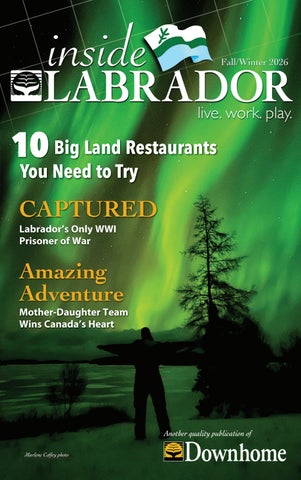
10 Big Land Restaurants You Need to Try
CAPTURED Labrador’s Only WWI Prisoner of War
Amazing Adventure Mother-Daughter Team Wins Canada’s Heart
Marlene Coffey photo
IL_2611_2_VIP Directory 0606_new 9/10/26 1:21 PM Page cov2
IL_2611_2_VIP Directory 0606_new 9/10/26 2:09 PM Page 1
IL_2611_2_VIP Directory 0606_new 9/10/26 2:09 PM Page 2
Published by Downhome Inc. 43 James Lane, St. John’s, NL, A1E 3H3 1-888-588-6353 • www.insidelabrador.ca
Editor-in-chief Dillon Collins
Marketing Director Tiffany Brett
Assistant Editor Nicola Ryan
Publisher and CEO Grant Young
Art Director Vince Marsh
General Manager and Assistant Publisher Tina Bromley
Distribution and Subscription Representative Marlena Grant Advertising Sales Account Manager Curtis Heffernan
To subscribe, renew or change address use the contact information above.
Canada Post Canadian Publications Mail Sales Product Agreement #40062919 The advertiser agrees that the publisher shall not be liable for damages arising out of errors in advertisements beyond the amount paid for the space actually occupied by the portion of the advertisement in which the error occurred, whether such error is due to the negligence of the servants or otherwise, and there shall be no liability beyond the amount of such advertisement. Pen names and anonymous letters will not be published. The publisher reserves the right to edit, revise, classify, or reject any advertisement or letter. © Downhome Inc. No part of this publication may be reproduced in any form without permission of the publisher.
Printed in Canada
2
inside LABRADOR
FALL / WINTER 2026
IL_2611_2_VIP Directory 0606_new 9/10/26 3:45 PM Page 3
60 table of contents 4 Editor’s Note 6 Then & There News, notes and events in Labrador
8 Captured Labrador’s only WWI Prisoner of War
14 From Nostalgic to New-Found Music history of Labrador
22 Big Land Days 24 Cat’s Cradle and String Games Traditional fun pastimes
28 10 Restaurants You Need to Try in Labrador 34 “Give Er Missy!” A mom-daughter team wins Canada’s heart FALL / WINTER 2026
40 Conspicuous by their Absence Remembering America’s war dead
46 Labrador Life 48 A View From Black Rocks A trip to the Labrador Straits
52 Looking Back at Labrador Memories of L’anse-au-Loup
57 Big Land Hide and Seek 58 Tastes of Labrador 60 Journey Through Labrador The continuing tale of a solo trek
64 Photo Finish inside LABRADOR
3
IL_2611_2_VIP Directory 0606_new 9/10/26 3:46 PM Page 4
A lot is going on in the world right now.
Trade wars, tariffs and economic uncertainty are affecting communities near and far, while here at home, major developments in energy and industry are creating their own mix of questions and opportunities. At Downhome, we’ve always believed that one way to make sense of changing times is to look at the places and people around us, where we’ve come from, where we are now and where we might be headed. In this issue of Inside Labrador, we’ve brought together stories aimed to do just that. You’ll find 10 Labrador restaurants worth seeking out, a mother-daughter team who brought their Labrador spirit to The Amazing Race Canada, and a look at the musical traditions and influences that have helped shape the region’s cultural identity. We also look to the past, with the remarkable story of Labrador’s only First World War prisoner of war, along with other people and moments that have helped shape the Big Land we know today. Enjoy, and thanks for reading.
Dillon Collins Editor-in-chief dillon@downhomelife.com
4
inside LABRADOR
FALL / WINTER 2026
IL_2611_2_VIP Directory 0606_new 9/10/26 2:09 PM Page 5
Everyone has a tale to tell. And we want to see your stories about Labrador. Maybe it’s a recollection of the way things used to be, a historical piece, or a story about somebody doing great things in your community. Maybe it’s a travel story about a trip somewhere in the Big Land. Whatever your story, in verse or in prose, our readers would love to see it and so would we. If you’re better with a camera than a keyboard, you’re in luck, too - we’re also looking for photos of Labrador. From snapshots while berry picking to compositional studies of the landscape and everything in between, we love looking at your images.
Published submissions will receive $20 in Downhome certificates to spend in our stores and online at www.shopdownhome.com.
Send your photos and stories to editorial@downhomelife.com or upload them to our website at Downhomelife.com/submit.
IL_2611_2_VIP Directory 0606_new 9/10/26 2:09 PM Page 6
Then&There
Inside Labrador catches readers up on major recent news, notes, events, anniversaries and acknowledgements across The Big Land.
NL Hydro
New Churchill Falls Agreement Opens Door to Labrador Development Newfoundland and Labrador has reached a new agreement with Quebec and the federal government aimed at reshaping the future of Churchill Falls and unlocking new energy development in Labrador. The deal replaces the 2024 MOU and includes upgrades and expansion at the Churchill Falls generating station, development of the 2,700megawatt Gull Island project and new transmission infrastructure. The province says the agreement represents $49 billion in value to Newfoundland and Labrador, measured in 2026 net present value, and will provide more electricity for development. The broader projects are expected to support thousands of jobs as they move forward.
Team Labrador Created to Prepare for Major Development The provincial government has established Team Labrador to help communities prepare for the economic opportunities and pressures expected from major development projects in the region. The group will work with Indigenous governments and organizations, municipalities, businesses and community leaders across Labrador. Its focus will include housing, infrastructure, workforce needs, public services and potential impacts on health, education and public safety. The team was created following the new Churchill Falls and Gull Island agreement and is intended to help ensure Labrador communities are positioned to benefit from the investment ahead. Its work will also contribute to the province’s planned Northern Strategic Plan. 6
inside LABRADOR
FALL / WINTER 2026
IL_2611_2_VIP Directory 0606_new 9/10/26 2:09 PM Page 7
Air Borealis photo
New Support Makes Labrador Air Travel More Accessible Labrador residents have more flexibility under changes to the province’s Labrador Air Access Program. The program now provides eligible residents with subsidies for up to four return trips through March 31, 2027, including inter-regional air travel within Labrador. The province has also shortened the application process from 28 days to seven and reduced the required booking window from two weeks to 24 hours. The program is designed to make air travel more affordable for residents who rely on flights to reach regional centres and essential services.
Damhnait Doyle Returns With New Music Labrador City-born singer-songwriter Damhnait Doyle is back with Bird in Flames, her first collection of new music since 2019’s Liquor Store Flowers. The five-song EP finds Doyle leaning into sophisticated pop, hard-driving country and roots-rock as she explores grief, heartbreak, renewal and reconnecting with her authentic self. Produced and largely instrumentally performed by Doyle’s longtime friend Hill Kourkoutis, the EP includes collaborations with Newfoundland and Labrador artists Kim Stockwood and Juno winner Serena Ryder. From the propulsive opener “Ready Now” to the stormy “Darlin’” and titletrack finale, Bird in Flames marks a new creative chapter for the Labrador-born artist, who first broke out with her 1995 hit “A List of Things” and has spent three decades making music. FALL / WINTER 2026
inside LABRADOR
7
IL_2611_2_VIP Directory 0606_new 9/10/26 2:10 PM Page 8
Private Austin Pardy: Labrador’s Only World War I Prisoner of War BY MAURA HANRAHAN
8
inside LABRADOR
FALL / WINTER 2026
IL_2611_2_VIP Directory 0606_new 9/11/26 8:14 AM Page 9
On a silent, misty morning
in Cambrai, France, in November 1917, the troops of the Newfoundland Regiment march behind 500 tanks. 400 tanks aim to break through the Germans’ Hindenburg Line, 143 miles of defensive concrete reinforcements, while the rest are support tanks. Collectively, they carry half a million rounds of six-pound shells, five million bullets, and 200,000 gallons of fuel. This is the first time that tanks are used in battle en masse; their approach is a frightening sight. The Germans had practiced scorched earth to take Cambrai, burning almost 40% of the town’s buildings. The Allied tanks easily broke through the enemy’s blockades. Then came the soldiers: the Essex and Worcestershire Regiments flanked the Newfoundland Regiment (NR). The men of the NR captured part of the Masnières area; among them was Private Austin Pardy of Table Bay and Cape North, Labrador. As the battle went on, the Germans fled into the town of Marcoing. When the heavy Allied tanks crushed a bridge, the NR quickly built a footbridge, assailed by sniper and machine gun fire all the while. They fought for 12 days, and the Battle of Cambrai would not end until December 7, 1917. By then, Austin Pardy had been missing for four days.
The Altdamm POW Camp
FALL / WINTER 2026
inside LABRADOR
9
IL_2611_2_VIP Directory 0606_new 9/10/26 2:10 PM Page 10
Austin Pardy, #3229, enlisted in the Regiment on September 10, 1916. A fisherman-trapper, he worked for his father, Andrew, and earned $600 in 1915. Andrew was Inuit and English. His wife, Mary Ann (nee Lethbridge), was Inuit and Mi’Kmaq. The Pardys fished in Cape North, north of Cartwright, Labrador, in summer. For the winter, they shifted to Table Bay, where they could trap. The region was called Kikertauiak in Inuktitut, a language spoken there until the 1920s, with some of it surviving into the 21st century. Born in 1893, Austin was 23 and single when he enlisted. He was 5’6” and signed his attestation papers with X, as did many rural recruits. By July 2, 1917, he was at the front lines. Austin would fight at Poelcappelle, Belgium, where the NR led the campaign and had 51 dead and 127 wounded. He fought at Langemark, Belgium, where it rained in torrents, and some soldiers were stuck in the mud for hours. In November that year, Austin and the Regiment entered the Battle of Cambrai, France. On January 1, 1918, Andrew Pardy got the telegram every soldier’s parent dreads. It read: “I regret to inform you that Record Office London officially reports No. 3229, Pte. Austin Pardy as missing Dec. 3rd.” The Pardys would not know for some weeks that Austin had been captured by the Germans during the Battle of Cambrai. In 1920, Austin dictated his Prisoner of War Statement, “I was No. 1 on the Machine Gun. The Corporal, No. 2, was killed. I stayed by 10
inside LABRADOR
Austin and Beatrice Pardy my gun until wounded. I then retired to the dugout. The Germans captured me and six others. Before I had time to get my wound dressed, the stretcher bearers had it half-bandaged, but the enemy would not give them time to finish dressing it.” Austin would remain the only World War I prisoner of war from Labrador. The Battle of Cambrai ended on December 7, four days after Austin’s capture. The Germans lost 2/3 of their soldiers, and there were 40,000 British casualties, including 109 Newfoundland Regiment soldiers dead and 384 wounded. Austin was one of 43 missing NR members. Like most Great War conflicts, little was achieved during Cambrai, but there was no doubting the soldiers’ bravery and determination. Accordingly, the NewfoundFALL / WINTER 2026
IL_2611_2_VIP Directory 0606_new 9/10/26 2:10 PM Page 11
Beatrice was once a truck driver for the Women’s Royal Air Force during the war
land Regiment became the only military unit to be awarded the title Royal during combat. Austin’s family was informed that he was not wounded, but he had been shot in his right leg. The Germans transported him to the massive Altdamm POW Camp, deep in eastern Germany and now part of Poland.
FALL / WINTER 2026
Austin recalled, “I was taken to [Altdamm] Camp where I was kept for 3 months, I was unable to do any work on account of my wound…” He soon learned that forced labour was part of camp life: “I was taken there to a village named Weik, where I was sent to work on a railroad, I was treated very badly, I had to go without
inside LABRADOR
11
IL_2611_2_VIP Directory 0606_new 9/10/26 2:10 PM Page 12
Austin with daughters Cynthia and Audrey food on several occasions and was forced to work very hard, I spent four months at this work.” Altdamm had been built to hold 15,000 POWs; most of them were Russian, but there were small minorities of French, British, Polish, and other captives there. Eventually the filthy Altdamm barracks, full of insects, would hold over 18,000 men. By 1917, there were food shortages throughout Germany, affecting civilians and certainly POWs. Austin’s hunger gnawed at him, and he dictated a letter four months after his capture: “I would like very much if you would enquire about my grocery parcels as I have not received any since I was captured and I am badly in need of my boots and clothing as well as grocery and would be very much obliged if you would see to the matter for me.” Austin did receive seven packages on two days containing clothing such as trousers, socks, a jacket, and a great coat, toiletries including soap and towels, and footwear, specifically boots and canvas shoes, but no food. 12
inside LABRADOR
Besides having to cope with constant hunger and malnutrition, there was rampant disease at Altdamm, including tuberculosis, Spanish flu, and typhus. The British (and Royal Newfoundland Regiment) POWs formed a British Help Committee to pool their meagre resources and look out for the sick. Yet three Newfoundlanders succumbed to illness in the camp: Hiram Mutford, Reginald Cheaten, and Lewis Hudson. Austin was strong, resilient, and lucky. He spent over a year at Altdamm, but he experienced forced labour until the end: “I was taken to a village near Bergen, where I was sent to work on a farm. I was kept there for two months; I was taken to [Altdamm Camp] again, where I was kept until I was sent to England…” After the Armistice, Altdamm’s locked gates were opened and the POWs were told to fend for themselves. Finally, on January 2, 1919, the Pardys received the telegram they longed for: “…Austin Pardy repatriated from Germany… arrived at Ripon Camp [England] safely.” FALL / WINTER 2026
IL_2611_2_VIP Directory 0606_new 9/11/26 8:15 AM Page 13
Life in Labrador after the war
FALL / WINTER 2026
Austin’s story has a happy ending. A few weeks after he made it to England, he married Englishwoman Beatrice (Betty) Whittle, who made history by being the only Labrador war bride. Born in Northampton, Beatrice had been a truck driver for the Women’s Royal Air Force in Winchester, but she took to Labrador like a duck to water. The couple fished and trapped in Table Bay and Cape North and raised Eric, Joyce, Arthur, Sydney, Audrey, Austin St. Clair, David, and Cynthia. They moved to Cartwright (Natsiktok in Inuktitut) in 1946, returning to Cape North each summer to fish. Throughout his life, Austin loved to meet strangers and bring them home for tea, reports his grandson, Larry Pardy of Amherst, NS. Austin died at 77 of natural causes and is buried in the Anglican Cemetery at Cartwright, having lived a fulfilling life after his terrible wartime suffering.
inside LABRADOR
13
IL_2611_2_VIP Directory 0606_new 9/10/26 2:10 PM Page 14
An Exploration of Musical Regions Across Newfoundland and Labrador BY CASSANDRA FILICE
14
inside LABRADOR
FALL / WINTER 2026
IL_2611_2_VIP Directory 0606_new 9/10/26 2:10 PM Page 15
Downhome explores the impact of music, artists, and locales across the province. From St. John’s to the coastal communities of Labrador, we’ll follow a musical map that delves into tales and tidbits of one of our country’s most musical provinces.
To cover the history and diversity
of Labrador music in a single article is as daunting as counting the caribou that roam the land. Undoubtedly, many artists have been missed, but that doesn’t make them any less integral to the musical and cultural fabric. Nain is situated in the Nunatsiavut region, the northernmost settled community in the province. Moravian missionaries from Germany arrived in the 1700s and banned many sacred Inuit traditions, such as throat singing, and replaced them with their own gospel music and revival hymns. Today, katatjaktuq – throat singing – is seeing a revival and being taught and showcased at regional and national events.
FALL / WINTER 2026
inside LABRADOR
15
IL_2611_2_VIP Directory 0606_new 9/11/26 8:16 AM Page 16
Moravian music is still performed. The Labrador Inuit adopted this music and transformed it, making it uniquely their own. Nainip Tittulautingit, Inuktitut for the Nain Brass Band, has an international presence. The band’s impact is such that they, along with the
tion was my uncle, Gerald Mitchell. He was the first person to record Labrador songs on vinyl in the 1970s. Back then, some people could hardly read or write their own names, but somehow, they learned to read music transcripts for playing Moravian
Above: Moravian missionaries banned traditional Inuit music and replaced it with European hymns and instruments. Right: Singer-songwriter Gerald Mitchell was raised on Moravian music. Nain Moravian Church Choir, received MusicNL’s prestigious Lifetime Achievement Award in 2020, the first Labrador Indigenous group to receive this honour. Gary Mitchell is a singer-songwriter of Inuit ancestry from Makkovik, who was raised on Moravian music. “My great-grandfather used to play the church organ, and my grandfather was in the Moravian Brass Band,” he says proudly. “Music is in my family. It’s in our blood. My biggest inspira16
inside LABRADOR
music on brass instruments, violins, and organs.” He heard of Newfoundland fishermen arriving on schooners. “They brought their jigs and reels. It was a lot more lively than what we were playing in church.” Mitchell says they were always looking for something new, and they got a kick out of words and stories different from their own. “Music changes, and we have to as well. We took what we liked and made it our own.” FALL / WINTER 2026
IL_2611_2_VIP Directory 0606_new 9/11/26 8:27 AM Page 17
Music icon and member of The Flummies, Tunker Campbell feels strongly about recording and preserving the traditional songs of Labrador
Mitchell’s music spans the country, quite a feat for someone who grew up with limited radio. His song “The Voices of the Land”, written with his wife Barbara, was performed on Parliament Hill by the Labrador Youth Choir in 2017 to mark Canada’s 150th anniversary. Mitchell is still performing. His song “Brimstone Head” is a staple at the Brimstone Head Folk Festival on Fogo Island every summer. He’s often joined by his daughter Jennifer, an
FALL / WINTER 2026
accomplished accordion player. Together, they have produced two albums. Tunker Campbell has been described as an icon of Labrador music. As well as his solo career, he’s part of the band The Flummies, recipients of MusicNL’s Lifetime Achievement Award in 2021. Growing up near the airbase in Goose Bay, he was interested in rock and roll. “Zeppelin, Hendrix, these were the guys we listened to … We
inside LABRADOR
17
IL_2611_2_VIP Directory 0606_new 9/11/26 8:27 AM Page 18
loved listening to the bands that came in from the outside. It was fun to watch them play, to learn from them, and then go jam with friends,” Campbell says. Campbell feels strongly about recording and preserving the historical, cultural, and traditional songs of Labrador. “Labrador music is just that,” he explains. “People like to hear songs with stories of the old days. We’ve written and sung about our people,
know Mom was a part of my life. I wrote “When Your Heart Was the Song” about her.” By thirteen, Neville was performing in The Black Tickle Band. “It was before the cod moratorium. There were thousands of fishermen in Black Tickle. By Friday and Saturday night they were looking to get out and have a dance. People came from miles away to hear us play. You could hear their boats coming in the dark before you saw them. We’d play all night, and at the
“Labrador music is just that. People like to hear
songs with stories of the old days. We’ve written and sung about our people, how we’ve survived hard times, and how we appreciate and honour our land.” Tunker Campbell
how we’ve survived hard times, and how we appreciate and honour our land. We’re documenting life on the Big Land, so our past isn’t forgotten. It’s necessary to continue the history of Labrador music while reinventing traditional songs.” Richard Neville knows how to give the crowds what they want. Just back from the States filming a segment for Towns in Tune, Neville has travelled far and wide from where he grew up in Black Tickle. Neville’s mother died when he was only ten. He found refuge in music and credits his father for teaching him guitar. Neville says, “It’s important to me that people
18
inside LABRADOR
crack of dawn my dad was hollering for me to get down to help him fish.” “The Black Tickle Band gave me a platform to be more ambitious. It’s hard in a remote, old-fashioned community to break through, but we did it – even when we had to wrap the amps and drums in pillows and tarps, strap them to the back of our komatik, and cross the frozen ocean,” he laughs. Neville recorded his first album in Halifax, where he spent several years in studio work, playing pubs, and touring the Maritimes. “When I moved back home, things changed dramatically. Harry Martin – the guy’s
FALL / WINTER 2026
IL_2611_2_VIP Directory 0606_new 9/11/26 8:17 AM Page 19
Richard Neville finds inspiration for his music during his travels throughout Labrador as a wildlife biologist. “I’m flying to Nain, the Torngats. You see the landscape differently. How could it not influence me?” our premier songwriter, his music is part of our fabric – reached out to me, asked me to play guitar for him. I did. For twenty years we were on the road. I squeezed in time for my own stuff, but playing with Harry, learning from him, catapulted me into a completely different sphere.” These days, Neville performs when he’s not working as a wildlife biologist heading up fieldwork for caribou herds. This chapter has been just as impactful for his music. “I’m flying to Nain, the Torngats. You see the landscape differently. How could it not influence me? I wrote “Boreal” in tribute to the land, the caribou, and now Memorial University wants to include it in their curriculum. Labrador is so diverse. We have three different
FALL / WINTER 2026
Indigenous groups, and caribou are the lifeblood of each one.” Jamie Jackman pays homage to the land and caribou with his group, Silver Wolf Band. “Most musicians from the Big Land move to St. John’s, Toronto, or Halifax, but Silver Wolf Band decided to stay. We’re committed to this place,” he says. Jackman stresses that Labrador is just as rich and diverse as Newfoundland. They are working on their sixth album ahead of their 20th anniversary next year. There’s more to their music than performing. “People have a skewed vision of what a music career can be,” Jackman explains. “There are so many paths to the stage. We love workshopping with students and youth to write
inside LABRADOR
19
IL_2611_2_VIP Directory 0606_new 9/11/26 8:28 AM Page 20
Jamie Jackman pays homage to Labrador with the Silver Wolf Band. “Most musicians from the Big Land move to St. John’s, Toronto, or Halifax, but Silver Wolf Band decided to stay. We’re committed to this place,” says Jamie. songs that celebrate our culture and identity. It’s really rewarding. It’s difficult to find music teachers up here. There aren’t many music programs, and we aim to show that creative and performing arts can be pursued without leaving home. “Labrador has really great music, really great musicians, an interesting and unique perspective, but it’s limiting here. It’s a real job to market music and achieve the necessary exposure. Venues are limited, and touring is expensive,” Jackman says. Maxwell Bentley’s is one of two venues in Happy Valley-Goose Bay that offer live music on the weekends. The other is Mamattuk, a go-to for great meals and tunes. Lab City has more opportunities for artists. Iron Rock Brewing offers a craft beer taproom – but more than that, it’s the most important musical hub in Labrador West. Brian Hurley is co-owner of the brewery. He recognizes that there 20
inside LABRADOR
aren’t a lot of musicians travelling through Labrador, and he strives to make Iron Rock a nucleus for arts opportunity. “Art is work, and it deserves to be compensated,” he says. “We don’t take commission from artists who are travelling through and stop for a show. We want to eliminate the barriers for folks coming up to perform.” In partnership with Brad Dillon of Bad Elf Productions and lead guitarist for The Sun Dogs, Iron Rock Brewing finished hosting its second annual summer Mixtape Festival. The event is a celebration of Labrador music and marks the annual release of a pressed vinyl record. This growing project featured twelve local artists in 2025 and seventeen on the 2026 double vinyl. Iron Rock donated $2000 from the 2025 event to a local high school for new sound and recording equipment. Hard rock holds a niche market in Labrador, but the band Wild Step is FALL / WINTER 2026
IL_2611_2_VIP Directory 0606_new 9/10/26 3:46 PM Page 21
making themselves known, partly through performing at festivals like Mixtape. Ben Rogers handles bass and vocals. “Hard rock isn’t as popular up here, so we just create the music we want to play and listen to,” he says. People are loving it. “Our demo “Space Wizards” was the first song on side two of Mixtape. It was a great show. The place was packed, and people loved our set. There were so many great artists there, and we really had to bring our A-game.” “We know heavy music has a stigma. Our songs are metaphorical, and lyrically they aren’t exploitative. It’s just good, heavy music,” says Jeff Wall, drummer and vocalist. He confirms the difficulty of gaining a presence in Labrador. “You have to want it badly enough that you’ll make it and get what you need. You need to have fun. You need to play and practice and be willing to get out there because it’s not easy.” Guitarist Allan McGee agrees. “It’s
been tough trying to break into the scene here. The greatest hurdle has been having a venue take us seriously, and that’s why Iron Rock Brewery is so awesome.” One thing about the Labrador music community is how supportive the musicians are of each other. “We did Battle of the Bands for Ironfest 2025 at the Arts and Culture Centre. We came in second to Luce Ends, a fantastic band from Lab City. You’ve got to support each other, especially when you’re different,” Ben says, shouting out rapper MC Andy and teenage rockers Serene. “It’s really vulnerable to get up on a stage without other musicians. We turn up for each other.” Richard Neville summarizes being a musician in Labrador: “Music reaches the ones who are meant to play it.” Isolation, heartache, and hardships beget music and creativity, and those experiences ultimately form palpable connections to the songs from those who’ve lived them.
Josh Bingle Photography
Hard rock bands such as Wild Step are making themselves known thanks in part to events such as Mixtape Festival put off by Iron Rock Brewery FALL / WINTER 2026
inside LABRADOR
21
IL_2611_2_VIP Directory 0606_new 9/11/26 10:28 AM Page 22
Big Land Days
First Light
The early September sun catches the buildings along the harbour. STEPHEN COLBOURNE Nain, NL
Camp Companions
Doge and Lynk keep an eye on the campfire. LORILEA EDWARDS Ashuanipi River, Labrador
22
inside LABRADOR
FALL / WINTER 2026
IL_2611_2_VIP Directory 0606_new 9/10/26 2:11 PM Page 23
Wintery Scenes
An abundance of snow transforms Labrador West into a winter wonderland. KEITH FITZPATRICK Labrador City, NL
Send us your Labrador photos
downhomelife.com
Northern Night
The sky puts on a show above Churchill Falls. MARLENE COFFEY Nameless Cove, NL
FALL / WINTER 2026
inside LABRADOR
23
IL_2611_2_VIP Directory 0606_new 9/10/26 2:11 PM Page 24
Cat’s Cradle and
String Games BY DIANNA BROWN
24
inside LABRADOR
FALL / WINTER 2026
IL_2611_2_VIP Directory 0606_new 9/11/26 8:31 AM Page 25
John Michelin teaching Cat’s Cradle to Levi Nochasak Candace Cochrane photo
Recently, I came across
a picture on the internet of my great-grandfather, John Michelin, a Labrador trapper, hunter, fisher, wilderness guide and prospector. It was an image of him playing a string game, and really piqued my curiosity. The photographer, Candace Cochrane, captured a perfect moment as my great-grandfather taught the game of cat’s cradle to Levi Nochasak. The two men smile in the middle of a transition, taking turns holding a string figure while the other picks up Xs with pinched fingers to move them over, under or between straight strings to create a new figure, being ever so careful, as a mistake can end the game loop. In Labrador and the wider Arctic region, string figures and cat’s cradle string games, called ajaraat in Inuktitut, were used for entertainment and a way to pass down cultural knowledge through stories. With string commonly used in hunting, fishing and mending fishing nets and clothing, the Inuit created complicated and beautiful figures by manipulating loops of string on fingers to create shapes representing animals and objects inspired by nature. Ajaraat was something communities relied on during long winters to entertain and pass the time. My great-grandfather’s legacy has been featured in Them Days magazine, an oral history quarterly that preserves the history and traditions of the people of Labrador and Nunatsiavut. I love to browse through my Mom’s collection of Them Days from back to the 1970s. Thanks to archived records, I have even read the words spoken by my great-grandfather: “I trapped up above FALL / WINTER 2026
inside LABRADOR
25
IL_2611_2_VIP Directory 0606_new 9/10/26 2:11 PM Page 26
Churchill Falls for over forty years, and that’s where I learned all the string games, learned them all on my own. I never put any names on ‘um. There was nothing else to do, Sundays, it was something to pass the time.” (Rope and String Games, 1981). Watching people play string games gives a great appreciation for the string artist’s muscle memory, as the movements become their own kind of language, telling their fingers what to do next. There’s almost something secretive and magical in the strings. Cat’s cradle and string figures are an ancient art form and have been collected from indigenous cultures around the world. I’ve even learned that string can be considered one of the earliest forms of the book, passed down to the next generation to retell stories. These string figures are so intricate to recreate and would have to be practiced so many times. The patterns may look simple, but they’re extremely complicated to master. Since my great-grandfather was an excellent storyteller, I wonder if he ever used the loops of string in his storytelling of his days on the traplines? I can imagine the string changing shape as the story unfolded, the loops illustrating the tale. I also learned that he would do string tricks to entertain, and I hope to one day learn and recreate some of the string figures and tricks he crafted. As a teacher, I’m always looking for ways to bring Indigenous teachings into my classroom. I know how fun 26
inside LABRADOR
the game of cat’s cradle is, as I played it in elementary school with my friends. I still recall some of the designs we wove through our fingers using a long loop of string. I recently came across the book Cat’s Cradle, Owl’s Eyes: A Book of String Games by Camilla Gryski. The author teaches
how to tie a knot that doesn’t slip or how to melt nylon string to create a loop. She also advises that the string be two metres long, leaving the string loop to measure one metre. Then she shows step-by-step instructions to make different figures: the cradle, soldier’s bed, candles, manger, saw, diamonds, cat’s eye, fish in a dish, two royal crowns, hand drum, and lucky tea kettle. Although students may find these FALL / WINTER 2026
IL_2611_2_VIP Directory 0606_new 9/10/26 2:11 PM Page 27
kinds of figures challenging, I think it’s important to introduce this art form to demonstrate how playing the games helped Inuit children build hand-eye coordination and finger dexterity needed for tasks like sewing skins and handling harpoons. I reached out to Candace Cochrane and learned that these pictures were
taken as part of a project where she captured images of Inuit life taken between 1969-1986. In my research, I learned that she’d collaborated with Andrea Procter and the Nunatsiavut Creative Group, including eleven Inuit co-authors, to create the book: TautukKonik | Looking Back: Piusigilaut-
FALL / WINTER 2026
tavut Labradoriup Taggâni, 1969–1986 | A Portrait of Inuit Life in Northern Labrador, 1969–1986. The book is a collaborative portrait of Inuit in Labrador with both English and Inuktitut recollections of Candace’s repatriated black-andwhite images. I eagerly await the arrival of my book, which is available through Memorial University Press or Chapters, and am excited to share it with my students. Until then, I’m inspired to keep a long piece of string on my person, so that there’s always a story in my pocket. I want to practice following the steps in Gryski’s book, and practice weaving loops of string through my fingers, and eventually pairing the string figures to a story in hopes of inspiring my students to try it for themselves. In this way, the legacy of my great-grandfather can live on. If you would like to check out more of Candace Cochrane’s work, you can visit her website: www.ccochranephoto.com
inside LABRADOR
27
IL_2611_2_VIP Directory 0606_new 9/10/26 2:11 PM Page 28
28
inside LABRADOR
FALL / WINTER 2026
IL_2611_2_VIP Directory 0606_new 9/10/26 2:11 PM Page 29
Eating your way across Labrador takes a little planning. There are plenty of places to eat, but they aren’t spread evenly across the Big Land. Happy Valley-Goose Bay and Labrador West have the most choice, while along the Trans-Labrador Highway and the coast, options shrink significantly. So rather than breaking Labrador into regions, here’s a list of 10 restaurants and cafés worth visiting, based on reviews, impressions and a healthy, hungry comb through the internet. Dig in! Mamattuk If you’re looking for a restaurant that makes an effort to connect the food with Labrador, Mamattuk is one of the best bets. Located beside the Royal Inn + Suites in Happy ValleyGoose Bay, Mamattuk has a restaurant, coffee bar, lounge and patio. Its menu is built around seasonal and locally sourced ingredients and is inspired by Labrador’s land, people and culture. The current provincial tourism listing confirms breakfast, lunch and dinner, takeout, local ingredients, a licensed bar and live music. This is the place on the list to choose when you want something a little more ambitious than a standard road-trip meal.
Sushi Lab Yes, you can get sushi in Labrador City. Sushi Lab has become an established Labrador West eatery, serving sushi alongside Chinese dishes and other casual favourites. Gateway Labrador currently lists an all-you-caneat option as well as à la carte dining. The menu goes well beyond sushi, with options such as noodles, dumplings and teriyaki.
FALL / WINTER 2026
inside LABRADOR
29
IL_2611_2_VIP Directory 0606_new 9/10/26 2:11 PM Page 30
Whalers Station Restaurant Whalers Station Restaurant is one of Labrador’s classic visitor stops. It’s just minutes from the Red Bay UNESCO World Heritage Site and has been serving visitors since 1985. Newfoundland & Labrador Tourism highlights its famous Chalupa fish and chips, made with local cod, along with homemade meals and desserts featuring local bakeapples and partridgeberries. The restaurant is seasonal, so check the current dates before you go. Red Bay is one of the places where the restaurant and the attraction naturally go together: visit the historic Basque whaling site before stopping for lunch.
Baba Q’s Smoke & Grill
Dhay’s Cuisine
For something completely different from coastal seafood, head to Baba Q’s Smoke & Grill in Labrador City. It’s a family-owned smokehouse specializing in meats smoked in-house, including brisket, pulled pork, chicken and ribs. The restaurant also serves steaks, burgers and breakfast, with a full bar and a large selection of beer and cocktails. Baba Q’s describes its smoking process as using real logs, with meats smoked for four to 12 hours. Yum!
One of the newer additions to Labrador West’s food scene, Dhay’s Cuisine opened in 2025 at the Labrador City Mall. It serves Filipino food alongside Canadian favourites, with dishes including beef kare-kare, kaldereta, laing, pork barbecue skewers, siopao, spring rolls and dumplings. It’s a good example of how much more varied Labrador City’s restaurant scene has become in recent years.
30
inside LABRADOR
FALL / WINTER 2026
IL_2611_2_VIP Directory 0606_new 9/10/26 2:11 PM Page 31
Mariner’s Galley Mariner’s Galley at Hotel North is one of the longstanding restaurants in Happy Valley-Goose Bay. They offer a varied menu, with breakfast, lunch and dinner, seafood and Canadian dishes among the main options. The provincial tourism listing confirms year-round operation, 120 seats, takeout, reservations and local ingredients. It’s particularly handy for travellers because it opens early and serves throughout the day.
Pep’s Diner & Takeout Pep’s Diner is a small, family-run restaurant on Green Street in Happy Valley-Goose Bay. The menu is unusually broad for a small diner: homemade food, burgers, poutine, fish, chicken, Chinese and Asian dishes, plus homemade breads, cookies and cakes. The provincial tourism listing confirms that it operates year-round and offers breakfast, lunch, takeout and delivery.
FALL / WINTER 2026
inside LABRADOR
31
IL_2611_2_VIP Directory 0606_new 9/10/26 2:11 PM Page 32
Iron Rock Brewing Co. Iron Rock Brewing Co. is Labrador’s first craft brewery and has become a local gathering place in Labrador City. The brewery makes its own beer and has a taproom serving a range of styles, along with wine, cocktails and pub staples like hot dogs and nachos. They boast regular trivia, acoustic music, board games and other events for patron pleasure.
Well-Bean Café For breakfast, coffee or something lighter, Well-Bean Café is a good local stop. It’s a family-run café on Amherst Avenue in Lab City, serving specialty coffee and tea, baked goods and lunch specials. Gateway Labrador also lists regular events and live music. It’s a café rather than a destination restaurant, but that makes it traveller-friendly on a lengthy road trip, particularly if you need coffee and breakfast before getting back on the highway.
The Frozen Rooster Located in the Wabush Hotel, The Frozen Rooster rounds out the list with another example of Labrador West’s broad restaurant scene. Gateway Labrador lists Chinese, Canadian and seafood buffets, along with pub food, wing nights and steak nights. There’s also a full bar, making for a useful choice if you’re staying in Wabush rather than Labrador City and need a fun and comfortable place to unwind. 32
inside LABRADOR
FALL / WINTER 2026
IL_2611_2_VIP Directory 0606_new 9/10/26 2:11 PM Page 33
Notes For The Road There are plenty of other places to eat in Labrador that could easily have made the list. Combining through the web and various social media accounts uncovered a wealth of eateries across the Big Land, including Knix Bistro & Café, Hive Café, Coastal Way Eatery, CJ’s Pub, Fishnet Lounge, Jungle Jims, Wing’n It, Jarge’s Pub, Pizza Delight, Mary Brown’s, McDonald’s and more. For travellers, the biggest difference between eating in Labrador and eating in a larger tourist destination is the distance between your options. Often, the route from Point A to Point B is long and, as such, planning mat-
ters. So fill up when you can, carry snacks and some food in your vehicle, and check restaurant hours before hitting the road. Seasonal schedules are common, and services are widely spaced along the Labrador Highway. And don’t worry too much about finding the restaurant with the highest online rating. In Labrador, some small local restaurants have very few reviews simply because relatively few travellers pass through. The best approach is to look at current restaurant websites and social medias, check the provincial tourism listings, and ask locally when you arrive. You may just find a hidden gem or dish worth driving to.
Big Land Hide and Seek Answers See page 57
D P E C C D A Y O O H O B B F Y X V T S J V Z M D Y B Q I H W U X E K W I X N B G W K M C W M D Q Z T L Q Q C Y N M F S M R Z L R L B C P S N Z Z M G P S Y O B Z M U T M C P X I T S C V B K R O K Q C T T G L N Q P C G M P A T F Q J T D P C L R F P G E S M O F T R R G C Q R H J Y I N F J M N O P L I G M J Z A K R C A W H T P H J E A R N R O E L X T I L S C Y F C C X P B R E T T V G D Y E D U C L U Q A C A O X N A B H I I A G G Z O P E P W W M N Q I R T R H T M K L H O D R L E K K Q R P K N I O F U X B I I M E U N B A G S C S D X I I A N E S P B O Y P B O L D I N K J E P Q O C X R Z R C T G Y U V X D O U K M H P G T Q U V O D E J N T L J P H A Q M H U S N X V W W F A Z Z M Q L O H H A C S V X H T I V F I P Q S B O P E N N S T G A U E E B K K C C D E G B J Y H Q A L N Y S M G G N H R P Y R X Q I V O D T G R H S D K L X S B A X H R O F B O Y O E T U N D R A F J X X E I P L U C A O B D O E E P O C O X R L A T W W J T A W V U E A R U L O X W L A Z U S J E Q G Q S N V G P D Z U R K Q V D Z Y W E M R R Z J Q S S F Q H J U P R C K Z H F C R Z P W O J L P S S W R K X J D M P L X Q M R L X P U U X H L P Z S E A L X U X V F A H E Q V P D
FALL / WINTER 2026
inside LABRADOR
33
IL_2611_2_VIP Directory 0606_new 9/10/26 2:11 PM Page 34
Labrador’s Mother-Daughter Team Win Canada’s Heart BY PAM PARDY
Photos courtesy CTV/Crave
34
inside LABRADOR
FALL / WINTER 2026
IL_2611_2_VIP Directory 0606_new 9/10/26 2:11 PM Page 35
Amazing Race Canada 2026 competitors, with Dana and Cordelia at the far left
BY THE TIME Dana Martin-Kelly and her
daughter, Cordelia Richards, stood on the starting line of The Amazing Race Canada, they had already spent years dreaming about the moment. It began with the very first season, and it took four applications before everything finally lined up, but looking back now, they wouldn’t have wanted it any other way. The timing finally felt right for a reason. The previous year, the family had suffered the heartbreaking loss of Dana’s father, Russell Martin. While they had hoped to be selected then, both women now believe things happened exactly as they were meant to. “We’re so thankful we didn’t get picked because we got that time with him before he passed away,” Cordelia says. “So this year I think he was looking out for us.” Officially introduced by The Amazing Race Canada as a mother-daughter team and best friends, Dana and Cordelia proudly represented Wabush and became only the second team ever to represent Labrador on the national competition. Their goal was simple: bring East Coast kindness, Labrador pride and a whole lot of personality to Canadians from coast to coast. Mission accomplished. Long before viewers learned their names, thousands had already learned their favourite phrase: “Give Er, Missy!”
FALL / WINTER 2026
inside LABRADOR
35
IL_2611_2_VIP Directory 0606_new 9/10/26 2:12 PM Page 36
By the end of the first few episodes, fans were quoting it and even asking for merchandise. Dana still shakes her head in disbelief. “The messages we’re after getting, it’s actually crazy,” she says. “People writing us saying, ‘I cried watching the first episode.’ Even when we had our watch party… I actually teared up. I’m like, ‘Man, we have the most amazing supportive people ever.’ I’m mind-blown from it.” For Cordelia, who has built a large online following over the years, the response surprised even her. “99.9 percent of the comments are extremely, extremely positive,” she says. “We’ll send the odd negative one to each other and just laugh.” Although Cordelia has lived in St. John’s for the past six years while Dana remains in Wabush, distance hasn’t changed their bond. “We talk to each other pretty much every day,” Dana says. Before Cordelia moved away, they did nearly everything together. “When I moved away, I found that really hard,” Cordelia recalls. “The only reason I would ever move back home really is because of Mom.” Ironically, one of television’s toughest competitions became an opportunity to spend uninterrupted time together. “It was nice to be able to get that time together since we don’t live in the same town anymore,” Cordelia says.
36
inside LABRADOR
Cordelia and Dana work together to complete a challenge on The Amazing Race Canada Dana loved every minute of it. “We didn’t have phones or anything, and I found it excellent.” The experience also confirmed that they really are best friends. When asked what they learned about each other during the race, there wasn’t much to say. “Nothing really,” Cordelia laughs. “We just know each other so well.” “We narrate everything we do,” Dana says with a laugh. Cordelia immediately jumps in. “Like, ‘I’m going to the bathroom now.’” Then they both burst into laughter after realizing they had both been
FALL / WINTER 2026
IL_2611_2_VIP Directory 0606_new 9/10/26 2:12 PM Page 37
doing exactly that throughout the race: a narrating dynamic duo. “I learned more about myself than I learned about Mom,” Cordelia says. “I let my fear of failure get in the way of me trying new things. It’s okay to fail, because if you don’t try, you’re not going to know if you’re going to do it or not anyway, so you might as well just do it.” Growing up in Labrador, they say, prepared them for more than they realized. Snow? No problem. Cold weather? That’s home. When one challenge involved digging through snow, Dana couldn’t have been happier. “I just came from the Labrador Games, man, digging the snow, this is wicked.” But they believe Labrador shaped something even more important than
physical toughness: Kindness. “We’ll talk to anybody,” Dana says. “We’re friendly.” Cordelia noticed that almost immediately once the race began. “The second we opened our mouths, it felt like all the other teams wanted to talk to us and get to know us.” She believes East Coasters carry something special wherever they go. “Everybody loves East Coasters.” Of course, the race itself wasn’t always easy. Many viewers assume success depends entirely on strength or endurance, but both women insist that’s only part of the story. “The race is a lot of everything,” Cordelia explains. “You can be extremely physically fit... but there’s a lot of different challenges.”
Dana and Cordelia face elimination on The Amazing Race Canada
FALL / WINTER 2026
inside LABRADOR
37
IL_2611_2_VIP Directory 0606_new 9/10/26 2:12 PM Page 38
“It’s not just about being the fittest,” adds Dana. “There’s so many different things that all come together.” That unpredictability eventually caught up with them. After three episodes, Dana and Cordelia were eliminated following a difficult Road Block that resulted in a time penalty, ending their run earlier than many fans had hoped. Yet somehow, elimination never became the defining chapter of their story. Instead, viewers remembered the laughter, encouragement, positivity and unmistakable accents. And perhaps most importantly, the way they carried Russell with them throughout the journey. Before leaving for the race, Dana asked her mother if there were any of her father’s crossword books left. She had just given them away, or so they thought. Then Dana spotted one final cross-
38
inside LABRADOR
word book sitting quietly in a corner. Beside it was Russell’s last copy of Downhome magazine, too. “He loved it,” Dana says. Both items travelled with them throughout the race. “So I took that with us. We had a little bit of Dad with us, and we had Downhome with us.” She also carried something even more personal. “I have a little bit of his ashes glued into a four-leaf clover lucky charm on my backpack. He came with us for sure.” Looking back, neither woman talks much about placements or penalties. Instead, they remember the people, the friendships formed with the other teams, the chance to represent Labrador on one of Canada’s biggest television stages. And the opportunity to simply experience something extraordinary together.
FALL / WINTER 2026
IL_2611_2_VIP Directory 0606_new 9/10/26 2:12 PM Page 39
Dana doesn’t hesitate when asked what she would tell someone thinking about applying. “Do it again a dozen times,” she says. “I absolutely loved every minute of it.” Then comes the advice that probably explains why Canadians connected with them in the first place. “Be yourself,” Dana says. “Not everyone’s going to love us, but we are ourselves.” Perhaps that’s exactly why so many people did. Because whether they were racing across Canada, cheering each other on with a heartfelt “Give Er, Missy!”, or carrying a beloved family member with them every step of the way, Dana and Cordelia reminded Canadians of something bigger than a television competition. Sometimes the greatest victory isn’t crossing the finish line first, but showing the rest of the country exactly where you come from and remaining authentic.
FALL / WINTER 2026
inside LABRADOR
39
IL_2611_2_VIP Directory 0606_new 9/10/26 2:12 PM Page 40
Remembering America’s War Dead at Goose Bay Cemetery BY DARRELL HILLIER
40
inside LABRADOR
FALL / WINTER 2026
IL_2611_2_VIP Directory 0606_new 9/10/26 3:50 PM Page 41
Left: Captain Lester S. White (standing far left) and his B-17 crew that crashed on take-off in November 1943. Photo courtesy Kelly O’Neill, whose grandfather, assistant radio operator/gunner Sergeant George J. Oakley (kneeling third from right), was also lost on this flight.
Goose Bay, like Gander, became
a strategic maintenance and refuelling stopover for overseas aircraft ferrying operations during the Second World War.
Built by Canada in 1941, the Labrador airfield relieved pressure on Gander and was key in creating a new Labrador-Greenland-IcelandUnited Kingdom northern air route. This allowed for the delivery of short- or medium-range fighters and bombers in short hops or stages. Initially, Goose Bay serviced aircraft bound for the British Royal Air Force, but following America’s entry into the war in December 1941, aerial activity intensified as the United States began sending air units to the UK. The first mass movement of US bombers and fighters overseas via Goose Bay began in the early summer of 1942 under the codename Bolero. The first US personnel arrived to set up communications equipment. Hangars were built, then a theatre, barracks, operations building, mess halls, a post office, library, bowling alley and a 100-bed hospital. By the end of 1942, with the Americans well-established in their own sector of the field, 662 aircraft had transited Goose Bay under the Bolero movement. There would be no let-up in delivery flights by American aircrews, many of them teenagers, having exited the highly structured air training pipeline in the US, intended to prepare them for specialized combat roles, such as pilot, navigator, bombardier, radio operator, engineer or gunner. Indeed, on one July day in 1944, Goose Bay dispatched 150 bombers, representing one aircraft every 10 minutes for 24 hours straight, departing for overseas. It made for the largest single daily movement to the UK and established July as a record-setting month for deliveries. So busy was the airfield that the mess halls, built to accommodate 450 men at a sitting, were feeding 2,000 men at one meal. FALL / WINTER 2026
inside LABRADOR
41
IL_2611_2_VIP Directory 0606_new 9/10/26 2:12 PM Page 42
Some graves of American servicemen in the Goose Bay Joint Services Cemetery in 1942 MUN archives
By war’s end in 1945, Goose Bay had serviced roughly 9,000 Americanoperated aircraft, but it came at a price. With such intense activity, accidents were bound to happen. Some 30 wartime military personnel presently rest at Goose Bay Joint Services Cemetery (commonly known now, and during the war, as “Lest We Forget” cemetery), the majority Canadians, alongside several from Britain and one Australian. However, American personnel were once buried there too, and in numbers that more than doubled the current figure. Air Force archival documents suggest that the first US casualties at Goose Bay occurred in August 1942
42
inside LABRADOR
when two transient airmen, awaiting clearance to fly overseas, wandered off in search of amusement, apparently to hunt or fish. The pair was never seen again. Construction workers reported seeing two males wandering the shores of the bay, inquiring about boats from which to fish. The men were presumed to have drowned, although a daily search along the shoreline revealed no sign of their bodies. The first fatal accident involving US aircrew is well known in the annals of Labrador aviation history. The aircraft, a twin-engine B-26 Marauder carrying a crew of seven, force-landed in December 1942 at Cape Saglek, 368 miles north-northwest of Goose Bay.
FALL / WINTER 2026
IL_2611_2_VIP Directory 0606_new 9/10/26 2:12 PM Page 43
Three crewmen disappeared after they set out southward in a rubber life raft to search for help. The remaining four men starved to death before Inuit hunters travelling by dog team happened upon the crash in April 1943. American Arctic search and rescue specialist Major Norman Vaughan flew to the settlement of Hebron, 20 miles south of the downed aircraft, landing on the harbour ice in a twinengine Beechcraft AT-7. From there, Vaughan and his Inuit guides travelled overland and along the shore ice by dog team to Cape Saglek, returning to Hebron with the bodies of the deceased airmen. However, in this instance, the bodies were interred at the US Army Cemetery in Fort Chimo in northern Quebec, where the Americans had established a weather station and airfield (codenamed Crystal I). At war’s end, the remains were transferred to Goose Bay for burial. In November 1943, the ten-man crew of a B-17 Flying Fortress, piloted by 26-year-old Captain Lester White and en route to Iceland, crashed in Mud Lake on takeoff. All but one of the crew was buried at Goose Bay cemetery. The body of gunner Sergeant Lorenz Kirchoff was never recovered. Today, the Texan is remem-
FALL / WINTER 2026
bered on the East Coast Memorial to the missing, located in Battery Park, New York City. Tragedy struck again when, in April 1944, another B-17 carrying a tenman combat-ready crew inexplicably crashed in Lake Melville minutes after takeoff. Both Catholic and Protestant chaplains officiated the military funeral service for pilot 22-year-old 2nd Lieutenant Aubrey Alexander and his crew. For next of kin, the absence of a body, buried in a foreign country at that, meant that the return of personal belongings took on special meaning. The repatriation of their loved ones’ remains would have to await the cessation of hostilities, explained the US War Department. Therefore, the return of these precious personal items became a token of good faith. Moreover, they represented “the last tangible evidence of their loved one,” affirming their humanity and existence, and symbolic of the family’s loss, writes Michael Sledge in his study of America’s soldier dead. The mother of Aubrey Alexander was no exception in this respect. For months after her son’s death, she pleaded with the War Department for the return of his pilot’s wings,
inside LABRADOR
43
IL_2611_2_VIP Directory 0606_new 9/11/26 8:34 AM Page 44
bracelet, billfold, rings and a Bulova watch “that we gave him when he finished 12th grade.” All such personal items were first inspected and inventoried at the Army Effects Bureau at the Kansas City Quartermaster Depot in Missouri. Four months after the crash, the effects bureau packaged up Aubrey’s items and sent them home, but to Margaurite Alexander’s dismay, the watch was absent and was never recovered. Two more tragic crashes during the winter of 1944-1945 would claim another 14 airmen. The first, a C-109 fuel transport (a B-24 Liberator bomber modified to carry fuel) with a crew of five, had just taken off for Iceland when it crashed in a wooded area near the Otter Creek gasoline storage compound. The crash immediately claimed both pilot and co-pilot, 1st Lieutenant Milton Silvers and Flight Officer John Bruns. Three survivors were hospitalized, but the navigator, 1st Lieutenant Richard Kobza, succumbed to his injuries two days after the accident. The crew engineer, Staff Sergeant Claude Dozier, spent several weeks in hospital recovering from third-degree burns to his face and neck. The bandages were removed on Christmas Day, showing no signs of scarring and making for the “best Christmas present he could have received or ever hoped to receive,” records the US base unit history. Dozier, a “modest possessor of a distinguished career,” had previously completed 31 missions over Germany and flown air cover during the D-Day invasion. His efforts overseas earned him the Distinguished Flying Cross and the Air Medal. January 1945 marked the last 44
inside LABRADOR
23-year-old 1st Lieutenant Grover C. Hodge Jr. of Biloxi, Mississippi, pilot of the ill-fated B-26 that crashed at Cape Saglek in December 1942. Hodge, who kept a diary of their ordeal, starved to death along with three crewmates. U.S. Army file photo - Jay Lance Collection.
fatal US wartime accident. Pilot 2nd Lieutenant Roger Mellion’s B-24 Liberator, christened “The Murmuring Mummy,” was part of an outbound movement of US aircraft that snowy night. The bomber was but minutes airborne when someone spotted a light or flare east of the airfield. An American search and rescue unit under the direction of veteran Arctic explorer Willie Knutson immediately set out to investigate using snowmobiles and dog sled teams. Battling darkness, snow and blowing snow, searchers found the burning wreckage of 20-year-old Mellion’s bomber six miles out on frozen Lake Melville. All FALL / WINTER 2026
IL_2611_2_VIP Directory 0606_new 9/11/26 8:35 AM Page 45
but one of the nine men aboard had perished. The only survivor, air gunner Corporal Wayne Robinett, was rushed to hospital by snow machine. Hospital staff, including a brain surgeon flown in from the US, made a valiant attempt to save the young airman’s life, but he succumbed to his injuries six days after the crash. Robinett was buried at the local cemetery alongside his crewmates. In September 1946, in an effort to centralize its war dead “to a more suitable site where constant care of the grave can be assured,” explained the Quartermaster Corps, the army branch under which graves registration operated, the remains of 43 Americans (including two civilians) at Goose Bay were temporarily moved to the Post Cemetery at Fort Pepperrell
FALL / WINTER 2026
near St. John’s. In 1946, Congress passed a bill authorizing the War Department to begin the anxiously awaited repatriation program. Families could choose final interment in a private or national cemetery in the US. In 1947, graves registration transferred the remains of all US personnel buried at Fort Pepperrell to Argentia for transshipment to New York aboard the US Army Transport Joseph V. Connolly. From New York, the military sent the remains to distribution centres located countrywide for shipment to next of kin and final burial. Today, the absence of American graves at Goose Bay obscures the scale of the sacrifice once marked there. To remember them is to restore, however briefly, the presence of those who are now conspicuous by their absence.
inside LABRADOR
45
IL_2611_2_VIP Directory 0606_new 9/10/26 2:12 PM Page 46
Labrador Life Going Places Penny hits the skidoo trails for a ride!
APRIL WATKINS Wabush, NL
Future Subscriber
Claire browses through the Downhome at Poppy’s cabin. LISA JENKINS Labrador City, NL
46
inside LABRADOR
FALL / WINTER 2026
IL_2611_2_VIP Directory 0606_new 9/10/26 2:12 PM Page 47
Wintery Treat
Enjoying a snowy day with a Purity raspberry snow cone. NAOMI EDWARDS Goose Bay, NL
Send us your Labrador photos
downhomelife.com
Saltwater Days
“In 2025, I shared my love for my summertime home with my husband, Joe. This year our son Nathan joined us! We got to enjoy the smells of home, and the love and joy of this beautiful place with him. The weather was rain, drizzle and fog, making it a true Spotted Island experience. Time disappeared in a blink, now we’re counting down to 2027!” LORI SNOW Spotted Island, Labrador
FALL / WINTER 2026
inside LABRADOR
47
IL_2611_2_VIP Directory 0606_new 9/10/26 2:12 PM Page 48
A View Black Rocks from
BY LAWRENCE R. NORMORE
On a hilltop,
known locally as Black Rocks, I am standing where the provincial boundary between Labrador and Quebec runs into the Strait of Belle Isle. The Strait of Belle Isle, which separates Labrador from the island of Newfoundland, is off to my left, with the thin edge of the Northern Peninsula in the distance, some 20 km away. Towards the west, the now uninhabited twin islands of Ile au Bois and Greenly are stark reminders of the once lucrative cod fishery that has all but disappeared into the annals of history.
I stroll down the hill a few meters towards the village of Blanc Sablon until Room’s Point comes into view on the mainland. This abandoned site of the old Hudson’s Bay Company premises (aka ‘The Bay’) had been known locally as ‘The Room’, hence the name of the point. The Bay had purchased the fishing and retail business from Job Brothers in the late 1920s and subsequently continued as the main operator in the area
48
inside LABRADOR
FALL / WINTER 2026
IL_2611_2_VIP Directory 0606_new 9/10/26 2:12 PM Page 49
for another half century. It sold a wide variety of products and at much cheaper prices than could be gotten elsewhere in Labrador, and it also bought salt-dried codfish and furs from the fishermen and trappers of the region. There were other merchants operating in the Labrador Straits at the time, but their prices were unreasonably high compared to those just across the strait on the Northern Peninsula or in Quebec, so The Bay was the preferred place to do business. In 1825, the boundary line between Labrador and Lower Canada (now Quebec) had been drawn through the middle of the Blanc Sablon River, with Lower Canada to the west of the river and Labrador to the east. Since Room Point was situated on the east bank of the river, therefore under the jurisdiction of the Colony of Newfoundland, business with the new ownership continued much as it had with the previous owners. Then two things happened far away from Labrador that disrupted this cordial relationship with ‘The Room’. Following an ongoing boundary dispute
FALL / WINTER 2026
with Quebec, which had been festering since the 1825 decision, the Privy Council of Great Britain agreed to redraw Quebec’s eastern boundary and move it approximately 2 kilometres to the east of the river to where I am today. From here, the line goes due north until it intersects the 52nd parallel. Residents of the village of Blanc Sablon awoke one morning in 1927 to the news that they had suddenly become Canadian citizens. Those in the Straits communities, east of Blanc Sablon, though they didn’t know it at the time, would eventually have their free trade with ‘The Room’ taken away because they were now on the wrong side of an international boundary. Meanwhile, business would carry on as usual for a few more years until, in 1933, Newfoundland’s ‘Responsible’ Government relinquished its responsibility in favour of a Commission of Government controlled by Britain. Having quickly established a police force known as the Newfoundland Rangers, the new government decided to place a tariff on goods crossing the border into Labrador and therefore expected the Rangers and Custom
inside LABRADOR
49
IL_2611_2_VIP Directory 0606_new 9/10/26 2:13 PM Page 50
Officers to collect duties on nearly all goods entering Labrador from Quebec. Today, all that can be seen of the former site of the Hudson’s Bay Company Store on Room Point is a single, private warehouse. But for the residents of the Labrador Straits up to 1935, that store had been their main supply base for a very long time, and their own Government was taking it away. Yet, they weren’t about to let it go easily, so they resorted to the only card they had left. Customs Officers and Rangers tried their best to keep a watchful eye out for suspected smugglers, but the ‘cat and mouse’ game was on and continued until, in 1948, a vote was held across Newfoundland and Labrador to decide whether Newfoundland should revert back to Responsible Government, extend the Commission of Government for another five years or join the Canadian Confederation. At that time, lifestyle in the Labrador Straits was much as it had been in the mid-1800s. There were still no roads. The only means of transportation, other than on foot, were by motorboat in summer/fall and by dog team in winter/spring. A single-wire telegraph/telephone system (installed in one home per community) was the only form of telecommunication, and there was no electricity in any homes 50
inside LABRADOR
unless someone owned a private generator. There were no public waterworks systems, thus the gathering of water and the disposal of sewage was quite primitive at best. Each village had one (sometimes two) all-grade schools, often with untrained teachers straight out of high school. Homes were heated by a single wood-burning stove, generally set up in the kitchen and expected to heat the entire house, including the upstairs section. The list of “have-nots” goes on and on, but suffice to say, for a person visiting from outside the region, lifestyle in the six or seven villages of the Labrador Straits more closely resembled that of the 19th century than it did the 20th. Therefore, when given the opportunities in June and July of 1948, the people of the Labrador Straits needed no convincing on how they would vote. All the evidence they needed could be clearly seen from the top of Black Rocks. On April 1, 1949, when Newfoundland and Labrador officially became the 10th province of Canada, lifestyle in the Labrador Straits might best be described as primitive, but change was on the horizon. The benefits of joining Canada began almost immediately when the boundary between Quebec and Labrador transitioned from an international border to a FALL / WINTER 2026
IL_2611_2_VIP Directory 0606_new 9/10/26 2:13 PM Page 51
provincial one. Custom duties on the border were abolished, and a free flow of goods and services was reinstated. Shortly thereafter, the family allowances and seniors’ benefits began arriving from the Canadian Government, giving residents of a largely cashless society money at their fingertips. These things alone might have been sufficient, at the time, to make their decision to vote for confederation worthwhile, but this was just the beginning. Five years later, a D6 bulldozer, a payloader and a couple of five-ton dump trucks were landed at Blanc Sablon and driven to the top of Black Rocks. The Labrador Straits Highway was under construction. Due to financial constraints and the expense of building a bridge across the Pinware River, it would take six years to get it through to Red Bay, 80 km away, but the road was a pivotal development and the key to the future. The next decade saw a flood of improvements come to the region. The old telegraph system was replaced by private telephone installations in practically every home, and a centrally-located diesel-generated power plant provided electricity throughout the district. Two regional high schools
FALL / WINTER 2026
were constructed at Forteau and West St. Modeste respectively, and buses brought the students together in state-of-the-art buildings staffed with qualified teachers. Crammed, multigraded classrooms were no more. Snowmobiles replaced the sled-dogs for winter travel, and a car/passenger ferry was placed on the Strait of Belle Isle, linking the Labrador Straits highway to the provincial highway system on the island of Newfoundland and beyond. The 20th century had finally arrived in the Labrador Straits, albeit 60 years late. There will likely never be a time when the general population of Newfoundland and Labrador will agree on whether the decision to join the Canadian Confederation was the better choice in the second vote held on July 22, 1948, but it seems fair to state that for most of the people who lived on the Labrador side of the Straits of Belle Isle during the 14-year period (1935–1949), there was never any doubt. They understood very clearly the difference between the availability, quality and cost of goods in Labrador compared to those just across the border in Blanc Sablon, Canada. The choice was a no-brainer. For them, there was nowhere to go but up.
inside LABRADOR
51
IL_2611_2_VIP Directory 0606_new 9/10/26 2:13 PM Page 52
Lookingat Back
Labrador A Teacher and Mystery in L’Anse-au-Loup BY DENNIS FLYNN
52
inside LABRADOR
FALL / WINTER 2026
IL_2611_2_VIP Directory 0606_new 9/11/26 8:37 AM Page 53
The June evening sun
caresses the stained-glass windows of St. Nicholas Anglican Church in Torbay as I attend a Storytelling St. John’s fundraising event. A dignified gentleman spies me in the audience and walks up the aisle. “I’ve been waiting for you and hoped you might show up here,” he says. “I have something for you related to Labrador.” With that, Harvey Young, whom I’d only met once months before, hands me a carefully folded sheet of paper. “I heard you tell a story about Labrador and figured you might enjoy some of my father’s adventures as a young teacher in L’Anse-au-Loup way back in the 1930’s and 1940’s,” he says. “You might even be able to help me solve a minor mystery about the identity of a drowned sailor he buried in the aftermath of a German submarine attack during World War II?”
L’Anse-au-Loup in the early 1900s Isobel Muir collection
FALL / WINTER 2026
inside LABRADOR
53
IL_2611_2_VIP Directory 0606_new 9/11/26 8:38 AM Page 54
The one room schoolhouse and chapel in L’Anse-au-Loup in the early 1900s Well, how can I resist something like that? I think it’s a spectacular idea and even if I don’t know the answer, I’m willing to bet some sharp-eyed reader of Downhome or Inside Labrador will be able to shed light on it all. Chatting with Harvey during the intermission, I learn that his father, the late Arthur G. Young, began his teaching career in 1936 at the Anglican one-room school in L’Anse-auLoup with a total of 45 students ranging from Grade One to Grade 10. “Father said he was paid the grand sum of $27 per month, and from that he had to pay $10 a month for board. Safe to say he never got rich on it, but he really enjoyed the people and his time there,” Harvey adds with a smile. Arthur married a local girl in 1938 and served as the volunteer lay reader for the church, which Harvey explains “was a bigger responsibility than you might suspect.” At the time, the huge geographic area from Blanc Sablon to Red Bay was part of the old Anglican Mission 54
inside LABRADOR
of Flower’s Cove. The priest could only visit the Labrador side of the Straits twice a year, once in the spring and again in the fall. “Father had to travel all over to nearby communities to hold religious services, baptize children, and bury the dead,” Harvey notes. “There were no roads, so all travel was by footpath or small boat in the summer until navigation closed for the long winters. Then the only way about was by dog sled, which he really loved, saying that ‘Travel by dog team was the most pleasant experience of all.’ Of course, there was very little communication with the outside world once winter set in, so you would be left to your own devices until May or early June.” Arthur G. Young maintained an affinity for the coastal boat service and, in particular, the S.S. Northern Ranger, on which he travelled many times, cherishing lifelong friendships formed with fellow travellers on lengthy voyages. At that time the Labrador Coastal Service extended FALL / WINTER 2026
IL_2611_2_VIP Directory 0606_new 9/11/26 8:38 AM Page 55
from St. John’s to Humbermouth via the Straits of Belle Isle. It took the vessel roughly two weeks to cover the distance at a top speed of only 11.7 knots per hour. Given it was so isolated and money was hard to come by, keeping the school stocked and going posed unique challenges, Harvey explains. “The school my father was in was fairly comfortable compared to others. They heated it with a large wood stove by the brand name of “GIANT”. However, it was difficult to keep warm when winter temperatures would drop to minus 28 degrees Fahrenheit (minus 33 Celsius) or lower. The men of the community would take weekly turns supplying the wood and lighting the stove. To get school supplies, Father put off concerts during the winter and used the proceeds to buy needed gear.”
FALL / WINTER 2026
He explains that the first piece of educational equipment Arthur ordered was a hectograph, which was an early form of a duplicator machine. In 1937, he also purchased the first radio in the community. “That gave people access to news and programs from Station VONF in St. John’s and other stations in Canada and the United States,” Harvey says. “A few weeks before Christmas, an actor playing Santa Claus would broadcast on the radio. Father would gather the smallest children and tell them to call out loud to the radio so Santa could hear what they wanted for Christmas. It was always interesting what they would say, such as a pinny (an apron) or a doll, small, simple things like that.” In 1939, with the advent of World War II, the radio took on increased significance to the people of the
inside LABRADOR
55
IL_2611_2_VIP Directory 0606_new 9/11/26 8:39 AM Page 56
German U-boats patrolled and attacked shipping along the Labrador coast during World War II. community. It brought news of the conflict and allowed residents to listen to speeches of great leaders Winston Churchill and Franklin Roosevelt. While Arthur G. Young generally loved his experiences in Labrador, one particular event stayed with him. “I’m sure Father told me the name of the man, but I guess I was young and didn’t pay too much attention. But if anyone remembers or knows who he was or what ship he came off, I’d appreciate learning. “Father said during WWII German submarines would harass Allied shipping in the Straits of Belle Isle area.
56
inside LABRADOR
One time, subs attacked a convoy off Point Amour and Forteau Point, causing some ships to be driven ashore. During that attack, an engineer/sailor drowned trying to get ashore. Father had the unpleasant task of burying the poor soul in the Anglican cemetery at L’Anse-au-Loop.” Arthur G. Young would remain for six years teaching in the area and would speak and write with apt observations and tenderness when looking back at Labrador. Readers with insights into the unknown sailor can email editorial@ downhomelife.com
FALL / WINTER 2026
IL_2611_2_VIP Directory 0606_new 9/10/26 2:13 PM Page 57
Big Land Hide & Seek The words can be across, up, down, backward or at an angle, but always in a line.
Torngat Muskeg Caribou Moose Ptarmigan Partridge Boreal
Tundra Trapper Firewood Snowmobile Seal Lichen Spruce
Bakeapple Polarbear Caribou Willow Blackfly Rapids
D P E C C D A Y O O H O B B F Y X V T S J V Z M D Y B Q I H W U X E K W I X N B G W K M C W M D Q Z T L Q Q C Y N M F S M R Z L R L B C P S N Z Z M G P S Y O B Z M U T M C P X I T S C V B K R O K Q C T T G L N Q P C G M P A T F Q J T D P C L R F P G E S M O F T R R G C Q R H J Y I N F J M N O P L I G M J Z A K R C A W H T P H J E A R N R O E L X T I L S C Y F C C X P B R E T T V G D Y E D U C L U Q A C A O X N A B H I I A G G Z O P E P W W M N Q I R T R H T M K L H O D R L E K K Q R P K N I O F U X B I I M E U N B A G S C S D X I I A N E S P B O Y P B O L D I N K J E P Q O C X R Z R C T G Y U V X D O U K M H P G T Q U V O D E J N T L J P H A Q M H U S N X V W W F A Z Z M Q L O H H A C S V X H T I V F I P Q S B O P E N N S T G A U E E B K K C C D E G B J Y H Q A L N Y S M G G N H R P Y R X Q I V O D T G R H S D K L X S B A X H R O F B O Y O E T U N D R A F J X X E I P L U C A O B D O E E P O C O X R L A T W W J T A W V U E A R U L O X W L A Z U S J E Q G Q S N V G P D Z U R K Q V D Z Y W E M R R Z J Q S S F Q H J U P R C K Z H F C R Z P W O J L P S S W R K X J D M P L X Q M R L X P U U X H L P Z S E A L X U X V F A H E Q V P D Answers on page 33
FALL / WINTER 2026
inside LABRADOR
57
IL_2611_2_VIP Directory 0606_new 9/10/26 2:13 PM Page 58
Tastes of Labrador Baked Labrador Trout with Garlic Butter & Lemon
4 trout fillets, about 6 oz each 3 tbsp salted butter, melted 3 cloves garlic, minced 1 tbsp fresh lemon juice 1 tsp grated lemon zest 1 tsp dried summer savoury
1/2 tsp salt 1/4 tsp freshly ground black pepper 1 small lemon, thinly sliced 2 tbsp chopped fresh parsley or chives 1 tbsp maple syrup
Preheat oven to 400°F. Line a baking dish with parchment paper and arrange the trout fillets skin-side down. In a small bowl, whisk together melted butter, garlic, lemon juice, lemon zest, summer savoury, salt, pepper and maple syrup. Spoon the garlic butter evenly over the trout and top each fillet with a few slices of lemon. Bake for 12-15 minutes, or until the trout flakes easily with a fork and reaches an internal temperature of 145°F. Spoon some of the lemon-garlic butter from the pan over the fish and garnish with parsley or chives. Yields four servings.
58
inside LABRADOR
FALL / WINTER 2026
IL_2611_2_VIP Directory 0606_new 9/10/26 2:13 PM Page 59
Moose and Root Vegetable Pot Pies 2 tbsp vegetable oil 1 1/2 lbs moose stew meat, cut into 1" cubes 1 tsp salt 1/2 tsp freshly ground black pepper 1 medium onion, diced 2 carrots, diced 1 small turnip, peeled and diced 2 cloves garlic, minced 2 tbsp all-purpose flour
2 cups beef or game stock 1 tbsp tomato paste 1 tbsp molasses 1 tsp dried thyme 1/2 tsp dried summer savoury 1 cup frozen peas 1 sheet prepared puff pastry, thawed 1 egg, beaten
Preheat oven to 400°F. Heat oil in a large Dutch oven or heavy-bottomed pot over medium-high heat. Season moose with salt and pepper. Working in batches, brown the meat on all sides, about 2-3 minutes per side. Transfer to a plate. Reduce heat to medium and add onion, carrots and turnip to the pot. Cook for 5-6 minutes, stirring occasionally, until the vegetables begin to soften. Add garlic and cook for 30 seconds. Sprinkle flour over the vegetables and stir for 1 minute. Gradually pour in the stock, stirring until smooth. Stir in tomato paste, molasses, thyme and summer savoury. Return the moose and any accumulated juices to the pot. Bring to a gentle simmer, cover and cook for 45-60 minutes, stirring occasionally, until the moose is tender and the sauce has thickened. Stir in the frozen peas and cook for 2–3 minutes more. Remove from heat and let cool slightly. Divide the filling among six 8-oz ramekins, leaving about 1/2 inch of space at the top. Cut the puff pastry into six pieces slightly larger than the ramekins. Brush the rims of the ramekins with a little beaten egg, then place pastry over each one, pressing gently around the edges to seal. Cut a small vent in the centre of each pastry lid and brush generously with the remaining beaten egg. Place ramekins on a baking sheet and bake for 18-22 minutes, or until the pastry is puffed and deeply golden and the filling is bubbling around the edges. Let stand for 5 minutes before serving. Yields six individual pot pies.
FALL / WINTER 2026
inside LABRADOR
59
IL_2611_2_VIP Directory 0606_new 9/10/26 2:13 PM Page 60
Downhome History
BERNIE HOWGATE Downhome • November 1994
60
inside LABRADOR
FALL / WINTER 2026
IL_2611_2_VIP Directory 0606_new 9/10/26 3:51 PM Page 61
In this flashback through our Downhome archives, our November 1994 issue published the sixth of 14 episodes from author and adventurer Bernie Howgate from his eight-month, 4,000-kilometre solo trip up the Labrador coastline. The first part of the journey was on foot dragging a sled in the dead of winter. The second part was by kayak during the summer. This is the sixth excerpt of his journey through Labrador:
March 16, 1992 - There is a saying on the Labrador coast that the Black Tickle manufactures storms for export to the mainland, and my arrival on it coincided with a major dig out: four days before I had taken shelter at the bottom of Porcupine Bay. For three nights I slept in relative comfort while 20 kms away, Black Tickle’s inhabitants were living through the eye of a blizzard. Black Tickle is an offshore community located on the southwest corner of the Island of Ponds. There is not a single bush or twig to be found anywhere, nothing to soak up the 130 km/hr winds that battered it, and as I walked down to the harbour, its full force was plainly evident. Mountainous snow drifts had changed the whole geography. The first two houses I came to were buried up to their rooftops, and had I not seen the puffs of snow coming out of an eight-foot hole, I would have walked unknowingly right over another. Electricity and telephone lines were now at chest height and, as I was soon to find out, had been used as life lines of evacuation during the blizzard.
Black Tickle on a much nicer day. Eldred Allen photo
FALL / WINTER 2026
inside LABRADOR
61
IL_2611_2_VIP Directory 0606_new 9/10/26 2:13 PM Page 62
Bernie’s route in March 1992 originally published in the November 1994 issue of Downhomer magazine “You couldn’t see your hand in front of your face, boy. The only way you could get around was by touch.” Stories came thick and fast. Black Tickle’s power failed the first night, and as two-thirds have oil-fired central heating, by the second night mass evacuations were the order of the day. Whole families, dog and cats included, crawled along from one power line to another searching out neighbours. One house took in a dozen people, another with only three rooms took in over 20, but not all families without power wanted to leave. Some just roughed it out with extra layers of clothing and candles. One enterprising family hooked up a bicycle to generate power, and yet another, stubborn to the end, chopped up their furniture to keep the stove going. This blizzard wasn’t even the first that year. In fact, I was told they were a regular part of life. The first ques62
inside LABRADOR
tion that came to mind was, why? Why do people live here? Who in his right mind would put up with having to travel six kilometres for water and 50 km for wood? Let alone live through intermittent power failures. In St. John’s, I heard the first stories of Black Tickle. “They’re all Newfies who went there to fish in summer and missed the last boat home in the fall.” On the surface, you would think they were all crazy. Outside their modern airstrip, there is no other all-yearround mode of transportation onto the mainland. During the summer months, boats can be used, and in winter, ski-doos can cross the ice, but during the dangerous months in spring and fall when the ice is unsafe, they might as well be in Timbucktoo. To find the answer, I had to look back to the 60s and Joey Smallwood’s resettlement program. In those days, places like Mary’s Harbour, Port Hope FALL / WINTER 2026
IL_2611_2_VIP Directory 0606_new 9/10/26 2:13 PM Page 63
Simpson and Charlottetown were just blips on the map. The Labrador coast was still full of small communities. Some hid away in coves, some at the end of remote points of land and some, like Black Tickle, stuck to bare rock like limpets. Then came resettlement and overnight they shut up shop and migrated to the mainland. Many over the years have returned. Some families use their old homes as summer cottages and move back lock, stock and barrel to be close to the fishing grounds, and yet other buildings have turned into ghostly museums. Black Tickle was also given the option of resettlement. The younger generation voted to leave, but in those days major decisions were made by elders, and the family heads of the Dysons and Keefes voted to stay, so they stayed. By the end of the first day, the old clinic had been converted into my home. The oil tank was topped up, electricity connected, and outside of having to get my drinking water from a bucket and use the portable “honey pot” for a toilet, I had all the amenities of home. Soon my rooms had turned into the local drop-in centre, and a steady stream of visitors came by to see the ‘Walking Man’. I stayed for six days. I wanted to spend my 43rd birthday in Black Tickle. In the last 12 years I had spent eight of them on the road; this time I wanted to be around familiar faces. That night, the school teachers put on a great spread. A friend of a friend brought in beers from Cartwright. For once I could close the door on travel, eat, drink and unwind and leave the consequences until tomorrow. FALL / WINTER 2026
Goose Bay
www.CFMWS.ca
gbmfrc@nf.sympatico.ca P.O. Box 69, Station C Goose Bay, NL A0P-1C0 (709) 896-6900 ext. 555 6060 (709) 896-6916 (fax)
inside LABRADOR
63
IL_2611_2_VIP Directory 0606_new 9/10/26 2:14 PM Page 64
photo finish
The Sentinel
A raven observes the world from high above. TIM COLLINS Labrador City, NL
64
inside LABRADOR
FALL / WINTER 2026
IL_2611_2_VIP Directory 0606_new 9/10/26 1:25 PM Page cov3
Scan! Here
Start You Adventure r !
Visit www.GeoExplorer.World to discover more!
IL_2611_2_VIP Directory 0606_new 9/10/26 1:25 PM Page cov4