Vol 39 • No 03
$4.99
August 2026
2608-Cover-NL.qxp_0609-Cover-NFLD 6/19/26 1:46 PM Page 1
Finding Fossils Quilts & Cape Anns Vanished: A Transatlantic Mystery
2608-Cover-NL.qxp_0609-Cover-NFLD 6/19/26 1:46 PM Page 2
2608_TOC_0609 index.qxd 6/18/26 3:05 PM Page 1
2608_TOC_0609 index.qxd 6/19/26 11:55 AM Page 2
life is better Published monthly in St. John’s by Downhome Publishing Inc. 43 James Lane, St. John’s, NL, A1E 3H3 Tel: 709-726-5113 • Fax: 709-726-2135 • Toll Free: 1-888-588-6353 E-mail: mail@downhomelife.com Website: www.downhomelife.com Editorial Editor-in-Chief Dillon Collins Assistant Editor Nicola Ryan Editor Lila Young
Warehouse Operations Warehouse Operator Josephine Collins Shipping/Receiving Clerk Jonathon Organ Shipping/Receiving Clerk Kim Tucker
Art and Production Art Director Vince Marsh Illustrator Mel D’Souza Illustrator Snowden Walters
Retail Operations Retail Operations Director Jackie Rice Retail Manager, Water Steet Crystal Rose Retail Manager, Avalon Mall Emma Luscombe Retail Manager, Twillingate Donna Keefe Retail Sales Associates Destinee Rogers,
Advertising Sales Marketing & Advertising Director Tiffany Brett Finance and Administration Accountant Marlena Grant Accountant Sandra Gosse Operations Manager, Twillingate Nicole Mehaney
Emily Snelgrove, Alexandria Skinner, Colleen Giovannini, Morgan Powless, Adriana Hann, Keith Lamkin, Martina Rogers, Hayley Warren, Bridgette Bartlett, Maggie Fenton, Nikeah Bennett, Jessica Newman, Grace Jennex Cox, Ryder Melville, Jeanette Burt
Subscriptions Customer Service Associate Jennifer Kane Customer Service Associate Jacinta Squires Founding Editor Ron Young Chief Executive Officer/Publisher Grant Young General Manager/Assistant Publisher Tina Bromley
To subscribe, renew or change address use the contact information above. Subscriptions 1-Year term total inc. taxes, postage and handling: for residents in NL, NB, PE $49.44; NS $49.01; ON $48.58; QC, SK, MB, AB, BC, NU, NT, YT $45.14. US $54.99; International $59.99
Canada Post Canadian Publications Mail Sales Product Agreement #40062919 The advertiser agrees that the publisher shall not be liable for damages arising out of errors in advertisements beyond the amount paid for the space actually occupied by the portion of the advertisement in which the error occurred, whether such error is due to the negligence of the servants or otherwise, and there shall be no liability beyond the amount of such advertisement. The Letters to the Editor section is open to all letter writers providing the letters are in good taste, not libelous, and can be verified as true, correct and written by the person signing the letter. Pen names and anonymous letters will not be published. The publisher reserves the right to edit, revise, classify, or reject any advertisement or letter. © Downhome Publishing Inc. No part of this publication may be reproduced in any form without permission of the publisher. We acknowledge the financial support of the Government of Canada.
Printed in Canada
2
August 2026
1-888-588-6353
2608_TOC_0609 index.qxd 6/19/26 11:58 AM Page 3
62
life at the cape
Harold Feiertag photo
Contents
AUGUST 2026
20 Island Insights A Cape Ann by Any Other Name Nicola Ryan
20
batten down
42 The Last Boat Part II in our in-depth exploration into Newfoundland and Labrador’s fishery Pam Pardy
56 Prehistoric Newfoundland Newfoundland and Labrador’s prehistoric marine life Todd Hollett
62 Welcome to Cape St. Mary’s A visit to the Southern Avalon’s iconic ecological reserve Christopher Payne
www.downhomelife.com
August 2026
3
2608_TOC_0609 index.qxd 6/18/26 3:05 PM Page 4
Contents
AUGUST 2026
homefront 8 Between the Lines A note from the Editor
10 Letters From Our Readers Salty Paws, Summer Memories, and notes on the Screech-In
16 Then & There Downhome catches readers up on major recent news, notes, events, anniversaries and acknowledgements across NL and beyond.
18 Downhome Tours Australia 24 Life’s Funny The Traveller Kenneth O’Brien
25 Say What? A contest that puts
18 24 G’day!
the weary traveller
words in someone else’s mouth
26 Lil Charmers Some Sweet Summer
28 Pets of the Month Take a Spell 30 Book Nook Downhome dives into the latest and greatest in NL literature
32 Fresh Tracks Wendy Rose reviews East Coast Music Award-winning rockers The Order of the Precious Blood
36 Adventures Outdoors Not for a Million Bucks Gord Follet
28 easy livin’
4
August 2026
1-888-588-6353
2608_TOC_0609 index.qxd 6/18/26 3:05 PM Page 5
Contents
AUGUST 2026
68
80
picnic perfect
music in the city
features 50 One Patch at a Time A unique early-1920s Redwork patch quilt tells the story of Little Heart’s Ease Lester Green
68 From Nostalgic to New-Found Part I: St. John’s Cassandra Filice
home and cabin 74 Stuff We Love Island Echoes
76 Everyday Gourmet Pão de Queijo – Brazilian Cheese Bread Andrea Maunder
80 Downhome Recipes Afternoon Picnic Essentials www.downhomelife.com
August 2026
5
2608_TOC_0609 index.qxd 6/19/26 12:01 PM Page 6
Contents
AUGUST 2026
102
a mystery solved?
reminiscing 90 Flashbacks Classic photos of people and places.
91 This Month in History “Meg” (Megaptera novaeangliae)
92 Two Journeys to Scotland Part II: The Discovery Robert Lilley
98 The Determined Fisher Dwight Verge
90 a look back
102 Vanished The Mysterious Disappearance of Thomas Harvey Smith Darrell Hillier
6
August 2026
1-888-588-6353
2608_TOC_0609 index.qxd 6/19/26 1:46 PM Page 7
140 when sun rays crown
110 Puzzles 122 Colouring Page 124 Classifieds 126 Mail Order
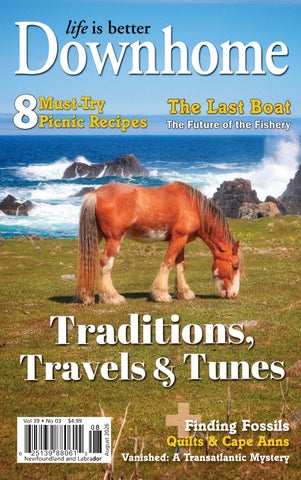
the back porch 130 The Labrador Current Dust and Ore Nathan Freake About the cover Traditions, travels and tunes are at the heart of Downhome’s August issue. Bonavista’s own Mark Gray and his exceptional shot of a horse grazing before a breathtaking ocean backdrop graces our cover. Elsewhere, we provide eight must-try picnic recipes and continue our in-depth exploration into Newfoundland’s fishery.
Cover Index 8 Must-Try Picnic Recipes • 80 The Last Boat • 42 Finding Fossils • 56 Quilts & Cape Anns • 20 & 50 Vanished: A Transatlantic Mystery • 102 www.downhomelife.com
132 What Odds Paul Warford, SpongeBob and musical memories
134 Ties to Home Rhythm of Resilience Dianna Brown
138 From Our Readers The Joys of Summer Judith Ann Keough
140 My Ode to Newfoundland Best-selling author Mike Martin draws inspiration from his home province Mike Martin
144 Photo Finish August 2026
7
homefront_1_Layout 1 6/18/26 11:07 AM Page 8
between the lines Famed writer Aldous Huxley once said that “After silence, that which comes nearest to expressing the inexpressible is music.” Music has been a constant companion throughout my life. There are few waking moments that don’t come complete with a soundtrack. Vacations are planned around concerts and festivals. My car rarely leaves a parking space before the stereo is switched on. Even this column is being written with music playing in the background. Simply put, music is woven so tightly into my everyday life that a life without it would feel lifeless, half-cooked and colourless. As Newfoundlanders and Labradorians, we understand the weight of a good song. The right riff or melody can change lives. For generations, we’ve used music to tell our stories, preserve our history, bring communities together, and help celebrate, reflect, and heal. In this issue, we celebrate the music that forms the soundtrack of our lives. We begin with an exploration of our province’s rich musical heritage, starting in the capital city of St. John’s. We venture down the heavier side of the sonic highway, where those willing to scratch beneath the surface will discover beauty in unexpected places. We also explore the healing power of music and the comfort it can provide during times of loss and grief. Because life is better with music.
Dillon Collins Editor-in-chief
8
August 2026
1-888-588-6353
homefront_1_Layout 1 6/18/26 3:22 PM Page 9
Submission Guidelines and Prize Rules
You could WIN $100! Every reader whose PHOTO, STORY, JOKE or POEM appears next to this yellow “from our readers” stamp in a current issue receives $10 and a chance at being drawn for the monthly prize: $100 for one photo submission and $100 for one written submission. Prizes are awarded in Downhome Dollars certificates, which can be spent like cash in our retail stores and online at shopDownhome.com.*
Submit Today! Send your photo, story, joke or poem to
Downhome, 43 James Lane, St. John’s, NL, A1E 3H3 or submit online at: www.downhomelife.com *Only 1 prize per submitter per month. To receive their prize, submitters must provide with their submission COMPLETE contact information: full name, mailing address, phone number and email address (if you have one). Mailed submissions will only be returned to those who include a self-addressed, stamped envelope. Downhome Inc. reserves the right to publish submissions in future print and/or electronic media campaigns. Downhome Inc. is not responsible for unsolicited material.
Hidden somewhere in this issue is Corky Sly Conner.
Can you find him? Look carefully at all the photographs and in the text of the stories. If you spot Corky, send us your name, address and phone number, along with a note telling us where he’s located. Your name will be entered in a draw and the winner will receive a coupon worth 25 Downhome Dollars redeemable at our store, or through our website.
Send your replies to: Corky Contest 43 James Lane St. John’s, NL, A1E 3H3
mail@downhomelife.com www.downhomelife.com Deadline for replies is the 25th of each month.
Congratulations to Steve Jones of Warren, MB who found Corky on page 72 of the June issue!
*No Phone Calls Please. One entry per person
www.downhomelife.com
August 2026
9
homefront_1_Layout 1 6/18/26 11:07 AM Page 10
RE: ‘Is Ye a Screecher?’
I just read your interesting article about the origin of the Screech-In (June 2026 Island Insights’). I just wanted to write and give you some background information regarding the Screech-In that you may not have had access to. The Screech-In actually originated and was initially developed by my father Fred Walsh when he was manager at the Bella Vista/Stanley’s Steamer. Journalist Roger Bill has done extensive research on the Screech-In for his dissertation. He also wrote a summary article entitled, “The Screech-In at 50: The Invention of a Newfoundland Tradition” (June 23, 2025) on the internet site (thegammybird.ca). He concludes that my dad did indeed “invent” the Screech-In, and in the same article Myrle Vokey confirms that he attended one of dad’s Screech-Ins at the Bella Vista prior to him and his son doing their own imitation of the one dad developed. Roger’s article goes into additional background and has photos of dad dressed somewhat like a fishing admiral conducting a Screech-In at the Bella Vista. Here is the Screech Club card dad issued and a photo of him conducting the Screech-In. Hope this is helpful. Linda Doody St. John’s, NL
The more you know! Thanks for this fascinating slice of local history, Linda. If you have further insights into the Screech-In let us know at editorial@downhomelife.com 10
August 2026
1-888-588-6353
homefront_1_Layout 1 6/18/26 11:07 AM Page 11
Catch of the Day Hello friends. How ye gettin on? Not bad, I suppose. Not much to report here on this early sunny morning, sitting on the balcony with a fire extinguisher on standby in case my one good typing finger catches on fire. Some folks up home say the word cet instead of catch. Cet any fish? Now there are some out there. Speaking of my title, “catch of the day.” Memories of childhood take me back to summertime when my Mom’s cousin, Monnie O’Neil, would visit from The Big Apple, New York City. Monnie was single, and she and Mom were like sisters. Mom’s father passed away when Monnie was young. So Monnie and her sister Marie and their mother, Bridge, moved into the other end of the old house in Trepassey down by the water that everyone likes to photograph. One of the first few
www.downhomelife.com
apartments in Trepassey at the time. Of course, Mrs. Sarah Curtis, the neighbour, had a similar living arrangement and had an apartment in her son Pat’s house. So did Mr. and Mrs. John and Anne Halleran up by the church. So not too rare. One time Monnie visited my older sister Cee, armed with a hay fork. A prong we called it, and a galvanized bucket headed down to the landwash to procure lunch. It was low tide, and you could walk way out on the shoals in the harbour and stab lobsters hiding underneath the rocks. Cee was good at finding the lobsters, and with no fisheries officers around, it was catch them while you can. So a few lobsters. Enough to feed twelve people and a bucket of clams dug out of the sand down in the landwash. If the clamshell was open, it meant they were no good. If you wanted fresh
August 2026
11
homefront_1_Layout 1 6/18/26 11:08 AM Page 12
Fun at the Powwow
The following snap was taken by our own Mel D’Souza at the Miawpukek Powwow in Conne River, when he circumnavigated Newfoundland and Labrador with Adventure Canada last year. Pictured here are Norah Joe, Hope Jeddore, Porsha Joe and Zayne Goodyear. Way to get into the fun, kids!
mussels. You had to go over the back of the point for those. A great feast indeed. No tip required. My mouth is watering thinking about it. The fish plant was operational back then, and cod, turbot, and flounder (sole) were the order of the day. Of course, you could purchase fresh cod fillets from the plant office reasonably cheaply. I get my love of eating seafood from my Dad. I remember him roasting a piece of salt cod with the skin on, wrapped in newspaper, cooked over the open fire to have with his breakfast. Not sure why mother would get embarrassed if a neighbour showed up around noon when we would have potato skins on the table from the new spuds cooked with their jackets on and skin of cod fish peeled off in a heap as well. Think she liked to be tidy, and a big thing
12
August 2026
about food is presentation and eye appeal. I get it now, well, I had about 60 years to think about it. These are some yarns about the good old days, we call them. If you don’t like fish, they were not really so memorable. Thanks for walking down memory lane with me. This is very therapeutic without a shrink. Lola, my wife, is a nurse (RN) and works in mental health, so I can use her as my expert. So long, it’s been good to know ya. Kenneth O’Brien Airdrie, AB
We appreciate this stroll down memory lane, Kenneth! We’re always interested in reminiscing with our readers past or present. Send yours to editorial@downhomelife.com or online at downhomelife.com/submissions
1-888-588-6353
homefront_1_Layout 1 6/18/26 11:08 AM Page 13
Salty Paws Hi! I wanted to share a story and a couple of photos that may be of interest to the Downhomer. The Newfoundland and Labrador CL-415 water bombers – affectionately known as the “Peas and Carrots” plane because of their distinctive orange and green colours – are deeply symbolic to our province. They also hold a very special meaning for me personally, as the daughter and sister of both former and current water bomber pilots. When wildfires threaten our beautiful landscapes and communities, we are always drawn to the aircraft, the pilots, the engineers, and the ground crews whose dedication and courage help protect the places we call home. My love of dogs, combined with my connection to the water bomber aviation world, inspired me to create these reversible dog scarves. One side features an embroidered NL CL-415 water bomber, while the reverse side showcases the iconic Newfoundland tartan. In these attached photos, my brother Chad and his wife Hannah’s dog, Benson, is proudly modelling one of the scarves. I thought your readers and followers might enjoy this story, so I wanted to send it along for your consideration. Heather Goobie Via downhomelife.com
www.downhomelife.com
August 2026
13
homefront_1_Layout 1 6/19/26 1:54 PM Page 20
A Cape Ann by Any Other Name The story behind one of Newfoundland’s most recognizable pieces of gear.
By Nicola Ryan
“O, this is the place where the fishermen gather / With oilskins, boots, and Cape Anns battened down. All sizes of figures with squid lines and jiggers / They congregate here on the squid jiggin’ ground.” With these lines from “Squid Jiggin’ Ground,” 15-year-old Arthur Scammell immortalized the most recognizable pieces of traditional fishermen’s clothing in Newfoundland. Written in 1928 and later popularized in Gerald S. Doyle’s songbook, the song’s lyrics once required no explanation to local audiences. But what are oilskins? What’s a Cape Ann? And how do you batten it down? 20
August 2026
Sou’westers The Cape Ann is a type of sou’wester, a waterproof fisherman’s hat designed to withstand the harsh conditions of the North Atlantic. Its name originated from Cape Ann, Massachusetts, the historic fishing region centred on a place called Gloucester. During the nineteenth century, Gloucester fishermen relied on these distinctive hats for protection against wind, spray, and freezing rain. The design featured oiled 1-888-588-6353
homefront_1_Layout 1 6/19/26 1:51 PM Page 21
canvas, ear flaps, and an elongated rear brim that prevented water from running down the wearer’s neck. Because of its widespread use in the Cape Ann fishery, the style became known as the “Cape Ann sou’wester.” Ah, but we Newfoundlanders and Labradorians rarely use the same word as everyone else if we can help it. Historian Andrew Horwood notes in Newfoundland Ships and Men, “A sou’wester is a seaman’s head dress that in other parts of North America is known as a Cape Ann. But to a Newfoundlander, it was in the beginning and still is and forever will remain a sou’wester.” The word “sou’wester” itself comes from the weather it was designed to withstand – the prevailing southwesterly winds of the North Atlantic.
American History Museum
To further confuse things, Newfoundlanders also called sou’westers “Lincolns” or “Linkums”. Why? The Joseph H. Rowe & Company, out of Gloucester, manufactured genuine Cape Ann oiled clothing, including different styles of sou’westers. One was enigmatically called the Lincoln sou’wester, though it’s a very different hat from the one usually associated with the famous American president. “Linkum” is just a mispronunciation of that.
Oilskins
The Rooms
www.downhomelife.com
Before modern waterproof fabrics existed, sailors and fishermen depended on garments made from oiled cloth to protect against water at sea. As early as the eighteenth century, mariners waterproofed sailcloth and clothing with oils, animal fats, and tar. Knows they weren’t greasy. New Zealand sailor Edward Le Roy is often credited with standardizing modern oilskins in 1898 by applying layers of linseed oil and wax to canvas. This process also gave traditional oilskins their distinctive yellow colour. August 2026
21
homefront_1_Layout 1 6/18/26 1:59 PM Page 22
Linseed oil, derived from flax seeds, naturally produces a yellowish tint when applied to fabric. Although manufacturers eventually shifted to paraffin- based treatments that were more durable and less prone to cracking, the bright yellow remained an enduring visual marker of fishermen’s foulweather gear. In “Outport Memories” in The Book of Newfoundland, Scammell recalls the excitement of receiving his first suit of store-bought oil clothes as a young fisherman on Change Islands. “What a thrill it was when I donned my first suit of store oil-clothes and my first pair of long rubber boots!” he writes. “Now indeed I had joined the free masonry of the sea; I was apprenticed into the fellowship of the craft. Soon the oiled calico would become chafed and worn…but that first yellow robing, together with the black cape ann, is a highlight in my memory.”
Getting Rigged Out In the nineteenth century, most Newfoundland fishermen obtained their oilskins and supplies through the truck system, a credit-based arrangement where merchants advanced gear against the season’s catch of cod or seals. St. John’s import firms on Water Street, such as Bowring Brothers and Ayre & Sons, dominated this trade, bringing in textiles and ready-made oiled garments from New England and Britain. Outport merchants like James Ryan Ltd. in Bonavista, or John Munn & Co. in Harbour Grace, then redistributed these goods to fishing communities. Many fishermen also made or repaired their own gear using canvas or worn sailcloth when store-bought options were scarce or expensive. 22
August 2026
Joseph H. Rowe & Co.
Battening Down So, finally, how do you batten down a Cape Ann? To “batten down,” most commonly heard in the phrase “batten down the hatches,” is a maritime term meaning to prepare for rough weather or difficult conditions. If a big storm is coming, waves that crash aboard the ship could send water straight through the hatches. Battening down the hatches meant securing tarpaulins over the gaps, blocking the spaces where water could flow in. When used as an expression in everyday life, it’s simply to prepare for something rough coming your way. So, to batten down your cape ann means to make sure 1-888-588-6353
homefront_1_Layout 1 6/19/26 12:02 PM Page 23
Labrador Fishermen that it’s screwed down on your head and tied tight around your chin to prevent it from getting lost in the drink.
Beyond the Brim Nowadays, modern waterproof fabrics have replaced oiled canvas, and you can pop down to your local outfitters for your gear. But the language of the fishery remains deeply embedded in Newfoundland culture, and the sou’wester is still an enduring symbol of our fishing heritage. There’s a reason they plunk one on the tourists’ heads during a Screech-In. It’s a reminder of a world of rough seas, hard work and a life shaped by wind, water, and the North Atlantic itself. The Rooms
Do you have a question about Newfoundland and Labrador that you’d like to find out more about? Email us at editorial@downhomelife.com www.downhomelife.com
August 2026
23
104_Vanished_0609 Home Front.qxd 6/18/26 1:38 PM Page 102
reminiscing
102
August 2026
1-888-588-6353
104_Vanished_0609 Home Front.qxd 6/18/26 1:38 PM Page 103
The Mysterious Disappearance of Thomas Harvey Smith By Darrell Hillier
IN THE EARLY MORNING HOURS of 28 May 1939, 25-year-old Thomas Smith left from Old Orchard Beach in Maine, piloting a single-engine, high-wing Aeronca 65C Chief, nicknamed “Baby Clipper” and bearing US registration NX22456.
Some 50 well-wishers cheered as Smith roared down two miles of tide-hardened sandy beach in his fuel-laden monoplane made of fabric-covered welded steel tubing, his path lit by the flashbulbs of news photographers. At the right moment, Smith pulled back on the steering-wheelstyle yoke and rose skyward into the Atlantic mist. His destination is Croydon Airport near London, England. The solo “research flight,” as Smith called it, unauthorized by the US Civil Aeronautics Authority, was intended to “demonstrate the practicality of light planes for long-distance flights.”
1-888-588-6353
August 2026
103
104_Vanished_0609 Home Front.qxd 6/18/26 1:38 PM Page 104
Thomas Smith at the controls of the Aeronca 65C Chief, nicknamed “Baby Clipper” Earlier that May, Smith had taken delivery of the brand-new, silver coloured aircraft at the Aeronca factory in Cincinnati, Ohio. The Aeronca Chief, with its 65-hp Continental engine, had a range of only 250 miles, so Smith had the factory install two fuel tanks holding 152 extra gallons of gasoline, enough for the long, non-stop fight overseas. His aircraft carried no radio apparatus but was equipped with navigation and technical equipment, beyond the standard instrumentation of the time. For the Atlantic crossing, Smith “stowed away in his tiny cockpit four sandwiches, a couple of chocolate bars and two thermos bottles, one containing water and another a soft drink for refreshment,” reported the New York Times. 104
August 2026
In the event of a forced landing in the wilderness, a friend in Cincinnati gave him a .22 calibre revolver and shells. Smith also stocked a first aid kit with fishing line and hooks, mittens, matches, mosquito netting, and a knife and ground compass. While in Maine prior to leaving, the young pilot had befriended Harold Troxel, president of the Portland Flying Service and the local Aeronca dealer. Troxel praised Smith’s project as one of the best prepared nonscientific flights he had seen. Troxel’s comments aside, transatlantic flying was risky business for light aircraft in 1939. Indeed, only weeks before Smith’s flight, SwedishAmerican Charles Backman set out from Bangor, Maine, and became the first aircraft from abroad to land at the newly finished airfield at Gander 1-888-588-6353
104_Vanished_0609 Home Front.qxd 6/19/26 1:59 PM Page 105
(then called Newfoundland Airport), built for a proposed transatlantic mail and air passenger service. The ill-prepared Backman, delivering a Monocoupe 90A to his native Sweden, carried little more than a railway map. He set out nonetheless, making history as the first aircraft to depart the airfield on a transatlantic flight. In Sweden, his mother was among the small crowd awaiting his arrival at Bromma Airport near Stockholm. Sadly, his plane never arrived, and he was never heard from again.
tion business at the time of his transatlantic flight attempt. Smith’s Atlantic crossing had been in the works for some years, said one writer, and finally the time had come. He plotted a course northeast along the Maine coast to Newfoundland, from where he would turn and take the great circle route, the shortest geographic air route from eastern North America to Europe. A stop at Gander to top up his tanks was apparently not in the plans. Barring any mechanical problems or poor weather that might force him to land in Newfoundland, Smith intended to continue onward. Off he went. Reports soon came in of potential sightings in the Maritimes and later in Ireland, Scotland, and England. A rumour circulated that he had landed in Foynes, Ireland, refuelled, and was headed for London, and yet another told that he was arrested at Foynes for lacking the proper flight permit from US authorities. When word spread that he had landed at Croyden, a large crowd gathered at the airport to catch a glimpse of their hero pilot. Even the local St. John’s newspapers reported that he had landed at Londonderry in Northern Ireland. No one knew what to believe. Those in aviation circles were hopeful, pointing out that Smith’s aircraft carried enough fuel to remain aloft for 40 hours. But it was all for nought. Like Charles Backman before him, Smith and his aircraft had disappeared. Such daredevil fights ended four
A stop at Gander to top up his tanks was apparently not in the plans. Barring any mechanical problems or poor weather that might force him to land in Newfoundland, Smith intended to continue onward. While transatlantic flying was foreign to Thomas Smith, flying itself was not. His interest in aviation began at an early age. When his family moved from their hometown of Clarksburg, West Virginia, to Florida, he took up flying lessons at the Curtiss-Wright school in Miami, making his first solo flight at age 15. At 19, he opened a flying school in West Virginia and later landed a job as a test pilot for the Taylor Aircraft Factory in Pennsylvania. During one such test flight, Smith was forced to abandon his aircraft by parachute. In 1937, he moved west to California and was working there in the avia1-888-588-6353
August 2026
105
104_Vanished_0609 Home Front.qxd 6/18/26 1:38 PM Page 106
In 1941 an RCAF patrol spotted the downed plane, about 30 kilometres north of Burgeo months later with the outbreak of war in September 1939. Gander’s role in the conflict remained uncertain initially, with aerial activity limited to upper-air meteorological flights using two Newfoundland government-owned aircraft, and midair-refuelling trials by two Handley Page Harrow tankers, sent out from the UK and used in conjunction with British Imperial Airways’ transatlantic flying operations at Botwood. (Some of the world’s first air-to-air refuelling took place from Gander.) In June 1940, the Royal Canadian Air Force sent a detachment of twin-engine Douglas Digby patrol bombers to Gander for defence purposes and later that year took charge of the two Harrows, sending them to Canada for other work. A Harrow might still drop in at Gander on occasion, and it was during one such return flight to Halifax early in August 1941 that pilot Flying Officer Langmack and crew spotted a downed aircraft in a remote corner of southern Newfoundland. The first 106
August 2026
two letters of the registration number, stencilled on one wing and visible from the air, suggested that the aircraft was American. Word of the sighting quickly reached Gander. The search was on. In between antisubmarine patrol work, Gander’s Digbys searched sporadically throughout August until finally spotting the crash resting in rocky and barren terrain some 20 miles north of Burgeo. Aerial photographs taken on a follow-up flight confirmed that the registration was indeed American. Neutrality notwithstanding, the US had established an aerial presence at Gander before Pearl Harbour in the form of the 21st Reconnaissance Squadron. The Canadians reported their findings to Major Jarred Crabb, commander of both the squadron and the US contingent at Gander. It happened that Crabb’s squadron was transferring out that August, so the matter was left in the hands of the incoming 41st Reconnaissance Squadron. Meantime, efforts to trace 1-888-588-6353
104_Vanished_0609 Home Front.qxd 6/19/26 12:09 PM Page 107
the registration number had garnered results. The crashed aircraft was indeed Thomas Smith’s missing Aeronca. With favourable weather, a fiveman American ground search party from Gander, including Lieutenant Sykes piloting a Grumman Goose amphibious aircraft, landed on a
Markers left by Smith near the lost plane.
suitable pond as near the Aeronca as possible. The men anchored the Goose, inflated a life raft, and rowed ashore. Slowed by thick underbrush, the trek to the crash took an hour. The search team found the aircraft in a “normal upright position, damaged very little.” Even the tires were still inflated, they observed, and all things considered, “Smith had made an excellent landing.” The two auxiliary fuel tanks and the regular tank in the nose were empty, likely due to two years of leakage and evaporation, the men speculated. Papers, charts, and equipment were left scattered about inside, but there was no sign of the pilot. 1-888-588-6353
Smith, however, had left a note telling how icing had formed on his aircraft and forced him down. The temperature continued falling, and he feared freezing while asleep, so he gathered some food and emergency supplies and decided to walk “south [and] then will walk west if I hit [the] ocean.” For unknown reasons, he scratched out this remark, deciding instead to walk north-northwest to look for help. “If I can’t find a house,” he added, I “will try to come back to [the] ship.” Why he headed further into the interior as opposed to south towards the coast and the town of Burgeo is unclear. Presumably, the town was marked on his maps, or perhaps he thought himself to be much further north. With this information, the search team again took to the air, flying in a northerly direction. Three miles from the crash, they spotted a discernible line of signs or signals of unknown origin made of rocks and sticks and pointing northwest. A ground search of this area revealed the presence of a trapper’s log cabin, but no evidence that Smith had been there. No trace of Thomas Smith was ever found. As a final act, everything of value from the aircraft was salvaged by the search party and returned to the flyer’s father. Thus ended another sad chapter in the annals of Newfoundland and Labrador’s aviation history. August 2026
107
2608_Mailorder_Mail order.qxd 6/19/26 10:23 AM Page 126
GREAT GIFT IDEAS!
18" Cod Fish Plush #94697 | $21.99
12" Cod Fish Plush #94696 | $15.99
Everything you need for a Newfoundland
Screech In!
Traditional NL Sou’wester
#85044 | $12.99
Screech-In Certificate
#3530 | $1.99
6" Cod Fish Plush Keychain #94695 | $9.99
NL Flag Shot Glass
#89938 | $3.99
ORDER ONLINE: www.shopdownhome.com
Prices subject to change without notice. Prices listed do not include taxes and shipping. While quantities last.
2608_Mailorder_Mail order.qxd 6/19/26 10:23 AM Page 127
MORE SELECTION ONLINE www.shopdownhome.com
NL Blue Stoneware Mug #91294 | $11.99
NL Serviette Packs
Fish Bone Kitchen Trivet
Puffin Oven Mitts
#94938 | $9.99
#95745 | $8.99
NL Harbour Trivet
Puffin 4 Pc. Kitchen Set
Nautical #95757 | $3.99 Tartan #95753 | $4.99 Flag #91725 | $4.99
#90879 | 8.99
#95748 | $13.99
Tartan 4 Pc. Kitchen Set
Jiggs Dinner Apron
Embroidered Tartan Map Tea Towel
#95747 | $13.99
#95233 | $25.99
TO ORDER CALL: 1-888-588-6353
#95752 | $5.99
Prices subject to change without notice. Prices listed do not include taxes and shipping. While quantities last.
2608_Mailorder_Mail order.qxd 6/19/26 10:23 AM Page 128
GREAT GIFT IDEAS!
GeoToken
Start your adventure! Connecting people, one GeoToken at a time! Where will your GeoToken take you? Includes TWO GeoTokens! #92823 | $11.99
Also in Black!
+ More Shades
Embroidered Tugboat Style Moose Cap #95813 | $21.99
Embroidered Cruiser NL Style Cap #95812 | $19.99
Distressed Embroidered Denim NL Cap
Say No to Pot Lobster Ball Cap
Kids - My First Newfoundland Cap
Soft Embroidered Moose Patch Cap
#52323 | $20.99
#38995 | $22.99
!
#95763 | $12.99
#94606 | $24.99
ORDER ONLINE: www.shopdownhome.com
Prices subject to change without notice. Prices listed do not include taxes and shipping. While quantities last.
2608_Mailorder_Mail order.qxd 6/19/26 10:24 AM Page 129
MORE SELECTION ONLINE www.shopdownhome.com
NL Flag Carry On Tote
Waving Flag 4 Pc. Kitchen Set #91715 | $14.99
NL Flag Microfibre Throw Blanket #91716 | $32.99
Waving Flag Tea Towel
#91712 | $3.99
NL Flag Windsock #95758 | $12.99
NL Flag Backpack
#87934 | $14.99
Embroidered Moose Flag Cap
Newfoundland and Labrador Flag Pin
Waving Flag Oven Mitts
#95824 | $15.99
#89146 | $25.99
#58928 | $5.99
TO ORDER CALL: 1-888-588-6353
#91709 | $8.99
Prices subject to change without notice. Prices listed do not include taxes and shipping. While quantities last.