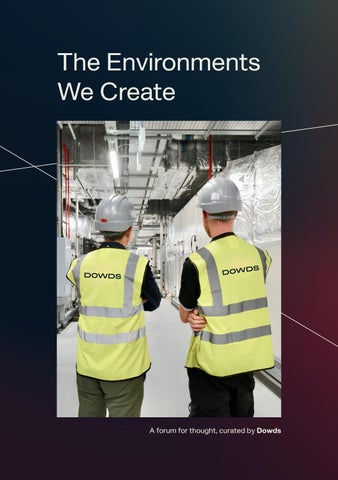
The Environments We Create
A forum for thought, curated by Dowds
Thank you for joining us at The Environments We Create, our 2026 Forum & Exhibition. The event wasn’t about showcasing Dowds. It was about opening up an honest conversation on the pressures and opportunities we’re all facing, both within our industry and across the wider economy. The environments we create – from the culture our people experience, to how we work together, to the impact we leave on the places around us – shape the outcomes we achieve. That responsibility sits with all of us. We brought together a carefully selected group of people, each with real expertise in their own field. We encouraged everyone to share their perspectives, challenge us, and take the time to hear from others in the room. We hope you left with fresh thinking, new connections and a few ideas worth taking back to your own teams. Louise McClelland CEO
Contents Zone Breakdown
03
Understanding the Macro Trends Shaping our Shared Future
05
Zone 1: Our People & Pathways
09
Zone 2: Innovation in the Built Environment
13
Zone 3: Operational Excellence
21
Zone 4: Responsible Growth & ESG
27
Speakers & Panelists
35
The Culloden Estate & Spa, Belfast
Zone Breakdown Environments are the conditions we create through leadership, culture, relationships, decisions and responsible business practices, and they shape the outcomes we achieve. Each of our four zones explores one of these connected environments, and together they make up The Environments We Create.
Our People & Pathways
Zone 1
Operational Excellence
Zone 3
The workplace environment directly shapes safety, culture and performance. Here, we look at our people and the Dowds Academy model – focusing on structured career pathways, talent attraction and continuous upskilling to build long-term workforce resilience.
Operational excellence is no longer measured by efficiency alone, but by how reliably operations hold up under pressure. We look at how creating a collaborative environment, built on non-negotiable safety standards, early engineering involvement, strong supply chain partnerships and continuous learning, delivers a model that adapts to change.
Innovation in the Built Environment
Responsible Growth & ESG
Zone 2
As the built environment becomes increasingly complex, modern delivery relies on digitising how we work at every level. We explore how embedding technology across site operations, building digital skills in our workforce and connecting design directly with offsite manufacturing improves coordination and project delivery.
Zone 4
The environments we create extend far beyond our sites, and sustainable progress requires genuine accountability across the supply chain. Guided by our Head, Hands & Heart values, we share our practical work in decarbonisation, ethical partnerships and lasting community impact.
Zone Breakdownpg. / 04 6
Understanding the macro trends shaping our shared future. The global business environment is entering a period of constant change, driven by a workforce under pressure, accelerating technology, fragile supply chains and rising climate risk. What unites these shifts is the pace of change – technology, regulation and markets are evolving faster than ever before.
WE SEE FOUR GLOBAL TRENDS SHAPING OUR OPERATING LANDSCAPE, EACH EXPLORED IN OUR FORUM’S ZONES: A Workforce Under Pressure. 36% of UK vacancies are now skillshortage vacancies, up from 22% in 2017 (Gov, 2024). The gap is widest in sectors that rely on technical and skilled trades, where it is limiting capacity and slowing project delivery.
Accelerating Technology Adoption. 88% of companies now regularly use AI, yet only 6% report significant value from it (McKinsey, 2025). Most organisations are therefore still working out where technology delivers a genuine return, and how to embed it into everyday operations.
Supply Chain Disruption. Tariff escalations reshuffled more than $400 billion in global trade in 2025 (WEF, 2026). As a result, moving goods and components across borders is now less predictable than at any point since the 1960s, putting pressure on costs, lead times and programme certainty.
Climate Risk Is Financial Risk. Global insured losses from natural catastrophes have passed $100 billion for the sixth year in a row (Swiss Re, 2025). As a result, climate risk is increasingly reflected in the price of capital, insurance and access to finance, making resilience a commercial priority as well as an environmental one.
While these trends present clear challenges, we view them as opportunities. Organisations can no longer remain passive to global change. The businesses that build resilience and adapt before change forces them to, are the ones that will thrive. To succeed, organisations can no longer rely on static multi-year plans or operate purely for short-term cost efficiency. Strategic focus must shift toward operational flexibility - building adaptable supply chains, targeting technology investments with clear financial returns, and reshaping workforce strategies for an aging, skill-constrained talent pool.
Navigating these trends is a shared responsibility that goes beyond any one organisation. It centres on the Environments We Create: the environment our people experience, the one we shape across our industry, and the one we leave for society:
The environment our people experience
The environment we shape across our industry
The environment we leave for our society
The environment our people experience at work shapes how they perform, grow and thrive - built through leadership, culture and the conditions we create for one another.
No organisation responds to change alone. How we collaborate, with clients, partners and supply chains, determines how well our industry adapts together.
Ultimately, the environments we shape reach beyond any one project or industry, they extend into the communities and world we all share. Lasting impact means leaving places and people, better than we found them.
We've experienced these pressures first-hand at Dowds, and we're transforming how we respond across design, digital construction, manufacturing and operational delivery. We don't claim to have all the answers. Today is about sharing our journey, where we're challenging ourselves, and how we can shape the environments of tomorrow together.
Macro Trends / 06
Explore Our Zones
Showcase Zone 1
Our People & Pathways LABOUR AVAILABILITY AND PRODUCTIVITY HAVE BECOME DEFINING CONSTRAINTS ON GROWTH AND DELIVERY The global economy is facing two linked structural challenges that will shape the next decade: weak productivity growth and persistent labour shortages. These are not just postpandemic effects. They reflect deeper demographic, technological and institutional shifts that are changing how economies work. Talent shortages have hit a 17-year high, with 76% of employers reporting difficulty filling roles, affecting capacity across technology, healthcare, engineering and skilled trades. At the same time, UK productivity has grown just 7% over the past decade - against 21% in the decade before the financial crisis – leaving it second slowest in the G7. Together, they point to something more fundamental: people, and their development, have been overlooked for too long.
We view the following trends as the principal drivers behind the labour and productivity constraints that organisations face today:
LONG-TERM SICKNESS
A record 2.8 million working-age people in the UK are economically inactive due to long-term sickness, 800,000 more than in 2019 (Gov, 2026), creating sustained staffing pressure in critical sectors.
SKILLS MISMATCHES
36% of UK vacancies are now skill-shortage vacancies, up from 22% in 2017 (Gov, 2024), limiting the ability to deliver complex projects and adopt new technologies.
DEMOGRAPHIC AGEING AND RETIREMENTS
The number of people at State Pension age will rise by 1.8 million between 2024 and 2034 (TiM, 2026), taking critical skills and knowledge out of a smaller workforce.
WEAK INVESTMENT
Business training expenditure in England has fallen 9%, from £49.4bn to £44.8bn in 2024 prices (Gov, 2026), even as the demands on people grow.
Together, these pressures mark a fundamental shift in the economy. With fewer people available and productivity under strain, organisations in every sector are rethinking how they attract, develop and support their people. Labour and productivity have become two sides of the same challenge, each shaping the other. We view these pressures as a turning point and a moment to reinvest in our people – to grow the skills the market is short of, embrace new technology and build smarter, more productive ways of working. That is why we are investing in learning and development. By bringing new talent into the industry and giving them the skills, training, experience and support to grow, we are tackling these labour and productivity challenges head on and building a resilient, productive workforce that is ready to lead as the market evolves. Zone 1: Our People & Pathways / 10
OUR ELEVATED EMPLOYEE VALUE PROPOSITION Our industry is facing growing pressure on its people, and we have a responsibility to think differently about how we support them. That is why we created our Elevated Employee Value Proposition (EVP) – so our people can see and feel how seriously we take their financial security, health and wellbeing. It is built around four areas: Made for Real Life – 41 days of annual leave, enhanced family-friendly leave, paid carer's leave, flexible working and an electric vehicle salary sacrifice scheme. Health & Wellbeing – Private medical cover, a health cash plan, life assurance and a confidential 24/7 Employee Assistance Programme, alongside everyday wellbeing benefits such as gym discounts and a cycle-to-work scheme. Employee Recognition – A recognition platform where colleagues can nominate one another for living our values, and rewards that mark long service and career milestones. Finance & Salary Package – Salaries benchmarked against the market and reviewed every year, a company performance bonus, a pension matched up to 7% and enhanced company sick pay. For us, this is about more than a set of benefits. It is how we are looking after our people – recognising their contribution, rewarding them fairly and supporting their health, wellbeing and life outside work. By doing so, we are giving our people the support they need to build their future with us, while building a diverse, resilient and productive workforce that can grow with the business and is built to last.
Rob Rees
Angela McShannon
Head of People
Senior People & Culture Business Partner
To find out more about our people pathways and EVP, speak to a member of our team at: contactus@dowdsgroup.com.
Zone 1: Our People & Pathways / 12
Showcase Zone 2
Innovation in the Built Environment RISING COMPLEXITY, FASTER TECHNOLOGICAL CHANGE AND GREATER VOLATILITY ARE DRIVING ORGANISATIONS TO RETHINK HOW THEY DESIGN, DELIVER AND OPERATE. The global economy is entering a period in which complexity, data and resilience are becoming central to how organisations create and sustain value. Products, services, and supply chains are increasingly interconnected, while organisations must respond to faster technological change, volatile operating conditions and greater demands for certainty. As systems become more connected, linking data, expertise and delivery has become central to controlling risk and creating certainty.
We view the following trends as key drivers of the need for more integrated, data-enabled and resilient ways of working:
COMPLEXITY IS OUTGROWING TRADITIONAL MODELS
Only 0.2% of 3,022 major infrastructure and construction projects were delivered on time, on budget and with their promised benefits (ICE, 2025). As projects become more interconnected and technically demanding, organisations must balance cost, quality, speed, carbon and regulation all at once.
DATA IS BECOMING THE INFRASTRUCTURE FOR DECISION-MAKING
AI adoption among UK businesses with 10 or more employees has almost tripled since late 2023, from around 12% to 35% (ONS, 2026). As a result, data is shifting from a record of the past to an active input into how projects are planned and delivered.
RESILIENCE IS BECOMING A SOURCE OF COMPETITIVE ADVANTAGE
Fewer than 8% of businesses feel fully in control of supply-chain risk, while 63% report higher-thanexpected losses from disruption (WTW, 2025). With disruption now a normal operating condition, resilience is moving beyond contingency planning and into how systems, supply chains and assets are designed.
DIGITAL ADOPTION IS BECOMING A CONDITION OF COMPETITIVENESS
Almost three in five construction professionals fear their organisation will fall behind without faster digital adoption (Construct UK, 2025). Digital capability is therefore becoming a baseline expectation, shaping who wins work and who can deliver it efficiently.
As complexity and volatility increase, organisations need to make critical decisions earlier and design out risk before it reaches delivery. This means managing projects not as separate stages but as connected systems – from early design through to delivery, operation and improvement. Digital tools, data and industrialised methods make this possible, reducing rework and building certainty into delivery. The organisations that succeed will be those that turn information into action and connect specialist expertise to delivery. Zone 2: Innovation in the Built Environment / 14
THE DOWDS DESIGN HOUSE With data now shaping how projects are planned and delivered, we are building out the Dowds Design House – taking ownership of design so information flows seamlessly from concept to site, driving: Collaborative early design engagement Technical design expertise BIM and digital engineering for delivery Standardisation and repeatable processes Point cloud scanning and digital surveying Advanced engineering assets Digital twins and smart buildings As our in-house design practice, the Design House puts design ownership at the core of every project – delivering full mechanical, electrical and public health design from concept through to manufacturing, delivery and aftercare. Working alongside our clients from day one, it brings together design, technical engineering and digital capability to shape better decisions earlier. Using BIM-based coordination, fabrication purpose-built content and digital plug-in tools, we can foresee and resolve conflicts before they reach site. Standardised and repeatable processes create greater consistency across delivery. Ultimately, this enables better decision-making earlier, reducing risk and creating greater certainty throughout delivery.
DIGITISATION IN BELFAST GRAND CENTRAL STATION
Client: Location:
MEP Value:
Translink Belfast, Northern Ireland
£15m Fully coordinated M&E services model
0 paper drawings used on site
Installation-ready MEP plant room
100%
KEY HIGHLIGHTS Digital Design & BIM Authoring Authored the entire M&E scope in Autodesk Revit, developing bespoke families for specialist elements including generators, PV panels, and PA/VA systems. Coordination & Clash Detection Ran dual-layer clash detection using Navisworks & BIMCollab, resolving multidisciplinary issues before impacting on-site costs. Verification & Asset Handover Delivered point cloud laser scanning, COBie data in Excel and IFC, and a Uniclass-classified Asset Information Model – FMready from day one.
Information Management Deployed Viewpoint and Dalux as a structured two-platform CDE, transitioning from PAS 1192 to full ISO 19650 compliance – with digital best practice embedded from RIBA Stage 3. Site Digitisation Used Dalux to manage snagging, inspections and systems testing digitally on site, maintaining realtime traceability between field activity and office quality records throughout construction.
of M&E assets classified using Uniclass for FM compatability at handover
50+ in-house custom built Revit families created
1500+ clashes identified and resolved across all MEP disciplines
Zone 2: Innovation in the Built Environment / 16
MANUFACTURING WITH DOWDS The future of M&E is digital, standardised and built off-site. With supply chains less predictable than ever, we're taking greater control of how projects are built by introducing manufacturing into construction – developing lean manufacturing capabilities and logistics hubs, underpinned by a procurement strategy for sourcing and assembling components, with a planned Northern Ireland facility at its core. Dowds Offsite will become our manufacturing centre of excellence – a dedicated offsite facility supported by our Design House and delivered through our logistics hub. It will shift M&E delivery from on-site construction to factory-based manufacturing and assembly, becoming a core pillar of how we deliver. This will create an integrated manufacturing and digital delivery service that responds to the increasing complexity of the industry, delivering: Reduced programme risk Improved quality and consistency Less complexity on site Greater certainty for our clients A safer, more controlled and technology-enabled environment for our people
MMC IN ROYAL SURREY HOSPITAL
Client: Location:
Royal Surrey NHS Foundation Trust Guildford
£12m
38% reduction in on-site installation through offsite prefabrication
214 KEY HIGHLIGHTS Health & Safety Prefabricated 214 flanged pipework sections off-site, eliminating hot works & reducing on-site labour in live environment. Programme & Delivery Compressed a 16-week on-site installation programme to 10 weeks by resolving fabrication, assembly, and quality sign-off in a controlled factory environment. Quality & Precision Achieved zero re-works across the full prefabricated scope – quality checks and sign-off completed in a controlled factory environment before modules reached site.
Off-Site Manufacturing Executed a coordinated off-site manufacturing programme spanning 8 module types, 8 pipework racks, and 432 spool sections – all delivered fully assembled and installation-ready to site. Digital Coordination & 3D Modelling Used Revit 3D modelling to coordinate 9 AHUs within a constrained plant room, achieving clash-free installation with zero re-works across the full M&E scope.
flanged pipework sections fabricated offsite
432 sections of spool pipework fabricated and delivered to site
Zero re-works required across the full M&E scope
Zone 2: Innovation in the Built Environment / 18
CONNECTING DIGITAL, DESIGN AND MANUFACTURING How we're responding to rising complexity, data-led decision-making and the need for greater resilience – through our digital foundations, Dowds Design House and manufacturing. With digital capability now a baseline expectation, digital enablement underpins how we design, deliver and grow. We’re focusing on three areas: Connected Tools. Integrating technology, AI and digital capabilities for our clients and our people. A Digitally Confident Workforce. Building the skills our people need to work confidently with new technology. A Single Source of Truth. Connecting data across projects, teams and the supply chain, so it actively shapes how projects are planned and delivered. Together, these areas help us make faster, better-informed decisions, reduce rework and bring greater certainty to every stage of a project – creating better ways of working for our people and greater value for our clients.
Damian McCamphill
Paul Skinner
Head of MMC
Head of Technical, Design & BIM
Aneta Neuman
Head of Business Tranformation & IT
To find out more about our digital, design and manufacturing capabilities, speak to a member of our team at: contactus@dowdsgroup.com.
Zone 2: Innovation in the Built Environment / 20
Showcase Zone 3
Operational Excellence CONSTANT DISRUPTION, RISING EXPECTATIONS AND THE PACE OF CHANGE ARE REDEFINING WHAT OPERATIONAL EXCELLENCE DEMANDS. The global economy is entering a period of constant disruption, in which transformation efforts are struggling to deliver lasting change and client and end-user expectations are evolving faster than organisations can adapt – making operational excellence a more demanding and more strategic capability. In a more volatile and connected environment, performance depends on maintaining reliable outcomes, learning from failure and improving continuously – across people, processes and technology.
We view the following trends as key drivers behind the changing demands on operational excellence:
VOLATILITY IS BECOMING STRUCTURAL
On average, organisations experienced three and a half major disruptions in the last two years (PwC, 2023). Driven by geopolitical, climate, economic and supply-chain risk, disruption is now the normal operating context, pushing organisations to build resilience into their operations rather than rely on efficiency alone.
IMPROVEMENT MUST BE CONTINUOUS
More than 70% of transformations fail to meet their original goals (BCG, 2026). Change often falls short because improvements are not embedded in how organisations work, so lessons are lost and the same problems return.
END USERS ARE REDEFINING PERFORMANCE
70% of executives say customer expectations are evolving faster than their organisation can adapt (Source, Year). As a result, performance is increasingly judged not by delivery alone, but by how reliably buildings and services perform in use.
As disruption becomes constant and expectations rise, organisations must deliver consistently, recover quickly and keep improving. This means treating operational excellence not as a matter of efficiency alone, but as a whole system spanning people, processes, technology and risk
Zone 3: Operational Excellence / 22
EMBEDDING OPERATIONAL EXCELLENCE AT DOWDS At Dowds, we’re developing the standards and capabilities to adapt to these changing expectations, embedding excellence across key pillars:
Health & Safety
Digital
We place the utmost importance on the health and safety of our people, our partners, and the public. As a SafeContractor-approved partner, we deploy senior-led teams who take ownership on every job – de-risking technical and logistical hazards through early identification, rigorous isolation planning, and effective mitigation strategies.
Our digital framework embeds technology into every stage of a project, from collaborative early design and point cloud surveying to digital twins and smart buildings. On site, our digital dashboards and mobile tools remove friction from data collection, so decisions are made faster and with better information.
Supply Chain
Design
Our partners are an extension of who we are and how we deliver. We work with people who meet the same high standards we set for ourselves – technically, ethically, and culturally. We operate as one connected supply chain, taking shared responsibility for the outcomes we create.
Integrating design from day one means we lead from initial feasibility through to delivery, handover and aftercare. BIM-based coordination resolves conflicts before they reach site, protecting programme, budget and performance from the outset.
Facilities Management
Continuous Improvement
Our FM division is a natural extension of our design, build and maintain philosophy, providing clients with the reassurance of uninterrupted building performance long after handover. From planned and reactive maintenance to lifecycle modelling and energy efficiency, aftercare is fully integrated in-house.
We capture insights from every project, turning experience into knowledge that shapes the next. Every project closes with a structured review, celebrating what went well and identifying where we can do better – so our processes, tools and thinking keep evolving, project by project.
Together, these pillars are how we take operational excellence beyond efficiency – an environment built on collaboration at every stage, where we deliver consistently, adapt quickly and keep improving as we grow.
Zone 3: Operational Excellence / 24
OPERATIONAL EXCELLENCE ACROSS OUR SECTORS Every sector we work in faces its own operational pressures, but all share the same underlying need: environments that remain safe, resilient and fully operational as conditions change. Healthcare
Commercial
Live clinical environments that must operate around the clock, alongside ageing estates, strict infection control and net zero targets.
Buildings that must meet today's standards, adapt to tomorrow's and use data to improve performance over time.
Life Sciences
Education
Rapid growth in lab and research facilities that must meet exacting safety standards while reducing high energy and water demand.
Rising demand for digital, healthy and low carbon learning spaces, set against ageing estates and a growing maintenance backlog.
Defence
Renewable Energy
Ageing estates that must be modernised to maintain readiness, energy security and resilience in an uncertain geopolitical climate.
A shift from building generation capacity to operating variable, interconnected systems reliably.
Data Centres
Facilities Management
Rising power and cooling demand from AI and cloud computing, where even planned maintenance carries risk.
Ageing assets and deferred maintenance that turn unseen failures into rising cost and risk.
Each of these environments requires us to understand the specific demands of our clients' operations. At Dowds, we bring the same discipline wherever we work – planning in resilience from the outset, proving performance before handover and supporting assets long after – so our clients' buildings and systems perform when it matters most.
Daryl Barr
Dean Mulvaney
Head of Strategic Partnerships
Head of Operations
To find out more about how we are embedding operational excellence at Dowds, speak to a member of our team at: contactus@dowdsgroup.com.
Zone 3: Operational Excellence / 26
Showcase Zone 4
Responsible Growth & ESG RISING CLIMATE RISK, TIGHTENING REGULATION AND DEMAND FOR GREATER ACCOUNTABILITY ARE MAKING RESPONSIBLE GROWTH A CORE BUSINESS PRIORITY. ESG is no longer a peripheral consideration sitting alongside the business – it is becoming a core driver of business planning itself, reflecting a deeper shift in how capital, clients and talent are choosing who they work with. This shift is being driven by talent, investors and regulation alike. 70% of Gen Z and Millennials say a company's environmental credentials shape where they choose to work (Deloitte, 2025), while investors are increasingly building sustainability into their decisions and regulation is turning voluntary commitments into standardised reporting. As a result, organisations are now expected to show clear evidence of how ESG performance links to risk, value and long-term growth.
We view the following trends as key drivers behind the shift towards responsible growth:
CLIMATE RISK IS FINANCIAL RISK
Global insured losses from natural catastrophes reached $107 billion in 2025 (Swiss Re, 2025). With losses now exceeding $100 billion for six consecutive years, rising claims are pushing up premiums and making cover harder to secure in exposed locations and sectors.
DEMAND IS DRIVING ACTION
80% of people say they are willing to pay more for sustainably produced or sourced goods (PwC, 2024). As a result, trust is increasingly built on demonstrable impact, not targets.
CLIMATE CHANGE IS SHIFTING THE BASELINE
In 2024, the global average temperature was more than 1.5°C higher than in pre-industrial times for the first time on record (Met Office, 2025). With 2026 set to be the fourth year above 1.4°C, changing conditions mean buildings must be designed and operated for overheating and cooling demand to flood resilience.
Together, these pressures are redefining what it means to grow responsibly. Climate risk now carries a clear financial cost and expectations of proof are rising – placing the built environment, and those who design, deliver and maintain it, at the centre of the response.
Zone 4: Responsible Growth & ESG / 28
RENEWABLE ENERGY IN HENDERSON GROUP SPAR STORES
Client:
Henderson Group SPAR
Location:
Northern Ireland
MEP Value:
£2.7m 2.7GWh
KEY HIGHLIGHTS
Sustainability Delivered solar PV systems across 50+ sites, supporting sustainability goals and reducing reliance on grid electricity. Each installation was tailored to maximise renewable energy generation while maintaining normal site operations. Operational Resilience Working in live environments required a strong focus on operational resilience. Effective stakeholder management and phased delivery ensured business continuity throughout the project. Programme Management Managed a coordinated programme to maximise delivery efficiency. Close collaboration with client ensured works were planned around store requirements to minimise disruption to day-to-day site activities.
Data-Driven Design Designs were tailored to individual stores using live consumption data to determine the optimal system size and maximise on-site energy utilisation. Bespoke designs ensured the highest levels of self-consumption, performance, and return on investment. Client Enablement Supported the end client through system demonstration and handover, providing guidance on operation and energy usage to help maximise solar generation, self-consumption, and long-term system performance.
of renewable generation
£735,137 estimated total electricity savings from grid
536 tCO2e carbon emissions avoided
2.12MWp of solar PV installed across 50+ stores.
Zone 4: Responsible Growth & ESG / 30
LINKING BACK TO OUR VALUES At Dowds, we believe in this change. Through our Head, Hands & Heart values, we are turning ambition into measurable action – reducing our environmental impact, creating meaningful opportunities for people, strengthening the communities where we work and holding ourselves accountable to every promise we make.
Hands
Head
Heart
Cathal McGarry
Kenny Conneely
Head of Supply Chain
Commercial Director
We are committed to becoming Carbon Neutral by 2038, and our progress is already measurable. We have reduced our emissions by 11% against our 2023/24 baseline and now report across seven Scope 3 categories. In 2024/25 alone, our people completed more than 4,000 hours of training, and we have recorded zero reportable incidents since April 2024.
Turning commitments into practical action. Safe, high-quality delivery, lower-carbon operations, waste reduction and smarter, more efficient project delivery.
Making informed, ethical, future-focused decisions. Strong governance and accountability, data and evidence-led reporting, and long-term, responsible commercial decisions.
Recognising our impact beyond the immediate task. People and wellbeing, opportunity and inclusion, social value, and community and environmental impact.
To find out more about our approach to ESG and responsible growth, speak to a member of our team at: contactus@dowdsgroup.com.
Zone 4: Responsible Growth & ESG / 32
Meet Our Speakers
Speakers & Panelists We brought together leaders, designers, scientists and strategists to share what the environments they create mean to them. From leadership and the future of work to digital construction and fusion energy, each offered a different lens on how people, businesses and communities thrive.
Louise is CEO of Dowds Group, leading the business through its next phase of growth and transformation. She brings more than 20 years’ experience spanning business transformation, finance, private investment and organisational change, with a career that has given her extensive exposure to businesses and markets internationally.
Louise McClelland CEO, Dowds Group
Her background combines strong financial and commercial experience with an understanding of how private investment can support sustainable growth and long-term value creation. At Dowds, her focus is on strategy, people, innovation, responsible growth and building the capabilities the business will need for the future.
Gina London is an Emmy Award-winning former CNN anchor and correspondent, global leadership advisor, ICF-certified executive coach, author and international keynote speaker. An American entrepreneur based in Dublin, she is founder and CEO of Language of Leadership, co-founder of KELLA Senior Women’s Leadership, an Adjunct Professor at University College Cork and a Non-Executive Director.
Gina London Communications & Leadership Expert, Author and Former CNN Correspondent
Wayne Hemingway MBE Designer, Entrepreneur & Co-founder of HemingwayDesign
Wayne is an award-winning designer, entrepreneur and co-founder of HemingwayDesign, a multidisciplinary design studio focused on place, people and positive social impact. Having first achieved international success as cofounder of fashion label Red or Dead, Wayne has spent the past three decades working across regeneration, placemaking, housing, culture and design. His work is underpinned by a belief in the power of thoughtful, peoplecentred design to improve communities and create lasting social value.
Speakers & Panelists / 36
Dr Marianne Roux
Marianne is a global Future of Work strategist, leadership expert and organisational consultant with more than 30 years’ experience across HR, transformation and executive development. She has held senior roles with organisations including PwC, Accenture, Deloitte and Mercer and now leads Roux Consulting from Dublin, helping leaders navigate changing expectations around work, people and organisational design.
Future of Work Strategist & Leadership Expert
Melanie is Founder and Director of Origin7 and a leading specialist in BIM, digital construction and transformation within the built environment. With more than 20 years’ industry experience, she works with organisations to improve productivity, information management and project delivery through smarter use of digital processes, data and technology.
Melanie Dawson Digital Construction & Transformation Specialist
Ron Immink Strategist, Author & Innovation Expert
Dr Elina Militello Asp
Ron is a strategist, author and speaker specialising in innovation, future trends and helping organisations prepare for change. With four decades of experience working with CEOs, entrepreneurs, corporates, universities and international organisations, he brings a broad perspective on the forces shaping business and society. His work challenges organisations to question assumptions, identify emerging change and think differently about what comes next.
Elina is a physicist and Scenarios Team Leader at the UK Atomic Energy Authority, with more than 20 years’ experience in fusion plasma physics research. Her work focuses on some of the complex scientific and engineering challenges involved in developing fusion as a future energy source, bringing a unique perspective to our conversations around energy, innovation and the skills that will shape the industries of tomorrow.
Fusion Energy Physicist & Scenarios Team Leader, UK Atomic Energy Authority
Speakers & Panelists / 38
Realising the opportunities of a continuously changing world requires us to look to each other, challenge assumptions and build on what we learn. The environments we create shape the outcomes we achieve – and we all share a responsibility for them, not only within our own organisations, but across wider society. By continuing to collaborate, open up new conversations, and work across industry boundaries, we can adapt faster – together.
To explore our work in more detail, access digital insights, or continue the conversation with our team, visit our website or get in touch directly at contactus@dowdsgroup.com
London 7 St Chad's Pl, London WC1X 9HH +44 (0) 28 2766 2789 Ballymena 4 Parkway, Ballymena BT43 5ET
+44 (0) 28 2766 2789 Website dowdsgroup.com