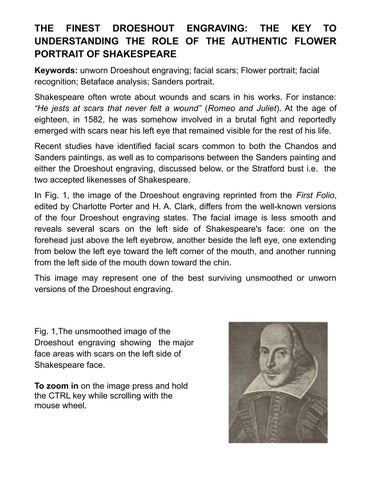
THE FINEST DROESHOUT ENGRAVING: THE KEY TO UNDERSTANDING THE ROLE OF THE AUTHENTIC FLOWER PORTRAIT OF SHAKESPEARE Keywords: unworn Droeshout engraving; facial scars; Flower portrait; facial recognition; Betaface analysis; Sanders portrait. Shakespeare often wrote about wounds and scars in his works. For instance: “He jests at scars that never felt a wound” (Romeo and Juliet). At the age of eighteen, in 1582, he was somehow involved in a brutal fight and reportedly emerged with scars near his left eye that remained visible for the rest of his life. Recent studies have identified facial scars common to both the Chandos and Sanders paintings, as well as to comparisons between the Sanders painting and either the Droeshout engraving, discussed below, or the Stratford bust i.e. the two accepted likenesses of Shakespeare. In Fig. 1, the image of the Droeshout engraving reprinted from the First Folio, edited by Charlotte Porter and H. A. Clark, differs from the well-known versions of the four Droeshout engraving states. The facial image is less smooth and reveals several scars on the left side of Shakespeare's face: one on the forehead just above the left eyebrow, another beside the left eye, one extending from below the left eye toward the left corner of the mouth, and another running from the left side of the mouth down toward the chin. This image may represent one of the best surviving unsmoothed or unworn versions of the Droeshout engraving.
Fig. 1,The unsmoothed image of the Droeshout engraving showing the major face areas with scars on the left side of Shakespeare face. To zoom in on the image press and hold the CTRL key while scrolling with the mouse wheel.
Fig. 2. The Flower painting described by Hammerschmidt-Hummel as the authentic version that does not contain the later-added contemporary yellow pigment.
In Fig. 2, the Flower painting, dated 1609 and distinct from the smoother version containing contemporary yellow pigment, was proposed by HammerschmidtHummel as the model used by Droeshout for his engravings. Others, however, have rejected this claim. When compared with the second state of the Droeshout engraving, Hammerschmidt-Hummel reported analyses conducted by Reinhardt Altmann of the BKA showing seventeen similarities with either the Chandos or Flower paintings, although these images are not reproduced here. In addition to these similarities, however, the Flower painting also appears to show numerous scars on the left side of the sitter's face (see Fig. 2). Whether or not it served as a model for the engraving, this short study first compares the Flower painting with the unsmoothed version of the Droeshout engraving shown in Fig. 1. The investigation begins with a Betaface analysis comparing a black-and-white version of the Flower painting, which serves as the 100% reference image, with the original colour version of the painting, the unsmoothed Droeshout engraving, and three classic versions of the engraving. The results are presented in Fig. 3.
Fig. 3, Betaface comparison of the Flower painting either black & white or colored with the unsmoothed Droeshout engraving and the 2nd, 3rd and first states of the engraving.
This Betaface analysis produced an especially notable set of results. When compared with the reference black-and-white version of the Flower painting, which was assigned a score of 100%, the colour version of the same painting achieved a 99.6% similarity score. The unsmoothed version of the Droeshout engraving produced a similarity score of 95.5%. The near-identical scores obtained from the black-and-white and colour versions of the Flower painting indicate that the facial correspondence is not dependent upon colour information. More importantly, the unsmoothed Droeshout engraving produced an exceptionally high similarity score of 95.5%, despite being a fundamentally different type of image and retaining engraved facial information. The unsmoothed Droeshout engraving also achieved a higher similarity score (95.5%) than the three classic, smoother versions of the engraving, although these likewise retained high similarity scores: 94.3% for the second state, 94.0% for the third state, and 93.5% for the first state. These results indicate that all versions of the Droeshout engraving remain highly related. The consistency of these exceptionally high scores across differently rendered images provides an important additional biometric observation. A further comparison was then conducted using powerful visual face recognition (VFR)* software developed by the late Robert J. Schmitt Jr., an expert in this field. Figure 4 presents the results obtained from the VFR comparison.
Fig. 4, Screen captures of the VFR comparisons between the Flower painting (black and white) and the unsmoothed Droeshout engraving image.
In the top panel, the two sitters are aligned with their eyes on the same horizontal plane and with identical interpupillary distances. In the second panel, the sliding comparison pauses at the level of the right eye; in the third, at the nose; and in the fourth, at the left eye, highlighting the scars above the left eyebrow. The results shown in Fig. 4 speak for themselves: remarkably close correspondences are obtained when the unsmoothed Droeshout engraving shown in Fig. 1 is compared with the Flower painting shown in Fig. 2 in black and white. The comparison reveals the following striking correspondences: 1. A similar pattern of baldness; 2. Similarly shaped, thin eyebrows; 3. Similar spacing between the eyebrows; 4. A similarly broad forehead; 5. A similar hairstyle; 6. Similar eyelids and dark areas above and below the eyes; 7. A similar left facial contour extending toward the left earlobe; 8. A similar nose shape and nostrils; 9. A similar Cupid's-bow shape of the upper lip; and 10.Similar, clearly visible scars above the left eye. And in addition each sitter has a similar costume and plain falling collar as shown in Fig. 1 and 2. All the similarities described by Hammerschmidt-Hummel in her comparison of the Flower painting with the second state of the Droeshout engraving appear to be present. In addition, both images show very similar facial areas containing scars on the left side of Shakespeare's face. Again, the VFR results indicate a very close relationship between the Flower painting and the unsmoothed Droeshout engraving. The VFR software can also generate an overlay of the two images, as shown in Fig. 5.
Fig. 5, Screen capture of the VFR comparisons showing an overlay of the Flower painting and the less smoothed Droeshout engraving. The red arrows underline a difference observed between the two artworks.
A nearly perfect correspondence is observed between the two images, with one principal exception. The right facial contour, extending from the chin toward the right eyebrow, as indicated by the red arrows in Fig. 5, represents the main difference between the Flower painting and the engraving. This mismatch may result from a slight difference in perspective between the two images. The Flower painting becomes even more interesting when it is compared with the Sanders painting, dated 1603 (Fig. 6).
Fig. 6, Screen captures of the VFR comparison side by side between the Flower and the Sanders paintings. As in a previous study comparing either the first state of the Droeshout engraving or the unsmoothed version of the engraving with the Sanders painting, the comparison between the Sanders and Flower paintings reveals similarly striking correspondences. However, the sitter in the Flower painting appears older, as indicated by more pronounced baldness, an elongated philtrum, and slight sagging of the lower face—features consistent with the normal aging process. These differences may account for the higher position of the smiling mouth in the Sanders portrait relative to the Flower image, as indicated by the red arrows in the side-by-side comparison and overlay shown in Fig. 7.
Fig. 7, Screen captures of the VFR comparisons between the Flower and Sanders paintings, showing a side-by-side panel on the left and an overlay of the two images on the right. The red arrows indicate differences between the two paintings. The difference observed in the overlay of the black-and-white Flower painting and the unsmoothed Droeshout engraving in Fig. 5 is also visible in the overlay between the Flower and Sanders paintings in Fig. 7, although only under high contrast, which is not shown here. The same facial areas containing scars that are visible in the older image of the Droeshout engraving (Fig. 1) and shared with the Flower painting (Fig. 2) also appear in the Sanders painting, which was created approximately six years before the Flower painting. The Fig. 8 summarizes the results concerning these facial scars.
Fig.8, Summary of the principal facial scars common to the unsmoothed Droeshout engraving (left), the Flower painting (centre), and the Sanders painting (right). The geometric markings identify the principal facial areas containing scars common to all three sitters.
All of the facial areas containing scars shown in Fig. 8 occur in each of the three images—the two paintings and the engraving—in corresponding facial positions: above the left eye, beside the left eye, extending from below the left eye toward the corner of the mouth and the chin, or immediately below the left side of the mouth. These features may therefore be considered highly distinctive facial characteristics, comparable in their identifying value to fingerprints. They support the possibility that the three images depict the same individual—Shakespeare. The Flower painting appears to provide the most direct link between the Sanders painting and the Droeshout engraving. Both the Sanders and Flower paintings also appear to demonstrate a strong commitment to realistic representation. So both the Flower and Sanders paintings, produced during Shakespeare's lifetime, exhibit similar scars on the left side of the face to those visible in the posthumous, exceptionally detailed version of the Droeshout engraving. These correspondences place the two paintings within a particularly significant group of portraits that may depict the Bard. This short study not only brings renewed attention to an unsmoothed version of the Droeshout engraving and to the remarkable precision of the Sanders painting, but also provides additional support for Hammerschmidt-Hummel's hypothesis that the Flower painting may have served as a model for the Droeshout engraving. At the same time, the possible involvement of both the Sanders and Flower paintings, directly or indirectly, in the creation of the Droeshout engraving cannot be ruled out. Jean-Pierre Doucet The author is a retired scientist living in Quebec, Canada and is thankful to Daniel Fischlin for his support, to Mark Vinet (Timeline) for the best Sanders pictures and to the members of Betaface.com who let me used their analytic tool. Note: Another painting was previously found highly related to the Sanders painting and the unsmooted Droeshout engraving, the Wadlow painting (not shown) in which the theator actor was getting into character. The sitter is wearing an actor costume and some white and reddish makeup are completing the actor dress. These makeup hide the major scars or swellings described above in this study.
As it happened often, may be the unknown painter decided to be nice with his famous sitter. *The use of this VFR cannot be easier: one just needs to clic in the center of the eyes of each sitter and the software automatically rotates the faces if necessary and the eyes are put on the same horizontal plane; then a direct comparison can be done by sliding with a curser each image over each other as the user sees fit or not. The user involvement is minimize. So the main basis of this software is to adjust each picture to the same interpupillary distance (IPD), a constant value in adulthood and this anatomical reference marker is used regularly for forensic facial identification. Such comparison is possible when the chosen sitters are in the same perspective. MAIN REFERENCES: Wilson J.R., Wounds in Shakespeare, https://wilson.fas.harvard.edu/stigma-in-shakespeare/wounds-in-shakespeare Stirling S.A., Art & Will, artandwill.blogspot.com/2014/03/shakespeares-crab.html. Doucet J.-P. (2026) Bridging the Iconographic Gap: Biometric Comparison and AI-Assisted Restoration of the Chandos and Sanders Portraits of William Shakespeare, https://issuu.com/doucetjp/docs/biometric_comparison_and_ai-assisted_restoration_o Doucet J.-P. (2026) The Sanders Portrait and the Accepted Likenesses of William Shakespeare: A Comparative Facial Analysis of the Droeshout Engraving and the Stratford bust, https://issuu.com/doucetjp/docs/sanders_painting-droeshout_engraving-stratford_bus The Complete work of William Shakespeare Reprinted from the First Folio (1904), Vol. 1, T. Fisher Unwin, 123 pages. https://archive.org/details/completeworksrep01shakuoft/page/n3/mode/2up Hammerschmidt-Hummel H. (2004) The True Face of William Shakespeare, The poet's death mask and likenesses from three periods of his life, Chaucer Press, 2008 pages. Doucet J.-P. (2024) THE WADLOW PAINTING IS A GENUINE PORTRAIT OF SHAKESPEARE FOLLOWING COMPARISONS WITH THE SANDERS PAINTING THE HILLIARD MINIATURE THE DROESHOUT ENGRAVING FROM THE FIRSTFOLIO AND THE STRATFORD BUST, https://free.relayto.com/jeanpierre-doucet/the-authenticity-of-thewadlow-painting-of-shakespeare-18o1xhmxeqx0a#page=1