COMPARISONS BETWEEN AN ISAAC OLIVER MINIATURE AND THE GRAFTON PAINTING — COMMON FACIAL LANDMARKS WITH OTHER SHAKESPEARE PORTRAITS Keywords: Isaac Oliver’s miniature; Grafton painting; Shakespeare portraits; facial scars; facial-recognition software; Betaface analysis.
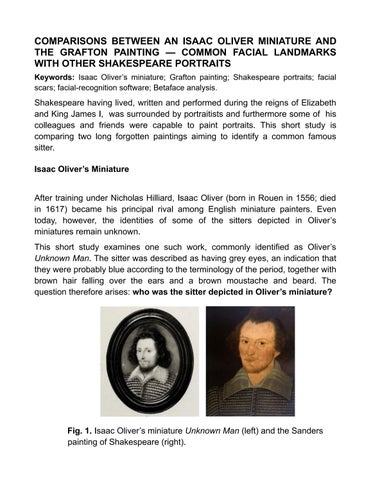
Shakespeare having lived, written and performed during the reigns of Elizabeth and King James I, was surrounded by portraitists and furthermore some of his colleagues and friends were capable to paint portraits. This short study is comparing two long forgotten paintings aiming to identify a common famous sitter. Isaac Oliver’s Miniature After training under Nicholas Hilliard, Isaac Oliver (born in Rouen in 1556; died in 1617) became his principal rival among English miniature painters. Even today, however, the identities of some of the sitters depicted in Oliver’s miniatures remain unknown. This short study examines one such work, commonly identified as Oliver’s Unknown Man. The sitter was described as having grey eyes, an indication that they were probably blue according to the terminology of the period, together with brown hair falling over the ears and a brown moustache and beard. The question therefore arises: who was the sitter depicted in Oliver’s miniature?
Fig. 1. Isaac Oliver’s miniature Unknown Man (left) and the Sanders painting of Shakespeare (right).
These few facial characteristics, as well as the sitter’s clothing, appear strikingly similar to those found in the Sanders painting of William Shakespeare. These similarities are more investigated here using visual face-recognition (VFR) software developed by Robert J. Schmitt, an expert in biometric facial analysis. Some screen captures obtained from the comparison are presented in Figures 2 and 3. That simple but powerful tool has been described in previous studies.
Fig. 2. Side-by-side screen capture of the VFR comparisonof Isaac Oliver’s miniature and the Sanders painting of Shakespeare.
The VFR approach has previously been used to compare the Sanders painting with several of the principal surviving representations of Shakespeare, including the Droeshout engraving published in the First Folio (1623), the Hilliard miniature, the Harley miniature, the Stratford portrait, the Waldow and Peake paintings as well as the engravings by George Vertue (not shown). The results obtained in the present comparison are striking (Fig. 2 and 3). The two images exhibit a similar head contour, comparable forehead proportions, a similar pattern of baldness, similar hairstyle, thin lips, delicate eyebrows, spacing between the eyebrows, eyelids, and rings or markings above and below the eyes. Overall, the facial structures correspond remarkably closely. Only minor differences are apparent. In Oliver’s miniature, the sitter’s nose appears slightly longer, and the mouth is positioned somewhat lower than in the Sanders painting. Apart from these relatively small differences, however, the two faces correspond very closely, producing an almost glove-like fit when aligned.
Fig. 3. Screen capture of the overlay automatically produced following the VFR comparison of Oliver’s miniature and the Sanders painting.
The strong correspondence observed with the VFR software is further supported by an independent facial-analysis program capable of providing a numerical confidence value. The Betaface API analysis produced a confidence value of 93.9% for Isaac Oliver’s miniature when compared with the Sanders painting, which was assigned a value of 100% in the same comparison (Fig. 4).
Fig. 4. Confidence value obtained from the Betaface API comparative analysis of the Sanders painting and Isaac Oliver’s miniature.
This result is notable because the two images were produced in different media (playing card and wood) and have very different dimensions: Oliver’s miniature measures approximately 2 × 1 9/16 inches, whereas the Sanders painting measures approximately 15 1/2 × 13 inches. They were also produced by two different artists, one of whom was a renowned master of miniature painting. Further historical context may also be relevant. As described by Mary Edmond, the Oliver family lived in Blackfriars, the same district in which Shakespeare lived and where the Blackfriars Theatre was located. The theatre was leased by Shakespeare’s company. Oliver and Shakespeare also operated within
overlapping networks of patrons and courtly connections: Oliver was associated with the Queen and her court, while Shakespeare was associated with the Chamberlain’s Men, later the King’s Men. It is therefore possible that Oliver and Shakespeare encountered one another, perhaps on more than one occasion. The designation Unknown Man nevertheless remains intriguing. One possible explanation is that anonymity may have protected the sitter, particularly if his Catholic affiliation was potentially sensitive in Protestant England. This possibility, however, remains speculative. The Grafton Painting Recent comparative studies have identified a number of facial features that may be useful when examining different representations of Shakespeare. These include markings or scars above the left eye, a protuberance of the eyelid, scars or swellings below the left eye, and a scar below the left corner of the mouth. Similar facial features have been observed in several works discussed as possible representations of Shakespeare, including the Shakespeare figure in Van Mander’s The Chess Players, the Sanders, Chandos, and Flower paintings, and the exceptionally detailed version of the unsmooted Droeshout engraving. Considering only the facial features, the present study examines whether the Grafton painting (Fig. 5) may also belong to this group.
A
B
C
Fig. 5. The Grafton painting (A), following restoration (B), and in b&w after high-contrast processing (C). On the front of the Grafton painting are the numbers 24 and 1588, corresponding to Shakespeare’s age and the date traditionally associated with
the portrait. The reverse bears the inscription “W + S.” The sitter is depicted as a young man with brown hair and blue eyes, described at the time as grey. The painting had suffered considerable deterioration, as shown in Fig. 5A. According to Tarnya Cooper, it had undergone what she described as "enthusiastic cleaning with caustic soda". The effects of this treatment are particularly visible around and above the left eye (Fig. 5A). Despite the damage caused by the alkali treatment and the subsequent restoration (Fig. 5B), several facial markings remain visible above and below the sitter’s left eye. These features can be seen in the original image and become particularly apparent in the high-contrast version shown in Fig. 5C. Before drawing any conclusions, the Grafton painting was compared with Isaac Oliver’s miniature using the same VFR approach. Some of the resulting screen captures are presented in Figure 6.
Fig. 6. Selected screen captures of the VFR comparison between the restored Grafton painting and Isaac Oliver’s miniature, shown either side by side or as an overlay (lower-right image). The scars above and below the sitter’s left eye are readily visible in the comparison and do not require substantial enlargement of the Oliver miniature.
The tip of the nose is somewhat different: in Oliver’s miniature it appears less rounded and slightly longer than in the Grafton painting. This is a relatively minor difference, however, when considered alongside the numerous other corresponding facial characteristics. These include similar scars above and below the left eye, the same delicate eyebrow structure, similar eyelids, comparable spacing between the eyebrows, the same forehead proportions, a similar head contour, a similar facial line extending toward the right eyebrow, corresponding nose position, similar mouth position and thin lips, a light moustache, a comparable chin, and a similar left jawline. Taken together, these correspondences produce a remarkably close facial alignment, as illustrated by the near-perfect overlay shown in the final screen capture of Figure 6. An equivalent result was observed when the Grafton painting was compared with the Sanders painting using the VFR approach, although those data are not presented here. Finally, the Figure 7 brings together the b&w left side of the faces represented in several of the principal paintings and engravings considered in this and previous studies: the Grafton painting, Isaac Oliver’s miniature, the Sanders painting, the Chandos painting, the Flower painting (not having the contemporary yellow pigment), and the finest version of the Droeshout engraving.
Fig. 7. Left side of the b&w faces represented in the Grafton, Isaac Oliver, Sanders, Chandos, Flower, and Droeshout portraits. Without forgetting that some of these artists needed to please their famous sitter, the Figure 7 comparison highlights a recurring group of facial features, including an apparent eyelid protuberance, scars or swellings above and below the left eye, and a scar beneath the left corner of the mouth where the beard
could not grow. All these features have previously been described in the Sanders, Chandos, and Flower paintings and in the exceptionally detailed version of the Droeshout engraving. Conclusion Both Isaac Oliver’s Unknown Man and the Grafton painting are works produced during Shakespeare’s lifetime. Both also display a combination of facial characteristics that correspond closely with features visible in the Sanders, Chandos, and Flower paintings, as well as in the exceptionally detailed version of the posthumous Droeshout engraving. The correspondence between the Oliver miniature and the Sanders painting is supported by both VFR analysis and the Betaface comparison, while the Grafton painting displays also a set of facial landmarks that closely correspond with those observed in the Oliver miniature and in several other Shakespeare portraits. These observations place the Oliver miniature and the Grafton painting within a particularly significant group of works that may depict Shakespeare. If these recurring facial characteristics are indeed individual landmarks of the same sitter, they may provide a useful additional avenue for investigating the identity of otherwise unidentified portraits. There may, therefore, be further representations of Shakespeare yet to be identified. After all, he was the Bard. Jean-Pierre Doucet The author is a retired scientist living in Quebec, Canada. Main references: Edmond M., (1983) HILLIARD & OLIVER, The lives and works of two great miniaturists, Robert Hale, London, 238 pages. Malone E., (1821) THE PLAYS AND POEMS OF WILLIAM SHAKESPEARE, Vol. XX, London, 468 pages, Venus and Adonis, page 18, annotation 3: ‘’What we now call blue eyes, were in Shakspeare’s time called grey eyes…’’. Nolen S., (2002) Shakespeare’s Face, Knopf Canada, 384 pages.
Cooper T., (2006) Searching for Shakespeare, Yale university press, 239 pages. Kay T., (1914) The Graftom portrait of Shakespeare, London: S.W. Partridge & Co. Ltd, Old Bailey, 82 pages. Norris Parker J., (1885) The portraits of Shakespeare, Robert M. Lidsay, Philadelphia, 266 pages. Hammerschmidt-Hummel H. (2004) The True Face of William Shakespeare, The poet's death mask and likenesses from three periods of his life, Chaucer Press, 2008 pages. Doucet J.-P. and Doucet M., A Comparative Examination of the Sanders Portrait of Shakespeare and the Droeshout Engraving of Shakespeare, https://news.canadianshakespeares.ca/news/a-comparative-examination-of-thesanders-portrait-of-shakespeare-and-the-droeshout-engraving-of-shakespeare id., THE SHAKESPEARE IN VAN MANDER’S PAINTING "THE CHESS PLAYERS" IS TRULY THE SAME AS IN THESANDERS’ PAINTING OF SHAKESPEARE, https://free.relayto.com/jeanpierre-doucet/the-shakespeare-in-van-mander-s-paintingthe-chess-players-is-the-same-as-in-the-sanders-painting-qrx3il9e2a6d6#page=1 id., Bridging the Iconographic Gap: Biometric Comparison and AI-Assisted Restoration of the Chandos and Sanders Portraits of William Shakespeare, https://issuu.com/doucetjp/docs/biometric_comparison_and_ai-assisted_restoration_o id., THE FINEST DROESHOUT ENGRAVING: THE KEY TO UNDERSTANDING THE ROLE OF THE AUTHENTIC FLOWER PORTRAIT OF SHAKESPEARE, https://issuu.com/doucetjp/docs/the_finest_droeshout_engraving_the_key_to_underst