Steve Temple



Steve Temple

Dennie Ortiz
Publisher
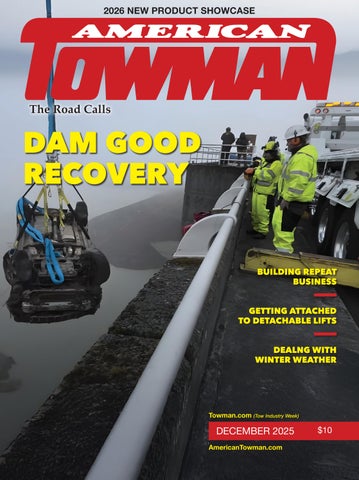
As we look toward the coming year, the special Product Showcase section (page 42) in this issue offers a glimpse into the products and services that top suppliers will be offering.
Not only will you be able to view at a glance which items or businesses can support your operations, but also contact information is provided so you can easily reach out to them. We’re sure that you will find some helpful products to get you through the winter season.
The cold months can pose their own risks, and being prepared is always a smart move. Operations Editor Randy Resch, in his article, provides constructive suggestions on how to operate your trucks with caution during extreme weather. Citing actual tragic incidents, Randy offers proven techniques in various scenarios for operators to avoid serious injury and even death.
As you plan for business in the next year, Brian Riker, makes the case for why detachable towing units (DTUs) offer versatility and usefulness, if you don’t already employ this type of equipment. From wheelbase and real axle ratings on tractors, to determining if a winch and recovery boom is needed, Brian helps spec out which DTU is right for your book of business.
Steadily and consistently marketing your business is essential, as is acquiring new business. Newly minted American Towman contributing writer and former tow boss, Joey DiMarco, shares insights and specific techniques on how to get and keep new customers. Joey’s tried-andtrue methods harken back to good ol’ proven practices in building trusted local partnerships.
Hope you enjoy the issue, gain some knowledge, and take pleasure viewing the challenging recovery at a steep dam, along with the beautiful photos of tow trucks in the Classic Wrecker and My Baby departments.
All of us here at American Towman wish everyone a happy holiday season and as always, stay safe out there!

Steve Temple Editor
As the New Year approaches, like many folks we reflect on the past and try anticipating the future. Looking back on 2025, we’re deeply grieved by the loss of fellow towers, and recommit to increasing SDMO awareness, along with other towing safety measures in 2026. We also acknowledged how so many towers gave back to their communities, and appreciate seeing even more demonstrations of a Towman’s “heart behind the hook.”
In line with that, our Heroes awards, in recognition of towers selfless acts in the line of duty, are moving tributes and a touching highlight of Festival Night at the American Towman Exposition in Baltimore. Look for a recap in our February issue which highlights Festival Night, Order of Towman, the Wrecker Pageant and other legendary Expo events.
What’s of even greater importance than the physical medals and awards is the character of the towers that deserve them, the personal fortitude that led to these honors. We’ll continue to tell towers’ courageous stories, and how these roadside saviors are a vital benefit to everyone.
Copyright ©2025 American Towman Magazine is published 12 times a year by American Towman Media, Inc.
Subscription: Single Copy: $10 1 yr: $60 – 2 yrs: $110 International: $75 & $140

Connecticut towing companies and consumer advocates presented sharply different plans as a Department of Motor Vehicles working group tries to draft recommendations for lawmakers by February.
The 10-member committee, created under a 2025 law that revamped much of the state’s towing system, is debating how to balance fairness to vehicle owners with the financial realities of towing businesses.
Towing representatives proposed eliminating the current rule that treats cars valued under $1,500 differently, instead allowing all vehicles to be sold after 30 days. They argued the change would simplify the process and help companies recover costs.
Consumer advocates pushed for stronger protections for motorists—including pausing storage fees once owners signal intent to reclaim their cars, and creating a system to dispute private-property tows. They also want itemized lists of personal items kept in vehicles and new DMV oversight on sales data.
Source: ctmirror.org
The Mount Sinai Light and Health Research Center, in collaboration with the AAA Foundation for Traffic Safety, is conducting a nationwide survey to better understand how work lighting affects tow operator visibility and safety during nighttime roadside operations.
The project, titled “Roadside Service Vehicles: Effects of Work Light Glare on Worker Safety” aims to develop industry best practices for safer nighttime operations.
Researchers are asking towing and roadside professionals to share their experiences with lighting and glare while working along the road at night. Responses will help identify lighting setups that improve visibility and reduce glare hazards for both operators and passing motorists.
“Tow operators face one of the most dangerous roadside jobs,” said researcher John Bullough. “We want to ensure lighting helps them be seen—without creating visual hazards for drivers.”
The five- to ten-minute survey will guide recommendations on ideal light placement, brightness, and angle to enhance safety for all.
Tow operators can participate in the study at forms.gle/VmdFg4Gme3Ejq77S7. Questions may be directed to John.Bullough@ mountsinai.org.
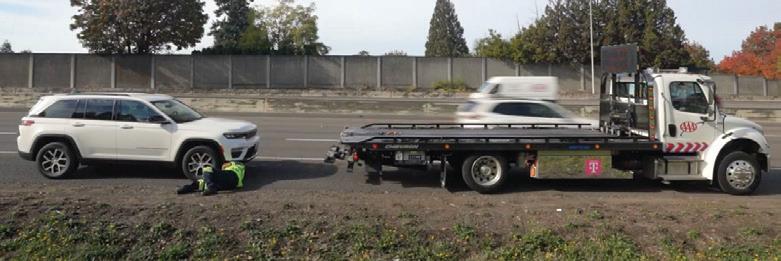
Despite “Slow Down, Move Over” (SDMO) laws in all 50 states and D.C., 46 emergency responders were killed roadside last year, according to the Emergency Responder Safety Institute. A new AAA Foundation for Traffic Safety (AAAFTS) study finds that confusion, weak enforcement, and lack of awareness continue to endanger first responders, including tow truck operators.
AAA’s national survey revealed that while two-thirds of drivers have heard
of SDMO laws, many don’t know what they require. Video analysis showed only 64% of drivers slowed down or moved over for roadside incidents— dropping to just 58% when tow trucks were present.
AAA is urging policymakers to clarify and align SDMO laws nationwide, increase enforcement visibility, and strengthen public education campaigns.
Source: info.oregon.aaa.com
Towbook, a leader in towing management software, has announced a new integration with Waze that provides real-time alerts of tow trucks and roadside assistance vehicles to drivers. The partnership aims to enhance safety for both tow operators and motorists by notifying drivers when service vehicles are nearby, giving motorists more time to slow down or move over.
“Tow trucks and roadside assistance vehicles often work in dangerous conditions,” said Dan Smith, founder of Towbook. “By integrating with Waze, we’re helping keep motorists and service providers safe while improving the efficiency of roadside operations.”
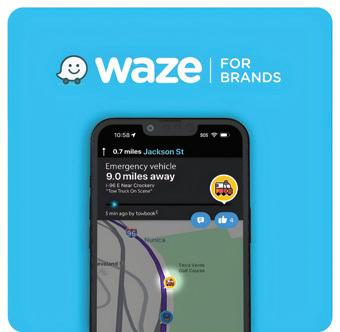
Towbook processes more than 40 million service requests annually in countries around the world. The integration with Waze means these alerts will be available to drivers globally, promoting greater driver awareness and reducing the risk of roadside collisions.
Source: prnewswire.com
The International Towing & Recovery Hall of Fame and Museum held its ninth annual Wall of the Fallen Name Unveiling Ceremony in October, honoring 19 towing and recovery professionals who lost their lives in the line of duty.

The Wall of the Fallen, located at the museum in Chattanooga, Tennessee, was dedicated in 2006 to raise awareness of the dangers faced by tow operators working roadside. This year’s honorees were Richard Barrows, Bryan Ray Biggs Sr., Terry Blum, Shawn Alan Bodiford, Graeme Lesley Brown, Christian Matthew Burt, Troy Lee Caldwell, Michael Robert Curry, Rico K. Funchess, David Conrad Holz, Howard Charles Husband, Richard Kenda, Moses B. King, Mark Llewellyn, Willie McPherson, Jose Parra, Kavish Ramnarayan, Richard A. Rodriguez, and Kenneth Sposato.
The memorial now bears more than 400 names.
Source: whnt.com
Assembly members Heather Goulding and Max Carter presented Assembly Bill 415 to the Nevada Legislature, proposing faster removal of abandoned, inoperable vehicles and safeguards against unfair towing dispatch practices. The bill would let law enforcement mark an abandoned vehicle and, after a fiveday notice, authorize disposal if it meets four conditions: it’s abandoned, unregistered, not roadworthy, and worth under $500 in scrap—up from $200.

Lawmakers weigh a proposal to clear abandoned vehicles quicker and tighten towing-dispatch rules.
Supporters said the change aligns with neighboring states and eases financial burdens on tow operators forced to store junk vehicles for long periods. Tow company owners and trucking representatives cited towing and cleanup costs that can exceed $1,000 per vehicle. Counties and cities said the bill would help address blight and public-safety hazards.
Source: citizenportal.ai
Heavy-duty truck manufacturers scored a legal win after a federal judge temporarily blocked California from enforcing key parts of its Clean Truck Partnership (CTP). U.S. District Judge Dena Coggins granted a preliminary injunction, ruling that major OEMs, which are responsible for nearly all U.S. Class 8 sales, would face harm if forced to comply with the 2023 agreement while its legality is under review.
Daimler Truck North America, Paccar, Volvo Group North America and International argued the CTP violates the Clean Air Act and is preempted by federal authority. The manufacturers claim they were caught between conflicting mandates: California insisting they follow CARB’s certification and zero-emission requirements, and the U.S. Department of Justice ordering them to stop, calling the standards illegal. DOJ sent cease-and-desist letters in August, arguing only EPA rules apply.
Source: ttnews.com
Two Republican lawmakers are pressing the U.S. Department of Transportation to take stronger action against fraudulent CDL mills—unregulated driver-training operations that critics say produce unsafe, undertrained commercial drivers. Sen. Tom Cotton of Arkansas and Rep. Andy Barr of Kentucky, sponsors of the Secure Commercial Driver Licensing Act, urged Transportation Secretary Sean Duffy to investigate programs they believe exploit regulatory gaps and put motorists at risk. Their bill would require CDL testing to be conducted in English, a standard they argue is essential for safety.
Their request follows a similar push from Sen. Cynthia Lummis of Wyoming, who introduced legislation requiring CDL holders to understand and communicate in English, aligning with President Donald Trump’s executive order on “Commonsense Rules of the Road.” The Federal Motor Carrier Safety Administration is already tightening scrutiny, recently withholding more than $40 million from California for failing to meet Englishlanguage proficiency standards.
Industry groups such as American Trucking Associations support the federal efforts, saying stronger training and licensing rules are vital to ensuring that only qualified, well-prepared drivers operate on the nation’s highways.
Source: ttnews.com
The Striker from SafeAll is a premiumgrade wireless LED tow light engineered specifically for towing professionals operating on public streets and highways.

When a towman is in transit, visibility isn’t optional, it’s critical. The Striker delivers reliability, brightness, and versatility to help ensure safe, compliant transport in any conditions. Designed for optimum performance, the Striker features multi-functionality with stop/turn/ tail signals, as well as integrated warning and work light modes for added visibility when loading, unloading or navigating roadside

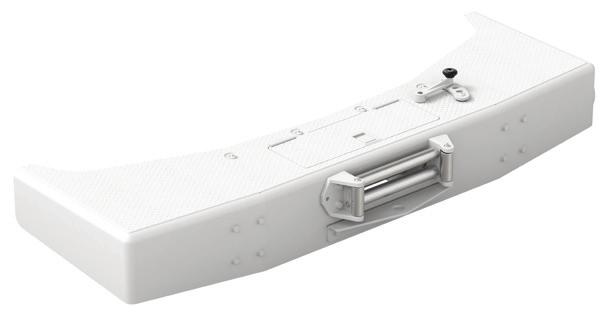
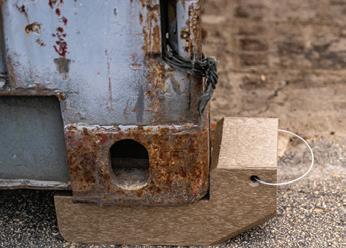
Arrowhead Winch has introduced a new concept in winch bumper design with the Braden UCB12. This next-generation solution for utility fleets is designed to improve on-scene safety, productivity, and service truck versatility. Engineered for medium-duty, Class 4 vehicles, the UCB12 combines heavy-duty pulling power with a built-in capstan extension—transforming the front end of a service truck into a multi-tasking work platform. With a 12,000-lb. rated line pull based on the proven TR Series planetary hydraulic winch design, the UCB12 delivers the performance tow crews need for pulling gear, equipment, debris, and more. The unit features a three-position manual clutch that lets tow operators engage the drum, switch to freespool (neutral), or activate the capstan. The ability to operate the winch and capstan independently enhances safety and flexibility on scene and sets the UCB12 apart from traditional bumper systems.
situations. Adjustable, rubber-coated magnetic mounts provide a secure hold, even on sloped or contoured surfaces such as hoods and trunks, ensuring the best angle for maximum signal projection. A waterproof, backlit power button and illuminated battery life indicator offer ease of use in all weather and lighting conditions. The rechargeable lithium-ion battery with replaceable external batteries have a total runtime of over 50 hours.
PSS, an innovator in safety equipment, has improved its FirstGard foldable traffic cone with a fill port that offers greater stability and performance in the field. Designed to optimize portability and efficiency, FirstGard enhances safe roadside operations for towing professionals. With the addition of a convenient fill port, users can easily add dry sand to ballast the cone for extra stability in challenging weather or high-speed traffic conditions. With this update, each of FirstGard’s three panels can hold up to 1.5 lbs. of sand, for a combined additional 4.5 lbs. of weight. Customer feedback led PSS to incorporate this option in more extreme environments. On windy days, a standard cone can blow over, but adding the extra weight to FirstGard allows them to remain more stable. The fill port is designed for ease of use, durability, and leak prevention.
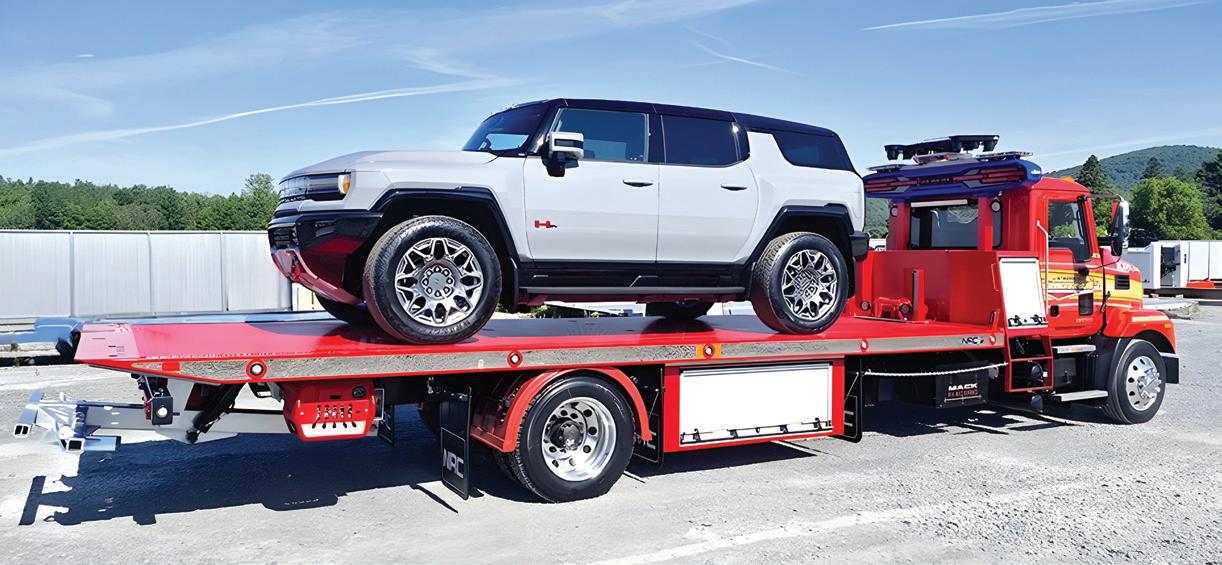
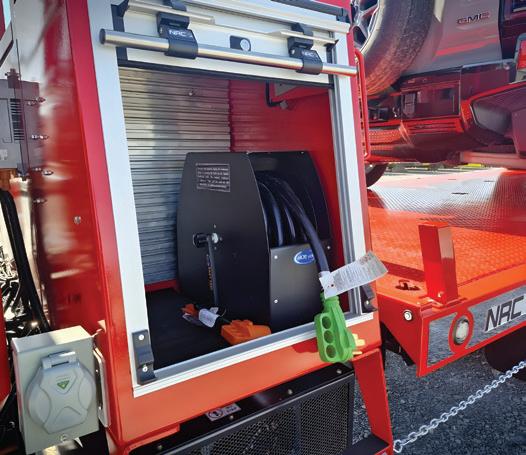
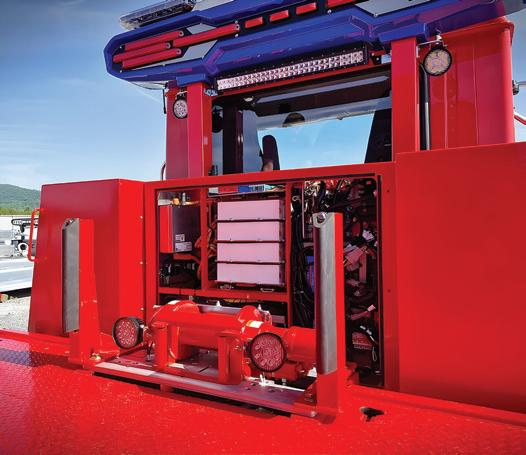
NRC Industries is shifting gears toward a cleaner, more powerful future. In conjunction with the company’s 50th anniversary celebrations, NRC unveiled its very first electricpowered carrier, currently undergoing road testing under the name E-20TB. This transporter breakthrough reflects the company’s commitment to offering highperformance solutions that meet both tomorrow’s environmental challenges and today’s regulatory standards. This firstof-its-kind, electric-powered carrier was installed on a Mack MD Electric truck for the fleet of Remorquage Boissonneault based in Granby, QC, Canada. The system—featuring a power pack and an ePTO (electric Power Take-Off)—is fully concealed and integrated into the vehicle. No special adjustments are required from the operator. Everything has been designed to ensure a simple, efficient user experience comparable to that of a conventional NRC model. Some key features include a recharge
function while driving, allowing for a full workday without interruption, and compatibility with both electric and diesel trucks. When installed on an electric vehicle, it meets all zeroemission standards, and while on a diesel truck, the platform operates with the engine off, reducing fuel consumption, engine wear, and idling-related maintenance costs. The unit supports the same options and accessories as a standard NRC model. With a commercial launch and orders beginning in Spring 2026, road testing is currently underway. In monitoring the usage of this first unit, NRC reports that from June 30 to September 30, 2025, the E-20TB completed 435 service calls, and traveled more than 6,200 miles. It logged 2,175 minutes of hydraulic usage, and achieved over 12 hours of continuous operations per day with 40% battery power still remaining (on average). Additional testing will determine how well this new EV carrier performs in winter conditions.
By Terry Abejuela
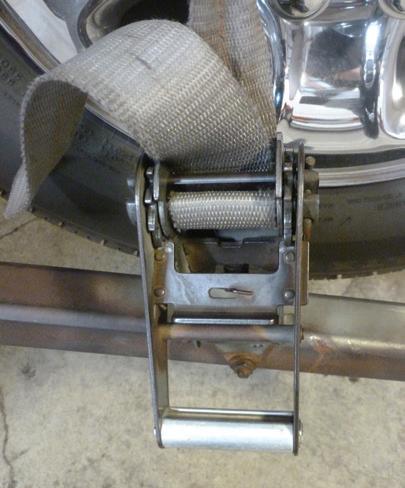
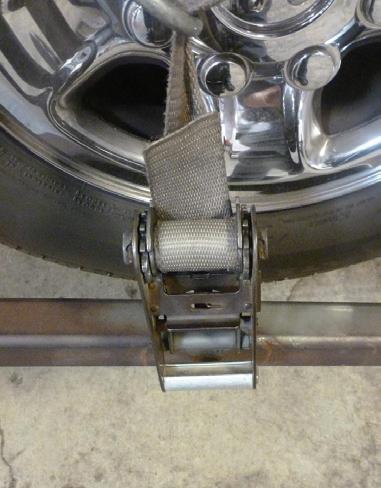
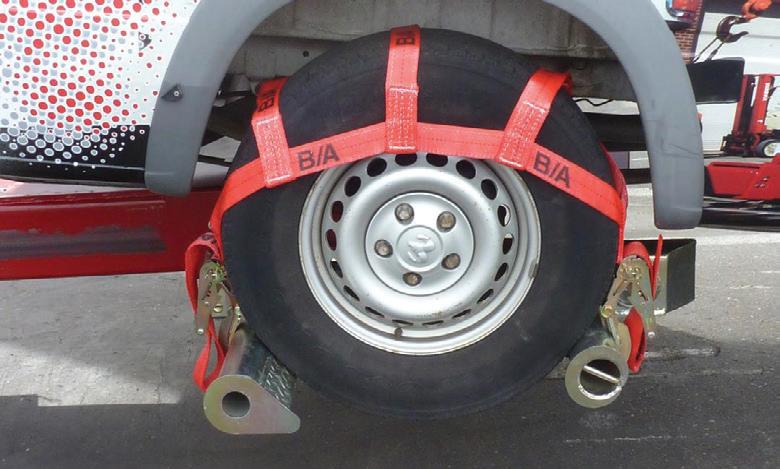
On the left, the strap is not wrapped around the barrel of the ratchet enough, and may work its way loose during the towing process. If you can see the metal barrel of the ratchet, the strap will almost certainly loosen. The strap must wrap completely around the ratchet barrel (right) at least two times to achieve fiber lock.
Wheel-lift systems require a primary means of securing the vehicle to the wheel lift grid to prevent the vehicle from coming loose during the towing process.
The Original Equipment Manufacturer (OEM) designed and tested the primary securement used to ensure safe operation of their equipment. Tow operators should use the OEM securement straps (or equivalent) and follow all of the OEM procedures.
Field Editor Terry Abejuela has 40-plus years of light-duty towing and recovery experience. He is also a light-duty Level 1 instructor for the California Tow Truck Association.
If a tower doesn’t know what type of wheel straps are provided by the OEM, contact the local towing equipment distributor for information or check the OEM’s website.
Inspection and maintenance must be performed in order to ensure the equipment is in safe operating condition. In addition to the wheel lift system, regularly check all of the wheel securement components.
Conduct a quick inspection of your all wheel securement straps, ratchets, and other
strap components prior to each use to visually ensure they appear to be in safe operating condition. At least once per month, conduct a detailed inspection of the wheel securement strap components. Inspect for damages such as cuts and abrasions, as well as foreign objects embedded in the strap webbing. Dirt or small pebbles in the webbing material will cause abrasion damage to the fibers.
If the wheel securement straps have any metal components such as chain,
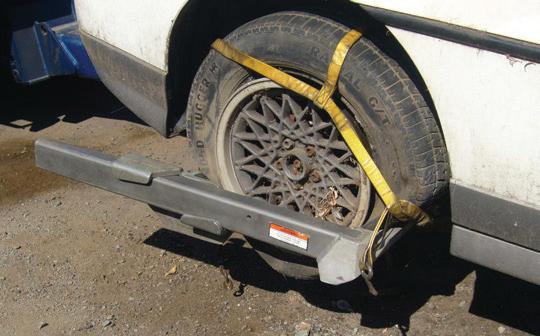
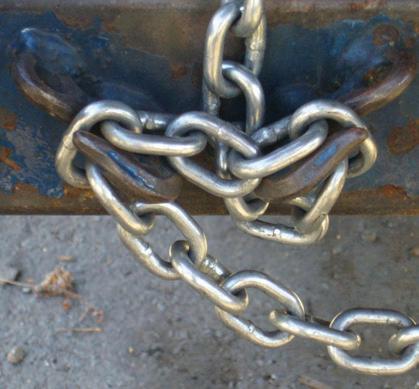
On the basket strap, with the Mini-T hooks at one end and a length of chain at the other,
the spoon, and the chain
other
attaches
the grab hooks on the front side of the wheel-lift crossbar. While various methods are used in the field, this picture shows the correct way the chain attaches to the grab hooks.
hooks, rings or ratchets, examine for stretched, cut, or bent parts. If hooks are designed with a safety latch, ensure it is working properly.
Synthetic wheel securement straps can be cleaned if needed, however, contact the OEM for the correct procedure. Because these straps are load-bearing equipment, it is important to ensure the working load limit (WLL) is not compromised by the washing process. Generally, most synthetic straps can be washed, but should not be exposed to harsh chemicals or machine washing or drying. Pressure washing is usually not recommended as it may cause premature fading of the straps’ color.
Hand washing with mild soap and lukewarm water is usually acceptable. A soft bristle brush may be used on stains if needed. Using a hard bristle brush may cause damage to the synthetic fibers. A vacuum cleaner or air hose can be used to remove dirt and small pebbles. Synthetic straps should be thoroughly rinsed with water to remove all soap residue, and air dried completely before being stored to avoid mold and mildew.
Ratchets, chains, hooks, and
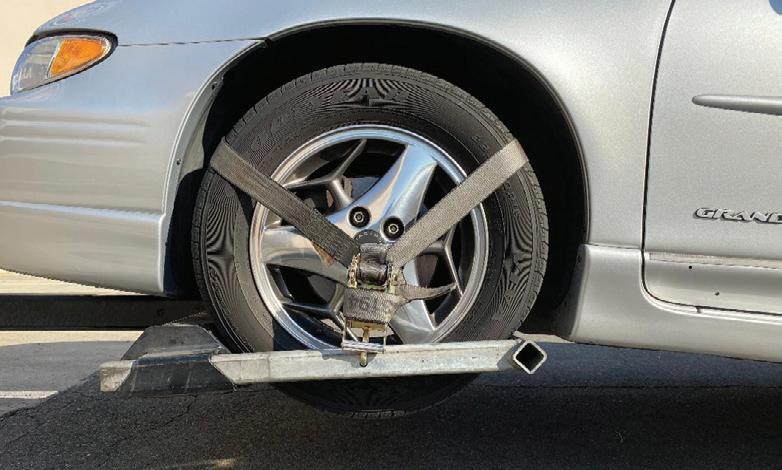
crossover style strap is commonly used on auto-loader wheel lift systems. Different manufacturers may attach this type of
the manufacturers recommendations.
metal rings used as part of the primary securement straps must be inspected for damages, but normally do not require much maintenance. Depending on the environment, the ratchets may require some light lubricant to operate properly.
There are many different types of wheel securement straps used, depending on the manufacturer, model, and style of wheel-lift. Most wheel-lifts use one of three types of wheel-lift grids. These include L-arms, spoons, and claws.
There are also variations of the wheel securement straps used by different manufacturers and different models. Space doesn’t allow for covering all of the variations, but there are three common wheel securement straps. First, some generic recommendations that apply
to most wheel-lift securement straps. Use both wheel securement straps on every tow. Often tow operators towing a vehicle down the roadway use only one wheel securement strap. This is not a safe and secure tow. In a hard stop or collision, the towed vehicle’s wheel on the unsecured side may roll forward and off of the wheel-lift grid. It may also cause the wheel securement strap on the secured side to come loose, resulting in a failure of the primary securement.
Once the wheel-lift grid has been attached to the towed vehicle, raise the wheel-lift until the towed vehicle’s wheels are just off of the ground, and attach both wheel securement straps.
Tighten straps enough to visibly compress the tire slightly. As the vehicle is being towed down ◀
the roadway, the tires in the wheellift grid will settle into the wheellift grid and the wheel securement strap may loosen if it is not tight enough to start with. This does not apply to some basket wheel securement straps, so do not use a ratchet to tighten the strap. They use a chain at one end of the straps to secure it hand tight.
When a ratchet is used in the wheel securement strap, make sure the strap wraps around the barrel of the ratchet a minimum of two complete times. This is another common mistake that occurs in the field. If some of the metal barrel of the ratchet is visible, the strap will most likely loosen during the tow. The strap must go around the barrel of the ratchet at least two times in order to achieve what is referred to as fiber lock, in order to prevent the strap from working its way loose.
Lasso-style straps uses a choker hitch on the tire, and a ratchet to secure the wheel to the wheel lift grid. This is a common wheel strap used on L-arm style wheellift grids. The straps should be positioned on the tire at the 10 and 2 o’clock positions. Make sure the strap on the back side of the wheel is not contacting any component that may be damaged.
When the wheel in the wheel-lift
grid has a flat tire, the strap may need to be moved to more of a 9 and 3 o’clock position to avoid pulling just the flat tire instead of the rim. Since there may be variations on the use of a lasso style strap, refer to the OEM for the proper use of the towing equipment.
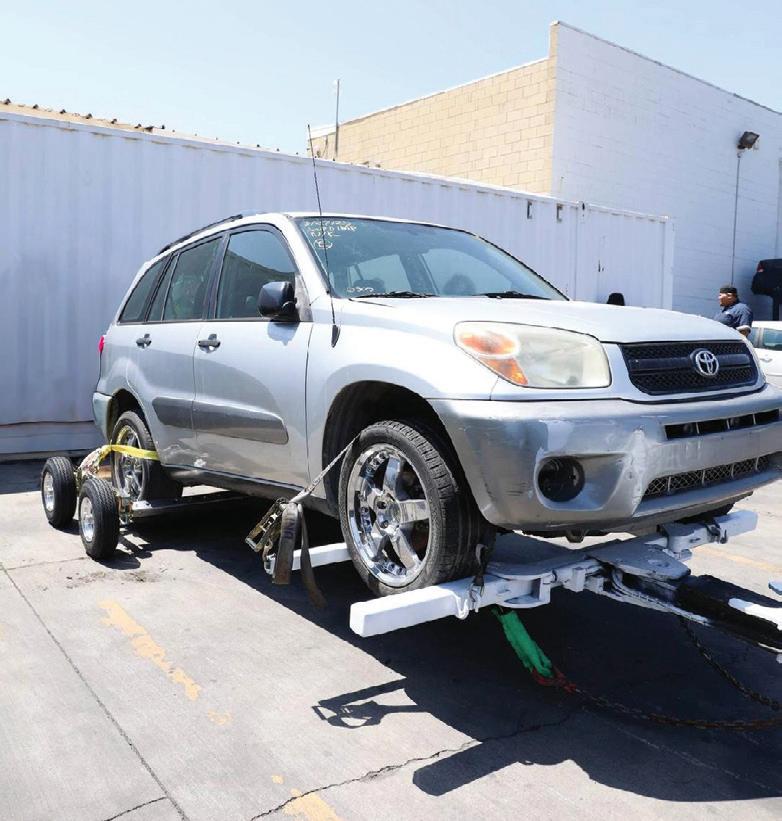
Basket-style straps can be used on an L-arm system, but it is not very common. These straps are commonly used on a spoon and claw (auto loader-style) wheel-lifts. Some use a mini T-hook or other style of hook to attach to the claw on one side, and a chain or ratchet to attach to the wheel-lift crossbar.
This style does not require the strap to be cinched down tightly, only hand tightened. In a hard stop, when the wheel starts to roll forward, it will ride up on the crossbar, causing the strap to tighten, even if the strap has loosened during the towing process because the wheel settled in the wheel-lift grid. Since there may be variations on the use of a basket-style strap, check with the OEM for proper application.
Crossover straps are commonly used on auto loader wheel lifts. A crossover straps has a ring or hook at one end, and a ratchet is used to tighten at the other end. The hook or ring is attached on the wheel-lift crossbar, and the strap is routed over the top of the tire and attached to the wheel claw with a ratchet. Since there is only one contact point for the strap on the tire, it is especially important to compress the tire by tightening the ratchet. Since there may be variations on the use of a crossover-style strap, refer to the OEM of the towing equipment for their proper use. The same advice applies to other styles of wheel-lift primary securements. They are an essential part of a safe tow, so make sure to use them correctly on every tow.

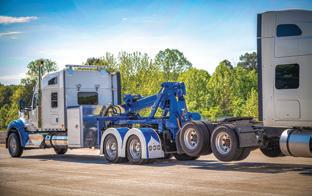
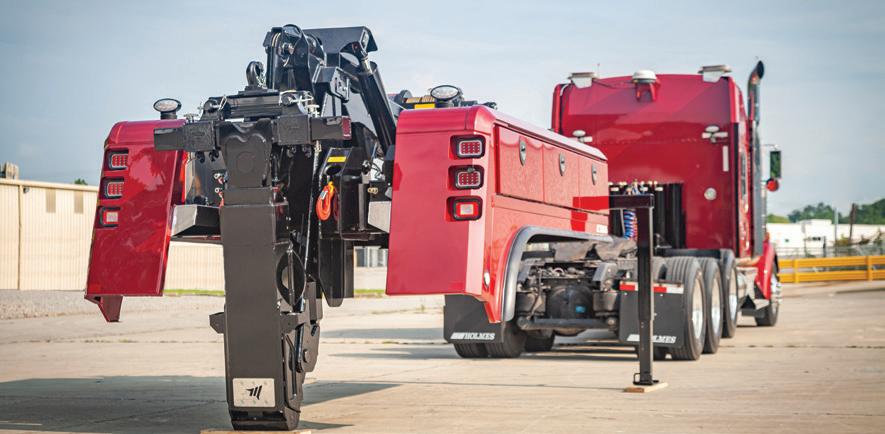
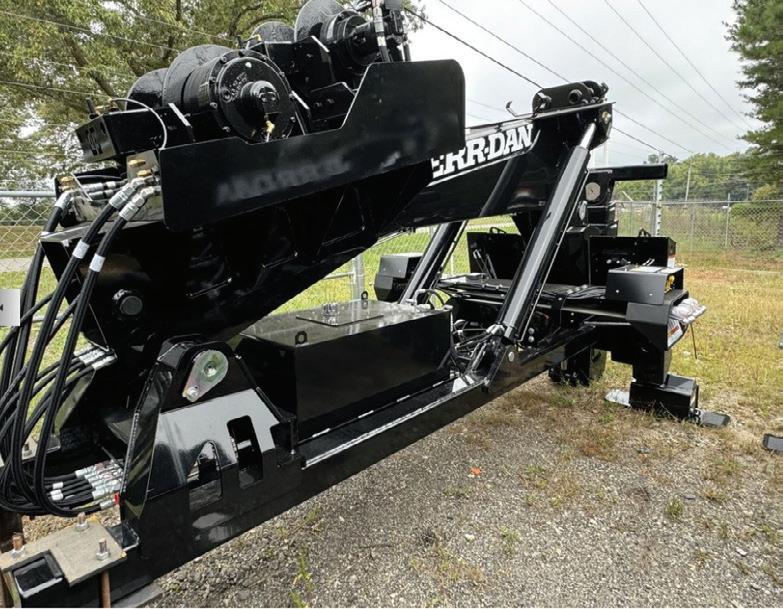
The Holmes DTU from Miller has been redesigned to decrease rear overhang, increase front axle weight, and repositioned lift cylinders, all for improved towing operations. The unit comes standard with a 20,000-lb planetary winch, 175 feet of 9/16” wire rope, and front legs that allow the DTU to be easily removed in a matter of minutes.
By Brian J. Riker
With the selection of tow trucks almost as varied as the vehicles they tow, what’s the best fit for a tow company? While there is

Brian J. Riker is a thirdgeneration towman, with 30 years of experience in the ditch as a tow operator, and president of Fleet Compliance Solutions. He specializes in helping navigate the complex world of federal and state transportation regulatory compliance. He can be reached at brian.riker@ fleetcompliancesolutions.net
no one-size-fits-all wrecker, there are some pieces of equipment that are more versatile than others, especially when towing is the primary application. This is precisely where detachable tow units (DTU) shine.
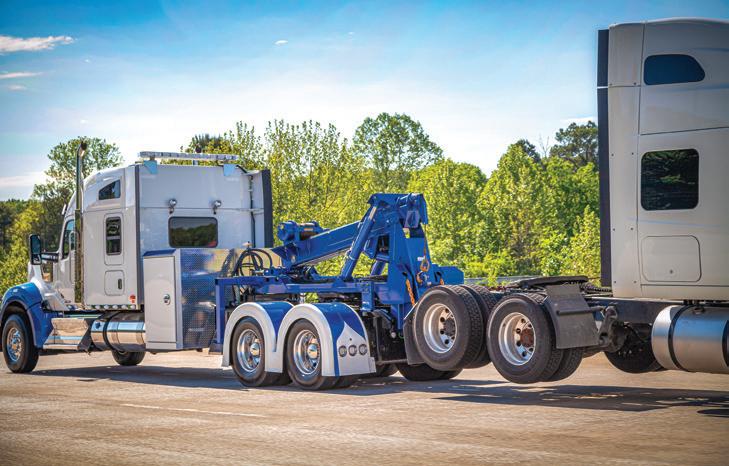
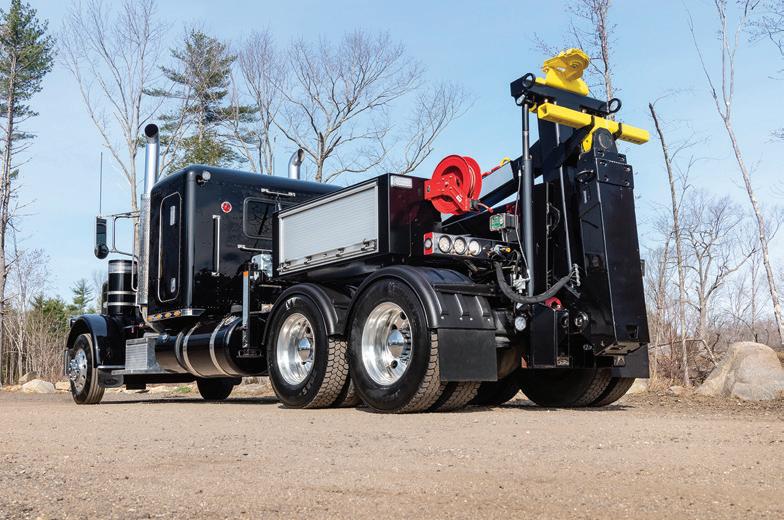
A DTU is a removable towing device used to convert a standard road tractor, preferably one with a longer wheelbase and heavy-haul specs, into a heavy-duty tow truck. The safe, quick and removable nature of a DTU is what makes it so useful, because it allows a towman to use only one truck for both towing and hauling. In contrast, a standard heavy-duty wrecker is simply that, a wrecker.
Another big benefit of using a DTU is weight. Since there usually is not a big recovery boom nor a body, just two fenders and a smaller toolbox, a DTU has a significant weight savings over a similarly rated wrecker with a traditional underlift setup. This allows for a higher rear axle capacity, thus making scaling legal easier (to avoid exceeding gross weight or individual axle weights as prescribed by state and/or federal laws). Also, the lighter weight often improves fuel economy, which is why DTUs are ideal for longdistance towing.
When a tow boss first enters the heavy-duty market they will most likely not have consistent work right away, nor will they have heavy recovery work in sufficient quantities to justify the cost of a heavy wrecker. A DTU is a suitable setup to bridge this gap. The overall cost to own and
acquire a capable heavy-spec road tractor and DTU will be less than a comparable heavy wrecker, and the tractor will be available to use with trailers. These benefits allow an entry-level, heavy-duty tower to provide expanded services without straining the budget.
market will already have several light-duty wreckers, along with a few medium-duty trucks, they usually can handle the recovery work with this other equipment while building a reputation for additional services. Of course, eventually a true heavy wrecker will likely need to be added to the fleet, but don’t discount the advantages of a DTU to build a heavy-duty business, or supplement a fleet of heavy wreckers.
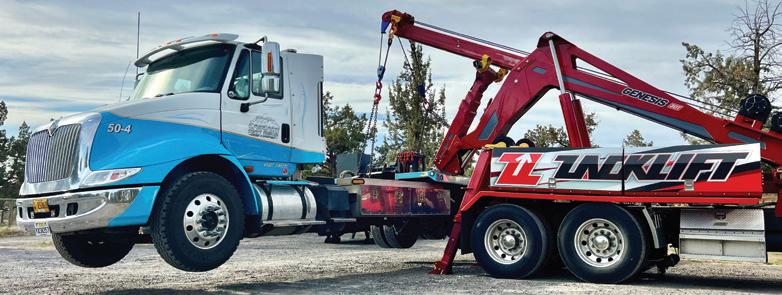
There are several models of DTUs on the market today, with three major manufacturers making various units that both look and perform in a manner consistent with traditional heavy wrecker under-lifts. Miller Industries, NRC, and Zacklift are the leading manufacturers of wreckerstyle DTU equipment with traditional under-lift designs, and offer winches and simple recovery booms available as options. Miller and NRC also have tire lifts available for their DTU units allowing for more hookup options, which is especially helpful with buses and recreational vehicles.
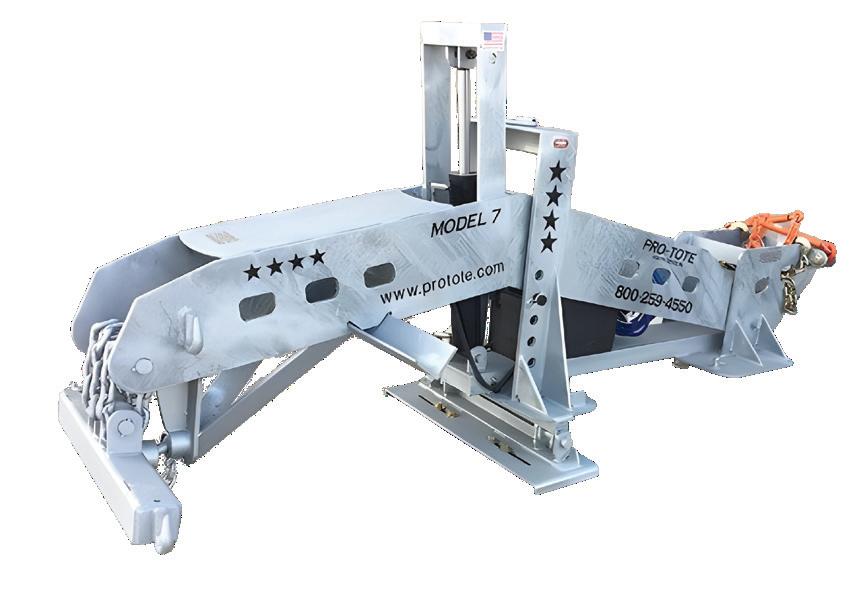
In addition to the traditional under-lift style DTU, there are several manufacturers of fifth-wheel conversions, known by some old timers as “Big Ben” units, which appeal to traditional trucking fleets for moving their own trucks. These are not necessarily designed for towing services, although they are a lower price option for a fleet that only needs to occasionally move their own trucks. One such manufacturer is Pro-Tote, which typically uses a tow-bar design where the truck being towed is suspended by chains from the frame—just like the old truck bars from days gone by.
Just as with wreckers, the right DTU for a company depends on how the tow manager intends
Since most tow companies venturing into the heavy-duty ◀
to use it. The first consideration is which tractor is available to use with the DTU, and if it has a PTO (hydraulic pump system). Or is a DTU that works off a pony motor or other portable hydraulic system an option? Having the proper flow rate and pressure to operate a DTU, along with whatever other trailers are being pulled, is critical to the successful multitasking of a road tractor.
Wheelbase and rear axle ratings will determine which units can safely be paired with a tractor. Some models, such as the Zacklift Z252, will work with wheelbases as short as 240 inches, while other units require at least a 250-inch wheelbase, or even longer, to provide for proper weight distribution and minimum front-axle weight reduction. Frame strength is also important to consider, so always check with the equipment manufacturer to confirm that a tractor is capable of safely accommodating their DTU.
This is especially critical when work includes towing a lot of recreational vehicles,
Once the tractor chassis requirements have been sorted out, the next question is what will be towed on a regular basis? The most common use for DTUs is tractor swaps out of a tow, although they are capable of much more. Just as when deciding between a 25-, 35- or 50-ton standard wrecker, select the DTU with the under-lift rating and height profile that makes sense for the application.
buses, or heavy commercial vehicles like dump trucks and cement mixers.
Determine if a winch or an extendable boom is necessary. While the primary purpose of a DTU is towing, there may be a need to do some light winching or minor recovery occasionally. A winch can be very handy to reposition a vehicle for better access to hook up, or perhaps to move it just a few feet so it can drive away under its own power. A winch and recovery boom, although not needed for day-to-day towing operations, can be helpful for an entry-level heavy tower just breaking into the market.
Where should a tow operator store their tools, forks and other rigging
In addition to the traditional under-lift style DTU, there are several manufacturers of fifthwheel conversions, such as the Pro-Tote for trucking fleets moving their own trucks.
equipment? Given the removable nature of a DTU, consider one with storage fenders so that all the towingrelated tools and equipment are removed with the DTU, keeping them readily available when the DTU goes back onto the tractor.
Now, if the wheelbase is long enough, consider installing a large “headache rack” style of toolbox to hold some, if not all, of these items. Or mount a tunnel box from a traditional heavy wrecker. Whatever the setup, just remember that the primary purpose of having a DTU is to ensure the tractor is still useable as a road tractor—unless of course a tow boss is just looking to make a lower cost and lighter weight tow truck.
Lastly, establish where this truck is going to be operated. Is it primarily in a city, a rural setting, or for long hauls across multiple states? Each of these operating environments has its own set of challenges.
For urban locations, find the optimum balance between a long enough wheelbase to handle the weight safely, but still short and nimble enough to maneuver through crowded and tight streets. Perhaps a 240- to 250-inch day cab is perfect for this application, with just small fender-mounted toolboxes to increase visibility.
Conversely, when going over the road, then a longer wheelbase with a small sleeper (which acts as a natural counterweight) would be advisable. The longer wheelbase will allow for better weight distribution, and if a tow manager is concerned about scaling legal on the rear axles, perhaps NRC’s Quickswap with tag axle is a better solution.
The beauty of the DTU is that it doesn’t necessarily need to be detached, ever. For tow bosses looking to build a dedicated heavy towing machine, a truck that is both lightweight and affordably priced, then the DTU is the ideal muscle for the project. Looking at what’s available on the market, the Zacklift products come in either fifth-wheel style detachable units or permanentmount models, while the Miller and NRC units can be left on the truck in a permanent fashion without concern.
In addition, tow companies looking for a lightweight unit with towing as its primary purpose, should also consider Jerr-Dan’s No-Body 25-ton unit. As the name implies, this proven 25-ton integrated wrecker has a permanent mount design, minus the body. This is a lighter weight and lower cost alternative to the towing and winching power of a traditional 25-ton wrecker, but without the bulky body adding weight, cost or complexity to the build.
Whether a tow company is just dipping their toes into the water as an entry-level heavy tower, or already have a fleet of heavy wreckers, adding the right detachable tow unit to the fleet can be a wise decision. DTUs are very versatile and efficient to operate, allowing a towman to keep heavy wreckers close to home, and to best serve law enforcement or commercial accounts when the job demands a true recovery truck.
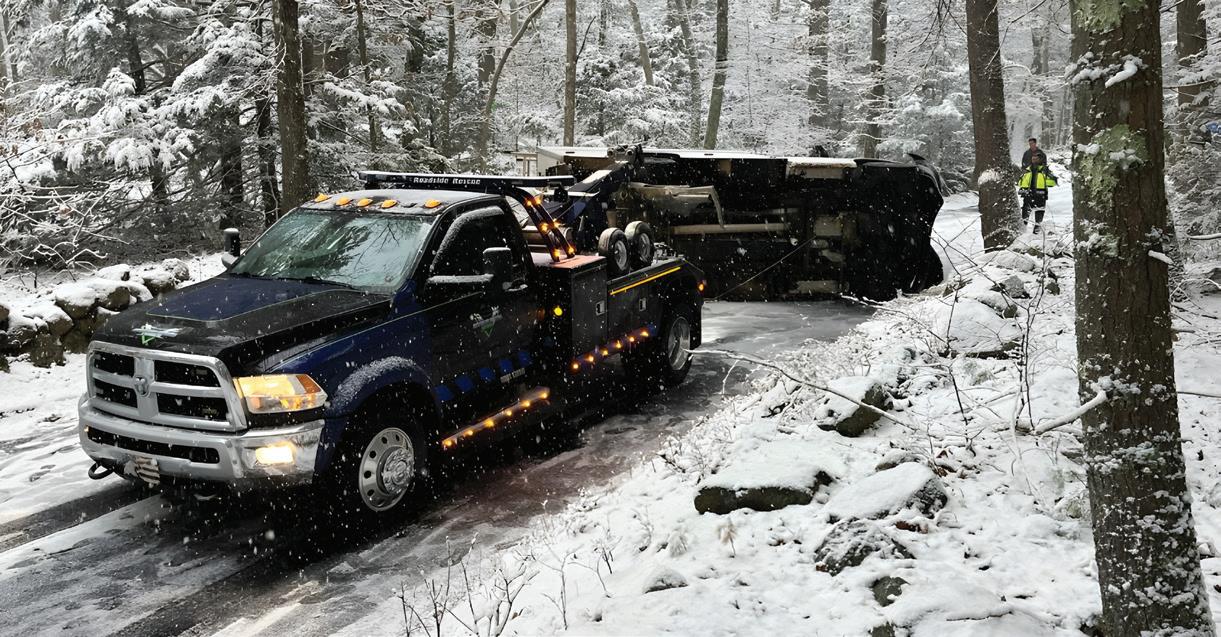
conditions.
Operations Editor Randall C. Resch is a retired California police officer and veteran tow business owner, manager, consultant and trainer. He writes for TowIndustryWeek.com and American Towman, is a member of the International Towing & Recovery Hall of Fame and recipient of the Dave Jones Leadership Award. Email Randy at rreschran@gmail.com.
By Randall C. Resch
Photos courtesy of Roadside Rescue & Transport, Inc.
Now is the time to assess tow operators’ “Winter Danger IQ”, and determine how ready they are for Mother Nature’s fury. Towers that are not mentally prepared may find themselves lacking in operational readiness. Beyond simply following safe driving practices, a towman must proactively anticipate the dangers of extreme weather. Being seasonally savvy is critical, recognizing that heavy weather poses significant risks, and being prepared can prevent avoidable injuries or even fatalities. While towers face all sorts of hazards on a daily basis, several categories deserve extra attention:
Back in 1942, garageman and wrecker operator, John Elliott Buell, waded into the raging waters of the Potomac River near Cabin John Branch, just outside Washington D.C. He was attempting to rescue victims trapped in a partially submerged vehicle. With a coworker on the wrecker’s controls, John Buell entered the swollen river with a winch cable in hand.
As Buell approached the partially submerged vehicle, the unsure footing, strong currents, and his own wet slicker caused him to misstep, and he plunged into the raging waters. Although a policeman witnessed Buell fall into the water, the officer exercised sound judgement and restraint and didn’t jump in to help save him. John Buell’s body was recovered far downstream the next day.
Towers should never rush into running waters to conduct water recoveries. Winching from higher ground is a solid and safe alternative not to be ignored. Furthermore, attempting a water recovery while wearing a heavy jacket, boots,
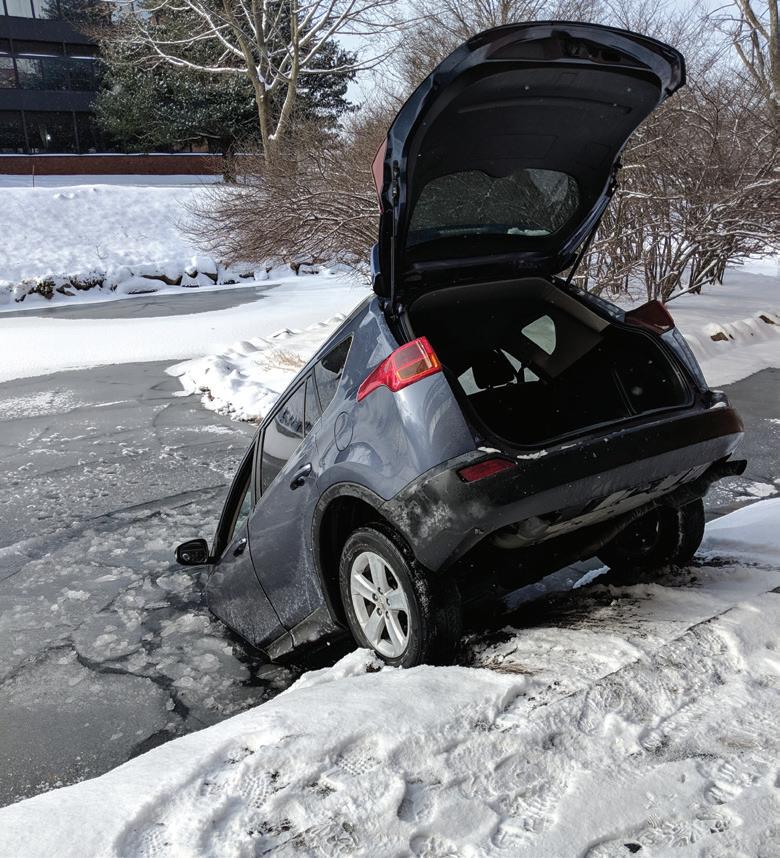
Floodwater contains contaminants harmful to towers—what you can't see can harm you.
and a tow operator’s uniform can actually hinder a towman’s ability to maneuver or stay afloat.
Risking one’s life to recover vehicles from flooded waterways isn’t smart. Never place yourself in harm’s way and potentially become an additional victim. Best practices dictate that towers allow fast water to subside before attempting water recoveries.
In adverse driving conditions, unloaded flatbed carriers are at greater risk because they’re lighter over the rear axle. At the first instance of light rain, a skim of oil rises from the pavement, especially asphalt, where unloaded carriers are prone to loss of traction.
Dozens of towers have been killed when their carriers lost control, skidded off roadways, and/ or collided with stationary objects.
Many of them overturned, and to that point, always wear seatbelts to avoid being ejected from the truck.
Throughout history, animals and pedestrians have been injured or killed by lightning strikes. For towers, working during a thunderstorm is a common occurrence. Experts estimate the following distances from lighting strikes based on the elapsed times when thunder is heard:
• If 20 seconds pass after a flash until sound is heard, lightning is about four miles away.
• If ten seconds passes, lightning is about two miles away.
• If five seconds passes, lightning is about one mile away. When pedestrians are struck by lightning, two injuries occur. The first is called “thermal effect” and
consists of burns resulting from intense temperatures generated by energy bolts (reaching 55,000 degrees Fahrenheit). The other, “electrical effect”, causes disruptions in the victim’s brain or nervous system. Whether causing burns or neurological damage, lightning is indiscriminate and can find its victim anywhere. Both effects are considered deadly, and only a few individuals survive. Common to lightning strikes, victims often have shoes blown off where grounded electricity travels through the body, taking the path of least resistance.
In environments where thunderstorms are likely, towers should stay away from trees, poles, metal structures, downed wires, and wet cars. In June 2000, a tow operator in Mobile, Alabama was hooking up a crashed car when he was struck by lightning. The tower told reporters that the bolt knocked him about a foot and a half away, but he was one of the fortunate, and survived what could have been a fatal strike.
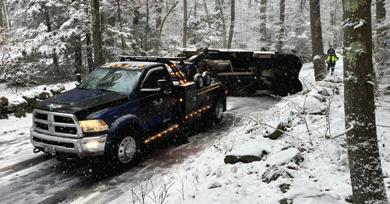
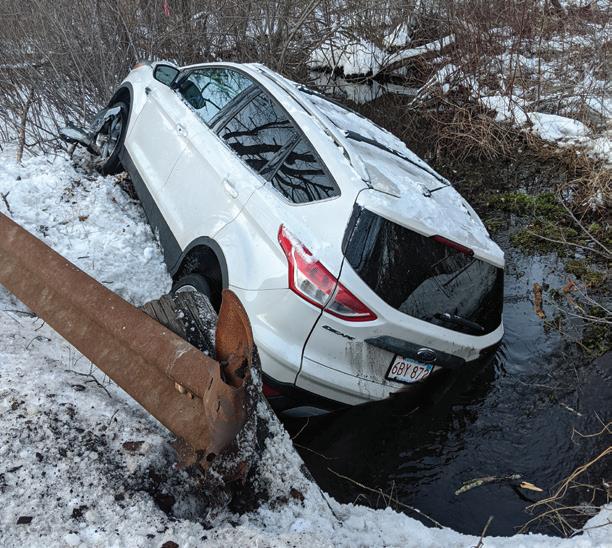
Most towers are aware that during any type of storm, working under or even near trees should be avoided. Under heavy rain or snowfall, trees become saturated with water. In windy conditions, this water weight contributes to tree limbs snapping or the trunk uprooting at the base. It’s virtually impossible to detect when trees branches will collapse.
As one tragic example, on December 26, 2021, California tow operator Kevin Carlos Rodriguez, worked with CHP to pull cars from snowdrifts and spinouts. As Kevin freed trapped vehicles, a snowladened tree fell and killed him.
Warnings against sheltering under a tree during an electrical storm date back to at least the late 20th century. Even if clouds aren’t directly overhead, lightning bolts can produce ground strikes at a distance of 10
miles from thunderstorm’s origin. If lightning hits a tree, electrical charges can surge out and away from trees in every direction. Accordingly, standing underneath trees is a leading cause of lightning casualties.
In September 2023, North Carolina tow operator, William Trueblood, 60, was winching a downed tree that had dropped across the roadway. Under a hard pull, the truck’s winch line let loose, recoiling back, striking him in the head and killing him instantly.
When removing trees blocking roadways, a safer technique is to wrap a non-metal strap around the trunk’s largest diameter, attach it to the wrecker’s tailboard, and then drag the tree to a wide location. Doing so opens the roadway, leaving it for
local crews to clean up the remaining debris. Also, in order to avoid a shock load that breaks the strap, never “slingshot” a tree. In addition, note that tree removal is generally not a requirement of law enforcement contracts. In doing so, tree removal by a towman would be a free service.
In inclement conditions, maintain a clear line of sight. On December
24, 1929, garageman, George Bignal of Great Barrington, MA, was returning from a vehicle assist under blizzard conditions. With no heater or defroster in his vintage wrecker, George resorted to driving by sticking his head out the truck’s window to see a path. Tragically, George steered too close to a tree alongside the road and slammed his head against the trunk, and he died instantly.
It’s just commonsense that in nasty weather, “slow and steady
wins the race.” True to storms creating blinding snow, thick fog, monster hail, or driving rain, towers are reminded to drive according to the state’s Basic Speed Law.
As stated in California’s Section 22350, this code mandates that “No person shall drive a vehicle upon a highway at a speed greater than is reasonable or prudent having due regard for weather, visibility, the traffic on, and the surface and width of the highway, and in no event at a speed which endangers the
safety of persons or property.”
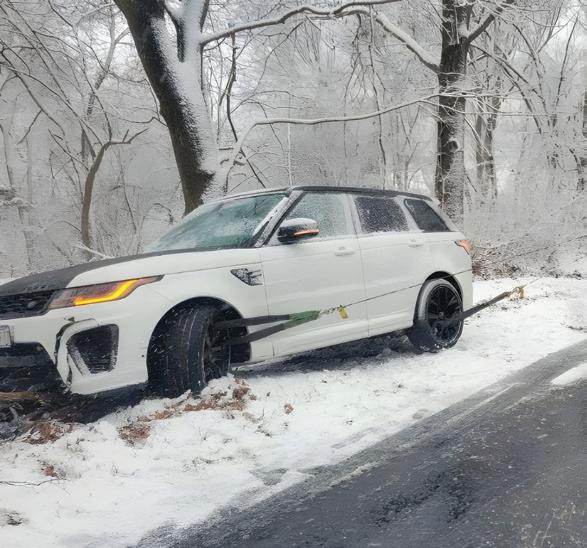
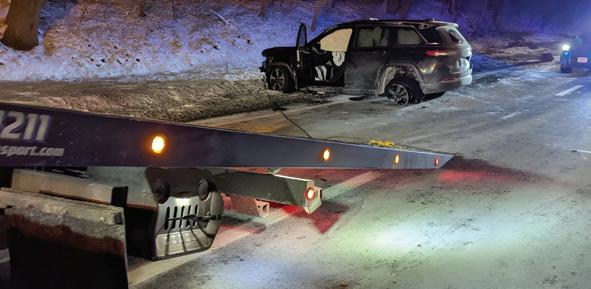
Temperature readings below 36°F should alert you to the risk of road icing. Any type of precipitation (snow, sleet or rain) when temperatures are close to or below freezing is the greatest warning sign for imminent road icing conditions. Icy roads often first develop on bridges, overpasses, and shaded areas. Black ice is a nearly invisible layer of ice that forms on the road, making it a significant and unpredictable hazard.
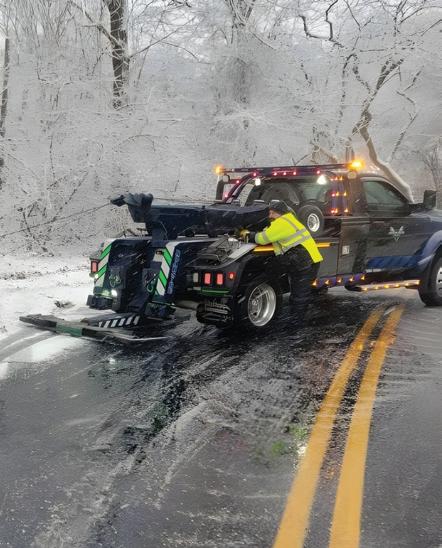
To ensure safety, drive slowly, increase following distance, and avoid sudden braking or acceleration. If you begin to skid, steer gently in the direction of the slide and take your foot off the accelerator.
Water recovery safety has been addressed in previous issues of American Towman. Historically in the towing industry, recovering a submerged vehicle is often regarded by towers as “easy money” and the
common sense to stay out of unpredictable water situations is ignored.
Recovering submerged vehicles from flooded roadways may seem an admirable service, but it’s a dangerous practice and never
recommended. When towers place themselves in harm’s way, they ignore the dangers associated with accidental drowning, injury by debris, reptile attacks, and pesticides, along with water-borne diseases common to flooding.
According to MyCare.com, major diseases found in floodwaters include; cholera, typhoid fever, hepatitis A, giardia and e. coli. Each of these can lead to severe symptoms such as bloody diarrhea, extreme dehydration, and dysentery, a gastrointestinal disease that results in painful abdominal discomfort. For anyone with a compromised immune system, these diseases can be fatal.
A mere six-inches of rushing water can move an automobile. Once flowing streams reach lower door seals, water entering a vehicle’s cab adds to its risk of sinking. Looking back to the 1970 El Niño storms in Southern California, many full-sized RVs were quickly washed down the L.A. River Basin when motorists attempted to cross flowing roadways.
Tow trucks and carriers obviously aren’t amphibious vehicles. All it takes is one bad decision to damage or lose a tow truck. Swift water undermines roadways, creating potholes, cracks, and washed out pavement. Wading a tow truck or carrier into standing or rapid water is a dangerous decision.
The towing industry demands long hours, and management must recognize the serious risks created by fatigue. Operator safety requires that towers are provided ample time to get properly rested.
The consequences from lack of adequate rest can be deadly. In September 2023, New Zealand tower, John Hall, reportedly worked 96 hours straight. The broadcast news reported that he fell asleep while driving, and crashed his tow truck into a tree, killing him.
Periodic operator training on all of these topics is necessary. Notably, if a tow operator is injured or killed on the job, as in any accident investigation, tow company owners may face monetary fines and prosecution should OSHA determine negligence.
Towers are reminded to dress appropriately for the weather. Include heavy, layered clothing for the cold. With winter nearly upon us, preparation and training are a company’s best defense in facing weather extremes. Don’t wait for an unexpectedly severe storm to claim towing personnel as the next victim.
By Steve Temple
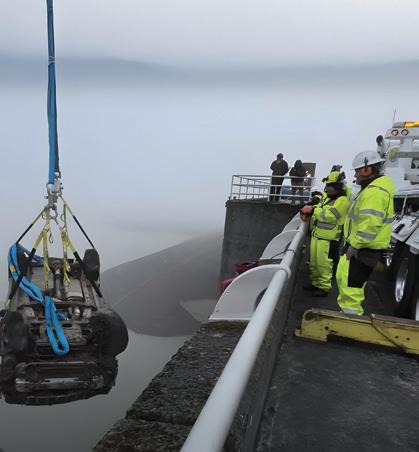
Some tow jobs come as a sudden surprise, and with more than the usual obstacles to overcome. That was the result of a precipitous call from the Army Corps of Engineers to haul up a 2009 Jeep submerged at the bottom of the steep Lookout Point Dam, located southeast of Eugene, Oregon. Puddle Jumper Towing & Recovery was up for the challenge, handling mud, sweat and gears.

Bio Synergy Environmental
Ford F-350 pickup and a 24-ft emergency spillresponse trailer
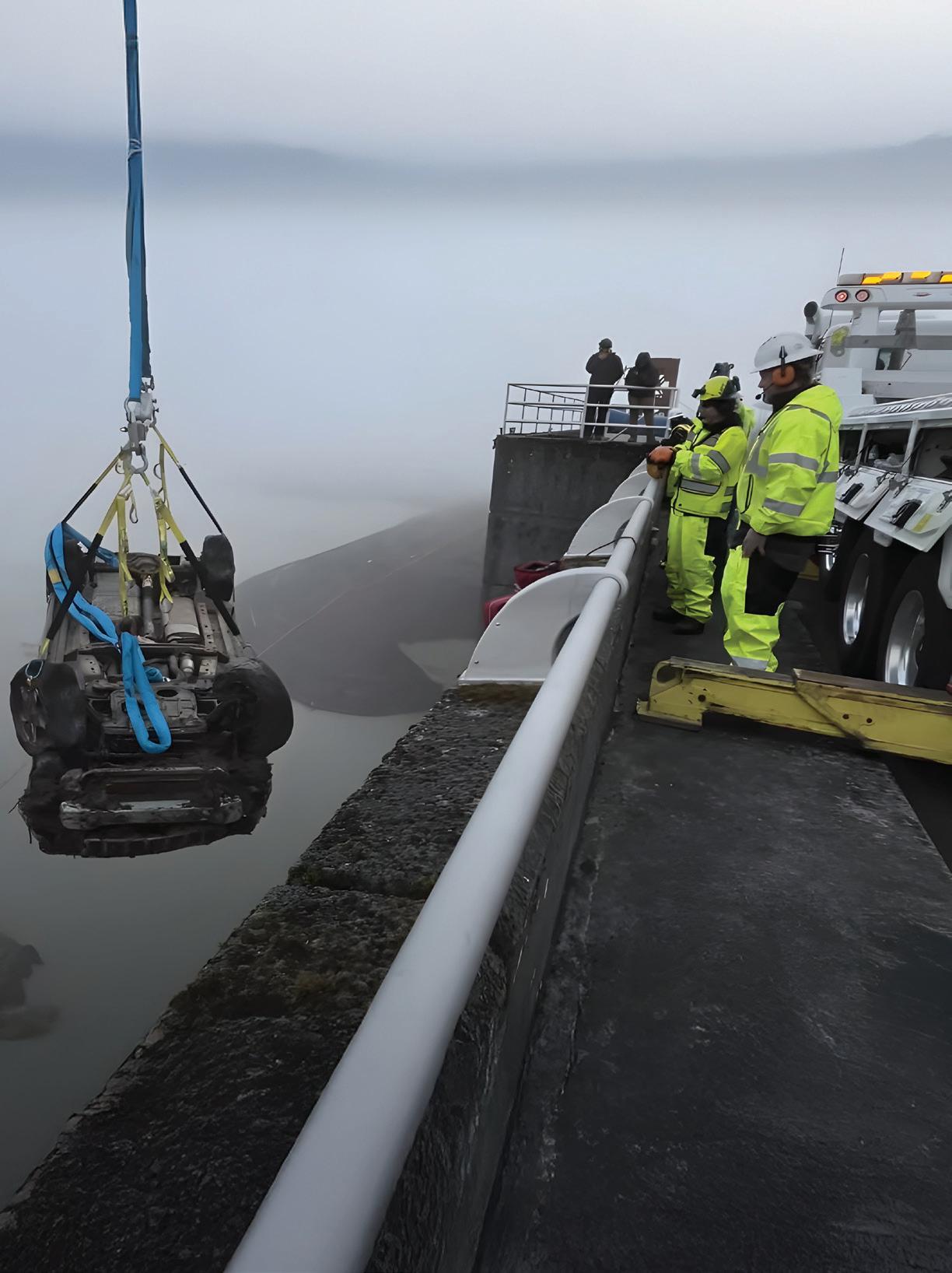
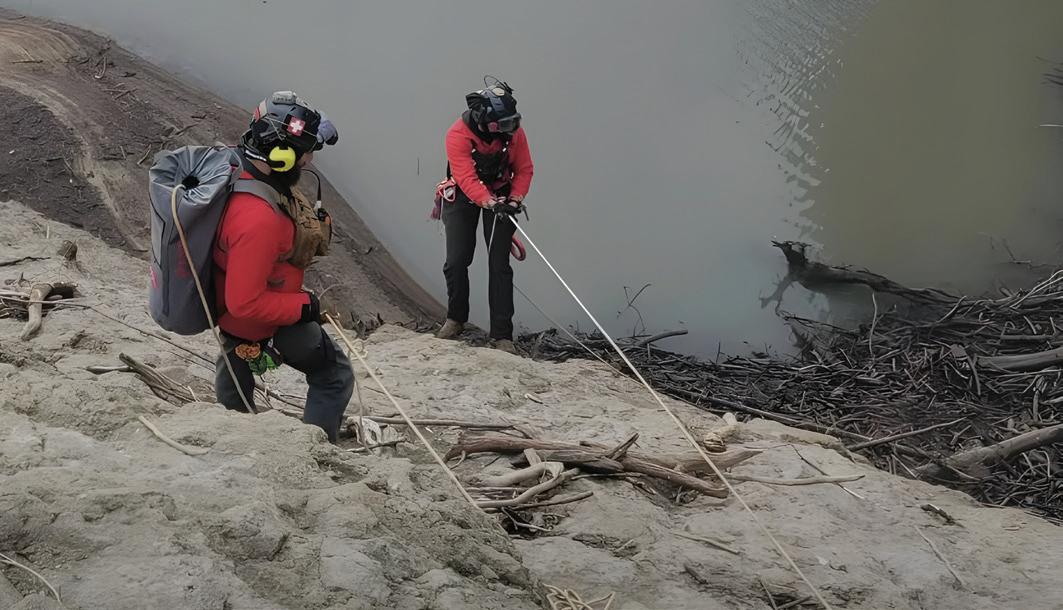
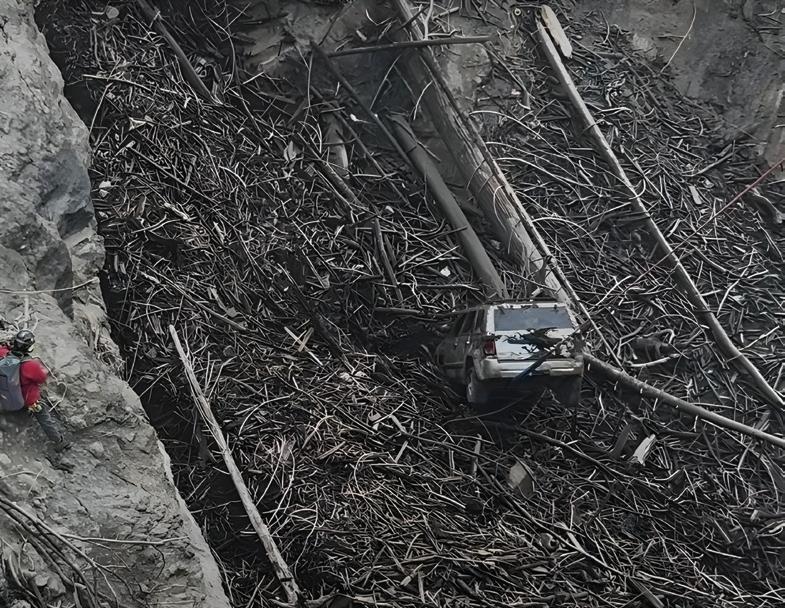
The Jeep had been resting undisturbed since 2011, immersed well below the water’s surface. To access the vehicle, the water table had to be significantly lowered. Using a rangefinder, the tow operators determined that the Jeep was located 238 feet down the dam wall (taller than a 20-story building!), and dangerously close to the trash gates. These gates are crucial for preventing debris from entering the reservoir and moving downstream.
Given the depth and proximity to
the dam, Puddle Jumper partnered with High Priority Consultants, a team of specialists skilled at rappelling. With safety as the top priority, a comprehensive briefing developed a five-phase recovery plan. This included addressing potential engineering concerns, performing precise mathematical calculations, and identifying and mitigating safety hazards.
For instance, the edge of a dam has only a four-foot tall railing that is inherently dangerous. In addition, weather conditions were not the friend of operators on the day of the operation. It was bitterly cold, with the wind gusting and thick fog severely limiting visibility, all making the recovery scene even more complex.
The operational strategy relied on an NRC 40/50, a heavy wrecker with a 360-degree rotating boom. This versatile piece of equipment was key to maneuvering around obstacles and lifting the Jeep from its submerged position. Careful calculations were made for rope
lengths, ensuring sufficient reach to the Jeep, using a combination of 7/8″ synthetic line with a 20,000-lb working load limit, heavy-duty lifting straps, and “continuous loop” straps with exceptional strength.
The recovery process required extra finesse due to the risky conditions. The rappelling crew first accessed and stabilized the
Michael Clement
Michael Austin
Nate Mitchell
Kevin Schuetz
Chanlin McCabe, owner of High Priority Consultants
Matthew Adams, owner of Crux rescue
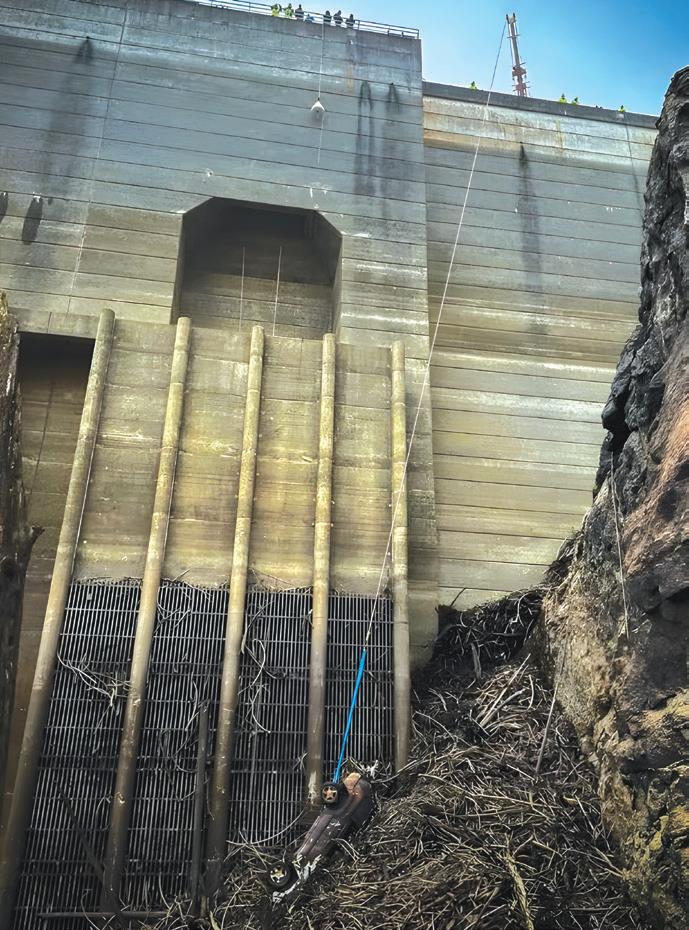
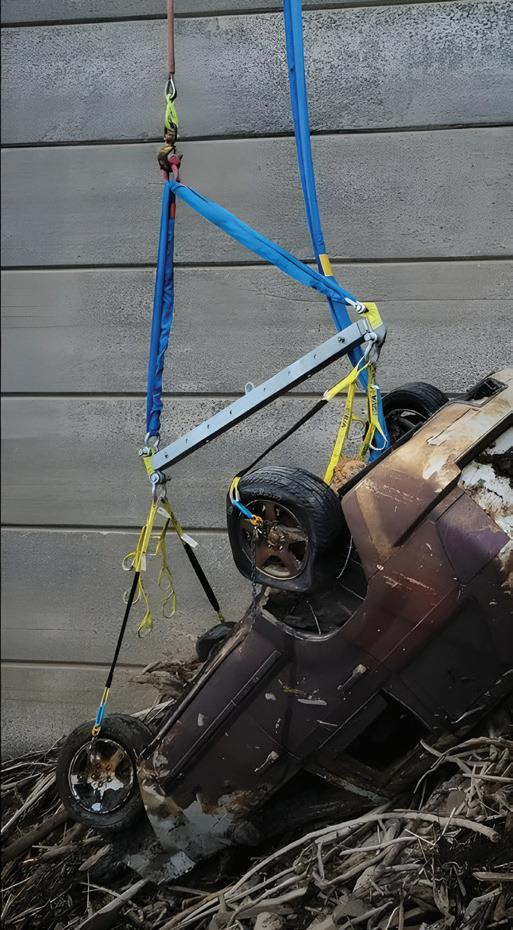
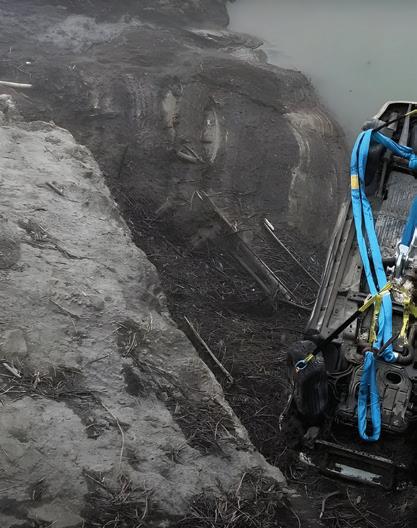

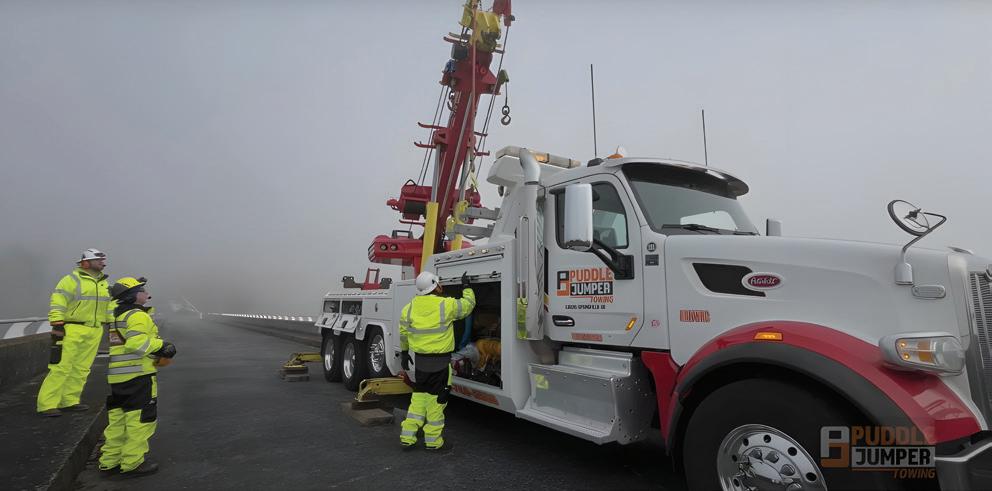
That’s one long lift, so careful calculations were made for rope lengths and the working load limits of the rigging equipment.
Jeep. Then, it was carefully extracted from the mud, and maneuvered around a large outcropping.
Initially estimated at 5,000 lbs., the Jeep’s actual weight was closer to 7,200 lbs. due to 14 years of accumulated mud and debris.
Lifting the Jeep up the dam
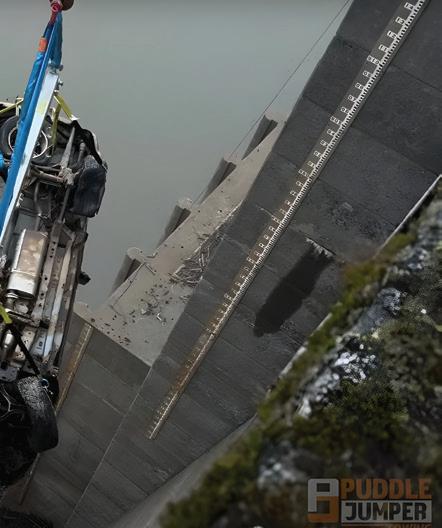
Constant communication helped to maintain precise positioning of the casualty vehicle.
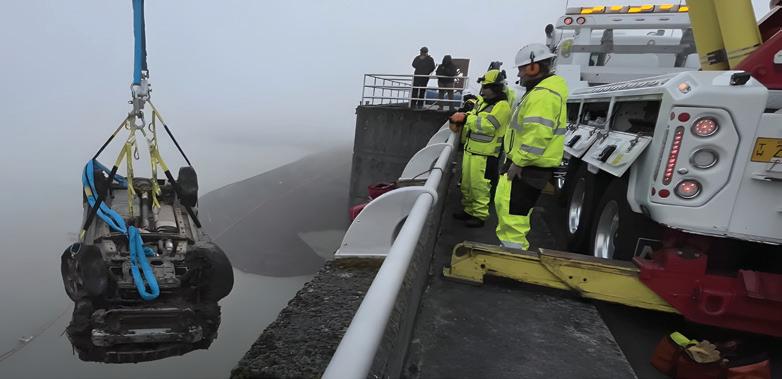
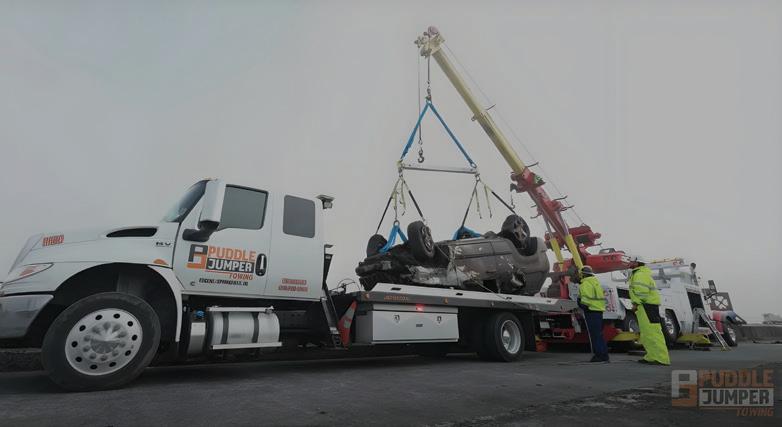
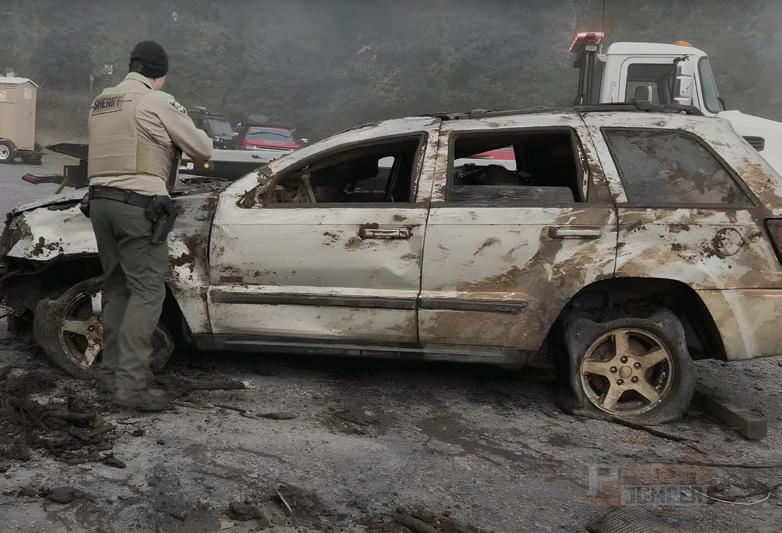
face proved to be the most difficult phase. Attempts to flip it onto its wheels were thwarted by the weight and shifting mud. Instead, operators opted to lift it upside down, using a spreader bar to secure all four wheels.
As the recovery progressed, the wind intensified. Constant communication with the rappelling crew was required to ensure their safety, and maintain precise positioning of the casualty vehicle. Finally, after nearly a full day of effort, the tow operators successfully lifted the Jeep over the dam wall and onto a carrier for transportation.
Law enforcement officers were on scene to conduct forensic analysis, searching for identifying information such as the VIN number and license plate to locate the owner. (No further information about the Jeep’s owner and the cause of the crash have come to light yet.)
Operations like this one remind towers how much they love what they do.
“This is what I live for,” exclaimed Michael Clement, owner of Puddle Jumper Towing. “I could do it every day and never get tired of it.”
Braving the elements, experiencing teamwork in action, and achieving the seemingly impossible is what motivates Puddle Jumper’s towmen. For them, it’s not just about recovering vehicles—it’s about the thrill of solving unexpected problems and making the impossible possible. And that takes way more than just dam luck.













By Stephanie Marchese

IStephanie Marchese is a contributing writer and copy editor for American Towman magazine, drawing on valuable skills honed from years in book publishing. With a passion for clear storytelling and in-depth industry coverage, Stephanie brings a keen editorial eye and a dedication to giving tow professionals a voice in the industry’s leading trade publication.
n the towing industry, meeting inspirational people happens more often than not, but every now and then, we encounter someone who manages to stand out just a little bit more.
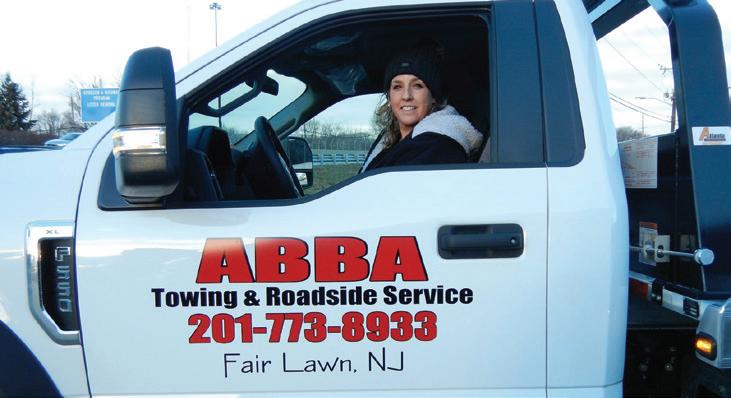
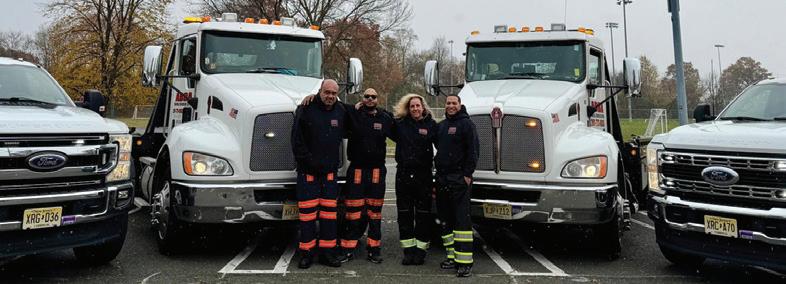
We recently came across a local tower, Roe Atia, owner/operator of ABBA Towing in Fair Lawn, New Jersey, who caught our attention when she was featured on a local news channel noting her numerous American Towman ACE awards. We immediately knew that Roe deserved some one-on-one attention from us.
Not having direct contact info for Roe, I started with a Google search and found ABBA Towing’s number. Reaching out for an interview can be tricky when you’re dialing a local number from the internet, but Roe answered on the first ring. Once I explained I was with American Towman and wanted to interview her for a feature, she warmly agreed and invited me to her home to keep things informal.
With the date and time set, I arrived at Roe’s quaint cape-style home on a treelined cul-de-sac, located just 12 miles from New York City. Parked right in front of Roe’s house was one of her flatbed tow trucks. I was welcomed inside by what can only be described as a striking woman wearing a tower’s coveralls. Once comfortably settled in Roe’s kitchen, we got down to the business of getting the story behind this woman.
Roe and her husband, Ephi, a tow operator, left Brooklyn, NY in 2004 with their two young boys and settled in Fair Lawn, NJ. In 2008, Roe encouraged Ephi to start their own towing business, explaining that, “I had a love for tow trucks my whole life,” and she had every confidence that this was something they could do successfully.
When deciding on a name for their new towing business, Roe told Ephi that she’d love to name the company “ABBA” after her favorite Swedish band. Ephi liked the idea, but as a smart businessman, insisted that they incorporate AAA-ABBA, to ensure the company had the first listing in the yellow pages, which was still relevant back then, before a company’s listing was dependent upon customer reviews.
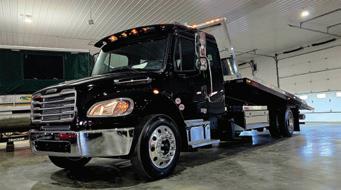
Like most new business ventures, ABBA started small, and their first tow truck was a 1996 Chevy 6500, which Roe laughingly refers to as “The Lady,” as she was aptly named by the three-person ABBA team. According to Roe, on any given day, Lady could be in a bad mood, sputtering and choking her way down the road, or
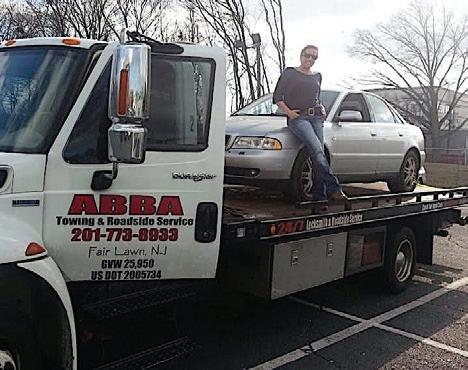
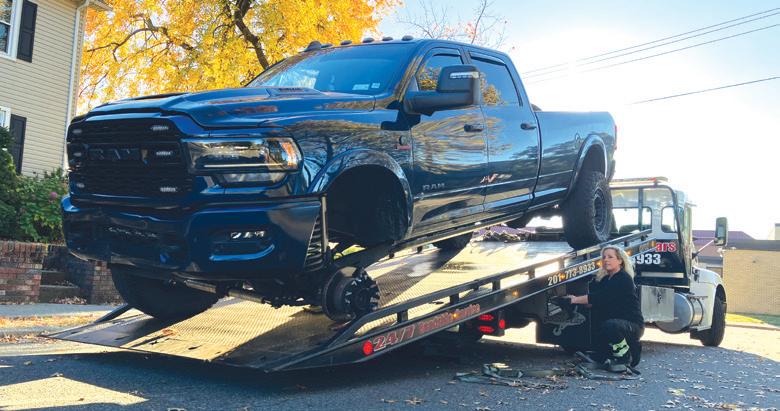
Roe takes a well-earned breather after another smooth save.
purring like a kitten, with light puffs of smoke coming from the exhaust.
Lady was prone to mood swings and upon arriving at the shop every day, Roe’s driver would ask, “So what kind of mood is Lady in today?” Another quirky feature of Lady was that she always had to be in neutral, and on one particular day, perhaps the driver forgot to properly set her parking brake, Lady took it as an opportunity to make a statement, and on a busy road in New Jersey, she jumped the curb and drove herself straight into a bagel shop, clearly deciding she “kneaded” a break! Luckily, no one was injured and damage to the bagel store was minimal. Years later, Lady went out with a bang, literally, when she exploded into pieces on the very commercially traveled Route 4 in New Jersey. “She must have been in a mood that day,” laughed Roe.
ABBA Towing added another truck to their business not long after the first, another GMC Flatbed, and this one they named “Demon” which they quickly realized was another wrecker with a strong personality. Not to be outshone by Lady, Demon slammed into a wall in a junkyard while the driver was dropping a car and again, luckily nobody was injured.
In January 2011, Ephi was diagnosed with pancreatic cancer and initially, carried on in his usual way. Roe recalls that he worked steadily for about three months after the diagnosis, but came home one day and said, “I can’t work anymore” and started on a quest for doctors, treatments, and simply trying to live
life to the fullest. Roe notes, “We still had a family to raise, the boys were young, just six and eight years old and in elementary school.” Although Roe had been the one to actually open the business and obtain the roadside contracts, it was Ephi who did most of the driving and dispatching. Roe quickly realized that she needed to learn how to do both things, and do them well.
Since the two tow trucks they owned were 25,950 lbs., under the 26,000 lbs. mandated for a CDL, Roe just needed to become comfortable driving the wreckers, and of course, learn how to perform basic recoveries, at least initially. The vast amount of Roe’s training was on-the-job, and this included driving, dispatching, bookkeeping, and anything else that came her way. All this was done while raising her two young boys and taking care of her terminally ill husband.
In mid-2011, Ephi pulled himself completely out of the business and pursued treatment in Texas. This
particular treatment involved a chemotherapy regimen that was not covered by their insurance and thus, the medical bills began to mount.
With a profound look of sadness, akin to regret, Roe recalls, “Ephi talked about going on a vacation, something memorable.” But, with the kids, the business, and the evergrowing medical bills, Roe gently explained to him that she needed to continue to run the business for their family’s financial stability. Realizing this was a dream of Ephi’s, perhaps his dying wish, and that she could not in good conscience accommodate him, still breaks her heart to this day.
With tears in her eyes, Roe recounts that very early on, one of her husband’s doctors all but gave him the date he would die and sadly, it came to pass in January of 2013, just two years after the initial diagnosis. Ephi was surrounded by family and friends at home, and Roe did not leave his side. When the cancer finally took him, everyone assumed the business would go with him, but Roe had other plans—she would carry on the towing business they had built together.
The next several years weren’t easy, the boys were still quite young, just 8 and 10 now, and Roe had to juggle babysitters, work, school functions, and the vast amount of medical bills left by her husband’s two-year cancer battle. Roe explains, “I almost lost
my home because of the medical bills, but was able to keep the business going, clean up the bills, and save our home.” As far as her young sons, she feels lucky that they lived within walking distance to the elementary, middle, and high schools, but also feels like she was out working all the time and realizes she missed a lot of their growing up.
By 2014, Roe was much more hands-on with the entire business, and by 2018, purchased a new Ford F-550 flatbed from Atlanta Wrecker Sales. In 2019, she bought a T270 KW flatbed from Tri State Towing Equipment in Westbury, NY and in 2020, a T270 KW flatbed was purchased from Purpose Wreckers Sales in Wentzville, MO. This was followed by a F-600 flatbed in 2022, and just last year, an F-550 flatbed, both from Atlanta Wreckers SC. Roe realized then that the company was well on its way to continued growth. Today, ABBA Towing has four working tow trucks
and Roe credits her 17 years with GEICO as one of the driving forces behind the success of the business, along with her love of the industry where she says, “I learn something new every day. I can’t imagine doing anything else.”
With the boys now grown, Roe confessed that they don’t seem too interested in taking over the business, but her younger son, now 21, will help out with roadside assistance. His current passion is restoring cars, he’s working on a 1988 Nissan Z right now, but Roe hopes that someday soon, he’ll realize he loves towing as much as his mom does.
“You can’t push kids into doing something, they have to realize it on their own,” states Roe “but a little gentle persuasion never hurts.”
Like the Super Trouper song from the group that inspired its name, ABBA Towing keeps “shining like the sun”, proof that some lights never fade.

By Steve Temple
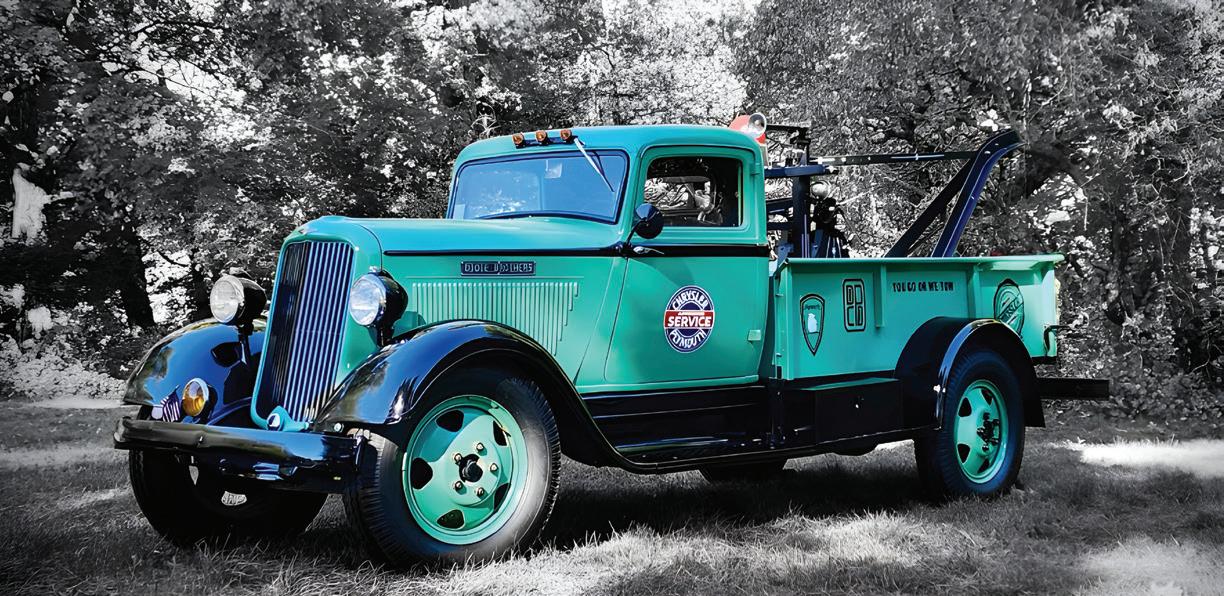
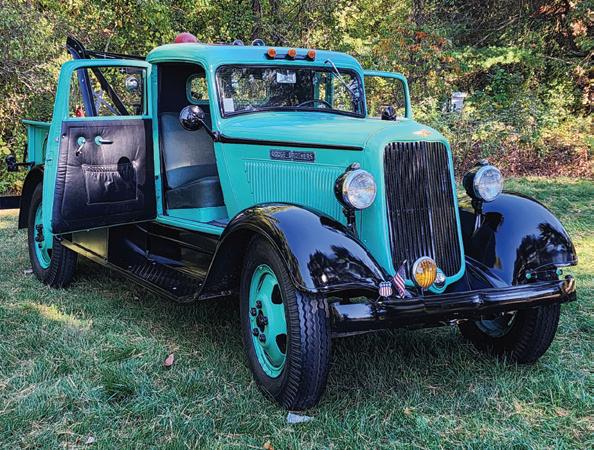
Even though the Dodge Brothers Company’s automotive endeavors date back to early 1900s, this firm didn’t produce any trucks until WWI— and that model was actually a panel van, not a pickup. It had a half-ton capacity with a 35 horsepower engine and an underlying car chassis.
But in 1921, the Graham Brothers started selling one-and-a-half ton pickups through Dodge dealers, using their own bodies on a Dodge chassis. A one-ton showed up later in the 1920s, powered by the same four cylinder engine. Dodge Brothers bought Graham Brothers in 1925, and in 1926, began manufacturing their first civilian trucks.
In 1928, Chrysler acquired Dodge Brothers, which launched a halfton pickup for 1929, just after its acquisition by Chrysler, the last truck designed by the old Dodge Brothers company. Three engines were available, two Dodge engines with six cylinders (63 and 78 hp), and a Maxwell four cylinder that produced just 45 hp. The trucks had four-wheel hydraulic brakes, a major safety feature unique among pickups.
By 1930, the Dodge Brothers Company was known simply as “Dodge,” and it was around the time
that the Dodge nameplate became the premier brand for light- and mediumduty trucks, which ranged from halfto two-ton variants. By the mid 1930s, Dodge had become the quintessential American Pickup.
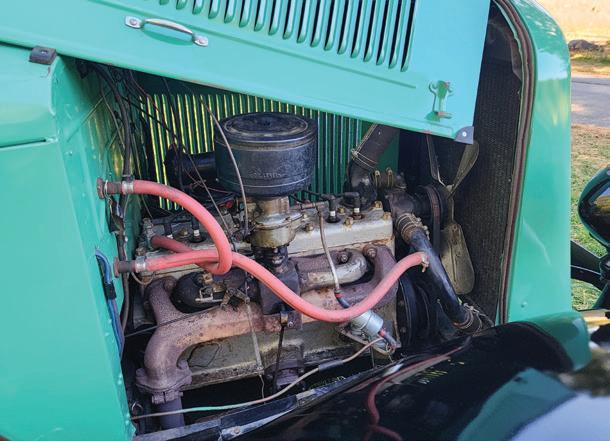
Beginning in 1933, Dodge trucks abandoned the old Dodge Brothers engines and used Chrysler Corporation engines instead, modifying them for durability. The six cylinder engine was the flathead six used in Plymouths, which continued through 1960.
The 1934 Dodge was engineered
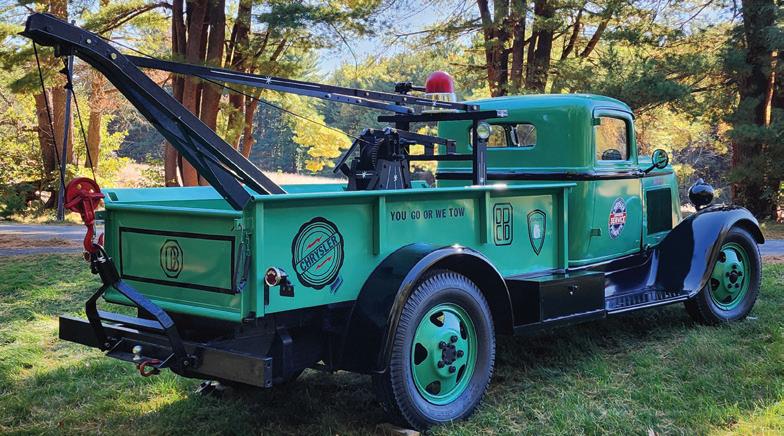
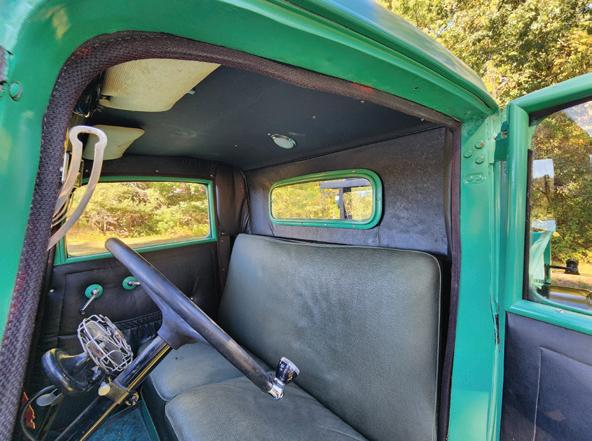
to be a rugged, dependable workhorse, and included a number of safety advancements for its time. These included a reinforced, rigid “double-drop, X bridge-type” frame for greater stability and safety. Also, the cabin had a smooth, flat dashboard and padded seat backs.
All of these features captured the interest of Mike Borelli, owner of Roadside Rescue & Transport, Inc., a family-run firm based in three Massachusetts locations, and running a fleet of 13 tow trucks. The Roadside fleet includes several medium-duty flatbeds and a pair of twin-line wreckers (16and 25-ton), along with light-duty wreckers and a variety of service equipment.
Getting back to the heavy-duty 1 1/2 ton Dodge shown here, it’s a K33 commercial version, and was restored about 25 years ago, and then sequestered in a storage facility. Mike acquired it in July 2025 for a few personal reasons.
“My passion and love for the towing industry,” Mike explains. “I wanted to purchase this truck for my business, which celebrated 30 years of operation in October 2025.” He felt that this wrecker would be a fitting piece of equipment to add as a flagship to his fleet, and desired to preserve the truck in its original condition. As such, it still has the original 218 ci Chrysler Flathead rebuilt engine, still running strong, and “suicide doors” hinged at its rear rather than the front.
As for the wrecker body, it’s a manual Weaver Auto Crane, the manual Model # R28a rated for three tons. This popular product line dates back to 1915, and came in several capacities, and could convert a truck or even the rumble seat of a car into a tow vehicle.
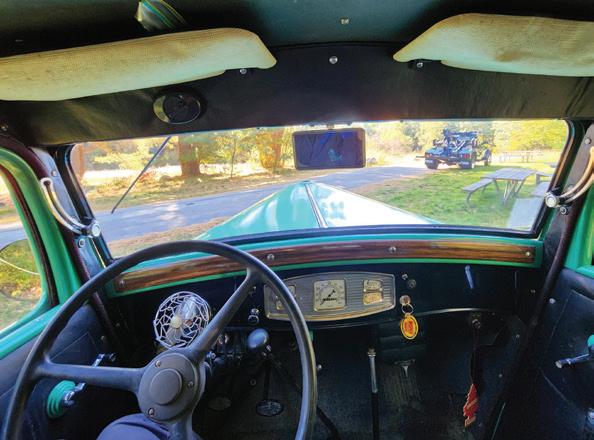
Today, many of the 1934 Dodge trucks are customized, with builders often integrating modern technology. But Mike prefers the authentic period-treatment, and plans to keep it that way for parade promotions.
“I am very proud to own this vehicle and protect its originality,” Mike notes. And towers everywhere are glad to see their enduring history being carefully preserved.

By Joey DiMarco
We’ve all had that “lightbulb moment.” For one manager, it came after years of running an auto repair shop and constantly relying on outside tow companies. A customer would call saying they needed a tow, and they’d be directed to call AAA or contact a local tower. The hope was that they’d show up on time, handle the vehicle properly, and choose this manager’s shop over the competition.
This hope vanished the day a devoted customer called AAA for a tow, only to be steered by the driver to another shop that paid kickbacks for referrals. When the manager realized he’d lost a repeat customer because of someone else’s tow company, he resolved to make sure it never happened again.
The next morning, the manager and his brother bought their first tow truck. However, it seemed that although one problem had been solved, a host of other problems were created—no business, no calls, and a brand-new loan payment. More than 25 years later, after trials, errors, and hard-earned lessons, this manager discovered that customer acquisition and retention are the true engines of any successful towing operation.
In towing, most calls are one-anddone. A stranded driver likely won’t need another tow anytime soon. Getting a five-star review is great for a business’ reputation, but the truth is, this same customer probably won’t be calling next week. So where does repeat business come from?
It comes from the destinations. Every vehicle dropped off—whether at a dealership, bodyshop, or independent repair center—is a potential business lead. These facilities need reliable towing partners, and often have no real allegiance to whoever they’re currently using. This is the moment to seize an opportunity.
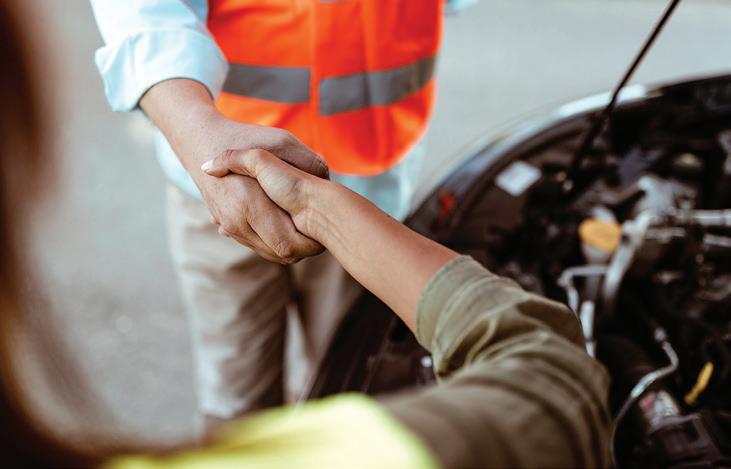
Start simple: Each and every time a vehicle is towed to a facility, make sure the tow operator introduces themselves, confirms exactly where the vehicle should be dropped, and delivers the keys and customer information directly to the service writer. It sounds basic, but this step prevents chaos—no calls from angry service managers asking where a car is, no wasted time reloading and repositioning vehicles, and no dispatch delays. If the delivery goes smoothly, that shop just had a positive experience. This is referred to as a “warm lead”.
The next day, follow-up with a quick call: “Hey, this is [Name] from [Company]. We delivered a vehicle to ◀
you yesterday for [Motor Club/ Insurance Company/Customer Name]. Just wanted to make sure everything went smoothly and ask who you typically use for your towing needs.”
This short conversation does two things:
• It reinforces your professionalism and reliability.
• It opens the door to a longterm relationship.
If the customer is unhappy
with their current tow provider, then the timing couldn’t be more perfect. Offer to prioritize their calls and to consistently deliver the same level of care they just experienced.
Going forward, a small gesture, such as a simple ‘Thank You” note, goes a long way, and for added points, consider dropping off a box of donuts or a pizza on occasion. This lets them know that their facility is important to your
business. Also, consider handing out one of the most effective marketing tools, a custom mouse pad with the tow company’s logo and phone number, always visible right on the service writer’s desk.
As the network of clients receiving drop-offs grows, keep track of every facility. Create a list and dedicate time each week to reconnect with each one. The more relationships nurtured, the steadier the workload becomes. Once a solid base of local partners has been built, expand the tow company’s marketing team and have at least one person focus solely on account management and new customer acquisition.
Working with motor clubs, insurance companies, and dealerships will naturally provide a tow company with exposure. But, remember that real growth comes from converting one-time deliveries into steady, loyal partnerships. Success in towing isn’t about the truck—it’s about the relationships. Anyone can buy equipment, but not everyone can earn trust.
If a tow manager treats every customer as a potential partnership, and not just another job, it’ll turn company trucks into rolling business cards, and drop-offs at businesses into dependable revenue streams. Always keep this in mind: the best customer is the one who calls again.



Geoff Nienstedt has dedicated 37 years to the towing industry, and established Roadrunner Towing in 2001 in Schertz, Texas. He’s built his company into a trusted name recognized for its reliability, professionalism, and strong community presence. Over the past decade, Geoff has become a driving force for safety within the industry, actively championing for improved safety standards and greater SDMO awareness. He serves as a board member for Southwest Tow Operators, and helping to guide initiatives that create meaningful, statewide impact. Geoff was named 2024 American Towman of the Year and is a two-time Masters of Chaos Award recipient.
By Geoff Nienstedt
Tow truck operators face unique health and safety challenges due to the nature of their jobs. And they don’t always realize the impacts on their wellbeing.
For instance, recently a towman was diagnosed with diabetes, prompting his manager to think about what he could do to help his tow operators stay healthy. A week later during an unexpected trip to the emergency room, this manager was advised that he also is diabetic. After 36 years in the industry, it had finally caught up with him.
Tow truck operators perform one of the most demanding and dangerous jobs in transportation. Long hours, irregular schedules, heavy physical labor, poor
nutrition, and high-stress roadside conditions all take a toll on both body and mind. This checklist provides practical steps to protect a towman’s health and improve overall wellness, in order for to take care of himself or herself, while also taking care of others.
• Fast food is convenient, but preparing meals or snacks ahead of time reduces reliance on greasy, high-salt options. Nuts, fruit, jerky, cheese sticks, protein bars, and cut veggies can be stored easily in a tow truck.
• Keep a refillable water bottle in the truck. Energy drinks and sodas provide short bursts, but lead to blood-sugar energy crashes. Symptoms include fatigue, irritability, and shakiness. Drink mostly water throughout a work shift.
• Eat a mix of lean protein (chicken, fish, beans), high-fiber foods, and fresh produce daily. Avoid sugary and processed foods with refined grains (donuts, cookies, pastries).
• Before and after each tow, do a quick, two- to three-minute stretch (neck rolls, shoulder shrugs, hamstring stretches) to avoid stiffness.
• Use proper lifting techniques and equipment whenever possible. Bend your knees, not your back.
• Even short walks between calls improves circulation and fights fatigue. Aim for a minimum of 15 to 20 minutes of activity daily.
• Consider wearing a quality backsupport belt and keep core muscles strong through simple exercises such as planks.




• Prioritize getting seven to eight hours of quality sleep daily, even if it’s in separate blocks due to shift work.
• A 15- to 20-minute nap can restore alertness. However, avoid longer naps that may leave you groggy.
• Use blackout curtains, earplugs, or a white noise machine if you sleep during the day.
• Caffeine and nicotine can disrupt sleep if used within four to six hours of rest time.
• Roadside incidents are unpredictable and create stress. Take short breaks between calls. To reset after a tough job, take deep breaths, use calming music,
or call a friend/family member.
• Fatigue, stress, and frustration all increase the risk of an accident. Don’t push past a breaking point, and be sure to rest after a shift.
• Talking with coworkers, family, or a professional can prevent stress from building up.
• Maintain healthy relationships outside of work—isolation can lead to burnout.
• Always wear reflective vests/ clothing when working roadside.
• Gloves, steel-toe boots, and safety glasses can protect against injuries.
• Carry sunscreen, hats, water, warm clothing, and blankets, depending on the season.
• Always position yourself with
traffic flow in mind—your safety comes first.
• Schedule annual physical exams—don’t wait until something feels wrong.
• Regular checkups with a physician are critical for safe driving and awareness roadside.
• High blood pressure, diabetes, and back pain are common in the industry. Monitor any unusual symptoms.
A towman’s health is the most important tool on the job. By making small, consistent changes in daily habits not only feels better, but enables a tow operator to work safer, smarter, and longer in the towing industry.

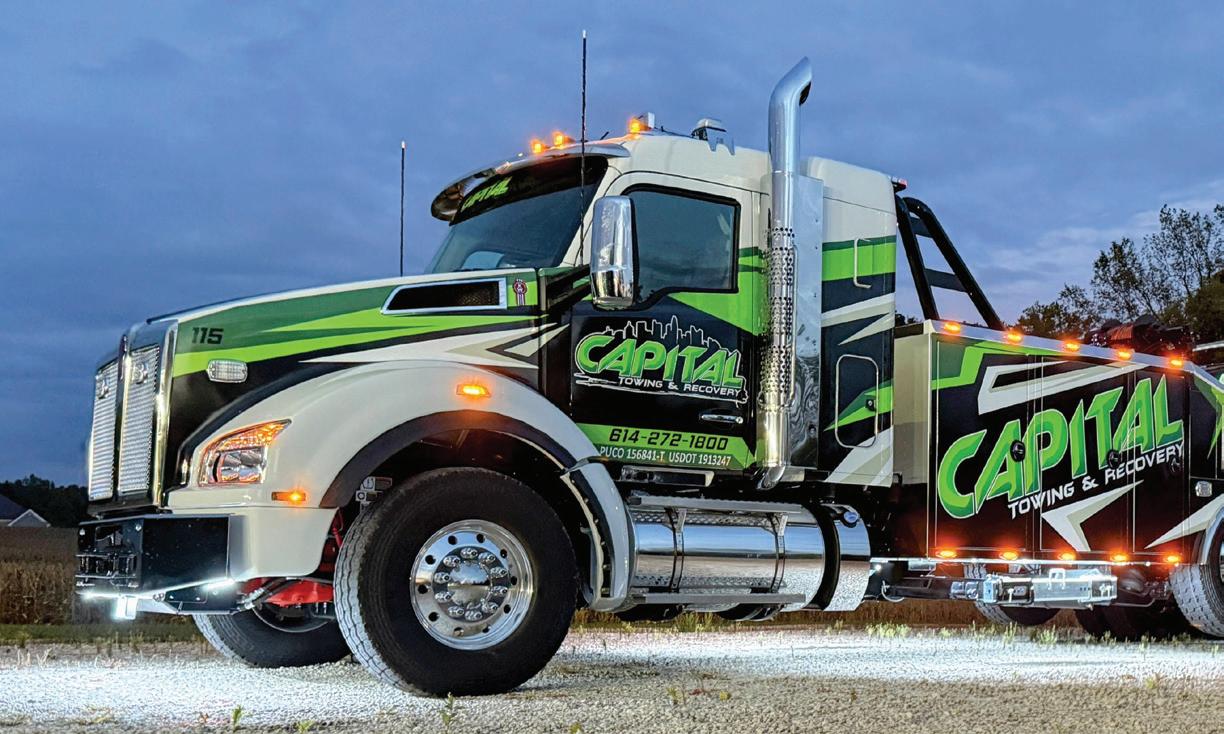
Under-body lighting not only looks dramatic, but also enhances both visibility and safety on scene.
By George Nitti

Getting noticed in the competitive towing business takes some innovative thinking and bold branding. To that end, Capital Towing & Recovery created vivid new graphics. The Columbus, Ohio tow company recently completed a full fleet rewrap that highlights its name in striking green and black lettering, signaling a confident, modernized identity.
“We wanted our name to stand out more,” explains owner Brandon Harris, who founded Capital Towing in 2007 after serving as a police officer. “The previous scheme looked great, but our company name kind of got lost in the graphics. We felt we were able to accomplish that with the new redesign.”
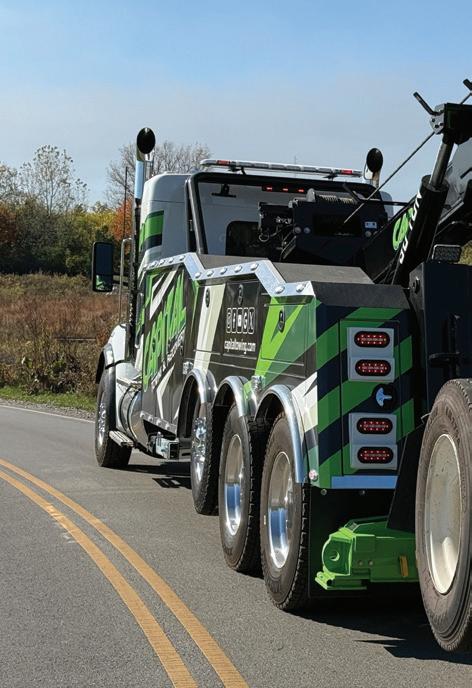
The transformation was no small investment. Brandon said the company rewrapped its entire fleet, which includes
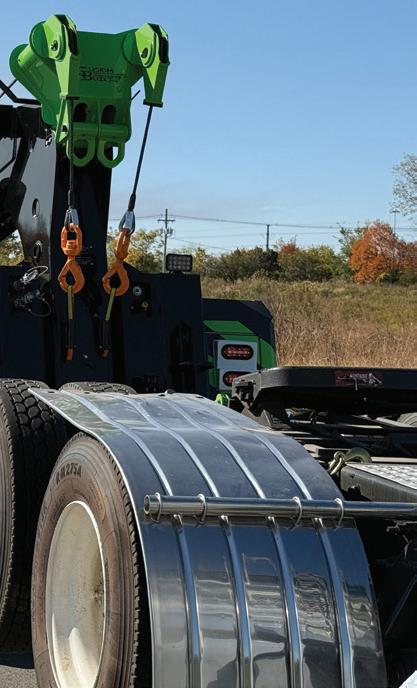
Chassis: 2026 Kenworth T880
Engine: Cummins X15 600HP
Transmission:
Allison Automatic
Wrecker Body: 2026 Custom Built CB 30HD
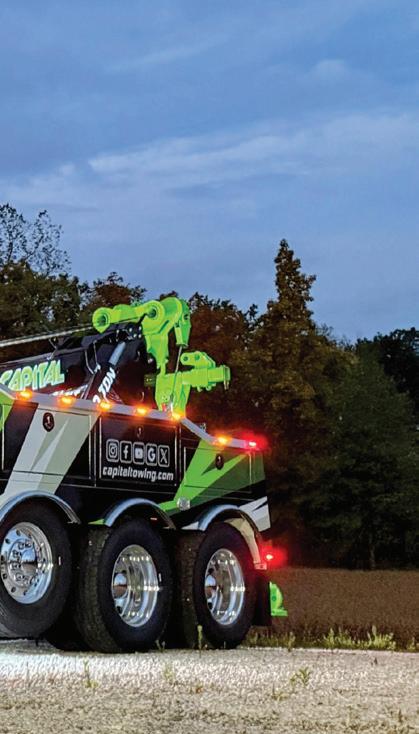
more than 100 pieces of equipment and around 60 power units. The new look was produced by Best Graphics in Westerville, Ohio, which also wrapped Capital’s newest unit, the Custom Built 30ton wrecker shown here. ◀
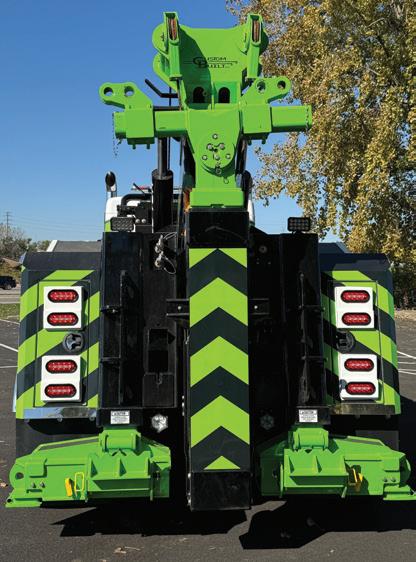
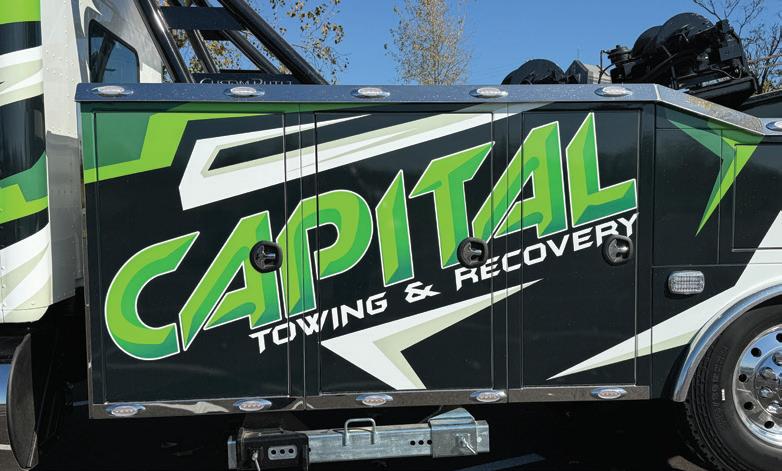
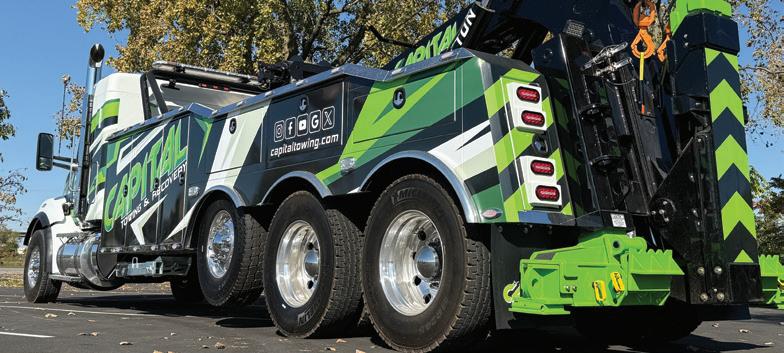
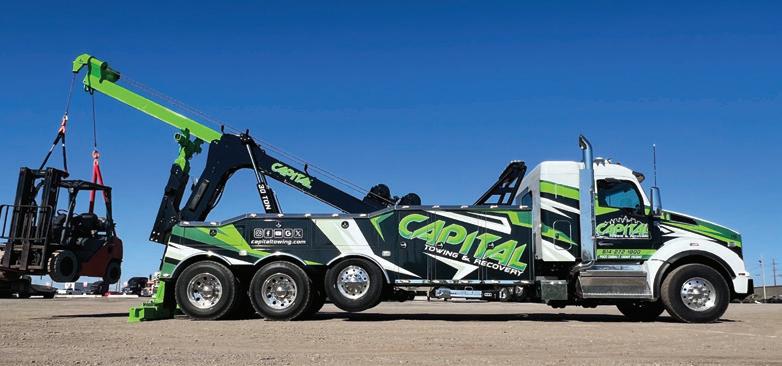
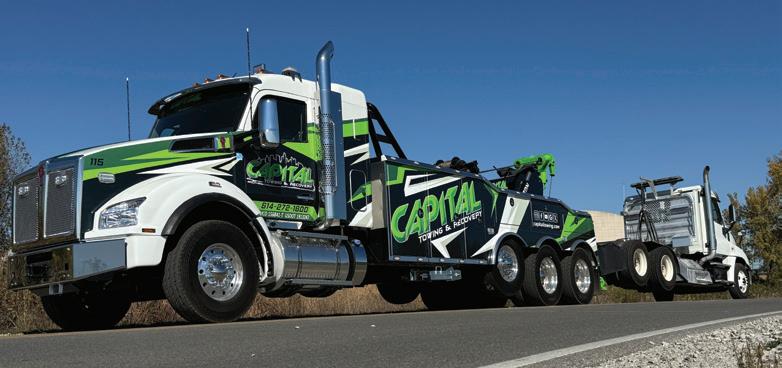
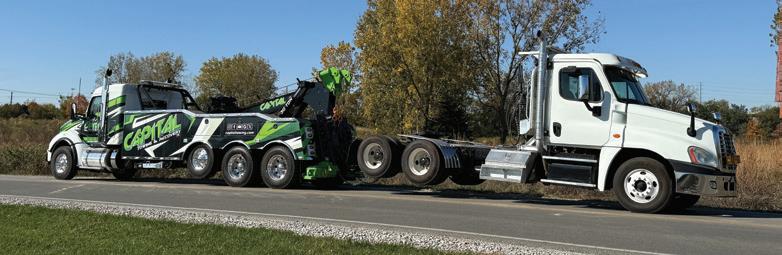
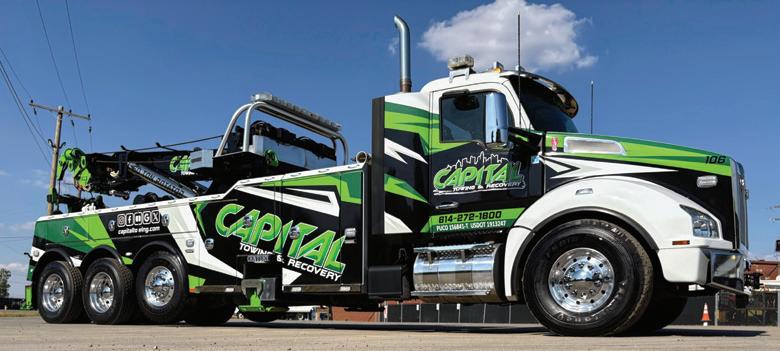
The design makes an immediate impact with a high-contrast neon green and black palette that projects energy, visibility, and precision. The look mirrors Capital’s momentum. Green accents emphasize the boom, stabilizers, and body panels, while angled black striping creates a sense of motion and strength. The Capital company logo appears in bold, italicized block lettering, with “Towing & Recovery” clearly visible beneath. Above that is an outline of the cityscape of Columbus, serving to reinforce Capital’s hometown connection.
“Being born here was one factor why we went with a cityscape,” Brandon points out. “The company was named ‘Capital’ because Columbus is the capital of Ohio.”
Social media pictograms and the address for the company website, managed by OMG, complete the wrap. “We wanted something that not only looked powerful but also represented who we are— professional, modern, and proud of what we do,” Brandon adds. “We leverage technology in everything we do to make our operation more efficient, more effective, and safer for everyone involved.”
The truck also represents the fourth wrecker Capital has ordered from Custom Built Manufacturing of Kane, Pennsylvania. “We’re slowly replacing our entire heavy-duty fleet with Custom Built wreckers,” Brandon says. “I think the truck is the best heavy-duty wrecker handsdown in the market today.”
Brandon praises Custom Built’s focus on simplicity in the electrical and hydraulic systems, along with the wrecker’s deep toolboxes. With steady growth and service to 23 police agencies and numerous private clients, Capital Towing’s bold green-and-black fleet has become a recognized mark of quality, reliability, and pride.
U.S. light vehicle sales fell sharply in October following the expiration of federal tax credits for electric vehicles (EVs), according to data from Omdia. Sales dropped 6.5% to a seasonally adjusted annual rate of 15.3 million units. EV sales plunged to 74,897 units from 98,289 in September after President Donald Trump’s “One Big Beautiful Bill” ended the $7,500 newEV and $4,000 used-EV subsidies on October 1.
Economists say the loss of incentives, combined with labor market weakness and rising tariff pressures, is dampening consumer demand. Overall, unadjusted light vehicle sales fell 4.5% from a year earlier, signaling moderate retail activity. Ongoing economic uncertainty, artificial intelligence adoption, and immigration-related labor shortages have slowed hiring, with unemployment near a four-year high at 4.3%.
call—and he wasn’t there.”
The Omaha Police Officers Association called him “a great partner” who “always seemed to be in the right place at the right time.”
At his funeral, Bartling’s casket rested in his tow truck, tow trucks across the region lighting up the sky in his honor.
Source: ketv.com
Tow trucks lined up, lights flashing as police stood by and a bagpiper played in tribute to Frank Coady, the longtime owner of Coady’s Garage & Towing Service. He died at age 74 after battling Alzheimer’s disease.
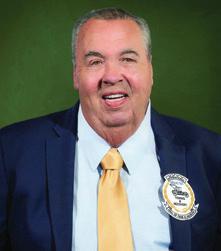
Coady was a Massachusetts native and towing industry icon. A year before his passing, he was inducted into the International Towing & Recovery Hall of Fame for over five decades of leadership, innovation, and philanthropy.

ter, Jenn Sharpe, who owns the salon. The butterfly artwork, featuring yellow wings tipped in blue, has become a popular photo spot but carries a reminder of the importance of Michigan’s “Move Over” law.
Sharpe plans to commission a second mural to mark the 10th anniversary of her brother’s death, hoping it will continue to raise awareness about roadside safety. “All it takes is a second to miss something and take someone’s life,” she said.
Source: wgrt.com
Sales of all-electric vehicles collapsed in October. Ford, Kia, Hyundai, and Toyota saw steep drops as buyers rushed to purchase before the credits expired.
Source: reuters.com
cnbc.com
For the first time in 15 years, Arrow Trucking, based in Council Bluffs Iowa, was without tow operator "Fast Eddy" Bartling. Bartling, known for his quick response and big heart, died after suffering a heart attack while driving home from a tow. He was remembered this week by coworkers, friends, and police officers who often relied on his help.
“He’d give the shirt off his back,” said colleague Daryl Jones, who shared 25 years of breakfasts and calls with him. “This morning, there was no
“Frank changed lives, all the while doing what he loved,” his family wrote on Facebook. “The purpose of life is to give your gift away. Frank will continue to give in more ways than we can measure.”
Retired state police Lt. Edward Johnson recalled Coady as “the kind of man who helped anyone, anytime. During any storm, his office was always open—to warm up, dry off, and grab a cup of coffee.”
Source: cnhi.com
A bright butterfly mural behind Twisted Scissorz Salon in Port Huron, Michigan stands as a tribute to Jason Schultz, a tow truck driver killed by a drunk driver in 2016. Created in 2023 by local artist April Cutler, the mural was commissioned by Schultz’s sis-
Car repossessions are surging across the U.S. as more Americans fall behind on auto loans, raising concerns on Wall Street that rising defaults could signal deeper financial strain. The recent bankruptcies of subprime lender Tricolor, and auto parts supplier First Brands, have added to fears of instability in the car lending market, an industry now showing cracks similar to those that preceded the 2008 financial crisis.
“Right now, we’re overwhelmed with work,” said George Badeen, president of Allied Finance Adjusters, noting a sharp rise in repossessions, especially among subprime borrowers. Fitch Ratings recently reported that 6.5% of subprime auto borrowers are at least 60 days behind on payments, the highest rate in over three decades.
Experts say the pressure reflects how inflation, higher interest rates, and pandemic-era price spikes have left consumers struggling with record car payments averaging $750 a month. “Stress in auto financing is a warning sign,” said Columbia Business School economist Brett House. “When people can’t afford their cars, it’s often the first indication that household finances are getting tighter.”
Source: theguardian.com
Warren
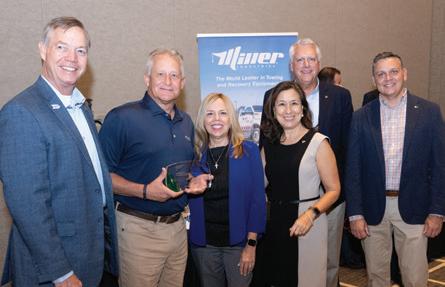
Miller Industries; Dawn Ray, Preferred Supplier Programs Manager, AAA, Inc.; Margaret Pittelkow, Vice President, Automotive, AAA, Inc.; Bob Huffman, Director, Roadside Programs & Benefits, AAA, Inc.; and John White, Preferred Supplier Programs Manager, AAA, Inc.
Miller Industries is celebrating two decades of partnership with AAA, the nation’s leading roadside assistance provider, marking 20 years of shared commitment to safety, innovation, and quality service in the towing and recovery industry. Since 2005, Miller Industries has served as a preferred supplier to AAA and its network of service providers nationwide. The collaboration has helped strengthen AAA’s emergency roadside fleet through the integration of Miller’s advanced towing and recovery equipment, including its proven Century, Vulcan, Chevron, and Holmes brands.
Founded in 1902, AAA serves more than 65 million members across North America, providing roadside assistance, travel planning, insurance, and advocacy. Its reputation for reliability has been bolstered through partnerships with industry leaders like Miller Industries, the world’s largest manufacturer of towing and recovery equipment.
Source: Miller Industries Press Release
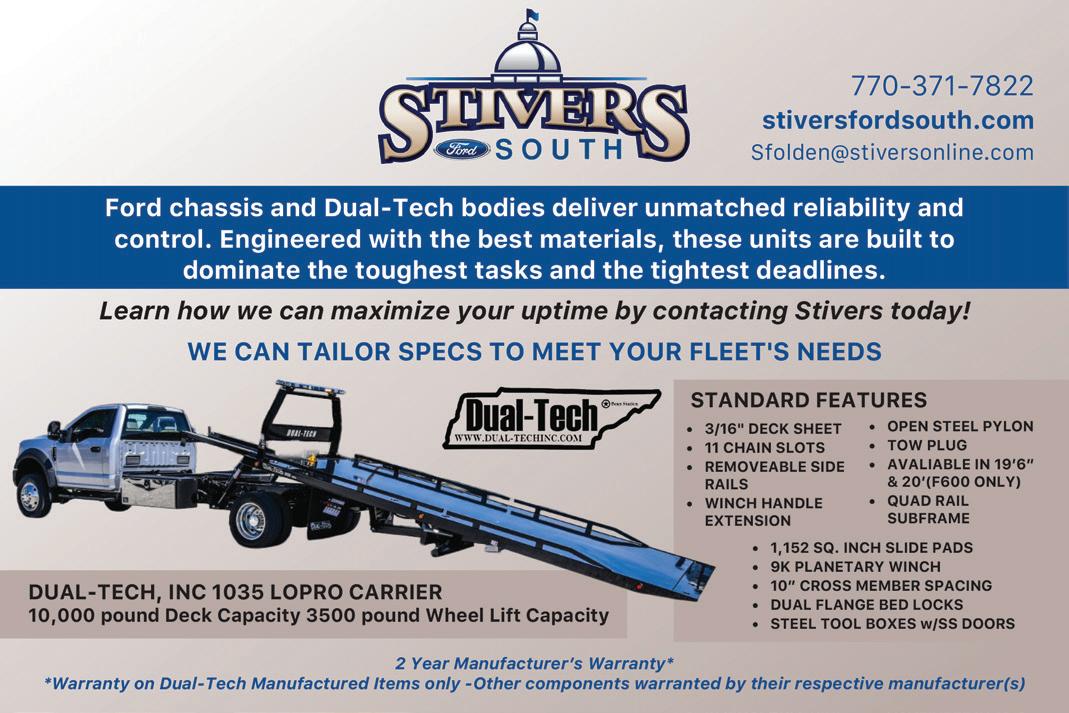
Stivers Ford South has partnered with Dual Tech, Inc. as the Ford distributor of the Dual Tech 1035 low-profile ◀
carrier built on Ford F-550 and F-600 chassis. Stivers Ford South is one of three Stivers Ford dealerships in the Atlanta, Georgia area, and one of eight dealerships in four states.
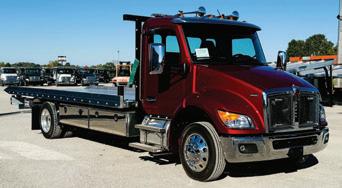
Founded by Don and JoAnn Roberts in 1989, Dual Tech, Inc. is headquartered in East Tennessee, and is one of the oldest family-owned rollback manufacturers in the United States. Dual-Tech’s rollback unit is one of the few that comes with a standard 40-gallon fuel capacity, and an independent wheel lift operating without a loaded bed. The heart of the Dual-Tech system is a patented “Quad Rail” subframe, engineered to prevent bending, and has been utilized for almost 30 years with no reported failures. All Ford rollbacks equipped with Dual Tech beds come with straps and chains, and options include a wireless winch remote, custom bed colors, bed texturing and adjustable car dolly chains.
For more information on rollback prices and stock options, contact Steven Folden at Stivers Ford South; phone: 770-371-7822.
U.S. light vehicle sales fell sharply in October following the expiration of federal tax credits for electric vehicles (EVs), according to data from Omdia. Sales dropped 6.5% to a seasonally adjusted annual rate of 15.3 million units. EV sales plunged to 74,897 units from 98,289 in September after President Donald Trump’s “One Big Beautiful Bill” ended the $7,500 new-EV and $4,000 used-EV subsidies on October 1.
Economists say the loss of incentives, combined with labor market weakness and rising tariff pressures, is dampening consumer demand. Overall, unadjusted light vehicle sales fell 4.5% from a year earlier, signaling moderate retail activity. Ongoing economic uncertainty, artificial intelligence adoption, and immigration-related labor shortages have slowed hiring, with unemployment near a four-year high at 4.3%.
Sales of all-electric vehicles collapsed in October. Ford, Kia, Hyundai, and Toyota saw steep drops as buyers rushed to purchase before the credits expired.
Source: reuters.com cnbc.com
For the first time in 15 years, Arrow Trucking, based in Council Bluffs Iowa, was without tow operator “Fast Eddy” Bartling. Bartling, known for his quick response and big heart, died after suffering a heart attack while driving home from a tow. He was remembered this week by coworkers, friends, and police officers who often relied on his help.
“He’d give the shirt off his back,” said colleague Daryl Jones, who shared 25 years of breakfasts and calls with him. “This morning, there was no call—and he wasn’t there.”
The Omaha Police Officers Association called him “a great partner” who “always seemed to be in the right place at the right time.”
At his funeral, Bartling’s casket rested in his tow truck, tow trucks across the region lighting up the sky in his honor.
Source: ketv.com
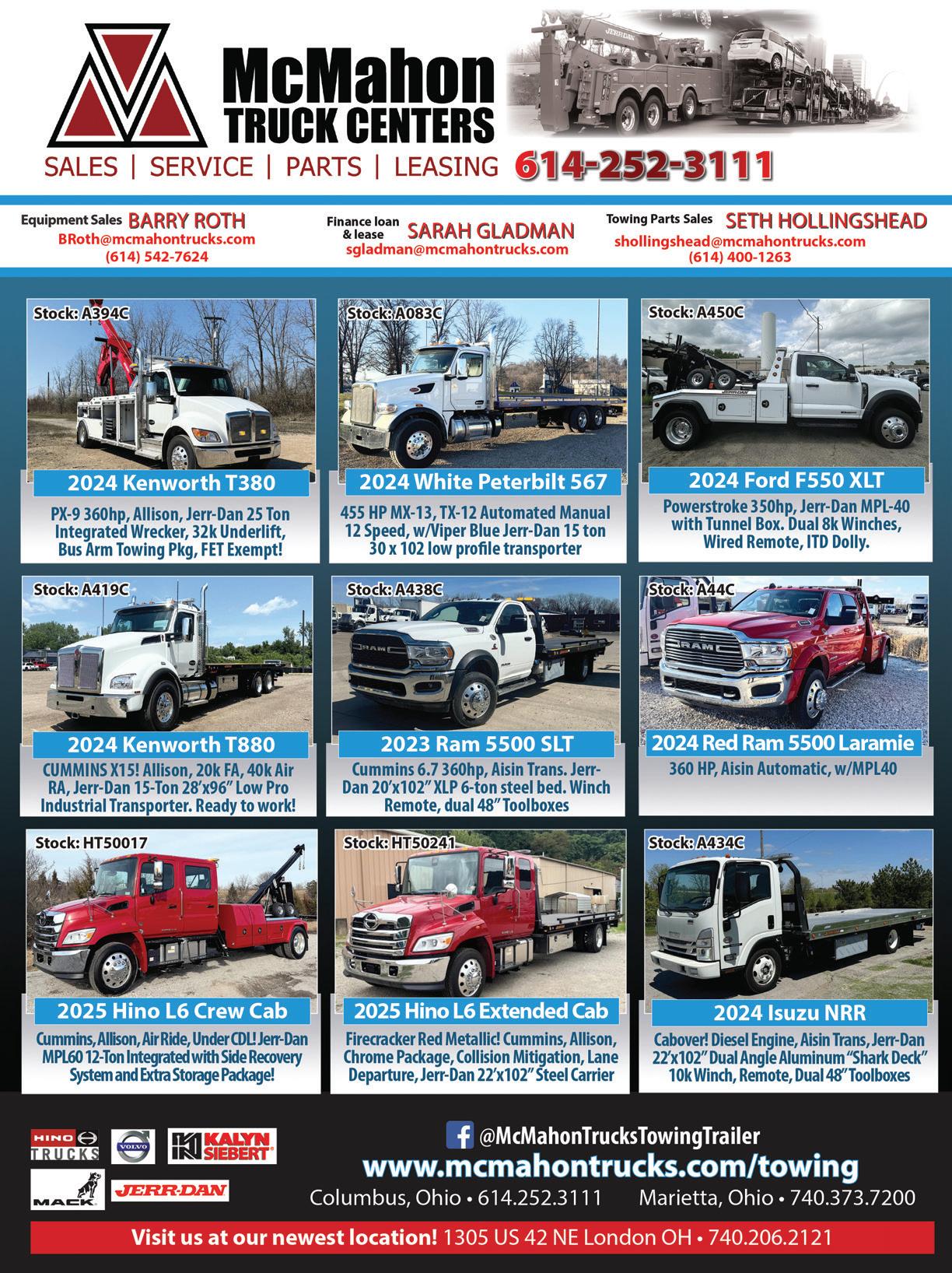
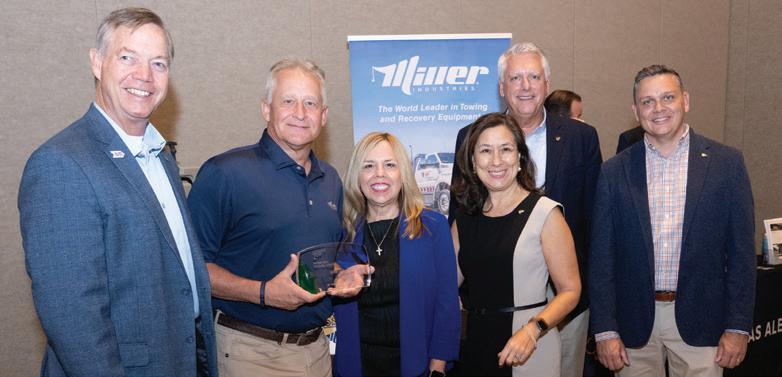
Miller Industries is celebrating two decades of partnership with AAA, the nation’s leading roadside assistance provider, marking 20 years of shared
commitment to safety, innovation, and quality service in the towing and recovery industry. Since 2005, Miller Industries has served as a preferred supplier to AAA and its network of service providers nationwide. The
collaboration has helped strengthen AAA’s emergency roadside fleet through the integration of Miller’s advanced towing and recovery equipment, including its proven Century, Vulcan, Chevron, and Holmes brands.
Founded in 1902, AAA serves more than 65 million members across North America, providing roadside assistance, travel planning, insurance, and advocacy. Its reputation for reliability has been bolstered through partnerships with industry leaders like Miller Industries, the world’s largest manufacturer of towing and recovery equipment.
Source: Miller Industries Press Release
Stivers Ford South has partnered with Dual Tech, Inc. as the Ford distributor of the Dual Tech 1035 low-profile carrier built on Ford F-550 and F-600 chassis. Stivers Ford South is one of three Stivers Ford dealerships in the Atlanta, Georgia area, and one of eight dealerships in four states.
Founded by Don and JoAnn Roberts in 1989, Dual Tech, Inc. is headquartered in East Tennessee, and is one of the oldest family-owned rollback manufacturers in the United States. Dual-Tech’s rollback unit is one of the few that comes with a standard 40-gallon fuel capacity, and an independent wheel lift operating without a loaded bed. The heart of the Dual-Tech system is a patented “Quad Rail” subframe, engineered to prevent bending, and has been utilized for almost 30 years with no reported failures. All Ford rollbacks equipped with Dual Tech beds come with straps and chains, and options include a wireless winch remote, custom bed colors, bed texturing and adjustable car dolly chains.
For more information on rollback prices and stock options, contact Steven Folden at Stivers Ford South; phone: 770-371-7822.
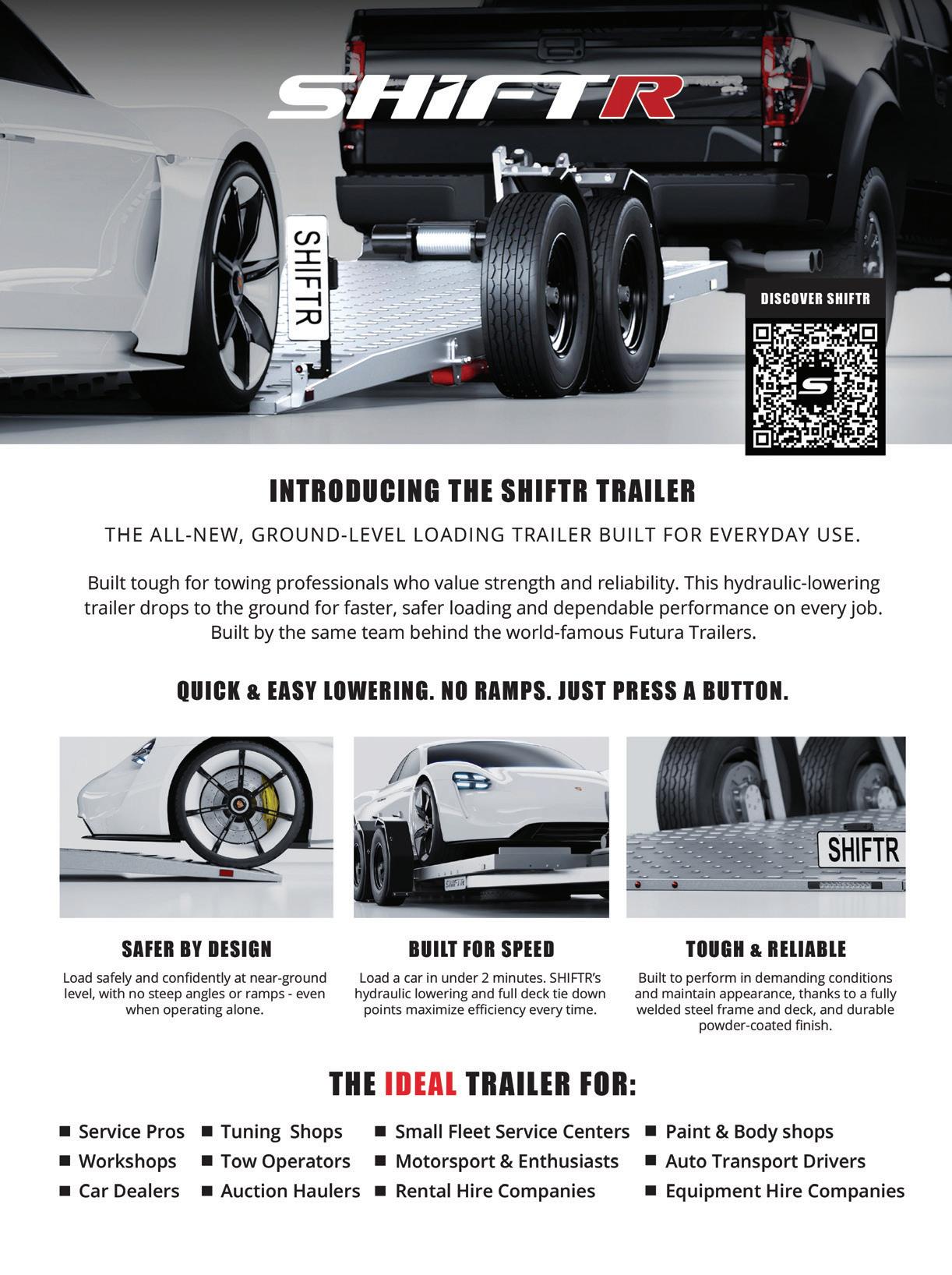
U.S. light vehicle sales fell sharply in October following the expiration of federal tax credits for electric vehicles (EVs), according to data from Omdia. Sales dropped 6.5% to a seasonally adjusted annual rate of 15.3 million units. EV sales plunged to 74,897 units from 98,289 in September after President Donald Trump’s “One Big Beautiful Bill” ended the $7,500 newEV and $4,000 used-EV subsidies on October 1.
Economists say the loss of incentives, combined with labor market weakness and rising tariff pressures, is dampening consumer demand. Overall, unadjusted light vehicle sales fell 4.5% from a year earlier, signaling moderate retail activity. Ongoing economic uncertainty, artificial intelligence adoption, and immigration-related labor shortages have slowed hiring, with unemployment near a four-year high at 4.3%.
call—and he wasn’t there.”
The Omaha Police Officers Association called him “a great partner” who “always seemed to be in the right place at the right time.”
At his funeral, Bartling’s casket rested in his tow truck, tow trucks across the region lighting up the sky in his honor.
Source: ketv.com
Tow trucks lined up, lights flashing as police stood by and a bagpiper played in tribute to Frank Coady, the longtime owner of Coady’s Garage & Towing Service. He died at age 74 after battling Alzheimer’s disease.
Coady was a Massachusetts native and towing industry icon. A year before his passing, he was inducted into the International Towing & Recovery Hall of Fame for over five decades of leadership, innovation, and philanthropy.
ter, Jenn Sharpe, who owns the salon. The butterfly artwork, featuring yellow wings tipped in blue, has become a popular photo spot but carries a reminder of the importance of Michigan’s “Move Over” law.
Sharpe plans to commission a second mural to mark the 10th anniversary of her brother’s death, hoping it will continue to raise awareness about roadside safety. “All it takes is a second to miss something and take someone’s life,” she said.
Source: wgrt.com
Sales of all-electric vehicles collapsed in October. Ford, Kia, Hyundai, and Toyota saw steep drops as buyers rushed to purchase before the credits expired.
Source: reuters.com
cnbc.com
For the first time in 15 years, Arrow Trucking, based in Council Bluffs Iowa, was without tow operator "Fast Eddy" Bartling. Bartling, known for his quick response and big heart, died after suffering a heart attack while driving home from a tow. He was remembered this week by coworkers, friends, and police officers who often relied on his help.
“He’d give the shirt off his back,” said colleague Daryl Jones, who shared 25 years of breakfasts and calls with him. “This morning, there was no
“Frank changed lives, all the while doing what he loved,” his family wrote on Facebook. “The purpose of life is to give your gift away. Frank will continue to give in more ways than we can measure.”
Retired state police Lt. Edward Johnson recalled Coady as “the kind of man who helped anyone, anytime. During any storm, his office was always open—to warm up, dry off, and grab a cup of coffee.”
Source: cnhi.com
A bright butterfly mural behind Twisted Scissorz Salon in Port Huron, Michigan stands as a tribute to Jason Schultz, a tow truck driver killed by a drunk driver in 2016. Created in 2023 by local artist April Cutler, the mural was commissioned by Schultz’s sis-
Car repossessions are surging across the U.S. as more Americans fall behind on auto loans, raising concerns on Wall Street that rising defaults could signal deeper financial strain. The recent bankruptcies of subprime lender Tricolor, and auto parts supplier First Brands, have added to fears of instability in the car lending market, an industry now showing cracks similar to those that preceded the 2008 financial crisis.
“Right now, we’re overwhelmed with work,” said George Badeen, president of Allied Finance Adjusters, noting a sharp rise in repossessions, especially among subprime borrowers. Fitch Ratings recently reported that 6.5% of subprime auto borrowers are at least 60 days behind on payments, the highest rate in over three decades.
Experts say the pressure reflects how inflation, higher interest rates, and pandemic-era price spikes have left consumers struggling with record car payments averaging $750 a month. “Stress in auto financing is a warning sign,” said Columbia Business School economist Brett House. “When people can’t afford their cars, it’s often the first indication that household finances are getting tighter.”
Source: theguardian.com
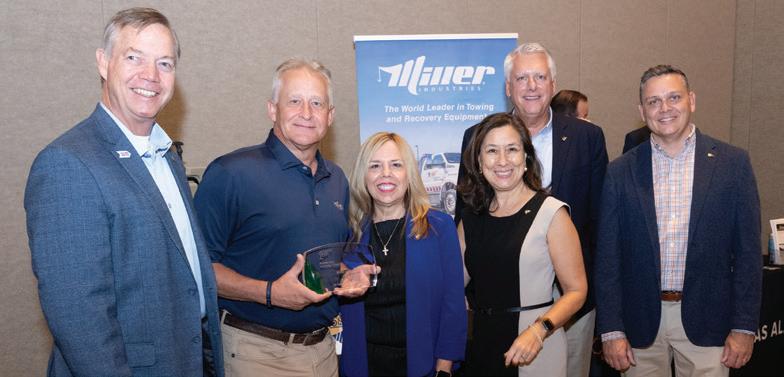
Miller Industries is celebrating two decades of partnership with AAA, the nation’s leading roadside assistance provider, marking 20 years of shared
commitment to safety, innovation, and quality service in the towing and recovery industry. Since 2005, Miller Industries has served as a preferred supplier to AAA and its network of service providers nationwide. The
collaboration has helped strengthen AAA’s emergency roadside fleet through the integration of Miller’s advanced towing and recovery equipment, including its proven Century, Vulcan, Chevron, and Holmes brands.
Founded in 1902, AAA serves more than 65 million members across North America, providing roadside assistance, travel planning, insurance, and advocacy. Its reputation for reliability has been bolstered through partnerships with industry leaders like Miller Industries, the world’s largest manufacturer of towing and recovery equipment.
Source: Miller Industries Press Release
Stivers Ford South has partnered with Dual Tech, Inc. as the Ford distributor of the Dual Tech 1035 low-profile carrier built on Ford ◀
F-550 and F-600 chassis. Stivers Ford South is one of three Stivers Ford dealerships in the Atlanta, Georgia area, and one of eight dealerships in four states.
Founded by Don and JoAnn Roberts in 1989, Dual Tech, Inc. is headquartered in East Tennessee, and is one of the oldest family-owned rollback manufacturers in the United States. Dual-Tech’s rollback unit is one of the few that comes with a standard 40-gallon fuel capacity, and an independent wheel lift operating without a loaded bed. The heart of the Dual-Tech system is a patented “Quad Rail” subframe, engineered to prevent bending, and has been utilized for almost 30 years with no reported failures. All Ford rollbacks equipped with Dual Tech beds come with straps and chains, and options include a wireless winch remote, custom bed colors, bed texturing and adjustable car dolly chains.
For more information on rollback prices and stock options, contact Steven Folden at Stivers Ford South; phone: 770-371-7822.
Shell Rotella announced the launch of the Knowledge Hub “What is PC-12?”, an educational resource designed to help fleets, owner-operators, and industry professionals understand the upcoming API PC12 diesel engine oil category. As heavy-duty diesel engines evolve to meet new performance demands and emissions regulations, PC-12 (Proposed Category 12) will represent the next generation of oil standards, following the current API CK-4 and FA-4 specifications. The new category, expected to be licensed by the American Petroleum Institute (API) in January 2027, will ensure that future engine oils meet stricter durability, efficiency, and emissions requirements.
Source: rotella.shell.com