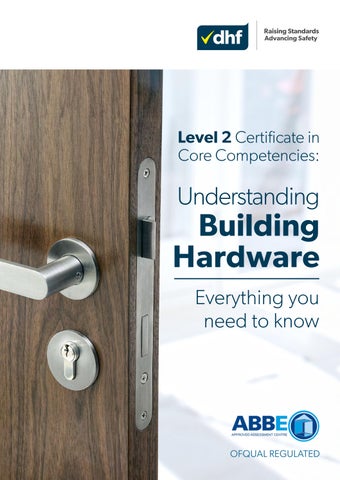
Level 2 Certificate in Core Competencies:
Understanding
Building Hardware Everything you need to know
OFQUAL REGULATED
Table of content 03
04 Introduction
05
Developed for building hardware professionals
06 Mapped to draft BS 8670-2
08
How the programme works
10 The learner journey
12
11 Formal recognition of achievement
14
Core modules
18 12 specialist product modules
02
Invest in knowledge. Strengthen your business.
| dhf Building Hardware Training Programme
How to book
INTR O DU CT I O N
Building competence Building confidence Building the future Building competence
Building confidence
Industry called for a clear and credible way to demonstrate individual competence. Draft BS 8670-2 sets out the requirements for individual competence at different levels, and this qualification has been developed to address the knowledge requirements of a Level 2 learner within the proposed framework.
Learners gain a strong understanding of the core principles and essential product knowledge in building hardware.
Created by dhf in collaboration with leading building hardware experts, dhf Core Competencies: Understanding Building Hardware provides an all-online, structured and measurable way to build, assess and evidence product knowledge across your workforce.
Businesses benefit from employees having a greater product knowledge who are better equipped to provide accurate advice, recommend appropriate solutions and respond confidently to technical queries.
Building the future By providing a consistent, assessed and nationally recognised foundation of knowledge, the programme fills a significant gap in the industry’s learning and development provision.
Having an in-depth, detailed Ofqual regulated training programme enables employers to develop their staff’s demonstrable competence levels towards developing industry needs such as BS 8670-2. We will use this training to develop our product managers, customer service and sales teams to be able to better service our customers with competent product knowledge solutions. Richard Bromley Vice President, Chief Technology Officer & Head of Residential, ASSA ABLOY Opening Solutions UK & Ireland and Chairman of the dhf Building Hardware Group
www.dhfonline.org.uk | 01827 52337 | training@dhfonline.org.uk
Introduction
| 03
Developed for building hardware professionals Suitable for manufacturers and organisations across the building hardware supply chain, the qualification provides a structured pathway supporting progression from the shop floor to product management. Designed for: Customer service advisors Technical support teams Internal and external sales team Product managers Marketing teams & Warehouse Shop-floor operatives
For HR and training managers, a structured solution for: Induction and onboarding programmes Supporting apprentices and new entrants Performance and professional development Addressing knowledge gaps Company-wide employee training Employees progressing into product-focused or technical roles Monitor learner progress Employers, HR teams and training managers can monitor learner engagement, progress and achievement through a dedicated management portal, complementing existing HR and staff development processes.
04
|
dhf Building Hardware Training Programme
Our people at Squire learn from their colleagues but it would be really helpful to their careers if they can also learn from the wider industry. The dhf initiative will help us to produce a well-informed, skilled and industry-wide compliant workforce. Glyn Green Technical & Operations Director, Squire
Mapped to draft BS 8670-2 The construction industry is placing increasing emphasis on competence, accountability and the ability of employers to demonstrate how their people’s knowledge has been developed. dhf has incorporated its members comments into its response to draft BS 8670-2 Core criteria for construction product competence, helping to ensure that the knowledge requirements of the building hardware sector are represented. This qualification has been mapped against the competence framework contained within the draft standard, with its learning outcomes having a strong alignment with Level D and aspects of Level C. It therefore supports employers in developing and evidencing the knowledge element of individual competence. By investing in structured learning now, businesses can develop their workforce in line with the emerging direction of competence across the construction industry.
www.dhfonline.org.uk | 01827 52337 | training@dhfonline.org.uk
This is the most comprehensive resource our sector has ever had. It sets a clear standard for competency in current and future professionals. Paul Browne dhf Chairman
Building hardware professionals
| 05
How the programme works Each learner completes a mandatory core module comprising six units and one or more of 12 specialist product modules. Businesses can select the product modules most relevant to each learner’s role and responsibilities.
01
Complete the core module (6 units)
History of building hardware
Legislation
Standards and certification
Sustainability
Commercial
Handing, fixings and finishes
This programme helps create a consistent foundation of knowledge for everyone working in building hardware. Deborah Cannon Product Manager, dormakaba
06
|
dhf Building Hardware Training Programme
02
Choose relevant product modules
At least one of 12 specialist modules can then be selected for every learner:
I didn’t want staff learning about products products that are not core to what they do. This programme provides recognised, third-party training specific to their role. Neil Rule Managing Director, Access2 and Vice Chairman of the Building Hardware Group
Locks & latches
Access control systems
Hinges
Access control hardware
Cylinders
General door hardware
Door closers
Residential smart locking
Seals
Padlocks, padlock fittings and key safes
Panic and emergency exit hardware
General window hardware and window hinges
03
Continue developing
Further product modules can be added without repeating previous learning, creating a scalable pathway that develops alongside the learner’s role.
www.dhfonline.org.uk | 01827 52337 | training@dhfonline.org.uk
Descriptions and learning outcomes can be found on page 14.
How the programme works
| 07
The learner journey A clear, supported route from enrolment to recognised achievement.
03 01
02 Use dedicated learning resources A downloadable study guide and qualification handbook support each learner throughout the programme. These provide module learning outcomes, guided note-taking space and prompts to reinforce key concepts.
Access the training Learners access their training through a personalised online portal, with all enrolled courses available in one place.
Learn with flexibility Progress can be tracked throughout, allowing learners to pause and return where they left off and fit their studies around work and other commitments. Content is presented in manageable sections, with larger modules divided into parts to make the learning easier to absorb and complete alongside work.
08
|
dhf Building Hardware Training Programme
05 04 06
Achieve the qualification On successful completion, learners receive: • A certificate from dhf listing completed product modules • An Ofqual branded certificate issued by the Awarding Body of the Built Environment (ABBE) • DHF CertBH post nominal
Complete formal assessments Each module concludes with a timed multiple-choice assessment.
www.dhfonline.org.uk | 01827 52337 | training@dhfonline.org.uk
Continue the journey • A continued professional development (CPD) programme is currently in development • dhf members get access to specialist support via the technical helpline
The learner journey
| 09
Invest in knowledge. Strengthen your business. Internal product training remains valuable, but it can vary between teams, be difficult to benchmark and provide limited independent evidence of achievement. This qualification will: Improve customer confidence The fact that the training courses lead to an Ofqual-regulated qualification adds significant value, giving employers greater confidence that it demonstrates a defined level of knowledge and competence.
Knowledgeable employees provide credible advice that reassures customers and builds trust.
Create continuity across various teams Provide the same structured foundation of learning across departments, roles and locations.
Kevin O’Reilly DipGAI RegAI FGAI Technical Director, Rutland
Support onboarding and development A clear learning pathway supports new starters, employees moving into different roles and experienced people looking to broaden their knowledge.
Demonstrate knowledge Nationally recognised Ofqual regulated qualifications with clear assessment criteria evidence that learning has been completed and successfully achieved.
Reduce organisational risk Better-informed employees can help reduce incorrect advice, unsuitable product recommendations and the commercial or reputational consequences that can follow.
Build long-term capability Broaden technical knowledge across your workforce, reduce duplicated training and support employee retention and organisational resilience through continued professional development.
10
|
dhf Building Hardware Training Programme
Formal recognition of achievement Successful learners achieve an Ofqual-regulated Level 2 qualification awarded by ABBE, the Awarding Body for the Built Environment, together with the DHF CertBH post-nominal. They will receive two certificates including the Level 2 Certificate in Core Competencies: Understanding Building Hardware from dhf, which records the product modules completed, together with an Ofqual-branded certificate issued by ABBE.
Recognised knowledge. Evidenced achievement. A foundation for continued development.
Flexible learning that works around your business Our industry has never had a consistent foundation of knowledge for people coming into it, and that gap shows up every day. This programme gives employers a structured way to induct and develop staff, and gives learners a recognised, Ofqual-regulated Level 2 qualification to build a career on. Russell Coldwell
Technical Director, Royde and Tucker
www.dhfonline.org.uk | 01827 52337 | training@dhfonline.org.uk
Designed to minimise disruption to business operations, the programme is delivered entirely online through the dhf Training Academy, enabling learners to study alongside their existing responsibilities. There are no fixed start dates or enrolment windows, so learners can begin their training following booking. Businesses can enrol employees throughout the year in line with operational requirements and phase training investment across the financial year. Learners have 12 months from enrolment to complete the qualification. Employers and training managers can monitor learner engagement, progress and achievement through a dedicated management portal.
Invest in knowledge
| 11
Core modules Discover the knowledge covered within the mandatory core module and each of the 12 specialist product modules available.
Legislation Equips learners with the knowledge required to understand the sources and application of regulations relevant to the manufacture, supply and specification of construction products.
History Explores the historical development of building hardware from ancient civilisations tothe modern era, tracing its progression in response to advancements in materials, technology and societal needs.
12
|
dhf Building Hardware Training Programme
Standards and certification Examines the origins and various purposes of standards while building learners’ understanding of certification.
Commercial Builds learners’ understanding of the commercial landscape within the building hardware industry, including the roles of key players, pricing structures, supply chain processes and market dynamics. This prepares them to navigate the industry effectively from a business perspective.
Sustainability Provides learners with the background knowledge needed to understand the principles of sustainability in building hardware products. It highlights what this means for procurement and product disposal, while building awareness of emerging trends and the impact they may have on the future of building hardware.
www.dhfonline.org.uk | 01827 52337 | training@dhfonline.org.uk
Handing, fixings and finishes Explains the importance of correct handing and the methods used to determine it. Learners become familiar with common building hardware fixings, including those required for specific products to support correct installation and functionality. It also covers popular building hardware finishes, including their aesthetic and practical benefits.
Core modules
| 13
12 specialist product modules Locks and latches
01
Introduces mortice and rim locks, their importance and key differences. Learners examine mortice lever and cylinder locks,how they are measured and their applications. Learners also examine Scandinavian, narrow style and multipoint locks, rim locks, cabinet and cupboard locks, knobsets and mechanical digital locks. They gain an understanding of how locks can be fitted to glass doors, building broad knowledge of locking mechanisms for a range of applications.
Hinges Covers the fundamentals of hinges, including their purpose, types, materials and selection criteria. Learners develop an understanding of how hinges support and secure doors in different settings and identify the types used on timber, steel, uPVC and composite doors. They also examine hinge components, bearing systems, common materials and finishes.
02
Current industry standards are introduced alongside key factors for selecting the right hinge, including strength, fire rating and corrosion resistance.
03
Cylinders Develops learners’ understanding of cylinder locks and their role in security, including how they work, their benefits and key features. Learners identify different cylinder types, formats and components, as well as keying options such as keyed alike and master keyed. Cylinder functions and security features such as anti-drill and anti-snap are also covered. Learners examine key types, including serrated, reversible and patented systems, gaining practical knowledge for security applications. The module also introduces DHF TS 007 and its relevance to cylinder security.
14
|
dhf Building Hardware Training Programme
Door closers
04
Provides an introduction to door closers, covering their purpose, operation and the different types available. Learners examine their basic mechanisms, functions and components, as well as their role in ensuring safety and accessibility. The importance of door closers in meeting fire safety and accessibility regulations is also highlighted. Learners gain the foundational knowledge needed to understand door closers and apply that knowledge in practical settings.
Seals Focuses on Building Regulations affecting fire and smoke doors and the legal safety requirements they must meet. Learners explore fire test standards, evidence and assessment reports used to demonstrate compliance.
05
The module also focuses on fire door (FD) functions, key components, intumescent protection, door types and third-party certification schemes, alongside the role of intumescent, acoustic, smoke, perimeter and glazing seals in providing fire and sound protection.
06
Panic and emergency exit hardware Outlines the fundamentals of panic and emergency exit hardware, including the need for clear, safe escape routes with fire protection. Learners develop an understanding of the difference between panic hardware, such as push bars and touch bars, and emergency exit hardware, such as push pads and lever handles. They are also introduced to key standards. Major components for touch bars, push pads and locks are identified, together with accessories such as outside exit devices, hold-back devices and alarms. The use of electrical escape systems is also highlighted.
www.dhfonline.org.uk | 01827 52337 | training@dhfonline.org.uk
Product modules
| 15
Access control systems
07
Learners are introduced to Access Control Systems, their benefits and key components. They examine different system types, including standalone, virtual, wireless, hardwired and hybrid systems, how they work and their advantages and disadvantages. Learners also develop knowledge of the roles of system controllers, connection types such as USB, LAN and VPN, and audio and video door entry systems. Key terms such as anti-passback, event logs, access rights and audit trails are also defined.
Access control hardware Covers the fundamentals of access control and access control hardware, explaining how movement within a building is managed and highlighting the differences between hardware and software. Learners examine fail-safe and fail-secure systems, different locking methods, electric releases, electromagnetic locks and electronic locksets.
08
Methods of release and access, such as keypads, biometrics and Bluetooth, are also examined, together with their advantages and disadvantages. Finally, learners gain an understanding of the importance of power supply units and different power transfer methods.
09
General door hardware Examines the functions and uses of general door hardware. Learners explore handles, escutcheons, spindles, pull handles and flush pulls, together with door protection, letter plates, knockers and numerals. Other products covered include cylinder pulls, door chains (DHF TS 003 Door Chains and Limiters), door viewers (DHF TS 002 Door Viewers), door stops and door bolts. Learners are also introduced to finger protection and anti-ligature furniture (DHF TS 001 Enhanced Requirements & Test Methods for Anti-Ligature Hardware).
16
|
dhf Building Hardware Training Programme
Residential smart locking
10
Explores the fundamentals of residential smart door locks, explaining what they are, the benefits of this type of locking solution and how these products can be integrated into smart home solutions. Learners examine the different ways they can be unlocked, the types of doors to which they can be fitted and key standards, including DHF TS 621.
Padlocks, padlock fittings and key storage boxes
11
Details the purpose, types and features of padlocks, padlock fittings and key storage boxes. Learners explore how padlocks provide security in different settings, the various types and shapes available and their key features. The materials used in padlock production and the different accessories available are also explained. Learners develop an understanding of the purpose and types of key storage boxes, how they work and the standards that ensure their security.
12
General window hardware and window hinges Builds learners’ knowledge of the basic components and hardware used in windows, including their functions, types and selection criteria. Window configurations and materials are covered, together with key parts such as friction hinges, casement handles, window locks, restrictors, hinge protectors and spring balances. Learners gain an understanding of the purpose, sizes, types and functions of each component, along with the relevant terminology. Together, these areas provide the foundational knowledge needed to identify and select appropriate window hardware for different applications.
www.dhfonline.org.uk | 01827 52337 | training@dhfonline.org.uk
Product modules
| 17
How to book Book online Our straightforward online booking system is the quickest and easiest way to enrol. You can view current prices, select the appropriate modules and include multiple learners within a single booking.
Book using a booking form If you would prefer to book manually, contact the dhf Training Team to request a booking form. Once the completed form has been processed, an invoice will be issued. Access to the training will be provided once payment has been received.
View prices and book online dhf members benefit from discounted course pricing. Scan to view prices and book
18
|
dhf Building Hardware Training Programme
Planning training for your team? To discuss product module selection, team bookings or specific training requirements, contact: 01827 52337 training@dhfonline.org.uk
Support beyond the qualification dhf members also have access to specialist technical support. Our technical team and product-area experts can assist with product-related queries and provide guidance on relevant legislation and standards. technical@dhfonline.org.uk
Continuing professional development dhf advocates continuing professional development across the industry. A CPD programme is currently in development to help learners maintain, refresh and build on their knowledge after completing the qualification.
www.dhfonline.org.uk | 01827 52337 | training@dhfonline.org.uk
How to book
| 19
Building competence Building confidence Building the future Develop the knowledge your workforce needs and gain recognised evidence of their achievement.
Raising Standards Advancing Safety
Contact us for more information dhf THE BARN | SHUTTINGTON FIELDS FARM MAIN ROAD | SHUTTINGTON | B79 0HA 01827 52337 | training@dhfonline.org.uk
www.dhfonline.org.uk Not currently a DHF member? To learn more about dhf membership and your organisation’s eligibility, contact: membership@dhfonline.org.uk
© Copyright dhf (Door & Hardware Federation) 2026. No part of this publication may be reproduced in any form without prior permission in writing from dhf. E&OE Registered in England No.2537077 VAT No. 240112234