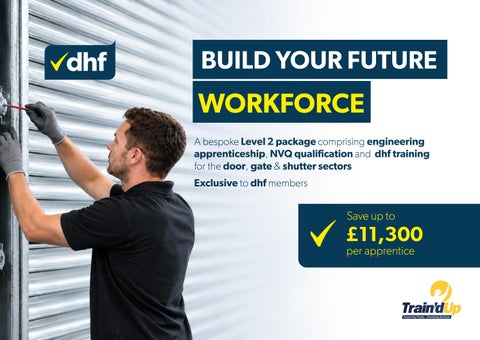
BUILD YOUR FUTURE
WORKFORCE A bespoke Level 2 package comprising engineering apprenticeship , NVQ qualification and dhf training for the door , gate & shutter sectors Exclusive to dhf members
Save up to
£11,300
per apprentice
A long -term investment in your workforce Finding and developing skilled people is essential to building a capable, sustainable workforce. This specialist programme gives dhf members a structured way to bring new talent into the sector or develop an eligible existing employee through substantial new learning. Developed by dhf in partnership with Train’d Up, the programme brings together engineering knowledge, practical workplace development, occupational competence and specialist sector safety training within one supported route.
Benefits for dhf members Save up to £11,300 per apprentice across the combined apprenticeship, NVQ and dhf training package
MEMBER VALUE Access FREE apprentice recruitment support from Train’d Up Build the knowledge and competence of new or existing employees through a programme designed specifically for the door, gate & shutter sector Receive regular progress updates and ongoing support throughout the apprenticeship Support succession planning while developing recognised knowledge, practical skills and occupational competence
By combining apprenticeship funding with the recognised NOCN Level 2 NVQ Diploma and specialist dhf training, members can potentially access the NVQ and dhf training for FREE, or for very little investment, depending on their circumstances.
2 | Member opportunity
Who is the programme for? The programme is fordhf members that want to recruit new talent or develop an eligible employee in a role involving installation, servicing, maintenance or repair within the door, shutter, gate, or barrier sector. It may be suitable for
New entrants to the industry, including school and college leavers aged 16+
New employees entering relevant engineering maintenance roles
Existing employees whose role will involve substantial new learning
People working in suitable installation, servicing, maintenance or repair environments
Benefits for the employer
Benefits for the apprentice
o
Build a future skills pipeline and support succession planning
o
Work towards nationally recognised formal qualifications
o
Develop new and existing employees through a structured route
o
Earn while developing knowledge and practical skills
o o
Demonstrate occupational competence through real work Receive tutor, assessor and workplace support
o
Build a foundation for a career in the sector
o
Receive regular visibility of progress and support
o
Support retention by investing in meaningful development
o
Access funding and free recruitment support
3 | What is the programme
One programme. Five connected qualifications. The programme typically takes 12–18 months and combines five elements to develop engineering knowledge, practical skills and occupational competence.
Level 2 Engineering Operative Apprenticeship
NOCN Level 2 NVQ Diploma in Specialist Installation Occupations (Construction)
A structured apprenticeship standard combining engineering knowledge, practical skills and workplace development.
Covering Door, Shutter, Gate or Barrier Installation, Maintenance or Repair.
dhf Level 2 Safety Award An Ofqual-regulated and ABBE-accredited Level 2 Safety Award relevant to the apprentice’s sector.
EAL Level 2 Certificate in Engineering Operations (Knowledge)
EAL Level 2 Diploma in Engineering Operations (Skills)
Developing essential engineering knowledge through specialist tutor-led learning.
Developing and demonstrating practical engineering skills within the workplace.
The EAL (Excellence, Achievement and Learning Limited) knowledge and skills qualifications are mandatory components of the apprenticeship standard. The NOCN NVQ is a separate, mandatory qualification delivered alongside the apprenticeship as part of thedhf member package. 4 | What is the programme
Funding made clear Government apprenticeship funding can significantly reduce the cost of developing your workforce. Train’d Up will confirm eligibility and any employer contribution before enrolment. Levy -paying employers Levy-paying employers can use available funds in theirApprenticeship Service Account to pay for apprenticeship training and end-point assessment. Subject to sufficient available funds and eligibility, this means the apprenticeship can be fully funded through the employer’s levy account. Don’t have an Apprenticeship Service Account? Don’t worry, Train’dUp can help you create and register your account during onboarding. Scan to find out more.
Eligible non -levy employers Eligible apprenticeship training and assessment costs arefully funded for apprentices aged 16–24. For apprentices aged 25 and over , the Government funds 95% of eligible costs, with the employer contributing 5%.
REMINDER dhf has negotiated for the NVQ and relevantdhf Level 2 Safety Award to be included within the wider member package. As a result, members can potentially access theNVQ and dhf training forFREE , or for very little investment, depending on their circumstances.
FUNDING DISCLAIMER: Apprenticeship funding eligibility, employer contributions and programme arrangements are subject to current government funding rules and may change.Train’d Up will confirm eligibility and any employer contribution during the enrolment process.
5 | Apprentice funding
Finding the right apprentice, made easier Not having a candidate should not prevent your business from exploring the programme. Train’d Up provides a complimentary apprentice recruitment service todhf members at no additional cost . Recruitment support includes Apprenticeship vacancy advertising
Recruitment guidance and advice
Candidate attraction campaigns
Apprenticeship funding eligibility
Initial candidatescreening
Apprentice onboarding support
Interview coordination and support
Employer and apprentice matching
checks
ALREADY HAVE SOMEONE IN MIND? Train’d Up can also discuss whether a new or existing employee is eligible and suitable for the programme.
6 | Apprentice funding
A supported route from enquiry to enrolment Train’d Up manages recruitment, eligibility checks and onboarding, helping employers and prospective apprentices understand the requirements before enrolment. Train’d Up may refuse enrolment where a prospective apprentice does not meet the eligibility requirements or is assessed as unsuitable for the programme. Process summary
1
Employer & apprenticeship opportunity agreed
2
Apprenticeship booking form issued
3
Apprentice added to the e-portfolio system
4
Eligibility checklist completed
5
Enrolment review undertaken
6
Skills radar and cognitive assessment completed
7
Enrolment date confirmed
8
Employer compliance documentation completed
9
Online enrolment completed
Completion gates
Assessments completed
Form completed Eligibility confirmed
Enrolment completed
Employer compliance complete 7 | Enrolment and onboarding
Supporting and recording progress Alongside the formal apprenticeship and NVQ qualification, apprentices use a dedicated Individual Learning Plan (ILP). It provides a comprehensive list of practical activities, sets out the off -the-job training requirements and helps connect structured learning with relevant workplace development throughout the programme. The ILP gives apprentices a clear framework for completing activities, recording their development and compiling evidence of their knowledge, transferable skills and occupational competence. It also helps employers understand the workplace experience and support the apprentice will need. Evidence may include : Learner Work Evidence Records (LWERs) Training records
EMPLOYER BENEFIT The ILP helps employers connect programme learning with meaningful workplace experience and monitor the apprentice’s progress towards competence.
Testing reports and completion certificates Workplace observations Professional discussions The Train’dUp Engineering Assessor will guide the apprentice through the evidence requirements and review their progress with the employer. Records and evidence are managed through Aptem, the programme’s online apprenticeship and portfolio platform. 8 | Learningplan
Learning that connects with the workplace Live online learning Apprentices attend one day per week of live online learning with specialist Train’d Up engineering tutors. Knowledge areas include engineering health and safety, mathematics, science, environmental awareness, maintenance principles, IT systems, communications and working practices.
Workplace development Each apprentice is supported by a dedicated Train’d Up Engineering Assessor. Support includes workplace visits every8 weeks, practical observations, portfolio support, coaching, employer liaison and preparation for end-point assessment. Progress reviews A formal review takes place every 12 weeks with the apprentice, employer and assessor to review progress, set objectives, identify support needs and keep the programme on track.
WHAT EMPLOYERS NEED TO PROVIDE A genuine job role and suitable opportunities to develop and demonstrate new skills Protected learning time during paid working hours, in line with the off-the-job training requirements provided in the learnerILP, together with workplace supervision and participation in reviews A laptop or desktop computer, reliable internet access, webcam, microphone and access to required learning and portfolio systems
9 | Delivery, support and requirements
Maintaining the industry standard The NOCN Level 2 NVQ Diploma remains the recognised competence qualification for the sector. It is delivered alongside the apprenticeship standard and based on competence demonstrated through genuine installation, maintenance and repair activity. How the NVQ works
MEMBER VALUE Following successful progress on the apprenticeship, the apprentice is registered for the mandatory NOCN NVQ
ESA (Entrance Systems Alliance) acts as the registration centre for the NVQ
Train’d Up supports the apprentice in gathering, developing and maintaining the required portfolio of evidence
Evidence can include observations, photographs, reflective accounts, reports and witness testimony arising from real work
For eligible apprentices on the programme, the NVQ and relevant dhf training may be available FREE or for very little employer investment, depending on funding circumstances.
dhf is responsible for delivery of the standards training with a relevantdhf Level 2 Award
10 | NVQ delivery and occupational competence
The NVQ is limited to a single product endorsement group, these being: Industrial doors
Domestic garage doors
Vehicle gates & traffic barriers
This shall be discussed and agreed between the training provider and the individual employer. Within each product endorsement group, there is a choice of pathway, these being: Installation
Maintenance
Within each pathway, there is a choice of amaximum of three individual product endorsements, selected from the total list below . The available product endorsements are: Manual & powered industrial doors: o Roller shutter door o Sectional overhead door o Horizontally sliding door o High speed vertically moving door o High speed horizontally moving door
Manual & powered domestic garage doors: o Single panel construction o Rolling construction o Sectional construction
Powered vehicle g ates & barriers: o Vehicle gates o Vehicle barriers
Following completion of the NVQ, additional NVQ units may be obtained. 11| NVQ delivery and occupational competence
A structured journey to competence The programme runs for approximately 12–18 months. The scheme of works organises activity into four phases, moving from induction and foundations through core engineering development, growing workplace autonomy and preparation for completion.
Phase 1 - Induction, safety and core foundations | Months 1
–2
The apprentice begins with programme induction and initial assessment , followed by health, safety and compliance, an introduction to engineering maintenance and specialist systems, the safe use of tools, and understanding drawings and job specifications. Learning focus
Workplace activity
Evidence of progress
Who contributes
Apprenticeship induction and initial assessment.
Use tools, equipment and access equipment safely.
Practical observations. Photographs and reflective accounts.
Apprentice: participates in learning and begins gathering evidence.
Health and safety legislation, risk assessments and method statements.
Prepare work areas and resources.
Toolbox talks and evidence from real work.
Train'd Up: leads induction, assessment and learning support.
Introduction to engineering maintenance and door, gate and/or shutter systems.
PHASE OUTCOME: their job role.
Read job specifications and drawings; work efficiently and responsibly.
Employer: provides supervision, suitable work and evidence opportunities.
The apprentice understands the programme, works safely and begins applying core principles in
12 | Programme structure
Phase 2 - Installation and maintenance fundamentals | Months 3 –7 The focus moves tomechanical and electrical awareness , planned and reactive maintenance , safe isolation and structured installation competence . The apprentice also completes their relevantdhf safety training and begins the NVQ registration, portfolio and assessment-planning process. Engineering knowledge
Practical development
Core engineering maintenance Structured installation competence, principles and mechanical and electrical working to manufacturer and site awareness relevant to specialist systems.requirements. Mechanical components, including fixings, rollers, guides and bearings.
Install door, gate and/or shutter systems; set out, fix, align and adjust Electrical awareness, including motors, equipment. isolators and safety devices. Undertake basic commissioning and Planned versus reactive maintenance; testing; work safely on live sites. safe isolation and fault awareness.
Qualification, evidence & behaviours Who contributes Relevant dhf Level 2 Safety Award activity The apprentice contributes across and NOCN NVQ registration. every activity in this phase. NVQ portfolio set-up and assessment planning. Teamwork, quality focus, following instructions and time management.
Assist with installation and maintenance; remove and replace components; work Engineering tools and techniques; maintenance roles and responsibilities. with powered and manual systems.
Train'd Up supports the engineering learning, workplace skills and NVQ portfolio planning.
The employer provides workplace opportunities and supports most learning, skills and evidence activity. dhf provides the relevant L2 safety training Award. ESA provides the NOCN registration and NVQ portfolio planning.
PHASE OUTCOME: The apprentice develops supervised installation and maintenance competence while building evidence against the programme requirements.
13 | Scheme of works- phase 2
Phase 3 - Maintenance, fault diagnosis and repair | Months 8
–10
The apprentice develops greater confidence and autonomy throughinspection , servicing , fault identification , component replacement , adjustment and accurate work records . Focus
Workplace activity
Growing confidence and autonomy. Routine inspection and servicing.
Preventative and corrective maintenance.
Evidence
Who contributes
Live observations.
The apprentice, Train'd Up and the employer contribute across Phase 3 activity.
Identify faults and wear; replace and Maintenance reports and witness adjust components; record work testimony. accurately.
Phase 4 - Compliance, quality and gateway preparation | Months 11 –12 The final phase focuses on completing the NVQ units and evidence, reviewing progress against the apprenticeship standard, developing industry and regulatory awareness, completing mock end-point assessment activities, selecting portfolio evidence and preparing for gateway sign-off where the apprentice prepares for end-point assessment. Completion activity
Readiness checks
Shared responsibility
Output
Complete NVQ units and final evidence.
Confirm knowledge, skills and behaviours.
The apprentice, employer and Train'd Required NVQ evidence signed off Up contribute to gateway readiness. and NVQ Diploma achieved.
Review progress against the apprenticeship standard.
Complete mock end -point assessment activity.
Knowledge and skills qualification requirements completed.
Develop industry, regulatory, customer and site awareness.
Select and create the end-point assessment portfolio; prepare for gateway sign-off.
Gateway readiness confirmed before end-point assessment.
14 | Scheme of works- phase 3 & 4
Gateway to end -point assessment | End of month 12 Once the gateway requirements have been met and readiness confirmed, the apprentice formally progresses to independent end-point assessment.
End -point assessment | Months 13 –18 Science Industry Assessment Service (SIAS) is the independent body, commissioned by Train’dUp that conducts the independent EPA, comprising a practical observation and professional discussion.
15 | Scheme of works- phase 3 & 4
Who is responsible for what? Successful delivery depends on the employer, apprentice and programme partners working together. Each has a defined role in supporting learning, workplace development, assessment and progression through to completion.
Employer and apprentice responsibilities Employer o o o o o
Employ and supervise the apprentice Provide protected learning time and suitable workplace opportunities Support the apprentice in developing and recording evidence Maintain contact throughAptem Participate in progress reviews and gateway decisions
Apprentice o o o o o
Attend and record their own learning Develop and demonstrate skills in the workplace Complete the required learning and assessment activity Maintain their portfolio of evidence Participate in progress reviews and prepare for end -point assessment
16 | Partners and responsibilities
Programme delivery and assessment Train’d Up o o o o o
Deliver and quality-assure the apprenticeship up to gateway Manage apprenticeship records and progress through Aptem Provide recruitment and onboarding support Deliver learning, mentoring and ongoing progression support Support the apprentice in developing and maintaining their NVQ portfolio
dhf o o o
Deliver the relevantdhf Level 2 Safety Award Remain responsible for delivery of the NOCN NVQ route Provide sector knowledge, programme requirements and quality oversight
ESA o
Act as the registration centre for the NOCN NVQ
SIAS o
Act as the appointed independent end-point assessmentorganisation for the apprenticeship
17 | Partners and responsibilities
Plan around the latest programme dates Programme start dates, reading weeks and holiday periods will be kept online so employers and apprentices can always access the latest timetable.
SCAN FOR CURRENT DATES View the latest academic timetable, programme start dates and any planned catch-up arrangements.
18 | Academic timetable
Recognised achievement and future development Completing the programme To complete the programme, apprentices must successfully complete the apprenticeship requirements, the mandatory EAL knowledge and skills qualifications, the end-point assessment and all requiredNOCN NVQ assessment activity. Each qualification is awarded only after all relevant learning and assessment requirements have been successfully completed. Successful completion brings together transferableengineering knowledge and practical skills with the specialist occupational competence required by the sector. On completion o The apprentice completes the Level 2 Engineering Operative Apprenticeship and its mandatory EAL knowledge and skills qualifications. o The apprentice achieves the NOCN Level 2 NVQ Diploma o The chosen dhf Level 2 Safety training Award . o The NVQ provides the recognised route to applying for the relevant CSCS Blue Skilled Worker card, subject to the card scheme’s requirements.
PROFESSIONAL ONGOING SUPPORT Apprentices will have access to membership of the Institution of Mechanical Engineers (IMechE ) for the duration of their apprenticeship, providing access to professional development opportunities, networking and industry resources.
Continue developing occupational competence After achieving the NVQ, additional NVQ units may be obtained at the employer’s or apprentice’s own expense. Speak to the dhf team to discuss the available options:training@dhfonline.org.uk 19 | Completion and progress
Door & Hardware Federation The Barn |Shuttington Fields Farm Main Road |Shuttington |B79 0HA
FIND OUT MORE
01827 52337 | info@dhf online.org.uk
Train’d Up
BOOK A DISCOVERY CALL
Old Manor House | 129 Henderson Street Bridge of Allan |Stirlingshire | FK9 4RQ 0330 058 8300 | enquiries@traindup.org
© Copyrigh t dhf (Door & Hardware Federation) 2026. No part of this publication may be reproduced in any form with prior permission in writing fromdhf . E&OE
Registered in England No.2537077 VAT No. 240112234