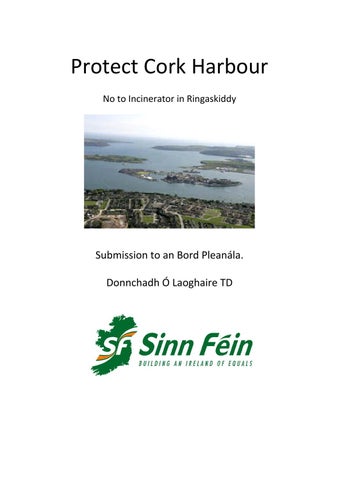
Protect Cork Harbour No to Incinerator in Ringaskiddy
Submission to an Bord Pleanรกla. Donnchadh ร Laoghaire TD
Objection to Ringaskiddy Resource Recovery Centre planning application - PA0045 09-03-2016 An Bord Pleanála 64 Marlborough St Dublin 1 Submitted by Donnchadh Ó Laoghaire TD 9 Cúirt na Faiche Thoir Feirm an Mhainéir An Leitheanach Beag An Tóchar Corcaigh Telephone ; 0868819653 Email ; donnchadhol@hotmail.com
A chara I wish to register, as part of the Planning Process under the Strategic Infrastructure Act, my opposition to the Ringaskiddy Resource Recovery Centre planning application (PA0045). I am opposed to the application on the following grounds.
Location (i) Tourism and the vision for Cork Harbour. Cork Harbour is one of the most significant assets we in Cork have, and it has seen significant developments in recent years, and there is considerable potential for future positive developments and growth. Such worthwhile developments include the ongoing development of the NMCI, and IMERC campus including the Beaufort Building and Wave energy research lab. At the same time, more and more use is being made of the Harbour for leisure and tourism purposes, with developments such as the proposed cruise terminal for Cobh, the development of Spike Island as a Tourist attraction, and the development of Fort Camden Meagher at Crosshaven, and new piers at Passage West and planned developments for Blackrock Harbour, All of these developments, are part of the reorientation of Cork Harbour. Its heavy industrial era is passing, and a new future is opening up, that is potentially kinder to the local community, and the Local environment. However, the location of a Hazardous Waste Incinerator would be potentially be deeply detrimental and damaging to this potential. The possibility of increasing the tourism numbers in the Harbour would surely be discouraged by the location of a significant, 240,000-tonne-per-annum waste-to-energy incinerator in the locality, it is far from conducive to such activity. It would also be rather perverse to see that an Incinerator, with all the risks, hazards and potential implications for the local environment, would be located almost side by side with a world class research facility examining Wave Energy, with clean, 21 st Century Energy being researched adjacent to an incinerator. (ii) Flooding and Coastal Erosion The location is wrong entirely in relation to the entire strategy and vision the people of Cork, it's representatives and the County Council hold for the Harbour. This was among the primary reasons that the application in 2011 was rejected, and I believe
it remains a reason it should once again be refused on this basis. The location remains highly unsuitable as the site identified remains vulnerable to flooding, and it is impossible, I believe, to eliminate the possibility of a tidal erosion affecting the site over the medium term, having long term implications for the safety of the site, for this particular use. As noted by the group Cork Harbour Alliance for a Safe Environment (CHASE) on their website, the World Health Organisation (WHO) site selection criteria for hazardous waste management facilities advises elimination of areas subject to coastal erosion and flooding stating “Step 1 is to eliminate generally unsatisfactory areas, – coastal areas subject to floods, – coastal wetlands, – areas with limestone deposits.” The area remains vulnerable to flooding, and damage done during last winter's storms to parts of the coastline at the Indaver site illustrates the fact that the site is far too close to vulnerable coastline to be suitable. Pictures at this link illustrate this point. http://chasecorkharbour.com/storm-frank-erodes-indaver-sites-gobbybeach-boundary/ (iii) Safety concerns for the Local Community There is significant concern about the environmental impact that an incinerator located at Ringaskiddy could have for the Local Community, not only in Ringaskiddy, but out to Passage West and Monkstown, in to Carrigaline, and right upstream to Cork City. This has been heightened by recent events at a major Indaver facility, on the 26 th February, an explosion causing a significant response from Local Fire Services, and which led to local residents being forced to close windows and doors, and closure of a nearby road tunnel. It has been described by Indaver Belgium as a violent explosion followed by three fires. These are precisely the kind of incidents that local residents fear. There is a significant risk to the local environment and community from such incidents and hazards. It is not possible to guarantee that such a facility will be entirely safe for the local community and it underlines that unquestionsably Incinerators are prone to accidents, and dangerous incidents, and Indaver facilities are no exception to that. It is also worth noting the impact that the facility will have even in it's ordinary operations, without accidents, through emissions. This is borne out by the fact that
according to the most recent EPA emissions report (EPA Licensed Sites 2014 – Report on Air Emissions), the Indaver Incinerator in Duleek County Meath, was the most significant offender, with a significant 19 emissions limit breaches reported at the facility in 2014. All 19 breaches and exceedances relate to Carbon Monoxide emissions limits. This has the potential to pose a health risk to the local community, because, as has been noted by CHASE (their source being the US EPA), which means a higher risk of other pollutants such as dioxins and furans which form at lower temperatures. Carbon monoxide at excess levels has significant health impacts, including, among the general population and otherwise health members of the community, such as unexplained headaches, chest pains or muscular weakness, Sickness, diarrhoea or stomach pains, Sudden dizziness when standing and general lethargy. However it is most serious for those who suffer from cardiovascular disease. This along with other emissions related issues, outlined below, are among the reasons why this incinerator would be entirely unsuitable for Ringaskiddy. (iv) Size of site. The Boards direction of June 7th, 2011, stated that “The Board is not satisfied that the provision of incineration capacity to deal with residual municipal waste, in addition to hazardous waste, at this site is appropriate, having regard to both the layout and limited size of the site and to the current strategy of the Cork local authorities in respect of waste management.� This is a consideration which has not changed, the site remains the same, is problematic due to location, and it is a concern held by the local community, that if the site is too small, this may create safety difficulties, and will injure local amenity. It remains the case that the development would constitute overdevelopment of the site and would seriously injure the amenities of the area and of property in the vicinity. (v) Road Infrastructure, traffic, and Local Disruption There are also quality of life considerations to be taken in to account in evaluating this application. Ringaskiddy, and Shanbally, are living communities, small villages, with vibrant village life within both, however, already substantially impacted upon by the enormous commercial, industrial imprint on the community, over many many years. This has it's implications for traffic and for quality of life.
In particular, it is clearly the case that there will be an increased traffic impact due to this Incinerator, that this will be significant, and that it will likely be even more significant during construction. Even during it's operations some 70 trucks a day, or perhaps some 140 journeys will pass through the village. There is no commitment to delay this project until the delivery of the M28, which provide some relief to the village in terms of traffic. But it should also be noted that during construction, there will be works required to construct the flood defences, under the main road, and that significant traffic for Haulbowline, IMERC and other facilities at that end of the village will have to be routed elsewhere. Where they can be routed to is not entirely clear, the entire peninsula operates to some extent as a cul de sac. Given that the m28 is already some distance from delivery, the construction will also have a significant impact back along the road, including already congested pinch points, such as Ringaskiddy village, Shanbally Village, Shannonpark Roundabout, Carr's Hill, Bloomfield Interchange, and perhaps also the Jack Lynch Tunnel. There is also the issue of pedestrian safety in the village which would need to be considered, much improvements are already required, in order to cope with the significant scale of traffic, including heavy freight, and the addition of additional heavy freight would potentially make the village even more unsafe for pedestrians, including children in particular, who have to cross that road in order to access the new playground facility.
Incineration While, in recognising that this application is not likely to be decided on the principle of incineration, as incineration is considered accepted within the Regional Waste Strategy, I feel that as this is a document publicly available, it is necessary and appropriate to put on record the Sinn FĂŠin position on Incineration generally speaking. We are opposed to incineration and do not believe it should have a place within the Regional Waste Strategy. Sinn Fein is committed to the promotion of environmental renewal through investment in reduction, recycling and policies working towards a zero waste economy. National Policy, which favour increasing the use of incinerators as an alternative to diminishing landfills is a wrong headed approach starting at the bottom of the hierarchy. Such an approach is neither sustainable nor eco-friendly.
We believe that we must put the emphasis on to the promotion of strategies at the top of the waste hierarchy (reduction, reuse, recovery where it is without damaging consequences) instead of the status quo which focuses on strategies at the bottom. A reliance on incineration does nothing to create a public understanding of waste as a resource, fails to adequately tackle over-packaging and over-consumption and needs to be fundamentally revised. In the hierarchy of reduction, re-using, recycling and re-use, reduction remains the most important and yet remains the one which we have made least progress on. Sinn Fein remains opposed to incineration which can cause air pollution, the emission of toxic fumes and an increased volume of traffic generated by the transportation of waste to and from incinerators. One other aspect of incineration is that after burning, the remaining ash still needs to be disposed of in landfill. A further amount, approximately 7%, known as fly ash, is classified as toxic waste which cannot even be disposed of in landfill and requires further treatment. In addition, naturally building an incinerator is a large capital cost. Once built, it must be used on a continuous basis for it to pay for itself, which will ‘lock in’ incineration as a substantial, or even a primary method of waste disposal. To sum up, as a Party we are specifically opposed to incineration because of - Ash which remains after incineration needs to be disposed of - Toxic fly-ash produced through incineration process and how that must be dealt with - It will increase volume of traffic to and from incinerators - Air emissions of sulphur dioxide, nitrogen dioxide, chlorine, dioxin and fine particulates - Emissions of greenhouse gases of CO2 and nitrous oxide Sinn Fein calls for incineration to be phased out and ultimately abandoned and favours removing the option of incineration or thermal treatment from regional and central waste management strategies.
Strategic Infrastructure Act I retain significant concerns as regards this piece of legislation. It is not for the Board to adjudicate on this matter, however I feel it necessary to put on record my view that this legislation is heavily weighed against local Communities. The process is
entirely unfair, and allows major projects like this incinerator, to be potentially allowed, providing those making the proposals which a much more favourable set of circumstances. The reality is that the Local Community has had six weeks to process and consider the detail of years of detailed work by Indaver. It is a gross inequality that the people of this community have had to face this process, at great cost to them personally, twice already. I have listened to residents express their anguish and frustration at the efforts that have gone in to fundraising, and the knowledge that these efforts could have gone towards things in their personal lives, or in improving their community in other ways. It is wrong that the community is forced to deal with this exhausting process yet again, for the third time. I think the legislation is problematic even for a single application, but that it is possible to use the Machinery of the Planning and Development (Strategic Infrastructure) Atc 2006, for a third time, is grossly unfair to local communities, and is hugely advantageous to the applicants. Indeed I note that Cork County Council passed a resolution in opposition to this, proposed by Cllr D'alton, and which I was more than happy to support, as a Cllr at the time.
Conclusion I believe that the above submission outlines clearly that the location for which Indaver have made a planning application, notwithstanding the general issues with the planning process and with incineration, is unsuitable. It is unsuitable because it is in clear contrast and opposition the overall vision held by the people of Ringaskiddy, of Cork, and held by the County Council for Cork Harbour, for a clean harbour, promoting tourism, research, education, leisure, and clean industry, and there is no way in which an incinerator can fit in with this vision. It is unsuitable at it is still very near a vulnerable coastline, and may be at risk of flooding, with potential impacts upon the safety of the facility. It is unsuitable as the site is too small, and because it will have a huge impact on traffic and community life in Ringaskiddy. In addition I note that this is not only an issue for Ringaskiddy and Shanbally. Naturally these are the communities most affected by the immediate affects of it, however traffic issues will affect the entire Harbour area, and the impact of any emissions or pollution due to industrial accidents, will be felt throughout Cork City and County.
I hope that An Bord Pleanála will consider these factors, and refuse the application at hand. Is mise le meas Donnchadh Ó Laoghaire TD 9 Cúirt na Faiche Thoir Feirm an Mhainéir An Leitheanach Beag An Tóchar Corcaigh Telephone ; 0868819653 Email ; donnchadhol@hotmail.com