FALL 2026 DOMINICAN UNIVERSITY OF CALIFORNIA
News and features about and for the Dominican community
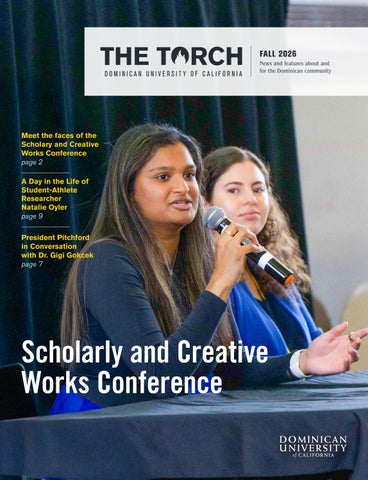
Meet the faces of the Scholary and Creative Works Conference page 2 A Day in the Life of Student-Athlete Researcher Natalie Oyler page 9 President Pitchford in Conversation with Dr. Gigi Gokcek page 7
Scholarly and Creative Works Conference THE TORCH | FALL 2026
I
Dominican Women's Basketball, Jennifer Rogers #5 Rebounding, circa 1998, Dominican University of California Archives
DOMINICAN UNIVERSITY OF CALIFORNIA
Fall 2026
In This Issue
1 Letter from the President 2 News: Meet the faces behind the Scholarly and Creative Works Conference Undergraduate Research, Internships, Mentors Direct Honors Student Toward Career Path Dr. Coelho Talks with New York Times Magazine for Story Focused on Coral Reef Ecology Dominican Scholar & the Global Reach of Research
The Torch The Torch is a publication presenting the news, people and progress of Dominican University of California. The symbol of the flaming torch, representing truth, is rooted in the history of St. Dominic. The University’s motto is “Truth is a flaming torch.” The torch is carried by one of the “hounds of the Lord,” or, in Latin, “Domini canes.”
President Nicola Pitchford, PhD
Lead Editor Victoria Grajeda
Art Direction/ Production Sheila Gebrekidan
Editors
6 Dominican Scholar & the
Global Reach of Research
7 Feature Story: President Pitchford in Conversation
9 Athletics Story: A Day in the life of
Student Athlete Researcher Natalie Oyler
11 Alumni News 15 Commencement 2026 17 Class Notes 19 In Sympathy
Sarah Gardner Jilliann Rodriguez M'Barki Yvette Koth
Writers Sarah Gardner Victoria Grajeda Tricia Lacy Jaime Libby Natalie Oyler Holly Werly
Photographers Stuart Lirette Dia Rao Jim Block
Published By Dominican University of California 50 Acacia Ave. San Rafael, CA 94901 (415) 257-1396 dominican.edu
LETTER FROM THE PRESIDENT Dear friends, I’m going to welcome you to this issue of The Torch with a few words about resilience. I’ve been thinking a lot lately about resilience, which calls to my mind Newton’s Third Law of Motion: for every action, there is an equal and opposing reaction. Our students, this University, and the whole higher education sector are testing Newton right now. Long-term trends like demographic changes and rising public skepticism about the value of education have been compounded by the shockwave of the pandemic and now abruptly reduced access to federal funding. Will our opposing reaction—our resilient force—be big enough, soon enough? All I have to do is look at our students to know the answer. That answer must be yes. As I enter my last year serving Dominican as president, my fire—my conviction that these students deserve and must continue to have equitable access to education and opportunity—has never burned brighter. You’ll read in the following pages about students whose dogged determination to achieve a college degree, to expand their minds and serve their communities, has powered them through even the toughest challenges. In the midst of global social and political tumult, these emerging scholars and practitioners are publishing original research on early literacy, teenage mental health, and public trust in government agencies. Writing, crafting, and imagining better futures for us through the creative arts, business planning, and more. Preparing to heal a broken world with deep empathy. Like our students, the University is manifesting resilience to meet this moment. This final year of my presidency will focus on innovating our business model, expanding partnerships, and galvanizing our community to invest in a new chapter for Dominican that deepens our service to students and our region. If you believe in students’ right to learn, in the impact of Dominican alumni in our world, join us in delivering an opposing reaction to the forces threatening higher education today. Yours in fierce partnership,
Nicola Pitchford, President
1
THE TORCH | FALL 2026
NEWS
Meet the faces behind the Scholarly and Creative Works Conference Professor Bill Phillips has been part of the Dominican community for 25 years and helped shape the Scholarly and Creative Works Conference from the beginning. As a professor of psychology, he served on the original planning committee that launched the conference as part of the Dominican Experience. “We decided on establishing a student conference, and Michael Pujals and I volunteered to coordinate it,” Phillips said. Over the past decade, he has watched SCW grow from roughly 100 presenters to nearly 240 students in 2025, a testament to increasing faculty support and campus-wide participation. For Phillips, the conference is about empowering students. “In a nutshell, SCW is about convincing every student that YOU CAN DO THIS.” He especially enjoys the musical performances throughout the day and says the most rewarding moments come when students realize they are capable of presenting their work with confidence.
Assistant professor of nursing Dr. Deborah Meshel joined the SCW committee in 2025 after incorporating research presentations into her nursing courses for years. “The conference is really an extension of what we do in class,” Meshel said. “Students move from learning about research concepts to developing a proposal and presenting it in a professional setting.” She is especially inspired by projects addressing real-world health issues, from health disparities to evaluating misinformation on social media. For Meshel, SCW gives students the opportunity to move beyond completing an assignment. “They learn how to explain their ideas, defend their findings, and engage in thoughtful, evidence-based conversations.” She hopes students leave with the confidence and critical thinking skills to continue asking questions long after graduation.
THE TORCH | FALL 2026
2
NEWS
Meet the faces behind the
Scholarly and Creative Works Conference (con't) Jessica Moitt, Assistant to the Vice President for Academic Affairs and Dean of the Faculty, serves as co-organizer of the Scholarly and Creative Works Conference, overseeing planning, logistics, communication, and event coordination. After first becoming involved as a La Vida Dominican Scholarly and Creative Works Staff Fellow, she continued supporting the conference because of its impact on students and the campus community. “What excites me the most is seeing students proudly present the work that they have spent months developing,” Moitt said. She has enjoyed watching the conference expand, especially during the 10-year celebration in 2025, which introduced new features such as the Poets' Corner, Penguin Radio timecapsule interviews, and an open mic. Moitt hopes students leave knowing their voices matter and that they can make meaningful contributions beyond Dominican.
Christina Mayes, Assistant Director of Digital Support Services and Integrative Coach, joined the SCW leadership team during the pandemic, helping transition the conference online while preserving opportunities for students to share their work. “Bringing our campus community together around student scholarship and creativity during such an isolating period was especially meaningful,” she said. Today, what excites her most is seeing students, faculty, staff, and mentors come together to celebrate scholarship and creativity. One presentation that has stayed with her was Solena Ornelas' interdisciplinary exploration of gun violence, which combined research, history, social justice, and a live bass performance of The Star-Spangled Banner. For Mayes, the conference becomes truly meaningful when students share their work with audiences beyond their own disciplines, building confidence and creating lasting connections. She also sees the growing involvement of alumni as one of SCW's most exciting developments.
3
THE TORCH | FALL 2026
NEWS
Undergraduate Research, Internships, Mentors Direct Honors Student Toward Career Path
A
t Dominican University of California, psychology major Vanessa Morales '26 began conducting faculty-directed research during the spring semester of her first year—an experience that has helped shape her academic journey and career aspirations. For the past two years, Vanessa has served as a research assistant for psychology professor Dr. Afshin Gharib, contributing to research on humane education and self-empathy in youth. Through this work, she developed skills in data analysis and research synthesis, ultimately presenting findings at the Western Psychological Association Conference. Those experiences helped her secure a highly competitive summer internship at Sutter Health California Pacific Medical Center in San Francisco. There, she observed kidney and liver transplant surgeries, participated in clinical rounds, and gained firsthand experience in patient care.
“We were able to enter the operating room with the surgeon— sometimes standing right at the table—and then visit patients during rounds,” Vanessa said. “It was incredible to see how lives were transformed after surgery.”
As part of the internship, Vanessa researched and presented a case report on thrombotic microangiopathy following a kidney transplant to a board of surgeons and medical professionals, synthesizing complex clinical data into a professional presentation.
The experience also reshaped her future plans. Although she first discovered her passion for psychology in high school, working alongside physicians confirmed her interest in a career in medicine.
"I looked forward to going every day," she said. "I realized it was because I was doing something I was truly passionate about."
Now entering her senior year—and graduating a year early — Vanessa is majoring in psychology with minors in biological sciences and experimental cognitive science. She also serves as a Senator-at-Large in student government, works as an orientation leader, and supports youth mental health and harm-reduction initiatives in the community. Vanessa graduated from Dominican a year early — majoring in psychology with minors in biological sciences and experimental cognitive science. She also served as a Senator-at-Large in student government, worked as an orientation leader, and supported youth mental health and harm-reduction initiatives in the community. She continued her research as a member of Dr. Ben Rosenberg's Health and Motivation Lab, studying how social psychological theories influence health-related behaviors.
THE TORCH | FALL 2026
4
NEWS
Dr. Coelho Talks with New York Times Magazine for Story Focused on Coral Reef Ecology
D
ominican University of California faculty member Dr. Vania Coelho is contributing to global conversations on climate change and marine conservation through research exploring ways to protect coral reefs from rising ocean temperatures. Her work was recently featured in The New York Times Magazine, which highlighted emerging interventions—including artificial cloud cover and shading techniques—to reduce coral bleaching. A tenured professor in the Department of Natural Sciences and Mathematics, Dr. Coelho studies management strategies that help coral reefs withstand the effects of climate change. Working alongside undergraduate researchers at Dominican, she investigates why some corals are more resilient to heat than others and whether shading can improve coral survival during prolonged marine heat waves. Coral reefs are among the planet's most diverse ecosystems, but rising ocean temperatures cause corals to expel the algae they rely on for survival—a process known as bleaching. If temperatures remain high, entire reef systems can be lost. To address this challenge, Dr. Coelho has conducted laboratory and field research in American Samoa examining whether reducing light exposure during heat events can improve coral survival. Published in the Journal of Experimental Marine Biology and Ecology, her research found that shading significantly reduced bleaching in three coral species, demonstrating that light reduction can help increase coral resilience during extreme heat. Healthy coral reefs support marine biodiversity, protect coastlines from storms, and sustain local economies through fisheries
5
THE TORCH | FALL 2026
and tourism. As bleaching events become more frequent, Dr. Coelho believes practical interventions can help preserve reefs while broader climate solutions take effect.
"As bleaching becomes more frequent due to global warming, we should consider proactively using shading to help mitigate the effects of thermal stress and prolong the survival of at least some coral communities until solutions to address global climate change become effective," she said.
In The New York Times Magazine, Dr. Coelho emphasized that reducing fossil fuel emissions remains the highest priority, but protecting vulnerable ecosystems also requires immediate action.
"I think we should do everything in our power to help coral reefs—not only for the sake of biodiversity, but also for the human communities that depend on them."
Through her research and mentorship, Dr. Coelho provides Dominican students with opportunities to contribute to meaningful environmental research while addressing one of the world's most pressing conservation challenges.
NEWS
Dominican Scholar & the Global Reach of Research
W
hat begins as a thesis, paper, or creative project at Dominican doesn’t end at graduation. Through Dominican Scholar, the University’s open-access digital repository, student and faculty work is finding audiences far beyond campus—sometimes in the most unexpected corners of the world.
In a time when information is abundant but often locked behind paywalls, platforms like Dominican Scholar play a critical role in setting knowledge free. Digital scholarship may not create community engagement on its own—but it stands as a meaningful result of it, translating academic work into insights that resonate with real people and real communities.
For many years, graduate theses dominated the platform’s most-downloaded content. Recently, however, a notable shift has emerged: undergraduate senior theses are gaining remarkable traction. This trend reflects both the depth of undergraduate scholarship at Dominican and a growing confidence in sharing student voices on a global stage.
From campus classrooms to global conversations, Dominican Scholar is proof that the work done here matters—and that its impact can travel farther than students ever imagine.
What often surprises students most is not if their work is read— but where. While students may assume their research has a narrow audience, download data tells a different story. Papers are being accessed across continents, from major metropolitan centers to small islands in the Pacific and even Siberia. These moments are powerful reminders that the questions Dominican students explore—education, health, justice, community, and culture—are truly universal.
Natalie Guadiana and Taylor L. Okashima (263,052 downloads)
Seeing Dominican research accessed and cited worldwide affirms the quality of the work being produced and underscores the importance of open access. By removing paywalls, Dominican Scholar ensures that knowledge is not restricted by geography or financial means. In doing so, it advances the University’s mission of social justice and community engagement, extending learning beyond borders and into a global community hungry for information. The culture of research at Dominican has evolved steadily over time, with graduate work—particularly from the Education Department—offering a clear lens into that growth. These projects highlight how scholarship has become increasingly applied, reflective, and connected to real-world impact. Behind the scenes, ensuring this work reaches the world takes care and expertise. Support comes late in the writing process, focusing on formatting, accessibility for assistive technologies, and navigating copyright considerations. Students and faculty are also guided through their rights as authors, especially when pursuing publication in professional journals. This support ensures that Dominican research is not only visible, but ethical, inclusive, and sustainable.
The 10 Most Popular Papers:
1 The Effects of Sleep Deprivation on College Students 2 Impact of Reading Ability on Academic Performance at the Primary Level Caleb Bartholet Cimmiyotti (85,272 downloads)
3 The Inclusion of Students with Special Needs in the General Education Classroom Megan Walsh (73,512 downloads)
4 Analysis of Pre Test and Post Test Performance of Students in a Learning Center Model at the Elementary School Level Marion E. Schalich (72,856 downloads)
5 21st Century Education: The Importance of the
Humanities in Primary Education in the Age of STEM Christine M. Reiter (57,303 downloads)
6 An Analysis of the Changing Competitive Landscape in the Hotel Industry Regarding Airbnb Dean D. Lehr (54,168 downloads)
7 Media Coverage of Law Enforcement and Effects of the Image Created James Schultz (36,830 downloads)
8 The Impact of Commitment, Accountability, and Written Goals on Goal Achievement Gail Matthews (27,831 downloads)
9 The Effects of Losing a Parent on Teenagers’ Mental Health Emily O'Keefe (24,157 downloads)
For students who may not see themselves as “researchers,” the 10 The Effect of Positive Affirmations on Self-Esteem and Well-Being in College Students message is simple and encouraging: everyone has something Lynnelle Arquiza (11,490 downloads) worth sharing. Curiosity alone is enough to begin. If a topic matters deeply enough to research and write about, there is almost certainly someone else in the world eager to learn from it. THE TORCH | FALL 2026
6
FEATURE
Dr. Gigi Gokcek
President Pitchford in Conversation with Dr. Gigi Gokcek
7
THE TORCH | FALL 2026
FEATURE
I
t’s a characteristically gorgeous afternoon on the Dominican campus (radiant blue sky, flowers upstaging one another). Also characteristically, President Pitchford has a full day of meetings. So it’s a treat to step away from pure business for a chat with longtime colleague Dr. Gigi Gokcek, Associate Vice President for Academic Affairs, Dean of the School of Liberal Arts and Education, and Professor of Political Science. President Pitchford (NP): I have the greatest admiration for university administrators who successfully maintain a rigorous research agenda. Dean Gokcek (GG): Research is the whole reason I became an academic in the first place; it’s part of my identity, and I’d feel like something was missing if I weren’t pursuing my curiosity. That’s the greatest gift of academia: the freedom to study what interests me and write what I know to be true. NP: How on earth do you find the time? GG: The trick is a tightly organized weekly schedule. Weekdays are all about my administrative duties, and I commit to one weekend day when I’m going to dive into research and writing. (Prioritizing self care outside those work hours is absolutely critical.) Then there’s vacation—I leverage campus holidays to relax, but I’m also likely to rent a beach house over spring break and structure some writing into my time off. It can be refreshing to get a change of scenery. NP: How does your academic research enrich your deanship? GG: Since becoming a dean, my research focus has shifted, mostly, away from international relations and towards the changing landscape of higher education. I’m reading endlessly and collaborating with experts more and more on that topic. A specific line of inquiry is about women leaders in academia, about the family obligations that disproportionately fall on women, especially since we “came back” from the pandemic. I started a forum with some colleagues to amplify those stories and foster solidarity. All that intensive study and discourse keeps me deeply engaged with the faculty experience.
My international relations training, though, is eternally useful. Bringing diplomacy to a workplace conflict is absolutely natural to me. NP: Tell us about your research journey, how you’ve developed as a scholar since you were in college. GG: I studied abroad during my junior and senior years of college, and I performed my own original research, which became the basis of my thesis. When I submitted my thesis, I remember thinking, “I can do this.” Without that early confidence boost, I don’t know if the idea of becoming an academic would ever have occurred to me or seemed possible. When I started teaching, I found it a real challenge to continue producing scholarship in my home discipline. A colleague gave me some great advice: write about pedagogy, about effective teaching methods. That opened up a whole new world of possibility—books and volumes on teaching international relations and supporting student success have followed. NP: Dominican’s Scholarly and Creative Works Conference is around the corner. What do you observe in students as they prepare for and participate in sharing their own original work? What's the value of that experience for students? GG: The Conference is a treasure. It’s unusual to find that kind of opportunity, one that involves students across every major and graduate program, on a college campus. I love seeing students devote their time to a project of their own design and then present it to the university community—they are curious, passionate, and supportive of each other. Our students often out-compete graduates from other institutions, in graduate school and in the workforce, because of the quality of their culminating projects. It’s exciting to participate in their journeys as scholars and makers, especially while I reflect on my own path, which was shaped by singular opportunities just like this one.
THE TORCH | FALL 2026
8
ATHLETIC STORY
FROM FIELD TO LAB: A Day in the Life of Student-Athlete Researcher Natalie Oyler Background Plan. Reflect. Grow. Three themes being a student-athlete balancing NCAA Division II lacrosse and independent research has taught me.
Natalie Oyler
Since my freshman year of high school, I have been devoted to pursuing a Ph.D. in cancer research. The next question was, "How do I get there?" I grew up in Meridian, Idaho, where I played basketball and lacrosse, but science wasn't a big focus yet—just a dream.
Senior year, I received the opportunity to play college lacrosse at Dominican University of California, helping start the women's lacrosse program. While my sights were set on lacrosse, I was excited to learn Dominican gave me the opportunity to do research as early as freshman year. Undergraduate research is rare and often highly competitive, so the opportunity was invaluable. As a freshman, I completed four three-week rotations in Dominican labs before joining Dr. Meredith Protas for the next three semesters to study evolutionary genetics. During my second semester, not only did we have 12 away games across five travel trips (one of which included 10 days in Colorado), but I also proved my capabilities in the lab. Dr. Protas then introduced me to a postdoctoral researcher at the Buck Institute for Research on Aging in Novato. That introduction sparked a year-and-a-half internship studying mitochondrial dysfunction in infertility. The Buck Institute exposed me to a true research environment, and I fell completely in love with research. It strengthened my desire to pursue a career in cancer research as a principal investigator. That passion grew alongside lacrosse, where I helped lead my team to a conference championship as the seventh-ranked goalie in NCAA Division II. My Dominican research experience concluded in the lab of Dr. Tyler Johnson. A conversation about my future during the spring of my junior year sparked a mentorship I know I will carry throughout my research career. My focus shifted toward professional development—learning how to run a lab, conduct independent research, and write grants and manuscripts. As I continued researching and preparing for my senior lacrosse season, I thought about the next step: earning my Ph.D. I applied to nine graduate programs ranging from broad cellular biology to focused cancer immunology and immunotherapy. I received three interview invitations and spent the month of February flying across the country three times, coming home at 2 a.m. and waking up at
9
THE TORCH | FALL 2026
6 a.m. for practice. It was a grind that I gave everything to, and I was thrilled to be accepted into all three programs. I ultimately committed to the Cancer Immunology and Immunotherapy program at Moffitt Cancer Center/University of South Florida. As I wrap up my Dominican experience—with every intent of not losing the championship this year—and prepare to begin my Ph.D. journey, I carry with me the three themes that have shaped my success as an undergraduate researcher at Dominican: plan, reflect, and grow. With some background, I welcome you to a day in my life as a student-athlete researcher. Morning Practice My first alarm goes off at 5:45 a.m., which I immediately snooze to start my day with a slight hit of dopamine. By 6 a.m., I'm up and beginning my morning routine. My teeth are brushed, contacts go in, and my hair is pulled into a ponytail. Without fail, my nonnegotiable every morning is making my bed. It helps me feel like I've started the day on the right foot and reflects the balance holistic habits bring to our lives.
Dominican Women's Lacrosse Team celebrating a victory in the spring of 2025.
By 6:30 a.m., I leave for practice, using the drive to focus in. I blare some house music to get my heart rate going and have a pre-practice snack. The moment that truly gets me ready to compete is seeing my teammates. I have a deep passion for lacrosse, but the lifelong relationships I've built with my team keep me smiling no matter what. And let me tell you, as a goalie, you need a smile on your face. A "good" game for a goalie is a 50% save percentage—unlike academia, where a 50% is an F. This demands a highly fluid growth mindset. I must constantly adapt, maintaining my resilience to save the next shot. Gratefully, this adversity has only benefited me in the lab. As a scientist, you have to be comfortable with failure and willing to adjust your original plan.
ATHLETIC STORY On difficult practice days, I've learned to shift my focus toward my research, studies, family, or friends to maintain a positive mindset. So, as I leave the field and walk to class or the lab, I take time to reflect and grow while looking ahead to my plan for the day. Morning Academics On the way to class or the lab, I review my plan for the day along with any notes I may have. This structure helps everything flow smoothly, whether I'm heading into a lecture or immediately beginning experiments. I am always most motivated in the mornings, as the adrenaline from practice fuels my focus. I often use this time for demanding projects, whether that's reading scientific literature, conducting experiments, or responding to important emails. If I'm in class, I'll schedule review sessions throughout the week. If I'm running experiments, I create contingency plans for possible outcomes. Knowing when my focus is sharpest helps me maximize my productivity. Photo of the 25-26' Johnson Lab group members with our repository of marine sponges.
Every now and then, though, I'll intentionally switch things up—going home to shower or do chores before studying at night. It keeps my brain "on its toes" so unexpected changes don't throw me off. Lunch Hour Lunch is my chance to reset and reflect. Having celiac disease and being dairy-free, I meal prep at the beginning of every week to make sure I'm adequately nourished. It reduces stress around deciding what to eat and saves money. The best part of lunch, though, is reflecting on the morning. I revisit my original plan, see what I accomplished, identify what went off course, and adjust my schedule for the rest of the day. Of course, experiments or meetings sometimes interrupt that routine, but I do my best to adapt while making sure I still take care of myself. Afternoon Activities The afternoon is a combination of learning and reflection. This is where conversations begin, the task load lightens, and my mind becomes more fluid. I enjoy leisurely reading recently published scientific literature in areas that interest me. Reading often sparks new questions, research ideas, and approaches to my projects.
4–7 p.m. on Mondays and Wednesdays but finish my academic day by 2:30 p.m. on Tuesdays and Thursdays. While much of this time is spent on homework and research, I'm always happy to fill it by meeting with friends, helping classmates, or catching up with the research team in the Johnson Lab. I've realized I thrive in environments that require adaptability, whether in the lab, on the field, or whenever unexpected challenges arise. Evening Wind Down Finally, the night comes to an end. For me, how I spend this time is critical. I do my best to avoid studying new, difficult material before bed. I'm less efficient and retain far less than I do in the morning. Instead, this is the time to make a great dinner, spend time with my roommates and best friends, and tackle tedious tasks that require very little brainpower. Saving those tasks for the evening allows me to devote my best energy to more demanding work earlier in the day. Everyone works differently, but everyone needs time to recharge. I learned that lesson the hard way. At the end of my sophomore year, my health began to deteriorate because I was working from 7 a.m. to 10 p.m. every day. I reached a point where I could no longer focus on my academics, research, or lacrosse. I quickly learned that interpersonal connections are essential to my productivity. I'm grateful I learned that lesson so young, and I hope my experience reminds others on a similar path to enjoy the journey. Once I've relaxed with friends, I spend a little time by myself. I reflect on my day, grow from that reflection, and plan for the day ahead (recognize those words?). Yes, I'm the person who packs my bag, lays out my clothes, and even micro-cleans my room before bed. It works for me, especially since I can always hit snooze once or twice without guilt. By 10 or 11 p.m., I close my eyes, dreaming of the wonderful work I get to do the next day. Final Thoughts To wrap up, yes, it's a demanding lifestyle, but I absolutely love it. I wake up every day excited to be on the field and equally excited to be in the lab because I've built an environment where I can truly thrive. I have a structure that works for me and am lucky to have family and friends who support me 100%. I know my passion because I get to live it every day. I create my own drive, my own path. I am determined, but humble, ready to dedicate my life to advancing our understanding of cancer.
I rarely spend this time at home. I thrive in an academic environment, usually working in the lab or the library. My afternoons also vary from day to day. This semester, for example, I have class from
THE TORCH | FALL 2026
10
ALUMNI NEWS
Transferring to Dominican Allowed Psychology Alumna to Excel in Research, Community Engagement
A
fter beginning her college journey at larger universities in Colorado and Virginia, Madelyn Ayers ’25 transferred to Dominican University of California in search of a more supportive and personalized academic experience. At Dominican, she found the environment she needed to thrive—one grounded in close faculty mentorship, hands-on learning, and a strong commitment to social justice. Madelyn graduated summa cum laude with a degree in psychology at the Fall 2025 Commencement Ceremony. In recognition of her academic excellence and leadership, she received the Outstanding Student Award for the School of Liberal Arts and Education and was selected to deliver the undergraduate commencement address. “I feel grateful for Dominican,” Madelyn shared. “The small school size allowed me to build meaningful relationships with professors who offered one-on-one support and recognized my academic strengths.” Drawn to the intersections of psychology and social justice, Madelyn was especially attracted to Dominican’s experiential approach to education. “I’ve been interested in psychology since middle school,” she said, “and I value that Dominican psychology students complete both directed research and field placements, which contribute to a truly holistic education.” During her first year at Dominican, Madelyn earned Dean’s List honors in both the fall and spring semesters, joined the Honors Program, and was inducted into Psi Chi, the international honor society in psychology. Supported by Dominican’s flexible curriculum, she also completed two minors aligned with her career goals: clinical and counseling science and health humanities. Together, these programs strengthened her understanding of therapeutic practice while exploring health through literature, ethics, and psychology. In the 2024–2025 academic year, Madelyn joined Dr. Ben Rosenberg’s Health and Motivation Lab, where she focused on trauma-informed care. Her research culminated in a presentation at the Western Psychological Association Conference in Las Vegas and a senior thesis titled Trauma-Informed Care: A Catalyst for
11
THE TORCH | FALL 2026
Strong Therapeutic Alliances, which was nominated for the Psychology Department’s Dr. Bob Shukraft Award for Excellence. As a transfer student aiming to graduate a semester early, Madelyn credits much of her success to the guidance of her faculty advisor, Dr. Veronica Fruiht, associate professor of psychology. “She created a detailed graduation plan for me and was incredibly attentive,” Madelyn said. “Advisors play a critical role in student success at Dominican.” Madelyn also cited the influence of several faculty members, including Dr. George Faithful, associate professor of religion and philosophy, and Dr. Christine Schaefer-Willis, adjunct professor of psychology. “They were always accessible outside of class and pushed me to think more deeply about the material,” she said. Committed to community engagement, Madelyn embraced service-learning opportunities that connected academic theory with real-world issues. Through the Ethics and Housing and Homelessness course, she worked with San Rafael’s Downtown Streets Team, collaborating with individuals experiencing homelessness to clean public spaces while learning about programs designed to support housing stability. “I built meaningful relationships and gained insight into how Marin County and California address homelessness,” Madelyn reflected. Madelyn further applied her academic training through a field placement with the Youth Mental Health Academy, operated by the Child Mind Institute. As a mental health intern and youth mentor, she supported students from structurally marginalized communities as they developed capstone projects focused on mental health topics. She continued mentoring nine students throughout the year, helping them prepare for transitions into higher education or the workforce. “I was inspired by my mentees’ curiosity and passion,” she said. “Each had a unique research interest, and it reinforced how important early access to mental health education can be.” Through scholarship, research, and service, Madelyn’s journey reflects Dominican’s mission in action—preparing students to engage thoughtfully with their communities and make a lasting impact beyond campus.
ALUMNI NEWS
Science, Public Health Background Leads Alumna to Grad School at UC Berkeley
K
imberly Navarrete’s path to public health and medicine began at Dominican, where hands-on research and deep community engagement shaped her academic and professional direction. Now preparing to begin a Master of Public Health program in infectious disease and vaccinology at UC Berkeley this August, Kimberly credits Dominican’s undergraduate research culture for setting her trajectory. A December 2024 biology graduate with minors in chemistry and public health, Kimberly was initially unsure about attending Dominican. Encouraged by a high school counselor to take a closer look, she explored faculty research online and was drawn to Dominican’s integrated research methodology course sequence, which embeds seven units of research into the science major and prepares students to join faculty-led labs early in their academic careers. That access proved pivotal. After completing the research sequence in her first year, Kimberly joined the late Dr. Roland Cooper’s malaria research lab, where she studied molecular mechanisms of drug resistance in Plasmodium falciparum. Under Dr. Cooper’s mentorship, she developed independence as a researcher while learning the discipline and collaboration required for advanced study.
Beyond the lab, Kimberly expanded her clinical and community experience through the Dominican/Kaiser Permanente Pre-Med Mentor Program, where she shadowed physicians and gained firsthand exposure to critical care environments. Service-learning placements at San Pedro Elementary School and the Marin Community Clinic further shaped her understanding of health inequities and community-based care. She also served as president of Latine Unidos, balancing leadership with a demanding academic schedule. Kimberly’s interest in public health was sparked by coursework with Dr. Michaela George, associate professor of global public health. Through hands-on, community-based projects, Kimberly discovered how public health complements clinical medicine. “I saw that public health would be a great addition to the clinical work I was doing,” she says. After graduation, Kimberly continued collaborating with Dr. George on a program evaluation for Marin Healthy Youth Partnerships, supporting initiatives aimed at reducing substance use and shifting social norms around alcohol consumption at youth-centered events—work that reflects Dominican’s emphasis on applied learning and reciprocal community partnerships.
"Dominican makes it very easy for undergraduates to join a lab, that kind of access wouldn’t have been possible for me elsewhere."
THE TORCH | FALL 2026
12
ALUMNI NEWS A Message from your Former Alumni Board President When I reflect on scholarship and research at Dominican, I think about purpose and impact—not just academic work, but the people and communities it serves. In 2016, I completed my Master’s thesis alongside classmates Jocelle Flores and Rachelle Yambao, focusing on fall prevention education for older adults in Marin County. Partnering with first responders from the Novato Fire District, we identified gaps in existing outreach and developed interactive, personalized education addressing risks such as home safety, medication management, and balance. The results were encouraging: 90% of participants rated the program “very good” or “excellent,” reinforcing the power of client-centered, evidence-based care. That experience shaped my professional path. As a first-generation college student, Dominican gave me more than an education—it gave me mentorship, confidence, and a strong sense of belonging. Through research, leadership, and community engagement, I learned that scholarship doesn’t live in isolation; it has the power to create real change. Today, as an occupational therapist and president of the Alumni Board of Directors, I continue to draw on the research foundation I built at Dominican. My thesis, now published on Dominican Scholar, continues to be viewed and cited—a reminder that student work can have a lasting reach. Those early experiences also prepared me for advanced research later in my career, including at UCSF. Events like the Scholarly and Creative Works Conference capture Dominican at its best. Celebrating its 10th anniversary last year as a keynote speaker was especially meaningful and a reminder of how deeply research, creativity, and inquiry are woven into the student experience. As I pass the torch of Alumni Board president to Crystal Shaw-Nasir ’04, I do so with tremendous gratitude for the opportunity to serve. I’m thankful for the time I’ve spent in this role, for the alumni and students I’ve had the privilege to work alongside, and for the chance to give back to the university that gave me so much. To our alumni reading this edition of The Torch: your Dominican education continues to matter. The scholarship, curiosity, and values you developed here carry forward into your careers, communities, and lives. Together, we remain part of a Dominican legacy that makes a real difference. Dominican doesn’t just prepare students for careers. It prepares them to make a difference. With gratitude,
Salvador “Sal” Chávez, MS-HAIL, MS, OTR/L 2025-26 Alumni Board President Alumni Board of Directors
13
THE TORCH | FALL 2026
ALUMNI NEWS A Message from your New Alumni Board President Dear Beloved Penguins, It is an honor to step into the role of president of Dominican’s Alumni Board of Directors. As a proud member of the Class of 2004, Dominican University has been a meaningful part of my story for more than two decades, and I’m grateful for the opportunity to give back to the community that helped shape me. I am especially grateful to Salvador “Sal” Chávez for his leadership and dedication as president. Sal has poured his time, energy, and heart into the Alumni Board, always keeping our alumni community and Dominican’s future at the center of his work. Thank you, Sal, for all you have done and for the strong foundation you leave behind. As I begin this new chapter, I look forward to building on that foundation and working alongside our incredible alumni, students, faculty, and staff. Our alumni community is one of Dominican’s greatest strengths, and I believe there are so many opportunities to strengthen those connections, celebrate our shared Penguin pride, and ensure alumni continue to have a meaningful place in Dominican’s future. I’m excited for what’s ahead and honored to serve. With Penguin pride,
2025–2026 Alumni Board of Directors Patricia Dougherty O.P. ’67 Stewart McRae ’77 Kathy A Grako ’79 Shurray Medina ’95 Jennifer Gotti ’98 Crystal Shaw-Nasir ’04 (President) Lianni Castro Teets ’04 Rebecca Hyatt ’04 Michael Golden ’04, MBA ’06 Bethani Eguia Nakoa ’05 Lesley Cocores ’05 Felicia Bell ’06 Sherri Bridgeforth ’06 Gigi Gillard ’06, MBA ’07 Elizabeth Crook ’07 Casey Thorne ’10 Domingo Ramirez ’14 Kimberly Harris ’15, MS ’16 Salvador Chávez ’16, MSOT ’17 (Former President) Sophia De Quattro ’16 Robert Daley ’18, MA ’19 Allison Kustic ’20
Crystal Shaw-Nasir ’04 President, Alumni Board of Directors
THE TORCH | FALL 2026
14
Commencement
2026 Class of
15
Dominican University of California THE TORCH | FALL 2026
THE TORCH | FALL 2026
16
CLASS NOTES
Members of the Class of ’72
Heather Steil ’03
1960s Catherine Silcock Lowe ’60 is retired and lives in Las Vegas with her husband, John Macdonald. As part of a blended family, they have three living children, nine grandchildren, and eight great-grandchildren. During her career, Lowe served as chief judicial educator for the California and Arizona Supreme Courts. After retiring, she served three terms as board president for the Osher Lifelong Learning Institute at the University of Nevada, Las Vegas, where she also taught numerous ancient and medieval history courses. Lowe became a Catholic in 1962 and expresses gratitude to Dominican for laying the foundation for a full and happy life. Members of the Class of ’72 recently visited Sister Joan King.
1970s Monica Esposito ’78 shared the passing of two close friends and fellow Dominican alumni from the Class of 1979, on behalf of their spouses. William Iriarte died on Aug. 6, 2023, at his home in Neosho, Missouri. He was 67. Carol Flores-Beck died on Aug. 23, 2025, at her home in Oxnard, California. She was 68. Kathy Grako Gerth ’79 shared that her mother, Vivian Brotherson Grako, died in July 2025 at the age of 96
17
THE TORCH | FALL 2026
Scott Steffens ’06 and Ashley Steffens ’06
following a stroke. Vivian Grako was a lifelong supporter of her family and known for her warmth and friendliness. She spent her career teaching high school English, journalism and graphics, and later served as a librarian for 25 years before retiring. Her family remembers her with gratitude for her long life and the impact she had on those around her.
1980s Natasha Yim ’83, M.S. ’86, is a children’s author based in Ukiah, California. Her 12th children’s book, Luna and the Case of the Missing Mooncakes, was published by Charlesbridge Publishing in August 2025. She is also scheduled to release two additional books in 2026: a board book, Brave Little Otter (It’s Okay to Wait), in April, and a picture book, Luna Picks a Lucky Dumpling, in May. Yim has been writing and publishing children’s books for 25 years while also working primarily in the mental health field. She currently works part-time at the Mendocino County Office of Education as a grant manager and grant writer, and facilitates mental health awareness trainings. She also enjoys school visits, where she connects with students to discuss her books and the writing and editing process. Yim has been married to her husband, Brian Carter, for 27 years. They have three adult children.
Claire Neenan Schwartz ’08
Theresa Padden ’83 shared the death of her brother, John Padden ’84, who died on Dec. 25, 2025. He is also the son of Nancy (Wiseman) Padden ’53 and the nephew of Margaret (Wiseman) Jensen ’49. His family remembers that he cherished the friendships he formed during his time at Dominican University of California. Claire Nixon Reed ’88 and her husband, Mark Allen Reed ’01, are both alumni of Dominican University of California. Mark Reed died unexpectedly at home on July 19, 2024. He is survived by his wife of 56 years, Claire Reed; their three children; and three grandchildren. The Dominican experience held deep significance for the Reed family. Their daughter, Molly Rose Reed, earned a Master of Science in psychotherapy from Dominican in May 2010 and has practiced as a psychotherapist since that time.
1990s Kim Culbertson Sagebiel ’96 was named a finalist in fiction for the California Independent Booksellers Alliance (CALIBA) 2025 Golden Poppy Award for her debut adult novel, Other People’s Kids. She also continues her work as a mentor in Dominican University of California’s Master of Fine Arts in Creative Writing program.
CLASS NOTES
Tanya Tsikanovsky ’09
Kate O’Connor ’14
2000s Heather Steil ’03 retired from the U.S. State Department in fall 2025 after 20 years as a Foreign Service officer. A public diplomacy officer, she represented the United States to foreign audiences in Lithuania, Afghanistan, Iraq, Nepal and Romania. Her recent assignments include serving in Islamabad as chief of staff for Mission Pakistan, working as a foreign policy adviser to the commander of U.S. Central Command, and concluding her career as an instructor in public diplomacy training. Steil plans to return to Marin County to begin the next chapter of her life. Scott Steffens ’06 has built a successful career as a history teacher and lives in Sacramento with his wife and fellow alumna, Ashley Steffens ’06. They have one son, Matthew, 4. He is preparing to begin his 10th year teaching history-themed courses and recently taught his first philosophy class, drawing inspiration from his undergraduate studies at Dominican. Claire Neenan Schwartz ’08, M.A. ’17, recently joined fellow Dominican alumni Dominique Palma Szarmach ’08, Maureen de Nieva Marsh ’07, ’10, and Jena Hunt Abraham ’08 to celebrate milestone birthdays at the
Sandy White ’22
Madonna Inn. During the gathering, the group began planning for their upcoming 20-year reunions. Stay tuned! Tanya Tsikanovsky ’09 is a candidate for West Hollywood City Council in the 2026 election. Kate O’Connor ’14 earned her MBA from Dominican University of California more than a decade ago. After a 30-year career at Lifehouse, where she began as a direct support professional and advanced into management, ultimately serving as director of administration and facilities supporting more than 360 individuals with intellectual and developmental disabilities, she stepped into the role of executive director at Cornerstone Community Homes in San Rafael in November 2025. O’Connor is excited to support and lead alongside the individuals served, their families and dedicated staff. Barbara McVeigh ’17 was selected from nearly 500 applicants to present at the World Forum for Democracy in Strasbourg, France, on Nov. 6, held under the patronage of the French president. She will present the “Jimmy Carter Jamboree,” a California initiative she founded in 2017 to celebrate former President Jimmy Carter. The grassroots effort has received support through eight California county
Evet DeCota ’24
proclamations and a state resolution. The initiative now includes events to raise scholarship funds for California high school students to attend the 2026 Summer Peace Summit at the Jimmy and Rosalynn Carter School for Peace and Conflict Resolution at George Mason University in Virginia. As co-director, McVeigh also released a short documentary to international film festivals, supported by the Alalusi Foundation and Asad Jamal, titled “Gaza By No Other Name: Jimmy Carter’s Vision.” The project is a collaborative peace initiative with artists from Gaza and The Media Group and aims to highlight Carter’s advocacy for human rights. Sandy White ’22, published a poetry collection in summer 2025. The work draws on the American cinquain, a five-line poetic form developed in the early 1900s by Adelaide Crapsey, based in part on her study of Cherokee incantations. Evet DeCota ’24 is a certified life coach and founder of DeCota Life Coaching, where she works with clients to build resilience, self-awareness, and intentional personal growth. She also hosts The Original Self Podcast, which focuses on identity, mindset, and authenticity.
THE TORCH | FALL 2026
18
IN SYMPATHY ALUMNI
Barbara J. McDonald MA ’73
SYMPATHY TO
Jane Weis Fair ’45
Christine K. Cahill ’74
Carol Haber Moye ’45
Marie Goff-Tuttle MA ’74
Beverly Teves Sweeney ’50 on the passing of her husband, Neil Sweeney
Virginia Formichi ’46
Michael J. Mello ’75
Mary Carmelita Arburua ’47
Carol Ann Flores Beck ’79
Katheryne “Peggy” Dias Erigero ’47
Michael P. Morarity, Sr. ’80
Joeann Diepenbrock Nelson ’48
Alice Olivia Thomas ’81
Genevieve Willson Barnhart ’49
Marcia Phipps CRED ’82
Rose Ann Burger Hurst ’49
Jon Berg ’83
Clare Pope Bouquet ’51
AnnEtta Link MS ’83
Terese McChrystal Wright ’51
John Padden ’84
Magda Battha Chambers ’53
Sande Kiriluk ’93
Sr. Marion Irvine, OP ’53
Janet Ellinwood MBA ’01
Sr. Susannah Malarkey, OP ’53
Siouxzi Foxxen ’01
LeeLee Doyle ’54
Amy B. Koenig ’04
Peggy Shafroth Levy ’54
Meredith Pechoultres ’04
Marta Battha Beres ’56
Daniel Casanova ’11
Lorraine Hickey Arnaudo ’58
FACULTY AND STAFF
Mary O'Donnell Clement ’58 Victoria Paul ’58 Paula Peters Avanzino ’59 Marguerite Grady Fox ’59
John Caple Marian Marsh Vern Nathe
Ann Thuss Clark ’61
TRUSTEE
Barbara Elliott ’61
C. Forrest Bannan
Kathleen Carlson Fraser ’61
John Caple
Patricia Wickhem ’62 Mary "Molly" Duggan Dowd ’63 Kathryn “Kay” McLaughlin Madsack ’63 Joan O’Donnell O’Rourke ’63 Rita Orlandini ’63 Anne Carroll Wooliever ’63 Mary Every Margolis ’66 Ann Lusk Honeywell ’67 Elyce Melmon ’71 Jeanne Kostelic MA ’72 Marie McCarthy MA ’72 Susan J. Peterson ’72 Osborn Howes MA ’73
19
THE TORCH | FALL 2026
Eileen Pope Troyan ’53 on the passing of her sister, Clare Pope Bouquet ’51 Joanne Hickey Prolo ’64 on the passing of her sister, Lorraine Hickey Arnaudo ’58 Toni Bannan Gross ’65 and the extended Bannan family on the passing of her brother, C. Forrest Bannan Paula Cavanagh Tschida ’67 on the passing of her husband, Bill Tschida, Sympathy to Patricia Vaio Mize '70 on the passing of her daughter, Karen Mize Gill BA '98 CRED '99 MS '02 Mary Pat Power ’72 on the passing of her wife, Hollis Greenwood Mindy Mello Ahern ’82 and Barbara Mello Streckfus ’83 on the passing of their brother, Michael J. Mello ’75 Theresa Padden ’83 on the passing of her brother, John Padden ’84, Karen Mize Gill BA '98 CRED '99 MS '02 Joan Fair Foedisch ’84 on the passing of her mother and Kathryn Madsen ’13 on the passing of her grandmother, Jane Weis Fair ’45 Mollie Wooliever-White ’92 on the passing of her mother, Anne Carroll Wooliever ’63 Ellen Henderson ’95 on the passing of her father, Tracy Henderson Shurray Medina ’95 on the passing of her mother, Joanne Peterson Teresa Beres Upson ’95 on the passing of her mother, Marta Battha Beres ’56 and her aunt, Magda Battha Chambers ’53 Paul Raccanello ’96 on the passing of his mother, Karen Raccanello Kay Donelson Cardenas ’05 on the passing of her husband, Joseph Cardenas Paddy Tatusko '07 on the passing of his mother, Maureen Kirby Kathleen Dowd, faculty, on the passing of her mother, Molly Duggan Dowd '63
Your Gift to Dominican Changes Lives Tylan Powell '28 “Looking for colleges was easy—finding one that believed in me was not. Throughout high school, I was often reminded how difficult it is to afford college, and at times, a degree felt out of reach. Receiving the Presidential Scholarship marked a turning point. It lifted a financial burden from my parents and gave me the opportunity to fully experience college. For years, I couldn’t answer the question of what I wanted to be. Now, because someone believed in my education, I can say with confidence that I hope to become a journalist and, one day, a college professor. Scholarships open doors for students who have long felt those doors were closed—making it possible to take risks, create change, and pursue higher education.”
Give today to ensure another century of doing good — visit dominican.edu/makeagift There are many ways to support Dominican: 50 Acacia Ave., San Rafael, CA 94901 dominican.edu/makeagift (415) 257-1347
Tylan Powell '28
THE TORCH | FALL 2026
20
50 Acacia Avenue San Rafael, California 94901 dominican.edu Address service requested
THE TORCH | FALL 2026
21