eca se on the day I existed I looked down, not at my feet, b t at my rectangle"
Above the village, in a cave on the lush slopes of a dormant volcano, dwelled an old, old man. His eyes, it was said, were always shut, for he slept year-round in the cavern.
That book emphasised for me how much hatred the world is capable of and how we need to ensure events like those described in the novel are never a o e to happen a a n
Fortunas 58
Many thanks to everyone who contributed articles or images to Fortunas 57; the deadline for submission of articles for the next issue is Thursday 8 October.
Board of Governors
Chair Professor Russell Morris
Vice-Chair
Ms Jackie Smith
Mr Gregor Alexander
Mr Martin Boyle
Mr Denis Coyne
Mrs Cathy Gladwin
Mr Ross Kitson
Dr Suzanne Mawson
Mrs Shirley McIntosh
Mrs Seonaid Mustard
Ms Karolina Pavlikova
Mr Mike Robins
Mrs Debbie Weir
Bursar & Chief Operating Officer
Mr Graeme Morrison
Editor: Heather Moore moore-h@dollaracademy.org.uk
The opinions expressed in this magazine belong to the individual writers and not to Dollar Academy.
GDPR
Dollar Academy sends out copies of Fortunas, and any enclosures, in envelopes addressed to Former Pupils, former staff and friends of the Academy who have actively opted in to receive postal mailings. One copy is sent to each postal address on the opt-in mailing list. If you wish to change your postal mailing preference, or need to update your postal mailing address, please contact dollarfp@dollaracademy.org.uk. You can opt to receive a link to a digital version of the magazine using the same email address.
FROM THE RECTOR
As the summer term draws to a close, it gives me great pleasure to introduce the latest edition of Fortunas
As I reviewed the pages that follow, I was struck by the sheer breadth of achievement across our school community. Whether in the classroom, on the sports field, on the stage, through service to others, or in pursuit of creative endeavour, our pupils and colleagues continue to demonstrate the energy, ambition and kindness that define life at Dollar Academy. It is very clear from Edition 57 that the Academy is thriving. This is no mean feat given the various headwinds that the independent sector has faced of late. However, given that I work with such exceptional people every day—young and not so young—I am not at all surprised that the school continues to go from strength to strength.
This has certainly been a year of exciting progress. For example, the continued development of the Futures Institute at Dollar Academy reflects our determination to prepare young people not only for the world as it is, but for the world they will help shape. It has been particularly encouraging to see the Institute’s work resonate beyond our own campus, with increasing numbers of schools and young people engaging with its programmes and contributing to important national conversations around sustainability, innovation and the future of education. At the same time, Fortunas underlines the fact that a great education is about far more than any single initiative or building project. It is found in the daily opportunities that encourage young people to discover their strengths, develop character and contribute positively to the lives of others.
As ever, Fortunas captures the richness and diversity of life at Dollar Academy with great skill. I should like to thank Heather Moore, her team and all our contributors for bringing together the stories that make this publication such an important record of school life.
I hope readers enjoy this edition as much as I have. Thank you for your continued support of the Academy, and I wish all members of our community a restful, enjoyable and well-deserved summer.
With warmest wishes
Ian Munro
FUTURES INSTITUTE
AT DOLLAR ACADEMY:
Building Momentum
For someone whose work is also their passion, arriving on the Dollar campus every morning never ceases to have an impact. I feel it each morning—the anticipation of conversations yet to happen, ideas to develop, progress to be made.
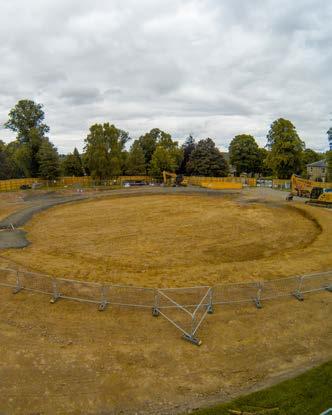
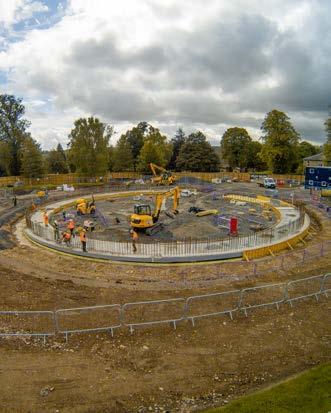
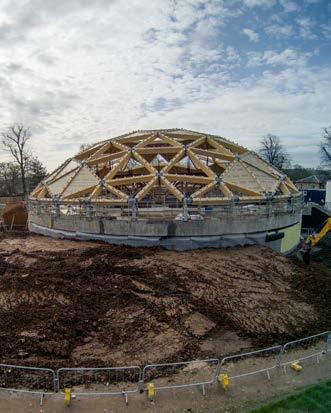
Recently, that feeling has been given a powerful new focus. The emerging Futures Institute building has become a visible symbol of a shared purpose.
During this spring term, milestones have been passed ahead of schedule. On 15 January, the Rector, Bursar and I, together with Top Six members Bailey C. and Amy R., and the CEO and Managing Director of Robertson, had the honour of signing a steel beam to celebrate the completion of the steel structures at the heart of the building. During the February break, the first parts of the timber frame arrived in Dollar, having made the 1,200-mile road trip from the specialist supplier in Austria.
Since then, the building’s signature structure— the dome—has taken shape before our eyes, sometimes making significant progress between the first school bell in the morning and the last at 3.25pm. If you happen to walk past later in the evening, it’s highly likely that you will see the Robertson team still hard at work, assembling its gigantic beams with millimetre precision. With this visible progress has come a growing
sense of anticipation among pupils and staff. For the new building represents far more than simply an expansion of facilities for Dollar Academy. It is a statement about the kind of education we believe in. Design workshops and a laboratory will sit at the heart of the building, surrounded by flexible spaces for teaching, discussion and collaboration. This will enable our young people to engage with complex global challenges in dynamic and meaningful ways.
Sustainability has been a guiding principle in the design of the Futures Institute, reflecting both FIDA’s values and its educational focus. The building serves as a powerful symbol that our commitment to a sustainable future is not so much something that can be taught, as something that we are actively building together.
FIDA Educational Programme
As the building progresses, so too does our educational programme. Our flagship course of study—the International Sustainability Diploma—is now running in 12 schools across Scotland, offering a rigorous and forward-looking qualification. Young people engage in interdisciplinary projects that require them to think critically about complex global issues and develop practical solutions.
While the course has been developed at Dollar, it is led by teachers in their own schools. A teacher running the course at a school in Dumbarton commented:
‘It’s not every day that a curriculum shift feels less like a requirement and more like a revolution, but that is exactly what happened at our school last year when we welcomed the pilot of FIDA’s International Sustainability Diploma… Instead of just reading about the climate crisis or resource scarcity in a textbook, our pupils spent time tackling realworld problems and prototyping solutions for local issues. They analysed sustainable strategies and debated the ethics of global consumption... As a school, we are proud to support this forward-thinking approach to qualification delivery. It moves away from “teaching to the test” and towards “teaching for the future.”’
Contributing to National Educational Reform
FIDA’s educational programme is helping to position Dollar Academy at the forefront of curriculum development at a pivotal moment in Scottish education. I have personally had the privilege of contributing to the national Curriculum Improvement Cycle in Scotland, as a member of the core working group on Interdisciplinary Learning.
Underpinning this work is a growing recognition across and beyond the education sector that many of the most pressing challenges facing society—climate change, technological transformation, global inequalities—do not fit neatly within traditional subject boundaries.
It has been both encouraging and affirming to see the extent to which our work at Dollar Academy
resonates with national priorities. At the same time, this involvement provides valuable insights that we can bring back to Dollar, ensuring that FIDA can both contribute to—and be informed by—the latest thinking in Scottish education.
Looking Ahead
These developments represent a significant moment for FIDA. The new building will provide a powerful physical space for innovative learning and teaching; the continued growth of the International Sustainability Diploma demonstrates the strength of our academic vision; and our engagement at a national level ensures that our work is both informed by and influential within the wider educational landscape in Scotland.
As we look forward with optimism to FIDA’s next steps, we recognise with enormous gratitude the generous support of the wider Dollar Academy community, which has made both the building and the educational programme possible. Our fundraising work continues, and there is still time to have your name included on our Donor Wall in the new building. If you are considering donating, you can find out more using the QR code below:
Jacqueline Smith (FIDA Director)
YOUR SUPPORT | OUR GROWTH | THEIR FUTURE
Supporting Dollar: The Year in Review
Looking back on the past year, philanthropy continues to play a vital role in shaping the Dollar experience for our pupils. Thanks to the generosity of our community, we have been able to make meaningful progress across several areas of school life.
Support from donors has enabled us to further develop the FIDA educational initiative—expanding opportunities for pupils at Dollar, but also in schools across Scotland—to engage with forward-thinking, globally relevant and accredited learning. Our Futures Institute also continues to take shape on campus, and one supporter recently commented:
‘I watch the building emerging daily, which is exciting. However, your work on the diploma and the recent step into SCQF4 is fantastic. Interdisciplinary learning is the way forward to break the limiting and off-putting laser focus on subject exams. Young people leaving school with an understanding of how their learning applies in the real world must be one of the fundamental reasons for education and is crucial to all our futures.’
At the same time, we have been proud to welcome another group of bursary pupils who will start in August 2026, ensuring that a Dollar education remains accessible to talented young people regardless of financial circumstances. As a recent bursary pupil reflected:
‘The money you put in really does change lives. I never would have been able to receive this education without it—but now I have, and I am extraordinarily grateful. Thank you. It is life
changing. I cannot emphasise that enough.’
Beyond the classroom, fundraising support from our parent body has helped to enhance our co-curricular provision, and we would like to extend a special thanks to the hardworking teams at DAPA (our parent association) and PreLoved at Dollar, whose energy and commitment continue to make a significant impact across the school.
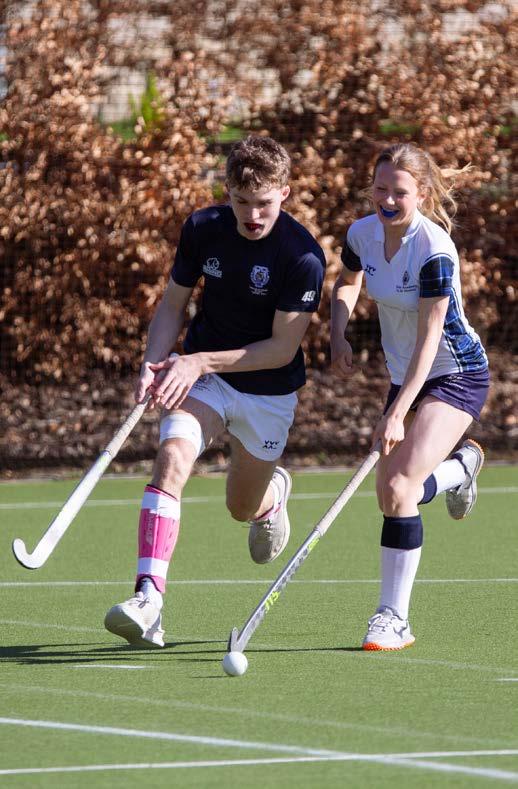
We are extremely grateful to everyone who has contributed this year, whether through individual giving, sponsorship or participation in fundraising activities. Looking ahead, we are excited about the opportunities the coming academic year will bring. Our main focus in 2026–27 will be the continued development of our sporting facilities, including plans for a new hockey astro on campus, as well as the wider sports development along Devon Road. These projects will ensure that our pupils continue to benefit from high-quality environments in which to train, compete and thrive.
With the ongoing support of our school community, we look forward to building on this year’s momentum and continuing to provide exceptional opportunities for every pupil at Dollar. If you would like to find out more or discuss how you can support the school, please contact me, the Fundraising and Sponsorship Manager, on: mcfarlane-re@dollaracademy.org.uk .
Rebecca McFarlane
RUNNING ON TOWARDS SEDBERGH A Farewell to Robin Pyper
After his spell as Deputy Rector, Robin Pyper leaves Dollar Academy to take up the post of Head of Sedbergh. It is a richly deserved appointment and one that reflects the calibre of leadership he has brought to the Academy during his time here.
In school leadership, some colleagues are defined by longevity, others by impact. Robin has been firmly in the latter category. From the outset, he combined a confident authority with a clear sense of purpose, and he quickly established himself as a trusted and valued member of the Senior Leadership Team.
At its core, Robin’s strength has lain in his ability to bring clarity, structure and consistency to complex areas of school life. His work on policy compliance has strengthened systems across the Academy, ensuring that high standards are not simply aspired to, but reliably embedded in practice. In parallel, his leadership of school development planning has helped to sharpen strategic thinking across the Academy and ensure that ambition is matched by coherent and deliverable priorities.
Alongside this, Robin has been a calm and steady presence in the day-to-day rhythm of school life. Those who know him well will recognise the slightly paradoxical combination that defines his working style: he is an ultrarunner outside school, yet he somehow manages to operate within school at a consistently high tempo. Meetings rarely seemed to conclude with less energy than they began. He has that rare ability to absorb detail without losing sight of the bigger picture and to contribute to discussions in a way that is both measured and decisive. Colleagues will also recognise his preference for action over noise.
Importantly, Robin has always understood that the best school leadership is ultimately about people. Beneath the policy work and strategic oversight lies a genuine commitment to pupils and staff alike. He has been generous with his time, thoughtful in his judgement, and consistent in his support of colleagues across the Academy. His unwavering belief in the potential of the young people in our care will remain my standout memory of him.
He leaves with the gratitude of the whole school community. Sedbergh is gaining a Head who will bring integrity, calm assurance and a strong moral compass to the role, alongside a clear-eyed understanding of how excellent schools function in practice.
We wish Robin and his family every success and happiness in the next chapter of their journey. He leaves Dollar in good heart, with the systems and thinking he has helped to shape continuing to serve the school well.
Ian Munro
EMILY HILL
Emily Hill is delighted to have joined the Chemistry Department in August. Brought up on a farm in Islandmagee, a small peninsula in Northern Ireland, she attended Larne Grammar School where she first discovered her enthusiasm for Chemistry. This interest led her to the University of St Andrews, where she earned a master’s degree in chemistry. A teaching module at Monifieth High School and an education-based dissertation during her university years confirmed her desire to pursue a career in teaching.
After completing her PGDE at the University of Edinburgh and spending a year teaching at Harris Academy in Dundee, Emily returned to Northern Ireland to teach at Belfast High School for two years. Now back in Scotland, she is thrilled to have joined Dollar Academy and the wider school community.
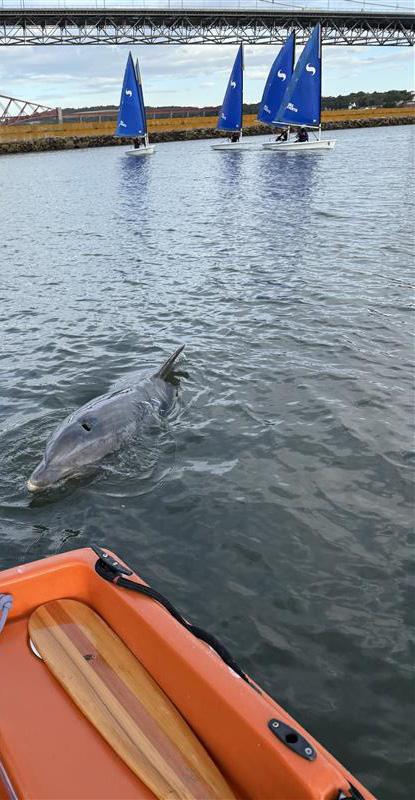
Outside the classroom, Emily loves being outdoors, and she especially enjoys sailing, cycling and hiking. A committed sailor, she continues to compete while bringing her coaching experience to the CCF’s Navy section. She has enjoyed becoming involved with the unit and looks forward to developing more sailing and powerboating opportunities for cadets. As a House Tutor in Heyworth House, Emily values getting to know the pupils and colleagues outside of the classroom.
Emily’s first year at Dollar Academy has been very special, and she is especially grateful to her department for their support as she has settled in. She feels lucky to be part of such a welcoming community and is excited for the years ahead.
OLIVIA BELL
Olivia is an enthusiastic member of the Physical Education Department. She is passionate about the subject and believes there is a balance to be found between performance sport and enjoying physical activity, and she has been impressed with how Dollar’s PE Department explores this balance. Having previously worked in schools in Edinburgh, she now thoroughly enjoys having the beautiful surroundings of the Ochils on her doorstep.
She played against Dollar Academy many times on the senior astro, and so the transition from opposing player to a member of the coaching staff at Dollar has been smooth sailing. It is a pleasure to be a part of the crew supporting such a high-achieving and enjoyable hockey programme. Some highlights of Olivia’s time at Dollar Academy so far have included coaching the Junior 2 hockey team, her role as a House Tutor in Heyworth and establishing the Talent Athlete Programme, as well as taking pupils to compete in the Scottish Schools Indoor Rowing Championships. She is particularly excited to continue developing rowing at Dollar, and she is looking at ways of giving pupils more opportunities to get out on the water. She is also delighted to be Acting Assistant Houseparent in McNabb & Tait for the summer term. She finds her role within the boarding community both rewarding and fulfilling, and she looks forward to the opportunities and challenges this new position will bring.
ARGYLL
One thing we can be sure of is that there is always something happening in Argyll House. At the time of writing, Easter has arrived, and we took time to look back upon all the memories accumulated over the last two terms. We ended our first term with an eventful Christmas dinner, full of laughter and energy. We exchanged Secret Santa presents and enjoyed Mr Johnston’s ill-fated attempt to light the Christmas pudding on fire! Traditional Scottish ceilidh dancing brought much joy to all during the Christmas dance season, building festive spirit ahead of the holidays.
The second term brought more exciting times. Cosy movie nights are a classic end-of-week activity that we all look forward to, and we also undertook a number of enjoyable and productive trips. One of the favourites was a trip with a focus on pottery painting and pancake eating; this showcased our girls’ artistic skills and creativity—not only in the painting, but also in the fine art of pancake topping. The Argyll girls also continued to proudly represent the House in a range of sports—not least hockey, rugby and football. We concluded the second term with a trip for all boarders to St
Andrews for a land yachting adventure. Although some of us were sceptical at first, this quickly proved great fun. Some of us were hit so hard by the powerful winds that we were flipped over, dumped ignominiously onto the beach; others couldn’t catch the wind at all and found themselves becalmed beside the dunes…but, in the end, everyone was sandy, smiling and starving. A Nando’s meal hit the spot, and then a lovely stroll through the busy, narrow streets of St Andrews was a fitting way to end this delightful outing.
The end of second term required that we said a fond farewell to the Johnstons. They have been a part of the Dollar boarding community for the last 11 years, and they are undoubtedly an integral part of the Argyll experience. Generations of Argyll girls will remember the kitchen talks, the book club meetings, firepit nights and the incredible boarders’ forfeits. The dedication and determination that the Johnstons have put into boarding is unimaginable. These moments, and so many more, shaped all our experiences at Dollar, making boarders’ transitions to House life smooth and easy, and our departure from Argyll an emotional
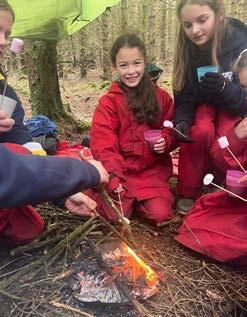
rollercoaster. Before the end of term, the whole House gathered around a firepit with s’mores and pizza night to say our farewells. All those who have lived in Argyll House (whether in years past or more recently) would like to wish the Johnstons all the best in the future.
As the days grow longer and the sun begins to shine again, we are very excited for the new term ahead. We will welcome the MacDonalds (who have been Assistant Houseparents of McNabb & Tait) as our new Houseparents, and we hope that they settle well into the busy but exciting life of Argyll. Brim-full with 20 teenage girls, Argyll House is a place of awesome challenge and responsibility; we look forward to welcoming them and we wish them luck in their new role.
As we write, the final exams loom and, for some of us, the end of our time at Dollar is just around the corner. Those in Form VI are especially looking forward to the boarders’ barbecue and all of the end-of-year celebrations that will herald our departure from this momentous and memorable period of our lives.
We would like to wish all those returning to Argyll—and those who will be arriving for the first time—in August, the very best of luck with the exciting times that lie ahead for them.
Liana P. (Head of House, Form VI) and Elene K. (Deputy Head of House, Form VI)
McNABB & TAIT
The end of the first term and the entirety of the second term have once again proven to be an outstanding period for McNabb & Tait, filled with memorable events, strong participation and a real sense of House spirit. From celebrations and trips to sporting success and community moments, it has been a time that truly reflects what makes McNabb & Tait such a special place to be.
We finished the first term in style with the Boarders’ Christmas Ceilidh, which stood out as one of the most enjoyable and memorable nights of the year. The entire House got involved, creating an atmosphere that was energetic and full of enthusiasm from beginning to end. All the practice that had gone into preparing for the ceilidh was clearly worthwhile, as everyone fully committed to the dancing; this made the evening feel like a genuine McNabb & Tait occasion. Before the ceilidh began, the House came together for Christmas dinner, which was equally special. It gave everyone the chance to relax and enjoy each other’s company, while the excellent food and thoughtful speeches captured the spirit of the occasion perfectly. It was a moment that brought everyone closer together and set the tone for the celebrations that followed later in the evening.
Adding to the festive spirit, the boys also produced their own House Turn, performing a parody of the well-known Christmas song ‘The Fairytale of New York’ as part of a friendly competition against Argyll
and Heyworth Houses. The level of creativity and effort that went into the performance was impressive and, although they did not take first place, their enthusiasm and commitment made them clear winners within McNabb & Tait itself. The entire evening, from the dinner through to the ceilidh and performances, was one that will be remembered fondly for years to come.
The second term has been equally busy; a wide range of trips have given everyone the opportunity to spend time together outside of the usual routines. One of the highlights was our visit to Top Golf, where the boys tested their skills and competed to achieve the highest scores. It was great to see everyone encourage each other—there was plenty of laughter at the less successful attempts and real celebration of the best shots. Attending an ice hockey match provided a fastpaced and exciting experience that everyone could enjoy together. The high energy of the game made it a particularly engaging event and offered a great way for the House to bond. Other trips have also been hugely successful. The trampoline park let everyone burn off energy, challenge each other and have fun in a relaxed environment, while bowling offered some surprisingly competitive games and plenty of humour. Shopping trips
provided more laid-back opportunities for the boys to unwind and pick up anything they needed. Altogether, these outings have played an important role in strengthening friendships and creating shared memories.
Alongside these social activities, it has been fantastic to see continued involvement across a wide range of sports and cocurricular opportunities. Many boys have represented McNabb & Tait in teams such as the football 1st XI, the rugby 1st XV, the school’s Ultimate (frisbee) team and our basketball team, demonstrating commitment and teamwork while enjoying the chance to compete. One particularly notable achievement has been a member of the House representing at the U18 Six Nations level; this accomplishment made us all extremely proud. Beyond sport, the boys have also stayed engaged in activities such as the Dungeons and Dragons Club, showing that there is something for everyone and that participation remains strong in all areas of House life.
This term also brings a note of farewell, as Mr and Mrs MacDonald come to the end of their time as Deputy Houseparents. This provides an important opportunity to recognise and thank them for the significant contribution they have made to McNabb & Tait. They
have dedicated a great deal of time and effort to organising memorable activities (including escape rooms and axe throwing!). These were powerful highlights of the year for many boys. Much of the MacDonalds’ day-today work has taken place behind the scenes. They help to ensure that everything runs smoothly, that events are enjoyable and well organised, that the boys are always well supported. Their presence has been constant and reliable, and their willingness to help has not gone unnoticed. They have made a lasting impact on the House community; their absence will be felt. And, not to be forgotten, Mr Bo (the MacDonalds’ dog) has also been a much-loved feature of McNabb & Tait life, offering adorable joy and alwaysreliable good company.
There is great excitement about what lies ahead in our summer term. While many boys will be focusing on exams and working hard to finish the academic year successfully, there is also plenty to look forward to in terms of trips, sporting fixtures and House activities. The motivation and enthusiasm within McNabb & Tait remain high, and it is clear that everyone is eager to continue building on the positive experiences of the past two terms.
Overall, the year so far has been a great success for McNabb & Tait, marked by strong participation, memorable events and a genuine sense of community. With plenty more still to come, the House is well set to continue this momentum into the final term, making it another period filled with achievement, enjoyment and lasting memories.
Hal S. (Head of House), Alex M. (Deputy Head of House) and
Christian S.-W. (Deputy
Head of House, all Form VI)
HEYWORTH
Life in Heyworth this term has been just as full and unforgettable as ever, featuring moments that will stay with us long after this academic session ends. As ever, we have struck a balance between hard work and fun, buoyed by an abundance of House spirit and lots of laughter.
The festive season was undoubtedly a highlight. The Christmas dances and the muchanticipated Boarders’ Christmas Dinner and Dance provoked intense excitement throughout the House. The Boarders’ Dance brought everyone together; each House performed their own House Turn. This year, Heyworth gave it our all and it paid off: we were thrilled to win. This was a very proud moment for the whole House—one to remember.
The post-Christmas return meant one thing for many of us: prelims. That was a stressful and demanding time. But it also served as motivation for what, at the time of writing, lies ahead for us. Despite the pressure, everyone supported one another, demonstrating the real strength of our Heyworth community.
A counterweight to the academics, fun has not been in short supply. We enjoyed a combined House trip with McNabb & Tait to the bowling alley, which brought out everyone’s competitive side, and a night at the ice hockey. Although Glasgow didn’t achieve the result we hoped for, it was still a great experience—something a bit different.
Back in the House, we’ve had some brilliant evenings together. Glowstick Night, organised by Mrs Emma Poole, was a particular favourite, full of energy and laughter; we also enjoyed games of hide and seek, a treasure hunt and, as always, plenty of snacks. We were treated to a relaxing spa night thanks to Nicola, which gave everyone a chance to unwind and take a break from busy school life. There have also been the countless small pleasures that make life special: from regular Pilates trips to spending time chatting together in the evenings. Our Form VI celebrated Burns Night, a night full of great speeches and good food, and we marked St Patrick’s Day with Irish snacks kindly brought in by Miss Leanne Scott. Little touches like these make life in Heyworth feel like a
home away from home.
Sadly, this term we also say a temporary goodbye to Rebekah McNie, who is heading off on maternity leave. She has been a very important part of Heyworth life, and she will be greatly missed by everyone in the house. But we wish her and baby, Amelia Rose, all the very best, and we all look forward to seeing her again soon!
As I write, there is a lot to look forward to in the summer term—not least, some warmer weather. At the same time, we are all aware of the hard work still to be done, particularly for Form VI. University offers, for many, depend upon the grades we achieve. With the constant support from everyone in the house, however, there is no doubt that we will get through it together. Once again, this term has shown that Heyworth is so much more than just a boarding house; it is a community full of encouragement and friendship that forges unforgettable memories.
Michelle A. (Head of House, Form VI)
WORLD BOOK DAY: 'A Splash of a Story'
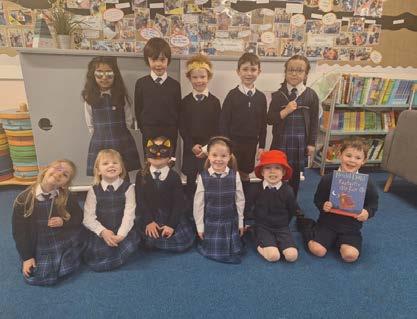
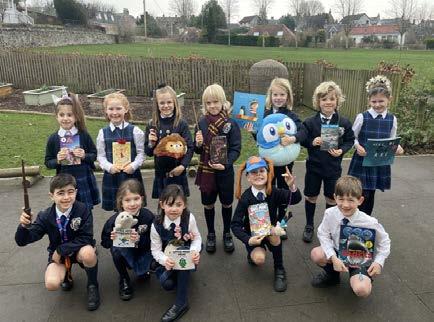
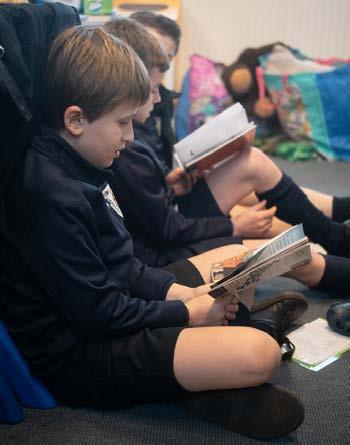
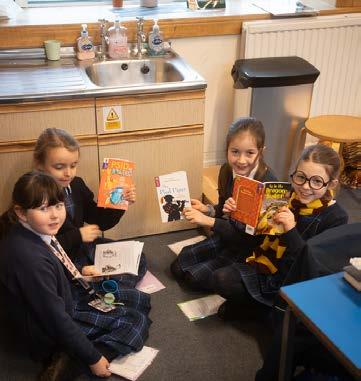
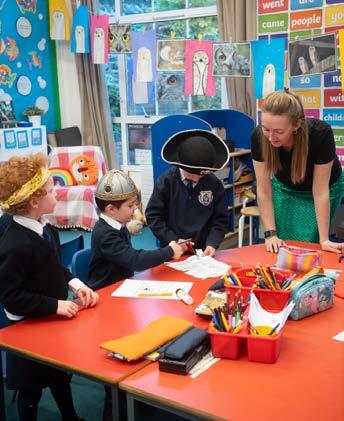
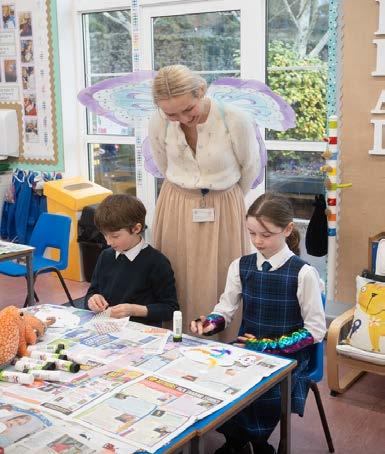
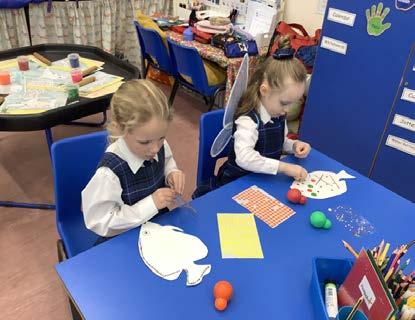
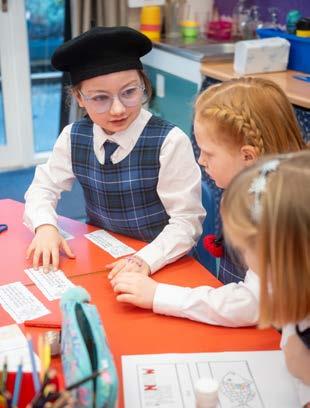
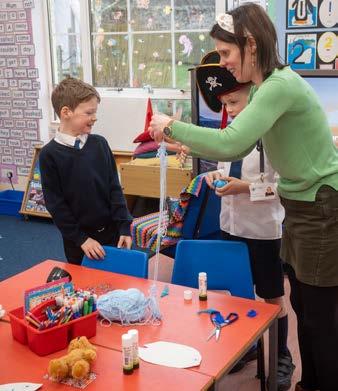
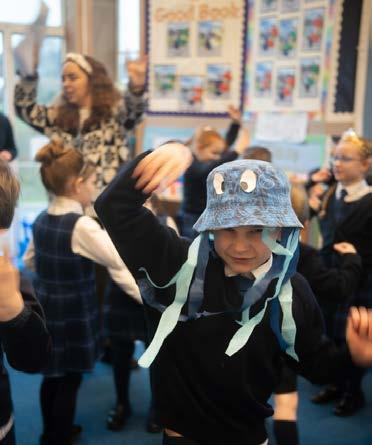
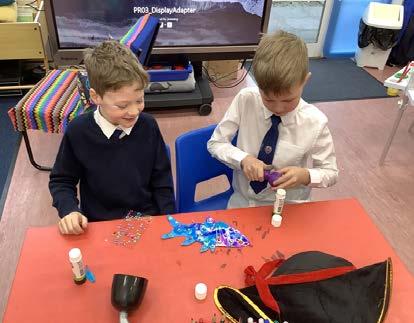
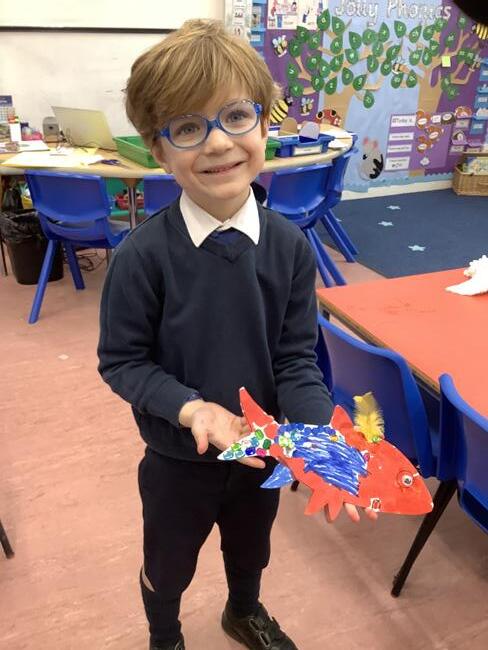
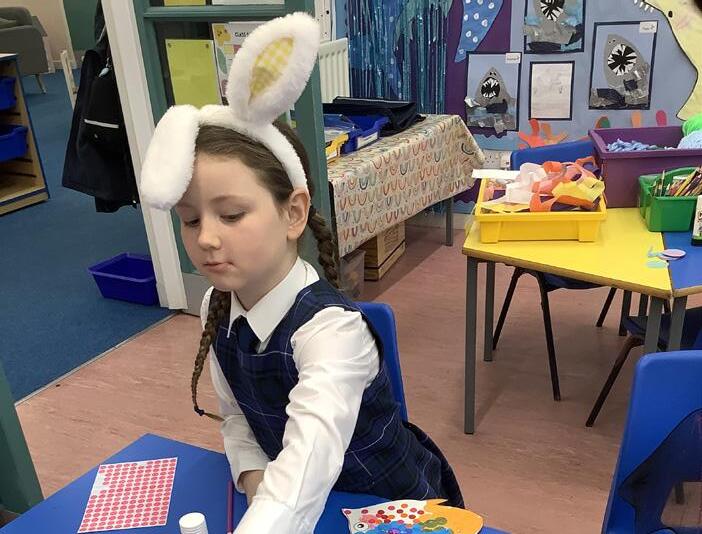
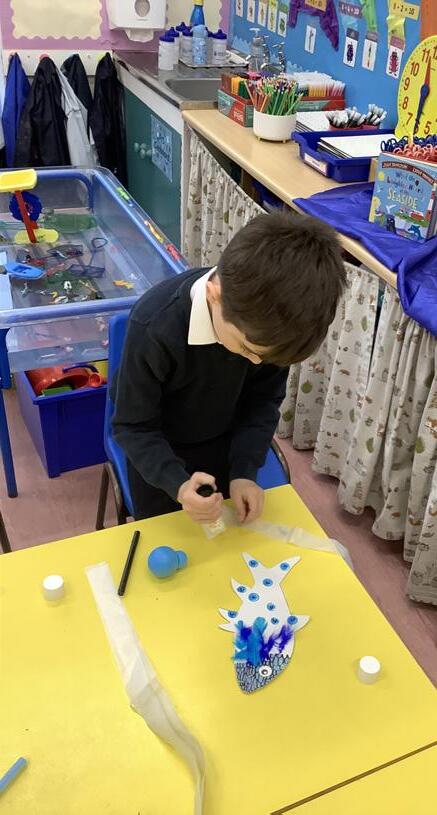
World Book Day this year made a wonderful splash, as pupils across the Prep School celebrated the theme ‘A Splash of a Story’. Children arrived dressed in an array of imaginative and inventive costumes, all inspired by their favourite fantasy, fiction and non-fiction books. From magical characters to sea creatures and adventurous explorers, the creativity on display brought our favourite stories to life.
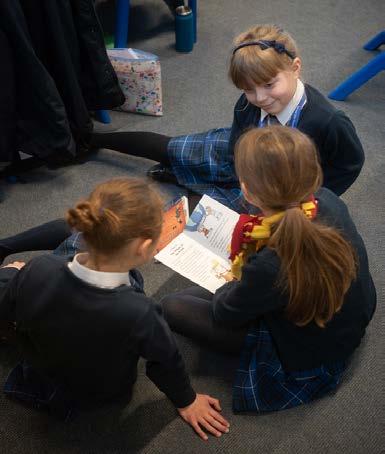
The day began with a whole Prep and Junior School assembly, led by the English Ambassadors from the Senior School. They shared their favourite books and spoke passionately about the importance of reading, inspiring younger pupils to discover new stories and develop a love of books.
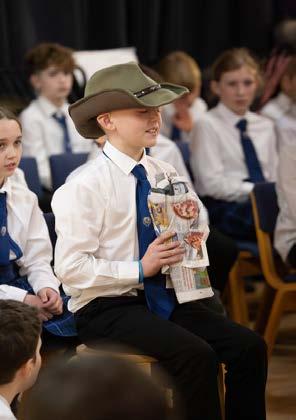
One of the highlights of the morning was a lively game of ‘The Masked Reader’. Pupils listened carefully as mysterious, voice-altered readings were performed by Miss Heather Holloway, Robert L. (Junior 1), and Mrs Louise Timney. There was great excitement as everyone tried to work out who was behind the mask…
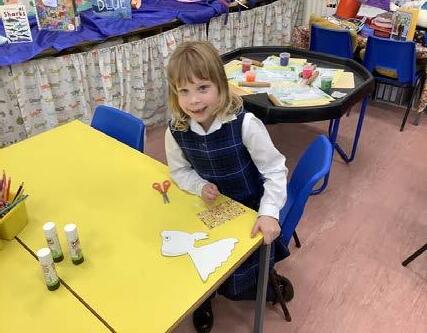
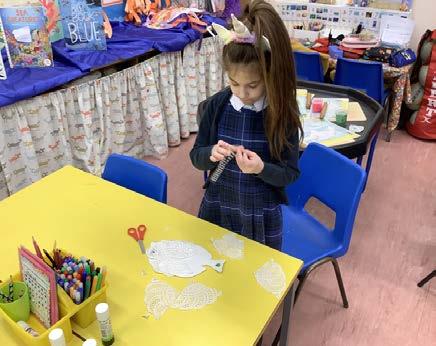
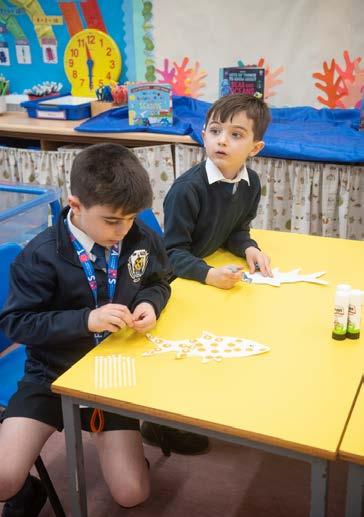
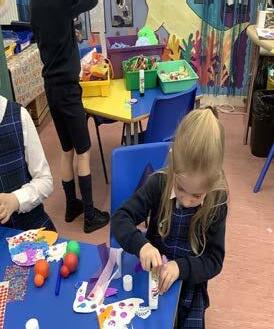
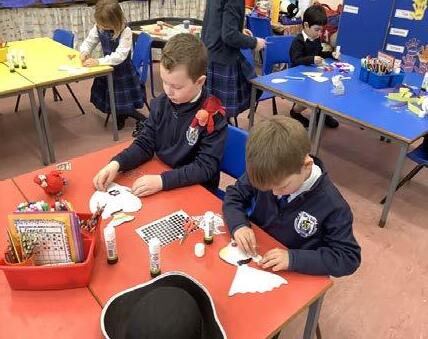
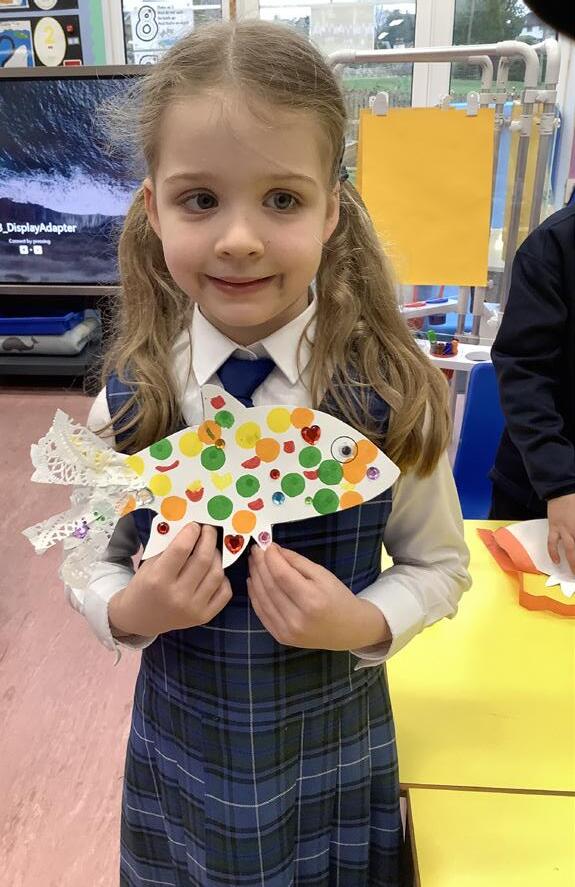
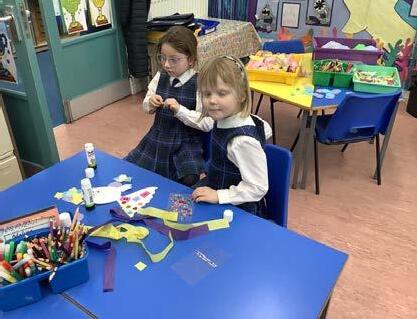
Throughout the day, children took part in a carousel of engaging activities across the Prep 1, 2, and 3 classrooms. They created fantastic fish inspired by Tiddler; they performed freeze-frame drama based on The Snail and the Whale; they read The Rainbow Fish and made their own unique rainbow fish and explored story sequencing. Pupils also enjoyed a sea-themed dance session inspired by reading Commotion in the Ocean, when they listened to sea shanties and even designed their own pirate boats.
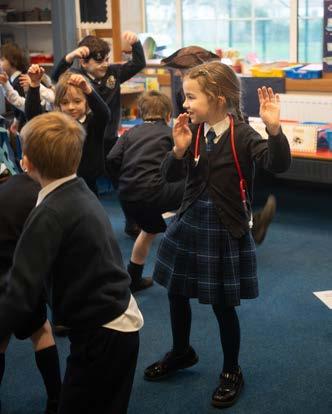
The celebrations ended on a high note: the Prep 1, 2 and 3 pupils enjoyed a dance in the playground to Under the Sea, bringing everyone together in a happy finale.
It was a memorable day full of creativity, laughter and a shared love of reading. World Book Day reminded us of the magic of stories and how they can transport us to new and exciting worlds.
Heather Holloway
OUTDOOR LEARNING IN THE JUNIOR SCHOOL:
The Wildlife Welcome Here Project
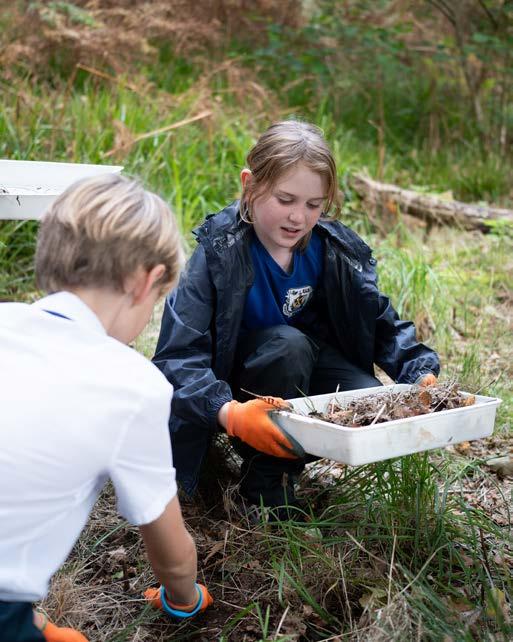
This year Junior 1 pupils have been working towards their Wild Places Guardian awards, a nationally recognised environmental award administered by the John Muir Trust. The four strands of the award are Discover, Explore, Conserve and Share. The award links with the United Nation’s Sustainable Development Goals, specifically SDG 15 (Life on Land) which aims to protect, restore and promote the sustainable use of terrestrial ecosystems and SDG 13 (Climate Action) which focuses on taking urgent action to combat climate change and its impacts.
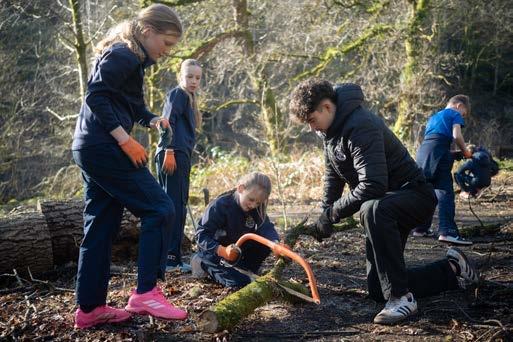
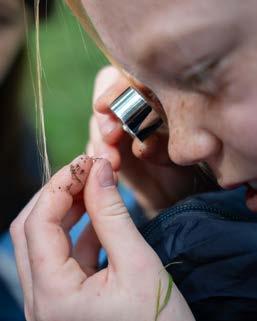
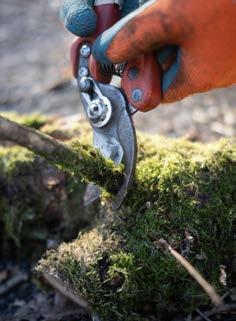
At the beginning of the first term, our pupils learned about the diversity of nature and the importance of insects and plant life in maintaining a healthy ecosystem. They took part in activities such as invertebrate, tree and bird identification and conservation tasks like creating a dead hedge. Expertise is provided by our partners at the National Trust for Scotland (Dollar Glen), the Conservation Volunteers (Mill Green) and the Dollar Community Development Trust (Harviestoun Community Garden).
In the second term (and, as we write, continuing into the third), our pupils have researched and explored specific species in and around Dollar. This has included hedgehogs and brown long-eared bats, as well as native tree and flower species. Pupils have also learned about the threats these species face.
Throughout the outdoor learning sessions, pupils are given opportunities to discover and explore nearby green spaces, and they are encouraged to share these experiences with others. Feedback from pupils involved in the project so far has been positive: they have enjoyed learning about and interacting with nature. As I write in March, we are moving into the warmer months, and we have been delighted to see so much biodiversity coming to life in the grounds of the school and in Dollar Glen.
Eliot Sedman
BENMORE
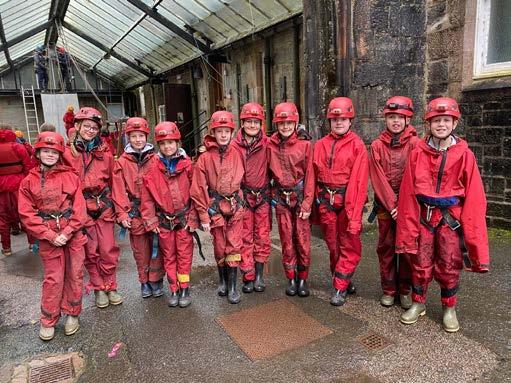
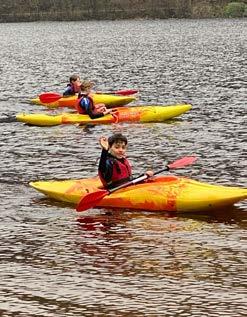
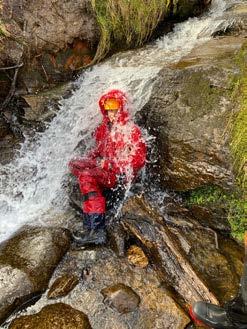
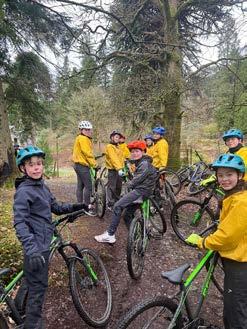
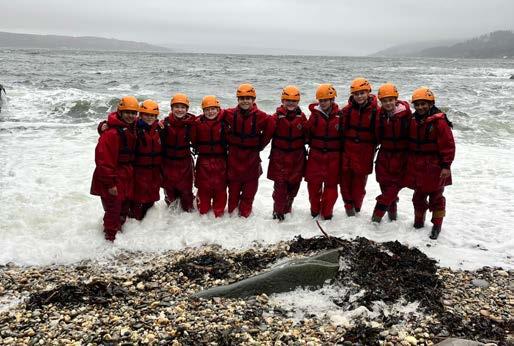
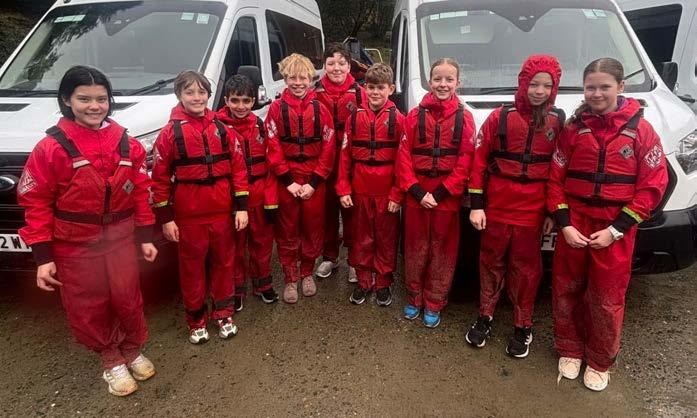
Junior 2 pupils travelled to the Cowal Peninsula for their eagerly anticipated residential to Benmore from 9–13 March 2026. The wet and windy weather was no deterrent, and pupils embraced every challenge to make the most of a fantastic week away. Pupils created newspaper articles on their return—the extracts below offer a snapshot of their experiences.
Junior 2 Residential Reporters: Ivy P., Lucy H. & Angus L.
On Monday 9 March the Junior 2 pupils of Dollar Academy made their way to Benmore Activity Centre for a week full of fun outdoor adventures.
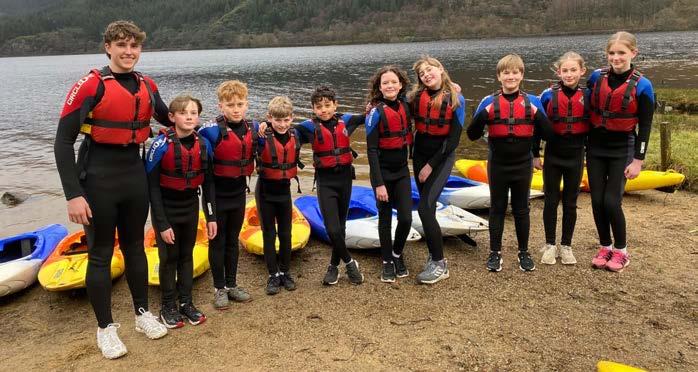
Group Four headed straight out to Loch Eck to go canoeing on the first morning. It was a real team effort because it was so cold and rainy; they were very glad to be given hot juice when they reached the other side!
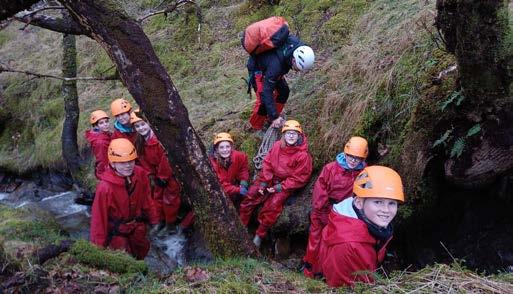
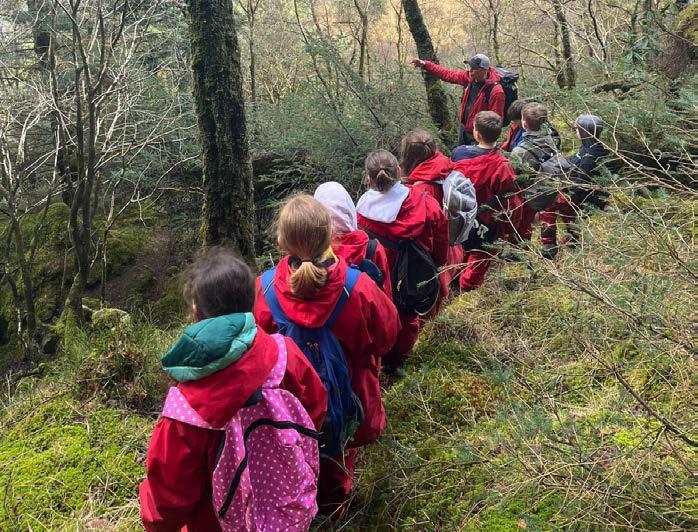
The next day, the group enjoyed a forest walk. To get there, they had to hike up a miniature gorge, so they were able to put new skills to the test, making dens and playing rounds of camouflage. In the afternoon, they braved the high ropes course and faced the epic ‘Leap of Faith’.
The final activity day was jam-packed with mountain biking, caving and the final evening disco—a brilliant and slightly exhausting day!
Before they knew it, it was Friday and time to tidy their dorms, load their luggage, say their thank yous and begin the journey back to school. Group Four and all the J2s thoroughly enjoyed their week and will treasure their memories of Benmore forever.
Junior 2 Residential Reporters:
Luisa C.-T.
& Claudia B.
On 9 March 2026, Junior 2 pupils from Dollar Academy arrived at Benmore with lots of exciting activities ahead of them. After meeting their instructors, the groups took their suitcases and bedding to their dorms to make their beds and unpack—an easier job for some than for others!
During their first exploration of Benmore Botanic Gardens, pupils got to walk through streams. They learned from their instructor that every tree in the garden was named. They also learned that you can eat the little yellow flowers on a gorse bush. When Group Seven went climbing and abseiling, they climbed up to a quarry that provided some of the rock that was used to build Benmore House.
On Wednesday, the morning activity was caving. Afterwards, some of Group Seven said there had been too many spider eggs, but others loved it. The afternoon activity was shore scrambling, and some people jumped into the freezing cold water. They came back completely soaked, but luckily had time to change before ‘cake o’clock’. When the group went gorge walking, they climbed up a waterfall which had steps at the side, and they went through another waterfall to get to the top. That afternoon, the group also went indoor climbing—which they were glad to find was much a drier pursuit.
After an amazing week, the J2s returned to Dollar but they will always remember their super Benmore trip.
JUNIOR SCIENCE FAIR 2026
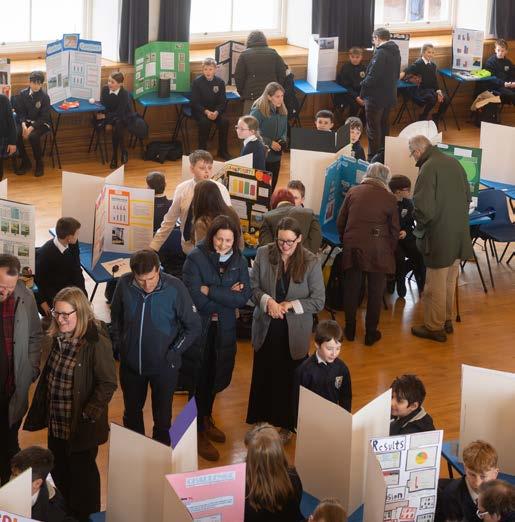
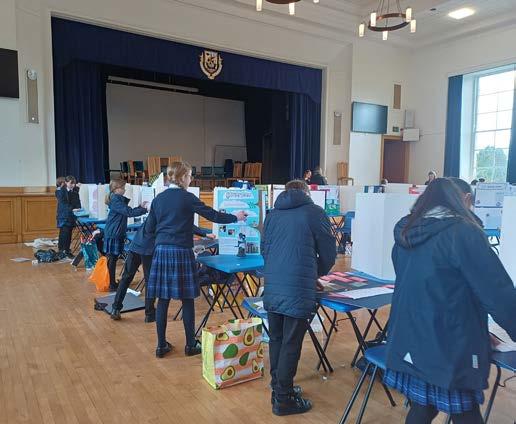
Preparation for the annual Junior Science Fair here at Dollar Academy begins in August. I am sure it would surprise most people to learn just how early our journey starts—but when you wander through the Assembly Hall during the Junior Science Fair and witness firsthand the sea of colour and activity in that space, it will become apparent that an event of such magnitude could not simply happen by accident. It is an awesome thing to be a part of.
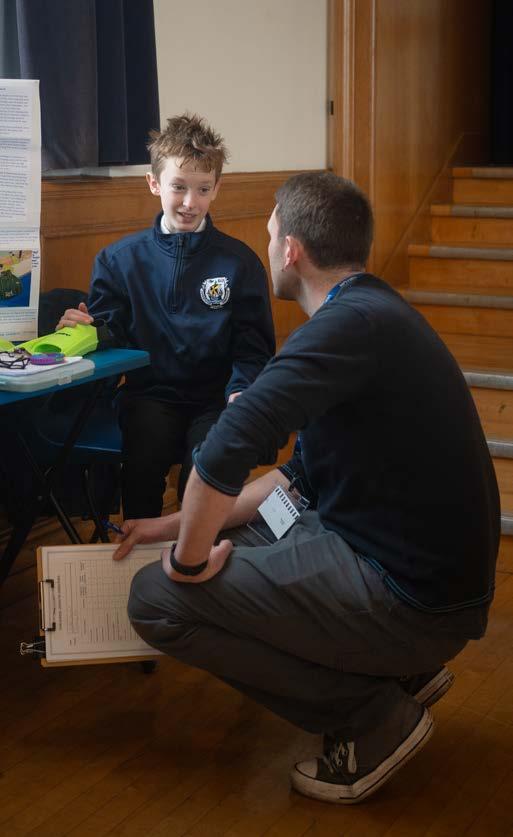
Our pupils begin their Science swap rotation by exploring the scientific method, forming hypotheses and gathering reliable results. And then the real work commences. Over the months that follow, ideas grow, experiments are refined and anticipation builds for the big day. There is something for everyone. Even pupils who do not see themselves as natural scientists find the chance to be creative or develop digital and presentation skills. Choosing only one winner, when so many produce such fine work, is never easy. This year, our champion was Claudia B., with Christian S.-V. close behind.
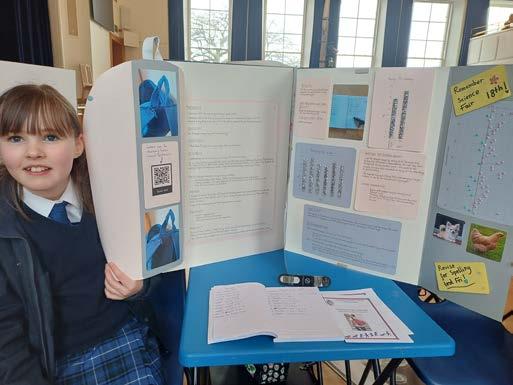
Winner: Claudia B.
Claudia’s project asked a simple but important question: Are J2 School Bags Too Heavy? The idea came when one of the straps on her own bag tore. She began to wonder whether the weight she was carrying had caused it, and whether her classmates might be facing the same issue.
Her experiment was practical and thoughtful. After buying a disposable camera and a digital scale, she planned all the steps. Her hypothesis was that the bags would be too heavy. She measured the weight of her peers’ bags, calling out each reading while her friend Isla carefully recorded the results. Working at home and in the classroom, she created her presentation board using the measurements, photographs and graphs she had prepared, drawing on ideas shared by classmates as she worked.
Her findings were clear. Eighty percent of the bags she weighed were overweight. Her hypothesis was correct, and her project showed real purpose, curiosity and care for her year group.
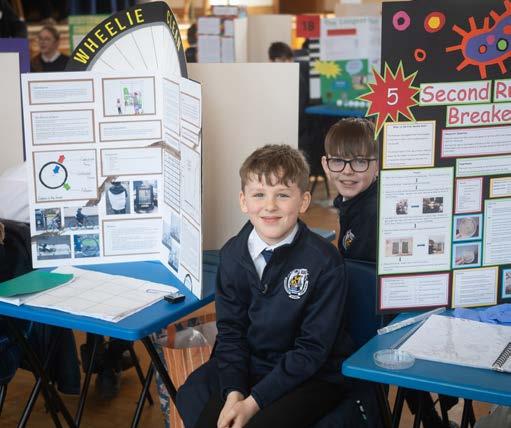
Runner-up: Christian S.-V.
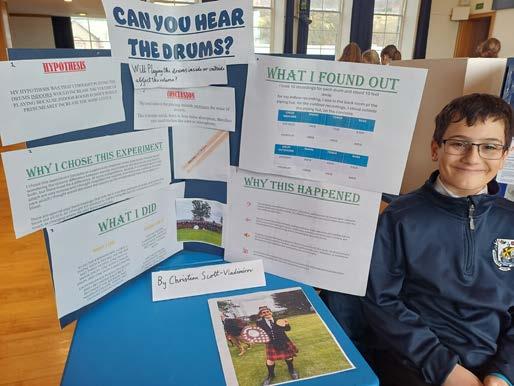
Christian explored something relevant to what he experiences every week as a dedicated drummer in the Dollar Academy Pipe Band: Can You Hear the Drums? More specifically, he sought to find out whether drumming sounds louder indoors or outdoors. His hypothesis was that indoor spaces, with their echoes, would increase the volume.
To test this, he used a phone with a decibel meter and recorded three drummers playing snare, tenor and bass drums. Each played ten beats indoors and outdoors while he recorded both the maximum and average volume from a fixed distance.
His results surprised him. All three drums produced louder readings outdoors. Christian discovered that, when indoors, sound waves bounce off surfaces, interfere with one another and are partly absorbed by soft furnishings. When outdoors, sound travels directly to the microphone with less interruption, leading to higher readings. His conclusion was that the drums themselves do not become louder, but the environment changes how we hear them.
Everyone who took part in the 2026 Junior Science Fair is owed a very heartfelt congratulations, and every pupil should feel proud of their development. They showed themselves to be capable scientists and well-rounded learners.
Mike McComiskie and Lauren Murphy
JUNIOR SCHOOL BURNS RECITAL COMPETITION
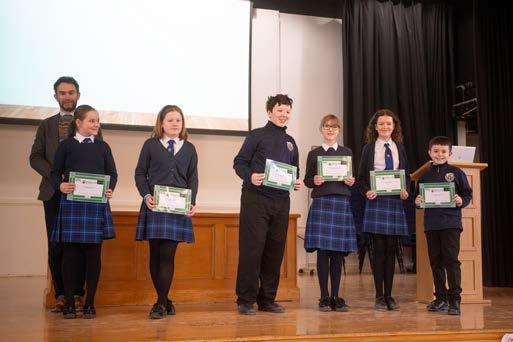
The Junior School celebrated Scotland’s national bard with a vibrant Burns Recital Competition. Pupils across the Junior School learned an impressive range of Scots poetry for their class recitals. Our class winners were then invited to perform again in the annual final held in the Assembly Hall. The standard throughout was exceptionally high, making the judges’ decisions particularly challenging.
Among the finalists, each performer brought something distinctive to the stage. Lara C. (Junior 2) delivered ‘Scots Wha Hae’ with passion, bringing intensity and conviction to the lines. Tom W. (Junior 2) enchanted the audience with his humorous and well characterised performance of ‘The Twa Dugs’, demonstrating his natural flair for storytelling. Meanwhile, Norah T. (Junior 2), this year’s overall winner, captivated listeners with the depth and emotion she brought to ‘Despondency—An Ode’, offering a sensitive and sophisticated interpretation well beyond her years. Together, these finalists showcased the rich talent and expressive range of our young performers.
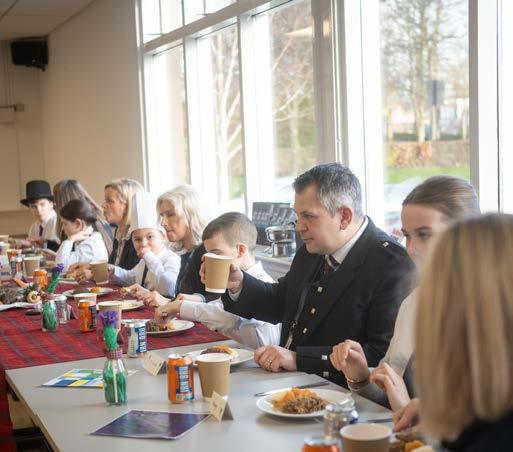
Following the competition, pupils enjoyed a hearty Burns Supper of haggis, neeps and tatties, washed down, of course, with Irn Bru. Our winning performers provided wonderful entertainment during the event, and we were delighted to welcome back Maya W., last year’s overall winner. Now in Form I, she returned to the stage with great assurance, performing ‘Willie Wastle’ to the enjoyment of pupils and staff alike.
Charlie W. (Junior 1) performed the ‘Address to a Haggis’ alongside Mrs Elaine Walls, president of the Dollar Burns Club. This was delivered with great energy and expressiveness, and Mr Matt Wilson received rapturous applause as he piped in the haggis. Every one of the pupils and staff involved in making this year’s celebration such a memorable success is deserving of congratulations and thanks.
Sophie Petrie
EDT UPDATE
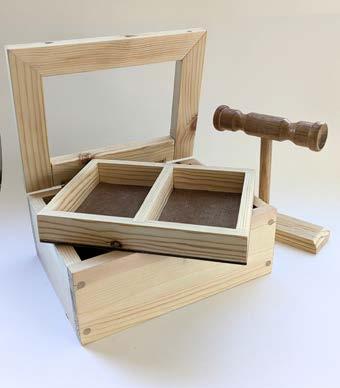
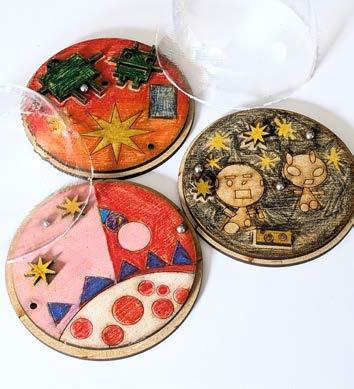
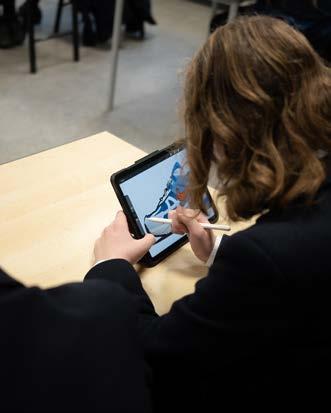
Pupils in the Engineering, Design and Technology Department have, as ever, been producing a wild and wonderful array of work. This session has seen much use of Computer Aided Design (CAD) and Manufacture (CAM), alongside more traditional skills.
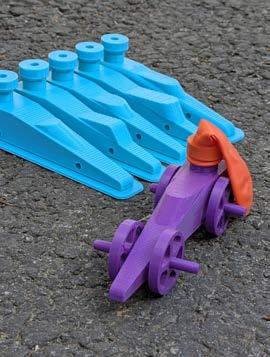
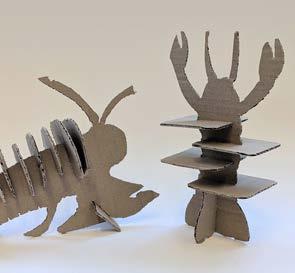
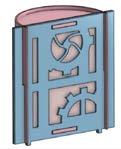
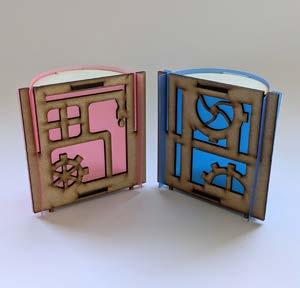
Our Prep 5 pupils have been letting their creativity loose with their designs for space-themed ball bearing games; this activity required them to learn new software in order to draw and create the files used to laser-cut their final products. Form I pupils designed, developed and refined a solution for a steampunkinspired lamp. They each created a CAD model of their final proposal before manufacturing it, also using the laser cutter. Our Form II cohort were tasked with designing a balloon-powered car on CAD; the results were an array of 3D-printed models, each trying to gain the accolade of being named ‘Most Aerodynamic’, ‘Most Attractive’ or simply ‘The Fastest’! They also created cardboard prototypes to test ideas for an animal-themed coaster holder, in response to a brief to design a promotional item for the World Wildlife Fund. A requirement for this product was that it had to be capable of being mass produced using CAD/CAM. Elsewhere, Form III Graphic
Communication pupils learned about creating vector graphics using Adobe software to produce an infographic; they had to design a visual method of communicating facts and statistics.
The use of graphics was also in evidence in ‘Creative Thinking’, where Cara C. (Form VI) presented a visual for an art installation that highlighted the impact of palm oil use on an orangutan population. This was the outcome for her ‘Campaign for Kindness’ project. And, in a complete change of media, the Practical Woodworking class showcased their skills in joining and turning timber in their final projects.
Claire Brownbridge
Turtle speeds
Leatherback
PSE UPDATE
At Dollar Academy we endeavour to provide a relevant and impactful PSE programme that supports our young people through the range of challenges they face today. The overview below represents only a fraction of what pupils experience each year, but I hope it offers a useful insight into their learning.
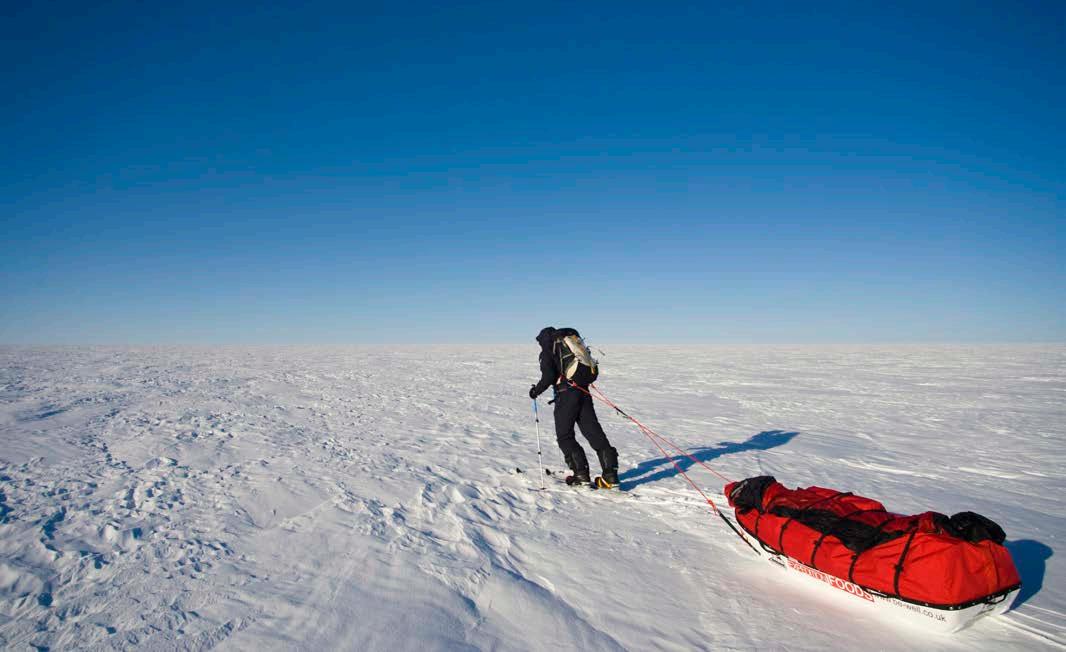
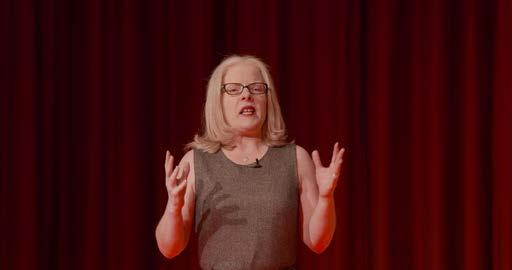
We have been very privileged over the last year to host several excellent and inspiring speakers. Pupils in Forms V and VI received a presentation from polar explorer Alex Hibbert, who shared his experiences in the Arctic, highlighting the importance of resilience, adaptability and empathy in the face of isolation and adversity. Another highlight was Emma Cole from Positive Voice, whose story
of living with HIV helped Form IV pupils to understand the challenges of the illness, while dispelling the myths surrounding the disease and those who live with it.
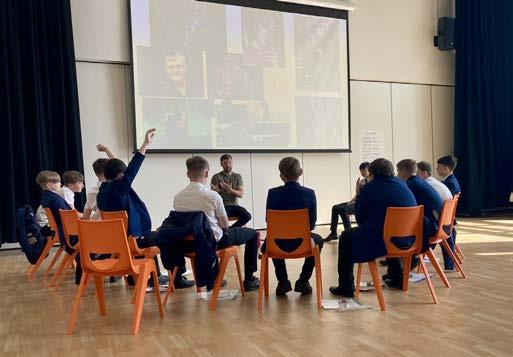
Phil White from Progressive Masculinity spoke with pupils from Forms II–V, offering a positive and inclusive vision of masculinity in an age when so much public
discussion on this issue risks being dominated by harmful and regressive viewpoints. His message highlighted the importance of emotional courage, compassion and honesty in how we treat others and ourselves. And, as I write, our most recent talk came from Patrick Foster, who shared his lessons on the dangers of gambling and the rigours of
Emma Cole
TEDx Guildford
addiction. Form III pupils were captivated by his story. They left that presentation, far better informed about how to avoid addiction—particularly at a time when gambling elements are increasingly present in entertainment, advertising and social media.
Alongside this, several long-term partners have continued to offer invaluable contributions to the PSE programme through their voluntary work and specialist
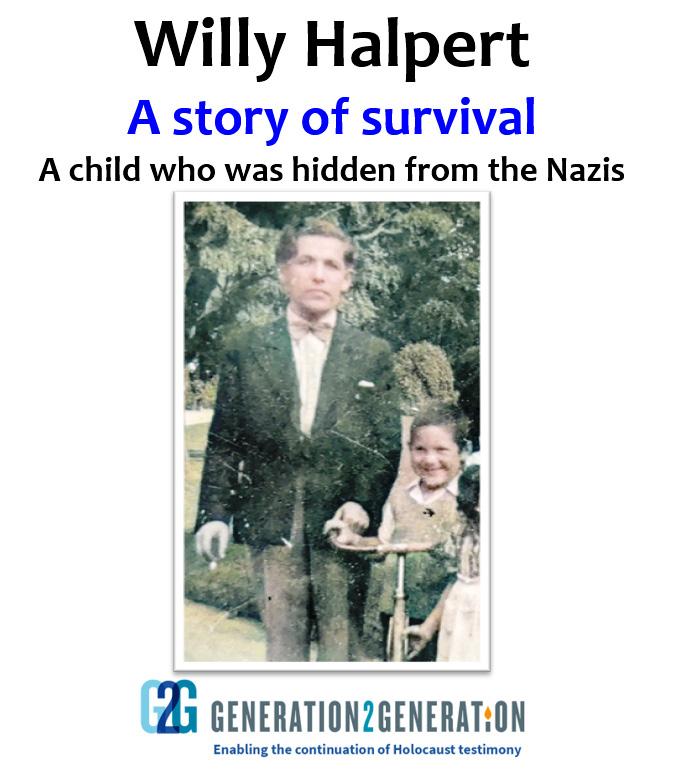
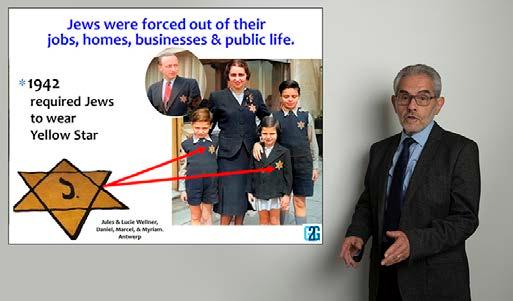
tutorials. To commemorate Holocaust Memorial Day, volunteers from Generation 2 Generation (G2G) shared the experiences of their family members under Nazi occupation, emphasising to pupils the importance of compassion and
hope in the face of seemingly overwhelming evil.
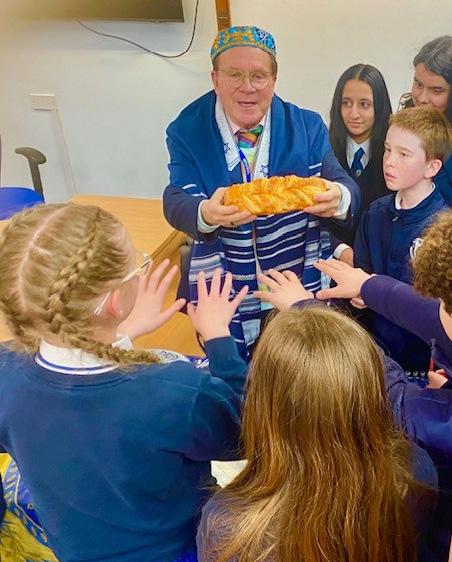
Form I pupils have continued to receive visitors from Interfaith Edinburgh; each speaker explained to pupils what makes faith so important to them. This certainly helps to improve our awareness of the various belief systems
represented across modern Scotland. Form VI pupils visited Stirling’s Macrobert Arts Centre over the winter to watch Safe Drive Stay Alive, as they do every year. This powerful presentation focuses on the hazards and repercussions of dangerous driving. This is always a hard-hitting and influential show, designed to help young people (and those they share a car with) to understand better the weighty responsibilities they shoulder when behind the wheel of a car. Lastly, in Forms I–III PSE, we have continued to welcome volunteers from Clackmannanshire Women’s Aid and Forth Valley Rape Crisis, whose engaging, honest and compelling lessons on healthy relationships continue to form a core pillar of our offering.
As part of our weekly PSE lessons, we have endeavoured to remain on the front line of emerging issues in pastoral care. In response to the many pressures of growing up online, we have continued to expand our range of lessons on online wellbeing, updating content to reflect current pressures. Furthermore, as the pressures of exams and achievement seem more persistent each year, we have increased the number of study skills lessons throughout Forms I– III, doing what we can to ensure that all pupils have a range of strategies at hand to prepare for assessments. Finally, in response to changing definitions of bullying, we have updated and refined lessons on positive behaviour and friendship, ensuring Dollar remains a happy, kind and inspiring place to live and learn.
Craig Wilson
Professor Joe Goldblatt, Ambassador for Interfaith Relations, Edinburgh Interfaith Association
WORLD BOOK DAY AND THE NATIONAL YEAR OF READING
The whole of the Dollar Academy community is joining together to celebrate the National Year of Reading: an important government and National Literacy Trust initiative to help reignite a national love of reading.
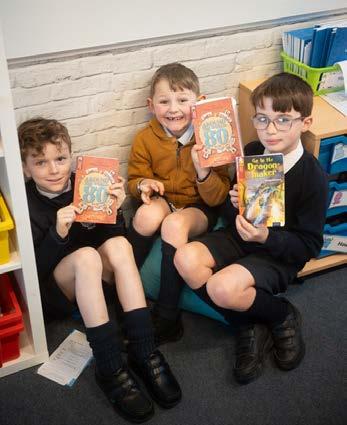
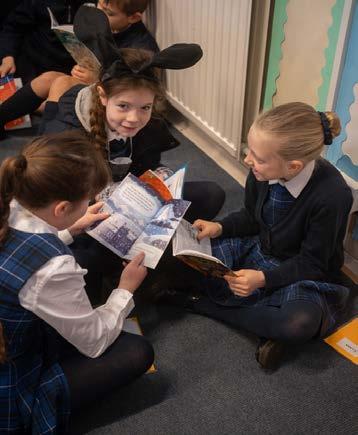
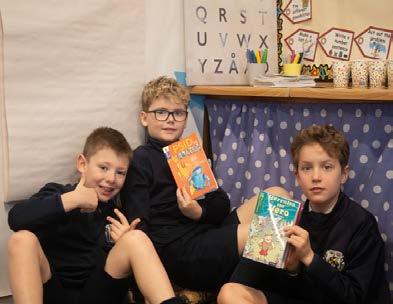
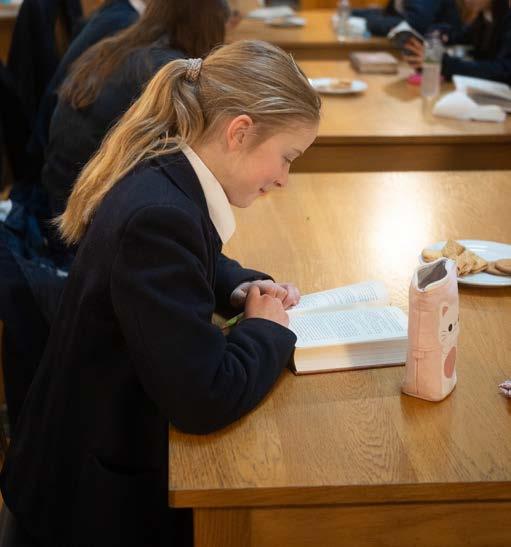
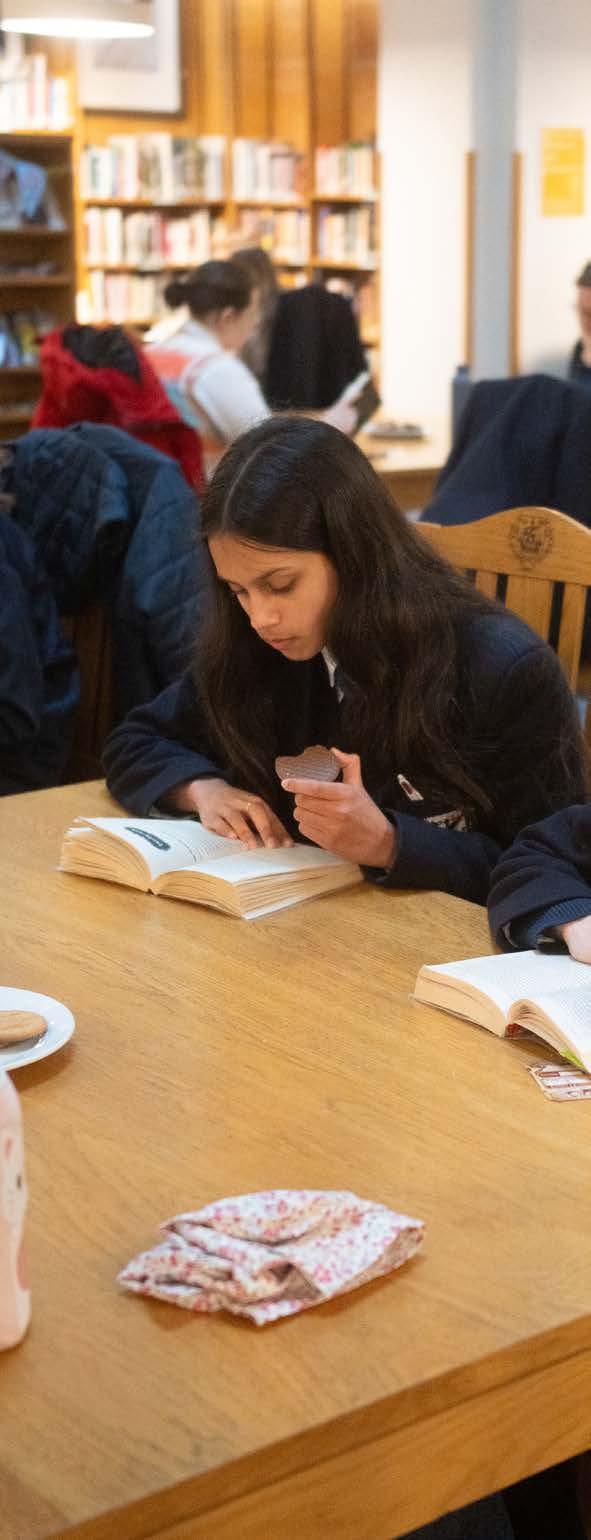
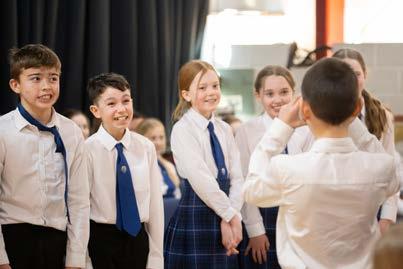
World Book Day on 5 March provided the perfect opportunity to introduce pupils to the initiative. The day began with a book-themed assembly and a game of ‘The Masked Reader’, led by our English Ambassadors: Calum M., Ele K., Naomi G.-B. (all Form VI) and Tigerlily S. (Form IV). Throughout the day, all pupils in Form I–III read books of their own choice in every lesson and at lunchtime. Staff and pupils switched off their devices, and we all enjoyed reading in the ‘Library Unplugged’, a technology-free space.
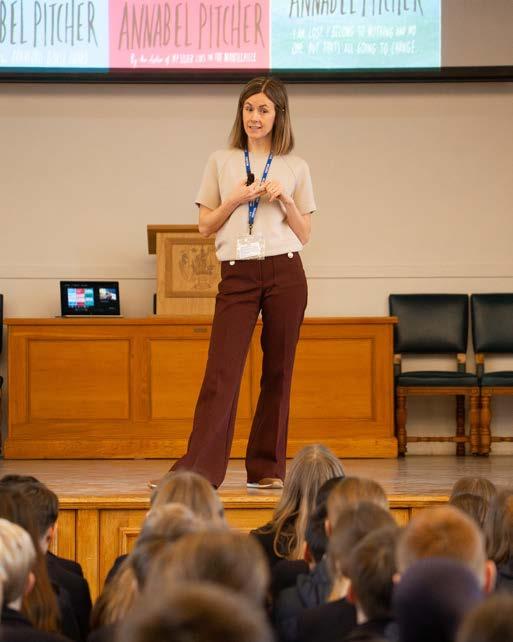
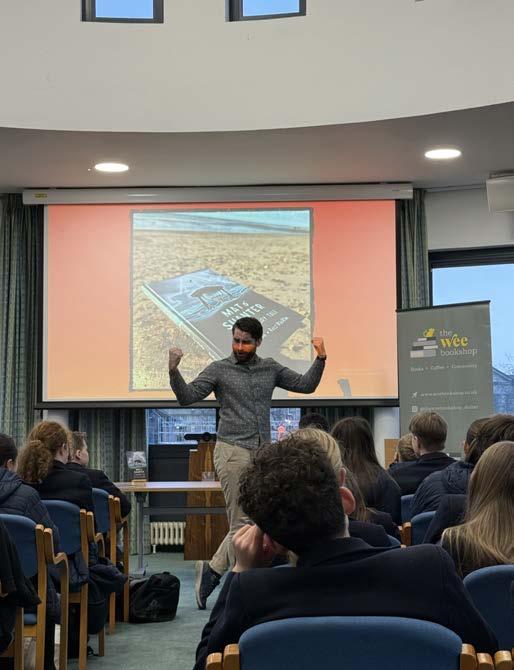
We have also recently welcomed two authors to the school: the poet Simon Lamb and author Annabel Pitcher. Both delivered memorable talks about their writing and journeys to becoming writers.
The benefits of reading for pleasure are considerable and have the potential to have a hugely positive impact on our pupils’ lives. We have many more exciting events planned for the National Year of Reading 2026!
Kathryn Rambaut
Question: Why do you love reading?
Pupil Answers:
‘Reading is a way to escape the stresses of life, whilst further educating myself and broadening my vocabulary.’
-Katie S. (Form IV)
‘I like reading because it is a good thing to do when I am bored. It’s nice to read about characters who are like me and how they interact with other people in their fictional world.’ -Niamh D. (Form IV)
‘It brings like-minded people together.’ -Georgie B. (Form III)
‘Reading is actually good, if you get the right book.’ -Jessica K. (Form III)
‘Reading is good because when you find a book you like, it’s like a TV in your mind.’ -Lara R. (Form III)
‘Being able to escape our world and live in another. Reading allows us to live a thousand lives in one.’ -Abi C. (Form III)
‘I like reading because it is a way to understand the world and our society. Whether it is fantasy, dystopian, horror or sci-fi, books can help readers reflect on themselves and the world from a different perspective.’ -Sofia H.-S. (Form III)
‘I like reading because it allows us to escape the pressures of exams. It also helps me to learn more while relaxing. -Alana B. (Form III)
‘What I like about reading is that it can take you to a whole new world for a while, away from reality.’ -Lucy H. (Junior 2)
‘BOOKTOK’:
The Metamorphosis of Reading Culture
TikTok, the shortform video platform, has been proven to have negative effects on our mental health and our cognitive ability in several ways. Concentration spans have shrunk dramatically. There has been an increase in problems linked to self-image. It has promoted conformity and the proliferation of fake news. The very idea of reading a book has become denormalised. It requires concentration to sit and read—something that has become much harder for young people. The people who read daily are now the unusual ones.
However, there is another side of TikTok: one that actively promotes and shares novels and individuals’ own unique experiences with them. The rise of creators such as ChrisKindaReads and SamWallReadsBooks proves that, when reading is on a general decline, social media can be used to promote and share books to a vast audience. Importantly, perhaps, this message comes from creators who are young men. The push for a return to intellectual thought and knowledge has a resounding message: reject AI.
‘AI Fatigue’ is becoming increasingly prevalent online as society awakens to the damaging nature of ‘AI slop’ flooding social media. Seventy percent of all images uploaded are now believed to be AI generated.
But all is not lost. Communities such as Booktok prove that reading can survive the short-form epidemic and help us to remember the value of literature in shaping our understanding of the human condition. Communities like Booktok will help us restore literature to its place as an integral part of our culture.
Calum M. (Form VI)
Annabel Pitcher
Simon Lamb
THE POWER OF WORDS:
Reflections on Reading
I know you’ve heard this all before: teachers going on about how important reading is, how it improves your grades, your vocabulary, your future. After a while, it just starts to sound like background noise—another thing that you’re supposed to care about.
But reading is so much more than that. It isn’t just about school; it’s about understanding the world in a deeper, more meaningful way. Through reading, you expand your imagination; you see things from different perspectives; you begin to understand people whose lives might be completely different from your own.
When I was younger, I didn’t read just because a teacher told me to; I read because I wanted to. Sometimes it was because I wanted to learn something new; other times, it was because I wanted to escape into a completely different world. Books gave me that freedom: to explore, to imagine and to feel things I wouldn’t experience otherwise. That’s what made reading meaningful—not the idea that it was ‘good for me’, but the fact that I genuinely chose it.
W hether it’s fiction or non-fiction, reading gives you space to think, reflect and grow. It introduces new ideas, challenges what you think you know and encourages curiosity. More than that, it can spark creativity in ways you don’t expect. After reading The Perks of Being a Wallflower, one idea that stayed with me was the importance of participation—not just in school, but in life. It’s about choosing to be present and involved, rather than just doing what you think you’re meant to do. That idea inspired me to write a poem around the same theme, which shows just how powerful reading can be. It doesn’t just stay on the page; it stays with you, and it pushes you to create, think and see differently.
Reading isn’t only meaningful; it’s also good for your wellbeing. A study by the University of Sussex found that reading for just six minutes a day can reduce stress by up to 68%. So even if it’s not something you naturally love, taking a small amount of time each day to read can make a real difference.
In the end, reading isn’t just a school task. It’s a way of exploring ideas, understanding others and becoming a more thoughtful, imaginative version of yourself.
Tigerlily S. (Form IV)
Making Pals with Silent Cal
When I first picked up his autobiography over the 2024 October break, Calvin Coolidge was, to me, simply a charmingly alliterative name vaguely associated with the glamour of America’s roaring ‘20s. I little thought that the slim volume before me would so influence my life. In the first place, this is because I found in Coolidge a style of reserved and principled statesmanship increasingly rare today. In the second place, it is because, in learning about such an admirable figure, I was motivated to apply for the Calvin Coolidge Presidential Foundation’s flagship initiative. This scholarship covers the recipient’s tuition, room, board and expenses for four years’ undergraduate study at any accredited US university.
Though being one of the scholarship’s five recipients felt like an improbable goal, the application essay questions—centred around Coolidge’s precepts of political economy and philosophy—seemed in themselves a worthwhile opportunity to write about the ideas that most interest me. And so, with the generous support of my two recommenders, Mrs Heather Moore and Mr Neil McEwan, I submitted my application in mid-December, having relished the process of weaving words about a laconic leader I had come to like.
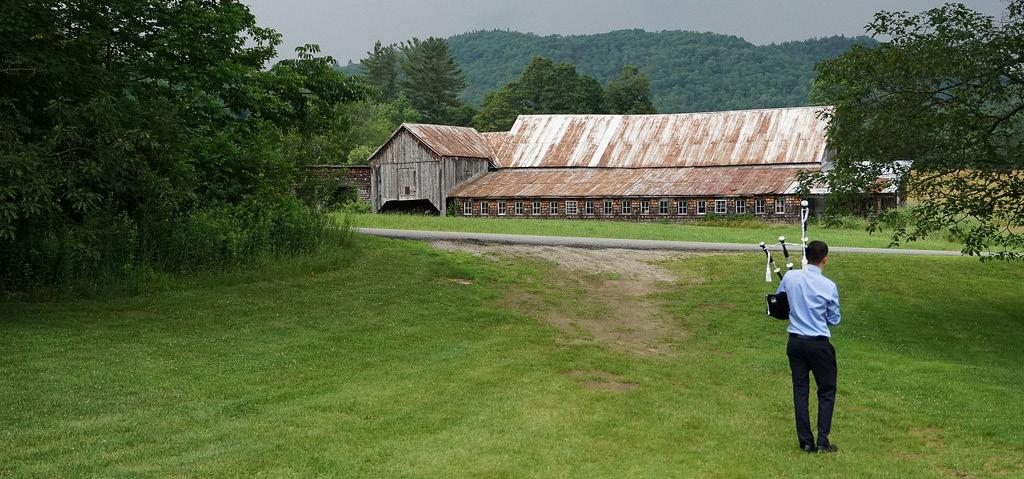
In late April, ‘Silent Cal’ returned to the forefront of my mind as I was invited to the Finalist Interview Weekend for the scholarship, held in Coolidge’s hometown of Plymouth Notch, Vermont. Exam leave proved unexpectedly advantageous over the next three weeks. Afternoons were spent paging through Cicero, Locke and Jefferson, along with Coolidge’s own writings. As I learned more about what the weekend would entail, my
preparations became more diverse and were aided greatly by Mr Iain MacDonald. When I finally set foot in New England, I felt that (whether I managed to survive the gauntlet awaiting me or no) I had prepared as best I could. What transpired was far more an enjoyable gathering than a gauntlet. Stress certainly accompanied the interview and other adjudicated tasks, but this was balanced by the pleasures of speaking (and playing pool) with the other finalists. Returning to Scotland, I was grateful to have entered—if only briefly—such a remarkable community.
‘Paul, I’d like to welcome you to the Coolidge Scholar family.’ I was ecstatic to hear those words on a Zoom call at the end of May, but it was not until the summer that I grasped their significance. The Fourth of July week was spent at ‘the Notch’ with the other four 2025 scholars, forging friendships over intense discussion, (less intense) hikes and dazzling fireworks. The final week of the summer holiday brought with it the Scholar Seminar, during which our new class of scholars bonded with those of the past four years. I was delighted to reunite with many of them in December at the annual Coolidge Gala in New York City, and I look forward to spending time with scholars old and new this August at the 2026 Scholar Seminar.
Coolidge’s Autobiography has a special place on my nightstand: a reservoir of wisdom and a fond reminder of the scholastic family I have been fortunate enough to enter through its pages. But more than the Silent President’s charm, more even than sheer luck, I owe this good fortune to the teachers and mentors who wholeheartedly encouraged and supported my application.
For the munificent backing of the Dollar Academy family—chiefly Mrs Heather Moore, Mr Neil McEwan, Mrs Karen Miller, Mr Iain MacDonald, Mr Ian Munro and Mrs Catherine Munro—I am most grateful.
Paul M. (Form VI)
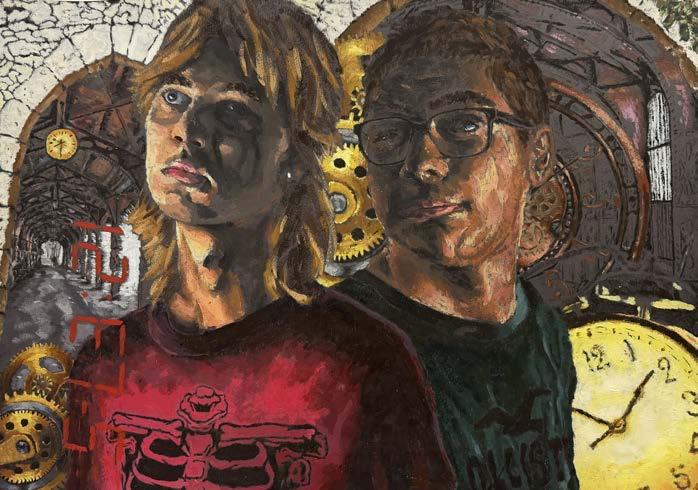
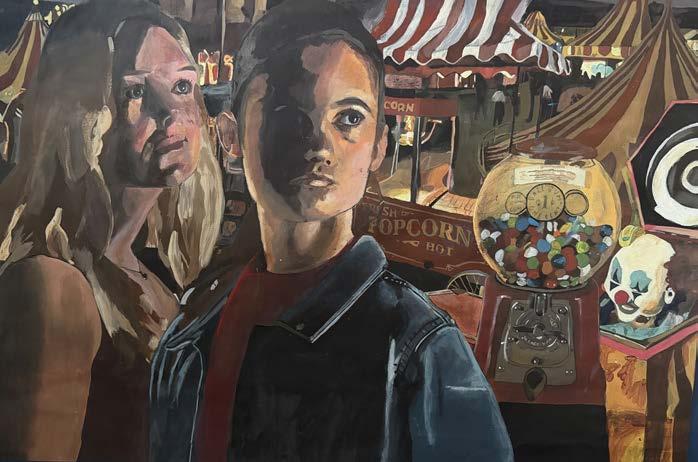
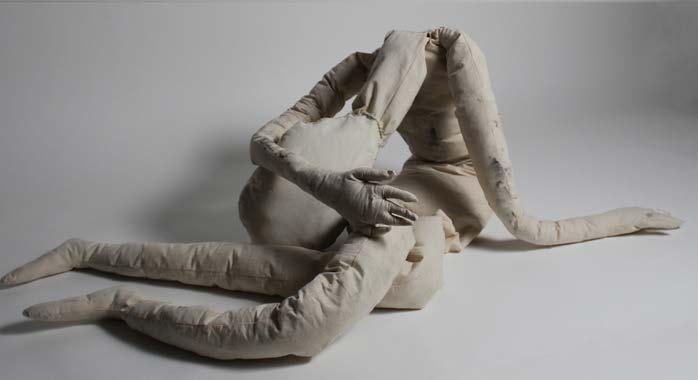
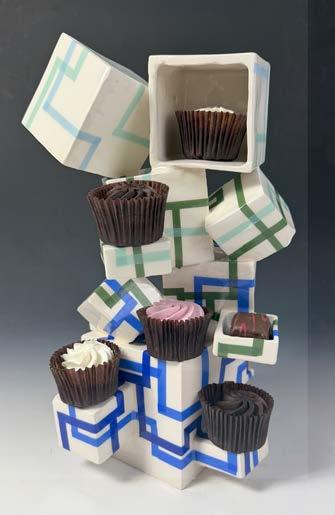
THE CHRISTMAS ART AND DESIGN EXHIBITION 2025
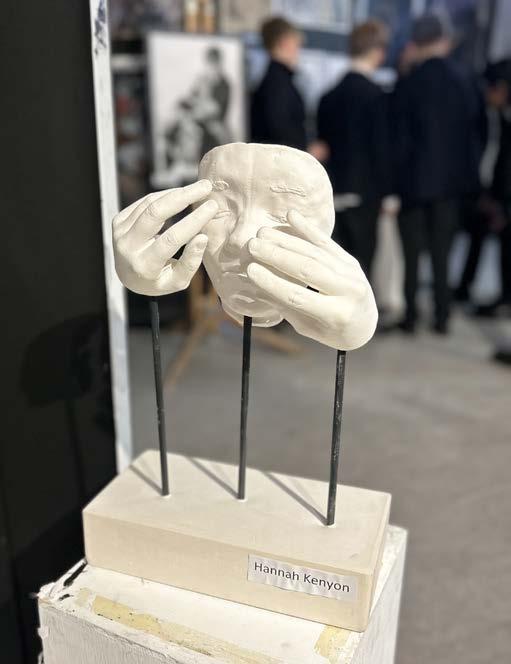
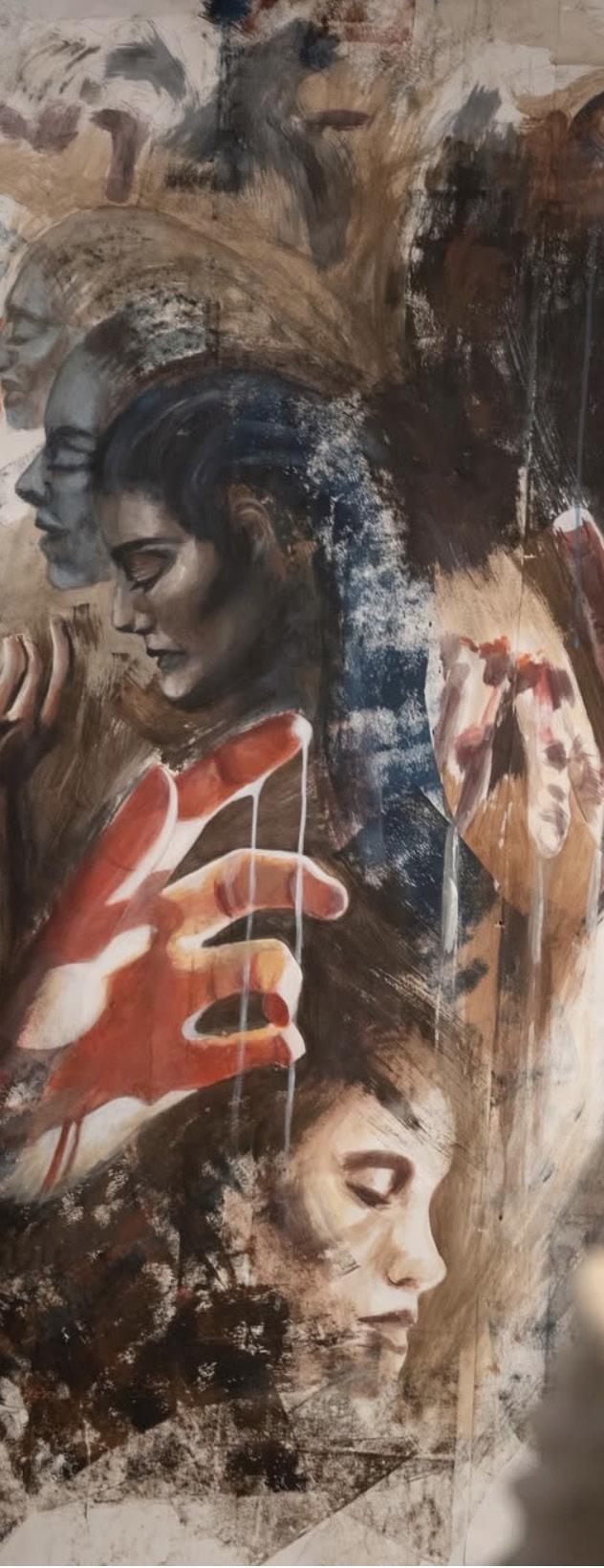
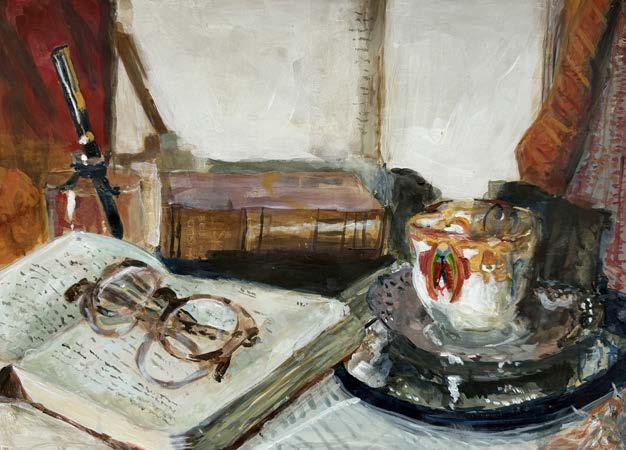
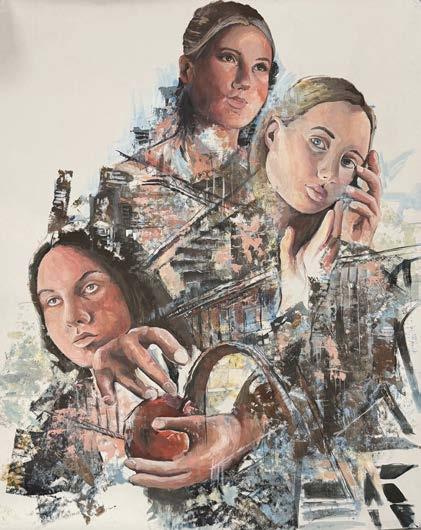
Being part of our school Christmas Art Exhibition gave me a real sense of what it might be like to share my work in a more public and professional setting, rather than just with friends and teachers. It made the prospect of studying Fine Art at the Glasgow School of Art feel more real and exciting—and something I am genuinely looking forward to. Having the freedom to help set up the exhibition and choose where my work was displayed allowed me to create a space that felt personal. The positive, encouraging atmosphere made the experience feel less like simply viewing art and more like being part of a shared moment. People engaged with my work and asked me questions, which helped build my confidence when discussing my ideas. I also enjoyed noticing how different viewers responded in different ways: some focused on techniques— such as my sketchbook work and charcoal drawings—while others connected more with the ideas behind the pieces. Overall, taking part in the Christmas Art Exhibition was a valuable experience that has intensified my excitement about studying Fine Art. I cannot wait to continue developing my creativity.
The Christmas Art Exhibition is a highlight of the year for the Art Department. Pupils, parents and staff are always so eager to see the work we have produced throughout the first term. As Art is studied across many year groups, almost every room in the department is transformed into an exhibition space. Older students play an important role in the preparation, helping to mount work in the lead-up to the event. The Sixth-Year Studio is a very special place; each student curates their own section and arranges their work independently. I helped several classmates—as selecting and presenting your strongest pieces within a limited space can be challenging. The exhibition is a special opportunity for sixth-year pupils to showcase the work they are proud of and to share and discuss it with friends, family and teachers in a lively and supportive setting.
Erin G. (Form VI)
Suilven H. (Form VI)
THE MAKING OF A CHRISTMAS CARD
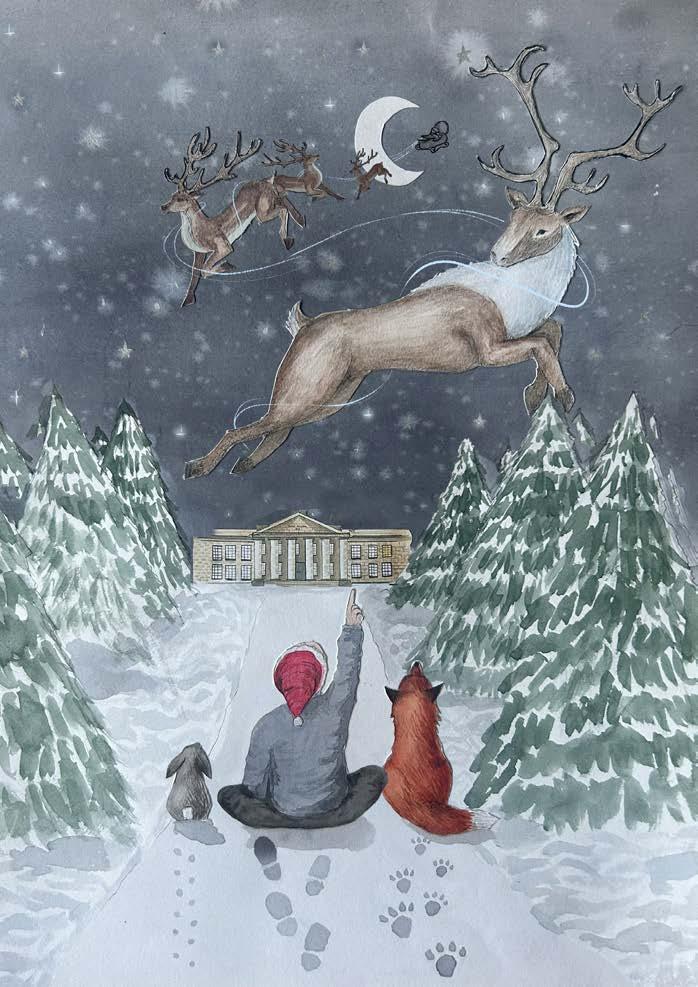
This card was inspired by the elements of the school that shape its unique atmosphere, particularly the approach to Playfair and the trees lining it. Their familiar imagery gives the design a personal quality that resonates with pupils, parents and the wider community.
Each element was handdrawn—using pencil, pen and ink— then carefully cut and arranged to create a magical Christmas view that captures both the sense of community and the excitement of the season. I was influenced by Charlie Mackesy’s illustrations in The Boy, the Mole, the Fox and the Horse, whose distinctive style suited the warm, nostalgic mood I wanted to evoke.
The final design reflects the strong sense of togetherness found in Dollar at Christmas, especially its connection with younger pupils. This genuine reaction from people is what I believe helped the card sell out so quickly, and I am incredibly grateful for the support and for the funds raised, which went to the charity Seamab.
Lexie S. (Form VI)
FIDA: Bothy Culture
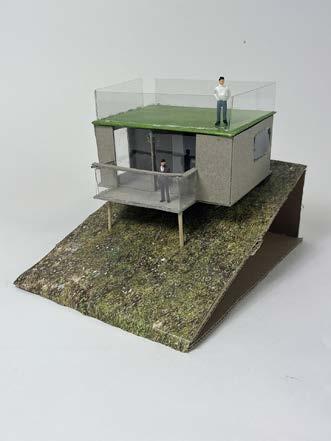
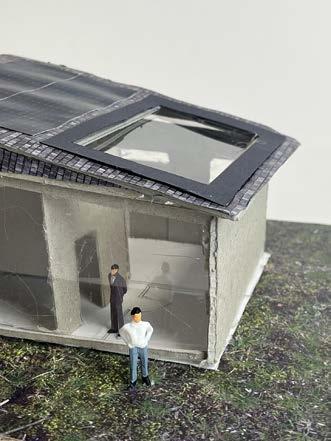
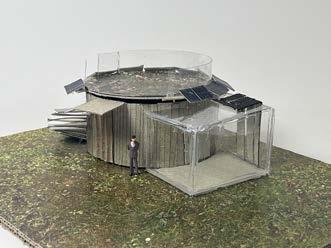
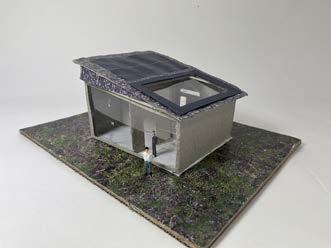
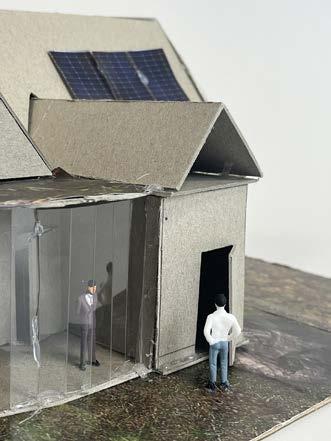
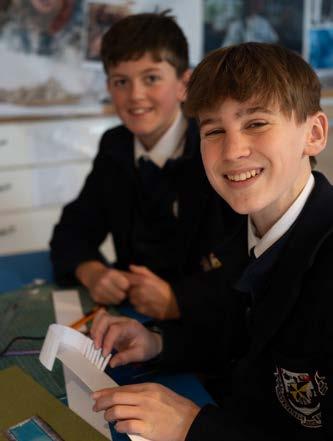
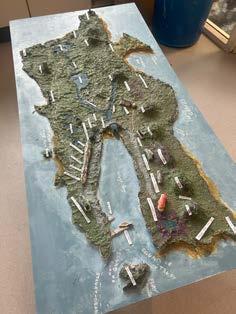
This session our Form I pupils undertook an exciting new FIDA sustainable architecture course entitled ‘Bothy Culture’. It was structured to equip and enable pupils to make valid choices regarding design and sustainability in creating their own unique modern bothy designs.
From Harris to Braemar, Islay to Elie, pupils were tasked with exploring Scotland—and its stunning rural locations—to source an inspiring location and undertake a miniature site analysis, before designing and building their modern bothy concept. The pupils examined how sustainable practices involve an awareness of the wider environment and landscape around them, and they considered the appropriateness of materials and of suitable processes. The year group were kept very busy learning how to use their project sketchbooks as an effective research-and-design tool. They explored existing small-dwelling designs; they undertook a case study of an artisan bothy; they carried out research into the factors affecting choice of location. All of this work informed the ways in which pupils brought their design concepts to life. They also honed their craft skills whilst making their 1:50 scale models. They learned safety skills, cutting techniques, scale measuring and basic construction techniques, as well as efficient work methods.
The levels of engagement and the quality of the outcomes made it evident that our pupils connected well with this project work. The combination of research, creativity and practical tasks kept pupils motivated
and engaged throughout the project, from concept to construction. We very much look forward to doing it again with next year’s cohort.
Fraser Muirhead
CREATIVE INDUSTRIES DAY:
A Day of Design, Innovation and Imagination
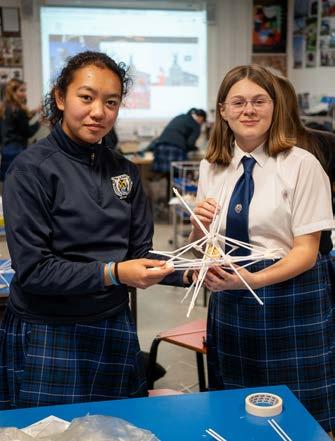
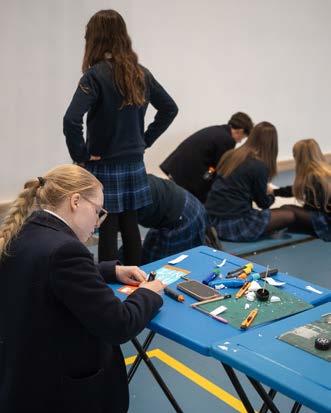
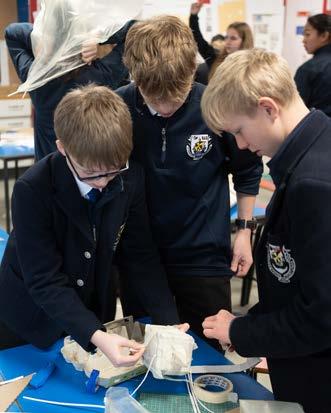
Form II pupils took part in what was an inspiring Creative Industries Day, celebrating imagination, problem solving and hands-on making across a wide range of disciplines.
The day showcased how many exciting creative pathways exist: from bold fashion design and inventive architecture models to innovative racing car design. All of it served to capture pupils’ curiosity and interest. Throughout the event, our enthusiastic pupils were encouraged to think creatively, experiment with ideas and work collaboratively. The experience was engaging and memorable.
A special thanks goes to Holly Allan, Molly Kelly, Mya Shiels (all FPs 2024) and Rhiannon Millar (FP 2025) for their valuable input and creative guidance. Their presence helped bring the activities to life and encouraged pupils to push their ideas further.
One of the highlights of the day was the hugely inventive Big Egg Drop, led by Peter Nelson (FP 1993), an artist and designer. The challenge sparked plenty of imaginative engineering solutions, perfectly capturing the spirit of the event.
Overall, the Creative Industries Day was a vibrant celebration of creativity and innovation, leaving pupils motivated, inspired and eager to explore new ideas beyond the classroom.
Cath Kelly
Stepping into the Scene:
Form II Art and Design Competition
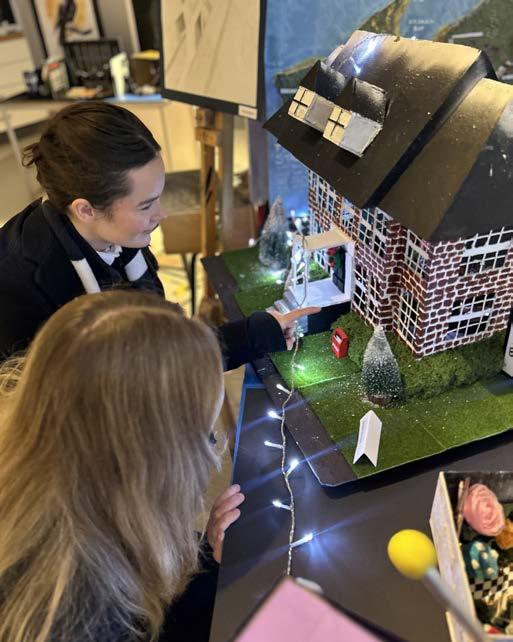
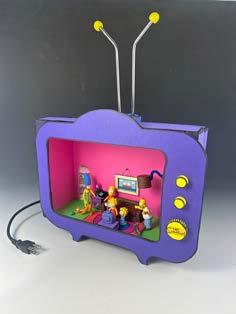
The annual Form II Design Competition is a highlight of the creative calendar, giving pupils the chance to step into the role of real set designers. Working from famous film scenes, book illustrations and well-known stories, Form II pupils are challenged to recreate these worlds in miniature. The results are always impressive.
This year’s group produced an outstanding collection of models that showcased remarkable imagination and technical skill. From carefully layered backdrops to inventive use of everyday materials, the pupils demonstrated a strong understanding of scale, composition and storytelling. Tiny props, hand-painted textures, and cleverly engineered structures reveal a level of detail and craftsmanship from designers working well beyond their years.
Cath Kelly
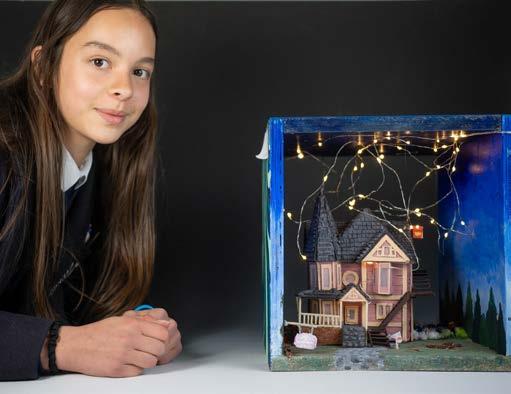
First-Prize Winner: ‘The Pink Palace’
The reason I chose Coraline for this project is simple: I love the film. And I knew that it would provide the inspiration for my work. Its distinctive look and eerie, imaginative style feel completely unique compared with other films I have seen. After plenty of trial, error and decision making, I finally settled on recreating the iconic Pink Palace. My first attempt was a cardboard trial house that took three days to build, but I wasn’t satisfied with how it turned out. So, I started again— this time, creating the version that ultimately became my final model. Made from scraps of card, Costa coffee-stirring sticks and a lot of determination, the project pushed my creativity and problem-solving skills further than I ever expected. I learned so much from the process, and winning the competition made all the hard work worthwhile
Zoe G. (Form II)
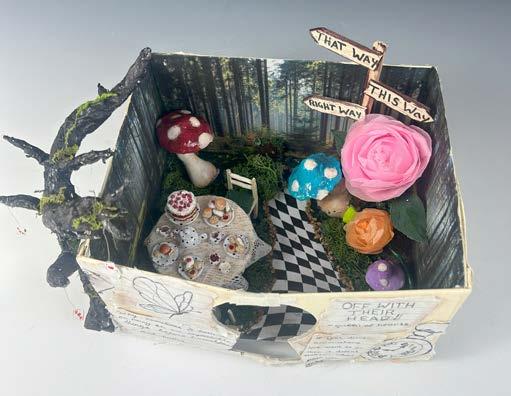
Third-Prize Winner: ‘Alice in Wonderland’
Creating this Alice in Wonderland 3D model was one of my favourite projects this year, and I was thrilled to win third place. I chose to recreate the Mad Hatter’s tea party, which I especially enjoyed as it allowed me to build a magical forest setting around the scene. Adding twinkle lights helped bring the model to life and enhance the atmosphere. I aimed to capture the strange, imaginative world of Wonderland using bright colours and unusual shapes to reflect its quirky, surreal nature.
This project encouraged me to develop my artistic skills and be more creative. It taught me the importance of patience, problem solving and reworking ideas when things do not go to plan. Winning third prize reminded me that creativity and effort really do pay off, motivating me to continue studying Art next year.
Isabella L. (Form II)
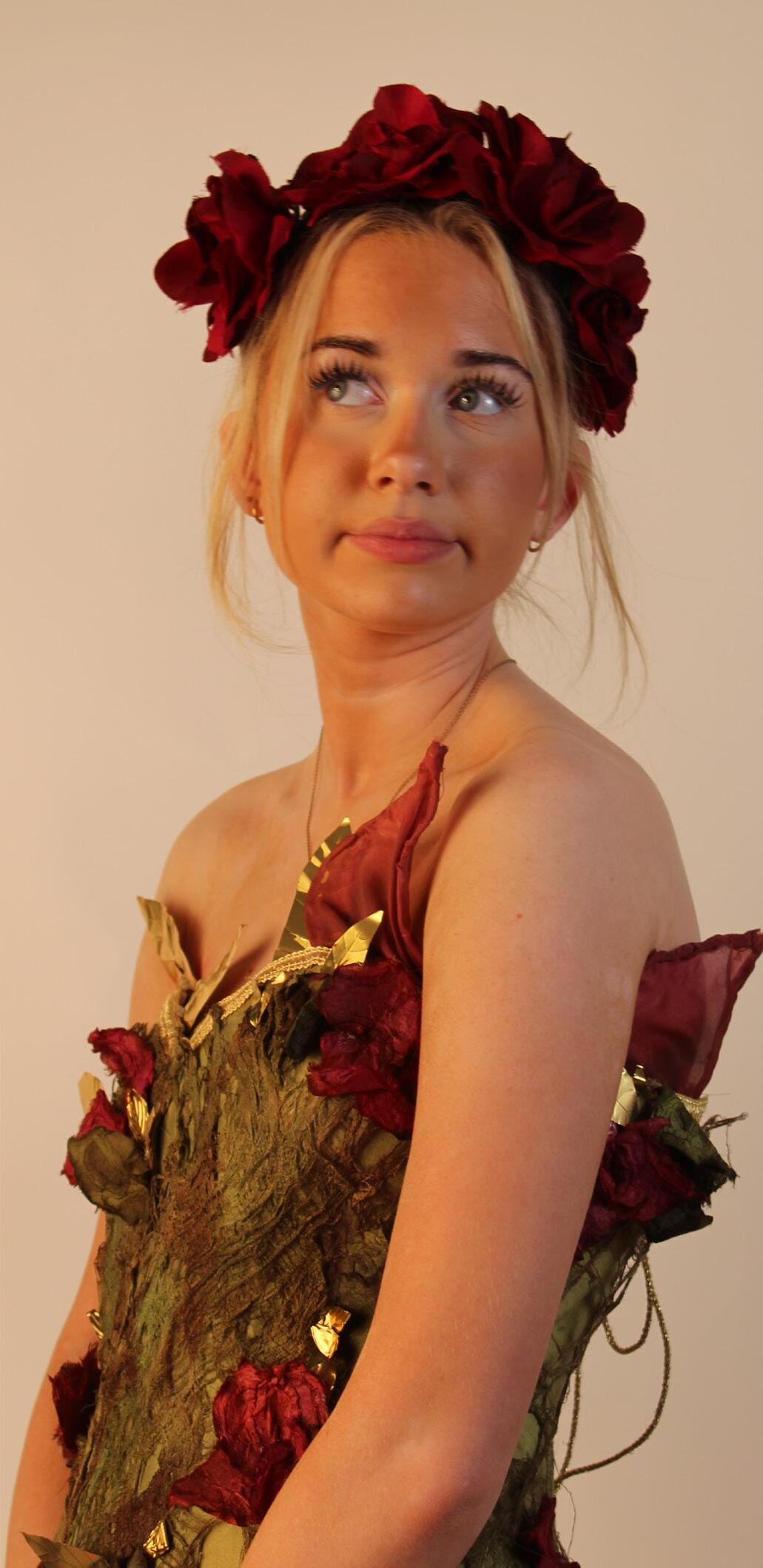
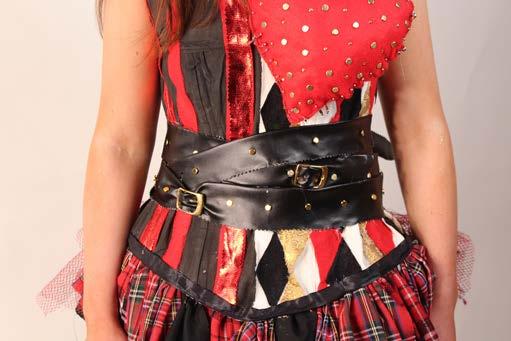
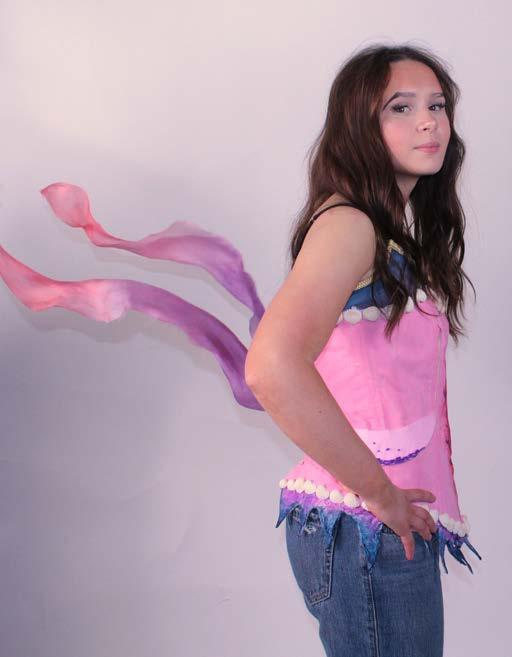
NEW CREATIVE COURSE: COSTUME DESIGN (NPA)
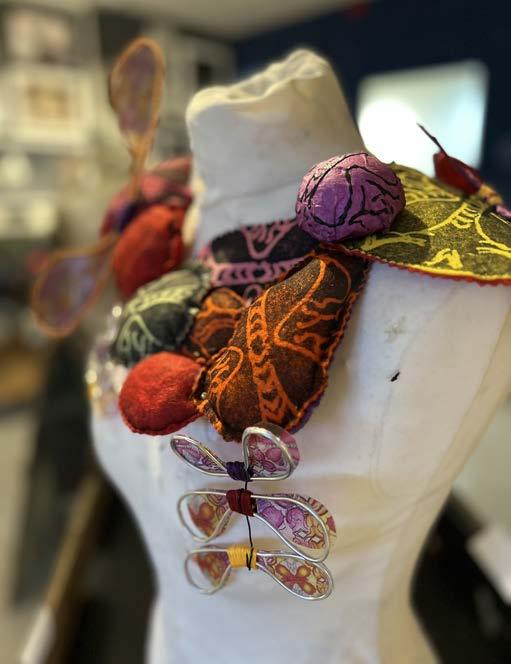
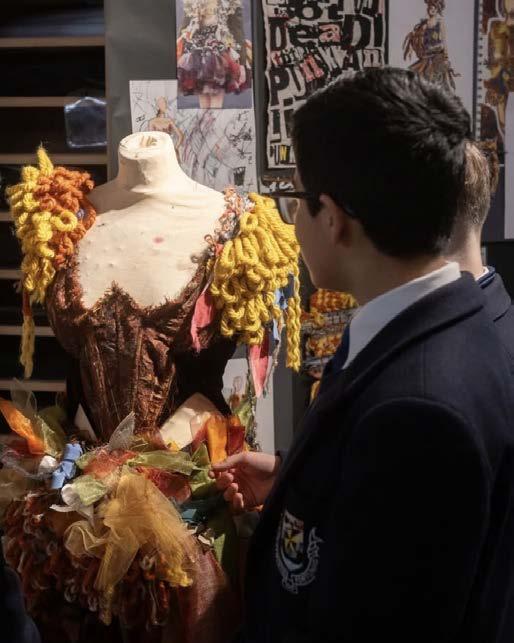
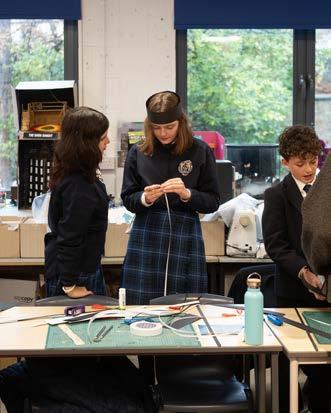
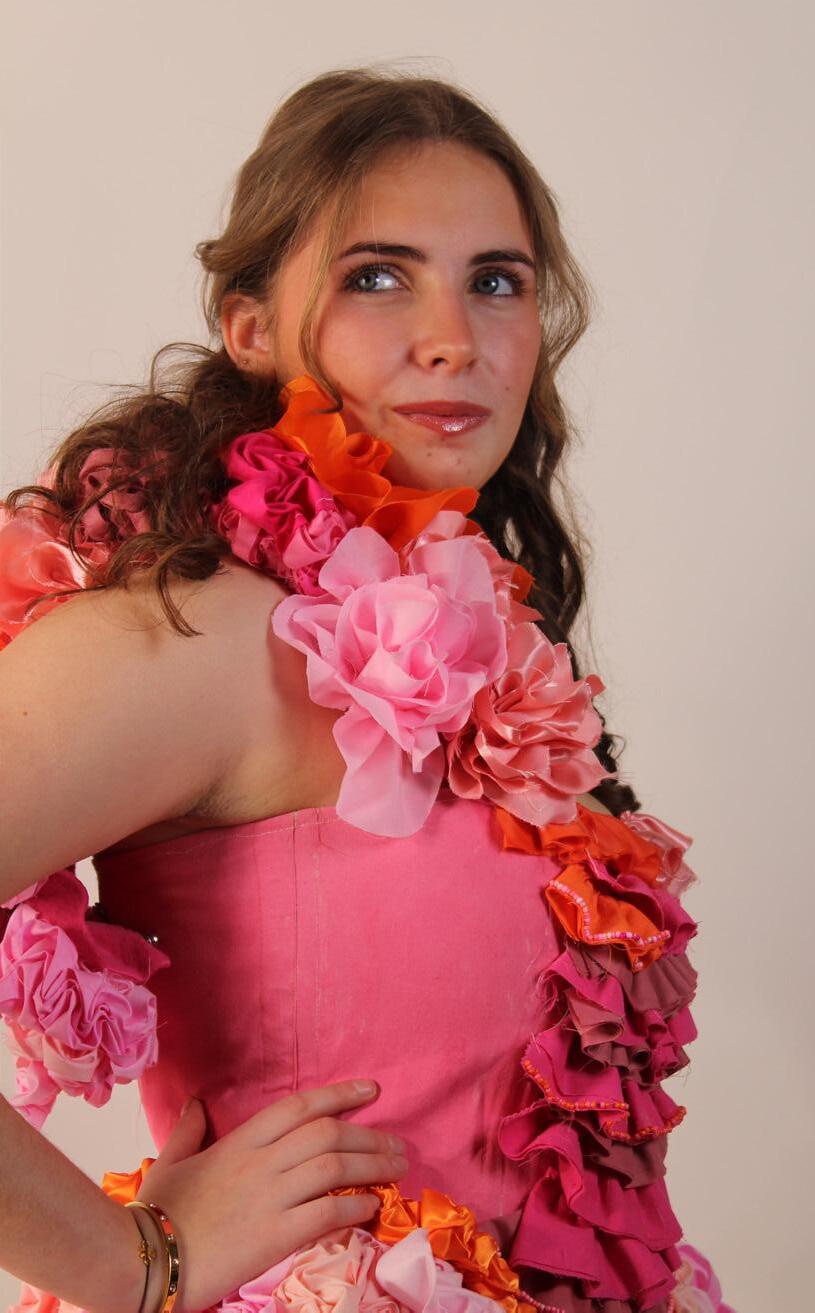
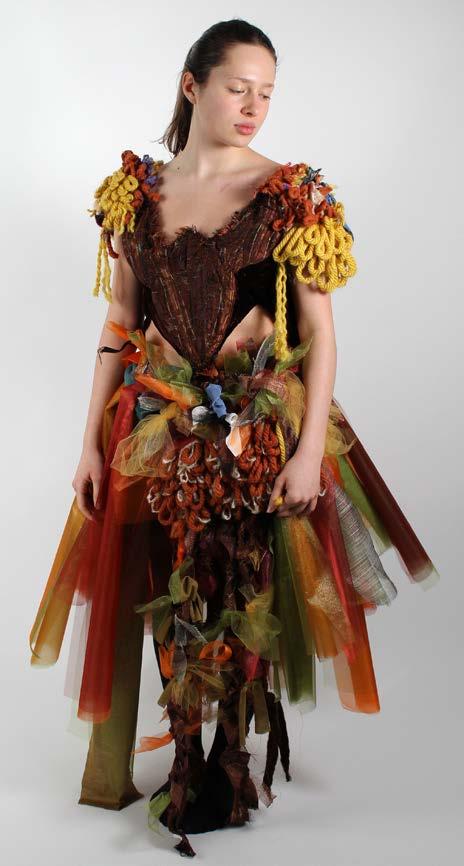
The Art & Design Department has been buzzing with energy and imagination this year, as Form V and VI pupils brought bold ideas to life through our new course offering: a National Progress Award (NPA) in Costume Design. From initial concept to finished garment, students have embraced the challenge of working to their own design briefs, transforming their creative vision into striking and wearable pieces for stage and screen. Along the way, they have honed their ability to plan, research and refine their work with clarity and purpose, all while building confidence and technical skill.
A key part of this creative process involved getting to know the sewing machine, and for many, this was a foray into the complete unknown. Pupils quickly built confidence in constructing garments—learning how to handle fabric, explore stitch techniques and solve problems as they worked. Pattern cutting introduced them to the foundations of garment construction and structure, encouraging precision as well as creativity in shaping their final costume designs. Experimentation and creative freedom have been at the heart of this course. Students have explored a wide range of surface decoration and textile techniques, from fabric manipulation and embellishment to dyeing and mixed media applications. This hands-on approach has allowed each pupil to develop a unique visual style, resulting in pieces that are imaginative, thoughtfully executed and ready to wear.
The final outcomes presented here were beautifully modelled by the makers themselves and serve as a testament to their hard work and willingness to take creative risks. Each design reflects not only their original design brief, but also the individuality of each character and its creator.
Rebecca Munro
GALLERY
Erin G. (Form VI)
Lily A. (Form VI)
Cara C. (Form VI)
Abbie M. (Form III)
Suilven H. (Form VI)
Rosie L. (Form IV)
Matilda W. (Form V)
Gerard P. (Form V)
Emilia W. (Form VI)
Shanzah H. (Form VI)
Imogen M. (Form IV)
Ben M. (Form V)
Adela M. (Form VI)
Nika L. (Form IV)
Lexie S. (Form VI)
Hannah K. (Form VI)
Genevieve H. (Form IV)
REFLECTIONS ON READING
2026 is the National Year of Reading, a UK-wide campaign designed to inspire more people to make reading a regular part of their lives. Dollar Academy has taken real delight in marking this campaign in many ways, as you will have read about on page 26. When you visit the ‘Year of Reading’ website, the first heading declares: ‘Everyone knows reading expands worlds, sharpens minds, and fuels creativity. But fewer of us are making time for it.’ Fortunately, as the pieces that follow demonstrate, plenty of Dollar pupils already make time for books and need no persuading about what is to be gained from reading. We are sure you will enjoy these essays from Orla R (Form V) and Noah P. (Foom IV) and a poem by Tigerlily S. (Form IV), paying elegant tribute to the simple pleasures and powerful benefits of reading books.
Chapter by Chapter, Year by Year
If I told you that there’s something you can do that reduces stress, improves memory, boosts your empathy and generally makes you more intelligent, you might assume I was talking about some complicated game or hobby— something that requires immense thought and effort. What I’m actually talking about is something incredibly simple. Reading has been proven, time and time again, to be essential to cognitive growth and emotional development. But, over the past few years, it has decreased to the point that being an active reader as a teenager is deemed ‘weird’, and people even seem to take a sliver of pride in saying: ‘I’ve not read a book in years.’ Reading has even been shown to boost babies’ (who cannot talk or understand words yet) understanding of the world as a whole. So— as someone who has read since being a young child, as someone who has never stopped reading books—seeing my peers drift slowly away from books has been incredibly disheartening. Books have, quite literally, shaped who I am today. They’ve impacted every area of my life, whether it’s my basic language skills, my friendships or my untethered imagination. Books are the unsung heroes of our world, because the concept of books is so incredibly simple: just some words on a page. Yet they can transport you to totally new dimensions or inform you on a topic you once knew nothing about.
My journey with reading began when I was around five years old, when I decided that, since my older brother was reading, I had to as well. I started, of course, with Julia Donaldson—Tiddler, specifically. I read Tiddler again, and again, and again, and again (and again, and again, and again...) until I could rehearse it proudly to my exhausted parents, who eventually decided enough was enough and told me to record myself reciting Tiddler. It wasn’t a complicated book; it was a book about a fish, in an ocean. But it had me hooked. From then on, I read all the time— even delving into books I probably didn’t fully comprehend, like Roald Dahl’s Matilda. Thinking back to that time fills me
with profound nostalgia. Instead of spending my time on an iPad, entertained by flashing colours and distracting sounds, I was exploring corners of the world I’d never experienced before. Just seeing those dear books on the shelves of a local bookshop now, I feel the warmth and excitement I felt all those years ago.
Even the simplest books can fuel the imagination in powerful ways. When I think back to that time, two other books come to mind: Just Imagine and You Choose, also by Julia Donaldson. (I think I was her number one fan back then.) They, too, were incredibly simple books, full of colourful and appealing doodles, and they gave basic prompts like: ‘Where should I live?’ and ‘What should I wear?’ To seven-year-old me, those books were everything. I came up with wild stories—about princesses from faraway lands who lived in secret underground lairs and only ever ate jelly and cake and only ever wore bright pink dresses. Reading those books with my parents comprise some of my fondest childhood memories (although I think my parents were glad to see those books retire!). And, sometimes, all I ever want is to go back to that period of time, when my biggest concern was about which castle my unicorn should live in. At my core, at the very basis of who I am, are these books. My imagination may drive me loony sometimes, but I would not be the person I am without it.
As I grew up, books were always there. When I arrived at my new school, everything felt so incredibly uncertain. But the one thing I took comfort in was ‘The Reading Challenge’: we had to read books from all different genres, authors and places, and record our opinions of them in a reading diary. Back then, ‘The Reading Challenge’ was pretty universally hated, but I relished the prospect of being awarded badges for reading books, pinning them to my blazer with immense pride. The books that I read were incredibly varied; some were tales by Jacqueline Wilson–stories of dysfunctional mothers and their daughters (with the strangest of names). Some of her books were grim, and
will haunt me for life, but they exposed me to the tough experiences some people go through; they taught me empathy. Other books, like The Creakers by Tom Fletcher, explored hidden lands with monsters who stole children, yet they also illustrated how appearances aren’t everything— and monsters can sometimes be the good guys. Even books like The Magic Faraway Tree by Enid Blyton (which abandons any sense of reality) taught me so much about friendships and morality through exposing me to situations that were entirely foreign to me. I found great solace in unfamiliar lands.
As life became more serious and more confusing, my imagination and reading inclinations turned to dystopia. While I was battling with growing up and all the trials and tribulations of starting high school, I was also battling alongside Katniss Everdeen, fighting for the liberation of her district. Or, while I was fighting seemingly never-ending tests and homework, I was doing so alongside Tris, fighting for truth and justice in a world designed to control her. My problems were nowhere near the intensity of avoiding the wrath of Voldemort or running for my life through a maze, yet I found comfort in the struggles of these characters, and I saw myself in many of them. Even the most unrelatable of tales—stories of clans of cats at war in a forest; stories of young girls who befriend talking polar bears and hot-air balloon riders—struck a chord. At the heart of those books were very simple themes: friendship, bravery, honesty, truth. Most of us look back on that period of our lives with shame and embarrassment (for who is more cringey than our own selves at 11 and 12 years old?), but I also look fondly back upon those times. Books were the one thing that kept me tethered to reality and made the horror that is growing up a little less unbearable, less scary. Even now, as my 17th birthday approaches, books play an incredibly significant role in my life. The world, as a whole, has become a much more frightening and intimidating place, and literature has helped me to develop
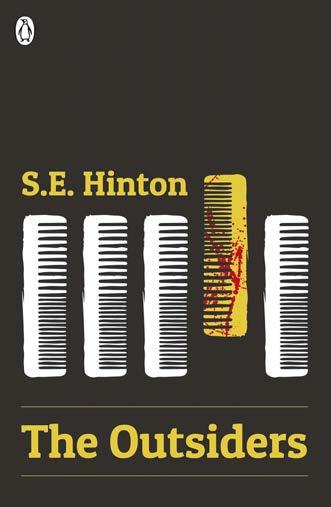
my opinions, to provide me with insight on the evil in the world. Books like The Handmaid’s Tale—an incredibly horrific, but impactful book—have allowed me to compare the horrors of the women in red to the struggles faced by women, all over the world, every single day. Books like To Kill a Mockingbird—apparently, a simple story about children—have taken me back to a different time when America was not ‘the land of the free’. That book emphasised for me how much hatred the world is capable of and how we need to ensure events like those described in the novel are never allowed to happen again. Then, of course, there are the books that aren’t the most complex or eventful, but that somehow still make up an important part of who I am. One book in particular, The Perks of Being a Wallflower, has stuck with me ever since the day I first picked it up. Charlie isn’t a complicated character. He is, like me, a teenager desperate to escape the confines of conformity—someone who finds comfort in his friends, his books, and most importantly in David Bowie’s song ‘Heroes’.
Coming-of-age stories will always have a special place in my heart, and it has been so incredible to grow up immersed in the magic that is literature. Every book I have ever read, every character I have grown to love, has stayed with me, has been a tile in the mosaic of who I am. Matilda taught me how to be brave; the Creakers taught me that appearances aren’t everything; Lyra taught me that children aren’t weak, but powerful; Charlie taught me that it’s OK to not ‘fit in’ because, at the end of the day, high school isn’t forever. These characters have each taught me something different, an invaluable life lesson, and I wouldn’t be who I am today if I hadn’t read all of these books. As I look onto the future—to applying for university, to moving out— everything feels incredibly uncertain, except for one thing: my love for books.
Orla R. (Form V)
Children’s Stories
When I was a young child, one of the highlights of my day always came in the evening, when my family would come together to read brilliant stories that would captivate all our imaginations. We had countless books. Lots were by Julia Donaldson: tall tales of rats riding horse; sticks coming to life; sentient, superhero worms. We would gather by the warm, crackling fire in the dimly lit living room, sitting on the sofa and flicking through the pages. These are some of my fondest memories, and these books have an impact on me that has lasted even to this day.
Although perhaps not my favourite, the most well-known of all the stories we used to read was undoubtedly The Gruffalo. It follows the story of a small, intelligent mouse in a deep, dark wood who conjuries up the Gruffalo, a great and terrifying monster, in order to ward off predators such as a fox, an owl and a snake. Eventually, the mouse encounters the Gruffalo, who turns out to be real—but, thanks to the mouse’s intelligence, he manipulates the Gruffalo and causes him to flee, proving that he, the mouse, is in fact ‘the scariest creature in the wood’. As a very young child hearing this story, I would shake and tremble and cover my face. The Gruffalo terrified me. Its tall, ghastly stature made my heart thud in my chest and my breath quicken. Although I soon grew out of that, I still remember vividly how frightened I was. My favourite line from that story—‘Oh help! Oh no! It’s a Gruffalo!’—captures the fear and horror that I (like the mouse) felt. When I was younger, I used to think of the Gruffalo and the predators as the villains of that story, and the mouse as its hero (whom I
rooted for). As I grew up, however, my perspective has shifted. The mouse’s ability to manipulate and lie is truly terrifying; perhaps he was the villain all along. The story of The Gruffalo is one of the most well-known modern British children’s stories—and for good reason. The terror of the monster and the inspiration of the small mouse conquering the woods has impacted so many children, like me, for generations. It will always have a special place in my heart.
Every Christmas Eve, for many years, my family read Judith Kerr’s The Tiger who Came to Tea together, and so it is another of my favourite children’s books. I feel warm inside thinking about it, recollecting the dark, snowy nights, sitting in front of the fire with hot chocolate, reading this story together. It describes a young girl named Sophie and her mother. One afternoon they are visited by a wellmannered, hungry tiger, who chaps on their door and says, ‘Excuse me, but I’m very hungry. Do you think I could have tea with you?’ It is at this point that the absurdity of the story begins—and when the charm and the intrigue begin to grow. The family invite him inside, where he begins to eat and drink everything and anything he can find. This includes all of the food, the biscuits, even the tap water. He eventually leaves; however, there is nothing left for Sophie and her mother’s dinner. They decide to head out for dinner to the local cafe where they meet Sophie’s dad. He suggests buying a large tin of tiger food, in case the tiger comes back— but he never does. Although a bizarre story, I find it so oddly comforting. I feel like a young child again thinking about it, remembering the joyful moments flicking through pages of simple, yet brilliant, artwork in our big, hardback copy. It gives me a feeling of warmth and comfort, and it reminds me of Christmas—the part of the year where I spend the most time
with my family, sharing presents and having fun. This book will always be one of my favourites among the many I read as a child and, whenever I think of Christmas, it is always in my mind. Far and away my favourite children’s book (and the one we read the most) is Julia Donaldson’s Room on the Broom; this one reigns supreme. It describes a kind witch flying on her broomstick with her cat, but the strong winds continuously blow off her hat, her bow and her wand. One by one, these are discovered by a dog, a bird and a frog, who each hop on for a ride. The weight of all those animals, plus the witch herself, eventually causes the broom to snap. In this way, they encounter a horrifying dragon, but the animals work together to scare it away. The witch then makes a new, much larger broom for all the animals to ride on: ‘with seats for the witch and the cat and the dog, a nest for the bird and a pool for the frog’. This final line explores the important themes of kindness and friendship, as the witch makes sure that her new broom caters for all. She cares for and respects them all, and this subtly teaches young readers to behave kindly towards all animals and people. This is why I loved (and continue to love) this book so much. I still vividly remember the front cover, the artwork, the plot, the glossy pages, the cartoonish size…and all of it reminds me of my childhood. It is my most-loved childhood story, and I hope I can experience the joy of reading it to my own children in the future.
Although these stories range from the simple through to the truly bizarre, there will always be a special place in my heart for each of them. My love for them is unmatched. Without them, my joy in reading would not be what it is today. I am forever thankful to these authors whose skill and imagination create stories that shape our minds so powerfully.
Noah P. (Form IV)
On the Day I Existed
(Inspired by reading The Perks of Being a Wallflower)
On the day I existed, I couldn’t tell you what happened, only that everything did, because it does, and it will.
There was laughter, and smiles, and tears, and furrowed brows.
Moments stitched themselves together into a day that moved without waiting for me.
But they belonged to faces, in crowds, in the distance, elsewhere.
My head was under water, every voice distorted, every sight blurred.
And I just existed.
I didn’t care, or laugh, or think clearly. My thoughts were louder than the room around me.
They circled and tangled, pulling me inward, deeper than the day itself.
Things passed me by, out of my grasp, out of reach.
I didn’t speak, or maybe I did, but I didn’t say, I didn’t change. I wasn’t meaningful.
When others recall their day, they will remember moments, a joke, a glance, a spark of something.
And I will be another face, another emotion, another blur.
Because on the day I existed I looked down, not at my feet, but at my rectangle, not for answers, not for connection, but for something to fill the space between my thoughts.
And the day passed me by, and my thoughts raced on, never silenced, never stopped, never ceased.
So I screamed, but it hadn’t been a day. There was no one around, no one to hear, no one to see me as I spun inside myself.
Someone tried to reach in. Someone offered light, or warmth, or a hand, I think, or maybe they just wanted something. But my head censored them, I could not let them come close, they would only join the voices that left, that hurt, that never stopped.
On the day I existed, my head kept me trapped, my mind a whirlwind, my body still, my voice caught. My eyes stared into the blur of a world that moves without me.
And I am in the water, both floating and drowning, waiting for the day the voices stop, where no one else can leave me, and I cease to exist.
Because on the day I existed, I didn’t really. Everything didn’t happen, because it wouldn’t, and it won’t.
Till I learn to live.
Tigerlily S. (Form IV)
THE OUTSIDERS:
A Form II Reading and Writing Project
This year some Form II classes read the classic coming-of-age novel The Outsiders by S.E. Hinton. Set in 1960s America, the novel tells the story of teenager Ponyboy Curtis and his struggles with right and wrong in a society in which he believes that he is an outsider. While reading the novel, pupils were asked to write a short story about a character who feels like an outsider in a particular place or situation. Do they find a way to belong? Or do they choose to remain on the outside? The following are short extracts from two of their stories.
Fran Mackie
‘The Outsider’ Epilogue
I had always known I was different. Other people did too. The kids at school loved to remind me. The moment I stepped out of the house, eyes would stare, heads would turn, people would mutter. I didn’t really care though. At least, that’s what I told myself. I would remind myself over and over again: if nobody cared, then nobody could hurt me. I had already been hurt once. I couldn’t be hurt again.
Twelve Years Earlier....
I was five at the time. No matter how hard I wanted to forget it, I couldn’t. It was my birthday. I woke up and bounded out of bed, expecting an abundance of presents to be lying downstairs. Except there was nothing. Literally. All the photos of my siblings were gone; the cushions from the sofa, removed. The only thing left was the old armchair. Panic rose in my chest, and my knees felt weak. I ran to the front door and flung it open. All the furniture from the house was packed in a van; my siblings were sitting in the car.
‘Mum?’ My voice quavered. She turned around her eyes filled with tears. ‘I’m so sorry, honey,’ she said quietly, ‘but I have to think of your siblings.’
Though I was only five at the time, I fully understood the situation. They were leaving me. Abandoning me. I tried to jump into her arms; I begged her to stay—but she pushed me away. She pulled out a hammer and shattered my heart into a million pieces. I fell on my knees and cried, screaming for her to come back. It was only when I stopped crying and sat up that I realised my family had left me. I learned two lessons on that day. Never trust anyone and never love anyone. It’s easier to let them go when they betray you.
Amber H. (Form II)
‘The Outsider’
The sun bore down, a mirage of heat flickering on the horizon. The elephant calf brayed and cried by its mother’s lifeless body, still warm umder the blazing sun. The herd paced forward, beginning to march in a steady rhythm. The calf turned to follow, but produced one final squeak, a halfhearted attempt to wake up its mother. It cantered onward but glanced back—willing its mother to stand up and march toward the herd, praying to feel the brush of its mother’s trunk once more.
The sun began to set, painting the vast sandy desert canvas with broad strokes of orange and yellow. The herd settled down after the day’s aching journey, forming a wall of tough wrinkled skin like a battered cliff face. The herd’s young slept peacefully in the centre, exhausted from the days exertions. The calf, finally arriving at the night’s camp, cantered toward the circle, desperate for a protected night’s sleep after its unaided journey. The calf lifted its foot and nudged at the nearest elephant’s rough grey back, trumpeting quietly to gain its attention. The trumpet sounds grew louder as the desperate calf attempted to win over this mother elephant’s compliance. But the elephant (annoyed at this pathetic disruption) only let out a low rumbling bray and swatted the calf away with her trunk.
The morning finally arrived to light the desert once again, and the sun silhouetted the herd’s protected circle, now dispersing. The herd’s young, in the middle, were being awakened by their mother’s gentle touches, mother and child trumpeting playfully. The calf awoke, taking in the scene with an aching heart. It wandered over to the herd, stumbling and unsteady on its feet, kicking the fine red dust of the desert in despair.
Bridget P. (Form II)
‘Funeral Blues’: An Essay in Response to W. H. Auden’s Poem
I understand that death is inevitable. I understand that it’s all around us—whether through famine, war or sickness. Death remains society’s promised curse: a plague that allows it to function, a field with no expertise. As Christians, we are almost taught to embrace the idea of death and not fear what the other side of the curtain holds. As Christians, we are taught to live a life knowing that beyond our time on Earth is an eternity of life in Heaven. Theoretically, this is all very easy to understand and accept, and for many—including myself—this provides a sense of comfort. However, as I watched death overwhelm my grandfather, I realised how it lingered at his bed. Watching, waiting and listening to our cries and prayers. Slowly, stealing everything that made him the person he was. First his voice, then his laughter, and finally his strength. Death left me, and everyone else in that funeral home, with nothing but the shell and the memory of a man who had beaten all the odds of life. He was someone who exhibited selflessness, charity and community. Gone. I learned an earth-shattering lesson that day: if Death could slowly strip away someone whom I had believed to be a kind of exception to the rule, then I have only accepted Death theoretically. I had no idea about the emotional anguish that came along with having someone forcefully stripped away from my life. How could anyone accept Death? It made me look at Death not from a bird’s eye view, but rather from ground level. Death allowed me to see the frame more clearly. Pixel by pixel, life for life.
Stop all the clocks, cut off the telephone, Prevent the dog from barking with a juicy bone, Silence the pianos and with muffled drum Bring out the coffin, let the mourners come.
There have been a few times in my life thus far that I have truly longed for all of time and existence to bow down to my own desires. For minutes to stretch into hours. For silence to overwhelm the room, leaving no space for dangerous thought or emotion. To just sit and simply be—far away from the waves of different groups of people incessantly washing up to where my family and I sat in the church, depositing their regards and retreating back to where they came from. These were people I had never heard of: politicians, friends, colleagues. Telling me the stories and adventures of the past: the work they had done, the people they had fought for, the lives they had fought for. I couldn’t help but feel slightly jealous. They had spent so much time together. All we’d had together was fifteen
summers and fifteen winters. It was unfair. Everything about that day was unfair. One group, I remember very vividly: the kids from his foundation had prepared an elaborate performance, singing songs and executing rehearsed dances that illustrated the lessons he had taught them—from how to plant a tree to the finer lessons in life. He had singlehandedly saved them from lives of darkness by being their light. It was then that I realised he was not my grandfather, but theirs, too. And I was OK with that.
I remember forcing my gaze along the walls of the church in an attempt to reduce the pressure of water pricking in my eyes. I focused on the stained glass windows and the dark, wood panels separating each pane. I remember closing my eyes and being transported years back. I had once sat on this very same bench, anxiously waiting to give my very first speech. Light filled the room, beaming through: a tapestry of colours, ravishing red panels set alight like embers burning at night whilst the cerulean washed the floor like the warm beaches of Diani. Light filtered, scattered and refracted as it stretched its arms, hugging every crevice of the church. The room would sing with colour.
The room could never sing again.
(‘We love you and will miss you…’) The performance was over, abruptly cutting off my call to the past. Replacing it with the disconnected tone of reality. He was gone.
Let aeroplanes circle moaning overhead Scribbling on the sky the message ‘He is Dead’, Put crepe bows round the white necks of the public doves, Let the traffic policemen wear black cotton gloves.
The choir directed us in our final hymn of the service; the words of the song lingered on our tongues. There was a collective understanding that the time of his burial was soon. The time for us to say a final goodbye. As if several metres of soil was a greater separation than the line between the living from the dead. The pastor ushered us out of the church and handed me a solid, white cross with a golden plaque, his name embossed in perfect black script. The pastor told me to walk to the front and guide us to the site. At that moment, I had never felt so inadequate, so ill-prepared. There was no chance to protest or ask for someone more qualified—as if anyone could be. One foot in front of the other. That’s all it was. Left, right, left, right.
With each step I took, the weight and significance
of the moment became more apparent. It had to be perfect (left, right, left, right, left, right). I was completely tunneled in my vision, set on the task at hand (left, right, left, right); the pungent smell of varnish wafted up my nostrils, bombarding them with chemicals. A faint dizziness crept in, as my mind loosened its grip on my body. Two separate entities: mourners at the same funeral. My body: anchored by the pressure of the moment. My mind: drifted away, distant and detached, watching the moments unfold. My hands turned white as they grasped the edges of the cross. All temporary discomforts. The realisation that this was our final walk together was permanent. (left, right). The gentle whispers of prayers were overwhelming. I didn’t know it at the time, but hundreds of villagers had joined the line chanting tribal blessings. (It is well, Ubarikiwe, mtukuzu Mungu, it is well, kuri sasawa). Gradually the sounds became louder, erupting into a cacophony of different languages (English, Swahili, Kimeru) and praises. This was all too much. The burden of perfection was greater than anything I had ever done.
He was my North, my South, my East and West, My working week and my Sunday rest, My noon, my midnight, my talk, my song; I thought that love would last forever: I was wrong.
It is inconceivable for me to try to summarise what my grandfather meant to me. How do I explain that his presence provided me with direction? Like a map, he guided me through certain trials in my life. Silently, he pointed out dead ends and obstacles. How do I explain that he was my pillar of moral judgement? A key on my map that could tell right from wrong, good decision from bad. Now I walk the journey of my life with no compass or key. I have no bearings. Which path do I take? What road am I on? ‘I thought that [he] would last forever: I was wrong.’
The stars are not wanted now; put out every one, Pack up the moon and dismantle the sun, Pour away the ocean and sweep up the wood; For nothing now can ever come to any good.
Michelle S. (Form V)
STITCHES
Crochet? Boring. Knitting? Boring. TikTok? That will do. When my grandkids ask me what I did when I was younger, I don’t want to say: ‘Nothing much—I couldn’t really be bothered learning something new.’ Just imagine what they would think… Instead, I can say: ‘I crochet. I braid hair. I paint. I play with my dog.’ You may be wondering why I am telling you about my hobbies. In Fahrenheit 451, Ray Bradbury writes, ‘Everyone must leave something behind when he dies. A child or a book or a painting or a house or a wall built or a pair of shoes made or a garden planted.’ Creativity gives our lives meaning and leaves a legacy. Our hands are essential to learning, creativity, character and culture. Yet the importance of craft, of using our hands to create something, is often overlooked in a world dominated by screens.
My dad and I both stitch. As a surgeon, he stitches people’s bodies, whilst I stitch with crochet yarn. Although the materials we use are completely different, both of us rely on patience, precision and steady hands. Through generations of my family, my ancestors have valued craftsmanship. We have always been craftspeople—one was even the Queen’s seamstress—and we have all used our skills to express our love for creativity. These skills are not just jobs, but ways of showing pride and care in what we create. These hands-on skills have connected generations of my family members.
Maria Montessori famously said, ‘Hands are the instruments of man’s intelligence.’ Crochet and other hands-on hobbies require concentration, patience and time. They develop coordination, creativity and problem-solving skills. They teach resilience when a stitch goes wrong and offer satisfaction when something is finally completed. However, the ability to work with our hands is an important skill that has quietly slipped under the radar over the last few decades, lost to our screens, our notifications, our endless scrolling. While technology has its place, it cannot replace the deep focus and fulfilment that comes from creating something. Practical activities give the brain a workout by stimulating neural pathways. Aristotle said, ‘Excellence is a habit.’ Doing crafts and activities with your hands engages the brain with patterns and improves our skills and discipline.
Smartphones have turned rooms into places full of people, but empty of conversation. Boredom, once a trigger to do something creative, has been supplanted by phones. People once spoke naturally to strangers in public spaces, but today people retreat behind their screens. We avoid discomfort, eye contact and spontaneous conversations. Having practical hobbies encourages you to make conversation with someone, to make new friends with similar interests and to enjoy what you are doing whilst keeping your brain active and healthy.
Phones distract us from new hobbies, but they also threaten our cultural traditions. In Scotland, Tweed weaving (using looms) is a huge part of our national heritage, as is playing a traditional instrument like the bagpipes or the accordion. These traditions have been practised for hundreds of years, and they are an important part of Scottish identity and history. If these traditions are not passed on and continued by the next generation, these aspects of Scottish culture will be lost. The Harris Tweed company website notes that: ‘These skills of hand and eye that weave the strands together have been inherited over many generations and can only be found in the Outer Hebrides of Scotland’; true craftsmanship is a vital part of our Scottish ancestry.
Beyond culture and learning, tactile hobbies play a very important role in mental wellbeing. Using our hands may be key to maintaining a healthy mood. One in five people between the ages of eight and twenty-five have a mental health disorder of some kind. Taking part in handson tasks involving gentle and repetitive movements (like painting and crochet) can have a calming, almost meditative effect. Studies have shown that crochet can significantly reduce levels of stress, leading to lower anxiety and blood pressure and helping to lower cortisol levels. A survey by Craft Yarn Council found that 85% of people reported that it reduced their stress. Practising music also helps shift your focus away from anxious thoughts, and many participants report feeling happier. A study called Happy Hookers found that over 80% of participants with depression reported feeling happier after crocheting. Crochet also encourages social interaction, as you can take part in workshops and connect with a community, encouraging friendships and reducing loneliness.
Research by Anglia Ruskin University, Cambridge, found that activities like painting or making things by hand boosted happiness and increased overall life satisfaction. Knitting triggers the release of dopamine, a natural mood enhancer. This provides a sense of pleasure and satisfaction, encouraging patience and persistence. While crochet and knitting may seem old fashioned, even elite athletes recognise their value. Olympic diver Tom Daley describes knitting in an interview as: ‘A powerful tool for mindfulness, creativity and a mental escape.’ He started knitting in 2020 to help him focus on the present movement, to escape the pressures of competition, to unwind. I don’t know about you, but we all want a little bit more happiness in the world especially in times of political tension, world conflicts or personal sadness or stress. This sense of calm is something many of us need more of.
Finishing a project, no matter how small, can give you a sense of achievement and boost your self-esteem, especially when compared to endless doom scrolling. Reducing time on your phone is not just about limiting
screen time; it is about holding on to more traditional skills that require hand-eye coordination. One study suggested that up to 80% of university students showed signs of smartphone addiction. The World Health Organisation (2019) highlighted symptoms of phone addiction such as difficulty limiting phone use, emotional dependence and the negative impact on daily life such as neglecting hobbies or face-to-face relationships. Are smartphones worth all this?
Bradbury wrote, ‘As long as you change something from the way it was before you touched it into something that’s like you, after you take your hands away.’ Creating with our hands, through trial and error, brings satisfaction and boosts self-esteem. It reminds us of the importance of taking time. And, in a world that is always rushing, some things are worth the wait. In my own family, this idea is stitched into our lives. In different ways, my dad and I are creating and repairing. Some things cannot be rushed. In a world that is dominated by technology and speed, we often forget the therapeutic and rewarding value of creating something with our own hands. From making a piece of art or knitting a scarf, kneading dough or just learning a few notes on a piano, the act of creating with our hands can offer many benefits for our mind and body. In my family, these skills connect us. So why not start? Everyone should have a handson hobby: weaving, embroidering or origami. As Michelangelo wrote, ‘I saw the angel in the marble and carved until I set it free.’ When we put our phones down and pick up our tools, we are not just making things—we are shaping our minds, our culture and the legacy we leave behind. Our hands tell our stories, but only if we put our phones down long enough to let them.
Maisie
C. (Form V)
BEYOND THE MIRROR
What do you see when you look in the mirror? Just a reflection? Or a perception of yourself, shaped by societal expectations, and self-judgement? What is the ‘ideal body type’? What is the ideal weight? These are questions we all ask ourselves sometimes. The constant desire for perfection and the fear of other people’s opinions haunt us, shaping the negative self-perception of who we are. You weren’t born hating your body; you were taught to.
In my early teenage years, I struggled with my body image and my appearance, and this affected my life hugely. But it got better. I recovered. I went ‘beyond the mirror’.
It was my first year at high school. I was 13 and this chapter of my life was meant to be exciting—a time to meet new friends and be happy, to live life with no worries, the way a normal 13-year-old should...
When it happened, I remember it well—very well. A group of boys came up to me in PE class and, without a care in the world, offered up their hilarious comment: ‘Thunder thighs’. It hit hard, like a knife in my chest, wholly re-shaping how I saw myself. The word ‘fat’ rang in my ears. I was 13 years old, and so young. I never deserved this. I remember going home that night, looking at myself in the mirror, trying to scratch at my skin, hoping it would go away.
I felt ashamed; my perception of myself was destroyed forever. The mirror was my worst enemy, like a pack of wolves hunting me down. The word ‘fat’ echoed in my mind and just sat there, a constant reminder. My selfworth faded. I started dieting; self-criticism motivated me. I went from a carefree child enjoying life to questioning myself all the time. ‘What is wrong with me?’ ‘Am I hard to look at?’ And one single word played a rhythm in my head: fat, fat, fat.
My body struggles continued. I carried on for years, the same exhausting battle consuming me. I isolated myself; I missed mealtimes with family. I hadn’t truly smiled in years. Whenever I went out, I constantly checked my reflection; I felt cautious about my body in clothes, thinking about how I looked in photos. My weight dropped
dramatically; my hair started falling out in bulk; I felt cold all the time—oh, so cold. The constant emptiness and dizziness all day drained me. My life and soul did not even feel mine anymore.
I set meal plans, limiting calories to no more than 800 calories a day—sometimes less or even nothing at all. I lost my period (which I have been so fortunate to gain back later down the line). I was fighting for survival rather than living. My mental health collapsed. I was embarrassed, disgusted and ashamed to be me.
Looking back now I wish I could give my younger self a big hug and give her the warmth and help she needed in a meaningful way. I wish I could comfort her with the knowledge that it would get better.
Life is so much more than the number on the scale, and the most important relationship you will ever have in this world is the one you have with yourself. As humans, our bodies are our temples—our homes forever. Our bodies are the only ones we will ever get, so we must take good care of them.
I wasn’t alone. I’m lucky for that—very lucky. I had people around me who saw my pain and suffering, and that created a glimmer of hope for me to believe in myself. My best friend distracted me, taking my focus away from my mind’s flawed view of myself. She provided a safe space. I felt seen and heard. My family had so much patience. I realised that people cared for me, and that it was my own criticism trapping me. When I couldn’t find kindness for myself, I was surrounded by people who took care of me. Still, to this day, I am thankful beyond words for my family and for my best friend. They were always there. That’s all that mattered: being there. My best friend understood and reassured me that it wasn’t my fault; she helped me become the strong person I am today. When I had entirely lost sight of myself, my parents protected me. They hoped that one day I would see what they see in their little girl. That day would come.
It was time for change: a time to finally fight against my thoughts, my mind and my perception of myself. My patience was gone. I kept losing more weight, but
still saw a monster in the mirror. I started receiving help: doctor appointments, blood tests and weight check-ins. But nothing helped. My life felt it was drifting by every day. I didn’t give up. I slowly started committing my mindset to change: change for myself, for my family and for my best friend. With their help, I slowly started eating again. I still battled the mirror every day but I realised my worth and I became more brave.
I started seeing friends again; I started enjoying all types of food; and, most importantly, I started loving myself. I felt warmth as the pigmentation in my skin came back—brighter than ever, shining. In recovery, I didn’t love my body every day, but I respected it. I finally found the courage to stand up to my negative thoughts, to cruel judgements. I learned that self-love is accepting the body I have, that I am enough, and that I will always be enough.
We were never meant to fix and perfect ourselves; the purpose of our lives is to experience, achieve and gain memories that will last forever. I picked up running, a sport that helped me feel euphoric and unstoppable. I celebrate every run, whether long or short distance, as an achievement that puts a smile on my face. The critical voices always fell silent, replaced by the tweeting of birds, the thudding of my trainers on the ground, my heavy breathing creating a quiet miracle. Whether I walk, run or sprint, running reminds me of the lengths my body can go to when I work with it not against it. Running, to this day, makes me feel powerful: a way to escape reality and to be in the moment. I truly love what my body can do.
My past experiences will never be forgotten; they shaped and created the person I am and they eventually moulded the peace I have with my appearance. I find myself sometimes internally reliving the comments, but I always look ahead, focusing on my progress and the journey I have made. My cycle of self-doubt changed to one of confidence and happiness.
Instead of viewing my body as just something I need to fuel, I viewed it as art, a gift, something so delicate and spectacular. Almost four years have passed now, and I have made so many memories. Everything I do is for her.
The most important message I have for anyone out there struggling with anything similar is that it gets better. Recover for you, not for anyone else’s expectations but for yourself. Beauty starts in your mind when you start seeing your worth, not the mirror. You are so important in this world, and you deserve a life without hating your body.
The happiest moments in my life had nothing to do with the way my body looked. Body image, beauty standards and the opinions of others are some of the hardest things to overcome, but there is beauty in the knowledge that everyone’s appearance is unique and different. Go, escape and be free: travel beyond the mirror.
Elinor B. (Form V)
THE EMOTION OF DARKNESS
I remember the moon on the water with a shining clarity. I stood facing Loch Lubnaig, my toes on the silt edge. The wiry birches watched on as silently as I did. I felt very old that night. I didn’t feel the age of my own fourteen years; I was feeling the age of something else. But amongst the tired melancholy of darkness, my own emotions drifted. I felt a nameless emotion, like a sadness and longing mixed with something so pure it made me want to cry. It was a painfully beautiful sensation, and I would have stood facing that loch in the dark for my forever.
The moonlit faces of my parents cut through the dark. The call of my name like a brick through a window. For a fleeting moment I had felt something new entirely, far from the tarmac and voices of my parents. Since that evening, I have tried many times to recapture the emotion of darkness.
I run in the dark. My feet hit the ground, my headtorch bounds across the trail. My lungs scream my own limitations. It’s raw and ugly. Running is something functional, something human. Running holds a power over me, the animalistic thrill of physical movement, my heart beating away the darkness. But walking lends itself to something beyond my own position. I’m no longer moving through the dark, I’m moving in the dark.
I have walked the drive to Pitfirrane Castle many times.
The castle has stood since the 15th century, small windows embedded in thick sandstone, the pointed turrets unchanging on their solid foundations. But I can walk the same route many nights in a row. Darkness is never the same twice. Sometimes the dark has crunchy footsteps and bites at the tips of my fingers, other times it throws my hair into my face and burns my lungs with a heady wildness. One night I walked the drive when the neatly mown lawn was blurred in a misty haze. There was stillness so profound my footsteps rang in my ears. I crested the hill and saw darkness had swallowed the castle. It had climbed down the crowstepped gables, leaked into gutter and chimney. The stone structure stood in the wandering mist, and I imagined the darknesses before. Night had fallen on its slate-tipped towers for centuries before. When my eyes fall on the moonlit slate, I think it old. Not the castle, but the darkness. Something about darkness is older than time.
I know that time exists in darkness. The hours are marked by the gliding of Frost’s luminary clock. Yet Chronos is blurred as I walk in the dark. I cannot see the minutes that stretch out before my feet. They cease to exist. Instead, I roam only in the present.
My hunger for darkness has never been satiated by Pitfirrane. I can experience the emotion of darkness night after night, yet still I look for it again. I am addicted to the
sensation. My search continues down the pot-holed road to Logie House, another country estate. I’ll see the darkness waiting for me outside; I tell my family I am going walking. It draws me through the wrought iron gates, between the mossy pillars. Rhododendrons clamber out of the verges and consume the light from the lodge house. Darkness falls like my footfall among last summer’s leaves. The avenue of trees is crooked with age, the man who planted them long since dead. But darkness falls now over my body, just as it did over his. Sometimes paranoia creeps along behind me down the road. Shadows dance about around me, the trees whisper to each other. Suddenly crows startle, their wings beating hard as my heart. I feel vulnerable in my female form. I choose my routes carefully; ideas scanned for dangers that should not exist. I want to walk through the wood, to hear the wise oaks creak with the crisp breeze. But it’s a Friday night. Is a Friday more dangerous than a Saturday? A warning light flashes in my subconscious. The kind of warning light that starts off as a repetitive annoyance, growing to unnerving, until it becomes the blinking red of a time bomb. I am waiting for a danger that might, or might not, exist. The fear attempts to drive me home, yet my boots pass over the bristled doormat almost every night. I am threatened by the dark, but drawn to the dark. My walks seem
to be a form of instinctive regulation. A natural manner in which to reduce the chaos; the darkness is a cooling constant against the wild fluctuations of the hormonal cycle.
My eyes flit like clouds over the moon, my mind forming men out of nothing. I’ll wish for a companion to return the figures to trees. Yet I know a voice would defeat my reason for walking, scare away the ancient darkness; I need silence to hear it. I am silent, my mind is silent. The voice of thought in my head is snuffed out like light, leaving only feeling. A feeling so precise it has no name. Sadness mixed with new realisation.
The realisation is new every time. I found it fresh as ever as I climbed to the farm on Berry Law. Darkness fell on the hill as it does on Logie and Pitfirrane. I had my torch on as I set out. I walked along pavements that drew me to the farm track. It began as a gaping black hole between streetlights. I stepped from the crisp curb and onto the rough patchwork. My torch was cruel. Its piercing eye staring plainly at my current feet. I could see only a meaningless glare. I killed the light and embraced the dark. The wide periphery swallowed me up in blurry purity. Absolute darkness. Ploughed fields extended either side into pagan shadows, the track ahead narrowing to a point next to old stone cairns. I only looked back when I reached the top of the hill. When I turned, I was faced with emotion. The
River Forth carried light from Falkirk, sending it in little shards under the three bridges. Orion’s Belt pointed my view south to the Pentlands. I became filled with the emotion of darkness. I realised it could be love; love as an ancient frequency hidden somewhere within me; love as something I have felt and still wait to feel; love that comes with memory and anticipation, darkness holding both. I feel the melancholy of my darknesses long since passed, and the anticipation of unknown darknesses to come.
Last night I walked from the Dean Plantation. I left the Waldeinsamkeit and traced the burn with the path, leading me back to the village. My walking was a beautiful loneliness. There is nothing lonelier than an emotion felt by nobody else. My walk’s realisation: I go to the dark to return to the beginning. The beginning of everything. I return to the dark of the formless and empty earth, before God let there be light. I seek the dark that reigned before the falcon-headed Ra sailed his Mandjet boat across the skies. Ancient civilisations attempted to understand the darkness. We created order in the chaos. Darkness as shadowy Nyx, darkness as Nótt cantering through the clouds. But darkness is just as miraculous as the creation of the complex beings observing it. We cannot explain darkness. We cannot explain the beginning.
The end of my walk was nearing. Inevitable light broke the puddles, broke the emotion of darkness. I looked back, wondering if I could go back. To trace the burn once more. But we can never go back, only forwards. A streetlight beckoned with a bittersweet glimmer. I crossed from path to street. My form drawn from the dark, as all is drawn from the dark.
Rowan B. (Form VI)
Notes:
Waldeinsamkeit: A German word that translates to ‘forest solitude’, typically suggesting the peacefulness experienced when alone in woodland
Ra: The ancient Egyptian sun god Mandjet: The ancient Egyptian solar barge used by Ra to travel through the sky during the day
Nyx: The Greek goddess of the night Nótt: The Norse goddess of the night
The Old Sleeper or The Torogan
A Filipino Folktale
‘We are such stuff as dreams are made on, and our little life is rounded with a sleep.’
-Prospero, The Tempest
‘I’ll sleep when I’m dead.’
-My late Filipino lola
Above the village, in a cave on the lush slopes of a dormant volcano, dwelled an old, old man. His eyes, it was said, were always shut, for he slept year-round in the cavern. And when the townspeople journeyed through the jungle to his rocky cellar—fishermen, weavers, rice farmers, sugar harvesters—they heard the loud echo of his snores. In the village, the children said the mouth of the cave was groaning. Like a tonsil, a bell hung at the cavern’s entrance, and weary travellers jostled its rope at eve to wake the old slumberer. If he took the visitor—and he always did—they left their carabao at the entrance, stepped inside his dark abode and crouched in a flame-lit corner. With time, the old man shuffled near and sat before his seeker, his eyes but gently curving slits smiling in the warmth of the light. Travellers carried wood with them in their wagons to replenish the flame. Silent, the old sleeper would extend his arms with open palms. Two biko, a coconut filled with carabao gatas, three sampaguita petals. He knew them by their weight. A low chuckle and a lift of the brows proved the old man was pleased. His hands on the beard over his belly, and the guest knew to speak.
‘Tatang, will you dream the datu’s tribute po, for next month’s fish?’
‘Tatang, mano po, dream all the binakul patterns to make the aswang fear my apos.’
‘Tatang, dream the rains po, of the monsoon season.’
‘Tatang—dream a thousand swarms of locusts on my neighbour’s sugar cane.’
The old man would chuckle, sigh and bow his head. He shuffled again into the shade, rice, milk, sampaguita petals under his arm. Twelve days it took for his one night to pass. The travellers stayed in a nearby bamboo hut while he slept. When they heard the snoring cease and the clanking of rusty bells, they withdrew from their jungly
lodge to the cave where the old man was waiting by the flame. Some thought he still was sleeping when they found him, for his eyes were shut as always. But the sleeper saw and chuckled when the seekers sat.
The flame’s light licked his face and cast its shadow against the cavern wall. New travellers took no notice until long after his beard began to twist. Against the stone, its shadow played the dream. Long hairs waved with the currents of the river. They interlaced and whirled like silk. They fell like streams of rain. They joined and swayed with the give of sugar stalks.
The villagers watched the shadows for their fortunes. Some gaped. Some smiled. Some laughed. Some howled. Some scribbled on dried palm leaves. Some sat the show through in silence until the wisps of beard reformed on his chin and hung again over his belly. Then the old sleeper chuckled and bowed his head and shuffled again into the shade. So the seekers left the stony cellar and, on their carabao, descended the emerald slopes to the village.
One evening as the slumberer snored, a young boy trekked up the final leg of the jungle path. The boy paused at the dreamer’s door of darkness. He panted from the hike but drew in breath as he reached for the shell dangling from his beaded belt. He blew its noise into the blackness.
Soon, he heard the sound of shifting feet and peered into the mouth of the cave. Deep in its throat, he saw a gentle flicker and the glow of a man beside it. The boy’s steps echoed as he entered.
Above the flame, three smiles graced the old man’s face. He presented his hands.
‘Old man,’ said the young boy, ‘I bring you a pair of my father’s pearls, a jar of his dyes of deepest blue, three gilded palm leaves.’
The boy unfastened them from his belt and heaped them on the sleeper’s hands. The old man dropped them to know them by their sound. The boy was honest.
Now, he was also cross.
‘Why do you drop my offerings, old man? Are they not fine enough for you? I see no gold in this grotto of yours.’
The old man’s eyes were straight. His hands held his knees. He inhaled and, very softly, grunted.
‘Very well, old man. Since I have heard you do not speak, I shall.’ The boy dusted his silken shorts. ‘I am the datu’s son. My father reigns in the barangay beneath this volcano. From our river house, I see the villagers voyage up and down the mountain. When friends have visited my residence, they have spoken of a cave that snores and silently tells the future’s stories. I have snuck past my father’s guards with gifts to find this cave that snores. Now, I have found you, a sleepyman. Dream, old dreamer, my
destiny.’
The flame shook and hissed, and the cave went dark, for the prince had brought no wood. The prince could not see the sleepyman, but he heard no snoring, no shuffling back to bed.
‘Go, now, to your sleep, and dream my destiny, old sleeper! My destiny, old sleeper! For I am the son of the—’
‘Young prince,’ spoke the old sleeper. ‘I do not sleep because I have already lived this dream.’
Through the darkness the old man saw the prince’s jaw agape but spoke no more.
Asked the bewildered prince at last, ‘What, then, old sleeper…is my destiny?’
‘Your destiny, young prince, is death.’
‘Death? What is—what is this death, old sleeper?’
‘It is like sleep, young prince, without the dreams.’
The prince now was even more perplexed.
‘Without the dreams, old dreamer? What, then, is with such sleep? Sleep with only nightmares? With only the aswang, the kapre, the manananggal?’
‘No, young prince. A sleep without the nightmares or the dreams.’
Death seemed strange to the prince.
The prince did not like death.
‘Ha, old dreamer!’ he jeered. ‘You claim to have lived this dream, but you cannot live the dream of death! You are a fool, old sleeper. This death is not my destiny.’
The slumberer’s eyes curved once again. He chuckled and his hands bounced on his belly.
‘Young prince, you are correct. I have not yet lived the dream of death. But I am living the dream you seek. My life, young prince, began like yours. My destiny also will be like yours.’
‘Your words are well, old sleeper, but they are not wise.’
The sleeper was silent. The prince tapped his sandalled foot.
‘How is your life like mine, old sleepyman?’ asked the prince.
The old man smiled and tilted his head back. His eyes stayed thin and pressed, but white slivers pierced the blackness as he chuckled.
‘Many years ago, young prince, I was the datu’s son. I played in the river house when my friends were let in through the gate. We ate my mother’s biko, drank gatas fresh from the carabao and tossed in the petals of the sampaguita flower. We ate and played and grew.
‘I heard one day of a cave that snored and stored the future’s stories. I saw villagers journey up the distant slope, down its tangled trails on the twelfth twilight.
‘My father was a strict man. He did not let me leave the torogan. So one night while the cockerel slept, I stole his
jewels and ventured toward the mountain.
‘By the next day’s dusk, I had found the cave and, in it, the old old sleeper.
‘I asked him what occurred in the barangay below, what awaited me in the world beyond. At this second question, he spoke: “Death.”’
The prince’s breath was heavy. He swallowed before he spoke.
‘What happened to the old old sleeper, old sleeper?’
‘The old old sleeper died, young prince. Now he neither dreams nor lives. He only sleeps.’
“Why old dreamer, do you now dwell here?’
‘Because death, young prince, is my destiny. Someday, I shall not dream nor live. I shall only sleep. But with my one life, I choose to dream a thousand lives. The life of the fisherman. The life of the fish. The life of the weaver. The life of the silk worm. The life of the rice farmer. The life of the raindrop. The life of the sugar harvester. The life of the locust and the sugar cane.’
‘But, old dreamer,’ interrupted the prince, ‘you say you shall die and yet you live a thousand lives. How is one life so long, old dreamer?’
‘Twelve of your days it takes for my one night to pass, young prince. But in my one night, I dream twelve of your years.’
Cockerels cried outside in the morning light. The cavern was quiet. The prince’s hands were on his hips, caressing his beaded belt.
‘This death you say is my destiny, old dreamer—it scares me…very much.’
‘Courage comes quickly with practice, young prince,’ the slumberer spoke with smiling lips.
‘Are you brave, Tatang?’
‘I have lived a thousand lives, young prince, and I have died a thousand deaths.’
‘What is it like to die…old dreamer?’
The sleeper’s belly was hollow and seemed to snore, for the prince had brought no biko. His voice was dry and breathy, for the prince had brought no gatas.
‘Like sleeping, without the dreams.’
The young prince sighed and softly gnawed his knuckle. The cave was dark. The old man chuckled and stroked his beard.
‘Try it, young prince. For you, I have opened my mouth. For me, shut your eyes.’
And the prince did.
Paul M. (Form VI)
2025 CHRISTMAS CONCERT
Dollar Academy returned to the Perth Concert Hall for their 2025 Christmas Concert, and tickets disappeared like gold dust. The concert was fully sold out within a few days of going on sale in November, and the pupils were delighted to perform to a sell-out audience on the evening of 16 December.
The concert began at 7pm with a performance by Chamber Choir in the foyer, setting the scene for an evening of Christmas music. Their beautiful harmonies and mature singing had everyone feeling festive before they entered the hall for the official 7.30pm start.
After the Rector’s opening welcome, the combined choirs of the Prep & Junior and Senior Schools (accompanied by a small chamber ensemble) led the audience through A Winter’s Night by Cecilia McDowell. This five-movement choral piece featured all choirs individually, as well as combined, and it gave our older musicians a chance to accompany in a small chamber music setting. These musicians included: Christopher J. (Form VI) on bassoon; Emma G. (Form V) on flute; Adrian T. and Lina T. (both Form V) on violin; Rachel G. (Form VI) on violin; Ellie S. (Form V) on viola; and Verity F. (Form VI) on cello. These young musicians demonstrated precision playing in what is a very delicate work. The musicians were next joined on stage by the full Senior Orchestra who performed the rousing ‘A Christmas Overture’, a medley of carols arranged by Paul Campbell.
After an energetic audience carol that made the concert hall ring, the Chamber Choir sang an original arrangement of ‘O Come, O Come, Emmanuel’, arranged by Euan Stevenson (FP 1999). This haunting version of a traditional carol, accompanied by piano, was performed with great musicality and sensitivity. It was followed by the Wind Band’s performance of Gavin Lendt’s ‘Winterscape’, another confident rendition with excellent articulation and dynamic interest.
The younger pupils were next to entertain with ‘Shoulda Been a North Pole Elf’ by Andy Beck. A lively segment (the singers adorned with bobbing hats, festive props and huge smiles), the Prep Choir had the audience
clapping along. The image of their performance might have been taken straight from a Christmas card.
The 140-strong Mixed Voice Choir (including pupils from Forms III–VI) offered an arrangement of ‘Once in Royal David’s City’ by Will Todd. This was accompanied by a jazz ensemble comprising Lucas P. (Form V) on drumkit; Gabe J. (Form VI) on bass guitar; Dylan K. (Form VI) and Adelaide A. (Form V) on trumpet. And no summary of this concert would be complete without a very special mention of Maisie C. (Form V), who sang the opening solo to this carol.
The talented and newly formed Percussion Ensemble performed next, with their version of Coldplay’s ‘Viva La Vida’. The Form II–VI pupils showcased their skills with this rhythmic performance, making way for the Forms I and II Choir singing ‘Once Upon a December’ from the film Anastasia. Their sensitive performance displayed excellent diction and phrasing throughout. The Junior Choir’s performance of ‘Christmas Through the Eyes of a Child’ gave the audience another strong performance with secure harmonies and solos.
The Senior String Ensemble lifted the tempo with Corelli’s ‘Christmas Concerto’, led by Lina T. (Form V). The group performed the first three movements, capturing the spirit of this well-known work. After another audience carol, all choirs and musicians, including members of the Dollar Academy Pipe Band, took to the stage for the finale. Leonard Cohen’s ‘Hallelujah’ was the final piece on the 2025 programme. Performed by all choirs, with solos from Isla L. and Lexie S. (both Form VI), the hall resonated with the power and beauty of Cohen’s extraordinary song.
The Pipe Band led the audience out into the foyer for the third part of the evening, when DAJO performed a Christmas classics singalong for everyone as they departed the Perth Concert Hall, somewhat reluctantly, at the end of the evening’s festivities. That night was a celebration of the season, offering something for everyone. And, all too suddenly, it was over for another year. Roll on, 15 December 2026. We are thrilled to be returning to Edinburgh’s iconic Usher Hall, and we hope to see you there.
Louise Timney
PREP AND JUNIOR SPRING CONCERT
The Prep and Junior Spring Concert took place on Monday 23 March, and over 150 pupils participated. The doors to the Assembly Hall opened at 1.45pm, and friends and family were ready and seated for the 2pm start, eager for an afternoon of musical celebrations.
The Prep Choir opened the concert with ‘Crash, Beep Beep’, ‘Swing Low’ (a spiritual gospel medley), and the ‘Hawaiian Rollercoaster Ride’ from Lilo & Stitch. Their performance was full of energy and enthusiasm—not to mention beautiful singing. The stage was positively a mass of smiling faces. Sitting in the audience, watching and listening, you just had to smile broadly in response.
The Prep Orchestra were just as entertaining with their polished performances of ‘Golden’ from KPOP Demon Hunters and Beethoven’s ‘Ode to Joy’. Solos came from Imogen S., Zoe P. and Juliet R. (all in Prep 5) on recorder, and Jimmy R. and Harrison D. (both also Prep 5) on guitar. The orchestra made a confident sound, showing remarkable precision and detail for such a young ensemble.
The Junior Orchestra entertained next with ‘When I Was a Lad’ from H.M.S. Pinafore, ‘Habanera’ from Bizet’s Carmen and ‘We Will Rock You’ by Queen, featuring Hugh C. (Junior 2) on electric guitar. This group included a full percussion section as well, who led from the back with their rhythmic playing.
Ensemble items were interspersed with solos from Sage P. (Prep 5) on flute, Logan W. (Junior 2) on saxophone, Hugh C. (Junior 2) on electric guitar and Jimmy R. (Prep 5) on acoustic guitar and voice. All of these performances received rapturous applause from the audience who recognised the achievements of the brave, young soloists.
The Junior Choir ended the
concert with three beautiful songs: ‘Make a Song for my Heart to Sing’, ‘Believe’ and ‘The Circus’, showing off their clear diction and secure threepart harmonies. They were joined on stage by the Prep Choir for what was the final performance of the day: ‘Listen to the Rain’. This audience participation number was so delightful that it left everyone wishing the music might go on just a bit longer. Congratulations to all the musicians who took part in this spring celebration of music. With this level of talent and enthusiasm, the future of music making at Dollar Academy looks very positive indeed.
Lousie Timney
THE JUNIOR 1 SPRING CONCERT: A Blast from the Past
This year’s Junior 1 Spring Concert, A Blast from the Past, took us on an entertaining journey through the history of education. The children explored the very different experiences pupils once had in schools, and they shared these moments with great humour and confidence. From lively songs about ‘Navy-Blue Knickers’, to the story of free school milk that everyone had to drink whether it tasted good or not, the performance was filled with laughs and memorable scenes. The audience particularly enjoyed the section about old-fashioned discipline, including the song ‘Six of the Best’, which highlighted how times have changed and how fortunate we are that certain practices are no longer part of school life today!
The children spoke and sang with clarity, energy and excellent expression. Every word could be heard and every joke landed brilliantly. The audience loved the show, appreciated the humour woven throughout, and responded with warm applause from beginning to end.
Special congratulations also go out to all of our soloists and instrumentalists, each of whom performed with great confidence and poise. Their individual contributions added something special to the performance and helped to make the concert a memorable celebration of talent across the entire year group.
Heather Holloway
YOUNG MUSICIAN OF THE YEAR 2026
Our annual Young Musician of the Year competition began in September of last year. Open to any Senior School pupil who sings or plays an instrument, the first round involved recording a short performance and submitting it digitally for consideration.
With over seventy entries across six categories, the Music Department staff had the unenviable task of selecting which pupils would move forward to the second round. In the case of the Intermediate Instrumental category, the standard was so competitive that all pupils advanced directly to their own category final, which took place on a separate night to the main competition.
For all other categories, the entries were whittled down after a live audition in round two; from that pool, just three performers were selected for the final in each category.
Ms Mandy Miller, retired Head of Music at Lochgelly High School and conductor of Dunfermline Choral Union, kindly adjudicated both finals and praised the performers for their musicality and commitment to pursuing excellence in music. The audience enjoyed a wide variety of performances from German arias to jazz funk.
RESULTS:
Foundation Vocalist:
Maya W. (Form I)
Foundation Instrumentalist:
Conor B. (Form I) on bass guitar
Intermediate Vocalist:
Sophie R. (Form IV)
Intermediate Instrumentalist:
Emily M. (Form II) on piano
Advanced Vocalist:
Flynn G. (Form VI)
Advanced Instrumentalist:
Lucas P. (Form V) on drumkit
Additionally, Lucas P. was selected by Ms Miller to represent Dollar at the Scottish Young Musician of the Year Independent Schools heat, where he was awarded second place overall.
Hazel Duff
SPRING CONCERT 2026
Our Senior School music ensembles and choirs took to the stage on Thursday 19 March for their annual Spring Concert. The event showcased pupils in Forms I to VI performing a range of music to a full Assembly Hall of family and friends.
Form I and II Orchestra opened the evening with ‘Fanfare and Flourishes’, Greig’s ‘In The Hall of the Mountain King, and a medley from the musical Wicked. The Senior String Ensemble performed next with ‘I Giorni’ by Einaudi and ELO’s ‘Mr Blue Sky’. The Wind Band were next, and they offered a rousing medley from Back to
the Future. The first half ended with the Senior Orchestra playing Ponchielli’s ‘Dance of the Hours’, ‘Overture’ from West Side Story by Leonard Bernstein and an energetic arrangement of the traditional ‘Eightsome Reel’ to finish.
DAJO opened the second half of the concert with the Gordon Goodwin’s ‘Jazz Police’ and ‘Sweet Home Chicago’ by the Blues Brothers.
The Dollar Academy senior choirs continued the musical extravaganza with Forms I and II performing ‘For Good’ from Wicked, and Ken Johnston’s arrangement of the story of ‘True Thomas’. Chamber Choir entertained with the a capella ‘Lullabye for Lucy’ by Peter Maxwell Davies and ‘The Rhythm of Life’ from the musical Sweet Charity Our Mixed Voice Choir brought the evening to an end with Queen’s
‘Bohemian Rhapsody’ and ‘Come Alive’ from The Greatest Showman, accompanied by Fraser P. (Form V) on drumkit.
The evening also featured our Young Musician of the Year winners: Conor B. (Form I) on bass guitar; Emily M. (Form II) on piano; Lucas P. (Form V) on drumkit; Maya W. (Form I) and Sophie R. (Form IV), both singing. Chris J. and Priya S. (both Form VI), also performed on bassoon and clarinet respectively, together playing a movement from Glinka’s ‘Trio Pathétique’ in D minor.
The evening highlighted the range of talent across the Senior School, and it was an excellent way to end the second term’s music-making season. Congratulations to all who took part.
Louise Timney
NATIONAL 5 DRAMA SHOWCASE
On the eve of their National 5 Drama practical exam, pupils from the Drama Department took to the stage to present a vibrant showcase of play extracts. The evening featured an exciting mix of comedy and drama, offering the audience everything from sharp-witted humour to powerful emotional moments. Each scene was performed with confidence, creativity and a level of polish that impressed everyone in attendance.
What made the night stand out was not only the high standard of performance but also the professionalism shown by the pupils. Backstage and onstage, they supported one another wholeheartedly, helping with props, offering last-minute encouragement and demonstrating genuine teamwork. Their commitment to the craft and to each other created an atmosphere that felt both warm and inspiring. The showcase proved to be far more than just a preview. It offered pupils the perfect opportunity to rehearse under real performance conditions, easing nerves and helping them refine their work before the official exam the following day. The experience clearly paid off, boosting their confidence and strengthening their ensemble skills.
Overall, the evening highlighted the talent, dedication and collaborative spirit at the heart of the Drama Department—a celebration of young performers at their very best.
Iain MacDonald
HIGHER ACTING WORKSHOP
Higher Acting pupils were given an exceptional learning opportunity this term when two professional actors (Helen Mackay and Andrew Rothney) visited the Drama Department to work alongside them in preparation for their practical exams. The workshop-style sessions offered far more than traditional rehearsal support—our pupils were treated as fellow performers, collaborating directly with working actors who brought industry-level insight, technique and generosity into the room.
Throughout the day, the actors guided pupils in exploring their texts with deeper emotional clarity and intention. They encouraged them to consider the emotional truth of each moment, refine their characters’ objectives and experiment with purposeful blocking that supported the storytelling. Rather than directing from the outside, the visiting actors engaged with the students as creative equals, modelling the professional process of approaching a script with curiosity, discipline and instinct.
For the young actors, this approach was transformative. Working alongside professionals—being challenged, supported and treated as peers—offered an experience that simply cannot be replicated in a classroom alone. Pupils gained confidence in their choices, sharpened their technique, and discovered new ways of thinking about character and performance.
This unique opportunity not only strengthened their preparation for the Higher practical exam, it also offered a glimpse into the collaborative nature of professional theatre. It was an inspiring day that left our pupils motivated, energised and proud of their progress as developing actors.
Iain MacDonald
CREATIVE WRITING CLUB AND DRAMA COLLABORATION: ‘Imagine a Future’
Now in its second year, the Creative Writing Club and the Drama Department once again joined forces in March for an evening of brand-new plays performed in the Drama Studio. Building on the success of last year’s inaugural event, this year featured a vibrant mix of returning writers and first-time playwrights, all responding to the shared stimulus: ‘Imagine a Future’.
Pupils created an exciting range of stories exploring imagined worlds shaped by regret, the past, love, ambition and the many ways futures might unfold. Their scripts were performed by two professional actors, whose dynamic interpretations brought each piece to life with energy, nuance and a real sense of professional craft.
Audiences were treated to an eclectic programme—from intimate dramas to bold, imaginative tales—each play reflecting the distinctive voice and vision of its young writer. For the pupils, seeing their work performed by seasoned actors offered not only a moment of celebration but also a valuable insight into how writing transforms from page to stage.
The continued collaboration between the Creative Writing Club and Drama Department has proved to be an inspiring and empowering experience for everyone involved, leaving this year’s participants with renewed confidence, unforgettable memories and the excitement of contributing to a growing school tradition.
Iain MacDonald
CREATIVE WRITING CLUB UPDATE
This term has been enormously productive for the members of Dollar’s Creative Writing Club (CWC). Five CWC pupils— Isabella R., Darcy K. (both Form II), Mungo S., Tomás N. (both Form III) and Christie M. (Form IV)—revealed their talents once more. Two further plays were written by Tigerlily S. and Catriona D. (both Form IV), from Iain MacDonald’s Playwrights’ Club, and so a total of seven plays were performed by professional actors during the showcase (see page 63 of this edition). That evening was a delightful, informative and moving experience for the whole audience. Writers approached the theme ‘Imagine A Future’ with originality and nuance, confronting the concept of the future fearlessly and imaginatively.
CWC also has no fewer than eight aspiring novelists working on their writing each week. (Please apply with an appropriate collective noun for this group: past suggestions have included ‘a plot’, ‘a chapter’ or even ‘a quill’ of writers). Kimberley L. (Form I) has done some particularly outstanding work and is now on her third novel, a thriller called Pull the Trigger. An extract from that novel follows, as well as her reflections on her own writing process.
Our writers have been challenged by several recent competitions; two recently submitted work to a competition inspired by the prompt: ‘Stranger Things’. The task was to write a mini-saga in exactly a hundred words. It’s harder than it sounds—we challenge you to try it…
A few of our writers wanted to reflect on the writing process itself, so on these pages you will find an extract of three writers’ work, followed by their reflections about what it feels like to seek inspiration, to allow an idea to germinate, to nurture it, to write, edit, rewrite and to share—quite vulnerably—what has been created. It takes courage and quiet commitment to be a writer. It’s something pupils in CWC prove they have every week (that, and biscuits, of course).
We hope you enjoy reading the extracts and reflections that follow, generously provided by some members of the CWC.
Beth Wright
An Extract from The Last Checkpoint: A One-Act Play
Contender 1: (turns around slowly) I… I don’t know what to say to that. But—
Contender 2: But you can help me! (extends hand) Please— take my hand and we can finish together!
Contender 1: (looks tempted and is about to before pulling away)
Contender 2: (panic) Please!
Contender 1: (looks sad and guilty) Sorry— (looks like they want to say more, but can’t)
(Contender 1 turns and slowly jogs away)
Contender 2: (angry, shouting) Fine! Go! Win! But mark my words—you’ll never sleep again!
Contender 1: (calling back) I’m sorry, but it’s not just the trophy. The prize money...
Contender 2: You can’t buy a clean conscience!
Reflections on Writing:
The process of creative writing is (to me), an enjoyable, pleasant and eventually very rewarding experience. Sitting down to continue a writing project can feel very relaxing and therapeutic, and I enjoy the stress-free element of it. You don’t have to write to please anyone or to gain good marks at school. You only write what you want to put on the page without worrying about others’ thoughts and opinions. That, for me, is a nice feeling. However, not everything is such plain sailing. Sometimes, starting upon a new writing endeavour can be difficult—what characters should I use, what should they be doing, and why should the reader care? These are all thoughts that ring out loud in my mind as I stare at the blank Word document on my computer screen. Eventually, something will come though. Although writer’s block is a common and immensely frustrating experience, hold on, ride with it and something will come. My advice to fellow writers going through this: take inspiration from the world around you—and just write! No one cares if it is not perfect the first time. Continue working on it, improving, enjoying the process and soon the words will flow.
Mungo S. (Form III)
An Extract from Pull the Trigger
‘It feels like all the pain that has been removed from my body since I got here is being pushed back in. Calm, be calm. Calm is impossible to bear right now. The windows are blacked out and suddenly I’m separated from the outside world. Guilt runs deep inside my veins. Slow killing poison. I don’t say a word, it’s not worth it anymore. My fate was sealed as soon as we entered that alley; it was never going to change. Darkness is the only thing recognisable in this car. I don’t recognise myself anymore.’
Reflections on Writing:
I will admit, writing a novel was not easy, and it didn’t get much easier the second time either. I knew the story was not going to just pop out of my head. Some nights I would be typing nonstop. Others I would just sit, waiting for the words to magically appear from out of nowhere. I would go weeks without writing anything. But every time, the motivation that kept me going was remembering the smile on my friends’ faces each time I let them read some of it. And, every time I stared at the paragraphs I had written that day, I felt proud of myself.
Writing is a painful process—but also a powerful one. For me, the best part is having control of it, having your own story to manipulate in any way you want. It is an amazing experience, if it is the one for you.
I think anyone can write. I didn’t believe it before. But now I can see it, remembering that I started off as a person with a blank document and some inspiration that randomly came into my head over the summer.
And all I needed was endless support from my friends and a heap of determination. So, I did it. And it felt so good to write the final sentence of that first novel.
Kimberley L. (Form I)
Extract from the short story ‘rhodoccocus spNJ-530’
‘He turned to leave with the barely alive body in his arms. Leaving behind a lifeless body, a USB stick in the snow and a playing card fluttering in the wind. The heavy doors slammed.
The snow fell.
Ice.’
Reflections on Writing
This is an extract from my short story ‘rhodoccocus spNJ530’ (a bit of I mouthful I agree). Using the weather has a huge impact on emotion in any story, and short (even single-word) sentences build suspense brilliantly. I read a lot of books and find that sorting out all the clues and information at the end is very satisfying, so I like to incorporate those ideas into what I write as well. I take a lot of inspiration from books, and often, if I am really stuck, I will read the opening lines of my favourite books for inspiration. I also love the way certain writers build suspense—especially Holly Jackson and Jennifer Lynn Barnes. I like to create separation. I think that the line ‘the heavy doors slammed’ (however simple that line may be) creates almost a loss of hope for the future, a distance from the snowy wasteland outside. The fact that the women weren’t identified left it open for interpretation—with all outcomes being life-changing. (You really need to read the whole story for context). I love to write. One of the most important reasons for my love of writing is the true sense of accomplishment it gives me; I can be proud of what I’ve done. It’s also a way to express myself, without it being me doing the expressing—which somehow feels more natural.
Bridget P. (Form II and winner of the 2025 Association of Scottish Literature Young Writers’ Competition)
*Bridget’s prize-winning short story was published in full in Fortunas 56.
BURNS SUPPER 2026
Late January is, of course, a busy time at Dollar Academy. But one event on the Form VI calendar always provides a brief moment of calm: a time to eat good food and celebrate friendships; a time to listen to the wise, witty words of Burns and consider our lives through the lens of his writing; a time to showcase and applaud the many literary, elocutionary and musical talents within the year group. The annual Burns Supper is certainly a key event on the Form VI calendar. In the depths of winter, pupils joined staff, governors, and members of the Dollar Burns Club in the Dining Hall to celebrate not only Scottish culture and the work of Robert Burns, but also the journey our Form VI pupils have taken— and the paths that lie ahead.
The evening followed the traditional structure of a Burns Supper, and pupils took on key roles throughout. Proceedings began with the Selkirk Grace, followed by the ceremonial piping in of the haggis (led by Beatrix C.) and the ‘Address to a Haggis’, beautifully performed by Flynn G. These moments captured the spirit of Scottish identity, bringing a sense of occasion and tradition to the evening.
After dinner, the focus turned to a series of speeches, performances and recitations. Highlights included the Immortal Memory speech, delivered by Emma B., alongside the Toast to the Lassies by Calum M. and the Reply (on behalf of the lassies) by Yulia M. Musical and poetic contributions added variety and entertainment, showcasing the talent and confidence of the pupils involved. The evening concluded with the presentation of the Fergusson Quaich, awarded to Gabriel J. for his recitation of Burns’ ‘A Man’s a Man for a’ That’. Not only did Gabriel sing beautifully, he also wrote the accompanying piece played on the piano. We finished with the vote of thanks and the traditional singing of ‘Auld Lang Syne’.
While the Burns Supper is a celebration of Scotland’s rich cultural heritage, it also holds particular significance for Form VI. As their final year unfolds, the evening provides a valuable opportunity to reflect on their time at school— on friendships, achievements and personal growth—while also looking ahead with anticipation to their future beyond Dollar Academy.
The Burns Supper remains a memorable and meaningful occasion, uniting tradition, community and reflection at a pivotal moment in the school year.
Olivia Bell
DEBATING
In a world where misinformation proliferates rapidly and political discourse so often collapses into name-calling, it is easy to lament the decline of critical thinking. Competitive debating—where speakers must articulate why they believe what they believe and engage with perspectives other than their own—endures as a space where logical reasoning still thrives. Nowhere is this more evident than at the Oxford Schools’ Debating Competition, the highlight of the secondary school debating calendar.
Following a hard-fought qualifying round in February of this year, Dollar’s team—Paul M. (Form VI) and your author, Eve G. (Form V)—progressed to the prestigious Finals Day, hosted at the Oxford Union and attended by debaters from across the world. After many a prep session, and a tiring journey down south, the day arrived.
Among crowds of debaters, coaches, and teachers, we found our way into the bustling Union. Before long, a day of what would be challenging and topical debates commenced. Motions in the first three rounds tackled the role of marginalised authors in literature, the potential for banning religious leaders from running for political office, and the narrative that society has failed young men and boys. Having put in strong performances in these debates, we found ourselves near the top of the team standings as the fourth and final preliminary round approached. As teams are ‘power-paired’—the better you perform, the stronger the opponents you face—we knew the fourth round would bring the toughest competition yet. Assigned the position of ‘closing government’, we defended European political parties adopting cordon sanitaire to exclude extremist parties from
coalitions. The ensuing debate certainly met expectations, with high-level, quality contributions from all four teams. Rising to the challenge, Dollar emerged first of the four teams in the debate. When the rankings were announced, we weren’t disappointed. Out of a cohort of over 120 schools, Dollar placed second overall; we were only narrowly defeated in a close-fought semifinal, where we argued from closing opposition that the UK ought not welcome the decline of the two-party system.
Yet what we, as debaters, are left with at the end is something far more enduring than the rush of winning a debate or placing highly in a competition. Debating teaches you to think critically about both the arguments made by others and the beliefs you hold yourself. By interrogating your own opinions, you are encouraged to build bridges rather than walls in discourse, and to step outside the echo chambers you might otherwise inhabit. More than that, debating pushes you beyond your school courses, leaving you with a greater understanding of—and often greater interest in—the world around you.
So, to anyone considering stepping through the doors of P07 on a Wednesday lunchtime, rest assured that wherever debating takes you, it will leave you more informed, more open minded, and equipped with skills applicable across myriad other domains in life. Debating trains you to think quickly and logically and to articulate your thoughts effectively. And who knows? One day you may well find yourself in the libraries or teaching rooms of Oxford University, speaking at one of the most renowned events school debating has to offer.
PIPING WITH SKERRYVORE
Last December, pupils from both the Novice A and Juvenile pipe bands came together with the Scottish Celtic rock band Skerryvore to perform at the Albert Halls in Stirling. We played the illustrious ‘Take My Hand’ and ‘The Rise’, and our Juvenile lead drummer, Sandy M. (Form VI), finished with a solo. It was a fantastic opportunity to get involved, and we all had an incredible night.
It’s always quite an event when Dollar’s Pipe Band plays somewhere new: drums were hauled up steps, carriers were balanced precariously on the drums, and the pipers, as usual, strolled in (the picture of calm) with their pipes over their shoulders.
After we all made it inside, we tuned and then had a few run-throughs with Skerryvore. Many of us were very enthusiastic to meet the members of Skerryvore, and it was certainly exciting to be performing on stage with them. After a few successful practices, we walked to the Allan Park for a delicious meal. Back in the hall again, the guests had begun to file in and nerves were high. We proceeded to the very top of the Albert Halls to don our Pipe Band uniforms, and then we sat in the balcony to watch the supporting act. Maria McAveety is a multi-talented musician with an excellent voice, and soon everyone was clapping and singing along, putting us all at ease.
When the time came to perform, we lined up backstage with our instruments and waited apprehensively for the signal. The guitarist played his solo riff: our cue. We marched on, drumsticks and pipes in hand, and got into position. The atmosphere was incredible. We were blinded by flashing lights and the cheering was deafening. The concert had been sold out and there wasn’t an empty seat in the whole hall. Finally, our moment had come and, after another guitar riff, we began to play.
It was an incredible feeling. As we played, the anticipation and worry drained out of me. I couldn’t stop myself from grinning madly; it was fantastic. The pipes roared and our drums pounded out the rhythms. By the time we reached the chorus of the tune, the whole hall was on its feet, singing. As the end of the tune drew closer, every member of the Pipe Band was grinning ear to ear. The crowd erupted with applause and cheers, and we retreated into the wings to prepare for ‘The Rise’.
This time, the drummers were to play with lightup drumsticks; that immediately hooked the audience. As the lights went out, there were cheers from the crowd. The pipers began to play and the drummers leapt into action, twirling tenor sticks and clashing snare sticks alike. The multicoloured lights on our sticks illuminated the whole
performance, and it was a spectacle to behold. Sandy ended the tune with a drum solo, evoking an eruption of noise from the crowd; his solo certainly ensured the band finished on a high. Sandy later told me that ‘playing with Skerryvore was one of the best experiences of my life, and I’m sure others will say the same. It really represented everything I love about the Pipe Band.’
We could hear the crowd clapping wildly and there were shouts of ‘Encore!’, so we rose to the occasion and took to the stage for one last rendition of ‘Take My Hand’. This time everyone was singing (including the stage crew) and Alec, the lead singer, had a huge smile on his face as we played the final notes.
Performing in Dollar Academy’s Pipe Band is always memorable, but that night the experience was made even more remarkable thanks to the opportunity we were given to play with this fantastic band of talented musicians. Skerryvore blew everyone away. We couldn’t have asked for a more wonderful night; we look forward to the next time—we hope you can come and watch!
Siena S.-V. (Form
V)
ALAS, WE’RE
NOT
IN KANSAS ANYMORE!
Memories from Winter Storm (the North American Bagpiping Championships)
As players of an unusual instrument— one all the more uncommon in our native USA—American bagpipers are accustomed to convening in places peculiar and peripheral, their obscurity inviting vernacularised investigations into the particulars of our music. To travel, then, to the middle of the United States for the North American Bagpiping Championships was to enjoy a welcome enhancement to the platform usually reserved for the bagpipes.
Having arrived Tuesday night, allowing our pipes time to acclimatise to the dry midwestern air, we spent much of Wednesday acquainting ourselves with Kansas City. Among its many charms is the National WWI Museum and Memorial, which boasts the world’s most comprehensive collection of artefacts from the Great War—one enriched by an antique set of bagpipes donated by a Dollar family
during the Pipe Band’s last trip to Kansas City in 2023. After seeing the pipes, we were treated to a thorough and fascinating tour of the museum.
Now that we were accustomed to the time difference, and our pipes to the climate, competition day had come. Our events being scheduled in the evening, we started the day off strong with the breakfast of champions: bagels loaded with cream cheese from a nearby café. Not only was it a lovely opportunity to catch up with a fellow piping friend of ours, but an excuse to ride the city trolley up and down the hill. (It’s no pair of ruby slippers, but still a highly enjoyable means of transportation and exploration).
Before we knew it, our events were upon us. Were our stomachs in knots because of nerves or the whopping amounts of Jack Stacks barbecue consumed the night before?
We can’t be sure, but it was certainly a thrilling atmosphere in which to compete. Paul hit his signature competition eyebrow raise and Bea
blocked her entire performance out. We finished off the night by working off all the pent-up adrenaline in the most logical place: the hotel gym at 11pm.
Our Friday was spent watching other competitors, pipers and drummers alike. It was wondrous to witness and listen to such talent, much of it from familiar acquaintances. Before the awards ceremony in the evening, we took a trip to the AllAmerican classic: The Cheesecake Factory. Nothing quite says freedom like a giant, hefty slab of silky-smooth, creamy citrus dessert with pillows of fluffy marshmallow on top. It’s safe to say that Mr Wilson knows his cheesecakes well and has converted us into lemon-meringue afficionados. The meal was more than gouda. With the pressures of competition behind us, Saturday and Sunday offered the opportunity to learn from and play with numerous piping and drumming legends. Workshops on topics ranging from pipe band leadership to medley arrangement provided invaluable insights, but despite attending one on ‘handling performance anxiety’, nothing could have prepared us for the thrill (and slight terror) of playing with many of the world’s most renowned pipers during the concert on Saturday night. Indeed, though we are not in Kansas anymore, the feeling of performing before an enthused crowd alongside World Champion pipe majors, drum sergeants, and soloists is one we will carry with us wherever our piping journeys lead.
Bea C. and Paul M. (both Form VI)
PIPE BAND
Since the last Fortunas update, our pipers and drummers have been busy continuing to learn and develop their repertoire in preparation for the 2026 pipe band competition season. Alongside this, we have been fortunate to receive several invitations to perform at wonderful events and conferences across the country.
In November, we hosted the CCF Trio and Quartet contest, where our quartet once again won the competition. The winning group consisted of Paul M., Bea C. (both Form VI), Ben M. (Form V) and Toby C. (Form III).
In a more festive spirit, our pipers performed ‘Hallelujah’ during 2025 Christmas Concert in Perth, a lovely way to combine our music-making with that of the wider Music Department.
Between Christmas and New Year, we had the fantastic opportunity to perform with Skerryvore as part of their anniversary tour at a sold-out Albert Hall in Stirling. Seeing our pupils enjoy this experience so much made it particularly valuable for me personally. I would like to thank all Pipe Band staff for giving their time during the holidays to prepare the pupils and perform on the night. Please do read Siena’s account of this experience on page 68.
January is always a busy month, with a variety of Burns events at which our pipers perform, and this year was no exception. We took delight in performing at many Burns Suppers, both school and community events. It is also the time of year when we travel to Kansas City, Missouri for the annual Winter Storm, a pipes and drums event. This year, Paul M. and Bea C. (both Form VI) attended the event; they took part in workshops led by some of the world’s leading pipers and drummers, while also competing in solo events. We were also fortunate to take part in the Winter Storm Concert, which provided a valuable opportunity to share the stage with some of the greats. Bea and Paul have written more about this event, and their article can be found on page 69.
The build-up to our indoor season continued with solo events and a particularly busy period for our bands. The Juvenile band retained the Glasgow Highland Club Senior
Contest title and won Best Drum Section. There was also a notable win for Toby C. in the Intermediate Piping event.
Our Novice A and B bands travelled to George Watson’s College for the annual invitational contest and performed extremely well, both achieving second place in their respective grades.
Finally, we prepared for a long day at the Scottish Schools Indoor Championships. The Juvenile band placed second with a strong performance, winning the piping in an extremely competitive grade. Our Novice A band placed fourth, while Novice B finished in an encouraging seventh place in their respective categories.
It was also a great experience to be invited once again to perform for Ignite corporate hospitality as part of the Six Nations hospitality for both home matches at Murrayfield. Meeting former international players such as Lawrence Dallaglio, Owen Farrell and Kelly Brown was an added bonus. Seeing Scotland win both games, however, was undoubtedly a highlight. This underlines the many opportunities that our pipers and drummers are offered—quite apart from the competition environment.
Matt Wilson
SOLO CONTEST RESULTS
The Caritas Banner Contest:
Intermediate Piobaireachd: Toby C. (Form III; 1st)
The Vale of Atholl Junior Contest:
Under-15 March Piping: Olivia G. (Form I; 3rd)
15-18 MSR: Toby C. (5th)
Under-12 Novice Piping: Olivia (3rd) and Harris C. (Form I, 4th )
10 and Under Stick and Pad
Blair C. (Junior 1, 1st)
Brodie M. and Fraser C. (both Prep 4, 2nd equal)
Erika D. (Prep 5, 4th)
Scott C. (Prep 4, 6th)
Novice Snare Drumming
Zara W. (Form III, 2nd)
Christian S.-V. (Junior 2, 3rd)
Under-18 March Drumming
Christian S.-V. (4th)
Under-18 MSR Drumming
Siena S.-V. (Form V, 1st)
Glasgow Highland Club:
Senior Piping: Paul M. (Form VI, 2nd)
Intermediate Piping: Toby C. (1st) and Ben M. (5th)
Senior Drumming: Eliza D. (Form IV, 3rd) and Harry R. (Form V, 6th)
CHARITIES COMMITTEE 2025–26: A Year of Fundraising
The 2025–26 Form VI Charities Committee can boast a spectacular year of fundraising, raising thousands of pounds for a range of worthy causes. The calendar has always been full; our events have ranged from bake sales and non-uniform days to talent shows and sports matches. They have all raised money for different charities, local, national and global. Students have shown immense dedication, enthusiasm and determination, and we have sought to inspire the younger years to do the same.
Our first fundraiser was a cake sale for McMillan Cancer Research which raised a small, but important £100. Another cake sale raised an additional £425 for Children in Need. The first half-term concluded with a Form I pyjama party that raised £150 for Homestart, a charity that provides vital support to families in need.
Some of the biggest fundraising moments came in the second half of that first term. Non-Uniform Day, in support of Scotland’s Charity Air Ambulance, brought in a remarkable £2,884. In the last week of term, Christmas Jumper Day was held in aid of Seamab, raising an extraordinary £3,000. This was the single highest total of the year, a true Christmas miracle! A Wear Red/Pink Day for The Gate Charity raised a further £900, and a 1st XV vs 1st XI hockey match raised £100 for My Name’5 Doddie, the foundation supporting those living with MND.
Perhaps the most talked-about event of the year, however, was the Teachers vs Charities Committee football match, held in aid of Red Nose Day. In what has become one of
the most eagerly anticipated fixtures in the school calendar, the Charities Committee produced a historic performance, beating the teachers for the very first time ever. The victory, celebrated loudly by pupils across the school, also raised £250 for Comic Relief, making it a win in every sense of the word. It has been an amazing experience to be a part of the Charities Committee, as it has demonstrated just how much can be achieved when a school community comes together for a common cause. Congratulations and heartfelt thanks to everyone who got involved to help make 2025–26 such a remarkable year for charitable giving.
Logan T. (Form VI)
MY NAME’5 DODDIE TRIPLE CROWN 2026
In March, the Rector—along with a dedicated team of pupils, staff, parents and a school governor—was proud to be part of the My Name’5 Doddie Triple Crown Charity Cycle Challenge, cycling from Melrose to Dublin over four days, raising vital funds for MND research. Following months of training and preparation, the group not only pushed themselves physically, but also came together for a cause that continues to be close to the school.
Their efforts resulted in an outstanding £58,000 raised for the charity: a remarkable achievement and a testament to their commitment, resilience and the generosity of our school community. We are hugely grateful to the businesses and individuals who supported the team (particularly our main sponsor, Thomas Franks). Their backing played a vital role in making this success possible. Below, Jessica E. (Form VI), and the eldest of the pupils on the team, tells her story.
I have been a pupil at Dollar for nine years, and I have never had so much fun (and simultaneously been in so much pain) than when participating in the Doddie Triple Crown Challenge. From 10–14 March, it was non-stop and I had no concept of time or where I was:
I was riding twice or even three times a day and sleeping at any opportunity— often in the back of one of our support vans. It really did confuse my body clock.
At 7am on 11 March we began the challenge, leaving from Melrose Rugby Club to cycle to Leeds. It soon became apparent that this would not be just a nice four days of cycling. This was going to be brutal—both physically and mentally.
For me, the most challenging day (but also the most rewarding) was Day Three in Wales. Many of the team, including me, had never been to Wales before. There are two words I would use to describe the place: wet and windy. From the moment we crossed the border, it rained non-stop; the head winds were so strong we had to pedal downhill. At the end of the day, however, we were treated to a (huge) plate of Welsh beef ragu and as many Welsh cakes as we could eat. This was a common pattern throughout the trip: eating together, sharing stories of the day and meeting friends of friends— all of whom had also set out with the same goal: to raise money for (and awareness of) Motor Neurone Disease. It is hard to pinpoint my
favourite part, but one moment stands out. We were cycling through Gloucestershire at the end of Day Two; the sky turned a lovely pink as the sun set in the west. We rode along singletrack lanes surrounded by rolling hills and green fields; we saw not a single car. I think our average speed on this leg was around 29km/hr. In that moment, I realised just how much I would miss this when it was over.
I learned a lot throughout the trip: important bike skills—like clipping in and out of my pedals and the importance of pointing out potholes on the roads, but also how to work as a team. This is a sport that is usually so individual. And in the weeks since the challenge, I’ve really missed the camaraderie of the pupils, staff and parents who made up this incredible team. It is because of them that the experience was so special—and one I’ll always remember as I move on from Dollar.
We raised an incredible amount of money for the charity and we also all came away with a lifelong passion for cycling. We also began asking the all-important question: ‘Where are we going next year?’
CCF: RECRUITS
In November 2026, our recently enrolled recruits took part in Exercise Lost Tribe, a night-training exercise that proved both challenging and rewarding for those who took part. The cadets were taken to Drumburn training area where they were immediately put into a high-pressure situation when they were ‘kidnapped’ by two individuals with ski masks who spoke a different language. The cadets were led to a ‘pick-up point’, before being rescued by other friendly forces who found them behind enemy lines. This meant that they were in a simulated ‘escape and evade’ situation requiring them to move through rough woodlands while avoiding detection from the enemy. The cadets had to employ all of their teamwork, camouflage and concealment, and quiet communication skills. During Phase One of ‘escape and evade’, the cadets had to move through the area silently while sentries used flashlights to search for movement. The goal of Phase One was to evade detection when crossing from enemy territory and make it back to the friendly forces.
The second phase involved night movement and observations. The cadets followed a set route and had to identify the noise-based stimulus made by instructors. This tested their awareness and ability to approach an area at night with minimal disturbance. Once this had been completed, there was a night navigation task that taught the cadets how to navigate in the dark using the stars (as well as a map and compass).
Overall, the Exercise was a great success, helping them develop and refine their essential fieldcraft skills. Looking ahead, the recruits will take part in Exercise Final Nail (their first overnight exercise) in May which will test all the aspects of the syllabus they have been working through this year.
CSM Thomas S. (Form VI)
CCF: EXERCISE GOLDEN LION 2026
Heading into the weekend of 13–15 March, there was a quiet understanding among the Advanced Infantry cadets: Golden Lion would not be easy. As the final major field exercise of the year, it promised three days of relentless testing across every corner of the syllabus—and it delivered.
Deploying to Barry Buddon on Friday evening, the platoon moved quickly to establish a harbour area before darkness fully settled. Any hopes of an easy first night evaporated shortly after midnight when an enemy force (made up of senior cadets) launched a coordinated attack on our position. Forced to withdraw under pressure, the platoon spent the next several hours evading harassment, relocating repeatedly and maintaining discipline despite fatigue. By first light on the Saturday morning, the cadets had earned a brief, enforced rest—and found renewed determination to hit back.
Saturday became a day defined by controlled aggression. The platoon conducted a series of search and destroy missions, ranging from deliberate assaults on enemy positions to well-executed ambushes that disrupted their movement across the training area. By sunset, we had pushed
the enemy back far enough to position ourselves 500 metres from their main compound—a structure heavily defended by barbed wire and bunkers known as ‘The Lion House’. Under the cover of darkness, a reconnaissance patrol confirmed only one viable approach route. Minutes later, the platoon launched a coordinated assault, clearing and securing the compound beneath a sky full of stars.
The final morning brought one last challenge. Using the rising sun to mask our movement, the platoon mounted a dawn attack on the remaining enemy, dug in atop a fortified bunker. The assault was swift and decisive. Within minutes, the position was taken, the enemy eliminated and the Advanced Infantry cadets recovered their hackles from the dying hands of the enemy.
And, as tradition demands, Golden Lion ended the only way it ever could: with a triumphant march straight to the Golden Arches. After 48 hours of patrolling, ambushing and assaulting, nothing tastes quite as good as victory— especially when it comes with a dozen hash browns.
CSM Mason N. (Form VI)
CCF: ROYAL NAVY
In February the CCF Navy section visited HMS Glasgow and HMS Cardiff, giving us the opportunity to to experience what life is like for marine engineers in the Royal Navy. We had the chance to try out the training systems used to train real marine engineers in the operation of HMS Glasgow. We also had the opportunity to see and explore a full 3D rendering of HMS Glasgow, allowing us a deeper look into the systems that keep the giant Type-26 battleships running. Finally we had the opportunity to go onboard the HMS Cardiff, currently under construction. Seeing inside the skeleton of HMS Cardiff gave us all a new perspective on the true scale of the project and the manpower involved in the construction and everyday operation of modern warships. It was a fun and meaningful experience for all of the cadets involved. The highlight of the trip was when a photograph of HMS Glasgow, signed by all the cadets on the trip and the engineers of HMS Glasgow, was presented to WO1 Alex G. and WO2 Emma B. (both Form VI).
In March, the Navy section and a few Recruits went to Port Edgar in Queensferry for the yearly Exercise Mainsail camp. We enjoyed two full days on the water, whilst meeting new people and improving our dinghy sailing skills. In just two days, the newer sailors managed to go from basic steering to racing and capsizing, and the more experienced sailors improved their rigging and racing skills under the tutelage of the section’s sailing instructor, SLt Emily Hill.
WO1 Alex G. (Form VI)
CCF: RAF
The annual Regional Air Squadron Trophy is always a highlight of the RAF section’s calendar, but this year felt particularly special for our contingent’s RAF cadets. The event took place at RAF Leuchars and, while the day was packed with the usual militarythemed challenges (ranging from drill to complex command tasks and first aid scenarios), the true spirit of the event was found in the camaraderie within the team. There is something unique about the atmosphere of an inter-unit competition that brings everyone together. Whether we were shouting words of encouragement to each other during the command task or meticulously checking over each other’s turnout during a break, the sense of teamwork was palpable. Beyond the rivalry for trophies, the most rewarding part of the experience was the chance to connect with cadets from across the region. The usual unit barriers quickly melted away as we swapped stories about annual camps and even came together to practise the drill sequence. We may have arrived as competitors, but we left as part of a much wider RAFAC family, having forged new friendships that will likely last throughout our time in the cadet force.
We ended up placing fourth in the entire region, a vast improvement from last year’s performance! But by the time the results were announced, the cheers were just as loud for other units as they were for our own team. Although the weather was quite bleak and the so-called ‘parade square’ left something to be desired, we all left with a renewed sense of pride in our unit and some great memories that will far outlast our time in school. I am immensely proud of everyone who took part; you were an outstanding team to lead and seeing you learn and develop together was inspirational.
Sgt
Gabriel J. (Form VI)
CCF
Training Camps
Dunkeld has always been a deeply meaningful place for anyone involved in the CCF. For those in Form VI this year, it carried an even greater significance. It was the last Dunkeld camp, the last Dunkeld breakfast, the last Dunkeld unihoc match, the last late trip to the Dunkeld canteen, the last Dunkeld assessments and the last chance to create Dunkeld memories together.
Each Dunkeld camp includes several cadres that develop different skills within the CCF. These include the First Aid cadre, CFIT (Cadet Force Instructional Technique) cadre, MOI (Method of Instruction) cadre, and—the most distinctive of them all—Drill Cadre. Each cadre offers its own form of training, progression and experience for the cadets. The First Aid cadre is largely led by the First Aid team, with support from adult staff. This year the team included me as captain; Nawaal A. as vice captain; Nikita G. (all Form VI); and Adelaide A. (Form V)—though Adelaide was also participating in Drill Cadre. First Aid is the first cadre that cadets complete in the CCF, and many say it is one of the most enjoyable parts of the programme.
The instructional cadres form the next stage of development. They are the stepping stones toward becoming directing staff or instructors in fifth year. MOI is completed in Form III and focuses on teaching techniques, while CFIT (completed in Form IV) develops instructional leadership and training skills.
Drill Cadre, however, deserves its own explanation. It is difficult to describe fully—in essence, it attempts to replicate and condense elements of basic Army training. It emphasises teamwork, leadership and resilience. Cadets are pushed physically and mentally, starting with early morning PT sessions led by the RSM, CSMs and RQMS. Anyone who has completed Drill Cadre will admit that there are moments when you wonder why you signed up for it in the first place. Yet, at the same time, there is a powerful sense of shared purpose. Everyone around you is experiencing the same challenges, working toward the same goal of finishing together and earning the same sense of achievement at the end.
The Ochil Cadet First Aid Challenge (OCFC)
This February we hosted the first Ochil Cadet First Aid Challenge (OCFC) as part of the Ochil Cadet Challenge Series. The event consisted of a range of challenges, some directly related to first aid and others designed to test teamwork, quick thinking and problem solving. These included CPR challenges, First Aid Pictionary, Spot the Danger, an Arm Sling challenge, the Big Fat First Aid Quiz, a written test and several realistic casualty scenarios. Cadets took part in these activities throughout the day in teams, working together to complete each challenge as successfully as possible. At the end of the competition, the team consisting of Sgt Jonathan B., Sgt Maisie C, Sgt Bianca R. (all Form V) and LCpl Will C. (Form IV) came out on top. This excellent event was enjoyed by all, and I have no doubt it will be a fixture in the CCF calendar for years to come.
Overall, this year has been both rewarding and bittersweet. As RSM, I have had the privilege of watching the younger cadets develop and grow throughout the year. It has been inspiring to see them gain confidence and progress
through the ranks. At the same time, I have watched many of the senior cadets grow into strong leaders, taking on greater responsibility and setting an example for the rest of the contingent. Now I find myself in the same position as those who came before me. After progressing through the ranks, building lasting friendships and experiencing some incredible opportunities, we have reached the final stage of our journey in the CCF. It is the point where everything comes together. The peak of the experience. Yet with that also comes the moment when we must step aside and pass the baton on to the next generation. For many of us in sixth year, that moment is approaching quickly. A new chapter lies ahead, but the memories, friendships and lessons from the CCF will stay with us long after we leave.
RSM Yulia M. (Form VI)
THE DUKE OF EDINBURGH’S AWARD UPDATE
Over the course of this session, as they completed the various Award requirements, pupils in Forms IV, V and VI were presented with their Duke of Edinburgh’s Award certificates and pins in assemblies. To earn their awards, pupils must complete their expeditions, but also all the requirements for the other three DofE sections: Volunteering, Skills and Physical (there is a further Residential requirement at Gold level).
Pupils enjoyed a special treat, however, when Lt Col (ret’d) Johnny Stewart, Lord Lieutenant of Clackmannanshire, visited Dollar Academy to speak to our DofE candidates and make a special presentation of their certificates and pins.
In total, this session, 82 pupils have successfully earned their Bronze Awards; 39 have earned their Silver Awards; and 25 have earned their Gold Awards. Tremendous congratulations to all, as completion of the Awards at any level requires dedication and commitment.
Over the summer term, the next cohort of Bronze candidates will be continuing their DofE journeys, undertaking their Practice expeditions in the Ochil Hills. They will complete their Qualifying expeditions (also in the Ochils) early in
the autumn term. This year’s Silver and Gold Award candidates will take part in both their Practice and Qualification expeditions in June, exploring the Cairngorm and Ben Alder/Loch Ossian regions. Further details of those expeditions will be published in the next Christmas edition of Fortunas.
Heather Moore
FORM III LONDON ART TRIP
After the Christmas break the Art Department took 28 Form III pupils to London for a trip full of a variety of workshops, a musical and lots of shopping! We had many chances to admire all manner of art and design. Even though we were only in London for three days, we all felt sad when the trip came to an end.
The first day of the trip was a perfect way for us to familiarise ourselves with busy London life. We went to Franco Manda and ate delicious pizza. We then went to see Six the Musical, which was (unsurprisingly) a lot of singing and dancing; the cast wore amazing costumes, which brought the atmosphere and the story to life. On the second day of the trip we walked a great distance. At the Victoria and Albert Museum we attended a design workshop where we analysed famous product designs, such as Phillippe Starck’s lemon squeezer (the ‘Juicy Salif’). We were also lucky enough to visit the Wes Anderson exhibition, where we saw objects and designs from films including Fantastic Mr Fox. We then went to Westfield, to take part in a photography workshop and study iPad art in the Apple Store. After a long day, we walked around Westfield in search of dinner and souvenirs.
On our third day we went to Tate Modern, the modern and contemporary art gallery, where we saw some very interesting art pieces. We also went to St Paul’s Cathedral which was beautiful. Lunch was found in the areas around the cathedral and, after lunch, we went to the Whispering Galleries. This was fascinating, as you could hear people literally whispering on the other side of the dome. Their voices (and their words) were crystal clear, as if by magic.
The trip, overall, was thrilling—we explored quite a lot of London and we came home with many great memories—not least because we all built new friendships. This trip was honestly a blast, and we had a really great time walking around London with all our friends, old and new.
We especially enjoyed St Paul’s Cathedral and also Tate Modern, as the art we saw there was truly inspiring. We learned that even the art that people might find simple could really have a significant impact and make an impression on spaces and on people. We would definitely recommend this trip for anyone who takes Art in Form III; it’s an amazing way to learn new things and explore our capital city.
Cara E. and Arran F. (both Form III)
CLÈRES 2026
A group of Form I pupils travelled to Clères in Normandy to stay with French host families from 20–24 March. It was our 21st visit to this beautiful village, and we were lucky to have sunny weather throughout this year’s stay. The host families were as welcoming as ever, sharing their homes, their language and their cuisine with the pupils. Evenings were spent with the families, playing games including Uno and rugby, horse riding and quad biking, all of which provided plenty of opportunities for French speaking practice. During the day, we enjoyed full day trips to Dieppe, Paris, Rouen and Disneyland. We had great fun, all while learning about Joan of Arc, Impressionism, the history of Normandy and while seeing the main sights in the capital city.
Lucy B. said that she ‘found the trip really enjoyable. The families were great, and I learned some new skills through travelling and doing things independently. I had so much fun on the five days we were there.’
Gabby B. (Form I) added that she ‘had an amazing time in France! We went to lovely towns and cities, but the highlight of the trip for me was probably Disneyland Paris. It was an amazing experience. My friend and I went on loads of fun rides, and we bought lots of tasty treats. It was “parfait”! My favourite ride was probably The Pirates of the Caribbean ride since there was a mysterious atmosphere and lots of splashes on the boat. Unfortunately, it was soon time to head back to the airport and say goodbye to France, but I will never forget the experience!’
Jacqui Young
NEW YORK CITY: A BUSINESS EDUCATION TRIP
The New York Business Education trip was certainly a trip to remember. We gained so much cultural experience through sightseeing, taking part in activities and living the life of New Yorkers. On the first night we walked, at sunset, to our first diner experience. Later, we took countless photos of the city from the height of 1,500 feet above the New York skyline, perched at the top of the Empire State Building. It was very evident from there that New York truly is the city that never sleeps. On our first full day we took a trip to Grand Central Station where we filmed many Gossip Girl-inspired videos and saw an inspiring ‘Humans of New York’ exhibit. From there, we walked to Fifth Avenue, excitedly rushing to shop all the famous American brands, quickly swapping our handbags for Target bags. In the evening, we experienced the bright, bustling atmosphere of Times Square and enjoyed some delicious food. Much to our relief we were able to take the subway back to the hotel (though not without some technical difficulties, as clearly we Brits are perhaps not as streetwise as we thought). Dinner that night was accompanied by some very enthusiastic karaoke performances, lifting our spirits in time for Moulin Rouge: The Musical Finally, we had a once-ina-lifetime opportunity to ice skate at the iconic Rockefeller Center—an unforgettable experience.
Alexandra M., Robyn G., Lola D., Lily A. (all Form VI)
We began Monday with a guided tour of Manhattan’s Financial District where we explored the rich history of major financial institutions and the lasting influence of Wall Street on both the national and the global economies. The tour also provided insight into the district’s current role and its evolving future as the economic heart of the city.
Next, we visited Macy’s, the largest department store in the United States. There, we gained a behind-thescenes understanding of what it takes to manage such an iconic retail landmark, from large-scale operations to strategic coordination across departments.
We concluded the business portion of our trip with a tour of Madison Square Garden, one of the world’s most prestigious sports and entertainment venues. Hosting everything from professional sports games to major concerts and live events, the arena’s sheer scale made the experience especially impressive.
Christian S.-W. (Form VI)
THE CITY THAT NEVER SLEEPS:
Dollar Academy Takes on New York
In October 2025, 21 Dollar Academy pupils, led by Mrs Michelle Stevenson and accompanied by Mrs Lynne McMartin and Mr James Simpson, travelled to New York City for a six-day educational visit. While the bright lights of Times Square and the iconic skyline were unforgettable, this was far more than a sightseeing tour. For pupils studying Business Education subjects, New York was a place where theory met reality in one of the world’s most influential financial and commercial centres.
After an early start at Edinburgh Airport, we flew via Paris before touching down at John F. Kennedy International Airport. Excitement was high as we transferred to our base for the week, the SpringHill Suites by Marriott in Midtown. With barely time to unpack, we headed straight back out to experience our first taste of the city. Our first evening included dinner at the Tick Tock Diner, followed by a visit to the legendary Empire State Building to see the city’s famous skyline at night.
Saturday began with a photography workshop at the Apple Store on Fifth Avenue, where pupils learned how to take better photos on their iPhones—a skill that was put
to excellent use throughout the trip. We then explored the Museum of Modern Art, where pupils saw masterpieces by some of the most influential artists of the modern era. We later walked the High Line, an elevated park built on a former railway line, and we enjoyed the unique views of the city from that vantage point. In the evening, we navigated through the bustling, iconic Times Square before a delicious meal at Applebee’s.
On Sunday, we braved the subway before taking the ferry from Battery Park to visit the Statue of Liberty and Ellis Island, learning about immigration and the millions who arrived in America seeking new opportunities. Later, we visited the poignant 9/11 Memorial, where pupils paid their respects. The evening lifted our spirits once more with dinner at Ellen’s Stardust Diner, followed by a spectacular Broadway performance of Moulin Rouge! The Musical.
On Monday, we took part in a Wall Street walking tour, discovering the heart of New York’s Financial District, including famous sites such as the New York Stock Exchange and the Charging Bull statue. A guided visit to Macy’s, one of the world’s most famous department stores, provided an example of how businesses evolve to remain relevant and demonstrated retail strategy in action. After dining at Bubba Gump Shrimp Company, we headed to Rockefeller Center for a truly memorable ice-skating experience in one of New York’s most famous settings.
Our final full day included a tour of Madison Square Garden, where we explored behind the scenes of one of the world’s most famous sporting and entertainment venues. Standing courtside while the Edmonton Oilers trained for the match that evening was a highlight for many sports fans in the group.
Perhaps the greatest strength of the trip was its ability to make economics and business tangible. From cultural landmarks and world-class art to history, finance and Broadway entertainment, the trip offered far more than sightseeing. By the end of the trip, friendships were strengthened, memories were made and countless pictures now tell the story of an extraordinary week.
Business Education Department Staff
HOCKEY CLUB 2025–2026
1st XI
This year’s 1st XI hockey has been very enjoyable, especially for the Form VI players. As the Dollar hockey journey draws to a close for those who are about to depart, we all consider that this was a good season to call our final one. Although many of us have never played with each other, we can look back and recognise how far we have come as a group. Highlights include our Morrison’s 7s win; reaching the semifinals of the other two 7s tournaments; coming third in Scotland for indoor hockey; and reaching the finals of the Midland Cup. These successes would not have been possible had the girls not engaged wholeheartedly in all aspects of the game: the gym sessions, the running sessions and the pitch sessions.
In October we travelled down south to take on Sedbergh School and Kirkham Grammar School. This trip gave our team a chance to play two of the best schools in England; we experienced a different style of hockey altogether compared to what we play in Scotland.
This season has gone by very quickly, but there is so much to look back upon and feel proud of. We wish the Form IV and V players the very best as they progress to another season (without us!).
Lois W. (Form VI)
Junior 1A
Our Junior 1A hockey team has taken part in many matches and tournaments. We won some and we lost some, but it all made us better players. At training, we often practise spacing out to improve this in our match play. We know that it is not always about doing something perfectly the first time; instead, it’s about taking your time and practising repeatedly so the skills become second-nature. Our team mates are always encouraging, cheering us on and making us feel like winners. There have been many exciting, memorable moments. The Christmas party and the Christmas
1st VI
tournament were moments we will never forget, but the highlight was the Dollar Junior Tournament. We have learned so from our amazing coaches, Mrs Emily Manson and Miss Bevhan Trevis. They have always encouraged us to keep on trying and never give up, and we want to thank them for all their help this season.
Rose A. and Isla W. (Junior 1)
Junior 1B
In Junior 1B hockey this year, we learned lots of skills including J turns, V drags and learning to space out because, sometimes, we are just like ‘bees around a honey pot.’ We have been working on hits and sweeps recently, too. Being confident with the ball was our greatest challenge, but we quickly gained that confidence through weekly practices and games on the weekend. We have loved hockey this year, and everyone on our hockey team has become great friends with one another. Our J1B team is strong, and everyone has their individual strengths. This is all thanks to our amazing coaches, Mrs Emily Manson and Miss Bevhan Trevis. The most exciting moment was winning against the ever-amazing George Watson’s College; we were very ‘on the ball’ that day. The most disappointing moment was the match against the High School of Dundee; we were winning 2–1, but then, in the second half, they came back and won the match. We have very much got the hang of the Saturday matches now. We always take turns at being captain so that everybody has an opportunity and can learn from the experience.
Freya L. and Violet H. (Junior 1)
Junior 2A
My favourite memory from this season was when we won The Mary Erskine School Tournament; everyone was so happy. This year we have loved having Miss Olivia Bell as our coach, as she is always so supportive— hether we win or lose. We enjoyed the hockey Christmas party because it was such fun, and we had lots to eat. Even though we don’t always win, it’s nice to
laugh and talk about it afterwards. We always think about what we can improve on and what went well. If someone scores a goal, we always make them feel good afterwards by complimenting them. Every position that everyone plays, whether striker or defender, matters because everyone contributes to scoring goals and helping to win matches. This year we have loved Junior 2 hockey, and we are already looking forward to next year.
Grace D. and Poppy F. (Junior 2)
Junior 2B
My best memory was when we had our Junior Hockey Tournament in March, in front of a home crowd. We lost our pool matches, but in our playoff match we won 3–1. We are all proud of our teamwork and our ability to keep going. If someone falls, we help them up and we support each other as a team. It doesn’t matter if we win or lose; it’s about working hard, getting involved, and, of course, having fun. Becoming captain changed the way I thought about hockey. I felt that I had a second family; we all tried so hard to be there for our friends. And there is one person we could not do without: Miss Olivia Bell. She is one of the best hockey coaches you will ever meet. She is such a kind and thoughtful person, and she will always try her best to make anything possible. We would not be where we are without her.
Faith H. (Junior 2)
Form 1A
For the Form 1A hockey team, moving up another year and joining the Senior School brought so much excitement. We loved welcoming lots of new players and introducing them to the fun of Dollar hockey. It was great, after the summer break, to get back into the sport we all love so much. We were also looking forward to our matches and to tournaments and to working with our inspiring coaches, Mr Volland and Miss Heather Holloway, again They never fail to make us laugh at every training session.
Our first game back was an amazing 8–0 victory against Glasgow Academy: a brilliant start to the season. Throughout October, the team enjoyed several more victories, as well as some nail-biting draws. The tension made the games really exciting and helped us finish the first term in a strong position.
Over the October holidays many of the girls went on the Form 1 and 2 hockey tour to The Hague. We had a very early start, leaving for Glasgow Airport at 2.30am, but everyone stayed in good spirits even though we were very tired. We watched both men’s and women’s hockey games, which were incredible. We also played three games against strong teams. Although we lost these, we learned a lot from the experiences.
One of our proudest moments was coming second at the Fettes Tournament, only narrowly losing in the final against George Watson’s College. As I write, the season is coming to an end and there are just a few games left. We would like to thank our amazing coaches, Mr Ollie Volland and Miss Heather Holloway. They have helped us to grow closer as a team, to improve our game, and they also put up with our constant laughter and jokes on the early morning hockey buses.
Isla H. (Form I)
Form 1B
The Form 1B team has had a fun and productive season, playing so many different teams; whether we won or lost, it was always an enjoyable experience. Over the course of the season, we have learned all about our strengths and weaknesses. Most importantly, we have learned the importance of working well together as a team. We have learned to communicate better and have good strategies in place. Moving from 8-a-side to 11-a-side has been a big change for our team—but a good one. And we have enjoyed the challenge of playing on a larger pitch. The B team is dedicated, always showing up and trying their best. A great moment was winning the first game of the
season against Glasgow Academy, setting the tone for the season ahead. We are very proud of winning many of our toughest matches. We wouldn’t have been able to do any of it without the help of Miss Heather Holloway and Mr Ollie Volland, and we want to thank them for always being there for us.
Ellie M. (Form
I)
Form 2A
I have loved every single moment with the Form 2A hockey team. There have been highs and there have been lows, but we have improved our teamwork and developed our resilience in ways that have kept us looking forward.
One of the biggest highlights for our team this year was a fantastic trip to Utrecht: a fun and insightful experience. We learned so much about hockey, and this helped us play better all year. We have a remarkable record, only losing one game all season. We went on to win the Dollar Academy Tournament on our home pitches, the first time a Dollar Academy Form 2 team has done so.
We also started training for the High Performance Consultancy Indoor Hockey Tournament, which we went on to win. Indoor hockey is a whole other game, and I feel lucky to have had that opportunity.
This season, I have been incredibly proud of everyone on the team. We have trained almost every day, and this has included some challenging winter mornings and some beautiful sunny afternoons. Mr Callum McLeod always sought to push us on and so, finally, I would like to thank Mr McLeod on behalf of the whole squad. He has been the most amazing coach. We have all genuinely loved that he has been the one leading us to victory in so many more ways than lifting a trophy. Thank you, Mr McLeod.
Eilidh
C. (Form II)
Form 2B
This hockey season has been special and memorable for the Form 2B team. From the start, our team showed great enthusiasm, determination, and a real love for the game. This carried us through the entire season. Every training session and match was treated as a chance to grow stronger together. One of the most important parts of this season was the strong sense of unity within our team. We learned to communicate effectively, support one another, and work together in every situation. Whether we were attacking or defending, everyone played their part in the wider team’s success.
Throughout the season, we demonstrated resilience, positivity, and encouragement towards one another. Even in tough moments, we stayed motivated and lifted each other up. This positive attitude helped create a supportive environment where everyone felt valued and confident. We also built strong friendships. Training sessions and matches were not just about improving skills; they were also about enjoying time together, celebrating achievements and supporting each other.
As the season went on, we all showed clear improvement. We became more confident, organised and united. The effort and commitment from every player made this season a wonderful one for our team. It was filled with growth, teamwork and positive experiences that we will remember for a long time.
Rebecca L. (Form II)
Form 3A
The Form 3A team’s season was one to remember. The season started off on a high with a winning streak of five continuous matches in which we conceded just one goal. We were, however, later defeated by George Watson’s.
In October, the girls enjoyed a trip to England to play Sedbergh School and Kirkham Grammar School.
We gained lots of experience and, we walked away with a loss, a draw and many fine memories.
Later we faced our biggest setback: a disappointing 2–1 loss to Strathallan School in the Scottish Schools’ Cup (round 2), which knocked us out of the Cup run. This loss, however, only fuelled the girls to work and train harder to secure the win in the Midland Tournament two weeks later.
The girls also gained invaluable indoor experience playing at the High School of Dundee and High Performance Consultancy Tournaments; the much faster pace gave us a whole new perspective on the game. The team finished the season on a high by winning the Midland Knockout Cup 5-2 in the final against Strathallan. The squad has developed incredibly in all aspects of hockey, not least in the strong bonds that have formed between them since the start of the season. They especially wish to thank Mrs Gillian Robb, Mrs Karen Thomson, Mrs Louise Cruickshank and Miss Claire Brownbridge. Roll on, next season’s senior hockey.
Anushka D. (Form III)
Form 3B
This season has been a genuinely good one for the Form 3B squad. Yes, we won most of our matches (which is great), but there is more to it all than just winning matches. It’s about how much effort everyone put in along the way.
Training wasn’t always easy— especially in the tough Scottish weather, or when we were tired after long school
days. But everyone still showed up and put the work in, and that dedication showed in our performances. As the season went on, our passing improved, our communication got better, and we played with more confidence. It didn’t just happen; we worked for it.
There were some close and competitive matches, but we stayed composed and worked together. Even when games were tight, we stayed focused. Overall, we’ve improved both individually and as a team; we have worked hard, and achieved good results. Most importantly, we know our wins came from effort and teamwork, which makes them well deserved.
Freya
C.-O., (Form III)
3rd and 4th XI
The 3rd and 4th XI hockey provides opportunities for many students to represent the school, develop their skills, and enjoy the sport. Being part of these teams is not just about winning matches, but also about teamwork, improvement, and having fun.
A huge part of the team’s success comes from our fun and supportive coach, Mrs Verity Smith. She always brings lots of energy and positivity to training and matches, encouraging everyone to keep going, to never give up.
Our players have many different levels of experience. Some have been playing hockey for many years, while others are learning the basics. Training sessions focus on building core skills such as passing, positioning and communication on the pitch. Over this season, the players have grown more confident and learned to work better together.
For some, the best part is the Saturday matches against other schools; these are certainly always exciting; the air buzzes with the competitive atmosphere. One of our best matches was against George Watson’s (whom we rarely beat). That day, we won 3-1. Another ‘best’ was against Edinburgh Academy; Maisie C. (Form V) scored an amazing five goals. Even though
the competition is often challenging, the 3rd and 4th XI always play their determined best. Playing with this squad has been a great experience for the last three years; I would highly recommend anyone who is considering it to join them.
Emily W. (Form VI)
2nd XI
2nd XI hockey started differently this season; we found ourselves with an extremely large team. In all my years of senior hockey, I have never seen players have to work so hard to stay in the 2nd XI squad. We are usually a very laidback team, seeing the occasional loss as not a big deal. That changed this year. We only lost three matches in total. This is incredible, as only one of those matches really counted as a
loss: our 5–0 loss to Mary Erskine’s. (That was, in all honesty, not our finest moment.) But this season was a profoundly successful one. Perhaps this could be ascribed to the fact that Leigh A. and I were the only sixthyears on the team. Seven of us started in Form IV, but the numbers declined leaving just us two. We enjoyed so many great moments—including drawing twice against George Watson’s and convincing wins against other schools. We have had a very enjoyable season (whilst making the most of every lie-in whenever a match was cancelled). This season was filled with laughter, wins, and excitement.
Izzy M. (Form VI)
These photographs have been reproduced by kind permission of Gillman & Soame photographers and can be ordered online at https://www.gsimagebank.co.uk/ dollaracademy/t/ypf4ic2026
Form 2A
Junior 2B
Junior 2A
Form 1B
Junior 1A
Form 1B
Form 1A
HOCKEY NEWS
Boys’ Hockey at Dollar
A key objective for the 2025–26 season was to establish boys’ hockey within the school. This has now been successfully implemented through the introduction of hockey blocks for all Prep 4 to Junior 2 pupils during curriculum time, and girls are using this period to experience rugby. Form I and II pupils were also given the option to select hockey as an alternative to rugby.
Additional opportunities were provided through lunchtime sessions: senior boys trained on Wednesdays, often competing in highly competitive matches against the Form I girls, while junior boys trained on Tuesdays. Junior 1 and 2 boys also attended after-school sessions on Fridays. Competitive fixtures with local schools are now being arranged.
Dollar Academy Form II Hockey Tournament
Dollar Academy won the Form II Tournament for the first time in nine years. Playing in front of a home crowd, the team scored eight goals and conceded only one, securing victory ahead of the runners-up, The Mary Erskine School.
Dollar Academy Junior Tournament
Junior 1 and 2 girls competed in the Dollar Academy Junior Tournament. The Junior 2A team finished fourth, and the 2B team placed ninth. In the Junior 1 event, both A and B teams contested the playoff for seventh and eighth place, with the A team narrowly securing seventh place. The Junior II tournament was won by the High School of Dundee, and George Watson’s College won the Junior I tournament. The standard of play demonstrated by all pupils was exceptional and the tournament was thoroughly enjoyed by everyone involved.
RUGBY 2025–2026
1st XV
The 2025–26 season for the 1st XV was defined by more than just the scoreboard; it was defined by the work ethic and grit that permeated every training session and every game. As captain I feel not only incredibly proud to have led such a great group of boys, but also thankful as the effort everyone gave each week made my job meaningful.
Our journey began in the heat of August, when we worked to build a unique style of rugby. While we faced an early setback against George Watson’s, that loss served as a catalyst. We improved every weekend thereafter, highlighted by a dominant
31–5 victory over our close friends at Stirling County.
Our Shield run made the season such a special one. We put on a peak performance and enjoyed a semifinal win against Hutchesons’ that ended 41–21. That secured our dream of playing at Murrayfield—a goal we had set in the charter at the beginning of the season. Walking out for the final with all my best mates was a moment of immense pride. The narrow 21–26 loss was disappointing, but seeing the sea of younger pupils cheering in the stands reminded us that we weren’t just playing for us; we were playing with the hope of inspiring all of the younger players in the school.
On behalf of the team, I’d like to offer a massive thank you to our coaches: Mr Ranald Baird, Mr Bob McKillop and Mr Graeme Morrison and to the physios for making our season possible. My message for next year’s squad is this: playing for the 1st
XV is a huge privilege, so give it your absolute all in every game. Never take a moment for granted and, most of all, enjoy it.
Cameron H. (Captain, Form VI)
Junior 1
The 2025–26 season has been an excellent one for this Junior 1 team for several reasons. We have seen plenty of tries, wins, and losses, but what has made this year truly special is the camaraderie, teamwork and kindness consistently on display. Several players took up rugby for the first time this year, and it has been wonderful to see their confidence grow in both attack and defence as the season has progressed. The team has shown great potential and, with continued hard work and perseverance, is well placed to reach even greater heights next year and beyond. All the coaches have been
1st XV
impressed by the dedication shown across the squad, and we wish them every success in their rugby journeys.
Abtin Pourgive
Junior 2
The Junior 2 rugby team has had a good season, playing matches at home and away against local club teams and other Scottish schools. The team has really developed, especially in the last few matches when we enjoyed good wins against Dunfermline RFC and Hutchesons’ Grammar School. We have improved in the way we play as a team with rucking and with passing moves in the backs. In the recent Dollar Tournament, we lost narrowly (by just one score) to a Stewart’s Melville team that had dominated previous matches. Everyone has worked hard, but there were some standout performances. Archie S. shows real strength in carrying the ball and in defense; Adam E. demonstrates his skill with kicking and running; and Will F. is a strong tackler. Harry M. joined the team recently, but he has settled in well with the group and made an impact with his strong running. A real highlight of the season was when four squad members got to be ballboys at the U18 Shield final, held at Murrayfield. They even walked down the tunnel and visited the international dressing rooms. We are now looking forward to getting back to training, as Form 1 players, after the summer.
Angus L. (Junior 2)
Form 1
This season has been a great experience for the Form 1 team in their first year of Senior School rugby, playing 13-a-side. As captain, I have loved leading the players, and I have taken a lot of pride in the role. It has been a privilege to represent the school, to help my teammates and to welcome the new players who joined this year. We enjoyed some strong wins and suffered some tough losses, but the highlights of the season have been playing together as a team, building friendships and playing against some
new schools. Ending the season with a win was a great bonus. One of the most memorable moments came against St Mary’s School. With just two minutes left on the clock, we were losing by seven points—but with great teamwork, determination and skill (and the cheers from our supporters), we managed to score and draw the game. It felt like a win and showed what we can achieve when we work together.
We were lucky enough to take part in the Rosslyn Park National 7s festival in London, where we played against some strong teams and gained good experience to take forward into next season. We didn’t achieve the results we’d hoped for, and we were unfortunately missing some key players due to injury and holidays, but we still had a great time. O verall, it has been a good season, having taught us a great deal about the importance of communication, respect and teamwork; I am very proud of the team. I would also like to thank Mr Steve Wilson and Mr Steve Newton for coaching us this season. There is great potential in this squad, and I am excited to see how we develop in Form 2.
Munro S. (Form I)
Form 2
Captaining the Form 2A team this year has been a real privilege—even through the inevitable ups and downs. Despite some challenging weather, the boys showed impressive resilience and commitment all season. It was fantastic to see so many players returning to the squad, boosting our numbers and allowing us to field two teams regularly while broadening our skills base. We also welcomed several new pupils to Dollar Academy who settled in quickly and have already become valuable members of the squad.
After a shaky start, the team grew in confidence and cohesion, rising to each challenge that came our way. The forwards continued to develop as a strong unit with powerful carries, while the backs produced some
excellent handling and attacking play. Highlights of the season included our matches against Merchiston Castle School, Strathallan School and George Heriot’s School, as well as those matches in which we pushed George Watson’s College and Erskine Stewart Melville right to the wire. We are determined to turn those narrow losses into wins in Form 3.
In the second term, the boys stepped up another level for the 7s season. Competing in three tough tournaments, they sharpened their handling and passing skills and enjoyed several high-scoring victories. A huge thank you must go to our coaches, Mr Cameron Smith and Mr Russell Ferguson, for their guidance, encouragement and support throughout a demanding but rewarding season.
Nicky T. (Form
II)
Form 3
The 2025–26 season for the Dollar U15 rugby team has been packed with many memorable moments: some uplifting wins and a few unfortunate losses. But, most importantly, the team have shown immense commitment to training and development; that hard work and dedication have really paid off. I can say for certain that every single player on the team has improved in some way, from improved focus and technique to greater strength, perseverance and loyalty to the team. We started the season with a narrow loss to George Watson’s—actually a confidence boost for us. We followed this up through the winter months with a series of wins, narrow losses and even a draw against Watson’s.
Before we knew it, 7s season was upon us. We adapted very quickly, grasping the basics of 7s and advancing from Day One. Our first tournament was at Edinburgh Academy, where we placed third overall, a great result to start the season off.
Captaining the U15s this season has been an absolute privilege. I have loved every minute of it. We built
a strong team spirit which is at the core of everything we have achieved. As we look forward to next season, I anticipate that the team will continue to develop as a unit, as our fitness and strength build. As always, we owe an enormous amount of gratitude to our two fabulous coaches, Mr Don Caskie and Mr Gavin Blackburn, who have done an amazing job of keeping us all motivated, whilst always making rugby full of challenge and enjoyment.
Murray M. (Form III)
U16
Our U16 season has been memorable to say the least. Over the past eight months, we have experienced some
very competitive rugby and we are playing at a high level. Beginning the season with new coaches and a host of new players was a challenge, but it didn’t take long for the boys to bond as a team, and soon our season was underway. We took some tough losses early in the season, and we knew we needed to work hard to achieve our goals for the season. In my opinion, the pivotal moment was our Cup quarterfinal against Marr; this was a difficult game that ended in a loss, representing the end of our Cup run. The change in mindset was clear, and we set ourselves the goal of winning the last three games of the conference. In our first of the final three games, we earned a decisive win over Stirling County. We sustained this momentum;
wins against Strathallan and Boroughmuir soon followed, rounding off a successful conference of which we are rightly proud. Looking ahead at the time of writing, we are preparing for Rosslyn Park 7s; this will be a great chance to test ourselves against some of the top schools in the country. We are also looking forward to a rugby tour to Kenya, giving us an incredible opportunity to play rugby abroad and, simultaneously, learn about Kenyan culture.
Olly C. (Form IV)
These photographs have been reproduced by kind permission of Gillman & Soame photographers and can be ordered online at https://www.gsimagebank.co.uk/ dollaracademy/t/ypf4ic2026
2nd
U16B
U16A
GIRLS’ RUGBY
This term saw an exciting set of opportunities for our girls’ rugby teams, from new kit to matches and tournaments. We were coached by the superb team of Mrs Verity Smith, and Scotland players Ceitidh Ainsworth and Gemma Thomson.
The term began with the receipt of our new kit. The U16s were first to display the Dollar logo with an away match at Alva Academy. They scored 11 tries and came away with a great win against Alva.
In the second half of the term our U16s and U18s faced Falkirk High School. The U18s lost their first game, but won the second with three tries and three subsequent conversions by Iona O. (Form VI). The U14s lost both games, but they demonstrated significant improvement from one match to the next. All told, it was a great afternoon filled with some physical and fast-paced matches.
All players cleaned up nicely for the professional team photos in the penultimate week of term, before muddying their washed boots once again during a mini round-robin at practice the next day. It was a great way to say goodbye to Antonia S. (Form III) and Lottie R. (Form V), boarders who have now returned to their homes in Germany.
All around, it has been a fantastic few months for our teams. At the time of writing, we are looking forward to the summer term; there are some promising matches on the calendar. Study leave beckons, and playing rugby is a great way to relieve the stress of revision and exams.
Beatrix C. and Amy R. (both Form VI)
Girls U14
Girls U16
Girls U18
Girls’ Rugby
BUILDING STRONGER PARTNERSHIPS
As we reflect on this academic year, we recognise an important moment in the development of sport at Dollar. Our increased focus on building relationships with sponsors has not only provided valuable financial support but has also strengthened the sense of community around our teams.
Sport remains a vital part of life at the school. From early morning training sessions to competitive fixtures, races, and tours, these experiences shape our young people by fostering resilience, teamwork, confidence and leadership—qualities that stay with our pupils long after they leave Dollar.
To sustain and enhance these opportunities, we recognised the importance of evolving how we support our sporting programme. This year has marked the beginning of a more structured approach to sponsorship, connecting our teams with businesses and individuals (the majority of whom are Former Pupils and parents), all of whom share our commitment to providing the very best experiences for our pupils.
These partnerships have already made a tangible difference. Whether through support for kit, travel or equipment, our sponsors are helping to ensure that pupils can fully participate and thrive.
We are incredibly grateful to those who have supported us this year. Your generosity and belief in what we are trying to achieve has helped to lay strong foundations, and we hope that you feel a real sense of connection to the teams and young people you are supporting. Our special thanks go to our main sponsors: Looking ahead, we are keen to build on this year’s momentum. There
is still significant potential to grow our network of supporters and expand the opportunities we can offer across our sporting programme and beyond. We are particularly keen to welcome sponsors for our fantastic Pipe Band and for our new Futures Institute on campus, areas where additional corporate support would make a difference.
If you, or someone you know, would be interested in getting involved, we would be delighted to start a conversation. If you are interested in finding out more, please contact me, our Fundraising and Sponsorship Manager, on:
Girls’ football kicked off this year with real energy, and it’s been a joy to be part of the journey. We began with Friday training sessions, where match play helped everyone settle in and get the basics right. The mix of beginners and more experienced players created the perfect environment for quick development, teamwork and plenty of fun.
Our first game at Newfield against Robert Gordon’s College made for a brilliant start. The team came away with a strong win, but, even more importantly, many girls enjoyed their first proper match experience. Although it was a friendly, the competitive spirit on the pitch made it exciting, and it was fantastic to see the girls put their new skills into action. After that match, we added Thursday sessions (focused on skills development), while Fridays remained our game day. You could tell the enthusiasm was growing—several girls returned from Christmas break
proudly wearing brand-new football boots.
Our second game took us away to Wallace High School, a team renowned for their strength. It was a challenging match, but a valuable one. The girls showed real determination, defending with grit and continuing to push right to the final whistle. Their resilience testified to their commitment to improvement throughout the year. That game was also the last in which two of our most dedicated teammates took part; we then had to say a fond farewell to boarders Antonia S. (Form V) and Tilda M. (Form IV), whose time had come to return home to Germany. Our third fixture was away against Fettes, where everyone played with confidence and composure. The team’s hard work paid off, and it was a rewarding way to round off the season. Finishing the year with new kit and so many players who had started as beginners now playing with assurance,
These photographs have been reproduced by kind permission of Gillman & Soame photographers and can be ordered online at https://www.gsimagebank.co.uk/ dollaracademy/t/ypf4ic2026
it is clear just how far the group had come.
We would also like to offer a huge thanks to Mrs Elizabeth Harding and Mr Matt Bauer for their time and support in making all of this possible.
Lola D and Liana P. (both Form VI)
FOOTBALL
The 2025–26 season represented a period of continuity for the senior boys’ football team, as most of the players from last year’s run to the semi-finals of the SISFA Cup were still involved. At the same time, with the introduction of the inaugural SISFA League, we have had more opportunities to play matches. Twenty-four boys have played competitively at some stage of the campaign.
In our group section for the Cup we began well, starting with a 5–0 win at Queen Victoria School in Dunblane with goals from Finlay W., Lewis E., Cameron H. and our captain, Hal S. (all Form VI). Unusually, four of the goals were headers. We followed this up with an excellent 8–0 win at home to St. Leonards. This time, four of the goals came from Hal, with the others scored by Oli R., Andres S. (both Form VI), Preston W. (Form V) and Tom G. (Form IV).
As autumn gave way to winter, we played some of our fixtures in the inaugural SISFA League. We started with a disappointing 6–3 reverse at home to a strong Strathallan School team, who were simply sharper than us on the day. Our goals came from Hal, Andres and a terrific free kick from James W. (Form VI). Following this we played in the shadow of Hampden Park against Hutchesons’ Grammar at Toryglen. In freezing conditions, an incredibly open 4–4 draw played out with goals coming from Oli, Andres, Finlay and Lewis. Our third and final league match to date was a fine 5–2 win at home to Gordonstoun School, with goals coming from Hal, Oli, Dylan K. (Form VI), an own goal and a long-range blockbuster from Lennon D. (Form VI).
We returned to Cup duty in the new year with a comfortable 5–0 win over Glenalmond College; goals came from Finlay, Dylan and a hat-trick from Hal. The section was rounded off with a fine 4–1 win at Strathallan; we gained revenge for our earlier League defeat by winning the section with maximum points. The scorers were Finlay, Hal and Preston (with a brace).
In the quarterfinals we were drawn at home to Robert Gordon’s, and it proved to be a day of high drama. Our opponents had the edge on territory, but we looked a constant threat on the counterattack and two lightningquick breaks brought goals from Hal and Finlay to give us a two-goal half-time cushion. We were brought back to parity early in the second period, and both sides found chances to win it. Alas, after five penalties each and sudden death, we lost 5–4: an agonising way to be knocked out.
In June, we bid farewell to around 15 pupils who have been involved this season, but special mention must go to Raphael J.-R. (Form VI), James, Lennon, Finlay, Dylan, Oli (our vice-captain) and Hal (our skipper). They have all contributed a huge amount to football at Dollar, in some cases for four years. We wish them well.
Paul McKay
BASKETBALL
Basketball at Dollar Academy has taken another great leap forward.
At the start of session, we faced the fact that many of our key players had left school the previous June. It was now time for new players to step up, and for a new team to be formed. We had a clean slate, and we tried to see that as an opportunity.
In the beginning, when we were just starting to work together, we took a few close losses in the Scottish Cup to both Falkirk and Graeme High Schools. Falkirk, however, were the reigning Scottish Cup champions, and the Graeme High team were extremely talented (having made a strong run at the Cup last season), so we weren’t too disheartened. Soon, we had a strong 50-point win against Beath High behind us, and a comfortable win against a highly skilled Alva Academy team. We knew we had the ability to play as a team at a high level.
As we worked to improve our teamwork, ball movement and individual skills, our confidence throughout the season continued to grow. After a small break in games over the new year, we finally put the pieces together and headed into 2026 feeling good, but knowing that we faced a series of tough games ahead of us.
First up was Strathallan School. A safe 8-point win
saw us taking the first seed in the SISBA Cup. Larbert High were up next, offering us a chance to prove to ourselves that we could call ourselves one among the best teams in the country. We achieved a comfortable 14-point win over Larbert High School, and we were now playing with some serious momentum as we headed into the remainder of the season. In the quarter-finals of the SISBA Cup we faced Robert Gordon’s College, where a smooth 20-point win saw us sail into the final four.
With a month to go (at the time of writing), until the weekend that will decide the SISBA Cup winners, I have the utmost confidence in our ability and our chance to win. No matter the result at the end of the day, however, we can all be proud of the team we have been part of. Above all, we can be proud of how hard we have worked all year—proving to ourselves that we can compete against the best.
The U15 team have also enjoyed a very successful year, with many players showing great development. They claimed many wins this season and reached the knockout stage in the region for the Scottish Cup. Many congratulations to those players who represent the continuation of what is becoming a strong basketball tradition at Dollar.
I look forward to following the Dollar basketball team next year, and I am very confident that next year’s team will build upon the standard set this year.
ULTIMATE
In late February, the Form VI Ultimate Frisbee Club made (what is fast becoming) an annual pilgrimage to Dublin to play in the U18 Irish Schools Indoor Championships. Hosted at the National Indoor Arena in Dublin, an expectant and enthusiastic group journeyed across the Irish Sea hoping to become the first-ever Scottish school to win the Irish national championships.
This event has been growing in size and scale every year, and 2026 was no exception. Dollar faced teams from Dublin, Cork and Wicklow in the pool stages. Both of our Dollar teams acquitted themselves well, and our 1st team emerged with a winning record from this stage of the tournament. Our only loss occurred against Santa Sabina College’s 1st team who were pre-tournament favourites and the number-one seeds. Our Dollar players still delivered a spirited and very competitive performance against this intimidating squad.
Following a comfortable victory in the quarterfinals, we were again (somewhat inevitably) paired against topseeded Santa Sabina in the semi-final. With five minutes to go, the game was tied at 3–3, but Santa Sabina’s experience and class helped them pull away to an eventual 8–5 victory over Dollar. We concluded the tournament on a high note in the playoff match for the third- and fourth-place finishes, earning a thumping 12–3 victory over one of the Wicklow teams who had caused us a lot of trouble earlier in the tournament. Our 1st team ended up a very creditable thirdplace finish in Ireland (our highest-ever finish) and our 2nd team gained a fifth-place finish. It was a fantastic day all round for the Dollar Ultimate Club.
Our second day in Ireland saw us hosted by the national champions, Santa Sabina College, for a round-robin tournament—and another day of high quality and very
friendly competition. This was a enjoyable and successful day, and every single member of our group must be thanked for their enthusiasm, energy and willingness to get stuck in from start to finish on this trip. Some very high-quality Ultimate was played, and there was so much fun and lots and lots of laughs—I just wish we could do it all over again.
Neil McEwan
EQUESTRIAN
The Dollar Academy equestrian team have enjoyed a successful year of competition. In November, the pupils took part in the Strathallan Team and Individual Show Jumping competition, representing Dollar with great enthusiasm. In the 50–55cm category, Naomi A. (Form II) won first place, followed by Hannah M. (Form III) in second. The team of Abi C. and Mia M. (both Form III), Hannah and Naomi earned a strong second-place finish. In the 60–65cm class, the team of Hannah, Mia, Cerys R. and Erin S. (both Form IV) came second, and Cerys placed third individually. Dollar’s team were also successful in the 70–75cm category: Annina L. (Form IV), Naomi, Cerys and Erin took third place. In the 80–85cm category, the team of Ava W (Form VI), Naomi, Erin and Imogen D. (Form III) took first place. Overall, Dollar’s achievements here demonstrated individual talent and excellent teamwork.
Many riders benefited from the introduction of show jumping training sessions with riding instructors Elisabeth, Leo and Regan (from Highfield Equestrian Centre at Howe). As a result, our equestrians were better prepared for the first-ever Dollar Academy Team and Individual Show Jumping event, held at Howe on 25 January. This competition was the highlight of this year and a great success, involving
approximately 150 competitors from various schools and pony clubs. Our equestrians had a series of great results, gaining cups, plaques, sashes and rosettes. Well done to the teams of Allegra H. (Form II), Abi, Eleanor M. (Junior I) and Katy A. (Form I) who placed second in both the 40cm and 50cm. Congratulations also to Katy, Abi, Mia and Hannah who gained team third in the 60cm. In the 70cm, 80cm and 1m categories, our teams won. A massive well done to Hannah, Mia, Cerys, and Erin who won the 70cm class. Cerys and Erin were joined by Amy R. (Form VI) and Neve W. (FP 2025) to win the 80cm in the largest, most competitive class. Our team of Imogen, Naomi, and Grace M. (Form II) placed second in this class, too. The 1m team of Sophie M., Izzy C.H. (both Form V), Isla I. (Form IV) and Grace who placed first. Special mention to Grace who won the individual 90cm and was placed third in the 1m on Paddey. Individual rosettes were also gained by Allegra, Eleanor, Cerys, Hannah, Neve, Sophie and Izzy.
While our competition demonstrated the strength of our equestrian team, it also showcased the community spirit at Dollar. Many volunteers helped out, including a great team of current and past equestrian parents, as well as FPs Aoiffe Peden (FP 2023), Evie Penderis (FP 2024),
Ferne Smith (FP 2023) and Jodie Fulton (FP 2005). Many current pupils and staff also kindly offered their support to Mrs Verity Smith, event organiser. Their help made this great event an even more special day. Thanks are also owed to our two sponsors (who provided our equestrian team jackets and saddle pads) and to those who donated prizes.
In March, the equestrians at Dollar continued to demonstrate their skill in both showjumping and dressage at the Scottish Schools and at the NSEA Regional Grassroots qualifiers. Well done to Katy, who came third, qualifying for the Regional Grassroots in the 50cm show jumping. At the Scottish Schools competition, Grace won both the 1m, 10cm and the 1m classes. Holly P. (Form III) placed second in the elementary dressage and Imogen placed third in the preliminary class. Our dressage team of Imogen, Ava and Abi also gained third place. Well done to all equestrians involved and a huge thank you again to all who have helped to support and develop the Dollar equestrian team this year.
Ava W. and Jessica E. (both Form VI)
ACRO
AcroDance combines classical dance technique with acrobatic skills, helping dancers develop strength, flexibility, balance and coordination. The Acrobatic Arts programme provides a structured and safe syllabus, ensuring skills are taught with correct technique and appropriate progressions.
Pupils build core stability, upper body strength and overall conditioning, all essential for performing acrobatic skills safely. Flexibility and mobility are also developed, particularly in the hips, shoulders and back, enhancing both performance quality and safe execution.
A strong focus on technique and gradual progression helps reduce the risk of injury while building confidence. As dancers learn new skills, they also improve coordination, balance and spatial awareness. Skills covered in class include cartwheels, handstands, headstands, walkovers and many more.
Overall, Acrobatic Arts offers a safe and effective way for dancers to develop physically while building confidence and resilience.
Rebecca White
TRIATHLON
Our much-anticipated Triathlon Programme officially launched in August and is the only programme of its kind in Scotland. As leader of the programme, I am also a Former Pupil of the school (FP 1991) and one of Scotland’s most successful long-distance triathletes and adventure racers— pupils have already immersed themselves in a wide range of swim, bike, and run activities.
While much of the swimming has taken place in the pool, the squad has also enjoyed several open water sessions, with many more planned for the summer term. The programme has attracted a range of sponsors, including off-road shoe company VJ Sports and headtorch brand Fenix Lights. Their support has been invaluable, with kit already in regular use during multiple weekly runs across the extensive local trail network. I also lead the pupils on challenging runs in the magnificent Ochil Hills, which form part of Dollar’s stunning backdrop.
Looking ahead, I am as excited as the pupils for the summer term, when road cycling will become a major focus. The squad has already taken part in a large-scale bike skills session and made full use of the school’s impressive indoor bike studio. Three pupils represented the programme in the Doddie charity ride—an early highlight of the year.
In February, the group travelled to Cyprus for a warm-weather training camp. There, pupils experienced the spectacular—and notably quiet—roads of rural Cyprus, balancing their training with some well-earned enjoyment of the hotel’s water park and buffet.
Further adventures lie ahead. In late May, the squad will take on the challenge of riding the Bealach na Bà in Torridon—the highest road pass in Britain—promising a memorable and demanding experience. The race season will see pupils competing both nationally and internationally, with a full calendar of triathlons, duathlons (run-bike-run) and aquathlons (swim-run) across Scotland and beyond.
Looking further afield, an exciting trip to Sicily is planned for the October break. This will include a week of multisport activities, from a run around Mount Etna to a swim across the Strait of Messina (from mainland Italy to Sicily). There are even rumours of a parent team preparing to take on an extreme half-Ironman event during the trip.
At the heart of Dollar’s Triathlon Programme is the philosophy of ‘Sport for Life’—equipping pupils with the skills, confidence, and enthusiasm to enjoy swimming, cycling and running well beyond their school years.
So far, so very good.
Sean McFarlane
(FP 1991)
RUNNING CLUB
The weekly Running Club has had another busy year, exploring the paths, trails, and hills around Dollar with two or three dozen pupils each week. This past session, we have combined forces with the new Triathlon Club; this has meant that we can give our pupils even more options and ensure that we are catering for a range of abilities. Each week, the club heads out from the Academy, mixing steep hill runs one week with flatter terrain the next week. Sometimes, we mix in interval and hill rep sessions to improve fitness. Many of our pupils tried their first parkrun earlier in the year, and we saw a good turnout despite the very wet conditions.
Andy
Johns
CURLING
Dollar Academy Curling is a great club for newcomers, for those looking to develop their skills further, or for those who simply want to have fun. Every Tuesday after school, the group travels to Kinross Ice Rink and then (after wrapping up against the cold) heads onto the ice for a curling session in which we play games and improve our precision.
Our school teams came second in the Cathedral Accounting league (a Stirling schools league) in the first term. They have also competed in cup competitions and fun bonspiels. In late February 2026, a team consisting of Douglas B. (Form II), Lukas M. (Form III), Louise N. and Layla S. (both Form IV) competed in the Scottish Schools Curling Championship. They qualified from the group stages with just one defeat against a very strong side from Elgin Academy. In the quarterfinals, they beat Stranraer (B) 5–3. In the semi-finals, they beat Stranraer (A) 6–2. The final could not have been closer, and Kinross took one point from the final end to win it 3–2. Our young team were over the moon to come away as runners-up.
Outside of school, our curlers have also achieved significant success. Douglas made it into the Scottish U14 Curling Academy and Lukas into the U17 Regional Academy; these are both achievements of high standard in the curling world. Throughout the season most members of the team competed in the U17 Asham Slams: five competitions spread throughout the season. Douglas and Louise played for Team Asham who placed joint third and Lukas, playing for Team Cowie, placed tenth in the whole of Scotland. Curling will resume in September with a come-andtry session for anyone in the Senior School. Please see Mr Alastair McConnell in Geography or Mr Andrew McGlen in Computing for more information.
Louise N. (Form IV)
SKI RACING
Back on Snow: Dollar Ski Teams Return to Glenshee
This year the Dollar Academy ski teams competed in, firstly, the Dual Slalom, which took place at Hillend’s Midlothian Snowsports Centre in November. A high standard of skiing was on display, and Dollar placed fourth in their pool after some great racing by Isla D., Alexander H., Thomas A., Robert K. (all in Form II) and Ranald P. (in Form I).
The team were then very fortunate to race on Scottish snow for the first time in many years. The Alpine races took place in January at the Glenshee Ski Centre, after a long, enforced absence. The Dollar team finished 17th overall, and the pupils all had a blast in the very cold conditions—more typical of an oldschool Scottish winter. It was great to get back on the snow!
Milo MacDermot
STRATHEARN SCHOOLS CLIMBING COMPETITION
On the 26 March, an 18-strong team of pupils from Forms I–VI represented Dollar Academy in the Strathearn Schools’ Climbing Competition. The competition was hosted by Morrison’s Academy in Crieff, and this was the third consecutive year pupils from Dollar competed at the event.
In total, 150 pupils from schools across Scotland took part. We think that Dollar had the biggest team there, with pupils taking part in every age category (S1-2, S3-4, and S5-6).
The competition set challenges involving problems across both the main climbing wall and the smaller bouldering room. The problems tested each climber’s coordination, problem-solving skills and strength. Points were awarded for each problem based on the number of attempts it took to complete.
The challenging boulder problems tested our skill, determination, teamwork and resilience. As in previous years, there was a great atmosphere in the gym. Everyone supported one another with respect and enthusiasm, regardless of what school one was representing. All of our pupils did really well, and we were delighted for the very talented Robbie G. (Form VI) who placed second in the boys’ S5-6 category (despite not having climbed in the last year due to injury and surgery).
Thank you very much to Morrison’s Academy for hosting this event, and to our teachers Mrs Heather Moore and Mrs Susanne Currie for organising the team and getting us to Crieff. It was a fantastic experience, and we look forward to competing in it again next year.
Tia S. (Form I)
FENCING
This year has seen the resurrection of the Dollar Academy Fencing Club. The club began with taster sessions at the end of the first term and classes started in January 2026. The club is fortunate to have two great coaches. Originally from New Zealand, Rob Blackburn has been coaching for over 13 years in Scotland; he is the team coach for the Commonwealth Championships and lead weapon coach for the Scottish Fencing Pathways Programme. Our other coach, David Kelly (FP 2025), represents GBR at competitions across the globe, and he is a multiple international fencing medallist.
Fifty young fencers attended a mixture of lunchtime and after-school sessions on Mondays, Wednesdays, Fridays and Saturdays. Pupils from Prep I to Form VI take part and are now learning the Olympic sport of fencing. During the weekly sessions, pupils were first introduced to the skills required for fencing, including footwork and point control. As the term progressed, pupils started to develop their confidence on the piste, practising both attack and defence in friendly bouts with their teammates. Fencing is often referred to as ‘physical chess’ because it requires quick thinking and strategy, as well as speed and agility. Pupils have also enjoyed learning the rules and etiquette of the sport, including the importance of respect for opponents and referees.
We were pleased to see pupils who already fence at local clubs come to the school club and support their fellow pupils to develop their skills, whilst improving their own.
Fencing is open to anyone within the school and complete beginners are welcome to come and try the sport.
David Kelly (FP 2025)
60 NOT OUT FOR TWO DOLLAR FPs
Last summer, two Dollar FPs, Stevie Carr (FP 1981) and Cameron Glasgow (FP 1984) played several matches for the Scotland Over 60s cricket team. Scottish Seniors Cricket has recently been accepted into the International Masters Cricket organisation, and this equates to ‘test’ status for age group cricket. Since inclusion, the Scots have played against England, Wales, Ireland, and also the current over-60s world champions, Australia—as well as a couple of games against the England Lions (England’s second team).
Playing for the Forty Club is a prerequisite to being available for selection for the Scotland age group teams, and it has been their performances for this club that gained both players their places in the national team. The Forty Club is reputed to be the largest wandering cricket club in the world. As a wandering or nomadic club, it does not own its own ground, and so always ‘plays away’. The club was founded in 1936, and its aim is to take cricket to schools, offering the schools and youth teams the chance to play against experienced cricketers and gain valuable insights into the ‘Spirit of Cricket’.
A destructive top-order batsman and accomplished mediumpace seam bowler, Stevie played four years in Dollar Academy’s 1st XI, captaining the team through a successful season in his last year. Indeed, his own form in his sixth year was (as then Head of P.E. Ron Glasgow noted) nothing short of ‘outstanding with both bat and ball’; he scored big runs in nearly every school fixture, taking nearly twice as many wickets as his nearest rival. His best figures being 7 for 13 against Perth and 5 for 3 against Dundee. He then enjoyed an excellent cricket career with Langholm (scoring a Border League record of
254 against Lanark in 1989) and Drumpellier (with whom he won many honours, including the Scottish Cup in 1995). His first outing for the Forty Club came in 2019, and, to date, he has played 90 games, scoring 1,147 runs and taking 33 wickets. The highlight of his Scotland Over 60s career to date was a fine 42 runs against England at Saltburn CC.
Cameron played three years in the school 1st XI, and despite his diminutive height was a surprisingly fast seam bowler. On returning to live in Dollar in 2007, he rejoined Dollar CC and now captains the club. His first game for the Forty Club came in 2024, somewhat appropriately, against Dollar Academy. Whilst still occasionally turning his arm over for a few overs, he has shown that old dogs can learn new tricks, and he has morphed into a wicket-keeping batsman. In his six games to date for Scotland Over 60s, he has scored 199 runs whilst being ‘not out’ on four occasions—giving him an average of 99.5, just a smidge behind the great Don Bradman! As Cameron noted, ‘I just wish David Gough could have seen this!’
Having known each other at school, both men very much enjoyed catching up with each other as a result of playing for the Forty Club. However, the undoubted highlight for both players was playing together in the inaugural ‘official tests’ for the Scotland Over 60s and batting together against England, where (between them) they scored 82 runs. The Over 60s World Cup is being played in Canada in August this year, and both players hope to make the squad.
I’m sure David Gough would indeed have been immensely proud.
Steve Carr (FP 1981) and Cameron Glasgow (FP 1984)
FROM 2014 TO 2026: MY JOURNEY TO THE COMMONWEALTH GAMES
My story begins in 2014, a year marked by two seemingly unrelated events: firstly, Glasgow welcomed the Commonwealth Games and, secondly, I began my time at Dollar Academy. These two events became milestones in my life, shaping the person I am today.
I joined Dollar in April of 2014, and at that point I had no idea of who or what I wanted to become when I was older—but I was ready to take on every opportunity that Dollar could offer me. As summer approached, the excitement of the 2014 Commonwealth Games filtered into the school. From a Commonwealth Sports Day involving the Prep and
Junior School, to the whole school community welcoming the Queen’s Baton Relay to the school grounds; those Games brought the entire school community together. While those moments remain unforgettable, the 2014 Commonwealth Games had a far greater influence on me than I could ever have imagined.
A unique aspect of the Commonwealth Games is the integration of Para Sport within the main competition which provides disabled athletes the same platform and visibility as nondisabled athletes. As someone who was born with a physical disability called Arthrogryposis, the 2014 Games were the first time I saw athletes who looked like me participating in sport. I can still remember sitting in my living room, watching 13-year-old para-swimmer Erraid Davies win a bronze medal for Team Scotland. That moment opened my eyes to a new world: one where I finally felt represented, where sport became something I could imagine being part of, and where I started to see new possibilities for the person I could become.
Following on from the inspiration of Glasgow 2014, I went on to join my local swimming club and spent the next six years training six days a week, competing in para swimming competitions across the country, working my way up to becoming part of the Scottish para-swimming squad, all while making sure I was keeping on top of my schoolwork. The dedication, commitment and work ethic I developed through swimming became qualities that shaped both my education at Dollar and the person I am today.
While my school years were filled with a variety of co-curriculars, sport was never a central part of my time at Dollar. Throughout my childhood, PE lessons and mainstream sport environments were the places where I felt different, where my disability felt most visible, and where I
struggled to keep up with my peers. Disability sport became a steady constant throughout my teenage years, giving me a space where I could participate fully, meet others like me and feel understood in a way I never had before. And while I began to experience the many benefits of sport, the inequalities which exist in sport became increasingly apparent. Disability sport receives much less funding, it is much harder to access and there is insufficient education on disability inclusion for coaches, teachers and other sport professionals. The barriers and challenges I faced as a para-athlete sparked a passion in me, and I knew I wanted to work to ensure that other disabled people wouldn’t have to face the same.
As I entered my final years at Dollar, I set my sights on studying Sport Studies at the University of Stirling. Alongside this, I decided that I no longer had the dream of being a Paralympic athlete; instead, I wanted to explore the other pathways to a career in sport. This summer marks five years since I left Dollar. At 18, I had no idea just how many opportunities the next five years would bring.
From a young age, I believed that life is not about what you can’t do; it’s about what you can do. I embraced this mindset throughout university as I sought out opportunities to learn, develop and find my direction in sport. I said ‘yes’ to every opportunity that came my way. That attitude led me to positions on both the sportscotland and Scottish Disability Sport Young People’s Sport Panel, where I used my experience, my passions and my voice to influence and shape sport at a national level. It took me into schools across Scotland as a Fit for Girls Tutor, delivering workshops that empowered teenage girls to build confidence, develop leadership skills and shape their own positive experiences in sport. And it allowed me to become a Scottish Disability Sport Tutor; in that role, I delivered training to teachers and sport professionals, helping them build the knowledge and confidence required to make sport more inclusive for disabled people. These are just a handful of the experiences I said ‘yes’ to. By the time I graduated four years later, I had a CV I could hardly squeeze into two pages, filled with experiences from grassroot coaching roles to national-level advocacy work. Those experiences opened doors I never expected. Public speaking and sharing my story became central to what I was doing, but it all started in the simplest of ways: an online school assembly during Covid in Form VI where I spoke about my experience in disability sport for the first time. I had no idea that that moment would lead me to stages and platforms far beyond Dollar. Since then, I’ve spoken at conferences across Scotland, been interviewed on BBC Alba, and shared my story with MPs in the House of Commons. Each experience has taught me about the power of using my voice to challenge perceptions, to educate others and to drive meaningful change.
And, in an unexpected moment which has brought my story full circle, I found myself being offered the position of Schools and Youth Engagement Coordinator for the Glasgow 2026 Commonwealth Games: the very same Games that inspired me 12 years ago. Now I’m working to bring the
Commonwealth Games to life for every school, for every classroom, for every young person across Scotland, creating meaningful learning experiences which will leave a longlasting impact and spark the same inspiration I felt in 2014. This article has focused on describing the impact of the 2014 Commonwealth Games on my journey, but I cannot overlook the extent to which I was shaped by joining Dollar Academy in 2014. It has only been through attending university and working in different educational settings that I realised how unique my own education was. I learned in an environment that encouraged me to work hard, pushed me to do my best and inspired me to dream big. It was an environment where people genuinely cared about who you were and who you could become and where you were constantly given opportunities to try new things, grow your confidence and find your passion. Not every young person gets that experience, and I will feel forever grateful to have had the privilege of a Dollar Academy education.
Grace Stirling (FP 2021)
Glasgow 2026 Schools Programme
From lessons spanning every area of the curriculum to ideas for whole-school events, projects and challenges, the free resources have been designed to bring Glasgow 2026 to every child and young person across Scotland, inspiring them to participate, learn and lead. These are an opportunity to spark curiosity, build confidence, encourage physical activity, and drive our young people to think and dream big. Whether you’re exploring global cultures, promoting health and wellbeing, or building excitement across your school community, there’s something for every age and setting. Please visit the following link: http://www.glasgow2026.com/schools
What’s available?
Learning resource packs: lesson and activity ideas across every curriculum area from early years to upper secondary, ready to use today.
Young Ambassador pack: a toolkit for young people to run their own events/activities and assemblies in school.
Opportunities to connect with athletes who can inspire your pupils firsthand.
Whole-school participation ideas, including our Schools’ Baton Relay resource.
A variety of other resources for lessons, short activities and challenges created by a wide range of collaborators, including Scottish Governing Bodies of Sport.
Fun, active games, activities and movement breaks for younger learners, inspired by our brilliant mascot, Finnie.
FINDING MY WAY: AN ALTERNATE ROUTE
There is nothing quite like standing in the boiling heat of Kandahar, conducting a survey for explosive devices in a roadside drainage ditch, only to be told that your Taliban police escort is the very man who laid them. It is a moment of profound irony and
tension—one that a classroom can never truly prepare you for.
After leaving Dollar, I suspect my situation was familiar to many— life after formal education felt like a nebulous unknown. I lucked my way into Edinburgh University for a degree in Business Studies and French, but I had little real interest in the subject matter and excelled even less. After scraping a 2:1, I ferried myself to Shetland to earn ‘good money’ gutting fish with Lerwick Fish Traders. A Russell Group graduate, FP of the esteemed Dollar Academy, scraping salmon innards on a processing line, hoping for overtime to pay the bills. My pivot came when I joined The HALO Trust, the landmine clearance charity. Having never been to Africa, and with no relevant qualifications apart from being labelled ‘robust’, I was sent to Kuito, a town in central Angola devastated by a 27-year civil war. The conflict, which raged from 1975 to 2002, was a brutal proxy of the Cold War, involving the Soviet-backed MPLA government and the South African-sponsored UNITA rebels. Five years later, I was still bouncing between post-conflict environments like Mozambique, Sri Lanka, Cambodia and Afghanistan. Twenty years after
that, I was returning from Laos, where the bombs from the Vietnam war scar the landscape, and from war-torn Syria after the fall of the hated Bashir AlAssad.
The work was visceral and immediate. In Sri Lanka, at age 25, I managed 500 local staff clearing mines from their own gardens and farms. When the 2004 Boxing Day tsunami struck—killing an estimated 230,000 people across the region, we became first responders. We used HALO’s earth-moving equipment to recover swept-away villages and cut makeshift roads through the jungle to reach stranded communities.
HALO living was spartan to make the most of small funds—cold showers, long days and the odd health challenge. I contracted malaria within ten days of arriving in Angola, African Tickbite Fever in Mozambique and a variety of other maladies which tested the spirit. I’ll leave my story about my medical treatment in the Sri Lankan jungle for my therapist. However, my colleague won the ‘infection bingo’ when he contracted the impressively named Chikungunya fever.
By 26, I was in western Afghanistan, leading a project to destroy ordnance collected under an International Security Assistance Force (ISAF) stabilisation project. We destroyed over a thousand tonnes of ordnance, from bullets to aircraft bombs, in what might be ranked up there as a job to tell your kids about. Years later, I found myself leading 3,000 staff of the Afghanistan programme under the new ‘Taliban 2.0’ regime, navigating a complex landscape where we accessed areas that had been cut off from charities and even normal Afghans for decades. This included a surreal meeting where I hosted HALO’s CEO, the former commander of the British Army’s 3rd Division for a meeting with one of the Taliban’s highest-ranked military commanders. While this was a moment of diplomacy it ended with a compelling demonstration of the concept of Pashtunwali, the Afghan tradition of hospitality, when we were invited to stay the night in the
Palace with offerings for a goat to be slaughtered in our honour. I can’t quite work out whether my gift of a small box of battered and melted Ferrero Rochers helped or hindered here.
However, this isn’t a tale of pure adventure. There was real consequence; I lost colleagues—hardworking people for whom this employment was the only thing standing between survival and poverty. Afghanistan’s people, and its women in particular, continue to suffer under the most awful human rights abuses. They are not alone— Ukraine, Sudan, Myanmar, Gaza…so many of these places feel the effects of conflict decades after it has ended.
For HALO and other international aid organisations, the work expands, but the money contracts. So many nations, including the UK, have slashed foreign aid expenditure, and in doing so have damaged that soft power dynamic that acts as a diplomatic support element, where other routes so often fail.
I have since moved into
a niche role as the head of Blue Shield International, ‘the Red Cross for Cultural Heritage’, under the establishment of the 1954 Hague Convention. I now work with a small team of extremely learned volunteers trying to protect history and memory. After all, in the brutal aftermath of conflict, when people lose friends and family, it is those special, sacred places that help to bind a community together. Without these places, recovery becomes almost impossible. I recently took my family to see Dollar—we played catch with my daughter on the fancy astro, and my boys and I had fun on the scrummaging machine. Having turned out for the 1st XV three years running as a significantly lighter and far less confident chap, I couldn’t have imagined the experiences I would have to look forward to. I doff my cap to old coaches like Colin McKay, John Foster, my piping tutor Craig Stewart and teachers like Mr Richard Vanstone and
Mr Grant Lindsay—even now, I find myself passing some of their lessons on to my children. Anyway, I am mid-career and still working things out. If there is any advice I can offer to those currently at Dollar, it is this: do not worry if you don’t yet know your path. I’ve fixated on travel—it offers a perspective like no other. And as cliché as it sounds, do some good somewhere—history repeats itself, and today’s conflicts will affect us all like never before.
Callum Peebles (FP 1998)
FORMER PUPIL MUSICIAN ACHIEVEMENTS:
In Iceland and at The Fringe
Two former stars of the Dollar Academy Music Department, Laura Koechlin (FP 2023) and Sarah Corr (FP 2023), have been pursuing incredible opportunities.
A COMPOSER IN ICELAND
In March of 2025, I was fortunate enough to be selected to participate in a project with Drake Music Scotland, alongside another Royal Conservatoire of Scotland current student and also a recent graduate. We were commissioned to write a piece of music for SATB choir, harp, and solo baritone. And—the most exciting part—these new works would be premiered in Reykjavík in Iceland as part of the Óperudagar (Opera Days) Festival in October 2025. Three master’s students from the Iceland Academy of the Arts would also be contributing new music for this concert, and (over several Zoom meetings) it was a privilege to hear their ideas. Over the summer I started composing with support from the amazing baritone Colin Levin (who performed my work) and the composer Stefan Sand (who conducted and organised the concert). I chose the Emily Dickinson poem ‘Time Does Go On’ to base my music around; I believe it went very well with the music I wanted to write. I was fortunate enough to fly to Iceland in October, where we had several rehearsals in Harpa, the beautiful concert venue in the heart of Reykjavík.
Meeting the other composers and performers was amazing. I even managed to sneak in some sightseeing, and I was lucky enough to see the northern lights. The premiere was very well attended by family members, festival attendees and also several tourists who were curious about the music! It was such an honour to have my music performed among such creative new pieces, and it was truly an experience I will never forget.
Sarah Corr (FP 2023)
A DREAM…
I remember performing in 13! The Musical at the Edinburgh Fringe when I was just a little Form I pupil; I remember what it felt like to sing to the busfuls of people who had come to see our show. The Edinburgh Fringe buzz is a different sort of atmosphere; there is singing and firebreathing wherever you look. I knew, even then, that I would perform in my own show one day.
That day is almost here. This August, along with producing and directing, I’ll also be starring in a musical at the Fringe. You Never Know: A Song Cycle (more commonly known as In Pieces) is a beautiful musical about life, relationships and the people you don’t end up with. It’s a powerful, contemporary new musical that dives deep in its exploration of love, loss and self-discovery. Starring the next generation of musical theatre performers, this award-winning song cycle is told through a series of memories following seven classmates as they learn to embrace the pieces of who they are and see where that leads them. I’ll be starring as Sam, the girl who wants it all (very relatable). As a first-time producer I have already learned so much, about everything from marketing to legal requirements—and I’m sure I’ll learn even more over the coming months.
I’m so excited to be getting back on stage before I return to London for the third and final year of my Musical Theatre degree at Italia Conti. Since graduating from Dollar in 2023, I’ve done many exciting things, but this will be the biggest and most rewarding challenge yet. I’ll be back soon, in the next edition of Fortunas, to tell you how it all went.
You Never Know will be playing from 17–22 August at Surgeons’ Hall, Edinburgh
Laura Koechlin (FP 2023)
HAPPY 100th BIRTHDAY
Dr Evelyn Paterson (FP 1938–1944) celebrated her 100th birthday with afternoon tea on Saturday 30 May attended by over fifty friends and former colleagues, including two from Melbourne. Kirsty Molnar (FP Registrar) was delighted to receive an invite and attend this very special event. Evelyn won an entrance scholarship to study Medicine at the University of St Andrews and went on to spend her entire life working in the medical field.
DATES FOR YOUR DIARY
Sports Weekend 2027 Reunions: Saturday 19 June 2027
Class of 1997 (30-Year Reunion): The Raeburn, Edinburgh
Class of 1987 (40-Year Reunion): Dollar, after the Sherry Party
Class of 1977 (50-Year Reunion):
A 50-year reunion drinks and dinner event is in planning. This is likely to take place in a venue in/near Stirling. Join the Class of 77 Facebook Group for updates.
Class of Around 1957 (70-Year Reunion):
Captain’s Room, Dollar Academy from 12.30.
To be put in touch with the reunion organisers, email Kirsty on dollarfp@dollaracademy.org.uk or call 01259 742511.
DEATHS
ANDERSON
Dr Tom Anderson (FP 1944–1952) passed away peacefully on 14 December 2025 in Forth Valley Hospital following a short illness. Tom was born on 17 November 1934 and went to primary school in Giffnock, Glasgow. He then attended Dollar Academy from 1944 to 1952, boarding in Rathmore House with Mrs Tennant. His sister, Margaret, began at Dollar a few years later. At school, Tom’s lifelong enthusiasm for sports began; he played rugby, cricket and tennis, interspersed with the early morning cross-country runs whose completion entitled him to a hot shower in the boarding house. He also started shooting with the CCF and was a member of the school team at the annual competition in Bisley. At school he displayed a talent for Mathematics and was awarded the Milne Medal in his final year.
Tom continued his education at Glasgow University where he obtained a BSc and later a PhD in Chemistry. It was also while he was at Glasgow University that he met Irene.
After completing his PhD, Tom joined what became BP Chemicals and stayed with them for the entirety of his working life. Tom and Irene were married on 14 September 1960 and had two sons, Richie (FP 1977–1983) and David (FP 1977–1987).
Tom enjoyed his lifetime membership of the Glasgow Dollar Academy FP Club, taking part in their annual golf tournament whenever he could and regularly attending their annual dinners. He greatly appreciated the several events hosted at Dollar Academy for older FPs.
Tom is sadly missed by Irene; Richie and David and their wives; and his three grandchildren.
His Family
BARBOUR
James Barbour (FP 1972–1979) died at the age of 64 on 3 December 2025 following a long illness.
BUCHAN
Hamish Buchan (FP 1956–1963) sadly passed away on 30 April 2026. Obituary to follow in the next edition.
CHAPPELLE
Bridget Chappelle (née Gamble, FP 1964–1976) died on 25 March 2026, aged 66. Beloved wife of Richard Chappelle, devoted mother to Alistair and Katie, and loving granny to three granddaughters. Daughter of Ted Gamble (Head of Physics, 1964–1986) and Pamela Gamble, sister to Peter Gamble (FP 1964–1968) and Wendy McNeill (née Gamble) (FP 1964 -1974).
HALL
Ian Hall (FP 1942–1950) passed away in early 2026. During his time at Dollar, Ian published the school newspaper, played rugby, did ‘tolerably well’ in his studies and became a founder member of the National Youth Orchestra. He went on to become Scotland’s first graduate in Aeronautical Engineering. Following postgraduate studies at Princeton on a King George VI Scholarship, he returned to work in the British aeronautical industry, becoming the technical director of British Aerospace—the most senior engineering post in the country. In 1991, he was awarded the Royal Aeronautical
Society’s British Gold Medal for ‘outstanding practical achievement leading to advancements in aeronautics’. By the time of his passing, he boasted four children, fifteen grandchildren and thirty-two great grandchildren. He always considered his time at Dollar Academy to have been a privilege.
Chris Hall
JONES
Alan Jones (FP 1957–1964) died on 19 February 2026. See obituary in this edition.
McEWAN
Neil McEwan (FP 1939–1947, Class of 1953) passed away in January in Australia. Despite leaving Dollar at a young age, he said he never forgot Dollar and it changed his life. He attended two social FP gatherings in Melbourne.
NAPIER
Derek Napier (FP 1952–1960) passed away in August 2025. See obituary in this edition.
NEVILL
Harriet Nevill (FP 1974–1982) passed away on Wednesday 18 February 2026.
PURDIE
Leslie Purdie (FP 1954–1960) passed away on 28 November 2025.
THOMSON
Rona Thomson (née Beaton, FP 1966–1975) passed away after a long illness in May 2025. She had a lifelong career as a primary teacher working in the Scottish Highlands.
FORMER STAFF CARTER
Dick Carter (Staff 1991–2007), former Head of Technological Studies and Heyworth Houseparent, died on 19 February 2026.
SMITH
Marjorie Smith, former Biology teacher and Head of Biotechnology, died on 31 December 2025. See obituary in this edition.
HONOURING THE PAST, SUPPORTING THE FUTURE
‘I had the happiest of times at Dollar and still have many clear and fond memories of my time there. I fully appreciate what a difference a broad and high-quality education can make to life and career prospects. I came from a background where my parents had to make many sacrifices to send me to Dollar, and I am forever grateful to them for their generosity and foresight.’
New Legacy Donor 2025–26
Each generation of Dollar pupils has benefited from the generosity and vision of those who came before them. Today, some members of our school community choose to make a difference through gifts in their will or through donations made in memory of a loved one. Since June 2024, Dollar has received just over £395,000 in legacy donations, and we continue to appreciate the generosity and sentiment behind these gifts.
These contributions help ensure that current and future pupils can enjoy the opportunities and experiences
that make Dollar special. Whether funding bursaries, enhancing facilities, or honouring a cause close to their heart, a gift to the school helps preserve the values cherished by our Former Pupils.
If you’d like to find out more about remembering Dollar in your will or discuss ways to make a tribute for a loved one, please contact Rebecca McFarlane in the Development Office on mcfarlane-re@dollaracademy.org.uk or 01259 742511 or visit www.dollaracademy.org.uk/supportus.
Rebecca McFarlane
RONALD JOHNSTON (RON)
FP 1960–1969
1949–2025
Ron Johnston’s life was one defined by humour, loyalty, love, and deep connections with family and friends. He began his education at Dundas Primary School before moving on to Dollar Academy, a place that remained very close to his heart throughout his life. At Dollar, Ron thrived both socially and personally, forming friendships that endured for decades. Even in later years, he remained in regular contact with many of his school friends, a testament to the lasting bonds he created there. He was proud of his time at the school, where he served as Deputy Head Boy and even developed a surprising talent for dancing. Friends fondly recalled his ‘ballroom moves and Latin American hips’, a lighthearted detail that reflected his personality and willingness to enjoy life.
Despite his flair for dancing, Ron eventually found his true passion on the rugby pitch, playing as a tighthead prop. His love for the sport stayed with him throughout his life, although in later years it was expressed more from the comfort of his armchair—enthusiastically supporting Scotland and offering commentary as though he were still on the sidelines.
Unlike many of his peers, Ron did not pursue university education, but he approached this with characteristic humour. At school reunions, he would hand out business cards displaying impressive-looking qualifications—DPS, DA, and FJCL—which—as he later revealed to his daughter, Hilary—simply stood for Dundas Primary School, Dollar Academy, and his first employer, FJC Lilley. This playful joke perfectly captured Ron’s wit and ability to find amusement in life’s situations.
Ron’s professional career began at FJC Lilley, where he met Anne, the woman who would become his beloved wife and lifelong partner. Their love story began on 15 June 1973, when Ron asked Anne on a date to Loch Lomond. They sailed on the Maid of the Loch, marking the start of a relationship that would last 52 years. They married on 25 October 1975 at St Anthony’s Church in Govan, Anne’s hometown. Their early married life involved some periods of separation due to work. Ron took a position at a gas terminal in St Fergus in 1974, and later, in 1978, became Accountant Company Secretary at a subsidiary of FJC Lilley in Horwich. During this time,
the couple spent five months apart, seeing each other only every second weekend—a rare and difficult separation in what was otherwise a deeply close partnership. In January 1980, Ron and Anne welcomed their daughter, Hilary, who became the centre of their world. A few years later, in 1983, the family moved to Dumfries, where they settled into their home and built a life filled with love, stability, and shared experiences. It was a home that remained central to their lives for decades.
As Hilary grew older, she introduced her partner, Barry, to the family in 1997. Barry was warmly welcomed, though Ron often joked about Hilary dating someone with the same surname—albeit spelled slightly differently. The family grew further with the arrival of grandchildren, though not without heartbreak. In 2008, Ron and Anne experienced the devastating loss of their grandson, Jack, who was born sleeping. Despite this tragedy, joy returned with the birth of their granddaughter, Emily, in 2010, notably on the anniversary of Ron and Anne’s first date. In 2016, grandson, Logan, was born, completing the family and bringing immense happiness to Ron and Anne. In 2017, Ron proudly walked Hilary down the aisle at her wedding
in Cyprus, enduring intense heat in full traditional attire because he wanted to look his best—a reflection of his pride and sense of occasion.
Later years brought significant challenges. In 2022, Anne was diagnosed with cancer, a devastating development for the family. Although she initially recovered, the illness returned, and she sadly passed away in July 2025. Her loss deeply affected Ron and the entire family, as she had been his constant companion and ‘right arm’ throughout their lives together.
Shortly after Anne’s passing, the family took a trip to Nairn in the hope of finding some comfort and creating new memories together. Joined by their dog, Cooper, they spent time revisiting familiar places, reconnecting with friends, and enjoying each other’s company. One particularly meaningful visit was to Aviemore, where they returned to the hotel where Ron and Anne had spent their honeymoon and later celebrated their silver wedding anniversary. Ron expressed a wish to extend the trip and revisit more cherished locations, including Oban and the island of Easdale, but plans could not be arranged at short notice. The family promised to return later, a promise that, sadly, would remain unfulfilled. On their journey home, they stopped at Loch Lomond—the site of Ron and Anne’s very first date. It was a poignant moment, though none of them realised at the time that it would be their last shared visit to such meaningful places. Just one week later, Ron passed away.
Those final days brought comfort to the family, who were grateful for the opportunity to spend meaningful time together and create lasting memories. Ron was remembered as a kind, generous, and friendly man, though he could also be a little crabby at times—a trait that only added to his character. He was always willing to help others and would give whatever he could to support those in need. Ron Johnston leaves behind a legacy of love,
laughter, and devotion. He is survived by his daughter Hilary, his son-in-law Barry, and his grandchildren, Emily and Logan. Above all, he is remembered as a devoted husband, father, and grandfather, and as a man who lived his life with warmth, humour, and integrity. His family takes comfort in the belief that he is now at peace, reunited with his beloved Anne.
Ron’s Family
ALAN LENNOX JONES
FP 1957–1964
1955–2026
Alan (brother to Doreen Jones, 24 May 1940–19 February 2017) was born in Colwyn Bay, North Wales to Geoffrey (a local GP) and Rebecca Jones, the youngest of three children; his older sisters being Doreen and Carol.
After attending primary school at Conway Road School in Colwyn Bay, all three children completed their schooling at Dollar Academy in Scotland. Alan then went on to study Electrical Engineering at Strathclyde University in Glasgow, a time he apparently enjoyed very much, as he always smiled when reminded of those days.
His professional career saw him working in the field of
telecommunications, at times for long stints overseas in Zambia and Greece. Some of the friends he made in that industry remained close throughout his life. This included Chris Foote (until his sad passing a few years ago) and Colin Williams, whom he still met weekly for a pint at the Turk’s Head in St Margarets, only cancelling their most recent date—a couple of days before he passed—saying he wasn’t feeling well. Little did we all know how unwell he was. Alan was never one to complain or ask for help, even when he perhaps really needed it.
Alan had an adventurous nature, and in his younger days gained a pilot’s licence, regularly flying Cessna single-prop aeroplanes for fun and relaxation. He still took joy in volunteering at the Brooklands Museum during his retirement, showing visitors around historic aircraft such as the famous Harrier jump jet.
He also loved cars, and in his time owned many, including an Aston Martin and a few Mercedes. Finally, in his retirement, he restored—and took great pride in—a 1960 Triumph TR3A. He drove it with his beloved TR
Club to many events, races and tours across the UK, Belgium and France, usually accompanied by his faithful friend, Cecile Mangier.
Alan was a traditionalist, a country music fan and a Freemason. Although he had no children of his own, he enjoyed hosting family Christmas dinners for his sisters, Doreen and Carol (FP 1962), and he was a loving uncle to Carol’s son, Chris, and Chris’ son, Archie.
Alan leaves us all with a lifetime of memories of his humour, kindness and generosity; and, certainly, none of us shall ever forget his cheeky smile.
Carol Dale (FP 1962)
PETER KIRKWOOD
FP 1950–1963
1945–2025
Most of Peter’s life was spent in Dollar, though his early years were in Brazil and his university and early working years were spent in Glasgow. He attended the Academy as both a day pupil and a boarder, going on to dabble with engineering, then architecture, before settling on chartered surveying through an apprenticeship with Graham and Sibbald. He met Pauline at a rugby dance at the old Strathallan Hotel in 1969. They were married in 1970, and children and labradors followed. They moved from Glasgow back to Dollar in 1981.
Rugby, Cricket and Country Pursuits
Rugby was a massive part of his life; he played first at school, then for Dunfermline, North Midlands and West of Scotland, later Alloa Aardvarks. A natural second-row
build, latterly he would only play if put in at number 10, as he had had enough of scrums. He was chairman of Dollar Accies for many years, resurrecting the Annual Dinner. At his French rugby club, he was ‘L’Ecossais’.
Having been his cricket 1st XI school team’s captain, he continued to play, umpire and score with Dollar Cricket Club for many years. He was a good batsman, but preferred to hold out for boundaries, as running for runs was not actually his thing. In 2025 Dollar Cricket Club arranged a memorial match against Dollar Academy, which is set to become an annual event. He fell into shooting and fishing with gusto and even, aged 49, began riding lessons. Not having a classic jockey’s build, he was put on a Clydesdale cross.
The Pipe Band
At school he wanted to learn the pipes. Alas, he discovered that he was in the queue for drummers (and was too shy to explain his mistake), so he became a drummer…and then Drum Major, wielding the mace (against all instructions) during a visit from Queen Elizabeth II in 1963. He was coinstrumental in rescuing the Academy Pipe Band from a low point in the 1980s, and he became a regular on the bus to competitions. It was he who insisted that the bus stop for a pint to celebrate their first win in 1994, despite the youngest player being 13.
France and Beyond
After enjoying much French hospitality through the Twinning Association, he bought a house in southwest France and threw himself into renovating it. This entailed getting his French up to standard, and he was proud to be able to read
the newspaper and finally attain the Higher French qualification which had eluded him at school. This done, he made the same effort with Italian. He was very well known in Dollar and was seemingly unable to travel the world without bumping into somebody he knew. This he attributed to contacts through school, rugby and cricket. After suffering failing health for a few years, he died after a brief spell in hospital.
Kirkwood Trees
Four oak trees recently planted in the school grounds were grown from acorns planted by Peter for his grandchildren, Elliott, Orla, Lily, and Peter. The saplings are on Thornbank Road overlooking the rugby pitches and beside the swimming pool. The family is grateful to the school for arranging this tribute.
The Kirkwood Family
MARJORIE SMITH
1958–2025 Biology Teacher and Head of Biotechnology (1991–2011)
Marjorie Smith died at peace on 31 January 2025 in hospital with her husband, Graham, and family by her side. I first met Marjorie in 1991, when I interviewed her for a position as a Biology teacher at Dollar Academy. She was just 33 years old and my comments on that first meeting were recorded some twenty years later in Fortunas when she left the school—not to retire, (that concept wasn’t part of her repertoire), but to go on to teach in Jakarta where Graham had just been given a significant new posting. We were unsure of one another in that first meeting, but what tipped the balance, as far as I was concerned, was the glowing reference I received from a good teaching friend of mine who had worked with Marjorie in a Dundee state secondary a few years before. And that reference proved to be absolutely accurate. Over her 20 years at Dollar Academy, Marjorie’s influence on the school and the pupils she taught was beyond compare, and it’s sad there are no pupils, and few staff, left at the school who will remember her now. And yet her presence is so fresh in the minds of those who knew her at Dollar, because she had such an impact on so many during her time at the school.
When Marjorie arrived at Dollar, we soon began to experience her passion for teaching, which was combined with her love of young people. It was a great disappointment to her and Graham that they never had children of their own, hence all of her energy was directed towards those she taught. At school she became a House Tutor, organised bird-watching trips and started a book club for Prep School pupils. She was very keen to develop strong links with the Prep and Junior School, and these formed the basis of the Science courses for Junior pupils at Dollar ever since. Beyond the school she became involved with the national Crest Award scheme, marking the beginning of a major commitment to the national scene.
Marje and I left Dollar at almost the same time, over 15 years ago, and we remained strong friends—we were ‘Body and Maple’, our version of ‘Bonnie and Clyde’. This was typical of her impish sense of humour. In the old days of texting, alphabetic predictive text was used (with just 13 keys), and when you typed ‘MARJE’ you got ‘MAPLE’; when you typed ‘ANDY’, you got ‘BODY’. I was no Mr Universe, so this was just perfect as far as she was concerned.
The father of one of my pupils was a senior manager at Quest International, Menstrie. Marjorie contacted him and set up class visits to the factory. Never was there a better example of Marjorie’s incredible entrepreneurial spirit and energy—‘oaks from acorns’. Over the next few years, Quest funded the building and equipping of a biotech base at the Academy, and a Biotechnology module was written and became part of the curriculum at Dollar Academy. Eventually, an SQA Higher Biotechnology course was offered in Scottish schools, with week-long summer school training for teachers each year at SSERC— all organised by Marjorie. The governors of the school recognised this major achievement, and Marjorie became Head of Biotechnology at Dollar Academy, a fitting recognition of the achievements of a remarkable woman.
Andy Morton (former Head of Biology, 1985–2010)
Writing a summary of Marje’s achievements from a teacher’s perspective is a difficult task, simply because they were so numerous. She was not only a fantastic Biology teacher, but also a wonderful mentor for new teachers: a friendly ear, a fount of good advice, and a whole lot of fun. She took new teachers under her wing, inviting us on expeditions, encouraging us to contribute to all aspects of school life, and ‘guiding’ us firmly when necessary.
One of her colleagues at Dollar Academy, Cameron Smith, sums up Marje beautifully:
‘Without doubt, she was a kind woman who was eager to provide as many youngsters as possible
with the opportunity to access and share her love of learning. She was clear thinking, warm, quick with a joke or a funny story, and she loved the rigours of science and scientific debate. More than that, she was passionate about sharing her love of learning with others, and she saw the humanity or human impact in nearly every scientific area she was interested in. Her compassion always shone through in all her points of view and conversations, and I always left a lunchtime chat with Marje feeling inspired.’
The best way I could put it is that, to Marje, the science really mattered—but the people mattered much more.
Lucy Payne
If you were at Dollar Academy between 1991 and 2011, you would be very likely to remember Mrs Smith: small in stature, but huge in personality—and always full of great enthusiasm for anything to do with Science, particularly the wide field of Biology. Maybe you were in the Senior School and had Science or Biology lessons with her in Lab 11 of the Dewar Building. In Form III, you might have joined her on field trips to Inchcailloch, or, in Form VI, on field trips to Benmore, or Millport on the Isle of Cumbrae, or to the University of Edinburgh for ‘Laboratory Skills for Sixth-Year Pupils’. You might have chosen one of her ‘new’ subjects: Biotechnology or Psychology—and carried out practical investigations in the ‘Quest’ mini-lab.
If you were in the Junior School, you would have made your way over to the senior laboratories for some of your Science lessons, and you would have worked through Science booklets handwritten by ‘Mrs Smith from the Senior School’.
You may have been lucky enough to go with her on epic bird-watching trips to Bass Rock, to the Isle of May, or to Vane Farm for the 5am ‘Dawn Goose Watch’ (always followed by bacon rolls).
If you were in Argyll House you may well remember Mrs Smith as your House Tutor, full of energy and fun.
Teaching was the perfect career for Mrs Smith. She had always been curious as a child growing up, quick to grasp opportunities for discovery and wonder in the natural world. When she became a teacher, these discoveries were transformed into learning experiences in the classroom. Mrs Smith left Dollar Academy in 2011, but her influence can still be felt in the Science Department in original pioneering developments; in the memories of her energy and enthusiasm and her ability to liven up the room with her sharp wit and characteristic laugh. She kept in
touch with many of you, Former Pupils, well after you left the school; she encouraged and advised you as you moved on to future careers; many of you will be enjoying lifetime adventures inspired by the enthusiasm for investigation instilled by Mrs Smith.
And, reader, you will not be surprised to learn that even when in hospital, and very ill, she was mulling over her latest project: how to encourage meaningful discussion among young people on the subject of AI and its impact on their lives. She wanted us to ask: what kind of world do we want to live in, in the future? Mrs Smith would have wanted it to be full of positive human interaction: full of humans looking at the real world around them, inspired to care for each other and for the wildlife on this, our wonderful living planet.
Mrs Smith was my Biology teacher at Dollar Academy. Everyone has one or two teachers who truly connect with them and leave a lasting impression, and Mrs Smith, or Marje, as I later knew her, was mine. I spent a great deal of time in the Biology Department during my final years at school, and Mrs Smith became not only my teacher, but also my mentor and friend. She was the first person I turned to with those naive life questions. She would giggle, then gently explain the answer, always sparing my embarrassment as much as possible. She looked beyond grades and ability and encouraged me to think not about what I could do, but about what I truly wanted to do in life.
A couple of years after leaving school, I realised my career choices needed more careful consideration. Once again, it was Mrs Smith I turned to for advice. She helped me explore alternatives and offered the same thoughtful support that she always had.
I have so many happy memories: I remember a Biology field trip to the Benmore Centre in Argyll: enjoying the sunshine, canoeing and carrying out surveys. It was a long time ago now, but from memory both Marje and Graham were there, making the experience special. Mrs Smith was quiet, but wonderfully funny, often making us laugh with her subtle and unexpected wit. I will miss her deeply. She was an important influence in my life and helped steer me on my way. I owe her so much and am incredibly grateful to have had her not only as a teacher, but also as a friend.
Rosemary Millar (née Bryce, FP 1994)
Frances McDonald (Former Biology Teacher)
LIEUTENANT COLONEL DEREK NAPIER
FP 1952–1960
1942–2025
Attending Dollar Academy in 1952, aged ten, was a wonderful start to Derek’s life. Having been sent to boarding school in Edinburgh when he was three years old (because his mother decided to join Derek’s dad and go to live in West Africa), things weren’t great for a few years. Before attending Dollar, however, he did stay with his aunties, going to the local school in Kirkcaldy. This was a lovely family time and started the bond with his cousins that lasted until he passed away. Derek thoroughly enjoyed Dollar, excelling at rugby and in the Army Cadet Corps.
On leaving school he decided to join the Army, the start of a very successful career. He attended the Royal Military Academy Sandhurst from 1962 until 1964 when he was commissioned into the Gordon Highlanders. He had many postings including Redford, Borneo, Malaysia and Minden. In 1968 he decided to join the Royal Australian Regiment, which included two years’ active service in Vietnam. After four years in the RAR, he rejoined the Gordon Highlanders and continued his successful career, including postings to Belfast, Singapore, Chester and Warminster. He then spent time in Preston as Chief of Staff in North West District. Before retiring from the Army, he was in London at the MOD, and he finished his career at Craigiehall in Edinburgh. While he was still serving he was asked by the regiment to write the next volume (Volume VII) of The Life of a Regiment: The History of The Gordon
. It turned out that
would be the final volume, so he was asked to summarise the people and the events over the 200 years, and he ended up writing Volumes VIII and IX. This was a wonderful achievement and kept him busy for many years.
After his Army career, he was appointed chief executive officer for a cancer charity where he and his team raised many millions of pounds for cancer research. During his Army career he married Helen in 1982 and became a much-loved stepfather to Jackie (FP 1989) and Mark Boam (FP 1991), both of whom went on to become pupils at Dollar Academy.
What made the last 25 years of his life so happy was being Papa to his three grandsons, Cameron, James and Jack. Hugely missed by all his friends and family, he was a wonderful man.
Derek’s Family
Highlanders
this
FROM THE ARCHIVES
What You (Probably) Didn't Know About the School Badge
Have a close look at this illustration of the school badge. Do you notice anything unusual about the motto? This is the version which appears in The Public Register of All Arms and Bearings in Scotland, kept by the Lord Lyon King of Arms in Edinburgh.
When the school celebrated its centenary in 1918 it changed its name from Dollar Institution to Dollar Academy. At the same time the Lord Lyon insisted that the school should have a proper coat-of-arms, registered with his office.
Previously the school badge had been designed by the Art Master—in the 1860s the Dragon Ship badge, and then, in 1890, a coloured crest (see below):
In 1918 the badge we all know, which has appeared on thousands of blazers, was designed by the Lord Lyon’s staff. The illustration and an Excerpt from the Letters Patent produced by them appear in the Public Register. Unfortunately there was an error in the motto, with the word VERO appearing instead of VEHO in both the image of the badge and the Excerpt.
This error was not noticed in time for the illustration and text in the Register to be changed. However, it must have been spotted in Dollar in 1918 as the framed Extract of Matriculation of the Arms of Dollar Academy displayed in the school had the correct motto (JUVENTUTIS VEHO FORTUNAS)—as did all blazers.
This framed Extract was lost in the 1961 fire. In 1982 the Dollar Academy Club generously decided to donate a new copy to the school, not being aware of the confusion about the motto. The Lyon Clerk sent them a draft copy for checking. They found the second word of the motto given as PERO. They wrote back to say it should be VEHO, only to have the reply:
‘There would appear to be some dreaded curse upon the second word of the Academy’s motto. The correct word is VERO, we mis-typed it PERO and you mis-typed it VEHO. I have corrected the draft text, and if the scribe produces any further variation when she comes to write your document I shall leap out of the window.’
After further correspondence the Clerk had to agree that the correct word was VEHO and that the Extract should be amended. He commented: ‘There will now ensue a total silence from myself, owing to this afternoon’s defenestration of Lyon Clerk instantly upon my signature.’ Happily, the Clerk survived his defenestration. Hugh Hutchison drew a lively cartoon of the event in the 1982 Dollar Magazine.
Shown below is the original 1918 Excerpt in the Register, featuring the incorrect motto and the 1982 amendment. The framed 1982 Extract donated by the Dollar Academy Club can be seen at the foot of the Rector’s stairs, beside the old school bell. Images of the Arms and Extract are by the kind permission of the Court of the Lord Lyon. Thanks to Huw Sherrard (FP 2011-18) for drawing my attention to the errors.
Janet Carolan (Archivist)
Instead of viewing my body as just something I need to fuel, I viewed it as art, a gift, something so delicate and spectacular
These are some of my fondest memories and these books have an impact on me that has lasted even to this day."
My dad and I both stitch. As a s rgeon, he stitches people's bodies, whilst I stitch with crochet yarn."