Visit us @ www.prideag.com
MANAGER’S DESK
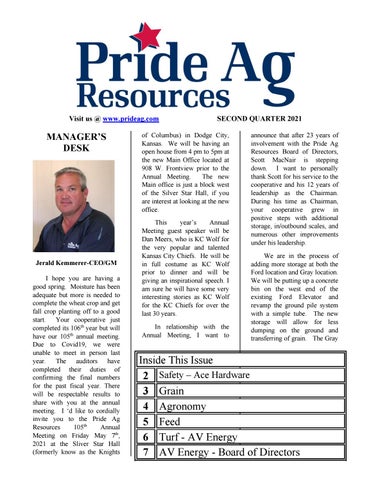
Jerald Kemmerer-CEO/GM I hope you are having a good spring. Moisture has been adequate but more is needed to complete the wheat crop and get fall crop planting off to a good start. Your cooperative just completed its 106th year but will have our 105th annual meeting. Due to Covid19, we were unable to meet in person last year. The auditors have completed their duties of confirming the final numbers for the past fiscal year. There will be respectable results to share with you at the annual meeting. I ‘d like to cordially invite you to the Pride Ag Resources 105th Annual Meeting on Friday May 7th, 2021 at the Sliver Star Hall (formerly know as the Knights
SECOND QUARTER 2021
of Columbus) in Dodge City, Kansas. We will be having an open house from 4 pm to 5pm at the new Main Office located at 908 W. Frontview prior to the Annual Meeting. The new Main office is just a block west of the Silver Star Hall, if you are interest at looking at the new office. This year’s Annual Meeting guest speaker will be Dan Meers, who is KC Wolf for the very popular and talented Kansas City Chiefs. He will be in full costume as KC Wolf prior to dinner and will be giving an inspirational speech. I am sure he will have some very interesting stories as KC Wolf for the KC Chiefs for over the last 30 years. In relationship with the Annual Meeting, I want to
announce that after 23 years of involvement with the Pride Ag Resources Board of Directors, Scott MacNair is stepping down. I want to personally thank Scott for his service to the cooperative and his 12 years of leadership as the Chairman. During his time as Chairman, your cooperative grew in positive steps with additional storage, in/outbound scales, and numerous other improvements under his leadership. We are in the process of adding more storage at both the Ford location and Gray location. We will be putting up a concrete bin on the west end of the existing Ford Elevator and revamp the ground pile system with a simple tube. The new storage will allow for less dumping on the ground and transferring of grain. The Gray
Inside This Issue 2 Safety – Ace Hardware 3 Grain 4 Agronomy 5 Feed 6 Turf - AV Energy 7 AV Energy - Board of Directors
location will receive a new metal bin just west of the leg to allow us to handle more grain without having to use the flat storage as much. These needed improvements have been in the planning stage for a while. Both projects have already begun with the goal to have them in place prior to fall harvest. I hope you have a great summer and thank you for your business. It is always appreciated! See you at the 105th Annual Meeting so we can share with you the results. Jerald Kemmerer-CEO/GM Pride Ag Resources
Safety Division Skyler Hays THE MOST COMMON ACCIDENTS ON THE FARM It is common knowledge that farming is a dangerous occupation. I researched the most dangerous occupations, and although the information I found did not always agree what jobs are most dangerous, agriculture was always near the top of the list. An awareness of the dangers one may face can be a tool to make farming safer. Following is a list of seven of the most common causes of death and injury on the farm. Overturning tractors and heavy machinery. It seems like every year we hear about a farmer or farm worker who is killed when a tractor overturns.
Most new tractors have ROPs (Roll Over Protection), but many older tractors do not. Remember that other equipment can overturn and cause injury or death, such as four-wheelers, sprayers, motorcyles, etc. Falls. Any time one works from atop a grain bin or a roof, he is at danger of a fall. Remember that an injuryproducing fall is not necessarily one from great height. One of the most common types of fall injuries occurs from ladders. Toxic chemical exposure. This category includes pesticides of any kind and fertilizers (especially anhydrous ammonia). Always read the label, wear the required personal protective equipment and wash throroughly after handling chemicals. Keep all chemicals away from children. Suffocation. The main culprit here is dying inside a grain bin from either entrapment or engulfment. Always make certain to follow best practices when entering a grain bin. Asphyxiation can come from any area where there is an oxygen deficiency, such as manure pits or silos. Heat stress. Farming can be hard work and summer temperatures make heat stress or heat stroke a possibility when working, especially when working outside in the summer. Take frequent breaks and drink plenty of water. Limbs crushed in machinery. This category also includes
amputations. Make certain that all guards over moving parts are in place. Never attempt to repair a machine without first locking it out. Animal related injuries. This includes anything from getting kicked by a horse to getting bit by a dog. These are just a few ways that one can be injured or killed on the farm. There are many other dangers besides these. Probably the best. advice I can give to anyone working in agriculture is to be aware of what you are doing and of the dangers that you may face when doing it
ACE HARDWARE Jack Lane, ACE Manager Spring is definitely here. It is time to start doing all the great lawn care projects and Ace definitely has you covered. From Stihl trimmers, blowers, chainsaws and the combi-motor with many different attachments for different chores. Stihl also has a battery-operated lawn mower. It is amazing how far we have come with batteryoperated equipment. We have different manufacturers that include Stihl, Milwaukee, Ego, Dewalt and several others. Ego seems to be the front-runner in battery lawn mowers. They also have an amazing blower with an attachment to clean leaves out of your rain gutters. Milwaukee makes grass trimmers and several other battery lawn tools. The great thing is it uses the same batteries as your 2
Milwaukee power tools, which makes it handy indeed. Ace also has all your fertilizer needs from our own Pride Turf brand, Ace, Scotts and several others. From garden seeds to garden hoses your Ace store has, your lawn and garden needs covered. Stop by and look at the full line of Toro and Craftsman mowers in stock. Hope to see you soon. We appreciate your business.
GRAIN DIVISION Gary Friesen Grain Division Winter is finally over and the welcome signs of springtime are putting a bounce in my footsteps and hopefully in your footsteps too. Springtime is that special time of renewal when life seems to burst forth from an all too long period of inactivity. A time when your eyes see the brilliant colors of early spring flowers and the deep greens of reawakened winter wheat fields seem much more vivid. After having gone through a brutal period of some of the coldest temperatures I have ever experienced, the warmer temperatures of springtime feel especially welcome. With vaccines being rapidly manufactured and distributed, it appears that it won’t be long till we can declare victory on Covid 19. After what feels like a yearlong winter of fighting and avoiding a deadly virus, we now have a decent opportunity to be with family and friends. Something we have all missed and something I will never take for granted again. The opportunity to once again join others at a baseball stadium has
never been more appealing. Hearing the sound of the crack of a baseball hitting a bat will have never sounded so sweet. As springtime approached the wheat market lost ground, coming off its high in late February. From Feb. 25th until April 6th Kansas City wheat July futures lost over $1.00/bu. Most of the decline was based on weather, as traders believed moisture was adequate in the Hard Red Winter wheat belt and initial concerns of damage resulting from the extended below zero temperatures were tempered. Wheat has rallied over the last few days mainly on strength in the corn market. KC July wheat closed at $5.94 ¼ on Friday, April 9th. The corn market performed mostly in a sideways pattern through most of the same time period but did move sharply higher after USDA issued their March 31st planting intentions report, moving from a low of $4.49 ½ on March 30th to a high of $5.03 ¾ on April 9th. Soybean prices moved sideways to lower through the same period of time. The March 31 planting intentions report however jumped soybean prices back to Feb 25th levels with soybeans up $.70/bu. after the report was issued. November Chicago soybeans closed at $12.63 ¼ on April 9th. Both old crop and new crop milo prices have been lower as gulf milo basis continues to show weakness. Gulf milo bids have declined rapidly as export demand has weakened and at times gulf milo bids have been nonexistent. The Department of Agriculture (USDA) has once
again left producers, end users and traders scratching their collective heads. Their March 31st planting intentions report was much lower than trade estimates and certainly lower than their Outlook Conference numbers published in March. Given current prices it’s hard for me to believe that planted corn and soybean planted acres won’t end up being closer to or higher than the 92 million acres for corn and 90 million acres for soybeans that USDA projected at their Outlook Conference. The April 9th World Supply and Demand report lowered, US corn stocks and raised both wheat and soybean stocks versus the grain trade’s estimates. USDA’s calculation of world ending stocks of corn and wheat were lower than trade expectations while soybeans ending stocks were above trade expectations. Date Wheat 1/6/21 5.74 2/5/21 6.02 2/23/21 6.18 3/18/21 5.62 Last Year – Feb. 2020 AVG. 4.23
Corn 5.23 5.82 5.87 5.82
Milo 6.25 6.84 6.89 6.67
Soybean 12.82 12.87 13.31 13.17
3.66 3.13 7.77
With the virus on the decline and the U.S. economy on the rise it looks like demand for corn and soybeans could likely be strong. More alcohol production is coming on line as the industry anticipates that summer travel will surge and demand for soybean oil grows as restaurants begin to reopen. While South American corn and soybeans are now available for export, I believe that opportunities to make export sales will continue. With ending stocks at lower levels, price volatility is likely, especially if dry weather 3
becomes a factor in the upcoming growing season. Dry weather in North Dakota is pushing Minneapolis wheat to higher levels on concerns that spring wheat planting will be down. Stronger spring wheat prices should support both Kansas City and Chicago wheat prices. We look forward to helping with your grain marketing needs as your row crops are being planted and as your wheat crop is reaching maturity. Having your futures orders in place ahead of a price rally is a great tool to help you get fills when the futures market makes an unexpected move higher. We also have Compass contracts which will price equal amounts of bushels each trading day at levels above the current market. We would be glad to put your order in or answer your questions about Compass contract offerings so don’t hesitate to give us a call. As always all of us at Pride Ag Resources appreciate your business and are ready to help you with all your grain marketing and grain handling needs.
AGRONOMY Tim Spector Agronomy Manager Fertilizer– Since this time last year we have seen our fertilizer values double in 12 months. Nitrogen values continue to be bullish and will continue through the fall crop planting season. The U.S. is short Urea for the 2021 Spring needs across the corn-belt. The global market is paying a premium for Urea compared to the U.S. market, thus, we are not seeing the
normal vessel lineup destined for our ports. The last report indicated we are short 500k tons to meet demand. Therefore, nitrogen values are utilizing supply factors coupled with grain values to support higher cost. UAN is following the urea trend and supply is limited. CF Industries and Koch are on allocation for the foreseeable future. We are fortunate as a cooperative to have assets to store additional tons for times like this. Phosphate supplies are extremely tight, 80 % of the tons servicing this market are coming from the Inola port facility in Tulsa, Oklahoma area. Mosaic controls 85% of the U.S. market and with the recent tariff ruling the normal chain of importers are not coming to our ports. The latest projection is that phosphate will stay firm throughout the summer and into the fall. In my thirty plus years in the industry dealing with fertilizer, we have never encountered a year like 2021. The good news, grain prices are high.
Crop Protection – Supply and demand are driving the market today. Glyphosate remains bullish along with other manufacturers increasing key A.I.’s due to the strain on the supply side of the technical materials. Your cooperative has a good inventory position to meet your needs. Grain prices are at a level of which we need to provide the plant every opportunity to maximize yields. If you are considering insecticides and fungicides in your crop plan, I recommend
that you contact your Pride Ag Resources agronomy team to place the orders. In the past week we have seen insecticides tighten up in the market i.e. Lorsban and diomethate. The weather pattern since November has blessed us with good levels of moisture. It seems like every 2 weeks we have received measurable levels of rain, coupled with the high winds that has hampered applications across the board. With the high grain prices you should consider going with a good pre-herbicide then within 21 days comeback with a solid post residual. Those steps will aid weed control especially in the milo. Post applications of herbicides on milo are difficult when battling the wind and rain. Our applicators are working hard to take care of the acres. In addition , we have aerial available and third party applicators as well.
Seed- The sales team is out with pricing and order specials for NK, Brevant, LG and Croplan seed. The genetic offerings through our suppliers have multiple Hybrid and Variety offerings to maximize your potential in Corn, Milo and Soybean production. Finance – As part of our ‘Advantage” program, your Pride Ag Resources Agronomist have information available to discuss input financing options for your seed, chemical and fertilizer needs for the 2021 crop year. Currently we offer CFA and Secure Finance options with terms to Feb 2022. Your Pride Ag Resources 4
agronomy team has information available if you have an interest. Agronomy Sales Team Base Location: Dodge City Main Office Dave Seymore 620-338-5553 dseymore@prideag.com Casey Blackburn 620-789-4003 cblackburn@prideag.com Base Location: Ingalls South Lawrence Baxa 620-789-1484 lbaxa@prideag.com Base Location: Garden City Darren Watson 620-290-2146 dwatson@prideag.com Dillon Gipson 620-805-2401 dgipson@prideag.com
FEED DIVISION Fresh green grass is a welcome sight come spring. However, early spring grass with limited growth or volume should be approached with caution when it’s used as the sole source of nutrition for recently calved cows. With limited grass volume, cows can expend more protein and energy than they are taking in and lose body condition. Cows are also coming out of gestation and into their time of highest nutritional requirement. While it can be lucrative to turn cows out on pasture at the first sign of grass, short grass won’t supply the nutrients a cow needs to perform her best. When feeding cows in the spring, it’s vital to provide adequate nutrition to help cows maintain ideal body condition
and get rebred. Your herd’s rebreeding success will determine the number of calves you’ll have the following year and how much those calves weigh. Needs by the numbers Nutritional requirements for cattle climb upward from gestation to the last trimester of pregnancy and are at their highest during lactation.
roughly 25 calves that are either born later or are not born at all because nutrition slipped postcalving.1 Calves born later result in less weaning weight.
As a cow begins lactation, her protein and phosphorus requirements go up about 60 to 70 percent compared to requirements during the last trimester. Requirements for total digestible nutrients (TDN), or energy, increase by an additional 15 to 25 percent.
Research has shown that a cow consuming 170 Kcal per metabolic body weight will maintain peak milk production for approximately 8.3 weeks at 20.2 pounds of milk per day, and will produce 2,726 pounds of milk over the course of 210 days. Providing additional energy, at a level of 290 Kcal per metabolic body weight, resulted in maintaining peak milk production for 10.9 weeks, at 24.2 pounds of milk per day and a total 210-day production of 3,742 pounds.
These nutrients impact milk production, a cow’s ability to get bred back quickly and, ultimately, the resulting calf crop. If you only maintain your feeding rate from gestation to lactation, you may start shorting your cows of adequate protein and energy. This gap in nutrition can result in lost body condition and performance. What’s at stake? Research shows that body condition score (BCS) at calving impacts how quickly cows begin cycling and become pregnant. For cows that calved in at a body condition score of 6 (ideal), 98 percent showed estrus by day 40 of the breeding season, and 90 percent were confirmed pregnant by day 40. Comparatively, a drop to a BCS 5 resulted in just 80 percent in estrus and 65 percent confirmed pregnant.1 For every 100 cows, a single point drop from a BCS 6 to a 5 at breeding could equate to
The amount of energy provided to a cow also influences her milk production and lactation length, which impacts nutrition available for her calf.
2 Set up for spring success It’s easy to get excited about a little bit of green grass, but there may not be enough volume to support a cow’s increasing requirements. Cows will run for green grass and burn more energy searching for grass than what they will consume. The energy deficit can result in lost body condition. A visual loss in condition often means you’ve already left some performance on the table. Supplements can help regain condition, but playing catch-up typically means feeding large amounts of supplement at a higher cost. Provide free-choice hay and supplement early until grass is lush and plentiful. Offer hay early and continue feeding it long enough for cows to achieve 5
a BCS 6 at calving and no less than a BCS 5.5 at breeding. Hay can be complemented with a self-fed solution like Accuration® supplement with Intake Modifying Technology®, which allows cattle to decide if they need additional energy and protein. Cows won’t consume much Accuration® supplement if forage is meeting their requirements, but will consume more supplement if forage is not meeting requirements. Supplementation can help keep an ideal cattle body condition score through all seasons and optimize cow performance with existing forage. Cover the spring nutrient gap, and set your cows up for greatness
Pride Ag Resources“Pride Turf” “Turf Talk” Tim Schiffelbein tschiffelbein@prideag.com
As springtime is approaching with warmer temperatures hopefully you have put down a Pre-emergent for crab grass control. If you haven’t it’s not too late to apply. Crab grass germinates when the soil temperature reaches 60 degrees Fahrenheit or before the last frost freeze of the year. If crab grass has germinated and then we get a frost freeze, generally that will kill immature plants that have broken through the surface. Our Preventer D, Preventer P and ALL Season Crab Grass Control products can still be used if applied in early May.
Will a particular preventer keep the dandelions away? The answer is no, unless you treat for them all year. Generally, weeds, such as dandelions, require a fall application before they pop up in the fall through to the spring. If you are fighting spring weeds, then I would recommend an application of “Weed N Feed” or picking up a bottle of Weed Killer at one of our Pride Ag Hardware stores in Lyons, Maize, Meade, and Dodge City. If weeds have already been treated and are easily manageable, use our Maintainer”. The “Maintainer” is considered our All-season fertilizer as it can be used in replacement of many other varieties that we offer. It has a good supply of Iron and Sulfur; as well, it contains 20% controlled slow release nitrogen providing a steady growth for up to 6 weeks. Next up is the use of our “Grub Guard”; this application should be applied before July 4th. This product controls the activity of White Grubs and other pesky or damaging bugs. Using this product from June through the activity season will also help prevent airborne June bugs from laying new eggs and stop the growth of new grubs throughout the fall (which is when grub growth is the most damaging. As always, if at any time you have any questions then please do not hesitate to get in touch with me, Tim Schiffelbein, Regional Sales Director. I would be happy to answer lawn or product related questions you might have. I can be easily reached at – tschiffelbein@prideag.com or at my office phone at 620-2254193,or cell phone at 620-3385678.
AV Energy Chris Klein AV Energy Manager Propane Safety Checks We are just wrapping up another propane season and as we do every year we will be starting our customer safety checks. We are required by our insurance company to do a five year inspection on all of our customer’s propane locations. These inspections are very important and we do them for the safety of our customers. Most of the time our safety checks take less than an hour and we do not charge for this service. Be proactive with premium diesel engine oil There’s nothing worse than dealing with engine issues. A dirty engine can noticeably lower your equipment’s performance and can even result in breakdowns. Luckily, there are ways to proactively avoid potential issues. Here are two tips to ensure engine cleanliness and proper preparation for harvest.
1. Conduct a LubeScan® Used Oil Analysis As oil moves through an engine, it picks up traces of any other contents or contaminants that might be inside. A LubeScan® Used Oil Analysis can be extremely helpful to uncover clues to larger issues before they become catastrophic. LubeScan Used Oil Analysis kits can be purchased from your local Cenex® distributor, and only a small sample of the used engine oil is needed. 6
Once the sample has been tested, an analysis report will show whether your oil sample contains any contaminants or runoff fuel — which could cause potential problems in your machine. To help you interpret your analysis results and fix possible issues before harvest, AV Energy offers consultations with certified specialists.
2. Be proactive with premium diesel engine oil To keep your equipment in top shape for the long run, an easy solution is to use a premium diesel engine oil such as CENEX MAXTRON® ENVIROEDGE® or MAXTRON® DEO. These synthetic, heavyduty diesel engine oils fight shearing and viscosity loss better than ever thanks to a new industry-leading viscosity modifier called ENDUROVIS™. The power of EnduroVis comes from its unique star shape. As opposed to a traditional linear coil-shaped viscosity modifier, EnduroVis’ radial form keeps the product intact as it moves through the engine. Boosted with EnduroVis, Maxtron Enviro-EDGE and Maxtron DEO are up to seven times more shear-stable than a traditional linear coil-shaped viscosity modifier — protecting your engine for longer, even under severe engine stress and heavy loads.
Following these tips can help you keep your engine clean and effective all year, especially when it matters most. To learn more, contact AV Energy.
Have a great spring and enjoy the warmer weather! Chris Klein
BOARD OF DIRECTORS Scott Mac Nair ........................ Chairman Tony Bleumer………..... .. Vice-Chairman Clint Hamilton ......... Secretary-Treasurer Butch Irsik.................................. Director Toby Whipple ............................ Director Jacob Tarman............................ Director Weston Vogel ............................ Director Brian Pinkney.…........Associate Director Phillip Woods …..…..Associate Director Jerald Kemmerer………………CEO/GM Debby Kennedy….......Newsletter Editor
An engine oil is the lifeblood of equipment. Not only does proper lubrication keep you in the field, it also keeps each component of your engine clean and protected. By using a premium-quality engine oil, you are setting up yourself — and your machines — for success. 7
Pride Ag Resources
Published quarterly by the
PRSRT STD U.S. POSTAGE
Pride Ag Resources
PAID
2nd Quarter 2021
908 W. Frontview, Dodge City, KS 67801
DODGE CITY, KS PERMIT #399
(620) 225-4193
8