Visit us @ www.prideag.com
MANAGER’S DESK
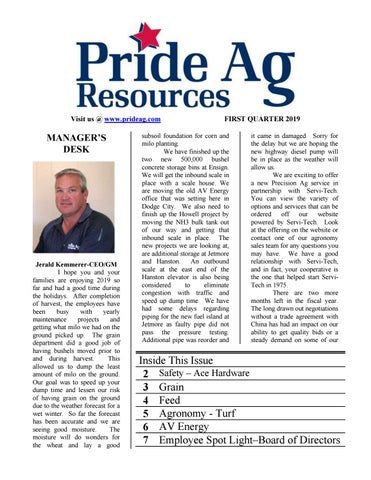
Jerald Kemmerer-CEO/GM I hope you and your families are enjoying 2019 so far and had a good time during the holidays. After completion of harvest, the employees have been busy with yearly maintenance projects and getting what milo we had on the ground picked up. The grain department did a good job of having bushels moved prior to and during harvest. This allowed us to dump the least amount of milo on the ground. Our goal was to speed up your dump time and lessen our risk of having grain on the ground due to the weather forecast for a wet winter. So far the forecast has been accurate and we are seeing good moisture. The moisture will do wonders for the wheat and lay a good
FIRST QUARTER 2019
subsoil foundation for corn and milo planting. We have finished up the two new 500,000 bushel concrete storage bins at Ensign. We will get the inbound scale in place with a scale house. We are moving the old AV Energy office that was setting here in Dodge City. We also need to finish up the Howell project by moving the NH3 bulk tank out of our way and getting that inbound scale in place. The new projects we are looking at, are additional storage at Jetmore and Hanston. An outbound scale at the east end of the Hanston elevator is also being considered to eliminate congestion with traffic and speed up dump time. We have had some delays regarding piping for the new fuel island at Jetmore as faulty pipe did not pass the pressure testing. Additional pipe was reorder and
it came in damaged. Sorry for the delay but we are hoping the new highway diesel pump will be in place as the weather will allow us. We are exciting to offer a new Precision Ag service in partnership with Servi-Tech. You can view the variety of options and services that can be ordered off our website powered by Servi-Tech. Look at the offering on the website or contact one of our agronomy sales team for any questions you may have. We have a good relationship with Servi-Tech, and in fact, your cooperative is the one that helped start ServiTech in 1975. There are two more months left in the fiscal year. The long drawn out negotiations without a trade agreement with China has had an impact on our ability to get quality bids or a steady demand on some of our
Inside This Issue 2 Safety – Ace Hardware 3 Grain 4 Feed 5 Agronomy - Turf 6 AV Energy 7 Employee Spot Light–Board of Directors
grain. We are hoping at least grain sorghum will reach an agreement so we can help market your grain. We just finished hosting our yearly grain marketing sessions with Jim Warren at CHS Hedging. I hope you were able to take advantage of one of the seminars as they were very informative and gave those who attended a good outlook on the markets. I hope you have a good safe spring and thanks for your business, it is always appreciated! Jerald Kemmerer
Safety Division Skyler Hayes Safety Director
BACK INJURY PREVENTION BY USING A NEW WAY TO LIFT Almost 80% of Americans will experience some kind of back pain sometime in their lives. It will cost $150,000,000,000 this year in the United States in direct and indirect costs as a result of back pain. This includes cost for pain medications, back surgery, trips to doctors and chiropractors, lost time at work, workers compensation costs and litigation. There is also the decrease in quality of life if one is affected by back pain. Often the cause of the back pain is improper lifting, which often injures the lower back. In the past we were told to approach the item to be lifted, place our feet shoulder width apart, bend our knees while keeping our back straight, grasp the item and “lift with your legs”. This way of lifting was wrong for several reasons.
Keeping our feet only shoulder width apart forced us to stand on the balls of our feet when we bent our knees to get low enough to grasp the item, which was an awkward stance. It also forced us to often bend our knees so far that it placed a lot of strain on our knees and reduced the lifting power of our legs, which made it difficult to stand up due to the angle. When we did stand up with the load, having our feet only shoulder width apart forced us to move the item away from our bodies to clear our knees which were in the way. This holding the load away from our bodies put great strain on our lower backs. Although no approach has been found for totally eliminating back injuries caused by lifting, let me discuss a new way to lift items that you may prefer. Approach the item, and with the last step position your feet much wider than shoulder width apart. This will allow you to keep both feet flat on the ground, which is a less awkward stance. It will also allow you to reach down and grasp the item without having to bend your knees as far as if your feet were only shoulder width apart, which is much easier on the knees and will not reduce the lifting power of your legs as much. If the item does not have handles, you may want to approach it from an angle and tip one end of it up to allow you to grasp the corners. After you have a hold on the item, lift your head and chest, which will position your hips forward for the optimal lifting position. Then stand up, keeping the item as close to your body as possible by lifting it straight up, similar to the way an elevator goes straight up.
This new way of lifting will help to prevent back injuries, but you can also prevent injuries by not lifting heavy or awkward items. If possible use cranes, bag carts, forklifts, etc. instead of your body to lift. If you must lift something heavy or awkward, have someone help you.
ACE HARDWARE Jack Lane, ACE Manager All the Pride Ag Ace stores have a new product in stock. It is a Harvest Right home freeze dryer. Harvest Right’s freeze dryer is small enough to sit on your counter top but can freeze dry large amounts of food. There is a world of difference between food dried at home and food that has been commercially canned or packaged. Nearly everything purchased at the grocery store is full of preservatives and food additives. Now you can preserve fresh fruits, and vegetables and complete meals at home. It is super easy and no mess. This product is perfect for people who want to avoid processed foods or have allergies or are gluten intolerant. You can freeze dry almost anything. Yes even ice cream!! Stop by any of the locations for information and a demonstration.
Date Wheat 10/5/18 4.79 11/2/18 4.59 11/21/18 4.24 12/17/18 4.67 Last Year –Feb. 2018 AVG. 4.12
Corn 3.61 3.64 3.55 3.69
Milo 3.03 3.11 3.02 3.19
Soybean 7.39 7.43 7.81 7.38
3.46 3.17 8.96
2
GRAIN DIVISION Its wintertime and the weather has been very winter like lately, providing an opportunity for some winter moisture. The government has been shut down for almost 30 days as I write this and generally speaking I believe that when the federal bureaucracy is shut down it’s a benefit to us as taxpayers. The shutdown has however closed local FSA offices and limited USDA’s Agriculture reports. Unfortunately, this time it seems that the two political parties are so far apart that a quick resolution to the current standoff is remote. Let’s hope that 2019 is the year that brings less divisiveness and that our leaders in Washington will find the fortitude to work together to solve problems rather than be problems. The weather has been volatile but the markets have not. The wheat market continues to be burdened with huge world supplies which has had March Kansas city wheat trading lower since last August. From a High of $6.44 on August 7, 2018 we have traded to a low of $4.82 ¼ on Nov. 27th. The wheat market rallied in mid-December on news the Russians might limit wheat exports and business would come to the U. S. but moved lower again the last half of December as no new news became available and no exports were reported. After bouncing around in a narrow range after the New Year started, March Wheat futures closed at $5.06 on Friday, January 18. The July 19 Kansas City wheat contract has traded
much the same as the March 19 contract with July Wheat closing at 5.24 ½. The wheat market continues to be plagued by a lack of export business. The corn and soybean markets have certainly been impacted by a deteriorating trade relationship between the U.S. and China. Soybeans have lost over $1.00 a bushel as the trade dispute continues. It seems about every other week the commodity market gets word that negotiations continue and progress is being made on the trade front. As of yet we have seen no concrete results. This lack of progress over trade issues has had an impact on the entire grain complex. As uncertainty has increased, commodity traders have been less enthusiastic to take positions. Record U.S. corn production this year as well as good South American production coming on line will continue I believe, to keep a damper on corn futures. The recent government shut down has also contributed to a lack of solid export information which has kept traders guessing about what exports might be. The March 19 Corn contract closed at $3.81 ¾ on Friday, January 18th. Both the March 19 and December 19 corn contracts have been range bound since the New Year began. Export opportunities for this year’s milo crop have been adversely affected by the trade dispute. Milo export business has dried up completely since the tariffs were imposed. While we have had hopes that normalized trade would reoccur and that milo demand from China would resurface, it appears that for now all we have is unrealized expectations.
To complete fall harvest this year we had to pile milo at your Howell, Ingalls, and Jetmore facilities. We were fortunate to get wheat trains loaded as fall harvest was finishing up which allowed us to pick up the Howell and Ingalls milo piles quickly. Weather was generally good while the milo was on the ground and we were able to pick up the milo in good shape at these locations before the end of the year. Our Jetmore milo pile was the last pile picked up and while it got snowed on, it also was picked up in good shape early in January. It’s good to have all the milo back in the elevators. Much thanks to all our grain operation people for a job well done. Construction of an additional 1,000,000 bushel storage capacity at your Ensign facility has been completed. This storage built by McPherson Concrete will increase our ability to handle your grain production more efficiently and provide better opportunities to reduce handling cost. The storage addition will also allow the Ensign facility to handle all three fall commodities more efficiently. Pride Ag Resources is committed to investing in local assets that improve handling capabilities and provide our member/owners with fast and efficient grain handling. While the cold of winter still lingers we know if will be spring time soon and we can look forward to yet another growing season. Please let us know how we can bring solutions to your grain production and marketing needs. Your Pride Ag Crop Production Department is fully staffed and ready to assist you with your all your crop 3
production needs. From prior to planting your crop till long after your crop is harvested, we look forward to helping you with all your grain production and marketing decisions. As always, thank you for the opportunity to serve you and thank you for your business.
FEED DIVISION Article provided by Purina Mills Cattle nutrient requirements can vary by season and stage of production – and now is a great time to evaluate your cattle mineral program and map out a plan to maximize impact. While minerals are a relatively small portion of the diet, they control many vital functions in cattle and impact everything from cattle reproductive and nervous systems, to feed efficiency and overall herd health. That’s why it’s so important to make sure the mineral needs of your cattle are being met year-round. Producers should consider these three steps to develop a solid mineral strategy: 1. Analyze annual cattle mineral needs. Mineral needs throughout the year can be impacted by a variety of factors, including cattle production stage and ration nutrient composition. Start your plan by considering how these factors change in your herd during the year. Production stages such as gestation, calving, weaning and breeding are especially important. During gestation and calving it’s critical to have a
good mineral to get cattle through that stress period. Cows that are mineral deficient can create a calf that is deficient at birth, which can result in “weak calf syndrome”, loss of vigor or scours. At weaning, calves need an on board reserve of minerals in their system as stress is often elevated and feed consumption may decrease temporarily. Bulls have special needs during breeding season – zinc, manganese and Vitamin E help to ensure sperm quality and vitality. Producers should also consider the overall nutrient composition and seasonality of their feedstuffs. For instance, areas with high growth, cool season grasses commonly have a need for higher magnesium in the spring to prevent milk fever or grass tetany. 2. Chose an optimal mineral source. Don’t let the mineral label completely drive your decision making. More is not necessarily better, and it’s important to identify the source of the mineral, not just the concentration producers should work with a nutrition consultant or Extension personnel to identify the levels of macro and micro nutrients needed in their herd and compare those nutrients to the amounts available in their rations or forage. Mineral product labels will list concentrations of each nutrient, so calculate anticipated intake and choose a mineral that sufficiently supplies lacking nutrients. Not all sources of minerals are utilized equally. Oxides are virtually unavailable to the animal – forms like chlorides
and sulfates are better, and organics or chelates are usually the best. Most oxide formulations are less expensive for manufacturers to include in a product, but they simply aren’t going to have the impact. Finally, consider expected seasonality when choosing a mineral source. During snowy or rainy seasons, water resistant and weatherized products can provide protection from mineral caking or from wind blowing it away. 3. Make the most of mineral consumption. While planning and choosing a quality mineral source are key, it takes proper management to have an effective mineral program. First and foremost producers should be tracking mineral consumption to make sure the cattle are getting the minerals that have been put out. To calculate consumption, producers should follow this simple formula: (Pounds of mineral distributed / Number of cows) /Number of days mineral was available Producers can encourage or discourage consumption by placing mineral feeders near or away from water sources, and in areas with ample room for access and rotation. Cows can’t tell if they do or don’t need mineral, but they do seek out phosphorus and salt, which can offer management tactics. Salt can be sued as a limiting factor, or if the cows are salt deficient, as a driver of intake. Overconsumption of mineral should be regulated. Although it is likely not dangerous, it can be costly. A well-planned mineral program means considering a 4
variety of factors from cattle needs and nutrients, to mineral sources and management strategies - - that planning can pay off in the long-run. You might not see changes overnight, but the return on this investment can be long-term. More cows bred back, less calf health challenges and any number of factors could result from a well thought out mineral strategy. Planning a strategy now will pay-off later on Choosing a mineral can be challenging.
AGRONOMY Lawrence Baxa Agronomy Manager Hello everyone! I hope 2019 has started off well for you. We are currently experiencing some of the best winter moisture we have had in a number of years. We are looking at a set up for an excellent crop year in 2019 in terms of production for both wheat and our fall crops. This will make fertility, weed control and other crop management decisions vital as we look at sustainability and maximizing production potential on each acre in this commodity price environment. Farming and technology has advanced and changed rapidly over the last several years. Decisions used to be made at a whole farm level based on averages. After a while management decisions evolved and were narrowed to a field by field level. Yield monitors and aerial imagery among other tools gave farmers the ability to drill down to that level. Now as we advance in the scope of production there are resources available so we can bring
production at the highest level, down to the given acre. Agronomy has come a long way from pulling soil samples and scouting for bugs. Pride Ag Resources along with our partners at Servi Tech have teamed up to help bring you, our producers the tools to do just that! Some new agronomy offering’s we are adding in 2019 are Field Intelligence Services. We have partnered with Servi Tech to bring the following: Field Imagery, Soil moisture management, Rainfall measurement and Growth modeling. Just to name a few. Check out our Web site or contact your Pride Ag agronomist for more information regarding this service. One thing about this region is that it will dry up. And the busy spring season will be upon us. We would like to remind you of just a couple more items to think about. With the winter moisture you can bet there will be weed problems in the fields. Be sure to scout your wheat fields early as possible to get a jump start on weed control for mustards and henbit so you can include weed control in your top-dress program. Your Pride Ag agronomist will be around to see you and assist in the details and get your spring plans in place. Going into spring there will be many things too think about, and many options available for your fertilizer purchases and your weed control needs. We at Pride Ag resources would like to thank all you for your past patronage and ask for your fertilizer and chemical business going into the 2019 crop production season!
I will quit rambling and close for now but as I always say, if you have any agronomy questions, if they should arise don’t hesitate to call, your Pride Ag rep or myself in Dodge City. The growing season will have many challenges, and with that, many opportunities as well. We at Pride Ag resources welcome the opportunity to work with you our customers. We APPREICIATE your business. We want to be your stop for chemical and fertilizer needs. Let us know how your Co-op can be of service to you.
Pride Ag Resources“Pride Turf” “Turf Talk” Nathan Ratzlaff nratzlaff@prideag.com First off, for those of you I have not had a chance to meet yet, my name is Nathan Ratzlaff and I am the new Regional Sales Director for Pride Turf Products. I hope everyone was able to enjoy the holiday season and was able to spend some time with family and friends. As a new employee with Pride Ag, I would like to take the chance to tell you a little about myself. I am a graduate of Kansas State University with a degree in Golf Course Management. I have worked the past fifteen years in the golf business with the last five of those being the golf course superintendent at Cottonwood Hills Golf Club in Hutchinson KS. My wife Anne and I have been married for almost four years and we will be expecting our first child this summer. So far, the weather we have had this winter has been great 5
for turf grass. Unlike last winter where we virtually had zero moisture and many places struggled to keep from losing their turf grass to winter desiccation, this year we have had great moisture throughout the fall and early part of winter. With this moisture, we have been able to sell quite a bit of our ice melt products, unlike the past couple of winters. The “Royal Blue Melter” is perfect for fast effective melting. It can be used for high traffic surfaces, driveways, sidewalks and steps. It has melting capabilities from 20 degrees to -20 degrees. The “Green Melter” is great for large applications and has an anti-slip material added in. This product has melting capabilities from 20 degrees to -15 degrees. In addition, as with all our products, we can sell these in 18lb and 50lb bags as well in our bulk totes. As we will be moving from winter into spring, the time to apply a pre-emergent will be here before we know it. We have a couple different preemergent options that we can provide to our customers. Our “Preventer P” is an early application product with a lasting residual. A good time to apply this product is around the middle of March before any crabgrass starts to germinate. Another option we have is our “Preventer D.” It is the ultimate crabgrass preventer; it has a later application window than Preventer P, as it should be applied around the middle of April. This product will actually kill any immature crabgrass plants that may have germinate a little early. Once again, I am Nathan Ratzlaff and if you ever have a question about your turf grass,
weather it is about fertilizing or you are having issues with pests or diseases, do not hesitate to ask. I am always glad to help anyone with a turf grass problem.
AV Energy Kelsey Wood New Certified Energy Specialist I would like to introduce Kelsey Wood as the newest member of the AV Energy Sales Team. Kelsey is originally from Wallace, Nebraska and recently graduated from Fort Hays State University. Kelsey now resides in Hanston and in her free time she likes to hunt and team rope. Kelsey has just finished up her training with the Cenex Energy Sales Team and will begin making sales calls soon. If you would like to contact Kelsey about your energy needs you can call her cell at 620-338-5500 or the office at 620-225-4994. Covering the worst-case scenario with the Cenex Total Protection Plan® Allyn File, who had just finished feeding his cattle last February, knew something was very wrong when his 5-year-old McCormick MTX 145 tractor started billowing white smoke. He managed to coast the tractor off the gravel road before it came to a halt. He thought there was probably an issue with the injectors, and he was right. But it was worse than that. It turned out that when the injectors went bad, they dumped so much fuel in the engine that the pistons started melting. “It was the worst-case scenario that there was,” File said. Fortunately,
File keeps all his qualified equipment covered through the Cenex Total Protection Plan®, which protects new equipment for up to 10 years or 10,000 hours and used equipment for up to 8 years or 8,000 hours, with no deductible. File has been using Cenex® fuels and lubricants for the past 30-plus years. “That oil has always, treated us good – very good,” File said. “And we’ve never thought about running anything else for that matter.” Importantly, File regularly maintains his equipment and sends in his used oil analysis through LubeScan®. File’s decades of loyalty paid off when he received a check from the Cenex Total Protection Plan® for $18,572.95 to cover 11 AV Energy
New Office Location With the purchase of High Plains Energy, AV Energy has moved into a larger office as of the first of November. Stop by to see our office and discuss any energy need you might have. AV Energy, LLC 108 North 14th Ave Suite B Dodge City, Ks 67801
Chris Klein
6
Pride Ag Employee Spot Light
Name: Gaylene Friesen Resides: Dodge City, Kansas Location: Main Office Position: Grain Merchandizer, Accounting, and software application support Gaylene has been employed with Pride Ag for over 35 years. Gaylene is married to Rod and they have a daughter Lindsay, who was recently married this last year. Gaylene grew up in Colorado Springs, and her hobbies are cooking, baking, craft’s and craft shows along with reading.
Name: Nathan Ratzlaff Resides: Haven, Kansas Location: Pride Turf Position: Regional Sales Director for Pride Turf Products. Nathan has been employed with Pride Ag for just over 4 months. Nathan is married to Anna, and their first child is due in July, 2019. Nathan grew up in Hutchinson Kansas, and his hobbies are Golfing, Hunting and going to the lake.
BOARD OF DIRECTORS Scott Mac Nair ........................ Chairman Tony Bleumer………..... . Vice-Chairman Clint Hamilton ......... Secretary-Treasurer Butch Irsik ................................. Director Toby Whipple ............................ Director Jacob Tarman ........................... Director Weston Vogel ............................ Director Brian Pinkney.…........Associate Director Phillip Woods …..…..Associate Director Jerald Kemmerer………………CEO/GM Debby Kennedy….......Newsletter Editor
Name: Tonya Hillman Resides: Jetmore, Ks Location: Kalvesta Branch Position: Office Manager, Tonya has been employed with Pride Ag for 4 yrs. Tonya is married and has one child Jacyee Tonya grew up in Timken Kansas. Her hobbies are Gardening and working outside.
Name: Will Kincaid Resides: Cimarron, Ks Location: Kalvesta Branch Position: Elevator Supervisor, shop, warehouse Will has been employed with Pride Ag for 2 1/2 years. Will is married to Dusty. Will grew up in Seattle Washington. Will’s hobbies are working on vehicles and putting together model cars.
7
Pride Ag Resources
Published quarterly by the
PRSRT STD U.S. POSTAGE
Pride Ag Resources
PAID
1st Quarter 2019
710 West Trail, Dodge City, KS 67801
DODGE CITY, KS PERMIT #399
(620) 225-4193
8