Visit us @ www.prideag.com
MANAGER’S DESK
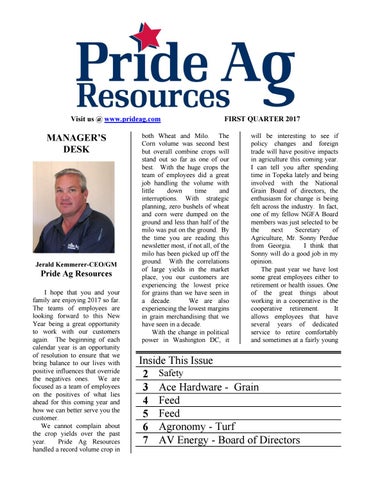
Jerald Kemmerer-CEO/GM
Pride Ag Resources I hope that you and your family are enjoying 2017 so far. The teams of employees are looking forward to this New Year being a great opportunity to work with our customers again. The beginning of each calendar year is an opportunity of resolution to ensure that we bring balance to our lives with positive influences that override the negatives ones. We are focused as a team of employees on the positives of what lies ahead for this coming year and how we can better serve you the customer. We cannot complain about the crop yields over the past year. Pride Ag Resources handled a record volume crop in
FIRST QUARTER 2017
both Wheat and Milo. The Corn volume was second best but overall combine crops will stand out so far as one of our best. With the huge crops the team of employees did a great job handling the volume with little down time and interruptions. With strategic planning, zero bushels of wheat and corn were dumped on the ground and less than half of the milo was put on the ground. By the time you are reading this newsletter most, if not all, of the milo has been picked up off the ground. With the correlations of large yields in the market place, you our customers are experiencing the lowest price for grains than we have seen in a decade. We are also experiencing the lowest margins in grain merchandising that we have seen in a decade. With the change in political power in Washington DC, it
will be interesting to see if policy changes and foreign trade will have positive impacts in agriculture this coming year. I can tell you after spending time in Topeka lately and being involved with the National Grain Board of directors, the enthusiasm for change is being felt across the industry. In fact, one of my fellow NGFA Board members was just selected to be the next Secretary of Agriculture, Mr. Sonny Perdue from Georgia. I think that Sonny will do a good job in my opinion. The past year we have lost some great employees either to retirement or health issues. One of the great things about working in a cooperative is the cooperative retirement. It allows employees that have several years of dedicated service to retire comfortably and sometimes at a fairly young
Inside This Issue 2 Safety 3 Ace Hardware - Grain 4 Feed 5 Feed 6 Agronomy - Turf 7 AV Energy - Board of Directors
age. For those who have, or are retiring, we wish you the best in the next chapters of your lives. We did lose an employee recently to health issues, Marilee Williams from our Ford location. Marilee had worked at that location for 46 years and was the corner stone for that location. Our thoughts and prayers go out to her family for their loss. The employees have been busy evaluating the facilities and making necessary repairs and maintenance on them to help keep major repairs down. This is also the time of year that as a coop we work on projects for the upcoming year that will continue to add speed and efficiency to our facilities to better serve you the customer. I hope you have a great spring with more needed moisture. Thank you for your business as it is always appreciated and never taken for granted! Jerald S. Kemmerer CEO Pride Ag Resources
Safety Division
Skyler Hayes
Safety Director ANHYDROUS AMMONIA SAFETY ON THE FARM Although there have been articles on anhydrous ammonia safety written in this newsletter in the past, a review of this
widely used fertilizer is in order. Anhydrous ammonia (referred to as ammonia for the rest of this article) is the cheapest form of nitrogen fertilizer available to the farmer, and, because of that economy, our customers use a great deal of ammonia. By using the cheapest form of nitrogen fertilizer, farmers will realize more profit in their operations. Ammonia has some disadvantages, though, and among the disadvantages are its difficulty and expense to the distributors and sellers to handle and its danger to humans and the environment. Because of the dangers, ammonia is a highly regulated chemical by several government agencies. Among them are the Occupational Safety and Health Administration, the Department of Homeland Security, the United States Department of Transportation, the Kansas Department of Agriculture and the Environmental Protection Agency. Heavy government regulation adds to the costs to your Coop to store, handle and transport this product. Ammonia has several chemical and physical properties that must be taken into consideration when storing and handling it. Ammonia has a boiling point of -28 degrees F, which means that in Kansas any anhydrous ammonia tank will have some pressure since the product will always be above -28 degrees. The pressure inside a tank of ammonia on a hot day can easily reach 200 psi or more. The term anhydrous means without water, and because anhydrous ammonia is without water, it is attracted to water. That is a good thing when the producer is injecting the ammonia into the ground, and it
is attracted to the moisture in the soil, as it helps to keep the ammonia from escaping into the atmosphere. That same attraction to water is a bad thing when people get ammonia on their skin, in their eyes or in their lungs. Ammonia is a strong alkali with a pH of between 10.6 and 11.6. Alkalis tend to turn human flesh into sticky goo that keeps eating away at the flesh until it is washed off by water. Ammonia will burn, but only in concentrations in the air of between 16% and 25% and with an ignition source of 1560 degrees F. Ammonia is not a poison, but a corrosive. It is not only corrosive to human flesh, but also to many metals such as copper, zinc and silver and their alloys. Most people can smell ammonia at concentrations of just 5 ppm. At that concentration you will not be harmed by ammonia, but you will know it’s around. At 400 ppm one will experience throat irritation. The best way to avoid injury to your skin or eyes by ammonia is with the use of personal protective equipment (PPE). The two most important pieces of PPE are non-vented or indirectly-vented goggles and PVC gloves. Never work with anhydrous ammonia without wearing these two types of PPE. Safety glasses are not recommended, as they will not protect your eyes as well as goggles will if you get a blast of ammonia in the face. Also, leather gloves are not recommended when handling ammonia. If you need guidance on where to obtain this PPE, contact any manager of a Pride Ag location that handles ammonia, and he will assist you. Remember that as little as 2
one drop of ammonia in one’s eye can seriously injure the eye. People have been blinded permanently by ammonia. Because very few farmers have access to respiratory protection, remember to run upwind from an ammonia spill or leak. It is important to know some basic first aid in case you are exposed to ammonia. As ammonia is released into the atmosphere, it becomes extremely cold and can cause frostbite to the skin and eyes. For exposure to the eyes or skin water is the only first aid. If you get ammonia in your eyes, hold the eyes open and flush with clean water for at least fifteen minutes. If your skin is burned by ammonia, flush the burned area with clean water for at least fifteen minutes. If ammonia is inhaled, remove the victim to fresh air and give artificial respiration or oxygen if needed. With any exposure to ammonia, first aid must be start immediately. The more time before treatment begins, the more damage will be done. As time passes the ammonia keeps going deeper into the eyes, skin or lung tissue seeking out water and doing more damage. After first aid has been administered, seek medical help immediately. As beneficial as first aid is, it is much better to not need it in the first place. People have been blinded by ammonia even though water was used to flush the eyes soon after exposure. That is why it is so important to wear the proper PPE. Once the ammonia is inside the eyeball, it is almost impossible to get it out by flushing. Also, remember that contact lenses should never be worn when working with ammonia. There is a five gallon carboy of emergency water
mounted on the top of each of our ammonia nurse tanks. Remember that this water may be frozen during the colder part of the year, so if you are applying ammonia during cold weather you should keep a supply of at least five gallons of clean water in the cab of your tractor.
ACE HARDWARE
sizes of bags and even in totes for larger operation needs. All the Ace locations are preparing for year-end inventory audits. Always a fun time of year. Thanks for your continuous support and your business
GRAIN DIVISION
Gary Friesen Jack Lane,
Grain Merchandiser
Ace Manager It is amazing what Mother Nature can do to boost winter sales. The Ace stores had strong sales in generators, ice melt, and chain saws due to the recent ice storm. Ace is now a dealer for Generac whole house standby generators available from the Ace Warehouse in Colorado Springs. These generators come with an automatic transfer switch that change over to generated power whenever your electricity goes off. They run off natural gas or propane and come in different kilowatt sizes depending on your needs. Stop by any of the locations for information on these units. We have also restocked our inventories on portable generators of different sizes. We have a good inventory of Toro and Craftsman snow blowers in stock along with the Pride Ag ice melt in all different
We’ve turned the page on the calendar again and started a new year. Calendar pages seem to turn more quickly this days with January becoming December all too quickly. We hope you had a happy new year and anticipate that this year will be memorable and will bring great opportunities for all of us. The important news so far this year is the change of leadership in Washington D.C. With the election of Donald Trump as president the equity markets have generally performed better and stock indexes have risen. The business environment has looked favorably on the change of administration with optimism Date Wheat 10/6/16 2.65 11/4/16 2.77 11/18/16 2.89 12/16/16 2.85 Last Year –Feb. 2016 AVG. 3.87
Corn 2.91 2.99 3.01 3.01
Milo 2.46 2.54 2.56 2.56
Soybean 8.59 8.82 8.94 9.37
3.54 3.03 7.79 3
that regulations will be less burdensome than was seen with the previous administration. I too, am optimistic that the economy will continue to improve and real economic growth will occur. Your Pride Ag Resources team has kept busy through the fall and into winter handling the crops that you harvested this fall. With over 3,000,000 bushels of milo on the ground at all of your locations, it was important to begin the process of shipping grain and making space in the elevators. Wheat, corn and milo were shipped during fall harvest to open space in the elevators to begin the process of picking up grain piles. As of today, all grain piles are picked up with the exception of the last of the Ensign ground pile which will be picked up very shortly. Thanks to our grain operations personnel for working extra hard and extra hours to make this happen. We were also fortunate to have dry conditions while the piles were on the ground even though a shot of moisture is always welcome in Western Kansas. The grain markets continue to be characterized by huge carry outs. Corn carry outs on USDA’s last report were 2.355 billion bushels and all wheat carry outs were 1.486 billion bushels. World carry outs continue to be large as well and these carry out numbers are expected to put a lid on both corn and wheat prices. Strength in the dollar may also pressure our export opportunities. Rail car costs have risen significantly lately and have lessened opportunities to ship wheat and milo to the gulf for export. The market is watching
the progress of the South American corn and soybean crop with great interest and conditions so far this growing season have been very good. The March Chicago corn contract surprisingly has rallied since the end of December to a high of $3.71 on January 24 but has fallen back since then. The soybean market was up last week after reports that Argentina received excess moisture. The March Kansas City wheat contract rallied after USDA’s report that the U.S. planted 7% less winter but is down $.15 from its high of $4.54 on January 17th. Weather will be worth watching as we move ahead to the 2017 growing season. Some weather analyst are predicting that the La Nina weather pattern will bring drier than normal conditions in the southwest and southern plains this year. With less planted wheat acres, dry conditions could cause more volatility in wheat prices and also put a premium in the corn and soybean markets prior to harvest time. As always, marketing opportunities will need to be watched closely and taking advantage of rallies when they occur will be important. Placing market orders can be an excellent way to gain this advantage. Additional opportunities exist with the Compass contracts that we can offer you through CHS. The Daily Price Plus and the Price Builder Bonus contracts can provide opportunities to price your production each day at prices above current market levels. Please call if you would like to take advantage of any of these marketing opportunities. Many thanks for your continued support of Pride Ag Resources
and best of luck to you and yours in 2017.
FEED DIVISION
Calvin Carey Consumption As the fall and winter temperatures change -- cattle change. Cattle grow a longer and thicker hair coat, along with a layer of fat under the hide to provide insulation to reduce heat loss and minimize cold stress. Changing temperatures in the fall combined with shorter days and longer nights stimulate appetite and physiological changes in your cattle. Shorter and colder days will increase feed intake and rate of passage through the gut that speeds up as cattle needs more fuel to keep them warm. Feed requirements may go up 10 to 25%. These changes increase heat production and help the animal withstand winter temperature changes. What is the most important nutrient that livestock need? Water. Water accounts for 50 to 80% of an animal’s weight and physiological process. Without water, feed intake decreases, and the animal becomes dehydrated and body functions fail. Water availability and quality has a major impact on cattle performance. To process that additional feed that cattle consume, the digestive tract needs adequate fluid. That’s why it is important to provide 4
adequate water during cold weather. A cow’s water requirements are not as high in the winter as they are in summer but are still important. Ruminants have a large storage reservoir to draw from, but is important to make sure they do have water available. Physiological status won’t be ideal if they go 24 hours without water, by 48 hours it becomes problematic. In extreme conditions, cattle experiencing stress don’t always have a sense of thirst due to overriding factors. An animals’ priority is to deal with the stress and survive. Depending on the stress level, cattle may not be consuming enough water. There is a tendency to urinate more with stresses such as shipping, handling, moving or severe cold stress, depleting the body’s water reserves. Cold stress may increase metabolic use of water and the cattle urinate more because the body is getting rid of anything extra that must to be kept warm. If cattle are not drinking enough water they are dehydrated. We do not know by restricting water how long the digestive system will perform. There is a definite relationship between feed intake and water intake. Any animal with health issues or running a fever is experiencing stress that can override thirst, which can result inadequate body fluids. You don’t always see subclinical issues, so it becomes extremely important that cattle have access to clean water at all times. Providing water is also important from animal welfare standpoint and is good animal husbandry. Cattle need ample water for normal rumen function, good feed mixing in the rumen and to maintain normal gut motility. Microbes in the rumen need a fluid environment to function best. Rumen microbes need adequate protein and moisture for optimum fermentation. Water is also important to maintain good electrolyte balances in the body. Every process in the body is driven by the ability to move nutrients across cell walls. The body is mostly water. Good cellular health, gut function, nutrient utilization,
normal metabolic function and keeping the body at proper temperature all depends on adequate supplies of water. As cattle become dehydrated in cold weather they are losing key elements such as sodium, potassium and chloride. These electrolytes are crucial to the body, especially at the cellular level, for proper metabolic and biological function (carrying nutrients in and out of the cells), muscle function and other basic physiological functions. We want to replace these and keep a good electrolyte balance. Cattle that are shivering to keep warm use energy, depleting reserves of energy and water. At the cellular level, when cattle lose electrolytes there is a loss of sodium and potassium. Then the cells are unable to function properly. Cattle need important elements to restore proper cellular metabolism and function. Many compounds in water can have a negative effect on cattle performance and health. These are: Dissolved solids-water containing high levels of Total Dissolved Solids (TDS) are commonly found in wells and can lower feed intake and daily gains in beef cattle. Lower gains and feed intake is not affected if the TDS level is below 3,000 ppm, but do not use water above 5,000 ppm range for cattle. Studies have shown that TDS in the 4,000 to 5,000 ppm range have lowered stocker cattle gains and decreased milk production in lactating cows, causing a reduction in weaning weights. Nitrates- nitrates from manure and fertilizer are an increasing problem affecting water quality. During periods of drought, pound water and streams become stagnant and evaporate, resulting in higher concentrations of pollutants. More than 300 ppm is considered unsafe, 100 – 300 ppm is questionable and less than 100 ppm is considered safe. When feed that is high in nitrates is fed, water contamination can become a serious problem. Chronic nitrates can cause the cattle to eat less thus have poorer performance. Avoid digging ponds
near areas where runoff could occur (feedlots). Mineral Content-other substances that cause water quality problems include sulfur, iron and manganese. These minerals decrease water intake because of foul flavors and odor. Another common problem is excessive levels of minerals that interfere with normal mineral absorption and lead to other deficiencies. The most common is high iron and sulfate levels that bind and prevent the absorption of copper and zinc. Algae-blue green algae is a water quality problems usually seen in the surface water that is rich in nutrients. Bluegreen algae are actually bacteria that, under the right conditions, can potentially produce toxins that can kill cattle. Toxicity problems occur when cattle consume large amounts of algae in the summer. The best methods to control algae are to eliminate the source of nutrients entering the water, aerate the water or fence the cattle away from the pond. Water Temperaturewater temperature can also affect cattle performance. Cool water helps cattle maintain proper body temperature and leads to increase water intake. Shallow ponds can lead to decrease water intake. Water is the most important nutrient for cattle, but providing clean water for cattle is often overlooked. Many problems occur when water becomes contaminated with manure, dissolved solids, nitrates, algae, or sulfates. Poor water quality can lead to poor performance and poor reproduction that often goes unnoticed, but can be deadly as well. Drinking water quality should be part of the evaluation when there is a problem with poor cattle performance. The best water will contribute to optimal production. We have a mineral and Stress Care Program that will maximize your performance of your cattle. Give us a call.
5
AGRONOMY
Bruce Millershaski Agronomy Sales Hello everyone, I would like to introduce myself. My name is Bruce Millershaski, the newest employee with Pride Ag Resources. I will be the new manager at the Ingalls South Location as of July 1, 2017 after Steve Dirks retirement. For the time being I am training under Steve just trying to learn the processes. Here is a little information about myself; I have been involved with agriculture since my high school graduation, I have been involved with many facets of agriculture. My experiences have been involved with agriculture since I was 5 years old and that is my passion. It is what puts food on the table. I will always have a special place for agriculture in my heart. That is what I know and wouldn’t change it for the world. I feel I have been given the opportunity to further improve the production processes with you, our Ag producers with this new appointment. With that in mind I want to remind you of what you might want to consider for the upcoming seasons. We have been blessed with some beneficial moisture and with that in mind you might consider a top dress application for your wheat acres. You might also want to include a herbicide application to prevent a weed invasion to allow for a “trouble-free” harvest. We have a wealth of knowledge with our agronomists at Pride Ag Resources. If you have questions, please call your local Pride Ag Resources representative or myself. I will let you know. If I don’t know
the answer to your question, I will find the answer and get back in touch with you. Your business is important to me and I want you to be confident in what Pride Ag Resources have as far as recommendations to assist you in a profitable year. We also have some very attractive pricing on fertilizers and herbicides that can make your cost of production more manageable. In visiting with customers like you I am sure this year will bring challenges like they have in the past. Contact us to lock in a price as soon as possible. I look forward to visiting with you as we get into the production year.
Pride Ag Resources“Augusta Green” Turf Shed
“Turf Talk” This newsletter article crept up on me very quickly as I am wondering what happened with January! I know for many of you the month of January will be one to remember for everyone involved with the recent ice storm. As I drove through town, I was in disbelief that Mother Nature has her own way of handling what we sometimes take for granted. It’s heartbreaking to see the damage to the trees. I was working at DC Country Club in 2007 when the last ice storm wreaked havoc on those trees, and was also at Wichita Country Club in 2005. I have seen some bad ice storms, but this one without a doubt was the worst I have seen. The Turf team is looking forward to a great 2017. We are
pleased to announce that we continue to add new items that are produced and packaged through our Turf Shed plant. Our “Pride Turf Products” lineup will have the same full Step program and a few new additions for 2017. One new addition that will be releasing very soon will be our Tree and Shrub fertilizer. I have spent some time researching different products and I feel like we will have a solid product to help repair many trees around the area. Normally a good tree fertilizer would have more phosphorus in it to help build a strong root structure, but for many trees in our area, we will need to have a fertilizer that will stimulate more top growth like Nitrogen. Normally a good rule of thumb when fertilizing trees is to complete under the normal canopy (this year try remembering how big the tree was) as that is typically your feeder root system on trees. A ground application will help or you can look into soil drilling and placing the fertilizer into the holes spaced under your canopy. Early spring is a great time to get your trees growing back and looking good again. If interested be sure to check in with your local branch or one of the Pride Ag Ace Hardware stores for this product very soon. With spring right around the corner, we will have our PreEmergent herbicides for Crabgrass and Goosegrass control as well as a new formulation on our Weed and Feed product. The new formulation of Weed and Feed is going through the labeling process currently and will be even more effective in cooler temperatures during the spring or fall on cool season grasses. We have also made some plant upgrades on how our products are coated and I am sure our combo products will be better than ever. I also have heard very positive comments on how our products did over the course of 2016 as that was our first full year of products. We had a cemetery that was treated to control sandburs with great success and another local golf course that 6
showed positive improvements in their soil tests. We pride ourselves on making the visible improvements to your lawn but also keeping with what our soils need the most, some results are not visibly seen but testing shows improvements for a longer lasting impression. Our motto has always been “Made in Kansas for Kansas soils”. If you haven’t tried our products out yet, I ask that you give us a chance to see some of these positive results. Also new this year, I have worked on a warm season program that will be very effective on Buffalograss and Bermuda lawns. Be on the lookout for that program to be released. As always, I am here if you have any lawn questions or if you need help recommending products. If you know someone that could use our products in bulk such as a city, park, sports field, or golf course please send them my way!!
AV Energy
Chris Klein AV Energy, LLC O. (800)752-1580 O. (620)225-4994 I hope everyone had a great holiday season and this letter finds you well! Old Mother Nature sure has quite a since of humor doesn’t she? Not only have we had some very cold days and nights, but she also decided to dump an inch of ice on us and knock out power to a lot of area residents. The good thing is that a lot of our customers who lost power had a backup propane generator and were able to have
power in their houses and wells until the power company was able to put them back on line. Below you will find some information from www.propane.com about propane generators. The U.S. Department of Energy recorded more than 3,600 major power interruptions nationwide in 2014. They also note that the frequency of outages is increasing every year. With a propane standby generator, your family can spend the next power outage playing games, reading, and relaxing while the neighbors search for candles and flashlights. Give your family greater comfort, security, and safety with a propane standby generator. Instant Power, Every Time When you see storm clouds looming on the horizon, you don't want to wonder if your backup generator will start or not. That's why propane is the perfect standby generator fuel. Unlike gasoline or diesel, propane won't degrade over time, so when the power goes out, your generator will start automatically, every time. You May Not Even Know It’s Working It usually takes less than 10 seconds after a primary power interruption for your propane standby generator to kick in. Plus, most units produce as little as 60 decibels of noise — comparable to a normal conversation — so you may not even realize the rest of the neighborhood has lost power. The Size and Capacity You Need Propane standby generators are available in a wide variety of capacities, so there's one to fit the needs of your family. How long can you depend on your standby generator? A 7kW standby generator drawing from a 250gallon propane tank can provide enough electricity to power your home for up to five days. If you would like to learn more about propane generators please give AV Energy a call. AV Energy works with several contractors throughout the area and we would be glad to get you a quote for a generator and propane tank. Thanks, and have a great day!
BOARD OF DIRECTORS Scott Mac Nair ........................ Chairman Jeff Reinert…………….....Vice-Chairman Clint Hamilton ......... Secretary-Treasurer Jeremy Derstein ........................ Director Butch Irsik ................................. Director Tony Bleumer ............................ Director Toby Whipple ............................ Director Jacob Tarman…........Associate Director Weston Vogel …..…..Associate Director Jerald Kemmerer………………CEO/GM Debby Kennedy….......Newsletter Editor
7
Pride Ag Resources
Published quarterly by the
PRSRT STD U.S. POSTAGE
Pride Ag Resources
PAID
1st Quarter 2017
710 West Trail, Dodge City, KS 67801
DODGE CITY, KS PERMIT #399
(620) 225-4193
8