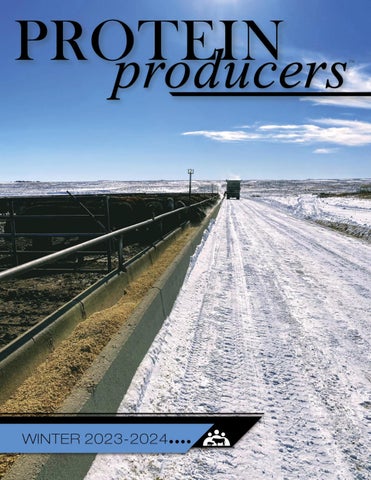
PROTEIN producers
TM
2023 Volume 11 Issue 4
EDITORIAL TEAM: Brandi Bain, Darcy Howard, Lisa Taylor
SPONSORS Thank you to all sponsors for supporting PAC & Protein Producers.
Animal Health International Bimeda Boehringer Ingelheim Animal Health USA Daniels Manufacturing Co. Diamond V Huvepharma Kemin Animal Nutrition & Health – North America Lallemand Animal Nutrition Merck Animal Health MicroTechnologies Newport Laboratories Norbrook Virbac Zinpro Zoetis FRONT COVER PHOTO CREDIT Thank you to Ryan Rice and Dr. Nels Lindberg for the photo from Nextgen Cattle Co. Riverbend Feedyard in Hugoton, Kansas. winter 2023-2024 | pacdvms.com
3
Jorgensen Farms Exeter, Nebraska
Photo Credit: Klaire Jorgensen
We want to showcase unique photographs from our readers here! Please submit your photographs to protein.producers@ pacdvms.com.
winter 2023-2024 | pacdvms.com
5
WELCOME Hello, everyone, and welcome to the winter issue of Protein Producers! As I write this, the first snow of the year is falling outside of my living room window and I cannot help but ponder what our upcoming winter will hold in store. Last December was memorable in all the wrong ways, but despite that, we still had a lot to be thankful for over the last year. Heavy snowfall in the winter led into heavy rains in the spring through most of the Midwest and West which abated a two-year drought. This gave rise to pasture grasses we have scarcely seen in a couple years and should contribute to commodity prices that are more functionable for all of our producers. This season is a time to be thankful. Thankful for our family and friends. Thankful for the opportunity to be a part of an industry that provides safe and healthy food to millions of people. At a time when there are wars being waged on two continents, we should all be extremely thankful for our safety and the safety of our families. We at PAC are thankful for you, the reader, our clients, consumers, and each team member of PAC. We have some great articles in this issue. Dr. Kip Lukasiewicz’s article on the impact of mud is a must read, particularly with the severity of the winter some long-term forecasts are expecting. Another very relevant article is Dr. Gregg Hanzlicek’s article on coccidiosis. On the topic of bovine respiratory disease complex is Dr. Brent Meyer’s article on bovine coronavirus. Although we are all tired of hearing about human coronavirus, there is a reason these viruses are so important to our industry and all animal industries. Dr. Dan Thomson addresses one of the oldest practices humans ever performed on domestic cattle – castration procedures – with a modern approach to welfare considerations. Ever-changing technology leads to more questions on communication and security, which are discussed by Dr. Nels Lindberg and Richard Fleeman. Finally, Dr. Duane Wulf discusses an ever-important topic in our industry, dark cutters. Thank you so much for reading our magazine and being a part of our family. Matt Fruge, MS, DVM: Production Animal Consultation Arnold, Nebraska
THANK YOU We want to thank the industry partners, publications and associations who have pro vided content to Protein Producers. Also, a big thank you to our readers for sup porting us, offering content and helping us improve each issue. We could not do any of this without all of you! Disclaimer: The views, opinions, and information expressed in this magazine are those of the authors and do not necessarily reflect Production Animal Consultation's policy or position.
contents WINTER 2023-2024 6 Welcome Matt Fruge, MS, DVM
29 Chuckles from Down Under
54 Risa entre dientes desde Oz
10
56 Getting to Know the PAC Team: Jared Bourek, DVM
58 Parable: Seed Time & Harvest
65
16 & 46
PAC Member Highlight:
❙ COW-CALF
Tom Covey, DVM
10
66
Keep Bovine Coronavirus (BCV) on Your Radar
The Pot Roast: Beef Taco Skillet
16 Castration in the Beef Industry: Best Practices and Innovations
❙ LEADERSHIP 58 8
contents
20 Rules of the Road for Texting
❙ FEEDLOT
26 Coccidiosis in Cattle
30 The Impact of Mud on Cattle Health, Performance and Well-being
30
❙ INDUSTRY
36 Living Life in the Yellow: Operational Security and Situational Awareness
40 Terrell Receives Distinguished Young Alumni Award
36
42
❙ EN ESPAÑOL
The Dark Side of Dark Cutters
46 20
– vaca-becerro
La Castración en la Industria de la Carne de Res: Mejores Practicas e Innovaciones
50
– industria
El Lado Oscuro de la Carne de Corte Oscuro 42 & 50
❙ 2023 SNAPSHOTS
14 PAC Network Veterinarians & Their Influence
68 Protein Producers winter 2023-2024 | pacdvms.com
9
KEEP BOVINE CORONAVIRUS (BCV) ON YOUR RADAR By Brent D. Meyer, DVM, MS, Merck Animal Health
W
hen I think about bovine infectious diseases, especially bovine respiratory and enteric diseases, bovine coronavirus (BCV) speeds to the front. I often investigate both scour and respiratory outbreaks in beef/dairy herds, and a common finding with diagnostics is BCV.
winter 2023-2024 | pacdvms.com
11
The number one management goal to help prevent BCV calf scours is ensuring that calves consume high quality colostrum from BCVvaccinated dams. Calves should be up and nursing within 6 hours of birth...
Given the frequent occurrence of BCV – and the significant impact it can have on the growth and productivity of beef cattle – producers should be aware of the presentation, prevention, and treatment of the virus and consider discussing it with their veterinarian. BCV is well documented for its role in enteric disease and until recently, was considered solely an enteric pathogen. It affects the small intestines and colon and is especially lethal in young calves due to the rapid loss of bicarbonate in feces. BCV is the cause of winter dysentery in adult cows. However, growing evidence shows its prevalence and association with respiratory disease.1 BCV has an affinity to both intestinal and respiratory cellular structures. BCV destroys goblet cells, which line both the trachea and the intestinal tract. These are the cells that produce a “mucus mat,” which is the calf’s defense against invasion of pathogenic bacteria. We often see a combination of BCV with Mannheimia haemolytica, Pasteurella multocida, Histophilus somni, and Mycoplasma bovis. If these bacteria are present with a concurrent BCV infection, then the bacteria have an unobstructed path into the lungs of a calf to develop bacterial pneumonia. In comparison to the enteric form, it is well established that BCV can be lethal by itself, but often allows for colonization with Rotavirus, Escherichia coli, or Salmonella sp. BCV enteric presentation is typically seen in young calves (3-21 days old) and is characterized by profuse watery or hemorrhagic diarrhea, with high morbidity and mortality rates. From a respiratory standpoint, it often is seen just prior to turnout or branding, preweaning, and during the first 45 days in the feed yard. Uncomplicated cases of BCV generate a mild fever around 103° F. There can be clear nasal discharge and ocular discharge as well. Another common presentation is increased respiration rate and coughing. Research shows that cattle shedding BCV from the nasal cavity and seronegative to BCV were 1.6 times more likely to require treatment for respiratory disease than cattle that did not shed virus or seropositive to BCV.2 Cattle shedding BCV were 2.2 times more likely to have pulmonary lesions at slaughter than cattle that did not shed BCV. These findings support the theory that neutralizing antibodies in naturally exposed calves, or cattle arriving at feedlots, have been correlated to protection against respiratory disease, pneumonia, or BCV shedding.
Global prevalence Results from ongoing and retrospective studies using 12 cow-calf
1,363 nasal swabs collected from cattle experiencing BRD where one or more respiratory pathogens were detected (34% of samples) showed that BCV was detected most frequently (22.9%) compared to 11.6%, 7.0%, 6.1%, and 5.0% for BRSV, PI3, BHV-1, and BVDV, respectively.1,3-4 The virus presence has been confirmed on all continents, and seroprevalence studies demonstrate that over 90% of cattle have been exposed to BCV during their lifetime.5 Prevalence may be underestimated because uncomplicated respiratory BCV infection is often undiagnosed (samples not submitted) because it seldom results in extreme illness and self-cures within a week. However, if calves progress to severe pneumonia or non-responsive diarrhea, then nasal swabs or fecal samples should be submitted to a diagnostic laboratory. To better protect animals, producers should know the common signs of BCV as well as practical management steps needed to decrease BCV-related illness in calves.
Vaccination and colostrum management Currently, there are no vaccines available for the respiratory form of BCV. There are BCV vaccines available that are labeled for the enteric form. More research is needed on the application and effectiveness of respiratory BCV vaccines. The number one management goal to help prevent BCV calf scours is ensuring that calves consume high quality colostrum from BCV-vaccinated dams. Calves should be up and nursing within 6 hours of birth, because by 12 hours, the esophageal groove that directs colostrum into the small intestine for absorption starts to seal up. Administer a BCV-containing vaccine in cows and heifers prior to calving. This boosts antibody levels in the colostrum, providing newborn calves with increased protection. Adhere to the correct protocol for the vaccine and avoid administering the vaccine less than five weeks prior to calving. It takes about five weeks for the mammary gland to generate colostral antibodies, so administering a vaccine too close to calving may reduce its effectiveness. The calving interval, labor, and facilities determine the cow vaccination window. Choose a vaccine with an extended vaccination window before calving so you can guarantee colostrum quality. It is also important to choose a broad-spectrum vaccine with antigens associated with major bacterial and viral causes of scours in young calves, including Rotavirus, Coronavirus
types 1 & 3, Clostridium perfringens types C & D, and Escherichia coli type K99. If a producer happens to miss the cow vaccination protocol, then there are a few vaccines labeled for BCV enteric protection in the neonatal calf. In neonatal calves, intranasal BCV vaccines are effective against enteric BCV infections and avoid interference from maternal antibodies. Consult with your veterinarian to determine the appropriate vaccine and vaccination schedule for your herd.
Environmental management The most common way that BCV spreads is through direct contact between infected and susceptible cattle and fecal-oral transmission. BCV can also live on surfaces for a long time if not inactivated by soaps or disinfectants. To decrease the incidence of BCV illness in calves, spread out your calving groups and rotate/clean areas to avoid BCV spread. Utilizing a Sandhills or Modified Sandhills calving system greatly reduces enteric issues in calves. Contaminated feed and water sources can act as potential sources of infection. Clean and disinfect all equipment (bottles, esophageal feeders, boots, and coveralls). Do not commingle calves from other farms or your own calves from different locations or calving groups. Implement efforts to minimize the stress of transportation and abrupt changes in the environment.
Treatment of BCV Early detection, proper supportive care, and veterinary intervention help lessen the effects of BCV while minimizing complications, alleviating symptoms, and promoting faster recovery. Treatment for enteric BCV is heavily dependent on oral and/or IV fluids. Excessive loss of fluids and electrolytes from prolonged and severe diarrhea can disrupt the balance within the body, leading to dehydration. Dehydration can further exacerbate the animal’s condition and increase the risk of complications. Oral fluids alone are often not enough for severe BCV, so IV fluids for two to three days in the clinic or on the ranch may be recommended. Treatment for respiratory BCV is dependent on what respiratory bacteria is of concern. Antibiotics have no effect on virus treatment, but they do minimize the secondary bacterial infections from making the situation worse. winter 2023-2024 | pacdvms.com
13
Regularly monitor the progress of infected animals and follow up with your veterinarian to assess the effectiveness of treatment. Adjustments to the treatment plan may be necessary based on the individual animal’s response. Bovine coronavirus poses a significant challenge to beef cattle herds, impacting animal health and profitability. Always consider submitting samples to the diagnostic lab if BCV is on your radar. Understanding how to prevent and manage BCV through comprehensive management approaches will lower the incidence of BCV-caused illness and lessen the impact it has on the health of your herd. References 1. Hick, PM, AJ Read, I. Lugton, F. Busfield, KE Dawood, L. Gabor, M. Hornitzky and PD Kirkland. “Coronavirus Infection in Intensively Managed Cattle with Respiratory Disease.” Australian Veterinary Journal 90.10 (2012): 381-386. 2. Lathrop, S. et al. ”Association Between Infection of the Respiratory Tract Attributable to Bovine Coronavirus and Health and Growth Performance of Cattle in Feedlots.” Am. J. Vet. Res. 61 (2000): 1062-1066. 3. Angen, Oystein, John Thomsen, Lars Erik Larsen, Jesper
14 cow-calf
Larsen, Branko Kokotovic, Peter M.H. Heegaard and Jorg M.D. Enemark. “Respiratory Disease in Calves: Microbiological Investigations on Trans-tracheally Aspirated Bronchoalveolar Fluid and Acute Phase Protein Response.” Veterinary Microbiology 137 (2009): 165-171. 4. O’Neill, R., J. Mooney, E. Connaghan, C. Furphy and D.A. Graham. “Patterns of Detection of Respiratory Viruses in Nasal Swabs from Calves in Ireland: A Retrospective Study.” Tech. no. 10.1136/vr.102574. Veterinary Record. Web. 21 July 2014. <veterinaryrecord.bmj.com> 5. Vlasova, A. N., & Saif, L. J. (2021). “Bovine Coronavirus and the Associated Diseases.” Frontiers in Veterinary Science, 8, 643220. https://doi.org/10.3389/fvets.2021.643220
Brent Meyer, D.V.M., M.S., is a technical services veterinarian at Merck Animal Health specializing in feedlot and cow/calf production medicine. Dr. Meyer has experience as a practicing veterinarian, feed yard consultant, and university adjunct instructor.
CASTRATION IN THE BEEF INDUSTRY: BEST PRACTICES AND INNOVATIONS By Dan Thomson, PhD, DVM, Production Animal Consultation
I
n the realm of livestock management, certain practices are both crucial and often misunderstood. One such practice is castrating bull calves in the beef industry. I examined this in depth in a recent episode of "Doc Talk" where we focused on the why, when, and how castration plays a pivotal role in the well-being of these animals and the broader industry. In this article, we will uncover the significance of this common procedure and the cutting-edge innovations transforming it.
winter 2023-2024 | pacdvms.com
17
In the beef industry, castrating bull calves is a standard practice in the United States and Canada. Castration is done primarily to reduce undesirable behaviors in bulls, such as aggression and mounting, which can lead to injuries and stress when they are penned together. Moreover, castration plays a significant role in improving carcass quality, enhancing tenderness, and making hide removal easier. I believe that performing castrations early in life is positive for cattle health with no impacts on performance. I frequently tell students, “The longer the testicles are attached to the bull, the more attached the bull becomes to the testicles.” Amusing as this may sound, it is backed by research from multiple universities that shows castrating calves within their first week of life compared to castrating calves at the time of weaning has no adverse impact on performance. Calves’ testicles must be producing testosterone to increase growth rate. Testosterone is not produced by the bull’s testicles until they hit puberty at eight to ten months of age. We wean cattle at seven months of age, which dispels the notion that leaving bulls intact until weaning somehow fosters superior growth. As evidenced by data from Superior Livestock Data presented by Merck Animal Health, producers get an increase in the price for those calves of up to $20 per hundred-weight when selling feeder calves from the ranch. The premium is paid because delaying castration until the animals reach the feedlot can have dire 18 cow-calf
consequences on feeder calf health. Failing to castrate bulls prior to feedlot arrival subsequently increases calf stress levels, morbidity rates, and death losses. Veterinarians have reported an increase in pull rates and death loss in bulls of 150 to 200% compared to cattle castrated prior to arrival at the feedlot. As calves grow, different castration techniques become more suitable. For infant calves, the elastrator bander or surgical castration are favored choices. The efficacy of elastrator banding in young calves has been further enhanced with the introduction of lidocaine-impregnated bands, which mitigate the pain. As the calves mature, knife cutting and banding tools take center stage. With surgical castration, there are scalpels and Newberry knives to open the scrotum. After incision, there are tools such as the emasculator and the Henderson Stone tool to remove the testicles and control hemorrhage. While castration is a routine procedure, it is not without its fair share of challenges. Hemorrhage often complicates knife-cut castration. If hemorrhage occurs, we pack the scrotum with gauze and then sew or band the bottom of the scrotum against the gauze to maintain pressure against the site of hemorrhage. Just remember to go back in the next couple days and remove the band and gauze. Blood occurs when we perform surgical castration. Preventing flies at the surgical site with a fly repellent is important to prevent infections. For bloodless methods, precision in placing both testicles and vigilant monitoring of scrotum and testicle detachment prove essential. Also, when banding, it is important to work with your veterinarian to prevent against tetanus in the calves. With a growing emphasis on animal welfare in the beef industry, pain control during castration emerges as a critical concern. Today, pain control at the time of surgical castration involves circumferential lidocaine injections around the neck of the scrotum and the spermatic cord of each testicle. Waiting five to ten minutes for the lidocaine to provide relief provides its own set of challenges. Since pain with banding does not present itself immediately like surgical castration, lidocaine injections are not recommended. Recently,
however, a new technology was released to solve this problem. LidoBandTM is a new innovative elastrator band technology for young calves that weigh 250 pounds or less. These bands are impregnated with lidocaine. When we band the calf, the lidocaine in the elastrator rubber band feeds to the site and decreases the pain. And so, now a bloodless technique has pain control properties. While this is a new technology, it is exciting to better understand how the lidocaine delivered over time will prevent the pain of banding that calf, which then improves its suckling and calf performance. Castration in the beef industry transcends the realms of routine; it embodies a critical facet of animal welfare and meat quality. By executing castrations at the opportune moment and harnessing advanced techniques, the beef industry ensures both the welfare of its animals and the excellence of the products that grace our tables. In an ever-evolving world of livestock management, staying informed about best practices and innovations is imperative to the ranchers and producers in the beef supply chain.
Dr. Dan U. Thomson is a third-generation bovine veterinarian from Clearfield, Iowa. Thomson is an owner/partner in PAC veterinary and research services which oversees the veterinary care, health and well-being for 20% of the U.S. cattle of feed. He is recognized internationally as a leader in animal welfare, beef cattle production, and cattle health management. Dr. Thomson’s research program has been granted over $35.3 million with $16.0 million of those funds coming with him as the primary investigator. Thomson is the founder and host of Doc Talk, a nationally aired beef cattle health veterinary show on television. He has hosted over 550 episodes of the show in its 11th season that reaches over 45 million homes worldwide. Dr. Dan is married to his wife Cindy. They have four daughters: Kelly, Katelyn, Tory, and Sarah. They enjoy hunting over bird dogs, fishing in southwest Iowa, and traveling.
To see full episodes of DocTalk, visit www.DocTalkTV.com, and I will see you down the road.
This article has been translated to Spanish on page 46.
winter 2023-2024 | pacdvms.com
19
RULES OF THE ROAD FOR TEXTING By Nels Lindberg, DVM, Production Animal Consultation
W
here would we be without texting? Texting, also known as short message service (SMS), was coined “short” because text messages are limited to 160 characters. Did you know that Friedhelm Hillebrand and Bernard Ghillebaert developed the concept of SMS in 1984? This was the year the Summer Olympics were held in Los Angeles, California. This was also the year my family quit farming in Leoti, Kansas, and moved to Lewis, Kansas, for my dad to pursue his career as a banker.
winter 2023-2024 | pacdvms.com
21
Neil Papworth sent the first text message on December 3, 1992, to Richard Jarvis of Vodafone. The message said, “Merry Christmas,” and was sent from a computer to a mobile phone. Texting has only grown more popular since then. The number of text messages sent by the average American increased from 0.4 per month in 1995 to 35 per month in 2000. A 2015 report showed that each day the average American smartphone user spent 26 minutes texting and sent and received 5 times more texts than calls. Now, Americans send around 2 trillion texts each year, and 23 billion texts are sent globally on a daily basis. That’s equivalent to about 270,000 texts per second! Even my parents, who are in their late seventies, send several texts a day. Personally, I used to hate texting. I thought, “Who would take the time to text, when you can just pick up the phone and call?” I think many other Gen Xers and Boomers thought this but now find themselves texting many times a day. You may be wondering, “So, what’s his point?” For something as central to our lives as texting is today, we have had very little education on rules or etiquette for texting. It is no surprise that most of us have faced problems, whether minor or major catastrophes, arising from poorly worded, misspelled, misread, misinterpreted, misunderstood, or ignored texts. Recently I was doing a workshop for a leadership team of about 40 people. We were working through their team member evaluation process and how to have crucial conversations. In these workshops, I always challenge attendees to write down the name of a person they need 22 leadership
to have a difficult conversation with and to plan to have the conversation within the next two weeks. Then, I ask for volunteers to share their situations with the group to help them gain clarity for healthy conversations. At this particular workshop, a woman (let’s call her Jane) not only volunteered, she wanted to have the difficult conversation right then and there with the person who happened to be sitting next to her. With my usual off-the-cuff, “I can handle just about anything” mindset concerning conflict, I said, “Well, let’s do this!” Jane turned to the person next to her (let’s call her Sally), and said, “Sally, you send these messages, and you always use exclamation marks, sometimes all caps, and I interpret those as you screaming at me.” As we dug deeper for more information, we found that Sally’s use of exclamation marks and capital letters was a product of her passion and cheerleading personality. Meanwhile, Sally revealed that she found Jane’s texts to her to be too direct, lacking enthusiasm and sincerity. In the end, the point of the story is that not that either method of texting is right or wrong. The key is to lay down some texting rules or guidelines for your team. We spend on average 26 minutes per day texting, yet most organizations have had no informal and formal conversations to formulate the culture of texting within their teams. So, let’s talk about some texting rules for your team, and let’s implement them! While this exercise may seem simple or unnecessary, it will help reduce confusion, improve organizational health, and provide greater clarity for your feedyard or team. Here is just a sample of texting rules to start with. As a team, brainstorm and add or remove rules to create a list that works for your team, and then write them down. If the whole team helps make the rules, they will be more likely to execute them! Be sure to admit your own shortfalls and be willing to hold each other accountable to the rules.
Rules for the Sender -
Be overly kind and courteous. Ask questions instead of making demands.
-
-
-
Always use please and thank you. Always be respectful and professional. Make sure the purpose of your text is very clear. Review your text to make sure it makes sense. Do not text anything private or confidential. Reread every text as if you are the person receiving it. Proofread all texts before sending, especially when using voice-to-text technologies. Set texting hours for your team. For example, no texts after business hours, or no texts after 8:00 PM. Do not use sexual innuendo. Do not text about significant changes to the organization or routine daily operations. Have this conversation in person. Do not text bad news. Deliver bad or sad news in person. Do not gossip. (Do not talk about problems you cannot fix.) Do not text when you are upset or angry. Do not make accusations. Do not be snarky or sarcastic.
-
Do not send a text that may cause conflict. Instead, talk in person. Start by addressing the person(s), such as “Good morning, team!” or “Hello, Jack. This is Nels.” Always express gratitude. Always say thank you.
Rules for the Receiver -
-
Do not overreact. Reacting rather than responding will blow things up. Always ask for clarification if you do not understand a text. Always ask for clarification if you are unsure of the tone in a text. Do not text back if you are upset or angry. Do not ignore a text. Reply promptly, particularly during business/working hours. If you can, respond within 30 minutes. If you cannot respond right away, acknowledge that you received the text within 30 minutes and then respond within a couple of hours. Ask the sender to remind you if you forget to reply. Always express gratitude. Always say thank you.
winter 2023-2024 | pacdvms.com
23
Again, these rules may seem simple or something you feel you and your team already do. Even so, I would encourage you to be intentional about writing down or reviewing your Rules of the Road for Texting. We all have room to improve in this area!
References • Cision PR Newswire, 2015. https://www.prnewswire.com/news-releases/no-time-totalk-americans-sendingreceiving-five-times-as-many-texts -compared-to-phone-calls-each-day-according-to-newreport-300056023.html • Forbes, 2021. https://www.forbes.com/sites/forbestechcouncil/2021/01/06/ the-past-present-and-future-of-messaging/?sh=2033fed99f17 • Mobivity, 2012. https://www.mobivity.com/mobivity-blog/a-brief-historyof-text-messaging • Statista, 2023. https://www.statista.com/statistics/185879/number-oftext-messages-in-the-united-states-since-2005/
24 leadership
Dr. Nels Lindberg is a people coach, team coach, business coach, and keynote speaker, available virtually or in person. If you have any interest in these opportunities, please reach out to his office at 620-792-1265 and visit with his right-hand lady, Jill.
COCCIDIOSIS IN CATTLE By Gregg Hanzlicek, DVM, PhD, PAS, Kansas State University College of Veterinary Medicine
C
occidiosis or “cocci” is a calf disease well known to veterinarians and producers. This disease is caused by a parasitic protozoan organism of the genus Eimeria. There are two primary Eimeria species that cause disease in the United States: E. zuernii and E. bovis. Eimeria organisms are found in other species such as goats, sheep, and poultry, but these are not infective to cattle.
winter 2023-2024 | pacdvms.com
27
Eimeria’s lifecycle occurs in two phases. One occurs in the environment (exogenous) and the other phase occurs within the bovine (endogenous). Unsporulated oocysts are passed in the bovine feces into the environment. Within 1-4 days, the unsporulated oocysts undergo sporulation which then renders them infective. Coccidia infection occurs through the fecal-oral route. When the sporulated oocysts are ingested by cattle, they eventually invade cells in the intestinal wall. While in the intestinal cells, they undergo both asexual and sexual reproduction producing more oocysts. A single sporulated oocyst can produce over 20 million oocysts during the endogenous phase. Once the oocysts become mature, the intestinal cells rupture and the oocysts are passed into the feces to complete the cycle. The entire life cycle is completed in 2-4 weeks. The bovine’s immune response to the oocyst’s intestinal presence and intestinal damage that occurs from the release of oocysts are responsible for the clinical signs. Signs of coccidiosis can be either subclinical or clinical with subclinical cases being more common. Clinical signs are usually observed in calves less than a year of age; adult cattle occurrences are rarely reported. Typically, once calves reach one year of age, they have developed immunity to clinical signs (clinical signs, not infection). 28 feedlot
Clinical signs include diarrhea (with or without visible blood), anorexia, straining to defecate, depression, weakness, and death. A small percentage of calves, especially those with heavy infections of E. zuernii, may present with “nervous coccidiosis”. These calves express central nervous signs including muscle tremors and convulsions. Nervous coccidia calves may experience clinical signs after sudden stress but many times will return to periods of normality. The mechanism behind nervous coccidiosis is unknown. Observing one or more of the signs mentioned above and completing a fecal flotation test is the most effective diagnostic strategy. Oocyst counts at 500 (or higher) per gram of feces in combination with clinical signs is highly suggestive of coccidiosis. Diagnosis can be difficult depending on the course of the disease. False negative results can occur if the fecal samples are collected either very early in the course of the disease or in chronic disease cases. Prevention should be focused on minimizing livingspace coccidia contamination. Because any single infected animal can produce millions of oocysts, preventing the contamination of feed, water, or resting areas is key to minimizing exposure to pen mates. Minimizing stocking density and bunk feeding instead of using bale rings can help minimize feed contamination.
Preventing areas of standing water in pens, although not always possible, is a very important prevention step. Providing an appropriate diet to enhance immunity that includes the addition of an anticoccidial product labeled for prevention is very important. Currently, there are four products available for coccidiosis prevention. These include amprolium, Deccox®, Bovatec®, and RumensinTM. Coccidia oocysts are resistant to most chemicals, freezing temperatures, and either high or low pH environments. They have been known to survive in the environment for at least one year after all cattle were removed. On a positive note, the oocysts are susceptible to sustained ultraviolet light and dry conditions. Treatment for clinical coccidiosis can be ineffective in some situations. This is due to the severe irreversible intestinal wall damage that can occur when oocysts rupture intestinal cells. Presently, there are two products labeled for treatment in cattle: amprolium and sulfaquinoxaline. Other sulfa products available for use in bovines are not labeled for coccidiosis control. Coccidiosis should be considered a herd disease and not an individual animal disease. When prevention or treatment is necessary, it is important that all calves
in the group be medicated. Resistance to coccidiosis prevention or treatment products has not been shown to occur. Coccidiosis continues to be a problem in calves. Although there are very effective prevention products available, there are important preventive management practices that can minimize exposure knowing that all cannot always be performed consistently on all operations.
Dr. Gregg Hanzlicek received his DVM from Mississippi State University in 1991. His practice background includes 16 years in bovine practice in Wisconsin and Nebraska. In 2007, he left practice to complete a PhD in epidemiology at KSU-CVM. He completed the PhD program in 2010 and subsequently joined the Kansas State Veterinary Diagnostic Laboratory and serves as Associate Director and Section Head for Production Animal Field Investigations and KSVDL Outreach.
CHUCKLES FROM DOWN UNDER.... My brother was not handling being sent to jail very well. He was refusing to eat or drink, yelling at everyone, and throwing furniture all over the place. Luckily, we don't play Monopoly that often!
*** Pat and Mick were job hunting and saw a mining company's poster advertising underground mining positions. Both thought they would be able to do this type of work and applied for interviews. Mick had the first interview and when asked how far underground he had worked, he replied “800 feet.” He was told this was not deep enough and thanked for attending the interview. To help Pat get the job, Mick told Pat he would have to say he had worked deeper than 800 feet underground. When Pat was asked how deep he had worked, he answered, “20,000 feet!” The interview panel was impressed and asked what type of lighting system was used at that depth, to which Pat answered, “Didn't need any. I worked the dayshift!” Keep on smiling! Warm Regards, Jane Sullivan winter 2023-2024 | pacdvms.com
29
THE IMPACT OF MUD ON CATTLE HEALTH, PERFORMANCE AND WELL-BEING By Kip Lukasiewicz, DVM, Production Animal Consultation
A
fter a summer full of heat, the Farmer’s Almanac is predicting a very cold and wet winter in South Dakota, Nebraska, and Kansas for the months of December through February. Last winter, the first major snowfall occurred just prior to Christmas and snow continued to be heavy through March in a large portion of north-central and western Nebraska. The excess mud that came with the snow and the rain had a negative impact on cattle health and performance in feedyards which devastated a large geographic region of the beef industry. Feedlot managers track cattle morbidity, mortality, average daily gain (ADG), dry matter intake (DMI), cost of gain (COG), and feed conversion (F:G) on a routine basis. These performance, health, and economic indicators were certainly impacted by last winter’s harsh conditions. It is time for feedyards and cow-calf operations to be better prepared for this winter.
winter 2023-2024 | pacdvms.com
31
Last year, the winter weather conditions caught some producers by surprise, leaving many operations unprepared to handle the elements. Ownership and management of feedlot operations should start to meet now (if they haven’t already) and discuss the winter weather action plan to maintain cattle health, comfort, and performance if they should receive excess winter moisture. Moisture during the winter is difficult to manage as the temperatures are usually cold enough that pens do not fully dry out or freeze to a point where one can run a scraper to smooth things out. There are often not enough daylight hours to aid in the drying of the soil, and this leads to the formation of the number one problem, mud! Last winter, mud had a significant negative impact on COG, DMI, ADG, F:G, and death loss. The deep mud led to several overbalanced cattle and cattle that simply weakened due to a lack of intake and exhaustion from the mud and cold conditions.
Dr. Dan Thomson from PAC, Dr. Matt Greenquist from Midwest PMS, and I utilized resources from several university researchers to identify the impacts of mud and temperature on cattle performance. Tables 1-3 are adapted from a 2011 paper by Dr. Terry Mader of UNL.1 The data in these tables show that decreasing mud depth significantly improves performance and COG of cattle and that bedding has a bigger impact on performance as temperatures decrease and mud depth increases. Bedding costs approximately $0.08/hd/d with 2 inches of mud and approximately $0.30/hd/d with 6 inches of mud. The return-on-investment (ROI) for bedding with 2 inches of mud is $0.07/hd/d at 26° F and $0.16/hd/d at 16° F. We also wanted to incorporate the compounding effects of mud on cattle performance. In a 2016 report, Dr. Halfman wrote that 4 to 8 inches of mud can cause a 15% reduction in intake.2 A reduction in intake is significant because of its impact on ADG but also because of its
▲
Table 1: Description of percentage change in cost of gain at two different cost of gain rates
Change in COG, %
10
20
30
40
50
COG, $1.30/lb
$1.43
$1.56
$1.69
$1.82
$1.95
COG, $1.40/lb
$1.54
$1.68
$1.82
$1.96
$2.10
▲
Table 2: Effect of mud depth and mean daily temperature on feedlot cattle performance
Pen space/hd, sq ft
250
250
250
250
250
120 d precipitation, inches
0
2
2
6
6
Mean temperature, °F
68
36
16
36
16
Mud depth, inches
0
0.4
2.52
2.38
7.52
DMI, lb/d
22
22
22
22
22
ADG, lb
3.71
3.37
2.91
3.18
2.12
F:G
5.93
6.52
7.55
6.91
10.36
% change in COG ($/lb)
---
10.0
27.5
16.6
74.8
If COG $1.20
$1.20
$1.32
$1.53
$1.40
$2.10
If COG $1.30
$1.30
$1.43
$1.66
$1.52
$2.27
If COG $1.40
$1.40
$1.54
$1.78
$1.63
$2.45
32 feedlot
negative impact on immune function. This can lead to elevated sickness and, in extreme cases, negative energy balances due to the fact the animal cannot consume enough ration to meet the overall maintenance requirements of the animal because it is simply too cold. Again, bedding has been shown to help in these situations. Consider the effect of intake dropping 15% on COG. If cattle were consuming 22 lb. per day on a DM basis, DMI decreases 3.3 lb/hd/d. If the effects of reducing DMI on ADG shown in Table 4 are linear (0.05 lb/d drop in ADG for every 0.25 lb/d reduction in intake), gain would decrease 0.726 lb/hd/d. Cost of gain with lost performance and fixed costs remaining the same would increase $17.82 per cwt, or $0.178/lb. This is equivalent to increasing COG $0.46/hd/d. Altogether, we estimated that failing to utilize bedding and control mud depth during last winter’s events cost the industry between $1.65 and $2.65 per head per
day. In a 20,000 head feedyard, this equates to $33,000 per day or more lost in cattle performance and health. Cattle lost weight during these conditions and could not eat enough to support growth of the animal for a long period of time, which was realized as additional shrink in weight for cattle sold two weeks after the storm when compared to cattle from the same lot sold prior to the storm. Here are some simple things to consider when excess mud and cold occur for several days or weeks in a row: • Clean or box scrape the pen. If the entire pen cannot be scraped due to excess snow or mud, at least scrape the upper third of the pen, giving the cattle the best access to the bunk and water and a comfortable place to lay down. • Enlist extra help. Many times in the winter, producers are short on help. In these wintery weather situations, enlisting help from the
▲
Table 3: Effect of mud depth, bedding and mean daily temperature on feedlot cattle performance
Pen space/hd, sq ft
250
250
250
250
250
120 d precipitation, inches
0
2
2
6
6
Mean temperature, °F
26
26
16
26
16
DMI, lb/d
22
22
22
22
22
ADG without bedding, lb
3.31
3.10
2.91
2.47
2.12
ADG with bedding, lb
3.31
3.31
3.22
3.31
3.22
COG without bedding, $/d
$2.27
$2.27
$2.27
$2.27
$2.27
COG with bedding, $/d
$2.27
$2.35
$2.38
$2.55
$2.59
COG without bedding ($/lb), % change
--
6.9
13.8
34.4
56.1
COG with bedding ($/lb), % change
--
3.7
7.4
12.3
17.3
▲
Table 4: Effect of reduction in feed intake on feedlot cattle performance
Reduction in feed intake, lb/d
0
0.25
0.5
0.75
1.0
ADG, lb
3.31
3.26
3.20
3.14
3.09
COG, $/lb
1.30
1.31
1.33
1.34
1.35
Adapted from Stock and Britton.3 winter 2023-2024 | pacdvms.com
33
farming crews or finding outside custom help is necessary to keep up with the elements. Make arrangements with manure hauling crews to help remove manure as needed and get pens in good condition. The only benefit of snow is it can be removed if one deals with it early. •
Provide bedding. Bedding is imperative. Bedding helps absorb some of the moisture that is in the ground. According to Mader, 1 pound of bedding per head per day is needed daily to overcome the impacts of 1 inch of mud.1 This can be used as a guideline for how much bedding is needed during these harsh times. The bedding will provide a better place to lay and will help prevent mud tags from forming on cattle, which can be a food safety issue when it comes to pulling the hides at slaughter. In some northern feedlot pens, creating a bed pack is recommended, which can aid in heat generation for the cattle to stay warmer and prevent frostbitten hides. However, the bed pack requires a lot of care and maintenance.
•
Provide clean water. Clean water is a must. Water tanks can be difficult to keep clean, but it is especially important for all new cattle.
During blizzards, rain, and ice storms, cattle care and employee safety must be top priority. This requires the leaders in the feedyard to inform the crew of the weather that is about to approach and lay out the plan for all to see and help with on the days that it is needed. At times, the team may have to skip riding a pen to drive equipment to move snow and deliver feed instead. At several feedyards last year, plans to address these issues were made so that the entire feedlot team had an inclement weather strategy to help keep the cattle fed and watered in the feedyard and to establish some early comfort for the cattle. Ideally, pen conditions should be in good order prior to the end of November. It is imperative to have meetings within the operations crew outlining how to handle inclement weather events, who will be running equipment, and ensure proper equipment is available to handle the situation. Always check the backup generator so the feedyard does not run out of power and/or freeze a well or water tanks. It is important to have water tanks preset for overflow, or heat in the water, to prevent freezing. Check for stray voltage to ensure all shorts are identified now. In the midst of a blizzard (emergency) 34 feedlot
event where feed trucks cannot get to the cattle to put feed out, put out an 1800 lb. bale of hay per 70 head of cattle in the pens. Preparedness is key to preventing excessive losses of cattle or performance. Mud is only an issue if a plan is not in place. Pen surfaces must be continuously maintained and cleaned rather than waiting for pen floors to be dirty or in crisis mode. Working together, being vigilant on pen floor maintenance, and having a plan for inclement weather will lead to being better prepared for this winter season.
Resources 1. Mader TL. Mud Effects on Feedlot Cattle. 2011 Nebraska Beef Report, p. 82-83. Accessed at https://beef.unl.edu/c9405542-1c41-4b9c-a143f192e1e72917.pdf. 2. Halfman B. Muddy Conditions Influence on Beef Cattle Performance. Drovers, April 7, 2016. Accessed at https://www.drovers.com/markets/muddy-conditionsinfluence-beef-cattle-performance. 3. Stock R, Britton R. Acidosis. NebGuide G91-1047-A, 1991. Accessed at https://digitalcommons.unl.edu/ extensionhist/198/.
Dr. Kip Lukasiewicz received his Doctor of Veterinary Medicine in 1999 from Kansas State University. He is the owner of Sandhills Cattle Consultants, Inc. and a partner with Production Animal Consultation, LLC. Dr. Kip’s primary focus is feedlot consulting, animal handling, and facility design. Dr. Kip trained under the late Bud Williams and has worked and trained extensively with Dr. Tom Noffsinger utilizing Bud’s thoughts on low-stress cattle handling and caregiving. Dr. Kip along with Dr. Tom works and trains with over 20% of the US fed cattle industry and also travels to Canada training feedlot clients on low-stress cattle handling and caregiving. Dr. Kip resides in Farwell, Nebraska, with his wife, and they have two children. He is an active member of the Academy of Veterinary Consultants, Nebraska Veterinary Medical Association, and American Association of Bovine Practitioners.
LIVING LIFE IN THE YELLOW: OPERATIONAL SECURITY AND SITUATIONAL AWARENESS By Richard Fleeman, Fortreum, LLC
I
n this article, I want to pivot away from the traditional cybersecurity topics and themes that we have been discussing and instead emphasize the importance of cultivating a mindset that can protect both your personal and professional interests. I want to introduce you to two key concepts that, when combined, can significantly enhance your defensive capabilities. As I mentioned in my other articles, cybercrime is rapidly on the rise due to the global reach of criminals and the continued profits from vulnerable victims.
winter 2023-2024 | pacdvms.com
37
and implement countermeasures to protect critical information and reduce vulnerabilities. •
The first concept is called operational or operations security, often referred to as OPSEC. You may be familiar with this if you spent any time in the military. OPSEC is a process to identify, control, and protect critical information. It can be used to analyze friendly actions and indicators that would allow adversaries or potential adversaries to identify and exploit vulnerabilities. In layman’s terms, OPSEC is a process used to analyze and protect sensitive or critical information. The five steps of this process are: •
•
•
• 38 industry
Critical Information: Identify what information is essential and could be valuable. Examples include personally identifiable information (names, addresses, dates of birth, places of birth, other significant dates), financial information (banks or accounting information), routines or travel schedules, trade secrets, intellectual property, and client data. Threats: Analyze potential threats and adversaries that may seek to exploit the above information. Examples include identify theft, financial theft, personal safety, impersonation, and trade espionage. Vulnerabilities: Evaluate the vulnerabilities and weaknesses in existing security measures and practices. Examples include divulging key information publicly (i.e., social media, conversation in public spaces, etc.), not taking due care to secure your wireless networks, just tossing bank statements or other sensitive documents, and not securing facilities or offices with sensitive information. Risk Assessment: Assess the risk posed by the threats and vulnerabilities and develop
Ongoing Evaluation: Continuously monitor and reassess the effectiveness of OPSEC countermeasures and adjust them as needed.
A good example of operational security that is used daily regarding livestock is branding and ear tags with unique identifiers. They are used to prevent theft, identify disease outbreaks, and help in tracking the movement and health of the livestock. At the business level, OPSEC practices play a pivotal role in safeguarding sensitive information. I have outlined basic OPSEC regarding password management in my previous article. Below are some additional examples: 1. Need-to-Know Principle: Share sensitive information only with individuals who have a legitimate need to access it. Avoid discussing operational or work-related matters in public spaces, as you never know who might be listening. 2.
Secure Handling of Data: Never leave sensitive information unattended in public spaces, unlocked offices, or open network shares. Properly secure and encrypt data to prevent unauthorized access.
From a personal perspective, OPSEC extends to protecting your own information. Below are some examples: 1. Social Media: Exercise caution on social media platforms. When on vacation, resist the urge to share your daily itinerary and photos in real-time. Wait until you return to post such information. Do not play the games that solicit information that can be leveraged to gain access to your accounts (i.e., favorite color, food, dates of anniversary, dogs’ names). 2.
Public Spaces: Limit what you say in public spaces about your schedule, your activities, and places you frequent. Do not talk in the open about sensitive information such as alarm or access codes to buildings or homes, etc.
Now let’s look at the second concept, situational awareness. I like to refer people to Jeff Cooper’s Color Code to model levels of awareness. Jeff Cooper was a colonel in the U.S.M.C. and an expert in small arms and the creator of the “modern technique” firing of handguns. The color code was created for self-defense and military combat; however, it can be employed in our everyday lives. It encourages individuals to maintain a state of awareness
that matches the level of threat they perceive, helping them respond effectively to potentially dangerous situations. The four stages of the color code are: •
White: Relaxed and unaware, essentially completely oblivious or tuned out.
•
Yellow: Relaxed, aware, and prepared. In this state, individuals are aware of their surroundings and potential threats but are not actively expecting trouble.
•
Orange: Focused, identified threat, ready to act. Individuals have identified a specific potential threat or danger and are mentally prepared to respond.
•
Red: Focused, verified threat, response to threat. Individuals believe they are in imminent danger and are fully prepared to take immediate action to defend themselves.
Let’s use a visit to a popular restaurant for dinner as an example to illustrate situational awareness. 1. When operating in the “white,” you are essentially oblivious to your surroundings. You pay little attention to your environment, casually sitting at any available seat, and giving little thought to those around you. 2.
Now, let’s shift our perspective to the “yellow.” In this state of awareness, as you wait for your table, you position yourself with your back against the wall. This strategic positioning allows you to maintain a clear view of both what lies ahead and behind you. As you are guided to your seat, you take a moment to scan for exits and select a seat that places you in the least vulnerable position and are aware of those that surround you.
A real-life example of situational awareness as protein or ag producers would be monitoring of livestock and weather. Being aware of the norm and identifying things that are out of the norm such as a sick animal or an approaching storm and reacting to situations appropriately. You might be wondering, “What does this have to do with cybersecurity?” Well, as Colonel Jeff Cooper once said, “Your mindset is your primary weapon.” When you transition towards a more defensive and alert posture, you enhance your ability to ward off threats and address identified vulnerabilities effectively. By combining OPSEC and situational awareness, you not
only safeguard sensitive information but also remain vigilant and responsive to your environment. This mindset enhances your awareness of the norms regarding you and your business’s physical and digital security and provides you with the tools to operate. In conclusion, the threat landscape is continually evolving, full of scams, theft, and exploitation of weaknesses both online and in the real world. When you diligently practice strong OPSEC and maintain a “yellow” mindset, you not only reduce your exposure but also activate the protective measures you’ve put in place to safeguard yourself or your business. This approach helps you stay one step ahead, making you a less appealing target for cybercriminals and other malicious actors.
Resources: https://www.quantico.marines.mil/Resources/OperationsSecurity/ https://www.ncolcoe.army.mil/Directorates/OperationsSecurity/ https://en.wikipedia.org/wiki/Jeff_Cooper#Combat_ mindset_and_the_Cooper_color_code https://csrc.nist.gov/glossary/term/operations_security
Richard Fleeman is a Director at Fortreum, LLC, and is responsible for supporting a wide variety of customers in both the public and private sectors. Richard’s team provides offensive security services including network penetration testing, application penetration testing, and social engineering services. Richard has over 25 years of information technology and information security experience including application and network security assessments, security architecture design and implementation, incident response, vulnerability management, configuration management, as well as business continuity and disaster recovery planning. Before joining Fortreum, Richard was responsible for running a variety of teams focused on both compliance and offensive-based vulnerability management services. Richard maintains the following certifications: Certified Information Systems Auditor (CISA), Certified Information Systems Security Professional (CISSP), GIAC Penetration Tester (GPEN), and Offensive Security Wireless Professional (OSWP). winter 2023-2024 | pacdvms.com
39
TERRELL RECEIVES DISTINGUISHED YOUNG ALUMNI AWARD By George Ledbetter
S
40 industry
hane Terrell was recently honored as a recipient of the Distinguished Young Alumni Award from Chadron State College. Terrell, a Hay Springs native, graduated Cum Laude from CSC in 2006 with a Bachelor of Science in Biology degree. His CSC career included four years as a student-athlete for the Eagles’ football team and membership in Blue Key. Following graduation from CSC, Terrell studied at Kansas State University, where he earned a Doctor of Veterinary Medicine degree in 2011, a masters in Veterinary Biomedical Sciences in 2012, and a PhD in Pathobiology in 2016. During his time at KSU, Terrell worked as a graduate research assistant for the Beef Cattle Institute, where he assisted research in food-borne pathogens and vaccine technologies. He also served as president of KSU’s student chapter of the American Association of Bovine Practitioners. Now a bovine veterinarian and partner in Production Animal Consultation (PAC), Terrell and his team provide veterinary services to beef cattle feedlot clients representing more 30 percent of the cattle on feed in the U.S. In addition to providing expertise in animal health, wellbeing, and production for PAC’s clients, Terrell is director of the company’s research division, which has special interests in projects focused on new technologies, antimicrobial stewardship, and animal care. Terrell has been a presenter and panelist at a number of national and international professional conferences for bovine veterinarians and has published articles in several academic publications, including the Journal of Veterinary Medicine. A member of the University of Nebraska’s LEAD Class 36, he graduated this year from the University of Illinois Executive Veterinary Program. Terrell and his wife, Kelly, live in Gothenburg, Nebraska, with son Clay and daughters Brett and Quinn. Kelly is business manager for her family’s feedlot and farming operation. The couple are partners in Terrell Farm and Terrell Ranches in northwest Nebraska.
THE DARK SIDE OF DARK CUTTERS By Duane M. Wulf, PhD, University of Arizona
“Fear is the path to the dark side.” – Yoda
D
ark cutting beef, also known as DFD (dark, firm, and dry), is characterized by a higherthan-normal meat pH which results in darkcolored lean with a firm and dry surface. In addition to an unappealing appearance to consumers, dark cutting beef has a shorter shelf life because it is more susceptible to bacterial spoilage. When cooked, dark cutting beef will appear “rare” even when cooked to “medium”, is tougher to chew, and has more off-flavors, including more metallic, musty, and bitter flavors.
winter 2023-2024 | pacdvms.com
Normal beef Dark cutting beef
USDA meat graders discount the carcass’s Quality Grade based on the severity of dark cutting and packers have specifications to keep dark cutters out of boxed beef channels; however, borderline dark cutters pass through the U.S. beef chain every day. I have recently observed on multiple occasions dark cutting beef in retail meat cases. Unfortunately, these “borderline” dark cutters that make it to the consumer have more meat toughness problems than those more severe dark cutters that are sorted out by the packers. The relationship between meat pH and tenderness is not linear: normal beef (pH 5.5) is tender, borderline dark cutter beef (pH 5.8 - 6.1) is tough, and more severe dark cutter beef (pH 6.3-6.7) is tender. Estimates of dark cutting incidence within the U.S. fed steer and heifer carcass population range from 0.5 to 3.0%. The most recent National Beef Quality Audit reported a nationwide overall incidence of 1.9% dark cutters, which equates to about a half million dark cutting beef carcasses annually. Given the current USDAreported average discount of $323 per head, the U.S. beef industry loses approximately $160 million per year, or $6.14 per head (averaged across all fed cattle) due to dark cutters. While this might not seem especially significant in a multi-billion-dollar industry, dark cutters often occur in clusters and can result in devastating economic losses in certain pens or producer lots. To understand what causes dark cutters, we must first understand the “normal” conversion of muscle to meat 44 industry
that occurs during the first 24 hours after death. Living muscle is a neutral 7.0 pH and drops to a pH of 5.5 in normal meat over a period of several hours after slaughter. After the blood supply is removed, metabolism within the muscle switches from aerobic to anaerobic, utilizing glucose to produce ATP and lactic acid. Lactic acid accumulates and causes this normal pH decline. As muscle pH approaches 5.5, the low pH deactivates the metabolic enzymes, stopping the entire process, and causing the onset of rigor mortis. Lactic acid is produced from glucose, which is stored in muscle in the form of glycogen (glycogen is a “branching tree” of many glucose molecules). If there is not enough glycogen in the muscle of the living animal, there will not be enough lactic acid produced in the meat, and the meat pH will remain too high, resulting in a dark cutter. The severity of glycogen depletion that occurred in the living animal determines the severity of dark cutting; that is, less glycogen means less lactic acid produced which leads to a higher pH, resulting in a dark cutter. Cattle can vary widely in muscle glycogen amount. According to our research, if their muscle glycogen drops below a threshold of 50 µg glucose per g of muscle, there will be insufficient lactic acid production to achieve a
Physiological stress can occur even if we are doing our best to provide for comfortable, happy cattle and even though the cattle do not appear stressed. normal meat pH, resulting in a dark cutter. Some cattle could be very close to crossing the threshold while others have abundant glycogen, and we have no way of knowing by visual observation. When cattle are stressed, the fight-or-flight response kicks in, cortisol and epinephrine increase, and glycogen is mobilized within the muscle, decreasing glycogen levels. Depending on animal diet and how depleted these glycogen stores are, it can take a few days or up to two weeks to replenish glycogen levels to normal. Therefore, dark cutters can result from stress events occurring several days prior to slaughter. Stress that depletes glycogen can either be psychological (isolation, mixing cattle, excited handling), physiological (weather, estrus, lack of water), or physical (exercise, long transportation, mounting/fighting). Physiological stress can occur even if we are doing our best to provide for comfortable, happy cattle and even though the cattle do not appear stressed. Some factors that contribute to a higher incidence of dark cutters: • Sex (bulls have much higher incidence; heifers have higher incidence than steers) •
Longer transportation time
•
Mixing unfamiliar cattle
•
Isolation (one animal by itself)
•
Season (September/October has 70% more dark cutters than other months)
•
Lower-energy diets (grass/forage-fed)
•
Greater proportion of Type I muscle fibers (dairy breeds)
•
Aggressive implant strategies or short time between final implant and slaughter
When dark cutters occur, determining the cause can be difficult or impossible. While we know that a stressor caused the depletion of muscle glycogen, we may not be able to identify the stressor or determine why some cattle were dark cutters and others were not. What we can do is minimize risk factors. Avoid mixing, sorting, or repenning cattle within the final weeks before slaughter. If possible, avoid long transportation distances to packing
plants. Ensure cattle are eating well and the diet is high in carbohydrates during the final weeks. Research efforts to create interventions that increase muscle glycogen or prevent glycogen depletion have not been very fruitful. We understand factors that have negative effects (reduce glycogen) but have not identified methods to increase glycogen. Newly available technologies that reduce an animal’s response to stress, such as appeasing pheromones, have been shown to decrease the cortisol response, which could be a very promising tool for reducing dark cutters. Reducing the fight-or-flight response is the path to reducing dark cutters. Yoda was right – “Fear is the path to the dark side.” The exciting thing about finding methods that prevent muscle glycogen depletion is that not only will dark cutters be reduced, but steak tenderness and consumer satisfaction should also improve within the non-dark-cutting population. As we continue to understand this problem more thoroughly and work on it together, we can defeat the dark side.
This article has been translated to Spanish on page 50.
Dr. Duane Wulf has been a faculty member at The Ohio State University, South Dakota State University, and currently the University of Arizona. His research focused on anteand post-mortem factors affecting meat quality has attracted numerous graduate students and resulted in 46 refereed journal articles. For ten years, Dr. Wulf served as a missionary businessman in Sonora, Mexico, starting a meat processing plant, a cattle ranch, and a restaurant, with the purpose of providing training opportunities to the fatherless and less fortunate. Dr. Wulf has worked across all production and processing phases of the meat industry and has been hired as a consultant domestically and internationally by both small and large companies. winter 2023-2024 | pacdvms.com
45
LA CASTRACIÓN EN LA INDUSTRIA DE LA CARNE DE RES: MEJORES PRACTICAS E INNOVACIONES Escrito por Dan Thomson, PhD, DVM, Production Animal Consultation
E
n el ámbito de la gestión ganadera, ciertas practicas son cruciales y a menudo malentendidas. Una de esas prácticas es la castración de terneros en la industria de la carne de res. Examiné esto a profundidad en un episodio reciente de "Doc Talk" donde nos enfocamos en el por qué, como y cuando la castración desempeña un papel fundamental en el bienestar de estos animales y en la industria en general. En este artículo, descubriremos la importancia de este procedimiento común y las innovaciones de vanguardia que lo están transformando.
winter 2023-2024 | pacdvms.com
47
En la industria de la carne de res, la castración de terneros es una práctica habitual en los Estados Unidos y Canadá. La castración se realiza principalmente para reducir comportamientos indeseables en los toros, como la agresión y el montaje, que pueden causar lesiones y estrés cuando están en el mismo corral. Además, la castración desempeña un papel importante en el mejoramiento de la calidad de la canal, el aumento de terneza y facilita la remoción de la piel. Creo que realizar castraciones a una temprana edad es positivo para la salud del ganado sin tener ningún impacto en su rendimiento. Con frecuencia le digo a los estudiantes, “Cuanto más tiempo estén unidos los testículos al toro, más apegado se vuelve el toro a los testículos.” Por muy gracioso que parezca, esto está respaldado por investigaciones de múltiples universidades que muestran que castrar a los terneros dentro de su primera semana de vida en comparación con castrar a los terneros al momento del destete no tiene ningún impacto adverso en su rendimiento. Los testículos de los terneros deben estar produciendo testosterona para aumentar la tasa de crecimiento. Los testículos del toro no producen testosterona hasta que llegan a la pubertad, entre los ocho y diez meses de edad. Destetamos el ganado a los siete meses de edad, lo cual disipa la noción de que dejar a los toros intactos hasta el destete de alguna manera fomenta un crecimiento superior. Como lo demuestran los datos de Superior Livestock Data presentado por Merck Salud Animal, los productores obtienen un aumento en el precio de esos terneros de hasta $20 por cada cien libras de peso cuando venden terneros de engorde del rancho. La prima se paga porque retrasar la castración hasta que los animales lleguen a la operación de corrales de engorda puede tener consecuencias nefastas en la salud de los terneros de engorde. No castrar a los toros antes de su llegada a la operación de corrales de engorda aumenta posteriormente los niveles de estrés de los terneros, las tasas de morbilidad y las perdidas por muerte. Los veterinarios han reportado un aumento en las tasas de morbilidad y perdida por muerte en toros de un 150% a un 200% en comparación con el ganado castrado antes de llegar a la operación de corrales de engorda. A medida que los terneros crecen, las diferentes técnicas de castración se vuelven más adecuadas. Para los terneros infantes, la banda elastradora o la castración quirúrgica son las opciones preferidas. La eficacia de las bandas elastradoras en los terneros 48 vaca-becerro
jóvenes se ha mejorado aún más con la introducción de bandas impregnadas de lidocaína, que mitigan el dolor. A medida que los terneros maduran, las herramientas con navaja para cortar y para aplicar bandas se vuelven el centro de atención. Para la castración quirúrgica, existen los bisturíes y el cuchillo de castración Newberry para abrir el escroto. Después de la incisión, existen herramientas como el emasculador y la herramienta Henderson Stone para extirpar los testículos y controlar la hemorragia. Aunque que la castración es un procedimiento rutinario, no está exento de tener sus desafíos. La hemorragia a menudo complica la castración con cuchillo. Si se produce una hemorragia, empacamos el escroto con gasa y luego cosemos o vendamos la parte inferior del escroto contra la gasa para mantener la presión contra le sitio de la hemorragia. Solo recuerde regresar en los próximos días para remover la venda y la gasa. La sangre se produce cuando realizamos una castración quirúrgica. La prevención de moscas en el sitio quirúrgico con repelente de moscas es importante para prevenir infecciones. Para los métodos sin sangre, la precisión en la colocación de ambos testículos y la vigilancia atenta del escroto y el desprendimiento de los testículos resultan ser esenciales. Además, al castrar con bandas, es importante trabajar con su veterinario para prevenir el tétanos en los terneros. Con un énfasis creciente sobre el bienestar animal en la industria de la carne de res, el control del dolor durante la castración emerge como una preocupación crítica. Hoy en día, el control del dolor en el momento de la castración quirúrgica implica inyecciones circunferenciales de lidocaína alrededor del cuello del escroto y el cordón espermático de cada testículo. Esperar de cinco a diez minutos para que la lidocaína proporcione alivio presenta sus propios desafíos. Dado que el dolor con las bandas no se presenta inmediatamente como en la castración quirúrgica, no se recomiendan las inyecciones de lidocaína. Sin embargo, recientemente se lanzó una nueva tecnología para resolver este problema. LidoBandTM es una nueva e innovadora tecnología de bandas elastradoras para terneros jóvenes que pesan 250 libras o menos. Estas bandas están impregnadas con lidocaína. Cuando colocamos una banda en el ternero, la lidocaína en la banda elastradora alimenta el sitio y disminuye el dolor. Y así, ahora una técnica sin sangre tiene propiedades para controlar el dolor. Aunque se trate de una tecnología nueva, es emocionante tener
un mejor entendimiento de cómo la lidocaína administrada a través del tiempo evitará el dolor de la aplicación de banda al ternero, lo cual mejorará su amamantamiento y su rendimiento. La castración en la industria de la carne res trasciende los ámbitos de rutina; representa una faceta critica del bienestar animal y la calidad de la carne. Al ejecutar castraciones en el momento oportuno y
aprovechar técnicas avanzadas, la industria de la carne de res asegura tanto el bienestar de sus animales como la excelencia de los productos que honran nuestras mesas. En un mundo de gestión ganadera en constante evolución, mantenerse informado sobre las mejores practicas e innovaciones es imperativo para los ganaderos y los productores de la cadena de suministro de carne de res.
El Dr. Dan U. Thomson es un veterinario de bovinos de tercera generación de Clearfield, IA. Thomson es propietario/socio en servicios veterinarios e investigación PAC, grupo de consultoría que supervisa el cuidado veterinario, la salud y el bienestar del 20% del ganado en alimentación en los EE. UU. Es reconocido internacionalmente como líder en el bienestar animal, la producción de ganado de carne y el manejo de la salud del ganado. El programa de investigación del Dr. Thomson a recibido más de $35.3 millones de dólares y $16.0 millones de esos fondos llegando con el como el investigador principal. Thomson es el fundador y presentador de Doc Talk, un programa de televisión veterinario enfocado en la salud del ganado de carne que se transmite a nivel nacional. Ha presentado casi 550 episodios del programa en su undécima temporada que llega a más de 45 millones de hogares en todo el mundo. El Dr. Dan está casado con su esposa Cindy. Tienen cuatro hijas: Kelly, Katelyn, Tory y Sarah. Disfrutan de la cacería de aves con perros de caza, la pesca en el suroeste de Iowa y viajar.
Para ver episodios completos de DocTalk, visite www.DocTalkTV.com, y nos veremos más adelante.
Este artículo está disponible en inglés en la página 16.
winter 2023-2024 | pacdvms.com
49
EL LADO OSCURO DE LA CARNE DE CORTE OSCURO Escrito por Duane M. Wulf, PhD, Universidad de Arizona
“El miedo es el camino hacia el lado oscuro.” – Yoda
L
a carne de corte oscuro, también conocida como DFD (dark, firm and dry), por sus siglas en inglés (oscuro, firme y seco), se caracteriza por un pH mayor al de la carne normal que da como resultado un color oscuro con una superficie firme y seca. A parte de tener una apariencia poco atractiva para el consumidor, la carne de corte oscuro tiene menor duración de almacenamiento ya que es más susceptible al deterioro bacteriano. Cuando se cocina, la carne de corte oscuro aparentará “término azul” incluso cuando se cocina a “término medio”, es más difícil de masticar y tiene sabores desagradables, incluyendo sabores metálicos, rancios y amargos.
winter 2023-2024 | pacdvms.com
El estrés fisiológico puede ocurrir incluso cuando estamos haciendo nuestros mejores esfuerzos para proveer un ambiente cómodo y manteniendo al ganado feliz incluso cuando el ganado no aparenta estar estresado. Los clasificadores de carne del Departamento de Agricultura de los Estados Unidos (USDA, por sus siglas en ingles) descuentan el Grado de Calidad de la canal en base a la severidad del corte oscuro de la carne y los empacadores tienen especificaciones de mantener la carne de corte oscuro fuera de los canales de carne empacada; sin embargo, los cortes oscuros que se encuentran justo en el límite de la clasificación pasan a través de la cadena de carne de los Estados Unidos todos los días. Recientemente he observado carne de corte oscuro en vitrinas de carne en venta al por menor. Desafortunadamente, estos cortes que están al límite de la clasificación de ser oscuros que llegan al consumidor tienen más problemas de dureza que aquellos cortes oscuros más severos que han sido descartados por los empacadores. La relación entre el pH y la terneza de la carne no es lineal: la carne normal (pH 5.5) es tierna, al límite de ser carne de corte oscuro (pH 5.86.1) es dura, y la carne de corte oscuro más severo (pH 6.3-6.7) es tierna. Se estima que la incidencia de corte oscuro en canales de novillos y vaquillas de engorda en los Estados Unidos oscila entre el 0.5 y el 3.0%. La Auditoría Nacional de Calidad de la Carne más reciente reportó que a nivel nacional la incidencia general fue del 1.9% de cortes oscuros, lo que equivale a alrededor de medio millón de canales de carne de corte oscuro anualmente. Dado el descuento promedio actual reportado por el USDA de $323 dólares por cabeza, la industria de la carne de los Estados Unidos pierde aproximadamente $160 millones por año, o $6.14 por cabeza (promediado a través de todo el ganado de engorda) debido a cortes oscuros. Aunque esto pueda no parecer muy significativo en una industria multimillonaria, los cortes oscuros frecuentemente ocurren en grupos y pueden resultar en pérdidas económicas devastadoras en ciertos corrales o lotes de productores. 52 industria
Para entender qué causa los cortes oscuros, primero debemos entender la conversión “normal” de músculo a carne que ocurre durante las primeras 24 horas después de la muerte. El músculo vivo tiene un pH neutro de 7.0 y baja a un pH de 5.5 en carne normal en un periodo de varias horas después del sacrificio. Después de que se elimina el suministro de sangre, el metabolismo dentro del músculo cambia de aeróbico a anaeróbico, utilizando glucosa (azucares) para producir ATP y ácido láctico. El ácido láctico se acumula y causa esta disminución normal del pH. A medida que el pH del músculo se acerca a 5.5, el pH bajo desactiva las enzimas metabólicas, deteniendo todo el proceso y causando el comienzo del rigor mortis. El ácido láctico se produce de la glucosa, la cual se almacena en el músculo en forma de glucógeno (el glucógeno es un “árbol de ramificación” de muchas moléculas de glucosa). Si no hay suficiente glucógeno en el músculo del animal vivo, no se producirá suficiente ácido láctico en la carne, y el pH de la carne se mantendrá muy alto, lo que dará como resultado un corte oscuro. La severidad del agotamiento de glucógeno que ocurrió en el animal vivo determina la severidad del corte oscuro; es decir, una menor cantidad de glucógeno significa una menor producción de ácido láctico lo que conduce a un mayor pH, lo que resulta en un corte oscuro. El ganado puede variar en gran medida en cuanto a la cantidad de glucógeno que poseen en el músculo. De acuerdo con nuestra investigación, si glucógeno muscular cae por debajo de un umbral de 50 µg de glucosa por g de músculo, habrá una producción insuficiente de ácido láctico para alcanzar un pH de carne normal, lo que dará como resultado un corte oscuro. Algunos animales pueden estar muy cerca de cruzar el umbral mientras que otros tienen abundante glucógeno y no tenemos forma de saberlo a través de observación visual.
Carne Normal
Carne de Corte Oscuro
Cuando el ganado está estresado, la respuesta de lucha o huida se activa, el cortisol y la epinefrina aumentan, y el glucógeno se moviliza dentro del músculo, disminuyendo los niveles de glucógeno. Dependiendo de la dieta del animal y que tan agotadas se encuentren sus reservas de glucógeno, puede tomar algunos días o hasta dos semanas para reponer los niveles de glucógeno a la normalidad. Por lo tanto, los cortes oscuros pueden ser el resultado de eventos estresantes que ocurrieron varios días antes del sacrificio. El estrés que agota el glucógeno puede ser psicológico (aislamiento, mezcla de ganado, manejo muy excitado), fisiológico (clima, estro, falta de agua), o físico (ejercicio, transporte de larga duración, montar/pelear). El estrés fisiológico puede ocurrir incluso cuando estamos haciendo nuestros mejores esfuerzos para proveer un ambiente cómodo y manteniendo al ganado feliz incluso cuando el ganado no aparenta estar estresado. Algunos factores que contribuyen a una alta incidencia de cortes oscuros: • Sexo (los toros tienen una incidencia más alta; las vaquillas tienen una incidencia más alta que los novillos) •
Mayor tiempo de transporte
•
Mezclar ganado desconocido
•
Aislamiento (un animal solo)
•
Temporada (Septiembre/Octubre tienen un 70% más de cortes oscuros que otros meses)
•
Dietas bajas en energía (alimentados con pasto/ forraje)
•
Mayor proporción de fibras musculares tipo 1 (razas lecheras)
•
Estrategias de implantación agresivas o tiempo corto entre la implantación final y el sacrificio
Cuando ocurren los cortes oscuros, es difícil y hasta imposible determinar la causa. Sabemos que un factor estresante causa el agotamiento del glucógeno muscular, es posible que no podamos identificar el factor estresante o determinar por qué algunos animales nos winter 2023-2024 | pacdvms.com
53
dan cortes oscuros y otros no. Lo que podemos hacer es minimizar los factores de riesgo. Evite mezclar, o volver a introducir el ganado al corral durante las últimas semanas antes del sacrificio. Si es posible, evite los transportes de larga distancia hacia las plantas empacadoras. Asegúrese de que el ganado esté comiendo bien y que la dieta sea alta en carbohidratos durante las últimas semanas. Los esfuerzos de investigación para crear intervenciones que aumenten el glucógeno muscular o prevengan el agotamiento de glucógeno no han sido muy fructíferos. Entendemos los factores que tienen efectos negativos (reducen el glucógeno) pero no hemos identificado métodos para incrementar el glucógeno. Nuevas tecnologías recientemente disponibles que reducen la respuesta de un animal al estrés, como las feromonas apaciguadoras, han demostrado reducir la respuesta del cortisol, lo cual puede ser una herramienta muy prometedora para reducir los cortes oscuros. Reducir la respuesta de lucha o huida es el camino para reducir los cortes oscuros. Yoda tenía razón “El miedo es el camino hacia el lado oscuro.” Lo emocionante de encontrar métodos que prevengan el agotamiento del glucógeno muscular es que no sólo se reducirían los cortes oscuros, sino que la terneza del bistec y la satisfacción del consumidor también deberían mejorar
dentro de la población que no consume cortes oscuros. A medida que continuamos entendiendo este problema más a fondo y trabajamos juntos en él, podremos derrotar al lado oscuro.
El Dr. Duane Wulf ha sido miembro del cuerpo docente de la Universidad Estatal de Ohio, la Universidad Estatal de Dakota del Sur y actualmente de la Universidad de Arizona. Su investigación enfocada en los factores ante y post mortem que afectan la calidad de la carne ha atraído a numerosos estudiantes de posgrado y ha dado lugar a 46 artículos de revistas arbitradas. Durante diez años, el Dr. Wulf sirvió como empresario misionero en Sonora, México, iniciando una planta procesadora de carne, un rancho ganadero y un restaurante, con el propósito de brindar oportunidades de capacitación a los huérfanos y menos afortunados. El Dr. Wulf ha trabajado en todas las fases de producción y procesamiento de la industria cárnica y ha sido contratado como consultor a nivel nacional e internacional por pequeñas y grandes empresas.
Este artículo está disponible en inglés en la página 42.
RISA ENTRE DIENTES DESDE OZ Mi hermano no estaba llevando muy bien el hecho de que lo enviaran a la cárcel. Se negaba a comer o beber, gritaba a todo el mundo y tiraba muebles por todos lados. ¡Afortunadamente, no jugamos Monopoly muy seguido!
¡Sigan sonriendo! Un cordial saludo, Jane Sullivan
54 industria
GETTING TO KNOW JARED BOUREK, DVM Hi there! My name is Dr. Jared Bourek, and I am incredibly thankful to take the opportunity to introduce myself. I am one of PAC’s newest veterinarians, and I have been with PAC for 2 ½ years (yes, I am still new enough that I will count the half years). I grew up on a small, diversified row crop and livestock farm in northeast Nebraska. Our farm was the typical family farm from 40 years ago – we farmed dryland corn, soybeans, and alfalfa, finished feeder cattle in the fall, and raised farrow-to-finish hogs. Growing up on the farm, I loved every minute of being outside and helping with chores, the only exception being when I was begrudgingly tasked with pulling weeds in Mom’s garden. My absolute favorite chores were anything related to cattle. I enjoyed loading and mixing feed, checking pasture cattle, and most of all, processing. After helping my uncle work his cow-calf pairs for a few years, he paid me for the first time. That was a “lightbulb” moment. I thought, “You mean I can actually make money doing this? I would have gladly helped for free!” From that point forward, I knew I wanted to work in livestock production. Throughout my high school years, I worked on our own farm and for a few neighbors. I spent a lot of time in swine confinement barns, but I still really enjoyed working with cattle more. I became active in 4-H, where I was very active in livestock and meats judging. Market steers were always my favorite classes to judge, and they were often the only classes I could place correctly. When it became time to think about a career, my love for working with livestock always pointed me toward becoming a veterinarian. I shadowed in a few veterinary clinics but never really enjoyed working with small animals. Finally, I met a veterinarian that consulted feed yards. That was the second “lightbulb” moment. After high school, I attended Kansas State University where I majored in animal science and minored in Spanish, agricultural economics, and any odd job with livestock. I did not complete the Spanish minor, but after a tough high school Spanish teacher made me learn the language, I always enjoyed speaking it and thought it could be a helpful tool in the livestock industry. As a junior in college, I got the opportunity to intern for a cattle feeding company in southwest Kansas where I told the staff veterinarian, Dr. Dave Sjeklocha, that I was bilingual. He called my bluff and placed me at one of the facilities that had an entirely Spanish-speaking labor 56 getting to know the PAC team
THE PAC TEAM•••••••••••••••••••••••••••
force. I learned quite quickly how much Spanish I didn’t know. Nevertheless, after a couple of months and a few thousand broken conversations later, I became fairly proficient. I went back to that same company after completing my undergraduate studies in 2016 and worked there for about a year and a half, further fine-tuning my secondlanguage skills and learning about commercial feed yards firsthand. It was there I first met Dr. Tom Noffsinger and he worked with me on cattle handling and acclimation. Dr. Tom opened my eyes to what was possible with proper handling, “lightbulb” moment #3. I returned to Kansas State to attend veterinary school in 2017. During that time, I began a dual-degree DVM/PhD program under the direction of Dr. Dan Thomson. Dr. Dan put me on a path to greater understanding of cattle health and evidence-based medicine. He also introduced me to more members of the PAC team. Getting to know these outstanding veterinarians further confirmed that this was the team I really wanted to work with. Since then, the mentorship I continue to receive from our team is second to none. My wife, Dani, and I were married in January of this year. Dani is an equine veterinarian in Aurora, Nebraska, where we live, and much of my scarce free time is dedicated to helping breed mares. We are expecting a baby girl this year, and I am excited to start that new chapter in our lives. We enjoy spending time with family and friends as well as watching horse racing. I cannot begin to fully express the gratitude I have for all of the outstanding people in our industry. I look forward to meeting more of you in the future!
winter 2023-2024 | pacdvms.com
57
SEED TIME & HARVEST By Doug Ford, DVM, Production Animal Consultation, & Greg Quakenbush, DVM, Geissler Corp.
L
abor Day 2023, I was called by a close friend to check out an ailing bovid in Briggsdale, Colorado. The cow had been treated several times for a severe respiratory episode with no success. When I arrived, she had expired, and we agreed a necropsy would be in order. She had a history of respiratory stridor for the past week, extension of the head and neck, abducted elbows, jugular pulse, and laid or stood uphill most of the time. As suspected, she died from hardware, not a primary case of pneumonia. As we drove from the corral to the front of their new country-style ranch house, I could see the grounds were perfect and very well kept.
winter 2023-2024 | pacdvms.com
59
The grand hand-peeled cedar pillars supporting the wrap-around porch added special eye appeal to their Texas-style ranch house. Everything was in place except for the conspicuous pumpkin plants flanking each side of the entryway steps. They were very random and growing somewhat out of control. I thought, “What redneck plants pumpkins in front of their new home?” I couldn’t help myself; I had to ask. Their explanation was very direct and made perfect sense. They explained that last Halloween, they carved pumpkins with the grandkids on the front steps, apparently leaving an army of pumpkin seeds scattered by the front porch steps. Miraculously, when spring arrived, so did an unplanned flush of pumpkins awkwardly placed in front of the house. Naturally, the grandkids thought this was the coolest thing ever, starting a new tradition at the Cass Ranch in perpetuity. As I drove home, I couldn’t help thinking about the wonder of God’s creation and the wonder of a seed. A few seeds in the right soil, at the right temperature, add a little water, and amazingly an accidental bumper crop of pumpkins appears out of nowhere. Much like humans, seeds have a personality, structure, specific components, specific systems, and even DNA. The seed is truly a miracle of creation. They always produce like kind, produce in a different season than planted, and yield more than the single seed planted (harvest). Incidentally, seeds don’t suffer from identity crises! By design, the physical attributes of the 60 parable
seed parallel key principles in the spiritual realm. In the Old Testament, one of God’s first challenges to his people was to tithe the first 10%. In his promise for their obedience, he would return a 100fold increase. In addition, he said, “Test me on this.” Nothing leaves heaven until it leaves our hand here on earth. (Seeds never planted never produce.) What if every word, every action, and every thought were a seed? What about the seeds in our lives that were sown 10, 20, or even 40 years ago that have resulted in bitterness, resentment, a life of depression, guilt, or regret? Or the seeds sown in our lives decades ago by a mentor that led to success, peace, joy, and unshakable confidence? When we lift up others, we can expect an exponential return. When we gossip, slander, and tear down others, we can expect an exponential decrease. Like the seed, there is a multiplier effect. When we extend favor, praise, comfort, encouragement, love, joy, and peace, a harvest of like kind is returned. When we sow strife, create problems, slander, and spread lies, we can expect a harvest of weeds and garbage. True to the seed principle, the manifestation of our actions, good or bad, usually comes in a different season. Sow bountifully, reap bountifully. What you make happen for others, God will make happen for you. He sees every act of kindness and every act of discord. He knows every pure thought and every lie. Today, as you walk with Him in awareness, ask yourself, “Are my words, thoughts, and actions producing a bountiful harvest of like kind, or should I be on my knees begging forgiveness and praying for crop failure?” 2 Corinthians 9:6-7 (NASB) Now I say this: the one who sows sparingly will also reap sparingly, and the one who sows generously will also reap generously. Each one must do just as he has decided in his heart, not reluctantly or under compulsion, for God loves a cheerful giver.
communicated by Jesus. The “Parable of the Sower” as it is frequently known must be important as it is told and explained in 3 of the 4 gospels (Matthew 13, Mark 4, and Luke 8). This parable is a great example of the use of agricultural metaphors and word pictures. It is interesting to note that even with the word pictures (or because of them), both the spectators and Jesus’ disciples did not understand. The disciples had to go back after class to have Jesus explain further.
The seed
Galatians 6:7-8 (NASB) Do not be deceived, God is not mocked; for whatever a person sows, this he will also reap. For the one who sows to his own flesh will reap destruction from the flesh, but the one who sows to the Spirit will reap eternal life from the Spirit.
Digging Deeper The Bible teaches truth. Even more specifically, the Bible seeks to unravel difficult-to-understand spiritual truths, by using a seemingly never-ending supply of examples, parables, and word pictures (metaphors, analogies, similes). Jesus was the master at teaching with these tools. His subject matter was frequently taken from agricultural themes, all of which were very familiar to his audience. Trees, vines, weeds, thorns, lambs, sheep, pruning, grafting, drought, rain, burning, sowing, barns, plowing, and even seeds were among the almost endless subject matter. In all these agriculturally based teachings, there were many important and significant topics. However, there was one repeated point that was not to be missed: the importance of producing a fruitful harvest.
The Parable of the Sower One of the better known of the Biblical teachings regarding sowing, reaping, and harvest was a parable 62 parable
When Jesus explained this parable, He clearly noted that the seed which was sown by the Sower was perfect. Anything that possibly went wrong in this planting story had nothing to do with the seed as it represented God’s word. In essence, the seed was the gospel. Luke 8:11 (NASB) “Now this is the parable: the seed is the word of God.”
The soil As the Sower walked along and scattered the seed, it fell on one of four types of soil. The first type of soil was hard ground like what would be found on a path or next to a road. This seed never had a chance to germinate as the birds (Satan) came along and snatched them away. The second type of soil where the seed fell was composed of rocky soil. This soil had no depth and little moisture. The seed initially sprouts but is temporary and “withers away”, as it is unable to establish a root. The next scattering of seed fell on the third type of soil which was contaminated with thorns. These wicked malicious plants choke out the plant of the good seed and hinder it to the point that it is unable to bear fruit. Finally, the Sower sows his seed on the fourth soil, “the good soil”, where the right components are present. In this rich fertile soil, not only do the seeds sprout and thrive, but they produce a generous harvest. A harvest that was 30, 60, or possibly 100 times more than what was planted via a single seed.
Guide to soil type: Type #1: Hard, compacted soil. Like that found by path or road. Type #2: Rocky ground. No depth of soil. Lacking in moisture. Type #3: Soil contained thorns. Type #4: Good soil.
Heart assessment Jesus’ intent in the telling of the Parable of the Sower was for it to be personal. Each of us is to be found within this allegory as the somewhat veiled subject is the condition of men’s hearts. If we let this parable do its intended work, what soil might best describe your situation? Hopefully, your heart aligns with soil #4, the good soil. Of the four soils, only one allows the seed to sprout, put down roots, grow, and ultimately produce the intended harvest from the planting of God’s word. The result of this harvest is salvation and eternal life. 2 Corinthians 13:5 (NASB) Test yourselves to see if you are in the faith; examine yourselves! Or do you not recognize this about yourselves, that Jesus Christ is in you – unless indeed you fail the test?
Additionally, there is great benefit for some serious soil amendments like gyp, compost, nitrogen, and prayer. The third and remaining soil/heart type that was unable to provide a harvest was inundated with thorns (worries of life, pursuit of wealth or success, pleasures of this life). Thorns and weeds are a problem known to farmers and gardeners since Adam ate the deadly fruit in the Garden of Eden. In this situation, Roundup and Bible studies might be necessary to remove the thorns and allow life-giving “light” and moisture to bring the seed to fruition with a beautiful harvest.
Final thoughts It is an interesting observation that nothing regarding becoming a Christian and living faithfully and obediently occurs without difficulty. The Bible states in John 16:33 that we should expect “trials and sorrows”, also known as “tribulations”, in this life. This difficulty is clearly laid out in this parable as three of the four soil types provided opposition that worked against the successful germination of God’s word. In the graphic on the following page, the conflicts that work against God’s word in our hearts and lives as explained by Jesus are noted. As one looks through this list, it is easy to identify with the various forms of opposition as they have been experienced by all of us.
Not too late What if your honest self-evaluation finds you with less-than-ideal soil? I believe C.S. Lewis (a British literary scholar and a lay theologian) might have had this situation in mind when he quoted the following:
“You can't go back and change the beginning, but you can start where you are and change the ending.” It is never too late to counter a pending harvest failure in your life. Maybe it is time to get out the chisel (Jesus), go deep, rip, and break up the hard pan in your heart. A hard heart can be very difficult to till and break down to where fertile ground is the result. When a hardened heart becomes open and available, the result and subsequent spiritual harvest is readily observed by all. Many of us have witnessed this firsthand in someone we know. The change is unmistakable. For the second soil/heart type, there is a need to remove the rocks (fear of affliction or persecution). winter 2023-2024 | pacdvms.com
63
Guide to conflict: Soil #1: (Hard) Satan takes the seed away. Direct spiritual opposition. Soil #2: (Rocky) Affliction or persecution because of God’s word. Temptation. Soil #3: (Thorns) Worries of the world, the deceitfulness of riches, desires for other things, pleasures of this life. The lesson or warning in this parable is that if we fail to provide or transition to “good soil” where God’s word can flourish, crop failure is guaranteed. Crop failure in this instance would be defined as no spiritual life and no eternal life. There is an old bumper sticker that always struck me as humorous and true, yet tragic. “Life is Hard... and Then You Die” It is hard to deny the end point of this bumper sticker. However, for the true follower, death is just another seed planting situation, version 2.0. In this case, our bodies,
like the pumpkin seeds by the porch, die and are buried... but then spring forth, resurrected, to a new and eternal life. This, after all, was the intended plan from the beginning. John 15:8 (ESV) By this my Father is glorified, that you bear much fruit and so prove to be my disciples. Matthew 7:19 (ESV) Every tree that does not bear good fruit is cut down and thrown into the fire. Colossians 1:10 (ESV) so as to walk in a manner worthy of the Lord, fully pleasing to him: bearing fruit in every good work and increasing in the knowledge of God; John 15:5-6 (NASB) I am the vine, you are the branches; the one who remains in Me, and I in him bears much fruit, for apart from Me you can do nothing. If anyone does not remain in Me, he is thrown away like a branch and dries up; and they gather them and throw them into the fire, and they are burned.
Doug Ford, DVM is the owner of Beaver Creek Veterinary Clinic in Brush, Colorado. Doug earned his DVM degree from Colorado State University. Brush, Colorado has been his home since graduating from Colorado State. Doug’s practice has been remarkably diverse over 40 years of veterinary medicine. Dogs, cats, cow/calf, feedlot, two sale barns, and spaying thousands of heifers for grass. The last 20 years of practice has been 50% large western dairies and 50% beef cattle (spaying, cow/calf, and feedlots). In 2005, Doug was given the privilege to become one of the six founding members of PAC. Doug and his wife Jan ranch in their “spare” time. They are also heavily involved in a wetland’s development project on the South Platte River near Snyder, Colorado. Doug’s dad used to say, “Get your grades up. Do you want to grow up to be a ditch digger?” Doug had no idea how much fun it would be to play in the dirt with dozers and track hoes. He feels truly blessed and believes that the best days are yet to come.
Greg Quakenbush, DVM is a 1978 graduate of Colorado State University and spent 16 years in large animal practice in Porterville, California. For 19 years, Dr. Q worked for Zoetis (Pfizer) and was Director of the US Cattle Technical Services team. Since 2013, Dr. Q has worked with the Geissler Corporation assisting in the development of new veterinary diagnostic technologies. Dr. Q enjoys Bible study, shooting sports, fly-fishing, and being a part-time farmer growing citrus and nuts in the central valley of California.
64 parable
PAC MEMBER HIGHLIGHT•••••••••
TOM COVEY, DVM Animal Clinic, Ltd. Winner, South Dakota In south-central South Dakota, 90 miles from the nearest Walmart, you can find Animal Clinic, Ltd. The practice, located in Winner, South Dakota, was founded in 1960 and today includes four veterinarians, five techs, two animal assistants, and a business manager who has been with the practice for 50 years! The team at Animal Clinic, Ltd. strives to be better every day, which goes hand in hand with their passion for helping clients. Dr. Tom Covey, one of the partners and veterinarians, has been practicing veterinary medicine for 21 years and with the practice for 18 years. After proving several naysayers who doubted that he would ever become a veterinarian wrong, Dr. Covey enjoys every single day as a veterinarian. He loves working with producers, becoming part of their operations, and watching their operations and families grow. He shared, “Fall pregnancy checking season is the best!” Inspired to become a veterinarian by Dr. Al Pravecek and Dr. John Voegeli, Dr. Covey would advise anyone interested in rural veterinary medicine: “Be prepared for hard work. You can’t do this job part time. It is all or nothing. But that is what is so endearing about it.” Dr. Covey and the next generation
BEEF TACO SKILLET Ingredients •
2 lb. ground beef
•
2 c. Minute® white rice, uncooked
•
2 c. water
•
1/2 c. salsa
•
1 can black beans, drained
•
1 package taco seasoning (or homemade taco seasoning)
•
1 c. shredded cheddar cheese
•
Lettuce, cilantro, sour cream, tortilla chips (to serve)
Instructions 1. Cook ground beef in large skillet. 2. Add rice, water, salsa, black beans, and taco seasoning. 3. Stir until well blended and bring to a boil. 4. Sprinkle with cheese; cover. 5. Remove from heat and let stand for 5 minutes. 6. Serve with shredded lettuce, chopped cilantro, sour cream, and tortilla chips (optional).
Thank you to Shelby Herrick and The Gingham Apron for sharing your recipe! The Gingham Apron is comprised of five women from one Midwest farm family whose passion is cultivating relationships in their everyday lives. Denise Herrick, center, is the mother and mother-in-law of the other four members of the group. Herrick has been an Iowa farm wife for 46 years. Jenny Herrick, Molly Herrick, and Shelby Herrick (left to right) currently live on their own farms, while Annie Boyd, Denise’s oldest daughter, lives in California where she homeschools her five children. They love to find new ways to celebrate everyday life together. They have a blog and website, theginghamapron.com, where they share how to plan family gatherings, try new recipes, take care of their homes, and educate kids. They cherish their beautiful family farm, time spent with their family, and most of all, their faith in Jesus Christ.
and Homemade Taco Seasoning
Ingredients •
1 tbsp. chili powder
•
1 1/2 tsp. ground cumin
•
3/4 tsp. sea salt
•
3/4 tsp. black pepper
•
1/2 tsp. paprika
•
1/4 tsp. garlic powder
•
1/4 tsp. onion powder
•
1/4 tsp. dried oregano
•
Dash to 1/4 tsp. crushed red pepper (depending on how spicy you like it)
Instructions 1. In a small bowl, mix together all ingredients. 2. Store in an airtight container Note: One batch of ingredients is equivalent to 1 package of store-bought seasoning.
If you have a recipe that you would like to feature in The Pot Roast section of Protein Producers, email us at protein.producers@pacdvms.com.
You can find additional recipes and more in their book The Gathering Table. Filled with beautiful photography and inspirational writing, The Gathering Table follows this Iowa farm family through a year of gatherings that strengthen relationships, establish and deepen family traditions, and showcase God's gift of great food. With complete menus, easyto-follow recipes, devotional readings, prayers, and plenty of inspiring and customizable ideas for everything from intimate family gatherings to larger community events, this book will become your go-to resource for entertaining and enjoying life – together!
This wonderful book can be bought online anywhere books are sold or by visiting their website: https://www.theginghamapron.com/ the-gathering-table-book/ winter 2023-2024 | pacdvms.com
67
Production Animal Consultation PO Box 41 Oakley, KS 67748 pacdvms.com
To Subscribe
Follow us on Social Media
@PACVets
facebook.com/pacdvms
linkedin.com/company/ productionanimalconsultation