03.20
STRATEGIES & INSPIRATION FOR AUTO CARE SUCCESS
PERFECT DAY 1 ONBOARDING PAGE 47
DOMINATE THE RIDESHARE MARKET PAGE 58
THE UPSIDE OF TECH CELL PHONE USAGE PAGE 20
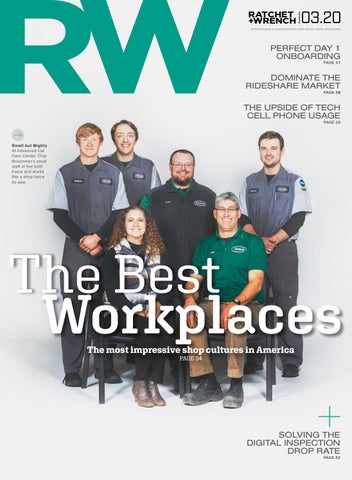
Small but Mighty At Advanced Car Care Center, Chip Broemmer’s small staff of five both trains and works like a shop twice its size.
The Best Workplaces The most impressive shop cultures in America PAGE 34
SOLVING THE DIGITAL INSPECTION DROP RATE
PAGE 52
03.20 / R+W / 1
2 / R+W / 03.20
A PERFECT FIT. A PERFECT PRICE.
EVERYTIME/
There’s a reason why Mitsubishi customers love Genuine Mitsubishi Parts. Designed as a direct replacement for the original part, Genuine Mitsubishi Parts provide the trouble-free performance customers have come to expect. For a flawless repair that will surely keep your customers happy, contact an authorized dealer for all your Genuine Mitsubishi Parts needs.
2020 MITSUBISHI MOTORS NORTH AMERICA, INC. ALL RIGHTS RESERVED
THE WIRING DIAGRAM RE-INVENTED — AGAIN
Wiring diagrams have never been so complex—or so easy to navigate! Get into the diagnostic fast lane with the all new Interactive Wiring Diagrams in ProDemand. Link to the complete component information you need from right INSIDE the wiring diagram. Click the component to see: › Component location & testing › Common failures & Real Fixes › Specifications — and more!
Learn more & get a free demo now! Call: 800-275-4417 | Visit: mitchell1.com Or find your local sales rep: mitchellrep.com © 2020 Mitchell Repair Information Company, LLC. All Rights Reserved. Mitchell a registered 4 1® / Ris+ W / 0 3 . 2 0trademark used herein under license.
repair information | shop management | shop marketing
03.20 VO L . 0 8 N O. 0 3
M A R C H
The Right Team Legendary Automotive owner, Jason Stretch, prioritizes hiring the best fit for a position.
F E AT U R E
C A S E
34
52
62
Tony Bove, owner of Bove’s Auto Repair, implemented a procedure for digital inspections and in doing so, nearly doubled his ARO.
Through processes and finding the right staff, Jason Stretch, owner of Legendary Automotive, has tripled his business's revenue within two years and has plans to grow to six locations.
THE WINNERS ARE...
Ratchet+Wrench launches its inaugural Best Workplaces issue, which looks at a few of the top shops in the industry.
S T U DY
GOING DIGITAL
B Y A B B Y PAT T E R S O N
R E PA I R
L I F E
RAPID GROWTH
B Y A B B Y PAT T E R S O N
CHEYANNE ALFORD
BY TESS COLLINS
PRINTED IN THE U.S.A. COPYRIGHT ©2020 BY 10 MISSIONS MEDIA LLC. All rights reserved. Ratchet+Wrench (ISSN 2167-0056) is published monthly by 10 Missions Media, LLC, 571 Snelling Avenue North, St. Paul, MN 55104. Ratchet+Wrench content may not be photocopied, reproduced or redistributed without the consent of the publisher. Periodicals postage paid at St. Paul, MN, and additional mailing offices. POSTMASTERS Send address changes to: Ratchet+Wrench, 571 Snelling Avenue North, St. Paul, MN 55104.
ON THE COVER: ADVANCED CAR CARE CENTER PHOTOGRAPHED BY KENYON GERBRANDT
03.20 / R+W / 5
TA B L E O F C O N T E N T S
J U M P
10 ONLINE
S TA R T
20 BREAKDOWN
Bring in new talent
Make cell phones work for your business
12 NUMBERS
23 VIEWPOINT
Should you invest in ASE certifications?
Support employees through customer mistreatment
15 AWARDS INSIGHT Adapt to the everchanging industry
24 SPEED READ
Consumers’ feelings on AVs
17 EDITOR'S LETTER An inside look at shop culture
28 SHOP VIEW
Prestige European Auto Service in Fort Lauderdale, Fla.
31
31 STRAIGHT TALK
The answer to your production problems JOE MARCONI
THE 2020 RATCHET+WRENCH ALL-STAR AWARDS
NOMINATIONS
ARE OPEN The nomination process is FREE, easy and takes less than 3 minutes
WILL YOUR TEAM BE NEXT? NOMINATE TODAY: RATCHETANDWRENCH.COM/AWARDS 6 / R+W / 03.20
T O O L B OX
61 THE BOTTOM LINE
47 SHOP ADVICE
Why you should pause before speaking
Plan your new hire’s perfect first day
MITCH SCHNEIDER
48 HUMAN RESOURCES
66 THE FIXER
The key to getting out of a bad situation
Questions to ask before firing
A ARON STOKES
51 INDUSTRY INSIDER Stop being afraid RISSY SUTHERL AND
58 SALES & MARKETING
Attract rideshare drivers
58
2020
03.20 / R+W / 7
O N L I N E
E X T R A S
CLICK ON THE LOGO BELOW FOR PRODUCT INFORMATION
ADAPT
Jasper Engines & Transmissions
OEConnection
TechNet
AUTEL
KUKUI
OnDeck
Tekmetric
Ratchet+Wrench Management Conference
UpSwell
Shopmonkey
WORLDPAC
WIRED FOR
SUCCESS
Automotive Training Institute
Mitchell 1
You’re wired differently and we likeAutoZone that. America likes Mitsubishi that. Visit futuretechsuccess.org and find out how your hands-on talent is the key to an amazing technical career. Ford
When Techs Rock, America Rolls ℠ futuretechsuccess.org
8 / R+W / 03.20
NAPA AUTO PARTS
TechForce Foundation
FUTURETECH
SUCCESS
™
EDITORIAL VICE PRESIDENT, CONTENT AND EVENTS Bryce Evans EDITORIAL DIRECTOR Anna Zeck ASSOCIATE EDITOR Tess Collins STAFF WRITER Abby Patterson SPECIAL PROJECTS EDITOR Jordan Wiklund SPECIAL PROJECTS EDITOR Nora Johnson CONTRIBUTING WRITERS Hanna Bubser, Joe Marconi, Mitch Schneider, Aaron Stokes, Rissy Sutherland, Maraya King, Courtney Welu PRODUCTION ART DIRECTOR Zach Pate GRAPHIC DESIGNER Lily Risken GRAPHIC DESIGNER Nicole Olson GRAPHIC DESIGNER Morgan Glisczinski PRODUCTION ARTIST Lauren Coleman SALES VICE PRESIDENT AND PUBLISHER Chris Messer 651.846.9462 / cmesser@10missions.com ASSOCIATE PUBLISHER Andrew Johnson 651.846.9459 / ajohnson@10missions.com MARKETING STRATEGIST Matt Walz 651.846.9463 / mwalz@10missions.com CUSTOMER SUCCESS REPRESENTATIVE Shayna Smith 651.846.9460 / ssmith@10missions.com CLIENT SERVICE SPECIALIST Jen George 651.846.9465 / jgeorge@10missions.com 10 MISSIONS MEDIA PRESIDENT Jay DeWitt GENERAL MANAGER AND PRODUCTION MANAGER Mariah Straub BOOKKEEPER AND CLIENT SERVICE SPECIALIST Meghann Moore EVENT COORDINATOR Katie Cornet SENIOR DIGITAL MEDIA STRATEGIST Tiffany Fowler MARKETING COMMUNICATIONS SPECIALIST Kasey Lanenberg ADMINISTRATIVE ASSISTANT Corey Steinhoff EDITORIAL ADVISORY BOARD Jimmy Alauria, 3A Automotive & Diesel Repair Leigh Anne Best, Mighty Auto Pro Ryan Clo, Dubwerx Dwayne Myers, Dynamic Automotive Ricky Jordan, Fifth Gear Automotive Bryan Gossel, BG Automotive HOW TO REACH US 10 MISSIONS MEDIA 571 Snelling Avenue North, St. Paul, MN 55104 tel 651.224.6207 fax 651.224.6212 web 10missions.com The annual subscription rate is $72 (U.S.A. only) for companies not qualified to receive complimentary copies of Ratchet+Wrench. BACK ISSUES Past issue single copies are $8. Go to ratchetandwrench.com/backissues LETTERS TO THE EDITOR editor@ratchetandwrench.com ARTICLE REPRINTS For high-quality reprints or e-prints of articles in this issue, call 651.846.9488 or email reprints@ratchetandwrench.com. Opinions expressed in Ratchet+Wrench are not necessarily those of 10 Missions Media, and 10 Missions Media does not accept responsibility for advertising content.
New Ratchet+Wrench Podcasts.
RADIO
4 SERIES WITH NEW EPISODES EVERY MONTH.
HOW I DID IT. Series featuring a rotating guest each month. Hear about the challenges, opportunities and success stories from shop owners who found a way to thrive. New episode this month.
GROW. Series hosted by marketing expert Frank Leutz. Inside the processes, systems and operational strategies that have allowed the industry’s top shops to thrive. New episode this month.
LEAD. Series hosted by shop operator Aaron Stokes. The go-to resource for leadership lessons, philosophies and success stories. New episode this month.
S P O N SO R ED BY:
Print & Direct Mail Made Easy
INNOVATE. Series featuring a rotating guest each month. An introspective look at the industry’s most pressing topics from the people who know them best. New episode this month.
LISTEN AND SUBSCRIBE S E A R C H “ R AT C H E T + W R E N C H ” I N A P P S FOR APPLE AND ANDROID
AUTOMOTIVE GROUP
PODCASTS
STITCHER
POCKET CASTS 03.20 / R+W / 9
ONLINE 03.20 COMMENTS, DISCUSSIONS, FEEDBACK AND MORE FROM AROUND THE WEB
RADIO
PODCASTS
—
From hiring tips to tracking KPIs, Ratchet+Wrench Radio most likely has a podcast on it. Visit us at ratchetandwrench.com/podcast
—
The Ratchet+Wrench team is lucky enough to get to attend some great events, like the ASA Colorado Summit in January. Follow Ratchet+Wrench Instagram page to see event coverage, behind-the-scenes photos and upcoming content teases. Visit us at instagram.com/ratchetandwrench
RW INTERVIEW SERIES
—
Ratchet+Wrench spoke with recently appointed RW editorial advisory board member and owner of Dynamic Automotive in Maryland, Dwayne Myers, about his apprenticeship program. Myers shares insight into bringing in a new generation of talent and tips for owners that may be struggling with this in a recent video interview.
VISIT
ratchetandwrench.com TODAY
10 / R + W / 0 3 . 2 0
instagram.com/ratchetandwrench
ratchetandwrench.com/facebook
twitter.com/ratchetnwrench
ratchetandwrench.com/linkedin
BRAD BARNWELL, R+W INSTAGRAM
Listen to the Ratchet+Wrench Interview series at ratchetandwrench.com/ DwayneMyers
“WITH TECHNET® WE HAVE MORE CREDIBILITY THAN EVER WITH OUR CUSTOMERS. With programs like the Nationwide Warranty and Roadside Assistance, our customers feel confident in the services we provide. Plus, TechNet has given us the tools to grow beyond our biggest hopes as a small business. Because of TechNet we are able to stay competitive!
”
LORENA CORREA AND ARTHUR CUNHA The Tire Place USA Deerfield Beach, FL TechNet Member Since June 2019
NATIONWIDE WARRANTY
ROADSIDE ASSISTANCE
ROAD HAZARD TIRE PROTECTION
LOCAL SERVICE, NATIONAL SUPPORT
Learn more at technetprofessional.com/rw FOLLOW US @TechNetPros 0 3 . 2 0 / R + W / 11
NUMBERS THE
TOPICS,
TRENDS,
AND
METRICS
DRIVING
YOUR
OPER ATION
IS THE INVESTMENT WORTH IT?
—
In order to qualify to be an ASE Blue Seal status shop, at least 75 percent of technicians must be ASE-certified and each area of support offered must be covered by at least one ASE-certified tech. To qualify as certified, technicians must have two years of on-the-job training or one year of on-the-job training and a two-year degree in automotive repair. In addition, technicians must pass a test that only two out of every three test-takers pass, according to the ASE website. To remain certified, technicians must retest every five years. That’s a lot to go through. So, here’s the question: Is it worth it? According to the survey results, when it comes to sales closing ratio, CSI, effective labor rate and efficiency, the answer is yes. The majority of shop owners polled in the Ratchet+Wrench Industry Survey were not Blue Seal status, but had ASE-certified techs (62%). Only 18 percent were Blue Seal and 20 percent do not participate in the program.
THE IMPACT OF BLUE SEAL STATUS
Blue Seal status
No, my business does not participate in the ASE program
18%
20%
100%
90%
80%
70%
60%
50%
20%
0%
No, but my business has ASE-certified techs
10%
Yes
40%
Not Blue Seal status, but has ASE-certified techs Does not participate in the ASE program 30%
HAS YOUR BUSINESS ACHIEVED ASE BLUE SEAL STATUS?
Sales closing ratio of 90% or higher
CSI of 96% or higher
Technician efficiency over 100%
62%
Effective labor rate over $90
GETTY
More on the Subject If you make all that investment, you better know how to market your certifications. For tips on doing this, check out the Ratchet+Wrench article “Marketing Your Shop’s Accreditations.” — ratchetandwrench.com/marketingaccreditations
12 / R + W / 0 3 . 2 0
OMNICRAFT ™ GETS IT. FORD BACKS IT. Premium Omnicraft parts come with a warranty* that includes labor and has no commercial exceptions. Trust Omnicraft for your non-Ford vehicle repairs. OmnicraftAutoParts.com
*Limited labor costs. See seller for limited-warranty details. Omnicraft™ is a trademark of Ford Motor Company.
0 3 . 2 0 / R + W / 13
RWMC
WHY SHOULD YOU ATTEND THE RATCHET+WRENCH MANAGEMENT CONFERENCE?
SEPTEMBER 17–19, 2020 HYATT REGENCY • MINNEAPOLIS
“There is nothing else you can possibly do that will give you a faster, better, more understandable return on investment than the time you’ll spend here. You can’t get the quality of content anywhere else, so if you choose to be present, and take in everything you can, it would be hard to not get your money’s worth.” MITCH SCHNEIDER • Conference Speaker, 2018 • Ratchet+Wrench columnist • Former owner, Schneider’s Auto Repair
2020
THE CONFERENCE WEBSITE IS LIVE WITH INFORMATION ON: THE AGENDA • SPEAKERS • WHAT’S NEW IN 2020 • AND MORE! SEE WHAT’S NEW AT RWCONFERENCE.COM
14 / R + W / 0 3 . 2 0
AWA R D S I N S I G H T
The Ratchet+Wrench All-Star Awards honors the innovators, leaders and difference makers pushing the industry forward.
ALL-STAR NOMINEE
STEVE WYATT —
SHOP FOREMAN AND TECHNICIAN JOEY’S TRUCK REPAIR CHARLOTTE, N.C.
Keep Up with the Times BY HANNA BUBSER
COURTESTY STEVE WYATT
Practices in automotive repair have drastically changed over the years. Digitization efforts have played a massive role in this, and shops need to keep up in order to remain relevant. Ratchet+Wrench All-Star Awards nominee Steve Wyatt is no stranger to this notion. He has been at Joey’s Truck Repair, a shop that services all makes and models, in Charlotte, N.C., for 19 years and serves as both shop foreman and technician. He’s been in the repair business since he was 15, and has witnessed the industry change before his eyes. “When I started, you used your back and arms,” Wyatt says. “Now, it’s more about using your head.” Wyatt uses digitization to his advantage, improving customer relations as well as educating others. He’s gone from being an “old school mechanic” to a “modern day technician,” according to his nomination. He’s proof that even those who have been in auto repair for decades can—and should—make the effort to learn and prosper from new advancements.
GROW WITH CUSTOMERS. “When I started, nothing was computer controlled,” Wyatt says. “Now, cars have computers in them.” Wyatt implements practices that include an AutoVitals digital inspection program for the vehicles Joey’s works on. These DVI methods educate customers on exactly what repairs were made and why. This lets customers look into modern methods that the shop uses. This is important for Wyatt when it comes to retention because customers that have driven one type of car for years may decide to buy a brand new vehicle. “If they get new vehicles you don’t want to say, ‘We can’t do this new one, you’ve got to take it back to the dealer,’” Wyatt explains. You want your customers to think of your shop as one that can grow with them. In order to do that, methodology needs to
reflect the new way that cars operate. If cars are changing, you need to as well. Wyatt likes to think of Joey’s approach as one that can take on any type of repair, and he believes that’s one of the things that makes it stand out. “We pride ourselves in customer satisfaction,” he says. “Anything the customer needs, that’s what we do.” After you’ve taken the time to get to know what works for you and your shop, communicate to your customers that you are able to work on newer vehicles as well as older ones. This instills customer retention and allows word to spread that your shop is advanced enough that people can come to you instead of a different shop for assistance. SERVE AS AN EXAMPLE OF EXCELLENCE. “Excellence” is a word that gets thrown
around a lot in the repair industry, and for good reason. In terms of modernization, it cements an identity for your shop that can turn you into an example for which other shops can strive. In Wyatt’s case, he’s taken some of his expertise to other shops in the area. “A lot of shops don’t have the technology that we have,” Wyatt says.“They’ll call us and either bring us a vehicle to work on or we’ll go to their shop and help them diagnose it.” It may seem inherent to shy away from helping out competition, but Wyatt looks at it as a chance for education and an opportunity to better the repair industry overall. This puts Joey’s in a unique position of having technology and education at its disposal. It automatically brings the shop to a higher caliber. Creating an identity like this can take time, but can result in your shop leading by example, Wyatt explains. SEEK OUT NEW LEARNING OPPORTUNITIES. Change can be daunting. The first step is knowing what you know and about what you need to learn more. Maybe you already implement digital practices in your shop, but there is always more on which to stay up to date. “If you are in this industry now and you want to stay in this industry, you need to get educated,” Wyatt says. Wyatt recommends being on the lookout for refresher courses supplied through industry leaders or online, perhaps through an ASE training. If a company in the industry decides to put out a new product or software system and they provide any information or training on it for shops, then take advantage of it by learning everything you can about it. From there, you can determine if it is fit for your shop or not. Either way, you gain more insight on advancements in auto repair, which allows you to adapt in the future when more changes come along. “The industry has changed big time,” Wyatt says. “It is a lot different than it was even five years ago.” When it comes down to it, the ability to either grow or shrink with change can make or break the reputation of a shop, and you definitely want to grow. 0 3 . 2 0 / R + W / 15
16 / R + W / 0 3 . 2 0
EDITOR'S LETTER
What Drives the ‘Best Workplaces’ UNDERSTANDING PERCEPTION, REALITY, AND HOW WE WORK TOGETHER TO ACHIEVE OUR POTENTIAL
LEAH QUINTO
Let’s go with some conservative estimates here: Pretend you
worked just 40 hours each week (I know; some of you are laughing at this). And imagine you sleep a full eight hours per night (even funnier, right?), and never work on weekends (come on, it’s not that funny). Add it up, and that would mean that you spend roughly 36 percent of your waking hours at work. Obviously, that number jumps up quite a bit the more hours you put in at the shop—it’d 44 percent if you worked 50 hours; 54 percent if you worked 60. (But, hey, if you’re working that much, you likely aren’t sleeping much, either! So, you have that going for you … I guess.) How does that number make you feel? Were you overcome with a sense of dread, self-loathing and frustration? Or were you reinvigorated with a high level of excitement and determination? Maybe somewhere in between? I’m not judging, but I think you can look at your reaction as a pretty solid judgement on your true feelings as to the state of your business and, more importantly, the culture in your operation—the culture you build, nurture and set each day as its leader. OK, hold on to that thought for a moment here. Associate editor Tess Collins’ lead feature this month (p. 46) launches a brand-new (soon-to-be) regular campaign we’ll do annually in Ratchet+Wrench: The 2020 Best Workplaces. In the feature, Tess profiles three operations, all with incredibly strong and impressive team cultures that truly make these businesses stand out in their progressive approaches to leadership, management, and team building. The shops were selected through a vetting process, based on nominations from you, our readers. In all, 117 different shops were nominated—all very deserving and worthy of the praise the nominators heaped on them. Our team looked at everything from benefits to PTO to training opportunities to various open-ended questions about team-building and company atmosphere. There were followup interviews, further follow-up phone calls, and a lot of internal discussion. We’re nothing if not thorough, and we’re very excited to share those stories with you this month. Really, this feature is a bittersweet one, because on the one hand, we love to profile businesses and leaders like these, people we can all learn a great deal from and would do well to work to emulate. But on the other hand, we know that across all industries, these types of company cultures are more an exception, rather than the norm. To steal a line from Tess’ feature: “Eighty-seven percent of Americans have no passion for their jobs and 80 percent are outright dissatisfied.” Those statistics are from a Deloitte survey, and sadly, they don’t surprise me. Building a business can be a grind. Leading teams can be difficult and emotionally exhausting. The pressure to perform and succeed
can be overwhelming. And it can be difficult not to take those feelings in through the front door each day you come to work. I get it, but as the old saying goes, cultures are built—and ripped apart—from the top down. The challenging part is that your vibe as the leader sets the tone for everyone. So, how do you break out of it? Well, I think our three Best Workplace honories and their teams share a lot of great ideas in this month’s feature. Be sure to read it, and feel free to connect with them to get more insight. (Hint: All three of them will be at a certain event in September that you can find more details about at rwconference.com.) But one of the great things about their advice is that it’s not complicated; they don’t do anything over-the-top or outlandish. Most of it is simple; these are strategies that anyone can use. It just needs to be sincere and intentional. Sure, the pressure on a leader can be trying at times, but one nice perk is that it comes with the ability to make a great impact. You get to choose the tone you set, and you get to choose the attitude you have about coming into work each day. And you get to spread that. It’s up to you.
BRYCE E VA NS, VICE PRESIDENT, CONTENT A ND E VENT S BE VA NS@10MISSIONS.COM 0 3 . 2 0 / R + W / 17
YOU NEED
OEM PARTS. Which means you need
RepairLinkShop.com
With cars becoming more complicated, don’t take a chance on non-OEM parts. RepairLinkShop.com makes your repairs easier with: • • • •
Part illustrations and technical diagrams for over 22 OEMs 24/7 online ordering VIN-based parts look-up OEM Part Discount Programs
Visit RepairLinkShop.com to sign-up for FREE
J U M P S TA R T NEWS
SHOP VIE W
/
IDEAS
/
PEOPLE
/
TRENDS
28
BREAKDOWN VIEWPOINT SPEED READ
Total Facelift A massive remodel to the interior and exterior of Prestige European Auto Service in Fort Lauderdale, Fla., helped increase sales.
COURTESY PRESTIGE EUROPEAN AUTO SERVICE
SHOP VIEW
0 3 . 2 0 / R + W / 19
J U M P S TA R T
Embracing Cell Phone Culture
How to make mobile devices a business tool rather than a distraction
With technology at our fingertips,
it can be difficult to turn it off. Now, most people have their phones attached to them at all times, including at work. For technicians, this is no exception. A recent study from IMR Inc., a fullservice automotive market research firm, found that 99.6 percent of automotive repair technicians own a cell phone (no surprise here). With this, however, 87.4 percent of technicians actively use their cell phones while working in their bays. “Cell phones are more integrated in 20 / R+W / 03.20
our lives than ever,” says Bill Thompson, CEO of IMR Inc. There are many work benefits that cell phones bring, but with texting, internet, and social media in near proximity, auto repair shop operators are concerned that it may be a distraction. Greg Buckley, owner of the technology-forward Buckley’s Auto Care in Wilmington, Del., knows exactly what auto repair shop operators are up against. “Most shops today face this issue and it depends on what the shop’s
stance on it,” Buckley says. “It comes down to productivity.” Buckley says a shop could be totally against cell phone usage at work, complete with SOPs and policies outlining the concern, but with today’s technicians and how they learn, he says they might as well take some thread and sew electronics onto their bodies. So, instead of working against cell phones, how can shop owners work toward embracing the digital culture, while ensuring productivity isn’t at stake?
GETTY IMAGES
BY A B BY PAT T E R S O N
A VALUABLE TOOL
A L O O K AT H O W T E C H S A R E U S I N G T H E I R P H O N E S I N B AY S
Recognizing the Benefits Cell phones can actually be beneficial to an automotive repair business and make technicians more efficient. The IMR study found that the 87.4 percent of techs that are using cell phones in the bays all use it to access technical information, technician manual sites, catalog information, parts manufacturer websites for technical or product information, ordering parts and watching training or instructional videos and content. “It prevents them from having to
leave their bay to do work,” Thompson says. And, for younger techs coming into the field, accessing this information through their phone or tablet is essentially how they tackle work, even learn. “That’s just the way that they [learn] today—they’ve grown up with it,” Buckley says. “They feel that there’s valuable content, [the videos] get right to the point, they see it being done, and they know how to execute it.” Tackling Distractions With young technicians using their cell phones in their bays, the distractions and time wasting aspects are the main concern. A 2017 CareerBuilder survey found that 49 percent of employers believe cell phones and texting are the biggest productivity killers, while 37 percent believe social media is to blame. However, shop owners can turn cell phones into a tool and make it work for their shop’s processes. Like many shops that have gone digital, Buckley’s technicians are equipped with a digital vehicle inspection tablet. However, he’s finetuned them to ensure productivity is still at an all-time high. For starters, Buckley uses one type of digital operating system, i.e. Android or Apple iOS, to make it more versatile with cell phones. He says everyone utilizing the same platform— in his case, iOS—helps with communication. Plus, all of the devices have the same functions as one another for ease of use. “Once you get into your personal phone, your apps are going to start
talking to you,” Buckley says. “With a work device, it’s limited.” Yes, the use of the tablets are meant to mimic a technician’s phone, but not with all of the features their personal phone would have; he made sure to add a couple extra features so his technicians have no reason to use their phones. His techs aren’t allowed to have any of their personal social media accounts on the tablets, but Buckley gave them access to other helpful features, like SOPs and vendor websites. One feature he did allow to help decrease the use of personal devices? Music. Instead of a technician setting down their tablet to grab their phone, they’re able to use their iPad to play their choice of music. Buckley says this has really helped technicians stay off their phones. Making It Work for You With that being said, having tablets available at your shop doesn’t mean the use of cell phones will disappear. Buckley stresses not to regulate the use of cell phones, but to moderate it. “The tablet isn’t used in place of the phone,” Buckley says. “The goal is to have them understand that using your phone wastes time.” Going digital is a commitment— you’re either all in or all out. Buckley says you have to embrace the digital culture, but how you manage it depends on your comfortability—it may even take a manager or another employee to take the reins. Overall, this technology isn’t going anywhere, so you might as well welcome it into your shop and make technology work for you. 0 3 . 2 0 / R + W / 21
SPONSORED CONTENT
Prioritize for Profit Commit to what you want to accomplish, and take actionable steps to make it so By Eric Twiggs, ATI Performance I counted to 10 and took deep breaths before my coaching calls with “Tom.” Tom is a shop owner who would agree to do certain things but never followed through. For example, he consistently failed to conduct the daily repair order audits. When I asked what happened, his response was, “I didn’t have time.” When I asked why he hadn’t updated his weekly portal data, his response was, “I didn’t have time.” When I asked if he updated his monthly budget, guess what he told me? That’s right: “I didn’t have time.” (Do you know anyone like Tom?) One day I called the shop, and his advisor said he was out on a smoke break. After digging deeper, I discovered that Tom spent one hour per day smoking, but “didn’t have time” to do the things to which he was committed. I was puzzled. How was it that Tom found one hour per day to smoke but never had time to do what we agreed to? And then it hit me: Smoking was a priority for him, so he found a way to make it happen. Before you laugh at Tom, consider this: If something is a priority, you will find a way. If not, you will find an excuse. If you plan to accomplish great things in your shop, you must embrace the right perspective on your time. If Tom’s story didn’t move you, I invite you to take the briefcase test.
THE BRIEFCASE TEST
Imagine that I have $500,000 cash in a briefcase waiting for you with your name on it. There’s one small catch: to claim your winnings, you must take the following actions over the next 12 weeks: 1. Conduct repair order audits every day. 2. Update your portal every week. 3. Update your 5-Year Budget numbers every month. 4. Attend your scheduled 20 Group Zoom meetings.
Would you do it? Of course you would, and here’s why: Your priorities have changed, even though your “real world” time barriers remain the same. Since the $500,000 is a priority, you would find a way to create the necessary openings in your schedule. Are you currently creating openings in your schedule to get these things done? If you answered no, the issue isn’t time—it’s priority. The repair order audits, portal entries, 5-year budget, and 20 Group Zoom meetings aren’t important enough for you to make the time for them. What are your priorities for this year? Answering this question is key to accomplishing great things.
The next step is determining what you need to do on a daily, weekly and monthly basis to achieve these outcomes. Doing those daily repair order audits will become a priority if it helps you find the lost gross profit dollars that can pay down the credit line. Updating the weekly portal becomes a priority if the data is helping you to track the number you need to average in sales to pay your replacement. Making the monthly updates to your five-year budget data becomes a priority once you have factored your new building into your budget costs. Linking your activities to your expectations will help you to accomplish great things in the coming year.
YOUR TWO-STEP PLAN
CONCLUSION
ATI Fundamental No. 17 instructs us to set and ask for expectations. To accomplish great things in 2020, you must first set expectations for yourself. The first step is to fast forward to your future. Imagine that it’s December 31, 2020, and you’re celebrating the fact that 2020 has been your best year ever. What specific outcomes would need to occur for you to feel this way? Some common examples are paying off that line of credit, replacing yourself with a rock star general manager, and moving into the new building with more bays.
So, there you have it—you will always create openings in your schedule to do whatever is important to you. If you commit to following the two-step plan, you can have a briefcase full of gross profit dollars waiting for you with your name on it. At ATI, we focus on teaching and coaching shop owners on best practices to get the most out of their automotive repair business. Stay on course to accomplishing great things with ATI’s Priority Robbers Checklist to tackle your most common distractions, available at autotraining.net/rw0320.
J U M P S TA R T
Support Your Staff The more you treat staff with care, the more likely they are to stay BY TESS COLLINS
Most likely, there is not a single person reading this that hasn’t dealt with an angry customer. The industry you’ve chosen lends itself to this type of interaction—people thinking you’re ripping them off, blaming you for a faulty repair (even though you’ve never even seen the vehicle) and outrage at a price that, in their words, is “robbing them blind.” There’s no getting around it, it’s part of the territory. For as long as there are cars to fix, there will be angry customers. This article is not about handling those situations or cutting down on those events, it’s about the impact these interactions can have on your employees. According to a new study, led by the UBC Sauder School of Business in collaboration with UBC-Okanagan Faculty of Management, the University of Illinois and the University of Queensland in Australia, customer conflict is a major contributing factor when it comes to employees leaving their jobs. The study, Unpacking the Relationship Between Customer (In) Justice and Employee Turnover Outcomes: Can Fair Supervisor Treatment Reduce Employees’ Emotional Turmoil?, involved 420 retail workers and 363 restaurant workers in the Philippines and 940 call center employees in Canada, found that even when controlling for other factors (such as low pay, long hours, poor working conditions), there was a significant correlation between customer mistreatment and the rate at which employees quit. That statistic may seem daunting, since, as stated, this is an industry where customers tend to always be unsatisfied—no matter how great the service—but the study also found that the way supervisors react to their staff in these situations makes a big difference when it comes to employee retention. “Whether you quit isn’t just about the customer, it’s what’s called an interaction effect— that is, the customer mistreatment is buffered when the manager treats you fairly,” Daniel Skarlicki, study co-author and UBC Sauder School of Business professor, said in a release on the findings. “So if you get berated by a customer and your boss says, ‘That’s disrespectful, I’m going to support you,’ it reduces the effect of that customer mistreatment.” Skarlicki discusses the study and what employers should take from it with Ratchet+Wrench.
What was the purpose behind this study? We know that people who are serving customers can experience mistreatment— like yelling or demanding or demeaning, which is very stressful and, in some cases, especially if they’re treated with a lack of dignity and respect, can end up taking a toll. Treatment like this impacts emotions and sense of worth. People will stay up at night thinking about it. Eventually, it starts to build up and they’ll start to look for another job because they want to make themselves whole again. Why do small business owners need to pay attention to these findings?
These findings are important to pay attention to because one person leaving you can have a huge impact. In the automotive world, customers come in and want to see the same person over and over again. Most studies look into how companies deal with employees in terms of pay and working conditions, we wanted to see how customer treatment can trigger turnover. We tend to think about competition between shop owners for customers, but there’s also competition for employees. Employees believe that if they quit a shop, they’ll get treated better and feel more value somewhere else. This is especially important for shop owners to pay
Daniel Skarlicki UBC Sauder School of Business professor
attention to because many customers will follow an employee, so losing an employee can also lose you a customer. If an employee is mistreated by a customer, what can an employer do to make sure he or she stays? The way employees are treated is a competitive advantage. Shop owners need to remember that it’s not about whether or not you treat your employees with dignity and respect, it’s about whether or not they perceive this to be the case. A lot of shop owners think they are doing better than they are. Can you describe what doing this well would look like? If a customer verbally attacks an employee, the employer has a few options. The first is, before the situation even happens, to let him or her know that there is a policy that allows him or her to get the boss in a situation where he or she feels uncomfortable with a customer. The second, if an employer witnesses the mistreatment, he or she can step in and basically let the upset customer know that you’re very sorry, but that kind of abuse is not tolerated. Afterward, as a leader, you should pull the employee into their office and let the employee know that you are proud of he or she for how he or she handled the situation and offer him or her coaching for next time. If you didn’t see it happen but hear about it, either through the grapevine or the employee him or herself lets you know, sit with him or her and ask him or her to tell you about the situation. Give him or her a chance to talk about it, don’t just tell him or her what to do. Let the employee talk about it, share their experience and then you can provide suggestions. 03.20 / R+W / 23
J U M P S TA R T
U.S. CONGRESSWOMAN VISITS SHOP, HEARS CONCERNS On January 13, U.S. Congresswoman Haley Stevens, of Michigan’s 11th district, visited The Farmington Garage to listen to the concerns about the future of the automotive aftermarket, including telematics. Founder and CEO of The Detroit Garage, Curtis Andrew Massoll, was joined by several others from the Auto Care Association (ACA) to share information and concerns regarding the changes and future developments in automotive repair. Modern vehicles have begun wirelessly transmitting data—straight to vehicle manufacturers—using a technology called telematics. Some may transfer up to 25GB of data per hour. Unbeknownst to many consumers, vehicle owners neither own nor have access to the information that their cars are generating. Unfortunately, this could leave consumers in an extremely vulnerable state, with manufacturers
controlling who sees that data and how it is used. By 2022, 87 percent of vehicles will be transmitting data. Members of the auto care industry depend on this crucial information to assist with maintenance and repairs, but without action, consumers will be extremely limited to where they may take their vehicle to be serviced. The Auto Care Association believes drivers should demand the right to transparency around the data collected from their vehicles, including what was collected, how it was used and with whom it was shared. Massoll shared with Congresswoman Stevens how this will directly impact small businesses, such as The Detroit Garage, and how her involvement will benefit both the industry and the general public. Her visit concluded with a tour through the repair shop, explaining how data is pulled from control modules, the on-board diagnostics process and why this information is essential.
GOVERNOR PLANS TO ELIMINATE VEHICLE SAFETY INSPECTIONS In his budget briefing, Virginia Gov. Ralph Northam unveiled plans to eliminate the state’s motor vehicle safety inspection program, according to the Automotive Service Association (ASA). The ASA opposes the elimination of state vehicle safety inspections. Northam, however, would like to eliminate the vehicle safety inspection program and reduce vehicle registration fees by half. According to Northam, “data shows that there is no connection between highway safety and these inspections. That’s why 35 other states don’t have them.” Northam believes the program is an unnecessary expense for Virginians. “Regular safety inspections by a qualified technician can identify and repair most safety issues arising from normal wear and tear on the vehicle,” ASA Washington D.C. representative Bob Redding said in an ASA press statement.
No time to get out from under the hood? Our simple business loan application takes 10 minutes.
Your go-to for small business loans Term loans $5k–$500k and lines of credit $6k–$100k Visit ondeck.com/wrench or call us at 800-226-6748
24 / R + W / 0 3 . 2 0
Loans subject to lender approval. Depending on the state where your business is located and other attributes of the loan, your business loan may be issued by Celtic Bank, a Utah-Chartered Industrial Bank, Member FDIC. Your loan agreement will identify the loan issuer prior to your signing. OnDeck® is a Registered Trademark. All rights reserved. 1400 Broadway, New York, New York.
W E B I N A R S
Growing Your Business From determining capacity to finding the right location, this webinar will evaluate whether or not you’re ready to expand—and how to do it right.
FREE WEBINAR Get details and claim your spot. R AT C H E TA N DW R E N C H .C O M / W E B I N A R S
GREG
BUNCH, CEO, ASPEN AUTO CLINIC
03/17 11am/cst
SPONSORED BY 03.20 / R+W / 25
E M B RAC E T E C H N O LO GY. G R OW YO U R B U S I N E S S . OW N YO U R F U T U R E .
.7569
Automotive Technology Summit
.01436
M AY 3 1 -J U N E 2 • N A S H V I L L E
HEAR FROM THE INDUSTRY’S LEADING OEM REPRESENTATIVES LIKE GM, NISSAN AND TOYOTA, ON TOPICS THAT RANGE FROM ADAS TO MANUFACTURING & BUYING TRENDS .14670
.01239
REGISTER AT
A D A P T S U M M I T . C O M PRICES INCREASE ON MARCH 27
PLATINUM SPONSOR
GOLD SPONSORS
S I LV E R S P O N S O R S
26 / R+W / 03.20
K E Y I N S I G H T S , T R E N D S A N D S T R AT E G I E S F O R T O M O R R O W ’ S I N D U S T R Y—T O D AY A D A P TA U T O M O T I V E . C O M
A D A P TA U T O M O T I V E . C O M / FA C E B O O K
BEHIND THE SCENES OF TOYOTA’S WOVEN CITY Toyota has announced its intent to build the Woven City, at a 175-acre site at the base of Mt. Fuji in Japan. The goal of this “living laboratory” is to examine the cohesion of automation and humans, which could include some of the fleet management software that could affect repair schedules in the future.
KEY FEATURES OF THE CITY INCLUDE: CAPACITY FOR APPROXIMATELY 2,000 PEOPLE FULLY SUSTAINABLE, WITH WOOD BUILDINGS TO MINIMIZE THE CARBON FOOTPRINT
T W I T T E R .C O M /A DA P T_ AU TO M OT I V E
ADAPT INTERVIEW SERIES: BEN JOHNSON Ever wondered what it means to switch to a management software system to one that operates on the cloud? Ben Johnson, director of product management for Mitchell 1, definitely has. In part one of the ADAPT Interview series, he shares what a cloud-based management software system entails and the benefits to switching to one. adaptautomotive.com/benjohnson1
ONLY CARS ON THE ROAD ARE SELF-DRIVING CARS
ADAPT TREND REPORT Head to the ADAPT website to sign up for the ADAPT Trend Report newsletter to have the latest news, strategies and transportation trends sent to your inbox every week. adaptautomotive.com/newsletter
PEXELS
M AY 3 1 - J U N E 2 NASHVILLE, TENN.
Registration and hotel accommodations are now open for The ADAPT: Automotive Technology Summit. Head to adaptautmotive.com/Summit to learn more about the event, who can attend and the schedule of the two-and-a-half day event.
0 3 . 2 0 / R + W / 27
J U M P S TA R T
Prestige European Auto Service BY TESS COLLINS PHOTOGRAPHY COURTESY PRESTIGE EUROPEAN AUTO SERVICE
1 / TOTAL TRANSFORMATION In the last two years, Prestige European Auto Service has changed drastically. The building, which was purchased by owners Eric Rutherford and Mike Difato 10 years ago, underwent a massive remodel at the end of 2018 into 2019, which has helped sales rise from $70,000 per month to $120,000.
2 / MASSIVE MURAL One of the most notable changes to the outside was the addition of a colorful mural to the side of the building that faces a busy street. A local artist painted the mural to look like the inside of an engine. Rutherford and Difato say the mural was a nod to the artsy home of the shop, Fort Lauderdale, Fla.
2
1
SHOP S TAT S Owner: Eric Rutherford and Mike Difato Location: Fort Lauderdale, Fla. Size: 6,000 square feet Number of lifts: 7 Staff Size: 9 (4 in the front, 5 in the back) Average Monthly Car Count: 130 Annual Revenue: $1.3 million
28 / R+W / 03.20
HAVE AN OUTSTANDING SHOP? Send a few photos and a brief description to submissions@ratchetandwrench.com and we might feature it here.
3
3 / INDOOR IMPROVEMENT Originally, the building had a small office and a customer area that Rutherford and Difato say was not “professional.” On top of that, if customers had to use the restroom, they had to go through the shop floor and use the same bathroom that the staff used. The indoor renovation, which tripled the size of the customer waiting area, updated the service advisors’ office and added a customer bathroom, made the entire area more appealing.
4 / EQUIPPING EXCELLENCE
4
One area that the owners invested heavily in was equipment. One of the pieces of equipment that was purchased was Hunter’s Quick Check, because the two want to be able to get input quickly to their customers and best advise them on what they need. Another way the shop makes sure that the customers are being served correctly is by paying techs .5 hours to do digital inspections. The customer isn’t charged for this service, but this extra incentive ensures that technicians do it each and every time. 03.20 / R+W / 29
Hyper-local Auto Repair Marketing
More customers. Period. That’s what you want, right? That’s what UpSwell delivers – for owners of auto repair shops across America. Combine our highly targeted digital and print marketing solutions to drive the max number of cars in your area to your shop. With UpSwell, power up your shop’s performance with our hyper-local auto repair marketing expertise.
100,000+ high-performance auto repair campaigns
12+ years of experience
Call 888.838.3779 for a Free
Marketing Assessment
auto.upswellmarketing.com 30 / R+W / 03.20
888.838.3779
Columns
STRAIGHT TALK Joe Marconi
MONEY ISN’T THE ANSWER A pay raise won’t solve your shop’s problems—pride will
GETTY, MICHAEL HOEWELER
Your lead tech is not performing up
to expectations. Shop production is slipping and you’re not sure why. You hear through the grapevine that some of your employees are wondering when they will get their next pay raise. After a few agonizing weeks of pouring through reports, you make the decision to give across-theboard pay raises. Almost immediately, you see a boost in production. The shop is more upbeat and all is well. Your decision appears to be correct. Three months later, your shop is once again struggling to meet its sales and production goals— and morale has slipped, too. I have seen this scenario all too often. And, while there are times that we need to give pay raises, if your shop is struggling to meet its sales and production goals, increasing pay to improve business is not the answer. The reality is you have deeper issues.
Let’s address employee compensation first. You must pay people a competitive wage with the opportunity to earn more. There should be incentives in place to reward your employees for reaching their personal and team goals. And, there needs to be a process in place where your employees understand how and when they will get a pay raise. However, in terms of long-term company growth, a focus on pay alone will never be the formula for success. In other words, throwing money at a problem is a short-term fix. It’s putting a Band-Aid on a more serious injury that requires much more care and attention. About 10 years ago, MercedesBenz was struggling with its customer experience at many of its dealerships. In response to this, Mercedes decided to increase pay incentives, implement new policies and training programs. No
Joe Marconi has more than three decades of experience in the automotive repair industry. He is the owner of Osceola Garage in Baldwin Place, N.Y., a business development coach for Elite Worldwide and co-founder of autoshopowner.com. j.marconi@eliteworldwide.com ratchetandwrench.com/marconi 0 3 . 2 0 / R + W / 31
STR AIGHT TALK / JOE MARCONI
improvements were realized. Mercedes top executives could not understand why customer service was not up to company expectations. After all, this is Mercedes, a car company that represents quality and sophistication. Why were their dealer employees so indifferent? A senior leader at Mercedes recognized the problem and stated, “Pride in the brand was not quite as strong as we thought, the level of engagement with work was not as deep as we thought.” Mercedes finally realized that until the employees at Mercedes genuinely cared more, no amount of money, policies or training would make a difference. Understanding the need to get frontline people more engaged and take pride in their work, Mercedes began to invite its dealer employees to spend 48 hours with the model of their choice. To experience not only the amazing performance and mechanical attributes of the vehicle, but also that they can turn heads as they drive through their
neighborhoods or when they drive into the little league parking lot. Mercedes also built its Brand Immersion Center in Tuscaloosa, Ala., in 2014, where hundreds of employees go each year to spend time getting to know how the cars are built, gain a deeper understanding of the brand, the history of Mercedes and experience the legacy of the company. According to Philippa Green, brand immersion trainer for Mercedes-Benz, “The ultimate goal is to engage their hearts and minds around the brand. We’re teaching them about our legacy.” As business owners, we track KPIs, set goals, work on marketing and refine our business plans. We also ensure that we provide our employees with adequate training and a well-equipped environment. These are the essentials of our business. However, we must never overlook the importance of our employees taking pride in their work. And, pride comes from employees knowing who you
are, what you stand for, what you do for your community and for the industry. Giving people pay raises can motivate them. But the bounce you get from that is short-lived. Once people have gotten over the excitement of the raise and made the financial adjustments to their lifestyles, the raise is long forgotten. If there are no other intrinsic motivators, then shop morale, production and employee engagement will fall right back to where it was before the raise. Anyone who knows me and has read my articles, knows how much I preach about leadership. The theme of this article also has its roots in effective leadership. You, the leader of your company, have the power to transform the people around you. Focus on the person, not the position. Recognize when your employees do things that are from the heart. Promote your company’s brand, vision and legacy. These are the keys to a long-lasting company. This is what will improve morale, not a pay raise.
subscribe .
Quick, before you miss another issue.
ratchetandwrench.com/subscribe
32 / R+W / 03.20
SPONSORED CONTENT
S H O P S P OT L I G HT : C A S E Y ’ S A U TO M OT I V E
The Power of Support Bryan
Jewett
has always been a gear head. In
2000,
right out of high
school, he got a job working at Advanced Auto Tech. The they handed him was a broom, but it
didn’t
ifrst
SHOP
tool
Casey’s Automotive
take long for them to
hand him a wrench so that he could begin working as a mechanic. Five
Owner: Bryan Jewett
years later, Bryan started working at Casey’s Automotive, a sho
Location: Chantilly, VA & Sterling, VA
owned by Bill Casey. Bill gave him a
piece
Staff: 20, across both locations
of advice that stuck with him for years to come,
the service industry, not the sales industry.
Focus
“We’re
in
Average Monthly Car Count: 600 & 200 (800 total)
on relationships, not on
A¹O: $³20, $³20
sales”. In 2015, Bill expressed that he was ready to retire, and Bryan was ready for
a new challenge. Bill Casey
decided
Bryan
Jewett.
In
2017,
Number of Bays: 6, 6 (12 total)
to leave his company in the hands of
someone he could trust to grow the business and stay true to his mentee,
P RS OH F IOLPE S T A T S
Casey’s
Automotive
opened
values,
its
his
Sho Management System: Tekmetric
second
location.
Casey’s: When I
A
Culture of
A
chieving Goals
auction. All the
proceeds
go back to Ellie's
Hats. We
$6,000 the second, and $8,000 the third.
took over, we got everybody's input about what they wanted to get out
We’re
raised $³,000 the shooting
for
ifrst
year,
$10,000 this
Spring.
of their job at Casey's: they wanted a chance to grow; they wanted job security; they wanted to enjoy the
place
We
where they worked.
build the trophies
from
stuff like
You need to grow the business so that the individual can grow. The business can't grow without having that individual, so the two kind of go hand-in-hand. Every January, we
do
a goal
-
poster
day.
Every employee writes
down
their
My
can open poster
throughout
their goals and
maybe even complete them.
beneifts Ellie's
do
Hats.
Ellie's
Hats
Fling
and Car Show, which
with cancer. Contestants
car at the event, we have a lot of free family
fun
pay
families
to show their
activities, and we hold a silent
parts. We'll pick
children
car to give out awards
Awesomest Car”. It really brings a lot of
can open it
people
for
together
up
Tekmetric’s
up from
my
phone,
whether
I'm
in Arizona or Starbucks
allows me to be there for my team and have the conifdence that
Shop
Overview
immediately gives me the car count and the
average repair order. It shows me what is a work in
progress,
completed, and what estimates have been given out.
I
If
can
it’s slow,
I
what cars are
pretty
much see if
can reach into our
see which client’s cars need maintenance, send a gentle reminder, people.
Visit Te metric com/sho -s otlight-ca to read the full story. For more information about Casey’s Automotive, visit k
I
a third location.
and ensure that we’re always helping
is a great organization that supports
diagnosed
I
upstairs. It
database,
Casey's Automotive Spring
of kids who have been
favorite
it's going to be a busy week or a slow week.
“ T he Most A wesomest CarT Every year we
their
shop management system gives me a window into my shops to see what's
going on.
between them.
deifne
“The Most
pick
Getting the S upport Needed or
the year. It's awesome to be able to help my employees
that car show out of motor
and makes everyone happy.
goals for the year, no matter what they are. It really creates some camaraderie
The neatest thing is when they cross things off their goal
for
the crowd and have them
.
Caseysautomotive.com
03.20 / R+W / 33
E S T.
BEST
2020
WORKPLACES
Ratchet+Wrench’s inaugural look at the shops defining “work culture” BY TESS COLLINS
3 4 / R + W / 0033. .2200
T
he average American spends 90,000 hours at work over the course of their lifetime (Source: Happiness at Work by Jessica Pryce-Jones). Ready for another alarming statistic? Eighty-seven percent of Americans have no passion for their jobs and 80 percent are outright dissatisfied (Source: Deloitte’s Shift Index Survey). That can’t be said for the 117 respondents for Ratchet+Wrench’s inaugural Best Workplaces issue.
Employers and employees alike sounded off on their chosen workplaces, answering questions on what the business provides as far as training, community involvement, employee benefits, shop culture and professional development. To level the playing field based on resources, Ratchet+Wrench decided to have three different categories based on staff size: under 10, 10–25 and over 25. The winners: Advanced Car Care Center, Fifth Gear Automotive and BG Automotive have found a way to make work—dare we say it?—enjoyable.
KEY CULTURE BUILDERS Use this key as a reference for all the benefits each shop offers that cultivates their already rich workplace cultures
401(k)
TOOL AND/OR TRAINING REIMBURSEMENT PARENTAL LEAVE
PTO
UNIFORMS
CAREER DEVELOPMENT
PAID SICK DAYS
RECOGNITION PROGRAM
HEALTH SAVINGS ACCOUNT
EMPLOYEE DISCOUNTS
MEDICAL, DISABILITY AND LIFE INSURANCE 03.20 / R+W / 35
ADVANCED CAR CARE CENTER
RETHINK THE INDUSTRY MOLD chip broemmer
KEY CULTURE BUILDERS
By the Numbers 36 / R+W / 03.20
Look to the younger generation. Broemmer has a fairly young staff, and he loves it. “Young people are not to run from,” Broemmer says. “That’s the problem with our industry, if they’re not ‘our mold,’ then we run. We need to change.” Many in the industry hesitate or complain about millennials. Now, with an even younger generation entering the workforce—Gen Z—repair shop owners need to find a way to embrace the younger demographic or there won’t be anyone left to hire. Rather than focusing on the negatives, Broemmer focuses on the positives, for example, their tech savvy and willingness to change. A few years ago, Broemmer made the decision to go paperless. On Monday, he handed out tablets. By Friday, they had completely made the switch. He was met with zero resistance—something that he may have run into with an older staff. Broemmer’s shop foreman is 25 years old, and though many may
25
1
Average staff age
Paid sick days earned per year, in addition to PTO
19 The age the shop's apprentice started contributing to his 401(k)
KENYON GERBRANDT
Categor y: Under 10 Em p l oye e s
TEN THOUSAND DOLLARS. That’s how much out-of-pocket money Advanced Car Care Center owner Chip Broemmer is willing to invest in his staff. Roughly three years ago, Broemmer took a significant amount—$10,000—of his own earnings to invest in tooling for his entire staff. Why? Because he wanted his technicians, along with young, budding talent, to be able to have access to the equipment they need to succeed in an industry that, at times, demands too much and pays too little. “This is a crazy industry where we want our employees to come up with thousands of dollars [worth of tools] just to interview,” Broemmer says. Because of that, the typical interviewee, who is 19 years old and can barely afford a car, is discarded. That’s not the case at Advanced Auto Care.
STRAFFORD, MO
OWNER: CHIP BROEMMER
STAFF SIZE: 5
AVERAGE MONTHLY CAR COUNT: 200
ANNUAL REVENUE: $450,000
STRAIGHT FROM THE NOMINATION:
“I BELIEVE IN WHAT ZIG ZIGLAR SAID, ‘YOU CAN HAVE EVERYTHING YOU WANT IN LIFE IF YOU HELP OTHER PEOPLE GET WHAT THEY WANT.’”
doubt his ability, Broemmer is confident in it and is also happy with the fact that he knows he’ll be productive for the next 20 years. “He knows as much about a 2019 vehicle as I do at 50 [years old]—I can’t know any more about that vehicle than he does,” Broemmer says. Young talent doesn’t just stumble in. Broemmer is actively involved with four high schools near him and is in contact with their vocational programs for recommendations for his apprenticeship program. He is also on the advisory board for Ozarks Technical Community College (OTC). Broemmer reaches out to young people who are interested in a career in the automotive field and tells them about the benefits, such as reaching a top pay scale and investing in their retirement while they’re in their twenties. To get inexperienced, potential talent upto-speed, Broemmer has an apprenticeship program in place at his shop. The shop takes on one per year and has had three total apprentices go through it. The apprentices can start part-time while they’re still in school with the end goal of bringing them on fulltime at the shop. The program doesn’t have a set timeline, it’s adjusted for each individual.
Their first apprentice, William, started two years ago when he was 17 and has since been hired on full-time.
“It’s great because they developed it,” Broemmer says of the tool tracking system. “I just wrote it down and implemented it.”
Promote a level playing field. Broemmer has an extensive background in automotive, including experience as a technician and a service writer. So, he knows firsthand how expensive tools can be. After a number of bad interviews, Broemmer took a step back and thought about the obstacles standing in the way of good potential hires. One that popped to mind right away was equipment. “I can’t give them passion and character, but I can give them tools,” Broemmer says. Since then, Broemmer has provided tools to all of his technicians. The tools stay with the shop, so, if an employee leaves the shop, the tools stay. To keep on top of inventory, Broemmer and his team developed a system to hold technicians accountable. Rather than throwing tools in a drawer, he has an organized system so it’s easy to see if anything is missing. The team also decided that it would be up to them to replace any missing tools. By coming up with the system as a team, it really gives the staff buy in.
Appeal to top talent. “It baffles me that we treat a 50-hour workweek like it’s normal,” Broemmer says of the industry. “If you want professional people, those people usually have personal commitments and deep connections with people in their personal life. You want to give them time to be able to do that with their time outside of work.” Advanced Car Care’s tech’s hours are 8 a.m.–5 p.m. Monday through Friday. It may not sound like a big deal, but offering a regular workweek is a big selling point for many potential candidates. The company also offers paid vacation time and—a rarity—sick days. For every year that an employee is with the company, they get that many paid sick days per year, up to five years. If it isn’t used, the employee can “buy it back” at Christmas time for a bonus. The sick days come in handy and were a no-brainer for Broemmer, as it’s a given in many other industries. One of his employees recently had a baby and used sick days he had accumulated to spend more time with his wife
7-10
25
$10,000
Average training hours per month
Age of shop's foreman
Chip Broemmer’s out-of-pocket investment for tools
0 3 . 2 0 / R + W / 37
FIFTH GEAR AUTOMOTIVE
C ate g o r y: 10 - 2 5 Em p l oye e s
ricky jordan
DEVELOP THE FUTURE
Build from the ground up. “The Academy” is Fifth Gear’s apprenticeship program, which brings young, inexperienced people into the program and develops them into experienced techs. Owner and manager Ricky Jordan says it’s the achievement at Fifth Gear of which he’s most proud. Six out
KEY CULTURE BUILDERS
By the Numbers 38 / R+W / 03.20
30
90
15
Average staff age
Days between each employee review
Minutes the team meets for a daily huddle
SARAH WARE
ALTHOUGH EXCITED to be talking about their now award-winning workplace, owners Rick Jordan; Bill Bernick; Ricky Jordan (Rick’s son); along with technician Tim Edwards and marketing director John Miller, may be a little tired. The night before the members of the Fifth Gear Automotive team spoke with Ratchet+Wrench, they were out celebrating the shop’s monthly recognition program for its employees. Each month, the Fifth Gear Automotive team meets at a nearby restaurant to enjoy dinner in a private room. During the meal, team members are recognized for meeting/exceeding goals, along with various other shoutouts. The night prior, technician Nathan Wagner was recognized for his contribution to the company’s culture. In the past, Wagner struggled with the culture, owner Rick Jordan explains. However, the leadership team noticed that Wagner has made significant improvements in his communication and has gone out of his way to help other techs throughout the month with difficult projects. Wagner, who is 30 years old, has been with the company for close to half of his life (13 years) and has grown over the course of that time, Rick explains. This is the type of success that the company likes to celebrate—growing its people. By taking young, inexperienced techs and heavily investing in their future, Fifth Gear has developed a pipeline of talent at its enviable workplace.
LEWISVILLE, TEXAS
OWNERS: RICK JORDAN, BILL BERNICK, RICKY JORDAN
STAFF SIZE: 22
AVERAGE MONTHLY CAR COUNT: 357
ANNUAL REVENUE: $3.89 MILLION
STRAIGHT FROM THE NOMINATION:
“I HAVE NEVER SEEN A CULTURE LIKE THIS IN THE INDUSTRY BEFORE—IT’S TRULY ONE OF A KIND.”
of eight of the technicians at the shop have gone through the process. “We’re in an industry where experienced techs are declining,” Ricky says. “Having an internal academy is a necessity.” The academy, which is comprised of five levels (or “gears,” the group says, with a laugh, when describing it), takes a minimum of five years to complete, although no one has ever completed it that quickly. When a tech is hired, he or she starts at the entry level (alignment rack) and spends however long (a minimum of one year) it takes to become skilled in the work and meet the necessary requirements to move to the next level, which is decided on by the leadership team. The academy is run by a non-producing leader whose sole responsibility is to progress the techs through the various levels. When hiring, Fifth Gear doesn’t focus on experience, Ricky explains. Instead, it hires for chemistry, potential and attitude. Knowledge and experience is taught through the internal academy. The academy is a way to show entrylevel employees how they can progress throughout the company, which is a helpful recruitment tool.
“While attracting young people into the organization, they need a clear career path,” Ricky says. “We over communicate what their key objectives and roles are.” Facilitate greatness. Many of the nominations for Fifth Gear called out the state-of-the-art facility, which includes climate control, multiple lifts and individual iPads for techs. The dedicated shop helper and parts and inventory manager also allow technicians to focus on what they’re there to do—repair vehicles and turn quality work. The facility was built 10 years ago with the goal of providing the staff what they needed to succeed. “We wanted a facility that was small enough to keep that family atmosphere and big enough to support career and financial growth opportunities,” Bernick says. The space was built to allow technicians enough space to be able to be as efficient as they need to be. By having access to multiple lifts, technicians can go to work on another vehicle while waiting for a part or authorization. The climate control makes a huge difference in the sweltering heat of Texas and is a luxury in the
area, the team says, and something that the staff really enjoys. The support staff helps the team out in any way they need and helps the shop turn out the highest quality product, and also keeps morale up as each person can focus on the core aspects of his or her own job. “I’m proud of the facility and having all of the support is great,” Edwards says. Provide constant feedback. Every morning, the team gets together for 15 minutes before the day starts to go over the game plan. It’s one of the many touchpoints that the team has that keep everyone on the same page. Every person on the team also has a mentor that is assigned internally. That mentor (part of the leadership team) promotes the culture through one-on-one meetings. The leadership team isn’t exempt from feedback, either. Every 90 days, the entire staff reviews how they can improve. “It’s nice to know and be told if you’re doing things well,” Edwards says. “It’s nice to be able to give feedback.”
5
36
$40,000+
Fifth Gear's streak as an annual ATI Top Shop
Minimum hours of training per year required
2020 training budget
03.20 / R+W / 39
BG AUTOMOTIVE
VISIT BG AUTOMOTIVE ON A FRIDAY
Categor y: 25+ Employees
A TRUE TEAM MENTALITY KEY CULTURE BUILDERS
By the Numbers 40 / R+W / 03.20
Find the right people.
You can’t force people to get along; you can only provide an environment that allows them to bond. That’s why, in order to create a good culture, the right people are key. The first, and perhaps most important person, is the leader. Gossel prides himself on being a servant leader, which means he aims to serve rather than have power. This isn’t for everyone and achieving his type of culture is difficult, he explains. So, for a shop owner that isn’t able to lead in this way, he suggests finding someone to manage your people that can. “If you don’t know how to be nice, you need to find someone who can be nice for you and empower those people,” Gossel says. The key, he explains, is that you need to want to be a team. If you don’t, you’ll never achieve this level of workplace culture. Gossel has found people to surround himself with that have a similar style to his own that are
25
40
5
Number of BG Fundamentals
Yearly training hours goal
Goal locations by 2025
ALYSON MCCLARAN
bryan gossel
morning and you’ll likely be greeted by the smell of crisp bacon and the sound of laughter. Every Friday, members of the leadership team prepare and serve breakfast to the entire staff. Gossel, a true believer of servant leadership, says that the breakfasts are a great way to empower the team and make it a true family atmosphere. “As you’re breaking bread and talking to each other, real stuff comes out,” Gossel says of the conversations and bonding that occur during these weekly meals. What began with Gossel ordering and bringing lunch to the team has become a weekly ritual, involving preparation and individualized orders. Everyone’s orders and preferences for breakfast are known, and they’ve got the art of getting it ready down to a science. Gossel has passed the chef hat to Phil Christensen, president, as a way to delegate work and allow him to step back from day-to-day operations. There aren’t many business leaders that take the time to cook for their staff on a weekly basis—but giving back and fostering an atmosphere where co-workers truly enjoy one another is how Gossel and crew have been able to create a family-like team.
2 LOCATIONS IN FORT COLLINS, COLO. AND ONE IN LONGMONT, COLO.
OWNERS: BRYAN AND CENDI GOSSEL
STAFF SIZE: 29
AVERAGE MONTHLY CAR COUNT: 800
ANNUAL REVENUE: $4.8 MILLION
STRAIGHT FROM THE NOMINATION:
“OUR CULTURE IS PURE FAMILY. IT IS REINFORCED DAILY BY EVERYONE HELPING EVERYONE ELSE.”
able to lead the day-to-day operations and allow him to focus on the bigger picture, like Christensen. “Phil and I were blessed—we can complete each other’s sentences,” Gossel says. That doesn’t just happen by luck. It’s all about finding people that you’re compatible with. Once the person is hired, they are required to spend a minimum of two weeks at the main store (Webster) to get a feel for the culture and how to carry it out. Create consistency.
It’s an achievement in itself to have one great workplace, but to have three is a true feat. Gossel’s onboarding process is one way to get the staff acquainted to the workplace, but he has other techniques for creating a consistent culture across his three locations. One way he does this is through the “BG Fundamentals,” which is 25 different fundamentals that are important to BG Automotive. Every week, there is a focus on one of the fundamentals and all of the
12 Nominations BG received
locations take part in discussing it. On Monday, the fundamental is sent out and on Wednesday, each store has a staff meeting where they discuss the fundamental, what it means to them, and discuss various situations and how that fundamental could come into play. The leader of the meeting is rotated, to get people out of their comfort zone. During the meeting, the staff also discusses a safety topic. Another way is by clearly communicating the goals of the business through a mission, vision and purpose statement, all of which are displayed and gone over at each location. • Vision: Look for BG Automotive to reach five destinations by 2025 and continue to have a culture that everyone envies • Mission: It is our duty to change the automotive industry and its public perception • Purpose: To create further opportunities for growth and fulfillment of our team members
8 ASE-certified techs
Encourage success outside of work.
For BG Automotive, it’s not just about excellence in work. The way you are in your business spills over into your personal life, and vice versa. “If there are problems at home, they roll into work,” Gossel says. A number of the nominations for BG mentioned how the culture at the shop has improved their personal lives. Gossel says he’s had wives of his staff break down crying in front of him out of gratitude for the impact the positive work environment has had on their home lives. Gossel makes it a priority to know his teams’ goals—both professional and personal. His shop foreman never thought he’d be able to own a house. Gossel coached him through the process and helped him save and make better financial decisions and he just closed on his first house. “It’s my duty to make everyone better in life, not just in business.”
30 Average length (in minutes) a fundamental is discussed on Wednesday 0 3 . 2 0 / R + W / 41
42 / R + W / 0 3 . 2 0
The Five Dysfunctions of a Team by Patrick Lencioni The Leadership Moment by Michael Useem Death by Meeting by Patrick Lencioni
RICKY JORDAN’S TOP READS
What could I, as your leader, do better?
What could be better?
What’s gone well the last 90 days?
3 QUESTIONS FOR BETTER FEEDBACK
Life insurance
401 (k)
Health insurance
Disability insurance
Training reimbursement
66% 68% 48% 39% 29%
The Ratchet+Wrench 2019 Industry Survey asked 261 respondents the benefits they offered employees.
DO SHOPS MEET WORKFORCE DEMANDS?
Tips, tricks and ideas straight from the winners
Jarrod Alexander Technician BG Automotive
“NOBODY IS EVER LEFT HANGING AT BG.”
Chip Broemmer Owner Advanced Car Care Center
“ISN’T IT TIME TO START TREATING THEM (EMPLOYEES) MORE LIKE PROFESSIONALS AND LESS LIKE A PERSON FLIPPING BURGERS?”
IN THEIR WORDS
CREATING THE BEST WORKPLACE
BEST WORKPLACES PROGRAM SPONSORED BY:
• Tool reimbursement • Profit sharing • Wellness program • Staff outings • Personal development • Birthday gifts • Gym membership • Scheduled reviews • PTO • Apprentices
BRING THE CANDIDATE IN FOR A WORKING INTERVIEW WITH THE TEAM—THEN MAKE THE FINAL DECISION AS A TEAM.
PHIL CHRISTENSEN’S NO.1 HIRING TIP
technicians at 5th Gear Automotive have gone through its Technician Academy
6 OF 8
*Once through the academy, the techs can earn $27 per hour or more
Level 1: $19
Level 2: $21
Level 3: $23
Level 4: $25
$26
Level 5:
5TH GEAR AUTOMOTIVE’S TECHNICIAN ACADEMY
Y
STAND OUT BENEFITS
The hours the entire BG team spends together camping every year
48
OUTSIDE THE SHOP WALLS
PA LS E V LE
03.20 / R+W / 43
SPONSORED CONTENT
You Can’t Manage What You Don’t Measure By breaking down customers leads, Kukui helps shops figure out where to best spend its marketing budget Bryan Gossel
S
even years ago, Bryan Gossel had a website that his buddy—a graphic designer—did for his shop, BG Automotive in Fort Collins, Colo. Although it worked adequately, it wasn’t geared toward the automotive world. It also didn’t provide him with any measurable data that he could use to break down his marketing efforts. When a salesperson from Kukui came to his shop, Gossel decided to make the switch. “The simplicity of Kukui’s platform is amazing,” Gossel says. “I’m able to look at it and within a few minutes, you have a good idea of what’s working and what’s not.” From launching a website to analyzing results, Kukui takes its customers through the entire process. The all-in-one platform designs a customized website to fit a shop’s needs and then monitors the data through its dashboard. With this data, users can figure out where customers are coming from and because of this, where marketing dollars are best spent. The benefits of working with Kukui. “When we started [with Kukui] I had a few employees,” Gossel says. “I now have 11 and we’ve expanded the shop a few times. We’ve had a lot of growth and we’re continuing to grow. They’re growing with us.” Kukui provides data that helps shops figure out where customers come from and the best areas to invest in marketing. Users can see how many customers came in through direct mail, AdWords, organic searches, Yelp or other platforms. Kukui also tracks phone call and email capture rates. If a phone call is missed during business hours, Gossel can bring that up with his staff and figure out what the problem was or why the front desk is missing opportunities to get contact information, such as email. Another plus, on top of creating a website, is that Kukui will help shop owners with any of their online needs. For example, Gossel wanted to start a blog, but knew he wasn’t going to be great at it, so Kukui hooked him up with a company that it works with that works on blogs that could help get him started.
Kukui’s pricing includes the full use of the platform, including websites and AdWords management, marketing analytics and a customer retention program.
Gaining a competitive edge. “We have weekly one-on-one meetings with our sales staff and then a weekly team meeting and we share the results [from Kukui],” Gossel says. During that time, the staff can go over what went wrong and how they can improve based on the information that is provided. “I feel like since we’ve started [with Kukui], our customer service and answering phone calls is better,” Gossel says. “The proof is in the pudding. It pays to be able to show your staff that they’re actually improving.” Gossel believes that most in the industry are competitive by nature, so features like Kukui ribbons that show where his shop rank in comparison to other Kukui shops in the area have been a huge motivator for his staff.
Breaking down the data.
Through pay-per-click marketing, Kukui tracks the amount of customers that are clicking on a specific ad and then tracks how many of those are being converted into customers. Because of the data collected by Kukui, Gossel was able to see that Yelp was the No. 1 source for bringing in his customers. Because of this, he increased the amount he spent on marketing with Yelp. Whenever a potential customer goes to Yelp and clicks on BG Automotive’s site, Gossel pays for that click. However, with the huge pull that Yelp has with his customer base, it’s worth it. Gossel says that Yelp has brought in customers that generate $30,000 per month. Gossel says that he also does pay per click with Google AdWords. Gossel spends $500 per month on this and he estimates he sees a return of $15,000–$20,000. On the flip side, for two months, BG Automotive ran ads with Bing. After analyzing the data and seeing poor results, the shop decided to stop doing them. This information has helped break down where Gossel should and shouldn’t invest his marketing dollars.
IF YOU WOULD LIKE TO FIND OUT MORE ABOUT KUKUI VISIT KUKUI.COM/ADWORDS OR CALL (877) 695-6008
M A K E
M O N E Y / S A V E
M O N E Y / W O R K
S M A R T E R
SHOP ADVICE HUMAN RESOURCES CASE STUDY SALES+ MARK E TING
PHOTOGRAPHY BY RONICA
Increasing Inspections By putting a process in place, owner Tony Bove was able to get his technicians to perform digital inspections on each and every vehicle.
CASE STUDY
52 03.20 / R+W / 45
46 / R+W / 03.20
T O O L B OX / S H O P A D V I C E
A Winning First Day An effective employee onboarding strategy establishes success and productivity in new hires The world of automotive repair can be a hectic one, which makes onboarding new employees tricky to navigate. There are many components to balance—from initial introductions to training programs—and there are a variety of different ways to approach it. Lauryn Roberts is a strategic customer success manager with Hireology, and she says that once employers make a new hire, they sometimes think that the tough work is done. But it’s actually where the work begins. Your hope is that new hires stay with you for the long term, so making a good first impression is vital. Here, Roberts details some tips for making a new employee’s first day as effective and beneficial as possible. AS TOLD TO HANNA BUBSER
Set up an online onboarding system.
Putting an employee in a room alone to fill out paperwork on their first day comes off as univiting and isolating. By providing him or her the option to do some relevant paperwork and potentially complete training materials ahead of time, he or she is able to do it from the comfort of his or her own home. Online onboarding systems are a great way to get employees ahead of the game, and there are many different kinds of software that have this option available. In addition, this gives you, as the employer, the opportunity to set the employee up for success on his or her first day. You can send a personalized message letting him or her know important details, such as where to park, what time to come in, and anything else that may pertain to your shop.
GETYY
Make the new employee feel welcome.
Having someone ready to greet the employee may seem like something out
of New Employees 101, but it can easily slip through the cracks. Be thorough and double check that the uniform is ready for him or her, that the locker is cleaned out and that the workspace is ready to go that first day. How nice would it be for him or her to walk in to a clean, designated space that may even have a note from the general manager and, say, a Starbucks gift card welcoming him or her to the team? Obviously it doesn’t have to be that exact strategy, but the point is that you want him or her to feel acknowledged. It is also useful to assign an existing employee as a new hire’s mentor for the first week. This way, he or she has a point of contact who can help answer questions or get the new hire acquainted with the shop’s atmosphere and schedule. The mentor can let the new hire know when meetings are, what time people usually go to lunch, and everything in between.
Have him or her get started on basic tasks by the afternoon. If you’re in a situation where you are
onboarding an experienced technician, he or she is probably eager to get started. As an employer who is confident in their hiring decision, you are most likely eager, as well. In a circumstance such as this, it is not a bad idea to start assigning him or her basic tasks by the afternoon of their first day. Hands-on experiences are especially critical in the repair industry, which means that it is important to integrate them as a component of the onboarding process.
Check in with the employee.
Make sure that the new employee is retaining the information being relayed to him or her. As an employer, you should either check in with the employee yourself or have whoever has been regulated as their mentor do so. At the end of the first day, it is important to ask if the new employee has any lingering questions and review everything that was covered. Do the same at the end of his or her first week, and then from there, the employee should be checked in with at the 30-day mark, as well as 60 days and 90 days. This process shows follow-through. The repair industry can have a quick turnaround, but when you bring on a new hire, your first thought should revolve around what you can do for him or her that would make him or her want to stick around for the long term. By taking the time to periodically check in with their progress, you are showing that you notice his or her work and care about meeting him or her where they are at. 0 3 . 2 0 / R + W / 47
T O O L B OX / H U M A N R E S O U R C E S
The Time to Fire Three experts share five questions worth asking before letting an employee go BY HANNA BUBSER
If shop owners are the heart of auto
repair, then the employees are its bones. They support the daily structure of a shop. But, when employees falter, it can impact everything, including the employer. This is the kind of behavior that leads a shop owner to make a difficult decision: Should the employee be fired? Sometimes, it is better to let someone go to if it means getting rid of a problematic employee. But this doesn’t make the process any easier. Firing an employee is not something any employer necessarily looks forward to doing. But it can be a crucial component of the 48 / R+W / 03.20
employer’s job in keeping the shop running at its full potential. Approaching the task of firing someone can be the most difficult part. It can be hard to navigate—from determining who needs to be fired and determining the reasoning behind your decision. Before making any final decisions, read on for five questions you should ask before pulling the trigger. Who is really at fault? Sometimes, a situation is not always as cut and dry as it may seem. An employee may exhibit unacceptable
behavior, but have you done everything you can as an employer to communicate this disrespect with him or her? Does he or she know that what he or she is doing is out of line? Or, have you lapsed on your end as the employer? Mel Kleiman, owner and president of Humetrics, a hiring solutions company, uses the example of an attendance policy to illustrate this. “If you’ve got someone who doesn’t show up for work on time, that’s a reason to fire someone.” Kleiman says. “But have you warned them? Have you set these expectations?”
Basically, Kleiman’s point is that there can be temptation to fire someone for his or her behavior, but it is also on you, as the employer, to let the employee know that these behaviors are a fireable offense ahead of time. However, if the issue has already been thoroughly discussed, it then becomes time to assess the process. Give the employee a bit of room and time for improvement, but don’t keep the leash too long. “I think you’re going to know in 30 days,” Steve Sheriff, the service manager at Zimmerman’s Automotive in Mechanicsburg, Pa., says. He and Judy Zimmerman Walter, one of Zimmerman’s Automotive’s owners, base this breadth of time on a situation they faced not too long ago when they fired an employee. They had a plan in place for improvement, and even saw some once it was implemented. “You get that knee-jerk reaction of, ‘I need to straighten up or I’m going to lose my job,’” Sheriff says. But, after about 30 days, behavior shifted. “There are certain traits that end up working their way back in,” he notes, meaning that some of the initial issues started resurfacing. Because of the employee’s inability to make a solid effort in refocusing, they were let go. This is not to say that you shouldn’t provide an employee with the opportunity for redemption, if you see a possibility for a positive outcome, but don’t allow for that room for error to last too long. Unless you see a dramatic improvement on his or her end in a reasonable amount of time, then you may need to cut him or her loose.
Is the rest of your staff frustrated with the employee? The other employees at your shop act as a second pair of eyes. Their perspective can be vital in guiding you in the ultimate decision of whether or not to fire someone. “You can tell when you have somebody that’s poisoning the well,” Sheriff says of a problematic employee’s potential ripple effect. One employee’s misguided decisions can impact the shop’s entire population. “It starts to bleed over into everyone else,” he adds. Be cognizant of this ripple effect, and take the time to address it with other employees because they may see things that you haven’t. “Sometimes you’ll let someone go that you’ve been agonizing over for months,” Zimmerman Walter says. “And then your staff will come in and say, ‘Why didn’t you do that before?’” Avoid this after-thought by staying in touch with staff and getting ahead on problematic employees. It will ultimately aid the entire shop.
you’re going to do so that we don’t have this problem.” This holds the employee accountable while also providing both you and him or her the space to offer perspective on the situation.
Has the issue been clearly communicated with the intent to resolve? Communication between employer and employee is key. “Firing should never be a surprise,” says Kleiman. He recommends having a conversation with the employee about the issue at hand, and creating an action plan with the intention of some resolution. How do you go about this? Kleiman suggests telling the employee something along the lines of, “I want you to take Friday off, and when you come back on Monday, I want you to tell me, specifically, what
Have you been thinking of firing him or her for awhile? At the end of the day, it all boils down to trusting your instinct. You know your shop best, after all. Kleiman says you should take note of when your thoughts begin to wander into firing territory. “Learn to fail fast,” Kleiman says. “The first time you start thinking about firing someone is when you should start to do it.” The process of firing an employee could look different to each employer, but the main takeaway is that the actions of an employee may be putting your business on the line. Don’t drag your feet if you see an issue—take action.
Is your shop culture suffering? Maintaining the reputation of your shop is always a priority. When an employee jeopardizes this, it affects your shop’s culture. This can throw everything off balance, including the way your shop is perceived by customers. It is a high risk situation that can manifest in many different ways. Sheriff lists bad attitudes, showing up late for shifts, and not completing an adequate amount of work in a day’s time as red flags for which to look out. Zimmerman Walter adds that outright disrespect, especially of the owner (who he or she may feel more comfortable bad mouthing), is a huge one. “You have to have a team player that likes the company,” she says. “If they don’t like the company, then they need to get out.”
03.20 / R+W / 49
THE 2020 RATCHET+WRENCH ALL-STAR AWARDS
NOMINATIONS
ARE OPEN The nomination process is FREE, easy and takes less than 3 minutes
WILL YOUR TEAM BE NEXT? NOMINATE TODAY: RATCHETANDWRENCH.COM/AWARDS
50 / R+W / 03.20
Columns
INDUSTRY INSIDER Rissy Sutherland
LEAD FEARLESSLY Stop making decisions based on fear
FUE VANG
Here’s the lesson of the month on
what it takes to be the best of the best: As owners, we have to make decisions that are not always popular with others and we need to stop making these decisions out of fear. This lesson came to me while I was attending an industry meeting with successful owners. While there, I kept seeing examples of decisions that were made based on fear of how it would affect others. One example was many owners talked about how they were making the necessary increase in labor and shop supplies, which resulted in needed increases in revenues and no issues with customers. After multiple statements of the big difference this change had made in their businesses, I heard kickback statements like, “I can’t charge that much in my area or my customers won’t buy at that price.” These are fear statements. These were said by owners who had not even implemented or tested it. As a leader, the questions you ask should be about how to make it happen now, and not whether or not it will work for you. Figure out how to make it work—stop trying to think of ways it won’t work. Another case of this was shop owners discussing what they were doing to cause huge car counts. This brought up questions about how to get customers to come in. The owners who were successful with this laid out their advertising plans that created the needed car count and improvements in call conversions. Then, owners with low car count started offering reasons why spending more on advertising would
hurt their profits. Really? I guess that means they’re happy with the number of customers they currently have. They had rebuttals for reviewing calls and training on call conversions, too. “My manager won’t follow that phone procedure,” or, “I know my managers answer the phone right away.” These comments came from people that don’t listen to calls every day, so they don’t really know what’s happening. The third example that blew my mind was employees controlling the decision on pay or equipment because owners were afraid their employees would leave if they didn’t do exactly what they wanted. I heard actual conversations where shop owners said that they wouldn’t buy a cost-effective piece of equipment because their techs “wouldn’t like it.” Instead, they were buying top-of-the-line equipment that cost thousands of dollars more because of their technicians’ preferences—even though the cost effective piece works just as well. The issue here is not the equipment, or the cost—it’s the mindset. Who is the owner of these shops? Shop owners need to start making the best decisions for their shops and stop making decisions in fear. Research and find the truth. Then, once you’ve made your decision, find out how to sell your team on your decision and how to provide training and proof. I’ve been in situations like this myself, trust me. Last month, a manager threatened to leave unless he was paid a certain way. I did some research to see if there was a valid point but decided not to change, since it wasn’t the best call for the
Rissy Sutherland has opened more than 400 shops in her career as the executive for nearly a dozen automotive brands and now the president of SRS + Co. She is one of the industry's foremost experts in shop operations. sutherlandrissy@gmail.com ratchetandwrench.com/sutherland
business. Guess what? The manager is still there and is now happy because we figured out what really needed to be addressed. Sometimes we have to make tough decisions that are not popular. The best owners take time to research, find the truth and make a decision without fear of what others will do or say. If you’re having trouble doing this, talk to others that have gone through a similar issue. Surround yourself with successful business owners that have figured out how to make things happen. You became a business owner by having the tenacity, confidence and risktaking that few humans can replicate. Don’t lose it now! 0 3 . 2 0 / R + W / 51
T O O L B OX / C A S E S T U DY
THE DIGIT INSPECTIO DIFFERENC Avoid drop-offs in digital inspection through processes and buy-in
52 / R+W / 03.20
AL ON CE
BY A B BY PAT T E R S O N PHOTOGRAPHY BY PHOTOGRAPHY BY RONICA
Tool for Success After implementing mandatory digital inspections, the ARO at Bove’s Auto Repair has risen from $287 to $440.
03.20 / R+W / 53
T O O L B OX / C A S E S T U DY
What’s the difference between using a digital inspection tool versus not? When Tony Bove, owner of Bove’s Auto Repair in Rockford, Ill., decided to have his technicians utilize digital inspections in the shop, his ARO went from $287 to $440, a substantial difference. But it wasn’t an overnight success. The problem? Few technicians completed the digital inspections on each and every service, which meant Bove missed out on moneymaking opportunities each time the inspection wasn’t completed. So, what did he do to curb the problem? He put processes in place to make sure it was done on every vehicle that came through the shop’s doors.
THE BACKSTORY
What used to be a one-building operation back when the shop opened in 1963 has grown into three—a quick lube, a space for small repairs, and another auto repair building where the bigger jobs are carried out. With these three different spaces to run, efficiency is essential for the operation to run smoothly. After seeing another shop owner’s digital inspection platform and how it led to upsells from just a couple of pictures, he wanted to try it out for himself. The shop is a NAPA Gold Certified auto care center, so AutoVitals was offered to the shop free of charge to try out its digital inspections. “After seeing [the digital inspections] in action, I ordered the iPads from AutoVitals and have been hooked ever since,” Bove says. When the system first came on board in the shop in 2017, learning was all trial and error. The digital-savvy, millennial techs picked up on it really fast, but the older techs weren’t keen on the new process.
THE PROBLEM
For the first six to eight months of using digital inspections on in 54 / R+W / 03.20
BOVE'S AUTO REPAIR Owner: Tony Bove Location: Rockford, Ill. Shop Size: 7,000 square feet Staff Size: 13 (six techs) Average Monthly Car Count: 700 (446 repairs, total number includes tires, fast lube and inspections) Annual Revenue: $2.395 million
Making It Mandatory Shop owner Tony Bove created a rule in his diagnostic system to prevent his techs from skipping the digital inspection.
the shop, Bove noticed a huge increase in the shop’s ARO, but he also noticed the processes for performing the inspections weren’t efficient or consistent. For one, the technicians would wait to run the digital inspection until after completing the initial repair that the customer came in for, which led to them to have to go back and redo or perform additional repairs if the inspection found more issues rather than presenting all of the work to the customer up front, which created a lot of back and forth and wasn’t the most efficient use of time. “There’s nothing worse than trying to get a job in and waiting for parts or waiting for jobs,” Bove says. “We’ve learned over the years that it doesn’t work to do it at the end.” Along with this, technicians didn’t perform the inspection on a regular basis. Bove believes part of the problem is laziness and complacency, but also the technicians’ mindsets. The technicians didn’t get paid to do the inspections, so they wanted to skip a part of the process; they wanted results now, not later, explains Bove. “I think it’s very common after a while, because if you don’t have the right things in place to do it every time, everyone gets complacent,” Bove says. “If you let them get away with it a few times, it won’t stop.”
THE SOLUTION
When Bove started seeing more profit from using the digital inspections, he decided to make digital inspections mandatory and created a system to ensure it’s done consistently and as efficiently as possible. To avoid the hassle of technicians having to start all over after finding additional work, Bove required the digital inspection to be done first in order to come up with a complete diagnosis from the start; there was no way around it. To ensure his technicians weren’t trying to skip forward to the repair, Bove created a technical rule in his diagnostic system that doesn’t allow a technician to move forward until the digital inspection is approved by a service advisor. With the technical feature, there’s no way for technicians to start doing the work that the vehicle was brought in for until a complete inspection has been performed and all work on the vehicle has been identified. With the digital inspection, technicians are required to take at least 10 pictures, including parts of the vehicle that don’t need to be fixed at the time. This way, the shop’s customers can compare pictures when they come back in and can physically see parts getting worse over time. “It’s easier to communicate with the customer,” Bove says. 03.20 / R+W / 55
T O O L B OX / C A S E S T U DY
Leading For Change Shop owner Tony Bove needed to get his entire staff on board with digital inspections for it to make the biggest difference.
“We can show them exactly what we are looking at; it’s like they are right next to [the technician].” And once the customer sees this proof, they then trust the technician’s judgement and are more likely to get the recommended repairs. So, yes, physically a technician can’t complete a job unless they run the inspection, but Bove didn’t want to force technicians into it, he wanted them to want to complete the inspections. Bove, seeing the payoff, shares the numbers with his team in the morning shop meetings, which helped the team see the impact of performing the inspections and helped create buy-in.
And, to be even more efficient with their time, techs are now running the digital inspection at the beginning of the service to diagnose issues that the customer is not aware of, which helps drive up ARO. With their new process, they have at least three cars lined up at a time for repairs, so once one 10-minute inspection is complete, the technicians can work on that vehicle’s estimate while running a digital inspection on another vehicle in the meantime. “It was a little hard to get used to doing the digital inspections in the beginning, but once they saw the results, as far as more money on their checks, it got a lot easier,” Bove says.
THE AFTERMATH
With the bad reputation that can revolve around technicians, the digital inspection instills more trust in them. It not only ensures the technician is finding every repair issue, but it also provides proof for the customer, which helps reverse the negative stigma that the industry has. The more it’s done, the more trust that’s involved, the more repairs the customer is willing to get done, and the more money that will go into the technician’s—and auto repair shop’s—pocket. So, essentially, if your techs aren’t running the inspection each and every time, you’re losing easy money. “Business is about trust, and if they trust you, they will trust you to fix their car,” Bove says. “Pictures sell 1,000 words.”
The shop’s nearly-double ARO gave Bove’s technicians a push to do digital inspections every time. Once Bove’s team started to see the physical numbers and how much more money they could be making, they all bought in—old and new techs alike. “I showed them they could be making more money for doing this,” Bove says. “You have to have some sort of benefit attached to it.” Now, after transferring to an all-digital platform, the techs complete the inspection each and every service. Yes, the process is enforced, but the monetary incentive behind it has given technicians a huge push toward wanting to use the platform. 56 / R+W / 03.20
THE TAKEAWAY
PRE-SCAN
& POST-SCAN
DIAGNOSTIC REPORTS MODULE IDENTIFICATION ICON PINPOINTS MODULES REQUIRING ADAS CALIBRATION
CREATE EFFICIENT REPAIR PLAN FROM THE START Saved By RO and VIN • Single Button Report • Wireless Print or Email • E-Signature For Insurance Approval
Enter New Vehicle RO
MS908 Pro
Pre-Scan Report
MS908
Repair Vehicle
MS908 ELITE
Enter Vehicle RO
History
MS908S
Post-Scan Report
MS908S Pro
NOW AVAILABLE ON ALL MAXISYS 908 TABLETS Phone: (855) 288-3587 • USSUPPORT@AUTEL.COM AUTEL.COM • MAXITPMS.COM • MAXISYSADAS.COM
Follow Us @AutelTools
© 2020 Autel U.S. Incw., All Rights Reserved
0 3 . 2 0 / R + W / 57
T O O L B OX / S A L E S + M A R K E T I N G
Capture the Rideshare Market This booming business model brings with it a brand new customer base BY A B BY PAT T E R S O N
hearts and minds of drivers and commuters alike. According to a Lang Aftermarket iReport, one-third of 19-year-old Americans are currently without a driver’s license—more than double the share without a license in 1985. One of the causes of this? Rideshare. Teens would rather hitch a ride than own a vehicle of their own. Because of this, vehicle sharing could change how Americans use and own vehicles, which could have massive implications for the aftermarket, according to the report. “Their vehicle is their office,” says Jordan Cozatt, business development manager for Victory Auto Service & Glass in the Minneapolis metro area of Minnesota. “[Drivers] log 40,000 to 50,000 miles per year. They aren’t leaving the metro; they are just doing 30-plus trips per day. Because of this, they need to take care of their vehicle properly.” And this is why rideshare drivers are a valuable customer base for repair shops to target. Cozatt says rideshare has helped not 58 / R+W / 03.20
only bring in business (there are about 20,000 drivers alone in the Minneapolis-St. Paul metro with 60 percent driving for both Uber and Lyft), but retain more customers. From the start, Cozatt saw an opportunity into an untapped market. Back in 2015, he reached out to Uber and Lyft to form a partnership. Within the first three months of the partnership, he saw an extra 40 customers. In one month alone, between all seven Victory Auto Service locations, the business added 550 new customers strictly through rideshare. Since its initial debut, rideshare has surged in popularity—for customers and drivers alike. And, while it did, other repair shops started to see the appeal of the market. Tveten’s Auto Clinic in Lakewood, Wash., was one of these shops. It added a rideshare inspection service in March 2018. The shop currently has around 80 retained customers from Uber and Lyft alone. Nichole Lott, a service writer in charge of the Uber/Lyft program at Tveten’s Auto Clinic, says the shop gets five more cars
per week on average. Even the shop’s ARO has benefitted; it went from $385 last year to $550. “We’re right in the middle of a busy city in a shopping district where people use a lot of Uber and Lyft in the area,” says Lott. “It’s been a massive growth opportunity, especially in terms of car count. We had a lot more customers coming through the door and it’s made the staff become better leaders overall.” Here’s how to go about capturing this desirable demographic. 1. Learn your area’s regulations— and opportunities. While popular, rideshare isn’t available just anywhere; some cities and smaller towns have Uber, but not Lyft, vice versa, both, or no rideshare services at all. But if it is offered, regulations can vary from city to city. Back in Minnesota in 2015, Minneapolis and St. Paul tried to level the playing field between rideshare and taxicabs. Taxicabs were required to go in for an annual inspection of its vehicles, while
GETTY IMAGES
The rideshare craze has captured the
companies like Uber and Lyft did not have this requirement. The argument was if taxicabs had to get inspections, so should the rideshare drivers. And, once city officials passed the requirement for rideshare, Cozatt saw an opportunity. All of those drivers would need regular inspections, and he wanted Victory to be the shops to handle those. Forming relationships with Uber and Lyft was easy, especially with one of Uber’s hub locations directly across the street. So, once you figure out your area’s regulations, capitalize on them. 2. Form a partnership with rideshare companies. One opportunity to bring customers in is by partnering with the local rideshare hubs to refer customers straight to your door. Since working with Lyft over the past couple of years, Victory Auto has reached countless rideshare drivers for their vehicle maintenance needs. From the partnership, Victory started hosting information sessions to educate interested drivers on the rideshare program. While drivers were being informed on the program, they would service their car in the shop to pass the inspection requirements. Soon after this took off, Lyft started renting out part of the Maplewood location to do all of Lyft’s onboarding for new and interested drivers. And, since then, Victory hasn’t had an issue with bringing in rideshare customers. With drivers coming into Victory for their onboarding procedures, it was a one-stopshop to get their vehicle inspection done at the repair shop right after. 3. Make it appealing. To bring in drivers, you want to make the experience as hassle-free as possible from
the get-go. And for shops offering the rideshare inspection service, it starts with offering an attractive price. Before someone can even start driving for Uber or Lyft in Minneapolis and St. Paul—and every year after that—the rideshare companies require an inspection on the driver’s vehicle. For Victory, they offer rideshare drivers the initial inspection for $30, while Tveten’s offers one free of charge. “The inspection cost is minimal, but building a relationship is a lot,” Cozatt says. It also comes down to simply being in a convenient area. With Tveten’s Auto Clinic located in the middle of a hightraffic shopping center—a rideshare hotspot—drivers frequently come in to get the required maintenance for their vehicles. From this, the shop saw the demand and started offering their own inspection and maintenance services specific to rideshare. “A lot of customers come in from Uber or Lyft with a checklist of things they needed to get fixed to get approved to be a driver,” Lott says. “We tried to make it more convenient for them.” 4. Offer benefits. If every shop starts offering rideshare inspections, how can your shop stand out from the crowd? Give drivers an incentive to use your shop over others. For example, Lott is looking to partner with Uber to service repairs in the near future. With the nearest testing hub five miles away in Tacoma, Wash., she wants Uber to distribute coupon cards to drivers—an easy referral to retain more business. And, with the coupon cards offered, it’s an incentive to bring those drivers in. Through Tveten’s independent rideshare
program, drivers receive a complimentary 30-point inspection and 10 percent off of their service, an incentive for rideshare drivers only. And when it comes to scheduling, the shop usually only leaves two walk-in spots open, but rideshare drivers are an exception to the rule. Lott makes sure to fit in rideshare drivers whenever they walk through the door so they can get back to work as quickly as possible. “We decided to give them 10 percent off to make it more convenient for them and also try to make it attractive so they’d tell other people about it,” Lott says. 5. Figure out a marketing campaign. Whether it’s through a Facebook post, mailers, or simply word-of-mouth, find a way to connect with rideshare drivers. Recently, Victory had a chance to become even more widely available. In August, it joined a Lyft partnership with Openbay, an online marketplace for auto repair shops. When a rideshare driver needs maintenance, they go on Openbay to request a service and a list of shops that provide Uber/Lyft inspections will pop up with 10 percent off repairs for Lyft drivers that use the listed shops. All they have to do is choose, book the service, and pay. Now, when a rideshare driver is looking for a shop, Victory Auto will come up in their search results. “It’s another platform to get the word out to potential customers,” Cozatt says. “It puts you on a network.” There are no fees associated to be a part of the partnership. When a driver books through Openbay, a customer pays Openbay, not the auto repair shop. From this, Openbay takes off 10 percent from the total as a referral fee before paying the auto repair shop. 03.20 / R+W / 59
MORE TECHNICIANS CHOOSE DURALAST PARTS*
“FAILURE IS NOT AN OPTION. WE’VE GOT TO GET IT RIGHT THE FIRST TIME AND EVERY TIME. I NEED MY CUSTOMERS SAFE AND SATISFIED.” DONNIE M. | TECHNICIAN | 24 YEARS OF EXPERIENCE
Duralast OE Quality Parts In Over 20 Categories. Learn More At DURALASTPARTS .COM * Source: Proprietary Consumer Study of Automotive Aftermarket Parts Conducted by The NPD Group, 2020. ©2020 AutoZone, Inc. All rights reserved. AutoZone, AutoZone & Design and Duralast are registered marks of AutoZone IP LLC or one of its affiliates. 60 / R+W / 03.20
Columns
THE BOTTOM LINE Mitch Schneider
WHY ARE YOU TALKING? Taking a moment to reflect on what you’re about to say is key
MICHAEL HOEWELER
In all of the conversations you’ve
ever had, when have you learned more—when speaking, or when actively engaged in listening? If you are anything like I am— like just about all of us are—there are times your attention is anything but undivided. Instead of listening, your conscious and subconscious mind is racing, working diligently to determine what you will say next. Most of us are chomping at the bit to say something to prove how clever we are or to elevate our position in some way rather than learning something by actually listening. I’m not a big fan of acronyms— lord knows, in this industry, we’re drowning in them. That being said, I came across one the other day that really resonated with me. The acronym is W.A.I.T. which stands for “Why Am I talking?” and it’s meant to help us pause before responding in order to ensure that we have something worthwhile to contribute. This diagram helps determine whether or not a response is necessary. As soon as you have something to say, ask yourself what the intent of your message is. There are two reasons that what you have to share is worth sharing. Is what you’re saying a fact or an opinion? If it is an opinion, identify it as such and determine whether or not it’s appropriate to bring it up in discussion. If it isn’t, remain silent. Or, at least, try. If it’s a fact, is it my fact to share? Is it relevant to what I’m doing or need to do? If the answer is yes, share it. If the answer is no, then head to the top of the diagram and ask whether or now what you’re about to contribute is relevant to what is being discussed.
Why am I tal ki ng?
My c o n t r i bu t i o n is rel ev a n t t o w h a t is b e i n g d is cus s e d
I s i t my tur n t o s h a re?
I h av e s o m et h i n g re a l l y i m p o r ta n t t o s h a re OR I h av e a s t ro n g o p i n i o n I n e e d t o c o n v ey No No
Ye s
I s i t my tur n t o s h a re?
Ye s H as t h e p o i n t b e en m a d e a l re a d y?
No
Ye s
C o mm en t, bu t pl e as e ke e p rem a rks br i ef and on topic
If it is relevant, ask yourself whether or not it’s your turn to participate. If it is, go ahead. However, before you do that ask yourself if that contribution has already been made. If it has, abandon it. If it isn’t relevant, it’s back to asking yourself: Why Am I Talking? It’s important to have awareness of whether or not you are talking with another individual or at them. If it is relevant or your fact or opinion is worth sharing, you need to assess whether or not it’s your time to share. If it is, ask yourself if the comment, in one way or another, has been made already. If it hasn’t, then go ahead and share, but remember to keep comments brief and on topic.
Mitch Schneider is a fourthgeneration auto repair professional and the former owner of Schneider’s Auto Repair in Simi Valley, Calif. He is an industry educator, seminar facilitator, blogger, and author of the acclaimed novel Misfire. Contact him at: mitch@misfirebook.com. mitch@mitchschneidersworld.com ratchetandwrench.com/schneider 0 3 . 2 0 / R + W / 61
“THINGS CHANGE CO NEED TO MAKE CHAN Repair Life
JASON STRE TCH
P H O T O G R A P H Y B Y C H E YA N N E A L F O R D
62 / R+W / 03.20
ONSTANTLY, AND WE NGES CONSTANTLY.” Sky is the Limit By creating goals for himself and sticking with a plan, Jason Stretch, owner of Legendary Automotive, tripled his business’s revenue in 24 months. 03.20 / R+W / 63
R E PA I R L I F E / J A S O N S T R E T C H
LEGENDARY AUTOMOTIVE AND TRUCK SERVICE
Location: Fort Meyers, Fla. Shop Size: 4,500 square feet Staff Staff: 8 Lifts: 7 Average Monthly Car Count: 182 Annual Revenue: $1.8 million
A
fter owning an auto repair shop in New Hampshire for a decade, owner Jason Stretch wanted to trade in life on the east coast for warmer weather and a chance to expand his operation. Overall, the Sunshine State just sounded like a better place to be. After sending out 140 letters to shop owners in the area, he sold his business and headed down to Fort Myers, Fla., where he opened his shop in April 2017. Right from the start, he hit the ground running to find the perfect crew for his operation, while also implementing an organized system in his shop aimed toward constant growth. The result? He tripled the business’s revenue over the next 24 months and now pulls in $1.8 million annually. Now, his goal is to grow his one location to six, and he’s going about achieving this with a consistent plan in mind and finding willing, able people to help him reach that goal.
A S TO L D TO A B BY PAT T E R S O N 64 / R+W / 03.20
A Focused Approach Jason Stretch sets aside different days of the week to focus on various areas of his business—such as writing thank you cards to customers.
On the days I come in, I try to get here by 9 or 10 a.m. and sometimes earlier to be a part
of the production meetings. Production— technician and service advisors—gets here at 7:30 a.m. and meets with the sales team to know what to expect. Right when I get in, I check emails and check if there is any sort of communication from customers. I use my time throughout the day to focus on different areas of the business. Each
day is a battle; if you don’t spend the time going over what the battle will be like, it’s easy to forget things throughout the day. I don’t have a pile of paperwork on my desk to get through. Instead, I set aside days to go over different aspects of the business. I don’t
necessarily use that whole day for that one aspect, but I put most of my attention on it. Depending on the day, it may be finance that I’m working on, it may be marketing or stats. For example, on Mondays, I go over stats and KPIs. I write out a battle plan and meet with managers in sales and production to go over where they are at for the week, for the month, and what they need to do in order to reach our goal. On Tuesdays, that’s more of a finance day for me. I look at cashables and allocate money to pay the shop’s bills. And Thursday, I spend a lot of time on marketing and the website. It’s not a set schedule. I may move things around if needed; everything is driven by the numbers, so when we see problems arise, we
aren’t the right person for the job. Bringing another person in costs a lot of time and a lot of money, so you have to find the right person right off the bat. I’m still continuing to constantly refine the process. We are currently working on a recruiting program that delivers exceptional talent regularly. Across our industry, as far as techs A Mind for Business Jason Stretch attacks every area of the business—from leading his staff to tracking the shop’s KPIs—with a thorough plan.
tackle those first before handling the day-today operations. Our manager forecasts our sales from the previous day for the next day ahead. With
this, we can see where we should be by the end of the week and can really see how things are running, see if sales are off, etc. I can then put my attention on those things before I focus on other owner and administration stuff. For instance, sales were down last week and the issue was in production. When faced with an issue, first, I try to inspect the problem before correcting it— don’t jump to conclusions, do the research first. Second, I talk to the direct people in charge of the task to see what happened. Then, I look at the policies and procedures in place. It could be the flow of the shop or simply a lack of training that caused the issue. A lot of people are quick to yell at staff, but if you haven’t provided an efficient solution or training, you can’t yell at them. If the policy hasn’t been documented, I add it, and if it is, I change the procedure so it doesn’t happen again. It can feel like it’s going really well in the business, but feelings don’t get you anywhere—it’s all about the numbers. If the owner is not paying attention to their numbers, they are going to get what not
paying attention looks like. Ultimately, you have to pay attention to your KPIs daily to hit those targets. I am always recruiting new talent, even if I have a full staff. It’s predicted the automo-
tive industry will be short 24,000 technicians this year, which means there aren’t enough technicians—even high-level techs—out there. And, because of this, I’ve been spending a lot of time on recruiting and trying to find the best. You never know what could happen in people’s personal lives that can affect your business, and the perfect candidate isn’t always looking when you are looking for them. People are still coming in to fill out applications and coming by for interviews. I set my staff up to understand that we are always looking for new talent, just so they don’t get weirded out that I’m hiring. So far, it’s been working really well with changing the message in the job ads. Instead of, “I need a service writer,” I’ll start off a job ad with, “A service writer is one of the most important parts of a business,” and people are like, “Wow, he gets it!” We do things differently than a lot of other shops. For most owners, it’s, “Oh, a warm body looking for a job.” And then, two weeks go by and they realize they
go, there are not a lot of amazing techs that want to be the best; a lot of them want to just get by to pay the bills. You want them to want to care about your customers and want them to want to make that money. It’s hard when you’re operating at a top level, so onboarding those people and creating that process for hiring and firing is very important. This includes finalizing the manuals for each position, which I continue to refine each week, along with the policies and procedures. We are even starting to move toward video for training. I use Camtasia to record the videos on my desktop to show staff how to do a warranty claim, for example. It takes so much less time to sit down in front of a computer to create a training manual. I use Google’s G Suite platform for my business, so it’s easy to create dynamic training documents with a link to the training video. We are going to get away from a lot of stuff in writing, mainly because it’s easier to follow along with a video. Really, it’s about making sure—as an owner in any business—that you have somebody doing what needs to be done. They
know what their job is and know what they need to do to get it done so you don’t have to worry about it. It’s not as simple as throwing someone in there and going off to plan for the future. If I’m stuck in the business with people that don’t have that, that robs my opportunities for expansion. I’ve learned to delegate a lot of my responsibilities to my staff, however, I still am the main person working on marketing because I enjoy doing it. Success is really about creating a strict plan on utilization of your time. In order to expand, we have to have time. For example, I used to do certain standardized marketing tasks—new customer letters, referral thank you cards. Now, I have my delegated staff do that for me on Tuesdays. I even delegated the end of the day cashing out process—counting the drawer, making the deposits match and the invoices are posted. Delegating these tasks to my staff allows me to spend more time focusing on expansion for the future. 03.20 / R+W / 65
Columns
THE FIXER Aaron Stokes
If you want to get out of your situation, it’s time to be honest with yourself I’m at a conference — whether it’s my own or anyone else’s—I can always spot someone who is stuck. He—or she, but it’s usually a he—is trying to look busy playing on his phone in the back, waiting for me outside of the bathroom or near the door after the end of a presentation. He’s looking for hope and he’s scared, but trying to play it off like everything is great. It’s always the same. He comes up to me, or sometimes I’ll go up to him, and we start talking about their business. It always starts with the good. He talks about how well his business is doing. He will not crush his own ego. He’s desperate to protect it. But, eventually, something will leak and the bad will come out and he’ll admit that there’s an issue. Great, we’re finally being honest. But, here’s the thing: He’s developed a victim mindset and convinced himself that he will always be in a bad place. Then, what he’ll do is explain he did something, probably something he’s already tried, just to say he’s done it or he’s Whenever
66 / R+W / 03.20
tried it, that will perpetuate this mentality. The truth is, most people that are stuck, they’re not willing to do the work that’s needed. I’ll give him advice, but whether or not he actually does the work is on him. Many people just do not want to do the work or really admit to themselves that there’s an issue. It’s like being stuck in quicksand. That little twig is not going to help you, but it’s easier and more appealing to grab onto than the slimy vine, but that’s what’s actually going to help you. You need to be willing to get your hands dirty. The key is to admit you’re stuck. Once you do that, you’ll have a breakthrough. If you’re not willing to do that, you’ll be stuck for the rest of your life. You can’t leave a place that you never actually admit that you’re in. Here’s my message out there to those who are stuck: The facts are the facts, but the facts are not the truth. Let me repeat that, the facts are the facts, but the facts are not the truth. What I mean is, the fact is that you’re in a bad place, but that is not
aaron@shopfixacademy.com ratchetandwrench.com/stokes
your truth. You’re confusing the facts for the truth. You will not always be in a bad place unless you allow yourself to believe that is your truth. The situation is that you’re in a bad spot, but you don’t live in a bad spot. My accountant once told me, “Aaron, what do you do when you find yourself in hell? Keep walking.” I want to encourage those out there that are struggling to stop lying to themselves, grab that vine, get your hands dirty and do something about it. Sometimes, going to someone in the hall and asking for help is all you need to do. Find the money to go to a conference. If you don’t have the money to go to a conference, borrow it. Reach out to someone within your industry. Read every article like this you can. Get all of the information possible that is available to you for this industry. Understand that you need to get everything you can to grow. If you don’t do anything, you’ll be in this situation six months from now. Stop confusing facts for truth.
FUE VANG, GETTY
ADMIT IT: YOU’RE STUCK
Aaron Stokes grew his business, AutoFix, into a six-shop operation that is widely regarded as one of the top repair businesses in the country. He is also the founder of Shop Fix Academy.
Scan This, Win a Trip to NAPA EXPO Scan the QR Code or visit kukui.com/napa for details
*
Sponsored by:
Kukui All-in-One Success PlatformÂŽ Custom Websites
Advanced CRM
Digital Ad Management
Postcards
Solutions for Your Auto Repair Shop Get the Data You Need and the Tools to Manage It
Analytics
KUKUI Reviews
Follow Up
Real-Time Messaging
Digital Vehicle Inspections
Shop Videos
KUKUI is helping more than a thousand repair shops take their business to the next level - and now NAPA AutoCare locations can take advantage of the All-inOne Success platform! This platform, built entirely by KUKUI, helps independent automotive repair facilities increase their revenue and conversion rates by providing an analytics dashboard to measure key revenue streams critical for shop growth.
Get a DEMO - WIN a Trip!*
Call (888) 361-2688 or visit kukui.com/NAPA 0 3 . 2 0 / R + W / 67
68 / R+W / 03.20