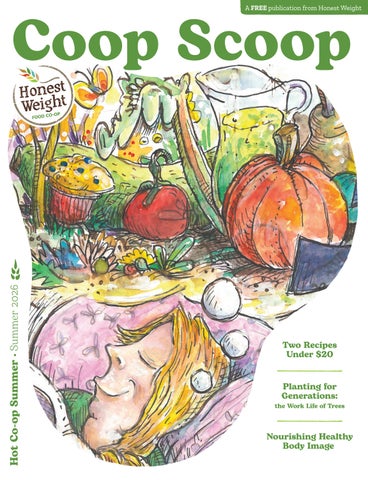
Coop Scoop
A FREE publication from Honest Weight
Hot Co-op Summer ∙ Summer 2026
https://www.ohmycodvegan.com/
Two Recipes Under $20 Planting for Generations:
the Work Life of Trees
Nourishing Healthy Body Image
is and A committed to providing our with foods and products for healthy living. To promote more
of living. ways to who choose to participate in a community that embraces cooperative principles in an atmosphere of and
90 WA TE
RV L
GR AN T AV E
PARK RD
EX
T
N E
W
E AV
KI NG
Store Hours: Open to All
INDUSTRI AL
AV E
AV E
N O ST G N VI LI
CE NT RA LA VE
IET
W AT ER VL IET AV E
EVER ETT R D
for
S
www.HonestWeight.coop
8am-9pm Daily
Hot Summer HealCo-op ∙ June/July 2021 ∙ Summer 2026 Features Features
6
11 7
Full Stream Ahead!
By Laura McCarthy
Native Plant of the Month: Healing From Butterfly Weed Heartburn By Elizabeth Meers
Lorem ipsum dolor sit amet, consectetuer adipiscing elit, sedWeight’s diam Meet Honest Marketing Team nonummy nibh euismod
9
By Coop Scoop Editors
By Rebecca Angel
11
Nourishing Healthy Body Image
10 21
By Leona Palmer, LMSW
135
Joy during Planting for Generations: the Quiet Work of Trees COVID By Richard Daley
Can Regenerative Agriculture Heal Our Food System?
Recipes Lorem ipsum from dolor sit amet, consectetuer adipiscing elit, sed diam nonummy nibh euismod tincidunt ut the Archives laoreet Lorem ipsum dolor sit amet, consectetuer
Meet Stephanie, Caleb, and their new baby Nora!
25 By Rebecca Angel
Two Recipes Under $20
By Sarah Rosenthal
Curated by the Coop Editors adipiscing elit,Scoop sed diam nonummy nibh euismod
30
By Ruth Ann Smalley
Superfood Group: Shopping List
By Dr. Madeline
Happenings at the Co-op
3 4
Happenings at the Co-op
Incredible
Coop Scoop’s Tenth EdibleMusings Gardens Birthday from Ed Miller Fresh News! Excerpted by Ruth Lorem ipsum dolorAnn sit Smalley amet, consectetuer
5
23 4
By Deanna Beyer 50th Fun Facts
From the Archives
4
What is a Co-op
From the Archives
By Pat Ellis
Co-op 101
Front Jeffrey Wright-Sedam LoremCover ipsumPhotography: dolor sit
amet, consectetuer
What’s
Earthly Remedies, Skin Deep Fresh Naturals & Tierra Farm
Producer Profile Lorem ipsum dolor sit By Pat Ellis
LoremCoconut ipsum dolor sit Water amet,and consectetuer Pomegranate
Hot Summer Co-op Playlist
By Melanie Pores Juice Marinade
Skin Deep Naturals
By Mathew Bradley
14
Recipe Corner By Melanie Pores
Double Up Food Bucks!
Fresh News! New Be Sure to Check Our eck it Lorem ipsum dolor sit Ch e! Coop Scoop amet,Blog! consectetuer Out Her
Producer Profile Lorem ipsum dolor sit amet, consectetuer
ISSN 2473-6155 (print) • ISSN 2473-6163 (online) By Deanna Beyer By The Pat Coop Sahr Scoop is for informational purposes only, and not intended as medical or health advice. Always consult your physician or other qualified healthcare provider. The views of our guest writers do not necessarily reflect those of Honest Weight, and we do not take responsibility for them.
Coop Scoop
Book Review
29
By Deanna Beyer
9
Tiny Gardens Everywhere
By Ruth Ann Smalley Recipie Corner
amet, consectetuer
24
Favorite 13 Melanie’s Date-Sweetened 27 Fruit Smoothie
HonestWeightCoopScoop.com
SPRING 20262025 SPRING
By Deanna Beyer
22
Honest Editors Honest Editors Natalie Criscione remembers shopping at the Quail St. Honest Weight location. She wears many hats: educator, writer, artist, musician, property manager, advocate, volunteer. She loves being part of the Coop Scoop team!
Pat Ellis has been a shopper at HWFC for years and became a member a year ago. She enjoys participating in the creative energy of the Scoop’s editorial team and is excited about contributing more in the future.
Leona Palmer, LMSW is a therapist living in Nassau with her partner, daughter, and beagle-mix pup. She joined her first co-op at sixteen (The Outpost, Milwaukee). When not tending the HW Blog, she can be found weeding her garden.
Sarah Rosenthal is the new Education and Engagement Specialist at Honest Weight. When she isn’t planning new events at the Co-op, you can find her teaching group fitness classes, cooking a tasty vegan dish, or gardening!
Ruth Ann Smalley PhD, is our Content Editor. An educator and writer, with a 4-digit Co-op member number from the early 90s, Ruth Ann offers wellness, writing, and creativity coaching through her practice at www.vibrant-energies.com or www.ruthannsmalley.com.
Mathew Bradley is an Art Director for a record label based out of Troy, NY. At HWFC, he serves as the Coop Scoop’s Layout Editor. When not at the computer, he sets aside time to make music with his two bands, lounges on his couch with his cat (Alene Lee), walks Peebles Island with his dog (Cricket), or tries out a recipe from one of his many cookbooks.
3
Letter from an Editor By Ruth Ann Smalley
A
s I write this, we’ve been riding up and down the thermometer lately, after an overall rather cool spring. When the weather can vary by as much as thirty+ degrees in a short time period, the very changes can feel as difficult to adjust to as the actual heat or humidity. And though our region has the capacity to switch on the fall chills sometimes by mid-September, it is just as possible for folks to be cranking fans and air conditioners that month as it is in August. This climate uncertainty—whether it happens to be “typically northeastern” or modern and human-induced—combined with our continuing observation of Honest Weight’s fiftieth anniversary, led us to our theme of “Hot Co-op Summer” for this this season’s edition.
We’re sharing ideas for making the best of your summer and our Co-op, through resources that help you enjoy your time outdoors, cool down your kitchen experiences, and learn more about the people, producers, and history of our unique cooperative grocery store. Along with up-to-the-minute cool and affordable recipes in this issue, you’ll find some fun “vintage” member recipes chosen from the Scoop’s pre-2015 archives. Dr. Madeline also offers a preview of her upcoming blogs about superfoods, through her superfood shopping list and infographic overview. Along with fun facts from our history, Pat Ellis highlights a range of local producers we’ve appreciated because they have graced our shelves for years. We introduce you to four staff members who are making unique contributions to the life of our current store and we time-travel back to the store’s tenth anniversary celebration with some remembrances from Ed Miller’s 1986 Coop Scoop column. Elizabeth Meer’s native plant profile and Rich Daley’s article about planting trees that cool and feed us (and other lifeforms!) help us to turn our thoughts to the f u tu r e a s we choose plants fo r our environment. The summer heat can affect the eating habits of children and adults, as can social pressures around the notion of having a “beach body.” Leona Palmer’s article, “Nourishing a Healthy Body Image” provides some helpful ways to frame these issues. Laura McCarthy’s “Full Stream Ahead” offers a beautiful example of how to provide children with an enjoyable, natural experience of being in their body in a body of water. And remember, when your house is hot, your power bill is amping up, and you can’t get to the stream or the beach, Honest Weight can be your cooling station! We have a full roster of fun events and offerings in our community and practitioner rooms. Or just grab a snack and a cool drink, and peruse the Coop Scoop in the comfort of our cafe. You’re sure to notice something new, bump into friends, or even make new ones while you’re at it.
Rose Pogonias by Robert Frost
There we bowed us in the burning, As the sun’s right worship is, To pick where none could miss them A thousand orchises; For though the grass was scattered, Yet every second spear Seemed tipped with wings of color, That tinged the atmosphere.
A saturated meadow, Sun-shaped and jewel-small, A circle scarcely wider than the trees around were tall; Where winds were quite excluded, And the air was stifling sweet With the breath of many flowers,— A temple of the heat.
We raised a simple prayer Before we left the spot, That in the general mowing That place might be forgot; Or if not all so favored, Obtain such grace of hours, That none should mow the grass there While so confused with flowers.
HOT CO-OP SUMMER
Coop Scoop’s Tenth Birthday Musings from Ed Miller Excerpted by Ruth Ann Smalley
“W
hile Jimmy Carter was crisscrossing the country to gather support for his presidential bid, the news of Honest Weight’s birth was being spread by word of mouth across the overlapping social circles of Albany hippiedom.” “Your group (or ‘family’, as it was known) was responsible for collecting, collating, and processing the orders (right down to carrying those two-ton cans of oil down the basement steps, and pouring a pound into Peter and Judy’s jar, two pounds into Margaret Inderhee’s jar—and there were no spigots, kids) once every three or four months. But, despite the early difficulties, or maybe because of them, things got bigger and better quickly. It wasn’t just that the monthly orders were growing (to about $1000 a month in the first year)—there was more going on—a lot of really high-energy people getting to know each other real well, real fast, working hard and enjoying it. And we were getting a lot of great food at great prices.” “Also back in the old days, we had a much more limited variety of foods. You’re not going to believe this but back
Coop Scoop
then, not only did we not have any fruits and vegetables, but we also didn’t have five kinds of jojoba shampoo, not to mention cookies and cakes (no, Baba’s Bakery wasn’t even born yet).” “Another feature of the earlier years was the atmosphere at Coop meetings. We weren’t going to get stuck in the eversweet flower-children syndrome, you see, so the idea was to be clear and honest and to let your feelings out, so we could take care of business. This led to the only (many) shouting matches I’ve witnessed that I considered absolutely hilarious. I’ve got to try to recreate one in particular. Get this—there’s about eight of us at Pierce Hall, interviewing Manager candidates one at a time, over about five hours. About two hours into it, after we finished one particular interview, our interview leader looked positively furious (you remember, this was pretty common at that time) and pointed accusingly at one of us, who had nodded out, and blasted her with something like ‘DAMN IT!! What kind of CRAP is this with you SLEEPING RIGHT IN THE MIDDLE OF THE INTERVIEW!!!’. Well, she didn’t miss a beat, and blurted right back ‘I WASN’T SLEEPING! I just had my eyes closed!’, and the rest of us knew it would be OK now; they had gotten their feelings out.” “I guess I really can’t do as many Coop hero stories as we’ve had heroes, because there’s just not enough paper to write ‘em, but maybe just one little anecdote from 1981, when we were gearing up to buy our building (four mortgage payments to go now). Well, I was calling up one more number, giving the pitch about how much we had already raised, and how much more we
needed, and how important it was, when she said she’d really like to, but she was hurtin’ for money, and she was leaving town tomorrow to move out West . . . and I started to say I understood, and we’d really miss her, but she said she could spare three dollars, and damned if she didn’t leave it off at the Coop the next day on the way to the bus station.” “Now don’t get me wrong; I know that Albany people are no better by birth or environment than other people, but when Co-opers from other cities where the coop is not doing too well (or folded three years ago), ask us what we’re doing right, I can only look for explanation to the efforts of all our members over the years.” “Toward reluctantly concluding this article, it seems kind of appropriate to draw some analogies between present-day Honest Weight and a ten year old child. It doesn’t fit too badly, actually. We’ve been growing steadily our first ten years, learning a lot of new skills, but it’s clear that our most explosive growth and learning is yet to come. We are beginning to develop muscles we never knew were coming, gradually adding maturity and clarity of purpose to our actions. Our future promises to be limited only by our imaginations. Happy Birthday, Honest Weight.
”
Biography: One of Honest Weight’s founding members, Ed passed away from ALS in the spring of 2017. These lines from his Times Union obituary offer a sparkling commentary on his character: “When he wasn't working for the DEC, he spent time with his family, gardened, connected people with humor - jazz - Festivus - pies in the face - and other unique experiences. He taught a fierce independence both with humor and resistance. Some might say he was a mensch and a champion of humanity, but he would deny it all. Everyone agreed he was a kind and gentle soul. He will be missed dearly. A fervent recycler, Ed donated his body to Albany Medical College for research. You may wish to send donations in his memory to the ALS Association.”
“SHADBLOW,” WATERCOLOR ON PAPER & PHOTOGRAPHY BY ELIZABETH MEER
4
Fun Facts From the Archives for the 50th Anniversary 1984
Compiled by Pat Ellis
March: New products are introduced at the store: coffee, (including fresh roasted beans from the Daily Grind), masa for tortilla making, skimmed milk, Brown Cow coffee yogurt, herbed Havarti, and grated parmesan. April: The manager’s salary is increased to $6.00 per hour. May: Jane Govola is the winner of the T-shirt Logo contest. The price for each shirt is $3.24 for members and $4.02 for non-members.
January: Co-op sales are expected to exceed $330,000 by end of the year.
June: Bulk and packaged raw honey from a local apiary become available.
The “Kosher Pizza & Falafel” restaurant dinner of Eggplant Parmesan and salad ($3.65!) is given rave reviews.
1985
June: Members vote 50 to 13 in favor of allowing representatives to search for a new home for the Co-op to allow for future growth.
September: An article on investments notes that Money Market Rates dropped from 10% in January to 7% in August. December: Christmas Idea - gift certificate for a year's subscription to the Scoop on sale for $4.00/yr.
1986
January: “Notes from the Board” announces that until further investigation children under 14 are no longer allowed to work at the store. May: Coop Scoop publishes its 100th issue! June : Stoned Wheat Thins member price is 1.09/box. Birell Non-alcoholic beer is member-priced at $2.22 a six-pack. The Board assumes a more active role in ensuring Co-op principles are given priority even during times of rapid sales growth: -Support local small-scale farming -Emphasize bulk foods and avoid over-packaging -Consideration of environmental and social-consciousness concerns July: Feature article is titled “Protection from Aftereffects of Chernobyl” November: Scoop announces that Locally Grown Organic Produce is coming to the Albany area: the beginning of CSA in our area. The Co-op’s first Contra dance is planned for November at St. Patrick’s Parish Center. Le Chevner goat milk yogurt is introduced as a new product in the coolers. The results of a membership survey reports that “overwhelmingly, prices, quality and selection of food, and the social atmosphere at the store” are the top reasons for shopping at the Co-op. December: Another Co-op mystery: the articles summarizing the Board meetings of July 21 and August 4 disappear. HW celebrates the addition of shopping carts, baskets, and a bike rack.
5
1987
October: Looks like the first Contra dance Party went well because a second is scheduled for October 24th. Members show up on Labor Day to help prepare for the expected Health Department re-inspection.
1988
January: Co-op adopts a formal year-round budgeting process; the first Co-op Budget Hearing is scheduled for the 18th. March: Popcorn advice: add a little water before starting to cook the popcorn (and before heating the oil or pan). The added moisture should help the popping. The 1988 budget includes a 65% increase in payroll due to the hiring of a third Co-Manager and pay raises for all Co-Managers. High Peaks Base camp advertises a special of $15.00 per person for bunk room lodging, a homemade “stick-to-your-ribs” country breakfast, and cross-country skiing and ice skating on 189 acres in the Adirondacks. September: Bulk organic whole wheat rigatoni and linguini are introduced along with brown sweet rice and roasted buckwheat.
1989
March: 1988 Annual Report highlights that gross annual sales increase by 36.6% and payroll by 61.3% due to added staff and raises. Member sales as a percentage of total sales is approximately 53%. June: Members vote to adopt a new member investment policy where members are requested to purchase one share valued at $100. The Co-op conducts its first ever inventory by department. The overall figures indicate roughly 11-12 inventory turns/year. September: A member labor crisis forces HW to close the store early in the afternoons for which an insufficient number of workers show up.
PHOTOGRAPHY BY LAURA MCCARTHY
Full Stream Ahead! By Laura McCarthy
S
uddenly find yourself with kids on a hot day and nowhere to be? A spur-of-the-moment stream picnic play-date can be pure magic. It’s simple: Text a few other parents, throw together some essentials like water shoes and extra clothes, grab some picnic food, and sit next to—or even better, in!—a shady stream while your little ones happily explore for a few hours. The place: The key is finding an accessible spot where you know you’ll have enough water for splashing (note water level is variable at sites throughout the season). If you’re up for it, send an open-ended invite to a few other families – especially those new parents who need to see people and perhaps pass that baby around, or that mom you haven’t seen since before kids! This is a great low commitment hang out for the grownups, and unrestricted play with friends of all ages adds to the spontaneity. We’ve found that last-minute plans are sometimes the ones that fit chaotic young family lives the best. The picnic: If you’re lucky enough to have time to plan ahead or stop by on Honest-Weight on your way out, a few of our favorite no-prep picnic goodies include the house-made wraps and sandwiches, awesome chicken and mock chicken salads from the Grab N’Go section prepped isle, Cider Belly donuts (or other bakery treats), dried fruit or trail mix from the bulk section, fun assorted sodas or seltzers from the coolers, and maybe even organic freeze pops. For portable energy we also love Bobos: delicious mini oat energy bars with fillings in boxes found in the snack aisle. Don’t have time for the store this time, or packing light? Any combination of fruit, sliced carrots and cucumbers,
Stream Picnic Adventure Checklist: Delicious easy picnic and plenty of water
Plastic containers for observing cool stuff (temporarily)
Water shoes, sport sandals, or old sneakers that can get wet Sunblock and hats Dry clothes and shoes A small net
Towels Picnic blanket Camp Chair (if your destination isn’t too far)
hummus, cheese sticks, and maybe a peanut butter roll-up in a tortilla can do the trick. After working up an appetite from balancing on rocks all morning combined with the novelty of a picnic blanket, almost anything goes. The playtime: Whether trekking up and down a stream bed looking for minnows and crayfish, or just sitting somewhere safe to splash or build with natural objects on the water’s edge, the opportunities for everyone to learn, engage (or maybe even relax!) are endless. Don’t forget a net if you have one, or just a couple of containers to scoop up and observe awesome critters like salamanders or aquatic invertebrates. Three reminders for a great stream play day: First, wet rocks are slick! Show kids how to step carefully, testing footing first. Water shoes, sandals, or even old sneakers with good grips are a must. Second, please be mindful of fragile stream habitats and be kind to wildlife, leaving critters behind when you head home. Remind kids to put rocks back where they were, too, which ensures our aquatic friends have plenty of places they need to thrive. And finally, for their safety, always supervise children carefully around water. Some streams we’ve enjoyed exploring in recent years include Thacher Park’s Paint Mine area, Five Rivers Environmental Education Center, Mohawk Hudson Land Conservancy’s Hollyhock Hollow Sanctuary, and the Huyck Preserve in Rensselaerville. Have fun and stay cool! Emergence! If you read “A (Not So?) Simple Gift” in Fall 2025’s Coop Scoop Edition, you may be delighted to learn that the well-cared for and extremely well-traveled caterpillars we met then did in fact overwinter as cocoons in the garage. Finally, Laura Adam, the first of the two polyphemus caterpillars, emerged in early June of this year, with Luna Adam just a week or so behind. What a reward after almost a full year of attention!
7
HOT CO-OP SUMMER
with butterflies, bees, and other native pollinators. The Monarch butterfly, in particular, will only lay its eggs on plants in the Asclepias (or Milkweed — there we go again!) family, and its caterpillars will only eat the leaves of Asclepias plants. The mildly toxic chemicals found in the plants make the caterpillars and butterflies distasteful to most predators.
Native Plant of the Month: Butterfly Weed
(Asclepias tuberosa) By Elizabeth Meers
F
irst, let’s get this straight: Butterfly Weed is NOT a weed. It is a lovely, well-behaved perennial that covers itself in lusciously vibrant orange flowers in late June and early July, bringing a smile to the face of all who pass by. Its name is a classic example of the attitude taken by many settlers from Europe towards plants they found growing naturally and abundantly in America, many of which have the word “weed” or “false” in their name . . . (don’t get me started)! Unlike many plants introduced by the same settlers, Butterfly Weed is a true and beneficial native to our region. Indeed, it co-evolved right here over thousands of years Coop Scoop
The chemicals found in Butterfly Weed have also made it useful as a medicine. According to the U.S. Department of Agriculture, European Americans used the plant, also called “pleurisy root,” to relieve inflammation and edema of the lungs and dilate the bronchial tubes. The plant, whose name is derived from that of the Greek god of medicine, Asklepios, was officially listed in the U.S. Pharmacopoeia from 1820 to 1905. Named Perennial Plant of the Year in 2017, Butterfly Weed is a great addition to even the most formal of gardens. It forms attractive, compact mounds of glossy green leaves one to three feet tall and does not spread by runners. The dazzling bright flowers are followed by distinctive tan seed pods that provide interest well into winter and make a great addition to fall wreaths and flower arrangements.
supports many other insects and pollinators, including beetles and bees. Great companions include Hairy Beardtongue (Penstemon hirsutis), Common Yarrow (Achillea millefolium), Wild Bergamot (Monarda fistulosa), Goldenrod (Solidago spp.), and Aster (Symphyotrichum spp.) You can find all these plants growing along with Butterfly Weed in the Co-op’s Ecoregional Native Garden. Plants grown from seeds responsibly collected from abundant, local and wild populations are available from IMAGINE Native Plant Farm, a co-sponsor of the Co-op’s Ecoregional Native Plant Garden (see http://imaginenativeplants.org). Consider planting some to make you smile! LIGHT: Sun (part shade tolerated) HEIGHT: 1-3’ SPACING: 15-18” SOIL MOISTURE: Average / Dry BLOOM TIME: Late June / early July COLOR: Bright orange flowers, June-July; funky tan seed pods, August-September; white silky seeds, September-November. Elizabeth Meer is a gardener, artist and environmental policy expert who has designed and tended the Co-op’s gardens with other Member-Owner Garden Stewards for more than twelve years. Please consider joining our team!
Butterfly Weed is easy to grow in average to dry soil, and is drought tolerant. It prefers full sun but will tolerate part shade. It forms a long taproot that can make transplanting challenging, but our experience at the Co-op shows that it can gently reseed and increase in a non-aggressive way over time. It is usually late to emerge in the spring, so try to be aware of its presence and avoid stepping on its crown during spring clean up. Based on the research of Dr. Doug Tallamy, Butterfly Weed supports 12 species of moths and butterflies in addition to Monarchs. It also
PHOTOGRAPHY & ILLUSTRATION BY ELIZABETH MEERS
8
Meet Honest Weight’s Marketing Team By Coop Scoop Team
Erika Lopez
In a nutshell, what is your role at HW? Hi! I’m Erika Lopez, and I am the Marketing Manager at the Co-op! I lead the incredible team behind our outreach, education, and branding and design efforts for the store. This includes tabling events out in the community, donations and sponsorships we make to local nonprofits and organizations, our in-house events and practitioner services, social media, signage, advertising, and branded merchandise, among other things! Within that role, what are your goals for HW? My goals for Honest Weight are that we lead with our mission in everything we do and approach our work with our triple bottom line in mind:
People: This is first for a reason! We want to ensure that everything we do is in service to our community, shoppers, members, staff, and local producers. Through leading with this value first, we not only set ourselves apart from our corporate competitors, but we also create an environment that people want to be a part of, and a more resilient local economy. This is our greatest strength, and I believe it is what makes us so successful. Planet: Sustainability and eco-friendly practices are areas of opportunity for us to strengthen in the coming year. Increasing our efforts to minimize food waste, increasing our composting efforts, reducing our dependence on plastic, rethinking signage favoring recycled and reusable materials are some of the ways that we
Marketing Manager
can accomplish this. We do our best to order merchandise from local vendors, reduce supply chains, and use more natural materials, but we will continue to research the best products available to live up to this plank of our commitment. Profit: While this might be third on the list, it is equally important to maintain the health of the business, which in turn allows us to expand on how well we meet the first two planks. Driving profits allows us to make more donations to local nonprofits, sponsor more community groups and activities, promote and assist local farms and producers, explore alternative packaging that is better for the environment, and to continue existing as a community resource for education and engagement activities. What are you most passionate about at HW? I am most passionate about being an effective leader for my team and helping meet the needs of the store. Our jobs are all-encompassing, touching every department of the Co-op, and as such offer variety and excitement which I thrive on. I love that I can bring my love for making things — like the giant flowers that now sit near the seeds at the front of the store by the shopping carts — and find ways to include and teach the community as we did with our paper flower classes earlier this year. The giant “50” that is hanging in the vestibule to celebrate our 50th anniversary is the product of these classes, and it makes me smile to see what we all made together!
What is the weirdest part of your job? I don’t know that I think any part of my job is necessarily “weird,” but I do have many “I can’t believe I am getting paid to do this,” moments, like teaching the aforementioned paper flower classes, or attending events and practitioner appointments offered through our education program so that I can better market them. My job is never dull and I absolutely love that! Do you have any stories you’d like to share? I just celebrated my 1-year employment anniversary on May 27th, which funnily enough happened to be the 50th anniversary of the store signing its certificate of incorporation. This is my first job working in a grocery store — I came from the national nonprofit communications realm, and before that was the Director of Sales for a Hilton branded hotel — so I still have a TON to learn and improve on. I joked when I first started that working in a grocery store means learning a new language, science, and math all at the same time, and I still think that is an accurate description. My hope is that now that I have been through one whole “cycle” things will be easier this time around, but also that I have worked hard enough to develop a sense of trust with both members and my colleagues that if I fail at something, they will know that I will turn that experience into a learning opportunity and do better next time. I try really hard not to fail at things, but we’re all human and I have to remember that I am still learning, and that is ok.
Fay Patterson
Graphic Designer 9
In a nutshell, what is your role at HW? I'm the new Graphic Designer for the Co-op! I also handle social media. Basically, I'm the conduit for different departments getting their message out there via visual language.
raise it to the next level! I appreciate what HW does to make quality food accessible, and how their donations create a loop of giving back to the people that make all of this possible in the first place.
Within that role, what are your goals for HW? I'd really love to use art to connect & inform people, and get some new faces in the store. We fear what we don't understand, so by making our events & mission easily digestible, it becomes more approachable.
What is the weirdest part of your job? Definitely getting paid to make art. That's always been my end goal, despite the "starving artist" stereotype. My middle school self would be like "we freaking did it!"
What are you most passionate about at HW? Seeing how much the community treasures Honest Weight makes me want to do my part to
HOT CO-OP SUMMER
Do you have any stories you’d like to share? Still too early to have any crazy stories — I got you next year though!
Outreach Coordinator
Anastasia Rodgers In a nutshell, what is your role at HW? Hi, Anastasia here! I've worn many hats here at our beautiful co-op, but as of January 2026, I am the Outreach Coordinator at Honest Weight. I am your point person for things like our Donations & Be the Change programs, and lead a team of fabulous members who go out into the community to represent HWFC. We do things like wellness fairs, library cooking programs, and visiting schools to teach students about fruits, veggies, and other healthy food options. This summer we will be going to local libraries to do food activities based on their Summer Reading Program theme "Unearth a Story;” we'll be 'excavating' zen cookies like pastry archeologists using toothpicks to uncover all the goodness hidden inside the cookie; and making 'Dig Site Parfaits' using different HWFC treats to represent the different layers of earth. We'll be at the Ten Broeck Mansion for their free family programs on 7/11, 7/25, 8/1, & 9/12 to share some delicious HWFC snacks with families as they learn about significant foods from different cultures.
direct neighborhood. I plan to develop new and engaging activities to bring to community events that represent our mission and highlight the people and the products that make HWFC special. What are you most passionate about at HW? Teaching the community who we are, what we do, and most importantly, that all are welcome here. What is the weirdest part of your job? I wouldn't say weird, but I'd say interesting! This role involves getting out into the community and meeting people, learning about all the different ways the communities are working to help each other, and that definitely keeps things interesting! Do you have any stories you’d like to share? Honestly too many stories to parse through right now. I'll get back to you!
Within that role, what are your goals for HW? I would like to do more Outreach programming within the West Hill neighborhood of Albany, our
Sarah Rosenthal In a nutshell, what is your role at HW? I am the new Education and Engagement Specialist at Honest Weight! I book all classes that happen in the Co-op. At HWFC we offer anything from Acupuncture to Cooking classes, even yoga and meditation!
everyone to feel welcome to take them. It's hard putting yourself out there and I want the Co-op to feel like a space where people can come and hang out and learn and build relationships. We are different from every grocery store in that sense. I feel like in my role it's my responsibility to assist in that.
Within that role, what are your goals for HW? My main priority when choosing classes is to keep them as little-to-no-cost as possible to support community needs. I also am trying to book classes that will bring new faces into the Co-op.
What is the weirdest part of your job? The weirdest part of my job, weird in a good way, is that I work with people who truly care about the Co-op and care about their jobs. I don't think a lot of people can say that about their jobs. We may disagree at times, but it's only because people want the best for Honest Weight.
Luckily, when I began this role, we already had really great class offerings. I want to continue building off of that by adding more class times, different practitioners, and new classes.
Education & Engagement Specialist
Coop Scoop
When booking classes I often prioritize cooking classes, language Classes, classes focused on Children/Teen Learning/Enrichment, and those related to committees or expanding DEI knowledge. What are you most passionate about at HW? Geez, what am I not passionate about, haha. I love my job and I take it very seriously. I want these classes to be beneficial to everyone and for
SUMMER 2026
Do you have any stories you’d like to share? Everyday is a new story! The one I repeat the most often is my first day visiting the Co-op. It was the day I moved to Albany, it was my first stop when I got off of the plane, I hadn't even walked through the doors and I immediately was welcomed. Actually! The first person I spoke to at HWFC was Elizabeth Meer, a fellow Coop Scoop writer. I will always remember that day because everyone was so friendly and no one knew it was my first day in the city. When I left, I called my husband and told him we had to become members!
10
Nourishing a Healthy Body Image
W
By Leona Palmer
e live in a society obsessed with thinness and appearance. Diet culture is a multi-billion-dollar industry worldwide. It is a mindset that equates health with body shape and size; labels certain foods “good” and certain foods “bad”; and promotes restrictive eating and/or unsustainable exercise programs. So it is not surprising that more than three-quarters of youth report “body image distress,” especially in the age of social media, or that half of girls report a desire to be thinner. These phenomena add up to a prevalence of both eating disorders (clinical diagnosis) and disordered eating (concerning behavior that falls outside strict diagnostic criteria) across all demographics. Some myths to dispel: dieting is a normal phase of adolescence; you can tell that someone has an eating disorder by looking at them; having an eating disorder is a choice someone is making. In the face of all of this societal pressure, how do we nurture a healthy body image and positive relationship to food and eating in ourselves and our loved ones? It is actually not so complicated. Preventing eating disorders is a combination of a) reducing “risk factors” like associating self-worth with body appearance, excessive dieting or exercise, an unusual focus on calories or clothes sizes, and frequent negative body/self talk; b) increasing “protective factors” like self-compassion and appreciation of one’s physical body for everything it does, such as sensory processing, brain power, physicality, emotional bio-chemistry, and capacity to heal itself; and finally, c) bringing awareness to the fact that some people are more susceptible to eating disorders, like LGBTQ+ people, people with a history of sexual trauma, people who are “overweight”, young athletes (including dance and gymnastics), and anyone overexposed to an environment where people are emphasizing the value of thinness. Puberty, changing schools or peer groups, and a change in expectations involving academic performance are all times when adolescents are at higher risk.
There are three good rules of thumb in our thinking around our bodies and food. First, treat all bodies the same—avoid overtly positively or negatively singling out a child or adult based on their appearance, size, or weight. When we value, remark, judge, or evaluate certain bodies for certain physical traits, we convey beliefs and messages. Are we (consciously or not) subscribing to or uplifting the majority Western cultural standard—the very narrow ideal of who is outwardly attractive and what physical shape and size is desirable? We all know it. Boiled down to its essence, it is the white, blonde, blue-eyed, hourglass Barbie and beefy Ken. Second, focus on compliments that emphasize positive characteristics, personality traits, and actions and behaviors over physical appearance like hair, clothes, weight (especially loss), or attractiveness. It’s not that we should never let someone know that we like their haircut or the outfit they put together or that we think they have beautiful eyes or happen to be glowing. It’s the overall balance that’s key. All of us want to feel value, love, belonging, and appreciation for who we are, not what we look like on any given day or year. For people struggling with, or in recovery from, eating disorders, compliments based on appearance highlight a toxic mental blueprint that equates worth and looks. For people navigating questions around gender, appearance can highlight a disconnect between outer presentation and inner identity. For people who are dealing with acute or chronic medical conditions or lifestage transitions, their appearance is something over which they have little control. For that matter, almost none of us chose our facial features, height, or shape. Usually, what matters most is what’s happening inside: how we are navigating life’s ups and downs, investing in our personal growth and wellbeing, and evolving as a person. So, admiring and appreciating someone’s humor, strength,
creativity, generosity, or resilience is far more meaningful. Third, do not link health, fitness, or overall wellbeing with appearance. This seems obvious, but think how many times we may have assumed that when someone’s body has changed visibly, especially become smaller, someone has automatically improved their health. Healthy bloodwork does not correlate to jean size. Much research has been done to debunk the BMI, not just because of its implicit racism and sexism being based on European white men, but also because it ignores body composition (ratios of muscle, bone, and fat) and biological differences across life stages. These three guidelines: a) bodies and eating habits can look all different ways and be absolutely healthy; b) value and worth are determined by what’s inside not outside (and really just the fact that we exist at all gives us tremendous inherent value and entitlement to respect as a person); and c) being mindful to treat all bodies with the same appreciation and respect, can go a very long way in building up our own positive body image and modeling healthy attitudes for others. References: https://directorsblog.health.azdhs.gov/eating-disoers-awarness-week-and-ways-to-help-prevent-disordered-eating/ https://keltyeatingdisorders.ca/prevention/prevention-resources/ https://www.nationaleatingdisorders.org/prevention/ https://nedc.com.au/eating-disorders/preventing-eating-disorders/prevention-programs https://www.nnph.org/files/cchs/chronic-disease/5210_materials/Phrases-that-Help-and-Hinder-Healthy-Eating.pdf https://pmc.ncbi.nlm.nih.gov/articles/PMC3926692/ https://reasonsedc.com/compliments-that-count/ https://renfrewcenter.com/what-causes-negative-body-image-4-biggest-influences/ https://www.tandfonline.com/doi/full/10.1080/10640266.2024.2345995#abstract https://withall.org/learn-what-to-say/
Resources for Parents: WithAll’s Parent Guides and Power Pack https://withall.org/what-to-say/for-parents-families/; MyPlate’s Phrases that Help and Hinder for young children https://www.nnph.org/files/cchs/chronic-disease/5210_materials/Phrases-that-Help-and-Hinder-Healthy-Eating.pdf; Prevention Tips for Parents https://renfrewcenter.com/eating-disorder-prevention-tips-for-parents/; What to Know About Teens and Eating Disorders https://renfrewcenter.com/eating-disorders-in-teens-everything-you-should-know/ Resources for Educators: Resources for Schools https://nedc.com.au/assets/NEDC-Resources/NEDC-Resource-Schools.pdf?2026061018; Healthy Bodies, Healthy Minds https://healthunit.org/wp-content/uploads/Tool_for_Educators.pdf Resources for Coaches: WithAll What to Say Coaches Challenge https://withall.org/for-coaches/
Resources around Language and Messaging: The Language of Health Style Guide https://www.azhealthzone.org/wp-content/uploads/2021/10/style-guide-language-of-health.pdf.
11
HOT CO-OP SUMMER
Positive Practices Frame food around health, nutrition, and lifelong physical wellbeing as opposed to appearance. Teach and practice balanced eating habits, and honor and respect your own and everyone’s bodily awareness around hunger and fullness cues (especially children’s—see MyPlate’s Phrases for recommendations). Model a healthy and balanced relationship through positive attitudes and behaviors around food and movement. Avoid labeling foods as “good” or “bad” (like “junk food”)—this can encourage hyper fixation, restricting, or binging based on food groups. All food can be part of a healthy, balanced lifestyle. Avoid commenting on body types or weights and avoid labeling bodies as positive or negative based on appearance, to lower any risk of associating worth or happiness with one’s body. Emphasize the joy in connecting over cooking and eating together, taking time to eat with presence, gratitude over where our food comes from, and excitement in trying new foods. Avoid using food as a comfort, solution to boredom, reward, or punishment with children or oneself. Lead with appreciation about how bodies naturally change in childhood and adolescence, pregnancy, middle age, and later stages.
Coop Scoop
Be aware of negative, critical, or shaming self-talk or attitudes, both verbal and nonverbal, especially around young people who can pick up as much from how we treat them as from how we treat ourselves. Encourage self-compassion and appreciation for a body’s abilities, strengths, and functioning. Engage in media and cultural literacy and training around image manipulation, the “thin/muscular ideal”, mainstream beauty/fitness standards, and subliminal assumptions around health and wellbeing aligning with only certain shapes and sizes and races. Be proactive in noticing these ideals in ads and marketing, shows and movies, social media, and conversation. Seek out role models of health that come in different shapes and sizes across age, race, and ability. Engage in talks around what “fat” means that do not assume it is either negative or unhealthy. Engage in talks around what “dieting” means and do not assume it is positive or about being healthy. Engage in talks around what is “beautiful” or “attractive” that appreciate all different bodies and emphasizes not just appearance but also personality and character. Honestly evaluate the costs and negative consequences physically and psychologically of pursuing a Western physical ideal while highlighting the positive effects of balanced nutrition and exercise. Associate value and positive self-worth with both intrinsic belonging and unconditional love, as well as cultivating positive core beliefs and behaviors around being enough, doing our best, learning from mistakes, caring about ourselves and others, and giving back, etc. instead of what we look like. If someone you care about is unhappy with their body, ask a lot of questions, listen with curiosity and compassion, focus on feelings instead of food or weight, and share your own challenges, feelings, and vulnerabilities.
PHOTOGRAPHY BY MARK ALLGO
12
Recipes from the Archives
Curated by the
itors
Coop Scoop Ed
The Coop Scoop archives, accessible through the Honest Weight website, is a treasury of history and interesting finds from year’s past. One of the deep dives is the search for recipes. There are many! Pictured here are some from past issues of the Coop Scoop. They offer a fascinating window into the kitchens of Honest Weight members over time. If you try any, let us know how they come out. (We have not tested them!) —The Coop Scoop Editors
13
HOT CO-OP SUMMER
15
HOT CO-OP SUMMER
Coop Scoop
SUMMER 2026
16
17
HOT CO-OP SUMMER
Coop Scoop
SPRING 2026
18
19
PHOTOGRAPHY BY JEN GRAINER
Coop Scoop
SPRING 2026
20
Planting for Generations:
the Quiet Work of Trees By Richard Daley
A
s a youngster I spent countless hours wandering the woods of the Catskills. I wish I had looked up more than ahead, because when I did look up I found myself admiring the structure of tall trees, the way light moved through leaves, and experiencing the coolness beneath a dense canopy even on the hottest days of summer. Long before I humbly attempted to understand the ecology of the woods, I felt instinctively drawn to trees and shrubs, especially those that offered food: the mulberry at the edge of the field up the road, the blackberries tangled through an old stone wall along the property line, the hickories scattered throughout the woods, and especially the wineberries, a so-called “invasive” plant, that grew beside my childhood home. I can still remember gathering those tart red berries for my cereal on summer mornings. To this day, those memories remind me that our relationship with the living world is often far more nuanced than the simple categories we assign to it. Today, as our summers seem to grow hotter and our communities search for ways to adapt to the ecological instability of our time, I find myself returning again and again to tree crops: fruit and nut trees, berry-producing shrubs, and the broader vision of edible perennial landscapes. Far from mere daydreams, these plants are more than sources of food. They are living infrastructure; cooling the air, building soil, holding water, supporting wildlife, and providing nourishment year after year with relatively little human intervention. A mature tree does far more than stand strongly in place. Trees cool and temper the world around them through shade and transpiration, releasing moisture into the atmosphere as part of the hydrological cycle. Walk beneath a grove of trees, food-bearing or otherwise, wooden friends nonetheless, and, especially in July, you will immediately feel the difference. We have all felt the air become softer, more humid, more alive.
21
HOT CO-OP SUMMER
Trees slow wind, build soil, hold water, reduce erosion, provide habitat, store carbon, and support countless insects, birds, fungi, and microorganisms. In many ways they create their own climate within climates, one in which we feel most comfortable. Unlike annual agriculture, with its constant demands and seasonal urgency, perennial systems often ask comparatively little of us once established. A tomato planting may require tillage, continual laboring of irrigation, trellising, pruning, and fertility management. But a healthy chestnut, persimmon, mulberry, or hazelnut planting can nourish generations while quietly participating in the life of a place. In Sicily, there are chestnut trees believed to be thousands of years old, living beings that have outlasted kingdoms and entire eras of human history. Tree crops invite us into a very different relationship with time. This is not a new idea. Human societies across the world historically depended on tree crops and perennial food systems for both human food, and forage for their animals. Here in the Northeast, Indigenous communities stewarded complex forest ecosystems long before industrial agriculture emerged. In many parts of the eastern United States, the American chestnut once formed the backbone of entire forest communities. Before the chestnut blight arrived in the early 1900s, billions of American chestnuts stretched from Maine to Georgia, producing immense annual nut harvests for both humans and wildlife. The loss of the American chestnut remains one of the great ecological tragedies of North American history. An introduced fungal disease known as chestnut blight swept through eastern forests and effectively erased one of the continent’s most important tree species within a matter of decades. But the story of the chestnut is not only one of loss. Across the Northeast, people continue working to restore and strengthen chestnuts through breeding programs and conservation plantings, and important hybridization efforts that combine the resilience of Asian chestnut species with the form and ecological role of the American chestnut. Many of these newer hybrids already demonstrate how thoughtful human intervention can help repair damaged ecological relationships when we choose the role of caretaker over conqueror, steward over exploiter.
Coop Scoop
r fa s e o d e e r t e r u t a m A ongr t s d n a t s n a h t e r o m l ly in place. Trees coo ld and temper the wor h around them throug n, tio shade and transpira to releasing moisture in rt a the atmosphere as p cle. y of the hydrological c To me, these efforts represent something larger than simply saving a species. They remind us that ecological restoration does not always mean attempting to recreate some fantasy of an untouched wilderness. Rather, sometimes it means participating humbly and carefully in the healing of damaged systems. And chestnuts are only one example. Many resilient perennial food plants already thrive in our region: elderberries, serviceberries, hazelnuts, pawpaws, aronia, beach plums, currants, mulberries, heartnuts, hybrid persimmons, and disease-resistant hybrid chestnuts. Some are native and others are carefully selected hybrids capable of tolerating pests, diseases, and climate stresses that older varieties struggle against. Together, these plants can form diverse edible landscapes that support pollinators and wildlife alike, and of course greatly benefitting human communities. Importantly, these systems do not need to exist only on farms. They belong in schoolyards, church grounds, parks, neighborhoods, food co-ops, and backyard gardens alike. A single mature shade tree can dramatically reduce heat, especially in urban environments. A hedgerow of berries can feed birds and people alike. A community orchard can become both a gathering place and a food source when grocery prices can be unmanageable for many of our neighbors.
”
beneath, yet this is precisely what makes this act powerful. Trees embody continuity beyond the self. They connect generations.
Perhaps this is one reason so many people feel emotionally drawn to trees. We intuitively recognize that they participate in forms of patience and reciprocity that industrial society often forgets.
As the summers seemingly grow hotter, I suspect many of us are longing not only for cooler temperatures, but for cooler ways of living; ways rooted less in extraction and haste, and more in stewardship and community. We yearn for a slower, deeper relationship with the living world around us.
Planting perennial food systems will not solve every ecological crisis we face, but fruit and nut trees offer something increasingly rare in modern life: a practical act of hope grounded in material reality. They feed us, cool us, shelter us, and remind us that restoration begins slowly, season by season, root by root, and sometimes, simply, by planting a tree. The Editorial team recommend The Overstory by Richard Powers as a deeper dive into the life and relationships of trees and forests and how they impact humans.
In a culture obsessed with immediacy, trees ask us to think differently about time. Planting a chestnut or an apple is an act of faith in the purest sense. Most of us plant trees whose full shade we may never sit
PHOTOGRAPHY BY KEITH STEWART
“I think that I shall never see A poem as lovely as a tree….” - Joyce Kilmer, 1913
22
Producer
Profile By Pat Ellis
Part of HWFC’s mission is to provide its members and community with affordable, high-quality natural food products, supplied with a focus on moral and ethical production and environmental stewardship. This goal necessitates building relationships with quality suppliers whose products meet those standards. In this issue of the Scoop we’re happy to highlight four companies we’ve partnered with for many years, because they have proven to meet those objectives and more.
Earthly Albany, NY Remedies
E
arthly Remedies by Erin specializes in Herbal Medicinal and Botanical skincare products. The company’s founder and chief herbalist, Erin Ethier, developed her interest in herbs as a teenager. When Ethier was diagnosed with multiple sclerosis in 2002 and her son began simultaneously experiencing severe allergy issues, that interest turned into a vocation.
Skin Deep Naturals Troy, NY
W
hen Skin Deep Naturals founder, Octavia Maxwell, was in elementary school, she struggled with dry skin and hair loss. Her inability to access natural-based products became the impetus for researching and formulating a line of natural, clean, skin and hair care products to meet her goal of making self-care accessible, intentional, and empowering for everyone. Maxwell believes that “caring for your skin and hair should never feel like a luxury but rather a basic, necessary act of self-respect.”
23
Ethier began making cleaning products, lotions, soaps, and bubble baths that she used in her home. She started creating her family's skincare products from botanicals and noticed that these nature-based, clean products seemed to resolve many of her son’s issues. Encouraged by the improvements, Ethier continued to study. As her knowledge increased, so did the variety of herbal medicines she formulated. In 2009, this journey led to the creation of Earthly Remedies by Erin. Today, Earthly Remedies' product line is all-natural, organic, and locally made in Cobleskill, NY. The products include plant medicines, herbal tinctures, syrups, teas, salves, tooth powder, eczema creams, and dry shampoos. All products are 100% free of synthetic chemicals and mostly organic. Everything is made fresh and in small batches. The only animal-based ingredients are beeswax and honey sourced from a local farm.
The company, located in Troy, NY, makes skincare products formulated with high-quality, natural ingredients like shea and mango butters. Oils, including apricot, almond, coconut, jojoba, and avocado, are blended as appropriate for the particular application. The products are designed for all skin types and are free from sulfates, parabens, and harsh chemicals. Skin Deep Natural’s line of products includes whipped body butters, hair serums, clay masks, natural deodorants, facial /body scrubs, body oils, and a hair revitalizer containing mango butter, coconut oil, and raw honey that smells good enough to eat, although we advise against that! (https://www.skindeepnaturals.shop)
ILLUSTRATION BY MATHEW BRADLEY
tamari almonds. Fishgold says he appreciates the co-op’s continued support over these 27 years.
Tierra Farms Valatie, NY
T
ierra Farms, a certified organic manufacturer and distributor of dried fruits and organic nuts, has a long association with HWFC. Initially, Tierra Farms, located in Valatie, NY, produced only organic vegetables. But in 1999, founder and CEO Gunther Fishgold established a dried fruit and organic nuts division as a means of sustaining the farm during the winter months. That’s when the partnership between Honest Weight and Tierra Farm began. Fishgold remembers the first order Bob Linn (aka Bob from Bulk) placed for 20 cases of
Jean’s Greens Albany, NY
J
ean Argus’s vision of bringing the healing power of organic herbs, herbal teas, and tinctures to the local community was the foundation on which Jean’s Greens was established in 1989. At a time when organic and alternative healing practices were just beginning to gain attention, Argus became a pioneer in providing high quality, ethically-sourced herbs free from synthetic chemicals and pesticides.
Coop Scoop
Tierra Farms continues to grow and thrive as it sources high-quality nuts and seeds directly from farms. Today, its production includes dry roasting and flavoring seeds and nuts; grinding butters; blending trail mixes; and coating fruits and nuts in chocolate (some of my faves). They also roast fair-trade coffee beans. Production batches remain small and handcrafted to promote freshness and consistent q u a l i t y. A l l p r o d u c t s a r e gluten-free, peanut-free, kosher, and made without the addition of refined sugars and oils. An impressive hallmark of Tierra Farms is theirits commitment to environmental stewardship. Tierra Farms offers more than 100 certified organic products in plastic-free, home compostable packaging, and has eliminated 98% of single-use plastic throughout their operation. Further, they generate over 70% of the electricity they use and recycle more than 60% of the generated waste. (https://www.tierrafarm.com/)
Today, the company is owned by Nora Vallon-Burgos. Her experience as a nurse, coupled with her passion for natural healing, has allowed her to build upon that original vision to include the goal of making holistic health accessible to everyone, no matter their background, financial situation, or where they live. Toward this vision, Jean’s Greens offers a large variety of organic herbs and spices, teas, tinctures, essential oils, and wellness goods. These products are selected to enhance self-care. Jean’s Green’s has a resident clinical herbalist, Corinne Ferry-Moselle, who is available to help on an individual's healing journey. Be sure to check out their website! (https://jeansgreens.com)
SUMMER 2026
24 tinyurl.com/mathewshotcoopsummerplaylist
Corner
Two Recipes Under $20 By Sarah Rosenthal
I
f you were to look through my saved reels on Instagram, you’d quickly notice I love a good, simple vegan recipe. Double points if it takes under an hour to cook and prepare, and triple if it’s gluten free! I know what you’re thinking, vegan and gluten free! What does she eat?! Let me tell you there’s a ton of food out there! That’s why I have provided two easy gluten free/vegan recipes, all under $20 and all perfect for the summer!
Chickpea Salad Recipe* 15 oz. can chickpeas drained and rinsed (or 1 ½ cups cooked chickpeas) 1 stalk celery diced 2 green onions sliced ½ cup halved grapes or quartered if they are large 2 Tbsp homemade vegan mayonaise or your favorite store-bought vegan mayo 1 Tbsp dijon mustard 1/2 tsp dried dill 1/2 tsp poultry seasoning Dash of salt/pepper to taste
I did not make these recipes up. These recipes are from two different online blogs, but I have adapted them to my liking. Remember when cooking, adapt flavors to your liking and omit things you know you won’t enjoy!
1. Drain and rinse chickpeas 2. In a medium bowl, slightly mash the chickpeas with a potato masher or fork (feel free to leave some chickpeas whole for texture) 3. Chop your celery and green onions 4. Cut your grapes in halves or quarters 5. Add all ingredients to mashed ingredients and mix well 6. Taste and adjust seasoning to your liking 7. Refrigerate until ready to serve
*I use this recipe from the online blog Veggie Inspired
25 Coop 25 Scoop
PHOTOGRAPHY BYARTHUR JENN JAN/FEB 2023INNIAS PHOTOGRAPHY BY TSENG
14
Fried Rice: Cowboy A Non-Recipe Recipe Caviar*
To make fried rice, you must use cold
Prepcooked time:rice 25 minutes - Serves: (white or brown). In8a wok
or heavy skillet, start by sautéing sliced garlic in an oil that is heat tolerant, like sunflower. When the garlic starts to brown, remove it and set it aside.
3 Roma tomatoes seeds removed, diced
Rice is Nice By Ann Lapinski
If you want egg in your rice, add a 2 avocados diced beaten egg or two, quickly cook the egg and it aside. Now add the rice, 1/3also cupset diced red onion with more oil if necessary, and some salt 15 oz. can canned beans and stir-fry the rice black around. Addrinsed in and drained veggies that only need light cooking like peas (frozen is fine) and grated carrot 15 oz. can canned black eyed peas and keep mixing around. Add the egg rinsed and drained and garlic back in, mix around, and you have meal!frozen corn kernels 1 1/2acups
thawed
1 bell pepper diced, any color 1 jalapeño seeds removed, finely diced
Vegan Rice Pudding
1/3 cup chopped fresh cilantro Dressing:
1/3 cup olive oil 2 Tbsp fresh lime juice 2 ½ cups oat milk 2 Tbsp red wine vinegar ½ cup arborio rice 1 tsp granulated sugar or 1 tsp. vanilla pastechoice or vanilla extract sweetener of your 2-4tsp Tbsp. 1/2 saltmaple syrup 1/2 tsp black pepper 1/4 tsp garlic powder 1. Heat oat milk and rice in a medium-sized heavy pot on top of the stove. 1. Bring Combine avocado, onion, 2. thistomatoes, mix to eyed a boil, thencorn, reduce black beans, black peas, heat. Simmer about 30 minutes, until the pepper, jalapeno pepper, and cilantro in rice is soft. a large bowl. Toss/stir well so that ingredients are well-combined 3. Stir the rice every 5 minutes or so to keep from sticking. 2. In it a separate bowl, whisk together olive oil, lime juice, red wine vinegar, sugar, salt, pepper, garlic powder 4. Whenand the rice is done, add the vanilla. Stir in the maple syrup, 1 Tbsp. at a time, to your taste. I find that 3 Tbsp. me. You can 3. Pour dressing overworks otherfor ingredients also cinnamon raisins to this rice andadd stir/toss veryand well pudding if that’s your preference. I like plain old vanilla.on its own or with tortilla chips 4. Serve Store leftovers in the refrigerator See items you don’t typically buy? Try our bulk section and get as little/much as you want!
*I use this recipe from the online blog Spend With Pennies
Coop CoopScoop Scoop Coop Scoop
Coop Scoop
PHOTOGRAPHY BY MARIA Heal SPRING 2026 JAN/FEB 2023POD
26 1414 26
Tiny Gardens Everywhere: The Past, Present, and Future of the Self-Provisioning City by Kate Brown By Ruth Ann Smalley
27
PHOTOGRAPHY BY BROOKLYN GRANGE NOTE: If you have stained or damaged
I
love the concept of the “self-provisioning city” and as this book makes clear, when places have relied on gardens in this way, there was always an accompanying growth of community care and solidarity. Kate Brown describes her book as “part history, part memoir, part manifesto” and it is certainly an interesting, often surprising read. She follows her topic through time and across space, presenting what she calls a "kaleidoscopic history.” Though Brown’s kaleidoscope is limited to a fairly small sample of self-provisioning cities in the Northern hemisphere, she does take us through numerous fascinating twists and turns. In fact, her book is organized into seven “turns”: the first, “A Light in Dark England;” the second, “The Berlin Commune;” the third, “Washington, DC;” the fourth, “Lawn and Order;” the fifth, “The Dacha Empire;” the sixth, “Mansfield, Ohio;” and the seventh, “Amsterdam.” Through these turns, Brown offers “shards of information, different times, places and national histories” that “go into the cylinder and rotate to reveal new patterns and connections.” One of the most salient patterns to emerge is elite control of land, and the common person’s ongoing struggle—against oppressive governments and class- or race-based discrimination—for the capacity to grow their own food. Starting from the enclosures of the commons in Britain, Brown traces the far-reaching effects: “By the nineteenth century, the social impact of the new round of enclosures was clearly visible. Peasants who once had subsisted from the commons and wastes had to make do with low-wage jobs that dried up in winter . . . Prices rose as formerly self-provisioning people bought staples in shops. Families racked up debts for rent and groceries. Competition for work was stiff, so employers lowered pay. With fewer apprenticeships and jobs that had delayed the age of marriage, teens married a decade younger than their parents’ generation. As the years of married fertility doubled, so did the number of children” (29). It is telling that in the aftermath of enclosures, usage of the term “pauper” rose alongside the phrase “private property.” In the 1830s, allotments were introduced as a method of easing some of the food scarcity. These were much sought-after, and the program needed to be expanded. In such garden plots, working people “could grow enough to save about 20 percent of their household expenses.” This is significant on its own, but the terrible turn of events that Brown describes next is instructive. By the twentieth century, the “agricultural improvements” introduced by wealthy landowners had substantially depleted the soils of British farms. The island nation had become reliant on imports for “eighty percent of wheat and forty percent of meat.” In contrast, the land tended by allotment gardeners produced abundantly— “even when allotment gardeners took over exhausted land that the farmer no longer found profitable, they produced astonishing returns” (38). Additionally, the allotments helped unite and support workers. Labor groups worked together to pressure the government into making more gardens available on public land. In this way, “tiny gardens, as meager as they were, built alternative political dominions.” In the various different times and settings Brown researches, garden-related community-building increased the formation of informal banking and insurance systems, access to child-care, and various educational measures.
hoods east of the river in Washington, DC in the early decades of the 1900s; or the post-WW2 Dacha gardens of Estonia; gardeners defied the odds and sometimes the authorities. I was unfamiliar with all of Brown’s examples and amazed by the stories of both hardship and success. I’d like to share a few of the more striking facts and statistics presented throughout this informative book, starting with this one: “Around the world, small-scale farmers produce an estimated one-third of the world’s food. Most often these farmers are envisioned to be located in the global south, yet Russia and countries of the former Soviet block have the highest numbers of small landholders in the world” (207). That’s a substantial level of contribution to the food supply. Brown makes clear how much difference these small farms and gardens have made in recent history. This was especially true in the USSR. In the mid-twentieth century, 60 percent of the potatoes there were grown “in small plots on 7 percent of the country’s arable land. A quarter of all vegetables and a third of eggs and milk came not from large collective farms but from tiny gardens” (185). These gardens mattered immensely when we consider the previous scale of famine there: four million died between 1921-2, seven million ten years later, and 1-2 million in 1947. Brown notes, “after the postwar establishment of allotment gardens on a mass scale, the Soviet Union suffered no more historic hunger” (191). Despite all the small-garden successes Brown’s book celebrates, there are troubling statistics, even in countries like the Netherlands, which has “a vibrant urban farming movement.” While the Netherlands constitutes “the largest agricultural exporter in the world,” it is also suffering from a “nitrogen crisis.” The country’s farms “exceed European Union regulations” for nitrogen emissions. In fact, the Netherlands “lead Europe in biodiversity loss in part due to the great volume of animal poop” (235). The emphasis on livestock cultivation is a substantial problem in Europe: “Eighty-two percent of the European Union’s CAP agricultural subsidies favor resource-intensive, animal-based foods at the expense of vegetables, fruits, and nuts” (236). This bias is not limited to the EU, however, and is not a good trade-off. According to Brown, animal husbandry “requires seventy to eighty percent of the world's agricultural land to produce only eighteen percent of calories and twenty-five percent of all protein consumed by humans” (237). In the U.S., fruits and vegetables are “categorized as ‘specialty foods’” and constitute a mere 2 percent of our acreage. Meanwhile, residential lawns constitute a vast acreage. Moreover, our penchant for turf grass poses major health and environmental issues: “Lawn care services annually pour eight hundred million gallons of fuel into maintaining turf grass.” Private lawns are the recipients of “more herbicides and pesticides per acre than commercial farms.” These same chemicals “have been linked to childhood brain cancer, leukemia, neuroblastoma, nontissue sarcomas, non-Hodgkin’s lymphoma, and cancers of the brain and testes” (160). We’re in need of a major overhaul in how we make use of our land. Brown’s stories of tiny gardens are inspiring, without romanticizing the work they require. In the face of climate uncertainty, supply chain issues, and current political disruptions to the global order, we could address a number of problems at once by turning over the turf. Tiny gardens could be, instead of the accident waiting to happen, the boon ready to bloom.
It is inspiring to see how small gardens have grown into lifesaving resources and sites for mutual aid. Whether in the “arbor gardens’ or “green ghettos” created by the poor in shanty towns around Berlin at the turn of the twentieth century; the segregated Black gardening neighbor
Coop Scoop
SUMMER 2026
28
1 cup coconut water
Corner
Coconut Water & Pomegranate Juice Marinade By Melanie Pores
T
½ cup pomegranate juice 2 Tbsp fresh lime juice 1 Tbsp maple syrup or date syrup 1 tsp minced ginger 1 tsp minced garlic ¼ tsp ground cumin ¼ tsp black pepper 2 Tbsp fresh cilantro leaves 1 tsp coconut aminos 1-2 Tbsp olive oil 1 cup of protein of choice: extra-firm tofu, tempeh, chicken thigh, a white fish such as snapper or tilapia, or boneless pork chop ½ cup quinoa 1 cup riced cauliflower
his yummy, nutrient-dense marinade featured below combines tropical sweetness with tart, savory notes, making it excellent for firm tofu, tempeh, chicken, fish, or pork. The coconut water, pomegranate juice, and fresh cilantro are cooling and refreshing and the lime juice provides a nice tenderizing effect.
1 cup frozen Brussels sprouts Fresh pomegranate seeds and chopped fresh cilantro for garnish
Melanie Pores is a retired bilingual educator, an HWFC member since 1978, and the facilitator of HWFC’s Spanish Conversation Group since 2015, currently on Zoom, Fridays 10am to noon.
1. In a measuring cup, whisk together the coconut water, pomegranate juice, lime juice, maple syrup, minced ginger, minced garlic, and coconut aminos. 2. Whisk in the olive oil until well combined. 3. Cut your protein of choice into bite-size pieces and place it in a shallow baking dish. Add in the quinoa, riced cauliflower and Brussels sprouts Mix well to ensure that all of your ingredients are well-coated with marinade. 4. Cover and refrigerate. • For Tofu/Tempeh: 1 to 2 hours (or overnight for best results). • For Chicken/Fish/Pork: 2 hours to overnight. 5. Preheat the oven to 350°F. 6. Bake for 1 hour, or until your protein of choice is completely cooked. (Internal temperature for chicken should reach 165°F, Internal temperature for pork should reach 145°F).
Coop 29 Scoop
2023 PHOTOGRAPHY BY NICOLE JAN/FEB KEEPS - INFOGRAPHICS BY DR. MADELINE
14
Here's a sneak peek of Dr. Mad's upcoming in-depth article about adding more superfoods to your menu!
Fried Rice:
A Non-Recipe Recipe To make fried rice, you must use cold cooked rice (white or brown). In a wok or heavy skillet, start by sautéing sliced garlic in an oil that is heat tolerant, like sunflower. When the garlic starts to brown, remove it and set it aside. If you want egg in your rice, add a beaten egg or two, quickly cook the egg and also set it aside. Now add the rice, with more oil if necessary, and some salt and stir-fry the rice around. Add in veggies that only need light cooking like peas (frozen is fine) and grated carrot and keep mixing around. Add the egg and garlic back in, mix around, and you have a meal!
Rice is Nice
Vegan Rice Pudding
Look out for it on our blog in the coming weeks! By Ann Lapinski
2 ½ cups oat milk ½ cup arborio rice 1 tsp. vanilla paste or vanilla extract 2-4 Tbsp. maple syrup
1. Heat oat milk and rice in a medium-sized heavy pot on top of the stove. 2. Bring this mix to a boil, then reduce heat. Simmer about 30 minutes, until the rice is soft. 3. Stir the rice every 5 minutes or so to keep it from sticking. 4. When the rice is done, add the vanilla. Stir in the maple syrup, 1 Tbsp. at a time, to your taste. I find that 3 Tbsp. works for me. You can also add cinnamon and raisins to this rice pudding if that’s your preference. I like plain old vanilla.
Coop Coop Scoop Scoop
Coop Scoop
Heal2026Heal SPRING
14 30 14
Sourcing foods locally from over:
285 & 319
D
Farms
AV E
INDUST
T
GR A
IET
N
O ST
AV E
G
N
NG
E S
VI
13
N W
LI
LA VE
RV L
NT
RA
Store Hours: Open to All
RIAL
PARK RD
EX
AV E
IET
W AT E
NT
RV L
E AV
KI
CE
WA TE
AV E
EVER
ETT R
90
Producers
www.HonestWeight.coop
8am-9pm Daily