Danny Elfman: ‘From Batman to Boingo to Big Mess and Beyond’

Danny Elfman: ‘From Batman to Boingo to Big Mess and Beyond’
Danny Elfman: ‘From Batman to Boingo to Big Mess and Beyond’
Danny Elfman: ‘From Batman to Boingo to Big Mess and Beyond’
Danny Elfman: From Batman, to Boingo, to Big Mess and Beyond
& Notes: Mixing Beartooth’s Monitors— While Playing; EAW Moves Into New HQ; EDM in Marseille; Clair Global Acquires LD Systems

*



FOLLOW US twitter.com/Mix_Magazine facebook/MixMagazine instagram/mixonlineig
CONTENT
Content Directors Tom Kenny, thomas.kenny@futurenet.com
Clive Young, clive.young@futurenet.com
Senior Content Producer Steve Harvey, sharvey.prosound@gmail.com
Technology Editor, Studio Mike Levine, techeditormike@gmail.com
Technology Editor, Live Steve La Cerra, stevelacerra@verizon.net
Contributors: Craig Anderton, Barbara Schultz, Barry Rudolph, Robyn Flans, Rob Tavaglione, Jennifer Walden, Tamara Starr
Production Manager Nicole Schilling
Design Directors Will Shum and Lisa McIntosh
ADVERTISING SALES
Managing Vice President of Sales, B2B Tech Adam Goldstein, adam.goldstein@futurenet.com, 212-378-0465
Janis Crowley, janis.crowley@futurenet.com
Debbie Rosenthal, debbie.rosenthal@futurenet.com
Zahra Majma, zahra.majma@futurenet.com
SUBSCRIBER CUSTOMER SERVICE
To subscribe, change your address, or check on your current account status, go to mixonline.com and click on About Us, email futureplc@computerfulfillment.com, call 888-266-5828, or write P.O. Box 8518, Lowell, MA 01853.
LICENSING/REPRINTS/PERMISSIONS
Mix is available for licensing.
Contact the Licensing team to discuss partnership opportunities. Head of Print Licensing: Rachel Shaw, licensing@futurenet.com
MANAGEMENT
SVP, MD, B2B Amanda Darman-Allen VP, Global Head of Content, B2B Carmel King MD, Content, AV Anthony Savona VP, Head of US Sales, B2B Tom Sikes
Managing VP of Sales, B2B Tech Adam Goldstein VP, Global Head of Strategy & Ops, B2B Allison Markert
VP, Product & Marketing, B2B Andrew Buchholz
Head of Production US & UK Mark Constance
Head of Design, B2B Nicole Cobban FUTURE US, INC.

The first photos and videos to come out of Los Angeles on January 7 were shocking enough, but over the ensuing hours, then days, they kept getting worse…and worse...and worse. By late afternoon, individual stories of terror, confusion and loss started to trickle out, adding a very human, ground-level weight to the visuals and bringing the horror home to those watching it unfold on TV or across their socials.
Huge swaths of hillsides were on fire, roaring from the Palisades and heading toward Malibu. Entire city blocks were consumed in minutes. Cars were melting, with liquid aluminum running in the gutters. Smoke was blanketing huge parts of the city. Embers were flying, with reports of new fires popping up all over the place. Evacuation orders were multiplying by the hour.
That night, I texted producer/songwriter Greg Wells to see if everything was okay. We had just wrapped up a Mix story on his stellar work producing the music for Wicked, and only a week earlier, he had agreed to be the keynote speaker at our Mix LA event in March. We had become friends over the past few years. Not too long ago, I spent a wonderful afternoon and evening at his family home in the Palisades.
Greg texted back, beginning with three fire emojis, then: “Hey! We evacuated and I put everyone in a car headed for Joshua Tree where we’ve rented a house for a couple of nights. Our neighborhood is ablaze and we are in deep freakout!”
The next day, back in L.A., things got even worse. The Pasadena area, miles to the east of the Palisades, was now under threat. Altadena, home to a lot of musicians, was starting to burn. The winds had picked up even more. I got a phone call around noon and found out that Bob Clearmountain and Betty Bennett had lost their home, burned to ashes, along with Bob’s oneof-a-kind Mix This! studio.
I write this 10 days after the Palisades Fire broke out, and though the winds have eased up and the threat of new fires has diminished, the hotspots are still not “contained.” That’s an awfully long time to be living with fear, anxiety and uncertainty.
I had been living in Oakland for just over a year when the 1989 Loma Prieta earthquake crushed the Bay Area, knocking out the Bay Bridge, pancaking the Cypress freeway in Oakland and leveling the Marina District in San Francisco. Two years later, I was living a mile away when the Oakland Fire roared through the Highlands and Montclair, destroying close to 3,000 homes and killing 25 people, most of them still in their cars coming down the hill trying to evacuate. The fire was much, much more frightening. But I was relatively safe. I had my 18-month-old daughter Molly in my
arms, and I had time to collect and pile up my treasures on the kitchen table while I watched the fire’s progress on TV. I can’t imagine what it’s like to be driving home after running an errand and seeing huge clouds of smoke hanging over your neighborhood, your spouse and children still at home as far as you know. Or to be woken up at 1 a.m. by the sound of multiple sirens and a loud knock on the door telling you that you have 5 minutes to get out. No arguments, that means Now!
I’ve been wondering about that over this past week, walking around my house, poking my head into closets: If I had 5 minutes, once family and pets are safe and in the car, what would I grab? Of all these “things” that have become part of my life, what do I value the most? In an interview with the Australian Broadcast Corp. soon after his home burned, Bob mentioned that he had grabbed a number of photographs that had been taken by his father. Greg Wells, Canadian-born, mentioned in an interview with Variety that one of the first things his wife grabbed were the family passports.
Following disasters, first we turn to family and friends to make sure everyone is okay. Then we turn to our community, our tribe, our people. Those we work with, play with and create with. Our community may be small, but it’s well-connected. By Day Two, I was told, EveAnna Manley had started compiling a list of those in the local pro audio community who would be needing help in the coming days, weeks and months.
Disasters don’t discriminate based on income, class or race. They hit rich people as well as poor people. Bob, to his credit, noted in the interview that he was well off and could handle the hit. His heart went out to all those who couldn’t afford to lose everything.
A whole lot of musicians, engineers and audio professionals in the Los Angeles area have suffered losses, professionally and personally, that the rest of us can’t imagine. In the coming weeks and months, please don’t forget them. Many organizations have established funds and launched efforts to assist those in need, from the Recording Academy to Guitar Center to the local musician’s union. Please donate if you can.
Even better yet, if you have a friend who has been affected by the fires, and if you happen to have an extra LA-2A lying around, or a Shure SM57, or a laptop that you’re not using, stop by and drop off a gift. Everyone could use a helping hand.
Tom Kenny, Co-Editor
By Steve Harvey
Aseries of wildfires fueled by tinder-dry vegetation and driven by hurricaneforce winds broke out in the Los Angeles area on January 7, reducing 60 square miles to ashes by the end of the first week. By the start of the second week, with more red flag winds forecast as the two biggest blazes, the Palisades and Eaton Fires, continued to rage, the losses to the music and pro audio communities were beginning to come into focus.
According to authorities, by the end of the first seven days, the L.A. fires had laid waste to more than 12,000 structures. Two dozen people were confirmed to have died, with more expected to be discovered in the scorched rubble.
A good number of media and entertainment audio professionals have long maintained studios at their residences in Pacific Palisades and Altadena, which together bore the brunt of the devastation. Within days of the fires starting, several were speaking publicly of the destruction of their home facilities.
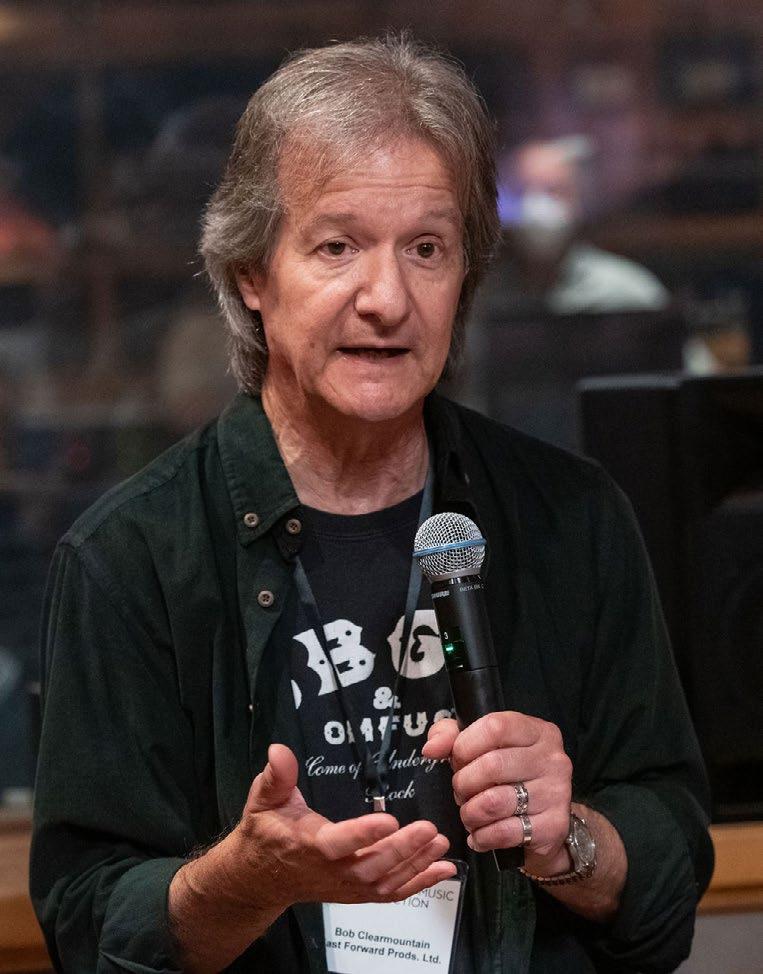
In an interview with the Australian Broadcasting Corp. shortly after the Palisades Fire broke out, multi-award-winning mixer, engineer and producer Bob Clearmountain revealed that his house, which he shared with his wife, Betty Bennett, founder and CEO of Apogee Electronics, was a total loss. “I just saw a picture of what used to be my home and studio, and it’s just a pile of ash,” he said. “The entire town is just gone. It’s just history. It’s horrible.”
Clearmountain built his Mix This! studio— centered around his customized SSL 4000G+ 72-input console—in his home in the early 1990s and had upgraded it for Dolby Atmos. He spotted the flames while driving. “I got home and then before I knew it there were sirens and all hell broke loose, so we just packed everything,” he said, including valuables and old photos that his father, a photographer, had taken.
Greg Wells, the Grammy-winning Canadian producer, mixer and multi-instrumentalist behind the soundtrack of Wicked , did much of

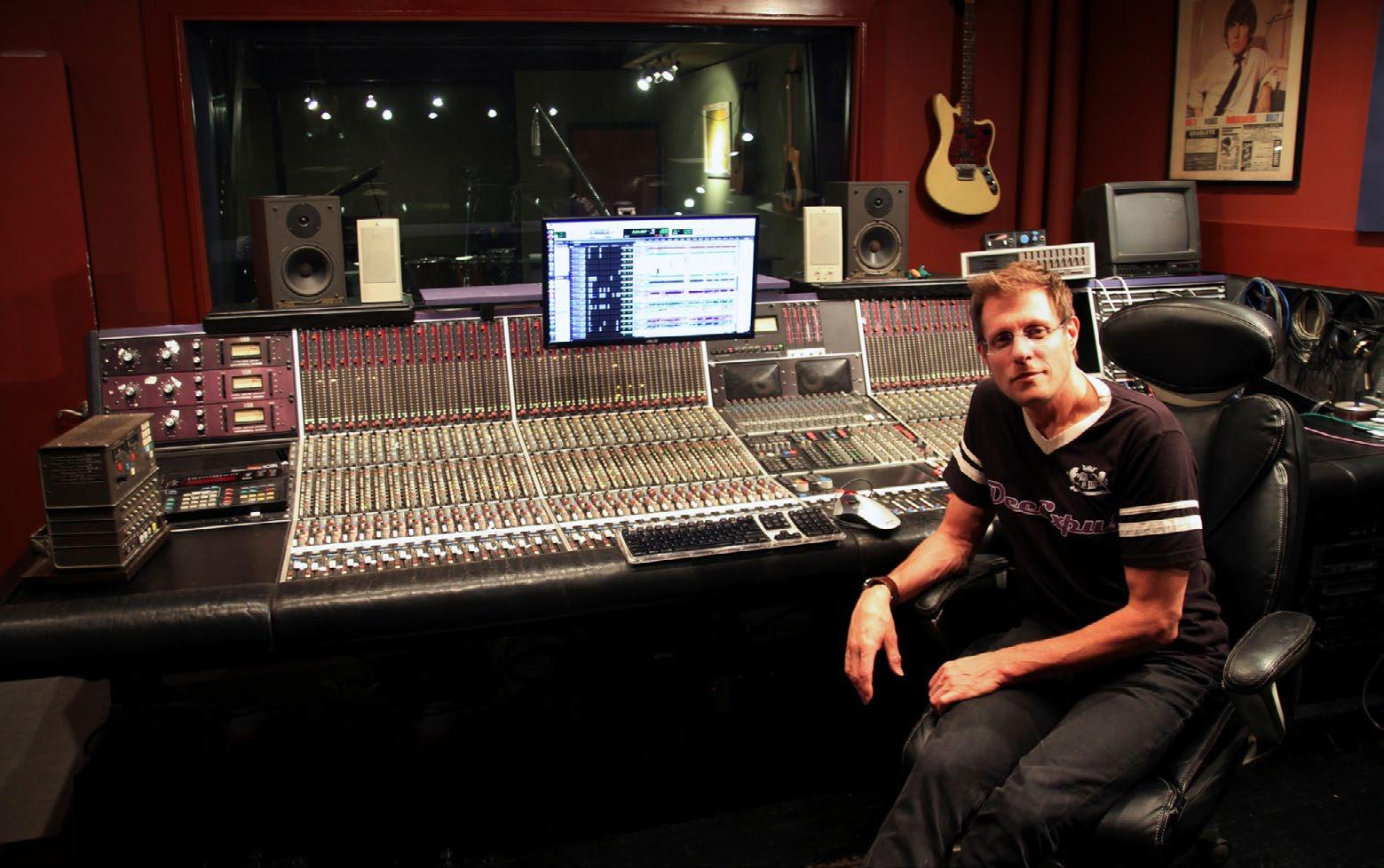
his work on the movie in the immersive mix studio in his Palisades-area home, which was razed by the fire. The 7.1.6 mix room, outfitted with a bespoke 48-channel analog console made by Paul Wolff, was designed by Peter Grueneisen of nonzero\architecture. “It’s the nicest mix room I’ve ever worked in,” Wells told Variety .
“[T]here were these 1950s RCA tube compressors from the Little Richard/Elvis era, really unique pieces that had always just made me salivate. It was a really kind of bucket list thing,” he also commented. “But what are you gonna do? I just have to remind myself, it’s really down to the people and to the ideas, and none of that stuff makes a song better. So I’m not gonna let it define me.”
Fortuitously, the bulk of Wells’ eclectic instrument collection at his other studio in Santa Monica escaped the conflagration. Adding to the challenges facing Wells, he had already started work on the second part of Wicked and the clock is ticking with orchestral sessions are scheduled for May. “Everything’s backed up in a safe way,” he reported. “There’s a lot to do between now and then, and I’ve lost all my computers except for one. There’s just a lot to replace and figure out where I’m gonna do this and how I’m gonna do it—and that’s all manageable. I’ll figure it out.”
In Malibu, the 20-mile-long beach community west of the Palisades, Harbor Studios, a residential facility that has hosted Jack Harlow, 21 Savage and SZA, is no more. “I am profoundly sad to announce that Harbor Studios has been lost to the Palisades Fire,” wrote studio owner Zach Brandon on Instagram.
Harbor Studios has a storied history. Originally established by Weather Report founder and keyboardist Joe Zawinul, in 2008 it became the home base of film score composer Paul Dinletir. Constructed by studio builders and acoustic designers Steven Klein of Sound Control Room, Inc. and Hanson Hsu of Delta H Design, it was rebranded Harbor in 2021. It officially opened in 2022, attracting Nicki Minaj and Doja Cat, who both recorded albums there.
Brandon wrote that this is not the end of Harbor: “We are restarting from scratch (again)…
nothing we haven’t done before.”
Around the turn of the millennium, engineer, producer and mixer Rich Mouser and his wife found a house with a 35-foot cathedral ceiling in the living room for sale in Altadena and turned it into the Mouse House Studio. Just days into the Eaton fire, he posted on Facebook that the studio, which featured a vintage 56-input Calrec
UA8000 analog console and racks of classic outboard gear, had been wiped out.
“The Mouse House Studio as it stood is no more, but it lives in the recordings and memories of all the wonderfully talented people that shared that space and brought life into it!!” he wrote. “We will find a way to rebuild! The show must go on!!” ■

By Matt Hurwitz
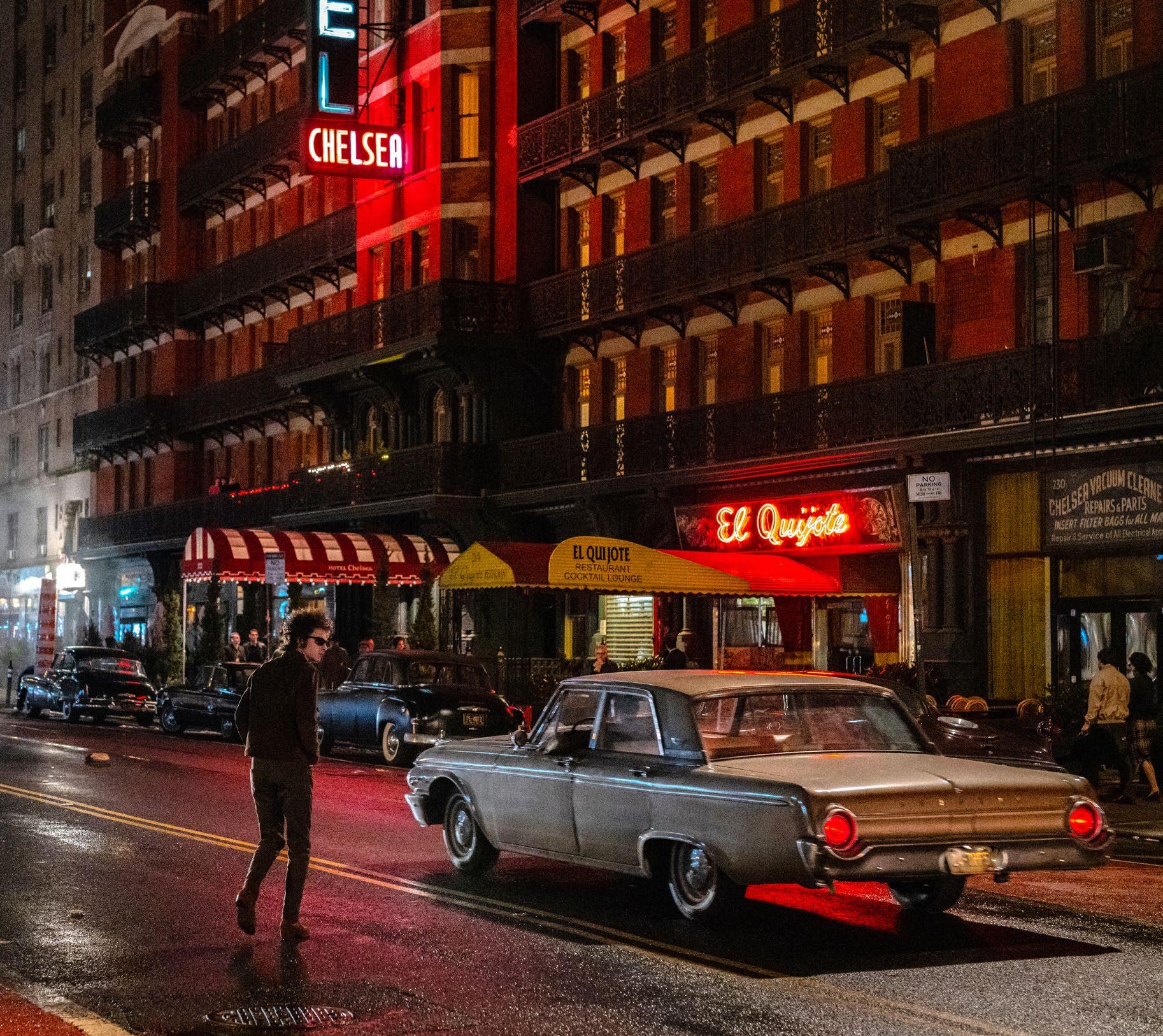
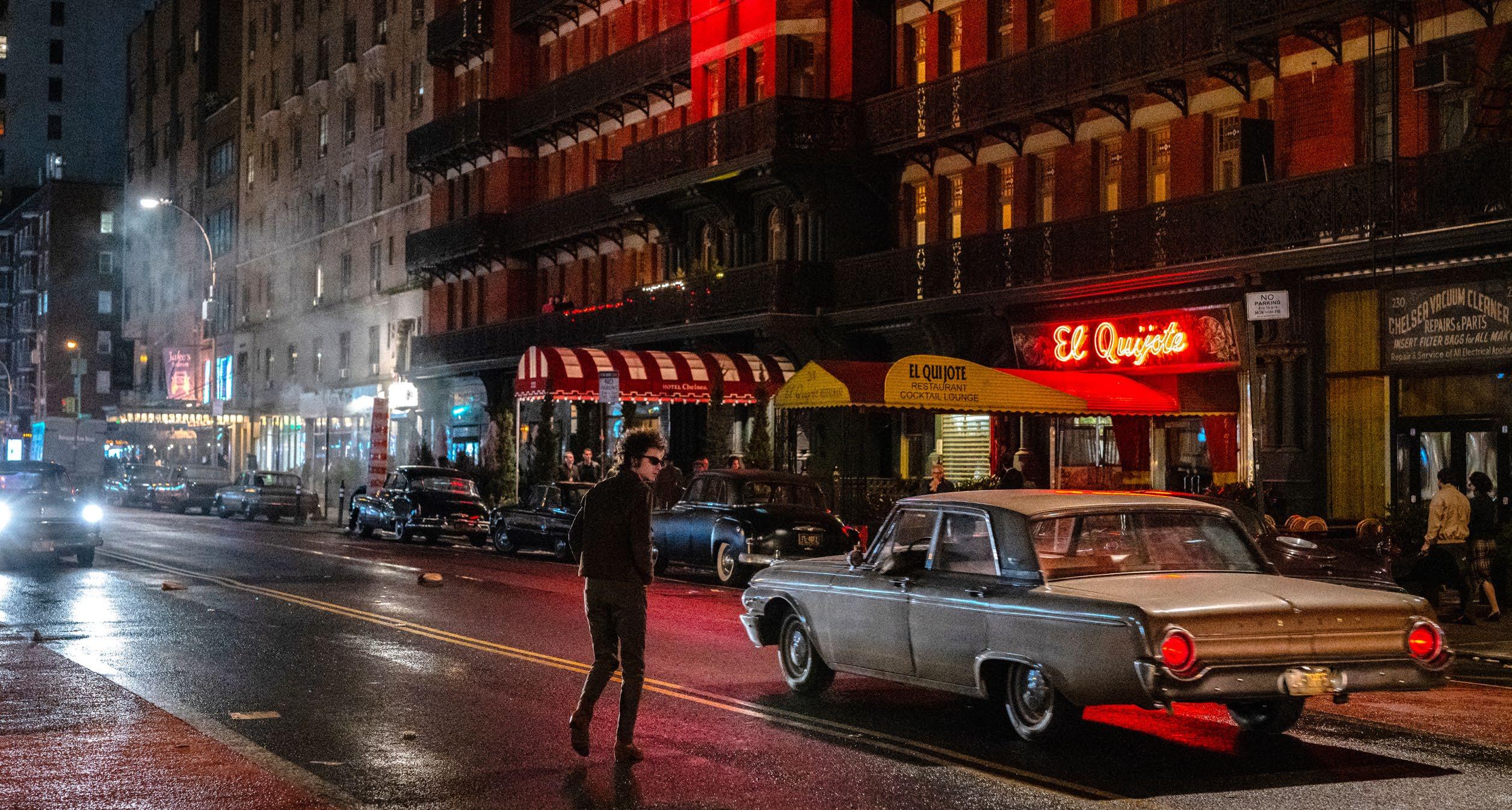
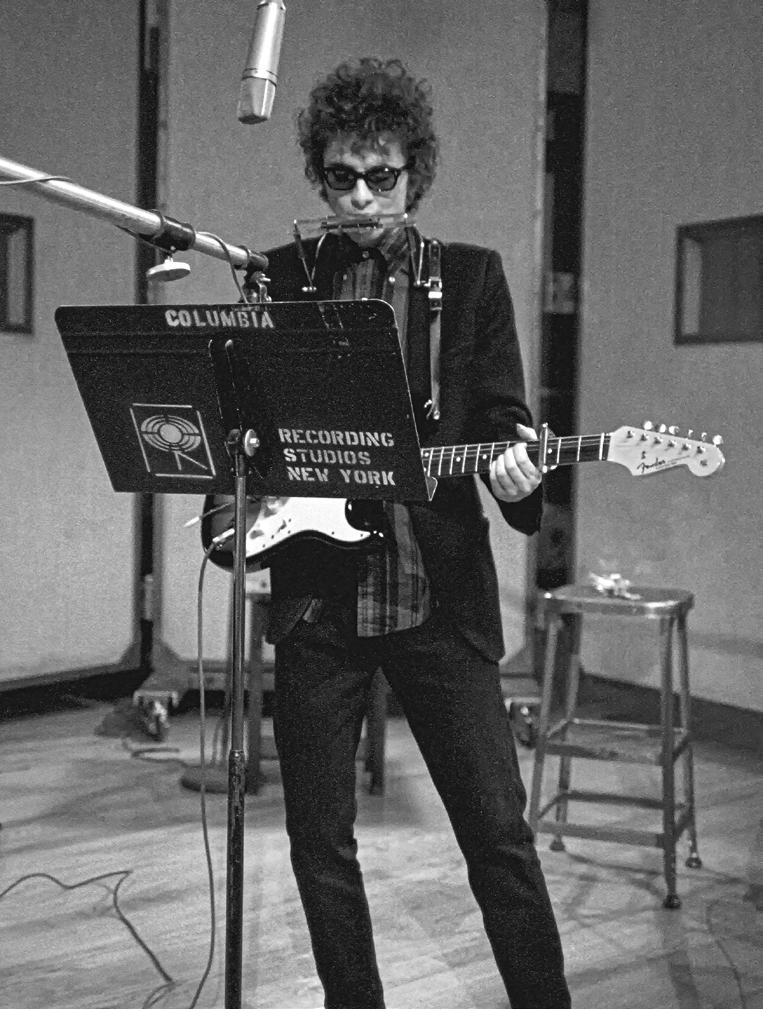
If you’re a recordist and recently sat down in a theater to see James Mangold’s A Complete Unknown, which focuses on Bob Dylan’s early years in New York, you no doubt were thrilled to see an authentic re-creation of Columbia Records’ Studio A, where the artist recorded some of his most iconic records. As you probably guessed, this was no throw-it-together, generic studio set. It was real—and what you heard was what you saw onscreen. Those mics were switched on.
“It’s about building a space that feels like the real thing,” says Mangold, noting that his goal was to give the audience the experience of
watching a real recording session. “I tried not to do a ‘Disney’s Hall of Presidents.’ I’m a music fan, and I know what went on in these rooms. You can overcompensate by shooting it in some kind of ‘holy’ style, telegraphing the ‘importance’ of the room. The reality of these spaces where great things happened is that they are mundane, as well as beautiful. They’re cathedrals, but they’re also workplaces. They’re overrun with cables and notepads and drinks someone didn’t finish—and more cable.”
Mangold tasked his production designer, Francois Audouy, with forensically rebuilding Studio A as it appeared in the thousands of
photographs taken of Dylan at work there over the years (often by photographer Don Hunstein, who is portrayed shooting a session in the film). “It’s an exact re-creation of Studio A,” the designer states, complete with wall elements/ columns between portions of the control room window, as the real studio had.
Essential to that re-creation was the use of whatever gear producers John Hammond and Tom Wilson, and engineer Roy Halee, used in the early 1960s to make those recordings. To do that, Audouy enlisted experienced prop master
Michael Jortner.
“The task became identifying all of the individual microphones, stands, recording equipment, cable connectors—everything,” Jortner says. “That was done with a combination of a lot of research and finding some local sources that actually own the equipment that were able to rent to us.”
Jortner turned to several sources, including Sonic Circus, located in Townshend, Vt. “They’re great collectors of studio equipment from over the years,” he says, “but everything is in various states of working condition, so we were cherrypicking from what they had to find things that were in working order.” Those finds included numerous Neumann mics, Altec “saltshaker” mics and a few of the RCA 77Xs Dylan is seen using in a 1961 studio scene.
Jortner also worked with Joshua Lutz, a former Electric Lady Studios engineer who maintains an incredible collection of vintage mics. “Josh was instrumental for us, coming to our Studio A set every day, helping to set up all of the equipment,” Jortner notes. “He built one or two racks for us, for the control room part of the set, with equipment we had assembled.”
A total of 43 period microphones were used throughout the film, both in studio sequences and in live performances. Tod Maitland, the film’s renowned production sound mixer, took advantage of the options. “I wanted a different texture of sound for every different venue we filmed,” he explains, “so anything that was a show, where they had microphones in front of them, we would use different microphones, progressing them as time went on, to help
illustrate the progression of microphone development in those years.”
The control room on the set featured a replica of the original mixing console, though only a portion could be sourced, with the remaining part built by the Art Department based on original design drawings.
“Sonic Circus had the central part of the desk, but the original also had wings on either side,” Jortner says. “We had the Construction Department build those to spec, and we bought all the chickenhead knobs for it, and LED lights.”
The Ampex tape machines were borrowed from working studios in Brooklyn.
And what historical session re-creations would be complete without accurate representations of the instruments that were used, as seen in photos and heard on records? While they were sourced from a variety of places, Jortner says, “Gibson provided some for us. They provided Bob’s 1961 J-50 acoustic, and they had done a reissue of the Nick Lucas model from 1963,” with a second copy purchased in Italy. A number
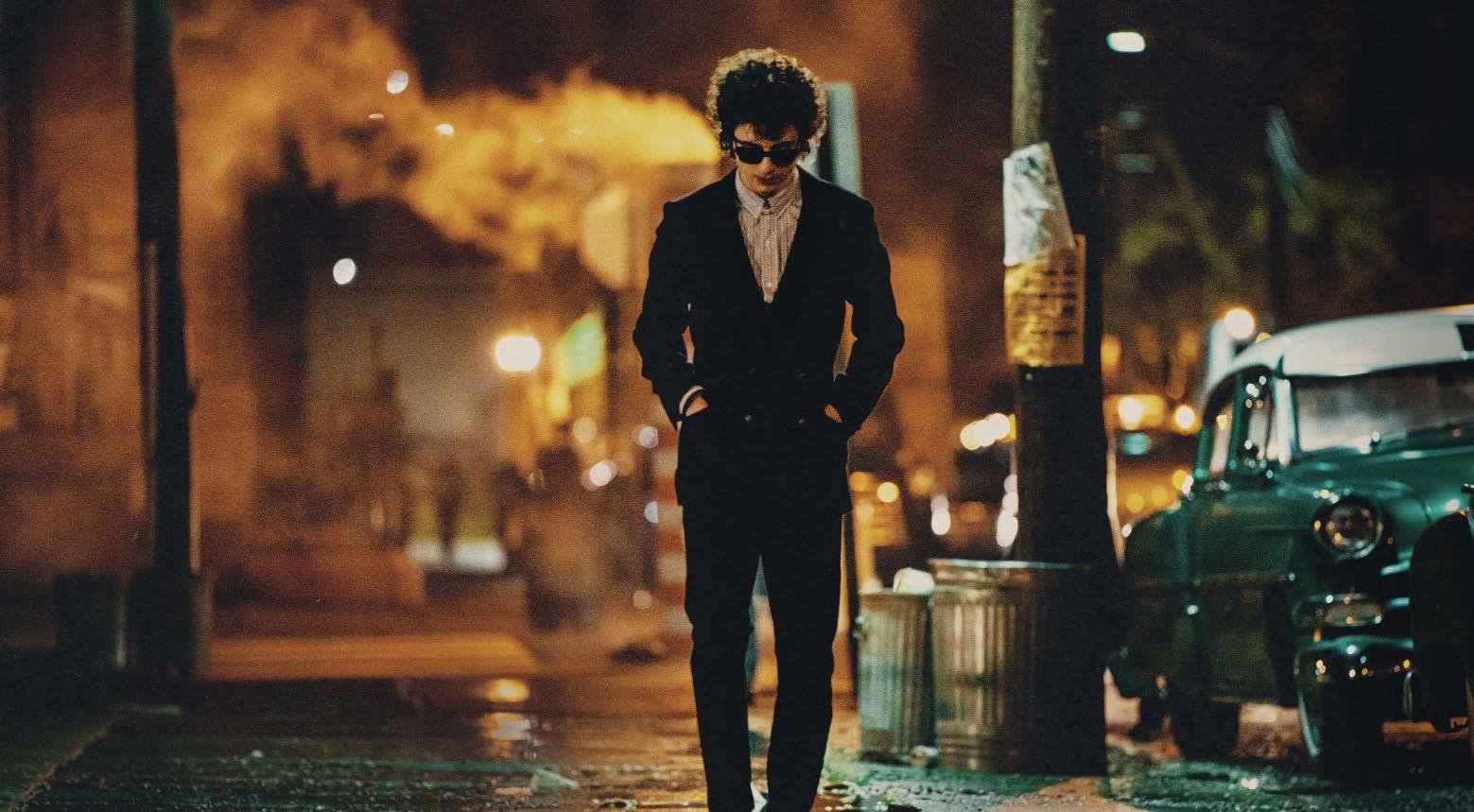
of others, such as the Fender Jazzmaster bass and Mike Bloomfield’s Fender Telecaster, were also purchased, as was the Jazzmaster guitar Al Kooper brought to the “Like a Rolling Stone” session, expecting to be playing guitar before ending up playing his now-iconic Hammond B3 part instead.
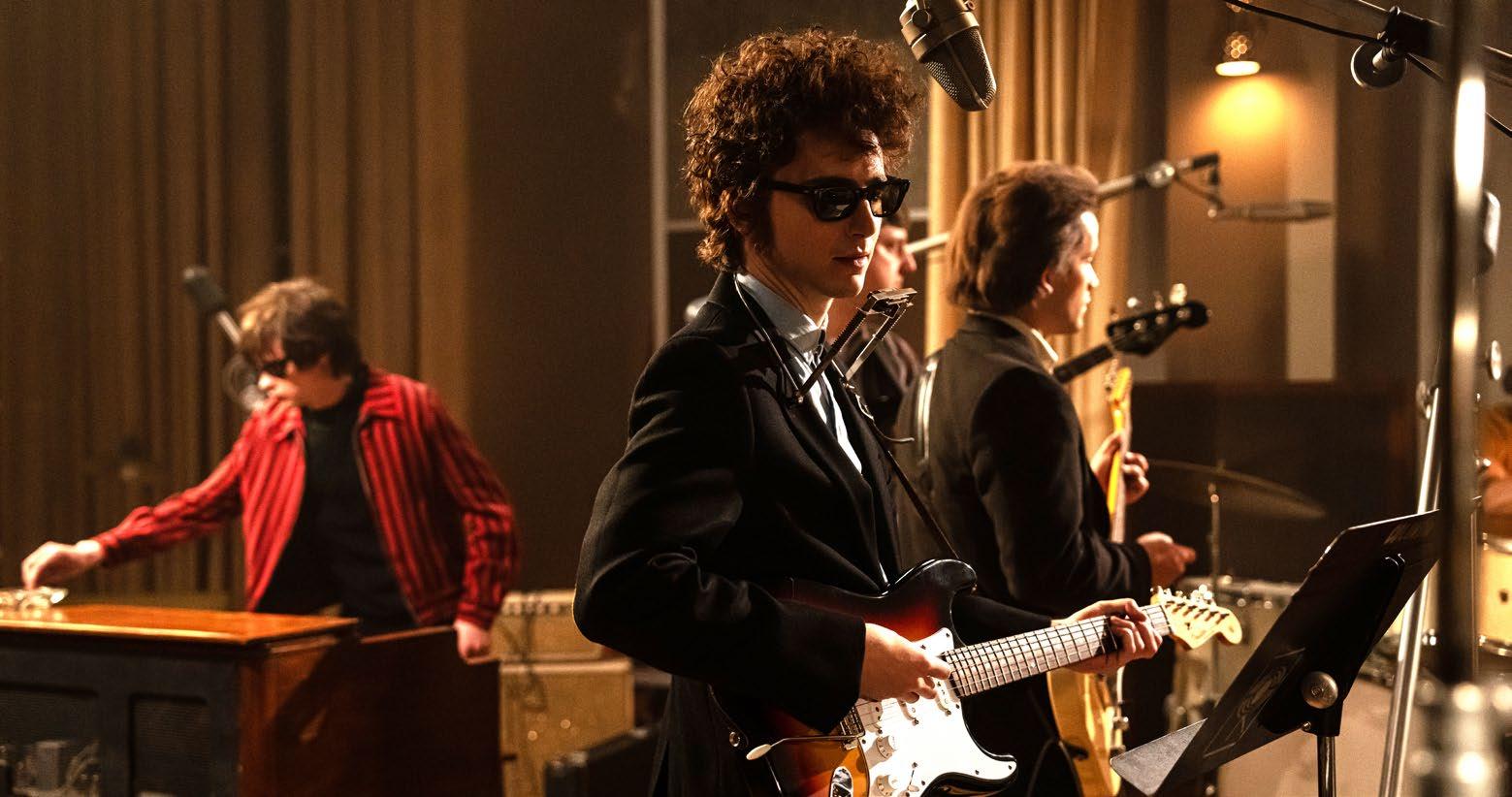
“We tried to stay as close as we could, in years, to everything,” Jortner says. “Obviously, some of the Telecasters and Stratocasters from the mid-’60s have now become quite collectible— and expensive.” That required Dylan’s Sunburst Stratocaster to be built for the film, tapping guitar expert Remy De la More of North Hollywood-based History for Hire to bring it together. “It’s correct, down to the serial number plate on the back.”
Jortner even tracked down one very important, special instrument seen in the film: the Acme Police Siren that Dylan blows at the beginning of “Highway 61,” amusing his bandmates in the scene. The company, Jortner says, still makes them.
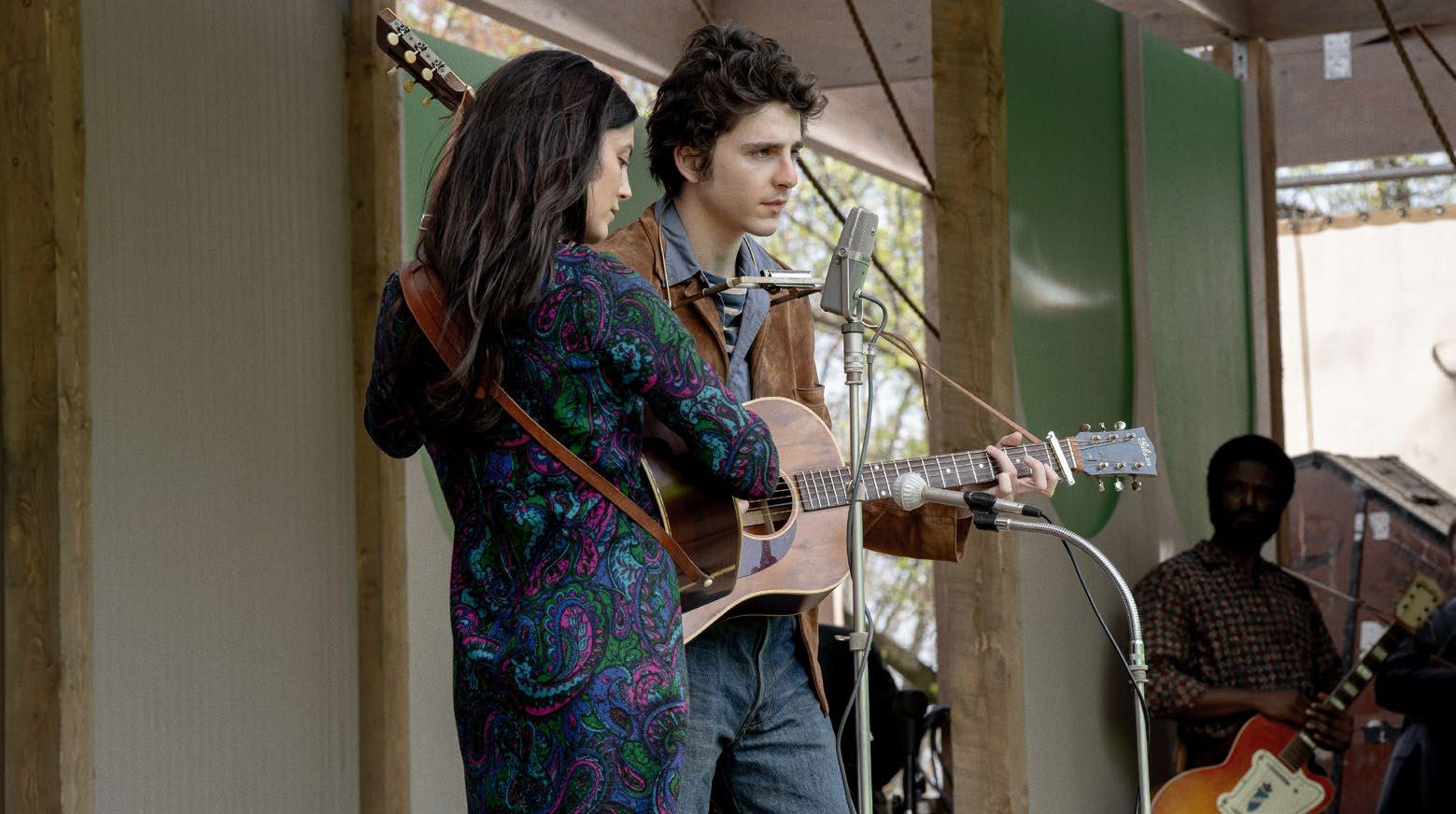
The decision was made early on that all musical performances—those with Timothée Chalamet (who plays Dylan) and his acoustic guitar, and those with a full band—would be recorded live, particularly the former. “He always has his guitar with him,” Maitland says.
While an acoustic performance in a film would normally involve placing a wireless lavalier on the actor’s chest, Maitland says that wasn’t possible because, “Timmy held his guitar in a similar position to the way Bob did, with the body of the guitar up high, which would cover a mic on his chest.” Instead, he opted for placing a DPA 6000 Series subminiature lavalier in the actor’s hair, more typically done with Broadway actors.
For instances where Chalamet is playing in a setup without a stage mic (either a small club or in his apartment), Maitland miked the guitar from the inside. “We took a Sanken COS-11D lavalier mic and cut the cord, so it was just the plug and mic, and attached it to a Shure ADX1M micro-bodypack transmitter with Joe’s sticky tape, inside the belly of the guitar.”
For the band, shown inside the studio set, the actors/musicians all played live on set, tracked by Maitland using the working vintage studio mics seen in the frame. The equipment was set up by Terence McCormack, Maitland’s tech (and nephew), and his longtime boom operator, Jerry Uen.
There were also prerecords for all band scenes, tracked a year prior to filming (which was delayed by a year due to industry strikes) by executive music producer Nick Baxter, who also provided on-set music direction. The tracks were recorded with session musicians at The Village Recorder and Sunset Sound in Los Angeles, with vocals recorded at Igloo Music Studio.
Chalamet was tracked live, though, on set, and not included in prerecords, except for instances where the playing required was beyond the actor’s reach. “Timmy’s work is 80 or 90 percent of what we see and hear,” Maitland explains, “but Bob was a really good guitarist, and there is some stuff that just takes a lifetime to learn. Nick did the work himself for those few pieces.”
they get into everything, and you can’t get them out. But [Tim] never used an in-ear monitor. Even with the live shows, or just on his own, he continually knocked it out of the park, staying within 1 beat per minute of himself, from take to take. It was just incredible.”
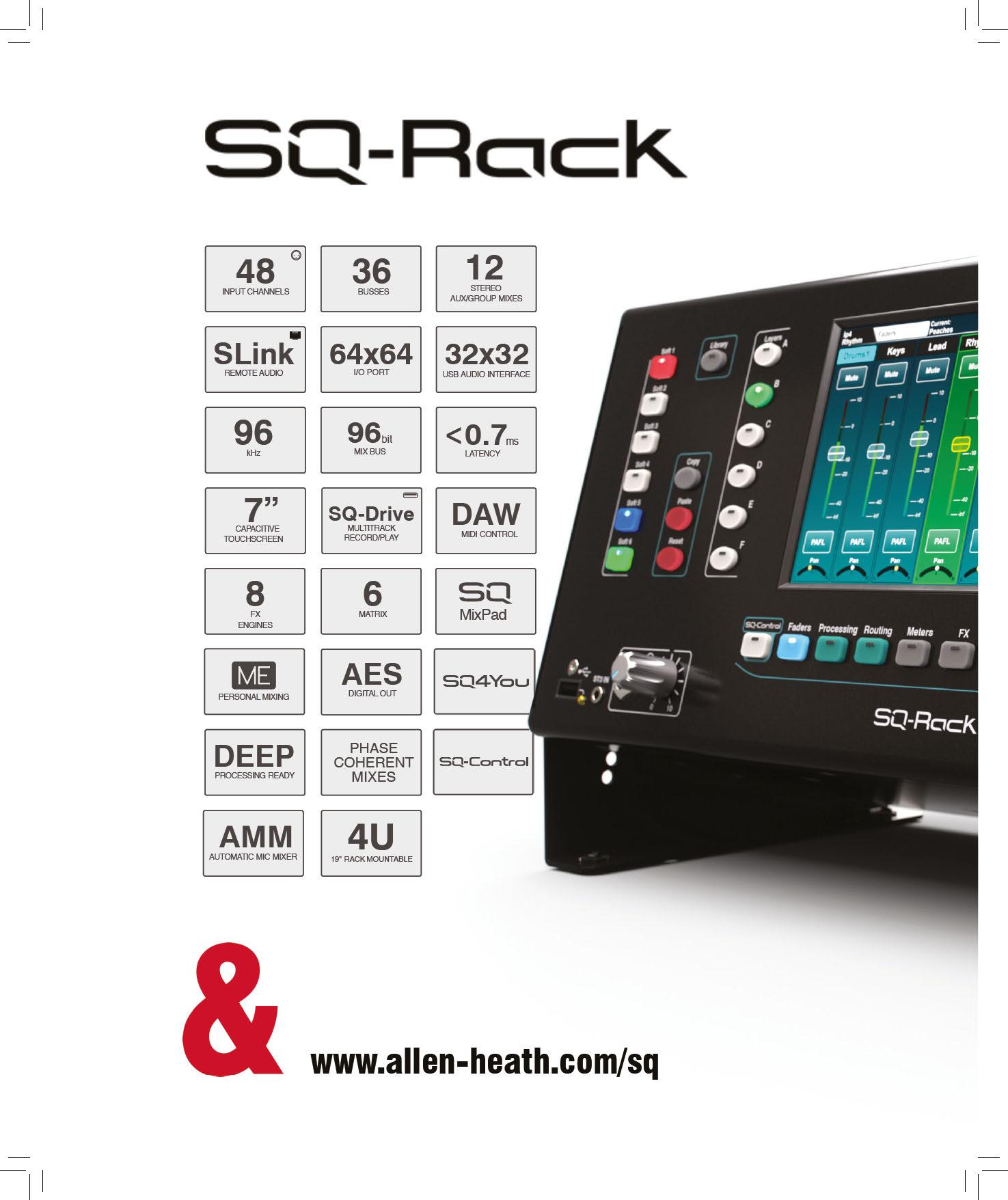
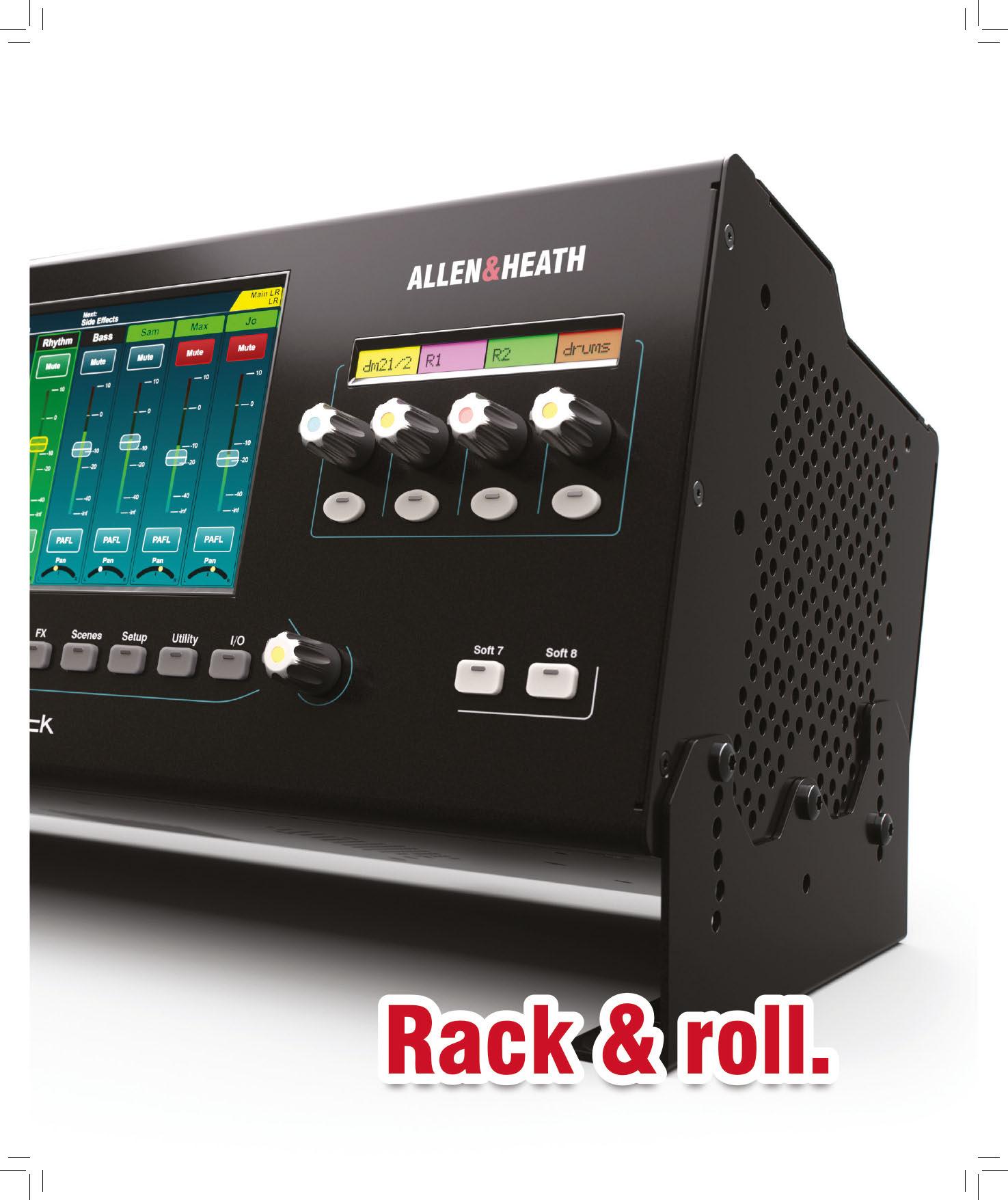
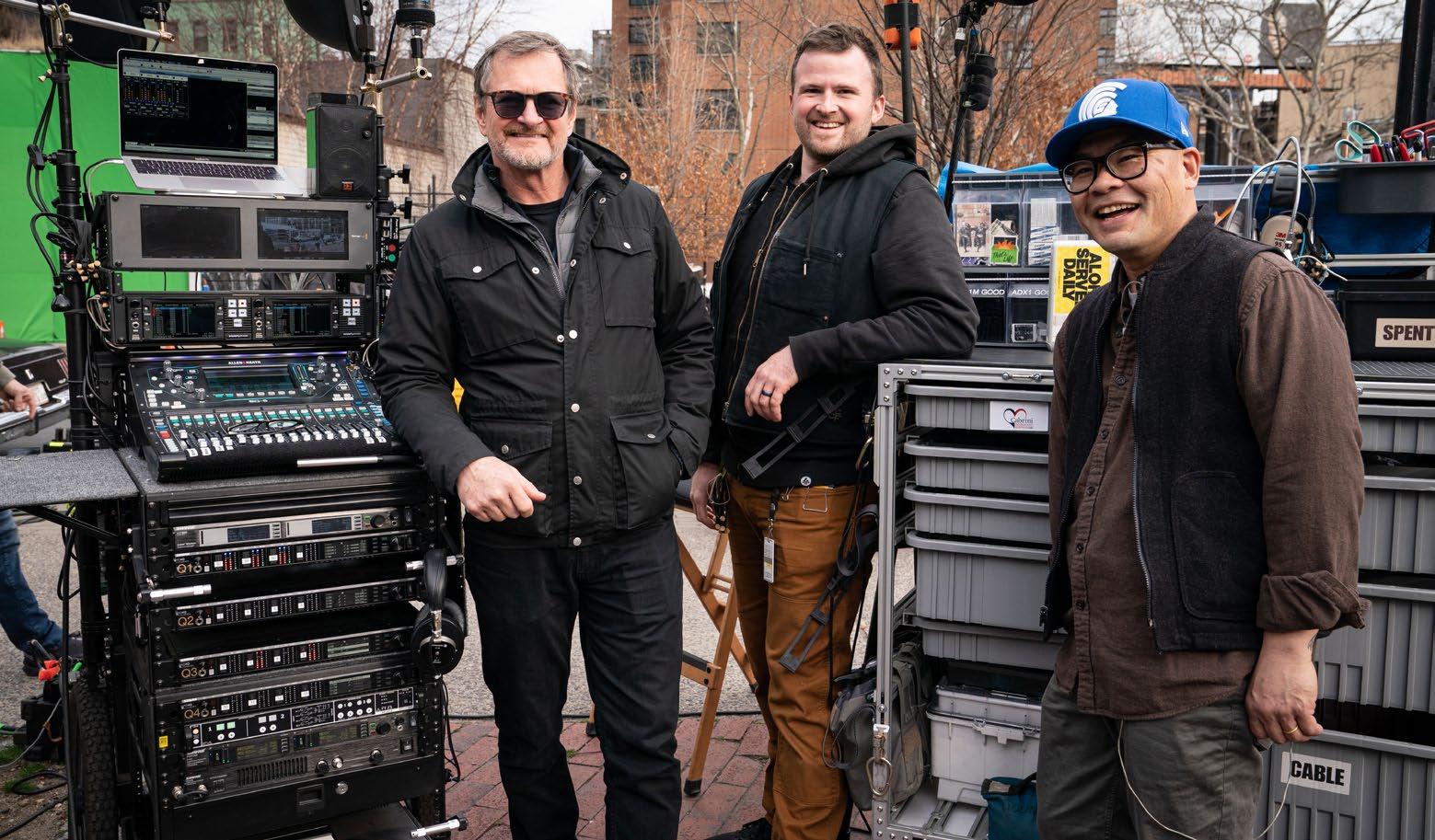
Maitland’s recording setup starts with a cart he put together in 2020 for the production of West Side Story. The rig includes a 48-channel Allen & Heath SQ-5 digital mixer, making use of 32 channels of wireless, courtesy of 26 Shure ADX1M transmitters, for use by the actors, and eight of the larger ADX1s for booms and stash mics (additional Sennheiser 416s placed on various sets to take advantage of ambient sounds).
“It was a good time, four and a half years ago, because wireless was really changing,” Maitland recalls. “All the major companies came in and showed us their new stuff, and Shure was definitely the winner.”
The Shures were valuable not only for recording, but for output use as well, in combination with the SQ-5’s ability to allow Maitland to make multiple sets of mixes, such as for stagebound
monitor mixes at the Newport Festival shows.
There was another valuable use of the IEM transmitters: to drive the VU meters seen on the recording console in the Studio A control room set. While all live mics were fed directly to Maitland for recording, he also sent them to on-set Pro Tools operator Derek Pacuk. Pacuk then created individual mixes, which Maitland sent back out to the ADX1Ms, to the prop mixing console’s meters, allowing them to move differently, representing each of the instruments being seen through the control room window. It’s yet one more example of the effort made to re-create the experience of being in the studio at the time.
The final mix, by Oscar-winning re-recording mixer Paul Massey, was a combination of both Nick Baxter’s prerecords and live recordings by Maitland—with Chalamet and the others seen on-screen still providing their own live performances to camera. As Maitland says in summary, “This is a movie about sound. It’s about music. The music is live, it’s raw, it’s not flash—and it’s totally real.” ■
The movie band later played to a low-level playback of those pre-records over a loudspeaker on the set, their instruments recorded live by Maitland. Those instruments included electric guitars, bass, organ, piano, and Chalamet’s guitar and vocals. “We muted drums,” Maitland interjects. “Drums are always the killer because

By Robyn Flans
Even before Ken Caillat’s new Dolby Atmos studio Marshmellow Skies was officially open, he and his chief engineer, Claus Trelby, had used the facility to remix Joni Mitchell at Newport Live, which won the 2024 Grammy for Best Folk Album.
It was the last of five Joni Mitchell records that Warner Music had commissioned the team to remix in Atmos, which also included her first four albums on Asylum, known as The Asylum Albums: Court and Spark, Miles of Aisles, The Hissing of Summer Lawns, and For the Roses, released by Rhino Records in September 2022.
Caillat and Trelby had already fulfilled their work on the other four Mitchell albums at Mikal Blue’s Revolver Studios in Thousand Oaks, where they had set up shop with their own gear. A year into that arrangement, Blue informed them that rapper Lil Wayne wanted to take over the entire studio and they would have to leave.
So, as Caillat says, “I decided to make lemonade… and build this place.”
But why? Why on Earth at this stage of the Fleetwood Mac producer’s life would he want to undertake such a huge project? Why build a studio when he can work anywhere he wants?
“Nobody told me I couldn’t,” Caillat says with a laugh. And then came the real answer: “I love it. What else am I going to do? I heard making music creates endorphins; it makes you feel better. I didn’t know that. I just felt better.”
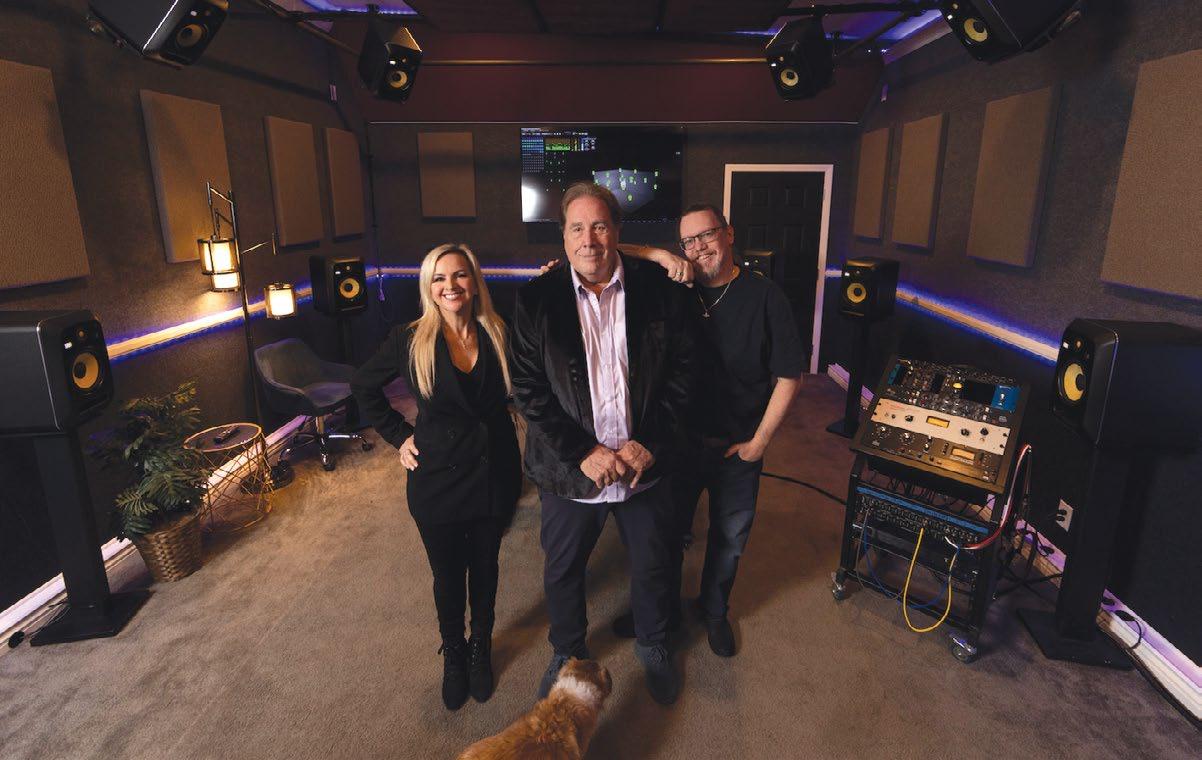
In January 2023, Caillat and his team found a multipurpose space in Westlake Village, Los Angeles, that has an area for live performance, a conference room and a screening room where Steven Spielberg allegedly watched Close Encounters for the first time. It also houses Artist
Max, the artist development service headed by Caillat and Nitanee Paris, who is also a managing partner in Marshmellow Skies.
There, with the help of famed acoustician/ studio designer George Augspurger, they built a custom 9.1.6 immersive music mix studio, equipped with state-of-the-art KRK studio monitors, that supports Dolby Atmos, DTS:X Pro, and Sony RA360, as well as all traditional audio formats. By June 2023, the studio was functional (“Not pretty, but calibrated,” according to Trelby) and they started remixing the fifth Joni Mitchell record. The official opening took place in May 2024.
Caillat’s journey into immersive music began with a call from mix engineer Joe Zook, who wanted to do an Atmos version of Fleetwood Mac’s “Dreams,” asking if Caillat could help him get the master files. Caillat brought them over and fell in love with the format. Soon after, when asked to undertake the Mitchell projects, Caillat listened to a tape of the songstress playing all the parts—strings, horns, everything—to Court and Sparks’ “Down to You” on a grand piano.
“I remember when we took all the 16 tracks of music and spread it around the room,” he says. “All the nooks and corners of the room had this
beautiful sound resonating and it sounded like some sort of angelic creation.”
The team feel that the format better serves music and offers the opportunity for more expression. The studio has worked on several projects, including the remixing of Christmas in the Sun and Coco by his daughter, Colbie Caillat, and both Bad and Dangerous by Michael Jackson. They also recorded David Becker’s Gravitationally Bound both traditionally and with Atmos in mind.
“We do a lot of vocals, piano and guitars here,” Trelby notes. “We also do commercial audio recordings for ADR and pickups. Tulsa King and American Dad have done some of their post audio recording here as well. It’s a versatile room.”
Did Caillat ever imagine anything like the immersive format during the early years of recording? Actually, yes, he says, during the making of Mirage, and in particular the beginning of Stevie Nicks’ track “Gypsy.” Lindsay Buckingham opened the song with guitar flutters that Caillat says he heard as sparkling fireflies, the sound of which he wanted to capture all around the listener.
“I was at George Massenburg’s studio, The Complex and there was scaffolding available, so I had speakers put on the scaffolding,” Caillat recalls. “I had guys moving the speakers around the room. It seemed like that music should be around me. I actually had a binaural head and put it among the speakers, but it turned out that the binaural head didn’t have the articulation to precisely track the sounds and reproduce them.” While the idea couldn’t be used back then, did he envision that one day there would be a platform that would allow the music to literally immerse him? “In about twenty-something years,” he muses, then laughs. ■
Berklee NYC has integrated Focusrite audio-over-IP equipment into its programs, expanding its relationship with the brand. Berklee NYC is the Berklee College of Music’s New York City campus, housed in the historic Power Station recording studio facility on West 53rd Street in Midtown Manhattan
With the recent campuswide implementation of Dante networks and Focusrite RedNet technology, Berklee NYC now supports fully networked audio across its performance spaces and studios. This setup allows students to connect between stage and studio environments, learn how to build playback rigs, integrate analog gear and manage large-scale, networked audio systems. The Dante infrastructure lets them work with in-ear monitors, front-of-house setups and live broadcast streaming.
Daniel Pembroke, chair of live music production and design and director of academic technology at Berklee NYC, explains, “Our collaboration with Focusrite has evolved as our graduate programs have grown. Our focus is on creating environments where students gain hands-on experience with professional audio interfaces, immersive mixing and playback systems that they’ll use in the field. With Focusrite, we’re ensuring our students learn not only the technical skills but also best practices in latency reduction,
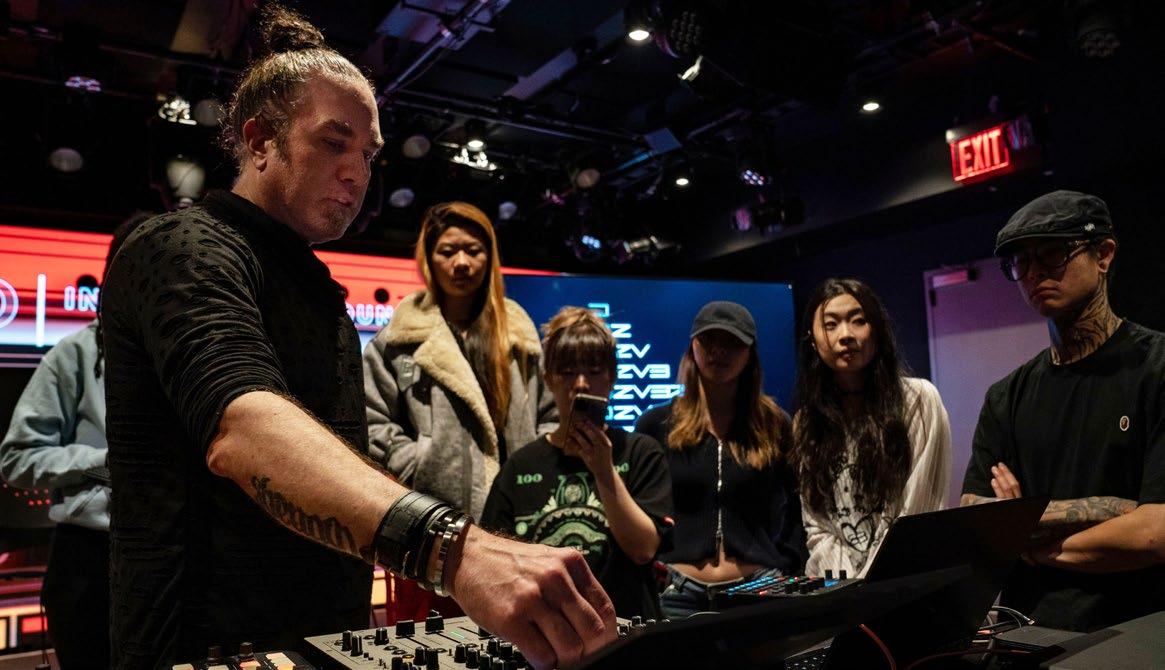
signal flow and digital over-network audio transmission.”
Pembroke, who has been with Berklee NYC for four years, leads courses in Introduction to Live Sound, Advanced Live Sound, Project Management and Interactive Experience Design, equipping students with skills in everything from content creation and lighting design to front-of-house audio and set design.
In the fourth year of Berklee NYC’s graduate programs, the Focusrite collaboration has resulted in the integration of RedNet AoIP interfaces, Red 16Line interfaces, and PCIeNX cards throughout the campus. From Danteenabled DiGiCo consoles and Yamaha mixers to Waves plug-ins and Ableton Live playback systems, students have access to a toolkit reflective of the professional music production and live sound industry.
Pembroke emphasizes the importance of the tools: “Our students learn using products like the RedNet PCIeNX cards that provide ultra-low latency and high channel counts—features critical to achieving seamless live production in modern setups. From reducing latency for onstage performers to implementing Dante networks across our entire campus, these experiences ensure our graduates are proficient with the technologies they’ll encounter on major tours, festivals and studio sessions.” ■
Brooklyn-based mixing and mastering engineer Nick “Squids” Squillante had a busy 2024—one that included tackling the Dolby Atmos mixes for Mötley Crüe’s “Dogs of War” single and Mongolian metal band The Hu’s live performance at Glastonbury. In both cases, he had limited materials to work with, and wound up turning to one particular plug-in to work around those issues and ensure his mixes were as heavy as they needed to be.
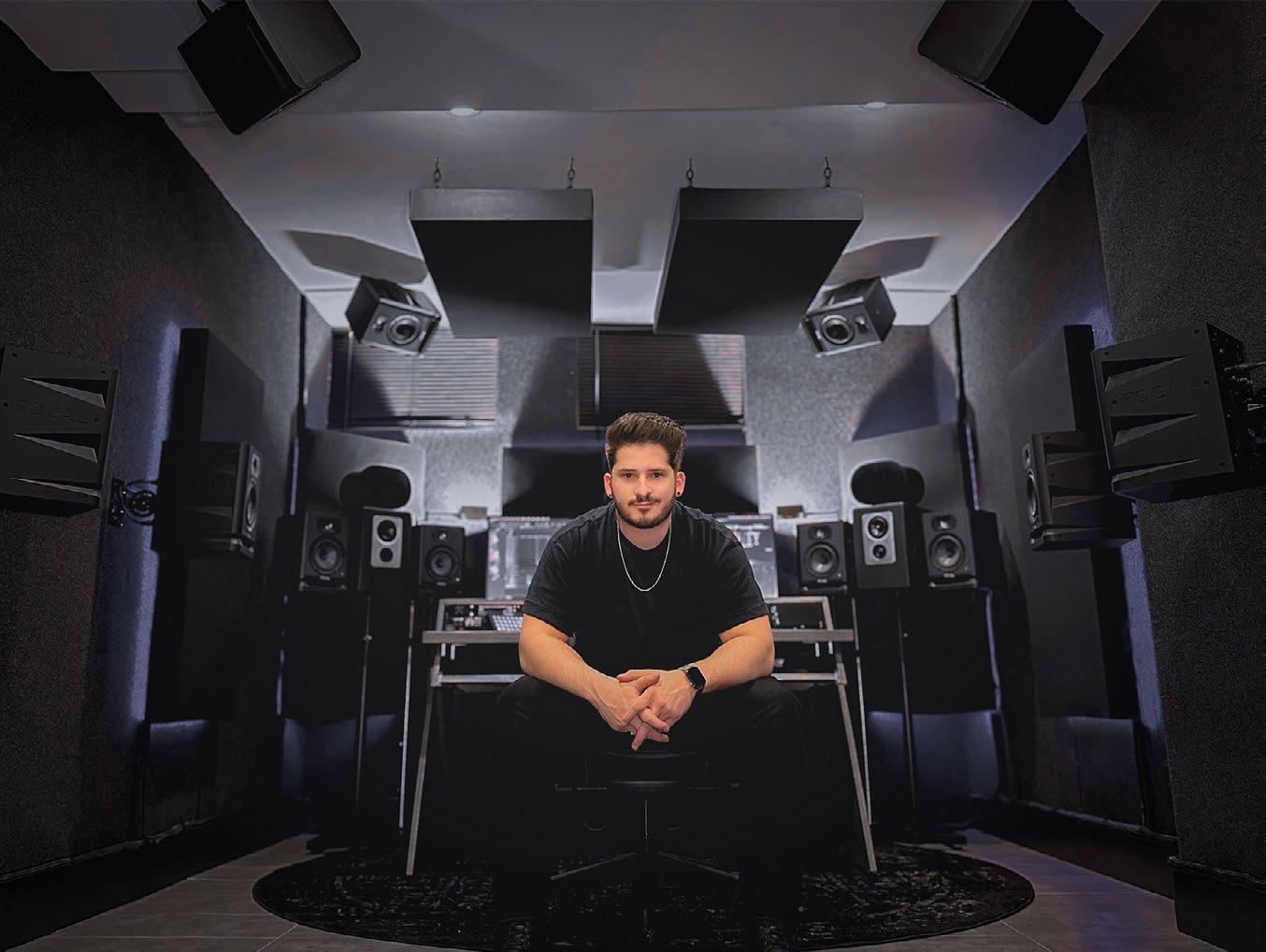
Squillante incorporated Nugen Audio’s Halo Upmix in an Atmos mix for Mötley Crüe’s recent single, “Dogs of War,” and was faced with working from stereo tracks. “You don’t always have the option of doing exactly what you want in instances like this; it all depends on the stereo mix and how the stereo mixer printed the stems,” he explains. “Often times, you receive grouped stems—for example, the guitars may all come in one and keys in another, but you never want to waste the Atmos space. That’s where Nugen’s Halo Upmix comes in; it provides full control and allows for expansion.”
Squillante found the plug-in also had a “surprising” effect on lead vocals: “In stereo, I love to have the dry vocal shoot out of multiple speakers at similar volumes. It provides a sense of intimacy, like it’s right inside your head. With Halo Upmix, I can basically get that same effect, while also taking the signal with the wetter effects and wrapping it around behind you.”
Squillante also turned to the plug-in when he mixed The Hu’s Glastonbury live set for Atmos: “I staged the majority of close-miked signals up front, shifted more reverberation in the rears and had the crowd behind and up to the side of the listener. This way, when audiences turn around with the spatial effect on, it feels like they are standing in the crowd and can hear the back of the venue as well. This was another instance where I was given a lot of stereo stems and I didn’t get to pick and choose, so of course, Halo Upmix helped me a ton in getting that effect and feel that I intended.” ■
By Tom Kenny
Danny Elfman hasn’t really “toured” much since the breakup of Oingo Boingo 30 years ago, though he has put on some spectacular shows. Most of them have been one-offs, and for a large majority of them, he has been backed by an orchestra performing some variation of his film scores, sometimes live-to-screen. These can be complex shows to stage, sync and mix, and they typically take place outdoors.
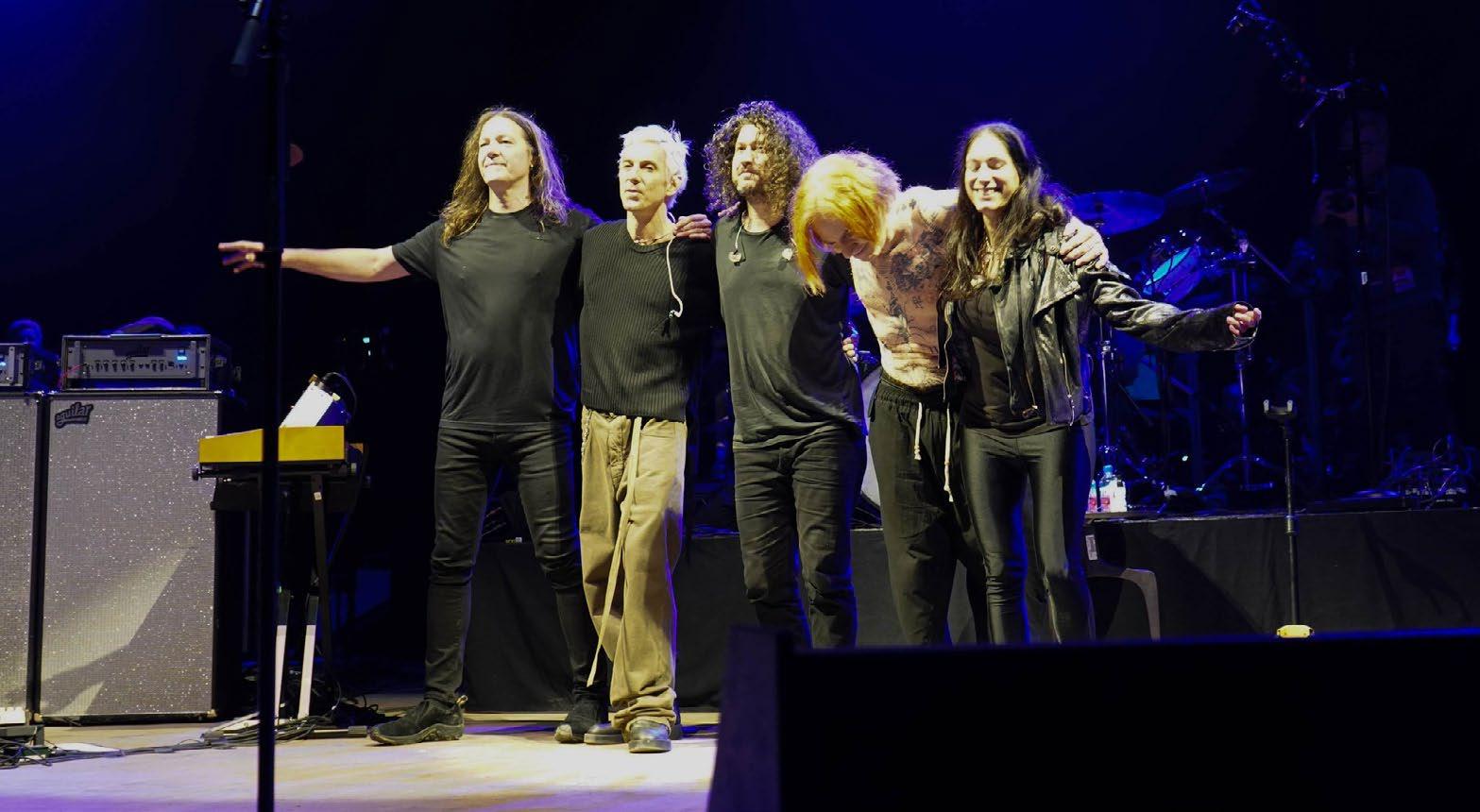
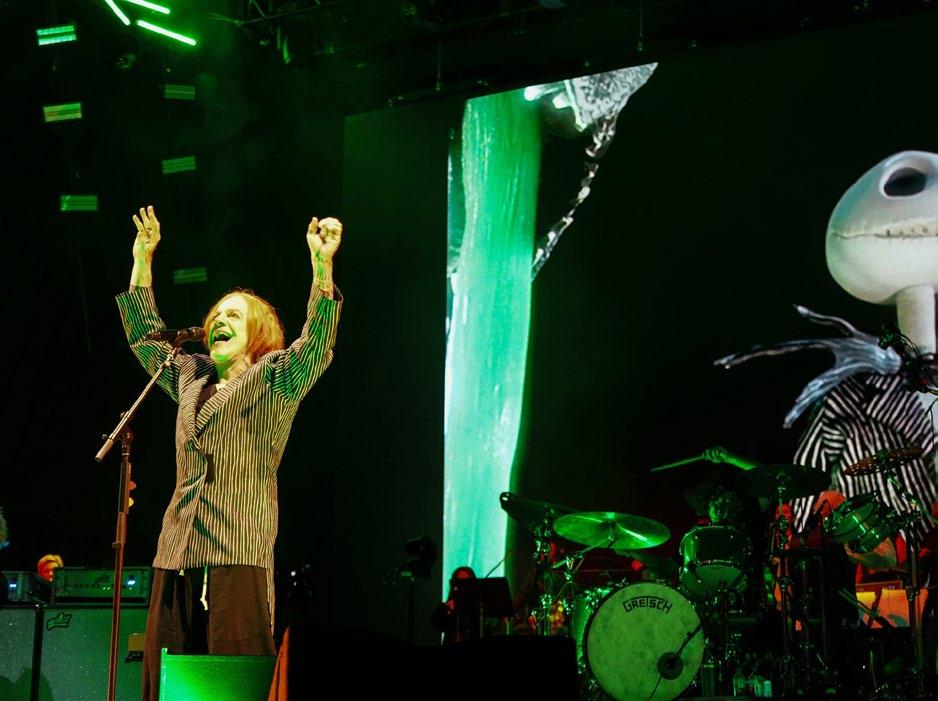
In late 2024, Elfman may have pulled off his biggest run of shows yet, starting on Halloween night in Monterrey, Mexico with a performance of The Nightmare Before Christmas, followed by back-to-back nights at the Hollywood Bowl on Nov. 2 and Shoreline Amphitheater, near San Francisco, on Nov. 3, where he brought his entire career to the stage for a nonstop, two-hour, adrenaline-fueled mashup titled “From Batman to Boingo to Big Mess and Beyond.”
“This covers a lot of genres in one go,” says Ryan John, Elfman’s front-of-house engineer for the past five years. “Big Mess is kind of industrial metal. Oingo Boingo, we’ve got some old school rock and roll. The film scores, obviously, are orchestral. And when the show actually happens, it goes straight from industrial metal to a film score, and straight from the last note of a film score into an Oingo Boingo track. And sometimes they’re all playing together, with a choir! The sonic signature changes significantly from song to song, and there’s no downtime in between.”
Adding to the challenge of mixing such disparate and wide-ranging styles of music was the simple fact that the stage was packed. Besides the 40-piece orchestra and five-piece band—Elfman on guitar and vocals, Robin Finck and Nili Brosh also on guitar, Ilan Rubin on drums and Stu Brooks playing bass—there was a 15-voice choir at stage right. Not to mention the highly choreographed and precision-timed
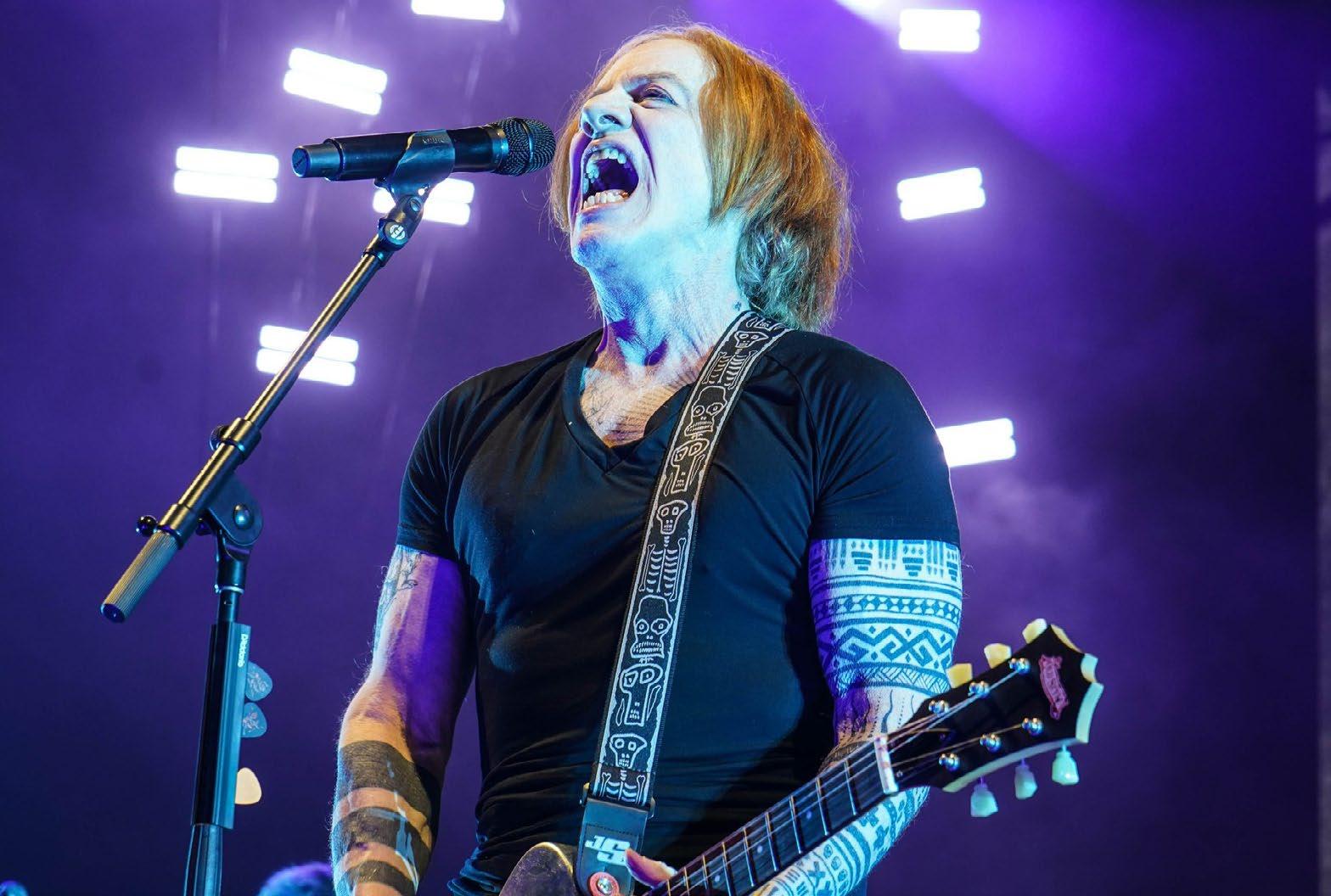
video playback and lighting design. And the large LED wall.
“We’re at 170 inputs from the stage,” John states. “Every single orchestra player has a closemic, and some play multiple instruments, all with individual microphones. There’s four guitars on stage when Steve Bartek, the conductor, joins them, and at certain points, it’s all of them at the same time. And the whole orchestra. And the choir. There are also clicks and counts and talkbacks for playback and conductor, so not every input is going out to the house, but it is well into the hundreds.
“And there’s something like 300 snapshots in this show,” John continues. “It’s a lot of motion. It’s a lot of keeping up with what’s going on. We have video content and lighting, and the entire ecosystem as a whole is effectively tied together through time code. A playback system on stage
feeds click tracks to everybody, plus cues. It all works beautifully.”
A big show with this many moving parts that relies on precision sync is not easy to pull off, especially if it’s for one or two nights only and there’s no time to get the kinks out. Black Ink Presents, a production company that handles a wide range of creative and management services for tours, concerts and specialty events, has become something of a specialist in this admittedly niche market. If you’ve seen a live orchestra-to-film-playback performance, it was likely produced by Black Ink.
For the Hollywood Bowl and Shoreline shows, Black Ink worked with audio provider Delicate Productions on a package that included, for front of house, an Avid S6L-32D Surface, three Avid MADI 64 Channel Interface Cards and three Avid Stage 64 I/O Racks. John brought along two racks
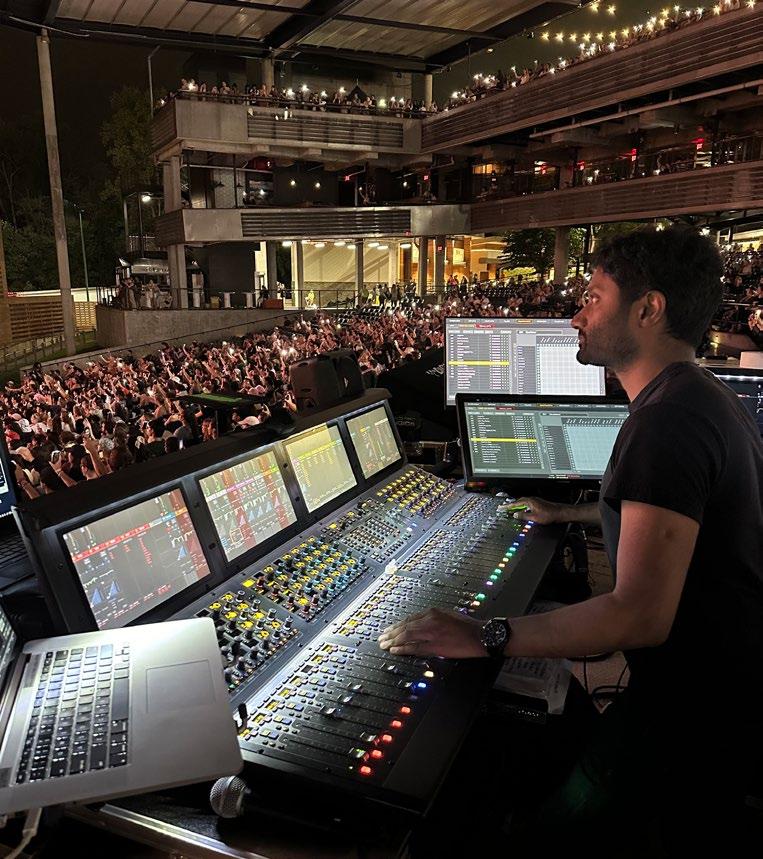
of his own outboard gear and a few particular external plug-ins, including Universal Audio for all the reverbs, and iZotope Neutron 4 to dial in a bit of the Trash module on Elfman’s vocal.
For the two monitor positions—band and orchestra plus choir—Delicate provided two DiGiCo SD7 Quantum consoles and three SD Ultimate Racks, as well as, notably, two Bricasti M7 reverbs, an Avalon VT-737sp mic preamp and two Empirical Labs Distressors. A Shure Axient Digital wireless system covered the stage, along with four PSM-1000 IEM setups and four KSM9 condenser mics. Four d&b audiotechnick M4 stage monitors were set up for Elfman and anyone else who cared to listen in.
For the P.A., Delicate supplied an L-Acoustics system that included 12 KARA II line array cabinets per side, eight X8 front-fills, and 16 KS28 flown subwoofers and 16 SB28 ground subs. The main hang, however—featuring the new flagship L Series line array system, with a mere three L2 cabinets plus a single L2D per side powered by the new LA7.16 amplifier package—came direct from L-Acoustics, working in partnership with Black Ink, Delicate and Elfman’s team.
It takes time for a new high-performance, flagship-level loudspeaker to make its way into the touring market. Rental houses need to hear it and see it both in use and in demand before they’ll commit to buying. While the L Series made its U.S. debut on the Mojave Stage at Coachella 2023 and has appeared on a number of tours since, the Elfman shows were a prime opportunity to show off the system’s full capability. It wasn’t by accident.
FOH engineer John was one of the mixers on that Coachella stage in 2023. He has also worked on dozens of events with Black Ink Presents over the years, beyond the Elfman shows. He’s toured with other artists, off and on, over his 20-plus years in the industry—and in his day job, his title is Director of Product Management, Software, L-Acoustics.
“My first experience with the system was actually the first time it was pulled out at Coachella,” John says. “I was with the artist Labyrinth, who also does film work, and his show is a horn section, choir and almost hip hop-type music. It is incredibly dynamic, a lot like Danny’s show. The first thing that blew my mind was when I walked from 250 feet away to 10 feet away, and I didn’t hear any shift in the tonality of the system. The frequency response stayed the same across the whole range. To be that consistent from far field to the near field was an eye-opening experience for me.”
While listeners cite the L2’s clarity and mixers rave about its control and steering capabilities, Scott Sugden, who has been with L-Acoustics for 15 years and is now product manager for the L Series, can run off a huge list of improvements over previous line array systems, from its 40% lighter weight, 30% lower power consumption, advanced steering capabilities, fast deployment, flat angles, dispersion, and internal wood bracing to its patented Progressive Ultra-Dense Line Source technology.
“To me, the L Series is by far the best-sounding system we’ve ever built, especially in terms of transient response,” says Sugden, who was onsite to provide support for the Elman shows. “I think a lot of that’s down to some of the core technology choices, and one of those is the way we amplify the speaker. Each L2 cabinet has 20 transducers in it, amplified by 16 amplifiers. Each amp channel is capable of 1,400 watts. Each high-frequency transducer has
its own amp channel, and each mid section or low section has its own amp channel, so each amplifier has plenty of headroom, and each has room to share.”
While Sugden admits that improvements in speaker design and performance, being constrained by the laws of electronics, acoustics and physics, don’t often come in huge leaps, they do still come, and will continue to.
“What has changed in these past few years is our ability to control the interaction between multiple speakers, and the ability to control what actually comes out as a result of the interaction between multiple drivers—versus just making one driver better,” he says. “We really pride ourselves on building systems that aren’t just great for a rock band, or Coachella, but also for the Hollywood Bowl and orchestra and everything in between. We don’t ever want to hear it said that ‘this is a great place for this type of music’. It should be great for you.” ■
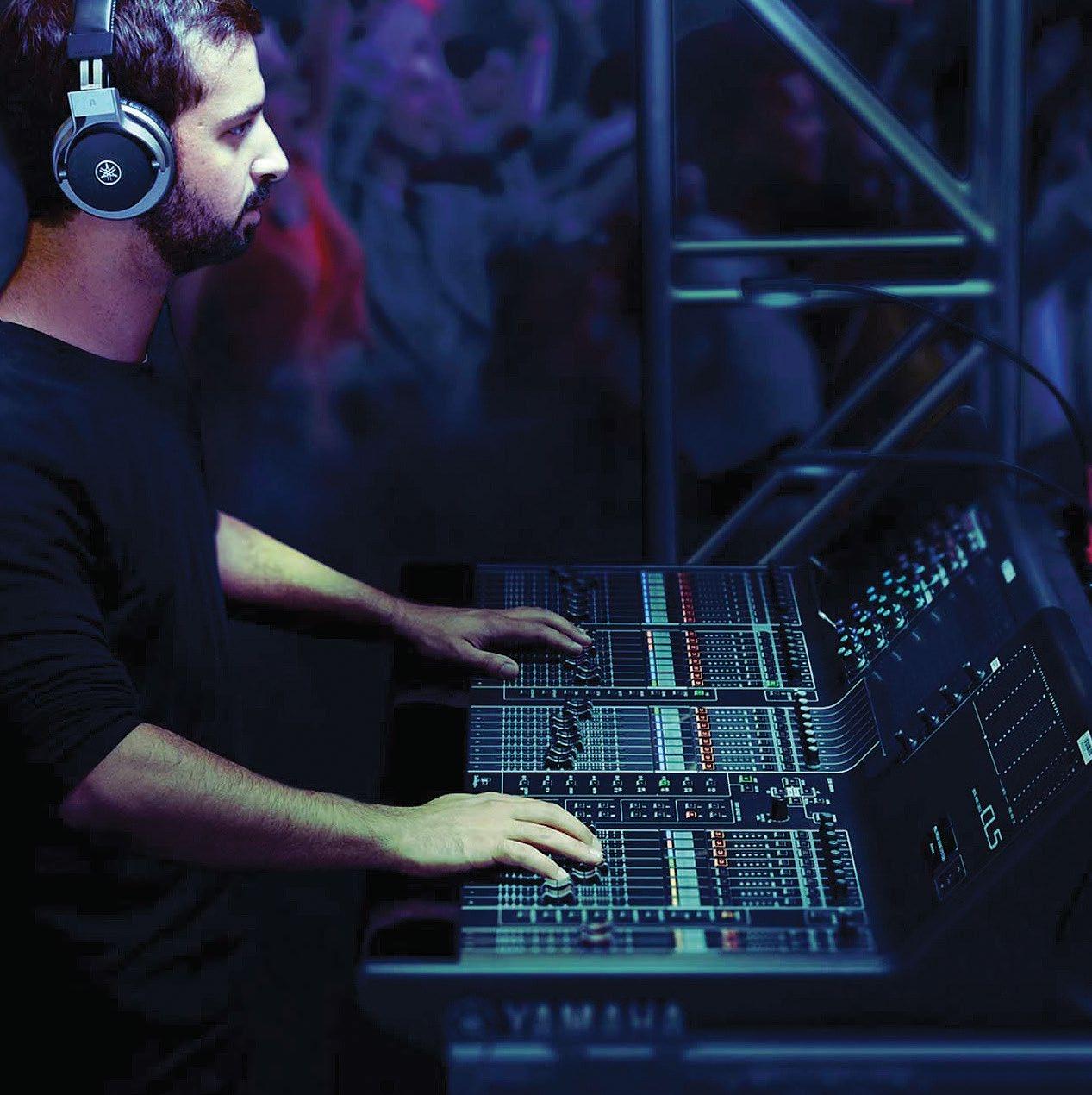
There are lead singers who play a mean guitar, and others whose dancing could make Prince break into a nervous sweat—but how many mix their band’s ear monitors live? Indie rockers Beartooth have been on the road for months, and tackling the band’s IEMs is none other than frontman Caleb Shomo.
Intimately familiar with creating the band’s sound, having engineered and mixed Beartooth’s studio recordings, Shomo spent his most recent U.S. tour mixing the group’s IEMs on a low-profile Allen & Heath C1500 Surface, which fits a 12-inch touchscreen and a dozen faders into a 19-inch rack-mountable frame. From the stage, Shomo handled five stereo in-ear monitor mixes, side fills and two pairs of center monitors.
The arrangement was created for the band by audio visual company V2 Productions, and was based around Allen & Heath dLive DM48 MixRacks at both FOH and monitor positions with an analog split deployed between them.
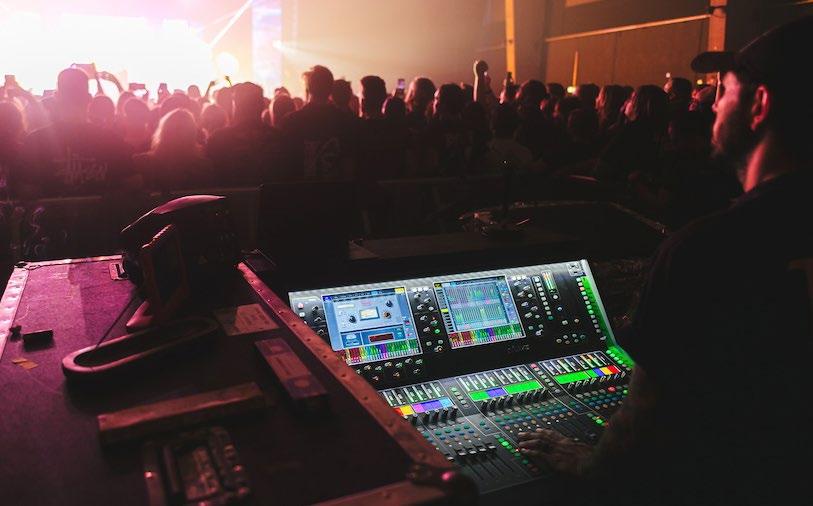
At FOH, engineer Danny Harvey oversaw a S5000 Surface, featuring dual 12-inch touchscreens and 28 faders, as well as a MixRack equipped with a Waves card. Harvey offered, “Before this tour, I was on the C1500 at FOH, but having the extra faders and control of the S5000 has been a game-changer. The built-in processing lets me achieve the power and punch Beartooth demands.”
For Shomo, wearing frontman and monitor man hats at the same time is all in a night’s work. “After mixing the Beartooth albums on some of the world’s best consoles, my requirements and expectations for mixing inears have become almost impossibly high,” he admitted, but also said that the unusual arrangement worked for both him and the band. “I’ve never felt so confident creating mixes that make everyone on stage want to melt face night after night.” ■
Franklin, Mass.—Eastern Acoustic Works has moved to a new company headquarters in Franklin, Mass. Previously based in Whitinsville, Mass. since 1988, the company has moved on to a new, 56,000-square-foot standalone building that consolidates all operations.
Located roughly 45 minutes from Boston and 30 minutes from Providence, the new facility includes 32,000 square feet dedicated to production and warehousing, 6,000 square feet of engineering lab space, a 3,000-square-foot indoor training and demo space, 3,000 square feet for in-house technical service and support operations, and 12,000 square feet of office space. The new location also has expansive outdoor demo spaces on the grounds.
Warehouse and production areas are equipped with advanced systems and infrastructure intended to provide faster lead times for customizable products, including color options. “Streamlined logistics and improved production capabilities translate directly into exceeding customer expectations for quality and response times,”
said EAW president, TJ Smith.
Meanwhile, the high ceiling of the new engineering lab space will aid in measuring lower frequencies,” explained Geoff McKinnon, senior director of Engineering at EAW. “On-site product development and testing strengthens our ability to deliver superior-sounding solutions.”
The facility’s indoor training and demo space will allow for classroom-style customer education
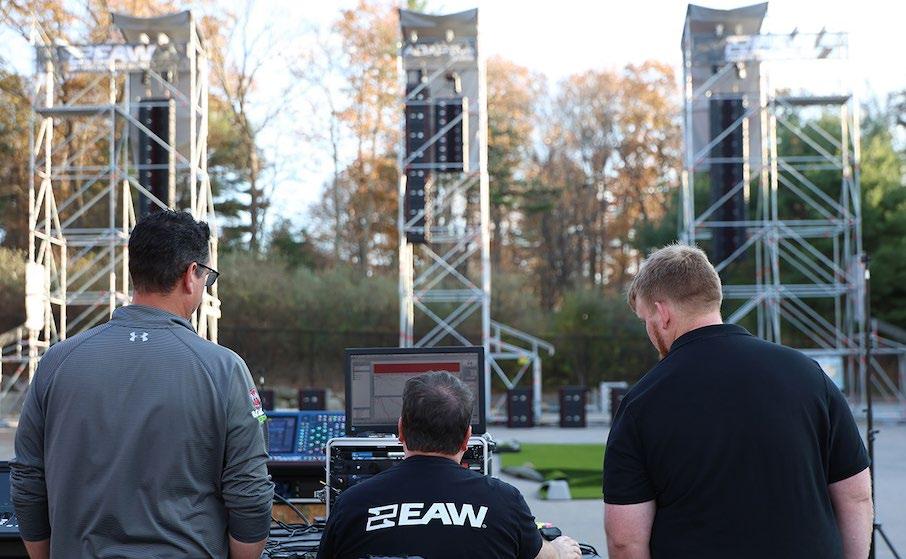
and product demonstrations, and will also host a video production studio to accommodate virtual training. Complementing this are two outdoor demo spaces, including a 175-foot throw area and a 300-foot throw area supported by three 40-foot scaffold towers and rigging capable of showcasing systems ranging in size from a large club or theater to stadium-length arrays. These spaces allow EAW to validate and showcase its loudspeaker systems for potential customers in realworld conditions.
“The best part of the new headquarters is that the proximity of all departments fosters closer interaction and communication,” said Smith. “For example, having customer support, the service center and engineering in close contact every day enables us to enhance our efficiency as we work to serve our customers.”
EAW’s new headquarters at 19 National Drive, Franklin, MA, is now open to customers by appointment. ■
Marseille, France—Mixing EDM and theatrical performances, the Madame Loyal Marseille festival, held indoors over two days in late November, was a jaw-dropper. Hosting acts like Acid Arab, Vitalic and Worakls Orchestra, the event took place at the Parc Chanot, using Funktion-One P.A.s in both rooms.
Under the direction of production manager Aurel Quiévreux and audio engineer/consultant Probe (Sebastien Jovys) and in collaboration with Concept Group, Alive and Funktion-One distributor for France Solution One, the show fielded a Vero VX system in the main room (Grand Palais) with a 21 F124 cardioid bass array, Evolution X in-fill and PSM318 DJ monitors and an Evo 7T system with a 14 F124 cardioid bass array and PSM318 DJ monitors in the second room (Palais de l’Europe).
Quiévreux noted, “I asked Probe, whom I’ve known for a very long time, if he’d like to join me on this event, knowing his great technicality and precision. We immediately started talking about the constraints of the place and the disruption that could be caused to the local residents with the event taking place in an urban area.” Probe was given carte blanche to manage the whole audio gear and team, while Funktion-One’s Will Wright aided in system design as well as deployment and operation at the site.
The Parc Chanot’s Grand Palais is a large, reverberant space. “The venue acoustics needed to be taken into account to present an audio experience up to par with the whole production,” said Quiévreux. “We needed to control our vertical dispersion to avoid hitting unwanted areas like the ceiling and maximize rear rejection to avoid rear wall reflection. This was achieved with the use of the three wide, seven high asymmetrical bass array
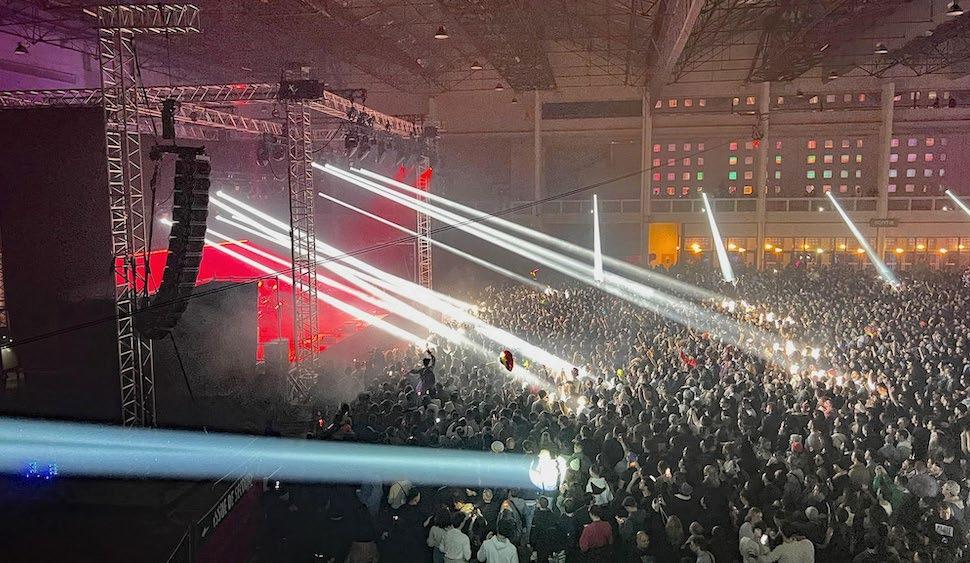
in a gradient cardioid configuration.”
Funktion-One’s Projection system design software was used to model the performance of the system, providing rigging information and splay angles for the crew on site. VX M Beams were used for all four hangs to fly the system on single points with continuous tilt adjustment under load. The system processing was designed and built ahead of time using globcon. “Projection was put to great use when testing different deployments,” said Probe. “The alignment values for the bass array it predicted totally matched our measurements on site. Having bands performing involved guest monitor engineers mixing right behind the sub stack, but the controlled directivity allowed for minimum spill, leaving their position relatively unaffected. globcon was the main system control software, providing control over 15 D100Q amplifiers fed with Dante and analog redundancy. I think this deployment exceeded everyone’s expectations and we had nothing but positive feedback about the difference it made.” ■
Houston, Texas—Houston-based event and installation services provider LD Systems has been acquired by Clair Global Group as of January 1, 2025.
Founded in 1975, LD Systems has additional offices in San Antonio and Austin, and notably handles the extensive live sound production needs of RodeoHouston, as well as large-scale festivals like Chicago’s Lollapalooza. Providing audio, video and lighting production services and installed solutions serving the U.S. market and beyond, LD Systems offers a multi-disciplinary, full-service approach to servicing large-scale special events for clients such as the March Madness Music Festival, the NFL Draft, and the
Austin City Limits Music Festival.
The company has also provided systems integration for the NFL’s NRG Stadium, the 64,000 seat Alamodome in San Antonio and numerous other sports facilities, houses of
worship and performance venues.
“With this union, Clair will provide a good home for the full offering of our services,” said Rob McKinley, co-founder and general manager of LD Systems. “We’re thrilled to be expanding the depth of our resources, securing the future of LD Systems, and ensuring our ability to service clients for the long haul through this exciting collaboration.”
“We were impressed with LD’s caring culture, long-term client relationships, and their commitment to quality, and that standard of unwavering service and excellence will continue with us,” said Clair Global CEO Troy Clair. “The shared vision is exciting as we continue to think globally but build locally.” ■
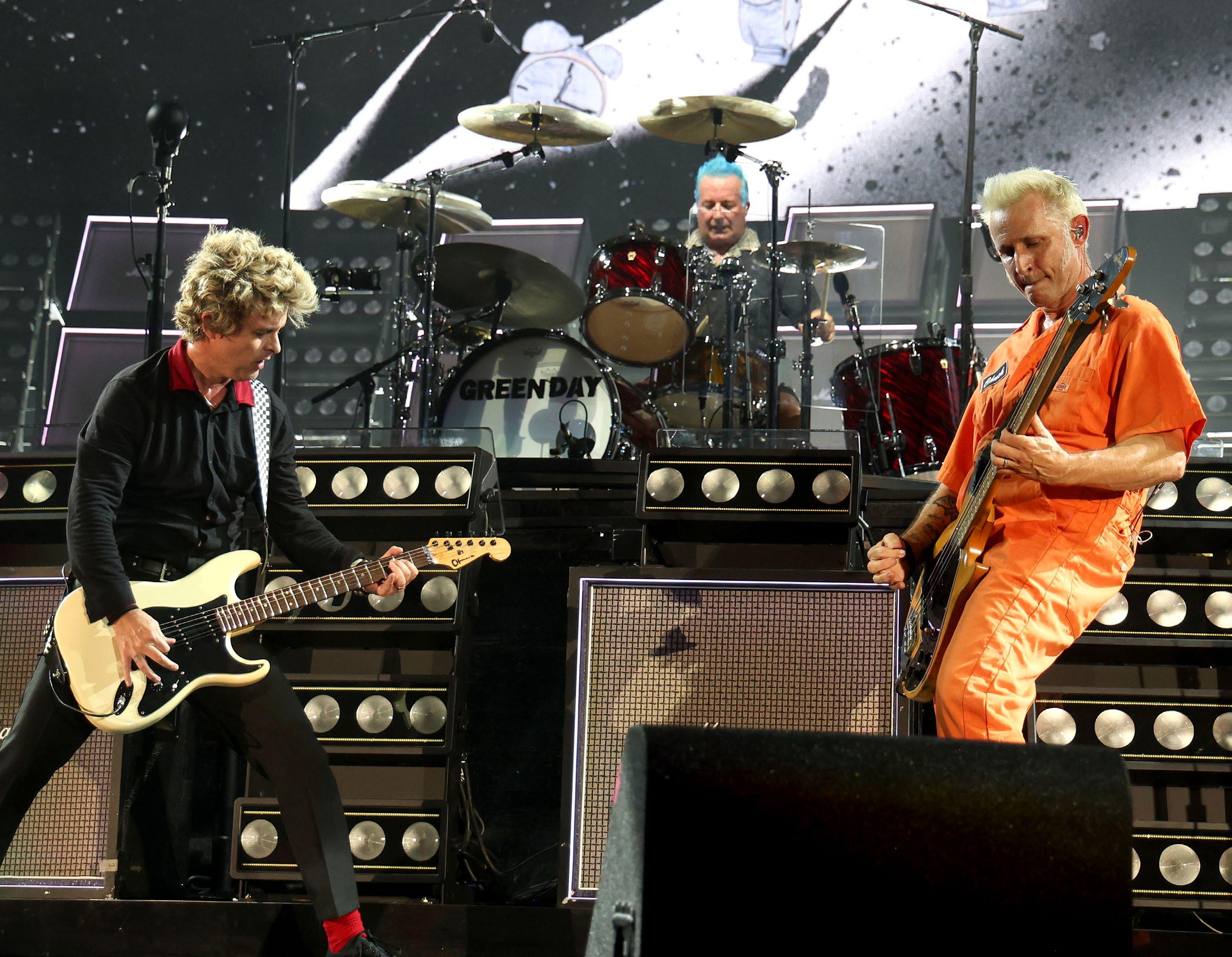
Green Day’s Billie Joe Armstrong and longtime mix engineer Chris Lord-Alge talk capturing lightning in a bottle— and three Grammy nominations—with Saviors.
By Clive Young
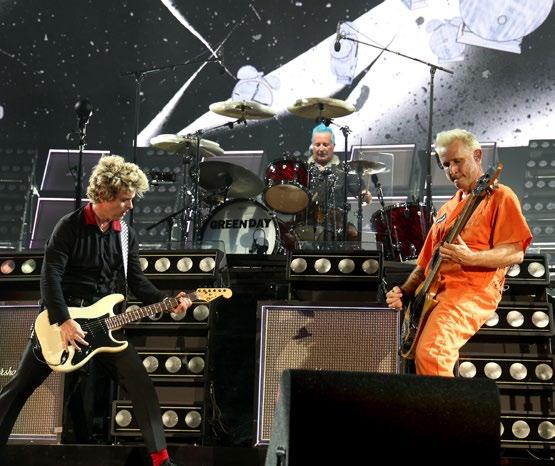
Scrappy” isn’t a word typically used to describe stadium bands 30 years into their career, but that’s exactly what Green Day is on its most recent album, 2024’s Saviors. Playing with a true hunger—like a band that’s sold 75 records instead of 75 million—the vibe is familiar but fresh as frontman/songwriter Billie Joe Armstrong wrestles with modern life and its ugly side effects, all the while backed by performances that bring the rock, dump it on your lawn, and head back to the quarry for more.
While Armstrong, bassist Mike Dirnt and drummer Tré Cool got their strongest reviews in years with Saviors, even more kudos came their way in November when they earned their first Grammy Award nominations in more than a decade: “The American Dream Is Killing Me” and “Dilemma” were put up for Best Rock Performance and Best Rock Song respectively, while Saviors itself nabbed a nod for Best Rock Album. That kind of acclaim caught the veteran band by surprise. “I didn’t really know what to expect at this point,” Armstrong admits. “It seemed like it just resonated with people.”
Saviors may be a return to form, but it also marked the return of key collaborators from the band’s past, most notably producer Rob Cavallo, who worked with the group on some of its bestknown albums, including the 1994 breakthrough Dookie and 2004’s landmark song cycle, American Idiot. Also returning were Green Day’s longtime recording engineer Chris Dugan; mastering engineer Ted Jensen; and mix engineer Chris Lord-Alge, who tackled the album—his seventh for the band—in his SoCal facility, Mix L.A.
If Armstrong was caught off-guard by the album’s critical success, Lord-Alge was not. “Saviors is the Dookie bus and the American Idiot bus crashing through each other,” he says with a laugh. “It gives you the intelligence of Idiot with the raw riffs of Dookie—and Nimrod, because let’s not discount Nimrod.”
Saviors had its genesis far from Los Angeles, however, as Armstrong first began working on the album in England as the group’s 2021-22 Hella Mega world tour—postponed from its originally planned 2020 run—wrapped up.
“We started at RAK Recording Studios in London right around Halloween,” says Armstrong. “I was staying at a place close by, and I would walk through Regent’s Park every day to go to the studio. Some of my favorite music of all
time has come out of England—The Kinks, The Beatles, Buzzcocks, Generation X, bands like The Libertines—so writing songs that were about a post-mortem America while being in a different country just felt right.”
Certainly, the America of Saviors isn’t an easy place to be. “Susie Chapstick” explores social media’s chilling effect on friendships, while “1981” draws upon the specter of the Cold War and the self-lacerating “Dilemma” contrasts a happily chugging riff against Armstrong’s battles with his personal demons.
“People want to know what the songs are about, but I look at what is every line about,” says Armstrong. “With a song like ‘The American Dream Is Killing Me,’ I address things like homelessness and QAnon and everything that’s under the umbrella of what the American Dream is supposed to be—and how it just doesn’t work and it’s a broken country right now. Same with ‘Coma City,’ where it says, ‘Mask on your Face / Bankrupt the planet for assholes in space.’ I’m covering a lot of ground in two lines. It’s not like songs have to specifically be about one thing; I think they can be about multiple things in the verses.”
The band’s long history with Cavallo informed the writing process as well. “I have such a strong
relationship with Rob,” says Armstrong. “Rob is good with ‘try this chord’ or being a good cheerleader, but I think most importantly, it’s the depth of conversation that we can have about the music and what the lyrics are about. For instance, with the song ‘Bobby Sox,’ there is a bisexual something that is ambiguous about that song—and we got into the guts of it. I said, ‘I could really hear a girl singing on this song,’ and he was ‘Well, that would change it completely.’ And I realized, ‘Well, technically, I am the girl in the song in the second verse,’ and he’s like, ‘Yeah, that’s right.’ Those are really important conversations to have when you’re making music that matters.”
Recording that music took the better part of a year with sessions held at RAK as well as Los Angeles’ United Recording and Henson Recording Studios. Periodically, Lord-Alge got songs to mix in small batches, each time finding all the stakeholders pleased with the results, but also determined to return to the studio.
“The thing that makes Saviors so good is that they were ahead of the game,” says Lord-Alge. “Remember, COVID changed all the touring schedules, and it gave them a nice buffer. We were sitting in the mix room and Rob’s like, ‘I
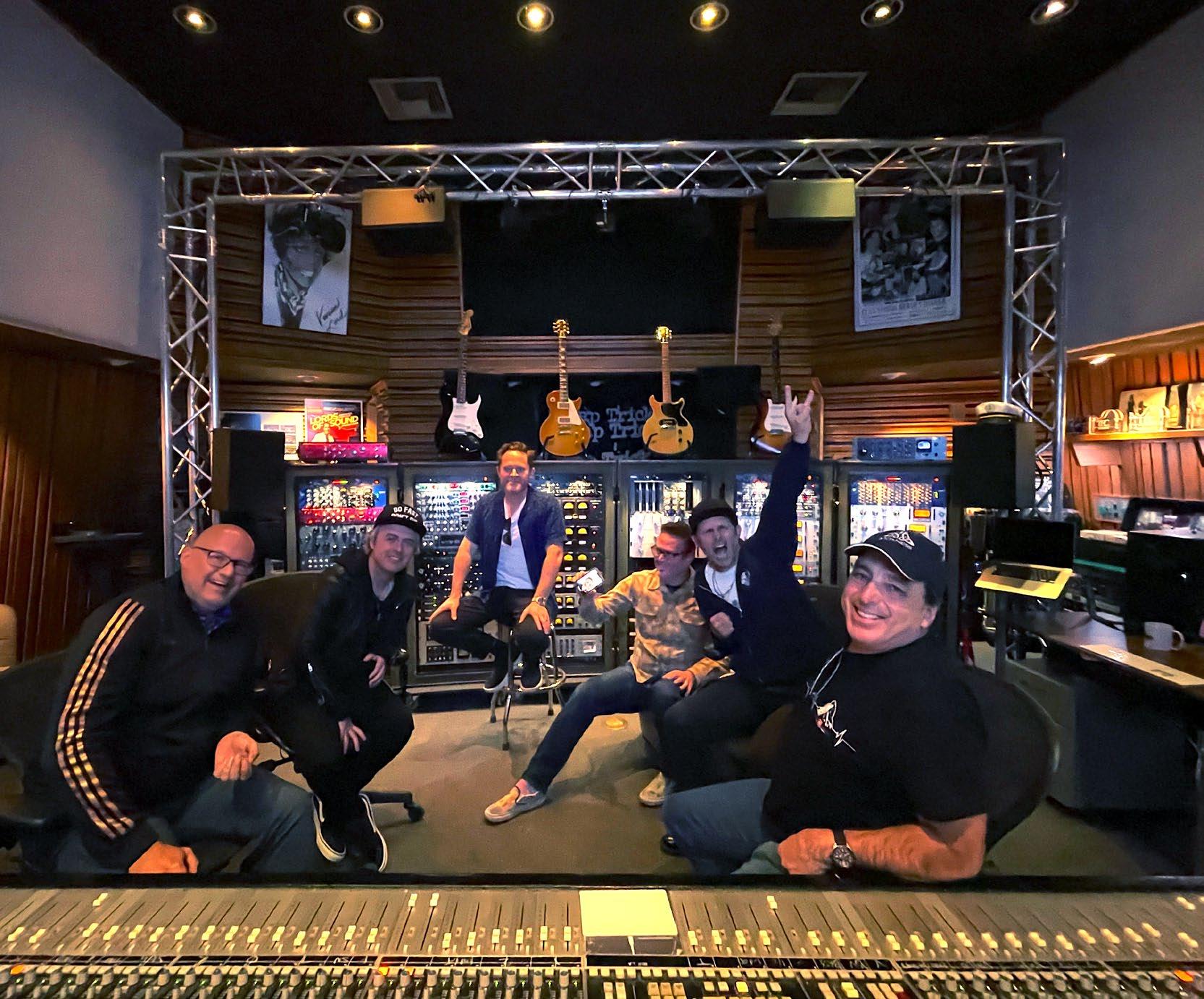
Rob, ‘You have time; why don’t you guys keep cutting?’ That’s where ‘American Dream’ came from.”
The caustic “The American Dream Is Killing Me” may have been the opening track and first single, but the anthem nearly wasn’t recorded, having initially been written and then set aside during sessions for the band’s previous album, 2020’s Father of All….
“We were going for something completely different then,” says Armstrong. “I didn’t want to be political; that wasn’t really the message we were trying to do. We were wanting to do something more garage rock back then—but as time went on, it just seemed like ‘American Dream’ was fitting in with the new album perfectly.” Now Armstrong sees that song and the album’s title track, written during the darkest days of the pandemic, as “two sides of the same coin, or two sides of the same single. It felt perfect and when I played the demo for Rob, he was like, ‘Man, we should really record this.’”
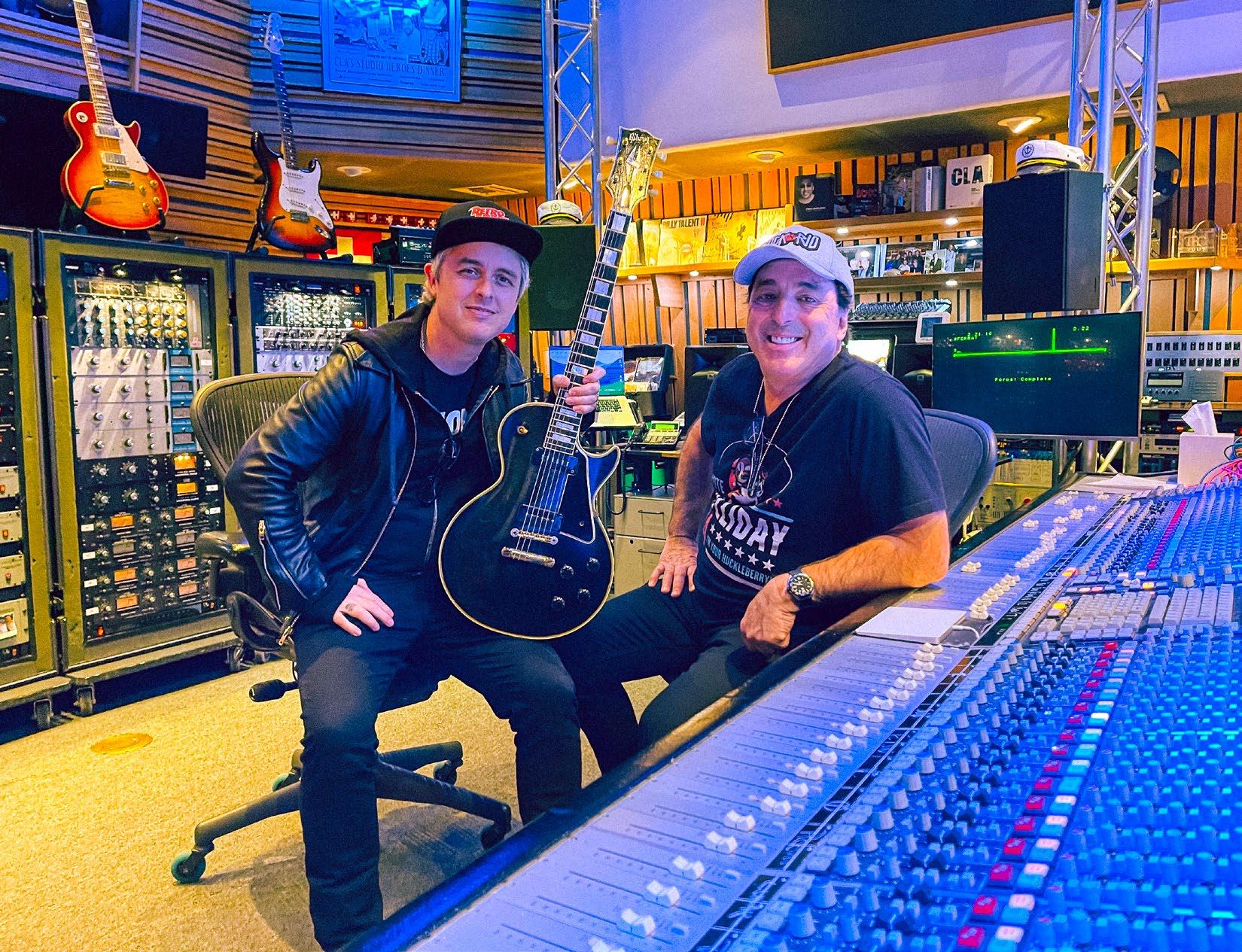
After 14 albums, the band’s recording process is well-honed, with Armstrong writing on his own before presenting demos to the band. In the past, he’s had well-appointed home studios that could put some commercial facilities to shame, but these days, he takes a less complicated approach, opting for a desktop UA Apollo interface, Kemper amp modeler, electronic drum kit and computer.
“I love to do demos in Pro Tools, but I keep it super simple; I don’t want to get into geeking out or I’ll just get lost,” he says with a grin. “I play the demo for Mike and Tré and we’ll get in the studio and start to mess with it—like, ‘Well, the song’s a minute and a half long, so we probably should make it another minute and a half long!’ We’ll work with the bridge or an instrumental part like that outro to ‘Coma City,’ which is something where we were ‘Let’s just burn till the end.’
“We get the perfect drum track from Tré— he analyzes everything that he does and he’s such a professional when it comes to that,” says Armstrong. “Then Mike will overdub bass; he’s very particular about the kind of bass lines that he wants, and he’ll do them a couple of different ways. I’ll put my guitars on, put a solo on, do vocals mostly by myself and then Mike will put his backup vocals on it. 90% of the time, we know what each song is gonna be, but it’s about making sure that we’re done before sending it to Chris Lord-Alge.”
For the veteran engineer, mixing the album
was a joy because of the material: “With ‘American Dream,’ the way the riff was so anthemic, it was like, ‘Okay, that is so Green Day!’ It was like ‘Holiday’ and ‘American Idiot’ rolled into one because, let’s be honest, the thing that they’re really good at is playing Green Day songs.”
And there are two secrets to ensuring they sound like Green Day songs, says Lord-Alge, the first of which is to keep everything as analog as possible. “You can’t mix a Green Day record in a box—it ain’t gonna happen,” he says, sitting next to his SSL 4000 E/G desk. “The sound of that record is going through the analog gear—through the console, through the Pultecs, through the compressors. The more analog gear used, the more it sounds like Green Day; the less you use, it doesn’t sound like ’em.”
The second secret, he says, is to zero in on Mike Dirnt’s bass lines: “Once I get what I feel is Tré’s drum sound, the vocals and guitars are easy, and the bass becomes the focus. It’s not because Mike’s the bass player and wants to hear his part; no, he doesn’t care. He finds these parts that glue it together—and if you don’t hear them, it doesn’t sound like Green Day. The bass has to be as loud as the guitars so you can hear all the melodies. Mike plays these inner, little passing parts, and once those are upright, then that melodic structure of the band comes together.”
With extra time to refine the album, the bandmembers were able to live with the mixes for a while instead of making split-second decisions. That had its pros and cons, says LordAlge: “Look, I like deadlines. You know what happens with deadlines? Shit gets done. On the
other hand, when you don’t have one, a mix can sit around and you can revisit it, so we were able to fine-tune stuff that they were unsure about and add or change parts.”
Armstrong agrees, recalling, “Every once in a while, we’ll go, ‘Oh, we’re missing this one thing’ while we’re mixing, and I’ve pulled out a guitar in Chris Lord-Alge’s place and just played it there on the spot.”
Ultimately, says Lord-Alge, “Nothing is ‘done’ unless all three are here and they sign off—and that’s fine. My attitude is, ‘It’s not done until you say we’ve got to send it to Ted Jensen for mastering.’”
That attention to detail is telling, too. “What separates Green Day from other bands,” says the engineer, “is the fact that they actually care about how their record sounds and they put a lot of effort into it; they don’t just sit on their laurels. We don’t have bands like that anymore; we do not have another Green Day, another Rolling Stones or The Beatles.”
That fact is likely not lost on the band either. The title track on Saviors shows up late in the album—song number 14—finding Armstrong in full-on power-pop mode, searching for hope in a downtrodden world as he sings, “We are the last of the rockers.” Asked if that’s really the case, he pauses, perhaps thinking of recent Grammy nominations, stadiums of screaming fans, the band’s stumbles and successes or a thousand other milestones over the last 30 years, before eventually replying thoughtfully, “I think that we are the survivors of the rockers—that’s for sure.” ■

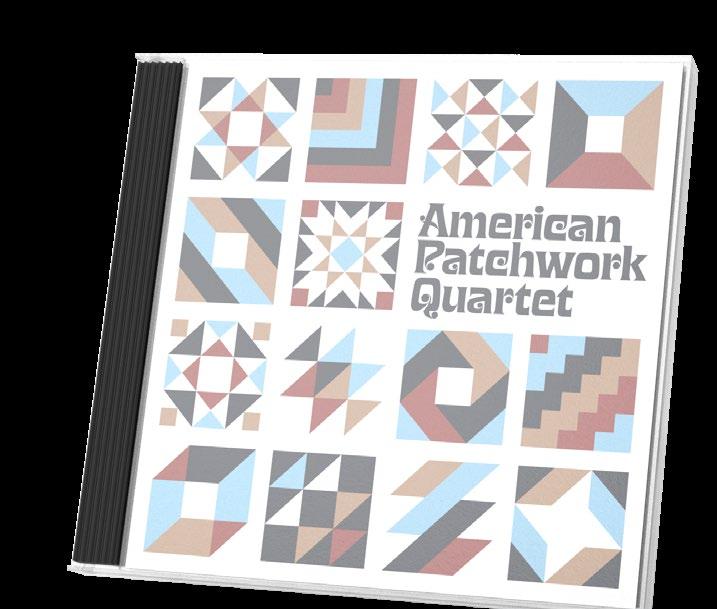
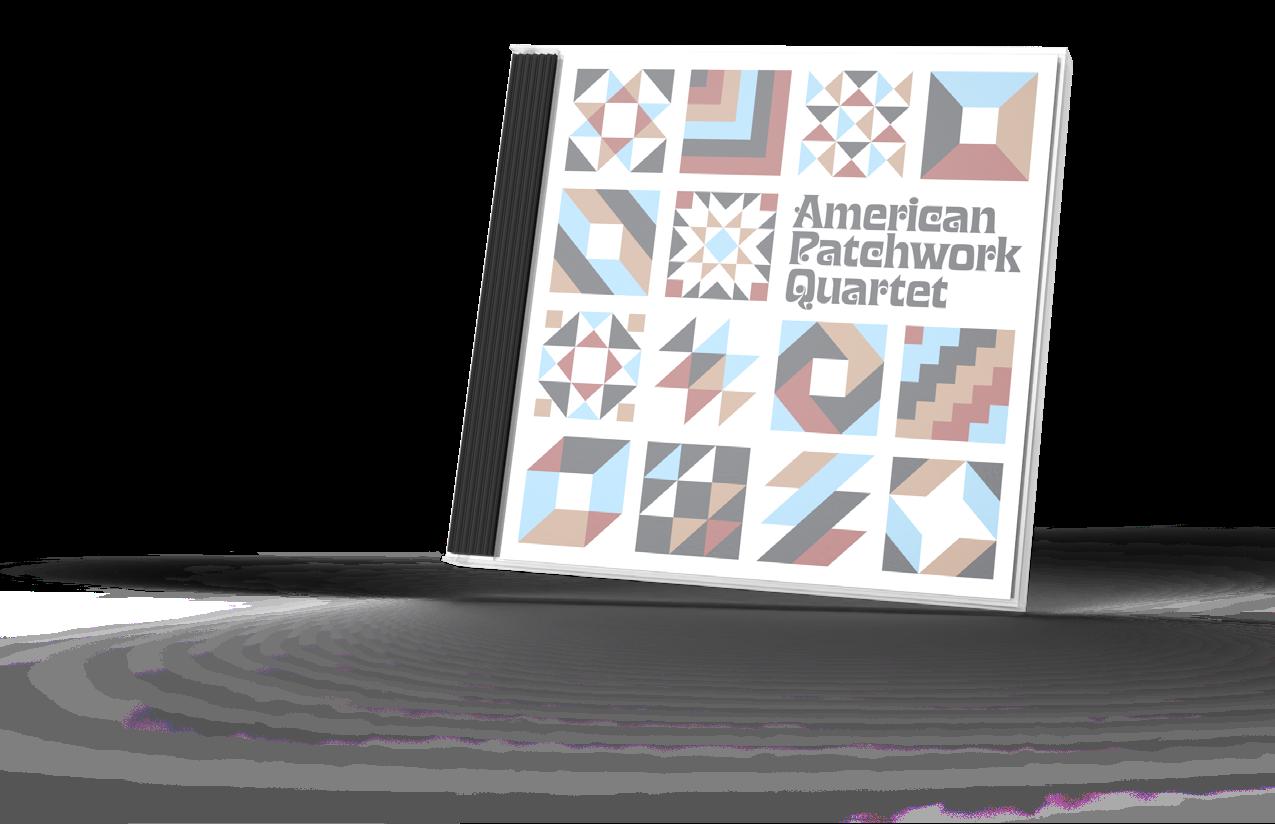
American Patchwork Quartet, which recently earned a Grammy nomination in the category Best Folk Album for its debut, self-titled outing, is a breathtaking confluence of heritage roots, jazz and world music influences, all woven together to reimagine the songbook of our traditional folk music story.
On paper, it might seem an unlikely combination of talent to form a quartet, but this patchwork of musicians—Falguni Shah, known as Falu, an 11th-generation traditional Indian vocalist; guitarist/producer Clay Ross, who also founded two-time Grammy-winners Ranky Tanky; drummer/percussionist/associate producer Clarence Penn, a protégé of Ellis Marsalis, raised in the Black churches of Detroit; and Tokyo-born acoustic and electric bassist Yasushi Nakamura, whose vast variety of work has brought him to Jazz at Lincoln Center and the New York City Ballet—delivers a unique selection of songs you will swear you’ve heard before. Bending genres and crossing boundaries, some renditions are closer to their roots; all are stunning.
APQ formed in 2019 through a friendship forged over three years between Falu and Ross while both were teaching at Carnegie Hall and exchanging musical ideas. The first song Ross brought the singer was “Pretty Saro,” which he described as the quintessential immigrant story. Having been an immigrant herself, she related. Then she brought so much more to the table.
The usage of Falu’s Indian classical vocal training in APQ’s version of the 19th century
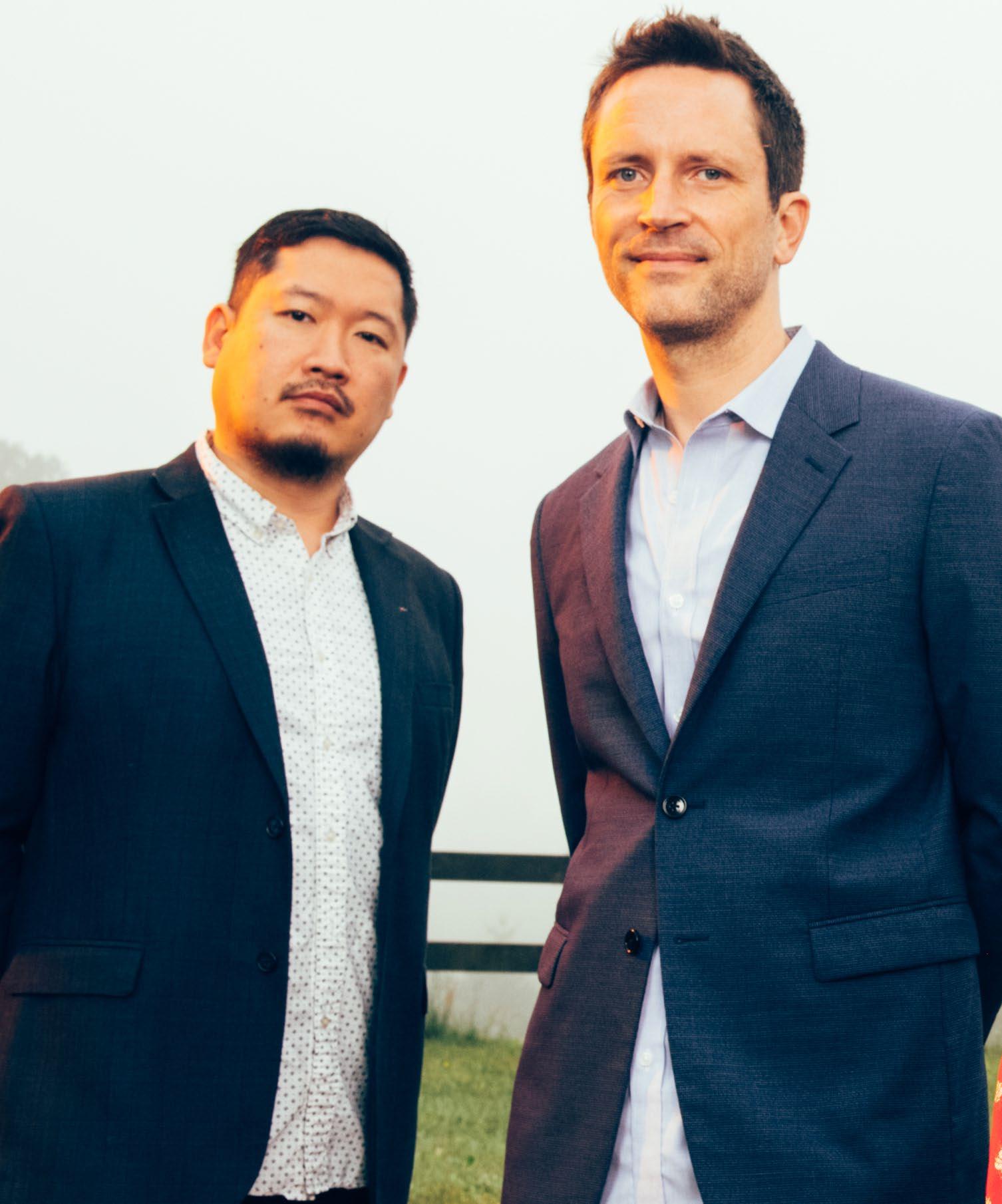
folk ballad “Shenandoah” creates a spiritual, almost Native American quality to the track that can bring a listener to tears. In technical terms, she explains, the first half is a murki, followed by a meend. “All of these ornamentations and microtonal elements that I have added,” she says, “I have thought about how they would enhance the longing in the song,”
Falu discovered the power of music early on. Her mother, a classical musician, would bribe her then two-and-a-half-year-old with food if she completed a music lesson first. Later, while in the hospital at six years old following a bicycle accident, her mother told her to sing instead of scream when in pain.
“I started singing in that hospital room, and
I didn’t stop,” Falu recalls. “That pain was only bearable when I sang. I realized music is the answer to everything in my life.”
While studying with the most prestigious teachers, Falu never intended on leaving India, but at 21, she fell in love with musician Gaurav Shah, who lived in Texas. Moving to the States, she experienced an early career highlight when she was invited to the White House in 2009 to sing alongside A. R. Rahman at President Obama’s first State Dinner, in honor of the Indian Prime Minister Manmohan Singh.
Ross, the driving force behind APQ, originally moved to New York to play jazz but got sidetracked by roots and folk music. He brought the other two band members into the

fold, believing that their jazz foundations would complete the picture. After a positive public response to a series of four videos, the foursome decided to go ahead and make an album and began pre-production. Ross calls the project his “baby.”
As producer, Ross presented more than 20 potential songs to see which would resonate with the players. He created extensive demos, with guitar orchestrations and percussion layers, to present his concept, and then welcomed “lots of input from the group.”
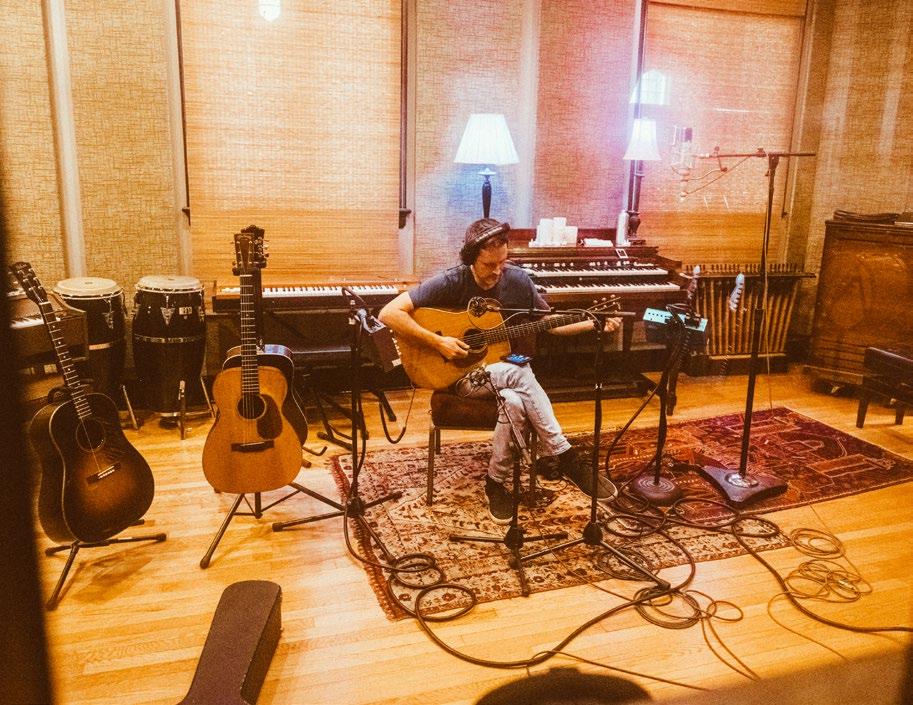
It had been Ross’ dream to record at Echo Mountain Studios in Asheville, N.C., having
hailed from the area and believing the vibe to be simpatico with the project. He enlisted engineer Shani Gandhi after hearing her work on the album Desert Dove by friend Michaela Ann (Neller).
Together, they ended up spending seven days at the studio in 2022.
Gandhi describes working at Echo Mountain as a “getaway” experience that offers focus. Hanging out in the band house and cooking together, she says, proved unifying.
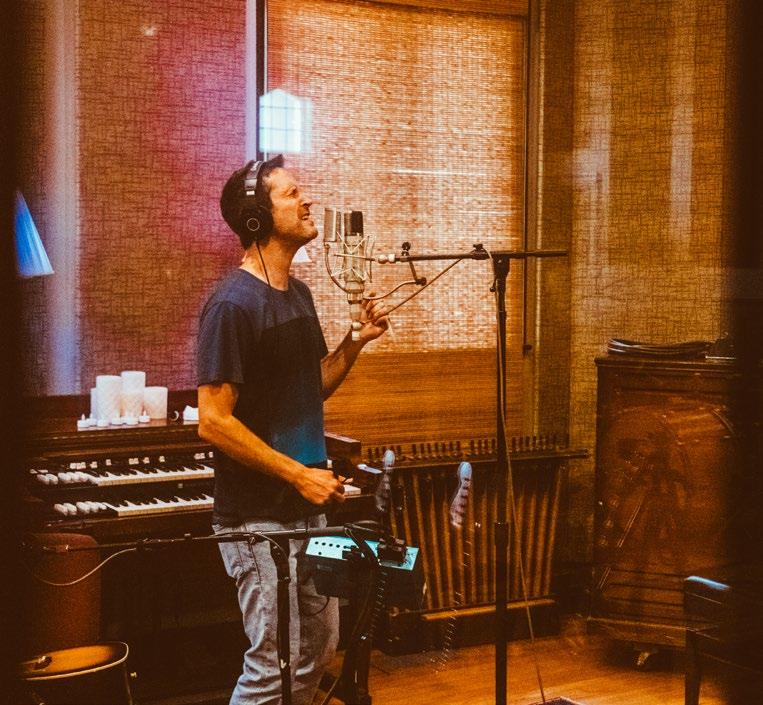
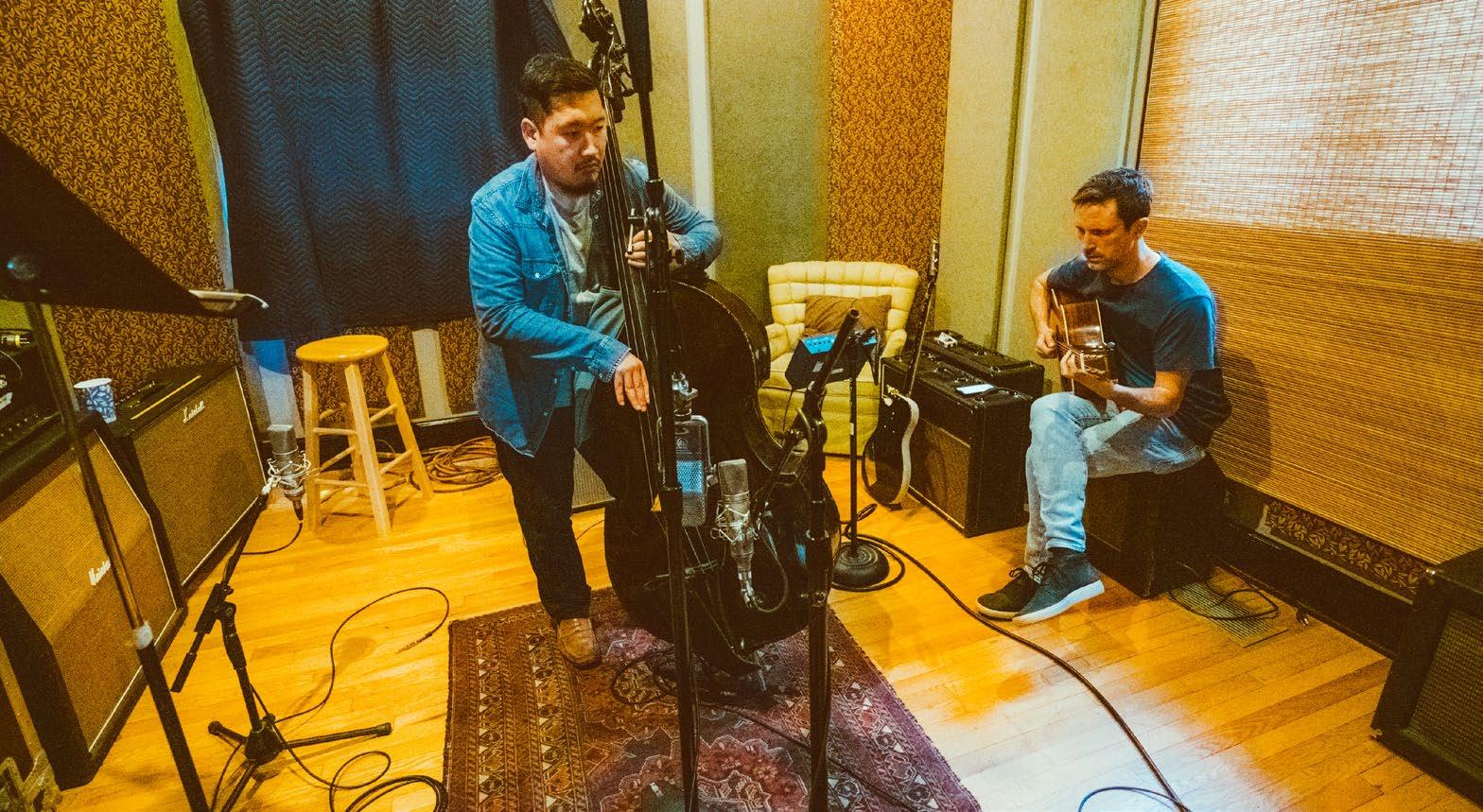
Gandhi, along with her assistant engineer, Dowel Gandy (who “knows where everything is”), tracked to Pro Tools through a combination of Lynx Aurora and Burl Mothership converters. They tracked live in Room A, a.k.a. the Church, with Falu singing her vocals into a reissue of the Neumann U-67, which went into the Neve 8060 mkII console preamp, into a GML 8200, then into a Fairchild 670 or LA2A, depending on the song. Ross’ signal chain started with a Telefunken 251 mic into the Neve console pre, then to a Fairchild 670.
The engineer’s biggest challenge, it turned out, was navigating the difference between Falu’s and Ross’s vocal qualities.
“It began with doing vocal mic shootouts,” Gandhi explains. “We did the shootouts to voice them at the same time, as opposed to having them—and me—picking their favorite mics for their voice. I also wanted them to think about how it matched with their partner’s voice. Falu has a very soft and rounded tone, and I needed her to be more forward in the mix, so I put her
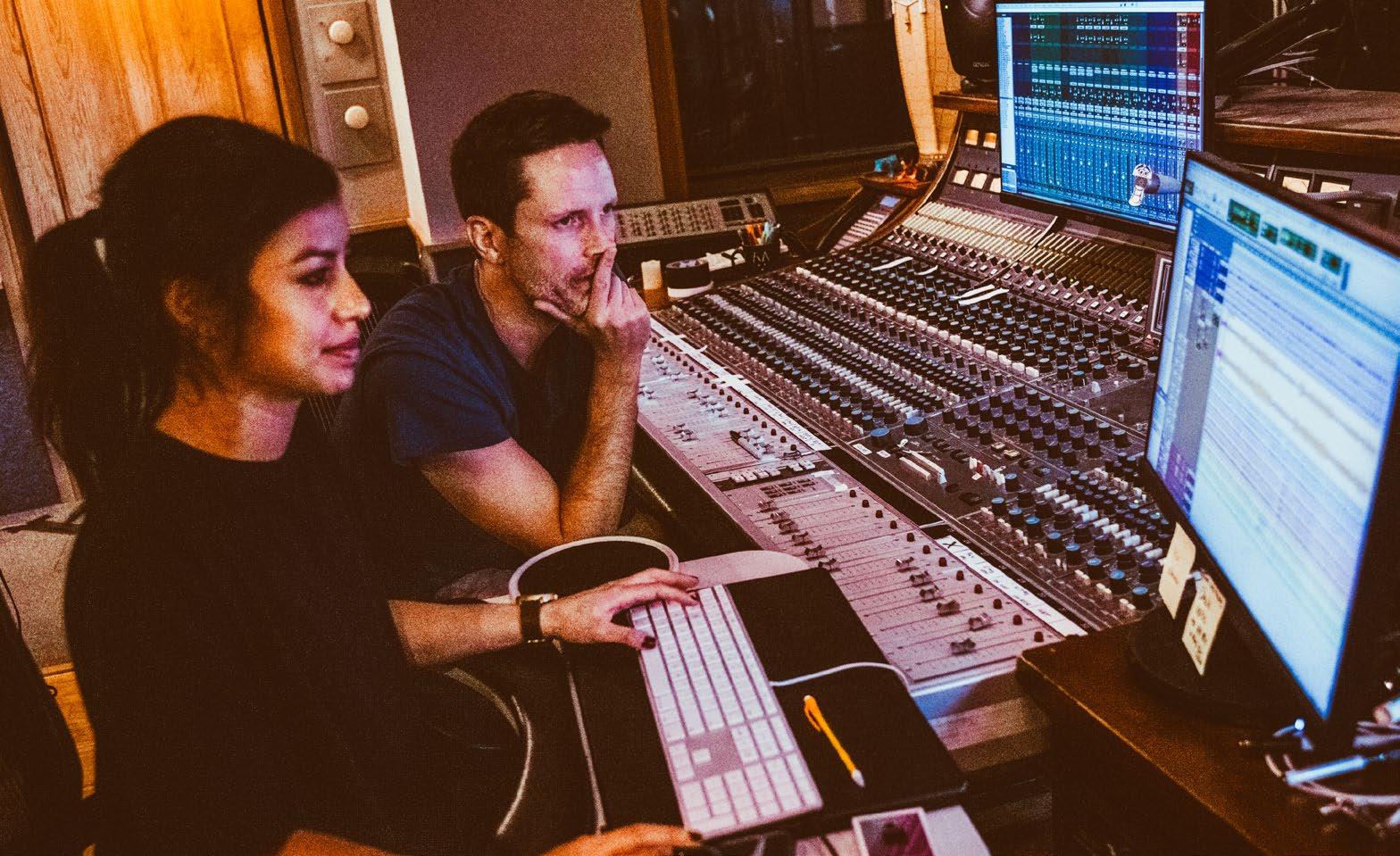
through an LA2A. Clay has quite a growly tone, so I needed him to soften up a bit to match her, so I put him through a Fairchild.”
That made “Pretty Saro” one of the more difficult songs to record, as Ross and Falu had to sing together throughout.
“Falu can sing a note for five minutes and hold it there, and Clay has a much shorter cadence,” she notes. “To try to get her to be cognizant of him, and for him to work on his breath support, we tracked them together a few times so they could understand each other’s qualities, and then we separated them. Then it came down to comping to try to find that blend. Their strengths are so different from one another. The marvel of digital technology makes someone sing a note just a hair longer [laughs]; it’s very useful.”
There were two drumsets brought into the sessions for their different sounds and moods. Ross found that the drums were an integral part
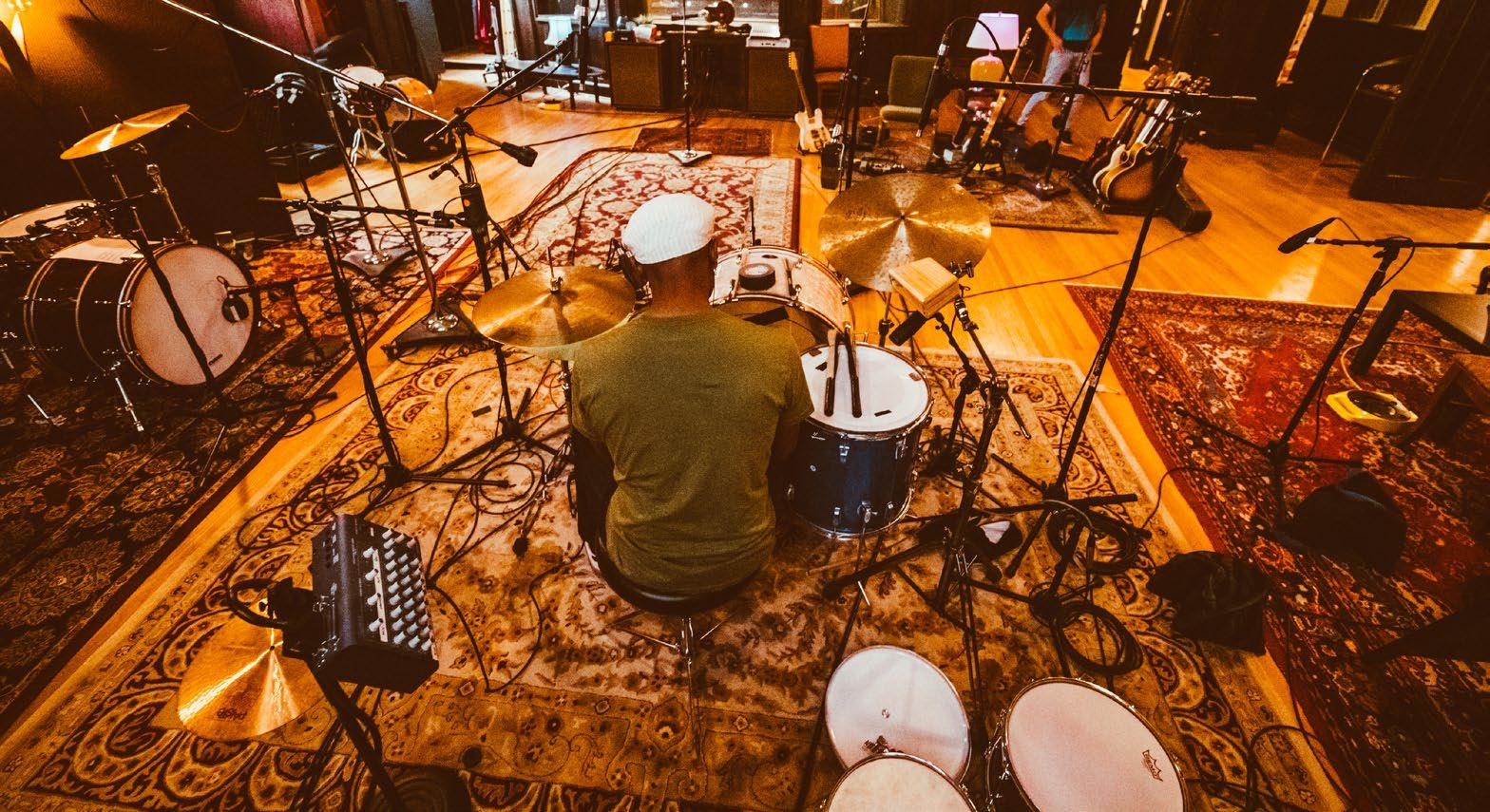
of the sound from the beginning, and the music required fewer cymbals than a jazz drummer might be accustomed to.
“Set one was a more traditional tight drumkit, and the other [Kit 2] was a more loose sound, with a huge drum decay,” Gandhi explains. “I don’t believe there were any cymbals, maybe a dark cymbal here and there. That was for moodier elements. We spent quite a lot of time tuning those drums, making sure we had the right mallets, we had top and bottom tom mics to make sure to capture the decay. The miking was different on those drums, so it made it easier to have the two sets that we could leave up all the time and didn’t have to keep changing it around.”
The miking scheme for those two drum setups included: Kick mics (D12e and U47 FET into dbx 160s); Snare mics Kit 1 (KM84 and SM57 into Empirical Labs Distressors; Snare mics Kit 2 (Shure Unidyne into Distressors; Tom mics Kit 1 (Sennheiser 421s); Tom mics Kit 2 (Beyer M88s); Overhead mics Kit 1 (AEA R88 and 2x AKG C12, depending on the song); Overhead mics Kit 2 (Josephson C617s); Room mics (Coles 4038s into EMI TG12413). All mics went through the studio’s 32-channel Neve 8068 mkII console preamps and EQ.
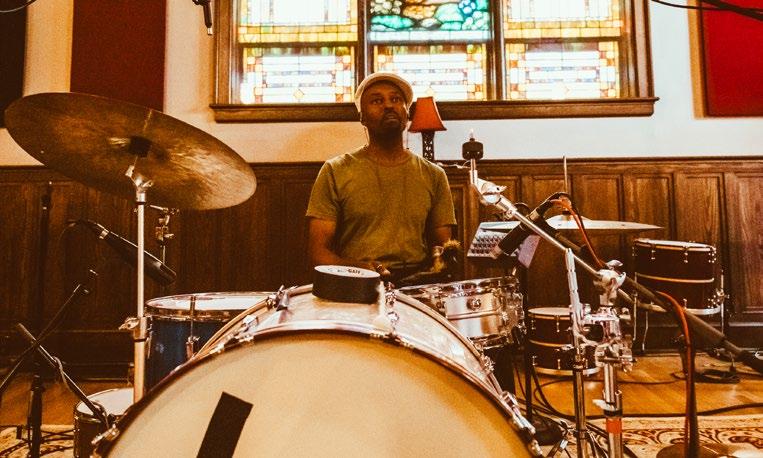
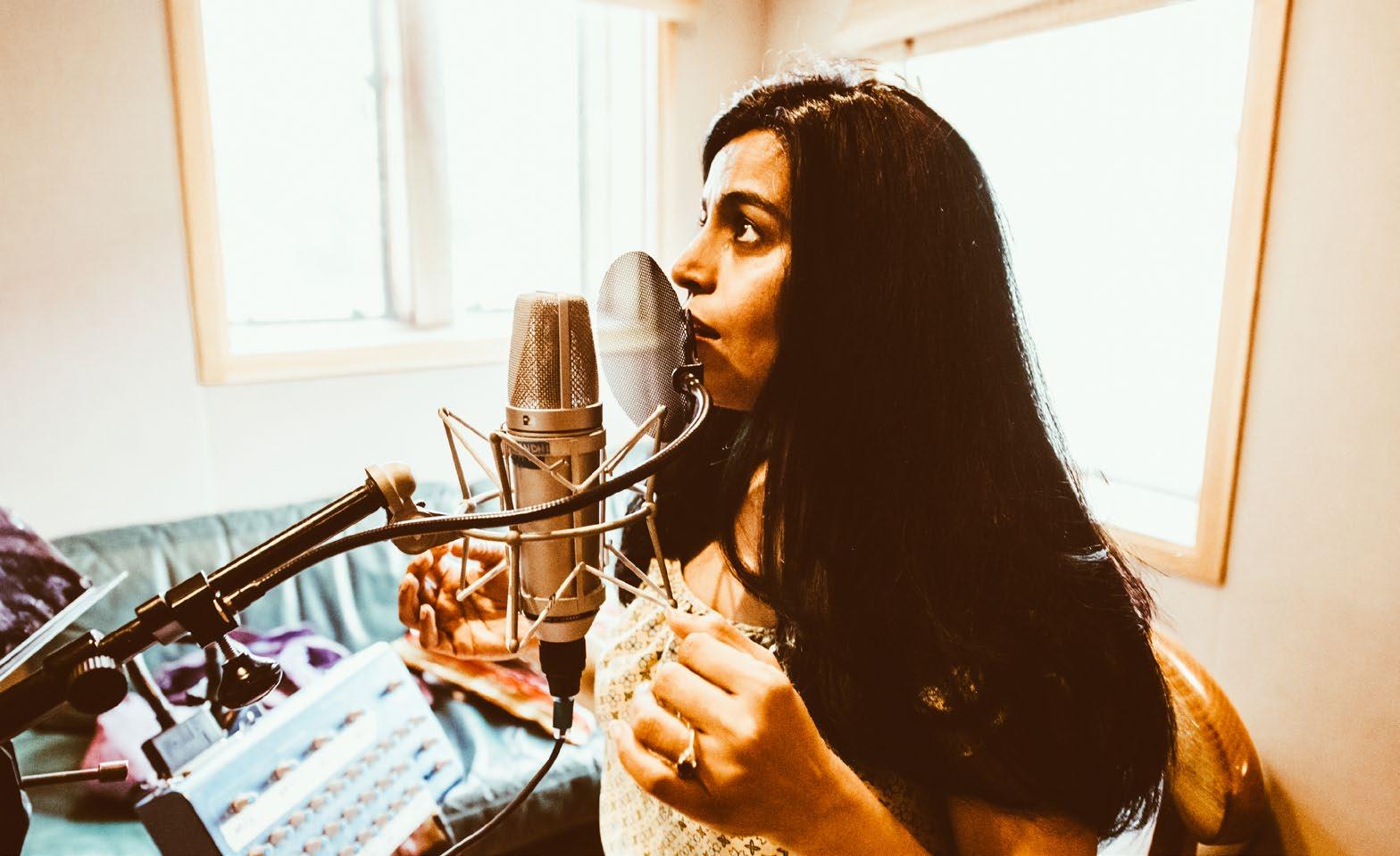
One of Ross’ favorite tracks ended up being the Skip James’ composition “I’m So Glad,” which Cream popularized in 1966. “We had been playing that song in a much more traditional way,” he recalls, “and the day before we recorded the song, Clarence said, ‘I have an idea. Instead of it being in 4/4, it’s going to be in 15.’ If you listen to that track, it’s deceptively crooked. As if the plate wasn’t already full enough! I was so upset about it, but then I thought, ‘This is the spirit of what this band is—to embrace ideas and try things.’ That’s the thing about working with people like Clarence, Yasushi and Falu; they’re going to challenge you. It’s so much cooler now than the way we were doing it before—and it makes it so much more unique to us.”
Another of Ross’ favorites is “The Devil’s Nine.” Falu spoke about how she brought the Indian rhythm called Chakradhar to that song, a cycle that repeats three times, the last of which ends on a downbeat. As with all the unconventional choices, it was at first an experiment. Many were tried and tossed, while others, like “The Devil’s Nine,” were kept.
“Leaving space” was a common thread that both Ross and Gandhi talked about throughout the production. Space was crucial in attaining
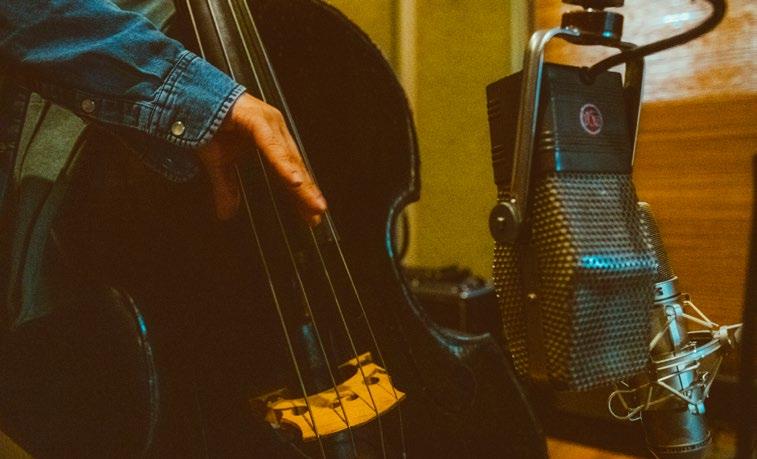
their sound, Gandhi says, because the four of them were bringing such unique and different elements and training to the table, sometimes even intentionally clashing with one another.
“What Yasushi wanted to do on the bass was not at all where Clarence’s instincts were going,” Gandhi says, citing one example. “Either I could rein one of them in, or I could say, ‘Okay, do what you want to do, but leave a little bit of space for each other.’”
Gandhi describes it as a dance, where you are learning the push and pull and give and take within the musical experience. There was an abundance of piling into the control room to listen back for reference, she says, and it was a learning experience for all, even just navigating the language, musical terms and simple communication.
The mix was done at Forty-One Fifteen Studios in
sonic Northern Star for the mix, she says, was Emmylou Harris’ Wrecking Ball, but initially that did not help her pinpoint their vision due to that album’s own sonic diversity. After some back and forth, they were able to close in on the track “Where Will I Be” from the Harris album as a guide.
“They were like, ‘We like where the vocals sit, we like the overall EQ, we like the grittiness, the roundness,’ et cetera, and all four of them agreed, whereas I couldn’t get all four of them to agree on anything else,” Gandhi says. “That was really helpful for me.”
Ross says the aesthetic they were pursuing was the feeling of a “warm bath,” a lushness and an Asheville vibe.
For Falu, it was about emotions: “Feelings are what we have captured in this folk album. Feelings are human and universal. When you focus on our universal strength, everything comes together. Instead of looking at our differences, we chose to look at our strengths and our uniqueness and bonds that bind us as human beings.” ■
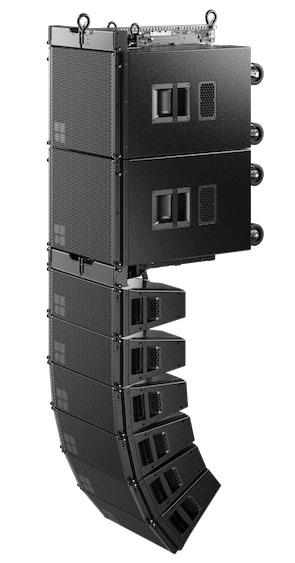
d&b audiotechnik has launched its CCL System (Compact Cardioid Line Array) as the debut of a larger, new CL Series, which brings the technologies of the company’s SL Series models to a smaller format and thus available for installations and small audience spaces. The system is built around two 7-inch front-firing drivers, two 5-inch side and rear drivers and two newly designed 1.75-inch high-frequency transducers. The CCL will be available in both mobile (CCL) and installed (CCLi) configurations, as well as 80° (CCL8) and 120° (CCL12) horizontal dispersion versions. Also new is the CCL-SUB, a flyable subwoofer based around a passive cardioid design with a front 15-inch and a rear 10-inch driver configuration.
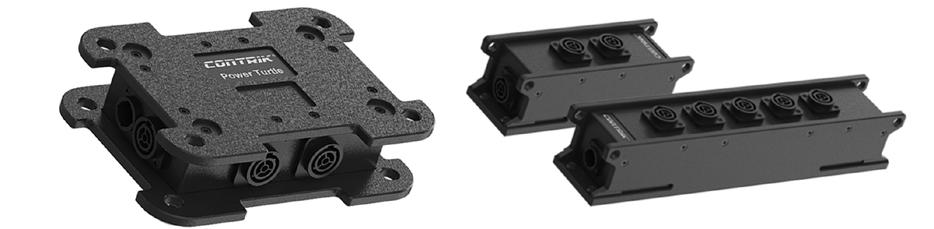
Neutrik Group has introduced its Contrik brand of professional power distribution systems, equipotential bonding systems and premium power cables to the U.S. market. Already established in Europe, its first products to appear Stateside—all manufactured in the U.S., too—include the Power Strip X CPSSX-T1-T3, Power Strip X CPSSX-T1-T6, Power Turtle X CPTSX-T1-T7 and CCL75-P2 Truss Clip set. The devices sport Neutrik powerCon True1 Top input and output connectors, an Easylen housing with a leather grain texture that is flame retardant (UL94 V0) and non-conductive, and truss mounting options. The devices feature high mechanical protection (high IK), and are ETL listed with NEMA1 indoor certification for the U.S. market and UL 1640 compliance.
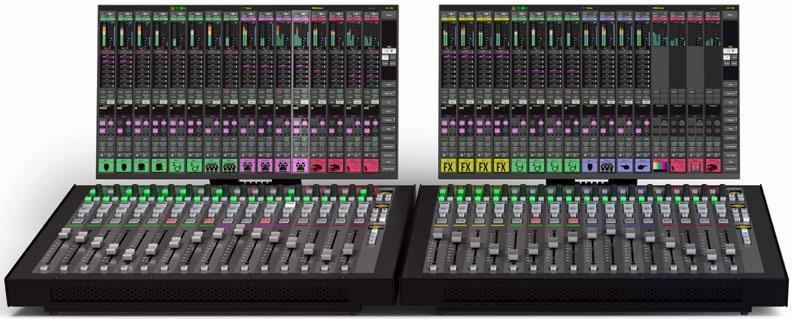
The latest edition of the SSL Live’s operating system, V6, debuts at ISE in early February. The new SSL Live V6 software update will bring numerous studio tools to the live stage. The Fusion effect rack emulates five circuits from SSL’s Fusion hardware, reportedly delivering tonal color. The Path Compressor Mix Control introduces parallel compression directly to channels and buses, while updates to the TaCo app allow engineers to remotely control the SSL Sourcerer and Blitzer modules. Further, enhanced Dante Routing Modes provide system-wide integration across ShowFile Saved and Outside of ShowFile setups. The new software will be demoed on an SSL L650 console, the brand’s flagship live desk.
Adam Hall Group’s LD Systems has brought its MAILA (Modular All-Round Intelligent Line Array) system to the U.S. MAILA is a scalable sound system with four basic elements— MAILA SAT satellite module, MAILA COL column module, MAILA SPA amplifier module and MAILA SUB subwoofer—that enable scalable system configurations for a range of
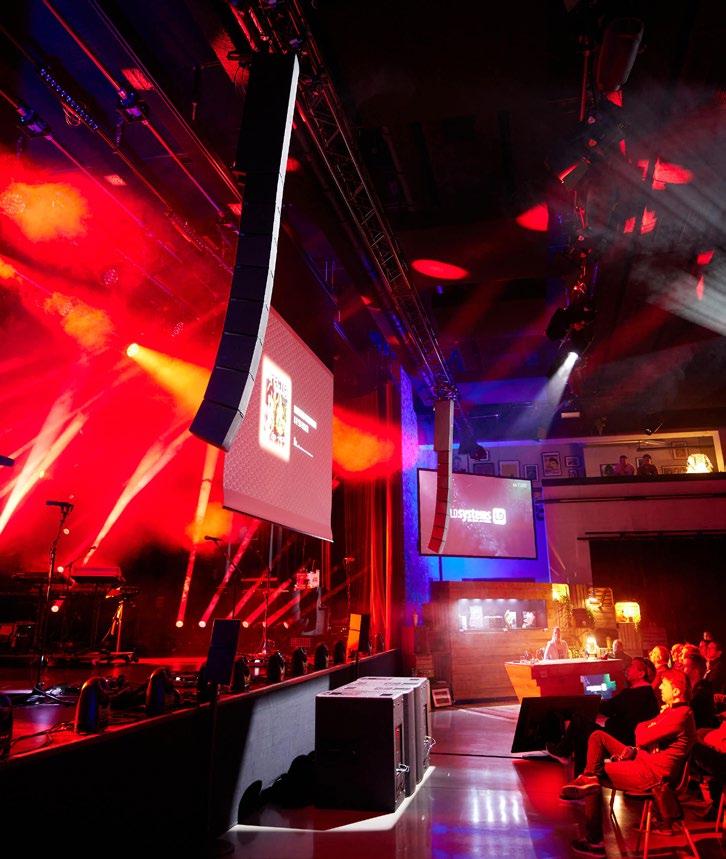
P.A. applications. MAILA is user-friendly with a patented and German-developed wireless SmartLink+ connection, the MAILA Set-Up App and an EasySplay mechanism. The mechanism allows users to adjust the tilt of each separate satellite almost continuously from 0° to 8°.
DarkFire is a new saturation plug-in that provides control over the harmonic content it creates, allowing users to tailor its effects to warm up and fatten a source. The signal path contains three main sections—the Input Filter, where you can apply high- and low-pass filtering to preshape the frequency range of the audio to be processed; the Harmonic Shaper, where the bulk
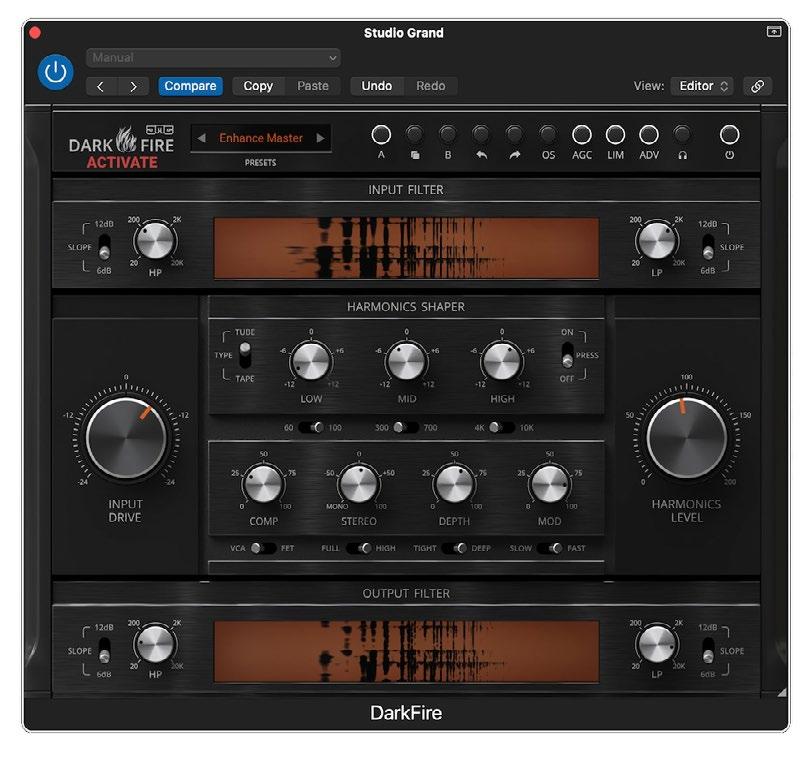
of the processing occurs; and the Output Filter, which contains another set of high- and low-pass filters for final tonal shaping before the output. Several buttons on the plug-in’s top row toggle in additional options. In addition to turning on 8X oversampling, automatic gain compensation is available to match the input and output levels.
Ferrofish has introduced its Pulse 8 AE, an 8-channel AD/DA converter with ADAT connectivity, designed for both studio and live recording environments. Outfitted with 8 analog
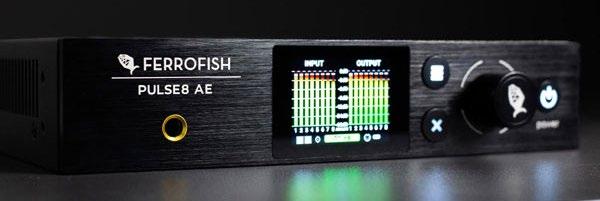
inputs and outputs, the Pulse 8 AE enables integration of mixing consoles, synthesizers, drum machines and other instruments into a typical live or studio workflow. The unit is powered by ESS converter chips chosen for their sound quality and delivers conversion up to 192 kHz with +20 dBu headroom. The Pulse 8 AE is compatible with any ADAT-enabled audio interface, making it adaptable to a variety of production scenarios. Remote control is also possible via Mac and PC using Ferrofish’s RemoteFish control software.
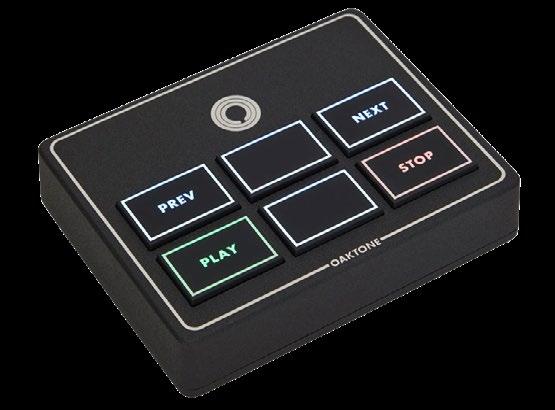
Oaktone has introduced its new Oakboard Mini 2 MIDI controller, intended for playback technicians and artists who perform with computers. Designed to be a straightforward, reliable way to launch music cues, the unit is housed in a 2mm thick, die-cast aluminum alloy shell, and sports buttons with tactile feedback that are backlit in order to ensure they are visible even in dark workspaces. Using the MIDI clock from a connected DAW, the “Play” button on the Oakboard Mini 2 can blink in time with music. The unit connects to other hardware via standard USB-C cabling, avoiding any need for dongles and adapters when connecting to a playback computer. The controller integrates with Ableton Live-compatible cue-launching software such as Taz, AbleSet and Setlist.
The third member of Martin Audio’s iKON Series of power amplifiers, the iKON iK41 is a 4-channel power amp combining high-power density with high-performance audio specs, DSP and network control. The iK41 provides four channels of Class-D amplification, delivering up to 6,000 watts total power output (depending upon load impedance) in a 2RU chassis. The iK41 can generate 1,500 watts per channel into 2Ω or 4Ω loads, all channels driven with continuous program material. Channel pairs
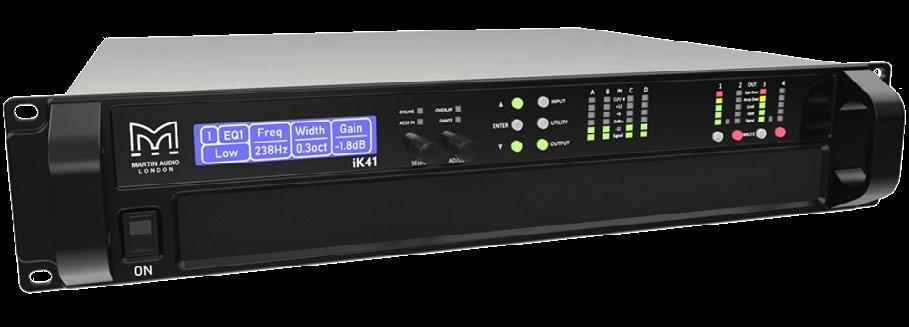
may be bridged, enabling the iK41 to deliver as much as 3,000 watts per bridged pair into 8Ω or 4Ω loads. It employs a switch-mode power supply (85V to 240V auto-sensing) that reduces demand on the mains supply while ensuring that sufficient power reserves are available.
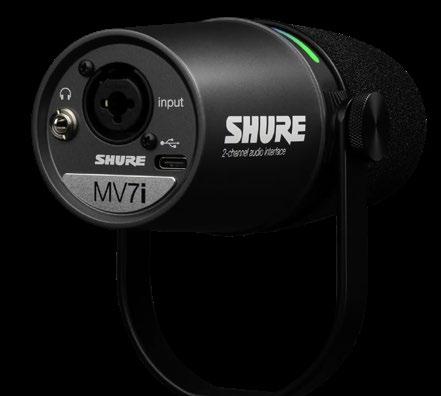
Shure has introduced the new MV7i Smart Microphone, which uniquely sports an integrated, onboard interface. Aimed at podcasters, content creators and others who require two channels of recording, it allows users to directly connect a second XLR mic or musical instrument into the MV7i itself, eliminating the need for an external hardware interface. The MV7i offers the same audio quality as the MV7+ and likewise makes use of onboard DSP and MOTIV Mix desktop and MOTIV mobile app integration. Users can control both channels of audio either in the MOTIV apps through a computer or phone or with a DAW. The MV7i itself has a metal chassis and includes a built-in combo XLR and 1/4-inch input, enabling users to connect a second microphone or instrument with 60 dB gain and 48V phantom power.
KIT Plugins and Blackbird Studio have collaborated on a new emulation plug-in, this time setting their sights on a Rupert Nevedesigned late-1960s compressor/limiter. The
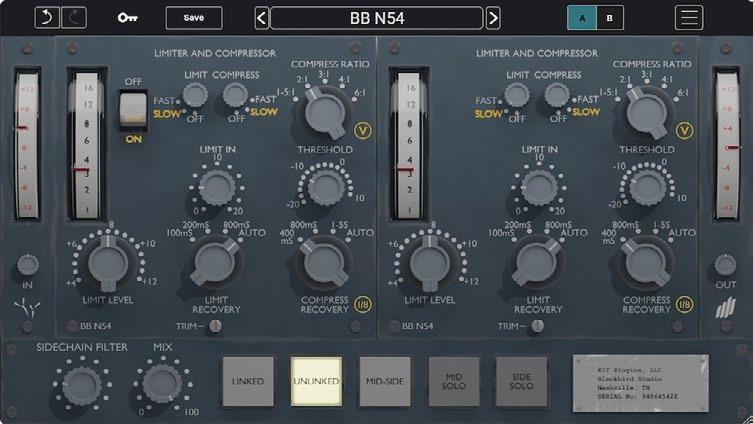
result is the newly released BB N54, which the collaborators intend to provide analog-style warmth and cohesion to vocals, drums, bass and mix buses. The original 2254 has become known for its signature warmth, harmonic richness and
dynamic control, driven by an all-discrete Class A design, featuring a diode bridge gain reduction circuit and Marinair transformers. The new BB N54 plug-in was tailored to Blackbird Studio owner John McBride’s personal taste, and as a digital re-creation, can reportedly provide the familiar sound but with added precision.
Wolff Audio has introduced its ProPatch Patchbay, a digitally controlled, relay-based, large-scale analog patchbay. Featuring 128 patch points, the
ProPatch is designed to route audio with a “straight wire” signal path free of electronics. The ProPatch supports USB-C, Ethernet or WiFi connectivity. The control application runs on Mac, Windows and mobile, configuring connected equipment and setting up signal routings that may be associated with DAW sessions. 128 patch points are available as 12 rear panel DB25s, 16 TT I/O pairs on the front panel, 4 XLR/TRS combo jacks and 4 TRS jacks. The ProPatch takes up a single rackspace, does not generate heat and does not require fans. It may also be integrated with large existing TT patchbay systems via its front panel TT connections.
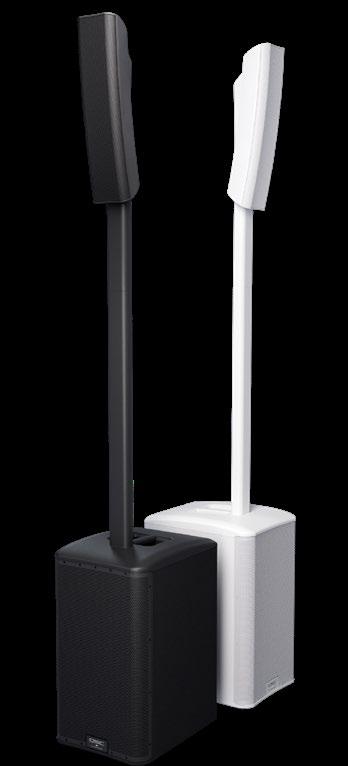
QSC has introduced the new KC12, a 3-way, 3,000-watt, portable loudspeaker system. The system consists of a ported subwoofer, housing a 12-inch (305 mm) driver extending down to 40 Hz. The mid/high enclosure features a 1-inch compression driver combined with the proprietary QSC LEAF (Length-Equalized Acoustic Flare) waveguide, as well as two high-excursion 4-inch (102 mm) midrange drivers providing horizontal coverage of 145 degrees and 35 degrees of audience-directed vertical coverage. The system features two combo XLR inputs (Mic/Line/Hi-Z and Mic/Line/+48 V), with independent, assignable Factory Presets for each. The system also sports a multi-function digital display allowing users to control and select a variety of loudspeaker functions, including Global Parametric EQ, Subwoofer level, Presets and Scenes, Bluetooth configuration, Delay (200 ms) or Reverb. ■
By Mike Levine
Neutron 5 (Mac/Win) is the latest incarnation of iZotope’s integrated mixing-processor suite. It includes a modular “Mothership” plug-in incorporating all of its processors, plus individual plug-in versions of each and several separate utility plug-ins.
iZotope has also added three new processors, bringing the total to 10. The lineup includes: Compressor (multiband, up to two instances in a signal chain), Equalizer, Exciter (saturation), Gate, Sculptor (spectral shaping), Transient Shaper, Unmask and the three new modules: Density, Clipper and Phase.
Before getting deeper into the new modules and features, let me quickly review the structure of the Mothership plug-in. It offers two main work areas: Detailed View and Assistant View.
The former’s workflow resembles that of a standard modular plugin. You can open your desired modules, adjust their places in the signal order and edit all their available parameters. When you select a module in the signal chain area, its display and controls are visible underneath.
The other workspace, Assistant View, is where you access the AI-based Mix Assistant. After briefly analyzing your audio, Neutron chooses the appropriate modules and settings. Assistant View offers a simplified set of parameter adjustments, all in one screen, for tweaking the AI settings.
iZotope revamped the Assistant View controls in Neutron 5, rearranging and renaming the categories and changing the available controls to make them even more intuitive. From Assistant View, you can adjust EQ, dynamics, saturation and stereo width, mostly with “one-knob”-style controls.
Novice mixers will gravitate to Assistant View because it makes creating usable settings for any source easy. However, thanks to the deep parameter control available in Detailed View, Neutron 5 will also appeal to advanced users. I like to use Assistant View to create a basic setting, then switch to Detailed View for more precise tweaking. I suspect that most users, no matter their experience level, will use some combination of both Views.
The new Density module is an upward compressor, meaning that
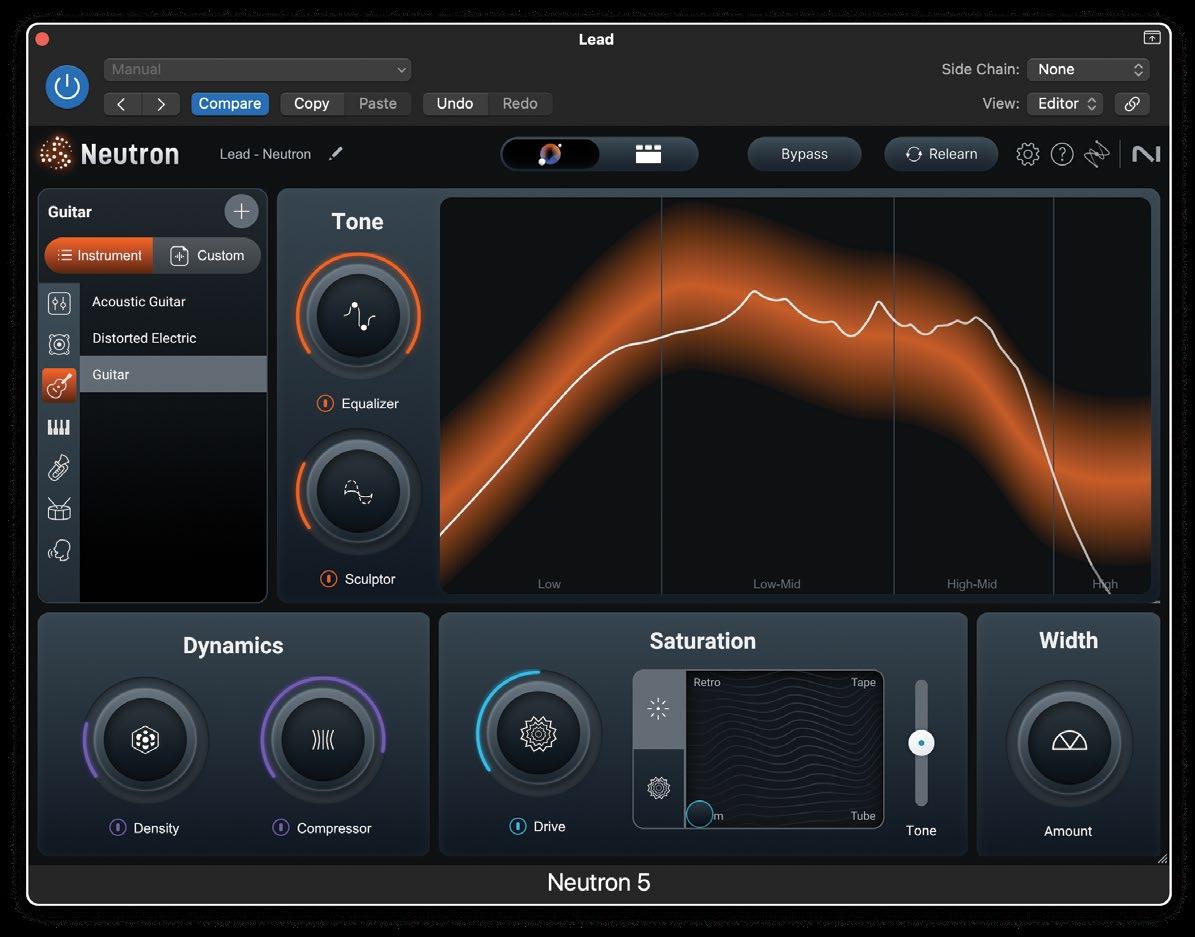
instead of attenuating any signal above a user-selectable threshold, it boosts any signal below a threshold.
Let’s say you have a vocal track where the singer maintained a good level most of the time but wasn’t loud enough in several intermittent spots. You could manually adjust the gain using automation in your DAW to compensate for each occurrence, but it’s faster and easier using Density to bring up those quiet moments so they are closer in level to the rest of the track, which increases intelligibility without having to raise the overall volume.
Like the Compressor module, Density’s Threshold control is a horizontal line that crosses the waveform display. You adjust it by dragging it up or down. Another line, called Gain Trace, indicates gain changes from Density’s processing. (This combination of graphic threshold control and waveform/gain trace displays is common throughout many of Neutron’s modules.)
In addition to the Threshold slider, Density provides three more knobs. Range controls the maximum gain range and can be set between 0 and 20 dB. Ratio controls the amount of boost for signals falling below the threshold. Speed governs how quickly the processor acts on sounds below the Threshold.
The new Clipper module affects dynamics using soft-clipping, which aggressively cuts off the tops of waveforms and makes it possible to increase a track’s average level significantly. It can add some distortion and make a track sound more energetic when applied heavily.
What makes Neutron’s Clipper especially powerful is its multiband capabilities. It supports up to three user-adjustable frequency zones, each with independent settings. In addition to Threshold sliders, each
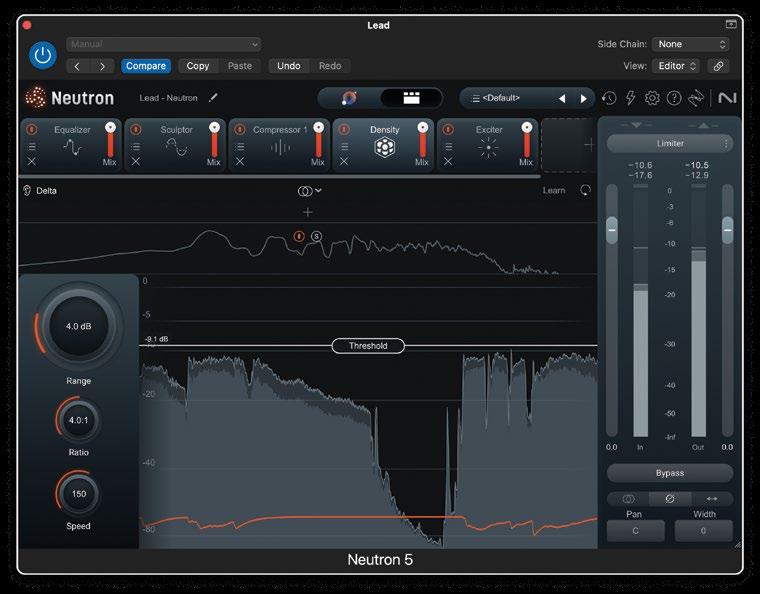
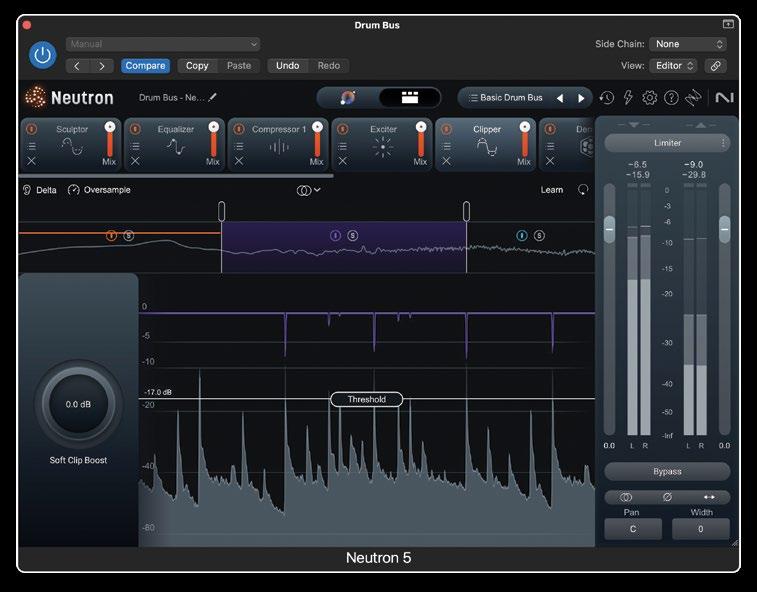
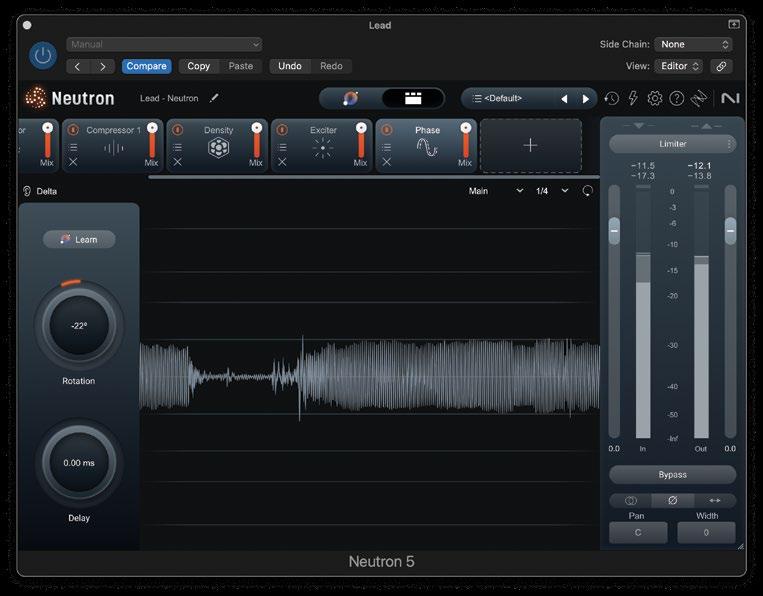
band has a Soft Clip Boost knob, which controls the Clipper’s knee. The higher you set it, the faster the clipping is applied to the waveform and the more squashed the track will sound.
The multiband capability provides great flexibility. For example, if you put Clipper on a drum bus or stereo drum loop, you could set up the frequency zones and thresholds to focus mainly on the kick, leaving the snare sounding less processed, or vice versa.
The final new module, Phase, has two significant functions. First, it can detect and correct (through phase rotation) asymmetrical waveforms—a problem you may not have even realized you had. Such waveforms are sound waves, typically from vocals and certain instruments, that are unbalanced between positive and negative. Their peaks end up higher than their troughs, resulting in a loss of headroom and potentially leading to distortion when you turn up the track.
With the Phase module open and the DAW’s transport playing, hitting the Learn button will automatically adjust the Rotation parameter to reduce asymmetry. It’s easy to do and has no impact on a track’s average level.
The other main parameter in Phase is Delay. It applies a time shift to the track. You can set it manually, but if you want Phase to automatically time-align one track to another, you need to route a feed of the source track into the target track using your DAW’s sidechain feature.
The Phase module features an oscilloscopestyle display with several view options. You can choose to see the signal from the Main track only, the Sidechain track only, the Main and Sidechain together (with the sidechain in a different color) or a single summed waveform of both. The Phase module works as advertised and provides functionality for which you’d generally need a separate alignment plug-in.
Those features are new, but one of the big
“improvements” in Neutron 5 is called Channel Modes. Previously, each processor was limited to one operating mode, either stereo or mono, depending on the plug-in’s instantiation. Now, the Sculptor, Equalizer and Clipper modules offer the choice of three modes: Stereo, Mid-Side and Transient/Sustain. The Density, Transient Shaper and Unmask modules offer Stereo and Mid/Side.
With Mid-Side, you can address the mid and side sections of the signal with entirely different settings. This allows you to be more surgical with processing when needed and gives you additional control over the stereo image (e.g., boosting just the sides of a stereo image will make it sound wider).
Transient/Sustain mode lets you process the two aspects of a signal separately. For example, you could use the Equalizer to brighten and emphasize the attack portion of an acoustic guitar without affecting the body of the tone.
Also new are Delta solo buttons in every module. These buttons allow you to hear the difference between the processed and unprocessed audio, making it easy to grasp what the processing is doing to the source.
Besides revamping Assistant View, iZotope also
COMPANY: iZotope
PRODUCT: Neutron 5
WEBSITE: www.izotope.com
PRICE: $249
PROS: Density module provides upward compression. Phase offers waveform rotation and phase alignment. Clipper provides dynamics control. Module Channel Modes. Mix Assistant. Assistant View streamlined. Delta buttons added throughout.
CONS: Mix Assistant can be heavy-handed with saturation.
improved the Mix Assistant’s performance. I compared the Assistant’s automatic settings in Neutron 4 and Neutron 5 on various track types, including a drum kit, electric piano, vocals, electric bass and a full mix.
On the iZotope website, one article says that the new Mix Assistant is twice as fast as the one in Neutron 4. My (admittedly anecdotal) testing didn’t bear that out. Both versions took about six seconds to create a setting on my M2 Mac mini.
However, I found the results of Neutron 5’s Assistant to be better overall than those of Neutron 4. In the latter, the Mix Assistant sometimes guessed the wrong instrument (for example, guitar instead of bass). My only complaint—valid for Neutron 4 and 5—was that the Mix Assistant frequently added too much saturation for my taste when used on a clean source. However, dialing that back using the controls in Assistant View was easy enough.
Another way to use the Mix Assistant is to upload a custom reference file. For example, I found a clean and warm acoustic guitar recording and uploaded it to the Assistant View. It produced better-sounding results than the acoustic guitar reference built into Neutron.
It is rare for a plug-in to appeal to the full spectrum of users, from novices to experts, but Neutron 5 does just that. For the former, it offers the Mix Assistant and the simple-to-adjust Assistant View controls. It provides a comprehensive suite of mixing processors with extremely deep adjustability and a flexible architecture for the latter. The new features, particularly Density, Phase, Clipper and the Channel Modes, add additional control layers. Considering all you get, it’s an excellent value. If you already own a version of Neutron, the upgrade is well worth it.
iZotope sells Neutron 5 singly and includes it in the Music Production Bundle 7 and The Mix and Master Bundle Advanced. A stripped-down version, Neutron 5 Elements, is also available for significantly less. It offers fewer features and modules but includes the Mix Assistant. ■
By Steve La Cerra
You have to give the folks at Lauten Audio credit for having a sense of humor when it comes to designating model numbers for their products. When the company introduced its snare drum microphone in 2023, rather than assigning it some sort of cryptic model number, they simply called it “Snare Mic.”
Continuing in that tradition, the new tom microphone (introduced last year) is simply called Tom Mic. No question regarding the intended use! The focus of this review will be Tom Mic, but since the folks at Lauten were kind enough to send a Snare Mic, along with two Tom Mics, I’ll have some comments on that one as well. You can also read Barry Rudolph’s full review of Snare Mic in the March 2024 issue of Mix.
Tom Mic was designed for use on rack and floor toms in the studio and onstage, with attention paid to achieving highdefinition sound and a high degree of off-axis rejection (reportedly
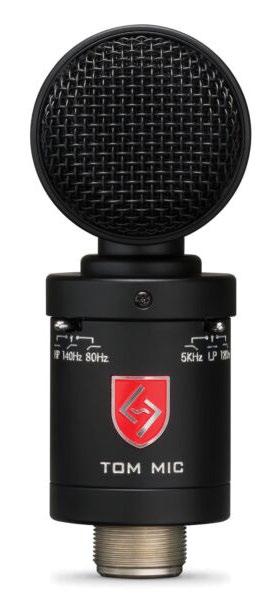
up to 28 dB). It’s a side-address, pressure-gradient FET condenser microphone with a 32mm supercardioid, center-terminated capsule, and requires 48VDC phantom power.
Tom Mic is a hefty little thing, constructed entirely from metal, with a solid brass head frame that should stand up to robust whacks from a drumstick (I thought it’d be too rude to do a smash test). As is the case with all of the company’s products, Tom Mic was designed by Lauten Audio in California. It ships in a cardboard box with an adjustable hard mount and a zippered pouch.
The front of the Tom Mic is indicated by the Lauten Audio badge and two three-position switches: a high-pass filter and a low-pass filter. Switch settings for the HPF are Off, 140 Hz, and 80 Hz; settings for the LPF are Off, 5 kHz and 12 kHz.
The hard mount can be rotated or removed (though there’s no need to do so) by loosening a round thumbscrew that secures it to the bottom of the mic, and the pivot is secured with a large ratchet-style lever that I found easy to grab and tighten from any angle. These features combine to make the Tom Mic easy to place, even in tight quarters. When set in position, the logo and switches are concealed from the audience and face the drummer, which may annoy some engineers.
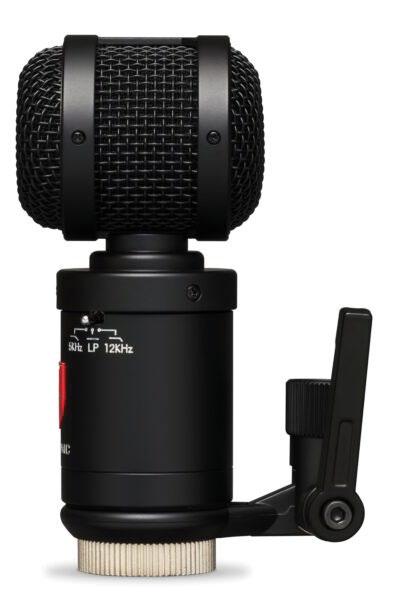
The quick-start guide offers a few suggestions for placement, including body-over-the-rim with the capsule approximately four inches away from and pointing toward the center of the drum head; in a “safe zone” with the mic head peeking over the rim pointing toward the center of the head approximately 2 inches away; and underneath the drum pointing straight up, approximately 3 inches from the bottom head. Most of my recordings were made with the first two placements. I don’t care much for miking toms from the bottom, and Tom Mic reinforced that opinion, yielding less resonance and more midrange honk with a subdued attack. Your mileage may vary.
I used the Tom Mic (and Snare Mic) on several different drum kits with equal success
on stage and in the studio. The first kit was a mid-1990s Pearl BLX with birch shells, which I’ve owned since they were new and have recorded hundreds of times. The following comments apply with the filters set flat; we’ll get to the filters later.
Tom Mic produced a warm round tone with a slight hint of a scooped midrange. Compared to a (Sennheiser) MD421, the Tom Mic is a tad softer in the top without being dull, more rounded in the low end and has less growl in the midrange. In general, the 421 was more forward in the midrange and emphasized the attack a bit more.
Contrary to what I expect from condenser mics on toms, the Tom Mic reminded me more of a dynamic mic, especially in regards to one critical aspect: bleed. While I like using condenser mics on toms, I find that (especially on stage) the sensitivity can be a double-edged sword: You get plenty of detail and fidelity, but along with that comes a ton of leakage from cymbals and whatever else happens to be nearby. Not so with Tom Mic.
I didn’t have a scientific way to verify Lauten Audio’s claim of 28 dB off-axis rejection, but I felt like Tom Mic captured less bleed from cymbals than most condenser mics when placed in a similar position. If meters are any indication, then leakage was easily down more than 20 dB. When I placed Tom Mic on a floor tom in close proximity to a ride cymbal, leakage from the ride was apparent only when the drummer was bashing away at the cymbal; leakage from the hi-hat in the rack tom microphone was non-existent.
Using the Tom Mic’s HPF and LPF switches is where things get really interesting. First, the HPF. Set to the 80Hz position for a 13-inch rack tom, Tom Mic sounded beautiful. The HPF cleaned up some of the proximity effect (which is already well-controlled) and improved clarity without gutting the low end. I felt that the 80 Hz filter was subtle enough to be useful in keeping the boom of a sloppy tom under control, and maybe reducing some kick drum leakage.
The 140 Hz setting for the HPF magnifies this property but can thin the resonance from large toms if needed. The LPF really opens up some possibilities. As you’d expect, switching it to 12 kHz takes the edge off of the top end, but along with that comes an improvement in the rejection of cymbals. While this loss of top end is obvious when you solo the Tom Mics, you won’t miss it when
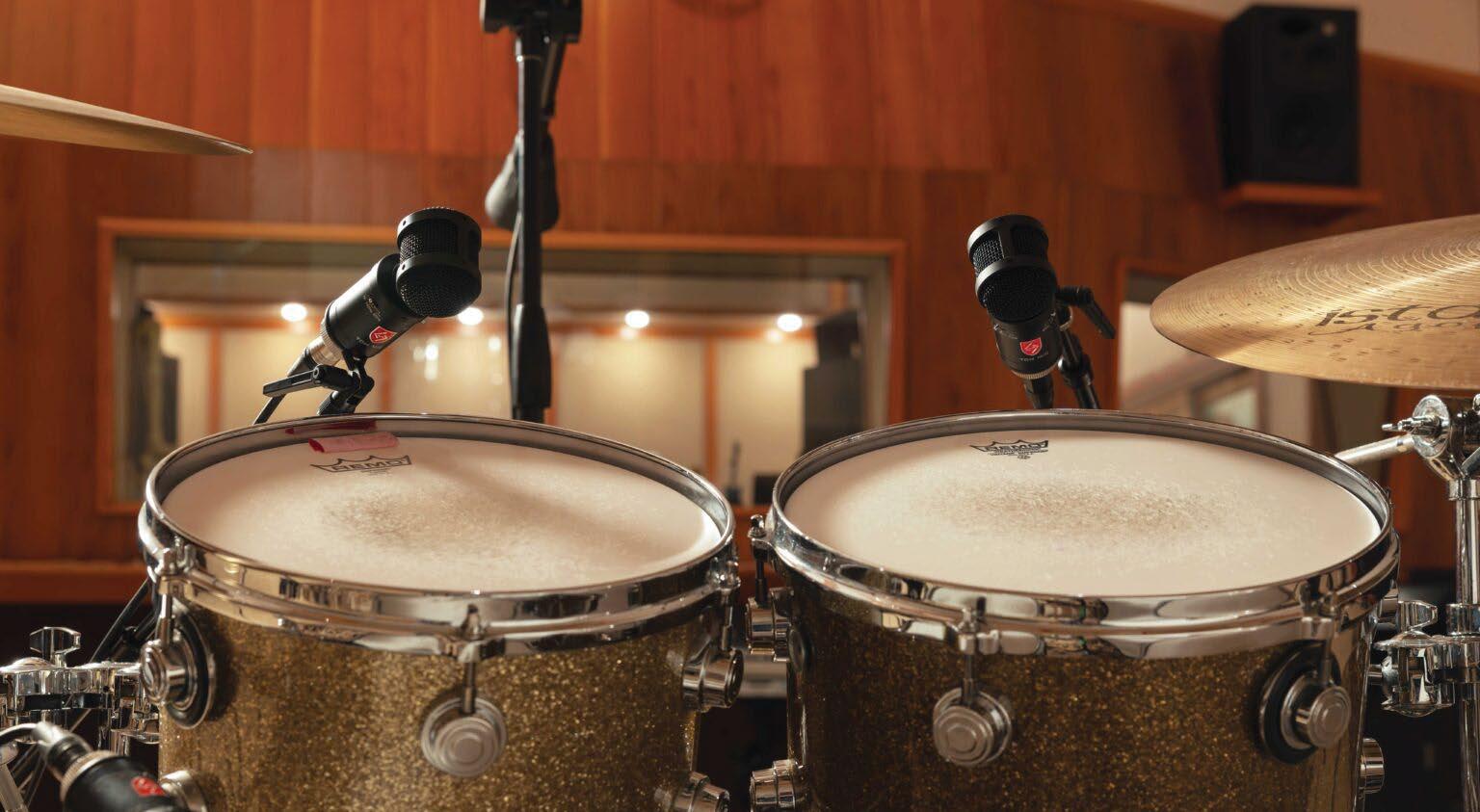
you add the overheads, which will provide plenty of attack and air to complement the fundamental tones captured by the close-up Tom Mics.
Switching the LPF to the 5 kHz setting puts you firmly in “Ringo tea towels on the toms” territory without the hassle of trying to place towels over or under the rims, or messing with EQ. In total, the two switches provide nine different voicings, and kudos to Lauten for making these settings clearly audible and not some subtle wishy-washy gimmick. Changing the switches produced some low-level “tick” noises, but not the pronounced “pops” that some condenser mics emit when a rolloff switch is engaged.
It’s worth noting that although Tom Mic does not feature a pad switch, the output level is more in line with that of a dynamic microphone and shouldn’t present a problem for most mic preamps.
I also had the opportunity to try Snare Mic, a FET condenser model with a 32mm cardioid capsule, requiring 48VDC phantom power. Construction of Snare Mic is similar to that of Tom Mic, but Snare Mic is a traditional end-address package. Lauten Audio suggests placing Snare Mic in a somewhat unorthodox position whereby the mic looks over the rim, but is parallel to the top head—as opposed to the traditional “point it at the center of the drumhead” position. Indeed, this placement somehow seems to capture more of the bottom head and opens up the top end while providing plenty of meat (low-mids). I’d be happy using this in lieu of adding a microphone for the snare bottom.
The quick-start guide for Snare Mic shows a switch “preset” called Bleed Decimator, with the HPF set to 140 Hz and the LPF set to 5 kHz. If you solo the Snare Mic while using these settings, it sounds kind of dull, but add in the overheads and you’ll never know the difference—except for the fact that leakage is significantly reduced.
I really enjoyed my time using Tom Mic and Snare Mic. I found them both to be versatile and capable of producing professional results with minimal fussing. The filter options are truly useful, and hearing the results of using the LPF to reduce bleed while allowing the overheads to supply the top end for snare and toms was a bit of an ear-opener.
Construction is first-rate, and the mic bodies are compact enough to stay out of the way. Rather than try to imitate a sound that’s already been done, both mics offer a unique voice with plenty of options for fine-tuning timbre in different applications. They’re a bit more expensive than some of the usual suspects available for snare and tom, but well worth the price difference. I recommend you check out Tom Mic and Snare Mic. You won’t be disappointed! ■
COMPANY: Lauten Audio
PRODUCT: Tom Mic
WEBSITE: www.lautenaudio.com
PRICE: $398
PROS: Excellent rejection of off-axis sound, versatile sonic options, solid construction.
CONS: No pad switch.
By Barry Rudolph
FabFilter, based out of Amsterdam, the Netherlands, has released its latest version of the popular Pro-Q plug-in equalizer. Pro-Q 4 has several new features that add to the noteworthy transparent processing of its predecessor, Pro-Q 3, which was released in 2018. These upgrades necessitated a complete redesign to make it the company’s ultimate, mastering-grade mixing/tracking equalizer.
Users of Pro-Q 3 will know that there are up to 24 bands of EQ with selectable filter types and 6 dB to 96 dB/octave slopes including a steep, “brick wall” slope for the high and low-cut sections. For the most precision mastering processing, you may choose fractional slope settings such as 3.3 dB/octave for the LP or HP filter.
An All-Pass filter has been added for correcting phase anomalies, and you can copy-and-paste EQ settings between two or more instances and directly enter settings in the EQ window. Any individual EQ instance can be set to Zero Latency, Natural Phase or the newly improved Linear Phase EQ (with its attendant latency). There is support for Dolby Atmos 9.1.6, surround channel linking, and per-band, Stereo, Left, Right, Mid or Side modes.
Pro-Q 4 will co-exist with all previous versions of Pro-Q you may have, and FabFilter has re-created and ported its stock Q3 presets over to Q4 versions. The company says Pro-Q 4 will read all previous versions’ presets as long as you use their preset structure and not your DAW’s.
Available for Mac and Windows, Pro-Q 4 comes in VST, VST3, AU, AAX Native, AudioSuite and Clap formats. For Mac, it’s OS 10.13 or higher for 64-bit, while PCs require Windows 11, 10, 8, 7 or Vista and a VST 2 or 3 host.
A significant change is Spectral Dynamics, which builds on Pro-Q 3’s dynamic EQ; it’s available on any EQ band within an instance. Spectral Dynamic EQ will apply threshold-based expansion or compression on a specific EQ band without affecting the rest of the audio running through the plug-in. Essentially, you’re “tuning in” a section of sound on a track you’d like to manipulate—such as dynamically compressing down peaky resonances or expanding upward only the high frequencies of a dark-sounding instrument. This is a wholly new approach and technique for equalization. Updates here also include: adjustable attack and release times with the given default values a good starting point, and now there is side-chain access. Mousing over a control always reveals a helpful “pop-up” window to explain what that particular control does. Love it!
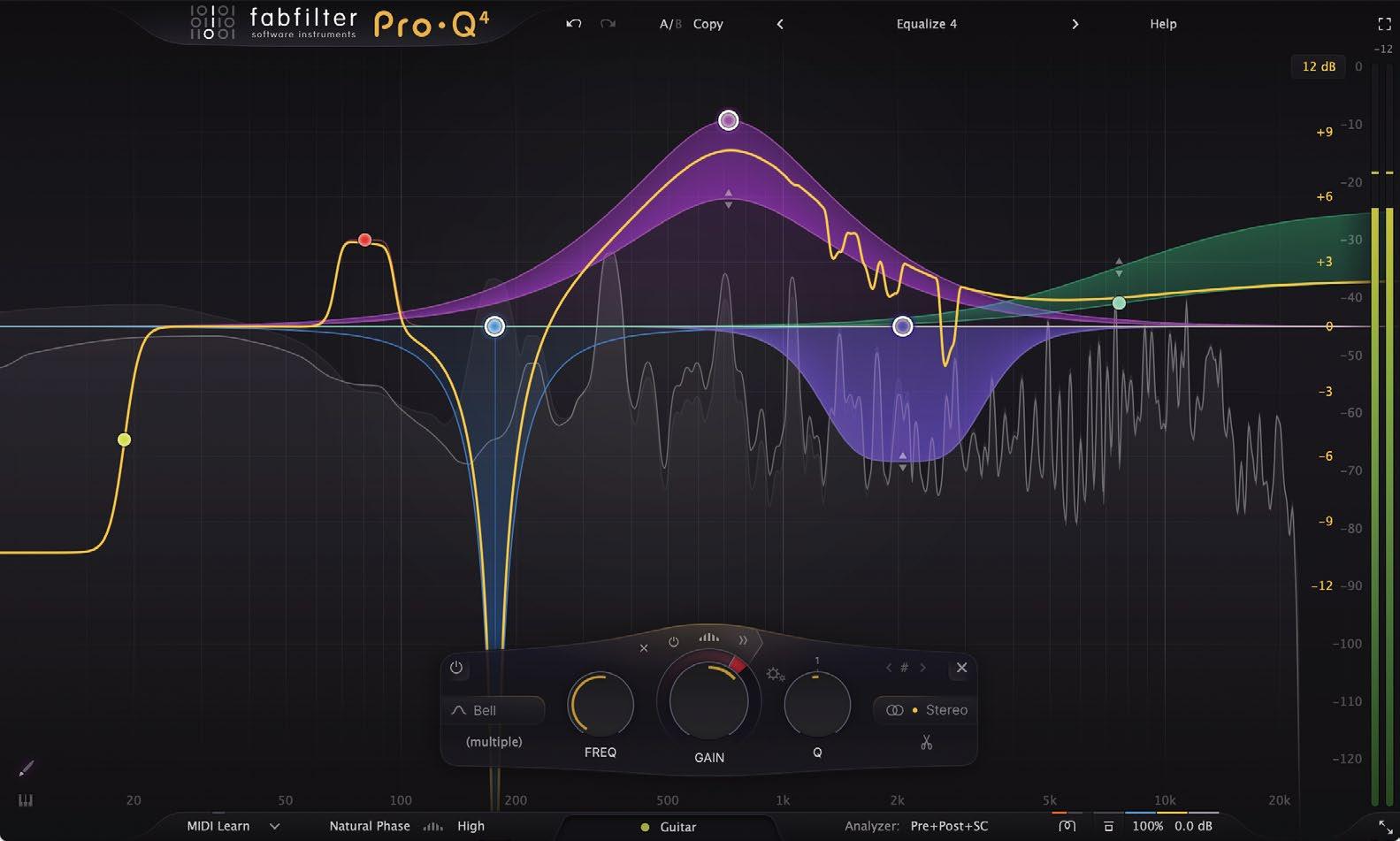
Clicking on the track name at the bottom of the GUI launches the Instance List over the main window. Instance List is a brilliant and modern idea when mixing music—especially on large sessions with numerous tracks. It harkens back to the days of mixing on an analog console where all the equalizers were visible in the channel strips
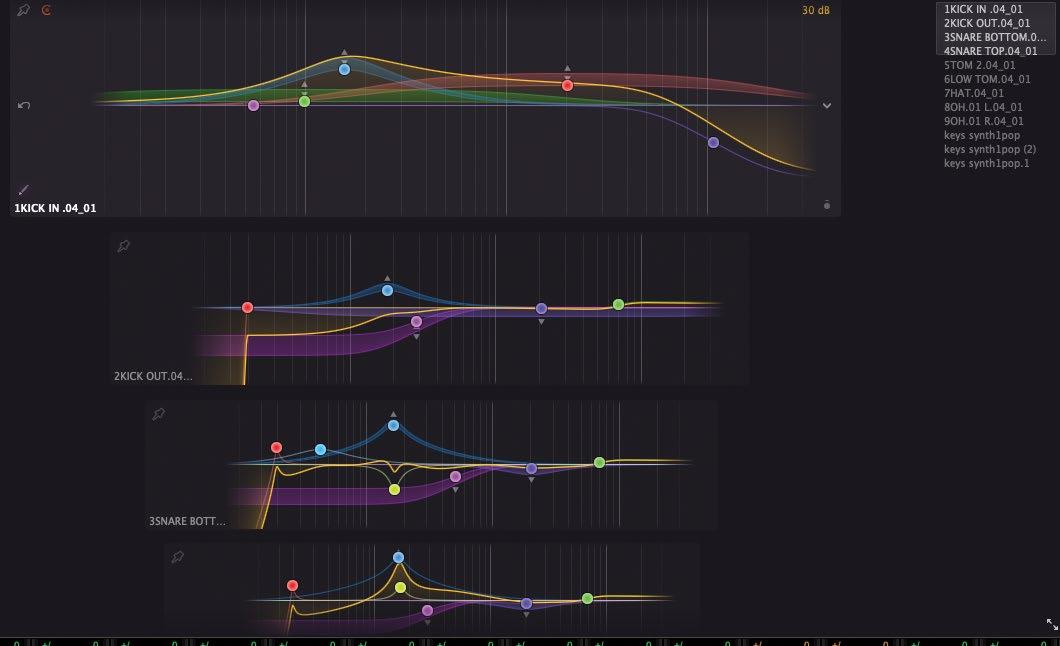
in front of you. You can see all the EQ curves you’ve set up and cycle through them to dial in any individual EQ while the mix is playing.
The resizable GUI shows all the individual Pro-Q 4 plug-in instances running at the same time and in one window. You’ll see the spectrum displays and nodes, along with the same editing facilities, only in an expandable, smaller view. The right-hand sidebar shows groups of Pro-Q 4 plug-ins, ready to click on and move to the center of the window for close scrutiny.
Instances come up in a scrollable stack arranged alphabetically, not sequentially. Currently, only VST 3 supports Track Color and Order. In my Pro Tools sessions, I got into the habit of adding a number in front of the track name to order them sequentially. If your drum tracks start at channel 1, you can scroll down to see all the drum channel EQs. Pro Tools has said it will implement Track Order in the next update, with Apple following soon after for Logic Pro.
Using one instance for evaluation, such as the lead vocal, you can see “collisions” depicted in a red haze surrounding a node and band. A collision is a buildup of the same frequencies produced by multiple instances. I found this an excellent tool for mixing midrange tracks—guitars, keyboards, and backing vocals—that often fight with other tracks in the same frequency range.
FabFilter has put a lot of thought into designing this awesome new feature. It’s important for users to learn how to navigate, resize and copy one set of curves from one instance to another. An Auto-Zoom slider enlarges all instances for focusing when modifying them using a complete set of editing controls. You can “Pin” a track or
tracks, such as a big collection of backing vocals, for adjustment, and then “Unpin” them back to normal operation. “Jump To” is like a search engine to find a particular instance, or you can always click on an instance in the sidebar list. I liked how all this works because it is a big time saver in assembling a rough mix on large sessions. I’ve been adapting my Pro Tools workflow to be more efficient using the Instance List. Post-production mixers are going to wonder how they ever got along without this!
EQ Sketch is another new feature, one that enables drawing EQ curves. When first inserting a Pro-Q 4 instance on a track, you’ll see a faint “ghost curve” that changes filter shape as you move the cursor across the center baseline. Starting at 15 Hz, you’ll see a low-cut filter shape. Continuing to move the cursor to the right changes it to a low shelving filter up to 40 Hz; moving through the midrange and higher, it becomes a bell-shaped filter all the way up to 10 kHz, where it becomes a high-cut filter. If you click anywhere, a node is generated, with the curve shape corresponding to the precise location of the node. You can then drag this node
COMPANY: FabFilter
PRODUCT: Pro-Q 4
WEBSITE: www.fabfilter.com
PRICE: $179 USD MSRP
PROS: A modern, top-quality equalizer
CONS: Requires a little bit of time educating yourself to use most effectively
up and down at will to build an EQ profile. A small window pops up over any node and shows controls for +/- gain, Q, bypass, frequency, and a choice of 10 different filter shapes, including All-Pass. There is a larger window at the bottom of the GUI that stays visible whenever a band is selected; it has controls for spectral processing, time constants and a lot more. Again, I look at the pop-up for details, functionality and ideas.
EQ Sketching speeds the application of an EQ and also works in the Instance List window. Once this rough curve is created, you can start refining its exact frequency, shape, Q and +/gain. I would add more nodes as needed, and I liked to find “nuggets” in the instrument’s sound energy this way. I like this feature, but wish the ghost curves were a little brighter, bigger and easier to see.
Pro-Q 4 also adds two Character modes to Pro Q’s clean and transparent sound. Two modeled distortion characteristics are available: Subtle is vintage saturation, while Warm is a more saturated, tube-like distortion. Both Character modes are level- and frequency-dependent colors, just like real analog EQs and tube/transformers. In my testing on a direct bass guitar track, I found these two Characters very subtle, determining they will work better when using them across all instances. Character Mode can be included as your own default, custom preset for use on every track.
My first check was to test the Instance List feature by instantiating 77 stereo Pro-Q 4 equalizers across all tracks of a developing mix. I use a Mac Studio with a M2 Ultra, Sequoia 15.2, and Pro Tools Ultimate version 2024.10.1 and had no problem at all launching this big session. It all worked flawlessly.
I liked the resizable GUI windows to help me see deep into the spectrum analyzer window. Sometimes I had issues with setting a node that I didn’t want, but that’s clumsy me. I used the Extra-Large window (100% size) for scrolling all the instances in the mix. Instances seem to be easier to delete or modify in Instance view.
FabFilter Pro-Q 4 is now in my mix template and there is no other EQ that comes close in utility. Its dynamics and spectral functions, along with the Instance List, accomplish the work of multiple processors in an efficient and intuitive way. Highly recommended. ■
By Rob Tavaglione
Wildly creative, unusual and unique vocal manipulations
You’ve likely noticed the incredible long-term popularity of that playfully warbling, synthy, robotic effect on vocals—AutoTune. It all started with the Antares effect on Cher’s voice back in 1998 and continues unabated to this day, especially in rap and pop productions.
Now Pasadena plugin gurus Baby Audio have entered the ring with Humanoid, a “vocal transformer and hard tuner” processor that enables all manners of unusual vocal manipulation, with only minimal effort required.
The choices begin with the Pitch section, including hard tuning, scale selection, quantizing, Robotifying and formant control. Think of a formant as the defining frequency resonance characteristics of the physical structure doing the vibrating—in this case, the vocal tract—that is
independent of pitch. Shifting the formant makes it sound like a different person is singing, even as the note/pitch stays the same.
The Synthesize section allows adding another sound to the vocal, with waveform selection (saw, sine, square, etc.), shape manipulation, stretching, note (pitch) shifting, a Transform control and adding octaves (a personal fave). Imagine a synth playing along in unison with your vocal; it’s not unlike using audio-to-MIDI functions to blur the lines between voice and instrument.
Surely you can sense the need for a Filter section to narrow and focus such explorations. The low-pass and high-pass filters are continuously variable, each with a resonance control (a resonant filter shape introduces a slight boost just before the cut, which is quite pleasant-sounding). There’s also a single band of boost EQ found here, encouraging the notoriously popular technique of excessive high-Q mids-boosting that makes such vocal craziness all the more outlandish and fun.
COMPANY: Baby Audio
PRODUCT: Humanoid
WEBSITE: www.babyaud.io
PRICE: $129
PROS: Excellent-sounding vocoding, hard vocal tuning, formant shifting and synthesizing
A Utility section allows basic taming controls: narrowing the frequency range employed, De-essing, Gating and Smoothing (too much is too cool). Similarly, the Effects section allows Width control (wish it went a little wider), Warble control, and a Freeze control with variable buffer (tricky to employ, but so powerful). Finally, global Sharpen and Output (level) controls round out the large number of options.
CONS: Too many useful and interesting choices for quick selections
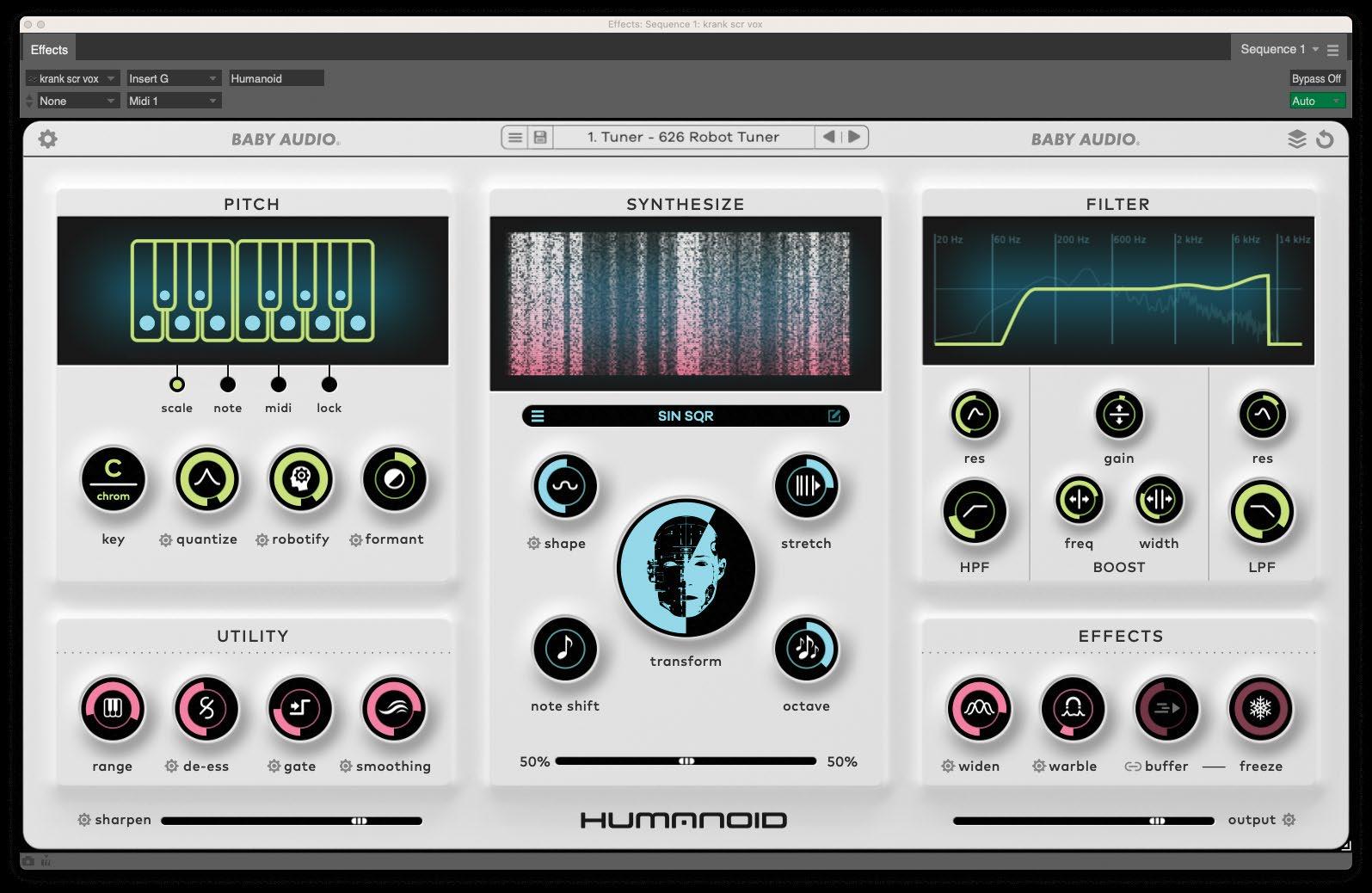
By now you’re likely feeling a tad overwhelmed with so many choices and so much fertile ground to cover. Thankfully, there are nearly 200 presets organized into categories (Tuners, Vocoders, Harmony, Synth, Dryish and Instrument) that readily fuel ideas and provide a great starting point for you to tweak more specifically.
And that is the only “problem” with Humanoid— the tones are so good, the effects so modern and stylistically relevant, the cool factor so far offthe-charts, that actually using Humanoid creates down-the-rabbit-hole situations. Don’t think you can quickly select and then move on; you will linger, you will experiment and your mind will wander as beautifully bizarre and wonderfully weird patches will captivate you for longer than you anticipated.
If you’re a mix engineer who works in trap, hyper-pop, indie, techno or any post-modern genre that is embracing “vocal as an instrument/effect,” then you must try out Humanoid. Never before has such radical and complex transformation been so easy to achieve and customize. Just watch out for those rabbit-holes, and be prepared to dial-in strange sounds you’ve never used before while your client just sits there overwhelmed but smiling. ■
By Mike Levine
Automatic settings are effective, require minimal tweaking
Sonible’s newest release is designed to clean up and enhance vocal recordings. Unlike the company’s previous software products, which are real-time plug-ins, prime:vocal is a standalone application and an ARA plug-in. As of this writing, the ARA component is still in beta, but is available directly through the prime:vocal installer.
On its website, Sonible promises, “prime:vocal lets you achieve world-class, studio-quality vocals, regardless of your recording environment.” That may be overstating it a bit, but prime:vocal is undoubtedly a powerful tool for quickly and efficiently improving the quality of vocal recordings.
The application and the ARA component are functionally similar, except the former has an export feature. With either, the first step is for prime:vocal to analyze the vocal track. The process takes roughly as long as the track’s duration.
When the analysis is finished, prime:vocal creates a suggested setting using its five processors. These include Noise Reduction for background noise and bleed, Room Reduction to lessen the effect of room acoustics, Vocal Clean-Up for sibilance and plosives, Spectral Balance for tonal consistency, and Dynamics for gain riding and compression.
Each processor has a large knob controlling its amount. The Noise Reduction, Room Reduction and Vocal Clean-up knobs are color-coded green, pink and orange, respectively. After the analysis, you see the noise components overlaid on the original waveform display, in the color corresponding to their knob.
Each processor also has a Fine-Tuning section with additional controls. For example, Noise Reduction and Room Reduction have a multiband feature called Frequency Weighting, which emphasizes or reduces the processing in low-, mediumand high-frequency zones. Spectral Balance lets you choose vocal type and balancing style, and Dynamics offers various intensity levels.
Prime:vocal has its own automation, allowing you to change the amount of any processor over time. The automation lines, which appear below the main display, have color codes corresponding to the processors. One odd design choice: the Spectral Balance and Dynamics knobs are both gray and are indistinguishable in the automation area.
The standalone and ARA versions of
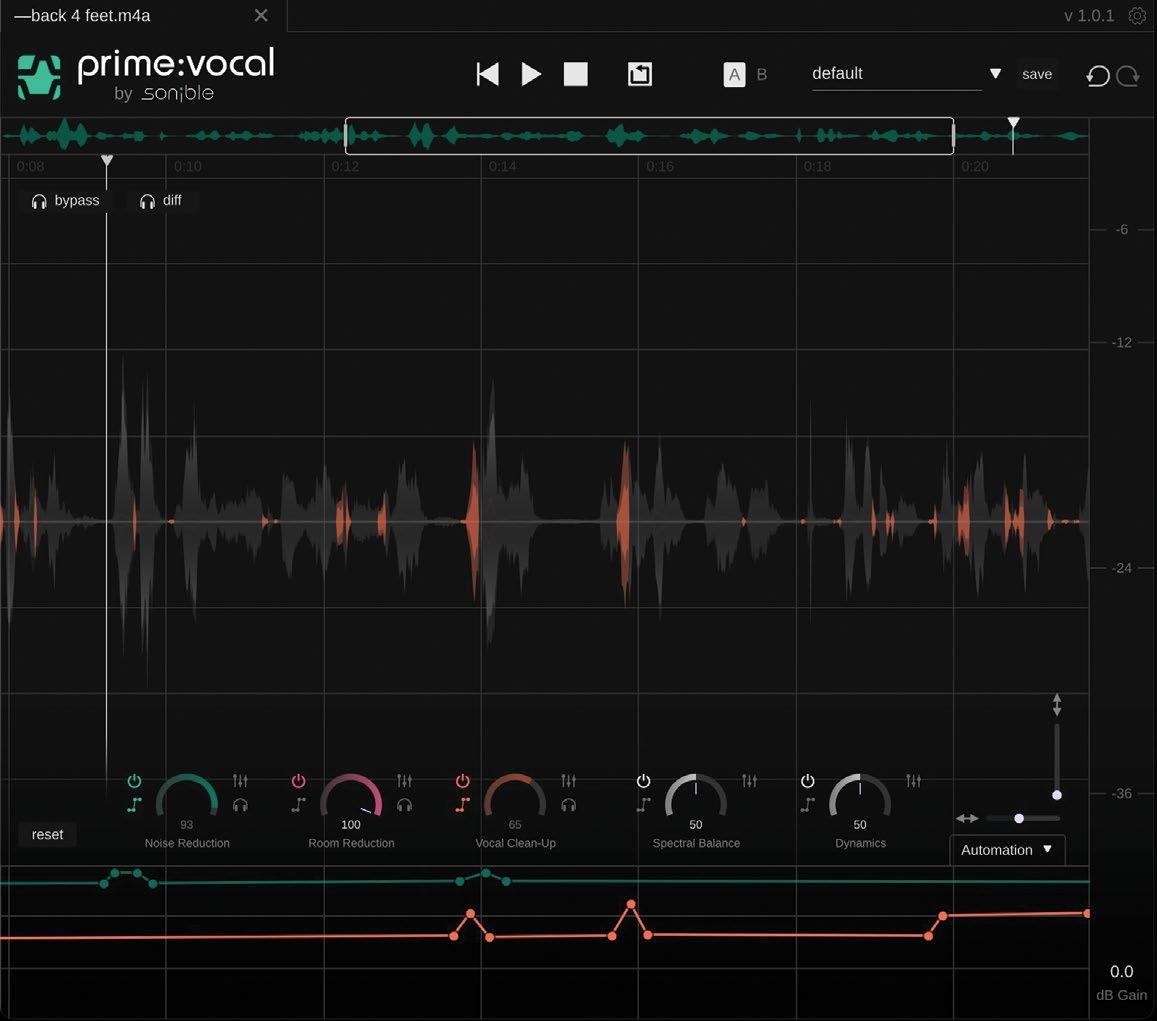
prime:vocal feature transport controls and allow you to set loops freely. You can zoom horizontally and vertically and navigate using the zoomedout Track Overview Bar at the top of the screen. Global Bypass and Diff (Delta) buttons make before/after comparisons easy. An Export page supports renaming, selecting a sample rate, bit depth and bit rate, and normalizing to specific LUFS levels.
I used prime:vocal on vocal recordings of varying quality, both sung and spoken. Some were recorded with studio mics and others with the mic on my iPhone. Some were close-miked; in others, the mic was several feet back.
Prime:vocal improved them all. Not surprisingly, the lower the source quality, the more noticeable the improvement. The automatic settings were effective and typically required minimal tweaking. This was particularly true for the Noise and Room Reduction processes.
Using the Diff button, I could hear how much room tone and resonance those processors removed. Even on clean, studio-recorded tracks, prime:vocal typically found and reduced some resonance, subtly improving the sound.
COMPANY: Sonible
PRODUCT: prime:vocal
The Vocal Clean-Up processor worked well, but I often had to turn it higher than the automatic setting to lessen plosives and sibilance sufficiently. The automatic Spectral Balance and Dynamics settings were generally quite usable.
WEBSITE: www.sonible.com
PRICE: $179
PROS: Excellent at removing noise, room tone and resonance. Dynamics offers compression and gain riding. Built-in automation. Comprehensive export features in standalone app.
CONS: Product released with ARA plug-in still in beta. Spectral Balance and Dynamics share a color code.
Prime:vocal is another example of Sonible’s expertise in creating practical, AI-based audio production software. Not only does it improve sung vocals recorded in untreated spaces, it will also benefit producers of podcasts, videos and other spoken-word content where substandard audio quality is often unavoidable.
Once Sonible officially releases the ARA version—hopefully supporting most or all ARAcompliant DAWs—prime:vocal should have an even broader appeal. The standalone app works great, but the need to import and export audio from it may make it impractical for certain workflows. ■
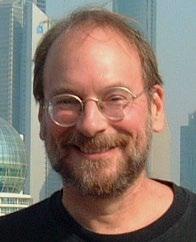
By Craig Anderton
There’s an uneasy feeling that something is not quite right with today’s music—and it goes beyond the boilerplate “kids, get off my lawn” you expect from older generations. Why does a younger demographic believe that vinyl sounds better? Why did the 23-year-old server at a local restaurant tell me she preferred 1960s and ’70s music? Why do kids barely into their teens wear AC/DC and Pink Floyd t-shirts?
Today’s listeners have access to most of the music catalog at their fingertips and they stream music nonstop. But often, it’s background music. Ask anyone about the last time they actually just listened to music, at the exclusion of other activities. Expect a long pause as they try to remember. Something’s wrong. And I think I know what part of it is.
With the advent of digital audio, sound quality started to be confused with musical quality. We can make recordings that sound absolutely stunning, but are musically bland. The music may not have started out that way, but in the wrong hands, technology intended to improve sound quality can strip the emotional impact inherent in music’s crucial expressive elements: timing, dynamics, pitch and tension/release.
The fundamental flaw in pitch correction is relating pitch solely to a technical model—the irrational number-based intervals of an eventempered scale—rather than a musical model. Singers often glide to notes based on just intonation, even with a band playing even-tempered instruments. Yet it doesn’t sound out of tune. Instead, the subtle pitch differences enrich the sound—like what happens when instruments have doubled strings, or use chorusing effects. String ensembles and barbershop quartets instinctively see pitch not as a technical issue to be conquered, but an emotional concept to be understood.
Bob Dylan emphasized notes by singing sharp. Madonna left in a clearly out-oftune slide at the end of “Ray of Light,” which made the song just that much more compelling. When Judy Garland sang “somewhere over the rainbow,” the pitch of “somewhere” followed the upward visual arc of a rainbow, while “over” slid down the other side of the rainbow’s arc.
The fundamental flaw in pitch correction is relating pitch solely to a technical model—the irrational numberbased intervals of an even-tempered scale—rather than a musical model.
Consider pitch correction. Most people who don’t like it cite the unnatural sound, or feel it’s “cheating.” But I think a bigger problem might be that the human voice is not a fretted or keyboard instrument.
A great vocalist will slide around notes and play with pitch. I recently analyzed a vocal line that I thought sounded excellent. It started with a series of five notes, going from a low note based on the tonic, to a high note. The low and high notes were right on pitch. But the three in-between notes were not only “incorrectly” tuned, they were off-pitch in what seemed like a deliberate (albeit probably subconscious) way.
The first of the three notes was considerably flat. The second of the three was a little less flat, and the third note was very slightly flat. This seemed like a classic example of building tension for tension-and-release. The flat notes caused tension, and release happened after coming ever-closer to, then ultimately hitting, the perfect high note. Processing the vocalist’s pitch would have corrected the tuning, but strip-mined the emotion behind the pitch
Our ears pay attention to pitch. When you’re not sure about something and say, “Uh-oh,” your voice drops in pitch compared to your normal speaking voice. But when you say, “Look out,” the pitch rises. It also rises when you ask a question, but falls to indicate the end of a thought. In tonal languages, like Mandarin, Vietnamese, Cherokee, Zulu and others, the same word can have multiple meanings depending on its pitch variations.
When Robert Plant sang “way down inside” on “Whole Lotta Love,” he used pitch to bring “way” up for emphasis, only to slide down with “inside.” His use of pitch was mathematically incorrect—but, musically speaking, it was perfect pitch.
We’re at the column plot point where it’s time to offer some proposed solutions, so here we go:
• Correct only notes that sound wrong. It doesn’t matter whether they look right or wrong.
• Don’t let engineers decide when to use pitch correction (no offense, y’all). Have the singer listen to the track. If the singer hears something wrong, then the engineer fixes it.
• Alter pitch in context with the rest of the music. Variable-level dim solo, not standard solo, is your friend.
• Always turn off snap/quantize-to-scale with any pitch correction software. Instead, if a note sounds “wrong,” grab the note while monitoring its pitch, and move it until it sounds right. Don’t be distracted by any tuning calibrations. They’re not listening to the music.
• Use pitch un-correction. As with the example of the three notes that ended on a note with perfect pitch, you can introduce tension-and-release elements by altering pitch strategically to make emotional statements. Go a little sharp on the last held note before the big chorus to add friction. Go slightly flat with a note that’s just before the end of a phrase, and end on a perfectly tuned note. Also, harmonies complement a lead vocal well with judicious use of slightly flat or sharp notes.
Yes, it’s fashionable to complain about pitch correction. And, granted, I’m complaining about correction of pitch. But I’ll never complain about freedom of pitch. To me, that’s where pitch-altering tools excel—they give the opportunity to enhance a song’s emotional impact, not strip-mine it. ■