UNITING THE SCOTCH COMMUNITY
Growing through challenge, guided with purpose Edition 142 | October 2026
Hardship is not a dirty word
Year 4: An intentional start to the Scotch journey
04
10
Clan is a periodic news pictorial for the Scotch College community. Clan © Scotch College 2026 Editor: Jordan Reincastle Design: PaperScout
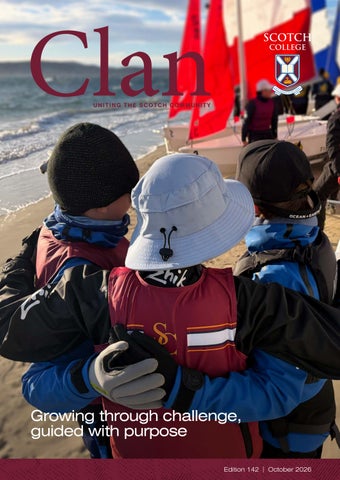
On the cover: Liam Rossiter, George Croot and Angus MacKinnon arm in arm at the 2026 Australian Secondary Schools Teams Racing Championship in Tasmania
14
Making literacy everyone’s business
16
Growing future leaders in agribusiness
24
What support looks like in the senior years
18
In this issue
26
The greatest service I have experienced
Sport
50
Investing in opportunity: Three new scholarships for 2027
Headmaster
4
Service
24
Council
6
Sport
26
Foundation
7
The Arts
30
Chaplain
8
Community
34
Captain of School
9
Old Scotch Collegians
38
Teaching and Learning
10
Philanthropy
48
School Captains
22
Archives
49
What’s happening at Scotch? Stay up to date with everything happening at Scotch through the Calendar.
Headmaster
Hardship
Ego is not a dirty word
Dr Alec O’Connell Headmaster
In 1975, a Skyhooks album challenged a cultural assumption with the provocative refrain, “Ego Is Not a Dirty Word.” Their argument was simple: something viewed negatively may, in fact, be essential to human flourishing. Perhaps schools today need a similar conversation. In an age increasingly focused on comfort, protection and risk minimisation, it may be time to declare that hardship is not a dirty word. While protection and entitlement can undermine growth and self-development. Over the past two decades, the concept of wellbeing has spawned countless programmes, consultants, apps and commercial solutions. At times, wellbeing has become a catch-all explanation for less-than-perfect outcomes or at worst, justification not to challenge a person. Wellbeing should not be understood to mean everything has to be perfect. Genuine wellbeing involves the capacity to navigate challenge. Overprotection can reduce readiness for real-world adversity, while hardship can lead to the development of resilience, identity, independence, empathy and perspective.
Recognising the value of hardship is not an argument for a lack of care or empathy. Rather, it acknowledges that hardship, failure, disappointment, frustration and struggle are among life’s most important teachers. The evidence from developmental psychology, educational research and resilience studies is remarkably consistent. Young people do not become capable adults by avoiding adversity. They become capable adults by learning how to navigate it.
The butterfly and the chrysalis There is a fable of a person who noticed a butterfly struggling to emerge from its chrysalis. Wanting to help, they carefully cut open the cocoon. The butterfly emerged easily, but it never flew. Nature’s intended struggle was precisely what forced fluid into its wings and enabled flight. What appears to be an obstacle is often a developmental necessity.
wisdom and judgement, are forged not through uninterrupted success but through repeated encounters with difficulty. No student develops resilience by reading about resilience. Just as muscles develop through resistance, character develops through challenge.
The problem with snowplough, lawnmower and helicopter parenting Modern parenting has produced a growing collection of metaphors. Helicopter parents hover overhead, monitoring every challenge. Lawnmower parents cut down every obstacle before their child encounters it. Snowplough parents clear the road entirely. These behaviours are usually motivated by love and good intentions. However, the outcomes may not be beneficial.
Research by developmental psychologist Masten, A. S. (2001) describes resilience as “ordinary magic”, a capacity developed through successfully navigating challenge and adversity. Students build resilience by experiencing manageable setbacks and discovering they can overcome them.
Research increasingly associates excessive parental intervention with reduced autonomy, lower self-efficacy, poorer emotional adjustment, increased anxiety and diminished motivation. Students given fewer opportunities to solve problems independently often reach adolescence and adulthood less prepared for life’s inevitably challenges. (McCoy, S.S. et al. 2025)
A child who never fails a test, loses a match, misses a leadership position, receives difficult feedback or experiences social disappointment may be protected from discomfort in the short term. Yet they are also deprived of opportunities to develop perseverance, emotional regulation, adaptability and self-efficacy.
A recent study concluded that helicopter parenting can hinder the development of independence and autonomy during developmental periods when these capacities should be strengthening. (Kocsis, Z et al. 2025). In attempting to eliminate short-term distress, we may unintentionally increase long-term vulnerability. For example:
Failure is a better teacher than success
• A scraped knee teaches caution.
Success is encouraging, but failure is educational. Carol Dweck’s (2006) research on growth mindset demonstrates that students who view ability as something developed through effort are more likely to persevere after setbacks. Failure becomes information rather than identity. Research showing resilience and persistence grow when students learn to interpret disappointment as part of the learning process rather than evidence of inadequacy. (King, R.B. et al. 2026) Many of the qualities we most admire in adults: grit, courage, humility, empathy,
• A disappointing grade teaches preparation. • A lost election teaches humility. • A failed audition teaches perseverance. • A friendship conflict teaches empathy. • A difficult expedition teaches courage. A parent’s role is not to clear every obstacle from their son’s path. Their role is to walk beside him long enough for him to learn to navigate challenging pathways himself. To raise sons who can cope, recover, and understand that hardship is not a dirty word, but is often life’s most important teacher. The measure of successful parenting is how capable they become when disappointment inevitably arrives.
A parent’s role is not to clear every obstacle from their son’s path. Their role is to walk beside him long enough for him to learn to navigate challenging pathways himself.
Preparation, not protection
My final word
References
If your son feels uncomfortable, disappointed, frustrated, embarrassed or nervous, it may be exactly the developmental moment he needs.
Many contemporary discussions about wellbeing risk confusing wellbeing with comfort. Genuine wellbeing is better understood as capability: the ability to manage stress, adapt to uncertainty, recover from setbacks and continue moving forward.
Azikiwe, I. J. (2025). The influence of growth mindset on students’ resilience and coping strategies in academic failure. Cai, Z., & Meng, Q. (2025). Academic resilience and academic performance of university students: The mediating role of teacher support. Frontiers in Psychology, 16. https://doi.org/10.3389/ fpsyg.2025.1463643 [frontiersin.org] support. Front. Psychol. 16:1463643. doi: 10.3389/ fpsyg.2025.1463643 Dweck, C. S. (2006). Mindset: The new psychology of success. Random House. King, R. B., Li, J., & Wang, Y. (2026). Both individual and peer growth mindsets matter for academic resilience. NPJ Science of Learning, 11, Article 17. https://doi.org/10.1038/s41539-02600403-z Kocsis, Z., Kas, D., & Pusztai, G. (2025). Wings or handcuffs? The dilemmas of helicopter parenting based on a systematic literature review. Social Sciences, 14(10), 621. https://doi.org/10.3390/ socsci14100621 Masten, A. S. (2001). Ordinary magic: Resilience processes in development. American Psychologist, 56(3), 227–238. https://doi.org/10.1037/0003-066X.56.3.227 McCoy, S. S., Dimler, L. M., & Rodrigues, L. (2025). Parenting in overdrive: A meta-analysis of helicopter parenting across multiple indices of emerging adult functioning. Journal of Adult Development, 32, 222–245. https://doi.org/10.1007/ s10804-024-09496-5 Miller, R. W., Rainbolt, C. L., & Tallents, S. (2024). Hovering Is Not Helping: Relationships among Helicopter Parenting, Attachment, Academic Outcomes, and Mental Health in College Students. Youth, 4(1), 260-271. https://doi.org/10.3390/ youth4010018 Vigdal, J. S., & Brønnick, K. K. (2022). A systematic review of helicopter parenting and its relationship with anxiety and depression. Frontiers in Psychology, 13, Article 872981. https://doi. org/10.3389/fpsyg.2022.872981
Too often, we confuse “Is my son in danger, or is he simply uncomfortable?”. If he is in danger, adults should intervene. Yet research shows that resilience, confidence, independence and grit are built not by removing every obstacle but by helping young people navigate them successfully (Miller, R. Wet et al. 2024). Parents and schools should work together to help young people develop the skills required to navigate obstacles themselves. We must protect them from harm, not from growth. Because confidence is built by overcoming hardship, not avoiding it. When we remove hardship, we remove many of life’s most powerful classrooms. Schools must prepare, not protect. Consider our mantra at Scotch, ‘Preparing Boys for Life’. As John A. Shedd famously observed, “A ship in harbor is safe, but that’s not what ships are built for”. Schools do not exist simply to make students comfortable. Their purpose is to prepare young people for life. That preparation requires challenge. It requires the courage to let students speak publicly, lead teams, climb mountains, sit difficult examinations, receive honest feedback, lose occasionally and discover that disappointment is survivable.
Perhaps the greatest gift we can give young people is not a perfectly smooth path, but the confidence that they can navigate a rough one. Life will inevitably bring setbacks that no parent, teacher, or school can remove. Students who experience hardship before adulthood learn an invaluable lesson: I can cope. I can adapt. I can begin again. That is resilience. That is character. That is preparation for life. So perhaps schools and parents need a new anthem. Hardship is not the enemy of wellbeing. Properly supported hardship may be one of its greatest teachers. And perhaps, borrowing from Skyhooks anthem one final time,
Hardship is not a dirty word.
Reports
5
Council
Looking forward, giving thanks
Mr Tim Wiese Chair of Council
While predominantly focused on the governance of the College, a key part of each Council meeting is presentations from members of the College, such as Executive and staff responsible for key areas of College operations. Along with reports from the Headmaster, executive minutes and input from current parent representatives, we maintain a ‘nose in, fingers out’ stance on the dayto-day operations of the school. Council membership includes six current parents and four past parents, giving breadth in our connection to College operations. Recently, two operational presentations have stood out. It has become tradition for the School Captain to address Council, providing a student perspective on school operations
and the leadership of the Year 12 cohort. I congratulate the 2026 cohort on their commitment to service, leadership of boys in the Junior and Middle Schools and enthusiastic participation in interhouse competitions. Secondly, from Head of Junior School, Maria Hodges. Maria has led the Junior School through significant growth and change. Responsible for the Early Learning Centre to Year 5, spanning the broadest age range of the College’s three sub-schools. Enrolments have increased by almost 200 students since 2020, making the Junior School a key driver of future enrolments. Maria has built a highly competent team of educators focused on knowing, challenging and supporting every boy. On behalf of Council, I would like to thank Maria for her six years of stewardship of the Junior School. And wish her all the best for her retirement. While we are sad to see Maria go, I’m sure the school’s loss will be a gain to the many other aspects of her life. Council is always looking ahead through its master planning process to improve facilities for staff and students. We continue to monitor construction of the new Senior School Administration Building. As of August 2026, the project remains on schedule and within budget. No mean feat in the current climate. As Council bathroom facilities disappeared
Year 12 student Luke Wessels working with a group of Year 5 students on their Leadership Day
with M Block, I assure you Council is busting to see that progress is maintained and a mid2027 delivery date is achieved. Future master planning priorities are many, but implementation depends on affordability. Council is presently engaged in its annual five-year forecast and budgeting process. Key decisions include 2027 fees. We aim to keep increases to a minimum, while keeping pace with inflation and competitive staff remuneration. A small surplus remains a responsible goal. Without government funding, significant capital works remain challenging. As has been the case since Scotch College’s inception, philanthropy will continue to be key to developing the College’s ability to fund scholarships, build facilities and invest in extraordinary training opportunities for staff. This is the last edition of Clan that I will write. At the end of 2026, I step down after ten years on Council, including four as Chair. I have had the honour of serving alongside individuals who generously share their time, skills and wisdom, and I thank them for contributing to my own ‘lifetime of education’. An excellent successor has been chosen and the transition will be seamless. Lastly, I thank Headmaster Dr Alec O’Connell and CFO Dr Ian Anthony for their investment in their relationships with Council and their faith in and support for me.
Foundation
Belonging, belief and building the future
Ben Bartholomaeus Chair of Foundation
The second is that philanthropy performs best when it is fully integrated with admissions, alumni relations, parent engagement, marketing and communications, rather than operating as a separate function. The third, and perhaps the most immediately relevant, is that capacity is the constraint. The goodwill toward Scotch is real and substantial. Converting it into sustained support requires people, systems and discipline.
Twelve months ago, in my first Clan article as Chair, I wrote that the Board of Trustees would undertake a strategic planning process to position Foundation and the Philanthropy Office for the years ahead. That work is now well advanced and I am pleased to share its direction with the Scotch community. Our starting point was to look outward. Over the past year we have studied the practices of leading educational endowments and foundations across Australia, visiting schools that have built genuine philanthropic depth over decades. Three lessons stood out. The first is that vision comes before fundraising. Every high-performing school we looked at was anchored to a clearly articulated philanthropic purpose that had been tested with its community.
Those lessons have shaped a draft framework covering 2027 to 2031, which the Board will consider in detail in the coming months. Four priorities sit at its centre.
A culture of giving Scotch enjoys extraordinary loyalty. The task now is to translate that loyalty into participation. This means talking to our broad Scotch community more regularly and more openly about the work of Foundation, telling the story of philanthropy across the College’s history and helping students themselves understand that the facilities and opportunities they enjoy were made possible by earlier generations.
Scholarships as our flagship priority Scholarships and bursaries remain the clearest and most compelling case for support. They are mission-aligned, easily understood and their impact is visible. The 2025 Annual Appeal demonstrated the power of telling those stories well. We intend to build on that, including through named and endowed scholarships and a renewed focus on access for unprivileged families and rural/ regional families.
Thinking about your Will? Whether you’re writing your first Will or updating an existing one, Scotch College’s legal partner, Pragma Lawyers, can help. If you choose to recognise Scotch College in your Will, this service is provided free of charge, and you’ll be welcomed into The Alexander Society, our bequest community. Contact the Advancement Office to learn more. philanthropy@scotch.wa.edu.au +61 8 9383 6987
Lifetime relationships A family’s connection to Scotch may begin at enrolment, deepen through parent involvement, continue through the Old Scotch Collegian network and ultimately find expression in a bequest. Our role is to ensure those relationships are nurtured and properly recognised at every stage. Central to this is the growth of the Alexander Society, which Foundation wants to see become one of the College’s most significant expressions of confidence in its future.
Preparing for what comes next In time, the College and those involved in the long-term master planning of the College will identify a major future priority worthy of a significant philanthropic effort. When that moment arrives, Foundation will be ready— with a tested case for support, a mature understanding of donor interests and the credibility that comes from years of consistent stewardship. There is further work to do as the Board refines this framework, sets the resourcing to match and ensures it complements the College’s own strategic direction. But the underlying logic is one I am confident in, and it was put to us simply during this process: people first feel they belong to Scotch. They then believe in its future. Philanthropy invites them to help build that future. Belonging, belief, building. Foundation’s task is to make each of those steps a natural one. I look forward to sharing more as this work progresses.
Spirituality
Finding belonging in a world of exile
Revd Gary van Heerden Chaplain
Many of us live with a quiet sense of restlessness. Even when life is going well, there can be a feeling that something is missing, that we are not quite at home within ourselves, with one another, or in the world around us. The prophet Isaiah speaks directly into this experience with an extraordinary invitation: ‘Come, all you who are thirsty… come, buy and eat without money and without cost’ (Isaiah 55:1). Isaiah originally addressed these words to people living in exile in Babylon. Far from home and uncertain about the future, they carried the pain of displacement and loss. Yet
the prophet’s message was about more than returning to a homeland. It was an invitation to rediscover belonging, community and a way of life shaped by generosity rather than fear.
on what does not satisfy?’. True fulfilment, he suggests, is found not in endless striving but in relationships marked by generosity, inclusion and mutual care.
In many ways, exile remains a modern experience. We can feel disconnected from the natural world, from one another and even from ourselves. Despite being more connected technologically than ever before, many people carry a quiet sense of loneliness or restlessness. We often search for belonging in achievement, popularity, possessions, or status, only to discover that these things rarely satisfy our deepest longings.
Jesus embodied this same vision throughout his ministry. In both his teaching and his actions, he demonstrated that God’s kingdom grows through sharing, hospitality and welcome. Often, it is the simplest acts, a word of encouragement, a gesture of kindness or time given to someone who needs it, that help others feel seen, valued and included.
Into this reality, Isaiah offers a radically different vision. God invites everyone to the table. There are no special qualifications, no preferred seating, and no one left outside the invitation. Food, water, wine and milk are offered freely, not as rewards for success, but as gifts to be shared. The vision is of a community where every person has a place. This vision challenges many of the assumptions that shape modern life. We are often encouraged to measure our worth through what we achieve, accumulate, or accomplish. Isaiah asks a simple but searching question: ‘Why spend your labour
The invitation remains open: to live generously, nurture belonging and discover that there is always room at the table for everyone.
Shearer students in a group huddle in preparation for their relay race
At Scotch, this invitation takes practical form every day. We live it whenever we welcome someone new, include those who feel left out, listen respectfully to people whose experiences differ from our own or use our gifts in service of others. In these moments, we help create a culture where people know they belong. Ultimately, Isaiah reminds us that life flourishes when we recognise our deep interconnectedness. We belong to one another, to the earth and to God, whose generosity sustains all life. When we live from that awareness, the experience of exile begins to fade and a deeper sense of home emerges.
School Captain
Proud and bold, forever maroon and gold Ben Hofmann Captain of School
Through school camps and expeditions, Scotch boys have travelled far and wide this year to places including Spain, France, Indonesia and South Korea. We’ve seen them be bold as they’ve tested their skills in the real world and stepped forward to initiate something new. I know from personal experience that being bold and taking risks can sometimes be uncomfortable, but it often leads to great adventures and meaningful growth.
This time last year, the student leadership team set out to create the motto for the year ahead.
The second half of the motto, “Forever Maroon and Gold”, becomes more relevant with each passing day. During the school week and on weekends, it has become second nature to wear the maroon and gold, whether on a blazer or jersey. For everyone, however, whether a student, sibling or parent, there will come a time when those colours aren’t so prominent in day-to-day life. That doesn’t mean the College has left us. It becomes part of who we are, providing a foundation and stepping stone for the years ahead.
After some heated discussion about rhyming schemes and diction, we came up with “Proud and Bold, Forever Maroon and Gold.” The motto reflects how we all wanted to approach 2026 and our new leadership roles. The first half of the motto focuses on the individual and asks, “What does it mean to be proud and bold?” Pride is often very polarising and can easily be mistaken for hubris or arrogance. This year, we wanted it to instil pride of self, resilience in hardship and confidence in our abilities. Similarly, we wanted leaders and boys alike to embrace opportunities and be bold.
Boys have followed this route for decades: turning after the pool, marching up the ramp and finishing in front of the Dickinson Centre. Yet for us it felt different. It was a moment out of the ordinary, a break from 2 years on the Playing Fields and a change to routine. As we marched through the Senior School, we left our own legacy on those bricks as the first group to recommence a route that many boys will march in years to come. For the Class of 2026, the end of school has steadily approached and there is probably some relief in seeing the finish line ahead. It marks the beginning of a new chapter. For any boy at Scotch, from Pre-Kindy to Year 12, I hope you embrace change. It can be daunting and may reshape your normal, but it is often what makes life memorable, whether through challenge or success. Be proud and be bold. Forever, we’re all a part of the maroon and gold.
Scotch leaves its mark on each student who walks its halls and, in turn, we too leave our mark on the College. At the end of July, after almost two years on the Playing Fields, we held our first Friday morning march in the Senior School.
The 2026 Student Leadership Team with Dr O’Connell (L-R: Declan Crombie, Ben Hofmann, Dr Alec O’Connell, Jack Mayo and George Gale)
Top: Keys House right wheel Bottom: Drum Major, Daniel Weustink, leading the Pipe Band
Reports
9
Teaching and Learning
Year 4 student Stewart Palassis presenting at the Speakers Challenge
Year 4: An intentional start to the Scotch journey Mrs Amanda Ritchie Deputy Head of Junior School – Pastoral Care Mr Warwick Norman Acting Head of Junior School
In the Junior School, Year 4 is our major intake year, with classes increasing from two streams to three.
approaches to learning, ensuring students are well prepared for the demands of the Year 5 International Baccalaureate Primary Years Programme (PYP) Exhibition.
To support our students’ transition, the Year 4 programme has been purposefully designed to prepare students for the academic, social and personal challenges they will encounter as they progress to Middle School. Through a carefully structured combination of learning, leadership, co-curricular participation and Outdoor Learning, students develop the confidence, capability and independence needed for the next stage of their educational journey.
Designed as a bridge between the Junior and Middle School years, the Year 4 curriculum provides students with opportunities to strengthen their research, critical thinking, communication and self-management skills. These capabilities form the foundation for the Year 5 PYP Exhibition, where students investigate significant real-world issues, collaborate with peers, work alongside mentors and take meaningful action within their communities.
A key feature of the programme is the increasing complexity of the curriculum and the broader range of achievement standards against which students are assessed and reported. This encourages the development of the organisation, resilience and independence required for future success. The programme also places an explicit focus on developing inquiry skills and
Students are also encouraged to extend themselves academically through participation in the ICAS assessments across English, Mathematics, Science and Digital Technologies. These assessments provide opportunities to challenge themselves academically, benchmark their achievement against national and international cohorts and celebrate personal growth and excellence.
Students develop the confidence, capability and independence needed for the next stage of their educational journey.
Year 4 students participating in various activities as part of their Belonging and Community Camp
Year 4 students at their Inter-House Athletics Carnival
Beyond the classroom, students are introduced to a wider range of experiences that broaden their interests and develop important life skills. Through half-termly team sport competitions against Christ Church Grammar School, Hale School and Trinity College, students gain their first experience of Junior Primary Schools Sports Association (JPSSA) interschool competition. These experiences introduce boys to the sports available in Years 5–12, helping them make informed choices when selecting their summer and winter sports. Students are also encouraged to represent the College in a variety of co-curricular activities, including IPSHA Paper Plane Competition, Lego League, the Speakers Challenge, Junior School Choir, Ukulele Ensemble and Junior Strings. Together, these opportunities foster curiosity, commitment and a willingness to challenge themselves in a new environment.
Leadership is another important aspect of Year 4. Students are encouraged to assume increasing responsibility through a range of leadership opportunities, particularly when Year 5 leaders are unavailable. Each Thursday, while the Year 5 students represent Scotch in JPSSA competitions, Year 4 students take on leadership responsibilities across the Junior School. Participation in the Compass Programme, conducted in partnership with St Hilda’s Anglican School for Girls, introduces students to elements of the Duke of Edinburgh framework, fostering teamwork, service, resilience and personal growth.
Along the way, students build confidence, independence, teamwork and resilience in a supportive outdoor environment. Together, these experiences make Year 4 a significant stage in a student’s development, laying strong foundations for Year 5, Middle School and the many opportunities that lie ahead.
In Year 4, students continue their Outdoor Learning journey through an overnight camping experience at the College. Developing foundational campcraft and outdoor living skills, the experience provides a foundation for ongoing participation in Scotch’s Outdoor Learning and Adventure Programme and prepares students for their Year 5 adventure at the College’s Outdoor Learning Campus, Moray, in Dwellingup. Teaching and Learning
11
Teaching and Learning
Learning through multiple lenses
Daniel Kusel, Raphael Zouad and Elliot Meredith-Humphry proudly showcase their winning proposals judged by Sir Richard Branson
Mr Chris Stickman Primary Years Coordinator
Each discipline contributes unique knowledge and skills, allowing students to build a richer, more nuanced understanding of a topic through authentic, engaging and purposeful learning experiences. An example of transdisciplinary learning in action is evident in the Year 5 PYP Exhibition unit, How the World Works.
At Scotch College, learning leans on interest. In the Junior School, we invest deeply in creating authentic learning experiences through the International Baccalaureate Primary Years Programme (IB PYP). As an IB PYP school, teachers work as curriculum designers, interpreting the Western Australian curriculum through units of inquiry that are engaging, relevant, challenging and significant. Central to this approach is a commitment to transdisciplinary learning. Transdisciplinary learning encourages students to explore a topic, issue or learning outcome through multiple disciplinary perspectives. This incorporates English, Mathematics, Science, Humanities and Social Sciences (HASS) and Technologies, alongside specialist areas such as Visual Arts, Languages and Music.
Driven by Science outcomes relating to space, students explore the central idea that observing and exploring the solar system provides opportunities for the future. Through the inquiry they investigate: • The features and cycles of the solar system. • The observation and exploration of space. • The opportunities for humans in space. Through a transdisciplinary approach, students explore the central idea through a range of disciplinary lenses, for example in: Science: A fundamental understanding of the features of our solar system and the cycles that function within it, including the orbital patterns of the Moon. Maths: Exploring time and how the rotation of the Earth and other natural cycles are used to organise time into hours, months and years, while investigating angles and their relationship to the moon and the sun. English: Students will write a detailed and well-structured information report about their understanding of space.
HASS: Students will explore the history of human observation and exploration of space, and the implications and opportunities for the future of humanity in space. Technologies: Students will learn about a variety of software tools to share their understanding and research, as well as developing coding skills to create spacerelated content. Visual Arts: Students will create expressions of their understanding through artwork. Approaching learning through a transdisciplinary lens is engaging and purposeful because it demonstrates how knowledge is applied beyond the classroom. It reflects the way people solve problems in the real world, where complex questions rarely belong to a single subject area. Importantly, this approach provides opportunities for students to demonstrate strengths across different disciplines. Whether a student excels in science, writing, mathematics, technology or the arts, transdisciplinary learning provides multiple pathways for them to engage deeply and contribute meaningfully. By connecting learning across disciplines, students are encouraged to pursue their interests, ask deeper questions and develop the curiosity that underpins lifelong learning.
Left: Year 5 Introduction to Adventure Camp at Moray our Outdoor Learning Campus in Dwellingup Right: Year 12 students abseiling in Margaret River
More than a camp: the journey behind Outdoor Learning at Scotch Dr Duncan Picknoll Head of Outdoor Learning and Adventure
Outdoor Learning and Adventure at Scotch College is intentionally designed as an integral part of our learning community. The programme scope and sequence provides a progressive educational journey that supports students’ personal, social and emotional development from childhood through to adolescence. Each experience is carefully themed and scaffolded, enabling students to develop new skills, confidence, resilience and independence each year. As students progress, the length, complexity and responsibility associated with each experience increase, ensuring that challenge remains appropriate, purposeful and achievable. Learning in the outdoors provides experiences that cannot be replicated in the classroom. Natural environments require
students to solve authentic problems, adapt to changing conditions, communicate effectively and take responsibility for themselves and others. Research consistently demonstrates that Outdoor Learning strengthens resilience, wellbeing, leadership, collaboration and environmental stewardship. These experiences complement academic learning by developing the character, capabilities and dispositions required for success well beyond school. In the Junior School, programmes nurture curiosity, belonging and confidence in outdoor environments. Year 3 introduces students to Outdoor Learning through fun, discovery and exploration. In Year 4, students begin learning to live and work alongside their peers during an overnight experience, developing responsibility, cooperation and a sense of community. By Year 5, students undertake their first residential experience at Moray, where time away from home encourages new routines, fresh challenges and growing self-reliance. The Middle School years recognise adolescence as a significant period of personal growth. In Year 6, students travel to Lancelin, where they develop technical skills, learn to understand risk and work collaboratively. Year 7 builds on these foundations during a four-day programme at Moray, our Outdoor Learning Campus, fostering independence, resilience and strong peer relationships. By Year 8, students
are prepared for a six-day experience that encourages greater ownership of decision-making, leadership and personal responsibility. Extended time in the outdoors allows students to move beyond participation and develop meaningful self-awareness, confidence and perseverance through shared challenges. In Senior School, the focus broadens further. Year 9 students spend four days on Rottnest Island in pastoral groups, exploring their role within a wider community. Year 10 represents the culmination of the Outdoor Learning journey, with students selecting an expedition that encourages ownership, motivation and personal responsibility. For Boarding students, the Bibbulmun Track programme provides an exceptional long-term developmental experience. Over six years, students progressively complete the entire 1,000-kilometre trail from Kalamunda to Albany. This unique journey exemplifies perseverance and commitment while reinforcing personal growth and the development of mateship. The Outdoor Learning & Adventure Programme is far more than a series of camps. It is a deliberately sequenced educational framework that develops capable, resilient and compassionate young men who are equipped to embrace challenge, contribute positively to their communities and develop a lifelong appreciation for learning and the natural world. Teaching and Learning
13
Teaching and Learning
Making literacy everyone’s business Ms Karen Yates Deptuy Head of Middle School – Teaching and Learning
The ability to read, write and communicate with confidence is the gateway to success in every subject. Whether interpreting a scientific investigation, analysing a historical source, solving a mathematical problem or presenting a design solution, students rely on sophisticated literacy skills to think critically, engage with new knowledge and communicate their understanding with precision. At Scotch College, we believe that every teacher is a teacher of literacy. Developing confident readers, writers and communicators is therefore a shared responsibility across the Middle School, with an evidence-informed approach embedded across every subject and every classroom.
Research consistently demonstrates that literacy development does not end in primary school. As students encounter increasingly complex texts and concepts, they require explicit teaching and regular opportunities to refine the skills that underpin successful learning. Our approach reflects this understanding, embedding literacy throughout the Middle School experience rather than treating it as something taught in isolation. Reading sits at the heart of this work. We believe that becoming a capable reader requires regular engagement with highquality texts, supported by explicit teaching. Across the Middle School, teachers model fluent reading and use approaches such as choral reading to strengthen fluency, expression and comprehension. Students are provided with regular opportunities to read across the curriculum, building the stamina and confidence needed to engage with increasingly sophisticated texts. In Year 6, Oral Reading Fluency screening provides an evidence-informed baseline of each student’s reading development and enables us to monitor progress over time. For students who would benefit from additional support, Reading Progress and Reading Coach, integrated through Microsoft Teams, provide opportunities to practise reading aloud with personalised feedback and targeted teacher guidance.
Just as important is the development of vocabulary. Through explicit instruction, students develop the precise language of each discipline, enabling them to access increasingly sophisticated ideas and communicate with clarity. In Year 6, students also participate in Vocabulous, a structured programme exploring the Latin and Greek roots that underpin thousands of English words. Alongside opportunities to read, discuss and write across the curriculum, this deliberate focus on language helps students think critically and articulate their ideas with increasing precision. Recognising that every learner’s journey is unique, we provide targeted teaching matched to individual needs. Through evidence-based programmes such as MultiLit, alongside explicit handwriting instruction and regular handwriting fluency practice, students receive personalised support to strengthen the foundations for success across the curriculum. Ultimately, our goal extends beyond developing strong literacy skills. We are nurturing curious readers, thoughtful writers and articulate communicators who can engage confidently with complexity, contribute meaningfully to discussion and continue learning long after they leave the classroom. When students can read with confidence, think with precision and communicate with purpose, they are equipped to succeed across every discipline and beyond.
What does education look like in the age of AI Mrs Shireen Winrow Digital Pedagogy Specialist
At Scotch, we believe learning is most powerful when students can explore ideas, communicate understanding and apply their thinking in meaningful ways. Artificial Intelligence (AI) is one of many tools that can support this process. Its multimodal nature gives students new ways to create, explain, refine and share their learning. Used intentionally, AI can expand how students communicate what they know without replacing the thinking behind it. Across subjects including Science, English, Humanities and our wellbeing programme, Turas, AI is introduced with a clear learning purpose. The focus is not on the technology itself, but on how it can support creativity, communication and deeper engagement with learning. Student judgement, subject knowledge and original ideas remain central. The technology may evolve, but the educational intent remains the same:
helping students think deeply, communicate effectively and engage meaningfully with their learning. The emphasis on communication and understanding can be seen during the Year 6 Science Fair, where students completed investigations before designing digital summaries to share their findings. One student combined AI-generated imagery and augmented reality to create a character who presented the investigation as a story for peers and parents. The technology did not conduct the investigation or write the conclusions, but it helped make complex learning more accessible and engaging.
approaches remain valuable, different ways of demonstrating learning can open new pathways for students to demonstrate their understanding. Equally important is helping students understand not only what technology can do, but where its limitations exist. During a Middle School Ancient Egypt themed week, AI generated characters introduced learning activities from different historical perspectives. The experience also prompted valuable discussions about the safeguards built into generative AI and why those boundaries exist and how students can engage with AI responsibly.
Building understanding is only one part of learning. AI can also help students interpret literature, make personal connections and experiment with new ways of communicating their responses. Following Book Week, students responded to Huda and Me by creating digital suitcases and justifying the items they selected. While AI accelerated the creative process, the essential work remained human: interpreting the story, making personal connections and explaining choices.
Across the curriculum, students are encountering AI through design thinking, game creation, visual communication and interactive media. This is not simply a story about new technology. It is a reflection of how learning continues to evolve while remaining grounded in the qualities that matter most. It is about helping students understand both the possibilities and limitations of AI while developing the judgement to use these tools thoughtfully and responsibly.
When students are given different ways to demonstrate their learning, engagement can deepen significantly. In Year 9 English, students had the opportunity to use AI-generated code to create interactive experiences that showcased their understanding of Frankenstein. For one student, this work evolved into a passion project that continued for six weeks beyond the original learning task. While traditional
Through these experiences, students engage in subject content, strengthen creativity, communication and judgment. It is these human capabilities that support lifelong learning in a world of increasingly complex technology.
Used intentionally, AI does not replace student thinking. It expands the ways students can explore, make, explain and reflect.
Teaching and Learning
15
Teaching and Learning
The inaugural Agribusiness cohort at Dowerin Machinery Field Days in 2025
Growing future leaders in agribusiness Mr James Rees Commerce Teacher
As one of only a small number of schools in Western Australia offering the ATAR Agribusiness course, Scotch College is helping develop the next generation of leaders for one of Australia’s most important and rapidly evolving industries. Under the guidance of Commerce teacher, Mr James Rees, students develop the knowledge and skills needed to understand the role of agribusiness in the Australian economy and the global food and fibre sector. Combining business principles with primary production, they investigate supply chains, value-adding, international markets and global business expansion while developing an understanding of the economic, environmental and social challenges facing modern agriculture.
technologies, current industry challenges and future opportunities. First introduced into the Western Australian curriculum in 2024, the Commerce department commenced teaching Year 11 Agribusiness in 2025 and is proud to see its inaugural Year 12 complete the course for the first time this year. The subject has proven exceptionally popular, with the current Year 12 class representing around one-third of all students sitting the 2026 Agribusiness ATAR examination. The course has attracted strong interest from both boarding and day students. While many boarders bring firsthand experience of agricultural industries, increasing numbers of day students are choosing the subject to explore career opportunities in business, economics, technology and sustainability. The subject provides an opportunity for students to better understand the interconnected nature of modern agriculture and business. This mix of experiences creates a rich learning environment, with students sharing perspectives, challenging assumptions and learning from one another.
The course has also expanded, with seven Presbyterian Ladies’ College students currently enrolled. The enthusiasm for the course extends well beyond the classroom. Many Old Scotch Collegians have gone on to build successful careers in agriculture or are currently studying agriculture and agribusiness at university. When they discover that Scotch now offers Agribusiness as an ATAR subject, a common response is that they wish the opportunity had existed during their own time at the College. Their reaction highlights both the relevance of the course and the growing recognition of agribusiness as a field offering diverse and rewarding opportunities. As the Agribusiness programme continues to grow, Scotch College is committed to equipping students with the knowledge, skills and industry connections to thrive in a rapidly changing world. By combining academic learning with authentic industry experiences, students gain insight into the diverse opportunities within one of Australia’s most innovative and essential industries.
Beyond the classroom, students engage with industry professionals, university academics and real-world case studies, providing valuable insight to diverse career pathways across agriculture. One highlight is the annual visit to the Dowerin Machinery Field Days, where students connect with industry leaders, businesses and Old Scotch Collegians working across the sector. The excursion provides students with firsthand exposure to emerging Year 11 Scotch and PLC students learning about machinery from McIntosh and Son at the 2026 Dowerin Machinery Field Days
More than travel: the purpose of language immersion Pak Wilfred Liauw Assistant Curriculum Leader - Modern Languages
While language learning often begins in the classroom, its greatest lessons are learned through real-world experience. To understand another language, students must also understand the people, culture and perspectives that shape it. At Scotch College, we offer three second languages: French, Indonesian, and Spanish. In each of these languages, students are encouraged to develop their ability to understand, write, and communicate effectively. Our language programmes are designed to build strong foundations and challenge students to achieve a high level of proficiency. However, true language learning goes beyond what happens in the classroom. To understand a language, students also need to experience the people, culture, and environment where that language comes to life. Meaningful proficiency develops when students use language in authentic contexts and engage directly with the culture behind it. Every other year, Scotch offers Language and Immersion Tours to Indonesia, Spain, and France. These tours provide students with the opportunity to apply their language skills in authentic situations while developing a deeper understanding of another culture. By living and learning within a different cultural environment, students gain insights and perspectives that cannot be replicated in a classroom. They are a condensed learning experience, similar to an intensive course, but with lasting benefits that extend beyond students’ time at the College and often shape the way they view the world and their place within it. The strength of these tours lies in their combination of experiences that support the way students learn best. Students participate in intensive language lessons, visit significant cultural and historical sites, and take part in physical activities such as cycling and hiking. They are also challenged through experiences that develop confidence, independence and
Top: Students at the Eiffel Tower on the Spain and France Cultural Immersion Bottom: Students on the Indonesia Cultural Immersion
cultural awareness, encouraging them to step outside familiar routines and adapt to new environments. Simple activities such as ordering local food, trying unfamiliar dishes, navigating new places, or bargaining at local markets become valuable opportunities to practise language and understand different ways of life. Students are also given challenges that require them to communicate and think independently. They may need to interview local people, find their own way to a destination, or collect examples of authentic language from their surroundings. These activities encourage students to take risks, make mistakes and learn from their experiences, building confidence in speaking another language and fostering greater independence. This is where some of the most meaningful learning happens. While travel is part of the experience, these tours are designed first and foremost as learning opportunities. Every activity encourages students to communicate, think
critically and engage with the language beyond the classroom. Beyond improving language ability, immersions develop communication skills, resilience, curiosity and cultural sensitivity. These qualities are increasingly important for young people growing up in a connected and culturally diverse world. In the future, they will work and connect with people from many different backgrounds and the ability to understand and appreciate different perspectives will be an important advantage. Scotch’s Language and Immersion Tours are about more than academic achievement. They provide students with real-life experiences that help them grow, become more open-minded and build confidence in unfamiliar situations. They offer a lifelong advantage, preparing students not only for further study and future careers, but also to engage thoughtfully with people, culture and communities throughout their lives.
Teaching and Learning
17
Teaching and Learning
What support looks like in the senior years
Current Year 11 and 12 students being tutored by OSC Tutors
Mr Richard Spence Director of Teaching and Learning
“When you are in Year 11, you really start to feel the pressure,” Riley explains. “Having access to tutoring, free of charge, is incredible. Even one or two sessions a week can make a significant difference.” The OSC Tuition Programme was designed to support Year 11 and 12 students at a critical stage of their learning. Funded by the Old Scotch Collegians, the programme connects students with Scotch alumni who understand the Scotch journey and the expectations of ATAR and IB pathways.
In our Senior School, students are supported through the OSC Tuition Programme which connects Year 11 and 12 students with Scotch graduates for subject-specific tutoring, free of charge. Introduced in 2026 by the Old Scotch Collegians (OSC), the programme helps students build confidence and take ownership of their learning as academic demands increase. For Year 11 boarder Riley, this has made a meaningful difference as he navigates the final stretch of his academic journey at Scotch.
From Tuesday to Thursday, both boarders and day students can book targeted sessions using the StudyGrid platform, developed by alumnus James Anderson (OSC 2022). To support busy schedules, students in the programme can join boarders for dinner after sports training before attending small, focused sessions across a wide range of subjects. Each session is intentionally limited to six students and delivered in a devicefree setting, supporting focus and active participation. Most WACE and IB subjects are offered across a two-week cycle, with tutors carefully selected and guided by Mr Jack Utting, Dean of Boarding Academics and Data Analysis. For Riley, the results have been clear. “It has helped increase my marks by about 20 per cent in Chemistry and 10 per cent in Methods.”
Beyond academic outcomes, the programme reflects a broader commitment to a community for life. Old Scotch Collegians return to support current students, offering guidance that is both relatable and reassuring. It is a practical expression of a community that continues well beyond school. Head of Boarding Steve Montgomery sees this as a defining strength, noting that it is “giving our senior students the opportunity to take ownership of their learning and connect with Old Scotch Collegians who have walked the path themselves and understand the Scotch journey and the pressures of ATAR and the IB.” While still in its early stages, the programme has quickly gained momentum, strengthening the connection between current students and the wider OSC network. Engagement across both boarding and day students has been strong, with early signs of improved academic performance. As students prepare for end-of-year examinations and final assessments, the programme is already playing an important role in supporting them through their final years of schooling.
The role of discomfort in the boarding journey Mr Kristian Leeson Head of Middle School Residence Mr Michael Ninkov Head of Senior School Residence – Blair Clan
For many boys, boarding begins with a moment of discomfort. Leaving home, adjusting to new routines, and finding their place in an unfamiliar environment can feel significant at first. Boarding school is an environment where growth is shaped not just by opportunity, but by experience. At the center of that experience is challenge that is carefully introduced, supported and gradually handed over to the student as they grow. For Middle School boarders, this process is structured. For most, it begins with leaving home. Homesickness, new routines and shared living are early challenges that are both expected and supported. At this stage, boys are learning how to respond. They are guided through daily expectations such as managing their
belongings, completing schoolwork and contributing to the life of the Boarding House. In the Middle School Boarding House, structure plays a critical role. Clear routines, visible expectations and consistent staff support create an environment where these challenges feel manageable and purposeful. Community is also central to this experience. Boys learn that they are part of something larger than themselves. Through shared responsibilities, navigating friendships and resolving conflict, they develop understanding of accountability, respect and their role within a group. These moments are not always easy, but they are supported and, over time, build confidence and self-awareness. Programmes such as the Bibbulmun Track place boys in situations that stretch them, with the reassurance that support is always close at hand. Discomfort is not removed, but scaffolded. It is introduced, experienced and reflected on, allowing boys to build the habits and mindset that underpin resilience. This foundation sets the stage for the next phase of boarding, where the scaffolding gradually falls away. In Senior School the experience shifts. Challenge remains, but it becomes less structured and increasingly self-directed. Senior boarders are given greater autonomy. With that comes responsibility and the reality of consequence. Decisions around time management, priorities, relationships and commitments sit more firmly with the individual.
While support remains, it is less visible and less immediate. Students are expected to draw on the foundations established earlier in their boarding journey. Discomfort is no longer carefully introduced, it is encountered naturally through competing demands, uncertainty and the complexity of daily life. Plans change, expectations increase and outcomes are not always predictable. Students must respond, adapt and persist, often without immediate resolution. Resilience is shaped through ownership. Mistakes are still made, but they are increasingly self-managed. Reflection becomes internal rather than directed. Students begin to understand not only how to navigate challenge, but why it matters. Across both stages, the role of boarding remains consistent. It does not remove discomfort but uses it with purpose. In Years 7 and 8, that purpose is to build confidence, habits and the ability to respond with support. In Senior School, it is to develop independence, accountability and the capacity to navigate complexity. This progression defines the boarding journey. A boy who arrives uncertain and reliant begins by being guided through challenge. Over time, he learns to take ownership of it. By the time he leaves, challenge is no longer something to avoid, but something he is equipped to manage. In doing so, boarding prepares students not only for school, but for the realities of life beyond it.
Programmes such as the Bibbulmun Track place boys in situations that stretch them, with the reassurance that support is always close at hand.
Year 7 boarders Charles Robinson, Kelton Bass and Theo Bignell embarking on the Bibbulmun Track
Teaching and Learning
19
Teaching and Learning
Studio Scotch is the College’s podcasting studio, presenting the voices of students, teachers and experts to the Scotch community and beyond.
Proudly supported by our Old Scotch Collegians, we currently have 4 podcast series running including Tartan Ties, capturing the lives and stories of OSC’s, Political Pulse, a student led series exploring hot topics in the world of politics, The Range Project, an educational teacher led podcast and Scotch Conversations, looking at current activities and initiatives happening across the College and our community.
Political Pulse with Various Guests Gus Meadows and Michael Harby, Year 12 Gus and I have had the opportunity to run Political Pulse this year, asking politicians tough questions about issues affecting young people today. Our conversations have ranged from housing affordability with Basil Zempilas MLA to environmental conservation with Brad Pettit MLC. One of the most valuable aspects of the experience has been hearing a wide range of perspectives
on similar issues. Podcasting has been a rewarding experience, providing a stronger connection to politics and the opportunity for genuine conversations with the people who help shape our state. Throughout the year, Gus and I have developed the confidence to interview guests and discuss complex topics that are impacting Western Australia today.
Scotch Conversations with Bailey Banfield Jack Mayo, Year 12 Scotch Conversations is a student-run podcast exploring leadership, community initiatives and life at Scotch. Earlier this year, the student leadership team interviewed Bailey Banfield (OSC 2015), a Fremantle Dockers player and the club’s Sustainability Officer. Bailey reflected on how Scotch, particularly the IBDP programme, helped shape him into a ‘learner for life’, inspiring him to return to university and pursue an MBA focused on sustainability economics. He spoke
about his passion for sustainability and his desire to help ensure future generations enjoy the same opportunities and quality of life he experienced. Bailey also discussed his commitment to continuous improvement as a footballer and shared insights into the Dockers’ mindset as they balance the expectations of premiership contention with the challenge of performing each week.
Tartan Ties with Harry Gilchrist Noah Cooper, OSC 2024 Tartan Ties is the Old Scotch Collegians (OSC) podcast, sharing the experiences of former students both during and after their time at Scotch. Recently, I had the opportunity to speak with previous School Captain and now professional actor Harry Gilchrist (OSC 2019). Harry reflected on his involvement in the College’s 1st XVII AFL team, Scotch Drama productions and his studies, discussing how he balanced these commitments and the support he received from the College.
After graduating from Scotch, Harry studied at WAAPA and has since built a career across film, television and theatre. We also discussed his recent production, The Almighty Sometimes, and the dedication required to bring a theatre production to life. Hearing Harry’s story provided a valuable insight into the performing arts industry and highlighted the resilience, discipline and passion that have shaped his journey.
To hear the full episodes, listen to the podcast on the Scotch YouTube channel.
Enrichment Programmes
CLUEDUNNIT
Year 9 Poetry Sessions
Raphael Zouad and Matia Pantelic, Year 5
Eric Deng, Year 9
In 2026, seven boys participated in the ClueDunnit competition run by the Law Society of WA. We had to demonstrate our knowledge and apply a wide range of skills throughout the competition. Working as a team, we solved a fictional criminal case by analysing evidence, writing and rehearsing a creative presentation of our findings, learning scripts by heart and performing them confidently.
In Autumn Term, a group of boys, including myself, took part in a poetry club run by Ms Jane Hedley. Through analysing poems by Seamus Heaney and Judith Wright, we learnt about poetic devices such as perspective shifts and extended metaphors and how they contribute to a poem’s meaning.
It was a challenging experience because we had to showcase our abilities in a single performance before editing the film and adding sound effects. The competition provided valuable opportunities to develop teamwork, creativity and problemsolving skills. We hope many other boys will have the chance to take part in this rewarding experience.
For my own poem, I wrote about the challenges of practising piano every day. At first, I found it difficult to generate ideas because piano practice seemed like an ordinary topic. However, by focusing on small details and observations, I was able to develop my poem and overcome this challenge. The programme gave me a much greater appreciation for poetry and helped me understand the techniques and hidden meanings that give poems their depth and significance.
Curtin Rising Scholars Deon Sim, Year 10 I studied the Financial Decision Making course. This course allowed me to learn more about how to maximise the value of resources and included a segment on the time value of money, which I hadn’t considered before. The most interesting thing I learnt was about the business side of managing
money and what a business would go through to function efficiently. The part of the process that I enjoyed most was doing the eQuizzes, as they gave me an opportunity to test my knowledge and see how much I had learned.
Anuja Siriwardena, Year 10 For my Curtin Rising Scholar unit, I am studying Markets and Legal Frameworks. The course has introduced me to corporate scandals and the legal frameworks that businesses must follow. What I have found most interesting is learning to think critically about real-world business issues rather than simply memorising definitions from a
textbook. The experience has been very different from school and the biggest challenge was managing the university workload alongside my school commitments. Because learning is selfmanaged, staying on top of the required readings and economic concepts was challenging at first. Overall, it has been a positive experience.
Lucas Kwan, Year 10 Throughout my time studying the Analytics for Decision Making course through the Rising Scholar pathway, I was most enthralled by the final topic: the ethics of data collection. Although the bulk of the course focused on data analysis and I generally prefer more theoretical fields, the final ethics section allowed me to combine the practical skills I had gained with my passion for theory, creating a satisfying conclusion to a highly
engaging experience. While the primary coursework was interesting in itself, the most captivating part was observing the contrast between school and university culture firsthand. Whereas Scotch offers a highly supported learning environment, which benefits many students, including me, university demands far more independent learning. Adapting to this difference in teaching style was perhaps the most challenging part of the process. Teaching and Learning
21
SCHOOL CAPTAINS 2027
Leadership is not about achieving success yourself, but about encouraging others to succeed alongside you.
Will Carmichael Captain of School I first joined Scotch in Year 2 after living in different parts of the world. Since then, Scotch has become a significant part of my life, and the friendships, experiences and opportunities I have enjoyed here have helped shape the person I am today. Throughout my time at Scotch, I have embraced many aspects of life at the College from service programmes such as All Abilities Cricket to the Duke of Edinburgh’s Award. Sport has also played an important role, particularly athletics, where I have contributed to the PSA-winning team over the past four years. I have also had the privilege of representing Scotch in the 1st XI cricket team, and playing alongside my brother is a memory I will always cherish. How has your journey at Scotch prepared you for this role?
Through my journey at Scotch, I have had the opportunity to learn from and be inspired by many great leaders and role models. My experiences, particularly through sport, have shaped my understanding of leadership. Athletics has taught me that progress requires discipline, consistency and resilience. It has also shown me that leadership is not about achieving success yourself, but about encouraging others to succeed alongside you. For me, leadership begins with relationships. I want to be approachable, listen to others and connect with students across all year groups, as well as with staff and parents. Every student should feel recognised, included and confident that they have something valuable to contribute to Scotch. My goal is to bring people together and leave the Scotch community stronger for those who follow.
Angus Crawford Vice Captain of School – Operations My Scotch story began in Year 7, following in the footsteps of my father, who graduated from the College 28 years ago. Like many boys starting at Scotch, I immediately fell in love with the opportunities on offer, filling my schedule with everything I could, from sport to the arts, Pipe Band and any other event that I was able to take part in. Scotch provides countless opportunities for boys to discover their interests, develop their character and grow into the people they want to be. What part of student life at Scotch are you most passionate about supporting?
Throughout my time at Scotch, I have been involved in a wide range of activities. I am most passionate about supporting fellow students to step outside their comfort zone and try something new. This school has something for everyone; it is simply a matter of finding what works for you. My dream is for every boy to have a passion, activity or sport that makes him want to get out of bed in the morning. I want to support boys to explore new opportunities and discover what inspires them. I also want to continue to foster the Staff Trophy as a competition centred on House pride and teamwork, allowing boys of all talents to contribute and compete. Oliver Patterson Vice Captain of School – Service Starting in Year 7, Scotch has been a full and exciting experience. My favourite part of school has been playing the bagpipes. Through this, I’ve developed some strong friendships while also learning discipline and new skills. Scotch offers plenty of experiences and I recommend trying as many as possible while in the younger years. It’s the best time to figure out what you enjoy, and you will have the most free time to try new hobbies.
Why is service important to you personally? Can you share a service experience that has had a lasting impact on you?
Service is important to me for two reasons. First, I think it’s our responsibility to serve our community and make it better for everyone, especially those less fortunate than us. Secondly, and perhaps less obviously, service creates meaningful connections with others. The service experience that best demonstrates this is the knitted poppy initiative that started this academic year. We knitted a wreath of 76 poppies for ANZAC Day, which is a time-consuming yet rewarding process. The afternoons became a great way to talk with my mates, while enjoying a slice of rocky road and unwinding after a long day. Oliver Risinger Captain of Boarding I am honoured to be the Boarding Captain for 2027. I started my Scotch journey in Year 7 when I moved from home in Dongara. Since then, both Scotch and boarding at Scotch have become a second home for me. Throughout my time at Scotch, I have been fortunate to be involved in many different aspects of the College. These include drumming in the Pipe Band, service activities such as Soup Kitchen and All Abilities Cricket and PSA sports such as Rugby, Cricket, AFL and athletics. What makes the Scotch boarding community unique? What is your favourite thing about being part of the community?
Boarding communities are built not only by students, but also by staff and families. The thing that makes the Scotch boarding community one of a kind is its connection. My favourite part of boarding is the relationships I have formed. Academics and school life are important, but they are not what defines the boarding experience. It is each boy’s unique story and background that helps this community thrive. I look forward to leading the boarding community in 2027 and continuing to grow and adapt our boarding family through activities such as the Clan Games, while also building stronger connections between boarders and day boys.
Left to Right: Oliver Patterson, Vice Captain of School – Service, William Carmichael, Captain of School, Angus Crawford, Vice Captain of School – Operations, Oliver Risinger, Captain of Boarding
School Captains
23
Service
The greatest service I have experienced
Jack Mayo Vice Captain of School – Service
For me, Service is not about holding a title, standing at a lectern or wearing a badge. It is about recognising what others have given you and trying, in whatever way you can, to give something back. With this in mind, I have approached my role as Vice Captain of School – Service as a chance to give back to the College that has given me so much. As my mum has taught me from a young age, when someone gives you something meaningful, you should write a thank you letter. So here goes… Dear Scotch, It is hard to believe we first met 12 years ago, when I put on my much smaller khaki uniform. I didn’t really enjoy school at first. I was born in the Netherlands, where learning was play-based and outdoors. Moving to Australia was a shift – with more structure
and classroom time. Reading and writing did not come naturally to me and, as someone with dyspraxia, school could sometimes feel frustrating. Looking back, I am incredibly grateful my parents chose Scotch. The International Baccalaureate Primary Years Programme, with its emphasis on curiosity, inquiry and individual growth, helped me rediscover a love of learning. Rather than feeling defined by challenges, I was encouraged to focus on my interests, capabilities and how I could continue to improve. I began my journey at Scotch with some trepidation, but quickly realised this was a place where people wanted to help you succeed. In Junior School, Mr Stewart would organise daily monkey bar competitions. Later, we’d realised it was a way to help build our upper-body and hand strength something he had researched. By Middle School, I felt ready for the next stage. It was during this time I began to appreciate our teachers. Mr Arbuckle taught me that being challenged by a teacher is often one of the greatest compliments they can give you, because it means they believe you are capable of more. Examples like these sum up so much of what I have experienced at Scotch: teachers helping students succeed, sometimes in ways we might not understand at the time. By the end of Middle School, I understood that we have a responsibility to positively contribute to our communities. With a formal
Year 12 Leadership students participating in the MND Big Freeze with Mr Peter Burt raising money for Fight MND
introduction to service learning, my Year 8 community project showed me that I could make an impact beyond the College. Through mentorship of older students I realised that service is not always grand gestures, but often is found in small acts of kindness that leave others feeling valued. As we navigate through Senior School, the extent or service our teachers provide is prominent. During some difficult moments, the regular check-ins and support from staff, such as Mr Zani, have meant a huge amount to me. Those conversations have helped me work through challenging times, regain perspective and keep moving forward. While I can’t possibly name every teacher who has supported or inspired me, I remain grateful for the care our teachers give that extends beyond the classroom. Scotch, with only six months left together, I know we will be connected for life. The experiences, relationships and lessons I have learned have shaped who I am, and I feel ready to face the next chapter of my life. Looking back, the greatest service I have experienced has been the quiet investment others at Scotch have made in me over the past 12 years. If I can offer even a small part of that same care to others, then I will consider that a success. I have loved being part of this community and am grateful for all it has given me. So, with love and thanks, Jack
Built around the concept of service leadership, the programme encourages boys to step beyond the classroom and engage meaningfully with the people and organisations around them.
Clockwise left to right: Students reading to Pre-Primary students as part of the Primary Assist Programme, Preparing sandwiches at the Salvation Army in the city and students preparing hot meals for Second Bite
Making a difference through the Year 10 Service Programme At Scotch College, stewardship and service are two of our core values that underpin everything we do. These values come to life through the Year 10 Service Programme, a long-standing initiative that sees the entire Year 10 cohort dedicate Friday afternoons to serving both the College and the wider community. Built around the concept of service leadership, the programme encourages boys to step beyond the classroom and engage meaningfully with the people and organisations around them. Through a diverse range of service opportunities, students develop a greater understanding of their community while learning the importance of making a positive contribution to society. For many students, the experience provides valuable perspective and helps build empathy, confidence and leadership skills that stay with them long after Year 10.
Year 10 student Lincoln Percy shared that “Service is an incredible opportunity for students to have a role in their community, in something bigger than themselves. It allows us to reflect and empathise with perspectives new to our own.” One of the programme’s lasting successes is its ability to inspire ongoing service. Many Old Scotch Collegians continue volunteering beyond their time at the College, including through initiatives such as the Claremont-Nedlands Cricket Club All Abilities Cricket Team. Seb Carmichael (OSC 2025) has remained involved with the programme since graduating and says the experience continues to have a meaningful impact. “One of the biggest highlights has been seeing the genuine connections formed between students and participants. It is a great example of how service can make a real difference while equipping students with lifelong skills such as empathy, leadership and communication.”
Students involved in other service activities have experienced similar rewards. For Year 10 students Harrison Alder and Samuel Hubble, performing with the Pipe Band at aged care facilities has been a memorable opportunity to connect with others and bring joy through music. “Through our performances we were able to connect with and provide entertainment to groups in the community. As students we bonded as a Pipe Band group and provided joy to others” says Harrison. Samuel has found the experience equally rewarding sharing that “The programme allows students to be involved in the community and participate in something bigger than themselves.” The Year 10 Service Programme is about more than volunteering hours. It is about developing young men of character who understand the importance of serving others. By fostering empathy, leadership and a commitment to community, the programme helps prepare students to make a meaningful contribution throughout their lives.
Service
25
Sport
Lessons beyond the boatshed
Mr James Rees Head of Rowing
Before students learn how to make a boat move quickly, they learn something far more important. In rowing, success depends on other people. The lessons learnt through rowing often extend far beyond the boatshed. A crew only succeeds when every member contributes equally. If one athlete misses training, the entire crew is affected. There is no easy way to adjust numbers or continue as normal. Students quickly learn that their commitment matters not only to themselves but to everyone around them. “Rowing is a sport where, while you might have a captain, all nine people in the boat have just as much of a role as each other,” says rower and Old Scotch Collegian (2021) Ben Scott. “You can’t have heroes, and you also can’t have people who are falling behind. It just has to be full focus with everyone on the same page.” Through this, they develop accountability, resilience and discipline. They learn to embrace discomfort, overcome setbacks and experience the satisfaction of contributing to something bigger than themselves. These are lessons that extend far beyond the boatshed. For many students, rowing is completely new when they arrive at Scotch. Unlike many sports, few students spend years in junior programmes or specialist coaching. Instead, almost everyone starts together. They learn to balance a boat, row in rhythm and work as one crew, creating friendships through shared challenges.
It is one of the few sports where students can discover a passion in their teenage years and, through commitment and perseverance, achieve far more than they ever imagined. Then, almost overnight, rowing becomes part of family life. Training sessions, regattas, crew selections, blisters, early mornings and lifelong friendships quickly dominate conversation. Similar to supporting your favourite sporting team, rowing has a way of becoming part of your identity. At every Head of the River assembly, the Captain of Boats reflects on the season. There are stories of early mornings, kilometres rowed and the pursuit of speed. While those experiences are important, they are only part of the story. The kilometres rowed and races contested are memorable, but the lessons in commitment, resilience and teamwork often leave the greatest impression. The friendships formed through rowing are equally enduring. Hours spent training before sunrise, travelling to regattas and working towards shared goals create bonds that often last a lifetime. Many Old Scotch Collegians continue rowing through the Old Scotch Collegians Boat Club, maintaining the friendships made while keeping connected to the community that first introduced them to the sport. For some, rowing also becomes a pathway to opportunities well beyond Scotch. Ben Scott (OSC 2021) progressed from Captain of Boats at Scotch to Harvard University Boat Club and now represents Australia at senior level. Tom Byass (OSC 2023), who first picked up an oar in Year 11, earned the opportunity to row at Northeastern University in Boston. While these achievements are exceptional, they demonstrate that rowing can open doors students may never have imagined. Ultimately, the greatest value of rowing is not measured in medals or trophies. It is found in the confidence gained from overcoming challenges, the friendships that endure for decades, the habits of discipline and commitment that carry into adulthood and the understanding that success is rarely achieved alone. That is what makes rowing more than a sport. It is an education in life.
Success across the season Mr David Gault Head of Sport
A season highlighted by three premiership-winning campaigns, an undefeated cross-country title defence and outstanding performances across all year groups. As we reflect on the 2026 winter sports season, there is much to celebrate. From championship success to displays of resilience, teamwork and sportsmanship, our students represented Scotch with distinction throughout the winter programme. After a historical win in 2025, our crosscountry team successfully defended the Moyes Trophy, going undefeated in the 2026 season. Similarly to last year, the team faced strong competition from Christ Church but consistently did enough each week to stay ahead, even when injuries took their toll. Featuring boys from Years 7 to 12, the squad and coaching staff should be extremely proud of their achievement.
The 1st XV rugby team also completed an undefeated season, reclaiming the Brother Redmond Cup from Hale. A draw against Hale was the only match they did not win. The two fixtures against Hale were of the highest quality, with Scotch coming from behind on both occasions in what were effectively mini grand finals. These were outstanding games of schoolboy sport and are sure to remain memorable for players, coaches and spectators alike. It was also a premiership-winning year for the 1st XVIII football team. Despite trailing late in several matches early in the season, the team reached the term break with an impressive 8–0 record. A heavy loss to Hale after the break placed their title hopes in doubt, but determined victories at home against Trinity and Aquinas saw the boys secure the Alcock Cup for 2026. Similarly, this was a season that all will remember for years to come. The 1st VI badminton team finished second this year, placing behind Christ Church. Fighting an almost undefeated season, with Scotch’s only losses coming against them. Both contests were closely fought, including a narrow 4–5 defeat at home, where most matches went to three sets. With the entire squad returning next year, the team will be aiming to go one better in 2027. In hockey, our 1st XI team placed third behind Christ Church and then Hale. The team played some excellent hockey throughout the
season, but small lapses at crucial moments proved costly in key matches. With several players returning next year, there is a strong foundation on which to build. After a roller-coaster of a season, the 1st XI soccer team ultimately finished fourth in the 2026 season. While their campaign featured dominant victories, hard-fought draws and some disappointing losses. Hale secured the title by a single point ahead of Aquinas. Scotch being among the teams to draw with Aquinas after leading for much of the match. Congratulations to all involved on their efforts throughout the season. In the annual PSA Golf and Surfing competitions, Scotch finished fifth and third respectively, with Wesley claiming the golf title and Christ Church winning the surfing competition. Beyond the first teams, many Scotch boys across all age groups and sports delivered strong performances. Most pleasingly as an educator, our boys consistently demonstrated sportsmanship, humility and resilience. On behalf of the Sport Department, thank you to all coaches, managers, families and supporters who contributed to Scotch sport throughout the 2026 winter season. The achievements celebrated in this review reflect the collective efforts of students, staff and volunteers whose commitment helps create outstanding sporting experiences for our boys.
Triple triumph for Junior School sport What an outstanding JPSSA season our Junior School students have had in 2026. In addition to their weekly JPSSA fixtures, students in Years 4 to 6 represented the College at the Inter School Swimming, Cross Country and Athletics carnivals, competing against their peers from all seven PSA schools. We are proud to share that in 2026 our students claimed all three interschool shields. The swimming team secured the first after a close contest with Christ Church, before a whole-school effort in cross-country saw every boy contribute valuable points towards victory. Athletics capped off the achievement, with outstanding performances at the interschool carnival, including record-breaking efforts from Jonathan Eldridge and Quinlan Dowd, while Johnny Drinkwater set two new records. Mr Scott Whiston Head of Junior School Sport
Left to right: Hugh Reid, Jack Gerrard, Lucas Peall, Chase Nerlich, Lachlan Horton, Darcy Brewis holding their shields proudly!
Sport
27
Sport
Sport
29
The Arts
The power of live theatre
The Scotch and PLC cast and crew of Oliver!
Ms Sarah Combes Curriculum Leader – The Arts
There are few shows as iconic and timeless as Oliver! Inspired by Charles Dickens’ 1838 novel Oliver Twist, the show follows the orphan and titular character, Oliver, as he escapes the brutality of a workhouse and travels to London. There he is welcomed into a gang of thieves, finding friendship, community and a sense of belonging in the unlikeliest of places. It is well known that community, belonging and friendship are experiences fostered through school drama productions. Theatre creates a unique environment where everyone involved feels part of a team, establishing new bonds and strengthening existing ones. As one of the most collaborative art forms, theatre relies heavily on working together
to create shared vision through effective communication, problem-solving and teamwork. From the very first rehearsal, the cast learn to build relationships quickly, exploring characters, expressing emotion, tackling challenges and learning to sing and dance in unison. Together, students develop a sense of camaraderie, purpose and determination as they work towards a shared goal. The learning is embodied, meaningful and memorable as the cast and crew embark on a creative and collaborative journey until the performance is unveiled on opening night. Electricity and nervous energy fill the air as the cast and crew await the response from the audience. Then comes the reward and satisfaction, when the hours, days, weeks and months of rehearsal have paid off and everyone has somehow managed to make what once felt impossible happen. Each component comes magically together in a wondrous moment shared by the audience as they collectively hold their breath, laugh, shed a tear or burst into applause. Then, suddenly, the final curtain falls and it’s all over. Unlike other art forms, theatre is transient, happening in the moment, existing only for those present in the room and then disappearing. In his iconic book The Empty Space, world-renowned director Peter Brook
describes theatre as “a self-destructive art, and it is always written on the wind”. It is the fleeting nature of this intangible, magical shared experience which binds a cast and crew together and keeps our young theatremakers coming back again, and again, to recapture the energy, excitement and thrill of live performance. This is the power of theatre for young people. The memories created, friendships forged and standing ovations received will remain long after the final curtain has fallen. The collective effort and dedication of the creative team, cast, musicians and crew in embracing the challenge of bringing the classic tale of Oliver Twist to life, and the success of the final product is testament to their enormous talent, commitment and hard work. Many students may feel a sense of loss when the final curtain falls on a show, the set is dismantled, props and costumes are packed away and the theatre space is returned to a blank canvas, expectantly awaiting the next story to be told. However, everyone involved in this year’s production of Oliver! can treasure the sense of achievement that comes from delivering an unforgettable performance, a moment in time that will live forever in memory.
Exploration, experimentation and investigation allow children to test ideas, solve problems and develop resilience.
The Arts
31
The Arts
Musicking the new
Year 7 students rehearsing for their showcase
Mr Adrian Kingwell Music Teacher
When was the last time you experienced something brand new? Something not heard before – not by you, me, or anyone at any time or place in human history. Truly new. For most people, it wouldn’t be very often. What about making something brand new? When was the last time you did that? Year 7 Music at Scotch is unique in WA and modelled on best-practice programmes from Australia and around the globe. Each Year 7 student begins by choosing how they would like to develop their musical skills through learning a string instrument, a band instrument or developing their voice. Students are streamed into class ensembles and mentored by Scotch Music educators who are specialists in these areas. These rehearsal classes are rooted in authentic musicking1 – music as a verb, an action and a process. However, musicians like Linda May Han-Oh, Tame Impala, or players in WASO do not spend all day just rehearsing. Their work culminates in an outcome, whether an album, a concert or another performance.
The real-world outcome is an important part of authentic musicking. This is why in 2023 Scotch launched its annual Year 7 Music Showcase. The Showcase provides students with the chance to perform repertoire in a formal concert setting, often off campus in purpose-built performance spaces. This raises the stakes, helping develop a good work ethic and the resilience needed to meet the moment and excel in it. It also brings the classroom to the Scotch community, allowing parents to see their child’s development and making the invisible work inside the classroom visible on a public stage. For many students, it provides a rare opportunity to perform music in a formal concert and experience authentic musicking. Perry Joyce understands authentic musicking. As a nationally recognised performer (WA Opera, WASO), choir director and teaching artist, Perry grasps the multifaceted nature of doing music. As a composer, Perry also has an understanding of ‘the new’, particularly within classical music. Classical music is sometimes perceived as elitist – a sonic ‘living museum’ shaped by the same rotation of “Dead White European Male” composers. Perry’s compositional work challenges this idea and recentres classical music as a living tradition, shaped by contemporary approaches and an Australian perspective.
For this reason, Perry has been commissioned to write the 2026 Year 7 Showcase Original Commissioned Work. This continues Scotch’s commitment as a school that celebrates and supports new music and provides a platform for its students to present world premiere performances. All commissioned works place student skills, experiences and understanding as the foundation of the creative process. In 2023, I collaborated with students to create lyrics for my piece, Where the Swan Meets the Sea. In 2024, Griffin Wright’s Western Shore used Noongar names for Western Australian fauna to create a sense of home. In all instances, students are not only passively learning the work, but they are shaping musical decisions and gestures in collaboration with their teachers and composers. Scotch students are part of the creative process – they are making ‘the new’. Families can experience the 2026 Year 7 Music Showcase on Monday 26 October in the Dickinson Centre. Registration is available via the Scotch Calendar. So, when was the last time you made something brand new? For a Year 7 Scotch student, it may be every time they enter the Music classroom.
Check out the calendar
A medium of expression For Year 12 student Robert Farmer, art is more than a creative outlet. It is a way to express culture, tell stories and share experiences that words alone cannot capture. When Claremont Football Club (CFC) approached Rob and his friend Elijah to design a NAIDOC guernsey, the opportunity allowed them to bring their own story to life through art. The design depicts their journey from Albany in the Great Southern to Perth, while also celebrating the wider Claremont Tigers community. Throughout the artwork, themes of connection and belonging are woven together, representing the various teams within the club and the communities that support them. Hints of red throughout the design pay homage to players in the Kimberley, while symbolic elements along the outside of the sash reflect the pride and connection shared across the club. The finished piece was the result of weeks of planning, sketching and refining ideas. Rob spent time developing new guernsey concepts each week, experimenting with different approaches before combining the strongest elements into the final design.
“Everyone has a different story and showing it through art is a great way to express yourself and your journey, past and present,” he said. Creativity is something that runs in the family, with Rob drawing inspiration from his uncle, whose artistic influence continues to shape his own practice. Having joined Scotch in Year 11, Rob also created an artwork in 2025 titled Coming Together as One. This piece winning the 2025 Arts Purchase Prize chosen by the Headmaster in his first year at the College, Rob’s artwork portrays the layers of community at Scotch and how they are interconnected to each other and to country. For Rob, art is a powerful medium for expressing culture and perspective. Whether designing a football guernsey or creating a personal artwork, he sees creativity as a way to share stories, celebrate identity and strengthen connections with others.
While Rob plays footy in the firsts team at Scotch and is a forward for Claremont, Rob is equally passionate about the creative arts. Drawn to painting and drawing, particularly Indigenous art, he enjoys the sense of calm and personal space that creativity provides.
Rob’s 2025 art piece Coming Together as One
The Arts
33
Community
Supporting those who support regional communities For the last five years, Scotch has proudly supported the Royal Flying Doctor Service (RFDS), raising approximately $9,000 for the organisation. Beyond fundraising, students have also focused on supporting RFDS patients in a more personal way. In Summer Term, Keys House collected a range of items to create toiletry and activity packs for patients. Community Fundraising Manager Megan Louth thanked Keys House for their contribution: “The packs have been received with appreciation and are ready to be distributed by our clinicians. These packs will certainly provide some comfort to our smallest patients.” Building on this momentum, Boarding Week saw our boarders take the lead in a hands-on fundraising effort. As part of Boarding Week celebrations, the Boarding community led the College to raise almost $3,000 for the RFDS.
This year’s initiative formed a central part of Boarding Week, a celebration of boarding life that recognises the contribution boarders make to the wider College community. Combining service with advocacy, the week provided a meaningful opportunity for students to highlight the importance of the RFDS while giving back in a practical way.
Boarding students prepared and sold lamb and gravy rolls to students and staff, with both lunchtime events selling out before the end of lunch, reflecting strong support from the College community. All ingredients were generously donated by members of the Scotch community, highlighting a shared commitment to the cause.
The Boarding students led both fundraising and awareness, selecting the RFDS as a charity with strong personal connections for many boys. Captain of Boarding Declan Crombie, from Corrigin, said the organisation’s impact resonates deeply with boarding families across regional Western Australia.
Boarding Week continues to be a time of connection, reflection and celebration. This year’s efforts in support of the RFDS highlight the impact students can have when they come together around a shared purpose, strengthening their understanding of community while supporting those who rely on essential services across Western Australia.
“The RFDS is something I hold very close to my heart, as do many other regional families as it is so important for the health and lives of people across regional WA” said Declan.
Hear stories from our community:
Taka Simon, Spencer Chapple, Dr Alec O’Connell and Declan Crombie preparing lamb and gravy rolls for the Boarders’ RFDS fundraiser
Staff spotlight
In her second year at the College, Science Teacher, Brisbane House Mentor and marathon runner Ms Erica Morgan-Chapman, was inspired by then-Year 12 student Noah Cooper (OSC 2025) to fundraise for Breakthrough T1D Australia.
Being part of a community that supports others, or works towards something that may not provide immediate benefit but will have a positive impact in the future, is a privilege.
Erica Morgan-Chapman Hi Erica, for those who don’t know you, tell us a bit about yourself and how you got into marathons! At Scotch, I currently teach Physics and IB Core, and I’m a proud Brisbane House Mentor and coach Middle School hockey. Despite it being my second year at the College, the growth I have seen in so many of our young men has been inspiring. I’ve always been a runner. As a child, I was always climbing, exploring and taking the fastest route from one place to another. However, I hadn’t seriously considered running marathons until COVID-19, when I entered the Newport Wales Marathon in 2021 while living in London. That first marathon was horrific, but it sparked something. Despite zero training, I managed to run a Boston Marathon qualifying time in my second marathon, and in April this year, completed my tenth marathon in Paris. How did Noah’s story lead you to support Breakthrough T1D Australia through your marathons? When I received my place to run Chicago in 2025, I knew I wanted to use it as a platform for fundraising, so I posed the question to my mentor group. One of my Year 12 students at the time, Noah Cooper (OSC 2025), suggested Breakthrough T1D Australia. Noah had joined my mentor group following the mentor reshuffles and immediately brought positive energy to the group. He’s unassuming but deeply passionate and his recommendation resonated immediately. He shared how the organisation had supported him while navigating life with Type 1 diabetes and I was honoured to contribute to a cause that had such a meaningful impact on one of my students. Breakthrough T1D funds research into detection and treatments and advocates for subsidies for monitoring and treatment devices for those living with Type 1 diabetes. What particularly resonated with me was its commitment to providing support networks, resources and guidance for individuals and families navigating the challenges associated with the condition.
The decision was easy and I continued fundraising for the organisation when I ran Paris and plan to do so again when I run Berlin in September 2026. What does it mean to you to see the Scotch community continue to support people well beyond their time at the College? Seeing the Scotch community continue to support people beyond their time at the College is the essence of Scotch and the embodiment of the Service and Stewardship values. Being part of a community that supports others, or works towards something that may not provide immediate benefit but will have a positive impact in the future, is a privilege. Something Scotch does particularly well is instil the importance of looking beyond oneself and considering how you can positively influence the world around you. As a staff member, what do you hope students take away from seeing you take on a challenge like this for a meaningful cause? I would love students to see that while it is wonderful to give to others, undertaking challenges like this can also create meaningful connections and deepen your understanding of other people’s experiences. One of my favourite ideas is that the impact we have on others continues long after a particular moment has passed. If our students can see me creating positive ripples, connecting with others and sharing experiences through something I love, I would feel that I had done something worthwhile and helped pass forward the opportunities I have been fortunate to receive.
Community
35
Community
Rinu Williams, Aiteira Argyle, Matt Hofmann, Joanna Morrison Mayo and Sarah Doyle assisting at the 2026 Welcome Back BBQ
Scotch Parents: creating connections that last Ms Sha Ragnauth Scotch Parents Committee President
It often starts with a simple chat. It could be connecting on the sidelines of a Saturday fixture, a coffee after dropoff, a boogie on the dance floor at the Junior School Disco or a walk around Lake Claremont. These moments are small, but they help strengthen the relationships that underpin our community. At the heart of these connections is the Scotch Parents Committee. Our volunteers provide a welcoming way to engage with school life, open to all parents from across the College. Parents from our Junior, Middle, Senior and Boarding Schools share a common goal: to strengthen the sense of belonging that makes the Scotch community so special.
Throughout the year, the Committee supports a range of events, creating opportunities for parents to build relationships and share in the journey together. We all lead busy lives, so creating opportunities for connection is more important than ever. We are incredibly grateful to the parents who volunteer at our school events. The Welcome Back BBQ, Middle School Sundowner, Year 11 Dance, Year 12 Ball, March Out and Valedictory Dinner are our most hands-on opportunities to get involved in school life and our volunteers always say that they get more out of the experience than they put in. Sharing these experiences leads to friendships that extend beyond their children’s years at Scotch. There is nothing quite like pumping up thousands of balloons for the Year 11 Dance to bring people together. One of the most remarkable examples of community spirit is the Valedictory Dinner. When a team of 35 volunteer parents transforms the Dickinson Centre into a seated dinner for 600 people, it is an extraordinary achievement. From arranging flowers and moving tables to laying napkins, it is a powerful example of paying it forward and helping create a memorable evening for families celebrating the culmination of their sons’ Scotch journey. What makes the occasion even more special is that many of those volunteers know their
turn will soon come, and they too will be sitting at the Valedictory Dinner celebrating their own family’s Scotch journey. The benefits of the Scotch Parents Committee extend beyond parents. When families feel connected to their school community, our boys benefit too. They see first-hand the importance of service, contribution and belonging. They experience a community where people willingly give their time, energy and talents for the benefit of others. These values sit at the heart of a Scotch education. The Scotch Parents Committee thrives on generosity. None of this would be possible without the many volunteers who contribute throughout the year, often behind the scenes, helping to create opportunities for families to connect. At our annual Welcome Back BBQ, volunteers love cooking sausages on the barbecue for the whole school community to enjoy. Being part of the team welcoming new families helps strengthen the ties that make Scotch such a special place. The Scotch Parents Committee is a community built on relationships. With the involvement of parents across the College, we continue to strengthen those connections and ensure that every family feels part of something bigger. Because when parents are engaged, our community remains connected and our boys are the ultimate beneficiaries.
Scotch Parents community highlight Eveena Palassis My name is Eveena, and I have been volunteering as the Middle School Coordinator and serving on the committee for the past three years, since my eldest son, Austin, joined the Middle School. Prior to this, I was actively involved in the Junior School for more than 10 years, frequently serving as a year representative for both of my sons, Austin and Stewart. I thoroughly enjoy the sense of belonging which Scotch Parents offers. We have such a strong and committed school community. In my role as Middle School Coordinator, I have had the opportunity to organise a number of events, including the Middle School Sundowner, Mother’s Day Morning Tea and Year 8 Valedictory Supper. For parents who are new to the community and considering getting involved, I encourage you to get involved! The committee is made up of wonderful parents eager to give back to the community. It’s a fantastic chance to connect with other parents while exploring the various opportunities the College offers. The Scotch journey is unique for every boy, and engaging with fellow parents helps you navigate the many pathways available.
Eveena with Sha Ragnauth and Lisa Church
Linda Hewson My name is Linda and I am currently the Chair of the Scotch Boarding Parents Committee and have sat on the Scotch Parents Committee as the boarding representative for the last two years. What I enjoy most about Scotch Parents, and our boarding community is the opportunity to make new friends through the College. It is such a lovely thing to have the opportunity to make friends all over WA and beyond, through our boys’ time at Scotch. For any new parents, I would say if there is an opportunity to get involved, just jump in! We are all busy but forging a little space in the diary to help out Scotch Parents where you can is always worth it. If it is only a little bit of time you can give, it absolutely counts. That old adage, many hands makes light work, is really true. Give a bunch of mums and dads a big job to do and the net result is satisfaction of getting it done, making new connections and having a bit of a laugh along the way.
Ben Higgins My name is Ben and I have been on the committee since January 2023! I enjoy giving back to, and being a part of, an institution that my son benefits so much from in terms of the teachers, facilities, opportunities, and most importantly his friends. Scotch Parents is such a great way to meet other parents who have boys at different stages of their school careers and understand what challenges arise and what pathways become available. You also get to meet many more of the staff than you would normally through your son’s interactions. I am constantly amazed by the genuine passion and depth of knowledge of the staff who have presented at Grant Committee meetings. For any new parents considering getting on board, I would say the meetings are few, but the opportunities to volunteer are many.
Community
37
OSC President
Building on strong foundations Alex Aberle-Leeming (OSC 2008) OSC President Since taking over as interim President in December and then formally following the AGM in March, the year has been off to a busy start. My priority as President of the Old Scotch Collegians (OSC) is to ensure we’re making consistent, transparent decisions in the best interests of our alumni community. I’ll soon be presenting our strategic plan to the committee for review and will share it in Talca-More and Clan in due course. “Just like a charcuterie board, no one’s going to like everything on it, but there is something for everyone.” The OSC aims to provide a forum for meaningful engagement for all alumni. To that end, we expect that not every event will be universally appealing, but there is an opportunity for everyone to engage in a way that suits their phase of life, profession or areas of interest. Nadia and I had the great pleasure of hosting the Alumni Managers and Presidents from the other PSA alumni associations at the Claremont Hotel.
I came away from that evening more excited about the future of the OSC. Reflecting on the broad-reaching discussion that evening, I had three specific thoughts to share: 1. We find ourselves in an incredibly healthy financial position compared with many of our peer organisations. Huge thanks to committees past and present for the careful stewardship that has laid this foundation. 2. Our peer alumni organisations have broadly similar challenges and some have very innovative solutions. 3. There is a healthy appetite from alumni organisations across the PSA to collaborate on solving some of our shared challenges and to provide a better experience for our members.
Since the last edition of Clan, the Alumni Office has been hard at work ensuring we deliver engaging events for everyone. From reunions and networking opportunities to chapter gatherings and special celebrations, it’s been wonderful to reconnect with alumni across generations. We hope you enjoy the event highlights and reflections featured in the following pages. As always, a particular thanks to those who have taken the time to reach out or approach me directly with your perspectives on OSC initiatives. Please keep the feedback coming; the more we hear from you, the better we can serve the OSC community. I look forward to seeing you all at the next OSC event.
Furthermore, it was my great privilege to interview a shortlist of five Year 11 boys for the PC Anderson Scholarship. This was an incredibly difficult decision and I was particularly impressed by the maturity and insight shown by each boy I interviewed. It’s clear to me that our future is in safe and capable hands. Congratulations to the 2026 PC Anderson Scholarship winner, Angus Crawford.
Members Wellbeing Programme For OSCs and their families The Old Scotch Collegians (OSC) is committed to supporting our community for life. We are pleased to announce that Converge International has been appointed as the new provider of the OSC Members Wellbeing Programme. Through this partnership, Old Scotch Collegians have access to professional counselling and wellbeing support to help navigate personal, family or work-related challenges that may be affecting their mental health and overall wellbeing. The OSC will cover the cost of up to four counselling sessions each calendar year for eligible alumni and their immediate family members residing in the same household. This confidential service is easy to access, providing professional support whenever it is needed.
Call 1300 687 327 or visit the link below using the quote ‘OSCWA’ convergeinternational.com.au
OSC Spotlight
Finding a new innings
Left: Cameron Steel in action Right: Cameron on left with Matthew Kelly (OSC 2012) holding the Darlot Cup
Cameron Steel (OSC 2012) describes his years in professional cricket as “the best time of my life”.
a replacement for international or IPL-bound players, he could find himself wearing a bib and running drinks one week, then under pressure to perform the next.
After more than a decade in the game, including three consecutive County Championship titles with Surrey, the former Old Scotch Collegian has recently retired from professional cricket and begun a new chapter in journalism and commentary.
“I was always striving for more, of course, but being the best team man I could be mattered just as much to me,” he says.
Looking back, it is the wins and trophies that stand out most vividly. Steel was part of Surrey’s Championship-winning teams in 2022, 2023 and 2024. “Many players go their whole careers without winning a single Championship, so to have been part of a team that won three in a row was hugely satisfying,” he says. Beyond the trophies, Cameron believes the experience taught him the importance of culture. Surrey had an exceptional collection of talent, making it essential that everyone pulled in the same direction. The players took ownership of that culture, working with the team psychologist and regularly checking in on their shared values. At the heart of it was Surrey’s motto, Ich Dien, or “I Serve”. For Steel, that philosophy was particularly relevant within a star-studded squad. Often
That contribution was recognised with the Graham Kersey Team Man of the Year award three years running, coinciding with each of Surrey’s Championship victories. His retirement, brought forward by a long-term ankle injury, has been a more complicated transition. After lengthy rehabilitation periods, Steel describes the decision as bringing “sadness, disorientation, relief and liberation all at once”. Yet rehabilitation also opened an unexpected door. During an extended injury period in 2025, Steel was invited into the BBC Radio commentary box by Surrey broadcaster Mark Church. What began as half an hour on air developed into further commentary opportunities, including work with talkSPORT. Writing had also long been part of his life. Steel kept a detailed cricket diary throughout his career and, while recovering from another operation, began writing more seriously. His Substack attracted attention, leading to commissions from several publications, including The Times.
“I’m loving media and journalism so far,” he says. Steel credits his Scotch experience with helping prepare him for both professional sport and life beyond it. Teachers including Michael Scaife, Kate Webster-Blythe, Brendan Zani and Sandra McGowan fostered his love of English, History, reading and writing, while coaches Mike Hirsch and Peter Freitag helped create environments in which he could develop as an athlete. He particularly remembers early mornings at the astro-turf nets, training alongside fellow students under Hirsch and spin coach Ted Wishart. “It was the most fun I ever had training,” he recalls. His advice to the next generation is “back yourself, enjoy the journey, define your goals and trust your instincts.” And as he navigates a life beyond professional cricket, Steel remains philosophical about change. “The world changing around you is inevitable,” he says. “Change can be fun, invigorating and often helpful. As long as you stick to your values, work hard, and try to enjoy things, things tend to work out as they’re meant to.”
Old Scotch Collegians
39
What have they been up to?
John Bennett | 1957 When my family moved from Victoria to Bassendean, there were no nearby senior secondary schools, so my father enrolled me at Scotch in Year 8. Each day, I travelled by train to Swanbourne and back, an early routine that shaped my school years. After graduating from the University of Western Australia, I began my career as a science teacher at Northam Senior High School. In 1970, I took leave to serve as Officer in Charge of the Australian National
Antarctic Research Expedition on Macquarie Island, a truly unforgettable experience. With no shops on the island, my earnings were saved, allowing my wife to purchase land in Gooseberry Hill, where we built our first home. I retired in 2000 as Principal of Waroona District High School and have since enjoyed a comfortable retirement. Now in my eighties and still going strong, I enjoy receiving the Scotch newsletter and staying connected.
Cedric Armstrong | 1966 When I left Scotch College, I completed a B.Sc. in Pure Mathematics at the University of Western Australia, followed by a B.Sc. (Hons) at the Australian National University. I then earned an M.Sc. in Computer Science from the University of London and a Ph.D. from the University of Edinburgh, Scotland. I taught Computer Science at the University of Ottawa in Canada and the University of Texas at San Antonio in the USA. Outside academia, I worked as a consultant for Ernst & Young and Deloitte & Touche. My consulting work took me across the
USA, UK, Canada, Switzerland, Portugal, Italy, Korea and the Philippines. I retired from Novartis Pharmaceuticals in 2023, having spent the final 10 years of my career as Associate Director, Compliance and Security. Since then, I have continued pursuing my interest in Artificial Intelligence through Reign GRC Solutions, which provides services including prompt engineering and blog writing support. GRC stands for governance, regulatory and compliance, although our tools can be applied more broadly.
Craig Smith | 1976 How time flies! After school, I studied Psychology for two semesters, then dropped out and went surfing for almost a decade, including partnering with my brothers Grant (OSC 1975) and Bruce (OSC 1977) in Odyssey Surfboards. Reality eventually set in and I obtained a business degree, moved to Sydney, where I worked for Wilson Parking, married Jill Walker and have a son, daughter and our first grandson, Arthur.
After 27 years with Wilson, including GM Australia and NZ and ten years as CEO, I retired in 2015 and now work part-time as a non-executive director for an infrastructure fund. Looking forward to catching up with everyone at the Class of 1976 reunion!
Stuart Bond | 1996 After completing school and university studies, I became an engineer in the oil and gas industry. I was very fortunate to keep playing sport and played many games of hockey for the mighty YMCC Hockey Club, where I was part of one of the most successful sides in first-grade history. Hockey allowed me to play in many countries, and I ended up playing in Europe for a few years before working in Aberdeen, Scotland (North Sea) for three years
before returning home. My wife, Melissa, moved to Aberdeen at the time, probably thinking, “What am I doing here?” We currently live in Perth and have three children, with our two boys currently attending Scotch. I have been with Woodside Energy for 15 years and have been very fortunate to travel and work overseas.
Grant Gilmour | 2006 In 2018, alongside Cal Archibald (OSC 2005), né Foulner, we founded Beanstalk AgTech, driven by the global challenge of producing 50% more food by 2050 while using fewer resources and caring for our natural environment. In the eight years since, we have grown the business into APAC’s largest AgTech venture and advisory firm, working with leading producers, investors and innovators across the region to build and scale agricultural technology solutions.
I live on a farm in Tasmania, where my wife and I are raising our three boys. Our eldest has recently started learning the pipes!
St Andrew’s Day Vale Service A time to remember, reflect and come together
The Old Scotch Collegians invite members of the Scotch community to join us for a special St Andrew’s Day Vale Service in the Scotch College Chapel, remembering loved ones we have lost and supporting those for whom the festive season can be a difficult time.
Monday 30 November 2026 Arrive: 10:50am | Service: 11:00 – 11:35am Morning tea to follow – a chance to connect, share and remember together. All members of the Scotch community are warmly welcome.
Register to attend calendar.scotch.wa.edu.au
In memoriam
Calendar
Name
Year
Ian Searle
1960
Ian Wilson
1942
Robert (Bob) Morton
1962
Raymond (Ray) Whitford
1946
Brian Shadbolt
1964
Fri 16 Oct, 11am Playing Fields
Robert (Robin) Goulder
1951
George McQueen (Alex)
1966
Founders Day Dinner
Neville Nankivell
1951
Evan Saggers
1974
David Forman
1952
Craig Evans
1975
Fri 23 Oct, 6pm Dining Room
Brainerd (Ross) Hiller
1952
Mark Tebbutt
1976
Thomas (Tom) Vivian
1952
Alexander (Alex) Haack
1982
Sat 24 Oct, 6pm Claremont Hotel
Colin Greenhill
1954
Alex Hatch
1985
PSA Golf Day
James Reynolds (West)
1955
David Blow
1985
Ian Henry
1956
Phillip Shain
1997
Fri 30 Oct, 9am Cottesloe Golf Club
James Lang (Jim)
1957
James Heggaton
2012
Tony Myers
1959
Nicholas Chadwick
2025
Fri 13 Nov, 6pm Claremont Hotel
Bradley West
1959
Jack Avenell
2028
Class of 2016 – 10 Year Reunion
March Out
Class of 1986 – 40 Year Reunion
Class of 2006 – 20 Year Reunion
Fri 20 Nov, 6pm Claremont Hotel St Andrews Day Vale
Mon 30 Nov, 11am Scotch Chapel Young Old Boys Drinks
Wed 2 Dec
Old Scotch Collegians
41
Events
2
1
Class of 1956 – 70 Year Reunion 1: Geoff Shilkin, Ralf Moore, Anthony Vallve, John Luxton, Don Mazzucchelli, John Flower, John Black, Bill Fleming, Peter Butterworth, Walter Pidgeon, Ainslie Waddell, Geoff Black, Barry Gardner, Bob Richardson, and Bob Bunning 2: Barry Gardner, Bob Richardson and Bob Bunning 3: Peter Butterworth and Walter Pidgeon
3
Members of the Class of 1956 gathered on 20 February to celebrate their 70-year reunion over lunch at the Herdsman Tavern, a favourite venue for their regular catchups.
Thank you to Geoff Black for coordinating the reunion and bringing the class together to mark this special milestone.
The reunion provided an opportunity for classmates to reconnect, reminisce and celebrate the enduring friendships formed during their time at Scotch.
1
2
Tartan Lawyers Breakfast 1. Guest Speakers Simon Freitag and Morgan Witham with attendees at Tartan Lawyers Breakfast 2. Guest Speaker Simon Freitag speaking with attendees 3. Students Ollie Wever, Michael Harby, Xavier Elliott, Jack Mayo, Luca Croci and Dr Alec O’Connell
3
The Old Scotch Collegians and PLC Old Collegians’ Association welcomed alumni from across the legal profession to the 2026 Tartan Lawyers’ Breakfast, Beyond the Verdict: Building a Career in Criminal Law – From First Brief to Courtroom Confidence. Facilitated by Nicholas van Hattem (OSC 2002), the breakfast featured Simon Freitag SC (OSC 1991) and Morgan Witham (PLC
OCA 2014), who shared practical insights into careers in criminal law, including advocacy, courtroom practice and building confidence within the profession. The annual breakfast provides a valuable opportunity for alumni to connect, share experiences and strengthen professional networks across the Scotch and PLC communities.
1
Business Directory – Legacy That Lasts
2
Building on the success of the popular Business Directory events, members of the Scotch community attended Legacy That Lasts: Supporting Financial Literacy for Families and Future Generations. 1. Business Directory event attendees 2. Our panellists Julia Schortinghuis (PLCOCA), Jamie Ridderhof (OSC 1998) and David Alder (OSC 1996)
The discussion examined key economic trends, including inflation, housing affordability and the rise of artificial intelligence and its impact on long-term financial planning.
Hosted by Jamie Ridderhof (OSC 1998), the panel featured David Alder (OSC 1996) and Julia Schortinghuis (PLC OCA 1989), who generously shared their extensive knowledge and experience in wealth creation, estate planning and the importance of seeking professional financial advice.
2
1
Class of 1966 Reunion – 60 Year Reunion 1. Class of 1966 2. Clive Bradley, David Thorn, Leigh Aird, Michael Lanyon 3. Richard Sutherland and Lindsay McNeill
3
Members of the Class of 1966 returned to the College to celebrate their 60-year reunion, marking an extraordinary milestone and reconnecting with classmates and lifelong friends. The day began with a tour of the College, providing an opportunity to revisit familiar landmarks and see the many changes that
have shaped the campus over the past six decades. Guests then gathered in the Gooch Pavilion for lunch, where they enjoyed reconnecting, sharing memories and reflecting on the journeys their lives have taken since leaving Scotch.
Old Scotch Collegians
43
Events
2
1
Reporter Collection
3
In May, members from the Class of 2025 returned to the College for the annual Reporter Collection, providing a welcome opportunity to reconnect with classmates and former teachers following their first few months beyond Scotch.
1. Reporter collection attendees 2. Piers McNeil, Leonardo Chiaborelli, Xavier Vanden Driesen, Alex Donald, Oscar Ho, Heath Arbuckle, Jacky Yang 3. Thomas Sojan, Luke Brennan, Charlie Bates and Lucas Marley
1
2
4
Seniors Lunch 1. Malcolm Jones, Bruce Wittber and Michael Walter 2. Tom Langley and Patrick Dawkins 3. Max Heitman, Peter Carter and Arthur Harris 4. Attendees at Seniors Lunch 5. Bob Howie and Graham Watson with the Enigma machine
It was wonderful to see the boys again and hear about the diverse pathways they have pursued since graduation. A highlight of the morning was watching House Marching from the sidelines, and for many, it was the first time as Old Boys offering a new perspective on one of the College’s cherished traditions.
3
5
Old Scotch Collegians who graduated more than 50 years ago were invited to attend the annual Seniors Lunch in May, a muchloved tradition celebrating the enduring connection between Old Boys and the College community.
A highlight of the afternoon was the presentation of an Enigma machine to the College by Bob Howie (OSC 1964). This generous donation reflects Bob’s ongoing support of Scotch and commitment to future generations of students.
Guests enjoyed watching the House Marching, a College tour, and lunch together in the Boarders Dining Hall, providing an opportunity to reconnect, share memories and celebrate lifelong friendships.
Guests also enjoyed reflections from Kim Sounness (OSC 1953), shared by his friend Arthur Harris (OSC 1953), and the traditional “Countdown” led by Glenn Longmire (OSC 1967).
2
1
Class of 2001 Reunion – 25 Year Reunion 1: Rob Hamilton, David Fenbury and Aaron McDonald 2: Jamie Grieve, Sean Stratford and Rob Kelly 3: Michael Richardson, Hugh Smith and Harry Banyard 4: Joshua Hartz, Ben Randall and Jonathon Charlesworth
3
4
Members of the Class of 2001 gathered at Brighton Wine Bar in Scarborough, owned by classmate Ben Randall, to celebrate their 25-year reunion.
A special thank you to Aaron McDonald for his generosity and efforts in bringing the cohort together and helping to make the evening a memorable occasion.
The sundowner provided an opportunity for classmates to reconnect, share stories and reflect on their journeys since leaving Scotch with familiar faces, laughter and conversation over drinks and canapés.
2
1
Class of 1996 – 30 Year Reunion 1: Class of 1996 2: Andrew Paulsen and Bruce Talbot 3: Bruno Osredecki and Andre Van Helvoort
3
Thirty years after leaving Scotch, the Class of 1996 reunited at the Claremont Hotel on 31 July for an evening of shared memories, old friendships and stories of the years since graduation. The cohort also embraced the opportunity to give back, supporting a raffle fundraiser for
cancer charities inspired by Murray, the son of fellow ’96 OSC Ian Foulsham. Thank you to Andre Van Helvoort and Rowan Jones for bringing the reunion together, and to everyone who attended and helped make the evening a memorable celebration of 30 years since leaving Scotch.
Old Scotch Collegians
45
50 years of
SCOTCH ARCHIVES 1957:
The first steps Scotch Archives origins can be traced to the College’s Diamond Jubilee year, when Frank Ackland (OSC 1932), Jack Wade (OSC 1917) and Headmaster Maxwell Keys considered producing a history of Scotch College. Although the publication did not proceed, the importance of preserving historical records was recognised and archival material began to be retained.
1972:
Preserving the collection A collection of significant artefacts reflecting the College’s heritage was deposited with the State Archives on indefinite loan, ensuring long-term preservation.
1976:
Archives formally established Scotch Archives was formally established by a committee chaired by Basil Balme (OSC 1940), together with Alasdair Courtney (OSC 1953), Adrian Monger (OSC 1950) and retiring staff member Don Thomas.
1976–79:
1980–2007:
As Scotch’s first archivist, Don Thomas began collecting, documenting and preserving records and artefacts connected to the College’s history.
Following Thomas was Alasdair Courtney (OSC 1953), who guided the archives for almost three decades. During this period, interviews were conducted with senior Old Scotch Collegians, publications such as Clan and Reporter were retained, and alumni stories were collected, helping preserve both artefacts and community memories.
The first archivist
Solidifying the collection
To commemorate the last 50 years of Scotch Archives, here are a few of the most interesting and iconic artefacts from the collection: THE REVD. DAVID SHEARER GOLD POCKET WATCH, C. 1869 One of the oldest items in the collection, this watch and chain was presented to the Rev. David Shearer by members and friends of Ellison Street Presbyterian Church, Gateshead, England, in 1879 as a ‘Token of Esteem’. Shearer founded the Presbyterian Church in Western Australia playing an important role in educational reform during the late nineteenth century. The watch was donated by the Shearer family in September 2003. AUSTIN ROBERTSON (OSC 1960) FOOTBALL, 1960 A brown leather football that Austin donated to the College. The ball was presented to Austin in the year he kicked 105 goals during what was at that time called the Darlot Cup and is now the Alcock Cup competition.
Robertson played football during his time at Scotch (1952-60), going on to play for Subiaco Football Club (1962-65, 196774), and South Melbourne Football Club in 1966. DAVID STEWART (OSC 1938) BLAZER, C. 1937-38 A maroon blazer striped with gold and navy, reflective of the era, featuring embroidered rifles and oars, symbolising David’s participation in shooting and rowing during his time at Scotch.
View the collection: Clockwise: Peta Madalena with student in archives, c. 2008; Blazer donated by David Stewart (OSC 1938), c. 1937-38; Football donated by Austin Robertson (OSC 1960); Revd. David Shearer’s Gold Pocket Watch, c.1869; Don Thomas, the first archivist
2026 marks five decades of Scotch Archives, having grown from a small preservation initiative into an engaging, valuable resource that connects our community both past and present with the College’s history.
2008–16:
The Campbell House years Peta Madalena managed the archives while the department operated from Campbell House, continuing the stewardship of the growing collection.
2017:
A new home Succeeding Madalena was Yasmin McDonald, who helped establish the collection within Memorial Hall’s purpose-built Heritage Centre, providing a dedicated home for Scotch’s historical resources.
2023:
Engagement and digitisation Since Kyle Shuttleworth’s appointment, Scotch Archives has expanded beyond traditional preservation and recordkeeping to community engagement and digitisation. These initiatives have enhanced access to the collection for students, staff, alumni and families.
2026:
Celebrating 50 years Fifty years after its formal establishment, Scotch Archives continues to preserve and share the stories, people and artefacts that have shaped the College community across generations.
2027 and beyond The completion of the Senior School administration building is expected to increase foot traffic through Memorial Hall’s Heritage Centre, creating further opportunities for engagement with the collection and strengthening connections between the archives and the wider Scotch community.
Donations GRIEVE FAMILY COLLECTION
COLIN SHARP (OSC 1951)
A c. 1945 photograph of Bryce Grieve, far left, (OSC 1929) with a wartime group, outside Buckingham Palace after receiving his MBE (Member of the Order of the British Empire).
Donated a collection of letters belonging to his father, Cyril Sharp (OSC 1914), who was writing back to his family during the First World War, offering a first-hand account of wartime life and struggle.
A brown leather soldiers’ pay book belonging to Bryce during his service in the Second World War. An 1881 birth certificate extract of Andrew Grieve (OSC 1899), a Scotch foundation student. The Three Musketeers, awarded to Bryce in December 1929 by then Headmaster Peter Anderson for General Proficiency. These artefacts are part of a larger collection of photographs, documents and books the Grieve family kindly donated on 11 March 2026.
Colin kindly donated to the College on 15 May 2026. MAXINE HUDSON Donated a pamphlet of the Family Portrait production hosted by the College’s Dramatic Society, in August 1953, belonging to her late husband Paul Hudson (OSC 1959). The pamphlet features the synopsis of scenes, alongside the cast and crew list. Maxine kindly donated to the College on 12 May 2026.
Call Out We are currently seeking more donations in our collection of: • First World War photographs, letters, and uniforms. • Archival evidence of the College during its time in Perth (c. 1897-1904) - photographs, documentation, textiles etc. Wish to see more from Archives? Please contact archives@scotch.wa.edu.au for donations, research enquiries or to visit the collection at Memorial Hall’s Heritage Centre.
Left to Right: ‘Family Portrait’ Production Pamphlet, 1953; WWI Letters; Bryce Grieve (OSC 1929) outside Buckingham Palace after receiving his MBE, c. 1945.
Archives
47
Archives
A variety of Reporter covers and pages from over the years
120 years of Reporter 26 September 2026 celebrates 120 years of the Scotch College Reporter, the College’s continuously reliable record of school life, achievement and community. On 24 July 1903, while the College was based at Shearer Memorial Hall on Beaufort Street, Perth, Headmaster John Sharpe and a group of students called a meeting and proposed “That a Society be formed at this school to be known as the Scotch College Literary and Debating Society”, (Knight, 1911). This led to the publication of the society’s Reporter on 14 May 1904. Following a brief pause in publication, the magazine was revived in 1906 under Headmaster Peter Anderson. With the support of senior students and founding editor Robert Tucker (OSC 1906), the first edition of the shortened Scotch College Reporter was published on 26 September 1906. Perth printer Richard Stanley Sampson initially produced the publication, establishing a tradition that has continued for more than a century. From 1906–79, the publication’s front cover was printed with the Latin phrase, from Virgil’s Aeneid, “Forsan et haec olim meminisse iuvabit”, translated to “Perhaps one day, it will even be pleasing to remember these things”, reflective of the College’s cultural attitudes at the time.
The publication evolved alongside the College, appearing quarterly from 1906 to 1917, three times a year between 1918 and 1930 and annually since 1931. Early editions followed a structured format featuring sections such as Memorabilia, School Column, Sports Pages, and the Old Boys’ Section.
individual team members. From the 1960s onwards, it broadened its focus to include Drama, Music, Chess, Visual Arts and other aspects of life at Scotch. Student artwork, creative writing and even original musical compositions found a place in its pages, reflecting the growing breadth of opportunities available to students.
In April 1915, the Defenders of the Empire column was introduced to report on the military service of Old Boys during the First World War. The feature documented promotions, honours, correspondence from overseas and the growing casualty lists, included in publication until after the Second World War.
In 1995, a history of the publication itself was documented in Aspects of Scotch College, where archivist Alisdair Courtney (OSC 1953) examined the Reporter’s development and significance.
The artistic aesthetic of Reporter changed numerous times, with its illustrated titles appearing in publication from 1914–38, simplified during the 1939–47 period, before being removed all together, by the middle decades of the century. Visual storytelling has also been central to the publication. Photographs appeared from the beginning, while the first colour image, a portrait of P.C. Anderson, was printed in 1945. Colour reproductions became more common during the 1950s, reflecting changing printing techniques and reader expectations. A sporting focus was prominent in Reporter for decades, including extensive scoring of wins and descriptive critiquing of
More than 120 years after its beginnings, it continues to preserve and celebrate the lifeblood of the College remaining a valued record encapsulating the year that was. REFERENCES Courtney, A. W. (1995). A series of special articles featuring selected aspects of the life of the school over the years No. 6: The Scotch College Reporter. Aspects of Scotch College, (6), 1–4. Gregory, Jenny. (1996). Building a Tradition: A History of Scotch College, Perth, 1897– 1996. University of Western Australia Press. Knight, S. I. (1911). Records of Scotch College, 1897–1910. Scotch College Archives.
Philanthropy
Building a legacy of success: 2026 Annual Appeal A sincere thank you to everyone who contributed to this year’s Annual Appeal in support of the development of our College pool, a facility at the heart of our community. The 2026 Annual Appeal has been a great success and we are incredibly grateful for the generosity shown by our College community. We also extend our sincere thanks to those donors who continue to support our Scholarship and Bursary Fund, helping to ensure that a Scotch education remains accessible to deserving students for generations to come. If you are still considering a donation there is still time and all contributions no matter the size are greatly appreciated and make a meaningful difference to our boys.
Head of Swimming Ryan Steenkamp
Building a culture of belonging in the water For Head of Swimming Ryan Steenkamp, the pool at Scotch College is more than a place of competition. It is where boys discover confidence, connection and a lifelong love of movement. Ryan brings a deep personal connection to the sport. A former national-level swimmer who represented Australia at World Cup events, he has long believed his true impact would be as a coach. Since arriving at Scotch, that belief has shaped a programme defined not only by performance, but by relationships and opportunity. Today, Ryan oversees a programme that reaches far beyond the PSA carnival. From Learn to Swim programmes for young children, through to school teams, squad pathways and the Highlanders Swimming Club, the pool has become a hub for the wider community. A place where the community and Scotch boys of all abilities can participate, and where talent can be nurtured towards state, national and even international competition.
Alex Aberle-Leeming
Robin Kempton
Ian Allan
Matt Keys
Charlies Anderson
Greg & Nicolet King
Beacham Family
David Kyle
Gene & Julie Beadsworth
Rex Langmead
Jega Bhharathhan
Carmen Le Breton
This philosophy has transformed participation and culture. Boys are encouraged to contribute in whatever way they can, creating a sense of ownership and pride that extends well beyond the pool deck. Old boys often return to coach, mentor and support the next generation, reinforcing a strong and enduring sense of community.
John Black
Paul & Kailee Lingard
Rob Black
Don Mazzucchelli
Alison Bonhomme
Callum McCracken
David & Helen Broadfoot
David McIntyre
Rob Bunning
Mews Family
Looking ahead, Ryan’s ambition is clear, to create a sustained legacy of success while continuing to expand opportunities for boys at every level. From developing future Olympians to supporting lifelong swimmers, the programme continues to grow in both depth and reach.
Chaney Family
Central to this vision is the College pool. It underpins every lesson, training session and moment of connection that defines Scotch swimming today. Through the Annual Appeal, the community has the opportunity to support this vital space, ensuring it continues to inspire boys, strengthen wellbeing and build a culture of belonging for generations to come.
Christine & David Burt A B Camac John Clark Jock Clough Mel Colling Dan & Liana Cox Kylie Cross Ben Crossing Martina Crowley John & Casey Drinkwater Peter Evans Peter & Gillian Fairweather Frank Fergusson Fitch Family Terry & Julie Gale Val Gmeiner
Under his leadership, Scotch swimming has seen significant success, including recent PSA victories and the emergence of nationally ranked athletes. Yet, for Ryan, results are only part of the story.
Robin Goulder
“The majority of our team are boys who come from other sports,” he explains. “It’s about building relationships, meeting them where they’re at, and helping them enjoy the experience.”
Dr Ross Graham
Check out the most recent video:
Marshall McKenna Anna Michael Jane Miels John Milne Tony Myers Dr Mark Newman John S Paterson Peet Family Hamish & Naomi Purser Kate Quinn Ben Etchells Graham, Margaret & Alistair Reynolds Mike Snell Thomas K Stacy Bruce Stark Matthew & Suzanne Taylor Barry Tregenza Bruce Treharne Peter Unsworth
Bob Grieve
Boudewij van de Veire
Brendan Harris
Dr Guy Van Hazel
Ian Harrison
Dr R J Vaughn
Sam Hector
A C Wackett
WW & OJ Henwood
Michael Walter
Peter Herring
Tim & Sarah Wiese
R E Howie
Plus 23 Anonymous Donors
Philanthropy
49
Philanthropy
Every scholarship begins with an act of generosity.
Scholarship recipient Warren Nguyen performs on piano at Jazz Night 2026
Investing in opportunity: Three new scholarships for 2027 For generations, scholarships have played a vital role in helping young men from diverse backgrounds and communities across Western Australia attend the College, creating opportunities that shape a young man’s life while enriching our College community through their experiences, perspectives and aspirations. In 2027, Scotch College will further strengthen this commitment with the introduction of three new scholarships and bursaries. THE KAARTIDIJIN SCHOLARSHIP This scholarship supports a metropolitanbased Indigenous student entering Year 11. Made possible through the generosity of the J P Stratton Trust and its Trustees, Cameron Alder (OSC 1998) and John Welborn (OSC 1987), it reflects a shared commitment to supporting Indigenous students through the final years of schooling. THE BILARAW SCHOLARSHIP This scholarship will provide an opportunity for a regional Indigenous student entering Year 7. Established through the generosity of past parent Sean Clarke, it will support a student from the beginning of their secondary school journey at Scotch.
HODGSON FAMILY BURSARY The College is also proud to introduce the Hodgson Family Bursary, supporting a student from the Williams-Narrogin region entering Year 9. The bursary recognises the Hodgson family’s enduring connection to both the region and the College. The bursary recognises past-boarder Michael Hodgson (OSC 1957) and his families long connection to the region and the College, helping future students access the opportunities available to generations of country boarders. Together, these new scholarships represent a significant investment in young people who demonstrate promise, character and a desire to make the most of the opportunities before them. “Scholarships open doors for young people whose talent, character and potential can enrich our community. They ensure that opportunity remains at the heart of a Scotch education and allow students to pursue experiences that can shape their futures in remarkable ways,” says Headmaster Dr Alec O’Connell. Current scholarship recipient Warren Nguyen joined Scotch in Year 10 and is now studying the International Baccalaureate Diploma Programme. “The scholarship has allowed me to be part of a beautiful community, giving me access to many resources for my academic and future endeavours,” Warren says.
A talented pianist, Warren says the scholarship has broadened his horizons and opened opportunities that have supported both his academic and personal growth. His experience highlights the impact of scholarship support in helping students develop their talents, pursue their ambitions and contribute meaningfully to the College community. The introduction of the Kaartidijin Scholarship, BilaRaw Scholarship and Hodgson Family Bursary reflects the generosity and vision of donors who recognise the transformative power of education. Their support will enable more young people to access the opportunities of a Scotch education and realise their potential. Every scholarship begins with an act of generosity. If you would like to learn more about Scotch College’s scholarship programme, we invite you to visit scotch.wa.edu.au/giving. Donations to the College’s tax-deductible Scholarship Fund help remove financial barriers and create life-changing opportunities for students and their families. Together, we can help ensure that ability, character and aspiration, rather than circumstance, determine who can benefit from a Scotch education.
Follow life at Scotch Follow us on social media as we share what’s happening inside and outside the classroom.
Make sure to tag us, and we’ll reshare your photos when we can. You can also email your great Scotch snaps and captions to marketing@scotch.wa.edu.au or text +61 417 634 741. Find us at: @scotchcollegeperth
@scotchcollegeperth
Scotch College, Perth
ScotchCollegeWA
76 Shenton Road Swanbourne WA 6010
+61 8 9383 6800
reception@scotch.wa.edu.au
www.scotch.wa.edu.au
CRICOS Provider Code 00449M