#24
September - October 2026 ibyimd.org 20 CHF
Why personal rivalry is not good for business 18 IEA chief’s prescription for energy security 30 How a martial art helps resolve conflict 54
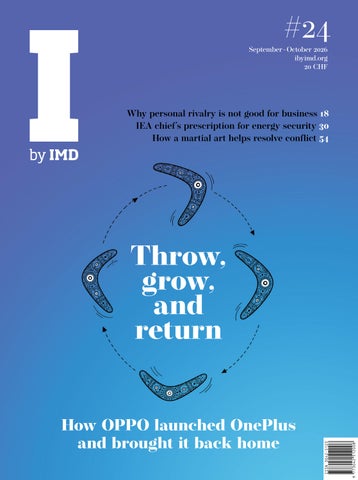
Throw, grow, and return How OPPO launched OnePlus and brought it back home
Votre réunion est à deux pas. Votre séjour aussi. Séjournez au coeur de Lausanne, profitez de chambres élégantes et d’espaces de réunions pensés pour prolonger vos rendez-vous professionnels dans un cadre privilégié.
lausanne-palace.ch | +41 21 331 31 31 | info@lausanne-palace.ch
WELCOME Beyond the hype: tackling AI’s second-order effects
H
ow can we lead effectively in the age of AI? It’s the question we keep hearing from leaders, grappling with the complexity of decision-making in a world shaped by rapid technological development and an awful lot of noise.
It’s fair to say the conversation about AI models, technology, and data is maturing. And we are already seeing the intense hype about generative AI being partly usurped by a new fascination: AI agents. For leaders, the more interesting questions sit one level deeper, away from the noise. These questions focus on what we call “second-order effects” of AI. These are the consequences of the consequences: what happens after the first, obvious impact has played out. As the IEA’s Fatih Birol points out in an op-ed in this edition of I by IMD, deploying AI at scale drives an unprecedented surge in electricity demand. The second-order effect? Grid capacity, energy security, and geopolitical dependency now sit in the middle of every AI conversation. Andrew Sharman examines another second-order effect in his timely article on the perils of “always-on” culture. AI and digital collaboration tools raise individual availability, but rather than automatically boosting productivity, attention fragments to the point where the strategic thinking these tools were meant to support becomes harder. Second-order effects are hard to predict because they emerge from interactions across systems that nobody owns, on timelines longer than most planning cycles, and they only become visible once they are already expensive to reverse.
Illustration: Jörn Kaspuhl
The selection of articles in this edition of I by IMD is designed to help leaders challenge what is and inspire what could be. In the age of AI, that means moving their strategic thinking from first- to second-order effects.
Stefan Michel,
Professor of Management, Dean of Faculty and Research
September - October 2026 / I by IMD
1
CONTENTS
September - October 2026
COVERSTORY 04 Innovation
When Chinese phone giant OPPO spun off OnePlus, it created a global sensation. Now the two are successfully reunited. The four-step Boomerang Innovation Pathway offers a blueprint for others to follow. Nongfei Pan
34
ACTS OF LEADERSHIP 18 Performance
Rivalry boosts individual effort but can harm team performance by encouraging excessive risk-taking and selfish behavior. Linus Dahlander, Henning Piezunka, and Arne Thomas
Explorer and psychiatrist Bertrand Piccard tells Kartik Ashta that successful leaders need to let go of outdated assumptions.
OPERATING SYSTEMS
26 Sustainability
Friction-free board meetings and quick approvals are misleading indicators of effectiveness. The bestperforming boards harness the power of conflict. Marianna Zangrillo and Thomas Keil
Climate-linked pay is not enough, on its own, to solve Mark Carney’s ‘tragedy of the horizon’. Christos Cabolis and Karl Schmedders
30 Energy transition
In our ‘just-in-case' energy era, long-term policy stability and infrastructure investments are essential for a secure, resilient power supply. Fatih Birol
33 10 leading questions
Mabel LU, Founder of Eastgate AI, reveals the talent she’d most like to possess and why.
34 The interview
Daniel Bossard, CEO of the Bossard Group, tells Stefan Michel how the 195-year-old family firm transformed into a global strategic partner for giants such as Tesla.
2 I by IMD / September - October 2026
38 Board governance
44 Strategy
If you looked at the Earth from the Moon, you’d quickly realize the importance of interconnected business ecosystems that span the globe. Yoshinori Fujikawa
48 Organizational culture
‘Always-on’ work culture destroys productivity and innovation by confusing constant availability with genuine effectiveness. Andrew Sharman
53 The locker room
Lessons from the world of cricket can help keep the customer satisfied. Howzat?
Cover: Midjourney V8 @ paulandcat, Photo: IMD
23 Management
Scan the QR code to visit ibyimd.org
THE SANDBOX 54 Management
The nonviolent principles of the martial art Aikido can help leaders turn corporate pushback into collaboration. Chip Bond and Francesca-Giulia Mereu
60 Board’s eye view
60
To thrive in an unpredictable world, corporate boards must move beyond resilience to build ‘antifragile’ organizations. Jean-Jacques Henchoz
64 Brain circuits
Neither introvert nor extrovert, an ‘otrovert’ may be just the type of person your team needs. A simple test will identify them. Olivia Lichtenstein
66 Cartoon case
FRESH THINKING
68 Coaching corner
Prediction markets promise a global ‘truth machine’, but risk turning our shared reality into a dangerous casino. Jerry Davis
Presenting a complex leadership challenge with no simple solution.
How coaching helped a technically gifted but toxic leader move from controlling micromanager to empathetic leader. Dave Schoof
74 Do you know
Are you a truly global citizen? Test your knowledge on the dynamics shaping the world.
14 In good company
63 The human factor
Lasting business success requires ‘double ROI’, combining financial performance with investments in trust, talent, and social impact. Shelley Zalis
Photos: Midjourney @ paulandcat (2)
70 The forecaster
48
Prestige brands such as Aston Martin and Rolex have a glamour that new kids on the block will find hard to match. Howard Yu
75 P.S. The president’s soliloquy
Fresh from visits to India and China, David Bach urges business leaders to step outside their echo chambers. September - October 2026 / I by IMD
3
COVERSTORY / Innovation
The boomerang buccaneers How established companies can create a successful spin-off and then bring it back home
4 I by IMD / September - October 2026
The future of retail: OPPO’s state-of-the-art flagship store in Beijing
Photo: Project by DOMANI ARCHITECTURAL CONCEPTS, China
OPPO’s experiment with OnePlus offers a blueprint for established enterprises seeking to sustain performance through breakthrough innovation. Nongfei Pan outlines a four-step framework for replicating their success
September - October 2026 / I by IMD
5
H
COVERSTORY / Innovation
ow can large enterprises innovate to navigate business cycles amid profound structural change? This is one of the thorniest problems in management, and it’s littered with disaster stories. Buffeted by disruption, incumbents can see tectonic shifts unfolding yet find themselves trapped between two polarities: exploitation (deploying and defending core capabilities to safeguard performance) and exploration (pursuing untested waters for future growth).
Immediate pressures naturally take priority: managers direct resources toward what feels like the safe ground of exploitation. However, defending against disruption by doubling down on established advantages has nearly always failed. As Clayton Christensen demonstrated in The Innovator’s Dilemma, market leaders almost always lose to disruptive entrants: optimizing existing capabilities for core customers leaves them unable to adapt to new technologies. Kodak invented the digital camera but collapsed after prioritizing its legacy film business – a pattern repeated across industries from mobile handsets to enterprise computing. As Ma Huateng (known as Pony Ma), founder and CEO of Tencent, reportedly observed: “When a giant falls, its body is still warm.”
Attempts to pursue exploration through internal incubation often fail because they are smothered by the constraints of the parent company’s culture and systems. Nokia developed touchscreen smartphones internally years before the iPhone, but its dominant feature-phone business starved the nascent project of resources and attention. Teams at Intel working on mobile processors were sidelined by its PC chip division, and it missed the mobile computing era entirely. Large organizations have an immune system, an in-built rejection mechanism that maintains the efficiency and routines of core operations. While protective during stable periods, it becomes a lethal barrier to innovation during industry transitions. Think of the competency trap, first conceptualized by Barbara Levitt and James G March in 1988, and later expanded by Michael Tushman and Charles A O'Reilly in their work on organizational ambidexterity. Incumbents over-allocate resources to exploit cash cows and starve or reject the exploration of radical, unknown frontiers. The headwinds facing in-house incubation have hampered smartphone makers for years. Sub-brands, such as Xiaomi’s Redmi, struggled to shed the “appendage” tag in their early stages. Their supply chain and R&D were coupled to the parent
6 I by IMD / September - October 2026
company, meaning they had little upper wiggle room for pricing within the parent’s portfolio. Some achieved strong sales but remained sidelined as a gross-margin firewall and volume driver, thereby preventing meaningful premium growth. To escape this immune system, some firms spin off units dedicated to innovation. This brings new challenges. Even if independent startups survive the early stages, they frequently hit a growth ceiling as they evolve from “niche excellence” to the mainstream: they are unable to cross the innovation chasm. Constrained by scarce resources, they are particularly vulnerable to missteps in strategy, operations, or management. One error can trigger crisis and collapse. Motorola conceived the Iridium satellite as an internal moonshot for global communications. It was spun off in 1991 to escape organizational inertia and pursue untested market potential. Technically, it succeeded in building a worldwide satellite network and proved its value in niche uses such as oceanic and polar expeditions. But when it attempted to expand into the mainstream, its exorbitant pricing proved terminal. Without Motorola’s balance sheet to absorb losses, the heavily indebted spin-off had almost no room for trial and error. It filed for bankruptcy a year after launch.
OPPO and OnePlus: a blueprint for exploration
How can incumbents overcome these significant barriers to engage in meaningful exploration amid disruption? Based on several years of research, I believe Chinese smartphone maker OPPO’s decade-long innovation journey with its spin-off OnePlus offers valuable insights for large organizations. The story of OPPO and OnePlus is not perfect and remains unfinished, but it shows how spin-offs can enable meaningful exploration that creates value for the parent without damaging it. Around 15 years ago, China’s smartphone industry was in the throes of seismic change. Newcomer Xiaomi’s runaway success with an internet-driven business model had left most traditional handset makers disoriented. Predictably, a wave of exploration into internet-based models followed as incumbents scrambled to respond. OPPO had built strong, defensible offline channel barriers in China, anchored by an exclusive wholesale-retail network. This system spanned hundreds of thousands of multi-brand momand-pop stores and exclusive retail points across China's lower-tier cities and rural towns. Unlike Western open-channel distribution, OPPO’s barrier relied on three pillars: regional exclusivity that prevented price wars, a shared-interest community in which local distributors held equity stakes or financial ties with the brand, and a heavy-subsidy infrastructure that provided stores with high-margin rebates, storefront signage, and sales
The quarterly magazine is part of IbyIMD+ subscription To enjoy the full experience, please log in or subscribe to IbyIMD+
Login or subscribe