A SUPPLEMENT TO
MAGAZINE
THE INTEGRATION GUIDE TO
HOME THEATER
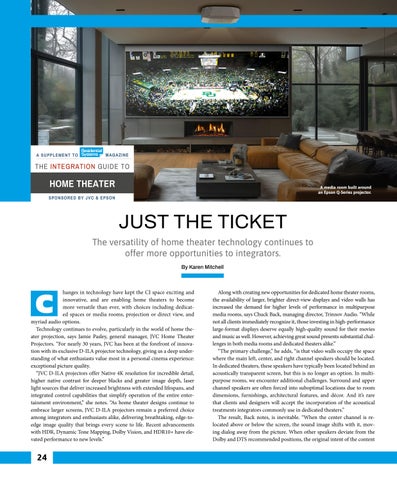
A media room built around an Epson Q-Series projector.
SPONSORED BY JVC & EPSON
JUST THE TICKET
The versatility of home theater technology continues to offer more opportunities to integrators. By Karen Mitchell
C
hanges in technology have kept the CI space exciting and innovative, and are enabling home theaters to become more versatile than ever, with choices including dedicated spaces or media rooms, projection or direct view, and myriad audio options. Technology continues to evolve, particularly in the world of home theater projection, says Jamie Pasley, general manager, JVC Home Theater Projectors. “For nearly 30 years, JVC has been at the forefront of innovation with its exclusive D-ILA projector technology, giving us a deep understanding of what enthusiasts value most in a personal cinema experience: exceptional picture quality. “JVC D-ILA projectors offer Native 4K resolution for incredible detail, higher native contrast for deeper blacks and greater image depth, laser light sources that deliver increased brightness with extended lifespans, and integrated control capabilities that simplify operation of the entire entertainment environment,” she notes. “As home theater designs continue to embrace larger screens, JVC D-ILA projectors remain a preferred choice among integrators and enthusiasts alike, delivering breathtaking, edge-toedge image quality that brings every scene to life. Recent advancements with HDR, Dynamic Tone Mapping, Dolby Vision, and HDR10+ have elevated performance to new levels.”
24
Along with creating new opportunities for dedicated home theater rooms, the availability of larger, brighter direct-view displays and video walls has increased the demand for higher levels of performance in multipurpose media rooms, says Chuck Back, managing director, Trinnov Audio. “While not all clients immediately recognize it, those investing in high-performance large-format displays deserve equally high-quality sound for their movies and music as well. However, achieving great sound presents substantial challenges in both media rooms and dedicated theaters alike.” “The primary challenge,” he adds, “is that video walls occupy the space where the main left, center, and right channel speakers should be located. In dedicated theaters, these speakers have typically been located behind an acoustically transparent screen, but this is no longer an option. In multipurpose rooms, we encounter additional challenges. Surround and upper channel speakers are often forced into suboptimal locations due to room dimensions, furnishings, architectural features, and décor. And it’s rare that clients and designers will accept the incorporation of the acoustical treatments integrators commonly use in dedicated theaters.’’ The result, Back notes, is inevitable. “When the center channel is relocated above or below the screen, the sound image shifts with it, moving dialog away from the picture. When other speakers deviate from the Dolby and DTS recommended positions, the original intent of the content