Remembering 9/11 8
Redesigning Heat Pumps 22
ABMA in Transition 25 SEPTEMBER/ OCTOBER 2026 www.hpac.com
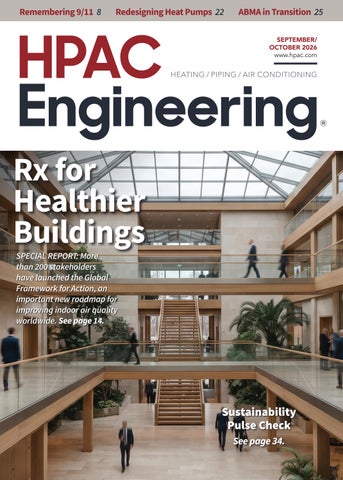
Rx for Healthier Buildings SPECIAL REPORT: More than 200 stakeholders have launched the Global Framework for Action, an important new roadmap for improving indoor air quality worldwide. See page 14.
Sustainability Pulse Check See page 34.
2610HPAC_C1_Cover.indd 1
9/23/26 11:21 AM
What’s behind it is just as important as what’s inside it.
Introducing the all-new Fujitsu AIRSTAGE line of R-32 VRF systems… available now and backed by best-in-class training, service and support. Our R-32 VRF systems deliver the flexibility and high performance today’s projects demand, including capacities from 2 to 32 tons and a broad selection of indoor unit options. Combined with expert layout assistance, training, and responsive support, they’re designed to help you succeed from planning through installation and beyond. Confidence comes from knowing what’s behind it. Ready when you are.
GENERAL HVAC Solutions America, Inc.
Visit fujitsugeneral.com
© GENERAL HVAC Solutions America, Inc. - 2026 GHSA distributes Fujitsu and AIRSTAGE branded products made by its group companies. The Fujitsu trademark’s registered owner in the USA and Canada is Fujitsu Limited of Japan.
2610HPAC_GeneralHVACSolutionsAmerica.indd 1 2610HPAC_C2-5_TOC.indd 2
8/4/26 10:10 9:53 AM 9/23/26 AM
2610HP
HEATING
COOLING
HOT WATER
Daikin ALTHERMA 3 H HT
SOPHISTICATED. ELEVATED. EFFICIENT. Sustainability This all-electric system is designed to help reduce a home’s carbon emissions, compared to fossil fuel burning systems. An added benefit if the electricity comes from renewable sources like solar and/or wind power.
All-Climate Operation
t .
Daikin ALTHERMA 3 H HT operates reliably in various climates. Space heating + domestic hot water (DHW) is possible down to -18°F (-28°C) ambient. ALTHERMA is designed to produce high leaving water temperatures (LWT) of up to 158°F (70°C) and provide space cooling up to 109°F (43°C) ambient.
Energy Efficient The Daikin ALTHERMA electric air-to-water heat pump provides an efficient, sustainable heating solution, supporting the transition away from fossil-fuel-based comfort systems toward all-electric energy.
Signature Technology Daikin ALTHERMA 3 H HT airto-water heat pump systems are designed with the latest technology and manufactured to exacting standards. Modern inverter-driven compressors and fan motors plus microprocessor controls deliver constant comfort and high efficiency performance.
TO LEARN MORE, SCAN QR CODE.
2026 DAIKIN COMFORT TECHNOLOGIES NORTH AMERICA, INC. . Houston, Texas . USA . www.daikincomfort.com
9:53 AM
2610HPAC_DaikenComfortTech.indd 1 2610HPAC_C2-5_TOC.indd 3
9/9/26 10:10 3:43 PM 9/23/26 AM
Contents
SEPTEMBER/OCTOBER 2026
Cover Photo: IWBI
Volume 98 • Number 5
COVER STORY:
Transforming Science into Healthier Buildings
14
More than 200 global stakeholders have created an important new roadmap for dramatically improving indoor air quality worldwide. By Jason Hartke
FEATURES
NEWS & NOTES
22 Designing Commercial Heat Pumps
10 ASHRAE, United Nations
for Greater Performance
As more buildings move toward electrification, engineers must be as focused on operational equipment tolerances as they are on equipment schedules and capacity calculations. By Vinay Shekar and Robby Oylear
BOILER SYSTEMS ENGINEERING 25 ABMA Announces Top
Up Again in August
After 12 years, Scott Lynch steps down as President & CEO of the American Boiler Manufacturers Association. VP Shaunica Jayson assumes those posts on an interim basis.
High oil prices tied to Iran conflict and ongoing trade friction with Canada have pushed PPI up 8.9% over a year ago, according to the Bureau of Labor Statistics.
26 Rebuilding Bridges to the
A growing partnership between ABMA and the Association of Water Technologies promises to improve communication and facilitate problem-solving. By Shaunica Jayson
‘Lifecycle Refrigerant Management’ is main focus of new MoU establishing two-year framework for implementation of both the Montreal Protocol and Kigali Amendment.
11 Construction Materials Prices
Leadership Transition
Water Treatment Community
Renew Joint Efforts on Sustainable Refrigeration, Energy Efficiency
12 EPA Announces Repeal
25
27 Nationwide Passes Baton from Day to Lieskovan
HPAC Engineering (USPS Permit 464-930, ISSN 0039-0895 print, ISSN 1930-8957 online) is published 6x a year (Jan/ Feb, Mar/Apr, May/Jun, Jul/Aug, Sep/Oct, Nov/Dec) by Endeavor Business Media, LLC. 201 N Main St 5th Floor, Fort Atkinson, WI 53538. Periodicals postage paid at Fort Atkinson, WI, and additional mailing offices. POSTMASTER: Send address changes to HPAC Engineering, PO Box 3257, Northbrook, IL 60065-3257. SUBSCRIPTIONS: Publisher reserves the right to reject non-qualified subscriptions. Subscription prices: U.S. ($117); Canada/Mexico ($130); All other countries ($156). All subscriptions are payable in U.S. funds. Send subscription inquiries to HPAC Engineering, PO Box 3257, Northbrook, IL 60065-3257. Customer service can be reached toll-free in US/Canada at +1 (877) 498-4668, outside US/Canada at +1 (920) 249-4687. or at customerservice@hpac.com for magazine subscription assistance or questions. Printed in the USA. Copyright 2026 Endeavor Business Media, LLC. All rights reserved. No part of this publication may be reproduced or transmitted in any form or by any means, electronic or mechanical, including photocopies, recordings, or any information storage or retrieval system without permission from the publisher. Endeavor Business Media, LLC does not assume and hereby disclaims any liability to any person or company for any loss or damage caused by errors or omissions in the material herein, regardless of whether such errors result from negligence, accident, or any other cause whatsoever. The views and opinions in the articles herein are not to be taken as official expressions of the publishers, unless so stated. The publishers do not warrant either expressly or by implication, the factual accuracy of the articles herein, nor do they so warrant any views or opinions by the authors of said articles.
of GHG Rules for Power Plants At G20 meeting in Houston, Administrator Zeldin says removal of greenhouse gas regulations will save U.S. industry $310 million.
DEPARTMENTS 8 Editor’s Notes Remembering September 11, Renewing a Spirit of Community By Rob McManamy
28 New Products 34 Industry
34
Perspectives
A Pulse Check on the Sustainability Movements. By Elizabeth Beardsley
4 HPAC ENGINEERING SEPTEMBER/OCTOBER 2026
2610HPAC_C2-5_TOC.indd 4
9/23/26 11:13 AM
2610HP
Specify FEI. Protect Performance.
Fan Energy Index (FEI) helps protect your design intent by making it easier to compare the energy performance of similar fan systems and select fans that operate more efficiently, quietly, and reliably, with a flexible operating range. More than a compliance metric, FEI helps ensure installed fans deliver the performance your project demands.
Discover FEI benefits at greenheck.com/fei
© 2026 Greenheck
2610HPAC_Greenheck.indd 51 2610HPAC_C2-5_TOC.indd
8/21/26 10:10 1:07 PM 9/23/26 AM
EDITORIAL OFFICE 8001 Lincoln Ave. • Suite 720 Skokie, IL 60077 www.hpac.com
Embracing Change, with ASPE President Bryan Hutton
‘HPAC On The Air’ welcomes back the top plumbing engineer for an ‘exit interview’ as he concludes his two-year term atop the international society. www.hpac.com/55388323
MEMBERS ONLY WEBINARS 31447604 © Wavebreakmedia Ltd | Dreamstime
Ethics in Engineering: Case Studies in HVACR
ON DEMAND: Recorded April 28, this webinar tests your “Ethics IQ” with real-world dilemmas faced on HVACR projects. Participants examine how ethical decisions can often depend on context. www.hpac.com/55364113
MEMBERS ONLY EXCLUSIVES Looking Back at Ten Years of Clark’s Remarks
Andrii Stepaniuk/Shutterstock
From climate change and sea level rise to decarbonization and regulatory upheaval, our sustainability columnist reflects on a stormy decade. www.hpac.com/21270656
HPAC 2026: Our September Quiz!
HAPPY BIRTHDAY, AMERICA! Enjoy our celebratory mix of engineering and U.S. history. Test Your Smarts! Win Prizes! www.hpac.com/55401580
FEELING SOCIAL? Follow us on Twitter at @HPACEng, as well as our sister publications, @Contractormag, and @ContractingBiz. Retweet our up-to-date content, send comments, questions. Expand your world of engagement with us, at no extra charge! 6 HPAC ENGINEERING SEPTEMBER/OCTOBER 2026
2610HPAC_6-7_Web_TOC.indd 6
HPAC/ASPE
MEMBERS ONLY PODCASTS
EXECUTIVE TEAM CEO: CHRIS FERRELL COO: PATRICK RAINS CDO: JACQUIE NIEMIEC CALO: TRACY KANE CMO: AMANDA LANDSAW EVP, BUILDING & CONSTRUCTION GROUP: CHRIS PERRINO
EDITORIAL CONTACTS MIKE EBY VP of Content Strategy, Building & Construction Group meby@endeavorb2b.com ROB MCMANAMY Editor-in-Chief rmcmanamy@endeavorb2b.com DAVID ECKHART Art Director deckhart@endeavorb2b.com SALES CONTACTS MIDWEST BILL BOYADJIS 973-722-2048 bboyadjis@endeavorb2b.com SOUTH & WEST RANDY JETER 512-263-7280 • Fax: 913-514-6628 rjeter@endeavorb2b.com WEST ELLYN FISHMAN 949-239-6030 efishman@endeavorb2b.com ACCOUNT MANAGER STEVE SUAREZ 941-259-0867 ssuarez@endeavorb2b.com DIRECTOR OF SALES JOE AGRON 941-200-4778 jagron@endeavorb2b.com LIST RENTAL SMART REACH sr-assets@endeavorb2b.com effective PRODUCTION AND CIRCULATION RITA FITZGERALD Senior Production Manager rfitzgerald@endeavorb2b.com MELISSA MENG Ad Services Manager mmeng@endeavorb2b.com JAMES MARINACCIO Audience Marketing Manager jmarinaccio@endeavorb2b.com
Copyright 2026 Endeavor Business Media, LLC All Rights Reserved
9/23/26 10:11 AM
2610HP
EFFICIENCY WITHOUT COMPROMISE
NEOTHERM® XTR COMMERCIAL BOILER OR VOLUME WATER HEATER: Engineered for LEED and sustainable building designs, LAARS® NeoTherm XTR features a high-grade stainless-steel water tube heat exchanger with low-pressure drop to maximize heat transfer. The result: 96% thermal efficiency, low NOx emissions, and a 10:1 turndown ratio.
LEARN MORE ©2026, LAARS Heating Systems. All rights reserved. LRSHPEN0926
2610HPAC_LAARS.indd 1 2610HPAC_6-7_Web_TOC.indd 7
9/9/26 10:11 8:52 AM 9/23/26 AM
EDITOR’S NOTES
BY ROB MCMANAMY, EDITOR-IN-CHIEF
Remembering September 11, Renewing a Spirit of Community
A
s someone born and raised in New York City, I would be remiss this fall if I did not take note of the 25th anniversary of 9/11, that darkest of days that abruptly changed the trajectory of the 21st century, not just for America, but for all the world. I was actually in Washington DC that fateful morning in 2001, expecting to represent Design-Build magazine at a meeting with the Design-Build Institute of America (DBIA). But that meeting actually had fallen through for me the night before after I had already arrived in DC. So on the morning of 9/11, I had told my wife that I was trying
to witness purposeful destruction of lives, machines, and structures is repulsive to us not only as human beings but doubly so as mankind’s builders.” But Coad was also struck by the extraordinary outreach, sympathy, and offers of support that he received from ASHRAE members all over the world. “I was absolutely dumbfounded by the outpouring of concern I received from our friends in other countries,” he recalled years later. In 2002, Coad’s successor as ASHRAE President, Don Colliver wrote, “Our focus as a people is now on rebuilding. Not only at Ground Zero, but in our society, in our way of life, and for many, in their personal lives. We feel a greater need to connect on a human Ievel with one another. Statistics reveal since the September tragedy an unprecedented number of people have volunteered for community service. Let this, then, be our opportunity to also rebuild.”
The global engineering community reacted 25 years ago with support, solidarity, and a resolve to rebuild. to arrange a tour of the newly renovated wedge of the Pentagon, which had just been completed via design-build project delivery. Luckily for me, I was unable to set up a last-minute tour, so I was not present when the Defense Dept. headquarters was pierced that morning by a hijacked commercial airliner. Traveling around DC that day, I will never forget the otherworldly, movie-set feel of unreality on the streets of our nation’s capital, as its confused and terrified citizens tried to grasp what the heck was going on. Army jeeps with machine gun turrets were deployed on dowtown overpasses, as anxious soldiers stood guard, scanning passing traffic for God-knows-what. Some 225 miles north, of course, at the southern tip of Manhattan, things were much, much worse, as chaos, fear, and waves of toxic dust gripped my hometown. All these swirling memories prompted me to research what ASHRAE’s response to that shocking tragedy had been. The Society’s then-President, Bill Coad, a member of HPAC Engineering’s Editorial Advisory Board, said at the time, “As a society of engineers, it is in our nature to build. So,
Indeed, community service is the aspect that I would like to close on here. Twenty-five years after 9/11, we seem to have forgotten so many of the hard lessons that we learned that day and in the months of extraordinary compassion and international solidarity that immediately followed. But arguably, ASHRAE and the international engineering community somehow seem to have held on to that feeling, that tighter, universal bond of respect and solidarity, forged by tragedy. So my wish for this solemn anniversary is that we as a nation can follow your lead as engineers, that we may look back on 9/11 not just with anger and sadness, but with hope and determination. And may those qualities also help us to see each other as members of a global community that builds not just solid structures, but resilient relationships... that can withstand even the darkest of days.
EDITORIAL ADVISORY BOARD: William P. Bahnfleth, PhD, PE The Pennsylvania State University Glenn Barrett, PE DC Engineering David W. Bearg, PE Life Energy Associates Lawrence (Larry) Clark, QCxP, GGP, LEED AP+ Sustainable Performance Solutions LLC Kenneth M. Elovitz, PE, Esq. Energy Economics Inc. Charles E. Gulledge III, PE, HBDP, LEED AP, FASHRAE Environmental Air Systems LLC Elise Kiland, PE, YEA Cambio Nancy Kohout, PE, LEED AP Buro Happold Stephanie Taylor, MD, M.Arch, ThinkLite Air Ginger Scoggins, PE, CEM, CxA, LEED AP, FASHRAE Engineered Designs Inc. James P. Waltz, PE, CEM, ACFE Energy Resource Associates Inc. Michael K. West, PhD, PE Advantek Consulting D. Yogi Goswami, PhD, PE University of South Florida Gerald J. Williams, PE, LEED AP 8760 Engineering LLC
8 HPAC ENGINEERING SEPTEMBER/OCTOBER 2026
2610HPAC_8-9_Ed_Note.indd 8
9/23/26 10:12 AM
2610HP
Innovative Wastewater Pumps that Deliver Unmatched POWER and RELIABILITY
LSS/LSV Series • Available in 2-Vane and Vortex impeller styles • Available in 1.5, 2, 3 or 5 HP • Single mechanical silicon carbide shaft seal • Cast iron construction with epoxy powder coating • Quick-connect power cords in 35', 50' or 100' lengths
Proudly made in the USA
with US & global components
7000 Apple Tree Avenue - Bergen, New York 14416 Phone 800-543-2550 - Fax 585-494-1839 www.LibertyPumps.com Copyright © Liberty Pumps, Inc. 2026 All rights reserved.
2610HPAC_8-9_Ed_Note.indd 2610HPAC_LIbertyPumps.indd 91
9/23/26 8/18/26 10:12 8:23 AM AM
NEWS & NOTES
FROM PRESS RELEASES BY ASHRAE, ABC, AND USEPA
ASHRAE, United Nations Renew Joint Efforts on Sustainable Refrigeration, Energy Efficiency ‘Lifecycle Refrigerant Management’ is main focus of new MoU establishing two-year framework for implementation of both the Montreal Protocol and Kigali Amendment.
A
SHRAE and the United Nations Environment Programme (UNEP) have renewed their longstanding partnership to advance sustainable refrigeration and air conditioning. On Sept 10, the two signed a new Memorandum of Understanding that strengthens cooperation on lifecycle refrigerant management, energy efficiency, technology, safety and capacity building in developing countries. UNEP OzonAction and ASHRAE have cooperated strategically since 2007 to advance sustainable, lowerGWP technologies and best practices in the Refrigeration Servicing Sector (RSS). The new agreement establishes a two-year framework to support the implementation of the Montreal Protocol and its Kigali Amendment. Priorities include strengthening the refrigeration and air-conditioning workforce in developing countries, advancing international standards and technical guidance, promoting energy-efficient cooling, and exploring digital and artificial intelligence (AI)- enabled tools to improve refrigerant management and system performance. The partnership will be implemented through the 2026–2027 Work Plan, the seventh in a series of joint work plans. Under the theme “Lifecycle Refrigerant Management,” activities will address refrigerants from manufacture and importation through equipment selection and use, servicing and leak prevention, and ultimately end-of-life management.
Projects include an AI-powered mobile field companion for RAC technicians, new fact sheets on safe handling of flammable refrigerants, continued promotion and evaluation of ASHRAE-UNEP educational products, and stronger connections between all ASHRAE chapters globally and National Ozone Units. The 2026–2027 Work Plan is available through the ASHRAE-UNEP Portal at ashrae.org/ashrae-unep-portal. The portal also provides information on joint ASHRAE-UNEP products available to ASHRAE members and National Ozone Units, including a free technical guide with operational checklists for assessing the sustainability of RAC plants. This welcome collaboration combines ASHRAE’s technical expertise and global professional network with UNEP OzonAction’s international mandate to assist developing countries in meeting their Montreal Protocol obligations.
For more information about the partnership and how ASHRAE chapters and National Ozone Units can use the jointly developed resources, contact ashraeunep@ashrae.org.
About ASHRAE
ASHRAE is a global professional society committed to advancing healthy, sustainable and resilient buildings for everyone, everywhere. Through the collective expertise of more than 55,000 volunteer members in over 132 countries, ASHRAE drives innovation across HVAC&R through trusted standards, research, education and collaboration. Advancing the built environment through technical excellence since 1894, ASHRAE continues to shape the future of building design, construction and operation. Learn more at ashrae.org and follow ASHRAE on Instagram, Facebook, LinkedIn, X and YouTube and download the ASHRAE 365 app to stay connected on the go.
10 HPAC ENGINEERING SEPTEMBER/OCTOBER 2026
2610HPAC_10-13_News.indd 10
9/23/26 10:12 AM
Construction Materials Prices Up Again in August High oil prices tied to Iran conflict and ongoing trade friction with Canada have pushed PPI up 8.9% over a year ago, according to the Bureau of Labor Statistics.
Associated Builders and Contractors is a national trade association established in 1950 with 67 chapters and 24,000 members. Founded on the merit shop philosophy, ABC helps members
August 2017 through August 2026 30% 25%
12-month % Change
20%
1-month % Change
15% 10% 5% 0% -5% 2019
2020
2021
Producer Price Index: August 2026 Inputs to Industries Inputs to construction Inputs to multifamily construction Inputs to nonresidential construction Inputs to commercial construction Inputs to healthcare construction Inputs to industrial construction Inputs to other nonresidential construction Inputs to maintenance and repair construction Commodities Adhesives and sealants Brick and structural clay tile Concrete products Construction machinery and equipment Construction sand, gravel, and crushed stone Copper wire and cable Crude petroleum Fabricated structural metal products Gypsum products Hot rolled steel bars, plates, and structural shapes Insulation materials Iron and steel Lumber and wood products Natural gas Plumbing fixtures and fittings Prepared asphalt, tar roofing and side products Softwood lumber Steel mill products Switchgear, switchboard, Unprocessed energy materials Source: U.S. Bureaiu of Labor Statistics
offer a robust employee value proposition, develop people, win work and deliver that work safely, ethically and profitably for the betterment of
2022
2023
2024
2025
2026
Change Since Feb. 2020
2018
12-Month % Change
-10% 2017
1-Month % Change
About ABC
Producer Price Index Change Inputs to Construction Industries
Percent Change
C
onstruction input prices increased 1.2% in August compared to the previous month, according to an Associated Builders and Contractors (ABC) analysis of the U.S. Bureau of Labor Statistics’ Producer Price Index (PPI) data, released Sept. 10. Nonresidential construction input prices also increased 1.2% for the month. Overall construction input prices are 8.9% higher than one year ago, while nonresidential construction input prices are 8.8% higher. Prices increased in 2 of the 3 energy subcategories last month. Crude petroleum prices expanded 5.2% and unprocessed energy materials prices rose 1.5%, while natural gas prices were down 11.6% in August. “Construction input prices surged again in August, and the increases were widespread across materials,” said ABC Chief Economist Anirban Basu. “Prices for iron and steel, softwood lumber, switchgear, copper wire and cable, and several derivative metal products are now up more than 10% year over year. “While our contractor members remain optimistic about their margins, according to ABC’s Construction Confidence Index, ongoing input price escalation is likely to weigh on profitability over the next several months. This is especially true given recent escalation in the trade war with Canada and the fact that oil prices have jumped back above $100 per barrel.”
1.2% 1.0% 1.2% 0.9% 1.1% 1.1% 1.4% 1.3%
8.9% 7.4% 8.8% 7.4% 7.4% 8.1% 9.4% 9.5%
55.6% 53.8% 56.4% 56.4% 56.0% 52.9% 56.8% 54.1%
1.0% 0.3% 0.3% 0.0% 0.3% 4.2% 5.2% 0.5% 0.7% 0.0% 0.5% 0.9% -0.3% -11.6% 0.3% 0.5% -1.9% 1.7% 2.4% 1.5%
6.2% 1.0% 4.2% 2.2% 6.2% 27.2% 34.9% 6.5% 0.2% 13.4% 1.1% 17.9% 4.8% 0.5% 5.1% 3.9% 11.8% 23.4% 12.3% 23.6%
47.7% 34.5% 47.8% 38.2% 57.1% 104.9% 80.2% 72.0% 49.8% 63.0% 48.2% 80.8% 32.4% 41.4% 33.8% 52.3% 28.3% 103.4% 82.8% 85.9%
the communities in which ABC and its members work. For more, contact Erika Walter, ABC director of media relations, at ewalter@abc.org.
SEPTEMBER/OCTOBER 2026 HPAC ENGINEERING 11
2610HPAC_10-13_News.indd 11
9/23/26 10:12 AM
NEWS & NOTES
EPA Announces Repeal of GHG Rules for Power Plants At G20 meeting in Houston, Administrator Zeldin says removal of greenhouse gas regulations will save U.S. industry $310 million. What follows is EPA’s chosen wording.
A
t the G20 Energy Abundance Ministerial held Sept. 14 in Houston, U.S. Environmental Protection Agency (EPA) Administrator Lee Zeldin announced the repeal of the majority of the Biden Administration’s greenhouse gas requirements for U.S. power plants, an action the agency projects will save $310 billion. He also proposed rescinding every remaining greenhouse gas standard for the power sector. If finalized, the new proposal would save an additional $370 million in direct compliance costs, in addition to the billions more American families and businesses can expect to see saved across the economy. Together, the moves restore reliable and affordable baseload power for the communities that depend on them. Administrator Zeldin was joined by U.S. Dept. of the Interior (DOI) Secretary Doug Burgum and National Energy Dominance Council (NEDC) Executive Director Jarrod Agen. The Trump EPA is taking these actions in accordance with the law and based on the best reading of the Clean Air Act (CAA). EPA’s final rule is expected to unleash the full potential of America’s vast energy resources, including coal and natural gas. Coal production for power sector use is expected to increase by more than 10 times. “For over 15 years, the Obama and Biden administrations implemented a war on coal to destroy reliable and affordable energy. The Trump Administration has come in to protect American energy and to make sure you can afford to keep the lights on,” said EPA Administrator Zeldin. “Americans will see a decrease in electricity prices, but this is just the beginning. We are working to
go even further so that American energy can be fully unleashed. Realizing the full potential of American energy means more jobs, lower prices, and a more prosperous America.” “The Trump administration is saving Americans hundreds of millions of dollars through common sense energy solutions that put an end to the Biden administration’s disastrous Green New Scam policies enacted at the cost of our nation’s energy security and future,”
climate alarmists, President Trump promised to put the American people first and he is delivering.” The final rule strikes most of the 2024 Carbon Pollution Standards, which EPA has determined exceeded its authority under the CAA by requiring control technologies not adequately demonstrated, effectively forcing plants to retire rather than setting standards they could actually meet.
said NEDC Chairman and DOI Secretary Burgum. “This necessary reversal restores efficiency to our energy sector and allows our vital resources to be used for the benefit of the American people. Under President Trump, this administration will continue reversing course on out-of-touch Obama and Biden-era policies by unleashing American energy and securing our nation’s energy independence for generations to come.” “During periods of peak electricity demand, coal and natural gas continue to play a critical role in keeping the lights on,” said Secretary of Energy Chris Wright. “Today’s announcement will help ensure reliable electricity generation regardless of whether the wind is blowing or the sun is shining by allowing coal and natural gas plants to keep generating power when Americans need it most. Unlike past administrations that prioritized the interests of
The 2024 rule also failed to account for the U.S. Supreme Court decision in West Virginia v. EPA, which barred EPA from misusing the CAA to manipulate Americans’ energy choices. Models continue to show that GHG emissions from power plants have no material impact on global climate change. In fact, if all carbon dioxides were eliminated tomorrow, there would be no meaningful climate impact. Additionally, the targeted emissions are global in nature, and any potential public health harms are too uncertain, conjectural, remote, and convoluted to tie specifically to the U.S. power sector. Therefore, the agency is proposing it is out of its scope to regulate. EPA will hold a public hearing for the proposal 15 days after publication of the action in the Federal Register, as well as a 45-day public comment period. For more details, visit EPA.gov.
12 HPAC ENGINEERING SEPTEMBER/OCTOBER 2026
2610HPAC_10-13_News.indd 12
9/23/26 10:12 AM
2610HP
Shape your year in 3 days
2610HPAC_InternationalExposition.indd 1 2610HPAC_10-13_News.indd 13
7/22/26 10:12 9:35 AM 9/23/26 AM
COVER STORY
More than 200 global stakeholders have created an important new roadmap for dramatically improving indoor air quality worldwide.
By JASON HARTKE, PhD, Executive VP, International WELL Building Institute
I
ndoor air is not passive. It is a delivery system.” When Rachel Hodgdon of the International WELL Building Institute (IWBI) delivered that line recently in a keynote to the
International Society of Indoor Air Quality and Climate (ISIAQ), she named something that every building engineer understands: all buildings shape the air its occupants breathe, whether by design or by default. Sometimes that air is clean, healthy and carefully managed. Other times, without notice or measurement, it
carries fine particles, pathogens, combustion byproducts, volatile organic compounds, allergens, infectious aerosols or wildfire smoke. According to the EPA, indoor air is, on average, two to three times more polluted than outdoor air. Occupants may not see or feel the difference, but their lungs certainly do.
14 HPAC ENGINEERING SEPTEMBER/OCTOBER 2026
2610HPAC_14-21_Cover_Story.indd 14
9/23/26 10:13 AM
IWBI
As Hodgdon added, “Too often, [the building] is delivering things our bodies were never meant to breathe. We are taking them in quietly, constantly, unknowingly – with every breath. And over time, sometimes slowly and sometimes suddenly, they degrade our health, weaken our lungs, dull our focus, strain our immune systems and contribute to this staggering burden of disease and even premature death.”
Sustaining the Second Wave
The average person takes about 20,000 breaths a day. In the U.S., most happen indoors where people spend 90% of their lives. Homes, offices, schools, hospitals, airports and all indoor spaces sit at the boundary between outdoor conditions, indoor sources and the air ultimately drawn into our lungs. The building sector has made real progress reducing energy use and operating costs through efficiency and sustainable design. Yet it remains in the early stages of realizing the comparable potential of healthier indoor air, and capturing the health, performance and resilience benefits that come with it. Rick Fedrizzi, a principal founder of the green building movement, longtime CEO of the U.S. Green Building Council (USGBC) and current executive chair of IWBI, recognized that turn a decade ago. “We are witnessing the ‘Second Wave of sustainability’ when it comes to the built environment,” he wrote in a 2017 article, describing the movement’s initial emphasis on reducing construction’s burden on the planet. “The First Wave was all about protection and minimization,” he explained. “But what we’re beginning to understand—and what the Second Wave is all about—is the potential for buildings to actively promote health and well-being.” Indoor air should be central to that second wave. Instead, it remains largely undervalued, in part because the problem, like air, itself, is invisible. Out of sight has too often meant out of mind. That invisibility carries a steep cost. Air pollution contributed to 7.9 million
Rachel Hodgdon, President and CEO of the International WELL Building Institute: “When we come together with purpose... we can create amazing change.”
deaths worldwide in 2023, according to the State of Global Air, and household air pollution alone is associated with nearly 3 million premature deaths per year. Indoors, the hazards are both familiar and evolving: fine particles, combustion byproducts, volatile organic compounds, dampness and mold, allergens, infectious aerosols and wildfire smoke – all of which find their way into our buildings. Nor is burden evenly shared. Children, older adults, people with chronic disease and communities with fewer resources often face the greatest risks and the fewest protections. Dr. Yele Aluko, health industry strategist at the Harvard Business Review and former chief medical officer at EY and co-chair of the Commission, makes the equity stakes explicit. “The impacts of polluted indoor air, worsened by wildfires and climate change, are not felt equally,” he says. “Vulnerable communities, especially children, bear the heaviest burden. Poor air quality doesn’t just reduce performance; it harms health, development, and opportunity.” The question, then, is no longer whether indoor air shapes health, learning, cognition, productivity and resilience. That evidence is clear. The
harder question is how to turn decades of science and a growing toolbox of solutions into a strategy capable of transforming buildings at scale.
Global Commission Takes on a Public Health Crisis
That challenge brought a uniquely distinguished group to the United Nations in September 2025 during Climate Week. Scientists and doctors sat alongside engineers, architects, public health leaders, advocates, real estate executives, manufacturers and investors to launch the Global Commission on Healthy Indoor Air. Its mission was ambitious in its simplicity: make healthy indoor air the norm not the exception. Today, the Commission includes more than 200 leaders and experts from more than 40 countries, among them some of the world’s most respected scientists, public health luminaries, technical experts, building practitioners, business leaders and advocates helping advance healthy indoor air. In announcing the Commission, Hodgdon invoked Margaret Mead’s quote about the ability of thoughtful, committed people to change the world. She then made the challenge specific. “When we come together with purpose, when we collaborate across
SEPTEMBER/OCTOBER 2026 HPAC ENGINEERING 15
2610HPAC_14-21_Cover_Story.indd 15
9/23/26 10:13 AM
IWBI
COVER STORY
Last fall, the United Nations put indoor air quality on its global agenda, igniting a movement that is still gaining momentum.
boundaries, we can create amazing change. We can reshape markets. We can transform systems. And most importantly, we can improve lives.” The full meaning of that collaborative moment served as a sign of things to come. Indoor air measures had made strides in recent decades, but the agenda had advanced intermittently,
and largely within the separate lanes of individual disciplines or fields. In building practice, meanwhile, it had until recently been seen as a nice-tohave, not a must-have. The message sent by this multidisciplinary group coming together under the umbrella of the Commission, while implied, was loud enough: no single stakeholder
PURPOSE-BUILT FOR WATER SERVICES.
group, agency, standard, technology or funding source would be able to deliver healthy indoor air at scale alone. For Hodgdon, the event captured both the significance of the moment and the scale of the opportunity. “Gathered there in the United Nations, we knew it was a special moment, a chance to put indoor air on
For Stainless Steel
For Copper
SERIES 250 BUTTERFLY VALVE The Series 250 Butterfly Valve is purpose-built for potable water, technology cooling, chilled and heating water, and water/wastewater systems, in stainless steel or copper. Wetted surfaces matched to pipe material deliver superior corrosion resistance, while a new gasket formulation and optimized body, seat and disc design provide bi-directional, bubble-tight shut-off with pressure up to 300 psi, lower friction loss, and longer life than standard lug and wafer valves. © 2026 VICTAULIC COMPANY. ALL RIGHTS RESERVED.
2610HPAC_Victaulic.indd 1
16 HPAC ENGINEERING SEPTEMBER/OCTOBER 2026
2610HPAC_14-21_Cover_Story.indd 16
8/17/26 4:46 PM
9/23/26 10:13 AM
the global agenda,” she said. “By working together and delivering a transdisciplinary strategy, the Commission set out to develop a signature deliverable by drafting the first-of-its-kind framework to ignite the movement, inform decision-makers, accelerate innovation, unlock new sources of funding, shape policy and raise public awareness.”
Sharing a Strategic Roadmap
This September, the Commission returned to New York for Climate Week to launch the Global Framework for Action: Advancing Healthy Indoor Air through Societal Engagement and Market Transformation. In the words of the Commission’s co-chairs, it is not simply a report but a shared strategic roadmap, uniquely designed to translate global momentum around healthy indoor air into market transformation. That distinction is important. The Framework does not prescribe a ventilation rate, a sensors and controls
methodology, a filtration strategy or a policy model. Buildings, climates, resources, governance structures and public-health burdens vary too widely. Instead, it identifies the universal levers that can elevate healthy indoor air as a public health imperative and market priority, and ultimately institutionalize it as an everyday expectation. “It’s made up of a series of strategic focus areas and recommendations, but it’s organized around market transformation. In effect, it gives us... a muchneeded game plan,” writes Fedrizzi in the Framework’s Forward. “When I was helping grow energy efficiency and green building years ago, we didn’t have a playbook like this. We were writing it as we went along. This time, we have taken the time to develop and coalesce. And in market transformation, preparation saves time, saves resources and can serve as a powerful accelerant. The Framework organizes around 40 strategic focus areas and nearly 180
INTRODUCING THE WAGS
TM
4W
recommendations across nine interrelated and interconnected levers of market transformation: • Building awareness and public engagement; • Innovation, research and development; • Advocacy and policy development; • Education and training; • Demand and market incentives; • Financing and resource mobilization; • Codes, standards and leadership certifications; • Partnerships and collaboration; • Implementation, monitoring and evaluation. The list is less important than the relationship of its parts (See Figure 1). Research strengthens the evidence and fuels innovation. Training moves that evidence into design and operations. Better technologies improve measurement and controls while lowering
4W-DP &
5WG
5WG-DP KITS
PRESS FIT FOR FASTER INSTALLATIONS – SPACE SAVING PAN
NO O Maintenance M i t
WAGSTM Is The Original And Only 100% Mechanical Automatic Water Heater Safety Shutoff Valve On The Market!
How it works... The WAGSTM Valve sits in a drip pan under the water heater and is activated when leaking water accumulates to approximately a 1” level in the drip pan. The WAGSTM is ‘The One Shot Wonder’ and not resettable – for user safety. IN
OUT
Drip Pan
NO Electricity
3
A Red Indicator Tab pops out to show WAGSTM Valve activation. Once activated, the industrial duty, spring loaded piston in the WAGSTM Valve instantly shuts off the cold water flow to the water heater, and draws vacuum on the tank, preventing any additional water leakage from the tank and damage to your customers property.
NO Batteries
IN
OUT
Drip Pan
NO O Wi Wireless l Signals
NO Worries
WAGSTM 4W 4W-DP
(3/4″)
6
WAGSVALVE.COM
CHECK OUT OUR
PACK SPECIAL
4W WATER
5WG WATER & GAS
WAGSVALVE.COM W WAGS Protection = Flood Prevention 2610HPAC_AquaGuard.indd 1
2610HPAC_14-21_Cover_Story.indd 17
WAGSTM 4W-DP & 5WG-DP KITS 1/2″ OR 3/4″ BRASS PRESS FITTINGS
1-844-GET-WAGS
The Original Creators of the WAGSTM Cranston, Rhode Island • 02910 • USA
9/9/26 9:56 AM
SEPTEMBER/OCTOBER 2026 HPAC ENGINEERING 17
9/23/26 10:13 AM
NEW eF SERIES® TURBO
HEAVY-DUTY COMMERCIAL MEETS ULTRA EFFICIENCY Our latest addition to the eF Series® comes engineered for high-demand applications where efficient performance matters most.
• ENERGY STAR® Certified with up to 97% thermal efficiency • Enhanced Modulation for fuel efficiency and up to a 6:1 turndown ratio • Retrofit Ready including multiple side water connections and common venting Available in 119-or 125-gallon configurations and 399,999 to 500,000 BTU/Hr. inputs ©2026, Bradford White Corporation. All rights reserved. BWHPEN0926
2610HPAC_BradfordWhite.indd 1 2610HPAC_14-21_Cover_Story.indd 18
9/23/26 10:13 AM
DISCOVER MORE
2610HPAC_14-21_Cover_Story.indd 19
9/9/26 10:13 4:26 PM 9/23/26 AM
costs. Innovative financing determines whether these solutions reach more buildings. Policy establishes expectations and strengthens accountability. Standards, workforce capacity and implementation turn those expectations into real-world performance. Awareness keeps demand high, while visible results build trust, and trust attracts new investment. Together, the Nine levers of the Framework can create a flywheel of market transformation, with progress in one generating momentum across the others. That may be the Framework’s most consequential contribution. Healthy indoor air has not stalled for lack of evidence or solutions. Ventilation, filtration, source control, moisture management, material selection, monitoring, commissioning and sound operations are all well established. Progress stalls when those solutions remain disconnected from the policies, budgets, incentives, workforce and accountability structures needed to sustain them. “Healthy indoor air is far more than a building issue. Ensuring that everyone can breathe healthy indoor air is a sacred responsibility, one that influences health, opportunity and resilience throughout life,” said Dr. Richard Carmona, 17th Surgeon General of the United States and CoChair of the Global Commission on Healthy Indoor Air. “This Framework brings public health and the building sector to the same table, uniting us behind a common vision and giving us a shared plan of action to protect people in every community.”
The Engineer as Translator and Integrator
For engineers, the Framework is both validation and a challenge. It recognizes that technical competence remains indispensable, but the work extends beyond the traditional boundaries of building systems. Engineers and other stakeholders must help translate health evidence into design intent, explain risk to owners, coordinate with public health
IWBI
COVER STORY
ASHRAE Immediate Past President Bill McQuade last year established the permanent Center of Excellence for Indoor Environmental Quality.
experts, test and validate operational performance and help decision-makers understand the consequences of valueengineering health out of a project. The engineering community was already moving in this direction before the Commission launched. “After the pandemic, I saw attention to IAQ slipping and old habits returning,” said Bill McQuade, global vice president and head of government affairs and sustainability at Baltimore Air Coil and the immediate past president of ASHRAE, who made the theme of his term indoor environmental health. “As President, I wanted us to refocus the industry on occupant health, wellness and productivity — not just building performance.” That agenda produced an enduring institutional home to advance that work. “We launched the permanent Center of Excellence for Indoor Environmental Quality, which now carries that mission forward through education, guidance, standards, research, and global leadership,” said McQuade, who also serves as a Commissioner. This translation and integration role is especially important in practice.
Outdoor conditions change. Occupancy changes. Filters load. Controls drift. Spaces are repurposed. Maintenance budgets tighten. A health-based approach therefore depends on feedback: commissioning, assessment, monitoring where appropriate, clear indicators and continuous improvement. “Managing indoor air quality for health could become one of the defining breakthroughs of modern healthcare, turning buildings into active tools for disease prevention and improved human performance. The benefits of fewer illnesses, lower healthcare costs, stronger schools and workplaces, and healthier communities reach across society,” adds Stephanie Taylor, MD, M.Arch., chief medical officer at ThinkLite Air, underscoring the urgency to act. “Engineers can lead this transformation by setting health-centered performance targets, challenging outdated assumptions, demanding measurable outcomes, and making healthy indoor air a non-negotiable standard wherever people live, learn, and work. Who can say ‘no’ to this?” As Taylor notes, codes and standards also remain essential to that
20 HPAC ENGINEERING SEPTEMBER/OCTOBER 2026
2610HPAC_14-21_Cover_Story.indd 20
9/23/26 10:13 AM
process. They can raise the floor, establish common language and give owners confidence that health-focused performance is achievable. “Ten or 15 years ago, many IAQ researchers, especially those in academia, seemed uninterested or even averse to contributing to policy and standards. As a direct outcome of the COVID-19 pandemic, that community is now aggressively working to move the results of science into practice,” said Bill Bahnfleth, professor of architectural engineering at Penn State, Global Commissioner and member of ASHRAE’s Center for Excellence on Indoor Environmental Quality. “To accelerate market change, the focus needs to be on putting affordable, safe, and effective technologies into existing buildings. In-operation requirements that are currently lacking combined with education and incentives are keys to doing that.” Building on that ethos, the Framework also calls for implementation pathways and accountability mechanisms that make performance visible in practice, not merely compliant at the moment of design. Leadership certifications, too, have an important role to play, helping set higher leadership thresholds, demonstrate demand, uphold accountability, create models that support wider adoption and inspire the market. The work also requires integration across the sustainability spectrum. Indoor air cannot be separated from energy, decarbonization, thermal comfort, acoustics, lighting or resilience. The Framework flatly rejects the premise that health and climate are competing objectives. It instead calls for integrated strategies that reduce risk, support human performance and advance leading sustainability practices in new and existing buildings.Making Health Visible in the Market In the end, progress will scale only when the market recognizes the real and full value of healthy indoor air. The Framework identifies value creation as a core principle because building decisions are made in budget meetings as
surely as they are made in mechanical rooms. Showing how healthier spaces can reduce risk and absenteeism, support cognitive performance and learning, strengthen resilience and create organizational value can change what owners, lenders, insurers, employers, school systems and governments choose to specify, fund and maintain. “Our health is inextricably tied to the health of our buildings - our homes, our schools, the places we work,” said Dr. Joseph G. Allen, Associate Professor; Director of the Healthy Building Program at Harvard’s T.H. Chan School of Public Health, and author of
These nationally-tailored blueprints can utilize the nine levers across each country’s priorities, implementation pathways, financing strategies and stakeholder responsibilities. Engineers will be essential to that work, sharing knowledge and understanding of the building stock, infrastructure constraints, climate conditions and operating realities.
From Plan to Practice
Moving forward, the Framework’s strength lies in how we all use it to influence a design brief, a capital plan, a curriculum, a procurement requirement, a building code, a maintenance
The Commission’s long-term vision is a future in which healthy indoor air is expected, measured, valued, financed, governed and continuously improved across the places where people live, learn, work and heal. In short, healthy indoor air should be the norm, not the exception. —Global Framework for Action
the bestselling book Healthy Buildings. “Buildings represent one of the most powerful tools we have for improving the human condition globally.” Creating that intrinsic value also depends on trust. People cannot value what they cannot see or act on information they do not understand. That is why the Framework connects public engagement with credible measurement, disclosure and accountability.
Global Goals, Local Pathways
Of course, the Framework as a global roadmap is not a substitute for locally driven strategies, nor was it designed to be. In fact, a key part of the Commission’s continuing work is to support the development of country-specific Blueprints for Action customized to local context, governance, climate, building stock, resources and institutional readiness.
practice or a public expectation. Its nearly 180 recommendations are not a scorecard for completing everything at once. They are a menu of coordinated moves that governments, businesses, associations, researchers, financial institutions and communities can adapt to their own points of leverage. “At its core, the work of the Global Commission is about people–their health, their safety and their ability to thrive in the indoor spaces where we live our lives,” said Fedrizzi in summarizing the Commission’s purpose. Of course, the Framework’s ultimate test is whether it improves the quality of the indoor air people breathe. Every day, human lungs will keep drawing air inside our buildings, thousands of times a day. The task now everywhere is to make those breaths healthier – by design, not default.
SEPTEMBER/OCTOBER 2026 HPAC ENGINEERING 21
2610HPAC_14-21_Cover_Story.indd 21
9/23/26 10:13 AM
CASE STUDY
Designing Commercial Heat Pumps for Greater Performance As more buildings move toward electrification, engineers must be as focused on operational equipment tolerances as they are on equipment schedules and capacity calculations.
By VINAY SHEKAR, PE, LEED AP, and ROBBY OYLEAR, PE, LEED AP, Affiliated Engineers, Inc.
I
ncreasing demand for building electrification and decarbonization has accelerated the adoption of heat pump technologies in commercial HVAC systems. These systems offer significant energy and carbon reduction benefits through high-efficiency heating, cooling, and heat recovery.
However, unlike traditional hydronic systems, heat pump plants require a more thorough evaluation of operational limits, system hydraulics, and control sequences. This case study of an all-electric thermal plant with domestic water heat pumps (DWHP), air-to-water heat pumps (AWHP), and water-to-water heat pumps (WWHP) illustrates some common challenges of heat pump systems and highlights key design strategies for reliable performance.
Operational Challenges
Shortly after occupancy, operators at a laboratory facility began experiencing equipment lockouts, low-temperature and low-flow alarms, and heat pump outages. Were the pumps operating outside the allowed temperature range? An investigation found the underlying issues were more complex—and rooted in the building’s central plant system design and operational setup. The facility evaluated in this case study uses an all-electric heating and cooling
Vinay Shekar, PE, LEED AP, is a project engineer at Affiliated Engineers, Inc., with over 10 years of experience providing HVAC, mechanical design, and energy analysis for complex healthcare, laboratory, biotechnical manufacturing, and commercial building projects. Robby Oylear, PE, LEED AP, is a principal at Affiliated Engineers, Inc., with over 19 years of experience delivering solutions for complex mechanical systems, central utility plants, and infrastructure across corporate, healthcare, and research facilities. 22 HPAC ENGINEERING SEPTEMBER/OCTOBER 2026
2610HPAC_22-24_Efficient_Pumps.indd 22
9/23/26 10:14 AM
plant comprising a central geo-exchange bore, field-connected to a six-pipe WWHP and DWHP with supplemental heating/cooling provided by an AWHP. The WWHP operates in heating, cooling, or heat recovery mode. The common source loop supports both WWHP and DWHP, while also serving space conditioning loads, with AWHP sized to provide more cooling during peak loads and heating during the shoulder season. From a thermal capacity standpoint, the system was appropriately sized based on anticipated building loads, operating conditions, and equipment performance under those conditions. But the operational problems exposed the importance of heat pump flow stability requirements and the hydronic loop arrangement.
Flow, Stability and Lift
The first operational concern involved the DWHPs. Operators reported recurring low-flow alarms and intermittent domestic hot water outages. Because
source-water temperatures were relatively low in winter, it was assumed that entering water temperatures were below equipment operating limits. However, the manufacturer’s specifications confirmed that the heat pumps could operate at temperatures lower than those observed on site. Further investigation identified unstable source-water flow as the primary cause of the shutdowns. The DWHPs relied on small source-water pumps connected in parallel to the same variable-flow, geo-exchange loop serving the rest of the plant. As the larger primary geo-exchange circulation pumps modulated, system differential pressure increased. The smaller DWHP pumps were unable to overcome this pressure and maintain their design flow. Although the entering water temperatures remained within the allowable operating range, inadequate flow resulted in repeated equipment trips and domestic hot water interruptions.
The investigation also revealed that units were operating under very high compressor lift (condenser-leaving water temp minus evaporator-leaving water temp), resulting in reduced system efficiency. The heat pumps were required to produce domestic hot water temperatures of 130°F to 140°F while extracting heat from a geo-exchange loop that could operate near freezing during winter conditions. This required the compressors to overcome a temperature lift exceeding 100°F, placing the equipment near the upper end of its operating range. This highlights a key design principle for heat pump systems. Unlike traditional combustion or electric boilers, heat pumps are significantly less tolerant of fluctuating flow conditions and must operate within the manufacturer’s allowable range. Even when operating within the manufacturer’s allowable temperature range, insufficient flow can quickly
LISTEN. LEARN. IN LESS THAN 20 MINUTES. HPAC ON THE AIR Our Podcast series offers unique and compelling industry insights for mechanical engineers in the HVACR and plumbing markets. Each month, we talk with engaging thought leaders and practitioners like ASHRAE’s Bill Bahnfleth and cybersecurity expert Nick Espinosa. Produced by HPAC Engineering magazine and hosted by Editor-in-Chief Rob McManamy, this series is just one of several exciting products, designed to enhance your HPAC multimedia experience.
2610HPAC_House_Podcast.indd 1
2610HPAC_22-24_Efficient_Pumps.indd 23
9/18/26 1:00 PM
SEPTEMBER/OCTOBER 2026 HPAC ENGINEERING 23
9/23/26 10:14 AM
CASE STUDY
trigger low-pressure, freeze-protection, or compressor performance issues, as well as safety shutdowns. The primary solution was to hydraulically decouple the DWHPs from the main geo-exchange loop using a sidecar arrangement. This helped stabilize flow and isolate the heat pump from pressure fluctuations elsewhere in the system. Additionally, an auxiliary electric heating system with a swing/buffer tank system was recommended to maintain a lower compressor lift and provide stable high-temperature water on the distribution side of the system.
Hydronic Loop Arrangement
The second operational concern involved the WWHP. During periods of near-peak heating demand with simultaneous lower cooling loads, the WWHP experienced unstable flow conditions, resulting in alarms, inconsistent operation, and periodic unit shutdowns. Our investigation determined that the system’s minimum-flow bypass valve was located immediately adjacent to the heat pump equipment, like a traditional variable-flow boiler or chiller plant. During low-cooling-load conditions, this arrangement created a short hydraulic loop that reduced the active
system volume available to the heat pump, decreased thermal stability, and increased susceptibility to rapid temperature fluctuations and cycling. Relocating the bypass valves farther downstream within the distribution system increased the active system volume and promoted flow through the hydronic network. This modification allowed for a longer cycle time before supply water returned to the heat pump via the bypass under lowload conditions, increasing equipment runtime and part-load performance. This reinforces an important design principle for heat pump systems: stable, reliable performance ultimately requires understanding the effective thermal volume available to the heat pump under different operating conditions. Experience with similar installations has also shown that variable-primary hydronic systems require careful flow controls. Modular heat pumps utilize on-board controls to stage compressors and vary internal flow paths, making variable-primary pumping difficult since the system flow required by the current load becomes dependent on the equipment’s flow requirements. The building automation system (BAS) must balance stable, minimum
flow and differential pressure at the modular heat pump against the flow requirements of the building loads, with limited visibility and control over the internal heat pump operation. For these reasons, primary-secondary hydronic configurations are the preferred system arrangement for modular heat pump applications. By hydraulically decoupling equipment flow from distribution flow and utilizing dedicated pumping, primary-secondary systems provide more stable flow conditions, simplify control sequences, and improve overall system reliability.
Reliable, Integrated Design
As more buildings move toward electrification, engineers must ensure they are as focused on operational equipment tolerances as they are on equipment schedules and capacity calculations. Dedicated pumping, hydraulic decoupling, minimum-flow protection, thermal buffering, and carefully coordinated controls often determine whether a heat pump plant operates reliably. When these principles are incorporated early and refined as design progresses, heat pump systems can provide efficient, resilient performance across the full range of operating conditions.
24 HPAC ENGINEERING SEPTEMBER/OCTOBER 2026
2610HPAC_22-24_Efficient_Pumps.indd 24
9/23/26 10:14 AM
BOILER SYSTEMS ENGINEERING
ABMA Announces Top Leadership Transition After 12 years, Scott Lynch steps down as President & CEO of the American Boiler Manufacturers Association. VP Shaunica Jayson assumes those posts on an interim basis.
T
he American Boiler Manufacturers Association (ABMA) on Sept. 1 announced a significant leadership transition. After 12 years with ABMA, Scott Lynch has concluded his tenure as President & CEO. The Board of Directors has appointed Vice President Shaunica Jayson to serve as Interim President & CEO, effective immediately. The Board acknowledged Lynch’s years of service and his contributions to the evolution of ABMA and to the many relationships built across the broader industry during his tenure. The Association wishes him well in his future endeavors. Shaunica Jayson brings deep institutional knowledge and stability to the interim role. A dedicated member of the ABMA team for more than nine years now, she knows the Association, its members, and staff extremely well. From this day forward, she has the full support of the Board and Executive Committee to lead ABMA, support its members, and ensure continuity throughout this transition period. “Leadership transitions are part of the life of every organization,” said ABMA Board Chair Nancy Simoneau. “While change can bring uncertainty, it also reminds us of the strength of what has been built and of our ability to move forward together. ABMA exists first and foremost to serve its members, and our strength comes from their expertise, commitment,
and generosity. We approach this next chapter with gratitude for the past, confidence in our team, and optimism for the future as we continue advancing our Association and our industry.” The ABMA Executive Committee is establishing a thoughtful process to identify the next permanent President & CEO. The Board will approach this responsibility with a clear understanding of ABMA’s responsibility to its members, the evolving needs of the industry, and the opportunities ahead. Throughout this transition, the ABMA team and daily operations remain fully engaged in serving members and advancing the industry. On Sept. 3, in a message to ABMA membership, Jayson wrote, “As I step into the role of Interim President & CEO, I wanted to take a moment to reach out to you directly. It is a genuine honor to serve this organization, and
I am approaching this responsibility with a great deal of humility and a clear readiness to get to work... There is important work ahead, and I am committed to working tirelessly on your behalf to ensure we are always moving in the right direction.”
About ABMA
Since 1888, ABMA has advocated for the safe production and operation of boilers, facilitated advances in energy efficiency, and provided solutions for our member companies. Throughout our history, our member base has relied on us to lead the boiler industry as it tackles challenges and embraces opportunities in our constantly evolving sector. Through participation with ABMA, our members are better informed, connected, and positioned to thrive in today’s global boiler marketplace. To learn more, visit www.ABMA.com.
SEPTEMBER/OCTOBER 2026 HPAC ENGINEERING 25
2610HPAC_25-27_BSE.indd 25
9/23/26 10:15 AM
BOILER SYSTEMS ENGINEERING
Rebuilding Bridges to the Water Treatment Community A growing partnership between ABMA and the Association of Water Technologies promises to improve communication and facilitate problem-solving. By SHAUNICA JAYSON, Interim President & CEO, American Boiler Manufacturers Association
I
n recent years, one of ABMA’s most rewarding initiatives has been renewing its longstanding relationship with the water treatment community, which figures to be an increasingly important partner in the decades to come. An open dialogue between ABMA and the Association of Water Technologies (AWT) has now blossomed into an actual partnership that promises to be lasting, productive and undeniably essential. Real progress happens when we replace assumptions with collaboration-and nobody has been a bigger champion of that effort than Steve Jobin, M.Sc., MBA, a water chemist at TGWT Ocean Technologies and ABMA’s dedicated liaison with AWT. Jobin has been instrumental in building a bridge between our two associations, best exemplified now by the major work currently underway on the updated ABMA Boiler Water Treatment Guidelines. Explains Jobin, “Anyone who has worked around boilers has experienced it: a boiler problem occurs, and before long, the conversation shifts toward determining whether the equipment or the water treatment is to blame. More often than not, the issue isn’t a lack of expertise. It’s a lack of communication among the people involved. Recognizing this opportunity became the starting point of the growing partnership between the AWT and ABMA.” For AWT members, Jobin adds, this collaboration provides something especially valuable: a direct connection with the people who design, manufacture, and support the equipment they treat every day. “Understanding the OEM perspective helps water treatment professionals better appreciate equipment design, operating limitations, warranty considerations, and emerging technologies,” he says. In turn, boiler manufacturers gain a greater appreciation for the critical role water treatment plays in protecting their equipment throughout its lifecycle. Last updated in 2012, the ABMA Boiler Water Treatment Guidelines are now being reviewed jointly. Combining the expertise of both organizations will help ensure the revised document reflects today’s technologies, operating practices,
Steve Jobin, TGWT chemist, AWT liaison.
and industry expectations while providing greater technical consistency for manufacturers, water treaters, and end users alike. “Ultimately, the greatest value for AWT members is having a seat at the table,” says Jobin. “By collaborating directly with boiler manufacturers, AWT members can help shape industry best practices, strengthen the credibility of professional water treatment, and build relationships that benefit the entire industry. When both organizations work together instead of in parallel, everyone wins.”
26 HPAC ENGINEERING SEPTEMBER/OCTOBER 2026
2610HPAC_25-27_BSE.indd 26
9/23/26 10:15 AM
Nationwide Passes Baton from Day to Lieskovan
N
ationwide Boiler Inc. announced in August a planned leadership transition designed to ensure continuity and long-term stability. Effective Aug. 1, current VP of Sales, Jim Lieskovan, was appointed President, succeeding Larry Day, who will continue in his role as CEO through his retirement in January 2027. Serving as President & CEO since 2016, Day has played a key role in guiding Nationwide Boiler’s growth, strengthening its market position, and advancing its capabilities across its rental, sales, and emissions control businesses. As CEO, he will continue to provide strategic leadership and oversight during the transition. “I am proud of what we’ve accomplished together and grateful for the opportunity to continue serving as CEO through my retirement,” said Day. “Nationwide Boiler has an exceptional team and a strong foundation built on integrity, dependability, and real customer service. Jim is wellpositioned to lead the company forward, and I look forward to working closely with him to ensure a smooth and successful transition.” Lieskovan brings extensive industry and leadership experience to his new role. Throughout his tenure as VP, he has demonstrated a strong commitment to operational excellence, customer satisfaction, and strategic growth. As President, he will oversee the day-to-day operations and work closely with the leadership team to continue driving innovation and delivering value to customers and partners. “I am honored to step into the role of President,” he said. “Larry Day has built a company with a strong reputation and a culture that truly sets it apart. I look forward to building on that legacy and working with our talented team to continue delivering the quality and service our customers expect.”
Once Day retires, Lieskovan will take on full responsibilities as Chief Executive Officer, as well. For his part, Day, who started with Nationwide as a sales engineer in 1984, will continue to serve on the Board of Directors.
Based in Fremont, CA, Nationwide Boiler has been a leading supplier of industrial rental and package boilers for nearly 60 years. It maintains one of the world’s largest fleets of rental boilers. Visit www.nationwideboiler.com.
United States Postal Service Statement of Ownership, Management, and Circulation (Requester Publications Only) 1. Publication Title: HPAC Engineering 2. Publication Number: 464-930 3. Filing Date: 9/25/26 4. Issue of Frequency: Bi-Monthly 5. Number of Issues Published Annually: 6 6. Annual Subscription Price: Free to Qualified 7. Complete Mailing Address of Known Office of Publication (Not Printer): Endeavor Business Media, LLC, Contact Person: James Marinaccio 1233 Janesville Ave, Fort Atkinson, WI 53538 Telephone: 407 553 2439 8.
Complete Mailing Address of Headquarters or General Business Office of Publisher (Not Printer): Endeavor Business Media, LLC,30 Burton Hills Blvd., Ste. 185., Nashville, TN 37215
9.
Full Names and Complete Mailing Addresses of Publisher, Editor, and Managing Editor - Publisher: EVP/ PUBLISHER NAME Chris Perrino, ADDRESS 30 Burton Hills Blvd, Ste 185, Nashville, TN 3721; Editor: Mike Eby (VP of Content Strategy), 30 Burton Hills Blvd, Ste 185, Nashville, TN 37215; Managing Editor: Rob McManamy (Head of Content), 30 Burton Hills Blvd, Ste 185, Nashville, TN 37215
10.
Owner - Full name and complete mailing address: Endeavor Media Holdings I, LLC, 905 Tower Place, Nashville, TN 37204; Endeavor Media Holdings II, LLC, 905 Tower Place, Nashville, TN 37204;Resolute Capital Partners Fund IV, LP, 20 Burton Hills Blvd, Suite 430, Nashville, TN 37215;RCP Endeavor, Inc, 20 Burton Hills Blvd, Suite 430, ,Nashville, TN 37215;Northcreek Mezzanine Fund II, LP,312 Walnut Street, Suite 2310,Cincinnati, OH 45202;Invegarry Holdings, LP,44235 Hillsboro Pike,Nashville, TN 37215;Everside Fund II, LP,155 East 44th St, Suite 2101 - 10 Grand Central,New York, NY 10017Everside Endeavor F1 Blocker, LLC, 155 East 44th St, Suite 2101 - 10 Grand Central, New York, NY 10017;Everside Endeavor International Blocker, LLC, 155 East 44th St, Suite 2101 - 10 Grand Central, New York, NY 10017;Everside Founders Fund, LP, 155 East 44th St, Suite 2101 - 10 Grand Central, ,New York, NY 10017;Suncap Endeavor Blocker, LLC,155 East 44th St, Suite 2101 - 10 Grand Central,New York, NY 10017;
11. Known Bondholders, Mortgagees, and Other Security Holders Owning or Holding 1 Percent or More of Total Amount of Bonds, Mortgages or Other Securities: None 12. Tax Status (For completion by nonprofit organizations authorized to mail at nonprofit rates) (Check one) The purpose, function, and nonprofit status of this organization and the exempt status for federal income tax purposes: N/A 13. Publication Title: HPAC Engineering Average No. Copies 14. Issue Date for Circulation Data: Sept/Oct 2026 Each Issue During No. Copies of Single Issue Published Preceding 12 Months Nearest to Filing Date 15. Extent and Nature of Circulation a. Total Number of Copies (Net press run) 23,116 23,012 b. Legitimate Paid and/or Requested Distribution (By Mail and Outside the Mail) (1) Outside County Paid/Requested Mail Subscriptions stated on PS Form 3541. (Include direct written 13,381 15,467 request from recipient, telemarketing and Internet requests from recipient, paid subscriptions including nominal rate subscriptions, employer requests, advertiser’s proof copies, and exchange copies.) (2) In-County Paid/Requested Mail Subscriptions stated on PS Form 3541. (Include direct written request from recipient, telemarketing and Internet requests from recipient, paid subscriptions including nominal rate subscriptions, employer requests, advertiser’s proof copies, and exchange copies.)
0
0
(3) Sales Through Dealers and Carriers, Street Vendors, Counter Sales, and Other Paid or Requested Distribution Outside USPS®
418
446
0 13,799
0 15,913
8,668
6,489
0
0
17
28
93
56
c.
(4) Requested Copies Distributed by Other Mail Classes Through the USPS (e.g. First-Class Mail®) Total Paid and/or Requested Distribution (Sum of 15b (1), (2), (3), and (4))
d.
Nonrequested Distribution (By Mail and Outside the Mail) (1) Outside County Nonrequested Copies Stated on PS Form 3541 (include Sample copies, Requests Over 3 years old, Requests induced by a Premium, Bulk Sales and Requests including Association Requests, Names obtained from Business Directories, Lists, and other sources) (2) In-County Nonrequested Copies Stated on PS Form 3541 (include Sample copies, Requests Over 3 years old, Requests induced by a Premium, Bulk Sales and Requests including Association Requests, Names obtained from Business Directories, Lists, and other sources) (3) Nonrequested Copies Distributed Through the USPS by Other Classes of Mail (e.g. First-Class Mail, Nonrequestor Copies mailed in excess of 10% Limit mailed at Standard Mail® or Package Services Rates) (4) Nonrequested Copies Distributed Outside the Mail (Include Pickup Stands, Trade Shows, Showrooms and Other Sources)
e.
Total Nonrequested Distribution (Sum of 15d (1), (2), (3), and (4))
8,777
6,573
f.
Total Distribution (Sum of 15c and 15e)
22,577
22,486
g.
Copies not Distributed
540
526
h.
Total (Sum of 15f and g)
23,116
23,012
i.
Percent Paid and/or Requested Circulation (15c divided by 15f times 100)
61.12%
70.77%
16 Electronic Copy Circulation a.
-
-
b.
Total Requested and Paid Print Copies (Line 15c)+ Requested/Paid Electronic Copies (Line 16a)
13,799
15,913
c.
Requested and Paid Electronic Copies Total Requested Copy Distribution Distribution(Line 15f) + Requested/Paid Electronic Copies
22,577
22,486
61.12%
70.77%
(Line 16a) d.
Percent Paid and/or Requested Circulation (Both Print & Electronic Copies) (16b divided by 16c x 100) x
I certify that 50% of all my distribution copies (electronic and print) are legitimate requests or paid copies:
17. Publication of Statement of Ownership for a Requester Publication is required and will be printed in the issue of this publication.
Sept/Oct
18
Date James Marinaccio, Audience Development Manager
9/10/26
I certify that all information furnished on this form is true and complete. I understand that anyone who furnishes false or misleading information on this form or who omits material or information requested on the form may be subject to criminal sanctions (including fines and imprisonment) and/or civil sanctions (including civil penalties). PS Form 3526-R, July 2014
SEPTEMBER/OCTOBER 2026 HPAC ENGINEERING 27
2610HPAC_25-27_BSE.indd 27
9/23/26 10:15 AM
NEW PRODUCTS Metasys 16.0 Building Automation System
Johnson Controls unveils its Metasys 16.0 building automation system strengthens protection with built-in cybersecurity features that help safeguard operations while reducing IT complexity. Cuts engineering and deployment time by 30%, accelerates upgrades by 40% and speeds integration by 80% to simplify operations and scale faster as operational demands intensify. Reduces downtime risk through native system redundancy, keeping systems running without specialized hardware or third-party software. Scales from single buildings to campuses and portfolios, supporting up to 1,300 IP devices, 30% more than previous versions, without requiring system changes. Johnson Controls
Torin Commercial Air-To-Water Heat Pump
The Torin commercial air-to-water heat pump from Rheem delivers hot water in cold climates with temperatures reaching -13° F (-25° C). It provides domestic hot water or space heating for applications including multifamily housing, hotels, offices, schools and university campuses. Available in 68k BTU/hr. and 120k BTU/hr. Energy Star-certified models. The units help reduce carbon emissions and building energy costs through high-efficiency technology. The fully electric, zero-emission design eliminates reliance on fossil fuels, while low-GWP R-454B refrigerant helps reduce environmental impact. Rheem
SIMATIC AX WinCC Unified Elements
Siemens introduces SIMATIC AX WinCC Unified Elements for the SIMATIC WinCC Unified system. The IT-style engineering tool speeds automation application development, reducing the time required to bring industrial projects to market. It empowers automation engineers to build, perform version control and deploy visualization engineering projects with the same workflows used by IT software developers. The open, code-based engineering environment for visualization runs alongside traditional graphical, drag-and-drop editor-based workflows. Siemens
Oil-Free Check Valve
Danfoss Climate Solutions’ oil-free check valve is used in conjunction with Turbocor oilfree compressors for chillers and heat pumps. The patented all-in-one valve incorporates a damp nozzle check valve, a stop valve and diffuser functions. It enhances the performance of Turbocor-based applications by reducing discharge pressure drop while increasing capacity and efficiency. Additional features include an integrated stop function, a damped check valve function, an integrated diffuser elbow and an integrated staging port. Danfoss
28 HPAC ENGINEERING SEPTEMBER/OCTOBER 2026
2610HPAC_28-33_Products.indd 28
9/23/26 10:16 AM
R-32 Variable Refrigerant Flow Platform
GE Appliances Air & Water Solutions offers its R-32 VRF commercial platform to support engineers and spec reps, offering heat pump and heat-recovery configurations, flexible capacity options, extended piping capabilities, third-party air-handling unit integration and wireless communication. It features lower-GWP R-32 refrigerant technology, enhanced corrosion protection, precise temperature control, advanced variable refrigerant adjustment, quiet operation, wide operating ranges and compatibility with multiple indoor unit options. GE MRV-7 (pictured) and GE MRV-7S systems accommodate a range of commercial applications. A dedicated VRF Resource Portal centralizes key tools and technical documentation in one location. GE Appliances Air & Water Solutions
VSH Shurjoint Stainless-Steel Grooved Pipe Systems
Aalberts integrated piping systems’ VSH Shurjoint stainless-steel grooved pipe systems offer a broad range of couplings, fittings and valves that are less labor-intensive, safer and cleaner to install while delivering consistent connection quality. Model SS-7E rigid coupling (pictured) is designed for Schedule 5S, Schedule 10S and Schedule 40S stainless-steel pipe. Its tongue-and-groove mechanism and heavy-duty bolt pad design create a positive rigid connection. CF8 (304) or CF8M (316) housing segments, a Grade E EPDM gasket, stainlesssteel track bolts and heavy-duty nuts support durable performance. Suited for heating, cooling, compressed air, sprinkler and dry fire main applications. Aalberts integrated piping systems
Metasol MS Contactor and Overload Relay
LS ELECTRIC America introduces its Metasol MS contactor and overload relay, a low‑voltage solution engineered for high performance, safety and simplified panel design in industrial and commercial power systems. The compact footprint helps reduce control panel size and create greater design flexibility in crowded electrical environments. Each contactor can be paired with a directly mountable MT thermal overload relay, creating a compact motor starter with integrated overload protection. The Type II coordination helps ensure the contactor remains fully operational after a short-circuit event. LS ELECTRIC America
Enhanced Flexi-Rooter Drain Cleaner
General Pipe Cleaners enhances its Flexi-Rooter flexible-shaft drain cleaner by offering a longer 75-ft. shaft, providing greater reach for tackling clogs in residential and commercial drain lines. The strong, stiffer flexible shaft features an integral variablespeed motor, allowing operators to clear 2-in. through 4-in. drain lines. The integral variable-speed motor delivers speeds from 1,500 to 2,400 rpm and is operated with an air-actuated foot pedal. A safety slip clutch helps protect the flexible shaft during operation. Features a rugged metal frame, 10-in. wheels, and a folding handle for easy transport. General Pipe Cleaners
SEPTEMBER/OCTOBER 2026 HPAC ENGINEERING 29
2610HPAC_28-33_Products.indd 29
9/23/26 10:16 AM
NEW PRODUCTS Steam Pro Low Water Cut-Off Kit
Hydrolevel unveils the Steam Pro Kit, designed specifically for steam boiler gauge glass attachments. It combines an advanced electronic low water cut-off with rugged components and installer-friendly features. It serves as a direct upgrade path for existing installations, making it easy to specify and install in place of legacy controls. Adapts to all 8-in. to 14-in. sight glasses, delivering universal compatibility. Hydrolevel’s patented cast-iron hub assembly provides durable, longlasting performance and overall system integrity in demanding steam environments. Incorporates indicator LEDs for visual status confirmation, enabling technicians to quickly troubleshoot and monitor operation without additional tools. Hydrolevel Co.
Premium Control Panel with BACnet/IP
Q-PAC adds BACnet/IP as a standard feature in all Premium Control Panels. Modern Ethernet-based network integration and BACnet MS/TP give users added flexibility across new and existing building automation environments. Engineers can standardize on a single control platform across a wider range of projects without changing how they manage local operations at the unit level. Users can now access operational data and system points over standard Ethernet networks. Available points include airflow, power monitoring, fan status, individual motor status, and fan and system alarms. Q-PAC
Priority 24V Smart Thermostat
Trane introduces its Priority Smart Thermostat, universally compatible with nearly any 24V HVAC system. Enhanced dehumidification manages air quality by controlling fan speeds. A premium, lowprofile, smartphone-like touchscreen uses color cues to show heating or cooling at a glance. Maintain control over ventilation and humidification systems via remote control and monitoring. Wholehome visibility is possible when paired with the Remote Temperature and Humidity Sensor. Supports up to six remote HVAC sensors to reduce hot or cold spots by averaging temperatures across different rooms. Energy Star-certified. Trane
SPM Series Commercial Boiler Water-Fired Water Heater
The SPM Series boiler water-fired water heater from Diversified Heat Transfer combines a high-efficiency, double-wall, plate-and-frame heat exchanger with an integral digital mixing valve. It continuously monitors demand and automatically adjusts performance to maintain accurate outlet water temperatures under varying load conditions. The semi-instantaneous unit can produce up to 200 gpm of domestic hot water for commercial and industrial applications. Features include a compact footprint that fits through standard mechanical room doorways, factory-packaged piping and controls, removable heat exchanger connections and a 4.3-in. touchscreen interface with native ModBus IP and BACnet IP connectivity. Diversified Heat Transfer 30 HPAC ENGINEERING SEPTEMBER/OCTOBER 2026
2610HPAC_28-33_Products.indd 30
9/23/26 10:16 AM
DHS Hybrid Series Cooling Units
Pfannenberg introduces the DHS hybrid series cooling units (DHS 34X1), a closedloop system that safeguards critical electronics within an enclosure while lowering energy consumption, cutting costs and reducing carbon emissions. It achieves its optimal efficiency by combining free cooling with active cooling. This dual system provides redundancy within a single unit to avoid downtime, fits all full-sized enclosures and features an easy-to-read status display. Offered in indoor (Type 12), outdoor (Type 3R/4) and washdown (Type 4X) configurations. It was designed to comply with upcoming environmental regulations governing the use of R-513A refrigerant. Pfannenberg
SmartCut Sleeve Arm Protection System
Brass Knuckle introduces its SmartCut Sleeve (BKCRS231), available in 16 in. or 18 in. of coverage to deliver the extended protection workers need, even when worn with short sleeves. It is precise protection, not a one-size-fits-all solution. Options also include narrow, wide and extrawide sizes for a comfortable fit, plus variants with a thumbhole and for ambidextrous use. Constructed from high-density polyethylene with ANSI A2 cut resistance to help guard against cuts and abrasions without restricting movement. Brass Knuckle
Origo Modular Transmitters and Probes for HVAC Applications
Vaisala highlights its Origo transmitters and compact probes as a modular HVAC measurement platform for a range of facilities and controlled environments. Origo10 delivers real-time measurements of temperature, relative humidity, carbon dioxide and dew point to help support stable environmental conditions and more efficient HVAC operation. The transmitter features a durable, IP65-rated enclosure with smooth, easyto-clean surfaces and offers wall and duct mounting options, as well as flexible, nonintrusive placement that does not disrupt airflow. Factory-calibrated interchangeable probes can be exchanged quickly without removing the entire transmitter. Vaisala SEPTEMBER/OCTOBER 2026 HPAC ENGINEERING 31 2610HPAC_ShortridgeInstruments_FlowHood.indd 1
2610HPAC_28-33_Products.indd 31
1/9/26 12:13 PM
9/23/26 10:16 AM
NEW PRODUCTS LEGIOMIXevo Commercial Digital Mixing Controller Caleffi introduces the LEGIOMIXevo digital mixing controller is designed for commercial domestic hot water systems requiring precision temperature control and reliable Legionella prevention. The fail-safe actuator shuts off the hot water supply during power failures. A userfriendly touchscreen eliminates the need for manual calibration and complex configuration. Automated descaling of the ball control element prevents scale buildup and ensures consistent temperature stability for dependable long-term operation. Cloud and BMS connectivity enable real-time monitoring, remote diagnostics, and setpoint adjustments. Designed for quick retrofits. Caleffi
Centurion Primus Jack Lifting Tool
SpaceGuard introduces the Centurion Primus Jack modular lifting tool, engineered to safely elevate the front leg of a pallet rack upright for fast repairs — all without unloading pallets in most situations. The modular three-piece column sections stack securely to reach the desired height for any repair kit installation, allowing the jack head to be adjusted in 2-in. increments along the full length of the column to support maximum repair heights of up to 13 ft. The unit includes both 5-ft. and 15-ft. hydraulic hoses, enabling comfortable pump placement regardless of the repair height. SpaceGuard Products
AD INDEX ADVERTISER
WEBSITE
PAGE NO.
AQUAGUARD..................................................................................................WWW.WAGSVALVE.COM.................................................................................................................... 17 ARMSTRONG FLUID TECHNOLOGY............................................ WWW.ARMSTRONGFLUIDTECHNOLOGY.COM................................................................................................... 36 BRADFORD WHITE...................................................................................WWW.BRADFORDWHITE.COM.................................................................................................... 18-19, 33 DAIKIN COMFORT TECHNOLOGIES..........................................................WWW.DAIKINCOMFORT.COM.................................................................................................................. 3 GENERAL HVAC SOLUTIONS AMERICA...................................................WWW.FUJITSUGENERAL.COM................................................................................................................. 2 GREENHECK..............................................................................................WWW.GREENHECK.COM/FEI............................................................................................................ 5, 33 INTERNATIONAL EXPOSITION CO..................................................................WWW.AHREXPO.COM...................................................................................................................... 13 LAARS..................................................................................................................WWW.LAARS.COM..................................................................................................................... 7, 33 LIBERTY PUMPS.........................................................................................WWW.LIBERTYPUMPS.COM............................................................................................................. 9, 33 SHORTRIDGE INSTRUMENTS......................................................................WWW.SHORTRIDGE.COM................................................................................................................... 31 VICTAULIC....................................................................................................... WWW.VICTAULIC.COM...................................................................................................................... 16
32 HPAC ENGINEERING SEPTEMBER/OCTOBER 2026
2610HPAC_28-33_Products.indd 32
9/23/26 10:40 AM
MARKETPLACE TANK PROTECTION THAT GOES THE EXTRA MILE
Exclusive Microban® antimicrobial tank protection is built into all our tank-type water heaters.ers.
LEARN
Smarter Ventilation Starts Here.
Explore smarter school ventilation with Greenheck’s interactive K-12 school, designed to help you find the right solution for every space in your school building. Learn More
MORE Microban® antimicrobial product protection helps prevent the growth of bacteria, mold and mildew that may aff ect the product. The built-in antimicrobial properties do not protect users or others from disease-causing organisms. Microban® is a registered trademark of Microban Products Company. ©2026, Bradford White Corporation. All rights reserved. BWHPEN0926
HIGH OUTPUT.
2610HPAC_BradfordWhite_MKPL.indd 1
NO TANK REQUIRED.
© 2026 Greenheck
9/9/26 9:34 AM 2610HPAC_Greenheck_MKPL.indd 1
8/25/26 8:40 AM
With its unique V-Slice®® cutter technology, the Omnivore®® literally devastates anything unfortunate enough to enter into its vicious vortex.
Laars Plate Semi-Instantaneous Double Wall Plate Water Heater Pair with Laars Commercial Condensing Boiler ™
LEARN MORE
©2026, LAARS Heating Systems. All rights reserved.
2610HPAC_28-33_Products.indd 33 2610HPAC_LAARS_MKPL.indd 1
9/9/26 2610HPAC_LIbertyPumps_MKPL.indd 9:01 AM 1
9/23/26 10:40 AMAM 8/18/26 9:12
INDUSTRY PERSPECTIVES
BY ELIZABETH BEARDSLEY, SENIOR POLICY COUNSEL, U.S. GREEN BUILDING COUNCIL
A Pulse Check on the Sustainability Movement Despite recent challenges, decarbonization efforts are still evolving and even gathering momentum in many areas, writes USGBC’s Liz Beardsley.
W
hat is the state of sustainability? It depends where you look. On the one hand, there are some ominous headlines about rollbacks, companies adjusting climate targets or walking away from net zero, and downsizing in-house sustainability staff. This adds to the many ways the U.S. government is also rolling back federal programs and incentives for energy efficiency and some types of clean energy. These are all very real and concerning patterns. On the other hand, we are seeing signs of increased sustainability actions. Many companies are becoming more sensitive to increased risks in the form of public sentiment, rising physical risks, and the sustained high cost of energy. Add approaching climate disclosures and whether they are called “sustainability” or not, these are boardroom topics that are still driving progress. So, sustainability is still evolving. The shift we are in the midst of now is from sustainability as an add-on activity, to its incorporation into business practice. That is more sustainable (if I may) in the long term, but brings with it increased scrutiny in terms of value to the business. That value includes financial value, reputational value, and the value of reduced risk, now and into the future. Consider the response that data centers are having on the public discourse today. While data centers aren’t the first development boom to have environmental impacts, their scale and pace has captured public attention. With this has come new public awareness of energy and water impacts of development; and this leads right into what has been the biggest driver of reduced resource use: sustainability. When citizens take notice and express their concerns about energy, water, and other impacts, policy and better practices will follow. As one of many examples, consider Oracle’s Project Jupiter, which under public attack modified its energy plan, moving to a low emissions fuel cell along with renewable energy. Oracle even recently announced a public dashboard which will disclose environmental data, and that it will engage a third-party expert to assess performance.
Increasing physical risks are also reinforcing sustainability actions, while they may be labelled as risk reduction. For example, a 2026 MSCI report found that a large majority of listed companies have identifiable activities related to adaptation and resilience. Corporate risk management activities documented by MSCI often are those that contribute to both sustainability and resilience. For example, drought risk management actions were being taken by 65% of companies and focused on water efficiency including reducing water use, recycling process water, or installing efficient irrigation — all strategies we also point to in sustainability practice. One can also look to Climate Week NYC 2026. This year’s version is set to be the largest ever, expected to draw over 100,000 attendees across more than 1,000 events throughout New York City. Sustainability is embedded across all the activities on the climate action agenda. And by the way, participants are not just ‘green’ activists but include CEOs, investors, insurance firms, banks, venture capital, philanthropy, think tanks and NGOs, companies from throughout the economy, governments, and policy advocates. Still not convinced? Consider Climate First Bank, the fastest growing new U.S. bank in nearly 20 years, already hitting $2 billion in assets. This is just the beginning. As this transition takes root, instead of sustainability as a siloed aspiration or as the goal of a team that lacks authority, we’ll see a move to embed sustainability practices in operations, with shared responsibility and accountability. And this will ultimately benefit the sustainability professionals who will still be needed to monitor progress, track evolving market and investor expectations, connect goals and practices, and to manage reporting. So many companies are still seeking solutions to today’s challenges, and sustainability – by whatever name or justification – cannot be ignored or dismissed. With that in mind, there’s a new resurgence ongoing in technology and implementation innovations focused on resilience. So, yes, the state of sustainability is changing. But that change is creating the opportunity to reset your compass, keep calm, and still transform the world.
34 HPAC ENGINEERING SEPTEMBER/OCTOBER 2026
2610HPAC_34-C4_Guest_Opinion.indd 34
9/23/26 10:17 AM
2610HP
WHERE FACILITY CHALLENGES FIND SOLUTIONS
CENTRAL VALLEY
SOUTHERN CALIFORNIA
NORTHWEST
Co-located with Northwest Machine Tool Expo
March 17 & 18, 2027 Lodi, CA
April 28 & 29, 2027 Anaheim, CA
May 5 & 6, 2027 Portland, OR
RENO
NORTHERN CALIFORNIA
NORTH TEXAS
August 2027 Reno, NV
Fall 2027 Santa Clara, CA
Fall 2027 Irving, TX
facilitiesexpo.com OWNED & PRODUCED BY:
2610HPAC_34-C4_Guest_Opinion.indd 2610HPAC_House_FacilitiesExpo_Rev.indd 3 1
9/23/26 9/10/26 10:17 1:08 PM AM
2610HPAC_ArmstrongFluidTechnology.indd 2610HPAC_34-C4_Guest_Opinion.indd 4 1
9/11/26 10:17 9/23/26 10:59 AM AM