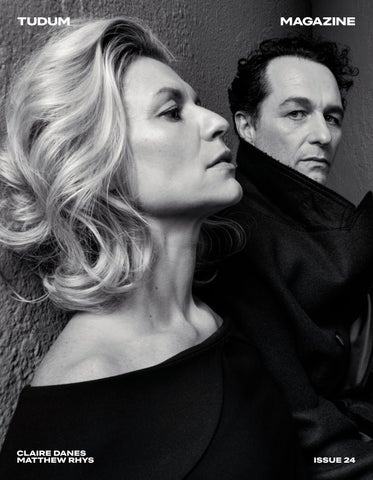
TUDUM
CLAIRE DANES MATTHEW RHYS
MAGAZINE
ISSUE 24
Table of Contents 04 Queued Up 28 Features 30 BEEF
40 The Diplomat
46 Tessa Thompson 50 Dan Levy
56 The Duffer Brothers
64 Book to Screen: Vladimir
118 Claire Danes and
Matthew Rhys 128 Jason Bateman 132 Monster: The Ed Gein Story 138 Tina Fey 142 Wednesday 146 Michael Shannon and Matthew Macfadyen 150 aka Charlie Sheen 154 Nobody Wants This 160 Wanda Sykes and Taylor Tomlinson 164 KPop Demon Hunters 168 Dinner Party: Marco Calvani
68 Below
the Line
ON THE COVER
The cast of BEEF photographed by Richie Talboy Claire Danes and Matthew Rhys photographed by Inez & Vinoodh
Tudum Magazine
40 THE DIPLOMAT
cast brings crackling chemistry to the political drama.
30
BEEF
returns with four new actors leaving their mark on the anthology series.
3
50 DAN LEVY
STR A N G E R T H I N GS P H OTO BY N I KO TAV E R N I S E .
delivers a sharp new comedy with Big Mistakes.
118
CLAIRE DANES AND MATTHEW RHYS make sparks fly in The Beast in Me.
56
THE DUFFER BROTHERS
bid farewell to 10 years of Stranger Things. Issue 24
From the Editor
T
he second installment of BEEF was worth the wait, a fact underscored by the outstanding performances delivered by its stars — Oscar Isaac, Carey Mulligan, Charles Melton, and Cailee Spaeny. The ensemble, playing a set of couples locked in a country club–set feud steeped in betrayal and blackmail in the anthology, graces the cover of Issue 24, photographed by Richie Talboy. Filmed on location throughout Southern California and Korea, the cast grew close while collaborating with creator Lee Sung Jin on the dramedy, and their playful energy carried over to the set of our cover shoot. “I was struck by the sense of foreboding in the series, and inspired by the works of painters Bo Bartlett and Alex Colville. I wanted to create tableaus — hyperreal sets, some props creating an uncanny sense of perfection. The actors were fantastic partners in the creative process,” says the photographer. This is also true for our second set of cover stars, The Beast in Me’s Claire Danes and Matthew Rhys. The duo had audiences enrapt throughout their cat-and-mouse thriller when it debuted last fall, and in our cover story, Danes remembers feeling like the project was a contemporary twist on a Hitchcockian mood. Their shoot, photographed by Inez & Vinoodh, hits a similar Old Hollywood chord. “Claire and Matthew are the ideal actors to photograph! Open, imaginative, and at ease in their bodies,” say the photographers. “We like to give our subjects a well-known person to keep in mind during the shoot that informs expression and body language. For Matthew, that was Jean Cocteau, and for Claire, it was Lauren Bacall.” This issue is jam-packed with more of the season’s can’t-look-away series and specials, including Stranger Things, Monster: The Ed Gein Story, The Diplomat, Wednesday, and more; this edition also features a special deep-dive section on the artists and crafts that bring them to life. — Krista Smith Find us on social @NetflixTudum. Tune in to our podcast, Skip Intro with Krista Smith. Designed by Pentagram
Tudum Magazine
Queued Up 5
06 THE BREAKTHROUGH
Taylor Ortega
08 SPOTLIGHT
Remarkably Bright Creatures
10 PLAYLIST
Stranger Things
12 THE VOICE
Morgan Freeman
14 WATCH LIST
Adult Animation
16 ARTIFACTS
Squid Game
20 BY THE NUMBERS
Bridgerton
22 THE MAP
BEEF
24 SOUND BITES
Learn more about Queen Charlotte’s (Golda Rosheuvel) wigs on page 20.
That’s What They Said
26 THE LEGEND
Alfred Molina Issue 24
Taylor Ortega The Breakthrough
The actor and comedian is at the center of the action in Dan Levy’s crime comedy Big Mistakes. Photograph by Mary Ellen Matthews The chaos of the family-crime comedy Big Mistakes is set off by an impulsive but well-meaning gesture. In a misguided theft for a gift to give her dying grandmother, Morgan — the middle sibling of the Dardano family, played by actor and comedian Taylor Ortega (Another Simple Favor) — steals a diamond tennis necklace from a seedy local store. The theft inadvertently brings Morgan and her brother, Nicky (Dan Levy), into the threatening world of organized crime. They get blackmailed into cooperating with an underground drug operation controlled by the mob, with their exploits taking them on a journey far beyond their tight-knit suburban town in New Jersey. The unparalleled stress destabilizes Morgan, already a long way from her early dreams of making it as an actor in New York City. Working a thankless job as a public school teacher and stuck in a lackluster relationship with her long-term boyfriend, Max (Jack Innanen, Adults), the messy and aimless Morgan is judged for her choices by both her overbearing mother, Linda (Laurie Metcalf, Lady Bird), and the youngest — and favorite — Dardano sibling, Natalie (Abby Quinn, Knock at the Cabin). Tudum Magazine
For Levy, who is a co-creator of the series as well as showrunner, casting the right performer to play his onscreen sister was a tall order, as Morgan and Nicky share a hilariously fraught yet ultimately supportive bond. But any fears went out the window when Ortega came on board. “There was an instant sibling dynamic,” remembers Levy. “It does have to either be there or not with chemistry,” says Ortega. The performer notes that as she and Levy got closer and developed their working relationship, they found parallels in their own familial bonds that may have contributed to their true-tolife dynamic. “We grew up in similar households, [and] our communication style must be similar with our families, [because to us,] this is how siblings would communicate.” Big Mistakes is not afraid to explore what family can really feel like and the complexities of adult sibling relationships. Morgan and Nicky have their fair share of arguments, and they struggle dealing with their domineering mother, but ultimately, they both have a fierce love and protectiveness for one another as they face the unexpected. “When my own mom came to set … for
her it felt very realistic,” Ortega says, noting Big Mistakes’ honest approach to intrafamilial conflict. “The woman watches a lot of television; I know she knows it’s scripted, but it was hitting for her.” Ortega is still relishing the fact that she found her comedic kindred spirit in Levy, with whom she felt connected long before cameras rolled on the comedy thriller. “There were even times I would watch Schitt’s. I remember watching that and just being like, ‘This is the way my parents describe me,’” says Ortega. “We have a bit of a similar sensibility where I can sort of anticipate a little bit where [Levy] might go with something, and then that makes it easier for us to be very quick with it.” Their shared sensibilities make Big Mistakes a laugh-out-loud ride, with Morgan and Nicky coming across as a natural sibling duo. “Taylor has brought such a fresh earnestness to that character, and she’s so spontaneous in her performance that it led to this game of sparring with each other that constantly feels fresh,” says Levy. “So much of what you see is, like, just us having fun with each other, and she’s the greatest scene partner, and we just had a blast.”
7
Remarkably Bright Creatures Spotlight
Dive into the world of the bestselling novel in this adaptation starring Sally Field and Lewis Pullman. What do an octopus, an Oscar winner, and a blockbuster movie star have in common? Look no further than Remarkably Bright Creatures, a film adaptation of the beloved novel by Shelby Van Pelt that spent more than 64 weeks on the New York Times Best Sellers list in its debut run. Directed by Olivia Newman (Where the Crawdads Sing), the film follows Tova (Academy Award and Emmy winner Sally Field), a lonely widow who finds joy again when she forms unlikely bonds with a giant Pacific octopus at the aquarium where she works and a wayward young man, Cameron (Emmy nominee andThunderbolts* actor Lewis Pullman), who comes to town in search of family. Together, they uncover a mystery that will lead them to a lifechanging discovery and restore their senses of wonder. Readers and fans of the book will know that the story is told not by a human but rather by the cantankerous cephalopod Marcellus, voiced by Emmy, BAFTA, and Golden Globe nominee Alfred Molina (Frida). Tudum Magazine
Van Pelt says an internet rabbit hole and a fiction-writing exercise led her to her unexpected narrator. “One of the places where I was able to find a really good character was on YouTube, watching videos of naughty octopuses that were escaping from their enclosures or just getting up to antics in aquariums,” says the author. “I remember thinking that would be such a fun voice to write, such a fun character to harness.” Of course, Marcellus needed human characters to ground the story in the real world, which is where Tova, based on Van Pelt’s maternal grandmother, and Cameron, inspired by events throughout the author’s life, came into play and filled out this cozy world. “Beyond Marcellus, Remarkably Bright Creatures is a story of love and grief,” Van Pelt says. “Those are two emotions that everyone who walks this planet feels at some point, so the themes are very widely resonant. There’s just a wide range of ages and generations and characters that people can enjoy together.”
9
Tova (Sally Field) and Cameron (Lewis Pullman).
Tova (Field) and the film’s narrator, Marcellus (voiced by Alfred Molina).
Issue 24
Playlist Robin (Maya Hawke) and Steve (Joe Keery) hit the airwaves throughout the fifth season of the series, thanks to the fictional WSQK 94.5 FM.
Stranger Things Music has the power to transport us through time and space. Popping on a pair of headphones and pressing play on a song can instantly make you feel like you’re falling through a portal to another dimension, almost like Will Byers (Noah Schnapp) vanishing into the Upside Down. Creators Matt and Ross Duffer are well aware of this phenomenon and have used each season’s soundtrack to build the eerie and emotional world of Stranger Things over its nearly decade-long run. Throughout the series, the 1980s are resurrected via strategically chosen needle drops from that era and before by iconic bands like Wham!, Duran Duran, Psychedelic Furs, Talking Heads, and Tudum Magazine
Journey, and legendary artists including Peter Gabriel, Diana Ross, David Bowie, and Madonna. Hits from the past like “Should I Stay or Should I Go” by The Clash and “Running Up That Hill” by Kate Bush double as important plot devices. With music forming a crucial component of the drama’s DNA, curating the soundtrack for the most sweeping season yet was an important undertaking for the Duffer Brothers and music supervisor Nora Felder, one that was aided by the reinvigorated success of their previous selections. When the creators said they wanted to feature two Prince songs from the generational artist’s Grammy-winning 1984 album Purple Rain — “When Doves Cry” and
the titular “Purple Rain” — in the finale, “we were told that it was a real long shot, so we just crossed our fingers,” says Matt Duffer. “And then, thanks to [our experience with] Kate Bush, we were able to acquire the rights.” The English artist’s 1985 classic track saw an overwhelming resurgence in popularity after it was used in the fourth season, showcasing the series’ ability to honor seminal musicians and songs tied to the characters’ deeply emotional and actionpacked journeys. Even now that the series has aired its fifth and final season, you can still return to Stranger Things’ nostalgia-fueled universe anytime by listening to its unforgettable playlist.
11
A DD I T I ON AL R E P ORT I N G BY K E I S H A H ATCH E T T A N D O LI V I A H A R R I S O N . T H I S PAG E : RO S S : H A RRY L A N G D O N / G E TTY I M AG E S . BUS H : G OV E RT DE ROOS /AVA LON P HOTOSHOT/COU RTE SY E VE R E T T COL L ECT I ON . P R I N CE & B OWI E : M I C H A EL O CH S A R CH I V E S / G E T T Y I M AG E S .
SONG TITLE
PERFORMED BY
EPISODE
TIMESTAMP
“Upside Down”
Diana Ross
01
00:23:56
“Running Up That Hill”
Kate Bush
02
00:24:43
The Chordettes
02
00:51:52
“I Think We’re Alone Now”
Tiffany
03
00:19:41
“When It’s Cold I’d Like to Die”
Moby
07
00:00:38
“When Doves Cry”
Prince
08
01:14:24
“Purple Rain”
Prince
08
01:18:33
Fleetwood Mac
08
01:23:42
David Bowie
08
01:58:47
“Mr. Sandman”
“Landslide” “Heroes”
“Upside Down”
A song has never been more perfect for the Stranger Things universe than this Diana Ross classic. Following the release of Stranger Things 5, Volume 1 in November 2025, the track saw a 510% jump in overall global streams on Spotify, as a whole new generation of music lovers discovered the 1980 hit.
“Running Up That Hill”
After it was used in the fourth season of Stranger Things, Kate Bush’s 1985 classic shot up to No. 3 on the Billboard Hot 100 in
July 2022. The song remains a key musical motif throughout the final chapter as Max (Sadie Sink) fights to regain consciousness after being put in a coma by Vecna.
“Purple Rain”
The Duffer Brothers had “never talked about a song choice as much as we did for” the heartbreaking moment Eleven (Millie Bobby Brown) says goodbye to Mike (Finn Wolfhard) in the finale. “What is also very exciting about it is it just has not been used. [Prince’s] estate does not generally allow that song to be licensed outside the Purple Rain movie,” Ross Duffer explains. The song choice was also
thrilling for the Duffer Brothers “because it summed up the emotion of the moment.”
“Heroes”
The Peter Gabriel cover of the song was already a part of the series’ canon after being featured in earlier seasons when Joe Keery, who plays Steve, suggested using the original version to close out the emotional epic, playing over the end credits. Says Ross Duffer, “Once Joe said that, we immediately knew that was the right song to end the show on because it is, in some ways, an anthem for Stranger Things. To use the original Bowie version just felt fitting for the conclusion.” Issue 24
Morgan Freeman The Voice
The Dinosaurs takes viewers back to the days of Pangaea with the help of narrator Morgan Freeman. Photograph by Pari Dukovic About 235 million years ago, on the sunblasted supercontinent of Pangaea, a tiny, fleet‑footed creature known as Marasuchus emerged from its egg. Standing on two legs, with advanced lungs, light bones, and warm blood, this unassuming animal carried the blueprint for a lineage that would become nature’s greatest empire: the dinosaurs, who held dominion over Earth for 150 million years. Now, from executive producer Steven Spielberg and Amblin Entertainment, in collaboration with the creators of Our Planet, comes a four‑episode documentary series charting the rise and fall of the dinosaurs — where they came from, why they mattered, how they evolved, and how they became extinct. The Dinosaurs builds on the groundwork laid in Life on Our Planet, which blended nature cinematography with photo‑realistic visual effects to tell the history of life on Earth from 4 billion years ago to the present day. Showrunner Dan Tapster saw the new series as an opportunity to go deeper and finally give the story of the dinosaurs the space and scale it deserved. “We had eight 50‑minute episodes to tell the entire story of life on Earth [in Life on Our Planet], so there were lots of things where we could only scratch the surface — and the dinosaur story was absolutely one of them,” Tapster says. “With The Dinosaurs, we finally get to tell that story in full and celebrate it like no Tudum Magazine
one has ever done before.” Adds director Nick Shoolingin‑Jordan, “Here, we really tell the full chronology all the way through and take the audience on a rip‑roaring adventure.” The Dinosaurs also gave Tapster and Shoolingin‑Jordan the opportunity to reunite with their Life on Our Planet narrator Morgan Freeman, who lends his singular languid baritone to the show. “His voice is just outstanding. As a drama tool, he brings a kind of gravitas and pacing and at times lighter moments too,” says Tapster. “There’s that running gag that he’s the voice of God.
Photo-realistic visual effects enhance the storytelling in The Dinosaurs.
It’s like, ‘Well, what better voice to tell this story that really happened over 170 million years?’” The Academy Award–winning actor was also a perfect fit for the documentary series because of his own passion for the planet. “He knows a huge amount about evolution, about the story of life, and he’s a dinosaur nerd,” says Tapster. “He’s passionate about some of the challenges that the planet currently faces, and there are some scenes that hold a mirror up to what’s happening today, and he really liked that. He was absolutely fantastic to work with.”
P ORT R A I T CO URT ESY OF T R U N K A R CH I V E .
13
Issue 24
Animation Watch List
Cartoons aren’t just for kids. Discover the animated comedies and dramas that are delivering inventive visual storytelling and boundary-pushing narratives.
Long Story Short
BoJack Horseman creator Raphael BobWaksberg has done it again with this already renewed animated title, which follows Jewish American siblings from childhood to young adulthood to middle age. The episodes jump back and forth through the years, offering relatable moments of triumph, disappointment, joy, and compromise, with a star-studded voice cast, including Ben Feldman, Abbi Jacobson, and Max Greenfield.
Stranger Things: Tales from ’85
The new animated series from showrunner Eric Robles and Stranger Things co-creators Matt and Ross Duffer takes place in 1985. It’s a freezing winter in Hawkins, Indiana, and our heroes are about to embark on an epic journey. The original series’ characters must fight new monsters and unravel a paranormal mystery terrorizing their town.
Mating Season
While Big Mouth has ended, fans of gross-out animated humor can rest easy: The twisted minds behind the Emmy-nominated series are back. Mating Season covers the topics of love, sex, relationships, and the universal need to find a partner and perpetuate the species — starring bears, raccoons, deer, and foxes, along with a host of other horny, lovable forest critters.
Tudum Magazine
For Adults
15
Scan the QR code for more animated series to watch.
Love, Death & Robots
This anthology series, created by Deadpool director Tim Miller and executive produced by David Fincher, taps into a variety of different animation styles and genres to probe the three subjects of its title: love, death, and robots. Expect everything from dark comedy to terrifying creatures and mind-bending realities. No two installments are the same, which makes for an enthralling watch.
Haunted Hotel
This ghostly comedy centers on a single mother of two who struggles to run the Undervale, a hotel that happens to be haunted. Luckily, she has some help from her estranged brother — now one of the ghosts — who thinks his fellow phantoms have some pretty good ideas. The series’ voice cast features Will Forte, Eliza Coupe, Skyler Gisondo, Natalie Palamides, and Jimmi Simpson.
Arcane
Praised for its gorgeous animation and emotional storytelling, this action-packed sci-fi series follows two sisters — Jinx (Ella Purnell), also known as Powder, and Vi (Hailee Steinfeld) — who find themselves on rival sides of a brewing war between the rich, utopian city of Piltover and its oppressed underbelly, Zaun. As the conflict intensifies, the sisters veer down two very different paths — and their bond is tested.
Issue 24
Squid Game Artifacts
Discover enduring imagery from the series that took the world by storm. With more than 4 billion hours of Squid Game streamed over the course of its three seasons, the series’ visual language is indisputably iconic. The Korean global phenomenon made fans clamor to get their hands on green tracksuits and see the simple shapes of a circle, triangle, and square very differently. In the third and final season, the original series’ iconography returns, with new twists. Costume designers Cho Sang-kyung and Choi Yoon-sun reinvent the pink-guard jumpsuits for a menacing villain, while Emmy-winning production designer Chae Kyoung-sun incorporates the larger-than-life doll Young-hee into a new game. Here, we take a look at images and moments that closed out the record-breaking series. Tudum Magazine
1
17 1. BLACK GUARD’S SUIT Black Guard, played by Park Hee-soon, is tapped to supervise the rest of his fellow guards and keep watch over the players and the games when the cunning Front Man (Lee Byung-hun) is not around. The pink zipper, belt, and shoelace details of his suit reference the pink jumpsuits that have been synonymous with Squid Game since Episode 1, but the suit’s more sinister nature reflects not just the hierarchy but also his character. The audience will discover that the Black Guard is covertly managing another dark operation: harvesting organs from the eliminated players. 2. YOUNG-HEE, THE DOLL Young-hee returns for one more round of terror — and this time, she brings a friend. The infamous doll from Seasons 1 and 2 who leads the first game — Red Light, Green Light — is back for a new game in Season 3: Jump Rope. The instructions for this game are fairly simple: Walk from one side of a platform to another. The difficulties arise when players realize Young-hee and her new friend Chul-su are towering above the walkway, manning a gigantic metal jump rope. Players must make it across the walkway within 20 minutes without being hurled off the platform by the rope. At the end of this merciless round, the competitors believe there are only eight of them remaining. However, the guards inform them there are actually nine players still in the running: In the wake of her mother’s self-sacrificial death during Jump Rope, Jun-hee’s (Jo Yu-ri) baby is Player 222. Offended after learning that the infant could suddenly inherit a full share of the prize pot, the contestants vote to play one last game.
2
3. SKY SQUID GAME TOWERS The last round of Squid Game combines the competition’s dedication to strategy with its thirst for blood. At the start of the Sky Squid Game challenge, players stand atop one of three hulking towers. Each is a different traditional Squid Game shape: The first is a square, the second is a triangle, and the third is a circle. To advance from one tower to the next, players must push one or more of their fellow competitors off of the structure. On the second and third towers, the round begins only after a player presses a button in the ground, setting off a countdown clock. If players do not eliminate a participant by the time the clock runs out, all players will be eliminated. Gi-hun (Lee Jung-jae) must remember all of this — and keep his wits about him — as he strives to protect himself and Jun-hee’s baby from their bloodthirsty co-competitors.
3
Issue 24
Artifacts
4
Tudum Magazine
19
5 4. VIP-ROOM CHAIR The VIPs play an important role in Squid Game, as the group of anonymous high-net-worth individuals fund the deadly games and watch for pure entertainment; to them, the games are truly sport. The ornate, golden animal masks they wear to conceal their identities have been a fixture of the series since the beginning, and in Season 3, the VIPs make even more grotesque decisions that affect the game they’re bankrolling. While the games are played in settings that reference childhood imagery and objects, the VIP viewing room is lavishly, colorfully decorated, with lush, exotic plants and velvet furniture, including this red shell-shaped chair.
5. VIP DINING ROOM The dining room for the VIPs is another decadent set that contrasts with the stark, minimalist dormitory and game sets. Velvet details and botanical wall coverings echo the decor and the multicolored plants that dominate the viewing room. A large hexagonal table anchors the space, and mounted above is a six-sided structure with screens that can be raised or lowered so that VIPs never miss a minute of the brutal action.
Issue 24
Bridgerton By the Numbers
172
looks were created by the costume team for the masquerade ball, among them king and queen chess pieces, a sheep, a rabbit, a horse, and the sun. Penelope (Nicola Coughlan) and Colin (Luke Newton) nail the couple’s costume as they both arrive as pirates.
200
pictures were sourced from public libraries, printed on canvas, glazed, and then framed to fill the grand homes and palaces of Season 4. Elsewhere, paintings based on photos taken on set were created to depict the characters.
700+ Tudum Magazine
pieces of jewelry were made for Season 4, from massive necklaces to delicate stock pins. The jewelry team was also responsible for hand painting shiny white molded masks for the masquerade ball.
21 In Season 4 of the regency romance, artisans reached new heights with their crafted sets, wigs, costumes, and props.
100+
P H OTOG R A P H Y BY L I A M DA N I EL .
dance cards were designed and created for each ball scene. Ladies attach them to their wrists to manage their dancing schedule with suitors.
160 wigs were used for background actors in the masquerade ball scene. One special wig, created for and worn by Queen Charlotte (Golda Rosheuvel), pays homage to the celestial skies and symbolizes the queen’s love for King George. The wig features a heart-shaped cage that contains a replica of her nuptial crown.
6,000+ candles were used in Season 4 in the various ball scenes. For the Queen’s Ball, which featured an “under the sea” theme, 2,000 scallop shells were shipped in from Cornwall, England, each individually wrapped in gold foil before being hung.
BEEF The Map
The second season of the Emmy-winning anthology stays true to its California roots while also spanning the globe. Illustration by Katherine Baxter
Two seasons in, the dark comedy anthology series BEEF has become just as synonymous with feuds as it has with Southern California. In the latest outing, creator Lee Sung Jin travels north of Season 1’s Los Angeles to the ritzy enclave of Montecito and the fictional Monte Vista Point Country Club, where club manager Josh (Oscar Isaac) and his wife, Lindsay (Carey Mulligan), collide with staff member Ashley (Cailee Spaeny) and her fiancé, Austin (Charles Melton), after the latter couple witnesses and records a fight had by the former. But this foursome is not lucky enough to call themselves residents of the tony community, and Lee illustrates the stark class divide between guests and staff as Josh and Lindsay return home to their fixer-upper in Ojai and Ashley and Austin, just starting their life together, commute back to neighboring Oxnard. Their beef doesn’t stop at the county line: In the second season, the characters also travel to Park City, Utah, to club member Troy’s (William Fichtner) chalet, and to new MVPCC owner Chairwoman Park’s (Youn Yuh-jung) home country of Korea as the couples get caught up in an escalating series of betrayals, blackmail, and existential heartbreaks. Here’s a closer look at some of the places where the unforgettable action happens. Tudum Magazine
23
Issue 24
Sound Bites “It’s just a truism that men look better in a three-piece suit than they do in jeans and a sweatshirt. They just do.” CILLIAN MURPHY, PEAKY BLINDERS: THE IMMORTAL MAN
That’s What They Said Peaky Blinders: The Immortal Man Podcast
Familiar voices had some things to say on Netflix podcasts. Scan the QR code to listen to the latest Netflix podcasts.
“We want you to take away the idea that you don’t have to settle, that you get to define who you are, you don’t let anybody else do so.” SHONDA RHIMES, BRIDGERTON
Bridgerton: The Official Podcast Tudum Magazine
25 “The more I get into Morticia’s dress and shoes and her character, the more I completely love her and quite frankly don’t want to let her go.” CATHERINE ZETA-JONES, WEDNESDAY
CI L L I AN M UR P H Y A N D C H A R LI E H UN N A M P H OTOS CO URT E SY O F G E T T Y I M AG E S . CATH E RI N E Z E TA-JO N E S PH OTO C O URTE SY O F STI L L MOV I NG. NE T.
The Wednesday Season 2 Official Woecast
“When I go to England, everyone thinks I’m American. I get a little bit of flack for the way I sound.” CHARLIE HUNNAM, MONSTER: THE ED GEIN STORY
Skip Intro with Krista Smith
“Through this all, I feel like I’ve learned one person can make a difference.” ELIZABETH SMART, KIDNAPPED: ELIZABETH SMART
Skip Intro with Krista Smith
“The accomplishment or the failure is a moment … so much of life should be focused more on process.” BRAD FALCHUK, FAMOUS LAST WORDS
Skip Intro with Krista Smith
Issue 24
Alfred Molina The Legend
The revered actor stars in supernatural drama series The Boroughs. Photograph by Rii Schroer
Alfred Molina is one to jump headfirst into every role he inhabits, from his Tony-nominated performances onstage to his instantly iconic turn as Doctor Octopus in the Spider-Man universe, to transforming into real-life figures such as Diego Rivera in the film Frida and his Emmy-nominated performance as director Robert Aldrich in the series Feud: Bette and Joan. And there’s plenty of jumping, running, and action involved in his latest onscreen adventure, The Boroughs, created by Jeffrey Addiss and Will Matthews (The Dark Crystal: Age of Resistance) and executive produced by the Duffer Brothers and Hilary Leavitt. In the supernatural mystery series, Molina puts his stamp on Sam Cooper, a recent widow who is the new retiree on the block in the sunny New Mexico retirement community of The Boroughs, where golf carts outnumber cars and worries can be cast aside as the grounds are meticulously managed by owners who have thought of everything. But when Sam discovers a terrifying entity haunting his neighborhood, he brings together his fellow residents, becoming an unlikely leader as the group works to uncover the truth lurking beneath their picture-perfect community. Molina felt a kinship with the role from the early conversations he had with Addiss and Matthews, which made it easy to jump aboard. “I realized, when we got onto the subject of loss and the sense of ‘What do you do when you lose a partner that you’ve been with a long time?’ — that’s something that I share with the character,” says Molina. “Not that they Tudum Magazine
were asking me to mine that memory, but I was happy to offer and say, ‘Well, I know what that feels like.’” Sam is a reluctant hero, pushed to action despite his own grumpiness. “He starts off in one place and is somehow forced to go somewhere else,” says the actor. “He may not like it all the time, and he may not want to, but he has to. That kind of conflict, that kind of contradiction in characters is where the meat is.” Another meaty aspect of The Boroughs was the opportunity to work with a murderers’ row of generation-defining actors. Molina is joined by Alfre Woodard, Denis O’Hare, Geena Davis, Clarke Peters, and Bill Pullman in the ensemble, many of whom had already crossed paths over their decades-spanning careers. The ice was already broken before they arrived on set. “We’ve all been around a bit. None of us have got anything to prove,” Molina says of their instant chemistry. “When you reach a certain age, we’ve all learned how to take the job seriously, but ourselves not at all. And that makes for a very easy atmosphere.” What also made The Boroughs a delightful experience for Molina was the humanity at the core of the otherworldly suspense. “It didn’t feel like writing. It felt like speech, like people talking,” the performer says of Addiss and Matthew’s scripts. “Alfred Molina is a dream No. 1 on a call sheet,” says Addiss. “He is effortlessly talented and kind, and he can break your heart so quickly and easily.” Adds Matthews: “Everyone wants to do a good job in front of Alfred. No one wants to let down Alfred Molina.”
Boogie Nights
Frida
Spider-Man 2
Feud: Bette and Joan
The Boroughs
PORTRAIT COURTESY OF EYEVINE/REDUX. BOOGIE NIGHTS: NEW LINE CINEMA/COURTESY EVERETT COLLECTION. FRIDA: MIRAMAX /COURTESY EVERETT COLLECTION. SPIDER-MAN 2: COLUMBIA/COURTESY EVERETT COLLECTION. FEUD: BETTE AND JOAN: BYRON COHEN/©FX/COURTESY OF EVERETT COLLECTION
27
DI T E L I TAT E P E R U M R E R I ST E N DUC I M U S A A D E AT I UM N UM F UG I A S E QU I D I T I S E T AC E S S E C UPTATUR? I D E LE CTI S I TI C O RPO R A S PI C I D U TA M E NI MI L I S QU E NIMI, NE CTI SIM
TUDUM BEEF THE DIPLOMAT HIS & HERS BIG MISTAKES STRANGER THINGS VLADIMIR THE BEAST IN ME BLACK RABBIT MONSTER: THE ED GEIN STORY THE FOUR SEASONS WEDNESDAY DEATH BY LIGHTNING AKA CHARLIE SHEEN NOBODY WANTS THIS TAYLOR TOMLINSON: PRODIGAL DAUGHTER WANDA SYKES: LEGACY KPOP DEMON HUNTERS MAGAZINE
All he t Rage
Oscar Isaac, Carey Mulligan, Charles Melton, and Cailee Spaeny dish out humor and pain in the next serving of BEEF. By CHRISTOPHER HUDSPETH Photography by RICHIE TALBOY Fashion editing by MICHELLE CAMERON
32
F
Feuds don’t always begin with a bang. Sometimes all it takes is a simple misunderstanding and the faintest spark of leverage to ignite an inferno. In BEEF Season 1, a brief road rage incident spirals into a rapidly escalating, all-consuming war between two strangers determined to drag each other to the depths of misery. In the second season of the Emmy-winning anthology, the fuse is lit at Monte Vista Point, an exclusive Montecito country club, where low-level employees Ashley and Austin capture incriminating video of a heated argument between the volatile but magnetic club manager, Josh, and his tightly wound wife, Lindsay, using the footage as currency to advance their careers. For creator Lee Sung Jin, the combustible premise is surprisingly familiar, “ripped from the headlines” of his own life, and loosely based on an experience he had witnessing neighbors have their own spat. “We’ve all been seen at our worst in the privacy of our own home,” he says. He initially considered keeping things closer to home and utilizing a “Rear Window setup” before shifting to the boss-subordinate conflict, centered
“At a certain point, everyoneʼs construct is going to fall apart — the way people reconstruct is the challenge.”
around two couples navigating vastly different stages of adulthood: “We thought, what if we actually made them closer in age and highlighted the generational divide between a millennial and Gen Z couple?” Enter Oscar Isaac, Carey Mulligan, Charles Melton, and Cailee Spaeny, the ensemble at the core of Lee’s expansive follow-up. What begins as an unsettling secret spirals into a web of blackmail-driven favors, bold manipulation, and life-threatening stakes, making for an explosive, corrosive new grade of “beef.” Episode by episode, tensions simmer beneath polite smiles and fraudulent formalities until everything boils over and monumental decisions must be made. In his earliest moments, Josh (brought to life by Emmy winner Isaac) seems captivatingly composed, the charming type of guy who’s sharp enough to know everyone’s name — and resourceful enough to solve their problems — at the helm of Monte Vista Point. Isaac labels Josh as the “fixer” who “knows everything” until his polished exterior quickly begins to crack, and ongoing tensions with his wife (Mulligan) result in an animated domestic dispute. “It was really fun to build the façade that you see crumble quite quickly,” Isaac shares. Josh and Lindsay’s complicated marriage is made more fraught by their shared ambition for more: more money, more for their careers, and Tudum Magazine
OS CA R I S A AC W E AR S A S U I T BY U M I T B EN A N A N D A T- S H I RT BY TH E R OW.
Oscar Isaac
35
more for each other. “Possibilities were endless. They believed in each other,” says Isaac, imagining the couple’s earlier days. “They had huge dreams and decided to go for it. Now they find themselves feeling stuck.” The ominous sense of time slipping away is part of what drew Mulligan to the role of Lindsay, a fledgling interior decorator at a crossroads in her life, in the first place. “I recognized so much in her in this dilemma of reaching a point in life and realizing that maybe it’s not where you imagined you would be,” says the Academy Award– and Golden Globe–nominated actress. “There’s a sense of the passage of time. I think that can make people crazy. I saw a bit of crazy in her that I thought would be fun to play.” Stagnation is a logical explanation for the emission of pent-up frustration on display during Lindsay and Josh’s big confrontation — a scene that came together with an abundance of effort. “The fight
“Thereʼs a fine line between something that makes you laugh and something that makes you cry.”
CA R EY M U L LI GA N W E A R S A D R E S S BY CA LV I N K LE I N , LE AT H E R G LOVE S A N D S H OE S BY PRA DA .
Carey Mulligan
went through so many iterations and rehearsals, lots of improvising, lots of talking about things that had happened to us personally, friends, people we know,” Isaac recalls, examining Josh and Lindsay’s verbal jousting in depth. “What are the things that they’re not expressing that they wish they were expressing? Ultimately, you’re seeing these two people who are desperate to reach out to each other but have so much baggage and resentment that they’re unable to.” Despite the toxicity corroding their connection, the relationship wasn’t always fractured and contentious. “Josh and Lindsay did have a real love story,” Mulligan says. “They had this huge romance when they met in their 20s. The reality of life has hit them, so now Lindsay feels like an annoyance to him. They don’t connect. They’ve fallen into these stereotypes of their lives. The essence of young love is faintly in the background and they keep grasping for it.” Mulligan and Isaac previously worked together on Drive (2011) and Inside Llewyn Davis (2013), and the pair relished their fiery, ferocious scenes. “Oscar is the most fun person to fight with. We had a really good time,” says Mulligan. “A lot of our stuff is pretty spicy, but we’ve known each other for 15 years and we’ve worked together a lot, so there’s a lot of relational stuff that’s out of the way when you’ve known someone that long.” Their lived-in dynamic contrasts with the relationship of the couple at the other end of BEEF’s central feud. Ashley and Austin, brought to life by Spaeny and Melton, are in a hazy, optimistic state of early love, newly engaged and yet to face the destabilizing challenges life can throw at a partnership. “We find them in rose-colored glasses,” Spaeny says. “They’re very in love and they’re sold that all they need is the simple life. They’re quite naïve and they’re also sort of anxiously attached to each other.” They have some abandonment issues they have yet to interrogate, and orbiting the crumbling marriage of Josh and Lindsay shakes their worldviews. “What’s interesting is we journey with them through certain circumstances that bring out different parts of them,” Melton explains. “Maybe parts they hadn’t yet seen in each other.” After witnessing the catastrophic exchange between their boss and his wife, Austin is eager to find the right thing to do, whereas Issue 24
Ashley slowly realizes that blackmailing Josh for a better job with actual benefits — ones that are crucial as she navigates a health problem that could affect her fertility — might be the best way to set her and her beau up for a better life. But ambition rarely stops at the first milestone. “Once she gets that first taste, there’s sort of no end to it. We could always have something better,” says the Golden Globe–nominated Spaeny. “That obsession drives her crazy, because she’s set on thinking she deserves a certain kind of life.” As she climbs the ranks at the club, Ashley morphs into an unsettling mirror of Josh himself. Austin, meanwhile, continues to struggle with his desire to do the right thing, even if it doesn’t align with what’s best for him and his partner. As Melton notes, “One of Austin’s dilemmas is, ‘If I’m doing the right thing and it’s not good, is that OK? What if I’m doing the good thing but it’s not the right thing?’” The moral tug-of-war is part of what makes Austin so endearing and authentic. “I think we all got a little Austin in us,” Melton adds. “Austin wants to be useful. His purpose is in being of use. That’s one of his main things. When he feels he’s not needed, that’s like, ‘What about me?’” That depth brought Melton closer to the character than he expected: “It’s the most naked I’ve felt doing a job. I have more similarities with this role of Austin than I’ve had in previous things.” The role also gave Spaeny an opportunity to explore the awkward, sensitive edges that make BEEF feel so human. “The only way to do BEEF right is if you play the most embarrassing parts of yourself honestly. If you’re doing that next to someone who doesn’t trust you or is judging you, it’s not going to work,” she says. Fortunately, Spaeny had a collaborator who made vulnerability second nature. “That’s what’s so great about Charles: There’s no judgment. I’ve never had as much fun as I had with Charles.” The feelings are mutual. “Cailee’s such a talented actress and a better human,” says Melton. “We are extremely close, she’s like my best friend. I’m always finding things creatively with her.” Josh and Lindsay’s early quarrel isn’t just the impetus that sets BEEF’s story in motion; it also establishes the tense atmosphere that lingers throughout the season. “Tone is everything and BEEF has this satirical, cringe element to it, but it has a lot of empathy as well,” says Isaac. “It shows you absurdity, but it’s not pointing and laughing. It’s from a place of understanding that we’re all like that at times.” Spaeny agrees: “Tonally, BEEF is unlike anything else I’ve done before. It’s absolutely heartbreaking and hilarious at the same time.” Mulligan also praises BEEF’s particular ability to intertwine humor and drama. “What’s so brilliant about the writing is that so many of the
“Itʼs kind of like learning to dance with someone. Everyoneʼs a different dancer, and weʼre just playing and flowing.”
Charles Melton
things that happen in the show are true to life,” says the performer. “A lot of great tragedy carries real comedy. There’s a fine line between something that makes you laugh and something that makes you cry.” The new BEEF troupe members were thrilled to play in Lee’s world, already counting themselves as fans of it, and Lee brought them along for the ride as he crafted the season. An ongoing dialogue with Lee was an incredible resource as the cast sat with their characters. “We’d have long conversations over Zoom a couple times a week, and it almost became like my therapy session,” says Isaac. Lee feels similarly. Tudum Magazine
CH A R LE S M E LTON W E A R S A S UI T BY LOU I S VU I T TO N A N D CH A I N BY DAV I D Y U R M A N .
36
CA I LE E S PA EN Y W EA R S A DR E S S A N D BE LT BY ACN E ST U DI O S , S H O E S BY A L ES S A N D RA RI C H , A N D E A RRI N G S BY S O PH I E BI LLE BRA H E .
39
“Writing BEEF characters can be both exhausting and cathartic,” says the creator. “There’s a very therapeutic thing that happens when you’re shining a light on all the shadows inside.” For Melton, the journey began two years prior to production, when he connected with Lee — known as “Sonny” by the cast — at an intimate dinner. “We sat next to each other and he told me about Season 2,” Melton recalls. “I had just watched Season 1 and it was my favorite show that year. Sonny’s such a brilliant mind. We hit it off and he talked about this character and his whole concept.” “The character of Ashley was something Sonny and I found together,” says Spaeny. “It was all about excavating ourselves, our own personal stories, and what we wanted to say. Sonny’s giving up as much about his own experience as we are, so it felt like a really safe space.” Melton extends that same sentiment to the entire ensemble. The Golden Globe nominee says that working alongside Isaac, Mulligan, and Spaeny felt like acting through instinct. “It’s kind of like learning to dance with someone. Everyone’s a different dancer, and we’re just playing and flowing.” As a result, the foursome imbue BEEF with raw vulnerability and aching authenticity as they explore modern relationships, the effect of late-stage capitalism on one’s sense of self, and how love and ambition can cannibalize each other. “[For] so many of our characters in Season 1 and Season 2, it’s all about what you present to the world versus what you keep inside,” says Lee. The couples struggle to stay on track as they continue the never-ending race of keeping up with their peers, hoping that success will save them from themselves. “It’s about ego
“It was all about excavating ourselves, our own personal stories, and what we wanted to say.”
Cailee Spaeny
construction, which we all do, right? That’s part of living in this world,” says Isaac. “At a certain point, everyone’s construct is going to fall apart — the way people reconstruct is the challenge.” Mulligan also points to Season 2’s overarching messages regarding life’s larger meanings and the impressions we make while we’re here. “What is it that defines you? Your relationships? Your career? Your status? Money? What is it that makes you a person?” she says. “At what point in your life can you settle on what you’ve got? For me, this season is about identity.” The end result, Melton believes, is a season that continues BEEF’s exploration of the simplicities and complexities of modern relationships: “We all want to be seen. Austin wants to be seen. Lindsay does, Josh does, Ashley does. It taps into complex versions of relationships and feuding.” He adds that he believes audiences might find themselves exploring the layered questions that BEEF’s characters ask themselves about personal priorities. “Do you want a million dollars? Do you want a billion dollars? Or do you want the happiest family with kids and a steady paycheck, but maybe you have to struggle month to month? What do you choose?” Much like the award-winning Season 1 that preceded it, BEEF’s second installment offers zero easy answers, only thought-provoking reminders that beneath every pleasantry, quiet compromise, and carefully assembled image, there’s often the potential for fresh beef. Issue 24
40
CHAIN OF
41
The cast of The Diplomat unpacks shifting alliances, power reversals, and Season 3’s highest-stakes moves.
COMMAND
H
How do you top a season of globespanning political intrigue that concludes with the sudden death of a president? The Diplomat creator Debora Cahn did so by letting that moment play out over the course of a thrilling third installment, which saw a conflicted Kate Wyler (Actor Award winner Keri Russell) watch as former Vice President Grace Penn (Allison Janney) — who just admitted to being part of a terrorist plot — assumes the role of the highest office. To heighten the tension further, Grace handpicks Kate’s husband, Hal (Rufus Sewell), as Tudum Magazine
Billie Appiah (Nana Mensah), Grace Penn (Allison Janney), and Hal Wyler (Rufus Sewell).
her vice president — a position for which Hal had been grooming Kate. Marital, and political, turmoil ensues. “What we’re always looking to do to keep blood in the series is reverse status relationships,” explains Cahn. Grace’s catapult to power, and how it impacts Kate, Hal, and Grace’s husband, Todd (Bradley Whitford), shakes up the world of The Diplomat. “At a certain point it became clear that Grace becoming president could reverse every status relationship in the show at the same time,” says Cahn. The thriller’s immeasurably talented ensemble cast — including Russell, Sewell, Janney, Whitford, David Gyasi, Ali Ahn, Ato Essandoh, and Nana Mensah — reunited to unpack the power dynamics and unexpected plays of the series’ third season.
David Canfield: Keri, you have such a great arc this season, and there’s this beautiful mirroring in the moment in the premiere when you find out that you are not going to be vice president, and the moment at the end of the season, where you really have to absorb a betrayal. Keri Russell: The constant power play in relationships is so fun — and true in government, especially in the Foreign Service. People are constantly shifting jobs, and relationships are moving, and a new president is in, and where do I stand? So all of it is delicious and so fun. This season felt incredibly personal and more intimate at times, and it’s a complete treat to get to do this job.
DI TEE OP NLI N I TAT G SEP R PE EA RD: U MP R HE OTOG R I ST E R ANPDUC H Y BY I M ULSI A AMA D DAENAT I EILUM . TH NIUM S SP FR UG E AI AD:SPH E QU OTO I D GR ITIS A PEH TYAC BYE SCSLIEFCTO UPTATUR? N PRE S C OI D D.E LE CTI S I TI C O RPO R A S PI C I D U TA M E NI MI L I S QU E NIMI, NE CTI SIM
43
Rufus, what’s so interesting about that moment from Hal’s perspective is he does very quickly try to think of how Kate can get something out of it as well. And I think that speaks to the enduring, complicated love of this marriage. Rufus Sewell: What’s lovely about playing the scene is that we didn’t really have to decide how to play it. It was just the total shock. What you see is what happened; no one moves because we were just dumbfounded by it. I think right from the start, Hal has wanted this for Kate, but as soon as it goes the other way, of course he’s very shocked, but in his head, he’s right, right? He is someone for whom, whatever the play is, that’s what you do. And if the play had been for him to be vice president, then they would’ve both been going towards that. He’s been 100% behind her, but another door is cracked open. From here, we get another very complicated season of marriage between the two of you. And that leads to an interesting dynamic between Kate and Dennison. David Gyasi: It’s one of the most interesting and frustrating things about Dennison: There’s this connection and this pull [to Kate], and then there’s his head, which is like, “We must be above reproach. We can’t do this, we can’t do this.” As an actor, you’re like, we can bro. Honestly, bro, get yourself. We can do this. We can, absolutely, trust me. It’s going to be all right. There are elements, when you get to play someone like Dennison, that live in that space of envy of the party that you see going on, but it’s not for you.
required, and you can spot it. So I was just dying to be a part of it. Allison, the scene where you essentially realize that Grace is about to be president is fascinating. What was it like figuring out what this would mean to her? Allison Janney: There’s so many different levels going on in Grace, this is not how she thought she would be president. I think she’s someone who is absolutely ready to take on the job of president. She deserves it. She’s a very seasoned politician. She’s ready and capable of doing this, but there’s so many things that could
rip this moment away from her. And she’s aware of that all the time, and yet she’s doing this. There’s so many wonderful things to play. And then bringing [Bradley] in, and just getting to play with him and all the history we have together — just baked right into our relationship. It’s just amazing. It’s so much fun. One thing that happens with this plot development is the world of the show gets to expand in a really exciting way. Nana, there’s a lot for you to navigate, being more fully enmeshed into the world of the show in that way.
Todd Penn (Bradley Whitford). Below: Austin Dennison (David Gyasi).
Bradley, you’re the newcomer this year to this group, but of course not new to working with Allison Janney. Talk about being married to Allison Janney. Bradley Whitford: I was so jealous of this show because I could see Debora writing for everybody in their voices and everybody’s blood flowing. And Allison and I have talked about it. We were independently jealous of experiences like this because nobody really knows how to do storytelling. And there is a kind of alchemy that is Issue 24
44
Nana Mensah: It’s a joy. Spending more time in that world has been so grounding and wonderful because I’m not on a Zoom screen. I feel like Seasons 1 and 2 I had to kind of phone it in, literally. It’s been great to actually be in the room and have these opportunities. It’s helped contextualize some of the relationships. Getting to feel the fabric of these big decisions that she has to make 35 times a day, getting to actually see some of the [repercussions] play out. Her relationship with Stuart and the heaviness of the weight of the lies that she has to tell — on one hand
it can make her extremely unlikable, but, I don’t know, I have empathy for her. It’s a tough gig. We obviously, as viewers, have maybe more information than your characters sometimes do in terms of who’s responsible for what and who’s allied with whom. So this season, what was it like to play some of those moments where you may be more in the dark than the viewers? Ali Ahn: I think that Eidra is a character who is really good at masking any kind of emotion. What’s so great about the show is with every character, some people might find
Kate Wyler (Keri Russell) and Eidra Park (Ali Ahn). Below: Eidra (Ahn) and Stuart Hayford (Ato Essandoh).
[them] villainous, but there’s a real moral center as to why each person is doing what they’re doing. And I think that tension [that arises from] doing what you think is best, to which someone else might be like, “But that’s really shitty,” is the truth of what it is to be a human in this world. There’s always been an interesting contrast between your character and Ato’s in terms of level of idealism and how each sees this world. Ato, there’s a journey that Stuart goes on, maybe a bit of a reality check. Ato Essandoh: I think out of everybody, Stuart’s the one who doesn’t know shit. Season 1, he knew everything. Season 3, he don’t know shit. And there’s an ideal that Stuart is trying to achieve, but it’s hard to do what Ali just described and not take it personally. These are relationships these people have. And so [with] Nana’s character, Billie, it feels like a betrayal, but it’s a professional betrayal. It’s necessary. It’s the ideal that Stuart is now trying to learn how to navigate with Eidra, with Kate. Kate is his ideal, but even she has to play dirty. And Stuart is trying to figure out how to play dirty, how to catch up, and how to be part of the cool kids, which he’s not right now. It feels like you guys are all always lifting each other up and you can feel in your scenes together that there’s a real symbiosis in the performances. Essandoh: The story is the mission, so every single person here arrives to tell this story. It’s not about Keri, Rufus, me, anybody. And that’s, I think, what works about our collection of people, because we’re there to tell the story, which is the mission. Russell: Sometimes [with] the big thing that’s happening, it’s less about the big thing and more about the person who’s standing in the back and the way they’re taking what’s happening. That’s equally important. Debora and the team cast incredible actors to play every part. You have to have those actors. There’s not one person in this cast who isn’t incredible.
Tudum Magazine
Hal (Sewell), Kate (Russell), Billie (Mensah), and Eidra (Ahn).
“WHAT WE’RE ALWAYS LOOKING TO DO TO KEEP BLOOD IN THE SERIES IS REVERSE STATUS RELATIONSHIPS.” DEBORA CAHN
Sewell: And that’s always been one of the really exciting things about the read-throughs, you see someone you’ve never seen before who might just have a couple of lines. Definitely when we’re working in New York and also in England, people who might be doing plays in London or whatever — really, really accomplished actors come in and do something. But you can tell that everyone is incredibly qualified, even overqualified, [and at the same time] grateful to be there, because not all jobs are like this. It’s like being part of a theater group, really. Issue 24
TESSA TESSA TE S
Actor and executive producer Tessa Thompson tackles the dual demands of starring in and developing the twisted thriller series His & Hers. By SARAH RODMAN
SSA TESSA TESS A
48
G
iven the wildly disparate roles she has played over the course of her lauded, 20-plus year career, it’s easy to see why Tessa Thompson was drawn to the twisty thriller His & Hers and the role of Anna Andrews. “She’s a fiercely ambitious, dedicated, sharp, and sometimes biting newscaster who has lost her way but finds it again through her work,” says Thompson of the Hers of the series’ title. Anna, an Atlanta anchorwoman, returns to her sleepy, humid hometown of Dahlonega, Georgia, where she is drawn into a murder investigation that prompts uneasy reunions with people from her past. The Emmy-, BAFTA-, and Golden Globe–nominated actor has nimbly toggled between film and television, drama and comedy,
is also an estranged wife who is by turns ferocious and smoldering with her husband Detective Jack Harper — the His of the title — played with intense heat by Emmy winner Jon Bernthal (The Unforgivable, The Punisher). Anna is also the occasional caretaker of her declining mother Alice — played by Crystal Fox (Big Little Lies, The Big Door Prize) — to whom she wants to give her best even as she is exasperated by Alice’s needs. Underlying all those elements of Anna’s personality is the damaged woman who is still trapped in the wreckage of a devastating teenage trauma while also processing a much fresher grief from an unimaginable loss. The consequences of both those events simmer and boil over as the episodes progress.
TEGRAL
IN BEING AN IN ON TI AC SF TI SA US DO EN EM TR ’S RE “THE period pieces, and futuristic sci-fi. Thompson can crack jokes as well as she can jerk tears. She has scaled up her unique humanity to blockbuster franchise size for roles like fierce warrior Valkyrie in the Marvel Cinematic Universe and musician Bianca Creed in the trilogy of Creed films opposite Oscar winner Michael B. Jordan. The Los Angeles native can also modulate for rich character pieces, including a woman enmeshed with a friend dangerously flirting with hiding her true identity in the poignant Harlem Renaissance– set drama Passing and her recent turn as the titular role in Nia DaCosta’s acclaimed cinematic adaptation of Henrik Ibsen’s classic play Hedda Gabler. Crossing over to the stage, Thompson made her Broadway debut in March in the death-row drama The Fear of 13 opposite Adrien Brody. Adapted from Alice Feeney’s novel of the same name by filmmaker William Oldroyd (Eileen, Lady Macbeth), His & Hers is a dazzling showcase for the skills Thompson has honed through her various roles: Across the series’ six episodes, Anna cycles through a wide range of modes and moods. There is the tenacious news anchor/reporter version of Anna who is not above light subterfuge to get her scoop. She Tudum Magazine
“The beauty of playing Anna was to really reinvest in the truth that the only way to pass something is through it,” says Thompson about the various demons chasing her character through the series — some expected, some surprising. “In an effort to run away from her past, it has served her well to run toward ambition and work and activity, where she feels a sense of control. When that method falls apart and she doesn’t have that anymore, all that’s left is really herself. And it’s really painful, but also really, really beautiful.” Thompson not only dug deep on camera, she also rolled up her sleeves behind it as an executive producer, via her production shingle Viva Maude. The behind-the-scenes element dovetailed nicely with her desire to work closely with Oldroyd. “I think he’s a really tremendous director, and I love the idea of working with directors in new spaces for them,” she says, noting that His & Hers marks Oldroyd’s first time helming a television series. “He wanted to make something sexier and pulpier than what he typically does, and something serialized. I found it really sexy that he wanted to do some disruptive and surprising things inside of the genre space, because I started my production company Viva Maude with an aim to do that and also to change
49
Married couple Anna (Tessa Thompson) and Jack (Jon Bernthal) face their own demons as a murder mystery unravels in their small Southern town.
A DD I T I ON AL R E P ORT I N G BY A R I A N A R O M E R O.
Y.” Tessa Thompson NE UR JO NG LI EL YT OR ST E TH OF EP PART OF EVERY ST
the kind of protagonists that we typically see at the center of a story that we think we know and understand. I felt like this source material had the opportunity for us to do that in spades.” Oldroyd found Thompson indispensable in both of her capacities on set. “Tessa is not only an actor of great sensitivity and intelligence but also a very savvy businesswoman and loyal ally,” says Oldroyd, who leaned on the executive producer as a collaborator. “I’m so grateful to her for the experience, insight, and support she shared.” “I’ve found the transition into producing to be a very natural and fulfilling progression in my career,” says Thompson, who also served in that capacity for Hedda. “My interest has always extended beyond just acting, focusing on the big picture of a project. I genuinely enjoy being deeply invested in the entire creative process, from the initial stages of development and script refinement to building the immersive world of a show. There’s tremendous satisfaction in being an integral part of every step of the storytelling journey.” Bernthal, who also pulled double duty as an executive producer, has been a Thompson fan for some time. “Tessa
is ‘born to be an actor’s actor,” he says. (Coincidentally, he also made his own Broadway debut in March; Dog Day Afternoon opened at a theater just four blocks from his co-star.) “She has natural capabilities and an inspiring ability to access emotions and tell the truth on camera. I loved the moments we had filming together.” Thompson says the pair quickly developed an “easy rapport,” exploring the tender-to-explosive dynamics of the strained wife and husband trying to find their way back to each other in the midst of murder, betrayal, and grief. “I would describe Jon as an open book who brings a lot of himself to his work,” Thompson says. “We found a dynamic where our characters give each other a hard time, with a lot of love underneath.” While His & Hers is, at its core, a murder mystery, Thompson hopes Anna’s journey can serve as a launching pad for survivors of sexual assault to heal and discuss their own stories, something that she knows people in her own life have struggled with. “It’s not something that should be stigmatized at all,” she says. “Maybe after watching His & Hers, there will be people who think about having a conversation that they couldn’t imagine having before.” Issue 24
Dan Levy’s
Big Mistake
The actor, writer, and creator returns with a riotous family-crime comedy. By JENNY CHANGNON Photography by MARY ELLEN MATTHEWS
52
Big Mistakes casts Taylor Ortega, Laurie Metcalf, Elizabeth Perkins, and Jack Innanen alongside creator and writer Dan Levy.
t’s been six years since Dan Levy closed a big chapter of his life. Schitt’s Creek, the beloved comedy he co-created, starred in, and won four Emmys for, may not seem like it was that long ago, as Levy’s perfectly written and delivered lines continue to reverberate to this day, but it was, in fact, more than half a decade ago. “That’s how long it took, really, to get an idea that I felt as strongly about as I did when we started Schitt’s Creek,” explains Levy. “When I finished Schitt’s, I really thought, like, I don’t know how I can do anything after this.” Thankfully, that idea is Big Mistakes, Levy’s return to television, and his latest comedic exploration of the hilarity and complexity of familial bonds. During his downtime, Levy directed and wrote his first film, Good Grief, in which he starred alongside Ruth Negga and Himesh Patel, joined the final season of Sex Education as Mr. Molloy, and hosted the Emmy Awards with his dad, Eugene Levy, among other things — all while his next series was percolating. “This show really kind of opened this window of possibility, and I realized I am just as excited about this as I was [about Schitt’s Creek].” Levy stars, executive produces, and showruns Big Mistakes, which follows two deeply incapable siblings, Nicky (Levy) and his sister Morgan (Taylor Ortega), who find themselves pulled into the world of organized crime after Morgan steals a necklace from a store, intending it to be a gift for their dying grandmother. After their petty theft, Nicky and Morgan are blackmailed into a series of alarming criminal assignments, all while their overbearing mother, Linda (Laurie Metcalf), is mounting a run for mayor of their suburban New Jersey community. The comedy thriller may be a high-stakes odyssey with action and unexpected adventure, but it shares a common thread with Levy’s previous comedic creations. “What I loved about it is that it’s so different from Schitt’s, and scratches such a different itch, but at the same time it’s an exploration of family,” says Levy, who co-created the series alongside Rachel Sennott. “They’re both explorations of family, just in very different ways. And I like to describe this show as kind of like a different book on the same shelf.” It may have taken six years for Levy to find the same spark he got with Schitt’s Creek, but landing on Big Mistakes was worth the wait. “I never thought that would happen. It’s a testament to the writers, to the cast and crew of this show. It’s so fun to do,” says Levy, who details the making of the series here. Tudum Magazine
You’ve always written characters who feel deeply human, even when they make questionable choices. What draws you to that kind of storytelling? Dan Levy: I just think I’m really curious about real-life people. I think there has to be a point of relation from even the most absurd character to the audience, and I think that connectivity is really rooted in humanity. You can make any kind of person relatable as long as they’re grounded in something. Casting is also crucial; making sure that you
P H OTOG R A P H Y BY S P EN CE R PA ZE R .
have the right actor playing the right part. And I was so lucky in this show to have Laurie Metcalf sign on from day one. Watching her perform as an actor, even in a scene with her, at times I had to remind myself that I was actually, like, with her as an actor and not just as an audience member. [With] Taylor Ortega, to be able to offer someone an opportunity to showcase all that they can do as an actor when they haven’t had that opportunity necessarily before in their career, it’s so thrilling. And Taylor knocked this out of the park.
What excites you most about playing Nicky, and how did you approach bringing the different sides of that character to life throughout the season? Levy: A lot of playing Nicky is in response to playing David [on Schitt’s Creek]. Nicky is so concerned about what people think and how he shows up in a room. He’s making some really bad decisions, but they’re all rooted in well-intentioned action. He’s just trying his best. It was really fun to play a character that was very antithetical to a character I had Issue 24
54
There has to be a point of relation from even the most absurd character to the audience, and I think that connectivity is really rooted in humanity.” Dan Levy
played before, and it offered a whole new set of challenges. David was someone who wore all of his emotions on his sleeve and was so reactive, and Nicky is someone who is so insecure and so tightly wound. What was it like writing the relationship between Nicky and his sister Morgan? Levy: This is by no means a reflection of my own family dynamic, but I think anyone who has a sibling understands how frustrating and also how funny that conflict can be, particularly when you were younger. I think about my sister and me getting in fights when we were, like, young kids, and how insane it all was. It’s fun to write that for adult people, and I think for Morgan and Nicky to find themselves in this situation that is trapping them to work together after so many years of being away, you do end up reducing them to their most childlike selves at times. The series also features a fantastic ensemble that includes beloved veterans. Can you talk about the casting process and what it was like bringing that group together on set? Levy: There’s always this fear when you’re casting that you might not find the right person. The euphoria of knowing that everyone is in the right place once that whole process is done, it’s like the greatest joy. Because it means that I don’t have to worry, and I can really leave the scenes up to the actors and know that they just are going to bring whatever they have to the, you know, to the lines. Jack [Innanen], a fellow Canadian, crushed it. And Boran [Kuzum], who is a superstar in Turkey, this is his first big American job. And he brought such a warmth and a softness and a sensitivity and an eccentricity to Yusuf that was so fun to play with. I really feel like the ensemble as a whole is so strong. It’s not easy to ground suspense and thrills and also pivot to comedy within a single scene, or in some cases, a single line. It’s so hard on an actor, and I think it speaks volumes to the quality and the skill of this cast that they are able to make it all look so easy. Tudum Magazine
Circling back to Laurie, what made her so perfect for the character, and did you always have her in mind? Levy: The minute Laurie signed on to the show, I knew that the show was going to be special. So much of this show orbits around the matriarch of the family, and I knew that that character had to be performed by an actor who brought something of themselves to every role that they do, and Laurie is so singular in what she does. She had such enthusiasm for the role and brought so much empathy and complexity and dimension and humanity to the character of Linda. As a writer, it was such an amazing thing to watch something that the writers and I had been building — watch [Laurie] take it and, like, lift it to this place that we could never have imagined. And she really acts as this gravitational pull for all of the rest of us to orbit around. And that’s the key to this show. She’s the glue to the whole family. And what better person than Laurie Metcalf to come in and act as this gravitational center of everything? Looking back at the experience of making Big Mistakes Season 1, what part of the creative journey has been the most meaningful for you? Levy: The greatest takeaway for me as a showrunner is honoring the work of the cast and crew of the show. People take so much time out of their lives, away from their families, to make something. It becomes my responsibility at the end of the day to put it all together into a television show that lives up to what I hope all of our standards were, and honors all the work that was put in, and celebrates all the work that was put in. And so for me, the great takeaway of Season 1 of Big Mistakes is just how proud I am of everyone’s work and how I feel like we managed to put it on the screen. It’s all there. It is a celebration of cast and crew, and that’s all I can hope for. So, like with all the work that I do, I just want to live up to the hopes of my cast and crew, because they’ve put in a lot of work, and I want to make sure that the final product honors all of that. I feel very happy with what we’ve made and very proud of the team.
Stranger Things Have Happened Creators Matt and Ross Duffer unpack saying goodbye to Hawkins, Vecna, and the Upside Down. By KEISHA HATCHETT
Photography by NIKO TAVERNISE
58
S
tranger Things creators Matt and Ross Duffer knew well before the final credits rolled that their epic story would end on a closed door. In the finale of the groundbreaking series, Max (Sadie Sink), Lucas (Caleb McLaughlin), Dustin (Gaten Matarazzo), Will (Noah Schnapp), and Mike (Finn Wolfhard) ascend the steps of the Wheeler family home’s basement after completing their final Dungeons & Dragons campaign, and Mike shuts the door to close out the series. The Duffer Brothers had been sitting with the idea for that definitive ending “for a very long time,” says Matt Duffer. As each member of the party exits the basement, “that’s them leaving their childhood behind,” he explains. When Mike’s younger sister, Holly (Nell Fisher), and her friends race past the crew to start their own D&D game, Mike understands what’s about to happen. “It is their time to leave it behind and pass the torch to the next group of kids,” Matt says. Throughout its five expansive seasons, the world created by the Duffer Brothers has captivated audiences with its heart-pounding action and heartwarming camaraderie as the kids of Hawkins, Indiana, fought off the ultimate evil of Vecna. Five seasons, 12 Emmys, and countless memorable moments later, the time came for the creators to confront the end of their coming-of-age epic. “I think everyone agreed that this was the right moment to end the show,” explains Matt, “but when it actually came down to the moment where you’re saying goodbye to these characters and these actors and you’re shooting those final moments with them … it was hard.” It’s a sentiment echoed by Ross Duffer. “Our AD managed to design the schedule so that every actor’s last scene was their last day on the show. I think everyone was emotional in their last days, and that infused their final moments on the show with this very real, powerful emotion.” With the Stranger Things journey now completed, the Duffer Brothers reflect on how the moving final chapter came together. An edited version of the conversation follows. Stranger Things begins with a Dungeons & Dragons game and Tudum Magazine
ends with the party playing their final campaign. Why did you wrap the series on that note? Ross Duffer: It felt right to go full circle. This is about this group of characters saying goodbye to their childhood. That basement, specifically the Dungeons & Dragons game, represents their childhoods. [It’s] how we first met them as an audience. To say goodbye to it, you have to play one last time. It was such a blast shooting, and it really reminded us of the first day on set when we filmed the kids playing D&D [in Season 1]. That was the first thing we ever shot, and it felt appropriate that this would be the last thing we ever shot. We even tried to mimic with the camera what we had done back in Season 1 all those years ago. Before the Upside Down collapses, Hopper (David Harbour) delivers a moving speech asking Eleven (Millie Bobby Brown) to promise that she’ll fight to survive. Later, Eleven delivers her own monologue, calling on Hopper to trust that she’ll make the right choice for herself. What’s the significance of both moments, and why was it important for them to mirror each other? Ross Duffer: Hopper’s speech, in some ways, was us articulating how we and a lot of the writers felt when we were discussing Eleven. She’s been through so much over the years, and we wanted someone to communicate that to her as she’s trying to make this decision about what her life, if any, [is] at the end of all this, if they manage to defeat Vecna. With [Eleven’s] speech to Hopper … he’s been a great father figure, but he’s been very overprotective because he’s lost a daughter before, and he’s so fearful of that. As a result, he’s not allowing her to make her own decisions or to really grow into an adult. Matt Duffer: A lot of the finale is about growing up. It’s the end of a long coming-of-age story, and part of coming of age is leaving your parents and making your own decisions. That’s the moment where Eleven reaches that point, and Hopper realizes he does have to let go.
Previous spread: Ross and Matt Duffer work with Noah Schnapp. This spread: Finn Wolfhard and Millie Bobby Brown film a heartbreaking scene from the finale.
“A lot of the finale is about growing up. It’s the end of a long coming-of-age story.” Matt Duffer
Joe Keery.
Jamie Campbell Bower as villainous Vecna discusses the scene at hand with the Duffer Brothers.
Finn Wolfhard.
Winona Ryder.
“This is a story about outsiders and outcasts. It’s about banding together and embracing your otherness to defeat the evils of this world.” Ross Duffer
63
Millie Bobby Brown.
Hopper and Joyce (Winona Ryder) finally have their date at Enzo’s, where Hopper proposes, and they plan to move to Montauk. Why did you end their story that way? Matt Duffer: We knew they had to have their final date at Enzo’s. It’s very difficult what Hopper went through, especially with Eleven, and we liked the idea of him and Joyce having an opportunity to start a new chapter in their lives. David [Harbour] liked the idea of sort of a Dickensian ending for those characters. More than I would say is typical, we really talked a lot with all the actors to make sure they were content with where their characters ended up. That was important to us. This final episode reveals more about Vecna’s backstory, how he was possessed by the Mind Flayer, and he insists that it was his choice and that he’s not being controlled like Will suggested. What were you signaling to fans about Henry at that moment? Ross Duffer: We did discuss with the writers room if he could have a moment where he turns against the Mind Flayer [in a] Darth Vader– type situation. But the more we talked about it with the writers and with Jamie [Campbell Bower], he’s gone so far at this point to get here. He has to justify everything he’s done. And the only way to justify that is to go, “I chose this, and I believe in this still.” Even though he is shaken by seeing this memory, he’s too far gone at this point to turn against the Mind Flayer. But we wanted to leave it up to the audience in terms of whether young Henry did choose this or whether it was simply the Mind Flayer controlling him from beginning to end. But ultimately, in terms of where Henry goes, it doesn’t matter, because he chooses the side of the Mind Flayer. Dustin delivers a rebellious valedictorian speech at the gang’s high school graduation. Why was it essential for him to have that moment? Ross Duffer: A lot of what Dustin’s talking about is one of the major themes of the show, which is that this is a story about outsiders and
outcasts. It’s about banding together and embracing your otherness to defeat the evils of this world. Matt Duffer: So much of the show is [about] unlikely friendships. Much of what we were trying to do with the show and with so many of the characters was to take these tropes and flip them on their heads. The point of Dustin’s speech is that because of everything that happened, it thrust people together who never would have interacted in the first place and enriched their lives because of that. I think many people in this world are unfairly judged just because of the way they look or the way they’re perceived. We like the idea that so many of the characters transcend what you might initially think of them. In the final moments of the series, Mike tells the story of Eleven possibly escaping the Upside Down and moving to a small village. Why did you leave her ending ambiguous? Matt Duffer: What we wanted to do was confront the reality of what her situation was after all of this, and how could she live a normal life? There are two roads that Eleven could take: There’s this darker, more pessimistic one or the optimistic, hopeful one. Mike is the optimist of the group and has chosen to believe in that story. Ross Duffer: There was never a version of the story where Eleven was hanging out with the gang at the end. For us and our writers, we didn’t want to take her powers away. She represents magic in a lot of ways and the magic of childhood. For our characters to move on and for the story of Hawkins and the Upside Down to come to a close, Eleven had to go away. We thought it would be beautiful if our characters continued to believe in that happier ending even if we didn’t give them a clear answer to whether that’s true or not. The fact that they’re believing in it, we just thought it was such a better way to end the story and a better way to represent the closure of this journey and their journey from children to adults. Issue 24
BOOK TO SCREEN
Vladimir
Julia May Jonas shares the process of adapting her hit novel into a limited series. By BROOKIE MCILVAINE Illustrations by JIYEUN KANG
When Julia May Jonas’s debut novel, Vladimir, was released, it topped every best-of-the-year list from NPR to The Washington Post, Vulture, The Guardian, and the New York Public Library. But translating such a specific and slippery narrator to the screen was not a very straightforward task. Vladimir follows a middle-aged professor and writer (played by Rachel Weisz in the series) who feels her power slipping through her fingertips. Her career has soured thanks to decades of writer’s block and a Title IX hearing against her husband, John (John Slattery), who had affairs with students years ago. She feels that her sexual appetite and appeal are waning, and she’s not ready to fade into the background of her own life just yet. “As you grow into an older woman, you’re asked to want less, take up less space, be more of service,” says Jonas. “At a certain point [the narrator thinks], ‘So that’s ahead of me?’”
When Vladimir (Leo Woodall), a buzzy young writer, joins the faculty, everything changes. The unnamed protagonist, Weisz’s character, descends into a frenzied obsession — complete with steamy fantasies that play out onscreen and a mischievous direct address — even as her life unravels around her. “When I was getting my makeup done, I was like, ‘Wow, I’m getting my makeup done on the set of the show that is based on the novel that I wrote,’” says Jonas. “That’s insane. It’s been incredibly magical and very humbling to see the cast and crew bring this to life. I’ve been focused on just trying to tell the story.” Read on to learn how each medium allowed Jonas to tell one singular story in two different ways. As Oscar-nominated director Shari Springer Berman puts it, “We’ve been guests in the brilliant and unusual mind of Julia May Jonas.”
66
On Crafting Dialogue for a Viewer Instead of a Reader Julia May Jonas: When you’re writing a novel, you’re having a conversation with one person the entire time. You’re playing with their imagination, what they see, and what they can imagine and trying to access, “Oh, is this a recognizable feeling? Can I put that into words?” When you’re writing a performancebased adaptation, you’re writing for actors; you have to leave enough space for collaborators to come and bring their own artistic stamps. You’re writing for something to be visible, instead of just imagined. You have to show things through action, character, and dialogue, versus being able to take big-time leaps in the novel.
On Rachel Weisz as the Protagonist Jonas: As we were going over who could do it in the early days, I thought of her. I needed someone who is incredibly intelligent but also able to have this wicked humor and be lovable at the same time. She also has a lot of fun. So much of the character is her amusing herself in various situations. I was like, “Who do I want to talk to my face? Who do I want to do that direct address?” Thinking about Rachel doing that was incredibly exciting. She’s an incredible actor in that she can give it her own spin. There were small moments where she would say, “I don’t understand that from my character interpretation. Why would she say that?” I would think about it, and often I would change it.
On Breaking the Fourth Wall
Jonas: The novel is very internal — so much of it is in her head. It was a challenge to figure out how to make that into something for the screen. [The direct address] both reveals and deliberately confuses. What we’re seeing is that her actions are not always meeting what she’s saying to us. She’s viewing her life as this story. We’re all outside of our lives because we’re so caught up in the drama that we’re living. Tudum Magazine
67
She’s so caught up in the drama, but also trying to protect herself because she doesn’t want to come off too poorly. In Shakespeare, if you have an aside, that’s the character telling the truth. We thought, “What if we flip that?” It’s about self-presentation.
On the Adaptation Essentials
Jonas: So much of the novel was about the voice of this particular character. She has a lot of insecurity, but she also has humor. She has confidence but also kind of hates herself. To bring in that complex person who does things and doesn’t know why she does them and feels layered and sometimes contradictory — that felt really important for me. There were several little moments I wanted to keep. I wrote it so specifically for TV, but then when I look back on it, it does hold so much of the book. It doesn’t feel as far away as when we were making it.
On Leo Woodall as Vladimir
Jonas: Leo Woodall is incredible at being alluring while being very human at the same time. He has to play both this intelligent guy with a lot of ego, while being really sweet and almost puppy-doggish. And then, at the same time, being really sexy. Leo encapsulates that persona so perfectly. He really understands this character of someone who is both really celebrated but also very insecure and boyish. I feel so lucky that he chose it — it’s a needle to thread. I wanted to explore this world of supermasculine writers because that’s something you come across as a female novelist. I was thinking about him as being a member of that.
On That Fiery Ending
Jonas: There’s a different need from an ending when you’re watching something. The book has more tragic elements. You can talk to a person’s head. You can let time pass. Leaving with her holding that book, that’s actually where her power is. What she can take from that wanting is more useful than actually getting the thing. The series is so much about questions, about what’s right and what’s wrong, who’s right and who’s wrong. There’s so much ambiguity. We wanted a mixed moment of triumph for her.
From the protagonist’s sexy boots to Vladimir’s coveted swim trunks to the endless yellow legal pads with fantasies scrawled out along the paper, the series’ visuals both ground and heighten the story.
Issue 24
68
BELOW THE LINE
Below the Line
The craftspeople and artisans behind these acclaimed series dive into their world-building, genre-defining work.
Tudum Magazine
W E D N E S DAY PH OTO BY BE R N A R D WA L S H . B R I DG E RTO N A N D T HE D I PLOM AT PH OTO G RA PH Y BY LI A M DA N I E L . DE ATH BY L I GH TN I N G PH OTO BY L A RRY H ORRICKS. ST RA NG ER T H ING S P HOTO BY CL AY E NOS.
69
70
78 82
Wednesday
88
92
96
Death by Lightning
102
106
110
The Beast in Me Bridgerton
The Diplomat
Black Rabbit
BEEF
Monster: The Ed Gein Story
Stranger Things
Issue 24
BELOW THE LINE
Wednesday Head behind the scenes of Nevermore Academy to see how the artisans evolved the show’s macabre magic in Season 2. GENRE
Gothic Comedy
SHOWRUNNERS
Alfred Gough & Miles Millar
Jenna Ortega films an aerial stunt as the titular character.
72
↑
Arcimporios undam remod endiaero teces eum ipsam ut expereperum facero blaniscid mincillaccum seque repudis sapedip
↑Thing comes to life behind the scenes with help from the prosthetics team, the VFX team, and actor Victor Dorobantu, seen above with Jenna Ortega.
Tudum Magazine
THE CREATIVE TEAM BEHIND WEDNESDAY — the blockbuster series that follows Wednesday Addams and her time at the menacingly magical boarding school Nevermore Academy — has always conjured a weird, wild universe, filled with purple skies, fiery phoenixes that take flight, and a professor who’s just a severed head in a jar (played by Christopher Lloyd). Of course, all the action centers on Wednesday, played with wit and winking irony by Jenna Ortega. “The show has always been about the characters at the heart of it and who Wednesday is,” says series director Tim Burton. “No matter what gets a little bit bigger this season, all those elements remain the same.” In the new season, our heroine returns to Nevermore older, sharper, and as something of a sleuth. A mysterious force targets the school, and a fresh wave of murders unsettles the campus, including new principal Barry Dort (Steve Buscemi).
Costume designers Colleen Atwood and Mark Sutherland wanted to illustrate Wednesday’s growth through what she wears. “The costumes were a little more sophisticated. We kept her in her monochrome world, but in a simpler, more adult way,” Atwood says. “We elevated it without it making the look too ‘fashion,’ because she’s not that girl,” continues Sutherland. Her updated look — still defined by all-black “Wednesday-core” — also involved a fabulous Sherlock Holmes–style coat befitting her amateur detective work. “We were all very excited when we saw this coat,” says Ortega. “Wednesday wore a lot of jeans in the first season, and this season I’ve been wearing a lot of skirts, and [the] lines are very sharp and precise.” The sartorial highlight of the season is undoubtedly a candlelit fundraising gala with an 18th-century Venetian theme, which took a costume team of around 100 people manufacturing more than 1,000 pieces of clothing, including dyeing, aging, and prepping fabrics. “We found things that were authentic from that period and then combined [them] with our own creations,” says Atwood. This included Wednesday in an Oscar Wilde–inflected layered waistcoat, with Ortega’s personal hairstylist and makeup artist Nirvana Jalalvand fusing Victorian-era braids with makeup inspired by British punk icon Siouxsie Sioux. Wednesday’s mother, Morticia (Catherine ZetaJones), is shown at the gala in a dramatic exterior pannier, a sculptural, hip-focused framework that exaggerates the waist and creates an unmistakably old-world hourglass silhouette. “Figuring out ‘How does Morticia do the 18th century?’ gave me a lot of trepidation, because her shape is the opposite of that, so we created an exoskeleton,” says Atwood. For Zeta-Jones, the costume crystallized Morticia into the version she most loves to play — saucy and sharp-edged. “I’ve known Colleen for over 23 years,” she says. “And her attention to detail is just sublime.” The production also made a geographical shift for Wednesday’s second season, leaving behind its Season 1 base in Romania to shoot entirely in Ireland, where shadowy landscapes and a gothic atmosphere perfectly align with the show’s ambiance. “Everything about Ireland fits the sensibility of the show,” says series co-creator Miles Millar. “We have incredible woods. We have beautiful castles. We have the lush greens, the gray skies.” For the pièce de résistance — the sprawling campus of Nevermore Academy — production designers Mark Scruton and Philip Murphy took extra special care to get things right. The original courtyard met a violent end in Season 1, so the production used the move to Ireland as an opportunity to build a more interconnected outdoor hub for student life,
P H OTOG R A P H Y BY H E L EN S LOA N A N D B E R N A R D WA LS H .
BELOW THE LINE
Wednesday
73
↑The makeup and VFX teams had their hands full in Season 2 with Slurp, played by Owen Painter.
known as the Link. “We wanted it to feel like a natural evolution of the Nevermore world — familiar yet refreshed — while still tying back to our original location at Cantacuzino Castle,” says Scruton. “To preserve that visual continuity, all the brickwork was cast from molds taken directly in Romania, ensuring the texture and tone remained consistent.” A new collection of custom gargoyles lines the school’s upper edges, rewarding returning viewers with hidden callbacks. “The new gargoyles were all custom-designed, many of them subtly reflecting characters from the academy, just as we did before,” says Scruton. Anchoring the courtyard is a monumental arched window inspired by Charleville Castle, a real-world Gothic landmark long associated with ghost lore. Surrounding it are stained-glass panels bearing the Nevermore crest, along with a towering carved stone werewolf — complete with a perfectly placed rock that doubles as an impromptu podium for the school’s principal.
“We also added a Venetian-style bridge and a colonnade balcony, both offering quieter, more intimate spaces for character-driven scenes,” says Scruton. Music has always been central to Wednesday, but this season features an unprecedented pop-star crossover with Lady Gaga. After a viral moment from Season 1, in which Wednesday does an intricately choreographed routine at Nevermore’s Rave’N dance, took over TikTok, a fan famously re-edited the scene to Gaga’s “Bloody Mary” — turning the deep cut into a global hit. “It’s so cool that an underdog song started racing up the charts,” Gaga says. “Because you believe in something that you’ve worked on, and you go, ‘This is ahead of its time, so no one might get it now,’ and [then] it actually happens 10 years later.” Gaga was so enthralled that she not only signed on to film a Season 2 cameo, as former Nevermore professor Rosaline Rotwood, she also contributed a new song to be used during the
“We kept her in her monochrome world, but in a simpler, more adult way.” COLLEEN ATWOOD Costume Designer
74
→The production design crew was tasked with building a bigger and better Nevermore Academy as production moved to Ireland.
Tudum Magazine
Wednesday
75
←A large chandelier is the centerpiece for the Venetian gala in Episode 7. ↓Tents were created for Camp Jericho, including one made to resemble the Addams family home.
↑Through VFX, Christopher Lloyd plays a bodyless professor at Nevermore.
BELOW THE LINE
“The show has always been about the characters at the heart of it and who Wednesday is. No matter what gets a little bit bigger this season, all those elements remain the same.” TIM BURTON Director and Executive Producer
↑Lady Gaga contributed an original song, “The Dead Dance,” to the season and joined for a cameo alongside the main cast of Catherine Zeta-Jones, Ortega, and Luis Guzmán, seen with director Tim Burton.
Tudum Magazine
fundraising gala. “I got a phone call that the show was looking for music. I immediately had a song in mind called ‘The Dead Dance.’ Once I knew it would be for Wednesday, I decided to work on it even more and made it extra special for the show,” Gaga says. “Being on the set was such a trip — the art direction, the craftsmanship, the attention to detail.” Looking to build on the show’s first viral dance sensation, the creative team set out to engineer a fresh, scene-stealing routine, bringing in choreographer Corey Baker to craft a new number for Wednesday’s schoolmates Enid (Emma Myers) and Agnes (Evie Templeton), all set to “The Dead Dance.” “We had about a week in the studio to come up with some ideas. Four or five dancers and I got into a studio and developed some moves, tried to establish a tone, figure out a structure for the dance, and make something that felt true to the song, the world of Wednesday, and the characters,” Baker says. Gaga then reinterpreted Baker’s work for her own standalone Burton-directed music video. “I always like working with new people,” she
says. “I really love the move when I make the Thing hand, and then crawl up my arm. My favorite part.” The show’s eerie sensibility is enhanced by Burton’s penchant for groundbreaking visual effects — the same flair that made Thing so striking to fans like Gaga — and this season, a new character required a special touch: Slurp (Owen Painter), Pugsley’s (Isaac Ordonez) zombie friend who relies on an added layer of bespoke VFX. “As with Season 1, there are certain things that Tim really cares about. This season, Slurp was a big one,” says VFX supervisor Tom Turnbull. “He’s got a big hole on the side of his head, and we had to
Wednesday
hollow that out. He’s missing his nose; it’s just an open hole. When he first comes out of the ground, he’s in pretty bad shape. And it’s also revealed as we go along that his jaw can open up extra wide — a distended jaw — and he has a giraffe tongue that he uses to eat brains. Those are all things that we have to work on and integrate with Owen.” Ultimately, it’s the seamless blend of every aspect — from the macabre design to the haunting VFX, from the unforgettable music to the unforgettable acting — that comes together to create the world of Wednesday, a show as darkly clever and meticulously sharp as its titular hero.
77
It’s a universe so fully realized it invites viewers to linger, making us all wish we could spend a little more time there. We’ll be patiently waiting while they cook up new surprises for Season 3. “It’s just unbelievable, this world that was created,” says Zeta-Jones. “It doesn’t happen overnight. It’s hair and makeup, our costumes, our set designers, our sound people, our cinematographers, the new actors coming in. It’s just endless. We had a whole studio in Ireland, and it was like our own world. We were in [there] morning, noon, and night. I’m telling you, I wish everybody could have come in and just be here and see it and feel it. It’s just magic here.”
↑ The VFX team brings several characters and creatures to life, including the Hyde.
79
Paramours Benedict Bridgerton (Luke Thompson) and Sophie Baek (Yerin Ha) take the reins in Season 4.
BELOW THE LINE
Bridgerton From Cinderella moments at the masquerade ball to an understated, romantic wedding, the teams behind Season 4 embrace simplicity and spectacle for Benedict and Sophie’s story. GENRE
Regency Romance
SHOWRUNNER
Jess Brownell
Tudum Magazine
↑ Golda Rosheuvel has her Queen Charlotte wig adjusted by the hair and makeup team on the palace set.
With Sophie and Benedict’s electric chemistry buzzing, finding the right soundtrack to enhance their story fell to music supervisor Justin Kamps, who chose Joseph William Morgan’s arrangement of Taylor Swift’s “Enchanted” as one of this season’s key love themes. “The cover has so much yearning in it, as it has that fuller string orchestra and can move into a little bit more of a score … than we typically hear in our string covers,” says Kamps. The song plays during Episode 2, as Sophie peers through a crack in the door to look upon the object of her affection. While the simple, quiet moments of Benedict and Sophie’s blooming love are refreshing, this regency drama’s ornate and fantastical elements always lead to showstopping moments. Queen Charlotte (Golda Rosheuvel) returns with looks fit for royalty, including 19 different wigs over the course of the season. “Queen Charlotte never repeats a look,” says assistant hair and makeup designer Giorgio Galliero. “She has a new wig for every story day. If you see the wig in more than one scene, it’s because it’s the same sequence.” The colorful and fanciful costumes, floral arrangements, wigs, and musical arrangements most notably shine in the season’s first episode, in which Lady Violet Bridgerton (Ruth Gemmell) hosts a masquerade ball. “It was very intentional that the masquerade ball is the first episode, because it was such an undertaking by our department heads and our crews to bring it to life,” says Brownell. “We really needed all that prep time before starting the season.”
P H OTOG R A P H Y BY L I A M DA N I EL .
BRIDGERTON SEASON 4 EVOLVES THE romantic drama series’ established dynamic — the central love story doesn’t focus on two members of the ruling class but on aristocrat Benedict Bridgerton (Luke Thompson) and maid Sophie Baek (Yerin Ha). Showrunner Jess Brownell also found in this upstairs-downstairs romance an innate theme of fantasy versus reality. “You have two characters who are at opposite ends of a pole, and rather than either of them needing to get all the way to the other side, they both need to travel to the middle,” says Brownell. “Between fantasy and reality, true love lies in the middle. Neither one creates the circumstances for romance to bloom. You have to embrace a little bit of both.” The award-winning crafts teams set out to embrace that harmony in their work. Benedict and Sophie’s styles are quite different from those of the paramours of past seasons. Brownell was particularly impressed by the flair the costume team — led by John Glaser — brought to Benedict’s wardrobe. “There’s a romantic sensibility with Benedict, as if he’s Byron — a poet or something.” The team took that literary inspiration for Benedict, especially when the character retreats to his country house, My Cottage. “He’s very much at home,” says associate costume designer Dougie Hawkes. “Very rural Thomas Hardy.” When it came to the pair’s wedding, simplicity was key for the design team. “Sophie would never wear anything that was overpowering. It’s one of those situations where the dress is not the center of attention — it’s this marriage,” says Glaser.
Bridgerton For the actors on set, this particular ball took the show to new heights of perfection. “Bridgerton is incredibly famous for its design, and the masquerade ball gives the costume, makeup, and set designers the opportunity to create a whole fantastical world that feels a little different from the stuff we’ve seen before,” says Thompson. The ball required a large space filled with delicate flowers and sumptuous treats through which the actors and cinematographers could move. “We had to be able to shoot in many different directions and film quite a number of scenes and setups in a few days,” says director of photography Jeffrey Jur. “We were in there with over a hundred background players as well, all in different costumes.” Home economist Lisa Heathcote leaned on historical texts to ensure the sweet treats were period appropriate. “For the bonbons and the sweets, I used Mrs. Mary Eales’s Receipts, a very flimsy little pamphlet by the confectioner to Queen Anne, published in the 1700s, and it’s got all sorts of lovely sweetie ideas and confectionery.” Meanwhile, floral designer Phillip Corps crafted graceful botanical arrangements. “The flowers were very neutral white, and their style was that they were gathered from the gardens by the servants and put together in a very raw kind of way — very ethereal, very wild, very gathered, very natural. We put some real branches mixed in among the fakes, which gave it a really lovely, different look.” While the flowers were a mix of faux and real, the mood lighting set by the thousands of candles in the scene were really lit. “I didn’t realize that most of the candles were real candles, because you have so many all around,” says Isabella Wei, who plays Sophie’s stepsister Posy Li. “One of the amazing crew members goes around with this flame gun lighting all of them. That was crazy because I thought they were fake.”
81
“You feel like you’re in a dream space, and it really plays into our theme this season of fantasy versus reality.” JESS BROWNELL Showrunner
↓ Intricate masks and costumes were perfected for characters like Rosamund Li (Michelle Mao), Alice Mondrich (Emma Naomi), and Francesca Bridgerton (Hannah Dodd).
The costumes for the masquerade put the finishing touches on the glimmering ball. Creating masks for each character wasn’t easy. “A mask is such a personal thing, because everybody’s face is very different,” says assistant milliner Charlotte Fenby. “To be able to have something that sits on the face in a comfortable way and yet conveys the character very much determined the shape that would be chosen.” Sophie’s look was key to delivering the wow factor that would make a Bridgerton man swoon. “For Sophie’s dress, we created tiny appliqués beaded with sequins, bugle beads, and seed beads, and [we] gave final touches with crystal beads and a sparkle pleated tulle in every single appliqué,” says head embellisher Maria Elena Gomez Patino. “We used a lot of Swarovski crystals as well — hundreds of crystals.” “I first tried it on with the mask and everything, [and] it was a Cinderella moment,” says Ha. “My favorite thing about the costume is that underneath they have embellished all these crystals and gemstones so that it can sparkle when I move. I remember seeing this superwide shot of us on the terrace with the lighting, and when we were dancing, you could actually see the dress sparkle under the moonlight. It felt like the animation in Cinderella came to life.” The masquerade was the diamond in the season for Brownell, a moment when the efforts of each creative team came together to create magic. “John Glaser’s team built individual masks for everyone, all these fabulous headpieces. Alison Gartshore and her amazing production design team built a Midsummer Night’s Dream type of feeling. The floors were painted to look like you’re above the clouds — the curtains, the glitter,” says the showrunner. “You feel like you’re in a dream space, and it really plays into our theme this season of fantasy versus reality.”
BELOW THE LINE
BEEF The craftspeople behind the Emmy-winning anthology consider ambition, status, and generational divides. GENRE
Class Warfare
Carey Mulligan, Cailee Spaeny, and Charles Melton on location in Korea.
SHOWRUNNER
Lee Sung Jin
BELOW THE LINE
THE FIRST SEASON OF BEEF — LEE SUNG JIN’S 2023 episodic ode to road rage and all the ways modern life induces immense stress — took the world by storm, winning eight Emmys and three Golden Globes. For a follow-up installment of the anthology, Lee wanted to use the show’s foundation — the exploration of anger in its most dramatic and comic forms — as a jumping-off point for something familiar but also wholly unique, bringing us along for the ride through a new rabbit hole of wrath and resentment. “The intention with BEEF was always to have it as an anthology. Even in the original pitch, we said we’d love to explore other types of beefs,” he says. “And I think given that Season 1’s beef was so in-your-face, we wanted to change the feeling where it’s a little bit more passiveaggressive, more of the internal repression, of the kind of rage that you see in the workplace.” With an entirely new blockbuster cast of Oscar winners and nominees, the story is something of a battle between generations, with a plot as intricately put together as a Swiss watch. Working behind the scenes at an ultra-exclusive country club Tudum Magazine
in Southern California, young couple Ashley (Cailee Spaeny, Wake Up Dead Man) and Austin (Charles Melton, May December) — two employees with little power and even less job security — find themselves pulled into the private collapse of their bosses: the club’s tightly wound general manager, Josh (Oscar Isaac, Frankenstein), and his volatile wife, the club’s interior designer, Lindsay (Carey Mulligan, Maestro). Ashley and Austin are quietly pressured into running favors, keeping secrets, and choosing sides, all in hopes of securing protection from the club’s untouchable senior owner, the enigmatic billionaire Chairwoman Park (Youn Yuh-jung, Minari). But Park is fighting fires of her own, as a brewing scandal tied to her second husband, Dr. Kim (Song Kang-ho, Parasite), threatens to expose just how fragile the club’s polished hierarchy really is. To create a wholly fresh world distinct from Season 1, returning production designer Grace Yun came up with an overarching approach to visualizing the show: The storylines, as she puts it, are fascinatingly split between the generations, with plots that focus on Gen Z, Millennials, and
BEEF
“The wealth and the power are displayed by the absence of things.”
OP E N I N G S P R E A D: P H OTOG R A P H BY JA E H Y U K LE E. T H I S S P R E A D : P H OTO G R A PH Y BY A N D RE W C O O PE R.
GRACE YUN Production Designer
Boomers; Yun decided to give each age group a corresponding seasonal feel when it came to the aesthetic of their personal spaces. “Ashley and Austin are just starting a new life together, so we’re assigning the season of spring to them. More pastels and softer colors, this feeling of freshness and hopefulness,” she says. For Josh and Lindsay, who are struggling through the midpoint of life, a rugged autumnal earthiness felt right. Added to this are the touches of unfinished walls, Coachella paraphernalia, and loose electrical outlets in their abode. “Their home is a representation of their dreams. When they first purchased it, they wanted to create a bespoke bed-and-breakfast, but when
we see it, it’s still mid-renovation — and it’s stuck in that renovation,” Yun says. “There’s that sense of compounding stressors, of an unfinished dream, an unrealized dream.” In Park and Kim’s icy cold world of wealth in Korea, Yun used a gray-and-white palette of quiet luxury and restrained, moneyed minimalism. “The wealth and the power are displayed by the absence of things. It’s more embedded in the architecture rather than the decor, which is something far more costly than just buying a ton of different lamps,” she says. “It’s in the texture of the walls and in the flow of the spaces.” Then there’s the all-important country club, the nucleus around which all the
↑ The contrasting spaces of the country club, the Trochos clinic, and Josh and Lindsay’s home.
Issue 24
BELOW THE LINE
↑From top: Eunice (Seoyeon Jang) and Austin (Melton); Ashley (Spaeny); Chairwoman Park (Youn Yuh-Jung) and Doctor Kim (Song Kang-ho). Tudum Magazine
characters orbit, which subtly evolves as Park takes more and more control away from Josh and Lindsay. “In a lot of films and TV, country clubs often have a ‘boys’ club’ feel, a lot of dark wood and 1980s-feeling ornamentation. But with Grace, there’s a lot of yellows and different wallpapers,” Lee says of Yun’s work. “It’s just fun to collaborate with a production designer who is taking what’s on the page not just literally, but adding to it.” The Oscar-nominated cinematographer James Laxton — whom Lee loved for his work on groundbreaking films like Moonlight — joins the BEEF team for the sophomore outing. He wanted to represent the hectic unpredictability with a sense of unfilteredness. “I think the show needs a very natural sort of portrayal. The way [Lee’s] writing functions best is when the visual is more authentically portrayed. It’s a bit more reserved,” he says. Laxton used a new-generation 65 mm camera called the Alexa 265 to capture high-quality large-format images. “There are just so many frames of this season that could be paintings,” says Lee. In the often tight, cramped world of the show, the magic of editing and cinematography brings us right into the intense, claustrophobic minds of the characters. “Some of the more frightening scenes are in Episode 4 at the hospital. I wouldn’t categorize it as horror, but maybe there’s a tense thriller-ness to it all,” Laxton says. “There are some sort of physical blocking moments within that episode that are interesting — where characters can be revealed behind characters, with a tone that both strikes a scare and a laugh. One of the things I love most about the show’s visual language is that it can go between those two things very effortlessly — a scene can feel unnerving, but at the same time humorous.” Music plays a huge role in the world of BEEF. For the score, Lee turned to composer and musician Finneas O’Connell, best known for his longrunning collaboration with his sister, Billie Eilish; Lee knew he wanted to tap into the producer and artist’s signature sound the moment he heard his Oscar-winning song “What Was I Made For?” from Barbie. “I wanted the score to feel polished, to tug at the heartstrings, because the season is about love at the end of the day,” says Lee. “Finneas has that gift that so many of the greats do. They take these familiar chord progressions, and they always know exactly when and how to subvert it a little bit, but not too much where it takes you left field.” O’Connell already counted himself a fan of BEEF Season 1 when he first met with Lee, and early conversations with the creator about the characters and country club setting of Season 2 got the gears turning for his possible approach. “I went and found a sprinkler running in Griffith Park, and I recorded that. I took that file of the sprinkler, ran it through a sort of a quantizer engine
BEEF
87
↑Cinematographer James Laxton captured and crafted the show’s visual language.
“There are just so many frames of this season that could be paintings.” LEE SUNG JIN Showrunner
to make it in common time, and then built all these beats around a sprinkler head, which I found very stressful and anxiety-inducing, even though it’s this kind of a pleasant sound,” says O’Connell. “If you’re on a golf course and you hear a sprinkler, it’s like, oh, it’s kind of nice, but try to make this kind of stressful environment out of that.” The early demo spoke to Lee and the season’s thematic tension, and the Grammy winner was officially on board for the sonic challenge. “This is super different to anything I’ve done before,” says O’Connell. “I could do another eight episodes right now, but to get to episode eight was this cutting through the woods. It’s not following a map. [It was] super satisfying.” When it came to costumes, it was important that the wardrobe — as well as the hair and makeup — felt close to real life. But, just like with the decor of the homes, it represented the split in generation between characters, contrasting, for example, the poppy, influencer-y athleisure of Austin with the business-casual blandness of Josh. “I thought it was really interesting to try to decode a generation aesthetically. Normally we can look at a trend or a generation 20 years back, but trying to define it and mimic it in real time was really interesting. A lot of these characters would have a social
media presence, so it’s spending a lot of time on Instagram, finding people that fit the same socioeconomic profile, living in the same place,” says costume designer Olga Mill (Love Lies Bleeding) of her research process. “I listened to a few lectures about the differences between Millennial and Gen Z, and the word authenticity kept coming up. The millennial tendency to have a perfect morning routine and clean-girl aesthetic, everything is artisan and handcrafted. While Gen Z pulls towards a messier rejection of perfection.” As with BEEF Season 1, Lee finds that the real alchemy never comes from a single voice — it emerges in the friction, trust, and shared risk of a full creative team shaping the story together. “The true signature sauce is the people working on the show. In every conversation, you get a sense of collaboration. It’s all about the dynamics between people, which creates a certain energy, and that energy then translates onto the screen. From the actors to the crew to the assistants to the catering, there’s always a back and forth,” he says. “I think BEEF prides itself on putting our individual selves aside for this higher good of creating something great. And that collaboration you feel between people? It cannot be beat.” Issue 24
BELOW THE LINE
Death by Lightning The artists behind the political limited series rebuilt 19th-century America through production design, visual effects, and attention to detail. GENRE
Historical Drama
SHOWRUNNER
Mike Makowsky
The convention center set was a particularly arduous task for the production design and VFX teams, to highlight this pivotal moment for James Garfield (Michael Shannon), left.
MIKE MAKOWSKY’S LIMITED SERIES Death by Lightning, a political drama about the 1880 election and the 1881 assassination of President James A. Garfield, required a team of skilled artists in front of and behind the camera to depict a pivotal moment in American history. Based on Candice Millard’s book Destiny of the Republic: A Tale of Madness, Medicine, and the Murder of a President, the story is about two men: Ohio congressman turned president Garfield (Michael Shannon) and failed lawyer turned assassin Charles Guiteau (Matthew Macfadyen). As Garfield’s political profile rises, Guiteau descends into delusion; the two men’s fates are sealed when Guiteau’s grievances lead to political violence. “It was important to us that this didn’t feel like your typical period piece or a dry history lesson,” says Makowsky, “that it’d have more of a contemporary verve to speak to audiences today — while still remaining true to the spirit of these people and their world.” Creating the world of 1870s and ’80s New York City, Washington, DC, Chicago, and Ohio for the series involved a coordinated effort. Production designer Gemma Jackson had her team source paintings and photographs from the period, as well as books about this particular time in American history, to get an understanding of the types of interiors and exteriors that President Garfield and Guiteau would have been surrounded by. Tudum Magazine
Because the series was filmed in Budapest, the art department traveled around Europe to collect pieces for their builds, including everything from marble columns to fireplaces, before returning to the studios and locations where they’d bring the late 19th century to life. The visual effects team was tasked with making adjustments given the Central European shooting location for this American story. Through digital adjustments, streets were widened, trees were removed, and modern features were painted out to subtly alter the background environments and bring the period-specific visual cues of the United States to the screen. One of the most complex builds was also one of the most iconic locations for an American political drama series, one which many production designers throughout film and television history have been tasked with crafting: the White House. The Death by Lightning White House set took more than 15 weeks to build, with the team aiming to create a sense of grandeur. Another set that required close collaboration between production design and visual effects was the convention center. As the backdrop for one of the most poignant and energetic scenes of the series, in which Garfield delivers an unexpected speech and a presidency is born, the convention center needed to be an awe-inspiring setting. Jackson and her team designed the large rectangular room, decorating the first third with
↑ Set pieces like chairs, seen above in a scene featuring the Oneida Community and Charles Guiteau (Matthew Macfadyen), were sourced from across Europe for the Budapest-based production.
“It was important to us that this didn’t feel like your typical period piece or a dry history lesson.” MIKE MAKOWSKY Showrunner
Death by Lightning
P H OTOG R A P H Y BY L A R RY H OR R I CKS .
banners and flags, tables and chairs, and the lectern from which Garfield gives his impromptu address to the delegates. Visual effects artists then filled out the space through digital work, including adding to the 500 real-life extras, crafting a scene that feels overwhelming in magnitude. Much of the visual effects team’s work on Death by Lightning is not about spectacle, as in a fantasy series, but rather rendering the invisible effects that blend into the backdrop of the scenes to make them appear more realistic. One such subtle effect that required significant innovation was the work done to create the world outside the train car as it travels across the country. Instead of utilizing a green screen, the team, shooting inside a Budapest train museum, used two massive LED screens — roughly 25 feet tall by 80 feet long — to display real-time rendered environments outside the windows. The screens provided nearly all the lighting for the scene, evoking a sense of authenticity that would have been difficult to establish with a green screen. It also required very little post-production VFX. Another group that made a significant impact on the visual identity of the series was King+Country, the motion-design studio that produced the intricate, individual title sequences that appear in the four episodes. The sequences pull inspiration from a Victorian-era animation device whose
91
pre-cinematic cylindrical design created the illusion of motion pictures, resulting in a complex mechanical spectacle that mirrors the political machinery and intrigue surrounding Garfield’s story. The 3D world of the titles blends motion design, animation, and compositing, evoking the elaborate machinations of the 19th-century political landscape that drives Death by Lightning’s drama.
↓ The production design team went to work creating a White House set, including a presidential bedroom for First Lady Lucretia Garfield (Betty Gilpin) and President Garfield (Shannon), and planting fields for Garfield’s Ohio home.
92
BELOW THE LINE
The Diplomat Keri Russell’s Kate Wyler navigates a political landscape where personal alliances become as dangerous as professional ones, all while grappling with the expectations of appearance and power in the world of high diplomacy. GENRE
High-Stakes Political Drama
SHOWRUNNER
Debora Cahn
93
Makeup and hair has played a role, and created onscreen debate, for Kate Wyler (Keri Russell) throughout the series.
94
↑ The crew and cast filmed in locations across the UK and the US in Season 3, depicting Kate’s (Russell) journey on the political ladder.
“In many cases, the art department needed to transform the whole edifice, certainly the inside, and sometimes out.” JANICE WILLIAMS Executive Producer
Tudum Magazine
BELOW THE LINE
THE THREE SEASONS OF EMMY AWARD– and Golden Globe–winning The Diplomat are an intricately braided thrill ride through international intrigue, all woven around the wild twists and turns of one key character, Kate Wyler. Played by Keri Russell, Kate is a seasoned Foreign Service officer with deep experience in conflict zones, who is unexpectedly appointed US ambassador to the United Kingdom, where she must navigate highstakes international crises while grappling with the strains of a complicated marriage. The trick of this series has always been to provide a sense of continuity to Kate’s claustrophobic and tumultuous world, mimicking the real and unending flow that is foreign affairs. “We’re always trying to do better. We’re always trying to make it bigger and more beautiful and more interesting and surprising,” says the show’s creator, Debora Cahn. “Really the first three seasons are one story. Season 3 is really a part two of everything that happened last season. We’re always looking for ways for the story to surprise us. It often does. We change plans a lot in the development of the season. But this was baked into it from the get-go.” Season 3 of The Diplomat opens with Kate discovering that ambition can be its own catastrophe. After implicating Vice President Grace Penn (Allison Janney) in a terrorist conspiracy — and privately confessing she wants the VP job herself — the political landscape resets when the
president suddenly dies. Kate’s husband, Hal (Rufus Sewell), doubles down on his long-running project to engineer Kate’s rise. Forced into a position she never sought, Kate finds her personal alliances becoming just as dangerous as her professional ones. Her relationship with British Foreign Secretary Austin Dennison (David Gyasi) deepens in ways that complicate diplomacy, while an unlikely connection with First Gentleman Todd Penn (Bradley Whitford) pulls her even closer to the center of a presidency she no longer trusts. In Season 3, the audience sees Kate’s world expand as her sphere of influence grows. Yes, the show features the settings we’ve come to love — including Winfield House, the stately manor where Kate lives, filmed at the real-life 18th-century Palladian mansion Wrotham Park in Hertfordshire, England — but it also has some new and exciting backdrops in and around London, including one of the city’s most touristic destinations, Trafalgar Square, for a pivotal scene. “That’s a situation where I was like, we should find some cool exterior for this, maybe a park, maybe a park bench, I don’t know — something that has the grandiosity of Trafalgar Square, that would be great, but obviously we can’t shoot there,” Cahn says. “And [executive producer] Janice Williams was like, ‘Why not? Don’t ask, don’t get.’ And sure enough, we shut down Trafalgar Square. It was an unbelievable day.”
The Diplomat
P H OTOG R A P H Y BY L I A M DA N I EL .
↓ Kate (Russell) with the people in her orbit, including husband Hal Wyler (Rufus Sewell), President Grace Penn (Allison Janney), and Foreign Secretary Austin Dennison (David Gyasi).
95
Kate also hops across the pond in Season 3, and that meant the crew did as well, filming in New York for scenes set at President Penn’s Hamptons home. There are also fresh new re-creations of important English landmarks, including one of Britain’s most iconic state residences, with stunning production design by Curt Beech and Jeff Tessler. “Episode 8 takes place in what is supposed to be a version of Chequers, the prime minister’s graceand-favor country house in the UK. I think everyone was probably a bit skeptical — like, how do we find that? And our locations department brought quite an extraordinary match,” says Williams. “In many cases, the art department needed to transform the whole edifice, certainly the inside, and sometimes out. They did really great work. And it also was an opportunity to go to a place and let the place tell us a little bit about what the story should be, how it should unfold, how things should play out.” Kate’s hair — done by Roo Maurice — has also been an important part of storytelling throughout the seasons. In contrast to the impeccably polished President Penn — who never seems to have a strand out of place — we see Kate vacillating between devil-may-care frizz and more controlled, pulled-back looks, particularly after Penn emphasizes to Kate how integral appearances can be in a high-profile position in public service. “Basically, Grace tries to educate Kate on the importance of looking good in addition to doing your job well,” Janney says. “Her appearance is important because her face will be in the media an average of 12,000 times a day, and her picture will be in every classroom and embassy.” Russell, no stranger to the public’s long-running fascination with a woman’s hair, finds it intriguing how viewers scrutinize her appearance in the same way they would an actual diplomat’s. “That is something people comment to me, about my hair,” she says. “I love the whole narrative around how she looks, how she dresses. It’s everything I want it to be.” In Season 3, with costume design by Jenny Gering, we also still see Kate chafing at the more formal sartorial aspects of diplomacy. “I was not informed in advance about the sash,” she says of a particularly fussy dress she’s given for a dinner with the prime minister. As always, Kate is most at ease in the functional black pantsuits that define her working life. “For me, it is so freeing to get to just be regular, and just be me, and be not finished, or be whatever version of that that’s good enough,” says Russell of her character. “I love that space. I think the moment you start having to do too much, and [are] wearing your clothes too tight, for me, I lose all the freedom and the fun and spontaneity. You’re just so worried about the way you look, and it’s so stupid. You miss 80% of the good times.” Issue 24
BELOW THE LINE
Monster: The Ed Gein Story Chilling visuals and evocative accuracy define the third season of Ryan Murphy and Ian Brennan’s anthology series, thanks to macabre artistry that jumps through the decades. GENRE
Criminal Portrait
SHOWRUNNERS
Ryan Murphy & Ian Brennan
Vintage cars give authenticity to the eras in which the characters — like Adeline (Suzanna Son) and Ed (Charlie Hunnam) — inhabit.
98
BELOW THE LINE
↑Christine Jorgensen (Alanna Darby) and Ed (Hunnam) converse via ham radios.
THE THIRD INSTALLMENT OF THE EMMYwinning Monster anthology is not just the scariest but also the most ambitious and complex, demanding detailed work from its behind-thescenes artisans. The first season, which focused on Jeffrey Dahmer, explored his Midwestern killing spree over four years in the late 1980s; the second outing, focused on the Menendez brothers, was a palm-tree-tinged portrayal of a Los Angeles that was captivated by their murders in the 1990s. For the most harrowing season, co-creators Ryan Murphy and Ian Brennan wanted not just to interrogate Ed Gein and the crimes he committed in a remote Wisconsin town in the 1950s, but also his decades-spanning influences and influence — and how they rippled throughout the world and popular culture. Monster: The Ed Gein Story takes viewers inside the Butcher of Plainfield’s fractured mind, defined by his abusive environment as well as his own morbid fascinations. Anchored by Charlie Hunnam’s Golden Globe and Actor Award–nominated performance, the series illustrates how much of an impression the horrors of Nazi Germany made on Ed, specifically the atrocities of Ilse Koch (Vicky Krieps), the wife of a Third Reich commander who is known as the Beast of Buchenwald for her treatment of the bodies of concentration camp prisoners. It also jumps through eras of pop culture Tudum Magazine
that Gein defined, from Alfred Hitchcock’s work on Psycho in 1960 to the making of The Texas Chainsaw Massacre in the 1970s and The Silence of the Lambs in the 1990s. “We jumped between so many different worlds that I started focusing more on how [to] make a distinction between the simple people of Wisconsin and the polished Hollywood world, and then the dark, oppressive world of Nazi Germany and every world we visited in between,” explains Emmy-winning hair designer Barry Lee Moe (Pose). “It didn’t become so much about what exactly was this era. It was more about how to inform the audience of the story that we’re telling in this moment, because we went between so many different worlds so quickly.” The same philosophy guided costume designer Joshua J. Marsh (WeCrashed). “You wanted to create silhouettes within those worlds that immediately evoked that period iconography,” Marsh says. “When you think about the ’40s, it was about the particular shapewear and the beginning of the bullet bras in the first episode. You start with those foundations and build your way out from there.” Traveling from Ed’s small Midwestern farm town to the shimmering glitz of Hitchcock’s Hollywood allowed for more playfulness with color and texture. “It was really exciting to get to do a more glamorous, polished, bright [look], and when you go
“It didn’t become so much about what exactly was this era. It was more about how to inform the audience of the story that we’re telling in this moment.” BARRY LEE MOE Hair Designer
Monster: The Ed Gein Story back into the ’40s, it would be grounded [with] rich, dark, muted tones,” says Marsh. The unique tone of each time was mirrored in the production design of Matthew Flood Ferguson, who also worked on DAHMER - Monster: The Jeffrey Dahmer Story and Monsters: The Lyle and Erik Menendez Story. “For me, it was color jumping around to distinguish the periods,” says Ferguson. “I really wanted a fleshy, monochromatic feel in the [Gein] house, with the dark wood trim. Once that was set tonally, it was lit very dark. And when we jump into the ’60s with Anthony Perkins at the Chateau [Marmont, it’s] green carpet. It was fun to contrast between those worlds with color. And then, obviously, when we go into the ’70s with Texas Chainsaw Massacre, I call it a little garish.” Rendering Ed’s life required extensive research and consideration of the era, given the limited documentation and imagery of the man and his surroundings. The production team, along with director Max Winkler (Jungleland), looked at films like In Cold Blood and the paintings of Andrew Wyeth and Norman Rockwell, as well as archival imagery spanning decades, to inform their choices. They were also inspired by the raw vulnerability at the heart of the series and Hunnam’s portrayal of Ed. “When we were first going into costume fittings, we had looked at a lot of Depression-era photos and other things from the late ’30s to try and create this kind of farm-life imagery, [but] I felt like it didn’t quite evoke what the Ed Gein we were going for was,” says Marsh. “It didn’t feel like someone that people would remember as being the guy next door. So I think that once we found the right silhouette, the right tonality of the little plaid shirts, and we started playing with that and buttoning every button up to the top, and everything was ever so slightly looser-fitting to just lean into that vulnerability of this languishing man, it seemed to really come together.” As Ed and his grasp on reality deteriorate, so do the things in his world. “What was also interesting is that Ed wasn’t really a clothes horse, so we had maybe 20 or 30 pieces that he had constantly in rotation. So, as the episodes go along, these pieces are getting … aged down and dilapidated,” adds Marsh. The same philosophy applied to his family farm, which was as much a prison as it was a home. “By Episode 3 or 4, we’re like, ‘OK, that area there, let’s rip it open so that we can expose more of the decay of the house,’” says Ferguson. “I had to build it in, cover it up, and then reveal it as we went through the story.” In examining whether monsters are born or made, Monster: The Ed Gein Story probes Ed Gein’s isolation and how that influenced the man and killer he became. It wasn’t until he was arrested that he was diagnosed with schizophrenia. “The most
99
↑The series covers moments in Ed’s world in Wisconsin, in WWII and the trials that followed, and in film history.
↑Top: Ed (Hunnam) and his mother, Augusta (Laurie Metcalf). Middle: Ilse Koch (Vicky Krieps). Bottom: Tobe Hooper (Will Brill).
Issue 24
BELOW THE LINE
→ The makeup department had to age characters, including Ed, whose whole adult life is covered onscreen.
“When his mind is fracturing, we get to kick things up. Everything was born from this character.” ADAM PENN Producer and Editor
present monster in this whole story is Ed’s brain,” says Winkler, who directed six of the season’s eight episodes. “The idea was like, what happens if you scratch behind the Norman Rockwell painting and start to see what’s on the other side of beautiful, postwar Americana? And actually, behind that were men who were really, really struggling but didn’t know how to ask for help or have any kind of facility to say, like, ‘I’m not OK.’” The sparse, open scenery of the Midwest and subtly unnerving string music accompany Ed’s descent. “Ed’s world is really more about that natural ambience and the loneliness of it. You can feel the cold and the light,” says cinematographer Michael Bauman (One Battle After Another). “The sense of loneliness and capturing that sense of the remoteness, wrapped within all of this gorgeous stillness of the landscape: It’s an interesting contrast that we’re playing with.” Emmy-winning composer Tudum Magazine
Mac Quayle (Mr. Robot) sought to complement the visual desolation. He wanted to let “the music make it unsettling, and then allow for those big moments when the madness came through to emphasize that,” he explains. Crafting a series that so deeply and evocatively lives inside one person’s head allowed the behindthe-scenes team of Monster to push their creative boundaries to render something striking — and, at times, strikingly scary. “What was cool about this is that it all came from Ed,” says producer and editor Adam Penn (American Horror Story). “It was all very subjective, more so than I’d ever experienced before, as far as the loneliness, the stillness, the slow pacing of when he’s alone on the farm, and then these pops of just sheer madness when he’s looking through the comic book. When his mind is fracturing, we get to kick things up. Everything was born from this character.”
P H OTOG R A P H Y BY M I L E S CR I ST.
Monster: The Ed Gein Story 101
Issue 24
BELOW THE LINE
The Beast in Me The creative team behind the Golden Globe–nominated series redirects the dramatic tension toward the audience, forcing viewers into the characters’ unstable vantage points. GENRE
Cat & Mouse Thriller
SHOWRUNNER
Howard Gordon
Stars Claire Danes and Matthew Rhys on set.
BELOW THE LINE
IN THE CRIME THRILLER THE BEAST IN ME, the dramatic tension runs so taut you could cut it with a knife. The series’ showrunner, writer, and executive producer, Howard Gordon (of the Emmywinning series Homeland and 24), is a mastermind of suspense, and in this discomfiting television drama, he doesn’t simply allow the unease to linger; instead, the show seems to actively redirect the tension toward the audience — through masterful cinematography, production design, wardrobe, and locations — forcing us into the same unstable vantage point as its characters. “It really is about all of our complicity,” Gordon says of the Golden Globe–nominated series. “Whether it’s Monica Lewinsky or Amanda Knox or whatever, sometimes we are quick to make assumptions. But when we’re forced to look at it from another angle, do we have the humility and the compassion to listen and to revise the narrative?” Once a celebrated literary star, Aggie Wiggs (Claire Danes, who also executive produces) has vanished into grief. In the wake of her young son’s death, she has withdrawn from public view and lost the one thing that once anchored her: the Tudum Magazine
ability to write. Her isolation is disrupted when a notorious new neighbor arrives: Nile Jarvis (Matthew Rhys), a powerful real-estate tycoon whose otherwise polished reputation has long been tainted by suspicion surrounding his missing wife. For Aggie, what begins as wary curiosity hardens into obsession. Drawn to the mystery next door, she begins building a new story around Nile — and around the violence and secrets he seems to carry — even as she struggles to outrun the unresolved devastation in her own life. As the line between research and fixation erodes, Aggie and Nile slip into a tense psychological standoff. Creator and executive producer Gabe Rotter (The X-Files) was initially inspired by the “Faustian bargain” writers often make for access to fascinating subjects. “I thought that the subject-writer dynamic was an interesting way into a series,” he says. “It evolved over the decades that it took to develop this show. The more brilliant people got involved, the more we pivoted and evolved.” The series is set in the affluent, picturesque coastal enclave of Oyster Bay on Long Island, a quietly rarefied world of money and power.
↑ The Long Island backdrop creates a polished setting against which the tension unfurls.
The Beast in Me
105
“I thought that the subjectwriter dynamic was an interesting way into a series.”
P H OTOG R A P H Y BY CH R I S S AUN DE R S .
GABE ROTTER Series Creator
To achieve that atmosphere, production filmed in choice locations across New Jersey, capturing both the region’s polished elegance and its sense of isolation. Production designer Loren Weeks (The Crowded Room) created a backdrop that feels at once opulent and unnerving — an environment that mirrors the show’s simmering, cat-and-mouse tension. The contrast between the homes inhabited by Nile and Aggie evokes the differences between the characters themselves: As seen from the outside, Aggie’s house, an 1860s Victorian, is a classically beautiful country home. But within, it’s shadowy and crumbling, a large and lonely space painted in gothic colors, representing the sad state of her emotional well-being, with director of photography Lyle Vincent (The Staircase, Carry-On) allowing us to accompany Aggie as she ambles around corners and in and out of cramped spaces. And Aggie’s costumes — by costume designer Arjun Bhasin (A Beautiful Day in the Neighborhood) — feel aptly true to form for a work-from-home recluse, with felt clogs passing for footwear and a whole wardrobe of loose layers and unstructured sweaters and trousers.
Meanwhile, Nile’s house is sprawling and nouveau riche, with a gate and a long driveway — a nod to the light, moneyed glitziness that masks the chilling realities within. Rhys says the atmosphere on set was one of creativity and teamwork, allowing him to burrow deeper into the dark heart of his character. “It was a real collaboration. For me, that’s the key word. If it’s not collaboration, then it’s just kind of puppetry,” says Rhys. “It’s all performing as a team, as a unit. So that was a real luxury.” And under the directorship of filmmaker Antonio Campos (The Devil All the Time, The Staircase), who helmed four of the eight episodes, the audience gets a chance to feel as if we’re actually there, restlessly toggling between the anxious worlds of Nile and Aggie. “Antonio was just the ideal visionary for this series,” says Danes. “He really understood what was special and strong about it, and his ideas about how to animate it and visualize it were really immediate and intuitive. It’s so much about atmosphere and tone and suspense, and that could have all become quite diffuse and muddy. But I think Antonio was able to dramatize it in such a brilliant way.”
↑ The interior spaces designed for Aggie (Danes) and Nile (Rhys) reflect their inner worlds and public projections.
Issue 24
106
BELOW THE LINE
Black Rabbit Dive deep into New York City’s cool, chaotic nightlife in the limited series Black Rabbit, anchored by two dysfunctional brothers and a downtown tavern with a dark past. GENRE
Frenetic Family Drama
CREATED BY
Zach Baylin & Kate Susman
107
Jude Law and Jason Bateman filmed around iconic New York City locations, including Coney Island.
108
IN BRINGING THE LIMITED SERIES BLACK RABBIT to life, creators Zach Baylin and Kate Susman knew that getting the vibe right — the insatiable frenzy that surrounds the hectic world of dining and nightlife in New York City — was as important as anything. “One of the things that was great about working on the show is just how specific it is to the city,” Susman says. “We wanted it to feel very lived-in.” The plot centers on two brothers, played by Jude Law and Jason Bateman — both of whom also served as executive producers — and the shepherding of the downtown tavern that gives the show its name. “There was an evergreen relatability to the story, even though we’re in this grimy subset of society you don’t get to see often,” says Bateman. “It’s really about two brothers who love each other but don’t match — one’s a screwup, and the other is better at hiding his dysfunction.” True to the up-all-night energy of the setting, music plays a central role. In flashbacks, we see that the two brothers once fronted a raucous ’90s punk band — scenes that, thanks to costume designer Amy Westcott, are packed with spot-on stylistic details, including Law’s irreverent blond wig. To get the band’s sound right, they enlisted Albert Hammond Jr. of the legendary New York rock band The Strokes to write two original songs for the band to perform. “I just kept sending them bits and bits, and they just kept giving me information. The best one was from Jason, where he was like, ‘I need a big drum fill before the chorus,’” Hammond Jr. says. “The back-and-forth was fun.” Law, who handled vocals, relished the opportunity to work with a rock legend. “I was told early on in my career, if you’re asked to suggest ideas for something, start at the top. Albert was
BELOW THE LINE
“There are lots of layers of depth in these spaces, which makes for interesting reveals as you turn around the corners.” ALEX DIGERLANDO Production Designer
at the top of the list, and we couldn’t believe he said yes,” Law says. “Albert worked miracles. He actually made me sound like I could sing. He was so generous in the recording studio, putting up with me screaming away and trying to sound like a rock star.” Of course, the Black Rabbit’s physical backdrop had to be just so, and production designer Alex DiGerlando pulled references from real-life New York haunts like Chumley’s, One if by Land, Two if by Sea, Fraunces Tavern, and Freemans Restaurant. “But the real eureka moment was unlocked when we stumbled upon the Water Street location,” DiGerlando says of the existing locale they used for the restaurant. “The second we got out of the van under the Brooklyn Bridge overpass and we saw this old wooden building on a corner with all these great irregularities and character, we were like, ‘This has got to be it.’” For the interiors, DiGerlando was tasked with building out full sets that would look, feel, and even function like they’re authentic. “Our interiors are such that I found it very hard to believe that this place doesn’t really exist,” says Law. “The fact that you can walk through the ground floor and go straight into the kitchen, with a full functional walk-in fridge, burners, that our people then can use to cook — that’s just an indulgence as a filmmaker that you don’t normally get.” For cinematographers Igor Martinović and Pete Konczal, the latter of whom won the American Society of Cinematographers award for the finale episode of the series, the intricacy of the set offered seemingly endless interesting shot opportunities. “There are lots of layers of depth in these spaces, which makes for interesting reveals as you turn around the corners,” says DiGerlando.
← Bateman films a music video scene to fill in the brothers’ rock history.
P H OTOG R A P H Y BY M I C H EL E K . S H ORT.
Black Rabbit
The series was helmed variously by different directors, including Ben Semanoff, Justin Kurzel, Bateman himself — who took on the first two episodes — plus Bateman’s Ozark co-star Laura Linney. “I had a ringer up my sleeve who lives very close by, named Laura Linney, who directed one of the best episodes ever on Ozark. Until Black Rabbit, it was the only thing she’d ever directed,” Bateman says. “When the opportunity came up, I took her out to dinner, and I said, ‘I don’t want to ambush you, but think about it,’ and I’m really, really proud that she said yes. She put her stamp on the show. She came in and just fucking killed it. She’s just so good at directing.” Meanwhile, Bateman and Law developed an immediate and affectionate bond as the series leads. “Jude actually reached out to Jason and said, ‘If I did this, would you play my brother?’” says Baylin. “Jude gets a lot of credit for getting Jason on board in that way.” In order to give the show a sense of on-thestreet authenticity, the team filmed around the city at iconic locales like the West Village, Coney
↑ Law, director Laura Linney, and Steve Witting discuss their Episode 2 scene at Black Rabbit.
Island, and the vaunted old-school schvitz, the 10th Street Russian and Turkish Baths, which has been open since 1892. Still, it’s that original Water Street location that gives Black Rabbit an almost spectral sense of both history and edge. “It was built in 1794, and to put that into context, the building was 75 years old at the start of the construction of the Brooklyn Bridge,” DiGerlando says. “Originally, it was a little grocery that was right on the water’s edge. In the late 1800s, it became a very nefarious saloon called The Hole in the Wall that was famous for grisly killings and notoriously violent fights that culminated with fingers being cut off and displayed in a pickle jar on the bar counter.” It’s that sense of downtown danger that pulses through every frame, and with its breakneck pacing and jittery tension, Black Rabbit carries an unmistakable energy — one that anyone who’s ever set foot in a dark Manhattan hotspot will recognize right away. “We wanted it to feel like we had dropped the audience into New York,” says Baylin. Issue 24
Millie Bobby Brown performs a stunt for the final episode of the series.
BELOW THE LINE
Stranger Things The creative team behind the hit series reveals how they brought the Duffer Brothers’ nostalgic vision and cultural phenomenon to life for a final season. GENRE
Epic Adventure
SHOWRUNNERS
The Duffer Brothers
↑ Caleb McLaughlin as Lucas Sinclair.
SPRAWLING SETS, TOWERING CREATURES, sky-high hairstyles — every aspect of Stranger Things became more expansive for the show’s fifth and final season. That presented some unique challenges for the behind-the-scenes sorcerers tasked with helping creators Matt and Ross Duffer execute their ambitious vision for the Emmy Award–winning drama. Across departments, artisans responsible for the series’ exemplary style came together to conjure real Hollywood magic. “The action is next level, the visual effects are next level, but I’m also happy to say that the emotional center remains the same,” says executive producer Shawn Levy. Planning got underway well before the shoot kicked off in January 2024 as production designer Chris Trujillo conceptualized some of the largest sets he’d ever created for the show — everything from radio station WSQK to the cavernous interiors of a monster’s abdomen. The most complex was the Military Access Control Zone (or “MAC-Z”). When Stranger Things 5 opens, the psionic villain Vecna (Jamie Campbell Bower) has ripped apart Hawkins, providing the alternate dimension of the Upside Down direct access into our world; the epicenter of that rift is contained inside the MAC-Z and strictly controlled by government forces. In previous seasons, downtown Jackson, Georgia, had Tudum Magazine
doubled for downtown Hawkins, but Trujillo quickly realized that it wouldn’t be possible to build the infrastructure of the MAC-Z on location. So he transformed the backlot of Atlanta’s Cinespace Studios, surrounding it with chain-link fencing and corrugated metal topped with razor wire. “We re-created essentially the entirety of our downtown, which was like this giant townsquare space,” Trujillo details. Doing so required a massive retaining structure to serve as the skeleton of the many buildings that made up the square, all of which were in various states of disrepair. “We [had] endless dump trucks full of dirt and just unbelievable amounts of steel,” Trujillo recalls of the build. “We had to create the topography because we were essentially in a flat parking lot. The library is up on this big hill and the street is raised, so we had to create the topography of that curve.” Giant rolling gates provided access in and out, and Trujillo and set decorator Jess Royal brought in Quonset huts to serve as barracks. Shipping containers stacked five feet high were used to create command centers. “We also went to local military surplus places and got a lot of equipment: trailers, big crates, engine containers,” Royal says. “We got the backstory of everything and made sure it was period correct.”
“The action is next level, the visual effects are next level, but I’m also happy to say that the emotional center remains the same.” SHAWN LEVY Executive Producer and Director
P H OTOG R A P H Y BY M AT T K E N N E DY, CL AY E N O S , A N DR E W CO O PE R , AT U S US H I N I S H I JI M A , A N D N I KO TAVE RN I S E .
Stranger Things Perfecting the MAC-Z set was critical, as it’s the site of one of the season’s most explosive sequences, when Vecna and a phalanx of Demogorgons emerge from the rift, unleashing chaos. To both reflect the damage he sustained at the end of Season 4 and to make sure he appeared as imposing as possible, Bower’s character received a gruesome makeover, undergoing significant design changes. For the new incarnation, makeup effects department head Barrie Gower revised the number of prosthetics Bower was required to don. Instead of wearing custom appliances over his entire body, the actor now had all-new prosthetics covering just his head, shoulders and right arm; he also wore contact lenses and dentures. “Vecna’s look [is no longer] purely humanoid in its shape,” Gower says of the design, created by the show’s senior concept artist Michael Maher Jr. “All the values and the forms of his body have started to get a lot more fluid.” Bower wore a skintight Lycra suit covered in tracking markers, enabling the VFX team to build Vecna’s body digitally — including areas of burned and charred flesh, exposed wounds, and writhing vines — in post production. “He’s becoming even more part of the Upside Down, and we see … all the roots and all the tendons start to grow out of Vecna,” Gower says. The VFX team also was tasked with turning stuntmen dressed in form-fitting gray bodysuits into ferocious Demogorgons. “The goal is always to [have audiences] just be so taken away by the story that they believe that that Demogorgon is there,” visual effects supervisor Betsy Paterson says. Paterson also oversaw the development of the worlds-shakingly large incarnation of the Mind Flayer featured in the final episode: The enormous, multi-limbed creature confronts the heroes inside the Abyss, the jaundiced realm it calls home. Designed by Maher, the CG creature is so massive that the climactic battle between Vecna and Eleven (Millie Bobby Brown) unfolds inside its body cavity — a set that took up an entire soundstage. As the two characters fight, using their powers to throw one another through the air, the Mind Flayer lumbers across the desolate landscape chasing the show’s other heroes. Cinematographer Caleb Heymann designed the lighting for the fight scenes to reflect that motion. “When you get into the belly of the beast and that thing starts moving around, we had hundreds of lights on cues that were simulating that diffused daylight kind of swirling around,” says Heymann. “It was a beautiful set. There were these 12 larger-than-life spires that had this amazing tactile structural quality. But it was a challenging set to shoot on. Nothing is flat. It’s a sandy floor, but we did it mostly with Technocranes. There’s some incredible stunt work, Jamie and Millie just going at it.”
↑ Joe Keery and Gaten Matarazzo.
↑ Brown and David Harbour meet with director Frank Darabont.
↑ Matarazzo, Natalia Dyer, Charlie Heaton, and Keery.
↑ Dyer films in the dripping set of Episodes 5 and 6. ← Nell Fisher and Sadie Sink.
Tudum Magazine
Stranger Things
115
↑ Fisher films the scene in which her character Holly is taken by Vecna.
← Brown in Eleven’s Field General High Nikes, which costumer Amy Parris felt looked like wrestling boots.
“The final episode, it’s like a huge action movie ... shooting it was an incredibly moving experience.” CALEB HEYMANN Cinematographer
↓ Director Shawn Levy and actor Heaton review a storyboard together.
Knowing that Brown would be called upon to deliver a physical performance, costume designer Amy Parris developed a look for Eleven that would make sense for the character and would be comfortable for Brown to wear on set. As Stranger Things 5 primarily takes place in the fall of 1987, Parris drew inspiration from movies from that year, including Some Kind of Wonderful. The principal costume she assembled for Eleven consisted of red sweat shorts worn over gray sweatpants, paired with a zip-front cropped hoodie and a printed navy bandana. “I wanted her outfits to feel like she is focused on being an athlete and training,” Parris says. The costume designer completed the ensemble with a unique pair of Nikes based on a shoe the company manufactured between 1985 and 1987 called the Field General High Nike. “It’s almost like a wrestling boot,” Parris says. Nike was just one of the brands Parris worked with for Stranger Things 5 — pieces from Benetton, Gap, Adidas, Guess, Minnetonka, and Woolrich are also all featured. In some cases, Parris commissioned custom garments; in others, she had access to the companies’ archives. But she and her team also created one-of-a-kind items for key costumes, like the aquamarine blue dress worn by Holly Wheeler (Nell Fisher) while she’s trapped in Mr. Whatsit’s (Bower) mind. Like Parris, hair designer Sarah Hindsgaul found inspiration in cinema, specifically Ridley Scott’s 1979 genre landmark Alien. Knowing that the heroes would so often be in fight-or-flight mode — running, climbing, brawling, attacking supernatural beings — she felt that their hair should appear “very sweaty, Tudum Magazine
very messed up, stringy. I wanted to feel the grit, to have that edge to it, dirt, grit, water, sweat, tears,” Hindsgaul says. She modeled the wig she designed for Nancy (Natalia Dyer) on Sigourney Weaver’s legendary Alien coiffure. “I love that look she has — the way that she could just be so sweaty,” Hindsgaul says. “I think Natalia has that quality, that she can go there. One of my favorite things is to see Nancy fight.” Still, as relentlessly fast-paced as Stranger Things 5 might be, the fighting does eventually end, good triumphs over evil, and the characters (mostly) move on to brighter futures — leading to the poignant, affecting scenes in the coda of the finale episode, “The Rightside Up.” In the show’s last moments, the Duffer Brothers return to the basement of the Wheeler family home and the characters play Dungeons & Dragons, a callback to the beginning of the first installment. For those scenes, Heymann used three cameras to film the actors over the course of two days, adding little pops of blue to augment the largely warm mood of the lighting, creating a bittersweet effect that matched the mood on set. The cinematographer admits he became emotional at the end of the shoot, as he and the crew began to reflect on what they’d achieved over a decade of Stranger Things. “It was just beautifully bookended,” he says. “The final episode, it’s like a huge action movie. And then at the end of it, to go back to something that’s very grounded and about friendships and about this core group of friends and how they’ve grown — shooting it was an incredibly moving experience. It brought all of us to tears at one point or another on that last day.”
↑ Large group scenes display the attention to detail on each character’s period look.
DI T E L I TAT E P E R U M R E R I ST E N DUC I M U S A A D E AT I UM N UM F UG I A S E QU I D I T I S E T AC E S S E C UPTATUR? I D E LE CTI S I TI C O RPO R A S PI C I D U TA M E NI MI L I S QU E NIMI, NE CTI SIM
Stranger Things 117
Jamie Campbell Bower in his prosthetic head covering and lycra suit, from which the VFX team built his Vecna figure.
Issue 24
Claire Danes and Matthew Rhys confront inner darkness in the suspenseful thriller The Beast in Me. By JESSICA SHAW Photography by INEZ AND VINOODH Styling by PETRA FLANNERY
THE
Scotch is flowing. The cigarettes are smoldering. And the tension is simultaneously tantalizing and terrifying. Matthew Rhys shifts into his best suspected-murderer mode and pours more prop liquid truth for Claire Danes, who is channeling both inebriation and profound maternal mourning. With a smile on his face that is both menacing and seductive, he coos, “I think we were having a moment.” Were they ever. It’s one of many moments crackling with goosebump-inducing suspense in The Beast in Me, the thrilling limited series about Aggie Wiggs (three-time Emmy–winning Danes), a bestselling author reeling from the death of her son, and Nile Jarvis (Rhys, also an Emmy winner), a real estate scion who is rumored to have murdered his first wife. From the first minute Aggie and Nile meet, as new neighbors on a posh culde-sac in the town of Oyster Bay, the two seem to have an electric charge between them that, depending on the jolt, may or may not be deadly. Of course, there’s deadly, and during that particular face-off, there’s dying of embarrassment. Catching up more than a year after filming and months after the series premiered, Rhys recalls, in expletive-filled detail, the enduring trauma of shooting that scene. “God, I hate dancing with an absolute passion,” he says, remembering when he learned he would have to bust a seemingly drunken move to Talking Heads’ “Psycho Killer.” “Far more than taking my clothes off or singing or playing drunk. As soon as I saw it [in the script], I’m like, ‘Oh, fuck you.’ They said, ‘Do you want to work with a choreographer?’ and I went, ‘No, I don’t. That’ll just make everything far worse than it already is.’” Meanwhile, as Danes was witnessing her co-star suffer through his fancy footwork, she was feeling like death. “We were playing drunk at 7 in the morning and I was really sick. I had to go on steroids, actually, and I had to smoke all of those herbal cigarettes which are so much grosser than actual cigarettes, weirdly,” Danes says. “I was miserable, but Matthew was really dreading having to dance, poor guy. At least I got to lounge on the sofa.” Whether fueled by Danes’s illness or Rhys’s sick moves, there was something infectiously heartwarming, albeit in an incredibly toxic kind of way, about these unlikely, plastered pals. It’s not an easy dynamic to pull off. Too sinister and you can’t pick up on the sweetness between them. Too tender and you can’t anticipate the danger. The extent to which they nail Nile and Aggie’s attraction and revulsion over the course of the eight episodes of the series is a testament to the talent of these two actors, who, despite having appeared in esteemed shows like Homeland and The Americans
Tudum Magazine
OP P OS I T E: CL A I R E DA N E S W EA R S A DR E S S BY TH E R OW, S H O ES BY Y VE S S A I N T L AURE N T, A N D BRAC LE T BY VH E RN I E R; MATTH E W RH YS W E ARS A COAT BY AMI PARIS, SHIRT BY Z E G NA , PA N TS BY FE N DI , A N D S H OE S BY C H R I ST I A N LO UB O UT I N . ON PRE VI O US PAG E S DA N E S WE A RS A BLO US E BY PH O E B E P H I LO, TROU S E RS A ND SHOE S BY Y V E S SAINT L AU RE NT, A ND J E WE L RY BY DAVI D W E BB . ON F O LLOWI N G PAGE R H YS WE A R S A S UI T BY Z E G N A , S H I RT A N D TI E BY BRUN E LLO C UCI NE L L I , A ND S H OE S BY CHRISTIAN LOU B OU TIN.
and being fellow New York City–based parents, somehow had never worked together. Danes was attached to Beast for years, since Jodie Foster brought the project to her with hopes of collaborating. They’d worked together on Home for the Holidays and were looking for a way to reteam, but the timing didn’t work out. Meanwhile, series creator Gabe Rotter’s initial script went through structural shifts when legendary producer Howard Gordon, who had worked with Danes on Homeland, joined the production. Some aspects of the story changed, including Nile going from being a mafioso to being a Robert Durst–esque heir with a questionable past. But Danes’s interest never wavered. “It seemed very stark and immediately compelling,” Danes says about the aspects that drew her to the project. The series examines the hold that inner and outer demons can take on a person, the legacy of trauma, and the dangers of connecting with someone who speaks to your darkest impulses. “It was really familiar but also kind of uncanny,” she continues. “I hadn’t actually seen it before, but it seemed like I had. I had never played a person exactly like this. Again, kind of reminiscent of, but not her exactly. It was very classic Hitchcockian, but felt contemporary and fresh.” It was the duality of Aggie’s personality that excited Danes the most. “I liked the idea of playing a kind of animalistic writer. There was some paradox there, because I think of writers as more inward-looking observers, passive in a way, although they have enormous power,” she says. A once-celebrated author trying to complete her next book in the wake of her son’s death, Aggie is struggling emotionally and financially when she meets Nile, who piques her interest as a potentially more viable — and violent — subject for a biography. “To consider this woman, who might appear to be a receding character, actually being deceptively predatorial was really interesting to me,” Danes says. “And I loved this idea of your shadow self suddenly becoming animate, like you’re in relationship with a part of yourself that is much more activated than you want to admit.” The beast in Aggie needed its counterpart, and that bit of casting proved more challenging for Gordon and the team. It took some time to find the right Nile. Ultimately, Rhys seemed like the only choice to portray a potentially typical villain with a sense of nuanced vulnerability and danger. As it had for Danes, the series’ thriller sensibility also reminded the Welsh actor of Hitchcock movies, ones that he and his father used to watch, and the Agatha Christie mysteries he grew up with. Rhys recalled the sense of impending doom he used to get while watching the late-’70s and
“IT WAS VERY CLASSIC HITCHCOCKIAN, BUT FELT CONTEMPORARY AND FRESH.”
CLAIRE DANES
’80s British horror and suspense series Tales of the Unexpected. “You didn’t really know until the end what the outcome was,” Rhys says. “You’re just watching going, ‘I know this is going to end badly and I desperately need to know why.’” Rhys was overjoyed to be asked to play a dark role like Nile, since he’s often thought of for characters he describes as “nice guys who are slightly downtrodden and misunderstood.” (Fans of The Americans might disagree on the “nice guy” front.) He once asked Gordon and Rotter which of his facial expressions or performances they’d seen that led them to think he could pull off a possible sociopath with major daddy issues. He says they responded, “‘Well, there was nothing really. We just kind of thought you could do it.’” Looking back, Rhys says, chuckling, “If anything, I think there was a degree of concern as to whether I was the right casting pick. But I remember early on, they were like, ‘Oh! Oh!’ Like, ‘It’s working!’ There was relief in the statement.”
Issue 24
124
Rhys quickly found Nile’s higher-pitched, nasal drawl, but it took time to nail precisely how to calibrate his criminality. “I was wary of easing into arch menace,” he says. “There were a few days where I was ironing out not hiding behind an opera cape and kind of going ‘Mwa ha ha ha.’ [Director] Antonio Campos was very good at dialing me back when the mustache had been twirled too heavily.” Danes, who also serves as an executive producer on the series, had no notes about the casting of her scene sparring partner. Especially after Campos had them rehearse to find the precise connection before any cameras began rolling. “I knew it in the first week. I was like, ‘This feels great,’” she says. “It’s a little ineffable. You can’t always pinpoint it, but it was that easy. There was no sense of being clenched or hesitant or fearful.” Even on days when her scenes were solo, she welcomed visits from her pal who was on set having costume fittings. Their second day of shooting together was the now-legendary 10-page lunch scene in Episode 1 in which Nile takes Aggie out to a white-tablecloth restaurant, ostensibly to convince her to let him build a running path through the woods near her property. He orders for her (chicken pomodoro), mocks her decision to write a book about Ruth Bader Ginsburg and Antonin Scalia’s friendship, and tries to convince her to write about him, a misunderstood victim, instead. They fearlessly volley verbal spikes about fathers, bloodlust, entitlement, and loss, all before Nile smashes the phone of a lookie-loo diner seated nearby with her young daughter in an unnervingly chilly display of rage, then serenely returns to start on a plate of branzino. It’s as thrilling to watch as it was to perform. “They spar, they play, they tickle, they just wildly fluctuate between so many different emotions,” Rhys recalls of the first time he read the scene. “I just thought, that’s what is central to this whole thing, this incredible but ultimately fucked-up friendship. And if they’re already at that stage at their first lunch, where does it go from there?” As their relationship develops, there are moments when Nile and Aggie’s connection feels like a love story, and in others, a horror show. “[What makes] the story so satisfying and affecting is that they do betray each other. They’re wounded by each other because they find a connection that they didn’t realize they were so desperate for in each other,” says Danes. “Claire always said they find each other’s shadow self in each other, to a degree,” Rhys says. “They’re these two isolated islands who kind of found each other. There’s real friendship and connection, which they
Tudum Magazine
MATTHEW RHYS
both have been lacking and missing, and then all of a sudden it takes a darker turn.” While their characters fall out — with Nile eventually framing Aggie for murder before he is apprehended and sent to prison for his crimes, where he meets his ultimate fate — things couldn’t have been cheerier between the two actors, who, long after wrapping, haven’t given up membership to their mutual admiration club. “Why is Matthew a wonderful partner?” Danes wonders out loud. “He’s fully present. He loves what he does. He’s inherently generous. He’s genuinely curious about what’s going to happen between you two in a scene. He’s intuitive and exploratory. He plays around, and he’s very facile.” As for his take? “There’s nothing she can’t do,” Rhys says matter-of-factly of his co-star. “Claire Danes fires the tennis ball at you at 100 miles an hour, and you better be able to return the serve.” Since The Beast in Me debuted last fall, the series has been recognized with nominations at the Golden Globes, Actor Awards, Critics Choice Awards, and more, but the real thrill has been the “sense of buoyancy” that came from the making of the project, as Danes puts it. “There can be that discrepancy between the quality of the work, which can be really grim, and the experience of rendering that grimness, which actually can be weirdly joyful,” she says. “Because the alchemy was right, it felt genuinely collaborative. That really is so enlivening and it’s very special.” Still, it took some explaining to her friends who were genuinely surprised when they watched the dark psychological series. “They were like, ‘That’s what you were making? You kept talking about having such a good time.’ I was like, ‘I really did! I had a blast.’” Despite the enforced dancing, Rhys says he isn’t quite ready to say goodbye to the experience: “I’d had such a good time filming it, I was like, ‘Do I have to die?’” The glowing response from critics and audiences alike continues to resonate months after its premiere. “A lot of people have said, ‘Oh my God, you’re so creepy!’ It’s either ‘creepy’ or ‘scary’ or both,” Rhys says, still laughing. “And then I just hope they’re referring to The Beast in Me, in which case I’m very proud. I’m like, ‘OK, job done.’”
Tudum Magazine
DI T E L I TAT E P E R U M R E R I ST E N DUC I M U S A A D E AT I UM N UM F UG I A S E QU I D I T I S E T AC E S S E C UPTATUR? I D E LE CTI S I TI C O RPO R A S PI C I D U TA M E NI MI L I S QU E NIMI, NE CTI SIM
“THEY SPAR, THEY PLAY, THEY TICKLE, THEY JUST WILDLY FLUCTUATE BETWEEN SO MANY DIFFERENT EMOTIONS.”
DI T E L I TAT E P E R U M R E R I ST E N DUC I M U S A A D E AT I UM N UM F UG I A S E QU I D I T I S E T AC E S S E C UPTATUR? I D E LE CTI S I TI C O RPO R A S PI C I D U TA M E NI MI L I S QU E NIMI, NE CTI SIM
127
Issue 24
JASON BATEMAN GOES BEHIND THE LENS
With the first two episodes of Black Rabbit, the actor takes the reins as director. By RUTH KINANE
130
W
hen you’re directing and starring in a series, it can be important to have a trick that helps you differentiate between the two sets of responsibilities. For Jason Bateman on Black Rabbit, in which he plays the chaotic yet charismatic Vince Friedken as well as directing two episodes, a simple action allowed him to slip into his character’s shoes. “Because I’d be directing, directing, directing, and then it’d be, ‘We got to go, let’s go, let’s roll,’ and I’d have to be Vince, the quick hack for me was just to separate my jaws,” Bateman says. “If you just open up your mouth a little bit, you’re Vince. He never has his lips together. He’s either talking or he’s mouth-breathing. That got me right in the slot. Most people are aware of not wanting to look like they’re in the middle of trying to figure something out, but Vince always is.” It’s a succinct and accurate description of Bateman’s character in the limited series from creators and executive producers Zach Baylin and Kate Susman. When we meet gambling addict Vince, he’s grappling with debt and heading back to New York City, in need of his brother Jake’s (Jude Law, who also executive produces alongside Bateman) financial help. Soon enough, Vince has dragged Jake down into the depths of the city’s criminal underworld, as Vince tries to keep mobster debt collectors at bay, and Jake tries to keep his business, the up-and-coming Black Rabbit restaurant, afloat. That character arc was appealing to Bateman, who was excited to play someone quite the opposite of his usual roles, but it was the Tudum Magazine
prospect of directing a couple of episodes that really drew him in. “From the first two scripts I knew it was the kind of thing I really love to do directorially,” says Bateman, who won the 2019 Emmy Award for Outstanding Directing for a Drama Series for his work on Ozark. “It was moody and dangerous, but it wasn’t so out there and outrageous that folks at home watching can’t relate to it. It was tangible for us normal folks who like to stay out of jail! And Kate and Zach’s plan for the remaining six episodes was really cool. It was really tight, really propulsive, and I loved it.” After sending Bateman the scripts, Baylin and Susman called him to discuss his involvement. “They basically wanted me to do what I did with Ozark, as far as acting and directing and executive producing — kind of overseeing the whole thing and hiring the other directors and shaping one eight-hour thing.” Bateman got right to work, exploring the environment, mood, and aesthetic of the story and asking himself how those elements could merge with his directorial style. “There was a lot of grit to this, which I really like, a lot of danger and unsettling moments and conflict,” he says. While the actor-director-producer might have mastered his transformation into Vince with a quick slackening of the jaw, gearing himself up to take on the role of director of Episodes 1 and 2 was more labor-intensive. “It’s a ton of work, directing something,” he says. “I’m not taking anything away from actors, but you are, for the most part, waiting in your trailer until the director’s done doing their work and the rest of the crew has set up the shot. You only work like 15 minutes an hour as an actor.”
131
“ I THINK IT MIGHT BE THE BEST THING I’VE DONE AS AN ACTOR, DIRECTOR, PRODUCER, BUT A LOT OF THAT HAS TO DO WITH EVERYONE ELSE WORKING ON IT.”
Bateman approached his two-episode directorial arc with a simple philosophy. “It’s all about the inevitability of tomorrow,” he says. “The sun is going to rise, and you don’t really have any say in that. So how would you like tomorrow to go? Do you have that big test that you’ve got to take at school tomorrow? Well, do you want to wake up and have that sour anxiety feeling in your stomach? No. Well then, study really hard the night before and know how to nail that test so when you wake up in the morning, you’re excited to get to school.” Applying that mindset to directing meant collaborating with the crew “so the day is done before you even get there,” says Bateman. Being underprepared for the day, Bateman says, leads to a prickly mood on set. “That was always a good lesson for me, to make sure I got my room clean before I got there. It’s a really privileged place to be in when you’re dealing with a group of people who are incredibly skilled and work incredibly hard. The least you can do is [to] have done your homework, have a point of view, and be in whatever disposition you need to be a sincere collaborator.” The end result is an equal parts electric and anxiety-inducing series that Bateman is “really, really proud” to be a part of. “I think it might be the best thing I’ve done as an actor, director, producer, but a lot of that has to do with everyone else working on it,”
P H OTO BY M I CH E L E K . S H O RT.
JASON BATEMAN
Bateman says. “We’re not painting, it’s not golf, it’s not tennis. This isn’t a single-player sport. Your success is based on the people you do it with. The reason this is so good is because there were so many good people on this, doing great work.” On the heels of Black Rabbit’s success, will Bateman be throwing himself into more directing projects? “One day, I think when [my younger daughter] Maple goes to college, then I’ll take on directing because there’s just no coming home on the weekends when you do that,” he says. “This oversight position [on Black Rabbit] is the next best thing: trying to keep continuity through all episodes and the editing room, talking with composers, and even just the marketing too. I really enjoy that level of immersion and responsibility. It is sort of a masochistic amount of work and involvement, but I have addiction issues, so I’ve got to point them somewhere.” Issue 24
Creators Ryan Murphy and Ian Brennan continue their exploration of the impact of evil in Monster: The Ed Gein Story.
creating a monster
134
Charlie Hunnam plays Ed Gein, who commits violent crimes and performs disturbing acts in his Wisconsin town in the third installment of the anthology series.
W
ho’s the real monster in Monster: The Ed Gein Story? That’s the question at the heart of the latest installment of the Emmy-winning anthology series from co-creators Ryan Murphy and Ian Brennan. “The interesting thing about the show is that the thesis statement of every season is: ‘Are monsters born or are they made?’” Murphy says. “And I think in Ed’s case, it’s probably a little of both.” The series’ third installment focuses on the Wisconsin serial killer and grave robber Ed Gein (played by Charlie Hunnam) and chronicles his reign of terror in his small town throughout the 1950s before he was caught by police in 1957. The series explores Gein’s influences as well as the influence he cast on film: A wealth of cinematic classics, including Psycho, The Texas Chain Saw Massacre, and The Silence of the Lambs, draw inspiration Tudum Magazine
from Gein’s crimes. “This whole series, it turns the camera right on us,” says Brennan. “It really matters what you look at and the images and stories you consume. They do stick with you, and they do have an impact.” Monster: The Ed Gein Story tackles every aspect of Ed Gein’s life: his abuse at the hands of his mother, Augusta Gein (Laurie Metcalf), his fascination with Nazi war criminals, his grisly crimes against the women of Plainfield, Wisconsin, and finally his incarceration and psychiatric diagnosis. “He really contained these multitudes of tone and subject matter,” Brennan says. “We left no stone unturned. We really painted as big of a picture as we possibly could have.” The long-lasting shadow Gein cast on pop culture is part of what attracted Murphy to the material. “He is probably one of the
most influential people of the 20th century, and yet people don’t know that much about him,” says Murphy. Monster shows us Alfred Hitchcock’s casting of Anthony Perkins (Joey Pollari), a young man struggling with being closeted in 1950s Hollywood. It also gives us a glimpse at the Master of Suspense’s bravura marketing campaign for Psycho — theaters were urged not to allow anyone in after the film had started, complete with a poster showing Hitch pointing at his watch and warning audiences not to be late. All this is in service of Murphy and Brennan’s larger goal for the third season of Monster: depicting the birth of America’s fascination with serial killers. “There’s something about this story that has really echoed down the ages,” Brennan says. “Just thinking about how influential he was on movies. That’s when it sort of clicked.”
“We left no stone unturned. We really painted After Gein is arrested, the judge as big of a picture presiding in his trial as we possibly agrees to send him to could have.” a mental institution rather
than prison. There, Ed lives Ian Brennan out his days in relative peace while fantasizing about communicating with the subjects of his fascinations via ham radio. He imagines himself in dialogue with Ilse Koch (Vicky Krieps), a Nazi war criminal known as the Beast of Buchenwald, whose story helped propel Ed down the road toward monstrosity, particularly
Issue 24
136
when it came to his perverse treatment of the human body. “It was those images that got stuck in his head that he couldn’t unsee,” Brennan says. The ham radio also allows Ed to “get in touch” with another of his long-standing fascinations: Christine Jorgensen (Alanna Darby), the first widely known person to undergo genderaffirming surgery in the United States. Ed has become convinced he himself is transgender, wearing the skin of his female victims just as Buffalo Bill would in The Silence of the Lambs. But, as Jorgensen tells him, Ed is not transgender but is gynephilic — so aroused by the female body that he wants to be inside it. It’s a distinction the show’s creators felt was necessary to make, given continuing misinformation about transgender persons. “It was really important for us to make that distinction, for us to say, ‘Look, these are two very different things,’” Brennan says. Tudum Magazine
While researching, Murphy and Brennan learned that Gein had a ham radio while he was institutionalized. That discovery inspired the ham radio “gimmick,” to borrow Murphy’s word, in Episode 7. “[We thought,] this is a perfect way to dramatize his relationships with all of those women,” says Murphy, “and have those conversations be the catalyst that led to his realization of who he was and what he did, and what their influence [was] on him.” While in isolation in the mental hospital, Gein is diagnosed with schizophrenia, which gives him much-needed insight into why he committed the crimes and why he doesn’t remember committing them. For Murphy, the entire season was building to Ed receiving this crucial diagnosis. “All eight episodes, I thought, depended on that scene. The miraculous thing about that episode was that the take that you see in that, of Charlie’s performance,
137
Ed’s (Hunnam) relationship with Adeline (Suzanna Son) develops as things within the Gein household turn darker and darker.
“I was very interested in “We used to be society’s obligation a country that took care of to the mentally our mentally unwell. There unwell, people were systems in place. There who are having were hospitals. There were sanitariums. We explore how that has mental crises.”
degraded in our country,” Murphy continues, noting how funding for mental health services has decreased over the years. In the final episode of the series, Ed’s violent and upsetting fantasies take an even darker turn. Now he envisions himself helping FBI agents catch serial killer Ted Bundy (John T. O’Brien), a delusion that his nurses take in stride. Toward the end of his life, Ed has a vision of the many killers he inspired, ushering him down a long hallway as they smother him with praise. “It’s the most tonally challenging part of the show to me in that he’s not horrified by it,” Brennan says. “He sort of loves the fact that he made a mark.” Adds Murphy: “We wanted to talk about [how], yeah, it was a dark legacy. There were many, many dark creatures in our world — Richard Speck, Ted Bundy — who were influenced by and obsessed with Ed for all the wrong reasons.” The show’s final scene nods at that cultural legacy, with a group of carousing teens trying to steal Ed’s gravestone — a concept drawn from reality. “His headstone is not there,” Brennan says. “It keeps getting stolen.” The teens in Monster, however, are scared off by the echoes of Ed Gein — Norman Bates, Buffalo Bill, and Leatherface. Ed watches from a distance, smiling, and the series fades to black on the same chilling image that closes The Texas Chain Saw Massacre: Leatherface (Gunnar Hansen) and his chainsaw in a twisted dance. “He’s sort of haunting the proceedings,” Brennan says. “In a way, you wanted it to really sort of pay off how influential he was.”
Ryan Murphy
is his first take, which he nailed,” says Murphy. “I think I called [Charlie] twice crying on the phone. I was so moved by what [he] had done.” Hunnam’s haunting performance in the limited series has since been nominated for a Golden Globe Award, an Actor Award, and a Critics Choice Award. The co-creators were also drawn to Gein’s story because it gave them an opportunity to have a specific conversation about mental illness. “I was very interested in society’s obligation to the mentally unwell, people who are having mental crises,” says Murphy. “Ed was the perfect person to talk about that because when he was apprehended, he [was] very quickly diagnosed, and he was given great care by society. He was taken to different hospitals. He was treated well. He was given the correct medications.”
Issue 24
A
WOMAN
FOR
ALL
SEASONS
Co-creator, showrunner, and star Tina Fey makes her directorial debut in the second installment of The Four Seasons. By JENNY CHANGNON
140
he return of The Four Seasons is cause for celebration, and not just because it means reuniting with the lovable and hilarious friend group at the center of the heartwarming comedy series from creators and showrunners Tina Fey, Lang Fisher, and Tracey Wigfield. At the end of the first season, Kate (Fey), Jack (Will Forte), Danny (Colman Domingo), Claude (Marco Calvani), and Anne (Kerri Kenney-Silver) are navigating the sudden death of Anne’s ex-husband, Nick (Steve Carell), when Nick’s new girlfriend, Ginny (Erika Henningsen), joins them in their mourning before revealing she’s pregnant. The surprising cliffhanger sets the stage for more antics for our favorite friends — and a different kind of milestone for Fey. Following from a prolific career as a writer, performer, and creative engine behind comedies like 30 Rock and Unbreakable Kimmy Schmidt, the 10-time Emmy winner steps into unfamiliar territory: The second season of The Four Seasons marks Fey’s debut as a director. “The big challenge for me was learning how cameras work, really,” she says. “This whole time I didn’t even realize we were filming this stuff. I just thought it was a poorly attended play.” Jokes aside, Fey felt ready to jump into the director’s chair because of her deep care and love for these characters. “It was exciting. I’ve always felt that I really wanted to leave [directing] with people [for whom it’s] their great passion,” Fey explains. “But at this point I thought, ‘It’s time to try it,’ because this show itself is such a great passion of mine, [and] it felt like it would be OK for me to try to do it.” Fey helms the second episode of the season, “Funky Motel,” where unforeseen circumstances force the friends to be confined inside of the “fake-nice” (as Danny describes it) upstate getaway Midnight Ramble Hotel. It’s the first of four vacations the crew takes in The Four Seasons, which is a portrait of a group of friends told in snapshots throughout the year. Tensions simmer in their restricted state, and hijinks ensue — as they tend to with the Four Seasons gang. Fey’s admiration for the ensemble runs so deep that it made the transition behind the camera seamless. “I really do love working with the other actors,” says the multihyphenate talent. “What’s most fun for me is that everyone’s lovely and funny in real life.” Fey’s castmates noted her innate ability in the role. “I couldn’t believe that she hadn’t directed before, because I’ve worked with her so many times over the years. Total natural,” says onscreen husband Forte.
Previous spread: Marco Calvani, Colman Domingo, Will Forte, Tina Fey, Kerri Kenney-Silver, and Erika Henningsen. This page: Forte and Fey; Domingo and Fey. Right page: Fey and co-star Kenney-Silver.
Tudum Magazine
While the comedy series’ sophomore outing kicks off with a trip upstate to scatter Nick’s ashes, the characters each navigate their grief in their own ways throughout the season. “The group is trying to figure out, ‘Who are we without this person?’” Fey says. The friends reunite again for seasonal jaunts to the Jersey Shore and Claude’s village in Italy, spending holidays together as they process life without a person who’d been such a presence since their college days. The Four Seasons has a signature way of balancing heart with hilarity, embracing life’s jagged edges with vulnerability and authenticity. For Fey, the marriage of these two sensibilities is exciting, as is what the actors bring to each of their roles and storylines. “We talk about all these characters for so long before we tell these tiny stories about them,” she says. “It really brings me a lot of joy that Tracey and Lang and our writing staff and I get to give actors like Kerri, who’s been doing straight comedy forever, these dramatic scenes too.” For longtime married couple Kate and Jack, the loss of Nick brings unaddressed dynamics in their partnership to light. Jack takes the passing particularly hard, and Kate has to be there for him while processing it herself and taking stock of the next chapter of their lives together. “Kate’s mindset is that she really is in a mode of wanting to take care of Jack because he’s still kind of not really been himself since losing his friend,” says Fey. “I feel like Jack is very much wanting to do a lot to honor Nick.” Kate tries to rally the friends to be supportive of Jack and his efforts, but they find themselves on their own journeys on their way toward accepting Nick’s death. “A lot of what Jack is trying
PHOTOGRAPHY BY EMILY V. ARAGONES.
T
“I COULDN’T BELIEVE THAT SHE HADN’T DIRECTED BEFORE, BECAUSE I’VE WORKED WITH HER SO MANY TIMES OVER THE YEARS. TOTAL NATURAL.” Will Forte
to figure out is like, can he keep this core group together?” says Fey. “It seems it’s very important to him to try to have the friend group dynamics not change too much, but of course they do a little bit, inevitably.” Unexpected change is all but guaranteed in any relationship, with the opportunity to weather each storm and grow together or apart as a result. As they scripted Season 2, the co-creators were inspired by the source material, the original The Four Seasons film from director, writer, and star Alan Alda. Kate and Jack have their own distracting obsessions they use to cope with their marriage’s bumpiness: Kate imagines a newfound career as a bed-and-breakfast owner, and Jack commits to running as a way of honoring Nick. “Another thing about their marriage, they are in some ways the trickiest couple to write for,” remarks Fey of Kate and Jack, played by Carol Burnett and Alda in the original 1981 comedy. “It’s not like we’re divorced or we’re having a baby. It’s like, all right, so how [can] it still be story?” In spite of the challenge, the creative team found much to mine from the relatable realities of a lived-in partnership. For Kate, at the start of the season, that means agreeing to train for a marathon in support of Jack’s own efforts so that they can run it together. “That’s what marriage is, right?” says Fey. Thankfully, while Kate and their friends may lack excitement around Jack’s race, making The Four Seasons is a joyous journey Fey and her ensemble keep taking together, one seasonal and sidesplitting vacation at a time. Issue 24
B
L
O
O
D
L
I
N
E
S
Three generations of Addams family women collide in Season 2 of Wednesday. By ARIANA ROMERO
W
Wednesday Addams (Jenna Ortega) has taken down a Hyde, skillfully unraveled a generations-long conspiracy, and traversed the dangerous hairpin turns of teenage friendship. Yet in Wednesday Season 2, the titular sleuth finds a “thorn in her side” even she didn’t expect: encroaching familial closeness. Oh, the horror! In Season 2, Wednesday’s parents, Morticia (Catherine Zeta-Jones) and Gomez (Luis Guzmán), move onto the grounds of Nevermore Academy as the former becomes the chairperson of the school’s fundraising committee. While, as Zeta-Jones says, “Morticia and Wednesday’s relationship lends itself to times of separation,” Mrs. Addams is now tangoing right in her daughter’s backyard. But Morticia isn’t the only character helping Wednesday expand its Addams family history. Director and executive producer Tim Burton and co-creators Miles Millar and Alfred Gough have also welcomed Morticia’s own mother, Hester Frump (Joanna Lumley), to the Gothic proceedings alongside a surprise finale guest … Wednesday’s no-longer-lost Aunt Ophelia. “One of the things we learned in Season 1 is how much people love the Addams family, and there really isn’t a lot of Addams family lore that exists,” cocreator Gough says. “We love having the open playing field of creating the Addams family myth and delving deeper, so we wanted to bring them to Nevermore.”
As Morticia is drawn to the academy to be closer to her less-than-enthused daughter, so is Grandmama Hester. The mortuary mogul brings a fresh element of grim glamour to Wednesday, complicating the already tricky relationship between Wednesday and Morticia. These three generations of Addams family women find themselves coming together, and crossing literal and metaphorical swords, to create what Gough calls a “delicious family triangle” that becomes the desiccated heart of Wednesday Season 2. Ortega was excited to uncover new layers of Wednesday’s maternal connections. “In Season 1, she is a very typical teen, rolling her eyes, saying ‘Get away from me,’” says the actor and producer. And yes, in Season 2, the burgeoning psychic would very much like a little space from her stylish and “clingy” mother, as Wednesday refers to Morticia. But they’re also pulled together as they face a dire new issue. In Episode 2, Morticia learns that Wednesday is suffering from “psychic exhaustion” after attempting to manipulate her supernatural abilities to save werewolf Enid Sinclair (Emma Myers) from looming danger. Morticia wants Wednesday to hand over Goody Addams’s ancient book of spells, which the teen is using for her latest mission. Wednesday would rather weep endless black tears than lose her biggest asset in saving Enid — especially as her powers are starting to become unpredictable.
“Wednesday and Morticia’s relationship is beautiful. It’s encouraging. It’s contentious. It’s fraught,” Zeta-Jones explains. “It’s all those things a mother-daughter relationship goes through.” Ortega went into Season 2 making it her priority to reveal new shades of Wednesday’s behavior and also explore her connection with her mother. “Obviously teenagers are always going to butt heads with their parents,” she says. “But I tried my best to leave in moments where we actually see Morticia and Wednesday be alike in certain ways, or at least have a bit more respect for each other.” Complicating the matter is Grandmama Hester, who joins the series in Episode 4. Psychic abilities run in the family — Grandmama has them too, and Wednesday takes after her in more ways than one. “Wednesday and Grandmama — who’s played by the beautiful, wonderful Joanna Lumley — are best friends,” Ortega says. “They love each other. They’re very alike, very hard, not very sensitive or open to things, love all things gothic and dark. They just really understand each other.” Lumley, on the other hand, calls Morticia and Hester’s relationship “ghastly.” Hester is one of the richest outcasts in the world, and she isn’t exactly pleased with her daughter’s lot in life. “Hester secretly quite admires Morticia and she’s hugely irritated by her,” Lumley says. “Hester wishes that Morticia had taken after her a bit more. And she thinks Morticia’s
Morticia (Catherine Zeta-Jones) and Wednesday (Jenna Ortega).
OP E N I N G S P R E A D: P H OTO BY H E L EN S LOA N . T H I S PAGE : PH OTO BY J O N AT H A N H E S S I O N .
144
145
T H I S PAG E : P H OTO BY OWE N B EH A N .
Morticia’s mother and Wednesday’s Grandmama, Hester (Joanna Lumley).
married beneath her — that Gomez is not up to it. She thinks he’s just useless.” Wednesday’s co-showrunners thought adding Hester into the spooky mix would be the perfect way to add more “emotional depth” to Season 2. Millar says, “Al and I both have teenage daughters, so seeing the mother-daughter relationship is something that we’re very familiar with. For us as writers, it’s a very fertile plain, so that was something we were very excited to explore. Bringing the whole family to Nevermore felt like a no-brainer.” The tension of this forced Addams proximity hits a fever pitch in Part 1, after Morticia manages to nab Goody’s spell book. Determined to regain the relic, Wednesday challenges her mother to a duelo a ciegas, or a blind duel. Addams family traditions are, let’s say, unique. The duo meets in a secluded part of the forest for their showdown. Clad in all black — save for their satin blindfolds — Morticia and Wednesday go foil-to-foil among the trees, trading blows and barbed words. Their prowess as Nevermore fencing team members is evident. Zeta-Jones was delighted by the opportunity. “We had the chance to really get deeper into the relationships and the family. When I was reading each episode, it was like, ‘Oh my gosh, I get to do so much more. I get to fence. Brilliant!’” she says. Zeta-Jones drew on her fencing chops and leaned into her lessons from past projects like her 1998
breakout hit The Mask of Zorro, for which she first learned to fence. “I actually wanted to continue doing it after I finished shooting. I loved it. And Morticia Addams fencing is on a different level.” Unfortunately for Wednesday, ZetaJones is correct. Morticia is an expert fencer and the duel doesn’t exactly solve Wednesday’s problems. But that’s what she has her beloved Grandmama for. The teen sleuth turns to the eldest family member when times get difficult. “Wednesday is like a little closed book,” says Lumley. “She hardly ever shows emotions.” It’s clear from their first scene together that this pair has an intense love for each other (though they’d certainly never call it that). The hard-won familial admiration extends across all three generations in the Season 2 finale, when Wednesday, Morticia, and Hester band together and use their collective psychic abilities to find a kidnapped Pugsley (Isaac Ordonez). Not only does the moment force physical connection between the women, it reveals a few long-hidden secrets. To save her son, Morticia admits that Gomez once had electrical powers like Pugsley. But they were then stolen by Gomez’s former best friend Isaac Night (Owen Painter). Suddenly, Hester sees her daughter’s marriage in a new light — Gomez is the victim of a twisted scheme. “There’s a great expression of surprise from Hester. She has realized that she underestimated Gomez,” Millar says.
“Now — through this recollection of the story of Isaac Night and what happened — there’s definitely a sense that the family is coming together. They’ve all learned from this season.” To prove as much, Morticia closes out Season 2 with a grand gesture to Wednesday: giving her Ophelia’s journal. Until then, Morticia had been terrified that her daughter would follow the same destructive path as her sister, who was also a Raven. By allowing Wednesday to read the troubled tome, Morticia shows she trusts Wednesday to make the best decisions. “There’s a new level of understanding, and Morticia’s learning as a mother. As much as she wants to protect and kind of control Wednesday, she knows that she can’t,” Gough says. Millar agrees, calling the moment “a big deal.” Yet, even as the Addams family ties grow stronger, there are always secrets bubbling just below the surface of Wednesday. In the final seconds of Season 2, we see Hester, supposedly in a newfound “détente” with her relatives, according to Gough, strutting through the halls of her own mansion. Hidden away in the darkest hallways, behind the darkest door, she unveils Ophelia, who is very much alive (and not missing). With the single turn of a key, Hester has conjured an entirely new mystery about horror’s favorite family. “The reemergence of Ophelia is going to definitely hit this family like a bomb,” Millar promises. Issue 24
LIGHTNING STRIKES
TWICE
In Death by Lightning, Matthew Macfadyen and Michael Shannon create sparks. By JOHN DILILLO
Photography by NADAV KANDER
148
How much did you know about this time in history before starting work on the series? Matthew Macfadyen: I knew nothing about it. I read Candice’s book and jumped in from there. I have a funny relationship with research. It’s an exercise in letting go of some of it and forgetting some of it because you can’t play it. So I read Candice’s book, and if you have a great script, that’s all you need, really. Michael Shannon: It was kind of our textbook. It’s definitely what Mike Makowsky was working off. It was his bible for the thing. There was a big, fat biography of Garfield by a fellow named C.W. Goodyear. I read that. That was very helpful. And just reading speeches. You can fish around on
Michael Shannon as President James Garfield.
Tudum Magazine
the internet and find all different kinds of oration that Garfield gave. What attracted you to this series, and these characters? Shannon: Well, I was being asked to play a president, so that’s momentous in and of itself. It’s not every day someone asks you to play an actual US president. I like learning on the job. When I was going to school, I didn’t find things like this so interesting, but when you’re acting out a historical story, you’re getting to experience it in so much detail, and you’re actually trying to inhabit it and understand what it was like in a very sensory way. I wish, honestly, that’s how history was taught. Macfadyen: It’s just a great story, a great part. It’s something I knew nothing about. I hadn’t played a part like [Charles Guiteau] before. I really loved meeting Matt Ross, our director, and I admire his film Captain Fantastic, which I thought was brilliant. So that was a big draw, and I knew Mike [Makowsky] was going to be involved, which was thrilling. It was just a wonderful thing to embark on. President Garfield is often viewed as an inconsequential president because of how brief his tenure was. But the series and the book make clear he’s a very compelling figure. Michael, what did you want to capture about his character? Shannon: His compassion and his curiosity about other people, and his genuine interest in improving the health of our country. America was a real mess when he became president. We had not picked up the pieces from the Civil War. There was still a lot of tension and disarray, and it was a monumental challenge to be president at that time. And I really think, had he lived on, he would’ve done it because he understood that being a president is an act of servitude, it isn’t an act of power or control. It’s being a public servant, a civil servant. Charles Guiteau is a character who is funny as often as he is threatening. Matthew, how did you balance the tone of that performance?
“THIS SHOW IS A RUMINATION, A MEDITATION, AND AN EXPLORATION OF WHY PEOPLE DO THINGS LIKE THIS, BECAUSE THEY’RE STILL DOING THEM.” Michael Shannon
PH OTO G RA PH Y BY L A RRY H O RRI C KS .
D
eath by Lightning is the story of two men: an American president, and the man who shot him. The limited series follows President James Garfield as he rises from the depths of poverty to the pinnacle of American politics — only for his presidency to be cut short by a delusional office seeker named Charles Guiteau. Based on Candice Millard’s 2011 book Destiny of the Republic: A Tale of Madness, Medicine, and the Murder of a President, Death by Lightning is an intimate drama with nationwide consequences. “Candice really honed in on this parallel structure, where she was constantly weighing the president, this great man, James Garfield, against the man who would come to kill him, Guiteau,” says series creator and writer Mike Makowsky. To play these two figures, Makowsky and director Matt Ross turned to a pair of titanic performers: Michael Shannon and Matthew Macfadyen. “I think Michael Shannon is just one of the most talented actors of our generation,” Makowsky says. “[And] casting an actor like Matthew Macfadyen, I think, will hopefully provide an access point for viewers who probably will be coming in with preconceptions about how they think they’re going to feel about Guiteau.” Here, Shannon and Macfadyen discuss the process of bringing Death by Lightning to life.
149
Macfadyen: You have trust in your director, and we had a great director in Matt Ross. I’ve rarely enjoyed collaborating with somebody so much as Matt. It was just a lovely process with him. You’d say, “Well, in this scene there, should we make him a little more grotesque and a little more unpleasant?” And then we’d dial it up and down in different takes. Often, [Guiteau is] very sweet and very sympathetic and quite childlike, and we’d play with that. The two of you share a single scene together. What was it like filming that sequence? Macfadyen: It was really fortunate where it was scheduled, which was at the end of the shoot, one of the last scenes either of us had, which is great because you never know, you shoot everything out of sequence. So it was wonderful. Guiteau just wants to get to Garfield and get his advice and just to be in his presence, I suppose. And so it was building and building and building for Guiteau to this moment. I remember the scene kind of taking care of itself when we actually shot it.
in more. And then something happened with Biden while we were shooting that. I think that’s when Biden pulled out. And so I went to Matt Ross and said, “Is there any way, since we have extra time, we could revisit that speech?” Because it was so overwhelming to deliver that speech. It’s hard to believe that just came from one human being, that amount of perception, insight, wisdom. It’s astonishing. So I perhaps felt a little unworthy the first time around. But anyway, we had the time, so Matt’s like, “Sure. We got it the first time, but if we do it and I don’t see any difference, then that’s fine because we have the time anyway.” And to be frank, I don’t even know what you’re watching when you watch the show. I don’t know if you’re watching the first time I did it or the second time I did it, and I don’t really care. But I do know I enjoyed getting the opportunity to do it again because it was much more articulate of a statement than I would ever be capable of making.
Shannon: God, man, you were vibrating when you came in there. You had your energy, you were on another plane. I was like, “Man, this guy just showed up to knock this out of the park.” But I remember I said to Matt, because I’m usually behind my desk when folks come into [Garfield’s office], I said, “Matt, I think this would be cool if we’re over at my little table where I play chess so that there’s not this big hunk of wood between me and Charles.” It would’ve been so different. I liked making that subtle shift.
The series is about political violence, corruption in politics, the importance of medicine — all things with modern relevance. What do you want audiences to take away from the story of these men? Shannon: I think it’s important to have a lot of empathy for Charles Guiteau. I don’t think Charles Guiteau is a villain. I think it’s important to consider that question, “Well, what would have happened if he hadn’t done it?” Let’s think about that together. This show is a rumination, a meditation, and an exploration of why people do things like this, because they’re still doing them, and it’s over a hundred years later. So come on now.
James Garfield insists that he doesn’t want to become president, but then he also gives this convention speech that’s very stirring and inspiring. Tell us about filming that pivotal scene. Shannon: Well, we actually shot it twice. We shot it once, and then we got through. It looked like we were going to have a little extra time. I had had a few days to let it settle
Macfadyen: I think watching somebody like James Garfield onscreen ought to be really inspiring. He was a kind of beautiful guy, and he was an exemplary public servant — thoughtful, empathetic — a fundamentally decent man. It wasn’t about him. It was about the office and helping the citizens of the United States. That’s a good takeaway, I’d say. Something to aspire to, isn’t it?
“IT WASN’T ABOUT HIM. IT WAS ABOUT THE OFFICE AND HELPING THE CITIZENS OF THE UNITED STATES. THAT’S A GOOD TAKEAWAY, I’D SAY.” Matthew Macfadyen
Matthew Macfadyen as Charles Guiteau.
Issue 24
Y L D I D N CA CHARLIE
The actor talks about vulnerability, trust, unexpected catharsis, and the documentary aka Charlie Sheen. By TROY POZIREKIDES
152
F
For decades, the messiest details of Charlie Sheen’s life have been splashed across tabloids, dissected on TV news, and memed into infinity. Alongside blockbuster roles in films like Platoon and Wall Street and his moment as the highest-paid actor on television came a steady stream of scandals, culminating in a 2011 unraveling the world couldn’t look away from. But the real story, the one behind the chaos, remained untold. In aka Charlie Sheen, director Andrew Renzi’s two-part documentary, the actor finally tells it himself, holding nothing back. Though packed with wild revelations and painful reckonings, the documentary is neither a greatest-hits reel of bad behavior nor a redemption tour. It traces Sheen’s trajectory from Malibu childhood to Hollywood stardom to the drug- and alcohol-fueled spirals that nearly took him down for good. Family, friends, ex-wives, his former drug dealer, and even media personality and former “Hollywood Madam” Heidi Fleiss all weigh in, but at the heart of the documentary is Sheen himself, sitting in a booth at Chips, a classic Southern California diner. Seven years sober, he speaks candidly about his career, his battle with addiction, living with HIV, his relationship with his family, and the parts of his story he’d never shared publicly before shooting the documentary.
Tudum Magazine
“This wasn’t a giant mea culpa,” Sheen says. “These are the areas where everybody’s been radically misinformed for so long that now I get an opportunity to deliver the stories as they happened, [in the] first person.” Getting there wasn’t easy. Sheen was hesitant to take part in the project at first and Renzi spent about eight months building a relationship with him before cameras ever rolled. “The way we got over that was a shared interest in telling a story about a drug addict,” Renzi says. “Charlie Sheen is probably the most legendary drug addict in Hollywood history. He is miraculously still alive and he turned his life around. I was very drawn to that.” Sheen says that as he got to know Renzi, “We found each other to be wonderfully, mutually flawed human beings, guys that embrace their battle scars.” And he began to see the documentary as an opportunity to put his past on the shelf and usher in a new chapter. “On the doorstep of act three of my life, my career, whatever’s supposed to happen next, I could park all this shit.” Once they were both ready, Renzi set up the filmed interviews as marathon
sessions — three 12-hour days at the diner — to break through the surface. “I wanted to get Charlie to a place where he wasn’t just thinking about the shared history he has with the audience, but also his own [personal] history,” he says. Notably, Sheen had no say in the final cut of the two-part documentary. “I knew it was important to not be a producer on the film,” the actor says. “It creates the vibe that people might [read] as protected or inauthentic or controlled.” Letting go of that control brought him into unexpected territory, including his sexuality — something he’d never discussed publicly before. In the documentary, Sheen doesn’t label the hypersexuality that he attributes to crack addiction. He uses a metaphor: flipping over a menu to see what’s on the other side. “It would’ve felt inauthentic to omit that stuff, especially with the incredible, semi-unbelievable stories of crack,” he says. “It’s really hard to believe someone went that deep into that world and the other thing didn’t cross over.” Ultimately, talking about those experiences proved to be freeing, he says: “The ceiling didn’t cave in. All the stories we write about the results, our predictions are always off.”
“THESE ARE THE AREAS WHERE EVERYBODY’S
BEEN RADICALLY MISINFORMED FOR SO LONG THAT NOW I GET AN OPPORTUNITY TO DELIVER THE STORIES AS THEY HAPPENED.” CHARLIE SHEEN
Charlie Sheen spent 12 hours a day filming inside a diner for the documentary.
For Renzi, it was one of the documentary’s rawest revelations. “It was the most vulnerable thing for him, and I find the way he approached it to be brave and amazing. I am grateful that he trusted me enough to tell this part of his story,” he says. That trust extended to the way the film handles family. Sheen’s father, Martin, and brother Emilio Estevez chose not to participate on camera, but according to Renzi, their support was unwavering. “They wanted to let Charlie have this moment,” Renzi says. “But I imagined it would be very painful for them to revisit some of this.” Still, Sheen’s father’s presence looms large in the film. The documentary explores the elder Sheen’s struggle with addiction during the filming of Apocalypse Now, which Charlie witnessed firsthand — and which foreshadowed his own battles to come. Footage from films they appeared in together, like Wall Street and Cadence, parallels their offscreen
dynamic: tough love from a father who never gave up on his son. “There is not a father-and-son duo in the history of entertainment who have shared the screen [like] Charlie and Martin have,” Renzi says. “It felt meta. They were living this journey together while taking on roles that told this story.” In the documentary, Charlie expresses a quiet hope that his father “sees some of this as the love letter to him that it is.” When Martin Sheen finally saw the film, that hope was confirmed. “Dad said, ‘I’m already in it. I’d rather see that younger, handsome version of myself than old-guy me in the now,’” Charlie says. “He was grateful. He felt really celebrated.” Since the documentary came out, Sheen says his relationship to it has transformed. Releasing it was like “hitting the most epic version of send with that giant whoosh out to the universe. There’s a finality about that.” And with that came
tremendous relief: “I went from being on my heels to on my toes.” Renzi sees something universal in Sheen’s story. “I hope people see that the sum of our parts is better than the individual pieces that exist in all of us,” he says. “Charlie is the perfect indication of that.” When Sheen takes stock of everything aka Charlie Sheen unearths, he’s struck by a question he says he could never neatly answer: “What were you trying to prove?” For years, he never stopped to ask himself. Watching his whole life projected back at him helped clarify what sobriety had already begun to reveal. “I don’t feel like anything’s missing,” he says. “It just is.”
Many people from Sheen’s past and present share stories in the documentary, including (from left) Ramon Estevez, Heidi Fleiss, Sean Penn, Chuck Lorre, Chris Tucker, and Denise Richards.
Issue 24
154
HOW TO WRITE A ROM COM Creator Erin Foster and showrunners Jenni Konner and Bruce Eric Kaplan take relationships to the next level in Nobody Wants This Season 2. By NADINE ZYLBERBERG Tudum Magazine
Above: Erin Foster and Jenni Konner on the set of the second season. Left: Kristen Bell as podcaster Joanne.
Tudum Magazine
157
hey kissed, they fell in love, they became exclusive. Then what? The second season of the Emmy-nominated comedy Nobody Wants This picks up after relationship podcaster Joanne (Kristen Bell) and rabbi Noah (Adam Brody) find they are in a mature and loving couple against all odds (the odds being Noah’s mother, religion, and career). Now, we enter the next stage of their relationship, a more comfortable space, but one that opens them up to new questions. Where do you spend the holidays? Do you get your partner a nightstand at your place? Do you exchange Valentine’s Day cards? Most cinematic love stories end before we get to ask those questions, but they’re the ones that series creator Erin Foster and co-showrunners Jenni Konner and Bruce Eric Kaplan were most excited to explore. Season 2 is about how love can persist and deepen in spite of life’s thorns and curveballs. Behind the scenes, the creative team took their relationship to the next level, too. For this season, Konner and Kaplan joined Foster to tell the next phase of Noah and Joanne’s story. “A really good way to do Hollywood is to get invited to be on the second season of a massive hit,” says Konner. In addition to being nominated for Outstanding Comedy Series at last year’s Emmy Awards, its leading lovebirds Bell and Brody were also nominated for Emmy, Golden Globe, and Actor Awards for their performances, with Brody winning the Critics Choice Award for his Season 1 performance. Initially, Foster was unsure about what it would mean to start a new season with a new team. But the relationship between her, Konner, and Kaplan grew from a place of mutual respect. “They know how to support and elevate a show that’s very voice-focused,” Foster says of her collaborators. “If something was important to me, then they prioritized it, and that meant a lot to me.” Konner and Kaplan have worked together since the days of Girls — “for about 400 years,” Konner jokes — so they’re wellversed in responding to a strong and specific voice. “Erin’s is crystal clear. We wanted to keep it the same, grow it further, and help her do her job. We wanted to make sure she also wanted us to do our job. It was a natural, easy fit,” Konner says. For both Konner and Kaplan, being a showrunner is not a one-person gig. Together, they were able to support Foster’s vision, which came from a deeply personal place. From the first episode, Nobody Wants This has relied on Foster’s singular voice and perspective. The show, specifically Season 1, was inspired by her relationship with her now-husband. “Almost everything from the show has a kernel of truth as the starting point,” says Bell, the series’ star and executive producer. “What’s popping off the page feels real, and it feels like dynamics you want to explore.” Season 2 became more of a playground for the writers to explore questions that come after the courtship. Will their friends get along? Can they host a dinner party together? How do they argue? “I really wanted to look at what romance looked like with a couple that’s comfortable and relaxed,” Foster says. For his family, friends, and congregation, Noah is a natural problem-solver. Now, he has to grapple with all that he’s given up for his relationship. With his mother’s disapproval, his job promotion tanked, and Joanne’s conversion indefinitely stalled, “His story in Season 2 is forcing him to figure out what he derives meaning from,” Kaplan says. Through each test, he returns to Joanne, and they take a step further in their relationship. At one point, after seeing a reckless driver in a parking lot, Joanne and her sister, Morgan (Justine Lupe), immediately want Issue 24
158
Tudum Magazine
They know how to support and elevate a show that’s very voice-focused. If something was important to me, then they prioritized it, and that meant a lot to me. ERIN FOSTER, ON HER COLLABORATORS
P H OTOG R A P H Y BY E R I N S I M K I N .
to get back at them. Noah, shocked, explains that when something doesn’t go your way, you just need to “observe it, accept it, and try to move on.” It seems to be his life motto. After he gets passed up for the head rabbi job, for example, he experiences the scorn of his disapproving mother. But Joanne tells him, “Life is for the living.” In this season, their push-pull dynamic as well as the different elements they bring to the relationship get more nuanced, more tender, and more real. Kaplan, who has also worked on hits like Seinfeld and Six Feet Under, has long been interested in the question: What is it like to be a person alive today, and how do you get through it? “I like to sit down with all the writers, put the main characters’ names on a board, and then talk about them like they’re people,” Kaplan says. “What could happen to them? If this happened to them, how would that affect one of the other characters?” Season 2 was also an opportunity to expand the universe to Noah and Joanne’s loved ones. “Joanne and Noah’s love shines a light on what could be wrong in other relationships in the show,” Konner says, like Esther (Jackie Tohn) and Sasha (Timothy Simons). Sasha is Noah’s brother who got married young, and it’s not clear if they’re meant to stay committed to each other forever. Sasha, a man-child but also a loyal partner, stands by Esther as she explores the questions around her marriage. Or Morgan, who finds herself abandoned by her sister and seeking love in strange places, like her therapist’s office. “I showed up the first week asking, ‘What if Morgan has a relationship, and what if it’s actually more serious?’” Kaplan says. Behind her jokes and insults, all she wants is a happy ending for herself. Season 2 brings in a slew of heavy-hitter guest stars that have longstanding ties to the cast and crew. Dr. Andy, Morgan’s love interest (and therapist), is played by Arian Moayed, who previously co-starred with Lupe in Succession. And it was Konner’s idea to cast Leighton Meester, Brody’s wife, as Abby, Joanne’s childhood rival. “Her style felt very new,” Konner says of Meester. “You never saw a joke coming.” Then, Seth Rogen, a friend of Konner’s, came on as a progressive rabbi on the show. Alex Karpovsky, who had worked with Konner and Kaplan on Girls, plays Big Noah, the rabbi who gets Noah’s dream job and makes him deeply jealous. Each of these new characters, it seems, exists to test Noah and Joanne’s faith in their own compatibility and longevity. Every relationship has two sets of wants and needs, as exhibited by Joanne and Noah, Esther and Sasha, and Morgan and Dr. Andy. “You always have to reconfigure your relationship because life happens,” Kaplan says. Throughout the season, the question remains of whether Joanne is willing to step fully into Noah’s Jewish world. Joanne is drawn to different elements of Judaism, its values and traditions, but she never takes that to mean she’s ready to convert. “She’s trying so hard to see it that she can’t see it,” Foster says. She ends up finding her way there with the help of Esther, her early rival and, now, unlikely friend. “In real life, Kristen and Jackie are best friends,” Foster adds. By the end, Joanne’s acceptance of her potential Judaism becomes an unspoken fact, something quietly earned over the course of the season. “We wanted to end on romance, not religion,” Foster says. More important is the way each of their messages is communicated. “In the first season finale, he’s running to her. Now she’s running to him,” Konner says. In a show all about strengthening bonds, in front of and behind the camera, Season 2 ends with the notion that love persists, despite life’s roadblocks.
Above: Bruce Eric Kaplan reunited with actor Alex Karpovsky (left) after first working together on Girls. Right: Adam Brody as Rabbi Noah.
Issue 24
A d r o h t i W Waw Sykes nda a n d Taylor n o s n i l m o T ome dians c e m o c honor ted T h e g i f o t a l k s h o p i n i a l s. rt ec togethe test Netflix sp a l of their By JENNY CHANGNON
162
There’s something special about getting two stand-up comedians together to talk about their creative processes, and it’s an even more momentous occasion when those entertainers are superstars like Wanda Sykes and Taylor Tomlinson. “I just want to make it clear, and you can put this in there, me talking to Wanda Sykes about how we do stand-up is so silly. No offense, Netflix,” says Tomlinson. “Please make it clear to the readers, I’m not sitting here going, ‘We do this.’ This is so lopsided.” Sykes, who calls herself a “Taylor fan,” pushes back quickly. “You’re so sweet to say that, but we absolutely should be having this conversation together. We’re peers. Come on.” Lucky for us, their conversation unpacked how they stay true to themselves in their stand-up, what it’s like testing material on the road, and what they remember about their first specials in honor of their latest, Taylor Tomlinson: Prodigal Daughter and Wanda Sykes: Legacy. “My first [special], I was working at The Chris Rock Show at the time as a writer,” says Sykes. “I just remember Chris telling me, ‘Look, it’s a half hour, but it’s a special, so just make it special. Don’t go do a set. Do a special.’”
Taylor Tomlinson: I agree with that. I also think that I’ve definitely done material onstage and it worked, and then the second I did it, I was like, “Oh, I’m not ready to talk about this yet.” Sometimes I find out I’m not ready to talk about something as I’m doing it. And then I just go, “OK, well, those 3,000 people know a lot about me now, and I hope nobody filmed it.” Sykes: Sometimes something will hit you, and you open it up, and you start talking about it, and then you go, “Nah, I can’t put that out there.” Especially now I have kids. I have some hysterical stuff about my kids, but I go, “I can’t put that out there.” It’s their life, and I can’t do that.
You had close connections with the venues for your respective specials. How did you land on those spaces to mark this moment in your careers? Tomlinson: I wanted to film in a church because the subject matter was about religion and my relationship to growing up in church and the fact that I started in churches and how I’ve come around to thinking that’s a funny, interesting way to start. For a long time, I felt really embarrassed that that’s
“Wee’veen bg this doin enough ong to know l concept is fu if a n n y , e h but t art is that p g d n r i a y h conve to the audience.” Wanda Sykes
Tudum Magazine
O N PRE VI O US S PRE A D : WA N DA SY K E S P H OTO BY CL I F TON P RE SCOD; TAY LO R TO M LI N S O N PH OTO BY TO D D ROS E NB E RG.
T
Both of you do comedy that’s so personal, but you’re also entertaining a room of people. How do you wrap your heads around staying true to your perspectives while entertaining an audience? Wanda Sykes: It has to feel right for me. It’s like, I have to be enjoying this. I can’t go onstage and … do this material because I know this audience is going to enjoy it but I disagree with it. It can’t work like that. Then you’re making me have a job, and I don’t want a job.
163
how I started, and it made me feel like I wasn’t, like, a real comic or something. Now I’m like, “OK, you’ve been doing this for 15 years, it seems like you’re a comedian now.” But it took me so long to feel that way that I think I had to get to this place to feel like, “OK, I can talk about that and appreciate it.” Sykes: I wanted to make this special special. And I kept thinking about different cities. My producing partner, Page Hurwitz, she said, “You should go back to your alma mater. Go do it at Hampton.” And I thought about it. I’m like, “That’s huge and daunting.” It’s the HBCU, and Ogden Hall has all this legacy. At one point, we couldn’t wear jeans in there. Once I got to campus, the school went nuts. It was a great weekend. It turned out to be everything that I wanted it to be. We got the kids involved, we had the students shadowing the department heads, and everybody was blown away with how great they were [doing as] PAs and all. The art of stand-up is unique in that it’s a constant feedback loop every night of a tour. How would you describe your relationship to each audience, and how does that impact your material? Tomlinson: That’s what I like so much about touring: I think it gives you a lot of confidence when you do get to a place where you record it, because you’ve done it for years at that point. So you’re like, “OK, I’ve taken these jokes all over the world and done them many, many, many times, and they worked in a lot of different places in front of a lot of different audiences.” Before my first special, no one was coming to see me on purpose. Now people come to see me on purpose, for the most part, which is such a gift.
Sykes: We know when something’s funny. We’ve been doing this long enough to know if a concept is funny, but the hard part is conveying that to the audience. Because it might be a piece of information that we have that makes it funny, but we haven’t given it to them yet. So it’s like, why aren’t y’all laughing at this? I know this is funny. Then one night you’ll stumble on it. It’s like, hey, they laughed at that, and you’ve got to go back and listen, which I hate doing. I hate listening to my shows. I actually work with someone who will go through my shows and tell me, “Oh, you said it this way, and that’s why it worked that time.” It’s a science, really. And we do listen, because that’s our indicator if something’s working or not — the level of the audience and the laugh. What’s it like being in a community with other comedians? Tomlinson: The thing I love about stand-up is it kind of doesn’t matter what level you’re at. I think that if two stand-ups run into each other at an airport, you can talk for five hours. It’s like having this sort of shorthand shared language, but it is smart to back up and … just remind yourself that’s Wanda Sykes and you’re you and keep working really hard. Sykes: I love that there’s young voices and people are coming up because, like you said, we’re all doing the same job. It’s the same. It’s not like, “I’m the supervisor. I’ve been promoted.” No, it’s the same. It’s all entry-level positions. I just love that we are in this business and especially seeing more women in this business. So yeah, I don’t look at it as you’re here, I’m there, whatever. We’re all doing the same damn job.
“If two stand-up s run into each other at anyairport, o talk for fiveu can h o u r s . g n i v a h this e sort of k i l s ’ It .” e g a u g n la d e r a h s d n a shorth Taylor Tomlinson
Issue 24
atop en,” s k e ld t we of “Go h hit, h g i s to e urney a sma d. o o m e m e f u l l j e c a m e e wo r l e g b h n-pa hear th that ound t e v se em 0, ar m a Hot 10 rs anth d fans o r F ard Hunte elighte E E o b l l d on NL Bi the op Dem ar, and y S T E P H A B sc KP t he on an O w
166
THE LAST SONG — AND THE MOST IMPORTANT The movie’s second big musical number was the last one to fall into place — which makes sense, because “Golden” has to carry everything. It’s the plot engine behind the Golden Honmoon and the emotional mission statement for the three members of HUNTR/X. Rumi is asking, “Who am I meant to be?” Mira is reckoning with being her family’s “black sheep.” And Zoey struggles with feeling misunderstood. That pressure cooker produced a lot of drafts — and a healthy push-pull between the team’s goals of telling a character-driven story and writing an undeniable banger.
“Golden” started the way that very few smash hits do — with a seven-page memo. In outlining their vision for KPop Demon Hunters’ heart anthem, performed by iconic girl group HUNTR/X, directors and writers Maggie Kang and Chris Appelhans and producer Michelle Wong asked for something basically impossible. They needed a banger so catchy and soulful you’d believe it could inspire enough fan love to conjure the elusive Golden Honmoon, a perfect shield that keeps demonic forces out of the mortal realm for good. Also, the track couldn’t just sound like a monster K-pop crossover smash. In true movie-musical fashion, the song had to perform a hat trick: introduce the most personal struggles of all three HUNTR/X members; reveal lead singer Rumi’s biggest secret (that she’s a demon hunter who’s half demon); and land a hook so punishing to sing that the fight to hit the stratospheric note becomes its own plot point. To accomplish this, the filmmakers and music supervisor Ian Eisendrath called in the best: IDO, 24, and Teddy of K-pop powerhouse THEBLACKLABEL; musical theater songwriter Mark Sonnenblick; and K-pop songwriter EJAE, who also voices Rumi’s singing. With everyone working together, the alchemy of storytelling and state-of-the-art songcraft clicked into place. “To us, it was a hit, but we didn’t think it could get this far,” EJAE recalls. With the announcement of a sequel and a year of award wins, read on for the full journey of the song that began as a hopeful glimmer in a PDF memo and is now shining like it was always meant to be.
EJAE SONGWRITER & LYRICIST
Tudum Magazine
Danny Chung, producer/songwriter at THEBLACKLABEL: “Golden” was the last song to be really locked in. The whole team was meeting every single week face-to-face on these Zoom calls, because we started meeting during COVID times, and we were all across the world. Mark Sonnenblick, songwriter and lyricist: Everything starts with the story and Maggie and Chris and [producer Michelle Wong] and Ian. “What does the song need to do in this moment?” There were many songs before this version of “Golden.” EJAE, songwriter, lyricist, and Rumi’s singing voice: I have to say, they were all equally hard to sing. Very hard. Chris Appelhans, co-director and writer: “Golden,” as the song that’s meant to create the Golden Honmoon, is both the plot goal of the movie and a vessel for the girls’ personal and emotional goals. Maggie Kang, co-director and writer: HUNTR/X’s mission is to protect the world from the demon threat that is always trying to get to humans. Their goal is to keep the world connected and these good vibes of [the] human soul alive, because that’s what fuels this barrier between the worlds that protects us. And so their mission is to always create amazing music that really ignites the human spirit and keeps them connected. Sonnenblick: The filmmakers, along with us, mapped out section by section what needs to happen for these characters — what the first verse needs to cover, and what the second verse has to cover, what happens in the chorus. So the map was there before the songwriting happened. Ian Eisendrath, music supervisor: We wanted to create a song that gives backstory for each of the girls. Like some great pop songs do, you can learn something about the singer while keeping the text pretty universal. It’s also the song that states their “I want,” which is for everything to be golden and to fulfill their destiny. On one hand, it’s fun and exciting, because it’s hopeful: “We’re going to succeed!” But at the same time, it’s frightening, because the stakes are so high.
167
WEAVING “GOLDEN” FROM EMOTION — AND A GOLD FILLING With the emotional blueprint set, the team moved on to making it a living, breathing pop song. “Golden” needed a sonic language that could shimmer from a distance in the first seconds, then arrive as a stadium-sized supernova — without losing the private ache at the center of the girls’ stories. Chung: We started with the beat. It took a couple of tries for 24, IDO, and Teddy to figure out what the soundscape of this song really meant. Because it kind of [introduces] the emotional arc of the film and then becomes the cinematic climax as well, it had to be a moment. With the direction of “gold” as the concept, that’s where we got this twinkly feel in the beginning. It sounds like stardust. EJAE: They gave us the track, and we had a deadline, so I had to listen to it immediately, and I was in the taxi on the way to the dentist to get a gold filling — I always have to point that out. The melody came out really fast, and I brought it to Mark. … We were super excited. Once we were finished, we were just like, “This sounds like a smash.” Chung: There is this vulnerable feeling in the first verse of the song that feels like the tension is there, and the tension is building, and then you feel the release in the chorus, and that just comes from great songwriting.
THE MOMENT “GOLDEN” BECAME REAL Just as “Golden” transforms HUNTR/X inside the film, it profoundly changed the people who made it — and the audience who embraced it. Since the release of KPop Demon Hunters and its soundtrack in June 2025, the song has done what almost nothing does: grow bigger with time. “Golden” became the No. 1 most-streamed global release of 2025, spent eight weeks atop the Billboard Hot 100, and logged more weeks at No. 1 on the Billboard Global 200 than any song in history — not to mention the industry accolades. The singing voices behind HUNTR/X — EJAE, Audrey Nuna, and Rei Ami — have taken the song to some of the world’s biggest stages. And none of it felt inevitable at the start. Sonnenblick: There are so many videos and moments where you see comments and messages from fans. It’s a song of healing and coming into your own and moving past maybe the darker parts of who you’ve been or ways that other people have brought you down or that life has brought you down. It’s just so far beyond anything that could even be imagined. EJAE: I moved here to the States and wanted to do more pop, and my dream was to have a Hot 100 hit song. Now to have it be a K-pop song that I was a part of with Korean lyrics in it means so much. It put things in perspective and has made me very proud as a Korean American.
P H OTO BY R OB E RT GAU T H I E R / LOS A N G E LE S T I M E S V I A G ET TY I M AG ES .
Eisendrath: In the middle of the song is this bridge, sung by Rumi, alone in her dressing room. And suddenly the song goes from being this sort of inspirational pop to totally sotto voce, down tempo, interior, internal, a little bit darker, as she’s seeing the patterns on her skin, the markings that show she’s a demon. … She’s just looking at herself and realizing how completely isolated she is. EJAE: I could 100% relate to Rumi, being a K-pop idol trainee myself, because I was in it for 10 years. Rumi is strong, but she has demons that she’s ashamed of, always having to put her best foot forward and be perfect. As a trainee, you have to be perfect, look perfect. … It was honestly very cathartic for me, because it synced with what I went through. Eisendrath: It’s a song that was meant to be an athletic vocal challenge for Rumi … something that only Rumi can sing, [so] that everyone in the audience who’s listening to the song realizes, “That is a spectacular voice. She is doing something Olympic, something that no one else can do.” So when she stops [being] able to sing that, the world is falling, the sky is falling, everything’s caving in. EJAE: As we were writing, Mark would remind me, “You’re going to have to sing this.” When we were [recording], I was constantly saying, “Oh, I hope I never have to sing this live.” And God laughed.
“Golden” has won an Oscar, a Grammy, and a Golden Globe since it took the world by storm. It might just be a bigger hit in real life than it was in the film: The anthem, which is approaching four billion streams, is the No. 1 most-streamed single released in 2025 and the top-streamed track in 2026 so far. Above: Rei Ami, EJAE, and Audrey Nuna perform as HUNTR/X at the 98th Annual Academy Awards.
Issue 24
Dinner Party at Marco Calvani’s The Four Seasons actor opens his heart and home for his dream feast. By MADELEINE SAAF-WELSH
Illustration by BARRY FALLS
170
W With a series like The Four Seasons, the comedy created by Tina Fey, Lang Fisher, and Tracey Wigfield that tells the story of a group of longtime friends navigating relationships in their 40s and 50s, the recipe for success is in the ensemble cast. Each of the actors brings the vitality, humor, and emotional resonance that make it a pinnacle comfort show. “Tina really wanted this show to be like a warm soup you eat on a winter night,” says cast member Marco Calvani. “The ultimate goal was to reach people’s hearts in a very simple, but also deep, way.” The Italian actor (also an accomplished playwright, theater director, and filmmaker) shines in the ensemble, a remarkable feat considering his castmates include Fey, Will Forte, Colman Domingo, Kerri Kenney-Silver, Erika Henningsen, and Steve Carell. Claude, Calvani’s character, is the expressive and often reflective husband of Danny (Domingo), whose marriage faces new tests and questions in the series’ second season. “Sometimes in a long-term relationship, we tend to lose the Tudum Magazine
borders of our own self,” says Calvani. “The storyline of Claude is a great reminder that if you keep nourishing your individuality, then the relationship and the couple will benefit from it.” Coming back to Season 2 gave Calvani new appreciation for Claude. “It’s incredible when you’re surprised by your own character,” he says. “There’s nothing more exciting than finding ways to play something that you’re not familiar with, and then ultimately to discover that it’s already within you. [Claude] taught me so much.” Here, Calvani dreams up his ideal dinner party, where his own hopes reflect the sense of togetherness, love, and comfort that The Four Seasons is known to serve up. First of all, I’m Italian. So everything happens around the table. Good things, bad things. I grew up in a household full of people, where at the table, the lunch and the dinner was sacred, even if the television was always on. It was an opportunity to all be together, to reunite, and just get to know one another more. Also it’s an opportunity to show love, to give love, to receive it. I always say I’d rather have a small dinner party at home than a huge party at Madonna’s house. I feel like I’m more comfortable, more confident. And also I like to cook. I like to cook and show off a little bit with my American friends, [make them] the Italian recipes that I learned growing up. There’s plenty of people that I would love to sit down and get to know more that are out there doing beautiful work in the world, but I would like to use this opportunity to invite some of the children, some of the mothers, some of the brothers, some of the fathers, some of the sisters who’ve been left alone, unseen, unheard, unsafe, who’ve been separated by law
171
enforcement, by wars, some of the people who are our neighbors who are now afraid to leave their house to go to work or to go to a medical appointment because they don’t know if they’ll make it back home to their families. I’ve been thinking about it a lot lately, the current state of the world and of this country in particular. As a writer and director, I often talk about what it means to be away from the place you were born, what it means to belong to a different country, a different person, a different community. And nowadays I feel even more encouraged to think about this as an actor who has a public platform. How can I help? How can I make a difference? And I know everything starts in the smaller circles. I cannot speak to a whole country, but I can speak to Maria who comes here once a week and she’s concerned about her friends and the people in her community. And I can tell her, “Invite your cousin here and then we will invite someone else.” Maybe a good dinner with good people and making them feel at home in a place that’s not their own is a gift that we can give. I want this dinner to be glamorous for them. I would like to start the evening with some appetizers and delicatessen, maybe with some Italian and French cheese, most importantly with some delicious burrata, served with fresh tomatoes and basil. Champagne or Negroni will be served with the appetizers. And then I will make spaghetti alla bolognese, with the bolognese sauce that my grandma taught me. That’s my comfort food, and I would use it to comfort them. What Americans don’t realize is that the bolognese sauce is really a meat sauce. I respect the tradition very well. That’s how my grandma taught me. Sometimes I see my American guests’ faces … people are a little scared because they don’t see much sauce, but there is.
White wine is the secret ingredient for the sauce (although it is best to accompany this meal with red wine!). It is a long, slow cook, about six and a half hours. The hardest part is the chopping. The first part is to create the soffritto. Soffritto is this combination of olive oil, onion, carrots, and celery. So that is the base. Another secret is that you don’t put much salt in the pasta and in the bolognese sauce. I was raised with this sauce being paired with a lot of Parmesan cheese, and Parmesan cheese has a lot of salt in it. I don’t have a sweet tooth, but everybody else does. I do love tiramisu, and that’s something that my mom used to make a lot. It’s not that complicated. And there are multiple versions that you can do — there is also strawberry tiramisu, which is quite interesting. It’s very refreshing. For the guests, I’ll make everything. If you’re vegetarian, I’ll also make a tomato sauce that’s delicious. I can make cheese tortelli. I can make a lot of things, but I would ask my guests to bring a song from their country of origin, something that speaks to the place they come from. And so we will create a playlist and over the course of the dinner party, we will hear music from all over the world, and if they want, they can share a story about why they brought that song — or we just listen to them. I think that would make quite a wonderful soundtrack. There’s a song that’s been in my life since before I can even recall. It’s a song by one of our most beloved singers, Mina. It’s called “Il cielo in una stanza.” And it’s very nostalgic, a love song. It has this melancholic vibe, which I believe really is what I am. I can be the life of the party, but also deep down, I’m very contemplative and introverted. It speaks to my soul. Issue 24
The End.
“I loved this idea of your shadow self suddenly becoming animate, like you’re in relationship with a part of yourself that is much more activated than you want to admit.”
“You’re just watching, going, ‘I know this is going to end badly and I desperately need to know why.’”
Jeffrey Addiss Ali Ahn Chris Appelhans Jason Bateman Zach Baylin Kristen Bell Jon Bernthal Ian Brennan Jess Brownell Tim Burton Debora Cahn Marco Calvani CLAIRE DANES Matt Duffer Ross Duffer EJAE Ato Essandoh Tina Fey Will Forte Erin Foster Morgan Freeman Lady Gaga Howard Gordon Alfred Gough David Gyasi Oscar Isaac Allison Janney Julia May Jonas Maggie Kang Bruce Eric Kaplan Jenni Konner Jude Law Lee Sung Jin Dan Levy Shawn Levy Joanna Lumley Matthew Macfadyen Mike Makowsky Will Matthews Charles Melton Nana Mensah Miles Millar Alfred Molina Carey Mulligan Ryan Murphy William Oldroyd Jenna Ortega Taylor Ortega Andrew Renzi MATTHEW RHYS Gabe Rotter Keri Russell Rufus Sewell Michael Shannon Charlie Sheen Nick Shoolingin-Jordan Cailee Spaeny Kate Susman Wanda Sykes Dan Tapster Tessa Thompson Taylor Tomlinson Shelby Van Pelt Bradley Whitford Janice Williams Max Winkler Catherine Zeta-Jones