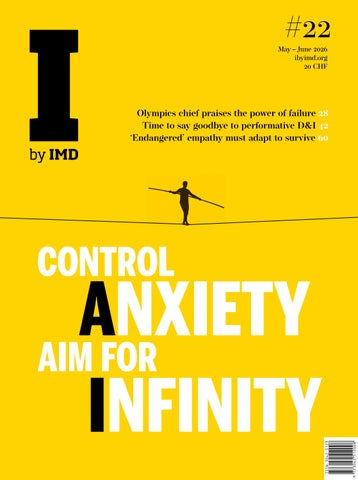

INFINITY AIM FOR CONTROL ANXIETY



It’s time to turn AI anxiety into agency

The hype about generative AI has been partly replaced by the hype surrounding AI agents. Yet, as leaders, we struggle to keep up with the developments in the technological, economic, and societal spheres. The cover of this issue reads "Control anxiety, aim for infinity". It captures something I keep hearing in conversations with executives. The anxiety is real. The infinity is real, too. Many leaders seem to get stuck on the first part and never reach the second.
Anxiety shows up in predictable ways. People ask whether their job will exist in five years. Boards ask whether the AI investment will ever pay back. CEOs ask whether they should buy, build, or wait. These are reasonable questions. But they share a common feature: they treat AI as something happening to the organization rather than something the organization can shape.
José Parra Moyano makes this point sharply. The hard part of AI transformation is not the technology or the data. It is the people. Not because people are difficult, but because every knowledge worker eventually has to answer one question: what do I contribute now? When that question goes unanswered, you get withdrawal, performative compliance, and quiet sabotage. None of which shows up in the consultant deck.
So, what does "control anxiety, aim for infinity" mean for everyday leadership? First, name what you are afraid of. If you cannot say out loud what worries you about AI, you cannot manage it. Vague fear becomes generic resistance. Second, build the workflow before the wonder. The companies getting real value from AI are not the ones with the loudest agent demos. They are the ones who redesigned a specific process, added language understanding where it actually helps, and kept a human in the loop where judgment matters.
The infinity part is real. But it does not arrive on its own. It arrives when leaders stop asking what AI will do to them and start asking what they want to do with it.
Enjoy reading. And remember, learning does not come from experience. It comes from your reflections on your experience.
Stefan Michel, Professor of Management, Dean of Faculty and Research
CONTENTS
May - June 2026
COVERSTORY
04 Technology
The rise of AI has provoked fear, yet it offers infinite possibilities for leaders ready to embrace the transition.
José Parra Moyano
16 Despite the benefits, companies must set strict boundaries and introduce a highly structured workflow to prevent AI’s ‘rogue’ agents.
Mariia Bulycheva, Karl Schmedders
22 Our visual guide reveals the extent of AI’s massive electricity and water consumption and suggests ways to minimize the damage.
ACTS OF LEADERSHIP
28 Leaders unplugged
Olympics chief Kirsty Coventry discusses with David Bach the essential skills business leaders can learn from sport.
34 Current trends
The growth of AI and the rise of geopolitical tension have widened the gap between elite confidence and public mistrust.
Christine Graeff
38 CEO dialogue
Niels B Christiansen, CEO of LEGO, explains to Jean-François Manzoni how he reduced complexity to rebuild the toy giant.
41 C-suite questionnaire
In our series ‘15 leading questions’, Valentina Ficaio, CFO of the Adecco Group, reveals the women who inspire her the most.

OPERATING SYSTEMS
42 Inclusion
Diversity and inclusion strategies are under threat. Strategic cohesion and an end to virtue signaling can offer a timely reset.
Luca Condosta
48 Governance
Combining the roles of CEO and chair is usually treated with suspicion, but in some cases it’s exactly what’s required.
Hans-Christoph Hirt, Roger Barker
54 Strategy
Knowing when to switch between tighter and looser operating models can mean the difference between success and failure.
Paul Strebel

Photos: IOC, John Gichigi, Getty Images via Unsplash
THE SANDBOX
60 Team building
Emotional intelligence still has a place in this new era of blunt and direct leadership.
Merete Wedell-Wedellsborg
66 Coaching corner
Slow down and take a break if you want to earn your team’s respect.
Uwe Napiersky
68 Board’s eye view
Oversight is no longer enough; boards need to develop a sixth sense to be successful. Natacha Theytaz
71 Brain circuits
Are you an ambitious leader snared in the ‘insider trap’? Take our test to find out.
Jing Yan
FRESH THINKING
15 The human factor
Shelley Zalis believes human judgment is still vital. ‘AI may write the recipe, but we taste the food.’
24 In good company
Jerry Davis explains why the example of open-source software can still lead the way to a democratic future for AI.
72 The forecaster
Howard Yu says mixing American and Chinese AI systems will yield the best results.
75 P.S. The president’s soliloquy
David Bach finds hope in the unscripted, collective drama of the beautiful game. It’s something that algorithms and AI can’t replace.



Beyond fear, beyond imagining
How to embrace AI’s infinite possibilities for economic value creation, while shaping a future worth living in

may be scary, but not that
Photo: ALAMY
AI
scary... Philippe Petit’s 1974 Twin Towers high-wire walk was recreated in the film The Walk, starring Joseph Gordon-Levitt
As AI masters tasks once reserved for highly skilled professionals, workforce anxiety – and resistance –is rising. To ensure the technology generates lasting value and people aren’t left behind, leaders must foster genuine cognitive collaboration between humans and machines.
José Parra Moyano provides a framework and
C-suite checklist
to realize the true potential of the human-AI partnership
Value creation increasingly depends on the interaction between humans and artificial intelligence. The technology is a genuine participant in knowledge work, yet it cannot operate without humans. Technically, it needs a human with intent to activate it. Ethically, society expects human judgment and accountability in processes in which AI plays a role. This (economic and ethical) need for the “human in the loop” requires us to redesign roles to establish an effective division of cognitive labor between people and AI. The very expression “human in the loop” poses so many unanswered questions: Which human? From whom do we expect what? In a loop that does what? To solve which problem? Organizations must figure out how humans add value when AI systems are adopted, especially at scale. How a company answers this question will determine whether its AI transformation succeeds or simply incurs an expensive bill for the technology it bought but could not leverage.
Answering those questions is important for the organization to succeed in creating value, but also for the people who need to find new ways of working and adding value. That applies not only to those whose tasks are taken over by AI but also to those who must change the way they do the tasks that remain theirs.
The problem in many organizations is that the leaders don’t have answers to these questions. The uncertainty often leads to anxiety and fear, hampering the AI transformation because people can’t see the benefits and worry about the consequences. Worse still, it results in conscious or unconscious sabotage by the people who should be leading it.
Finding and providing clarity is fundamental in reducing the anxiety that is preventing real value creation and a return on investment in costly AI applications. This makes the human side of AI transformation one of today’s most pressing leadership challenges and responsibilities. As the next stage of value creation relies on effective interaction between AI and humans, we – the people – will be either blockers or enablers. Leaders must find ways to ensure their teams support and actively participate in transformation, rather than hinder it or miss out. The stakes are high. If leaders get this right, they will enable their people to imagine and conduct previously “impossible” tasks with the help of AI: the kind of breakthroughs that can redefine industries and unlock new chapters in economic development. If they fail, their teams and companies will inevitably fall behind, while others survive and progress.
In my research and work with organizations, I use three frameworks to structure this critical conversation about AI transfor-