BREAKTHROUGH ISSUE 161
PART 2 WHITETAIL SEASONS • REPLICA SHEEP STAINING • GREAT SHOP DYNAMICS • FISH CARVING INSPIRATION
SPRING 2026
LETTERS COVER PHOTOGRAPHY BY SARAH DEJOURNETTE PRODUCTION BY KEN EDWARDS
FISH CARVING INSPIRATIONS
LETTERS
There is No Better Time and Place to Begin a New Journey
60
ISSUE 161 SPRING 2026
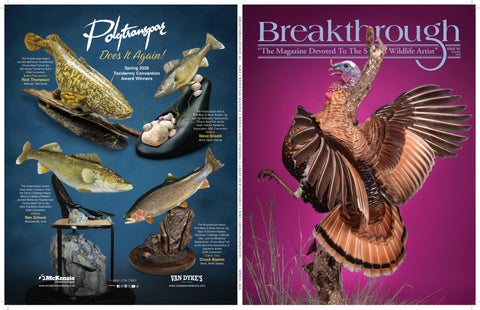
This issue’s cover features a beautiful Rio Grande turkey mounted by Keith York, owner of Lost Pines Taxidermy in Cedar Creek, Texas. It is a unique color phase and was killed by a customer who sent the turkey’s DNA to the NWTF; it was confirmed as 100 percent Rio Grande. That color phase only shows up in 1 out of every 350,000 Rio Grande turkeys that hatch. At the 2024 WTC Keith’s turkey scored a very respectable 87 in the Master Division. It also won the People’s Choice award at the 2025 Texas (TTAI) show and at an earlier NTA show. In this issue’s Gallery we are featuring many of the Master Division birds that scored high in the various sub-categories. We are also featuring many of the professional division birds at the 2024 World Shows. All categories at the 2024 World Show set recordbreaking entry numbers with some of the finest taxidermy artistry ever seen. The next World Shows will be in Coralville, Iowa, again, Tuesday through Saturday, April 13-17, 2027. You will find additional info in this issue.
ON THE COVER:
Keith York
In This Issue The Breakthrough Gallery . . . . . . . . . . . . . . Birds from the 2024 WTC
2
14 Staining Replica Sheep Horns . . . . . . . . . . . . . . . . . . . . . . . . . . Erich Carter
LOOKING
Pine Marten Reference Study by Larry Blomquist
AHEAD
FISH CARVING INSPIRATIONS: These are Danny Harris’ four Intermediate-Division entries at the 2024 World Fish Carving Championships. Danny’s first competition was at the 2019 WFCC. He is a very talented carver who knows what it takes to get into the world of fish carving.
Reference Studies in Issues Ahead: Bighorn Sheep by Larry Blomquist Reference Studies in Issues Ahead: Coyotes by Larry Blomquist Mounting an Alligator Snapping Turtle by David Ellzey
22
Part 2: The Three Dynamics of a Great Shop . . . . . . . . Billy Robertson
14
28 Who Has Won Best in World? . . . . . . . . . . . . . . . . . . . . . . Kathy Blomquist 34
Part 2: Whitetail Season Transitions . . . . . . . . . . . . . . . . . Kurt Ainsworth
43 Professional Division Birds, 2024 WTC . . . . . . . . . . . . Ribbon Winners 50 3-D Printing in Taxidermy Larry Blomquist 72 African Reference Series: Duikers . . . . . . . . . . . . . . . . . . Larry Blomquist 60 Fish Carving Inspiration: Fins . . . . . . . . Danny Harris and Bo Wessman
More Coverage of 2024 World Show Competition Part 3: Shop Design Ideas: Small-Medium-Large by Billy Robertson Fish Painting Schedules and Reference by Various Artists
72 D E PA R T M E N T S
Walking on the Wild Side: Many Procedures from Truelife Taxidermy Studio by Roy Holdridge
10 80 82 83 88
Fish Carving Inspirations: Photos/graphics by Danny Harris
A D V E R T I S I N G ADVERTISER
D I R E C T O R Y
TELEPHONE
PAGE
McKenzie Taxidermy Supply . . . . . . . 800-279-7985 . . . . IFC, 49
ADVERTISER
Mount Medix . . . . . . . . . . . . . . . . . . . . . . . . 855-686-3349 . . . . . . . . . 81
WASCO . . . . . . . . . . . . . . . . . . . . . . . . . . . . . 800-334-8012 . . . . . . . . BC
Breakthrough Magazine . . . . . . . . . . . . 800-783-7266 . . . . . . . . . 33
Northern Pines Rugmaking . . . . . . . . 231-937-4696 . . . . . . . . . 42
Western Sportsman Auctions . . . . . . 832-829-0000 . . . . . . . . . 17
Brush Country Studios . . . . . . . . . . . 817-372-7399 . . . . . . . . 55
Ozark Woods . . . . . . . . . . . . . . . . . . . . . . . 800-467-0369 . . . . . . . . . 66
Wildlife Gallery, Inc. . . . . . . . . . . . . . . . . 989-561-5369 . . . . . . . . . 11
Dakota Taxidermy Studio . . . . . . . . . 701-323-0537 . . . . . . . . 18
Payer Eyes . . . . . . . . . . . . . . . . . . . . . . . . . 610-420-0500 . . . . . . . . . 41
Wood Carving Illustrated . . . . . . . . . . . 800-506-6630 . . . . . . . . . 81
Derma Grip . . . . . . . . . . . . . . . . . . . . . . . . . 770-616-8224 . . . . . . . . . 17
PRO-1 Performance Chemicals . . . . 681-355-0225 . . . . . . . . . 54
G2 Supply . . . . . . . . . . . . . . . . . . . . . . . . . . 319-470-7035 . . . . . . . . . 21
Quality Fur Dressing . . . . . . . . . . . . . . . 281-292-2206 . . . . . . . . . 32
TELEPHONE
Geryak Taxidermy Supply . . . . . . . . . . 765-823-0265 . . . . . . . . . 64
Research Mannikins . . . . . . . . . . . . . . . . 800-826-0654 . . . . . . . . IBC
Guinn’s Flesh-All Mini-Flesher . . . . . 918-358-2796 . . . . . . . . . 67
Scenes-n-Nature . . . . . . . . . . . . . . . . . . . 573-346-5555 . . . . . . . . . 31
Habitat Rock . . . . . . . . . . . . . . . . . . . . . . . . 406-543-5501 . . . . . . . . . 65
TPS (Taxid. Positioning System) . . . 800-279-7985 . . . . . . . . . 71
K&K Tannery . . . . . . . . . . . . . . . . . . . . . . . 517-320-0851 . . . . . . . . . 70
Trigga Hunting App . . . . . . . . . . . . . . . . +27724738161 . . . . . . . . 16
Matuska Taxidermy Supply. . . . . . . . . 800-488-3256 . . . . . . 26-27
World Show 2027 . . . . . . . . . . . . . . . . . . . 800-783-7266 . . . . . . 12-13
Page Page88 88
22
PAGE
AVES Studio/Apoxie Sculpt . . . . . . . . 800-261-2837 . . . . . . . . . 17
ADVERTISER
34
Editorial Calendar of Events Classified Ads Breakthrough DVDs Directory of Advertisers
TELEPHONE
PAGE
BREAKTHROUGH MAGAZINE (ISSN 1056-0130) is published quarterly for $44.00 per year, $78.00 for two years. Breakthrough Magazine, 2271 Old Baton Rouge Highway, Hammond, LA 70403. Periodical postage paid at Hammond, Louisiana, and additional mailing offices. POSTMASTER: Send issues not forwarded and address changes to: BREAKTHROUGH MAGAZINE P.O. Box 2945 Hammond, Louisiana USA 70404-2945. ADDRESS SERVICE REQUESTED
43 BREAKTHROUGH BREAKTHROUGHIssue Issue161 161
BREAKTHROUGH Issue 161
Page 1
LETTERS
LETTERS
HARLEQUIN QUAIL Christel Van Ommen-Verdaasdonk SCHINDEL, NETHERLANDS
GAME BIRDS BLACK GROUSE Lennart Pettersson BALINGE, SWEDEN
High-Scoring Master Division
Page 2
Birds BREAKTHROUGH Issue 161
BREAKTHROUGH Issue 161
Page 87
RING-NECKED PHEASANT (MUTANT) Jeff Herrick
RIPON, WISCONSIN USA
from the
Page 86 BREAKTHROUGH Issue 161 BREAKTHROUGH Issue 161
P H O TO G R A P H Y B Y G L E N B R O W N I N G , S A R A H D E J O U R N E T T, B J F O R N IN O , T IA N YA N G , J AY M C D O N A L D , A N D K E N E D WA R D S
LETTERS LETTERS
2024 World Show Page 3
LETTERS
NONGAME BIRDS
LETTERS
BUDGERIGARS Christel Van Ommen-Verdaasdonk SCHINDEL, NETHERLANDS
YELLOW BLACK GROSBEAK Jan Fredriksson BORGHOLM, SWEDEN
Page 4
BREAKTHROUGH Issue 161
BREAKTHROUGH Issue 161
Page 85
LETTERS
LETTERS WHITE-BELLIED CRIMSON FINCH Christel Van Ommen-Verdaasdonk
SCHINDEL, NETHERLANDS
DOMESTIC ROOSTER Patrick Rummans MADRAS, OREGON USA
Page 84
BREAKTHROUGH Issue 161
BREAKTHROUGH Issue 161
Page 5
Use the QR code to take you straight LETTERS to the Breakthrough website to order any of these fine DVDs from the industry leaders at World Taxidermy Championships®
LETTERS
Taxidermy Seminars: 2005
EASTERN WILD TURKEY Michael Mizelle LEESBURG, GEORGIA USA
DVD972 — Habitat Rock Assembly and Painting with Dale Manning
DVD902 — Molding and Casting Artificial Fish Parts with Gary Bruch
DVD973 — Mastering Facial Features on Bobcats with Cole Cruickshank
DVD903 — Mounting a Strutting Ruffed Grouse with Mike Orthober
DVD974 — Mounting a Standing Pheasant with Fred Barilla DVD975 — Techniques for Antler Repair with Erich Carter
DVD905 — Open-Mouth Mountain Lion Shoulder Mount with Phil Soucy
DVD976 — Competition Striped Bass Painting with Brian Noody
DVD906 — Mounting a Pedestal Trout with Jeff Mourning
DVD977 — Mounting a Lifesize Gray Fox with Brian Hendricks
DVD907 — Painting a Rainbow Trout with Gary Bruch
DVD978 — Understanding Bird Anatomy with Mike Orthober
DVD908 — Competition Whitetails with Fred Vanderburgh
DVD979 — Creating and Painting Artificial Trout Heads with Frank Kotula
DVD909 — Mounting a Flying Ptarmigan with John Lager
DVD981 — Skinning and Mounting a Fox Squirrel with David Ellzey
DVD910 — In-Shop Tanning Procedures with Bruce Rittel
2017
DVD911 — Using Commercial Tanners and Importers with Group
DVD982 — Mammal Taxidermy Tip and Tricks Lecture with Ken Walker
DVD912 — Skinning an Alligator with Tom Voyer and Bruce Rittel
DVD983 — Carcass Molding and Casting with Travis De Villiers
DVD913 — Mounting a Standing Baikal Teal with Cory Caruthers
DVD984 — Painting a Largemouth Bass Repro with Mike Kirkhart
DVD914 — Painting a Brown Trout with Pat May
DVD985 — Shoulder Mount Whitetail Deer with Clint Rickey
DVD915 — Mounting a Cape Buffalo with Ray Hatfield
DVD986 — Mounting a Pedestal Bobcat with Clay Wagner
DVD916 — Making Your Own Bird Bodies with Harry Paulson
DVD987 — Competition Fish Painting Techniques with Jeff Mourning
DVD917 — Habitat: Custom Rocks and Limbs with Tony Ward
DVD988 — Minding Your Taxidermy Business with Robyn Rocke
DVD918 — World Avian Challenge with Peter Sunesen,
DVD989 — Water & Ice Habitats for Swimming Ducks with Dave Sherwood
Jack Fishwick & Lennart Pettersson
DVD990 — Competition Bird Mounting Techniques with Dale Manning
DVD919 — Whitetail Deer Shoulder Mount with Brian Dobson
DVD991 — Mounting a Flying Turkey with Jacob Clark
DVD920 — Mounting a Walking Turkey with Dale Manning
DVD992 — Designing Trophy Room Mountains with Frank Newmyer
DVD921 — Museum Quality Re-Creations with Ken Walker
DVD993 — Mounting a Lifesize Gray Fox with Shane Davenport
DVD922 — Mounting a Hungarian Partridge with Peter Sunesen
DVD994 — Mounting a Rattlesnake with Matt Zimmerman
DVD923 — Altering Lifesize Mannikins with Stuart Farnsworth
DVD995 — Mounting a Ruffed Grouse with Mike Orthober
2009
OCHLOCKNEE, GEORGIA USA
DVD997 — Techniques To Improve Your Mammals with Ken Walker
DVD926 — Bighorn Sheep Shoulder Mount with Dawayne Dewey
DVD998 — Finishing a Rattlesnake with Matt Zimmerman
DVD927 — Wiring Bird Wings for Accuracy with Glen Browning
DVD999 — Sculpting a Whitetail Deer Shoulder Form with Mike Noonkester
DVD928 — Molding a Rainbow Trout with Gary Bruch & Jeff Mourning
DVD1000 — History: Lion Attacking a Dromedary with Stephen Rogers
DVD929 — Whitetail Deer Shoulder Mount with Bill Lancaster
2019
DVD930 — Mounting a Standing Pheasant with Cory Caruthers
DVD1001 — Altering Gamehead Mannikins with Jerry Huffaker
DVD931 — Mounting a Gemsbuck Shoulder Mount with Tom Weickum
DVD1002 — Mounting Flying Waterfowl with Page Nethercutt
DVD932 — Whitetail Deer Shoulder Mount with Gene Smith
DVD1003 — Mounting Custom Mammals with Ken Walker
DVD933 — Mounting a Strutting Turkey with Andy Campbell
DVD1004 — Water and Splash Habitats with Mickey Bowman
DVD934 — Habitat: Artificial Rocks, Limbs and Bases with Justin Nagy
DVD1005 — Mule Deer Shoulder Mount with Rebecca Wilcher
DVD935 — Open-Mouth Elk Shoulder Mount with Aaron Connelly
DVD1006 — Producing Copper Leaves for Habitat with Kurt Ainsworth
DVD936 — Problem Areas In Competition Fish Taxidermy with Mike Ross
DVD1007 — Finishing Work on a Whitetail Deer with Paul Cales
DVD937 — Whitetail Deer Shoulder Mount with Rick Carter
DVD1008 — Whitetail Deer Shoulder Mount with Clint Rickey
DVD938 — Mounting a Flying Harlequin Duck with Billy Ollie
DVD1009 — Artistry, Composition and Design with Josh Guge
DVD939 — Mounting a Largemouth Bass with Archie Phillips
DVD1010 — Mounting a Standing Merganser with Cory Caruthers
DVD940 — Mounting and Painting an Iguana with Simon Blackshaw & Tom Voyer
DVD1011 — Fish Painting Techniques with Tom Matuska & Brett Wingfield
DVD941 — Casting a Rainbow Trout with Gary Bruch and Jeff Mourning
DVD1012 — Habitat Using Static Applied Fibers with Hutch Hutchinson
DVD942 — Wrapped Body Waterfowl Mounting with Dave Luke
DVD1013 — 3-D Technology for Taxidermists with Allis Markham
DVD943 — A History of Taxidermy with Dr. Pat Morris
Fish Carving Seminars: 2005
DVD946 — Swimming Eider Mount with Dave Sherwood and Billy Ollie
DVD411 — Power Carving a Trout with Bob Berry
DVD947 — Whitetail Deer Shoulder Mount with Tommy Hall
DVD412 — Scale Detailing Techniques with Jeff Compton
DVD948 — Composition and Design in Mammal with Ashley Barrett
DVD413 — Fish Speed Carving with Dan Blair
DVD949 — Part 1: Gila Monster Skin Mount with Kerby Ross
DVD414 — Molding and Casting with Larry Goldman
DVD950 — Part 2: Gila Monster Skin Mount with Kerby Ross
DVD415 — Painting a Rainbow Trout with Clark Schreibeis
DVD951 — The Art of Action in Mammal Taxidermy with Dennis Harris
DVD416 — Fish Carving Panel Discussion with Group
DVD952 — Part 1: Mounting a Strutting Turkey with Brett DeFreitas
2007
DVD953 — Part 2: Mounting a Strutting Turkey with Brett DeFreitas
DVD417 — Airbrushing A to Z with Steve Angers of BearAir Express
DVD954 — Mounting a Standing Widgeon with Jerry Froelich
DVD418 — Planning a Carving with Ed Barrett and Danny Patterson
DVD955 — Elk Pedestal Mount with Tom Weickum
DVD419 — Scales and Texturing with Jeff Compton and Clark Schreibeis
DVD956 — Finishing Western Gameheads with Tom Weickum
DVD420 — Fish Painting Techniques with Bob Berry and Mike Orthober
DVD957 — Painting a Reproduction Bass Head with Brett Wingfield
DVD421 — Composition and Design with Simon Blackshaw and Paul Thiesing
DVD958 — Van Ingen: The Tiger Taxidermists with Dr. Pat Morris
2015
BREAKTHROUGH Issue 161
DVD1014 — Mounting an Impala Shoulder Mount with Owen Eldred
DVD945 — Mounting a Standing Pheasant with Mike Orthober
DVD944 — Mule Deer Shoulder Mount with Tom Weickum
Page 6
DVD996 — Mounting a Rainbow Trout with Jeff Mourning
DVD925 — Altering Mannikins for Composition with Ken Walker
2011
TURKEYS
DVD971 — Rebuilding Shrinkage on Fish with Mike Orthober
DVD901 — Game Bird Wire Frame Taxidermy with Glen Browning
2007
MERRIMAN TURKEY Seth French
DVD970 — Mounting a Flying Wood Duck with Mike Nakielski
2009
DVD422 — Fish Locomotion with Dan Patterson
DVD964 — Carving a Lifesize Kit Fox Mannikin with Ken Walker
DVD423 — Wood Burning Tools with Larry Goldman
DVD965 — Mounting a Kit Fox on a Carved Mannikin with Ken Walker
DVD424 — Carving Reef Fish Habitats with Bob Berry
DVD966 — Casting a Wild Boar Head with Chris Horne
DVD425 — Painting and Glazing Techniques with Paul Thiesing
DVD967 — Three-Dimensional Rattlesnake with Kirby Ross
DVD426 — Composition and Design with Clark Schreibeis
DVD968 — Mounting an Open-Mouth Mountain Lion with Phil Soucy
DVD427 — Building a Dust Collector and Exhaust with Don Frank
DVD969 — Whitetail Deer Anatomy and Reference with Rick Carter
DVD428 — Fish Carving Panel Discussion with Various Artists
BREAKTHROUGH Issue 161
Page 83
Breakthrough CLASSIFIEDS
LETTERS
You’ll get tremendous results from the LARGEST subscriber base in the industry! Phone 1-800-783-7266 • E-mail: info@breakthroughmagazine.com
HOW TO COUNT ADS: One or more characters divided by a space will count as one word. This includes a phone number, ZIP code, state abbreviation, plus sign (+), ampersand (&), email, and website. Words separated by a slash (/) or hyphen (–) will count as two words (example: “green-salted” will count as two words). We are not responsible if Web addresses hyphenate.
CATEGORIES
Wanted Real Estate Opportunities Employment Miscellaneous Specimens Services Skins-Horns-Antlers
2026 CLASSIFIED RATES: $1.50 per word, 24 word/$36.00 minimum. Unless the ad is to run continuously, all classifieds must be prepaid, either by check, money order, American Express, Visa, MasterCard or Discover. BEST WAY: Email your ad and call 800-783-7266 with your credit card info. We will need your name, full address and telephone number to process the credit card. No additional for punctuation, so please include it so your ad will be understandable. Make sure you give us issue(s) in which the ad is to appear and category heading. SKINS-HORNS-ANTLERS
MISCELLANEOUS
SERVICES
AAA ANIMAL EXCHANGE: We’ve been serving the taxidermy community since 1976. We carry whitetail, mule deer, antelope, elk, caribou, and moose capes. We have North American lifesize species such as black bear, wolf, lynx, mountain lion, wolverine, coyote, fox, raccoon, and much more. We stock antlers and horns for most North American game as well. We also carry a wide variety of African plains game capes, lifesize, and horns. For further information contact Joe or Kelly Geryak at 317-416-4144, 812-597-6133, or aaaanimalexchange@yahoo.com
THE TAXIDERMY POSITIONING SYStems components were developed by Tony Psaila for specific uses, and are extremely versatile in the taxidermy studio. For example, the Pedestal Support Sets can also be used to off-set waterfowl, pheasant, and flying turkey mounts away from the wall instead of wire supports. The TPS peg and receiver sets can be used in the feet/legs of lifesize mounts for an easy and super solid attachment to habitat. Order from Breakthrough (985) 345-7266; Jetz Taxidermy Supplies (830) 792-4694; McKenzie Taxidermy Supply 800-279-7985; Joe Miles Wildside Outdoors (517) 795 3810; Jake’s Taxidermy (501) 230-1670; Like Nature Premium Taxidermy Supply DK +45 404 151558; Mountain High Taxidermy Supply NZ +64 210 303 596; Head Office: Taxidermy Positioning Systems AU +61 450 435 923.
WHOLESALE FREEZE-DRY ITEMS AVAILABLE: Ducklings, Weasels, Squirrels, Mice, Panfish, velvet racks, etc. Or we freeze-dry YOURS. Telephone 218-2637177. www.edgewatertaxidermy.com. Full time since 1978.
FOR SALE : LIFESIZE HIDES, CAPES, Antlers, Horns, : Stone Sheep, Dall Sheep, Bighorn Sheep, Mountain Goats, Cougars, Grizzly Bears, Moose, Caribou, Elk, Deer : Wildlife Taxidermy 7774 Pleasant Valley Road, Vernon, British Columbia, V1B-3R7 Canada : Phone 250-545-4614 : Email ken@ wildlifetaxidermy.com. HUGE INVENTORY: Grizzly, dall and stone sheep, goat, cougar, wolverine, black bear, lynx, bobcats, timber wolf, deer, and much more. Antlers of all kinds. Sheep and goat horns. Moose and elk capes. Contact Full Moon Taxidermy at 250-847-3188. 100-CAPE COLLECTION FOR SALE. Whitetail deer capes $75.00, $100.00 and up. Take your pick! Aves Studio, P.O. Box 344, River Falls, WI 54022. 715-386-9097. EXOTIC SHEEP, AXIS, FALLOW, SIKA, Catalina, blackbuck, nilgai, oryx, wild boar capes, horns, antlers and golden pheasants. We also book whitetail and exotic hunts. Azlin Taxidermy, 1815 Kyle Rd., Clute, TX 77531. Call 979-285-7426.
TURKEY Keith York
RED ROCK, TEXAS USA
FREEZE-DRY SERVICE AND DERmestid beetle cleaning: Turkey heads $30.00. Ten to 12-week turnaround on a first-in, first-out method. Also mammals, reptiles and small fish. Lifelike Taxidermy, 510 Kennerdell St., Franklin, PA 16323. 814-432-4142.
MOVING? SEND US YOUR NEW ADDRESS
TURKEY Kevin Flaherty
info@breakthroughmagazine.com
Page 82
BREAKTHROUGH Issue 161
GRAND ISLAND, NEW YORK USA
BREAKTHROUGH Issue 161
Page 7
LETTERS
2027
WOOD DUCK Mike Nakielski
IRON RIDGE, WISCONSIN USA
ROSS’ GOOSE Chad Horst
RICHLAND, PENNSYLVANIA USA
WATERFOWL Page 8
BREAKTHROUGH Issue 161
2027 CALENDAR
January 20–23, 2027 Safari Club Int. The Safari Club International 54th Annual Hunter’s Convention. Music City Center in Nashville, TN. Visit scimembership@safariclub.org. Call (210) 985HUNT. February 4–6, 2027 Florida 2027 Florida State Taxidermy Association Convention & Competition. Best Western Gateway Grand, 4200 NW 97th Blvd, Gainesville, Fl 32606 (352) 331-3336. Contact Theresa Durham at (386) 5467353 or theresadurhamfsta@yahoo.com. February 18–21, 2027 Eur. Championship The 15th European Taxidermy Championship at the Messezentrum in Salzburg, Austria, in cooperation with RX Austria & Germany and Die Hohe Jagd & Fischerei. Contact Carsten Skakkebaek at +45 40415158 or carsten@eurotaxidermy.eu. FEBRUARY 24–28, 2027 MICHIGAN Michigan Taxidermists Association Annual Convention & Competition. Vibe Credit Union Showplace in Novi, MI. Contact Todd Ekstrom at (810) 4410727 or Toddekstrom1985@gmail.com. FEBRUARY 26–28, 2027 AUSTRALIA The Australian Association of Wildlife Artists (AUSAWA) Annual Convention and Competition. The York On Lilydale, Mount Evelyn, in Lilydale, Victoria. Contact the secretary at Secretary-Ausawa@outlook.com. MARCH 11–13, 2027 VIRGINIA Virginia Taxidermists Association Annual Convention & Competition. Best Western Inn & Suites. Waynesboro, VA. Contact Amanda Robinson at (276) 275-9879 or vataxidermist@gmail.com. Visit Vataxidermists.com. MARCH 12–14, 2027 NORTH DAKOTA North Dakota Taxidermists Association Annual Convention and Competition. Bismarck Hotel & Conference Center in Bismarck, ND. Contact Bill Neuman at (320) 293-5249 or Neumannikins@ yahoo.com. MARCH 18–21, 2027 IOWA Iowa Taxidermists Association Competition and Show. Sheraton West Des Moines Hotel in Des Moines, IA. Contact Tim Schroeder (president) at (515) 231-7185 or timschro10@gmail.com. Visit iowataxidermyassociation.com. APRIL 9–11, 2027 QUEBEC Quebec Taxidermy Association Annual Convention and Competition. Hotel Le Dauphin in Drummondville, Quebec, Canada. Contact President Royal Robillard at (819) 663-7612 or taxidermierobillard@ gmail.com. April 13–17, 2027 The World Show The World Taxidermy & Fish Carving Championships®. Hyatt Regency Coralville Hotel and Conference Center. 300 E 9th St., Coralville, IA 52241. Call Breakthrough at 800-783-7266. APRIL 22–24, 2027 CALIFORNIA California Association of Taxidermists Annual Convention and Competiton. Colusa County Fairgrounds in Colusa, CA. Contact Alan Dowdy at (530) 305-0208 or willowcreektaxidermy11@yahoo. com. APRIL 22–25, 2027 NEW YORK United Taxidermists of New York Annual Convention & Competition. Holiday Inn Auburn, NY. Contact President Matt Pigliavento at (518) 557-2636 or mattandniki823@aol.com. June, 2027 Texas Texas Taxidermists Association Annual Convention and Competition. Abilene, TX. Contact Keeley Busbee-Smith at (830) 377-1359 or kbusbee-smith@ outlook.com. Visit www.texastaxidermyassociationinc.com. June 10–13, 2027 West Virginia
BREAKTHROUGH Issue 161
West Virginia Taxidermy Association Convention and Mountain State Championship. Days Inn Conference Center in Flatwoods WV. Contact President David Secrist at dasecrist@k12.wv.us or phone (304) 9193960. Follow West Virginia Taxidermy Association on Facebook. July 14–17, 2027 NTA National Taxidermists Association 56th Convention and Competition. Provo Marriott Hotel & Conference Center in Provo, UT. Contact Colt Ford, president, at (229) 237-6353 or jace.c.ford@outlook.com. MARCH 10–12, 2028 NORTH DAKOTA North Dakota Taxidermists Association Annual Convention and Competition. Bismarck Hotel & Conference Center in Bismarck, ND. Contact Bill Neuman at (320) 293-5249 or Neumannikins@yahoo.com. NTA JULY 19–22, 2028 National Taxidermists Association 57th Convention and Competition. Embassy Suites by Hilton East Peoria Riverfront Hotel & Conference Center in East Peoria, IL. Contact Colt Ford, president, at (229) 2376353 or jace.c.ford@outlook.com.
CALENDAR OF EVENTS is furnished at no charge as a service for our subscribers. Before making plans to attend any of these conventions, you should check with the contact person for any changes. Almost every state has an annual taxidermy competition, and the dates for some have not yet been finalized. Send us the following information as soon as the dates and location are approved—a year ahead is not too early. Attendees and supply companies need time to plan to attend. To have an event listed in this calendar, please email (not all caps, please) us your information: • Dates and year • Official name of event • Facility where event takes place • City and state • Contact person’s name, telephone number, and email address. • Event’s website Send information to kathy@breakthroughmagazine.com.
Page 81
2026 CALENDAR
LETTERS
Jan. 2026 1 2 3 4 5 6 7 8 9 10 11 12 13 14 15 16 17 18 19 20 21 22 23 24 25 26 27 28 29 30 31 Safari Club 18–21
Feb. 2026 1 2 3 4 5 6 7 8 9 10 11 12 13 14 15 16 17 18 19 20 21 22 23 24 25 26 27 28 29 30 31 Florida 5–7
Nat.WildTurkey 11–14
GADWALLS (GROUP) Micah Godwin
Mar. 2026 1 2 3 4 5 6 7 8 9 10 11 12 13 14 15 16 17 18 19 20 21 22 23 24 25 26 27 28 29 30 31 Virgnia 5–7
Eastern Reg.12–15 North Dakota 13–15
Pennsylvania 18–21 Utah 18–21 Canada 19–21 South Dakota 19–22
Kansas 26–29 Iowa 26–29 Western Reg 26–29 Nevada 26–28
EL CAMPO, TEXAS USA
Apr. 2026 1 2 3 4 5 6 7 8 9 10 11 12 13 14 15 16 17 18 19 20 21 22 23 24 25 26 27 28 29 30 31 EASTER
Minnesota 9–12 Wisconsin 9–12 Quebec 10–12 Michigan 9–12
New York 16–19 Wyoming 16–18
Mississippi 23–25 New Mexico 23–26
Georgia 30–2 California 30–2
May 2026 1 2 3 4 5 6 7 8 9 10 11 12 13 14 15 16 17 18 19 20 21 22 23 24 25 26 27 28 29 30 31 Georgia 30–2 Australia 1–3 California 30–2
MOTHERS DAY
Louisiana 14–16 Indiana 14–16 Maine 5–16
MEMORIAL DAY
NEAT (29-31)
Jun. 2026 1 2 3 4 5 6 7 8 9 10 11 12 13 14 15 16 17 18 19 20 21 22 23 24 25 26 27 28 29 30 31 Oklahoma 4–6 Idaho 4–6 South Carolina 4–6
Jul. 2026
Illinois 11–14 West Virginia 11–14 Nebraska 11–13
FATHERS DAY Alabama 18–21 Oregon 18–20
Texas 24–28 Kentucky 26–27
1 2 3 4 5 6 7 8 9 10 11 12 13 14 15 16 17 18 19 20 21 22 23 24 25 26 27 28 29 30 31
INDEPENDENCE DAY
Arkansas 10–12 Ohio 10–12
Nat. Taxid. Association 16–18
United Taxid. Assoc. 24–27 Tennessee 23–25
NoCarolina 3–1
Aug. 2026 1 2 3 4 5 6 7 8 9 10 11 12 13 14 15 16 17 18 19 20 21 22 23 24 25 26 27 28 29 30 31 NoCarolina 3–1
Missouri 13–16
Sep. 2026 1 2 3 4 5 6 7 8 9 10 11 12 13 14 15 16 17 18 19 20 21 22 23 24 25 26 27 28 29 30 Oct. 2026 1 2 3 4 5 6 7 8 9 10 11 12 13 14 15 16 17 18 19 20 21 22 23 24 25 26 27 28 29 30 31
Nov. 2026 1 2 3 4 5 6 7 8 9 10 11 12 13 14 15 16 17 18 19 20 21 22 23 24 25 26 27 28 29 30 THANKSGIVING DAY
Dec. 2026 1 2 3 4 5 6 7 8 9 10 11 12 13 14 15 16 17 18 19 20 21 22 23 24 25 26 27 28 29 30 31 CHRISTMAS DAY
“I would encourage anyone who is interested in advancing his taxidermy skills to join a state association, where he can make friends and acquaintances that will last a lifetime. Some of our closest friends are people we have met at conventions and competitions, and we believe this industry needs this type of camaraderie.” Clint Weber June 4–6, 2026 Idaho Idaho Taxidermy Association Convention and Competition. Eastern Idaho Fairgrounds in Blackfoot, ID. Contact Steve Eccard at sbeccard87@gmail.com. June 4–6, 2026 Oklahoma Oklahoma Taxidermists Association Convention and Competition. Doubletree-Warren in Tulsa, OK. Contact LaDeana Andrews, OKTA President, at (580) 235-1873 or ladeanaa@yahoo.com. June 4–6, 2026 South Carolina South Carolina Association of Taxidermists Annual Convention and Competition. Robinson Event Center in Lake City, SC. Contact Hunter Evans at Fowlmouthtaxidermy@gmail.com. June 11–14, 2026 Illinois Illinois Taxidermists Association Annual Convention and Competition. Decatur Conference Center in Decatur, Illinois. Contact Ryan Patterson at rlpatterson78@yahoo.com. june 11–13, 2026 Nebraska Nebraska StateTaxidermists Association Annual Convention and Competition. Columbus Riverside Convention Center. Columbia, NE. Contact Ben Hansen at hansentaxidermy21@gmail.com. June 11–14, 2026 West Virginia West Virginia Taxidermy Association Convention and Mountain State Championship. Days Inn Conference Center in Flatwoods WV. Contact President David Secrist at dasecrist@k12.wv.us or phone (304) 919-3960 . Follow West Virginia Taxidermy Association on Facebook. June 18-21, 2026 Alabama
Page 80
Alabama Taxidermists Association Convention & Competition. Lake Guntersville State Park, 1155 Lodge Dr. in Guntersville, Alabama. Contact President, Paul Smith at .(334) 897-8732 or contact Secretary, Tonya O’Tinger at (217) 440-6294 or avianaddictiontaxidermy@gmail.com. Visit www. alabamataxidermyassociation.com. June 18–20, 2026 Oregon Oregon Taxidermists Association Annual Convention and Competition. Klamath County Fairgrounds Lineman Hall (Exhibit Hall #1), Klamath Falls, OR. Contact Sean McKinney at lm_taxidermy@yahoo. com. June 24–28, 2026 Texas Texas Taxidermists Association Annual Convention and Competition. Killeen Civic Center in Killeen, TX. Host hotel is Courtyard by Marriott/Killeen. Contact Keeley Busbee-Smith at (830) 377-1359 or kbusbee-smith@outlook.com. Visit www.texastaxidermyassociationinc.com. June 26–27, 2026 Kentucky Kentucky Taxidermy Association and Competition. Cave City Convention Center in Cave City, KY. Contact Cody Hodge at codyhodge38@gmail.com or (502) 640-5097. July 10–12, 2026, 2026 Arkansas Arkansas Taxidermist Convention 2026. Holiday Inn Little Rock Airport, 3201 Bankhead Drive, Little Rock, AR. Contact Sean Henderson president at (501) 239-3614 or artaxidermist@yahoo.com. July 10–12, 2026 Ohio Ohio Taxidermists Association Annual Convention and Competition. Mid-Ohio Conference Center,
890 W. 4th Street, Mansfield Ohio. Contact Aaron Phillips at (419) 399-0793 or wildlegendstaxidermy@gmail.com. July 16–18, 2026 National Taxid. Assoc. National Taxidermists Association 55th Convention and Competition. Holiday Inn University Plaza in Bowling Green, KY. Call Colt Ford, president, at (229) 237-6353. July 23–25, 2026 Tennessee Tennessee Taxidermy Association and Competition will be held at Pickwick State Park in Counce, Tennessee. Contact Brian Brew at brianbrew2000@ yahoo.com. July 24–27, 2026 United Taxidermists Expo The United Taxidermists Association Taxidermy Expo. Clifty Inn in Clifty Falls State Park. 1650 Clifty Hollow Road in Madison, IN 47250. The inn overlooks the Ohio River and offers rooms and suites. Madison, IN. Contact Tim Stidham at (816) 5361974 or email stuffit@timstaxidermycom. July 30–Aug. 1, 2026 North Carolina North Carolina Taxidermists Association Annual Convention and Competition. Greensboro 5-Points Marriott (Airport) in Greensboro, NC. Contact Ryan Garrison at (910) 723-9029 or ryangarrison1@ yahoo.com. August 13–16, 2026 Missouri Missouri Taxidermists Association Annual Convention and Competition. Wyndham Executive Center, 2200 Interstate 70 Drive SW, Columbia, MO 65203. Phone (573) 445-8531. Contact Dakotta Snyder at dakotta42@gmail.com.
BREAKTHROUGH Issue 161
REDHEAD Jerry Froelich
ST. CLOUD, MINNESOTA USA n
BREAKTHROUGH Issue 161
Page 9
EDITORIAL LETTERS
SUBSCRIPTIONS. Subscription rates (United States) are $44.00 for one year, $78.00 for two years. Canadian and Mexican subscriptions are $88.00 for one year, and $160.00 for two years in U.S. dollars only. New subscriptions and renewals should be sent with payment to Breakthrough Magazine, Circulation Department, P.O. Box 5187, Granbury, Texas 76049. Credit card renewals and subscriptions may be placed by telephone: 1-800-783-7266. Email: info@breakthroughmagazine.com. LETTERS TO THE EDITOR are considered for publication unless otherwise specified. Editorial and photographic contributions are welcome, but the publisher assumes no responsibility for loss or damage to unsolicited material. Manuscripts submitted to Breakthrough will be treated as unconditionally assigned for publication and copyright purposes and are subject to Breakthrough’s unrestricted right to edit and publish commercially. E-mail letters to: kathy@breakthroughmagazine.com. Advertisers agree to indemnify to publisher and Breakthrough Magazine. BREAKTHROUGH is published four times a year by Breakthrough Magazine, P.O. Box 5187, Granbury, TX 76049. General offices located at 2271 Old Baton Rouge Highway, Hammond, LA 70403-3525. U.S. SUBSCRIPTIONS Orders 1-800-783-7266 WEBSITE: www.breakthroughmagazine.com LETTERS/ARTICLES: kathy@breakthroughmagazine.com EUROPEAN SUBSCRIPTIONS BAUER HANDELS GMBH Unselbständige Zweigstelle Freibühlstrasse 6 DE-78224 SINGEN (Germany) Tel. ++49 (0) 7731 926 44 16 Email: info@taxidermy.ch www.taxidermy.ch JHT SUPPLIES (JOHN HALLET) 21 Library Road, Penygraig RCT South Wales CF 401ST Telephone: 01 443 441529 sales@jhtsupplies.co.uk
Page 10
HE WTC MANAGEMENT AND COMpetition Committee has had several meetings this past spring and we need to update everyone with a few changes in the rules, divisions, and categories. You will find the Master Division rules on pages 58 and 59 of this issue with rule changes noted in magenta text. The rules have been adjusted and rewritten on how a Best in World is decided. It really does not change the process as it is still determined by the two category judges, but their final results must align with the three highest average scores from the subcategories of each Master category which is where 18 Best in World titles come from. Two other Best in World titles come from the Live Sculpting and Collective Artists divisions, for a total of 20 Best in World titles. We have also made a decision on the use of 3-D printing. Again, this is noted in the 2027 Master Division rules. These rules require that all visible elements of a mount must be originally made, scanned, reproduced, and finished by the competing taxidermist. This new ruling allows parts or a whole item made by 3-D printing to be used, but it must be made by the individual entering the mount. There is also an article in this issue on pages 50-53 by me concerning this technology. My research determined it still requires a lot of talent and knowledge to reproduce parts utilizing 3-D technology to equal those made by molding RTV or silicone, and casted by epoxy or resin. No molded parts or 3-D parts made and sold by others are allowed in producing individual entries in the Master Division or the Master of Masters Division of the WTC. There is much more discussion on this process in my article. The competition committee has also decided to drop the title of Best in World Largemouth Bass because of lack of participation. In past shows there have only been 2 to 4 entries in this World Title category. In 12 World Shows this title was awarded to only 4 winners. Largemouth bass will now compete in the a. subcategory of Warm Water Fish. The Best All-Around Division has also been dropped because of lack of entries and interest. Since its addition in 2015, with Best All-Around awards offered in both the Master and Professional divisions, the interest has been shockingly low with a total of 14 individuals competing in a total of 5 different shows. With the exception of the two above areas, it must be noted every other division at the WTC has been highly competitive with high num of entries breaking previous records, as was the case in 2024.
Breakthrough and the World Shows are growing. Breakthrough and World Taxidermy Championships® have played a big role in the advancements of the taxidermy industry and both will continue to grow and offer leadership. The new owners and management of both Roy and Marie Holdridge and Dr. Dan McBride will soon have a new website built and an operating office set up later this summer in Grandbury, Texas. Roy and Marie have already attended shows in Pennsylvania, Iowa, and Louisiana and will be attending other shows in Oklahoma, Texas, and the NTA in Kentucky this summer. As soon as the new data systems are completed, they will begin accepting show registrations for the World Shows and telephone calls regarding Breakthrough. On page 56 of this issue you will see that the hotel block at the Hyatt Regency in Coralville, Iowa, is now ready to accept room registrations. It has been a very smooth transition and Kathy and I have been working with the new team in the production of Breakthrough and the WTC and WFCC throughout this transition. When all is complete, Breakthrough will be offered both as a hardcopy magazine and a digital magazine along with many new features that current subscribers can view on the new website. This will include things like past references articles, paint schedules, and many other featured articles from past issues. Marie is in the process of building a new registration system and data system for both the World Shows and Breakthrough. This new data system should allow for a much smoother registration at the show in Coralville. Picking up preregistrations packets and new registrations at the show, along with accepting mount entries, should run much more smoothly. We highly recommend early registrations which are available at a special rate up to one month before the show than if you do it at the show. The whole focus is to have shorter and faster-moving lines than we did in 2024. A new schedule for registration in 2027 should help with Master Division entries only being accepted on Tuesday and the early hours of Wednesday so that judging can begin six hours earlier for the Master Division entries. Wednesday will be the day for Professional and other divisions entries to be entered. The show schedule for the competition and seminars days and times should be completed by August and published on our website, Facebook page, and the World Show booklet which will be mailed in October. It’s going to be a great show and new era for B reakthrough . We hope to see all of you there.. n
BREAKTHROUGH Issue 161
COMMON OR GREY DUIKER FEMALE
A R N O M E IN T J E S
2027 World Taxidermy Championships® BY Larry Blomquist
BLUE DUIKER FEMALE
P E TE R M UL L IN EU X
Copyright © 2026 by Breakthrough Magazine. All rights reserved. Printed in the United States. Permission to reprint material in this magazine must be obtained in writing from Breakthrough Magazine.
T
when threatened. Since common grey duikers live in more open areas, such as savannas, they have longer legs and vertical horns, which allow them to run faster and for longer distances; only the males, which are more confrontational and territorial, exhibit horns. Duikers also have well-developed preorbital glands, or in the cases of blue duikers, pedal glands on their hooves. Males use secretions from these glands to mark their territories. n
ARNO MEINTJES
EDITORIAL CONTRIBUTORS Kurt Ainsworth Larry Blomquist Erich Carter Danny Harris Billy Robertson Bo Wessman
News & Updates
C HR IS F OU R IE
PUBLISHERS Roy and Marie Holdridge Dr. Dan McBride R M & D PARTNERS LLC CO-MANAGING EDITOR/ADVERTISING Kathy Moody Blomquist Marie Holdridge ASSOCIATE EDITOR Larry Blomquist ASSOCIATE ART DIRECTOR Ken Edwards CIRCULATION MANAGER Kathrine J. Flowers CIRCULATION ASSISTANT The RG Group–Richard Graves PRODUCTION Sheridan CJK Group
LETTERS
COMMON OR GREY DUIKER
BREAKTHROUGH Issue 161
COMMON OR GREY DUIKER
Page 79
LETTERS
WR A N G E L
RED-FLANKED DUIKER
T H E N AT U R E G U Y 1
LETTERS REFERENCE
G E Z A FA R K A S
RED FOREST DUIKER
ADER’S OR ZANZIBAR DUIKER
Some examples of duiker species recognized and documented in the SCI Record Book include: Abbott’s Duiker Ader’s (or Zanzibar) Duiker Angolan Bush Duiker Bay Duiker Black Duiker Black-fronted Duiker Blue Duiker Common (or Grey) Duiker Harvey Red Duiker Jentink’s Duiker (note: this species is highly protected and generally not importable into the US) Maxwell’s Duiker Natal Red Duiker Ogilby’s Duiker
S TE F B EN NE T T
Peters’ Duiker
Page 78
Red Duiker Red-flanked Duiker White-bellied Duiker
RED FOREST DUIKER
Yellow-backed Duiker Zebra Duiker
BREAKTHROUGH Issue 161
BREAKTHROUGH Issue 161
Page 11
LETTERS REFERENCE WEST AFRICA BLACK DUIKER
of each species often dictate the distribution and abundance of duikers in a given habitat; distinguishing between the numerous species of duikers based purely on distribution and abundance is often difficult. For example, blue duikers and red forest duikers coexist within a small area of Central African Republic. While blue duikers are seen more frequently than red forest duikers in the heavily hunted area of Mossapoula, red forest duikers are more observed in a less exploited regions such as the western Cameroon. With their bodies low to the ground and with very short horns, forest duikers are built to navigate effectively through dense rainforests and quickly dive into bushes
A N ATO L I I S AV I T S K I I
B U C K S K IN M A N
LETTERS
ZEBRA DUIKER
Page 12
BREAKTHROUGH Issue 161
BREAKTHROUGH Issue 161
Page 77
LETTERS
C H AR L ES G I BSO N
LETTERS REFERENCE
YELLOW-BACKED DUIKER
C H A R L E S J . S HA R P
identifications. I have corrected those and correctly labeled the ones that gave no descriptions. If you see one that is not correct, do not let the “judge” know. Email us your correction and we will correct it for when these reference articles go online in the new website that will be available in the near future that only current subscribers can assess. Now some information about duikers. A duiker is a small- to medium-size antelope native to sub-Saharan Africa. There are 22 living species including 3 sometimes considered to be subspecies of common ancestors. Duikers are found in many different regions of Africa with most originating in the tropical forests of central and wet Africa. The fundamental niches
MAXWELL’S DUIKER
Page 76
BREAKTHROUGH Issue 161
BREAKTHROUGH Issue 161
Page 13
REFERENCE LETTERS
A R N O M E IN T J E S
REPLICAS
animals that are entrusted to us, mainly so we can identify them and have reference available to do so. Knowing about the animals we receive also earns the respect from our customers. There are 22 existing species of duikers and to make it more confusing, some of these species go by two or three common names. I wish I could tell you I found photos of all 22 species, but I did not. I mainly used photo sources that give us legal rights to use copyrighted photos. I did find photos of most species taxidermists receive and text comes on the photos of the photographer’s description. The only problem with using photo sources is that not all are correct in their
Nevada Desert Bighorn
REPLICA SHEEP I
COLORING
N MY LAST ARTICLE I SHOWED MY METHOD OF staining replica antlers, particularly those of whitetail deer. For this article I will demonstrate my method of staining the replica horns of a desert bighorn. To me, sheep are probably the most difficult of all to accurately stain as close to the original. People may disagree with me, saying just slap some brown stain on them and you are good to go. Not so fast Sparky! When you look closely at sheep—and I mean really closely—you’ll see a blend of colors and tones that from a distance you cannot see. As taxidermists and wildlife artists, however, we try to seek perfection, getting as close as we can to the original. Although I’m never totally satisfied with my work, I try to get it within the 90-percent range of the original color. When I stain replicas, I always stain in layers of color going from light to dark. It does not matter which species of live animal I’m replicating, they always start lighter, building up the color by adding layers Page 14
of stain. In the wild, animals rub their horns on trees, shrubs, rocks, and dirt, causing color variations throughout the horns or antlers. This is how I color all my replicas, and by using this method, I am able to closely replicate the color on the originals. For this Nevada desert bighorn, I use my typical water-soluble stains, however, instead of water I use 70-percent rubbing alcohol. The alcohol dries fairly fast and allows me to apply successive coats fairly quickly. The two types of paints I’m using are: Winsor Newton water soluble oil colors and Marshell Ray’s “Brush On, Wipe Off” stains. Rick Smith is now the new owner of Marshell Paints, and the company is called “Natural State Taxidermy.” These stains are highly pigmented, and a little goes a long way. The kit comes with six colors: White, Clay Red, Charcoal Brown, Raw Umber, Golden Camel, and Black. These stains will work with water, lacquer thinner, or rubbing alcohol.
BREAKTHROUGH Issue 161
A RN O M E IN TJ ES
BY Erich Carter
COMMON, OR GREY DUIKER
BREAKTHROUGH Issue 161
COMMON, OR GREY DUIKER FEMALE
Page 75
REFERENCE LETTERS Tribe Cephalophin Genus Cephalophus Abbott’s duiker, C. spadix Aders’s duiker, C. adersi Bay duiker, C. dorsalis Black duiker, C. niger Black-fronted duiker, C. nigrifrons Brooke’s duiker, C. brookei Harvey’s duiker, C. harveyi Jentink’s duiker, C. jentinki Ogilby’s duiker, C. ogilbyi Peters’ duiker, C. callipygus Red-flanked duiker, C. rufilatus Red forest duiker, C. natalensis Ruwenzori duiker, C. rubidus (may be a subspecies of the blackfronted duiker or the red-flanked duiker) Weyns’s duiker, C. weynsi White-bellied duiker, C. leucogaster White-legged duiker C. crusalbum (may be a subspecies of Ogilby’s duiker) Yellow-backed duiker, C. silvicultor Zebra duiker, C. zebra Genus Philantomba Blue duiker, P. monticola Maxwell’s duiker, P. maxwellii Walter’s duiker, P. walteri Genus Sylvicapra Common duiker, S. grimmia
REPLICAS
methodology, comparables I used, and why comparables are not available for protected species, which were a part of this appraisal with legal permits. The defendant, my client, won his case against the IRS and my methodology was adopted by the IRS. What does all of this have to do with duikers? It is a prime example that many species look alike, but as taxidermists we need to know and understand as much as we can about the
1
1. To start this project, the sheep horns are attached to a mounting stand. At this point all mold flash lines have been removed. The replica is first cleaned off by wiping it with lacquer thinner. I use a chip brush to apply the lacquer thinner. It dries instantly and I am ready to stain. 2. The color I choose is “Golden Camel.”
4
2
5
3
GR OB L ER DU P REE Z
COMMON, OR GREY DUIKER
5. I use a white ceramic dinner plate and mix the color with the alcohol. 6
3. To get the color I want, I first paint it on a piece of scrap replica, then dry the color with a hair dryer. 4. The first layer of color is going to be the lightest color I see on the original horns, holding them close for comparison. Page 74
BREAKTHROUGH Issue 161
BREAKTHROUGH Issue 161
6. The first coat goes on very thin and wet. I want it to flow into all the cracks and crevices of the horns. Page 15
REFERENCE LETTERS
7
9
7. I repeat this process on the other side, then let it dry for 10 minutes. 8. Next, I wipe off the horns using a soft terry cloth towel. 9. I then spray Rust-oleum Dead Flat matte over the horns. The matte sealer will keep the successive layers of color from mixing with the previous layers. The alcohol will not eat through the sealer. I want the distinctive colors to show through. The sealer is applied after each coat. 10
8
10. The second layer is applied using Raw Umber. Again, it is mixed on the plate and applied very run-
on this earth. That necessary research served as a vital source of knowledge on many junctures of my life. On several occasions I was pulled into federal court as an expert witness concerning wildlife trophies appraisal. In one case the plaintiff’s attorney tried to impeach me by showing a slide show of African antelopes, asking me to identify each one. Many were the species and sub-species of African antelopes, lechwes, elands, blesboks, hartebeests, and many of the small ones like oribis, klipspringers, dik-diks, sunis, grysbucks, and the many species of duikers. After about 15 minutes the judge banged his gavel and said, “That is enough—this man has proved to me he is more than capable as a expert witness in this case.” To this day that frightening e v e n t o f impeachment, that I did not expect, remains in my memory. I passed the test and remained on the witness stand for 3 more hours, explaining m y a p p r a i s a l
BLUE DUIKER
DUNCAN NOAKES
REPLICAS
DU NC A N NO AK E S
BLUE DUIKER
Page 16
BREAKTHROUGH Issue 161
BREAKTHROUGH Issue 161
Page 73
LETTERS REFERENCE
L
REPLICAS
E D E N M A N U S P H O TO G R A P H Y
ISAAC MCEVOY
ONG AGO I DID WILDLIFE TROPHY had to do research on many different species APpraisals, from around 1985 to 2010, from around the world, that I realized I had and it was one of the most demanding mounted only a small portion of the animals jobs I have ever dived into in my professional career. Some of my appraisal requests involved collections of hundred of animals, including many of America’s museums both private and public. One story came to mind when I decided to do this reference study on duikers. During my 35 years as a full-time professional taxidermist, safari work was the largest portion of my business, especially for the final 20 years, but it was during the appraisal work, where I
REPLICAS
ny or thin. I then immediately wipe off the excess with a cloth. Next, wait 10 minutes and apply the matte sealer. The sealer dries very fast. After 10 to 12 minutes, I’m ready to start the next layer. 11
11. When I look at the original horns, I see the darker colors of
BLUE DUIKER
Duikers
BLUE DUIKER
Celaphinofini
AfricAn Photo reference Study
RESEARCHED AND COMPILED BY Larry Blomquist Page 72
BREAKTHROUGH Issue 161
BREAKTHROUGH Issue 161
Page 17
REPLICAS 12
grey and brown toward the skull cap up to the first and second growth rings. 12. This is done using the Raw Umber vmixed with Payne’s Grey.
FISH CARVING
13. This mixture is applied with a small paintbrush and a toothbrush to get the color in all the details. 13
13
Page 18
BREAKTHROUGH Issue 161
BREAKTHROUGH Issue 161
Page 71
FISH CARVING
REPLICAS 14
14. Again, the excess is wiped off with a cloth. Next, I’m going to be using my Pan Pastels to do detail coloring in the growth rings. 15
17
17. I also detail with the pastels between the ridges that hold 18 darker detail. After the Pan Pastels are applied, the matte sealer is used again. 18. The next color layer is done using Clay Red mixed with Raw Umber. 19. This color is unique to Nevada desert sheep where they have reddish-brown markings in various areas over the horns. 19
15. On a plate, I mix Light Umber and Dark Umber. 16
16. I then rub the pastel into the horns. Page 70
BREAKTHROUGH Issue 161
BREAKTHROUGH Issue 161
Page 19
REPLICAS
FISH CARVING
20
22
20. By looking at the original horns, I apply this color blend to those areas like the top and sides of the horns.
blend of Golden Camel and Raw Umber. It is very translucent. Use the alcohol mix as previously described, and paint the wash coat over the entire set of horns. I then let it dry for five minutes and finish by using a dry cloth to buff off the excess. This will leave a perfect flat dry finish.
21
23
21. I use the stipple brush method to replicate the marks on the horns. Using a rag or dry brush helps blend colors as needed. A final matte coat is applied and then let the horns dry. 22. Unlike deer, elk, or other game animals, sheep horns have zero shine or satin look to them. They have a super flat finish. Even though the sealer I use is called “Dead Flat,” it does give a very slight satin sheen. To achieve a totally flat look, I mix up a very diluted wash coat using a Page 20
to put the Chinook in front of the 35 sabertooth’s head to display these signs of urgent swimming, even though that would hide the tooth on that side. 35. In these pictures I hope that you can see the result. Unfortunately, at the time the idea of this article hadn’t emerged yet, so I didn’t focus on showing this when I took these pictures. I hope the photo angles show what I mean anyway. The above is, of course, an attack-flight scene of sorts, so it automatically brings us back to the first picture. I will not go into details about that, but based on what we have been looking at in this article, I hope that the reader would now feel able to come up with some thoughts on how it could be changed
to express more of what is going on. I hope that this was useful. You are welcome to join the Fishcarving Inspiration Facebook group, and I hope to see you all in Coralville, Iowa, in April 2027 for the World Taxidermy and Fish Carving Championships. n BO WESSMAN is a previous winner of Best in World Reproductions in 2012 with a sea robin at the World Taxidermy Championships in Salzburg, Austria. Bo turned his talents to fish carving, and at the 2022 World Fish Carving Championships® he won 3 first places and 1 second place in 3 different divisions and categories of the Open Level. His permit carving appeared on the cover of Breakthrough Issue 148.
23. Lastly, I look over the entire set of horns to see if I missed anything. Sometimes when doing a large project, we can miss areas that need to be touched up. If I do any touch ups, I use the “Brush On, Wipe Off ” paints. That completes this article on replica sheep coloring. Look ahead for more of my articles on molding and casting in future Breakthrough
issues. n
ERICH CARTER has been a taxidermist and wildlife artist for over 40 years. Erich invented the Quik-Set Eye Tool and Quick-Canal Ear Tool that are available through most taxidermy supply companies. Erich’s line of reproduction antlers and horns are available exclusively through Research Mannikins. Videos of Erich’s World Show seminars are also available from Breakthrough. Erich can be emailed at erichc@ comcast.net or contact him on Facebook. BREAKTHROUGH Issue 161
BREAKTHROUGH Issue 161
Page 69
FISH CARVING 28
anal and the caudal, by starting 29 to press left while the anal and caudal are still pressing right. summary, and an example. What I have described above is, of course, not a “universal fixall recipe” and there are probably many ways to approach this. The important thing is how we think and how we approach the problem of conveying a feeling. So as a practical example I will try to show how I have used it in a scene. In 2023-24, I made a foam carving of the extinct, enormous sabertooth salmon. It was taken to the 2024 World Taxidermy & Fish Carving Championnships® and after that donated to The World Museum of Natural History at La Sierra University, California. Two articles describing how I made the model have been published in Breakthrough (Issues 154-155). Two of the things that fascinated me with this fish was its size and the teeth that gave rise to its name, so my idea for the model was that if this enormous fish encountered one of the largest salmon species that we have today, a Chinook, the Chinook would be completely dwarfed by the big fish. A well known thing in salmon spawning behaviour are “sneakers,” smaller individuals sneaking in on the spawning of the bigger guys, trying to steal a spawning opportunity that they would not get otherwise due to their smaller size. Of course, the bigger fish try to chase them away if they can. So my idea was to present the picture of such a turf war between a big sabertooth salmon and a medium-size Chinook. 30. The big teeth were probably used for fighting at the spawning
REPLICAS
grounds, which is common among its relatives, so it would be a picture of the big fish jabbing sideways with its tooth, and the little fish making a push to get away from it. That called for an active sideways attitude of the sabertooth, and a forward, away push in the Chinook. This is how I tried to convey that picture. 31-32. The sabertooth’s body 31 and fins are suggesting a left turn or jab, with the body slightly bent, the caudal fin pushing to the left and the pectorals and pelvics used in the manner that I described above for a left turn. 33-34. The Chinook’s body was given an s-curve to suggest quick swimming, a caudal fin that is pushing on, and paired fins fairly level to suggest forward motion. I decided 32
33
34
30
Page 68
BREAKTHROUGH Issue 161
BREAKTHROUGH Issue 161
Page 21
WORKSHOP TEXT AND PHOTOS BY
Billy Robertson
GREAT
PART 2: The Three Dynamics of a N THIS SECOND SEGMENT, WE WILL DISCUSS ELE ments that are used daily in our work and the benefits they provide. The floor plan for your shop requires extensive thought and planning. The step-by-step execution of what you are working on must flow properly in order for you to be efficient and productive. Rushing through the process can result in mistakes and having to redo work that could have been completed correctly the first time. In many cases, time can become the enemy if it is not used in an organized manner. Creating systematic procedures and having everything needed to complete a mount arranged in an organized way should always be the goal. Remember this while you are working: Slow is smooth, and smooth is fast. To achieve this level of efficiency, tools should be stored in designated sections of the shop. After each use, return them to their assigned location. Keep all fasteners such as screws, nuts, bolts, staples,
and similar items, in labeled bins or boxes organized by size. Other hardware, including threaded rods, wire, and related materials, should also have a designated storage area. Organization and Arrangment. Organization is critical. Time spent searching for tools or materials is revenue lost. Time and waste are two of the most costly factors in taxidermy.
ˆShop:
FISH CARVING in the swimming. That happens all the time, especially with fins that are 25
26
BONDO CANS. POOR MANAGEMENT CAUSING WASTE.
placed far back on the body. As a matter of fact, that is something that we already knew, or at least most pike fishermen do. The common northern pike is one of the fastest accelerating fish species that we know. A pike can accelerate so fast that it creates a gravity force of 25g, going from standstill to a strike that you cannot follow with the eye in less that 0.1 second. The main secret to that is the placement of the big dorsal and anal fins, far back on the body. These fins will, of course, cup too, according to how they work in the water. Since they are placed in front of the caudal fin, they make their side movements a little before the movements of the caudal fin. You can see that in the picture of the three perch. In the upper one of the three, the rear dorsal has started a left stroke while the caudal is still on the right stroke. In the middle one on the other hand, both dorsal and anal fins are in the same stroke direction as the caudal fin. 27-28. In these pictures you can see how I animate the dorsal and anal fins… 27 29. … and in this one how I use them in a carving. I have made this fin arrangement so that the dorsal fin works in advance to the
DREAMSTIME
NEEDED EQUIPMENT: √ cabinets/sink √ bandsaw √ drills √ reciprocating saws √ fleshing machine √ desk and chair √ mounting stands √ plastic tubs Page 22
BREAKTHROUGH Issue 161
BREAKTHROUGH Issue 161
Page 67
23
PART 2: The Three Dynamics of a
Shop:
ing, even animation curves take a little more space to the sides than the “ordinary” type of animation. In extreme cases I might need to make compound fin blanks like the one for the caudal fin above, but it hasn’t happened to me yet; the normal type of fin blanks with uniform grain directions have been enough so far. I always have the fish body at hand when I start making the fins, so that I can test them against the body at the angle that I have planned. It is very easy to get things wrong when the cupping and angling direction of the fins are important. I have a slight tendency to do the “mirror image” of what I really want. It has happened a few times, and the only remedy then is to go back and make a new fin blank. How the tabs that go into the body are angled is also important when the fins are angled up or down like this. 24. Here is a little bonus picture that I found. The fish is pushing forward, picking up speed. What tells us that? First, of course, the cupped 24
EFFICIENCY PRODUCTIVITY ORGANIZATION WORKSHOP
The prices of chemicals, foam, Bondo, plastics, and rubber continue to rise, and unnecessary waste cannot be afforded. Hide glue is another product we use daily. It is expensive, but using the highest-quality product available is essential and less costly in the long run. I have seen as much as a 15-percent waste caused simply by poor management of Bondo
cans and buckets of glue. An entire article could be written on that subject alone, but for now, let’s return to shop design. Keeping storage and certain work areas positioned along the walls to maximize open floor space is extremely important. Maximum open floor space creates versatility, allowing the shop to function more efficiently and adapt to a variety of projects and work demands. Freezers. In small one- or two-person shops, freezer capacity can often be limited. Chest freezers positioned along walls can consume
CHATGPT IMAGE CREATED THROUGH AI
FISH CARVING FISH CARVING
caudal fin. But the pelvic fins are held tightly towards the body, which also gives an impression of speed or urgency. You can also see that both the dorsal and the anal fins are working sideways to help pressing forward. Fins that are not necessary to what the fish is doing at the moment are often folded in or down, and that makes sense since a fin that is held out causes drag in the water. When not needed they are folded in, especially spiny dorsals that go up and down a lot. I think they have no real function in propulsion or maneuvering, except possibly sometimes as a “balance rudder,” so they can often be folded down without losing too much control. In Photo 26 with the three perch, you see that. The spiny dorsal goes up and down as it works best for the fish, and in this picture all three fishes are obviously using it differently. The point here is that you should never be afraid to display a fin only half way out, or sometimes even down completely, if it adds to the sense of the scene. In-folded fins generally signal motion, speed, and urgency. 25-26. In both these pictures the dorsal and anal fins are participating Page 66
BREAKTHROUGH Issue 161
BREAKTHROUGH Issue 161
Page 23
WORKSHOP Manufactured drop-off cooler, courtesy of Kurt Ainsworth
FISH CARVING FISH CARVING
a great deal of valuable floor space. One way to maximize the area around freezers is by installing overhead storage cabinets above them. In some cases, positioning freezers perpendicular to a wall and back-toback with one another can work to your advantage and create a more efficient layout. Medium-sized shops, generally employing three to six people, tend to have fewer problems with freezer space and may even be able to accommodate a walk-in freezer unit. Large shops typically do not struggle with space if the operation is managed in an organized manner. Drop-off cooler. One very helpful feature for any shop is an after-hours drop-off cooler. This can either be a manufactured unit or one you build yourself. During busy seasons, especially deer season, it allows clients to drop off specimens after normal business hours and place them in a secure, refrigerated environment until normal process-
Floor-model bandsaw on wheels, compliments of Precision Avian Artistry, owner John Barresi
Bench-mounted belt sander, compliments of Kurt Ainsworth
pectoral fin is even angled out, so that it “steers” into the turn, drawing the fish to that side a little like a rudder. If the speed of the fish is slow, that fin 21
might even do a slight paddle stroke or two in that direction. 21. In this sweetlips, you can see that the outer pelvic fin can also be used to do the rudder job. The inward pelvic is held close to the body and the inner pectoral is angled up—out—possibly pulling the fish around, while the outer pectoral is balancing like a wing. The difference might be because this fish has a different layout of the paired fin positions, with the pelvic closer to the head and the pectoral higher up, but I don’t have the data to say that for sure. These fin positions, however, are the same as those of many of the fish that we carve, like bass, panfish, and perch. Here is obviously information that tells us what is happening. If we incorporate such things in our carvings, the viewer will instinctively understand where the fish is going, just as we do with these pictures. Place the fins more or less level as wings, and you get a fish swimming in a more or less straight line. Angle them according to these examples, and the fish turns to one side or the other. It is, of course, important to remember that all fins cup when working in the water—pectoral and pelvic fins, too. Make that cupping realistic to make the picture work. Now, back to how this affects my carving process. First of all, I have to decide on what the scene is going to say and plan the fin angles and animations accordingly, before I even start making the fin blanks. 22
22-23. This golden redfish is standing at a rock top, waiting for the current to bring something edible. It’s working continuously with the pectorals and pelvics to maintain its position in the current. The caudal fin signals no propulsion; it’s just standing there. I also have to use fin blanks that are thick enough – these more sweepPage 24
BREAKTHROUGH Issue 161
BREAKTHROUGH Issue 161
Page 65
WORKSHOP
FISH CARVING ward. The pectoral and pelvic fins are held horizontally, possibly a bit low. I imagine them working more or less like the wings of an airplane, keeping the fish level in the water, balancing it and possibly steering up or down. There are of course fine adjustments going on to keep the course, depending on how turbulent the water is, so they might not be perfectly symmetrical, but the point here is, a fish swimming in an approximately 19
20
18
answer to that is in the other fins, primarily the pectoral and the pelvic fins. 17-18. Here are pictures of fish swimming more or less straight for-
Outdoor entrance to a walk-in freezer, courtesy of Ryan Rhodes
straight line is holding it’s fins out at an approximately level angle. 19-20. Here are two pictures of the little salmon again, now doing a turn. This guy was a goldmine, swimming around close to the glass, showing its whole spectrum of manoeuvers and attitudes. Something has changed here, especially with the fins that are inside in the turn. Both the pectoral and the pelvic fins are angled down. The
Office of Ryan Rhodes, and showroom at North Rhodes Taxidermy Searsport, Maine
Outdoor entrance to a drop-off cooler, courtesy of Ryan Rhodes
Page 64
BREAKTHROUGH Issue 161
BREAKTHROUGH Issue 161
Interior of drop-off cooler, courtesy of Ryan Rhodes ing and paperwork can begin the following day. Most importantly, it allows you to establish regular business hours without constantly interrupting family or personal time for late-night drop-offs. Necessary Tools. There are certain tools that, in my opinion, every taxidermy shop should have because of how frequently they are used. Number one is a floor-model bandsaw with as much cutting height as possible. This tool can be used for fabricating parts, manikin alterations, cutting foam and wood, and trimming skull caps from antlered or horned animals. The versatility of a bandsaw is nearly endless. Number two is a belt sander mounted on a workbench. I use mine primarily for fine-tuning the fit of skull caps on antlers and horns, along with many other detail applications. Number three is a bench grinder equipped with a grinding stone on one end and a wire wheel on the other. The stone is useful for sharpening the ends of wires and threaded rods, while the wire wheel is excellent for cleaning metal tools and trimming or shaping hard plastic cast parts. Number four is your work chair. Invest in a high-quality chair. I have seen many shops using chairs that look like they came straight from a Dumpster. A good chair will help protect your back and legs over the years and make long hours much more manageable. Lighting. To produce quality work, excellent lighting is absolutely essential. Do not cut corners in the work areas or showroom of your shop. I converted my shop from eight-foot fluorescent lighting to eightfoot LED lighting, and the difference was, to say the least, eye-opening. In showrooms, LED track lighting with directional fixtures allows you to highlight mounts individually and create a more professional display. In finishing areas, it is nearly impossible to have too much light. Vacuumming and trash. Last but certainly not least is a quality shop vacuum. Keeping your shop clean is extremely important. Do not allow clutter to accumulate. Clean your work area regularly and keep an adequate trash container at every workstation. In closing, organization, efficiency, and productivity—along with managing time, waste, and cleanliness—are the foundations of a successful taxidermy shop. Part 3 (final) of this series will tie all of these concepts together and include floor-plan drawings of organized shops. It will also discuss the business side of the operation. Remember: Work smarter, not harder. Slow down. You’ll have a more harmonious outcome. n Page 25
14
FISH CARVING
straight forward, or a turn left or right. So how can we tell what it is? Here, I have two sketches that my good friend Danny Harris provided. I may be decent at carving three-dimensional and at painting, but I am not very good at sketching. With his help, though, I think there will be no problem to understand the sketches. 14-15. As you see, both sketches work for a fish swimming in a straight line. The caudal fin is working back and forth, left to right, and the first sketch would then represent the beginning of a right stroke, the second the end of a left stroke. It may be a bit extreme curve in the body in these particular sketches, but not impossible, and we could very well get the feeling of a direction more or less straight forward to come across with this. But this caudal fin could also show the beginning of a turn, and that is when it gets interesting. Because even though the fish’s body is bent the same way—to the left—the feeling that we get is different between the two. One gives us a feeling of a left turn, the other the beginning, or change of direction, into a right turn, as the arrows indicate. So there is obviously more directional information in how the caudal fin is working than in how the body is bent. To complete this picture I include a sketch of a caudal fin made the “usual” way, with a more or less straight edge, maybe undulating a bit, but giving no sense of propulsion or any directional information. If other elements in the mount or habitat are suggesting motion and direction, such a fin would deduct from this message and, if anything at all, create confusion. 16. That takes us to the next question. How do we express if the fish is swimming straight forward or if it’s turning to one side or the other? The Page 26
BREAKTHROUGH Issue 161
BREAKTHROUGH Issue 161
15
I L L U S T R AT I O N S B Y D A N N Y H A R R I S
LETTERS
16
Page 63
LETTERS
FISH CARVING picture above of a fish carving from the rear I think the feeling exists. 6. For comparison, here is a replica trout made the way that many 6
You see that in the Photo 8 where I have drawn two red lines representing the grain direction in the two different parts. 10-11. The curve of the outer fin edge starts fairly straight in the bottom part of this “double blank” and curves gradually up into the sloping grain part as it goes around the 10 rear edge, to a high point in the middle of the rear edge. It then curves back down on the other side. 12-13. The surface of the fin follows the same general curving pattern, going from fairly flat at 11
are done, with the curve in the body, with the bent fin, but without the cupping. The feeling that it’s actually swimming actively is lost, the caudal fin more or less looks as if it’s just trailing behind the fish. 7. To carve such a deep cupping in a fin calls for a few adaptations of 7
12
the process. Normally, you cut the wood thick enough to accomodate the entire animation, and that works as long as the curve doesn’t angle too far out from the main direction of the fin. But the rear edge of this kind of fin might angle 30 degrees or more away from the general grain direction of the wood. That is too much to carve thinly with the same grain direction as at the fin base. The wood grain in the fin’s outer parts need to go sideways to follow the curve, otherwise we get so much cross-grain that we risk breaking the outer edge. I need another grain direction in the outer, most extreme parts of the curve. 8-9. I solve that by making two identical blanks for the caudal fin, both 8
9
glued together the way you normally do from two or more pieces of wood, so that the wood grain follows the general direction of the fin rays from the center of the base out towards the two outer fin tips. I plane one of the fin blanks down at an angle, so that the grain slopes up from the fin base, out towards the rear fin edge, and glue them on top of each other. Page 62
13
the edges to a higher curve in the middle. There is also a bend to the surface lengthwise, angling steeper up the closer it gets to the rear edge (picture). This way I get the grain to roughly follow the surface everywhere, ensuring a grain direction that makes the fin strong (also in the outer, thinner part). Ok, that’s propulsion. Now to the matter of direction. The cupping caudal fin tells us that the fish is working to move, but that could be BREAKTHROUGH Issue 161
BREAKTHROUGH Issue 161
Page 27
BEST IN WORLD
Who are the World Champions? THE FIRST WORLD SHOW WAS HELD IN 1983 IN Atlanta, Georgia. It was a huge success, and brought forth the most cherished titles in taxidermy. During the formative years of the World Shows, it must be remembered that there were various category and title changes. We have attempted to present former winners in a simple and understandable listing, however, for the first couple of years, the names of various World Titles varied, and we have noted these variations. We will also want to remind you that many times there are no World Titles given in various categories if the judges determine there are no entries worthy of those title. For that reason, you will notice that there
were no titles awarded in certain years of the World Championships. From 1983 until 1988, the World Show was held every year. It is now held every two years in oddnumbered years. In 2008 and 2012, World Taxidermy Championships® were held in Salzburg, Austria. THERE HAS BEEN CONTENTION after previous World Taxidermy and Fish Carving Championships® about who can and cannot designate themselves “World Champion.” It has been decided by the officers of Breakthrough Magazine Inc., who is the trademark- and registration-holder of the World Taxidermy Championships® and World Fish Carving
Championships®, that the title “WORLD CHAMPION” is officially given ONLY to a competitor who has won a Best in World title in the Master and Collective Artists divisions of taxidermy, and in the Open Level of fish carving. Winners of other major awards should be extremely proud of their accomplishments and should designate that such awards were won “AT the World Championships.” We note this because winning a title at the World Show® does NOT make you a World Champion—UNLESS you win “Best in World.” Reprinted from Rule 24, 2007 Official World Show Rules
BEST IN WORLD LIFESIZE MAMMALS BEST IN WORLD GAMEHEADS 1984 1985 1986 1988 1992 1995 1997 1999 2001 2003 2005 2005 2007 2007 2008 2008 2008 2009 2009 2011 2011 2012 2012 2013 2013 2015 2015 2017 2017 2019 2019 2022 2022 2024 2024
Kim Fritzler Mule deer Brad Bruce Raccoon Bob Elzner Black bear Terry Springer Otter Jan Van Hoesen Bobcat Darin Flynn Fox squirrels Rodney Schreurs Opossum Ken Walker Two timber wolves Ken Zimmerman Desert bighorn sheep Merle Heintz Thomson’s gazelle Tommy Hall (Small-Medium) Whitetail deer fawn Jason Snowberger (large) Cougar (w/baby) Ole Schanke (small-med.) European marten Dawayne Dewey (large) Argali sheep Hans Niedermair (large,huntable) Mouflon sheep Christian Blumenstein (small, non-game) Yellow-necked mouse Dirk Opalka (sm.-med., game) Two red foxes Ashley Barrett (large) Mountain lion Brian Harness Bobcat (small mammal) Phil Soucy (large) Cougar Lance Van Dusen (small) Corsican lamb Jan Panniger (small) Coatimundi cub Hans Niedermair (large) Chamois David Dunn (large) Grizzly bear Chris Horne (med.small) Piglets David Ferguson (med.small) Bobcat Daniel Meng (large) Leopard Bill Neuman (large) Mountain goat Carolin Brak-Dolny (med.small) Coyote Ashley Barrett (large) Cougar George Elekes (med.small) Coyote Ashley Barrett (large) Mountain Lion Brian Hendricks (med.small) Gray Fox Ashley Barrett (large) Mountain lion Ashley Barrett (med/small) Mountain lion
1984 Kim Fritzler
BEST IN WORLD WHITETAIL DEER 1983 1984 1985
1987 1988 1992 1995 1997
1999 2001 2003
2005 2007 2008 2009 2011 2012 2013 2015 2017 2019
2022 2024
Joe Coombs Sallie Dahmes Joe Meder
Cary Cochran Hilton Eppley Ronnie Gaillard Gene Smith Paul Cales
Pat Wagner Brad Eppley Mike Rohanna
Gene Smith Tommy Hall
Eric Boffety Ed Piaskowski Vincent Fleming Maurice Bouten Jack Emery Paul Cales Gene Smith Clint Rickey Wes Mote Jena Everage
Page 28
Whitetail deer Whitetail deer Whitetail deer Whitetail deer Whitetail deer
Kevin Hynes Harvey Zeigler III-Marion IL
2008 2009
NO WINNER Jerry Froelich
2011 2013 2015
Whitetail deer Whitetail deer
Whitetail Deer Whitetail Deer
1999 2001 2003 2005 2007
Whitetail deer Whitetail deer Whitetail deer
*Roe deer (Eur. WTC) Whitetail deer Whitetail deer Whitetail deer Whitetail Deer
Sallie Dahmes Mule deer Wayland Adams Elk Don Holt Axis deer Brad Eppley Black bear Brad Eppley Elk Brian Dobson Mule deer Tom Weickum Pronghorn Rion White Moose Todd Kranau Wild boar with rattlesnake Bryan Roll Bison Monte Hoggarth (large) Elk Andy Nimmons (med-sm) European boar NO WINNER (large) Robert Bennett (med-sm) European boar Eric Boffety Red stag Robert Bennett (med-sm) Wild boar Doug Sinniger (large) Caribou Mike Olsanowski (large) Cape buffalo Jean Roll (med-sm) Red fox Laszlo Bago (sm-med) Yellow baboon Bill Neuman (large) Zebras Chris Horne (med-sm) Wild boar Jerry Huffaker (med-sm) Desert bighorn sheep NO WINNER (large) Owen Eldred (large gamehead) Sika deer Rebecca Wilcher (small-med.) Pronghorn antelope Benjamin Fahnholz (large, antlered/horned) Pronghorn antelope NO WINNER (large, non-antlered/horned) George Elekes (med.small) Groundhog (dead) Clint Rickey (antlered/horned) Aoudad Dave Long (non-antlered/horned) Mountain lion Mike Doyle (non-antlered/horned) Bobcat Brian Olson (large antlered/horned) Mule deer Kelly Agren (large non-antlered/horned American quarter horse Rodney Schreurs (med.small) Opossum
1986 Wayland Adams
BEST IN WORLD WATERFOWL
Whitetail deer Whitetail deer Whitetail deer
*Roe deer (Eur. WTC) Whitetail deer Whitetail deer
1985 1986 1987 1988 1992 1995 1997 1999 2001 2003 2005 2005 2007 2007 2008 2009 2009 2011 2011 2012 2013 2013 2015 2015 2017 2017 2019 2019 2019 2022 2022 2022 2024 2024 2024
1983 Joe Coombs
2017 2019 2022 2024
Joe Segler Harvey Zeigler Billy Ollie
Jerry Froelich Dale Manning Brandon Zahn
Eric Perry Mike Nakielski Jerry Froelich Jordan Hackl
Wood duck Two blue geese and one snow goose Canvasbacks Pintail, gray duck group King eider Smew/Hood (cross) Emperor goose Snow goose Ross’ goose
Mallard Wood Duck Black Pacific Brant Blue-winged teal
BEST IN WORLD HABITAT 2024
Katherine Nee
Venezuelan troupial
BREAKTHROUGH Issue 161
FISH CARVING gression, attack, focus, flight, chaos… lots of confused action. But all that we make is doing. are lacking in the piece; the small fish look like they are not moving at all. 3. Fish carvers learn to animate the fins (give them bends and moTheir body language doesn’t signal any activity. So what happens is, we tion) in fishcarving classes and fishcarving books; it is a way to hide the don’t automatically understand the story, and that creates this dreamlike, thickness of the material in the fin. The animation, however, used in fish slow-motion impression. carvings is often exaggerated, unnatural, and random, not giving any sigAnd that is what I am going to try to explore with this article: how can nals, and because of that it is not adding (perhaps even detracting) from we create a body language in a fish that is in sync with the scene and ex- the lifelikeness of the carving. presses the right feelings and intentions? I believe that much of that “body The same can be said for fins in mold-cast replicas. With the technique language” comes from the fins. The important thing to understand here that is used there, it is easy to animate the fins if you want to, but that tool seems to be how fish use their fins in different situations. is seldom used and when it is, equally random and exaggerated. In skin This subject is huge, and we can only scratch the surface in a magazine mounts, due to the carding technique used, fins are traditionally displayed article of a few pages, so we will focus on simple, everyday things, like flat, without animation. The field of how to animate fins in skin mounts swimming forward, or turning to one side or the other. Believe me, that seems to have been overlooked, but if it is explored, I am sure that there will be enough, and for those who want more action, the field of explora- will be methods and tools to do that, too. tion and experimenting with these things hopefully opens up if I manage Let’s go through these two situations: when a fish is just going straight to put some light on this aspect. forward; and when it’s turning around, in turn. But before that I must I seldom (or rather never) create any drama scenes like the one above. apologise for the quality of some of these pictures. It is actually very difThe bulk of what I carve is either for trophy mounts or for display at mu- ficult to catch these split seconds when the fish is doing what we want to seums and similar exhibitions. Those pieces are usually meant to just show see—in a viewing angle from which it can be seen clearly—with a still the fish, but that doesn’t make it less important that the fish looks real picture camera through an aquarium glass, so I have had to extract some and alive. To do that, there must be a feeling that it is consciously doing of these as snapshots from my video clips. There are also reflections and something, even if that thing is as simple as just swimming. blur from the aquarium glass, which doesn’t exactly add to the sharpness My favourite way to study fin action is to go to a public aquarium and and detail of the pictures. Even if some pictures are a bit unsharp, I think film the fish with my phone. In these larger tanks the fish move around that we can still see the things that I want to point out. more than in the smaller aquariums that we have at home, so our chances Let’s start by having a look at the caudal fin. Here is a picture of a small are better of seeing something that the fish does in open water. I usually Chinook that I found in an aquarium in Seattle. It is actually quite rare single out one individual fish and try to follow it with the camera for as to come across salmonids that are as active as this one was in aquariums, long as I can. and many of the fish that we do are salmonids, so there will be a number I can then study these clips at home, run them back and forth in slow of pictures if this little guy. motion, and really see what is going on. If you do that, you discover a lot of 4. The caudal fin has two stiffer edges, the upper and the lower edges small things that you normally overlook. Small things, but important for 4 our understanding of a frozen picture like a taxidermy piece or a carving. More or less, all fish fins are stiffer at the outer edges, especially the forward edge, and softer in the middle and to the rear. That means that when they move and press against the water, they cup, bending more in the middle and rear and less in the forward, stiffer parts. When we see this cupping we automatically interpret it, and it tells us in which direction the fin is pressing the water. That, in turn, gives us an immediate understanding of what the fish is doing. In an underwater photo of a fish that is obvious. We understand at a glance—even though the picture isn’t moving—what is happening. That is what we want to re-create in our representation of the fish, be 5 it taxidermy, a fish carving, or even a sketch or a painting. If we learn to (that are in fact both directed understand how this works, we can use that to signal what the fish that “forward” of sorts) so when it works against water pressure, 3 these will be the edges with the least bend. The central and rear parts are softer and the fin will cup like in the picture. We immediately understand that this fish is moving the caudal fin to the right, pressing water to its right side, swimming forward. 5. So that is the kind of curve that we want to put in our carving for it to look like it’s doing something active. In the BREAKTHROUGH Issue 161
Page 61
FISH CARVING
BEST IN WORLD FISH
World Champion Bo Wessman PHOTO AND GRAPHICS BY Danny Harris TEXT AND PHOTOS BY
I
N FISH CARVING, AS WELL AS IN TAXIDERMY, WE usually want the creation to tell a story of some sort. That adds to the piece, makes it interesting and appealing, and increases our chances of getting it sold or of getting good points for it if we take it to a competition. There are many ways to achieve this, but the main tools at our disposal are the design of the overall scene and the body language of the animals involved, something that is often overlooked when it comes to fish. If the scene and the body language tell conflicting stories, the message gets confused and the creation looks strange. If the story that they tell is the same, it can be a fantastic piece. I think that the reasons that many fishes in carvings and taxidermy lack body language are mainly two. One: we are not as aware of the fact that fish do have body language as with other animal groups, since the usual way that we see a fish is out of its element, for example, lying helpless on a boat deck. The second reason is that fish don’t have as many indicators to use to express moods or intentions. The signals that a fish taxidermist or carver has to work with are smaller and more subtle than with other animal groups. 2. But that doesn’t mean that we can ignore fish body language. On the contrary, it makes it so much more important to get it right. Let me show an example. Take a look at this picture: a dramatic scene, a northern pike going in for the kill on a group of roach (European fish, Rutilus rutilus). Before we start picking this piece apart, let me say that this is very good taxidermy. The fish are mold-cast replicas, but they could just as well be perfect skin mounts with all that small detail. This is not going to be about quality of work or anything technical, it is about what feeling the piece conveys to the one who watches it. Page 60
2
As I would describe it, there is a dreamlike calm resting over this scene. The pike and the baitfish look like they are totally unaware of each other. The pike seems to nibble a little on the tail of one baitfish, which in turn doesn’t seem to bother at all. The effect is almost surreal. This could of course be totally intentional. The artistic license is always at our disposal and the artist may very well have intended the scene to come across that way. But let’s assume, just for the sake of this discussion, that the piece is trying to tell the story of a violent pike attack. If that is so, that story fails. If this was real there would be panic, agBREAKTHROUGH Issue 161
Arctic char Jeff Compton Walleye Alan Gaston Largemouth bass Tom Sexton Walleye Alan Gaston Snook Mike Kirkhart Yellow perch Randy Pike Chum salmon Jeff Lumsden Brook trout Bill Cooke Brown trout Mike Orthober Koi carp Richard Abraham European rudd Simon Blackshaw Sperlin Mathias Fahrni Brown trout group Mike Ross (coldwater) Koi carp Gary Bruch (warmwater NO WINNER (coldwater) Smallmouth bass Brett Wingfield (warmwater) Bullhead Mathias Fahrni Golden trout Jeff Mourning (coldwater) Round goby Paul Borkowski (warmwater) Chum salmon Pete Harum (coldwater) Bluegill Mike Orthober (warmwater) Brown trout Frank Kotula (coldwater) Striped bass Brian Noody (warmwater) Tiger rockfish David Campbell (warmwater) NO WINNER (coldwater) Sockeye salmon Tim Gorenchan (coldwater) Lake sturgeon & longnose sucker Terry Weick (warmwater) Muskellunge Tim Gorenchan (coldwater) Golden tench Matthias Fahrni (warmwater) Cutbow Trout Richard White (coldwater) Plescostomus Tim Gorenchan (warmwater) Walleye Casey Watterson (warmwater) Fine-spotted cutthroat trout Richard White (coldwater)
1983 1984 1985 1986 1987 1988 1992 1995 1997 1999 2001 2003 2005 2005 2007 2007 2008 2009 2009 2011 2011 2013 2013 2015 2015 2017 2017 2019 2019 2022 2022 2024 2024
BEST IN WORLD
BEST IN WORLD LARGEMOUTH BASS 1983 1984 2005
2007 2009 2011 2013 2015 2017 2019 2022 2024
Kenny Asproth *Capercaillie Ed Thompson **Turkey Frank Newmyer Chicken Frank Newmyer Bird group David Spears Black duck Kelly Seibels Harlequins Kent Reedy Richardson’s goose William Brandenburg Scoter Frank Newmyer King eider Charlie Fanta Bald eagle Cally Morris Turkey Gary Pegg Cockatoo Uwe Bauch Warbler Uwe Bauch Tree sparrow Lennart Peterson (gamebird) Hazel hen Peter Sunesen (non-gamebird) Roller NO WINNER (non-gamebird) NO WINNER (gamebird) Jean Pierre Renault (gamebird) Wood pigeon Robert Stein (non-gamebird) Buffon’s macaw Randy Holler (gamebird) Ring-necked pheasant NO WINNER (gamebird) Jan Fredriksson (non-gamebird) Green woodpecker Lowell Shapley (non-gamebird) Keel-billed Toucan Robert Stein (non-gamebird) Kea Jonathan Wright (gamebird) Ring-necked pheasant NO WINNER (no-gamebird) Lowell Shapley (gamebird) Ring-necked pheasants Tony Finazzo (non-gamebird) Banty rooster Sam Cahoy (gamebird) Sandhill crane Lennart Pettersson (non-gamebird) Starlings Dale Manning (gamebird) American coot Mike Orthober (non/gamebird) Australian magpie Jordan Hackl (gamebird) Ring-necked Pheasant Christel VanOmmen-Verdaasdonk (non-gamebird) Paradise Jan Fredriksson (gamebird) Patrick Rummans (non-game bird)
Wood pigeon Blue/gold macaw
* Kenny Asproth-won Best in World Bird with freeze-dried capercaillies in 1983. After 1983, this title was only awarded to skin-mounted birds. That same year, Jack Wilson won Best in World Mixed Group Birds. ** Ed Thompson won this title as Best in World Turkey. After that year, turkeys were included in the category of Best in World Birds (until 2005). ‡ Shared title for 2011.
BREAKTHROUGH Issue 161
*Largemouth bass *Largemouth bass
NO WINNER Kenneth Bauman NO WINNER NO WINNER NO WINNER
Largemouth bass
Brett Wingfield Dan Helmer NO WINNER NO WINNER
Largemouth bass Largemouth bass
• Garry Senk first won this title as Best in World Largemouth Bass. After 1984 when it was won by Tom Lenoit, largemouth bass were included in the category of Best in World Fish. This category was reinstated in 2005 but was deleted for the 2027 show.
1986 Alan Gaston
1987 Mike Kirkhart
BEST IN WORLD REPTILES, AMPHIBIANS, INVERTEBRATES 1992 1997 1999 2001 2003 2005 2007 2009 2011 2013 2015 2017 2019 2022 2024 2024
Ben Haden NO WINNER NO WINNER NO WINNER Rodney Schruers John Lager NO WINNER Matthew Zimmerman Rodney Schreurs Matthew Zimmerman Rodney Schreurs Jason Krause Ashley Towne NO WINNER Tim Daigle (crustacean) Royce Dake (reptile)
2005 2007 2009 2011 2013 2015 2017 2019 2022 2024
no winner Shane Smith Brett DeFrietas Brett DeFrietas Stevie Young James Wood Todd Capitano Harold McGuire Blake Reiminger Blake Reiminger
Rattlesnake
Monitor Bearded dragon Alligator Toad Green iguana Clam Timber rattlesnake Western hognose snake Atlantic lobster Prairie rattlesnake
BEST IN WORLD TURKEYS 2005
BEST IN WORLD BIRDS 1983 1984 1984 1984 1985 1986 1987 1988 1992 1995 1997 1999 2001 2003 2005 2005 2007 2007 2008 2008 2009 2011 ‡2011 ‡2011 2012 2013 2013 2015 2015 2017 2017 2019 2019 2022 2022 Tanger 2024 2024
Garry Senk Tom Lenoit NO WINNER
1983 Kenny Asproth
Ocellated turkeys Eastern turkey Eastern turkey Eastern wild turkey Eastern wild turkey Wild turkey Wild turkey Eastern wild turkey Eastern wild turkey
BEST IN WORLD REPRODUCTIONS 1983 1995 1997
Mike Kirkhart David Campbell Shep Brown
2009 2011 2012
Richard Abraham NO WINNER Bo Wessman
2017 2019 2022
Tyler Erickson Rodney Schreurs Terry Johnson
2001 2003 2005 2007 2008
2013 2015
2024
Ladyfish Tarpon Alligator (head)
Simon Blackshaw Rodney Schreurs Jeff Mourning NO WINNER Dirk Claesen
Gecko Chameleon Crocodile lizard White rhinoceros Koi carp
Sea robin
NO WINNER David Campbell
Olivia Miseroy
Rainbow trout
Yellow perch Spotted salamander Gopher snake
Mohave sidewinder and banded gecko
JUDGES’ CHOICE BEST OF SHOW TAXIDERMY 1983 1984 1985 1986 1987 1988 1992 1995 1997 1999 2001 2003
Kenny Asproth Kim Fritzler Tom Sexton Alan Gaston Kent Reedy Terry Springer Jeff Lumsden Darin Flynn Rodney Schreurs Ken Walker Simon Blackshaw Uwe Bauch
2005 2007 2008 2009 2012 2011 2013 2015 2017 2019 2022 2024
Tommy Hall Ole Schanke Dirk Opalka Wendy Christensen-Senk Robert Stein Lowell Shapley Brian Noody Lowell Shapley Carolin Brak-Dolny Tim Gorenchan Ashley Barrett Ashey Barrett
Page 29
BEST IN WORLD BEST IN WORLD RE-CREATIONS 1988 1992 1995 1997 1999 2001 2003 2005 2007 2008 2009 2011 2012 2013 2015 2017 2019 2022 2024
Bill Munns Bill Munns Jim Day Joe Boggs NO WINNER Joe Segler Ken Walker Ken Walker NO WINNER Marcel Nyffenegger Wendy Christensen-Senk NO WINNER Detlev Gregorczyk NO WINNER Scott Humble Carolin Brak-Dolny Carolin Brak-Dolny Josh Guge Carolin Brak-Dolny
BEST IN WORLD SKELETONS SALZBURG, AUSTRIZ
Snow monkeys Archeopteryx Bald eagle Snowy owl
2008 2012
Labrador duck (extinct) Giant panda Irish elk (extinct)
2012
2013 2015 2017 2019 2022 2024
Silver-washed fritillary Golden eagle Red panda Maned wolf American Kestrel Aye aye
Birds Caribou and ptarmigan Coyote and whitetail deer Partridge and yellow hammer Mother chipmunk and babies Bluegill and turtle Alligator gar and nutria Frog (repro) and toad (skin) Largemouth bass with frog Cross fox and American toad Coatimundi and Rattlesnake Coyote pup and green frog
BEST IN WORLD COLLECTIVE ARTISTS 1997 1999 2001 2003 2005 2007 2008 2009 2011 2012 2013 2015 2017
Frank Newmyer and Peter Sunesen European jays Brian Hendricks, Jamie Flewelling, Randy Wolfe Wolves Berend Koch, Matthias Feuersenger European starlings Jeff Mourning and Mike Ross Chum salmon Jeff Mourning and Mike Ross Kokanee salmon group Frank Newmyer Sr. and Frank Newmyer Jr. Wood ducks Juegen Fiebig and Robert Stein Komodo dragon Dennis Harris, Jamie Oatman & Daniel Bontrager Lion and zebra Marcus, Ken, and Winston Zimmerman Gobi argali sheep Lennart Pettersson and Jan Fredriksson Long-eared owl Kent and Val Reedy Wood duck Phil Soucy, Forest Hart, Mike Vernelson Leopard in tree Phil Soucy, Forest Hart, Kevin Neidigh, James Smith, Mike Foss, and Will Arnold Snow leopard Forest Hart and Philip Soucy Studios Siberian tiger Forest Hart and Philip Soucy Studios Cougar and Cubs Kent/Val Reedy and Shep Brown Rattlesnake and red-tailed hawk
2019 2022 2024
BEST IN WORLD LIVE SCULPTURES 1997 1999 2001 2003 2005 2007 2008 2009 2011 2010 2013 2015 2017 2019 2022 2024 1983
Atlanta, GA
Mike Frazier Mike Frazier Vic Heincker John Schmidt Dawayne Dewey Aaron Connelly Kestutis Bybartis John Schmidt John Schmidt Thomas Bauer John Schmidt David Ferguson Jim Beenken David Ferguson Bill Neuman Dave Pearson 1984
Atlanta, GA
Page 30
1985
Lawrence, KS
1986
Lawrence, KS
Whitetail deer Pronghorn Bobcat Wolf Bighorn sheep Elk Raccoon dog Bobcat Bobcat Mouflon sheep Raccoon Bobcat Bear (cub) Red fox Vervet monkey Fox 1987
Macon, GA
1988
Macon, GA
1992
Gainesville, GA
1995
Gainesville, GA
1997
Springfield, IL
1999
Springfield, IL
Armadillo House mouse
BEST IN WORLD P.E.G. PROCESS Christian Blumenstein
2001
Springfield, IL
2003
Springfield, IL
Best in World, Decorative Lifesize Best in World, Decorative Lifesize Best in World, Decorative Lifesize Best in World, Decorative Lifesize Best in World, Decorative Lifesize Best in World, Decorative Lifesize Best in World, Decorative Lifesize
Bob Berry David Johnson Jeff Compton Carey Gray Eric Thorsen Clark Schreibeis Clark Schreibeis
Butterflyfish Lionfish Brook trout Redfish Rainbow trout Rainbow trout Moray/tinkers
1999 1999 1999
Best In World Decorative Lifesize Best In World Natural Finish Best In World Decorative Miniature
Jeff Compton Clark Schreibeis Jeff Compton
2001 2001 2001
Best in World Decorative Lifesize Best in World Natural Finish Best in World Decorative Miniature
Lance Lyons Cyril Smith Cyril Smith
2003 2003 2003
Best in World, Decorative Lifesize Best in World, Natural Finish Best in World, Decorative Miniature
Bob Berry Simon Blackshaw Bob Berry
Garibaldi Rudd Cortez Angelfish
2005 2005 2005 2005
BEST OF SHOW Fish Carving Best in World, Decorative Lifesize Best in World, Natural Finish Best in World, Decorative Miniature
Simon Blackshaw Simon Blackshaw Andrew Tunikov Simon Blackshaw
John Dory John Dory Salmon Lionfish
2007 2007 2007 2007
BEST OF SHOW Fish Carving Best in World, Decorative Lifesize Best in World, Natural Finish Best in World, Decorative Miniature
Clark SchreibeisDanger at the Cleaning Station Clark SchreibeisDanger at the Cleaning Station Andrew Tunikov Salmon Jeff Compton Queen Angelfish
Championships® medallion and a Recognition Plaque will
b. Large birds (crow, rook and larger)
defined as renderings which include NO natural parts of the
be awarded for the best entry in the Master Division (Best of
c. Raptors and owls (birds of prey)
animal portrayed. A re-creation may include original carvings
d. Non-game birds, group
and sculptures. A re-creation may use natural parts,
Show). The Best of Show award will be chosen by all judges
species, copies (reproductions, including carvings) of
below. If no mount scores at least 90 in a subcategory of a
Category 10. Waterfowl
skulls, bones, teeth, tusk, antlers, or horns may be used to
Rooster fish Trout with fly Golden trout
World Title category, there will be no Best in World for that
a. Diving ducks (mergansers, stiff tails)
reconstruct the re-creation, or can be used as part of the
category. Second in World will receive a silver medallion and
b. Puddle ducks
re-creation. In the Master Division, entries in the category
Third in World will receive a bronze medallion.
c. Geese and swans
of re-creations must be animals that have been scientifically
13. MASTER DIVISION CATEGORIES:
d. Waterfowl group
named that are now extinct or presently living on earth.
by secret ballots from the Best in World winners.
(17 Best in World titles, possible)
Ted RichmondBrook Trout “Home Delivery” Michael Buelna Rock Greenling Scott Humble Tiger Trout Ted RichmondBrook Trout “Home Delivery”
2019 2019 2019 2019
BEST OF SHOW Fish Carving Best in World, Decorative Lifesize Best in World, Decorative Miniature Best in World, Natural Finish
Dave Sprout Dave Sprout Phil Brannan Paul Thiesing
Brook Trout Brook Trout Lionfish Steelhead
2022 2022 2022 2022
BEST OF SHOW Fish Carving Best in World, Decorative Lifesize Best in World, Decorative Miniature Best in World, Natural Finish
Bo Wessman Bo Wessman Dave Arndt Les Thomas
Permit Permit Brown Trout Moray Eels
2024 2024 2024 2024
BEST OF SHOW Fish Carving Best in World, Decorative Lifesize Best in World, Decorative Miniature Best in World, Natural Finish
Josh Guge Josh Guge Bo Wessman Ted Richmond
Queen angelfish Queen angelfish Norway redfish Brown trout
2005
2007
2019
Springfield, MO
2022
Springfield, MO
BREAKTHROUGH Issue 161
not be accepted in Master Re-Creations.
lbs.). Note: Juvenile mammals will compete in a subcategory
b. Other, 12 inches or smaller
Category 17. Mixed Group
of comparable size. Example: a newborn whitetail deer
c. Other, larger than 12 inches
would compete against small mammals, whereas a 2-month-
d. Saltwater
interact with different animal classes, such as mammals—
e. Group
with birds, or with fish, or with reptiles. a. Mixed Group is a combination of two or more of the
a. Small mammals, less than 25 lbs.
b. Pike, muskellunge, pickerel
d. reptiles/amphibians). Examples: for a bass chasing a
b. Medium mammals, Lifesize weight from 25 to 75 lbs.
c. Other, 12 inches or smaller
frog, the piece must be entered in Mixed Group if both are
c. Small mammals group
d. Other, larger than 12 inches
to be judged, but a mountain lion attacking a mule deer
e. Group
would have to be entered in Lifesize Mammal Group. If a
a. Large mammals (long/thick hair)
Category 13. Reptiles, Amphibians (skin mounts)
piece contains one coyote and one quail, you can enter the
b. Large mammals (short/thin hair)
a. Reptiles, amphibians (single)
coyote for judging in the Lifesize Mammal Category and the
c. Large mammals group
b. Invertebrates/crustaceans (single)
quail for judging in the Bird Category. If you wish to have
c.
only the coyote judged, you may do so and enter it into the
Category 3. Whitetail Deer Heads
Reptiles,
amphibians,
invertebrates/crustaceans
a. Whitetails long/thick hair, open mouth
(group)
Lifesize Mammal Category. If you wish both mounts to be
b. Whitetails long/thick hair, closed mouth
Note: Any entry incorporating any part of its skin or shell
judged together, they must be entered into the Mixed Group
c. Whitetails short/thin hair, open mouth
will go into one of the above subcategories. More than
Category. You must specify your wishes at the time of entry.
d. Whitetails short/thin hair, closed mouth
90 percent of all living animal species are invertebrates.
Competitors are not allowed to change into this division
Category 4. Medium-Small Gameheads
Worldwide in distribution, they include animals as diverse
after they have already entered the piece into one of the
(smaller than 75 lbs.)
as sea stars, sea urchins, earthworms, sponges, jellyfish,
single categories. Example: if you have a bass chasing a
Same rules apply here for juvenile mammals, see Category
lobsters, crabs, insects, spiders, snails, clams, and squid.
frog and have entered this piece into the Fish Category, you
1 Note.
invertebrates can simply be identified as animals that do not
cannot come back later and change to Mixed Group.
a. Small gameheads (Based on estimated lifesize weight of 25 lbs. or less) b. Medium gameheads (Based on estimated lifesize weight of 25-75 lbs.)
have backbones. Some invertebrates have exoskeletons. Category 14. Reproduction Fish a. Freshwater (where spawn, salmon example) < or = to 20˝
Mixed Group pieces will be scored as follows: Each class of species in the composition will be judged by one judge using the appropriate score sheet. The score sheets for each class of species involved in the mixed group will
c. Half-lifesize gameheads (must include front feet)
b. Freshwater > 20˝
then be averaged to give a final score. Example: in the
d. Medium-Small Gameheads, group
c. Saltwater < or = to 30˝
case of two coyotes chasing a quail, a single score sheet
Category 5. Large Gameheads Non-Antlered/Non-
d. Saltwater > 30˝
will be used by a mammal judge to score the coyotes and
Horned (Based on estimated lifesize weight of more than
e. Group
one score sheet will be used by a bird judge to judge the
75 lbs. or more) a. Large gameheads (long/thick hair)
Coralville, IA
Category 12. Cold Water Fish (skin mounts)
four different animal classes (a. mammals, b. bird, c. fish,
Category 2. Large Mammals (larger than 75 lbs. )
2024
The intent for this category is to create entries that
a. Trout, salmon, char
which subcategory a juvenile animal would be entered.
Coral Hind Coral Hind Alligator Gar RainbowTrout
Mythical re-creations, such as centaurs and dragons, will
a. Sunfish, perch, walleye, crappie, all bass
The Competition Chairman will make all final decisions on
Brown Trout Brown Trout Sabre Squirrel Fish RainbowTrout
Category 11. Warm Water Fish (skin mounts)
Category 1. Medium-Small Mammals (smaller than 75
old whitetail deer might compete against medium mammals.
Queen Trigger Fish Queen Trigger Fish Flag Rock Fish Brown Trout
Peoria, IL
Note: Re-creations, for the purpose of this category, are
African game. For an extinct, protected, or endangered
BEST OF SHOW Fish Carving Best in World, Decorative Lifesize Best in World, Decorative Miniature Best in World, Natural Finish
Springfield, MO
a. Small birds (magpie and smaller)
d. Turkeys, group
2017 2017 2017 2017
Springfield, IL
d. Re-Creation Group
12. Awards: Best of Show: A World Taxidermy
“Best in World” titles for the Master Division categories listed
Mike Buelna Mike Buelna Phil Brannan Phil Brannan
Salzburg, Austria
c. Miscellaneous
Category 8. Non-Game Birds
turkey feathers, or a cow hide could be used to simulate
BEST OF SHOW Fish Carving Best in World, Decorative Lifesize Best in World, Decorative Miniature Best in World, Natural Finish
St. Charles, MO
b. Birds
e. Game birds, group
c. Turkeys, standing
2015 2015 2015 2015
St. Charles, MO
a. Mammals
d. Migratory game birds (doves, rails, coots, cranes)
11. Artificial Heads and Fins. Any fish with an artificial
entries judged as “Best in World.” There will be 18 possible
Clark Schreibeis Clark Schreibeis Bob Berry Ted Richmond
Salzburg, Austria
c. Quail
Weedy seadragon Trout w/ heron Rainbow trout
BEST OF SHOW Fish Carving Best in World, Decorative Lifesize Best in World, Decorative Miniature Best in World, Natural Finish
Reno, NV
Category 16. Re-Creations
categories.
For instance, a re-creation eagle could be constructed using
2013 2013 2013 2013
Springfield, IL
entered in the Professional Division.
b. Grouse and partridges
b. Turkeys, open wings
Josh Guge Josh Guge Bob Berry Gene Bremmer
2017
a. Pheasants
Group category, or as two or more entries in the appropriate
medallions and Recognition Plaques will be awarded to
BEST OF SHOW Fish Carving Best in World, Decorative Lifesize Best in World, Decorative Miniature Best in World, Natural Finish
2015
categories, it can be entered as one entry in the Mixed
provided the parts are not from the species being portrayed.
2011 2011 2011 2011
2013
not available, the reproduction antler/horn will have to be
Category 7. Game Birds
a. Turkeys, strutting
Josh GugeKing angelfish, scythe, trunk fish Josh GugeKing angelfish, scythe, trunk fish Ted Richmond Brown trout Josh Guge (3) Long-nosed butterflyfish
2012
judges to have a reference of comparison. If the original is
mount can be entered. If two or more of the mounts cross
BEST IN WORLD: World Taxidermy Championships®
BEST OF SHOW Fish Carving Best in World, Decorative Lifesize Best in World, Natural Finish Best in World, Decorative Miniature
2011
he must include the original antler/horn that was cast for
d. Large Gameheads, group
Category 9. Turkeys
2009 2009 2009 2009
2009
c. Half-lifesize large gameheads (must include front feet)
entered in its established category, or only one selected
of the skin-mount categories.
1985 1986 1987 1988 1992 1995 1997
2008
ways to enter it. Each mount of the composition can be
head and/or fins, but incorporating the skin, will go into one
Great white-footed shrew (family)
BEST IN WORLD MIXED GROUPS
Almann tribal man Lowland gorilla
Jack Wilson Brian Olson Jim Hicks NO WINNER Peter Sunesen Rodney Schreurs Don Frank Terry Weick Rodney Schreurs ‡ shared title NO WINNER Don Frank Carolin Brak-Dolny NO WINNER Brian Hendricks Carolin Brak-Dolny
Heiner Luttmann Elco Bouwman
SALZBURG, AUSTRIZ
BEST IN WORLD MIXED GROUPS 1983 1999 2001 2003 2005 2007 2009 ‡2011 ‡2011
WTC RULES CHANGES
Category 15. Reproduction Reptiles, Amphibians,
quail. The two score sheets (1 mammals and 1 bird) will be
Invertebrates, Other
averaged together to determine the final score.
b. Large gameheads (short/thin hair)
a. Reptiles
Category 18. Habitat World Title Level
c. Half-lifesize large gameheads (must include front feet)
b. Amphibians
Subcategories (see Habitat Division Rules)
d. Large Gameheads, group
c. Mammals, Birds
a. Land and Vegetation – at least 75 percent
Category 6. Large Gameheads Antlered/Horned (Based
d. Groups
b. Water and/or Ice – at least 75 percent
on estimated lifesize weight of more than 75 lbs. or more)
e. Miscellaneous, Invertebrates, other (horns, antlers,
c. Combination of both – 50:50 or less than 75 percent n
a. Large gameheads (long/thick hair)
etc). This includes antlers and horns. If a competitor
b. Large gameheads (short/thin hair)
enters an antler or horn in this Master Division category,
BREAKTHROUGH Issue 161
Page 59
WTC RULES CHANGES
BEST IN WORLD
2027 WORLD TAXIDERMY CHAMPIONSHIPS®
MASTER DIVISION CHANGES ARE SHOWN IN RED
MASTER DIVISION
4. World Titles: In the Master Division, there are 18
(World Title Division)
possible Best in World titles which are selected from the 18
1. Who May Compete: Anyone may enter this open
The Best in World winner for each category is selected
entries must be original and made by the competitor. Molds
competition at the World Taxidermy Championships® and
from the first-place ribbon winners of the subcategories.
and casts of soft tissue areas, such as a mouth cast, including
is for taxidermists who are prepared for stiff competition.
If entries are eligible, there can be a Second and Third in
bills, feet, artificial noses, fish fins, fish heads, reproduction
Basically, the learning is over, and they know what is
World selection. Best in World will be determined by the
blanks of fish, reptiles, and amphibians, cannot include any
expected of world-class mounts. The Master Division
highest averaged score in the category, as long as it scores
part of a cast made by someone else. Commercial items
competitors will be vying for Best in World honors and a
90 or above. Second and Third in World will be determined
allowed are earliners (including earliners with inner ears
possible World Champion titles.
by the second and third highest scores in the category (90 or
reproduced), eyes, mannikins, and artificial turkey heads. It
Due to the fact that this is a single-ribbon division (First,
above). The two category judges will make the final decision
has been determined by the WTC Competition Committee
Second and Third place), it is possible that a mount scoring
for Best in World, Second in World, and Third in World
that if 3D-printed parts are used, they must be originally
over ninety may not receive an award/ribbon if the judges
once they have their first-place pieces determined in each
made, scanned, and produced by the competitor and not
rate three other entries higher in the same category. Judges
subcategory. An entry must have a score of 90 or higher to
a second party or source. Proof using photographs are
break any ties.
be eligible for a Best in World, Second in World, and Third
highly recommended to document originality of casts or
2. Judging: Judging in the Master Division will be very
in World. Only if there is a split decision, where each judge
printed parts. At entry time, you will be asked to fill out a
demanding. Mounts must be technically correct as well as
favors a different entry in deciding a Best in World title, will a
questionnaire concerning individual work which the judges
artistically oriented and creative. For 2027, each entry in the
third judge be brought in to cast a vote to break the tie.
will have to review.
on individual score sheets and the scores averaged together
Atlanta, GA
possible to achieve the highest score. Exposed or viewable artificial parts of Master Division
Master Division categories.
division, however, this is the toughest level of regular
Master Division will be independently scored by two judges
1983
complete as many of the elements of the composition as
The results will be kept secret and announced at the
8. Habitat: When you register an entry, you will be asked to declare information about your entry’s habitat, such as if
World Show Awards banquet.
to determine the final score of the entry. If a Master Division
Remember—to win a Best in World, Second in World, or
the habitat materials were made or purchased by you, and if
entry has a scoring difference of five or more points by the
Third in World title you must first have a First Place ribbon
the habitat was designed and composed by you or a second
two judges, the competition chairman will ask the judges
in a subcategory. You may want to consider competing in
party. Creating a habitat scene or building an artistic exhibit
to confer and re-evaluate that entry. This may or may not
several of the subcategories to increase your chances of
case can add points to your final score, but to earn these
change the final averaged score.
being considered in that final decision. The only variation in
points, you must have done the habitat work yourself. For
An entry must have a score of 90 or higher to be eligible
selecting a Best in World in the Master Division may occur
instance, if two entries were technically even and one had
for a Best in World, Second in World, and Third in World.
in Categories 15, 16 and 17 since more than two judges
an excellent habitat scene while the other was on a plain
Best in World will be determined by the highest averaged
may be involved. If more than two judges are involved in the
panel, the award would go to the mount with the excellent
score in the category, as long as it scores 90 or above.
judging of these categories and entries score 90 or higher
habitat scene or special exhibit case. Be forewarned—this
Second and Third in World will be determined by the second
and are eligible for a World Title all judges involved will be
can also work against you if the habitat or case is of poor
and third highest scores in the category (90 or above). If
brought together to vote for Best in World in that Category.
quality. (See the NEW Habitat Division rules described later
there is a tie, the two category judges will be asked to break
5. Multiple Entries: Although there is no limit to the
the tie to decide which piece wins Best in World. Only if there
number of entries a competitor may place in the competition,
9. Freeze Dry: There is no freeze dry category in the
is a split decision, where each judge favors a different entry
a competitor may not “sweep” a subcategory by winning
Master Division; there is a freeze dry category for freeze dry
in deciding a Best in World title, will a third judge will be
more than one ribbon in an individual subcategory. Only
entries in the Professional Division. Except for freeze-dried
brought in to cast a vote to break the tie. The results will be
his or her highest scoring mount will receive a placing in
turkey heads, freeze dry preservation of flesh may not be
kept secret by the judges and show officials and announced
any given subcategory. It is possible for a competitor to win
entered in this division. Specifically, all parts of the specimen
at the World Show Awards Banquet.
a ribbon in more than one subcategory within a category.
must be conventionally mounted or completely skinned,
3. Subcategory Awards: The three highest scores
Example: If a competitor entered a whitetail shoulder mount
including the head, prepared, and then mounted over a
within a subcategory will win ribbons provided they score
in each of the four subcategories of Category 3 Whitetail
mannikin prior to any freeze-dry preservation to reduce
high enough to qualify. An entry must have a score of 90
Deer Heads, he or she could theoretically win a ribbon in
shrinkage. The use of freeze-dried turkey heads, produced
or higher to receive a first-place ribbon, 80 or higher to
each subcategory.
by freeze-dry wholesalers or reproduction specialists, will
in these rules.)
receive a second-place ribbon, and a score of 70 or higher
6. Eligibility: This division is judged on an extremely
be allowed in the Master Division competition. A competitor
to receive a third-place ribbon. In some cases, the first-,
high level, but anyone may enter except for the current
can purchase, or have a wholesaler mount a freeze-
second-, and third-place winners may all score in the 90s.
WTC judges. Former Best in World winners are eligible to
dried or reproduced turkey head to be used in the World
If a subcategory has two entries, one mount scoring in the
compete in the same Master Division categories in which
Competition. The following information will be noted on our
90s and another mount scoring in the 70s, then there will
they won in previous competition(s).
questionnaire for judges to consider in their evaluation of
only be one first place and one third place awarded. This is
7. Individual Work & Reproduced Parts: All taxidermy
the entry: 1. The head was prepared, completed, mounted,
done to ensure that the competition standards are met and
procedures, such as form preparation, sewing, mounting
and/or replicated by the person who mounted this entry; 2.
to prevent someone from simply entering a category, being
procedures, and finishing procedures must be done
This is a commercially prepared head, either freeze dried or
the only competitor in the category, and winning a ribbon
entirely by the individual competitor and certified as such
reproduced by a second party, but finished and painted by
regardless of the quality of the mount. The Master Division
by his or her signature at the time of entering. Taxidermists
the person who mounted this entry; 3. This is a commercially
is not a multiple ribbon division so single first-, second-, and
can use tanned skins they have purchased, or have sent
prepared head, either freeze dried or reproduced, that was
third-place ribbons will in1988each subcategory 1984 1985 1986 be awarded 1987 1992 1995 if
painted by to a commercial Competitors 1997 1999 2001fur dresser. 2003 2005 2007 can also 2008 use2009 finished 2011 and 2012 2013 a second 2015 party. 2017
Atlanta, GA
Lawrence, KS
Lawrence, KS
Macon, GA
Macon, GA
Gainesville, GA
Gainesville, GA
the entries score high enough. It is possible all ribbons given in subcategories could have scores of 90 or higher.
Page 58
Springfield, IL
Springfield, IL
Springfield, IL
Springfield, IL
Springfield, IL
Reno, NV
Salzburg, Austria
St. Charles, MO
prefabricated habitat materials, but it must be emphasized
that at this level of competition, it is advantageous to
St. Charles, MO
Salzburg, Austria
Springfield, IL
Springfield, MO
Peoria, IL
2019
Springfield, MO
2022
Springfield, MO
10. Compositions with Multiple Mounts: If a
2024
Coralville, IA
composition has more than one mount, there are several
BREAKTHROUGH Issue 161
BREAKTHROUGH Issue 161
Page 31
LETTERS
UPCOMING WORLD SHOW
Make Plans for the 2027 WTC April 13–17 • Coralville, Iowa BY World Show Competition Chairman Roy Holdridge
PARTIAL LIST… Instructors and Judges
★
A full schedule, list of judges and their assigments, seminars and show events will be completed early this fall.
Tuesday Evening Seminar Apr. 13, 2027 7:00–9:30 p.m. We have an outstanding lineup of seminars already secured for the 2027 World
Show. Make plans to arrive early on Tuesday for this exceptional seminar by Brian
Olson and Bill Neuman. Who better to start the World Show than two of the top World Champions? Brian Olson is from Platteville, Wisconsin. He first won a Best in World Mixed Group in 1999 with a caribou and a ptarmigan. Twenty-five years later he won Best in World Gamehead with a mule deer. Bill Neuman is from Bismarck, North Dakota and has won 3 Best in World titles: 2013 Best in World Large Gameheads; 2017 Best in World Large Lifesize Mammals, and 2022 Best in World Live Sculpting. Their seminar “Color Casting” is still being put together. More information will be available in the months ahead.
The following instructors have been confirmed SO FAR for seminars. There will be a total of 18-20 seminars for Tuesday through Friday. Royce Dake Mounting a Rattlesnake
Kurt Ainsworth Habitats
Paul Cales Professional Tanning Methods
Jerry Huffaker LS Mammal or Form Alterations
Abel Everage Small Mammal for Competition
Dale Manning Birds or Habitats
Below is a list of the 2027 WTC judges confirmed SO FAR for
Master and Professional Divisions. More will be added and J U D G E S , PARTIAL LIST the we should note, changes are always possible.
Wendy Christensen
Jena Everage
James Newport
Page 32
BREAKTHROUGH Issue 161
Blake Reiminger
BREAKTHROUGH Issue 161
Jacob Clark
Dawayne Dewey
Brenda Duvall
Owen Eldred
Hutch Hutchinson
Jeff Mourning
Rick Krane
Bill Neuman
Patrick Rummans
Dean Schulte
Lance Van Dusen
Brandon Zahn
Page 57
UPCOMING WORLD SHOW
Make Plans for the next WTC April 13–17, 2027 • Coralville, Iowa
HOTEL RESERVATIONS Hyatt Regency Coralville 300 E 9th St Coralville, IA 52241 (319) 688-4000
Room Amenities 55″ flat-screen smart HDTV Individual climate control Blackout curtains Hair dryer Pharmacopia bath amenities Coffeemaker Minifridge In-room safe Garment steamer Motion-sensor floor lighting Chaise
Group Code G-TAX8 Cutoff: March 19, 2027 The World Show hotel room block and bookings are now open at the beautiful Hyatt Regency in Coralville, Iowa. We encourage you to book your room(s) using the following booking link: https://www.hyatt.com/events/en-US/group-booking/IOWRC/G-TAX8 The rate is $149 per night, including breakfast for 2 and free overnight parking for each guest room booked. The room rate is subject to a current taxes and fees rate of 13.5%. The cutoff date to book in the block is March 19, 2027. The WTC Hotel block sells out very fast (especially rooms with 2 queen beds) so you are encouraged to book your rooms as soon as you make your plans. The Hyatt offers modern, newly renovated guest rooms on the banks of the Iowa River at Hyatt Regency Coralville Hotel & Conference Center, near Iowa City. Experience thoughtful service, modern amenities, expansive outdoor spaces, and immerse yourself in the community with local artwork and the Iowa Writer’s Library. Grab a drink and a bite to eat at The Café or sit down to connect with friends over a meal at Watermill Kitchen + Bar. This natural retreat is located right next to the action with many restaurants nearby and is perfect for leisure stays or business. Cancellation Policy: 48 hours prior or 1 night Fee/ Credit Card Required Deposit Policy: Credit Card Guarantee Required
— Issue 34, Fall 1993 . . . . . . . . . . . . . . . . . . . . . . . $7.00 — Issue 35, Winter 1994 . . . . . . . . . . . . . . SOLD OUT — Issue 36, Spring 1994 . . . . . . . . . . . . . . SOLD OUT — Issue 37, Summer 1994 . . . . . . . . . . . . SOLD OUT — Issue 38, Fall 1994 . . . . . . . . . . . . . . . . . . . . . . . $8.00 — Issue 39, Fall 1994 . . . . . . . . . . . . . . . . . SOLD OUT — Issue 41, Summer 1995 . . . . . . . . . . . . SOLD OUT — Issue 42,Fall 1995 . . . . . . . . . . . . . . . . . . SOLD OUT ISSUE 46 ISSUE 34 ISSUE 35 ISSUE 36 ISSUE 37 ISSUE 38 ISSUE 39 ISSUE 40 ISSUE 41 ISSUE 42 ISSUE 43 ISSUE 44 ISSUE 45 — Issue 43, Spring 1996 . . . . . . . . . . . . . . SOLD OUT — Issue 44, Summer 1996 . . . . . . . . . . . . . . . . . . $8.00 — Issue 45, Fall 1996 . . . . . . . . . . . . . . . . . . . . . . . $8.00 — Issue 46, Winter 1997 . . . . . . . . . . . . . . SOLD OUT — Issue 47, Spring 1997 . . . . . . . . . . . . . . SOLD OUT — Issue 48, Summer 1997 . . . . . . . . . . . . . . . . . . $8.00 — Issue 49, Fall 1997 . . . . . . . . . . . . . . . . . . . . . . . $8.00 — Issue 50, Winter 1997 . . . . . . . . . . . . . . . . . . . . $8.00 — Issue 51, Spring 1998 . . . . . . . . . . . . . . . . . . . . $8.00 ISSUE 47 ISSUE 48 ISSUE 49 ISSUE 50 ISSUE 51 ISSUE 52 ISSUE 53 ISSUE 54 ISSUE 55 ISSUE 56 ISSUE 57 ISSUE 58 ISSUE 59 — Issue 52, Summer 1998 . . . . . . . . . . . . . . . . . . $8.00 — Issue 53, Fall 1998 . . . . . . . . . . . . . . . . . . . . . . . $8.00 — Issue 54, Winter 1998 . . . . . . . . . . . . . . . . . . . . $8.00 — Issue 55, Spring 1999 . . . . . . . . . . . . . . . . . . . . $8.00 — Issue 56, Summer 1999 . . . . . . . . . . . . . . . . . . $8.00 — Issue 57, Fall ’99. . . . . . . . . . . . . . . . . . . . . . . . . . $8.00 — Issue 58, Winter 2000 . . . . . . . . . . . . . . . . . . . . $8.00 — Issue 59, Spring 2000 . . . . . . . . . . . . . . . . . . . . $8.00 — Issue 60, Summer 2000 . . . . . . . . . . . . . . . . . . $8.00 — Issue 61, Fall 2000 . . . . . . . . . . . . . . . . . . . . . . . $8.00 ISSUE 60 ISSUE 61 ISSUE 62 ISSUE 63 ISSUE 64 ISSUE 65 ISSUE 66 ISSUE 67 ISSUE 68 ISSUE 69 ISSUE 70 ISSUE 71 ISSUE 72 — Issue 62, Winter 2001 . . . . . . . . . . . . . . . . . . . . $8.00 — Issue 63, Spring 2001 . . . . . . . . . . . . . . . . . . . . $8.00 — Issue 64, Summer 2001 . . . . . . . . . . . . . . . . . . $8.00 — Issue 65, Fall 2001 . . . . . . . . . . . . . . . . . . . . . . . $8.00 — Issue 66, Winter 2002 . . . . . . . . . . . . . . . . . . . . $8.00 — Issue 67, Spring 2002 . . . . . . . . . . . . . . . . . . . . $8.00 — Issue 68, Summer 2002 . . . . . . . . . . . . . . . . . . $8.00 — Issue 69, Fall 2002 . . . . . . . . . . . . . . . . . . . . . . . $8.00 — Issue 70, Winter 2003 . . . . . . . . . . . . . . . . . . . $10.00 ISSUE 73 ISSUE 74 ISSUE 75 ISSUE 76 ISSUE 77 ISSUE 78 ISSUE 79 ISSUE 80 ISSUE 81 ISSUE 82 ISSUE 83 ISSUE 84 ISSUE 85 — Issue 71, Spring 2003 . . . . . . . . . . . . . . . . . . . $10.00 — Issue 72, Summer 2003 . . . . . . . . . . . . . . . . . $10.00 — Issue 73, Fall 2003 . . . . . . . . . . . . . . . . . . . . . . $10.00 — Issue 74, Winter 2004 . . . . . . . . . . . . . . . . . . . $10.00 — Issue 75, Spring 2004 . . . . . . . . . . . . . . . . . . . $10.00 — Issue 76, Summer 2004 . . . . . . . . . . . . . . . . . $10.00 — Issue 77, Fall 2004 . . . . . . . . . . . . . . . . . . . . . . $10.00 — Issue 78, Winter 2005 . . . . . . . . . . . . . . . . . . . $10.00 — Issue 79, Spring 2005 . . . . . . . . . . . . . . . . . . . $10.00 ISSUE 86 ISSUE 87 ISSUE 88 ISSUE 89 ISSUE 90 ISSUE 91 ISSUE 92 ISSUE 93 ISSUE 94 ISSUE 95 ISSUE 96 ISSUE 97 ISSUE 98 — Issue 80, Summer 2005 . . . . . . . . . . . . . . . . . $10.00 — Issue 81, Fall/Wint 2005. . . . . . . . . . . . . . . . . $10.00 — Issue 82, Spring 2006 . . . . . . . . . . . . . . . . . . . $10.00 — Issue 83, Summer 2006 . . . . . . . . . . . . . . . . . $10.00 — Issue 84, Fall 2006 . . . . . . . . . . . . . . . . . . . . . . $10.00 — Issue 85, Winter 2006 . . . . . . . . . . . . . . . . . . $10.00 — Issue 86, Spring 2007 . . . . . . . . . . . . . . . . . . . $10.00 — Issue 87, Summer 2007 . . . . . . . . . . . . . . . . . $10.00 — Issue 88, Fall 2007 . . . . . . . . . . . . . . . . . . . . . . $10.00 ISSUE 99 ISSUE 100 ISSUE 101 ISSUE 102 ISSUE 103 ISSUE 104 ISSUE 105 ISSUE 106 ISSUE 107 ISSUE 108 ISSUE 109 ISSUE 110 ISSUE 111 — Issue 89, Winter 2007 . . . . . . . . . . . . . . . . . . . $10.00 — Issue 90, Spring 2008 . . . . . . . . . . . . . . . . . . . $10.00 — Issue 91, Summer 2008 . . . . . . . . . . . . . . . . . $10.00 — Issue 92, Fall 2008 . . . . . . . . . . . . . . . . . . . . . . $10.00 — Issue 93, Wint 2009 . . . . . . . . . . . . . . . . . . . . . $10.00 — Issue 94, Spr/Sum 2009 . . . . . . . . . . . . . . . . $10.00 — Issue 95, Sum/Fall 2009 . . . . . . . . . . . . . . . . $10.00 — Issue 96, Winter 2009 . . . . . . . . . . . . . . . . . . . $10.00 — Issue 97, Spring 2010 . . . . . . . . . . . . . . . . . . . $10.00 — Issue 98, Summer 2010. . . . . . . . . . . . . . . . . $10.00 ISSUE 112 ISSUE 113 ISSUE 114 ISSUE 115 ISSUE 116 ISSUE 117 ISSUE 118 ISSUE 119 ISSUE 120 ISSUE 121 ISSUE 122 ISSUE 123 ISSUE 124 — Issue 99, Fall 2010 . . . . . . . . . . . . . . . . . . . . . . $10.00 — Issue 100, Winter 2010. . . . . . . . . . . . . . . . . . $10.00 — Issue 101, Spring 2011 . . . . . . . . . . . . . . . . . . $10.00 — Issue 102, Summer 2011 . . . . . . . . . . . . . . . $10.00 — Issue 103, Fall 2011 . . . . . . . . . . . . . . . . . . . . . $10.00 — Issue 104, Winter 2011 . . . . . . . . . . . . . . . . . . $10.00 — Issue 105, Spring 2012. . . . . . . . . . . . . . . . . . $10.00 — Issue 106, Summer 2012 . . . . . . . . . . . . . . . $10.00 — Issue 107, Fall 2012 . . . . . . . . . . . . . . . . . . . . . $10.00 ISSUE 125 ISSUE 126 ISSUE 127 ISSUE 128 ISSUE 129 ISSUE 130 ISSUE 131 ISSUE 132 ISSUE 133 ISSUE 134 ISSUE 135 ISSUE 136 ISSUE 137 — Issue 108, Wint 2012 . . . . . . . . . . . . . . . . . . . . $10.00 — Issue 109, Spring 2013. . . . . . . . . . . . . . . . . . $10.00 — Issue 110, Summer 2013 . . . . . . . . . . . . . . . $10.00 — Issue 111, Fall 2013 . . . . . . . . . . . . . . . . . . . . . $10.00 — Issue 112, Winter 2013 . . . . . . . . . . . . . . . . . . $10.00 — Issue 113, Spring 2014 . . . . . . . . . . . . . . . . . . $10.00 — Issue 114, Summer 2014 . . . . . . . . . . . . . . . $10.00 — Issue 115, Fall 2014 . . . . . . . . . . . . . . . . . . . . . $10.00 — Issue 116, Winter 2014 . . . . . . . . . . . . . . . . . . $10.00 ISSUE 138 ISSUE 139 ISSUE 140 ISSUE 141 ISSUE 142 ISSUE 143 ISSUE 144 ISSUE 145 ISSUE 146 ISSUE 147 ISSUE 148 ISSUE 149 ISSUE 150 — Issue 117, Spring 2015 . . . . . . . . . . . . . . . . . . $10.00 — Issue 118, Summer 2015 . . . . . . . . . . . . . . . $10.00 — Issue 119, Fall 2015 . . . . . . . . . . . . . . . . . . . . . $10.00 — Issue 120, Winter 2016. . . . . . . . . . . . . . . . . . $10.00 — Issue 121, Spring 2016. . . . . . . . . . . . . SOLD OUT — Issue 122, Summer 2016 . . . . . . . . . . SOLD OUT — Issue 123, Fall 2016 . . . . . . . . . . . . . . . . . . . . . $10.00 — Issue 124, Winter 2017. . . . . . . . . . . . . SOLD OUT — Issue 125, Spring 2017. . . . . . . . . . . . . SOLD OUT ISSUE 151 ISSUE 153 ISSUE 154 ISSUE 155 ISSUE 156 ISSUE 157 ISSUE 158 ISSUE 159 ISSUE 160 — Issue 126, Summer 2017 . . . . . . . . . . SOLD OUT — Issue 127, Fall 2017 . . . . . . . . . . . . . . . . SOLD OUT — Issue 128, Winter 2018. . . . . . . . . . . . . . . . . . $10.00 — Issue 129, Spring 2018. . . . . . . . . . . . . SOLD OUT — Issue 130, Summer 2018 . . . . . . . . . . SOLD OUT To Subscribe or Renew BREAKTHROUGH, P.O. Box 2945 — Issue 131, Fall 2018 . . . . . . . . . . . . . . . . SOLD OUT — Issue 132, Winter 2019. . . . . . . . . . . . . SOLD OUT New Subscription (U.S.) Hammond, LA USA 70404-2945 — Issue 133, Spring 2019. . . . . . . . . . . . . SOLD OUT Telephone 800-783-7266 Renewal (U.S.) — Issue 134, Summer 2019 . . . . . . . . . . SOLD OUT — Issue 135, Fall 2019 . . . . . . . . . . . . . . . . SOLD OUT One Year (4 issues) $36.00 $44.00 CREDIT CARD NUMBER Visa MasterCard American Express Discover — Issue 136, Winter 2020. . . . . . . . . . . . . . . . . . $10.00 Two Years (8 issues) $68.00 $78.00 — Issue 137, Spring 2020. . . . . . . . . . . . . . . . . . $10.00 FOREIGN: AIR MAIL ONLY (4 TO 7 DAYS DELIVERY) — Issue 138, Summer 2020 . . . . . . . . . . . . . . . $10.00 — Issue 139, Fall 2020 . . . . . . . . . . . . . . . . . . . . . $10.00 Canada and Mexico — Issue 140, Winter 2021. . . . . . . . . . . . . . . . . . $10.00 — Issue 141, Spring 2021. . . . . . . . . . . . . . . . . . $10.00 One Year (4 issues) $79.00 $88.00 EXPIRATION DATE ______ ____________ SECURITY CODE ______ — Issue 142,Summer 2021 . . . . . . . . . . . . . . . . $10.00 Two Years (8 issues)$152.00 $160.00 — Issue 143, Fall 2021 . . . . . . . . . . . . . . . . . . . . . $10.00 SIGNATURE _____________________________________________________________________ — Issue 144, Winter 2022. . . . . . . . . . . . . . . . . . $10.00 All other countries — Issue 145, Spring 2022. . . . . . . . . . . . . . . . . . $10.00 L E G I B L Y, A S N A M E A P P E A R S O N C R E D I T C A R D . One Year (4 issues) $94.00 Distributors — Issue 146, Summer 2022 . . . . . . . . . . . . . . . $10.00 — Issue 147, Fall 2022 . . . . . . . . . . . . . . . . . . . . . $10.00 Two Years (8 issues)$180.00 Distributors — Issue 148, Winter 2023. . . . . . . . . . . . . . . . . . $10.00 YOUR NAME (PLEASE PRINT) ______________________________________________________________________________________ — Issue 149, Spring 2023. . . . . . . . . . . . . . . . . . $10.00 Shipping: BACK ISSUES — Issue 150, Summer 2023 . . . . . . . . . . . . . . . $12.00 BUSINESS OR STUDIO _____________________________________________________________________________________________ United States: Add $8.00 first one, — Issue 151, Fall 2023 . . . . . . . . . . . . . . . . . . . . . $15.00 — Issue 152, Winter 2024. . . . . . . . . . . . . . . . . . $15.00 then 2.00 ea. additional. MAILING ADDRESS — Issue 153, Spring 2024. . . . . . . . . . . . . . . . . . $15.00 All Foreign orders: Contact us for shipping rates. — Issue 154, Summer 2024 . . . . . . . . . . . . . . . $15.00 LOUISIANA RESIDENTS: — Issue 155, Fall 2024 . . . . . . . . . . . . . . . . . . . . . $15.00 CITY__________________________________STATE/PROVINCE__________ZIP/POSTAL CODE_______________COUNPLEASE ADD 5% SALES TAX. — Issue 156, Winter 2025. . . . . . . . . . . . . . . . . . $15.00 — Issue 157, Spring 2025. . . . . . . . . . . . . . . . . . $15.00 TRY_________ — Issue 158, Summer 2025 . . . . . . . . . . . . . . . $15.00 — Issue 159, Fall 2025 . . . . . . . . . . . . . . . . . . . . . $15.00 ______________ — _________________________ DAYTIME AREA CODE/PHONE NUMBER (REQUIRED) ____________ — Issue 160, Winter 2026. . . . . . . . . . . . . . . . . . $15.00
INSPIRATION
DELIVERED QUARTERLY
Two queen beds, river view
One king bed, city view
(
)
1-800-783-7266
E-MAIL _________________________________________________________________________________
Page 56
BREAKTHROUGH Issue 161
BREAKTHROUGH Issue 161
Page 33
REFERENCE
UPCOMING WORLD SHOW
Whitetail
Part 2
Kurt Ainsworth
JARED MARKGRAF
A STUDY BY
CHANGE OF THE SEASONS F
ROM EARLY AUTUMN TO THE PEAK OF THE RUT, A MATURE whitetail buck undergoes one of the most dramatic transformations in the animal kingdom. 1-2. Closely study the deer in the first 2 photos; these are the same deer. As daylight decreases and testosterone surges, his sleek summer coat gives way to a thicker gray-brown hide, his neck swells with muscle, and his body packs on vital fat reserves that can add significant weight before breeding begins. Velvet peels from hardened antlers, revealing the weapons that will be
Page 34
1 BREAKTHROUGH Issue 161
BREAKTHROUGH Issue 161
Page 55
UPCOMING WORLD SHOW
REFERENCE
Transitions
JARED MARKGRAF
polished for dominance and combat. Once focused on feeding, a buck becomes increasingly territorial, leaving rubs and scrapes throughout his range, while testing the presence of rivals and monitoring does. By the time the rut arrives, the cautious early season buck has evolved into a restless, driven breeder, traveling far beyond his normal routine, challenging competitors, and expending enormous amounts of energy in pursuit of mating opportunities. The transformation is a remarkable display of nature’s timing, preparing whitetails bucks for the most important and demanding Page 54
BREAKTHROUGH Issue 161
BREAKTHROUGH Issue 161
KURT AINSWORTH grew up and started his career in taxidermy in Michigan. He has traveled, hunted, and fished extensively in North America and Africa and now lives in Independence, Kentucky, where he has his taxidermy studio and wild game processing business. He is a highly skilled and award-winning taxidermist and has been creating both realistic and artistic (metal) habitats for many years. He does offer for sale some of his habitat recreations. If you have a question for Kurt or would like a list of items he has for sale, the best way to reach him is his email: deerguy1@gmail.com.
JA R ED M A R KG RA F
“Check out the body changes this old buck made from late summer to the rut. It’s quite a beefup, especially for such an old guy… “
2 Page 35
LETTERS
REFERENCE
3a
Shown is a duck foot being textured with computer software, a model of a foot mid-sculpting. Each scale needs to be outlined and highlighted, as well as creases and textures in the webbing. The left side of the foot is essentially a raw scan model, but right side where each scale is detailed is the work Grey did to enhance the details.
BRUCE MACQUEEN
canines, bear, etc), fish, reptiles, and amphibian reproductions. The 3-D machines, scanning process, and products are expensive and most taxidermists do not have them. In the Master of Master and Master divisions of the WTC, commercial products for these uses and categories cannot be used and they must be original and made by the competitors. All of these factors come into play for fair rules in these Master divisions. They do not come into play for all of the other divisions of the WTC. The competition rules committee has addressed these concerns and we wanted to get these decision published before the 2027 World Show. The WTC Regulatory Committee has decided that the following rules be added and amended as follows: It has been determined by the WTC Regulatory Committee that if 3D-printed parts are used, they must be made, scanned, and produced by the competitor and not a second party or source. Proof using photographs are highly recommended to document originality of casts or printed parts. This ruling allows for this new technology to be used in the Master Divisions only if the competitor does it with his 3-D resources and all processes are completed by him/herself. When you sign your competition entry form for the Master Division, it will have an area stating you used 3-D technology and that all visible recreated parts were made by you. Thus the rules stipulating all work is your original work have not changed. In all other divisions you can use parts made through any method and sold by other sources. There are exceptions specific in the rules, one being the use of freezedried turkey heads by other freeze-dry specialists. All of the WTC rules, except the Masters of Master Division, allow for use of commercial forms and altered commercial forms. Many competitors are now sculpting or making in some manner their own original forms in the Master Division and some in the Professional Division who are vying for Best of Category, however, these facts need to be documented for judges to consider for originality and the judges final scoring.
Page 36
BREAKTHROUGH Issue 161
BREAKTHROUGH Issue 161
Over the past 41 years (1983-2024), the World Show rules have been fine tuned on several occasions, especially in the Master Divisions, to address new processes, products, and technology. As mentioned, one of these changes was the use of freeze-dried turkey heads. Others involved the evolution of commercially reproduced parts, and the fact that reproduced parts cannot be reproduced from an item made or reproduced by another person. It must be original and reproduced from nature by the person entering a competition piece in the Master Division. The WTC Regulatory Committee has recently met and conferred to adopt several changes to the Master Division rules and subcategories plus the new rules governing the use of 3-D produced items in the Master Division. To help new competitors entering the Master Division of the WTC and to refresh all competitors of old and new rules who have entered the Master Division before, we are publishing in this issue on pages 58-59 the Master Division rules for the 2027 show and have highlighted in red all changes and any new additions to subcategories. All rules and regulations will be available on the WTC website and www.taxidermy.net, and in the show booklet to be published in October 2027. The WTC Regulatory Committee now consist of 5 members, the 3 current members Larry Blomquist, Ken Edwards, Skip Skidmore, and 2 new members: Roy Holdridge and Dr. Dan McBride. Skip Skidmore will remain as competition chairman for the World Show April 13-17, 2027. n
Page 53
LETTERS
REFERENCE
3b
J AR E D M A R K G R A F
Crawfish and merganser head by Grey Vanderpol
will likely always need remodeling, just like a carcass-cast is with wet or sculptor’s clay for one-time use or molding for a commercial product. My feeling and concerns are that we cannot ignore the use of the 3-D printing technology when it comes to certain areas of competition taxidermy. The one area that it definitely conflicts with are the WTC rules for the Master of Masters and Master Division of the World Taxidermy Page 52
Championships® where all visible areas of fleshy tissue must be made or completed by the individual taxidermist (molded, cast, or sculpted and finished by the competitor). The fact remains that it is a process that eliminates much of the traditional process of original sculpture and reproduction methods for open mouths of mammals, noses (if not using original nose pads or noses for BREAKTHROUGH Issue 161
s
eason of their year. I must thank my friend Jared Markgraf for the majority of these excellent reference photo, especially the ones starting this article of the same whitetail taken in early autumn and during the rut in late fall. The difference is dramatically striking and that is what I wanted to write about in this article. He often posts reference on social media like those you will see here and he allowed me to use several in this discussion on whitetails offering a lot to see and study. His photo series of the same deer (next page) over a 6-year period are remarkable evidence of a maturing whitetail in stages of development. Many wildlife biologists tell us a whitetail buck will not reach his peak of antler potential until 6 or 7 years of age, while most are taken in hunting seasons at 3½ to 4½ years of age or even younger. What does all of this mean to taxidermists? It means that reference and the interpretation of it becomes vital to produce an accurate and BREAKTHROUGH Issue 161
convincing mount. It is extremely important to reference the same ageclass and time of year as the deer you are working on. For example, if you were making a sculpture of a five-year-old male child, would it make sense to use reference pictures of an old man’s ear, or perhaps his uncle’s nose, or better still, his grandfather’s neck and chin? Well, you get my point. It would come out looking like an alien! 3A-3B Let’s look at some of those changes. We will start with a velvet buck versus a buck that has shed its velvet and is polishing its antlers. The hair around the burr extends about ¾ of an inch or so above the burr. Once the buck starts rubbing and polishing its rack, that hair gets clipped off as it is pinched between its antlers and a tree. That clipped hair will line up with the polished nubs on the antler, around the burr. This will tell you how much you have to build up on the skull and around the pedicel to replace what was removed. Many times, taxidermists struggle with gaps around the antler burrs after a mount dries because they failed to build it back to its original place. Page 37
JARED MARKGRAF
REFERENCE
4
Next, we look at the eyes (pun intended). In early-season deer the eyes are sharply detailed with long beautiful lashes. As a buck rubs tree after tree, those lashes tend to get trimmed off. Facial muscles get swollen from constant banging against trees and sparring, plus the surge of testosterone. The brows become heavier and battle-ridden like Rocky Balboa’s in the fourteenth round against Apollo Creed. This is where reference from the correct age-class and time of year come into play. While judging shows, I have seen far too often RUT deer with eyes that are clearly from referencing early-season deer. 4. Now let’s talk about those hanging dewlaps. At age 64, I have sagging skin on my face and neck that I didn’t have when I was 24. The Page 38
3-D LETTERS PRINTING
same is true for older bucks. There are three main factors that cause this. It can be a combination of age, genetics, and hormones. As mature bucks age, the skin and connective tissue can loosen and stretch, especially after years of neck swelling during the rut. Older bucks often develop a more pronounced dewlap than younger deer. Genetics also can play a role. Some deer simply inherit looser skin and larger throat flaps than others. If you are seeing a buck with a large swinging dewlap, it is often a sign he is a mature animal, commonly 4½ to 5½ years or older. 5. We move on to the ears. When a buck in early autumn has its ears in a forward position, it may have eight or more buckles in the front of its ear butts. Yes, I said buckles, although some may refer to them as BREAKTHROUGH Issue 161
ing rapidly. As its use becomes more widespread, costs will continue to decrease, much like what happened with computers, printers, photocopiers, and countless other products that are now far less expensive than they were 30 years ago. To help me understand more about this process Grey sent me a link to a video he made that is on YouTube on the process for scanning a pheasant body and sculpting it using his software program called Blender. This video was around 45 minutes in length and I took these two photos (top right) on my computer screen showing the beginning scan of the body and the near-finished body that can then be printed. This offers an example of what it takes to get a usable body for use in 3-D printing. In the next issue you will learn much more about mounting a bird using a 3-D printed body. Duck heads. The photo to the right shows the original scanned duck head to the left and the head after sculpting it using the software Blender. The scanned duck heads and skinned bodies have to be fine-tuned using a high quality scanning software. Using the software and its tools, Grey is actually sculpting the refined shape of the head with anatomical details adding texture to the bill and correcting any flaws. Technology and the future of 3-D printing is just one part of this article and that came about from the research I did to help make a decision on its use at the upcoming 2027 WTC. It’s also about how products of 3-D printing are starting to show up in taxidermy competitions, and that have a bearing on some of our competition rules. A useful comparison can be made to freeze-dry technology, which entered taxidermy roughly 50 years ago after being introduced by the Smithsonian Institution around 1960. At the time, freeze-drying was also controversial in competition taxidermy, especially during the growth of organized competitions in the 1970s. Many competitors argued that its use was unfair when compared to traditional taxidermy methods. The freeze-dry process, when used properly, eliminated shrinkage and also allowed use of some or all of the natural anatomy of the specimen being recreated. It reduced a lot of the problems and work faced in normal taxidermy procedures, and reduced much of the working time to complete the specimen. It still required knowledge to accurately position and prepare the specimen in a natural lifelike presentation. Eventually, competitions set up different rules for its usage and in many cases established separate categories for freeze-dry specimens. The implementation of freeze-dry taxidermy, when use properly with proper preservation methods, has become a tool for taxidermists. Its use became BREAKTHROUGH Issue 161
a very valuable tool for those who could afford to buy a freeze-dry system to use in their commercial taxidermy. Many freeze-dry specialists evolved and offered their services, not only to the public, but to taxidermy studios on a wholesale basis. These events allowed a useful tool/process (that was controversial at one time) to become a moneymaker for many taxidermists and competition rules adapted to it. This analogy with 3-D printing will eventually evolve into a similar path in the taxidermy industry, but it will need to also be ad-
dressed and adapted for competition entries. In consideration of taxidermy competition, the use of 3-D printing for competition entries needed to be addressed. When it comes to reproducing reptiles and fish as well as antlers and horns, it removes much of the human process that has been used in taxidermy for so many years. It should also be noted the carefully skinned bodies of mammals, birds, fish, and reptiles, positioned, scanned, and detailed by a computer for 3-D printing, does eliminate the carcass-cast method. It is a tool that has merit. These reproduced bodies by 3-D printing
Printing artificial kelp for use in a habitat
Page 51
REFERENCE
3-DLETTERS PRINTING
5
Page 50
for taxidermy. The products I saw in Grey’s booth were very accurate and detailed. You will first assume, like I did, that you scan it, press a button, and out it comes. That is partially true, but there is a lot more about the pathway and process to complete a high quality reproduction with 3-D printing. There are variables such as cost and quality of scanners, printers, and the material used in the printing process. You must have a good knowledge of anatomy, understand computers, the software for scanning, and taxidermy processes/necessities. This process and the use of 3-D printing is not a problem in any
manner or form, but it is something that needs to be considered in the way it is applied to competition taxidermy. In fact, I think we will see it as a major advancement for our industry, both commercially in our studios, but that time in Grey Vanderpol’s estimation is ten years in the future. We are currently just seeing the tip of the iceberg, but as time evolves we will see more and more of how it can be utilized in our industry. If all goes well, it will reduce costs and assist us in producing the quality of work we see today in less time and with more profit. It will never replace our supply industry as their vast offerings of positions, species, sizes, and high quality urethane forms will remain a staple of what we do. Like many technologies before it, 3-D printing is advancBREAKTHROUGH Issue 161
wrinkles. The difference between a buckle and a wrinkle is a wrinkle is loose or sagging skin, where a buckle is crowded skin that is forced against itself or a more solid part of the anatomy. Another example is neck skin forced against a shoulder in a hard turn, causing the skin to buckle. By the time the rut hits, that same deer may display only three or so buckles in this same area. The reason for this is the skin at this time is much thicker and can’t move as freely. When a deer with a full winter coat moves an ear to a more back position you may notice the appearance of buckles on its earbutt. There are two main factors here that dictate this. One is memory in the skin itself, while the other is lanolin. Deer produce a substance called lanolin; it is an oily, waxy substance that helps to waterproof its hair. It is a sticky substance that will cause the hair to stick together and leave the appearance of those buckles. 6-7 next page. In conclusion of this second part of this series, it is my sincere hope that this has gotten your wheels turning, thinking about what it is you are trying to achieve on a particular deer you are working on. Start digging deeper and asking why, what, where, and how things work when studying the anatomy of one of the Lord’s most beautiful and interesting creatures, a whitetail deer. n
JARED MARKGRAF
T IS TIME TO ADDRESS A SITUATION THAT IS BEcoming relevant and available to some taxidermy procedures and how it is used and ruled on in taxidermy competitions. I am referring to the advancements of 3-D printing and how this process and the items produced by this process can and will be used in taxidermy competitions. I have had several emails with concerns of 3-D printed reproductions competing against entries using traditional molded and cast/poured replicas. I should first tell you that the opinions I had before my research have somewhat changed. I want to be clear—I have no problem with people who use 3-D printing in any form for their taxidermy businesses or competition pieces. It’s a procedure that has come forward in the advancement of technology, and if it can make taxidermists more efficient and profitable, why not use it? It’s just like many of the other products, tools, and processes that have found their way into our practice of taxidermy over the last 100 years that have elevated our product. For competition, however, I do feel this technology has to be discussed and addressed in competition rules with the WTC Regulatory Committee for the fairness to individuals who do not have this process available in their shops. I think one of the main concerns is most of us do not understand the complete story about this process. I began my research on this technology by searching the Internet. Yes, there was a lot to see and read, but it was not what I expected to see or learn in this initial research. Most of the products were mainly smooth reproductions, most lacking in details, but these were low cost printers using lower-end scanners and software. There are some very expensive 3-D printers, scanners, and software that are capable of detailed printing, but the higher quality products also require an experienced and knowledgable person to do so. I then had the fortunate opportunity to met Grey Vanderpol at the Louisiana Taxidermists Association convention in early May this year. Grey lives in Molino, Florida, near Pensacola and is very knowledgeable about the 3-D process, employing it in his bird taxidermy. The products displayed on his two tables were precise as any reproductions I had seen. They were 3-D-printed and were what I was expecting to see on the Internet. During the show he was not at his booth very often as he was scribing for the bird show judge Jordan Hackl from Warrensburg, Illinois, and a recent Best in World Waterfowl winner. Each day I was hoping to spend some time with Grey, but when he was at his booth he was busy with attendees and we did not have time for a personal visit. After the show I called Grey and had over a one-hour discussion on 3-D printing, its capabilities, and its use in taxidermy. I can say now it is not a simple turnkey process for very detailed reproductions like duck feet and bills or reptile reproductions. I do have plans next issue to do an in-depth article with Grey on the process of 3-D printing and its future
6
JA R ED M AR K GR AF
I
BY Larry Blomquist
BREAKTHROUGH Issue 161
Page 39
REFERENCE
2024 WTC BIRDS
MI KA E L M A L ES MIK A EL M AL ES
77
Page 40
BREAKTHROUGH Issue 161
BREAKTHROUGH Issue 161
Page 49
2024 WTC BIRDS
REFERENCE
37
38
39
40
41
42
43
44
45
46
47
48 n
Page 48
BREAKTHROUGH Issue 161
BREAKTHROUGH Issue 161
Page 41
REFERENCE
Page 42
2024 WTC BIRDS
BREAKTHROUGH Issue 161
25
26
27
28
29
30
31
32
33
34
35
36
BREAKTHROUGH Issue 161
Page 47
2024 WTC BIRDS
2024 WTC BIRDS
High Quality Work with Superb Artistry
13
14
15
16
17
18
LARRY BLOMQUIST
P H O TO B Y K E N E D WA R D S
BY
A
19
20
21
22
23
24
Page 46
T THE 2024 WTC THERE WAS A TOTAL OF 147 BIRD ments continue with our younger generation and I am sure it will conentries in the Master and Professional Divisions. The Master tinue in the years in front of us. I have received only a few emails from readers of Breakthrough saying Division had 94 total entries and the Professional Division had 53. Our “Gallery of Wildlife Art” in this issue features 18 Master Division we run too many competition photos. At the same time we have received uncounted hundreds of calls and emails expressing how they value seeing birds that scored 90 or over. The following pages showcases 48 Professional-Division entries that the work of others. Readers seeing, studying, and appreciating these phoscored between 100-70 points. Others that won major awards in the Mas- tos of accomplishment definitely offer motivation to others. Featuring ter Division or Best of Category in the Professional Division were featured competition photos like these on the following pages are rewarding to the in previous issues. We know you will enjoy both of these features. Next artists who did them, and provide a message to new aspiring taxidermists issue we are considering do a similar feature on lifesize mammals: large, that they can also do this for both competition and commercial work. There was some outstanding work achieved back in those early days, medium, and small. It’s truly inspiring how taxidermy of the early competitions in the but in today’s world of taxidermy competition I can say every entry in the 1970s and even 1980s have elevated at a steady pace as an art form. I Master and Professional divisions would captured your attention. I have remember Bob Berry’s comment back then that most fish are mounted watched walkthrough videos from the WTC, national, and state shows on a plaque, or a “fish on a stick,” and Joe Kish referenced deer on a table- that express the same feeling. I told Kathy we must give due diligence to top-base with a panel as a “toilet cover” creation. I’m not criticizing their honor that fact in Breakthrough. Yes, we have published a lot of entries comments because I mounted hundreds of fish and deer like that, and from the last WTC, but we still need to reward those who did not win back in those days they were the norm. Berry and Kish were both trying major awards as their work also represents the quality of work that the to motivate our craft and profession to new and higher standards and were 2024 show attracted. I am still in awe about the quantity and the quality of taxidermy entered at the 2024 World Taxidermy Championships®. To making a point: there can be more artistic ways of presentation. Well, I can say now that I am near the end of my tenure in writing and be honest, it was a humbling sight and it has been that way for a long publishing we have reached higher standards. Presentation has become a time! I must say the percent of entries entered having elements of art, must in both competition taxidermy and commercial work, making the realistic habitats, and highly crafted taxidermy are at an all time high. — value of our work the highest it has ever been. For those of you who go Larry Blomquist back 40 to 60 years, you know exactly what I am saying. The advanceBREAKTHROUGH Issue 161
BREAKTHROUGH Issue 161
Page 43
2024 WTC BIRDS
Professional Division: Birds
RIBBON WINNERS 2024 WORLD TAXIDERMY CHAMPIONHIPS®
2024 WTC BIRDS BEST PROFESSIONAL ENTRY $1,000 FROM MCKENZIE SUPPLY
AUGUST 6–10, 2024 • CORALVILLE, IOWA 25 Turkey
Eric Stacks–Eldon, MO 84 2nd
Eric Souders–Lincoln, NE 91 1st
26 Red Head
Jeff Baker–Spirit Lake, IA 84 2nd
Pheasant
Kyle Schlesser–Lamars, IA 91 1st
27 Common Eider Hen
Joe Miller–Middlebury, IN 84 2nd
4
Taiwan Barbet
Chang Chih-ping–Taiwan 91 1st
28 Hooded Merganser
Cathy Vanderpol–Molino, FL 84 2nd
5
Taiwan Barbet
Chang Chih-ping–Taiwan 91 1st
29 American Wigeon
John Biedakiewicz–Wellsville, NY 83 2nd
6
Pheasant (barnwood)
Kyle Schlesser–Lamars, IA 90 1st
30 Green-winged Teal
Brian Eggebrecht–Nacogdoches, TX 83 2nd
7
Mourning Dove
8
Canvasback
9
Eastern Turkey
1
Australian Magpie
2
Wood Duck
3
Chase Voss–Wellington, New Zealand 94 1st
Landon Martin–Richland, PA 90 1st Eric Souders–Lincoln, NE 90 1st Caleb Roseburrough–Princeton, MO 90 1st
10 Ptarmigan
Melanie Hughes–Cody, WY 89 2nd
11 Wood Duck
Rachel Fronczak–Reedsburg, WI 88 2nd
31 Pheasant 32 Mallard (duckling) 33 Cinnamon Teal
Brian Eggebrecht–Nacogdoches, TX 81 2nd
34 Blue-winged Teal
Brian Eggebrecht–Nacogdoches, TX 81 2nd
35 Pheasant (orange red base)
Kyle Schlesser–Lamars, IA 81 2nd
36 King Eider
Phillip Cook–Vilonia, AR 78 3rd
13 Common Eider Drake
Joe Miller–Middlebury, IN 88 2nd
37 Eastern Turkey
Jeremy Lee–Knoxville, IA 78 3rd
38 Old Squaw
Gentry Wooden–Lamar, MO 77 3rd
39 Ringneck Duck (drake)
Gentry Wooden –Lamar, MO 77 3rd
15 Northern Pintail
John Biedakiewicz–Wellsville, NY 88 2nd
16 Ring-necked Pheasant
Eric Souders–Lincoln, NE 87 2nd
40 Eastern Turkey
Aaron Cochran–Mussey, MI 76 3rd
17 Mandarin Duck
Phillip Cook–Vilonia, AR 87 2nd
41 Green-winged Teal
Gentry Wooden–Lamar, MO 76 3rd
18 Cuturnix Quail
Ben LeNoble–Waupaca, WI 87 2nd
42 Mallard (drake)
Marc DeLong–Kalispell, MT 76 3rd
19 Ruddy Duck
Riley Jordahl–Lamoure, ND 86 2nd
43 Long-Tailed Duck/Old Squaw Courtney Racine–Lansing, MI 75 3rd
20 Shoveler
Joe Miller–Middlebury, IN 86 2nd
44 Ross’ Goose
21 Shoveler
Jeff Baker–Spirit Lake, IA 86 2nd
45 Tree Duck
22 Silver Wood Duck
Loran Navarro–Evans, CO 85 2nd
46 Pintail
Bill Zimmerman–Harrisburg, MO 70 3rd
23 Pheasant
Kyle Schlesser–Lamars, IA 85 2nd
47 Chicken
Remington Hutton–St .Charles, IA 70 3rd
24 Green-winged Teal Page 44
William Preuett–Charlotte, TN 85 2nd
48 Eastern Turkey
3
4
5
6
7
8
9
10
11
12
Wesley Becker–Mount Hope, KS 82 2nd
Chang Chih-ping–Taiwan 88 2nd
Brian Eggebrecht–Nacogdoches, TX 88 2nd
2
Hunter Martin–Freeport, TX 83 2nd
12 Babbler
14 Surf Scoter
1
Justin Weick–Hopkins, MI 72 3rd David Spiess–Greenwell Springs, LA 71 3rd
Greg McEowen–Dubuque, IA 70 3rd BREAKTHROUGH Issue 161
BREAKTHROUGH Issue 161
Page 45
MD-6881SW-2P Pedestal
Hard Left Turn
Leg Extensions
LANCASTER