What to know about your station log
Attorney Gregg Skall answers common questions about this longstanding requirement.
A Fine solution
Howard Fine has spent many hours documenting errors on Part 74 licenses.
If the cap fits ...
Chuck Gloman offers tips for working with capacitors in vintage gear.
Fighting the good fight
“American Warrior Radio” honors those who have served in the military and first-responder communities.

Vol. 50 No. 11 | May 20 2026
www.radioworld.com
FOLLOW US
www.twitter.com/radioworld_news
www.facebook.com/RadioWorldMagazine www.linkedin.com/company/radio-world-futureplc
CONTENT
Managing Director, Content & Editor in Chief Paul J. McLane, paul.mclane@futurenet.com, 845-414-6105
Content Producer Nick Langan, nicholas.langan@futurenet.com
Technical Advisors W.C. “Cris” Alexander, Thomas R. McGinley, Doug Irwin
Contributors: Michael Baldauf, David Bialik, John Bisset, Edwin Bukont, James Careless, Ken Deutsch, Todd Dixon, Mark Durenberger, Charles Fitch, Donna Halper, William Harrison, Alan Jurison, Paul Kaminski, John Kean, Mark Lapidus, James O’Neal, Jim Peck, Mark Persons, Jeremy Preece, John Schneider, Gregg Skall, Dan Slentz, Randy Stine, Tom Vernon, Chris Wygal
Production Manager Nicole Schilling
Senior Design Director Lisa McIntosh
Senior Art Editor Will Shum
ADVERTISING SALES
Senior Business Director & Publisher, Radio World John Casey, john.casey@futurenet.com, 845-678-3839
Advertising EMEA
Raffaella Calabrese, raffaella.calabrese@futurenet.com, +39 348 229 3293
SUBSCRIBER CUSTOMER SERVICE
To subscribe, change your address, or check on your current account status, go to www.radioworld.com and click on Subscribe, email futureplc@computerfulfillment.com, call 888-266-5828, or write P.O. Box 254, Lowell, MA 01853.
LICENSING/REPRINTS/PERMISSIONS
Radio World is available for licensing. Contact the Licensing team to discuss partnership opportunities. Head of Print Licensing Rachel Shaw licensing@futurenet.com
MANAGEMENT
SVP, MD, B2B Amanda Darman-Allen
VP, Market Lead Carmel King
MD, Content, Broadcast Tech Paul J. McLane
Global Head of Sales, Future B2B Tom Sikes
Managing VP of Sales, B2B Tech Adam Goldstein VP, Global Head of Strategy & Ops, B2B Allison Markert
VP, Product & Marketing, B2B Andrew Buchholz
Head of Production US & UK Mark Constance Head of Design, B2B Nicole Cobban

FUTURE US, INC.
Future US LLC, 130 West 42nd Street, 7th Floor, New York, NY 10036
All contents ©Future US, Inc. or published under licence. All rights reserved. No part of this magazine may be used, stored, transmitted or reproduced in any way without the prior written permission of the publisher. Future Publishing Limited (company number 02008885) is registered in England and Wales. Registered office: Quay House, The Ambury, Bath BA1 1UA. All information contained in this publication is for information only and is, as far as we are aware, correct at the time of going to press. Future cannot accept any responsibility for errors or inaccuracies in such information. You are advised to contact manufacturers and retailers directly with regard to the price of products/services referred to in this publication. Apps and websites mentioned in this publication are not under our control. We are not responsible for their contents or any other changes or updates to them. This magazine is fully independent and not affiliated in any way with the companies mentioned herein.
If you submit material to us, you warrant that you own the material and/ or have the necessary rights/permissions to supply the material and you automatically grant Future and its licensees a licence to publish your submission in whole or in part in any/all issues and/or editions of publications, in any format published worldwide and on associated websites, social media channels and associated products. Any material you submit is sent at your own risk and, although every care is taken, neither Future n or its employees, agents, subcontractors or licensees shall be liable for loss or damage. We assume all unsolicited material is for publication unless otherwise stated, and reserve the right to edit, amend, adapt all submissions.
Radio World (ISSN 0274-8541) is published bi-weekly by Future B2B. 130 W. 42nd St, 7th Floor, NY NY 10036.
Periodicals postage paid at New York, NY and at additional mailing offices.
POSTMASTER: Send address changes to PO Box 254 Lowell MA 01853.
Please recycle. We are committed to only using magazine paper which is derived from responsibly managed, certified forestry and chlorine-free manufacture. The paper in this magazine was sourced and produced from sustainable managed forests, conforming to strict environmental and socioeconomic standards. The manufacturing paper mill and printer hold full FSC and PEFC certification and accreditation.
The busy life of a DOE
Which hat are you wearing today?

Paul McLane Editor in Chief
What are the biggest challenges that directors of engineering are dealing with these days?
I had the opportunity to sit down with several DOEs in separate conversations at the spring NAB Show. What I heard sheds light on the real-world impact of the trends we cover in RW throughout the year. For one thing, they’re overworked. You might be tempted to pull out the world’s smallest violin when I say that, but look, cutbacks in engineering staff over many years, combined with the streamlining of engineering roles at the very top, means that these folks bear a great deal of stress that may have little to do with the reasons they got into radio engineering in the first place.
Some indeed have been tasked with filling the shoes of highly experienced and nationally visible technology leaders who had mentored them but then left those roles, willingly or otherwise.
These engineers now are the ones interacting with the CEOs of a very challenged industry. Those CEOs may in turn have just come out of very stressful interactions of their own with investors, boards of directors or bankers. And you know what they say about stuff flowing downhill.
Among major issues weighing on these DOEs is real estate management. (Whose Elmer ever taught them that?)
On the RF side, fewer companies own their own steel now, and costs of leasing antenna and tower space keep escalating. With bosses pressing them to find cost savings, lease negotiations with tower owners get more intense, and the pressure builds to find facility moves and opportunities for creative combined transmission facilities.
Meanwhile on the studio side, as you know, radio groups continue to downsize their physical footprints in local markets. More and more I hear the phrase, “Our local studio is now just a sales office.”
And maybe not even that. One DOE told me, “Our company is reviewing every market lease. And we’re discontinuing some of them.”
As a result our industry is turning more and more to distributed workflows. That is an interesting technical story in itself, but it challenges the traditional way of doing radio. “Major-market stations now may be run from a NOC hundreds of miles away,” one leader told me.
Meanwhile, big radio enterprises also are now more likely to contract out key administrative functions to offshore resources. These might include traffic, accounting and the IT help desk. That’s a big change to how broadcast companies are run.
Engineering leaders also must be skilled in video. Studios are being designed from the outset with video capabilities that go well beyond what radio has been doing visually for the past 20 years. This may also mean becoming knowledgeable in how video can be purposed for various platforms, including social media cutups.
Further, another round of consolidation is on the horizon. If the FCC removes local ownership caps as I fully expect it will, we reasonably can expect a surge of buying and selling. This in turn will probably mean further
reimagining of clusters.
One engineer predicts a lot of “swapping” tactics. A company like Audacy or EMF might feel that it is relatively weak in Market X so it could trade those stations to its local competitor in order to become even stronger in Market Y.
Oh, and cybersecurity. If anything would keep me up at night as a technology leader, it would be worrying about the almost infinite number of ways a bad actor could do harm to my employer’s internal systems and data.
And DOEs must be conversant with cloud technologies that now perform automation, scheduling, AI content generation, network distribution, talkshow systems and other key functions.
The impact of cloud technologies is a story we’ve been telling for some time, but I felt that things really stepped up at this convention. As one engineer told me, managers now see that these tools “are making it possible to do audio seamlessly from anywhere.”
That’s powerful. But it’s also stressful. I heard about a recent meeting in which a top executive at a major group told his head of engineering: “We need to move to the cloud. Now.” That single conversation will affect the technology backbone at hundreds of stations.
infrastructure implications and concerns about operational resilience. I know several software companies that would disagree strongly. But another person, a director of engineering, said that when it comes to the cloud, “There’s no sheriff. There’s no equivalent to an AES67 standard. It feels like the Wild West.”
None of this is intended to paint an overly negative picture.
I have a lot of respect for engineers who have taken on roles that demand so much expertise in so many disciplines. The directors of engineering I spoke with remain excited to be working in this medium. They seem to embrace their responsibilities. They understand that the decisions they make affect a lot of people and help shape the success of their employers, even if they can’t get their hands into the back of an equipment rack as often as they used to.
What challenges are radio technical leaders facing in their everyday jobs? Email me at radioworld@futurenet.com
PS: Perhaps the best tech tip I heard at the show came from an engineer whose transmitter was acting up. He hated the idea of having to ship anything to the factory. So he simply dumped the transmitter manual into his AI platform and then asked a question. And presto, it

Writer

Nick Langan
The author has a lifelong passion for long-distance FM radio propagation and is a faculty advisor for WXVU(FM) in Philadelphia.
Outdated records leave microwave links at risk
Howard Fine documents errors on Part 74 licenses traced to an FCC database transition
Many radio and TV stations have, or once had, fixedlink microwave stations that relay audio from a studio to a transmitter site, or perhaps between studios.
But under Part 74 rules, errors in their licensing data could prevent new auxiliary services from signing on, or preclude effective protection for incumbent stations.
Under Part 74, fixed relays are licensed in the U.S. frequency spectrum in the 950 MHz, 2.5 GHz, 7 GHz, 13 GHz and 17 GHz bands.
Their data, contained in the FCC’s Universal Licensing Service database, has been a primary focus of Howard Fine, who has been a frequency coordinator in Southern California since the early 1980s.
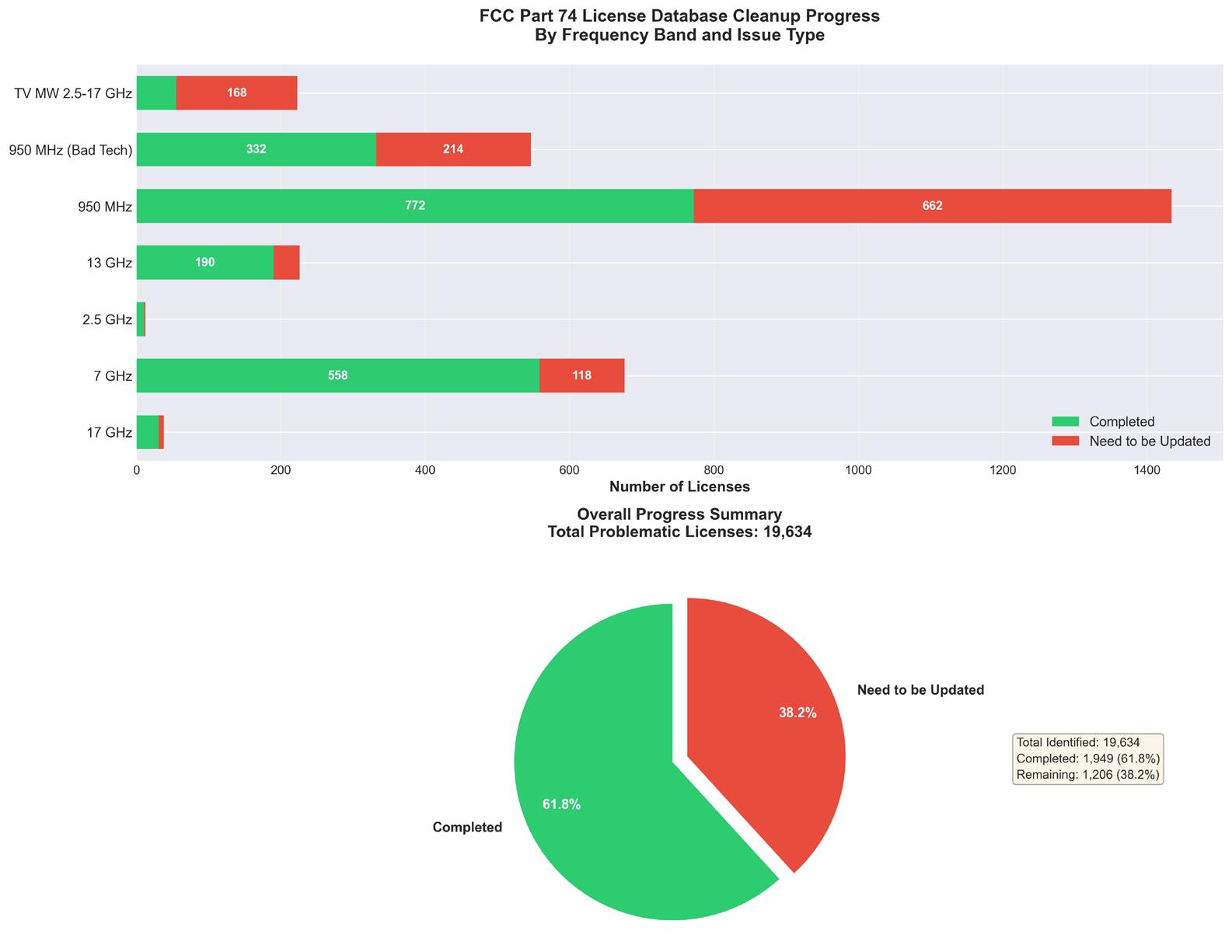
He says more than 1,200 licensees are missing receive sites on their auxiliary licenses or have incorrect technical data such as coordinates, elevation, antenna make and model and antenna receive height.
Approximately 200 TV pickup licenses out of 1,466 have no technical data on the license to protect them from non-broadcaster users coming into the band, such as satellite uplinks or Wi-Fi in the 6 GHz band.
A need for cleanup
Part
For existing licenseholders, sufficient protection requires that accurate technical parameters be available in the FCC’s databases for use in interference calculations.
For example TV pickup licenses that have no technical data can’t be protected from other non-broadcast users coming into their band, such as satellite uplinks or Wi-Fi. Out-of-date licenses also could prevent new services
from obtaining licenses in an already crunched spectrum.
There have been several examples, Fine said, of ownership transfers that included a broadcast station’s license but not its associated Part 74 fixed-links, only for the buyer to find out afterward. “Technically they don’t even have an active microwave license,” he said.
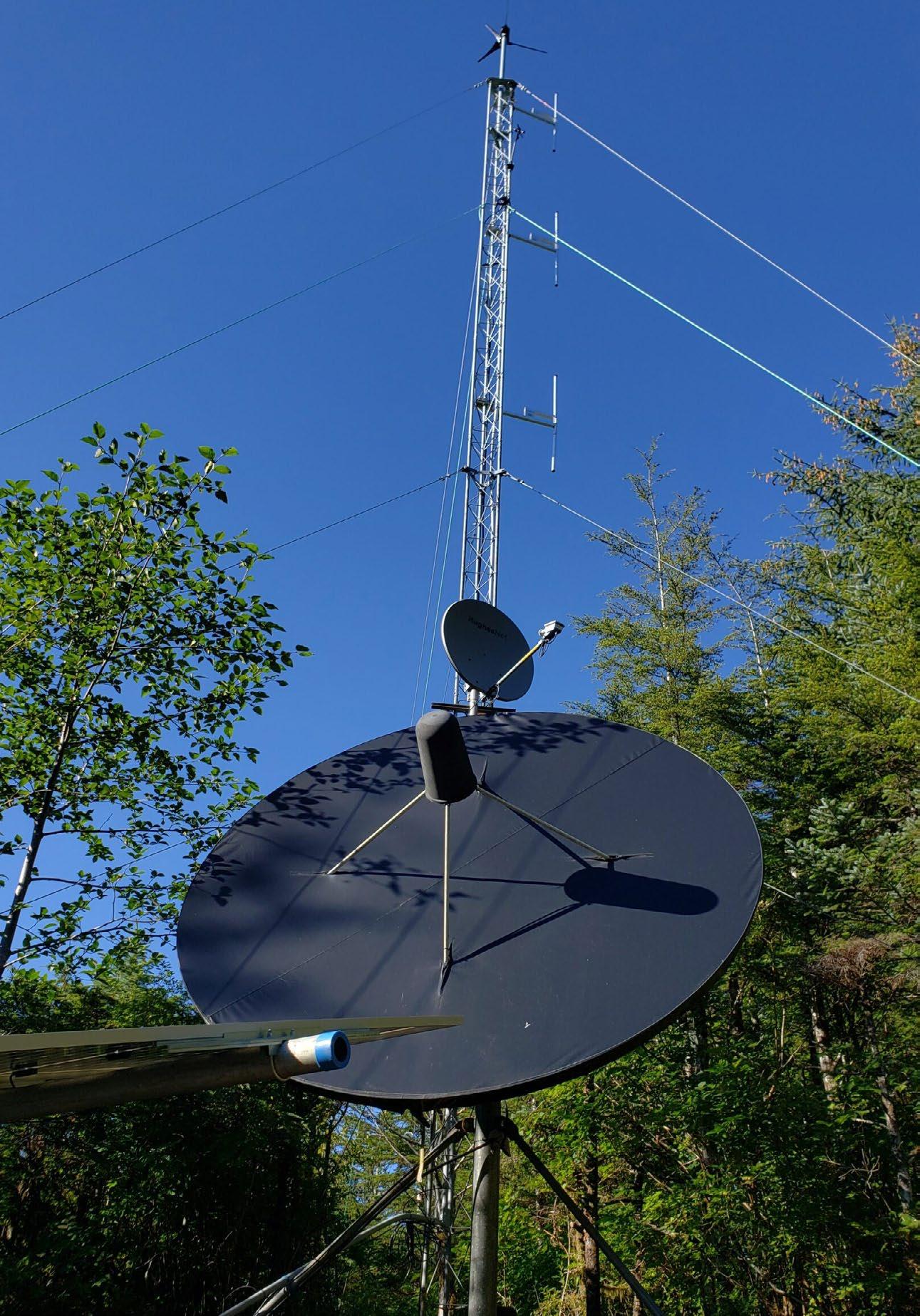
Right
This KCAW(FM) translator site maintains a
74 broadcast auxiliary remote pickup license, KA74933, in Sitka, Alaska.
Above
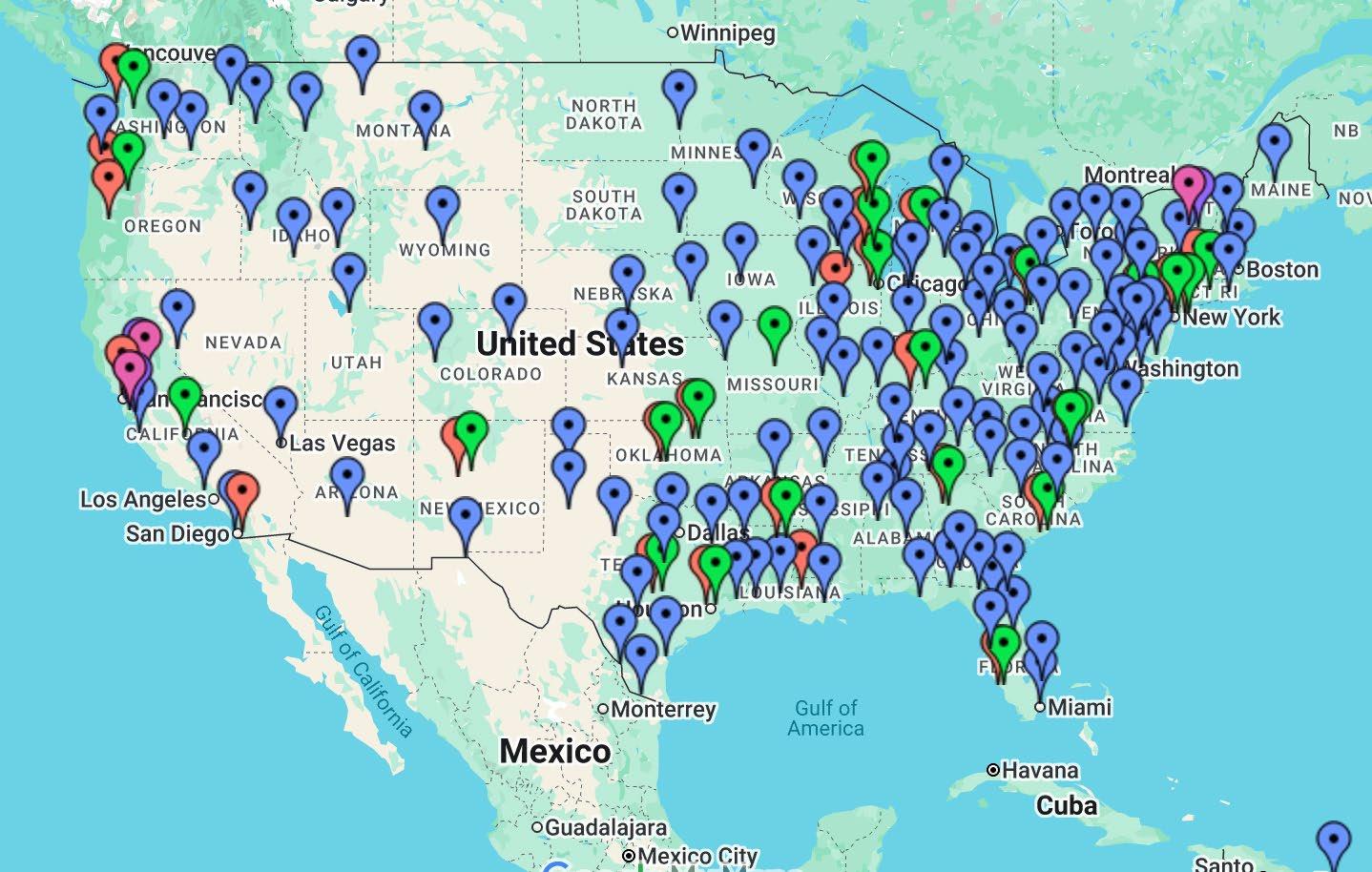
From the Society of Broadcast Engineers’ website, a Google Maps overlay showing the location of frequency coordinators in the U.S. and Canada.
Howard Fine is a coordinator for most of southern California, having served in that role since the early 1980s.
Why the inaccuracies? Fine said they stem from a largescale migration in 1999, when the FCC transitioned its database from Form 313 to the Universal Licensing System.
A contractor posted much of the data manually into new ULS entries. Some errors are typographical, such as 23 rather than 32 seconds for coordinates.
Many broadcasters had no idea this was a problem, in part because the database transition was not well publicized.
Frequency coordinators worked to keep licenses in check. In the 1980s and ’90s, he said, “The local Broadcast Auxiliary Services frequency coordinators knew where every link was and protected them.”
Now with a new crop of broadcasters not as well-versed with rules and regulations that go back decades, there is even less impetus to fix incorrect data.
“Many stations don’t have chief engineers on staff, and so until the FCC mandates fixing it, the owners are not going to spend the money,” he said.


Part 74 licenses do not expire unless they are a non-station license, such as for an entity like Metro Traffic.
In some cases a license may reflect an expired status instead of a cancelled one.
“There are hundreds of licenses
sitting there doing nothing for stations that don’t exist,” Fine said.
Another problem, Fine said, may result when a broadcast group purchases stations and moves them across states — from Dothan to Birmingham, Ala., for example.
“You look up where the Part 74 license coordinates plot on Google Earth, and it comes back to a Pizza Hut,” he said.
Ultimately, inactive licenses can prevent somebody else from getting a license.
“There are some cities where probably half of the 950 MHz licenses are going unused,” he said.
Convincing the commission
The FCC acknowledged the problem in 2003. It issued a public notice encouraging Part 74 licensees to add missing receive-end data, without a prior coordination notice, if it could demonstrate that the missing data was the result of using an early version of Form 313 that didn’t ask for this information or if the receive-end information had been previously licensed or provided in an application.
Fine has raised his concerns to the FCC several times through the Broadcast Auxiliary Services Fixed Service Committee working group of the National Spectrum Management Association.

If the commission could send letters to specific licensees, the NSMA suggested, it would expedite the process to update inaccurate information.
But the FCC never issued another notice. Fine said he has been told that the FCC feels it is a broadcaster’s responsibility to fix data, such as coordinates, on a Part 74 license.
If an entity wishes to do so, they have to pay for a prior coordination notice for frequency coordination, conduct an RFI study and file afterwards to correct the coordinates.
In a recent case, he said, a Part 74 license had its coordinates listed as 33 seconds when it should have been 3.3 seconds. A Part 101 licensee on 7.5 GHz filed to use the same tower with the correct coordinates. It cost the incumbent $15,000 to relocate the new licensee.
site http://fccinfo.com, which will automatically flag sites that have invalid latitude or longitude entries.
Above
“The FCC told them, ‘Your licenses aren’t correct, and that’s what we go by.’”
Database duties
In the meantime, Fine does what he can to help clean up the mess.
He has examined essentially all of the active Part 74 microwave licenses — approximately 18,500 of them. He has helped correct approximately 1,940 licenses.
Fine exported the FCC’s ULS data into a database of his own, and created a spreadsheet of the entries that did not have any receive sites listed.
He took the rest and identified characteristics such as incorrect coordinates. He has made use of Cavell Mertz’s
According to Howard Fine, as of today, there are more than 1,200 Part 74 licenses that are missing receive sites on their auxiliary licenses or have incorrect technical data.
“Industry efforts from within are the most effective way to get the job done.
Fine is passionate about the upkeep of auxiliary devices. He has served Los Angeles and surrounding areas as Part 74 Frequency Coordinator since the early ’80s, and he has functioned as on-site coordinator at venues in Los Angeles for events and NFL games.
“Sometimes, when I’m sitting at home, I start working on something, and 15,000 lines of typing later, here I am.”
He will match coordinates to recent Google Earth street-view data to verify whether any transmitting entity exists at a location. When he can, he notifies stations of discrepancies.
Broadcasters have been penalized for improper Part 74 operation, including fines in Wyoming and Colorado for approximately $100,000.
Recently, he notified the new owner of a station in Colorado about fixed links that were still listed in the database but no longer being used. The owner expressed gratitude and was better prepared when the FCC visited its market.
He invites stations in similar circumstances to send him an email at scfcc93906@gmail.com to check licenses.
For now, Fine preaches an internal effort to help database accuracy efforts.
“Whether it’s better understanding from the law firms in Washington or the broadcasters themselves, industry efforts from within are the most effective way to get the job done,” Fine said.

Writer Chuck Gloman Associate Professor & Chair, TV/Film Department, DeSales University, Center Valley, Pa.

Let’s discuss the power of capacitors
Tips to keep in mind when restoring vintage equipment
Vintage equipment relies on many components to run properly. Let’s focus today on what capacitors do in this process.
A capacitor is a device used to store an electric charge, usually consisting of one or more pairs of conductors separated by an insulator.
Let’s discuss three types: paper capacitors, electrolytic capacitors and polyester film capacitors. (There are others like tiny mica capacitors that are less relevant for this discussion.)
down due to mechanical stress, heat and age.
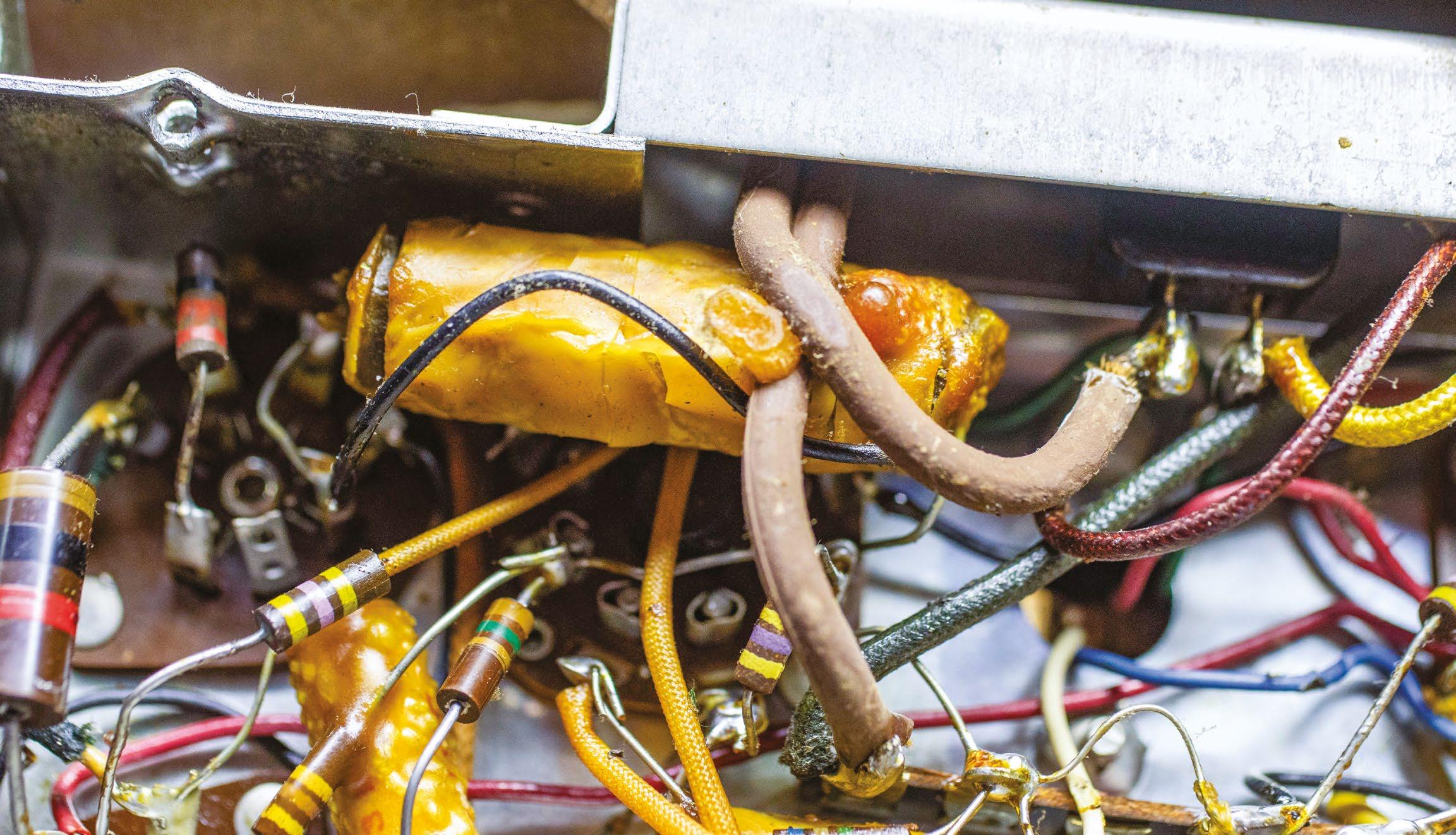
Their role is to store an electrical charge, but because of their age they are no longer capable of that. The most visible signs of capacitor failure are a bulging top or sides, fluid leaking and a bubbling of the wax coating (Fig. 1).
As mentioned, these should be replaced. You can look at the schematic, or if you’re fortunate enough, the printing may still be visible on the paper sleeve.
Top Fig. 1: A great example of a wax capacitor that is no longer functioning properly. Note that the ends are bulging and the cylinder’s wax is bubbling.
Let’s look first at the paper capacitors, sometimes called paper/wax or wax capacitors.
These are usually tube-shaped with metal leads coming out of the left and right ends (axial) and wrapped in wax. These were in common use up to the early 1960s.
If you’re restoring equipment with these capacitors, replace them. Wax capacitors do not last 50 or more years, especially if the unit had been used frequently. They break
Note the microfarad size and voltage. One of the most common capacitors used in vintage radios is the .05 microfarad 400 Volt capacitor. You are looking for the microfarad value and the voltage. You never want to go much smaller than its microfarad rating and never go smaller in the voltage capacity.
Modern replacements are normally polyester film capacitors. It may be difficult to find .05 microfarad capacitors. With my limited math skills, I use a .047 microfarad 600 volt capacitor. A .047mf capacitor is extremely close to a .05 and is a suitable replacement.
When installing a polyester film capacitor, the polarity does not matter. There is no positive or negative lead.
The next type of capacitor is the electrolytic. This is a polarized capacitor with a cathode or positive plate, and a negative or anode plate.
These types normally are made of metal that forms an insulating oxide layer through anodization. This oxide layer acts as the dielectric of the capacitor.
Inside, a gel, solid or liquid electrolyte covers the surface of this oxide layer, serving as a cathode or positive plate of the capacitor.
Because these capacitors are polarized, they must be connected in the correct direction in the circuit to function properly.
Electrolytics can have a much higher voltage to capacitance per volume than any other type of capacitors. To make it even more complicated, there are three different types of electrolytic capacitors: tantalum, niobium, and aluminum.
Because they have these very large capacitance values, they are great for low-flow signals, allowing them to pass and for storing larger amounts of energy. They’re often used in power supplies, or for noise filtering.
Two potential negatives of larger electrolytic capacitors are that they are more prone to leaking because of the higher storage value, and they should be discharged before removing them from the circuit.
I like to think of it as an insect. The bigger the bug or the larger the capacitor, the more energy it stores and the larger shock (bite) you could get.
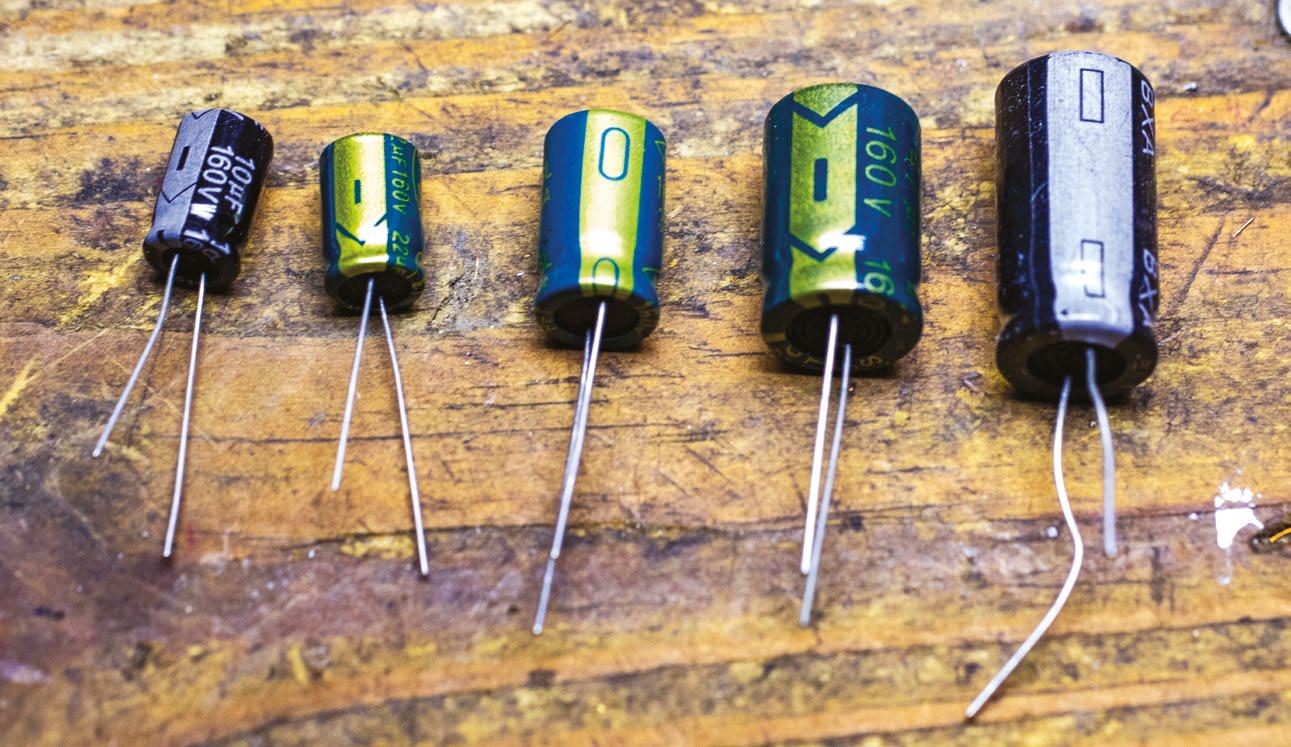
Values of electrolytic capacitors have also changed over the years. I commonly see 50 microfarad capacitors in vintage units. That size is not readily available anymore. The most common sizes of electrolytic capacitors are 10, 22, 33, 47 and 100 microfarads (Fig. 2). You can get them in other sizes too, but these are the most common.
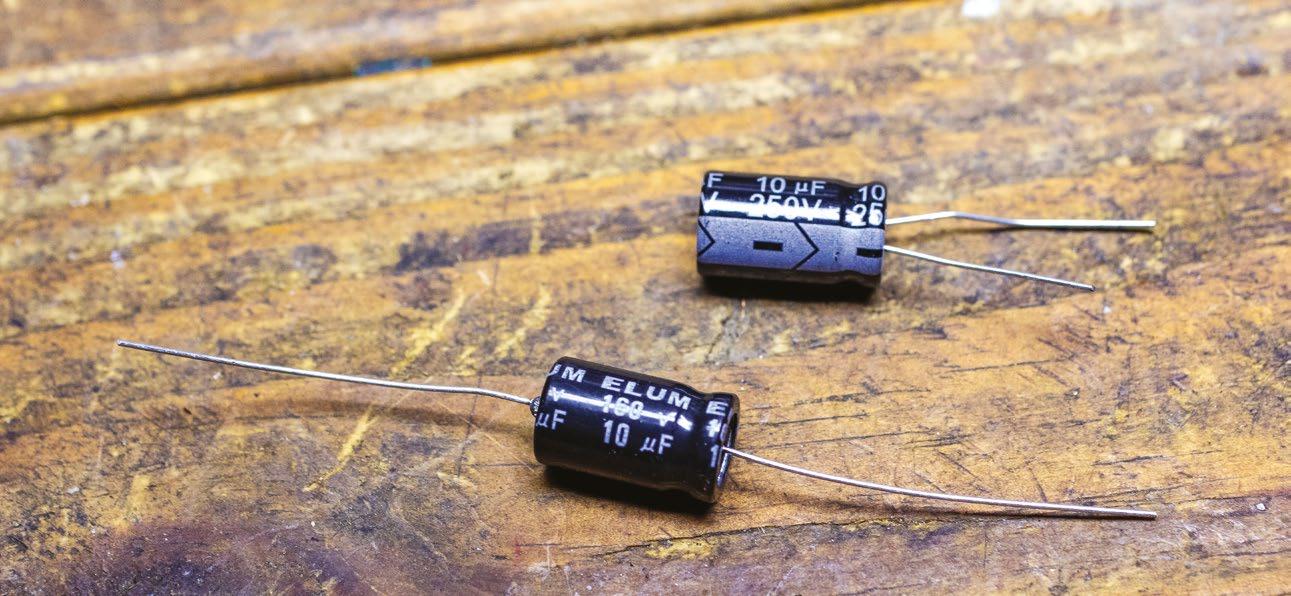
The electrolytics come in two styles: axial with a lead on each end (like a car axle) and radial with both leads coming out of the bottom (Fig. 3).
Following the schematic, or removing the old electrolytic cap, take note of which is the positive and which is the negative. They are labeled on the capacitor itself. The
Vintage Gear
negative lead on a radial capacitor is always a little bit shorter than the longer positive lead.
Also look for the minus or arrow band noting the negative side. If you reverse the polarity of an electrolytic capacitor, it probably will rupture.
The third type we’ll mention here are film or polyester film capacitors. This type is used most often when replacing wax capacitors.
These more modern units will last much longer and are known for their reliability as well as stability. However, a colleague of mine says if you’re working on a unit before 1970, replace all the capacitors.
Is there any other way of determining if a capacitor is bad if it passes the visual inspection? You can test the capacitor using, strangely enough, a capacitor tester. You will be given a value of what the capacitor’s rating is as well as is ESR.
Below
Two examples of a 10 mf capacitor. The one on the bottom is an axial and 160 volts.
Above is the 250 volt radial. Note that the negative lead is shorter on the radial.
ESR stands for Equivalent Series Resistance. This measures the internal resistance. Low ESR is good, and the high ESR is bad, meaning the capacitor should be replaced. When looking at the value of a tested capacitor, if the value is too high or too low and the ER is high, replace the capacitor.
When working with combo units (example: two 50 mf capacitors in one), test the leads and see what the value is of each capacitor. The simplest replacement is to combine the negative leads on the two 47 microfarad electrolytic capacitors and solder one positive lead to one wire and the second positive lead to the other wire.
If the electrolytic capacitor was in a metal can, some people prefer to hollow out the old capacitors and put new ones inside the same container. That’s a lot of extra work, though, and rarely will people see inside the unit anyway.
I hope this bit of information doesn’t overload your capacity. I’m a little resistant to talk about resistors — that’s another article!
Chuck Gloman is an associate professor and chair of the TV/Film Department at DeSales University. Reach him at chuck.gloman@desales.edu
Above Examples of radial electrolytic capacitors.
From left to right: 10, 22, 33, 47 and 100 mf.

John Bisset
CPBE
The author is in his 34th year of writing Workbench. He handles western U.S. radio sales for the Telos Alliance and is a past recipient of the SBE’s Educator of the Year Award.
Steve keeps the pressure on
How liquid soap and roof sealant can solve some common problems
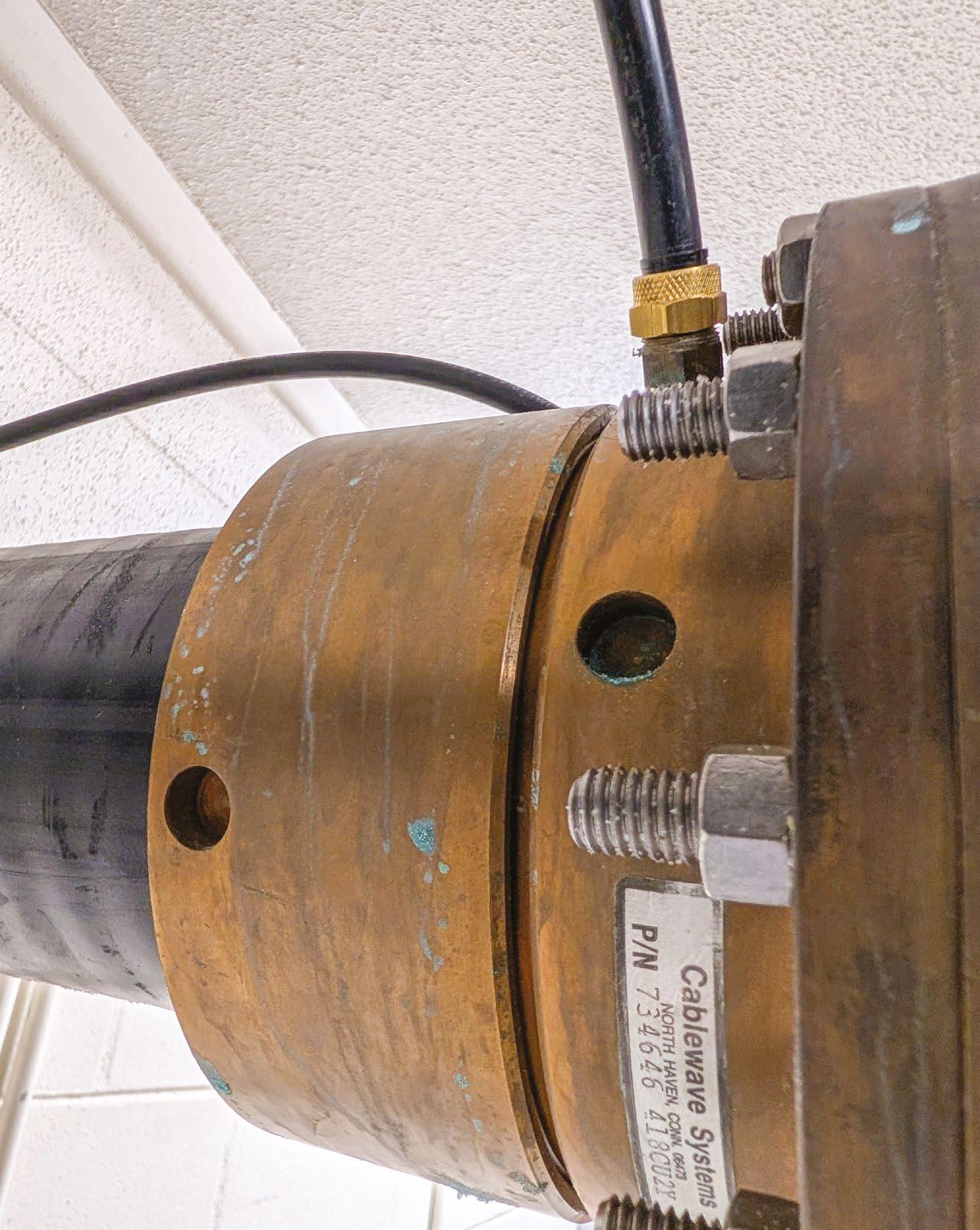
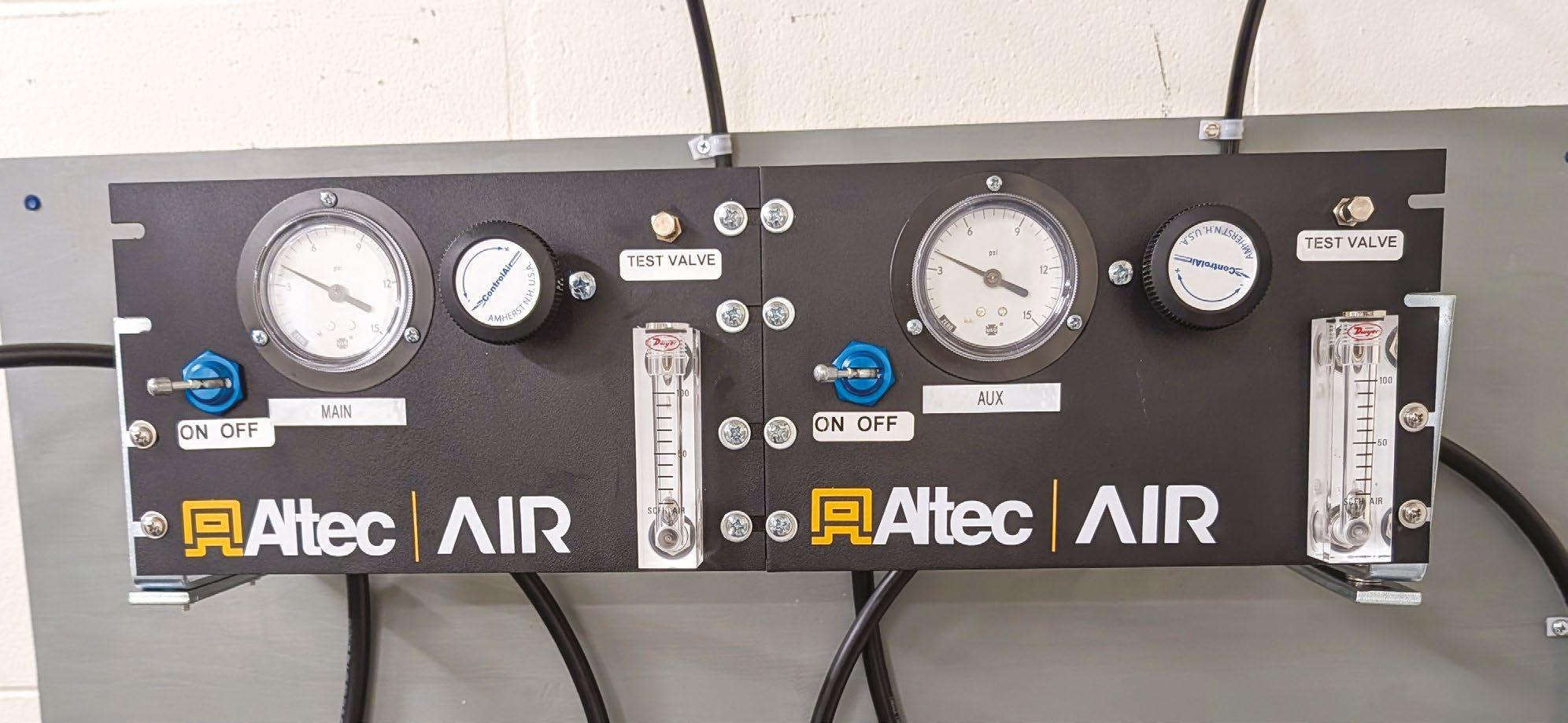
Experiencing nitrogen leaks? Steve Tuzeneu, CPBE, recommends that before you call riggers to climb your tower, take a bottle of diluted liquid soap and spray around the air inlet (Fig. 1) and all the gas fittings on the manifold (Fig. 2).
This will clean off grunge but more importantly it will reveal leaks. Any bubbles — even tiny ones — will demonstrate nitrogen escaping at that junction.
Tighten or replace any leaking fittings. And then you’ve saved yourself the money for a tower climb.
Tips
Please Workbench submissions are encouraged and qualify for SBE recertification credit. Email johnpbisset@ gmail.com
Protect ground strap
Copper thieves are at it again. Over the last month, I’ve spoken with two stations that had copper strap stolen. If you haven’t “painted” or otherwise concealed your ground strap, do so now. That shiny strap seems to draw thieves like moths to flame.
Slather a coating of Gardner’s Wet-R-Dri sealant on the copper strap. Metal reclaimers will not accept copper that’s covered with
Top
Fig. 1: The inlet fitting on the transmission line can be a source of leaking nitrogen.
Right
Fig. 2: Spray the manifold hose fittings while looking for small bubbles.

this asphalt compound. It’s a roofing cement made from asphalt. (Steer clear of rubber-based “equivalents.”)
This stuff won’t peel off. It’s available at Home Depot or direct from the manufacturer at https:// gardnercoatings.com.
M-Disc lifespan
A reader asked our editor if the M-Disc archival optical disc format can really save and protect recorded material for 1,000 years, as claimed.
After some research, it looks like this is true, based on accelerated longevity tests and the inorganic, stone-like recording layer construction. The layer is not affected by sunlight, humidity or temperature.
Do you have experience with particular media formats for very long-term storage? Share it at johnpbisset@gmail.com.
Backup audio
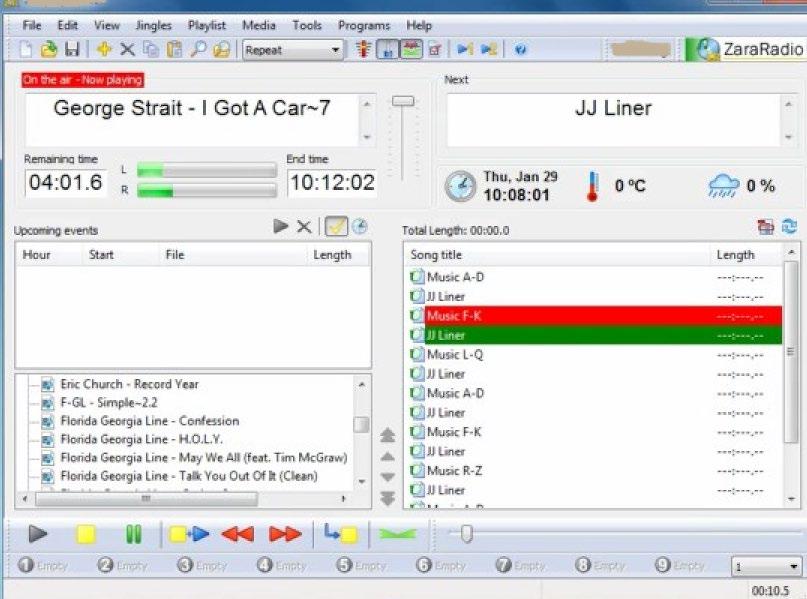
Long-time engineer Steve Ordinetz in Littleton, N.H., commented on our tip about repurposing an old CD player as an emergency backup at the transmitter site.
“It’s a good idea, but even in the best-case scenario, the CD only gives a little over an hour’s worth of programming,” he notes.
There are sophisticated backup options now available through various platforms including cloud-based automation systems. But for some applications, you might need a basic fix.

“Metal reclaimers will not accept copper that’s covered with this asphalt compound.
Above
A page from Steve’s backup automation
Left
This can be your friend in fending off copper thieves.
Back in the ’00s, Steve discovered a freeware automation program called Zara Radio (Fig. 4). He uses it for audio backup at his transmitter sites because it’s versatile and will run on pretty much any PC.
Steve set up a library of a couple of hundred songs, grouped into rotator files such as “Artist A–C, Artist D–F,” etc. All have similar but not exact sizes so songs don’t come up in the same order all the time.
Steve will set it up to play a couple songs, a liner, a couple more songs, etc. The program has a timed event feature so you can create a window for a legal ID to play. It also allows you to set precise end-of-message marks so every segue is tight. The program runs 24/7 so audio’s always available for as long as it’s needed.
Steve used a silence sensor to trigger it, but set to about 45 seconds to prevent loose programming from starting the backup.
This goes into an audio switcher in the air chain. When studio audio returns, it automatically switches back. Steve says it works great, and you can’t beat the price.

Writer Gregg P. Skall
What to know about your station log
At least for now, these rules remain on the books
As the commission works its way through proposals in the Delete, Delete, Delete docket, it’s a good time for broadcasters and station employees to refresh their memory on what recordkeeping requirements are still on the books.
Many of the questions we get relate to FCC logs. The basic station log requirement is found at §73.1800 of the FCC Rules, and the contents are detailed at §73.1820.
While the amount of information required to be kept in a station log is significantly less than many imagine, broadcasters should familiarize themselves with the station log requirements to avoid any FCC fines.
The station log must be kept by a station employee “competent to do so” and who has “actual knowledge of the facts.”
Thus, the GM should assign the task to an employee who understands the rules and is trained in the engineering required for some of the special readings that may
be required to be logged, depending on the station’s circumstances.
All entries must accurately reflect the actual operation of the station. The employee who makes an entry must sign the log. His or her signature serves as a personal and legal attestation that the entry, as well as any corrections or additions to it, are accurate.
The log must record all the details required for that type and class of station, and it must be readily available to be read without special requirements or lapse of time. All logs kept on paper must have all the pages numbered and dated with the time entries in local time indicated as either daylight savings or standard.
Here is a list of station log requirements:
1. Regular observations of tower lights (at least once every 24 hours, unless a compliant automatic monitoring system is used). If extinguished or malfunctioning, the log must also include the nature of the problem, the date and time of extinguishment or improper operation, and the date, time and nature of adjustments, repairs or replacements.
2. A record of any entries that are specifically required on the station license or other instrument of authorization.
3. Each test and activation of the Emergency Alert System. The EAS records may be kept in a special log, in which case the EAS log is considered a part of the station log.
4. The records for the logs can be maintained manually, or by the use of automatic devices, provided they are calibrated and records are kept of the calibration. The
“While information required is significantly less than many imagine, broadcasters should familiarize themselves with the log requirements to avoid FCC fines.

equipment used for automatic recording must conform to other specifics found in the rules at §73.1215.
5. The logs must be kept for a period of two years. However, logs involving communications incident to a disaster or regarding an FCC investigation must be retained until authorized for destruction by the FCC. If the log relates to a complaint of which the licensee has received notice, relevant records must be maintained until the matter has been fully resolved or the applicable statute of limitations has run.
6. The logs may be maintained manually or electronically, provided that they can be made readily available for suitable viewing. If special equipment is required for viewing, it must be available to permit FCC inspection. Logs stored on data storage systems have to be made available as full-sized copies when requested by the FCC or when requested by the public, if authorized for public inspection under FCC Rules.
Read the rules
The details of your station log requirements can be found in the FCC rules at §73.1820.
“It’s a good idea to keep a copy of the FCC rules at the station. They can be ordered in hard copy from the Government Publishing Office. But you also can find them easily on the internet.
7. Directional AM stations have special requirements if they do not have an FCC-approved antenna sampling system. This is a very technical area and the station engineer should consult §73.1820 for details.
There is no longer a requirement to keep program logs or records of material that is broadcast, whether it is commercial matter or programming, as part of the station log.
Note, however, that broadcasters are still required to comply with their public file obligations, including the quarterly report of issues and programs and the political file requirements. The public file is separate from the station log or a program log, neither of which the public
has a right to see, and these obligations might change through the Delete, Delete, Delete proceeding.
Even though a program log is not required by the FCC, many licensees maintain one anyway as a convenient and reliable record of spots and other material that has been broadcast.
Such program logs can be used for internal and business purposes, for example, to document for advertisers, agencies or reps that a spot was actually broadcast (and when). It can also be useful to supplement requirements for the political file.
Even though program logs are not subject to public inspection, there is a risk: FCC staff might ask to see them, or, if relevant, they could be subpoenaed as evidence in a lawsuit alleging station wrongdoing. Thus, licensees will have to determine whether maintaining such a log is worthwhile.
Tip: It’s a good idea to keep a copy of the FCC rules at the station. They can be ordered in hard copy; visit the Government Publishing Office at bookstore.gpo.gov and type “CFR Title 47 Pts 70-79” in the search field. But you also can find them easily on the internet. To access the FCC rules relating to broadcasting, go to www.ecfr.gov/ current/title-47 and drill down to Chapter I, subchapter C.
How must logs be signed?
Interestingly, this question keeps popping up. It seems to result from what may turn out to be one of the great myths in broadcasting: that FCC rules require that the station log be signed in wet ink only, and that it must be blue ink.
Here are some actual questions station managers have asked:
1. Our operators maintain our log on a computer. Can I simply use the computer records, or do I need to print them out in paper, have them signed and then produce the paper copy when asked for it?
2. Our operators maintain our log on a computer and sign a separate affidavit when they come on shift and go off shift. Is this needed or can they initial the entries on the log and then have an affidavit matching the initials to the persons signature?
3. Must the Chief Operator physically sign the station log when reviewed or can he type his name or initials and provide an affidavit matching the initials to the signature?
4. We’ve been having some trouble confirming an FCC requirement that logs be signed using only black or blue ink. Is that true?
A look at the rules confirms there is no substance to the myths and rumors behind these questions.
Section 73.1820(a) of the rules permits the logs to be prepared by electronic means with automatic entries.
Since this is an explicit recognition of computerized logging equipment, and since other sections of the rules permit maintaining files by electronic storage so long as a reader is available for anyone entitled to access them, it is clear that the FCC sanctions maintaining the station log by electronic means.
Nothing more is said about the manner of the signature, so normal evidence rules would simply require that the signature could be by any means where its authenticity could be proven.
Moreover, there is no specific rule dealing with the manner of signature. Since an operator is permitted to use electronic record-keeping, it is logical that he or she could designate a verifiable method for electronic signature.
The key would be that the operator must be able to demonstrate that the signature, by whatever method, may be entered only by the intentional act of the authorized person and only after verifying that the required actions have been performed.
That the federal government, and the FCC specifically, is ready to accept electronic signature has been demonstrated in several ways. The Electronic Signatures Act (Public Law No: 106-229) was enacted and became effective on Oct. 1, 2000. The act affords electronic contracts the same weight as those executed on paper. Indeed, President Clinton signed it electronically.
Broadcast Law
It specifically states that it does not limit or supersede any requirement by a federal or state regulatory agency, but since there are none in the FCC rules, Congress’ recognition of the effectiveness of electronic signatures supports its use for FCC log purposes.
A search of the FCC regulations, policy documents and cases confirms that the FCC has not spoken to this topic in any way that would invoke the limitations of the Electronic Signatures Act with respect to broadcast station logs. Moreover, in the maritime service the commission specifically permitted maintaining station logs by electronic signature, and electronic signatures are permitted for filing broadcasting FCC applications in the Licensing and Management System. The conclusion that electronic signatures are permitted is further supported by these rules.
Moving back to signatures signed in hand, there is also a perception that station logs must be signed in blue ink. Others believe it has to be black. Here too, there is no such FCC rule. The important factor is, again, the evidentiary consideration that the log be signed in any manner that shows that it is an actual, verifiable signature.
This column is for general information and should not be relied upon as legal advice pertaining to a specific factual situation. Legal decisions should be made only after proper consultation with a legal professional of your choosing.

Writer
Marc Yablonka
The author wrote here last year about stations that serve Hmong communities in the U.S.
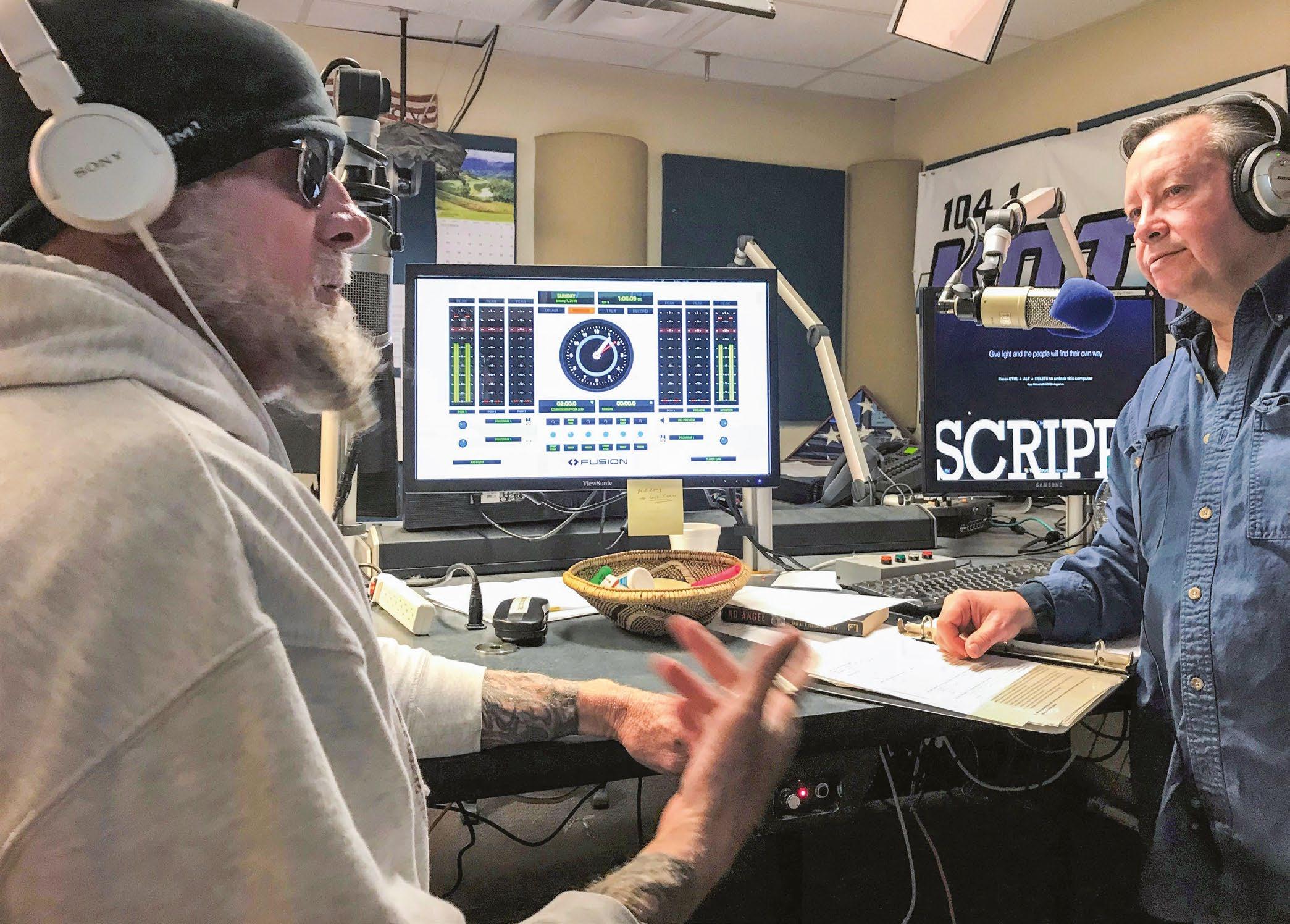
“American Warrior Radio” fights the good fight
“Telling the stories of the men and women who protect us at home and abroad”
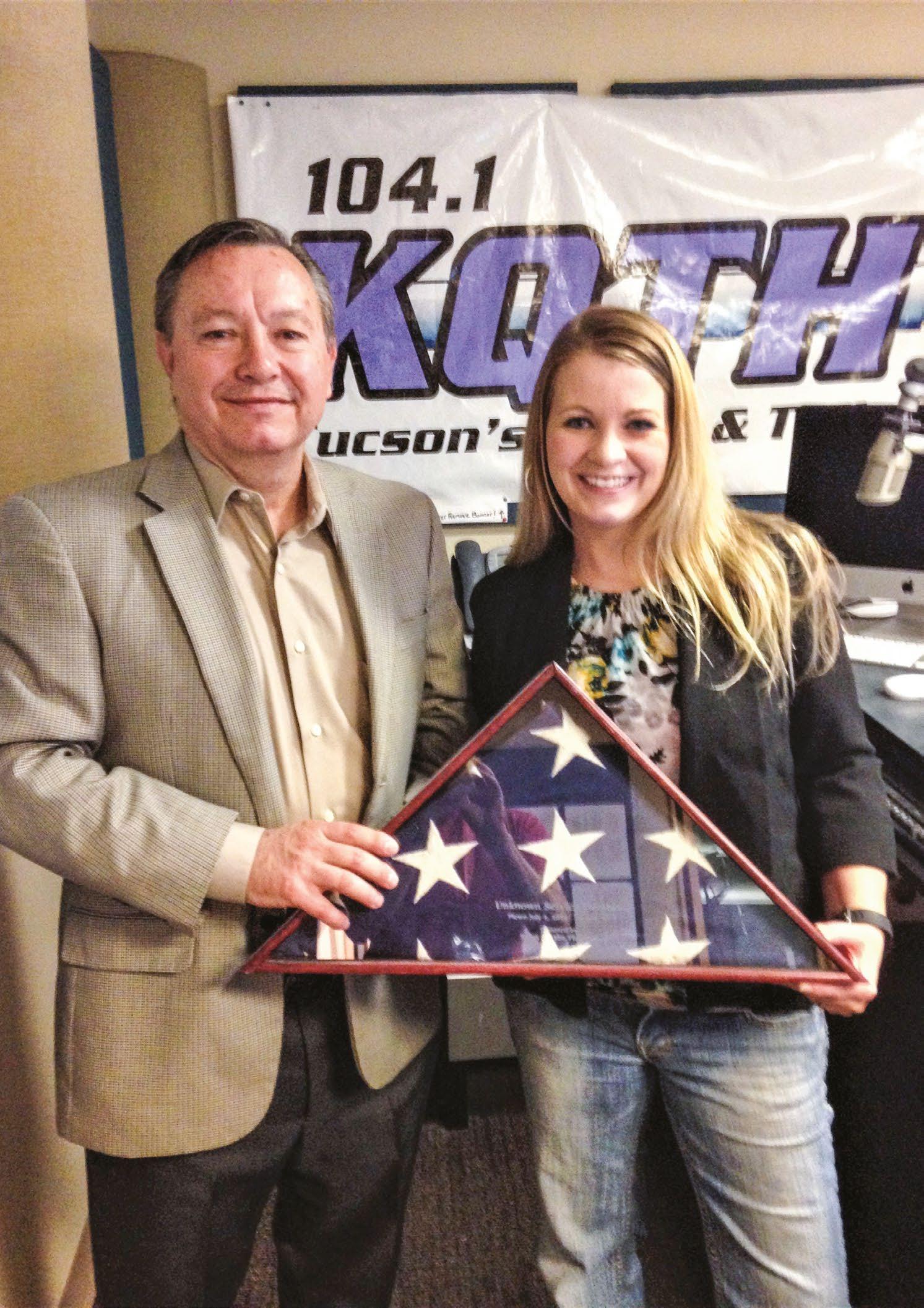
Ben Buehler-Garcia went from having no radio experience to being at the helm of “American Warrior Radio” for 13 years and counting.
The program, which now originates from Bustos Media station KVOI(AM) in Tucson, Ariz., tells the stories of men and women in the military and first-responder communities. It is syndicated on Talk Media Network to 143 stations and heard in podcast form on all major platforms.
“I never served in the military or wore a badge, so as an adult, I’ve always felt it was my duty to support those who do
or have,” he told Radio World.
When he started working at the local Chamber of Commerce, it had a Military Affairs Committee. BuehlerGarcia was put in charge of staffing it. “I was 23 years old, and that’s when I really started to appreciate the sacrifices that military families make on our behalf.”
In that role he met local media icon Dave Sitton, who covered University of Arizona sports on local stations.
Sitton had attended UA on a baseball scholarship and had planned to join the Marines. Unfortunately, he was hurt playing ball, and becoming a Marine was not in the cards.
But Sitton conceived “American Warrior Radio,” BuehlerGarcia recalled, to bridge a gap of understanding between
Ben BuehlerGarcia, right, with retired ATF agent Jay Dobyns, who infiltrated the Hells Angels club.
Courtesy Ben Buehler-Garcia
the civilian population and the 1 percent who served. It began as a brokered program on KNST(AM) in Tucson.
“He knew I was very active in military affairs, so it started out with him asking me for referrals for guest ideas.”
Sitton then invited Buehler-Garcia to sit in on shows with him. After a few years, Sitton decided to run for Congress, and he invited Buehler-Garcia to guest-host while he ran his campaign.
Unfortunately, he did not win the election. Subsequently, Sitton came in to do the show one Sunday, and the engineer said, “Dave you look a little off.” Sitton replied, “I don’t feel quite right, but I have a doctor’s appointment
“I was 23 years old, and that’s when I really started to appreciate the sacrifices that military families make on our behalf. ”
tomorrow.” But Sitton died the next day at age 58.
“Put me in touch”
Buehler-Garcia felt that the work of the program needed to continue.
“I leapt in with both feet. I knew absolutely nothing about the radio business.” KQTH(FM) was the home of the program at that time, and management was open to the idea, as was Sitton’s family.
“It has been on-the-job learning for me. The interviews, the production, but also the sales. All that right-brain stuff that I needed to support the show. My intention was to make this a weekend labor of love.”
Above Buehler-Garcia with former Army soldier Jessica Lynch, who was held for nine days by Iraqi forces in 2003. He reunited Lynch on the air with one of the Navy SEALs who rescued her.
When he started, 80 percent of his guests were local, invited from military centers like Davis-Monthan Air Force Base, the USS Tucson nuclear submarine and U.S. Army posts south of the city.
“One of the things I learned from my previous job in sales was you always ask for referrals. So after a good interview, I would always ask, ‘If you know anybody with a good story to tell, put me in touch.’”
A growing network of filmmakers, book publishers and PR agencies subsequently has helped him find a wider variety of guests.
“Things started to get a little bit easier from that point on, but the reverse of that is that I’ve got a stack of 12 books that I’ve got to read,” he said with a laugh.
He recalls a time when his growth felt stalled.
“I interviewed a former Delta Force member who had fought in the Battle of Mogadishu. He was talking about how he felt lost. He lost his connection to his tribe. He lost his purpose. During the interview, my wife texted me, ‘Sound familiar?’
“When I got home, I realized this was something that I hear often from Special Forces ‘Tip of the Spear’ people —
Courtesy Ben Buehler-Garcia
how they really feel lost. They don’t have a purpose in life anymore. They miss their tribe.”
Buehler-Garcia thought this was what his wife had meant when she texted him.
“No,” she told him. “That’s you! You feel lost. Your mission is to get this message out to as many ears as possible.”
At that point, Buehler-Garcia explored self-syndication. He brokered KNFX(AM) in Phoenix, then added stations in Norfolk, Va. and Salt Lake City. Affiliates in Sacramento and Colorado Springs followed.
After 12 stations signed up, Buehler-Garcia began to wonder, “Maybe there’s a different way to skin this cat.”
Enter Talk Media Network.
“I looked at other syndicators, but they weren’t a good fit, and I wasn’t prepared to make that financial jump at the time. Josh Lang, the owner of Talk Media Network, then approached me.”
Radio Programming
Ironically, Lang had been Dave Sitton’s engineer at KNST.
“Josh obviously knew the product, and he’s a veteran himself. He supports the cause. It was like we’d worked together forever because we both had ties to Dave Sitton,” Buehler-Garcia said.
“Before, I was a one-man shop. I was doing it all up until the point that I was syndicated,” he continued. “I was seeking out the guests, doing the production, scripts for interviews, the sales to keep myself afloat for the brokered time.”
The syndication agreement gives Buehler-Garcia the freedom to concentrate on production, though his contract also allows him to dabble in sales. Today only four of the affiliates are still carrying the show as a brokered program.
Part of the reason that Buehler-Garcia has such a passion for radio has to do with the fact that his parents were missionaries. They worked in Oaxaca, in the jungles
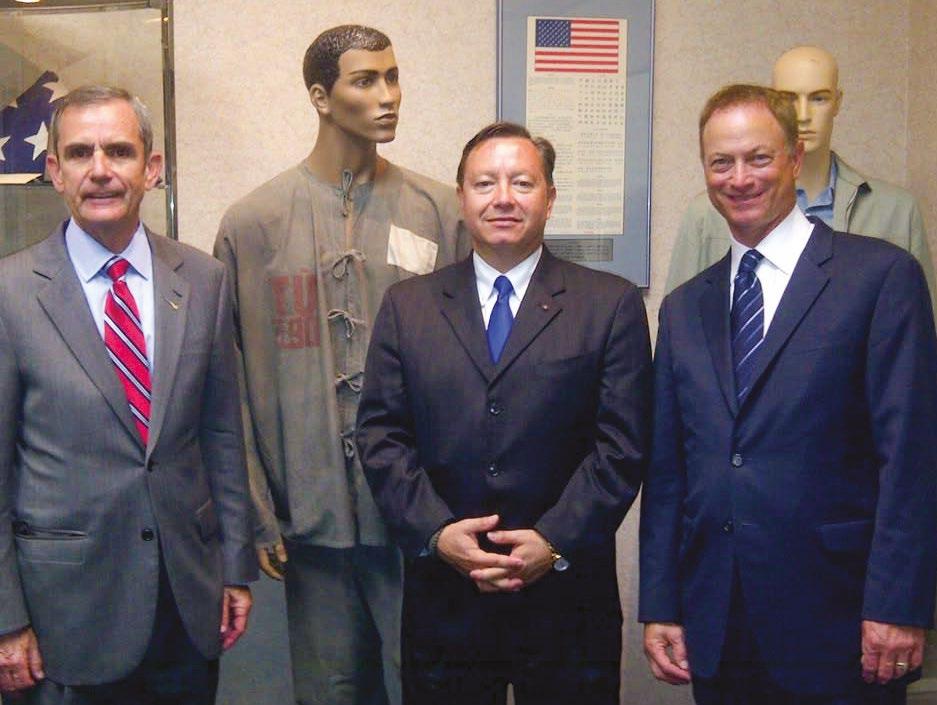
Buehler-Garcia, center, poses with retired U.S. Air Force Col. Lee Ellis, left, who had been a prisoner of war in Vietnam, and actor/advocate Gary Sinise. They were at the POW Exhibit Hall at Randolph Air Force Base in San Antonio, Texas. Both have been guests on the program.
“He doesn’t do it for fame or fortune. He does it out of respect. ”
of Mexico with indigenous people, and on an Indian reservation in South Dakota.
“What that taught me as a young boy was the importance and the power of storytelling. “American Warrior Radio” is basically a forum for these men and women who have served or are serving our nation just to come on and tell their stories. I like to say that it’s a friendly conversation between two people with thousands of people eavesdropping.”
One of the compliments Buehler-Garcia often receives is how comfortable the interviewees feel, as if it were a friendly chat around the campfire.
Recent guest Bobbie Keith, known as “Bobbie the Weather Girl” for her broadcasts from the studios of the American Forces Vietnam Network-Saigon during the war, echoes that sentiment.
“The interview with Ben went ever so smoothly because he was sincere. We both agreed how important it is for veterans and others like myself who served in Vietnam in a different capacity, that our stories are archived and remain in the banks of history.
“It’s people like Ben whose heart is in making sure our stories are told. I feel so blessed that I now have memories that will not die,” Keith said.
Gary Tollett is the owner of AM stations WOBL and WDLW in Lorain County, Ohio, which air “American Warrior Radio” twice a week.
“What Ben does is inspiring. Not all of us get the opportunity to serve our country, but we can honor them the way our veterans and first responders should be
Ben Buehler-Garcia.
Above

Radio Programming
honored. The fact that he has made that his mission is amazing. Every show gets better and better. He doesn’t do it for fame or fortune. He does it out of respect. There is a special place in heaven for Ben when he is called home,” Tollett said.
The program also was heard for a time on the American Forces Network, reaching 160 countries and aboard 200 ships. “It was a huge honor. That was on top of the world for a guy like me.” AFN recently decided to switch to internally produced content.
Personal accounts
There are two basic rules.
“We don’t talk politics. And if somebody has written a book, I have to read it before I bring them on the show. They have to have a compelling story to tell.”
One of his more unexpected guests was actress Bo Derek. “Her father was a Green Beret in Vietnam. She’s an honorary Green Beret. She hosts and supports a lot of veteran sports events. When I interviewed her, she had a
“He was talking about how he felt lost. He lost his connection to his tribe. He lost his purpose.
”line of shampoo for dogs and she was shipping the stuff free of charge to deployed dog handlers. Sometimes there is a story there that you don’t see right away. You have to dig down deep,” he said.
For Buehler-Garcia, it’s important to offer a mix. He has interviewed authors who write harrowing fiction about war, but he prefers personal stories from veterans.
“I do regular features on veteran entrepreneurs or on non-profit organizations that support veterans.”
He also interviews first responders. “Our tag line is ‘Those who protect us at home and abroad,’” he says.


Guest Jay Dobyns had been a standout football player for Arizona, then went to work for the Bureau of Alcohol, Tobacco and Firearms. He was shot his third day on the job, and later infiltrated the Hells Angels, an experience he recounted in a book. “He got to where he was losing his sense

of who he was because he was in so deep undercover,” Buehler-Garcia recounted.
The host occasionally has needed to use what he calls the famous Dump button.
“I’d been doing the show about nine years and had a lot of salty talks with Marines, Delta Force and Navy SEALs, people whose daily language does not comply with FCC rules. But I never had to bleep anyone — until I had to press the Dump button on an ATF agent, a female, who was describing a shoot-out she was involved in. She was using language that was certainly not appropriate for our listeners.”
He does feel that the forum places a responsibility on him to discuss some uncomfortable subjects such as veteran suicide and PTSD.
“You have to have those conversations,” he states. “I’m looking to educate. I’m looking to inspire.”
The author is a military journalist and author whose work has appeared in the Stars and Stripes, Army Times and many other publications. He has written four books on the Vietnam War.
Courtesy Bobbie Keith
Right Bobbie Keith on the set of the American Forces Vietnam Network in Saigon.
Radio shifts to centralized control
Groups embrace cloud-enabled observability with data-driven support across an entire RF network
Raymond Miklius is chief technology officer of GatesAir. In this article, excerpted from the ebook “Trends in Remote Control & Facility Management,” he talks about the AirWatch 365 remote monitoring and response service.
What do you consider the key trend in this area?
Raymond Miklius: The most important is the shift from “site-by-site monitoring” to centralized, cloud-enabled observability with proactive, data-driven support across an entire RF network.
For GatesAir AirWatch365, that means moving beyond basic remote control of a single transmitter to continuous telemetry, alarm correlation and analytics across many sites, with support teams acting on issues before the station hears about them.
Writer Paul McLane
To what extent has radio created centralized infrastructures for monitoring and control?
Miklius: Larger groups now expect a single pane of glass for all transmitters, translators and auxiliary chains, regardless of market. Many have converged from legacy, siloed remote controls to centralized NMS-style architectures where a core system ingests SNMP, GPIO and API data from multiple vendors and sites.
GatesAir positions the cloud server as that central aggregation layer while AirWatch site appliances (RDCs) normalize data from exciters, transmitters and environmental systems. This allows engineering teams to manage alarms, performance metrics, firmware/ config baselines and reports across the portfolio, while maintaining local autonomy and fail-safe operation if a site is temporarily isolated.



What kind of customization is available in these types of solutions?
Miklius: Modern broadcast monitoring platforms have moved away from rigid, onesize-fits-all GUIs. Engineers now expect customizable dashboards, user-defined thresholds, station-specific alarm rules and role-based views for engineering, IT and operations.
AirWatch365 builds on this by allowing tailored logical views by market or region, site groupings (main/aux/booster), and device-specific KPIs (e.g., forward/reverse power, PA temps, audio silence, RDS parameters) to be surfaced differently per customer.
Alarm rules and notifications can be tuned to each station’s tolerance and operating pattern, reducing alarm fatigue while ensuring that out-of-tolerance RF, power or environmental conditions generate actionable alerts.
What kind of connectivity is best?
Miklius: The industry has largely standardized on IP as the transport for monitoring and control, with VPN overlays for security. Depending on geography, engineers use a mix of fiber, enterprise IP backhaul, licensed microwave and increasingly LTE/5G or fixed wireless for hard-to-reach sites.
AirWatch365 assumes IP connectivity and uses a site VPN appliance (RDC) to originate secure outbound tunnels from the transmitter site to the cloud, which is friendlier to customer firewalls. This supports modern workflows like browser-based access to GUIs, secure shell into devices where allowed, and continuous telemetry streaming, while still working over constrained rural links by tuning poll intervals and data granularity.
Can you recommend best practices for setting up notifications and alarms?
Miklius: Industry experience shows that poorly tuned alarms cause fatigue and get ignored; well-tuned ones shorten outages. Best practice is to start from a standard template — power, VSWR, audio silence, HVAC, door, mains, STL status — and then refine severities, thresholds and hysteresis based on real operating history.
In AirWatch365, GatesAir recommends:
• Defining clear severity levels (critical, major, minor, informational) mapped to different notification paths
(SMS/phone, email, ticket only).
• Using alarm correlation to avoid cascades — e.g., one mains-failure event plus multiple “transmitter off” events presented as a single incident.
• Applying schedules, so non-critical alarms don’t page people overnight unless they affect on-air status or safety.
• Reviewing alarm statistics quarterly, retiring noisy conditions and tightening meaningful ones.
This makes the AirWatch365 alarm feed something engineers trust rather than mute.
How do off-site monitoring and management services cope with clients whose facilities have a lot of customized components? And what if you need a live body to go on site?
Miklius: There is clear momentum toward managed and co-managed monitoring services, especially for groups with lean engineering staff or widely dispersed sites. Vendors and integrators increasingly offer 24/7 NOCs that watch alarms, perform triage, and only escalate to station staff when needed.
AirWatch365 is designed to support this model: Telemetry and alarms feed a central platform that can be used both by the customer’s engineering team and by GatesAir or partner support desks. The shared information, combined with secure remote access back through the site VPN, allows off-site experts to validate issues, adjust parameters and advise local engineers, effectively turning monitoring into a support-as-a-service offering rather than just a dashboard.
As a fully managed service, AirWatch365 gives GatesAir support engineers a live, holistic view of each site, including alerts, alarms and the current state of all monitored equipment. This depth of telemetry lets the team pre-coordinate the right response before anyone
“There is clear momentum toward managed and comanaged monitoring services, especially for groups with lean engineering staff or widely dispersed sites.
Above Raymond Miklius
rolls a truck — identifying likely root causes, confirming whether a site is still on-air and assessing the urgency of intervention.
With that information, engineers can plan remediation efficiently: assembling the correct parts, skills and access in advance, choosing the right maintenance window, and deciding whether an issue can be resolved remotely or truly needs a site visit.
How can an engineer protect these systems and related infrastructure from cyberattacks?
Miklius: Security has become a primary evaluation criterion for remote monitoring; unmanaged open ports and ad-hoc VPNs are no longer acceptable. Best practice is to use outbound-only, authenticated tunnels from sites, strong identity and role-based access, and to keep RFplant networks logically segmented from corporate IT and the public internet.
AirWatch365’s security model is built to satisfy both station engineering and corporate IT. The on-site appliance functions as a security gateway, originating encrypted VPN sessions to the cloud and enforcing strict firewall rules that limit what, and who, can reach internal systems from the outside.
Authentication and authorization are centralized, every remote session is logged, and SNMP plus other











management interfaces can be confined to the monitoring overlay rather than exposed on the open network.
For customers, this means unauthorized actors cannot reach critical RF and IT systems; for engineers, it means powerful, flexible remote access and monitoring without asking IT to open inbound ports or “poke holes” directly into transmitter-site gear.


EBOOKS: Tools for Strategic Technology Decision-Making
































































Radio World’s growing library of ebooks can assist you in maximizing your investment in an array of platforms and tools: licensed transmission, online streaming, mobile apps, multicasting, translators, podcasts, RDS, metadata and much more.






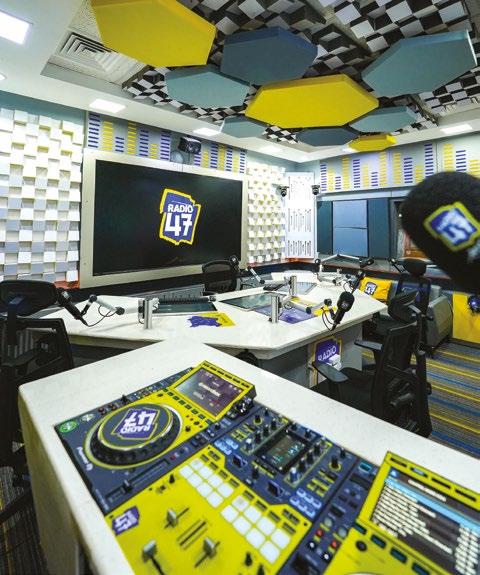


The ebooks are a huge hit with readers. They help engineers, GMs, operations managers and other top radio executives — radio’s new breed of digital, crossplatform decision-makers — understand this new world and thrive in it.





















Writer

Bruce Jones Meteorologist/ National Spokesperson, Midland Radio Corp.
Weatheradio Canada is worth far more than it costs
This money-saving decision is destined to bring grief to Canadian families
I’m writing in response to Nick Langan’s article “Canada to Shut Down its VHF Weather Radio Service” (radioworld.com).
As a meteorologist in the heart of America’s “Tornado Alley,” I find it disheartening to see a radio-based alerting system deemed unnecessary because cell phones and internet are naively trusted to replace it. This cost-saving decision is destined to bring grief to Canadian families.
Weather radios can alert for more than just weather. Raging wildfires, wind and floods destroy cell phone towers, fiber optic cables, phone lines and electricity wires. Yet, via weather radio, a radio frequency broadcast can be sent into homes, schools and businesses 24/7/365 to announce evacuations, shelter-in-place and weather warnings. Public Alert-certified weather radios have battery backup, so they will run several days even when power is completely out. Will your cell phone or internet be operating in that power outage? It’s a vital question because there are numerous examples of such tragedies:
On March 3, 2020, an EF-4 tornado touched down at 1:48 a.m. and tore through Cookeville, Tenn., a suburb of Nashville. The two cell towers that served the area had been knocked off the air by thunderstorm winds an hour earlier. Anyone who went to bed thinking their cell phone would alert them had no idea their cell service was cut off.
Weather radio broadcasts, on the other hand, awakened residents 11 minutes before the tornado arrived, saving
“Weather radio broadcasts awakened residents 11 minutes before the tornado arrived, saving many lives. But 19 people died in this well-warned tornado.
many lives. Nineteen people died in this well-warned tornado.
In the Texas Hill Country flash flood of July 4, 2025, children in a riverside camp and adults overnighting in an RV park were swept to their deaths when the Guadalupe River rose.
A strongly worded flash flood warning had been sent out via weather radio almost two hours before the river breached its banks, but no one in the camps was using a weather radio. As in Cookeville, they were relying solely on their cell phones, which failed to adequately alert them.
The Heaven’s 27 Foundation, named for the 27 girl campers who drowned, persuaded the passing of a state law in Texas that now requires weather radios in all camps and RV parks. Similar legislation is proposed in four other U.S. states.
Finally, a story about wildfires, which may be Canada’s most impactful threat:
Sonoma County, on the north end of San Francisco Bay, is part of California’s wine country. In the overnight hours of October 8–9, 2017, shifting 60 m.p.h. winds redirected a wildfire into the city of Santa Rosa.
Despite the best efforts of a cell phone alerting system, many sleeping residents were unaware the fire was coming. Almost 3,000 homes were destroyed and 22 people died. In the aftermath, Sonoma County’s emergency management agency made weather radios a prominent part of their alerting system.
Today, Sonoma County residents can receive wildfire warnings via cell phone, landline phone and via weather radio. They won’t be caught unaware again.
One does not need a crystal ball to see that tornadoes, floods and wildfires will continue to affect Canada, and with these threats comes the specter of death.
When your nearest cell tower, your fiber optic internet connection, your landline phone and your electricity are burned, flooded or blown out, only a radio-based alert signal will be able to get through. Time and again, when all else fails, radio works.
The cost of maintaining, improving and expanding Weatheradio Canada is a pittance in comparison to the cost of lives lost when warnings are not received. I hope the people of Canada can persuade Ottawa to reverse course and continue Weatheradio Canada, before they up with their own Heaven’s 27 group.

Let down by the bank
The decision by Microwave Power Products (“Radio Operators React to Econco Closure: ‘A Serious Issue,’” radioworld.com) will have an even greater impact on shortwave broadcasters.
Unlike for FM and AM transmitters, we are unaware of any company that manufactures efficient, high-power (100,000+ watt) solid-state transmitters capable of operating from 3 to 20 MHz.
For the unforeseeable future, we have no option but to be dependent on high-power vacuum tubes to continue broadcasting. Econco has been our source for reliable rebuilt tubes for the past 40+ years.
Since we are overseas and keep tubes “banked” at Econco, we are now scrambling to find another tube rebuilder willing to receive those “banked” tubes and rebuild reliable tubes for us as needed.
Larry McGuire Transmitter Engineer Trans World Radio
Government programming
I read “Carr Urges Broadcasters to Get Patriotic” (radioworld. com) about how the chairman wants radio stations to start the broadcast day with the National Anthem. And maybe air the Pledge of Allegiance. And civics lessons during the day a la the 1970s “School House Rock” videos. Start the day with the National Anthem? You can’t force me to do that. But I would eagerly comply by airing something like the anthem in the style of Smash Mouth’s “All Star.” Yet that might not be what Carr had in mind.
The pledge could be combined with locally aired civics lessons based on audio clips from such prestigious people as Jessie Jackson, Jessie Helms, Richard Nixon, Oliver North and maybe even Bill Clinton. Again, probably not what he had in mind.
He also suggested playing patriotic marching band music. First, wasn’t there a good piece in “Hair”? I also would note that some of the most rousing patriotic marches came out of northeastern Europe circa 1936 to 1944.
But that is just my opinion.
Radio from home
The concept that radio stations can run just fine from people’s spread-out homes, as reported in Radio World articles, may be working somewhere. Yet on a major station in my area, one that generally has good engineering, I hear regular problems.
There’s been plenty of time to sort this out since Covid but I’m still hearing audio level issues among other things. I think maintaining proper levels is one of the basics of good broadcasting. If we can’t manage that, doing it from home isn’t cutting it.
I should add that in some small markets where affording two good mics may be an issue, buying the tech that allows everyone to work from home may just not be possible.
We have it already
John Caracciolo of JVC Broadcasting (“Cold Water From CBS,” April 8) said he would like to see a radio network emerge that “partners with local stations to amplify their voices, not drown them out. One that provides national scale where it matters — news gathering, distribution, sales infrastructure — while keeping content authentic and rooted in the community.”
I read that and immediately realized such a network already exists: National Public Radio. Quite often its stories include detailed reports from member stations’ journalists. That serves as amplification of local voices, doesn’t it?
Richard Cuff Radio enthusiast and analyst Allentown, Pa.
Archie Stulc
Terry Skelton
Microwave Power Products