
The Clermont-Tonnerre Grail, in French, illuminated manuscript on vellum [Metz, c.1290-1310]
The story of the Holy Grail, Merlin and the young King Arthur: an impressive and generously illustrated witness to texts fundamental to Western culture, the earliest of only three known in private hands.
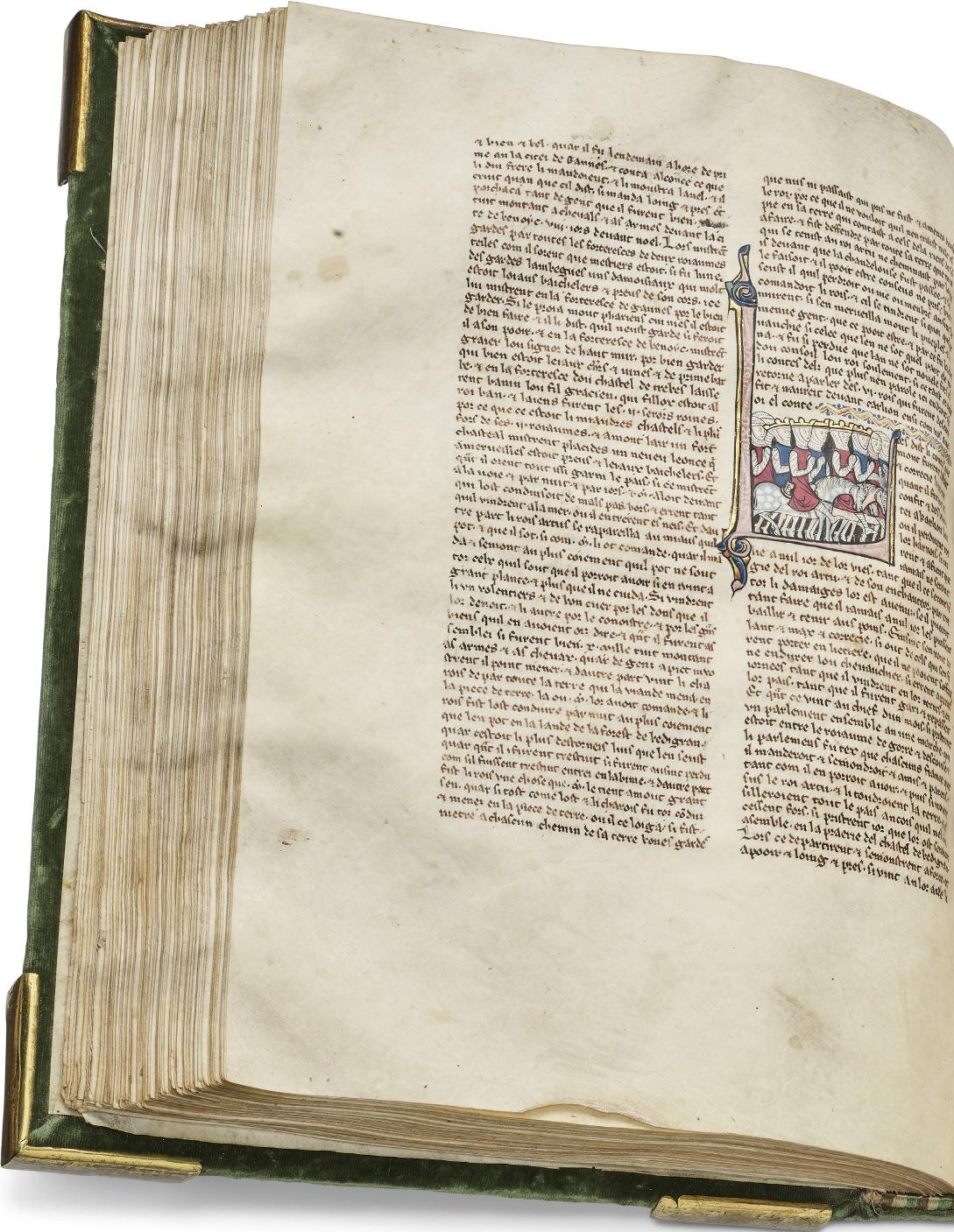
350 x 255mm. i loose (early endleaf) + i + 241 + i leaves: 110(iv, v and vi and top section of iii and viii early replacements), 2-1312, 1410, 1512 (iv, v, xiii and ix singletons), 1612, 178, 18-2012, 219 (of 12, x-xii cancelled blanks), gathering numbers at end of 16 and 17, some later signatures using Arabic numerals, 50 lines, ruled space: 228 x 175 mm, line endings in gold, pink and blue, 126 historiated initials, some with marginal extensions forming partial borders, one miniature in three compartments (ff.4-6 replacements and top section of ff.3/8 replaced and text rewritten, losing most of initial f.8v, small hole in initial f.26v patched on recto losing a few letters of text, a few letters obscured f.95 and lost to small hole f.184, some leaves darkened, some original holes in vellum, some cockling, some margins with slight damage and staining, initials water damaged ff,194v,195v, 197, initial and border worn f.2, miniature and initial worn ff.103v-104, some initials with small paint losses and some rubbing of gold, slight smudging of ink outlining of framing on some leaves, overall in excellent condition).
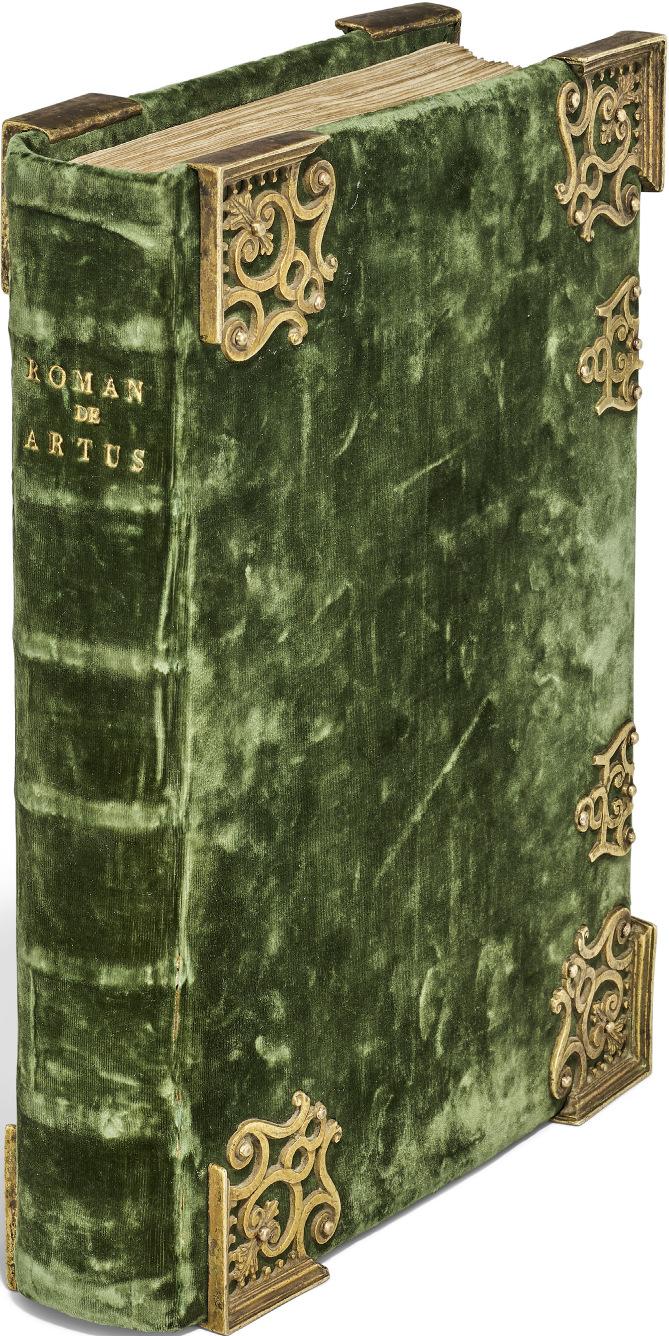
17th-century binding of green velvet (replaced) over wooden boards, spine in seven compartments, gilt lettered ROMAN DE ARTUS, with metal cornerpieces and fastenings for Charles-Henri de Clermont-Tonnerre, comte de Clermont et de Tonnerre (1571-1640) (lacking clasps from fasteners and probably a central metal fitting with his coat of arms, pastedowns renewed).
PROVENANCE:
(1) The language indicates an origin in the area of Lorraine; the style of illumination and other aspects of production are typical of manuscripts produced in the decades around 1300 in Metz and Verdun, with the balance of the evidence favouring Metz. A free imperial city of the Holy Roman Empire since 1189, Metz governed itself and its surrounding territory and prospered through trade and banking. Local patronage and strong trading networks helped make the city a major centre of book production, see Stones, 2013, pp.31-41, and 2015, esp. cat. IV 6-16. Given the later provenance, the first owner was probably local to Metz.
(2) Michel de Gronnais (d.1501) of Metz: his motto and name, Moult vault franchise Michel de Gronnais on ff.77 and 233, his motto alone on f.8. The same inscriptions are found in a compilation including the Cosmographie of Jean Fusoris (Paris BnF ms fr. 9558); Michel de Gronnais doubtless owned other books. The surname was prominent among the great Metz families of the urban patriciate, the paraiges that ruled the city, and had many variant spellings, with de Gournay eventually emerging as the usual form; for the earlier period, le Gronnais is the standardised spelling used on the website MéLoDi (Mémoires des Lorraine Disparues): Projet cité de Metz 1250-1552), a major source for the biographies that follow. It can be deduced that this Michel is the son of Didier le Gronnais and Isabelle de Heu; he was one of the representatives of Metz sent to attend the coronation of Louis XI of France in 1461, when he was knighted by the King – the knightly status of other Metz patricians was more ambiguous – and granted an annual pension to secure a pro-French well-wisher in Metz. Elected In 1469 one of the Sept de la guerre, the seven responsible for the defence and defences of Metz, he played an active part in military affairs, leading the artillery, for example, at the siege of the Luxembourg border fortress of Richemont in 1483. He had married Jacquemine Bataille by 1466; of their children, three daughters outlived him: Barbe, Françoise and Catherine.
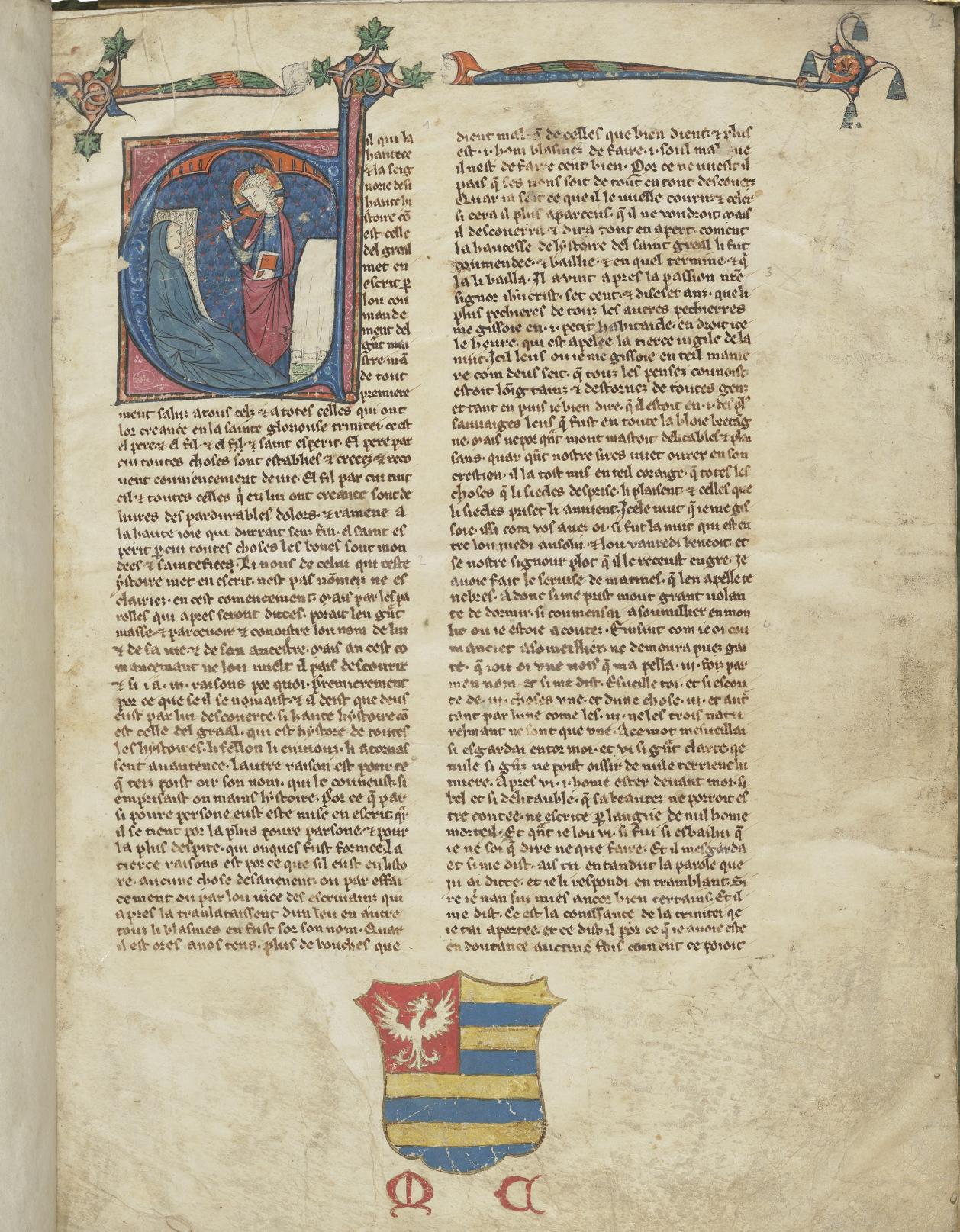
(3) Michel Chaverson (d.1532), seigneur de Montoy, Grimont and other lands, hereditary seneschal of the bishopric of Metz: his initials and coat of arms, barry of 8 or and azure, on a quarter gules an eagle displayed argent, were added to the margin of f.1; the manuscript is in his list of books, les livres que je seigneur Michiel Chavresson ai en ma petite librairie: among those in French is ung livre du Saint Graal et de Merlin, escript en parchemin, couvert d’une pel rouge et cloué de cloz jaunes (H. Klipffel, Metz, cité épiscopale et impériale, 1867, p.401). Michel Chaverson, active in the city government, held the highest office of maître-échevin, principal alderman, in 1507 and 1514; in younger days he participated in jousts held in Metz, being one of the four members of the paraiges to fight in 1494 and one of six in 1500. He presumably inherited the book from his mother, Michel le Gronnais’s daughter Barbe (d.1507), who in 1476 had married Jean Chaverson (d. 1514). Michel’s wife, married in 1504, was Gertrude, the daughter by his first wife of François le Gronnais (14501525), from a different and more influential branch of the family. Although Getrude died in 1508, Michel apparently stayed close to his father-in-law, who had married as his second wife Michel’s maternal aunt, Françoise le Gronnais (d.1504), with whom he had further children. Twenty books in Michel’s list had come from his father-in-law, including the Voeux du Paon, a chivalrous romance in verse (Oxford, Bodleian Library, ms Douce 308). Michel’s heir was his daughter, Philippe, who married Robert de Heu in 1531 and died between 1543 and 1545, leaving an only child Catherine (d.1608), whose only child from her marriage to Claude Antoine de Vienne, Nicole, died childless in 1623, possibly survived by her second husband, Ezéchiel de la Tremoille.





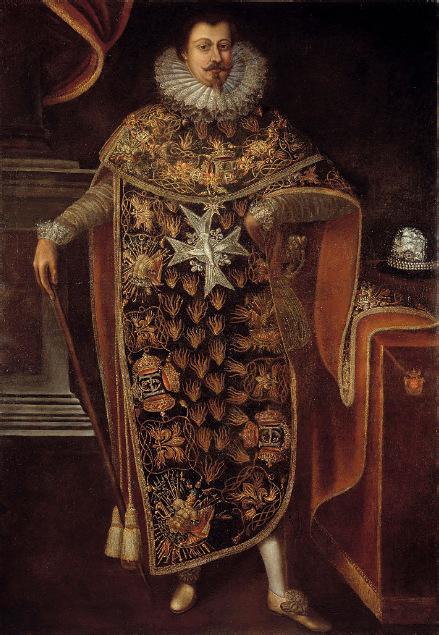
Charles-Henri de Clermont-Tonnerre
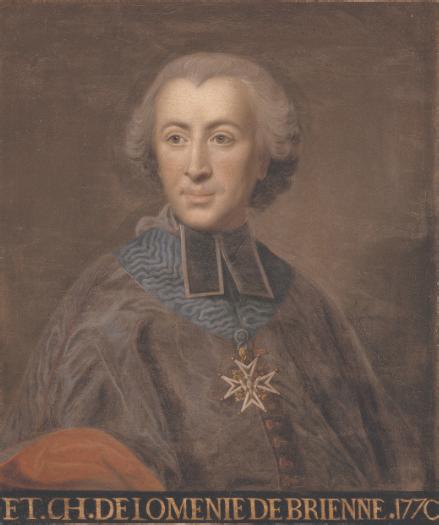
Étienne Charles de Loménie de Brienne
(4) Charles-Henri de Clermont-Tonnerre, comte de Clermont et de Tonnerre (1571-1640): the velvet binding with metal cornerpieces is typical of his manuscripts and the cornerpieces follow the same design as those on, for instance, a later Grail manuscript (Yale University, Beinecke ms 227) or a Livre des gouvernement des princes (New York, Morgan Library and Museum, M.122); see Gasnault, 1998, pp. 585-614, and ‘Un amateur de manuscrits médiévaux: Charles-Henri de ClermontTonnerre’, Bulletin de la Société nationale des antiquaires de France, 1998, pp.70-7. The ornate and expensive bindings show that the count valued his earlier books but little is known about the motivations for, and sources of, his collection. In 1631 at his château of Ancy-le-Franc, south-east of Tonnerre, he entertained Louis XIII, returning to Paris from Metz, which had been ceded to the French crown in 1552.
(5) The Convent of the Minimes in Tonnerre: in 1611 Charles-Henri de Clermont-Tonnerre established a convent in Tonnerre for the austere order of the Minimes, founded by St Francis of Paola. By 1633 he had presented them with about forty manuscripts and incunables in his luxurious bindings, which have enabled them to be recognised; since they were chiefly histories and chivalric romances, their relevance to the Minimes and the purpose of the gift remain unclear.
(6) Cardinal Étienne-Charles Loménie de Brienne (1727-1794), Archbishop of Toulouse (1763) and of Sens (1788): in the sale by James Edwards, London, 28 March 1791, Bibliotheca Parisiana [ ], lot 371, ‘Le Roman du roi Artus, compilé par ordre du roi Henri d’Angleterre; in fol. green velvet. Manuscript on vellum; of the 14th century, in Gothic characters and very different from the printed copies of this romance. It is in perfect preservation and formerly belonged to Claude d’Urfé’ (the French edition of the catalogue appeared as Bibliotheca Parisina); sold for £19/8/6 (annotated copy in Getty Research Centre). The d’Urfé provenance has been shown to be false and the true source of the books to be Loménie de Brienne, to whom the Minimes of Tonnerre had sold valuable books in 1787 (see also M. Gatch, ‘The Bibliotheca Parisina’, The Library, 12, 2011, pp.89-118). A member of the Académie française and friend of Voltaire, Loménie de Brienne made a successful career in the church despite the advanced views that made him an early supporter of the Revolution. As events and ideologies rapidly became more extreme, de Brienne apparently decided to realise funds outside the country by selling his books in London, with a false provenance to avoid attracting the attention of the Revolutionaries. His concerns were justified: he was arrested in 1794 and died in prison.
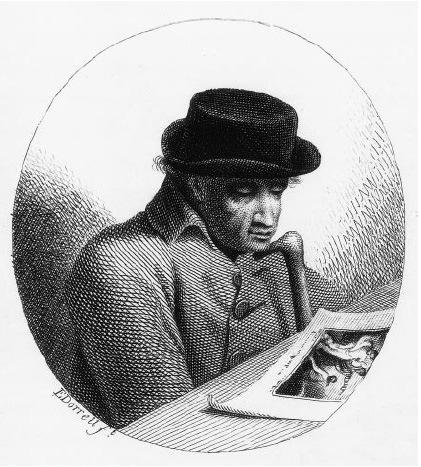
(7) Henry Constantine Jennings (1737-1819), known as Dog Jennings from his statue of ‘Alcibiades dog’, acquired by the British Museum in 2001. Francis Douce’s annotated copy of the Parisiana Sale Catalogue (Oxford, Bodleian Library, Douce C.167) gives ‘Nowell’ as the purchaser of lot 371, among other lots that included two other Grail manuscripts, lot 367 (Beinecke ms 227), and lot 372 (Geneva, Bodmer Foundation ms 147). Jennings adopted the surname Nowell in 1774 to benefit from a legacy to his second wife: in 1789 he had his name as Henry Constantine Nowell engraved on Samuel
Johnson’s teapot (Harvard University, Houghton Library, Hyde Collection, *2003JM-6). While ‘dropping Jennings entirely when it suited him’, he was also known as Jennings Nowell (or Noel) and Nowell Jennings, (E. Climenson, ‘The Shiplake Virtuoso’, Berks, Bucks, and Oxon Archaeological Journal, 20,1914, pp.26-28, 49-53, p.52). Eternally indebted, always acquisitive, and ever in trouble, his almost constant need to avoid creditors can make his own, and his collections’, movements hard to trace. As well as numerous public auctions, mostly by Phillips, he apparently sold directly to dealers and collectors, partly to ensure that those he disliked did not acquire his treasures.
(8) Evans, London, Catalogue of valuable, rare and splendid Books, Books of Prints, and curious Manuscripts, 27 May 1825, lot 856, where lots 855 and 857 were the Parisiana Sale lots 367 and 372; the three Arthurian manuscripts had apparently stayed together since then.
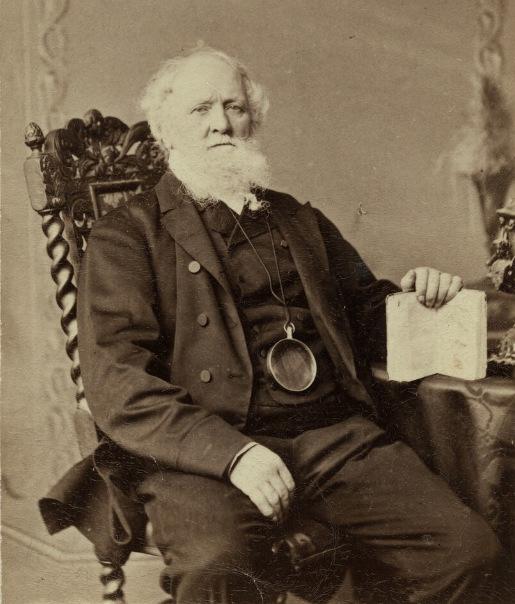
(9) Sir Thomas Phillipps of Middle Hill (1792-1872): his library stamp of crest, Sir T.P. and Middle Hill, the number 1047 written below on the first endleaf; note ‘Evans 27 May 1825 lot 856’ on loose endleaf. Describing himself as a vello-maniac, Phillipps was another obsessive who amassed an enormous collection of some 60,000 manuscript books, records and legal documents, together with over 40,000 printed books. In 1863, he moved his collections from Middle Hill in Worcestershire to Thirlestane House near Cheltenham, where he lived until his death. Thirlestane House and its contents were bequeathed in trust for his youngest daughter Katherine (1824-1913), wife of John Fenwick, and her male heirs ‘with a natural love of reading books’, with a life interest to her third son, Thomas Fitzroy Fenwick (1856-1938). The resources to maintain the house and library being totally inadequate, permission was given to break the trust by selling the manuscripts and any duplicate printed books, prints and coins. Sales began the following year and continued until World War II forced the storage of the residue and made Thirlestane House unfit to house the library. In 1946 the residue was sold to Lionel and Philip Robinson by Thomas’s nephew and successor, Alan George Fenwick (1890-1966).
(10) The brothers Lionel and Philip Robinson of William H. Robinson Ltd: the Clermont-Tonnerre Grail was one of the 34 finest manuscripts in the first Phillipp’s sale organised by the Robinsons, Sotheby’s, 1 July 1946, lot 10; purchased by the Parisian dealer Lucien Scheler (1902-1999).
(11) Jean Lebaudy (1894-1969) and his wife Henriette de Ganay (1898-1983): listed among the ‘Manuscrits réservés par Monsieur et Madame Jean Lebaudy’ ( BnF, Dept. des manuscrits, 8-IMPR2490), when most of their library was given to the Bibliothèque de Versailles in 1962. Lebaudy was a prominent French industrialist and collector whose interests embraced prehistoric archaeology and African cultures as well as books and manuscripts. There is a loose typed note signed and dated 7 March 1950 by Jean Porcher (1892-1966), head of the Manuscript Department of the Bibliothèque nationale. The occasional small pencilled marginal numbers, ff.2-57v. refer to the edition by Ponceau, 1997.
CONTENTS:
L’estoire del saint Graal, History of the Holy Grail, ff.1-103v: opening ‘Cil qui la hautece et la seignorie de si haute histoire com est celle del greal […]’ f.1, and ending ‘Et retorne a une autre branche que len apele lestoire de merlin quel convient aioster ensemble a fine force avec lestoire del saint graal por ce que brainche en est et apartient. Et comencent messire Robers de borron cele branche en tel manière’, f.103v. Robert de Boron, credited with the text, is said to have translated into French the Latin translation made by an anonymous hermit-priest of a work written in a heavenly language that was delivered to him by Christ himself, an unimpeachable source. Robert de Boron is usually considered the author of the French verse that preceded this prose reworking, perhaps also by him and datable to the 1220s. This exists in a longer version, the text here, and a shorter version, which is probably a later abbreviation. All the texts of the Clermont-Tonnerre Grail, not yet the subject of a detailed study, seem extremely close, though not identical, to those in Paris, BnF fr. 344, a complete Lancelot-Grail cycle, which Ponceau, listing 42 manuscripts, placed in his α group of the longer versions of the Estoire del saint Graal (Ponceau, 1997, pp.xxv-xxix).
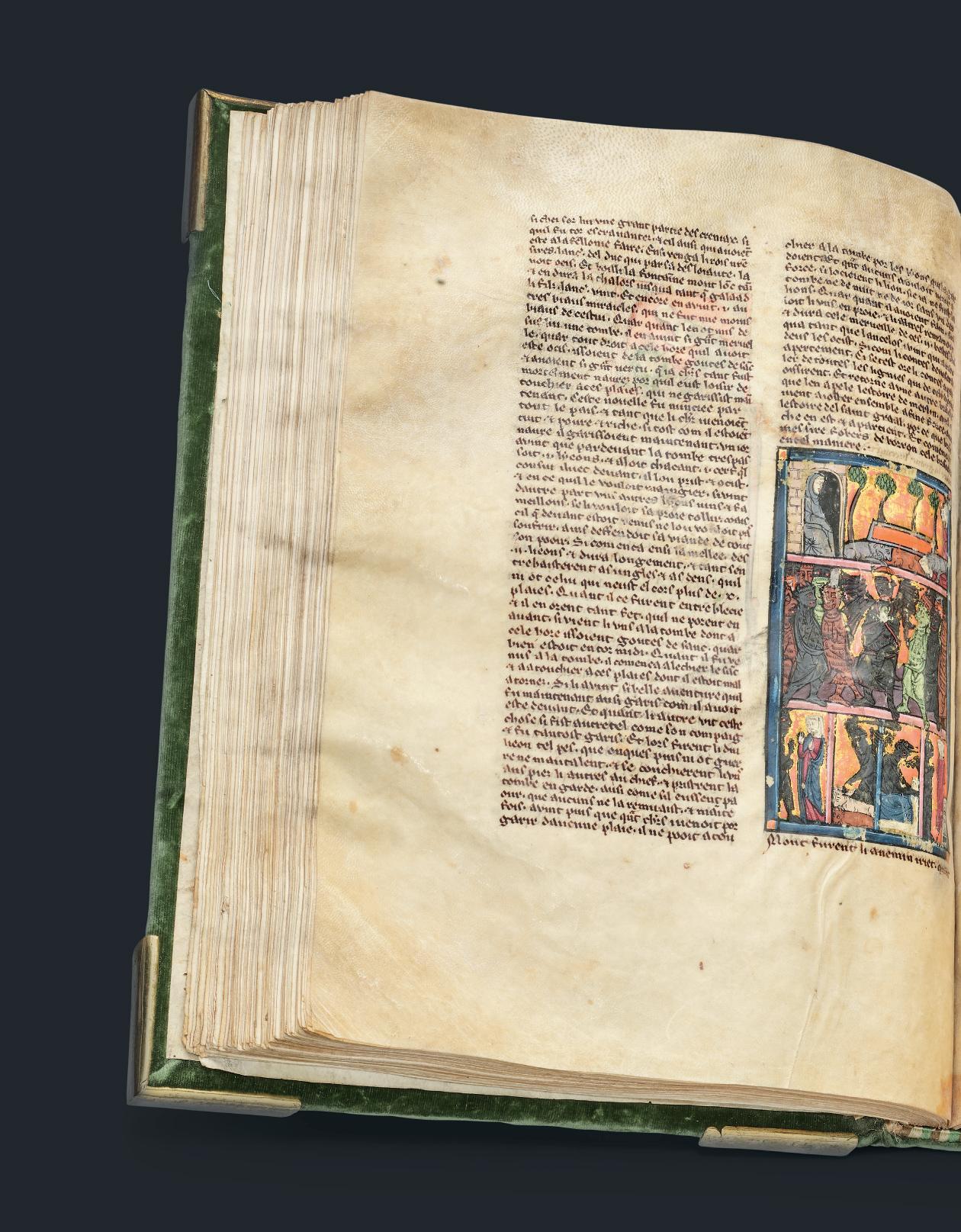
L’estoire de Merlin, History of Merlin, ff.103v-135: opening ‘Mout furent li anemni [?] iriet quant, f.103v, repeated ‘Mout furent li anemi iriet quant nostre sires ot este an anfer […]’ f.104, and ending ‘Ainsi ne fu artus a roi esleuz et tint le terre et lou roiame de logres lonc tans au pais’, f.135. Robert de Boron vouches for the authenticity of the work, since he is only rendering into French a narrative dictated at irregular intervals by Merlin himself to his teacher Blaise. This too is a prose version of earlier verse and has been called the first prose fiction in French literature (FügPierreville, 2014).
Les premiers faits du roi Artus, The First Deeds of King Arthur (Suite vulgate de Merlin), ff.135241v: opening ‘Ci androit dist li contes que a la mi aost apres ce qui li rois artus fu coronez que il tient cort efforciee grant [?] et merveillouce […]’ f.135, and ending ‘Et retorne a une autre matiere quil convient aioster a cestee par droite force qui en commence en tel manière’, f.241. Although this section is certainly later, it is presented as part of the previous text with no break on the page and the continuity extends to the same claimed authorship: Merlin is seen dictating to Blaise on ff.184v and 215. The continuation of Merlin also exists in a long version and a short version. This is the longer text of the α group, except that it has an abbreviated ending, a distinctive characteristic shared with its ‘sister’ manuscript in Paris, BnF fr.344, although the two are not identical. The title used above is that added to Bonn, Hs S 526; usually the History of Merlin and its continuation are, as here, presented as a continuous text. The abbreviated ending, as analysed for BnF fr. 344, makes the shift in emphasis from Merlin to Arthur more evident, since Merlin’s encounters with Viviane (Nimue) are reduced and the concluding narrative focuses on the remaining rebel kings finally offering fealty to Arthur (I. Fabry-Tehranchi, ‘Arthur et ses barons rebelles. La fin remaniée et abrégée de la Suite Vulgate du Merlin dans le manuscrit du cycle du Graal (Paris, BnF, fr. 344, ca 1295)’, Médiévales, 67, 2014, pp.121-142). The more established title is the less explanatory Suite Vulgate, which comes from the common naming of the complete Lancelot-Grail compilation as the Vulgate Lancelot-Grail, because it is in French, the vulgar, of the people, tongue.
The Clermont-Tonnerre Grail corresponds completely with none of the modern editions; for recent editions see below. The names of people and places have been taken from the English translation edited by Lacy, 1991-1996.
SUMMARIES:
L’estoire del saint Graal presents the story of the Holy Grail, the vessel used by Christ for the wine he consecrated at the Last Supper and then by Joseph of Arimathea, who organised Christ’s burial, to collect blood from Christ’s wounds at the Crucifixion. Its miraculous powers of healing and feeding encourage conversions to Christianity during the mission of Joseph and his son, Josephus, to the East and the fabulous adventures of some of the converts are related. Joseph, Josephus and a band of converts bring the Grail to Britain; their missionary journeys in Britain are bound in with the establishment of kingdoms and dynasties that will culminate in King Arthur and the Knights of the Round Table and their quest for the Grail. Josephus entrusts the Grail to his nephew Alain, the first of the guardian Fisher Kings who will preserve it, unseen, until the coming of Galahad, the one knight pure enough to achieve the quest.
In L’estoire de Merlin, the narrative focuses on the half-devil magician Merlin, beginning with his conception by an innocent virgin through devilish wiles. His magical powers, including knowledge of past and future, are apparent from his infancy when he successfully defends his mother against charges of immorality. He is helped through his troubled childhood by his mother’s confessor, Blaise, whom he calls his master. It is, however, at Merlin’s command that Blaise writes down Merlin’s dictated account of events. When Merlin is summoned to King Vortigern’s court, Blaise retires to Northumberland where Merlin continues to visit him to update his story, enabling us now to read it, reassured of its truth and authority. Merlin becomes chief councillor to King Uther Pendragon of Logres, whom he instructs to found the Round Table; Merlin assists the King in the seduction that results in the birth of Arthur, whom Merlin protects; Arthur proves he is the rightful King by drawing the sword from the stone.
Les premiers faits du roi Artus (Suite vulgate de Merlin) continues the story of Arthur. With Merlin’s help and supported by the brothers Ban (father of Lancelot) and Bors, he defeats the kings who refuse to accept his rule. In return he assists Ban and Bors to defend their French kingdoms and, in Britain, aids King Leodagan against the Saxons at Merlin’s behest. Arthur’s prowess and consequent fame attract knights to his court, the most outstanding being his nephew Gawain (Gawainet). At Uther’s death the Round Table had passed to Leodagan: when Arthur marries Guinevere, Leodagan’s daughter, rivalry between the Knights of the Round Table and Gawain and his companions, who have become Knights of the Queen, is resolved when they become one fellowship of the Round Table. Merlin is succumbing to the beauty and wiles of Viviane, who will steal his powers and imprison him; Arthur sends Gawain and his brothers and father to persuade the remaining rebellious kings to make peace; the son of Pelles, brother of the Fisher King who guards the Grail, sets out to be knighted by the best of knights, Gawain; the birth of Galahad to Pelles’ daughter and Lancelot is anticipated.
The three texts are the opening narratives in the great Arthurian cycle, known as the Vulgate Lancelot-Grail, which continues with Lancelot, La queste del saint Graal, The Quest for the Holy Grail, and Morte d’Artus, Death of Arthur. The full narrative stretches from the Biblical Joseph of Arimathea and the origins of the Holy Grail, to the death of the King amidst deceit and disloyalty, presenting on the way the doings of Merlin, who brings Arthur to the throne, the deeds of Lancelot and the Knights of the Round Table, Lancelot’s and Guinevere’s love and Galahad’s achievement of the Grail, interwoven with the adventures of the first companions of the Grail in the East and in Britain, of other individual knights in Britain and France, particularly here of Gawain, and of Merlin, here with a long digression on his visit to Julius Caesar in Rome when he shape shifts into a stag and a wildman to alert the Emperor to his wife’s lechery – her attendant ‘ladies’ are actually depilated lusty young men – and effect Caesar’s remarriage to a noble lady, who had been cross dressing for honourable reasons. Fantastic though events often are, the reactions of the protagonists are plausible and recognisable.
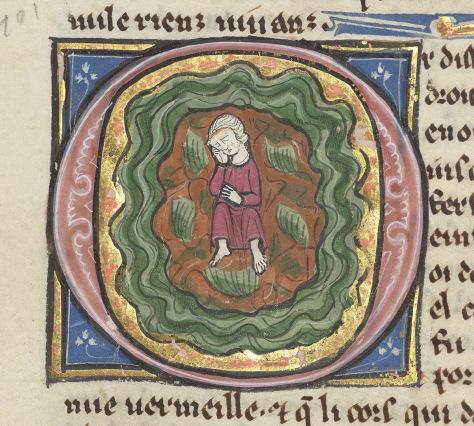
The sleeping Nascien, miraculously delivered from prison and placed on the Turning Isle
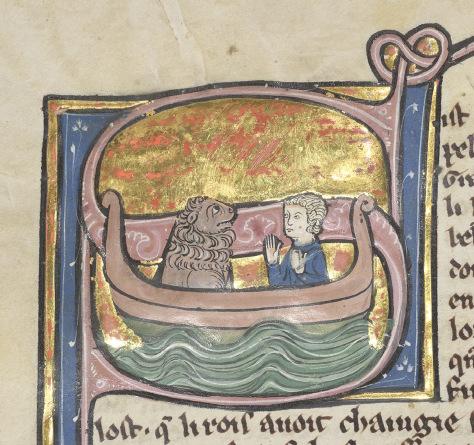
Celidoine, having been deposited on an island, sharing a boat with a lion as punishment for apparently causing the death of the island’s king, Label
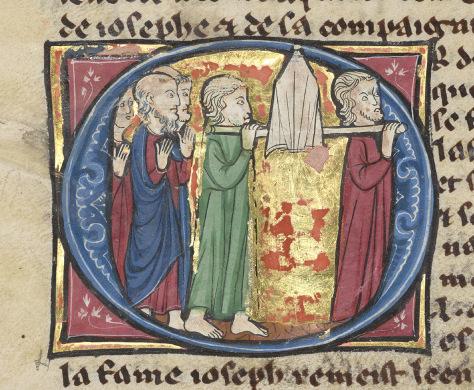
Joseph, Josephus and his companions carrying the Holy Grail with them as they leave Galafort to travel round Britain preaching; Camelot, one of the chief towns, is among those that become Christian
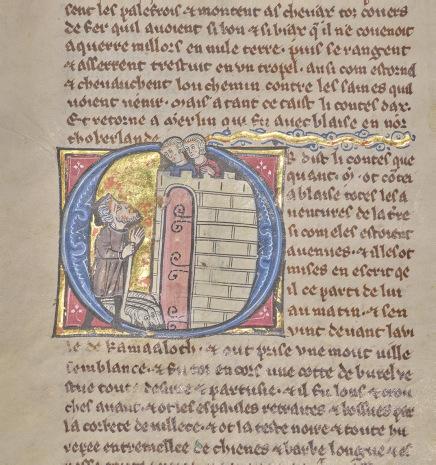
Merlin disguised as an old herdsman imploring Gawain to leave the safety of Camelot to aid Sagremor against the Saxons
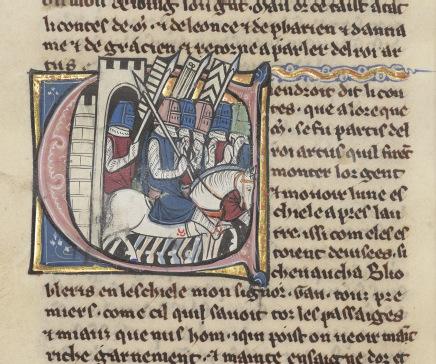
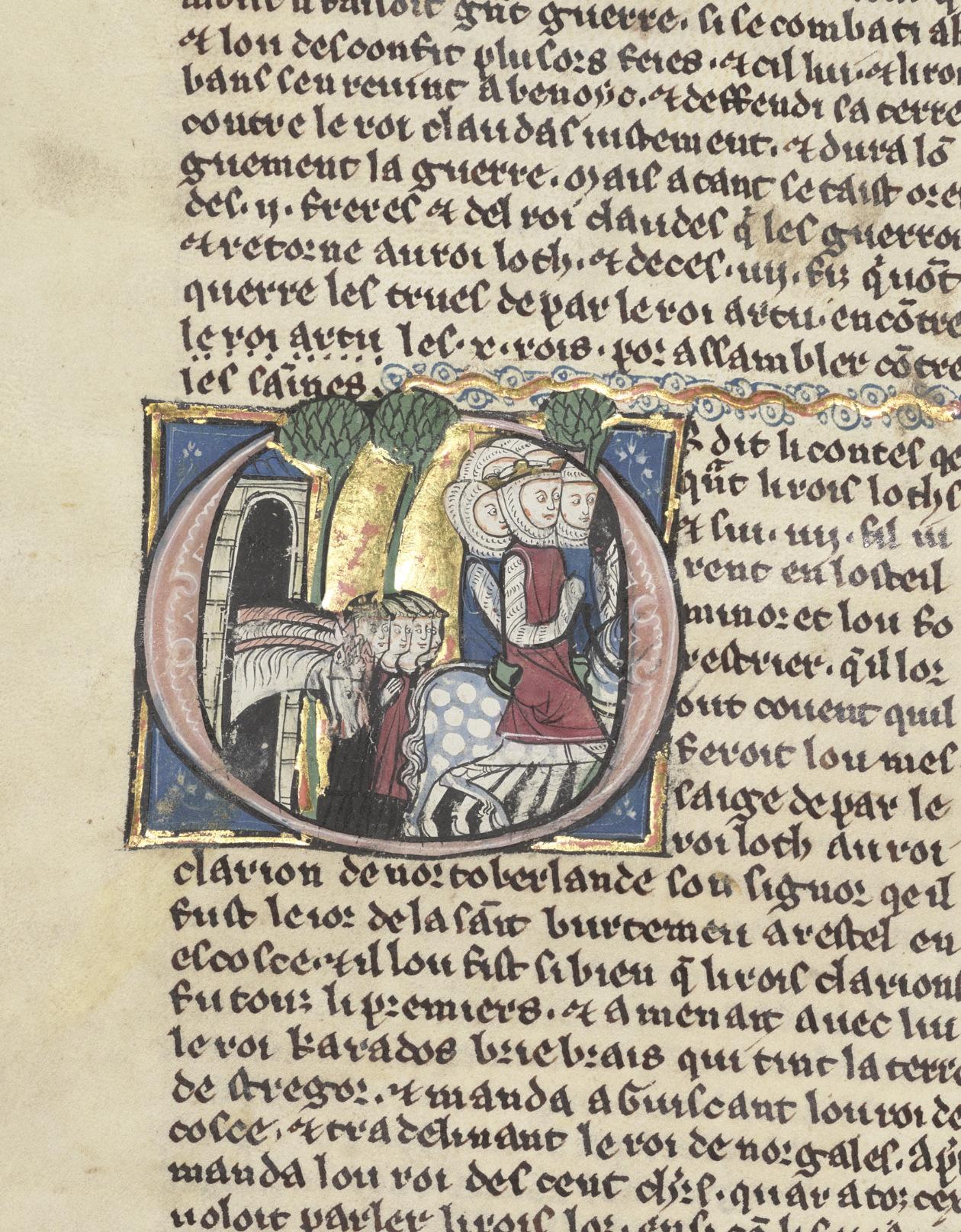
Blioberis at the head of Gawain’s men leading Arthur’s army, with flags fluttering, to encounter the French King, Claudas of the Land laid Waste, and his allies
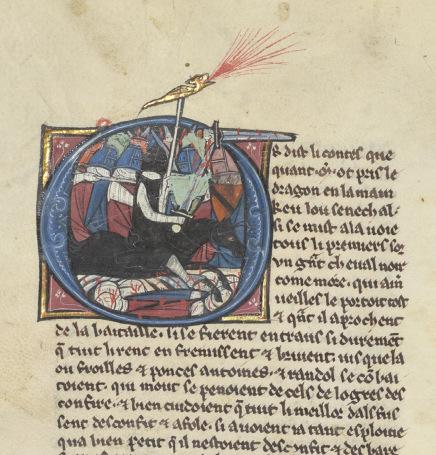
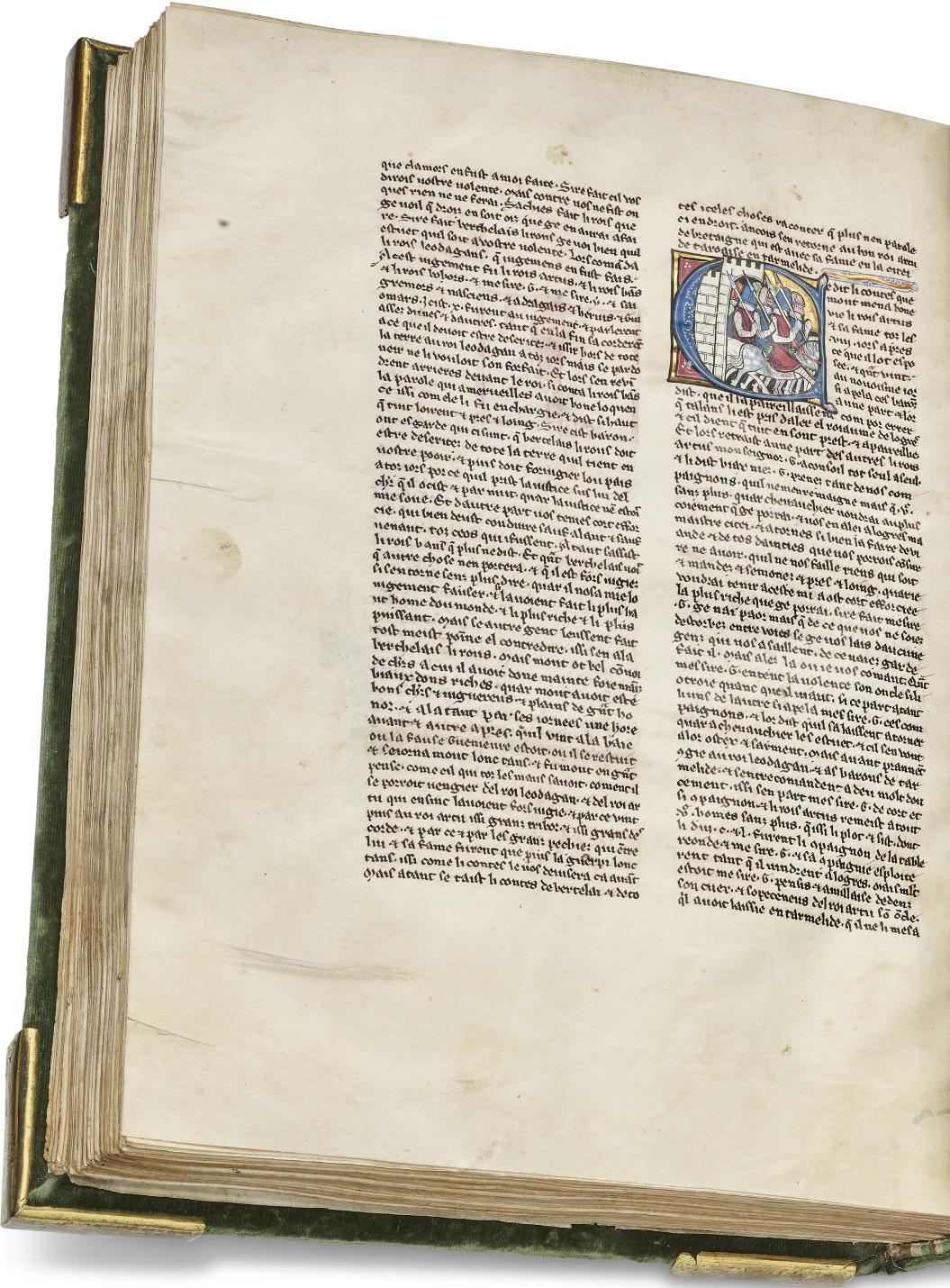
Merlin’s magic standard with its fire breathing dragon
As summed up by Alison Stones: ‘The story encompasses the whole range of human emotions, from purity to lust and sin, from friendship and love to treachery and betrayal, from aspiration to achievement but also to failure, from salvation to death’ (The Lancelot-Graal Project website). The cycle proved hugely popular: around 200 manuscripts preserve part of, or in seven instances more or less the whole of, the cycle, dating from c.1220 (Bibliothèque de Rennes métropole les Champs Libres, ms 255) onwards. Only two other manuscripts of whole texts from the cycle are known in private hands, both later in date: the three volumes of the Rochefoucauld Lancelot-Grail cycle of c.1315-1325, which lacks the Premiers faits and has only 28 small miniatures for the two first texts, Sotheby’s, 7 December, 2010, lot 33 (with the fourth volume divided between the Bodleian Library Oxford, ms Douce 215, and the John Rylands Library, Manchester, ms Fr.1), and the early 15th-century manuscript from the Bodmer Collection of the first three parts with only 36 small miniatures, Jörn Günther, Mittelalterliche Handschriften und Miniaturen, Katalog 3, 1995, no 11. The incomplete Lancelot listed in a Japanese private collection on The Lancelot-Graal Project website is now Beinecke Library, Takimaya ms 42. The near monopoly of public institutions reflects the importance of the work in Western culture for its subject matter; for its place in the burgeoning of vernacular prose; for its contribution to the evolution of fiction and the construction of narrative, especially its interweaving of several connected stories.
The Lancelot-Grail resulted from the fusion of various sources and literary forms. From Latin history writing, notably by Geoffrey of Monmouth c.1136, drawing principally on Welsh written and oral traditions, came the prophet Merlin and the ‘historical’ Arthur, defender of Britain against the Saxons, who then reached a wider audience through Wace’s French versification, the Roman de Brut, c.1155. The ‘historical’ figures were than translated to the realms of chivalric fiction in the French verse of Chrétien de Troyes, the apparent originator in two works of c.1180 of Lancelot and his affair with Arthur’s queen, Guinevere, and of the Grail, a talismanic dish with no Christian associations, but still the object of a quest.
The contribution of Robert de Boron, if indeed the author of the French verses of the stories of the Grail and Merlin, datable c.1200, was the all-embracing Christian context within which he expanded the narrative, by grafting Biblical and apocryphal material onto the British Merlin and Arthur, as developed in France. The now Holy Grail, used by Christ at the Last Supper and by Joseph of Arimathea to collect Christ’s blood at the Crucifixion, was entrusted by Christ to Joseph and brought to Britain, where it accompanied him and his companions as they converted the Britons to Christianity. The Christianisation of Merlin actually makes him a potential Anti-Christ: his magic powers and total knowledge of the past come from his devil father, who engendered a son on a virgin to counteract the Son of God’s releasing of souls from hell; the purity of Merlin’s mother meant that God not only permitted Merlin to keep these powers, to use for good, but also endowed him with knowledge of the future. The sometimes stupendous results of his magic, like the supernatural erection of Stonehenge with stones from Ireland, do not, however, always seem proportionate to their moral value, in this case to commemorate the Britons fallen in battle. Merlin is also part of the Grail’s story: telling Arthur’s father Uther Pendragon to make the Round Table in imitation of the tables of the Last Supper and of the first companions of the Grail, where they were miraculously fed; the Round Table is to have one empty seat that can be occupied safely only by him who is worthy of achieving the Grail. Arthur himself, battling the pagan Saxons, was a hero whose Christianity required little enhancement in the world of the crusades.
The Christian context was continued by Robert de Boron’s successors, although the chronology of the texts that make up the Vulgate Lancelot-Grail, the number of its authors and the nature of their interdependence is still debated (for a recent overview, see P. Moran, ‘The Old French Vulgate and Post-Vulgate Cycles’, in The Cambridge History of Arthurian Literature I, 2026, pp.188-205). It is usually considered that the last three texts, the Lancelot, Queste du saint Graal and Morte d’Artus, were composed first and Robert de Boron’s work subsequently adapted, and extended by the Livre des premiers faits, to provide the earlier history of the Grail, Merlin and Arthur. The six parts are tied together through genealogy – we meet here the ancestors of Lancelot, Galahad and other Knights of the Round Table – and by the introduction of people and objects whose significance is indicated to be detailed only later. A plot with the False Guinevere is here foiled, for instance, but she will reappear to contribute to the final disaster; there are frequent references to things that will only be achieved by Galahad, like the empty seat at the Round Table, Nascien’s miraculous shield that awaits him, f.102, or the fountain that will only stop boiling at his coming, f.103.
The popularity of the work and its history of adaptation and accretion make for a complicated textual history as different versions evolved and were copied in varying combinations. The Clermont-Tonnerre volume merits detailed study to clarify its place in the transmission of the texts and its precise relationship with its ‘sister’ manuscript, closely related, though not identical, in text and iconography, Paris BnF ms fr. 344 (see A. Stones, 2026, Fabry-Tehranchi and Nicolas, 2021). The sister manuscript contains the whole cycle, carefully orchestrated to form one sequence, as the conclusions of each branche, part, indicate. Although the Clermont-Tonnerre volume ends by signalling the next branche, the words may have been copied without considering whether further volumes would follow. The vellum left blank on the final page shows that no further texts were planned for the volume; if there were further volumes to complete the cycle, they had been dispersed before it came to Michel de Gronnais. These first three texts often formed a separate volume and the presence of individual volumes in book lists, like his, show that parts of the cycle could stand alone.
The Vulgate Lancelot-Grail retained its popularity well into the 16th century, with King Arthur’s court providing a spine to which other romances, like Tristan and Iseult, could be attached. Its indirect influence, through subsequent elaborations and abbreviations, is still felt. Unsurprisingly, the ‘Matter of Britain’, although given its lasting form in France, had greatest influence in English speaking lands, particularly through Thomas Malory’s 15th-century English version that retained a French title, Le Morte d’Arthur. That influence is still very much alive whether through Tennyson’s epic verse Idylls of the King (1859-1885) or the spoof film Monty Python and the Holy Grail (1975), Purcell and Dryden’s semi-opera King Arthur (1691) or Lerner and Loewe’s musical Camelot (1960), the down to earth yet magical reworking of T.H. White’s The Sword in the Stone (1938) or the fantasy fictions of this and the last century in novels, conventional and graphic, films and television series like Merlin (2008-2012). The altruistic heroism of the Knights of the Round Table helped to give an affirmative gloss to the slaughter of the First World War, while the collapse of Camelot was associated with the untimely ending of John F. Kennedy’s presidency of the United States. Arthur’s traditional epitaph, first recorded in the 14th century and succinctly translated by White as ‘Here lies Arthur the once and future King’ has acquired a meaning its author cannot have foreseen, as Arthur’s future is assured by the reworkings of his past.
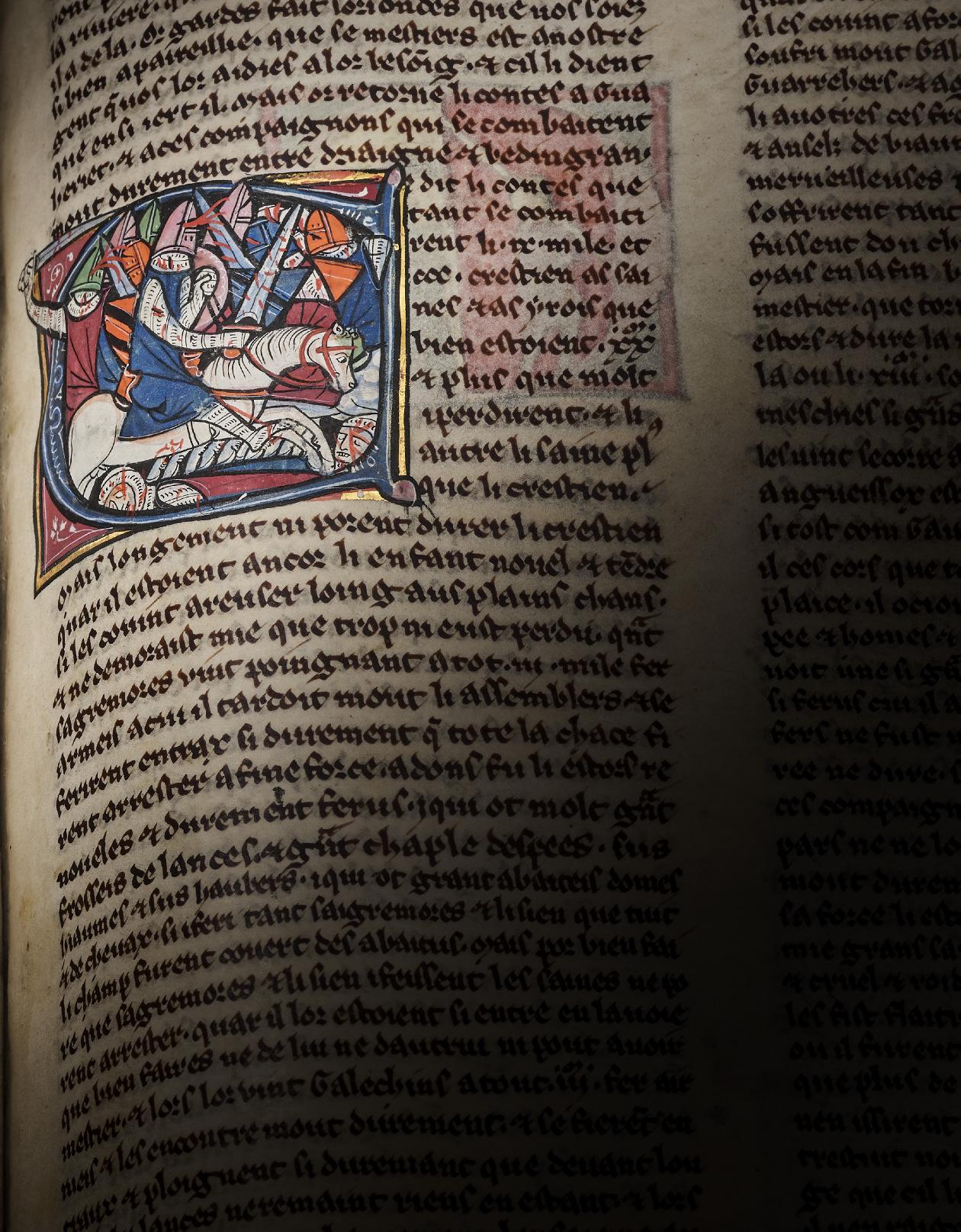
ILLUMINATION:
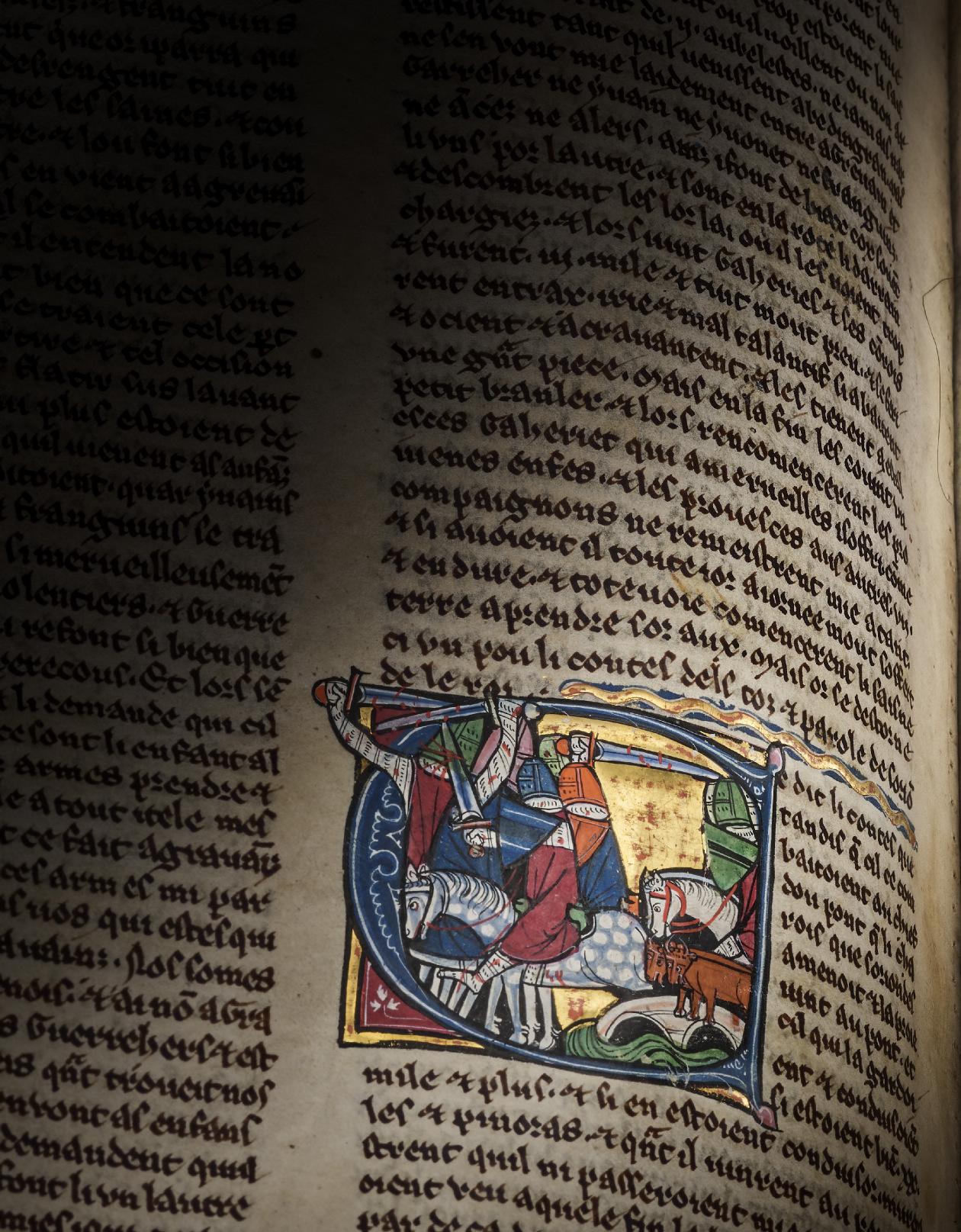
Images accompanied the texts from the earliest known manuscripts, such as Rennes ms 255, also with historiated initials; as the 14th century progressed small miniatures became more usual. Illustrations were doubtless an important part of the narratives’ appeal, whether to a solitary reader or to a group who could gather round the lectern to see, and perhaps discuss, the relevant pictures as they heard the book read aloud. Literacy is not yet assumed for noblemen: when letters are received, as by Gawain from Merlin disguised as a messenger f.179, we are reassured that the recipient can read them because he has learnt how. The historiated initials signal significant sections of text but there were no standard chapter divisions so that the placing and number of initials or small miniatures vary widely. Some conventions do seem widespread. The Merlin, for instance, was, as here, usually given only a few images through the text, while marking the break from the Grail with a larger compartmentalised miniature with scenes from both texts (see FabryTehranchi and Nicolas, 2021, and I. Fabry-Tehranchi, Texte et images des manuscrits du Merlin et de la Suite Vulgate (XIIIe-XVe siècle). L’Estoire de Merlin ou les Premiers faits du roi Arthur, 2014; Stones, 2018, pp.201-220).
The engaging initials and miniature of the Clermont-Tonnerre volume are in the Metz style associated by Alison Stones with the Sainte-Glossinde Charter of 1293, the Abbey of Ste Glossinde being just outside Metz (St-Julien-lès-Metz, Archives départementales de la Moselle, H4085 (5); Stones, 2013, 1, p.71; Duchêne-Gasseau, 2021, pp.143-45). This style dominated Metz illumination in the decades around 1300 and is found in a wealth of manuscripts embracing all sorts of texts, secular, devotional and liturgical. While they may reflect the career of one illuminator, possibly the Master Gerard (Maistre Gerais) documented in Metz from 1279 to 1298 and dead by 1335 (after a gap in the records, Duchêne-Gasseau, 2021, pp.241-42), there are clearly several hands at work. Attempts to distinguish them have resulted in shifting lists of attributions, compounded by a paucity of dated manuscripts to clarify whether changes are due to different hands or to one individual’s evolution over time.
As well as the Ste-Glossinde Charter, a vernacular Apocalypse in Liège, usually dated into the 14th century, (Bibliothèque de l’Université. ms Wittert 5) has been taken as the basis for establishing work that can be associated with a Master of the Liège Apocalypse. Although undated, the Apocalypse provides not only far more miniatures than the Charter but also a wider range of subject matter, making it a more informative basis for further attributions. The Master has also been described as ‘The First Hand of Douce 308’ (see Stones 2012 and 2015), from the miscellany with the Voeux de paon, also owned by Michel Chaverson (Oxford, Bodleian Library, ms Douce 308 and London, BL, Harley ms 4972). The miniatures that open Douce 308, however, are much cruder, with carelessly placed blobs of red on faces instead of the neat orange dots of the Grail manuscript; they seem likely to represent a different strand within the stylistic group.
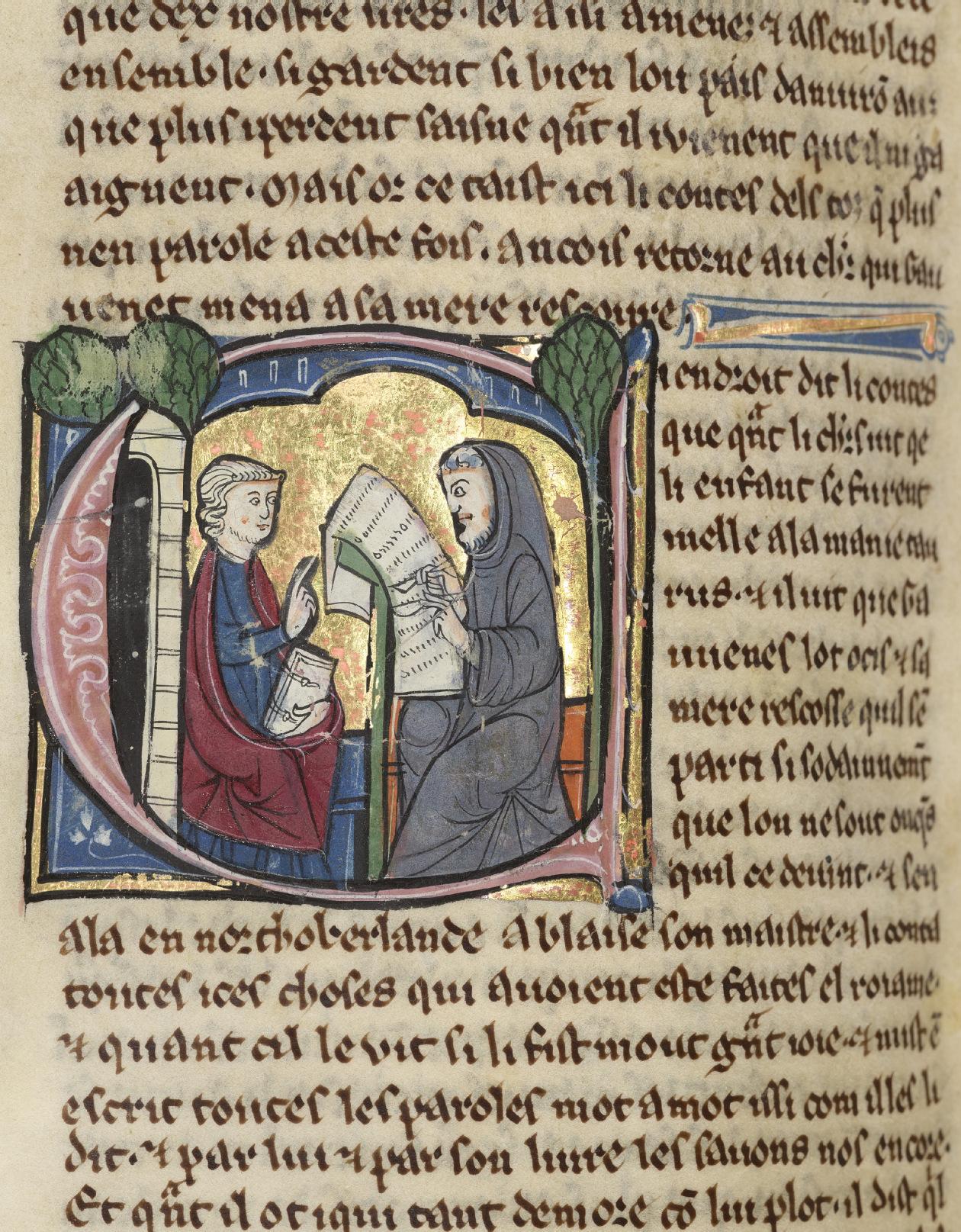
The Clermont-Tonnerre Grail shares with the Ste-Glossinde Charter the square jawed male faces with a far contour simplified into an almost straight line, an effect emphasised by black outlining, e.g. Merlin seen in three-quarter view dictating to Blaise on ff.184v and 215. Blaise exemplifies a characteristic profile view, with an exaggerated nutcracker chin and the forehead continuing in an almost straight line into a Grecian nose with an overlong tip. Although there are no profiles on the Charter for comparison, similar profiles occur in the Liège Apocalypse, where the threequarter view heads often have more nuanced contours than those in the Charter and the Grail. The ‘squared’ heads of these two manuscripts appear so similarly in BnF fr. 344, the ClermontTonnerre Grail’s less well-preserved sister manuscript, and in a copy of the Chroniques de Baudouin d’Avesnes (BnF NAF 5218), especially from f.177, that the same hand may be involved. The Clermont-Tonnerre Grail’s connections with these manuscripts, usually dated to the 1290s or c.1300, are closer than with the Liège Apocalypse, usually placed in the 14th century. A date in the 1290s for the Clermont-Tonnerre Grail receives further support from the presence of probably the same hand(s) in a Psalter-Hours described as le chef-d’oeuvre de ce courant artistique, the masterpiece of this artistic trend, datable before 1297 from the absence of St Louis from its calendar (Metz, Médiathèque Verlaine, ms 1588, Duchêne-Gasseau, 2021, pp.151-154; Stones, 2015, 1, pp.21-23). It is impossible, however, to rule out a date after 1300 for the Clermont-Tonnerre Grail, less elaborately illuminated as was usual for books not directly intended for the service of God, yet still a masterpiece of narrative illustration.
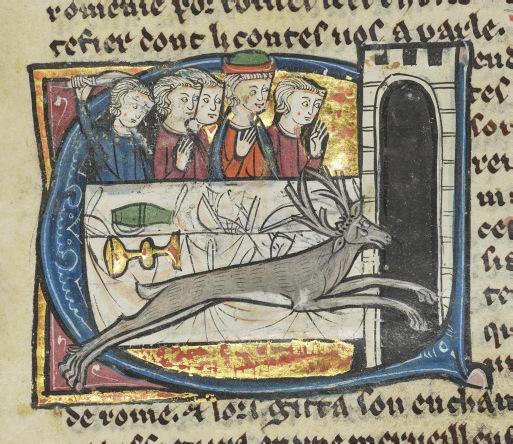
Master of the Liège Apocalypse. Merlin, disguised as a large stag, having told the Emperor that only a Wildman (Merlin in a different disguise) can interpret his dream, overturning all the food and vessels as he rushes out of the imperial hall, f.211 of the Clermont-Tonnerre Grail.
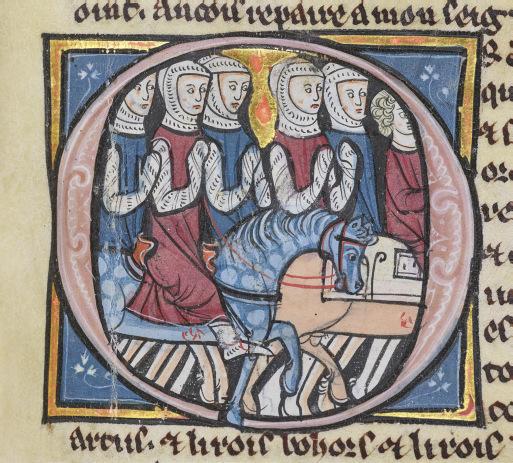
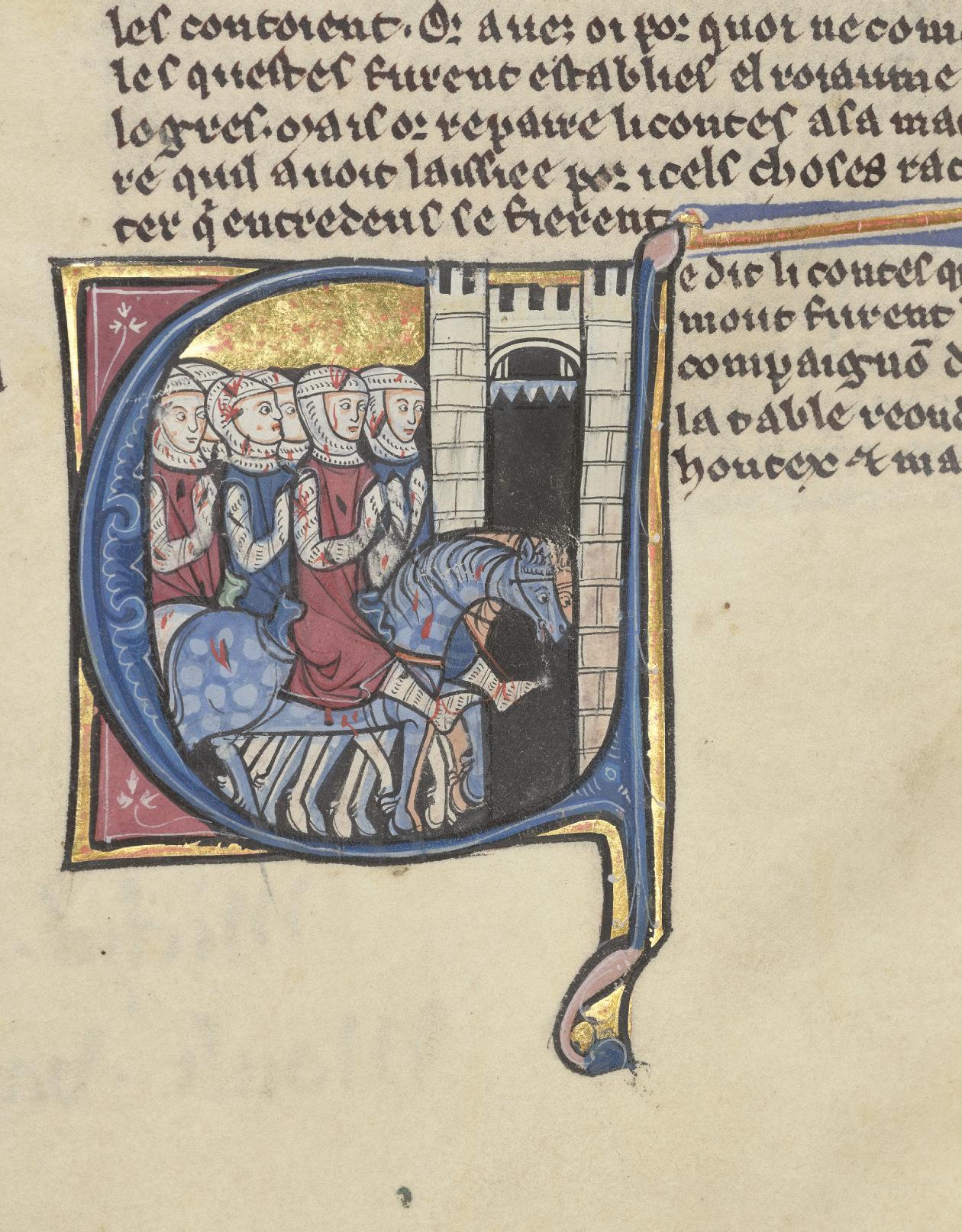
Master of the Liège Apocalypse. Gawain and his men coming to Banoic in peace with great booty from the pillaged lands of King Claudas, f.210 of the Clermont-Tonnerre Grail.
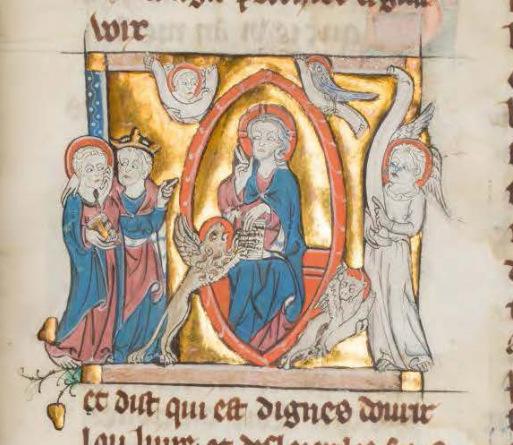
Master of the Liège Apocalypse. Université de Liège, Bibliothèque, ms Wittert 5, f.23.
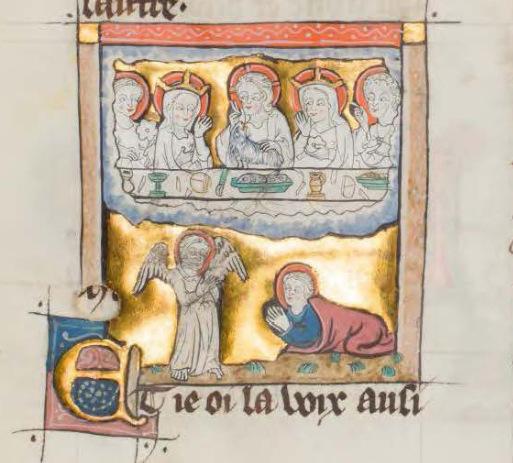
Master of the Liège Apocalypse. Université de Liège, Bibliothèque, ms Wittert 5, f.37v.
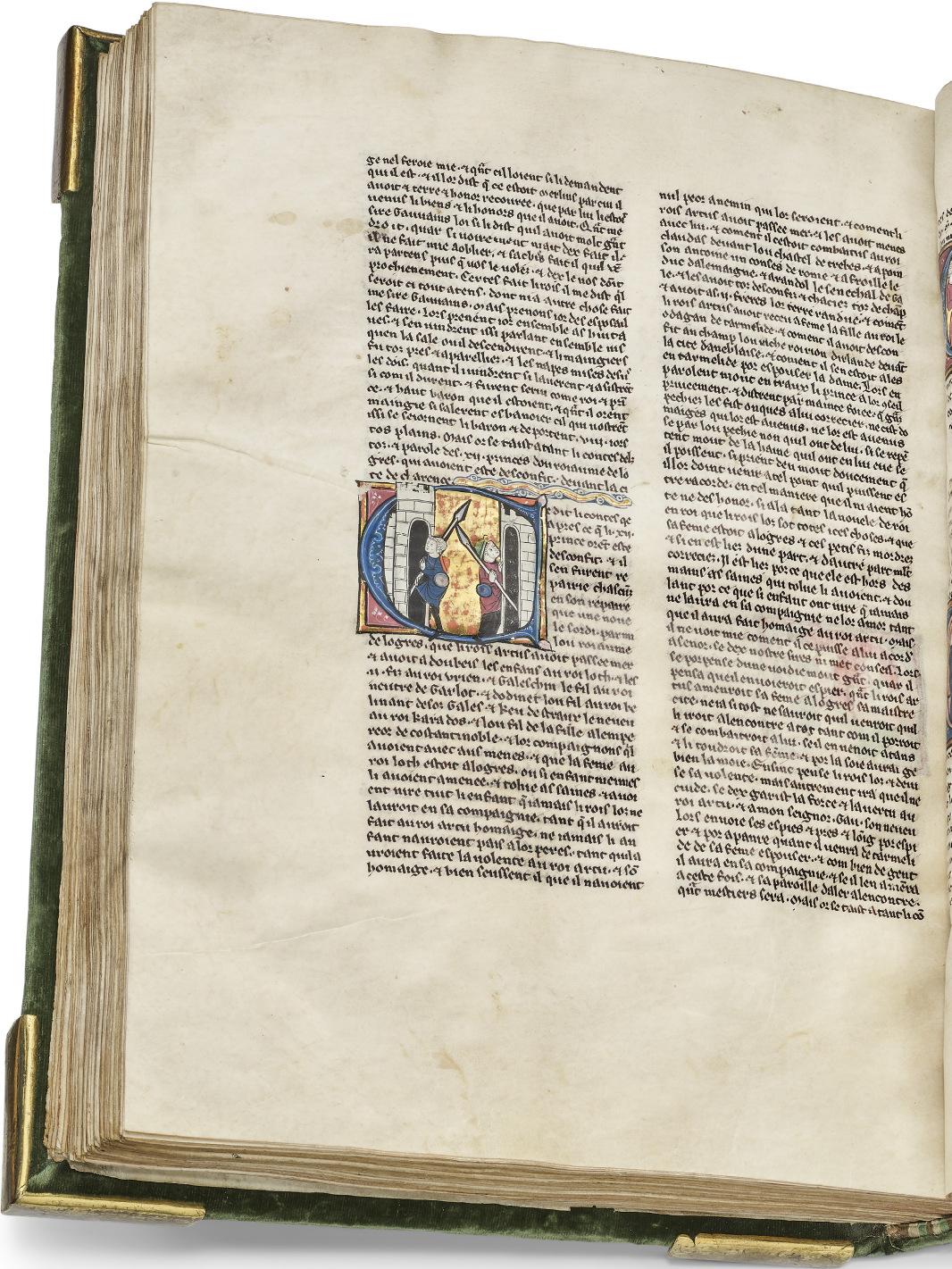
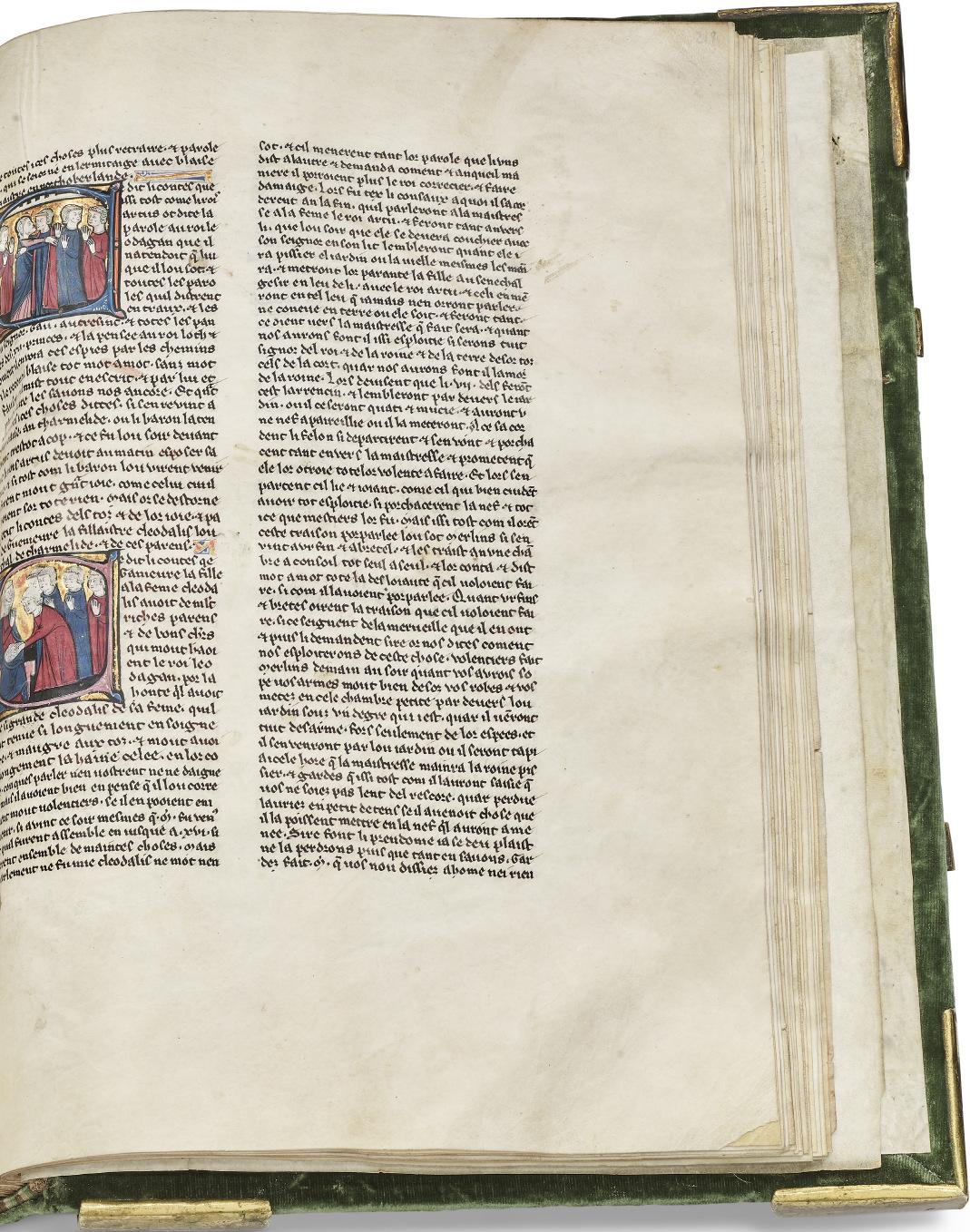
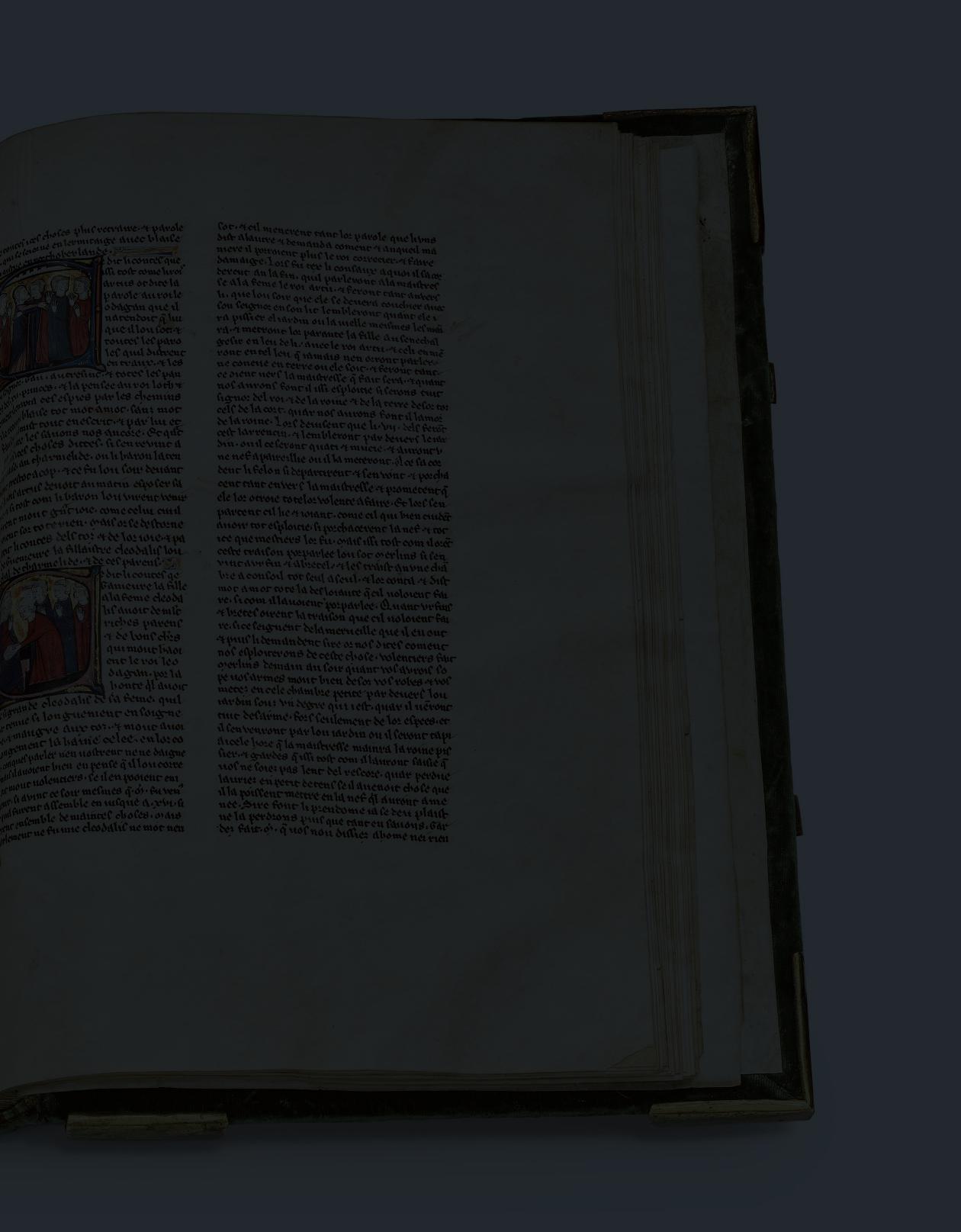
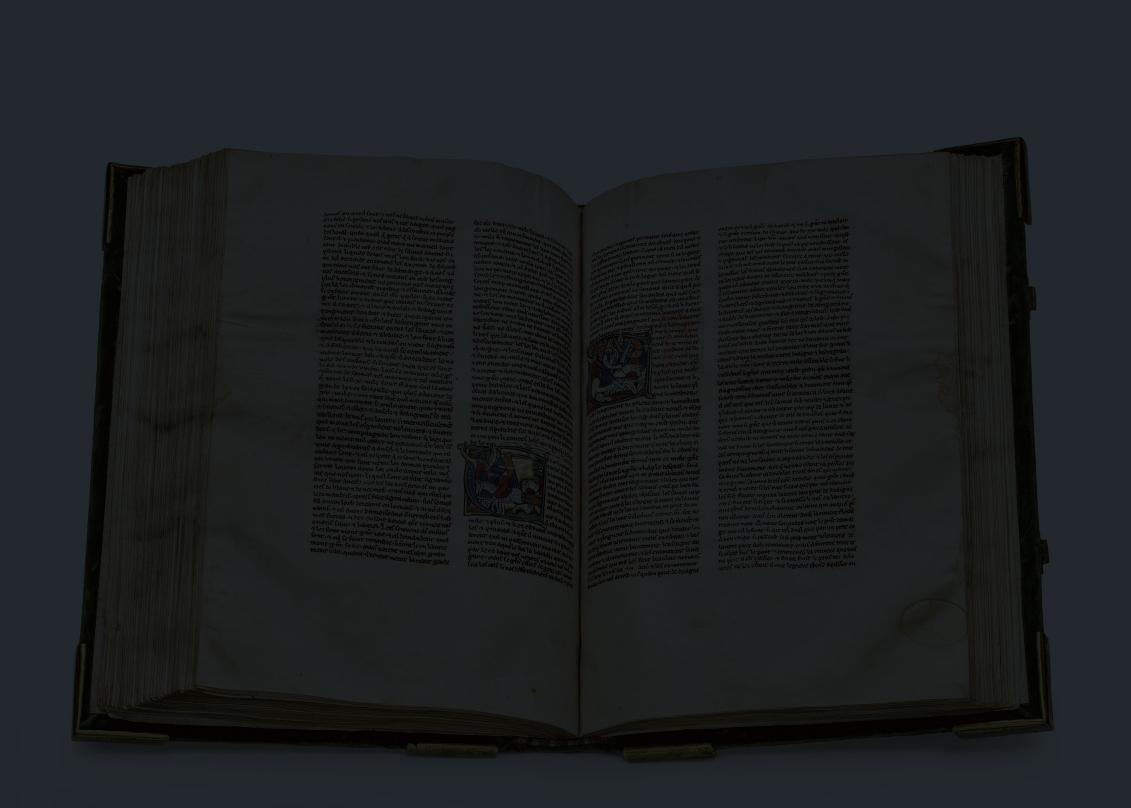
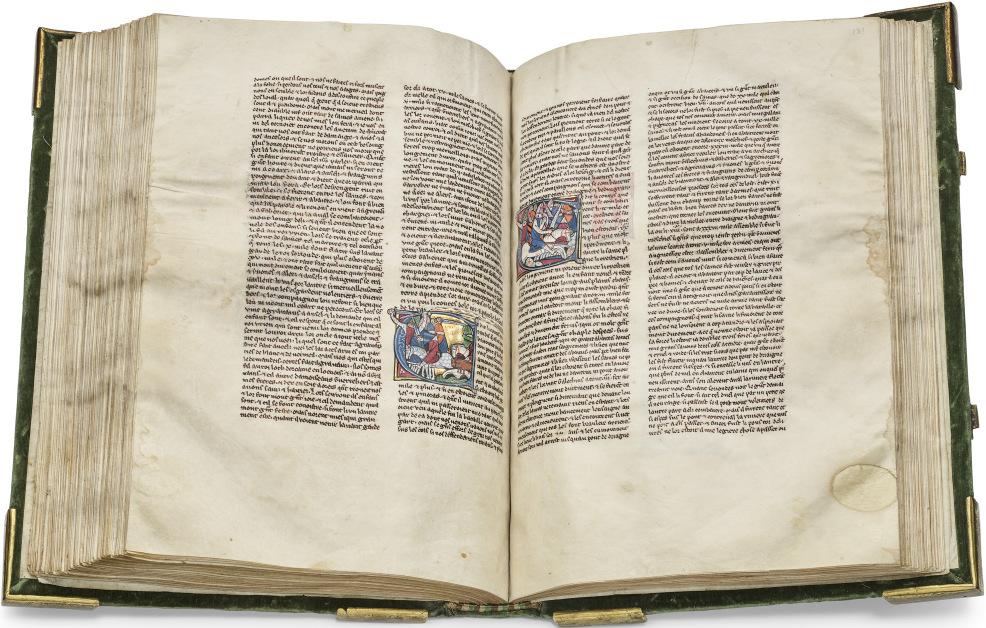

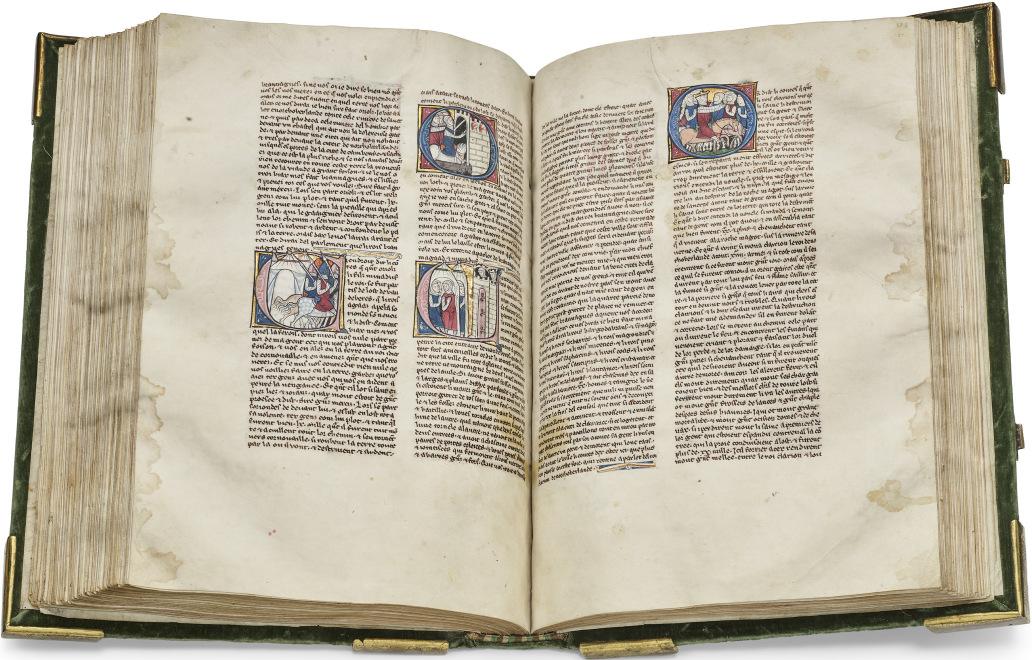
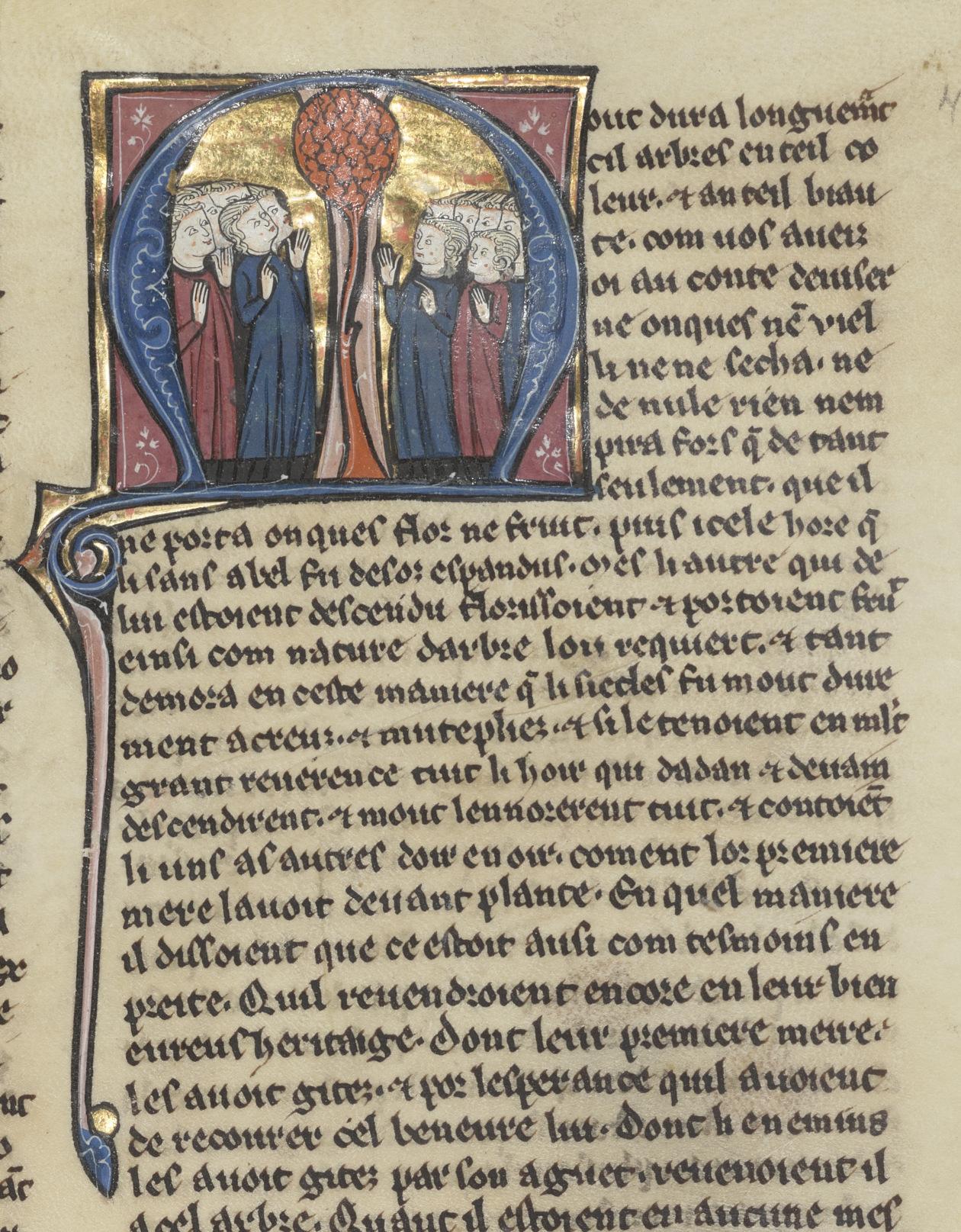
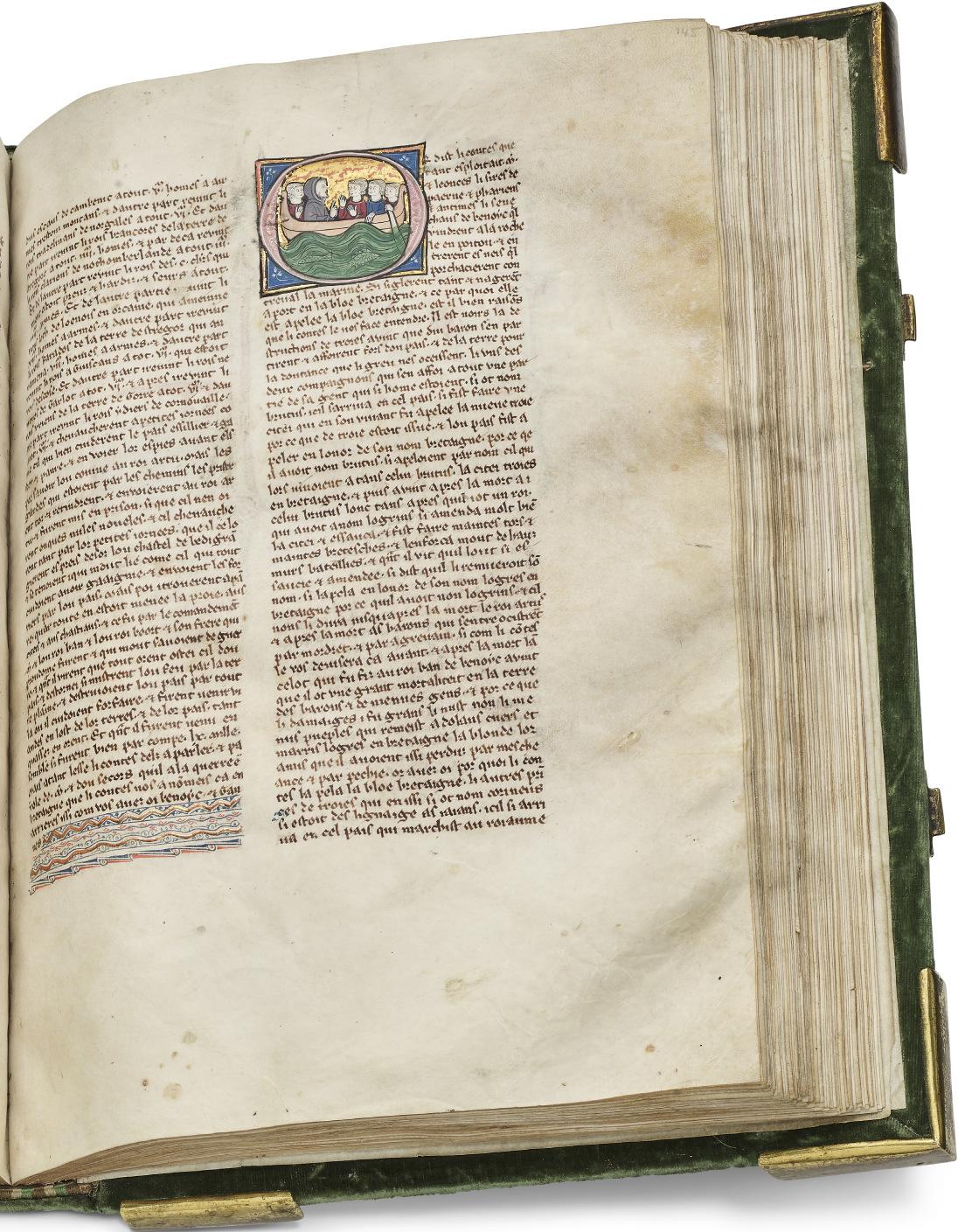
The lively, deftly drawn figures are animated by the sharply contrasted black pupils of the eyes, often carefully placed to convey interaction, on f.75v contrasted with inaction as Joseph of Arimathea’s wife sleeps on while her husband listens intently to the divine messenger. Figures and their economical settings form satisfying compositions, usually structured by colour and strong verticals and horizontals, sometimes contrasted with curves as in the scenes of wavy seas meeting land or ships, ff.62v, 145; on f.48v Nascien’s verticals are set against the scalloped edges of the Turning Isle, its encircling waves contained within the smooth outlines of the containing letter ‘O’, itself framed in a rectangle. For other scenes, the protagonists extend beyond the framing letter, giving their actions an added energy and immediacy; on f.12v subject matter continues into the marginal extension, which curves up below the initial to form the pit holding two of those who have fled from the Trinitarian trees of Evalach’s vision. At times detail can become endearingly confusing, for instance the depiction of numerous legs for a troop of horses, e.g. f.144v; in other cases the careful inclusion of small details from the text clarifies and enriches the subject matter: the Tree of Life that is not green since it turned red with the first death, Cain’s murder of Abel f.54; the diminutive sheep that authenticate Merlin’s shape shift to an old herdsman f.174v; the banners described as fluttering in the wind f.200v; Merlin’s magic standard with its fire breathing dragon f.206v. Perhaps an imprecise instruction to the illuminators resulted in the Grail appearing not as the bowl or goblet required by the text but as a sort of veiled monstrance in both this manuscript and its sister, BnF fr.344.
The illuminators of the Liège Apocalypse group were used to series production as they met the growing demand for illustrated vernacular narratives: in addition to the sister Grail manuscripts, the Chronicle of Baudouin d’Avesnes (BnF, NAF ms 5218) has two sisters (Bern, Burgerbibliothek ms 98; Yale University, Beinecke ms 339), and seven further Apocalypses are illuminated in related styles. For the two Grail manuscripts, comparisons by Stones (2026) and Fabry-Tehranchi and Nicolas (2021) show that, like the texts, the historiated initials are not identical, despite sharing many subjects, compositions and placings; neither seems a straightforward copy of the other. A closer study of the two, embracing text, illustration and production methods, might clarify their relationship and shed light on working practices.
The little studied Clermont-Tonnerre volume is an entrancing copy of a seminal work that is rewarding in itself, as well as for what it may offer to researchers. Exploring the texts and imagery of Arthurian legends is not a quest with an inevitably achievable goal but a journey of discovery into the ideals, concerns and assumptions of those who fashioned the stories some nine hundred years ago, of the illuminators who illustrated this copy over eight hundred years ago and of those who continued to treasure the book through the succeeding centuries: the knight Michel de Gronnais, who led his fellow citizens to war; the urban patrician, Michel de Chaverson, himself a jouster; the French aristocrat, the comte de Clermont-Tonnerre, who served his king on the battlefield; the obsessive medievalist, Sir Thomas Phillipps, the illegitimate son of a textile manufacturer and touchily proud of his new baronetcy and title; the industrialist, Jean Lebaudy, whose heroic deeds in both World Wars brought him two croix de guerre. What were the resonances for them and what will be the resonances in the years to come? As Merlin himself prophesies:
And the story will forever be told and gladly heard for as long as the world lasts (Pickens’ translation of L’estoire de Merlin, Lacy ed., 1993, p.181).
BIBLIOGRAPHY FOR THIS MANUSCRIPT:
The manuscript is listed in numerous publications on the LancelotGrail but little could be said about it until recently; among those which add significantly to our understanding are:
A. Duchêne-Gasseau, Le livre d’heures à Metz au Moyen Âge : archive de la dévotion des élites urbaines (1270-1490), Ph.D thesis, Université de Lorraine, 2021, pp.143-44 (accessed at the University website HAL)
I. Fabry-Tehranchi and C. Nicolas. L’ iconographie du LancelotGraal, Turnout, 2021, examining the iconography of BnF fr. 344 and detailing differences from the Clermont-Tonnerre Grail from photographs
P. Gasnault, ‘Charles-Henri de Clermont-Tonnerre et la bibliothèque du couvent des Minimes de Tonnerre’, D. NebbiaiDalla Guarda and J.-F. Genest eds, Du copiste au collectionneur Mélanges d’histoire des textes et des bibliothèques en l’honneur d’André Vernet, 1998, pp. 585-614, pp.600-601
J.-P. Ponceau ed., L’estoire del saint Graal, 2 vols,1997, I, p.xxv
A. Stones. ‘Le contexte artistique du Tournoi de Chauvency’, pp.151204 in M. Chazan and N. Freeman Regalado eds, Lettres, musique et société en Lorraine médiévale. Autour du Tournoi de Chauvency (Ms. Oxford Bodleian Douce 308), 2012, pp.152-3, 155, 168.
A. Stones, A Survey of Manuscripts Illuminated in France, Gothic Manuscripts: 1260-1320, Part One, 2 vols, 2013, Part Two, 2 vols, 2015; Part One, 1, p.71 and Part Two, 1, p.31
A. Stones, Studies in Arthurian Illumination I, 2018, esp. pp.205-6; 248-249
A. Stones, ‘Arthurian manuscript illumination: the Old French Vulgate tradition’, The Cambridge History of Arthurian Literature I, 2026, pp.527-56.
See also Alison Stones’ website The Lancelot-Graal Project
MODERN EDITIONS OF THE TEXTS:
H. O. Sommer, The Vulgate Version of the Arthurian Romances, I,1909, and II, 1908, based on London, BL Add. 10292-4 with short versions of the texts.
D. Poirion et al. eds., Le livre du Graal, I, 2001, for these three texts, based on the version with the shorter texts in Bonn, Universitätsund Landesbibliothek Hs S 526, with a colophon dated 1286; with modern French translation.
J.-P. Ponceau ed., L’Estoire del saint Graal, 2 vols,1997, based on the La Rochefoucald copy (Sotheby’s, 7 December 2010, lot 33), which shifts towards the end from the long to the short version.
A. Micha ed., Robert de Boron. Merlin. Roman du XIIIe siècle. Edition critique, 2000, based on Paris BnF fr. 747.
C. Füg-Pierreville, Le Roman de Merlin en prose, 2014, based on BnF fr.14394, with modern French translation.
For an English translation: N.J. Lacy, ed., Lancelot–Grail: The Old French Arthurian Vulgate and Post-Vulgate in Translation, 5 vols, 1992-1996; the first volume contains The History of the Holy Grail, translated by C.J. Chase, principally based on Le Mans, Médiathèque Louis d’Aragon, ms 354, which belongs to the ß group of the long version, and The Story of Merlin (including Le livre des premiers faits), translated by R.T. Pickens, chiefly based on the Sommer edition.
Manuscripts cited accessible on line:
Liège, Bibliothèque de l’Université, ms Wittert 5, is on the University’s website DONum
Metz, Médiathèque Verlaine, ms 1588, can be accessed on ARCA Bibliothèque numérique de l’IRHT (Institut de recherche et d’histoire des textes)
Oxford, Bodleian Library, ms Douce 308, is on the website Digital Bodleian
Paris, BnF mss fr. 344 and NAF 5218, are on the BnF website Gallica
There are images from the Charter of Ste-Glossinde and also links to these and other Metz manuscripts on the website MéLoDi (Mémoires des Lorraine Disparues): Projet cité de Metz 1250-1552
SUBJECTS DEPICTED:
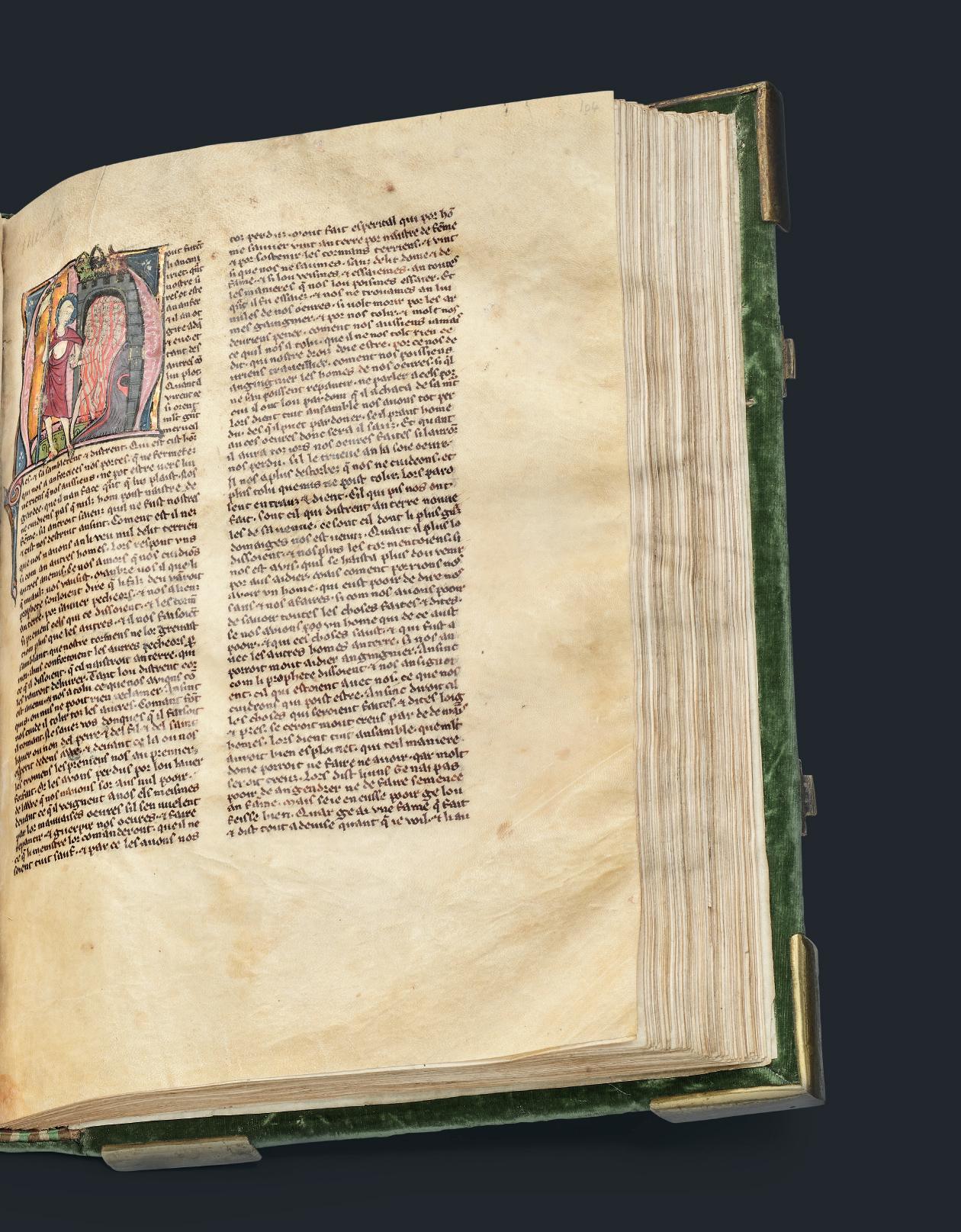
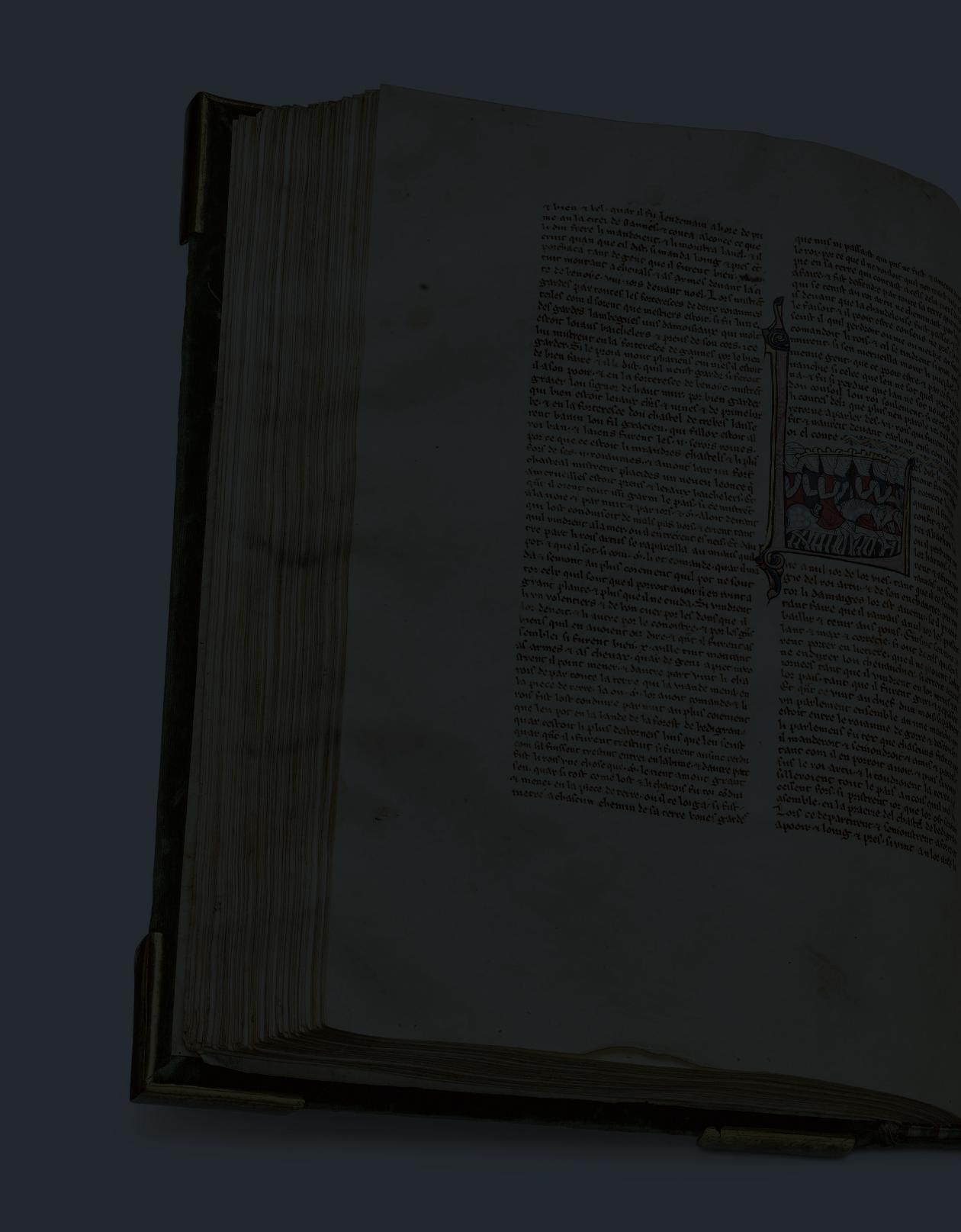
The subjects of the miniature between L’estoire de Saint Graal and L’estoire de Merlin are, from the top: for the first text, the author Robert de Boron seated by the tomb of King Lancelot, guarded by the two lions who benefitted from its healing powers and who now kill any knight similarly seeking healing, as on the right; for the second text, devils discussing how to counteract Christ’s Harrowing of Hell seen in the facing initial, and resolving on the birth of a devil’s son; a family is tormented to leave one daughter vulnerable to impregnation by the devil: her mother, Merlin’s grandmother, telling a devil how to proceed, devils killing her husband’s livestock and their son, the mother killing herself after her husband has died of grief, f.103v.
THE SUBJECTS OF THE HISTORIATED INITIALS ARE:
L’estoire de Saint Graal
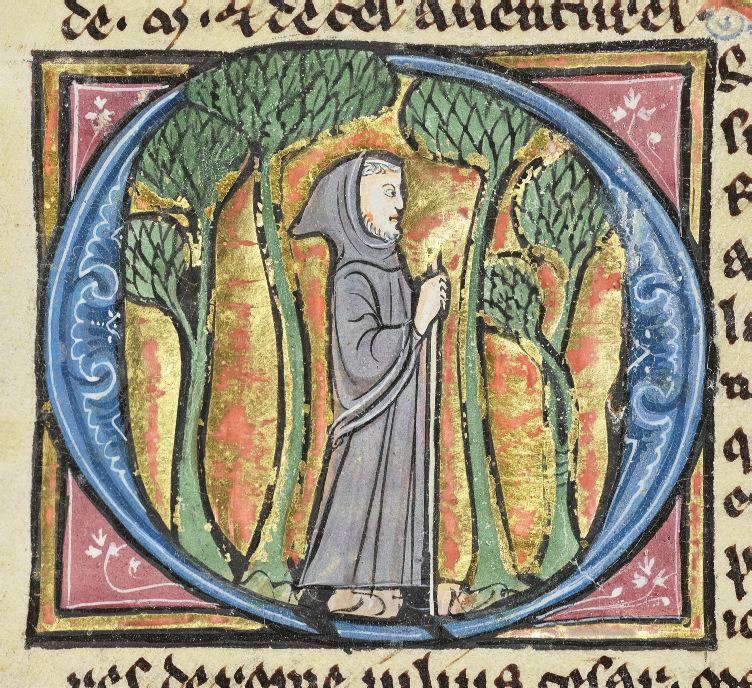
Christ bringing the book with the story of the Grail, written by his own hand in a heavenly language, to the hermit f.1; blank space for initial on replacement leaf, f.5: BnF fr. 344, f.4, has Joseph of Arimathea leading the Deposition of Christ from the Cross at this point; remaining lower part of initial suggests a scene of Joseph of Arimathea preaching, with the feet of a pulpit on the left and seated figures to the right (BnF fr.344, f.5, has a different scene), f.8v; the Annunciation, part of Joseph’s missionary preaching to King Evalach of Sarras, a land to the east, f.10; Joseph addressing Evalach, f.11; Evalach and his vision of the three trees, symbols of the Trinity, f.12v; Joseph praying for Evalach’s conversion, f.13; Joseph, his son, the bishop Josephus, and his companions praying before the ‘ark’ made to contain the Grail, entrusted by Christ to Joseph, f.14v; leading out his troops against King Tholomer, Evalach, receiving a letter from his wife, Sarrasinte, who has been warned by Josephus of Tholomer’s invasion, f.21v; the armies meeting outside La Choine; f.24; Joseph and Josephus addressing Queen Sarrasinte, who promises to return to the Christian faith, f.26v; Josephus converting Evalach f.29v; Josephus about to show the contents of the ‘ark’, including the Grail, to Evalach, newly baptised as Mordrain, and his brother-in-law and fellow convert, Duke Nascien, f.32v; Mordrain, troubled by visions, and Sarrasinte in bed, still wearing their crowns, f.34v; Sarrasinte discovering her brother Nascien and the palace attendants apparently dead, f.35v; Mordrain left by the Holy Spirit on the Rock of the Perilous Port, f.36v; Mordrain encouraged to trust in God by All-in-all who has arrived in a silver ship (not shown as silver), f.38v; Nascien, falsely accused of murdering Mordrain, imprisoned in a tower with his young son Celidoine, f.45v; Sarrasinte and Nascien’s wife, Flegetine, lament together for their missing husbands, f.47v; the sleeping Nascien, miraculously delivered from prison and placed on the Turning Isle, f.48v; Nascien, on the ship built by Solomon, finding the sword of David and the three spindles made from the Tree of Life, f.52; the Tree of Life that turned red when Cain murdered Abel, f.54; Nascien fearing the sword and spindles cannot be portents of good, f.56; miraculous hands lifting Celidoine from the prison tower by his hair, f.57v; Celidoine, having been deposited on an island, sharing a boat with a lion as punishment for apparently causing the death of the island’s king, Label f.62v; the messengers sent by Sarrasinte to find news of Nascien, f.63v; after their ship is wrecked, the two surviving messengers and Label’s daughter finding refuge in the abandoned palace of Hippocrates f.65v; the three find his tomb, inscribed IPOCRAS, f.68v; Nascien’s messengers before Flegetine, f.75; a
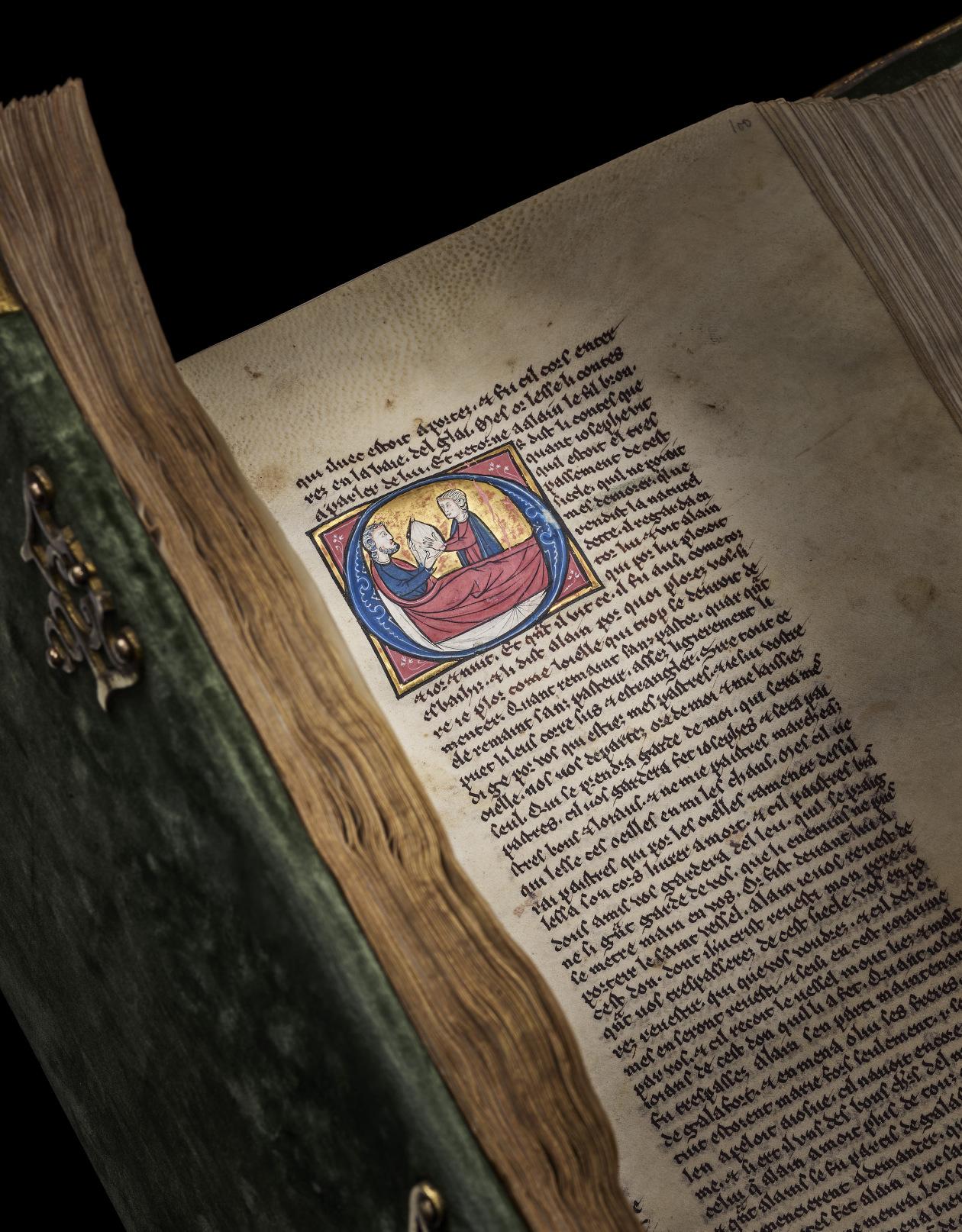
voice commanding Joseph of Arimathea to engender a child, f.75v; Nascien asleep on his drifting ship that will carry to Britain him and those converts not worthy to share the miraculous boatless crossing to Britain with Joseph, Josephus and the Grail, f.76v; Duke Ganor, at whose court at Galafort Nascien and Celidoine have been reunited, dreaming of the damned and the saved to convince him to convert to Christianity, f.78v; Joseph, Josephus and his companions carrying the Grail with them as they leave Galafort to travel round Britain preaching; Camelot, one of the chief towns, is among those that become Christian, f.82v; Josephus’s follower Canaan being buried alive for murdering his twelve brothers, f.93v; another follower, the gravely wounded Peter, brought to shore before King Orcant’s daughter, whom he will marry to become the ancestor of King Lot of Orkney, father of Gawain, f.94v; Josephus and his companions with the Grail continuing their mission of conversion round Britain until their return to Galafort, f.98v; Joseph having died, Josephus telling King Mordrain of their approaching deaths and of the eventual coming of Galahad, f.99v; Josephus on his deathbed entrusting the Grail to Alain, charging him to pass it on as Christ had done to Joseph, and Joseph to himself, f.100; burial of Nascien, with, above the tomb, Mordrain’s miraculous shield, on which Josephus had drawn a cross in his own blood (shown in reverse as white on red), waiting for Galahad, f.102; Celidoine sets out to rule his own lands, f.102; an unjustly suspicious husband, having murdered King Lancelot, ancestor of Sir Lancelot, trying to remove the King’s head from a fountain that starts to boil and will only stop with the coming of Galahad, f.103.
L’estoire de Merlin
The Harrowing of Hell, f.104; murder of the young King Maine of Britain, so that the throne can pass to Vortigern, f.110; the barons seeking advice from Merlin after the death of King Uther Pendragon, younger brother of Maine and founder of the Round Table, f.131v.
Les premiers faits du roi Artus (Suite vulgate de Merlin)
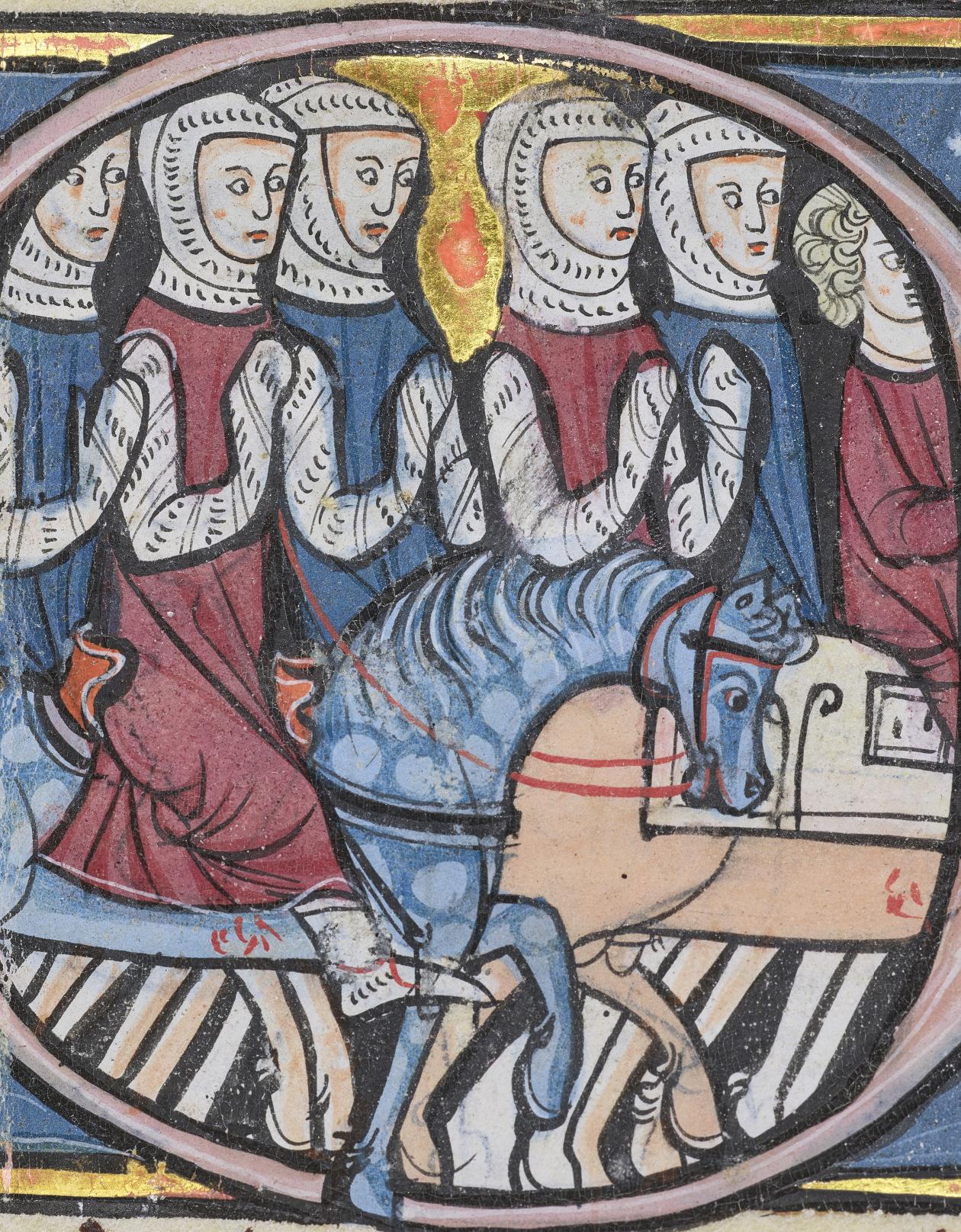
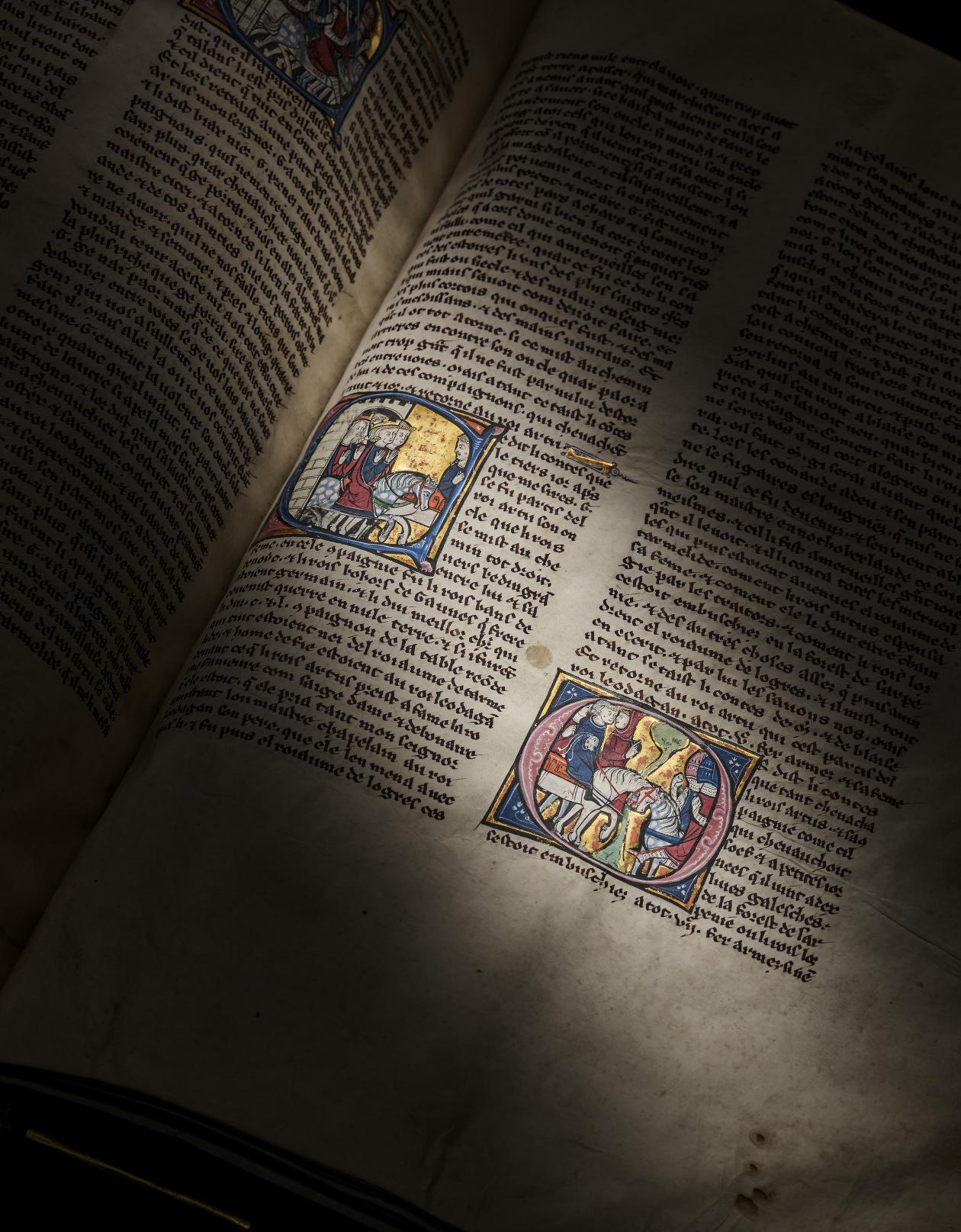
King Arthur, newly crowned, in state at Carlion to receive the kings and barons riding in to attend his court, f.135; Arthur riding out to greet the brother kings, Ban and Bors, f.141; Merlin having explained that Arthur is the legitimate son of King Uther Pendragon, Ban and Bors swearing fealty to Arthur, f.143v; five of the six traitor kings defeated by Arthur riding back disconsolate to their lands; (at least one, too depressed to ride, travelled in a litter), f.144v; Merlin sailing back to Britain with Leonce, Pharian and Alelme bringing reinforcements from the French lands of Ban and Bors, f.145; the reinforcements disembarking and riding to Arthur’s aid, f.145v; Ban and Bors greeting Leonce, Pharian and Alelme, f.145v; Saxon troops ravaging the lands of the six kings who have left them to renew the war against Arthur, f.146v; Arthur’s army surprising the forces of the now ten kings in their tents, f.146v; Arthur victorious returning to Logres, where pavilions have been erected to lodge his army, f.150v; the defeated kings arriving at Sorhaut, f.152; the kings needing to protect their lands against the Saxons, King Neutres of Garlot arriving to defend the city of Garles, f.154; King Clarion of Northumberland arriving to defend his city of Belande, f.155; King Brandegorre and King Caradoc leaving Sorhaut to defend their lands, f.155v; messenger of Galescalain, son of Neutres and nephew of Arthur, telling Gawain, son of King Lot of Orkney and nephew of Arthur, that he and his brothers should go to Galescalain,156v; Galescalain and Gawain
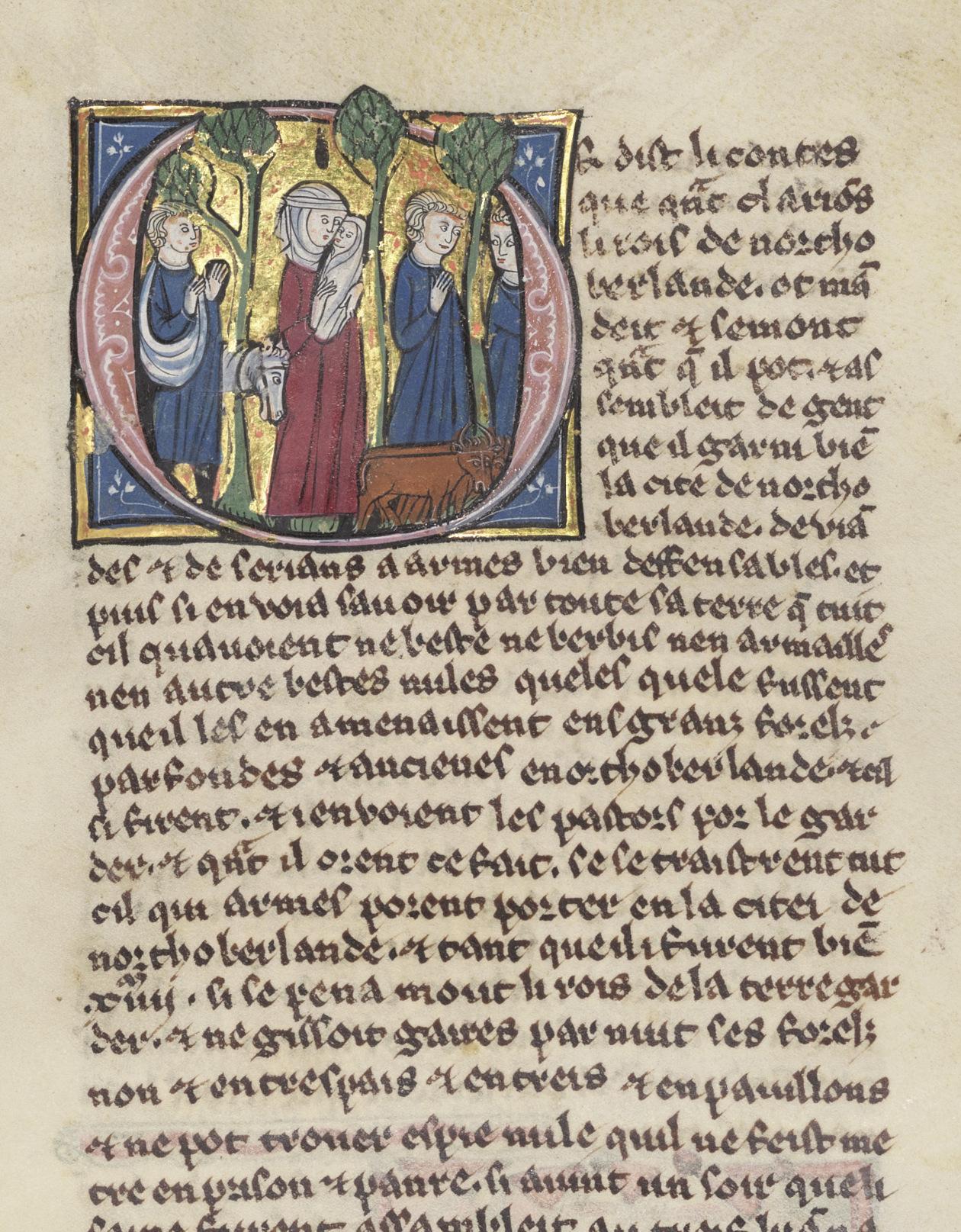
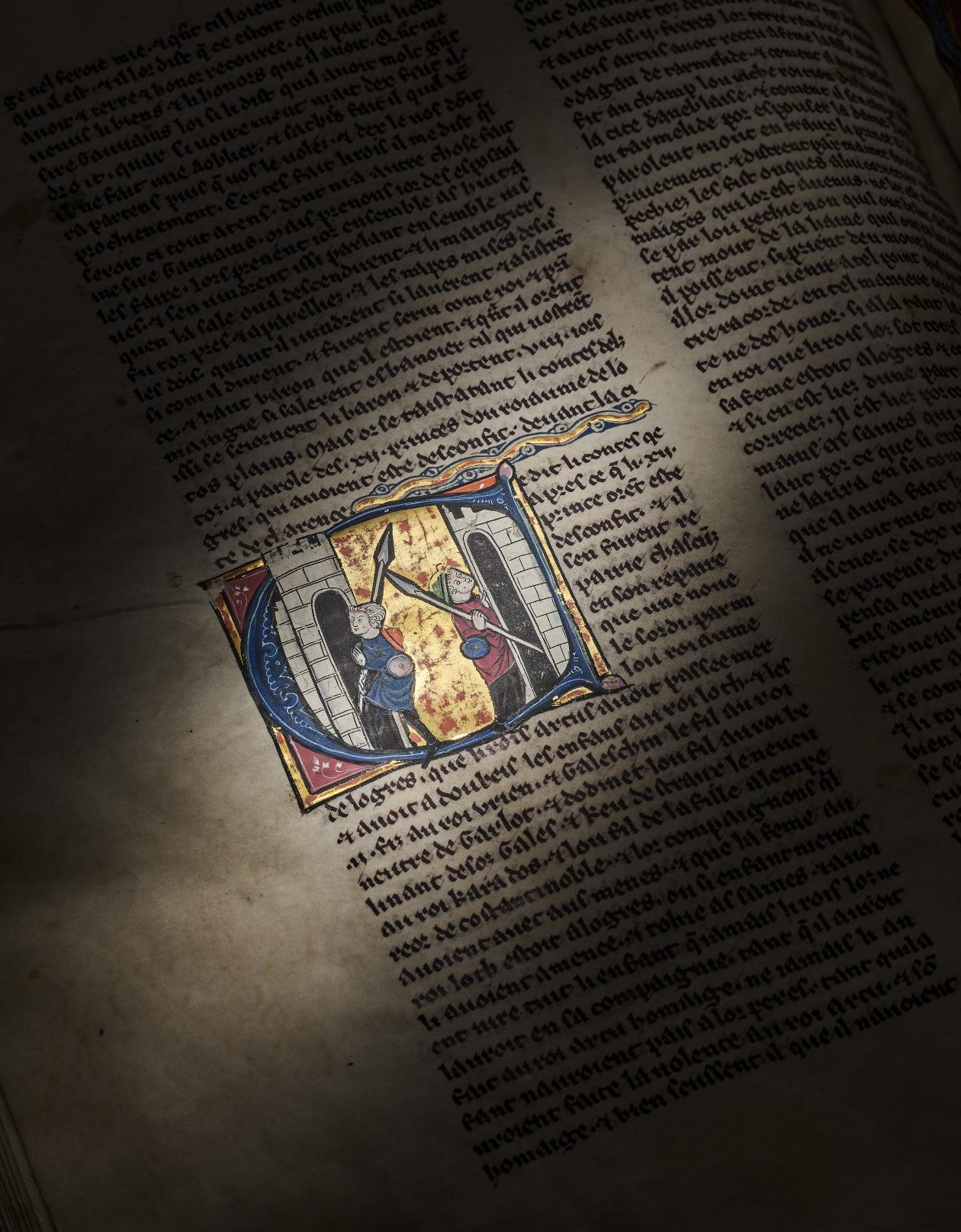
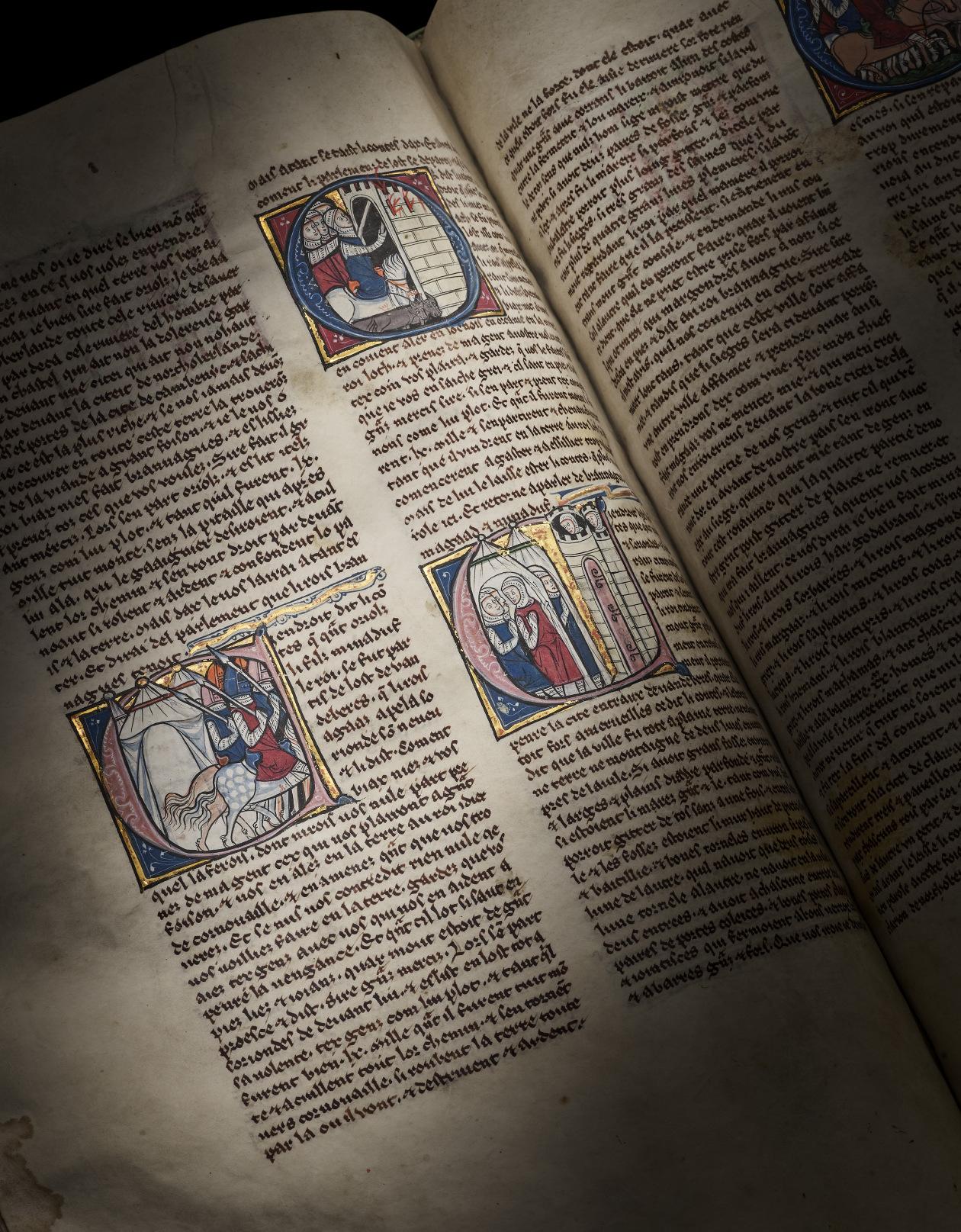
and his brothers, Agravain, Guerrehet and Gaheriet, bearing branches (some, at least, green in the equivalent damaged scene in BnF fr.344, f.118) to honour May as they ride to join King Arthur at Logres, f.157; the food and beasts rescued from the Saxons by Gawain and his company arriving at Logres, f.158; Arthur, Ban and Bors arriving at Carhaix to fight the Saxons with King Leodagan and the Knights of the Round Table, which had passed to Leodagan at Uther Pendragon’s death, f.159v; the battle of Carhaix against the Saxons, f.161; Ban killing King Clarion the Giant (not Clarion of Northumberland) at the battle of Carhaix, f.162v; Arthur and his companions entering Carhaix after the battle, f.165; Merlin instructing Arthur, Ban, Bors and ?Leodagan, having taken them aside during the victory banquet, where Arthur had met Leodagan’s daughter, Guinevere, f.166v; a spy warning King Tradelmant of North Wales that the Saxons have invaded his lands, f.166v; Tradelmant and the King of a Hundred Knights rejoicing after driving the Saxons back to their fortress, f.167v; the Saxons rampaging through Scotland, f.168; King Aguisant of Scotland fighting the Saxons, f.168v; either the messenger bringing King Neutres of Galot news of Aguisant’s defeat or the messenger bringing him news of the victory of Tradelmant and the King of the Hundred Knights, f.169v; Brandegorre supervising the building up of the defences of Estrangorre, f.170v; the inhabitants of Northumberland obeying King Clarion’s order to hide their livestock from the Saxons in the forests, f.172; the Saxon troops of Soriondes leaving to attack Cornwall, f.172v; the Saxon Arrant sacking the lands of Lot of Orkney, f.172v; the Saxons besieging Vambieres, f.172v; King Clarion greeting Duke Escant , who has brought troops to his aid, f.173; Merlin setting out for Northumberland to aid Clarion, f.173v; Sagremor, grandson of the Emperor of Constantinople, arriving in Britain to join the Christian forces at Camelot, f.174; Merlin disguised as an old herdsmen imploring Gawain to leave the safety of Camelot to aid Sagremor against the Saxons, f.174v; Clarion and Escant leading their troops against the Saxon Oriel, f.177; Yvonet and his bastard brother, also Yvonet, take refuge in Arundel to avoid the Saxons, f.178v; Merlin disguised as a messenger delivers to Gawain a letter supposedly from Yvonet, asking for Gawain’s aid against the Saxons, f.179; King Yder fighting the Saxons outside Arundel, f.179v; the Saxons escorting a baggage train of plunder arriving at the Bridge of Diana where Soriondes is leading his troops in battle, f.180v; the Saxons being driven back at the Bridge of Diana, f.181; Gawain sending out a spy to discover the Saxons’ movements, f.181v; battle before Arundel, f.182; Merlin, disguised as a knight, arriving at Arundel to lead Gawain and his company to rescue Gawain’s mother from the Saxons, f.183; Merlin recounting his adventures to Blaise, who records them for posterity, f.184v; the King of the Hundred Knights presiding over the council he has summoned to Winchester, attended by Kings Lot and Aguisant among others, f.186v; Merlin arriving in Carhaix and being greeted by Kings Arthur, Ban and Bors, f.187; King Leodagan and the Knights of the Round Table, aided by King Arthur, fighting King Rion of Ireland and the Saxons, f.190v; battle between King Amant and King Galahad, f,194v; after the battle, Arthur and his companions arriving at Carhaix, f.194v; Bors leaving his brother Guinebal in the Perilous Forest, f.195v; Gawain asking Arthur, resting in a wood with Ban and Bors, to
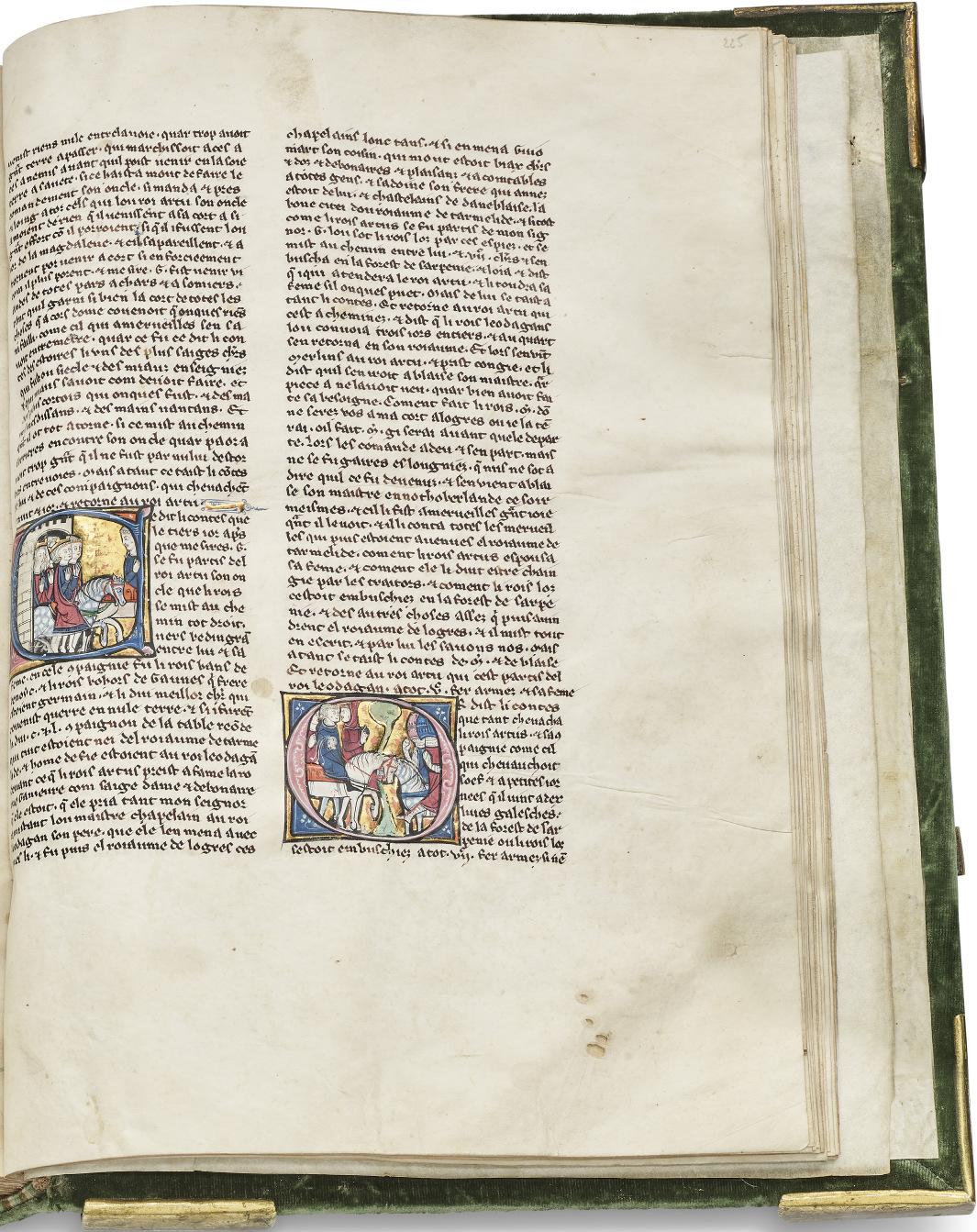
knight him and his companions and take them into his service, f.197; Arthur, Ban and Bors sailing to France to defend the brothers’ lands of Benoic and Gaunes, f.199; Pharian and Leonce and their armies arriving at Benoic, f.199v; Blioberis at the head of Gawain’s men leading Arthur’s army, with flags fluttering, against the French King, Claudas of the Land laid Waste, and his allies, f.200v; the armies meeting at the Battle of Trebes, f.203; helped by his cousin, Gawain, Galescalain defeating Frollo of Germany at Trebes, f.204; the wives of Ban and Bors watch the battle from the castle of Trebes, f.204; in the confusion of the battle, Ban’s and Arthur’s men fighting amidst the troops of Claudas’s allies, f.205; Merlin, having rallied the flagging Arthur and his knights, leading them in a charge with the magical dragon standard to win the Battle of Trebes, f.206v; Ban with Bors and Arthur listening as Merlin interprets Ban’s dream, f.209; Gawain and his men coming to Benoic in peace with great booty from the pillaged lands of King Claudas, f.210; Merlin in the forests around Rome, where he has gone to interpret the dream of the Emperor, Julius Caesar, f.210; Merlin, disguised as a large stag, having told the Emperor that only a Wildman (Merlin in a different disguise) can interpret his dream, overturning all the food and vessels as he rushes out of the imperial hall, f.211; having been told by Merlin that he should marry Avenable in place of his adulterous wife, the Emperor has her parents escorted to Rome, f.215; Blaise recording Merlin’s account of events since their last meeting, f.215; the eleven kings (four shown), led by the King of the Hundred Knights, and one Duke, who had rebelled against Arthur, holding a war council that will lead to their defeat by the Saxons, f.215v; Arthur with Ban and Bors returning to Britain to proceed to Carhaix where Arthur will marry Guinevere, f.218; the defeated kings and duke (two shown) each return to their own lands, f.218v; Merlin returning to Arthur at Carhaix, f.219; relations of the False Guinevere, daughter of Leodagan and the wife of his seneschal, Cleodalis, bribing Guinevere’s nurse to put the False Guinevere in the bridal bed instead, f.219; the Knights of the Round Table returning to the palace after the tournament celebrating Arthur’s marriage, f.222; Bertelay, one of Leodagan’s knights, killing the knight who had killed his cousin, f.223v; Leodagan ordering Cleodalis to take his step-daughter, the False Guinevere, away from his court, f.224; Gawain riding out with many of Arthur’s men to prepare for the King to hold court sumptuously at Logres, f.224v; Arthur and Guinevere setting out with Ban and Bors, f.225; Arthur’s men finding King Lot, one of the rebellious kings, waiting to ambush Arthur in the forest of Sapinoie, f.225; knights wounded in the tournament held by Arthur returning for the banquet, where the opponents are reconciled and the new knights, led by Gawain, join the Round Table, f.233v; Lot, reconciled to Arthur, and his sons, Gawain, Agravain, Guerrehet and Gaheriet, setting out on their embassy to the remaining rebellious kings, taking the five best horses at the court with them, f.235; Eliezer telling his father, King Pelles, that he will only be knighted by the best of knights, Gawain, f.238v; Eliezer and his squire riding to Arthur’s court at Carlion, f.239; Lot and his sons leaving the house of the forester who has given them refuge in Northumberland, f.239v; Lot and his sons arriving to give messages to Urien of Gorre about fighting the Saxons, f.239v.
AUCTION
Wednesday 8 July 2026 at 12.00 pm
8 King Street, St. James’s London SW1Y 6QT
VIEWING
Friday 3 July 9.00 am - 5.00 pm
Saturday 4 July 12.00 pm - 5.00 pm
Sunday 5 July 12.00 pm - 5.00 pm
Monday 6 July 9.00 am - 5.00 pm
Tuesday 7July 9.00 am - 5.00 pm
AUCTIONEERS
Eugenio Donadoni, Clementine Sinclair, Olivia Ghosh
CONTACTS
Eugenio Donadoni
International Specialist and Head of Sale, Medieval and Renaissance Manuscripts edonadoni@christies.com
Phoebe Putnam
Sale Coordinator, Books and Manuscripts pputnam@christies.com
Acknowledgements:
Christie’s would like to thank Jean-Baptiste de Proyart (Paris) and Ariane Adeline (Paris), who conducted initial research on this manuscript.
The sale of each lot is subject to the Conditions of Sale, Important Notices and Explanation of Cataloguing Practice which are set out online, with other important sale information at christies.com. For the most up to date sale information for a lot, please see the full lot description, which can be accessed through the sale landing page on christies.com.