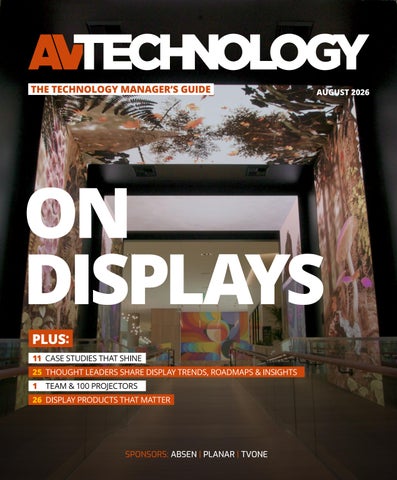
THE TECHNOLOGY MANAGER’S GUIDE
AUGUST 2026
ON DISPLAYS PLUS: 11 CASE STUDIES THAT SHINE 25 THOUGHT LEADERS SHARE DISPLAY TRENDS, ROADMAPS & INSIGHTS 1
TEAM & 100 PROJECTORS
26 DISPLAY PRODUCTS THAT MATTER
SPONSORS: ABSEN | PLANAR | TVONE
Mount-It! PRO
IN THIS ISSUE
30
AV/IT Team...............................................................................................................06 Meet the creative team behind the Museum of Art + Light, where more than 100 laser projectors bring creativity to life with nearly 37,000 square feet of eye-popping color and exquisite detail.
Thought Leaders.................................................................................................10
Epson
06
Twenty-five industry thought leaders share insights on topics such as how to grow and immerse audiences, collaborate across campuses via the cloud, use AI to drive targeted messaging and gather data, create an ecosystem to improve workflows, increase sustainability, and reduce total cost of ownership.
Case-in-Point .........................................................................................................22
Planar
Eleven on Display: Honolulu Prep Comes to Life in LED | Processing Performance You Can Bank On | Medical Labs Upgrade to Interactive Displays | Beauty in Collaboration at Microsoft HQ | Engineering Boston’s Widest Curved LED Canvas | Signage Transforms Shopping Experience | Two Video Walls, One Unified Brand | Monitoring 8,000 Satellites, 24/7 | A Warm, Video Wall Welcome in Wyoming | Digital Storytelling Bolsters Faith and Community | Immersive Fan Experiences on Full Display
44
Display Tech That Matters ........................................................................44 Video processors, fine-pixel-pitch LED video walls, COB LED display, integrated SoC displays, AV production suites, video wall appliances, AV-overIP distribution, dvLED universal wall mounts, laser projectors, 21:9 displays, outdoor LCDs, ADA-compliant applications, interactive displays, digital signage solutions, mobile all-in-one displays, e-paper, and much more! COVER IMAGE COURTESY OF Q-SYS
3
A U G U S T 2 0 2 6 | a vnet wo rk .co m
FOLLOW US twitter.com/AVTechnologyMag CONTENT Brand and Content Director, Cindy Davis, cindy.davis@futurenet.com Contributing Writer, Macy O’Hearn Graphic Designers, Sam Richwood, Robert Crossland Production Managers Heather Tatrow, Nicole Schilling
EDITOR’S NOTE
VISUAL STRATEGY by Cindy Davis
ADVERTISING SALES Managing Vice President of Sales, B2B Tech
DISPLAY TECHNOLOGIES, SIGNAL DISTRI-
ful display strategies recognize that hardware
212-378-0465
bution solutions, video wall mounts and the
specifications are a starting point—not the
Janis Crowley, janis.crowley@futurenet.com,
software platforms that help create engaging
deciding factor,” explained John Kruse, solutions
Adam Goldstein, adam.goldstein@futurenet.com,
845-414-6791
experiences have undergone a sea change.
engineer manager at ViewSonic. “Ecosystem
212-378-0473
Today, almost every collaboration space has a
alignment, remote manageability, and long-term
Zahra Majma, zahra.majma@futurenet.com,
large display for sharing content and bringing
supportability increasingly determine which
distributed teams into the discussion. Corpo-
investments hold their value. The display on the
rate lobbies, hotels, sports venues, and higher
wall is no longer just a screen; it’s an operational
education campuses often feature video walls
platform.”
Debbie Rosenthal, debbie.rosenthal@futurenet.com,
845-678-3752 SUBSCRIBER CUSTOMER SERVICE To subscribe to AV Technology or Future’s other AV industry brands, go to https://www.smartbrief.com/subscribe LICENSING/REPRINTS/PERMISSIONS
or projection systems that convey branding,
For organizations managing multiple build-
AVTechnology is available for licensing. Contact the Licensing
messaging, and content that engages visitors.
ings or venues, consistency and connectivity are
Throughout these environments, these displays
key, said Rudy Vitti, group manager of Product
are the glue that creates a unified experience.
Marketing at Panasonic Projector & Display
team to discuss partnership opportunities. licensing@futurenet.com MANAGEMENT SVP, MD, B2B Amanda Darman-Allen VP, Market Lead, Carmel King
We asked 25 industry thought leaders to
Americas. “Standardized displays and central-
share trends and insights on topics such as
ized content management can create a cohe-
MD, Content, AV, Anthony Savona
growing and immersing audiences, collaborat-
sive visual experience across a campus while
VP, Global Head of Sales, B2B, Dena Malouf
ing across campuses via the cloud, using AI to
simplifying AV/IT management. An integrated
Managing VP of Sales, B2B Tech Adam Goldstein
drive targeted messaging and gather data, and
ecosystem also allows organizations to build on
creating ecosystems that improve workflows,
existing infrastructure rather than replace it, en-
increase sustainability, and reduce total cost of
abling new displays to work alongside LCD video
ownership. Below are excerpts from a few.
walls, projectors, and other legacy technologies.”
VP, Global Head of Strategy & Ops, B2B Allison Markert, VP, Product & Marketing, B2B Andrew Buchholz Head of Production US & UK Mark Constance Head of Design, B2B Nicole Cobban FUTURE US, INC. 130 West 42nd Street, 7th Floor New York NY 10036
All contents ©2026 Future US, Inc. or published under licence. All rights reserved. No part of this magazine may be used, stored, transmitted or reproduced in any way without the prior written permission of the publisher. Future Publishing Limited (company number 2008885) is registered in England and Wales. Registered office: Quay House, The Ambury, Bath BA1 1UA. All information contained in this publication is for information only and is, as far as we are aware, correct at the time of going to press. Future cannot accept any responsibility for errors or inaccuracies in such information. You are advised to contact manufacturers and retailers directly with regard to the price of products/services referred to in this publication. Apps and websites mentioned in this publication are not under our control. We are not responsible for their contents or any other changes or updates to them. This magazine is fully independent and not affiliated in any way with the companies mentioned herein. If you submit material to us, you warrant that you own the material and/or have the necessary rights/permissions to supply the material and you automatically grant Future and its licensees a licence to publish your submission in whole or in part in any/all issues and/or editions of publications, in any format published worldwide and on associated websites, social media channels and associated products. Any material you submit is sent at your own risk and, although every care is taken, neither Future nor its employees, agents, subcontractors or licensees shall be liable for loss or damage. We assume all unsolicited material is for publication unless otherwise stated, and reserve the right to edit, amend, adapt all submissions.
Trent Slyter, national sales director of Pro AV
Today, spaces are no longer defined by how
Sales at Absen, said, “The display is no longer
they were originally designed, but by how users
simply where content appears; it has become
need them to function throughout the day. Joe
one of the most important touchpoints between
Drury, business manager, BRAVIA Professional
organizations and their audiences. The most
Displays at Sony Electronics, explained, “A single
versatile display isn’t the one that can show
environment may support collaboration, digital
the most content; it’s the one that helps an or-
signage, training, or targeted communications
ganization communicate, connect, and fulfill its
depending on the moment. Artificial intelli-
mission—no matter how that mission evolves.”
gence is accelerating this evolution by helping
Daniel Renne, director of Emerging Tech-
organizations automate workflows, deliver more
nologies at Hall Technologies, added, “The next
relevant content, and gain insights from opera-
generation of displays should become intelli-
tional data.”
gent participants within the broader enterprise
Misty Chalk, vice president of Sales, Americas
technology ecosystem. Cloud connectivity,
at BrightSign, added, “Ultimately, maximizing the
IoT technologies, and AI give organizations an
return on display investments isn’t just about
opportunity to better understand not only what
adopting the latest AI capabilities; it requires
content is being displayed, but how, when, and
building an ecosystem that is intelligent, scal-
where their AV environments are being used.”
able, reliable, and secure so organizations can
Choosing a display partner has become a
focus on delivering an innovative, memorable
more strategic endeavor. “The most success-
experience.”
AV/IT TEAM
Vision Meets Projection Throughout this contemporary art museum, more than 100 laser projectors bring creativity to life with nearly 37,000 square feet of eye-popping color and exquisite detail. By AV Technology Staff
B
uilding on a longstanding legacy of shaping public learning and culture, museums are finding new ways to engage audiences and bring art to life, including through multi-visual technology and immersive experiences. At the Museum of Art + Light (MoA+L) in Manhattan, Kansas, art and technology converge to create immersive experiences that ignite imagination and redefine how audiences engage with creativity. As the first museum in the U.S.—from its inception—to unite digital, immersive, and fine art, MoA+L is setting a new standard for cultural innovation and using Epson’s next-generation projection technology to do it. The MoA+L vision began nearly six years ago with a bold idea: to build a museum that blends traditional collections with immersive digital experiences for 21st-century visitors. Uniting leading figures from the art world, the centerpiece of this vision is now The Mezmereyz Gallery (“The Mez”), a state-of-the-art immersive
6
A U G U S T 2 0 2 6 | a vnet wo rk .co m
exhibit space on the MoA+L’s first floor. “We’re building entirely new artistic worlds, and that requires state-of-the-art technology,” Erin Dragotto, executive director of the Museum of Art + Light said. “We depend on industry leaders who can elevate each artist’s vision and support their creative process. It’s a complex undertaking, and Epson has truly stepped up to meet the challenge.” IMMERSIVE AND INTEGRATED To bring The Mez to life, the museum needed a display solution that provided flexible throw distance and aspect ratios, as well as precise brightness and resolution to ensure art-quality viewing at close range. For Sydney Bouhaniche, creative director of immersive exhibitions at the museum, projection was the clear choice. “When you’re immersed in projection, you don’t need permission or prior knowledge of art history to experience it fully,” he said. With deep expertise in digital and immersive
The two 20,000-lumen laser Epson projectors which power the building’s front-facing projection mapping are housed in durable enclosures built to withstand the elements.
A U G U S T 2 0 2 6 | avn e two rk . c o m
7
art experiences, Bouhaniche led the design process with precision. After building a full 3D model of the space and assessing multiple projector brands, he said, “Epson consistently delivered the best results in pixel clarity, color reproduction, projector count, and lens options.” The museum uses 108 Epson 10,000-lumen laser projectors with a variety of lenses along with short-throw models for specialized spaces. These projectors deliver crystal-clear, lifelike images, which are vital for close-range viewing in immersive environments. Two 20,000-lumen large-venue laser models, which power the building’s front-facing projection mapping, are housed in durable enclosures built to withstand various outdoor elements. For precise blending and mapping, the museum paired the Epson projectors with a Modulo Pi media system. The museum also runs 24 servers, each feeding six projectors. A custom tool splits the 12,000-pixel-wide animations into wall-specific files with the correct naming conventions, allowing each server to automatically identify its content for a seamless, automated workflow.
“Seamless integration with the Modulo Pi system and servers was essential, as were the short-throw lenses that let the projectors sit close to the wall, minimizing shadows while maintaining high brightness and crisp pixel detail,” Bouhaniche said. “Reliability was another critical factor; once you set them up, the alignment holds, even with vibration, HVAC airflow, or daily power cycles.” “Because we’re a museum, we’re constantly shifting the galleries and working with different artists who want to integrate projection and multimedia,” Bouhaniche said. “Epson’s range of equipment makes this possible for us on an ongoing basis.” ON DISPLAY: EROSION OF TIME Running September 2025 to April 2026, Erosion of Time pairs contemporary artists Dean Mitchell and Des Lucréce in an immersive exhibition designed by MoA+L’s motion graphics team. Visitors begin in the Mez Gallery One, a 360-degree projection environment featuring Lucréce’s layered digital work exploring belonging, memory, and life between cultures. As a digital artist, Lucréce is used to seeing his work projection mapped, from smaller
The Museum of Art + Light (MoA+L) needed a display solution with flexible throw distance and aspect ratios, as well as precise brightness and resolution to ensure art-quality viewing at close range.
With help from the new Epson projectors, MoA+L achieved its foundational goal of fostering creativity, connection, and innovation by exploring the intersections of art, light, and digital media.
8
A U G U S T 2 0 2 6 | a vnet wo rk .co m
settings to massive buildings, but nothing prepared him for complete immersion in his artwork. “I think it was the first time I was truly stopped in my tracks by seeing my own work,” said Lucréce. “I might even say it was the first time I saw it the way other people see it.” The journey continues through the Mez Gallery Two, a curved projection gallery of Mitchell’s portraits and landscapes, arranged from 400 high-resolution images to form a visual narrative on community, dignity, and empathy. Experiencing his work at this scale moved Mitchell deeply, revealing every brushstroke and emotional detail in a way he’d never seen before. “It was incredibly emotional for me; the color, the clarity—it's astonishing. Everything is so sharp and alive,” Mitchell said. AN EXPERIENCE LIKE NO OTHER From the immersive Erosion of Time exhibition to ongoing collaborations with digital and fine artists, MoA+L is more than a museum; it’s a creative hub where art and innovation intersect. “Seeing this all come to life exactly as envisioned is incredibly rewarding,” Bouhaniche said. “And we couldn’t have done it without Epson’s technology and support.” Dragotto added, “We’re being recognized globally, regionally, and locally, and what impresses me most isn’t the statistics; it’s the reactions we’re receiving and the grassroots impact we’re creating. And this is just the beginning.” “We’re inspired by what this museum represents and the bold approach behind it,” Gavin Downey, group product manager at Epson America said. “Their use of Epson projectors in this unique space pushes the boundaries of aspect ratios, installation techniques, and blending methods, and we can’t wait to see even more remarkable art come to life.” Dean Mitchell is an Erosion of Time contemporary artist.
Erin Dragotto is the executive director of the Museum of Art + Light.
Sydney Bouhaniche is the creative director of immersive exhibitions at the Museum of Art + Light.
Photography courtesy of Epson
A U G U S T 2 0 2 6 | avn e two rk . c o m
9
STRATEGIC ASSETS By Cindy Davis and Macy O’Hearn
B
y leveraging AI, IoT and cloud connectivity, displays serve as critical touchpoints that
enhance audience engagement, streamline operations and offer predictive diagnostics. On the following pages, 25 industry thought leaders share insights on topics such as how to grow and immerse audiences, collaborate across campuses via the cloud, use AI to drive targeted messaging and gather data, and create ecosystem to improve workflows, increase sustainability, and reduce total cost of ownership.
10
A U G U S T 2 0 2 6 | a vnet wo rk .co m
Photo courtesy of Epson
THOUGHT LEADERS
TRENT SLYTER National Sales Director of Pro AV Sales Absen Not long ago, displays were often viewed as the final component of an AV project—the technology used to present content after the real decisions had been made. Today, that mindset is changing. Across industries, displays have become strategic assets that shape how organizations communicate, engage, and deliver on their mission. Consider the range of environments AV/IT professionals support today. In higher education, displays help create more collaborative and accessible learning experiences. In corporate offices, they enable communication that connects distributed teams and reinforces culture. Retailers use displays to capture attention and influence purchasing decisions, while hotels, casinos, resorts, and cruise ships rely on them to elevate the guest experience. In sports venues, displays energize fans, deliver real-time information, and create new sponsorship opportunities. In houses of worship, they help ensure every member of the congregation can clearly see, connect with, and participate in the message. While the applications differ, the objective is remarkably consistent: help people engage more effectively with the experience in front of them. That shift should change how AV/IT leaders evaluate display technology. The conversation can no longer begin and end with size, brightness, or resolution. Strategic display investments are measured by how well they adapt to evolving needs, integrate with broader technology ecosystems, support multiple stakeholders, and continue creating value over time. The display is no longer simply where content appears; it has become one of the most important touchpoints between organizations and their audiences. The most versatile display isn’t the one that can show the most content; it’s the one that helps an organization communicate, connect, and fulfill its mission— no matter how that mission evolves.
DANIEL RENNE Director of Emerging Technologies Hall Technologies For decades, we have thought of the display as the destination in the AV signal chain. Content travels through an increasingly sophisticated technology ecosystem, but ultimately the display has one job: present that content to the audience. I believe that definition is rapidly changing. The next generation of displays should become intelligent participants within the broader enterprise technology ecosystem. Cloud connectivity, IoT technologies, and AI give organizations an opportunity to better understand not only what content is being displayed, but how, when, and where their AV environments are being used. That intelligence can fundamentally change the audience experience. Digital signage can adapt messaging based on location, time, events, occupancy, or other organizational data. Across campuses, centralized platforms can coordinate content and experiences while still allowing individual spaces to respond to local needs. The same data can provide tremendous operational value. Understanding display utilization, operating hours, device health, energy consumption, and content effectiveness can help AV and IT teams identify problems earlier, automate workflows, reduce unnecessary energy usage, and make better lifecycle decisions. AI will accelerate this transformation, but its effectiveness will depend heavily on the quality and context of the data available to it. The goal should not simply be to add AI to displays, but to build an ecosystem where displays, AV devices, cloud platforms, and enterprise systems can securely share meaningful information. Ultimately, maximizing the value of a display means looking beyond resolution, brightness, and specifications. The most strategic display may be the one that helps an organization better understand, automate, and continuously improve the environment around it.
JOHN KRUSE Solutions Engineer Manager ViewSonic Today’s commercial display is simply no longer the endpoint of an AV system; it has become an integrated platform within an organization’s broader technology ecosystem. How well it integrates, how easily it can be managed, and the operational value it delivers over time matter as much as what it displays. Modern displays integrate into collaboration, digital signage, cloud management, and room control ecosystems to create consistent user experiences across offices, campuses, and distributed environments. That interoperability reduces deployment friction, simplifies ongoing support, and gives AV and IT teams the visibility they need to manage at scale. Total cost of ownership tells a more complete story than acquisition cost alone. The display that wins the proposal isn’t always the one that delivers the most value in year three or year five; integration complexity, management overhead, software compatibility, and lifecycle support factors in what a deployment actually costs an organization over time. Proprietary ecosystems create dependency. Open, standards-aligned platforms create flexibility. And flexibility compounds value over the life of the deployment. Artificial intelligence is accelerating this evolution by making displays more than presentation devices. Predictive diagnostics, usage analytics, and automated content optimization reduce operational burden on lean teams—returning value not from the moment of purchase, but across the years that follow. The most successful display strategies recognize that hardware specifications are a starting point—not the deciding factor. Ecosystem alignment, remote manageability, and long-term supportability increasingly determine which investments hold their value. The display on the wall is no longer just a screen; it’s an operational platform.
A U G U S T 2 0 2 6 | avn e two rk . c o m
11
RUDY VITTI Group Manager of Product Marketing Panasonic Projector & Display Americas Display technology is becoming more influential across environments— from campuses and corporate spaces to arenas, restaurants, and retail outlets. Display screens have evolved from simplistic digital poster boards into immersive storytelling tools that engage audiences, streamline communication, and support operations. Flat panel displays deliver bright, color-accurate visuals for live feeds, wayfinding, messaging, and digital signage, while dvLED creates seamless, large-scale experiences in lobbies, command centers, and other signature spaces. For organizations managing multiple buildings or venues, consistency and connectivity are key. Standardized displays and centralized content management can create a cohesive visual experience across a campus while simplifying AV/IT management. An integrated ecosystem also allows organizations to build on existing infrastructure rather than replace it, enabling new displays to work alongside LCD video walls, projectors, and other legacy technologies. AI can further enhance these networks by helping teams deliver the right message to the right audience at the right time. Location- and time-aware content scheduling can support targeted messaging, safety alerts, wayfinding, event promotion, and sponsorships, while engagement and usage data can inform future facilities, marketing, and content decisions. Just as important is designing technology for long-term value. Some dvLED solutions can be designed to integrate easily into existing infrastructure, reducing upfront investment. DvLED simplifies servicing, allowing teams to replace components rather than an entire display, while all-in-one solutions can streamline installation by arriving pre-assembled and pre-calibrated. Displays engineered for 24/7 operation and centralized management can reduce downtime and maintenance over time. Together, these approaches help organizations create more immersive experiences while improving workflows, supporting sustainability through longer equipment lifecycles, and maximizing total cost of ownership.
12
A U G U S T 2 0 2 6 | a vnet wo rk .co m
“Displays engineered for 24/7 operation and centralized management can reduce downtime and maintenance over time.” — Rudy Vitti Group Manager of Product Marketing, Panasonic Projector & Display Americas
“The future of display is not just brighter pixels; it is smarter orchestration.” — Martin Kuhn Vice President of Experiential Technologies, Ross Video
MARTIN KUHN Vice President of Experiential Technologies Ross Video Displays are no longer just endpoints; they are the connective tissue of live experiences. From stadiums and corporate campuses to museums and multipurpose venues, every surface can become part of a connected story, with LED, projection, audio, lighting, control, and data working seamlessly together. That matters because audiences now expect experiences to respond to where they are, why they are there, and what is happening in the moment. AI and analytics can help teams understand traffic patterns, content performance, and audience interests, but the real value comes when those insights can be translated into targeted, repeatable content workflows: the right message on the right canvas at the right time. With Vertex, we see an immersive display strategy moving toward unified ecosystems. A campus can support a town hall in one space, branded wayfinding in another, and a largescale evening activation elsewhere—all with simpler operation and consistent creative control. For venues, that means synchronized fan moments across boards and displays. For cultural or brand environments, it means sensor-driven interactivity and projectionmapped storytelling where the technology fades into the background. This approach also improves sustainability and total cost of ownership. When systems are easier to automate, reuse, scale, and support, teams can reduce one-off engineering, limit redundant equipment, extend the useful life of installations, and operate sophisticated experiences without oversized crews. The future of display is not just brighter pixels; it is smarter orchestration.
DAVID ALBRIGHT Senior Product Manager, Video Wall Mounts and Services Legrand | AV, Chief The display is no longer a single screen in a single room; it is the strategic centerpiece of how organizations engage audiences, from a dvLED wall in a lobby to a campus-wide network of displays. A display is only as strategic as the infrastructure holding it up. Immersive, seamless dvLED experiences depend on precision alignment across three axes—not a flat wall and a bracket. Buildings shift, walls are rarely plumb, and fine-pixelpitch displays reveal every imperfection. Mounting systems engineered for independent X, Y, and Z adjustment let integrators deliver a seamless wall on day one and keep it that way as a building settles. That same infrastructure layer underpins how organizations standardize operations. A single, cross-manufacturer mounting
“As displays take on more strategic, data-driven roles, infrastructure cannot be an afterthought.” — David Albright, Senior Product Manager, Video Wall Mounts and Services, Legrand | AV, Chief
platform replacing brand-specific hardware gives campuses and multi-site portfolios one specification and installation workflow at every location, regardless of display brand, reducing training time and simplifying inventory. It also drives total cost of ownership. Frontservice access for realignment means a display can be serviced in place rather than pulled down and reinstalled, extending usable life and reducing rework and downtime as new applications place demands on displays. The same is true for power. Legrand | AV’s Unified Cloud Platform consolidates remote
monitoring and management into a single view, whether the load is one display or a full video wall plus the edge devices delivering the content behind it. Across enterprise and higher-education campuses, that visibility is what sustains performance and serviceability over the installation’s lifecycle. As displays take on more strategic, datadriven roles, that infrastructure cannot be an afterthought. Getting the physical and digital foundation right is what lets everything else—from immersive content to connected ecosystems—perform as intended.
AMBER WARD Senior Marketing Director Carousel Digital Signage Engaging digital signage isn’t just eye candy; it’s about purpose. Kinetic lobby displays are great for setting a vibe, but function must come first. If a digital menu shifts to an announcement right as a customer is trying to order, the signage fails. Start with the goal and the audience, then build content that serves both. Effective engagement requires balancing the needs of both the audience and the content creators. In large organizations, like university campuses, relying on a single contributor often misses nuances. A more efficient workflow distributes authorship to individual departments, ensuring content is authentic and accurate. Digital signage software with role-based permissions enables a streamlined approval process: Contributors create updates, and administrators review messaging before it goes live. One way to maximize the cost of a growing digital signage system is to invest in software that works well with mixed-device environments. Highquality digital signage platforms work with many popular dedicated media players, integrated displays, softwarebased players, and remote management systems, giving the end user choices. When you can leverage your own devices and manage them at scale while keeping your environment secure, the possibilities open up and total cost of ownership goes down.
14
A U G U S T 2 0 2 6 | a vnet wo rk .co m
JOEL MULPETER Senior Director of Product Marketing Crestron As far as this segment’s concerned, the products we make at Crestron move content and ready it for the display, whatever that might be. With solutions such as DM NVX AV over IP, we can help ensure that the signal is lossless, reliable, secure, and moved at near-zero latency. The goal is to deliver the best possible experience—no matter the vertical and no matter the screen—whether it’s a Jumbotron at a sports venue, signage in a retail space, or the screen in a huddle room. To do that, we need to deliver more than a black box; we need to deliver a system that’s future ready—specifically, that is, able to handle needed firmware updates. We strive to provide products that can essentially function anywhere—not on a roomby-room, case-by-case basis. The best and most versatile solutions lean into building- or campus-wide network infrastructure that will reduce the need for rip-and-replace solutions in the future. If you can swap out a single encoder-decoder or change a screen at an endpoint to suit the changing needs of a space, the right network infrastructure will deliver the best experience no matter how the display hardware may change. When you have that network architecture in place, other options open up: You can switch any content to any endpoint in the building, and you can monitor everything in the same, consistent way. Control doesn’t change from space to space or building to building, either; it remains familiar to the user throughout the organization. Furthermore, your IT and AV staff will have that same kind of familiarity, no matter the space—and that’s bound to save time and money should an issue pop up.
JOE DRURY Business Manager, BRAVIA Professional Displays Sony Electronics The role of the professional display has changed dramatically. What was once an endpoint for content delivery has become a platform for communication, collaboration, audience engagement, and business intelligence. As technology requirements continue to expand, it has become increasingly difficult for any single manufacturer to provide a complete end-to-end solution. Today’s deployments depend on ecosystems that bring together hardware, software, analytics, content management, and collaboration tools. The success of a display is no longer defined solely by its specifications, but by how effectively it integrates into that broader environment. At Sony, this perspective continues to shape our Pro BRAVIA strategy, emphasizing interoperability, flexibility, and ecosystem partnerships. This shift began with BYOD and the demand for greater flexibility. Today, spaces are no longer defined by how they were originally designed, but by how users need them to function throughout the day. A single environment may support collaboration, digital signage, training, or targeted communications depending on the moment. Artificial intelligence is accelerating this evolution by helping organizations automate workflows, deliver more relevant content, and gain insights from operational data. At the same time, AV investments are becoming more strategic. Reliability, sustainability, serviceability, and lifecycle value are increasingly important, yet many of these attributes remain difficult to quantify and specify. Customers recognize that factors such as image quality, operational efficiency, and manageability impact outcomes, but they are often evaluated as commodities. The industry must do a better job helping customers define and specify the capabilities that matter most. At Sony, we believe our responsibility extends beyond delivering products; it includes helping customers define success, identify what matters most, and build solutions that continue creating value long after installation.
MISTY CHALK Vice President of Sales, Americas BrightSign Audience expectations for engaging experiences have heightened in recent years. Immersive, interactive activations were once limited to entertainment venues. Now, advances in display technology and digital signage players have made dynamic audience interactions a priority across industries—from banks and retail stores to corporate offices and quickservice restaurants. As organizations invest more in digital displays as a revenue driver, they’re looking to optimize the value of every visual touchpoint. That’s where AI is offering the greatest impact and driving more tailored, customized content. AI-powered gaze detection, for instance, can help organizations measure how many people engaged with one visual versus another. Meanwhile, AI can also help detect content anomalies, such as incorrect aspect ratios
“As digital signage networks grow larger and more distributed, centralized management becomes essential.” — Misty Chalk, Vice President of Sales, Americas BrightSign
and blank screens, helping AV teams quickly identify a fix to minimize downtime. To gain the most benefit from these AI-powered tools, it’s important to consider the type of media player you have processing content. A player with a built-in Neural Processing Unit (NPU) can run powerful AI applications directly on the device so users don’t have to worry about sacrificing performance. Similarly, as digital signage networks grow larger and more distributed, centralized management becomes essential. Whether managing displays across a college campus or
nationwide enterprise, AV teams need access to comprehensive management tools that give them visibility into the entire network. An effective management solution will support the ability to scale, monitor, and schedule actions across a fleet of players. Ultimately, maximizing the return on display investments isn’t just about adopting the latest AI capabilities; it requires building an ecosystem that is intelligent, scalable, reliable, and secure so organizations can focus on delivering an innovative, memorable experience.
RALPH IDEMS Chief Executive Officer Praevar The most strategic displays are the ones organizations stop thinking of as just displays. For us in outdoor, transit, campus, and public environments, a display becomes part of the infrastructure. It needs to communicate effectively, withstand demanding conditions, integrate with existing technology platforms and remain serviceable for years—not simply look impressive. That changes how we should evaluate display technology. Brightness and image quality matter, but so do durability, thermal management, environmental protection, remote monitoring, energy consumption, and serviceability. A display that requires frequent intervention, specialized maintenance, or premature replacement can quickly erase any savings achieved through a lower initial purchase price. Sustainability and total cost of ownership are increasingly connected. Extending product life, reducing unnecessary truck rolls, and enabling components to be serviced rather than replacing an entire system can reduce both operational costs and environmental impact. The next opportunity is making these endpoints smarter. Connected displays can provide operators with valuable performance data while increasingly intelligent content platforms allow organizations to deliver messaging based on location, audience, time, and real-world conditions. The display is no longer simply where content ends; it is an intelligent, connected endpoint within a much larger communications ecosystem. Organizations that recognize that distinction will stop buying displays for today’s application and start building visual infrastructure for what comes next.
16
A U G U S T 2 0 2 6 | a vnet wo rk .co m
“Brightness and image quality matter, but so do durability, thermal management, environmental protection, remote monitoring, energy consumption, and serviceability.” — Ralph Idems Chief Executive Officer, Praevar
“Make sure your dvLED manufacturer stands behind and supports its product for its lifetime.” — Jim Vasgaard AV Sales Manager and Business Development, Daktronics
JIM VASGAARD AV Sales Manager and Business Development Daktronics Choosing a reliable U.S.-based dvLED display manufacturer can eliminate information gaps that often slow complex installations and service uncertainty for your display’s lifetime. AV/IT end users who work with a manufacturer they know and trust receive access to consultative U.S.-based sales staff that can quickly pull in project managers and engineers when questions arise about product capabilities, electrical requirements, signal routing, or unusual installation conditions. Product knowledge is a key differentiator. Look for reputable companies that understand the LED technology they’re delivering. There is an overflow of differing indoor LED packaged solutions in the market today, and truly understanding each solution—their pros and cons—can be difficult in the purchasing process. Look for manufacturers who handle design, testing, manufacturing, and service inhouse, and staff a team that can speak about how a system will perform in the field—and match the right product to the application from the start. Find out if they operate their own testing lab where components are tested to failure during the design phase, giving engineers a clear picture of how each part will behave over the life of the display. That testing discipline also extends to supplier management. If the manufacturers’ suppliers make any changes to the system, that dvLED manufacturer needs to know about it and be able to test it before they make that change and ship a new display solution using that component. And finally, make sure your dvLED manufacturer stands behind and supports its product for its lifetime. Ask about parts access guarantees that reach 10 years to ensure you receive full support for the lifetime of your display. The goal should be that you receive a display system that arrives on time, delivers on day one, and performs predictably and dynamically throughout its life.
ROBERTO MUSSO Senior Technical Director NDI A display becomes strategic when it stops being the end of a signal chain and starts participating in a two-way workflow. In an NDI-based environment, video and audio are only part of the exchange. Metadata can travel with the media, carrying identity, capabilities, status, timing, and control information. This allows content not merely to play, but to respond. A touch interface can request a different source, room or event data can trigger a content change, and authorized teams can monitor and control supported endpoints across buildings or campuses. AI can help determine which content may be relevant, but metadata provides the operational context needed to act on that decision, and can carry the feedback needed to assess the result. This distinction matters: Intelligence can remain in software and evolve without turning every display into a closed, single-purpose appliance. Privacy, permission, and transparency must be designed into the workflow—especially when audience data is involved. For AV/IT teams, flexibility, and total cost of ownership come from consolidation and reuse—not from IP alone. A shared NDI infrastructure can support media distribution, monitoring, control, and interaction while reducing dedicated signal paths and specialized hardware. However, bandwidth, energy use, resilience, security, and maintenance still need to be measured across the complete system. The strategic display is therefore not the screen with the longest feature list; it is a connected participant that can receive media, expose its state, accept permitted control, and help turn one-way messaging into a responsive experience. That is how display systems become easier to operate, adapt, and scale.
CHRIS TEGUH Product Manager Epson America Technology plays a foundational role in creating engaging and immersive experiences, determining the clarity, accuracy, and impact of the presented content. Advances in color brightness, color accuracy, and resolution in today’s displays help ensure digital content appears vivid and true to life to capture attention and foster engagement. At the same time, smaller form factors, versatile throw ratios, and greater installation flexibility enable large, impactful visuals in spaces where they previously weren’t feasible. This opens new opportunities to transform unconventional environments into more immersive, memorable experiences that connect people more deeply to the content. When selecting display technology, organizations can benefit from focusing on common operating standards, consistent user experiences, interoperability, and centralized management. Consistency can also extend to how content is created, distributed, and measured. Within a connected ecosystem, AI can help tailor messaging for different audiences and locations, while data provides insight into how content is performing. Standardization also allows users to move seamlessly from room to room without learning new systems or workflows, while enabling consistent content sharing, hybrid collaboration, and centralized IT management across locations. Total cost of ownership should be evaluated across the entire lifecycle; not just purchase price. This means looking at installation, energy use, maintenance, training, replacement parts, and operational downtime. Innovations across both projection and dvLED are improving efficiency to get the greatest long-term value from technology investments. Laser projection technology and filterless designs reduce maintenance, extend product life, and lower operating costs, while COB technology and common cathode designs in dvLED solutions help reduce power consumption and heat generation. Together, these advances give organizations more ways to create impactful experiences that support stronger communication, participation, and engagement.
RICK SHAFFER Design Sales Consultant PCD A display can be the most visible technology in a room, but visibility shouldn’t be confused with strategy. The real value emerges when displays are part of a thoughtfully designed AV ecosystem. Consider a college campus: Faculty may need to share content across classrooms, hybrid participants need an equitable experience, administrators need consistent communication across buildings, and technology teams need to manage dozens—or hundreds—of spaces without visiting every room. The display becomes the common denominator connecting those experiences. But making that experience seamless requires much more than selecting the right screen; network infrastructure, control, audio, collaboration platforms, content distribution, monitoring and support all must work together. We see standardization most valuable across campuses because it can simplify training, troubleshooting, maintenance, and future expansion. Data adds another layer. System analytics can help technology teams understand how spaces are being used, identify recurring problems, and make better decisions about future investments. AI is increasingly helping to transform that information into actionable insight.
A U G U S T 2 0 2 6 | avn e two rk . c o m
17
KURT DEYOUNG Chief Revenue Officer Nanolumens Engaging and immersing audiences is all about making a good first and lasting impression. From the viewer experience perspective, not a lot has changed regarding what draws eyes, engrosses, and creates memories: It is size, resolution, color accuracy, brightness, and even shape. Content remains king, but if the display is big, bright, crisp, colorful, and a non-standard shape, then it’ll most likely be memorable. The more-than-200-square-foot, cone-shaped Oculus LED display at Houston’s George Bush Intercontinental airport is a prime example of this. The Oculus is huge, features incredible content on a non-traditionally shaped canvas, and is interactive. However, organizations must evaluate display technology beyond specifications—and instead make displays a piece of the broader environment’s look, feel, and function. Often, environments incorporate natural and practical elements such as trees and stones so the atmosphere is not fully digital—and need display technology to amplify and support the spirit of the space. From a behind-the-scenes perspective, organizations are placing greater emphasis on display solutions that can evolve alongside their operational needs. Whether in higher education, corporate, museums, or public venues, immersive environments are most effective when displays integrate seamlessly with content management, collaboration platforms, and control systems. As a result, organizations can deliver consistent experiences across multiple locations while simplifying content distribution and system management. The most successful deployments recognize that displays are part of a broader ecosystem. Close integration with video processing, content management, and collaboration technologies creates environments that are easier to deploy, manage, and expand as organizational needs change. Rather than focusing solely on display specifications, organizations should evaluate how technology supports long-term flexibility, operational efficiency, and audience engagement. An ecosystem approach helps create immersive experiences today while ensuring systems remain valuable and adaptable for years to come.
18
A U G U S T 2 0 2 6 | a vnet wo rk .co m
AARON ADDISON Senior Manager, IT Corporate Leader LG Electronics A good display strategy starts with looking at the whole environment—not just the individual product. IT teams are trying to create standards that are easier to deploy, easier to manage, and give users a consistent experience whether they’re in an office, a classroom, a collaboration space or somewhere else across the organization. The biggest thing I hear from customers, corporate, and higher ed alike is that everything has to work together as one digital asset strategy: hardware, software, services, connectivity, security, and device management planned as infrastructure and not as point purchases bolted on later. That starts with the OEM relationship itself. They want a partner who’s driving initiatives and bringing collaborative solutions to the table—not just selling boxes. Bring that partner in at the design stage and you avoid systems forced into rooms never meant to support them. That’s also where total cost of ownership really comes into play. It’s not just about what a display costs on day one. Customers are looking at reliability, lifecycle, manageability, and how much time their IT teams are spending supporting the technology over several years. AI is obviously becoming a bigger part of the conversation as well. There are some great opportunities around smarter management, understanding usage, and delivering more targeted experiences, but most organizations still need to get the fundamentals right first. At the end of the day, technology should make things easier for IT and better for the person using it. If it does both, then you’re probably headed in the right direction.
JAMES PIETSCH Director of Global Accounts Scalable Display Technologies Projection technology has expanded beyond display content and has, instead, become part of a connected AV ecosystem that supports collaboration, immersive experiences, and centralized management across a wide range of environments. Whether used in corporate campuses, higher education, museums, or training facilities, organizations are looking for projection systems that are easy to deploy, simple to manage, and built to scale. Large-format projection continues to be one of the most effective ways to engage audiences. Higher brightness, improved color performance, and advanced image processing enable immersive experiences in spaces where traditional displays are impractical or cost prohibitive. Networked projection systems also allow organizations to share content across multiple rooms or campuses, helping ensure a consistent experience regardless of location. AI is beginning to play a larger role behind the scenes. Rather than replacing operators, it helps automate tasks such as image optimization, scheduling, and system monitoring while providing insights into room usage and content performance. These capabilities help organizations make better decisions while reducing the time required to manage complex AV systems. Just as important is interoperability. Projection platforms that integrate with collaboration platforms, content management systems, and cloud-based monitoring tools simplify workflows and allow administrators to manage multiple systems from a single interface. Organizations are also placing greater emphasis on sustainability and long-term operating costs. Laser light sources reduce maintenance by eliminating lamp replacements while improving energy efficiency and product lifespan. Combined with remote monitoring and centralized management, these capabilities reduce service calls, minimize downtime, and lower the total cost of ownership. As projection technology continues to evolve, its value extends well beyond image quality to supporting more efficient, connected, and sustainable AV environments.
JOHN TRACY Senior Vice President Sales SiliconCore One of the most significant developments in display technology is the rise of the allin-one LED display. It is making fine-pitch LED accessible to a much wider range of organizations by removing much of the complexity traditionally associated with deploying LED. Rather than designing a display permanently into one room, organizations can now deploy large-format LED without a lengthy installation process and, with mobile solutions, move that investment between collaboration spaces, training rooms, engineering environments, and multipurpose facilities as requirements change. That versatility changes the TCO conversation. A display that can serve several spaces and applications has the potential for much higher utilization over its lifetime. It also gives IT and AV teams greater flexibility to respond to evolving workflows without continually redesigning rooms around fixed technology. However, simplicity at the front end shouldn’t mean overlooking what’s happening behind the display. As LED canvases become larger, power consumption and heat generation become increasingly important considerations for both operating cost and sustainability. When specifying a solution, look beyond pixel pitch, resolution, and brightness to how efficiently the LEDs themselves are being driven. Technologies such as Common Cathode independently manage the voltage supplied to the LEDs, reducing wasted energy and heat. That can have a tangible infrastructure benefit. Highly efficient all-in-one displays can operate from a single standard power connection without additional components adding more electrical and cooling requirements. The more integrated the product—the fewer potential points of failure. The opportunity is to make LED not only more accessible, but more usable as a flexible resource that can move with an organization while consuming less energy throughout a longer operational life.
ELIJAH MOUNTS Product Manager Mount-It! PRO When we talk about the future of displays, the conversation gravitates towards what people can see: larger canvases, finer pixel pitches, immersive content, and increasingly sophisticated visual experiences. But I think some of the most important decisions happen behind the display. A mounting system determines far more than where a display sits on the wall; it can affect installation time, accessibility, ADA compliance, alignment, serviceability, labor requirements, and, ultimately, the total cost of ownership of the system. That becomes even more significant with dvLED. A stunning dvLED wall depends on precision. Small inconsistencies across a large array can become highly visible, which makes adjustment and alignment critical. At the same time, integrators are being asked to complete increasingly sophisticated installations with tighter timelines and limited skilled labor. Mounting technology has to evolve alongside the display. Modular designs, micro-adjustment, fewer components, and easier front or rear service access can help integrators turn complex installations into repeatable workflows. And when a technician can access, adjust, or replace components without dismantling major portions of an installation, those efficiencies continue long after commissioning. The mount may never be the star of the visual experience, but if it’s doing its job, it makes everything in front of it look better and everything behind the scenes work smarter.
DOUG WACK Chief Executive Officer Total LED DvLED has fundamentally changed what a display can be. We aren’t limited to conventional screen sizes or formats anymore. DvLED can now transform venues into a storytelling environment, create an immersive command center, energize a venue, or turn an architectural surface into a digital canvas. There’s another side of innovation that deserves just as much attention: making these experiences practical to deploy. A spectacular display that creates unnecessary complexity in the field isn’t truly optimized. We believe that dvLED should focus as much on the integrator experience as the viewer experience. Cabinet design, mounting methodology, alignment, power and data access, serviceability, and configuration all influence how quickly a system can be installed and how efficiently it can be maintained. Engineering those considerations into the product from the beginning can reduce installation time, minimize field modifications, and create more predictable project outcomes. It also changes the total cost of ownership conversation. Faster installation reduces labor costs. Accessible components simplify maintenance. Modular architecture can allow targeted repairs rather than large-scale replacement. And systems designed around repeatable processes make future expansion easier. The industry will continue pushing pixels, brightness, and visual performance—and it should! But great engineering isn’t just about what the audience sees; it’s about designing a display that delivers an incredible experience while making life easier for the people responsible for installing, operating, and maintaining it.
A U G U S T 2 0 2 6 | avn e two rk . c o m
19
BRANDON WHITE Director of Product Development Vanco Digital displays bring an organization’s visual identity to life: The light, motion, and scale make a deep impression that static displays cannot rival. That said, it takes more than a bright screen with true-to-life color and resolution to capture the attention of today’s audiences. At Vanco, we’re seeing more and more clients getting creative with their display deployments, even in light commercial contexts. Small businesses, and especially those serving a high-end clientele, need customers to believe in their brand. End customers ranging from wealth management funds to dentist offices are using immersive display deployments to reinforce their messaging and build affinity. These solutions go beyond simple digital signage or video walls: They use columns and ribbons of displays that flow with architectural sightlines rather than interrupting them, and they use portrait-oriented screens that blend in with high-end aesthetics. They are cultivating an atmosphere. The audience should feel like they are looking at a design feature and not at a TV screen. Of course, content must be coordinated across every display. As the eye travels from a video wall, to a display ribbon, to a row of hallway signage, the brand experience must remain consistent and in sync. As a result, we have seen a steady rise in AVoIP adoption in small and medium commercial spaces. The decision to adopt network-based AV distribution is no longer just about sheer scale; end customers at organizations of all sizes need the flexibility AVoIP offers. With a full-featured AVoIP solution, organizations can create video walls with creative layouts; route audio, video, and USB independently; create signage overlays; and more. They have the control and flexibility they need to create a fully immersive brand experience.
20
A U G U S T 2 0 2 6 | a vnet wo rk .co m
“With a full-featured AVoIP solution, organizations can create video walls with creative layouts; route audio, video, and USB independently; create signage overlays; and more.” — Brandon White Director of Product Development, Vanco
“The best workplace technology removes friction, so people focus on ideas.” — Carly Burton-Sallay Senior Marketing Manager, BenQ
CARLY BURTON-SALLAY Senior Marketing Manager BenQ Today’s displays don’t exist just to present information; they should encourage participation and engagement—with ease. Tasks like creative brainstorming, annotation, wireless sharing, and real-time collaboration have become everyday expectations. The best workplace technology removes friction, so people focus on ideas instead of figuring out the technology or waiting for it to work. Organizations are no longer investing in displays as standalone hardware; they’re investing in collaboration platforms that connect people, content, and workflows while giving teams the flexibility to work in the way that makes sense for them. There’s no doubt the emergence of AI is accelerating this evolution, but it should enhance workspaces rather than complicate them. The most valuable AI tools aren’t always the flashiest; they’re built in directly so features like meeting transcription, intelligent camera framing, voice tracking, and automated summaries can reduce administrative work. This allows teams to stay focused on the conversation and on bringing ideas to life. Technology needs to be cohesive; not a collection of disconnected tools. The right collaboration ecosystem reduces the burden on IT by making workplace technology easier to deploy, manage, secure, and support over time, while giving employees a more seamless meeting experience with the tools they need. The future of displays isn’t adding more technology; it’s about creating collaboration experiences that feel natural and adapt to the needs of different teams within the workspace.
OLIVIA KOBZA Marketing Manager T1V We’ve moved well beyond the idea that a display simply needs to show information. Today, the most effective displays create an experience for audiences— one that captures attention, communicates a story, and makes an audience feel connected to a brand. One thing we’ve seen with companies is the opportunity to bring customers and end users further into their story. Through immersive content and thoughtful storytelling on displays, brands can make people feel like they are part of the experience, and, ultimately, part of the brand itself. Instead of simply showing a product, a company can tell the story behind it. Instead of displaying a destination, they can make someone feel like they are already there. A display can transport someone to a different time or place, introduce them to the people and ideas behind a brand, or invite them to explore a story in a way that feels personal and memorable. That shift is especially powerful in environments where brands are competing for attention. Static content can communicate a message, but immersive storytelling can create an emotional connection; it gives audiences something to experience rather than simply something to look at. I think the key is to design displays around the audience experience. When integrating these displays, it’s important to ask things such as “What do I want someone to feel when they walk into the space?” “What do I want them to remember when they leave?” and, “How can content help take them somewhere they couldn’t otherwise go?” A combination of technology and storytelling can completely transform a company’s culture into something much more than just a tagline or a logo; it can also help create meaningful connections and turn these physical spaces into amazing experiences.
“A combination of technology and storytelling can completely transform a company’s culture.” — Olivia Kobza Marketing Manager, T1V
“A unified visual experience platform can multiply the value of your other enterprise tools.” — Troy Hanna Senior Sales Consultant 22Miles
TROY HANNA Senior Sales Consultant 22Miles Digital displays have become as essential to a location’s identity as physical architecture. Display management practices should reflect this reality, treating visual experiences as critical infrastructure. What does that mean? First and foremost, it means unified governance of visual experiences across every screen in every space. Too many technology managers are juggling multivendor stacks for digital signage, immersive experiences, room booking, wayfinding, video walls, and mobile apps. Maintaining content consistency across five different platforms is a never-ending uphill battle. If you instead standardize on a single visual experience platform that can handle all your target applications, including those on your future roadmap, you can manage content and devices efficiently and scale painlessly. AI content creation tools enable stakeholders with no design expertise to create deploymentready content, while hierarchical content workflows ensure every message is consistent and on-brand. A unified visual experience platform can also multiply the value of your other enterprise tools. By integrating with enterprise services like Microsoft Places, Zoom Enterprise, or Google Workspace, it can extend desktop experiences onto room boards, wayfinding kiosks, or mobile apps. Room booking works the same way at a desk, a kiosk, or a room board. Your visual identity is unmistakable across video walls and the mobile app. This consistency helps you establish pervasive messaging, imagery, tools, and practices that reinforce the culture you want to build. When every screen speaks with the same voice, your message lands with far more weight.
A U G U S T 2 0 2 6 | avn e two rk . c o m
21
CASE IN-POINT
22
A U G U S T 2 0 2 6 | a vnet wo rk .co m
HONOLULU PREP SCHOOL COMES TO LIFE IN LED ‘Iolani School in Honolulu, Hawaii is a culturally diverse K-12 college preparatory school that serves approximately 2,300 students. With a focus on academic excellence through dynamic, personalized instruction, ‘Iolani fosters an educational experience that inspires intellectual growth, character development, and a spirit of collaboration, with humility and respect for all community members. ‘Iolani recently opened its new Arrillaga Student Center, a three-story, 60,000-square-foot building located at the heart of campus that provides a space for learning, wellness, and connection. Designed by WCIT Architecture and Gensler, the facility was thoughtfully planned to reflect Iolani’s culture, values, and history. The center includes 16 classrooms, a health center, a bookstore, and a faculty lounge. On the rooftop is a spacious event area and tea house, and the first floor is home to the Tsai Family Dining Hall, a 12,500-square-foot venue where the school community comes together for meals, social gatherings, student assemblies, and other school-related functions. Mounted high in the dining hall are two 16-footwide-by-12-foot-high Planar DirectLight Essential Series LED video walls with 1.5mm pixel pitches. The vibrant twin displays provide a versatile digital solution for engaging the student population, creating a lively campus destination. The video walls are positioned approximately 20 feet overhead, introducing a viewing angle that is significantly off-axis. To maintain image quality and provide consistent viewing throughout the space, a solution with wide viewing angles was a key consideration, according to James DePoyster, general manager with Pacific Audio and Communications, the display technology integrator. “That’s where the DirectLight Essential delivers; the engineering of the display produces superb off-axis viewing,” DePoyster said. Another key performance consideration was the DirectLight Essential’s 30,000:1 contrast ratio, DePoyster said. “In a mixed-use space like this, with high ambient light that you don’t necessarily want to control all the time, that high contrast ratio makes a huge difference,” he said. “Those advantages, coupled with the lighter cabinets and the impact resistance of COB LED technology, made it a perfect fit.” In addition to supporting day-to-day communications and serving as a backdrop for activities
and events, the dual LED video walls are an integral part of ‘Iolani’s live productions. Pacific Audio and Communications integrated BirdDog cameras in the dining hall, allowing the school to route live video to the LED video walls. “It’s an impressive live streaming setup and laid out very intuitively,” DePoyster said. “They can easily pick and choose their content, giving them the flexibility to showcase whatever they want.” Aniki Ignacio, sound engineer at ‘Iolani School, said the LED video walls enhance the overall experience for students and faculty alike. “We can display information, show highlight videos, or use them for watching movies,” he said. “Regardless of the event—whether it’s a concert or a conference call—the video walls take the whole experience to another level.” The response from the campus community has been one of excitement and joy, Ignacio said: “For a concert, we were able to show live camera footage of the performers, and, whether you were sitting in the back or up front, everyone had a clear view. Anything we show on the video walls looks fantastic, and I really want to see them used to their fullest potential.” DePoyster added that the LED video walls are a defining visual feature within the new student center. “When you walk into the room, your eyes are immediately drawn to them,” he said. “Content looks absolutely phenomenal; the picture is crystal clear and bright. During the first demonstration, everyone—from the staunchest critics to the brightest-eyed believers—was blown away. The impact of those video walls cannot be understated.”
Photographs courtesy of Planar
A U G U S T 2 0 2 6 | avn e two rk . c o m
23
PROCESSING PERFORMANCE YOU CAN BANK ON When the 2026 FIFA World Cup kicked off this summer, employees at City National Bank’s new Financial Center headquarters found themselves gathering in the breakroom— because the breakroom features a 32-footby-9-foot, 0.9mm-pixel-pitch dvLED video wall driven by a CALICO PRO video processor from tvONE, an ACT Entertainment brand. The wall is the centerpiece of the recently completed first phase of a building-wide AV deployment by integrator Avology: a headquarters designed to pair intuitive operation with a premium aesthetic while providing the infrastructure headroom to keep expanding. Working closely with City National Bank, its architects, consultants, and trade partners, Avology delivered complete audiovisual integration services—including system engineering, project management, installation, programming, commissioning, testing, and end-user training—under the leadership of chief executive officer Jorge Miralles and chief operating officer Andrew Menendez. “The first phase of the project included audiovisual systems deployed across more than 30 conference rooms, huddle spaces, and training rooms—all designed to provide a
consistent Microsoft Teams Room experience and intuitive presentation capabilities throughout the building,” Menendez said. The breakroom, though, was conceived as something more: the building’s town square, hosting company-wide meetings, employee communications, live presentations, and major events. Driving its dvLED wall is the CALICO PRO C7-PRO-2200. “For this highly visible installation, image quality, reliability, and flexibility were key considerations,” Miralles said. “The tvONE CALICO PRO provides the processing performance required to drive the highresolution dvLED display while enabling multiple content sources to be displayed simultaneously without compromising image quality or latency.” That processing headroom lets City National Bank switch between a wide range of content on the same canvas: corporate branding, executive presentations, live events, financial dashboards, digital signage, Microsoft Teams meetings, employee communications, and live television broadcasts. “Its layout management functionality also provides the flexibility to adapt content
Photographs courtesy of Michael Hernandez
24
A U G U S T 2 0 2 6 | a vnet wo rk .co m
configurations in the future without replacing hardware, helping to protect the bank’s investment over the long term,” Miralles noted. Following commissioning, Avology trained City National Bank staff on room operation, presentation workflows, and general system functionality—though, by design, most employees barely need it. “The systems were designed to be intuitive, allowing employees to operate meeting rooms and presentation spaces with minimal training, while AV support personnel retain access to centralized management tools for future configuration requirements,” Menendez added. “The employee breakroom video wall has already become an important part of the headquarters’ working environment, hosting
company meetings and providing a shared space for employees to gather.” As additional phases of the headquarters are completed, Avology will continue deploying advanced AV technologies using the same scalable design philosophy, ensuring a consistent experience throughout the building while supporting City National Bank’s future growth—including additional tvONE CALICO PRO processors. “From the early design discussions through commissioning, tvONE’s technical staff has been responsive, knowledgeable, and readily available whenever assistance was required,” Miralles concluded. “Their support has helped streamline deployment and ensure the system performs exactly as intended.”
A U G U S T 2 0 2 6 | avn e two rk . c o m
25
MEDICAL LABS UPGRADE TO INTERACTIVE DISPLAYS Universidad de la Integración de las Américas (UNIDA University) is a leading private university in Paraguay. Established in 2003, it boasts modern facilities, cutting-edge equipment, and a focus on academic excellence. Currently, the university offers nine accredited degree programs through ANEAES (Paraguay’s National Agency for Higher Education Evaluation and Accreditation), with more programs under development. UNIDA University is committed to a balanced approach to teaching, research, and outreach. Its curriculum is designed to fulfill a number of objectives, the first of which is to develop highly skilled professionals who are well-trained in their chosen fields and possess strong clinical competencies. They are equipped with a solid foundation in science, ethics, human values, and social responsibility. The second objective is to foster a sense of community, belonging, responsibility, and respect for the institution, its various disciplines, and society as a whole. This environment encourages students to embrace diversity and learn from different ideologies,
26
A U G U S T 2 0 2 6 | a vnet wo rk .co m
genders, and cultures. Third, UNIDA University seeks to nurture well-rounded graduates. It cultivates strong humanistic and social skills in its students, alongside creativity, leadership qualities, and up-to-date knowledge of health and illness processes—along with appropriate intervention tools. The fourth objective is to promote interdisciplinary learning through collaboration with other knowledge areas, leveraging students’ individual strengths and interests. And finally, UNIDA University seeks to cultivate critical thinking, instilling a spirit of inquiry and reflection in its students. This fosters a critical and creative mindset, promoting intellectual independence. In order to modernize its medical curriculum, the university recognized the need to enhance its students’ practical training in surgery. To achieve this, the university team decided to replace traditional mannequins and props with a more advanced surgical simulator. This cutting-edge technology allows students to practice surgical procedures in a realistic, simulated operating room environment. This
shift from static models to a dynamic simulator provides a more realistic and engaging learning experience for future surgeons. In his quest to improve medical student training at UNIDA University, Alan Dioses, the systems director, visited a university medical school outside Paraguay. There, he was impressed by a surgical simulator that utilized interactive displays. While the cost of that specific setup was excessive, Dioses was determined to create a similar, yet more affordable, solution for UNIDA. Partnering with an integration company, they identified the ViewSonic ViewBoard 75inch interactive display, specifically the IFP7550 model, as the most suitable option. Two labs equipped with these displays were successfully launched at the Ciudad del Este campus two years ago. Due to the positive outcomes, UNIDA University is set to open two more labs at its Asunción location in the coming days. UNIDA University has revolutionized its medical program’s practical lessons with the introduction of ViewSonic interactive displays. These large displays serve as a virtual surgical
Photographs courtesy of ViewSonic
table where professors can perform simulated procedures on a digital patient. Students gather around the main display to observe the professor’s technique in detail. The learning experience doesn’t stop there: Eight additional displays mounted around the room allow all students, regardless of their position, to follow the simulation closely. This immersive environment fosters a more engaging and realistic learning experience, mimicking the pressure and detail of a real surgery. “Previously, we set up our classrooms with ViewSonic projectors, so we already knew about the excellent quality of their solutions,” Dioses said. “So when we set up the simulation
rooms for the medical degree program in Ciudad del Este, we chose ViewSonic again for their interactive displays. There are now eight exclusive classrooms with ViewSonic ViewBoard displays where the graduate program classes are taught. Thanks to the ViewBoard interactive display, we can simulate treatment on virtual patients and students can do their practical work under life-like conditions.” Marcos Paredes, ViewSonic’s territory manager for Argentina, Uruguay, and Paraguay, expressed his satisfaction in supporting this innovative project: “At ViewSonic, we’re committed to providing the best products to meet our customers’ needs.”
A U G U S T 2 0 2 6 | avn e two rk . c o m
27
AT MICROSOFT, THERE IS BEAUTY IN COLLABORATION Today, workplace collaboration extends far beyond the walls of a single room. Employees, customers, and stakeholders move through a connected journey that begins the moment they enter a building and continues across meetings, demonstrations, decision-making environments, and follow-up interactions. This shift is driving a new generation of AV experiences, and Microsoft Experience Center One (EC1) in Redmond, Washington offers a compelling example of what that future looks like. Designed as a showcase for Microsoft’s latest innovations in AI, cloud computing, security, data, and collaboration technologies, EC1 is far more than a demonstration facility; it is a dynamic environment built to evolve alongside rapidly changing technology trends. As Dave Buscarino, director of Design Infrastructure and Technology at Microsoft explained, “Our goal was to design a future-proof building that would allow a comprehensive set of emerging technologies to be infused as we move forward.” That ambition shaped EC1 as an experienceled destination where visitors can see how Microsoft’s technologies translate into realworld business outcomes. At the heart of EC1’s design is a recognition that experience itself has become the product. Delivering consistent, high-quality interactions across a large-scale environment requires infrastructure capable of adapting in real time while remaining simple to manage. To achieve this, Microsoft adopted the Q-SYS Full Stack AV Platform, creating a software-based,
28
A U G U S T 2 0 2 6 | a vnet wo rk .co m
network-first architecture that unifies audio, video, control, automation and monitoring within a single ecosystem. The result is an environment where, as Buscarino explained, “Every touchpoint—from lobby music and hallway background sound to digital signage, self-discovery moments, and the immersive tunnel—was infused with Q-SYS technology.” The scale of the deployment is substantial. More than 1,200 endpoints are centrally managed through the Q-SYS Platform, supporting a wide range of spaces including executive boardrooms, collaboration rooms, immersive demonstration areas, theatres, and specialized experience labs. Q-SYS described the project as moving beyond “what was historically a fixed design” to create “a unified, centrally managed AV-over-IP architecture connecting more than 1,200 endpoints—all orchestrated through Q-SYS.” By standardizing on a common platform, Microsoft reduced operational complexity while ensuring a consistent user experience throughout the facility. Beyond the technology itself, EC1 highlights the broader trend of the convergence of collaboration and intelligence within enterprise AV. As organizations increasingly embrace AI-powered workflows, collaboration platforms are becoming foundational infrastructure rather than standalone applications. Microsoft standardized on Teams Rooms throughout the facility, ensuring familiar and seamless meeting experiences across all collaboration environments. This consistency allows users to meet anywhere in the space while maintaining the same workflows, tools, and user interface.
Photographs courtesy of Q-SYS
Operational visibility was equally critical to the project’s success. Microsoft combined monitoring through the Microsoft Teams Rooms Pro Management portal with Q-SYS Reflect, the platform’s native cloud-based monitoring and management solution. Together, these tools provide real-time insights into room performance, device status and system health. This proactive management approach enables technology teams to identify and resolve issues before they impact end users, helping maximize uptime while supporting long-term scalability. The delivery of EC1 also demonstrates the value of partnership in large-scale enterprise AV projects. AVI-SPL served as the lead integration partner, working alongside Microsoft, Q-SYS Professional Services, Q-SYS Sales Engineering
teams, and multiple consultants to bring the vision to life. Despite a compressed commissioning timeline, the collaboration between stakeholders ensured the project was delivered successfully and aligned with Microsoft’s ambitious experiential goals. One of the most important takeaways from EC1 is what it reveals about the future of workplace technology. Organizations are increasingly moving away from viewing AV systems as isolated room-based deployments and instead treating them as enterprise-wide digital infrastructure. As Vic Bhagat, senior director of Alliances at Q-SYS observed, “Any large-scale deployment like EC1 needs the flexibility to put AV wherever collaboration happens.” Software-defined platforms, cloudbased management, and AI-ready collaboration
environments are becoming essential building blocks for modern workplaces. Microsoft Experience Center One demonstrates how a unified AV ecosystem can support not only seamless collaboration, but also innovation, adaptability, and operational efficiency at scale. By combining a softwarefirst architecture with intelligent collaboration tools and centralized management, EC1 provides a blueprint for organizations seeking to create more connected, flexible, and future-ready workplace experiences. As the AV industry evolves, projects like EC1 show that success is no longer defined by the performance of individual spaces alone, but by how effectively technology connects people, information, and experiences across the entire workplace journey.
A U G U S T 2 0 2 6 | avn e two rk . c o m
29
ENGINEERING BOSTON’S WIDEST CURVED LED CANVAS At 10 World Trade in Boston’s Seaport, developers set out to create more than a lobby feature; they wanted a living architectural landmark. The result is a 140-foot curved LED video wall wrapping the building’s great hall, forming the widest LED wall in the city and a defining visual signature for the property. From Mount-It! PRO’s perspective, this project wasn’t about hanging displays; it was about engineering an invisible structural backbone capable of supporting a non-uniform architectural curve with millimeter-level precision. Designed specifically for Planar LED panels,
the custom mount system enabled over 400 modules to read as one seamless digital surface. Despite a compressed installation window and complex downtown logistics, Mount-It! PRO delivered a fully engineered mounting ecosystem that transformed an ambitious architectural vision into a precision-built reality. The primary challenge was geometric—not just logistical. The video wall follows a nonuniform radius that tightens toward the ends, meaning no off-the-shelf mounting system could maintain alignment across the full 140foot span.
Mount-It! PRO engineered and prototyped a custom mounting solution tailored to the curve, allowing micro-adjustments at every module position. This ensured the wall remained visually seamless while maintaining structural integrity. Additional pressure came from schedule compression. A two-month installation timeline was reduced to two weeks to meet the building’s grand opening. Mount-It! PRO responded by embedding on-site expertise directly into the install team. Elijah from MountIt! PRO worked shoulder-to-shoulder with
Photographs courtesy of Mount-It! PRO
30
A U G U S T 2 0 2 6 | a vnet wo rk .co m
integrators, assisting with alignment, handling, and real-time problem solving, functioning as a true extension of the project crew rather than a distant vendor. What could have become a risk-heavy install became a coordinated engineering sprint. The technology involved in the installation included a 140-foot non-uniform curved LED structure, more than 400 Planar Venue Pro Series LED video wall panels (2.9mm pixel pitch), custom-engineered Mount-It! PRO mounting architecture, a micro-adjustable panel alignment system, a BrightSign 8K media player powering approximately 14K horizontal pixels, 60fps full-motion content delivery, and singleplayer architecture for long-term reliability. The mount system was fabricated and
prototyped specifically around the architectural geometry of the great hall. Each vertical section stacks four LED panels, supported by Mount-It! PRO’s precision mounting framework. Finetuning mechanisms allowed the integration team to dial in alignment panel by panel until the entire wall behaved as a single surface. Transport logistics required moving two trailer loads of equipment into downtown Boston under tight access windows. Coordination between Mount-It! PRO, Planar, and installation partners ensured that materials arrived staged and sequenced for rapid deployment. With on-site Mount-It! PRO engineering support, the compressed timeline was achieved without compromising structural or visual performance.
The finished wall is not just a display; it’s an architectural identity marker for 10 World Trade. Visible from both inside the great hall and along Congress Street, the installation acts as a dynamic storytelling canvas for BGI’s portfolio and future tenant advertising. It transforms the lobby into an immersive environment while signaling the building’s commitment to innovation and technology. For Mount-It! PRO, the project demonstrates the company’s role as an engineering partner capable of solving complex architectural challenges—not simply supplying hardware. The success of the install strengthened relationships across the partner network and positioned Mount-It! PRO as a go-to collaborator for future large-scale LED projects.
A U G U S T 2 0 2 6 | avn e two rk . c o m
31
DIGITAL SIGNAGE TRANSFORMS SHOPPING EXPERIENCE Park West, one of Arizona’s premier openair lifestyle shopping destinations, sought to modernize how it communicated with visitors across its retail, dining, and entertainment district. With a constant flow of shoppers attending seasonal events, visiting restaurants, and exploring local retailers, the property required a more dynamic communication platform than traditional static signage could provide. Park West aimed to replace conventional printed signage with a digital communications network capable of delivering real-time promotions, wayfinding, center announcements, and advertising. Existing static displays required ongoing printing, installation, and replacement of graphics, increasing operational costs while limiting the ability to respond quickly to changing retailer promotions, community events, and seasonal campaigns. The outdoor environment presented
32
A U G U S T 2 0 2 6 | a vnet wo rk .co m
additional challenges. Arizona’s intense sunlight and elevated temperatures required displays engineered for continuous outdoor operation while maintaining exceptional visibility and reliability. The new solution also needed to integrate seamlessly into the shopping center’s contemporary architectural design while minimizing disruption during installation. Beyond the display hardware, the project demanded a technology partner capable of delivering a complete turnkey deployment. Site engineering approvals, logistics, network infrastructure, media player configuration, installation, and commissioning all needed to be carefully coordinated to ensure the project was delivered on schedule and within budget. Long-term operational efficiency was equally important, requiring centralized remote management and simplified maintenance to support the growing digital signage network. Praevar Corporation partnered with Starlite Media to deliver a complete outdoor digital signage solution centered around nine Vanguard 55-inch freestanding double-sided displays strategically installed throughout Park West. Replacing traditional static signage, the new digital network provides a flexible platform for retailer promotions, center announcements, advertising, wayfinding, and seasonal campaigns while enhancing the overall visitor experience. Praevar’s role extended well beyond supplying display hardware. The company supplied the complete Vanguard solution, configured the network infrastructure and media player PCs, managed logistics and delivery, secured site engineering approvals, and completed installation, testing, and commissioning. This turnkey approach simplified project delivery while ensuring the deployment was completed on time and within budget. The Vanguard Series was selected for its service-first engineering philosophy and simplified deployment. Designed specifically for North American outdoor environments, each 55-inch display features a 2,500-nit sunlightreadable LCD that delivers outstanding visibility even in direct sunlight. IK10-rated vandal-resistant glass and a fully weather-
Photographs courtesy of Praevar
sealed enclosure provide reliable 24/7 outdoor performance, while support for Windows, Android, and Linux platforms enables seamless integration with existing content management systems without proprietary software restrictions. Built around Praevar’s Mount. Power. Go. deployment philosophy, Vanguard simplifies outdoor installations while reducing deployment complexity. Its modular assembly design further streamlines on-site installation, enabling faster deployment while simplifying future servicing and long-term maintenance. To improve operational efficiency, Praevar integrated intelligent IP power switching, allowing authorized personnel to remotely troubleshoot and power cycle displays without requiring immediate on-site intervention. The company also developed a centralized cloud-based management dashboard capable of monitoring and managing both the new Vanguard deployment and existing third-party
digital signage installations through a single interface. This unified platform simplifies dayto-day administration while providing greater visibility across the customer’s entire digital signage network. To complement the shopping center’s visual identity, each Vanguard display was custom silk-screened with the Park West logo, ensuring the technology blended seamlessly with the property’s architecture while maintaining a premium and consistent brand experience. The new platform enables Park West and Starlite Media to respond more quickly to changing business needs without the recurring costs and delays associated with printed graphics. Retail promotions, seasonal campaigns, and community events can now be updated instantly, providing greater flexibility for advertisers while ensuring visitors receive timely and relevant information throughout the shopping center. Vanguard’s front-service swing-frame
architecture provides fast internal access for servicing without removing the display from its installation, while the filter-less cooling system eliminates routine filter maintenance. Together, these innovations maximize uptime, simplify maintenance, and help reduce longterm operating costs throughout the life of the deployment. “Outdoor digital signage should be simple to deploy, easy to maintain, and built to perform reliably for years in demanding environments,” Ralph Idems, chief executive officer at Praevar commented. “Vanguard was engineered around those principles, combining practical innovation with service-first engineering that helps customers simplify installation, reduce maintenance, and maximize long-term value. The Park West project demonstrates how thoughtful engineering can create a communications platform that benefits property owners, advertisers, retailers, and visitors alike.”
A U G U S T 2 0 2 6 | avn e two rk . c o m
33
34
A U G U S T 2 0 2 6 | a vnet wo rk .co m
TWO VIDEO WALLS, ONE UNIFIED BRAND When a Northern California wealth management and financial services firm invested $2.5 million to remodel its headquarters, the owner was determined to create an environment that reinforced the company’s brand identity at every turn. The company turned to Advantage Security Plus, a low-voltage integration firm founded by Keith Margeson, to execute the vision. Margeson deploys 50 displays throughout the space, including two architecturally distinct video walls, immersing customers in the client’s messaging while preserving the company’s premium aesthetic. The office’s front entrance features a fivedisplay video wall, while a second space houses a seven-display horizontal ribbon with an unconventional aspect ratio. Margeson used Vanco’s EVO-IP AVoIP solution to route and manage both alongside roughly 40 additional individual displays throughout the building. Content workflow was the project’s greatest challenge. The client runs a mix of sources across the displays: A laptop in a manager’s office drives a “welcome board”-style rotation of birthdays and sales milestones, while a set of media players feed branded promotional video the company produces in-house. Margeson worked with the client’s videographer to figure out which content formats and aspect ratios worked in each area, then built a repeatable template so new video could simply be dropped in going forward. This front-end design work ensured that the client had a sustainable, self-service content
workflow that could be easily refreshed—a critical distinction for clients looking to estimate the long-term costs of immersive display system ownership. Every display is controlled from a single Vanco app, with no third-party control system layered on top. For the client, this means day-to-day changes never require specialized programming or a service call. The in-house team manages the display network and content updates with minimal support from ASP. Aesthetics were treated as seriously as the technology. Margeson used low-bezel LG and Samsung Pro displays: 42-inch panels for the video walls, 65-inch panels through most rooms, and 85-inch displays in select spaces. He also fabricated custom metal flashing to frame the video walls so that the displays would appear as a single surface rather than a bank of TVs. The resulting installation reads as architecture rather than signage. The consistent, building-wide display ecosystem reinforces brand identity everywhere a visitor or employee looks. That is critical for a company built on projecting a polished, high-net-worth-caliber image to clients and prospects. As organizations of all sizes look to extend their brand identity across every square foot of their physical space, projects like this one point to where commercial AV is headed: fewer standalone signage boxes and more unified display ecosystems that are simple enough for nontechnical staff to manage and flexible enough to handle unconventional architecture.
Photographs courtesy of Vanco
A U G U S T 2 0 2 6 | avn e two rk . c o m
35
MONITORING 8,000 SATELLITES, 24/7 Space has become a contested domain. Recent cyberattacks, including an incident at Japan’s Space Agency, highlight the risks posed to over 8,000 satellites in orbit over Earth. Any prolonged disruption could have catastrophic consequences for financial transactions, public and air transportation, weather forecasting, mobile communication, and navigation. Recognizing this, NATO and other countries have identified space as the next critical domain to protect. Safeguarding space-based services and monitoring the activities of others is the core mission of the Space Component Command (SpCC), a major command of the German Air Force that acts as its competence center for planning and conducting space operations. For its critical mission, the German Space Situational Awareness Centre (GSSAC) observes near-Earth space from the city of Uedem, approximately 100km from Cologne. Satellites and other space activity are monitored around the clock to identify threats and analyze the impact of space weather. The GSSAC team’s command center needed a secure control room with multiple video walls capable of displaying high resolution from a range of sources in real time. Those sources also needed to be routed into two separate displays without interfering with one another. They also needed an interface that was user friendly so that operators and personnel could rotate shifts easily without anyone requiring lengthy training sessions. To ensure a successful control room implementation, GSSAC enlisted integrator roda computer GmbH, specialists in defense-related IT system solutions. Their expertise helped design and deploy a highperformance video wall system tailored to mission-critical operations. The control room features two 3-by-3 video walls—each with nine Samsung VH55R-R LCD displays chosen for their ultra-narrow bezels and high-resolution imaging. VuWall’s TRx Centralized Management Platform enables seamless control and flexibility for operators managing critical data. Its user-friendly interface brings simplicity to control room operators, allowing them to perform their tasks without worrying about
36
A U G U S T 2 0 2 6 | a vnet wo rk .co m
technology, thus improving operations, minimizing errors, and facilitating shift changes. The implemented video wall system meets all of GSSAC’s requirements, including highresolution feeds routed to separate displays. TRx’s user-friendly interface enables operators to quickly change shifts and terminals without interruption or delay of any kind. The space agency’s video wall now displays a dynamic, informative situational picture of space at all times. Signals coming from the workstations are divided into two video wall systems, preventing signal interference. This created two isolated solutions, ensuring data security and operational stability. The monitoring and safeguarding of over 8,000 satellites is now a more manageable task for a dedicated team of professionals, enabling them to make critical decisions at a moment’s notice in order to keep the skies secure. Photographs courtesy of VuWall
A U G U S T 2 0 2 6 | avn e two rk . c o m
37
A WARM, VIDEO WALL WELCOME TO WYOMING Southwest Wyoming Regional Airport (RKS) in Rock Springs, Wyoming serves about 55,000 passengers a year. With a $44 million renovation—the largest in its history—RKS set out to create a modern, welcoming gateway for its community. The old terminal, built in 1978, was cramped, outdated, and left a poor first impression. “It was this concrete bunkerlooking building that just did not give off a good impression to our community,” Devon Brubaker, airport director at RKS said. The renovation doubled the size of the terminal, creating more space for TSA screening; improved passenger flow; and a brighter, more comfortable journey for travelers. The project aimed to modernize every aspect of the airport experience, from accessibility and security to aesthetics and community pride. A key highlight is the installation of custom Daktronics dvLED chip-on-board video displays at baggage claim, as well as a dramatic three-wall display at the exit lane. The large, 1.2mm LED video wall, visible to every arriving passenger, shows local tourism and community stories, turning a once-ordinary corridor into a memorable, immersive experience. Brubaker shared, “My vision all along was for that wall to be travel and tourism focused, making sure that every person who came to our community could fall in love with our community through that video wall.” Another factor in the success of the new terminal’s visual transformation was the expertise of AV integrator High Country Low Voltage. Their team managed the installation of the custom Daktronics LED video board, ensuring seamless integration and optimal performance. Daktronics is a U.S.-based manufacturer with
38
A U G U S T 2 0 2 6 | a vnet wo rk .co m
domestic assembly and support operations. For public agencies, this means easier procurement; compliance with TAA guidelines; and shorter, more predictable lead times—key for high-profile airport projects such RKS. The new LED displays have become a centerpiece, captivating travelers and elevating the airport’s image. Beyond their technical excellence, the video walls serve as a digital canvas for Wyoming’s landscapes, attractions, and community stories. By showcasing regional destinations in vivid color and detail, the airport has become a true tourism ambassador, reshaping perceptions and fostering pride among travelers and locals alike. Feedback has been overwhelmingly positive, with visitors calling the new facility the nicest in the community and praising its innovative approach to welcoming guests. The 1.2mm three-sided video wall has transformed a onceordinary corridor into a memorable, immersive experience that leaves a lasting impression on everyone who passes through. “People come into this building, and they’re like, ‘This is the nicest facility in our entire community,’” Brubaker said. “It just changes that first and last impression for our visitors.”
Photographs courtesy of Daktronics
A U G U S T 2 0 2 6 | avn e two rk . c o m
39
DIGITAL STORYTELLING BOLSTERS FAITH AND COMMUNITY Temple Emanu-El stands as a cornerstone of faith and community, rich with decades of history, meaningful traditions, and evolving congregational life. As a vital gathering place for worship, education, and community connection, the synagogue serves members across generations while welcoming visitors seeking to understand their heritage and mission. Temple Emanu-El faced several storytelling challenges that many established religious and community organizations encounter. The first of these involved outdated display methods, as the temple was relying on poster boards and elementary visual aids that struggled to capture the depth and vibrancy of their community’s journey. Second, content management difficulties meant struggling to keep displays current with new events, organizational updates, and growing membership. Third, limited engagement with static displays failed to create meaningful
40
A U G U S T 2 0 2 6 | a vnet wo rk .co m
connections with visitors and community members. The fourth challenge involved a time-consuming and costly process to modify or refresh existing displays. And finally, they found it difficult to present a cohesive narrative that encompassed their full history, mission, and community impact, all in one place. To tackle these challenges, Temple EmanuEl partnered with T1V to implement T1V Story, creating a comprehensive digital storytelling platform that transforms how they share that narrative. The interactive solution replaced outdated poster boards with dynamic, engaging content that can be easily updated and maintained—all from one Planar TVF Series 0.9mm-pixel-pitch LED display. “What we felt was missing from our previous storytelling tools was a sense of completeness, a sense of accessibility, and a sense of inclusion,” Connie Dufner, senior director of communications at Temple EmanuEl said. “We’ve added so much dimension and
excitement to our storytelling with T1V Story.” T1V Story offers visitors an immersive journey through significant moments; engaging biographies of leadership, members, and contributors; a dynamic presentation of the synagogue’s reach across the globe; real-time updates about ongoing programs, services, and community initiatives; and compelling photo and video content that brings their story to life. “It brings things to life in an interactive way that you really can’t get from reading a book or viewing a series of pictures,” Risa Gross, volunteer at Temple Emanu-El said. “I think the ability to engage with content is something we have all become accustomed to, so being able to interact with the material while you look is very helpful.” Temple Emanu-El’s implementation of T1V Story has delivered significant improvements in visitor engagement and operational efficiency. The solution has enhanced the visitor experience through more immersive storytelling that creates deeper connections, while streamlined content management allows for easy updates through T1V’s team, eliminating the need for physical poster replacements. Interactive elements encourage visitors to spend more time exploring and learning, and efficient operations enable staff to quickly update content to reflect new events, member recognition, and organizational changes. The modern, polished display better represents the congregation’s values and community standing, while stronger engagement tools help bring the Temple Emanu-El community together.
Photographs courtesy of T1V
A U G U S T 2 0 2 6 | avn e two rk . c o m
41
42
A U G U S T 2 0 2 6 | a vnet wo rk .co m
IMMERSIVE FAN EXPERIENCES ON FULL DISPLAY Splash Sports Bar at Thrive City is one of the most visually stunning sports venues in the San Francisco Bay Area. The venue spans multiple levels and zones—each with a distinct energy. From the sweeping sightlines of the main floor to private lounge areas and entertainment bays, Splash is a premium destination for sports fans, private events, and corporate activations. From the moment they enter, patrons are immersed in light, motion, and content. The space features IPTV across nearly 100 displays, an 840-square-foot curved LED wall, an LED ribbon ticker that wraps the entire venue, and luxurious golf simulator bays. This nextgeneration venue, brought to life by AVI-SPL’s XTG team, is managed from a single centralized visual experience platform: 22Miles. An 840-square-foot curved LED wall, fabricated and installed by SNA Displays, dominates the main floor of Splash. Multiple live IPTV feeds run simultaneously across different sections of the wall. On game night, an NBA game can dominate one corner and an NFL matchup another, while branded overlays
and promotional content animate between broadcasts. Sponsors, promotional partners, and venue branding rotate through the wall content on a scheduled basis. During private events or corporate buyouts, the entire wall can be quickly reconfigured to display custom branded content, personalized messaging, or event-specific visuals without any hardware changes or manual input switching. If the curved LED wall is the heart of Splash, then the ribbon LED ticker wall is the nervous system. Also built by SNA Displays, the ribbon wraps the upper perimeter of the entire venue, continuously delivering live sports scores, breaking news headlines, real-time stats, league standings, and branded motion graphics. The ribbon operates as a completely independent content layer, giving Splash a source of constant, real-time sports intelligence. Staff can update feeds, adjust scroll speed, push breaking news, or swap in branded sponsor messaging—all from a single software platform.
Photographs courtesy of SNA Displays
A U G U S T 2 0 2 6 | avn e two rk . c o m
43
PRODUCTS THAT MATTER
MUCH MORE THAN PRETTY FACES
2
1
CALICO PRO 2200
tvONE’s CALICO PRO 2200 (C7-PRO-2200) is a 2RU, 10-bit video processor that ships with a fixed I/O configuration of eight 4K60 inputs and four 4K60 outputs together with a built-in media store for background images and labels. This is the ultimate solution for LED applications of all sizes, capable of powering up to 33 million pixels across just four outputs. It delivers hundreds of low-latency 4K video windows with seamless performance and 24/7 reliability.
tvone.com
1
44
A U G U S T 2 0 2 6 | a vnet wo rk .co m
2
Planar DirectLight Essential Series
Planar’s DirectLight Essential Series is a line of fine-pixel-pitch LED video walls that deliver incredible visual performance tailored for budget-conscious indoor applications. Designed with COB technology, these TAA-compliant video wall displays offer higher pixel density and increased durability compared to traditional LED designs. The result is a high-quality viewing experience with improved brightness, deeper blacks, and a high contrast ratio—perfect for high-traffic indoor environments with abundant ambient light.
planar.com
5 3
4
3
KLCOB Pro V2 Series
Absen’s KLCOB Pro V2 Series is a COB LED display designed for professional AV environments that require high image quality, reliable operation, and flexible installation. It uses flip-chip COB technology and a black polymer coating to produce deep blacks, a 15,000:1 contrast ratio, and up to 1000 nits of brightness. Surface light source technology reduces moiré. The display features a 7,680Hz refresh rate and DCI-P3 color gamut for camera-ready applications. Its 360-degree impact protection, front-access maintenance, and wet-cleaning support simplify service and upkeep. The KLCOB Pro V2 can be installed using stacking, hanging, or 90-degree splicing configurations, supporting a range of professional AV environments.
absen.com
4
Hall Vision 32-Inch 4K Monitor
5
VG1457 Dual-Screen Portable Monitor
The Hall Vision 32-Inch 4K Monitor by Hall Research, combined with the Hall Intelligence suite of AI-enabled technologies, brings the concept of a smarter display ecosystem to life. Hall Vision delivers crisp 4K UHD content in a versatile 32-inch format, while Hall Intelligence extends the value of the display beyond what audiences see on screen. Together, they enable organizations to take a more intelligent approach to their AV environments by connecting display technology with actionable insights, centralized visibility, and AI-enabled capabilities. The result is a display solution designed not only to present content, but to contribute to smarter, more connected AV and IT environments.
ViewSonic’s VG1457 Dual-Screen Portable Monitor dual-screen portable monitor features a sleek, compact design with WUXGA (1,920 x 1,200) resolution, a 60Hz refresh rate, and five adaptable viewing modes. Weighing under three pounds, this sleek, compact device fits seamlessly into almost any laptop bag. Once unfolded, the dual 14inch displays combine to deliver 19 inches of total viewing space, effectively tripling the size of a user’s screen. The VG1457 redefines portable efficiency with a foldable, compact design. With five versatile viewing modes (Share, Dual Source, Full Screen, Mirror, and Extend) multitasking and collaboration become effortless, allowing users to adapt to any scenario.
hallresearch.com
viewsonic.com
A U G U S T 2 0 2 6 | avn e two rk . c o m
45
8 6 7
6
BRAVIA Professional Displays BZ-P Series
Sony’s BRAVIA Professional Displays BZ-P Series combines high-quality 4K image performance with Deep Black NonGlare technology for improving visibility in challenging lighting conditions. The 16 new, redesigned displays offer professional reliability, sustainability, business-optimized durability, and flexibility for modern commercial spaces including meeting rooms, retail, education, signage, and public environments. Featuring Sony’s advanced XR picture processing and exceptional brightness of up to 700 nits, along with vivid color reproduction, a slim bezel, and an integrated SoC for demanding business use, the series is designed for easier integration, management, and scalability while maintaining Sony’s proven display quality and reliability.
pro.sony
7
Vertex AV Production Suite
Ross Video’s Vertex AV Production Suite, part of the brand’s Experiential Technologies portfolio, enables teams to create, manage, and automate immersive experiences across live events, fixed installations, stadiums, corporate environments, museums, XR stages, and projection-mapping applications. Built around a powerful media server, Vertex unifies video, audio, lighting, show control, interactivity, triggers, timers, and third-party systems within a single production environment. It supports creative prototyping, synchronized playback, multi-output scalability, sensor-driven interaction, and intuitive operator workflows. By connecting creative vision with reliable operation, Vertex helps organizations deliver engaging audience experiences while simplifying production, improving scalability, and protecting long-term technology investments.
rossvideo.com
46
A U G U S T 2 0 2 6 | a vnet wo rk .co m
8
Mura DVW 4K Video Wall Appliance
Matrox Video’s Mura DVW 4K Video Wall Appliance enables you to combine multiple units to easily create a fully synchronized video wall of any size. Drive up to 64 4K synchronized displays from a range of sources and eliminate tearing by synchronizing DVW appliances together using IP-based PTP framelocking. Mura DVW integrates advanced computing, networking, video decoding in H.265 (HEVC) or H.264 (AVC), and graphical processing capabilities to deliver seamless visual experiences with maximum security. Thanks to the HEVC 4:4:4 codec, the distributed video wall appliance allows you to get the full color depth needed for maximum image quality and maximum equipment compatibility.
video.matrox.com
10 9
11
9
NPN Series
Daktronics’ NPN Series displays use flipchip, wire-bond-free COB LED technology to deliver dynamic color accuracy and off-angle viewing while also reducing energy consumption and thermal waste. The product features a proprietary pure-black surface encapsulant that dramatically elevates contrast, resulting in richer and bolder imagery, and serves as a protective barrier to reduce chances of contact damage during installation, operation, or maintenance. Available in a variety of fine pixel spacings, the LED panels can be assembled to any size or resolution, feature broadcast-friendly aspect ratios, and are backed by a 10year parts access guarantee.
daktronics.com
10
Chief TiLED Series dvLED Universal Wall Mounts
Legrand | AV’s Chief TiLED Series dvLED Universal Wall Mounts give integrators a single mounting platform compatible with more than 95 percent of interlocking dvLED cabinets from virtually every major display manufacturer, eliminating the need for brand-specific hardware on every project. Patent-pending floating button-capture technology, combined with independent X-, Y-, and Z-axis adjustment, delivers precise pixel alignment even as buildings shift and settle over time. Front-service access keeps that alignment serviceable for the long haul, and the scalable platform supports walls from a few tiles to 18-plus rows high. The mounts pair with TiLED Universal Trim Kits for a clean, finished edge.
legrandav.com
EB-XQ2030B Laser
11 Projector
Epson’s EB-XQ2030B Laser Projector is designed for productions where color, contrast, and detail define the experience. It delivers stunning 3-chip 3LCD color, deep blacks, and vivid 4K detail with up to 30,000 lumens of brightness for immersive, large-scale visuals worthy of worldclass creative experiences. As the world’s smallest and lightest 30,000-lumen projector, it expands installation possibilities across bright auditoriums, theaters, immersive exhibits, houses of worship, and architectural mapping. Powered by Epson’s Advanced Cooling Engine, it achieves a compact, lightweight design without sacrificing performance, while an expanded lens lineup with full throw ratio coverage (0.35 to 11:1) provides exceptional flexibility for complex installations.
epson.com
A U G U S T 2 0 2 6 | avn e two rk . c o m
47
14
12 13
12 Pana 92CT
13 Vanguard Series
14 Zaxxis Micro
Jupiter’s Pana 92CT brings immersive 21:9 collaboration to meeting rooms, classrooms, and corporate spaces. Its expansive 92-inch IPS canvas delivers native 5K resolution, 700-nit brightness, and a 178-degree viewing angle. Zero-bonding technology, 20-point infrared touch, and stylus support create a natural, low-parallax writing experience. Built-in Android 13; wireless screen sharing; an integrated whiteboard; smart wake up; and front-accessible HDMI, USB-C, and USB ports let teams walk in and begin immediately. Integrated 2.1 audio completes an all-in-one collaboration platform that requires no external PC or additional sound system.
Praevar’s Vanguard Series displays, built for retail, transit, campuses, and public environments, are engineered from the ground up for the lowest total cost of ownership. Backed by Praevar’s 20 years of experience designing and deploying rugged outdoor LCD displays across the U.S., Canada, Singapore, and Australia, Vanguard delivers reliable 24/7 performance with simplified deployment, front-service maintenance, and lower long-term operating costs. Available in 55-, 65-, and 75-inch models in portrait or landscape orientations, it supports wall-mounted and freestanding installations while integrating seamlessly with Windows, Android, Linux, and leading CMS platforms.
Mount-It! PRO’s Zaxxis Micro is the next evolution in modular dvLED mounting, engineered for faster installation, precision, and flexibility. At just 1.69 inches (43mm) deep, its ultra-slim design can achieve a total installed depth of less than 4 inches with compatible dvLED cabinets for ADA-compliant applications. Its scalable modular platform supports virtually any video wall array, while proprietary mounting plates provide broad cabinet compatibility. Integrated front- and rear-serviceable depth control bolts deliver precise 15mm Z-axis adjustment. With fewer parts, compact packaging, and streamlined assembly, Zaxxis Micro makes even complex dvLED installations easier and more efficient.
praevar.com
mount-it.pro
jupiter.com
48
A U G U S T 2 0 2 6 | a vnet wo rk .co m
15
17
16
SEAMLESS Connect Universal dvLED Mounting System
15 Titan Series
16 T1V Story
17
The Titan Series from Total LED is a next-generation dvLED platform engineered to simplify installation while delivering premium visual performance. Designed using real-world installer feedback, Titan incorporates French cleat mounting technology, integrated trim solutions, and field-friendly serviceability features that reduce installation time and improve project consistency. Available in multiple pixel pitches for commercial AV applications, Titan delivers exceptional image quality, color uniformity, and reliability. From corporate environments and retail spaces to higher education and houses of worship, Titan helps integrators achieve faster deployments, predictable outcomes, and stronger project margins.
T1V Story by T1V transforms interactive displays into engaging brand experiences. Designed to help organizations bring their stories to life, it turns digital screens into dynamic, immersive spaces where customers, employees, and visitors can explore content and connect with a brand in meaningful ways. From showcasing products and company history to creating interactive experiences that transport audiences to another place or moment, T1V Story gives organizations a more engaging way to communicate. Rather than simply displaying information, it invites audiences to interact, explore, and become part of the story, creating memorable experiences that leave a lasting impression.
Peerless-AV’s SEAMLESS Connect Universal dvLED Mounting System delivers a slim, adjustable wall-mounting solution for small to large video walls. Its universal architecture supports nearly any latching dvLED cabinet while maintaining an ultra-slim 1.6-inch (40mm) ADA-compliant profile. A gear-driven Z-axis mechanism provides 1.6-inch (40mm) of travel for precise positioning, while cast aluminum quick-connect clamps enable easy installation and alignment. The patent-pending universal spacer simplifies installation with built-in level and caliper functionality for consistent spacing. For dvLED visions beyond the wall, a complete ecosystem of floor-to-ceiling, floor-to-wall, floor stand, bolt-down pedestal, and cart solutions provides flexible installation options.
total-led.com
t1v.com
peerless-av.com
A U G U S T 2 0 2 6 | avn e two rk . c o m
49
20
18 19
135-Inch Mobile
18 All-In-One Display
19 EVO-IP 2.0
20 13-Inch Color E-Paper
SiliconCore’s 135-Inch Mobile All-In-One Display brings native 4K resolution to a flexible, fully integrated MicroLED platform. Its foldable, wheeled design fits through standard doorways and elevators, requires no installation, and can be rapidly deployed across boardrooms, control rooms, simulation environments and other shared spaces. Powered by SiliconCore’s Common Cathode IQ technology, the display consumes under 600W at typical operating levels while reducing heat output and supporting a lifespan exceeding 100,000 hours. With a MicroLED 0.78mm pixel pitch and up to 120Hz performance, it combines close-proximity image quality with mobility, helping organizations maximize utilization and total cost of ownership.
Vanco International’s EVO-IP 2.0 redefines AV-over-IP distribution with unmatched flexibility, scalability, and ease of deployment. Featuring 4K 4:4:4 video at 60Hz; independently routable KVM, audio, and control signals; and VLAN-free setup, this solution streamlines installation for integrators in a wide range of applications. EVO-IP 2.0 supports Cat6/6A, multimode, and single-mode fiber transmission, making it ideal for SMBs to enterprise environments. Built-in cloud-based management enables remote monitoring and troubleshooting, reducing downtime. With Dante, eARC/ARC, and video wall/digital signage capabilities, EVO-IP 2.0 is the ultimate networked AV distribution solution for commercial applications.
silicon-core.com
vanco1.com
Samsung Electronics America’s 13-Inch Color E-Paper is an ultra-low-power, paper-like digital display designed to replace traditional printed signage with a more sustainable and energy-efficient alternative. Combining innovative display technology with environmentally conscious materials, Samsung Color E-Paper helps businesses reduce paper waste, lower energy consumption, and modernize day-to-day signage operations. It is also the world’s first commercial display to incorporate a bio-resin derived from phytoplankton in its housing. Verified by safety and sustainability certification organization UL, the exterior contains 10 percent of this renewable material as well as 45 percent recycled plastic, which reduces carbon emissions during manufacturing by 40 percent compared to conventional materials.
samsung.com
50
A U G U S T 2 0 2 6 | a vnet wo rk .co m
22
21 23
Composable Digital
Aries III Fanless
21 Foundation ONE
22 Signage Platform
23 Signage Player
Draper’s Foundation ONE is a versatile LED video wall mounting system engineered for integrators who demand speed, reliability, and flexibility. Supporting both standard and custom cabinets, it streamlines installation and accelerates deployment while offering infinite scalability to meet the demands of any commercial AV project. Its cost-effective design simplifies ordering and stocking, delivering a lower price point than the original Foundation. With 20mm of Z-axis adjustment to address wall flatness and compatibility with a wide range of configurations, Foundation ONE adapts to virtually any environment. Whether you’re outfitting a corporate lobby, building a command center, or deploying a stadium display, it’s built to perform.
Navori Labs’ Composable Digital Signage Platform redefines digital signage as enterprise infrastructure for intelligent screen networks. It introduces a modular, composable architecture that unifies centralized control, edge playback, real-time data integration, automation, analytics, and monetization into a single scalable platform. This shift addresses the fragmented systems, manual workflows, and siloed data that limit scalability and prevent digital signage from delivering measurable business value. At its core is a centralized orchestration layer that coordinates devices, data, and content in real time across the network. The platform orchestrates devices, data, and content through a hardware abstraction layer, eliminating hardware dependencies and ensuring consistent performance across all screens.
Korbyt’s Aries III Fanless Signage Player is built for enterprise digital signage performance, blending leading graphics processing power with uncompromising reliability. Designed for today’s demanding, content-rich environments, Aries III is powered by AMD Ryzen Embedded processors with integrated Vega GPU architecture, delivering stunning 4K visuals and advanced multimedia processing that captivates audiences and elevates brand experiences. What truly sets Aries III apart is its enterprise-grade resilience. Its fanless, compact form factor ensures quiet operation and durability across a wide range of deployment environments, while Out-of-Band (OOB) management allows administrators to remotely power on, power off, or reboot devices—even when in-band functionality is unavailable.
navori.com
gokorbyt.com
draperinc.com
A U G U S T 2 0 2 6 | avn e two rk . c o m
51
24
26
25
24 InstaShow VS25
25 Phoenix
26 DX Pro
BenQ’s InstaShow VS25 removes the friction that often comes with hybrid meetings, making it easier for teams to present, share ideas, and host meetings from virtually any device, whether in a huddle space or large boardroom. Its app-free, hardware-based design lets users instantly launch Bring Your Own Meeting (BYOM) sessions without software installs, drivers, or network logins. BenQ’s Wireless Media Bridge architecture eliminates long USB cable runs for more flexible meeting room layouts, while enterprise-grade security and low-latency Wi-Fi 6 performance simplify deployment and help organizations support the way teams meet and collaborate.
AWALL’s Phoenix introduces a new category of display technology with a 135-inch all-in-one mobile and foldable MicroLED display. Unlike traditional LED video walls that require permanent installation, extensive setup, and dedicated infrastructure, the Phoenix can be deployed within minutes while maintaining the visual impact of a large-format MicroLED display. As one of the industry’s first truly mobile and foldable COB MicroLED displays, the Phoenix redefines how and where large-format LED technology can be used. With pixel pitches as low as 0.9mm, brightness levels up to 700 nits, contrast ratios up to 10,000:1, and a seamless bezel-free design, the Phoenix delivers exceptional visual performance.
benq.com
awall.com
22Miles’ DX Pro is a web-native visual experience platform that unites digital signage, dynamic wayfinding, video wall, interactive touchscreen, and mobile application management in a single interface. With cloud or on-premises deployment, DX Pro delivers the governance controls and content workflow tools enterprises demand, including fleetwide monitoring, user group management, mass scheduling, and emergency override capabilities. AI-native tools, including an AI Template Designer and AI Map File Creation, reduce the technical barriers to content creation and wayfinding deployment. Native integrations include Microsoft Places, Zoom Enterprise, Teams, Outlook Space Finder, SharePoint, Office 365, Google Workspace, and major social media platforms.
22miles.com
52
A U G U S T 2 0 2 6 | a vnet wo rk .co m
THE CLASSIFIEDS FURNITURE
FLYPACKS AND ROAD CASES
ACOUSTICAL PRODUCTS
FIBER CABLES
STAY ONE STEP AHEAD WITH AVNETWORKS FREE ELECTRONIC NEWSLETTERS ONE-STOP SHOPPING: simply visit www.avnetwork.com/news/subscribe and click on as many newsletters as you need.
OR CLICK HERE
ADVERTISE WITH US: For more information on advertising in the next issue of AVTechnology, please contact Zahra Majma Zahra.Majma@Futurenet.com
1
A P R I L 2 0 2 0 | avnet wor k. com
A U G U S T 2 0 2 6 | avn e two rk . c o m
53