No. 05 goo.gle/forward
European Perspectives on Tech & Society
Architecting Europe’s AI Future
SECURITY
How sovereign clouds deliver resilient infrastructure SOVEREIGNTY
How organisations integrate AI while maintaining control CHOICE
Why interoperability is key to digital autonomy
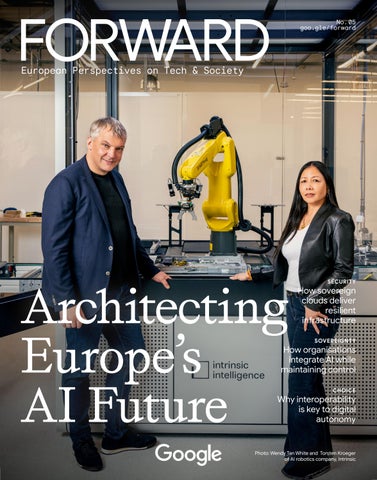
Photo: Wendy Tan White and Torsten Kroeger of AI robotics company, Intrinsic
EDITORIAL
Partnership. Choice. Security. Dear Reader, When I look around Europe today, I see incredible opportunities for a new generation of visionary leaders building the businesses to drive our region’s future economy. The time is now — the AI era gives businesses of all sizes access to the most powerful toolbox they’ve ever had. And the opportunity is here — for Europe’s heritage brands and agile startups to turn productivity and innovation into market advantage, and to lead globally. Over the past 25 years, European companies have used our tools and infrastructure to grow and innovate. AI creates the potential to boost the European economy by 1.2 trillion Euro within a decade, but this won’t happen by accident. When it comes to providing access to the latest technology, Europe too often puts itself at a disadvantage. In my conversations with business and policy leaders across Europe, I have listened closely to their concerns about sovereignty and European competitiveness. It is clear that they often perceive a paradox that Europe must choose between autonomy and growth. At Google, we believe that this is a false choice, and a premise that we challenge. 2
European businesses deserve access to the best AI tools and services wherever they come from. We understand that governments want world-leading technology in their countries and we want to be part of that. Digital sovereignty is about more than just controlling encryption keys: It’s about giving businesses the flexibility to operate on multiple clouds and securing data with the most advanced technologies. We combine cutting-edge AI capabilities with infrastructure designed to give European businesses greater control, choice and security. Our approach has been designed to meet the highest regulatory standards of existing sovereignty frameworks at the national level. We’re working with many European companies who are already strengthening their competitiveness, developing innovative new products and services. This is the foundation for economic growth and autonomy. In this edition of Forward, you’ll read inspiring stories of European companies and organisations using cutting-edge AI solutions without compromising on interoperability and safety — like Italian greentech startup Ganiga or Ireland’s Office of the Revenue Commissioners PHOTOS COVER AND BACK COVER: WINNI WINTERMEYER
AUTONOMY AND CONTROL
04
Debbie Weinstein President, Google EMEA
A Matter of Choice In the age of AI, digital autonomy means Europe has all the tools needed to safely innovate — and to remain the master of its own economic and digital development.
07
»Autonomy Recognises Interdependence« Konstantinos Komaitis on digital autonomy, cyber security and the path to a resilient European market.
08
Sovereign Perspectives Balancing innovation, competitiveness and indepen dence: What experts and politicians from across the continent say about Europe’s AI future.
10
Democratising Physical AI AI company Intrinsic is aiming at making intelligent robotics affordable and easy to use for companies of all sizes. Europe plays a leading role in this new era of AI innovation.
13
A Catalyst for Autonomy and Success How AI enables companies and organisations all over Europe to stay competitive, to innovate and to strengthen privacy and data safety.
16
»Stop Focusing on What We Don’t Have« How can Europe navigate the balance between regulation, innovation and digital sovereignty in the age of AI?
18
Investing in Europe How Google contributes to extending AI infrastructure by building data centres and developing cloud regions.
(see page 13). You will find out why physical AI — smart robots used for industrial purposes — is particularly key for European competitiveness and why the continent is well-placed to play a key role in this new field of technology (see page 11). But don’t just take it from me. In this edition a diverse range of AI, cybersecurity and digital policy experts discuss what Europe needs to unlock the vast potential of AI, while keeping its autonomy and remaining secure. I agree with Konstantinos Komaitis, an Internet policy expert with the Atlantic Council, who argues that resilience does not mean isolation (see page 7). Simply put, tech sovereignty means European business leaders should be able to build globally competitive products based on the world’s most advanced techno logies. Because Europe deserves the best.
Yours, Debbie Weinstein ILLUSTRATION: CAMILO HUINCA
3
CHOICE
A MATTER OF CHOICE In the age of AI, digital autonomy means Europe has all the tools needed to safely innovate — and to remain the master of its own economic and digital development.
4
ILLUSTRATIONS: CON MCHUGH
AUTONOMY AND CONTROL
Artificial intelligence is transforming daily life for millions of Euro peans, helping individuals work, learn and communicate more efficiently. On a larger scale, it represents a massive opportunity for the entire continent. Research conducted by Implement Consulting and commissioned by Google shows that widespread adoption of AI could boost the European Union’s GDP by €1.2 to €1.4 trillion — an 8 percent increase — over the next ten years, driven primarily by productivity gains across all major industries. To turn this vast potential into reality, European businesses are focusing on accelerating technology integration. Currently, only about 20% of EU enterprises with ten or more employees utilise AI technologies. As policymakers and business leaders discuss the best path forward, the conversation often centers on digital sovereignty. While some discussions emphasise local development and protective frameworks, many experts argue that a balanced approach of digital autonomy is about openness and choice (see interview with Konstantinos Komaitis, page 7). Google shares this view, as Giorgia Abeltino, Head of Government Affairs and Public Policy for Google Cloud in EMEA, explains: »Our approach to sovereignty, developed over many years, is grounded in delivering tangible, technical and verifiable control as well as open choice, while investing in the growth and security of Europe’s digital infrastructure.« Security is key Security is a vital dimension of autonomy, and it involves protecting sensitive information, establishing clear data residency and keeping data unencrypted only when under explicit customer control. This foundation ensures that European companies know exactly where
37%
of organisations worldwide are currently using sovereign cloud solutions, and a combined 44% plan to adopt them in the coming years, according to a report from IDC published in September 2025.
»Our approach to sovereignty, developed over many years, is grounded in delivering tangible, technical and verifiable control as well as open choice.« GIORGIA ABELTINO, HEAD OF GOVERNMENT AFFAIRS AND PUBLIC POLICY GOOGLE CLOUD EMEA
their data resides and can enforce strict regional access boundaries. Through our deep »Made with Europe« collaborations with regional champions — including S3NS in France; Thales, the Schwarz Group and T-Systems in Germany; PSN in Italy; Clarence in Luxembourg; and Telefónica in Spain — we are actively delivering the operational resilience and jurisdictional controls designed to meet the highest regulatory standards of existing sovereignty frameworks at the national level. Across our partner-led sovereign solutions, the S3NS offering in France has been qualified to meet SecNumCloud 3.2, Europe’s highest sovereignty regulatory bar. Our partners Clarence and S3NS, together with Mistral, offer services that have been approved by the EU Directorate-General for Digital Services (DIGIT) for use by EU Institutions who have sovereign cloud needs. Economic dimension of digital autonomy While robust security forms an indispensable shield, digital sovereignty remains incomplete without its second, offensive dimension: autonomy through economic enablement. History demonstrates that long-term technological leadership belongs to those who are best at adopting and implementing technology. The global AI race, too, is about putting AI to work rather than owning the Large Language Model or infrastructure. Europe’s competitive edge in this race lies in its world-class industrial base and its ability to apply advanced AI technology to highly specialised, high-value fields such as robotics, precision engineering and smart manufacturing (see interview on page 10). For European enterprises — from startups to global market leaders — autonomy means the freedom to select, utilise and transition between technologies that fit their needs.
5
CHOICE
Forward-thinking European organisations are already seizing this opportunity, making proactive, conscious AI choices to drive their growth and secure their digital future. In the article on page 13 you will find various examples — e.g. the techbio company Omniscope — of how they integrate Google AI capabilities into their strategies to optimise or transform business models. These companies recognise that utilising world-class global infrastructure is the fastest, most effective way to innovate safely and to secure their competitive survival in a globalised market. Beyond the commercial landscape, trust in secure partnership extends directly into the most critical sectors. Defence organisations and national security institutions across Europe rely on Google’s secure, sovereign architectures. Defence entities such as the German Armed Forces (Bundeswehr), or the U.K. Ministry of Defence have selected Google Cloud’s air-gapped solutions to run critical workloads with complete operational survivability and zero external connectivity (see box on page 6). No matter what European companies and institutions use AI for, they need to be in charge of how they do it. »We believe sovereignty has to be the power to decide under your own terms,« says Karen Massin, Head of Government Affairs and Public Policy of Google in Europe. »Choosing what you want as a solution, what partner, customising for your needs locally and making sure you’ve got the control you want to put in place.« Having this choice right now is vital for European companies to fully benefit from AI, as its positive impact strongly correlates with the speed of adoption. Many of them are eager to quickly shift from a theoretical debate to a confident implementation strategy — both by building Europe’s own technology and infrastructure and by using the technology and infrastructure provided by others.
Sovereign Cloud Portfolio Google Sovereign Cloud offers a comprehensive set of solutions to help customers meet their sovereignty needs with confidence. Google Cloud Data Boundary: Customer data can be stored in a chosen region (EU) and cannot be moved. Administrative access is restricted to EU personnel only, and is logged, audited, and controlled according to the customer's predefined con ditions. Encryption keys are stored and managed in a third-party key management system outside Google Cloud’s infrastructure, ensuring full separation between data and key control. Google Cloud Dedicated: An independent cloud universe (dedicated infrastructure) operated by a local partner on isolated infrastructure that offers compliance with national standards, operational autonomy, uncompromised innovation and the ability to continue to operate if disconnected from Google. In Europe, the offering in collaboration with Thales provides a robust set of Google Cloud services, including GPUs to support AI workloads dedicated to a region. Disaster-recovery-capable, sovereign cloud solutions for Europe. Google Cloud Air-Gapped: Fully standalone cloud environment deployed on-premises that operates without any external network connectivity, ensuring data remains under physical and operational control of the customer. Runs on open-source components, ensuring complete operational survivability for defence and public-sector workloads.
»We believe sovereignty has to be the power to decide under your own terms.« KAREN MASSIN, HEAD OF GOVERNMENT AFFAIRS AND PUBLIC POLICY OF GOOGLE EU
6
Learn more on: cloud.google.com/sovereign-cloud
INTERVIEW
AUTONOMY AND CONTROL
»Autonomy recognises the reality of interdependence« Konstantinos Komaitis, Senior Resident Fellow for Global and Democratic Governance at the Digital Forensics Research Lab at the Atlantic Council, shares his view on digital autonomy, cybersecurity and the path to a resilient European market in the age of AI.
As an internet policy expert, how do you define digital sovereignty? The primary challenge is that »sovereignty« is an extremely loaded term. It implies borders, geography and concrete parameters of control. I don’t believe Europe can — or should — replicate this approach for the digital world. Instead of fighting over a definition that pleases everyone, we should view sovereignty through the lens of properties. What characteristics must our systems possess to achieve our goals? Openness, interoperability and resilience are properties that, if properly cultivated, allow us to achieve autonomy without succumbing to isolationism — which is a dangerous trap. What kind of trap do you mean? The sovereignty trap is the confusion between substitution and sovereignty. Just because you localise technology stacks or tighten procurement rules to »buy European« does not automatically lead to sovereignty. If you focus solely on self-containment, you end up creating a »European Internet« that works only for Europeans, without the scale or competitiveness required to influence global standards. Furthermore, Europe is not homogeneous. If member states fragment the market by choosing 27 different products and approaches, we will continue to lose ground. We are currently learning that over-regulation, providing frameworks without a cohesive innovation agenda, is holding us back. What are the economic risks of prioritising »Made in Europe« over the best available technology? While you might achieve a form of sovereignty, it won’t be competitive. True autonomy recognises the reality of interdependence. If you look at the US, they don’t have unique, local stacks for everything.
Their chips, infrastructure and software come from all over the world. They exercise sovereignty by assembling the components in a way that allows them control. Europe needs to shift focus from creating everything in-house to creating an environment that incentivises venture capital and innovation. You emphasise interoperability as a key pillar of autonomy. How can this be achieved effectively? It must be market-driven. The goal is to design open, modular systems and API-driven architectures where switching becomes technically easy rather than legally forced. If the market prioritises interoperability as a competitive advantage, it responds faster and more efficiently than top-down regulation. You also emphasise resilience. What role does it play for sovereignty? Cybersecurity is the biggest motivator. We are facing a massive wave of attacks, and the fear of a successful breach leads many to believe that sovereignty means shutting everything down. But resilience does not mean isolation. In network systems, centralisation creates a single point of failure, which is a massive risk. The internet was built on the premise of building blocks — when a security incident occurs, you address that specific block without destroying the whole system. Autonomy, in this sense, means fostering a network of trust where collaborators can work together to patch vulnerabilities. Why is trust so important? Trust is the foundational layer of our digital ecosystem. When you undermine it — whether through infiltration or interception — you undermine the technology itself. Europe needs to build a predictable, consistent legal environment and foster open-source collaboration to restore and maintain that trust.
7
VOICES
Sovereign Perspectives
Niamh Smyth
»We need to have an open and constructive discussion on digital sovereignty. It is important that Europe strengthens its resilience and strategic capabilities in a way that also supports innovation, investment and competitiveness. A collaborative approach will help build consensus and ensure Europe is well positioned to seize the opportunities of the AI and Digital era.«
Minister of State for Trade Promotion, AI and Digital Transformation, Ireland
»The best sovereignty we can have is to make sure European companies can scale globally. Europe should not become protectionist but rather focus on allowing European companies to grow and compete globally.« Arba Kokalari
Swedish Member of the European Parliament (EPP) »The winners will not simply be those who adopt AI fast. The winners will be those who deploy it better — more intelligently, more efficiently, and more strategically.« Mauro Capo
Digital Sovereignty Lead EMEA, Accenture
8
ILLUSTRATIONS: SOME ELEMENTS EDITED OR CREATED WITH AI (GOOGLE GEMINI)
AUTONOMY AND CONTROL
Balancing innovation, competitiveness and independence: What experts and politicians from across the continent say about Europe’s AI future.
»(Ten years from now) I see a Europe which is a leader in technologies, in AI and quantum, which is open but has firm control. Where we have access to the best technologies — we can change them, we can develop them, we can integrate them and we can switch if a provider is not good enough for us.« Milena Jabůrková
Czech Confederation of Industry
»It’s not about exclusion; it’s about building our own capabilities and making sure also that people start co-developing instead of just buying technology passively. That’s really what sovereignty is about. It’s about also making it here.« Thibaut Kleiner
Director for Future Networks at DG CONNECT, European Commission
»Sovereignty does not mean being able to build everything yourself. It means ensuring you are not overly dependent on any one company or country for your overall requirements.« Caroline Read
UK Deputy Ambassador to the EU
9
INNOVATION
10
AUTONOMY AND CONTROL
Democratising Physical AI Intrinsic, an AI robotics group at Google, is aiming at making intelligent robotics affordable and easy to use for companies of all sizes. CEO Wendy Tan White and Chief Science Officer Torsten Kroeger explain why software is the key to this transition and why Europe plays a leading role in this new era of AI innovation.
What does Intrinsic work on? Wendy Tan White: Our core mission is to democratise access to intelligent robotics. Today, robotics is highly brittle; building applications is an incredibly difficult, time-consuming and expensive process. Operators usually have to stitch together highly customised software and hardware, managing a fragmented stack of proprietary tools. We want to make writing robotic software as simple as writing software for computers or mobile phones is today. With our platform, people see us as the Android of robotics and AI. We extend hardware capabilities through machine learning, with software serving as the defining layer. What’s the difference between intelligent robotics and traditional industrial robots? Torsten Kroeger: The robots you see on manufacturing lines today operate on concepts originating from the 1970s and 1980s. This architecture was never designed for data integration, making it impossible to inject modern AI or machine learning models. We bring a completely new approach, equipping industrial robots with a sense of vision and a sense of touch. To do this, we go deep into the lowlevel software control layers, cooperating directly with major robot manufacturers.
INTRINSIC
In early 2026 Intrinsic joined Google as an AI robotics group, having spun out from X, Alphabet’s Moonshot Factory in 2021. The Intrinsic platform makes it possible to develop, deploy and operate sophisticated AI robotic solutions faster in more cost-efficient ways. Utilising the capabilities of Gemini models and Cloud, while working closely with Google DeepMind, Intrinsic is helping accelerate work across frontier AI spanning R&D through to deployment for real industrial use cases in manufacturing and logistics. The company is led by British tech entrepreneur Wendy Tan White (CEO) and German roboticist and computer scientist Torsten Kroeger (CTO / Chief Science Officer).
PHOTOGRAPHS: WINNI WINTERMEYER
Wendy: By giving robots a sense of vision and touch, we enable them to adapt in real time. In the physical world, things are unpredictable. If a part is bumped, dropped or shifted, a traditional robot fails. An intelligent robot powered by physical AI sees and feels the change, adjusts its path, and continues. This is a massive cost-saver. And it allows the robot to adapt immediately if a human walks into its workspace, turning a rigid machine into a safe, cooperative assistant. And probably a very flexible one, too? Torsten: Exactly. If a new part is introduced that the system has never seen before, the robot can handle it right away. For example, in server manufacturing factories, we use robots to automate hard drive insertion. By simply changing the software and the programme, we can use that same robotic cell to insert mainboards or memory modules. Historically, you would have needed entirely different hardware setups and separate robots. The programming was the most expensive part, requiring weeks or months of specialised engineering. Now we can change tasks within hours or swap robots, even of different brands, while running the exact same software within a day. Intrinsic is headquartered in Silicon Valley. Why do you have an office in Munich? Torsten: Germany has a strong, deep ecosystem in industrial hardware and automation, and is driving international standardisation. Expert knowledge in Industry 4.0, industrial standards and system
11
INNOVATION
»Europe is in a fantastic position to play a key role in physical AI.« TORSTEN KROEGER
safety is highly concentrated in Europe, and our team must understand both software and manufacturing hardware. It is about combining Silicon Valley’s software and AI development with Europe’s deep industrial expertise, creating a very special, hybrid culture. Our Californian and German teams learn a lot from each other and bring the best of both domains to the platform. So Europe and the people in its workforce are critical for developing and orchestrating physical AI in society. Exactly how important is physical AI for Europe? Wendy: Europe faces declining birth rates and a severe shortage of skilled labour in manufacturing. If we want to maintain our standard of living, local GDP and economic relevance, we must have the capability to manufacture locally in Europe in more sustainable ways. COVID-19 showed how brittle global supply chains are, triggering a major push towards nearshoring. One clear way to help solve this is through AI and automation. With physical AI, businesses and their teams benefit from much greater flexibility in day-to-day operations, making local manufacturing with robotics feasible, cost-effective and manageable for the first time. Torsten: Our work with European partners like Trumpf on sheet metal processing, and with Martin Systems on tending CNC (Computer Numerical Control) machines, helps address labour shortages for their customers. Furthermore, Europe is in a fantastic position to play a key role here because of data. Large Language Models are trained on data from the internet, but for physical AI, there are no public websites containing joint angles, joint torques or robot motor data. Many European manufacturing companies have access to that data. They can leverage this treasure box to train advanced AI models for next-generation manufacturing. Aren’t these smart robots out of reach for smaller companies? Wendy: Not at all. We work with CNC system integrators in Germany to install standardised AI-enabled robot cell designs inside smaller machine shops, which are the backbone of the economy across Europe. Because our software helps them standardise their systems, it can substantially reduce the cost, allowing them to amortise the investment of the cell over multiple different tasks and timelines.
12
Most importantly, these systems are easy to use and operate day to day for the people who are responsible for production on the shop floor. This is what we mean by »democratising«. With AI working behind the scenes, we can keep user interfaces simple and familiar to machine tool operators, removing the need for specialised training and time-intensive upskilling. They can manage more machines, do small batch production and get assistance for lower value tasks from a robot. How do you balance cloud-driven AI robots with Europe’s strict data sovereignty requirements? Wendy: We always take this into account because we know manufacturers want complete control of their data and often prefer running systems on-premises. Most of our core applications run locally on-premises, not in the cloud. We use the cloud for software updates and for training models, but the runtime production is independent of the cloud. We don’t limit our customers; we support their preferred architecture. Additionally, Google Cloud offers various sovereign cloud options. So our customers have choice, both with regard to AI applications and cloud solutions. Torsten: This is also where the German research project RoX comes in. In order to protect a company’s IP, they must stay in control of their data. The RoX project is a consortium of key industry players preparing a framework to provide a distributed, decentralised and sovereign way of handling data assets, developing software interfaces for these assets together. Will physical AI change the role of traditional factory workers? Wendy: It is similar to what we see with LLMs today: Humans become enablers and orchestrators of automation. They are freed from highly repetitive, dangerous and physically damaging tasks. There is still a human in the loop, but instead of repeating the exact same physical task on an assembly line every few seconds, they automate those tasks, allowing them to focus on process design, product optimisation and rapid testing. We will see the rise of experts who understand the assembly process and teach it to the robot so it can execute the task. I think this technology will truly revitalise the industry. It attracts people from traditional desk jobs back into physical manufacturing.
AUTONOMY AND CONTROL
A CATALYST FOR AUTONOMY AND SUCCESS How AI enables companies and organisations all over Europe to stay competitive, to innovate and to strengthen privacy and data safety.
Driving the future of waste intelligence
Shortening the time from research to application Healthcare research is advancing rapidly, but there are challenges in bringing these new discoveries into practical use, leaving patients behind. Techbio company Omniscope is bridging this gap by creating the world’s largest immune data bank, to decode the complexity of our immune system and develop diagnostics and therapeutics. Creating the data bank requires a huge amount of computing power, so Omniscope chose to partner with Google Cloud to take advantage of the immense power and scalability of their cloud and AI solutions. In just a few seconds, Cloud Run boosts instances from 0 to 10,000, helping Omniscope to develop new products quicker and minimise cost, while GCP Sovereign Controls ensures they stay ahead of stringent medical data regulations. Omniscope, which for instance is decoding the immune system in areas such as computational vaccine design with the European Commission, can now deploy more sophisticated machine learning models and analyse up to millions of immune cells in an instant. According to Vijay Vaswani, Co-founder and CEO, the partnership with Google does not only accelerate Omniscope but society as a whole: »For Omniscope, access to Google Cloud’s infrastructure and AI is a way to reduce the time that separates data from new discoveries, the cloud from the cure and ultimately, the development times of transformative treatments that could redefine healthcare as we know it.« ILLUSTRATIONS:CAMILO HUINCA
To help solve Europe’s pressing waste management challenges, Italian green-tech startup Ganiga has developed an AI-powered platform that transforms waste into actionable data. Designed and built in Europe, Ganiga’s solutions automatically identify, classify and analyse waste in real time, helping organisations improve recycling performance, reduce operational costs and make sustainability measurable. Ganiga combines its proprietary AI and computer vision technology with Google’s Gemini and Vertex AI to recognise waste in less than one second. According to the company, the system identifies materials and brands with an accuracy of 95%, turning every discarded item into audit-ready KPIs that support ESG reporting, operational optimisation and smarter decision-making. Alongside waste intelligence, Ganiga has also developed Food Waste Intelligence, an AI solution that identifies food waste, estimates its economic impact and provides actionable insights to help kitchens, restaurants and large-scale catering reduce waste before it occurs. By transforming both waste and food waste into measurable data, Ganiga enables organisations to focus less on waste management and more on improving efficiency, sustainability and their core business.
13
INNOVATION
Protecting patient data while driving innovation The digitisation of university hospitals has the potential to both elevate patient care and reduce the strain on staff. At the same time, it must be implemented with the utmost care to prevent security breaches and protect sensitive patient data. The University Medical Center Freiburg uses Google Cloud and T-Systems to power their digitalisation journey with the cloud, while retaining full sovereignty of their data. »The high security and performance of the cloud solution enables us to drive patient-oriented innovations faster and thus increase the quality of care,« explains Prof. Frederik Wenz, Chief Medical Director of the University of Freiburg Medical Center. The cloud-based solution they use will drive innovation and progress in multiple areas, ranging from the speed and scalability of genomic use case evaluations to leveraging AI to improve website accessibility and build digital surgical assistants. It also has scope for groundbreaking future applications, such as eliminating training bottlenecks by substituting in-demand emergency and operating rooms for realistic virtual versions to seamlessly train the next generation of medical practitioners.
14
Ireland’s Office of the Revenue Commissioners has entered a seven-year partnership with Google Cloud to modernise its data infrastructure. While in the past, important information was stored across many different, separate systems, the collaboration will help bring all that information together into a single, secure place. They are migrating from legacy on-premises systems to a state-of-theart, unified AI architecture on Google Cloud. This new, unified system means that Revenue’s teams can analyse data and find insights without having to constantly move or copy information. This not only saves time and money but also makes the whole system much more efficient. To further accelerate time-to-insight and lower the technical skills barrier, the platform is enhanced by powerful AI capabilities, featuring Gemini as an embedded assistant to provide intelligent code completion, translate natural language prompts into complex SQL queries and automatically generate visualisations for business analysts. Needless to say that for a public body like Revenue, protecting the privacy of taxpayers’ data is of the utmost importance. Consequently, all of Revenue’s data will be stored and handled exclusively within the EU, ensuring strict compliance with local regulations. Revenue retains total control over its encrypted data, holding the exclusive keys to make information unreadable to anyone else — including Google — at any time.
Photography: Faruk Pinjo; © Architecture: Health Team Vienna, Albert Wimmer ZT & Architects Collective
Serving the taxpayers efficiently
AUTONOMY AND CONTROL
Made with Europe To offer sovereign solutions, Google Cloud works with trusted technology leaders all over the continent.
France Thales developed a sovereign hyperscale cloud offering for Europe, using Google Cloud technology, marking a significant milestone in European digital sovereignty. The partners first established S3NS, an independent French entity fully controlled by Thales, to operate an infrastructure combining hyperscale cloud innovation with strictly managed local operational control. As a global leader in defence, security and cybersecurity, Thales brings decades of respected expertise in protecting the most sensitive data and infrastructure in Europe and the world. Now branded »PREMI3NS«, this offering is designed to meet the rigorous security and operational resilience requirements of France’s SecNumCloud qualifications and become the first European hyperscale cloud offering. It provides all European companies and public sector organisations the possibility to access a rich set of state-of-the-art services, well beyond a basic IaaS portfolio, from a domestic provider instead of having to source its cloud outside of Europe. This ensures they can migrate sensitive applications with full confidence, to modernise critical infrastructure and protect it with world-class cybersecurity without sacrificing the usage of innovative services and frontier AI models. After the first S3NS’ successful French instantiation (it has been selected by the European Commission as one of the official Sovereign Cloud providers for European Institutions), Thales has engaged to develop a second independent cloud service provider in Germany and extend its broader European footprint.
Spain
Luxembourg/Belgium
Telefónica and Google Cloud will deliver a new sovereign cloud offering enabling Spanish public administrations and private companies, particularly those in highly regulated sectors, to maintain strict control over their data hosted on Google Cloud.
Clarence delivers a sovereign airgapped cloud designed for the most critical environments — Europe’s first fully disconnected sovereign cloud environment, located in Luxembourg. Operated through the joint expertise of Belgium Proximus and LuxConnect and initially built on Google Cloud technologies, the platform combines advanced capabilities with an increasing openness to opensource solutions and the integration of European third-party software.
Italy Built in collaboration with Telecom Italia (TIM), the Google Cloud region Milan provides innovative public, private and hybrid cloud services to help Italian companies of all sizes and across all industries accelerate digital transformation.
Germany Thales and Google Cloud have signed a partnership to launch a new European sovereign cloud offering in Germany, delivering advanced cloud capabilities to customers while keeping their data confidential, secure and fully sovereign.
15
CONVERSATION
»Stop focusing on what we don’t have« How can Europe navigate the delicate balance between regulation, innovation and true digital sovereignty in the age of AI? These and other questions were discussed by Marta Poslad, Head of Public Policy for Central and Eastern Europe at Google, and Daniel Friedlaender, European Head of the Computer & Communications Industry Association CCIA, at the POLITICO Speakeasy at GLOBSEC Forum 2026 in Prague. Below is an edited version of the conversation.
What are the most critical decisions Europe needs to get right in the next few years when it comes to AI? Daniel Friedlaender: We should acknowledge that the European Commission is genuinely trying something different. The fact that shortly after their landmark AI Act, they acknowledge that the pre vious approach was wrong, is significant. I worry that this well- intentioned simplification drive is at the edge of a precipice. I think the industry needs to keep pushing, positively encouraging and showcasing why it benefits everyone.
Marta Poślad: Since 2019, there have been more than 100 regulations that have affected the digital economy. The numbers speak for 16
themselves: Over 60% of European businesses cite regulation as a reason that holds them back from further investment. So, that is the very tangible aspect that needs to be solved, and I think it is measured, heavily opinionated and consulted. The less tangible aspect is trust, and how we build an environment to position Europe in the age of AI. How does simplification accelerate adoption, and how would you categorise the efforts to simplify things thus far in Europe? Friedlaender: The intention is good, but it is running up against reality. We have seen that with both the AI omnibus and the digital omnibus, but we have also seen it with this urge to keep putting out new rules that will actually create some of the same problems we have seen
AUTONOMY AND CONTROL
before. We have a whole bunch of new legislation about to come out — even more digital rules. Some will overlap with existing, not yet fully implemented rules. What the industry needs is certainty and clarity. And the digital single market has to be finished. This is why many European champions grow, scale and earn far more revenue outside Europe than within it. How can Europe foster innovation while maintaining high security standards that are vital to building trust? Poślad: You mentioned security, but there is another word heard very often these days: sovereignty. At Google, we talk about being »made with Europe«. We provide sovereign solutions that are open and hybrid, without ever compromising on security. Sovereignty also means freedom of choice — not limiting options but giving partners the freedom to choose. Many of the regulations tend to limit these options, and that is not a good way forward.
Friedlaender: The sovereignty debate risks pulling attention and energy away from what actually works. Europe should stop focusing on what we don’t have and instead leverage what we do: a strong integrated global supply chain. The AI economy wouldn’t function without ASML, without Zeiss. Companies like SAP, Ericsson and Nokia are fundamental to US infrastructure. American companies invest heavily in Europe and have always been trusted partners to local businesses. The sovereignty conversation, as it’s currently framed, risks ignoring or dismantling that. If that happens, we are all worse off.
»I want to look back and say: They resisted the easy, short-term protectionist path. They thought long-term.« DANIEL FRIEDLAENDER
Poślad: It is also a good moment to honour the European businesses that have started speaking up. This debate is not just between US industry and EU institutions. We have seen many valuable contribu tions from European businesses. They want to interpret their sover eignty through the ability to choose. How about cybersecurity? AI presents lots of opportunities, but it is also changing the threat landscape in real time. Friedlaender: If Europe’s reaction is just, »We want our own«, that does not lead to the right discussion. We need to have clear, strong partnerships between the institutions, which I actually think we have in most cases. Many cybersecurity interactions between global com panies, developers and regulators are positive and effective, though they rarely make the news.
Poślad: At Google, we often talk about the defender’s dilemma. With the increase in risks and threats, our ability to defend ourselves is getting higher, more accessible and cheaper. The more partnerships you have, the more secure you are going to be. This is what the US tech industry offers European partners, and it must not be put at risk. We see many new suggested pieces of legislation trying to decrease our cybersecurity at the cost of protectionist sovereignty.
»The more partnerships you have, the more secure you are going to be. This is what the US tech industry offers, and it must not be put at risk.« MARTA POŚLAD
One year from now, what would you like to see done, to make the AI ecosystem more successful? Poślad: I’d like Europe to look to countries like Czechia and the Baltic states — small nations that understand the value of growth beyond their borders. Their hunger for innovation and their entrepreneurial mindset hold real lessons for the broader European debate.
Friedlaender: Bold decisions. Leaders need to pick a few things and commit. Failing to choose creates uncertainty, which helps no one. A year from now, I want to look back and say: They resisted the easy, short-term protectionist path. They thought long-term. And they actually did it. 17
INFRASTRUCTURE
AUTONOMY AND CONTROL
INVESTING IN EUROPE AI infrastructure is vital for the continent’s competitiveness, and Google is committed to reinforcing this infrastructure by building data centres, developing cloud regions and collaborating with local partners on sovereign solutions across Europe. Here is an overview of current and future investments as of September 2026.
Google Data Centres Announced (not yet operational)
Physical facilities housing the local computing power, storage hardware and energy-efficient infrastructure that anchor Europe’s digital economy to European soil.
Stockholm
Vaala
Horndal Berlin Fredericia Muhos
Skien Frankfurt Eemshaven Winschoten
Google Cloud Regions
Geographically isolated clusters of data centres across Europe that guarantee customer data is stored, processed and backed up strictly within specified national or EU boundaries to ensure low latency and regulatory compliance.
Groningen Netherlands Middenmeer
Hamina Finland
Saint-Ghislain
Warsaw Dublin
Data Boundaries for Sovereign Controls by Partners
Advanced, compliance-driven software perimeters operated in direct collaboration with local European security partners to ensure that external encryption keys and data access remain entirely under sovereign European control.
Waltham Cross
Hanau Dietzenbach Kronstorf
London Paris Belgium Farciennes
Madrid
Milan
Zurich
Turin
Copy
18
ILLUSTRATION: SIMON LANDREIN
PUBLISHING INFORMATION
Google Ireland Limited, Gordon House, Barrow Street, Dublin 4, Ireland | Phone: +353 1 543 1000 | Fax: +353 1 686 5660 | Contact: goo.gle/contactgoogle | Managing Directors: Elizabeth M. Cunningham, David M. Sneddon, Vanessa Hartley, Colin Goulding, Amanda Storey | Google Ireland Limited is a corporation formed and registered under Irish law | Company number: 368047 | EU VAT identification number: IE6388047V This is a special promotional publication by Google. Produced in Germany. Thank you to the team at SZ Scala GmbH.
GU9 This printed matter has been awarded the Blue Angel.
European Perspectives on Tech & Society