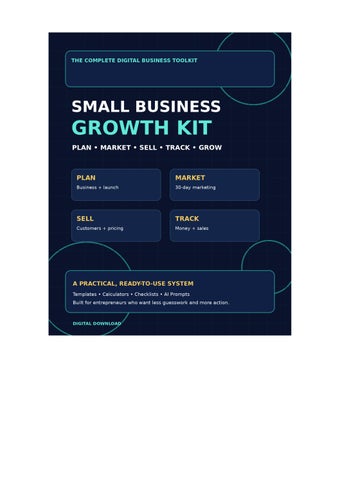
SMALL BUSINESS GROWTH KIT The practical system for turning a business idea into customers, sales, organized finances and repeatable growth.
How to use this kit Do not try to complete everything in one sitting. Work through the kit in order. First define the offer, then build the plan, attract customers, track money, and finally create a repeatable growth routine. Replace every example with your own numbers and business details.
1. Business Idea Workbook • Write the problem you solve in one sentence. • Define your ideal customer: who they are, where they are, what they need and what they already use. • List three competing alternatives and explain why your solution is easier, faster, cheaper, safer or better. • Describe your product/service, delivery method and expected price. • Test the idea with at least 10 potential customers before spending heavily. Key action: Output: one clear customer + one painful problem + one specific offer.
2. Business Planning Template • Business name and location • Problem and target customer • Product/service and unique value • Competitors and competitive advantage • Startup costs and monthly operating costs • Pricing and expected sales volume • Marketing channels • 90-day goals and weekly actions Key action: Rule: every goal must have a number and a deadline.
3. 30-Day Marketing Plan • Days 1–5: clarify offer, profile and proof. • Days 6–10: publish educational/problem-solving content. • Days 11–15: show demonstrations, before/after results or case examples. • Days 16–20: run a direct offer and ask for referrals. • Days 21–25: follow up with interested prospects. • Days 26–30: review leads, sales, best content and repeat the winners. Key action: Daily minimum: one useful piece of content + five meaningful customer conversations/follow-ups where appropriate.
4. Customer Acquisition Checklist • Choose 2–3 channels only at first.
• Create one clear call-to-action. • Build a simple lead list. • Ask existing customers for referrals. • Follow up after inquiry, quote and purchase. • Record source of every lead. • Measure leads → conversations → quotes → sales. Key action: Do not judge marketing by likes alone; judge it by qualified leads and revenue.
5. Pricing Calculator • Calculate direct cost per unit/service. • Add a share of overhead. • Estimate desired profit. • Check competitor price ranges. • Set a minimum acceptable price. • Create good/better/best packages when appropriate. Key action: Basic formula: Price = Total unit cost + desired profit. For a target margin: Price = Cost ÷ (1 − target margin).
6. Income & Expense Spreadsheet • Record every sale by date, customer and product. • Record every business expense by date and category. • Separate personal spending from business spending. • Reconcile cash/bank/mobile-money records regularly. • Review gross profit and net cash position monthly. Key action: Suggested columns: Date | Description | Category | Income | Expense | Payment method | Customer/Supplier | Notes.
7. Invoice Templates • Business name/contact • Invoice number • Invoice date/due date • Customer details • Item/service description • Quantity • Unit price • Subtotal • Tax/discount if applicable • Total due • Payment instructions • Terms and late-payment policy.
Key action: Use sequential invoice numbers and keep copies.
8. Quotation Templates • Customer need • Scope of work • Deliverables • Quantity • Unit price • Validity period • Timeline • Payment terms • Exclusions/assumptions • Acceptance section. Key action: Always state what is included and what is not included.
9. Customer Database • Customer name • Contact • Location • Product/service purchased • Date of purchase • Amount spent • Lead source • Last contact • Next follow-up • Status • Notes. Key action: Collect only information you genuinely need and protect customer data.
10. Social-Media Content Calendar • Monday: customer problem • Tuesday: educational tip • Wednesday: product/service demonstration • Thursday: customer story/proof • Friday: offer or FAQ • Saturday: behind-the-scenes • Sunday: recap/planning. Key action: Repurpose one strong idea into a short video, post, email and FAQ.
11. 100 Marketing Prompts • Explain the biggest mistake customers make with [problem]. • Show how your product works in 30 seconds. • Answer the top five questions customers ask. • Compare your solution with doing nothing. • Share a customer success story. • Explain how your price is determined. • Give a checklist customers can use today. • Show behind the scenes. • Bust a common myth in your industry. • Invite prospects to a simple consultation. Key action: Multiply these ten prompt types across your product, audience, objections and customer stages to create 100 usable prompts.
12. 50 AI Prompts for Business Owners • Create 10 social posts for [offer] aimed at [customer]. • Rewrite this offer to focus on customer outcomes. • Give me 10 objections customers may have and responses. • Turn this customer review into three marketing posts. • Create a follow-up sequence for a prospect who requested a quote. • Analyze this pricing table and identify weaknesses. • Create a 30-day content calendar for [business]. • Turn these notes into a professional proposal. • Generate FAQs for [product]. • Give me five ways to increase repeat purchases. Key action: Never paste confidential customer, financial or personal information into an AI tool unless your privacy/security arrangements permit it.
13. Daily Business Planner • Top revenue task • Top customer task • Marketing task • Operations task • Money/admin task • Three must-do actions • End-of-day result: leads, sales, cash received, follow-ups pending. Key action: Protect the first working block of the day for the task most likely to create revenue or customer value.
14. Weekly Sales Tracker
• Leads received • Qualified leads • Quotes sent • Sales closed • Conversion rate • Revenue • Average order value • Lost sales and reason • Follow-ups due. Key action: Weekly conversion rate = Sales closed ÷ Qualified leads × 100.
15. Monthly Business Review • Revenue vs target • Gross profit • Expenses • Cash available • Best-selling offer • Best customer source • Marketing that worked • Problems/returns • Outstanding payments • Three priorities for next month. Key action: Finish every review by choosing only three major priorities.
16. Customer Follow-Up Templates • After inquiry: thank them, restate their need, give the next step. • After quote: ask whether they have questions and when they expect to decide. • After purchase: confirm satisfaction and offer support. • After delivery: request feedback/testimonial. • Inactive customer: share a relevant reason to return. Key action: Follow up helpfully, not aggressively.
17. Business Launch Checklist • Validate demand • Choose name/brand • Define offer • Set price • Prepare payment method
• Create invoice/quote • Set up customer record • Create basic marketing assets • Test delivery process • Get first 10 customers • Collect feedback • Improve before scaling. Key action: Launch the smallest version that can genuinely deliver the promised result.
18. Profit Calculator • Revenue = selling price × units sold. • Gross profit = Revenue − direct costs. • Operating profit = Gross profit − operating expenses. • Profit margin = Profit ÷ Revenue × 100. Key action: Track profit separately from cash in the bank; a business can show sales while still suffering from poor cash flow.
19. Simple Cash-Flow Planner • Opening cash • Expected customer receipts • Other receipts • Supplier payments • Rent/utilities • Payroll/contractors • Marketing • Taxes/fees • Loan repayments • Closing cash. Key action: Closing cash = Opening cash + cash received − cash paid. Review future cash needs before committing to large expenses.
20. Business Growth Roadmap • Stage 1 — Validate: prove customers will pay. • Stage 2 — Stabilize: document delivery, pricing and bookkeeping. • Stage 3 — Acquire: identify the most profitable customer channels. • Stage 4 — Retain: improve repeat purchase and referrals. • Stage 5 — Systemize: automate repetitive work and document processes. • Stage 6 — Scale: expand only after unit economics and operations are healthy. Key action: Do not scale a broken process. Fix the offer, numbers and delivery first.
Recommended Product Tiers BASIC — $9.99
PRO — $19.99
COMPLETE — $39.99
Core workbook + selected templates
Full workbook + all templates
Everything in Pro + bonus systems
Business planner
Calculators + trackers
Editable master spreadsheet pack
30-day marketing plan
100 marketing prompts
50 AI prompts + prompt library
Launch checklist
Invoice + quotation templates
Commercial-use customization guide
PDF download
PDF + editable files
PDF + editable files + future bonus updates
Positioning: sell the outcome, not the number of files. The promise is a guided operating system that helps a small-business owner move from scattered ideas to organized action, measurable sales and better financial visibility.