1
A Story of Units®
Units of Ten TEACH ▸ Module 1 ▸ Counting, Comparison, and Addition
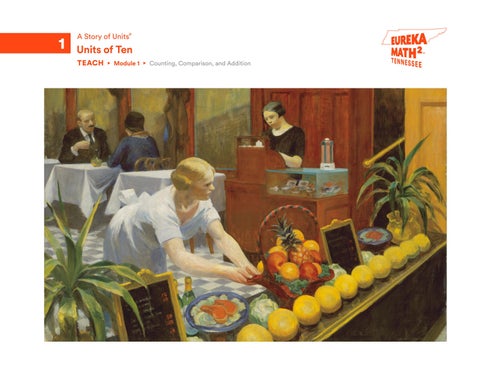
What does this painting have to do with math? American realist Edward Hopper painted ordinary people and places in ways that made viewers examine them more deeply. In this painting, we are in a restaurant, where a cashier and server are busily at work. What can you count here? If the server gave two of the yellow fruits to the guests at the table, how many would be left in the row? We will learn all about addition and subtraction within 10s in Units of Ten. On the cover Tables for Ladies, 1930 Edward Hopper, American, 1882–1967 Oil on canvas The Metropolitan Museum of Art, New York, NY, USA Edward Hopper (1882–1967), Tables for Ladies, 1930. Oil on canvas, H. 48 1/4, W. 60 1/4 in (122.6 x 153 cm). George A. Hearn Fund, 1931 (31.62). The Metropolitan Museum of Art. © 2020 Heirs of Josephine N. Hopper/Licensed by Artists Rights Society (ARS), NY. Photo credit: Image copyright © The Metropolitan Museum of Art. Image source: Art Resource, NY
Great Minds® is the creator of Eureka Math®, Wit & Wisdom®, Alexandria Plan™, and PhD Science®. Published by Great Minds PBC. greatminds.org Copyright © 2022 Great Minds PBC. All rights reserved. No part of this work may be reproduced or used in any form or by any means—graphic, electronic, or mechanical, including photocopying or information storage and retrieval systems—without written permission from the copyright holder. Where expressly indicated, teachers may copy pages solely for use by students in their classrooms. Printed in the USA 1 2 3 4 5 6 7 8 9 10 XXX 25 24 23 22 21 ISBN 978-1-63898-454-2
A Story of Units®
Units of Ten ▸ 1 TEACH Module
1 2 3 4 5 6
Counting, Comparison, and Addition
Addition and Subtraction Relationships
Properties of Operations to Make Easier Problems
Comparison and Composition of Length Measurements
Place Value Concepts to Compare, Add, and Subtract
Attributes of Shapes · Advancing Place Value, Addition, and Subtraction
Before This Module
Overview
Kindergarten Module 3
Counting, Comparison, and Addition
In kindergarten, students compare the number of objects in a set using language such as more than, fewer than, and the same as. They compare numbers to 10 using language such as greater than, less than, and equal to.
Kindergarten Module 5 Kindergartners represent composition and decomposition situations using number bonds and number sentences. They solve add to with result unknown and put together with total unknown problem types.
Kindergarten Module 6 At the end of kindergarten, students decompose teen numbers as ten ones and some more ones and write the decomposition as a 10+ fact.
Topic A Count and Compare with Data Data contexts provide natural opportunities for counting. Students collect data by answering questions, sorting sets, and making observations. They create bar graphs, picture graphs, and tally charts to visually represent the data. As students count to find totals and visually compare quantities, they recognize that linear organizations are useful. Students compare what they see using language such as more than, fewer than, and equal to, and represent these statements numerically using the symbols >, <, and =. Number paths and tally marks provide students opportunities for counting on from 5. 4
4
There are 14 bears.
6
6
4
4
There are more medium bears than small bears. 6>4 There are fewer large bears than medium bears. 4<6 The number of small and large bears is equal. 4=4
2
© Great Minds PBC
• This document is the confidential information of Great Minds PBC provided solely for review purposes which may not be reproduced or distributed. All rights reserved.
EUREKA MATH2 Tennessee Edition
1 ▸ M1
Topic B Count On from a Visible Part Students progress from finding totals by using the Level 1 strategy of counting all objects to using the Level 2 strategy of counting on from a known part. At first, objects are shown as two parts, such as the dots that appear on a pair of dice. Students choose a part they know, or can subitize, without counting one by one. They begin the count by naming the known part and then keep counting the objects in the second part to find the total: Fooouuur, 5, 6, 7, 8, 9, 10. Students advance to counting on from a part embedded within a total. For example, given a collection of apples, students represent two parts (4 apples and 6 apples) and the total (10 apples) by using number bonds and number sentences. They realize they can count on from either part and get the same total.
Fooouuur, 5, 6, 7, 8, 9, 10
4
6 4 + 6 = 10 10
© Great Minds PBC
• This document is the confidential information of Great Minds PBC provided solely for review purposes which may not be reproduced or distributed. All rights reserved.
3
EUREKA MATH2 Tennessee Edition
1 ▸ M1
Topic C Count On to Add Now students count on to find totals for expressions (e.g., 4 + 6) rather than for sets of countable objects. Because the parts are no longer presented as sets of objects that can be counted, students must hold the first addend in mind and count on the second addend by tracking with fingers. Students experiment with counting on from both numbers by using a number path to determine the efficiency of starting with the larger addend. Recognizing this efficiency and knowing that starting with either addend results in the same total, students begin to find totals by strategically counting on from the larger part. Students also look for patterns when adding 0 and 1.
Fooouuur... 5
6 7 8 9
10
1 2 3 4 5 6 7 8 9 10
4+6=6+4
Siiix, 7, 8, 9, 10
1 2 3 4 5 6 7 8 9 10
4
© Great Minds PBC
• This document is the confidential information of Great Minds PBC provided solely for review purposes which may not be reproduced or distributed. All rights reserved.
EUREKA MATH2 Tennessee Edition
1 ▸ M1
Topic D
After This Module
Make the Same Total in Varied Ways This topic deepens understanding about the meaning of the equal sign, which earlier topics introduced through data and counting on. Students recognize that the expressions on both sides of the equal sign have the same total. In this topic, students reason about more complex number sentences to determine whether they are true or false. For example, 4 + 6 = 8 + 2 is true because 4 + 6 = 10 and 8 + 2 = 10. This work leads to decomposing numbers and finding the partners for each (e.g., 10 is 1 and 9, 2 and 8, 3 and 7, 4 and 6, etc.). Their burgeoning number sense allows students to decompose addends to make equivalent, often easier, problems.
Partners to 10
4+6=8+2 10
10
4+6
10 0
10 10
1
10 2
10 8
3
10 4
9
4 2 4 + 4 + 2 = 10
7 10
6
5
Grade 1 Module 2 Graphs provide context for adding to find the total of all the data points. Students use counting strategies from this module to find unknown addends and to subtract.
Grade 1 Module 3 With Level 1 and Level 2 strategies well established in the first modules, module 3 focuses on Level 3 strategies that involve making easier problems. To access Level 3 strategies such as make ten, students practice • decomposing numbers 5 through 9, • finding the partner that makes 10 for any number, • developing fluency with 10 + n facts, and • working with three addend expressions.
Grade 1 Module 4 and 5
5
Students will use number paths as a measuring tool. They will also use >, <, and = symbols to compare measurements. Students will use familiar >, <, and = symbols to compare two-digit numbers by using place value concepts.
© Great Minds PBC
• This document is the confidential information of Great Minds PBC provided solely for review purposes which may not be reproduced or distributed. All rights reserved.
5
Contents Counting, Comparison, and Addition Why. . . . . . . . . . . . . . . . . . . . . . . . . . . . . . . . . . . . . . . . . . . . . . . . . . . . . . . . 8 Achievement Descriptors: Overview. . . . . . . . . . . . . . . . . . . . . 12 Topic A . . . . . . . . . . . . . . . . . . . . . . . . . . . . . . . . . . . . . . . . . . . . . . . . . . . 15 Count and Compare with Data
Lesson 9. . . . . . . . . . . . . . . . . . . . . . . . . . . . . . . . . . . . . . . . . . . . . . . . . . . 126 Count on from both parts and record part–total relationships.
Lesson 10. . . . . . . . . . . . . . . . . . . . . . . . . . . . . . . . . . . . . . . . . . . . . . . . . . 140 Count on from 5 within a set.
Lesson 11. . . . . . . . . . . . . . . . . . . . . . . . . . . . . . . . . . . . . . . . . . . . . . . . . . 154
Lesson 1 . . . . . . . . . . . . . . . . . . . . . . . . . . . . . . . . . . . . . . . . . . . . . . . . . . . . 18
See any part in a set and count on.
Organize to find how many and compare.
Lesson 12 . . . . . . . . . . . . . . . . . . . . . . . . . . . . . . . . . . . . . . . . . . . . . . . . . . 166
Lesson 2. . . . . . . . . . . . . . . . . . . . . . . . . . . . . . . . . . . . . . . . . . . . . . . . . . . . 30
Count on from 10 to find an unknown total.
Organize and represent data to compare two categories.
Lesson 3. . . . . . . . . . . . . . . . . . . . . . . . . . . . . . . . . . . . . . . . . . . . . . . . . . . . 42 Sort to represent and compare data with three categories.
Lesson 4. . . . . . . . . . . . . . . . . . . . . . . . . . . . . . . . . . . . . . . . . . . . . . . . . . . . 54 Find the total number of data points and compare categories in a picture graph.
Topic C . . . . . . . . . . . . . . . . . . . . . . . . . . . . . . . . . . . . . . . . . . . . . . . . . . 178 Count On to Add Lesson 13 . . . . . . . . . . . . . . . . . . . . . . . . . . . . . . . . . . . . . . . . . . . . . . . . . . 182 Count on from an addend in add to with result unknown situations.
Lesson 14. . . . . . . . . . . . . . . . . . . . . . . . . . . . . . . . . . . . . . . . . . . . . . . . . . 194
Lesson 5. . . . . . . . . . . . . . . . . . . . . . . . . . . . . . . . . . . . . . . . . . . . . . . . . . . . 66
Count on to find the total of an addition expression.
Organize and represent categorical data.
Lesson 15 . . . . . . . . . . . . . . . . . . . . . . . . . . . . . . . . . . . . . . . . . . . . . . . . . . 206
Lesson 6. . . . . . . . . . . . . . . . . . . . . . . . . . . . . . . . . . . . . . . . . . . . . . . . . . . . 78
Use the commutative property to count on from the larger addend.
Use tally marks to represent and compare data.
Lesson 16. . . . . . . . . . . . . . . . . . . . . . . . . . . . . . . . . . . . . . . . . . . . . . . . . . 218
Topic B. . . . . . . . . . . . . . . . . . . . . . . . . . . . . . . . . . . . . . . . . . . . . . . . . . . . 94 Count On from a Visible Part
Use the commutative property to find larger totals.
Lesson 17 . . . . . . . . . . . . . . . . . . . . . . . . . . . . . . . . . . . . . . . . . . . . . . . . . . 230 Add 0 and 1 to any number.
Lesson 7. . . . . . . . . . . . . . . . . . . . . . . . . . . . . . . . . . . . . . . . . . . . . . . . . . . . 98 Count all or count on to solve put together with total unknown situations.
Lesson 8. . . . . . . . . . . . . . . . . . . . . . . . . . . . . . . . . . . . . . . . . . . . . . . . . . . 114 Count on from a known part and identify both parts in a total.
6
© Great Minds PBC
• This document is the confidential information of Great Minds PBC provided solely for review purposes which may not be reproduced or distributed. All rights reserved.
EUREKA MATH2 Tennessee Edition
1 ▸ M1
Topic D . . . . . . . . . . . . . . . . . . . . . . . . . . . . . . . . . . . . . . . . . . . . . . . . . . 245 Make the Same Total in Varied Ways
Resources
Lesson 18. . . . . . . . . . . . . . . . . . . . . . . . . . . . . . . . . . . . . . . . . . . . . . . . . . 250
Standards. . . . . . . . . . . . . . . . . . . . . . . . . . . . . . . . . . . . . . . . . . . . . . . . . . 346
Determine whether number sentences are true or false.
Lesson 19. . . . . . . . . . . . . . . . . . . . . . . . . . . . . . . . . . . . . . . . . . . . . . . . . . 264
Module Assessment. . . . . . . . . . . . . . . . . . . . . . . . . . . . . . . . . . . . . . . . . 341
Achievement Descriptors: Proficiency Indicators. . . . . . . . . . . . . . . . 348
Reason about the meaning of the equal sign.
Observational Assessment Recording Sheet . . . . . . . . . . . . . . . . . . . . 354
Lesson 20. . . . . . . . . . . . . . . . . . . . . . . . . . . . . . . . . . . . . . . . . . . . . . . . . . 276
Sample Solutions . . . . . . . . . . . . . . . . . . . . . . . . . . . . . . . . . . . . . . . . . . . 356
Find all two-part expressions equal to 6.
Lesson 21 . . . . . . . . . . . . . . . . . . . . . . . . . . . . . . . . . . . . . . . . . . . . . . . . . . 286 Find all two-part expressions equal to 7 and 8.
Lesson 22. . . . . . . . . . . . . . . . . . . . . . . . . . . . . . . . . . . . . . . . . . . . . . . . . . 298
Terminology. . . . . . . . . . . . . . . . . . . . . . . . . . . . . . . . . . . . . . . . . . . . . . . . 360 Math Past. . . . . . . . . . . . . . . . . . . . . . . . . . . . . . . . . . . . . . . . . . . . . . . . . . 362 Materials . . . . . . . . . . . . . . . . . . . . . . . . . . . . . . . . . . . . . . . . . . . . . . . . . . 364
Find all two-part expressions equal to 9 and 10.
Lesson 23. . . . . . . . . . . . . . . . . . . . . . . . . . . . . . . . . . . . . . . . . . . . . . . . . . 308
Works Cited. . . . . . . . . . . . . . . . . . . . . . . . . . . . . . . . . . . . . . . . . . . . . . . . 366
Find the totals of doubles +1 facts.
Credits. . . . . . . . . . . . . . . . . . . . . . . . . . . . . . . . . . . . . . . . . . . . . . . . . . . . 367
Lesson 24. . . . . . . . . . . . . . . . . . . . . . . . . . . . . . . . . . . . . . . . . . . . . . . . . . 320
Acknowledgments. . . . . . . . . . . . . . . . . . . . . . . . . . . . . . . . . . . . . . . . . . 368
Use known facts to make easier problems.
Lesson 25 (Optional). . . . . . . . . . . . . . . . . . . . . . . . . . . . . . . . . . . . . . . . . 332 Organize, count, and record a collection of objects.
© Great Minds PBC
• This document is the confidential information of Great Minds PBC provided solely for review purposes which may not be reproduced or distributed. All rights reserved.
7
Why Counting, Comparison, and Addition What are the 3 counting levels? Students in K–2 advance through three strategy levels as they count, add, and subtract. All levels are valid strategies. However, each next level offers greater efficiency for problem solving. • Level 1, Direct Modeling by Counting All or Taking Away: Students represent problems with groups of objects, fingers, or drawings. They model the action by composing or decomposing groups and then they count the result. • Level 2, Counting On: Students count to solve, but they shorten the process of counting by starting with the number word of one part. They use different methods, such as fingers, to keep track of the count. • Level 3, Convert to an Easier Equivalent Problem: Students work flexibly with numbers. They decompose and compose parts to create equivalent, easier problems.
What stages do students move through as they develop skills with counting on? Counting on is foundational to more efficient addition strategies, mastery of facts within 20, and finding an unknown part. It takes practice for students to trust that counting all and counting on strategies each produce the same total. Several complexities are involved: • When presented with two parts composed of discrete objects, students intuitively count the objects to find the total. Rather than count all the objects starting at 1, they subitize one part and say how many (the quantity). Then they point to each object in the second part to count on. They understand that the last number stated is the total. They recognize that counting on is addition, recording the parts and total in number bonds and number sentences.
6
3
6+3=9 9
8
© Great Minds PBC
• This document is the confidential information of Great Minds PBC provided solely for review purposes which may not be reproduced or distributed. All rights reserved.
EUREKA MATH2 Tennessee Edition
1 ▸ M1
• When given one set of discrete objects, students will subitize an embedded part and count on to find the total. Students may point to the remaining objects as they count on, or they may begin to use their fingers to keep track. Students begin to realize that they can count on from either part and get the same result. • When presented with an addition expression, students state the first addend (possibly by making a fist). Then they count on the second addend, tracking with fingers. They stop when the number of fingers is the same as the second addend. The last number said is the unknown total.
Fiiiive
7 6
• Students first experience using one hand to count on, when the addend is 5 or less, and using two hands to count on when the addend is 6 through 9. • Students will see that the sums are the same, or equal, when counting on from either addend. They use number paths to show that counting on from the larger addend is more efficient. Finally, they choose to count on from the larger addend by thinking of 8 + 4 when presented with 4 + 8.
4+ 8
© Great Minds PBC
1
2
3
4
5
6
7
8
9 10 11 12 13 14 15
1
2
3
4
5
6
7
8
9 10 11 12 13 14 15
8+4
• This document is the confidential information of Great Minds PBC provided solely for review purposes which may not be reproduced or distributed. All rights reserved.
9
EUREKA MATH2 Tennessee Edition
1 ▸ M1
Which word problem types, or addition and subtraction situations, are used in this module? The table shows examples of addition and subtraction situations. Students in grades 1 and 2 work with all problem types. Grade 1 students revisit the following problem types that were mastered in kindergarten. However, in grade 1, the problems may use numbers within 20 (not just within 10) and students solve them by using Level 2 and Level 3 strategies. • Add to with result unknown: Both parts are given. An action joins the parts to form the total. Hope has 7 rocks. She adds 3 more rocks. How many rocks does she have now? (Lesson 13) • Put together/take apart with total unknown: Both parts are given. No action joins or separates the parts. Instead, the parts are distinguished by an attribute such as type, color, size, or location. 5 markers are in the box. 3 markers are out of the box. How many markers are there in all? (Lesson 7) • Put together/take apart with both addends unknown: Only the total is given. Students take apart the total to find both parts. This situation is the most open ended because the parts can be any combination of numbers that make the total. There are 5 dogs. What are all the ways they can be inside the house or out in the yard? (Lesson 18) Students are invited to solve word problems intuitively. Each lesson presents an accessible problem that can also be extended. Some students may directly model all components of the problem with manipulatives or by drawing. Others may use their fingers, a number path, or drawing to count on from one part. This variety is important because it presents an opportunity for students to discuss their reasoning.
10
© Great Minds PBC
Common addition and subtraction situations
Add to
Result Unknown
Change Unknown
Start Unknown
Two bunnies sat on the grass. Three more bunnies hopped there. How many bunnies are on the grass now? 2+3=?
Two bunnies were sitting on the grass. Some more bunnies hopped there. Then there were five bunnies. How many bunnies hopped over to the first two? 2+?=5 (1st)
Some bunnies were sitting on the grass. Three more bunnies hopped there. Then there were five bunnies. How many bunnies were on the grass before? ?+3=5 One-Step Problem (2nd)
Five apples were on the table. I ate some apples. Then there were three apples. How many apples did I eat? 5–?=3
Some apples were on the table. I ate two apples. Then there were three apples. How many apples were on the table before? ?–2=3 One-Step Problem (2nd)
(K)
Take From
Five apples were on the table. I ate two apples. How many apples are on the table now? 5–2=?
(K) Total Unknown
Put Together/ Take Apart
(1st) Addend Unknown
Three red apples and two green apples are on the table. How many apples are on the table? 3+2=?
(K) Difference Unknown
Both Addends Unknown
Five apples are on the table. Three are red and the rest are green. How many apples are green? 3 + ? = 5, 5 – 3 = ?
(K) Bigger Unknown
(“How many more?” version): Lucy has two apples. Julie has five apples. How many more apples does Julie have than Lucy? (1st)
(Version with “more”): Julie has three more apples than Lucy. Lucy has two apples. How many apples does Julie have?
(“How many fewer?” version): Lucy has two apples. Julie has five apples. How many fewer apples does Lucy have than Julie? 2 + ? = 5, 5 – 2 = ? (1st)
(Version with “fewer”): Lucy has 3 fewer apples than Julie. Lucy has two 1 many 2 3apples 4 apples. How does Julie have? 2 + 3 = ?, 3 + 2 = ?
Grandma has five flowers. How many can she put in her red vase and how many in her blue vase? 5 = 0 + 5, 5 = 5 + 0 5 = 1 + 4, 5 = 4 + 1 5 = 2 + 3, 5 = 3 + 2 (1st) Smaller Unknown (Version with “more”): Julie has 3 more apples than Lucy. Julie has five apples. How many apples does Lucy have? 5 – 3 = ?, ? + 3 = 5
Count On: DrawingOne-Step Count Path Problem On: (1st) Number One-Step Problem (2nd) Compare
7
One-Step Problem (2nd)
(Version with “fewer”): Lucy has three fewer apples than Julie. Julie 5has 6five 7apples. 8 How 9 10 many apples does Lucy have?
One-Step Problem
(1st)
K: Problem types to be mastered by the end of the Kindergarten year. 1st: Problem types to be mastered by the end of the First Grade year, including problem types from the previous year. However, First Grade students should have experiences with all 12 problem types. 2nd: Problem types to be mastered by the end of the Second Grade year, including problem types from the previous years.
7 8 9 10
Count On: Fingers
9 7
Count On: Number Facts
10
8
7 + 3 = 10
7 8 9 10
• This document is the confidential information of Great Minds PBC provided solely for review purposes which may not be reproduced or distributed. All rights reserved.
EUREKA MATH2 Tennessee Edition
1 ▸ M1
Teachers use students’ thinking to advance the class toward the objective. They watch how students solve the problem, select work to share, and ask questions that engage the class in others’ thinking. Observations about how students use counting on in these lessons may be useful for preparing to teach topics B and C. The Read–Draw–Write problem-solving routine begins in module 2.
Why is lesson 25 optional?
Counting Collections
Students count a collection of objects in lesson 25. Counting collections lessons engage students in self-directed learning and provide opportunities for informal assessment. This lesson can be used in the module when the timing best meets the needs of the class. Note that counting collections lessons require preparation. Make sure to read the Lesson Preparation in advance. Counting collections are best used as a frequent routine, as students benefit from opportunities to internalize the procedure, choose new collections, and try new counting strategies. They will be included in future lessons, however, consider doing them more often as time allows.
Why does this module include time? Lesson 17 briefly introduces telling time to the hour. This initial exposure provides a starting place for ongoing informal practice before module 4, where telling time to the hour and to the half hour are directly addressed. Beginning with lesson 17, consider • periodically pausing the class at the top of an hour to ask what time it is, and • pointing out the time when events regularly happen on the hour, such as lunch at 12:00 or dismissal at 3:00.
© Great Minds PBC
• This document is the confidential information of Great Minds PBC provided solely for review purposes which may not be reproduced or distributed. All rights reserved.
11
Achievement Descriptors: Overview Counting, Comparison, and Addition Achievement Descriptors (ADs) are standards-aligned descriptions that detail what students should know and be able to do based on the instruction. ADs are written by using portions of various standards to form a clear, concise description of the work covered in each module. Each module has its own set of ADs, and the number of ADs varies by module. Taken together, the sets of module-level ADs describe what students should accomplish by the end of the year.
Observational Assessment Recording Sheet Student Name
Grade 1 Module 1
Counting, Comparing, and Adding Achievement Descriptors
ADs and their proficiency indicators support teachers with interpreting student work on • informal classroom observations (recording sheet provided in the module resources), • data from other lesson-embedded formative assessments, • Exit Tickets,
Dates and Details of Observations
TN.1.Mod1.AD1
Apply the commutative property of addition as a strategy to add.
TN.1.Mod1.AD2
Apply the additive identity property as a strategy to add.
TN.1.Mod1.AD3
Count on to find the total number of objects in a set and represent the total with an addition number sentence.
TN.1.Mod1.AD4
Add within 20 by using strategies such as counting on or by creating an equivalent but easier problem.
TN.1.Mod1.AD5
Fluently decompose totals within 10 in more than one way.
TN.1.Mod1.AD6
Add fluently within 10.
TN.1.Mod1.AD7
Determine whether addition and/or subtraction number sentences are true or false.
TN.1.Mod1.AD8
Count on from 10 to find totals between 11 and 19.
TN.1.Mod1.AD9
Compare category totals in graphs by using the symbols >, =, and <.
TN.1.Mod1.AD10
Organize and represent data with up to three categories and write how many are in each category. PP Partially Proficient
Notes
P Proficient
HP Highly Proficient
• Topic Tickets, and • Module Assessments.
354
This page may be reproduced for classroom use only.
© Great Minds PBC
• This document is the confidential information of Great Minds PBC provided solely for review purposes which may not be reproduced or distributed. All rights reserved.
This module contains the 10 ADs listed. TN.1.Mod1.AD1
TN.1.Mod1.AD2
TN.1.Mod1.AD3
Apply the commutative property of addition as a strategy to add.
Apply the additive identity property as a strategy to add.
Count on to find the total number of objects in a set and represent the total with an addition number sentence.
1.OA.B.3
12
1.OA.B.3
© Great Minds PBC
1.OA.C.5
TN.1.Mod1.AD4 Add within 20 by using strategies such as counting on or by creating an equivalent but easier problem. 1.OA.C.5
• This document is the confidential information of Great Minds PBC provided solely for review purposes which may not be reproduced or distributed. All rights reserved.
EUREKA MATH2 Tennessee Edition
1 ▸ M1
TN.1.Mod1.AD5
TN.1.Mod1.AD6
TN.1.Mod1.AD7
TN.1.Mod1.AD8
Fluently decompose totals within 10 in more than one way.
Add fluently within 10.
Determine whether addition and/or subtraction number sentences are true or false.
Count on from 10 to find totals between 11 and 19.
1.OA.C.5
1.OA.C.6
TN.1.Mod1.AD9
TN.1.Mod1.AD10
Compare category totals in graphs by using the symbols >, =, and <.
Organize and represent data with up to three categories and write how many are in each category.
1.NBT.B.4, 1.MD.C.5
1.OA.D.7
1.NBT.B.3
1.MD.C.5
The first page of each lesson identifies the ADs aligned with that lesson. Each AD may have up to three indicators, each aligned to a proficiency category (i.e., Partially Proficient, Proficient, Highly Proficient). While every AD has an indicator to describe Proficient performance, only select ADs have an indicator for Partially Proficient and/or Highly Proficient performance. An example of one of these ADs, along with its proficiency indicators, is shown here for reference. The complete set of this module’s ADs with proficiency indicators can be found in the Achievement Descriptors: Proficiency Indicators resource. ADs have the following parts: • AD Code: The code indicates the grade level and the module number and then lists the ADs in no particular order. For example, the first AD for grade 1 module 1 is coded as TN.1.Mod1.AD1. • AD Language: The language is crafted from standards and concisely describes what will be assessed. • AD Indicators: The indicators describe the precise expectations of the AD for the given proficiency category. • Related Standard: This identifies the standard or parts of standards from the Tennessee Mathematics Standards that the AD addresses.
© Great Minds PBC
• This document is the confidential information of Great Minds PBC provided solely for review purposes which may not be reproduced or distributed. All rights reserved.
13
Circle a part.
Count on to find the total.
Count on to find the total.
5
1 ▸ M1
EUREKA MATH2 Tennessee Edition
5 Write a number sentence.
AD Code Grade.Module.AD#
AD Language
TN.1.Mod1.AD4 Add within 20 by using strategies such as counting on or by creating an equivalent but easier problem. RELATED TMS
1.OA.C.5 Add and subtract within 20 using strategies such as counting on, counting back, making 10, related known facts, and composing/decomposing numbers with an emphasis on making ten (e.g., 13 – 4 = 13 – 3 – 1 = 10 – 1 = 9 or adding 6 + 7 by creating the known equivalent 6 + 4 + 3 = 10 + 3 = 13 OR 6 + 6 + 1 = 12 + 1).
Partially Proficient Add within 20 by representing with objects or a drawing and by counting all. Add. Show how you know.
7+5=
Proficient
Highly Proficient
Add within 20 by counting on.
Add within 20 by creating an equivalent but easier problem.
Add. Show how you know.
Add. Show how you know.
12
7+5=
12
6+7=
I started with 7 and counted on with my fingers: Sevennnn, 8, 9, 1 0, 1 1, 1 2.
© Great Minds PBC
14
Related Standard
• This document is the confidential information of Great Minds PBC provided solely for review purposes which may not be reproduced or distributed. All rights reserved.
© Great Minds PBC
AD Indicators
13
6 + 6 + 1 = 13
349
• This document is the confidential information of Great Minds PBC provided solely for review purposes which may not be reproduced or distributed. All rights reserved.
Topic A Count and Compare with Data Topic A gives students a chance to extend their kindergarten counting and comparing skills within real-life data contexts. These lessons provide opportunities for students to mathematize their world.
EUREKA MATH2 Tennessee Edition
1 ▸ M1 ▸ TA ▸ Lesson 6
6
Name
I See
Students collect data by sorting sets, making choices, and tracking observations. They represent their data by using cubes, colored number paths, symbols, and tally marks. Students come to see that each piece of data can be represented by an object or mark. They also have opportunities to express which representations are most helpful to collect, represent, and interpret data. As students interpret data, they see that organizing helps them find totals and compare categories. Students ask and answer questions such as How many animals are in the park? or Do more children ride the bus or walk to school? To answer, they may compare data by noticing that one category is longer than another or that there are “extras.” They may also compare numerically by noticing which total is greater. At first, students use everyday words to share what they notice about the totals, and then they transition to more formal comparison terms. Finally, they connect the terms to the comparative symbols >, <, and =. Students write numbers to complete number sentence frames that use these symbols.
9
6
9
© Great Minds PBC •
This document is the confidential information of Great Minds PBC provided solely for review purposes which may not be reproduced or distributed. All rights reserved.
35
How We Go
Students will progress from counting all to counting on to add in topic A and topic B. Representations such as the number path and tally marks, which use 5-groups, support the transition throughout topic A. Comparison concepts are revisited later in module 1 as students explore equality; in module 2 when students find how many more; and in module 5 when students use place value reasoning. Please note that lessons 1, 3, and 5 include sets of objects that students count. They require advance preparation, as described in the materials section of each lesson.
© Great Minds PBC
• This document is the confidential information of Great Minds PBC provided solely for review purposes which may not be reproduced or distributed. All rights reserved.
How We Go
X X X X X X X X X X X X X X X
15
EUREKA MATH2 Tennessee Edition
1 ▸ M1 ▸ TA
Progression of Lessons Lesson 1
Lesson 2
Lesson 3
Organize to find how many and compare.
Organize and represent data to compare two categories.
Sort to represent and compare data with three categories. My
13 14 15 16 17 18 19 20
Organizing on a number path helps me count and compare.
1
2
3
4
5
6
7
8
9 10
11 12 13 14 15 16 17 18 19 20
I see my choice on the graph! More of us like to listen to music.
16
© Great Minds PBC
Cubes
Totals
Red
4
Blue
8
Yellow
10
I can tell there are more blue cubes than red cubes. 8 is greater than 4.
• This document is the confidential information of Great Minds PBC provided solely for review purposes which may not be reproduced or distributed. All rights reserved.
EUREKA MATH2 Tennessee Edition
1 ▸ M1 ▸ TA
Lesson 4
Lesson 5
Lesson 6
Find the total number of data points and compare categories in a picture graph.
Organize and represent categorical data.
Use tally marks to represent and compare data.
Cubes
Totals
I See
11 18
9
12 Look! I have 41 cubes. I sorted them by color. I chose to show my collection by coloring a graph.
✓ ✓ ✓
Butterfly Count
✓ ✓ ✓ ✓ ✓ ✓ ✓ ✓ ✓
Totals
6
9
3 6 3
Tally marks show groups of 5. There are 5, 6, 7, 8, 9 animals! There are fewer stop signs than bridges, 6 < 9.
I counted the checkmarks to find out that there are 12 butterflies. There are the same number of small butterflies and large butterflies, 3 = 3.
© Great Minds PBC
• This document is the confidential information of Great Minds PBC provided solely for review purposes which may not be reproduced or distributed. All rights reserved.
17
1
LESSON 1
Organize to find how many and compare.
EUREKA MATH2 Tennessee Edition
1 ▸ M1 ▸ TA ▸ Lesson 1
1
Name
Count out 8 cubes. Color how many cubes.
Lesson at a Glance Students explore ways to organize by counting a set. With guidance, they organize their set on a number path. Students compare and reason about the totals on the number path and discover the usefulness of linear organization. Finally, they use color to represent and compare sets on number paths.
Key Question
1
2
3
4
5
6
7
8
9
10
• How can we show objects so they are easy to count and compare?
Achievement Descriptor This lesson is foundational to the work of grade 1 and builds from K.CC.C.7 and K.CC.C.8. The lesson content is intended to serve as a formative assessment and is therefore not included on summative assessments in grade 1.
Count out 6 cubes. Color how many cubes.
1
2
3
4
5
6
7
8
9
10
Circle the number path with more cubes.
© Great Minds PBC •
This document is the confidential information of Great Minds PBC provided solely for review purposes which may not be reproduced or distributed. All rights reserved.
7
© Great Minds PBC
• This document is the confidential information of Great Minds PBC provided solely for review purposes which may not be reproduced or distributed. All rights reserved.
EUREKA MATH2 Tennessee Edition
1 ▸ M1 ▸ TA ▸ Lesson 1
Agenda
Materials
Lesson Preparation
Fluency
Teacher
• Gather 16 Unifix Cubes: 7 of one color and 9 of a different color.
Launch Learn
10 min 5 min
35 min
• Count a Set • Organize to Count and Compare • Problem Set
Land
10 min
• 20-bead rekenrek • Unifix® Cubes (16) • Large number path • Teacher computer or device* • Projection device* • Teach book*
• Assemble one bag of 10–15 Unifix Cubes per student. Vary the number in each collection, but make sure that each bag contains only one color. • Write a sentence frame for display: is greater than .
Students • Bag of Unifix® Cubes • Large number path • Pencil* • Learn book* • Personal whiteboard* • Dry-erase marker* • Whiteboard eraser* * These materials are only listed in lesson 1. Ready these materials for every lesson.
© Great Minds PBC
• This document is the confidential information of Great Minds PBC provided solely for review purposes which may not be reproduced or distributed. All rights reserved.
19
EUREKA MATH2 Tennessee Edition
1 ▸ M1 ▸ TA ▸ Lesson 1
Fluency
10 5
Counting on the Rekenrek by Ones Within 5 Materials—T: Rekenrek35
Students count by ones to prepare for work with the number path. 10
Show the rekenrek with the side panel attached. Start with all the beads behind the panel. Say how many beads there are as I slide them over. Slide the red beads from behind the panel, one at a time, as students count to 5. 1, 2, 3, 4, 5
Student View
Slide the red beads back behind the panel, one at a time, as students count down to 0. 5, 4, 3, 2, 1, 0
Watch closely! Say how many beads there are as I slide them over. Slide the red beads, one at a time, to the left or to the right in the following sequence as students count:
1
2
3
2
3
4
3
4
5
4
Continue counting on the rekenrek within 5. Change directions occasionally, emphasizing where students hesitate or count inaccurately. Invite play and promote focus by varying the pace or inserting dramatic pauses.
20
© Great Minds PBC
• This document is the confidential information of Great Minds PBC provided solely for review purposes which may not be reproduced or distributed. All rights reserved.
EUREKA MATH2 Tennessee Edition
1 ▸ M1 ▸ TA ▸ Lesson 1
Ready, Set, Compare Students compare values within 5 to prepare for comparing quantities by using the number path. Let’s play Ready, Set, Compare. Have students form pairs and stand facing each other.
Differentiation: Support
Model the action: Make a fist, and shake it on each word as you say, “Ready, set, compare.” At “compare,” open your fist, and hold up any number of fingers.
If students need support with comparing, they can use the one-to-one matching strategy of touching fingertips to compare their numbers.
Tell students that they will make the same motion. At “compare,” they will show their partner any number of fingers. Consider doing a practice round with students. Clarify the following directions: • To show zero, show a closed fist at “compare.”
“I’m showing more fingers.” “4 is greater than 2.”
Consider also having students say their counts as they touch fingertips so that they experience the greater number being said last.
• Showing more fingers is not a win. • Try to use different numbers each time to surprise your partner. Each time partners show fingers, have them compare amounts. They might say, “I’m showing more fingers,” “I’m showing fewer fingers,” or “We’re showing the same number of fingers.” See the sample dialogue under the photograph. Invite partners to use the word greater. For example, “ is greater than .” Circulate as students play the game to ensure they are trying a variety of numbers within 5.
© Great Minds PBC
• This document is the confidential information of Great Minds PBC provided solely for review purposes which may not be reproduced or distributed. All rights reserved.
21
EUREKA MATH2 Tennessee Edition
1 ▸ M1 ▸ TA ▸ Lesson 1 10
Launch
5 35
Students recognize that organizing objects is useful for comparing the size of groups. 10
Gather students and display the scattered yellow bears and blue bears. I will show you yellow bears and blue bears. See if you can tell just by looking whether there are more yellow bears or more blue bears. Show the bears only for a few seconds. Facilitate a brief discussion by using questions such as the following:
Language Support
• Are there more yellow bears or blue bears?
Consider using strategic, flexible grouping throughout the module.
• Is it easy or hard to tell which group has more? Why? Repeat with the rows of blue bears and yellow bears.
• Pair students who have different levels of mathematical proficiency. • Pair students who have different levels of English language proficiency. • Join pairs of students to form small groups of four.
Then display the scattered bears and rows of bears side by side.
As applicable, complement any of these groupings by pairing students who speak the same native language.
Draw attention to the usefulness of organization by asking the following question. Is it easier to compare the bears in the first picture or in the second? Why? It is easier in the second picture, because there are extra yellow bears on the bottom line.
22
© Great Minds PBC
• This document is the confidential information of Great Minds PBC provided solely for review purposes which may not be reproduced or distributed. All rights reserved.
EUREKA MATH2 Tennessee Edition
Revoice the correct answer using the term organize in your response. The second picture makes comparing easier, because the bears are organized or lined up. Transition to the next segment by framing the work. Today, we will organize Unifix Cubes to help us count and compare. 10 5
1 ▸ M1 ▸ TA ▸ Lesson 1
Teacher Note The following terms within this lesson are familiar from kindergarten: • Organize • Compare • Is more than • Is greater than
Learn
35
Count a Set
10
Materials—S: Bag of Unifix Cubes
Students explore ways to organize and count a collection. Distribute a bag of cubes to each student, and prompt them to count the items in their bags. Tell students that mathematicians take their time. Provide limited guidance so that you may circulate and informally assess the following counting behaviors: • Do students show one-to-one correspondence (say one and only one number word per cube)? • Do students understand that the last number said when counting is the total? • Do students organize their count in some way? • Do students say the counting sequence fluently? Identify two or three students who have varied approaches to organizing and counting, such as organizing in a line or in an array or by using 5-groups, as shown. Invite the students you identified to share their work with the class. Use prompts such as the following to show the value of organization. © Great Minds PBC
• This document is the confidential information of Great Minds PBC provided solely for review purposes which may not be reproduced or distributed. All rights reserved.
23
EUREKA MATH2 Tennessee Edition
1 ▸ M1 ▸ TA ▸ Lesson 1
Tell us how you organized and counted. How did organizing help our friend count? It was easy for them to know what they already counted. It helped them count each one (cube) only once. They didn’t skip any when they lined them up. Differentiation: Support
Organize to Count and Compare Materials—T: Large number path, Unifix Cubes; S: Large number path
Students use a number path to organize, count, and compare.
• placing more than 1 cube in a space,
Distribute a number path, numbered side up, to each student. Model counting to 5 by using a number path. Have students follow along on their own paths. Start at 1, place a cube on each number, and count out loud. When the class reaches 5, invite students to clear their number paths and repeat the process to organize and count their own collections.
1
2
3
4
5
6
7
8
9 10 11
• skipping numbers on the number path as you place cubes, or • starting at a number other than 1 when placing cubes.
12 13 14 15 16 17 18 19 20 Promoting the Standards for Mathematical Practice
Invite students to begin. As they finish, guide a class discussion. Peek at the number under your last cube. That number is the total. Tell a partner your total. How does the number path help you organize your cubes? The cubes are in a line now.
When students use the number path and are careful to start at 1, not skip any spaces, and only put 1 item in each space, they attend to precision (MP6).
Each cube has its own spot.
Ask the following questions to promote MP6:
How does using the number path make it easier to find the total?
• When using the number path, what do you need to be extra careful with?
The number under the last cube shows the total, so I don’t have to count. Have students set their work aside and turn their attention to the class number path. Place 9 cubes along the top and 7 cubes of another color along the bottom.
24
Consider making brief mention of incorrect counting behaviors, such as
© Great Minds PBC
• What mistakes are easy to make when using the number path?
• This document is the confidential information of Great Minds PBC provided solely for review purposes which may not be reproduced or distributed. All rights reserved.
EUREKA MATH2 Tennessee Edition
1 ▸ M1 ▸ TA ▸ Lesson 1
Ask students how many there are of each color. Then ask which color has more. Promoting the Literacy Skills for Mathematical Proficiency
1
2
3
4
5
6
7
8
9 10 11
12 13 14 15 16 17 18 19 20
Students use both cubes and the number path to represent and compare totals. Novice readers are encouraged to use multiple representations while doing so to develop mathematical connections (Literacy Skill 1).
How can we tell there are more green cubes? The green line of cubes is longer. 9 is more than 7. We can match each blue cube with a green cube. 2 green cubes don’t have a match, or a partner, because there are more green cubes. Tell students that we can also compare totals on the number path without using cubes. On the number path, circle the total of each color group, and then remove the cubes as shown. Point to the circled numbers as you refer to them.
1
2
3
4
5
6
7
8
9 10 11
12 13 14 15
7 is one total, and 9 is the other total. Without cubes, how can we tell that 9 is more than 7? 9 comes after 7. 9 objects are more than 7 objects. Display the prepared sentence frame and use it to compare the totals: 9 is greater than 7 .
Differentiation: Challenge Consider asking the following questions: • If you didn’t have a number path, how would you compare two amounts? • Which numbers on the number path are greater than 7? Which numbers on the path are greater than 9? If students are ready, briefly introduce the greater than symbol (>) by recording a comparison on a whiteboard, such as 9 > 7. Although the concept of difference is not taught until module 2, some students may notice how many more or how many fewer there are in one set than another.
We say 9 is greater than 7. Let’s say this statement together.
For these students, ask the following questions:
9 is greater than 7.
• How many extra blue cubes are there? • How many more green cubes would we need to make the groups the same?
© Great Minds PBC
• This document is the confidential information of Great Minds PBC provided solely for review purposes which may not be reproduced or distributed. All rights reserved.
25
EUREKA MATH2 Tennessee Edition
1 ▸ M1 ▸ TA ▸ Lesson 1
Have students return to their cubes and work with a partner to compare totals by using one or both of their number paths. Listen to student conversations, and prompt them to use the language more than or greater than as they discuss. If time allows, consider having students trade bags of cubes to count and compare by using their number paths.
Problem Set
Teacher Note
Differentiate the set by selecting problems for students to finish within the timeframe. Problems are organized from simple to complex. In lesson 1, students may benefit from the support of guided practice, and the directions may be read aloud. Help students recognize the word count in print. Invite students to underline it as you read it aloud. Please note that students will continue to use their cubes and number path.
The Problem Set transitions students from counting concretely with cubes to pictorial practice. Notice that the image of the dogs adds the complexity of a scattered arrangement. If students need a strategy to organize and count accurately, suggest they use their pencils to mark and count each dog. Some students may need to continue to organize and count cubes in lieu of counting static images.
26
© Great Minds PBC
• This document is the confidential information of Great Minds PBC provided solely for review purposes which may not be reproduced or distributed. All rights reserved.
5 EUREKA MATH2 Tennessee Edition 35
Land Debrief
1 ▸ M1 ▸ TA ▸ Lesson 1
10
5 min
Teacher Note
Objective: Organize to find how many and compare. Display student work from page 2 of the Problem Set. Facilitate a discussion within the given timeframe. Use some combination of the following questions to help students synthesize their experience from the lesson. Encourage students to build on one another’s ideas as they discuss the purpose of today’s lesson. Which is easier to compare: the pictures or the number paths? Why? The number paths are easier because you can see the numbers.
Have students clean up their bags of cubes by making sticks of 10 and other sticks of the leftover cubes. This will aid with the preparation for the bags of cubes in lesson 3.
UDL: Representation
The number paths are easier because you can see which is longer. How does organizing on the number path help us count? We don’t forget to count anything. We don’t count anything twice. The number path shows the numbers in order. I can look under the last cube to see the total. How does organizing on the number path help us compare? It makes it easy to see which group has extras. You can tell which group has more.
Exit Ticket
5 min
Provide up to 5 minutes for students to complete the Exit Ticket. It is possible to gather formative data even if some students do not complete every problem.
© Great Minds PBC
• This document is the confidential information of Great Minds PBC provided solely for review purposes which may not be reproduced or distributed. All rights reserved.
Consider making a graph in another format. Download the digital 1-20 Floor Number Path. Have students line up on either side of the Number Path based on their category choice.
UDL: Engagement Allow students to choose what to count and compare. For example, students might suggest comparing information about their classmates, such as tied and non-tied shoes, siblings and no siblings, or other categories that they find interesting or familiar.
27
EUREKA MATH2 Tennessee Edition
1 ▸ M1 ▸ TA ▸ Lesson 1
Sample Solutions Expect to see varied solution paths. Accept accurate responses, reasonable explanations, and equivalent answers for all student work.
EUREKA MATH2 Tennessee Edition
1 ▸ M1 ▸ TA ▸ Lesson 1
EUREKA MATH2 Tennessee Edition
1 ▸ M1 ▸ TA ▸ Lesson 1
1
Name
1. Count out 7 cubes. 2. Color how many cats.
Color how many cubes.
1
2
3
4
5
6
7
8
9
10
5
6
7
8
9
10
1
2
3
4
5
6
7
8
9
10
4
5
6
7
8
9
10
Count out 9 cubes. Color how many cubes.
1
2
3
4
Color how many dogs. Circle the number path with more cubes.
1
2
3
Circle the number path with more cats or dogs. © Great Minds PBC •
28
This document is the confidential information of Great Minds PBC provided solely for review purposes which may not be reproduced or distributed. All rights reserved.
5
© Great Minds PBC
6
PROBLEM SET
© Great Minds PBC •
This document is the confidential information of Great Minds PBC provided solely for review purposes which may not be reproduced or distributed. All rights reserved.
• This document is the confidential information of Great Minds PBC provided solely for review purposes which may not be reproduced or distributed. All rights reserved.
2
LESSON 2
Organize and represent data to compare two categories.
EUREKA MATH2 Tennessee Edition
1 ▸ M1 ▸ TA ▸ Lesson 2
2
Name
Write the totals.
We Like Rain or Sun
Totals
1 2 3 4 5 6 7 8 9 10 11 12 13 14 15
6
1 2 3 4 5 6 7 8 9 10 11 12 13 14 15
11
Lesson at a Glance The class collects data about student preferences and makes a graph by representing each student choice with a cube on a number path. Students represent and compare a new set of data pictorially by coloring squares on a number path. Each time they represent data, students label categories and totals and use the graphs to answer questions. This lesson introduces the term graph and the symbol >.
Key Question • What can we tell from a graph?
Achievement Descriptors
Which do more people like?
TN.1.Mod1.AD9 Compare category totals in graphs by using the
Circle.
symbols >, =, and <. (1.NBT.B.4, 1.MD.C.5) TN.1.Mod1.AD10 Organize and represent data with up to three
categories and write how many are in each category. (1.MD.C.5)
© Great Minds PBC •
This document is the confidential information of Great Minds PBC provided solely for review purposes which may not be reproduced or distributed. All rights reserved.
13
© Great Minds PBC
• This document is the confidential information of Great Minds PBC provided solely for review purposes which may not be reproduced or distributed. All rights reserved.
EUREKA MATH2 Tennessee Edition
1 ▸ M1 ▸ TA ▸ Lesson 2
Agenda
Materials
Lesson Preparation
Fluency
Teacher
Using 2 of the sticky notes, prepare a T-chart with labels IN and OUT for display.
Launch Learn
10 min 5 min
35 min
• Represent Data with Cubes • Represent Data by Coloring • Problem Set
Land
10 min
• 20-bead rekenrek • Large number path (2) • Chart paper • Sticky notes (8) • T-chart • Marker
Students • Unifix® Cube • Crayon
© Great Minds PBC
• This document is the confidential information of Great Minds PBC provided solely for review purposes which may not be reproduced or distributed. All rights reserved.
31
EUREKA MATH2 Tennessee Edition
1 ▸ M1 ▸ TA ▸ Lesson 2
Fluency
10 5
Counting on the Rekenrek by Ones Within 10 Materials—T: Rekenrek35
Students count by ones to prepare for work with the number path. 10
Show the rekenrek with the side panel attached. Start with all the beads behind the panel. Say how many beads there are as I slide them over. Slide the beads from behind the panel, one at a time, as students count to 10. 1, 2, 3, 4, 5, 6, 7, 8, 9, 10
Student View
Slide the beads back behind the panel, one at a time, as students count down to 0. 10, 9, 8, 7, 6, 5, 4, 3, 2, 1, 0
Watch closely! Say how many beads there are as I slide them over. Slide the beads, one at a time, to the left or to the right in the following sequence as students count:
6
5
6
7
8
7
8
9
10
9
Continue counting on the rekenrek within 10. Change directions occasionally, emphasizing where students hesitate or count inaccurately. Invite play and promote focus by varying the pace or inserting dramatic pauses.
32
© Great Minds PBC
• This document is the confidential information of Great Minds PBC provided solely for review purposes which may not be reproduced or distributed. All rights reserved.
EUREKA MATH2 Tennessee Edition
1 ▸ M1 ▸ TA ▸ Lesson 2
Ready, Set, Compare Students compare values within 10 to prepare for comparing quantities by using the number path. Let’s play Ready, Set, Compare. Today, we will use both hands. Have students form pairs and stand facing each other. Model the action: Make two fists, and shake them on each word as you say, “Ready, set, compare.” At “compare,” open one or both fists, and hold up any number of fingers as shown. Tell students that they will make the same motion. At “compare,” they will show their partner any number of fingers. Consider doing a practice round with students. Clarify the following directions:
“I’m showing more fingers.” “6 is greater than 4.”
• To show zero, show closed fists at “compare.” • Showing more fingers is not a win. • Try to use different numbers each time to surprise your partner. Each time partners show fingers, have them compare amounts. They might say, “I’m showing more fingers,” “I’m showing fewer fingers,” or “We’re showing the same number of fingers.” Invite partners to use the word greater. For example, “ is greater than .” Circulate as students play the game to ensure they are trying a variety of numbers within 10.
© Great Minds PBC
• This document is the confidential information of Great Minds PBC provided solely for review purposes which may not be reproduced or distributed. All rights reserved.
33
EUREKA MATH2 Tennessee Edition
1 ▸ M1 ▸ TA ▸ Lesson 2 10
Launch
5 35
Materials—T: Large number path
Students generate10data by selecting one of two choices. Gather students and invite them to get to know one another better through a survey. As you ask questions, acknowledge their responses, but do not record their choices. Explain to students that they should raise their hands only once. Let’s collect information about the things we like. Which do you like better: listening to stories or listening to music? Raise your hand if you like listening to stories. Raise your hand if you like listening to music. I’m getting so much good information, but I need a way to organize your choices so that we can remember them and talk about what we notice.
UDL: Engagement Sharing favorite activities through a class survey engages students by tapping into their interests and experiences. This also supports the development of a community of learners as students get to know their classmates and discover common interests. Consider adjusting the questions to match the class’s interests.
Display a number path. Help students recall that they used the number path to count and compare in lesson 1. Let’s count and compare your choices by using the number path. Are we able to put ourselves on the number path just as we put the Unifix Cubes on the number path? Why?
1
2
3
4
5
6
7
8
9 10 11
12 13 14 15 16 17 18 19 20
No, because we’re too big (or it’s too small). How can we use the number path to show your choices? We can count our hands and then put cubes on two number paths. Transition to the next segment by framing the work. Today, we will use number paths to organize, show, and compare our choices.
34
© Great Minds PBC
• This document is the confidential information of Great Minds PBC provided solely for review purposes which may not be reproduced or distributed. All rights reserved.
10 EUREKA MATH2 Tennessee Edition 5
Learn
1 ▸ M1 ▸ TA ▸ Lesson 2
35 10
Represent Data with Cubes Materials—T: Large number path, chart paper, sticky notes; S: Unifix Cube
Students graph and compare two categories of data by placing cubes on number paths.
1
2
3
4
5
6
7
8
9 10 11
12 13 14 15 16 17 18 19 20
1
2
3
4
5
6
7
8
9 10 11
12 13 14 15 16 17 18 19 20
Display two number paths on a piece of chart paper as shown. Distribute a cube to each student. As I pass out the cubes, let’s count them together. Why did we count up to (number of students present in class)? That’s how many students we have. Let’s use a cube to show each student’s choice. Use your cube instead of your hand this time to make your choice. Which do you like better: listening to stories or listening to music?
© Great Minds PBC
• This document is the confidential information of Great Minds PBC provided solely for review purposes which may not be reproduced or distributed. All rights reserved.
35
EUREKA MATH2 Tennessee Edition
1 ▸ M1 ▸ TA ▸ Lesson 2
Use sticky notes to label the number paths with the words Music and Stories.
13 14 15 16 17 18 19 20 1
2
3
4
5
6
7
8
9 10
11 12 13 14 15 16 17 18 19 20
We will use two number paths: one to show who likes listening to music and the other to show who likes listening to stories. Call up students who chose listening to music. Have them place their cubes one at a time, starting at 1, on the music number path. Emphasize the count by having the class say the number as each student places their cube. Have students reiterate the total and use a sticky note to label it as shown. Repeat the process with the stories number path for students who chose listening to stories. When students finish, invite them to look at the final graph. If spaces are skipped or cubes are misaligned, work with students to make corrections. As a class, discuss what each cube means: Each cube stands for one student choice. When we organize our choices on number paths, line up the number paths, and add labels, we create a graph. Label the representation with the word graph on a sticky note to connect the new term to the visual representation. Then add a sticky note to title the graph We Like Music or Stories as shown. Adding a title to our graph tells us what the graph is about.
36
© Great Minds PBC
• This document is the confidential information of Great Minds PBC provided solely for review purposes which may not be reproduced or distributed. All rights reserved.
EUREKA MATH2 Tennessee Edition
Lead a class discussion about what students notice about the graph. How does the graph help us organize our choices? Our choices are shown in lines. Each cube is on a square, so we make sure to count it. What does the graph show us about our choices? We can see if more students chose music or stories. There are more cubes on the music path. Have students think–pair–share about the following question. How do we know that more of us like listening to music than listening to stories? The line of cubes for music is longer. 13 is more than 11.
1 ▸ M1 ▸ TA ▸ Lesson 2
Teacher Note When comparing objects such as cubes or apples, the correct term to use is more. • There are more green apples than red apples. When comparing numbers or expressions, the correct term to use is greater than. • 12 is greater than 10. Model correct language, but do not expect students to differentiate between these specific uses at this time.
Not all the cubes on the stories path have a match (or a partner). There are extra cubes on the music path. Remember, we can say that 13 is more than 11 another way: 13 is greater than 11. Say that with me. 13 is greater than 11. Write the comparison statement to describe the two totals. Write a comparison number sentence that includes the > symbol as shown. Mathematicians draw a symbol to write is greater than.
Promoting the Standards for Mathematical Practice When students use a cube to represent their choice, place it on the graph, and explain what the graph shows, they reason abstractly and quantitatively (MP2). The following questions within the sample dialogue promote MP2:
Ask students to read the number sentence. Point to each part as they read. Transition to the next segment of the lesson by framing the work. Now we will answer a new question. This time, instead of showing our choices with cubes, we will collect our choices on a chart.
© Great Minds PBC
• This document is the confidential information of Great Minds PBC provided solely for review purposes which may not be reproduced or distributed. All rights reserved.
• What does it mean when you put a cube on the graph? • What does the graph tell you about our listening choices?
37
EUREKA MATH2 Tennessee Edition
1 ▸ M1 ▸ TA ▸ Lesson 2
Represent Data by Coloring Materials—T: Labeled T-chart, marker; S: Crayon
Students graph and compare two categories of data by coloring number paths. Collect a second set of data by asking a new question and inviting the class to raise their hands to make their choice. Which do you like better: inside or outside recess? Count raised hands, and then label and record the results by using a T-chart. Explain that the labels IN and OUT are simple ways to show choices for inside and outside recess.
This document is the confidential information of Great Minds PBC provided solely for review purposes which may not be reproduced or distributed. All rights reserved.
More people like
IN
Differentiation: Challenge
OUT Totals Like IN or OUT 11 12 13 14 15 16 17 18 19 20 17 IN 1 2 3 4 5 6 7 8 9 10 We IN 1 2 3 4 5 6 7 8 9 10 11 12 13 14 15 16 17 18 19 20 OUT 1 2 3 4 5 6 7 8 9 10 11 12 13 14 15 16 17 18 19 20 9 OUT 1 2 3 4 5 6 7 8 9 10 11 12 13 14 15 16 17 18 19 20 We Like
or
in
than
out
Totals
17 9
.
As students work, circulate and support the transition from cubes to coloring by asking students what each square stands for, or represents (one person’s choice). Also ask how they know the total of each category. Students may need support with labeling.
17
>
9
As they finish, gather students, and prompt them to notice what the graph shows. Discuss their observations, and close by comparing the categories.
© Great Minds PBC
What do you notice? • What true statements can you write as you look at the graph? What do you wonder? • What questions can you write about the graph? Consider allowing students to collect their own data by asking classmates to make one of two choices to answer a question, such as, “Do you like hot or cold lunch?” and graphing the results.
2
9
38
Consider asking some of the following questions:
1 ▸ M1 ▸ TA ▸ Lesson 2
greater than
EUREKA MATH2 Tennessee Edition
© Great Minds PBC •
Have students turn to the graph. Explain that they will use the number paths to show the student choices recorded on the T-chart. Have them color the number paths to show the choices instead of using cubes to count. Remind students to use a different number path to represent each choice from the T-chart. Students should not Name statements at the bottom of the page yet. complete the comparison
• This document is the confidential information of Great Minds PBC provided solely for review purposes which may not be reproduced or distributed. All rights reserved.
EUREKA MATH2 Tennessee Edition
1 ▸ M1 ▸ TA ▸ Lesson 2
How can we use the graph to tell which choice our class likes better? We colored more numbers on the IN path, which shows more of us like indoor recess. The number path for inside recess is longer. 17 is more, or greater, than 9. Guide students to complete the two comparison statements at the bottom of the page. Read them aloud as a class.
Problem Set Differentiate the set by selecting problems for students to finish within the timeframe. Problems are organized from simple to complex. In this lesson, students may benefit from guided practice for more structured support. The directions may be read aloud. Help students recognize the word totals in print. Invite students to underline it as you read it aloud. Consider providing context for the graphs shown. For example, “Some children answered a question about their favorite pets. This graph shows their choices.”
© Great Minds PBC
• This document is the confidential information of Great Minds PBC provided solely for review purposes which may not be reproduced or distributed. All rights reserved.
39
5 EUREKA MATH2 Tennessee Edition
1 ▸ M1 ▸ TA ▸ Lesson 2 35
Land Debrief
Language Support
10
5 min
Materials—S: Completed student work
Objective: Organize and represent data to compare two categories. Show an accurately completed student graph from the Problem Set. Facilitate a discussion by using the following questions. Responses are samples only; students do not need to generate them all. Why is the number path a helpful tool for making a graph? We can color a box for each person’s choice. The numbers are in a straight line. The longer line tells which one people like better.
As students share ideas about the usefulness of the number path, reword their responses using precise terminology (indicated here in italic print). Consider the following scenarios: • If a student says, “The longer line tells which one people like better,” reword the idea by clarifying, “Yes, the number path makes a straight line. When we compare number paths, the longer line shows more choices.” • If a student says, “We can color a box for each person,” reword the idea by clarifying, “Yes, each box shows one student’s choice.”
What can you learn from this graph? You can tell the two choices are hot dogs and pizza. 12 people chose hot dogs, and 9 people chose pizza. Tell students that what we learn from graphs can help us make decisions. Imagine that this class plans a picnic. How can the graph help them decide what food to bring? They should bring hot dogs because 12 students chose hot dogs. 12 is more (greater) than 9, so they should bring hot dogs. 9 students like pizza. Maybe they should bring both.
Exit Ticket
5 min
Provide up to 5 minutes for students to complete the Exit Ticket. It is possible to gather formative data even if some students do not complete every problem.
40
© Great Minds PBC
• This document is the confidential information of Great Minds PBC provided solely for review purposes which may not be reproduced or distributed. All rights reserved.
EUREKA MATH2 Tennessee Edition
1 ▸ M1 ▸ TA ▸ Lesson 2
Sample Solutions Expect to see varied solution paths. Accept accurate responses, reasonable explanations, and equivalent answers for all student work.
EUREKA MATH2 Tennessee Edition
1 ▸ M1 ▸ TA ▸ Lesson 2
2
Name
EUREKA MATH2 Tennessee Edition
1 ▸ M1 ▸ TA ▸ Lesson 2
2. 12 people like hot dogs. 9 people like pizza.
1. Write the totals.
We Like Rabbits or Snakes
Totals
1 2 3 4 5 6 7 8 9 10 11 12 13 14 15
12
1 2 3 4 5 6 7 8 9 10 11 12 13 14 15
15
Color. Write the totals.
Which do more people like? Circle.
We Like Hot Dogs or Pizza
Totals
1 2 3 4 5 6 7 8 9 10 11 12 13 14 15
12
1 2 3 4 5 6 7 8 9 10 11 12 13 14 15
9
Which do more people like? Circle.
Write two totals.
15
>
12 Write two totals.
greater than
12
>
9
greater than © Great Minds PBC •
This document is the confidential information of Great Minds PBC provided solely for review purposes which may not be reproduced or distributed. All rights reserved.
© Great Minds PBC
11
12
PROBLEM SET
• This document is the confidential information of Great Minds PBC provided solely for review purposes which may not be reproduced or distributed. All rights reserved.
© Great Minds PBC •
This document is the confidential information of Great Minds PBC provided solely for review purposes which may not be reproduced or distributed. All rights reserved.
41
3
LESSON 3
Sort to represent and compare data with three categories.
EUREKA MATH2 Tennessee Edition
1 ▸ M1 ▸ TA ▸ Lesson 3
3
Name
Write the totals.
Apple Count
Totals
Lesson at a Glance Students work in pairs to sort cubes into three categories and graph the data by coloring number paths. Using a completed graph, the class answers comparison questions about which category has more. Students read their comparisons as number sentences with the greater than symbol, >.
Key Question
12
• What can we tell from a graph?
6
Achievement Descriptors
3
TN.1.Mod1.AD9 Compare category totals in graphs by using the
symbols >, =, and <. (1.NBT.B.4, 1.MD.C.5) TN.1.Mod1.AD10 Organize and represent data with up to three
Circle the true sentences.
categories and write how many are in each category. (1.MD.C.5)
There are more yellow apples than red apples . There are more green apples than yellow apples . There are more red apples than green apples .
© Great Minds PBC •
This document is the confidential information of Great Minds PBC provided solely for review purposes which may not be reproduced or distributed. All rights reserved.
21
© Great Minds PBC
• This document is the confidential information of Great Minds PBC provided solely for review purposes which may not be reproduced or distributed. All rights reserved.
EUREKA MATH2 Tennessee Edition
1 ▸ M1 ▸ TA ▸ Lesson 3
Agenda
Materials
Lesson Preparation
Fluency
Teacher
• Prepare bags of Unifix Cubes. Each bag should contain 4 red cubes, 8 blue cubes, and 10 yellow cubes. Consider reusing the bags of cubes from lesson 1 to organize the bags.
Launch Learn
10 min 5 min
35 min
• Sort and Represent Three Categories
• 20-bead rekenrek • Bag of Unifix® Cubes • Large number path
• Compare Three Categories
Students
• Problem Set
• Bag of Unifix Cubes (1 per student pair)
Land
10 min
© Great Minds PBC
®
• Crayons (3)
• This document is the confidential information of Great Minds PBC provided solely for review purposes which may not be reproduced or distributed. All rights reserved.
• Match the color of the 3 crayons to the colors of the Unifix Cubes in each bag. • Copy or print the student page (incomplete graph) to use for demonstration.
43
EUREKA MATH2 Tennessee Edition
1 ▸ M1 ▸ TA ▸ Lesson 3
Fluency
10 5
Choral Response: Name the Shape Students identify a35 two-dimensional shape to maintain shape terminology from kindergarten.
Teacher Note
10
Display the picture of the circle.
Use hand signals to introduce a procedure for answering choral response questions. For example, cup your hand around your ear for listen, lift your finger to your temple for think, and raise your own hand to remind students to raise theirs.
What is the name of this shape? Raise your hand when you know. Wait until most students raise their hands, and then signal for students to respond. Circle
Teach the procedure by using general knowledge questions, such as the following:
Repeat the process with the following sequence:
Circle
Square Triangle Triangle Square
Circle
Square Hexagon Triangle Square
• What grade are you in? • What is the name of our school? • What is your teacher’s name?
Counting on the Rekenrek by Ones Within 15 Materials—T: Rekenrek
Students count by ones to prepare for work with the number path. Show the rekenrek with the side panel attached. Start with all beads behind the panel. Say how many beads there are as I slide them over. Slide the beads from behind the panel, one at a time, as students count to 10. 1, 2, 3, 4, 5, 6, 7, 8, 9, 10
44
© Great Minds PBC
• This document is the confidential information of Great Minds PBC provided solely for review purposes which may not be reproduced or distributed. All rights reserved.
EUREKA MATH2 Tennessee Edition
1 ▸ M1 ▸ TA ▸ Lesson 3
Continue sliding the beads, one at a time, to the left or to the right in the following sequence as students count:
9
10
11
10
11
12
13
14
15
14
Continue counting on the rekenrek within 15. Change directions occasionally, emphasizing where students hesitate or count inaccurately. Invite play and promote focus by varying the pace or inserting dramatic pauses.
5-Groups to 5 Students recognize a group of dots to prepare for counting on beginning in topic B. Display the 5-group card that shows 3. How many dots? Raise your hand when you know. Wait until most students raise their hands, and then signal for students to respond. 3 Repeat the process with the following sequence:
1
3
2
3
4
3
5
Offer more practice with recognizing 5-groups, skipping around within 5. As students are ready, challenge them to recognize the groups of dots more quickly by showing each image for less time. © Great Minds PBC
• This document is the confidential information of Great Minds PBC provided solely for review purposes which may not be reproduced or distributed. All rights reserved.
45
EUREKA MATH2 Tennessee Edition
1 ▸ M1 ▸ TA ▸ Lesson 3 10
Launch
5 35
Materials—T: Bag of Unifix Cubes, large number path
Students notice the 10 attributes of tools for collecting and representing data. Gather the class and display a student bag of red, blue, and yellow Unifix Cubes. Our bags of cubes are different today. What do you notice about them? The cubes in the bag are different colors. Before they were all the same color. Display the large number path, showing the side without numbers. Engage students in a discussion about how this number path differs from the tool they used in lesson 2. The following sample dialogue shows some likely observations.
What makes this number path different from other ones we’ve used? There are no numbers. Why do you think there are 5 gray and 5 white squares?
Teacher Note
The colors show groups of 5 (or 10). It makes it easier to count. You can start at 5 (or 10) and then count more. Display the number path as shown.
How many squares are blue? How do you know? 6. I started at the first square and counted each square: 1, 2, 3, 4, 5, 6. 6. I started at 5 and counted 1 more: Fiiiive, 6.
46
© Great Minds PBC
Counting on from 5, or even 10, by using the number path is a counting option. However, it is not expected at this point. Counting on from 5 will be further developed in later lessons. Note that the spelling of a number is stretched out (fiiiive) to signify that students are counting on from that number.
• This document is the confidential information of Great Minds PBC provided solely for review purposes which may not be reproduced or distributed. All rights reserved.
EUREKA MATH2 Tennessee Edition
1 ▸ M1 ▸ TA ▸ Lesson 3
Close the discussion by transitioning to the next segment. Today, we will sort cubes, show them on a graph, and compare totals. 10 5
Learn
35 10
Sort and Represent Three Categories Materials—S: Bag of Unifix Cubes, crayons
Students generate data by sorting and counting, and then represent the data on a graph. Partner students and distribute a bag of cubes to each pair. Direct students to sort by color and count each group. Depending on the available workspace, consider having students sort their cubes on a personal whiteboard so they can easily move their cubes as needed.
Promoting the Standards for Mathematical Practice When students create a graph to model their cubes and represent the totals using numerals, they are modeling with mathematics (MP4). Ask the following questions to promote MP4: • What can you do to represent, or show, 1 cube on the graph? • How can you check that your graph shows the right number of cubes?
EUREKA MATH2
1 ▸ M1 ▸ TA ▸ Lesson 3
3
Name
My
When most pairs are finished, ask students to turn to the My graph and get out crayons and a pencil. Display the incomplete graph to guide the class in graphing their own cube collections.
Cubes
Totals
Red
4
Blue
8
Yellow
10
First, invite students to complete the title frame with a word or phrase that tells what they are graphing.
Copyright © Great Minds PBC
EM2_0101TE_A_L03_classwork_studentwork.indd 15
© Great Minds PBC
• This document is the confidential information of Great Minds PBC provided solely for review purposes which may not be reproduced or distributed. All rights reserved.
15
23/01/21 3:45 PM
47
EUREKA MATH2 Tennessee Edition
1 ▸ M1 ▸ TA ▸ Lesson 3
Then model graphing the first category. How can we use these number paths to make a graph to show our color groups? We can use one path for each color. We can use our crayons to color how many cubes there are in each group. How can we label this number path to show the red cubes?
Teacher Note Consider printing the digital graph so that students can use it to graph data in other contexts:
We can write the word red or draw a red square next to it.
• Sorting other collections
How can we show how many red cubes we have?
• Counting classroom items
We can color the same number of squares as there are red cubes.
• Recording classroom votes
We can write the total in the box.
The removable is also available with numbered number paths for students who need additional practice with counting and writing numbers.
Have students use their cubes to complete their graphs independently. Observe and support as needed. When students finish, ask them to put away their cubes. Use the following prompt to have them turn and talk about the graph.
Teacher Note
What does the graph tell you about the cubes? Listen for students to share the totals of each category and comparisons of categories. Some may even find the total of all their cubes.
Students will count to graph in different ways: • lining up the cubes with the number path, and then coloring to match (without counting the cubes first) • counting the cubes, then counting each square to match • counting the cubes, counting that many squares, and marking the last square they need to color before coloring the others Consider having students discuss how they graphed their cubes.
48
© Great Minds PBC
• This document is the confidential information of Great Minds PBC provided solely for review purposes which may not be reproduced or distributed. All rights reserved.
EUREKA MATH2 Tennessee Edition
1 ▸ M1 ▸ TA ▸ Lesson 3
Compare Three Categories Students find multiple ways to compare categories on a graph and practice reading the greater than symbol. Display a completed student graph. Tell students that they can compare the groups on the graph, just as they compared their choices in lesson 2. Guide the class to compare by using the following prompts. Which color has the most? How do we know? Yellow. It has more than red or blue. How do we know there are more yellow cubes than blue cubes? The yellow line is longer than the blue line. There are more yellow squares than blue squares.
UDL: Representation Consider color coding the phrase is greater than and the greater than symbol to help students make connections between the words and the symbolic representation.
10 is greater than 8. Write the comparison statement: 10 is greater than 8. Then write it again as a number sentence, placing the greater than symbol below the word greater.
Read this sentence with me: 10 is greater than 8. Now read the number sentence with me: 10 > 8. I wonder what else we can compare by using this graph. Write the sentence frame: There are more cubes than cubes. Read the sentence frame aloud. Then pause and allow a moment for students to consider how they might complete the statement. Have students share a way to complete the sentence frame and explain by stating the number comparison. For example: There are more yellow cubes than red cubes. 10 is greater than 4. There are more blue cubes than red cubes. 8 is greater than 4.
© Great Minds PBC
• This document is the confidential information of Great Minds PBC provided solely for review purposes which may not be reproduced or distributed. All rights reserved.
Teacher Note Topic A lessons focus on greater than to minimize confusion about the direction of the < and > symbols. As needed, encourage students who are not yet meeting expectations with these symbols to use one of the following strategies to describe which group has more: • Point to the total or count aloud to find the total that comes “after” in the counting sequence. • Look for the line of colored squares that is longer. • Draw lines to match the squares between number paths. See which number path has extra squares.
49
EUREKA MATH2 Tennessee Edition
1 ▸ M1 ▸ TA ▸ Lesson 3
As students share, record the corresponding number sentences (10 > 4, 8 > 4) and have students read them aloud chorally.
UDL: Action and Expression
Problem Set
As students work independently, prompt them to monitor their progress by comparing their work to the graph made as a class and by asking questions such as the following:
Differentiate the set by selecting problems for students to finish within the timeframe. Problems are organized from simple to complex. 10 Help students recognize the word sentence in print. Invite students to underline it as you read it aloud.
• Have I labeled the number path to show the cubes I’m graphing?
5
• Did I show how many on my graph? • Do I need to do anything differently?
35
Land Debrief
10
5 min
Objective: Sort to represent and compare data with three categories. Display the Apple Count graph. Facilitate a discussion about what information graphs provide and what we can learn from them. What does this graph tell us about? How does it show that?
Apple Count
Totals
10
The graph tells about counting apples. The title is Apple Count, and the labels are apples.
6 7
It tells that there are three different groups of apples. The labels are red, yellow, and green apples. The colored number paths (graph) show how many apples are in each group.
50
© Great Minds PBC
• This document is the confidential information of Great Minds PBC provided solely for review purposes which may not be reproduced or distributed. All rights reserved.
EUREKA MATH2 Tennessee Edition
Have students think–pair–share about the following question. What can we learn from the graph? There are more red apples than green or yellow apples. There are more green than yellow apples. Students may incorrectly respond that the graph tells that most students like red apples. Refer students to the title to clarify that the graph tells about how many apples there are of each color. Consider using this type of mistake as an opportunity to brainstorm alternative titles that would change the meaning of the graph. For example: Apples We Like Best. Close by telling sudents that mathematicians use graphs to ask and answer questions, just like the class did today.
Exit Ticket
1 ▸ M1 ▸ TA ▸ Lesson 3
Language Support As students share what they notice, revoice their responses using precise terminology (e.g., title, label, total), but do not expect students to generate the terms independently. For example, if a student says, “It shows that they were counting apples because there are pictures of apples,” revoice the idea, and point to the relevant parts: “Yes, they sorted and counted apples. Each number path is labeled with the apple color.”
5 min
Provide up to 5 minutes for students to complete the Exit Ticket. It is possible to gather formative data even if some students do not complete every problem.
© Great Minds PBC
• This document is the confidential information of Great Minds PBC provided solely for review purposes which may not be reproduced or distributed. All rights reserved.
51
EUREKA MATH2 Tennessee Edition
1 ▸ M1 ▸ TA ▸ Lesson 3
Sample Solutions Expect to see varied solution paths. Accept accurate responses, reasonable explanations, and equivalent answers for all student work.
EUREKA MATH2 Tennessee Edition
1 ▸ M1 ▸ TA ▸ Lesson 3
3
Name
EUREKA MATH2 Tennessee Edition
1 ▸ M1 ▸ TA ▸ Lesson 3
1. Color how many apples. Write the totals.
Apple Count
Apple Count
Totals
10 6 7 Circle the true sentences. There are more red apples than yellow apples . There are more yellow apples than red apples . There are more red apples than green apples .
© Great Minds PBC •
52
This document is the confidential information of Great Minds PBC provided solely for review purposes which may not be reproduced or distributed. All rights reserved.
17
© Great Minds PBC
18
PROBLEM SET
© Great Minds PBC •
This document is the confidential information of Great Minds PBC provided solely for review purposes which may not be reproduced or distributed. All rights reserved.
• This document is the confidential information of Great Minds PBC provided solely for review purposes which may not be reproduced or distributed. All rights reserved.
EUREKA MATH2 Tennessee Edition
1 ▸ M1 ▸ TA ▸ Lesson 3
EUREKA MATH2 Tennessee Edition
1 ▸ M1 ▸ TA ▸ Lesson 3
2. Color the totals.
Apple Count
Totals
8 14 10 Circle the true sentences. There are more red apples than yellow apples . There are more yellow apples than red apples . There are more green apples than red apples . Write two totals. Sample:
10
>
8
greater than © Great Minds PBC •
This document is the confidential information of Great Minds PBC provided solely for review purposes which may not be reproduced or distributed. All rights reserved.
© Great Minds PBC
PROBLEM SET
19
• This document is the confidential information of Great Minds PBC provided solely for review purposes which may not be reproduced or distributed. All rights reserved.
53
4
LESSON 4
Find the total number of data points and compare categories in a picture graph.
EUREKA MATH2 Tennessee Edition
1 ▸ M1 ▸ TA ▸ Lesson 4
4
Name
Write the totals.
We See
✓ ✓
Totals
2
✓ ✓ ✓ ✓ ✓
✓ ✓ ✓ ✓ ✓ ✓ ✓ ✓ There are
15
Students sort a set by varied attributes. With guidance, they represent the sorted data by drawing pictures on a number path. Students use these picture graphs to compare categories with both the > and = symbols. Students also share strategies for finding the total number of data points. This lesson introduces the term represent.
Key Questions • How can we find the total of all the groups in a graph?
5
• How can a graph help us compare groups?
8
Achievement Descriptors TN.1.Mod1.AD9 Compare category totals in graphs by using the
leaves total.
symbols >, =, and <. (1.NBT.B.4, 1.MD.C.5) TN.1.Mod1.AD10 Organize and represent data with up to three
Write two totals. Sample:
Lesson at a Glance
8
>
categories and write how many are in each category. (1.MD.C.5)
2
greater than
© Great Minds PBC •
This document is the confidential information of Great Minds PBC provided solely for review purposes which may not be reproduced or distributed. All rights reserved.
31
© Great Minds PBC
• This document is the confidential information of Great Minds PBC provided solely for review purposes which may not be reproduced or distributed. All rights reserved.
EUREKA MATH2 Tennessee Edition
1 ▸ M1 ▸ TA ▸ Lesson 4
Agenda
Materials
Lesson Preparation
Fluency
Teacher
• The butterfly cards and the sorting mat must be torn out of student books. In addition, the butterfly cards must be cut out. Consider whether to prepare these materials in advance or to have students prepare them during the lesson.
Launch Learn
10 min 10 min
30 min
• Sort and Represent Data • Interpret a Picture Graph • Problem Set
Land
• None
Students • Butterfly cards (1 set per student or student pair, in the student book) • Sorting mat (1 per student pair, in the student book)
10 min
© Great Minds PBC
• This document is the confidential information of Great Minds PBC provided solely for review purposes which may not be reproduced or distributed. All rights reserved.
• Optional: small stickers or stamps of any shape (that fit in the squares on the number path)
55
EUREKA MATH2 Tennessee Edition
1 ▸ M1 ▸ TA ▸ Lesson 4
Fluency
10 10
Choral Response: Name the Shape 30 Students name a two-dimensional shape and identify the number of sides to maintain shape terminology from kindergarten. 10
After asking each question, wait until most students raise their hands, and then signal for students to respond. Raise your hand when you know the answer to each question. Wait for my signal to say the answer. Display the picture of the triangle. What is the name of this shape? Triangle How many sides does a triangle have? 3 Repeat the process with the following sequence:
Triangle
56
Rectangle
Triangle
Triangle
Rectangle
Hexagon
© Great Minds PBC
Rectangle
Triangle
• This document is the confidential information of Great Minds PBC provided solely for review purposes which may not be reproduced or distributed. All rights reserved.
EUREKA MATH2 Tennessee Edition
1 ▸ M1 ▸ TA ▸ Lesson 4
5-Groups to 10 Students recognize a group of dots to prepare for counting on beginning in topic B. Display the 5-group card that shows 5. How many dots? Raise your hand when you know. Wait until most students raise their hands, and then signal for students to respond. 5 Repeat the process with the following sequence:
6
5
10
5
7
3
5
8
5
9
Offer more practice with recognizing 5-groups, skipping around within 10. As students are ready, challenge them to recognize the groups of dots more quickly by showing each image for less time.
Counting the Math Way Within 10 Students construct a number line with their fingers while counting aloud to prepare for counting on beginning in topic B. Let’s count the math way. Face the students, and direct them to mirror you. Show a fist with your right hand, palm facing out. Show me your left hand. Make a fist like me. That’s 0. Now, raise your right pinkie. Show me your left pinkie. That’s 1.
© Great Minds PBC
• This document is the confidential information of Great Minds PBC provided solely for review purposes which may not be reproduced or distributed. All rights reserved.
57
EUREKA MATH2 Tennessee Edition
1 ▸ M1 ▸ TA ▸ Lesson 4
Student View of Your Hand
Teacher Note Students, whether they’re looking at their
Student View of Student’s Hand
0
1
2
3
4
own hands or your hands, will see a left-toright progression. The progression from one finger to the next mimics the number path and, eventually, the number line. To you, the progression will appear in reverse.
5
Let’s put up the very next finger. Raise your right ring finger; students raise their left ring finger.
Differentiation: Support
That’s 2. Let’s put up the next one. That’s 3.
Students with fine motor delays may find it easier to use their fingers when they lay their hands on the desk or floor. The flat surface helps them hold out the fingers they want raised and keep the others tucked.
Close it up! (Closes hands.) Now let’s count to 5 the math way. Count to 5 the math way with students, modeling the math way on your fingers. Show me 6. Demonstrate by extending your left thumb. Let’s count up to 10. Count to 10 the math way with the students, modeling the math way on your fingers.
58
© Great Minds PBC
• This document is the confidential information of Great Minds PBC provided solely for review purposes which may not be reproduced or distributed. All rights reserved.
EUREKA MATH2 Tennessee Edition
1 ▸ M1 ▸ TA ▸ Lesson 4
Student View of Your Hands
Student View of Student’s Hands
6
7
8
9
10
Offer more practice counting the math way. Have students count the math way from 0 to 3, then 0 to 5, and then 0 to 10 and back down to 0. Show the math way on your own fingers, but do not count aloud. 10
Launch
10
30cards Materials—S: Butterfly
Students notice various attributes within a set and use them to sort. 10
Display the butterfly garden, and give students a moment to look at the image. Mathematicians notice things about the world around them and ask lots of questions. Let’s look at this butterfly garden as mathematicians would.
© Great Minds PBC
• This document is the confidential information of Great Minds PBC provided solely for review purposes which may not be reproduced or distributed. All rights reserved.
59
EUREKA MATH2 Tennessee Edition
1 ▸ M1 ▸ TA ▸ Lesson 4
Have students think–pair–share about what they notice and what they wonder about the butterflies. Accept all responses, and consider writing them in a Notice and Wonder chart. Revoice student observations centered around attributes such as color, size, shape, and design. I heard you say that some of the butterflies are the same in some ways. I wonder whether we can sort the butterflies like we sorted our cubes in the last lesson. Partner students, and ensure that each pair has a set of cut butterfly cards. EUREKA MATH2 Tennessee Edition
1 ▸ M1 ▸ TA ▸ Butterfly Sorting Cards
Differentiation: Support If partners need help sorting, ask: • What is the same and different about the butterflies? • How could you make a group with butterflies that are the same?
Differentiation: Challenge © Great Minds PBC •
This document is the confidential information of Great Minds PBC provided solely for review purposes which may not be reproduced or distributed. All rights reserved.
23
Provide an opportunity for exploration by inviting partners to sort in ways that make sense to them. As they finish, gather the class, and discuss various ways to sort. Reiterate that there are many ways to organize these butterflies into groups. Transition to the next segment. Let’s use our sorts to create graphs and compare the groups of butterflies. 60
© Great Minds PBC
If partners are ready for a challenge, ask: • How many ways are there to sort the cards? • How do you know you have found all the ways?
• This document is the confidential information of Great Minds PBC provided solely for review purposes which may not be reproduced or distributed. All rights reserved.
10 EUREKA MATH2 Tennessee Edition 10
Learn
1 ▸ M1 ▸ TA ▸ Lesson 4
30 10
Sort and Represent Data Materials—S: Butterfly cards, sorting mat
Students sort cards into three categories and represent the data with a picture graph. Ensure that each student pair has a sorting mat. Ask partners to use the mat to sort their butterfly cards again, this time by size. After students complete their sorts, direct them to the incomplete graph in their student books.
Totals
This document is the confidential information of Great Minds PBC provided solely for review purposes which may not be reproduced or distributed. All rights reserved.
There are
EUREKA MATH2 Tennessee Edition
Name
© Great Minds PBC •
This document is the confidential information of Great Minds PBC provided solely for review purposes which may not be reproduced or distributed. All rights reserved.
EUREKA MATH2 Tennessee Edition
© Great Minds PBC •
Butterfly Count
butterflies total.
1 ▸ M1 ▸ TA ▸ Lesson 4
4
27
1 ▸ M1 ▸ TA ▸ Sorting Mat
25
Guide students to graph their sorts. Begin by pointing out that the title of the graph uses a picture and a word to tell what the graph is about. Then discuss a new way to represent the butterflies on the number paths. So far, we have used cubes or colored squares to make graphs. Today, we will show 1 butterfly by drawing a picture in 1 square on the number path.
Promoting the Standards for Mathematical Practice As students carefully make the graph by putting 1 picture in 1 square without skipping any squares, they attend to precision (MP6). Ask the following questions to promote MP6: • When making a graph, what steps do you need to be extra careful with? • What mistakes are easy to make when making a graph?
© Great Minds PBC
• This document is the confidential information of Great Minds PBC provided solely for review purposes which may not be reproduced or distributed. All rights reserved.
61
EUREKA MATH2 Tennessee Edition
1 ▸ M1 ▸ TA ▸ Lesson 4
Invite students to generate ideas about a simple picture they could use (e.g., circle, check mark). As an additional engagement strategy, consider providing small stickers or mini stamps. Students will use the picture they choose to graph every category.
Language Support This is the first use of the term represent. Support the term in future instances by revoicing it as a way to show something with a drawing, symbol, or letter. If more support is needed, consider sharing a common use of the word in students’ lives:
Let’s show each small butterfly on the graph. How many small butterflies are there? 3 Use the labels to help you find the number path for small butterflies. Draw 1 picture in 1 square until the number path represents, or shows, 3 butterflies. Write the total number of small butterflies at the end of the number path.
“You can represent, or show, there are 5 children by drawing 5 circles. Each circle represents 1 child.”
Have students graph the other two categories independently or in pairs. Observe and support as needed.
Students use a picture graph to find the total number of data points and compare categories.
Totals
3
✓ ✓ ✓ ✓ ✓ ✓
6
✓ ✓ ✓
3
There are
12
butterflies total.
Have students count all the pictures and compare their answer with at least one partner.
62
© Great Minds PBC
4
Each picture represents, or shows, 1 butterfly.
27
How does counting all the pictures help us find the total number of butterflies?
23/01/21 3:45 PM
We can count all the pictures.
1 ▸ M1 ▸ TA ▸ Lesson 4
Display a student graph, and have the class refer to their own completed graphs. Guide students to use the graph to answer questions about the data. If possible, begin with a wondering from the Notice and Wonder chart from the Launch. Earlier I heard you ask, “How many butterflies are in the garden?” How could we use the graph to find the total number of butterflies?
EUREKA MATH2
Interpret a Picture Graph
Butterfly Count
✓ ✓ ✓
Name
Copyright © Great Minds PBC
When students finish graphing, have them clean up their cards.
EM2_0101SE_A_L04_classwork_studentwork.indd 27
The sentence frame at the bottom of the page that asks for the total number of data points is used in the next segment; do not complete it yet.
Teacher Note Save the butterfly cards for students to sort and graph in a different way, at another time. Consider combining sets of butterfly cards for use as a counting collection material in lesson 25.
• This document is the confidential information of Great Minds PBC provided solely for review purposes which may not be reproduced or distributed. All rights reserved.
EUREKA MATH2 Tennessee Edition
Class, how many butterflies are there? 12 butterflies Prompt students to write the total to complete the sentence frame. Continue interpreting the graph by using the following sequence of questions. Compare the number of small and medium-sized butterflies. What do you notice? There are more medium butterflies than small butterflies. 6 is greater than 3. Model writing a number sentence to show the comparison: 6 > 3. What do you notice when you compare the small and large butterflies?
1 ▸ M1 ▸ TA ▸ Lesson 4
Teacher Note Most students will count all to find the total number of data points. They are not expected to count on from one category or add the totals of the three categories, but some students may use these strategies. Allowing these students to share their thinking with the class will support the counting on and addition strategies that are presented later in module 1.
There are 3 small butterflies and 3 large butterflies. Revoice a student response to transition to the concept of equality. The totals are the same, or equal. Write the number sentence: 3 = 3. Remember, mathematicians draw an equal sign like this (point to =) to show that 3 is the same as 3. Read this number sentence with me. 3 equals 3. If time allows, have students discuss what else they notice about the graph.
Problem Set Differentiate the set by selecting problems for students to finish within the timeframe. Problems are organized from simple to complex. In problem 2, consider prompting students to cross off the animals in the park to support accurate counting.
© Great Minds PBC
• This document is the confidential information of Great Minds PBC provided solely for review purposes which may not be reproduced or distributed. All rights reserved.
UDL: Representation To reinforce the concept of equality, consider comparing other examples of quantities that are equal and not equal. For example, the total number of windows vs. doors, desks vs. chairs, etc. Post examples in a 3-column chart. • We have 2 windows and 1 door. How can we compare them? • Is 2 the same as 1? Why? • Can we write 2 = 3? Why? • There are 22 desks and 22 chairs. How can we compare them?
63
10 EUREKA MATH2 Tennessee Edition
1 ▸ M1 ▸ TA ▸ Lesson 4 30
Land Debrief
10
5 min
Objective: Find the total number of data points and compare categories in a picture graph. Show a student’s completed graph from the Problem Set, and use the following questions to lead a discussion. Encourage a variety of responses, and ask, “How do you know?” to prompt students to share how they arrived at their conclusions. What can you learn from this graph? There are 7 birds, 5 frogs, and 5 snails. When you count them, there are 17 animals in all. There are more birds than snails. I know because 7 is more than 5.
Language Support Language development begins with everyday words, such as more, bigger, longer, and the big number. Then students transition to more formal math terms, such as greater than. Support this transition by asking questions that invite students to translate between everyday words and formal math terms.
Frogs and snails both have 5 check marks. How do you think this student found the total of all the animals? She counted all the check marks starting at the top and going down. She saw 5 and 5 are 10. Then she counted 7 more. How does this graph help us compare the groups, such as birds and snails, just by looking?
• Tell me a math word for bigger (or longer, or more). • Tell me an everyday word for greater.
More check marks (pictures) means more animals. Fewer check marks (pictures) means fewer animals. We can see which animal has the most check marks (pictures) on its number path.
Exit Ticket
5 min
Provide up to 5 minutes for students to complete the Exit Ticket. It is possible to gather formative data even if some students do not complete every problem.
64
© Great Minds PBC
• This document is the confidential information of Great Minds PBC provided solely for review purposes which may not be reproduced or distributed. All rights reserved.
EUREKA MATH2 Tennessee Edition
1 ▸ M1 ▸ TA ▸ Lesson 4
Sample Solutions Expect to see varied solution paths. Accept accurate responses, reasonable explanations, and equivalent answers for all student work.
EUREKA MATH2 Tennessee Edition
1 ▸ M1 ▸ TA ▸ Lesson 4
EUREKA MATH2 Tennessee Edition
1 ▸ M1 ▸ TA ▸ Lesson 4
4
Name
1. Write the totals.
We See
✓ ✓ ✓ ✓ ✓ ✓
Totals
6
✓ ✓ ✓ ✓ ✓ ✓ ✓ ✓ ✓
There are
15
2. Write the totals.
7
We See
✓ ✓ ✓ ✓ ✓ ✓ ✓
2
7
>
7
✓ ✓ ✓ ✓ ✓
5
✓ ✓ ✓ ✓ ✓
bugs total.
Write two totals. Sample:
Totals
6
There are
5
17
animals total.
greater than Write two totals.
5
=
5
equal to
© Great Minds PBC •
This document is the confidential information of Great Minds PBC provided solely for review purposes which may not be reproduced or distributed. All rights reserved.
© Great Minds PBC
29
30
PROBLEM SET
• This document is the confidential information of Great Minds PBC provided solely for review purposes which may not be reproduced or distributed. All rights reserved.
© Great Minds PBC •
This document is the confidential information of Great Minds PBC provided solely for review purposes which may not be reproduced or distributed. All rights reserved.
65
5
LESSON 5
Organize and represent categorical data.
Lesson at a Glance This student-driven lesson invites partners to sort a set of about 50 items into categories. The class shares and compares their strategies for organizing and counting each category. Students then choose either a chart or graph to represent their categories and discuss what their representation shows about the greater set. Because of the time needed to sort and count sets, the Problem Set and Exit Ticket are not included in this lesson. Use student representations as formative assessment.
Key Question • Why can it be helpful to show sorted objects by using a graph or chart?
Achievement Descriptor TN.1.Mod1.AD10 Organize and represent data with up to three categories and write how many are in each
category. (1.MD.C.5)
Exit Ticket There is no Exit Ticket for this lesson. Instead, use students’ recordings to analyze their work after the lesson.
© Great Minds PBC
• This document is the confidential information of Great Minds PBC provided solely for review purposes which may not be reproduced or distributed. All rights reserved.
EUREKA MATH2 Tennessee Edition
1 ▸ M1 ▸ TA ▸ Lesson 5
Agenda
Materials
Lesson Preparation
Fluency
Teacher
• Prepare a three-category data set: Place a set of objects (per student pair or student group) in a bag or small box. Although this lesson uses three types of bears, cubes, and pattern blocks, you may incorporate other items of high interest, such as pom-poms, erasers, and buttons. Each set should have no more than 60 total items and no more than 20 items per category. Each set should include three categories that can be sorted by an attribute, such as color, shape, or type.
Launch Learn
5 min 5 min
45 min
• 100-bead rekenrek • Three-category data set
• Sort and Count a Set
Students
• Share and Compare Strategies
• Three-category data set (1 per student pair)
• Represent a Set
Land
5 min
• Organizing tools
• Prepare and display tools for organizing, such as number paths, cups, and bags. • Consider providing sticky notes or personal whiteboards for tracking the count. • Consider posting a large, wall-mountable number path, 0–120.
© Great Minds PBC
• This document is the confidential information of Great Minds PBC provided solely for review purposes which may not be reproduced or distributed. All rights reserved.
67
EUREKA MATH2 Tennessee Edition
1 ▸ M1 ▸ TA ▸ Lesson 5
Fluency
5 5
Counting the Math Way Within 10 Students construct45 a number line with their fingers while counting aloud to prepare for counting on beginning in topic B. 5
Let’s count the math way. Face the students and direct them to mirror you. Counting the math way looks like this: 0, 1, 2, 3, 4, 5, 6, 7, 8, 9, 10. (Demonstrate.) Raise your right fist, palm facing out. Show me your left fist. That’s 0. Let’s keep counting to 10. Show the math way on your own fingers while students count, but do not count aloud. Have students count the math way to 10.
0
1
2
3
4
5
6
7
8
9
10
Stay here at 10. Now, count back down to 0. Ready? Have students count the math way from 10 to 0. Offer more practice counting the math way. Have students count the math way from 0 to 3, from 0 to 5, and from 0 to 10 and then back down to 0.
68
© Great Minds PBC
• This document is the confidential information of Great Minds PBC provided solely for review purposes which may not be reproduced or distributed. All rights reserved.
EUREKA MATH2 Tennessee Edition
1 ▸ M1 ▸ TA ▸ Lesson 5
Counting on the Rekenrek by Tens Materials—T: Rekenrek
Students count by tens to prepare for counting a set of objects. Show students the rekenrek. Start with all beads to the right side. Say how many beads there are as I slide them over. Slide the top row of beads to the left side.
Student View 10 Slide the second row of beads to the left side. 20 Slide the third row of beads to the left side. 30 Slide all the beads back to the right side. Repeat the process, having students count by tens to 50 and then by tens to 100 as you slide rows of beads to the left side.
© Great Minds PBC
• This document is the confidential information of Great Minds PBC provided solely for review purposes which may not be reproduced or distributed. All rights reserved.
69
EUREKA MATH2 Tennessee Edition
1 ▸ M1 ▸ TA ▸ Lesson 5 5
Launch
5 45
Materials—T: Three-category data set
Students estimate 5the total of a set and then prepare to sort and count the set. Gather students and show them a three-category data set of cubes in a basket. Explain that they will choose a similar set of objects to sort, count, and then show on a graph or chart. First, guide students to make a reasonable estimate of how many total objects are in the set. Encourage them to make estimates by using what they might already know. For example, they may guess based on the amounts in previous sets or the number that was too high for another estimate.
Teacher Note Estimating before counting or solving supports students’ sense of quantity and builds their number sense.
Mathematicians think about how many there might be before they count. Let’s make a good guess.
Asking for a number they know is too high and one that is too low early on establishes boundaries for a reasonable answer and encourages accuracy.
Turn to your partner and answer this question: How many cubes do you think there are?
Consider using a mounted number path to direct and support students’ estimates.
What total is too low? (somewhere between 0 and 20)
Teacher Note
What total is too high? (anything higher than 100) We said is too low and is too high. What guess makes sense then? (somewhere between 30 and 70)
Plan for what student pairs should do when they finish counting and recording their set: • Try another way to organize and count. • Switch sets with another student pair, and count to confirm the total. • Explain their recording to another student pair. • Clean up and get another set.
70
© Great Minds PBC
• This document is the confidential information of Great Minds PBC provided solely for review purposes which may not be reproduced or distributed. All rights reserved.
EUREKA MATH2 Tennessee Edition
1 ▸ M1 ▸ TA ▸ Lesson 5
Use the suggested questions below to get students thinking about how they might sort, organize, and count. How could we sort the objects into groups? How could we organize the groups to count them? How might we show these objects on a graph or chart? Briefly orient students to the steps of the lesson: • Choose a set of objects (and organizing tools). • Make a good guess of how many objects there are. • Sort the set into three groups. • Count how many are in each group. • Count how many are in the whole set. Transition to the next segment by framing the work. Today, we will organize, count, and represent a set of objects. 5
Promoting the Standards for Mathematical Practice
5
Sort and Count a Set
When students select a set of objects, make a plan about how to count, carry out the plan, and adjust the plan as needed, they make sense of problems and persevere in solving them (MP1).
Materials—S: Three-category data sets, organizing tools
Ask the following questions to promote MP1:
Students self-select a way to sort, organize, and count a set.
• How could you explain your plan in your own words?
Learn
45 5
Pair students and invite them to find a workspace. Consider having students count on a work mat or chart paper to help them keep their materials in their own work area, allow for the organized objects to be moved and shared, and expedite clean-up. Have whiteboards or sticky notes available for students to track their counts.
© Great Minds PBC
• This document is the confidential information of Great Minds PBC provided solely for review purposes which may not be reproduced or distributed. All rights reserved.
• Is your plan working? Is there something else you could try?
71
EUREKA MATH2 Tennessee Edition
1 ▸ M1 ▸ TA ▸ Lesson 5
Circulate and ask questions such as the following that encourage organization and accuracy: • What is your plan? Why did you choose that plan? • Show or tell me how you are counting. • How are you keeping track of what you already counted and what you still need to count? • How can you organize to make counting easier? As students work, notice how they organize and count after sorting. The following samples show possible ways to sort objects. Count Groups by Ones
Count Organized Groups by Ones Organize in 5-Groups, Count by Fives
Teacher Note The sample student work shows common responses. Look for similar work from your students and encourage authentic conversations about the key concepts.
Select two work samples that demonstrate an accurate sorting method and one or more of these counting strategies to share in the next segment: • Uses a strategy to keep track of the count (e.g., move and count) • Uses a tool to group or organize (e.g., cups or number paths) • Uses 5-groups to organize
If your students do not produce similar work, choose one piece to share. Highlight how it shows movement toward the goal of this lesson. Then select the sample way shown that best advances your students’ thinking. Consider presenting the work by saying, “This is how another student sorted and counted. What do you think they did?”
Share and Compare Strategies Materials—S: Three-category data sets, organizing tools
Students share and discuss their counting strategies. Invite the selected pairs to share their work. Have the rest of the class leave their organized objects in place and gather to look at the work to be shared. 72
© Great Minds PBC
• This document is the confidential information of Great Minds PBC provided solely for review purposes which may not be reproduced or distributed. All rights reserved.
EUREKA MATH2 Tennessee Edition
Consider facilitating a discussion by asking some of the following questions: • How did you sort your objects? • How did you count each group? • Why did you count that way? • How did you find the total of all the objects?
1 ▸ M1 ▸ TA ▸ Lesson 5
UDL: Representation Consider creating a two-column chart and, as partners share, record each organizational and counting strategy.
• How else could you group or count the objects? Use the three sample discussions below for reference.
Count Groups by Ones (Malik and Imani’s Way) Invite the pair to share how they sorted and demonstrate their approach to counting: moving cubes and counting by ones. Stop them after they count about 10 cubes and ask the class to describe their strategy. Highlight the usefulness of keeping track of the count. How did keeping track of the cubes help you find the total of each group?
… … … After all pairs have shared, have students reflect on the efficiency of the various ways to organize and count: • How might you organize next time? Why? • Which way of counting seemed most helpful to you? Why?
We counted each cube only one time. We counted all the cubes and did not miss any.
Count Organized Groups by Ones (Jon and Zan’s Way) Highlight this pair’s way of organizing shapes into groups. Ask questions such as the following to help them explain their strategy. Please tell us how you sorted and counted your shapes. We put different shapes in cartons. We counted how many were in each carton: 1, 2, 3, … How did this tool help you? The egg cartons made a place for each counter so that we didn’t miss any. When we put the counters in, they were in a line. That helped us keep track of what we already counted. © Great Minds PBC
• This document is the confidential information of Great Minds PBC provided solely for review purposes which may not be reproduced or distributed. All rights reserved.
73
EUREKA MATH2 Tennessee Edition
1 ▸ M1 ▸ TA ▸ Lesson 5
Organize in 5-Groups, Count by Fives (Liv and Kai’s Way) This pair sorted bears by size and then used 5-groups to organize each category. Ask questions such as the following to help them explain their strategy. How did organizing in 5-groups help you count? We know 2 fives make 10. It made it easy to count by fives. How did you count to find the total? We counted by fives: 5, 10, 15. If students use groups such as twos, fives, and tens, ask them to explain how they counted any extras. For example, students may say, “I counted 5, 10, 15, and then I counted 16, 17, 18.” Have students compare the work shared by using a variation of think–pair–share: Teacher Note
• Have students stand and find a new partner. • Prompt students to talk about what was the same and different about the shared strategies. Listen in as partners discuss. • Select students from different groups to share their responses. Close the discussion. How does organizing help you count many objects?
Not all students will make the connection between seeing groups of 10 and skipcounting by tens yet. If students do happen to make this connection, invite them to share their thinking. Ten as a unit is formally introduced in module 3.
It helps you keep track of what you already counted. It helps because you make sure you don’t miss any. You can make groups like fives or tens that help you count faster.
74
© Great Minds PBC
• This document is the confidential information of Great Minds PBC provided solely for review purposes which may not be reproduced or distributed. All rights reserved.
EUREKA MATH2 Tennessee Edition
Represent a Set Students create and discuss a representation to show their set.
1 ▸ M1 ▸ TA ▸ Lesson 5
Teacher Note
Briefly brainstorm how pairs might represent, or show, their grouped objects on paper. Entertain a variety of suggestions and encourage students to use the charts and graphs from lessons 1–4. Possible ideas include the following:
Watch as students complete their charts or graphs.
• Draw a picture of the groups.
• Do they need to count each square on the number path to find the total, or do they count on from 5 or 10 by using the shading on the number path?
• Make a chart with lines or numbers to show how many are in each group. • Color number paths for each group to make a graph. • Draw pictures on number paths to make a graph. Display the two recording sheets from student books. Invite pairs to decide whether to make a chart, graph, or picture graph to represent their set (see completed student samples). Then show them how to select the corresponding recording sheet. If students select the chart, they may decide how to represent their set in the chart. For example, they may use tally marks or lines, drawings of the objects in each group, numbers, or groups of 2, 5, or 10. Allow partners to continue to work together, but have each student create their own representation.
• Do they recount before recording?
• Do they count to find the total data points by counting all, or do they have another strategy such as counting on or adding?
Differentiation: Challenge As students complete their recordings, consider having pairs look at each other’s work. Prompt them with some of the following questions: • What do you notice? • What true statements can you write as you look at the chart? • What do you wonder? • What questions can you write about the chart?
© Great Minds PBC
• This document is the confidential information of Great Minds PBC provided solely for review purposes which may not be reproduced or distributed. All rights reserved.
75
EUREKA MATH2 Tennessee Edition
1 ▸ M1 ▸ TA ▸ Lesson 5
Have students clean up their objects and gather with their representations. Ask volunteers to share their representations with the class. If possible, select volunteers who made different types of representations. The following are samples of completed student work:
20 15
12
10
total.
There are
45
bears
total.
1 ▸ M1 ▸ TA ▸ Lesson 5
5
36
23/01/21 3:45 PM
5
Totals
Totals
18
1 ▸ M1 ▸ TA ▸ Lesson 5
20
cubes
35
45
shapes
23/01/21 3:45 PM
There are
Copyright © Great Minds PBC
10
41
Bears
EUREKA MATH2
11
There are
15
Totals
Copyright © Great Minds PBC
Cubes
EUREKA MATH2
Shapes
Copyright © Great Minds PBC
5
Name
EM2_0101SE_A_L05_classwork_studentwork.indd 36
1 ▸ M1 ▸ TA ▸ Lesson 5
EM2_0101SE_A_L05_classwork_studentwork.indd 35
EUREKA MATH2
total. 37
Use any combination of the following questions to facilitate a discussion: EM2_0101SE_A_L05_classwork_studentwork.indd 37
23/01/21 3:45 PM
Language Support
• How did you represent, or show, your objects? • Why is this a helpful way to show your objects? • How can you use the graph or chart to find the total of all the objects? • How is this graph or chart the same as or different from the ones we made in previous lessons?
76
© Great Minds PBC
If students represent their groups on a graph, listen for and support the use of terms such as title, labels, and total(s). Note that the word total may refer to the total of each group or to the total of all the data points. As needed, help clarify which total the term refers to.
• This document is the confidential information of Great Minds PBC provided solely for review purposes which may not be reproduced or distributed. All rights reserved.
5 EUREKA MATH2 Tennessee Edition 45
Land Debrief
1 ▸ M1 ▸ TA ▸ Lesson 5
5
5 min
Objective: Organize and represent categorical data. Display a student’s representation that hasn’t been shared yet and use it to help the class summarize the lesson. What can we learn by looking at the graph (or chart)? Listen for students to articulate the following ideas: • The categories used to sort • The total of each group • How the totals of the categories are different • The total of the whole set Why can it be helpful to show our objects by using a graph or chart? We can share what we found out with someone who was not here. We don’t have to count again to find how many or compare.
© Great Minds PBC
• This document is the confidential information of Great Minds PBC provided solely for review purposes which may not be reproduced or distributed. All rights reserved.
77
6
LESSON 6
Use tally marks to represent and compare data.
EUREKA MATH2 Tennessee Edition
1 ▸ M1 ▸ TA
A
Name
EUREKA MATH2 Tennessee Edition
1 ▸ M1 ▸ TA
2. Color the totals. Write the totals.
1. Write the totals.
Bugs We See
Ways We Go
5 Totals
6
6
8 4
4
© Great Minds PBC •
This document is the confidential information of Great Minds PBC provided solely for review purposes which may not be reproduced or distributed. All rights reserved.
41
© Great Minds PBC
42
TO P I C T I C K E T
© Great Minds PBC •
This document is the confidential information of Great Minds PBC provided solely for review purposes which may not be reproduced or distributed. All rights reserved.
• This document is the confidential information of Great Minds PBC provided solely for review purposes which may not be reproduced or distributed. All rights reserved.
EUREKA MATH2 Tennessee Edition
1 ▸ M1 ▸ TA ▸ Lesson 6
EUREKA MATH2 Tennessee Edition
1 ▸ M1 ▸ TA
The class collects data from a video and represents the data concretely by placing craft sticks on a chart. Students form tallies by organizing the sticks into fives and ones. They then represent the tallies pictorially by drawing tally marks to complete their own tally charts. They continue to count and compare category totals. This lesson introduces the < symbol.
Which one has more? Circle.
Key Question
Write two totals. Sample:
Lesson at a Glance
8
>
• How do tally marks make counting and comparing easier?
4
Achievement Descriptors
greater than
TN.1.Mod1.AD9 Compare category totals in graphs by using the
symbols >, =, and <. (1.NBT.B.4, 1.MD.C.5) TN.1.Mod1.AD10 Organize and represent data with up to three
categories and write how many are in each category. (1.MD.C.5)
© Great Minds PBC •
This document is the confidential information of Great Minds PBC provided solely for review purposes which may not be reproduced or distributed. All rights reserved.
© Great Minds PBC
TO P I C T I C K E T
43
• This document is the confidential information of Great Minds PBC provided solely for review purposes which may not be reproduced or distributed. All rights reserved.
79
EUREKA MATH2 Tennessee Edition
1 ▸ M1 ▸ TA ▸ Lesson 6
Agenda
Materials
Lesson Preparation
Fluency
Teacher
Make a chart with three rows on chart paper.
Launch Learn
10 min 5 min
35 min
• Represent Data in a Tally Chart
• 20-bead rekenrek • Chart paper • Craft sticks (25)
• Compare Categories in a Tally Chart
Students
• Problem Set
• None
Land
80
10 min
© Great Minds PBC
• This document is the confidential information of Great Minds PBC provided solely for review purposes which may not be reproduced or distributed. All rights reserved.
EUREKA MATH2 Tennessee Edition
Fluency
1 ▸ M1 ▸ TA ▸ Lesson 6
10 5
Choral Response: Name the Shapes Students name the 35 two-dimensional shapes used to form a larger shape to maintain fluency with composition of shapes 10 from kindergarten. Display the picture of the triangle on top of the square. Which shapes did I use to make the bigger shape? Raise your hand when you know. Wait until most students raise their hands, and then signal for students to respond. Triangle and square Repeat the process with the following sequence:
Rectangle and triangle
Square and square
Triangle and triangle
Triangle and triangle
Triangle, rectangle, and triangle
Counting on the Rekenrek by Ones Within 20 Materials—T: Rekenrek
Students count by ones to maintain fluency counting within 20 from kindergarten. Show the rekenrek with the side panel attached. Start with all beads behind the panel.
© Great Minds PBC
• This document is the confidential information of Great Minds PBC provided solely for review purposes which may not be reproduced or distributed. All rights reserved.
81
EUREKA MATH2 Tennessee Edition
1 ▸ M1 ▸ TA ▸ Lesson 6
Say how many beads there are as I slide them over. Slide the beads from behind the panel, one at a time, as students count to 10. 1, 2, 3, 4, 5, 6, 7, 8, 9, 10 Continue sliding the beads, one at a time, to the left or to the right in the following sequence as students count:
11
12
13
14
15
14
15
16
15
16
Continue counting on the rekenrek within 20. Change directions occasionally, emphasizing where students hesitate or count inaccurately.
5-Groups to 10 Students recognize a group of dots to prepare for counting on beginning in topic B. Display the 5-group card that shows 5. How many dots? Raise your hand when you know. Wait until most students raise their hands, and then signal for students to respond. 5
82
© Great Minds PBC
• This document is the confidential information of Great Minds PBC provided solely for review purposes which may not be reproduced or distributed. All rights reserved.
EUREKA MATH2 Tennessee Edition
1 ▸ M1 ▸ TA ▸ Lesson 6
Repeat the process with the following sequence:
6
5
10
5
7
3
5
8
5
9
Offer more practice with recognizing 5-groups, skipping around within 10. As students are ready, challenge them to recognize the groups of dots more quickly by showing each image for less time.
10
Launch
5 35
Students watch a video to count and keep track of data points. Gather students and 10 prepare them to watch a video by setting the context. Briefly explain that in this video, two siblings take a long ride in the car. To help pass time, they play a game called I See. One child looks for and counts bridges, and the other child looks for and counts signs. Before playing the video, have students discuss different ways the characters could keep track of their counts. How could the children remember how many bridges or signs they count? Invite the class to play the game with the children as they watch the video. Partner students and assign one partner to count bridges and the other partner to count signs. Have students share with their partner how they will remember, or keep track of, their count. Do not provide guidance about the methods of tracking. Have students ready any tools they need, and then play the video. Have partners turn and talk about how many bridges and signs they counted. Then ask them to reflect on the method they used to count.
© Great Minds PBC
• This document is the confidential information of Great Minds PBC provided solely for review purposes which may not be reproduced or distributed. All rights reserved.
Promoting the Standards for Mathematical Practice When students choose their own tools and decide how they will count the objects in the video, they use appropriate tools strategically (MP5). Ask the following questions to promote MP5: • Which tools could you use to help you keep count? • Why did you choose that tool? Did it work well?
83
EUREKA MATH2 Tennessee Edition
1 ▸ M1 ▸ TA ▸ Lesson 6
Tell your partner: Would you remember, or keep track of, your count the same way next time? Why? No. I tried counting in my head, but I forgot where I was. Yes. I used my fingers, and it worked well. No. I used lines, but I had to keep looking down so I may have missed one. Then transition to the next segment. Let’s make a chart to show and compare what the children saw on their road trip. 10 5
Learn
35 10
Represent Data in a Tally Chart Materials—T: Chart paper, craft sticks
Students make a tally chart to represent data. Place the chart on a flat surface, such as a carpet area or table. Gather students around it and point out the title and labeled categories. Tell students that the class will use the chart to show the counts of signs and bridges. I saw some of you keeping track by drawing a line (or putting up a finger) each time you saw a bridge or a sign. Invite students to share their totals for the bridges and signs (9 and 6, respectively), bringing the class to consensus if there is disagreement. Then have volunteers lay sticks on the chart to represent each total. Have students place the sticks in the correct section. Do not expect neat organization.
84
© Great Minds PBC
• This document is the confidential information of Great Minds PBC provided solely for review purposes which may not be reproduced or distributed. All rights reserved.
EUREKA MATH2 Tennessee Edition
1 ▸ M1 ▸ TA ▸ Lesson 6
How could we organize our craft sticks to count totals more easily? We could put them in a straight line. We could make groups. Invite a volunteer to move the sticks in the Bridge category into a straight line. Then lead the class in a choral count to confirm the total. Stop the class after counting 4. Pick up the fifth stick and lay it across the first 4 to show a group of 5 as shown.
How do you see 4 and 1 more in this group? (Point to the group of 5.) I see 4 sticks in a line and 1 stick laying across them. What is 4 and 1 more? 5 Let’s keep counting, starting at 5. 5, 6, 7, 8, 9
© Great Minds PBC
• This document is the confidential information of Great Minds PBC provided solely for review purposes which may not be reproduced or distributed. All rights reserved.
85
EUREKA MATH2 Tennessee Edition
1 ▸ M1 ▸ TA ▸ Lesson 6
Record the category total on the I See chart. Please note that the third category, Animal, will be created in the following segment.
UDL: Representation
We used tallies to represent, or show, 9 bridges. To make a group of 5 with tallies, draw 4 lines and then 1 more line across to make 5.
Present multiple examples and nonexamples of the correct use of tally marks to emphasize the importance of groups of 5. For example, draw 5 lines and then make a sixth line across to form a group.
Use the following question to have students think–pair–share about how the sticks show the total. Look at our tally chart. How did we show 9 with tallies? We showed 9 as a group of 5 and 4 more. A stick goes across 4 sticks to make 5. Then there are 4 more sticks. Repeat the process with the Sign category. Reinforce the idea that placing 1 stick across 4 sticks makes a group of 5. Write a third category on the chart: Animal. Using tally formation, place 9 sticks in the Animal category. As he drove, Dad played too. He counted animals. How many animals did he count? He counted 9 animals.
86
© Great Minds PBC
Ask students to show thumbs up or down to indicate whether they see an accurately formed group of tally marks. Invite the class to help identify and correct the mistake. Repeat the process with additional examples and nonexamples. Note that students may place the fifth tally across in either direction. Mastery of written tally marks is not expected in this lesson. Students will have additional opportunities to practice.
• This document is the confidential information of Great Minds PBC provided solely for review purposes which may not be reproduced or distributed. All rights reserved.
EUREKA MATH2 Tennessee Edition
How did you find the total? I counted the sticks: 1, 2, … , 8, 9.
1 ▸ M1 ▸ TA ▸ Lesson 6
Differentiation: Support
I started with the group of 5 and then counted the rest: 5, 6, 7, 8, 9. Have students turn to the I See chart in their book (see example). Tell them that they will make their own tally charts to show how many bridges, signs, and animals were in the video. Be sure to have students complete only the tally chart, not the comparison statements that follow. Guide the class as they draw tally marks for each category, one at a time. Circulate and provide support, modeling if needed. Consider having partners compare their work. Then chorally count each category (starting at 5), and have students write the totals. How do tally marks make counting easier? You can easily see a group of 5 and then count more marks.
Create additional support by having students use craft sticks to make various totals and then draw tally marks on whiteboards to match.
Differentiation: Challenge Create a challenge by asking students to find the total data points using strategies such as the following: • Counting all by ones • Counting by fives, then counting on by ones
Compare Categories in a Tally Chart Students use a tally chart to compare categories with >, <, and = signs.
• Addition EUREKA MATH2
1 ▸ M1 ▸ TA ▸ Lesson 6
6
Name
I See
Invite partners to use the I See tally chart to orally compare the categories. Display the following sentence frames for students:
9
• There are more than .
6
• There are fewer than . • There are the same number of and . See how many ways you can compare the numbers of bridges, signs, and animals.
9
As students finish, gather the class to share, record, and display their responses: There are more bridges than signs.
EUREKA MATH2
1 ▸ M1 ▸ TA ▸ Lesson 6
9
There are more animals than signs. 6
There are fewer signs than bridges.
>
6
greater than
Copyright © Great Minds PBC
<
35
9
less than
There are fewer signs than animals. There are the same number of bridges and animals.
© Great Minds PBC
9
=
9
equal to
87
• This document is the confidential information of Great Minds PBC provided solely for review purposes which may not be reproduced or distributed. All rights reserved.
36
LESSON
Copyright © Great Minds PBC
EUREKA MATH2 Tennessee Edition
1 ▸ M1 ▸ TA ▸ Lesson 6
How do we know there are more bridges (or animals) than signs?
Teacher Note
There are more tally marks. 9 is greater than 6. Have students complete the number sentence 9 > 6 on the first line below the tally chart. I heard you say there are fewer signs than bridges. How do we know this? There are fewer tally marks.
The terms greater than and less than are used to compare numbers. For example: • 5 is greater than 3, and 3 is less than 5. The terms more than and less than are used to compare continuous (i.e., not counted) amounts:
6 is less than 9. Write 6 is less than 9. Then write it again as a number sentence, placing the < symbol below the word less. Explain that mathematicians turn the greater than symbol around when they want to show less than in a number sentence.
• Edwin has more cake than Kit. Kit has less cake than Edwin. The terms more than and fewer than are used to compare discrete (i.e., counted) amounts: • Edwin has more cards than Kit. Kit has fewer cards than Edwin.
Read this sentence with me: 6 is less than 9.
Use the term equal to describe amounts that are the same:
Have students fill in the number sentence 6 < 9. What number sentence can we write to show that there are the same number of bridges and animals? 9 equals 9. Have students fill in the number sentence 9 = 9. If time allows, add another craft stick to the Animal category. Have students consider the change in the data.
• 3 is the same as, or equal to, 2 + 1. Students may incorrectly use a term that has the right general meaning. For example, they may use less than and fewer than interchangeably. Although mastery is not expected at this stage, continue to model correct terminology.
If Dad saw 1 more animal, what comparisons could we make then? Animals would have a total of 10. 10 is greater than 9 and greater than 6.
88
© Great Minds PBC
• This document is the confidential information of Great Minds PBC provided solely for review purposes which may not be reproduced or distributed. All rights reserved.
EUREKA MATH2 Tennessee Edition
1 ▸ M1 ▸ TA ▸ Lesson 6
To close this segment, ask the following question. The children wondered who saw the most objects on their trip. How can we use the chart to help them find out? The chart shows the total objects each person in the car found. They can compare the totals to see who saw more.
Problem Set Differentiate the set by selecting problems for students to finish within the timeframe. Problems are organized from simple to complex. 10 Help students recognize the word fewer in print. Invite students to underline it as you read it aloud.
Differentiation: Challenge Some students may be ready to use comparisons to find differences between categories. Ask questions such as these: • How many more signs does the family need to see to get to the same total as bridges or animals? • How many more bridges than animals did the family see?
5
35
Land Debrief
10
5 min
Objective: Use tally marks to represent and compare data. Display the totals for How We Go. Use the three representations to help students summarize topic A concepts. How We Go
How We Go
How We Go
X X X X X X X X X X X X X X X
© Great Minds PBC
• This document is the confidential information of Great Minds PBC provided solely for review purposes which may not be reproduced or distributed. All rights reserved.
89
EUREKA MATH2 Tennessee Edition
1 ▸ M1 ▸ TA ▸ Lesson 6
Have students think–pair–share to compare and connect the three representations. What is the same or different about these ways to show totals? They all show that more children take the bus to school.
Math Past The ancient Chinese used rods to represent numbers, which is similar to the tally work in this lesson.
They all show that 9 children take the bus and 6 children walk. The two graphs have number paths. Groups of 5 are shown in different ways. The tally chart has lines in groups of 5. The number path has squares in groups of 5. Which graph is helpful for you to compare groups? Why? The colored number paths are the easiest way to see a longer line. The X’s make it easy to see how many extras there are. What is helpful about each way of showing information? Number paths are helpful because you can compare by seeing which line is longer. Tallies are helpful because they are quick to make. A graph with pictures is helpful because you can count all the pictures easily to find the totals. Finally, preview the skill of counting on from the next lesson. Ask students to consider how the representations make use of groups of 5.
Students may find it interesting that mathematicians from long ago also used efficient ways to organize, group, and count. Consider creating an extension to this lesson by referring to the Math Past Resource for a more in-depth discussion of ancient Chinese number systems and suggestions for how to use them with students.
How do number paths and tallies both use groups of 5 to make counting easier? Number paths start with 5 gray squares. You don’t have to start counting at 1. Tallies group 5 lines together, so you can start counting at 5 instead of 1.
Topic Ticket
5 min
Provide 5–10 minutes for students to complete the Topic Ticket. It is possible to gather formative data even if some students do not complete every problem.
90
© Great Minds PBC
• This document is the confidential information of Great Minds PBC provided solely for review purposes which may not be reproduced or distributed. All rights reserved.
EUREKA MATH2 Tennessee Edition
1 ▸ M1 ▸ TA ▸ Lesson 6
Sample Solutions Expect to see varied solution paths. Accept accurate responses, reasonable explanations, and equivalent answers for all student work.
EUREKA MATH2 Tennessee Edition
1 ▸ M1 ▸ TA ▸ Lesson 6
6
Name
EUREKA MATH2 Tennessee Edition
1 ▸ M1 ▸ TA ▸ Lesson 6
2. Write the totals.
How We Go
1. Draw tallies for the totals.
I See
9 7 6 5 6 There are fewer
dogs
birds
than
.
Write two totals.
5
<
7
less than
© Great Minds PBC •
This document is the confidential information of Great Minds PBC provided solely for review purposes which may not be reproduced or distributed. All rights reserved.
© Great Minds PBC
37
38
PROBLEM SET
• This document is the confidential information of Great Minds PBC provided solely for review purposes which may not be reproduced or distributed. All rights reserved.
© Great Minds PBC •
This document is the confidential information of Great Minds PBC provided solely for review purposes which may not be reproduced or distributed. All rights reserved.
91
EUREKA MATH2 Tennessee Edition
1 ▸ M1 ▸ TA ▸ Lesson 6
EUREKA MATH2 Tennessee Edition
1 ▸ M1 ▸ TA ▸ Lesson 6
Write two totals for each.
9
>
6
greater than
6
<
9
less than
6
=
6
equal to
© Great Minds PBC •
92
This document is the confidential information of Great Minds PBC provided solely for review purposes which may not be reproduced or distributed. All rights reserved.
PROBLEM SET
39
© Great Minds PBC
• This document is the confidential information of Great Minds PBC provided solely for review purposes which may not be reproduced or distributed. All rights reserved.
Topic B Count On from a Visible Part This topic opens by inviting students to discover and verbalize that when finding a total of two parts, such as a box of 6 markers and 3 additional markers, using the Level 2 strategy of counting on from a known part is more efficient than counting all.
“1, 2, 3, 4, 5, 6, 7”
As topic B progresses, students use the Level 1 strategy of counting all less frequently. They learn to trust the cardinality of a part, seeing it as a unit from which they can count on. They select parts that they “just know,” or subitize. Subitizing a part and counting on the other part to find the total requires practice over time. Students may find it difficult to represent the second part in number bonds or number sentences. For example, students might ask, “When we count on 2 more from 5, why do we write 2 when we counted 6 and 7?” Several representations help students make sense of these part–total relationships:
“Fiiiive, 6, 7”
• numerical recordings of the count sequence (5, 6, 7) • number bonds • number sentences that relate counting on to addition As they better understand part–total relationships, students count on from both parts and notice that the total remains the same. Students take note of special part–part– total relationships and doubles, and they continue to practice these in fluency activities throughout module 1. Mid-topic, a subtle shift advances student learning. Students conceptually subitize, or isolate one part, within a visible set, such as those represented on dot cards, and count on from that part. Familiar 5 + n facts support the shift. Students move toward counting on from any known part to find the total. Their sense of efficiency and flexibility grows as they realize that some parts are more helpful to see and count on from, and that totals can be found in many ways.
94
© Great Minds PBC
5
2
7
• This document is the confidential information of Great Minds PBC provided solely for review purposes which may not be reproduced or distributed. All rights reserved.
EUREKA MATH2 Tennessee Edition
1 ▸ M1 ▸ TB
To prepare for addition expressions, students count on from 10. Because the second part is now shown as a numeral rather than a set of objects, students use fingers to track. Students learn that the term unknown refers to what needs to be figured out, and they use it to describe the total. Although students worked with 10 + n facts in kindergarten, fluency with these facts is essential to their success with Level 3 strategies.
5 4
9
5+4=9
6 8 9 10 7
© Great Minds PBC
• This document is the confidential information of Great Minds PBC provided solely for review purposes which may not be reproduced or distributed. All rights reserved.
95
EUREKA MATH2 Tennessee Edition
1 ▸ M1 ▸ TB
Progression of Lessons Lesson 7
Lesson 8
Lesson 9
Count all or count on to solve put together with total unknown situations.
Count on from a known part and identify both parts in a total.
Count on from both parts and record part–total relationships.
6
I drew all the markers and counted them. I know there are 6 markers in the box. I can start counting from 6.
Partner A: I see 4. I can point to the dots on the other die and count on. Partner B: I see 6. I can count on by pointing to the dots on the other die.
5
2
2
5
7
7
5+2=7
2+5=7
We can count on from either part and get the same total. The parts are the same in the number bonds and the number sentences, but they are in a different order.
96
© Great Minds PBC
• This document is the confidential information of Great Minds PBC provided solely for review purposes which may not be reproduced or distributed. All rights reserved.
EUREKA MATH2 Tennessee Edition
EUREKA MATH2 Tennessee Edition
1 ▸ M1 ▸ TB ▸ Lesson 11
1 ▸ M1 ▸ TB
11
Name
Circle a part. Fill in the number bond.
Lesson 10 Count on from 5 within a set.
Lesson 11
Lesson 12
See any part in a set and count on.
Count on from 10 to find an unknown total.
Write the number sentence. Sample:
6
3
4
9
14
I see a part I can use to count on: Siiiix, 7, 8, 9. The parts are 6 and 3, and the total is 9.
6+3=9
I see 5. I don’t need to start at 1. I can say fiiiive, and then count on two more, 6, 7.
© Great Minds PBC •
© Great Minds PBC
I can say 10 and count on by using my fingers for the other part. I was looking for the total.
This document is the confidential information of Great Minds PBC provided solely for review purposes which may not be reproduced or distributed. All rights reserved.
• This document is the confidential information of Great Minds PBC provided solely for review purposes which may not be reproduced or distributed. All rights reserved.
89
97
7
LESSON 7
Count all or count on to solve put together with total unknown situations.
EUREKA MATH2 Tennessee Edition
1 ▸ M1 ▸ TB ▸ Lesson 7
7
Name
5
Lesson at a Glance This lesson invites students to solve put together with total unknown situations by using strategies of their choice. Through discussion, the class compares and connects representations and strategies. Expect a range of student understanding at this stage, and advance student thinking from counting all toward counting on from a known, trusted part. This lesson provides an opportunity for formative assessment.
Key Question How many crayons in all?
7
• What is the same and what is different about counting all and counting on?
Show how you know.
Achievement Descriptor TN.1.Mod1.AD3 Count on to find the total number of objects in a set
and represent the total with an addition number sentence. (1.OA.C.5)
© Great Minds PBC •
This document is the confidential information of Great Minds PBC provided solely for review purposes which may not be reproduced or distributed. All rights reserved.
49
© Great Minds PBC
• This document is the confidential information of Great Minds PBC provided solely for review purposes which may not be reproduced or distributed. All rights reserved.
EUREKA MATH2 Tennessee Edition
1 ▸ M1 ▸ TB ▸ Lesson 7
Agenda
Materials
Lesson Preparation
Fluency
Teacher
• The 10-Frame removables must be torn out of student books and placed in personal whiteboards. Consider whether to prepare these materials in advance or to have students prepare them during the lesson. Consider saving these for use in lessons 8 and 9.
Launch Learn
10 min 5 min
35 min
• Represent and Solve: Marker Problem • Share, Compare, and Connect • How Many in All? • Problem Set
Land
10 min
• 20-bead rekenrek • Marker box • Markers (8) • Small box • Two-color counters (10) • Sticky notes (2)
Students • Two-color counters (10 per student pair) • Hide Zero® cards (1 set per student pair) • 10-Frame removable (1 per student pair, in the student book)
• Prepare bags of 10 two-color counters for each student pair. Pull out cards 0–10 from the Hide Zero cards for each student pair. Save for use in lessons 8 and 9. • Have a variety of math tools, such as two-color counters, number paths, and cubes, available for students to use. • Place 5 markers in a marker box and label with the number 5 by using a sticky note. Have 3 additional markers available. • Put 7 counters in a small box and label with the number 7 by using a sticky note.
© Great Minds PBC
• This document is the confidential information of Great Minds PBC provided solely for review purposes which may not be reproduced or distributed. All rights reserved.
99
EUREKA MATH2 Tennessee Edition
1 ▸ M1 ▸ TB ▸ Lesson 7
Fluency
10 5
10-Frame Fill-Up
35counters, Hide Zero cards, 10-Frame removable Materials—S: Two-color
Students find the number that makes 10 to maintain fluency with partners to 10 10 from kindergarten. Have students form pairs. Invite students to fill up the 10-frame by using the following procedure: • Partner A picks a card and places the corresponding number of red counters on the 10-frame. • Partner B completes the 10 by placing yellow counters on the 10-frame. • Partner B states the 10-fact. For example, “3 and 7 make 10.”
3
Have students alternate roles as they play. Circulate as students work and provide support as needed.
Counting the Math Way: 5 and Some More Students represent 5 and some more the math way to prepare for counting on beginning in lesson 8. Let’s count to 5 the math way. Have students count the math way from 0 to 5. Show the math way on your own fingers, but do not count aloud.
100
© Great Minds PBC
• This document is the confidential information of Great Minds PBC provided solely for review purposes which may not be reproduced or distributed. All rights reserved.
EUREKA MATH2 Tennessee Edition
1 ▸ M1 ▸ TB ▸ Lesson 7
Student View of Your Hand
Student View of Student's Hand
0
1
2
3 a
4
5
Close it up! Now let’s start at 5. Show me 5. (Students show 5 on their fingers the math way.)
Differentiation: Support
Show me 6. (Students put up their right thumb to show 6.)
If students count from 1 each time instead of unitizing the 5 fingers, playfully invite students to count all the fingers on one hand and ask how many. Repeat several times. Likewise, ask them to show 5 as fast as they can to build confidence in showing fingers without having to count.
Close it up! Show me 5. Show me 7. Close it up! Continue with the following sequence:
Show 5
Show 8
Show 5
Show 9
Show 5
Show 10
Continue skipping around to different numbers, always building from 5.
© Great Minds PBC
• This document is the confidential information of Great Minds PBC provided solely for review purposes which may not be reproduced or distributed. All rights reserved.
101
EUREKA MATH2 Tennessee Edition
1 ▸ M1 ▸ TB ▸ Lesson 7
Counting on the Rekenrek Within 20 the Say Ten Way Materials—T: Rekenrek
Students count the Say Ten way to maintain fluency with the skill from kindergarten. Show the rekenrek with the side panel attached. Start with all beads behind the panel. Let’s count on the rekenrek the Say Ten way. Say how many beads there are as I slide them over. Slide the top row of beads to the side.
Teacher Note
10 Here’s 1 more. Slide over 1 bead on the bottom row. This is ten 1. How many beads?
“Ten” “Ten” Student View Student View
Ten 1
In kindergarten, students learned to interpret teen numbers as 10 ones and some more ones, thinking of 20 as ten and ten. For now, twenty is “ten 10” the Say Ten way. When students learn to compose a ten later in grade 1, twenty becomes “2 ten.”
Slide over 1 more bead on the bottom row. How many beads? Ten 2
“Ten “Ten 1” 1” Student View Student View
Slide the beads from behind the panel, one at a time, as students count the Say Ten way to ten 10. Ten 3, ten 4, ten 5, ten 6, ten 7, ten 8, ten 9, ten 10 Slide the beads back behind the panel, one at a time, as students count the Say Ten way down to ten. Ten 10, ten 9, ten 8, ten 7, ten 6, ten 5, ten 4, ten 3, ten 2, ten 1, ten
102
© Great Minds PBC
• This document is the confidential information of Great Minds PBC provided solely for review purposes which may not be reproduced or distributed. All rights reserved.
EUREKA MATH2 Tennessee Edition 10
Launch
1 ▸ M1 ▸ TB ▸ Lesson 7
5 35
Materials—T: Marker box, additional markers
Students analyze a10put together with total unknown situation in which the objects in each part are visible. Gather students and show them the marker box. Point to the label and show that there are 5 markers in the box. Also show the 3 additional markers outside the box. Place the box and markers to the side. Prompt students to retell the situation and use their responses to write the situation as the beginning of a word problem as shown. What do we know about the markers I showed you?
Next have students consider what questions they could ask about the markers. Some possible responses include: • Are there more markers in the box or out of the box? • How many markers are there? • How many more markers do we need to fill 2 boxes? • How many markers would we have if we lost 2? Great ideas! Today, we are going to answer this question.
© Great Minds PBC
• This document is the confidential information of Great Minds PBC provided solely for review purposes which may not be reproduced or distributed. All rights reserved.
103
EUREKA MATH2 Tennessee Edition
1 ▸ M1 ▸ TB ▸ Lesson 7
Write the put together with total unknown question as shown to finish the word problem. Read the whole word problem out loud to the class.
? Transition to the next segment by framing the work. Today, we will solve word problems and share strategies. 10 5
Learn
35 10
Represent and Solve: Marker Problem Students independently represent and solve a put together with total unknown word problem. Continue to display the word problem. Prompt students to think–pair–share about the following question. How could we figure out how many markers there are in all?
Teacher Note
We could count on a number path.
Students may use a variety of representations to model and solve this problem including
We could use our fingers.
• markers,
We could draw the markers.
• manipulatives,
We could use two-color counters (or cubes).
• fingers,
Have students work independently to represent and solve the problem. Provide materials such as two-color counters, cubes, number paths, and personal whiteboards for student use. Encourage students to self-select their tools.
104
© Great Minds PBC
• number paths, or • drawings.
• This document is the confidential information of Great Minds PBC provided solely for review purposes which may not be reproduced or distributed. All rights reserved.
EUREKA MATH2 Tennessee Edition
1 ▸ M1 ▸ TB ▸ Lesson 7
Circulate and observe student strategies. Select two or three students to share in the next segment. Look for work samples that help advance the lesson’s objective by using the count all and count on strategies to find a total. Count All: Counters Count All: Number Path
Count On: Tallies
1 2 3 4 5 6 7 8 9 10 “1, 2, 3, 4, 5 (pause), 6, 7, 8.”
5
8
3
Count On: Drawing
5
Count On: Fingers
5
6
7 8
Share, Compare, and Connect Materials—T: Two-color counters
Students share solution strategies and make connections between counting all and counting on. Gather the class and invite the selected students to share their work. If possible, order the work so that it shows a progression of thinking from counting all to counting on. The first strategy should be accessible to all students.
Teacher Note The sample student work shows common responses. Look for similar work from your students and encourage authentic conversations about the key concepts. If students do not produce similar work, choose one or two pieces of their work to share. Highlight how these examples show movement toward the lesson objective. Then select one example from the chart to discuss that best advances the class’s thinking. Consider presenting the work by asking the following question: • This is how another student solved the problem. What do you think this student did?
As each student shares, ask questions to elicit thinking, clarify the strategy, and make connections among different strategies. Increase engagement and promote student-tostudent discourse by encouraging students to use the Talking Tool as they compare the strategies.
Talking Tool I Can Share My Thinking
My drawing shows . . . . I did it this way because . . . .
Use the following sample discussions to guide the debrief of student work. Highlight a student’s work that shows counting all with two groups.
GK-1 / BEGINNER
I think
I Can Agree or Disagree
because . . . .
I agree because . . . . I disagree because . . . . I did it a different way. I . . . .
Count All: Counters (Dan’s Way)
I Can Ask Questions
How did you . . . ? Why did you . . . ? Can you explain . . . ?
Dan, how did you find how many markers there are in all? I put out 5 red counters and 3 yellow counters.
I Can Say It Again
I heard you say . . . . said . . . . Can you say it another way?
Class, how does Dan’s work show the problem?
© Great Minds PBC
• This document is the confidential information of Great Minds PBC provided solely for review purposes which may not be reproduced or distributed. All rights reserved.
105
Copyright © Great Minds PBC
EM2_NA_E_GK-1_SE_LEARN_last-page_beginner.indd 1
5/6/20 7:35 PM
EUREKA MATH2 Tennessee Edition
1 ▸ M1 ▸ TB ▸ Lesson 7
The red counters show the 5 markers in the box, and the yellow counters show the 3 markers out of the box. Dan made a group of 5 and a group of 3. Dan, how did you count to find the total? I counted each counter. 1, 2, … , 7, 8. Class, how many markers are there in all? There are 8 markers. Dan counted all the counters to find the total. Is there another way to count them? You could start with the yellow ones instead of the red ones. You could start with 5 and keep counting. Leave Dan’s counters displayed and take a moment to prepare students to transition from discussing counting all strategies to counting on strategies.
Promoting the Standards for Mathematical Practice
Let’s count just the red counters. When students consider multiple strategies to find the total number of markers and notice that counting all and counting on both give the same total, they look for and express regularity in repeated reasoning (MP8).
Circle the 5 red counters and label. Let’s count all the counters again together, this time starting from 5. (Point to the group of 5 as students count: Fiiiive, 6, 7, 8.) How many counters?
Ask the following questions to promote MP8:
8
• When you count all and count on, what doesn’t change?
We got the same total as Dan: 8. He started at the beginning and counted all the counters, and we started at 5 and counted on.
• How do you know counting on always works to find the total?
Why did we get the same total both ways? We already know there are 5 counters in the red group, so we don’t have to count them.
106
© Great Minds PBC
• This document is the confidential information of Great Minds PBC provided solely for review purposes which may not be reproduced or distributed. All rights reserved.
EUREKA MATH2 Tennessee Edition
1 ▸ M1 ▸ TB ▸ Lesson 7
Highlight the work of a student who counted on from 5 pictorially.
Count On: Drawing (Kioko’s Way) Kioko, how did you find the total number of markers? I wrote a 5 on the box of markers, and then I drew 3 more markers. Class, Kioko didn’t draw every marker. How does her work show the problem?
5
The problem says there are 5 markers in the box. She drew the box of 5 and then the 3 other markers. Kioko, show us how you counted to find the total. Fiiiive, 6, 7, 8. (Points to the 5 and then each of the 3 markers.) Let’s use Kioko’s way to count together. (Point to the drawing as students count chorally.) Fiiiive, 6, 7, 8 We started with the group of 5 and counted on 3 more. Show thumbs-up if you found the total by counting on from 5, like Kioko did. Have students think–pair–share about the following question. Why did we start counting from 5 instead of 1? We don’t have to start at 1 if we know there are 5 in the box.
© Great Minds PBC
• This document is the confidential information of Great Minds PBC provided solely for review purposes which may not be reproduced or distributed. All rights reserved.
107
EUREKA MATH2 Tennessee Edition
1 ▸ M1 ▸ TB ▸ Lesson 7
Highlight the work of a student who used fingers to count on from 5.
Count On: Fingers (Zoey’s Way)
5
Ask Zoey to demonstrate her strategy: She says 5 and counts on 3 more to 8, by using fingers to track.
6
7 8
Who can explain what strategy Zoey used? She used her brain to think of 5 and then she used her fingers to count 3 more. How did Zoey use her fingers to show the parts of the problem? The problem has a box of 5 markers. Zoey just thought about 5. Then she showed 3 fingers to count the other 3 markers.
Differentiation: Support
Zoey counted on from 5, just like Kioko did. Instead of drawing the box of 5 markers, Zoey imagined the box. Record and display Zoey’s strategy.
Let’s use Zoey’s way to count together. Put a picture of the 5 markers in your mind and ready your fingers. Point to the 5 as the class chorally says, “fiiiive.” Then model raising 3 fingers, one at a time, as the class chorally counts: 6, 7, 8. Some students may find it helpful to make a fist to signal the group of 5 and then raise a finger to show the next number, 6. Return to the word problem about the markers. Guide students to answer the question.
? Let’s answer the question in a complete sentence. How many markers are there in all? There are 8 markers in all. 108
© Great Minds PBC
Some students may benefit from counting the actual markers used in Launch. Allow them to take the markers out of the box and count all. Then put the markers back in the box and support them as they start with 5 markers and count on 3 more. Help students remember that because they know there are 5 markers in the box, they do not need to start at 1. Consider changing the number of markers in the box to 3, 4, or 6 (change the label as well) and practicing counting all and counting on.
• This document is the confidential information of Great Minds PBC provided solely for review purposes which may not be reproduced or distributed. All rights reserved.
EUREKA MATH2 Tennessee Edition
1 ▸ M1 ▸ TB ▸ Lesson 7
How Many in All? Materials—T: Two-color counters, small box, sticky note
Partners solve a put together with total unknown situation in which some objects are hidden. Invite students to listen to another problem. As you present the problem, show students the box that contains 7 yellow counters and is labeled with a 7. Also show them 2 red counters in your hand. There are 7 yellow counters in the box. There are 2 red counters in my hand. How many counters do I have in all? Pair students, and prompt them to find the total by using the count on strategies shared earlier. Invite them to select their own tools (e.g., two-color counters, whiteboards, fingers).
Differentiation: Challenge
Circulate as students solve the problem. If they use the counting all strategy, ask advancing questions such as the following:
Show one or both of the following representations and invite students to discuss how they relate to the situation and to the strategy of counting on.
• We know how many are in the box. What number can we start with? • Would we get the same total if we counted on from 2 instead?
8
Notice how students count on to find the total. For example: • The student makes a model that shows 7 as a group and then counts on from 7, pointing to the other counters. • The student finds 7 on the number path and hops 2 more. • The student holds 7 in mind and then counts on by using a gesture, such as head bobbing or tracking with fingers.
5
3
5+3=8
Conclude by revealing the 7 yellow counters in the box. Have the class chorally count all and count on from 7. Support students to see that both counting all and counting on result in the same answer because starting at 7 includes the count sequence from 1 to 7. If time allows, vary the number of counters in the box and in your hand, such as 6 and 4.
© Great Minds PBC
• This document is the confidential information of Great Minds PBC provided solely for review purposes which may not be reproduced or distributed. All rights reserved.
109
EUREKA MATH2 Tennessee Edition
1 ▸ M1 ▸ TB ▸ Lesson 7
Problem Set Differentiate the set by selecting problems for students to finish within the timeframe. Problems are organized from simple to complex. In this lesson, consider providing structured support by reading the problem aloud, inviting students to work10 collaboratively, or providing tools to help them solve. Encourage them to represent their solution to the problem in the space provided. 5
35
Land Debrief
10
5 min
Objective: Count all or count on to solve put together with total unknown situations.
1
2 3
Display the picture of Deb and Max’s thinking. Ask students to study how each student counted. Then have students think–pair–share about the following questions.
Deb
Talk with your partner about how Deb and Max counted. What is the same? What is different? They got the same total. Deb counted every counter. Max counted on from 3.
1
2 3
4
4
5
3 4
Why did they get the same total, even though Deb counted all and Max counted on?
3
5
4
Max
5
They both still counted all the counters. If we know there are 3 in the bowl, we can just say 3 and keep counting. You don’t have to say every number. Deb
Max
Is it easier for you to count all like Deb or count on like Max? Why? Counting all is easier because I know I won’t miss any. It’s easier to count on because sometimes you just know how many there are in a group, and you don’t need to count them all. 110
© Great Minds PBC
• This document is the confidential information of Great Minds PBC provided solely for review purposes which may not be reproduced or distributed. All rights reserved.
EUREKA MATH2 Tennessee Edition
1 ▸ M1 ▸ TB ▸ Lesson 7
Conclude the lesson by explaining why counting on and counting all result in the same total. When we count all, we count each object: 1, 2, 3, 4, 5. When we count on, we know how many are in one part. We say the total of that part and keep counting the other objects one at a time. Either way, we are counting them all, either one by one or starting with a group.
Exit Ticket
5 min
Provide up to 5 minutes for students to complete the Exit Ticket. It is possible to gather formative data even if some students do not complete every problem.
© Great Minds PBC
• This document is the confidential information of Great Minds PBC provided solely for review purposes which may not be reproduced or distributed. All rights reserved.
111
EUREKA MATH2 Tennessee Edition
1 ▸ M1 ▸ TB ▸ Lesson 7
Sample Solutions Expect to see varied solution paths. Accept accurate responses, reasonable explanations, and equivalent answers for all student work.
EUREKA MATH2 Tennessee Edition
1 ▸ M1 ▸ TB ▸ Lesson 7
EUREKA MATH2 Tennessee Edition
1 ▸ M1 ▸ TB ▸ Lesson 7
7
Name
How many crayons in all?
8
4
Show how you know.
9
5
10
6
5
8 10
© Great Minds PBC •
112
This document is the confidential information of Great Minds PBC provided solely for review purposes which may not be reproduced or distributed. All rights reserved.
47
© Great Minds PBC
48
PROBLEM SET
14
© Great Minds PBC •
This document is the confidential information of Great Minds PBC provided solely for review purposes which may not be reproduced or distributed. All rights reserved.
• This document is the confidential information of Great Minds PBC provided solely for review purposes which may not be reproduced or distributed. All rights reserved.
8
LESSON 8
Count on from a known part and identify both parts in a total.
EUREKA MATH2 Tennessee Edition
1 ▸ M1 ▸ TB ▸ Lesson 8
8
Name
Count on from a part.
Lesson at a Glance Partners play a game, Roll a Total, to practice counting on from a known part to find a total. They record the parts and total in a number bond.
Key Question
Fill in the number bond.
• Why should we count on from a part we know?
Achievement Descriptor TN.1.Mod1.AD3 Count on to find the total number of objects in a set
and represent the total with an addition number sentence. (1.OA.C.5)
4
2
6
© Great Minds PBC •
This document is the confidential information of Great Minds PBC provided solely for review purposes which may not be reproduced or distributed. All rights reserved.
3
3
6
59
© Great Minds PBC
• This document is the confidential information of Great Minds PBC provided solely for review purposes which may not be reproduced or distributed. All rights reserved.
EUREKA MATH2 Tennessee Edition
1 ▸ M1 ▸ TB ▸ Lesson 8
Agenda
Materials
Lesson Preparation
Fluency
Teacher
• Use the bags of 10 counters and Hide Zero cards 0–10 prepared in lesson 7.
Launch Learn
10 min 10 min
30 min
• Roll a Total
• 20-bead rekenrek • Roll a Total (digital download) • 6-sided dot dice
• Record Two Parts and a Total
Students
• Problem Set
• Hide Zero® cards (1 set per student pair)
Land
• Two-color counters (1 bag per student pair)
10 min
• 10-Frame removable (1 per student pair, in the student book) • 6-sided dot dice (2 per student pair) • Roll a Total (1 per student pair, in the student book)
© Great Minds PBC
• This document is the confidential information of Great Minds PBC provided solely for review purposes which may not be reproduced or distributed. All rights reserved.
• The 10-Frame removables must be torn out of student books and placed in personal whiteboards. Consider whether to prepare these materials in advance, to have students assemble them during the lesson, or to use the ones prepared in lesson 7. Consider saving these for use in lesson 9. • Copy or print Roll a Total to use for demonstration. • Roll a Total must be torn out of student books and placed in personal whiteboards. Consider whether to prepare these materials in advance or to have students prepare them during the lesson.
115
EUREKA MATH2 Tennessee Edition
1 ▸ M1 ▸ TB ▸ Lesson 8
Fluency
10 10
10-Frame Fill-Up
30counters, Hide Zero cards, 10-Frame removable Materials—S: Two-color
Students find the number that makes 10 and complete a statement, number 10 bond, and number sentence to maintain fluency with partners to 10 from kindergarten. Have students form pairs. Invite students to fill up the 10-frame by using the following procedure:
3
• Partner A picks a card and places the corresponding number of red counters on the 10-frame. • Partner B completes the 10 by placing yellow counters on the 10-frame. • Partner B states the 10-fact. For example, “3 and 7 make 10.”
and
• Partner A writes the number sentence on the whiteboard and fills in the number bond as shown. For example, 3 + 7 = 10.
3
+
make 10.
7
= 10
10 3
7
Have students alternate roles as they play. Circulate as students work and provide support as needed.
5-Groups: Imagine 1 More Students recognize a group of dots and imagine 1 more to prepare for counting on. After asking each question, wait until most students raise their hands, and then signal for students to respond. Raise your hand when you know the answer to each question. Wait for my signal to say the answer. 116
© Great Minds PBC
• This document is the confidential information of Great Minds PBC provided solely for review purposes which may not be reproduced or distributed. All rights reserved.
EUREKA MATH2 Tennessee Edition
1 ▸ M1 ▸ TB ▸ Lesson 8
Display the 5-group card that shows 5.
Differentiation: Support
How many dots? 5 Imagine there is 1 more. What is the total? 6 Repeat the process with the following sequence:
6
5
10
5
7
3
5
8
5
9
If students need support to mentally add the dot, they can make a closed fist in the air to represent the extra dot. Align it, from their perspective, to the next empty space on the 5-group card. This way students can see what the 5-group card would look like with 1 more dot.
Counting on the Rekenrek Within 20 the Say Ten Way Materials—T: Rekenrek
Students count the Say Ten way to maintain fluency with the skill from kindergarten. Show the rekenrek with the side panel attached. Start with all beads behind the panel. Let’s count on the rekenrek the Say Ten way. Say how many beads there are as I slide them over. Slide the top row of beads to the side. 10 Here’s 1 more. Slide over 1 bead on the bottom row.
“Ten” “Ten” Student View Student View
This is ten 1. How many beads? Ten 1 Slide 1 more bead over on the bottom row. How many beads? Ten 2 © Great Minds PBC
“Ten “Ten 1” 1” Student View Student View
• This document is the confidential information of Great Minds PBC provided solely for review purposes which may not be reproduced or distributed. All rights reserved.
117
EUREKA MATH2 Tennessee Edition
1 ▸ M1 ▸ TB ▸ Lesson 8
Slide beads, one at a time, to the left or to the right in the following sequence as students count:
Ten 3
Ten 4
Ten 5
Ten 4
Ten 5
Ten 6
Ten 7
Ten 8
Ten 9
Ten 10
Continue counting on the rekenrek the Say Ten way within 20. Change directions occasionally, emphasizing crossing over ten and ten 5 and where students hesitate or count inaccurately. 10
Launch
10 30
Students count on from one part and identify both parts within the total. Display the picture of10dice and ask the following question. How many dots are there? How do you know? Give students quiet think time. Ask them to give a silent signal to indicate that they know the total. Pair students, and have them discuss how they found the total. Circulate and listen. If some students know that 6 and 4 is 10, ask them to show how they know. Identify a student who counted on from 6 and a student who counted on from 4 to share their thinking with the class. Invite the student who counted on from 6 to share their way first. Record their strategy on the image: label the blue die 6, and circle it. Then label the four additional dots 7, 8, 9, and 10, and circle the yellow die as shown. 118
© Great Minds PBC
Teacher Note Kindergarten students learn that the last number said tells how many. We apply that understanding to the known part to make sense of why counting on works. For example, when we count 5 objects, the last number we say is 5. When we know a part is 5, we say the next number in the counting sequence (6) to start counting the next part. Consider demonstrating this concept and making it explicit. This will support students who are still learning cardinality and those who are on the verge of understanding to see why it is that we can always say 5, 6, 7.
• This document is the confidential information of Great Minds PBC provided solely for review purposes which may not be reproduced or distributed. All rights reserved.
EUREKA MATH2 Tennessee Edition
1 ▸ M1 ▸ TB ▸ Lesson 8
Point to the labeled dots, and have all students chorally count on from 6. Then discuss the count on strategy by using the following dialogue as guidance. What is the total of 6 and 4? 10 We started with the part that has 6. How did starting with that part help us count? We could just say 6 and count on 4 more. If we counted all the dots on the blue die, would the first dot we count on the yellow die still be 7? Let’s find out. Invite the class to answer the question by chorally counting all. Begin with the blue die, and point to each dot as the class counts it. Ask students to confirm that the count starts at 7 when they switch to the yellow die. We don’t need to count all the dots one by one. We know there are 6 in this part (gesture to the blue die). So we can keep counting on the dots on the yellow die, starting at 7 for the first dot. Invite the student who counted on from 4 to share. Record the strategy, and then have the class chorally count on as well.
Language Support Counting on means to count up from one subitizable part, or addend, to find the total. Consider creating an anchor chart to support use of the term count on. For example:
Start
Count On
Count on from a part to get a total.
What is the total of 4 and 6? 10 We started with the part that has 4. How did starting with that part help us count? We could just say 4 instead of starting at 1. We counted on 6 more dots. When we count on to find a total, we start with how many are in one part. Then we continue counting by ones as we count the other part. Transition to the next segment by framing the work. Let’s play a game to practice counting on from a part.
© Great Minds PBC
• This document is the confidential information of Great Minds PBC provided solely for review purposes which may not be reproduced or distributed. All rights reserved.
5 Fiiiive, 6, 7
6 7
It may be helpful to add to this anchor chart as students use varied tools, such as fingers or a number path, to count.
119
10 EUREKA MATH2 Tennessee Edition
1 ▸ M1 ▸ TB ▸ Lesson 8 10 EUREKA MATH2
Learn Roll a Total
30
Roll a Total
2 3
10
4 5
Materials—T/S: Dice, Roll a Total
6
Students practice counting on from one part to find the total. Gather students, and display the Roll a Total recording sheet. Use the recording sheet and two dice to demonstrate how to play the game. Consider posting student-friendly directions for the game for students to refer to as they play. Partner A rolls the dice, chooses a part (hold up or point to one die), and counts on from that part to find the total.
7 8 9 10 11 12 Copyright © Great Minds PBC
53
Differentiation: Support
Threeee, 4 Partner B finds the total on the Roll a Total recording sheet and draws an X on it. If the total already has an X on it from an earlier turn, Partner B makes a tally mark in the space next to the total. Partners switch roles for each turn. For the next turn, Partner B rolls the dice and counts on to find the total. Partner A marks the total on the Roll a Total page.
Twoooo, 3, 4 Pair students. Ensure that each pair has a copy of Roll a Total in a personal whiteboard and two dice. Ready students to play by generating excitement and purpose.
120
1 ▸ M1 ▸ TB ▸ Lesson 8 ▸ Sprint ▸ Roll a Total
© Great Minds PBC
Support students who count all by asking them to notice which number they say as they start counting the second part. Prompt them to count again, this time starting with the last number they say on the first die. Ask: • Do you get the same answer when you count all and count on from a part?
Differentiation: Challenge Challenge students by asking them to count on another way before rolling the dice again. Some students may recognize that this is addition; invite them to write matching expressions or number sentences on a whiteboard. Students may also use three dice, number cubes, or 1–9 dice.
• This document is the confidential information of Great Minds PBC provided solely for review purposes which may not be reproduced or distributed. All rights reserved.
EUREKA MATH2 Tennessee Edition
1 ▸ M1 ▸ TB ▸ Lesson 8
I wonder if we will cross off all the totals. Which total will we roll the most? Let students play for 7 to 8 minutes as you circulate and listen. Then have them clean up their materials. Consider taking a moment to ask how many totals pairs crossed off and which totals had the most tallies.
Record Two Parts and a Total
EUREKA MATH2
1 ▸ M1 ▸ TB ▸ Lesson 8
8
Name
Students count on to find the total and name the two parts.
5 6
4
Have students follow along in their student books as you introduce the three problems, each using a different pair of dice. Use the following questions to guide students through each problem.
4
As you played, I noticed a few different ways that rolling the dice made the same total. This picture shows one roll. What are the two parts?
2
4 and 2
6
Let’s count on to check the total. Have students chorally count on from 4, recording the count on the dice.
Copyright © Great Minds PBC
Draw attention to how the counting sequence continues, rather than starts again, as you count on.
EM2_0101TE_B_L08_classwork_studentwork.indd 55
EUREKA MATH2
1 ▸ M1 ▸ TB ▸ Lesson 8
Why did we write 4, and then 5, 6, instead of writing 4, and then 1 and 2?
6
5
We already know we have 4, so we can keep counting instead of starting over.
5
Refer to the number bond as you activate prior knowledge about the model.
Some students may not understand why the second die is labeled with the numbers 5 and 6, but the corresponding part on the number bond is labeled 2.
1
4
3 3
Guide students to complete the number bond.
5
6
Point to the dots on the dice to clarify the two parts. Then explain that the labels 5 and 6 show how they counted on from the first part to find the total.
3
6 56
LESSON
EM2_0101TE_B_L08_classwork_studentwork.indd 56
© Great Minds PBC
Differentiation: Support
6
A number bond shows how parts come together to make a total. Let’s fill in this number bond to show the two parts and the total.
55
23/01/21 3:48 PM
• This document is the confidential information of Great Minds PBC provided solely for review purposes which may not be reproduced or distributed. All rights reserved.
Copyright © Great Minds PBC
23/01/21 3:48 PM
121
EUREKA MATH2 Tennessee Edition
1 ▸ M1 ▸ TB ▸ Lesson 8
What are the two parts? (Point to the two part boxes above the arms.) 4 and 2 What is the total? (Point to the total box.) 6 Notice that in this number bond, the parts are on the top and the total is on the bottom. Repeat the process with the next two problems. Release responsibility to the students as appropriate.
Promoting the Standards for Mathematical Practice When students start with the next number after the part they count on from and are careful to count on the correct number of objects, they attend to precision (MP6). Ask the following questions to promote MP6: • When counting on, what steps do you need to be extra careful with?
Problem Set Differentiate the set by selecting problems for students to independently finish within the timeframe. Problems are organized from simple to complex.
• What mistakes are easy to make when counting on?
Differentiation: Challenge Some students may be ready to write number sentences. Ask students where the numbers on the dice appear in the number bond and in the number sentence.
122
© Great Minds PBC
• This document is the confidential information of Great Minds PBC provided solely for review purposes which may not be reproduced or distributed. All rights reserved.
10 EUREKA MATH2 Tennessee Edition 30
Land Debrief
1 ▸ M1 ▸ TB ▸ Lesson 8
10
5 min
Objective: Count on from a known part and identify both parts in a total. Gather students with their Problem Sets. Have students compare their work for the second problem. Then show a student’s work and invite the class to analyze what they see. How do you think Beth found the total?
3 3
2
I think she counted on from the 3 dots: Threeee, 4, 5. Is there another way to find the total? You could count on from the 2 dots: Twoooo, 3, 4, 5. You could count all the dots: 1, 2, 3, 4, 5. Help students summarize the major learning from this lesson.
5
How is counting on the same and different as counting all? We get the same total. When we count all, we count each dot. But when we count on, we just say the whole first part and then count on the other part. Why can we just say the first part? We know how many are in that part already. Yes, the last number you say is how many are in a part. If you know how many there are in that part, you can just start counting on from that number. How is counting on from a part you know helpful? It is quicker than counting all the dots.
© Great Minds PBC
• This document is the confidential information of Great Minds PBC provided solely for review purposes which may not be reproduced or distributed. All rights reserved.
123
EUREKA MATH2 Tennessee Edition
1 ▸ M1 ▸ TB ▸ Lesson 8
Exit Ticket
5 min
Provide up to 5 minutes for students to complete the Exit Ticket. It is possible to gather formative data even if some students do not complete every problem.
124
© Great Minds PBC
• This document is the confidential information of Great Minds PBC provided solely for review purposes which may not be reproduced or distributed. All rights reserved.
EUREKA MATH2 Tennessee Edition
1 ▸ M1 ▸ TB ▸ Lesson 8
Sample Solutions Expect to see varied solution paths. Accept accurate responses, reasonable explanations, and equivalent answers for all student work.
EUREKA MATH2 Tennessee Edition
1 ▸ M1 ▸ TB ▸ Lesson 8
8
Name
EUREKA MATH2 Tennessee Edition
1 ▸ M1 ▸ TB ▸ Lesson 8
2. Count on from a part. Fill in the number bond.
1. Count on from a part. Fill in the number bond.
5 2
2
3
6
3
2 9
8 4
5
5 3
3
3
5
6
6 This document is the confidential information of Great Minds PBC provided solely for review purposes which may not be reproduced or distributed. All rights reserved.
© Great Minds PBC
5
4 10
© Great Minds PBC •
3
11
7 57
58
PROBLEM SET
• This document is the confidential information of Great Minds PBC provided solely for review purposes which may not be reproduced or distributed. All rights reserved.
© Great Minds PBC •
This document is the confidential information of Great Minds PBC provided solely for review purposes which may not be reproduced or distributed. All rights reserved.
125
9
LESSON 9
Count on from both parts and record part–total relationships.
EUREKA MATH2 Tennessee Edition
1 ▸ M1 ▸ TB ▸ Lesson 9
9
Name
Count on two ways.
Fill in the number bonds.
4
Write the number sentences.
3
Lesson at a Glance Students explore counting on from both parts and discover that either starting point will result in the same total. As partners play the familiar Roll a Total game, they count on from a part, make a number bond, and write a matching number sentence. Students are introduced to the term doubles, and they notice that counting on from either part is exactly the same.
Key Question
7
• Why do we get the same total no matter which part we count on from?
4+3=7
Achievement Descriptors TN.1.Mod1.AD1 Apply the commutative property of addition as a
strategy to add. (1.OA.B.3)
3
4
TN.1.Mod1.AD3 Count on to find the total number of objects in a set
and represent the total with an addition number sentence. (1.OA.C.5)
7
3+4=7
© Great Minds PBC •
This document is the confidential information of Great Minds PBC provided solely for review purposes which may not be reproduced or distributed. All rights reserved.
71
© Great Minds PBC
• This document is the confidential information of Great Minds PBC provided solely for review purposes which may not be reproduced or distributed. All rights reserved.
EUREKA MATH2 Tennessee Edition
1 ▸ M1 ▸ TB ▸ Lesson 9
Agenda
Materials
Lesson Preparation
Fluency
Teacher
• Use the bags of 10 counters and Hide Zero cards 0–10 first prepared in lesson 7.
Launch Learn
10 min 5 min
35 min
• Record Counting On Two Ways • Roll a Total • Doubles Roll • Problem Set
Land
10 min
• Number Bond removable (2, digital download)
• 10-Frame removable (1 per student pair, in the student book)
• The 10-Frame removables must be torn out of student books and placed in personal whiteboards. Consider whether to prepare these materials in advance, to have students assemble them during the lesson, or to use the ones first prepared in lesson 7.
• Number Bond removable (in the student book)
• Copy or print the Number Bond removable to use for demonstration.
• 6-sided dot dice (2 per student pair)
• The Number Bond removables must be torn out of student books and placed in personal whiteboards. Consider whether to prepare these materials in advance or to have students prepare them during the lesson. Consider saving these for use in lesson 12.
Students • Bag of two-color counters (1 per student pair) • Hide Zero® cards (1 set per student pair)
• Roll a Total (1 per student pair, in the student book)
• Roll a Total must be torn out of student books and will need to be placed in personal whiteboards during the lesson. Consider whether to tear the pages out in advance or to have students tear them out during the lesson.
© Great Minds PBC
• This document is the confidential information of Great Minds PBC provided solely for review purposes which may not be reproduced or distributed. All rights reserved.
127
EUREKA MATH2 Tennessee Edition
1 ▸ M1 ▸ TB ▸ Lesson 9
Fluency
10 5
10-Frame Fill-Up
35counters, Hide Zero cards, 10-Frame removable Materials—S: Two-color
Students find the number that makes 10 and complete a statement, number 10 bond, and number sentence to maintain fluency with partners to 10 from kindergarten.
3
Have students form pairs. Invite students to fill up the 10-frame by using the following procedure: • Partner A picks a card and places the corresponding number of red counters on the 10-frame. • Partner B completes the 10 by placing yellow disks on the 10-frame.
and
• Partner B states the 10-fact. For example, “3 and 7 make 10.”
3
+
make 10.
7
= 10
10 3
7
• Partner A writes the number sentence on the whiteboard and fills in the number bond. For example, 3 + 7 = 10. Have students alternate roles as they play. Circulate as students work and provide support as needed.
Counting the Math Way: Count On from 5 Students count on from 5 with their fingers to develop fluency with counting on. Let’s count to 5 the math way. Have students count the math way from 0 to 5. Show the math way on your own fingers, but do not count aloud. Close it up! Now let’s start at 5. 128
© Great Minds PBC
• This document is the confidential information of Great Minds PBC provided solely for review purposes which may not be reproduced or distributed. All rights reserved.
EUREKA MATH2 Tennessee Edition
1 ▸ M1 ▸ TB ▸ Lesson 9
Show me 5. (Students show 5 on their fingers the math way.) Show me 7.
5
(Students put up their right thumb and right index finger to show 7.)
7 6
Close it up! (Students close up fingers.) Count on from 5 to 7 the math way. Fiiiive, 6, 7 Close it up! Continue with the following sequence:
Show 5
Show 8
Count on from 5
Show 5
Show 9
Count on from 5
Show 5
Show 10
Count on from 5
Offer more practice counting on, always starting from 5.
5-Groups: Imagine 0 More, 1 More Students recognize a group of dots and imagine 0 more and 1 more to develop fluency with counting on. After asking each question, wait until most students raise their hands, and then signal for students to respond. Raise your hand when you know the answer to each question. Wait for my signal to say the answer. Display the 5-group card that shows 5. How many dots? 5
© Great Minds PBC
• This document is the confidential information of Great Minds PBC provided solely for review purposes which may not be reproduced or distributed. All rights reserved.
129
EUREKA MATH2 Tennessee Edition
1 ▸ M1 ▸ TB ▸ Lesson 9
Imagine there are 0 more. What is the total? 5 Imagine there is 1 more. What is the total? 6 Repeat the process with the following sequence:
3
5
10
5
9
8
5
6
5
7
10
Launch
5 35
Students count on two ways and see that both ways result in the same total. Display the picture of10dice. Tell students that the dice show a roll from Roll a Total, the game played in lesson 8. Ask students to turn and talk about the following question. How would you count on to find the total? Listen in as students share. They may describe and show strategies such as • pointing at the dots or using fingers to count all,
Differentiation: Support Show counting all if students still need to see how the two strategies connect. Counting all, starting with a different part (die) each time, supports the idea that we can start counting on from either part and get the same total or add in any order.
• counting on from one part by pointing at dots as they bob their head, or • counting on from one part and using fingers to track the second part. Display the picture of the two sets of dice. Have students use the first pair of dice to chorally count on from 5, using their fingers to track. Then repeat the process with the second pair of dice, starting with 2.
130
© Great Minds PBC
• This document is the confidential information of Great Minds PBC provided solely for review purposes which may not be reproduced or distributed. All rights reserved.
EUREKA MATH2 Tennessee Edition
Record both ways as shown. Use the displayed recordings to facilitate a class discussion. How is counting on from 2 like counting on from 5? The parts are the same. The total is the same: 7. Which way would you choose to count on? Why?
1 ▸ M1 ▸ TB ▸ Lesson 9
Teacher Note Encourage students to track with their fingers as they count on. This becomes increasingly important in later lessons when the objects in one part are not visible. Note that some students may count the math way, but they may start with any finger that makes sense to them.
I would start with 2 because I know that part. I would start with 5 because starting with 5 is faster. Transition to the next segment by framing the work.
7 Fiiiive
6
Let’s count on from both parts and show how we find the total. 10
4
5
Learn
35
Twoooo 3
5
6 7
10
Record Counting On Two Ways Materials—T/S: Number Bond removable
Students record number bonds and number sentences to show the part–total relationships in their counts. Continue to display the two recordings from Launch. For each recording, use the following sample dialogue to guide students to • use the number bond to show the part–total relationship and • express the count as a number sentence. © Great Minds PBC
• This document is the confidential information of Great Minds PBC provided solely for review purposes which may not be reproduced or distributed. All rights reserved.
131
EUREKA MATH2 Tennessee Edition
1 ▸ M1 ▸ TB ▸ Lesson 9
Begin with the recording of dice that shows counting on from 5.
EUREKA MATH2
Let’s think about how we found the total. What part did we start with?
1 ▸ M1 ▸ TB ▸ Lesson 9 ▸ Number Bond
5
2
We started with 5. Then we counted on 6 and 7. How many numbers did we count in the second part?
7
Two numbers We have a part that is 5 and a part that is 2. Let’s show these parts on our number bond.
5+2=7
Demonstrate writing the parts.
65
Copyright © Great Minds PBC
EM2_0101TE_B_L09_number_bond_studentwork1.indd 65
When we count on, we add parts together to find the total. What is the total of 5 dots and 2 dots? 7 dots Write the total on the number bond and 5 + 2 = 7 below the number bond. We can write the number sentence 5 + 2 = 7 to show how we added the parts to find the total. Ask students to complete the number bond and write the number sentence. Have the class read the number sentence chorally.
Teacher Note Although the number bond is written here according to the part the students used to count on from (left to right), the order in which we write each part of the number bond doesn’t matter.
EUREKA MATH2
Repeat the same procedure for the recording of dice that shows counting on from 2. Have students erase their whiteboards to start again. Use the second number bond for demonstration so the two representations can be shown side-by-side.
5
7 2+5=7
Copyright © Great Minds PBC
EM2_0101TE_B_L09_number_bond_studentwork2.indd 65
© Great Minds PBC
1 ▸ M1 ▸ TB ▸ Lesson 9 ▸ Number Bond
2
Display both completed number bonds and number sentences. Have students think–pair–share to discuss the following question.
132
23/01/21 3:48 PM
65
23/01/21 3:48 PM
• This document is the confidential information of Great Minds PBC provided solely for review purposes which may not be reproduced or distributed. All rights reserved.
EUREKA MATH2 Tennessee Edition
1 ▸ M1 ▸ TB ▸ Lesson 9
What do you notice about the number bonds and number sentences?
Differentiation: Support
Both totals (7) are in the same place. The parts (5 and 2) switched places. The total is the same. How does knowing that the total is the same help you choose a part to count on from? You can start with any part you know. You can start with the part that is easier for you. Consider pausing here to provide students time to process. Encourage them to ask any questions they have about counting the parts in any order.
Roll a Total Students relate counting on to number bonds and number sentences. Tell students they are going to play Roll a Total, as they did in lesson 8, to practice counting on. Partner students and distribute a pair of dice to each group. Have partner A place the Roll a Total page into a personal whiteboard. Have partner B keep the Number Bond in a personal whiteboard. 1 ▸ M1 ▸ TB ▸ Lesson 9 ▸ Roll a Total
EUREKA MATH2 Tennessee Edition
• What two parts do you see? Which part is bigger? • How do you know those are the parts and the total? • Where did you get the numbers in your number sentence?
Materials—S: Dice, Roll a Total, Number Bond removable
EUREKA MATH2 Tennessee Edition
If students always count on from the smaller part, it may be that they are not yet able to subitize the larger number. Advance thinking by asking:
1 ▸ M1 ▸ TB ▸ Number Bond
Roll a Total
2
Differentiation: Challenge Consider increasing complexity by using three dice and encouraging students to use what they know about the total of two dice as the starting point for counting on. Also consider using dice with larger numbers to promote subitizing larger amounts from which to count on. Note the recording sheet will not reflect the resulting larger totals.
3
To further extend student thinking, invite students to notice which totals are coming up the most and least. Invite students to write down the combinations and discover that there are more combinations that make the middle value (7) than the largest and smallest values (2 and 12). Ask, “Why might this be happening?”
4 5 6 7 8 9 10 11 12 © Great Minds PBC •
© Great Minds PBC
This document is the confidential information of Great Minds PBC provided solely for review purposes which may not be reproduced or distributed. All rights reserved.
65
© Great Minds PBC •
This document is the confidential information of Great Minds PBC provided solely for review purposes which may not be reproduced or distributed. All rights reserved.
63
• This document is the confidential information of Great Minds PBC provided solely for review purposes which may not be reproduced or distributed. All rights reserved.
133
EUREKA MATH2 Tennessee Edition
1 ▸ M1 ▸ TB ▸ Lesson 9
Review the following directions for Roll a Total. Note that in today’s game, each partner has a different job than they had in lesson 8. • Partner A rolls the dice, chooses a part, and counts on from that part to find the total. • Partner A finds the total on the Roll a Total page and draws an X on it. If the total already has an X on it from an earlier turn, partner A makes a tally mark in the space next to the total. • Partner B completes the number bond to show the roll and writes a number sentence to show the count.
Promoting the Standards for Mathematical Practice When students represent the roll and their counting using number bonds and number sentences, they reason abstractly and quantitatively (MP2).
• Partners switch roles for each turn.
Ask the following questions to help promote MP2:
Students can choose to count on from either part. If they are unsure about which part to choose, encourage them to try both ways and decide.
• How does the number bond show your roll in the game?
Allow students to play for 5 or 6 minutes. Consider closing the game by having pairs share whether anyone drew an X on all the totals and which total had the most tally marks.
• How does the number sentence show your counting?
Doubles Roll Students count on from doubles and see that the count is the same starting from either part. Display the picture of two dice showing 5. Ask students to share what they notice about the dice. Have students raise their hands if they encountered a roll where the dice showed the same numbers. Prompt the class to count on chorally to find the total, and then pose this question: Are there two ways to count on when you roll two 5s? Why? No. You have to start at 5 no matter which part you choose first.
134
© Great Minds PBC
• This document is the confidential information of Great Minds PBC provided solely for review purposes which may not be reproduced or distributed. All rights reserved.
EUREKA MATH2 Tennessee Edition
Display the picture of doubles 1–6.
When both parts are the same number, we call them doubles.
1 ▸ M1 ▸ TB ▸ Lesson 9
Teacher Note Students are not expected to master doubles facts in this lesson. Doubles practice will continue through fluency activities in module 1. In topic D, students will make problems easier by using doubles facts.
Point to each pair of dice as you name the doubles. 1 and 1, 2 and 2, … , 6 and 6 are all doubles. As time allows, have students find the totals of each doubles fact shown by counting on chorally or with a partner. Share the totals as a class. Look for doubles in your Problem Set today.
Problem Set Differentiate the set by selecting problems for students to independently finish within the timeframe. Problems are organized from simple to complex. Help students recognize the words number sentence in print. Invite students to underline it as you read it aloud.
© Great Minds PBC
• This document is the confidential information of Great Minds PBC provided solely for review purposes which may not be reproduced or distributed. All rights reserved.
Teacher Note Students do not need to record counting on by writing on the dice as long as they are counting on by pointing, counting aloud, or using their fingers. Some students may count on from the same part for both pictures of the dice. Prompt these students to point to the die they started with, and then ask them to count on from the other part.
135
5 EUREKA MATH2 Tennessee Edition
1 ▸ M1 ▸ TB ▸ Lesson 9 35
Land Debrief
10
5 min
Objective: Count on from both parts and record part–total relationships. Gather the class and display a completed first page of the Problem Set. Have students think–pair–share about the following question. The number bonds and number sentences for these two rolls are almost the same. Why are they so similar? The parts are the same on the dice: 3 and 5. The total is the same no matter which part you start with. 3 + 5 and 5 + 3 both make 8. The order doesn’t matter. We can count on from either part and get the same total. Why do we get the same total no matter which part we count on from? Because the parts are the same. The total number of dots is the same, no matter if we start with 3 or 5. If you rolled 3 and 5, which part would you choose to count on from? Why? I would choose to count on from 3 because I can see 3 without counting those dots. I would choose to count on from 5 because it’s the bigger part. There aren’t as many dots to count on. At this time, focus on what works for each student rather than efficiency. Consider closing the segment by pointing out that mathematicians are flexible and know many ways to solve problems.
Exit Ticket
5 min
Provide up to 5 minutes for students to complete the Exit Ticket. It is possible to gather formative data even if some students do not complete every problem.
136
© Great Minds PBC
• This document is the confidential information of Great Minds PBC provided solely for review purposes which may not be reproduced or distributed. All rights reserved.
EUREKA MATH2 Tennessee Edition
1 ▸ M1 ▸ TB ▸ Lesson 9
Sample Solutions Expect to see varied solution paths. Accept accurate responses, reasonable explanations, and equivalent answers for all student work.
EUREKA MATH2 Tennessee Edition
1 ▸ M1 ▸ TB ▸ Lesson 9
9
Name
2. Count on two ways.
1. Count on two ways. Fill in the number bonds.
EUREKA MATH2 Tennessee Edition
1 ▸ M1 ▸ TB ▸ Lesson 9
Fill in the number bonds.
5
6
4
Write the number sentences.
3
10
Write the number sentences.
8
6 + 4 = 10
5+3=8 4 3
6
5 10 8
4 + 6 = 10
3+5=8
© Great Minds PBC •
This document is the confidential information of Great Minds PBC provided solely for review purposes which may not be reproduced or distributed. All rights reserved.
© Great Minds PBC
67
68
PROBLEM SET
• This document is the confidential information of Great Minds PBC provided solely for review purposes which may not be reproduced or distributed. All rights reserved.
© Great Minds PBC •
This document is the confidential information of Great Minds PBC provided solely for review purposes which may not be reproduced or distributed. All rights reserved.
137
EUREKA MATH2 Tennessee Edition
1 ▸ M1 ▸ TB ▸ Lesson 9
EUREKA MATH2 Tennessee Edition
1 ▸ M1 ▸ TB ▸ Lesson 9
3. Count on from a part. Write the number sentence.
2+2=4
5 + 5 = 10
4+4=8
6 + 6 = 12
© Great Minds PBC •
138
This document is the confidential information of Great Minds PBC provided solely for review purposes which may not be reproduced or distributed. All rights reserved.
PROBLEM SET
69
© Great Minds PBC
• This document is the confidential information of Great Minds PBC provided solely for review purposes which may not be reproduced or distributed. All rights reserved.
10
LESSON 10
Count on from 5 within a set.
EUREKA MATH2 Tennessee Edition
1 ▸ M1 ▸ TB ▸ Lesson 10
10
Name
Circle 5 and count on. Fill in the number bond. Write the number sentence.
Lesson at a Glance Students identify and count on from 5 by using hands, 5-groups, and dot patterns. They show the parts and total on a number bond and write a number sentence to record the count. Students apply counting on from 5 to find totals in graphs and charts. Students learn that seeing a part within a set, such as 5, and using it to count on makes finding the total easier.
Key Question 5
4
• How is seeing 5 within a set helpful for finding the total?
5+4=9
Achievement Descriptor
9
TN.1.Mod1.AD3 Count on to find the total number of objects in a set
and represent the total with an addition number sentence. (1.OA.C.5)
© Great Minds PBC •
This document is the confidential information of Great Minds PBC provided solely for review purposes which may not be reproduced or distributed. All rights reserved.
81
© Great Minds PBC
• This document is the confidential information of Great Minds PBC provided solely for review purposes which may not be reproduced or distributed. All rights reserved.
EUREKA MATH2 Tennessee Edition
1 ▸ M1 ▸ TB ▸ Lesson 10
Agenda
Materials
Lesson Preparation
Fluency
Teacher
The Dot Cards removables must be torn out of student books and placed in personal whiteboards. Consider whether to prepare these materials in advance or to have students prepare them during the lesson.
Launch Learn
10 min 5 min
35 min
• Find 5 and Count On • Count On from 5 and Record
• None
Students • Dot Cards removable (in the student book)
• Count On from 5 in Data Contexts • Problem Set
Land
10 min
© Great Minds PBC
• This document is the confidential information of Great Minds PBC provided solely for review purposes which may not be reproduced or distributed. All rights reserved.
141
EUREKA MATH2 Tennessee Edition
1 ▸ M1 ▸ TB ▸ Lesson 10
Fluency
10 5
5-Groups: Count On from 5 Students recognize35 groups of dots and count on from 5 to develop fluency with counting on. 10
After asking each question, wait until most students raise their hands, and then signal for students to respond. Raise your hand when you know the answer to each question. Wait for my signal to say the answer. Display the 5-group card that shows 6. How many total dots? 6 How many dots are in the top row? (Gesture to the top row.)
Teacher Note
5 How many dots are in the bottom row? (Gesture to the bottom row.) 1 We can count on like this: Fiiiive (slide finger across the row of 5), 6 (point to the 1 dot on the bottom row). Try it with me. Ready? Fiiiive, 6. (Mimics the sliding and pointing motions in the air.)
As students become familiar with the routine, consider reducing the questions to as few words as possible (e.g., Top? Bottom?). Using this economy of language allows students to complete a greater volume of problems in a short time while maintaining an energetic pace.
Repeat the process with the following sequence:
7
142
8
9
© Great Minds PBC
10
• This document is the confidential information of Great Minds PBC provided solely for review purposes which may not be reproduced or distributed. All rights reserved.
EUREKA MATH2 Tennessee Edition
1 ▸ M1 ▸ TB ▸ Lesson 10
Ready, Set, Add Students find a total and say addition number sentences to build addition fluency within 20. Let’s play Ready, Set, Add. Have students form pairs and stand facing each other. Model the action: Make a fist, and shake it on each word as you say, “Ready, set, add.” At “add,” open your fist, and hold up any number of fingers. Tell students that they will make the same motion. At “add,” they will show their partners any number of fingers. Consider doing a practice round with students. Clarify the following directions: • To show zero, show a closed fist at “add.” • Try to use different numbers each time to surprise your partner. Each time partners show fingers, have them both say the total number of fingers. Then have each student say the addition sentence, starting with the number of fingers on their own hand. See the sample dialogue under the photograph. Circulate as students play the game to ensure they are trying a variety of numbers within 5.
© Great Minds PBC
Partners A and B: “6” Partner A: “2 + 4 = 6” Partner B: “4 + 2 = 6”
• This document is the confidential information of Great Minds PBC provided solely for review purposes which may not be reproduced or distributed. All rights reserved.
143
EUREKA MATH2 Tennessee Edition
1 ▸ M1 ▸ TB ▸ Lesson 10 10
Launch
5 35
Students use the fingers on one hand to count on from a known part, 5. Gather students and 10 make a game of having them recognize 5 fingers on their hand. Show me 5 the math way. Do you need to count each finger to know that there are 5, or are there always 5?
Teacher Note Remember, to count the math way, the teacher begins counting from the right pinkie. Students begin counting from their left pinkie. In this way, students see numbers from left to right.
There are always 5. Have all students show 7 fingers the math way.
1
23 4
Student counting on the math way:
7 5
7 6
5
6
Ask which part they know without counting. Students may respond with 5 or 2. Invite the class to chorally count on from both parts.
4 5 6
7 5
6
“Fiiiive, 6, 7”
2
7
3
“Twoooo, 3, 4, 5, 6, 7”
Both 5 and 2 are parts we can count on from. Which way is easier? Why? It is easier to count on from 5 because we only need to count on 2 more.
144
© Great Minds PBC
• This document is the confidential information of Great Minds PBC provided solely for review purposes which may not be reproduced or distributed. All rights reserved.
EUREKA MATH2 Tennessee Edition
1 ▸ M1 ▸ TB ▸ Lesson 10
Prompt students to show 8 the math way. Have students count on from 5 to find the total. Repeat for 9. Is it easier to count on from 5 or count all our fingers? Why? It is easier to count on from 5 because you don’t need to count all the fingers. It is easier to start at 5 because it is faster. Turn and talk with your partner. How did we count on from a part we know to find the total? Transition to the next segment by framing the work. Today, let’s look for 5 and count on from it. 10 5
Learn
35 10
Find 5 and Count On Students recognize a group of 5 within a set and use it to count on to find the total. Invite students to look at another set of objects. Display the 7-dot card. Have students think–pair–share about the following question. What are some ways to count on to find the total? Invite a few students to share responses with the class. If possible, include a student who mentions counting on from 5. Circle the row of 5 dots on the image. I circled 5. 5 is one part of the total. What is the other part? The other part is 2.
Teacher Note This lesson advances counting from lessons 8 and 9 in how the parts are presented. Previously, parts were visually separated on two dice. Now students find a known part inside a larger set. This helps students trust the known part: They come to see the part as a unit or addend rather than a set of discrete objects.
Where do you see the parts of 5 and 2 in the picture? There are 5 dots in the circled part on top and 2 on the bottom.
© Great Minds PBC
• This document is the confidential information of Great Minds PBC provided solely for review purposes which may not be reproduced or distributed. All rights reserved.
145
EUREKA MATH2 Tennessee Edition
1 ▸ M1 ▸ TB ▸ Lesson 10
Have the class chorally count on from 5 to find the total. Circle the 5 as the first part students counted on from. Then record the counting on sequence so students can see it as they voice it.
UDL: Representation Recording helps students relate the parts in the dots image and the number bond to the parts in the counting sequence.
What is the total number of dots? 7 Ask students to share the parts and the total again. As they share, draw a number bond to represent the part–total relationship.
Consider explicitly asking students to make these connections. • How do 6 and 7 in the count show this part (point to the 2) of the number bond and this part (point to the 2 dots) of the picture? Use color to highlight the corresponding parts.
What number sentence could we write to show how we counted on? 5+2=7
146
© Great Minds PBC
• This document is the confidential information of Great Minds PBC provided solely for review purposes which may not be reproduced or distributed. All rights reserved.
EUREKA MATH2 Tennessee Edition
1 ▸ M1 ▸ TB ▸ Lesson 10
Count On from 5 and Record
EUREKA MATH2
1 ▸ M1 ▸ TB ▸ Lesson 10 ▸ Dot Cards
5
Materials—S: Dot Cards removable
7
5+2=7
8
5+3=8
9
5+4=9
6
5+1=6
2
Students recognize a group of 5 within a set, count on to find the total, and record the corresponding number sentence.
5
3
Ensure each student has a copy of the Dot Cards removable in a personal whiteboard. Be sure the red side of the whiteboard remains visible.
5
4
Prompt students to use the class recording from the previous segment to independently complete the first problem that shows the 5 and 2 dot card. Be sure students remember to circle 5 and record the count sequence, number bond, and number sentence.
5
1
Use the Whiteboard Exchange routine to review work and provide immediate feedback:
Copyright © Great Minds PBC
• Tell students to indicate they are ready by showing the red side of their boards. Say, “Red when ready!” • When most are ready, prompt students to hold up their whiteboards to show you their work. • Give quick individual feedback, such as Yes! or Check your count sequence. For each correction, return to validate the corrected work. For the three remaining problems, have students find a part that makes 5 within the set, count on from it to find the total, and complete the number bond and number sentence. Use the Whiteboard Exchange routine to review and provide feedback after each problem.
EUREKA MATH2
1 ▸ M1 ▸ TB ▸ Lesson 10
10
Name
5 9
5+4=9
8
5+3=8
7
5+2=7
10
5 + 5 = 10
4
Form pairs of students, and have partners follow the same process of counting and recording to complete the dot card problems in their student book. Consider using these strategies to increase engagement:
5
3 5
2
• Use a crayon or highlighter to circle 5.
5
• Count on from 5 out loud.
5
• Stand and find a new partner for each problem. Copyright © Great Minds PBC
EM2_0101TE_B_L10_Classwork_studentwork.indd 75
© Great Minds PBC
• This document is the confidential information of Great Minds PBC provided solely for review purposes which may not be reproduced or distributed. All rights reserved.
75
EM2_0101TE_B_L10_5DOTcards_studentwork.indd 73
73
23/01/21 3:48 PM
Differentiation: Challenge Some students may know 5 + n facts from memory. Invite these students to express the part–total relationship by recording two different ways to write the number sentence. For example: 5 + 2 = 7 and 2 + 5 = 7 To extend the exploration of 5 as a group from which to count on, ask students to look around the room (as well as at themselves) to find things that come in fives, like their fingers. Students can make a list with drawings or words. What other groupings do they notice? Tables, cubbies, and table containers, for instance, may all be grouped in fours rather than fives. Invite students to consider how these repeated groups help with counting. Encourage them to choose a set of objects in the room and use the groupings to help them find the total of a set.
23/01/21 3:48 PM
147
EUREKA MATH2 Tennessee Edition
1 ▸ M1 ▸ TB ▸ Lesson 10
Close the activity by sharing two or three student work samples. Pose questions such as the following to drive discussion:
EUREKA MATH2
1 ▸ M1 ▸ TB ▸ Lesson 10
Baseball
Totals
8
• How does the dot picture match the number bond and number sentence?
9
• Why is counting on from 5 a helpful way to find the total?
Count On from 5 in Data Contexts
Tennis
Students recognize 5 as a part within totals shown on graphs and tally charts.
7
We have groups of 5 on our hands. (Wiggle your fingers.) We also saw groups of 5 on the dot cards. Prompt students to look carefully at the graph and tally chart and think–pair–share by using the following questions.
10
76
LESSON
Copyright © Great Minds PBC
EM2_0101TE_B_L10_Classwork_studentwork.indd 76
23/01/21 3:48 PM
Differentiation: Support
Where do you see groups of 5 in these pictures? I see 5 gray boxes on the number paths. I see groups of 5 in the tally marks. There are 4 lines and then 1 line across to make 5.
Some students may need to circle 5 on the number path to help them isolate that group.
How can we use 5 to find the totals? We can start at 5 and count on more squares or lines. Invite students to count on from 5 to find the totals in the graph and in the chart. Have students compare their work with a partner’s. Circulate and observe counting on from 5 behaviors, and check for accuracy. Consider having students share their totals with the class or model counting on from 5, if needed.
Problem Set Differentiate the set by selecting problems for students to independently finish within the timeframe. Problems are organized from simple to complex.
Promoting the Standards for Mathematical Practice When students find 5 within a set and use it as a part from which to count on, they are looking for and making use of structure (MP7). Ask the following questions to promote MP7: • Why is it helpful to look for 5 in a set? • Where do you see groups of 5? How do those groups help? • How can counting on from 5 help you solve this problem?
148
© Great Minds PBC
• This document is the confidential information of Great Minds PBC provided solely for review purposes which may not be reproduced or distributed. All rights reserved.
5 EUREKA MATH2 Tennessee Edition 35
Land Debrief
1 ▸ M1 ▸ TB ▸ Lesson 10
10
5 min
Objective: Count on from 5 within a set. Is it easier to count all the objects in a set or to find a part of the set and count on? Why? It’s easier to see a part and count on because then you don’t have to count all the dots. It’s easier to see a part because it makes counting faster. Display the picture of 9 dots. What parts do you see that you could use to count on? Invite volunteers to share a variety of ideas, identifying where they see the parts. Have the class chorally count on by using a few different ideas, so they see that some parts are easier to see and use than others. Possible responses include: There are 5 dots up and down on the right side. You could count on from 5: Fiiiive, 6, 7, 8, 9. I see 2 dots across the top. You could count on from 2: Twoooo, 3, 4, 5, 6, 7, 8, 9. There are 3 dots going across and down at the bottom. You could count on from 3: Threeee, 4, 5, 6, 7, 8, 9. What makes 5 an easy group to see or know? Lots of times you just know when there are 5. There are 5 fingers on our hands, and it’s easy to see 5 when there are 5 dots in a line. Some tools show 5 too. On a number path, there might be gray or white boxes to show 5. On dice or tally marks, 5 looks a special way.
© Great Minds PBC
• This document is the confidential information of Great Minds PBC provided solely for review purposes which may not be reproduced or distributed. All rights reserved.
149
EUREKA MATH2 Tennessee Edition
1 ▸ M1 ▸ TB ▸ Lesson 10
How does seeing 5 in a set help you find the total? When you know a part, you can count on. You do not need to start at 1. 5 is a big part, so you don’t have to count on that many other dots. Lots of numbers have 5 as a part, so you can find it and use it a lot. Summarize the lesson, and preview lesson 11 by telling students that some parts, like 5, are easier than others to see and count on from.
Exit Ticket
5 min
Provide up to 5 minutes for students to complete the Exit Ticket. It is possible to gather formative data even if some students do not complete every problem.
150
© Great Minds PBC
• This document is the confidential information of Great Minds PBC provided solely for review purposes which may not be reproduced or distributed. All rights reserved.
EUREKA MATH2 Tennessee Edition
1 ▸ M1 ▸ TB ▸ Lesson 10
Sample Solutions Expect to see varied solution paths. Accept accurate responses, reasonable explanations, and equivalent answers for all student work.
EUREKA MATH2 Tennessee Edition
1 ▸ M1 ▸ TB ▸ Lesson 10
10
Name
EUREKA MATH2 Tennessee Edition
1 ▸ M1 ▸ TB ▸ Lesson 10
2. Circle 5 and count on. Write a number sentence.
1. Circle 5 and count on. Fill in the number bond. Write the number sentence.
5+3=8 5
5+0=5
5+1=6
5+2=7
5+4=9
3
8
3 8 5
3+5=8 © Great Minds PBC •
This document is the confidential information of Great Minds PBC provided solely for review purposes which may not be reproduced or distributed. All rights reserved.
© Great Minds PBC
77
78
PROBLEM SET
• This document is the confidential information of Great Minds PBC provided solely for review purposes which may not be reproduced or distributed. All rights reserved.
© Great Minds PBC •
This document is the confidential information of Great Minds PBC provided solely for review purposes which may not be reproduced or distributed. All rights reserved.
151
EUREKA MATH2 Tennessee Edition
1 ▸ M1 ▸ TB ▸ Lesson 10
EUREKA MATH2 Tennessee Edition
1 ▸ M1 ▸ TB ▸ Lesson 10
EUREKA MATH2 Tennessee Edition
1 ▸ M1 ▸ TB ▸ Lesson 10
4. Count on from 5. Write the totals.
Basketball
5 + 7 = 12
8
5 + 6 = 11
3. Count on from 5.
6
Write the totals.
Soccer
Totals
7 9
© Great Minds PBC •
152
This document is the confidential information of Great Minds PBC provided solely for review purposes which may not be reproduced or distributed. All rights reserved.
PROBLEM SET
79
© Great Minds PBC
80
PROBLEM SET
© Great Minds PBC •
This document is the confidential information of Great Minds PBC provided solely for review purposes which may not be reproduced or distributed. All rights reserved.
• This document is the confidential information of Great Minds PBC provided solely for review purposes which may not be reproduced or distributed. All rights reserved.
11
LESSON 11
See any part in a set and count on.
EUREKA MATH2 Tennessee Edition
1 ▸ M1 ▸ TB ▸ Lesson 11
11
Name
Circle a part.
Lesson at a Glance Students identify parts they know within a set and use them to count on. Through partner practice and discussion, students solidify the understanding that there are many ways to see parts within a set and to count on to find the total.
Fill in the number bond.
Key Questions
Write the number sentence.
• How can we use number bonds to show how we find totals?
Sample:
6
• How can we use number sentences to show how we find totals?
3
Achievement Descriptor TN.1.Mod1.AD3 Count on to find the total number of objects in a set
9
and represent the total with an addition number sentence. (1.OA.C.5)
6+3=9
© Great Minds PBC •
This document is the confidential information of Great Minds PBC provided solely for review purposes which may not be reproduced or distributed. All rights reserved.
89
© Great Minds PBC
• This document is the confidential information of Great Minds PBC provided solely for review purposes which may not be reproduced or distributed. All rights reserved.
EUREKA MATH2 Tennessee Edition
1 ▸ M1 ▸ TB ▸ Lesson 11
Agenda
Materials
Lesson Preparation
Fluency
Teacher
None
Launch Learn
10 min 15 min
25 min
• Count On from a Part
• 20-bead rekenrek
Students • None
• Problem Set
Land
10 min
© Great Minds PBC
• This document is the confidential information of Great Minds PBC provided solely for review purposes which may not be reproduced or distributed. All rights reserved.
155
EUREKA MATH2 Tennessee Edition
1 ▸ M1 ▸ TB ▸ Lesson 11
Fluency
10 15
Counting the Math Way: Count On from 5 25 Students count on from 5 with their fingers to develop fluency with counting on.
Let’s count to 5 the math way. 10
Have students count the math way from 0 to 5. Show the math way on your own fingers, but do not count aloud. Close it up! Now let’s start at 5. Show me 5. (Students show 5 on their fingers the math way.) Show me 7. (Students put up their right thumb and right index finger to show 7.) Close it up!
5
(Students close up fingers.) Count on from 5 to 7 the math way.
7 6
Fiiiive, 6, 7 Close it up! Continue with the following sequence:
Show 5
Show 6
Count on from 5
Show 5
Show 9
Count on from 5
Show 5
Show 8
Count on from 5
Offer more practice counting on, always starting from 5.
156
© Great Minds PBC
• This document is the confidential information of Great Minds PBC provided solely for review purposes which may not be reproduced or distributed. All rights reserved.
EUREKA MATH2 Tennessee Edition
1 ▸ M1 ▸ TB ▸ Lesson 11
Counting on the Rekenrek Within 20 the Say Ten Way Materials—T: Rekenrek
Students count the Say Ten way to maintain the skill from kindergarten. Show the rekenrek with the side panel attached. Start with all beads behind the panel. Let’s count on the rekenrek the Say Ten way. Say how many beads there are as I slide them over. Slide the top row of beads to the side. 10 Here’s 1 more.
“Ten” “Ten” Student View Student View
Slide over 1 bead on the bottom row. This is ten 1. How many beads? Ten 1 Slide 1 more bead over on the bottom row. How many beads? Ten 2 Slide beads, one at a time, to the left or to the right in the following sequence as students count:
“Ten 1” “Ten 1” Student View Student View
Ten 3
Ten 4
Ten 5
Ten 6
Ten 5
Ten 6
Ten 7
Ten 8
Ten 9
Ten 10
© Great Minds PBC
• This document is the confidential information of Great Minds PBC provided solely for review purposes which may not be reproduced or distributed. All rights reserved.
157
EUREKA MATH2 Tennessee Edition
1 ▸ M1 ▸ TB ▸ Lesson 11
Continue counting on the rekenrek the Say Ten way within 20. Change directions occasionally, emphasizing crossing over ten and ten 5 and where students hesitate or count inaccurately.
Ready, Set, Add Students find a total and say addition number sentences to build addition fluency within 20. Let’s play Ready, Set, Add. Have students form pairs and stand facing each other. Model the action: Make a fist, and shake it on each word as you say, “Ready, set, add.” At “add,” open your fist, and hold up any number of fingers. Tell students that they will make the same motions. At “add,” they will show their partner any number of fingers. Consider doing a practice round with students. Clarify the following directions:
Partners A and B: “6” Partner A: “2 + 4 = 6” Partner B: “4 + 2 = 6”
• To show zero, show a closed fist at “add.” • Try to use different numbers each time to surprise your partner. Each time partners show fingers, have them both say the total number of fingers. Then have each student say the addition sentence, starting with the number of fingers on their own hand. See the sample dialogue under the photograph. Circulate as students play the game to ensure they are trying a variety of numbers within 5.
158
© Great Minds PBC
• This document is the confidential information of Great Minds PBC provided solely for review purposes which may not be reproduced or distributed. All rights reserved.
EUREKA MATH2 Tennessee Edition 10
Launch
1 ▸ M1 ▸ TB ▸ Lesson 11
15 25
Students share different ways to see parts within a total. Gather students and 10 tell them that you will quickly show a picture of apples. Prepare them to notice how many apples are in the picture. Flash the picture of 5 red apples for 2 or 3 seconds. Show me with your fingers. How many apples? How did you count them? I just know there are 5. I saw 2 and counted on 3 more. I saw 3 and 2. I know 3 + 2 = 5. Display the image of 10 green and red apples. Use the Math Chat routine to engage students in mathematical discourse. Give students silent think time to find the total number of apples. Have students give a signal to indicate they are ready. How many apples? How did you know? Have students discuss their thinking with a partner. Circulate and listen as they talk. Identify some students to share their thinking. Purposefully choose students who found the total by counting on from a part. Invite the selected students to share their thinking with the whole group. Consider recording their strategies. Have students use the Talking Tool to help them share their thinking and engage with each other’s comments.
Talking Tool I Can Share My Thinking
GK-1 / BEGINNER
My drawing shows . . . . I did it this way because . . . . I think
I Can Agree or Disagree
because . . . .
I agree because . . . . I disagree because . . . . I did it a different way. I . . . .
I Can Ask Questions
How did you . . . ? Why did you . . . ? Can you explain . . . ?
I Can Say It Again
I heard you say . . . . said . . . . Can you say it another way?
Copyright © Great Minds PBC
EM2_NA_E_GK-1_SE_LEARN_last-page_beginner.indd 1
© Great Minds PBC
• This document is the confidential information of Great Minds PBC provided solely for review purposes which may not be reproduced or distributed. All rights reserved.
5/6/20 7:35 PM
159
EUREKA MATH2 Tennessee Edition
1 ▸ M1 ▸ TB ▸ Lesson 11
Use the following sample discussion to guide your own discourse.
Teacher Note
Class, how many apples are there? 10 apples Nate, how do you know there are 10 apples? I saw 5 red apples, and I counted on for the rest: Fiiiive, 6, 7, 8, 9, 10. Who will show us how they counted on from a different part?
Students are not expected to subitize 6, 7, 8, or 9. Focus on building confidence with the count on strategy by using any part the student can easily subitize. Students may use more than two parts to find the total. For example:
I saw 3 green apples together: Threeee, 4, 5, 6, 7, 8, 9, 10. I saw 3 green and 3 red on the left. That is 6: Siiiix, 7, 8, 9, 10. I heard Tam count on from 7. Tam, can you share where you see 7? I see 5 red apples around the 2 green apples. 5 and 2 is 7. Let’s all count on from 7 to find the total apples. (Point to the apples to track the count.) Sevennnn, 8, 9, 10 We counted the apples in different ways, but the total is always 10.
• I see 3 and 1. That is 4. Fooouuur, 5, 6, 7, 8, 9, 10. • I see threeee, 4, 5, 6. I see 3 more—siiiix, 7, 8, 9. I see 1 more. That is 10. Some students may use three or four parts. For example: 3 + 3 + 3 + 1 = 10 3 + 5 + 2 = 10
Transition to the next segment by framing the work. Let’s find totals by counting on from parts we know.
160
© Great Minds PBC
• This document is the confidential information of Great Minds PBC provided solely for review purposes which may not be reproduced or distributed. All rights reserved.
10 EUREKA MATH2 Tennessee Edition 15
Learn
1 ▸ M1 ▸ TB ▸ Lesson 11
25
EUREKA MATH2
1 ▸ M1 ▸ TB ▸ Lesson 11
11
Name
10
Count On from a Part
3
Students identify a part they can subitize and count on to find the total.
6
Have students turn to the dot pictures in their student books.
5
1
5+1=6
Show the first problem (6-dot picture) and explain the following routine:
6
4
• Find and circle any part you know.
3
4+3=7
• Count on from that part to find the total number of dots.
7
• Write a number sentence that shows how you counted on.
2
5
2+5=7
• Fill in the number bond to show the parts and total. Invite students to work independently on the first problem only. Then ask two or three students to share their thinking. Consider displaying student work as they share.
3
3+3=6
7 Copyright © Great Minds PBC
83
EUREKA MATH2
1 ▸ M1 ▸ TB ▸ Lesson 11
EM2_0101TE_B_L11_classwork_studentwork.indd 83
5
23/01/21 3:47 PM
Teacher Note
3
5+3=8 8
What part did you count on from? What did that sound like?
4
4+4=8
I saw 3 on top. I counted on: Threeee, 4, 5, 6.
8
6
How do your number sentence and number bond show the way you counted on?
6+3=9
I saw 3 and circled it to make the first part. There are 3 dots left, so 3 is the other part. I counted on: Threeee, 4, 5, 6. The total is 6.
5+4=9
3
9
5
4
9 84
Class, show thumbs-up if you counted on from 3, too.
If students decompose the dot picture into more than two parts, support them in recording the corresponding number sentences and number bonds on a whiteboard.
4
LESSON
EM2_0101TE_B_L11_classwork_studentwork.indd 84
Copyright © Great Minds PBC
23/01/21 3:47 PM
Who found a different part to count on from? I see 5. I see 3 and 2. That makes 5, and 1 more is 6.
© Great Minds PBC
• This document is the confidential information of Great Minds PBC provided solely for review purposes which may not be reproduced or distributed. All rights reserved.
161
EUREKA MATH2 Tennessee Edition
1 ▸ M1 ▸ TB ▸ Lesson 11
Confirm the total number of dots. Then pair students, and have them complete the next 6-dot picture together. Find two different ways to count the total of the next dot picture. You and your partner can each record one way that you find. As partners finish, discuss their work.
Teacher Note Encourage students who work quickly to find other ways to break apart the given dot picture.
Then invite partners to complete the remaining problems. Consider having students use one or more of the following strategies: UDL: Engagement
• Circle a part with a crayon or highlighter. • Count on from the circled part in a whisper. • Stand and find a new partner for each new total. As partners finish, prompt a few students to share their work. Pose questions such as the following: • How did this student count on to find the total? • Why do you agree or disagree with this work?
As you listen to partners share thinking, provide students with feedback that emphasizes their application of strategies. For example, recognize when students explain that they saw a part they knew and counted on from that part, and validate the use of that strategy as contributing to their success.
• How could you do this problem differently? • How does the dot picture match the number bond and number sentence? Promoting the Standards for Mathematical Practice
Problem Set Differentiate the set by selecting problems for students to finish independently within the timeframe. Problems are organized from simple to complex.
When students analyze each other’s work to describe the strategy used and then explain why they agree or disagree with the strategy, they construct viable arguments and critique the work of others (MP3). Ask the following questions to promote MP3: • What questions can you ask about the strategy this student used? • What don’t you understand about the student’s work?
162
© Great Minds PBC
• This document is the confidential information of Great Minds PBC provided solely for review purposes which may not be reproduced or distributed. All rights reserved.
15 EUREKA MATH2 Tennessee Edition 25
Land Debrief
1 ▸ M1 ▸ TB ▸ Lesson 11
10
5 min
Objective: See any part in a set and count on. Display the picture of fish. Ask students to count on from a part to find the total number of fish. Have a few students share how they found the total number of fish. Some students may be able to subitize larger parts, such as 6, and count on to find the total. Others may see three or four separate parts and then need to count on more than once. For each student who shares, prompt the class to summarize the thinking by asking questions such as the following: • What part did they count on from? • What parts did they see? • What number sentence could we write to match how they counted on? Bring the class to agreement that there are 10 fish. Reiterate that there are many valid ways to count on. Then have students reflect on their own preferences. Which part is easiest for you to count on from? Why? Students have answered variations on this question in previous lessons. Notice and point out any advancements, such as mentions of efficiency, in their responses.
Exit Ticket
5 min
Provide up to 5 minutes for students to complete the Exit Ticket. It is possible to gather formative data even if some students do not complete every problem.
© Great Minds PBC
• This document is the confidential information of Great Minds PBC provided solely for review purposes which may not be reproduced or distributed. All rights reserved.
163
EUREKA MATH2 Tennessee Edition
1 ▸ M1 ▸ TB ▸ Lesson 11
Sample Solutions Expect to see varied solution paths. Accept accurate responses, reasonable explanations, and equivalent answers for all student work.
EUREKA MATH2 Tennessee Edition
1 ▸ M1 ▸ TB ▸ Lesson 11
11
Name
EUREKA MATH2 Tennessee Edition
1 ▸ M1 ▸ TB ▸ Lesson 11
2. Circle a part. Fill in the number bond.
1. Circle a part.
Write the number sentence.
Fill in the number bond.
Sample:
Write the number sentence.
3
Sample:
3
4
3+4=7
3
7
3+3=6
6 7 4
2
7+2=9
4
9
4+4=8
8 7 5
3
7 + 3 = 10
4
10
5+4=9 © Great Minds PBC •
164
This document is the confidential information of Great Minds PBC provided solely for review purposes which may not be reproduced or distributed. All rights reserved.
9 85
© Great Minds PBC
86
PROBLEM SET
© Great Minds PBC •
This document is the confidential information of Great Minds PBC provided solely for review purposes which may not be reproduced or distributed. All rights reserved.
• This document is the confidential information of Great Minds PBC provided solely for review purposes which may not be reproduced or distributed. All rights reserved.
EUREKA MATH2 Tennessee Edition
EUREKA MATH2 Tennessee Edition
1 ▸ M1 ▸ TB ▸ Lesson 11
1 ▸ M1 ▸ TB ▸ Lesson 11
3. Count on two ways. Circle a part. Write the number sentence. Sample:
3+6=9
6+3=9 © Great Minds PBC •
This document is the confidential information of Great Minds PBC provided solely for review purposes which may not be reproduced or distributed. All rights reserved.
© Great Minds PBC
PROBLEM SET
87
• This document is the confidential information of Great Minds PBC provided solely for review purposes which may not be reproduced or distributed. All rights reserved.
165
12
LESSON 12
Count on from 10 to find an unknown total.
EUREKA MATH2 Tennessee Edition
1 ▸ M1 ▸ TB
B
Name
EUREKA MATH2 Tennessee Edition
1 ▸ M1 ▸ TB
3. Count on from 10. Write the number sentence.
1. Circle a part and count on. Fill in the number bond.
2
5
4
6
10 + 5 = 15
2. Circle a part and count on. Write the number sentence. Sample:
6+3=9 © Great Minds PBC •
This document is the confidential information of Great Minds PBC provided solely for review purposes which may not be reproduced or distributed. All rights reserved.
95
© Great Minds PBC
96
TO P I C T I C K E T
© Great Minds PBC •
This document is the confidential information of Great Minds PBC provided solely for review purposes which may not be reproduced or distributed. All rights reserved.
• This document is the confidential information of Great Minds PBC provided solely for review purposes which may not be reproduced or distributed. All rights reserved.
EUREKA MATH2 Tennessee Edition
1 ▸ M1 ▸ TB ▸ Lesson 12
Lesson at a Glance Students count on from 10 to find a total when the objects in the second part are hidden or not visible. They use their fingers to keep track of the hidden part, and they record their count as a number bond and a number sentence. Partners practice these skills by playing a game. This lesson introduces the term unknown.
Key Question • Why are fingers helpful tools for counting on when we can’t see a part?
Achievement Descriptors TN.1.Mod1.AD3 Count on to find the total number of objects in a set and represent the
total with an addition number sentence. (1.OA.C.5) TN.1.Mod1.AD8 Count on from 10 to find totals between 11 and 19. (1.NBT.B.3)
Agenda
Materials
Lesson Preparation
Fluency
Teacher
The Number Bond removables must be torn out of student books and placed in personal whiteboards. Consider whether to prepare these materials in advance, to have students assemble them during the lesson, or to use the ones prepared in lesson 9.
Launch Learn
10 min 10 min
30 min
• 20-bead rekenrek
Students
• Missing Totals
• Hide Zero® cards
• 10-Card Count
• Number Bond removable (in the student book)
• Problem Set
Land
10 min
© Great Minds PBC
• This document is the confidential information of Great Minds PBC provided solely for review purposes which may not be reproduced or distributed. All rights reserved.
167
EUREKA MATH2 Tennessee Edition
1 ▸ M1 ▸ TB ▸ Lesson 12
Fluency
10 10
Counting on the Rekenrek Within 20 the Say Ten Way 30 Materials—T: Rekenrek
Students count the Say Ten way to maintain the skill from kindergarten. 10
Show the rekenrek with the side panel attached. Start with all beads behind the panel. Let’s count on the rekenrek the Say Ten way. Say how many beads there are as I slide them over. Slide the top row of beads to the side. 10 Here’s 1 more.
“Ten” “Ten” Student View Student View
Slide over 1 bead on the bottom row. This is ten 1. How many beads? Ten 1 Slide over 1 more bead on the bottom row. How many beads? Ten 2 Slide beads, one at a time, to the left or to the right in the following sequence as students count:
168
“Ten “Ten 1” 1” Student View Student View
Ten 3
Ten 4
Ten 5
Ten 6
Ten 7
Ten 8
Ten 9
Ten 10
Ten 9
Ten 10
© Great Minds PBC
• This document is the confidential information of Great Minds PBC provided solely for review purposes which may not be reproduced or distributed. All rights reserved.
EUREKA MATH2 Tennessee Edition
1 ▸ M1 ▸ TB ▸ Lesson 12
Continue counting on the rekenrek the Say Ten way within 20. Change directions occasionally, emphasizing crossing over ten and ten 5 and where students hesitate or count inaccurately.
Counting the Math Way: Count On from 5 Students count on from 5 with their fingers to develop fluency with counting on. Let’s count to 5 the math way. Have students count the math way from 0 to 5. Show the math way on your own fingers, but do not count aloud. Close it up! Now let’s start at 5. Show me 5. (Students show 5 on their fingers the math way.) Show me 7. (Students put up their right thumb and right index finger to show 7.) Close it up! (Students close up fingers.)
5
Count on from 5 to 7 the math way.
7
Fiiiive, 6, 7
6
Close it up! Continue with the following sequence:
Show 5
Show 8
Count on from 5
Show 5 Show 10
Count on from 5
Show 5
Show 9
Count on from 5
Offer more practice counting on, always starting from 5.
© Great Minds PBC
• This document is the confidential information of Great Minds PBC provided solely for review purposes which may not be reproduced or distributed. All rights reserved.
169
EUREKA MATH2 Tennessee Edition
1 ▸ M1 ▸ TB ▸ Lesson 12
Ready, Set, Add Students find a total and say addition sentences to build addition fluency within 20. Let’s play Ready, Set, Add. Have students form pairs and stand facing each other. Model the action: Make a fist, and shake it on each word as you say, “Ready, set, add.” At “add,” open your fist, and hold up any number of fingers. Tell students that they will make the same motion. At “add” they will show their partner any number of fingers. Consider doing a practice round with students. Partners A and B: “6” Partner A: “2 + 4 = 6” Partner B: “4 + 2 = 6”
Clarify the following directions: • To show zero, show a closed fist at “add.” • Try to use different numbers each time to surprise your partner. Each time partners show fingers, have them both say the total number of fingers. Then have each student say the addition sentence, starting with the number of fingers on their own hand. See the sample dialogue under the photograph. Circulate as students play the game to ensure they are trying a variety of numbers within 5.
10
Launch
10 30
Students share strategies for starting at 10 to count on and find the total. 10 Use the Math Chat routine to engage students in discussion. Gather the class and display the picture of 10 butterflies. Ask students to find the total number of butterflies. Allow a moment of silent think time.
170
© Great Minds PBC
• This document is the confidential information of Great Minds PBC provided solely for review purposes which may not be reproduced or distributed. All rights reserved.
EUREKA MATH2 Tennessee Edition
1 ▸ M1 ▸ TB ▸ Lesson 12
How many butterflies do you see? How do you know? 10. I saw 5 blue butterflies, and I counted on. 10. I saw 5 blue and 5 orange. 5 and 5 make 10. Use the following prompt to have students think–pair–share.
Talking Tool
Imagine 4 more butterflies came. What would the total be then? As pairs discuss, identify two or three students to share their thinking with the class. Purposefully choose students whose thinking allows for making connections between strategies.
I Can Share My Thinking
GK-1 / BEGINNER
My drawing shows . . . . I did it this way because . . . . I think
I Can Agree or Disagree
because . . . .
I agree because . . . . I disagree because . . . . I did it a different way. I . . . .
Invite the selected students to tell or show the class how they found the total. Guide students to express their ideas by using the sentence stems on the Talking Tool. Record and display strategies as they are shared and use the prompts below to facilitate a class discussion about them. • What was your strategy to find the total? • Why did you choose that strategy?
Count On: Fingers
10
11
12 13 14
I Can Ask Questions
How did you . . . ? Why did you . . . ? Can you explain . . . ?
I Can Say It Again
I heard you say . . . . said . . . .
Know Number Facts
Can you say it another way?
10 + 4 = 14
• Did anyone do it a different way? Display the picture of 14 butterflies, and ask the class to confirm that 14 is the total number of butterflies. Write 10 + 4 = 14, if not already recorded.
Transition to the next segment by framing the work. Today, we will count on from 10 when we cannot see all the objects. © Great Minds PBC
• This document is the confidential information of Great Minds PBC provided solely for review purposes which may not be reproduced or distributed. All rights reserved.
Copyright © Great Minds PBC
Differentiation: Support EM2_NA_E_GK-1_SE_LEARN_last-page_beginner.indd 1
5/6/20 7:35 PM
To prepare for topic C, students count on a second part where the objects are hidden. Most students will be able to track the count for the second part with their fingers. If students are not yet able to track with fingers, allow them to use cubes or a drawing. They should use their representation to count on: Tennnn, 11, 12, 13, 14.
171
10 EUREKA MATH2 Tennessee Edition
1 ▸ M1 ▸ TB ▸ Lesson 12 10
Learn
Differentiation: Support
30 10
Missing Totals
If students count all starting at 1, help them notice that there are 10 dots they can see. Prompt them to count on by asking:
Materials—S: Number Bond removable
Students count on from 10 to find a total and record the part–total relationship.
• What comes after 10? • Can you start at 10 and count on by using your fingers (or by tapping)?
Gather students and display the picture of the number bond. How many dots do you see?
4
10 Yes, one part is 10. What is the other part?
If students have trouble counting on because they cannot see the second set of dots, prompt them to use their fingers to show that part and count on. • How many more do we need to count on?
4
• How many fingers do you need to count on?
So, what is the missing total? How do you know? 14. I started at 10 and used my fingers to count on 4 more. I know there are 14 because 10 plus 4 is 14.
Promoting the Standards for Mathematical Practice
Display the next number bond to show 4 dots as the other part so that students can confirm their answer. Ensure that each student has a copy of the Number Bond removable in a personal whiteboard. Make sure the red side of the whiteboard remains visible.
14
Have students record the appropriate numbers in the number bond and write the corresponding number sentence for the number bond. Use the Whiteboard Exchange routine to review work and provide feedback: • Tell students to turn their boards over so the red side is up. When they are ready, say, “Red when ready!” • When most are ready, tell students to hold up their whiteboards to show you their work. Give quick individual feedback, such as Yes! or Check your total. For each correction, return to validate the corrected work. 172
© Great Minds PBC
When students understand that because the given part is always 10, they will not be able to count all on their fingers, but must instead count on from 10, keeping track of the other part on their fingers, they make use of structure (MP7). Ask the following questions to promote MP7: • Why is it helpful to say “10” without showing it on your fingers? • How do you know how many fingers to use when finding the total?
• This document is the confidential information of Great Minds PBC provided solely for review purposes which may not be reproduced or distributed. All rights reserved.
EUREKA MATH2 Tennessee Edition
1 ▸ M1 ▸ TB ▸ Lesson 12
Display a complete recording and ask students to interpret the representations. EUREKA MATH2
What did we need to figure out: a part or the total?
1 ▸ M1 ▸ TB ▸ Lesson 12 ▸ Number Bond
The total Yes, in this problem the total was unknown. When we say unknown, we mean that we need to figure out that number.
10
Unknown refers to a number or quantity in a problem that is not yet known.
4
In module 1, the unknown is always the total. In module 2, students find unknown parts as well as unknown differences.
What number tells the total in our number bond and number sentence?
14
As students make math drawings to represent word problems, consider encouraging students to use a question mark to show the unknown.
14
10 + 4 = 14
Let’s all draw a box around 14 in the number bond and in the number sentence to help us remember that the total was unknown. Repeat the procedure with three more number bond sets.
Teacher Note
93
Copyright © Great Minds PBC
EM2_0101TE_B_L12_number_bond_studentwork.indd 93
5
23/01/21 3:48 PM
10
7 15
17
9
10 19
• Give students a moment to count on from 10 to find the total. • Share a student strategy. • Reveal the dots or fingers in both parts to confirm the total. • Use the Whiteboard Exchange routine with the number bond.
© Great Minds PBC
• This document is the confidential information of Great Minds PBC provided solely for review purposes which may not be reproduced or distributed. All rights reserved.
173
EUREKA MATH2 Tennessee Edition
1 ▸ M1 ▸ TB ▸ Lesson 12
Use the following questions to help students summarize their learning. Why did we count on from 10 to find the total? We know the first part is 10. It is faster to start at 10. How can we keep track of our count when we can’t see the dots or fingers in the second part? You can use fingers. For each number you count, you put out 1 finger. What did we need to figure out, or what was unknown, in each problem? The total
10-Card Count Materials—S: Hide Zero cards
UDL: Action & Expression
Students practice counting on from 10 to find a total by working in pairs. Gather students to demonstrate and give directions for the 10-Card Count game. Partners use one Number Bond inside a personal whiteboard. Distribute one pack of cards to each pair. Then share the following procedure for playing the game: • Partners find the 10-dot card and set it in front of them. They put the other cards in a pile.
5
• Partner A takes a numeral card from the pile and sets it next to the 10-dot card.
Consider posting student-friendly directions for the 10-Card Count game for students to refer to as they play.
EUREKA MATH2
• Partner A counts on from 10 to find the total of the two cards.
1 ▸ M1 ▸ TB ▸ Lesson 12 ▸ Number Bond
10
• Partner B writes a number bond and number sentence on the personal whiteboard to match the count.
5
15
• For the next turn, partners switch roles. They leave the 10-dot card in place and draw a new numeral card from the pile.
10 + 5 = 15 Copyright © Great Minds PBC
EM2_0101TE_B_L12_number_bond_studentwork2.indd 93
174
© Great Minds PBC
93
23/01/21 3:48 PM
• This document is the confidential information of Great Minds PBC provided solely for review purposes which may not be reproduced or distributed. All rights reserved.
EUREKA MATH2 Tennessee Edition
1 ▸ M1 ▸ TB ▸ Lesson 12
Consider pairing students with similar ability to allow for differentiating the activity. Allow students to play for 7 to 8 minutes, leaving them time to clean up their materials before the next segment.
Differentiation: Support
Problem Set
• Support students who count all by having them use dots to represent both addends.
Differentiate the set by selecting problems for students to finish independently within the timeframe. Problems are organized from simple to complex.
Differentiation: Challenge • If students add without counting on, transition them to using numerals for both addends.
5 10 • Challenge students who are fluent with 10+ facts by having them count on from 20, 30, or 40 instead of 10.
20
© Great Minds PBC
• This document is the confidential information of Great Minds PBC provided solely for review purposes which may not be reproduced or distributed. All rights reserved.
5
175
10 EUREKA MATH2 Tennessee Edition
1 ▸ M1 ▸ TB ▸ Lesson 12 30
Land Debrief
10
5 min
Objective: Count on from 10 to find an unknown total. Gather students and display the picture of the person counting on from 10. Initiate a class discussion by using the following prompts.
10
How do you see Adrien counting on?
12 13 14 11
He is counting on from 10 to 14. I see 10 and then 11, 12, 13, 14. 10 is the first part, and he is using his fingers to keep track of the second part. Think about finding the total for this problem. What is different about counting on and counting all? You can count on faster because you don’t have to say all the numbers. With counting all you might run out of fingers. With counting on you only need fingers for the second part. How is counting on helpful? You can use parts to help you count faster. You can still use your fingers to help you count bigger numbers. If time allows, advance student thinking by asking the following question. Would it be possible to use the count on strategy to add 10 and 11? Why?
Topic Ticket
5+ min
Provide 5–10 minutes for students to complete the Topic Ticket. It is possible to gather formative data even if some students do not complete every problem.
176
© Great Minds PBC
• This document is the confidential information of Great Minds PBC provided solely for review purposes which may not be reproduced or distributed. All rights reserved.
EUREKA MATH2 Tennessee Edition
1 ▸ M1 ▸ TB ▸ Lesson 12
Sample Solutions Expect to see varied solution paths. Accept accurate responses, reasonable explanations, and equivalent answers for all student work.
EUREKA MATH2 Tennessee Edition
1 ▸ M1 ▸ TB ▸ Lesson 12
12
Name
EUREKA MATH2 Tennessee Edition
1 ▸ M1 ▸ TB ▸ Lesson 12
2. Count on from 10. Write the number sentence.
1. Count on from 10.
2
10 + 2 = 12
10
6
10 + 10 = 20
10 + 6 = 16
10
9
Fill in the number bond.
12
14
3
7
13
17
10 + 8 = 18
10
5
8
10
10 + 9 = 19
15 5
© Great Minds PBC •
This document is the confidential information of Great Minds PBC provided solely for review purposes which may not be reproduced or distributed. All rights reserved.
© Great Minds PBC
93
94
PROBLEM SET
• This document is the confidential information of Great Minds PBC provided solely for review purposes which may not be reproduced or distributed. All rights reserved.
© Great Minds PBC •
This document is the confidential information of Great Minds PBC provided solely for review purposes which may not be reproduced or distributed. All rights reserved.
177
Topic C Count On to Add Topic C advances the Level 2 strategy of counting on to find a total. Students move from counting on to find how many objects to counting on to add the numerals—or addends—in an expression. Students will find sums within 20, allowing them to apply counting on as a strategy for most addition facts and practice critical 10 + n facts.
Fiiiive, 6, 7, 8, 9
The strategy of counting on to add efficiently is key to adding within 20. Counting on to add involves building these skills: • Seeing one part, or addend, as a unit from which to count on • Holding that addend in mind
3+6=9
• Tracking on fingers to count on the second part, or addend Many students find it difficult to perform all three of these skills at once. At first, students hold actual objects to represent the first addend. Students may also use elongated pronunciation of the first addend—“threeee”—as they transition to holding the first addend in their minds. Some students may simply state the first addend—“three.”
Threeee, 4, 5, 6, 7, 8, 9
By using fingers to count on the second addend—“4, 5, 6, 7, 8, 9”—students can track the count and know when to stop. The last finger raised also gives visual confirmation that the last number they say is the total. Students become more efficient with counting on through work with the commutative property, which tells us that addends can be arranged in any order and the total stays the same. Through exploring part–part–total relationships (e.g., 6 and 3 make 9), students trust that 3 + 6 has the same total as, or is equal to, 6 + 3. Students practice finding totals by counting on from different addends and confirm the efficiency of counting on from the larger addend. With this knowledge in place, students use the commutative property to think of expressions like 3 + 6 as 6 + 3, so that the larger addend comes first.
178
© Great Minds PBC
3+6=9
6, 7, 8, 9
6+3
• This document is the confidential information of Great Minds PBC provided solely for review purposes which may not be reproduced or distributed. All rights reserved.
EUREKA MATH2 Tennessee Edition
1 ▸ M1 ▸ TC
Students also use repeated reasoning to increase their efficiency with finding totals. They notice patterns with facts involving 0 and 1 to form a conjecture, or a statement they think is true. Then students try their idea on similar problems to validate their reasoning. Topic D continues to develop the Level 2 strategy of counting on, and it introduces students to the Level 3 strategy of making an easier problem. Module 2 will advance counting on to find an unknown part or difference.
© Great Minds PBC
• This document is the confidential information of Great Minds PBC provided solely for review purposes which may not be reproduced or distributed. All rights reserved.
179
EUREKA MATH2 Tennessee Edition
1 ▸ M1 ▸ TC
Progression of Lessons Lesson 13
Lesson 14
Lesson 15
Count on from an addend in add to with result unknown situations.
Count on to find the total of an addition expression.
Use the commutative property to count on from the larger addend.
5
4
6
7
9
I imagine holding 5 in my hand. Then I track on my fingers to count on 4 more: Fiiiive, 6, 7, 8, 9.
1
2
3
4
5
6
7
8
9
10
1
2
3
4
5
6
7
8
9
10
1 + 6 and 6 + 1 have the same total. I can add in any order. It is helpful, or more efficient, to start with the larger part.
I don’t have to show or count the first part. If I know 4 frogs are in the pond, I can just count on: Fooouuur, 5, 6, 7, 8, 9.
180
8
© Great Minds PBC
• This document is the confidential information of Great Minds PBC provided solely for review purposes which may not be reproduced or distributed. All rights reserved.
EUREKA MATH2 Tennessee Edition
1 ▸ M1 ▸ TC
Lesson 16
Lesson 17
Teacher Note
Use the commutative property to find larger totals.
Add 0 and 1 to any number.
Note that lesson 17 introduces telling time to the hour as an extension of counting on and adding 1. Mastery is not expected in this lesson, as the skill of telling time benefits from distributed practice and classroom application.
5+1=6
4+8 1 1
2
3
4
5 6 7 8
9 10 11 12 13 14 15
1
2
3
4
5 6 7 8
9 10 11 12 13 14 15
2 3 4 5 6 7 8 9 10
I notice that when I add 1 to a number, I get the next number.
5+0=5 It is more efficient to start with the larger part. So I can think of 4 + 8 as 8 + 4. I can use a number path or my fingers to count on past 10.
© Great Minds PBC
1
2 3 4 5 6 7 8 9 10
I notice that when I add 0 to a number, I get the same number. Using these true statements helps me add 0 or 1 to any number!
• This document is the confidential information of Great Minds PBC provided solely for review purposes which may not be reproduced or distributed. All rights reserved.
181
13
LESSON 13
Count on from an addend in add to with result unknown situations.
EUREKA MATH2 Tennessee Edition
1 ▸ M1 ▸ TC ▸ Lesson 13
13
Name
Listen to the story. Count on to find the total. 5 frogs are in the pond.
Lesson at a Glance Students solve add to with result unknown problems by using strategies of their choice. After solving independently, the class compares work and makes connections among representations and strategies. This lesson supports students as they transition from counting on from a part of a set to counting on from an addend.
Key Question
4 more frogs hop into the pond.
• What are some ways to represent counting on by using tools and numbers?
How many frogs are in the pond now?
Achievement Descriptor TN.1.Mod1.AD3 Count on to find the total number of objects in a set
and represent the total with an addition number sentence. (1.OA.C.5)
5
9
© Great Minds PBC •
frogs
This document is the confidential information of Great Minds PBC provided solely for review purposes which may not be reproduced or distributed. All rights reserved.
99
© Great Minds PBC
• This document is the confidential information of Great Minds PBC provided solely for review purposes which may not be reproduced or distributed. All rights reserved.
EUREKA MATH2 Tennessee Edition
1 ▸ M1 ▸ TC ▸ Lesson 13
Agenda
Materials
Lesson Preparation
Fluency
Teacher
• Remove the 10 and the 20 from the Hide Zero cards for each pair of students. Keep cards available for lessons 14 and 15.
Launch Learn
10 min 5 min
35 min
• Represent and Solve: Rock Problem
• None
Students • Hide Zero® cards (1 set per student pair)
• Share, Compare, and Connect • Problem Set
Land
• Have a variety of math tools, such as two-color counters, number paths, and cubes, available for students to self-select.
10 min
© Great Minds PBC
• This document is the confidential information of Great Minds PBC provided solely for review purposes which may not be reproduced or distributed. All rights reserved.
183
EUREKA MATH2 Tennessee Edition
1 ▸ M1 ▸ TC ▸ Lesson 13
Fluency
10 5
Happy Counting by Ones Within 10 35 Students count forward and backward by ones to prepare for the use of addition and subtraction strategies.
Teacher Note
10
Invite students to participate in Happy Counting. When I give this signal, count up. (Demonstrate.) When I give this signal, count down. (Demonstrate.) The first number you say is 1. Ready? Signal up or down accordingly for each count.
1
2
3
2
3
2
3
4
5
4
Choose signals you are comfortable with, such as thumbs-up and thumbs-down or two fingers pointing up and down. Show your signal and gesture up or down with each count. Gestures should be clear and crisp so that students count in unison. Avoid saying the numbers with the class; instead, listen for errors and hesitations.
5
Now the first number you say is 3. Ready? Signal up or down accordingly for each count.
3
4
5
6
5
6
5
6
7
8
9
10
9
10
Counting On with Numerals and 5-Groups Materials—S: Hide Zero cards
Students practice counting on to prepare for noting the efficiency of starting with the larger addend beginning in lesson 15. Have students form pairs. Distribute a set of cards to each pair and have them play according to the following rules. Consider doing a practice round with students.
184
© Great Minds PBC
• This document is the confidential information of Great Minds PBC provided solely for review purposes which may not be reproduced or distributed. All rights reserved.
EUREKA MATH2 Tennessee Edition
1 ▸ M1 ▸ TC ▸ Lesson 13
• Each partner draws a card. • Partner A puts the card numeral side up. • Partner B puts the card dot side up. • Both partners count on the number of dots, starting with the numeral. • Both partners flip their cards and count on from the other numeral. • Draw two new cards and play again. Circulate as students play the game and provide support as needed.
10
Launch
7 “Sevennnn, 8, 9”
2 “Twoooo, 3, 4, 5, 6, 7, 8, 9”
5
UDL: Engagement
35
Students watch a video and make sense of an add to with result unknown situation. 10
Gather the class and set the context for the video. Briefly explain that a child named Hope collects rocks. She takes a walk to find new rocks for her collection. As you watch, notice how many rocks are in Hope’s collection before she takes a walk. Play the first segment, which reveals 7 rocks in Hope’s collection to start. Pause the video, and ask: How many rocks are in Hope’s collection? Continue to play the video to the end. The final segment shows Hope adding 3 more rocks to her collection. When the video finishes, have students think–pair–share to retell Hope’s story. Prompt students to share with the class by using the following questions. Record their summary of the story.
© Great Minds PBC
• This document is the confidential information of Great Minds PBC provided solely for review purposes which may not be reproduced or distributed. All rights reserved.
If presenting a video is not an option or if students would benefit from a tactile experience, consider having them act out the story. Partner students and provide each pair with 7 cubes and a cup or an opaque bag. Have partner A represent Hope’s rock collection before the walk by counting out 7 cubes and placing them out of sight in a bag or under the overturned cup. Have partner B go for a “walk” to visit the teacher. Give partner B 3 cubes to take back. Partners add the 3 new rocks to their collection and talk about how many rocks they have in all.
185
EUREKA MATH2 Tennessee Edition
1 ▸ M1 ▸ TC ▸ Lesson 13
Show with your fingers: How many rocks does Hope have in her box before her walk? (Shows 7 fingers) Record the following sentence and read it aloud: Hope has 7 rocks. Show with your fingers: How many rocks does Hope put in her box? (Shows 3 fingers)
Differentiation: Challenge
Record and read aloud: She adds 3 more rocks. What math questions could we ask about this story?
What if students know that 7 + 3 = 10?
Does Hope have more rocks before or after her walk? How many rocks does she have now? Record a question that requires finding the total, and read it aloud. Then transition to the next segment by framing the work. Today, we will solve problems like the one about Hope’s rocks and share our strategies.
Consider that even if students know the sum from memory, it may still be useful for them to practice representing a word problem situation and recording at least one solution strategy. If students need a challenge, however, change the problem to 7 + 7, 11 + 3, or 17 + 3.
10 5
Learn
Teacher Note
35 10
Represent and Solve: Rock Problem Students represent and solve an add to with result unknown problem. Display the word problem: Hope has 7 rocks. She adds 3 more rocks. How many rocks does she have now? Prompt students to think–pair–share about how to represent and solve the problem. Consider charting their ideas. 186
© Great Minds PBC
Word problem types such as add to with result unknown often feel more accessible than others because they involve action that students can visualize. The add to action gently suggests which operation or strategies might be helpful. In this case, the action in the problem matches the action of counting on. Although not all students will count on to solve, the problem also encourages that strategy by using numbers (addends) to show parts rather than parts of sets, as in earlier lessons.
• This document is the confidential information of Great Minds PBC provided solely for review purposes which may not be reproduced or distributed. All rights reserved.
EUREKA MATH2 Tennessee Edition
1 ▸ M1 ▸ TC ▸ Lesson 13
How could we figure out how many rocks Hope has in her box now?
Promoting the Literacy Skills for Mathematical Proficiency
We could show rocks by drawing circles. Then we could count the circles. We could use a number path and count on from 7. We could start with 7 and count on 3 more with our fingers. Have students work independently to represent and solve the problem. Provide materials, such as two-color counters, cubes, number paths, and personal whiteboards, for student use. Encourage students to self-select their tools. No matter how they choose to represent and solve, encourage students to record their strategy (as shown in the strategy chart). For example, if students use cubes to directly model the situation, ask them to draw a picture of how they counted or arranged their cubes. Encourage students to label with numbers as they draw. Circulate and observe student strategies. Select two or three students to share in the next segment. Look for work samples that help advance the lesson’s objective of counting on from a known part where the objects are not visible. Count On: Drawing
Count On: Number Path
1
7
© Great Minds PBC
Count On: Fingers
9
2 3 4 5 6 7 8 9 10
7
7 8 9 10
Number Facts
Differentiation: Support The strategies that students select progress over time. They often begin by directly modeling the situation with concrete materials before moving to more abstract counting strategies that focus on the count rather than the physical manipulation of objects. Support students who have difficulty recording their counting strategies pictorially by encouraging them to list the numbers they said in the counting sequence.
10
8
Students write mathematical arguments as they use their own strategies to represent and solve add to with result unknown problems (Literacy Skill 4).
7 + 3 = 10
7 8 9 10
• This document is the confidential information of Great Minds PBC provided solely for review purposes which may not be reproduced or distributed. All rights reserved.
187
EUREKA MATH2 Tennessee Edition
1 ▸ M1 ▸ TC ▸ Lesson 13
Share, Compare, and Connect Students discuss and reason about representations and solution strategies. Gather the class and invite the selected students to share their work. Purposely order shared student work so it shows a progression of thinking (see the sample progression in the strategy chart). If possible, the first strategy should be accessible to all students. As each student shares, ask questions to elicit their thinking, clarify the strategy, and make connections between different strategies. Encourage students to use the Talking Tool to increase engagement and promote student-to-student discourse. Students might use, in particular, “My drawing shows … ” and “I did it a different way ….” Use the following sample discussions to guide the debrief of student work.
Count On: Drawing (Ming’s Way)
7
Class, how did Ming show the problem? He drew each rock.
Teacher Note The sample student work shows common responses. Look for similar work from your students and encourage authentic classroom conversations about the key concepts. If your students do not produce similar work, choose one or two pieces of their work to share, and highlight how each shows movement toward the goal of this lesson. Then select one sample work from the lesson that would best advance student thinking. Consider presenting the work by saying, “This is how another student solved the problem. What do you think this student did?”
Ming circled a group of 7 because that’s how many rocks Hope had at first. What are some things Ming did to make his drawing clear? Ming labeled the group of 7. He drew the 7 rocks like a dot card. He drew 5 on top and 2 on the bottom. He circled a part to make it easy to see the two parts in the problem. Ming, how did you count to find the total? I knew there were 7 rocks, so I started there and counted on: Sevennnn, 8, 9, 10. Have the class confirm that the total number of rocks is 10. Then ask students to show thumbs-up if they also solved by counting on starting from 7. Invite the class to practice counting on from 7 all together. Model by using fingers to track the second part.
Promoting the Standards for Mathematical Practice When students choose how they will represent problems, they use appropriate tools strategically (MP5). Ask the following questions to promote MP5: • Why did you choose this tool to represent, or show, the problem? • How was this tool helpful to you? • What other tool might you use? Why?
188
© Great Minds PBC
• This document is the confidential information of Great Minds PBC provided solely for review purposes which may not be reproduced or distributed. All rights reserved.
EUREKA MATH2 Tennessee Edition
1 ▸ M1 ▸ TC ▸ Lesson 13
Count: Fingers (Kai’s Way)
9
Kai, how did you find the total? I held 7 in my brain. Then I counted on 3 more with my fingers: Sevennnn, 8, 9, 10. Draw a number bond to show the part–total relationship. Have students think–pair–share about the following question.
7
10
8
7 8 9 10
(Gesture to the number bond.) How do the numbers in this number bond show Kai’s count? 7 is the first part. That’s the part Kai held in her brain. 3 is the other part, so Kai counted 3 more on her fingers. 10 is the total. When Kai finished counting 7 and 3, the answer was 10. Help students relate the number bond to the word problem. Think about Hope’s rocks. In the word problem, what does the number 7 tell us about? 7 is how many rocks Hope has before her walk. What does the number 3 tell us about? 3 tells us the number of rocks Hope finds on her walk. What does the number 10 tell us about? 10 tells us how many rocks are in Hope’s collection now. Return to the word problem text, and reread the question: How many rocks does she have now? Let’s say a sentence to answer the question, like this: She has 10 rocks now. Say it with me. She has 10 rocks now.
© Great Minds PBC
• This document is the confidential information of Great Minds PBC provided solely for review purposes which may not be reproduced or distributed. All rights reserved.
189
EUREKA MATH2 Tennessee Edition
1 ▸ M1 ▸ TC ▸ Lesson 13
Number Facts (Mel’s Way)
7 + 3 = 10 Let’s look at another way to find the total. How does this work match the problem? It shows two parts, 7 and 3. The number sentence puts 7 and 3 together to make 10. Then have students think–pair–share about the following question. What is the same about all the strategies we studied today? They all started with 7. They all showed the two parts of the problem. They all showed 10 as the total.
Problem Set Differentiate the set by selecting problems for students to finish independently within the timeframe. Problems are organized from simple to complex. Problem 1 stories are 10 intended to be read aloud. Customize the directions as needed. Problem 2 stories may also be read aloud. 5 35
Land Debrief
10
5 min
Objective: Count on from an addend in add to with result unknown situations. Display the student work example. Explain that this shows a student’s strategy.
4
3 7
4 5 6 7 190
© Great Minds PBC
• This document is the confidential information of Great Minds PBC provided solely for review purposes which may not be reproduced or distributed. All rights reserved.
EUREKA MATH2 Tennessee Edition
1 ▸ M1 ▸ TC ▸ Lesson 13
Take a moment to study this student’s work. She showed the same problem in two ways. Turn and talk to a partner: What are the parts, and what is the total? The parts are 4 and 3. The total is 7. Where do you see the parts and total in her work? I see them in the number bond. She circled 4 to show the first part, and then she wrote three more numbers. The last number is the total. Where do you see counting on in her work? In the line of numbers, I can see that she started at 4 and counted on: 5, 6, 7. Display the picture of the bus and share the following word problem.
4
Listen to the problem she solved: 4 students are on the bus. 3 students get on the bus. How many students are on the bus now? This student solved the problem by counting on. Turn and talk to a partner: Why was counting on a helpful choice? Because she didn’t have to start counting at 1. The problem already tells you the parts: 4 and 3. You just have to pick a part to start. You can start at 4, the number of students already on the bus, and then count on 3 fingers to find the total.
Exit Ticket
5 min
Provide up to 5 minutes for students to complete the Exit Ticket. It is possible to gather formative data even if some students do not complete every problem.
© Great Minds PBC
• This document is the confidential information of Great Minds PBC provided solely for review purposes which may not be reproduced or distributed. All rights reserved.
191
EUREKA MATH2 Tennessee Edition
1 ▸ M1 ▸ TC ▸ Lesson 13
Sample Solutions Expect to see varied solution paths. Accept accurate responses, reasonable explanations, and equivalent answers for all student work.
EUREKA MATH2 Tennessee Edition
1 ▸ M1 ▸ TC ▸ Lesson 13
13
Name
4 frogs are in the pond. 5 more frogs hop into the pond.
1. Listen to the story.
How many frogs are in the pond now?
Count on to find the total.
9
4 bees are in the hive. 2 more bees fly into the hive. How many bees are in the hive now?
6
EUREKA MATH2 Tennessee Edition
1 ▸ M1 ▸ TC ▸ Lesson 13
4
frogs
2. Count on to find the total.
4
Show how you know.
bees
7 people are on the bus. 3 people get on the bus. How many people are on the bus now?
6 squirrels are in the tree. 3 more squirrels run up the tree.
10
How many squirrels are in the tree now?
9
squirrels
people
10 people are on the bus.
6
5 people get on the bus. How many people are on the bus now?
15 © Great Minds PBC •
192
This document is the confidential information of Great Minds PBC provided solely for review purposes which may not be reproduced or distributed. All rights reserved.
7
97
© Great Minds PBC
98
10
people
PROBLEM SET
© Great Minds PBC •
This document is the confidential information of Great Minds PBC provided solely for review purposes which may not be reproduced or distributed. All rights reserved.
• This document is the confidential information of Great Minds PBC provided solely for review purposes which may not be reproduced or distributed. All rights reserved.
14
LESSON 14
Count on to find the total of an addition expression.
EUREKA MATH2 Tennessee Edition
1 ▸ M1 ▸ TC ▸ Lesson 14
14
Name
Add. Count on with your fingers or the number path.
1
2
5+3=
3
4
5
6
7
8
9
10
Lesson at a Glance Students count on to find the total of two addends. They practice “holding” the first addend and using their fingers to track as they count on the second addend. Then they relate counting on with fingers to counting on with hops on the number path. This lesson introduces the term expression.
Key Question • Why are fingers helpful tools for counting on when we can’t see the parts?
Achievement Descriptor
8
TN.1.Mod1.AD4 Add within 20 by using strategies such as counting
on or by creating an equivalent but easier problem. (1.OA.C.5)
2+8=
© Great Minds PBC •
10
This document is the confidential information of Great Minds PBC provided solely for review purposes which may not be reproduced or distributed. All rights reserved.
103
© Great Minds PBC
• This document is the confidential information of Great Minds PBC provided solely for review purposes which may not be reproduced or distributed. All rights reserved.
EUREKA MATH2 Tennessee Edition
1 ▸ M1 ▸ TC ▸ Lesson 14
Agenda
Materials
Lesson Preparation
Fluency
Teacher
Hide Zero cards should still have the 10 and 20 cards removed, as in lesson 13.
Launch Learn
10 min 10 min
30 min
• Centimeter cubes (10)
Students
• Track by using Fingers
• Hide Zero® cards (1 set per student pair)
• Count On with Fingers and the Number Path
• Centimeter cubes (10) • Centimeter number path
• Problem Set
Land
10 min
© Great Minds PBC
• This document is the confidential information of Great Minds PBC provided solely for review purposes which may not be reproduced or distributed. All rights reserved.
195
EUREKA MATH2 Tennessee Edition
1 ▸ M1 ▸ TC ▸ Lesson 14
Fluency
10 10
Happy Counting by Ones Within 10 30 Students count forward and backward by ones to prepare for the use of addition and subtraction strategies. 10
Invite students to participate in Happy Counting. When I give this signal, count up. (Demonstrate.) When I give this signal, count down. (Demonstrate.) The first number you say is 3. Ready? Signal up or down accordingly for each count.
3
4
5
6
5
6
5
6
7
8
9
10
9
10
9
10
Offer more practice counting by ones within 10. Change directions occasionally, emphasizing crossing over 5 and where students hesitate or count inaccurately.
Counting On with Numerals and 5-Groups Materials—S: Hide Zero cards
Students practice counting on to prepare for noting the efficiency of starting with the larger addend, beginning in lesson 15. Have students form pairs. Distribute a set of cards to each pair and have them play according to the following rules. Consider doing a practice round with students. • Each partner draws a card. • Partner A puts the card numeral side up. • Partner B puts the card dot side up. 196
7 “Sevennnn, 8, 9”
© Great Minds PBC
• This document is the confidential information of Great Minds PBC provided solely for review purposes which may not be reproduced or distributed. All rights reserved.
EUREKA MATH2 Tennessee Edition
1 ▸ M1 ▸ TC ▸ Lesson 14
• Both partners count on the number of dots, starting with the numeral.
2
• Both partners flip their cards and count on from the other numeral. • Draw two new cards and play again. Circulate as students play the game and provide support as needed.
“Twoooo, 3, 4, 5, 6, 7, 8, 9”
Green Light, Red Light Students count from a given number to prepare for the use of addition and subtraction strategies. Display the green and red dots with the numbers 1 and 3. On my signal, start counting with the green light number. (Point to the 1 written below the green dot.) Stop at the red light number. (Point to the 3 written below the red dot.) Look at the numbers.
Teacher Note
1
3
Think. Ready? Green light! 1, 2, 3
If more movement is desired, consider having students run in place, hop, or engage in another physical exercise while counting.
Repeat the process with the following sequence:
3
© Great Minds PBC
1
3
5
5
8
10
8
• This document is the confidential information of Great Minds PBC provided solely for review purposes which may not be reproduced or distributed. All rights reserved.
197
EUREKA MATH2 Tennessee Edition
1 ▸ M1 ▸ TC ▸ Lesson 14 10
Launch
10 30
Students share strategies for finding the total when the second part is not shown. 10
Gather the class and display the picture of 5 basketballs. Use the Math Chat routine to lead a discussion. Encourage the use of finger work, which is a focus in this lesson, and avoid offering number paths, cubes, or whiteboards. Ask the following question: How many basketballs do you see? Have students share how they know the total is 5. Suppose someone put 4 more basketballs on the rack. How many basketballs would there be? Allow silent think time to find the total. Have students signal to indicate they are finished. Pair students to discuss their thinking. Identify a few students to share their strategies, purposely selecting those who chose ways that involve using fingers to count on from 5. Invite the selected students to share with the whole group. Use the following sample dialogue to facilitate a class discussion about their ideas.
7 5
Felipe, how did you find the total?
8
9
6
I put up 5 fingers and 4 fingers. I counted on: Fiiiive, 6, 7, 8, 9. Violet, you used your fingers a different way. Show us how. I knew there were 5 already, so I only put up 4 fingers. 198
© Great Minds PBC
• This document is the confidential information of Great Minds PBC provided solely for review purposes which may not be reproduced or distributed. All rights reserved.
EUREKA MATH2 Tennessee Edition
1 ▸ M1 ▸ TC ▸ Lesson 14
Fiiiive (makes a fist), 6, 7, 8, 9 (raises one finger for each number)
5
6
7
8
9
They used their hands differently. Why did they both get 9? They both counted the parts, 5 and 4. Most of us used our fingers instead of the picture to find the total. Why didn’t we use the picture? The picture only shows 5 basketballs, not the 4 more that someone puts on the rack. We had to picture the 4 more basketballs in our minds. Using our fingers helped us keep track of those basketballs as we added them to the 5 on the rack. Display the picture of all 9 basketballs to help students confirm the total. Point to the basketballs as students chorally count on from 5. Then ask students to share the corresponding number bond and number sentence as you record.
Transition to the next segment by framing the work. Today, let’s use our fingers to count on.
© Great Minds PBC
• This document is the confidential information of Great Minds PBC provided solely for review purposes which may not be reproduced or distributed. All rights reserved.
199
10 EUREKA MATH2 Tennessee Edition
1 ▸ M1 ▸ TC ▸ Lesson 14 10
Learn
30
Language Support
10
Show students an expression and a number sentence:
Track by using Fingers Materials—T/S: Centimeter cubes
Expression: 4 + 5
Students find the total of an expression by counting on the second addend with their fingers.
Number Sentence: 4 + 5 = 9
Distribute 10 centimeter cubes to each student. Write the expression 4 + 3.
Ask them to notice what is the same and what is different about them.
Instead of counting on to find a total with a picture, I will show you expressions like this. (Point.) It says 4 plus 3. An addition expression is like a number sentence because it shows the parts to add. An expression is different from a number sentence because it does not have an equal sign. We will use our fingers to add the parts to find the total.
Same: parts, 4 and 5 Different: = sign and the total, 9 Explain that a number sentence always has an equal sign or comparison symbol, and an expression does not. Note that a subtraction expression, such as 10 – 7, has a total and a part with no equal sign.
Let’s start with the first part of the expression: 4. Put 4 cubes in one hand. (Demonstrate.) Suppose we get 3 more cubes. How many cubes will we have then? Find the total. Watch how students track to add (mentally, raising fingers, head bobbing, tapping, etc.). Some of you added 3 by using your fingers to keep track of how many you added. Let’s all count on the second part in our expression, 3, with our fingers.
200
© Great Minds PBC
• This document is the confidential information of Great Minds PBC provided solely for review purposes which may not be reproduced or distributed. All rights reserved.
EUREKA MATH2 Tennessee Edition
1 ▸ M1 ▸ TC ▸ Lesson 14
Guide students to hold out their fists with the 4 cubes and say, “Fooouuur.” Then have them count 3 more on their other hand, raising a finger for each number: “Five, six, seven.” Why did we count on from 4? It is the first part. I have 4 in my hand. Why did we put up 3 fingers? The 3 fingers helped us keep track of adding 3 more. What is 4 + 3? 7
Teacher Note Students do not need to count on in a certain way. Students should extend one finger for each count in the sequence, but encourage them to do what feels right and makes sense to them. Students may use either hand and begin with their thumb, pinkie, or index finger.
Have students open their hands and use cubes to count on and confirm the total. Repeat the process with 6 + 3, 7 + 2, 9 + 3, and 10 + 5 without cubes to build confidence with • trusting the first addend to start the count and • tracking with fingers to count on the second addend. When students are ready, have them make a fist to represent the first part (instead of holding cubes). Students may use either hand. Many will transition to making the fist with the same hand they use to count on.
Students may say the first part (without making or referring to a fist). Allow students to do what makes sense for them as they “hold” the first part and begin counting on with their fingers.
Collect the cubes and close the activity by helping students summarize the usefulness of counting on. How does it help to say the first part when you count on?
Fooouuur
If you say the first part, then you know which number comes next to keep counting on. How are fingers helpful for keeping track of the second number? Fingers give you a way to see the part if there is no picture. You stop on the answer.
© Great Minds PBC
• This document is the confidential information of Great Minds PBC provided solely for review purposes which may not be reproduced or distributed. All rights reserved.
201
EUREKA MATH2 Tennessee Edition
1 ▸ M1 ▸ TC ▸ Lesson 14
Count On with Fingers and the Number Path
UDL: Representation
Materials—S: Centimeter number path
Students compare by using fingers and number paths to count on.
The number sentence, hand count, and number path provide students with multiple formats to represent counting on.
Write 5 + 3. Prompt students to count on to find the total. Did we count on to find a part or the total?
5
6
7
8 Teacher Note
The total What is the total of 5 and 3? 8 5 plus 3 is the same as, or equals, 8. Add an equal sign to the expression, and record the total, 5 + 3 = 8. Draw a box around the total. Display a number path, and distribute one to each student. Model using the number path to count on 3 more than 5 by circling 5 and drawing 3 hops to 8. Record + 3 above the 3 hops or jumps.
When hopping on the number path to add or subtract, circling the start number helps clarify which number to count on from. Later it will help clarify whether they are counting on to add or counting back to subtract. Students may use their finger to “hop” or record their hops when the number path is provided on paper or put under a page protector. They should show their thinking in any way that makes sense to them.
Differentiation: Challenge
1
2
3
4
5
6
7
8
9 10
Have students use their fingers to practice hopping to count on by using their own number paths. Then ask students to think–pair–share by asking the following question. How is counting on by using fingers the same as counting on by using the number path? You start with the same part. You count on the same number. With counting on, you put up fingers, and with the number path, you hop.
202
© Great Minds PBC
Many students may be ready to add larger numbers when tracking on fingers or using the number path. Use expressions such as these: 15 + 3, 12 + 5, 17 + 4, 11 + 6 Invite students to confirm the total in more than one way with tools like number paths, the rekenrek, or drawings. Some students will begin to discover the relationship between expressions, such as 5 + 3 and 15 + 3 or 2 + 5 and 12 + 5.
• This document is the confidential information of Great Minds PBC provided solely for review purposes which may not be reproduced or distributed. All rights reserved.
EUREKA MATH2 Tennessee Edition
1 ▸ M1 ▸ TC ▸ Lesson 14
Write 9 + 3. How could we count on to find the total of 9 and 3? We could make a fist for 9 and then count on 3 more. We could circle 9 on the number path and make hops. Consider having a student lead the class in counting on by using fingers. Model counting on and recording on the number path.
Differentiation: Support If students are not able to track the second imagined addend, try showing it as a dot card. Then have students • track on their fingers as they count dots, • point to the dots to count on, or
1
2
3
4
5
6
7
8
9 10 11
12 13 14 15 16 17 18 19 20
Have students use their fingers to follow along on their number paths. Add an equal sign to the expression and record the total.
• tap on their desks for each dot they count. Students may draw 3 dots under the second addend.
If time permits, continue with 11 + 4.
Problem Set Differentiate the10set by selecting problems for students to finish independently within the timeframe. Problems are organized from simple to complex. The directions may be read aloud. 10
Talking Tool
30
I Can Share My Thinking
GK-1 / BEGINNER
My drawing shows . . . . I did it this way because . . . .
Land
I think
10 I Can Agree or Disagree
because . . . .
I agree because . . . . I disagree because . . . . I did it a different way. I . . . .
Debrief
5 min
I Can Ask Questions
Why did you . . . ?
Objective: Count on to find the total of an addition expression. Gather students with their Problem Sets. Have partners discuss a selected problem. To support student-to-student conversation, pair students, and assign one student to be partner A and the other partner B. Prompt partner A to use the “I can share my thinking”
How did you . . . ? Can you explain . . . ?
I Can Say It Again
I heard you say . . . . said . . . . Can you say it another way?
Copyright © Great Minds PBC
© Great Minds PBC
203
• This document is the confidential information of Great Minds PBC provided solely for review purposes which may not be reproduced or distributed. All rights reserved. EM2_NA_E_GK-1_SE_LEARN_last-page_beginner.indd 1
5/6/20 7:35 PM
EUREKA MATH2 Tennessee Edition
1 ▸ M1 ▸ TC ▸ Lesson 14
section of the Talking Tool, and prompt partner B to use another section, such as “I can ask questions,” to respond. Sakon: My strategy was to count on my fingers.
Promoting the Standards for Mathematical Practice
Val: How did you get 7? Sakon: Fooouuuur, 5, 6, 7. (Holds up fist and then fingers.) Val: I did it a different way. I used the number path. I started at 4, and I landed on 7 too. Then use any combination of the following questions to help students summarize their counting on understandings. How can we count on when we cannot see all the parts? We can use our fist for the first part and count on with our fingers for the second part. Why is it helpful to track the second number with your fingers?
As students communicate their strategies, respond to their partner’s thinking, and ask questions, they construct viable arguments and critique the reasoning of others (MP3). If students need support, prompt them with the following questions: • Tell (or show) your partner about your strategy. Why did you choose this strategy? • What questions can you ask your partner about this strategy?
We will know when to stop and get the answer. If time allows, pique curiosity by providing a glimpse into the next lesson with the following questions. Can you count on starting at 6 to find the total of 2 and 6? Why? Yes, you can add parts in any order. In this expression, 6 is the second part. Why would we start counting on from that part? Because it’s easy to count on 2 more. We only need one hand. Because 6 is the bigger number.
Exit Ticket
Developing student-to-student dialogue takes practice and patience. Consider these helpful tips: • Role-play with a student or guide two students to role-play as the class watches. • Provide short, easy-to-read scripts.
5 min
Provide up to 5 minutes for students to complete the Exit Ticket. It is possible to gather formative data even if some students do not complete every problem.
204
Teacher Note
© Great Minds PBC
• Instead of responding to students directly, consider cuing other students to agree or disagree, ask a question, or repeat an idea in their own words.
• This document is the confidential information of Great Minds PBC provided solely for review purposes which may not be reproduced or distributed. All rights reserved.
EUREKA MATH2 Tennessee Edition
1 ▸ M1 ▸ TC ▸ Lesson 14
Sample Solutions Expect to see varied solution paths. Accept accurate responses, reasonable explanations, and equivalent answers for all student work.
EUREKA MATH2 Tennessee Edition
1 ▸ M1 ▸ TC ▸ Lesson 14
14
Name
EUREKA MATH2 Tennessee Edition
1 ▸ M1 ▸ TC ▸ Lesson 14
2. Add. Count on with the number path.
1. Add.
1 2 3 4 5 6 7 8 9 10
Count on with your fingers.
5+2=
7
6+2=
3+6=
8
9
1 2 3 4 5 6 7 8 9 10 3+3=
6
2+5=
7
4+2=
6
5+3=
8
6+4=
1 2 3 4 5 6 7 8 9 10 11 12 13 14 15 16 17 18 19 20 6+5=
3+4=
7
4+4=
8
This document is the confidential information of Great Minds PBC provided solely for review purposes which may not be reproduced or distributed. All rights reserved.
© Great Minds PBC
11
1 2 3 4 5 6 7 8 9 10 11 12 13 14 15 16 17 18 19 20 9+4=
© Great Minds PBC •
10
101
102
13
PROBLEM SET
• This document is the confidential information of Great Minds PBC provided solely for review purposes which may not be reproduced or distributed. All rights reserved.
© Great Minds PBC •
This document is the confidential information of Great Minds PBC provided solely for review purposes which may not be reproduced or distributed. All rights reserved.
205
15
LESSON 15
Use the commutative property to count on from the larger addend.
EUREKA MATH2 Tennessee Edition
1 ▸ M1 ▸ TC ▸ Lesson 15
15
Name
Circle the larger part. Count on. Fill in the number bond.
1 2 3 4 5 6 7 8 9 10
© Great Minds PBC •
3+6
=
9
6+3
=
9
This document is the confidential information of Great Minds PBC provided solely for review purposes which may not be reproduced or distributed. All rights reserved.
Lesson at a Glance Students explore commutativity as they consider what statements are true. They notice that expressions with the same total are equal because the parts are the same and can be added in any order. With guidance, students use the number path and fingers to count on from either addend. The class discusses how it is more efficient to count on from the larger part. This lesson introduces the academic verb convince.
Key Question • Why can we add numbers in any order?
6
3
Achievement Descriptor TN.1.Mod1.AD1 Apply the commutative property of addition as a
9
strategy to add. (1.OA.B.3)
109
© Great Minds PBC
• This document is the confidential information of Great Minds PBC provided solely for review purposes which may not be reproduced or distributed. All rights reserved.
EUREKA MATH2 Tennessee Edition
1 ▸ M1 ▸ TC ▸ Lesson 15
Agenda
Materials
Lesson Preparation
Fluency
Teacher
• Prepare a stick of 2 yellow and 3 red Unifix Cubes.
Launch Learn
10 min 5 min
35 min
• Unifix® Cubes (5)
Students
• Commutative Property
• Hide Zero® cards (1 set per student pair)
• Adding Efficiently
• Centimeter number path
• Roll a Total
• Roll a Total (in the student book)
• Problem Set
• Number cubes (2 per student pair)
Land
• Roll a Total must be torn out of student books and placed in personal whiteboards. Consider whether to prepare these materials in advance or to have students assemble them during the lesson.
10 min
© Great Minds PBC
• This document is the confidential information of Great Minds PBC provided solely for review purposes which may not be reproduced or distributed. All rights reserved.
207
EUREKA MATH2 Tennessee Edition
1 ▸ M1 ▸ TC ▸ Lesson 15
Fluency
10 5
Happy Counting by Ones Within 15 35 Students count forward and backward by ones to prepare for the use of addition and subtraction strategies. 10
Invite students to participate in Happy Counting. When I give this signal, count up. (Demonstrate.) When I give this signal, count down. (Demonstrate.) The first number you say is 8. Ready? Signal up or down accordingly for each count.
8
9
10
11
10
11
12
Teacher Note
13
14
15
14
15
14
15
Offer more practice counting by ones within 15. Change directions occasionally, emphasizing crossing over 10 and where students hesitate or count inaccurately.
Remember to listen to student responses and be mindful of errors and hesitation and lack of full-class participation. If needed, adjust the tempo or sequence of numbers.
Counting On with Numerals and 5-Groups Materials—S: Hide Zero cards
Students practice counting on to prepare for noting the efficiency of starting with the larger addend, beginning in lesson 15. Have students form pairs. Distribute a set of cards to each pair and have them play according to the following rules. Consider doing a practice round with students. • Each partner draws a card. • Partner A puts the card numeral side up.
7
“Sevennnn, 8, 9”
• Partner B puts the card dot side up.
208
© Great Minds PBC
• This document is the confidential information of Great Minds PBC provided solely for review purposes which may not be reproduced or distributed. All rights reserved.
EUREKA MATH2 Tennessee Edition
1 ▸ M1 ▸ TC ▸ Lesson 15
• Both partners count on the number of dots, starting with the numeral.
2
• Both partners flip their cards and count on from the other numeral. • Draw two new cards and play again.
“Twoooo, 3, 4, 5, 6, 7, 8, 9”
Circulate as students play the game and provide support as needed.
Green Light, Red Light Students count from a given number to prepare for the use of addition and subtraction strategies. Display the green and red dots with the numbers 2 and 4. On my signal, start counting with the green light number. (Point to the 2 written below the green dot.) Stop at the red light number. (Point to the 4 written below the red dot.) Look at the numbers. Think. Ready? Green light!
2
2, 3, 4
4
Repeat the process with the following sequence:
4
© Great Minds PBC
7
4
1
6
9
8
6
• This document is the confidential information of Great Minds PBC provided solely for review purposes which may not be reproduced or distributed. All rights reserved.
209
EUREKA MATH2 Tennessee Edition
1 ▸ M1 ▸ TC ▸ Lesson 15 10
Launch
5 35
Materials—T: Unifix Cubes
Students confirm that 10 two parts can be put together in any order and result in the same total. Hold up a stick of 5 Unifix Cubes: 2 yellow and 3 red as shown. How many cubes are in each part? 2 and 3 What is the total? 5
UDL: Representation
Draw a blank number bond and invite students to complete it with you. Help me fill in a number bond to show the parts and total in this stick. Prompt students to say what each number refers to as you write it in the bond (i.e., yellow cubes, red cubes, total cubes). Slowly turn the stick of cubes to show 3 red and 2 yellow. Is the total the same now? Why?
Consider providing an example of the commutative property in another format. Show students the dot side of a Hide Zero card in the traditional orientation, and then turn it upside down. Have students discuss whether the total changed to confirm that the order of the parts does not change the total.
Yes. The total is still 5 because you didn’t add more cubes, and you didn’t take any cubes away. Draw and complete a second number bond next to the first one. Have students help by calling out each referent as you write the numbers. You said the total is still 5. But now which part comes first? The 3 red cubes Have students think–pair–share to compare the number bonds.
Have students write the corresponding number bonds and number sentences on whiteboards.
The total is the same.
210
© Great Minds PBC
• This document is the confidential information of Great Minds PBC provided solely for review purposes which may not be reproduced or distributed. All rights reserved.
EUREKA MATH2 Tennessee Edition
1 ▸ M1 ▸ TC ▸ Lesson 15
The parts are the same: 3 and 2.
Teacher Note
The parts are in different orders. Transition to the next segment by framing the work. Today, we’re going to try adding parts in different orders to see whether we get the same total and whether one way is easier. 10
Although the number bond is written here according to the part the students used to count on, from left to right, the order in which students write each part of the number bond does not matter.
5
Learn
35 10
Commutative Property Materials—S: Centimeter number path
Students determine that counting on from the larger addend is more efficient. Have students ready their whiteboards and tell them they will listen to a math story. Students will decide whether Wes, the brother in the story, is right. They may draw or make recordings as they listen. Wes has 6 crackers. Mom gives Wes 1 more cracker. Val has 1 cracker. Mom gives Val 6 more crackers. Wes says, “That’s not fair! Val has more!” Invite students to think–pair–share about the following question. Is what Wes said true? Does Val have more? Why do you think so? Display the expressions that represent each child’s crackers, and have students retell the important details of the story by using the numbers.
Wes
Val
6+1
1+6
Have students use fingers or whiteboards to confirm whether Wes is right. Does Val have more crackers than Wes? No, they both have 7 crackers. © Great Minds PBC
• This document is the confidential information of Great Minds PBC provided solely for review purposes which may not be reproduced or distributed. All rights reserved.
211
EUREKA MATH2 Tennessee Edition
1 ▸ M1 ▸ TC ▸ Lesson 15
How do you know that 6 + 1 is the same as 1 + 6?
Promoting the Literacy Skills for Mathematical Proficiency
I know because they both total 7. Record the true number sentences 6 + 1 = 7 and 1 + 6 = 7. What do you notice about these number sentences?
Students use precise mathematical vocabulary to express ideas as they use the words part, total, order, and equal sign to describe the commutative property (Literacy Skill 2).
The total is the same for both. The parts are in different orders. Write 6 + 1 = 1 + 6. Is this number sentence true? How do you know? Yes, it is true because 6 + 1 is the same as 7, and 1 + 6 is the same as 7. Yes. They’re the same numbers on each side of the equal sign, just switched around. When the total on both sides of the equal sign is the same, we can say the number sentence is true. Transition to the next segment by framing the work. Now that we know 6 + 1 and 1 + 6 are equal, let’s decide which way of adding is more helpful.
Adding Efficiently Materials—S: Centimeter number path
Students determine that counting on from the larger addend is more efficient. Distribute a number path to each student. Have them use it to model counting on to find the total for each expression: 6 + 1 and 1 + 6. They 1 should 2 3use 4their5fingers 6 to 7 point 8 and 9 10 hop. Invite volunteers to show the strategy for each problem. Record the hops as shown starting with 1 + 6, followed by 6 + 1.
1
2
3
4
5
6
7
8
9 10
1
2
3
4
5
6
7
8
9 10
Confirm that the total is the same no matter which part students use to start counting from. Guide students to notice the more efficient approach by having them think–pair– share about the following question.
1
212
2
3
4
5
6
7
8
9 10
© Great Minds PBC
• This document is the confidential information of Great Minds PBC provided solely for review purposes which may not be reproduced or distributed. All rights reserved.
EUREKA MATH2 Tennessee Edition
1 ▸ M1 ▸ TC ▸ Lesson 15
Is it easier to count on starting with 1 or 6? Why?
Teacher Note
It’s easier to start at 6 because you only have to hop once. Since we know that 6 + 1 and 1 + 6 have the same total, when you’re asked to find 1 + 6, you can think of it as 6 + 1 in your head and then count on: Siiiix, 7. We can say that starting with 6 is more efficient. An efficient strategy is the most helpful way to solve a problem correctly. An efficient strategy is one you know and understand. It is less work for you than another strategy. You may learn new, more efficient strategies that you do not know yet. Display 2 + 7, and prompt students to consider how to add most efficiently. Would it be more efficient to start counting on from 2 or from 7? Why?
If students choose not to count on starting with the larger number, they will need both hands to track. “Twoooo, 3, 4, 5, 6, 7, 8, 9”
2+7
Starting with 7 would be more efficient because you only count on 2 more. If you start with 2, then you have to count on 7 more fingers. 7 is the second part. How do we know that we can start with 7? 2 + 7 has the same total as 7 + 2. You can add in any order. Circle 7. Then prompt students to find the total by counting on from 7 by using fingers or number paths. Come to consensus on the solution and record the total.
Promoting the Standards for Mathematical Practice
2+7
So, to find 2 + 7, what other expression can I think about? 7+2 Yes, when we circle the 7 and count on (Sevennnn, 8, 9), we are thinking of this expression as 7 + 2 to count on more efficiently. As time allows, continue with other expressions, such as 3 + 6, 8 + 2, 3 + 7, and 4 + 5. Consider partnering students: Have one partner count on by using a number path and the other partner count on by using fingers.
© Great Minds PBC
• This document is the confidential information of Great Minds PBC provided solely for review purposes which may not be reproduced or distributed. All rights reserved.
Students look for and make use of structure (MP7) when they choose to find the total of an expression by counting on from the larger addend. Ask the following questions to promote MP7: • How can you use 2 + 7 to help you find 7 + 2? • Why is it helpful to count on from the larger part?
213
EUREKA MATH2 Tennessee Edition
1 ▸ M1 ▸ TC ▸ Lesson 15
Roll a Total
EUREKA MATH2 Tennessee Edition
1 ▸ M1 ▸ TC ▸ Lesson 15 ▸ Roll a Total
Roll a Total
Materials—S: Number cubes, Roll a Total
2
Students play a familiar game to count on from the larger part.
3
Pair students. Ensure that each pair has a copy of Roll a Total in a personal whiteboard and two number cubes. Review the game directions:
5
4
6 7
• Partner A rolls the number cubes, chooses the larger addend, and counts on from that part to find the total. Partner A should consider which part is more efficient to start with as they choose it.
8 9 10 11
• Partner B looks for the total on the recording sheet and draws an X on top of the total. If there is already an X on the total from another turn, partner B draws a tally mark in the space next to the total instead.
12 © Great Minds PBC •
This document is the confidential information of Great Minds PBC provided solely for review purposes which may not be reproduced or distributed. All rights reserved.
105
Differentiation: Challenge
• Partners switch jobs for the next turn. As students play, ask them how they chose what number cube to count on from. If needed, help students remember that it is more efficient to count on from the larger addend. After 6 or 7 minutes, collect the number cubes. Consider having pairs share whether they rolled all the totals and how many tally marks they had for the total that was rolled most often.
After 4–5 minutes of play, ask students what they noticed as they played. They may notice that it is easy to cross off the totals in the middle and that they reoccur frequently, but the very small and very large totals occur less frequently.
Problem Set Differentiate the set by selecting problems for students to finish independently within the timeframe. Problems are organized from simple to complex. The directions may be read aloud. Help students recognize the word larger in print. Invite students to underline it as you read it aloud.
214
© Great Minds PBC
Differentiation: Support All students should have access to solving the problem to create rich discussion. If needed, choose an expression card with a total less than 10.
• This document is the confidential information of Great Minds PBC provided solely for review purposes which may not be reproduced or distributed. All rights reserved.
5 EUREKA MATH2 Tennessee Edition 35
Land Debrief
1 ▸ M1 ▸ TC ▸ Lesson 15
10
5 min
Objective: Use the commutative property to count on from the larger addend. Show an expression card, such as 5 + 7. Invite students to turn and talk about how they would find the total. We are going to play a game called Convince Me. When you convince someone, you explain or show why your idea is best. First, I am going to try to convince you!
5+7
I would start counting on from 5 because 5 comes first, and I have 5 on one hand. Do you agree, or do you think there is a better way? Convince me! I disagree. It is more efficient to count on from the larger number.
Language Support This is the first use of the term convince. Support the term in future instances by revoicing it as a way to explain or show why an idea is best. If students need more support, consider sharing a common use of the word in their lives: “You may convince someone to play a game you like.”
Why is starting with 7 more efficient? 7 is the larger part, so you will count on fewer numbers. You will use fewer fingers. It will be fewer hops on the number path. Can someone show me how we would use fewer fingers if we start with 7? Sevennnn, 8, 9, 10, 11, 12. (Puts up 5 fingers, one at a time.) Fiiiive, 6, 7, 8, 9, 10, 11, 12. (Puts up 7 fingers, one at a time.) You convinced me! We should think about 5 + 7 as 7 + 5 and start with 7. Why can we change the order of the parts? Changing the order of the parts doesn’t change the total; they will be the same. Yes, the total of 5 and 7 is the same as, or equal to, the total of 7 and 5. To be more efficient, we can think of the parts of the addition expression in either order.
Exit Ticket
5 min
Provide up to 5 minutes for students to complete the Exit Ticket. It is possible to gather formative data even if some students do not complete every problem. © Great Minds PBC
• This document is the confidential information of Great Minds PBC provided solely for review purposes which may not be reproduced or distributed. All rights reserved.
Teacher Note Some students may share and use other strategies, such as the following: • I agree because 5 and 5 is 10 and 2 more is 12. • I have a different way: I can take 1 from 7 and give it to the 5 to make doubles: 6 + 6. That is 12. It is important to honor all ideas. Efficiency is relative; it reflects what makes sense and is helpful to the student.
215
EUREKA MATH2 Tennessee Edition
1 ▸ M1 ▸ TC ▸ Lesson 15
Sample Solutions Expect to see varied solution paths. Accept accurate responses, reasonable explanations, and equivalent answers for all student work.
EUREKA MATH2 Tennessee Edition
1 ▸ M1 ▸ TC ▸ Lesson 15
15
Name
EUREKA MATH2 Tennessee Edition
1 ▸ M1 ▸ TC ▸ Lesson 15
2. Circle the larger part. Count on.
1. Circle the larger part.
1 2 3 4 5 6 7 8 9 10 11 12 13 14 15 16 17 18 19 20
Count on.
10 + 3 =
Fill in the number bond.
1 2 3 4 5 6 7 8 9 10
5+2
=
7
2+5
=
7
5
13
1 2 3 4 5 6 7 8 9 10 11 12 13 14 15 16 17 18 19 20 2
2+9
=
11
7 3. Is this number sentence true?
2 + 14 = 14 + 2
1 2 3 4 5 6 7 8 9 10
2+4
=
6
4
Show how you know.
2
Sample:
It is true. You can add in any order. 4+2 © Great Minds PBC •
216
=
6
This document is the confidential information of Great Minds PBC provided solely for review purposes which may not be reproduced or distributed. All rights reserved.
6 107
© Great Minds PBC
108
PROBLEM SET
© Great Minds PBC •
This document is the confidential information of Great Minds PBC provided solely for review purposes which may not be reproduced or distributed. All rights reserved.
• This document is the confidential information of Great Minds PBC provided solely for review purposes which may not be reproduced or distributed. All rights reserved.
16
LESSON 16
Use the commutative property to find larger totals.
EUREKA MATH2 Tennessee Edition
1 ▸ M1 ▸ TC ▸ Lesson 16
16
Name
Circle the larger part. Use your fingers or the number path to count on.
1 2 3 4 5 6 7 8 9 10 11 12 13 14 15 16 17 18 19 20
Lesson at a Glance Students continue to count on from the larger addend, this time with totals greater than 10. With partners, students count on from both addends by using various tools. The class discusses strategies and confirms that it is easier to count on from the larger part because there are fewer numbers to count.
Key Question • Is it easier to count on from the larger or smaller part? Why?
8+3
=
Achievement Descriptor
11
TN.1.Mod1.AD1 Apply the commutative property of addition as a
strategy to add. (1.OA.B.3)
11
© Great Minds PBC •
=
3+8
This document is the confidential information of Great Minds PBC provided solely for review purposes which may not be reproduced or distributed. All rights reserved.
113
© Great Minds PBC
• This document is the confidential information of Great Minds PBC provided solely for review purposes which may not be reproduced or distributed. All rights reserved.
EUREKA MATH2 Tennessee Edition
1 ▸ M1 ▸ TC ▸ Lesson 16
Agenda
Materials
Lesson Preparation
Fluency
Teacher
• Place 10 two-color counters in a cup for each student pair. At the end of the lesson, save them for lesson 17.
Launch Learn
10 min 10 min
30 min
• Use the Commutative Property to Count on Efficiently
• None
Students • Two-color counters (10 per student pair) • Cup (1 per student pair)
• Count On to Find an Unknown Total • Problem Set
Land
• Write the following sentence frames for display. Save them for lesson 17 as well. is greater than . is less than . is equal to .
10 min
• Have math tools, such as cubes or number paths, available for students to self-select.
© Great Minds PBC
• This document is the confidential information of Great Minds PBC provided solely for review purposes which may not be reproduced or distributed. All rights reserved.
219
EUREKA MATH2 Tennessee Edition
1 ▸ M1 ▸ TC ▸ Lesson 16
Fluency
10 10
Shake Those Disks: Compare 30counters, cup Materials—S: Two-color
Students compare different color counters to maintain work with comparing 10 numbers from kindergarten. Have students form pairs. Distribute cups of two-color counters. Display the following sentence frames: is greater than . is less than . is equal to . Have students play according to the following rules. Consider doing a practice round with students. • Partner A shakes the cup and spills all the counters. • Partners work together to organize the spilled counters into two groups by color. • Partners count the number of counters in each color group. • Partner A uses the sentence frames to make a comparison statement about the counters. • Partners continue playing, switching roles each time.
Two ways to organize 6 red and 4 yellow counters.
Circulate as students play. Encourage students to organize their counters so that they are easier to count and compare.
220
© Great Minds PBC
• This document is the confidential information of Great Minds PBC provided solely for review purposes which may not be reproduced or distributed. All rights reserved.
EUREKA MATH2 Tennessee Edition
1 ▸ M1 ▸ TC ▸ Lesson 16
Finger Flash: Doubles Students represent a doubles fact on their fingers and say a number sentence to prepare for using doubles facts as a strategy for addition beginning in topic D. Let’s use our fingers to show doubles facts. Face the students, and direct them to copy you. Raise both pinkie fingers. That’s 2. How many? 2 Raise both pinkie and ring fingers. Students do the same. How many? 4 Continue by using your fingers to model doubles for 6, 8, and 10.
Let’s use our fingers to show doubles again. This time we will say the number sentence. Ready? Raise both pinkie fingers. Students do the same. This shows 1 + 1 = 2. What is the number sentence? 1+1=2 Raise both pinkie and ring fingers while students do the same. What is the number sentence? 2+2=4 Continue modeling doubles with fingers and stating the facts as a class.
© Great Minds PBC
• This document is the confidential information of Great Minds PBC provided solely for review purposes which may not be reproduced or distributed. All rights reserved.
221
EUREKA MATH2 Tennessee Edition
1 ▸ M1 ▸ TC ▸ Lesson 16 10
Launch
10 30
Students count on two ways to confirm that parts can be added in any order and the total remains the same. 10
Display the puppy image and use the Math Chat routine to engage students in discussion.
How many puppies are in the picture? How do you know? Allow think time. Have students show a silent signal to indicate when they are ready. Invite a few students to share their counting strategies and confirm the total with the class. See sample student strategies:
Count all: 1, 2, 3, 4, 5, 6, 7, 8
222
Doubles: 4+4=8
Count by twos: 2, 4, 6, 8
© Great Minds PBC
Count on: Fooouuur, 5, 6, 7, 8
• This document is the confidential information of Great Minds PBC provided solely for review purposes which may not be reproduced or distributed. All rights reserved.
EUREKA MATH2 Tennessee Edition
1 ▸ M1 ▸ TC ▸ Lesson 16
Display the equation 8 + 3 = . What if 3 more puppies join this group? What would be the total? How do you know? Allow think time. Have students show a silent signal to indicate when they are ready. Then pair students to discuss their thinking. Circulate and listen. Invite a student who counted on from 8 and found the total to share with the class.
8
9
10 11
Ask students to think–pair–share about the following prompt. Suppose there are 3 puppies at first. Then 8 more puppies join them. Could you still count on from 8 to find how many puppies? Why? Listen for and revoice reasoning that draws on prior knowledge, such as the following: • 8 + 3 is the same as, or equal to, 3 + 8. • We can think of 3 + 8 as 8 + 3 to count on from 8 because they have the same total. • Numbers can be added in any order. • It is more efficient to count on from 8 because is it larger. Have students count on from 3 to confirm that 3 + 8 has the same total as 8 + 3. Transition to the next segment by framing the work.
Teacher Note All the totals in this lesson are greater than 10. Therefore, students cannot count all with their fingers. This provides practice with holding the first addend in mind and tracking the second addend with fingers.
Today, we are going to add efficiently by counting on from the larger part.
© Great Minds PBC
• This document is the confidential information of Great Minds PBC provided solely for review purposes which may not be reproduced or distributed. All rights reserved.
223
10 EUREKA MATH2 Tennessee Edition
1 ▸ M1 ▸ TC ▸ Lesson 16 10
Learn
Promoting the Standards for Mathematical Practice
30 10
Use the Commutative Property to Count On Efficiently Partners count on from both addends and decide which way is more efficient. Pair students and have them ready their personal whiteboards. Students may also choose to use cubes or number paths during Learn. Have students use a variation of the Numbered Heads routine. Assign each partner a number: 1 or 2. Have students write their numbers in the corner of their whiteboards to help them remember. Display the equation 4 + 8 = .
Students explain to a partner how they found the total, ask questions to make sure they understand their partner’s work, and work together to choose the more efficient way. As they do this, they construct viable arguments and critique the reasoning of others (MP3). Ask the following questions to promote MP3: • How did you find the total? Tell your partner.
Partner 1, count on from 4 to find the total.
• What questions can you ask your partner about how they found the total?
Partner 2, count on from 8 to find the total. Provide quiet time for students to independently find the total. As needed, allow them to self-select tools, such as drawings, number paths, cubes, or fingers.
• Which way do you think is more efficient? Why?
Have students stand and show their partners how they counted. Set expectations for productive group work: Lean in, look at your partner, and listen carefully. Partner 1, go first. Partner 2, go second. Have partners decide on the more efficient way to count on to find the total. Now it’s time to put your heads together and decide: Is it more efficient to count on from 4 or from 8? On your whiteboard, show how you and your partner chose to find the total. Be ready to share your thinking with the class. Allow up to 2 minutes for pairs to select and record their thinking. Tell students that either partner could be called on to share, so they should both be prepared. Before calling on students to share, return to the displayed equation, and agree on the total. Record it.
224
© Great Minds PBC
• This document is the confidential information of Great Minds PBC provided solely for review purposes which may not be reproduced or distributed. All rights reserved.
EUREKA MATH2 Tennessee Edition
1 ▸ M1 ▸ TC ▸ Lesson 16
Decide whether to call on partner 1 or partner 2, and then select a few partners to share their pair’s idea about the most efficient number to count on from and the tool they used to find the total. See sample student responses. Counting on from 4 with drawing
Counting on from 8 with fingers
Counting on from 8 with number path
4 8 910
11 12
1 2 3 4 5 6 7 8 9 10 11 12 13 14 15 16 17 18 19 20
As students share, ask the class to indicate whether their group had the same ideas by showing thumbs-up. Why did so many of you count on from 8? It’s more efficient to start with the bigger part because you only have to count on 4 more, not 8 more. Display both expressions.
4+8
8+4
Remember, we call these expressions because they do not have an equal sign. When we count on from 8 to find 4 + 8, what other expression are we thinking of to help us? 8+4 How do we know we can use 8 + 4 to help us figure out 4 + 8? 4 + 8 and 8 + 4 have the same total. We can add parts in any order. © Great Minds PBC
• This document is the confidential information of Great Minds PBC provided solely for review purposes which may not be reproduced or distributed. All rights reserved.
225
EUREKA MATH2 Tennessee Edition
1 ▸ M1 ▸ TC ▸ Lesson 16
Reiterate that 4 + 8 is the same as, or equal to, 8 + 4 because both expressions have a total of 12. Illustrate the point by circling 8 in each expression and drawing lines to record the totals as shown.
4+8
Teacher Note Presenting problems with larger addends encourages students to hold the larger addend in their mind and count on because they can’t directly model the problem on their fingers.
8 +4
Display the two number paths. Ask students to direct you as you record counting on, first from 4 and then from 8.
1
2 3 4 5 6 7 8 9 10 11 12 13 14 15
1
2 3 4 5 6 7 8 9 10 11 12 13 14 15
If students “just know” the 10 + n facts from their kindergarten experience, encourage them to use counting on as a way to check their thinking or prove their solution.
Help students recall that there are fewer numbers to count on when you start from the larger part and that counting on from either addend produces the same total. Circle 12 on both number paths to reinforce that the total is the same.
Count On to Find an Unknown Total Partners determine the more efficient way to count on as they find an unknown total that precedes the equal sign. Display the equation
= 2 + 9.
How is this problem different from 4 + 8 = ? The parts are 2 and 9, not 8 and 4. The line for the answer is first. The equal sign comes before the two parts and the plus sign.
226
© Great Minds PBC
• This document is the confidential information of Great Minds PBC provided solely for review purposes which may not be reproduced or distributed. All rights reserved.
EUREKA MATH2 Tennessee Edition
1 ▸ M1 ▸ TC ▸ Lesson 16
This time the unknown, or what we need to figure out, comes before the equal sign. What is the unknown: a part or the total? The total The parts and the total switched to different sides of the equal sign. We need to figure out the total for both problems, and we can figure it out the same way for each one. Repeat the Numbered Heads routine variation: • Both partners find the unknown total independently, this time choosing an addend to count on from. • Partners discuss and agree on the most efficient addend to count on from. • Decide whether to call on partner 1 or partner 2, and then call on those partners to share their thinking. • Confirm as a class that it is easier to count on from the larger addend. If needed, display the two number paths again, have students guide counting on from both addends, and compare the number of jumps or hops. • Record the total in the equation. Help students read the equation: 11 equals, or is the same as, 2 plus 9. As time allows, repeat the Numbered Heads variation with any of the following equations: • 5 + 7 = •
= 3 + 11
•
= 14 + 6
Problem Set Differentiate the set by selecting problems for students to finish independently within the timeframe. Problems are organized from simple to complex. The directions may be read aloud.
© Great Minds PBC
• This document is the confidential information of Great Minds PBC provided solely for review purposes which may not be reproduced or distributed. All rights reserved.
Teacher Note In this lesson, students are asked to consider equations that include a blank for the unknown, such as 3 + 2 = . Because this equation uses a symbol for the unknown (the blank), it cannot be referred to as a number sentence. The term equation will not be formally introduced until module 2; the term problem is used with students until then. When an equation includes a total, such as in 3 + 2 = 5, it may still be referred to as a number sentence.
227
10 EUREKA MATH2 Tennessee Edition
1 ▸ M1 ▸ TC ▸ Lesson 16 30
Land Debrief
10
5 min
Objective: Use the commutative property to find larger totals. Write 3 + 9 = . Display the example of counting on from 3. Explain that this shows how one student found the total.
3 4 5 6 7 8 9 10 11 What do you notice about this student’s work? She counted on. She started with the smaller part instead of the larger one. She got the wrong answer. She only counted on 8 more, instead of 9. If no one recognizes the error, say: Count on from 3 yourself to make sure she found the correct total. Have students think–pair–share about the following question. What would you show or tell this student?
UDL: Engagement
I would show her how to count on by tracking 9 on her fingers. I would tell her to start from the bigger part, so she only has to count on 3 more.
Exit Ticket
5 min
Provide up to 5 minutes for students to complete the Exit Ticket. It is possible to gather formative data even if some students do not complete every problem.
228
© Great Minds PBC
Emphasize that sustaining effort and persistence is a trait of mathematicians. Consider expanding the conversation to discuss how we learn from mistakes and that we all make mistakes.
• This document is the confidential information of Great Minds PBC provided solely for review purposes which may not be reproduced or distributed. All rights reserved.
EUREKA MATH2 Tennessee Edition
1 ▸ M1 ▸ TC ▸ Lesson 16
Sample Solutions Expect to see varied solution paths. Accept accurate responses, reasonable explanations, and equivalent answers for all student work.
EUREKA MATH2 Tennessee Edition
1 ▸ M1 ▸ TC ▸ Lesson 16
16
Name
2. Count on with your fingers or the number path.
1 2 3 4 5 6 7 8 9 10 11 12 13 14 15 16 17 18 19 20
1. Circle the larger part. Count on with your fingers or the number path.
1 2 3 4 5 6 7 8 9 10 11 12 13 14 15 16 17 18 19 20
10 + 4 =
14
9+4
=
13
4 + 10 =
14
4+9
=
13
8+5
=
13
13
=
6+7
5+8
=
13
13
=
7+6
© Great Minds PBC •
This document is the confidential information of Great Minds PBC provided solely for review purposes which may not be reproduced or distributed. All rights reserved.
© Great Minds PBC
EUREKA MATH2 Tennessee Edition
1 ▸ M1 ▸ TC ▸ Lesson 16
111
112
10 + 5 =
15
17
= 15 + 2
5 + 15 =
20
18 + 2 =
20
19
= 4 + 15
20
= 3 + 17
14
=8+6
6+8=
14
PROBLEM SET
• This document is the confidential information of Great Minds PBC provided solely for review purposes which may not be reproduced or distributed. All rights reserved.
© Great Minds PBC •
This document is the confidential information of Great Minds PBC provided solely for review purposes which may not be reproduced or distributed. All rights reserved.
229
17
LESSON 17
Add 0 and 1 to any number.
EUREKA MATH2 Tennessee Edition
1 ▸ M1 ▸ TC
C
Name
EUREKA MATH2 Tennessee Edition
1 ▸ M1 ▸ TC
3. Circle a part. Count on.
1. Add.
4
4+0=
7+1=
8
9
=2+7
8
=5+3
9+4=
13
16
= 6 + 10
2. Circle the larger part. Count on. Fill in the number bond.
3+5
=
8
3 8
5+3
© Great Minds PBC •
=
8
This document is the confidential information of Great Minds PBC provided solely for review purposes which may not be reproduced or distributed. All rights reserved.
5
117
© Great Minds PBC
118
TO P I C T I C K E T
© Great Minds PBC •
This document is the confidential information of Great Minds PBC provided solely for review purposes which may not be reproduced or distributed. All rights reserved.
• This document is the confidential information of Great Minds PBC provided solely for review purposes which may not be reproduced or distributed. All rights reserved.
EUREKA MATH2 Tennessee Edition
1 ▸ M1 ▸ TC ▸ Lesson 17
Lesson at a Glance Students apply their counting skills to telling time to the hour by using an analog clock. They notice patterns in sequences of +1 and +0 problems. They generalize to make conjectures about the total for each type of problem. They test their ideas on different problems to see whether their conjectures hold true. Students are introduced to the terms hour hand, minute hand, and o’clock.
Key Questions • What happens when we add 1 to any number? • What happens when we add 0 to any number?
Achievement Descriptors TN.1.Mod1.AD2 Apply the additive identity property as a strategy to add. (1.OA.B.3) TN.1.Mod1.AD4 Add within 20 by using strategies such as counting on or by creating
an equivalent but easier problem. (1.OA.C.5) TN.1.Mod1.AD6 Add fluently within 10. (1.OA.C.6)
Agenda
Materials
Lesson Preparation
Fluency
Teacher
Have sentence frames from lesson 16 ready for display:
Launch
10 min 10 min
• Demonstration clock
Students
• is greater than .
• Add 1 to Any Number
• Two-color counters (10 per student pair)
• is less than .
• Add 0 to Any Number
• Cup (1 per student pair)
• is equal to .
• Problem Set
• Sticky notes (2)
Learn
Land
30 min
10 min
© Great Minds PBC
• This document is the confidential information of Great Minds PBC provided solely for review purposes which may not be reproduced or distributed. All rights reserved.
231
EUREKA MATH2 Tennessee Edition
1 ▸ M1 ▸ TC ▸ Lesson 17
Fluency
10 10
Shake Those Disks: Compare 30counters, cup Materials—S: Two-color
Students compare different color counters to maintain work with comparing 10 numbers from kindergarten. Have students form pairs. Distribute cups of two-color counters. Display the sentence frames: • is greater than . • is less than . • is equal to . Have students play according to the following rules. Consider doing a practice round with students to refresh them on the procedure for the game. • Partner A shakes the cup and spills all counters. • Partners work together to organize the spilled counters into two groups by color. • Partners count the number of counters in each color group. • Partner A uses the sentence frames to make a comparison statement about the counters.
Two ways to organize 6 red and 4 yellow counters
• Partners continue playing, switching roles each time. Circulate as students play. Encourage students to organize their counters so that they are easier to count and compare.
232
© Great Minds PBC
• This document is the confidential information of Great Minds PBC provided solely for review purposes which may not be reproduced or distributed. All rights reserved.
EUREKA MATH2 Tennessee Edition
1 ▸ M1 ▸ TC ▸ Lesson 17
Finger Flash: Doubles Students represent a doubles fact on their fingers and say a number sentence to prepare for using doubles facts as a strategy for addition beginning in topic D. Let’s use our fingers to show doubles facts. Face the students, and direct them to copy you. Model doubles on your fingers and say the totals as students do the same.
2, 4, 6, 8, 10 Let’s use our fingers to show doubles again. This time, we will say the number sentence. Ready? Model the doubles with fingers and state the facts as a class. 1 + 1 = 2, 2 + 2 = 4, 3 + 3 = 6, 4 + 4 = 8, 5 + 5 = 10
Green Light, Red Light Students count from a given number to prepare for the use of addition and subtraction strategies. Display the green and red dots with the numbers 3 and 5. On my signal, start counting with the green light number. Stop at the red light number. Look at the numbers. Think. Ready? Green light! 3, 4, 5
© Great Minds PBC
3
5
• This document is the confidential information of Great Minds PBC provided solely for review purposes which may not be reproduced or distributed. All rights reserved.
233
EUREKA MATH2 Tennessee Edition
1 ▸ M1 ▸ TC ▸ Lesson 17
Repeat the process with the following sequence:
5
2
4
7
6
10
9
6
10
Launch
10 30
Materials—T: Demonstration clock
Students notice the 10 features of a clock and compare telling time to the hour to counting on a number path. Gather students. Display the image of two clocks and show a demonstration clock that reads one o’clock. Tell students that these are clocks and that clocks help us tell time.
Teacher Note Lessons in module 5 directly address telling time to the hour and to the half hour, but frequent, distributed practice with telling time helps students learn the skill. Fluency activities in upcoming lessons support such practice. In addition, consider • periodically pausing the class at the top of an hour to ask “What time is it?”; • assigning a student the job of “town crier” to pause the class at the top of an hour; or
Why do you think it is important to know how to tell time? What do you notice about all these clocks? 234
© Great Minds PBC
• regularly pointing out times on the hour when the same event happens every day, such as lunch at twelve o’clock or dismissal at three o’clock.
• This document is the confidential information of Great Minds PBC provided solely for review purposes which may not be reproduced or distributed. All rights reserved.
EUREKA MATH2 Tennessee Edition
1 ▸ M1 ▸ TC ▸ Lesson 17
Use the demonstration clock to briefly introduce the following ideas. Mastery is not expected in this module. • The large (red) numbers going around the clock tell the hour. • The short hand points to the hour. We call it the hour hand. • When the long minute hand points to the 12, we say o’clock. When the hour hand points to 1 and the minute hand points to 12, we say that the time is one o’clock. Have students read the time chorally. Then slowly move the hands on the clock to show two o’clock. As the minute hand goes around the clock, the hour hand slowly moves to the next number. Once the minute hand goes all the way around, the hour hand points to the next number. 1 hour has passed.
Teacher Note Demonstration clocks often use color coding as a scaffold. For example, the red hand may point to a red number that tells the hour. The blue hand may point to a blue number or tick mark that tells the minutes.
Have students chorally read the time: two o’clock. Move the minute hand again to show three o’clock and have students chorally read the time.
Each time the minute hand goes all the way around the clock and the hour hand goes to the next number, we count 1 more hour. Move the minute hand around the clock to show four, five, six, seven, eight, nine, ten, eleven, and twelve o’clock. Have students chorally read each hour. As time allows, start at different hours, and move the hands on the clock as students read each new hour up to twelve o’clock. Point out that on some clocks, the numbers look like a number path shaped as a circle. How are numbers on a clock and numbers on a number path the same or different? They both have numbers in order. The clock has numbers in a circle. The number path has them in a line. © Great Minds PBC
• This document is the confidential information of Great Minds PBC provided solely for review purposes which may not be reproduced or distributed. All rights reserved.
235
EUREKA MATH2 Tennessee Edition
1 ▸ M1 ▸ TC ▸ Lesson 17
How does reading hours on a clock remind you of counting on with the number path? You don’t always start at 1. Sometimes you start at another number and keep counting. When you read hours, the numbers go in order. When you count on with the number path, the numbers go in order too. Set the clock aside as you transition to Learn. Let’s find out what happens when we add 1 and 0 to different numbers. 10 10
Learn
Differentiation: Support
30 10
Some students will benefit from using fingers and cubes to demonstrate the addition of 1 more.
Add 1 to Any Number Materials—S: Sticky note
6+1=7
Students find the totals in a sequence of +1 problems to make and test a conjecture about the totals. Display the image that shows 5 + 1. Allow think time for students to find the total. Signal for students to chorally say the total. Display the image that shows 5 + 1 = 6 to confirm the total. Point out that the number path shows 1 hop.
5+1=6
5+1 1
2 3 4 5 6 7 8 9 10
1
2 3 4 5 6 7 8 9 10
6
7
Repeat with the sets of images for 3 + 1 and 9 + 1.
236
© Great Minds PBC
• This document is the confidential information of Great Minds PBC provided solely for review purposes which may not be reproduced or distributed. All rights reserved.
EUREKA MATH2 Tennessee Edition
Display the +1 number sentences made thus far. We added 1 each time. Look at the first part and the total in each problem. What do you notice? The total is the next number after the first part.
1 ▸ M1 ▸ TC ▸ Lesson 17
5+1=6 3+1=4 9 + 1 = 10
Why is the total the next number? Because the total is just 1 more. Have students think–pair–share about the following prompts to make a conjecture that the class can test. Do you think it is always true that when we add 1, the total is just the next number? What statement can we say to tell what we think happens when we add 1 to any number? Then record and display the following statement:
Invite students to test the conjecture by continuing with the sets of images for 12 + 1, 1 + 5, 1 + 3, and 1 + 20. Display the +1 number sentences made so far. Then reread the +1 statement chorally as a class. Look carefully at our +1 number sentences. Do you still think our statement is true?
12 + 1 = 13 1+5=6 1+3=4 1 + 20 = 21
Teacher Note A conjecture is a statement or idea that you think is true. Even young students can form conjectures about math principles they notice. This lesson provides many examples of each principle so that students look for patterns to make their first conjectures. In addition, students are provided opportunities to create examples of their conjectures, essentially testing the accuracy and precision of the statements. While checking numerous examples to support a conjecture is a good mathematical practice, it does not constitute a formal proof. A formal proof indisputably shows that the conjecture is true in every possible case. Without a formal proof, any statement is still only a conjecture. Therefore, avoid stating that a conjecture must be true simply because we have checked a variety of examples.
Yes, the totals are all the next number.
© Great Minds PBC
• This document is the confidential information of Great Minds PBC provided solely for review purposes which may not be reproduced or distributed. All rights reserved.
237
EUREKA MATH2 Tennessee Edition
1 ▸ M1 ▸ TC ▸ Lesson 17
Display the image that shows 3 + 1 = 4 and 1 + 3 = 4.
3+1=4
Why do you think our statement is still true when 1 is the first part?
1
2 3 4 5 6 7 8 9 10
1+3=4
You can add numbers in any order. The total is still 1 more than the other number (part). As needed, show other examples of 1 + n problems to build students’ confidence. What happens when we add 1 to any number?
Promoting the Standards for Mathematical Practice When students find +1 and +0 facts, use the answers to form a conjecture, and then support their conjecture by completing more examples, they look for and express regularity in repeated reasoning (MP8). Ask the following questions to promote MP8:
When you add 1 to any number, you get the next number.
• How can you use the statement we made to help find the total for 50 + 1?
Distribute a sticky note to each student.
• How do you know that adding 1 gives the next number?
Write a number sentence that goes with our statement. Have students post their number sentences near the recorded conjecture. Keep the display available for use during the Problem Set.
• How can you use the statement we made to help find the total for 50 + 0? • How do you know that adding 0 gives the same number?
238
1 + 1 = 2
3 + 1 = 4
30 + 1 = 31
1 + 2 = 3
1 + 9 = 10
1 + 10 = 11
7 + 1 = 8
5 + 1 = 6
© Great Minds PBC
• This document is the confidential information of Great Minds PBC provided solely for review purposes which may not be reproduced or distributed. All rights reserved.
EUREKA MATH2 Tennessee Edition
1 ▸ M1 ▸ TC ▸ Lesson 17
Add 0 to Any Number
Differentiation: Support
Materials—S: Sticky note
Students find the totals in a sequence of +0 problems to make and test a conjecture about the totals. Invite students to find the total where a part is 0. Display the image that shows 5 + 0. Allow think time for students to find the total. Signal for students to chorally say the total.
2 3 4 5 6 7 8 9 10
7+0=7
5+0=5
5+0 1
Some students will benefit from using fingers and cubes to demonstrate the addition of 0.
1
2 3 4 5 6 7 8 9 10
Display 5 + 0 = 5 to confirm the total. Point out that the number path shows adding 0 (no hops).
20 + 0 = 20
Display the sets of images for 3 + 0 and 7 + 0. Repeat the same procedure. What is the total when we add 0? The total is the same number as the other part. Why is that so? Because 0 is none. You don’t add any more. Display the +0 number sentences made thus far. Follow the same process as above to have students make and test a conjecture. Do you think it is always true that when we add 0, the total will be the same as the other part?
5+0=5 3+0=3 7+0=7
What statement can we say to tell what we think happens when we add 0 to any number? Record and display the following statement:
© Great Minds PBC
• This document is the confidential information of Great Minds PBC provided solely for review purposes which may not be reproduced or distributed. All rights reserved.
239
EUREKA MATH2 Tennessee Edition
1 ▸ M1 ▸ TC ▸ Lesson 17
Display the sets of images for 13 + 0, 0 + 3, 0 + 8, and 20 + 0, and repeat the above procedure.
13 + 0 = 13 0+3=3 0+8=8 20 + 0 = 20
Display the +0 number sentences the students just made. Let’s reread our statement and look at our number sentences. Do you still think our statement is true? Yes, when we add 0 to any number, we get the same number.
Why do you think our statement is still true when 0 is the first part?
3+0=3
We are still adding 0, or nothing. 1
What happens when we add 0 to any number?
2 3 4 5 6 7 8 9 10
0+3=3
When you add 0 to any number, you get the same number.
Consider using a version of Simon Says for practice. Explain that in this version, no one is ever out. • Simon says use your hands to clap 2 + 1 times. Go. (Claps 3 times)
Display the image that shows 3 + 0 = 3 and 0 + 3 = 3. You can add in any order.
UDL: Engagement
Distribute a sticky note to each student.
• Simon says tap your nose 1 + 0 times. Go. (Taps nose 1 time) Have students whisper the total as they begin the action. While Sitting: • Tap your head 3 + 0 times. • Touch your chin 4 + 1 times.
Write a number sentence that goes with our statement. Have students post their number sentences near the recorded conjecture. Keep the display available for use during the Problem Set.
• Clap your hands 6 + 0 times. • Touch your shoulder 1 + 5 times. While Standing: • Stomp a foot 4 + 1 times. • Jump up 3 + 0 times.
2 + 0 = 2
12 + 0 = 12
6 + 0 = 6
• Bend and touch toes 1 + 3 times.
0 + 9 = 9
• Arms up and cheer 5 + 1 times. With Room to Move: • Take 2 + 0 steps forward. • Hop forward 3 + 0 times.
14 + 0 = 14
240
5 + 0 = 5
1 + 0 = 1
• Turn around 1 + 0 times.
0 + 100 = 100
© Great Minds PBC
• Nod your head 5 + 1 times.
• This document is the confidential information of Great Minds PBC provided solely for review purposes which may not be reproduced or distributed. All rights reserved.
EUREKA MATH2 Tennessee Edition
1 ▸ M1 ▸ TC ▸ Lesson 17
Problem Set Differentiate the set by selecting problems for students to finish independently within the timeframe. Problems are organized from simple to complex. The directions may be read aloud. 10
In this lesson, it is important for students to have an opportunity to apply what they have learned about adding 1 and adding 0, which are on either side of the Problem Set. 10 30
Land Debrief
10
5 min
Objective: Add 0 and 1 to any number. Select two accurate number sentences (written on sticky notes) from each chart. Remove and display the four sticky notes in a random order as shown in this example.
14 + 0 = 14
1 + 10 = 11
1 + 1 = 2
0 + 100 = 100
Teacher Note Consider using the + 0 and + 1 fact cards to support future distributed practice with adding 0 and 1. 0
1
2
3
4
5
6
7
8
9
10
0 + 0 0 + 1 0 + 2 0 + 3 0 + 4 0 + 5 0 + 6 0 + 7 0 + 8 0 + 9 0 + 10
Gather students and pose a problem. What if these sticky notes fell off?
1+0
1+2
1+3
1+4
1+5
1+6
1+7
1+8
1+9
2+0 2+1
1+1
3+1
4+1
5+1
6+1
7+1
8+1
9+1
3 + 0 4 + 0 5 + 0 6 + 0 7 + 0 8 + 0 9 + 0 10 + 0
Point to one sticky note, for example 14 + 0 = 14, and facilitate a class discussion. Encourage students to build on one another’s ideas by saying, “Can anyone say more about that statement?” Which chart does this number sentence belong on? How do you know? I think it goes on the chart “When you add 0 to a number…,” because there is a +0 in the number sentence. I agree, and when you add 14 to 0, you get the same number, 14. © Great Minds PBC
• This document is the confidential information of Great Minds PBC provided solely for review purposes which may not be reproduced or distributed. All rights reserved.
241
EUREKA MATH2 Tennessee Edition
1 ▸ M1 ▸ TC ▸ Lesson 17
Which other sticky note can we put back on the same chart? Why? 0 + 100 = 100, because you are still adding 0. And you get the same number, 100. Why do we get the same number when we add 0? You are adding nothing. If you have 5 pennies and you get 0 pennies, you still have 5 pennies! Point to one of the two remaining sticky notes, for example 1 + 1 = 2. Which chart does this number sentence go back on? How do you know? I think it goes on the chart “When you add 1 to a number…,” because there is a plus 1 in the number sentence. I agree, and when you add 1 to 1, you get the next number after 1, which is 2. Can we put this last sticky note back on the same chart? Why? Yes, because you are adding 1 to 10. You get the next number, 11. Why does that happen when we add 1? You are adding just 1 more, just like when you are counting out loud (or looking at a number path). It is the number you say (see) next.
Topic Ticket
5+ min
Provide 5–10 minutes for students to complete the Topic Ticket. It is possible to gather formative data even if some students do not complete every problem.
242
© Great Minds PBC
• This document is the confidential information of Great Minds PBC provided solely for review purposes which may not be reproduced or distributed. All rights reserved.
EUREKA MATH2 Tennessee Edition
1 ▸ M1 ▸ TC ▸ Lesson 17
Sample Solutions Expect to see varied solution paths. Accept accurate responses, reasonable explanations, and equivalent answers for all student work.
EUREKA MATH2 Tennessee Edition
1 ▸ M1 ▸ TC ▸ Lesson 17
17
Name
3. Add.
1. Add.
7
=6+1
1+5=
6
1+8=
9
8
=7+1
10 + 1 =
11
12
= 11 + 1
EUREKA MATH2 Tennessee Edition
1 ▸ M1 ▸ TC ▸ Lesson 17
2+0=
2
5
=0+5
0+7=
7
9
=9+0
10 + 0 =
10
11 + 0 =
11
Write two more number sentences like these. Sample:
Write two more number sentences like these.
1+0=1
Sample:
9 + 1 = 10
6=0+6
13 = 12 + 1 4. How do you add 0 to any number?
2. How do you add 1 to any number?
Show how you know. Sample:
Show how you know. Sample:
© Great Minds PBC •
The answer is the next number.
This document is the confidential information of Great Minds PBC provided solely for review purposes which may not be reproduced or distributed. All rights reserved.
© Great Minds PBC
The number stays the same.
115
116
PROBLEM SET
• This document is the confidential information of Great Minds PBC provided solely for review purposes which may not be reproduced or distributed. All rights reserved.
© Great Minds PBC •
This document is the confidential information of Great Minds PBC provided solely for review purposes which may not be reproduced or distributed. All rights reserved.
243
Topic D Make the Same Total in Varied Ways Module 1 intentionally presents number sentences in various forms (figure 1) to promote understanding of the equal sign. Instead of reading the equal sign as a signal that the answer comes next, students learn that the equal sign tells about the relationship between the expressions on either side. For example, 2 + 3 = 3 + 2 means that the total of 2 and 3 is the same as the total of 3 and 2. Topic D advances this understanding by presenting more complex number sentences (figure 2). Students use concrete and pictorial models to represent the expressions on either side of the equal sign and compare their totals to determine whether the number sentence is true or false. A true number sentence is one in which the totals on both sides of the equal sign are the same.
6 +1 = 2 +5 7
7
“6 + 1 = 2 + 5 is true because both sides have the same total.”
4+ 2 = 6
6+1 7
“4 + 2 = 6 + 1 is false. 6 is not the same total as, or equal to, 7.”
5=5 2+3=5 5=2+3 2+3=3+2
3+2=4+1 5+1=2+2+2 7+2=0+9
Figure 1 0
1
2
Figure 2 3
4
5
6
7
8
9
10
0 + 0 0 + 1 0 + 2 0 + 3 0 + 4 0 + 5 0 + 6 0 + 7 0 + 8 0 + 9 0 + 10 1+0
1+1
1+2
2+0 2+1
1+3
1+4
1+5
1+6
1+7
1+8
1+9
2+2 2+3 2+4 2+5 2+6 2+7 2+8
3+0 3+1 3+2 3+3 3+4 3+5 3+6 3+7 4+0 4+1
4+2 4+3 4+4 4+5 4+6
5+0 5+1
5+2 5+3 5+4 5+5
6+0 6+1 6+2 6+3 6+4 7+0 7+1 7+2 7+3 8+0 8+1
8+2
9+0 9+1 10 + 0
Students also study equality by finding all the two-part expressions for given totals within 10. This work happens over the course of several lessons, and day by day, the expressions they find are put together to make an Addition Totals chart. The class uses the chart to notice patterns that help them confirm that they found all the expressions for a total and to predict how many expressions can be generated for the next total. Students use the chart to find examples of the commutative property and to identify doubles facts. From these expressions, they distill the “partners” that make each total. Whereas expressions contain symbols, such as the plus sign, partners are simply pairs of numbers that make a total. For example, partners to 5 are 1 and 4, 2 and 3, and 5 and 0. Students need fluency with partners of totals within 10 to access Level 3 strategies that involve making an easier problem. Work with Level 3 strategies begins in this topic. Students find the total of doubles +1 facts by decomposing one addend to create an equivalent, often easier, problem. © Great Minds PBC
• This document is the confidential information of Great Minds PBC provided solely for review purposes which may not be reproduced or distributed. All rights reserved.
245
EUREKA MATH2 Tennessee Edition
1 ▸ M1 ▸ TD
Progression of Lessons Lesson 18
Lesson 19
Lesson 20
Determine whether number sentences are true or false.
Reason about the meaning of the equal sign.
Find all two-part expressions equal to 6.
5+1=2+2+2 1+4
=
EUREKA MATH2
Ways to Make 6
0+6
2 + 5 = 3 +3
1+5
2+3
The total of 1 and 4 is 5. The total of 2 and 3 is 5. 5 is the same total as, or equal to, 5, so this number sentence is true.
1 ▸ M1 ▸ TD ▸ Lesson 20
2+4
If the total is the same on both sides of the equal sign, we can say it is true. If the total is not the same on both sides of the equal sign, the number sentence is false.
3+3 4+2 5+1 6+0
I know that we found all the expressions that add to 6. We started with 0 red and ended with 6 red. Copyright © Great Minds PBC
EM2_0101TE_D_L20_classwork2_studentwork.indd 140
246
© Great Minds PBC
140
09/01/21 1:12 PM
• This document is the confidential information of Great Minds PBC provided solely for review purposes which may not be reproduced or distributed. All rights reserved.
EUREKA MATH2 Tennessee Edition
1 ▸ M1 ▸ TD
Lesson 21 Find all two-part expressions equal to 7 and 8. 21 EUREKA MATH2
EUREKA MATH2
EUREKA MATH2
1 ▸ M1 ▸ TD ▸ Lesson 21
0+9
0 + 10
1+8
1+9
1+6
1+7
2+5
2+6
3+4
3+5
4+3
4+4
5+4
5+5
5+2
5+3
6+3
6+4
6+1
6+2
7+2
7+3
8+1
8+2
7+0
7+1
C L A S S WO R K
Copyright © Great Minds PBC
2+8 3+7
4+5
4+6
EM2_0101TE_D_L22_classwork_studentwork.indd 1
29/12/20 12:09 PM
2+2=
4
2+3=
5
2+2+1=5 I can use doubles facts I know to add doubles +1 facts. It is just 1 more!
9+1 10 + 0
1
2
Copyright © Great Minds PBC
29/12/20 12:09 PM
EM2_0101TE_D_L21_classwork_studentwork.indd 150
2+7 3+6
9+0
8+0
149
I see patterns in the expressions. I notice that there is 1 more expression than the total: 6 has 7 expressions, 7 has 8 expressions, and 8 has 9 expressions.
© Great Minds PBC
Ways to Make 10
Ways to Make 9
0+8
150 EM2_0101TE_D_L21_classwork_studentwork.indd 149
EUREKA MATH2
Name
Ways to Make 8
0+7
1 ▸ M1 ▸ TD ▸ Lesson 22
1 ▸ M1 ▸ TD ▸ Lesson 22
Name
Ways to Make 7
Find the totals of doubles +1 facts.
Find all two-part expressions equal to 9 and 10. 22
1 ▸ M1 ▸ TD ▸ Lesson 21
Copyright © Great Minds PBC
Lesson 23
Lesson 22
PROBLEM SET
Copyright © Great Minds PBC
29/12/20 12:08 PM
A total has 1 more expression than the last total. The total 8 had 9 expressions, so 9 will have 10 expressions, and 10 will have 11 expressions. EM2_0101TE_D_L22_classwork_studentwork.indd 2
• This document is the confidential information of Great Minds PBC provided solely for review purposes which may not be reproduced or distributed. All rights reserved.
29/12/20 12:08 PM
247
EUREKA MATH2 Tennessee Edition
1 ▸ M1 ▸ TD
Lesson 24
Lesson 25 (Optional)
Use known facts to make easier problems.
Organize, count, and record a collection of objects.
+6 +
2 + 2 = 10
+6 +
1 + 1 = 10
I can break up a part to make a problem easier.
We can organize our collection into groups of 5. This helps us find the total. We can show how we counted our collection by recording the groups by using tally marks.
248
© Great Minds PBC
• This document is the confidential information of Great Minds PBC provided solely for review purposes which may not be reproduced or distributed. All rights reserved.
18
LESSON 18
Determine whether number sentences are true or false.
EUREKA MATH2 Tennessee Edition
1 ▸ M1 ▸ TD ▸ Lesson 18
18
Name
Circle the number sentence if it is true. Draw an X on the number sentence if it is false.
Lesson at a Glance Students represent a put together with both addends unknown situation by generating two-part expressions that total 5, which are familiar from kindergarten. They work in pairs to prove the equality of these expressions by using cubes and number bonds. Students determine whether number sentences are true or false and explain their reasoning.
Key Question
5
=
1+3
• What makes a number sentence true or false?
3+2 = 2+3
Achievement Descriptor TN.1.Mod1.AD7 Determine whether addition and/or subtraction
number sentences are true or false. (1.OA.D.7)
© Great Minds PBC •
This document is the confidential information of Great Minds PBC provided solely for review purposes which may not be reproduced or distributed. All rights reserved.
125
© Great Minds PBC
• This document is the confidential information of Great Minds PBC provided solely for review purposes which may not be reproduced or distributed. All rights reserved.
EUREKA MATH2 Tennessee Edition
1 ▸ M1 ▸ TD ▸ Lesson 18
Agenda
Materials
Lesson Preparation
Fluency
Teacher
• Number Bond Dash: Make 5 must be torn out of student books. Consider whether to prepare these materials in advance or to have students prepare them during the lesson.
Launch Learn
10 min 10 min
30 min
• Unifix® Cubes (10) • Addition expression cards
• Equal Expressions of 5
Students
• True or False?
• Number Bond Dash: Make 5 (in the student book)
• Problem Set
Land
10 min
• Unifix® Cubes (10)
• Prepare two 5-sticks of Unifix Cubes in two different colors (e.g., 5 red and 5 yellow) for each student. • Pull the following cards from the set of Addition expression cards to create an Addition Totals chart: total cards 0–5, expression cards (for totals of 0–5). • Copy or print the doggy door recording sheet to use for demonstration.
© Great Minds PBC
• This document is the confidential information of Great Minds PBC provided solely for review purposes which may not be reproduced or distributed. All rights reserved.
251
EUREKA MATH2 Tennessee Edition
1 ▸ M1 ▸ TD ▸ Lesson 18
Fluency
10 10
Choral Response: Compare Numbers Students determine30which number is greater to maintain work with comparing numbers from kindergarten. Display 7 and 3.
10
Which number is greater? Raise your hand when you know. Wait until most students raise their hands, and then signal for students to respond.
7 is greater than 3
7
.
Display the sentence frame. When I give the signal, say the comparison statement. Ready? 7 is greater than 3. Display the completed sentence frame. Repeat the process with the following sequence:
8, 2
9, 5
1, 6
5, 10
7, 5
5, 6
9, 8
3, 1
Number Bond Dash: Make 5
Teacher Note
Materials—S: Number Bond Dash: Make 5
Students complete number bonds with totals of 5 to prepare for work with decompositions of 5. Help students recall the meanings of part and total with a kinesthetic activity warm-up. When I say the word total, make this signal.
The terms whole and total can be used interchangeably. Sample discussions suggest total to avoid confusing students who think hole when they hear whole. However, choose the word that resonates best with your students.
Model two hands clasped together. 252
© Great Minds PBC
• This document is the confidential information of Great Minds PBC provided solely for review purposes which may not be reproduced or distributed. All rights reserved.
EUREKA MATH2 Tennessee Edition
1 ▸ M1 ▸ TD ▸ Lesson 18
When I say the word parts, pull the total apart to make this signal.
Differentiation: Support
Exaggerate with a facial expression as if straining while pulling the two hands apart. Practice the signals for total and parts with students until they appear familiar with the routine.
If some students need support with completing the number bonds, provide additional support by giving them a 5-stick of cubes. Students can break apart the cubes to find the unknown part of the number bond.
5 4 Total
Parts
Direct students to the Number Bond Dash. Read aloud the directions. Invite students to use their finger to practice completing a number bond on their paper. Tell students that if they finish early, they should count from 5 to the highest number they can, recording their count on the back of the paper. Give a signal to begin. Let students work for 60 seconds or until about 80% of the class nears completion of the page. Do not extend beyond 2 minutes of written work. Call time. Have students put down their pencils. Read the number bonds aloud as students correct their own papers. When you have finished reading all problems, tell students to write the number they got correct in the star at the top of the page. Celebrate student success.
© Great Minds PBC
• This document is the confidential information of Great Minds PBC provided solely for review purposes which may not be reproduced or distributed. All rights reserved.
EUREKA MATH2 Tennessee Edition
1 ▸ M1 ▸ TD ▸ Number Bond Dash: Make 5
Number Bond Dash: Make 5 Fill in the number bonds.
5 4
5
5 1
5 0
4
5
5 1
3 2
4
1
5
5
5
5
5
2 3
3 2
1 4
4 1
3 2
5
5
5
5
5
2 3
3 2
0 5
1
4
4
1
5
5
5
5
5
0 5
1 4
2 3
3 2
4 1
© Great Minds PBC •
This document is the confidential information of Great Minds PBC provided solely for review purposes which may not be reproduced or distributed. All rights reserved.
119
253
EUREKA MATH2 Tennessee Edition
1 ▸ M1 ▸ TD ▸ Lesson 18
Show Me the Math Way Students show a number the math way to prepare for work with decomposing numbers beginning in lesson 20. Show me 0. Show me 1. Show me 2. Show me 3. Continue having students show fingers the math way up to 10. Next skip around to different numbers within 10.
0
1
2
3
4
5
6
7
8
9
10
10
Launch
10 30
Students draw and write expressions to represent a put together with both addends unknown situation. 10
Gather the class. Display the picture of the dog and read the problem aloud.
Teacher Note
There are 5 dogs. They have a doggy door. The dogs can be inside the house or outside in the yard. Draw all the different ways that 5 dogs might be inside or outside.
254
© Great Minds PBC
The phrase math drawing refers to drawings that are efficient and focused on the math. For example, draw simple circles to represent the dogs.
• This document is the confidential information of Great Minds PBC provided solely for review purposes which may not be reproduced or distributed. All rights reserved.
EUREKA MATH2 Tennessee Edition
1 ▸ M1 ▸ TD ▸ Lesson 18
Clarify the context by asking questions, such as the following: • What is the problem about? • What do we need to figure out? What is one way to think about how many dogs are inside and how many dogs are outside? Have students share their thinking. Select one accurate response, such as 4 dogs inside and 1 dog outside. Invite students to brainstorm math drawings they could sketch of the dogs. Highlight ideas that save time, such as drawing a circle to represent each dog. Select one drawing to demonstrate this technique. Ask students to open their books to the doggy door recording sheet. Use the first In-Out box to demonstrate. Use the In box to show the dogs that are inside. (Draw 4 circles.) Use the Out box to show the dogs that are outside. (Draw 1 circle.) Pause for a moment, and ask students to do the same. What expression can we write to match our drawing? 4+1 Have students draw more combinations and write matching expressions for another minute or two. Note the specific combinations students make. Be ready in the next segment to ask about the combinations not identified. Transition to the next segment by framing the work. Now let’s compare the expressions that you wrote to represent the 5 dogs.
© Great Minds PBC
• This document is the confidential information of Great Minds PBC provided solely for review purposes which may not be reproduced or distributed. All rights reserved.
EUREKA MATH2
1 ▸ M1 ▸ TD ▸ Lesson 18
18
Name
Draw all the ways 5 dogs can be in or out. Write the expression. IN
OUT
4
+
IN
3
+
0
+
5
Copyright © Great Minds PBC
EM2_0101TE_D_L18_classwork_studentwork.indd 123
+
IN
2 OUT
OUT
1
1 OUT
IN
IN
4 OUT
2
+
IN
3 OUT
5
+
0 123
29/12/20 12:26 PM
Teacher Note Students may not show all the dogs that are inside or outside (5 + 0 or 0 + 5). Prompt them to discover this possibility by asking the following questions: • Can all the dogs be outside? • If so, then how many dogs are inside? • What expression can you write to show this?
255
10 EUREKA MATH2 Tennessee Edition
1 ▸ M1 ▸ TD ▸ Lesson 18 10
Learn
30 10
Equal Expressions of 5 Students generate all two-part expressions with a total of 5. Invite students to share their drawings and expressions. What is one way to draw how many dogs are inside and how many dogs are outside?
Promoting the Standards for Mathematical Practice
There could be 2 dogs inside and 3 dogs outside. What expression matches your drawing? 2+3 Record and display the expression 2 + 3. Ask students to show thumbs-up if they also thought of this combination. Continue to elicit responses and record expressions until all responses from students are shared. If a possible expression is not shared, then ask a guiding question such as:
When students represent problems by using math drawings and then represent the math drawings by using expressions, they reason abstractly and quantitatively (MP2). Ask the following questions to promote MP2: • What does the expression 2 + 3 tell you about the dog story? • What does “2 dogs are inside and 3 dogs are outside” tell you about which expression you should write?
How many dogs are outside if 0 dogs are inside? Have students turn and talk about the list of expressions. What do you notice about these expressions? Some are similar, like 2 + 3 and 3 + 2. The order of the numbers is different, but the parts are the same.
Teacher Note
They all show ways of thinking about the 5 dogs. They are all equal to 5. Students may comment that some expressions are the same (e.g., 2 + 3 and 3 + 2). Point out that the expressions do have the same parts and total, but they match different drawings. Use one situation to explain the difference: 1 dog is inside and 4 dogs are outside versus 4 dogs are inside and 1 dog is outside. Have students put their books away in preparation for the next segment.
256
© Great Minds PBC
Students decomposed and composed 5 in kindergarten. The two-part expressions that equal 5 are intentionally used in this lesson so that students can extend their thinking to equality between expressions. Using familiar combinations will allow them to attend to new, more complex mathematical concepts.
• This document is the confidential information of Great Minds PBC provided solely for review purposes which may not be reproduced or distributed. All rights reserved.
EUREKA MATH2 Tennessee Edition
True or False? Materials–T/S: Unifix Cubes
Students determine whether number sentences are equal (true) or not equal (false). Partner students, and have them ready their whiteboards. Distribute one bag of Unifix Cubes to each student.
1 ▸ M1 ▸ TD ▸ Lesson 18
Differentiation: Challenge If students are ready, have them generate all the ways 6, 7, 8, 9, or 10 dogs can be inside and outside. Consider having them compare the expressions generated to explore equality.
Guide partners through the following activity by modeling with cubes. Use one color for the first addend and another color for the second addend in each expression. • Partner A uses cubes to show 2 + 3. • Partner B uses cubes to show 4 + 1. • Partners place their cube sticks one above the other, with the ends aligned. What do you notice about the parts and totals? The red and yellow parts are different. Both sticks have a total of 5 cubes. Since both sets have a total of 5 cubes, they are the same length. When we organize them this way, they look like an equal sign. Draw the symbol for an equal sign, =, next to the cubes.
Differentiation: Support Students may think that the answer must come after the equal sign: 5 + 1 = 6 is true, but 3 + 3 = 4 + 2 and 6 = 1 + 5 are false. This thinking shows a misconception about the meaning of the equal sign. Use the following sequence of number sentences to help students examine their ideas. Have them use cubes to construct arguments in support of their thinking. 1+4=5 5=1+4 5=5
Let’s write a number sentence to show that both sets of cubes are equal in length and have the same total. Record 2 + 3 = 4 + 1. Ask students to write this number sentence on their whiteboards. How do we know that 2 + 3 is equal to, or has the same total as, 4 + 1? The sticks are the same length.
1+4=1+4 1+4=4+1 1+4=2+3 1 + 4 = 5 + 1 (false)
Both sticks have the same total number of cubes.
© Great Minds PBC
• This document is the confidential information of Great Minds PBC provided solely for review purposes which may not be reproduced or distributed. All rights reserved.
257
EUREKA MATH2 Tennessee Edition
1 ▸ M1 ▸ TD ▸ Lesson 18
Write the total below each expression. Draw number bond arms to show the total for each expression.
Each side of the number sentence has the same total. We can say that 2 + 3 = 4 + 1 is a true number sentence because the total on each side is equal to 5. Write 5 = 5.
Teacher Note The similarity between the equal sign and cube sticks of the same length not only is helpful to students, but also has a historical basis. The equal sign we use today was first used in 1557 by Welsh mathematician Robert Recorde. He wrote that to avoid constantly repeating the phrase is equal to, he would instead use a pair of twin lines.
Is this number sentence true? Why? Yes, it is true. Both sides are 5. Both sides of the number sentence have the same total. Have students erase their whiteboards and write 1 + 4 = 2 + 3. Prompt partners to use cubes or whiteboards to help them determine whether the number sentence is true. Is this number sentence true? Why? It’s true because 1 + 4 = 5 and 2 + 3 = 5. Have partners repeat the process, this time by using the false number sentence 2 + 2 = 5 + 0. As students share, listen for thinking, such as: It is not true. We showed 2 + 2 and 5 + 0 with cubes. One stick was longer than the other stick. We drew lines to show the totals, and they were not the same length. 2 + 2 = 4 and 5 + 0 = 5. We can say that 2 + 2 = 5 + 0 is false. The expression on each side of the equal sign has a different total. Draw an X over a number sentence to show that it is false. Do that with me. (Demonstrate.)
258
© Great Minds PBC
Differentiation: Support If students do not see or evaluate the expression on each side of the equal sign, consider drawing a box around each expression for emphasis.
1+4=2+3
• This document is the confidential information of Great Minds PBC provided solely for review purposes which may not be reproduced or distributed. All rights reserved.
EUREKA MATH2 Tennessee Edition
1 ▸ M1 ▸ TD ▸ Lesson 18
As time allows, provide more practice by using the following number sentences. Have students show their reasoning: one partner with cubes and the other with a whiteboard (by writing the total of each expression). Remind students to draw an X over a false number sentence. • 3 + 1 = 2 + 2 (true) • 1 + 2 = 3 + 1 (false)
UDL: Representation Create a two-column chart, and record as students decide whether each number sentence is true or false.
• 1 + 2 = 2 + 1 (true) • 5 = 5 + 2 (false) • 5 + 1 = 2 + 2 + 2 (true)
Problem Set Differentiate the set by selecting problems for students to finish independently within the timeframe. Problems are organized from simple to complex. Help students recognize the word expression in print. Invite students to underline it as you read it aloud. Many students will need to model the expression on each side of the equal sign to determine whether the number sentence is true or false. Encourage students to show each expression with cubes, draw a picture, or draw number bonds to evaluate each expression.
5+1=2+2+2
5+1=2+2+2 6
© Great Minds PBC
6
• This document is the confidential information of Great Minds PBC provided solely for review purposes which may not be reproduced or distributed. All rights reserved.
259
10 EUREKA MATH2 Tennessee Edition
1 ▸ M1 ▸ TD ▸ Lesson 18 30
Land Debrief
10
5 min
Objective: Determine whether number sentences are true or false. Use your observation of students’ work during the lesson to select and display at least one of the following number sentences. 0+5
=
2+2
9+1
=
5+5
5+2
=
2+5
Teacher Note Students explore equality by generating the full set of expressions that total 5. In kindergarten, students generated “partners” to 5, which are the number pairs in any order.
Ask students to use whiteboards, cubes, or other ways of reasoning to determine whether each number sentence is true or false. Lead a discussion about their work. How can you tell whether this number sentence is true or false? I can count on to find the total of each side to see if they are the same. I can use cubes to see if one stick is longer than the other stick. I can see the two numbers on both sides are the same, just in different orders. Draw an X on each false number sentence that is displayed. Then guide students to verbalize their current understandings about equality. What do we mean when we say that a number sentence is true? Each side of the equal sign has the same total.
The work in both grade levels offers practice with decomposing numbers. This essential skill is necessary to access Level 3 strategies that involve making a problem easier. Consider organizing the expressions chart made by the class in Learn to make a partners to 5 chart.
What do we mean when we say that a number sentence is false? Each side of the equal sign has a different total. What does the equal sign mean? The expressions on both sides of the number sentence have the same total.
260
© Great Minds PBC
• This document is the confidential information of Great Minds PBC provided solely for review purposes which may not be reproduced or distributed. All rights reserved.
EUREKA MATH2 Tennessee Edition
Exit Ticket
5 min
Provide up to 5 minutes for students to complete the Exit Ticket. It is possible to gather formative data even if some students do not complete every problem.
1 ▸ M1 ▸ TD ▸ Lesson 18
Teacher Note Begin the construction of the classroom wall display, Addition Totals chart. Place the totals cards (0–5) across the top row. Place the expression cards (for totals of 0–5) in the correct total columns, as shown.
0
1
2
3
4
5
0+0 0+1 0+2 0+3 0+4 0+5 1+0
1+1
1+2
2+0 2+1
1+3
1+4
2+2 2+3
3+0 3+1 3+2 4+0 4+1 5+0 Expression cards for totals of 6–10 will be added to the chart in lessons 20, 21, and 22.
© Great Minds PBC
• This document is the confidential information of Great Minds PBC provided solely for review purposes which may not be reproduced or distributed. All rights reserved.
261
EUREKA MATH2 Tennessee Edition
1 ▸ M1 ▸ TD ▸ Lesson 18
Sample Solutions Expect to see varied solution paths. Accept accurate responses, reasonable explanations, and equivalent answers for all student work.
EUREKA MATH2 Tennessee Edition
1 ▸ M1 ▸ TD ▸ Lesson 18
18
Name
EUREKA MATH2 Tennessee Edition
1 ▸ M1 ▸ TD ▸ Lesson 18
2. Circle the number sentence if it is true. Draw an X on the number sentence if it is false.
1. Circle the number sentence if it is true. Draw an X on the number sentence if it is false.
2+3 =
3
=
1+4
3
5
4+1
4+1=1+4
4=3+1
6=5
2+5=7+1
= 0+5
= 2+2 3. Write a true number sentence. Show how you know it is true. Sample:
3+1=4+0 4
© Great Minds PBC •
262
This document is the confidential information of Great Minds PBC provided solely for review purposes which may not be reproduced or distributed. All rights reserved.
123
© Great Minds PBC
124
PROBLEM SET
4 © Great Minds PBC •
This document is the confidential information of Great Minds PBC provided solely for review purposes which may not be reproduced or distributed. All rights reserved.
• This document is the confidential information of Great Minds PBC provided solely for review purposes which may not be reproduced or distributed. All rights reserved.
19
LESSON 19
Reason about the meaning of the equal sign.
EUREKA MATH2 Tennessee Edition
1 ▸ M1 ▸ TD ▸ Lesson 19
19
Name
Circle the number sentence if it is true. Draw an X on the number sentence if it is false.
Lesson at a Glance Students practice matching equal expressions as a class and then in pairs. They reason about equality and the meaning of the equal sign as they evaluate whether a variety of number sentences are true or false.
Key Question • What does the equal sign mean?
Achievement Descriptor
3+3 = 6+2
TN.1.Mod1.AD7 Determine whether addition and/or subtraction
number sentences are true or false. (1.OA.D.7)
6+2 =
© Great Minds PBC •
This document is the confidential information of Great Minds PBC provided solely for review purposes which may not be reproduced or distributed. All rights reserved.
7+1
133
© Great Minds PBC
• This document is the confidential information of Great Minds PBC provided solely for review purposes which may not be reproduced or distributed. All rights reserved.
EUREKA MATH2 Tennessee Edition
1 ▸ M1 ▸ TD ▸ Lesson 19
Agenda
Materials
Lesson Preparation
Fluency
5 min
Teacher
Launch
10 min
• Pull the following cards from the teacher set of Addition expression cards for teacher use: 3 + 3, 2 + 4, 6 + 0, 6 + 1.
Learn
35 min
• Class True or False? • Partner True or False? • Match: Expressions • Problem Set
Land
10 min
• Addition expression cards
Students • Number Bond Dash: Make 5 (in the student book) • Match: Expressions (in the student book) • Bag of Addition expression cards for Match: Expressions (21-card set per student pair) • Unifix® Cubes (10)
• Use the Addition expression cards to make sets of 21 cards to play Match: Expressions. Pull out four cards (from the full set) per total 6, 7, 8, 9, and 10. Be sure to include a few cards that show the total on both sides of the card. Also include an equal sign card. Save the sets in a resealable plastic bag for use in lessons 20, 23, and 24. (Differentiate sets by pulling four cards for lower totals, such as 3, 4, 5, 6, and 7.) • Number Bond Dash: Make 5 must be torn out of student books. Consider whether to prepare these materials in advance or to have students prepare them during the lesson. • Match: Expressions must be torn out of student books and placed in personal whiteboards. Consider whether to prepare these materials in advance or to have students prepare them during the lesson. • Have math tools, such as cubes or number paths, available for students to self-select.
© Great Minds PBC
• This document is the confidential information of Great Minds PBC provided solely for review purposes which may not be reproduced or distributed. All rights reserved.
265
EUREKA MATH2 Tennessee Edition
1 ▸ M1 ▸ TD ▸ Lesson 19
Fluency
5 10
Number Bond Dash: Make 5 Materials—S: Number 35 Bond Dash: Make 5
Students complete number bonds with totals of 5 to prepare for making 10 an easier problem beginning in module 3. Recall the meanings of part and total with a kinesthetic activity warm-up. When I say the word total, make this signal. Model two hands clasped together. When I say the word parts, pull the total apart to make this signal. Exaggerate with facial expression as if straining while pulling the two hands apart. Practice the signals for total and parts with students until they appear familiar with the routine. Direct students to the Number Bond Dash. Read aloud the directions. Invite students to use their fingers to practice completing a number bond on their paper. Tell students that if they finish early, they should count from 5 to the highest number they can, recording their count on the back of the paper.
EUREKA MATH2 Tennessee Edition
Fill in the number bonds.
Give a signal to begin.
5
Let students work for 60 seconds or until about 80% of the class nears completion of the page. Do not extend beyond 2 minutes of written work. Call time. Have students put down their pencils. Read the number bonds aloud as students correct their own papers. When you have finished reading all problems, tell students to write the number they got correct in the star at the top of the page. Celebrate student success.
4
© Great Minds PBC
5
5 1
5 0
4
5
5 1
3 2
4
1
5
5
5
5
5
2 3
3 2
1 4
4 1
3 2
5
5
5
5
5
2 3
3 2
0 5
1
4
4
1
5
5
5
5
5
0 5
1 4
2 3
3 2
4 1
© Great Minds PBC •
266
1 ▸ M1 ▸ TD ▸ Number Bond Dash: Make 5
Number Bond Dash: Make 5
This document is the confidential information of Great Minds PBC provided solely for review purposes which may not be reproduced or distributed. All rights reserved.
127
• This document is the confidential information of Great Minds PBC provided solely for review purposes which may not be reproduced or distributed. All rights reserved.
EUREKA MATH2 Tennessee Edition 5
Launch
1 ▸ M1 ▸ TD ▸ Lesson 19
10 35
Materials—T: Addition expression cards (3 + 3, 2 + 4, 6 + 0, 6 + 1)
Students match expressions that are equal and explain their reasoning. 10 Gather students, and display the four expression cards shown. Distribute whiteboards, and have cubes and number paths available. Ask students to find at least two expression cards that are equal to one another. After about a minute of individual think time, allow students to turn and talk to a partner about their matches.
3+3
2+4
6+0
6+1
Invite volunteers to share a match, such as 3 + 3 and 2 + 4, and explain how they know the expressions are equal. Encourage students to build on each other’s ideas by using the Talking Tool. A common mistake is to suggest that 3 + 3 and 6 + 1 match. Students see 3 + 3 and think it is equal to the 6, ignoring the + 1. Even if students do not share this match, invite the class to discuss these expressions. Are 3 + 3 and 6 + 1 a match? Why?
Talking Tool I Can Share My Thinking
My drawing shows . . . . I did it this way because . . . . I think
I Can Agree or Disagree
because . . . .
I agree because . . . . I disagree because . . . . I did it a different way. I . . . .
I Can Ask Questions
How did you . . . ? Why did you . . . ?
They are not a match. 3 + 3 = 6, but there is a plus 1 after the 6. 6 + 1 = 7, but 3 + 3 = 6. They are not a match.
GK-1 / BEGINNER
Can you explain . . . ?
I Can Say It Again
I heard you say . . . . said . . . . Can you say it another way?
6+1 Display the 6 + 1 expression card. Copyright © Great Minds PBC
I noticed you did not share a match for 6 + 1. Why? 6 + 1 = 7. None of the other cards equal 7. © Great Minds PBC
• This document is the confidential information of Great Minds PBC provided solely for review purposes which may not be reproduced or distributed. All rights reserved.
EM2_NA_E_GK-1_SE_LEARN_last-page_beginner.indd 1
5/6/20 7:35 PM
267
EUREKA MATH2 Tennessee Edition
1 ▸ M1 ▸ TD ▸ Lesson 19
Transition to the next segment by framing the work. Today, we will use what we know about the equal sign to decide if a number sentence is true or false. 5
10
Learn
35 10
Class True or False? Materials—S: Unifix Cubes
Students reason about true and false number sentences to understand the meaning of the equal sign. Have students ready their whiteboards. Distribute Unifix Cubes as needed. Display the following number sentence, and ask students to determine whether it is true or false. Encourage them to show their thinking by using whiteboards and cubes. Give students a moment of silent work time.
6+1=2+5 Is this number sentence true or false? How do you know? It is true because 6 + 1 is the same as, or equal to, 2 + 5. True. Both sides of the number sentence equal 7. Encourage students to be precise. For example, if they say that both sides of the number sentence are the same, tell them that you think both sides are different because 6 and 1 are not the same numbers as 2 and 5. Then ask them to clarify the meaning of the same as by asking how 6 + 1 and 2 + 5 are the same. Some students say that 6 + 1 = 2 + 5 is false because you can’t write number sentences that way. What do you think they mean? You need to have the two numbers and then the equal sign and then one number after the equal sign. 268
© Great Minds PBC
• This document is the confidential information of Great Minds PBC provided solely for review purposes which may not be reproduced or distributed. All rights reserved.
EUREKA MATH2 Tennessee Edition
1 ▸ M1 ▸ TD ▸ Lesson 19
The equal sign always goes between two amounts that are the same. Do the expressions on both sides of the equal sign have the same total? Yes, 6 + 1 = 7 and 2 + 5 = 7. What is another way to say that the equal sign always goes between two amounts that are the same? The equal sign means that both sides have the same total. Display the following false number sentence:
2+5=3+3 Is this number sentence true or false? Why? False. 2 + 5 = 7, but 3 + 3 = 6. False. 7 and 6 are not the same total. Verify the total for each expression as a class.
2+5=3+3
2+5=3+3 Draw an X on the number sentence to show that it is false.
Partner True or False? Students collaborate to evaluate and confirm whether number sentences are true or false.
1
2
Next, use a variation of the Numbered Heads routine. Form pairs of students (rather than groups of 4) to practice counting on independently. Assign each partner a number: 1 or 2.
© Great Minds PBC
• This document is the confidential information of Great Minds PBC provided solely for review purposes which may not be reproduced or distributed. All rights reserved.
269
EUREKA MATH2 Tennessee Edition
1 ▸ M1 ▸ TD ▸ Lesson 19
Help students remember their number by having them write it in the corner of their whiteboard. Write 7 + 3 = 1 + 9. Is this number sentence true or false? How do you know? Allow quiet time for independent work. Encourage students to self-select tools, such as number sentences, number paths, cubes, or fingers. Then have students stand and share their work with their partner. Set expectations for productive group work:
Promoting the Standards for Mathematical Practice
Lean in, look at your partner, and listen carefully. Partner 2 go first. Partner 1 go second. After partners share, have them decide whether the number sentence is true or false. Now it is time to put your heads together to decide. Is the number sentence true or false? Why? Everyone should be ready to share their thinking with the class. Circulate and listen. Tell students that either partner could be called on to share. Both students should be prepared to give an answer and show work that supports their thinking. Following are possible strategies:
7
1 2 3 4 5 6 7 8 9 10
8
9 10
9 10
1 2 3 4 5 6 7 8 9 10
Decide whether to call on partner 1 or partner 2, and then select a few partners to share their answers. Guide the discussion by asking questions that promote reasoning about equality, such as the following: • How do you know the number sentence is true (or false)?
Students self-select useful tools to represent the abstract number sentence and determine if a number sentence is true (MP5). To promote MP5, ask the following question: • Why did you choose that tool to figure out if the number sentence is true? When students decide that a number sentence is true or false and create arguments to defend their thinking or challenge the thinking of other students, they construct viable arguments and critique the reasoning of others (MP3). Ask the following questions to promote MP3: • Is your answer a guess, or do you know for sure? How do you know for sure? • What questions can you ask your partner to make sure you understand their answer?
• Does anyone disagree? Why? Circle the number sentence when the class agrees that the number sentence is true.
270
© Great Minds PBC
• This document is the confidential information of Great Minds PBC provided solely for review purposes which may not be reproduced or distributed. All rights reserved.
EUREKA MATH2 Tennessee Edition
1 ▸ M1 ▸ TD ▸ Lesson 19
Select a number sentence from the following options, and repeat the process. If the class agrees that a number sentence is false, draw an X over it during discussion. 3+7=4+5 0=0+7 6=2+2+2
Match: Expressions Materials—S: Bag of Addition expression cards, Match: Expressions
Students match equal expressions to apply their understanding of equality and the equal sign. Keep students in pairs, and demonstrate a game similar to the Launch activity.
Teacher Note An expression is a number, or any combination of sums or differences, that can be evaluated. 10 is an expression, as are 8 + 2 and 5 + 5 + 5.
8+0
Take six cards from your set and arrange them plain side up (no color border) as shown. Place the equal sign card out as well. Put the rest of your cards to the side in a pile.
© Great Minds PBC
5
2+3
5+2
7
4+1
6+1
• This document is the confidential information of Great Minds PBC provided solely for review purposes which may not be reproduced or distributed. All rights reserved.
271
EUREKA MATH2 Tennessee Edition
1 ▸ M1 ▸ TD ▸ Lesson 19
Partner 1: Pick up two expression cards that you think are equal. Use the equal sign to make a true number sentence. Explain to your partner why you think the number sentence is true. You may use cubes or your whiteboard for support.
=
5
4+1
EUREKA MATH2
1 ▸ M1 ▸ TD ▸ Lesson 19 ▸ Match
4+0
=
4+1
Turn the cards over to check if they are equal (side with the color border). The totals are equal, so this number sentence is true.
=
5
2+2
Write true number sentence.
5
=
4+1
2+4
=
1+5
3+4
=
2+5
6
=
4+2
4+4
=
5+3
10 + 0
=
0 + 10
OR
2+3
=
Copyright © Great Minds PBC
EM2_0101TE_D_L19_Match_studentwork.indd 131
131
22/11/20 11:18 PM
5
Partner 2: Write the true number sentence on the Match: Expressions recording sheet. Partner 1: Keep your matching cards and draw two new cards from the pile. Place one card in each missing spot. Then switch jobs! Partner 2, it is now your turn to make a match. Distribute a bag of Addition expression cards for Match: Expressions and a Match: Expressions recording sheet to each pair. Invite them to self-select tools, such as number paths, fingers, whiteboards, or cubes as needed. Circulate and remind students to explain why they think two expressions make a true number sentence. Have students play until they find a match for all the cards. Have students put the cards away. Save the card sets for lesson 20.
272
© Great Minds PBC
Differentiation: Challenge If students finish quickly, have them write their own true or false number sentences and trade with their partner. Ask them to discuss how they know that their partner’s number sentences are true or false.
• This document is the confidential information of Great Minds PBC provided solely for review purposes which may not be reproduced or distributed. All rights reserved.
EUREKA MATH2 Tennessee Edition
1 ▸ M1 ▸ TD ▸ Lesson 19
Problem Set Differentiate the5set by selecting problems for students to finish independently within the timeframe. Problems are organized from simple to complex. 10
35
Land Debrief
10
5 min
Objective: Reason about the meaning of the equal sign. Display the image of a blank number sentence. Challenge the class to generate a variety of true number sentences and record their thinking.
= Let’s write different true number sentences with expressions that equal 6. How many can we think of? 6=6 6=5+1 3+3=4+2 4+2=2+4 1+1+1+1+1+1=6 What makes all these number sentences true? The same total is on each side of the equal sign.
© Great Minds PBC
• This document is the confidential information of Great Minds PBC provided solely for review purposes which may not be reproduced or distributed. All rights reserved.
273
EUREKA MATH2 Tennessee Edition
1 ▸ M1 ▸ TD ▸ Lesson 19
Write 6 = 6 + 2. A student says that 6 = 6 + 2 is true because 6 = 6. Why do you agree or disagree? I disagree. 6 is equal to 6, but 6 + 2 = 8. What do we know about the equal sign? You can have two (or more) numbers on both sides. The answer can come first. It means that what is on both sides is the same total. The total on both sides has to be the same if the number sentence is true. If time allows, present a more difficult problem for partners to think–pair–share about. How would you explain to a friend why 6 = 3 + 3 is true, but 6 = 2 + 2 is false? 6 is the same total as 3 and 3 put together, so it is true. 6 = 2 + 2 is not true because 2 + 2 = 4. 6 does not equal 4, so that number sentence is false.
Exit Ticket
5 min
Provide up to 5 minutes for students to complete the Exit Ticket. It is possible to gather formative data even if some students do not complete every problem.
274
© Great Minds PBC
• This document is the confidential information of Great Minds PBC provided solely for review purposes which may not be reproduced or distributed. All rights reserved.
EUREKA MATH2 Tennessee Edition
1 ▸ M1 ▸ TD ▸ Lesson 19
Sample Solutions Expect to see varied solution paths. Accept accurate responses, reasonable explanations, and equivalent answers for all student work.
EUREKA MATH2 Tennessee Edition
1 ▸ M1 ▸ TD ▸ Lesson 19
19
Name
2. Circle the number sentence if it is true. Draw an X on the number sentence if it is false.
1. Circle the number sentence if it is true.
6 + 6 = 10 + 2
Draw an X on the number sentence if it is false.
5
EUREKA MATH2 Tennessee Edition
1 ▸ M1 ▸ TD ▸ Lesson 19
= 3+2
3. Write a true number sentence. Show how you know it is true. Sample:
4 + 1 = 5 + 0
2+5 = 5+2
5
5
4. Write a false number sentence and draw an X.
5+3 = 8 + 1
Show how you know it is false. Sample:
5+0=0
© Great Minds PBC •
This document is the confidential information of Great Minds PBC provided solely for review purposes which may not be reproduced or distributed. All rights reserved.
© Great Minds PBC
131
132
PROBLEM SET
• This document is the confidential information of Great Minds PBC provided solely for review purposes which may not be reproduced or distributed. All rights reserved.
5 is not the same as 0.
© Great Minds PBC •
This document is the confidential information of Great Minds PBC provided solely for review purposes which may not be reproduced or distributed. All rights reserved.
275
20
LESSON 20
Find all two-part expressions equal to 6.
EUREKA MATH2 Tennessee Edition
1 ▸ M1 ▸ TD ▸ Lesson 20
20
Name
Color three ways to make 6. Fill in each number bond.
• How can we use the pattern on the Addition Totals chart to be sure that we found all the ways to make 6?
6 4
Students study a picture of items with a variety of attributes and sort, graph, and write a two-addend expression that totals 6. They identify the finite set of two-part expressions that total 6 through a guided, systematic approach. They play a game to develop fluency with facts that total 6.
Key Question
Write each number sentence. Sample:
Lesson at a Glance
2
Achievement Descriptors
4+2=6
TN.1.Mod1.AD5 Fluently decompose totals within 10 in more than
one way. (1.OA.C.5)
6 3
TN.1.Mod1.AD6 Add fluently within 10. (1.OA.C.6)
3
3+3=6
1
5+1=6
6 5 © Great Minds PBC •
This document is the confidential information of Great Minds PBC provided solely for review purposes which may not be reproduced or distributed. All rights reserved.
141
© Great Minds PBC
• This document is the confidential information of Great Minds PBC provided solely for review purposes which may not be reproduced or distributed. All rights reserved.
EUREKA MATH2 Tennessee Edition
1 ▸ M1 ▸ TD ▸ Lesson 20
Agenda
Materials
Lesson Preparation
Fluency
Teacher
• Ready the bags of Addition expression cards used in lesson 19.
Launch Learn
10 min 15 min
25 min
• Two-Part Expressions of 6 • Problem Set
Land
10 min
• Addition expression cards (totals of 6) • Chart paper • Two-color counters (6) • Addition Totals chart • Crayons to match the colors on the counters • Cup • Shake Those Disks: 6 (digital download)
Students • Bag of Addition expression cards for Match: Addition expressions (21-card set per student pair) • Two-color counters (6)
• Prepare to add expressions that total 6 to the Addition Totals chart that began in lesson 18. • Put 6 counters in a cup for each student. • Shake Those Disks: 6 must be torn out of student books and placed in personal whiteboards. Consider whether to prepare these materials in advance or to have students prepare them during the lesson. • Copy or print Shake Those Disks: 6 to use for demonstration.
• Crayons to match the colors on the counters • Cup • Shake Those Disks: 6 (in the student book)
© Great Minds PBC
• This document is the confidential information of Great Minds PBC provided solely for review purposes which may not be reproduced or distributed. All rights reserved.
277
EUREKA MATH2 Tennessee Edition
1 ▸ M1 ▸ TD ▸ Lesson 20
Fluency
10 15
Show Me the Math Way: Totals of 6 25 Students show numbers the math way and say an addition number sentence to prepare for work with decompositions of 6.
Show me 5.
10
Show me 6. Show me 5.
5
How many more to make 6? 1
6
Say the addition sentence starting with 5. Ready? 5+1=6 Repeat the process of making 6 with the following sequence of starting numbers:
1
3
6
0
4
2
Match: Addition Expressions Materials—S: Bag of Addition expression cards
Students identify equivalent expressions and use them to make a true number sentence to develop an understanding of equality. Have students form pairs. Distribute a set of cards to each pair, and have them play according to the following rules. Consider doing a practice round with students. • Lay out six cards expression side up. • Match two expressions that have equal totals.
4+1
=
2+3
Front 278
© Great Minds PBC
• This document is the confidential information of Great Minds PBC provided solely for review purposes which may not be reproduced or distributed. All rights reserved.
EUREKA MATH2 Tennessee Edition
• Form a true number sentence by placing an equal sign card between equal expressions. • Check that the number sentence is true. Turn over the cards to the side with the color border to see whether the totals on either side of the equal sign are the same.
1 ▸ M1 ▸ TD ▸ Lesson 20
5
=
5
Differentiation: Support
Back
If students need support with adding the totals, consider providing sets of cards with lower totals of 3, 4, 5, 6, and 7.
• Place the matched cards to the side, and replace them with two new cards from the pile. • Continue until all cards are matched. Circulate as students play the game and provide support as needed. 10
Launch
15 25
Materials—T: Chart paper
Students sort and 10 graph 6 items into two groups. Gather students and display the picture of apples. Look at the picture carefully. What do you notice?
Totals
Leaf
3
No Leaf
3
• 4 stems, 2 no stems
EUREKA MATH2
• 2 small, 4 large
Apple Leaf
Name
Copyright © Great Minds PBC
• 3 green, 3 red
EM2_0101TE_D_L20_classwork1_applegraph1_studentwork.indd 141
Guide students toward noticing quantities and attributes. Possible observations to chart include the following:
6 3+3=6
• 1 worm, 5 no worm
3
3
• 3 leaves, 3 no leaves 1 ▸ M1 ▸ TD ▸ Lesson 20
• This document is the confidential information of Great Minds PBC provided solely for review purposes which may not be reproduced or distributed. All rights reserved.
141
© Great Minds PBC
09/01/21 1:03 PM
Display the following graph. Tell students that this is how another class sorted and represented the apples.
20
• 6 apples, 0 other fruit
279
EUREKA MATH2 Tennessee Edition
1 ▸ M1 ▸ TD ▸ Lesson 20
Ask students to share their observations. Point to the elements of the graph (title, labels, etc.) as they discuss. What can you tell about the apples from this graph? It is about apple leaves. 3 apples have leaves, and 3 do not. There are 6 apples.
UDL: Action & Expression
They made a number bond and number sentence to show the total number of apples. Display the apple picture again along with the chart of observations. Pair students and ask them to talk about ways to sort the apples. Encourage them to use the picture and chart to support their discussion. Ask partners to select one attribute to sort and graph the apples. Have them represent their sort on the graph in their student books. As students work, circulate and notice the different ways they sorted. See the following samples.
3 6
2+4=6 5
EUREKA MATH2
3
6
1+5=6 1
Totals
Green
4
6
Apple Color Red
Name
Big
5
Copyright © Great Minds PBC
2
EM2_0101TE_D_L20_classwork1_applegraph4_studentwork.indd 141
Totals
EUREKA MATH2
Apple Size Small
Name
Copyright © Great Minds PBC
No Worm
EM2_0101TE_D_L20_classwork1_applegraph3_studentwork.indd 141
1
EUREKA MATH2
Totals
Name
Copyright © Great Minds PBC
EM2_0101TE_D_L20_classwork1_applegraph2_studentwork.indd 141
Apple Worms Worm
Consider having students take 1 minute to discuss the plan for their graph. Ask students to show thumbs-up when they have decided how to graph the apple information. Remind students that mathematicians take time to think and plan before starting to work.
3+3=6 2
4
3
3
20
1 ▸ M1 ▸ TD ▸ Lesson 20
141
29/12/20 12:09 PM
20
1 ▸ M1 ▸ TD ▸ Lesson 20
141
29/12/20 12:07 PM
20
1 ▸ M1 ▸ TD ▸ Lesson 20
141
09/01/21 1:07 PM
Select two or three different graphs that represent common ways the class sorted and graphed (e.g., by size). Invite pairs to share their graphs, and facilitate a class discussion by asking the following questions.
Teacher Note
How does your graph use two parts to show 6? It shows 1 apple with a worm and 5 apples with no worms. What other two parts could we use to show 6? 3 red apples and 3 green apples
280
Encourage students to title and label their graphs by using the sounds they hear in the words they wish to write or by drawing simple pictures to represent those words. Students may choose picture graphs rather than bar graphs.
© Great Minds PBC
• This document is the confidential information of Great Minds PBC provided solely for review purposes which may not be reproduced or distributed. All rights reserved.
EUREKA MATH2 Tennessee Edition
1 ▸ M1 ▸ TD ▸ Lesson 20
Why do some graphs have different parts, but every graph shows a total of 6 apples? The picture has 6 apples total. Different student groups sorted the apples into different parts. Help students relate the graph, number sentence, and number bond in each work sample. Point out that each representation shows two parts that total 6. Transition to the next segment. Today, we will find all the expressions with two parts that make 6. 10
EUREKA MATH2
15
Learn
1 ▸ M1 ▸ TD ▸ Lesson 20
Ways to Make 6
0+6
25
1+5 2+4
10
Two-Part Expressions of 6
3+3
Materials—T: Two-color counters, crayons; S: Two-color counters, crayons, cup
4+2
Students organize counters to find all expressions that total 6.
5+1
Distribute a cup with 6 two-color counters and crayons to match the colors to each student. Have the class turn to Ways to Make 6 in their student books. Let’s organize our counters to find all the ways to make 6. Display 6 yellow counters in a line. Place 6 yellow counters in a line above your book. How many counters are red? How many are yellow? There are 0 red counters and 6 yellow counters. Guide students to color the first row of circles yellow and to write the expression 0 + 6.
6+0
Copyright © Great Minds PBC
EM2_0101TE_D_L20_classwork2_studentwork.indd 140
140
09/01/21 1:12 PM
UDL: Action & Expression If needed, to minimize the fine motor demands of placing and turning over the counters, display counters instead. Students may direct each turn of a counter and then color the new combinations.
Turn the first counter in the line to red, and have students do the same. How many of the 6 counters are red? How many are yellow? There is 1 red counter and 5 yellow counters. © Great Minds PBC
• This document is the confidential information of Great Minds PBC provided solely for review purposes which may not be reproduced or distributed. All rights reserved.
281
EUREKA MATH2 Tennessee Edition
1 ▸ M1 ▸ TD ▸ Lesson 20
How can we write that as an expression?
Teacher Note
1+5 Continue turning over counters, coloring, and writing expressions for all the combinations of 6. Have students turn counters from left to right so they record expressions where the first addend represents the red counters. As they clean up, have students place counters and crayons back in cups and set them aside for use in a game at the end of the lesson. Display a work sample and invite students to reflect on their work.
In lessons 20, 21, and 22, students find all the ways to decompose 6, 7, 8, 9, and 10 into two whole number parts. Note that these lessons do not explicitly state that both parts must be whole numbers because grade 1 does not discuss other types of numbers (such as fractions and negative numbers).
Have students think–pair–share about the following questions. What do you notice about the counters we colored? It looks like stairs.
Promoting the Standards for Mathematical Practice
Each time a yellow gets 1 less, a red gets 1 more. We started at 6 yellow, and we ended with 6 red. They have matches like 4 red and 2 yellow or 2 red and 4 yellow.
What do you notice about our list of expressions?
Students attend to precision (MP6) when they are careful to color and list each expression that sums to 6 exactly once without skipping any expression that totals 6.
I notice it goes 0, 1, 2, … , 6. (Points to the first addends.)
Ask the following questions to promote MP6:
3 red and 3 yellow does not have a match.
(Points to the second addends.) Here it is like you are counting backward. It starts with 0 and 6, and it ends with 6 and 0. 6 + 0 and 0 + 6 have the same parts, but in a different order. What are the two parts that make 6 in the expressions 6 + 0 and 0 + 6?
• What do you need to be careful about when finding all the expressions that total 6? • Where is it easy to make mistakes when you are writing all the expressions that total 6?
6 and 0 Create an anchor chart of partners to 6 by recording student responses as number bonds. Repeat with the other two pairs of expressions and then 3 + 3.
282
© Great Minds PBC
• This document is the confidential information of Great Minds PBC provided solely for review purposes which may not be reproduced or distributed. All rights reserved.
EUREKA MATH2 Tennessee Edition
1 ▸ M1 ▸ TD ▸ Lesson 20
These are all the partners to 6. They show all the ways to break 6 into two parts. Tell your neighbor the partners to 6. Display the anchor chart. Note that four similar charts are generated in lessons 21 and 22.
Problem Set Materials—T/S: Cup, Shake Those Disks: 6, two-color counters In lieu of asking students to complete a Problem Set, prompt them to play Shake Those Disks in pairs to practice the skills from this lesson. Ensure that each pair has a Shake Those Disks graph. Display the graph point to the title, and read it aloud.
Teacher Note Becoming comfortable with the partners to 5, 6, 7, 8, 9, and 10 directly supports students’ fluency with addition facts to 10. Decomposing numbers fluently also plays a key role in two critical skills: • Making problems easier • Recognizing subtraction as an unknown addend problem
Demonstrate how to play the game. • Partner A shakes the 6 two-color counters in a cup and spills them out.
EUREKA MATH2
1 ▸ M1 ▸ TD ▸ Lesson 20 ▸ Shake Those Disks: 6
Shake Those Disks: 6
• Partner A counts how many counters landed on red and how many landed on yellow. They say the total and the parts they see. For example, 6 is 4 and 2, or 6 = 4 + 2. X
• Partner B identifies the matching number bond on the graph and makes an X above it. • Partners switch jobs. Consider posting sentence frames to help students state the number sentence that represents their counters: is
and .
0
X
X
X
X
X
X
X
X
X
X
6
6
6
6
6
1
5
2
4
3
3 137
OR
EM2_0101TE_D_L20_shake_and_spill6_studentwork.indd 137
29/12/20 12:07 PM
= + Have students clean up by placing their counters back in the cup. Set these materials aside for use in lessons 21 and 22.
© Great Minds PBC
• This document is the confidential information of Great Minds PBC provided solely for review purposes which may not be reproduced or distributed. All rights reserved.
283
15 EUREKA MATH2 Tennessee Edition
1 ▸ M1 ▸ TD ▸ Lesson 20 25
Land Debrief
10
5 min
Materials—T: Addition expression cards (totals of 6), Addition Totals chart
Objective: Find all two-part expressions equal to 6. Gather students and display the Addition Totals chart (with expressions for the totals 1–5). Help students recall that the number at the top of each column shows the total. The expressions for each total are listed below.
0
1
2
3
4
5
6
0+0 0+1 0+2 0+3 0+4 0+5 0+6 1+0
1+1
1+2
2+0 2+1
1+3
1+4
1+5
2+2 2+3 2+4
3+0 3+1 3+2 3+3
Invite students to share the expressions of 6 they found in this lesson. As students share, place the corresponding Addition expression cards on the chart in order. If students do not share all the expressions, then show the remaining expression cards, and ask the class to confirm that each card shows a total of 6.
4+0 4+1
4+2
5+0 5+1 6+0
Engage students in a discussion about the finite set of expressions of 6. How do we know these are all the ways to make 6 with two parts? The first part starts with 0 and goes up to 6. I agree. 0, 1, 2, 3, 4, 5, 6. We did not miss any! Draw attention to the other columns on the chart, and guide students to see that the 0 column has 1 expression, the 1 column has 2 expressions, the 2 column has 3 expressions, and so on. How many expression cards do you think 7 and 8 will have? Why do you think so? Entertain all responses and consider recording predictions for lesson 21.
284
© Great Minds PBC
• This document is the confidential information of Great Minds PBC provided solely for review purposes which may not be reproduced or distributed. All rights reserved.
EUREKA MATH2 Tennessee Edition
Exit Ticket
1 ▸ M1 ▸ TD ▸ Lesson 20
5 min
Provide up to 5 minutes for students to complete the Exit Ticket. It is possible to gather formative data even if some students do not complete every problem.
© Great Minds PBC
• This document is the confidential information of Great Minds PBC provided solely for review purposes which may not be reproduced or distributed. All rights reserved.
285
21
LESSON 21
Find all two-part expressions equal to 7 and 8.
EUREKA MATH2 Tennessee Edition
1 ▸ M1 ▸ TD ▸ Lesson 21
21
Name
2. Color a way to make 8. Fill in the number bond.
1. Color a way to make 7.
Write the number sentence.
Fill in the number bond.
7 5
© Great Minds PBC •
8
Sample:
Write the number sentence. Sample:
EUREKA MATH2 Tennessee Edition
1 ▸ M1 ▸ TD ▸ Lesson 21
4 2
This document is the confidential information of Great Minds PBC provided solely for review purposes which may not be reproduced or distributed. All rights reserved.
4
4+4=8
5+2=7
149
© Great Minds PBC
150
EXIT TICKET
© Great Minds PBC •
This document is the confidential information of Great Minds PBC provided solely for review purposes which may not be reproduced or distributed. All rights reserved.
• This document is the confidential information of Great Minds PBC provided solely for review purposes which may not be reproduced or distributed. All rights reserved.
EUREKA MATH2 Tennessee Edition
1 ▸ M1 ▸ TD ▸ Lesson 21
Lesson at a Glance In this lesson students build upon the previous lesson by finding the expressions for a given total. They apply the same systematic approach by using two-color counters to model the parts that make totals of 7 and 8. They record the finite set of two-part expressions equal to 7 and 8 and play a game to develop fluency with these facts.
Key Question • How can we use the patterns on the Addition Totals chart to be sure that we found all the ways to make 7? 8?
Achievement Descriptors TN.1.Mod1.AD5 Fluently decompose totals within 10 in more than one way. (1.OA.C.5) TN.1.Mod1.AD6 Add fluently within 10. (1.OA.C.6)
Agenda
Materials
Lesson Preparation
Fluency
Teacher
• Add 1 more counter to the cups of 6 counters used in lesson 20. Prepare to distribute 1 more counter to each student in the middle of the lesson.
Launch Learn
10 min 5 min
35 min
• Two-Part Expressions of 7 • Two-Part Expressions of 8 • Problem Set
Land
10 min
• Chart paper • Addition expression cards (totals of 7 and 8) • Addition Totals chart (0–6)
Students • Two-color counters (8) • Crayons to match the colors on the counters • Cup • Shake Those Disks: 7 (in the student book) • Shake Those Disks: 8 (in the student book)
© Great Minds PBC
• This document is the confidential information of Great Minds PBC provided solely for review purposes which may not be reproduced or distributed. All rights reserved.
• Prepare to add expressions of 7 and 8 to the Addition Totals chart that began in lesson 18. • Shake Those Disks: 7 and Shake Those Disks: 8 must be torn out of student books and placed in personal whiteboards. Consider whether to prepare these materials in advance or to have students prepare them during the lesson. 287
EUREKA MATH2 Tennessee Edition
1 ▸ M1 ▸ TD ▸ Lesson 21
Fluency
10 5
Choral Response: Compare Numbers Students determine35which number is less to maintain work with comparing numbers from kindergarten. 10
Display the numbers 7 and 3. Which number is less? Raise your hand when you know. 3 Display the sentence frame.
7
When I give the signal, say the comparison statement. Ready?
3
3 is less than 7.
3
is less than
7
.
Display the completed sentence frame. Repeat the process with the following sequence:
2, 9
6, 10
5, 1
9, 4
5, 8
7, 8
4, 3
1, 3
Show Me the Math Way: Totals of 7 Students show numbers the math way and say an addition number sentence to prepare for work with decompositions of 7. Show me 6. Show me 7. Show me 6. How many more to make 7? 1
288
6 © Great Minds PBC
7 • This document is the confidential information of Great Minds PBC provided solely for review purposes which may not be reproduced or distributed. All rights reserved.
EUREKA MATH2 Tennessee Edition
1 ▸ M1 ▸ TD ▸ Lesson 21
Say the addition sentence starting with 6. Ready? 6+1=7 Repeat the process of making 7 with the following sequence of starting numbers:
1
5
2
7
0
3
4
Show Me the Math Way: Totals of 8 Students show numbers the math way and say an addition number sentence to prepare for work with decompositions of 8. Show me 7. Show me 8. Show me 7. How many more to make 8?
7
1
8
Say the addition sentence starting with 7. Ready? 7+1=8 Repeat the process of making 8 with the following sequence of starting numbers:
1
© Great Minds PBC
5
3
8
0
4
6
2
• This document is the confidential information of Great Minds PBC provided solely for review purposes which may not be reproduced or distributed. All rights reserved.
289
EUREKA MATH2 Tennessee Edition
1 ▸ M1 ▸ TD ▸ Lesson 21 10
Launch
5 35
Materials—T: Addition Totals chart
Students analyze the 10 Addition Totals chart to predict the number of two-part expressions that make 7 and 8. Gather students and display the Addition Totals chart. Point to the 0 column and activate prior knowledge by asking the following question. How many expressions are there for 0? 1 expression Point to totals 1–6 and repeat the same question for each total. 2, 3, 4, 5, 6, 7 (expressions) Think about the number of expressions for each total. What patterns do you notice? Every time the total is 1 more, there is 1 more expression.
0
1
2
3
4
5
6
Promoting the Standards for Mathematical Practice
0+0 0+1 0+2 0+3 0+4 0+5 0+6 1+0
1+1
1+2
2+0 2+1
1+3
1+4
1+5
2+2 2+3 2+4
3+0 3+1 3+2 3+3
There is 1 more expression than the total.
4+0 4+1
How many expressions do you think we can make for 7? Why?
4+2
5+0 5+1 6+0
8 expressions. There are 7 expressions for 6, so there are probably 8 expressions for 7. 8 expressions. The total is 7, and there is usually 1 more expression than the total.
When students predict how many twoaddend expressions there will be with totals of 7 and 8, they look for and express regularity in repeated reasoning (MP8). Students make use of their previous work with finding all the expressions with totals of 0–5 to make this prediction. They notice the repeated pattern that each total has 1 more expression than the previous total and express regularity to predict that the pattern will continue.
How many expressions do you think we can make for 8? Why? Record students’ predictions to validate later in the lesson. Transition to the next segment by framing the work. Let’s see if we are right. Today, we will find all the expressions with two parts that make 7 or 8.
290
© Great Minds PBC
• This document is the confidential information of Great Minds PBC provided solely for review purposes which may not be reproduced or distributed. All rights reserved.
10 EUREKA MATH2 Tennessee Edition 5
Learn
1 ▸ M1 ▸ TD ▸ Lesson 21
35 EUREKA MATH2
1 ▸ M1 ▸ TD ▸ Lesson 21
10
Two-Part Expressions of 7
21
Name
Ways to Make 7
Materials—T: Chart paper; S: Two-color counters (7), crayons, cup
0+7
Students organize counters to find all expressions of 7.
1+6
Give each student a cup with 7 two-color counters and crayons to match the colors. Have the class turn to Ways to Make 7 in their books.
2+5 3+4 4+3
Help students recall the process to find two-part expressions used in lesson 20:
5+2
• Place 7 yellow counters in a line above your book. • In your book, color the circles, and write the expression 0 + 7 to show 0 red counters and 7 yellow counters.
6+1 7+0 Copyright © Great Minds PBC
149
• Turn over the first counter on the left. EM2_0101TE_D_L21_classwork_studentwork.indd 149
29/12/20 12:09 PM
• Color the circles and write an expression to show how many red and how many yellow counters. (The first addend in the expression represents the red counters.) Have students use this process to find and record all the two-part expressions of 7. When students finish, display a work sample. How many expressions are there for 7? Is our prediction correct? There are 8 expressions. Our prediction was right. Invite students to notice patterns in their work. Have students think–pair–share about the following questions. What do you notice about the counters we colored? This looks just like our work when we found expressions of 6. Each time yellow gets 1 less, and red gets 1 more. We started at 7 yellow, and we ended with 7 red. They have matches like 4 red and 3 yellow or 3 red and 4 yellow.
© Great Minds PBC
• This document is the confidential information of Great Minds PBC provided solely for review purposes which may not be reproduced or distributed. All rights reserved.
291
EUREKA MATH2 Tennessee Edition
1 ▸ M1 ▸ TD ▸ Lesson 21
What do you notice about our list of expressions? I notice it goes 0, 1, 2, … , 7. (Points to the first addends.) (Points to the second addends.) Here it is like you are counting backward. It starts with 0 and 7 and ends with 7 and 0. 7 + 0 and 0 + 7 have the same parts, but in a different order. What other expressions add the same numbers in a different order? Create an anchor chart of partners to 7 by recording student responses as number bonds. These are all the partners to 7. They show all the ways to break 7 into two parts. Share the partners to 7 with your classmate. Display the chart next to the partners to 6 anchor chart from lesson 20.
Differentiation: Challenge
If time allows, conclude this segment by displaying the picture of 7 birds. Have the class use partners to 7 to find various ways to sort the birds into two groups. Chart their responses. The sample chart shows possible responses.
We notice: • 1 striped wings, 6 no stripes
Students may see a pattern in the expressions created for 6 and 7 and not need counters or coloring to generate expressions of 8. Have those students explain how they figured out the expressions and how they know they found them all.
• 2 on the ground, 5 in the air • 3 grey, 4 blue
292
© Great Minds PBC
• This document is the confidential information of Great Minds PBC provided solely for review purposes which may not be reproduced or distributed. All rights reserved.
EUREKA MATH2 Tennessee Edition
Two-Part Expressions of 8
1 ▸ M1 ▸ TD ▸ Lesson 21
Ways to Make 8
Materials—T: Chart paper; S: Two-color counters, crayons, cup
0+8
Students organize counters to find all expressions of 8.
1+7 2+6
Distribute 1 more counter to each student. Invite students to find and record all the two-part expressions of 8 by using the same process they used for totals of 7.
3+5 4+4
As they clean up, have students place counters and crayons back in cups and set them aside for use in a game at the end of the lesson.
5+3 6+2
Display a work sample, and invite students to reflect on their work.
7+1
How many expressions are there for 8? Is our prediction correct? There are 9 expressions. Our prediction was right. As with 7, invite students to think–pair–share about the patterns in the counters and expressions. Then create an anchor chart of partners to 8 by recording number pairs as number bonds.
EUREKA MATH2
1 ▸ M1 ▸ TD ▸ Lesson 21
8+0 150
C L A S S WO R K
EM2_0101TE_D_L21_classwork_studentwork.indd 150
Copyright © Great Minds PBC
29/12/20 12:09 PM
These are all the partners to 8. They show all the ways to break 8 into two parts. Share the partners to 8 with your classmate. Display the anchor chart next to the anchor charts for partners to 6 and 7.
© Great Minds PBC
• This document is the confidential information of Great Minds PBC provided solely for review purposes which may not be reproduced or distributed. All rights reserved.
293
EUREKA MATH2 Tennessee Edition
1 ▸ M1 ▸ TD ▸ Lesson 21
If time allows, conclude this segment by displaying the picture of 8 animals at the pond. Have the class use partners to 8 to sort the animals similar to the previous picture of 7 birds. Chart their responses. The sample chart shows possible responses.
We notice: • 1 standing, 7 not standing • 2 big animals, 6 little animals • 3 in pond, 5 out of pond • 4 ducks, 4 frogs • 8 animals, 0 people
Problem Set Materials—S: Cup, Shake Those Disks: 7, Shake Those Disks: 8, two-color counters
EUREKA MATH2
1 ▸ M1 ▸ TD ▸ Lesson 21 ▸ Shake Those Disks: 7
EUREKA MATH2
7 ▸ M1 ▸ TD ▸ Lesson 21 ▸ Shake Those Disks: 8
Shake Those Disks: 7
Shake Those Disks: 8
Prompt students to play Shake Those Disks in pairs to practice partners to 7 then 8. As needed, remind students how to play the game. • Partner A shakes the 7 two-color counters in a cup and spills them out. • Partner A finds how many counters landed on red and how many on yellow. They say the total and the parts they see. For example, 7 is 4 and 3, or 7 = 4 + 3.
X
• Partner B identifies the matching number bond on the Shake Those Disks: 7 graph and makes an X above it. 0
• Partners switch jobs.
X
X
X
X
X
X
X
X
X
X
X
X
X
X
X
X
X
7
7
7
7
8
8
8
8
8
7
EM2_0101TE_D_L21_shake_and_spill7_8_studentwork.indd 143
© Great Minds PBC
X
X
Copyright © Great Minds PBC
294
X
X
1
6
2
5
3
0
4 143
29/12/20 12:07 PM
8 1
144
EM2_0101TE_D_L21_shake_and_spill7_8_studentwork.indd 144
7 2
6 3
5 4
4
Copyright © Great Minds PBC
29/12/20 12:07 PM
• This document is the confidential information of Great Minds PBC provided solely for review purposes which may not be reproduced or distributed. All rights reserved.
EUREKA MATH2 Tennessee Edition
1 ▸ M1 ▸ TD ▸ Lesson 21
Consider posting a sentence frame(s) to help students state the number sentence that represents their counters: is
and .
OR = + Circulate and provide support. After about 3 or 4 minutes, have students use 8 two-color counters and the Shake Those Disks: 8 graph.
Differentiation: Challenge At another time, consider creating deeper exploration by encouraging student pairs to graph their sorts for the 7 birds or 8 animals at the pond. The Launch in lesson 20 provides examples of sorting the items in a picture to create graphs. The sorting graph is located in the student book.
Have students clean up by placing their counters back in the cup. Set these materials to the side for use in lesson 22.
© Great Minds PBC
• This document is the confidential information of Great Minds PBC provided solely for review purposes which may not be reproduced or distributed. All rights reserved.
295
5 EUREKA MATH2 Tennessee Edition
1 ▸ M1 ▸ TD ▸ Lesson 21 35
Land Debrief
10
5 min
Materials—T: Addition expression cards (totals of 7 and 8), Addition Totals chart
Objective: Find all two-part expressions equal to 7 and 8. Gather students and display the Addition Totals chart. Invite students to share the expressions of 7 they found in this lesson. As students share, place the corresponding Addition expression cards on the chart in order. If students do not share all the expressions of 7, show the remaining expression cards, and ask the class to confirm that the cards show a total of 7.
0
1
2
3
4
5
6
7
8
0+0 0+1 0+2 0+3 0+4 0+5 0+6 0+7 0+8 1+0
1+1
1+2
2+0 2+1
1+3
1+4
1+5
1+6
1+7
2+2 2+3 2+4 2+5 2+6
3+0 3+1 3+2 3+3 3+4 3+5 4+0 4+1
4+2 4+3 4+4
5+0 5+1
Engage students in a discussion about the finite set of expressions of 7.
5+2 5+3
6+0 6+1 6+2 7+0 7+1
How do we know these are all the ways to make 7 with two parts?
8+0
I see all the matches 0 + 7 and 7 + 0, … , 3 + 4 and 4 + 3. The total of 6 has 7 expression cards, and the total of 7 has 1 more. Repeat the process with expressions of 8. Conclude by having students predict the number of expressions for totals of 9 and 10. Consider recording these predictions to use in lesson 22.
Exit Ticket
5 min
Provide up to 5 minutes for students to complete the Exit Ticket. It is possible to gather formative data even if some students do not complete every problem.
296
© Great Minds PBC
• This document is the confidential information of Great Minds PBC provided solely for review purposes which may not be reproduced or distributed. All rights reserved.
22
LESSON 22
Find all two-part expressions equal to 9 and 10.
EUREKA MATH2 Tennessee Edition
1 ▸ M1 ▸ TD ▸ Lesson 22
22
Name
2. Color a way to make 10. Fill in the number bond.
1. Color a way to make 9.
Write the number sentence.
Fill in the number bond.
10
Sample: Write the number sentence.
9
Sample:
5
© Great Minds PBC •
6 4
This document is the confidential information of Great Minds PBC provided solely for review purposes which may not be reproduced or distributed. All rights reserved.
EUREKA MATH2 Tennessee Edition
1 ▸ M1 ▸ TD ▸ Lesson 22
4
6 + 4 = 10
5+4=9
157
© Great Minds PBC
158
EXIT TICKET
© Great Minds PBC •
This document is the confidential information of Great Minds PBC provided solely for review purposes which may not be reproduced or distributed. All rights reserved.
• This document is the confidential information of Great Minds PBC provided solely for review purposes which may not be reproduced or distributed. All rights reserved.
EUREKA MATH2 Tennessee Edition
1 ▸ M1 ▸ TD ▸ Lesson 22
Lesson at a Glance Students now decompose 9 and 10 to complete the lesson trio: 20, 21, and 22. As in earlier lessons, students use two-color counters to systematically model the finite set of two-part expressions equal to totals of 9 and 10. They record the expressions and develop fluency with the facts by playing a game.
Key Question • How can we use the pattern on the Addition Totals chart to be sure that we found all the ways to make 9? 10?
Achievement Descriptors TN.1.Mod1.AD5 Fluently decompose totals within 10 in more than one way. (1.OA.C.5) TN.1.Mod1.AD6 Add fluently within 10. (1.OA.C.6)
Agenda
Materials
Lesson Preparation
Fluency
Teacher
• Add 1 more counter to the cups of 8 counters used in lesson 21. Prepare to distribute 1 more counter to each student in the middle of the lesson.
Launch Learn
10 min 5 min
35 min
• Two-Part Expressions of 9 • Two-Part Expressions of 10 • Problem Set
Land
10 min
• 20-bead rekenrek • Chart paper • Addition expression cards (totals of 9 and 10) • Addition Totals chart (0–8)
Students • Two-color counters (10) • Crayons to match the colors on the counters • Cup • Shake Those Disks: 9 (in the student book) • Shake Those Disks: 10 (in the student book)
© Great Minds PBC
• This document is the confidential information of Great Minds PBC provided solely for review purposes which may not be reproduced or distributed. All rights reserved.
• Prepare to add expressions of 9 and 10 to the Addition Totals chart that began in lesson 18. • Shake Those Disks: 9 and Shake Those Disks: 10 must be torn out of student books and placed in personal whiteboards. Consider whether to prepare these materials in advance or to have students prepare them during the lesson.
299
EUREKA MATH2 Tennessee Edition
1 ▸ M1 ▸ TD ▸ Lesson 22
Fluency
10 5
Show Me the Math Way: Totals of 9 35 Students show numbers the math way and say an addition number sentence to prepare for work with decompositions of 9.
Show me 8. Show me 9. Show me 8.
10
How many more to make 9?
8
1
9
Say the addition sentence starting with 8. Ready? 8+1=9 Repeat the process of making 9 with the following sequence of starting numbers:
5
4
9
0
7
2
6
3
Show Me the Math Way: Totals of 10 Students show numbers the math way and say an addition number sentence to prepare for work with decompositions of 10. Show me 9. Show me 10. Show me 9. How many more to make 10? 1
9
10
Say the addition sentence starting with 9. Ready? 9 + 1 = 10
300
© Great Minds PBC
• This document is the confidential information of Great Minds PBC provided solely for review purposes which may not be reproduced or distributed. All rights reserved.
EUREKA MATH2 Tennessee Edition
1 ▸ M1 ▸ TD ▸ Lesson 22
Repeat the process of making 10 with the following sequence of starting numbers:
1
2
8
3
7
4
6
5
Choral Response: Doubles on the Rekenrek Materials—T: Rekenrek
Students count using an array configuration to prepare for noticing patterns when adding doubles beginning in lesson 23. Show students the rekenrek with the side panel attached. Start with 2 beads to the left side, shown as 1 bead on the top row and 1 bead on the bottom row.
Student View
How many beads? 2 Show 4 on the rekenrek as 2 beads on the top and 2 beads on the bottom. Student View
How many beads? 4 Continue the process with the following sequence:
6
8
10
Offer more practice with doubles on the rekenrek, skipping around within 10 in array configurations.
© Great Minds PBC
• This document is the confidential information of Great Minds PBC provided solely for review purposes which may not be reproduced or distributed. All rights reserved.
301
EUREKA MATH2 Tennessee Edition
1 ▸ M1 ▸ TD ▸ Lesson 22 10
Launch
5 35
Materials—T: Addition Totals chart
Students analyze the 10 Addition Totals chart to predict the number of two-part expressions that make 9 and 10. Gather students and display the Addition Totals chart. Help students recall that the numbers along the top show the totals, and the expressions of each total are listed below.
0
1
2
3
4
5
6
7
8
0+0 0+1 0+2 0+3 0+4 0+5 0+6 0+7 0+8 1+0
1+1
1+2
2+0 2+1
1+3
1+4
1+5
1+6
1+7
2+2 2+3 2+4 2+5 2+6
3+0 3+1 3+2 3+3 3+4 3+5
Invite students to use the chart to think–pair–share about the following questions.
4+0 4+1
4+2 4+3 4+4
5+0 5+1
What do we know about how many expressions there are for a total?
5+2 5+3
6+0 6+1 6+2 7+0 7+1
There is 1 more expression than the total. The total of 7 has 8 expressions.
8+0
Each new total has 1 more expression than the last one.
How many expressions do you think we can make for 10? Why? Record students’ predictions to validate later in the lesson. Transition to the next segment by framing the work. Let’s see if we are right. Today, we will find all the expressions with two parts that make 9 or 10.
© Great Minds PBC
Students look for and make use of structure (MP7) when they use previously noticed patterns to make a conjecture about how many expressions of 9 and 10 there will be and to help them list these expressions efficiently. Ask the following questions to promote MP7:
How many expressions do you think we can make for 9? Why?
302
Promoting the Standards for Mathematical Practice
• Why is it helpful to see the expressions of 6, 7, and 8 when trying to list the expressions of 9 and 10? • How is finding all the expressions of 9 or 10 similar to finding the expressions of 6, 7, and 8?
• This document is the confidential information of Great Minds PBC provided solely for review purposes which may not be reproduced or distributed. All rights reserved.
10 EUREKA MATH2 Tennessee Edition 5
Learn
1 ▸ M1 ▸ TD ▸ Lesson 22
35 10
Two-Part Expressions of 9 Materials—T: Chart paper; S: Two-color counters (9), crayons, cup
EUREKA MATH2
1 ▸ M1 ▸ TD ▸ Lesson 22
22
Name
Ways to Make 9
Students organize counters to find all expressions of 9.
0+9
Distribute a cup with 9 two-color counters and crayons to match the two colors to each student. Have the class turn to Ways to Make 9 in their books.
2+7
1+8 3+6 4+5
Help students recall the process that they used to find two-part expressions in lessons 20 and 21.
5+4 6+3 7+2
• Place 9 yellow counters in a line above your book. • In your book, color the circles, and write the expression 0 + 9 to show 0 red counters and 9 yellow counters. • Turn over the first counter on the left.
8+1 9+0 Copyright © Great Minds PBC
EM2_0101TE_D_L22_classwork_studentwork.indd 1
1
29/12/20 12:08 PM
• Color the circles and write an expression to show how many red and yellow counters there are. (The first addend in the expression represents the red counters.)
Differentiation: Challenge
Have students use the process to find and record all the two-part expressions of 9.
Students may recognize the pattern from expressions of 6, 7, and 8 and not need counters or coloring to generate expressions of 9.
When students finish, display a work sample. How many expressions are there for 9? Is our prediction correct? There are 10 expressions. Our prediction was right. Encourage students to notice patterns in their work. Have them think–pair–share about the following questions. What do you notice about the counters we colored? This looks just like our work for totals of 6, 7, and 8. What do you notice about our list of expressions? I notice it goes 0, 1, 2, … , 9. (Points to the first addends.)
© Great Minds PBC
• This document is the confidential information of Great Minds PBC provided solely for review purposes which may not be reproduced or distributed. All rights reserved.
Consider having these students write all the expressions and then check with counters or a partner to confirm that they have all the expressions. These students may also explore repeating this reasoning for larger numbers, such as 12, 16, or 20. Ask: • How many two-part expressions that total 12 do you think there are? Test your guess!
303
EUREKA MATH2 Tennessee Edition
1 ▸ M1 ▸ TD ▸ Lesson 22
(Points to the second addends.) Here it’s like you are counting backward. It starts with 0 and 9 and ends with 9 and 0. 9 + 0 and 0 + 9 have the same parts, but in a different order. What other expressions add the same numbers in a different order? Create an anchor chart of partners to 9 by recording student responses as number bonds. These are the partners to 9. They show all the ways to break 9 into two parts. Tell your partner the partners to 9. Display the chart next to the partners to 6, 7, and 8 anchor charts from lessons 20 and 21. If time allows, conclude this segment by displaying the picture of 9 muffins. Have the class use partners to 9 to find various ways of sorting the muffins in the bakery. Chart their responses. The sample chart shows possible responses.
We notice: • 1 jumbo size, 8 normal size • 2 purple wrappers, 7 green wrappers
EUREKA MATH2
1 ▸ M1 ▸ TD ▸ Lesson 22
Ways to Make 10
• 3 on the top shelf, 6 on the bottom shelf
0 + 10 1+9
• 4 with berries, 5 with no berries
2+8 3+7 4+6
Two-Part Expressions of 10
5+5 6+4
Materials—T: Chart paper; S: Two-color counters, crayons, cup
7+3
Students organize counters to find all expressions of 10.
8+2
Distribute 1 more counter to each student. Invite students to find and record all the two-part expressions of 10 by using the same process they used for totals of 9. 304
© Great Minds PBC
9+1 10 + 0 2
PROBLEM SET
EM2_0101TE_D_L22_classwork_studentwork.indd 2
Copyright © Great Minds PBC
29/12/20 12:08 PM
• This document is the confidential information of Great Minds PBC provided solely for review purposes which may not be reproduced or distributed. All rights reserved.
EUREKA MATH2 Tennessee Edition
1 ▸ M1 ▸ TD ▸ Lesson 22
As students finish, display a work sample, and invite students to reflect on their work. How many expressions are there for 10? Is our prediction correct? There are 11 expressions. Our prediction was right. As they did with 9, invite students to think–pair–share about the patterns in the counters and expressions of 10. Then create an anchor chart of partners to 10 by recording number pairs as number bonds. These are all the partners to 10. They show all the ways to break 10 into two parts. Tell your partner the partners to 10. Display the anchor chart next to the anchor charts for partners to 6, 7, 8, and 9. If time allows, conclude this segment by displaying the picture of 10 puppies at the dog park. Have the class use partners to 10 to sort the puppies, as with the picture of muffins. Chart their responses. The sample chart shows possible responses.
We notice: • 1 sleeping, 9 awake • 2 have a ball, 8 have no ball • 3 wearing collars, 7 no collars
Teacher Note
• 4 have spots, 6 have no spots • 5 white, 5 brown
© Great Minds PBC
• This document is the confidential information of Great Minds PBC provided solely for review purposes which may not be reproduced or distributed. All rights reserved.
Consider posting or saving the partners to 6–10 posters for use in module 2.
305
EUREKA MATH2 Tennessee Edition
1 ▸ M1 ▸ TD ▸ Lesson 22
Problem Set
EUREKA MATH2
1 ▸ M1 ▸ TD ▸ Shake Those Disks: 9
EUREKA MATH2
1 ▸ M1 ▸ TD ▸ Shake Those Disks: 10
Shake Those Disks: 9
Shake Those Disks: 10
Materials—S: Cup, Shake Those Disks: 9, Shake Those Disks: 10, two-color counters Prompt students to play Shake Those Disks in pairs to practice partners to 9 and 10. As needed, remind students how to play the game.
X X
• Partner B identifies the matching number bond on the Shake Those Disks: 9 graph and makes an X above it.
X
X
X
X
X
X
X
X
X
X
X
X
X
X
X
X
X
X
X
X
X
9
9
9
9
9
10
10
10
10
10
10
0 9
1 8
2 7
3 6
4 5
• Partner A shakes the 9 two-color counters in a cup and spills them out. • Partner A counts how many counters landed on red and how many on yellow. They say the total and the parts they see. For example, 9 is 4 and 5 or 9 = 4 + 5.
X
0 10 1 9 2 8 3 7 4 6 5 5 151
Copyright © Great Minds PBC
EM2_0101TE_D_L22_shake_and_spill_9_10_studentwork.indd 151
04/01/21 8:54 PM
152
Copyright © Great Minds PBC
EM2_0101TE_D_L22_shake_and_spill_9_10_studentwork.indd 152
Differentiation: Challenge
04/01/21 8:54 PM
• Partners switch roles. Consider posting a sentence frame to help students state the number sentence that represents their counters: is
and .
Point out to students that in the game Roll a Total, some totals are more likely than others. Ask: • In Shake Those Disks, are any partners more likely to spill than others? Why?
OR = + Circulate and support students. After about 3 or 4 minutes, have students repeat the activity by using 10 two-color counters and the Shake Those Disks: 10 graph.
Differentiation: Challenge After the lesson, consider creating deeper exploration by encouraging pairs to graph their sorts for the picture of the 9 muffins in the bakery or the 10 puppies at the dog park. The Launch in lesson 20 provides examples of how to sort the items in a picture to create information for a graph. The graph recording sheet is located in the student book.
306
© Great Minds PBC
• This document is the confidential information of Great Minds PBC provided solely for review purposes which may not be reproduced or distributed. All rights reserved.
5 EUREKA MATH2 Tennessee Edition 35
Land Debrief
1 ▸ M1 ▸ TD ▸ Lesson 22
10
5 min
Materials—T: Addition expression cards (totals of 9 and 10), Addition Totals chart
Objective: Find all two-part expressions equal to 9 and 10.
0
1
2
3
4
5
6
7
8
9
10
0 + 0 0 + 1 0 + 2 0 + 3 0 + 4 0 + 5 0 + 6 0 + 7 0 + 8 0 + 9 0 + 10 1+0
1+1
1+2
2+0 2+1
Invite students to share the expressions of 9 and 10 they created in this lesson. As students share, place the corresponding Addition expression cards on the chart in order. If students do not share them all, show the remaining expressions, and ask the class to confirm that they show totals of 9 or 10.
1+3
1+4
1+5
1+6
1+7
1+8
1+9
2+2 2+3 2+4 2+5 2+6 2+7 2+8
3+0 3+1 3+2 3+3 3+4 3+5 3+6 3+7 4+0 4+1
4+2 4+3 4+4 4+5 4+6
5+0 5+1
5+2 5+3 5+4 5+5
6+0 6+1 6+2 6+3 6+4 7+0 7+1 7+2 7+3 8+0 8+1
8+2
9+0 9+1
Engage students in a discussion about the finite set of expressions of 9 and 10.
10 + 0
Differentiation: Challenge
How many ways are there to make 9? 10? There are 10 ways to make 9, and there are 11 ways to make 10. How do we know these are all the ways to make 9 and 10 with two parts? There is always 1 more expression than the total. The total of 10 has 11 expressions. Each next total has 1 more expression than the total before. Invite students to think about the entire Addition Totals chart. As time allows, guide students to notice other patterns, such as the following: • Doubles • Rows show 0+, 1+, 2+, 3+, 4+, 5+, 6+, 7+, 8+, 9+, and 10+ facts Leave the Addition Totals chart displayed for future lessons. Consider also displaying it throughout module 2 (or all year).
Exit Ticket
• Which totals have a doubles fact? How might that pattern continue? Why? • If the order of the parts does not matter, how many number bonds could we make for each total? • Now that we have tested our predictions, what is the rule for how many two-part expressions there are for any total? The number of two-part expressions is 1 more than the total. If you add 1 to the total, that is how many there are.
5 min
Provide up to 5 minutes for students to complete the Exit Ticket. It is possible to gather formative data even if some students do not complete every problem. © Great Minds PBC
• This document is the confidential information of Great Minds PBC provided solely for review purposes which may not be reproduced or distributed. All rights reserved.
307
23
LESSON 23
Find the totals of doubles +1 facts.
EUREKA MATH2 Tennessee Edition
1 ▸ M1 ▸ TD ▸ Lesson 23
23
Name
Add. Show how you know the total. Sample:
3+3=
6
3+4=
The introduction of doubles in topic B and continued fluency practice have prepared students for the concepts in this lesson. Students recognize doubles facts through analyzing a series of pictures. They discover that they can use doubles facts to help them find doubles +1 facts. They apply these understandings to a sequence of related doubles and doubles +1 problems.
Key Question
7
• How can a doubles fact help us find the total of a doubles +1 fact?
3+3+1=7 4+5=
Lesson at a Glance
Achievement Descriptor
9
TN.1.Mod1.AD4 Add within 20 by using strategies such as counting
on or by creating an equivalent but easier problem. (1.OA.C.5)
4+4+1=9
© Great Minds PBC •
This document is the confidential information of Great Minds PBC provided solely for review purposes which may not be reproduced or distributed. All rights reserved.
165
© Great Minds PBC
• This document is the confidential information of Great Minds PBC provided solely for review purposes which may not be reproduced or distributed. All rights reserved.
EUREKA MATH2 Tennessee Edition
1 ▸ M1 ▸ TD ▸ Lesson 23
Agenda
Materials
Lesson Preparation
Fluency
Teacher
Ready the bags of Addition expression cards prepared in lesson 19.
Launch Learn
10 min 10 min
30 min
• Doubles +1 • Number String • Problem Set
Land
• 20-bead rekenrek
Students • Bag of Addition expression cards for Match: Addition Expressions (21-card set per student pair)
10 min
© Great Minds PBC
• This document is the confidential information of Great Minds PBC provided solely for review purposes which may not be reproduced or distributed. All rights reserved.
309
EUREKA MATH2 Tennessee Edition
1 ▸ M1 ▸ TD ▸ Lesson 23
Fluency
10 10
Match: Addition Expressions 30 Materials—S: Bag of Addition expression cards
Students identify equivalent expressions and use them to make a true number 10 sentence to develop an understanding of equality. Have students form pairs. Distribute a set of cards to each pair, and have them play according to the following rules. Consider doing a practice round with students. • Lay out six cards expression side up. • Match two expressions that have equal totals.
4+1
• Form a true number sentence by placing an equal sign card between equal expressions. • Check that the number sentence is true. Turn over the cards to the side with the color border to see whether the totals on both sides of the equal sign are the same.
=
2+3
Front
5
• Place the matched cards to the side, and replace them with two new cards from the pile.
=
5
Back
• Continue until all cards are matched. Circulate as students play the game, and provide support as needed.
Choral Response: Doubles on the Rekenrek Materials—T: Rekenrek
Students count using an array configuration and say an addition sentence to prepare for noticing patterns when adding doubles and doubles +1. Show students the rekenrek with the side panel attached. Start with 2 beads to the left side, shown as 1 bead on the top row and 1 bead on the bottom row.
310
© Great Minds PBC
• This document is the confidential information of Great Minds PBC provided solely for review purposes which may not be reproduced or distributed. All rights reserved.
EUREKA MATH2 Tennessee Edition
1 ▸ M1 ▸ TD ▸ Lesson 23
How many beads?
Teacher Note
2 How many beads are on the top?
Student View
1 How many beads are on the bottom? 1
Say the number sentence. (Point to the top and bottom rows as students respond.)
As students become familiar with the routine, consider reducing the questions to as few words as possible (e.g., Top? Bottom?). Using this economy of language allows students to complete a greater volume of problems in a short time while maintaining an energetic pace.
1+1=2 Repeat the process with the following sequence:
2+2=4
3+3=6
4+4=8
5 + 5 = 10
10
Launch
10 30
Students use doubles facts to write number sentences that represent groups of objects. 10
Display the picture of 8 fish, and use the Math Chat routine to engage students in discussion. How many fish are there? How do you know? Allow think time. Have students show a silent signal to indicate when they are ready. Then pair students to discuss their thinking. Students may count on from 4, count by twos, or know the doubles fact.
© Great Minds PBC
• This document is the confidential information of Great Minds PBC provided solely for review purposes which may not be reproduced or distributed. All rights reserved.
311
EUREKA MATH2 Tennessee Edition
1 ▸ M1 ▸ TD ▸ Lesson 23
Invite a student who sees the doubles fact 4 + 4 = 8 to share. I see 4 green fish and 4 blue fish. 4 + 4 = 8. Record 4 + 4 = 8 next to the picture. How do you know that 4 + 4 = 8? It is a doubles fact I know. It is a partner to 8. I counted on. Display the picture of 9 fish, and invite students to think–pair–share. How many fish are there now? How do you know? 9. It is the same picture, just now there is a purple fish at the bottom of one side. Record 4 + 5 = 9 next to the picture. Here is another way to think about it. We can use 4 + 4, the doubles we already know, and add 1 more. Circle two groups of 4 fish and a group of 1 fish in the picture. Have students think–pair–share about the following question. What number sentence can we write to show this strategy? 4+4+1=9
312
© Great Minds PBC
• This document is the confidential information of Great Minds PBC provided solely for review purposes which may not be reproduced or distributed. All rights reserved.
EUREKA MATH2 Tennessee Edition
Record 4 + 4 + 1 = 9 below 4 + 5 = 9, leaving space between the number sentences. Next, draw a number bond to show decomposing the 5 in 4 + 5 = 9 as 4 and 1.
1 ▸ M1 ▸ TD ▸ Lesson 23
Teacher Note Drawing a number bond is a way to show doubles embedded in a number sentence. The number bond model supports understanding of this concept. Exposure to this notation is foundational to work in module 3.
We can think of 4 + 5 as 4 + 4 + 1. Why might we want to do that? It is easier. We know 4 + 4 and just have to add 1. Display the picture of 9 fish with the number sentence 4 + 5 = 4 + 4 + 1. How do we know that 4 + 5 is equal to 4 + 4 + 1? We just circled the fish differently. I see 4 and 5 on both sides. Both sides have the same total, 9. To illustrate equality, draw number bonds to show that both expressions have the same total. Because they have the same total, we can think of 4 + 5 as 4 + 4 + 1. We call 4 + 5 = 9 a doubles +1 fact.
Teacher Note Students may reason about equality in several ways, including by: • concretely modeling both expressions and seeing that they represent the same number of objects, • calculating the sum on both sides of the equal sign to see that they have the same total, or • relating the addends, or parts, on both sides of the equal sign without any calculations.
Transition to the next segment by framing the work. Today, we will find totals by thinking of the doubles facts we know.
© Great Minds PBC
• This document is the confidential information of Great Minds PBC provided solely for review purposes which may not be reproduced or distributed. All rights reserved.
313
10 EUREKA MATH2 Tennessee Edition
1 ▸ M1 ▸ TD ▸ Lesson 23 10
Learn Doubles +1
30 10
Students decompose an addend to make a doubles +1 problem. Use the following process to guide students through the first pair of equations in their book: 2 + 2 = and 2 + 3 = . Have students write the total for 2 + 2.
EUREKA MATH2
What is the same and what is different about the cubes that show 2 + 2 and the cubes that show 2 + 3? They both show 2 + 2 with red cubes.
1 ▸ M1 ▸ TD ▸ Lesson 23
23
Name
2+2=
2+3=
4
5
2 1 2+2+1=5
The cubes for 2 + 3 have 1 more blue cube. 3+3=
How can the doubles 2 + 2 help us find 2 + 3?
6
3+4=
7
3+3+1=7
2 + 2 = 4. So, 2 + 3 is just 1 more.
4+4=
8
Guide students to show this idea by writing 2 + 2 + 1 = 5.
4+5=
9
4+4+1=9
We can see the doubles 2 + 2 in this number sentence. But where do you see 2 + 2 in 2 + 3?
5 + 5 = 10
11
5 + 5 + 1 =11 Copyright © Great Minds PBC
We can break 3 into 2 and 1.
5+6=
EM2_0101TE_D_L23_classwork_studentwork.indd 159
159
29/12/20 12:09 PM
Revoice the idea that we can decompose 3 into 2 and 1. Draw a number bond to show the decomposition. Tell students that modeling this way helps us see the doubles +1 fact. As needed, guide students through one more problem. Then invite them to continue by working in pairs.
Number String Students use doubles facts to find the totals in a series of related problems. Have students ready their personal whiteboards. Display the following string of problems one at a time, and use the sample dialogue to guide the facilitation. Encourage students
314
© Great Minds PBC
• This document is the confidential information of Great Minds PBC provided solely for review purposes which may not be reproduced or distributed. All rights reserved.
EUREKA MATH2 Tennessee Edition
to find the first four totals by using mental math or fingers. Have them use whiteboards only for the last two problems. 3 + 3 = 3 + 3 + 1 = 3 + 4 = 4 + 4 = 4 + 5 = 5 + 6 = What is 3 + 3? How do you know? Give students a moment of silent think time. 6, I just know it. It’s a doubles fact. I used my fingers to show 3 + 3. I saw 6 fingers. Record the total. What is 3 + 3 + 1? How do you know? I already know that 3 and 3 make 6, so I just added 1 more. That’s 7. Record the total. Show 3 + 4 = and ask students to find the total. Record the total, and then have students turn and talk to share how they found the answer. Listen for thinking such as the following: If 3 + 3 = 6, then 3 + 4 = 7. It’s just 1 more. We just added 3 + 3 + 1, which has the same total as 3 + 4. Record students’ ideas by drawing a number bond to decompose 4 into 3 and 1. Ask students where they see the doubles 3 + 3. Show 4 + 4 = . After a moment of think time, have the class say the answer chorally. Record the total. Show 4 + 5 = .
© Great Minds PBC
• This document is the confidential information of Great Minds PBC provided solely for review purposes which may not be reproduced or distributed. All rights reserved.
1 ▸ M1 ▸ TD ▸ Lesson 23
Teacher Note An intentionally crafted sequence of related problems is commonly called a number string. A number string sequence begins with a problem that is accessible to all learners. Students consider how to apply a strategy— in this case, using doubles facts—as they move through the sequence, completing increasingly challenging problems. The intentional sequence helps students use their thinking about one problem to solve another. Provide more explicit support by using the following prompts: • How did the last problem help you figure out this one? • Keep the last problem in your mind. Now find the total for this problem.
Promoting the Standards for Mathematical Practice As students find the totals in the number string and notice patterns, they look for and express regularity in repeated reasoning (MP8). Ask the following questions to promote MP8: • What patterns do you notice in 3 + 3, 3 + 3 + 1, and 3 + 4? • How do you know that using a doubles fact to make a doubles +1 fact gives you the right total?
315
EUREKA MATH2 Tennessee Edition
1 ▸ M1 ▸ TD ▸ Lesson 23
Advance students’ thinking toward decomposing an addend to make a doubles +1 fact. What doubles fact could help you find this total? 4+4=8 Prompt students to use their personal whiteboards to show their thinking. Invite a student who makes a doubles +1 problem to show their work. If no one uses this strategy, then model the strategy. Record the total.
4 + 5 4
4 + 4 + 1 = 9 1
Show 5 + 6 = . Encourage students to find the total by using the doubles +1 strategy. Have them show their work on personal whiteboards.
Differentiation: Challenge
How did a doubles fact help you? 5 + 5 = 10. So, 5 + 6 is just 1 more.
Some students may know doubles facts beyond 4 + 4 = 8. Consider letting them explore the doubles +1 strategy with the following expressions:
Where did you see 5 + 5 in 5 + 6? 6 can be broken into 5 and 1.
Problem Set Differentiate the set by selecting problems for students to finish independently within the timeframe. Problems are organized from simple to complex.
6+7
9 + 10
7+8
10 + 11
8+9
The directions may be read aloud.
316
© Great Minds PBC
• This document is the confidential information of Great Minds PBC provided solely for review purposes which may not be reproduced or distributed. All rights reserved.
10 EUREKA MATH2 Tennessee Edition 30
Land Debrief
1 ▸ M1 ▸ TD ▸ Lesson 23
10
5 min
Objective: Find the totals of doubles +1 facts. Display the picture of the dice and share a brief story that contextualizes using doubles to find a total. My friend and I played a game. This was his roll. He knew the total without even counting! Have students think–pair–share about the following question. How do you think he figured out the total so easily? He just knows 5 + 4. He knows that 5 + 5 = 10, and 1 less is 4. He knows a doubles fact. 4 + 4 = 8, and 1 more makes 9. Where do you see the doubles 4 + 4 in 5 + 4? There are a total of 4 dots on one die, and there are 4 dots on the outside of the other die. 5 can be broken into 4 and 1. How can you use a doubles fact to help you find the total of a doubles +1 fact? We can see a doubles fact in the doubles +1 fact. We can add 1 more.
0
1
2
3
4
5
6
7
8
9
1+0
1+1
1+2
2+0 2+1
1+3
1+4
1+5
1+6
1+7
1+8
1+9
2+2 2+3 2+4 2+5 2+6 2+7 2+8
3+0 3+1 3+2 3+3 3+4 3+5 3+6 3+7 4+0 4+1
4+2 4+3 4+4 4+5 4+6
5+0 5+1
5+2 5+3 5+4 5+5
6+0 6+1 6+2 6+3 6+4 7+0 7+1 7+2 7+3 8+0 8+1
8+2
9+0 9+1
As time allows, have students identify all the doubles and doubles +1 facts on the Addition Totals chart.
Exit Ticket
10
0 + 0 0 + 1 0 + 2 0 + 3 0 + 4 0 + 5 0 + 6 0 + 7 0 + 8 0 + 9 0 + 10
10 + 0
5 min
Provide up to 5 minutes for students to complete the Exit Ticket. It is possible to gather formative data even if some students do not complete every problem. © Great Minds PBC
• This document is the confidential information of Great Minds PBC provided solely for review purposes which may not be reproduced or distributed. All rights reserved.
317
EUREKA MATH2 Tennessee Edition
1 ▸ M1 ▸ TD ▸ Lesson 23
Sample Solutions Expect to see varied solution paths. Accept accurate responses, reasonable explanations, and equivalent answers for all student work.
EUREKA MATH2 Tennessee Edition
1 ▸ M1 ▸ TD ▸ Lesson 23
EUREKA MATH2 Tennessee Edition
1 ▸ M1 ▸ TD ▸ Lesson 23
23
Name
1. Add. Circle doubles that help you.
4+4=
8
4+5=
9
2+2=
4
1+1=
2
2+3=
5
1+2=
3
3+3=
6
5+5=
10
3+4=
7
5+6=
11
2. Add.
6
3+3=
10
5+5=
2+2=
© Great Minds PBC •
318
4
This document is the confidential information of Great Minds PBC provided solely for review purposes which may not be reproduced or distributed. All rights reserved.
3+4=
5+6=
7
11
2+3= 5
161
© Great Minds PBC
162
PROBLEM SET
© Great Minds PBC •
This document is the confidential information of Great Minds PBC provided solely for review purposes which may not be reproduced or distributed. All rights reserved.
• This document is the confidential information of Great Minds PBC provided solely for review purposes which may not be reproduced or distributed. All rights reserved.
EUREKA MATH2 Tennessee Edition
1 ▸ M1 ▸ TD ▸ Lesson 23
EUREKA MATH2 Tennessee Edition
1 ▸ M1 ▸ TD ▸ Lesson 23
3. Add. Show how you know the total. Sample:
5+4=
9
4+4+1=9 6+5=
11
5 + 5 + 1 = 11
© Great Minds PBC •
This document is the confidential information of Great Minds PBC provided solely for review purposes which may not be reproduced or distributed. All rights reserved.
© Great Minds PBC
4+3=
7
3+3+1=7 6+7=
13
6 + 6 + 1 = 13
PROBLEM SET
163
• This document is the confidential information of Great Minds PBC provided solely for review purposes which may not be reproduced or distributed. All rights reserved.
319
24
LESSON 24
Use known facts to make easier problems.
EUREKA MATH2 Tennessee Edition
1 ▸ M1 ▸ TD
D
Name
1. Add.
2+2= 2+3=
4
8
5
9
Lesson at a Glance Students apply the skill of breaking up an addend to use doubles for finding the totals of doubles +1 facts. They share and discuss various strategies for adding, including breaking up an addend to make the problem easier.
Key Question
=4+4
• How can we be sure that when we make an easier problem the total stays the same?
=4+5
Achievement Descriptors 2. Write a true number sentence.
4+3
4+4
This document is the confidential information of Great Minds PBC provided solely for review purposes which may not be reproduced or distributed. All rights reserved.
on or by creating an equivalent but easier problem. (1.OA.C.5)
=
3. Write a false number sentence with an X.
© Great Minds PBC •
TN.1.Mod1.AD4 Add within 20 by using strategies such as counting
Sample:
=
TN.1.Mod1.AD7 Determine whether addition and/or subtraction
6+1
number sentences are true or false. (1.OA.D.7)
Sample:
6+1
171
© Great Minds PBC
• This document is the confidential information of Great Minds PBC provided solely for review purposes which may not be reproduced or distributed. All rights reserved.
EUREKA MATH2 Tennessee Edition
1 ▸ M1 ▸ TD ▸ Lesson 24
Agenda
Materials
Lesson Preparation
Fluency
Teacher
Ready the bags of Addition expression cards prepared in lesson 19.
Launch Learn
10 min 10 min
30 min
• How Many Ways • Make an Easier Problem • Problem Set
Land
• 20-bead rekenrek
Students • Bag of Addition expression cards for Match: Addition Expressions (21-card set per student pair)
10 min
© Great Minds PBC
• This document is the confidential information of Great Minds PBC provided solely for review purposes which may not be reproduced or distributed. All rights reserved.
321
EUREKA MATH2 Tennessee Edition
1 ▸ M1 ▸ TD ▸ Lesson 24
Fluency
10 10
Match: Addition Expressions 30 Materials—S: Bag of Addition expression cards
Students identify equivalent expressions and use them to make a true number 10 sentence to develop an understanding of equality. Have students form pairs. Distribute a set of cards to each pair, and have them play according to the following rules. Consider doing a practice round with students. • Lay out six cards expression side up. • Match two expressions that have equal totals. • Form a true number sentence by placing an equal sign card between equal expressions. • Check that the number sentence is true. Turn over the cards to the side with the color border to see if the totals on both sides of the equal sign are the same. • Place the matched cards to the side, and replace them with two new cards from the pile.
4+1
=
2+3
Front
5
=
5
Back
• Continue until all cards are matched. Circulate as students play the game, and provide support as needed.
Choral Response: Doubles on the Rekenrek Materials—T: Rekenrek
Students imagine 1 more and say an addition sentence to prepare for noticing patterns when adding doubles and doubles +1. Show students the rekenrek with the side panel attached. Start with 2 beads to the left side, shown as 1 bead on the top row and 1 bead on the bottom row.
322
© Great Minds PBC
• This document is the confidential information of Great Minds PBC provided solely for review purposes which may not be reproduced or distributed. All rights reserved.
EUREKA MATH2 Tennessee Edition
1 ▸ M1 ▸ TD ▸ Lesson 24
How many beads? 2 Imagine 1 more. How many beads?
Student View
3 Say the number sentence. As students respond, slide 1 additional bead over on the top to show that 2 and 1 more is 3.
Student View
2+1=3 Repeat the process with the following sequence:
4
6
8
10
Offer more practice with doubles and doubles +1 on the rekenrek, skipping around within 10 in array configuration.
10
Launch
10 30
Students use doubles facts to find the totals of doubles +1 problems. Have students ready10 their personal whiteboards. Display the problems shown one at a time. For each problem, allow time for students to find the answer mentally or by using whiteboards. Have them show a silent signal when they are ready. Prompt the class to chorally share the answer and record the total.
2+3 3+4 4+5 5+6
© Great Minds PBC
• This document is the confidential information of Great Minds PBC provided solely for review purposes which may not be reproduced or distributed. All rights reserved.
323
EUREKA MATH2 Tennessee Edition
1 ▸ M1 ▸ TD ▸ Lesson 24
Write 2 + 3. Ask students to think about a doubles fact they know, and encourage them to use it to find the total. What is 2 + 3? How did you use a doubles fact to find the total? I know that 2 + 2 = 4 and 3 is 1 more than 2. The answer is just 1 more.
Differentiation Support Students may benefit from seeing doubles +1 facts modeled on a rekenrek. Ask students where they see the doubles fact and record the model two ways. For example:
Record 5 as the total. Continue with the other three problems. If students break apart an addend with a number bond or write a three-part expression on their whiteboards, ask them to show their representation as they explain their strategy. For example:
3 + 4 3 1
3 + 3 + 1 = 7
Consider challenging students with 6 + 7 as appropriate. Invite students to reflect on the sequence of problems. What do you notice about all these problems? The two parts are just 1 away from each other. The second part is 1 more than the first part. The totals get bigger by 2 each time. Give the sequence of problems a title: Doubles +1 Facts. Why are these all called doubles +1 facts? We can break up one part to make doubles and then add 1 more. Then transition to the next segment by framing the work. Let’s look at different ways we know that can make problems easier.
324
© Great Minds PBC
• This document is the confidential information of Great Minds PBC provided solely for review purposes which may not be reproduced or distributed. All rights reserved.
10 EUREKA MATH2 Tennessee Edition 10
Learn
1 ▸ M1 ▸ TD ▸ Lesson 24
30 10
How Many Ways Materials—T: Rekenrek
Students self-select addition strategies and discuss their choices as a class. Write 4 + 6. Tell students that their job is to use and share as many ways as possible to add 4 and 6. Provide think time and ask students to record their work on their whiteboards. Have them give a silent signal to show when they are ready. Then prompt students to share their thinking with a partner. As pairs talk, identify several students who can share their strategies in a later discussion. In particular, try to choose students who decompose an addend similar to Beth’s way or Nate’s way. If no one uses that strategy, then plan to present Beth’s way during discussion and ask the class to explain the strategy. Engage students in a discussion about ways to add 4 and 6. Invite students to share their thinking with the class, and record their reasoning. Encourage students to use the Talking Tool to ask questions about their peers’ work.
Beth’s Way 4+6
Nate’s Way 4+6
4 2 4 + 4 + 2 = 10 Corey’s Way
5 1 4 + 5 + 1 = 10 Senji’s Way 4+6
6
7 8 9 10
Peg’s Way I know the partners that add to 10.
1 5 + 5 = 10 4 + 6 = 10
Corey, how did you find the total? I counted on from the bigger number. Siiiix, 7, 8, 9, 10. Did anyone find the total a different way? Beth: I broke 6 into 4 and 2. 4 + 4 = 8 and 2 more is 10. Nate: I broke 6 into 5 and 1 because I know my 5 facts. 4 + 5 = 9 and 1 more is 10. Senji: I thought of 4 + 6 as 5 + 5. I took 1 from 6 and added it to 4. I know 5 + 5 = 10. As such strategies are shared, consider using the rekenrek to model the thinking.
© Great Minds PBC
• This document is the confidential information of Great Minds PBC provided solely for review purposes which may not be reproduced or distributed. All rights reserved.
325
EUREKA MATH2 Tennessee Edition
1 ▸ M1 ▸ TD ▸ Lesson 24
Beth’s Way:
Teacher Note
4+6
Some students will begin to add by using more sophisticated strategies than counting on. For example, they may recognize that they can find totals by making easier, equivalent problems. They use the idea that smaller numbers are embedded within larger numbers to compose and decompose addends.
4+4+2
Nate’s Way:
Strategies that involve making easier, equivalent problems are called Level 3 strategies. They are taught directly in module 3.
4+6
At this time, it is not critical for students to represent these strategies. It is more important that they can explain what they did and why it worked.
4+5+1
Senji’s Way:
They are not expected to independently write equivalent three-part expressions or to draw number bonds to decompose an addend. These representations are primarily modeled during discussion to record students’ thinking.
4+6
5+5
Summarize the discussion by naming several strategies that the class talked about (e.g., using doubles, counting on, breaking apart numbers). Remind students that all these ways are strategies.
Promoting the Literacy Skills for Mathematical Proficiency
Close the discussion by inviting partners to turn and talk about the following questions.
As students turn and talk about addition strategies, they develop their ability to listen critically, discuss, and articulate their mathematical ideas clearly to others (Literacy Skill 3).
What strategy did you learn to help you add 4 and 6? Which strategy would you like to try next time? Why?
326
© Great Minds PBC
• This document is the confidential information of Great Minds PBC provided solely for review purposes which may not be reproduced or distributed. All rights reserved.
EUREKA MATH2 Tennessee Edition
Make an Easier Problem Materials—T: Rekenrek
1 ▸ M1 ▸ TD ▸ Lesson 24
Promoting the Standards for Mathematical Practice
Students break up an addend to make a problem easier. Some students added 4 and 6 by breaking up one part. Let’s try that strategy on another problem. Write 5 + 7. Show the parts on the rekenrek by sliding to the left 5 beads on the top row and 7 beads on the second row. What doubles do you see? 5+5 Where can we get another 5?
Students construct viable arguments (MP3) when they choose a strategy that makes sense to them and explain their thinking verbally. Ask the following questions to promote MP3: • Why does your strategy work? • What questions can you ask about your classmate’s strategy?
From the 7. We can break it into 5 and 2. Model this by sliding the 2 white beads slightly to the right toward the center of the row. Prompt students to write 5 + 7 on their whiteboards. Guide them to draw a number bond to break 7 into 5 and 2. Point out the 2 rows of 5 red beads on the rekenrek. What is 5 + 5? 10 How many more do we still need to add? 2 What is 10 + 2? 12 Then what is 5 + 7? 12 Is 5 + 7 or 10 + 2 easier? Why? 10 + 2. We know 5 + 5 = 10 and just 2 more is 12. Write 5 + 5 + 2 = 12.
© Great Minds PBC
• This document is the confidential information of Great Minds PBC provided solely for review purposes which may not be reproduced or distributed. All rights reserved.
327
EUREKA MATH2 Tennessee Edition
1 ▸ M1 ▸ TD ▸ Lesson 24
Ask students to find 5 + 7 another way and then share their thinking with a partner. They may choose counting on or shifting 1 from 7 to 5 to make 6 + 6. Invite a few students to share their different strategies (see sample student thinking). If time allows, write 5 + 3. Prompt students to work with a partner to find the total and show their thinking on their whiteboards. If they just know the fact, encourage them to record a strategy that validates that their total is correct. Lead a class discussion. Try to select at least one student who made the problem easier.
5 + 3 2 3 3 + 3 + 2 = 8
5
6, 7, 8
5 + 3 = 8 I know my 5+ facts!
5 + 3 1
4 + 4 = 8
Problem Set Differentiate the set by selecting problems for students to finish independently within the timeframe. Problems are organized from simple to complex. The directions may be read aloud. All students should complete 6 + 7. As the class works, select two students to share their strategies. Have these students bring their books to the Debrief in Land.
328
© Great Minds PBC
• This document is the confidential information of Great Minds PBC provided solely for review purposes which may not be reproduced or distributed. All rights reserved.
10 EUREKA MATH2 Tennessee Edition 30
Land Debrief
1 ▸ M1 ▸ TD ▸ Lesson 24
UDL: Action & Expression
10
5 min
Objective: Use known facts to make easier problems. Gather students and remind them that mathematicians use different strategies to add. Call on two students who used different strategies for 6 + 7 to share their thinking. Students may use the following strategies: • Counting on from 7
Support students in monitoring their own progress by having them sort addition expressions on a chart. Provide students with expression cards (the sets can be differentiated). They should complete the cards one at a time, using a strategy of their choice, and place each card in the appropriate category. A sample strategy sorting mat is shown below.
• Doubles +1 (6 + 6 + 1) • Decompose 6 into 5 and 1 and 7 into 5 and 2, then add (5 + 5 + 1 + 2) Adrien, how did you find the total? I made the problem easier by thinking of 5 + 5 = 10. Then I just needed to add 1 and 2 more. That is 13.
I Know It
Doubles +1
Ren, how did you make this problem easier? I know 6 + 6 = 12. It is a doubles fact. Then I added 1 more. These students used two different strategies. Both found the same correct answer.
Topic Ticket
3
4
Count On
5 My Way
5+ min
Provide 5–10 minutes for students to complete the Topic Ticket. It is possible to gather formative data even if some students do not complete every problem.
© Great Minds PBC
• This document is the confidential information of Great Minds PBC provided solely for review purposes which may not be reproduced or distributed. All rights reserved.
329
EUREKA MATH2 Tennessee Edition
1 ▸ M1 ▸ TD ▸ Lesson 24
Sample Solutions Expect to see varied solution paths. Accept accurate responses, reasonable explanations, and equivalent answers for all student work.
EUREKA MATH2 Tennessee Edition
1 ▸ M1 ▸ TD ▸ Lesson 24
EUREKA MATH2 Tennessee Edition
1 ▸ M1 ▸ TD ▸ Lesson 24
24
Name
6+7=
1. Color the circles.
13
Circle doubles that help you. 2. Add.
Write the total.
Show how you know the total.
2+3= 5
Sample:
3+4= 7
5+3= 8 5+6=
11
4+3=
2+4= 6
7 4+6=
4 + 4 + 2 = 10 6+5=
11
5+4=
330
6 + 6 + 1 = 13
167
© Great Minds PBC
168
PROBLEM SET
14
=7+5
5 + 5 + 2 = 12 This document is the confidential information of Great Minds PBC provided solely for review purposes which may not be reproduced or distributed. All rights reserved.
=7+6
9 12
© Great Minds PBC •
13
10
=6+8
6 + 6 + 2 = 14 © Great Minds PBC •
This document is the confidential information of Great Minds PBC provided solely for review purposes which may not be reproduced or distributed. All rights reserved.
• This document is the confidential information of Great Minds PBC provided solely for review purposes which may not be reproduced or distributed. All rights reserved.
EUREKA MATH2 Tennessee Edition
1 ▸ M1 ▸ TD ▸ Lesson 24
EUREKA MATH2 Tennessee Edition
1 ▸ M1 ▸ TD ▸ Lesson 24
3. Add.
6+6=
12
9+1=
10
0 + 17 =
17
14
=8+6
11
=7+4
14
=7+7
© Great Minds PBC •
This document is the confidential information of Great Minds PBC provided solely for review purposes which may not be reproduced or distributed. All rights reserved.
© Great Minds PBC
PROBLEM SET
169
• This document is the confidential information of Great Minds PBC provided solely for review purposes which may not be reproduced or distributed. All rights reserved.
331
25
LESSON 25
Organize, count, and record a collection of objects. (Optional) Lesson at a Glance This student-driven lesson invites partners to count and record a collection of objects by using tools and strategies of their choice. Through comparing and connecting strategies, students recognize the value of organizing objects into groups to count efficiently. Students may display a range of abilities. Due to the time needed to count collections, Fluency, Problem Set, and Exit Ticket are not included in this lesson. Use student recordings to analyze their work.
Key Question • How can we use groups to help us organize and count?
Achievement Descriptor This lesson is foundational to the work of 1.NBT.A.1. The lesson content is intended to serve as a formative assessment and is therefore not included on summative assessments in this module.
Exit Ticket There is no Exit Ticket for this lesson. Instead, use students’ recordings to analyze their work after the lesson.
© Great Minds PBC
• This document is the confidential information of Great Minds PBC provided solely for review purposes which may not be reproduced or distributed. All rights reserved.
EUREKA MATH2 Tennessee Edition
1 ▸ M1 ▸ TD ▸ Lesson 25
Agenda
Materials
Lesson Preparation
Launch
Teacher
• Count, bag, and display collections. Prepare and display a counting collection in a bag or small box. Each collection should have up to 120 items. Although this lesson uses two types of bears, cubes, and pattern blocks, you may incorporate other items of high interest.
Learn
10 min
45 min
• None
• Organize, Count, and Record
Students
• Share, Compare, Connect
• Counting collection (1 per student pair)
Land
• Organizing tools
5 min
• Have whiteboards or sticky notes accessible. • Prepare counting mats or chart paper for each student pair. • Select tools that students can choose to organize their count, such as cups, plates, number paths, or 10-frames. • Copy or print the recording sheet to use for demonstration.
© Great Minds PBC
• This document is the confidential information of Great Minds PBC provided solely for review purposes which may not be reproduced or distributed. All rights reserved.
333
EUREKA MATH2 Tennessee Edition
1 ▸ M1 ▸ TD ▸ Lesson 25
Launch
10 10
Materials—T: Counting collection
Students estimate30 the total number of objects in a collection and prepare to organize and count. Gather students, and10 show a counting collection. Explain that students will choose a similar set of objects to organize, count, record, and share. Briefly orient students to the procedure of counting a collection. Consider making and displaying a chart. • Choose a set of objects and organizing tools. • Make a good guess about how many objects are in the collection. • Plan how to count the collection, then count.
We will... 1
Choose a collection.
2
Make a good guess.
3
Make a plan and count.
4
Record the collection.
• Show how you counted the collection on paper. • Share your work. Using the demonstration collection, guide students to make a reasonable estimate of how many objects are in the collection. Mathematicians think about how many there might be before they count. Let’s make a good guess. How many do you think there are in my collection? Turn and talk to your partner.
our 5 Share work.
What total is too low? (Between 0 and 20)
12
8
1, 2, 3, 4, …
Teacher Note Estimating before counting supports students’ sense of quantity. Asking for a number they know is too high and too low early on establishes boundaries for a reasonable answer and encourages accuracy. Consider using a mounted number path to support estimation.
What total is too high? (Greater than 200) 334
© Great Minds PBC
• This document is the confidential information of Great Minds PBC provided solely for review purposes which may not be reproduced or distributed. All rights reserved.
EUREKA MATH2 Tennessee Edition
1 ▸ M1 ▸ TD ▸ Lesson 25
We said is too low, and is too high. What guess makes sense? (Between 25 and 150) Model how to use a recording sheet. Show students how to name their collection and write their estimate. Then use the following questions to get students thinking about how they might organize, count, and record: How could we organize the groups to count them? How could we show the way we count the collection? Transition to the next segment by framing the work. Today, we will share and discuss how we count our collections. 5 5
Learn
45 5
Organize, Count, and Record
Teacher Note
Materials—S: Counting collection, organizing tools
Students use their own strategies to organize and count objects and record their process.
Plan for what student pairs should do when they finish counting and recording their collections:
Partner students, and invite them to choose a collection, organizing tools (if they would like them), and space to work.
• Try another way to organize and count.
Circulate and notice how students organize, count, and record. (See possible student work in the chart below.) • Counting strategies may include counting by ones or another familiar number (twos, fives, tens) or counting subgroups and adding them to find the total.
• Switch collections with another student pair, and count to confirm the total. • Explain their recording to another student pair. • Clean up and get another collection.
• Recordings may include drawings, tally charts, numbers, expressions, or number sentences.
© Great Minds PBC
• This document is the confidential information of Great Minds PBC provided solely for review purposes which may not be reproduced or distributed. All rights reserved.
335
EUREKA MATH2 Tennessee Edition
1 ▸ M1 ▸ TD ▸ Lesson 25
Move and Count by Ones
Organize by 5-Groups
Organize by 10-Groups
Differentiation: Support If students sort by size, color, or other ways not related to number, help them transition to more efficient ways of organizing and counting. Use prompts such as the following: • How can you organize your collection to help you count? • What organizing tools can help you count? • Let’s visit another group to see what helps them count their collection.
EUREKA MATH2
1 ▸ M1 ▸ TD ▸ Lesson 25
25
Name
EUREKA MATH2
1 ▸ M1 ▸ TD ▸ Lesson 25
25
Name
big cubes How many do you think there are?
Total
Copyright © Great Minds PBC
EUREKA MATH2
1 ▸ M1 ▸ TD ▸ Lesson 25
25
Name
bears
small cubes 50
How many do you think there are?
40
Total 173
Copyright © Great Minds PBC
25
How many do you think there are?
Total
30 174
70
Teacher Note
10 10 10 10 10 2
The sample student work shows common responses. Look for similar work from your students and encourage authentic classroom conversations about the key concepts. If your students do not produce similar work, choose one to share and highlight how it shows movement toward the goal of this lesson.
52 175
Copyright © Great Minds PBC
Use the following questions and prompts to assess and advance student thinking: • What is your plan? Show (or tell) me how you are counting. • How are you keeping track of what you already counted and what you still need to count? • How does what you drew or wrote show how you counted your collection?
336
© Great Minds PBC
Then select a provided sample that advances your class’s thinking. Consider presenting the work by saying, “This is how another student counted the collection. What do you think this student did?”
• This document is the confidential information of Great Minds PBC provided solely for review purposes which may not be reproduced or distributed. All rights reserved.
EUREKA MATH2 Tennessee Edition
1 ▸ M1 ▸ TD ▸ Lesson 25
If needed, prompt students to record their collection: • Can you write or draw something on your paper to show how you counted? • Can you write numbers or number sentences to show your collection? Select student work that highlights the usefulness of organization in terms of the counting or recording to share in the next segment.
Share, Compare, Connect
Move and Count by Ones Teacher Note
Students discuss strategies for organizing and counting a collection.
How do I make student collections visible for sharing?
Gather the class to discuss the selected work.
• Have students gather around the collection.
Move and Count by Ones (Logan and Deb’s Way) Tell us what you did first.
• Take a picture of the work and project it.
We put our cubes on the mat, and then we moved each one as we counted it.
• Use a portable document camera to project. • Carefully move the counting mat to a central area.
Invite the pair to briefly demonstrate their strategy. What would happen if you lost count? We would start over.
EUREKA MATH2
1 ▸ M1 ▸ TD ▸ Lesson 25
25
Name
big cubes
After they demonstrate their strategy for counting, ask for their total and how it compares to their estimate.
How many do you think there are?
50
Then ask the pair to share their recording and explain how it matches their strategy. Facilitate a discussion to lead students toward recognizing that organizing objects into groups makes counting easier. Could you make bigger groups that would be easy to count by? You could make groups of 5 squares. You could circle two groups of tallies to make 10.
© Great Minds PBC
Total
40
Copyright © Great Minds PBC
• This document is the confidential information of Great Minds PBC provided solely for review purposes which may not be reproduced or distributed. All rights reserved.
173
337
EUREKA MATH2 Tennessee Edition
1 ▸ M1 ▸ TD ▸ Lesson 25
Turn and talk to your partner about what could help you organize so you don’t lose track of the count. Listen for students to mention 5-groups, number paths, graphs, and any other organizing tools they have used in module 1. Close the share by inviting the class to ask questions, compliment the work, or make suggestions. Then gather the class around the next sample.
Promoting the Standards for Mathematical Practice
Organize by 5-Groups Students model with mathematics (MP4) when they choose to record their collection abstractly, for example using tally marks.
Organize by 5-Groups (Dan and Ben’s Way) Class, what did Dan and Ben do?
Ask the following questions to promote MP4:
They made 5-groups.
• What can you write or draw to represent, or show, your collection?
I think they counted by fives.
• How does what you wrote or drew show how you counted your collection? How is it different?
Invite the pair to confirm or correct responses and then briefly demonstrate their strategy. Why is it useful to make groups of 5? You can count more cubes at once, so it’s faster. If you lose track, you don’t have to start over from 1.
EUREKA MATH2
Ask the pair to share their total and their estimate. Then have them display their recording.
1 ▸ M1 ▸ TD ▸ Lesson 25
25
Name
small cubes
How does their picture show the way they organized their cubes?
How many do you think there are?
25
There’s a group of 5 tallies for every group of 5 cubes. There are 6 rows of 5 cubes, and there are 6 groups of 5 tally marks. Invite the class to ask questions, give compliments, or make suggestions. Allow 5 minutes at the end of this segment for cleanup. Collect student recordings to review as informal assessment after the lesson. 338
Total
30
Copyright © Great Minds PBC
© Great Minds PBC
174
• This document is the confidential information of Great Minds PBC provided solely for review purposes which may not be reproduced or distributed. All rights reserved.
5 EUREKA MATH2 Tennessee Edition 45
Land Debrief
1 ▸ M1 ▸ TD ▸ Lesson 25
5
5 min
Objective: Organize, count, and represent a collection of objects. Support students in reflecting on their counting experience by selecting one of the following questions. If you were to count your collection again, would you do it the same way? I think I would try to group my cubes into tens and then count. I think I want to try counting by fives. How does organizing objects into groups make it easier to count them? If you lose track, you don’t have to start all over again. It makes it easier to draw. You can count faster. What is a tool you might try next time we do counting collections? I might use cups so I can group by fives. I might try 5-groups so I can group by tens. Maybe I’ll try the number path to 20.
© Great Minds PBC
• This document is the confidential information of Great Minds PBC provided solely for review purposes which may not be reproduced or distributed. All rights reserved.
339
> Write two totals.
• This document is the confidential information of Great Minds PBC provided solely for review purposes which may not be reproduced or distributed. All rights reserved.
341
© Great Minds PBC
Circle.
Which one has more?
Write the totals.
1. Color the totals.
Name
Module Assessment
EUREKA MATH2 Tennessee Edition
I Count
Totals
1 ▸ M1 ▸ Module Assessment
This page may be reproduced for classroom use only.
=0+6 • This document is the confidential information of Great Minds PBC provided solely for review purposes which may not be reproduced or distributed. All rights reserved.
342
8+4=
=1+6
2 + 10 = © Great Minds PBC
Count on.
3. Circle a part.
5
Write the number sentence.
2. Circle a part and count on.
EUREKA MATH2 Tennessee Edition
1 ▸ M1 ▸ Module Assessment
This page may be reproduced for classroom use only.
4+3 =
• This document is the confidential information of Great Minds PBC provided solely for review purposes which may not be reproduced or distributed. All rights reserved.
343
5+2
Show how you know.
7+1
3+4
= © Great Minds PBC
Draw an X on the number sentence if it is false.
5. Circle the number sentence if it is true.
4. Show two ways to make 9.
EUREKA MATH2 Tennessee Edition
1 ▸ M1 ▸ Module Assessment
This page may be reproduced for classroom use only.
5+4=
• This document is the confidential information of Great Minds PBC provided solely for review purposes which may not be reproduced or distributed. All rights reserved.
344
© Great Minds PBC
Circle doubles that help you.
7. Add.
6. Write a doubles number sentence.
EUREKA MATH2 Tennessee Edition
1 ▸ M1 ▸ Module Assessment
This page may be reproduced for classroom use only.
© Great Minds PBC
• This document is the confidential information of Great Minds PBC provided solely for review purposes which may not be reproduced or distributed. All rights reserved.
345
frogs
7
How many frogs are in the pond now?
2 more frogs hop into the pond.
7 frogs are in the pond.
Count on to find the total.
8. Listen to the story.
EUREKA MATH2 Tennessee Edition
1 ▸ M1 ▸ Module Assessment
This page may be reproduced for classroom use only.
Standards Module Content Standards Understand and apply properties of operations and the relationship between addition and subtraction. 1.OA.B.3
Apply properties of operations (additive identity, commutative, and associative) as strategies to add and subtract. (Students need not use formal terms for these properties.)
Add and subtract within 20. 1.OA.C.5
Add and subtract within 20 using strategies such as counting on, counting back, making 10, related known facts, and composing/decomposing numbers with an emphasis on making ten (e.g., 13 – 4 = 13 – 3 – 1 = 10 – 1 = 9 or adding 6 + 7 by creating the known equivalent 6 + 4 + 3 = 10 + 3 = 13 OR 6 + 6 + 1 = 12 + 1).
1.OA.C.6
Use mental strategies flexibly and efficiently to develop fluency in addition and subtraction within 20. By the end of grade 1, know all sums and differences up to 10.
Work with addition and subtraction equations. 1.OA.D.7
Understand the meaning of the equal sign (e.g., 6 = 6; 5 + 2 = 4 + 3; 7 = 8 – 1). Determine if equations involving addition and subtraction are true or false.
Understand place value. 1.NBT.B.3
Know that the digits of a two-digit number represent groups of tens and ones (e.g., 39 can be represented as 39 ones, 2 tens and 19 ones, or 3 tens and 9 ones).
1.NBT.B.4
Compare two two-digit numbers based on the meanings of the digits in each place and use the symbols >, =, and < to show the relationship.
346
© Great Minds PBC
• This document is the confidential information of Great Minds PBC provided solely for review purposes which may not be reproduced or distributed. All rights reserved.
EUREKA MATH2 Tennessee Edition
1 ▸ M1
Represent and interpret data. 1.MD.C.5
Organize, represent, and interpret data with up to three categories using pictographs, bar graphs, and tally charts. Ask and answer questions about the total number of data points, how many in each category, and how many more or less are in one category than in another.
Standards for Mathematical Practice MP1
Make sense of problems and persevere in solving them.
MP2
Reason abstractly and quantitatively.
MP3
Construct viable arguments and critique the reasoning of others.
MP4
Model with mathematics.
MP5
Use appropriate tools strategically.
MP6
Attend to precision.
MP7
Look for and make use of structure.
MP8
Look for and express regularity in repeated reasoning.
Literacy Skills for Mathematical Proficiency 1. Use multiple reading strategies. 2. Understand and use correct mathematical vocabulary. 3. Discuss and articulate mathematical ideas. 4. Write mathematical arguments.
© Great Minds PBC
• This document is the confidential information of Great Minds PBC provided solely for review purposes which may not be reproduced or distributed. All rights reserved.
347
Achievement Descriptors: Proficiency Indicators TN.1.Mod1.AD1 Apply the commutative property of addition as a strategy to add. RELATED TMS
1.OA.B.3 Apply properties of operations (additive identity, commutative, and associative) as strategies to add and subtract. (Students need not use formal terms for these properties.)
Partially Proficient Count on to add, always counting on from the first addend. Circle a part.
Apply the commutative property of addition as a strategy to add, counting on from the larger addend regardless of its position. Circle a part.
Count on to find the total.
2+5=
Proficient
Count on to find the total.
7
2+5=
7
Highly Proficient Explain how to use the commutative property of addition to add. How does knowing 5 + 2 = 7 help you know the answer to 2 + 5?
5 + 2 and 2 + 5 have the same total. I can add in any order.
TN.1.Mod1.AD2 Apply the additive identity property as a strategy to add. RELATED TMS
1.OA.B.3 Apply properties of operations (additive identity, commutative, and associative) as strategies to add and subtract. (Students need not use formal terms for these properties.)
Partially Proficient
Proficient Add 0 and any number.
Explain why adding 0 and a number yields the same number.
Add.
Add. Show how you know.
0+6=
348
Highly Proficient
© Great Minds PBC
0+6=
• This document is the confidential information of Great Minds PBC provided solely for review purposes which may not be reproduced or distributed. All rights reserved.
EUREKA MATH2 Tennessee Edition
1 ▸ M1
TN.1.Mod1.AD3 Count on to find the total number of objects in a set and represent the total with an addition
number sentence. RELATED TMS
1.OA.C.5 Add and subtract within 20 using strategies such as counting on, counting back, making 10, related known facts, and composing/decomposing numbers with an emphasis on making ten (e.g., 13 – 4 = 13 – 3 – 1 = 10 – 1 = 9 or adding 6 + 7 by creating the known equivalent 6 + 4 + 3 = 10 + 3 = 13 OR 6 + 6 + 1 = 12 + 1).
Partially Proficient
Proficient
Count on from a known part to find the total number of objects in a set.
Count on from a known part to find the total number of objects in a set and represent the total with an addition number sentence.
Circle a part.
Highly Proficient
Circle a part.
Count on to find the total.
Count on to find the total.
5 5 Write a number sentence.
TN.1.Mod1.AD4 Add within 20 by using strategies such as counting on or by creating an equivalent but easier problem. RELATED TMS
1.OA.C.5 Add and subtract within 20 using strategies such as counting on, counting back, making 10, related known facts, and composing/decomposing numbers with an emphasis on making ten (e.g., 13 – 4 = 13 – 3 – 1 = 10 – 1 = 9 or adding 6 + 7 by creating the known equivalent 6 + 4 + 3 = 10 + 3 = 13 OR 6 + 6 + 1 = 12 + 1).
Partially Proficient Add within 20 by representing with objects or a drawing and by counting all. Add. Show how you know.
7+5=
Proficient Add within 20 by counting on. Add. Show how you know.
Add within 20 by creating an equivalent but easier problem. Add. Show how you know.
12
7+5=
12
I started with 7 and counted on with my fingers: Sevennnn, 8, 9, 10, 11, 12.
© Great Minds PBC
Highly Proficient
• This document is the confidential information of Great Minds PBC provided solely for review purposes which may not be reproduced or distributed. All rights reserved.
6+7=
13
6 + 6 + 1 = 13
349
EUREKA MATH2 Tennessee Edition
1 ▸ M1
TN.1.Mod1.AD5 Fluently decompose totals within 10 in more than one way. RELATED TMS
1.OA.C.5 Add and subtract within 20 using strategies such as counting on, counting back, making 10, related known facts, and composing/decomposing numbers with an emphasis on making ten (e.g., 13 – 4 = 13 – 3 – 1 = 10 – 1 = 9 or adding 6 + 7 by creating the known equivalent 6 + 4 + 3 = 10 + 3 = 13 OR 6 + 6 + 1 = 12 + 1).
Partially Proficient
Proficient
Decompose totals within 10 in more than one way by using objects or pictures.
Fluently decompose totals within 10 in more than one way.
Use counters to show two ways to make 7.
Show two ways to make 7.
Highly Proficient Fluently name the partner to a number within 10.
Fill in the number bond.
10
6
10
8
TN.1.Mod1.AD6 Add fluently within 10. RELATED TMS
1.OA.C.6 Use mental strategies flexibly and efficiently to develop fluency in addition and subtraction within 20. By the end of grade 1, know all sums and differences up to 10.
Partially Proficient
Proficient
Add fluently within 5.
Add fluently within 10.
Add.
Add.
2+3=
350
Highly Proficient
3+6=
© Great Minds PBC
• This document is the confidential information of Great Minds PBC provided solely for review purposes which may not be reproduced or distributed. All rights reserved.
EUREKA MATH2 Tennessee Edition
1 ▸ M1
TN.1.Mod1.AD7 Determine whether addition and/or subtraction number sentences are true or false. RELATED TMS
1.OA.D.7 Understand the meaning of the equal sign (e.g., 6 = 6; 5 + 2 = 4 + 3; 7 = 8 – 1). Determine if equations involving addition and subtraction are true or false.
Partially Proficient Determine whether addition and/or subtraction number sentences with one operation symbol (e.g., 3 + 4 = 7) are true or false. Circle the number sentence if it is true. Draw an X on the number sentence if it is false.
Proficient
Highly Proficient
Determine whether number sentences involving two addition expressions or two subtraction expressions (e.g., 5 + 2 = 6 + 1 or 6 – 4 = 3 – 1) are true or false.
Determine whether number sentences involving both addition and subtraction expressions (e.g., 4 + 1 = 7 – 2) or three addends (e.g., 2 + 2 + 1 = 3 + 2 + 0) are true or false.
Circle the number sentence if it is true.
Circle the number sentence if it is true.
Draw an X on the number sentence if it is false.
Draw an X on the number sentence if it is false.
3+4=8 5+3=2+6
9-3=2+4
TN.1.Mod1.AD8 Count on from 10 to find totals between 11 and 19. RELATED TMS
1.NBT.B.3 Know that the digits of a two-digit number represent groups of tens and ones (e.g., 39 can be represented as 39 ones, 2 tens and 19 ones, or 3 tens and 9 ones).
Partially Proficient
Proficient
Highly Proficient
Count on from 10 to find the total number of objects in a set arranged as 10 ones and some more ones.
Count on from 10 to find totals between 11 and 19.
Find the totals of 10+ facts fluently.
Find the total. Count on from 10.
Circle a part.
Add.
Count on to find the total.
10 + 4 = 10 + 6 = 10 + 6 = 10 + 8 =
© Great Minds PBC
• This document is the confidential information of Great Minds PBC provided solely for review purposes which may not be reproduced or distributed. All rights reserved.
351
EUREKA MATH2 Tennessee Edition
1 ▸ M1
TN.1.Mod1.AD9 Compare category totals in graphs by using the symbols >, =, and <. RELATED TMS
1.NBT.B.4 Compare two two-digit numbers based on the meanings of the digits in each place and use the symbols >, =, and < to show the relationship. 1.MD.C.5 Organize, represent, and interpret data with up to three categories using pictographs, bar graphs, and tally charts. Ask and answer questions about the total number of data points, how many in each category, and how many more or less are in one category than in another.
Partially Proficient
Proficient
Compare category totals in graphs by using the words more than, fewer than, and the same number as. Write the totals. We See
✓ ✓ ✓ ✓ ✓ ✓
✓ ✓ ✓ ✓ ✓ ✓ ✓ ✓ ✓
Circle the true sentences.
Totals
Compare category totals in graphs by using the symbols >, =, and <.
Compare category totals in graphs and answer how many more or how many fewer questions.
Write the totals.
Write the totals. We See
✓ ✓ ✓ ✓ ✓ ✓
✓ ✓ ✓ ✓ ✓ ✓ ✓ ✓ ✓
Write two totals.
We See
✓ ✓ ✓ ✓ ✓ ✓
Totals
✓ ✓ ✓ ✓ ✓ ✓ ✓ ✓ ✓
more caterpillar than ladybugs.
>
There are more ladybugs than flies.
352
Totals
We see
There are more ladybugs than caterpillars. There are more caterpillars than flies.
Highly Proficient
greater than
© Great Minds PBC
• This document is the confidential information of Great Minds PBC provided solely for review purposes which may not be reproduced or distributed. All rights reserved.
EUREKA MATH2 Tennessee Edition
1 ▸ M1
TN.1.Mod1.AD10 Organize and represent data with up to three categories and write how many are in each category. RELATED TMS
1.MD.C.5 Organize, represent, and interpret data with up to three categories using pictographs, bar graphs, and tally charts. Ask and answer questions about the total number of data points, how many in each category, and how many more or less are in one category than in another.
Partially Proficient
Proficient
Write how many are in each group in a graph or chart. Write the totals.
✓ ✓
We See
Highly Proficient
Organize and represent data with up to three categories by using a graph or chart and write how many are in each category.
Totals
✓ ✓ ✓ ✓ ✓
✓ ✓ ✓ ✓ ✓ ✓ ✓ ✓
Color how many animals. Write the totals. We See
© Great Minds PBC
• This document is the confidential information of Great Minds PBC provided solely for review purposes which may not be reproduced or distributed. All rights reserved.
Totals
353
Observational Assessment Recording Sheet Student Name
Grade 1 Module 1
Counting, Comparison, and Addition Achievement Descriptors
Dates and Details of Observations
TN.1.Mod1.AD1
Apply the commutative property of addition as a strategy to add.
TN.1.Mod1.AD2
Apply the additive identity property as a strategy to add.
TN.1.Mod1.AD3
Count on to find the total number of objects in a set and represent the total with an addition number sentence.
TN.1.Mod1.AD4
Add within 20 by using strategies such as counting on or by creating an equivalent but easier problem.
TN.1.Mod1.AD5
Fluently decompose totals within 10 in more than one way.
TN.1.Mod1.AD6
Add fluently within 10.
TN.1.Mod1.AD7
Determine whether addition and/or subtraction number sentences are true or false.
TN.1.Mod1.AD8
Count on from 10 to find totals between 11 and 19.
TN.1.Mod1.AD9
Compare category totals in graphs by using the symbols >, =, and <.
TN.1.Mod1.AD10
Organize and represent data with up to three categories and write how many are in each category. PP Partially Proficient
Notes
354
This page may be reproduced for classroom use only.
© Great Minds PBC
P Proficient
HP Highly Proficient
• This document is the confidential information of Great Minds PBC provided solely for review purposes which may not be reproduced or distributed. All rights reserved.
EUREKA MATH2 Tennessee Edition
1 ▸ M1 ▸ Observational Assessment Recording Sheet
Module Achievement Descriptors and Content Standards by Lesson ● Focus content ○ Supplemental content Lesson Topic A
Topic B
Achievement Descriptor
Aligned TMS
TN.1.Mod1.AD1
1.OA.B.3
TN.1.Mod1.AD2
1.OA.B.3
TN.1.Mod1.AD3
1.OA.C.5
TN.1.Mod1.AD4
1.OA.C.5
TN.1.Mod1.AD5
1.OA.C.5
TN.1.Mod1.AD6
1.OA.C.6
TN.1.Mod1.AD7
1.OA.D.7
TN.1.Mod1.AD8
1.NBT.B.3
TN.1.Mod1.AD9
1.NBT.B.4 1.MD.C.5
● ● ●
TN.1.Mod1.AD10
1.MD.C.5
● ● ● ● ●
© Great Minds PBC
1
2
3
4
5
6
7
8
9
10
Topic C 11
12
13
14
●
15
16
Topic D 17
18
19 20 21
22 23 24 25
● ● ○ ○ ●
○ ● ● ● ● ○ ● ●
○ ○ ○ ●
●
● ●
○ ○ ○
● ● ● ○
● ○
● ● ● ● ●
●
● ● ○
• This document is the confidential information of Great Minds PBC provided solely for review purposes which may not be reproduced or distributed. All rights reserved.
This page may be reproduced for classroom use only.
355
Sample Solutions Expect to see varied solution paths. Accept accurate responses, reasonable explanations, and equivalent answers for all student work.
EUREKA MATH2 Tennessee Edition
Name
This page may be reproduced for classroom use only.
This page may be reproduced for classroom use only.
Module Assessment 1. Color the totals. Write the totals.
I Count
5 6 3 Which one has more? Circle. Write two totals. Sample:
6
>
5
• This document is the confidential information of Great Minds PBC provided solely for review purposes which may not be reproduced or distributed. All rights reserved.
• This document is the confidential information of Great Minds PBC provided solely for review purposes which may not be reproduced or distributed. All rights reserved.
356
Totals
1 ▸ M1 ▸ Module Assessment
2. Circle a part and count on. Write the number sentence.
5
© Great Minds PBC
© Great Minds PBC
341
EUREKA MATH2 Tennessee Edition
1 ▸ M1 ▸ Module Assessment
5+4=9
3. Circle a part. Count on.
8+4=
12
2 + 10 =
12
7
=1+6
6
=0+6
342
© Great Minds PBC
• This document is the confidential information of Great Minds PBC provided solely for review purposes which may not be reproduced or distributed. All rights reserved.
EUREKA MATH2 Tennessee Edition
1 ▸ M1
EUREKA MATH2 Tennessee Edition
Sample:
9
9 5
4
Draw an X on the number sentence if it is false. Show how you know.
5+2
343
© Great Minds PBC
7
=
7+1
8
3+4
=
4+3
They are in a different order.
• This document is the confidential information of Great Minds PBC provided solely for review purposes which may not be reproduced or distributed. All rights reserved.
• This document is the confidential information of Great Minds PBC provided solely for review purposes which may not be reproduced or distributed. All rights reserved.
5. Circle the number sentence if it is true.
1 ▸ M1 ▸ Module Assessment
6. Write a doubles number sentence.
4+4=8
© Great Minds PBC
© Great Minds PBC
1
This page may be reproduced for classroom use only.
This page may be reproduced for classroom use only.
4. Show two ways to make 9.
8
EUREKA MATH2 Tennessee Edition
1 ▸ M1 ▸ Module Assessment
7. Add. Circle doubles that help you.
5+4=
9
344
• This document is the confidential information of Great Minds PBC provided solely for review purposes which may not be reproduced or distributed. All rights reserved.
357
EUREKA MATH2 Tennessee Edition
1 ▸ M1
EUREKA MATH2 Tennessee Edition
1 ▸ M1 ▸ Module Assessment
This page may be reproduced for classroom use only.
8. Listen to the story. Count on to find the total. 7 frogs are in the pond. 2 more frogs hop into the pond. How many frogs are in the pond now?
© Great Minds PBC • This document is the confidential information of Great Minds PBC provided solely for review purposes which may not be reproduced or distributed. All rights reserved.
7
9
frogs
345
358
© Great Minds PBC
• This document is the confidential information of Great Minds PBC provided solely for review purposes which may not be reproduced or distributed. All rights reserved.
Terminology The following terms are critical to the work of grade 1 module 1. This resource groups terms into categories of New, Familiar, and Academic Verbs. The lessons in this module incorporate terminology with the expectation that students work toward applying it during discussions and in writing. Items in the New category are discipline-specific words that are introduced to students in this module. These items include the definition, description, or illustration as it appears in the lesson. At times, this resource also includes italicized language for teachers that expands on the wording used with students. Items in the Familiar category are discipline-specific words introduced in prior modules or in previous grade levels. Items in the Academic Verbs category are high-utility terms that are used across disciplines. These terms come from a list of academic verbs that the curriculum strategically introduces at this grade level.
New doubles An addition number sentence or expression where both parts are the same number. Doubles can also be shown with objects. For example, 3 + 3 = 6, 2 + 2, 4 fingers on one hand and 4 on the other, or two dice showing 6 dots. (Lesson 9) expression An expression is like a number sentence, but there is no equal sign. (Lesson 14)
360
© Great Minds PBC
In grade 1, an expression is a number, or combination of sums and differences, that can be evaluated. For example, 10 + 2 is an expression that evaluates to 12. However, 10 + is not an expression because it cannot be evaluated. In later grades, expressions will include multiplication and division. Some or all of the numbers in an expression may be replaced with symbols that represent unknowns. graph A way of organizing and representing, or showing, information so that we can ask and answer questions. (Lesson 2) In module 1, students make graphs by aligning number paths, titling the graph, and labeling categories with pictures, letters, or words. hour hand The short hand on a clock, which points to the hour. (Lesson 17) minute hand The long hand on a clock, which points to the minutes. (Lesson 17) o’clock We say “o’clock” to say the time when the minute hand points to 12. For example, when the hour hand points to 1 and the minute hand points to 12, we say that the time is one o’clock. (Lesson 17) unknown A number that we need to figure out. (Lesson 12)
• This document is the confidential information of Great Minds PBC provided solely for review purposes which may not be reproduced or distributed. All rights reserved.
EUREKA MATH2 Tennessee Edition
1 ▸ M1
Familiar compare is greater than is more than number path organize partners sort tally mark total
Academic Verbs convince represent
© Great Minds PBC
• This document is the confidential information of Great Minds PBC provided solely for review purposes which may not be reproduced or distributed. All rights reserved.
361
Math Past Chinese Counting Rods How did the ancient Chinese use rods to count? Did they make tally groups like we do? Did they represent 5 in a special way like we do? Tally the students in your class. Just make one vertical mark for every student. Let’s say your tally looks like this. Here is how the Chinese formed numbers from rods. Can you tell at a glance that you have tallied 20 students? Probably not! When there are 1, 2, 3, 4, or even 5 tally marks, most people can tell how many marks there are at a glance. After that, we need some way of grouping the marks to make it easier to count them. Suppose you redo your tally, this time placing every fifth tally mark diagonally across the 4 preceding marks to make groups of 5. Then it would look like this.
Now how many students does the tally show? With groups of 5 we can easily count “5, 10, 15, 20.” Around 2,400 years ago, the Chinese represented numbers by arranging rods that looked like tally marks to form certain patterns. These rods were made from bamboo, iron, ivory, jade, or animal bones. In China, they were used for counting for almost 2,000 years, and their use also spread to Korea and Japan.
362
© Great Minds PBC
1
2
3
4
5
6
7
8
9
The Chinese counted to 5 by using a single vertical rod for each 1. When they got to 5, they didn’t lay the fifth rod diagonally across the other 4 like we do with tally marks. Instead, they did something special when they formed numbers greater than 5. Ask your students to look at the rods that form the number 6. The Chinese used a horizontal rod to represent 5, and they put a vertical rod underneath it to represent 1. Point out to your students that when you add 5 and 1, you get 6. Then look at the rod numbers for 7, 8, and 9. Help students notice that the horizontal rod representing 5 is in each of these numbers too. This leads to an interesting question. We’ve seen that the Chinese didn’t use a diagonal rod to make a group of 5. But since they did use the horizontal rod to represent 5 in forming the numbers 6, 7, 8, and 9, why didn’t they just use instead of to represent 5?
• This document is the confidential information of Great Minds PBC provided solely for review purposes which may not be reproduced or distributed. All rights reserved.
EUREKA MATH2 Tennessee Edition
1 ▸ M1
The answer lies in the fact that the Chinese used two styles of arranging rods to form numbers. Here are the Chinese rod numbers in the second style.
1
2
3
4
5
6
7
8
9
Let’s call the first style vertical because the 1 is vertical. We can call the second style horizontal because the 1 is horizontal. The Chinese wanted to represent 1 in horizontal style. It would be pretty confusing if they also let it represent 5 in vertical style. If you didn’t know which style you were looking at, you wouldn’t know what the number was! So in vertical style, the horizontal rod could only represent 5 when it was combined with vertical rods, as in 6, 7, 8, 9. It couldn’t represent 5 all by itself. But why did the Chinese use two different styles of rod numbers? It helps to know that the earliest counting rods were round, so they sometimes rolled around when they were laid out. A merchant or official who needed to compute something would pull out his bag of rods and lay them out on a counting board. The counting board might have been an actual table, or it could have just been the floor.
Any counting board had to have lines to divide it into boxes. The rods that formed a number went in one box. Numbers greater than 9 occupied two boxes next to each other, much like we write two-digit numbers today. © Great Minds PBC
Suppose the merchant laid out rods to form the number 11 by using just the vertical style.
What would happen if the board was jostled? The rod in the right-hand box might roll across the dividing line into the left-hand box. Then the merchant would end up with the number 20.
Whoops! To avoid this problem, the Chinese counting rod system switched between the vertical and horizontal styles, starting with the digit on the right in vertical style. The correct way to form 11 was like this.
Then, even if the rods rolled, the merchant knew what number they should be, and the merchant could gently roll the rods back where they belonged. Have your class look again at the number 20. How did the Chinese display the number 0? Help your class to see that the Chinese just left a box blank. They had no special character for 0. Now that you’ve had a brief look at Chinese rods, consider pointing out the similarities between the Chinese counting rod system and our number system. We both have 10 symbols for numbers. We both represent 0—the Chinese didn’t have a symbol for 0, but an empty box meant the same thing. And both number systems form larger numbers by using the same symbols in different positions—the tens place, the hundreds place, and so on. The ancient Chinese counting rod system was actually very modern!
• This document is the confidential information of Great Minds PBC provided solely for review purposes which may not be reproduced or distributed. All rights reserved.
363
Materials The following materials are needed to implement this module. The suggested quantities are based on a class of 24 students and one teacher. 1
100-bead demonstration rekenrek
2
Number cubes, wooden, set of 12
1
20-bead rekenrek—wood
1
Pad of chart paper
1
Centimeter cubes, set of 500
2
Pads of sticky notes
1
Craft sticks, box of 200
24
Pencils
24
Crayon sets
24
Personal whiteboards
24
Cups, 6–8 ounce
24
Personal whiteboard erasers
1
Demonstration clock
1
Plastic pattern blocks set, 0.5 cm
2
Dot dice, set of 12
1
Projection device
24
Dry-erase markers
1
Small box
1
Eureka Math2™ Addition expression cards, 13 decks
1
Teach book
25
Eureka Math2™ Centimeter number paths
1
Teacher computer or device
1
Eureka Math2™ Hide Zero® cards, basic student set of 12
1
Teddy bear counters, set of 96
25
Eureka Math2™ Large number paths
1
Two-color counters, 200 pieces
24
Learn books
1
Unifix® Cubes, set of 1,000
1
Markers, set of 8
Visit http://eurmath.link/materials to learn more. Please see lesson 25 for a list of organizational tools (cups, rubber bands, graph paper, etc.) suggested for the counting collection.
364
© Great Minds PBC
• This document is the confidential information of Great Minds PBC provided solely for review purposes which may not be reproduced or distributed. All rights reserved.
Works Cited CAST. Universal Design for Learning Guidelines version 2.2. Retrieved from http://udlguidelines.cast.org, 2018. Kilpatrick, J., J. Swafford, and B. Findell, eds. Adding It Up: Helping Children Learn Mathematics. Washington, DC: National Academies Press, 2001 Tennessee Department of Education. 2021. Tennessee Mathematics Standards. Nashville, TN: Tennessee Department of Education.
366
© Great Minds PBC
Zwiers, Jeffrey, Jack Dieckmann, Sara Rutherford-Quach, Vinci Daro, Renee Skarin, Steven Weiss, and James Malamut. Principles for the Design of Mathematics Curricula: Promoting Language and Content Development. Retrieved from Stanford University, UL/SCALE website: http://ell.stanford.edu/content/mathematics-resourcesadditional-resources, 2017.
• This document is the confidential information of Great Minds PBC provided solely for review purposes which may not be reproduced or distributed. All rights reserved.
Credits Great Minds® has made every effort to obtain permission for the reprinting of all copyrighted material. If any owner of copyrighted material is not acknowledged herein, please contact Great Minds for proper acknowledgment in all future editions and reprints of this module. For a complete list of credits, visit http://eurmath.link/ media-credits. Edward Hopper (1882–1967), Tables for Ladies, 1930. Oil on canvas, H. 48-1/4, W. 60-1/4 inches (122.6 x 153 cm.). George A. Hearn Fund, 1931 (31.62). The Metropolitan Museum of Art. © 2020 Heirs of Josephine N. Hopper / Licensed by Artists Rights Society (ARS), NY. Photo Credit: Image copyright © The Metropolitan Museum of Art. Image source: Art Resource, NY; pages 17, 59, (composite image) Super Prin/Shutterstock. com, Vladimirkarp/Shutterstock.com, Metelitsa Viktoriya/ Shutterstock.com, Potapov Alexander/Shutterstock.com, Butterfly Hunter/Shutterstock.com, elena09/Shutterstock.com, Kashtal/ Shutterstock.com; page 60, (composite image) Super Prin/
© Great Minds PBC
Shutterstock.com, Vladimirkarp/Shutterstock.com, Metelitsa Viktoriya/Shutterstock.com, Potapov Alexander/Shutterstock. com, Butterfly Hunter/Shutterstock.com, elena09/Shutterstock. com; page 61, 62, aodaodaodaod/Shutterstock.com; pages 72, 73, GraphicsRF/Shutterstock.com; pages 90, 363, The Picture Art Collection/Alamy Stock Photo; page 171, (composite image) Vladimirkarp/Shutterstock.com, Potapov Alexander/Shutterstock. com; pages 198, 199, Joe Robbins/Getty Images Sport/Getty Images; page 222, (composite image) BG-FOTO/Shutterstock. com, Elles Rijsdijk/EyeEm/Getty Images, Ermolaev Alexander/ Shutterstock.com, Eric Isselee/Shutterstock.com, Dorottya Mathe/ Shutterstock.com, Svetography/Shutterstock.com, Jagodka/ Shutterstock.com, 5 second Studio/Shutterstock.com; page 234 (left) pim pic/Shutterstock.com, (right) Sahara Prince/ Shutterstock.com; page 254, mikeledray/Shutterstock.com; page 329, Yayayoyo/Shutterstock.com; page 362, Korean Sangi Rods, late 19th century, Rare Book & Manuscript Library, Columbia University in the City of New York.; All other images are the property of Great Minds.
• This document is the confidential information of Great Minds PBC provided solely for review purposes which may not be reproduced or distributed. All rights reserved.
367
Acknowledgments Kelly Alsup, Leslie S. Arceneaux, Christine Bell, Joseph T. Brennan, Lauren Brown, Dawn Burns, Jasmine Calin, Mary Christensen-Cooper, Nicole Conforti, Cheri DeBusk, Stephanie DeGiulio, Jill Diniz, Brittany duPont, Melissa Elias, Lacy Endo-Peery, Janice Fan, Scott Farrar, Gail Fiddyment, Ryan Galloway, Krysta Gibbs, Melanie Gutierrez, Eddie Hampton, Tiffany Hill, Robert Hollister, Christine Hopkinson, Rachel Hylton, Travis Jones, Kelly Kagamas Tomkies, Amanda Kaplan, Liz Krisher, Ben McCarty, Maureen McNamara Jones, Cristina Metcalf, Ashley Meyer, Melissa Mink, Richard Monke, Bruce Myers, Marya Myers, Andrea Neophytou Hart, Kelley Padilla, Shelley Petre, Kim L. Pettig, Marlene Pineda, Carolyn Potts, Elizabeth Re, John Reynolds, Meri Robie-Craven, Jessica Sims, Robyn Sorenson, Marianne Strayton, Mary Swanson, James Tanton, Julia Tessler, Philippa Walker, Lisa Watts Lawton, MaryJo Wieland
368
© Great Minds PBC
Trevor Barnes, Brianna Bemel, Adam Cardais, Christina Cooper, Natasha Curtis, Jessica Dahl, Brandon Dawley, Delsena Draper, Sandy Engelman, Tamara Estrada, Soudea Forbes, Jen Forbus, Reba Frederics, Liz Gabbard, Diana Ghazzawi, Lisa Giddens-White, Laurie Gonsoulin, Nathan Hall, Cassie Hart, Marcela Hernandez, Rachel Hirsh, Abbi Hoerst, Libby Howard, Amy Kanjuka, Ashley Kelley, Lisa King, Sarah Kopec, Drew Krepp, Crystal Love, Maya Márquez, Siena Mazero, Cindy Medici, Ivonne Mercado, Sandra Mercado, Brian Methe, Patricia Mickelberry, Mary-Lise Nazaire, Corinne Newbegin, Max Oosterbaan, Tamara Otto, Christine Palmtag, Andy Peterson, Lizette Porras, Karen Rollhauser, Neela Roy, Gina Schenck, Amy Schoon, Aaron Shields, Leigh Sterten, Mary Sudul, Lisa Sweeney, Samuel Weyand, Dave White, Charmaine Whitman, Nicole Williams, Glenda Wisenburn-Burke, Howard Yaffe
• This document is the confidential information of Great Minds PBC provided solely for review purposes which may not be reproduced or distributed. All rights reserved.
Exponentially Better Knowledge2 In our tradition of supporting teachers with everything they need to build student knowledge of mathematics deeply and coherently, Eureka Math2 provides tailored collections of videos and recommendations to serve new and experienced teachers alike. Math2
Digital2 With a seamlessly integrated digital experience, Eureka includes hundreds of clever illustrations, compelling videos, and digital interactives to spark discourse and wonder in your classroom. Accessible2 Created with all readers in mind, Eureka Math2 has been carefully designed to ensure struggling readers can access lessons, word problems, and more. Joy2 Together with your students, you will fall in love with math all over again—or for the first time—with Eureka Math2.
What does this painting have to do with math? American realist Edward Hopper painted ordinary people and places in ways that made viewers examine them more deeply. In this painting, we are in a restaurant, where a cashier and server are busily at work. What can you count here? If the server gave two of the yellow fruits to the guests at the table, how many would be left in the row? We will learn all about addition and subtraction within 10s in Units of Ten. On the cover Tables for Ladies, 1930 Edward Hopper, American, 1882–1967 Oil on canvas The Metropolitan Museum of Art, New York, NY, USA
ISBN 978-1-63898-454-2
9
781638 984542
Edward Hopper (1882–1967), Tables for Ladies, 1930. Oil on canvas, H. 48 1/4, W. 60 1/4 in (122.6 x 153 cm). George A. Hearn Fund, 1931 (31.62). The Metropolitan Museum of Art. © 2020 Heirs of Josephine N. Hopper/Licensed by Artists Rights Society (ARS), NY. Photo credit: Image copyright © The Metropolitan Museum of Art. Image source: Art Resource, NY
Module 1 Counting, Comparison, and Addition Module 2 Addition and Subtraction Relationships Module 3 Properties of Operations to Make Easier Problems Module 4 Comparison and Composition of Length Measurements Module 5 Place Value Concepts to Compare, Add, and Subtract Module 6 Attributes of Shapes • Advancing Place Value, Addition, and Subtraction