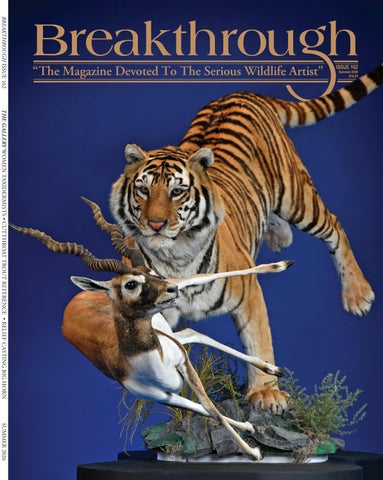
Summer 2026 $16.00
BREAKTHROUGH ISSUE 162
ISSUE 162
THE GALLERY WOMEN TAXIDERMISTS • CUTTHROAT TROUT REFERENCE • RELIEF CASTING BIG HORN
SUMMER 2026
LIFESIZE MAMMALS AFRICAN LION
Dawne Stacks ELDON, MISSOURI
FIRST PLACE
First Place Winners: Professional Division
WOMEN TAXIDERMISTS
When we produced a feature on the ribbon winners from the Professional Division Lifesize Mammals (see page ___), we immediately saw that most of the highest-scoring entries were by women.
Page 2
BREAKTHROUGH Issue 162
BLACK BEARS
PHOTOGRAPHY BY GLEN BROWNING, SARAH DEJOURNETT, BJ FORNINO, TIAN YANG, JAY McDONALD, AND KEN EDWARDS
Jessica Kriescher PHELPS, WISCONSIN
FIRST PLACE
from the
2024 World Show
August 6–10, 2024 • Coralville, Iowa USA
BREAKTHROUGH Issue 162
Page 3
BLACK BEAR
Kendall Wilson NEW BERN, NORTH CAROLINA
FIRST PLACE
WOMEN Page 4
TA X I D E R M I STS
FROM
THE
PROFESSIONAL BREAKTHROUGH Issue 162
WOLF
Velma Smith CALHOUN, KENTUCKY
FIRST PLACE
DIVISION:
2024
BREAKTHROUGH Issue 162
WORLD
TA X I D E R M Y
CHAMPIONSHIPS® Page 5
BOBCAT
Ashley Hitchcock EDWARDS, MISSOURI
FIRST PLACE
WOMEN Page 6
TA X I D E R M I STS
FROM
THE
PROFESSIONAL BREAKTHROUGH Issue 162
BOBCAT
Velma Smith CALHOUN, KENTUCKY
FIRST PLACE
FOX SQUIRREL
Velma Smith CALHOUN, KENTUCKY
FIRST PLACE
DIVISION:
2024
BREAKTHROUGH Issue 162
WORLD
TA X I D E R M Y
CHAMPIONSHIPS® Page 7
CROSS FOX
Sierra Guidry BRYAN, TEXAS
FIRST PLACE
Page 8
BREAKTHROUGH Issue 162
SAVANNA CROSS GOAT
Heather Krohe MACOMB, ILLINOIS
FIRST PLACE All Professional Division ribbon winners from the 2024 World Show are pictured later in this issue.
BREAKTHROUGH Issue 162
Page 9
VIEWPOINT PUBLISHERS Roy and Marie Holdridge Dr. Dan McBride R M & D PARTNERS LLC CO-MANAGING EDITOR/ADVERTISING Kathy Moody Blomquist Marie Holdridge ASSOCIATE EDITOR Larry Blomquist ASSOCIATE ART DIRECTOR Ken Edwards CIRCULATION MANAGER Kathrine J. Flowers CIRCULATION ASSISTANT The RG Group–Richard Graves PRODUCTION Sheridan CJK Group
EDITORIAL CONTRIBUTORS Larry Blomquist Erich Carter Danny Harris Billy Robertson
Copyright © 2026 by Breakthrough Magazine. All rights reserved. Printed in the United States. Permission to reprint material in this magazine must be obtained in writing from Breakthrough Magazine. SUBSCRIPTIONS. Subscription rates (United States) are $44.00 for one year, $78.00 for two years. Canadian and Mexican subscriptions are $88.00 for one year, and $160.00 for two years in U.S. dollars only. New subscriptions and renewals should be sent with payment to Breakthrough Magazine, Circulation Department, P.O. Box 5187, Granbury, Texas 76049. Credit card renewals Email: info@breakthroughmagazine.com. LETTERS TO THE EDITOR are considered for publication unless otherwise specified. Editorial and photographic contributions are welcome, but the publisher assumes no responsibility for loss or damage to unsolicited material. Manuscripts submitted to BREAKTHROUGH will be treated as unconditionally assigned for publication and copyright purposes and are subject to BREAKTHROUGH’S unrestricted right to edit and publish commercially. E-mail letters to: kathy@ breakthroughmagazine.com. Advertisers agree to indemnify to publisher and Breakthrough Magazine. BREAKTHROUGH is published four times a year by Breakthrough Magazine, P.O. Box 5187, Granbury, TX 76049. General offices located at 4303 E Hwy 377, Granbury, TX 76049. U.S. SUBSCRIPTIONS Orders 1-800-783-7266 WEBSITE: www.breakthroughmagazine.com LETTERS/ARTICLES: marie@breakthroughmagazine.com EUROPEAN SUBSCRIPTIONS BAUER HANDELS GMBH Unselbständige Zweigstelle Freibühlstrasse 6 DE-78224 SINGEN (Germany) Tel. ++49 (0) 7731 926 44 16 Email: info@taxidermy.ch www.taxidermy.ch JHT SUPPLIES (JOHN HALLET) 21 Library Road, Penygraig RCT South Wales CF 401ST Telephone: 01 443 441529 sales@jhtsupplies.co.uk
January 31, 2027 Nomination Deadline for Taxidermy Hall of Fame
The deadline for the Taxidermy Hall of Fame nominees for the 2027 induction year has been changed to January 31, 2027. The induction ceremony takes place every two years on odd number years. The Taxidermy Hall of Fame board members get a lot of inquires asking what are the requirements and what needs to be done to do to make a nomination for the THOF… well here is what you do. If you have not visited the THOF website, it is very interesting and informative and has all the information and requirements to make a nomination. The main requirement is a 500- to 1000-word biography of the
person you are nominating along with any interesting photos of that individual. This is what the selection Committee will read and see when the nomination goes to the board for acceptance. If you do not have a way to visit the THOF website, we are printing the information for nominating below that you can copy and submit. There are many deserving individuals who need to be considered for this honored position, and it is up to you to nominate them. Taxidermy Hall of Fame, President Larry Blomquist
Taxidermy Hall of Fame Nomination Application Please type or print legibly in English. Statement of Reasons for Nomination: When a nomination is made, a biographical sketch is required detailing the contributions of your nominee and why he/she should be considered. This information is of extreme importance during the selection process and it will be used on the website if the person is inducted. All requested information must be received by January 31, 2027, for consideration of induction in 2027. If there are more than 10 nominee applications, the THOF 20-member selection committee will consider, vote on, and reduce the number of nominees to 10 no later than March 31, 2027. The final 10 nominees will then be considered and voted on by the Executive Committee. This final selection vote of new inductees will be made by April 30 of the induction year. New Taxidermy Hall of Fame members will be honored at a formal induction ceremony in the summer and be featured in the THOF website. NOMINEE INFORMATION Date:________________ Name of person you would like to nominate: ______________________________________________________________________________ NOMINEE’S CONTACT INFO: Telephone: Home: __________________ Cell: _________________________ _Email:___________________________________________ Street Address: ____________________________________________________________________________________________________ City:_________________________________ State/Province:_________ ZIP/Postal Code:_______________ Country:_______________ Date of Birth and Place:_____________________________________________________________________________________________ Date of Death (if applicable):_________________________________________________________________________________________ Burial Place:________________________________________________________________________________________________________ Name of Spouse or Closest Living Relative:____________________________________________________________________________ The biographical sketch is suggested to contain the following: • Contributions to the taxidermy profession relating why your nominee merits election into the Taxidermy Hall of Fame. Suggested merits may include the impact of this person on the professional international community, innovation of techniques, new supplies, special achievements and awards, and superior artistic contribution or experience. The biography of the nominee should be between 500–1,000 words with at least one photo of the nominee. Additional supporting photographs are welcome and can be copies of original photographs or in digital form. (Photos submitted will not be returned.) • Include birth date (and death date if applicable including cemetery) • Including photos of person, work place, and mounts helps the Selection Committee make final decisions. NOMINATOR INFORMATION Date:________________ YOUR NAME: __________________________________________________________________________________________________________ Telephone: Cell: ___________________________
Email:_________________________________________________________________
Street Address: ____________________________________________________________________________________________________ City:_________________________________ State/Province:_________ ZIP/Postal Code:_______________ Country:_______________ Signature__________________________________________________________________________________________________________ All original submitted nominee applications will be retained at the office of the Hall of Fame secretary. If you prefer to EMAIL the application, biography, and photos, it should be emailed to Skip Skidmore: wesley_skidmore@byu.edu. If you prefer to MAIL the printed application, biography, and photos, it should be mailed to: Taxidermy Hall of Fame Barclay Damon LLP Barclay Damon Tower 125 East Jefferson Street Syracuse, NY 13202 USA
Page 10
BREAKTHROUGH Issue 162
NEW AD
BREAKTHROUGH Issue 162
Page 11
OBITUARY
A TRIBUTE TO
Ralph Garland 1942 - 2026
Survived by his devoted wife of 63 years, Sandy by Larry Blomquist
O
n Wednesday August 12, 2026, the taxidermy profession lost one of our great leaders and contributors,. Born in Hancock, Tennessee, he was the son of the late Charles E. Garland and Mae (Vaughn) Garland. In addition to his parents, he is preceded in death by his son, Timothy Ray Garland and daughter-inlaw, Angie. He is survived by his devoted wife of 63 years, Sandra (Rosenbalm) Garland. Their son, Tracy Wayne Garland, and wife, Melissa, and sons, including Brock Garland and his wife, Camden and their children: Emerson and Monroe., and son Haven. He is also survived by his grandchildren through Timothy Garland: Sarayah Spurgeon and her husband, Bryant, and their children: Midori, Mirabella, and Ember; Ryan Garland and his children: Evelyn and Rosalyn; and Minnie Garland and life partner, Richi Worboys and their children: Raiden and Rowan. Many of our younger generations who never met or got to know Ralph Garland need to know about this man who touched so many lives. We who lived during this era had the opportunity to meet and know him, and we were indeed fortunate. Ralph was a very talented taxidermist who early in his career helped form and became the president of the Tennessee Taxidermy Association in the late 1970s. Soon after, he found it necessary to resign when he accepted the position of taxidermy instructor at Piedmont Community College in Roxboro, North Carolina. At Piedmont he taught hundreds of students interested in taxidermy from all over the USA (including 8 students from foreign countries) what it takes to become a professional taxidermist. It is also important to note Ralph proudly served his country in the United States Army during the Vietnam era. Ralph received strong support from his wife Sandy of 63 years through all of his life accomplishments and he was not shy about giving her credit. In August of 2025 they were both inducted into the Taxidermy Hall of Fame for their lifetime of contributions to the Page 12
taxidermy profession. Ralph, a longtime friend and colleague of mine going back to the early 1970s, would be miffed at me if I did not convey the team relationship he and Sandy had in this tribute to him. Ralph was one of those special people we meet in life with a unique personality. He always had stories and knowledge to share, along with a honest and true desire to help and teach others. Ralph and I served many years together on the board of directors of the NTA, we competed in taxidermy competitions against each other with friendship always first, and we judged at least 30 competitions together later in our lives. Ralph and Sandy authored 33 articles for Breakthrough, and both were loyal program leaders at many World Taxidermy Championships® for Kathy and me. Many of the accomplishments of both Ralph and Sandy were documented in the nomination biography written by George Roof. Below is the nomination biography submitted by another close friend of the Garlands, George Roof, and he did a class act that says it all. George nominated both Ralph and Sandy Garland for the Taxidermy Hall of Fame in August of 2023 shortly after the induction of the class of 2023. The THOF inductions are held every two years with new nominations accepted through December 31 of even numbered years. This was the first time a nomination of a husband-andwife team had ever been made for inclusion into the THOF, and the board of directors voted unanimously to accept this dual nomination. The nomination was then approved by
Ralph Garland as he appeared in Breakthrough issue 49. the 20-member Selection Committee in 2024 and in early 2025 the 9-member Executive Committee voted on 8 Contemporary Nominees, electing 2 into the THOF: the Garlands and Dennis Behn. The official induction took place at the National Taxidermists Association convention in Peoria, IL, on August 16 of 2025.
Ralph shared his knowledge through many articles in Breakthrough, including this one on freeze-drying in Issue 53. BREAKTHROUGH Issue 162
OBITUARY
A LEGACY TOGETHER
Ralph & Sandy Garland Ralph and Sandy Garland shared alifetime of work, teaching, writing and service to the taxidermy community
F
or over 40 years, this husband-and-wife team worked in concert to provide an education and produce the impetus of the “Golden Age” of taxidermy. As Ralph has stated many times, it was Sandy who polished his work, assisted him, and made him look as if he were educated. When he began his work teaching taxidermy at Piedmont Community College (PCC) in Roxboro, North Carolina, the classes were purely vocational. As the years passed, the school required more academic and education concepts to be included in the curriculum. Sandy also attended the extra curriculum classes that were part of the taxidermy program to see if the college requirements could help the taxidermy students build their own businesses after they finished at the college. Afterwards, she modified their lesson plans to ensure that any required courses would benefit their students. At the same time, Ralph was insistent that no one method, supply company, or antiquated concept be taught to allow independent techniques of the students. Between the two, the classes eventually included biology, anatomy, business procedures, finances, and freeze-dry technology. In the classroom they also included helping the students to have an overall understanding of state and federal laws that must be observed by taxidermists as well as proper recordkeeping for them to learn how to comply with these laws. In the 20+ years the course was active, there were 1,100 students enrolled and 980 of them completed
BREAKTHROUGH Issue 162
the course and graduated. Included in the 980 students who completed all requirements for the taxidermy program, there were six (6) international students. At times student would come to take only one of the main four courses, such as gameheads, small game, fish, or birds. All of these courses were accredited by the state of North Carolina. The college offered a one-semester break for Ralph to go “back to industry” to further his knowledge and skills. He worked with Rick Morgan and Kevin White at Taxidermy International/Carolina Fur Dressing, while Sandy stayed at PCC and kept the program going. Ralph would return on Mondays only to give demos and interact with the students. Ralph had the opportunity to expand his knowledge of African and Asian game, tanning, as well as crating and shipping. In addition to the full-time taxidermy curriculum, Piedmont Community College also had a once-ayear 3-day weekend event called the “The Taxidermy Mini Course,” attracting over 400 attendees annually with guest instructors and a taxidermy competition. Attending the Mini Course was how Ralph learned about the college and the job opportunity as full-time instructor. Ralph was hired as the new taxidermy instructor soon after his application. Each year of the PCC Taxidermy Mini Course classes were filled within days of advertising with many having to be declined simply because of and class room constraints. The turnout was so great that the small town of Roxboro was unable to provide lodging for
the students. It’s not unusual to hear those who did attend talking about sleeping in their own vehicles or tents, because of the lack of places to stay. In addition to Ralph’s teaching the full-time curriculum at PCC he also taught seminars at the Mini Course, while Sandy headed up and worked in the competition. In addition both worked as advisors in preparations for the very popular Piedmont Taxidermy Mini course. Ralph and Sandy served extended terms with the North Carolina Taxidermy Association in all the offices therein. Both presented seminars at the National Taxidermists Association and the World Taxidermy Championships® (WTC). Sandy served multiple times as assistant competition coordinator under Skip Skidmore at the WTC, and Ralph worked as seminar coordinator and leader. He also served as a judge at 122 state, national, and world competitions. With her background in newspaper work, Ralph relied heavily on Sandy for proofing, correcting, and modifying his professional articles, of which there were 28 articles in Breakthrough, 46 in Taxidermy Today, 4 in American Taxidermy, and 28 in the NTA’s publication “Outlook.” Sandy also wrote a five part series in issues 55, 56 ,57 ,58, and 59 of Breakthrough on Shop Layout & Design-Organization. Ralph wrote a chapter called “Skinning and Mounting Poisonous Reptiles” in Tim Kelly’s book about taxidermy. Ralph served on the NTA board of directors and as both vice-president and president of the NTA. Today, the mere mention of “Piedmont” elicits an almost sacred right of progression in taxidermy and has certainly found its way into many professional resumes. The singular contributions of Ralph and Sandy Garland opened the frontier of taxidermy shows, competitions, and conventions now held around the nation and the world. Their contributions so richly deserve inclusion and honors bestowed by the Taxidermy Hall of Fame.
Page 13
BUSINESS
WA L K I N G ON THE WILD SIDE
AT TRUELIFE TAXIDERMY A TRUE STORY — PART 1 Written by Larry Blomquist
L
ate in July 2026, I traveled to Granbury, Texas—a beautiful community south of Fort Worth and home to Roy and Marie Holdridge, two of the new owners of Breakthrough (Adam: use BT font here) and the World Taxidermy & Fish Carving Championships®, along with their partner Dr. Dan McBride of Burnet, Texas. The purpose of my trip was to visit and photograph several articles at Roy’s 10,000-square-foot studio, TrueLife Taxidermy. R oy had invited his close friend, Jerry Huffaker, to work with his shop foreman Jesus Garcia and several employees, offering guidance on mounting techniques. Many readers will recognize Jerry as a highly accomplished mammal taxidermist and World Champion. He has written for Breakthrough, and his work has appeared on three covers—Issues 115, 123, and 142. When Roy told me Jerry would be there, I said, “That’s when I want to visit,” and I did. Jerry is a true professional in both competition and commercial taxidermy. This private workshop focused on lifesize large-cat taxidermy, including skin preparation, custom form alterations, and the mounting techniques he uses in his commercial work. In this issue, I present the first of several articles from that session, supported by more than 250 step-by-step photos. Before beginning the leopard series, I want to introduce you to the TrueLife studio and its owners, Roy and Marie Holdridge. Page 14
BREAKTHROUGH Issue 162
BUSINESS
Inside the TrueLife Studio 1
2
BREAKTHROUGH Issue 162
3
Page 15
BUSINESS 4
Roy Holdridge observes shop foreman Jesus Garcia working on the leopard featured in this article. The leopard mounted above Roy was completed by Jesus the week before my visit. TrueLife Taxidermy is a large, well-organized operation with excellent lighting and air conditioning. The main reception office is pictured above, and a second business office sits on the upper level along with storage areas. Beneath this mezzanine is a comfortable break room with tables, seating, a microwave, coffee station, and refrigeration for drinks and food. Page 16
BREAKTHROUGH Issue 162
BUSINESS
The Showroom 5
6
6
7
The showroom is filled with recently completed mounts awaiting pick-up or delivery, arranged neatly to display the studio’s high output. Some pieces belong to Roy personally, but space is always at a premium, and the showroom is currently full of customer work. I can attest that both the work in progress and the finished pieces are top tier for a studio of this size. The main lower-level office, where customer transactions occur, also displays TrueLife’s craftsmanship and provides a spacious, welcoming entry. Next issue: I will begin the series on mounting the lifesize leopard. BREAKTHROUGH Issue 162
Page 17
BUSINESS
COMPETING IN
8
9
10
11
TA X I D E R M Y COMPETITIONS When Roy became the TTAI competition room chairman, he chose to stop competing to avoid any perceived conflict of interest. The Studio Division—like the Collective Artists Division at the World Show— is limited to Texas residents and judged by member vote. Today, Roy encourages his employees to compete, knowing it is one of the best paths to learning and developing craftsmanship. Some commercial taxidermists believe competition is unnecessary. I’ve seen both perspectives. Over decades of visiting studios across North America, South America, Africa, Europe, New Zealand, Australia, and China—specialists in mammals, birds, fish, reptiles, and full-service operations—one common thread stood out: most successful studios were led or staffed by taxidermists who had competed during or after the 1970s and 1980s, when competitions became widespread. Before that era, many learned through trial and error. The Northwestern School of Taxidermy correspondence course provided a basic foundation, and libraries offered a few advanced books. Many mid20th-century studios hired museumtrained taxidermists who passed along their “trade secrets.” Today, with DVDs, manuals, books, Breakthrough magazine, and online resources like YouTube, it is absolutely possible to succeed without competing. Much depends on when you began. But competition remains one of the most effective learning tools, directly contributing to success in commercial taxidermy. When I opened my studio in the early 1970s, I already had twelve years of trial-and-error experience, yet I knew I had more to learn. Competing became the most rewarding educational experience of my 35-year commercial career. I have no doubt thousands of taxidermists today would agree. Page 18
BREAKTHROUGH Issue 162
BUSINESS 12
13
14
15
BREAKTHROUGH Issue 162
Page 19
BUSINESS 16
17
18
19
Page 20
BREAKTHROUGH Issue 162
BUSINESS 20
21
22
BREAKTHROUGH Issue 162
Page 21
MOYLE
Page 22
BREAKTHROUGH Issue 162
MOYLE
BREAKTHROUGH Issue 162
Page 23
NEW AD
Page 24
BREAKTHROUGH Issue 162
NEW AD
BREAKTHROUGH Issue 162
Page 25
2024 WTC LIFESIZE MAMMALS
Professional Division: LS Mammals
352024RIBBON WINNERS WORLD TAXIDERMY CHAMPIONHIPS® AUGUST 6–10, 2024 • CORALVILLE, IOWA
1
Lion
Dawne Stacks–Eldon, MO 94 1st
19 Raccoon
Jade Watson East Troy, WI 87 2nd
2
Black Bears
Jessica Kriescher–Phelps, WI 93 1st
20 Bobcat
Tyler Messer–Burlington, IA 87 2nd
3
Black Bear
Kendall Wilson–New Bern, NC 92 1st
21 Bobcat
Ashley Hitchcock–Edwards, MO 87 2nd
4
Coyote
Jack Purcell–Roberts, MT 92 1st
22 Mountain Lion
5
Wolf
Velma Smith–Calhoun, KY 92 1st
23 Coyote
Hunter Martin–Freeport, TX 86 2nd
6
Rocky Mt. Bighorn Sheep
Ryan Butler–Helena, MT 92 1st
24 Wolf
Shannon Mercado–Schertz, TX 86 2nd
7
Pine Marten
Jack Purcell–Roberts, MT 92 1st
25 Ranch Fox
Jarod Embree–Des Moines, IA 86 2nd
8
Audad
Dan Adamson–Creston, IA 92 1st
26 Wolverine
Ryan Butler–Helena, MT 78 3rd
9
Coyote
Marc DeLong–Kalispell, MT 91 1st
27 Lynx
Ryan Butler–Helena, MT 78 3rd
10 Bobcat
Ashley Hitchcock–Edwards, MO 91 1st
28 Coyote
Jeremy Pickarts–Poynette, WI 77 3rd
11 Bobcat
Velma Smith–Calhoun, KY 90 1st
29 Leopard
Sarah DeJournett–Bluford, IL 77 3rd
12 Savanna cross Goat
Heather Krohe–Macomb, IL 90 1st
30 Otter
13 Bison (juveile)
Tom Stombaugh–Howell, MI 90 1st
31 Black Bear
14 Fox Squirrel
Velma Smith–Calhoun, KY 90 1st
32 Wolf
15 Cross Fox
Sierra Guidry–Bryan, TX 90 1st
33 Coyote
Tom Stombaugh–Howell, MI 72 3rd
16 Nigerian Dwarf Goat
Heather Krohe–Macomb, IL 88 2nd
34 Bobcat
Jessica Kriescher–Phelps, WI 71 3rd
17 Bobcat
Tyler Messer–Burlington, IA 87 2nd
35 Mole
18 Mountain Lion
Page 26
Kevin Crowe–Acme, PA 86 2nd
David Spiess–Greenwell Springs, LA 76 3rd Dale Selby–Nicollet, MN 73 3rd David Spiess–Greenwell Springs, LA 72 3rd
Eric Chupp–Syracuse, IN 70 3rd
Paul Klar–Broadus, MT 87 2nd
BREAKTHROUGH Issue 162
2024 WTC LIFESIZE MAMMALS
1
2
3
4
5
6
7
8
9
10
11
12
BREAKTHROUGH Issue 162 161
Page 27
2024 WTC LIFESIZE MAMMALS
13
14
15
16
17
18
19
20
21
22
23
24
Page 28
BREAKTHROUGH Issue 162
2024 WTC LIFESIZE MAMMALS
25
26
27
28
29
30
31
32
33 Make plans to attend the 2027 World Taxidermy Championships¤
34 BREAKTHROUGH Issue 162 161
35
Hyatt Regency & Conference Center Coralville, Iowa April 13—17, 2027 n Page 29
SHOP
Page 30
BREAKTHROUGH Issue 162
SHOP
BREAKTHROUGH Issue 162
Page 31
NEW AD
Page 32
BREAKTHROUGH Issue 162
I N S P I R AT I O N
D E L I V E R E D Q U A R T E R LY
— Issue 34, Fall 1993........................ $7.00 — Issue 35, Winter 1994............... SOLD OUT — Issue 36, Spring 1994............... SOLD OUT — Issue 37, Summer 1994............. SOLD OUT — Issue 38, Fall 1994........................ $8.00 — Issue 39, Fall 1994.................. SOLD OUT — Issue 41, Summer 1995............. SOLD OUT — Issue 42,Fall 1995. .................. SOLD OUT ISSUE 46 ISSUE 34 ISSUE 35 ISSUE 36 ISSUE 37 ISSUE 38 ISSUE 39 ISSUE 40 ISSUE 41 ISSUE 42 ISSUE 43 ISSUE 44 ISSUE 45 — Issue 43, Spring 1996............... SOLD OUT — Issue 44, Summer 1996................... $8.00 — Issue 45, Fall 1996........................ $8.00 — Issue 46, Winter 1997............... SOLD OUT — Issue 47, Spring 1997............... SOLD OUT — Issue 48, Summer 1997................... $8.00 — Issue 49, Fall 1997........................ $8.00 — Issue 50, Winter 1997..................... $8.00 — Issue 51, Spring 1998..................... $8.00 ISSUE 47 ISSUE 48 ISSUE 49 ISSUE 50 ISSUE 51 ISSUE 52 ISSUE 53 ISSUE 54 ISSUE 55 ISSUE 56 ISSUE 57 ISSUE 58 ISSUE 59 — Issue 52, Summer 1998................... $8.00 — Issue 53, Fall 1998........................ $8.00 — Issue 54, Winter 1998..................... $8.00 — Issue 55, Spring 1999..................... $8.00 — Issue 56, Summer 1999................... $8.00 — Issue 57, Fall ’99........................... $8.00 — Issue 58, Winter 2000..................... $8.00 — Issue 59, Spring 2000..................... $8.00 — Issue 60, Summer 2000................... $8.00 ISSUE 60 ISSUE 61 ISSUE 62 ISSUE 63 ISSUE 64 ISSUE 65 ISSUE 66 ISSUE 67 ISSUE 68 ISSUE 69 ISSUE 70 ISSUE 71 ISSUE 72 — Issue 61, Fall 2000........................ $8.00 — Issue 62, Winter 2001..................... $8.00 — Issue 63, Spring 2001..................... $8.00 — Issue 64, Summer 2001................... $8.00 — Issue 65, Fall 2001........................ $8.00 — Issue 66, Winter 2002..................... $8.00 — Issue 67, Spring 2002..................... $8.00 — Issue 68, Summer 2002................... $8.00 — Issue 69, Fall 2002........................ $8.00 — Issue 70, Winter 2003.................... $10.00 ISSUE 73 ISSUE 74 ISSUE 75 ISSUE 76 ISSUE 77 ISSUE 78 ISSUE 79 ISSUE 80 ISSUE 81 ISSUE 82 ISSUE 83 ISSUE 84 ISSUE 85 — Issue 71, Spring 2003.................... $10.00 — Issue 72, Summer 2003.................. $10.00 — Issue 73, Fall 2003....................... $10.00 — Issue 74, Winter 2004.................... $10.00 — Issue 75, Spring 2004.................... $10.00 — Issue 76, Summer 2004.................. $10.00 — Issue 77, Fall 2004....................... $10.00 — Issue 78, Winter 2005.................... $10.00 — Issue 79, Spring 2005.................... $10.00 ISSUE 86 ISSUE 87 ISSUE 88 ISSUE 89 ISSUE 90 ISSUE 91 ISSUE 92 ISSUE 93 ISSUE 94 ISSUE 95 ISSUE 96 ISSUE 97 ISSUE 98 — Issue 80, Summer 2005.................. $10.00 — Issue 81, Fall/Wint 2005................. $10.00 — Issue 82, Spring 2006.................... $10.00 — Issue 83, Summer 2006.................. $10.00 — Issue 84, Fall 2006. . ..................... $10.00 — Issue 85, Winter 2006................... $10.00 — Issue 86, Spring 2007.................... $10.00 — Issue 87, Summer 2007.................. $10.00 — Issue 88, Fall 2007....................... $10.00 ISSUE 99 ISSUE 100 ISSUE 101 ISSUE 102 ISSUE 103 ISSUE 104 ISSUE 105 ISSUE 106 ISSUE 107 ISSUE 108 ISSUE 109 ISSUE 110 ISSUE 111 — Issue 89, Winter 2007.................... $10.00 — Issue 90, Spring 2008.................... $10.00 — Issue 91, Summer 2008.................. $10.00 — Issue 92, Fall 2008....................... $10.00 — Issue 93, Wint 2009...................... $10.00 — Issue 94, Spr/Sum 2009. ................ $10.00 — Issue 95, Sum/Fall 2009. ................ $10.00 — Issue 96, Winter 2009.................... $10.00 — Issue 97, Spring 2010.................... $10.00 — Issue 98, Summer 2010.................. $10.00 ISSUE 112 ISSUE 113 ISSUE 114 ISSUE 115 ISSUE 116 ISSUE 117 ISSUE 118 ISSUE 119 ISSUE 120 ISSUE 121 ISSUE 122 ISSUE 123 ISSUE 124 — Issue 99, Fall 2010....................... $10.00 — Issue 100, Winter 2010.................. $10.00 — Issue 101, Spring 2011. . ................. $10.00 — Issue 102, Summer 2011................ $10.00 — Issue 103, Fall 2011...................... $10.00 — Issue 104, Winter 2011. . ................. $10.00 — Issue 105, Spring 2012.................. $10.00 — Issue 106, Summer 2012. ............... $10.00 — Issue 107, Fall 2012. ..................... $10.00 ISSUE 125 ISSUE 126 ISSUE 127 ISSUE 128 ISSUE 129 ISSUE 130 ISSUE 131 ISSUE 132 ISSUE 133 ISSUE 134 ISSUE 135 ISSUE 136 ISSUE 137 — Issue 108, Wint 2012..................... $10.00 — Issue 109, Spring 2013.................. $10.00 — Issue 110, Summer 2013................ $10.00 — Issue 111, Fall 2013. ..................... $10.00 — Issue 112, Winter 2013. . ................. $10.00 — Issue 113, Spring 2014. . ................. $10.00 — Issue 114, Summer 2014................ $10.00 — Issue 115, Fall 2014...................... $10.00 — Issue 116, Winter 2014. . ................. $10.00 ISSUE 138 ISSUE 139 ISSUE 140 ISSUE 141 ISSUE 142 ISSUE 143 ISSUE 144 ISSUE 145 ISSUE 146 ISSUE 147 ISSUE 148 ISSUE 149 ISSUE 150 — Issue 117, Spring 2015. . ................. $10.00 — Issue 118, Summer 2015................ $10.00 — Issue 119, Fall 2015...................... $10.00 — Issue 120, Winter 2016.................. $10.00 — Issue 121, Spring 2016............. SOLD OUT — Issue 122, Summer 2016. .......... SOLD OUT — Issue 123, Fall 2016. ..................... $10.00 — Issue 124, Winter 2017............. SOLD OUT — Issue 125, Spring 2017............. SOLD OUT ISSUE 151 ISSUE 152 ISSUE 153 ISSUE 154 ISSUE 155 ISSUE 156 ISSUE 157 ISSUE 158 ISSUE 159 ISSUE 160 ISSUE 161 — Issue 126, Summer 2017. .......... SOLD OUT — Issue 127, Fall 2017. ................ SOLD OUT — Issue 128, Winter 2018.................. $10.00 — Issue 129, Spring 2018............. SOLD OUT — Issue 130, Summer 2018. .......... SOLD OUT BREAKTHROUGH, P.O. Box 2945 — Issue 131, Fall 2018. ................ SOLD OUT Hammond, LA USA 70404-2945 To Subscribe or Renew — Issue 132, Winter 2019............. SOLD OUT — Issue 133, Spring 2019............. SOLD OUT Telephone 800-783-7266 New Subscription (U.S.) — Issue 134, Summer 2019. .......... SOLD OUT Renewal (U.S.) — Issue 135, Fall 2019. ................ SOLD OUT CREDIT CARD NUMBER Visa MasterCard American Express Discover — Issue 136, Winter 2020.................. $10.00 One Year (4 issues) $36.00 $44.00 — Issue 137, Spring 2020.................. $10.00 Two Years (8 issues) $68.00 $78.00 — Issue 138, Summer 2020. ............... $10.00 FOREIGN: AIR MAIL ONLY (4 TO 7 DAYS DELIVERY) — Issue 139, Fall 2020. ..................... $10.00 — Issue 140, Winter 2021.................. $10.00 Canada and Mexico — Issue 141, Spring 2021.................. $10.00 EXPIRATION DATE __________ /_____________ SECURITY CODE______________ — Issue 142,Summer 2021................. $10.00 One Year (4 issues) $79.00 $88.00 — Issue 143, Fall 2021. ..................... $10.00 SIGNATURE___________________________________________________________________________ Two Years (8 issues)$152.00 $160.00 — Issue 144, Winter 2022.................. $10.00 L E G I B L Y, A S N A M E A P P E A R S O N C R E D I T C A R D . — Issue 145, Spring 2022.................. $10.00 All other countries — Issue 146, Summer 2022. ............... $10.00 One Year (4 issues) $94.00 Distributors — Issue 147, Fall 2022. ..................... $10.00 YOUR NAME (PLEASE PRINT)___________________________________________________________________________________ Issue 148, Winter 2023.................. $10.00 Two Years (8 issues)$180.00 Distributors — — Issue 149, Spring 2023.................. $10.00 — Issue 150, Summer 2023. ............... $12.00 BUSINESS OR STUDIO__________________________________________________________________________________________ Shipping: BACK ISSUES — Issue 151, Fall 2023. ..................... $15.00 United States: Add $8.00 first one, — Issue 152, Winter 2024.................. $15.00 MAILING ADDRESS — Issue 153, Spring 2024.................. $15.00 then 2.00 ea. additional. — Issue 154, Summer 2024. ............... $15.00 All Foreign orders: Contact us for shipping rates. CITY__________________________________________________________________ STATE/PROVINCE_______________________ — Issue 155, Fall 2024. ..................... $15.00 LOUISIANA RESIDENTS: — Issue 156, Winter 2025.................. $15.00 ZIP/POSTAL CODE______________________________ COUNTRY____________________________________________ — Issue 157, Spring 2025.................. $15.00 PLEASE ADD 5% SALES TAX. — Issue 158, Summer 2025. ............... $15.00 — Issue 159, Fall 2025. ..................... $15.00 DAYTIME AREA CODE/PHONE NUMBER (REQUIRED) ____________ ______________ — _________________________ — Issue 160, Winter 2026.................. $15.00 — Issue 161, Summer 2026. ............... $15.00 E-MAIL ________________________________________________________________________________________________
(
BREAKTHROUGH Issue 162
)
1-800-783-7266
Page 33
SHOP TEXT AND PHOTOS BY
Billy Robertson
W
e have reached the final installment of our three-part series on Efficiency, Productivity, and Organization. In the previous segments, we examined the importance of shop size, layout, and the foundational role these elements play in the success of any taxidermy operation. They set the stage for everything that follows. So where do we go from here? It’s time to address one of the most critical components of your business: time. TIME: THE CORE OF PROFITABILITY Time is inseparable from profit. Every minute invested in a project influences the amount of money you ultimately earn. The relationship is simple—yet often overlooked. When your time is used wisely, profit increases. When your time is wasted, profit shrinks. As we’ve discussed, time is shaped by your level of organization and efficiency. Both begin with a shop that is properly equipped, clean, well maintained, and designed to support your workflow rather than hinder it. A cluttered shop is more than an eyesore; it is a drain on productivity. When tools are scattered, misplaced, or in poor condition, you lose valuable minutes searching, cleaning, or compensating for inadequate equipment. Over the course of a year, those minutes accumulate into hours—and those hours represent lost income. If you are not working smarter, you are working harder, and when you work harder than necessary, both you and your taxidermy suffer. Fatigue, frustration, and inefficiency are costly companions. THE PRICING GRAPPLE Pricing remains one of the most sensitive subjects in our trade—almost a third rail— because discussions often spark strong opinions and uneven debates. What I can offer are my own observations, grounded in straightforward math and decades of experience. We all know the cost of Page 34
our materials, and most of us have a reasonable understanding of the overhead associated with each job. We also have a general sense of how much time we invest in a project, assuming nothing unexpected occurs. However, many taxidermists fail to account for the additional time lost due to disorganization, interruptions, or extended conversations with clients about matters unrelated to the work. These small inefficiencies add up quickly, and they must be factored into your pricing if you want your business to remain profitable. BREAKTHROUGH Issue 162
SHOP each step of your workflow should progress and design your space to support that flow. Avoid obstacles that disrupt movement from one stage to the next. Keep sanding, sawing, and drilling in a coordinated area where dust and debris can be managed. Skinning, fleshing, and salting should be done in a separate space—out of sight of clients—and kept clean and free of unpleasant odors. Establish a finish-work room that is as dust-free as possible and properly ventilated to ensure the highest-quality results. LIFELONG EDUCATION AND COLLABORATION The best advice I can offer is to invest in your education and craftsmanship. Join your state association and attend its convention. Participate in seminars, talk with other taxidermists, and absorb as much knowledge as you can. Attend shows in other states and broaden your understanding of the trade. Every interaction, every demonstration, and every critique contributes to your growth. I speak from experience. I had been in the trade for ten years before my state association was formed. At the time, I believed I knew everything I needed to know. I quickly learned how wrong I was. Since then, I have continued learning, competing, and helping run my state association alongside some of the finest people I have ever met. Through my work and involvement with the World Show, I have met taxidermists from across the country and around the world. I have taught classes and judged competitions in many states, at the World Show, and in New Zealand, Australia, and Canada. Much of my work today involves traveling throughout the United States and Canada. I have made a good living in taxidermy for 51 years—and I am not finished yet. Every accomplishment, every lesson, and every relationship I have built can be traced back to one thing: my state association, along with other state associations, and especially the World Show. These organizations have shaped my career and enriched my life in ways I could never have imagined.
CLOSING THOUGHTS I hope this series has helped you better understand the importance of organization, efficiency, and productivity—and how your shop’s layout supports your long-term success. In closing, remember this: Slow down—you’ll achieve a more harmonious outcome. Slow is smooth. Smooth is fast. WASTE: THE ARCH ENEMY OF PRODUCTIVITY Waste—whether in materials, chemicals, tools, or time—is the enemy of productivity. And of all the forms of waste we encounter, time is the most expensive. Once it is gone, it cannot be recovered. This is why working smarter, not harder, is essential. Slow is smooth, and smooth is fast. SHOP LAYOUTS AND PLANNING Included with this article are general floor plans for small and mediumsized shops. These layouts can be expanded simply by adding length or width, allowing you to adapt them to your needs. I did not include a plan for a large shop because most large facilities I have visited range from 15,000 to 20,000 square feet. If you are planning a shop of that magnitude, it is wise to involve architectural and time-management professionals to ensure the space is designed with maximum efficiency in mind. Regardless of shop size, thoughtful planning is essential. Consider how BREAKTHROUGH Issue 162
Thank you for your attention.
Page 35
LETTERS
Page 36
BREAKTHROUGH Issue 162
For complete competition rules visit www.breakthroughmagazine.com
2027 BEST IN WORLD DIVISIONS AND CATEGORIES Master Division Judging Procedure. Each entry in the Master Division will be independently scored by two judges and the scores averaged together. Best in World will be determined by the HIGHEST AVERAGE SCORE in the category, as long as it scores 90 or above. Second and Third in World will be determined by the second and third highest scores in the category (90 and above). A competitor cannot sweep a Best in World category. Only the highest-scoring entry will be considered. A competitor may only win one medallion in a category.
Important: All Master Division entries must be entered by 7:30 p.m. Tuesday, April 13, 2027. Small window for preregistered only: 8:00–9:00 a.m. Wednesday April 14, 2027
1. Medium-Small Mammals (smaller than 75 lbs. [coyote/peccary]) a. Small mammals, less than 25lbs. b. Medium mammals, lifesize weight from 25–75 lbs c. Small mammals group Judges for 2 score sheets: Brenda Duvall, Lance Van Dusen 2. Large Mammals (larger than 75 lbs. [cougar/deer]) a. Large mammals (long/thick hair) b. Large mammals (short/thin hair) c. Large mammals group Judges for 2 score sheets: Dean Schulte, Phil Soucy 3. Whitetail Deer Heads a. Whitetails long/thick hair, open mouth b. Whitetails long/thick hair, closed mouth c. Whitetails short/thin hair, open mouth d. Whitetails short/thin hair, closed mouth Judges for 2 score sheets: James Newport, Jena Everage 4. Medium-Small Gameheads (smaller than 75 lbs.) Same rules apply here for juvenile mammals, see Category 1 Note. a. Small gameheads (based on estimated lifesize weight of 25 lbs. or less) b. Medium gameheads (based on estimated lifesize weight of 25–75 lbs. ) c. Half-lifesize gameheads (must include front feet) d. Gameheads, group Judges for 2 score sheets: Brenda Duvall, Lance Van Dusen 5. Large Gameheads: Non-Antlered/Non-Horned (Based on estimated lifesize weight of more than 75 lbs. or more) a. Large gameheads (long/thick hair) b. Large gameheads (short/thin hair) c. Half-lifesize large gameheads (must include front feet) d. Gameheads, group Judges for 2 score sheets: Wendy Christensen, Dawayne Dewey 6. Large Gameheads: Antlered/Horned (Based on estimated lifesize weight of more than 75 lbs. or more) a. Large gameheads (long/thick hair) b. Large gameheads (short/thin hair) c. Half-lifesize large gameheads (must include front feet) d. Gameheads, group Judges for 2 score sheets: Wendy Christensen, Dawayne Dewey 7. Game Birds a. Pheasants b. Grouse c. Quail d. Migratory game birds (doves, rails, coots, cranes) e. Game birds, group Judges for 2 score sheets: Corey Caruthers, Patrick Rummans 8. Non-Game Birds a. Small birds (magpie and smaller) b. Large birds (crow, rook and larger) c. Raptors and owls (birds of prey) d. Non-game birds, group Judges for 2 score sheets: Patrick Rummans, Christel Verdaasdonk 9. Turkeys a. Turkeys, strutting b. Turkeys, open wings c. Turkeys, standing d. Turkeys, group Judges for 2 score sheets: Blake Reiminger, Jacob Clark
10. Waterfowl a. Diving ducks (mergansers, stiff tails) b. Puddle ducks c. Geese and swans d. Waterfowl group Judges for 2 score sheets: a/b Jordan Hackl, Corey Caruthers c/d Jacob Clark, Patrick Rummans 11. Warm Water Fish (skin mounts) a. Sunfish, perch, walleye, crappie, other bass b. Other, 12 inches or smaller c. Other, larger than 12 inches d. Saltwater e. Group Judges for 2 score sheets: Jeff Mourning, Rick Krane 12. Cold Water Fish (skin mounts) a. Trout, salmon, char b. Pike, muskellunge, pickerel c. Other 12 inches or smaller d. Other larger than 12 inches e. Group Judges for 2 score sheets: Jeff Mourning, Rick Krane 13. Reproductions Fish a. Freshwater, < or = to 20” b. Freshwater, > 20” c. Saltwater, < or = to 30” d. Saltwater, > 30” e. Group: Judges for 2 score sheets: Kerby Ross, Jeff Mourning 14. Reptiles, Amphibians, Invertebrates, Other (skin mounts) a. Reptiles, amphibian, other (single) b. Reptiles, amphibian, other (group) Judges for 2 score sheets: Kerby Ross, Jeff Mourning 15. Reproduction Reptiles, Amphibians, Invertebrates, Other a. Reptiles, Amphibians: Kerby Ross, Rick Krane b. Mammals: Wendy Christensen, Dawayne Dewey c. Group: to be determined by competition chair d. Miscellaneous: to be determined by competition chair Judges for 2 score sheets: to be determined by competition chair 16. Re-Creations a. Mammals: to be determined b. Birds: to be determined c. Miscellaneous: to be determined d. Re-Creation (group): to be determined Judges for 2 score sheets: to be determined by competition chair 17. Mixed Group Judges for 2 score sheets: Will be selected according to species entered Judges who vote for Best in World: Will be selected according to species entered 18. Habitat World Title Level Judges for 2 score sheets: Hutch Hutchinson, Rick Krane 19. Live Sculpturing World Title Level Judges for score sheets: Bill Neuman, Phil Soucy, Wendy Christensen, Dawayne Dewey, Brian Olson 20. Pre-Sculptured World Title Level Judges for score sheets: Bill Neuman, Phil Soucy, Wendy Christensen, Dawayne Dewey, Brian Olson 21. Collective Artists World Title Level Judges for score sheets: to be selected by competition chair
Judges are subject to change for reasons beyond our control.
BREAKTHROUGH Issue 162
Page 37
2027 World Championships®
GENERAL TAXIDERMY RULES & REGULATIONS NOTE: Interpretations of all rulings or regulations (and any rules not
3D-printed parts are used, they must be originally made, scanned,
professional manner. Unruly or disruptive behavior towards show officials
provided for) will be decided by the World Taxidermy Championships®
and produced by the competitor and not a second party or source.
or judges will not be tolerated and the perpetrator will be asked to leave
Regulatory Committee. This committee will consist of Skip Skidmore,
Commercial blanks will be acceptable in the Collective Artists,
and can be barred from future competitions. We reserve the right to refuse
Larry Blomquist, Ken Edwards, Roy Holdridge, and Dr. Dan McBride. If you
Interpretive Taxidermy, Professional, and Novice divisions.
admittance to anyone.
have a specific question regarding the competition, contact Competition
10. Protected Species: Protected species must have applicable
18. Protests: Any protests, complaints, or appeals must be presented
Chairman, Skip Skidmore at wesley_skidmore@ byu.edu. His address is
permits with the entry. The United States Fish and Wildlife Department
in writing to the Competition Chairman Skip Skidmore (not to the judges)
Brigham Young University, 1015 M.L. Bean Museum, Provo, UT 84602.
has seized birds not properly permitted in prior shows. If a mount is
before the end of the show. All decisions and rulings of the regulatory
Telephone: (801) 422-4621.
not legal or if you do not have a permit, do not bring it to the show. It
committee will be final. Appeal of a score will only be considered in the
your responsibility to bring valid proof for legally and/or mounting a
Professional Division of this competition. There can be no re-judging in the
protected species.
Master Division competition unless rule infractions or similar problems
1. Competition Entry Times and Display Hours MASTER DIVISION: All Master Division entries must be entered Tuesday April 13, 2027, from 2:00 P.M. – 7:30 P.M. You can also enter for a short
11. Entry Restrictions: Management reserves the right to
develop and are recognized before judging is complete and final results
time on Wednesday April 14, 2027, from 8:00 A.M. to 9:00 A.M., but only
restrict entries not conforming to accepted taxidermy methods, or
are made official. If rejudging takes place for a Professional Division entry,
if you have PREREGISTERED. Judging for the Master Division starts at
that are, in the view of the competition management, in poor taste.
and the piece being rejudged was involved in the Competitors’ Award
9:00 A.M. on Wednesday. On Tuesday ONLY Master Division entries will
It is the opinion of the WTC Regulatory Committee and management
competition or the Best All Around and the score changes—good or bad—
be accepted.
of the WTC that novelty mounts, which do not represent a true-to-life
that change will have no bearing on those awards. Appeals are not allowed
ALL OTHER DIVISIONS: Taxidermy entries from all other divisions
portrayal of the species (for example: squirrels playing cards, boxing,
in the Master, Collective Artists, and Live Taxidermy Sculpture Divisions
may be checked in Wednesday April 14, 2027, from 9:00 A.M. to 5:00 P.M.
etc.) have no place in world-class competition. If you have an entry
where the judges will be choosing the top three mounts within a category
All other division entries must be in the competition room by 6:00
that is questionable according to our restrictions, please call and
in single ribbon fashion. The selection process does not allow for protest
get a decision from our regulatory committee. Please do not put us
judging.
p.m. on Wednesday, April 14, 2027. ALL DIVISIONS: All entries must stay on exhibit until 1:00 P.M.
in a position of refusing an entry. You should telephone or email
19. Cheating: Cheating will result in forfeiture of all previous
Saturday, April 17, and must be removed by 4:00 P.M. Sorry, but there will
Competition Chairman Skip Skidmore. (His contact info is listed at
honors and awards and can result in denial of future World Taxidermy
be no exceptions to this rule. You must have your claim ticket to remove
the beginning of these rules.) If a piece is accepted that does not fit
Championships® participation.
your entry.
into traditional categories, it will go into the Re-Creation category in
2. Liability: Mounts entered in the show are done so at the owner’s
20. Interpretation: Interpretation of all rules and regulations or
the Professional Division. A recent decision by the WTC Regulatory
anything not specifically provided for in these rules and regulations will
risk. Every precaution will be made to secure the entries. We are not
Committee decided that domestic animals such as pigs, goats, hunting
be decided by the Regulatory Committee. Its decision will be final ( just
responsible for grooming disarrangement due to judging.
dogs, etc., are acceptable as long as the entries are mounted in a
like an umpire in a ball game). Decide to accept its decision as final, or do
3. Judging: Competition Chairman Skip Skidmore will make all final
natural pose for that species. Please—no domestic house dogs, cats,
not enter the competition.
decisions on rules and regulations of this competition. Two judges will
animals in traps, or game animals with such items as arrows impaled in
judge each entry in the Master Division, separately and independently.
them.
The scores the judges post will be averaged to determine the final score
12. Panels, Habitats, and Bases: With the exception of
of the entry. In the Professional and Novice divisions, each entry will be
gameheads, a mount is not complete if it is not attached to some
judged by one judge.
type of base, panel, etc. Any pedestal or floor mount weighing over
21. Name Plates: Omit (or cover) names on all entries.
22. Eligibility: Any mount entered at a previous World Show is ineligible for this and any future World Shows. 23. Registration: You must register for the competition (even if you do not attend) in order to compete.
4. Critiques (Saturday): With the exception of the Sculpture
50 pounds will be required to have rolling casters or other means
24. Clarification: There has been contention after previous World
Divisions and the Interpretive Division, each taxidermy entry will receive
to make it portable and moveable. Although the World Taxidermy
Taxidermy and Fish Carving Championships® about who can and cannot
a completed score sheet showing areas of merit and those that need
Championships® is a taxidermy competition, it is the opinion of the
designate themselves “World Champion.” It has been decided by the
improvement. Oral critiques of mounts will only be given by the judge
committee that panels, habitats, bases, and settings are significant
officers of Breakthrough Magazine Inc., who is the trademark- and
who judged the piece. A sign-up sheet will be available at 8:30 A.M.
ingredients of the completed entry and will be judged accordingly.
registration-holder of the World Taxidermy Championships® and World
Saturday morning for those who would like critiques. Oral critiques will
Mounts should be mechanically sound and securely attached to the
Fish Carving Championships®, that the title “World Champion” is officially
take place between 9:00 A.M. and 12:30 P.M. on Saturday, April 14, in
base and definitely should not be wobbly. In the Master Division,
given only to a competitor who has won a Best in World title in the Master
order of the sign-up sheet. There is a five-minute limit on critiques. There
this area will be strictly judged along with the entries’ composition,
and Collective Artists divisions of taxidermy and the Open Level of fish
is no charge for critiques.
accuracy, balance, and artistic merit. Keep in mind the base should
carving. Winners of other major awards should be extremely proud of
compliment the mount—not dwarf it.
their accomplishments and should designate that such awards were won
5. Score Sheets: The World Taxidermy Championships® score sheets will be used for judging most divisions of this competition. Some
13. Glass Cases: Glass cases must be removed for judging or
“at the World Championships.” We note this because winning a title at the
divisions have special methods for judging and that procedure is listed in
points will be deducted. If your case is delicate or exceptionally large,
World Show® does not make you a World Champion—unless you win “Best
the rules for each division.
we require you to remove it, not our competition staff. You will be
in World.”
6. Divisions: There will be 8 divisions of competition: Master, Professional, Novice, Youth, Collective Artists, Interpretive Taxidermy,
allowed to replace the case before the competition room opens for viewing.
25. Where can judges compete? Judges listed for the regular World Taxidermy Competition, where entries are placed in the enclosed
Habitats, Taxidermy Sculpture Division. Guidelines and descriptions are
14. Original Sculpture: Extra credit can be earned in any category
competition area, can only compete in the Master of Masters competition,
listed by each division to help you decide which is best suited for your
for mounts entered on the competitor’s original sculptured mannikin,
the Collective Artists Division, and the Interpretive Taxidermy Division,
level of skill and in which ones you will be eligible to compete.
wrapped, or carved body. Altered commercial forms do not qualify as
which are placed outside of the regular competition room. Judges of the
original sculpture, but will be considered for originality.
regular competition that are competing in any of these competitions must
7. Special Competitions: In addition to the regular competition divisions, we have the following invitationals and special competitions:
15. Reference: We encourage competitors to bring their own
declare this to the competition committee so that appropriate judges can
Master of Masters, voted on by Master Division competitors; the Carl E.
reference material for examination by the judges. The judges will use
be selected. Also, specialty judges who have been selected to judge only
Akeley Competition, selected by 3 judges; the Chairman’s Award, the
the material to help them determine if it was correctly interpreted and
specialty divisions and are not judges for the regular competition, are
Competitors’ Awards, highest score of 4 entries;and the Bronze Wildlife
manifested in the rendering. Please do not bring videotapes.
allowed to compete in the regular competition. These specialty divisions
Sculpture Invitational, voted on by all registrants.
16. Animation: Entries that employ animation, i.e., moving parts, voice
are Live Sculpting, Pre-Sculpted Models, and Interpretive, which are also
8. Multiple Divisions: Competitors may not cross divisions in the
boxes, etc., should try to make them as realistic and artistic as possible.
positioned outside of the regular competition room.
same category classifications, such as mammals which has five categories.
Poorly executed or unnatural-appearing animated parts will result in
26. What is an open mouth? Open Mouth: Any mammal entry is
The same holds true for birds, fish, and reptiles, for example, if one enters
lower scores than if the entry was not animated. If you choose to use
considered open mouth if inner mouth tissue is visible, such as, inner
a lifesize mammal category in the Master Division, then one may not
animation, it must appear natural.
frontal lip skin tissue, fleshy surface of side lip skin tissue, upper palate
enter a gamehead category in the Professional Division. He or she may,
17. Sportsmanship: Unsportsmanlike conduct could result in
and/or tongue surface. It would be up to the judge to determine degree
however, enter a gamehead in the Master Division and a bird (a different
disqualification and forfeiture of any and all WTC awards. The WTC has
of difficulty and accuracy for scoring purposes. If there is a very slight
classification) in the Professional Division. There is one exception, which
gone to great lengths to obtain the most experienced and qualified
opening, say 1/8 of an inch and only teeth can be seen and no inner frontal
will be for rugs. Since there is no rug category in the Master Division, you
judges in the world. Accept the judge’s decision as being final (even
or side lip tissue, that would be considered closed mouth. Many deer, as
may enter a rug (for example, a bear rug) in the Professional Division, and
if you don’t agree with it) or please don’t enter the competition.
an example, not all, will show the outer lip surface with a closed mouth.
now enter a bear/mammal (other than a rug) in Master Division.
Remember, everyone comes to the competition expecting to win.
Any possible variations would need to be determined by the competition
9. Reproductions: Reproduction fish, reptiles, and amphibians
Everyone will not win. If you cannot handle losing, then do not
chairman during entry of the piece or at a judges request.
must be originally molded by the competitor in the Master Division. If
enter the competition. Competitors should conduct themselves in a
Page 38
BREAKTHROUGH Issue 162
2027 WORLD SHOW
WORLD SHOW TAXIDERMY COMPETITION DIVISIONS
MASTER DIVISION
WORLD TITLE DIVISION 17 WORLD TITLES (Single first, second, third place ribbons) Category 1. Medium-Small Mammals (smaller than 75 lbs.) a. Small mammals, less than 25 lbs. b. Medium mammals, Lifesize weight from 25 to 75 lbs. c. Small mammals group Category 2. Large Mammals (larger than 75 lbs. ) a. Large mammals (long/thick hair) b. Large mammals (short/thin hair) c. Large mammals group Category 3. Whitetail Deer Heads a. Whitetails long/thick hair, open mouth b. Whitetails long/thick hair, closed mouth c. Whitetails short/thin hair, open mouth d. Whitetails short/thin hair, closed mouth Category 4. Medium-Small Gameheads (smaller than 75 lbs.) a. Small gameheads (Based on estimated lifesize weight of 25 lbs. or less) b. Medium gameheads (Based on estimated lifesize weight of 25-75 lbs.) c. Half-lifesize gameheads (must include front feet) d. Medium-Small Gameheads, group Category 5. Large Gameheads Non-Antlered/Non-Horned (Based on estimated lifesize weight of more than 75 lbs. or more) a. Large gameheads (long/thick hair) b. Large gameheads (short/thin hair) c. Half-lifesize large gameheads (must include front feet) d. Large Gameheads, group Category 6. Large Gameheads Antlered Horned (Based on estimated lifesize weight of more than 75 lbs. or more) a. Large gameheads (long/thick hair) b. Large gameheads (short/thin hair) c. Half-lifesize large gameheads (must include front feet) d. Large Gameheads, group Category 7. Game Birds a. Pheasants b. Grouse and partridges c. Quail d. Migratory game birds (doves, rails, coots, cranes) e. Game birds, group Category 8. Non-Game Birds a. Small birds (magpie and smaller) b. Large birds (crow, rook and larger) c. Raptors and owls (birds of prey) d. Non-game birds, group Category 9. Turkeys a. Turkeys, strutting b. Turkeys, open wings c. Turkeys, standing d. Turkeys, group Category 10. Waterfowl a. Diving ducks (mergansers, stiff tails) b. Puddle ducks c. Geese and swans d. Waterfowl group Category 11. Warm Water Fish (skin mounts) a. Bass, sunfish, perch, walleye, crappie b. Other warmwater fish, 12 inches or smaller c. Other warmwater fish, larger than 12 inches d. Saltwater e. Group Category 12. Cold Water Fish (skin mounts) a. Trout, salmon, char b. Pike, muskellunge, pickerel c. Other, 12 inches or smaller d. Other, larger than 12 inches e. Group Category 13. Reproduction Fish a. Freshwater (where spawn, salmon example) < or = to 20˝ b. Freshwater > 20˝ c. Saltwater < or = to 30˝ d. Saltwater > 30˝ e. Group Category 14. Reptiles, Amphibians, Invertebrates, Other (skin mounts) a. Reptiles, amphibians (single) b. Invertebrates/crustaceans (single) c. Reptiles, amphibians, invertebrates crustaceans (group) Category 15. Reproduction and 3D-Printed Reptiles, Amphibians, Invertebrates, Other a. Reptiles b. Amphibians c. Mammals, Birds d. Miscellaneous, Invertebrates, Other (horns, antlers, etc). e. Groups Category 16. Re-Creations a. Mammals b. Birds c. Miscellaneous d. Re-Creation Group Category 17. Mixed Group a. Mixed Group
PROFESSIONAL DIVISION
NOVICE DIVISION
(Multiple first, second, third place ribbons) • Lifesize Mammals • Whitetail Deer Heads • Gameheads • Birds • Fish Skin Mounts • Reptiles / Amphibians/ Invertebrates Skin Mounts • Reproductions: Fish-Reptiles Amphibians
(Multiple first, second, third place ribbons) a. Lifesize Mammals b. Whitetail Deer Heads c. Gameheads d. Birds e. Fish: Skin Mounts f. Reptiles/Amphibians Invertebrates: Skin Mounts g. Reproductions: Fish, Reptiles, Amphibians, Antlers/Horns h. Re-Creations, Replicas, or Miniatures i. Mixed Group (See note in Master Division categories) j. Skeletons k. Rugs (see Rules, p24) l. Freeze Dry. Lifesize Mammals, Birds, Fish, Reptiles-Amphibians (see Rules)
YOUTH DIVISION
Open to children 14 years old or younger.
INTERPRETIVE DIVISION
(Single first-, second-, third-place ribbons given in each category) There are four categories: A. mammals B. birds C. fish D. miscellaneous or mixed
1 WORLD TITLE For competition pieces where more than one taxidermist has worked on an entry. (Single first, second, third place ribbons) A. Lifesize Mammals. May include single or group pieces B. Game Heads. May include single or group pieces C. Birds. May include single or group pieces D. Fish, Reptiles, Amphibians (skin mounts). May include single or group pieces E. Mixed Group. May include a combination of mammals, birds and/or fish. F. Re-Creations and Reproductions. May include single or group pieces. This will include reproduction fish or reptiles, re-creations, carvings, and replicas of any animal.
TAXIDERMY SCULPTURE DIVISION LIVE SCULPTURE CATEGORY 1 WORLD TITLE • Sculpted live at the show (med. lifesize or shoulder sculpture)
TAXIDERMY SCULPTURE DIVISION PRE-SCULPTED DIVISION 1 WORLD TITLE • Pre-sculpted forms (must be in clay) a. gameheads b. large lifesize mammals c. small/medium lifesize mammals
HABITAT DIVISION
1 WORLD TITLE • Two levels of competition: Open Level and World Title Level • Categories within each level are: A. Land and Vegetation - at least 75 percent B. Water and/or Ice - at least 75 percent C. Combination of both - 50:50 or less than 75 percent
SEE RULES AND REGULATIONS FOR DETAILED DESCRIPTIONS OF ALL DIVISIONS.
HOW “BEST IN WORLD” TITLES ARE DETERMINED There are 21 Best in World titles to be awarded: 17 in the Master Division, 1 in the Collective Artists Division, 2 in the Taxidermy Sculpture Division, and 1 in the Habtat Division. In the Master Division, the two category judges will make the final decision for Best in World, Second in World, and Third in World once they have their firstplace pieces determined in each subcategory. Best in World will be determined by the highest average score of the category, as long as it scores 90 or above. Only if there is a split decision, where each judge favors a different entry in deciding a Best in World title, will a third judge be brought in to cast a vote to break the tie. Competitors vying for the Best in World titles should pay very close attention to the
subcategories. Some of the subcategories will be heavily competed in, while others may only have one or two entries. Remember—to win a Best in World title you must first have a first-place ribbon in a subcategory. You may want to consider competing in several of the subcategories to increase your chances of being considered in that final decision. They only variation in selecting a Best in World in the Master Division may occur in Categories 15, 16 and 17 since more than two judges may be involved. If more than two judges are involved in the judging of these categories and entries score 90 or higher and are eligible for a World Title, all judges involved will be brought together to vote for Best in World in
that category. Each Collective Artists entry will be judged by a team of judges. After placements are determined in each category, all taxidermy judges will evaluate the eligible entries for Best in World Collective Artists and cast individual secret ballots. Since this is one of only three divisions (Master of Masters, Collective Artists, and Interpretive) in which judges can compete, any judge competing in this division will not be eligible to judge in this division, nor cast a vote for Best in World (in that division). There are also 3 additional World Titles: Habitats (1), Taxidermy Sculpture Division (2). Rules and regulations for noth pf these can be found in our show booklet or on the website:
www.breakthroughmagazine.com.
Where can judges compete?
Master of Masters, Collective Artists, Interpretive Taxidermy
2027 WORLD SHOW JUDGES SUBJECT TO CHANGE IF NECESSARY
MAMMALS Brenda Duvall (WI) Owen Eldred (MI) Billy Robertson (W.V) James Newport (TX) Jena Everage (IN) Dean Schulte (UT) Lance Van Dusen (MO) Wendy Christensen (WI) Phil Soucy ((MT) Dawayne Dewey (WY) Frank Williams (IL) FISH Rick Krane (NH) Jeff Mourning (CO) Kerby Ross (AZ) BIRDS Corey Caruthers (IA)
BREAKTHROUGH Issue 162
COLLECTIVE ARTISTS DIVISION
Jacob Clark (AR) Patrick Rummans (OR) Jordan Hackl (IL) Blake Reiminger (MO) Christel Verdaasdonk (NL) Jeff Nelson (Utah)
INTERPRETIVE TAXIDERMY Kathy Blomquist (LA) Wendy Christensen (WI) Ken Edwards (GA) Don Frank (MO) Jeff Mourning (CO)
HABITATS Hutch Hutchison (PA) Rick Krane (NH)
LIVE SCULPTING Wendy Christensen (WI) Dawayne Dewey (WY) Brian Olson (WI) Bill Neuman (ND) Phil Soucy (MT)
REPTILES Jeff Mourning (CO) Kerby Ross (AZ) AKELEY AWARD Ken Edwards (GA) Joe Meder (IA) Frank Newmyer (MI)
PRE-SCULPTED TAXIDERMY SCULPTURES Wendy Christensen (WI) Dawayne Dewey (WY) Brian Olson (WI) Bill Neuman (ND) Phil Soucy (MT) SKELETONS Jaron Villamarette (OK) FISH CARVING Josh Guge (IL)
Page 39
2027 WORLD SHOW 2027 WORLD TAXIDERMY CHAMPIONSHIPS® MASTER DIVISION
DIVISIONS
(WORLD TITLE DIVISION) 1. Who May Compete: Anyone may enter this open division, however, this is the toughest level of regular competition at the World Taxidermy Championships® and is for taxidermists who are prepared for stiff competition. Basically, the learning is over, and they know what is expected of world-class mounts. The Master Division competitors will be vying for Best in World honors and a possible World Champion titles. Due to the fact that this is a single-ribbon division (First, Second and Third place), it is possible that a mount scoring over ninety may not receive an award/ribbon if the judges rate three other entries higher in the same category. Judges break any ties. 2. Judging: Judging in the Master Division will be very demanding. Mounts must be technically correct as well as artistically oriented and creative. For 2027, each entry in the Master Division will be independently scored by two judges on individual score sheets and the scores averaged together to determine the final score of the entry. If a Master Division entry has a scoring difference of five or more points by the two judges, the competition chairman will ask the judges to confer and re-evaluate that entry. This may or may not change the final averaged score. An entry must have a score of 90 or higher to be eligible for a Best in World, Second in World, and Third in World. Best in World will be determined by the highest averaged score in the category, as long as it scores 90 or above. Second and Third in World will be determined by the second and third highest scores in the category (90 or above). If there is a tie, the two category judges will be asked to break the tie to decide which piece wins Best in World. Only if there is a split decision, where each judge favors a different entry in deciding a Best in World title, will a third judge will be brought in to cast a vote to break the tie. The results will be kept secret by the judges and show officials and announced at the World Show Awards Banquet. 3. Subcategory Awards: The three highest scores within a subcategory will win ribbons provided they score high enough to qualify. An entry must have a score of 90 or higher to receive a first-place ribbon, 80 or higher to receive a second-place ribbon, and a score of 70 or higher to receive a third-place ribbon. In some cases, the first-, second-, and third-place winners may all score in the 90s. If a subcategory has two entries, one mount scoring in the 90s and another mount scoring in the 70s, then there will only be one first place and one third place awarded. This is done to ensure that the competition standards are met and to prevent someone from simply entering a category, being the only competitor in the category, and winning a ribbon regardless of the quality of the mount. The Master Division is not a multiple ribbon division so single first-, second-, and third-place ribbons will be awarded in each subcategory if the entries score high enough. It is possible all ribbons given in subcategories could have scores of 90 or higher. 4. World Titles: In the Master Division, there are 17 possible Best in World titles which are selected from the 17 Master Division categories. The Best in World winner for each category is selected from the firstplace ribbon winners of the subcategories. If entries are eligible, there can be a Second and Third in World selection. Best in World will be determined by the highest averaged score in the category, as long as it scores 90 or above. Second and Third in World will be determined by the second and third highest scores in the category (90 or above). The two category judges will make the final decision for Best in World, Second in World, and Third in World once they have their first-place pieces determined in each subcategory. An entry must have a score of 90 or higher to be eligible for a Best in World, Second in World, and Third in World. Only if there is a split decision, where each judge favors a different entry in deciding a Best in World title, will a third judge be brought in to cast a vote to break the tie. The results will be kept secret and announced at the World Show Awards banquet. Remember—to win a Best in World, Second in World, or Third in World title you must first have a First Place ribbon in a subcategory. You may want to consider competing in several of the subcategories to increase your chances of being considered in that final decision. The only variation in selecting a Best in World in the Master Division may occur in Categories 15, 16 and 17 since more than two judges may be involved. If more than two judges are involved in the judging of these categories and entries score 90 or higher and are eligible for a World Title all judges involved will be brought together to vote for Best in World in that Category. 5. Multiple Entries: Although there is no limit to the number of entries a competitor may place in the competition, a competitor may not “sweep” a subcategory by winning more than one ribbon in an individual subcategory. Only his or her highest scoring mount will receive a placing in any given subcategory. It is possible for a competitor to win a ribbon in more than one subcategory within a category. Example: If a competitor entered a whitetail shoulder mount in each of the four subcategories of Category 3 Whitetail Deer Heads, he or she could theoretically win a ribbon in each subcategory. 6. Eligibility: This division is judged on an extremely high level, but anyone may enter except for the current WTC judges. Former Best in
Page 40
World winners are eligible to compete in the same Master Division categories in which they won in previous competition(s). 7. Individual Work & Reproduced Parts: All taxidermy procedures, such as form preparation, sewing, mounting procedures, and finishing procedures must be done entirely by the individual competitor and certified as such by his or her signature at the time of entering. Taxidermists can use tanned skins they have purchased, or have sent to a commercial fur dresser. Competitors can also use prefabricated habitat materials, but it must be emphasized that at this level of competition, it is advantageous to complete as many of the elements of the composition as possible to achieve the highest score. Exposed or viewable artificial parts of Master Division entries must be original and made by the competitor. Molds and casts of soft tissue areas, such as a mouth cast, including bills, feet, artificial noses, fish fins, fish heads, reproduction blanks of fish, reptiles, and amphibians, cannot include any part of a cast made by someone else. Commercial items allowed are earliners (including earliners with inner ears reproduced), eyes, mannikins, and artificial turkey heads. It has been determined by the WTC Competition Committee that if 3D-printed parts are used, they must be originally made, scanned, and produced by the competitor and not a second party or source. Proof using photographs are highly recommended to document originality of casts or printed parts. At entry time, you will be asked to fill out a questionnaire concerning individual work which the judges will have to review. 8. Habitat: When you register an entry, you will be asked to declare information about your entry’s habitat, such as if the habitat materials were made or purchased by you, and if the habitat was designed and composed by you or a second party. Creating a habitat scene or building an artistic exhibit case can add points to your final score, but to earn these points, you must have done the habitat work yourself. For instance, if two entries were technically even and one had an excellent habitat scene while the other was on a plain panel, the award would go to the mount with the excellent habitat scene or special exhibit case. Be forewarned—this can also work against you if the habitat or case is of poor quality. (See the NEW Habitat Division rules described later in these rules.) 9. Freeze Dry: There is no freeze dry category in the Master Division; there is a freeze dry category for freeze dry entries in the Professional Division. Except for freeze-dried turkey heads, freeze dry preservation of flesh may not be entered in this division. Specifically, all parts of the specimen must be conventionally mounted or completely skinned, including the head, prepared, and then mounted over a mannikin prior to any freeze-dry preservation to reduce shrinkage. The use of freeze-dried turkey heads, produced by freeze-dry wholesalers or reproduction specialists, will be allowed in the Master Division competition. A competitor can purchase, or have a wholesaler mount a freeze-dried or reproduced turkey head to be used in the World Competition. The following information will be noted on our questionnaire for judges to consider in their evaluation of the entry: 1. The head was prepared, completed, mounted, and/or replicated by the person who mounted this entry; 2. This is a commercially prepared head, either freeze dried or reproduced by a second party, but finished and painted by the person who mounted this entry; 3. This is a commercially prepared head, either freeze dried or reproduced, that was finished and painted by a second party. 10. Compositions with Multiple Mounts: If a composition has more than one mount, there are several ways to enter it. Each mount of the composition can be entered in its established category, or only one selected mount can be entered. If two or more of the mounts cross categories, it can be entered as one entry in the Mixed Group category, or as two or more entries in the appropriate categories. 11. Artificial Heads and Fins. Any fish with an artificial head and/ or fins, but incorporating the skin, will go into one of the skin-mount categories. 12. Awards: Best of Show: A World Taxidermy Championships® medallion and a Recognition Plaque will be awarded for the best entry in the Master Division (Best of Show). The Best of Show award will be chosen by all judges by secret ballots from the Best in World winners. BEST IN WORLD: World Taxidermy Championships® medallions and Recognition Plaques will be awarded to entries judged as “Best in World.” There will be 21 possible “Best in World” titles for the Master Division categories listed below. If no mount scores at least 90 in a subcategory of a World Title category, there will be no Best in World for that category. Second in World will receive a silver medallion and Third in World will receive a bronze medallion. 13. MASTER DIVISION CATEGORIES: (17 Best in World titles, possible) Category 1. Medium-Small Mammals (smaller than 75 lbs.). Note: Juvenile mammals will compete in a subcategory of comparable size. Example: a newborn whitetail deer would compete against small mammals, whereas a 2-month-old whitetail deer might compete against medium mammals. The Competition Chairman will make all final decisions on which subcategory a juvenile animal would be entered.
a. Small mammals, less than 25 lbs. b. Medium mammals, Lifesize weight from 25 to 75 lbs. c. Small mammals group Category 2. Large Mammals (larger than 75 lbs. ) a. Large mammals (long/thick hair) b. Large mammals (short/thin hair) c. Large mammals group Category 3. Whitetail Deer Heads a. Whitetails long/thick hair, open mouth b. Whitetails long/thick hair, closed mouth c. Whitetails short/thin hair, open mouth d. Whitetails short/thin hair, closed mouth Category 4. Medium-Small Gameheads (smaller than 75 lbs.) Same rules apply here for juvenile mammals, see Category 1 Note. a. Small gameheads (Based on estimated lifesize weight of 25 lbs. or less) b. Medium gameheads (Based on estimated lifesize weight of 25-75 lbs.) c. Half-lifesize gameheads (must include front feet) d. Medium-Small Gameheads, group Category 5. Large Gameheads Non-Antlered/Non-Horned (Based on estimated lifesize weight of more than 75 lbs. or more) a. Large gameheads (long/thick hair) b. Large gameheads (short/thin hair) c. Half-lifesize large gameheads (must include front feet) d. Large Gameheads, group Category 6. Large Gameheads Antlered/Horned (Based on estimated lifesize weight of more than 75 lbs. or more) a. Large gameheads (long/thick hair) b. Large gameheads (short/thin hair) c. Half-lifesize large gameheads (must include front feet) d. Large Gameheads, group Category 7. Game Birds a. Pheasants b. Grouse and partridges c. Quail d. Migratory game birds (doves, rails, coots, cranes) e. Game birds, group Category 8. Non-Game Birds a. Small birds (magpie and smaller) b. Large birds (crow, rook and larger) c. Raptors and owls (birds of prey) d. Non-game birds, group Category 9. Turkeys a. Turkeys, strutting b. Turkeys, open wings c. Turkeys, standing d. Turkeys, group Category 10. Waterfowl a. Diving ducks (mergansers, stiff tails) b. Puddle ducks c. Geese and swans d. Waterfowl group Category 11. Warm Water Fish (skin mounts) a. Bass, sunfish, perch, walleye, crappie b. Other warmwater fish, 12 inches or smaller c. Other warmwater fish, larger than 12 inches d. Saltwater e. Group Category 12. Cold Water Fish (skin mounts) a. Trout, salmon, char b. Pike, muskellunge, pickerel c. Other, 12 inches or smaller d. Other, larger than 12 inches e. Group Category 13. Reproduction Fish a. Freshwater (where spawn, salmon example) < or = to 20˝ b. Freshwater > 20˝ c. Saltwater < or = to 30˝ d. Saltwater > 30˝ e. Group Category 14. Reptiles, Amphibians, Invertebrates, Other (skin mounts) a. Reptiles, amphibians (single) b. Invertebrates/crustaceans (single) c. Reptiles, amphibians, invertebrates/crustaceans (group) Note: Any entry incorporating any part of its skin or shell will go into one of the above subcategories. More than 90 percent of all living animal species are invertebrates. Worldwide in distribution, they include animals as diverse as sea stars, sea urchins, earthworms, sponges, jellyfish, lobsters, crabs, insects, spiders, snails, clams, and squid. invertebrates can simply be identified as animals that do not have backbones. Some invertebrates have exoskeletons. Category 15. Reproduction and 3D-Printed Reptiles, Amphibians, Invertebrates, Other a. Reptiles
BREAKTHROUGH Issue 162
2027 WORLD SHOW b. Amphibians c. Mammals, Birds d. Miscellaneous, Invertebrates, Other (horns, antlers, etc). This includes antlers and horns. If a competitor enters an antler or horn in this Master Division category, he must include the original antler/horn that was cast for judges to have a reference of comparison. If the original is not available, the reproduction antler/horn will have to be entered in the Professional Division. e. Groups NOTE: It has been determined by the WTC Competition Committee that if a 3D-printed reproduction is entered, it must be originally made, scanned, and produced by the competitor and not a second party or source. Proof using photographs are highly recommended to document originality of casts or printed parts. Category 16. Re-Creations a. Mammals b. Birds c. Miscellaneous d. Re-Creation Group Note: Re-creations, for the purpose of this category, are defined as renderings which include NO natural parts of the animal portrayed. A re-creation may include original carvings and sculptures. A recreation may use natural parts, provided the parts are not from the species being portrayed. For instance, a re-creation eagle could be constructed using turkey feathers, or a cow hide could be used to simulate African game. For an extinct, protected, or endangered species, copies (reproductions, including carvings) of skulls, bones, teeth, tusk, antlers, or horns may be used to reconstruct the recreation, or can be used as part of the re-creation. In the Master Division, entries in the category of re-creations must be animals that have been scientifically named that are now extinct or presently living on earth. Mythical re-creations, such as centaurs and dragons, will not be accepted in Master Re-Creations. Category 17. Mixed Group The intent for this category is to create entries that interact with different animal classes, such as mammals—with birds, or with fish, or with reptiles. a. Mixed Group is a combination of two or more of the four different animal classes (a. mammals, b. bird, c. fish, d. reptiles amphibians). Examples: for a bass chasing a frog, the piece must be entered in Mixed Group if both are to be judged, but a mountain lion attacking a mule deer would have to be entered in Lifesize Mammal Group. If a piece contains one coyote and one quail, you can enter the coyote for judging in the Lifesize Mammal Category and the quail for judging in the Bird Category. If you wish to have only the coyote judged, you may do so and enter it into the Lifesize Mammal Category. If you wish both mounts to be judged together, they must be entered into the Mixed Group Category. You must specify your wishes at the time of entry. Competitors are not allowed to change into this division after they have already entered the piece into one of the single categories. Example: if you have a bass chasing a frog and have entered this piece into the Fish Category, you cannot come back later and change to Mixed Group. Mixed Group pieces will be scored as follows: Each class of species in the composition will be judged by one judge using the appropriate score sheet. The score sheets for each class of species involved in the mixed group will then be averaged to give a final score. Example: in the case of two coyotes chasing a quail, a single score sheet will be used by a mammal judge to score the coyotes and one score sheet will be used by a bird judge to judge the quail. The two score sheets (1 mammals and 1 bird) will be averaged together to determine the final score. COLLECTIVE ARTISTS DIVISION (One World Title) 1. Who May Compete: This division is for competition pieces where more than one taxidermist worked on the entry. It can be entered in the name of the studio or each artist can be listed as the creators. This division offers a professional studio a great opportunity of promotion if it should win this best in world title. Anyone is eligible to compete except for the judges selected to judge this division. 2. Judging: This division will be judged by high standards and should be considered a division for advanced and professional taxidermists. A special score sheet has been designed which breaks down into the following point values: craftsmanship and mechanical soundness 30 points; anatomical accuracy 30 points; artistic merit 40 points, for a total of 100 points. Please note: 60 points of the total scoring is relative to taxidermy knowledge and ability. The mount must be technically strong to be competitive, but composition and design must be a major component. Each entry will be judged by three judges on one score sheet. The three highest scores within a category will win the awards, provided they score high enough to qualify. If no mount in a category scores at least a 90, there will be no first places in that category. The same holds true for second (at least 80 points necessary) and third places (at least 70 points necessary). Because a collective entry is completed by more than one individual, it is not eligible to earn points toward any of the NTA award programs. 3. Awards. Each category within The Collective Artists Division can have a First, Second and Third place award. The First place in each category will receive a cash award and a Best of Category plaque (Second and Third places get ribbons). Each Best of Category will then become eligible for Best in World Collective Artists. The Best in World Collective Artists will receive an Akeley Medallion, a Recognition Plaque, and a cash award. If there are no first places in any of the
BREAKTHROUGH Issue 162
categories, there will be no Best in World Collective Artists. There are no Second and Third in World for Collective Artists. Entries in this division will also be eligible in the Akeley Award judging and for voting of the Competitors’ Choice Award. 4. Multiple Entries: There is no limit to the number of entries a studio or group may enter in this division. This division is nonrestrictive as far as awards, and one studio or group can earn as many awards as possible. 5. Originality: The use of commercial mannikins and commercial fish reproductions will be allowed, but judges will put strong consideration in their scoring for original work. Altered or original sculpted forms and original reproductions will be noted on the entry card for the judges to see. 6. Freeze Dry: Freeze dry preservation will be allowed in this competition, but must be noted on the entry form. 7. Collective Artists Categories: A. Lifesize Mammals—may include single or group pieces B. Game Heads—may include single or group pieces C. Birds—may include single or group pieces D. Fish, Reptiles, Amphibians (skin mounts)—may include single or group pieces E. Mixed Group—may include a combination of mammals (lifesize or game heads), birds and/or fish F. Re-Creations and Reproductions—may include single or group pieces. This will include reproduction fish or reptiles, re-creations, carvings, and replicas of any animal. 8. Other Divisions: Any animal that is a part of a Collective Artists Division entry cannot be entered into any other division, even if it was done by an individual. The only exception to this is if a habitat in a Collective Artists entry is done by one individual. It can be entered into one of the Habitat Levels. INTERPRETIVE TAXIDERMY DIVISION Four categories: A. mammals, B. birds, C. fish D. miscellaneous or mixed This division was established for the 2013 World Show. The idea and rules were proposed by Don Frank of Missouri. In this division, a competitor can take his or her artistic talents and a fertile imagination to a new level and see what happens. Some of the technical burdens of conventional competition are lifted because the display will not be scrutinized with a flashlights and/or finger-probing. This does not mean that the quality of the work can be substandard, yet it does give the competitor the artistic license to use an animal or part of an animal to create art in any way he/she sees fit. The goal should be to convey the essence of the species. This division has great potential in showcasing some extraordinary examples of interpretive taxidermy art. We hope to see your imagination on display and competing for a major division title. 1. Who May Compete: This division is open to all registrants of the World Show, including judges of the show, except for the five judges selected to judge this division. Entries in this division can also be entered in other divisions as long as they fall under the rules of those divisions. An additional entry fee must be paid to enter an additional division. 2. Rules: The rules are quite simple and unrestrictive. Interpretive Taxidermy entries will be judged on craftsmanship, artistry, and whether the essence of the species is conveyed. An entry should emphasize form and content rather than realistic duplication of the entire animal. It should be presented in a style that provokes thought and wonder. Any species of bird, mammal, fish, or reptile can be entered in part or in its entirety. This is an exploration of taxidermy as art. 3. Judging: The work will be judged from a normal viewing distance by five judges (assigned by the World Show committee) and there will be an open discussion about the composition, design, and uniqueness of the entries. Score sheets are not used to judge this division. This is a single-ribbon division. Each judge will vote by secret ballot to determine the first-, second-, and third-place winners in each of the four categories. Each of the five judges will be ask to write down his or her placing for first through third. First is worth 3 points, second 2 points, and third 1 point. When these values are added from the 5 judges, the three highest scoring entries will receive a placing based on highest point value. If there is a tie the judges will be ask to cast a second vote to break the tie. After the winners of each category is determined the judges will then vote on the first place winners from each category to determine Best of the Division. When the Best of Division is determined the second place winner in that category will move up to compete with the remaining first place winners for Second of Division. The same procedure will be used to determine Third of Division. 4. Awards: First, second and third place ribbons can be awarded in each of the categories. The Best of Division winner will receive a plaque and a cash award, second of division a plaque and a cash award, and third of division a plaque and a cash award. These winners will receive their awards at the Award Ceremony on Friday night. 5. Collective Artists: This Interpretive Division is open to both a single artist and multiple artists working on the same piece. 6. Multiple Entries: There will be a limit of one entry by each artist(s) in each category. 7. Registering: The person who enters the Collective Artists entry needs to have a show registration and pays one entry fee for that Collective Artists entry. That person will be asked to give the names of others who worked on the entry. It is not necessary that the other person(s) attend or register for the show. HABITAT DIVISION (One World Title)
1. Who may compete: WTC registrants having full registrations can enter the Habitat Division, but the entry must conform to the requirements and criteria established in Rules 6 and 7. 2. How to enter: When entering the Habitat Division you will have the option of entering one of the two levels, the Open Level or World Title Level, see Levels of Competition: Rule 8. This World Title for habitat is not restricted to only Master Division entries. Habitat entries can come from taxidermy entries you have in the Master, Professional, or Collective Artists Divisions. Entries cannot come the Novice Division nor from the Interpretive or Sculpture Divisions, as criteria there does not meet those for natural habitats. 3. Entry fees: Entry fee for the Habitat Open Level is $35.00, and entry fee for the Habitat World Title level is $55.00. 4. Judging: The Habitat Open Level will be judged by one judge. Two judges will be used for judging habitat World Title Level entries, and each judge will complete a score sheet and their score sheets will be averaged together. 5. How the World Titles Will Be Determined: There are a Best in World, Second in World, and Third in World Titles available. The Best in World winner for the Habitat World Title is selected from the firstplace winners of the 3 categories in the World Title Level (a score of 90 or above). An entry must have a score of 90 or higher to be eligible for a Best in World, Second in World, and Third in World. If entries are eligible, there can be a Second and a Third in World selection. Once a Best in World winner is selected, the next highest scoring entry in that category (if there is one that scores 90 or over), will move up to compete for Second in World against any other highest scoring entries in the other two categories (if there are any that score 90 or over). The two category judges will make the final decision for Best in World, Second in World, and Third in World once they have their firstplace pieces determined in each category. This is the same method as used in the taxidermy Master Division to select World Titles. Only if there is a split decision, where each judge favors a different entry in deciding a Best in World title, will a third judge be brought in to cast a vote to break the tie. The results will be kept secret and announced at the World Show Awards Presentation. Remember: to win a Best in World, Second in World, or Third in World title you must first have a first place ribbon in a category. See Rule 8 for the three categories in each level of this habitat division. You may want to consider competing in more than one of the categories to increase your chances of being considered in that final decision, but only one of your entries can win a World Title. An individual competitor cannot sweep the division. 6. Requirements: A habitat by itself cannot be entered. The habitat entry must contain an animal entered in one of the divisions listed and completed by taxidermy, recreation, or reproduction as part of the habitat composition. Habitat entries can come from the Master, Professional, or Collective Artists Divisions. Entries cannot come from the Interpretive or Sculpture Divisions. 7. Criteria: A. This division is for a combination of composed habitatmaterials, not just a dirt-, sand-, or rock-only base. The complexity of the composition will enhance the value of your score if all are completed with an accurate and realistic appearance. B. There are no restrictions on where habitat materials can come from: they can be natural, machine-made, or manmade. This would be extremely difficult to enforce. Like taxidermy and carving, each habitat must be designed, composed, and completed by the individual who enters it. By signing the WTC entry form, you are agreeing that you alone made and finished the habitat being entered. If entering a habitat from the Collective Artists Division (where more than one person can work on an entry), the habitat portion must have been done by only one person to compete in the Open Level or World Title level habitat. C. Purchased manmade habitat is allowed, but will be evaluated at the judges’ discretion. Custom-made habitat: If any portions (tree, bark, rocks, fruit, leaves, etc.) of a habitat are custom-made, molded, painted, and finished by the artist, we highly recommend this action be documented by photos and submitted as proof for the judges. It would also be to your advantage to leave a short specific note stating what is made by you. If you enhance, paint, touch-up any features of the habitat, such as purchased rocks that you painted and finished, dyed or painted natural habitat, purchased materials made by another or machinery, it would be to your advantage to document that with photos. Otherwise, it is the option of the judge to assume the origin of any and all materials. D. Real or natural habitat can be used, such as driftwood, leaves, small rocks, etc. If any preservation or painting is done to enhance or make it more natural and prolong its longevity, you should document this before and after with photos for judges’ evaluation. E. There is no limit as to the number of habitats an individual can enter, but all entries by that individual must be in either the Open Level or World Title level—not both. 8. Levels of Competition: There will be two levels of competition in the Habitat Division: Open Level and World Title Level. You have the option to compete in the level where you feel most comfortable. 1. OPEN LEVEL - Entries can come from the Master, Professional, or Collective Artists Divisions 2. WORLD TITLE LEVEL - Entries can come from the Master, Professional, or Collective Artists Divisions The categories for both Open Level and World Title level are: A. Land and Vegetation – at least 75 percent B. Water and/or Ice – at least 75 percent C. Combination of both – 50:50 or less than 75 percent These percentages will be determined by the competition
Page 41
2027 WORLD SHOW chairman (Skip Skidmore) or his entry committee if needed. The judges will also have the option of changing the category after conferring with the competition chairman, if they deem it necessary. 9. Awards: OPEN LEVEL Best Open Level Habitat - Ribbon Best of Category winners - Ribbons WORLD TITLE LEVEL • Best in World Habitat Entry: A cash award and WTC Best in World Plaque with Gold Medallion • Second in World Habitat Entry: A cash award and a WTC 2nd in World Plaque with a Silver Medallion • Third In World Habitat Entry: A cash award and a WTC 3rd in World Plaque with a Bronze Medallion Multiple first-, second-, and third-place ribbons will be awarded in the Open and World Title Level categories. The entries must score 100–90 to be eligible for a first place, 89–80 for second, and 79–70 for a third. The Best Open Level habitat entry will be selected by the division judge from the Best of Category winners. PROFESSIONAL DIVISION 1. Who May Compete: Anyone who desires may enter this open division, however, this division is geared toward professional taxidermists. 2. Judging: Although the scoring system is the same, judging will be less critical than in the Master Division. Good professional taxidermy standards will be considered and traditional sportsman-oriented poses will be acceptable. Mounts must be technically correct as to today’s commercial standards as interpreted by the judging staff. Each entry will be judged separately and independently by one of the division judges. 3. Categories and Awards: Best of Category will only be awarded in categories where there is at least one First Place ribbon. The Best Professional Entry, chosen from Best of Category winners, will receive a Recognition Plaque and a cash award. a. Lifesize Mammals b. Whitetail Deer Heads c. Game Heads d. Reproductions: Fish, Reptiles, Amphibians, Antlers, and Horns e. Re-Creations/Replicas/Miniatures/Plastinations/Miscellaneous f. Mixed Group (see Master Div. Category 17) g. Skeletons/Skulls h. Rugs (see rule 9) i. Freeze Dry (includes all species) Multiple first, second and third place ribbons will be awarded in each category. First Place: 90 or above. Second Place: 80-89. Third Place: 70-79. 4. Multiple Entries: There is no limit to the number of entries a competitor may place in the competition. A competitor with multiple entries may receive as many awards as are earned by his or her entries. 5. Individual Work: All taxidermy procedures must be done by the individual competitor and certified as such by his or her signature at the time of entering. 6. Reproductions: In this division, a commercial blank will be allowed as long as the competitor performs all the finishing of the blank. In other words, you cannot purchase a finished blank and enter it in your name. This is also the category in which original (your work) antlers and horns will compete. 7. Freeze Dry Category: This separate category has been set aside for all entries employing freeze dry technology. If a freeze dryer is used to preserve the unskinned flesh of any part of an entry, it must be entered in this category. The only two exceptions are freeze-dried velvet antlers on a conventionally-mounted deer head, which may be entered in regular competition, and freeze-dried turkey heads that have been skinned, mounted, and freeze-dried to prevent shrinkage. Mammals, birds, fish, and reptiles will compete against each other in this category. Multiple first-, second-, and third-place ribbons will be awarded and a Best of Category will be given to the highest scoring entry in this category. 8. Skeletons: The basic criteria on which a skeleton will be judged will be the correct order and sequence of bone placement, their connections, the cleanliness of the individual bones, and form. The anatomic accuracy and posture should give the skeleton the ability to suggest the essence of the species depicted. As for craftsmanship and mechanical soundness, no strong odors should be present, chemical or organic. There should be no external evidence of corrosion or damage to the bone structure due to aggressive chemicals, or damage brought about by the (mechanical) cleaning process. (Natural damage however, i.e., bones that were broken and have healed, or bone growths that are evident in the living animal, add extra interest to the skeleton.) No tissue remains should be visible on connecting individual bones. Symmetry is a very important factor, especially where the rib cage is concerned. There should be no traces of grease or fatty remains that suggest insufficient cleaning. Special care should have been taken to ensure completeness of the intricate nasal bones. “Floating bones,” i.e., the ocular disc, the penis bone, the bones of the tongue and larynx, and some of the ribs in fish, etc., may be omitted, however, credit should be given for completeness. The support armature(s) and connections between individual bones should be as well hidden and as strong as technically possible. The base should be considered as an integral part of the piece, thus offering more scope for artistic expression and composition. Exceptional craftsmanship and difficulty factors will be taken into account. 9. Rugs: Rugs may only compete in the Professional Division. Multiple First, Second and Third place ribbons may be awarded according to score. Entering a rug in the Professional Division does not prevent a taxidermist from entering other animals in the Master Division. See Rules & Regulations, Rule 25. The rules for the World Show require all entries outside of the
Page 42
Collective Artists Division to be completed by the individual entering the piece. There are exceptions, such as freeze-dried turkey heads and allowing commercial fur dressers to do the tanning. These exceptions are noted in each division’s rules. For the rug category in the Professional Division, we recognize that rugs are often a twoperson project in many shops. Also, many shops send skins to be made into rugs to companies that specialize in rug making. If you are entering a rug, these specific rules are required for this category. A. If all work is done by a single person, the mount is entered in that individual’s name B. If it is completed by more than one person, such as a husband/ wife team or by two employees of a shop, it must be entered in the shop/business name. To enter as a shop, no parts can be completed by a wholesale rug company. C. If a wholesale rug company wants to enter a rug, it could do so by entering it in the name of the wholesale rug company. NOVICE DIVISION 1. Who May Compete? This division is open to anyone desiring to enter. This division is for beginning taxidermists who feel their skills have not developed enough to compete effectively in the Professional Division. 2. Judging: Judges will be more lenient in this division, with the primary emphasis on teaching competitors. Each entry will be judged separately and independently. The WTC score sheet will only reflect a total score at the bottom with marked areas that need improvement. 3. Awards: Multiple First, Second and Third place ribbons will be awarded. However, it must be emphasized that persons entering this level should be more interested in learning than in winning awards. The categories for this division are Lifesize mammals, Whitetail Deer Heads, Gameheads, Birds, Fish (skin mounts), Reptiles/Amphibians/ Invertebrates (skin mounts), Reproductions. A plaque will be awarded to the Best Novice entry. 4. Multiple Entries: There is no limit to the number of entries a competitor may enter. 5. Individual Work: All taxidermy procedures must be done by the individual competitor and certified as such by his or her signature at the time of entering. 6. Reproductions: In this division, commercial blanks will be allowed as long as the competitor performs all the finishing of the blank (preparation of the blank and painting). This is also the category in which original (your work) antlers and horns will compete. 7. Freeze Dry: Freeze dry preservation of flesh may not be entered in this division. Specifically, all parts of the specimen must be completely skinned (including the head), prepared, and then mounted over a mannikin prior to any freeze dry preservation to reduce shrinkage. YOUTH DIVISION This division is open to children 17 years or younger. Ribbons will be awarded for first, second and third places. (Same rules as Novice Division.) TAXIDERMY SCULPTURE DIVISION Live Sculpting (ONE WORLD TITLE): Pre-Sculptured (ONE WORLD TITLE): LIVE SCULPTING CATEGORY: There are a limited number of spaces (eight) available. All sculptors wishing to enter the “live” competition should send an email to marie@breakthroughmagazine.com or you may call us at 800-783-7266. The eight openings will be filled on a firstcome, first-acceptance basis from the date you requested a position in the competition. You must register by March 1, 2027, to confirm your position in the live sculpting competition if space is available. 1. Entering. Each competitor’s selection of species must be approved beforehand by competition coordinators Roy Holdridge and Skip Skidmore. A maximum of 8 sculpting positions will be allowed. A minimum of 3 positions must be filled in order for the competition to be held. In the event there are fewer than 3 positions filled, entry fees will be refunded. The entry fee is $75.00. The last day for registering for this competition is March 1, 2027 , unless the eight positions are filled before this time. This will allow time for the judge selection process, as noted in Rule 9 below. 2. Awards. The first, second, and third place selections will receive the following recognition and awards: First: Best in World Taxidermy Live Sculptor Title, Recognition Plaque, a gold Akeley Medallion, and a cash award. Second: Second in World Title, a silver Akeley Medallion, and a cash award. Third: Third in World Title, bronze Akeley Medallion, and a cash award. 3. Eligibility. The sculptor must enter in his or her name, but can be sponsored by a supply company. Supply companies can sponsor no more than two sculptors in the competition. This rule is to prevent a monopoly, which could in theory occur. 4. Species. For this 2027 World Sculpting Competition, participants can choose between a gamehead or a lifesize mammal. The gamehead model can be a medium-size North American or African species. The lifesize model will be limited to game animals in sizes ranging from a gray fox to mountain lion. The completed sculpture should be finished as it would appear for the beginning of the molding process. No preset glass eyes can be left in place. The eye sockets should be completed and finished, ready to accept eyes. Full or partial earbutts may be sculpted on the form, but no artificial earliners can be placed into or onto the sculpted ear butts. The sculptors will have full freedom in determining position and expressions in their pieces. Props such as food or tree-limbs may accompany the finished sculpture. 5. Armatures. The purpose of this criteria is so that each sculptor will start on an equal playing field. Each sculptor should bring a prepared armature. The base armature can be made or prepared in any manner you desire as long as it meets the following criteria:
a. Do not bring in an armature that is prepared beyond that of a typical skeletal armature. A skeletal armature (or a variation) is the standard of what will be accepted. b. The armature should show no application of musculature from clay or any other medium such as foam. However, clay, foam or epoxies can be used to strengthen, stabilize and support the armature. Foam is allowed to fill the skeletal cavities inside the rib cage, but not beyond the ribs themselves. Hollow areas of the skeletal structure can be filled with foam. c. A carcass cast of the animal will not be allowed as part of the armature. d. Any rulings on armatures will be made by Larry Blomquist and Skip Skidmore. 6. Reference. All types of reference will be allowed as long as they are not used to directly impression or shape the sculpture. Example: A skin wrinkle or muscle casting may not be pressed onto the clay to shape it. Nor may a clay impression from a nose cast be applied to the sculpture. The entire model must be completed free-hand. 7. Times: Each sculptor will have up to 22 hours to work on his or her piece. Established work times will be strictly enforced. These work times will be between the following periods: Wednesday, April 14, 12:00 noon to 8:00 p.m.; Thursday, April 15, 8:00 a.m. to 6:00 p.m.; Friday, April 16, 8:00 a.m. to 12:00 noon. Judging will take place Friday, April 16 after 12:00 noon. Winners will be announced at the 2027 WTC Awards Banquet. 8. Judging: Judging will be completed by a group of five qualified judges. Each judge will cast an individual ballot for his or her first, second, and third place selections. Point values will be assigned to each placing: First 5 points, Second 3 points, Third 1 point. The piece with the highest accumulative points will earn its sculptor the title of Best in World Taxidermy Sculptor. Second highest will be Second in World and third highest will be Third in World. If there is a tie for any of these positions the judges will be asked to cast ballots for those pieces only. 9. Judges: Selection of five judges will be coordinated by Roy Holdridge and Competition Chairman Skip Skidmore. It will be their prime objective to select judges who will perform their duties with no bias. TAXIDERMY PRE-SCULPTURED CATEGORY. There are three sculpture groups: a. Gameheads b. Large lifesize mammals c. Small/medium lifesize mammals This is a multiple-ribbon category with the three highest-scoring entries winning Best in World Titles: Best, Second, and Third. The winners will be presented at the 2027 WTC Awards Banquet. 1. Who May Enter? The pre-sculpted category is open to any sculptor who would like to enter a completed sculpture. 2. Rules: The sculpture must be an original, clay sculpture prepared using traditional sculpting methods. No sculptures in this division can be completed with any mechanical reproduction processes. It should be prepared to hang on a pegboard for display, or it can be on a pedestal or table. There are no limitations in regard to having antlers set or glass eyes in place, but this will have no bearing on the judging criteria. 3. Judging: Judging will be based on anatomical accuracy, creativity, workmanship, and essence or spirit of the species. The presculpted entries will be judged by a team of five judges. They will not use a score sheet, but will be asked as a group to fill out one critique sheet on each entry, and apply a numerical score for each entry. The highest-scoring entry for this category will win Best in World, the second highest-scoring entry will win Second in World, and the third highest-scoring entry will Third in World. Ribbons will also be awarded based on numerical scores. 4. Awards: Ribbons will be awarded based on numerical scores. • Best in World Pre-Sculptured Entry: WTC Best in World Plaque with Gold Medallion • Second in World Pre-Sculptured Entry: WTC Second in World Plaque with Silver Medallion • Third in World Pre-Sculptured Entry: WTC Third in World Plaque with Bronze Medallion 5. Sculpture Groups: a. Gameheads b. Lifesize Mammals c. Med/Small Lifesize Mammals Medium Small Mammal size will be determined by the same rules in Category 1 Master Division. n
BREAKTHROUGH Issue 162
BREAKTHROUGH Issue 162
Page 43
FISH CARVING
GETTING STARTED IN REALISTIC FISH CARVING
Where I Began, Where to Find Help, and What Experience Has Taught Me
BY
Danny Harris
1
How I Got Started If you had told me six years ago that I would someday be standing in a room full of the best fish carvers on the planet, waiting for judges to inspect one of my carvings while hoping they did not discover every mistake I had made, I would have laughed so hard sweet tea would have come out my nose. At the time, I was not a woodcarver, much less a fish woodcarver, I was simply a guy who liked to draw, paint, fish, hunt, and occasionally get involved in projects that common sense should have talked me out of before the
dust collector ever came on. 1-2. I have been drawing and painting wildlife for as long as I can remember. My mother used to tell people I had been drawing since I was old enough to hold a pencil, and she was probably right. Page 44
2
If there was a blank sheet of paper within reach, chances were good it would eventually have a deer, duck, squirrel, fish, or some other critter sketched on it. I grew up in south Arkansas, at a time where hunting and fishing were not considered hobbies, they were simply part of life. We hunted mostly deer, rabbits, and squirrels, and we fished every chance we got. Long before I ever thought about carving a fish, I spent countless hours chasing crappie, bass, bream, and catfish. Naturally, fish and deer became some of my favorite subjects to draw and paint. Then somewhere around my mid-teens, I discovered girls. Like many young men, I temporarily abandoned some of my artistic pursuits while dedicating enormous amounts of time and energy to activities that, in hindsight, had a remarkably low success rate. BREAKTHROUGH Issue 162
FISH CARVING Fortunately, I eventually outgrew that phase, mainly because my wife Tina would frown on me chasing other women these days. For years I continued painting, drawing, hunting, fishing, and raising a family. Woodcarving was not even on my radar. Woodcarving entered my life by accident. One Christmas, I decided to carve my daughter a Harry-Potter-style magic wand. She had been a fan since she was nine years old, and I thought a personalized handmade wand might make a special gift. 3 There was absolutely 4 no evidence suggesting I possessed the skills necessary to accomplish this task. I had never carved anything in my life, unless you count accidentally carving chunks out of perfectly good lumber while operating power tools. 3-4. I cut a piece of walnut from a tree in my yard, dug out an old Dremel tool, and went to work. Amazingly, the wand turned out pretty decent. More importantly, my daughter loved it.
5
5. Then my son, who is an avid fisherman, asked if I could carve him a crappie. So, I gave it a shot. Looking at that fish today, I can see mistakes that would get me laughed right out of a competition room. The anatomy was not perfect. The proportions were not perfect. The detailing was not perfect. Truthfully, there was not much about it that was perfect. But something unexpected happened. People loved it. And once I started improving, I quickly realized something. I was hooked. No pun intended. OK maybe a little pun intended. Most sensible people would have stopped right there. Unfortunately, I asked myself the question that has launched countless hobbies, careers, inventions, and regrettable purchases BREAKTHROUGH Issue 162
throughout human history: I wonder… what else could I carve? For me, the obvious answer was fish. I ordered a couple blocks of tupelo, bought a handful of carving bits, and started making sawdust. My first fish was not worldchampionship material. Neither was the second. Nor the third. But each one was a little better than the last, and before long fish carving stopped being a casual experiment and became an obsession into something I wanted to truly understand.
Where a Beginner Can Find Real
That is where the real challenge began. I approached fish carving the same way I approach most new interests: I became obsessed. Every evening I studied photos, watched videos, I joined and scrolled through Facebook carving groups, and looked for the secret that would unlock the next step. I found little encouragement. Under posts with beautifully carved fish, the description by the artist was generally vague, like “trout carved from basswood painted with acrylics,” and the comments usually sounded the same: “Awesome.” “Great job.” “Looks amazing.” Those comments are kind, and there is nothing wrong with complementing another artist. The problem is that compliments do not teach you much. They do not tell you why something looks right, or more importantly, what needs to be improved. When Facebook came up short, I turned to YouTube. I thought, surely somebody had produced a series that walked beginners through the process from start to finish. There were some good videos, but very little that explained the level of He eventually suggested that anatomy, proportion, and my work was showing enough detail I wanted to achieve. I am not much of a promise that I should consider trial-and-error kind of guy. entering the World Taxidermy Unfortunately, realistic fish carving insisted that and Fish Carving I become one. Looking Championships®. At the time, back, I would say I experienced a whole lot that sounded about as realistic more error than trial. as entering the Daytona 500 When I did turn to YouTube, I found some because I had successfully good information, but driven to Walmart.” very little that explained the level of anatomy, proportion, and detail I wanted to achieve. To make matters worse, there simply were not any local groups where someone interested in hyper-realistic fish carving could learn from experienced carvers. There were plenty of talented chip carvers around my area. They carved wonderful caricatures of old cowboys, woodsmen, and faithful old hound dogs that looked like they had spent a lifetime sleeping on somebody’s front porch. Those carvings take tremendous skill, and I admire the craftsmanship behind them, they just were not the direction I wanted to go. The first real breakthrough came when another carver in one of the Facebook groups I was in, David Okonsky, reached out to me. David offered tips, techniques, encouragement, advice, and patterns. More importantly, he gave me confidence when I had very little of it myself. He eventually suggested that my work was showing enough promise that I should consider entering the World Taxidermy and Fish Carving Championships®.
“
Page 45
FISH CARVING At the time, that sounded about as realistic as entering the Daytona 500 because I had successfully driven to Walmart. Still, his encouragement planted a seed. That is one of the most valuable resources any beginner can find: someone ahead of you who is willing to be honest, generous, and specific. Find People Who Will Tell You the Truth If there is one piece of advice I would give any new realistic fish carver, it is this: seek honest critique early. Not ridicule. Not cruelty. Not someone showing off how much they know. I mean the kind of critique from someone that’s been carving for a lifetime that can accurately explain what is wrong, why it is wrong, and how to fix it. That lesson became very clear to me at the 2022 World Taxidermy and Fish Carving Championships. I entered a largemouth bass and a white crappie in the Novice Division. Before judging began, I attended a seminar given by Bob Berry. I asked him after his seminar if he would be willing to give me an honest critique of my work. Bob agreed, and then he did exactly what I asked. He told me the truth. H e pointed out things I already knew needed improvement, along with a long list of things I had not even noticed or considered. Every correction came with an explanation. Every flaw became another lesson. By the time he finished, I was mentally packing my fish back into the truck to head home. I asked him how he thought they would do and Bob looked at me and said he did not think the bass would score particularly well. The crappie, he thought, might have a chance at a third-place ribbon. Well, that was encouraging. Since I had already driven all that way and paid the entry fees, I decided I might as well stick around and see how badly things turned out. 6. When judging was finished and contestants were finally allowed back into the showroom, I walked toward my entries expecting a lesson in humility. Instead, I found a blue ribbon on the bass. The crappie had earned second place. Then, during the awards banquet, I received another surprise. The bass had also been selected Best of Show in 6 the Novice Division. After the banquet, I was looking around the room and my wife asked who I was looking for, “Bob Berry,” I told her. “I am hoping he will carry my Best of Show plaque back to the hotel.” Of course, I was kidding. The truth is, Bob probably deserved partial ownership of that plaque. His willingness to offer honest criticism taught Page 46
me a lesson far more valuable than the award itself. Improvement does not come from applause. It comes from honest evaluation. That award was exciting, but the critique was more valuable. Improvement does not come from applause. It comes from honest evaluation. If you can find people willing to give you that kind of feedback, listen carefully and take notes. Use Groups That Encourage Learning 7. That need for honest instruction is one of the reasons Fishcarving Inspiration was created. So I’m going to talk about it first. The idea grew out of a roundtable discussion at the 2024 World Championships® where several of us 7 were talking about ways to generate more interest in the fish carving division and help beginners find good information. Bo Wessman from Sweden and I were asked to help make it happen. After a lot of messages crossing the Atlantic, we developed a Facebook group devoted specifically to hyper-realistic fish carving. Our goal was never to build the biggest group. Our goal was to build the most helpful one. If you are a Facebook user and would like to join, membership begins with three simple general woodcarving questions when you click the join button, because we want members who genuinely want to learn and are serious about hyper realistic fish carving, these questions must be answered and the first question must be answered correctly. The answer to it is found in the group rules that also have to be agreed to before membership will be approved. We encourage people to post finished pieces as well as works in progress, ask questions, and invite critique (or give) every step of the way. The group is built around learning. Yes, you will still receive plenty of “great job” and “looks good” comments, but you may also hear from world-class carvers who are willing to explain without sugarcoating exactly what could make your carving better. For a beginner, that is priceless. You can learn a great deal by viewing finished work, but you learn even more when someone explains what is happening during the process. That is where real growth happens. Study Videos, Seminars, and Taxidermy Resources There are still not many more specific resources on hyper-realistic fish carving available today than there were when I started. Besides joining Fishcarving Inspiration watch videos, but do not watch passively. Study the sequence. Notice how a carver establishes the profile, where material is removed, how fins are shaped, how the head is built, and how paint is layered. 8. There were several YouTube channels that helped encourage me; one is Mike Stinnett’s channel, Stinnett Sticks. He carves mostly snake walking-sticks but he also occasionally carves fish. It contains simple but excellent carving instruction, especially his fish projects. 9. Jameson Hawn of Rivers Bend Woodworks produces clear, beginner-friendly tutorials that are easy to follow; he’s also a member of Fishcarving Inspiration. 10. Blake McFarland at BM Sculptures creates remarkable wildlife sculptures using natural wood and resin. His work is not BREAKTHROUGH Issue 162
FISH CARVING competition-style fish carving, but more fine art, and his creativity and craftsmanship have been a tremendous inspiration to me. 11. My friend Bo Wessman also produces exceptional instructional content on his YouTube Channel that demonstrates the same world-class techniques that have earned him Best in World recognition on the competition stage. His YouTube channel is Bo Wessman (BossesFisk). 12. Josh Guge offers outstanding workshops through the Guge Institute & Art Studio, including in-person and live-stream classes. I have attended one myself, and his teaching style makes advanced techniques surprisingly approachable. 13. Finally, I too have a YouTube channel that I started a few months after I started carving; you can find it at Danny Harris Arts. I started it simply so family and friends could follow my progress. At first, the videos were mostly time-lapse recordings with no narration. I never appeared on camera because frankly, I lack on-camera charisma, I sound like a country bumpkin, and only have a face for radio. But viewers started asking questions: What wood do you use? What color did you use to paint it that way? What tool did you use there? That changed the direction of the channel. I changed the format to a beginner-teachingbeginners’ format—mistakes and all. I slowed the process down and started creating longer instructional segments. Each project is now broken down into five to seven 20-40-minute segments covering each step of the process. I now focus on individual techniques I use instead of just loading time-lapse and showing a finished project at the end. Teaching has forced me to keep learning, and that is one of the best things about it: as I learn I pass that on in my videos so my process and skill is still evolving. 14. Even outside wood carving, I have
8
9
10
11
12
13
BREAKTHROUGH Issue 162
Page 47
FISH CARVING 14
Matuska at WTC 2024
learned a tremendous amount from the folks at Matuska Taxidermy. Many taxidermists already know Tom Matuska and Brett Wingfield for their online taxidermy supply and instructional YouTube videos, but many of the painting techniques they teach for their mounts and replicas transfer beautifully to carved fish. You can visit the Matuska booth at the World Taxidermy Championships® trade show. I am convinced they empty their entire warehouse and bring it to the World Show. I never seem to leave with my wallet as full as when I walked in.They also have live demonstrations at their booths as do other vendors at the event. Go See Great Work in Person Videos and photographs are helpful, but nothing replaces seeing great work in person. The first time I walked through the showroom
15
at the World Taxidermy and Fish Carving Championships®, I was amazed at the level of detail I could see in the carvings in person. As a professional photographer, I know how much information photographs hide, even ultra-megapixel photos. Unless macro photos are taken, regular photos are not going to show the fine detail in fin rays, scale transitions, anatomy, color shifts, and subtle form changes. All of this suddenly made sense when I could stand inches away from the carvings and see them with my own eyes. 15. The seminars were just as valuable, and worth going for alone. Listening to craftsmen like Bob Berry, Josh Guge, and Phil Brannan among others explain their processes was like trying to Page 48
drink from a fire hose. Every hour gave me something new to try when I got home. A beginner does not have to enter a competition right away, but attending one can shorten the learning curve dramatically. You see what high level work looks like, you meet people who care about the craft and are willing to talk about their techniques, and you begin to understand how much there is to learn. Start Simple, Then Study the Fish For a first fish, do not make the mistake of trying to carve the most complicated pose, habitat, open mouth, flared gills, twisted body, and transparent fins all at once. That is like deciding to learn to swim by jumping off the I-30 bridge over the Arkansas River during a thunderstorm at night. You might survive, but your family may spend the next several months questioning your judgment. Start with a species you know and love. Study reference photographs. Learn the body shape, the head, the eye placement, the fin locations, the scale patterns, and the way the fins move. Fish are not wooden footballs with fins glued on the side. They are living animals with structure, movement, and attitude. Then draw the fish before you carve it. 16-17. Good reference material matters. Use clear photos from multiple angles and lighting. Study real fish when possible. The next
16
17
time you go fishing and catch a fish, take detailed closeups of every inch. We’ve started a fish reference photo album in Fishcarving Inspiration that I as well as others have posted nice detailed photos of many popular fish species. Taxidermists, fishermen, wildlife artists, and carvers all benefit from understanding anatomy. A carved fish does not have to be complicated to be convincing, but it does need to be believable. Most importantly, accept that your first carving will not be perfect. Mine certainly was not, and I’ve still yet to carve a perfect one and BREAKTHROUGH Issue 162
FISH CARVING likely never will, I still make mistakes but the goal is not perfection on the first attempt. The goal is growth and progress. Buy a block of tupelo or basswood. Draw a fish pattern and make some sawdust. Then make the next one better, the more you carve the more you will learn to see detail you may have never noticed before. A Little About My Background and Experience My own path into fish carving did not begin in a carving classroom. It began with a lifetime of drawing, painting, hunting, fishing, and studying wildlife. I have spent most of my life looking closely at animals, not just as an outdoorsman, but as an artist. Long before I ever picked up a carving bit, I was studying the shape of a fish, the posture of a deer, the wing of a duck, or the color changes in a bass. I have also spent decades working as a professional photographer and videographer for the Arkansas Secretary of State’s office. That background has helped me more than I expected. Photography teaches you to notice light, form, shadow, texture, and small details that can make or break realism. Wildlife art teaches the same thing. Hunting and fishing teaches patience and familiarity with the subject. Wood carving forces all of those things to come together in three dimensions, which is both rewarding and occasionally humbling enough to make a grown man question every decision he has made since puberty. After those first few experimental wand carvings for my daughter 6 years ago, and my son’s crappie, looking at that fish today, I can see plenty of things I would change. The anatomy was off. The proportions were off. The detail was lacking. But people responded positively to it, and a friend at work passed a photo of it to Carlton Wing who was
BREAKTHROUGH Issue 162
a state legislator that also owned and produced a nationally televised outdoor fishing show called Live Bait. He also has a local show called Arkansas Great Outdoors and he contacted me and wanted to feature me and the carving on his show. It was January then and he would tape the segment that August and it would air in October. I couldn’t go on a show with just one fish carving, so that gave me time and motivation to improve and carve more fish before the taping. And that was when fish carving stopped Listening to craftsmen like being casual for me. In 2022, at BOB BERRY, JOSH GUGE, the encouragement and PHIL BRANNAN… explain their from David, I entered the World processes was like trying to drink Taxidermy and Fish Carving from a fire hose.” Championships® in the Novice Division. I carved a largemouth bass and a white crappie: the bass earned a first place and Best of Show in the Novice Division, and the crappie earned a second-place ribbon. Two years later in 2024, I returned in the Intermediate Division with a bluegill and a brown trout and another largemouth. The bluegill earned first place and Best of Show in the Intermediate Division, the brown trout received a second-place ribbon, and the bass earned a third place. Those results have moved me into the Open Division for the 2027 World Championships®. That may or may not
“
Page 49
FISH CARVING sound impressive when written in a paragraph and it’s not meant to be, but the truth is after only carving for 6 years now I still consider myself a beginning student. Every carving teaches me something new. Every fish presents a new problem to solve. I welcome every critique, even the uncomfortable ones, because they give me a chance and the inspiration to improve. Today I carve, paint, teach, learn, and continue chasing the goal of becoming better with every project. My hope is that this article helps someone else avoid a few of the dead ends I wandered into. If you are a taxidermist who already knows how to paint fish, and maybe you compete in the World Taxidermy and Fish Carving Championships®, you already know the anatomy and you’ll be there, so why not try carving one and enter it in the Fish Carving Division? If you are a wood carver who loves wildlife and carve birds or other animals, challenge yourself with the anatomy, proportion, and realism of a fish. If you are a wildlife artist, fisherman, or simply someone who loves fish, there may be a block of wood waiting on you that has a fish
Page 50
hiding inside it. All you have to do is start cutting away everything that does not look like one. n Born in 1961 in Omaha, Nebraska, Danny has lived in Arkansas since the age of one. He has drawn and painted for as long as he can remember, with wildlife serving as his primary inspiration. A lifelong outdoorsman, hunter, and fisherman, fish were already familiar subjects, now they simply became three-dimensional. Danny has worked as a professional photographer for more than 35 years running his own business, working mostly with politicians, including fourteen presidential candidates, twelve governors, and other political candidates, and his spare time was occupied with photographing wildlife. He has spent the past fourteen years as a photo and video specialist for the Arkansas Secretary of State’s office. Danny and his wife Tina live in Alexander, Arkansas.
BREAKTHROUGH Issue 162
BREAKTHROUGH Issue 162
Page 51
REFERENCE
With Discussion about the Golden Trout Written and compiled by Larry Blomquist
Page 52
BREAKTHROUGH Issue 162
L
REFERENCE
iving in south Louisiana, I have always had a passion for fishing and have been fortunate to catch most of the fresh- and salt-water species available in this “Sportsman Paradise,” our state logo. The one thing we do not have are any coldwater species of fish. Later in my taxidermy and publishing career, my travels to many areas of the USA allowed me the experience of catching and studying the many species of trout, salmon, muskellunge, and pike. From Alaska to Canada and the mountain ranges of the lower 48, I learned firsthand that this entire continent is a “Sportsman Paradise,” not just Louisiana. he one species that I had not fished for and caught was cutthroat trout. In the early 1990s I decided that drought would end and I booked a pack-in trip with an outfitter in Jackson Hole, Wyoming, for our family to do some trout fishing in the higher elevations of the Tetons. I had experienced a lot of pack-in hunting trips and wanted Kathy and our children, Lindsay (12), Aaron (15), and to keep two teenagers happy we also invited Aaron’s girlfriend. This was a 4-night, 5-day journey with two professional guides, Tom Van Zandt and Julie Johnston. Their two ranchlands went in a day before us to set up the campsite, which was very basic with two-person pup tents for sleeping. My family learned
T
BREAKTHROUGH Issue 162
“From Alaska to Canada and the mountain ranges of the lower 48. I learned firsthand that this entire continent is a “Sportsman Paradise,’ not just Lousisiana.” quickly this was not a basic picnic when Julie planted a shovel in the dirt near our campfire and l placed a roll of toilet paper on the handle. This was before cell phones; I wish I could have gotten a picture of Lindsay’s face when she saw that maneuver: “DAD?!!” www.breakthroughmagazine.com Page 53
REFERENCE REFERENCE The trip was outstanding as was the fishing. We fished with both fly rods and spinning reels. I thought I knew how to fly-fish having done it most of my life for bream and bass, but Tom, who was an Orvis fishing guide, taught me the ins and outs of fly fishing for trout on the rocky streams of the Tetons. He taught me how to lay down that special loop of the fly line where the fly can naturally drift to where the fish is. Aaron caught the biggest cutthroat, a 17-inch beauty. We were asked to keep only 2 fish each day, which was our hors d’oeuvre before our main meal. I could make a valiant try at discussing cutthroats, but there is really no need as it would be pale when compared to a in-depth reference article Clark Schreibeis wrote for Breakthrough in the spring of 2013 in Issue 109. Clark is an awardwinning taxidermist and fish carver winning 7 World titles in fish carving. There are back issues of 109 available with that special article and many reference photos. For this feature I have collected new reference photos of cutthroats with photos we have never published as well as the cutthroat paint schedule that Clark did in 2013. Other ar ticles are listed in our index, which can be downloaded f rom the www.breakthroughmagazine.com website that cover this subject:
RELATED ARTICLES IN BREAKTHROUGH Berry, Bob.
Bruch, Gary. Mourning, Jeff.
Schreibeis, Clark.
Part I: Cutthroat Trout Carving Project, Issue 16, pp16-18 Part II: Cutthroat Trout Paint Schedule, Issue 17, p66 IN-DEPTH STUDY: Yellowstone Cutthroat, Issue 43, pp70-75 Part 1: A Golden Tale, Issue 83, pp68-72 Part 2: A Golden Tale (Learning from Small Fry), Issue 84, pp82-87 Part 3: A Golden Tale (Big Fish), Issue 85, pp22-25 Part 2: Molding & Casting a Fish, Issue 85, pp28-30 Painting Spawning Colorado Cutthroat and Greenback Cutthroat Trout, Issue 90, pp145-147 Painting a Spawning Golden Trout, Issue 96, pp128-129 Yellowstone Cutthroat Trout and History of the Cutthroats, Issue 109, pp60-66 Painting a Yellowstone Cutthroat Trout, Issue 109, pp68-71
01 Page 54
BREAKTHROUGH Issue 162
REFERENCE
02
03
04
Native west slope cutthroat from a high mountain lake in Idaho
Colorado River cutthroat trout.
Colorado River cutthroat trout.
BREAKTHROUGH Issue 162
Page 55
REFERENCE
05
06
07 Page 56
Photo of pair of cutthroat trout at the National Aquarium in Washington D.C.
Trophy cutthroat back into Arkansas’ White River.
Cutthroat from a river in Oregon BREAKTHROUGH Issue 162
REFERENCE Here’s some interesting insight about cutthroats and golden trout gathered from social media: The following discussion was found on wwwflyfishingforum.com and I found it very interesting so I thought it would be engaging for this article. As the saying goes “we never quit learning.”
Westslope vs Yellowstone Cutthroat vs Golden
Question: Does anybody have a link to a good resource to differentiate between the different cutthroat trout and golden trout? I have been to the Winds once when I was younger, hoping to find goldens, and I am pretty sure I did not. I made a trip to the Bighorns a few summers ago, again hoping to stumble on a golden, and I think I failed again. Are there any defining characteristics that stand out? How do you tell a bright red cutthroat from a golden? I will be heading back to the Winds this summer, into an area known for goldens. Hopefully I will be able to confirm catching one, but unless you are in known golden water that is known not to have cuts, what I am looking for? For instance, what is this fish? (Ignore that big white jig in its mouth. I had already caught one on the fly, and out of curiosity wanted to see what would happen if I dropped a big ugly jig into the depths.)
Responses (1) I’ll take a crack... unless it’s a lighting trick in the picture, that white tip on the anal fin leads me in the direction of a golden trout... although it’s usually more pronounced. Not sure if any hybridization occurs between goldens and cutthroats. (2) It can occur I from what I read. If I had to guess I’d say that would be one, mainly because the cutthroats I have seen with that much red were real dark in color over all. I’m no expert though. A forum member was in the Beartooths last year, and caught a nice cutthroat that looked like a Yellowstone hybrid. At the time I did some searches but could not find real good pictures. The only species I found on Google was a snake river hybrid. (3) Par marks are typically on adults even (though not always obvious), orange pectoral, pelvic and anal fins, followed by a black stripe and white/yellow tip. Dorsal fin with a white or orange tip, and large spots on it and tail fin. Dark olive-green back, golden lower sides, bright red to orange cheeks, underside, and branchiostegals, and once they get bigger, all bets EXCEPT the fin tips might be off. Also, I believe golden trout tend to have more gold than tan to their lighter colored areas. Think of cutthroats as being more subdued. An obvious example: California golden trout - Montana Field Guide
(4) All of that said, there are so many subspecies of cutthroats (Bonneville, coastal, greenback, Lahontan, Paiute, Rio Grande, Westslope, Yellowstone, Colorado River) that every ounce of the description above EXCEPT the fin tips will be countered. In any case, I’m guessing your fish is a cutthroat. Which subspecies is probably due more to location than anything. What I rely upon is, does it have clear and obvious fin tips like a brook trout? (6) There shouldn’t be westslope cutthroats in the Bighorns, but many of the lakes in the region are planted with hatchery cutthroats that some of the fish would be of mixed ancestry isn’t outside the realm of possibility. And I know Yellowstone cutthroats and goldens will cross in the Beartooths, so it wouldn’t surprise me to learn the same thing happens in the Bighorns as well. The pattern of spots screams Yellowstone cutthroat to me, but given how high up you were, I wouldn’t be surprised if it were a cross between native cutthroats and stocked goldens. (7) Thanks for the info guys. I appreciate it. That white leading edge on the fins should help to clear up things. I caught other cutthroats out of the same body of water that looked like a cutthroat should look like, but this one had me curious. The fish came out of a lake on the west slope of the Bighorns at about 10,400 feet. It was caught the first week in August.
Here is an AI overview on what is the difference between a cutthroat and a golden trout: A golden trout has bright goldenyellow bodies with a vibrant red stripe and white-tipped lower fins, while a cutthroat trout is named for the distinct red or orange slash mark under its lower jaw. Key Differences. • Under-Jaw Markings: A cutthroat trout has a bright red or orange line under its lower jaw. A golden trout completely lack this mark. • Coloration and Stripes: A golden trout features a brilliant golden-yellow belly and sides with a vivid red-to-orange horizontal stripe and retained oval parr marks on its sides. Cutthroat trout
vary from silver to golden-green depending on the subspecies, showing more subdued tones and heavy black spotting concentrated near the tail. • Fin Edges: A golden trout often displays distinct white or orange tips on its dorsal, pelvic, and anal fins, sometimes bordered by a dark line. Cutthroat trout lower fins are plain yellowish-orange without white tips. • Native Range: Golden trout are native strictly to high-elevation streams in California’s Sierra Nevada range. Cutthroat trout have many subspecies spread widely across western North America in diverse river basins and alpine lakes.
BREAKTHROUGH Issue 162
Page 57
NEW AD
Page 58
BREAKTHROUGH Issue 162
NEW AD
BREAKTHROUGH Issue 162
Page 59
REPLICAS
SOMETHING DIFFERENT
RELIEF CASTING
I
BY Erich Carter
N MY LAST ARTICLE I SHOWED MY METHOD OF staining replica antlers, particularly those of whitetail deer. For this article I will demonstrate my method of staining the replica horns of a desert bighorn. To me, sheep are probably the most difficult of all to accurately stain as close to the original. People may disagree with me, saying just slap some brown stain on them and you are good to go. Not so fast Sparky! When you look closely at sheep—and I mean really closely—you’ll see a blend of colors and tones that from a distance you cannot see. As taxidermists and wildlife artists, however, we try to seek perfection, getting as close as we can to the original. Although I’m never totally satisfied with my work, I try to get it within the 90-percent range of the original color. When I stain replicas, I always stain in layers of color going from light to dark. It does not matter which species of live animal I’m replicating, they always start lighter, building up the color by adding layers of stain. In the wild, animals rub their horns on trees, shrubs,
Page 60
rocks, and dirt, causing color variations throughout the horns or antlers. This is how I color all my replicas, and by using this method, I am able to closely replicate the color on the originals. For this Nevada desert bighorn, I use my typical water-soluble stains, however, instead of water I use 70-percent rubbing alcohol. The alcohol dries fairly fast and allows me to apply successive coats fairly quickly. The two types of paints I’m using are: Winsor Newton water soluble oil colors and Marshell Ray’s “Brush On, Wipe Off ” stains. Rick Smith is now the new owner of Marshell Paints, and the company is called “Natural State Taxidermy.” These stains are highly pigmented, and a little goes a long way. The kit comes with six colors: White, Clay Red, Charcoal Brown, Raw Umber, Golden Camel, and Black. These stains will work with water, lacquer thinner, or rubbing alcohol. my last article I demonstrated how I paint and finish the horns of a replica desert bighorn sheep. Although we are keeping with BREAKTHROUGH Issue 162
REPLICAS the sheep theme for this article, this project is quite different. Here is why. Most of the time when I build molds for clients, I tailor the mold to meet the exact project needs of the client, meaning if the client says he only wants one copy of a particular set of horns or antlers, I build the mold for that purpose. Consequently I have a lot of “oneoff” molds that are one and done. I will not be using these molds again. I do not sell copies of clients’ horns or antlers, however, I may cut up a mold and use the pieces for press molds or repair parts, etc. Otherwise, I just destroy the mold and throw it away. I was getting ready to dispose of a few sheep horn molds when I had a brainstorm idea. What if I cast a silhouette of a sheep horn and make it flat, turning it into a piece of wall art? You would get the 1
unique characteristics of a sheep horn, with all the cool textures and lines, sort of a raised relief sculpture. And once stained, you would have a cool piece of art. So that’s our project for the article. Now, you probably don’t have any sheep-horn molds on hand, however, you can easily duplicate what I have done much faster and with less time and materials. Although I am not demonstrating the process in this article, you can easily make a half mold of a sheep or an other horn of this type by painting on 12 to 15 coats of Latex 74 over the side of a sheep horn, building it up to about ¼ inch thick. You will not need a support shell at all, as the latex will hold the shape I perfected for the casting process. I have shared this technique in a previous article casting bison horns… back to the project.
2
3
1-2-3. You are looking at the latex mold for relief casting. Note all the detailing in the rubber. 4
6
5
4-5-6. I begin by cutting my latex sheep mold in half. I’m using the outside face of the horn because it tends to have more details than the inside (at least on this set it did). BREAKTHROUGH Issue 162
Page 61
REPLICAS 7
8
7-8. I lay the mold on a flat surface and then spray a paintable mold release called “Rocket Release.” Normally I can get 2 to 3 parts out of a latex mold without a release, but since my casting is going to be relatively thin, I want it to release without putting too much pressure on the casting.
Page 62
BREAKTHROUGH Issue 162
REPLICAS 9
10
9-10. Next, after the release dries, I brush glass powder into the mold. I spread it out into all the crevices and depressions. Then I shake off the extra glass. A fine film of glass stays on the surface of the mold just like static electricity. The glass powder helps suck in all the resin so that it does not hydroplane across the fine detail. I do this on all my molds.
BREAKTHROUGH Issue 162
Page 63
REPLICAS 11
12
13
14 11-12-13-14. Next, we’re ready for the resin process. For the resin I’m using two-part urethane from Revchem. It’s called “Studio Cast.” This is absolutely the best resin I have ever used, and I have tried a boat load. I start by pouring 8 ounces each of parts A and B into separate containers. I then add a bit of white ivory resin dye to the B side. Then 1 teaspoon of glass powder is put in the B side. It’s not necessary, but it does make the casting stronger, and slows down the kick time of the resin. Although the resin normally cures to an off-white, most urethanes will yellow over time. Just look at any manikin in your shop. To stop this from happening, I put a little white ivory tint into it and it will never turn yellow. 15
16
15-16. Next, I pour 1 ounce each of the A and B sides into separate 3-ounce paper cups. Each layer is 2 ounces (1 ounce of A and 1 ounce of B). After the resin is mixed for 20 seconds, it’s poured into the mold. I then use a 2-inch chip brush to brush the resin into the detail, making sure I get equal coverage, about 1/4 inch, of horn curve covered on top and bottom. Page 64
BREAKTHROUGH Issue 162
REPLICAS 22
17
23
21-22-23. I trim all excess resin off the edges with a sharp knife. I then gently peel away the edges. Rubbing alcohol works as a lubricant to help get the casting out of the mold. 25
19
18
26
17-18-19. As the resin begins to kick or slowly thicken, I keep brushing up the sides as the resin will run down to the flat part of the mold. When the resin gets to about the consistency of honey, I stop brushing and begin preparing for the next layer. This is done in 8 separate pours. As each pour begins to gel and turn white, then the next pour is done. Continue this process until you have finished the 8th pour. This project took about 16 ounces. 20. You need to pour the successive layers as soon as the resin turns white. Do not wait until it fully cures or you’ll risk delamination. This process is repeated until I’ve done 8 coats/layers. You can do more layers if you want it thicker. If you do less than 8 it will be too thin and fragile. After the final coat I let it cure for about an hour. Thin castings take longer to cure. Once the casting is cool to the touch it’s time to trim and demold it. 20
24
24-25-26. The relief casting is out of the mold. To clean up any uneven edges, I use a pair of shears and a Dremel with a sanding bit.
27
28
29
30
21
27-28-29-30. Next, I cut a small block of wood to attach with Bondo onto the back so the casting will be about ½ inch from the wall. A small hanger is then attached to the wood. Another option would be to frame it with a colored background. BREAKTHROUGH Issue 162
Page 65
REPLICAS 31
38
31. Now it’s time to stain this horn. In my last article I stained a desert bighorn. My technique for this project will be similar, but for a more detailed instruction see my article in the last issue, Breakthrough Issue #161. I first wipe off the casting with lacquer thinner to ensure the stain will achieve a solid bond. 32
34
35
35. A terry cloth towel is used to buff off the excess stain.
33
32-33-34. The paints I use for most of my replicas are Winsor Newton water soluble oils, however, I use 70 percent rubbing alcohol to thin the paint. This allows enough working time and also dries fairly quickly. For this project I’m using raw umber and Payne’s grey. The first coat is raw umber thinned down and painted as a light wash.
39
38-39. For the next layer I use raw umber with a bit of Payne’s grey mixed in. You can adjust the amount depending on how light or dark you want the horn. I paint this over the horn until I get the desired look I’m going for. You can use a cloth to wipe off any high points that are natural on a sheep. Next spray another coat of Rustoleum Flat Matte over the top. 40
41
42
36
36. A hand dryer will speed up drying time.
37 37. After it’s dry (this takes about 10 minutes), I spray Rustoleum Dead Flat Matte over the top. This keeps the additional layers from bleeding through each coat. Page 66
40-41-42. Next, I use a very thin brush to apply a darker color of raw umber and Payne’s grey. This is painted into the growth rings of the sheep horn. This really adds great detail to the horn. Again, another layer of clear sealer is applied. Depending on how I like the look, I may use some Pan Pastels in some spots (like chipped areas). When all coloring is complete, a final coat of Dead Flat sealer is applied. BREAKTHROUGH Issue 162
REPLICAS 43
44
43-44. The growth ring detail is done using a small brush with 50:50 raw umber and Paynes grey. 45
46
47
45-46-47. Here is the finished relief casting showing the narrow profile from the front with a great bighorn appearance from the side. I’m pretty happy with how this unique project turned out. You get the cool detail of a sheep without the extensive molding and casting process. You could even do both sides, making a matching pair of silhouette horns for a customer’s display. I hope you enjoyed this project and I appreciate any comments or suggestions that any reader may have. You can contact me at Erichc@comcast.net n
ERICH CARTER has been a taxidermist and wildlife artist for over 40 years. Erich invented the Quik-Set Eye Tool and Quick-Canal Ear Tool that are available through most taxidermy supply companies. Erich’s line of reproduction antlers and horns are available exclusively through Research Mannikins. Videos of Erich’s World Show seminars are also available from Breakthrough. Erich can be emailed at erichc@ comcast.net or contact him on Facebook.
BREAKTHROUGH Issue 162
Page 67
REPLICAS
Page 68
BREAKTHROUGH Issue 162
CUT REFERENCE THROAT TROUT This photograph was taken in Yellowstone National Park.
ROCKY MOUNTAIN
Bighorns North American Photo Referece S tudy RESEARCHED AND COMPILED BY
Larry Blomquist
Ovis canadensis canadensis
BREAKTHROUGH Issue 162
Page 69
REFERENCE
T
HIS WORLD HAS BEEN BLESSED BY SOME MAGnificence wild-game animals, and bighorn sheep are certainly in the upper level for hunters. They are a common entry in taxidermy competitions both lifesize and gamehead taxidermy. They are also one of the most highly regarded trophies for our cliental. During my 35 years as a full-time commercial taxidermist I had the privilege of mounting six “grand slams” and many single trophies. They were one of the animals that I always wanted to mount personally unless it was a lifesize mount where shop employees aided. Research shows there are four subspecies scientifically listed. • Rocky Mountain Bighorn Sheep (Ovis canadensis canadensis): • Desert Bighorn Sheep (Ovis canadensis nelsoni) Page 70
• California Bighorn Sheep (Ovis canadensis californiana) • Sierra Nevada Bighorn Sheep (Ovis canadensis sierrae) Rocky Mountain bighorn sheep are the largest wild sheep inhabiting North America. A large ram may weigh over 300 pounds and stand over 42 inches tall at the shoulder. A ewe will have smaller, shorter horns that curve only slightly. Ewes typically weigh 125–150 pounds. Rocky Mountain bighorns are found in British Columbia and Alberta, Canada; and in the western United States as far south as New Mexico. Rocky Mountain bighorn (Ovis canadensis) is one of two species of mountain sheep in North America; the other species being Dall sheep (Ovis dalli). Wild sheep crossed the Bering Land Bridge from BREAKTHROUGH Issue 162
BR AN D O N SMI TH
REFERENCE
BREAKTHROUGH Issue 162
Page 71
R IN U S BAAK
MO O SE H EN D ER SO N
REFERENCE REFERENCE
Page 72
Siberia into Alaska during the Pleistocene age (about 750,000 years ago). Subsequently, they spread through western North America as far south as Baja, California, and northwestern mainland Mexico. Divergence from their closest Asian ancestor (snow sheep) occurred about 600,000 years ago. In North America, wild sheep diverged into two extant species: Dall sheep, which occupy Alaska and northwestern Canada, and bighorn sheep, which range from southwestern Canada to Mexico. In the next issue we will feature reference of desert bighorns. Their horns are typically longer and not as massive as those of Rocky Mountain bighorns. Their horns are usually curled close to the face, but may flare widely outward, showing wide variation in horn structure between individuals. Desert bighorns also have slightly longer ears and tails than Rocky Mountain bighorns. We have published 6 full feature articles over the years and they are all still available as back issues or article print copies. Plans are in the works to have many of these available with hundreds of others on every phase of taxidermy as part of the Best of Breakthrough series on the new website, but you must be a subscriber to access this special feature. It will likely take a couple BREAKTHROUGH Issue 162
G ARY G R AY
REFERENCE
of years to implement this feature to its full expectations, but it will be the largest selection of educational and reference material in one place for the subject of taxidermy. n
LISTINGS FROM OUR INDEX: SHEEP, BIGHORN Blomquist, Larry. Reference Study: Rocky Mountain Bighorn Sheep, Issue 101, pp51-57 Cargill, John. Proper Care and Handling of Sheep Horns, Issue 52, pp74-78 Curtis, Randy. IN-DEPTH STUDY: Bighorn Sheep, Issue 42, pp66-71 Weickum, Tom. Mounting a Bighorn Sheep Shoulder Mount, Issue 101, pp22-29 Zimmerman, Marcus. Mounting a Pedestal Bighorn Sheep, Issue 53, pp8-10
SC OSEN S
R IC H AR D C OLLEN S
Cargill, John. Lifesize Bighorn, Issue 44, pp32-34
BREAKTHROUGH Issue 162
Page 73
R I NU S B A A K
R IN U S BAAK
MO O SE H EN D ER SO N 5
REFERENCE
Page 74
BREAKTHROUGH Issue 162
GARY GR AY
R I N U S BAAK
REFERENCE REFERENCE
BREAKTHROUGH Issue 162
Page 75
J OH N SIR LIN S
REFERENCE
G A RY G R AY
NEXT ISSUE Desert Bighorns
Page 76
BREAKTHROUGH Issue 162
M IC H AEL C H AT T
R I N U S BAAK
REFERENCE
BREAKTHROUGH Issue 162
Page 77
MO O S E H E N D E R S O N
IN GER ER IKSEN
REFERENCE
Page 78
BREAKTHROUGH Issue 162
NEW AD
BREAKTHROUGH Issue 162
Page 79
2027 CALENDAR Jan. 2027 1 2 3 4 5 6 7 8 9 10 11 12 13 14 15 16 17 18 19 20 21 22 23 24 25 26 27 28 29 30 31
Safari Club 20 - 23
Feb. 2027 1 2 3 4 5 6 7 8 9 10 11 12 13 14 15 16 17 18 19 20 21 22 23 24 25 26 27 28 29 30 31 Florida 4 - 6
Nat. Wild Turkey 11 - 13
Eur. Championship 15 - 21
Michigan 25 - 27
Austrailaia 26 - 28
Mar. 2027 1 2 3 4 5 6 7 8 9 10 11 12 13 14 15 16 17 18 19 20 21 22 23 24 25 26 27 28 29 30 31 Virgnia 11-13
North Dakota 12–14
Pennsylvania 17–21
Iowa 18–21
Montana 18-21
Apr.2027 1 2 3 4 5 6 7 8 9 10 11 12 13 14 15 16 17 18 19 20 21 22 23 24 25 26 27 28 29 30 E. Regional 1 - 3
Quebec 9 - 11
The Wold Show 13 - 17
Minnesota 1 - 4
California 22 - 24
Georgia 29 - May 1
New York 22 - 25
Louisiana 29 - May 1
May. 2027 1 2 3 4 5 6 7 8 9 10 11 12 13 14 15 16 17 18 19 20 21 22 23 24 25 26 27 28 29 30 31 Indiana 13-15
Jun. 2027 1 2 3 4 5 6 7 8 9 10 11 12 13 14 15 16 17 18 19 20 21 22 23 24 25 26 27 28 29 30 31 Mississippi 3-6
Jul. 2027
New England Reg 4-5
West Virginia 10-13
Texas 24-26
1 2 3 4 5 6 7 8 9 10 11 12 13 14 15 16 17 18 19 20 21 22 23 24 25 26 27 28 29 30 31 Arkansas 9-11
North Dakota 10-12
NTA 14-17
Aug. 2027 1 2 3 4 5 6 7 8 9 10 11 12 13 14 15 16 17 18 19 20 21 22 23 24 25 26 27 28 29 30 31
Sep. 2027 1 2 3 4 5 6 7 8 9 10 11 12 13 14 15 16 17 18 19 20 21 22 23 24 25 26 27 28 29 30
Oct. 2027 1 2 3 4 5 6 7 8 9 10 11 12 13 14 15 16 17 18 19 20 21 22 23 24 25 26 27 28 29 30 31 Nov. 2027 1 2 3 4 5 6 7 8 9 10 11 12 13 14 15 16 17 18 19 20 21 22 23 24 25 26 27 28 29 30 THANKSGIVING DAY
Dec. 2027 1 2 3 4 5 6 7 8 9 10 11 12 13 14 15 16 17 18 19 20 21 22 23 24 25 26 27 28 29 30 31 CHRISTMAS DAY
“I would encourage anyone who is interested in advancing his taxidermy skills to join a state association, where he can make friends and acquaintances that will last a lifetime. Some of our closest friends are people we have met at conventions and competitions, and we believe this industry needs this type of camaraderie.” Clint Weber
2027
January 20–23, 2027 Safari Club Int. The Safari Club International 54th Annual Hunter’s Convention. Music City Center in Nashville, TN. Visit scimembership@safariclub.org. Call (210) 985-HUNT. February 4–6, 2027 Florida 2027 Florida State Taxidermy Association Convention & Competition. Best Western Gateway Grand, 4200 NW 97th Blvd, Gainesville, Fl 32606 (352) 3313336. Contact Theresa Durham at (386) 546-7353 or theresadurhamfsta@yahoo.com. February 11–13, 2027 Nat. Wild Turkey Fed. National Wild Turkey Federation 51st Convention & Sport Show and Taxidermy Competition. Gaylord Opryland Resort & Convention Center, Nashville, Tennessee. For more information call (800) 843-6983 or visit https://taxidermy.nwtf.org. February 15–21, 2027 Eur. Championship The 15th European Taxidermy Championships take place at the Messezentrum Salzburg, Austria, held alongside the Die Hohe Jagd & Fischerei trade fair (organised by Messezentrum Salzburg). Contact: Nadine Nußbaummüller, Project Management, nussbaummueller@mzs.at February 25–27, 2027 Michigan Michigan Taxidermist Association Convention and Competition. Vibe Showplace in Novi, Michigan. Contact Kody Godwin at michigan.taxidermists@ gmail.com or (616) 902-6785. February 26–28, 2027 Australia The Australian Association of Wildlife Artists (AUSAWA) Annual Convention and Competition. The York On Lilydale, Mount Evelyn, in Lilydale, Victoria.
Page 80
Contact the secretary at Secretary-Ausawa@outlook. com. March 11–13, 2027 Virginia Virginia Taxidermists Association Annual Convention & Competition. Best Western Inn & Suites. Waynesboro, VA. Contact Amanda Robinson at (276) 2759879 or vataxidermist@gmail.com. Visit Vataxidermists.com. March 12–14, 2027 North Dakota North Dakota Taxidermists Association Annual Convention and Competition. Bismarck Hotel & Conference Center in Bismarck, ND. Contact Bill Neuman at (320) 293-5249 or Neumannikins@yahoo.com. March 17–21, 2027 Pennsylvania Pennsylvania State Taxidermy and Wildlife Art Competition, Convention, and Trade Show. Kovalchick Convention and Athletic Complex, Indiana, PA. Contact John Czerniakowski at (717) 437-5734 or hcl85@ yahoo.com. http://www.pataxidermist.org. March 18–21, 2027 Iowa Iowa Taxidermists Association Competition and Show. Sheraton West Des Moines Hotel in Des Moines, IA. Contact Tim Schroeder (president) at (515) 231-7185 or timschro10@gmail. com. Visit iowataxidermyassociation.com. March 18–21, 2027 Montana Montana Taxidermists Association Annual Convention and Competition. Copper King Convention Center, an Ascend Collection Hotel. Butte, Montana. Contact Autumn Evan at (661) 666-3587 or, mttaxidermistsassoc@gmail.com. Visit https://www. mttaxidermistsassociation.com. April, 1–3, 2027 Eastern Regional Eastern Regional Taxidermists Association Annual Convention and Competition. Frederick Fair
Grounds in Frederick, MD. Contact Jennifer Carder at (240) 674-9146 or marylandtaxidermists@gmail. com. April 1–4, 2027 Minnesota Minnesota Taxidermy Guild Competition and Convention at Breezy Point Resort in Breezy Point, MN. Contact Nick Hermanson, MTG President at (320) 980-2623 or hermanson.nick@gmail.com. Visit www. mntaxidermyguild.com. April 9–11, 2027 Quebec Quebec Taxidermy Association Annual Convention and Competition. Hotel Le Dauphin in Drummondville, Quebec, Canada. Contact President Royal Robillard at (819) 663-7612 or taxidermierobillard@ gmail.com. April 13–17, 2027 The World Show The World Taxidermy & Fish Carving Championships®. Hyatt Regency Coralville Hotel and Conference Center. 300 E 9th St., Coralville, IA 52241. Call Breakthrough at 800-783-7266. April 22–24, 2027 California California Association of Taxidermists Annual Convention and Competiton. Colusa County Fairgrounds in Colusa, CA. Contact Alan Dowdy at (530) 305-0208 or willowcreektaxidermy11@yahoo.com. April 22–25, 2027 New York United Taxidermists of New York Annual Convention & Competition. Holiday Inn Auburn, NY. Contact President Matt Pigliavento at (518) 557-2636 or mattandniki823@aol.com. April 29–May 1, 2027 Georgia The Georgia Taxidermy Association Annual Convention and Competition. Georgia National Fairgrounds & Agricenter, 401 Golden Isles Parkway in Perry, GA. Contact Jordan Korn, GTA Secretary, at gataxidermy-
BREAKTHROUGH Issue 162
2027 CALENDAR association@gmail.com or (678) 215-3139.. April 29–May 1, 2027 Louisiana The Louisiana Taxidermists Association Convention, Competition, and Crawfish Boil. Randolph Convention Center and Bentley Hotel in Alexandria, LA. Contact David Burnaman at (225) 4856070 or dburnaman69@att.net. May 13–15 , 2027 Indiana Association of Indiana Taxidermists Indiana Taxidermists Championships. The Clifty Inn at Clifty Falls State Park in Madison, Indiana. Contact Todd Buchanan at (317) 446-8183 or Tddbuch@comcast.net. JUNE 3–6, 2027 MISSISSIPPI Mississippi State Taxidermy Association Annual Convention and Competition. Historic Whispering Woods Hotel and Conference Center in Olive Branch, MS. Contact Dan Beasley at (601) 2597826 or beasleyd@bellsouth.net. JUNE 4–5, 2027 NEW ENGLAND REG. The New England Regional Convention and Competition, hosted by the New England Association of Taxidermists (NEAT) at the Sheraton Springfield, Monarch Place Hotel in Springfield, MA. Contact Duane Couture at newenglandtaxidermists@ gmail.com or (802) 309-2624. JUNE 10–13, 2027 WEST VIRGINIA West Virginia Taxidermy Association Convention and Mountain State Championship. Days Inn Conference Center in Flatwoods WV. Contact President David Secrist at dasecrist@k12.wv.us or phone (304) 919-3960 . Follow West Virginia Taxidermy Association on Facebook. JUNE 24–26, 2027 TEXAS Texas Taxidermists Association Annual Convention and Competition. Abilene, TX. Contact Melissa Miller at ttai_secretary@yahoo.com. Visit http:// texastaxidermyassociationinc.org JULY 9–11, 2027 ARKANSAS Arkansas Taxidermist Association Convention 2027. Wyndham Airport in Little Rock, AR. Contact Sean Henderson at Lonewolftaxidermy718@gmail.com or call (501) 239-3614. JULY 14–17, 2027 NTA National Taxidermists Association 56th Convention and Competition. Western Sports Park in Farmington, UT. Contact Colt Ford, president, at (229) 2376353 or jace.c.ford@outlook.com. March 10–12, 2028 North Dakota North Dakota Taxidermists Association Annual Convention and Competition. Bismarck Hotel & Conference Center in Bismarck, ND. Contact Bill Neuman at (320) 293-5249 or Neumannikins@yahoo.com.. JULY 19–22, 2028 NTA National Taxidermists Association 57th Convention and Competition. Embassy Suites by Hilton East Peoria Riverfront Hotel & Conference Center in East Peoria, IL. Contact Colt Ford, president, at (229) 2376353 or jace.c.ford@outlook.com.
CALENDAR OF EVENTS is furnished at no charge as a service for our subscribers. Before making plans is furnished at no charge as a service for our subscribers. Before making plans to attend any of these conventions, you should check with the contact person for any changes. Almost every state has an annual taxidermy competition, and the dates for some have not yet been finalized. Send us the following information as soon as the dates and location are approved—a year ahead is not too early. Attendees and supply companies need time to plan to attend. To have an event listed in this calendar, please email (not all caps, please) us your information: • Dates and year • Official name of event • Facility where event takes place • City and state • Contact person’s name, telephone number, and email address. • Event’s website Send information to marie@breakthroughmagazine.com.
BREAKTHROUGH Issue 162
Page 81
Breakthrough CLASSIFIEDS You’ll get tremendous results from the LARGEST subscriber base in the industry! Phone 1-800-783-7266 • E-mail: info@breakthroughmagazine.com HOW TO COUNT ADS: One or more characters divided by a space will count as one word. This includes a phone number, ZIP code, state abbreviation, plus sign (+), ampersand (&), email, and website. Words separated by a slash (/) or hyphen (–) will count as two words (example: “green-salted” will count as two words). We are not responsible if Web addresses hyphenate.
CATEGORIES WANTED REAL ESTATE OPPORTUNITIES EMPLOYMENT MISCELLANEOUS SPECIMENS SERVICES SKINS-HORNS-ANTLERS
2026 CLASSIFIED RATES: $1.50 per word, 24 word/$36.00 minimum. Unless the ad is to run continuously, all classifieds must be prepaid, either by check, money order, American Express, Visa, MasterCard or Discover. BEST WAY: Email your ad and call 800-783-7266 with your credit card info. We will need your name, full address and telephone number to process the credit card. No additional for punctuation, so please include it so your ad will be understandable. Make sure you give us issue(s) in which the ad is to appear and category heading. SKINS-HORNS-ANTLERS
CONTINUED
SERVICES
AAA ANIMAL EXCHANGE: We’ve been serving the taxidermy community since 1976. We carry whitetail, mule deer, antelope, elk, caribou, and moose capes. We have North American lifesize species such as black bear, wolf, lynx, mountain lion, wolverine, coyote, fox, raccoon, and much more. We stock antlers and horns for most North American game as well. We also carry a wide variety of African plains game capes, lifesize, and horns. For further information contact Joe or Kelly Geryak at 317-416-4144 • 812-597-6133, or aaaanimalexchange@yahoo.com
HUGE INVENTORY: Grizzly, dall and stone sheep, goat, cougar, wolverine, black bear, lynx, bobcats, timber wolf, deer, and much more. Antlers of all kinds. Sheep and goat horns. Moose and elk capes. Contact Full Moon Taxidermy at 250-847-3188. 100-CAPE COLLECTION FOR SALE. Whitetail deer capes $75.00, $100.00 and up. Take your pick! Aves Studio, P.O. Box 344, River Falls, WI 54022. Call 715-386-9097. EXOTIC SHEEP, AXIS, FALLOW, SIKA, Catalina, blackbuck, nilgai, oryx, wild boar capes, horns, antlers and golden pheasants. We also book whitetail and exotic hunts. Azlin Taxidermy, 1815 Kyle Rd., Clute, TX 77531. Call 979-285-7426.
WHOLESALE FREEZE-DRY ITEMS AVAILABLE: Ducklings, Weasels, Squirrels, Mice, Panfish, velvet racks, etc. Or we freeze-dry YOURS. Telephone 218-263-7177. www.edgewatertaxidermy.com. Full time since 1978. FREEZE-DRY SERVICE & DERMESTID beetle cleaning: Turkey heads $30.00. Ten to 12-week turnaround on a first-in, first-out method. Also mammals, reptiles and small fish. Lifelike Taxidermy, 510 Kennerdell St., Franklin, PA 16323. 814-432-4142.
FOR SALE : LIFESIZE HIDES, CAPES, Antlers, Horns, : Stone Sheep, Dall Sheep, Bighorn Sheep, Mountain Goats, Cougars, Grizzly Bears, Moose, Caribou, Elk, Deer : Wildlife Taxidermy 7774 Pleasant Valley Road, Vernon, British Columbia, V1B-3R7 Canada : Phone 250-545-4614 : Email ken@wildlifetaxidermy.com.
INFO@BREAKTHROUGHMAGAZINE.COM
Use the QR code to take you straight to the Breakthrough website to order any of these fine DVDs from the industry leaders at World Taxidermy Championships® Taxidermy Seminars: 2005
DVD970 — Mounting a Flying Wood Duck with Mike Nakielski DVD971 — Rebuilding Shrinkage on Fish with Mike Orthober
DVD901 — Game Bird Wire Frame Taxidermy with Glen Browning
DVD972 — Habitat Rock Assembly and Painting with Dale Manning
DVD902 — Molding and Casting Artificial Fish Parts with Gary Bruch
DVD973 — Mastering Facial Features on Bobcats with Cole Cruickshank
DVD903 — Mounting a Strutting Ruffed Grouse with Mike Orthober
DVD974 — Mounting a Standing Pheasant with Fred Barilla
2007
DVD975 — Techniques for Antler Repair with Erich Carter
DVD905 — Open-Mouth Mountain Lion Shoulder Mount with Phil Soucy
DVD976 — Competition Striped Bass Painting with Brian Noody
DVD906 — Mounting a Pedestal Trout with Jeff Mourning
DVD977 — Mounting a Lifesize Gray Fox with Brian Hendricks
DVD907 — Painting a Rainbow Trout with Gary Bruch
DVD978 — Understanding Bird Anatomy with Mike Orthober
DVD908 — Competition Whitetails with Fred Vanderburgh
DVD979 — Creating and Painting Artificial Trout Heads with Frank Kotula
DVD909 — Mounting a Flying Ptarmigan with John Lager
DVD981 — Skinning and Mounting a Fox Squirrel with David Ellzey
DVD910 — In-Shop Tanning Procedures with Bruce Rittel
2017
DVD911 — Using Commercial Tanners and Importers with Group
DVD982 — Mammal Taxidermy Tip and Tricks Lecture with Ken Walker
DVD912 — Skinning an Alligator with Tom Voyer and Bruce Rittel
DVD983 — Carcass Molding and Casting with Travis De Villiers
DVD913 — Mounting a Standing Baikal Teal with Cory Caruthers
DVD984 — Painting a Largemouth Bass Repro with Mike Kirkhart
DVD914 — Painting a Brown Trout with Pat May
DVD985 — Shoulder Mount Whitetail Deer with Clint Rickey
DVD915 — Mounting a Cape Buffalo with Ray Hatfield
DVD986 — Mounting a Pedestal Bobcat with Clay Wagner
DVD916 — Making Your Own Bird Bodies with Harry Paulson
DVD987 — Competition Fish Painting Techniques with Jeff Mourning
DVD917 — Habitat: Custom Rocks and Limbs with Tony Ward
DVD988 — Minding Your Taxidermy Business with Robyn Rocke
DVD918 — World Avian Challenge with Peter Sunesen,
DVD989 — Water & Ice Habitats for Swimming Ducks with Dave Sherwood
Jack Fishwick & Lennart Pettersson
DVD990 — Competition Bird Mounting Techniques with Dale Manning
DVD919 — Whitetail Deer Shoulder Mount with Brian Dobson
DVD991 — Mounting a Flying Turkey with Jacob Clark
DVD920 — Mounting a Walking Turkey with Dale Manning
DVD992 — Designing Trophy Room Mountains with Frank Newmyer
DVD921 — Museum Quality Re-Creations with Ken Walker
DVD993 — Mounting a Lifesize Gray Fox with Shane Davenport
DVD922 — Mounting a Hungarian Partridge with Peter Sunesen
DVD994 — Mounting a Rattlesnake with Matt Zimmerman
DVD923 — Altering Lifesize Mannikins with Stuart Farnsworth
DVD995 — Mounting a Ruffed Grouse with Mike Orthober
2009
DVD996 — Mounting a Rainbow Trout with Jeff Mourning
DVD925 — Altering Mannikins for Composition with Ken Walker
DVD997 — Techniques To Improve Your Mammals with Ken Walker
DVD926 — Bighorn Sheep Shoulder Mount with Dawayne Dewey
DVD998 — Finishing a Rattlesnake with Matt Zimmerman
DVD927 — Wiring Bird Wings for Accuracy with Glen Browning
DVD999 — Sculpting a Whitetail Deer Shoulder Form with Mike Noonkester
DVD928 — Molding a Rainbow Trout with Gary Bruch & Jeff Mourning
DVD1000 — History: Lion Attacking a Dromedary with Stephen Rogers
DVD929 — Whitetail Deer Shoulder Mount with Bill Lancaster
2019
DVD930 — Mounting a Standing Pheasant with Cory Caruthers
DVD1001 — Altering Gamehead Mannikins with Jerry Huffaker
DVD931 — Mounting a Gemsbuck Shoulder Mount with Tom Weickum
DVD1002 — Mounting Flying Waterfowl with Page Nethercutt
DVD932 — Whitetail Deer Shoulder Mount with Gene Smith
DVD1003 — Mounting Custom Mammals with Ken Walker
DVD933 — Mounting a Strutting Turkey with Andy Campbell
DVD1004 — Water and Splash Habitats with Mickey Bowman
DVD934 — Habitat: Artificial Rocks, Limbs and Bases with Justin Nagy
DVD1005 — Mule Deer Shoulder Mount with Rebecca Wilcher
DVD935 — Open-Mouth Elk Shoulder Mount with Aaron Connelly
DVD1006 — Producing Copper Leaves for Habitat with Kurt Ainsworth
DVD936 — Problem Areas In Competition Fish Taxidermy with Mike Ross
DVD1007 — Finishing Work on a Whitetail Deer with Paul Cales
DVD937 — Whitetail Deer Shoulder Mount with Rick Carter
DVD1008 — Whitetail Deer Shoulder Mount with Clint Rickey
DVD938 — Mounting a Flying Harlequin Duck with Billy Ollie
DVD1009 — Artistry, Composition and Design with Josh Guge
DVD939 — Mounting a Largemouth Bass with Archie Phillips
DVD1010 — Mounting a Standing Merganser with Cory Caruthers
DVD940 — Mounting and Painting an Iguana with Simon Blackshaw & Tom Voyer
DVD1011 — Fish Painting Techniques with Tom Matuska & Brett Wingfield
DVD941 — Casting a Rainbow Trout with Gary Bruch and Jeff Mourning
DVD1012 — Habitat Using Static Applied Fibers with Hutch Hutchinson
DVD942 — Wrapped Body Waterfowl Mounting with Dave Luke
DVD1013 — 3-D Technology for Taxidermists with Allis Markham
2011
DVD943 — A History of Taxidermy with Dr. Pat Morris
DVD1014 — Mounting an Impala Shoulder Mount with Owen Eldred
DVD945 — Mounting a Standing Pheasant with Mike Orthober
Fish Carving Seminars: 2005
DVD946 — Swimming Eider Mount with Dave Sherwood and Billy Ollie
DVD411 — Power Carving a Trout with Bob Berry
DVD947 — Whitetail Deer Shoulder Mount with Tommy Hall
DVD412 — Scale Detailing Techniques with Jeff Compton
DVD948 — Composition and Design in Mammal with Ashley Barrett
DVD413 — Fish Speed Carving with Dan Blair
DVD949 — Part 1: Gila Monster Skin Mount with Kerby Ross
DVD414 — Molding and Casting with Larry Goldman
DVD950 — Part 2: Gila Monster Skin Mount with Kerby Ross
DVD415 — Painting a Rainbow Trout with Clark Schreibeis
DVD951 — The Art of Action in Mammal Taxidermy with Dennis Harris
DVD416 — Fish Carving Panel Discussion with Group
DVD944 — Mule Deer Shoulder Mount with Tom Weickum
DVD952 — Part 1: Mounting a Strutting Turkey with Brett DeFreitas
2007
DVD953 — Part 2: Mounting a Strutting Turkey with Brett DeFreitas
DVD417 — Airbrushing A to Z with Steve Angers of BearAir Express
DVD954 — Mounting a Standing Widgeon with Jerry Froelich
DVD418 — Planning a Carving with Ed Barrett and Danny Patterson
DVD955 — Elk Pedestal Mount with Tom Weickum
DVD419 — Scales and Texturing with Jeff Compton and Clark Schreibeis
DVD956 — Finishing Western Gameheads with Tom Weickum
DVD420 — Fish Painting Techniques with Bob Berry and Mike Orthober
DVD957 — Painting a Reproduction Bass Head with Brett Wingfield
DVD421 — Composition and Design with Simon Blackshaw and Paul Thiesing
DVD958 — Van Ingen: The Tiger Taxidermists with Dr. Pat Morris
2015
2009
DVD422 — Fish Locomotion with Dan Patterson
DVD964 — Carving a Lifesize Kit Fox Mannikin with Ken Walker
DVD423 — Wood Burning Tools with Larry Goldman
DVD965 — Mounting a Kit Fox on a Carved Mannikin with Ken Walker
DVD424 — Carving Reef Fish Habitats with Bob Berry
DVD966 — Casting a Wild Boar Head with Chris Horne
DVD425 — Painting and Glazing Techniques with Paul Thiesing
DVD967 — Three-Dimensional Rattlesnake with Kirby Ross
DVD426 — Composition and Design with Clark Schreibeis
DVD968 — Mounting an Open-Mouth Mountain Lion with Phil Soucy
DVD427 — Building a Dust Collector and Exhaust with Don Frank
DVD969 — Whitetail Deer Anatomy and Reference with Rick Carter
DVD428 — Fish Carving Panel Discussion with Various Artists
BREAKTHROUGH Issue 162
Page 83
LETTERS
Page 84
BREAKTHROUGH Issue 162
LETTERS
BREAKTHROUGH Issue 162
Page 85
LETTERS
Page 86
BREAKTHROUGH Issue 162
LETTERS
BREAKTHROUGH Issue 162
Page 87
LOOK AHEAD
THERE IS NO BETTER
TIME AND PLACE
TO BEGIN A NEW JOURNEY
LOOKING
Pine Marten Reference Study by Larry Blomquist
AHEAD
BIG HORN SPECIES IN THE USA: There are two species of bighorn sheep in the United States. In addition to Erich Carter’s relief-casting article, this issue features reference coverage on the Rocky Mountain Bighorn. Our next issue will focus on Desert Bighorn sheep reference.
Coverage of the 2026 NTA Convention & Competition by Ken Edwards and Marie Holdridge Reference Studies in Issues Ahead: Bighorn Sheep by Larry Blomquist Reference Studies in Issues Ahead: Coyotes by Larry Blomquist Mounting an Alligator Snapping Turtle by David Ellzey Fish Painting Schedules and Reference Various Artists
The Value of Reference Study: Rocks & Stones, Vegetation, Water-Snow-Ice Reference Study by Larry Blomquist More Coverage of 2024 World Show Competition Part 3: Shop Design Ideas: Small-Medium-Large
A D V E R T I S I N G
D I R E C T O R Y
ADVERTISER
TELEPHONE
PAGE
ADVERTISER
TELEPHONE
PAGE
AVES Studio/Apoxie Sculpt
800-261-2837
17
Northern Pines Rugmaking
231-937-4696
42
Breakthrough Magazine
800-783-7266
33
Ozark Woods
800-467-0369
66
Brush Country Studios
817-372-7399
55
Payer Eyes
610-420-0500
41
Dakota Taxidermy Studio
701-323-0537
18
PRO-1 Performance Chemicals
681-355-0225
54
Geryak Taxidermy Supply
765-823-0265
64
Quality Fur Dressing
281-292-2206
32
Guinn’s Flesh-All Mini-Flesher
918-358-2796
67
Research Mannikins
800-826-0654
IBC
Habitat Rock
406-543-5501
65
Scenes-n-Nature
573-346-5555
31
K&K Tannery
517-320-0851
70
WASCO
800-334-8012
BC
Matuska Taxidermy Supply
800-488-3256
26-27
Western Sportsman Auctions
832-829-0000
17
McKenzie Taxidermy Supply
800-279-7985
IFC, 49
Wildlife Gallery, Inc.
989-561-5369
11
Mount Medix
855-686-3349
81
Page 88
BREAKTHROUGH Issue 162
MD-6881SW-2P Pedestal
Hard Left Turn
Leg Extensions
LANCASTER