FENDERBENDER.COM / JANUARY 2026
CREATE A CLEAR VISION FOR YOUR SHOP’S FEATURE
PAG E 16
LEADING CHANGE IN 2026
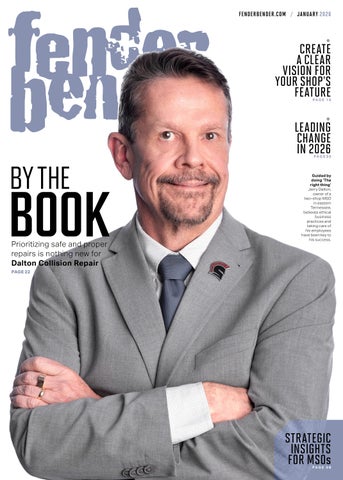
BY THE
BOOK Prioritizing safe and proper repairs is nothing new for Dalton Collision Repair
PAG E 3 0
Guided by doing ‘The right thing’ Jerry Dalton, owner of a two-shop MSO in eastern Tennessee, believes ethical business practices and taking care of his employees have been key to his success.
PAGE 22
STRATEGIC INSIGHTS FOR MSOs
PAG E 0 8
PG ⁄⁄⁄⁄⁄ ⁄⁄ C ⁄⁄ ⁄ ⁄ ⁄ ⁄ ⁄ ⁄ ⁄ CV⁄ ⁄⁄⁄ ⁄ ⁄ ⁄ ⁄ ⁄⁄ ⁄ ⁄ ⁄ ⁄ ⁄ ⁄ ⁄ ⁄ ⁄⁄ ⁄⁄ ⁄ ⁄ ⁄⁄⁄ ⁄ ⁄ ⁄ ⁄ ⁄ ⁄ ⁄ ⁄ ⁄ ⁄ ⁄ ⁄ ⁄ C ⁄ ⁄⁄ ⁄ ⁄ ⁄ ⁄ ⁄⁄ N ⁄⁄
INTRODUCING OUR
ISSIOATION M E M NEW CUSTOMER ICLE OR DASHBOARD line VEHROL INF Fuel: Gaso T & UPDATED MOBILE APP CON 2015
R2
d
IE ualifie ns: DV / TA q AILABLE N latioO W VV L u g L e r U E :
to / stds PC / rms onfo PA class s / stds: 1.2L C s E 11 th t ⁄⁄ ⁄⁄⁄O against⁄vers⁄tha ent⁄ U.S. ornia cla XV01.80 05 m ⁄ t⁄co ploythat O⁄⁄⁄⁄leashare n V We’re excited to the f ⁄⁄ i M l O a 5 ⁄ G e ⁄ t e Ca p: FG XR009 8 D: I I IRBAATÉRAL •⁄⁄oo⁄n⁄noot⁄⁄suidsee⁄⁄sair⁄baangu⁄adl⁄for A B M rou E L m •⁄ block neand ADL App r’s⁄ tion⁄ LKQ SIDNMobile NT B2B G vap: FG /TWC, O E ABLE S L w a M F o R ⁄ E m S S SIN GO S E 2 S ⁄eere⁄infor I O T ⁄⁄ H mo OUS CWeb AVER⁄⁄B⁄⁄⁄⁄⁄⁄ ⁄ orte⁄ Portal (portal.lkqcorp.com/ SFI/ (SRS)
0000
⁄ ⁄⁄⁄⁄ ⁄H
0000
P 5 BLE F001883 VE. PPLICA O A B a/30 L A L T0 OA OWN RMS T IN RE SH CONFOTANDARDSANUFACTU0 S 00 FETY DATE OF M 000 THE 000000 000 B DS0: 3U51 V 5 R 3 0 F RC: 1 TR SPB XLE V D A R 4 5 TC U / PS K P T A U TR : T PN K INT GP B BR4 14 NING ⁄⁄H⁄ WA⁄⁄R⁄J⁄⁄Y⁄Oe⁄⁄d⁄⁄o⁄or⁄
⁄⁄⁄ ⁄⁄⁄ ⁄la⁄p V⁄⁄⁄⁄ O⁄⁄⁄⁄ ⁄contre
⁄⁄ ez⁄pas ⁄siège t⁄du O⁄⁄V⁄É⁄⁄⁄O⁄same y re men login) now use PGthe ⁄⁄ ous⁄appu ⁄un⁄couv éploielogin. ⁄v ez⁄pas er⁄le⁄d ral⁄ e ⁄ • ⁄’utiliz ut⁄bloqu ble⁄laté ucteur⁄po⁄ur • qui⁄pe inboth One password for ents onfla ondplatforms ss ⁄g el⁄du⁄c ignem ⁄ cou⁄le⁄manuples⁄rense Voir luand s⁄am — simple, secure, seamless. de⁄p
N MATIO
NFOR DING I
A ND LO A E R I New Dashboard isT available
2 REAR
N MATIO R O F N ROL I CONT
ION MY EMISS 016 E L 2 C I : VEH ions
lat line egu r aso s with dard o t G V : s D l te n B4 L Fue in sta ns sta form ts e o Con PA: T2 l i tmen s a s s s u i j E r d I I . m a o f U.S OBD : Not rnia e FI No FED nia Califo /TC/D
on our Website & Mobile App • Faster, Easier Ordering: Place orders in just a few clicks with our streamlined interface. • Track Your Orders: Get real-time updates on every order you place. • Access Shipping Info & Reprint Invoices: All your order and billing details in one place. • View Credits: Easily see account activity and available credits. • Order History: Quickly search past purchases and reorders.
APPLE STORE
Scan the QR Code to get started now!
GOOGLE PLAY
O MOT ERAL : D E R F . AW LE OVE CAB NT G RIMSOLDAT N AB PPLI FRO40KG R16SL C W A I O L S 2 P 1 5 /70 SH 85 AL P23PORTAL S TOS IN ACTURE F00183 LKQ B2B WEB .0J a/30 D NUF ORM T0 R F 16X7205 kP A N CO STANDOF MA T E L C HI TY TE S VELE SAFETHE DA000000 THIH IC ON 0000 E V ECT 000 : DS01BTR EFF: 0000 U5 V 3 E P L : X : 13RC R A F05 PEM DB S P / TP 4 5 TVC U K R T: UA INT T
CONTENTS
JANUARY 0 1 . 2 6
|
V O L U M E
2 8
|
N U M B E R
FEATURE
0 1
PROFILE
16 CREATING A CLEAR VISION
22 BY THE BOOK
FOR YOUR SHOP’S FUTURE
Prioritizing safe and proper repairs is nothing new for Jerry Dalton.
Maximize your facility’s potential.
BY LINDSEY GAINER
BY NOAH BROWN
FenderBender (USPS Permit 25614), (ISSN 1937-7150 print) is published monthly by Endeavor Business Media, LLC. 201 N Main St 5th Floor Fort Atkinson, WI 53538. Periodicals postage paid at Fort Atkinson, WI, and additional mailing offices. POSTMASTER: Send address changes to FenderBender, PO Box 3257, Northbrook, IL 60065-3257. SUBSCRIPTIONS: Publisher reserves the right to reject non-qualified subscriptions. Subscription prices: U.S. ($93 per year). All subscriptions are payable in U.S. funds. Send subscription inquiries to FenderBender, PO Box 3257, Northbrook, IL 60065-3257. Customer service can be reached toll-free at 877-382-9187 or at fenderbender@omeda.com for magazine subscription assistance or questions. Printed in the USA. Copyright 2026 Endeavor Business Media, LLC. All rights reserved. No part of this publication may be reproduced or transmitted in any form or by any means, electronic or mechanical, including photocopies, recordings, or any information storage or retrieval system without permission from the publisher. Endeavor Business Media, LLC does not assume and hereby disclaims any liability to any person or company for any loss or damage caused by errors or omissions in the material herein, regardless of whether such errors result from negligence, accident, or any other cause whatsoever. The views and opinions in the articles herein are not to be taken as official expressions of the publishers, unless so stated. The publishers do not warrant either expressly or by implication, the factual accuracy of the articles herein, nor do they so warrant any views or opinions by the authors of said articles.
January 2026
3
fenderbender.com
CONTENTS
JANUARY
STARTER
06
PAST THE PAGE
New columns focus on helping customers grasp the complexity behind the price, plus a call to action for OEMs for their certified programs. Plus: SEMA backs legislation to ensure ADAS functionality on modified vehicles.
QUICK FIX
08
BREAKDOWN
Strategic insights for MSOs
11
NUMBERS
What is your training budget?
10
LIGHT HITS
The latest stories from around the industry
12
Q&A
Help your customers get reimbursed for their claims
12
STRATEGY
COLUMNS
26
THE SOP
26
14
SHOP PROFITS
Spending one afternoon a month cleared 60 stuck supplements
The true meaning of a champion
28
COLLISION COURSE
CASE STUDY Removing personally identifiable information
30
LEADERSHIP
Leading change in 2026
BY G REG LOB S IG E R
33
The benefits of collision repair networks
BY TIFFANY ME NE FE E
34
GUEST COLUMN The dilution of certified collision repair BY S HE Y K NIG HT
January 2026
4
fenderbender.com
CONTENTS
ONLINE EXTRAS
EDITORIAL
Chris Jones VSRG Editorial Director Jay Sicht Editor-in-Chief Peter Spotts Associate Editor Kacey Frederick Assistant Editor Emily Kline Special Projects Editor Leah Marxhausen Special Projects Editor Lindsey Gainer Contributing Writer Shey Knight Contributing Writer Todd Kortemeier Contributing Writer Greg Lobsiger Contributing Writer Tiffany MenefeeContributing Writer Carol Badaracco Padgett Contributing Writer Elisabeth Sobczak Contributing Writer Steve Trapp Contributing Writer
CL ICK ON THE L OGO BEL OW F OR PRODUC T INF ORMATION
AirPro Diagnostics
LKQ Refinish is Thankful for You! Products Abrasives Aerosols Body Fillers Clears & Primers Cleaners & Solvents Cloths & Wipes Safety
EDITORIAL ADVISORY BOARD
Jason Mundy Mundy’s Collision Center Jordan Beshears Steve’s Auto Body Sheryl Driggers Collision Advice Stan Medina Certified Collision Works
Detail Compounds & Polishes Masking Sealers & Adhesives Painting Supplies Tools & Equipment
Services
Auto Data Labels
SALES
Andrew Johnson Publisher ajohnson@endeavorb2b.com Mattie Gorman-Greuel Associate Sales Director Cortni Jones Director of Business Development Diane Braden Account Executive (National Accounts) dbraden@endeavorb2b.com Marianne Dyal Account Executive (National Accounts) mdyal@endeavorb2b.com Chad Hjellming Account Executive (National Accounts) chjellming@endeavorb2b.com Lisa Mend Account Executive (National Accounts) lmend@endeavorb2b.com Austin Miller Account Executive (National Accounts) austinm@endeavorb2b.com Kyle Shaw Account Executive (National Accounts) kshaw@endeavorb2b.com Sean Thornton Account Executive (National Accounts) sthornton@endeavorb2b.com
AUTEL Thanksgiving! Happy
Reporting Tools Inventory Management Process Analysis Ordering Options Digital Color Match Expertise Technical Resources
Buy Auto Supply
Our dedicated team delivers the products and services you need to reach your goals — because your success is our mission. Together, we are more than a supplier — We are your trusted partner.
Ford Motor Company
Scan to Learn More!
LKQ Corporation FOLLOW US!
Call Toda
Refinish
(866) LKQ-CORP | (866) 557-2 Order online at portal.lkqcorp.c
2511FB_LKQRefinish.indd 1
10
ART AND PRODUCTION
Mariah Straub Production Manager Jen George Ad Services Manager Mitch Bradford Art Director
ENDEAVOR BUSINESS MEDIA, LLC
CEO Chris Ferrell COO Patrick Rains CDO Jacquie Niemiec CALO Tracy Kane CMO Amanda Landsaw EVP Transportation Chris Messer EVP Endeavor Business Intelligence Paul Mattioli VP of Content Strategy, Transportation Group Josh Fisher
WE’RE SOCIAL CONNECT WITH US ON YOUR FAVORITE SOCIAL MEDIA SITES
SUB SCRIPTION S
Send address changes and subscription inquiries to: FenderBender PO Box 3257 Northbrook, IL 60065-3257 Subscription Customer Service: 877.382.9187 fenderbender@omeda.com
LET TE RS TO THE E DITOR editor@fenderbender.com
Opinions expressed in FenderBender are not necessarily those of Endeavor Business Media, and Endeavor Business Media does not accept responsibility for advertising content.
WWW.FENDERBENDER.COM January 2026
5
fenderbender.com
PA ST T H E PAGE
SEMA PRAISES ADAS FUNCTIONALITY & INTEGRITY ACT The Specialty Equipment Market Association sent out a press release praising the U.S. House of Representatives introduction of the ADAS Functionality & Integrity Act (H.B. 6688) by Rep. Diana Harshbarger (R-Tenn.), cosponsored by Rep. Gabe Vasquez (D-N.M.), Rep. Jay Obernolte (R-Calif.), and Rep. Norma Torres (D-Calif.). The legislation aims to provide aftermarket businesses with the information needed to properly calibrate advanced driver assistance systems after vehicles are modified. SEMA said the bill will allow shops to safely perform common modifications without compromising the functionality of ADAS, such as installing bike racks, wrapping a vehicle, installing larger wheels and tires, or installing a winch or aftermarket bumpers. The ADAS Functionalit y & Integrit y Act would require the National Highway Traf fic Safet y Administration to establish ADAS guidelines to create modification ranges and tolerances for new vehicles star ting in model year 2028. The bill also requires NHTSA to create guidelines that establish ADAS test procedures that
January 2026
6
af termarket businesses can properly test and validate that the vehicle systems have been properly calibrated. SEMA worked closely with lawmakers from both parties to secure bipartisan support for the legislation, which is being introduced before an upcoming federal mandate that will require new, model year 2029 vehicles to feature automatic emergency braking. “SEMA thanks Rep. Harshbarger for her leadership and Reps. Vasquez, Obernolte, and Torres for their strong support for ensuring vehicles with ADAS can be modified without compromising the integrity of these important safety systems. The introduction of the ADAS Functionality & Integrity Act is a landmark
fenderbender.com
VIDEOS
|
PODCASTS
|
WEBINARS
|
NEWS
Shey Knight,
CFO, Autosport Bodyworks MOST-READ ONLINE COLUMNS Knight: Why a Bumper Repair is now $10,000: Helping Customers Grasp the Complexity Behind the Price Vehicle technology advancements, including ADAS and OEM procedures, have transformed bumper repairs from simple fixes to complex, costly procedures.
FENDERBENDER.COM/55338799 Batenhorst: A call to action to OEMs for their certified collision programs OEMs must increase audit frequency, improve training, and be more selective in their network membership or risk damaging their brands’ reputation and customer trust.
ADOBE STOCK 456012513
moment for anyone who owns, repairs, or modifies a vehicle,” said Jim Moore, SEMA vice president of OEM and product development. “Americans deserve confidence that those critical systems will work as intended for the entire life of their vehicle, even after repairs or customization. Currently, the industry lacks clear standards governing ADAS calibration, and aftermarket businesses and vehicle owners need access to the necessary calibration information and procedures needed to keep modern safety features functioning. This bill marks a critical step forward in the name of vehicle safety and is a major step forward in protecting the American people’s right to modify the vehicles they own.”
January 2026
FENDERBENDER.COM/55335943 MOST DOWNLOADED EPISODE CollisionCast: Toxic Teams Don’t Fix Themselves Learn how to spot the signs of toxic leadership and how to resolve team conflict in your collision repair shop with Dr. Paul White, coauthor of The 5 Languages of Appreciation in the Workplace, and Sheryl Driggers, coach at Collision Advice.
FENDERBENDER.COM/55337122
@fenderbendermag 7
@fenderbendermag
fenderbender.com fenderbender.com
Q U I C K
F I X
BREAKDOWN
STRATEGIC INSIGHTS FOR MSOS: PREPARING FOR INDUSTRY SHIFTS AND PRIVATE EQUITY INVESTMENTS
Focus Advisors reports on increasing industry interest from private equity firms and opportunities for expansion during the economic downturn.
E C O N O M I C J I T T E R S S PA R K E D B Y President Trump’s tariff policies made for fewer MSO transactions in 2025. That did not surprise Focus Advisors’ John Walcher and David Roberts, who presented an MSO & Private Equity Report during the MSO Symposium in Las Vegas on Nov. 3. More than 450 shop owners and industry professionals packed the Brasilia Ballroom in the Rio Hotel & Casino. Roberts said the economic climate caused by tariffs created an air of uncertainty among consumers and MSOs alike. “We know that uncertainty is something that causes people to delay or not
By PETER SPOTTS
January 2026
8
fenderbender.com
NEWS
make decisions. They just wait, and we are experiencing that,” Roberts said. “The number of transactions in the industry is down significantly.” That said, days before the Symposium the Boyd Group announced it is acquiring Joe Hudson’s Collision Centers. The $1.3 billion deal adds 258 locations in the southeast U.S. to Boyd Group’s network, bringing its total to 1,273. Walcher pointed out the collision industry is not very consolidated yet – the “Big Five”: Boyd Group/Gerber, Caliber Collision, Classic Collision, Crash Champions, and Joe Hudson’s, hold just a 36% market share despite perceptions that it might be more. To illustrate the illusion of market share, he pointed out how Lowe’s and Home Depot have a 30% market share and CVS and Walgreens hold 40% in their respective industries. “We get asked all the time, what is the state of consolidation? How close are we? How much more do we have to go?” Walcher said. “I think the lesson here for us in part is that in some industries — smaller industries — consolidation can happen significantly, but when you look at the broader industries, like home products with Home Depot and Lowe’s, we’re not going to see that as much.” Private equity interest in the industry is ramping up as well. Focus Advisors’ presentation noted they’ve had more than 50 inbound inquiries from private equity firms in 2025, and there is a large pool of private equity capital looking for targets. There were four major private equity events in 2025: • Driving Force Collision (backed by TRP) acquired Tom Masano Auto Group • Trive Capital invested in Chilton Auto Body • Bestige Holdings invested in Collision Leaders • ONCAP invested in CSN, which acquired 16 shops “There are huge pools of capital that are out there to support the continuing consolidation of this and a lot of other industries,”
January 2026
Roberts said. “They like industries where there are regular sources of payment…so they like institutions that pay them, [such as] insurance companies and government and auto insurers. So that provides us this ongoing stream of revenues into an industry that can be optimized by the application of strategy and capital.” Joe Hudson’s Collision Center is “a perfect example of private equity success in the industry,” Roberts said. Carousel Capital bought it in 2014; Roberts estimated the sale was $65 million for 23 shops. In 2019, Carousel Capital sold 114 shops for $700 million to TSG Consumer. Six years later, Boyd Group is buying 258 shops for $1.3 billion. Overall, Joe Hudson’s value increased $1.125 billion in 11 years. “They bought what was then 114 shops. They went through a very difficult time of COVID-19 and finally went back to market…with 258 shops,” Roberts said. “They originally paid around $700 million, is what we understand…but they got a whole lot more money.” Ultimately, these are signs that the collision industry is maturing, according to Roberts. The largest consolidators are transitioning from rapid expansion to capital rationalization and margin optimization. Institutional investors will focus on earnings and be more selective with mergers and acquisitions. “We think that that [larger folks in the industry] are going to diversify and probably diversify a lot more actively over the next few years,” Roberts said. “It also means there is less competition in some regions of the country. Joe Hudson’s is pretty much waterfront property all across the Southeast of Texas.” Roberts and Walcher concluded the presentation by discussing the industry slowdown. Roberts said it’s not a recession, but it’s the third downturn he’s been through. What’s different this time is they’re seeing steeper dynamic changes, faster increases in total cost of repair, rising insurance premiums, more rapid and widespread technological demands.
9
|
IDEAS
|
PEOPLE
|
TRENDS
“The bottom line is there are fewer repair opportunities per mile driven. Is this downturn permanent or is it cyclical?” he asked. “We think some things are cyclical, and we think others are much more permanent. “ Operators are adjusting to these conditions by creating tighter relationships with referral sources and DRPs, diversifying, and bringing more sublets in-house. They are cutting costs, getting rid of bottom performers, working on fleets, and adding more certifications. Jason Zander, owner of Zander Group, acquired three shops during the current downturn in North Carolina. He bought near-totals, repaired and opened a used car sales operation on excess land, and made targeted acquisitions in tax-advantaged “opportunity zones.” His effective leadership also earned him CARSTAR’s Franchisee of the Year award. “It’s a good example that even in a downturn, there are opportunities,” Roberts said. “If you’ve got capital, and you’ve got good management, and you’ve got a plan, then a downturn is a great time to expand.” Looking ahead at the next five years, Focus Advisors expects AI to continue to enhance evaluations, communications, and efficiency. Large consolidators should grow and diversify; second-tier private-sponsored consolidators should continue acquisitions or merge with other significant MSOs, and independent MSOs should grow primarily by acquisition. Roberts and Walcher’s message to operators on what to do now is to create a strategy and execution plan. Focus on certifications, refocus on insurer relationships, adopt new technology, improve cycle times, and map out where the business is going to scale. “Upgrade your management, adopt the new tech; don’t wait. Don’t say I want to see how it works out. You’ll make some mistakes, but you’ve got to be on board with that,” Roberts said. “You’ve got to have a plan for who you want to acquire or where you want to go.”
fenderbender.com
QUICK FIX
LIGHT HITS
CCC CRASH COURSE Q4 2025: CALIBRATIONS, SUPPLY CHAINS, AND COST DYNAMICS
CCC Intelligent Solutions Inc.’s Crash Course Q4 2025 Report examined the rise in calibrations, supply chain issues, and changes in parts and repair costs. The rise in calibration demands hit all shops. The differences in make, model, trim, sensor placement, and damage type widen the range of requirements and require more documentation, sequencing, and added repair steps. Tariffs on imported auto parts stressed parts pricing and supply chains throughout the year. Even when claim frequency remained steady, the cost of fulfilling the average claim continued to rise. The average vehicle age continued to rise as affordability challenges ranging from higher new vehicle prices to elevated interest rates pushed consumers to hold onto cars longer. New vehicles also added increasing repair complexities as shops needed to tackle embedded electronics, a broader presence of ADAS, and increasingly integrated components. The year-to-date average total cost of repair (TCOR) is +1.4% year-over year, at $4,768. The average TCOR finished 2024 at over $4,730, or +3.8% year-over-year. This was the lowest increase since 2017. Increases in repair costs have been mitigated by the increase in total losses and age mix; almost 46% of repairable vehicles are seven years or older, generally requiring less parts and labor hours. CCC concluded that if this year revealed the pressure points, 2026 offers the opportunity to strengthen them. Success will come to the organizations that treat these insights to shape a path forward – one that supports a more resilient claims and repair ecosystem in the year ahead.
January 2026
REVV REPORT FINDS ONLY 21% OF SHOPS HAVE OPTIMIZED CALIBRATION PROCESSES
ADAS calibrations continue to grow as 86% of collision repair shops perform at least some calibration in-house. However, Revv’s The State of ADAS Calibration: Industry Benchmark Report 2025 revealed only 21% of shops have a fully optimized calibration process. The report highlights the challenges shops are facing at the rapid rate new vehicles are adopting ADAS technology but also presents financial opportunities. Out of 300 shops surveyed, the average shop generates $21,509 per month in ADAS revenue with a 9% net profit margin. The shops expect ADAS work to increase by 30% over the next two years, which should drive the revenue numbers higher. Revv identified five key takeaways that shops are grappling with as they try to keep up with ADAS’ rapid growth: • Equipment Costs Create High Barriers • Training Is the Biggest Barrier to Growth • Technology Friction Slows Optimization • ADAS Maturity Is Increasing Documentation Burden • Process Gaps Create Hidden Costs
10
Rev v’s repor t concluded with recommendations for how to tackle some of the biggest concerns shops face with ADAS calibrations: Rising costs: Build depth in high-volume makes before adding breadth. The 43% of shops turning away work often bought too broadly too soon. • Changing standards: Invest in software that updates automatically rather than manual tracking. The cost of missing a procedure change far exceeds software costs. • Complexity: Consider the sublet hub model; 61% of shops receive sublet work, allowing them to specialize rather than cover everything. • Tech shortages: Cross-train two to three technicians on common calibrations to prevent bottlenecks when someone is out. • Liability concerns: Implement systematic identification and documentation tools like Revv. Before these, 22% of vehicles requiring calibration left without it. Finally, systemize your processes to ensure nothing slips between the cracks.
fenderbender.com
NUMBERS
WHAT IS YOUR TRAINING BUDGET? OV ER THE PAST FEW Y EA RS, shop owners and operators responding to the annual FenderBender Industry Survey have invested more in a planned training budget.
The portion of people claiming they don't invest anything in training dropped by 12 points this year. Although the majority still spend 1-5% of their sales on training, those spending 11-15% jumped from only 3% to 9%.
W H AT P E R C E N TA G E O F Y O U R B U S I N E S S’ T O TA L S A L E S DO Y O U A L L O T F O R T R A I N I N G I N V E S T M E N T S ?
5%
0%
37%
1-5%
17%
6-10%
9%
11-15% 16-20%
1%
21%+
2%
None
January 2026 2409FB_BuyAutoSupply.indd 1
29%
11
fenderbender.com 6/20/24 2:51 PM
QUICK FIX
PETER SPOTTS
Q&A
HELP YOUR CUSTOMERS GET REIMBURSED FOR THEIR CLAIMS
Shops can empower their customers to help ensure everyone gets fair reimbursement during the repair process. By PETER SPOTTS
C U S T O M E R S E N T E R I N G a body shop after an accident need guidance to navigate the repair process. They might not know OEM requirements for repairing the damage or the ins and outs of what their insurance policy covers, but shops can help them. AkzoNobel Senior Services Consultant Tim Ronak and Business Consultant Tony Adams hosted “Developing Your Consumer’s Guide to Fully Reimbursed Auto Claims” during the SEMA Show in Las Vegas during the first week of November. Insurers are pushing back against rates and fully reimbursing OEM procedures, and many consumers assume the insurers’ decisions are final. It’s also critical that shops make it clear that they aren’t “padding the bill,” simply performing the necessary repairs to restore the vehicle to proper condition. By helping empower consumers, shops can help ensure everyone involved in the repair process gets fair reimbursement.
January 2026
Adams’ and Ronak’s 90-minute discussion, summed up here in a Q&A format, covered the rights of consumers, what constitutes a proper repair, tips to communicate information the customer needs to know during the repair process, and also provided attendees with documents they can use as a starting point to communicate with a customer. Q: What rights do consumers have? Adams: They have a right to choose the repair shop. They have a right to OEM standards. They have the right to full indemnification, not partial reimbursement. They have a right to documentation of denial reasons, and they have a right to arbitration, appraisal, or some sort of legal recourse…maybe small claims court or some of those other things. But these are all consumer rights, and we’ve developed some tools to help with that.
12
Q: The importance of proper repairs: Nobody here is trying to pad the bill, right? Adams: We’re just trying to repair the car to an OEM standard and follow all the documented procedures and leverage all of the P-Page logic in the estimating system that we all agree upon that we’re going to use. It’s not padding the bill, but that’s the word that we sometimes hear. So, it’s important to understand that…and empowering customers to just help ensure fair reimbursement for everyone…I used to tell some of my customers, “I didn’t buy your car, I didn’t wreck your car, and I didn’t choose your insurance company. Those things are not necessarily my issue. I’m merely the humble service provider trying to restore your car back to a safe and proper manner.” Q: Who is the insurance contract between? Adams: Understanding the policy and the consumer, specifically understanding
fenderbender.com
MARIANVEJCIK / ISTOCK / GETTY IMAGES PLUS
the policy and all of us as consumers of those insurance policies. You’ve got to understand what it contains and what it doesn’t. It is important because it is a contract between the consumer and the insurance company. They chose the third-party provider to help mitigate their damages. We are the service provider trying to restore that vehicle to a safe, operable manner…not every policy has the same types of limits of coverage. So, really understanding what that contract says and for the consumer to understand what that contract says...What I don’t want you to do is practicing law. You don’t want to be giving them legal advice, but helping them identify and understand coverage limits, repair vs. replace, payment of loss details, whether or not they have an appraisal clause, and understanding and reading the fine print. Q: How many cars do insurance companies fix? Ronak: None. Insurers do not repair
January 2026
cars. They are not in the business of fixing cars. They are in the business of underwriting losses, and that changes the perspective when you start thinking of it as a repairer. Their role is simply to restore that vehicle back to its pre-loss state and ensure they do that with the lowest level of avoidable reliability for the repairer. That’s the big key in all of this. Q: How do you quantify loss? Adams: We have to understand how the loss is defined in a collision claim and what the repair standard is. It could be pre-loss; it could be like kind and quality…we need to understand what those are...What are the OEM procedures defined? They do create the standard. They define what is a safe and proper manner…deviating from the OEM standard specified repair procedures puts yourself in a position of liability. They are the OEMs that say this is how a vehicle needs to be restored.
13
Q: What does repair liability look like? Adams: The estimate is not a repair blueprint. It’s merely a financial document and a projection of costs. It may omit required OEM repair procedures. Your duty as a professional repairer is to identify all the required steps necessary for a complete and safe repair, even if they were not listed or approved. What we’re specifically talking about there is the insurer estimate. The insurer’s estimate has no bearing on how the vehicle gets repaired. You as the repair professional decide how the vehicle needs to be repaired so that you’re protecting that consumer and avoiding avoidable repairer liability… You have all the repair, you have all the liability. It’s attached to the person performing the work…courts and experts will not accept, ‘Well, the insurer wouldn’t pay for that’ as your defense. All that says is that “I’ve put my profits ahead of the safety of this repair.”
fenderbender.com
COLUMNS
SHOP PROFITS
The True Meaning of a Champion Champions are made through adversity, teamwork, continuous learning, and the relentless pursuit of excellence. our learning process. Those could have been from a great mentor, a speaker, a book, etc. Several years back, I had the privilege of listening to Ray Evernham speak. He was Jeff Gordon’s crew chief for their multiple NASCAR championships in the late 1990s. Even though I do not follow NASCAR, I walked away from Ray’s speech with some VERY important truths about what it takes to be a true champion. Being a body shop owner isn’t easy and is NOT for the faint of heart, IF we want to grow year after year, have a high net profit, and pay our employees better than anyone else in our markets. Ray presented 12 good definitions of the true meaning of being a CHAMPION. 1.
“True CHAMPIONS are not born. CHAMPIONS are made in adversity. Bad days, problems, heartaches, and losses are all necessary elements in molding CHAMPIONS.” We all have those days in our shops, whether that be a nightmare insurance company, a difficult customer, an employee issue, or a repair that is not going well. We MUST look at the big picture, push through, and not become discouraged! 2. “A CHAMPION is not an individual star, necessarily, but a team player who knows how to function with others.” As owners, we must have proper pay plans, systems, and lead in a way that promotes teamwork. Yes, occasionally we need to “kick someone off the bus” who doesn’t like working on a team. Ray said they went through 64 people to finally end up with the 12 folks needed for their winning NASCAR crew. One of the final crew members was previously a plumber, but boy, what a team player he was!! 3. “CHAMPIONS inspire their teammates to play harder, more intensely, by their example. They walk their talk.” As owners, are we the first to arrive and the last one to leave? Or do we show up mid-morning in our new BMW with fancy shoes, then three or four hours later leave with the bank deposit for the rest of the day? 4. “CHAMPIONS are interested in learning all they can, mastering all their skills and responsibilities, acquiring every characteristic that helps them gain the edge.” We must constantly read, listen to smart people, and choose the correct friends to hang out with. It comes down to making good choices and avoiding bad ones.
January 2026
5. “A CHAMPION lives above pressure and thrives on it.” Without goals, and plans to reach them, you are like a ship that has set sail with no destination. — Fitzhugh Dodson 6. “CHAMPIONS love competition - the challenge of becoming more disciplined, more intense, more prepared. They realize that the harder the battle, the greater the adversity, the stronger they’ll become, the quicker they’ll achieve their goals. They relish battles. CHAMPIONS are driven to excel.” Ray told us a story I will never forget about how sick Jeff was during a race. Ray had radioed Jeff and asked him how he was feeling. Jeff’s response was golden: “I just threw up big time and feel so much better!” Yes, you guessed it, Jeff won the race! 7. “CHAMPIONS are never satisfied with their performance but are always content with the fact that they are continually striving to get better.” Did you get the keywords, ‘Never Satisfied!’? 8. “CHAMPIONS are uncomfortable with imperfection, always striving for perfection, knowing it can never fully be reached but loving the battle of trying to reach it, the FIGHT for Excellence!” 9. “CHAMPIONS are committed to excellence…always, only.” What we tolerate becomes the standard. 10. “The difference between CHAMPIONS and everyone else is very simple. CHAMPIONS are always willing to do the little things – that’s the simple difference.” Ray spoke about how tight their machine shop tolerances had to become to win. Are we checking our tolerances daily in our blueprinting, estimating and mirrormatching processes? 11. “The mark of a CHAMPION is how hard they work when no one is watching!” Sleep is WAY overrated. If you have never worked all night because you wanted to finish a task or project, you don’t know what you’re missing, trust me. People without passion cannot become champions; passionate people are the ones truly living. We are just wired differently than the average Joe. 12. “CHAMPIONS realize that some days, even most days, they don’t “feel” like working, striving, paying the price to be a CHAMPION. But then they remember, or another CHAMPION reminds them, being a CHAMPION is a choice they make over and over each day!... and so they make that choice again.”
14
GREG LOBSIGER
JOSIE SMITH PHOTOGRAPHY
It’s interesting to reflect on pivotal moments of
Greg Lobsiger has owned Loren’s Body Shop in Bluffton, Indiana, for over 23 years. He has been a member of Mike Anderson’s groups for ten years and had extensive lean manufacturing training.
EMAIL:
greg@lorensbodyshop.com
ARCHIVE:
fenderbender.com/lobsiger
fenderbender.com
FEATURE
CREATING A CLEAR VISION FOR YOUR SHOP’S
FUTURE The collision repair industry is changing rapidly. Learn how AI, specialization, and smarter insurance strategies can transform your shop from surviving to thriving. By NOAH BROWN
January 2026
16
IMAGINIMA / GETTY IMAGES / E+
CREATING A CLEAR VISION FOR YOUR SHOP’S FUTURE
E
very year, the speed at which the collision industry evolves and changes seems to increase. In just the last five years, vehicles have become infinitely more complex, negotiating with insurance companies has become even more difficult, and customer expectations have never been higher. Shops have more tools than ever at their disposal, from AI-enabled diagnostic tools to rapidly improving customer management suites and beyond. But, as the technology advances, so, too, does the need to stay on the cutting edge and keep up with the latest trends. It’s a tall order, and it can be overwhelming to look at all these new tools and resources and figure out where to start. However, Louie Sharp, business consultant and owner of Sharp Auto Body in Island Lake, Illinois, says there’s quite a bit of opportunity out there for those who know how to seize it. “One of my very favorite quotes is by entrepreneur Jim Rohn, and he basically says ‘You can’t hire other people to do your pushups for you,’” Sharp says. “You just have to go do the work. You’ve got to go learn how to use AI, you have to read books, you have to find that content.” Shops need to figure out how to set themselves apart. In today’s AI-enabled landscape where everyone has access to the same tools, information and learning, you separate yourself by becoming the expert and advocating for your customers. To thrive, shops need a clear vision for the future — one that embraces new technologies, focuses on specialization and redefines relationships with insurers.
expensive, proprietary AI platforms to harness its potential. Using open-source platforms such as ChatGPT is free, and if you know how to write strong prompts, those free-to-use platforms can help identify your target market, uncover pain points, and even generate marketing campaigns tailored to your audience. They can also assist with internal operations such as writing job descriptions, creating bonus programs, and drafting standard operating procedures. However, if you do decide to use those platforms, Sharp says it’s crucial to remember that they are open-source, meaning anything you put in will be added to its language learning model and could be used to generate prompts for someone else. “AI can do basically anything you ask it to, but it goes to everybody all the time,” Sharp says. “If you’ve got a brainstorm or an idea for a brand-new tool or marketing scheme, don’t put that in AI because it will disseminate that around the world.” Sharp adds that spending time worrying about whether AI will replace people’s jobs is, frankly, a waste. AI won’t fix cars, but it can help you run a smarter business. Start small with one AI platform and give it detailed information about your shop, such as location, size, specialties, certifications and market demographics. From there, you can ask detailed questions to help figure out what your target market’s pain points are. Once you have a solid understanding of how generative AI services work, that provides a strong knowledge base to use other AI-enabled tools such as scanners. And, as Sharp notes, AI is here to stay. “It’s only going to get better and faster,” he says.
Embracing Artificial Intelligence
Depth over Breadth
Ask anyone, regardless of their age or profession, about AI and chances are they’ll have a fairly strong opinion on it. While it still remains to be seen how much AI is really going to reshape the workforce, the technology is already reshaping how collision repair shops operate. Sharp says you don’t have to invest in
Gone are the days when a single shop could repair any vehicle that rolled through the door. Today’s cars are essentially computers on wheels, loaded with advanced driverassistance systems, complex electronics, and specialized materials. That complexity comes with a price tag, both in equipment and training. Darrell
January 2026
18
Amberson, VP of Industry and OEM Relations for Quality Collision Group, says some shops tend to underestimate the time, training, and money required to repair a vehicle. “If you’re going to do the job properly, really according to factory repair procedures, and even better yet be certified at it,” Amberson says, “the range of equipment that you need is staggering.” Consider this: A four-year subscription to Mercedes repair software costs around $40,000, according to Amberson, and to become Audi-certified, a shop might invest $300,000 in equipment and training. For most smaller operations, trying to take on every make and model is impossible. Sharp agrees, saying that way of thinking has been an unsustainable business model for years. “Trying to be everything to everybody never works,” he says. Instead, shops need to identify their niche. Whether that’s EVs, luxury brands, fleet accounts, or specific OEM certifications, specialization not only makes financial sense; it also builds credibility and trust with customers. Amberson says talking to vendors you work with, such as your paint company, can help you identify which makes and models are more common in your area. Otherwise, doing an internal audit of what vehicles are most frequently coming into your shop can help identify a target market. “Take a good look at what brands are most common and look at your own brand mix, probably through your own management system, and do some calculations on that,” Amberson says. “Do you have relationships with specific dealers? That can also help you narrow it down to a few brands.” He also advises looking at overall industry trends to see what could be coming in the next few years. He points to EVs as a perfect case study: At this time four years ago, many thought EVs were going to dominate the industry. Instead, Amberson says EVs grew to become about 10% of new vehicle sales right now, and they’ve plateaued.
fenderbender.com
“There’s a significant number of people who go back to ICE or hybrid,” Amberson says. “So while there’s a lot of reason to believe that the EV market share will still grow, especially as technology changes, I personally think it was a little ahead of its time. It was a little overhyped.” Amberson says he’s found Toyota to be a good company to watch in terms of figuring out what is a solid trend versus what is just a fad. “I think they’re cautious, calculating, intelligent, and they try to take a lot of the emotion out of their decision-making,” he says. “If you look, they kind of hedge their bets on EVs. They’ve dabbled in it, but they didn’t put all their eggs in that basket. They saw more future in hybrids, and that decision’s proven to be wise.” Specialization is becoming more and more of a requirement, and Amberson says it’s crucial that shops figure out what their specialty is sooner rather than later.
“Have a plan in terms of what brands you want to be,” he says. “Have a training plan, because the learning requirements are going to do nothing but increase.”
Rethinking Insurance Relationships For decades, many shops relied on direct repair programs (DRPs) to keep work flowing. But Sharp says that model is breaking down, and DRPs often force shops to accept insurer-driven shortcuts that compromise repair quality and profitability. “DRPs are a broken model,” Sharp says. “The sooner this industry figures that out, the sooner this industry is going to start to thrive and grow.” Instead of bending to insurer demands, Sharp says shops need to educate themselves and their customers about the need to follow manufacturers’ repair procedures
HOW TO WRITE GOOD AI PROMPTS TO GET THE BEST RESULTS 1. Provide Context AI is built on information. The more you give, the more helpful it will be. Include details about your shop such as location and market size, years in business, number of technicians, specialties or certifications, and services offered. 2. Be Specific Avoid vague questions like “How do I market my shop?” Instead, ask targeted questions such as “what’s the fastest way to reach fleet managers in my area?” or “what social media strategies work best for collision repair shops targeting EV owners?” 3. Use AI for Strategy, Not Secrets AI is great for brainstorming, but don’t share proprietary ideas. Treat it as a consultant, not a vault. Pro Tip: Think of AI as a laser, not a light. The more focused your prompt, the more powerful the result.
JOHN BLACK PHOTOGRAPHY AT DALTON COLLISION
January 2026
19
CREATING A CLEAR VISION FOR YOUR SHOP’S FUTURE
JOHN BLACK PHOTOGRAPHY AT DALTON COLLISION
and not trying to repair a vehicle for the lowest cost possible. Understanding state laws, such as for right to appraisal and other consumer protection regulations, can help your shop secure fair compensation. And educating customers about repair quality builds trust and differentiates your shop. However, Amberson says to tread lightly when dealing with right to appraisal or other methods, as going up against insurance companies directly can create a lot of risk for everyone involved. “You always want to negotiate based upon facts,” Amberson says. “There are shops that dabble with right to appraisal and other legal means to try and get paid, but those tend to be cumbersome and create a lot of anxiety for all parties.” Knowing your state and local laws around consumer protection regulations can help you more fully explain to your
January 2026
customers why following OEM repair procedures is essential. And sharing success stories of how customers avoided insurer shortcuts and got proper repairs done can go a long way in differentiating your shop. Sharp says consulting with your customers early and often can help them be informed when dealing with insurers. “I once spent an hour with a customer before I ever started writing an estimate,” Sharp says. “I explained what was most important to her — quality, safety, retaining the value of her vehicle — and showed her why OEM parts and proper procedures matter.”
Looking Ahead The next decade promises even more disruption in the automotive aftermarket. Though Amberson says ADAS calibrations will remain a safe bet for at least 20 years, given the median vehicle age of 12+ years, new technologies will continue to push the envelope.
20
EV adoption has plateaued at around 10% of new vehicle sales, but hybrids are surging, and it is very possible that EV sales pick up in the not-too-distant future. And, AI will continue to infiltrate every corner of the industry. With all of that, Amberson says the aftermarket is under even more pressure to repair vehicles safely and properly. “We keep going in the direction of more and more accountability required,” Amberson says. “I-CAR has said publicly they are going to start requiring equipment components and shop inspections as part of their programs.” For shops, Sharp says that means one thing: adapt or disappear. “There are a lot of shops that are not going to be in business a year or two from now because they’re not changing. They’re not openminded,” Sharp says. “And all that’s going to do is open up opportunity.”
fenderbender.com
PROFILE
BY THE BOOK
January 2026
22
Prioritizing safe and proper repairs is nothing new for J E R RY DA LTO N . By LINDSEY GAINER
fenderbender.com
“People talk about repair procedures as if they’re something new,” says Jerry Dalton, owner of Dalton Collision, a twoshop MSO in eastern Tennessee, “but they’ve been around for a long time.” He would know; he’s been relying on them since he first started the business in 1991, buying physical copies of every manufacturer’s repair manual he could get his hands on from the get-go. “Back then, we worked on a lot of Hondas, and we liked working on them because they had clear-cut repair procedures and manuals.” Nowadays, Dalton and his team still complete all repairs by the book — they have nearly 20 OEM certifications and have maintained I-CAR Gold Class status since 1998 (longer than any other shop in the state, to Dalton’s knowledge). The main difference now is the ease of access. Instead of relying on printed materials, technicians now access repair manuals electronically from their own personal tablets. The importance of a safe and proper repair simply can’t be stressed enough, says Dalton, who likens it to “packing someone else’s parachute” — an analogy he learned from Mike Anderson, a “phenomenal” mentor and founder of the Spartan Group that Dalton has been a member of for four years.
January 2026
“When you’re packing somebody else’s parachute, you’d better make sure it’s going to operate the way it’s intended when it opens. I’m just really big on proper repairs — from a liability standpoint and from a customer experience standpoint, I’ve just always wanted to make sure we’re repairing cars the way the manufacturers designed them.”
From Painter to Owner/Operator Dalton originally worked as a fiberglass repairman for Sea Ray boats in his “early days” before making the transition to painting cars. “I just kept going and kept going. I started working on some cars. Then I met a couple of guys that I hooked up with, a couple of brothers. We started repairing, and then we started a three-man body shop. Over time, here I am!” He quit painting to run the business full-time once they hired their fifth or sixth employee, he recalls. Fast forward a couple decades and the company now has nearly 50 employees between its two locations, in addition to almost 45,000 sq. ft. of shop space. The first expansion happened in 1998, when, after adding onto the original small garage in Blaine several times, Dalton took the plunge and built a 7,000 sq. ft. facility at the original location. Since then, they’ve continued adding onto that shop, now occupying 13,000 sq. ft. in the small town
23
that’s situated in the foothills of the Appalachian Mountains. Dalton operated solely out of that original location for more than 25 years before moving into the Knoxville market with a second shop in 2018. And when the time came to grow, he did it strategically. “We had been looking for maybe five or six years when we finally came across a building that we thought would work really well.” Sitting at just 4,000 sq. ft. in what was formerly a window and glass manufacturing operation, the building would require a complete overhaul to meet Dalton’s needs, but it was all about location, location, location. Market research revealed that $32 million in collision sales were happening within a 10-mile radius of the shop every year. “We expanded on it once — we’re now at 30,000 sq. ft. We spent a lot of money remodeling the entire building.” Even though it’s an older building, he says, everyone who sees it “thinks it’s brand new.” “We put new paint on it. We put a facade on the front. We totally remodeled the interior. We polished the floors. We put new equipment in it, of course. Because of the configuration of the shop, we developed two paint booths and two prep stations with side-load systems.” His is likely the first shop in the state of Tennessee, he believes, using the Global
fenderbender.com
PROFILE
Finishing Solutions side-load system for paint booths. “Vehicles are loaded on tracks and slide sideways into the booth, then come out the front, which allows for a continuous workf low.” “We also put in [GFS REVO] infrared system to cure our solvents. Whether it’s filler, primer, base coat, or clear coat, everything gets cured with infrared. That way, we’re pulling 100% of the solvent out. We also use Ultra UV technology for that.” More shops are implementing this type of booth, he says, because it allows you to maximize your shop space and expedite repairs. “You don’t need as big a footprint for a paint shop like this,” he explains. “It allows you to have more space for body, mechanical…all the other operations that you need to have.”
Aluminum Specialists The Knoxville shop includes 6,000 sq. ft. of operational space for dedicated ADAS calibrations. Both shops have dedicated aluminum rooms, a requirement for several of the certifications they hold, including Ford, Rivian, and Tesla. Dalton’s interest in aluminum started with Ford’s aluminum repair program in 2014 (in
January 2026
preparation for the release of the aluminum-bodied F-150 in 2015) and kept growing from there. “Any aluminum work that we do, we do it in a clean room, completely separated from any other metal. We have to have a separate vacuum system, separate tools, separate sandpaper…everything has to be separate, since contaminants from steel can cause galvanic corrosion on aluminum.” Specializing in aluminum repairs, says Dalton, has been a great revenue source for the business. They regularly get referrals from other shops without the equipment and setup for such jobs, and since both the Blaine and Knoxville shops have dedicated aluminum rooms, they have plenty of capacity. “Pretty much any aluminum or electric vehicle programs, we try to specialize more in those because it’s a market that a lot of shops don’t want to invest in. We’ve decided that’s the direction we want to go.” Dalton’s current certification portfolio includes Acura, Ford, Genesis, GM, Honda, Hyundai, Infiniti, Kia, Lexus, Nissan, Rivian, Stellantis (Chrysler, Dodge, Jeep, Ram, Fiat, and Alfa Romeo), Subaru, Tesla ,and Toyota . He plans to continue obtaining more but is always guided by market research
24
Packing Someone Else’s Parachute Owner Jerry Dalton’s team completes repairs using OEM repair procedures.
to enhance the shop’s value proposition. Every operational move he makes, whether acquiring a new store or certification — will be done strategically and supported by data. “When you’re picking an OEM certification, do market research first and see what vehicles are in your area,” he recommends. If you don’t do that, “you’re just spending money,” he warns. “Make sure you can leverage it. We go for the ones that bring the most value.” Dalton also recommends reaching out to dealers to get referral work from them. “Market it and let everybody know you have it. It’s a way to differentiate us from the competition.” He also highly recommends surveying customers and using that information to hone business operations. Treat your customers right, he implores, and they’ll give you “free advertising” by promoting the business to others through word of mouth and online reviews.
fenderbender.com
“We always ask our customers for Google reviews.”
Forward Momentum Like everyone else in the industry, Dalton’s claims volume has been down this year, he says, and the shop didn’t experience the growth he’d hoped for — but they’ve held their own, maintaining sales on par with last year…which has meant they haven’t had to let anyone go or lay anyone off. That’s thanks in large part, he thinks, to the fact that people continue to move to Tennessee, and the Knoxville market especially continues to grow disproportionately to other areas of the country. “My vision is to keep my brand intact and keep growing, always guided by doing the right thing. I’ve had opportunities for acquisitions in the past, but I’ve passed on them because I didn’t feel it was quite right. But as time goes on, we’ll possibly acquire or maybe build a ground-up operation — I feel good about our organization, and we’d like to see it grow.” With two sons and a daughter involved in the business, he’s confident that will happen — and he’d love to see Dalton Collision stay in
January 2026
25
the family someday when he’s ready to retire. Another focus in the immediate future is growing the new registered apprentice program that the team just started. Though he’s always preferred to train his own techs — and has had great success doing it (in just the last couple years, he estimates that six “mentored” techs have joined the business full-time) — this is his first foray into an official, registered program. “It’s the future of Dalton Collision,” he says, and a solution to the labor shortage facing the entire industry. “We want to grow the business with new techs, training them the way we want them to be trained.” “We always want our employees to feel secure,” he adds, saying that his team is one big family. Dalton offers health insurance and benefits like paid holidays, PTO, a 401(k) plan, and plenty of opportunities for training and career advancement to those who work for him. “Collectively, as a company, we believe in ethics and doing the right thing. In the end, doing what’s right might not be the cheapest way to do it; it might not be the most expensive, either. But always doing the right thing — I think that’s been the key to our success.”
fenderbender.com
S T R A T E G Y
THE SOP
BREAKING INDUSTRY DEADLOCKS:
HOW MONTHLY MEDIATION CAN ACCELERATE REPAIRS
The approach centers on evidence-based discussions, neutral facilitation, and structured decision-making, leading to cultural change, reduced disputes, and more efficient, high-quality vehicle repairs.
FOR DEC A DES, the body shop/insurance relationship has been defined by friction, dueling estimates, opaque communication, and supplements that linger for weeks while vehicles gather dust and customers lose patience. For many collision centers and carriers, those supplements do not stall because people are unreasonable; they stall because the system is noisy. Documentation and policy language drift past each other, repair methodology runs into
By ELISABETH SOBCZAK
January 2026
26
fenderbender.com
LEARN
ADOBE STOCK 169870583
adjuster authority, OEM procedures clash with legacy habits, and fragmented communication turns minor disagreements into long delays. The costs compound, shops carry unfinished work and starved cash f low, carriers absorb rental days and cycle-time hits, and the shared customer pays with time and frustration. As a mediator and former claims/operations leader who has sat on both sides of the desk, I saw a way to change the tempo, not the contracts: dedicate a single, structured afternoon each month to address
January 2026
stuck supplements together. Call it “Mediation Day.” The idea is simple: a recurring forum where decision-makers from both sides meet with a neutral facilitator to resolve aging files in a focused, timeboxed setting. It is not about rewriting relationships or re-litigating estimates; it is about restoring momentum with shared facts and clear outcomes. When we piloted this cadence, the impact was tangible. In just six months, we cleared 60 supplements that had been stalled for 10 to 90 days, reduced cycle time on those repair orders by 2.4 days, and saw rental exposure drop by roughly 18%. Just as important, the work’s temperature changed. What had been a series of heated, piecemeal escalations became shorter, evidence-based conversations that ended with aligned expectations and documented decisions. We did not change anyone’s DRP contracts, rewrite procedures, or add head count. We changed the process and the tone. What makes Mediation Day effective is not a secret recipe; it is professional discipline. Evidence takes precedence over opinion, the proper authority is present to make decisions, and time discipline keeps discussions crisp and productive. Safety remains nonnegotiable; structural integrity, restraints, ADAS, corrosion protection, and welding standards take precedence over preferences. And when a determination is reached, it is documented immediately, so everyone leaves with the same understanding. These are not shortcuts; they are standards that honor both the craft of repair and the realities of underwriting.
27
|
GROW
|
WORK SMARTER
The disputes themselves are familiar across the industry, corrosion protection and seam-sealer questions, calibration expectations, sectioning versus replacement, refinish and blend parameters. In a Mediation Day environment, those issues gain context. OEM procedures and objective artifacts — photos, scan data, measurements — tend to clarify answers faster than back-and-forth emails ever could. Disagreements do not disappear, but they become smaller, quicker, and more professional because the conversation centers on what is demonstrable and necessary to deliver a safe, accurate repair. The larger payoff is cultural. A recurring, neutral forum resets expectations, lowers friction, and creates space to test minor improvements, establish shared language for corrosion protection, set clearer thresholds for calibration, or adopt tighter documentation habits that prevent the same dispute from resurfacing. Over a quarter of shops report older supplements, shrinking by half and six-figure improvements without a single lawsuit. Carriers see cleaner files and fewer last-minute crises. Most importantly, customers experience timely, high-quality repairs with fewer delays. If your organization is wrestling with aging supplements, consider a Mediation Day. It is not a magic wand; it is a cadence that replaces friction with facts and stalemate with steady progress. One focused afternoon each month can streamline decisions, improve cash f low, and rebuild trust across the repair-insurance aisle. And in a business where time, safety, and reputation are everything, that shift is worth making.
fenderbender.com
STRATEGY
ADOBE STOCK 209412192
CASE STUDY
SCRUBBING CUSTOMERS’ CARS CLEAN OF DIGITAL DEBRIS
Personally identifiable information can be left behind in vehicles. What are the legal responsibilities and best practices for shop owners? By C AROL BADAR ACCO PADGET T
January 2026
28
J U S T B EC AU S E Y O U C A N ’ T S E E something doesn’t mean it isn’t there. Alongside sensitive physical papers and belongings, wrecked and totaled vehicles are regularly filled with an invisible personal asset: a digital trail that’s both highly personal and valuable —things like home addresses, garage door codes, and other information stored in the vehicle’s computer. Here’s how to safely handle your customers’ personally identifiable information, as it’s known, in a highly digitized era.
fenderbender.com
The backstory Each time a vehicle is towed into a shop for assessment or repair, it’s like a customer’s cell phone and banking information came along, too. And this puts a collision repair shop at risk right along with the customer, who probably isn’t aware of how much sensitive information they’ve left out in the open. It’s digital debris and practically diamond dust — invisible credit card numbers, passwords, and key codes stored digitally. And even though it is the customer’s valuable PII they have left behind, it may be your legal responsibility to contain it and keep it safe, according to laws of the state in which you operate. David Willett, co-founder and chief underwriting officer of Kansas City, Missouri-based Spark Underwriters, an I-CARtrained insurance company specializing in products for the automotive specialty market, has cyber-risk wisdom that can help keep shops safe.
The challenge Many shop owners — and probably the majority of state legislatures — are only beginning to grapple with cyber risk in the collision repair industry. “Insurance isn’t the full answer,” Willett says of the process of protecting your shop from liability. “Marrying insurance with risk management is the full answer.” He continues, “From a PII standpoint, when you’re working with customers’ autos you must know your liability. If you tell somebody that you’re going to clean their car of any trace of PII, then guess what? You’ve taken on the duty to do so.” This is where collision repair business owners need to know their state statutes. Be advised, as well: even when the law in a particular state seems settled and the statute appears to be clear on the issue of PII and shop liability, there can still be murky areas, Willett says. Increasingly in the collision repair industry, there is ongoing conversation about whether shops will be required to declare that PII will be safely cleared from customer vehicles in the first place. “But at this point in time, the legislation hasn’t always caught up with what’s going on,” Willet says.
January 2026
Another challenge for a shop owner is making sure they can actually do what they say they will do regarding a customer’s PII. “Once again, if your statement is that you will [clear a vehicle of this personal information], there’s the challenge of getting in and making sure that you’re actually able to clear it and get rid of it all,” Willett stresses. “It’s a challenge that can vary by make and model of car, as well,” he adds. “You have to realize what you’re working on and what you’re working with. The internet can track and capture a lot of information and keep it in the cloud forever. And it may be in a place you can’t even get to.”
The solution Knowledge is power, and it is also safety for a collision repair shop owner. “Initially, you could say you were providing the service, with some degree of keeping the customer’s data safe,” Willett says. “And a person would have to be really sophisticated to know if you actually did.” Now that various state laws have come into play, though, the issue of PII has become more convoluted. To find out what is required to do the job correctly and legally today, Willett says shop owners should talk to both their insurance company and a cyber risk expert, which will probably be their IT professional. At Spark Underwriters, Willett and his team can provide an evaluation of risk by looking over contracts and determining whether they are increasing or decreasing a shop’s risk. But as he stresses, “We’re able to measure risk [only], and that’s what we’re licensed and contracted to do.” To assess actual risk at your business and address it, however, an IT professional must be part of the process. Lawyers too, are part of the equation. As Willet notes, “Make sure your lawyer joins the conversation and that you have a good understanding with them, because it’s important how you write your contracts, for example.” Repair orders, too, must clearly state how PII will be handled by your shop.
29
“We’re pushing for our customers to be aware of this and to make sure they understand the language in the RO. Otherwise, it could be a gray area where your customers assume you’re [scrubbing their data clean from a wrecked vehicle], simply because you’re full-service.”
The aftermath Right now, there are more questions than answers in the industry about how to deal with PII left behind in damaged vehicles. “We’re working with our shop owner customers on what they’re communicating to their customers and on recognizing what’s their responsibility — and where they are legally liable,” Willett reiterates. Oftentimes, collision repair shops are operating in a total loss environment, as well. So, a car won’t be put back together in some form or fashion, it will be handed off for salvage disposal. “I’ve heard a lot of discussion about how people are going to clean the data left behind in those cars,” Willett says. “Is a shop owner somehow going to wipe it clean or wipe the information out of the system?” He adds, “My concern is to make sure you can. Make sure you actually know you can do that.”
The takeaway Just because a vehicle’s crunched, it doesn’t mean the intelligence of its software system and the hardware connecting it isn’t still fully functional. “It can still be connected, viable, and transmitting,” as Willett puts it. “We used to hope we could trust a computer shop when we took our computer somewhere to be worked on, and now our cars are roaming computers, right?” Since cars are computers today, that means a shop owner’s responsibilities — and liabilities — have exponentially increased. When customers bring in their vehicles for evaluation and collision repair, they now need reassurance on two counts. The first is, they need to be confident you’ll do the collision repair job. And the second is, they need to be sure you’re not leaving their PII unprotected.
fenderbender.com
STRATEGY ADOBE STOCK 320422261
LEADERSHIP
LEADING CHANGE IN 2026
Nobody likes change, but most can get behind improvements. Let’s make some in 2026! By STEVE TRAPP
January 2026
30
L E T ’ S FA C E I T : our industry encounters change daily. The 30+ manufacturers come out with new makes and models seemingly daily with an ever-expanding bouquet of safety and comfort features. To support these vehicle repairs, we see new tools and software and other resources to support our industry.
fenderbender.com
AS THE LEADER, IT IS OK TO ALLOW YOURSELF AND YOUR TEAM TO SHARE THEIR FRUSTRATION WITH A FORCED CHANGE. LET THEM EXPRESS IT OPENLY, SO THEY FEEL HEARD AND UNDERSTOOD. THEN, TRANSITION TO DECIDING HOW YOU WILL RESPOND AS A TEAM. Further, the payers instigate changes in their policies and tools used, seemingly without regard for the impact on the repairer. In short, change is constant and can be frustrating. How do we lead in the face of this ever-occurring change?
Play the long game As a leader, you must periodically pause on these requests for change and determine if the benefit of the long-term relationship with the vendor, vehicle manufacturer, or partner is worth the effort of implementing this seemingly frustrating change. If we adopt this new tool or process, will we be able to maintain or grow our relationship with this organization? Is it worth the short-term emotional win of telling them “No way” to the change, versus the loss of business or relationship going forward? We have to weigh the value with logic and less emotion to better enable a solid decision to be made.
HOW YOU RESPOND TO THESE CHANGE REQUESTS MATTERS TO YOUR COWORKERS AS THEY ALSO STRUGGLE TO ACCEPT THEM.
Emotional reaction When faced with the change, we may initially have an emotional reaction asking yourself, why do we need this? What is the motivation of the company to ask us to make this change? This emotional reaction is normal, but it is important to not overreact and allow those emotions to cause us to lose relationships or partnerships when the change isn’t as impactful as your initial reaction had you think. It may be helpful to step back and say, why do you think this change is being asked of me? If the answer has a logical answer, the process of accepting the change may be easier. Often, for example, changing to a new parts procurement platform when you have just mastered another can be frustrating. As the leader, it is OK to allow yourself and your team to share their frustration with a forced change. Let them express it openly, so they feel heard and understood. Then, transition to deciding how you will respond as a team.
January 2026
They are watching you as the leader How you respond to these change requests matters to your coworkers as they also struggle to accept them. If they see you not listening to the impact on them for the change, they will see you as a sellout, and they may lose some respect for you. If they see you as being stubborn and unwilling to consider the long-term impact, they again will lose respect for you when the business struggles as you “stand your ground” on a hill that may not be that crucial to defend. In short, they need you to lead. Let’s talk about this change. What is your initial reaction? Often, using “feel, felt and found” can really help here. I know how you feel about this change; it will be frustrating to (_____), but this may be temporary or may not have a huge impact. We felt that way
31
when we were asked to (___), and we found that turned out to be less of an issue than we thought. They want to be part of how this change is dealt with within the scheme of the shop workflow and how it impacts their daily lives. Take a minute to actively listen to better understand them, so if you decide to move forward they at least feel you listened to the impact on them and their productivity. Use some caution here; you’d better be genuine in your desire to listen to their concerns. I like to use a flip chart and write down all their concerns (regardless of if valid) to ensure they know we are truly listening. Then openly discuss their concerns and allow some emotion, but eventually lead the discussion to the logic of whether you will embrace the change.
The benefit of routine staff meetings/continuous improvement meetings If your shop doesn’t routinely have these meetings scheduled, I strongly encourage you to do so. They provide a regular forum to discuss the various changes we encounter. For me, it is important to establish the continuity of discussing the topics from past meetings and the impact those changes are having. This gives the staff a chance to reflect on the relative impact of past changes and to discuss any adaptations which may be needed to better integrate the change into the day to day processes. Then, open the discussion on any additional changes they may be encountering. The key is to get the team to keep an open mind to those changes. Many shops have periodic staff meetings, but does your company culture encourage their frank feedback during these meetings? Or have you turned them into a dictation of what you want to see going forward? I guarantee if you get their buy-in for ideas/changes, your chances of implementing any change or IMPROVEMENT are greatly improved!
Use the Standard Continuous Improvement Process once you decide to move forward Once we get comfortable that we will be trying to integrate the change in our process,
fenderbender.com
STRATEGY
“THIS STEP OF, ‘LET’S TRY IT AND COME BACK TO BRAINSTORM WHAT WE FOUND’ IS IMPORTANT TO BUILD A CULTURE OF OPEN COMMUNICATION AND FLEXIBILITY. ” we can use the traditional continuous improvement model: • Measure how we are currently performing with a KPI and speculate how this change will affect the KPI moving forward. This allows you to “dollarize” the potential benefits or to measure the potential costs / expenses which may be incurred to make an ROI decision. • Discover the changed process and compare it to the current process to discuss the impact the change will have on day-to-day operations and roles • Ask the team to “try it” and provide feedback on their impression and then brainstorm tweaks to make the change as positive as you can • Once you have tried it and tweaked the processes, it can be valuable to formalize the changes in your SOP • Then, long-term, you maintain the updated process to sustain the relationship with the partner Don’t forget to measure the long-term impact. That may be in time spent by the staff or KPI like gross profit. You need to keep an open mind and let data or logic prevail. In some cases, we may have underestimated the negative impact and have to go back to the partner and ask for concessions to keep following their changed process.
Let’s use a real-life example To avoid picking on a specific partner who is initiating a change, I will use the example
January 2026
of implementing the CCC AI estimating tool called Jumpstart. The initial emotional reaction has generally been, “I don’t really find any value in doing this,” and “It will take extra work to get the customer to send images of their vehicles.” Then, they aren’t sure if an 82-85% accurate estimate really adds any value. “We are too busy to do this process,” or, “Who has time to do this on top of our workload today.” As we stated earlier, you need to stop and listen to these concerns. After you have allowed them to discuss their initial reaction and they agree there may be some logic to considering this change, it is time to switch to, “OK, let’s try this new tool. Who is willing to give it a shot? The key here is to see if you can get a volunteer. Forcing someone to try it may lead to poor results. At the next staff / continuous improvement meeting, our next step after they try it would be to hear what they learned from it and to brainstorm how we might integrate this so it adds value for us. It may be helpful to pre-plan some questions soliciting their feedback and write them on the flip chart in advance to stimulate conversation: • As you explain the AI estimating process, was the customer impressed that we have access to AI estimating to save time and get more accurate inspections to pre-order critical parts before drop-off? • Because the customer sent us images, do you feel they are more committed to come in for the “advanced inspection?” • Let’s try it and see if it does save you time writing the initial sheet. Assuming it does, share that feedback. • How did having an AI estimate advance play with the customer when they come for the “advanced inspection?” Were they impressed? This step of, “Let’s try it and come back to brainstorm what we found” is super important to build a culture of open communication and flexibility. Then, we can discuss how to formalize this new process. To help with this implementation with my MSO clients who cannot
32
go through the entire continuous improvement process, I wrote an “Enhanced Advisory Selling” course, which offers roleplays to get the CSR and estimator comfortable introducing and implementing this idea in their shops. This gives them a chance to have a discussion as to what, why, the benefit and then practice encouraging them to try it themselves for each location. The result: our closing ratio went from 59% to 69% on all jobs and from 33% to 55% on customer-paid jobs! So, the change was worth the effort!
MANY SHOPS HAVE PERIODIC STAFF MEETINGS, BUT DOES YOUR COMPANY CULTURE ENCOURAGE THEIR FRANK FEEDBACK DURING THESE MEETINGS? Conclusion Nobody openly asks for changes that aren’t seen as immediate improvements. We as leaders need to be open to actively listen to the emotional reaction to the change and its possible impact. We have to then refocus on the why or the logic of the ROI for implementing the change. Then possibly “try-it” to see the actual impact and then openly brainstorm what was learned and how we can adapt our processes to work with the change. Then long-term, we formalize the change and measure its true impact to make sure the view is worth the climb! Change is coming daily; how will you adapt to it? Editor’s note: This article concludes the series Steve Trapp began with FenderBender two years ago. We are grateful to him for sharing his expertise. To read his previous articles, go to fenderbender.com/33016895.
fenderbender.com
COLUMNS
COLLISION COURSE
Exploring the Benefits of Joining a Collision Repair Network Independent shops can enhance repair quality, increase revenue, and ensure operational stability in a competitive industry. ing ahead of the curve is essential to maintaining a profitable and sustainable business. With the rapid pace of technological advancements, shifting customer expectations, and the pressure to manage costs effectively, many independent repair shops are turning to established auto collision repair networks. These offer a variety of benefits that can help improve operational efficiency, drive revenue, and stabilize long-term success. Let’s dive into the key benefits that can make a difference for your shop. 1. Preferred Vendor Relationships and Cost Savings Networks often have the collective buying power with their preferred vendor relationships to negotiate discounted rates on parts, equipment, paint, and other consumables. These savings can directly impact your bottom line, giving you more flexibility to manage operational costs or offer more competitive pricing to your customers. Network membership typically gives you access to exclusive partnerships with suppliers, providing better service, quicker delivery times, and higher-quality products. Whether it’s OEM parts or specialized tools, being part of a network ensures that you have access to top-tier resources that might otherwise be out of reach for smaller, independent shops. By using the latest technologies and products, you can improve the quality and efficiency of your repairs, which can enhance your reputation and customer satisfaction. 2. Streamlined Insurance and Corporate Relationships One of the biggest advantages of network membership is access to insurance companies, fleet management organizations, and other corporate clients. Many networks have pre-established relationships with insurers and large corporate entities, which can significantly increase the volume of business flowing to your shop. Insurance companies prefer working with network-affiliated shops because they know these
January 2026
businesses adhere to high-quality standards, use the latest technologies, and follow standardized repair procedures. This translates to faster claim approvals and a more predictable flow of work. For independent shops, being on an insurer’s preferred repair list can provide a steady stream of business, particularly during slower months. Corporate clients, including fleet managers, car rental companies, and leasing firms, also prefer working with network-affiliated shops due to the consistency and reliability that networks bring. These clients often require high-volume repair services with quick turnaround times, making it a lucrative source of steady work for your shop. 3. Access to Advanced Technology, Training, and Support Auto collision repair networks often provide their members with access to state-of-the-art tools, equipment, and repair technologies that might otherwise be cost-prohibitive for smaller, independent shops. Many networks offer ongoing training programs. From advanced welding methods to the intricacies of repairing electric vehicle components, training keeps your shop ahead of the curve. This not only boosts the efficiency of your repairs but also positions your team as experts capable of handling even the most complex repair jobs. Their operational support offers business management resources and guidance on best practices for customer service, inventory management, and employee training. These help streamline your shop’s operations, making it easier to manage day-to-day activities and improving your overall productivity. 4. Improved Customer Satisfaction and Loyalty Joining a well-established network can significantly enhance the trust and loyalty your shop enjoys. While quality repairs and efficient service are always important, the real power of network membership lies in the credibility it provides to your shop. Even
33
without rebranding, the association with a trusted, recognized network gives your business a level of confidence and assurance that independent shops simply cannot offer. 5. Streamlined Operations and Support In addition to access to high-quality tools and training, many networks offer operational support that helps shops improve their internal efficiency. Network membership typically comes with established systems for managing repairs, tracking inventory, and handling customer communications. These standardized processes allow your shop to run more smoothly and reduce time spent on administrative tasks.Moreover, the network’s administrative support extends to legal and regulatory guidance, helping you navigate any compliance or insurance-related issues that might arise. With expert resources at your disposal, you can focus more on growing your business and serving your customers while leaving the administrative and compliance headaches to the network.
TIFFANY MENEFEE
has more than 20 years experience in the insurance business and now runs a collision repair shop in El Paso, Texas.
EMAIL:
tiffanykaymenefee@gmail.com
ARCHIVE:
fenderbender.com/menefee
JOE GRETO
In our highly competitive industry, stay-
fenderbender.com
COLUMNS
GUEST COLUMN
The Dilution of Certified Collision Repair Exploited as a marketing tool rather than a guarantee of quality, OEM certification programs need stricter oversight and accountability. The collision repair industry is at a tipping point. For years, we’ve been told that becoming an OEM-certified repair facility is the gold standard — proof of professionalism, training, and commitment to doing repairs right. In theory, certification should mean something. It should signal to consumers that their vehicle will be repaired to manufacturer procedures, with proper equipment, by trained technicians. But in too many markets, certification has been watered down and abused. The truth is harsh: a certificate on the wall does not guarantee a quality repair. Everyone in the industry knows it. No one will say it. Every market has that shop — the “butcher.” They hold every certification imaginable. They contract with every insurer. They advertise as “factory-certified,” and they tell consumers they’re certified when they take phone calls. And yet their work routinely violates the very standards those certifications claim to enforce. Sloppy welds, aftermarket parts, incomplete structural bonding, seam sealer smeared like finger paint, missing clips and bolts, misaligned panels, overspray, and corrosion starting in critical areas. These are repairs driven by insurer cost-containment, not OEM procedures. Recently, my Ford Bronco even directed me to one of these shops, the same shop whose butchered work lands in our facility repeatedly. If the OEM considers that “certified,” then consumers are being sold a lie. A recent example underscores the danger. A late-model Toyota came in for a minor left front-end repair. The front bumper was barely attached. Inspection revealed a major prior repair done two years ago — holes in welds, misaligned structural components, missing hardware, improper seam sealing, improper welding, and rust spreading through welded joints. The shop never followed OEM procedures. They followed the insurance estimate like a recipe card. The shop was even bold enough to leave part labels on the parts identifying the shop. A random call revealed they had been “Toyotacertified” since they opened four years ago! What does this mean to certified shops that are truly repairing cars the right way?
January 2026
The car belonged to a young college student, unaware she had been driving an unsafe vehicle. She is far from being alone. Consumers trust OEM certifications, assuming quality is assured. But too often, it isn’t. OEMs are selling a promise they do not consistently deliver. Certified networks are supposed to meet strict standards, but butcher-level repairs are still labeled “certified.” It gets worse. Most OEM audits are performed by individuals with little or no technical experience. They simply visit to “check off the list” to verify that the shop has sufficient parking lot lighting and still has the equipment in place. Of course, they make appointments ahead of time to let the shop know they are coming. Many auditors have never repaired anything, much less welded, never sectioned a panel, never calibrated ADAS, and in many cases, have never even washed their own car. Yet, they are expected to judge compliance on safety-critical repairs. It’s no different from insurance estimators, who have never repaired a vehicle, dictating methodology. How can they audit something they’ve never done? They can’t. And yet, they do. You cannot serve two masters. There is no realistic way for a high-volume contract shop — under DRP cost controls, labor concessions, parts restrictions, and cycle time pressure — to simultaneously follow OEM procedures on every vehicle. Something has to give. Either you lose money on every proper repair, you selectively repair only some vehicles correctly, or you ignore OEM procedures when they conflict with insurer cost control. OEM procedures take time, proper tooling, research, weld testing, structural measuring, and ADAS calibration. Insurers rarely pay for it. Something has to give — and in too many certified shops, it’s the OEM procedures that get tossed aside. And let’s not forget that in most states, you don’t need a license to open a collision repair shop, dismantle vehicles, and “repair” them. Real accountability is the only solution. OEMs must police their networks seriously. The only effective oversight is random inspections and repair file investigations.
34
Not scheduled audits, not paperwork reviews by non-technical staff, not facility checklists that confirm equipment exists but not that it’s used. Real oversight means: • Random inspections of completed • Disassembly • Verification that OEM procedures were followed on every vehicle • Proof of weld tests and ADAS • Case file comparisons of estimates versus actual procedures • Repair plan Until that happens, certification will continue to be diluted, and consumers will continue to be misled. Certification itself is not the problem; lack of enforcement is! The truly good certified shops want to see accountability. They want to see shops FIRED from the program! Collision repair is technical, specialized, and safety-critical. Shops that ignore OEM procedures are not saving time; they are endangering lives . The uncomfortable truth: If you aren’t repairing cars correctly, why pursue certification at all? For too many shops, the answer is simple: to get work steered to them by the OEM. Certification has become a marketing funnel — a way to bring cars in the door. For shops ignoring OEM procedures once the car arrives, it’s nothing more than a badge. OEMs must decide: is certification for consumer protection — or shop or OEM promotion? Shops must decide: do you want to be certified on paper or in practice? Because certification without compliance isn’t certification at all — it’s steering dressed up as safety. S H E Y K N I G H T graduated from Jacksonville State
University with a Bachelor of Science in Production Management and a minor in Real Estate. He currently serves on several boards, including the CCRE and as treasurer for GSCA (Gulf States Collision Association). Shey serves as CFO for Autosport Bodyworks, also co-owns Vinyl Guys (a vinyl installation company) and is a licensed property and casualty insurance agent and professional sand sculptor.
ARCHIVE:
fenderbender.com/33006360
fenderbender.com
Happy New Year! Start the new year with LKQ – your trusted partner for all your refinish needs. • Abrasives • Aerosols • Body Fillers • Clears & Primers • Paint Coatings • Cleaners & Solvents • Cloths & Wipes • Safety • Detail • Compounds & Polishes • Masking • Sealers & Adhesives • Tools & Equipment
Call Today!
Refinish
(866) LKQ-CORP | (866) 557-2677 Order online at portal.lkqcorp.com
FOLLOW US!
Seamless camera integration
Structural rigidity
Original fit and function
Noise deafening
Identical size and thickness Recalibration ready
Forward thinking. Not reverse engineering. The use of OEM glass over alternatives is key to providing customer peace of mind. Same as the factory part, Original Ford Glass is designed to integrate with today’s advanced windshield safety systems, maintain structural integrity, and more. Joining the Ford Certified Glass Network (FCGN) gets you access to not only the right parts but also exclusive Ford procedures, training, and support — helping you properly install and calibrate glass in any Ford vehicle you see.
Learn more about the benefits of joining at ford.com/fcgn-fb.