HELPING HVACR MANAGERS RUN BETTER BUSINESSES SINCE 1944
30+
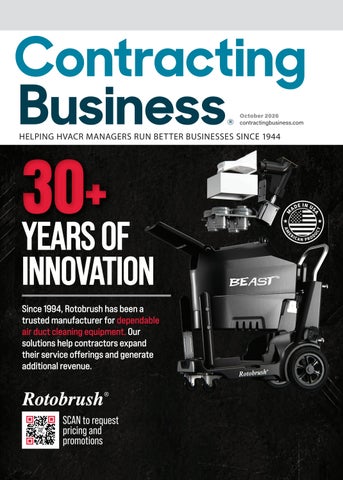
YEARS OF INNOVATION Since 1994, Rotobrush has been a trusted manufacturer for dependable air duct cleaning equipment. Our solutions help contractors expand their service offerings and generate additional revenue.
SCAN to request pricing and promotions
2610CB_Rotobrush_CVRTip.indd 1
9/2/26 8:29 AM
DIRTY DUCTS CAN COST YOU THE CHANGE-OUT. DON’T LEAVE DUCT CLEANING OFF THE QUOTE. A new HVAC system is a major investment. But if the existing ductwork is still filled with dust, debris, and buildup, the project may not feel complete. When your quote stops at the equipment, you leave the door open for a competitor to offer a more comprehensive solution. Air duct cleaning isn’t an extra, it’s the missing piece.
Increase Your Revenue
Win More Change-Outs
Stand Out From Competitors
Increase the value of jobs you are already bidding.
A full system refresh gives customers more reasons to choose your quote.
Offer duct cleaning as part of a complete HVAC solution.
TWO POWERFUL WAYS TO CLEAN. ONE TRUSTED NAME.
BrushBeast DR Black Edition Brush and Vacuum Duct Cleaning
BlowBeast II
Negative Air Duct Cleaning
PATENTED TECHNOLOGY • ROTATION SETTINGS • EXCLUSIVE REMOVABLE POD • RESIDENTIAL • COMMERCIAL • CLEAN FLEX
800-535-3878 | sales@rotobrush.com
2610CB_Rotobrush_CVRTip.indd 2
SCAN to request pricing and promotions!
9/2/26 8:29 AM
Is Your Business Built to Survive Without You? Page 30
October 2026 contractingbusiness.com
HELPING HVACR MANAGERS RUN BETTER BUSINESSES SINCE 1944
Turn Callbacks Into Wins
Callbacks can drain time and revenue, but with the right process, contractors can turn them into opportunities to improve performance and build customer loyalty.
PAGE 10
ALSO IN THIS ISSUE:
16 Humidity Control in Senior Living 22 Dual Fuel: Best of Both Worlds 25 Mastering CO2 Refrigeration
2610CB_C1-4_Covers.indd 1
9/18/26 10:29 AM
Remotely Manage HVAC Systems and Reduce Energy Usage With the Power of Skyport. TM
Skyport transforms Venstar thermostats into a centralized HVAC management platform, delivering real-time visibility and control across all locations from a single, intuitive dashboard. Monitor system performance, make instant adjustments, and respond to alerts before comfort issues escalate. From one thermostat to ten thousand, Skyport scales effortlessly, simplifying HVAC management.
• Instant System Visibility • No Fees or Subscriptions • Real-Time Alerts • Single Dashboard Control • Global Changes • Fewer Truck Rolls, Faster Fixes
Skyport is
FREE
with every Venstar WiFi Thermostat
2610CB_C1-4_Covers.indd 2 2606CB_Venstar.indd 1
9/18/26 10:29 AM 5/7/26 4:13 PM
OCTOBER 2026 | VOLUME 83, NUMBER 10
16 COLUMNISTS
6 First Word | Nicole Krawcke 28 What Matters Next | Sam Wakefield & Doug C. Brown 30 Guest Editorial | Matt Koop 34 Last Word | Alyssa Rogers
10 ON THE COVER: Callbacks can cost more than time and money—they can also test customer trust and contractor reputation. Learn how contractors are turning service failures into opportunities to build loyalty. Source: Cardinal Plumbing, Heating & Air
COVER STORY
10 HVAC Callbacks Are Inevitable: Here’s How Contractors Can Turn Them Into Wins
While contractors can’t eliminate every callback, they can use each one to improve performance, strengthen customer relationships, and demonstrate how their company responds when things go wrong.
IAQ & VENTILATION
16 Best Practices for Humidity Control in Senior Living Facilities Why relative humidity belongs in every contractor’s indoor air quality playbook.
CASE STUDY
20 How Geothermal & Radiant HVAC Helped
8 DEPARTMENTS
4 What’s New Online 8 From the Field 9 Manufacturer News 29 Ad Index 32 Products
Create a Net Positive School
A Chicago school used geothermal heat pumps, radiant heating, and highefficiency hydronic pumps to reduce energy demand.
RESIDENTIAL HVAC
22 Dual Fuel HVAC: Why Heat Pumps and Gas Furnaces Are Gaining Momentum
Duel fuel isn’t simply a transition to electrification—it can be a profitable, long-term solution for homes that already have natural gas.
REFRIGERATION SERVICE TODAY
25 Starting Up for CO2 System Lifecycle Success
How proper installation, startup, and commissioning establish the foundation for long-term CO2 refrigeration system performance.
32 October 2026 | CONTRACTING BUSINESS | 3
2610CB_003_TOC.indd 3
9/22/26 2:19 PM
QUIZ ▶ Think You Know Manual S? Put your HVAC design knowledge to the test and see how well you undersand ACCA Manual S and proper equipment selection www.contractingbusiness.com/ 55401810
25230414 © Redwood8 | Dreamstime.com
PODCASTS ▶ Test, Don't Guess: How to Build a Better HVAC Business Derek Aarstad, owner of DNA Heating & Cooling, discusses building a high-performance HVAC contracting business, generating leads, avoiding burnout, and more. www.contractingbusiness.com/55400958
Editor-In-Chief, Nicole Krawcke, nkrawcke@endeavorb2b.com Art Director, Julie Whitty Production Manager, Sam Schulenberg Audience Development Manager, James Marinaccio, jmarinaccio@endeavorb2b.com Ad Services Manager, Deanna O’Byrne
ProgrfifififivfifiCfifiufififiyfiInfiurfincfifiCofifi&fififfififififififififi
Online@contractingbusiness.com
CEO, Chris Ferrell COO, Patrick Rains CDO, Jacquie Niemiec CALO, Tracy Kane CMO, Amanda Landsaw EVP Buildings & Construction Group, Chris Perrino VP of Content Strategy— Buildings & Construction Group, Mike Eby VP—Buildings & Construction Group, Mike Hellmann
HVAC Contractor Turns Dispatch Data Into Revenue Growth Brady Jolly, owner and CEO of Jolly Heating, Air, Plumbing, Electric, discusses using AI to improve his business operations, including dispatching, call answering, customer follow-up, and review requests. www.contractingbusiness.com/55403941
ENEWSLETTER UPDATES ▶ Before Blaming the HVAC Equipment, Look for the Real Cause of the Callback
National Comfort Institute
This HVAC callback shows why contractors should consider airflow, building pressure, duct leakage, and ventilation when diagnosing comfort problems. www.contractingbusiness.com/ 55402100
FEELING SOCIAL? Follow us on Twitter at @ContractingBiz, as well as our sister publications, @Contractormag, and @HPACEng. Retweet our up-to-date content, send comments, questions. Expand your world of engagement with us, at no extra charge! https://www.facebook.com/CBMag
https://bit.ly/CBonLinkedin
Contracting Business (USPS Permit 010-480, ISSN 0279-4071 print, ISSN 2771-652X online) is published monthly by Endeavor Business Media, LLC, 201 N. Main St., 5th Floor, Fort Atkinson, WI 53538. Periodicals postage paid at Fort Atkinson, WI, and additional mailing offices. POSTMASTER: Send address changes to Contracting Business, PO Box 3257, Northbrook, IL 60065-3257. SUBSCRIPTIONS: Publisher reserves the right to reject non-qualified subscriptions. Subscription prices: U.S. ($ 110.00); Canada/Mexico ($ 144.00); All other countries ($ 165.00). All subscriptions are payable in U.S. funds. Send subscription inquiries to Contracting Business, PO Box 3257, Northbrook, IL 60065-3257. Customer service can be reached tollfree at US/Canada: +1 (877) 498-4668, Outside US/ Canada: +1 (920) 249-4687 or at customerservice@ contractingbusiness.com for magazine subscription assistance or questions. Printed in the USA. Copyright 2026 Endeavor Business Media, LLC. All rights reserved. No part of this publication may be reproduced or transmitted in any form or by any means, electronic or mechanical, including photocopies, recordings, or any information storage or retrieval system without permission from the publisher. Endeavor Business Media, LLC does not assume and hereby disclaims any liability to any person or company for any loss or damage caused by errors or omissions in the material herein, regardless of whether such errors result from negligence, accident, or any other cause whatsoever. The views and opinions in the articles herein are not to be taken as official expressions of the publishers, unless so stated. The publishers do not warrant either expressly or by implication, the factual accuracy of the articles herein, nor do they so warrant any views or opinions by the authors of said articles.
4 | CONTRACTING BUSINESS | October 2026
2610CB_004-5_Online.indd 4
9/22/26 2:19 PM
2604CB
ProgrfifififivfifiCfifiufififiyfiInfiurfincfifiCofifi&fififfififififififififi
Small business owners’ to-do lists can add up. So see if you can save money on a commercial auto quote at ProgressiveCommercial.com.
Get a quote online in as little as 8 minutes
2610CB_004-5_Online.indd 5 2604CB_ProgressiveInsurance.indd 1
9/22/26 2:19 PM 3/5/26 4:19 PM
FIRST WORD BY NICOLE KRAWCKE, EDITOR-IN-CHIEF
What Your Techs Do in Public Reflects Your Brand
Employees can shape a customer’s perception of a company long after the service call is over.
EDITORIAL ADVISORY BOARD TOM CASEY
Climate Partners Griffin Service
MIKE CONLEY
Pioneer Heating & AC
DOMINICK GUARINO
National Comfort Institute
JESS JIMOH
Bonfe Plumbing, Heating, Cooling, Electrical & Sewer
COLLEEN KEYWORTH Online Access
EDWARD MCFARLANE Sila Services
MATT MICHEL Author
SCOTT SHARROCK
Jolly Plumbing, Heating & Air Conditioning
BRIAN STACK
Stack Heating & Cooling
encourages them to uphold higher standards among their teammates as well.” Guydon advises that contractors should establish non-negotiable standards for how technicians represent the company, including their driving, appearance, language, cleanliness, and interactions with others. “These expectations should be documented and highly visible to all team members from the time they join your company. The goal is that every customer receives the same professional experience, regardless of which technician arrives at the home, helping to reinforce the reputation the company has worked hard to build.” Coaching employees on their professionalism can be a struggle. No employee wants to feel micromanaged, especially when it comes to behavior outside of a service call. “One effective approach I’ve used is to make professionalism a core value and include it in a consistent core-values review for every employee,” Guyton says. “Before the review, the technician and manager independently assess on a scale of 1-10 how well the technician demonstrates all company values and identify examples of both success and improvement. Comparing those perspectives creates a constructive conversation without singling anyone out or making the feedback feel personal. This process, not just for technicians but every team member in the organization, keeps expectations visible while giving employees an active voice in their development.” My own interaction with the lawn care company is a good reminder that employees can shape a customer’s perception of a company long after the service call is over. For HVAC contractors, a technician’s driving, parking, appearance, language, and interactions with neighbors can either reinforce the professionalism of the business or undermine it. Customers may never know whether an employee was following company policy or making an individual decision—they simply see the company name on the truck or uniform. That makes employee behavior a business responsibility, not just an individual one. Clear expectations, ongoing training, and accountability can help ensure every technician understands that when they are wearing the company name, they are representing the company. 133031646 © Piksel | Dreamstime.com
Y
our employees’ actions don’t stop mattering when they leave the jobsite. When a tech is driving a branded company vehicle or wearing a company uniform, they are representing the business everywhere they go—from the road and a customer’s neighborhood to the local gas station or supply house. I recently had an unfortunate interaction with a lawn service company that got me thinking about this topic. My neighborhood was built in the 1950s, and the streets are narrow. The main entrance to and from my neighborhood has ‘No Parking’ signs for that reason. It became a bottleneck for vehicles entering the neighborhood, yielding to oncoming traffic, waiting to go around a parked car, and often causing traffic delays on the main road. Since the signs were installed, there have been no traffic issues. That is until a lawn service company began parking their truck and trailer in the ‘No Parking’ zone. This happened three weeks in a row, and it was causing traffic issues for vehicles coming and going. So I decided to reach out to the company. I called— no answer—so I left a message. I also emailed and never received a response to either communication. However, I didn’t see the lawn service company parked there for the next few weeks, so I figured they acted on my feedback. Kudos! That is, until it started happening again. I was nice the first time. Now, I’m just frustrated with this company. They clearly do not care about the people who live in the neighborhood. That may or may not be the case. It could be that the employees decided not to follow the rules, but ultimately, it’s the company’s responsibility. Your techs are the face of your company within the community. Their actions reflect on you and your brand. So how can you ensure they follow the rules of the road and behave appropriately when you’re not there? “It starts by helping technicians view their work as a career and not just a job,” says Dustin Guyton, head coach, Business Development Resources (BDR). “When technicians connect their role to their purpose and individual goals, they develop a stronger sense of pride in both their work and the company they represent. That pride influences how they conduct themselves in public and often
U P w
H
* ©
6 | CONTRACTING BUSINESS | October 2026
2610CB_006-7_FirstWord.indd 6
9/22/26 2:19 PM
2606CB
UNLOCK MORE POTENTIAL with a Synchrony partnership • Streamlined processes • Flexible financing that works • Innovation with your business in mind
Here’s how we invest in your success: Complete consumer financing solutions, including revolving credit and installment loans, with competitive rates Leading approval rates that help drive higher tickets and more customers Premier second-look financing that covers more of your customers Continuous technology investments including seamless integrations with leading software platforms such as ServiceTitan® and WEX®, ensure an exceptional experience for both your technicians and customers The Synchrony Project Card encourages repeat business, with cardholders spending an average of $4,383—155% more than non-cardholders* Always-on marketing solutions, such as Synchrony Marketplace—which generates over 650 million impressions annually—help drive new leads to your business effortlessly, requiring no additional effort on your part
1 in 4 Americans have a Synchrony credit card
SCAN THE QR CODE TO LEARN MORE AT
SYF.COM/BUSINESS
*9th Major Purchase Journey Study, September 2023 © 2026 Synchrony Bank. All Rights Reserved.
2610CB_006-7_FirstWord.indd 7 2606CB_SynchronyFinancial.indd 1
9/22/26 2:19 PM 5/27/26 2:44 PM
FROM THE FIELD COMPILED BY NICOLE KRAWCKE, EDITOR-IN-CHIEF
HVAC & Home Performance: Two Sides of the Same Coin
Honest Heating & Cooling Inc., located in Marshalltown, Iowa, received the 2026 Contractor of the Year (Under $2 Million) Award from the National Comfort Institute at the annual Summit conference. Photos: Nicole Krawcke © Endeavor Business Media
Left: Mission Critical Comfort Solutions LLC, located in Kathleen, Georgia, accepted the 2026 Contractor of the Year ($2-$6 Million) Award from the National Comfort Institute. Kalos Services Inc., located in Clermont, Florida, accepted the 2026 Contractor of the Year (Over $6 Million) Award from the National Comfort Institute at the annual Summit conference.
PIGEON FORGE, Tennessee—At National Comfort Institute’s (NCI) annual Summit, building science, home performance, implementation, and company culture emerged as key themes for HVAC contractors looking to deliver higher-performance solutions. NCI President and CEO Dominick Guarino said more contractors attending Summit are recognizing the importance of understanding how the building itself affects HVAC performance. Guarino described the house as “the load side of the HVAC system,” emphasizing that HVAC contractors can’t always solve comfort and performance problems through equipment changes alone. While some contractors are expanding into insulation, air sealing, and other home-performance services, he said many others are instead building relationships with specialized home-performance contractors and referring or subcontracting that work.
Guarino said these partnerships are becoming increasingly common because many HVAC technicians are not interested in performing insulation and air-sealing work themselves. Other contractors, he noted, are choosing to create dedicated home-performance divisions within their companies. He encouraged contractors to “step into it” one piece at a time and connect with other contractors who have already gone through the process. Those relationships can help contractors avoid costly mistakes, including investing in equipment
that doesn’t deliver the expected results. A panel discussion session during the event reiterated how HVAC contractors increasingly need to look beyond the mechanical equipment and understand how the entire home operates. “A lot of us forget the ‘V’ in HVAC,” said Jonathan Esquivel, owner of Austin Star Services LLC in Austin, Texas, noting that contractors need to pay closer attention to the “V” and understand how ventilation interacts with the home. Terry McWilliams, owner and founder of Texcellent A/C Service, shared how his experience with the Weatherization Assistance Program broadened his understanding of building science. Initially, he focused on achieving the specified insulation depth, but eventually realized that insulation alone was not addressing air leakage through interstitial spaces. The experience reinforced the importance of stepping outside the traditional HVAC comfort zone and learning from other trades. McWilliams encouraged contractors and technicians to “think outside the box” when diagnosing comfort and performance problems. “Even technicians who do not perform formal home-performance testing should be able to recognize problems that are connected to the building” McWilliams added. “If we’re not digging after that continuing education in those areas and seeing how those things intertwine, I think we’d really be shooting ourselves in the foot. If you don’t change with the times, the industry’s going to pass you on by.” Tim De Stasio of Comfort Science Solutions looked ahead to how HVAC technology could change the relationship between equipment and the building. He predicted that AI, variable-speed, and inverter-driven equipment will play larger roles over the next decade, making load matching increasingly important. De Stasio said contractors may eventually spend less time debating individual equipment and duct-size selections and more time evaluating how effectively the complete system serves the building. “Let’s concentrate on the load matching part, what actually makes people comfortable,” he said.
8 | CONTRACTING BUSINESS | October 2026
2610CB_008-9_FromFieldMfgNews.indd 8
9/22/26 2:19 PM
COMPILED BY NICOLE KRAWCKE, EDITOR-IN-CHIEF MANUFACTURER NEWS
Rheem Supports Atlanta Veterans at VETLANTA Summit ATL ANTA—R heem Manufacturing Company sponsored the VETLANTA Q3 Summit on Sept. 8, supporting connections between veterans and businesses in the Atlanta community. The sponsorship provided free attendance for hundreds of veterans, transitioning service members, and military spouses. Attendees connected with business leaders, hiring managers, and veteran-owned businesses to explore opportunities supporting veterans in Atlanta. Ben Pellegrini, vice president and deputy general counsel at Rheem Manufacturing Company and a U.S. Army veteran, spoke at the event. He highlighted the role veterans play in the trades community. Pellegrini noted that many veterans enter the trades after gaining technical experience during military service. He said they also bring leadership, discipline, and other skills to the workforce. Veterans are represented throughout Rheem, from its manufacturing facilities to its Atlanta headquarters and executive leadership team. CEO Chris Peel is also a veteran.
Lennox Opens 6,000-SquareFoot Commercial HVAC Florida Training Center
DALLAS—Lennox has opened a new National Account Services headquarters and training center in Fort Lauderdale,
Florida, expanding its commercial HVAC technician training efforts. The facility includes a dedicated 6,000-square-foot training space for Lennox National Account Services technicians, managers, and field leaders. The space combines classroom instruction with hands-on training using commercial HVAC equipment and systems. Training programs support several career pathways, including Skilled Technician, Advanced Technician, Lead Master, and Manager-in-Training. The programs are designed to help employees develop technical and leadership skills. Lennox National Account Services also operates the Build-A-Tech apprenticeship program. The paid program lasts six to eight months and combines classroom instruction, field experience and mentorship. Since 2016, Lennox National Account Services has trained nearly 1,600 technicians. The company said the programs are intended to help address the ongoing commercial HVAC workforce shortage. “National account customers rely on Lennox to support critical operations across hundreds or even thousands of locations,” said Joe Nassab, executive vice president and president of Lennox Building Climate Solutions. “This investment strengthens the capabilities of our service organization and creates a dedicated environment where technicians and field leaders can sharpen their expertise and share best practices from across the network.” Lennox is also constructing an 18,000-square-foot Commercial HVAC
Lennox leaders celebrate the opening of the company’s new National Account Services headquarters and training center in Fort Lauderdale, Florida.
Experience and Training Center near its headquarters in Richardson, Texas. Together, the investments expand Lennox’s training resources for its workforce and commercial HVAC customers.
DiversiTech Acquires DITEK to Strengthen Surge Protection Products
DULUTH, Georgia—DiversiTech Corp. acquired DITEK, a U.S. manufacturer specializing in surge protection design and manufacturing, the companies announced. The acquisition combines DiversiTech’s HVACR installation, repair, and maintenance product portfolio with DITEK’s surge protection products and technical expertise. The companies said the combined organization will serve the electrical, fire and life safety, networking, HVAC, and security markets. DITEK’s capabilities include surge protection design, product development, and manufacturing. The company’s portfolio complements DiversiTech’s established HVACR product offerings. The companies said the acquisition will allow them to leverage their combined scale, expertise, and capabilities. DiversiTech’s service, support, and distribution network will also provide DITEK with expanded reach. “DiversiTech has built its reputation by helping HVAC customers simplify installation, repair, and maintenance with dependable products, broad availability, and practical solutions,” said Andy Bergdoll, CEO of DiversiTech. “DITEK brings outstanding surge protection design and manufacturing capabilities, along with a customer-centric approach and technical expertise that have made it a leader in its industry. We are excited to support DITEK as it continues to maintain the service, quality, and innovation its customers value while expanding the ways we can serve the HVAC/R market and Electrical, Fire & Life Safety, Networking, and Security markets together.” DITEK will continue its focus on product quality, customer support, and technical expertise. DiversiTech said it will support DITEK’s ongoing growth while maintaining the company’s existing customer-focused approach.
October 2026 | CONTRACTING BUSINESS | 9
2610CB_008-9_FromFieldMfgNews.indd 9
9/22/26 2:19 PM
COVER STORY | BY LARRY BERNSTEIN
While contractors can’t eliminate every callback, they can use each one to improve technician performance, strengthen customer relationships and demonstrate how their company responds when things go wrong.
HVAC Callbacks Are Inevitable
Here’s How Contractors Can Turn Them Into Wins
R
inging phones are a beautiful sound for a service business. Yet the joy of the sound disappears when the subject is a callback. What can HVAC business owners do to minimize callbacks? And when they inevitably occur, how can companies change the customer’s tune? Callbacks are unwelcome, but when they’re handled properly, they can turn an unhappy customer into a loyal one and provide a learning opportunity for technicians.
The Need to Reduce Callbacks “Every callback is a demand call you’re not running, and it has the potential to tarnish your company’s reputation,” says Johnny Baker, general manager of Leonard Splaine Co., a third-generation, family-owned company serving Northern Virginia since 1956. In addition to draining resources, callbacks are time-consuming. “There are only so many hours in a day, and if we don’t capitalize because we’re going on callbacks,
10 | CONTRACTING BUSINESS | October 2026
2610CB_010-15_CS HVAC Callbacks.indd 10
9/22/26 2:19 PM
The team at Leonard Splaine Co does a post-mortem on callbacks, discussing them at weekly meetings with the service teams. Leonard Splaine Co.
A callback doesn’t have to mean a lost customer; handled with empathy, urgency, and ownership, it can become an opportunity to build loyalty. Golden Rule Plumbing, Heating, Cooling & Electrical
we’re stealing from ourselves,” says Mark Paup, president of Golden Rule, which serves Des Moines, Omaha, and the Salt Lake City metro area. Therefore, companies can and do track callbacks as part of their effort to minimize them. Tracking callbacks has helped contractors identify why they occur. Cardinal Plumbing Heating & Air, which was founded in 2013 in Northern Virginia by two master plumbers who later added HVAC to their list of services, has found that one of the major reasons for callbacks is a lack of communication. “The average tech doesn’t start off as a great communicator, but instead is passionate about troubleshooting, diagnosing, and solving the problem,” says Cardinal Operations Manager Patrick Garner. “Due to that passion, technicians can get blinders on and focus on solving the initial issue, not always the larger contributing factors at hand or finding out what’s truly important to the customer.” Baker also cites communication as a key reason for callbacks. “Some techs, especially those
for whom English is a second language, have a fear of miscommunicating or lack the confidence to show off their work.”
Taking Steps to Reduce Callbacks No one realistically expects to eliminate callbacks altogether. However, by reducing them as much as possible, companies can claw back hours for revenue-generating work. At Golden Rule, Paup and his team recognized that many callbacks result from customer misunderstandings about new equipment. “We’ve built out a series of videos that explain the system to our customers.” The videos are shared with the customers after the job is completed. “We hope the videos October 2026 | CONTRACTING BUSINESS | 11
2610CB_010-15_CS HVAC Callbacks.indd 11
9/22/26 2:19 PM
COVER STORY
will reduce this type of callback by 90%, while the remainder will be those uncomfortable with technology and just want someone to come out.” Cardinal recently held a three-day training event focused extensively on communication. “We have amazing techs, but our customers didn’t go to customer school, so they may not know what they want or need,” Garner says. “Our training focused on how to talk to a customer from A-Z, including how to communicate to them not only what the initial, immediate issue is, but also any underlying concerns or enhancements. In spring 2026, the Air Conditioning Contractors of America (ACCA) created an install checklist. “We built out the checklist, gave it to our techs, and encouraged them to check it each time they do an install,” Baker says. “If they do it, we can get data to use as a training opportunity.”
Unfortunately, not every callback is preventable. Many are due to manufacturer errors that are beyond the contractor’s control. When callbacks result from technician error, however, contractors can use them to prevent similar mistakes in the future. “A serious tech wants feedback, because they want to be better,” Paup says. The company takes steps to help techs avoid errors and learn from experts. Techs can FaceTime with a tech advisor to help them diagnose a problem and verify findings. Baker and the team at Leonard Splaine Co do a post-mortem on callbacks. For preventable callbacks, they discuss them at weekly meetings with the service teams, and review how they can prevent them in the future. Learning from mistakes also requires an environment where techs are encouraged to admit uncertainty. “Some companies scare guys so the techs are afraid to admit they need help, but we encourage them to say something if they don’t know something,” Garner says. “You have to train techs and give them an opportunity to learn from their mistakes.”
Turning a Callback into a Win It’s easy to be frustrated when callbacks occur since they are a drag on business. This is especially true when they aren’t due to an error by the HVAC company. However, a callback is a second opportunity to make things right and develop a good relationship with a customer. The first step in handling a callback is empathy. “No one likes having to make a service call, so if a customer has to do it again, they’re annoyed,” Garner says. “They’re likely Communication is key, and Cardinal teaches its techs how to talk to a customer from A to Z. Cardinal Plumbing, Heating & Air
P
P
12 | CONTRACTING BUSINESS | October 2026
2610CB_010-15_CS HVAC Callbacks.indd 12
9/22/26 2:19 PM
2610CB
PERFORMANCE MEETS
PARTNERSHIP
HEAT TRANSFER FLUIDS FOR: • DATA CENTERS • BREWERIES • STATIONARY ENGINES • SPORTS FACILITIES AND MORE
DEPENDABLE THERMAL CONTROL READY-TO-SHIP BULK PRODUCT ON-TIME DELIVERY RESPONSIVE CUSTOMER SERVICE FLUID ANALYSIS PROGRAM MANUFACTURED BY OLD WORLD INDUSTRIES, LLC. NORTHBROOK, IL 60062 ©2026 PEAK ®, PEAK ® & MOUNTAIN GRAPHIC AND THERMAL CHARGE ® ARE TRADEMARKS OF OLD WORLD INDUSTRIES, LLC.
2610CB_010-15_CS HVAC Callbacks.indd 13 2610CB_OldWorldIndustries_RMEL.indd 1
Scan the QR code to visit our website or call us to speak with an expert about our products, services, and delivery solutions
800-323-5440
thermalcharge.com 9/22/26 2:19 PM 9/8/26 1:17 PM
Golden Rule Plumbing, Heating, Cooling & Electrical
COVER STORY
pissed and wondering why no one understands my issue.” Therefore, it’s important to address the callback pronto. At Golden Rule, they strive to book callbacks the same day as the call and are successful 90% of the time. The remaining 10% are typically calls that came in at the end of the day. “As soon as the call comes in, it goes through our customer recovery process, Paup says. “The customer service rep asks some routine questions and then escalates the call to a manager who documents the issue and books the callback without leaving the customer on hold.” To best address the callback, it’s important to take ownership. Leonard Splaine lists extreme ownership as a core value. “We know things happen that are outside of our control, but we don’t point fingers and instead take ownership,” Baker says. That includes prioritizing customer scheduling and doing whatever it takes to fix the issue as soon as possible. The determination to handle the issue even if it costs the company money has helped Leonard Splaine create raving fans (the name of a book about customer service). “It’s just as important to get five-star reviews when something went wrong, because customers see you care and that they are the priority,” Baker says. In addition to taking responsibility and handling the problem, Golden Rule puts a financial incentive directly in the customer’s hands. Every technician works from a standard checklist — the steps that are supposed to happen on every call. Through the
company’s mystery shopper program, customers are invited to grade the visit against that same checklist. If a step was missed, the customer gets paid for catching it. “The payout matters less than what it signals,” Paup says. “Rather than asking the homeowner to take the company’s word that things were done right, they can see for themselves. It also surfaces problems early as a missed step gets reported by a satisfied customer collecting a small reward, not by an angry one three weeks later.” Garner focuses on direct, proactive communication. He’ll say, “I’m sorry, let’s make it better.” He adds, “The intent of me saying that is that anybody can execute a job when things are going perfectly, but what about when the project goes sideways? What I’m excited about is how Cardinal is able to show customers how it performs when things aren’t perfect, when the jobs are overly complicated, and when curveballs are thrown at people.” Reducing callbacks is always a priority for service businesses. When HVAC companies reduce callbacks, they have more time for revenue-generating work. But callbacks that do occur can also create opportunities to learn, improve, and strengthen customer relationships. By answering quickly and addressing the issue, HVAC companies can turn an unwelcome call into a win. Larry Bernstein is a freelance writer based in northern New Jersey. He specializes in construction technology; education technology; and transportation, logistics, and supply chain.
14 | CONTRACTING BUSINESS | October 2026
2610CB_010-15_CS HVAC Callbacks.indd 14
9/22/26 2:19 PM
2610CB
WHERE FACILITY CHALLENGES FIND SOLUTIONS
CENTRAL VALLEY
SOUTHERN CALIFORNIA
NORTHWEST
Co-located with Northwest Machine Tool Expo
March 17 & 18, 2027 Lodi, CA
April 28 & 29, 2027 Anaheim, CA
May 5 & 6, 2027 Portland, OR
RENO
NORTHERN CALIFORNIA
NORTH TEXAS
August 2027 Reno, NV
Fall 2027 Santa Clara, CA
Fall 2027 Irving, TX
facilitiesexpo.com OWNED & PRODUCED BY:
2610CB_010-15_CS HVAC Callbacks.indd 15 2610CB_House_FacilitiesExpo.indd 1
9/22/26 2:19 PM 9/8/26 12:04 PM
IAQ & VENTILATION | BY DAVE SCHWALLER
Best Practices for Humidity Control in Senior Living Facilities Why relative humidity belongs in every contractor’s indoor air quality playbook.
S
enior living communities are designed to protect a vulnerable population, and indoor air conditions play a central role in how effectively that protection is delivered. In that environment, relative humidity levels can either support or undermine respiratory health, infection control, and long-term building performance. A relative humidity range of 40% to 60% is widely accepted as the point where indoor air conditions remain balanced, avoiding issues with either dry air or excess moisture. Within that range, indoor conditions are better suited to support occupant health and allow other HVAC systems to operate most efficiently. In senior living environments, that consistency matters, since many residents manage respiratory
or immune challenges, and even small shifts in air conditions can have a noticeable impact.
Understanding the Risk of Low Humidity Dry indoor air creates a cascade of issues, especially problematic in senior living facilities. When relative humidity drops too low, the body’s first line of defense against infection weakens. The respiratory system depends on moisture to capture and remove airborne particles. Without enough moisture, that process becomes less effective, and residents with asthma, COPD, or similar conditions often feel the effects quickly. Low humidity levels also change how airborne particles behave. In dry conditions, respiratory droplets shrink more
quickly, allowing them to remain suspended longer and travel farther. It is not difficult to see how that increases the risk of airborne transmission. On top of that, low humidity creates conditions that help many viruses remain viable longer, making it easier for illnesses to spread and persist indoors. Beyond health impacts, dry air also affects the building itself. Materials such as wood, finishes, and seals can dry out over time, leading to cracking, shrinkage, and increased maintenance. For building owners and operators, these issues result in higher operating costs and more frequent repairs.
Reframing Humidity as an Operational Priority There has been a noticeable shift in how senior living providers think about indoor air. Humidity is part of that shift. What used to be treated as a building issue is now tied more closely to care quality. For contractors, that changes the conversation. Instead of leading with equipment, it helps to start with outcomes. Stable humidity supports resident comfort. It can reduce some of the seasonal spikes in illness that facilities deal with every year. It also helps keep indoor conditions more consistent from one part of the building to another, which residents and staff tend to notice quickly. There is also a practical side to this. Decisions in senior living facilities rarely come from one person. Administrators, nursing leadership, and operations teams all have a say. When humidity is connected to resident well-being and infection control, it becomes easier for those groups to align and move forward with system changes. Stable humidity supports resident comfort. Images courtesy of DriSteem
16 | CONTRACTING BUSINESS | October 2026
2610CB_016-19_HumidityControl.indd 16
9/22/26 2:19 PM
Best Practices for Achieving Stable Humidity Getting humidity right is rarely about a single component. It comes down to design, controls, and how the system is maintained over time. Start with system design. Maintaining a target range is important, but stability matters just as much. Systems that drift or swing between dry and humid conditions can create as many issues as those that miss the target entirely. That is why accurate load calculations and proper sizing are so important. In colder regions, winter air brings its own challenges. Outdoor air is often very dry, so systems need to account for that from the beginning. Ventilation also plays a larger role than it sometimes gets credit for. Outdoor air requirements directly affect indoor moisture levels. During the heating season especially, bringing in large amounts of dry air can make it difficult to maintain proper conditions unless the system is designed to handle it. There are a few guardrails worth keeping in mind: • Watch for conditions that could lead to condensation in ducts or on surfaces; • Make sure airflow supports even distribution of moisture throughout the space; • Stay within reasonable moisture limits to avoid over-humidifying Finally, none of this works without upkeep. Humidity systems need routine inspection and maintenance. Access matters. If components are hard to reach, they
are often skipped. Over time, that shows up in performance.
Common Contractor Challenges and How to Address Them Humidity control in senior living environments poses practical challenges, especially in existing buildings. Many facilities operate in older buildings with limited space, and their infrastructure may not support large system upgrades, making humidity control more complicated. Space can be tight, and ductwork may not be ideal. In those cases, finding a workable solution often means adapting to what is already there. Budget is another factor that comes up early. Some owners and operators initially see humidity control in senior living facilities as optional. That view usually changes once the conversation shifts to outcomes. Reduced maintenance issues, more consistent indoor conditions, and support for infection control tend to resonate more than equipment specs. There are also some lingering misconceptions. Moisture is sometimes associated with mold or building problems. In reality, those issues are typically due to improper humidity management. When a system is designed and operated correctly, staying within an appropriate range helps prevent those problems rather than causing them.
Make Humidity Part of Your Service Strategy For contractors, humidity opens the door to a different kind of conversation with customers. It moves beyond heating and
cooling and into overall environmental control. A practical place to start is with assessment. Measuring existing conditions often reveals gaps that are not obvious day to day. From there, it becomes easier to recommend targeted improvements. Some contractors build this into ongoing service agreements, which can help maintain performance over time and strengthen the relationship with the customer. Training matters as well. Technicians who understand why humidity matters, not just how equipment works, tend to connect better with customers. They can explain what is happening in plain terms and point to real impacts inside the building.
Looking Ahead Senior living continues to put more emphasis on health and quality of life. Indoor conditions are part of that conversation now in a way they were not a decade ago. Humidity sits right in the middle of it. For contractors, this is not about adding another layer of complexity. It is about connecting pieces that already exist. When humidity is managed alongside temperature, ventilation, and filtration, the result is a more stable environment overall. In these facilities, air is not just background. It is part of how residents experience the space every day. Getting humidity right is one of the more direct ways to improve that experience while supporting long-term building performance. Dave Schwaller is the inside sales manager at DriSteem
October 2026 | CONTRACTING BUSINESS | 17
2610CB_016-19_HumidityControl.indd 17
9/22/26 2:19 PM
L a s a w
“ w s o t e o
One less thing to manage How a uniform program can streamline a growing HVAC business
The goal for any local HVAC business is steady growth. But every new customer and new hire introduces complexity to your business.
But as they brought more technicians onboard, they found it became harder to maintain a standard of professionalism on their staff.
Will more customers create an operational bottleneck? Are technicians stretched too thin? How quickly will a new hire pay for themselves? Do busy office staff have the time to properly onboard new team members?
With employees in charge of their own laundry and garment care, shirts and jackets quickly became tattered and worn, forcing Luxury to absorb the costs of new workwear.
As a company grows, those challenges often become interconnected, creating more administrative work that can quickly overwhelm a team. Luxury Heating Company once found themselves facing a similar challenge. The family-owned business has been a staple in Northeast Ohio since 1947 and has steadily expanded their operations across Cleveland’s west side. Because HVAC is a customer-facing business, Luxury knows it’s important that their technicians look professional when visiting customers’ homes. In the past, the company purchased T-shirts, sweatshirts and jackets so their technicians would look the part. “They would wear their own pants. The general rule was ‘no holes, no jeans,’” said Paige Lapchak, Luxury’s office manager. “We don’t want them to show up in something they’ve had for five years that looks unprofessional.”
Luxury wasted too much valuable time dealing with uniform issues, spending hours placing orders for new workwear. The turnaround for custom-printed shirts and sweatshirts was unsustainable, with new hires waiting several weeks for their uniforms to arrive. Plus, budgeting for workwear costs quickly became a guessing game, given the replacement garments Luxury needed to order.
In in g a p o t s g
“As we’ve grown and continued onboarding more employees, managing uniforms has become increasingly difficult,” she said.
F p t s r
Luxury began partnering with Cintas for their uniform needs in 2025. They haven’t looked back. They now provide their technicians with high-quality branded polo shirts and work pants made with flexible but durable performance materials.
“ t in r w
Plus, their program gives them the flexibility to offer team members Carhartt® jackets for Cleveland’s frigid winters and shorts for blazing summer days. That flexibility has been a hit with Luxury’s staff. “It’s been pretty easy to get the guys on board,” Lapchak said.
2610CB_016-19_HumidityControl.indd 18 2610CB_CintasCorp.indd 1
F p s O b
9/22/26 2:19 PM
Luxury’s office staff is also seeing the benefits of a managed program. Lapchak no longer needs to spend long hours ordering shirts and outerwear from a retailer. Plus, consistent pricing gives her clarity when it comes to budgeting for uniform expenses. “It’s very easy to budget because we know exactly what it’s going to cost to add someone on,” Lapchak said. “More than that though, it’s just the peace of mind. We really don’t have to go out of our way to manage anything anymore, we simply enter the employee’s name and uniform selections into our online account, and Cintas takes it from there.” For local HVAC companies experiencing growing pains, solutions often lie in day-to-day operations. Are staff members spending time on what truly matters? Or are they getting bogged down with unnecessary busy work? In addition to laundry and delivery, Luxury’s program includes repairs and replacements for all their garments. If a technician loses a button on their shirt, a new one gets sewn on following the laundering process. If a persistent grease stain won’t come out, the shirt gets replaced. If a technician wants to change the size of their shirts or pants, Lapchak simply informs her account manager and the change gets made. For Luxury, a professionally managed uniform program helps technicians and office staff look their best while streamlining their workday — simultaneously building customer trust and reinforcing the brand they’ve spent decades building. “I think it’s important that you can immediately tell they work for us,” Lapchak said. “When you’re going into someone’s home, you want the customer to recognize the company and feel comfortable with who’s walking through their door.”
“
As we’ve grown and continued onboarding more employees, managing uniforms has become increasingly difficult.
Paige Lapchak Office Manager, Luxury Heating Company
Utilizing a managed workwear program like Luxury Heating Company’s is easier than you might think. With Apparel+ from Cintas, you can provide every team member with a full set of branded uniforms with no upfront cost.
SPONSORED BY
Want to streamline your operations? Scan to explore workwear fit for your business or visit cintas.com/contractingbus
2610CB_016-19_HumidityControl.indd 19
9/22/26 2:19 PM 9/15/26 9:40 AM
CASE STUDY | BY JIM NOLAN
How Geothermal and Radiant HVAC Helped Create a Net-Positive School A Chicago school combined geothermal heat pumps, radiant heating, and highefficiency hydronic pumps to reduce energy demand while creating a model for sustainable building design.
A
t the Academy for Global Citizenship (AGC), serving the community isn’t just a mantra; it’s a model for everything they do. Spanning six acres on Chicago’s southwest side, on the former site of the Chicago Housing Authority’s LeClaire Courts complex, the AGC campus houses a dual-language charter school, early childhood education center, a community healthcare center, neighborhood market and more. To say that residents and students depend heavily on this community hub would be an understatement.
The Challenge How could more energy, ideas and creativity be created than what is consumed? That is the broader vision behind AGC’s focus on being the most sustainable school of the Midwest, where everything from the classroom to the cafeteria contributes to a climate-friendly output. “At AGC, we’re intent on developing 21st century learners who are able to address a lot of the changes that their generation is going to be confronting with increasingly complex challenges around climate change. And so, everything we do at the campus—from the curriculum to the operations of the building—is around this kind of net positive ethos,” said Paul Guilianelli, chief operating officer, AGC. As part of this commitment, the AGC is aspiring for the Living Building Challenge certification, the most rigorous standard for sustainable building worldwide. The school would be the first building in the Midwest to achieve this cutting-edge certification. In its quest to develop a net positive water and energy campus, the Academy needed a partner who could think outside the box to help achieve its goals, including on-site power generation and maximizing the efficiency of its building systems. What’s more, the project required exploring an alternative to electric boilers, which can be both inefficient and expensive to operate.
The Solution Just as everything from the Academy’s curriculum to its building operations is built around a net positive ethos, so was its thinking
ACG has successfully met its net positive energy and water goals since opening its doors in September 2023. Images courtesy of Xylem
around system design, product and vendor selection, as echoed by those on the project. From the very beginning, AGC sought project partners that shared the same commitment to promoting sustainability and reducing environmental impact. They discovered just that in Bornquist, a Xylem Bell & Gossett manufacturing rep, who, alongside local engineering firm dbHMS, was commissioned to design and install the highest possible efficiency HVAC system to reduce energy demand. “Sustainability was at the forefront of our design from start to finish,” noted Sidd Anand, mechanical engineer with dbHMS. Early on, Bornquist tested different system options to meet the AGC’s sustainability goals. A hydronic radiant system proved to be the most effective solution for achieving energy efficiency, occupant comfort and improved indoor air quality. Because the building doesn’t rely on fossil fuels, dbHMS chose a geothermal ground-source heat pump system. This, in tandem with Bell & Gossett Series e-1510 centrifugal pumps and Series e-90 closecoupled in-line centrifugal pumps, play a critical role in optimizing the Academy’s geothermal system performance, supporting the
20 | CONTRACTING BUSINESS | October 2026
2610CB_020-21_GeothermalSchool.indd 20
9/22/26 2:19 PM
A hydronic radiant system proved to be the most effective solution for achieving energy eff iciency, occupant comfort, and improved IAQ.
efficient circulation of hot and cold water through geothermal loops and proving the power of partnership. “Radiant heat isn’t new, but when you pair it with geothermal systems—using the ground as a heat sink—you get a huge efficiency boost. Radiant floors work really well because they use lower temperature water, which matches perfectly with geothermal systems. That combination allows us to heat and cool buildings much more efficiently than traditional air systems,” said Dan Watkins, sales engineer at Bornquist Inc President of Bornquist, Dave Everhart, reiterated the effectiveness of the system design employed at AGC: “Water carries a lot of energy very efficiently and it can do that over a wide space. If you tried to push air through a duct, it would give up energy over time, so that by the time it got where it was emitted into the space, it would no longer be cold or warm; water allows that transfer of energy without loss.”
The Results Since opening its doors in September 2023, the Academy has successfully met its net positive energy and water goals while significantly reducing waste through recycling, composting and awareness programs. In addition to delivering a solution that met AGC’s sustainability mission while lowering long-term operating costs, Xylem’s impact continues to be felt across the campus. As part of its corporate sustainability program, Watermark, Xylem secured a $10,000 water education and sustainability grant to help AGC continue campus developments and improvements. That included making the school building itself a teaching tool with exposed MEP systems and windows into the mechanical
rooms to spark curiosity about the systems that keep the school’s water flowing. Additionally, Bell & Gossett and its partners came together for an afternoon of volunteering with students, including education around the value of environmental stewardship and activities for the school’s community garden—a testament to the importance of uniting around a common goal of making a difference in the community. Today, AGC is a national model for holistic community revitalization, drawing visitors from around the world. Students experience a powerful sense of community investment in their education when seeing the innovative building features and understanding the technology behind them. “Teaching responsible actions by connecting our behaviors to the influence of our individual and collective choices inspires students to carry sustainabilityn into their homes and lives,” said Sarah Elizabeth Ippel, founder and executive director, AGC. On the success of this project, Susan O’Grady, senior director of marketing at Xylem, said, “Success on this project is really two-fold. One is relationships with our local Bell & Gossett rep, as well as their relationship with the local engineer. Those relationships help size the system, help provide the right products and help the school meet their ultimate goal.” Bringing together the promotion of sustainability and reduced environmental impact under one umbrella, while fostering the next generation through immersive education, was a win-win for the Chicago community. Jim Nolan is the North Central marketing development manager for Xylem, Inc.
October 2026 | CONTRACTING BUSINESS | 21
2610CB_020-21_GeothermalSchool.indd 21
9/22/26 2:19 PM
RESIDENTIAL HVAC | BY NICOLE KRAWCKE
Dual Fuel HVAC:
Why Heat Pumps and Gas Furnaces Are Gaining Momentum
Dual fuel isn’t simply a transition to electrification—it can be a profitable, long-term HVAC solution for homes that already have natural gas, according to Midea’s David Rames.
F
or HVAC contractors, the push toward electrification doesn’t have to mean choosing between heat pumps and gas furnaces. Dual-fuel systems offer a way to give homeowners the benefits of modern cold-climate heat pumps while retaining the flexibility of natural-gas heat when conditions or energy costs make it the better choice. As the technology advances and homeowners become more comfortable with heat pumps, the opportunity for contractors is expanding—but so are the questions around sizing, system selection, controls, David Rames selling, and profitability. In Midea this Q&A, David Rames of Midea explains why dual fuel is gaining momentum and what contractors need to know to make these systems work for both their customers and their businesses. CB: You recently installed a dual-fuel system in your own home? Why did you go with a dual-fuel system? DR: I live in Louisville, Kentucky—the good thing about Louisville is we get all four seasons. So we can have an extremely hot and humid summer, but at times, we can actually have a very cold winter as well. Then we get nice fall and spring weather. So the reason that I chose dual fuel at my house was—and I always say this—it’s the Van Halen song, the best of both worlds, right? And it truly is the best of both worlds. In my house, I’ve got a 4-ton Midea cold-climate heat pump, our coil, and then a third-party gas furnace. That puts the power in my hands as to what I
want to use and when. In Kentucky, we’re very lucky that the price per kWh (PW) for electricity is low, but the price per therm for natural gas is low as well. This past winter, we had a pretty bad ice storm. During that ice storm, I manually switched over to the gas furnace because, as the ice is falling, sometimes outdoor unit heat pumps don’t like that because the ice starts to form on the unit fan or grill. So, I just switched over to gas with one push of a button, and I kept my house warm. Then, as the ice melted off, I went back to the heat pump. It gives you ultimate flexibility for both electric and gas. CB: Why do you think dual-fuel systems are gaining momentum right now, especially in markets that have traditionally relied on gas furnaces? DR: There are a couple of reasons why. The administration in Washington, D.C. has a lot to do with what’s popular and what’s not, what’s incentivized, what’s frowned on. The last administration was about getting away from fossil fuels—we’re going to decarbonize, we’re going to electrify. We’re going to have incentives with the Inflation Reduction Act 25C tax credits in order to do that. The new administration is less concerned about natural gas and says it’s OK to use it. It’s available to us. Other than the ballot box, we have very little control over any of that, so we have to be able to adapt. Incentives drive behaviors. If you incentivize electrification, then a lot of people will begin to move the heat pump route. If you don’t, then they may stay with what they have. Dual fuel really is that ultimate sweet
spot—you’ve got the electrification for the heat pump, but you’ve also got that natural gas backup, if needed. And those who are a little hesitant to make that full electrification change, this gives them that safety net of that gas furnace. CB: Are you seeing increased contractor demand for dual-fuel systems, homeowner demand, or both? DR: Both. Midea specifically, but also a lot of other brands have shown their high performance in very cold climates. But, because it’s still fairly new, there’s still hesitancy. We’re pumping out heat at temperatures of -15°F. From the contractor side, if I’m at your house and I go all electric with a cold-climate heat pump and I don’t fully believe in the technology and the performance of today’s cold-climate heat pumps, I’m a little hesitant. So it makes me feel good as a contractor to know there’s that gas backup, too. If you’re freezing cold at 2 a.m. on a January morning and you call my office, you’ve got the dual fuel, the gas furnace to rely on. It provides a safety net for the contractor and the homeowner. CB: How have homeowner attitudes toward heat pumps changed over the past three to five years? DR: I think education, specifially from the manufacturers, has helped that. I always say, “It’s not your grandpa’s heat pump anymore.” You’ve probably heard it from me before. Grandpa’s heat pump from 25-30 years ago at 40°F, one of two things happened. Either you relied solely
22 | CONTRACTING BUSINESS | October 2026
2610CB_022-24_DualFuelQA.indd 22
9/22/26 2:19 PM
on the auxiliary heater, which is the least efficient way of heating your home, or the heat pump wouldn’t keep up. So now you’re dropping 3, 4, 5, 6° below set point, and you freeze to death in there. Through the technological advancements of vapor injection, the compressor, and the heat exchanger, heat pumps today are putting out very warm air at very cold outside temperatures. I think through education, consumers are now way more confident in today’s heat pumps than they were in Grandpa’s day. CB: What role are utility incentives, energy costs, and regional climate concerns playing in the growth of dual-fuel systems? DR: Without a national incentive, we have to rely on local utility companies because nothing is getting less expensive. Specifically HVAC, because we’ve gone through some pretty big regulatory changes over the past few years. In 2023, we had an increase in testing and efficiency. So that doesn’t get cheaper. The more efficient things get, it definitely doesn’t get cheaper. Then 2025 rolls around, we have a refrigerant change, and we can go from R-410A to an A2L, mildly flammable, either R-32 or R-454B. That doesn’t get less expensive. And this is where the 25C goes away. So having local utility providers to help offset some of that increased cost helps homeowners put in higher-efficiency systems instead of DOE minimums. We need to offset, and we need to reward those who make the decision to install higher performance, higher-efficiency systems in their house. CB: The hybrid vehicle comparison is compelling. Why does that analogy resonate so well with homeowners? DR: I am one who uses car analogies all the time because that’s what we’re used to, right? We get up, and we go to work in the morning, we take our kids places, we drive here, we drive there. So we can relate to that vehicle because we know it very well—way more than we know our own HVAC system. When we think about hybrid, and I’m a big hybrid guy in vehicles and with HVAC, if I don’t need a lot of power and a lot of
torque and a lot of get-up-and-go, then I can rely on one part of it. And if I really need something else, then I can ride on the other part. I’ve got the electrical side. I’ve got the gasoline side. The same thing goes with HVAC. I’ve got the electric side, and I’ve got the fossil fuel side. Depending on which one I need, it’s there for me. In my situation, I drive a Ford EcoBoost truck. If I’m just driving down the road, I’m going to be very efficient, but I also have a boat. So when I’m towing my boat, I’ve got twin turbochargers that will kick in when I really need that power and torque, but only when I need it. The same goes with a hybrid car or with a dual-fuel system at your house. We’ve got both, but only one kicks in when you really need it. CB: What are the biggest mistakes contractors make when introducing heat pumps to skeptical homeowners? DR: They think all heat pumps are born equal. I’ve got a colleague here; we were going to put a field test in his house. He had another brand of heat pump. When we first looked at it, everyone said, ‘Well, there’s a 5-ton in this house. We need to put a 5-ton back in this house.’ I said, ‘Hold on, let’s look at the performance data.’ Once we looked at the performance data, we saw we didn’t need all of that. You need to look at the enhanced performance status and ask, what type of heat is this heat pump putting out versus the other brand? I just did a case study for us down in San Clemente, California. A fellow bought a new house, and we took out 10 tons of cooling and replaced it with 6 tons of cooling. We took out over 100,000 Btu of heating from that house and we put in 3 tons. So the previous system was oversized. We did a Manual J load calculation and sized it the way it’s supposed to be sized. CB: Are there specific words or phrases contractors should avoid—or emphasize—when discussing dual fuel? DR: You have to be careful. When you change the comfort system in a house, you’re doing two things. One is you’re making them more comfortable. That should be the ultimate goal. The second goal can save them some money. We have
to be careful over promising all of these massive utility bill savings. There are operational cost calculators online, and I always caution them, don’t sell an HVAC system based off of utility savings alone. There’s an old saying, ‘I can make your system as efficient as possible, I just turn it off.’ But you’re not going to be very comfortable, are you? But you’re going to be super efficient. We just have to be really careful promising huge utility bill savings. Our goal is to make you more comfortable and also maybe save you some money in the process as well. CB: Are there particular climates, home types, or equipment ages where dual fuel delivers the strongest value proposition? DR: If you already have natural gas in your home, that’s the easiest route, right? In my house, my gas furnace maybe runs 2% of the time. But my heat pump does so well. So if you have natural gas in your house already, and you’re in a very cold climate, maybe the best route for you is to go dual fuel. That way we get the efficiency and the stable temperature control of a variablespeed inverter-driven heat pump. If you’re all electric and you don’t have gas, the last thing you want to do is add a propane tank outside of your house in order to run a furnace. So if you’ve got gas already, dual fuel is an incredible option. If you’re all electric, then just rely on that cold-climate heat pump and put in an auxiliary heater. CB: What are the biggest misconceptions contractors still have about heat pumps in northern climates? DR: The misconception is they still don’t think it works. We’ve got equipment installed in Montreal and the Quebec area. We’re in Toronto, in the Ontario area. We’re in British Columbia. And you probably saw our case study in Willow, Alaska that we did a couple of years ago, which is an hour or so outside of Anchorage. We replaced their system that was running off of a diesel generator and propane with all-electric Midea heat pumps. They are tickled pink with it. And probably a year ago, we went back and replaced it with the next version
October 2026 | CONTRACTING BUSINESS | 23
2610CB_022-24_DualFuelQA.indd 23
9/22/26 2:19 PM
of our cold-climate heat pump. If we can do it in Willow, Alaska, we can do it anywhere in the continental U.S. CB: How important is proper system sizing and controls in maximizing dualfuel performance? DR: You should always start with a good Manual J because it will fool you. What we have to remember is, let’s say someone’s system is 25 years old. Who’s to say that homeowner didn’t replace the windows or add more insulation in their attic in the last 25 years? Now, all of a sudden, that envelope is tighter and more efficient. If there’s a 36,000 Btu system in that house, why would we ever go back with the same size when they spent the money on efficiency upgrades to the home? Do the Manual J, see what the load calculation is for that house now, and install the right system. If they spent the money on insulation, windows, and doors, we can downsize that unit and actually offset some of this money that they spent on those efficiency improvements. CB: From a contractor’s perspective, are dual-fuel systems generally more profitable than traditional replacements? DR: Yes, and the reason I say that is the overall cost of a dual-fuel system will be higher. You’ve got a heat pump, a gas furnace, and a coil. So if the contractor puts the same gross margin on a higher-priced system, it will be more profit than the gross margin of a lower-priced system. One caveat I would throw in there: this is where financing comes in. Every homeowner, if they had their choice, would want to go with a higher-performing, higher-efficiency system. The problem is the wallet. Through financing—and everyone should be offering it—we can fit this higher-efficiency, higher-performance system into that homeowner’s budget by spreading those payments out over 36 or 60 months, and then let them make the decision on what they want. Offer them options and offer them options with financing. CB: During emergency replacement season, homeowners often make quick decisions. How can contractors
introduce dual-fuel options without slowing down the sales process? DR: The contractor themselves should probably slow down a little bit. About three years ago, we were developing some of our new products and we interviewed a bunch of consumers all across the U.S. We were trying to figure out what they based their buying decisions on. Probably 70-75% said, ‘I just did what my contractor told me to do.’ Anytime I talk to contractors, I tell them that story because you are the expert that they called. Slow down, take your time, give them all of the options. It’s going to cost a lot of money. Let’s face it, OK? To replace a system, it’s going to cost a lot. I would be very upset if I called a contractor and that contractor came in and didn’t give me every option and let me make that decision. This is the time; if I’m going to upgrade, now’s my chance. Contractors slow down; give them all the options, give them the choice of dual fuel. Educate yourself on the difference and why it’s important. Do an analysis on the price per kW and the price per therm for gas in your specific area. Do an operational cost calculator on why dual fuel works. Give them financing; let them make that decision based on education and not spontaneity. CB: As heat pump technology continues to improve, how do you see the role of dual-fuel systems evolving over the next few years? Do you think dual fuel is primarily a transitional technology, or will it remain a long-term solution for many U.S. homes? DR: I think they’re here to stay. And the reason I say that is, probably a year or so ago, I had our data scientist pull price per kW and price per therm average across the U.S. On average, what’s it going to cost me to run natural gas? What’s it going to cost me to run electricity? There are still a lot of areas where the price per therm of natural gas is very, very low. You’re in Michigan. Natural gas prices in Michigan are actually very low, very affordable. I think that’s a perfect place for dual fuel because if you’re going to use that gas furnace and switch from heat pump to gas furnace or back and forth, the price
per therm is low. That gives you the option to make the decision that you want to for your own house. There are other areas, like California, New York, and some of the other—we’ll call them progressive states— from an electrification standpoint, that price per kW and therm is totally different. And so they want to incentivize electrification. So the price per therm goes up. You need to look at those and analyze which option is best. And in many of those areas, dual fuel is a great option. CB: If you could give HVAC contractors one piece of advice to help them sell more heat pumps this heating season, what would it be? DR: Educate yourself on whatever manufacturer it is that you sell. There’s plenty of really good ones out there. Educate and know the product. Be the expert. Because again, when that homeowner calls you, they’re calling the expert. Contractors, you need to rely on your distributor for education. They have classes, they have education, they have training, they have all of that. I will also ask the distributors to rely on their manufacturer for training. When new products are coming out, new efficiencies, new combinations are all coming out, distributor, you need to ask your manufacturer to train you on that. We do a phenomenal job of training our distributors on products and the advantages of each and every one of them. And then that confidence just trickles down. As a manufacturer, we play the biggest part in developing these products. Our distributor now knows these products like the back of their hand. They train the contractor to know the product like the back of their hand. So when that contractor sits at the kitchen table with Mr. and Mrs. Jones, they inject confidence into them that they’re making the right decision on the product that they’re selling. I do think a lot of it will rely on what the administration says and where the incentives are. Again, incentives do drive behavior. If you’re going to reimburse me for doing something, there’s a good chance I’m going to look closely at doing that thing. But again, dual fuel is the best of both worlds. I wouldn’t have it in my house if it wasn’t a good way to go.
24 | CONTRACTING BUSINESS | October 2026
2610CB_022-24_DualFuelQA.indd 24
9/22/26 2:19 PM
PRODUCTS, TRENDS, AND SERVICE AND BUSINESS MANAGEMENT INFORMATION
Starting Up for CO2 System Lifecycle Success
How proper installation, startup, and commissioning establish the foundation for long-term CO₂ refrigeration system performance. By Mike Squires, Copeland
C
O2 refrigeration is no longer a novelty in North American food retail. More than 4,000 stores now run CO2 transcritical booster systems, with adoption projected to climb up to 176% through 2028. For HVACR contractors, this growth represents real business opportunity, as more supermarket operators will be seeking the services of technicians with CO2 skillsets. The quality of a CO2 booster system design and installation—including startup, commissioning, and the first year of maintenance—lays the foundation for its performance throughout the entire system lifecycle. Done correctly, the system becomes a reliable, high-performing asset that delivers years of dependable service and reinforces confidence in sustainable
CO2 technology. Take shortcuts or overlook key steps along the way, and the potential for system challenges, excessive service calls, and product issues could persist. With proper training and a foundational grounding in best practices, contractors can flatten the learning curve and quickly establish proficiency in CO2 refrigeration.
What Makes CO2 Different Than Legacy HFCs
CO2 (refrigerant name R-744) behaves differently than the hydrofluorocarbon (HFC) systems with which many technicians are familiar. CO2 booster systems operate at significantly higher pressures, react faster to changing ambient conditions, and rely heavily on the use of system-wide electronic controls, such as rack supervision, refrigerant- and oil-level monitoring, case
temperatures, electric and motor-driven electronic expansion valves (EEVs) and high-pressure valves (HPVs), variablefrequency drives (VFDs), and sensors. Hence, effective product integration is essential in enabling a fully connected ecosystem that can help simplify every phase of a CO2 system lifecycle. R-744 has unique characteristics that shape the installation and startup processes. • High operating pressures: System pressures can exceed 1,400 psig when medium-temperature (MT) compressors discharge into the gas cooler in high ambient conditions. Piping for this highpressure section of a CO2 system must be rated for 130 BAR (1885 As a key part of the Copeland CO2 control ecosystem, the E3 supervisory control features an advanced adaptive capacity control algorithm that removes the need for manual PID setpoint configuration. Rather than requiring technicians to manually dial in PID settings for each installation, the adaptive control algorithm automates the tuning process within the E3, continuously optimizing parameters based on actual system conditions. Copeland
October 2026 | CONTRACTING BUSINESS | 25
2610CB_025-27_RST CO2 Copeland.indd 25
9/22/26 2:19 PM
psig), requiring the use of ferrous alloy copper (e.g., brands like XHP or K65), high-pressure stainless steel, or even properly rated carbon steel. CO2 gauges must be rated for those high pressures. • Low critical point of 87.8°F: Below roughly 75°F ambient, the system runs in subcritical mode with a predictable pressure-temperature relationship. Above that, R-744 becomes a supercritical fluid, and the system enters transcritical mode, where pressure and temperature move independently. • High triple point of 60.4 psig: Charging with liquid while pressures sit below the triple point causes R-744 to turn to dry ice, stops refrigerant flow and brings installations to a halt.
Installation Starts With Piping Experienced CO2 technicians know that a smooth startup almost always traces back to installation quality. Clean, properly installed piping makes startup significantly easier. Dirty pipes can introduce non-condensable materials in a system that has zero tolerance for debris. Piping best practices include: • Brazing with an inert gas to prevent oxidation and carbon buildup inside the pipe; • Deburring all pipe cuts and avoiding the use of reciprocating saws, which leave copper shavings inside the line, which could be distributed throughout the system once running; • Protecting open pipe ends from field contaminants using caps throughout the installation process; • Conducting pre-installation meetings with all installation personnel to communicate the cleanliness standards required for CO2 refrigeration systems; and • Following manufacturer piping configurations and end userprovided installation specifications.
Point-to-Point Pre-Startup Verification Before a CO2 booster system is powered up and charged, a thorough pre-start verification process is essential. This phase is often
called a “point-to-point” check, and it involves methodically confirming that every control device, sensor and input/output (I/O) connection is functioning correctly and mapped to the right location in the supervisory control system. Critical pre-startup checks include: • Keep facility circuit breakers off until all pre-start checks are complete; • Confirm that piping is rated for the high-pressure section of the system, using stainless steel, high-pressure copper alloy or properly rated carbon steel per the high-pressure piping chart and local building codes. Take care not to install or intermix piping with lower pressure ratings in system sections that have higher pressure requirements; • Pressure test with dry nitrogen, then evacuate, per manufacturer’s recommendations; • Charge compressors with oil if the OEM racks are not pre-charged, typically between the second and third vacuum cycles; • Connect and verify supervisory control wiring throughout the system; check and proof every sensor, transducer, valve, and variable-frequency drive (VFD) signal; and • Confirm all mechanical pressure relief and check valves are installed and set correctly.
Startup Sequence: From Charging to Compressor Staging CO2 startup follows a specific sequence that accounts for R-744’s triple point. Begin by charging with vapor until the system climbs safely above 60.4 psig. Manufacturers commonly recommend charging with vapor until the system reaches at least 100 psig, and some specify up to 150 psig, before switching to liquid R-744. • Flash tank fill: Continue charging slowly into the flash tank until the float ball indicates liquid is present in the receiver; • Liquid line opening: Once adequate liquid level is confirmed in the flash tank, open the main liquid line to the cases; and
• Compressor staging: As refrigerant reaches the MT and LT circuits, suction pressure rises and compressors stage on incrementally, and naturally, in response to load demand.
Commissioning and Fine-Tuning Achieving system-wide stability is the goal of the commissioning process and is a critical step before handing off the system to the retail end user. In practice, this typically begins around day three or four of a startup week, once the initial hot pull-down has completed and the rack has been running stably for at least 48 hours. Historically, this fine-tuning has been a particularly challenging phase for contractors, but continuous advancements in controls technology are helping to automate this process. Commissioning should be evaluated under real-world operating conditions, ideally with product in the cases. Many times, systems that appear to be running well during a no-load startup may reveal tuning issues once full refrigeration loads are introduced. For this reason, best practice is to evaluate system performance for 30 days after the store opens, with product in all cases, before considering commissioning complete. Fine-tuning during commissioning focuses on: • Setpoint deviation review: Confirming that all temperature and pressure control variables are operating at or very near their target setpoints; • Defrost verification: Confirming correct function of electric offcycle, hot gas defrost or other defrost strategies; • Heat reclaim optimization: Verifying air heat reclaim, domestic hot water heat reclaim and slab heating functions where applicable; • Energy management optimization. Establishing energy baselines for the system and the store; implementing demand response programs or grid interactivity; and • Compressor staging refinement: Reviewing staging behavior under real load conditions.
26 | CONTRACTING BUSINESS | October 2026
2610CB_025-27_RST CO2 Copeland.indd 26
9/22/26 2:19 PM
For contractors, this translates into fewer hours onsite, reduced callbacks from unstable systems, and greater confidence handing the system over to the end user. Confirm stabilization by verifying that high- and low-side pressures and temperatures fall within specified ranges, that the system reaches saturation in subcritical mode, and that it transitions cleanly between transcritical and subcritical modes. Consider the commissioning process complete when the system demonstrates smooth pressure and temperature curves across all system variables, no hunting valves, minimal pressure deltas, and consistent setpoint adherence. Validate every setpoint against the retailer’s refrigeration schedule.
First-Year Maintenance: Listen to What the System Is Telling You The first weeks and months of system operation are a diagnostic window of opportunity for contractors. The most practical early indicator of system health is the condition of filters and screens, specifically the high-pressure valve (HPV) line screens, suction filters, and coalescing oil separator elements. All the refrigerant in a CO2 rack must flow through the HPV. So, if an HPV screen or inlet strainer is dirty, chances are the rest of the system is as well. Hence, checking the HPV screen early gives technicians a rapid, representative view of system cleanliness without having to inspect every circuit individually. Filter change interval recommendations vary among manufacturers. Some specify 24 hours, others 45 days. Performing this step within the first 48 hours reflects an understanding that contaminants concentrated during startup will deposit on filter media first. Unfortunately, budgeting for the cost of filter changes is often lacking, resulting in greater potential for undetected near- and long-term system health risks. However, discovering clean filters within the first 24 to 48 hours provides more confidence to set the next maintenance interval at 45 days. The goal is to let the system’s actual condition, not a fixed schedule, drive the maintenance cadence in the early months.
Establishing a Baseline for Long-Term Reliability and Control Beyond the first year, CO2 system management shifts from stabilization to maintaining an as-commissioned operational baseline. By following installation and maintenance best practices in the first months and year, contractors will be rewarded with reliable, ongoing operation
Mike Squires, solutions strategy and business development manager, Copeland
Complete Air Solutions. One Brand. Engineered for performance across the entire building.
Greenheck delivers the industry’s most complete selection of air movement, control, and conditioning products. From fans, dampers, louvers and make-up air units to energy recovery and packaged rooftop units, our solutions support safer, healthier, and more energy-efficient buildings. Explore the complete offering at greenheck.com.
Scan the QR code to find your rep.
© 2026 Greenheck
2610CB_Greenheck_Island.indd 1
2610CB_025-27_RST CO2 Copeland.indd 27
throughout the system lifecycle. For technicians willing to build expertise in a future-proof, safe, and sustainable refrigeration technology, CO2 is one of the fastest-growing service opportunities in commercial refrigeration.
October 2026 | CONTRACTING BUSINESS | 27
8/19/26 2:49 PM
9/22/26 2:19 PM
WHAT MATTERS NEXT BY DOUG C. BROWN AND SAM WAKEFIELD
Stop Creating Your Own Follow-Up
Nobody actually asked for the sale... Sometimes what we call a follow-up is really a decision that was unnecessarily postponed.
Doug C. Brown is the founder of CEO Sales Strategies, where he helps founder-led companies increase revenue, improve operating profit, and build businesses that are more valuable and less dependent on the owner. His work focuses on helping business owners uncover hidden opportunities that increase both cash flow and longterm enterprise value. Sam Wakefield is the founder of Close It Now and has spent decades helping home service companies improve technician performance, sales execution, leadership, and operational excellence. Together with his partner, Doug C. Brown, he advises contractors across the country on building businesses that generate stronger profits today while creating greater freedom and long-term value for the future.
Make the Decision Easier There’s a reason comfort advisors sometimes hesitate to ask for the sale. Asking someone to make a $10,000, $20,000, or even larger decision can feel uncomfortable. And the more complicated the presentation becomes, the more difficult the decision can feel for the homeowner as well. Consider everything they may be processing: equipment choices, efficiency ratings, warranties, rebates, financing, monthly payments, and installation dates.
2263225226 / iStock / Getty Images Plus
E
very trades company has them: estimates sitting in the pipeline waiting for someone to “follow up.” The comfort advisor plans to call Thursday. Maybe again next week. The opportunity stays open in the CRM, and everyone assumes the homeow ner simply needs more time to decide. Sometimes they do. But we’ve found that many of those opportunities are sitting there for a much simpler reason: Nobody actually asked for the sale. Think about how easily it happens. The comfort advisor completes the walkthrough, identifies the problem, presents the solution, and discusses the investment. The homeowner asks questions. The advisor answers them. Everything has been leading toward a decision. Then, when the moment arrives, the advisor says: “When would be a good time for me to follow up with you?” It sounds professional. It feels respectful. But sometimes that question creates work that never needed to exist. Now, a reminder goes into the CRM. Another call has to be made. Meanwhile, the energy of the original conversation begins to disappear. The homeowner starts reconsidering the decision, talks to friends, or calls another contractor for an estimate. Your company now has to recreate a sales conversation it already paid to create once. Sometimes what we call follow-up is really a decision that was unnecessarily postponed.
All of those things matter. But presented at the wrong time, they can also create decision fatigue. That’s why we encourage salespeople to bring the conversation back to the reason the homeowner called in the first place. They probably didn’t wake up wanting to buy an HVAC system. They wanted something to change. Maybe the bedroom that’s freezing in January and hot in July should finally be comfortable. Maybe the utility bill that keeps climbing needs to come down. Maybe the system they no longer trust needs to become something they don’t have to worry about every time the weather changes. The equipment is how you get there. The outcome is what matters to the homeowner. After you’ve diagnosed the problem, explained your recommendation, discussed the investment, and answered their questions, bring the conversation back to that outcome. Then ask for the decision. One question we like is: “Will you trust me with this project?” Then give the homeowner time to answer. That last part is harder than it sounds. Salespeople are often uncomfortable with silence. They ask for the sale, wait a few seconds, and start talking again. They revisit the financing, explain another feature, or introduce another option. The homeowner was thinking. Now you’ve given them something else to think about. Ask the question and give them room to answer it.
Trust Is Built Before You Ask for It Of course, you can’t wait until the end of an appointment and suddenly ask someone to trust you. Trust is built throughout the visit. It comes from the questions you ask, how well you listen, the way you inspect the home, how clearly
28 | CONTRACTING BUSINESS | October 2026
2610CB_028-29_WhatMatterNext.indd 28
9/22/26 2:19 PM
you explain the problem, and whether your recommendation connects to what the homeowner told you matters. We often tell salespeople to be friendly, not friends. There’s an important distinction. The homeowner doesn’t need to want to invite you to dinner. They need to believe you understand their problem, can solve it, and will do what you say you’ll do. That’s credibility. When you’ve built that credibility throughout the appointment, asking for the sale shouldn’t feel like a closing technique suddenly appearing at the end. It should feel like the natural conclusion of the conversation. Suppose a homeowner tells you their child’s bedroom never stays comfortable. At the end of the appointment, you could revisit duct sizing, return-air issues, equipment specifications, and efficiency ratings. Or you could bring the conversation back to what they told you mattered: “We’ve talked about why that room isn’t staying comfortable and what we can do to correct it. The goal is that your child can wake up in that room and it finally feels like the rest of the house, without wasting money trying to keep it comfortable. Will you trust me with this project?” Then wait. If the answer is yes, move forward. If the answer is no, understand why. And if there’s a legitimate reason the homeowner can’t move forward today, establish a clear next step and follow up.
The point isn’t that follow-up is bad. Unnecessary follow-up is.
What Matters Next Take a look at your sales pipeline and pay particular attention to everything sitting in “follow-up.” Don’t just ask how many opportunities there are. Ask why they’re there. Some will have legitimate reasons. A budget may not be available yet. A renovation may be months away. Another decisionmaker may need to be involved. But others may reveal something about your sales process. Your team did the work of generating the lead, running the appointment, diagnosing the problem, and presenting the solution—but never completed the conversation by asking for a decision. Those opportunities cost you twice. You paid to create the opportunity the first time. Now you’re paying your team to chase it again. Before spending more money generating additional leads, make sure your team is capturing the opportunities already sitting in front of them. Sometimes what matters next isn’t another marketing campaign, another lead source, or another sales technique. Sometimes it’s simply asking for the sale—and being quiet long enough to hear the answer. Go be somebody worth buying from.
AD INDEX Advertiser
Page
Cintas Corporation www.cintas.com
18-19
Greenheck www.greenheck.com
27
CLASSIFIEDS/INSIDE SALES: MEDIA ACCOUNT EXECUTIVE Steve Suarez Cell: 816-588-7372 Office: 941-259-0867 ssuarez@endeavorb2b.com
International Exposition Company www.ahrexpo.com
IBC
DIRECTOR OF SALES, BUILDINGS & CONSTRUCTION GROUP Joe Agron 941-200-4778 jagron@endeavorb2b.com
Rheem Heating & Cooling www.rheem.com
BC
Rotobrush www.rotobrush.com
Tip
Synchrony Financial www.synchrony.com/
7
SA LE S CO NTAC T S SOUTH & WEST: SENIOR MANAGER, BUSINESS DEVELOPMENT Randy Jeter Office: 512-263-7280 Cell: 512-426-9145 Fax: 913-514-6628 rjeter@endeavorb2b.com EAST COAST: SENIOR MANAGER, BUSINESS DEVELOPMENT Ellyn Fishman Cell: 949-239-6030 efishman@endeavorb2b.com ACCOUNT MANAGER MIDWEST Bill Boyadjis 973-722-2048 bboyadjis@endeavorb2b.com
Old World Industries, Inc. www.owi.com/
13
Progressive Insurance www.progressive.com/
5
The Best Postcards https://thebestpostcards.com/
Poly
Venstar Inc. https://venstar.com/
IFC
October 2026 | CONTRACTING BUSINESS | 29
2610CB_028-29_WhatMatterNext.indd 29
9/22/26 2:19 PM
GUEST EDITORIAL BY MATT KOOP
Are You Planning to Fail?
W A business built truck by truck, with no number to answer to, is still just you, no matter how many trucks are sitting in the lot.
hat happens after you die? Maybe not the question you expected, I know. While I’m sure this thought has kept you up at night at some point, the problem more frequently on your mind is probably, “Would my business survive without me?” The truth is, you might die. You might need to take a leave of absence you didn’t see coming. Or, if you’re lucky, you’ll get to work toward retirement on your own terms. A legacy home service company isn’t built by how many hours you worked, or how much you cared. It’s built by whether the business can make money without you in it. Can your business make money when you’re not there? If not, then it’s just a job you can’t leave, a job where you work extra hours for less reward. That’s not bad luck. That’s planning to fail without realizing it. But hey, don’t worry. In this article, you’ll learn the concepts and steps to get out of the rat race.
Step 1: How Much Revenue Should My Service Trucks Make?
395602061 © Andrey Popov | Dreamstime.com
You can’t run a fleet on feel. Without a number every truck is supposed to hit, you can’t tell whether adding a truck made you more money or just gave you more to manage. To set the right number, start here: • Evaluate last year’s revenue per truck. Don’t let one strong performer hide the ones that aren’t pulling their weight. List them all separately.
• Take your total revenue and divide it by the number of revenue-generating trucks you have on the road, not your total headcount. That number is your real revenue per truck. • Now compare that number to my baseline: $500,000 a year per HVAC service truck, minimum. That’s the floor I use for a service business to support a household and remain profitable. For plumbing, I use $600,000; electrical should be $600,000+. Skip that math and lean on total revenue alone, and the shortfall hides in plain sight. I talk to plenty of companies pulling a million and a half a year with five trucks and eight people on payroll. Divide it out: $300,000 a truck, well under what each one needs to be covering, and well under what’s actually paying for the fourth and fifth truck to ever exist.
Step 2: How Many Trucks Does It Take to Replace My Paycheck? Here’s the part almost nobody walks through with actual numbers, and it’s the reason so many owners get stuck long before they ever get close to real growth. Picture your company with one truck on the road, and that truck is you. Every dollar it makes after materials and overhead goes straight to your paycheck. Add a second truck. Same thing happens: that revenue covers a tech’s wage, some overhead, and the rest still funnels back to you, because you’re still the one running the business on top of running the truck. Add a third truck, and you’re finally generating enough to call it a real income, maybe even a good one. But run the math, and you’ll find there’s nothing left over. Every dollar those three trucks produce is already spoken for. That’s the whole rule in one sentence. It takes a minimum of three revenue generating trucks just to replace your own paycheck. It takes an average of five to replace your paycheck and rebuild the company’s profit on top of it. Trucks four and five are where the math finally turns in your favor, because their revenue isn’t paying for what you already needed. It’s building something new. This is exactly why owners step out of the field too soon. At two or three trucks, you look at the numbers, see your paycheck is finally covered, and decide it’s time to hire a manager or step back. But the math says otherwise. There’s no margin left to fund that move. You haven’t gotten free. You’ve just traded working in the truck for worrying behind a desk, with the same cash problem following you to the new chair.
30 | CONTRACTING BUSINESS | October 2026
2610CB_030-31_GuestKoop.indd 30
9/22/26 2:19 PM
Step 3: How Should I Grow My Service Business? Trucks four and five don’t earn anything just by existing. They earn by staying full, and staying full means someone’s generating enough calls to keep them that way. Marketing a single new truck doesn’t work the way marketing five does. To keep one truck full, you need a very specific, narrow volume of calls, and you can’t dial a marketing campaign in that precisely. You’ll either starve the truck waiting for exactly the right number of leads, or overspend chasing a volume too small to target efficiently. Feed five trucks instead, and the economics change: the cost of generating enough leads to keep all five full, spread across five trucks, comes out to less per truck than trying to feed just one. Bumping your ad spend $300 to feed a single truck won’t move the needle, because that’s not enough spend to reach real scale in any market. Bumping it $5,000 or $10,000 to feed a block of five will, because now you’re buying at a volume where the marketing itself starts working efficiently. That’s why the industry’s real growth curve runs 5, 10, 15, 25, 50, 100, and not 1, 2, 3, 4. Every company stuck between those numbers is running single-digit profit, and it’s not bad luck. It’s the direct result of trying to feed trucks one at a time in a system that only works in blocks.
Where This Leaves You None of this changes whether you’ll eventually leave the business. You will, whether that’s on your own terms or not. What it changes is whether there’s anything left standing when you do. A business built truck by truck, with no number to answer to, is still just you, no matter how many trucks are sitting in the lot. A business built in blocks, priced to fund its own growth, is the kind that can survive a bad diagnosis, a slow year, or the day you finally decide to walk away. Remember, three calculations get you there: • Your real revenue per truck. Total revenue divided by revenue generating trucks, not total employees. Compare it to the $500,000 or $600,000 baseline. • What your next hire has to justify. Every person you add needs to
either make the company money or save the company money. Run the math on which one applies before you hire, not after. • What it takes to fund a real block of five. Not “can I afford one more truck,” but “what does it take to get to my next block of five, and what’s the math on getting there. “Can I”
is a dead end. “How can I” is a plan. If you fail to plan, you’re planning to fail. Now you’ve got the numbers to actually plan with. Matt Koop is the vice president of The New Flat Rate and coaches small businesses and technicians to reach a 100% closing rate in an industry that is satisfied with an average of 68%. Koop is one of the nation’s most highly respected technicians and small business coaches.
United States Postal Service Statement of Ownership, Management, and Circulation (Requester Publications Only) 1. Publication Title: Contracting Business 2. Publication Number: 010-480 3. Filing Date: 9/25/26 4. Issue of Frequency: Monthly 5. Number of Issues Published Annually: 12 6. Annual Subscription Price: Free to Qualified 7. Complete Mailing Address of Known Office of Publication (Not Printer): Endeavor Business Media, LLC, Contact Person: James Marinaccio 201 N Main Street, Ste. 5, Fort Atkinson, WI 53538 Telephone: 407 553 2439 8.
Complete Mailing Address of Headquarters or General Business Office of Publisher (Not Printer): Endeavor Business Media, LLC,30 Burton Hills Blvd., Ste. 185., Nashville, TN 37215
9.
Full Names and Complete Mailing Addresses of Publisher, Editor, and Managing Editor - Publisher: EVP/ PUBLISHER NAME Chris Perrino, ADDRESS 30 Burton Hills Blvd, Ste 185, Nashville, TN 3721; Editor: Mike Eby, 30 Burton Hills Blvd, Ste 185, Nashville, TN 37215; Managing Editor: Nicole Krawcke, 30 Burton Hills Blvd, Ste 185, Nashville, TN 37215
10.
Owner - Full name and complete mailing address: Endeavor Media Holdings I, LLC, 905 Tower Place, Nashville, TN 37204; Endeavor Media Holdings II, LLC, 905 Tower Place, Nashville, TN 37204;Resolute Capital Partners Fund IV, LP, 20 Burton Hills Blvd, Suite 430, Nashville, TN 37215;RCP Endeavor, Inc, 20 Burton Hills Blvd, Suite 430, ,Nashville, TN 37215;Northcreek Mezzanine Fund II, LP,312 Walnut Street, Suite 2310,Cincinnati, OH 45202;Invegarry Holdings, LP,44235 Hillsboro Pike,Nashville, TN 37215;Everside Fund II, LP,155 East 44th St, Suite 2101 - 10 Grand Central,New York, NY 10017Everside Endeavor F1 Blocker, LLC, 155 East 44th St, Suite 2101 - 10 Grand Central, New York, NY 10017;Everside Endeavor International Blocker, LLC, 155 East 44th St, Suite 2101 - 10 Grand Central, New York, NY 10017;Everside Founders Fund, LP, 155 East 44th St, Suite 2101 - 10 Grand Central, ,New York, NY 10017;Suncap Endeavor Blocker, LLC,155 East 44th St, Suite 2101 - 10 Grand Central,New York, NY 10017;
11. Known Bondholders, Mortgagees, and Other Security Holders Owning or Holding 1 Percent or More of Total Amount of Bonds, Mortgages or Other Securities: None 12. Tax Status (For completion by nonprofit organizations authorized to mail at nonprofit rates) (Check one) The purpose, function, and nonprofit status of this organization and the exempt status for federal income tax purposes: N/A 13. Publication Title: Contracting Business Average No. Copies 14. Issue Date for Circulation Data: September 2026 Each Issue During No. Copies of Single Issue Published 15. Extent and Nature of Circulation Preceding 12 Months Nearest to Filing Date a. Total Number of Copies (Net press run) 30,527 30,301 b. Legitimate Paid and/or Requested Distribution (By Mail and Outside the Mail) (1) Outside County Paid/Requested Mail Subscriptions stated on PS Form 3541. (Include direct written 19,846 19,495 request from recipient, telemarketing and Internet requests from recipient, paid subscriptions including nominal rate subscriptions, employer requests, advertiser’s proof copies, and exchange copies.) (2) In-County Paid/Requested Mail Subscriptions stated on PS Form 3541. (Include direct written request from recipient, telemarketing and Internet requests from recipient, paid subscriptions including nominal rate subscriptions, employer requests, advertiser’s proof copies, and exchange copies.)
0
0
(3) Sales Through Dealers and Carriers, Street Vendors, Counter Sales, and Other Paid or Requested Distribution Outside USPS®
436
475
0 20,282
0 19,970
9,720
9,810
0
0
34
29
61
52
c.
(4) Requested Copies Distributed by Other Mail Classes Through the USPS (e.g. First-Class Mail®) Total Paid and/or Requested Distribution (Sum of 15b (1), (2), (3), and (4))
d.
Nonrequested Distribution (By Mail and Outside the Mail) (1) Outside County Nonrequested Copies Stated on PS Form 3541 (include Sample copies, Requests Over 3 years old, Requests induced by a Premium, Bulk Sales and Requests including Association Requests, Names obtained from Business Directories, Lists, and other sources) (2) In-County Nonrequested Copies Stated on PS Form 3541 (include Sample copies, Requests Over 3 years old, Requests induced by a Premium, Bulk Sales and Requests including Association Requests, Names obtained from Business Directories, Lists, and other sources) (3) Nonrequested Copies Distributed Through the USPS by Other Classes of Mail (e.g. First-Class Mail, Nonrequestor Copies mailed in excess of 10% Limit mailed at Standard Mail® or Package Services Rates) (4) Nonrequested Copies Distributed Outside the Mail (Include Pickup Stands, Trade Shows, Showrooms and Other Sources)
e.
Total Nonrequested Distribution (Sum of 15d (1), (2), (3), and (4))
9,815
9,891
f.
Total Distribution (Sum of 15c and 15e)
30,097
29,861
g.
Copies not Distributed
430
440
h.
Total (Sum of 15f and g)
30,527
30,301
i.
Percent Paid and/or Requested Circulation (15c divided by 15f times 100)
67.39%
66.88%
16 Electronic Copy Circulation a.
Requested and Paid Electronic Copies
-
-
b.
Total Requested and Paid Print Copies (Line 15c)+ Requested/Paid Electronic Copies (Line 16a)
20,282
19,970
c.
Total Requested Copy Distribution Distribution(Line 15f) + Requested/Paid Electronic Copies
30,097
29,861
67.39%
66.88%
(Line 16a) d.
Percent Paid and/or Requested Circulation (Both Print & Electronic Copies) (16b divided by 16c x 100) x
I certify that 50% of all my distribution copies (electronic and print) are legitimate requests or paid copies:
17. Publication of Statement of Ownership for a Requester Publication is required and will be printed in the issue of this publication.
Oct-26
18
Date James Marinaccio, Audience Development Manager
9/2/26
I certify that all information furnished on this form is true and complete. I understand that anyone who furnishes false or misleading information on this form or who omits material or information requested on the form may be subject to criminal sanctions (including fines and imprisonment) and/or civil sanctions (including civil penalties).
October 2026 | CONTRACTING BUSINESS | 31 2610CB_House_SOO.indd 1
2610CB_030-31_GuestKoop.indd 31
9/2/26 3:53 PM
9/22/26 2:19 PM
EDITOR’S NOTEBOOK: PRODUCTS
GENERAL HVAC Solutions America, Inc.
The AIRSTAGE VU-7 line of heat pump and heat recovery system, is the latest generation of three-phase VRF technology. Utilizing R-32 refrigerant, VU-7 systems offer improved performance, greater system and installation flexibility, and an improved sustainability profile compared to previous generations, the company says. The versatile VU-7 outdoor units enable the VRF system to operate either as a heat pump or heat recovery system, with capacities ranging from 6 to 32 tons. It supports up to 16 indoor units on 6-ton systems and up to 64 indoor units on 24-ton systems and larger. The system is available with a wide range of indoor unit models and capacities, to meet many commercial application requirements. Options include wall-mounted units, compact cassettes, slim ducted units, multi-position air handling unit, circular flow cassettes, medium- and high-static ducted units, and ceiling mounted units. Designed to perform in extreme climates, the VU-7 delivers reliable and powerful heating in outdoor temperatures as low as -15°F and cooling in temperatures up to 126°F. With a generous external static pressure capability of up to 0.44 in. W.G. for the outdoor units, it facilitates a variety of mechanical rooms and ducted installations. The VU-7 outdoor units are available for both 208-230/3/60 and 460/3/60 electrical service. www.fujitsugeneral.com
Rheem
The Rheem Torin Commercial Air-to-Water Heat Pump is designed for both indoor and outdoor solutions and provides domestic hot water or space heating for applications including multifamily housing, hotels, off ices, schools, and university campuses. Available in 68k Btu/h and 120k Btu/h models, the Torin Heat Pump delivers hot water in cold climates with temperatures reaching -13°F. A smaller footprint offers more flexibility with installation and location, making it easy to customize systems based on the building’s specific needs. Both models are ENERGY STAR-certified and help reduce carbon emissions and building energy costs through higheff iciency technology. With a COP of up to 4.5, units deliver energy savings and help reduce operating costs. Torin’s fully electric, zero-emission design eliminates reliance on fossil fuels, while its low-GWP R-454B refrigerant helps reduce the environmental impact. www.rheem.com
Panasonic
Panasonic announced two new WhisperFresh models: WhisperFresh (Standard) and WhisperFresh Plus, joining the established WhisperFresh Select. Each model features a built-in Fault Indicator Display (FID), flexible installation options, and DC motor technology meeting ENERGY STAR and HVI certifications. The WhisperFreshPlus adds humidity and temperature sensing for hot, humid climates, while the WhisperFresh Select delivers full smart connectivity for premium, app-enabled integration within the Panasonic wholehome IAQ ecosystem. Horizontal and vertical mounting supports attic, crawlspace, ceiling, and closet installations, adapting to any project layout while simplified electrical integration works across high-volume multifamily and single-family new construction applications without proprietary wiring requirements. Key features include flush ceiling mount with built-in access door, standard filter sizing, and humidity and temperature sensing. iaq.na.panasonic.com
Navien
Navien’s new NDF600 Condensing 2-Stage Gas Furnace combines 96% AFUE eff iciency, two-stage operation, and a variablespeed ECM blower motor to provide consistent indoor comfort while helping reduce energy consumption. The two-stage heating operation automatically adjusts output to match demand, minimizing temperature swings and delivering quieter operation than conventional single-stage furnaces, Navien says. The NDF600 was developed to simplify installation across a wide variety of residential applications. Its compact 34-inch cabinet, available in two widths, supports upflow, downflow, horizontal left, and horizontal right installations from a single platform. Zero-clearance installation and modular blower and heat exchanger assemblies further reduce installation and service complexity, while integrated diagnostics help streamline maintenance. Available in five models ranging from 50,000 to 105,000 Btu/h, the NDF600 is dual-fuel compatible for pairing with heat pumps and is certified for high-altitude applications, giving contractors the flexibility to specify the furnace across a broad range of installations. navieninc.com
32 | CONTRACTING BUSINESS | October 2026
2610CB_032-33_Products.indd 32
9/22/26 2:19 PM
Nest
The Nest Learning Thermostat (4th gen) from Google streamlines installation with easy on-device setup. With access to every essential setting right on the device, it’s easier to service or perform a system test. It’s compatible with up to 5H 3C, including heat pump, ventilation, and central humidifiers and dehumidifiers. The HVAC System Health Monitor puts your contact info front and center, so it’s easy for customers to get in touch when they need you. The pro-exclusive model is packaged without a sensor to give you a competitive edge and match more customer budgets. home.google.com/compatible-devices
Trane Technologies
Trane has introduced the next-generation of 24V Smart Thermostats, along with a new Remote Temperature and Humidity Sensor, designed to deliver smarter, more connected whole-home comfort. Universally compatible with nearly any 24V HVAC system, these new thermostats transform a traditional control device into a connected platform that supports long-term system performance. Key features include: Remote control and monitoring through mobile apps and voice assistant integration with Google Home and Amazon Alexa; sleek, low-profile edge-to-edge glass touchscreen designs with intuitive controls; ENERGY STAR-certified performance to help improve eff iciency and comfort; and whole-home visibility when paired with the new Remote Temperature and Humidity Sensor The new platforms also offer significant benefits for HVAC dealers through smart diagnostics, real-time system insights, simplified installation, and proactive service capabilities to streamline troubleshooting. www.trane.com
NIBCO INC.
NIBCO wrot copper PressACR P-traps, available in sizes ranging from 1/2” OD to 1-3/8” OD, feature two fitting ends designed to streamline installation in air conditioning and refrigeration systems. Also known as condensate traps, P-traps help prevent air leakage into or out of HVAC units while allowing condensate water to properly drain from the system. PressACR fittings are made of high-quality, globally-sourced pure copper. Manufactured in Stuarts Draft, Virginia, press end connections reduce installation time while the patented
interior groove design and gray HNBR seals make them suitable for high-pressure HVACR applications. PressACR fittings meet stringent certification and compliance standards that support applications rated up to 700 psi. nibco.com/pressacr
Milwaukee Tool
Milwaukee Tool’s new MX FUEL REDLITHIUM CP4.0 Battery Pack delivers 33% more runtime in the same size compared to the MX FUEL REDLITHIUM CP3.0 Battery Pack. The MX FUEL REDLITHIUM CP4.0 Battery Pack delivers 4 amp-hours of runtime, charges to 100% in as little as 45 minutes, and features an onboard fuel gauge for quick visibility into remaining battery life. Designed for durability, this battery has 5X more overmold in impact zones, providing added protection from jobsite impacts, weather, and environmental conditions. Fully compatible with all MX FUEL equipment and chargers, this new battery pack integrates seamlessly into the existing MX FUEL system and features a 2-year warranty. www.milwaukeetool.com
Maintenance Made Easy Greenheck’s redesigned direct drive CUE Upblast Exhaust Fans now include standard features that make installation and maintenance easier than ever.
• Toolless Entry • Removable Power Pack • Lower Hoodband Height
WATCH VIDEO ©2026 Greenheck
greenheck.com
October 2026 | CONTRACTING BUSINESS | 33
2610CB_Greenheck_MKPL.indd 1
2610CB_032-33_Products.indd 33
8/19/26 2:49 PM
9/22/26 2:19 PM
THE LAST WORD BY ALYSSA ROGERS
Stop Watching the Other Court
I Consistency wins the race.
Alyssa Rogers is vice president of Rogers Heating, Cooling, Electrical, with offices in Lynchburg and South Boston, Virginia.
just got back from a bucket-list trip: the US Open. I love tennis, so I went to watch some of the best players in the world compete. But after watching tennis at the elite level, I came home thinking less about tennis and more about business. None of us may be trying to become elite tennis players, but we are trying to become elite at something. Maybe you are trying to become an elite business owner. An elite manager. An elite technician. An elite salesperson. An elite leader. So what actually separates the people who make it to that level from everyone else? I think we are living through a particularly difficult time to answer that question in the trades. Everything around us seems to be changing. Companies are being bought and sold. Private equity continues to pour into the industry. Contractors are deciding whether to remain independent or partner with someone who could accelerate their growth. AI is changing so quickly that by the time you understand one tool, three more have been released. Then you open social media and see another contractor growing at an unbelievable rate. Another acquisition. Another new location. Another company hitting a revenue number you have been chasing for years. It is really easy to start believing you are behind. Maybe we need to move faster. Maybe we need to change the plan. Maybe what we are doing isn’t working. Maybe everyone else knows something we don’t. Then I sat at the US Open and something clicked. Every match was obviously a battle between two people who desperately wanted to win. There were incredible shots and moments of unbelievable athleticism, but those weren’t what decided the match. What fascinated me was the consistency. Point after point. Serve after serve. Return after return. The players who won kept doing what they had practiced thousands of times. Then, I started noticing what happened when that consistency broke. A player would make a mistake. Then another. You could almost watch the mental spiral begin. They would start talking to themselves. Getting frustrated. Some yelled. Some slammed their racquets. Suddenly, they weren’t playing the opponent anymore. They were playing themselves. How often do we do the same thing in business? We look at what another company is doing and question our own strategy. We get distracted. And distraction creates inconsistency. At the elite level, the fundamentals don’t disappear. They
become even more important. The players who impressed me most were the calm ones. They reset after a bad point. They didn’t suddenly abandon everything that got them there because their opponent hit an incredible shot. They went back to the next ball. One point at a time. There is a lesson in that for all of us. I truly believe there is tremendous power in getting really good at the boring things that come with running a business. Answering the phone every time. Following up with the customer. Watching the numbers. Training your people. Having the uncomfortable conversation. Holding the standard. Making the decision no one else wants to make. Then waking up tomorrow and doing it again. None of these things will make a great social media post. But they are the things that win matches. That doesn’t mean we shouldn’t evolve. We absolutely should. The trades are changing, and we have to change with them. We should learn about AI. We should understand what is happening with private equity. We should watch our competitors. We should challenge our own strategies. But there is a difference between evolving because it moves you toward your goal and changing direction because someone else’s success made you question your own. That is comparison. And comparison will have you changing your game in the middle of the match. I have been guilty of it. But I am learning that sometimes the answer isn’t to do something new. Sometimes the answer is to get better at what you are already doing. Know what game you are playing. Know what winning looks like for you. Then stay consistent long enough to see what happens. Because eventually, someone may look at your company and ask how you did it. And the answer probably won’t be one brilliant decision, one incredible hire, one acquisition, one marketing campaign, or one lucky break. It will be thousands of small decisions that no one saw. You stayed focused. You did the boring things. You adjusted when you needed to, but you didn’t let someone else’s race dictate yours. You kept hitting the next ball. So, if you are looking around the trades right now and feeling like everyone is moving faster than you, stop watching the other court for a minute. Reset. Remember your strategy. And play the next point. Consistency wins the race. Comparison just distracts you from running it.
34 | CONTRACTING BUSINESS | October 2026
2610CB_034_LastWord.indd 34
9/22/26 2:20 PM
We bring it all together.
2610CB_C1-4_Covers.indd 3 2610CB_InternationalExpositionCo.indd 1
9/18/26 10:29 AM 8/13/26 11:10 AM
2610CB_C1-4_Covers.indd 4 2610CB_RheemHeating&Cooling.indd 1
9/18/26 10:29 AM 9/9/26 2:24 PM