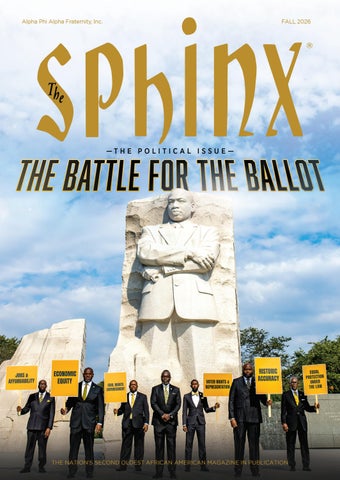
THE NATION’S SECOND OLDEST AFRICAN AMERICAN MAGAZINE IN PUBLICATION
CONTENTS
features
in this issue
10
3
THE AFRICAN AMERICAN PRESENCE: A TIMELINE SPANNING ADVERSITY, ADVANCEMENT AND ONGOING CHALLENGE
LETTERS
20
WHAT EVERY ALPHA SHOULD KNOW
BEYOND THE FALSE CHOICE
26
17 HISTORY
44 62
ALPHAS ON THE MOVE
CODE RED, BROTHERS: THE GOP WAR ON BLACK AMERICA IS REAL
90
35
92
40
96
ELECTION 2026: CENTER US BEFORE WE CLAIM “THEM”
THE TEST OF OUR LIFETIME: A VOTELESS PEOPLE IS STILL A HOPELESS PEOPLE
44
THE GROUND GAME TO SAVE VOTING RIGHTS STARTS NOW
46
ALPHA CHAIRMANSHIP
22
LICENSED MANUFACTURER & VENDOR DIRECTORY ALPHA AWARD OF HONOR/ ALPHA AWARD OF MERIT RECIPIENTS
98 OMEGA CHAPTER
105
LEADERSHIP DIRECTORY
A VOTELESS PEOPLE IS A HOPELESS PEOPLE
50
THE FIERCE URGENCY OF NOW AND TOMORROW
32
56
ALPHA'S GREATEST INTEREST: A PUBLIC POLICY AGENDA ROOTED IN THE ESSENCE OF OUR FRATERNITY
68
FROM ALPHA TO THE BOULE: HARRY E. JOHNSON’S ELECTION CONTINUES A DISTINGUISHED LEGACY OF ALPHA MEN IN SIGMA PI PHI
74
A LEGACY OF COURAGE AND CONVICTION: BROTHER AL GREEN’S CONGRESSIONAL JOURNEY
60
Alpha Phi Alpha Fraternity Inc. develops leaders, promotes brotherhood and academic excellence, while providing service and advocacy for our communities.
CONTENTS
Official Organ of Alpha Phi Alpha Fraternity, Inc. SPECIAL EDITION FALL 2026 I VOLUME 112, NO. 2 apa1906.net EDITOR OF THE SPHINX Eric Christopher Webb, DDiv., CPLC EWebb@apa1906.net CONTRIBUTORS Lucien J. Metellus, Jr., Sean L. McCaskill, Eric Christopher Webb, DDiv., CPLC, Adrian Stratton, MBA, CPP, PRP, Gov. Wes Moore, Leonard C. McKinnis, II, Ph.D., Robert L. Harris, Jr., Ph.D., Tkeban Jahannes, Marc Morial, Jeff Johnson, Basil A. Smikle, Jr., Ph.D., Roland S. Martin, Darryl J. Brackeen, Jr., and State Sen. Elgie R. Sims, Jr., Esq., PUBLICATIONS COMMITTEE Ramon Peralta, Jr., L.H.D., Chairman and Chief Creative Advisor, Eric Christopher Webb, DDiv., CPLC, Editor of The Sphinx, Eric G. Stephens, Derrick Jones, II, Derek D. Adams, PMP, Philip Wilkerson, III, and LaMarcus J. Hall, Ph.D. EDITORIAL OFFICES Alpha Phi Alpha Fraternity, Inc. 2313 St. Paul Street Baltimore, MD 212I8-5211 www.apa1906.net COVER PHOTOGRAPHY: Jamal Wiggins COVER DESIGN: Nicole McCoy PRINTING Mercury Publishing Services, Inc. (800) 634-9409 DESIGN Nicole McCoy Senior Graphic Designer Alpha Phi Alpha Fraternity, Inc. © 2026 Alpha Phi Alpha Fraternity, Inc. | All Rights Reserved
IN THIS ISSUE This Special Political Edition of The Sphinx declares 'The Battle For The Ballot.' It clarifies what’s at stake for African Americans in the upcoming midterm and the next general election, compiles a timeline of African American progress, challenges, and setbacks since our arrival in this country as well as assembles a collection of political perspectives from across the Fraternity, including elected officials, commentators, and advocates.
FALL 2026
FOLLOW ALPHA PHI ALPHA
@APA1906Network
@SphinxTV1906
1
MAIL FROM THE BROTHERHOOD
Dear Brother Webb, I just finished reading the special edition of the Sphinx Spring 2026, and had to pause to say, “Bravo!” Starting with the cover image – it was EVERYTHING! Y’all did that!!! Then, the various stories/articles were absolutely amazing and inspiring – from the article about Rev. Jackson, Alpha’s statement on the ICE aggression, and all through the Entrepreneurship highlights. Thank you for your stellar editorship and positive impact. Well Done.
My recommendation would be to provide the brotherhood a directory of contact information for these companies and to also include that directory in the next issue of The Sphinx. It could be in the same format as our official vendor directory. Again Brothers, this was a job well done and much needed! '06 Fraternally, Brother Tamahn Jamison Alpha Phi Alpha Fraternity, Inc. Omicron Phi Lambda Service Committee Chai
Brotherly, Brother Alex Washington, Ph.D., MSSW., MA Dear Brother Webb, Brother E.D. McCaskill, I want to sincerely thank you and Bro. Webb for bringing Alpha Dollars Touching Alpha Brothers to life on the pages of the latest edition of The Sphinx! Every article shared another opportunity where the Brotherhood, and the Black community overall, can circulate our dollars internally. There is one very important omission that I am compelled to bring to your attention - contact information. As I flipped through the pages, I was expecting to see a directory containing at least the website url for the Alpha businesses that are highlighted. (I would have preferred that information to be included somewhere within the respective article.) Having relocated from Virginia to the Black Mecca, that is Atlanta of course, 15 years ago has expanded my appreciation for the depth and breadth of economic excellence that our community has achieved. But I have come to realize in my own journey of highlighting Black-owned businesses that potential patrons want the process to be as easy as possible. Most will not take the time to search for each company's url, physical address, email address, etc. - nor should they have to.
2
I recently read your feature in The Sphinx and wanted to express my appreciation for the work you are doing. Your commitment to equipping Black institutions and mission-driven leaders to communicate with confidence, safeguard their legacies, and expand their influence deeply resonated with me. As an author of five books and an accomplished strategic communications leader, you have built the kind of sustained body of work and strategic influence toward which I am intentionally working. Fraternally, Brother Richard Brown III Founder and CEO, GRIEF Talk™ and GRIEF Talk UNFILTERED America’s GRIEF & Trauma-Informed Coach www.GRIEFxTalk.com
THE SPHINX®
FROM THE GENERAL PRESIDENT
Letter from the General President Greetings, “What are the dangers ahead in the next half century? They are not new. Success and prosperity breed selfishness and indifference. These vices undermine the free society that spawns them. Eternal vigilance remains the price of liberty. Freedom for oneself cannot be divorced from responsibility for one’s fellow citizens. Nor is freedom divisible. There is not one freedom for thought, another for speaking, another for reading, another for association, and yet another for travel. As citizens, our obligation is to guard complete freedom for all Americans jealously. Only this vigilance will keep America strong and keep us free.” — Jewel Henry Arthur Callis, 1956
Lucien J. Metellus, Jr. General President GeneralPresident@apa1906.net
Jewel Callis’s words impact me because they sound as if he were speaking to us today in 2026, not in 1956. Seventy years later, the forces of oppression are working to set us back, and we as Alpha Phi Alpha men cannot allow that to happen. It is incumbent upon every Alpha, College and Alumni, to be involved in the fight for our country’s freedom. This issue of The Sphinx Magazine® is focused on the current electoral climate and the 2026 elections. As a Fraternity, historically, we have not endorsed candidates for public office, but we have been active in making sure the interest of the downtrodden of our society are at the forefront. We must be engaged around protecting voting rights, being poll monitors in our local elections, and being active participants in the democratic process. Inside this issue, you will meet Brothers engaged in the fight for freedom, learn about the General Organization’s three-year plan to protect voting rights, and explore a policy agenda that advances the communities we serve. It highlights what WE can do now to save our country and reimagine its future. I often hear the question, “What is Alpha doing?” My response is always consistent: What are WE doing, Brother? The General Convention in the 1930s recognized that a “Voteless People is a Hopeless People,” and that truth requires each Alpha man to be engaged at the local level, not only at the national or international political level. We need you, Brother, to run for school board, local city council, state comptroller, and more. We need you, Brother, to make sure YOUR vote is counted and to bring three more people with you to the polls. We need each chapter to educate the community about economic justice, reparations, voter protection, advocacy, and equal justice under the law. “First of All, We Vote! Every Year, Every Election.” Brotherhood calls us to lift one another in every step forward. This issue of The Sphinx Magazine® is more than a publication; it is a road map to our future as a people. Each of us, regardless of age or initiation date, needs to be leaders now more than ever. I challenge you to leave your comfortable houses, cars, and lives and fight for this critical time in our country. Our charge is clear: register, educate, organize, protect, and vote. If every Brother leaves this issue with one action to take in his chapter, campus, city, or state, then this edition will have done more than inform us—it will have helped mobilize us. I look forward to the moments when we can shake hands, exchange greetings, and depart as friends once again. Always Fraternal. S
FALL 2026
3
FROM THE EDITOR FROM THE EXECUTIVE DIRECTOR
Letter from the Executive Director My Brothers of Alpha: As we approach the 2026 midterm elections, I am reminded of the profound responsibility entrusted to each member of our beloved Fraternity through one of our most historic and impactful General Programs, A Voteless People Is a Hopeless People. This program is not merely a Fraternity initiative; it is a cornerstone of our commitment to leadership, civic engagement, and social justice.
Sean L McCaskill Executive Director seanmccaskill@apa1906.net
Since its inception, Alpha Phi Alpha has recognized that the right to vote is among the most powerful instruments of change available to citizens in a democratic society. Our Fraternity has long stood at the forefront of efforts to educate, register, and mobilize voters, understanding that meaningful progress is achieved when communities actively participate in the electoral process. As Alpha men, we must fully understand and embrace the significance of A Voteless People Is a Hopeless People. The program challenges us to be informed citizens, active participants, and advocates for civic responsibility within our communities. It reminds us that our voices matter and that exercising the right to vote is both a privilege earned through sacrifice and a responsibility that must never be taken for granted. The upcoming midterm elections present a critical opportunity for us to fulfill this obligation. While presidential elections often generate the greatest public attention, midterm elections frequently determine the leaders and policies that directly impact our schools, neighborhoods, healthcare systems, economic opportunities, public safety, and civil rights. Decisions made at the local, state, and federal levels affect our daily lives, making every election consequential. Therefore, I encourage every Brother to take deliberate action: •
Verify your voter registration and ensure your information is current.
•
Educate yourself on the candidates, issues, and ballot initiatives in your community.
•
Develop a plan to vote, whether through early voting, absentee voting, or on Election Day.
•
Encourage your family members, friends, colleagues, and neighbors to participate in the electoral process.
•
Support your chapter's voter education and voter engagement efforts in alignment with Fraternity policies and applicable laws.
Our Jewels envisioned a Brotherhood committed to scholarship, leadership, advocacy, and service. By actively participating in every election, we should uphold this vision and contribute to the education and empowerment of the communities we serve. It is imperative to recognize that voting extends beyond presidential election cycles. True and enduring transformation is catalyzed by participation in municipal, county, state, and federal elections. Brothers, the future of our communities depends upon engaged and informed citizens. Let us recommit ourselves to the ideals embodied in A Voteless People Is a Hopeless People and continue the proud Alpha tradition of leading from the front. Let us serve as examples of civic responsibility and encourage others to make their voices heard through the ballot box. When Alpha men vote, we do more than cast ballots. We uphold a legacy, protect hard-won rights, and help shape a better future for generations to come. Thank you for your continued dedication to Alpha Phi Alpha Fraternity, Inc., and to the communities we are privileged to serve. S 4
THE SPHINX
FROM THE EDITOR OF THE SPHINX
Letter from the Editor of The Sphinx Greetings Brothers, Over the last year, the U.S. Supreme Court has not only threatened the Voting Rights Act, but gutted it, while the resolve of African Americans and those who truly believe in equality, justice, and the U.S. Constitution is being tested. Nationwide, state legislatures have used redistricting to disenfranchise Black voters and undermine Black political representation. In addition, the Trump Administration and some states have committed to an all-out effort to purge voter rolls, restrict mail-in voting, and other efforts to make it more difficult to vote. Eric Christopher Webb, DDiv., CPLC Editor ewebb@apa1906.net
‘The Battle For The Ballot’ has been declared. Since the Fraternity established one of its earliest General Programs “A Voteless People Is A Hopeless People” (VPHP) in the 1930s, the Fraternity has emphasized voting and African American participation in the U.S. political process. At the time, many African Americans had the legal right to vote but were kept from the polls by poll taxes, threats of retaliation, and limited knowledge of the voting process. For more than 65 years, voter education and registration remained central to this outreach. In the 1990s, the program expanded to promote political awareness and empowerment, primarily through town hall meetings and candidate forums. Inspired by a VPHP, this Special Political Edition of The Sphinx Magazine clarifies what is at stake for African Americans in the upcoming midterm and the next general election, including voting rights, civil rights, economic opportunity, education opportunity, healthcare, criminal justice, and diversity, equity and inclusion (DEI). For context, we have compiled a timeline of African American progress, challenges, and setbacks since our arrival in this country as well as assembled a collection of political perspectives from across the Fraternity, including elected officials, commentators and advocates. Other feature articles include a tribute to the congressional career of Brother Al Green and the ascension of Past General President Harry E. Johnson as Grand Sire Archon of Sigma Pi Phi Fraternity – The Boulé. In addition, the magazine offers voter and election resources as well as General News, and select magazine departments, which highlight current Alpha elected officials, Alphas who are candidates for public office, and College Brothers, who serve in leadership roles in their campus organizations. We encourage Alpha Brothers to utilize this Special Edition of The Sphinx Magazine as a resource as well as share it with family and friends prior to the upcoming midterm election on Tuesday, Nov. 3. As always, it is both my honor and pleasure to serve as your Editor of The Sphinx. S
FALL 2026
5
The General President and Past General Presidents On The 2026 Midterm Election "Our beloved founders would expect us to meet this moment with courage, leadership, and action. They understood that progress has never come without participation, sacrifice, and an unwavering commitment to justice. And their words still speak to us today: “A Voteless People Is A Hopeless People.” Brother Dr. Herman “Skip” Mason Jr. 33rd General President
6
"In every evolution of our country the people who vote are the direct linchpin of that change. This election season we are given the opportunity to move our country in a direction that will consider the downtrodden of our society as a priority and not an afterthought....your vote matters!" Brother Lucien J. Metellus General President
THE SPHINX®
"The 2026 midterm election is vitally important now even more than ever, due to the current political climate and division in the United States. While Americans may disagree about the extent of current barriers to voting, the broad participation in the election process ensures that every eligible citizen has an equal opportunity to influence the democratic process. This constitutional right, particularly now, must be vigorously exercised and defended. Alpha Phi Alpha must continue to be a vanguard in this monumental effort!" Brother Dr. Willis L. Lonzer, III 36th General President
FALL 2026
"Alpha Phi Alpha was not founded for comfortable times. We are witnessing racially motivated battles over who has access to the ballot, assaults on the teaching of Black history, challenges to long-established civil rights protections, resurgence of white supremacy and an expanding debate over the limit of governmental power. These and countless other issues demand Alpha men organize and mobilize unprecedented voter turnout on Nov. 3 . . . Let us embrace our 120-year legacy by “Fighting till hell freezes over and then fight on the ice." Brother Dr. Everett B. Ward 35th General President
7
Past General Presidents On A Voteless People Is A Hopeless People "Alpha Phi Alpha recognize(d) the power of the ballot many years ago when it rallied Blacks with its ‘A Voteless People is a Hopeless People’ slogan. Alpha men and Alpha chapters still know this to be true and must more than ever rally our people to register and vote. Black America has the resources with which to improve its condition. My suggestion to us today is to stop bemoaning conditions and ‘use what we have ‘to change conditions. To this end, ‘the struggle continues.’" The Late Brother Ozell Sutton, 1984 26th General President
"I implore each and everyone of you to participate in ‘A Voteless People is a Hopeless’ programs throughout the country to make certain that every eligible person in your household exercises their right to vote for the candidates of their choice. What better memorial can we give to honor those who lost their lives on that fateful day, than fulfilling the dreams of those who have gone before us by doing our part to ensure that every vote counts in the upcoming fall elections. If not you, then who? If not now, when?" Brother Harry E. Johnson, Sr., 2001 31st General President
Source: Believing in the 33!: Inspirational Words of Wisdoms From The General Presidents Of Alpha Phi Alpha Fraternity, Inc.
"Voting is one of the simplest, but most powerful ways we can make our voices heard and help shape the future of our communities. Midterm elections may not always get the same attention, but the decisions made in these elections affect our everyday lives, which is why it’s important that we stay informed, show up, and take part in the process." Brother Davionne M. Jakes Midwestern Regional Assistant Vice President
FEATURE
BY BROTHER ERIC CHRISTOPHER WEBB, CPLC, DDIV., [NU ’89]
The African American Presence: A Timeline Spanning Adversity, Advancement and Ongoing Challenge Throughout history, the African American presence in this country has been characterized by the Slavery Era, the Reconstruction Era, the Jim Crow Era, the Civil Rights Era, the Redlining Era, and the Post Civil Rights Era. Beyond emancipation, the right to vote—and the act of voting—has long served as a defining mark of citizenship and a vital path toward equality for African Americans. The U.S. Supreme Court’s decision to gut the historic Voting Rights Act has now drawn a line in the sand, declaring a ‘Battle For The Ballot.’ This Special Political Edition of The Sphinx clarifies what is at stake in the upcoming midterm and next general election through a timeline of African American progress, challenges, and setbacks, complemented by political perspectives from across the Fraternity as well as inspired by one of Alpha’s earliest General Programs, “A Voteless People Is A Hopeless People.” KEY: ADVANCEMENT • MIXED • MAJOR SETBACK
1619 – 1865 Slavery Era 1600s – 1705 Colonial slave codes enacted 1776 Declaration of Independence (Declared equality while slavery remained legal.)
10
1787 Three-Fifths Compromise (increased slaveholding states’ political power while denying enslaved people rights) 1808 Importation of enslaved Africans prohibited (Ended the international slave trade, though domestic slavery expanded.)
THE SPHINX
FEATURE
1820 Missouri compromise (Temporarily limited expansion of slavery while preserving it elsewhere.) 1831 Nat Turner’s rebellion (Prompted harsher slave laws across the South). 1850 Fugitive Slave Act (Required return of escaped enslaved people, even from free states.) 1857 Dred Scott Decision (U.S. Supreme Court ruled Black Americans were not citizens and had no constitutional rights.)
to resisting Reconstruction policies and suppressing newly won civil rights of African Americans.) 1865 – 1866 Black Codes enacted (Southern states sought to restore white control after emancipation.) 1868 14th Amendment (Guaranteed birthright citizenship and equal protection.) 1869 – 1870 15th Amendment (Was passed and then formally ratified, which prohibited racial discrimination in voting for men.)
1863 Emancipation Proclamation (Declared enslaved people in Confederate states free.)
1870 Hiram Rhodes Revels, a Republican from Mississippi, was the first Black American elected to Congress. (He made history when he was elected to the U.S. Senate on January 20, 1870, and was sworn into office on February 25, 1870, during the Reconstruction.)
1865 – 1954 Jim Crow Era
1875 Civil Rights Act of 1875 (Guaranteed equal access to public accommodations.)
1865 13th Amendment Ratified (Abolished slavery except as punishment for crime.)
1883 Civil Rights Cases (U.S. Supreme Court struck down much of the Civil Rights Act of 1875)
1865 Ku Klux Klan founded. (White supremacist terrorist group founded by six former Confederate soldiers dedicated
1896 Plessy v. Ferguson (Established “separate but equal,” legitimizing segregation.)
1861 – 1865 Reconstruction Era
FALL 2026
11
FEATURE
1905 The Niagara Movement founded (Militant Civil Rights organization founded by Alpha Brother W. E. B. Du Bois and William Monroe Trotter. Dedicated to fighting racial segregation, disenfranchisement, and discrimination, the movement famously drafted an unequivocal “Declaration of Principles” that served as the direct precursor to the NAACP and inspired the founders of Alpha Phi Alpha Fraternity, Inc. to organize.) 1906 Alpha Phi Alpha Fraternity, Inc. founded. 1909 NAACP founded. 1915 White House premiere of Birth of a Nation. (Depicted a racist version of post-Civil War history, where newly freed Black men murder and rape white women and the Ku Klux Klan is touted as a heroic force. President Woodrow Wilson legitimized its racist view and the nation’s violence against Blacks by saying “it is like writing history with lightning, and my only regret is that it is all so terribly true.” 1917 Alpha Phi Alpha Jewel Founder Eugene Kinckle Jones appointed as the Executive Secretary of the National Urban League. (Nation’s oldest and largest civil rights and urban advocacy organization working to provide economic empowerment, 12
educational opportunities, and civil rights for African Americans and historically underserved communities across the United States.) 1919 Alpha Phi Alpha Jewel Founder Robert H. Ogle was the first African American to serve as a professional staff member for a U.S. Senate committee, working for the U.S. Senate Committee on Appropriations. 1921 Destruction of Tulsa, Oklahoma’s Greenwood District, known as Black Wall Street (One of the most prosperous African American communities in the nation – more than 35 city blocks – was destroyed by racist mobs, 300 people killed and 800 people injured.) 1930 A Voteless People Is A Hopeless People established by Alpha Phi Alpha Fraternity, Inc. (Initiative created to combat political apathy and disenfranchisement during a time when many African Americans were prevented from voting due to poll taxes, literacy tests, and threats of reprisal. 1941 Executive Order 8802 (Banned racial discrimination in defense industries.) 1944 Adam Clayton Powell becomes first member of Alpha Phi Alpha Fraternity, Inc. elected
THE SPHINX
FEATURE
to the U.S. Congress. (He was elected to the U.S. House of Representatives to represent Harlem, New York.) 1948 – Executive Order 9981 (Desegregated the U.S. military.) 1948 Executive Order 9981 (Desegregated the U.S. military.)
1954 – 1968 Civil Rights Era 1954 Brown v. Board of Education (Overturned Plessy in public education.) 1955 Rosa Parks arrested (Sparked the Montgomery Bus Boycott led by Alpha Brother Rev. Dr. Martin Luther King, Jr.) 1957 – Civil Rights Act of 1957 (First federal civil rights law since Reconstruction.) 1960 – Greensboro sit-ins (Expanded direct-action protest movement.) 1961 Freedom Rides (Challenged segregated interstate travel.) 1963 March on Washington (Culmination of national civil rights activism. Brother Rev. Dr. Martin Luther King, Jr. delivers “I Have A Dream” Speech.) 1964 Civil Rights Act of 1964 (Outlawed segregation and employment discrimination.) FALL 2026
1965 Selma to Montgomery (Built public support for the Voting Rights Act.) 1965 Assassination of Malcolm X (Major loss to Civil Rights Movement.) 1965 Voting Rights Act of 1965 (Protected voting rights through federal enforcement.) 1966 Brother Edward Brooke becomes first African American elected to the U.S. Senate by popular vote. (Brother Brooke was the first African American since Reconstruction in 1874 to have been elected to the United States Senate and the first African American since 1881 to have held a United States Senate seat.) 1967 Loving v. Virginia (Landmark case struck down bans on interracial marriage.) 1967 Brother Thurgood Marshall sworn in as first African American Associate Justice of the U.S. Supreme Court.
1968 – 1970s Redlining Era
1968 Assassination of Brother Rev. Dr. Martin Luther King, Jr. (Major loss to the Civil Rights Movement.)
13
FEATURE
1968 Minister and Civil Rights leader Channing Emery Phillips became first African American in history to be placed in nomination for president of the United States by a major political party. At the same convention, Julian Bond was nominated for vice president, the first African American to be nominated for that office by a major party. Bond, ineligible on account of being under the required age (35), withdrew. 1968 Shirley Anita Chisholm became the first Black woman to be elected to the United States Congress. 1968 Fair Housing Act (Outlawed housing discrimination.)
1970s – present Post Civil Rights Era 1971 Swann v. Charlotte-Mecklenburg Board of Education (Approved busing to desegregated schools.) 1972 Shirley Anita Chisolm became the first Black candidate for a major-party nomination for President of the United States and the first woman to run for the Democratic Party's presidential nomination. 1978 Regents of the University of California v. Bakke (Allowed
14
affirmative action but prohibited rigid quotas.) 1982 Voting Rights Act renewed (Strengthened protections against discriminatory voting practices.) 1991 Civil Rights Act of 1991 (Expanded workplace discrimination protections.) 2003 Grutter v. Bollinger (Upheld limited use of race in higher education admissions.) 2008 Election of Barack Obama (First African American elected president.) 2009 Lilly Ledbetter Fair Pay Act (Strengthened pay discrimination claims.) 2013 The Black Lives Matter (BLM) movement was established in 2013 by organizers Alicia Garza, Patrisse Cullors, and Opal Tometi. (It began as a social media hashtag following the acquittal of George Zimmerman, the man who fatally shot 17-year-old Black teenager Trayvon Martin in 2012.) 2013 Shelby County v. Holder (Invalidated the Voting Rights Act’s preclearance formula, leading many states to adopt new voting restrictions.)
THE SPHINX
FEATURE
2019 Andrew Young Social Justice Institute established by Alpha Phi Alpha Fraternity, Inc. (A community and faithbased partnership to address pressing social issues such as immigration reform, public education and voting rights, among others.) 2020 George Floyd lynching and protests (Video recorded murder of unarmed man by police prompted largest Civil Rights demonstration in U.S. history; prompted reforms and backlash.)
2023 Students for Fair Admissions v. Harvard (Effectively ended raceconscious admissions in higher education.) 2025 Louisiana v. Callais (U.S. Supreme Court guts the Voting Rights Act by further narrowing protections against racial vote dilution and weakened key enforcement provisions.) S *Photos from the Library of Congress
2020 ALPHA PAC (the Alpha Political Action Committee) was founded and independently formed by members of Alpha Phi Alpha Fraternity, Inc. to help increase the number of African Americans and people of color in the U.S. House of Representatives and U.S. Senate. 2022 The Emmett Till Anti-lynching Act of 2022 (Signed into law by President Joe Biden. The law defines lynching as a specific federal hate crime and establishes maximum penalties of up to $250,000 in fines and 30 years in prison.) 2022 Ketanji Brown Jackson appointed and sworn in as the first African American woman to ever serve on the nation’s highest court.
FALL 2026
15
*Photos from the Library of Congress
HISTORY
BY BROTHER ROBERT L . HARRIS, JR., PH.D. [THETA '63]
A Voteless People is a Hopeless People Redux
S
ince its founding in 1906, Alpha Phi Alpha Fraternity, Inc. has had two major initiatives to achieve racial equality. The Brotherhood has promoted educational achievement with “Go-to-High School, Go-to-College” and political participation with “A Voteless People is a Hopeless People.” Alpha Phi Alpha was instrumental in breaking down barriers to higher education and then elementary and secondary education for African Americans through court cases that culminated in Brown v. Board of Education, in 1954. The road to unfettered political participation has been longer and more hazardous. According to the Equal Justice Initiative in Montgomery Alabama, some 6,000 African Americans and their allies were lynched between 1865 and 1950. During that time, lynching was supposedly for some alleged transgression against the white social order in the South, but was primarily meant to wield control and keep the Black population in its proverbial “place.” A similar tactic, although not as blatant as violence, is gerrymandering which is being used today to limit the Black vote.
FALL 2026
Immediately after the Civil War, many southern states instituted “Grandfather” clauses by which men could not qualify to vote unless one of their grandfathers had voted before the Civil War. The U.S. Supreme Court in 1915 voided “Grandfather” clauses in the state constitutions as violations of the Fifteenth Amendment which restricted the power of the U.S. government or individual states to abridge or deny the right citizens’ right to vote on the basis of race, color, or previous condition of servitude. Southern states then sought to limit Black political participation through the “White Primary,” in which only white voters could cast ballots in the Democratic party when the Republican and other political parties were almost non-existent, and was tantamount to election. The U.S. Supreme Court in 1944 voided the “White Primary” as being racially discriminatory. Southern states then used the poll tax to exclude Black voters. Southern states considered poll taxes as non-discriminatory because everyone of a certain age had to pay them. But application of the poll tax became
17
HISTORY
discriminatory as Southern States insisted that a prospective voter had paid the poll tax to qualify to vote. Black voters usually had to prove that they had paid their poll taxes for several years to be able to vote. The “Understanding” clause was used similarly as the poll tax. White voter registrars in Southern states quizzed prospective voters on their understanding of the U.S. and state constitutions. The white registrars who had little understanding of the constitutions themselves were the final arbiters of whether a person answered the questions correctly. White supremacists, however, fell back on their ultimate weapon, violence to keep African American from the polls. In 1957, Congress enacted its first civil rights legislation since Reconstruction. The Southern Christian Leadership Conference (SCLC) led by Brother Rev. Dr. Martin Luther King, Jr. organized a “Prayer Pilgrimage for Freedom” in Washington, D.C. while the legislation was before Congress. Some 27,000 protesters gathered in front of the Lincoln Memorial, where Brother Rev. Dr. King electrified the audience. He rose to oratorical heights with the refrain: “Give us the ballot and we no longer have to worry the Federal Government about our basic rights. Give us the ballot …” The Civil Rights Act of 1957 empowered the federal government through the Justice Department to bring lawsuits against those for the denial of voting rights. It also established a Civil Rights Commission to monitor violations and to propose remedies to Congress. SCLC determined that the ballot was central to school desegregation, employment opportunities, decent housing, and equal access to public accommodations and transportation. SCLC sought to double the number of African Americans registered to vote in the South. They did not achieve their objectives as southern white supremacists used delaying tactics, economic reprisals, gerrymandering, intimidation, and
18
THE SPHINX
HISTORY
outright violence to skirt enforcement of the 1957 legislation. It would require more years of struggle, additional civil rights laws, and a constitutional amendment to enfranchise African Americans in the South. Still, white supremacists found ways to limit Black access to the ballot and political representation. The “Gerrymander” has become their most recent device in drawing maps often with strange shapes to reduce Black and Democratic Party voters and expand Republican Party voters. “Mr. James Crow, Esq.” has become more sophisticated than his blatantly racist ancestor “Old Jim Crow.” Some may ask why are white supremacists so concerned about the Black vote? Part of their concern is to maintain a certain class of white people in control of political power and its spoils even at the expense of their poor and lesser educated brethren, who enjoy having someone to look down upon and to justify their failures and plight in life.
Moreover, there are some white supremacists who take Thomas Jefferson’s warning in “Notes on the State of Virginia” (p. 174) to heart. Jefferson understood slavery’s possible repercussions. He wrote: “… I tremble for my country when I reflect that God is just; that his justice cannot sleep forever.” Jefferson contemplated retribution for enslavement and the inequitable treatment of African Americans. To meet the new challenges to our right to vote, we must turn out in every election in large numbers. We must explore new strategies that are to our advantage, such as Brother Bishop William J. Barber terms fusion politics. We must consider approaches that worked for us in the past, such as the Black and Tan coalitions. The great labor leader, A. Philip Randolph reminded us that freedom is never a final fact; it is an ongoing struggle. And we must fight, as Jewel Vertner Woodson Tandy explained, “… until hell freezes over and then fight on the ice.” S
Brother Robert L. Harris, Jr., Ph.D, a Fall 1963 initiate of Theta Chapter, is a Professor Emeritus at CornellUniversity, serves as the Fraternity's General Historian and is the author of more than 40 articles and chapters in academic journals and books as well as The History of Alpha Phi Alpha: A Tradition of Leadership And Service.
FALL 2026
19
FEATURE
BY BROTHER BASIL A. SMIKLE, JR., PHD [DELTA LAMBDA ’16]
BEYOND THE FALSE CHOICE EDUCATION, INSTITUTIONS, AND THE POLITICAL ECONOMY OF BLACK MEN
A
s we approach the 2026 midterm elections, much of the political conversation about Black men will inevitably focus on polls: turnout, party identification, ideological shifts, and whether Black men are moving toward or away from one party or another. Those are important questions, but they are not the only ones—and perhaps not the most consequential. Elections are also moments when we make choices about the institutions that structure economic opportunities long after the ballots have been counted. For Black men, that means paying particular attention to debates over education, workforce development, higher education, civic institutions, and the pathways through which one generation builds wealth for the next. In that sense, what is at stake in these midterms is bigger than an election. It
20
is a debate over the political economy Black men will inherit. Every generation seems to rediscover an old debate about Black education. More than a century ago, it was often characterized as Booker T. Washington versus W.E.B. Du Bois: industrial education and economic selfsufficiency on one side, higher education and the cultivation of Black intellectual and
THE SPHINX
FEATURE
professional leadership on the other. Today, the vocabulary has changed. We talk about college versus trades, student debt versus apprenticeships, degrees versus skills. But then, as now, it is largely a false choice. Black America has always needed both. It needed the tradespeople, entrepreneurs, and skilled workers Washington championed, just as it needed the teachers, lawyers, doctors, scholars, and civic leaders Du Bois believed higher education could produce. The more consequential question was never which kind of education Black Americans should pursue. It was whether Black Americans would have equitable access to the institutions through which education becomes economic security, political influence, and generational wealth. That question is particularly
FALL 2026
consequential for Black men because it is inseparable from a larger question of political economy: who has access to the institutions through which societies distribute opportunity and accumulate wealth? We are living through a period of profound institutional distrust in government, higher education, media, and other institutions which have lost legitimacy for many Americans even as we depend on them to educate workers, generate knowledge, and sustain democratic life. Black Americans have warranted reasons for skepticism. American institutions repeatedly excluded us. But one of the most important features of Black political history is that exclusion rarely produced institutional abandonment. It produced institution-building such as churches, HBCUs, mutual-aid societies, civil-rights organizations, professional associations, and fraternities such as Alpha Phi Alpha that converted individual achievement into collective capacity. The New Deal offered perhaps the clearest example of why institutional access matters for wealth. Franklin Roosevelt's programs fundamentally reordered the American political economy. Social Security, labor protections, federal housing policy,
21
FEATURE
Percentage of 18-24 year olds enrolled in college in 2022
61% Asian
41% White
36% Black
Percentage of Black 18-24 year olds enrolled in college in 2022
39% Women public works, and the later expansion of federally supported education helped create the architecture of the twentieth-century middle class. But access to that architecture was profoundly unequal. Agricultural and domestic workers - occupations in which Black workers were disproportionately represented - were initially excluded from core Social Security protections and from major labor protections. Housing policy was even more consequential. Federal underwriting practices operated within, and helped institutionalize, a segregated housing market in which Black neighborhoods were treated as financial risks. At precisely the moment government was helping millions of families turn homeownership into an appreciating intergenerational asset, Black families were systematically constrained in their ability to participate. 22
32% Men The racial wealth gap is not simply the cumulative result of individual choices. It reflects decades in which public institutions shaped whose assets could grow, whose jobs carried protections, and whose families could pass wealth to the next generation. The Federal Reserve’s 2022 Survey of Consumer Finances found median wealth of roughly $285,000 for White families, compared with about $44,900 for Black families—more than a six-to-one difference. The New Deal did not single-handedly create that divide, but its unequal distribution of opportunity became part of the institutional machinery that allowed earlier inequalities to compound across generations. For Black families denied equal access to appreciating property and inherited capital, education consequently assumed unusual importance. A THE SPHINX
FEATURE
degree could never fully substitute for inherited wealth, but it could open access to occupations, professional networks, homeownership, civic leadership, and institutions capable of producing economic security. That history should make us cautious about contemporary claims that college no longer matters. The economic evidence consistently demonstrates that education yields substantial returns. Bureau of Labor Statistics data consistently show higher median earnings and lower unemployment as educational attainment rises. The sensible response is to recognize that apprenticeships, technical credentials, community colleges, four-year universities, and graduate education constitute complementary pathways within the same opportunity structure. The Black male college-going numbers make the stakes especially clear. FALL 2026
According to the National Center for Education Statistics, 36 percent of Black 18-to-24-year-olds were enrolled in college in 2022, compared with 41 percent of White young adults and 61 percent of Asian young adults. Within the Black population, 39 percent of women ages 18 to 24 were enrolled, compared with 32 percent of men. NCES cautions that the Black malefemale difference in that year was not necessarily statistically different, but the broader gender pattern deserves attention: across the population, women have consistently enrolled at higher rates than men, while Black men's college participation remains well below that of several other groups. The answer cannot be to downgrade college while upgrading vocational education. We should be investing in both. The skilled trades are essential
23
FEATURE
to America's infrastructure and can provide meaningful, well-compensated careers. But the knowledge economy also rewards advanced credentials in engineering, medicine, law, education, finance, scientific research, technology, and emerging fields such as artificial intelligence. The false choice has never been college versus the trades. The real choice is whether we expand opportunity or ration access to the institutions that create it. There is another form of education that receives far less attention but is central to this political economy: civic literacy. By civic literacy, I mean more than understanding how a bill becomes law or how to vote. It is the capacity to understand how institutions work and how people act collectively within them. It includes knowing how school systems allocate resources, how public budgets are built, how nonprofits mobilize communities, how philanthropy distributes capital, how coalitions form, and how citizens turn collective demands into lasting policy. This broader conception is consistent with scholarship that treats civic learning as knowledge plus participation and institutional practice. It also resonates with a long tradition in Black political-behavior research. Michael Dawson's theory of linked fate demonstrated how Black political judgment can connect individual prospects to perceptions of the wellbeing of the larger group. Katherine Tate's work on the movement from protest to politics documented another dimension of that development: 24
the civil-rights struggle increasingly required not only demanding change from institutions but exercising power within them. Civic engagement, understood this way, is not reducible to Election Day. It occurs through neighborhood associations, churches, school boards, nonprofits, professional organizations, philanthropy, movements, and government itself. I recently described this dynamic as an inside-outside tradition in Black politics. Black political history rarely required choosing between movements and institutions. It has relied upon both: pressure from outside institutions and participation within them. One creates leverage; the other can convert leverage into durable policy. That tradition also helps explain why Black political judgment so often incorporates questions of familiarity, trust, institutional competence, and demonstrated commitment. As I argued in Searchlight, when Black voters say of a public figure, 'we don't know you,' the statement can function less as a comment on identity or name recognition than as an assessment of whether that person has fought the same battles, understands the institutions involved, and can be trusted to remain accountable to collective goals. Put Dawson, Tate, and the civiclearning literature together and civic literacy becomes something more than political knowledge. It becomes institutional competence. A civically literate person knows not merely that government exists but THE SPHINX
FEATURE
how to navigate it. A civically literate community knows how to establish organizations, contest decisions, serve on boards, secure resources, build coalitions, preserve institutional memory, and hold leaders accountable. These capacities have economic consequences. Communities that can navigate institutions are better equipped to influence how public and philanthropic resources are allocated and to build organizations that endure beyond individual leaders. That brings us back to the midterms. Elections cannot resolve every structural inequality described here, and neither political party can claim ownership of the long Black tradition of education, institution-building, and civic engagement. But elections do determine who writes budgets, establishes the rules governing higher education and workforce development, oversees public institutions, and decides where public investment will—and will not—flow. Those choices can either enlarge the architecture of opportunity or make access to it more exclusive.
but history demonstrates that Black America ultimately needed both. We still do. The false choice has never been education or work, college or trades, protest or institutions. The enduring challenge is building— and preserving—institutions strong enough to keep all of those pathways open. That is what makes this election consequential: the choices made now will help determine not simply who governs, but which pathways to Black economic and civic power remain open for the generation that follows. S Brother Basil A Smikle, Jr., PhD,
is Professor of Practice at Columbia University’s School of Professional Studies and director of the graduate program in nonprofit management. He’s also an MSNOW political analyst and former executive director of the New York State Democratic Party.
For Black men, then, the significance of the 2026 midterms extends beyond candidates, parties, or even a single election cycle. The larger question is what kind of political economy we are constructing and whether Black men will have meaningful access to the institutions that shape it. Booker T. Washington and W.E.B. Du Bois represented competing emphasis in the strategy for Black advancement,
FALL 2026
25
FEATURE
CODE RED, BROTHERS BY BROTHER ROLAND S. MARTIN [PI OMICRON CHAPTER ’89]
THE GOP WAR ON BLACK AMERICA IS REAL
26
T
his is no time to soften the truth: Black America is under a sustained attack aimed at dismantling the infrastructure our people have built since slavery ended. What we are seeing is a detailed plan, laid out in Project 2025, to do more than weaken education, economic opportunity, civil rights, social justice, and health initiatives; it seeks to erase the very gains for which far too many people died. This is not hyperbole. In my 2022 book, White Fear: How the Browning of America Is Making White Folks Lose Their Minds, I explained that this movement was already taking shape by 2009. That year, a survey asked, “Are you optimistic about the future of America for your children?” Majorities in every ethnic group said yes—except whites. Most mainstream media ignored that finding, focusing
THE SPHINX
FEATURE
instead on President Barack Obama’s election and the illusion of a postracial America. That belief was always misguided. Anyone who has studied American history knows that Black progress has repeatedly been met with white backlash. White America was panicking because projections showed whites becoming a minority by 2043. That meant losing cultural dominance—and with it, money, power, and influence. I warned repeatedly that white America would not surrender that easily. The rise of the Tea Party, Donald Trump’s 2016 election, the Jan. 6, 2021 insurrection, and Trump’s 2024 re-election all reflected that backlash. But the aftermath of George Floyd’s murder on May 25, 2020, exposed it most clearly. For nine minutes and 29 seconds, the world watched as a white Minneapolis FALL 2026
police officer took the life of a Black man. This was unlike any other police killing. Because then-17-yearold Darnella Frazier recorded the video that spread across social media, people everywhere witnessed a slow, painful death. The response was global: protests erupted, local, state, and federal officials moved quickly to change policies, corporations pledged billions of dollars, academic institutions revised curricula and staffing, and parents began having difficult conversations with their children about systemic racism. George Floyd’s death began what I have often called the Third Reconstruction. The first Reconstruction followed slavery; Brother W.E.B. Du Bois wrote the definitive work on the subject, Black Reconstruction in America: An Essay Toward a History of the Part Which Black Folk Played in the Attempt to Reconstruct Democracy in America, 27
FEATURE
1860–1880. Another important work is Eric Foner’s Reconstruction: America’s Unfinished Revolution, 1863–1877. The foundation of the First Reconstruction was the Reconstruction Amendments—the 13th, 14th, and 15th—which abolished slavery except as punishment for a crime, established citizenship for formerly enslaved people of African descent, and prohibited denying the right to vote based on race. The Civil Rights Acts of 1866 and 1875 further strengthened gains for African Americans. The Second Reconstruction began with Brown v. Board of Education I
28
and II in 1954 and 1955. It was fueled by outrage over the heinous lynching of 14-year-old Emmett Till on Aug. 28, 1955, and gained momentum with the Montgomery bus boycott, which began on Dec. 1, 1955. That 14-year struggle culminated in the Civil Rights Act of 1964, the Voting Rights Act of 1965, and the Civil Rights Act of 1968, also known as the Fair Housing Act. I call Floyd’s murder the start of the Third Reconstruction because of what followed. Yet even as it unfolded, I warned that Black America could not become comfortable with promises
THE SPHINX
FEATURE
to do better; we had to ensure the momentum lasted AT LEAST 20 years. As a student of history, I knew white America would try to move on quickly—and that backlash had swiftly and decisively undercut the first two Reconstructions. And that is exactly what happened. Forces within white America saw the shift. For the first time in U.S. history, many Americans supported a Blackcentered movement. They saw white adults—and, more importantly, white youth—gaining a fuller understanding of American history rather than HIStory. And they said, “Oh, hell no!”
FALL 2026
In 2021, conservative media launched a vicious assault on Black Lives Matter leadership at the national, state, and local levels. Their echo chamber attacked every part of the movement and seized on mistakes by some leaders. In 2022, they rallied around race under the banner of critical race theory. As a Black man who has worked across Black-owned media, I had NEVER heard of CRT, which was taught in law schools and graduate-level courses. But for white conservatives, it became a tool to mobilize their base. That campaign led to book bans, conservative takeovers of school boards
29
FEATURE
nationwide, and the firing of Black and white-allied superintendents.
So what does this all mean for Alpha and Black America?
In 2023, the target was “woke.” Determined to destroy the momentum for racial equality after Floyd’s death, they labeled anything and everything woke. Then, in 2024, DEI—diversity, equity, and inclusion—became the focus. With Trump making these attacks central to his campaign, they won the White House. I remember warning during a 2023 NAACP Image Awards panel, “Buckle up, Black folks! DEI is dead!” Many told me I was too fired up and should tone it down.
If there was ever a time for this generation of Alphas to rise against fascism, tyranny, white nationalism, and white supremacy, it is now. Gen X, millennials, Gen Z, and Gen Alpha must face the reality that none of us has witnessed an assault on Black America at this scale. During Jim Crow 1.0, they used dogs, fire hoses, lynchings, beatings, and control of the courts and government to oppress us for 92 years—from 1876 to 1968. I mark the end of that era with Brother Martin Luther King Jr.’s assassination on April 4, 1968, and the signing of the Civil Rights Act on April 11, 1968.
THEY. WERE. WRONG. Trump’s 2025 inauguration launched their campaign to shut it all down. Elon Musk and DOGE wiped out billions in research and nonprofit aid; Trump dismantled DEI initiatives across federal agencies; Pete Hegseth blocked promotions for numerous Black military officers; and corporate America, fearful of Trump, voluntarily rolled back or eliminated DEI programs. Nearly every Black nonprofit in America has been harmed, with some losing as much as 80–90% of their funding. Then came the U.S. Supreme Court. With a 6-3 conservative majority, it issued rulings that weakened affirmative action in colleges and universities, voting rights, and Black political representation. White conservatives held a trifecta: the White House, the House and Senate, and the Supreme Court. At the state level, the GOP controls the governorship and both legislative chambers in 23 states.
30
In Jim Crow 2.0, they are still using the courts and legislatures. But the danger of their agenda is more insidious than dogs, fire hoses, and burning crosses. That means we must fight back just as aggressively. That means using the ballot as a weapon—and organizing our people after every city, school board, county, state, and federal election. Our strategy must be a 365-day effort. We must return to citizenship education training so our people understand how government affects their daily lives. We cannot simply keep our heads down and focus on “making this paper,” especially when Black economics is also under attack. In the final year of President Joe Biden and Vice President Kamala Harris, Black-owned businesses received $10 billion in federal contracts. That was only 2% of all federal contracts—an
THE SPHINX
FEATURE
abysmal share, but still a record. In less than two years under Trump, that figure has dropped to 1.2%, wiping out nearly $5 billion. In my new book, Black Forward: Marching Orders for the Fight Against Jim Crow 2.0—available for preorder now at HachetteBookGroup. com before its February release—I lay out what we must do to save Black America. Brothers, this is not a drill. We face a well-funded adversary determined to erase the work of Brothers King, Thurgood Marshall, Du Bois, Paul Robeson, Andrew Young, Adam Clayton Powell Jr., C.T. Vivian, Joseph Lowery, Whitney Young, Dick Gregory, John H. Johnson, Lester Granger, Julius Chambers, and so many others. Brothers, we cannot allow this to happen on our watch. We have the intellect, energy, and resources to defeat our common enemy. Alpha must lead the charge to save Black FALL 2026
America and secure a future for our children’s children. There is no time to waste. Every day we spend talking about the problem instead of doing the work gives our enemies more time to push us further behind. Every state, region, alumni chapter, college chapter, and member must be called into this fight. No battle is won by generals alone; we need troops on the battlefield. So, Brothers: What are YOU prepared to do? S
Brother Roland S. Martin, a Spring
1989 Pi Omicron Chapter initiate and Life Member of the Fraternity, is a political commentator, talk show host, and founder of The Black Star Network, which features #RolandMartinUnfiltered, the first daily digital show specifically targeting African American audiences five days a week.
31
OUT OF THE MOUNTAIN OF DESPAIR
32
THE SPHINX®
A STONE OF
HOPE
FALL 2026
33
FEATURE
34
THE SPHINX
FEATURE
BY BROTHER JEFF JOHNSON [DELTA LAMBDA '2016] PHOTO BY: BROTHER JAMAL A. WIGGINS [ZETA SIGMA '99]
Election 2026: Center Us before we claim “Them”
E
very cycle, the country asks how Black men are voting. The question comes from pollsters, party operatives, and panels of talking heads that often tell us what our answer will mean. It is asked on someone else's calendar, in service of someone else's agenda, and we have gotten very good at answering it. I want us to stop answering it first. Before we tell anyone how we are voting, we should be able to tell each other what we are living for. Our why must come before someone else's answer. Right now, it usually does not, and that is a real problem.
FALL 2026
Two Ways To Move Watch how we too often show up in an electorate, and you will see something worth naming. Black men tend to move as individuals trying to provide. The frame is the household, the obligation of provider, the work or the business that provides the resources for the people directly under our care. We evaluate a political candidate, a policy, an economy by what it does to our ability to carry what we are carrying. That instinct is not a flaw. It is love expressed as responsibility, and it has kept many families provided for through conditions designed to break them. 35
FEATURE
"If you want our collective vote to mean something, there is a price, and the price is not a promise. We have accepted promises for generations. We have accepted the language of consideration, of a seat at the table, of we will get to you once we are in. That is a back-end arrangement, and the
"
back end is where our agenda goes to die.
Black women tend to move differently. They also carry households, especially in the absence of men. But they move as women connected to community, working in service of that community even as they support a family, because they understand that the community is part of the support. The block club, the church, the school, the block itself; those are not extracurricular to the household, they are tapping into community. So, when they vote, they vote for the whole apparatus that holds their family…. their community up. I know this is a broad brush, but we see it play out. That difference shows up in the ballot box. It is why Black women vote as a bloc while we are counted as a swing. Not because we care less, but because we have been taught to secure the individual perimeter first and get to the collective later. Later too often fails to come. 36
THE SPHINX
FEATURE
Some of us learned that from fathers who struggled alone (or at least gave the impression of the solo grind). Some of us learned it in church, where the message was to trust God and endure, and nobody mentioned that God might send brothers to walk you through the worst of it without shame. Others of us got it from other Black men in harsh communities, campuses, and even corporations that taught, ‘put your head down, and make the future you want.’ Wherever we learned it, we learned it well.
first, we will keep entering those spaces without a mandate of our own, and a man without a mandate is available to anyone with a microphone.
Centering ourselves means naming our needs with urgency and precision. By “we,” I mean the full mosaic of Black communities. We are not monolithic, and some of us should stop pretending we want to be. Some brothers are to my left; others are well to my right. But most of us are not so ideological that we cannot recognize our shared destiny. If you reject Blackness, Black love, Black aspiration, or Black legacy, What Happens When You Have No then where you sit on the ideological Why of Your Own arc does not matter to me; there is nothing to build with you. But if you Here is what the individual model costs love those things——and show that us politically. love through your time, money, and sacrifice—then our ideological or When you have not defined your methodological disagreements are small own why in community with other compared with what binds us. What men, you must borrow one. So, we happens to you affects me. plug into vehicles that were built for other purposes and hope they will carry our interests along the way. We Let’s Build The Room take leadership in institutions that may genuinely want change, but do In every city, gather Black men, beyond not have Blackness at the center. We the frat, who love Black people. become the Black voice in the room Across party. Across income. Across instead of the room. And every four generation. Not to agree on everything, years we find ourselves reacting to but to sit with each other honestly agendas built without us, litigating about what we need, what we want, what a political party did or did not and what we are willing to fight for. do for us, spending our energy on the Most of us have never been asked those terms other people set. three questions by another Black man in a room where the answer would be I am not calling for us to abandon taken seriously. political parties, unions, trade associations, or civic organizations. Let the room produce three or four Work inside all of them. But until we things we agree on, and one thing so build the muscle to center ourselves paramount that it outranks the rest. I FALL 2026
37
FEATURE
am not naming those items for you; they should come from your city, not national data or my insights. But I will offer three tests for whatever you name. It should be true in every ZIP code we live in, not just the one you live in. It should be something you would still want if no election were coming. And it should be something we can be held to after the votes are counted. If those tests do not fit your community, find better ones. The discipline matters more than my version of it. Then take it back into every space you occupy and champion it as a Black man before you are anything else. Champion it with brothers you normally don’t work with. Mobilize it with Black men that you previously thought were unaligned. We are bigger than other’s efforts to make us believe we disagree.
A front-end commitment looks different. It is a specific deliverable from a candidate…a political party, named publicly, with a timeline, a dollar figure or a policy recommendation where applicable, and a person whose name is attached to it. It is agreed to before the vote, not after, because leverage evaporates the morning after an election. And it comes with a stated mechanism for what happens if it is not delivered. That is not hostility toward anyone. It is the ordinary practice of every other organized constituency in American politics. The only unusual thing about it is that it would be us doing it without accepting the old talking points that we need to save everyone before we are served by anyone. Our Mandate
We have a vehicle. ‘A Voteless People Is A Hopeless People’ has always This is where it gets practical, and run on regional leadership and local where we have historically been soft. chapter insight, and that remains its strength. But the electorate has If you want our collective vote to mean changed and how men receive and act something, there is a price, and the on information has changed, and our price is not a promise. We have accepted national approach must be reimagined promises for generations. We have for the reality in front of us rather than accepted the language of consideration, the one we designed for. of a seat at the table, of we will get to you once we are in. That is a back-end Every one of us was a Black man before arrangement, and the back end is where he was an Alpha. That order matters, our agenda goes to die. because it means this room cannot be only us. Plenty of you are already doing What Our Vote Costs
38
THE SPHINX
FEATURE
this work, and none of this is a verdict on where anyone is starting; whether you have organized for 20 years or have never considered it, the on ramp is open. So let the chapter be two things in your city. Let it be the trusted source of verified local and state information, so men know what is on their ballot and when their deadlines fall. Do digital information series, host local ballot sessions, train Alpha Brothers to be voices of accurate information. And host activities where Black men gather, not just Alphas, to be informed, to be
heard, and then to be mobilized to vote early where early voting exists and on Election Day everywhere else. We stand on the shoulders of men who did not have our tools. We do not owe them imitation. We owe them evolution. We have been so busy telling the country how we are voting that we have not told each other what we are living for that should drive our civic activity. Reverse that, and the vote takes care of itself. We owe it to ourselves to do something we never have to produce power we’ve never claimed. S Brother Jeff Johnson, a Fall 2016
Delta Lambda Chapter initiate of the Fraternity, has spent 25 years as an activist, consultant, and content creator centering Black people, serving Black communities, and building content meant to inform and inspire. He leads a strategy firm, JIJ Impact, hosts No Translation on the Black Star Network, and appears weekly on the Rickey Smiley Morning Show.
FALL 2026
39
FEATURE
BY BROTHER ILLINOIS STATE SENATOR ELGIE R. SIMS, JR., ESQ. [ETA TAU ’90]
THE TEST OF OUR LIFETIME: A VOTELESS PEOPLE IS STILL A HOPELESS PEOPLE
D
uring the first half of the Twentieth century, a striking contradiction defined life for Black Americans: America increasingly portrayed itself as a defender of democracy abroad while maintaining a deeply inequitable racial order at home.
to influence the laws governing its schools, neighborhoods, economic opportunities, public institutions, or civil rights.
Amid the hardships of the Great Depression, millions of African Americans possessed the constitutional right to vote in theory though were routinely denied that right in practice. This reality led the men of Alpha Phi Alpha Fraternity, Inc. to launch the “A Voteless People Is A Hopeless People” campaign.
The “A Voteless People Is a Hopeless People” campaign was never about electing one political party over another. It was about protecting and advancing democracy and demanding recognition as full citizens.
Our fore Brothers understood that barriers to the ballot had consequences far beyond Election Day. A community without meaningful political participation had little ability
40
Voting is more than the selection of candidates, voting helps determine the destiny of communities.
These seven powerful words carry a simple but revolutionary message: the ballot is more than a constitutional right—it is an instrument of citizenship, dignity, power, and selfdetermination. The 2026 midterm elections present another test of those principles. Not THE SPHINX
FEATURE
PH OTO F ROM THE LI B RARY OF CONGRESS
simply because one party or another is on the ballot, or because one candidate will win and another will lose, but because the American experiment in democracy is weakened whenever citizens conclude that their voices do not matter and choose not to use them. Too often, Americans reserve their greatest attention for presidential elections while overlooking the elections that shape nearly every aspect of daily life. Midterm elections determine the composition of Congress. They decide governors, state legislators, attorneys general, secretaries of state, judges, prosecutors, school boards, mayors, and countless local offices. These officials make decisions affecting education, public safety, health care, economic development, voting laws, infrastructure, and the administration of justice. FALL 2026
In many respects, presidential elections determine who occupies the White House. Midterm elections shape how America is governed. For Alpha Phi Alpha, this is not a new lesson. It is our inheritance. Our distinguished Brothers carried that inheritance through every era of American history. Brother W. E. B. Du Bois challenged America to confront the contradiction between its democratic ideals and racial realities. Brother Charles Hamilton Houston attacked the legal architecture of segregation. Brother Thurgood Marshall transformed constitutional law before continuing the fight for equity as the first African American Justice of the United States Supreme
41
FEATURE
In the 2020 presidential election, about eight million Black men voted— roughly 54% of those eligible. In the 2022 midterm election, approximately 5.9 million of the 14.1 million eligible Black men reported voting, or about 42%. Court. Brother Rev. Dr. Martin Luther King, Jr. reminded the nation of the extraordinary power of the ballot to break down injustice. Each understood that voting is not merely a political act. It is an affirmation of citizenship and a declaration that every voice matters. Yet too many, particularly Black men, are opting out of participating in our democracy because they believe voting means choosing the lesser of two evils or because they do not see an immediate connection between casting a ballot and achieving progress. But consider this fundamental 42
question: If our franchise were unimportant, why have too many generations faced such determined efforts to deny, restrict, dilute, or discourage its exercise? We must not willingly surrender a right won through generations of struggle, sacrifice, and bloodshed. Recent turnout data highlights the challenge. In the 2020 presidential election, about eight million Black men voted—roughly 54% of those eligible. In the 2022 midterm election, approximately 5.9 million of the 14.1 million eligible Black men reported voting, or about 42%. Put plainly, only about four in ten eligible Black men voted in the 2022 midterm election. Consequently, millions of voices were absent from decisions shaping Congress, state governments, courts, prosecutors’ offices, school boards, and communities nationwide. Regardless of political affiliation, ideology, or preferred candidate, we must reject disengagement and recognize civic participation as a responsibility. The 2026 midterm elections demand something more from us. Failure to participate not only neglects the legacy entrusted to us by those who fought for the franchise; it weakens our ability to safeguard opportunity and progress for those who will follow us. We cannot effectively advocate if we refuse to participate. Today, our nation faces different circumstances than our fore Brothers THE SPHINX
FEATURE
faced in the 1930s, but the fundamental question remains the same: Will we participate in shaping our democracy, or will we allow others to make decisions for us? History will not judge our generation solely by who won or lost an election. It will judge whether we accepted our responsibility as citizens and whether we left our democracy stronger for the generations that follow. So, our call to action must extend beyond simply telling people to vote.
give us a voice. Our responsibility is to use it and pass it on to the next generation. In 2026, let us answer cynicism with participation, apathy with action, and hopelessness with the power of an informed and engaged electorate. Let us register. Let us organize. Let us mobilize. And let us vote.
Register. Educate. Organize. Mobilize. Vote.
Because the warning issued a century ago remains our charge today:
Check your registration. Learn what offices and issues are on your ballot. Talk to your family, your neighbors, your coworkers, your church members, your line Brothers, the Brothers you socialize with. Help someone register. Help someone understand what is at stake. Help someone get to the polls.
A Voteless People Is A Hopeless People. S
And when Election Day comes, do not go alone. Take someone with you. My Brothers of Alpha Phi Alpha, our charge is even greater. A century ago, our fraternity sounded an alarm to Black America. We cannot simply celebrate that history—we must continue it. Every chapter must be engaged, every Brother registered, and every Brother a messenger for civic participation. Every community we serve should feel Alpha’s presence in the work of strengthening democracy.
Brother Illinois State Senator Elgie R. Sims, Jr., Esq., a Spring 1990 Eta Tau Chapter initiate, who represents the 17 District in Illinois. He also serves as a Democratic Committeeperson for the| 6th Ward, City of Chicago and is the 26th Midwestern Regional Vice-President, Alpha Phi Alpha Fraternity, Inc.
The generations before us fought to FALL 2026
43
WHAT EVERY CHAPTER NEWS
ALPHA SH
OULD KNOW
HOW TO CREATE A VOTING PLAN FOR NOVEMBER ELECTIONS REGISTER TO VOTE AND/OR CHECK YOUR REGISTRATION
Get started with our easy online tool: https://register.whenweallvote.org/aphia/
Check your state's registration deadline. Some states allow you to register in person on Election Day or during early voting, while others require that you register in advance. Make certain you're registered in the proper state!
RESEARCH THE CANDIDATES
Learn where candidates in your area stand on the issues, as well as, about the ballot measures by checking the voters' guide. Attend voter forums and debates to learn directly from the candidates before you cast your vote. https://www.vote411.org/ballot
LEARN ABOUT YOUR EARLY VOTING OPTIONS (ESPECIALLY COLLEGE BROTHERS)
Many states offer absentee, mail-in voting, or in-person early voting options. See what your state allows. https://www.vote411.org/select-state
NOV
3
SPREAD THE GOOD WORD! Discuss as a chapter, at dinner with your friends, and at the family game night what you learned in the process of making your voting plan. Cast your ballot and let your voice be heard!
KEEP IN MIND!
“A Voteless People is a Hopeless People” (aka VPHP) was initiated as a National Program of Alpha during the 1930s when many African-Americans had the right to vote but were prevented from voting because of poll taxes, threats of reprisal, and lack of education about the voting process.
T
he Voting Rights Act was dismantled in less time than it took the government, 61 years ago, to codify protections for all Americans.
Looking back at Black-and-white images from the 1960s, it is clear how years of televised violence shifted public opinion about the disenfranchisement of Black Americans. The violence and murders endured by organizers and students across the South during Freedom Summer in 1964 and Bloody Sunday in Selma pushed the public— and President Lyndon B. Johnson—to a breaking point. He signed the landmark voting rights bill on August 6, 1965, declaring: “This act flows from a clear and simple wrong. Its only purpose is to right that wrong. Millions of Americans are denied the right to vote because of their color. This law will ensure them the right to vote. The wrong is one which no American, in his heart, can justify. The right is one which no American, true to our principles, can deny.” Today, the White House and Congress are using executive orders and influence over state capitols to undermine voting rights— fueling false claims about citizenship, baseless allegations of mass voter fraud, and racially motivated gerrymandering allowed by the Supreme Court in Louisiana v. Callais. THE SPHINX®
BY BROTHER MARC MORIAL, NATIONAL URBAN LEAGUE PRESIDENT AND CEO [PSI ’77]
The Ground Game To Save Voting Rights
Starts Now
Make no mistake: although state-sanctioned violence did not bring us to this point, it remains a threat in the coming midterms. Advocacy groups are suing for transparency around the role of United States Immigration and Customs Enforcement (ICE) in potential election disruptions and unlawful activity. ICE has a history of excessive force and conduct that tests legal boundaries, often under direct guidance from administration officials. One of the battles President Johnson warned would follow the law’s passage and enforcement has now arrived. In response, the civil rights community is mobilizing to register voters at scale and challenge executive orders and judicial overreach that violate the Constitution and strip Americans of their right to vote. The Urban League movement has focused on Southern states such as Georgia and North Carolina, where restrictive laws, voter roll purges, and changes to familiar polling places have created long lines and confusion— tactics that suppress voting and are often used in Black communities. The campaign is called Reclaim Your Vote.
Partners such as the NAACP Legal Defense Fund are preparing to challenge unlawful ballot delays and failures to count mail-in ballots—a legal, convenient voting method targeted by White House executive orders and the SAVE America Act, a voter suppression measure currently stalled in Congress. This is not a time for silence or complacency. August 6, 1965 marked a monumental step toward honoring our constitutional promises and protecting democracy. As President Johnson said that day, “You must register. You must vote. You must learn so that your choice advances your interests and those of our beloved Nation. Your future, and your children's future, depend upon it.” Learn more about our campaign and the fight to keep the promise of the Voting Rights Act alive at reclaimyourvote.org. Generations did not fight for democracy only to see it rolled back by cowardice and authoritarianism. Let’s defend democracy together. S Brother Marc Morial, a Spring 1977 Psi
Chapter initiate, member of Kappa Xi Lambda Chapter and Life Member of the Fraternity, is the president and CEO of the National Urban League.
FALL 2026
45
FEATURE
A VOTELESS PEOPLE IS A HOPELESS PEOPLE BY BROTHER GOVERNOR WES MOORE [SIGMA SIGMA '00]
"I grew up in a family that didn’t come from politics–a family that was more used to suffering the consequences of policy decisions than to being the ones
"
shaping them.
46
I
grew up in a family that didn’t come from politics–a family that was more used to suffering the consequences of policy decisions than to being the ones shaping them. When I was three years old, I watched my father die from a preventable condition because he didn’t get the healthcare he needed or deserved. It wasn’t until I was fourteen years old, that my mother finally received a job that gave her benefits and she could stop working multiple jobs. And the hard truth is stories like mine still happen far too often. Growing up I never felt as if the people making decisions in Washington had families like mine at the top of their minds, and today with a federal administration like this, I know that to be the truth. THE SPHINX
FEATURE
31,000
Marylanders removed from their federal jobs
36,000
Marylanders affected by SNAP cuts
We see their work to divide us everyday: in the policies they create that don’t benefit our working families, in the hateful rhetoric they spread about our neighbors, and in the direct assaults on our friends and family who need support the most. They would rather line their own pockets, and continue making their friends even richer than to tackle the consequences of the actions they’ve taken that have made the lives of everyday Americans so much harder. And there is not a state in this nation that has faced a more direct assault from the Trump Administration than Maryland. We’ve watched Republicans in Washington remove 31,000 Marylanders from their federal jobs, rip SNAP benefits away from 36,000 FALL 2026
680,000
Marylanders potentially facing food assistance cuts
180,000
Marylanders potentially losing health care
people in our state, and right now, more than 680,000 Marylanders could see their food assistance cut and up to 180,000 Marylanders could lose their health coverage–all while the reckless acts of the Trump Administration have raised prices on working families on everything from gas to groceries. When devastating flooding hit western Maryland, damaging over 200 homes, businesses, roads, and bridges, we requested disaster relief from the federal government–President Trump denied it to those communities who qualified for it. Our state saw $33.7 million in damage, nearly three times the threshold for federal assistance and his administration still denied Maryland the relief it deserved.
47
FEATURE
And when Maryland won the bid for the new FBI Headquarters to be built in our state after a competitive selection process, he tried to rip it out from under our feet because we are a ‘liberal state.’ Our people can’t take it anymore, and after November they won’t have to, because we are going to win the battle for the ballot by showing people there is a better way forward. I am proud of our state because while we have been the affected, in this moment we have arguably been the most effective. When Republicans in Washington fired our workers, we created a one-stop shop for unemployment insurance, job placement, legal assistance, housing and other benefits. When they slashed benefits away from our families, we built Maryland's largest-ever network of SNAP employment-andtraining partners and launched a tool connecting SNAP recipients with workforce programs so they could satisfy new federal requirements and avoid losing assistance.
We did these things because in Maryland we don’t just push back, we push forward. And, I’ve been clear whether you live in Baltimore or western Maryland, whether you voted for me or not, our people deserve a government that shows up for them when disaster strikes and when times get hard. But, I also know that too many states across this country don’t have leaders willing to stand up to this administration, in this moment.
" If your voting rights were not important,
After being denied disaster relief that Maryland qualified for, we stepped into the breach and deployed Maryland's State Disaster Recovery Fund for the first time ever– providing funding directly to those communities affected. And when Donald Trump tried to rip away the new FBI Headquarters from being built in Maryland because of who our state voted for in 2024, we took him to court and we won. 48
THE SPHINX
FEATURE
Your power comes from your vote. And if you’re questioning whether or not your vote matters, ask yourself one question: If your voting rights were not important, then why are they working so hard to take them away from you?
then why are they
The reason that they are trying to take them away is because this is how we show our power. And this November, we have the opportunity to send a message that we refuse to wait for Washington to do the right thing, and that we are going to support leaders and initiatives that will push back against what we see in Washington and push forward in our communities to build a society that leaves no one behind. S
working so hard to take them away from you?
"
And, in November it's on us to do everything in our power to change that. I remember when I first ran for governor, I had to convince members of my own family to vote for me. It’s not because we didn’t love each other– it’s because that's not our background, we don’t come from a place where voting comes second nature. It’s true what they say, a voteless people is a hopeless people, and our communities cannot afford for us to sit on the sidelines any longer.
FALL 2026
Brother Wes Moore, a Fall 2000 Sigma Sigma Chapter initiate of the Fraternity and member of Delta Lambda Chapter, is the 63rd Governor of Maryland and the first Black governor in the state’s history. An Army veteran, Rhodes Scholar, former nonprofit CEO, and bestselling author, Moore has spent his career focused on public service and expanding opportunity. As governor, he has prioritized growing Maryland’s economy, improving public safety, strengthening education, and ensuring no one is left behind.
49
FEATURE
BY BROTHER DARRYL J. BRACKEEN, JR. [ETA ALPHA LAMBDA ’16] GENERAL CHAIRMAN, A VOTELESS PEOPLE IS A HOPELESS PEOPLE, ALPHA PHI ALPHA FRATERNIT Y, INC .
THE FIERCE URGENCY OF NOW AND TOMORROW
50
THE SPHINX
FEATURE
I
want to begin where our people always begin: with the truth.
We have watched an assault on fundamental freedoms, above all, the right to vote. The Supreme Court's decision to gut a pivotal section of the Voting Rights Act has served as an accelerant, and it must now serve as a catalyst — not simply to protect what we have, but to take back what has been taken from us. On April 29, 2026, in Louisiana v. Callais, the Court ruled six to three that a map drawn to remedy the dilution of Black voting strength was itself unconstitutional, rewriting Section 2 of the Voting Rights Act — the provision that for sixty years let our communities challenge maps drawn to cut us out. Justice Kagan warned that the ruling renders Section 2 all but a dead letter. Eight states have already redrawn congressional maps ahead of the 2026 election — a modern record. FALL 2026
As I said at our Emergency Voting Rights Town Hall: "They did not take our vote. They took our recourse. There is a difference, and the difference is what we do next." The courtroom can no longer be our first line of defense. What the law will not guarantee, organized people must secure for themselves. The Charge Ahead of Us General President Lucien J. Metellus, Jr. has charged us to build the next phase of A Voteless People Is A Hopeless People with the 2028 General Election in view. It is the last general election before the 2030 Census, seating the officials who will draw the maps that govern the 2030s. With Section 2 gutted, no judge is coming afterward to fix a bad map. The remedy must arrive before the map is drawn. 51
FEATURE
That is why the directive to register 100,000 new Black young adult male voters (ages 18–25) by 2028 is not a slogan. It is an arithmetic problem with a deadline. Our 2026 milestone is 25,000; we are building the machinery to get there. What We Have Built When I accepted this charge, I told the Brotherhood we were not going to run another campaign. We were going to build infrastructure. Alpha has never lacked willingness; we have lacked architecture. For ninety-five years we have restarted from nothing every four years. That ends now. The Four Pillars of VPHP: Register, Educate, Engage, and Protect govern everything. A national implementation team that includes Brother Dr. Nate Thomas on Strategy, Brother Chadwick Leonard on Communications, Brother Dr. Corky Wicks on Data and Technology, Bro. Rich Taylor, Esq. on Voter Protection, Brother Drew Gabriel on Training, Brother Sherlock Dow on Field Operations. Five alumni VPHP Regional Directors, Five College Regional Directors and 36 State/ District VPHP Leads stand as the connective tissue between national strategy and chapter execution. National partnerships with the NAACP, When We All Vote, Civic Nation, Repairers of the Breach, and the National Pan-Hellenic Council expand every chapter's capacity,
52
alongside the National Urban League Civic Engagement Fund, the 50-state Voter Action Network database, and the Building Community Voice Fund. One standard governs all of it: no plans, no benefits. If your state has a plan on file, the resources are yours. It is respect for every Brother who has set up a registration table in ninety-degree heat wondering whether anybody was paying attention. We are — and we can prove it. Announcing Alpha Nation Today I am announcing the next step: Alpha VPHP Nation is coming to a chapter near you — a dedicated digital platform built for this fraternity and owned by this fraternity. Not a rented tool or a borrowed dashboard. Ours. "With VPHP on Alpha1906.net, we are building our own digital 'Cistern' — a sovereign, single source of truth that connects every chapter." — Brother Corky Wicks A Brother Portal. Every compliant VPHP chair and chapter will have an account. Your training, certifications, events, and national count contribution in one place. When you register a voter, you will see it register. We are building dashboards at every level: Chapter Chairs will see their chapter, State Directors will see their state, and national leadership will see Alpha nation—all in real time. Onboarding in waves. States come online in groups, so every chapter gets
THE SPHINX
FEATURE
real support rather than a login and a prayer. Your State Lead will tell you when your wave opens. Data sovereignty. For too long, Black organizations have done the organizing while someone else kept the data. Alpha VPHP Nation ends that. The relationships we build and the data we generate belong to us. That is the difference between a movement and a mailing list. What Does Not Change The platform is the tool. The Brother is still the program. VPHP asks each chapter to maintain something permanent: a standing committee, a trained bench, a working relationship with your supervisor of elections, and a calendar that treats a March municipal race as seriously as a November presidential one. If we are serious about 2028, we prove it in the off-year races nobody is watching. Our advocacy is credible only to the degree that it begins with what people are living. Start with the light bill. Get to the ballot. Never the other way around. Thread it through programs we already run: Go-to-High-School, Go-to-College puts us in front of seniors who turn eighteen before 2028. Register them in the room.
with no protection, no precedent, no guarantee. We are closer to their circumstances than we have been in 60 years, and far better resourced than they ever were. Start now. Sign up for S.T.E.P. If your Chapter lacks a VPHP chair, appoint one this month. If your state lacks a plan on file, call your State Lead today. And watch for Alpha VPHP Nation. When it arrives, I want you ready to use it. A Voteless People Is A Hopeless People is not a motto. It is an assignment. Every generation of Alpha men must accept it in their own hour. This one is ours. First of All, Servants of All, We Shall Transcend All. S
Scan the QR code for VPHP/STEP Linktree for resources and updates
Brother Darryl J. Brackeen, Jr., a Fall 2016 Eta Alpha Lambda Chapter initiate and member of Gamma Theta Lambda Chapter, serves as
Start Now Our founders organized without the Voting Rights Act and built anyway — seven men at Cornell
FALL 2026
the General Chairman of A Voteless People Is A Hopeless People for Alpha Phi Alpha Fraternity, Inc. Contact: vphp@ apa1906.net.
53
54
THE SPHINX
FALL 2026
55
FEATURE
BY BROTHER LEONARD C. MCKINNIS, II, PHD [MU MU ’01] GENERAL CHAIRMAN, COMMITTEE ON PUBLIC POLICY, ILLINOIS DISTRICT DIRECTOR COVER PHOTO BY: CHARLES E. GREEN, JR. [NU '20]
ALPHA’S GREATEST INTEREST:
A Public Policy Agenda Rooted in the Essence of Our Fraternity
56
THE SPHINX
FEATURE
A
lpha’s greatest interest lies outside of itself.” These words both unite the Brotherhood of our Fraternity and provide the men of Alpha Phi Alpha with an essential charge and blueprint for social engagement. More than a familiar fraternal proverb, they articulate a philosophy of public responsibility to which Alpha men are accountable: Our impact is found not simply in what we accomplish for ourselves, but in what our collective influence makes possible for others. For Alpha Phi Alpha, public policy must therefore be understood as an extension of fraternal purpose: a disciplined, public expression of our commitment to justice, human dignity, and the flourishing of communities beyond ourselves. At the core of Alpha Phi Alpha’s public advocacy, therefore, is an undeniable truth that serves as a guiding light for men of the Black and Old Gold: Alpha Phi Alpha does not exist as an insular society unto itself. Rather, our Fraternity is called to be a change agent in the world, exercising a critical and compassionate eye toward those whose voices are too often muted by social, political, and economic policies lacking a sufficient moral frame. From our historic commitment to education and civic engagement to our longstanding advocacy for voting rights, economic opportunity, and equal protection under the law, Alpha Phi Alpha has understood service not merely as charity, but as an obligation to help shape the conditions under which communities can flourish.
FALL 2026
Consequently, the public policy agenda of Alpha Phi Alpha must be rooted in the conviction that our Fraternity advances ideas, supports policies, and advocates for legislation that reflects Alpha’s greatest interest: the well-being of those beyond the ranks of our Brotherhood. Our education, professional standing, civic influence, institutional relationships, and access are not ends unto themselves; they are resources that carry a responsibility to advocate for those who have too often been denied similar access and opportunity. This public policy agenda begins with a fundamental proposition: Alpha’s advocacy must be measured by its capacity to help create a more just world. It must speak to the conditions confronting Black communities while recognizing the broader human consequences of inequality and injustice. It must be animated by moral clarity and translated into sustained civic action. In this way, public policy is not peripheral to the work of Alpha Phi Alpha; it is one of the principal ways through which our Fraternity lives out its historic obligation to uplift humanity.
A Moral Foundation Public policy is not merely the passage of laws, nor is it simply the proposal and adoption of budgets. It must also be judged by how those decisions affect the human person. For far too long, African American communities, along with other minoritized and marginalized groups, have borne the inhumane consequences of policy decisions and budgetary priorities that have 57
FEATURE
negatively shaped both their immediate circumstances and their long-term prospects for a flourishing future. Alpha’s greatest interest demands something more. It recognizes that policy and budgetary considerations must be grounded in a moral foundation in which the dignity and well-being of the human person remain vital. Such a foundation requires us to ask difficult but necessary questions: Who loses? Who is left out? Who lacks the resources necessary to live and progress in healthy and sustainable ways? Whose communities are devastated by our decisions? Whose schools remain inadequately funded? Whose opportunities are constrained before they ever have the chance to emerge? Questions of this magnitude are not optional. To the contrary, they are essential to any public policy agenda genuinely oriented toward the common good. One of Alpha’s most distinguished sons, Brother Reverend Dr. Martin Luther King, Jr., made precisely this point in his Letter from Birmingham Jail. King distinguished between just and unjust laws by insisting that human law must be rooted in a higher moral law. A just law, in King’s formulation, accords with moral law and affirms rather than degrades human personality. His argument rested upon a theological and moral conviction that human beings possess an inherent dignity that neither governments nor public institutions have the right to deny. Alpha Phi Alpha’s public policy agenda maintains that such a moral compass
58
is essential to the governance and flourishing of our shared world. Public policy cannot be evaluated solely by whether legislation passes or institutions function efficiently. We must also ask whether our policies expand human possibility and create meaningful pathways toward opportunity.
My Brothers, the time is now. Social, racial, and economic conditions will not change on their own, nor will more just public policies emerge without the deliberate engagement of people committed to making them possible. In the current political moment, it is prudent for the men of Alpha to remain engaged in the public square, to advocate for policy initiatives rooted in justice and human dignity, and to insist upon a fundamental principle: good THE SPHINX
FEATURE
public policy creates the conditions in which all people and all communities have a meaningful opportunity not merely to survive, but to flourish.
What’s at stake? Alpha Phi Alpha’s public policy commitments during this critical midterm election cycle reflect the central premise of this agenda: “Alpha’s greatest interest lies outside of itself.” Among the most pressing issues facing the communities we serve is the protection of voting rights and meaningful access to the ballot. We must not shirk this responsibility. Across the United States, congressional redistricting, restrictive voter identification requirements, challenges to voter eligibility, and persistent, unfounded claims of
FALL 2026
widespread voter fraud have intensified national debates over who can participate fully in the democratic process. For Alpha Phi Alpha, the fundamental question must remain clear: Does every eligible citizen possess meaningful and equitable access to the ballot? It is therefore essential that Alpha Phi Alpha, at every level of the Fraternity, remain seriously engaged in the work of protecting democratic participation. This requires sustained engagement with lawmakers and state officials, the education of voters about their rights, and vigilance regarding policies and practices that may impede access to the ballot. Such a commitment is not merely consistent with Alpha’s historic engagement in the struggle for civil and voting rights; it speaks directly to the present moment and makes clear our 59
FEATURE
continuing fraternal responsibility to look beyond ourselves in service to the communities and society of which we are a part. Yet while the advancement of American democracy begins with voting, it does not end there. The right to cast a ballot must be connected to the ability to live with dignity in the society that ballot helps to shape. Alpha Phi Alpha must therefore continue to exercise leadership in advocating for fair and accessible housing, the protection and flourishing of Black women, the elimination of food insecurity, and responsible approaches to the rapid expansion of large-scale data centers and their effects on urban and historically underserved communities. These concerns may appear distinct, but they are connected by a common question: whether public policy enlarges or diminishes the capacity of people and communities to flourish.
A Charge to Keep My Brothers, the time is now. Social, racial, and economic conditions will not change on their own, nor will more just public policies emerge without the deliberate engagement of people committed to making them possible. The change we seek must begin, in part, with Alpha men who understand the meaning of the oath and the vow we took when we entered the House and who recognize that the privileges of Alpha membership carry with them responsibilities beyond Alpha itself.
60
We must therefore move deliberately and boldly. We must bring the full weight of our collective voice to the public square, not for ourselves alone, but in service to those whose interests and aspirations too often remain unheard. And through it all, we must remember the moral standard against which our advocacy should be judged: public policy is good public policy when every child, regardless of zip code; every family, regardless of income; and every community, regardless of political power, possesses a meaningful opportunity to thrive. Brothers, this is the responsibility of Alpha. And that is what it means to declare, in both word and deed, that Alpha’s greatest interest lies outside of itself. S Brother Dr. Leonard C. McKinnis, II, is
a Fall 2001 (Mu Mu Chapter initiate and member of Zeta Xi Lambda Chapter, is General Chairman, Committee on Public Policy, and the Illinois District Director. He is associate professor of Black studies and religion at the University of Illinois at Urbana-Champaign.
THE SPHINX
HISTORY
"Only legislative, judicial, and executive action can completely guarantee the victory of the free world." Brother Adam Clayton Powell, Jr.
*Photo from the Library of Congress FALL 2026
61
ALPHAS ON THE MOVE
ALPHAS ON
THE MOVE BELOW IS A LIST OF BROTHERS WHO CURRENTLY HOLD OFFICE AT THE FEDERAL, STATE, LOCAL, AND CAMPUS LEVELS. THIS LIST IS NOT COMPREHENSIVE, BUT BASED ON SUBMISSIONS.
Brother Rep. Gabe F. Amo, Jr. ALPHA ETA LAMBDA, 2025
Brother Emanuel Cleaver DELTA THETA, 1964
Brother Danny K. Davis MU MU LAMBDA, 1984
CONGRESSMAN Rhode Island
CONGRESSMAN Missouri
CONGRESSMAN Illinois
Brother Al Green BETA NU, 1968 CONGRESSMAN Texas
Brother Steven Horsford ETA LAMBDA, 2011
Brother John E. James KAPPA DELTA LAMBDA, 2010
CONGRESSMAN Nevada
CONGRESSMAN Michigan
62
THE SPHINX
ALPHAS ON THE MOVE
Brother Gregory L. Meeks ZETA ZETA LAMBDA, 1989
Brother Raphael G. Warnock ALPHA GAMMA LAMBDA, 1993
CONGRESSMAN New York
Brother Robert C. “Bobby” Scott SIGMA, 1966 CONGRESSMAN Virginia
Brother Governor Wes Moore SIGMA SIGMA, 2000
Brother Jaha Howard PI PHI, 2022
Brother Rashaun Kemp PI PHI, 2002
GOVERNOR Maryland
STATE SENATOR - DISTRICT 35 Georgia
STATE SENATOR - DISTRICT 38 Georgia
Brother Borris L. Miles THETA MU, 1986
Brother Charles E. Sydnor., III DELTA LAMBDA, 1996
Brother Elgie R. Sims, Jr. ETA TAU, 1990
STATE SENATOR - DISTRICT 13 Texas
STATE SENATOR - DISTRICT 44 Maryland
STATE SENATOR - DISTRICT 17
FALL 2026
CONGRESSMAN Georgia
Illinois
63
ALPHAS ON THE MOVE
Brother Alonzo T. Washington IOTA ZETA, 2006
Brother Ras J. Baraka ALPHA ALPHA LAMBDA, 2021
Brother Van R. Johnson BETA PHI LAMBDA, 1991
STATE SENATOR - DISTRICT 22 Maryland
MAYOR Newark, New Jersey
MAYOR Savannah, Georgia
Brother Wayne M. Messam IOTA DELTA, 1994
Brother Frank Scott, Jr. KAPPA ETA, 2002
Brother Quentin Wiltz ZETA XI, 1999
MAYOR Miramar, Florida
MAYOR Little Rock, Arkansas
MAYOR Pearland, Texas
Brother Randall Woodfin ALPHA RHO, 2002
Brother Christopher L. Bates Sr. GAMMA TAU LAMBDA, 2013
Brother Daryl R. Davis, II. BETA TAU LAMBDA, 2021
MAYOR Birmingham, Alabama
CONSTABLE - PRECINCT 2 Jefferson County, Texas
ISD BOARD OF TRUSTEES Crowley, Texas
64
THE SPHINX
ALPHAS ON THE MOVE
Brother Jaquavous S. Doucette ETA GAMMA, 2026
Brother Janssen E. Evelyn KAPPA PHI LAMBDA, 2026
Brother Dr. Stephen R. D. Glass NU TAU LAMBDA 2021
CITY COUNCIL | MAYOR PRO TEM Prairie View, Texas
COUNTY COUNCIL - DISTRICT 4 Howard County, Maryland
ORANGE UNIFIED SCHOOL DISTRICT
Brother Jimauis Glover ALPHA CHI LAMBDA, 2018
Brother Justin Michael Hendrix ZETA XI LAMBDA, 2025
Brother Michael Hooper IOTA ZETA LAMBDA, 1986
SCHOOL BOARD - DISTRICT 2 Hancock County, Georgia
SCHOOL BOARD - UNIT 4 Champaign, Illinois
COMPTON UNIFIED SCHOOL BOARD Compton, California
Brother Curtis E. Johnson Jr. BETA NU, 1986
Brother Dr. Skylar Mayberry-Mayes ALPHA THETA, 2021
Brother Vop Osili IOTA LAMBDA, 1993
CITY COMMISSIONER Fort Pierce, Florida
BOARD OF EDUCATION, VICE CHAIR Des Moines, Iowa
COUNTY COUNCILOR Indianapolis, Indiana
FALL 2026
Orange County, California
65
ALPHAS ON THE MOVE
Brother Denzell Perry IOTA ZETA LAMBDA, 2021
Brother Michael A. Robinson THETA GAMMA, 1977
Brother Joe Scott MU PHI LAMBDA, 2006
COMPTON UNIFIED SCHOOL BOARD Compton, California
CIRCUIT COURT JUDGE Broward County, Florida
SUPERVISOR OF ELECTIONS Broward County, Florida
Brother Behnjamin Dessources SIGMA, 2025 NORTHEASTERN UNIVERSITY
Brother Sheik Kante ALPHA RHO, 2026 MOREHOUSE COLLEGE
Brother Jaise King SIGMA, 2026 BOSTON UNIVERSITY
CAMPUS LEADER Director of Educational Events Black Business Student Association
CAMPUS LEADER Vice President Student Government Association
CAMPUS LEADER Secretary BU SoulAAn (Generational Black American Student Association)
66
THE SPHINX
ALPHAS ON THE MOVE
Brother Austin Kittrell SIGMA, 2026 BOSTON UNIVERSITY CAMPUS LEADER Co-Editor-in-Chief The Onyx Informer, Boston’s Black College Magazine
Brother Jon Knighten MU, 2025 UNIVERSITY OF MINNESOTA TWIN CITIES CAMPUS LEADER Community Development Society of Black Men
Brother Christopher Lambry, Jr. ALPHA RHO, 2026 MOREHUSE COLLEGE CAMPUS LEADER President/Board Of Trustees Student Government Association
Brother Jordan Mitchell SIGMA, 2026 BOSTON UNIVERSITY
Brother Maxim Ndjiki-nya SIGMA, 2025 NORTHEASTERN UNIVERSITY
Brother Omarion Owens KAPPA ALPHA, 2025 UNIVERSITY OF ALABAMA
CAMPUS LEADER President BU Brothers United Men of Color Forum
CAMPUS LEADER Community Chair Black Student Association
CAMPUS LEADER President Black Student Union
FALL 2026
67
FEATURE
BY BROTHER ERIC CHRISTOPHER WEBB, DDIV., CPLC [NU ’89] PHOTOS BY: BROTHER TREVOR CHIN [IOTA ALPHA LAMBDA '19] AND BROTHER BRIAN A. COOK, SR. [XI SIGMA '00]
FROM ALPHA TO THE BOULÉ:
HARRY E. JOHNSON’S
ELECTION CONTINUES A DISTINGUISHED LEGACY OF ALPHA MEN IN SIGMA PI PHI
T
he historic and symbolic relationship between Alpha Phi Alpha Fraternity, Inc. and Sigma Pi Phi Fraternity, Inc.—The Boulé—is being underscored once again with the election of Brother Harry E. Johnson, Sr., Alpha Phi Alpha’s 31st General President, as Grand Sire Archon-Elect of Sigma Pi Phi. Past General President Johnson’s election at the 58th Grand Boulé in Dallas, Texas, places him in an especially distinguished fraternity lineage. He follows Brother Charles C. Teamer, Sr., Alpha Phi Alpha’s 27th General President, as only the second former General President of Alpha Phi Alpha to subsequently serve as Grand Sire Archon of Sigma Pi Phi. Past General President Johnson is scheduled to begin his term as Grand Sire Archon in July 2028.
68
“I am elated at the fact I am the Grand Sire (Archon)-Elect of Sigma Pi Phi Fraternity,” says Johnson. “It is certainly an honor for me to assume this role that I will take over as Grand Sire in 2028, and a caveat to that makes me to be rare air, if you will, with Past General President Charles C. Teamer who is the only other member of Alpha Phi Alpha as a General President to become Grand Sire of Sigma Pi Phi Fraternity. To be in that rare air is something unique and I am just so proud of the fact that the members of Sigma Pi Phi elected me to that position.” PGP Teamer says that “as an individual (PGP Johnson) is very bright and can work very hard to getting it done.” He explained that while Alpha and The Boulé are two different organizations if one has “the administrative desire and some experience, it is possible and something that can be done very well.” THE SPHINX
FEATURE
The significance, however, reaches beyond the accomplishments of two individual Alpha men. It represents a continuing bridge between two organizations that occupy foundational positions in African American fraternal history. Sigma Pi Phi, founded in Philadelphia in 1904, is the oldest Black Greekletter graduate-level fraternity. Alpha Phi Alpha, founded at Cornell University in 1906, is the first intercollegiate Greek-letter fraternity established for African American men. The connection between Alpha Phi Alpha and Sigma Pi Phi goes back almost to the beginning of both organizations. Dr. Henry McKee Minton, one of the founders of Sigma Pi Phi Fraternity, Inc., later became a member of Alpha Phi Alpha Fraternity, Inc.—creating a direct FALL 2026
institutional link between the nation's first Black graduate fraternity and its first Black intercollegiate fraternity. Two Historic Presidencies, One Legacy of Leadership Past General President Charles C. Teamer, Sr., a New Orleans businessman, educator and civic leader, served as Alpha Phi Alpha’s 27th General President from 1985 to 1988. Before and after his tenure at the helm of Alpha, PGP Teamer built a career characterized by business leadership, public service and institution building. He was appointed by Louisiana Governor David Treen in 1983 as the first African American member of the Board of Commissioners of the Port of New Orleans and later co-founded Dryades Savings Bank, serving as its chairman.
69
FEATURE
"He has been prepared and trained to offer his service to the Boulé, as he did with the Fraternity. He will take the Boulé to another
"
level of excellence. PGP Teamer subsequently served as Grand Sire Archon of Sigma Pi Phi from 2004 to 2006, becoming the 21st person to hold the position. His tenure established an important precedent: an individual who had already led Alpha Phi Alpha at its highest level could also be entrusted with national leadership of the Boulé. “I was delighted to serve at that time,” says PGP Teamer. “I was much younger and much more involved in the national institution. In order to do that now, any person, including myself, would need to spend a good bit of time in today’s world and that would not be an easy thing.” More than two decades later, Harry E. Johnson, Sr. has been elected to follow that path. PGP Johnson's professional career has similarly combined law, business, philanthropy and public service. He served as Alpha Phi Alpha's General Counsel and Southwestern Region Vice President before becoming the fraternity's 31st General President from 2001 to 2004. During his administration, Johnson emphasized economic empowerment, entrepreneurship, franchise ownership and partnerships designed to create greater value for Alpha members. 70
His work after Alpha Phi Alpha's presidency further expanded his national profile. As president and CEO of the Martin Luther King Jr. Memorial Project Foundation, PGP Johnson helped lead the effort that ultimately produced the Martin Luther King Jr. Memorial on the National Mall. The foundation raised $127 million under his leadership, and Johnson oversaw the memorial through its installation and 2011 dedication. His election as Grand Sire ArchonElect therefore represents more than another leadership appointment. It places the Boulé's leadership in the hands of an Alpha man whose career has reflected the intersection of organizational governance, economic development, philanthropy and national service. “Many of the General Presidents of Alpha Phi Alpha Fraternity have held membership in the Boule across its 122 year history, but there are only two members of Alpha Phi Alpha Fraternity who hold the elite honor and distinction of serving as both General President of Alpha Phi Alpha Fraternity and Grand Sire of the Boule – our distinguished Brothers: Dr. Charles C. Teamer, Sr. and Attorney THE SPHINX
FEATURE
Harry E. Johnson, Sr.,” says Alpha Phi Alpha Fraternity, Inc. 29th General President Milton Carver Davis, also a member of the Boulé. “This rare and unique reality only underscores the high level of excellence and national prominence accorded Brother Harry E. Johnson, Sr. by men of the caliber and prestige of the Boule who now elevate Brother Harry E. Johnson, Sr. into this august position.” A Lineage of Alpha Men In The Boulé “Throughout its history, Alpha Brothers have been intricately involved in the Boulé, in leadership positions,” says 33rd General President Rev. Dr. Herman “Skip” Mason, also a member of the Boulé. “Brother Charles Harris Wesley wrote the history of Sigma Pi Phi, as he wrote the history of Alpha Phi Alpha Fraternity, and there’s a whole list of Alpha men and General Presidents, who were members of the Boulé.” Among the current 10 living Past General Presidents, 8 are members of the Boulé, including: Teamer, 28th General President Dr. Henry Ponder, Davis, Johnson, 32nd General President Darryl Matthews, Dr. Mason, 35th General President Dr. Everett B. Ward, and 36th General President Dr. Willis L. Lonzer, the Immediate Past General President. In 2004, PGP Mason and PGP Johnson were among the 100 men who joined the Boulé during its centennial celebration, including former Kappa Alpha Psi Fraternity, Inc. Grand Polemarch Dwayne Murray.
FALL 2026
“Harry’s ascension doesn’t surprise me in the least bit,” says PGP Mason. “He has been prepared and trained to offer his service to the Boulé, as he did with the Fraternity. He will take the Boulé to another level of excellence. The Boulé (doesn’t) talk a lot publicly about what they do, who they serve, how they help, and that has been intentional, but I think under Harry’s leadership people are going to hear a lot of great things about what the Boulé is doing regarding supporting HBCUs. That’s going to be a major initiative.” Past General Presidents Johnson and Teamer are part of a much broader tradition. And long before the two former Alpha General Presidents assumed the Boulé's highest office, distinguished Alpha men rose to leadership within Sigma Pi Phi. Among them was Brother Dr. Huel D. Perkins, the distinguished educator, administrator, musician and Southern University alumnus. Brother Perkins was a member of Alpha Phi Alpha and served as Grand Sire Archon of Sigma Pi Phi. His professional career included leadership at Southern University, Louisiana State University and the National Endowment for the Humanities. The Louisiana Legislature specifically recognized that Perkins belonged to both fraternities and became Grand Sire Archon and national president of Sigma Pi Phi. Another prominent Alpha-Boulé leader was Brother William A. McClain, the pioneering Cincinnati attorney and jurist. Brother McClain was a member of Alpha Phi Alpha's
71
FEATURE
Delta Gamma Lambda Chapter and Alpha Delta Boulé of Sigma Pi Phi. He served as Grand Sire Archon from 1984 to 1986, adding another important chapter to the history of Alpha men leading the Boulé. Brother Thomas Bailey Shropshire, a pioneering corporate executive who played a major role in the growth of Miller Brewing Company, also belonged to Alpha Phi Alpha and Sigma Pi Phi. Brother Shropshire served as Grand Sire Archon from 2000 to 2002. His Boulé administration established a Public Policy Committee and initiated work that produced a fraternity-wide strategic plan. The more recent lineage includes Brother James E. Payne, an accomplished Texas attorney and Alpha Phi Alpha life member, who served as Grand Sire Archon from 2012 to 2014. Brother Payne's
72
leadership was followed by other prominent Boulé presidents, including educators and institutional leaders such as Brother Gregory J. Vincent, who served as the 48th Grand Sire Archon. Brother Vincent is also a Life Member of Alpha Phi Alpha and has served the fraternity in national leadership, including as chairman of its Commission on Racial Justice. The lineage also includes Brother Antoine M. Garibaldi, an educator and university president who is a member of Alpha Phi Alpha and a past Grand Sire Archon of Sigma Pi Phi. Taken together, these leaders demonstrate that the relationship between Alpha Phi Alpha and Sigma Pi Phi is neither incidental nor merely ceremonial. Generations of Alpha men have carried their leadership philosophy from the collegiate fraternity into the professional and graduate-level environment of the Boulé.
THE SPHINX
FEATURE
A Bridge Between Two Historic Institutions The connection is particularly meaningful because Alpha Phi Alpha and Sigma Pi Phi emerged within a two-year period during an era when African Americans were systematically excluded from many institutions of higher education, professional associations and civic organizations. Sigma Pi Phi's founders created a fellowship for accomplished Black professionals at a time when racial barriers severely restricted opportunities for professional association and advancement. Two years later, Alpha Phi Alpha's founders created an organization centered on developing Black collegiate men and preparing them for leadership. The organizations consequently developed different membership models and traditions, but their histories intersect around a common principle: cultivating Black leadership and using that leadership in service to communities and institutions. That intersection is embodied in Brother Johnson's election. As Grand Sire Archon-Elect, Brother Johnson will inherit a tradition that includes not only Teamer, but a succession of Alpha men who have demonstrated that leadership can transcend organizational boundaries. His election also reinforces Alpha Phi Alpha's longstanding role in producing leaders capable of assuming responsibility across civic, professional, educational and fraternal institutions.
FALL 2026
When Johnson assumes the Grand Sire Archon's office in July 2028, he will become only the second former Alpha Phi Alpha General President to hold Sigma Pi Phi's highest office. For Alpha Phi Alpha, the moment is a recognition of one Brother's achievement. For Sigma Pi Phi, it continues a tradition of selecting accomplished leaders who understand the responsibilities of stewardship. And for the broader history of Black Greekletter organizations, it provides another reminder that the institutions founded by Black Americans more than a century ago remain interconnected through generations of leadership. From PGP Teamer to PGP Johnson— and from Brothers Perkins, McClain and Shropshire to Payne, Vincent and others—the path from Alpha to the Boulé represents a remarkable continuum of Black leadership. It is, ultimately, a story not simply about fraternity titles, but about the enduring responsibility of Black institutions to develop leaders capable of serving something larger than themselves. S *Internet sources also contributed to this article.
73
FEATURE
BY BROTHER ERIC CHRISTOPHER WEBB, DDIV., CPLC [NU ’89] P H OTOS BY: BROT H ER GLENN THORNTON [ EPSI LON DELTA '77] , AND BROTH E R CH ARL E S E . G R E E N, J R . [ NU ' 20 ]
A LEGACY OF COURAGE AND CONVICTION:
BROTHER AL GREEN’S
CONGRESSIONAL JOURNEY
W
ith his signature cane clasped in his hand, the 80-yearold Brother U.S. Congressman Al Green moves briskly and fearlessly through the ornate halls of the United States Capitol not like a man of his years.
And at the conclusion of the 119th Congress, Brother Green will leave behind more than an office, a congressional voting record, or a collection of legislative accomplishments.
His cane—not for the aid of walking, as some assume, but for, as he says, protection.
“Thank you for allowing me to serve you in the Congress of the United States of America,”’ he says humbly. “One of the great honors of my life is to have this preeminent privilege and I promise you I have until January the 3rd, and I am going to work every day that some people are going to regret it, but I am going to work every day for the people who hired me to finish my job . . . and if I should have an untimely demise I will come back and haunt the Congress of the United States of America.”
Throughout his tenure, Brother Congressman Green has faced not only fierce political opposition, but sometimes physical confrontations while standing up for what he sees as right. And for more than two decades, he has carried the principles of Alpha Phi Alpha Fraternity, Inc. into the halls of Congress—championing economic opportunity, civil rights, justice, and the dignity of communities too often left unheard. 74
He will leave a legacy.
And he means it.
THE SPHINX
FEATURE
For 22 years, Brother Green has represented Texas’ Ninth Congressional District in the U.S. House of Representatives, becoming one of the longest-serving African American members of the Texas congressional delegation and an unmistakable voice on issues of civil rights, economic justice, housing, financial inclusion, and racial equality. Elected in 2004 and sworn into the 109th Congress on January 3, 2005, Brother Green is completing his 11th term in the House. The U.S. House History, Art & Archives records his continuous service from the 109th through the 119th Congresses. But his journey to Washington began long before Congress. Born September 1, 1947, in New Orleans, Brother Green was raised with an appreciation for education, perseverance, and service. He attended Florida A&M University, where he was initiated into the Fraternity through its Beta Nu Chapter on May 10, 1968. He also attended Tuskegee University and Texas Southern University’s Thurgood Marshall School of Law, where he earned his law degree in 1974. He subsequently co-founded a Houston law firm and embarked upon a career in public service that included
FALL 2026
75
FEATURE
BROTHER AL GREEN: BY THE NUMBERS 11 — Consecutive terms served in the U.S. House of Representatives. 22+ — Years of congressional service beginning in January 2005 and continuing through the 119th Congress. 26 — Years Green served as a Harris County justice of the peace before entering Congress. 10 — Approximate years he served as president of the Houston Branch of the NAACP. $9 billion — Capital provided through the Emergency Capital Investment Program established through Green's legislation. $10 billion — Funding authorized through the State Small Business Credit Initiative legislation he championed. 3 — Federal judges Green recommended who were subsequently nominated and confirmed, according to his congressional office. 1 — Congressman who became the first lawmaker to introduce and force votes on three articles of impeachment against President Donald Trump during the 115th and 116th Congresses. 2005–2027 — The span of Green's congressional service, from the 109th through the 119th Congresses. 1 — Alpha Man whose congressional career has provided another chapter in the Fraternity's long tradition of public leadership and service.
76
THE SPHINX
FEATURE
26 years as a Harris County justice of the peace.
as part of the Housing Opportunity Through Modernization Act in 2016.
He also led the Houston Branch of the NAACP for nearly a decade. During his tenure, the branch expanded substantially, increased its membership, and secured a permanent headquarters.
Brother Congressman Green's work in financial services became another defining feature of his congressional career. He helped establish the Emergency Capital Investment Program, providing $9 billion to minority depository institutions and Community Development Financial Institutions serving lowand moderate-income communities. His legislation reauthorizing the State Small Business Credit Initiative provided another $10 billion to expand access to capital for small businesses.
By the time Brother Green arrived in Congress, he had already spent decades learning a fundamental lesson of public leadership: the measure of leadership is not the prominence of the position, but what one does with the platform. Taking the Alpha Tradition to Capitol Hill Brother Green brought that philosophy with him to Washington. Throughout his congressional career, he has approached public service through a framework that Alpha men will immediately recognize: advocacy, achievement, and service. His legislative work has touched on some of the most consequential economic and social issues facing working families. He was an original cosponsor of the Fair Minimum Wage Act of 2007, legislation that ultimately raised the federal minimum wage to $7.25 per hour. The House passed the measure in January 2007. He also championed legislation designed to address homelessness among veterans. His Homes for Heroes Act created a position within the Department of Housing and Urban Development to assist homeless veterans in finding affordable housing. The measure ultimately became law FALL 2026
For an Alpha man whose career has consistently emphasized economic opportunity, these efforts represented more than financial policy. They reflected a long-standing belief that communities cannot achieve genuine self-determination without access to capital, ownership, and opportunity. That philosophy was further reflected in his Minority Business Resiliency Act, which permanently codified the Minority Business Development Agency in federal law. A Voice That Would Not Be Silenced “Nothwithstanding the fact that I have been censured, but not silenced, I rise because as a person who has been censured and not silenced, I understand the value and the worth of having the opportunity to speak, and I continue to speak because I made a commitment to my constituents that I would work hard as long as I am in the Congress and I would work 77
FEATURE
for them to achieve affordability for food, clothing, shelter, health care – the necessities of life,” says Brother Congressman Green while speaking on the House floor. Brother Green's congressional career has also been marked by his willingness to speak forcefully on issues of racial justice and discrimination. He became the first member of Congress to introduce and force votes on articles of impeachment against President Donald Trump during the 115th and 116th Congresses. He subsequently voted for the articles adopted by the House in 2019 and 2021. In the 119th Congress, he authored and sponsored impeachment resolutions that the House ultimately voted to table. “Donald John Trump has demonstrated that he will remain a threat to National Security, the Democracy, and the Constitution if he is allowed to remain in office and has acted in a manner grossly incompatible with self-governance and the rule of law,” says Brother Green while presenting his resolution on the House floor this year. In March 2025, the Sergeant at Arms escorted him from the House chamber when he stood in the aisle and declared that President Trump had “no mandate” to cut Medicaid during the President’s joint address. Days later, the House voted 224-198 to censure him for a breach of conduct. Nearly a year later, he was ejected again, this time during the State of the Union Address in February after holding a sign that read, “Black People Aren't Apes," in response to President Trump’s social media tweeted image depicting 78
the Obamas as monkeys. A Republican lawmaker even unsuccessfully tried to forcibly grab the sign from him. Each time, the Fraternity applauded Brother Congressman Green’s “courage and conviction to stand against President Trump’s harmful and discriminatory policies” and actions, the first time in a formal statement, and then, the second time during its ‘The Sphinx Newsroom’ broadcast. Those episodes underscored one of the central characteristics of his public life: Brother Congressman Green has rarely been reluctant to put his name and reputation behind issues he believes demand action. Following his 2026 primary election defeat, Congressman Christian Menefee praised Brother Congressman Green as an icon, pledging to continue his “spirit of fierce and fearless protest.” Brother Green’s record has included advocacy surrounding voting rights, housing, labor, health care, financial discrimination and racial equity. His 2025 congressional report highlighted passage in the House of his Fair Lending for All Act, which sought to establish criminal penalties for intentional lender discrimination, as well as his Reforming Disaster Recovery Act and Systemic Risk Authority Transparency Act. His service on the House Financial Services Committee has given him a particularly important platform for addressing the economic structures that shape the lives of working families and communities of color. He currently
THE SPHINX
FEATURE
serves as Ranking Member of the committee's Oversight and Investigations Subcommittee. Remembering History While Shaping the Future Perhaps no recent episode better captures the intersection of Brother Congressman Green's congressional service and his Alpha identity than his work surrounding slavery remembrance. In August, he hosted Alpha Phi Alpha Fraternity, Inc.’s Slavery Remembrance Day at the U.S. Capitol for a legislative update and assembly, connecting his congressional advocacy with Alpha's historic commitment to preserving African American history and advancing justice.
harvested the crops, had a hand in building the White House, had a hand in building the capitol. They were the economic foundational mothers and fathers of the country. So the significance of the day is this: those generations that were sacrificed have been across the bridge of time united with this generation and we will not allow their sacrifice to go unnoticed.”
“The men of Alpha Phi Alpha were here on this campus, and we had a Slavery Remembrance Day to recall and commemorate the lives that were sacrificed for more than 240 years to make America the country it is today,” he says. “They planted the seeds,
Congressman Brother Green first introduced the resolution in July 2021 to officially designate Aug. 20 as a National Day of Slavery Remembrance along with dozens of original cosponsors and has since reintroduced and pushed for it alongside lawmakers
FALL 2026
79
FEATURE
"He is a friend to all of us in Houston. We are sorry to see you leave this privileged place where you have ruled with your cane,
"
and everything else. such as U.S. Senator Elizabeth Warren. The symbolism is profound. Alpha Phi Alpha was founded in 1906, only a generation removed from emancipation, by seven Black men, known as the Seven Jewels, who understood that education, brotherhood, leadership, and collective action were essential instruments for advancing a people.
Green's contribution to that tradition is distinctive because of the longevity and consistency of his public service.
Nearly 120 years later, one of their fraternity's sons stood inside the Capitol—working to ensure that the nation's history would be remembered rather than erased.
And he did not leave his previous identities behind when he entered the Capitol.
For Brother Congressman Green, remembrance has never been simply about looking backward. It is about understanding how history informs the responsibilities of the present.
The lawyer's understanding of law.
The Alpha Man as Public Servant
80
officials who have carried the principles of Alpha into virtually every arena of American life.
He did not arrive in Congress as a political newcomer. He arrived as a lawyer, jurist, civil-rights advocate and community leader.
He brought them with him.
The judge's appreciation for fairness. The civil-rights advocate's determination. The community leader's sense of responsibility.
Brother Green's congressional career belongs to a much larger Alpha tradition.
And the Alpha man's commitment to achievement and service.
The Fraternity has produced educators, attorneys, judges, military leaders, activists, entrepreneurs and elected
A Final Congressional Chapter The conclusion of Brother Congressman Green's congressional
THE SPHINX
FEATURE
career should therefore be viewed not simply as an ending, but as a transition in a life devoted to public service. Eleven terms have given him an extraordinary opportunity to influence public policy, advocate for constituents and bring issues affecting marginalized communities to the national stage. His career has also demonstrated that representation matters—not merely because a community sees someone who looks like them occupying a position of authority, but because representation can provide an avenue for issues that might otherwise remain outside the national conversation. In September, Congressman Green received a Special Lifetime Achievement Recognition at The Memorial Foundation’s 19th Annual “Leaders of Democracy” Awards Luncheon during the Congressional Black Caucus 55th Annual Legislative Conference. “Al is a friend of The Memorial Foundation,” says Memorial Foundation President & CEO Brother Harry E. Johnson, Sr., also the 31st General President of Alpha Phi Alpha Fraternity, Inc. during the presentation. “He is a friend to all of us in Houston. We are sorry to see you leave this privileged place where you have ruled with your cane, and everything else.” PGP Johnson emphasizes that Brother Congressman Green is also no less loyal to Alpha.
Alpha Phi Alpha,” he says. “He holds that distinction like many other men of Congress who are Alphas that when the General President calls these men will answer his call . . . We owe a great deal of gratitude to Al for being that champion of the less fortunate, for those who can’t speak up for themselves. That is Al Green and that will be the mantle that he carries for the rest of his life.” And as Brother Al Green prepares to complete his final term, Alpha Phi Alpha Fraternity, Inc. also salutes a Brother whose public life has been characterized by persistence, conviction and service. The congressional chapter will close. The record will remain. And the example will continue. For generations of Alpha men who follow, Brother Al Green's career offers a reminder that leadership is not bestowed by a title. It is demonstrated through action. From the courtroom to the community. From Houston to Washington. From the streets of the neighborhoods he served to the floor of the United States House of Representatives. Brother Al Green answered the call to serve. And for more than two decades in Congress, he did so as an Alpha Man. S
“What Al has meant to me and Alpha Phi Alpha is that there has not been a moment that I could not call Al Green and get him to do anything in the name of Alpha Phi Alpha or for FALL 2026
81
r o F n a y l a P D A n e o i k t a M Elec How to Get to the Polls? Transportation to the polls is provided through a mix of national nonprofits, civic organizations, local transit agencies, ride-share partnerships, disability advocacy organizations, and community groups. Some organizations coordinate rides directly, while others connect voters with local transportation providers.
National Nonpartisan Organizations Organization
Service
Website
Ride to the Polls
Coordinates free rides through local volunteer networks
Election Protection (866-OUR-VOTE)
Helps voters locate transportation resources and solve Election Day problems
www.866ourvote.org
League of Women Voters
Many state and local chapters organize rides or connect voters with transportation
www.lwv.org
VoteRiders
Assists voters obtaining required identification and often connects them to transportation resources
www.voteriders.org
Vote.org
Provides election information and links to local transportation options
www.vote.org
82
www.ridetothepolls.com
THE SPHINX®
Public Transportation Agencies Many transit agencies offer free or discounted rides on Election Day. Examples include: • Washington Metropolitan Area Transit Authority (WMATA) • Chicago Transit Authority (CTA) • Metropolitan Transportation Authority (MTA) • Los Angeles Metro • SEPTA (Philadelphia) • MARTA (Atlanta) Many announce Election Day fare promotions several weeks before elections.
Ride-Share Companies These companies periodically partner with election organizations to increase voter access. Programs vary by election.
Company
Typical Election Support
Uber
Discounted rides or in-app polling location information
Lyft
Discounted or free rides through nonprofit partnerships
Via
Local Election Day transportation partnerships in some cities
Disability Transportation Organizations Organization
Service
Website
Easterseals
Transportation assistance in many communities
www.easterseals.com
National Aging and Disability Transportation Center (NADTC)
Connects seniors and people with disabilities to transportation services
www.nadtc.org
Area Agencies on Aging
Local transportation assistance for older adults
www.eldercare.acl.gov
Community Organizations Many local organizations organize volunteer drivers, including: • • • • • • •
NAACP branches Urban League affiliates YMCAs Churches and faith coalitions Senior centers Independent Living Centers Community Action Agencies
These efforts are often organized locally rather than nationally.
Political and Civic Organizations Some civic organizations and political parties also provide rides to the polls, where permitted by state law. These include local political party organizations, labor unions, advocacy groups, and grassroots coalitions. Because these efforts may support particular constituencies or candidates, they are generally distinct from the nonpartisan organizations listed above.
Organizations Specifically Focused on Transportation Access These are the organizations most directly associated with helping voters get to polling places: • • • • • • • •
Ride to the Polls League of Women Voters (local chapters) Election Protection (866-OUR-VOTE) Local public transit agencies offering Election Day service Easterseals transportation programs Area Agencies on Aging Local nonprofit volunteer driver programs Uber and Lyft election partnerships (when available)
Together, these organizations help reduce transportation barriers for voters, particularly seniors, people with disabilities, individuals without personal vehicles, students, and low-income communities.
84
THE SPHINX®
Election Resources The following are resources for election administration and election integrity, government accountability and democracy watchdogs, election information and voter education, campaign finance and political transparency, international democracy and election observation, as well as civic engagement and democratic participation.
Election Administration & Election Integrity These organizations work with election officials, improve election systems, conduct research, or support election security and administration.
Organization
Primary Focus
Website
Center for Election Innovation & Research (CEIR)
Election administration research
www.electioninnovation.org
Fair Elections Center
Voting rights and election reform
www.fairelectionscenter.org
National Association of Secretaries of State (NASS)
State election administration
www.nass.org
National Association of State Election Directors (NASED)
Election administration standards
www.nased.org
Election Center (National Association of Election Officials)
Professional development for election officials
www.electioncenter.org
Verified Voting
Voting technology and election security
www.verifiedvoting.org
Center for Tech and Civic Life (CTCL)
Election administration support
www.techandciviclife.org
The Elections Group
Election administration consulting and research
www.theelectionsgroup.com
Power the Polls
Poll worker recruitment
www.powerthepolls.org
FairVote
Voter reforms
www.fairvote.org
Government Accountability & Democracy Watchdogs: These organizations monitor government, advocate for democratic reforms, transparency, ethics, and accountability. Organization
Primary Focus
Website
Common Cause
Government accountability and democracy reform
www.commoncause.org
American Oversight
Government transparency and public records investigations
www.americanoversight.org
Brennan Center for Justice
Democracy, voting, constitutional law
Issue One
Political reform and institutional accountability
www.issueone.org
RepresentUs
Anti-corruption and ethics reform
www.represent.us
Democracy Fund
Democratic institutions and election modernization
democracyfund.org
National Civic League
Civic engagement and democratic governance
www.brennancenter.org
www.nationalcivicleague.org
Election Information & Voter Education: These organizations provide factual, nonpartisan election information, voter guides, candidate data, and ballot resources.
Organization
Primary Focus
Website
VOTE411
Personalized ballot guides
https://www.vote411.org
Ballotpedia
Election encyclopedia
https://ballotpedia.org
Vote Smart
Candidate biographies and voting records
https://justfacts.votesmart.org
OpenSecrets
Campaign finance and lobbying transparency
https://www.opensecrets.org
86
THE SPHINX®
Campaign Finance & Political Transparency: These organizations specialize in tracking money in politics and promoting transparency.
Organization
Primary Focus
Website
OpenSecrets
Campaign finance, lobbying, outside spending
https://www.opensecrets.org
Campaign Legal Center
Campaign finance law and enforcement
https://campaignlegal.org
Issue One
Political reform and campaign finance
https://issueone.org
RepresentUs
Anti-corruption and ethics reforms
https://represent.us
International Democracy & Election Observation: These organizations support election integrity and democratic governance globally.
Organization
Primary Focus
Website
All Voting is Local (“All Voting”)
Free and fair elections at the state and local level
https://allvotingislocal.org/
The Carter Center – Democracy Program
International election observation
https://www.cartercenter.org/ peace/democracy
National Democratic Institute (NDI)
Democracy assistance worldwide
https://www.ndi.org
International Foundation for Electoral Systems (IFES)
Election administration and integrity
https://www.ifes.org
Civic Engagement & Democratic Participation: These organizations encourage civic participation, leadership, and informed citizenship beyond Election Day.
Organization
Primary Focus
Website
National Civic League
Civic innovation and community engagement
www.nationalcivicleague.org
The People
Civic engagement and democracy initiatives
League of Women Voters
Civic education and public policy
www.lwv.org
When We All Vote
Civic participation campaigns
www.whenweallvote.org
www.thepeople.org
Best organizations by specialty: • • • • • • •
88
Voting Rights Litigation: Fair Elections Center, Campaign Legal Center, Brennan Center for Justice Election Watchdog & Accountability: Common Cause, American Oversight, Issue One Election Administration: CEIR, Verified Voting, NASS, NASED Voter Registration & Turnout: Vote.org, League of Women Voters, Campus Vote Project, When We All Vote Election Information: Ballotpedia, Vote Smart, VOTE411 Campaign Finance Transparency: OpenSecrets, Campaign Legal Center, RepresentUs International Election Monitoring: Carter Center, IFES, NDI
THE SPHINX®
THE LIMITED EDITION
Jewel Coin Collection GET YOUR SET WHILE THEY ARE STILL AVAILABLE
HONOR THE 7 JEWELS WHO HAD THE VISION LOG INTO ALPHAMX TO ACCESS THE HEADQUATERS ONLINE STORE
ALPHA CHAIRMANSHIP
BY BROTHER ADRIAN STRATTON, MBA , CPP, PRP [OMICRON ZETA LAMBDA , ’08]
Offering Resolutions
W
hen attempting to express an important idea or opinion, clarity is critical. To help clearly convey intent, a carefully developed resolution can be beneficial. Resolutions offer the flexibility and structure necessary to communicate complex information effectively. Those seeking to influence and persuade others should become familiar with the process of drafting and offering resolutions. A resolution is a specialized type of formal proposal that can vary greatly in length and purpose. Resolutions can be used to propose action, establish policy, or express an opinion for consideration within an organization. Typically, resolutions are submitted in writing and must contain at least one “Resolved” clause. They also generally include a preamble consisting of one or more clauses beginning with “Whereas.” Support, such as facts, opinions, or evidence, may be included in the preamble and the action to be adopted is contained within resolved clauses.
90
Resolutions differ from other types of proposals, such as motions, in that rationales and information contained in preamble clauses precede actions proposed in resolved clauses. This logical progression from information to action can greatly aid in decision making if strategically utilized. The ability to frame a discussion and highlight important information prior to consideration is a critical advantage. An example of a simple resolution, consisting of a preamble with two clauses and one resolved clause is: Whereas, There is an urgent need for action; and Whereas, The time to act is now; now, therefore, be it Resolved, That the organization take immediate steps to address the critical issue. A single resolution may contain multiple clauses, but care should be taken to use as few as necessary. The same approach should be taken about the length of each clause which can be a single sentence or in the form of a paragraph
THE SPHINX
ALPHA CHAIRMANSHIP
containing multiple statements. Rules of a particular organization will provide direction on necessary formatting, length, and submission requirements regarding resolutions. Drafting an effective resolution requires precision. To maximize impact, care should be taken to avoid ambiguity or a lack of focus. Unclear clauses ultimately introduce doubt and resolutions that are ambiguous are unlikely to make a difference, even if they are adopted. To reduce ambiguity, resolution authors should refine each clause for clarity prior to submission. Additionally, resolutions that lack focus, such as those that include unrelated concepts, can be confusing. Resolutions that overreach frequently fail because voters who support a portion of the resolution may vote against the entirety if they disagree with another portion. This occurs often with those who agree with a resolved clause but disagree with specific elements stated in the preamble. If an ambiguous or overreaching resolution is presented it should be refined or amended.
Once considered, a resolution becomes part of the official record. Establishing such an entry provides for both accountability and future reference. Through its adoption or rejection, a resolution establishes the will of the voting majority while simultaneously providing an additional layer of foundation for future advocacy. Particularly for complex matters, the exact detail contained in a resolution can help ensure approved resolutions are fully complied with. When a resolution is rejected, information contained in any part of a resolution can provide a future starting point for development of new or revised proposals. More than procedural formality, resolutions can be powerful tools for advocacy and civic engagement. They offer a method to logically offer a proposal that includes both information and action. By fully utilizing the structure of resolutions, meaningful awareness can be achieved. Merely offering a resolution does not guarantee a successful outcome of adoption but doing so does create an entry in the official record. By avoiding common drafting mistakes and prioritizing clarity, proposers can elevate concepts and generate positive momentum. S
Brother Adrian Stratton, MBA, CPP, PRP, serves as General Parliamentarian for the Alpha Phi Alpha Fraternity, Inc.
FALL 2026
91
LICENSED MANUFACTURER & VENDOR DIRECTORY
LICENSED MANUFACTURER AND VENDOR PARTNERS Alpha One Greek & Promotional Items LLC alpha1greek@gmail.com www.alphaonegreek.com
Greek Traditions darrin@blackpagesusa.com www.greektraditions.net
Real Greek Apparel Company info@realgreekapparel.com www.realgreek.com
MANUFACTURERS 3 Sisters Embroidery, LLC 3sistersgreek@gmail.com www.yard-collective.com
Custom Creations customcreationsllc@gmail.com www.customcreationsmfg.com
Savage Promotions, Inc. K_savage@comcast.net www.savage-promotions.com
AD Greek adgreekinfo@gmail.com www.adgreek.com
Designed 2 Dribble, LLC crs030909@gmail.com www.designed2dribble.com
Stuart Consulting Group, Inc. brad@nsemblem.com www.nsemblem.com
Big Boy Headgear, Inc. joanne@bigboygear.com bigboygear.com
Express Design Group, Inc 618.539.9998 sales@greekgear.com www.greekgear.com
Trendzio Jewelry LLC ralphpierre@trendziostore.com www.trendziostore.com
Buffalo Dallas Merchandise & Apparel buffalodallas4611@gmail.com www.buffalodallas.com
The King McNeal Collection mr.mcneal1@gmail.com www.kingmcneal.com
Craftique Mfg. Co. dhogue@craftiquemfg.com www.craftiquemfg.com
My Greek Boutique info@mygreekboutique.co www.mygreekboutique.co
The Cultural Exchange Shop www.theculturalexchangeshop.com
National Convention Sales NationalConventionSales@gmail.com www.blackgreekstore.org
92
Worldwide Origins, LLC worldwideorigins1@gmail.com www.worldwideorigins.com
THE SPHINX®
LICENSED MANUFACTURER & VENDOR DIRECTORY
VENDOR PLUS APGG/Stuff4Greeks monica@s4g.com www.s4g.com Betty’s Promos Plus, LLC support@bettyspromosplus.com bettyspromosplus.com Bolton Business Services, LLC hbolton@aol.com Burning Sands LLC www.burning-sands.com info@burning-sands.com Captain Stitch Embroidery & More, LLC www.captainstitch.com Info@CaptainStitch.com Creative Woods creativewoodsonline@gmail.com CustomICED Designs LLC. www.customiceddesigns.com customiced.designs@gmail.com Distinctive Specialties (Greek Paraphernalia) rarecasellc@gmail.com www.distinctivespecialties.com Douggiebutterhoodz, LLC askew_marcus@yahoo.com www.dbhoods.com
Fire-N-Ice Greek Apparel & Embroidery artistaylorjr@gmail.com www.facebook.com/profile. php?id=61571077991861 Foote Prints footeprintsfour@gmail.com https://www.footeprintsfour.com/ fratrings ana@fratrings.com fraternityrings.com Gratia Pearl gratiapearl@gmail.com www.gratiapearl.com Greek Divine patasilveretc@yahoo.com www.greekdivine.com Greek Store By Darshi darshik@aol.com www.mygreekletter.com Kanework LLC, dab Greek Kustoms kaneworkkanes@yahoo.com www.kanework.com
National Convention Sales NationalConventionSales@gmail. com www.blackgreekstore.org Phorever Phirst, LLC phoreverphirst@gmail.com www.phoreverphirst.com Soror Bling vendor@sororbling.com www.sororbling.com Student Union, LLC www.stdntunion.com Support@stdntunion.com Turf Gear turfgear@turfgear.com www.turfgear.com W.E. Lusain Apparel, LLC ericlusain@gmail.com www.welusain.com Winters Industries jerimewinters@yahoo.com www.wintersindustries.com
Love Me Greek customerservice@lovemegreek.com www.lovemegreek.com
VENDORS Believe Greek Apparel & Accessories Believeaccess12@gmail.com www.believeaccessories.com
BT’S Sportswear btsgreekwear@gmail.com www.facebook.com/profile. php?id=100064073953739
Brothers and Sisters Greek Store orders@ brothersandsistersgreekstore.com
College Crib, Inc collegecrib@gmail.com www.collegecrib.com
The Cultural Exchange Shop www.theculturalexchangeshop.com Doom Wear Designs info@doomwear.com www.doomwear.com
www.brothersandsistersgreekstore.com
FALL 2026
93
LICENSED MANUFACTURER & VENDOR DIRECTORY
Greek CertiPHIed Apparel greekcertiphied@gmail.com www.greekcertiphied.com
Quality Laser Designs LLC curtis@qualitylaserdesign.com qualitylaserdesign.com
IWW DISTRIBUTIONS, LLC iwwdistributions@gmail.com www.iwwdistributions.com
Relentless Threadz Apparel, LLC RelentlessThreadzllc@gmail.com relentlessthreadzapparel.online/
Jewel Merch Limited Liability Company Christiangpeer123@gmail.com greekandfraternal.com/Alpha_Phi_ Alpha_7.html
Schaffes’s Wooden Treasures schaffes@comcast.net www.schaffeswood.com
Pat’s Exclusives patsexclusives@gmail.com www.patsexclusives.net Perfect Apparel, LLC www.perfectapparel.com
Uzuri Kd Kidz/ Uzuri Greek uzrikidkidz@yahoo.com www.uzuri-greek.myshopify.com X-Press Yourself Worldwide xpressyourselfsw@aol.com www.xpressyourselfgear.com
Ph1rst Pham LLC kevindixon28@gmail.com www.instagram.com/ph1rstpham/ Positive Vibes Books, LLC positivevibes2va@gmail.com www.perfectapparel.com
Get the Sphinx Hub App The official mobile app for Alpha Phi Alpha Fraternity, Incorporated members. Download via the Apple Store
94
Download via Google Play
A L P H A P H I A L P H A F R A T E R N I T Y, I N C .
Spring2027
REGIONAL
CONVENTION SCHEDULE SOUTHWESTERN REGIONAL CONVENTION HOUSTON, TX MARCH 4TH -7TH, 2027
SOUTHERN REGIONAL CONVENTION BIRMINGHAM, AL MARCH 18TH-21ST, 2027
MIDWESTERN REGIONAL CONVENTION CLEVELAND, OH MARCH 31ST TO APRIL 4TH, 2027
WESTERN REGIONAL CONVENTION SAN FRANCISCO, CA APRIL 8TH -11TH, 2027
EASTERN REGIONAL CONVENTION HARTFORD, CT APRIL 14TH TO 18TH, 2027
ALPHA AWARD OF HONOR / ALPHA AWARD OF MERIT RECIPIENTS
ALPHA AWARD OF HONOR AND ALPHA AWARD OF MERIT
I
n 1952, the General Convention established the Alpha Award of Honor and The Alpha Award of Merit. These have become, by tradition and practice, our greatest awards. The awardees were initially chosen by a committee headed by the venerable Brother Taliaferro "Tollie" Harris. At some point in our history, 1952 Brother Eugene Kinckle Jones Brother Thurgood Marshall Brother Garrett Morgan 1953 Brother Archibald J. Carey Brother Rufus Clement 1954 Brother Rayford W. Logan Mary McLeod Bethune 1955 Brother John H. Johnson T.R.M. Howard 1956 Brother Martin Luther King, Jr. Brother Arthur Shores 1957 Roy Wilkins Brother Austin T. Walden 1958 Brother Sidney Jones Marion Anderson 1959 Brother James W. Parker Pres. William V.S. Tubman John Howard Morrow 1960 Brother Adam Clayton Powell Brother Aaron Brown 1961 Brother Lester B Granger W.M.G Halm
the selection became a function of the Office of the General President. In recent years, the Award of Honor has been presented to non-members and the Award of Merit to members. Unfortunately, however, our current records do not make a distinction between the recipients of the awards.
1962 Brother Whitney M Young Brother Harry W. Richardson
1976 Brother Franklyn Williams William Tolbert
1963 Brother Edward Brooke Brother Franklyn Williams
1977 Brother William T. Coleman Henry “Hank” Aaron
1964 Brother Floyd McKissick Pres. John F. Kennedy
1978 Constance Baker Motley
1965 Brother Charles H. Wesley Pepsi Cola Company 1966 Brother Thurgood Marshall 1968 Brother Wyatt Tee Walker Brother Henry G. Parks 1969 Brother Theodore Berry Barbara Jordan 1970 A. Leon Higginbotham 1971 Brother Roscoe Cartwright Brother Samuel Gravely Muhammed Ali 1972 Brother Eddie Robinson Brother Damon Keith Brother Robert Brown
1979 Brother Lionel H. Newsome 1980 Brother Richard Arrington Parren Mitchell 1981 Albert T. Holland, Jr. 1982 Brother Malvin R. Goode Tom Bradley 1983 Brother Roland Burris Brother T.J. Jemison 1984 Brother Julian Dixon 1985 Brother William H. Gray III 1986 Brother Ernest N. Morial Randall Robinson
1973 Brother Robert W. Harrison Brother Eugene D. Jackson 1975 Lowell Perry Brother Maynard Jackson
96
THE SPHINX®
ALPHA AWARD OF HONOR / ALPHA AWARD OF MERIT RECIPIENTS
1987 Brother Walter Washington 1989 Brother Louis Sullivan 1992 Cecil L. Murray Brother Augustus M. Witherspoon 1993 Brother Eddie Robinson Brother Edward Brooke Lionel B. Richie, Jr. 1994 Brother Ozell Sutton Brother Dennis Archer M. Alexis Herman 1995 Brother Charles C. Teamer Brother John Hope Franklin 1996 Brother Thomas Pawley, III Brother James R. Williams 1997 Brother Andrew Young Brother Thomas Winston Cole, Sr. 1998 Brother Henry H. Brown Brother Huel D. Perkins 1999 Brother Emmett W. Bashful Brother Frank A. Dee Brother Hobart Sidney Jarrett 2000 Brother Lee P. Brown Brother Milton C. Davis Brother Maynard Jackson Brother Marc H. Morial Brother Henry Ponder 2001 Brother Norman C. Francis Roderick D. Gillum Brother Joe Samuel Ratliff 2003 Brother Adrian L. Wallace Brother James “Tiny” Blanton Brother William F. Pickard 2005 Brother Horace Dawson Brother Ernest L. Holloway Brother Robert “Bob” Willis
FALL 2026
2007 Brother Alfred Bailey Brother Harry E. Johnson, Sr. Harris Rosen 2008 Brother Sylvester L. Shannon Brother Joseph E. Heyward Soledad O’Brien 2009 Brother Robert Wright Brother James Huger Brother Roger Youman Tommy Hilfiger Calvin Peete Smokey Robinson Mary Wilson Otis Williams Martha Reeves 2010 Brother Jibreel Khazan Brother Wendell T. Foster, Jr. 2011 Brother Darryl R. Matthews, Sr. Brother Jerry Butler Brother Arthur Fleming Chris Womac Brother Dr. Earl W. Stafford Brother Ed Jackson, Jr. Frank Jenkins Brother Frank Russell, Jr. Brother George Reaves Brother Gregory Phillips Brother John H. Carter Joseph S. Ratliff Robert Bob Wingo Brother Tyrone Means Brother Vic Carter Brother George Sealey Brother Roderick D. Gillum Brother Julian Dixon Brother Joe Samuel Ratliff Brother Harold Navy Marian Wright Edelman Caryl Stern R. Guy Vickers Patrick Joseph Kennedy Brother Richard Marshall Steve Gursky Vivian Rogers-Pickard John Conyers, Jr. Constance A. “Connie” Morella John W. Warner Paul Sarbanes Daniel Paul Amos Earl G. Graves, Sr. Jesse Louis Jackson, Sr. Lerone Bennett Jr.
2013 Darryl L. Wilson Cynthia M.A Butler-McIntyre 2015 Brother Marion Barry Brother Stuart Scott Brother Warren Washington 2017 Brother Otis Moss, Jr. Eric Holder Mitchell J. Landrieu 2019 Brother Robert Lee Harris, Jr. Brother Freeman L. Hrabowski, III PH.D Brother Charles B. Rangel Brother Robert C. “Bobby” Scott Brother Robert Smith, M.B.A. Brother Hill Harper Stanley Nelson, B.F.A. 2021 Brother Aaron Crutison, Sr. 2023 Brother Charles Q. Brown, Jr. Brother Mark S. Tillman Alpha Kappa Alpha Sorority, Inc. Dr. Shirley Ann Jackson 2024 Congressman Brother Danny K. Davis H.E. President Rep. of Liberia, Brother Joseph Boakai, Sr. Congressman Brother Steven A. Horsford Governor Brother Wes Moore Brother Ford Tucker Johnson, Jr. Virginia Speaker of the House of Delegates Brother Del. Don Scott Illinois Speaker of the House of Representatives Brother Rep. Emanuel “Chris” Welch Brother Lionel B. Richie, Jr. Delta Sigma Theta Sorority, Inc. 2025 Brother Dr. Everett B. Ward Brother Premier the Honorable Edward David Burt Brother Nathaniel “Tiny” Archibald Brother Congressman Gregory W. Meeks Elsie Cooke-Holmes Kimberly Bryant Senator Cory Booker Macy’s Inc.
97
OMEGA CHAPTER
Brother Craig “Babyface” Stevenson: Intermingling Healthcare, Entrepreneurship, and Community Empowerment
B
rother Craig Stevenson was born to parents, the late Robert L. Stevenson, Sr. and Lizzieola Stevenson on February 3, 1962, in Philadelphia, PA.
CPLC., a longtime friend and a 1989 Nu Chapter initiate who Brother Stevenson pledged. “His laughter was infectious and his stories were hilariously captivating. He was the consummate ‘hype man,’ who let everyone Brother Stevenson, affectionately known as know how great they were before they did. “Babyface or Face” by Alpha Brothers and When I was on line, he even predicted that I college alumni, attended Lincoln University would someday be the Editor of-The Sphinx. in Pennsylvania – the nation’s first degree- He will be missed tremendously.” granting Historically Black College & University, where he was initiated through the For more than 30 years, Brother Stevenson Nu Chapter of Alpha Phi Alpha Fraternity, pursued a dynamic career intermingling Inc. on October 17, 1981, and also earned a healthcare, entrepreneurship, and community Bachelor of Science in physical education. empowerment. In Nineteen Hundred and Eighty-Nine, he founded CSA Medical and “Brother Stevenson brought an energy that Orthopedic Equipment. The company evolved everyone loved,” says the Fraternity’s Editor of- into CSA Surgical Devices, Inc., where he The Sphinx and Director of Communications served as president and chief executive officer, Brother Eric Christopher Webb, DDiv.,
98
THE SPHINX®
OMEGA CHAPTER
expanding its scope to joint replacement technologies, spinal implants, prosthetics, and key partnerships with leading orthopedic manufacturers by 1994. He was also a vital sales partner, trusted cornerstone of the team at Integrity Medical as well as proactively introducing minority surgeons to orthopedic implant development and design, opening doors in fields where Black professionals were historically underrepresented. In addition, he co-founded iBraces.com, an online orthopedic portal, and served as vice president of sales for No Green Thumb and was serving as an executive with Critical Care Management. He also co-founded the Mansa Musa Marketplace to increase visibility and financial circulation among Black-owned businesses. That endeavor would expand into a cutting-edge technology, 1325.ai, which he co-founded with long-time friend, Thomas Bowling, to transform the Black economy.
for Howard University’s orthopedic residency program. He also helped establish the first African American Chair in Orthopedic Surgery at Howard University, helping raise approximately $1 million in a single year. His commitment to healing extended globally through his participation in roughly 20 international medical missions. He also managed Delegate Jay Walker’s successful political campaign in 2007, and in 2012 founded The Blackpak Foundation to support HBCUs and invest in future generations of leaders. He was honored with the prestigious Thurgood Marshall Award from the DC Metro Alumni Association of Lincoln University in 2016 and the Dr. Frank "Tick" Coleman Award from the Philadelphia Alumni Association of Lincoln University 2025.
Brother Stevenson is survived by Alpha Brothers in his family, including his brother, Brother Robert L. Stevenson, Jr., a 1971 Brother Stevenson served on numerous boards Gamma Nu Chapter initiate, and his nephew, and founded The Charles H. Epps, Jr. Golf Brother Robert L. Stevenson III, a 1998 Nu Classic in 1995, raising more than $500,000 Chapter initiate. S
FALL 2026
99
OMEGA CHAPTER
Brother Kevin Hall: A Passionate Educator, Staunch STEM Advocate And Equestrian For nearly 40 years, he served with distinction in various leadership roles within the fraternity, most recently as treasurer of the Zeta Sigma Lambda Chapter in San Diego. He was the immediate past financial secretary and throughout the years, he either chaired or served on the finance, scholarship, holiday ball and MLK golf tournament committees within the chapter. Brother Hall also co-created the Alpha Mentoring Program. His stewardship within the chapter played a key role in Zeta Sigma Lambda receiving the 2026, 2024, 2023, 2022 Alpha Phi Alpha SoCal District Chapter of the Year titles and most recently, the 2026 Western Region Chapter of the Year.
B
Following in the footsteps of his mother, Brother Hall was a passionate educator and a staunch advocate for STEM education. In fact, he comes from a long line of educators with a bloodline deeply enriched in the origins of the first Black Greek-lettered fraternities and sororities.
rother Kevin Hall peacefully transitioned to the Omega Chapter on the evening of March 30, 2026. He was surrounded by his immediate family, along with his Brothers of the Zeta Sigma Lambda Chapter in San Diego, California. His great grandfather, Brother George Lyle, was an educator and a Beta Chapter charter Brother Hall, a native of Los Angeles and member at Howard University, established then an animal science major, was initiated on December 20, 1907 under the auspices on March 4, 1989 into the Iota Psi Chapter of Jewel Eugene Kinckle Jones. His great of Alpha Phi Alpha Fraternity, Inc. seated grandmother, Ethel Hedgemon Lyle, was also at Cal Poly Pomona. Among those on his an educator and one of the nine founding line, included current Western Region Vice members of Alpha Kappa Alpha Sorority, Inc. President Fred Jackson. on January 15, 1908, at Howard. In 1994, Brother Hall returned to Cal Poly Brother Hall taught at the elementary, high Pomona to obtain his Master of Science in school, and college levels, leaving a lasting equine exercise physiology. impact on countless students. Combining
100
THE SPHINX®
OMEGA CHAPTER
his passion for animals and education, he was an equestrian who introduced children with special needs to the sport. He was also a devoted husband to Maleata, a member of Delta Sigma Theta Sorority, Inc., and an exemplary father to their two sons, Rayvel, and Taylen.
His service, leadership, and commitment to excellence embodied the true spirit of Alpha Phi Alpha — “Manly Deeds, Scholarship, and Love for All Mankind.” S
Brother Michael T. Crawford, Immediate Past President of Alpha Lambda Chapter Transitions training, asked questions, took initiative, and worked hard to support the fraternity’s mission. Aside from serving as chapter president and severing as a chairman of several committees. He served as a chapter secretary, and treasurer. Brother Crawford was also a board member of the Alpha Lambda Education Foundation, Inc. On the district level, he was a past director of district conferences and the awards & achievement chairman. From his initiation in 2018 through 2025, Brother Crawford never missed a district conference, regional or general convention and often served as a chapter delegate. He took his membership with Alpha Phi Alpha lpha Phi Alpha Fraternity, Inc. mourns seriously by contributing his time, lending his the death of Brother Michael T. Crawford, talent, and generously giving to the support of immediate past chapter president of Alpha fraternal programs, initiatives, and Brothers. Lambda Chapter. Whether it was lending a helping hand and/ Brother Crawford, a Spring 2018 Alpha or giving a kind, supportive word, Brother Lambda Chapter initiate, truly embodied Crawford was truly kind, amiable & fraternal. S fraternal leadership and service. He engaged in
A
FALL 2026
101
OMEGA CHAPTER
A COMPREHENSIVE MEMORIAL LIST OF BROTHERS WHO TRANSITIONED TO OMEGA CHAPTER FROM MAY 1, 2026 THROUGH SEPTEMBER 30, 2026. For each member, included is his name, chapter of initiation, date of initiation, and date of death or date of reporting of death. All of the information is based on what is submitted by chapters and family members, which has been reconciled with the Fraternity’s records. *Indicates was mistakenly omitted from publication in prior Omega Chapter Listing.
Adams, Christopher P. Gamma Zeta 11/15/08 7/7/26
Dorsey, Lucius C. Kappa Upsilon 6/3/81 8/5/26
Jackson, Dorian Beta Epsilon 2/24/24 9/20/26
Baker, Syereness Delta Psi 4/17/59 6/1/26
Draper, Robert F. Beta 4/8/66 8/29/26
Jarmon, Mack A. Beta Theta Lambda 5/1/75 6/9/26
Brandon, Leslie J. Theta Omicron 1/10/68 6/6/26
Edwards, Lorenzo S. Epsilon Pi Lambda 5/5/88 8/5/26
Joseph, Dexter Theta Phi 11/29/84 8/2/26
Brewer, Wilson B. Zeta Zeta 2/6/72 8/9/26
Felton, Theodore A. Gamma Delta 12/4/52 7/3/26
King, Billy R. Beta Zeta 12/9/67 6/5/26
Brewington, Kevin Mu Tau 11/8/97 5/1/26
Finlayson, William E. Beta Nu 12/21/42 5/11/26
Leland, Travis M. Sigma Iota Lambda 9/28/19 8/5/26
Browne, Ivar F. Nu 10/11/58 6/20/26
Francois, Frank Beta Sigma 11/15/51 6/2/26
Lovely, Eddye L. Eta Mu 4/1/81 7/25/26
Caver, Floun'Say R. Delta Alpha Lambda 2/28/09 8/18/26
Garrison, LeDerrick Kappa Eta 3/23/24 5/18/26
Marshall, Herbert Beta Psi Lambda 3/1/71 6/13/26
Collins, John E. Zeta Beta 6/2/71 7/25/26
Haggins, Edward T. Alpha Zeta 12/3/49 6/8/26
Mayfield, Kenneth Iota Rho Lambda 1/23/86 5/8/26
Council, Walter B. Zeta Eta Lambda 6/25/79 6/4/26
Haynes, Earl D. Delta Beta Lambda 5/1/83 8/21/26
McGuire, Terence L. Gamma Lambda 5/6/90 7/9/26
Crawford, Ronald D. Nu 10/5/85 5/21/26
Hope, Warren C. Epsilon Pi Lambda 7/9/82 8/9/26
McMickens, Roderick E. Mu Psi Lambda 3/24/01 5/24/26
Crawford, William A. Beta 4/12/48 5/2/26
Hosear, Vahnroy Eta Kappa 2/16/86 8/3/26
Mitchell, Logan T. Beta Omicron 4/12/55 8/5/26
TO ALL OUR BROTHERS IN OMEGA CHAPTER, MAY YOU REST IN PEACE.
102
THE SPHINX®
OMEGA CHAPTER
Mosley, Darren Gamma Phi 11/8/85 6/5/26
Stevenson, Craig L. Nu 10/17/81 8/7/26
Mull, Antoine M. Xi Delta Lambda 3/21/09 6/21/26
Tyler, Ralph S. Delta Alpha Lambda 4/30/82 6/5/26
Munsaka, James Rho Phi Lambda 7/29/17 7/26/26
Williams, Joshua Beta Phi 11/21/86 6/12/26
Pasha, Sunnah M. Delta Gamma 3/4/95 6/4/26
Williams, Kendrick D. Beta Nu 2/28/96 5/6/26
Prentice, Kirk Iota Beta 11/1/82 8/14/26
Williams, Lawrence E. Zeta Delta Lambda 10/24/08 5/26/26
Robinson, Charles C. Beta Omicron 5/1/48 9/5/26 Rogers, Edward D. Gamma Chi 5/4/75 6/24/26 Stevenson, Collis Delta Gamma 4/19/58 8/4/26
TO ALL OUR BROTHERS IN OMEGA CHAPTER, MAY YOU REST IN PEACE.
FALL 2026
103
ALPHA PHI ALPHA FRATERNITY LEADERSHIP DIRECTORY BOARD OF DIRECTORS GENERAL PRESIDENT Lucien J. Metellus, Jr. generalpresident@apa1906.net IMMEDIATE PAST GENERAL PRESIDENT Dr. Willis L. Lonzer III 36@apa1906.net GENERAL TREASURER Dr. Ainsley A. Reynolds general.treasurer@apa1906.net GENERAL COMPTROLLER Wardell Glass, Jr. comptroller@apa1906.net EASTERN REGIONAL VICE PRESIDENT Rasheen E. Smith eastvp@apa1906.net EASTERN REGIONAL ASSISTANT VICE PRESIDENT Theodore R. "Theo" Young, II eastavp@apa1906.net MIDWESTERN REGIONAL VICE PRESIDENT Franklin Stacy, Jr. midwestvp@apa1906.net MIDWESTERN REGIONAL ASSISTANT VICE PRESIDENT Davionne M. Jakes midwestavp@apa1906.net SOUTHERN REGIONAL VICE PRESIDENT Matthew S. Bradford southvp@apa1906.net SOUTHERN REGIONAL ASSISTANT VICE PRESIDENT Maurice D. Fench, Jr. southavp@apa1906.net SOUTHWESTERN REGIONAL VICE PRESIDENT Dr. Rodney D. Welch southwestvp@apa1906.net SOUTHWESTERN REGIONAL ASSISTANT VICE PRESIDENT Jordan K. Smith-Acquah southwestavp@apa1906.net WESTERN REGIONAL VICE PRESIDENT Frederick L. Jackson westvp@apa1906.net WESTERN REGIONAL ASSISTANT VICE PRESIDENT Devin Torres westavp@apa1906.net
APPOINTED OFFICERS CHIEF OF STAFF Malik G. Goodson chiefofstaff@apa1906.net EXECUTIVE DIRECTOR Sean L. McCaskill SeanMcCaskill@apa1906.net GENERAL COUNSEL Wayne C. Harvey, Esq. counsel@apa1906.net GENERAL HISTORIAN Dr. Robert L. Harris, Jr. historian@apa1906.net GENERAL PARLIAMENTARIAN Adrian B. Stratton, PRP parliamentarian@apa1906.net
GENERAL CONVENTION OFFICIALS DIRECTOR OF CONVENTIONS Van L. Strickland director.conventions@apa1906.net DIRECTOR OF LOGISTICS Dr. Kenyatta N. Shamburger logistics@apa1906.net
FALL 2026
DIRECTOR OF TRANSPORTATION LOGISTICS D. Dee Horn transitmgmt@apa1906.net GENERAL CHAPLAIN Rev. Cassius L. Rudolph chaplain@apa1906.net SECURITY DIRECTOR Perrye K. Turner security@apa1906.net SERGEANT AT ARMS Eugene L. Aiken, Jr. sergeant.at.arms@apa1906.net
GENERAL CONVENTION COMMITTEES CHAIRMEN AWARDS AND ACHIEVEMENT Rodney T. Frank awards@apa1906.net RESOLUTIONS AND RECOMMENDATIONS Joseph K. Byrd resolutions@apa1906.net RULES AND CREDENTIALS Louis Bates, Jr. rules@apa1906.net
COMPETITIONS BELFORD V. LAWSON ORATORICAL CONTEST R. Sylvester Owens oratorical@apa1906.net HOBART S. JARRETT DEBATE COMPETITION Terrence Bunkley debate@apa1906.net JOHN HOPE FRANKLIN COLLEGIATE SCHOLARS’ BOWL Gregory L. Bailey scholars@apa1906.net MISS BLACK AND GOLD PAGEANT Sean A. Bellamy pageant@apa1906.net STEP SHOW COMPETITION Dr. Cecil A. Duffie step.show@apa1906.net
STANDING COMMITTEES CHAIRMEN BUDGET AND FINANCE Donald E. Jackson budget@apa1906.net BUSINESS AND ECONOMIC DEVELOPMENT (COMMISSION) Dr. Leroy David Stewart BED@apa1906.net COLLEGE BROTHERS AFFAIRS COMMISSION Donavan McLean college@apa1906.net CONSTITUTION Troy D. Small constitution@apa1906.net EDUCATIONAL ACTIVITIES Dr. Gregory Vincent education@apa1906.net ELECTIONS John M. Williams elections@apa1906.net ENDOWMENT AND CAPITAL FORMATION Avery L. Cohen ECF@apa1906.net FRATERNAL STANDARDS Alex DeJarnett FS@apa1906.net GRIEVANCES AND DISCIPLINE Kevin L. Jones, Co-Chair Hon. Lewis Nixon, Co-Chair grievances@apa1906.net
HISTORICAL COMMISSION Dr. Robert L. Harris Jr. historian@apa1906.net HOUSING COMMISSION Rey Hollingsworth Falu housing@apa1906.net HUMAN RESOURCES James Waters, Jr. HR@apa1906.net LIFE MEMBERSHIP Matthew S. Bradford life@apa1906.net MEMBERSHIP DEVELOPMENT Alprentice O. Rawls MD@apa1906.net MILITARY & VETERAN Maj. Gen. Ondra Berry, Co-Chair Jermaine L. Jenkins, Co-Chair military@apa1906.net PUBLIC POLICY Dr. Leonard C. McKinnis II public.policy@apa1906.net PUBLICATIONS Dr. Leo Witton publications@apa1906.net RACIAL JUSTICE COMMISSION Hon. Brandon L. McGee, Jr., Co-Chair Dr. Darryl A. Peal, Co-Chair racial.justice@apa1906.net
PROGRAMS & PARTNERSHIPS A. CHARLES HASTON BROTHER’S KEEPER Dante L. Merrell bk@apa1906.net A VOTELESS PEOPLE IS A HOPELESS PEOPLE Hon. Darryl J. Brackeen, Jr. VPHP@apa1906.net GO-TO-HIGH SCHOOL GO-TO-COLLEGE Tamir D. Harper GTHGTC@apa1906.net PROJECT ALPHA Dr. Tarrynce G. Robinson, Sr. project@apa1906.net BIG BROTHERS BIG SISTERS Dale H. Long, Co-Chair Darryl L. Irby, Co-Chair BBBSA@apa1906.net BOY SCOUTS Kenneth W. McIver scouts@apa1906.net MARCH FOR BABIES Byron D. Gautier MOB@apa1906.net MARCH OF DIMES Byron D. Gautier MOD@apa1906.net
SPECIAL COMMITTEES CHAIRMEN ALPHA UNIVERSITY Elijah M. Jenkins, Co-Chair Victor F. Kyler, Co-Chair alphau@apa1906.net AUDIT Gordon L. Miller audit@apa1906.net COLLEGE LIFE TO CORPORATE LIFE Allan G. Younger C2C@apa1906.net
DIVERSITY EQUITY & INCLUSION - EXTERNAL Alikhan Morgan, Sr. DEIexternal@apa1906.net FINE ARTS Charles Curtis finearts@apa1906.net HAZING TASK FORCE Parker Burton, III hazing@apa1906.net HBCUS TASK FORCE Kelsey L. Rushing, Co-Chair Adrian L. Scott, Co-Chair HBCU@apa1906.net HEADQUARTERS ASSESSMENT Ronald D. Stovall, Jr., Co-Chair Thomas A. Tatum, Co-Chair HAC@apa1906.net INTERNATIONAL AFFAIRS Robert L. Farmer III international.affairs@apa1906.net INVESTMENT Densel V. Fleming investment@apa1906.net LEADERSHIP DEVELOPMENT INSTITUTE Dr. Steven B. Skinner LDI@apa1906.net M.I.S. AND TECHNOLOGY Mark Dusseau, Co-Chair Keylan G.Morgan, Sr., Co-Chair MIS@apa1906.net
FOUNDATIONS ALPHA PHI ALPHA BUILDING FOUNDATION R. Leandras “Bob” Jones building@apa1906.net ALPHA BUILDING FOUNDATION CORPORATION Samuel D. DeShazior sdeshazior@aol.com ALPHA COMMUNITIES FOUNDATION, INC. Arthur Fleming education@apa1906.net JEWEL HERITAGE PROJECT FOUNDATIONS E. Eric Elmore JHP@apa1906.net
PAST GENERAL PRESIDENTS 36TH GENERAL PRESIDENT Dr. Willis L. Lonzer III 36@apa1906.net 35TH GENERAL PRESIDENT Everett B. Ward 35@apa1906.net 34TH GENERAL PRESIDENT Mark S. Tillman 34@apa1906.net 33RD GENERAL PRESIDENT Herman “Skip” Mason Jr. 33@apa1906.net
POLITICAL AND CIVIC ENGAGEMENT (COMMISSION) Roy M. Tatem, Jr. PCE@apa1906.net
32ND GENERAL PRESIDENT Darryl R. Matthews Sr. 32@apa1906.net
PROTOCOL & LOGISTICS Dale A. Gresson protocol@apa1906.net
31ST GENERAL PRESIDENT Harry E. Johnson Sr. 31@apa1906.net
RECLAMATION Norbert L. Robinson reclamation@apa1906.net
30TH GENERAL PRESIDENT Adrian L. Wallace 30@apa1906.net
RETENTION Hebrew L. Dixon, Co-Chair Dariyen J. Carter, Co-Chair retention@apa1906.net
29TH GENERAL PRESIDENT Milton C. Davis 29@apa1906.net
RITUAL AND CEREMONIES Dr. Ryle A. Bell ritual@apa1906.net SENIOR ALPHA AFFAIRS Billy C. Mitchell, Co-Chair Charles King, Jr., Co-Chair senior.affairs@apa1906.net SPECIAL NEEDS Parker Burton, III, Co-Chair Dr. Devon L. Scott, III, Co-Chair disabilities@apa1906.net STRATEGIC PARTNERSHIPS Dr. Kevin P. McAllister strategicpartner@apa1906.net STRATEGIC PLANNING Jeffrey Hines strategic@apa1906.net SURGEON GENERAL Dr. Jeffery E. Sterling surgeongeneral@apa1906.net TIME AND PLACE Blake W. Moorman TP@apa1906.net
28TH GENERAL PRESIDENT Henry Ponder 28@apa1906.net 27TH GENERAL PRESIDENT Charles C. Teamer Sr. 27@apa1906.net ALPHA PHI ALPHA FRATERNITY, INC. General Office 2313 St. Paul St. Baltimore, MD 21218 (410) 554-0040 membersupport@apa1906.net www.apa1906.net
ALPHA PHI ALPHA FRATERNITY JEWEL FOUNDERS Henry Arthur Callis Charles Henry Chapman Eugene Kinckle Jones George Biddle Kelley Nathaniel Allison Murray Robert Harold Ogle Vertner Woodson Tandy
UNIVERSITY PARTNERS Bryan S. Cotton univpartners@apa1906.net WORLD POLICY COUNCIL Hon. Donald R. Cravins, Jr. WPC@apa1906.net
DIVERSITY EQUITY & INCLUSION - INTERNAL Dr. Jamie R. Riley DEIinternal@apa1906.net
105
Come BaCk to the house.
Brother,
Are You the missing piece?
T H E SPH INX ®| |SPRING FAL L 2026 2017| |SPECIAL INAUGURATION EDITION ISSUE
® ALPHA ALPHA PHI PHI A ALPHA LPHA FFRA RATERNI TERNITY TY,| INC. WWW.AP | A PA1906.NE A1906.NET T