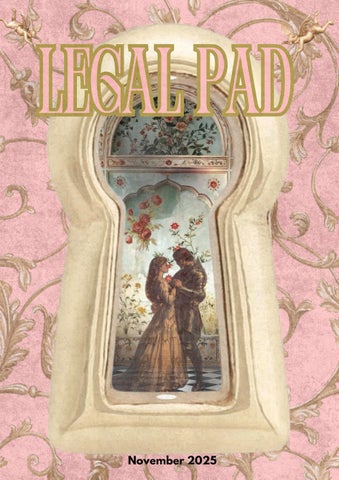
Legal Pad Legal Pad
November 2025
MEET THE TEAM
SPANISH TRANSLATION
BEHIND THIS EDITION
Editors-in-Chief Luciana (Micaela) Arauz Serena Herrera
Writers Ashima Yadav Xochitl Garcia Penelope Gray Angela Thomas Luciana (Micaela) Arauz Nelly Mujica
Cover Design Isabella Lobo Xochitl Garcia
Link: https://tinyurl.com/SpanishNov
FIND US ONLINE! WEBSITE
Graphic Design Serena Herrera Luciana (Micaela) Arauz Xochitl Garcia Isabella Lobo Adriana Bautista Carla Serrano
Photographers Ashima Yadav Bhavya Peri
Spanish Translation
Link: https://thelawlegalpad.com
Brissia Matus Alondra Rodriguez
LP Games Serena Herrera Harlem R. Gilbert
Advisor Mr. Tadesse
1
Handle: @thelawlegalpad
CALENDAR
SAVE THE DATES!
Compiled By: Serena Herrera
November: SUN MON TUE
WED THUR
FRI
SAT
09
10
11
12
13
14
15
16
17
18
19
20
21
22
23
24
25
26
27
28
29
30
01
02
03
04
05
06
November: 14th: A&M College Visit 15th: Mock Trial & Moot Court Competition 21st: Senior Friendsgiving 22-30th: Thanksgiving Break
December: SUN MON
TUE
WED THUR
FRI
SAT
30
01
02
03
04
05
06
07
08
09
10
11
12
13
14
15
16
17
18
19
20
21
22
23
24
25
26
27
28
29
30
31
01
02
03
December: 1st: Study Cafe (Freshmen) 4th: Winter Wonderland (All Grade Levels) 15th: Goodie Bags (Incoming Students Only) & ACP Review Night (Freshmen) 16-19th: ACP Week & Early Release 20-4th: Winter Break
2
3
Editor’s Note
Dearest Readers,
There was a certain breath in the air this day that felt familiar to one that cometh around December. Alas, it was fleeting, yet with it, it brought remembrances. Winter doth approach our humble threshold, and we shall greet it with open hearts. Such shifting of the season is reminiscent of the transformation that art hath undergone in the fourteenth to eighteenth centuries. This reverie hath roused our Legal Pad artists and scribes to fashion works most novel, the likes of which ne’er hath been seen. A scant few pleasures can compare to partaking of the delightful latest issue of the Legal Pad. During this edition, I, with mine honorable companions do beseech thee to wander thy creativity and whimsy. We have drawn inspiration from ages past and have embraced their grandeur and drama. Behold! My fellow scribes and I have put together a wondrous collection of articles (and creative writing work) that perfectly fit this theme. We do a profound exploration into the art of these ages (“Art Through the Ages,” “Did Medieval Artists Hate Cats?,” “Fashion In the Renaissance,” and “Reconquest to Renaissance: Spain’s Age of Glory”), explore the murkier sides of history (“Let Them Eat Cake!,” “Swinging Between Freedom and Control: Women in 18th-Century,” and “What History Forgot: Remembering the Gasoline Baths at the Border”), and provide our readers with some works of creative quill (“To Be Loved by a Maker,” and “Gift of Iris; War of Roses”). As thou dost indulge in this edition, mark well of the art and creativity that surrounds thee. Next time thou happens upon a most intriguing piece, seek its history and drink deep of that knowledge. The power of wisdom is not a gift that all are graced to possess. Most sincerely, Micaela Arauz
4
Art Through The Ages By: Ashima Yadav
Have you ever walked through a gallery, admiring images of ornate chapels adorned with tapestries, portraits of women in Victorian dresses, on which one could count every jewel, and lifelike sculptures carved from solid marble—only to turn down the next hall and see splatters of paint on a canvas or a piece of fruit taped to the wall? It’s a scene many people in the 21st century find puzzling, wondering why so many artists have strayed from academically detailed drawings to seemingly random, uncomplicated visuals, failing to notice the depth hidden within them. Art has transformed drastically over the decades, and with every passing year, it continues to redefine what beauty means.
PICTURE THE PAST Art in the Medieval and pre-Renaissance periods had a very different definition than art does today. Artists were not seen as innovators or inventors but rather craftsmen who adhered to commission requests. Many wealthy nobles would hire artists to paint their portraits or design replicas of intricate architectural structures, such as paintings of the Sistine Chapel. The value of this art wasn't attributed to the artist's creativity but rather the skills through which they carried out a realistic depiction of an already-existing person or place. Often, these things held value within themselves if they were well-known or objects expressing religious devotion, like chapels and churches. The value of these designs was greatly attributed to the materials used, as oftentimes these designs were hung in frames of gold or incorporated precious stones within them. Consequently, artists strived to make these pieces detail-oriented to resemble real life in a visually appealing manner rather than to convey a message. Techniques were used to incorporate shadow and light, as well as the coordination of different hues to create a dramatic piece centered towards storytelling. Audiences valued an artist's skills, realistically transcribing the world around them rather than creating a world of their own, but this was quickly changing.
A NEW PERSPECTIVE As art progressed throughout the Renaissance and Industrial Revolution, artists became recognized as innovators and intellectuals, not just craftsmen. Now art is often an expression of the artist. It's often used to express personal feelings and opinions on conceptual issues or movements in the world. Artists create based on issues they feel strongly about, the beauty they see in life, and their personal interpretation of the world around them. Instead of materials used, we started defining value by the interpretation and originality behind creation. This is when art really began to become autonomous, and artists started making their pieces independent of patrons.
5
SHIFTING FRAMES This changed the visual perception of as well as what audiences valued when they looked for art. Art popular in the late 19th century to the mid-20th century was no longer something that people went to be classically trained for, and, in fact, many art investors valued self-taught artists over academically taught ones, as they had more original techniques rather than using those that were taught worldwide and had become standardized. Modern art rejected traditional approaches and instead focused on how art could represent the current world. Visually, much of this art was less detailed, and this can be attributed to the way art is spread now through images and media rather than classic art galleries and exhibitions. It is more profitable for artists to produce conceptual art that will resonate with a large audience and can be easily reproduced than an intricate piece of art that will receive less recognition within a niche gallery.
EYE OF THE BEHOLDER After modern art died down around 1940, contemporary art, which is our current era, rose to the limelight. Contemporary art is now focused on meaning rather than looks. It focuses on social and political events and serves as a commentator on things that are often overlooked. This includes categories like performance art, which uses an artist's body as a medium and is a hybrid between art performance and traditional art. This can include installation art in which audiences experience an immersive experience when walking through a space designed to invoke certain emotions from the audience. Many people criticize contemporary and modern art on the premise that they are easy and lack craftsmanship, or that they only exist to draw reactions of shock or spectacle from audiences rather than pursuing appreciation. Much of this criticism comes from what people value in art. Many people still judge art by the basis of craft and skill, and how difficult it would have been to make it, rather than the originality of a concept or idea. This type of art is similar to photography, in which operating a device isn't the impressive or artistic part of an immersive photograph, but rather the planning and execution of achieving a scene that an artist imagined. Whether you prefer detail-oriented paintings or conceptually challenging pieces, there are endless kinds of art for you to explore. After all, beauty is in the eye of the beholder, and what someone else sees as a speck on the wall could introduce you to a captivating experience.
6
Swinging Between Freedom and Control: WOMEN IN THE 18TH CENTURY By: Xochitl Garcia
Misogyny wears many disguises, often woven onto silk and lace, or in the cream ruffles of a gentleman’s cuffs that grip her tightly, though he is far from gentle. It glints in the black polish of his shoes, stamping authority on the floor. It lives in the not-so-delicate, worn-out corsets that shape a woman’s silence as much as her waist. Yet, fashion is only one thread in a much larger tapestry. . But what is misogyny exactly, and how is sexism its counterpart? Well misogyny is more than simple dislike; it is the deep-seated contempt or prejudice against women that enforces patriarchal power. Sexism, on the other hand, is the system of beliefs and behaviors that privilege one gender over another, often justifying women’s subordination as natural. Both were woven into the social and cultural fabric of the eighteenth century, a time when misogyny was not just spoken but stitched, painted, and written into everyday life. As John Wilmot, 2nd Earl of Rochester, once warned, “Trust not that thing called woman: she is worse than all ingredients crammed into a curse.” His words. capture a society that praised women for their beauty while doubting their intellect. Misogyny shaped the culture of the 18th century, leaving patterns that still echo today.
7
AUTHORITY AND OBEDIENCE Sexism was normalized in law, religion, and daily life. Historian Geoffrey Pimm, in The Violent Abuse of Women in 17th and 18th Century Britain, explains that domestic violence was often treated as a routine part of marriage. Laws consistently favored husbands, allowing them to “correct” their wives, a term that masked cruelty. Religious teachings reinforced this authority. Reverend George Bird declared that if a wife refused to obey, a husband was justified “by God’s law” in using physical punishment to enforce compliance. Even in extreme cases, such as the 1624 death of Elizabeth Samways, killed by her husband’s blows, legal authorities often turned a blind eye. Legal experts like William Blackstone noted that English law permitted husbands to “give moderate correction,” while Welsh law explicitly allowed three blows with a broom handle. These rules and beliefs not only sanctioned male authority but also reinforced women’s subordination.
WHEN BELIEFS BLIND Misogyny was not only imposed by men, women themselves often internalized and upheld it. This phenomenon is known as internalized misogyny. It occurs when women adopt the sexist beliefs of their society, ultimately shaping their behavior and expectations. In The Lady’s Companion (1743), women were instructed to make themselves agreeable to their husbands, manage the household discreetly, and avoid any sign of independence. Dr. John Gregory, in A Father’s Legacy to His Daughters (1774), advised that a woman’s worth lay in obedience and domestic care. These texts reveal how societal norms trained women to accept inequality, creating habits and beliefs that reinforced patriarchal beliefs from within.
THE GAZE AND THE GARDEN Art reflected these same dynamics. Jean-Honoré Fragonard’s The Swing (c. 1767), a playful and ornate Rococo painting, depicts a young woman swinging through a lush garden, pushed by an older man while her lover watches below. Set in a lush garden, playful details like the woman’s flying shoe and a barking dog enhance the sense of movement and spontaneity, showcasing Fragonard’s technical skills.
Jennifer Milam, in her essay Playful Constructions and Fragonard’s swinging scenes, notes that Fragonard’s loose brushwork and light-hearted tone align with Rococo’s emphasis on pleasure and sensuality. Yet some feminist critics, such as Claudia Hart, interpret The Swing as emblematic of women’s objectification. As Hart notes, “the female body in the picture is objectified, and a voyeuristic look is placed on the picture” The woman’s vulnerability, her lifted dress, and the male gaze highlight patriarchal control over female sexuality and autonomy.
VOICES OF RESISTANCE Yet even amid systemic misogyny, women resisted and claimed their voices. Phillis Wheatley, an enslaved African woman, became the first African-American to publish a book of poetry, defying both racial and gender prejudices. Her intellect and creativity flourished despite a world that sought to silence her. In more recent times, designers like Vivienne Westwood have challenged restrictive norms through fashion, embracing political messages, androgyny, and designs that empower rather than confine women. The legacy of 18th-century misogyny is woven into law, art, culture, and the very ways women were expected to move, dress, and think. It shaped how society defined women’s worth and reinforced gendered hierarchies. By examining domestic rules, internalized beliefs, artistic portrayals, and acts of resistance, we gain insight into both the oppression and the resilience that defined the era. Misogyny persists, but so do the voices that resist it.
8
t s e u q Recon
to
Renaissance
SPAIN’S AGE OF GLORY By: Nelly Mujica
The Renaissance—a rebirth of literature, art, culture, and power—swept across Europe, painted walls with epic stories, and inspired minds with new ideas. Spain, rising alongside Italy, found its own rebirth in this age of beauty and ambition, producing artists and explorers who shaped the nation’s Golden Age. This Golden Age spans roughly the 16th and 17th centuries, beginning with the Renaissance and continuing into the Baroque period, showcasing both literary and artistic brilliance. After nearly 800 years of conflict during the Reconquista (Reconquest), Spain was finally united under King Ferdinand and Queen Isabella, the rulers of the kingdoms of Castile and Aragon, with the defeat of the Muslim kingdom of Granada in 1492. This political stability led to the rise of political power, exploration, and cultural flourishment, laying the foundation for the Spanish Golden Age. Spanish artists blended humanism— a belief that emphasizes the value, potential, and achievements of human beings— and creativity, leaving a legacy that still exists today in the modern world.
9
QUILLS TO CONQUESTS In that same year, humanist scholar Antonio de Nebirha published Gramatica de la lengua castellana (The first grammar of the Spanish language), giving Spain the tools to define its culture through words. Exploration also expanded Spain’s influence. In the early 1500’s, Hernan Cortes wrote the Cartas de Relación to Emperor Charles V, describing his exploration of Tenochtitlan (Aztecs) and justifying his conquest to the king. These letters reflected Spain’s expanding influence and ambition, showing how Renaissance humanism intersected to shape the nation’s cultural and intellectual growth.
POETS AND PICARESQUES Spanish authors embraced humanist ideals in their works. Garcilaso de la Vega (1501-1536) celebrated life in his sonnets, emphasizing carpe diem (seize the day). In “En tanto que rosa de y azucena” he urged readers—most of whom were young, pale Spanish women at the time—to enjoy youth and beauty before time fades them. Around the same time, the anonymous novel Lazarillo de Tormes (1554) pioneered the picaresque novel —a genre of fiction that follows the adventure of a rogue character who lives by his wits in a corrupt society—satirizing social hierarchy and corruption. Together, these works illustrate how Spain’s Renaissance explored both idealized beauty and realities of the human experience.
RENAISSANCE TO BAROQUE By the late 1500’s, Spanish literature began to shift from the optimism of the Renaissance to the Baroque style, which is known for its elaborate detail, drama, and focus on life’s complexity. Luis de Gongora (1561-1627) contrasted Garcilaso’s joyful carpe diem with memento mori, which translates to ”remember you must die”, reminding readers that life is short. Miguel de Cervantes (1547-1610) reflected this shift in Don Quijote de la Mancha, blending humor, realism, and idealism to explore human aspiration versus reality. These works show how Spanish writers moved from celebrating life to also reflecting its impermanence, while still embracing humanist ideas.
FEMINIST BEFORE HER TIME
ON THE CANVAS Spanish art mirrored literary achievements, carrying forward Renaissance humanism into the Baroque era. El Greco, whose style blends Renaissance technique with Baroque expression, used elongated figures, dramatic lighting, and vibrant colors to evoke emotion, creating scenes that celebrate life’s intensity. Diego Velazquez, court painter to King Philip IV, combined realism and careful detail in works like Las Meninas, portraying everyday life while hinting at the fleeting nature of youth and status. Together, Spanish literature and art during the Renaissance celebrated humanism and creativity. These works and many others establish a legacy of knowledge, imagination, and inspiration that continues to influence the world today.
Across the Atlantic, the Renaissance spirit reached colonial Mexico. Sor Juana Ines de la Cruz, a brilliant scholar and nun, used her writing to critique societal norms and explore human behaviours—which was especially remarkable given the strict rules of convent life. In her famous poem “Hombres Necios Que Acusais,” she exposes the hypocrisy of men for blaming women for faults that they themselves encourage. Using clever argumentation and sophisticated language, she examines both love and human conduct, highlighting the double standards women face while offering sharp social commentary. Her works blend wit, logic, and keen observation, demonstrating how, even in the restricted life of a nun, she could produce work reflecting the enduring influence of Spain’s Golden Age during the Baroque era.
Sor Juana Ines de la Cruz, painting by Miguel Cabrera, c. 18th century
10
Colors and Class:
THE COSTLY COLORS OF THE RENAISSANCE
By: Penelope Gray
During the Renaissance, the color of your gown acted as a declaration of privilege and power. Each hue on a noble’s robe or a painter’s canvas showed every other peasant and serf in the lower classes just how much richer you were than them. Behind each pigment was a system of labor, chemistry, and trade that decided who could afford it.
THE SCIENCE BEHIND THE SHADES
Ultramarine blue sat atop the pigment hierarchy. Made from lapis lazuli mined in Afghanistan, it was transported to Europe through Venetian trade routes. Turning the stone into usable pigment required many cycles of washing and picking the most vibrant bits by hand. The process was so costly that painters often charged commissioners extra to include the color in their portraits. Ultramarine appeared in the robes of the Virgin Mary and in portraits of the wealthy.
Red carried like associations. Common reds came from minerals like ochre, but richer tones required insect dyes. Kermes, produced in southern Europe, was a deep crimson, while cochineal from the Americas was an even more intense shade of red. Those who could afford such dyes used them to display their prestige and authority.
Producing pigments in the 15th and 16th centuries required copious amounts of skill as well as access to materials that were typically difficult to obtain. Artists and dyers alike relied on minerals, plants, and even insects to create the tones seen in art and clothing at the time. Though in museums they may seem dull now due to aging, they were vibrant displays of wealth back then. Without synthetic pigments, each shade came from resources that had to be mined and refined by hand. The effort and scarcity of pigments made color an economic boundary.
Frank Duveneck, Lady with a Red Hat (Portrait of Maggie Wilson), late 19th century, Dallas Museum of Art. He was an influential painter who ushered in new freedom of paint application. Photo by Ashima Yadav
11
Similarly to red, true purple was also harvested from living and breathing organisms rather than stone. True purple dyes came from murex sea snails, a laborious source that was consistently expensive in the Renaissance. Even when cheaper imitations appeared, legitimate purple remained a luxury reserved for the upper class. Many cities reinforced that exclusivity through clothing laws limiting who could wear certain colors. . That’s how seriously the . government at the time . took this class division by the color of people’s robes.
WHY THE RICH OWNED THE COLOR SPECTRUM The production of pigment was a chain or science and trade that required labor and precision. Every color relied on scarce materials and specialized knowledge. Ultramarine required both geology and chemistry; crimson demanded entomology and dye chemistry; purple depended on chemical reactions to sunlight. These tedious processes gave such colors an exclusivity that turned them into status symbols.
Trade routes also added layers of control for the upper classes. Merchants in Venice and Genoa dominated the pigment market, importing minerals from Asia and dyes from Africa and the Americas. Each transfer from miner, to merchant, to artist added profit margins. Patrons who commissioned painting or clothing rich in color paid global trade networks just as much as they did the artist.
Access to education and knowledge also played a role. Formulas for pigments and dyes were guarded by guilds and passed down within families. A successful dyer was valuable because few could replicate the results only they could produce. Failures were costly, and a single misstep could ruin an entire batch. That risk made color production as much a chemistry experiment as it was a craft reserved for the high class. Fabric choice reinforced this division. Coarse wool or linen absorbed dye poorly and faded quickly. Fine silks and velvets held color deeply, but only the wealthy could afford such textiles. This combination of rare ingredients, complex science, skilled labor, and luxury fabric made color a symbol of economic and social dominance.
THE LEGACY OF COSTLY COLORS The brilliance of these colors still live on today in museums (even recently robbed ones), but its history reveals a reality lived in times far before ours. Each pigment tells the story of a network spanning continents– miners in Afghanistan, insect harvesters in Mexico, traders in Venice, and artists in Florence. A single brushstroke of Ultramarine or cochineal held a history. Color in the Renaissance was never simply a matter of what color people liked best. It represented control over resources, access to knowledge, and participation in international trade. The blues like the oceans they traveled over, and reds like the blood sweat and tears put into producing them were above all a way to say “I’m rich and you’re not.” In the end, color itself became a currency. It became proof of what nations, patrons, and artists could create from no more than stone.
12
DID MEDIEVAL ARTISTS HATE C TS? By: Micaela Arauz
The human mind truly is wonderful. It is what separates us from every other species on planet Earth. From charcoal, water, and chalk, we made paint that decorated the inside of caves as it formed illustrations that told stories. Then, that evolved to resin mixed with pigments, which coated a bristle brush evenly as it gently touched a canvas. Small paintings became murals. Each piece of art contained more and more detail. Now, it’s easy to stare at medieval paintings in awe and wonder how they were able to create something so beautiful. But every once in a while, we are forced to take a double look, not because of the beauty of the painting, but because of a strangely depicted feline friend.
Charles Webster Hawthorne, Sardine!, 1903, Dallas Museum of Art Photo by Ashima Yadav
13
Hopefully, that picture didn’t make you too uneasy. Unfortunately for our witty furry friends, many medieval artists did not share our view on cats. Older artwork, especially during the medieval era, exaggerates objects in a symbolic manner to convey moral or cultural elements. Many artists did not aim for photorealism, but rather for portraying their message. Around that time, there was a lot of suspicion toward cats. They were often linked to “dark forces,” the devil, and even witchcraft. This is why, if we look past their strange appearance, we can see how the painted cats had an element of mischievousness.
Before this, cats were loved by the ancient Greeks, Romans, and Egyptians. They were often held in high regard in their religions. Ancient Egyptians saw cats as mutually beneficial companions. In their art, they were often depicted sitting in chairs or playing. Cats were also mummified and buried next to their owners, suggesting their importance in the afterlife as well. In ancient Greek and Roman myth, cats were associated with deities like Artemis or Diana and Apollo, as they were symbols of hunting and protection. As Christianity spread in Europe, the art began to reflect the religion as well. The cats who were once so celebrated and loved began to be thought of as demonic symbols.
On top of this, early artists simply lacked much practice. In the Middle Ages, there wasn’t a strong emphasis on understanding animal anatomy accurately enough to paint it. This was partly due to the fact that anatomical accuracy wasn’t really the goal. As previously stated, medieval artists preferred to emphasize symbolism and stylization. Additionally, cats weren’t as commonly domesticated compared to dogs or horses, which is why they got the shorter end of the stick.
Regardless, we got over this artistic hurdle, and very soon cats looked like, well, cats, instead of horrid furry beings with slightly human faces. Next time you cuddle with your cat, take a picture of it or, if you’re an artist, draw a sketch. Be thankful that your Mr. Whiskers did not have to be portrayed like this poor cat.
14
Gift of Iris;
War of Roses By: Angela Thomas
Night after night, the news of war never ceased to amaze me. It’s always like we're winning, then losing, then losing again. Now,it probably won’t take long for the Milanese to tear down our city walls. While I must admit I’m frightened to a degree, having another corrupt government won’t change a thing. Father was never a good ruler. He was even a tyrant at times. I’ve seen all the strings he pulls off effortlessly to get what he wants. It’s true insanity. Two knocks on the holm oak door, then three. “Duchess Alexandria, your mother needs you at once! Are you prepared?” “Yes, yes, I’m getting ready.” Except I wasn’t getting ready. Nowhere close to it in fact. Instead, I sat at my windowsill, vaguely paying attention to the peasants and commoners roaming about in the village. One was selling tomatoes with a line full of customers, and another sold spices we had bought from Spain. How a peasant got such spices, I wouldn’t know. Perhaps he was a tradesman or merchant. With one foot forward, I got up from my windowsill. I made sure none of my stacks of books were knocked down. I put on my camarra, then my gown and corset. Usually, my maids would help me with the corset, but seeing as my mother was busy with them, I didn’t ask for help. The dress today was white with a low golden neckline and embroidery. It was velvet with a bell shape towards the ground, which made it difficult to walk sometimes. Sitting down at my oak vanity, I did my makeup. The foundation color was pure white, like quartz. Then the rouge for my cheeks and lips was a deep, potent red. There was more makeup on my vanity, but I wasn’t sure how to do it by myself, so ignoring it seemed like the best call.
15
Down the palace corridor, maids are frantically working. Some were cleaning, others were polishing or sewing clothing. I made it to the dinner table, where my mother, Eleanor, was sitting. Maps from the war front and letters were scattered about. Mother looks at me, her facial expression going from stressed to delighted. “Alexandria, mi amour! Come sit.” I sit down and the maids fetch some spiced chocolate. My mother begins speaking, mainly in Tuscan, then sometimes switching to Spanish. First she spoke about Father, then King Henry VII (whom she hated with a passion), and then Camila trees. She seemed happy, which made me calmer than usual. We hadn’t talked in a while ever since the war started and Father left. She was much too busy with state affairs. Then the statement comes. “The Austrian prince has begun looking for a wife.” “I suppose he is.” “You aren’t still in love with that knight, are you?” My blood ran cold. I stayed quiet, not knowing what to say. How did she find out? Was she mad about it? I could feel my heart drop into oblivion. Maybe she was thinking of the wrong knight, maybe she was joking, maybe— “Alexandria?” Silence. As I suspected she started scolding me endlessly. Her cup of jasmine chocolate got colder and colder as she spoke. She spoke about duty; the least I could do was help get the family another alliance. It always struck me as unusual how, despite knowing the state of the war, she was so optimistic. In a few weeks, I might not even be alive to marry a stupid prince! I rose from my seat and ran, leaving my mother's and the maids' voices behind me. I couldn’t —no I refuse—to marry someone that I could never love.
16
LET THEM EAT C KE!
By: Penelope Gray
When famine swept through the streets of France and the poor went hungry, a single sentence came to show the cruelty of the crown. “Let them eat cake.” Detached and cold, it showed just how different the streets of Paris and the glittering halls of Versailles really were. Whether said in arrogance or indifference, the phrase put on full display the attitude of a monarchy that had lost all sense of duty to its people. Marie Antoinette stood at the center of this downfall. However, there is no proof that the queen said the now-famous quote. In fact, she was a mere 9 years old when it was written by JeanJacques Rousseau in reference to a “great princess.” Despite this, the statement still makes a good précis of her time on the throne. As the country fell deeper into debt and starvation, the queen’s world remained one of silk gowns, grand feasts, and private gardens far removed from the suffering of the country outside her palace's walls. To the French, “let them eat cake” became an indictment made by a ruling class that ignored their suffering and treated their needs as small irritations.
17
A SYMBOL OF INDIFFERENCE By the late 1700s, France had built up its debt. Decades of war, overspending, and the refusal of nobles to pay taxes had added to a heaping pile of the country’s expenses. Bread prices shot up, and hunger spread through the streets of Paris. But within Versailles, life went on per usual. Marie Antoinette poured public money into her private estate and commissioned a staged “peasant village”, the Hameau de la Reine, where she and her court dressed as farmers for amusement. For the starving people of France, this display showed how far removed their rulers were from the reality their country was facing. The words “let them eat cake” only furthered this distance, showing how void of empathy the government was and how their leadership viewed poverty as something beneath their concern.
The monarchy’s attitude toward hunger reflected not only carelessness, but a system built to protect the royal’s comfort and conscience. Inside the court, discussions of food shortages were treated as unimportant annoyances rather than an issue that plagued the country every day. Ministers who raised the issue risked being seen as disruptive. After all, why bring up an issue such as starvation in a court full of people who simply couldn’t care less? When bread riots broke out, the court’s response was often to suppress these voices instead of addressing the issues they screamed about. The people began to see their hunger as evidence of betrayal by those sworn to lead and serve them. Every new gown, feast, or court performance became a reminder of how their rulers wasted what little remained of France’s funds for their own pleasure. The palace walls that once protected the monarchy from attack now shielded them from the truth, drowning out the _ suffering of the nation.
THE PEOPLE AND THE CROWN REFORMS, REJECTED Due to France’s quickly collapsing economy, ministers such as Turgot, Necker, and Calonne proposed reforms to control spending and increase taxes upon privileged estates. Each plan faced pushback from the royals, including Marie Antoinette herself. She viewed these reforms as threats to her dignity and comfort. When advisors warned that France was nearing bankruptcy, she dismissed their urgency. Her influence over Louis XVI helped her block and weaken reform efforts, maintaining her privilege while the country’s funds dwindled. Behind these failures was an unwillingness to accept change. The queen believed that any attempt at reform would destroy her monarchy. Her perspective reflected the old order’s refusal to adapt to modern ideas about justice and equality. The dismissal of those officials showed France that its rulers would rather silence solutions than listen to what was truly happening.
By the 1780s, public anger fueled outrage. Bread riots broke out, and the monarchy’s reputation began to rapidly deteriorate. The queen’s lavish appearances and elaborate spending made her a symbol of everything corrupt about the royal family. Her rare acts of charity did little to shake that image, as they were too small to create any real impact, and often appeared to be staged attempts at saving her deteriorating reputation. To the people, this changed nothing. They were well aware that the attitude of their rulers was one that allowed years of neglect under a court that no longer acknowledged its duty to the nation. As famine worsened, pamphlets and newspapers spread stories of her waste and indifference. Revolutionary writers portrayed her as a villain who valued jewels more than justice. Though exaggerated, these portrayals are rooted in truths. The queen’s every decision—from new court expenses to the dismissal of reformists—confirmed the belief that the monarchy saw itself above the suffering of its subjects. This resentment grew into a movement. “Let them eat cake” had turned from the stuff of gossip to an accusation that the entire system of monarchy had failed. Masses of people outside of Versailles demanded bread while the royal family hosted feasts.
A LEGACY OF INDIFFERENCE As the revolution grew, the phrase became a motto. It gave voice to the resentment of a country that had endured hunger under a careless monarchy. When crowds stormed Versailles, they brought with them fury fueled by years of disregard from the throne. Marie Antoinette’s downfall was due to that disregard. Her extravagance, her denial of reform, and her disconnection from reality turned her monarchy upside down. In the end, the queen’s fate became the same as that of the nation. As the revolution gained traction, the same luxury that once defined her power was soon held against her. The public saw, in her, a warning about how arrogance can turn authority into tyranny. The downfall of France’s monarchy came from a pattern of disregard that evolved from hunger to outrage. The people did not need to hear the queen say, “let them eat cake”, they saw it in her refusal to change and indifference to their starvation. The phrase lives as a warning that power without responsibility destroys itself.
18
FASHION IN THE RENAISSANCE By: Angela Thomas
Fashion is an art that is ever evolving. Possibly starting around the mid-14th century, fashion gives people the creative freedom to not only wear what they want, but create clothes as well. Furthermore, clothing can, and usually does, reflect the era in which they were popular. Sometimes this is shown through trends and, other times, craftsmanship. During the European Renaissance, specifically, Fashion was not only an indicator of social class, but a form of art and even political standing. From delicate embroidery to colorful trousers, Renaissance Fashion is more complex than you’d think.
ITALY What better place to start off than the birthplace of the Renaissance? Italy, at the time, was not unified as a singular state; instead, it was broken up into several city-states. The most prominent states, however, were the Republic of Florence and Venice. Fashion in these states is directly tied to wealth and social standing. Higher classes often wore silk, brocade, and velvet in lighter colors. These colors were hard to import, making them more sparse and expensive. For the Medici family that ruled the Republic of Florence, deep red and gold were signature colors.
19
The gamurra, a style of women's dress, was characterized by a laced-up bodice attached to a full bell skirt. The sleeves of the gamurra didn’t have a set style, as different social classes wore different sleeves. A noble woman might wear longer, more vibrant colored sleeves, while commoners wore shorter, more loose-fitting sleeves. For men, daily wear was mainly composed of the camicia, doublet, and hose. A camicia, or undershirt, was worn closest to the skin and was usually made of linen. Then the doublet, or overcoat, was worn over the camicia. Doublets were often quilted and padded to give the illusion of the ideal body for a man. They were usually a fashion statement, colors and design showing off political standing. Lastly, the hose, which was the equivalent of pants, was worn. It was common, and even encouraged in some Italian cities, for each leg of the hose to have a different design. These Venice and Florence fashion trends would be mirrored and altered throughout Europe.
ENGLAND Despite being late to the game, English society rapidly changed to mirror the Spanish, Italian, and French courts. The Renaissance was characterized by the Tudors, the royal house of England at the time. The Tudors, most notably King Henry VII, his wives, and Queen Elizabeth I, set the majority of the fashion trends for the period. Unlike Italy, wool and cotton were used among commoners for everyday wear. Silk, velvet, lace, and brocade were reserved for royalty and higher classes. Red, gold, white, and black were associated with wealth, while the color purple was strictly reserved for the Tudors.
Women’s and men’s fashion essentially mimicked the fashion of Italy with a few exceptions. Long, lace collars were worn by royalty. These collars, specifically, were coined by Queen Elizabeth I and were highly sought after by other nobles. Sleeves were long, usually embroidered, and insulated to create a puffed effect. Additionally, Men’s clothing incorporated puffed, dramatic trousers. These trousers came in a range of colors and designs, though often depicted as striped. Lower-class dress was also identical/similar to that of Italy, but colors were limited. Thanks to sumptuary laws, certain colors were restricted from the general public, and even hosting harsh punishments if broken. Though Italy had similar laws, they were harder to enforce, and punishments were more lenient.
Overall, Renaissance fashion was created by wealth and characterized by trends. Beyond England and Italy, fashion was still prominent and thriving. Other city states of Italy, France, Spain, and even Germany had much to offer in fashion. I encourage you to go and research, find clothing that piques your interest. After all, the Renaissance, aside from all the poisonous makeup, had valuable fashion lessons that we, as a society, could learn from.
20
loved BY A
TO BE MAKER
By: Ashima Yadav
To be loved by a maker, a creator, a giver, Who does not idly intake stray breath carried aloft by the breeze, But expels the same gifts they are fortunate enough to receive.
To be loved by an author, a composer, a poet, an artist. To be a poem, a play, a book, a tune, To be a muse.
To be a love held so deep that it not only lives within one's heart, But also between pages and notes.
To be a sort of beautiful that is clasped not within one’s own eyes, But is immortalized in ink, letters, and chords.
To be a stream of inspiration that never runs dry, For one to dip their pen in and create a work of art
Is to be loved by a maker.
21
LP GAMES By: Harlem Gilbert & Serena Herrera
WORDLE
CONNECTIONS
STRANDS
Guess the hidden word in 6 tries.
Make four groups of four! Select four items and tap 'Submit' to check if your guess is correct.
You’ll see a series of letter tiles arranged in a strand. Each strand contains a secret word made from some or all of the letters.
After your enter a valid 4-letter word, the color of the tiles will change. Green: A letter in the guessed word is correct and in the correct position. Yellow: A letter in the guessed word is correct but in the wrong position. Gray: The letter is not part of the word.
Category Example: EXTRACURRICULARS CHESS, LINK CREW, MOCK TRIAL, MODEL UN
→
Tap letters in order to form a word that fits the strand.
Each puzzle has exactly one solution. Watch out for words that seem to belong to multiple categories!
Words can only use letters that are connected directly by a strand line.
Link: https://tinyurl.com/WordleNov
Link: https://tinyurl.com/NovStrands Link: https://tinyurl.com/NovConnections25
3 The person who arrived the latest brought the casserole
CASSEROLE
PIE
TURKEY
5:00
PIE
FOOD
6 The person who brought the mashed potatoes is either Manav or the person who arrived at 4:00
4:30
5:30
4 The person who arrived at 5:30 was Tovar 5 Manav arrived somewhat before Penny
TOVAR
4:00
TIME
2 The person who arrived at 5:00 is either Manav or whoever brought the pie
FOOD MASHED POTATOES
1 Penny brought the pie
BHAVYA
PENNY
CLUES:
MANAV
NAMES
LOGIC PUZZLE
TURKEY MASHED POTATOES CASSEROLE
22