V O L U M E 41 • N U M B E R 16 • S E P T E M B E R 14 , 2 0 2 0 • $ 6 . 9 5
ALTICE USA’S PROBLEMATIC COGECO PLAY IAB PUSHES FOR NATIONAL PRIVACY RULES
With Chris Rock playing a ’50s gangster, the new season of Fargo on FX is set to premiere. A long pandemic delay made things more challenging for creator Noah Hawley, Rock and everyone else.
VOLUME 41 ISSUE 16 • SEPTEMBER 14, 2020 WWW.MULTICHANNEL.COM
FOLLOW US twitter.com/MultiNews www.facebook.com/MultichannelNewsMagazine
ADVERTISING SALES Director of Sales, Media Entertainment & Tech Laura Lubrano, laura.lubrano@futurenet.com Ad Director Paul Mauriello, paul.mauriello@futurenet.com Account Manager Katrina Frazer, katrina.frazer@futurenet.com Japan Sales Sho Harihara, Yukari Media Inc., 81-64790-2222 or mail1@yukarimedia.com SUBSCRIBER CUSTOMER SERVICE To subscribe, change your address, or check on your current account status, go to multichannel.com and click on About Us, email futureplc@computerfulfillment.com, call 888-266-5828, or write P.O. Box 8688, Lowell, MA 01853. LICENSING/REPRINTS/PERMISSIONS Multichannel News is available for licensing. Contact the Licensing team to discuss partnership opportunities. Head of Print Licensing Rachel Shaw licensing@futurenet.com MANAGEMENT Chief Revenue Officer Mike Peralta Senior Vice President, B2B Rick Stamberger Head of Production U.S. & U.K. Mark Constance Head of Design Rodney Dive FUTURE US, INC. 11 West 42nd Street, 15th Floor, New York, NY 10036-8002 All contents ©2020 Future US, Inc. or published under licence. All rights reserved. No part of this magazine may be used, stored, transmitted or reproduced in any way without the prior written permission of the publisher. Future Publishing Limited (company number 2008885) is registered in England and Wales. Registered office: Quay House, The Ambury, Bath BA1 1UA. All information contained in this publication is for information only and is, as far as we are aware, correct at the time of going to press. Future cannot accept any responsibility for errors or inaccuracies in such information. You are advised to contact manufacturers and retailers directly with regard to the price of products/services referred to in this publication. Apps and websites mentioned in this publication are not under our control. We are not responsible for their contents or any other changes or updates to them. This magazine is fully independent and not affiliated in any way with the companies mentioned herein.
8 COVER STORY FEATURES
DEPARTMENTS
8 COVER STORY Viewers adore FX’s Fargo, which means a ton of pressure with each new season. A long pandemic delay made things more challenging for creator Noah Hawley, cast member Chris Rock and everyone else. By Michael Malone 4 AGENDA Altice USA’s aggressive $7.8 billion joint bid for Canadian cabler Cogeco was greeted coldly by that company’s ruling family — but Altice USA CEO Dexter Goei isn’t being deterred in his push to acquire its U.S. operation. By Mike Farrell
12 SPECIAL REPORT: HISPANIC TV AWARDS 16 PROGRAMMING 18 TECH 22 BUSINESS 24 FATES & FORTUNES 26 DATA MINE 30 VIEWPOINT 32 THE FIVE SPOT
20 POLICY Dave Grimaldi, top public-affairs executive at IAB, says his big-media members are in need of a national framework for online privacy. By John Eggerton
4 AGENDA 20 POLICY
If you submit material to us, you warrant that you own the material and/or have the necessary rights/permissions to supply the material and you automatically grant Future and its licensees a licence to publish your submission in whole or in part in any/all issues and/or editions of publications, in any format published worldwide and on associated websites, social media channels and associated products. Any material you submit is sent at your own risk and, although every care is taken, neither Future nor its employees, agents, subcontractors or licensees shall be liable for loss or damage. We assume all unsolicited material is for publication unless otherwise stated, and reserve the right to edit, amend, adapt all submissions. Please Recycle. We are committed to only using magazine paper which is derived from responsibly managed, certified forestry and chlorine-free manufacture. The paper in this magazine was sourced and produced from sustainable managed forests, conforming to strict environmental and socioeconomic standards. The manufacturing paper mill and printer hold full FSC and PEFC certification and accreditation.
Cover: Elizabeth Morris/FX. This page: Fargo: Elizabeth Morris/FX; GrimaldI: Rich Polk/Getty Images for Xandr; Goei: Altice USA
CONTENT VP/Global Editor-In-Chief Bill Gannon, william.gannon@futurenet.com Content Director Kent Gibbons, kent.gibbons@futurenet.com Content Manager Michael Demenchuk, michael.demenchuk@futurenet.com Senior Content Producer - Programming R. Thomas Umstead, thomas.umstead@futurenet.com Senior Content Producer - Finance Mike Farrell, michael.farrell@futurenet.com Senior Content Producer - Washington John S. Eggerton, john.eggerton@futurenet.com Senior Content Producer - Technology Daniel Frankel, daniel.frankel@futurenet.com Senior Content Producer Michael Malone, michael.malone@futurenetcom Senior Content Producer Jon Lafayette, jon.lafayette@futurenet.com Content Engagement Manager Jessika Walsten, jessika.walsten@futurenet.com Assistant Content Producer Chelsea Anderson, chelsea.anderson@futurenet.com Contributor Paige Albiniak Production Manager Heather Tatrow Managing Design Director Nicole Cobban Art Editor Cliff Newman
ON THE COVER
Chris Rock as crime lord Loy Cannon in season four of FX’s Fargo.
Future plc is a public company quoted on the London Stock Exchange (symbol: FUTR) www.futureplc.com
Chief executive Zillah Byng-Thorne Non-executive chairman Richard Huntingford Chief financial officer Rachel Addison Tel +44 (0)1225 442 244
Vol. 41 No. 16 September 14, 2020. Multichannel News (USPS 590-190) (ISSN 0276-8593) is published semimonthly, except July, with additional issues in January and September by Future US, Inc., 11 West 42nd Street, 15th Floor, New York, NY 10036-8002. Subscription prices: U.S. 1 year, $199. Canada 1 year, $249. Foreign 1 year, $299. Prepayment in U.S. funds only. Please send subscription orders to Multichannel News, P.O. Box 1337, Lowell, MA 01853-1337, (888) 266-5828. Outside the U.S., call (978) 667-0352. Please allow three to four weeks for your subscription to begin or for changes to become effective. Periodicals postage paid at New York, NY, and additional mailing offices. POSTMASTER: Please send address changes to Multichannel News, P.O. Box 1337, Lowell, MA 01853-1337. Publications Mail Agreement No. 40612608. Printed in U.S.A. © 2020 by Future US, Inc. All Rights Reserved. Multichannel News® is a registered trademark of Future US, Inc.
Multichannel.com
3
AGENDA
Altice USA Tries to Keep Cogeco Bid Alive After rejection by controlling shareholder, options are limited Whether that can be the path toward a Cogeco deal remains to be seen. The Bancroft trust included dozens of family members with diverse interests regarding their stakes. According to the Cogeco website, Gestion Audem is more closely held, with Louis Audet, the only family member among Cogeco senior management, holding the biggest piece (29.16%). He is followed by his brothers Bernard (17.7%) and Francois (13.89%) and two trusts: Fiducie la Fuente (17.71%) and Fiducie des Aulnes (21.53%). Ultimately, a sale would depend on Altice and Rogers’ ability to increase the offer and the Audet family’s willingness to accept it. While Rogers has long coveted Cogeco’s Canadian assets, Altice USA’s ability to up the ante could be trickier.
By Mike Farrell michael.farrell@futurenet.com @MikeFCable
A
fter a tersely worded rejection by the head of the family trust that controls most of the voting rights of Canadian telecom company Cogeco Inc., Altice USA may have to focus its efforts on the remaining family members if it wants its unsolicited takeover attempt to move forward. Altice USA joined hands with Canadian communications giant Rogers Communications to launch an aggressive $7.8 billion takeover of Cogeco, the fourth-largest telecom company in Canada, on Sept. 2. Altice USA, based in New York, is only interested in Atlantic Broadband — Cogeco’s U.S. cable operations — which it offered to buy for $3.6 billion, or about 10.2 times forward-looking cash flow. Rogers, which owns a 41% interest in Cogeco, has offered $4.2 billion for the company’s Canadian operations. It didn’t take long for Cogeco to reject that offer. In a statement, Louis Audet — Cogeco’s executive chairman and head of Gestion Audem, the holding company for his family’s stake in the telco — did so flatly. “Our stocks are not for sale,” Audet said. “And let me be clear, our refusal is not a negotiating position, it is final.” That didn’t appear to faze Altice USA CEO Dexter Goei who, at the virtual Bank of America Merrill Lynch Media, Communications & Entertainment conference Sept. 9, said Altice was still working on getting a deal done.
Altice USA
Altice’s Long Game
“This is a marathon, not a sprint,” Goei said at the conference. “We’re committed to trying to come to an end game. From our standpoint, that’s very simple, which is we’d like to be able to acquire the U.S. assets.” Altice burst on the scene in 2015 with its $9.1 billion purchase of Suddenlink Communications and followed that with the $17.7 billion buy of Cablevision Systems a year later. An IPO in 2017 raised about $1.9 billion and created a deal currency many expected would be used to roll up smaller operators. But since the Cablevision deal, Altice USA has managed just one purchase — Service Electric Cable TV of New Jersey for $150 million — an all-cash deal that closed in July. In the meantime, under some pressure from analysts to maintain its growth trajectory,
4
Multichannel.com
the company has made M&A a priority. “We will always be looking at stuff out there,” Goei said at the Bank of America conference. In detailing the offer on Sept. 2, Altice USA said that because of Cogeco’s corporate structure — Gestion Audem owns 69% voting control of Cogeco and 71% of Cogeco Connections’ voting rights — a deal would have to receive the Audet family’s blessing. Unlike other unsolicited deals, trying to circumvent the family by soliciting the favor of other shareholders would serve no purpose. So if Altice and Rogers are serious, they’ll have to appeal to individual family members, a notion not lost on Evercore ISI media analyst James Ratcliffe. In a Sept. 2 note, he pointed out that the tone of the press release announcing the offer seemed to indicate it had yet to convince Louis Audet of the benefits of a deal. “The release appears designed to appeal to other members of the Audet family, and also to an argument on the fiduciary duty of independent members of the Cogeco board,” he wrote. In a Sept. 2 press release, Altice highlighted the $612 million in cash as part of the offer that would go to Gestion Audem. The situation is reminiscent of an earlier unsolicited takeover of a family-controlled media asset: News Corp.’s $5.6 billion purchase of Dow Jones & Co. in 2007. Back then, the Murdoch family-led News Corp.’s unsolicited $5 billion bid — a 67% premium to its share price — blindsided Dow Jones’s ruling Bancroft family. As with Cogeco, initially the Bancrofts rejected the offer, concerned about News Corp.’s tabloid reputation. But three months later, after targeting younger, more eager-to-sell members of the Bancroft clan, Murdoch had a deal.
Altice USA CEO Dexter Goei told an industry conference his company’s bid to acquire Cogeco’s Atlantic Broadand unit is “a marathon, not a sprint.”
Price May Be Too Steep
“If they can get it for anything like their offer price, it would be a great addition,” MoffettNathanson principal and senior analyst Craig Moffett said in an email. “It would help them diversify away from the low-growth New York-area Optimum business, and would give them a longer runway for broadband growth and consolidated margin expansion.” Sanford Bernstein media analyst Peter Supino said given the potential of the Atlantic Broadband systems, Altice USA should have no problems going higher if it wants to.“I think that the company should be willing to pay higher prices and really pay right up to its point of economic indifference for the asset,” he said. ●
COGECO AT A GLANCE
Based in Montreal, Cogeco Inc. is Canada’s fourth-largest telecom company, primarily concentrating on Quebec, Ontario and 11 U.S. states under the Atlantic Broadband name. A breakdown of the company’s assets. 2019 revenue: $2.4 billion Employees: 4,500 Customers: 2.74 million primary service units Cogeco Communications: Includes Canadian cable and internet service provider Cogeco Connexion and U.S.-based Atlantic Broadband. Cogeco Connexion: The second-largest cable operator in Quebec and Ontario, providing video, telephone and broadband services to about 803,000 customers. Atlantic Broadband: The ninth-largest cable operator in the U.S. passes about 1.1 million homes in 11 states from Maine to Florida, providing about 480,000 customers with video, telephone and broadband services. Cogeco Media: Owns and operates 23 radio stations serving audiences mainly across Quebec, as well as Cogeco News, a news agency. SOURCE: Company reports
AGENDA
THE WATCHMAN
WATCH THIS …
Senior content producer Michael Malone’s look at the programming scene Coastal Elites
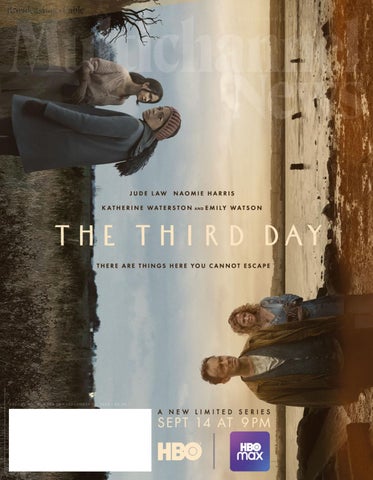
The Third Day The Third Day begins on HBO Monday. Six episodes are divided into “Summer” and “Winter.” In “Summer,” Jude Law plays a man stuck on a mysterious island. “Winter” has Naomie Harris as an outsider who comes to the island seeking answers. Also on Monday, it’s Monday Night Football on ESPN. It’s a doubleheader: the Steelers take on the Giants, then it’s Broncos vs. Titans. Thursday, Spides begins on Crackle. It’s a sci-fi series following a murder investigation that gets mighty dark. By Michael Malone michael.malone@futurenet.com @BCMikeMalone
Watchman: HBO; Netflix. Watch This: HBO; Allen Kee/ESPN Images; ABC/Jeff Lipsky
HBO Special Coasts From Stage to Screen
6
Coastal Elites, which HBO calls a “socially distanced comedy,” has Bette Midler, Kaitlyn Dever, Dan Levy, Sarah Paulson and Issa Rae in the cast. The characters grapple with politics, culture and the pandemic. Each performs a long monologue. Paul Rudnick wrote Coastal Elites (see Review, page 16) and Jay Roach directs. Both are executive producers. Coastal Elites was set to happen at New York’s Public Theater. Then 2020, and all its madness, hit. The producers reworked the scripts to reflect our crazy times. “It was always intended to be right now,” said Rudnick, “and to be as honest as we could possibly get it.” The actors shot their one-act scenes at home. “Paul’s monologues connect to something that everybody is going through in one way or another,” said Roach. “How they are coping is so heartbreaking and dramatizing, and also darkly ironic and absurd.”
Izzy Bee’s Koala World
Multichannel.com
Kid Koala Whisperer on Netflix
Izzy Bee’s Koala World starts on Netflix Sept. 15. Izzy is an 11-year-old girl living in Australia. Her parents run a koala hospital, and Izzy keeps the recovering koalas calm and happy. “She’s the emotional support person,” said David Glauber, supervising producer. “She’s almost a koala whisperer.” The koalas, including Cinderella, Juliet and Stormboy, are fun to watch. “Their personalities are unique,” Glauber said. “And of course, they’re adorable.” Izzy Bee was previously on an Animal Planet series called Dodo Heroes. “We fell in love with her,” said Glauber, creative lead at animal programmer Dodo Kids. “She exemplifies everything we believe in as a brand.” Koalas had a rough time when the wildfires devastated Australia. Glauber hopes the series provides viewers with a new appreciation for these fuzzy marsupials. “We want the audience to experience the joyful, playful lives of koalas,” he said.
‘Archer’ Awakens on FXX
Season 11 of animated comedy Archer kicks off on FXX Sept. 16. Super-spy Sterling Archer is conscious after years in a coma and making sense of the world around him. “After three seasons in Archer’s mind, we’re all excited to come back to the real world,” executive producer Casey Willis said. H. Jon Benjamin voices Archer. Adam Reed created the show. Willis said Archer has matured across its 11 seasons. The visual storytelling has improved, and the producers work more on character development. “We show more of their journey,” Willis said. The key to lasting this long is Reed shaking things up, Willis said, including shifting to Archer Vice in season five, and the coma seasons in recent years. He gives FX credit for sticking with Archer and trusting the producers’ whims. “To FX’s credit, it was always, Sounds great, go for it,” he said. “Other outlets might be a little wary about changing the whole format.” ●
Monday Night Football Spides depicts a club drug known as “Blis.” Friday, it’s season two of Pen15 on Hulu, which calls it “middle school as it really happened in the year 2000.” Anna Konkle and Maya Erskine play themselves at 13. And Sunday, it’s the Emmy Awards on ABC. Jimmy Kimmel hosts the virtual event. Netflix has three shows in the running for best drama: The Crown, Stranger Things and Ozark. — MM Emmy Awards
COVER STORY
FARGO
FINALLY SET TO PREMIERE? YOU BETCHA!
FX Networks
Season four of beloved series details what happens when a show gets jammed up by pandemic
8
Multichannel.com
By Michael Malone michael.malone@futurenet.com @BCMikeMalone
S
eason four of Fargo arrives on FX Sunday, Sept. 27, more than five months after it was initially poised to premiere. Yet another TV series waylaid by the pandemic, all eyes are on how this critically adored show presents itself after 150-plus days on the sidelines. The season looks at the mobster clans doing battle in Kansas City. While it takes place in 1950, season four touches on timely issues, including immigration and the African-American experience. The mob bosses swap their youngest sons in an effort to instill peace among the gangsters. Chris Rock plays the head of the African-American crime family who trades his son, Satchel, to the local Italian mafia and takes in the Italian boy. Every producer is figuring out a Plan B or Plan C amidst pandemic challenges. Fargo creator Noah Hawley said he used the five-month delay to fine-tune a tricky season. “I appreciated having the extra time with a story that is this ambitious and intricately woven, with this many characters. To really just live with the material — to be able to put it aside and come back,” he said. “There’s an amount of reflection time I got this season that, as
it turned out, is really good for the show, I think.” John Landgraf, FX chairman, said Fargo had “no ending to an incredible season” when the show was put on hold. The two final episodes were shot simultaneously in Chicago with two directors and two crews, more than 500 people working at once, so shooting could wrap quickly. Production concluded Sept. 8. Landgraf said Hawley “embodies the leadership and care for his cast and crew that every showrunner should emulate.” A unique mix of crime drama and dark comedy, anthology series Fargo is inspired by the 1996 film by the Coen brothers. Season one, with Billy Bob Thornton, Allison Tolman, Colin Hanks and Martin Freeman, was set in Minnesota and North Dakota in 2006. Thornton baddie Lorne arrives in Bemidji and stokes considerable havoc. Season two had Kirsten Dunst, Patrick Wilson, Jesse Plemons and Ted Danson in the cast. Set in Minnesota and the Dakotas, it took place in 1979. A beautician and a butcher pair aim to cover up the wife’s hit-and-run, and it doesn’t go well. Season three, set in Minnesota in 2010, had Ewan McGregor playing brothers, along with Carrie Coon and Mary Elizabeth Winstead. McGregor’s Ray attempts to steal a vintage stamp from his brother Emmit, a local parking lot guru. It premiered in 2017. Fargo has racked up industry awards, including the Emmy for outstanding limited series in 2014, and critical praise. Season one scored a 97 on Rotten Tomatoes, season two a 100 and season three a 93. “Fargo consistently leverages the neophiliac advantages of an anthology series that resets with each season, and blends it with the equity of
XXXXXXXXXXXXXXXXXXXX pre-exisiting IP from living within the Fargo shared universe (initially from the film, but now also derived from previous seasons),” Sarah Unger, senior VP of cultural insights and strategy at Civic Entertainment Group, said in an email. “It’s a smart approach that consistently renders it well-regarded with appreciative viewers.” (Civic Entertainment Group does business with FX parent Disney.)
Rock Star
Season four has 11 episodes, with a pair airing on premiere night. Fargo episodes turn up on Hulu the day after their FX premiere. Hawley promises something big and bold. “I liked the idea of going back to the scale of season two,” he said earlier this year. “[Season three] was much smaller and more intimate and I liked the idea of doing something bigger. I just had this idea of the two families and the trading of sons and what that would lead to.” That conceit was more a Hawley invention than a Midwestern mobster tradition. “It’s sort of the ultimate insurance policy on some level,” Hawley said of trading sons. “But it also allowed me to really look at assimilation. For a story about immigration and what it takes to become an American, now to do it in a much more intimate and personal way of, like, how does this child from one family assimilate into
Chris Rock (opposite, c.) leads the cast for season four of FX anthology series Fargo, joined by Ben Whishaw and Emyri Crutchfield (top r.). He follows season two stars Kirsten Dunst and Jesse Plemons (top l.), season three's Ewan McGregor (l.) and season one’s Martin Freeman (r.).
another family and who do they have to become to become part of that family?” The cast also includes Jason Schwartzman, Salvatore Esposito and Ben Whishaw. Fargo is a bit of a departure for comedian Chris Rock. Hawley had him in mind right off the bat. “For whatever reason, when I came up with the story, I thought of him,” he said. “Before I even had a script, I called FX and said, I think I want to do another one. I told them about it and said I want to cast Chris Rock to play this character. They loved the idea.” Hawley and Rock met before Hawley finished a script. Rock was a Fargo fan, and they had a deal. “I’m glad he didn’t have buyer’s remorse after he read it,” Hawley quipped. The new season is shot in Chicago, the Windy City standing in for Kansas City. Nine of the 11 episodes were filmed before the pandemic struck, along with a handful of scenes from the final two episodes. The Fargo gang reconvened in Chicago in late August for a 13-day shooting schedule. An actor with allergies and an office assistant with a persistent cough had the producers fretting, but no COVID emergencies occurred. “You have to make intense choices in terms of what it means for production, but we managed to persevere through it all,” said Hawley, who noted “lots of logistical heavy lifting” by the team. He is not complaining about the long Multichannel.com
9
COVER STORY
All we can ever hope for as storytellers is to be part of the dialogue that’s going on in our country. — Noah Hawley, creator, Fargo
Joining Chris Rock (top) for season four of Fargo are Jason Schwartzman (l.) and Jessie Buckley (below).
were stretched to three. “That allowed the story to breathe and not overwhelm people in each hour,” he said. Even before the battles for racial equality across the country heated up after the killing of George Floyd in Minneapolis, the new season of Fargo weighed in on the struggle of African-Americans in the United States, from the perspective of 1950s America. “There was certainly no way for me to predict when I started on this journey that we’d be having this conversation right now as the show comes out,” Hawley said. “My hope is that in addition to entertaining audiences, we’re telling them a real moral parable the way Fargo always does. The show has always been a conversation about America. We just happen to be having the American conversation in real time.” Roger Catlin, a TV critic who runs the TV Eye blog, called the new season “a real departure”, in terms of both its mid-century setting and that it was shot in Chicago, not in frigid Calgary. Since its series premiere, Fargo has upped the ante for elite shows in the peak-TV era, he said. “For me, it’s one of the most interesting and innovative shows,” he said. “My fingers are crossed [season four] is up there with the other seasons.”
FX Networks; Amy Sussman/Getty Images
Legion of Fans
delay. “In the face of a global pandemic that killed so many people, I can’t say I’m aggravated,” Hawley said. “At the end of the day, it’s just television.” Fargo is produced by MGM Television and FX Productions. Hawley and Warren Littlefield, former president of NBC Entertainment, executive produce the show with Joel & Ethan Coen. Back in the late ’90s, Littlefield considered a Fargo adaptation at NBC. It didn’t get beyond a script, though the project did at least reach the pilot stage some time later at CBS.
Timely Period Piece
Hawley said the story did not change drastically during the hiatus. Instead, he focused on the pacing. The first couple hours needed trims, he said, and he put them through the proverbial wood chipper. Two midseason episodes
10 Multichannel.com
Hawley was the creator of offbeat superhero drama Legion on FX. His novels include Before the Fall, The Good Father and The Punch. Catlin calls Hawley “a singular voice” in the TV world. Hawley is noncommittal about a fifth season of Fargo, but appears game for another go. “I certainly wouldn’t rule it out,” he said. “The luxury of the show is, it allows me to jump around and tell a story from 2006 and 1979 and 1950. It allows me to think about not just new characters but a new location or a new decade, and what perspective can we get on America and the struggles we’re going through, and the things we do for money.” With season four about to launch, Hawley is pleased Fargo can entertain a troubled nation and weigh in on the unrest around America in its own quirky way. He said people learn more from a good story than they do from a page of facts. “All we can ever hope for as story tellers is to be part of the dialogue that’s going on in our country,” he said. “This conversation is long overdue.” ●
Fargo executive producers Warren Littlefield (l.) and Noah Hawley and star Chris Rock at January’s 2020 TCA Winter Press Tour.
CHRIS ROCK ON PLAYING A MOBSTER Comic relished chance to portray ‘a grown-ass man’ THE FARGO CAST and executive producers took part in a webcast with the media last week, sharing what the new season is like and what — for the actors, at least — drew them to the quirky series. Chris Rock said he has long been a huge Fargo fan. “The writing, the directing, the sets, everything,” he said. Jason Schwartzman called Fargo his favorite show. “It’s such a unique situation — to love something that exists and then you get to become a part of it,” he said. “It’s like, you love a band, and you get to be on the next record.” Creator Noah Hawley spoke about what the various seasons of the anthology series have in common. “In Fargo, there’s a moral bar graph,” he said. “There’s always a good character and an evil character and the spectrum in the middle.” He said each season is “the story of decent people in over their heads.” Hawley was asked about how a new season touches upon the mythology established in earlier seasons, or even in the film that begat the series. “I would like to say that there’s a master plan, but there is no master plan,” he said. “Connections to the larger universe” are great, he added, “but that’s not the main goal.” Hawley was also asked about how the show draws big-name performers, such as Rock, Ewan McGregor in season three and Billy Bob Thornton in season one. “These are characters who are not like any other character they’ve played,” he said. Rock agreed. He said he is cast as a “man-boy” quite a bit, but Fargo is different. “It’s great to actually play a grown-ass man,” he said. Rock acknowledged that halting production due to the pandemic was frustrating, but he used the time to recharge. “I don’t want the world to have COVID,” he said, “but I think the last two shows are my best.” — MM
SPECIAL REPORT: HISPANIC TV AND VIDEO AWARDS
First Rafael Eli Awards Honor Hispanic TV Pioneers New category honors longtime co-producer of annual Summit By Joe Schramm jschramm@schrammnyc.com @Schrammnyc
Cantor: Telemundo; Saralegui: Schramm Archives; Bryan: Hispanic Media; Center column: d’exposito and Partners
T
12
he honorees in the first Rafael Eli Pioneer in Hispanic TV Awards class recently shared their thoughts about what the honor means to them personally, and reflected on the man for whom the award is named. Rafael Eli was the co-producer of the annual Hispanic Television Summit and a partner at Schramm Marketing Group. He lost his battle with COVID-19 on April 16. He will be remembered on Sept. 21 during the Hispanic Television and Video Awards ceremony, which kicks off with a memorial video about Eli’s career narrated by Cristina Saralegui, the Spanish-language talk show legend. The Rafael Eli awards are presented in three different categories — media, creativity and talent — by Multichannel News and B+C in recognition of individuals who are pioneers in the Hispanic TV industry. The recipients this year knew Eli personally. They are: Andres Cantor, sports commentator for Telemundo Deportes (talent); Gene Bryan, publisher of HispanicAd.com and CEO of Hispanic Media (media); and the team of executives at d expósito & Partners (creativity), including Daisy Expósito-Ulla, chairman and CEO; Jorge Ulla, partner, chief ideation officer; Gloria Constanza, partner, chief contact strategist; Fernando Fernandez, partner, chief client officer; John Ross, partner, chief financial officer; Louis Maldonado, partner, managing director; and Paco Olavarrieta, chief creative officer.
Andrés Cantor: ‘Voice of Soccer’
Andrés Cantor is Telemundo’s Emmy Award-winning voice of soccer, and a veteran television sportscaster, widely known to U.S. fans in both Spanish and English. Originally from Argentina, Cantor got his start while still in high school as a U.S.-based contributing reporter for what was then Argentina’s most popular sports magazine. In the 1980s, at his first television audition, he was required to conduct a live sportscast. The station owner was so impressed with his soccer knowledge and his enthusiastic play by play that he was hired on the spot. Cantor’s recognizable, long-winded “gooool” made its TV debut shortly there Multichannel.com
(From l.): Honoree Andrés Cantor; Cristina Saralegui with Rafael Eli; and honoree Gene Bryan of HispanicAd.com. after. Today, Andrés Cantor is the most recognized voice of soccer in the country and has been featured on multiple TV shows, including a recurring role as himself on The Simpsons. “I was introduced to Rafael Eli when he was at AT&T and involved with their sponsorship of Major League Soccer,” Cantor said. “Later, I worked directly with him when he was at Schramm, and promoting international soccer matches. I am honored to get this award named for Rafael. It seems appropriate. He was a pioneer in soccer marketing, and I am being recognized as a pioneer of soccer television.”
Gene Bryan: Ad Maven
Gene Bryan had already had a long career in Hispanic radio and TV media sales when, in 1998, he founded HispanicAd.com, a leading digital publication serving executives in the Hispanic brand advertising and media business. “Rafael and I both attended high school in Puerto Rico,” Bryan said. “We had that in common, and our relationship grew from there.” Bryan has had a 20-plus year commitment to the growth of Hispanic media. He and HispanicAd.com have been strong supporters of the Hispanic Television Summit since the Summit’s first year. “Rafael es mi hermano; he’s like my brother,” Bryan said. “He would always call to get my suggestions for speakers and the next set of award recipients at the Summit. I am humbled.”
Agency Pioneers
The team at d expósito & Partners had
Honorees Gloria Constanza, Louis Maldonado and Daisy Expósito-Ulla. Joe Schramm is president of Schramm Marketing Group and producer of the annual Hispanic Television Summit.
worked with Eli starting in 1994 when he first joined AT&T in the Hispanic marketing division. They were then AT&T’s Hispanic agency as part of Y&R’s Bravo Group. “Rafael made us all better — at what we do, and how we work as a team,” Daisy Expósito-Ulla said. “He was someone who respected and nurtured creative ideas, and he was a heck of a lot of fun to work with.” Partner Gloria Constanza mentioned that Rafael was always focused on innovations in television programming for Hispanics, whether it was the launch of Major League Soccer or championship boxing. He “was passionate and committed to the Hispanic fan and often spoke about VOD way back” before it was widely available, she said. The group of seven recipients from d expósito & Partners are unique. They have worked together for more than 20 years and have earned a reputation as an award-winning team that serves some of the leading brands in the Hispanic market, including AARP, McDonald’s and the U.S. Army. The Hispanic Television and Video Awards ceremony, which includes the presentation of The Rafael Eli awards, is hosted by two leading on-air personalities, Pamela Silva, anchor of Univision’s Primer Impacto, and Luis Sandoval, West Coast correspondent for Univision’s ¡Despierta América! The ceremony is scheduled to start at noon ET on Day 1 of the four-day “virtual” presentation of the 18th annual Hispanic Television Summit. This year’s Summit is being offered free of charge for the first time. To learn more, go to FallTVevents.com. ●
SPECIAL REPORT: HISPANIC TV AND VIDEO AWARDS
Diego Luna Shines as Achievement Award Honoree ‘Narcos: Mexico,’ ‘Rogue One’ star to be honored at Summit
T
he legacy award of the annual Hispanic Television Summit is the Award for Outstanding Achievement in Hispanic Television, presented by B+C and Multichannel News. This year’s recipient is Diego Luna, an actor, director and producer for theater, film and television. Each year, the Award for Outstanding Achievement acknowledges an individual or series for their contribution to the growth of the industry, including driving the employment of Latino talent in front of and behind the camera. Luna is being recognized for his remarkable television career. Since 2018, Luna has starred as drug cartel leader Miguel Angel Felix Gallardo in the hit Netflix series Narcos: Mexico. The Mexicanborn Luna is also known to audiences for his major film roles, including Cassian Andor in 2016’s Rogue One: A Star Wars Story. Luna started his career as a child actor in telenovelas with the encouragement of his father. He first came to the attention of U.S. and international audiences in 2001 with his role in the hit Spanish-language sex farce dramedy film Y Tu Mamá También. He has appeared in more than 30 films since then, including Vampires: Los Muertos, which also starred rocker Jon Bon Jovi, and the Oscar-winning Frida, as well as The Terminal,
Diego Luna is 2020’s Award for Outstanding Achievement in Hispanic Television honoree.
Havana Nights: Dirty Dancing 2 and the critically acclaimed Milk. Most recently, Luna and his production company introduced Pan and Circo, a new series available on Amazon Prime Video. The series offers insightful group conversations over a meal, involving scientists, innovators, activists and artists. The conversations are led by Luna himself, and focus on current or controversial topics and social problems
from violence, to immigration to abortion to racism to COVID. “I am thrilled to receive this honor,” Luna said. “I am anxious to continue to introduce many new important projects to create positive change in society.” Luna joins a list of distinguished prior recipients of this award including boxing’s “Golden Boy,” champion Oscar De La Hoya; soccer sportscaster Andrés Cantor; news anchors José Díaz-Balart, María Celeste Arrarás, Jorge Ramos and María Elena Salinas; show hosts Don Francisco, Cristina Saralegui, Lili Estefan and Raúl De Molina; telenovela stars Lucero and Rafael Amaya; and the cast of TUDN’s Republica Deportiva, among others. Presenting the award will be his close creative associate, Isaac Lee, the founder and chairman of Exile Content. The Hispanic Television and Video Awards ceremony is virtual and can be seen online for free on Monday, Sept. 21, starting at noon. It’s one of four daily segments of the 18th annual Hispanic Television Summit. — JS
ATTEND VIRTUALLY The Hispanic Television & Video Awards ceremony and the entire Hispanic Television Summit can be experienced for free. For more information or to register, go to www.falltvevents.com/2020/ HispanicTV.
Luna: El Corriente Del Golfo; Dobarro: Horizon
Horizon’s Dobarro Gets Executive Leadership Honor
14
KARINA DOBARRO, SENIOR VP, managing director, Multicultural & International Brand Strategy at Horizon Media, will be honored with this year’s award for Executive Leadership in Hispanic Television and Video. Dobarro will accept her award, presented by B+C and Multichannel News, during the annual Hispanic Television and Video Awards Ceremony. The award recognizes Dobarro for her professional contributions as a “media decision-maker” responsible for increasing and sustaining media commitments through Horizon’s multicultural practice, which she built over the past six years. The
Multichannel.com
practice supports nearly 30 brands. “My job brings me great personal satisfaction,” Dobarro said. “I see our team’s role not only as strategic advisers but as advocates of Hispanic consumers and media. I believe in collaboration and partnership. I believe together, we are stronger.” Upon learning that she was selected, Dobarro said, “I’m honored. This recognition reinforces the work our Horizon
Multicultural team does to advance Hispanic marketing and inclusive media practices.” Dobarro has had an admirable career. She was initially hired to build the multicultural practice and was given the added opportunity to lead the international network relationship. She also developed the business plan for a new entity that became 305 Worldwide, Horizon’s multicultural
content and creative agency. Today, Dobarro also leads an agency-wide effort called “Project Embrace” to advance inclusive media practices by empowering employees with new diversity training and tools. “The racial justice movement has brought light to the lack of diverse talent and inclusive practices within the advertising industry,” Dobarro said. “We see a shift where minority segments are at the forefront of marketing conversations.” “I am hopeful that this is not just a trend, but a true movement for our advertising industry,” she added. — JS
PROGRAMMING
Fuse Reaches Out to Young, Multicultural Viewers Sets new Hispanic Heritage Month shows, election-themed content for target audience By R. Thomas Umstead thomas.umstead@futurenet.com @rtumstead30
H
ispanic Heritage Month begins Sept. 15, and multicultural youthtargeted network Fuse TV has several programming initiatives planned for the celebration. The network later this month will premiere Varsity Punks, an original film, as well as talk show Like, Share, Dimelo, which is targeted to young, Latino audiences — part of the network’s broader fall lineup of five original series and documentaries. Fuse TV CEO Miguel Roggero, who took over the reins of the network in April 2019, recently spoke with Multichannel News about Fuse’s multicultural youth-targeted brand, as well as its programming strategy and partnerships surrounding the upcoming elections and the country’s ongoing movement against social injustice.
Like, Share, Dimelo: Fuse; Coastal Elites: HBO
MCN: How would you define the Fuse brand under your leadership? Miguel Roggero: I don’t see it any differently than the original mission of what we started. I’ve been with the company 14 years and so I’ve seen how we’ve evolved. The focus is a little broader than when we started, but it’s really an entertainment-based service for the multicultural community. The idea is to really provide this audience with authentic stories that are inclusive. When we first started in the old Sí TV days [Sí TV acquired Fuse TV in 2014], it wasn’t quite as inclusive because it was targeted to Latino audiences. But we’ve evolved over time to really reflect the young, multicultural audience today. MCN: That young, multicultural audience, like all young viewers, is watching more and more content on multiple platforms. How does Fuse plan to reach its core audience with a mostly linear service? MR: Television is still the largest medium out there and we have a product that serves the distribution community really well. The industry needs a product like ours. In 20 years, America is going to be half-multicultural, so the television ecosystem needs to be sensitive to this audience and we have a product that goes straight to the sweet spot. I think we’re in the right space in a moment in time where everybody’s paying attention to this audience
16 Multichannel.com
REVIEW
COASTAL ELITES (Saturday, Sept. 12, 8 p.m., HBO)
and, and now more than ever, the diversity and inclusion that we represent is that much more important. We’re experimenting with a lot of different new platforms to see which ones are going to emerge, but the cable TV universe is still the predominant form of delivery for us. We continue to have good relationships with our partners on the distribution side and we expect that to continue. We have to stay focused as a content brand. MCN: With the presidential election coming up and with the continued discussion about social injustice, will Fuse look to develop original content that speaks to the concerns of its young, multicultural viewer? MR: We look for stories that our audience can not only look at but feel empowered by. We've always been about providing positive stories and representations for our inclusive audience. So whether it’s music-related, lifestyle, culture or social responsibility, we’re developing content that hits those different touch points and will resonate with our audience. We were heavily involved creating content around the 2016 election and we’re going to be heavily involved in the 2020 election. We’re in the process of producing a town hall that'll be focused on local elections. We have a partnership with Color of Change, Climate Power 2020 and Stacey Abrams. There are like-minded partners out there and we have a platform for their messages. We do that because it’s part of our DNA. ●
Fuse TV CEO Miguel Roggero has five new shows on tap for fall, including talk show Like, Share, Dimelo (top).
HBO TAKES A walk through the minds of five people dealing with the travails of a pandemic and politics-weary world in its special movie presentation Coastal Elites. The movie, created by Paul Rudnick and originally to be staged as a play at The Public Theater in New York before the pandemic hit (see The Watchman, page 6), features five Zoom-themed monologues from mostly liberal-thinking personalities discussing their views and frustrations with the political and social divisiveness within the country. Coastal Elites benefits from a strong cast that brings each character to life. Bette Midler opines on her disillusion with the Trump administration as a retired Jewish woman speaking from a police interrogation room after a conflict with a MAGA hatwearing man in a restaurant; while Dan Levy (Schitt’s Creek) portrays an actor contemplating a potnetially career-making role as the first gay superhero in today’s divisive environment. Issa Rae (Insecure), fresh from a Black Lives Matter protest, speaks on a run-in her character and her rich father had with Ivanka Trump at the White House; Sarah Paulson (American Crime Story) interrupts her emerging YouTube blog to speak on her lockdown woes while spending time with conservative relatives in Wisconsin; and Kaitlyn Dever (Unbelievable) gives a first-person account of a nurse volunteering at a New York hospital overwhelmed with coronavirus patients. Even with the strong performances, viewers likely suffering from Zoom fatigue in their own lives may or may not have the temperament to sit through five monologues of 15 to 20 minutes in length, despite the compelling stories they tell. Those who do will come away with a unique, witty provocative and often funny reflection on the country’s current state of affairs. — RTU
TECH
‘SKYBOXE’ HUB GETS FCC’S OK
Wait ’Til Next Year for Apple TV Upgrade First refresh since 2017 will include gaming-capable chips By Daniel Frankel daniel.frankel@futurenet.com @dannyfrankel
A
pple is getting set to debut the next iteration of its Apple TV connected-TV device, equipped with a faster gaming-ready processor, but the gadget is likely slated for a 2021 release. That news comes courtesy of the B-roll material in a Bloomberg story focused on the larger news of Apple’s quest to deploy 75 million 5G-capable iPhones by the end of this year. With Apple ranking third in the second quarter in global smartphone shipments, trailing Huawei and Samsung with only 38 million units, there’s certainly urgency for Apple to get in the game in terms of 5G handset compatibility.
Pressure to Keep Up
But with Google set to deploy an Android TV-capable dongle, and chase U.S. connected TV device market leaders Roku and Amazon, there’s also pressure on Apple to stay in the connected-TV game. It would be Apple’s first upgrade in the 18 Multichannel.com
product category since 2017’s release of the Apple TV 4K. For starters, the device will improve upon the legacy A10X CPU with a chip that’s more compatible with what’s being released by the Apple Arcade service. Tech blog 9to5 Google reported in April that the new Apple TV will likely come with the same Apple-made A14 processor that will be included in the new iPhone 12. The new Apple TV will also come with 6 gigs of RAM, the blog said. There will also be remote control improvements. Beyond addressing some of the usability complaints rendered by Apple TV users in recent years — a fussy touchpad among them — the remote will reportedly come with a Find My iPhone-like feature that will help the bewildered more easily track down their lost controller. Look for the next generation of Apple TV to keep the Cadillac price: the current Apple TV 4K has an MSRP of $179, ranking it among the most-expensive connected TV devices on the market. ●
Apple hasn’t unboxed a new iteration of its Apple TV since 2017’s 4K-capable device.
STARTUP SKYBOXE SAID it has received Federal Communications Commission certification for a new fixed wireless device that would replace the cable modem, WiFi router and pay TV set-top in the home. The company is targeting a fall launch for its initial product, the Skyboxe Hub 4G, which would provide a 4G/LTE access point, an 802.11ac WiFi router, an ATSC 1.0 tuner for local broadcast channels and an Android TV-based connected device, with preloaded apps including Sling TV. The data sheet for the Skyboxe Hub 4G said it’s capable of delivering download speeds exceeding 1 Gbps, although most LTE networks currently don’t support that. Skyboxe is currently taking “no obligation” signups on its landing page. But it isn’t disclosing a price for the device and data service, or a launch date. While currently focused on legacy 4G/ LTE wireless network standards, Skyboxe said it’s “paving the way” for a fixed 5G wireless play down the road. Currently, cable companies are closing in on control of 70% of the U.S. fixed broadband market. But the major wireless carriers, as part of their 5G push, will soon try to convince consumers they don’t need to pay both wireline and wireless broadband bills. “Having the functionality of an access point, WiFi router, TV tuner and appsbased platform in a single device that isn’t tied to any one carrier is what we expect is going to differentiate us,” Skyboxe head of marketing Bill Smith said Sept. 8, one week after the FCC action. Prospective customers include cord-cutters and cord-nevers but also remote workers and other consumers, and potentially telecom carriers or cable operators, he said. San Jose-based Skyboxe is backed by Applied Digital Research Corp., a crowdfunded startup based in Sarasota, Florida. The Skyboxe team includes CEO Jeff Allen, a former Brightcove and IBM video cloud executive; chief operating officer Rob Shambro, a veteran tech entrepreneur; and marketing chief Bill Smith, formerly with TiVo. — DF
POLICY
IAB: National Privacy Legislation Is Job One Trade group public-affairs VP Dave Grimaldi pushes for U.S.-wide framework By John Eggerton john.eggerton@futurenet.com @eggerton
D
ave Grimaldi, former chief of staff to Federal Communications Commission member Mignon Clyburn and senior counsel to her father, House Majority Whip James Clyburn (D-S.C.), heads up advocacy before Congress and federal agencies for the Interactive Advertising Bureau, which represents some of the largest publishers and platforms in the world. Grimaldi, executive VP of public affairs for IAB, talked with Multichannel News about the potential new challenges to online advertising from Washington and state and local governments as President Donald Trump targets social media for regulation, states look for new ways to compensate for the economic sledgehammer of a global pandemic, and the nation — including IAB’s roster — looks to protect consumer privacy. Here’s an edited transcript of that conversation.
GrimaldI: Rich Polk/Getty Images for Xandr; MacTaggart: Alex Wong/Getty Images
MCN: Remind us who your members are? Dave Grimaldi: Mostly publishers but also platforms, including The Washington Post, The New York Times, Google, NBC and Disney.
20
MCN: Why are IAB and the other major ad associations concerned about a California product-liability law currently in the legislature that makes advertisers liable if a product is deemed defective? DG: When you talk about strict liability for advertising, you could have a gardening blog running ads on your site and if one is an ad for a can of Coke or Sprite and the can explodes, all of a sudden this gardening blog could be liable for putting that can of Coke into commerce. [The liability bill applies to businesses “facilitating the placement of products into the stream of commerce.”] This impacts small to midsized businesses monetizing their content. It is another example of a law that neither consumers nor American businesses know is coming. We appreciate consumer protections, but this goes too far. This liability piece is absolutely unprecedented. The economy is already getting walloped by COVID-19.
Multichannel.com
MCN: So what can be done about it? DG: This is my main theme and I will say it 100 times: We need a national federal [privacy] framework to put these things through regular order and due process and the debate that is necessary. MCN: What are some other threats out there? DG: We are seeing other out-of-nowhere emerging threats in the form of state and local advertising taxes that are put in city budgets. COVID has decimated city and state revenues. We are going to see it over and over again because it is a low-hanging piece of fruit. MCN: What is the status of the California Consumer Privacy Act or CCPA? DG: The final regs were just approved a few weeks ago and enforcement just began. But this November there is going to be a substantially new ballot initiative, the CPRA [the California Privacy Rights Act], that will amend the language of CCPA and require additional rulemakings. The CPRA ballot initiative was introduced by Alastair MacTaggart [board chair of Californians for Consumer Privacy], the same real-estate developer who came up with the CCPA. I give him credit for his
Dave Grimaldi, executive VP of public affairs at IAB, wants a national framework for online privacy.
tenacity and his creativity and doggedness and identifying that California’s ballot initiative rules opened the door to CCPA. And now the CPRA is going to add a new layer to CCPA and the burden will fall on consumers to understand. MCN: Is that why IAB says there needs to be a national privacy regime? DG: We need a law that lays down clear rules of the road, that lays out prohibited and allowed data practices, and that is the draft bill that we gave to Congress. The notice and consent regime is broken. No one understands it. It is not easy on consumers to navigate. MCN: But as a practical matter, nothing is going to happen on privacy legislation in the near term with an election coming up, correct? DG: What happens on Nov. 3, especially in the Senate [which is currently in Republican hands], is going to mean a great deal for online advertising and for consumer privacy writ large. You have extremely knowledgeable Democrats who are eager for a gavel to do antitrust oversight and anything to do with data brokers regarding privacy, the use of personal information and the guardrails around all of the above. That is not to say that the Republicans aren’t doing this, but you have progessive Democrats who are very fired up. So, if the Senate goes Democratic, I think that online data privacy will be a top-three issue for the Senate Commerce Committee. If Joe Biden wins the White House, then you have Democrats in the White House and controlling the Senate and House, and you could see significant overhauls. And that is what we want. MCN: So significant privacy legislation is good for IAB? DG: Yes, a national privacy law that preempts a patchwork of state bills that consumers are going to have to navigate. When they get on the plane at LaGuardia [Airport] and they get off the plane at LAX, they are not going to have to face new user-experience windows, they are not going to have to face privacy controls that have to be changed state by state. So, yes. I don’t know how urgently or how fast national privacy reform will come, but it will come. I think there is an open question on whether if Joe Biden wins he installs a privacy czar in the White House. Does he create a CFPB [Consumer Financial Protection Bureau]-like agency to tackle consumer data? What happens with antitrust? What happens with the use of market power? All of these are good questions. We have 600 members and it affects all of them. MCN: What is IAB’s take on the president’s attempts to regulate online content and modify Section 230 of the Communications Decency Act? DG: Section 230 has played a role in the
POLICY
Alastair MacTaggart, architect of the California Consumer Privacy Act, is pushing another that Grimaldi says will “add a new layer” to the legislation.
Internet that everyone knows and loves and it has given rise to platforms that every American is using every day. The discussion around additional improvements that can be made is a good one. But it should be a deliberative process and not an executive order. Section 230 was passed by Congress. It should be amended and debated at the committee level, with witnesses and testimony, and in both Houses of Congress on the floor, with buy-in from industries. It has gotten mired in politics and a sexy election year debate and the events surrounding it aren’t without real harm and real drama based on speech, and there are opinions on both sides around how a free online town hall works. Should there be policing of it? Who should be the arbiters of what is dangerous or not? All of these platforms that are protected by Section 230 are taking this extremely seriously and wrestling with their decisions. But if change comes, it should come through Congress and the deliberative process, not executive order. I’m a Democrat and I would say that in a Democratic administration also. MCN: What other big issues are on the horizon? DG: If 2020 was the year of privacy, 2021 is
This is my main theme and I will say it 100 times: We need a national federal [privacy] framework to put these things through regular order and due process and the debate that is necessary. — Dave Grimaldi, executive VP of public affairs, IAB
not only the year of privacy but of the online economy generally. There was a love affair for eight years between the Obama Administration and Silicon Valley, and it all changed in 2016 with Russian interference and Cambridge Analytica and everything else. A dark cloud moved in over the use of online data and that cloud has been parked there ever since. It has gotten conflated with Section 230 and with apps knowing where
you are night and day. It has turned into rampant demagoguery around an industry that is a massive piece of the national economy. If you know what this is, great. If you don’t, you are going to hate me because you are never not going to see it. But there is a little blue triangle in the corner of every single ad that is served on the internet; you click it and it lets you know why you were shown that ad and it shows you how to turn it off. We created that because people wanted transparency. We are not against greater scrutiny. We expected that and we welcome that. We are calling for regulation and it’s not often that an industry does that. There is a referendum on the use of online advertising and we have been proactive. But the focus on consent is misplaced and it does not address the underlying concerns from lawmakers and consumers. There are things like stalking and the use of geolocation and 911 data that have real-world ramifications, but those are apart from how personal ads have an impact on your life. If you are a soccer player and there are ads for new cleats or balls when you are reading an article, people prefer those to generic ads. The issues around how data is used is a debate that we want. ●
Multichannel.com
21
BUSINESS
Private Equity Looks Toward the Exit Ramp Broadband business draws interest of would-be buyers
By Mike Farrell michael.farrell@futurenet.com @MikeFCable
P
Colormos/Getty Images
rivate-equity firms, anxious to get back into the cable broadband business just a few years ago, are considering exit strategies, with at least one big deal in the works and others in the wings, according to sources in the cable financial community. Perhaps the biggest deal in the pipeline is the possible sale of Dallas-based private equity giant TPG’s interest in Astound, its rollup of RCN, Grade Communications and Wave Broadband. TPG, which spent around $5 billion rolling up those three overbuilders between 2016 and 2018, is seeking about $8 billion in a sale and has hired investment bankers Morgan Stanley and J.P. Morgan Chase to handle the auction, according to a Reuters report. TPG declined comment. Sources in the financial community confirmed the Reuters report, adding that TPG originally tried to start an auction for the properties in March, but pulled it back when the COVID-19 pandemic hit. The second round of bidding is expected to take place in the next two months, with a winner expected to be chosen early next year. Already, interest among larger operators is beginning to rise. On Sept. 2 Altice USA launched a $7.8 billion unsolicited takeover bid for Canadian telco Cogeco, the parent of Quincy, Massachusetts-based Atlantic Broadband. Altice USA has partnered with Toronto-based Rogers Communications, which would buy Cogeco’s telecom businesses for $4.8 billion. Altice USA would pay $3.6 billion for Atlantic Broadband, about 10.2 times the cable company’s forwardlooking cash flow. Cogeco’s controlling shareholder rejected that offer on Sept. 3, although most analysts expect Altice to raise its bid. Either way, the offer itself could mean that valuations for other assets would start at even higher multiples.
Riding the Broadband Wave
TPG burst onto the distribution scene in 2016 with its $2.25 billion purchase of Grande Communications and RCN and has ridden the broadband wave over the past several years, as large and small cable companies have shifted
22 Multichannel.com
their primary focus away from video and toward faster data speeds. All three companies serve diverse geographies. Grande focuses on metro and rural Texas, and has customers in Austin, San Antonio, Dallas, Corpus Christi, Midland, Odessa, Greater Temple and Waco. Wave, which TPG purchased in 2018, focuses on Washington (including the Seattle area) Oregon and California. RCN, the largest of the three, operates in Boston; Chicago; Washington, D.C.; Lehigh Valley, Pa.; New York and Philadelphia. When TPG closed the Wave deal in 2018, it claimed the combined companies passed about 2.7 million homes and had 925,000 residential and business customers, delivering nearly 1.7 million data, voice and video services. Just who would buy the TPG assets is the big question. Because of its status as an overbuilder in some of its larger markets like New York, Chicago and Boston, incumbent operators like Comcast and Charter Communications would be prohibited from buying. Midsized cable and broadband provider Cable One has been aggressively buying smaller cable companies and fiber network owners over the past three years: Emporia, Kansas-based broadband services company ValueNet Fiber; Sullivan, Missouri’s Fidelity Communications; Sikeston, Missouribased NewWave Communications and ClearWave Communications. But a TPG deal could be too pricey for Cable One, which paid about $735 million for NewWave and $526 million for Fidelity. The company didn’t reveal the price of the other purchases, but it is believed they were for considerably less. In a research note, MoffettNathanson principal and senior analyst Craig Moffett said CableOne needs to add scale to justify its high valuation, either organically or by other means. Its stock has been the best performer in
the distribution sector for three years running, currently priced at nearly $1,900 per share. In the second quarter, Cable One beat analysts’ expectations by adding more than 44,000 high-speed internet customers, an 11.3% growth rate and more than double the 5.1% rise in Q1. Broadband is driving much of the interest in cable at the moment. According to one member of the cable financial community who asked not to be named, familiar names in the smaller cable business that had sold their systems in the past — like NewWave’s Gleason family and former Wave Broadband CEO Steve Weed — have been dabbling in companies in the fiber-to-the-home business to help address the broadband boom.
Fiber Draws Interest
“It’s been nuts,” said the cable financial executive who asked not to be named. “There’s a lot of interest in fiber-to-the-home. It’s a new chapter for overbuilders.” Weed, who sold Wave Broadband to TPG in 2018 for $2.36 billion, formed WaveDivison Capital with former Wave Broadband executives Harold Zeitz and Wayne Schattenkerk shortly after closing that deal, and in May 2019 teamed up with Searchlight Capital to purchase former Frontier Communications properties in Washington, Oregon, Idaho and Montana with 350,000 residential and commercial customers for about $1.35 billion, renaming the company Ziply Fiber. At the time of the Frontier deal, Weed hinted that more deals could come. “We are big believers in the Northwest’s future growth opportunities and that future runs on broadband,” Weed said in 2019. “Our plan is to invest further in our markets, specifically by extending fiber to more homes and businesses, to bring them the high speeds they want.” Overall broadband growth has been strong and continues to be dominated by cable distributors. Leichtman Research Group estimated that cable operators added about 1.4 million high-speed internet customers in Q2, compared to 530,000 additions in the prior year. While much of that was due to workfrom-home and stay-at-home orders in many states due to the pandemic, Leichtman Research president Bruce Leichtman said in a press release that the increase was the largest since 2008. Some believe the momentum will continue. ●
ASTOUND ME
TPG is reportedly looking to sell its cable operations, collectively known as Astound, for about $8 billion. Here is how the assets and values break down. OPERATOR RCN
TOP MARKETS
PREVIOUS SALE PRICE
NEW YORK; CHICAGO; PHILADELPHIA; WASHINGTON, D.C.; BOSTON
$1.6 BILLION
AUSTIN, DALLAS AND SAN ANTONIO, TEXAS
$650 MILLION
SEATTLE; OREGON CITY, OREGON; SAN FRANCISCO
$2.36 BILLION
GRANDE COMMUNICATIONS WAVE BROADBAND SOURCE: Individual companies and published reports
FATES & FORTUNES
People Notable executives on the move BRIEFLY NOTED Other industry execs making moves
24
ALLEN MEDIA GROUP
CURIOSITYSTREAM
DISNEY CHANNEL
Byron Allen’s Allen Media Group has promoted Melody Smalls to executive VP, human resources. She formerly served as VP, head of human resources at Allen-owned The Weather Channel.
Matthew Blank has been named to the board of directors of factual media streaming service CuriosityStream. He is the former chairman and CEO of Viacom’s Showtime Networks.
Disney Channel promoted Theresa Helmer to executive director, Integrated Content Strategy and Development, a new post meant to foster diversity and inclusion in programming. She was director, social media strategy.
FCC
NICKELODEON
NICKELODEON
SEQUIN AR
Federal Communications Commission chairman Ajit Pai has tapped West Virginia State Sen. Robert H. Plymale to the agency’s Intergovernmental Advisory Committee, a panel of 30 elected and appointed officials.
Ramsey Naito has been promoted to president of Nickelodeon Animation, based in Burbank, California. She had been executive VP of animation production and development for the Nickelodeon Group.
Zack Olin was appointed to the newly created position of senior VP, live action for Nickelodeon. A former VP, creative development at ABC Studios, Olin most recently was a live-action development consultant to Nick.
Augmented reality services firm Sequin AR has named Brad Rumler as VP, sales, a new post. He most recently served as VP of sales for Brainstorm, a real-time broadcast graphics solutions company.
SMI
SOUNDEXCHANGE
WEATHER CHANNEL
VIZIO
Jason Keown has joined New York-based Standard Media Index as VP, marketing. Keown, who was head of accounts at Community Agency in Canada, will focus on expanding SMI’s business in North America.
Esther-Mireya Tejeda has joined SoundExchange in Washington, D.C., chief marketing and communications officer. She was senior VP and head of corporate communications at Entercom.
The Weather Channel parent Weather Group LLC has named Fred Bucher as senior VP and chief marketing officer. He had been senior VP and chief marketing officer of Spectrum Reach, Charter’s ad-sales unit.
Adam Gaynor has joined Vizio as VP, network partnerships, tasked with building direct relationships with networks across the SmartCast and Vizio Ads businesses. He comes from AMC Networks, where he was VP, AMCN Agility.
Multichannel.com
ENTERTAINMENT STUDIOS Brooke Kahn was elevated to VP of digital sales and partnerships at Entertainment Studios. She will continue to focus on licensing theatrical titles to SVOD services, and will develop AVOD partnerships.
The 4A’s Foundation has added five members to its board of directors: Walter Geer III, executive creative director of experience design at VMLY&R; Vann Graves, director of the Brandcenter at VCU; Ashley McGowan, global lead for business equality, Facebook; Sara Baiyu Porritt, senior director of integrated media planning and U.S. diversity and inclusion lead, OMD; and Renee Jennings, chief financial officer, Joan Creative. … Rory Read has been named CEO of cloud communications provider Vonage. He comes from Dell Technologies, where he was chief operating executive and CEO of its Virtustream unit. … Sinclair Broadcast Group has promoted Phillip Gharabegian to deputy general counsel and senior VP, business affairs for its regional sports networks. He had been senior VP, business and legal affairs. … Network development and information infrastructure firm Tilson had tapped Mike Dow as chief innovation officer. He will retain his postion as chief information officer. … Monica Fitzsimmons has joined ad-tech firm Vidoomy-USA as VP of multicultural sales.
DATA MINE
Data provided by
Ad Meter Who’s spending what where
PROMO MOJO Our exclusive weekly ranking of the programming that networks are promoting most heavily (Aug. 31-Sept. 6)
BIG SPENDERS
MOST-SEEN TV ADS
Brands ranked by the greatest increase in TV spend (Aug. 31-Sept. 6)
Brands ranked by TV ad impressions (Aug. 31-Sept. 6)
1 Ford Spend Increase:
1 Liberty Mutual ▲ 571%
$7M
Est. TV Spend: Spend Within Industry: Top Network:
9% NBC
2
Est. TV Spend: Spend Within Industry: Top Network:
▲ 231%
$6.6M 8% ESPN
Dick’s Sporting Goods
Discovery (brand spot), Discovery Inc. TV Ad Impressions: 248,558,129
Total TV ad impressions within all U.S. households, including national linear (live and time-shifted), VOD plus OTT and local
Est. Media Value: $1,184,345
Discovery
Estimated media value of in-network promos On the strength of 248.6 million TV ad impressions, a promo for Discovery and its siblings — including HGTV, Food Network, OWN and ID (“Whatever you’re into,” an announcer declares, “it’s on the Discovery family of networks”) — tops our chart. With the exception of NBC, which stirs up some excitement for drama Transplant in second place, our ranking is filled with more cable networks: MTV in third for Teen Mom 2, Disney Channel at No. 4 and ID in fifth for Crimes Gone Viral. The Crimes Gone Viral spot has the highest iSpot Completion Rate (98.85), meaning viewers were on average highly likely to watch it all the way through.
26
Multichannel.com
Est. TV Spend:
TOP 5 PROMOTIONS
Est. TV Spend:
$9.9M
Completion Rate:
87.62
Top Show:
America’s Newsroom
GEICO
3
Spend Increase:
1.16B
2
Nissan Spend Increase:
TV Ad Impressions:
▲ 208%
$3.5M
TV Ad Impressions:
$26.7M
Est. TV Spend: Completion Rate: Top Show:
1.15B 91.82
NBA Basketball
3
McDonald's TV Ad Impressions:
1.03B $10.9M
Est. TV Spend:
Spend Within Industry:
66%
Completion Rate:
Top Network:
NBC
Top Show:
87.20
NBA Basketball
1. Discovery (brand spot), Discovery Inc.
TV Ad Impressions Est. Media Value
2. Transplant, NBC
TV Ad Impressions Est. Media Value
3. Teen Mom 2, MTV
TV Ad Impressions Est. Media Value
248,558,129 $1,184,345 226,718,253 $3,273,968 217,046,523 $ 2,511,970 207,177,468 $1,944,345
5. Crimes Gone Viral, Investigation Discovery
TV Ad Impressions Est. Media Value
Spend Increase: Est. TV Spend: Spend Within Industry:
4. Disney Channel, Disney Channel TV Ad Impressions Est. Media Value
4 Chick-fil-A
189,508,375 $876,747
Top Network:
4 T-Mobile ▲ 202%
$5.8M 8% ABC
5
Est. TV Spend:
957.5M
Est. TV Spend:
$17.8M
Completion Rate: Top Show:
85.49
NBA Basketball
5 Amazon
Mountain Dew Spend Increase:
TV Ad Impressions:
▲ 181%
$4.3M
TV Ad Impressions:
883.9M
Est. TV Spend:
$12.3M
Spend Within Industry:
37%
Completion Rate:
Top Network:
ABC
Top Show:
96.84
Ridiculousness
DATA MINE
SAMSUNG HAS 14% OF WORLD’S OVER-THE-TOP DEVICE BUSINESS
MCN’S MOST VIEWED Top stories on multichannel.com, Aug. 18-Sept. 9 1. AT&T and DirecTV: Divorce Won’t Be Easy 2. Smart TVs Move Toward Platform Supremacy 3. Frontier Says No to YES Network 4. Why Does Roku Insist It’s Still Neutral? 5. FCC Abandons CableCARD, Navigation Devices Rule Review To read these stories, go to multichannel.com.
SAMSUNG, A GLOBAL LEADER in smart-TV manufacturing, controls 14% of TV devices that connect to the internet around the world, besting everyone, including Amazon (5%) and Roku (3%), according to research published Friday by Strategy Analytics. The global perspective throws cold water on the U.S. OTT device business, which is controlled by Roku, whose sales are being fueled by its partnership with Chinese smart TV marker TCL, now the top U.S. smart-TV seller. The fragmented global OTT device market, which is showcased in the Strategy Analytics report, includes 22 device manufacturers, the research company said, with the leading companies being smart TV makers — Sony (12%), LG (8%), Hisense (5%) and TCL (5%) are also among the market leaders. The figures were based on where the market stood in Q1 2020. The global market becomes even more fragmented when looking at connected TV platforms vs. devices (that’s the chart at right). For example, Samsung’s Tizen
operating system, which the Korean company began integrating into its smart TVs back in 2014, leads the global market, controlling 11% of the 1.14 billion OTT devices deployed across the world. But the “platform” ranking also includes the proprietary OS Samsung used before it started marketing Tizen, Strategy Analytics director David Watkins said. “Over-the-top TV and video streaming to the TV is a complex and evolving landscape compared to mobile devices, where only two platforms dominate,” Watkins said. “Content owners and developers need to consider carefully how to target their resources and strategy towards specific brands and platforms, since geographical deployment patterns vary enormously. Frequently updated, tactical tracking of platform deployments is a valuable tool in ensuring that services are reaching their highest potential audience.” — Daniel Frankel For more stories like this, go to nexttv.com.
Global TV Streaming Platforms: Share of Devices in Use, Q1 2020 Total TV streaming devices in use: 1.14 billion Insignia, 1% Toshiba, 1% Haier, 1% Konka, 2% Panasonic, 2% Changhong, 2% Apple, 2% Xiaomi, 3% Philips, 3% Roku, 3% Sharp, 3% Vizio, 3% Google, 3% Skyworth, 3%
Other, 9%
Tizen, 11%
Samsung, 14%
WebOS, 7% Sony, 12%
Sony Playstation, 7% Other, 49% Roku TV OS, 5%
LG, 8%
Fire OS, 5%
Hisense, 5%
Android, 4% Microsoft Xbox, 4% Google/Chromecast, 3% TVOS, 2% Firefox OS, 2%
TCL, 5% Amazon, 5%
Microsoft, 4%
Nintendo, 4%
SOURCE: Strategy Analytics' TV Streaming Platforms service, August 2020. Based on device sales and usage tracking in 27 gobal markets
STICKIEST SHOWS Top 10 cable programs ranked by viewer engagement Ratings Rank
Telecast (Week Ending Aug. 30)
Network
Stickiness Index*
1
213
Republican National Convention
C-SPAN
172
2
3
Republican National Convention
Fox News Channel
153
3
29
90 Day Fiancé: Happily Ever After?
TLC
150
4
456
Republican National Convention
Fox Business
140
5
687
La Rosa de Guadalupe
Galavisión
139
6
122
The Real Housewives of Beverly Hills
Bravo
137
7
18
2020 NBA Playoffs
TNT
135
8
45
90 Day Fiancé: The Other Way
TLC
134
9
165
Chronicle Mysteries: The Deep End
Hallmark Movies & Mysteries
132
1
Hannity
Fox News Channel
129
Stickiness Rank
10
Chronicle Mysteries: The Deep End: Hallmark Channel; Wikimedia Commons
*
The Stickiness Index looks at viewer engagement based on several factors. A higher number indicates more of the audience is tuned in for the duration of the telecast. * TV Engagement ratings powered by Comscore’s TV Essentials. (Sorted by social media activity.)
Multichannel.com
27
DATA MINE
Data provided by
STICKIEST SHOWS Top 10 broadcast programs ranked by viewer engagement
*
Ratings Rank
Telecast (Week July 19)
Network
Stickiness Index*
1
59
Como Tú No Hay 2
Univision
145
2
92
Cennet
Telemundo
144
3
97
Médicos, Línea de Vida
Univision
143
4
70
¿Quién Es La Máscara?
Univision
139
5
101
Exatlón Estados Unidos
Telemundo
138
6
104
La Rosa de Guadalupe
Univision
135
7
128
Atrapados En El Paraíso
UniMás
127
8
116
Enemigo íntimo
Telemundo
122
9
6
NCIS
CBS
122
10
2
America's Got Talent
NBC
120
Stickiness Rank
The Stickiness Index looks at viewer engagement based on several factors. A higher number indicates more of the audience is tuned in for the duration of the telecast. * TV Engagement ratings powered by Comscore’s TV Essentials. (Sorted by social media activity.)
THE WEEK OF JULY 20 TV Time users track the shows they're watching on TV via the TV Time app. That data is then used to determine the most-binged shows of the week in the U.S.
1
Lucifer
Share of binges: 3.76%
2
Cobra Kai
Share of binges: 3.05%
3
The Umbrella Academy
Share of binges: 1.07%
4
Criminal Minds
Share of binges: 0.94%
5
The Legend of Korra
Share of binges: 0.83%
6
Big Brother
Share of binges: 0.83%
Top five stories on nexttv.com, Aug. 18-Sept. 9.
7
Schitt's Creek
Share of binges: 0.76%
1. AT&T and DirecTV: Divorce Won’t Be Easy
LAST WEEK: —
LAST WEEK: —
LAST WEEK: 1
LAST WEEK: -
LAST WEEK: —
LAST WEEK: -
LAST WEEK: 4
8
NCIS: CBS; Charles Bergman/Tyler Vision LLC
LAST WEEK: 3
9
LAST WEEK: -
10
LAST WEEK: 6
Grey's Anatomy
Share of binges: 0.72%
Trinkets
Share of binges: 0.70%
The Office
Share of binges: 0.65%
Networks reflected don't include every viewing platform available nor total viewing in share of binge
28 Multichannel.com
To receive "The Binge Report" and otherTV Time reports, visit https://www.whipmedia.com/subscribe/
NEXT TV’S MOST VIEWED
2. BET Plus to Stream 'Tyler Perry's Madea's Farewell Play' 3. Pluto TV Adds Channels, Restructures Lineup 4. 200 Stations Jump Into New Streaming Venture 5. Sony Pictures TV Exiting the Network Sitcom Biz (Report) To read these stories, go to nexttv.com.
DATA MINE
Ratings Talk show favorites among American millennials TODAY.YOUGOV.COM
1
The Ellen DeGeneres Show
49%
6
The Daily Show
43%
2
Jimmy Kimmel Live!
47%
7
Last Week Tonight with John Oliver
42%
3
The Tonight Show Starring Jimmy Fallon
47%
8
The Late Late Show with James Corden
40%
4
Conan
46%
9
Good Morning America
37%
5
The Late Show with Stephen Colbert
45%
10
Late Night with Seth Meyers
37% The Tonight Show’s Jimmy Fallon
Methodology: Based on an average sample size of 920 US adults born between 1982 and 1999 who had a positive rating of these networks between May 2019-May 2020
Multichannel.com
29
VIEWPOINT
By Raquel Rosenthal, Digilant @RRosenthal2018
Connected TV Connects With Voters During COVID Internet-linked TV could help candidates pivot to digital during a disrupted campaign
Getty Images
C
onversations are happening in meetings with every political advertiser about what it will take to generate a winning outcome this election cycle. While these sorts of talks are nothing new, they are happening during unprecedented circumstances. The pandemic has thrown a proverbial wrench in the campaign strategies for candidates. Amid the public health emergency, COVID-19 has forced political advertisers to accelerate the adoption of digital channels. Not only is the greater adoption of digital channels necessary for advertisers to make up for lost opportunities to connect with voters in-person through rallies and canvassing, but it is inevitable as content consumption on digital channels rises. Political advertisers have a handle on some digital channels, and there are other channels they are just starting to figure out. One of those channels (which also turns out to be surging 60% since the COVID-19 outbreak) is connected TV — internetconnected TV sets or devices. When CTV first entered the media landscape, advertisers were concerned that it lacked scale. Fast forward a few years and, today, reach through CTV is extensive thanks to the growing number of publishers and massive adoption of streaming. CTV viewers are looking more and more like linear TV viewers and are expected to climb to over 200 million viewers, or 60% of the population by the end of 2020, per Extreme Reach. While political advertisers are still investing heavily in linear TV, it’s no longer a surefire way to reach voters — especially young voters, who are expected to break turnout records. A strategy to reach the 61% of young voters who have “cut the cord” relies squarely on digital channels like social, display, video and now CTV.
30
Multichannel.com
fake news, advertisers can reach voters while streaming TV with the same level of targeting expected from display or social, but in a more trustworthy environment. CTV upholds the element of storytelling: Storytelling is the key to effective advertising. For political advertisers, storytelling is a critical component of changing voter opinions and conveying how a policy will impact voters personally. Political advertisers investing in linear TV can benefit from extended reach to “cord-cutter” and “cordnever” audiences while upholding the integrity of stories and messaging best suited for longer-form video formats. CTV is low(er) cost: Unlike other categories where ad spend has dipped, political ad spending in 2020 is booming and expected to hit $6.7 billion, according to a May joint report from Advertising Analytics and Cross Screen Media. But that doesn’t mean political advertisers aren’t trying to do more with more, or, in some cases, more with less. With CPMs as low as $20, CTV investments are a fraction of the cost of linear TV investments where you can expect to pay CPMs of over $50.
A strategy to reach the 61% of young voters who have ‘cut the cord’ relies squarely on digital channels like social, display and video and now CTV. Yes, there is a mix of digital channels political advertisers can use to reach voters, but let’s take a look at why CTV is poised to make a significant impact on the effectiveness of political advertising campaigns in 2020. CTV rides on the coattails of TV, the most trusted media channel: There is a lot of mistrust in political advertising, especially on digital channels. With growing concerns over
Raquel Rosenthal is CEO of Digilant, a Boston-based programmatic media buying platform.
CTV extends omnichannel reach: Here’s the thing. While cost savings are an essential factor for advertisers, it all comes down to the ability for political advertisers to reach more eligible voters. CTV advertisers are getting access to audiences and targeting capabilities that are simply not available through linear TV. Political advertisers can apply cross-device targeting tactics to reach voters with sequential messaging, use look-alike targeting to reach high propensity voters, and apply geolocation data to heavy up regions that are politically divided lean towards a specific political party. And the targeting capabilities don’t end there. This is not the political year advertisers expected, but the shift towards more digital channels, like CTV, is a sea change that’s been a long time coming. The threat of cord-cutting and political ad bans on social platforms like Facebook have challenged political advertisers to get creative and embrace emerging channels with a new sense of urgency. Although not yet perfect (ahem, measurement and fraud protection), CTV has come a long way in the past five years to bring advertisers closer to their audience. And if you’re a political advertiser looking to advance on the political battleground, there is no better time than now to make a move on CTV. ●
THE FIVE SPOT
Tim Winter
President, Parents Television Council
Veteran kids’ advocate turns his eye toward TV ratings, streamers
P
arents Television Council president Tim Winter has been pushing for more accurate TV ratings and what the advocacy group sees as more familyfriendly programming for almost two decades. He brought the experience of a TV veteran and concerned parent to a job he says he never envisioned himself in. He spoke with B+C Washington bureau chief John Eggerton. How did you wind up heading this group? I grew up inside the Beltway, but D.C. wasn’t for me. After college I went as far as I could without getting wet: Los Angeles. I landed an entry-level finance job at NBC in January 1982 and worked at the network for 15 years, serving in financial roles for the studio and broadcast operations and for the entertainment division … I left NBC [in New York] in 1996 and returned to L.A. — Kris and I were newlyweds, but she was working at KNBC and I was at 30 Rock, and a three-timezone separation isn’t the best way to start a family. I became the CFO for MGM’s digital division, where we published video games based on the James Bond franchise and other studio properties. Then I spent a few years in the dot-com world developing streaming video technologies before starting at PTC in 2003. What prompted you to want to head up the PTC? During my 20-plus years in the industry, I never would have imagined
myself working at PTC, let alone leading it. But when I became a father, I quickly learned how powerful the media could be at influencing a child’s worldview — oftentimes despite the best efforts of a parent. Why do you think the TV ratings need to be overhauled? In recent years, I think our entire nation has learned that oversight of power needs to be accurate, transparent and publicly accountable. The same holds true for an industry-crafted system that parents are told they must rely upon to protect their children. Twenty-plus years of research (and last year’s FCC Report) demonstrate the need for improvement both to the ratings system and to its oversight. Every single night, explicit content airs on TV that networks rate as appropriate for children to watch. Oversight of the system is handed to the very same network employees who rate the content (sometimes inaccurately). Is that really what ‘oversight’ looks like? I’m not suggesting that there is evil intent, but the reality is that the current system is built entirely upon an inherent conflict of interest. PTC has taken aim at many Fox shows over the years, and during much of that time your wife was a top Fox TV-station executive. Did that cause any issues at home? During my time at PTC, Kris held senior management roles in local TV newsrooms at KNBC, KTLA and KTTV
Courtesy Tim Winter
When not serving as a TV watchdog, Tim Winter follows hockey’s Los Angeles Kings — and he’s even gotten to spend time with the Stanley Cup.
32 Multichannel.com
BONUS FIVE What’s on your DVR? KTLA’s broadcast of the 2016 Rose Parade — my daughter was the Queen! Also the 2012 and 2014 Stanley Cup Finals. I’m a 40-year diehard L.A. Kings fan and kissed the Cup twice! What destination tops your bucket list? Bandon Dunes, to play the new Sheep Ranch course. My new goal is to play as much golf as I’m accused of. Books currently on your nightstand or tablet? Revolutionary Characters by Gordon S. Wood. It’s comforting that American political animus was just as fierce 230 years ago as it is today. Favorite musical group? Tower of Power (50-plus years of answering the question ‘What is Hip?’). Most memorable recent meal? My family ate at a Michelin-rated restaurant [La Toque] up in Napa, last month. Mediocre food, but memorable because it cost me three car payments.
(their first-ever female news director!). She always disclosed to her employer what her husband did for a living, and she and I were always judicious not to share sensitive business information with each other. We’ve never had any problems at home, but her station management would occasionally press her for info about PTC intentions — especially on FCC-related issues like indecency and KidVid [children’s TV rules]. It was good that she could always answer honestly that she didn’t know. And the relationship has allowed me to speak with station and network folks directly and privately, resulting in many positive outcomes. You have said PTC is shifting its focus to streaming, ‘given that children are primarily consuming their media online.’ Do you think COVID-19 has accelerated that shift? For parents, it has never been more challenging than today when it comes to being firmly in control of their kids’ media consumption. And with so many children distance-learning due to COVID-19-related classroom closures, their average daily screen time has spiked through the roof. If the PTC is to faithfully serve its mission, then we must be present and active with our research, education and advocacy programs wherever children are consuming their media. That means less focus on the legacy, linear platforms and more focus on digital platforms. ●
9000