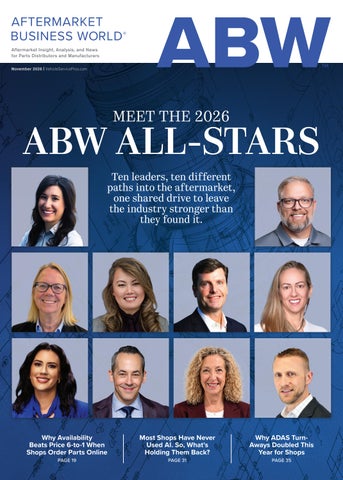
Aftermarket Insight, Analysis, and News for Parts Distributors and Manufacturers November 2026 | VehicleServicePros.com
MEET THE 2026
ABW ALL-STARS Ten leaders, ten different paths into the aftermarket, one shared drive to leave the industry stronger than they found it.
Why Availability Beats Price 6-to-1 When Shops Order Parts Online PAGE 19
01_AMBW_Cover_Tagline.indd 1
Most Shops Have Never Used AI. So, What's Holding Them Back? PAGE 31
Why ADAS TurnAways Doubled This Year for Shops PAGE 35
9/30/26 4:10 PM
EDITOR’S LETTER
EDITORIAL GROUP EDITORIAL DIRECTOR Chris Jones / chrisj@endeavorb2b.com CONTRIBUTING WRITERS Kacey Frederick, Emily Kline ART AND PRODUCTION ART DIRECTOR Emme Osmonson PRODUCTION MANAGER Mariah Straub AD SERVICES MANAGER Jen George SALES ASSOCIATE SALES DIRECTOR Mattie Gorman-Greuel / mgorman@endeavorb2b.com DIRECTOR OF BUSINESS DEVELOPMENT Cortni Jones / cjones@endeavorb2b.com ACCOUNT EXECUTIVES Kyle Shaw / kshaw@endeavorb2b.com Marianne Dyal / mdyal@endeavorb2b.com Darrell Bruggink / dbruggink@endeavorb2b.com Sean Thornton / sthornton@endeavorb2b.com Diane Johnston / djohnston@endeavorb2b.com Lisa Mend / lmend@endeavorb2b.com Chad Hjellming / chjellming@endeavorb2b.com
ENDEAVOR BUSINESS MEDIA, LLC CEO Chris Ferrell COO Patrick Rains CDO Jacquie Niemiec CALO Tracy Kane CMO Amanda Landsaw EVP TRANSPORTATION Chris Messer EVP ENDEAVOR BUSINESS INTELLIGENCE Paul Mattioli VP OF CONTENT STRATEGY, TRANSPORTATION GROUP Josh Fisher BUSINESS STAFF PUBLISHER Mattie Gorman HOW TO REACH US ENDEAVOR BUSINESS MEDIA LLC. 30 Burton Hills Blvd, Ste. 185, Nashville, TN 37215 Phone: 800-547-7377 Printed in the USA. Copyright 2026 EndeavorB2B, LLC. All rights reserved. No part of this publication may be reproduced or transmit ted in any form or by any means, electronic or m echanical, in cluding photocopies, recordings, or any information storage or retrieval system without permission from the publisher. Endeavor Business Media, LLC does not assume and hereby disclaims any liability to any person or company for any loss or damage caused by errors or omissions in the material herein, regardless of whether such errors result from negligence, accident, or any other cause whatsoever. The views and opinions in the articles herein are not to be taken as official expressions of the publishers, unless so stated. The publishers do not warrant either expressly or by implication, the factual accuracy of the articles herein, nor do they so warrant any views or opinions by the authors of said articles.
MEMBER OF:
Aftermarket All-Star Awards: The Inaugural Class
L
ate fall is a time to reflect on the accomplishments of the outgoing year and anticipate the growth and momentum of the year ahead. For the automotive aftermarket, it’s award season, a time when we come together to honor those among us who have gone above and beyond the call of service and whose exploits have inspired the industry. It’s my pleasure to share Aftermarket Business World’s first All-Star Awards class, celebrating the leaders who drive excellence across the automotive aftermarket. The 2026 honorees come from every corner of the parts and distribution segment of the industry and represent manufacturers, distributors, retailers, program groups, service providers, and technology companies. You’ll see familiar faces within the pages of this magazine: • Sue Godschalk Federated Auto Parts
• Suellyn Sprague Epicor Software Corp. • JC Washbish Aftermarket Auto Parts Alliance These are our 10 inaugural award winners, peer-selected to represent the aftermarket in this special issue. It has been a pleasure to capture these stories from angles you may be hearing for the first time. We asked the honorees about their hobbies, their leadership philosophies and mantras, and things people outside of their orbit may not know about them. What’s rich about every account is how each honoree entered the aftermarket. Much like weddings remind us of the day we first fell in love, these accounts will have you reflecting on your first day in the industry and why you’re still here. I think you’ll find their stories inspiring, amusing, and deeply human. Please join me in honoring the Aftermarket All-Stars Class of 2026.
• Mary Ieng the Auto Care Association • Bradley Jackson Dorman Products • Autumn Lamb GSP North America • Elle Lawhead AutoZone • Fletcher Lord III Bumper to Bumper • Courtney Pedler Autology Data Management
COVER IMAGE: PREDATOR, GENERATED WITH AI / ADOBE STOCK
• Aaron Shaffer Standard Motor Products
CHRIS JONES, GROUP EDITORIAL DIRECTOR CHRISJ@ENDEAVORB2B.COM
2 / Aftermarket Business World
02_AMBW_TOC.indd 2
9/30/26 5:13 PM
CONTENTS November 2026 /
AFTERMARKET BUSINESS WORLD
EDITOR’S LETTER 02 Celebrating the Inaugural All-Star Awards Class
MEET THE ALL-STAR AWARD WINNERS 04 Sue Godschalk
Sue Godschalk never chased Federated’s top job. She just kept doing the one in front of her until it found her By Chris Jones
08 Mary Ieng
Community is what drives the industry forward. Mary Ieng is the catalyst that makes it happen By Kacey Frederick
12 Bradley Jackson
PHOTO: RW ARCHIVES / NITISH SINHA
Bradley Jackson’s career went from Dorman second shift picker to aftermarket industry leader By Emily Kline
16 Autumn Lamb
In a service-centric industry, it’s essential to know how to connect the dots between parts and people. Autumn Lamb does that with precision By Kacey Frederick
20 Elle Lawhead
Elle Lawhead didn’t plan on entering the aftermarket, but when she saw how essential the industry’s work was, she had to be part of it By Kacey Frederick
24 Fletcher Lord III
Fletcher Lord III built his leadership style around a simple rule: always know who’s ready to move up next By Emily Kline
28 Courtney Pedler
Courtney Pedler grew up in her dad’s auto parts store and now is one of the aftermarket’s most trusted names in data By Chris Jones
32 Aaron Shaffer
Aaron Shaffer’s approach to AI, marketing, and leadership all comes back to the same basics: listen, follow up, build trust By Emily Kline
36 Suellyn Sprague
Suellyn Sprague’s analytical mind and love of problem-solving have carried her from a home office to the top of her field By Chris Jones
40 JC Washbish
11 Understanding the Technician
From parts delays to tech shortages, the challenges shops face in 2026 all land in the same place: the bay Prepared by IMR | Endeavor Business Intelligence
15 Why Repair Shops Turn to Public Websites for Parts and Why Many Don’t
Nearly half of shops never buy parts from public websites. The rest go online to fill gaps, not to replace their suppliers Prepared by IMR | Endeavor Business Intelligence
19 Availability Drives the Purchase When Repair Shops Order Parts Online
Availability outranks price nearly 6-to-1 among shops that order parts through platforms
Prepared by IMR | Endeavor Business Intelligence
23 Repair Shop Analysis
Car counts, ticket values, and labor rates all climbed in 2026. Here’s where shops are buying their parts Prepared by IMR | Endeavor Business Intelligence
31 AI and VR/AR in the Shop
Most shops know AI tools exist. Few have put them to work Prepared by IMR | Endeavor Business Intelligence
35 Navigating ADAS Challenges
ADAS volume dipped, but turn-aways doubled. Here’s where shops are still struggling Prepared by IMR | Endeavor Business Intelligence
JC Washbish, a fourth-generation aftermarket leader, sees his role as a calling and his time in the industry as an investment
39 State of the Repair Shop
By Emily Kline
Prepared by IMR | Endeavor Business Intelligence
Demand is strong. Serving it profitably is the challenge
November 2026 / 3
02_AMBW_TOC.indd 3
9/30/26 5:14 PM
EYERBOW
Aftermarket Insight, Analysis, and News for Parts Distributors and Manufacturers
FROM NIGHT SHIFT TO THE CORNER OFFICE
Sue Godschalk’s 53-year climb from clerical worker to CEO
BREAKING THE ICE
How a simple technique she learned from a mentor taught her how to read a room
Sue Godschalk: “So Good They Can’t Ignore You” 03_AMBW_Features.indd 4
9/30/26 4:10 PM
SUE GODSCHALK, FEDERATED AUTO PARTS
Sue Godschalk never chased Federated’s top job. She just kept doing the one in front of her until it found her BY CHRIS JONES
S
ue Godschalk didn’t think the meeting was about her. She’d been called in to learn who Federated Auto Parts had chosen to succeed outgoing CEO Larry Pavey, who had been elevated from president to CEO in 2020 when Rusty Bishop retired. Godschalk was named president that same year, replacing the role Pavey had vacated. None of that chain of succession crossed her mind as she sat in the meeting, ready to help welcome the incoming CEO—until she realized it was her. “Are you serious?” she remembers asking. “I really was not expecting it. I just didn’t have an idea that they were going to think that I could do the job.” It’s a fitting reaction from someone whose 53-year career in the automotive aftermarket has been defined less by climbing the ladder and more by raising the bar. Godschalk has developed a reputation for, as comedian Steve Martin famously said, being “so good they can’t ignore you.” She’s always done the job in front of her so well that the next one eventually found her. Godschalk’s career in the automotive aftermarket began in 1972, at Coiner Parts, the company that would later become Fisher Auto Parts. She worked a clerical position during normal business hours before switching to a newly minted night shift from 4 p.m. to 1 a.m., where she handled the company’s billing, which was all done by hand, and occasionally helped the crew pick orders and load trucks, which gave her a glimpse of how warehousing worked. The second shift allowed Godschalk, an undergraduate student studying business management, to earn a living while finishing her degree.
PHOTOS COURTESY OF SUE GODSCHALK
03_AMBW_Features.indd 5
A year later, an opportunity arose in a Fisher Auto Parts store. An incoming store manager needed someone with Godschalk’s clerical skills to work onsite. She moved into a clerical role, but discovered she loved the counter. “I really like looking up parts, selling parts. I enjoyed learning the different aspects of automobiles and how everything works,” she says. The store had its own machine shop and glass shop, and working alongside them gave her an early, granular education in exactly how a vehicle comes apart and goes back together. “It was just a really good learning experience and taught me what customer service is all about—and also teamwork. I also did a little bit of inventory management,” Godschalk recalls. That curiosity about every aspect of how a parts store operates led to her being hired as the store’s manager when her boss left for another opportunity. She held the post for several years.
Building Federated From the Ground Up In 1985, the late Art Fisher recruited Godschalk to help him build something new and visionary: a program distribution group that would become Federated Auto Parts. “He gave me a call and said, ‘I’m going to start a program distribution group, and I really need someone who has automotive knowledge to come and work at Federated,’” she recalls. “I found it very intriguing.” She was employee No. 3. There wasn’t much of an organization yet to speak of— everyone wore multiple hats, and crosstrained on all aspects of the business out of necessity, learning marketing and pur-
“You can’t change the direction of the wind, but you can change the direction of your sails.” —Sue Godschalk
chasing alongside whatever they’d been hired to do. “I learned a lot of different things, like marketing and purchasing. It helped me understand what Federated was all about,” she says. “I was not only working for one WD, (but) I was working for a whole group of WDs, and of course, each WD is different, so it was a very good learning experience.” Godschalk remembers her first significant taste of the industry—AWDA. It was something of an awakening for her to see the size of the aftermarket—its scope, its infrastructure, and all of its moving parts—visible for the first time. “I’m (was) like, ‘Wow, you know, this is like a big industry.’ I saw the WDs and all the manufacturers and, and I’m like, ‘My goodness, this is a huge industry.’ And I think that was the kind of ‘aha’ moment for me,” Godschalk says.
Two Mentors, One Leadership Style Over the next four decades, she moved
November 2026 / 5
9/30/26 4:10 PM
EYERBOW SUE GODSCHALK, FEDERATED AUTO PARTS
through nearly every seat at Federated: from general manager to president, and finally, in January 2025, chief executive officer. Along the way, she befriended a pair of coworkers who would become her contemporaries and who helped shape how she leads—eventual Federated CEOs Rusty Bishop and Larry Pavey. Bishop gave her an early model of creative, trial-and-error leadership—permission to try something, and permission to fail at it. “We would try something. If it didn’t work, we’d do something else,” she says. Larry Pavey brought a cerebral approach that involved asking questions that were sometimes uncomfortable, but aimed at arriving at a decision that felt genuinely right, not just convenient. Godschalk has carried a habit from Pavey’s staff meetings into her own— the icebreaker question. “He would ask you a question, and then he would really pay attention to how you answered that question,” she says. “He was evaluating what our skills were from the questions that he was asking. It’s very telling.”
CHEF’S KISS: Cooking is a passion and lesser-known talent of Sue Godschalk, who is seen here taking instruction from a chef in Italy.
Godschalk says her leadership is an amalgamation of the two, with a lot of her own personality attached. She says her main goal is to show up every day for Federated’s members. It builds trust, which matters to her, as do loyalty and integrity. “They want me to give them guidance and make good decisions so that they can be successful,” she says. “So with today’s industry and how it’s ever-changing, I have to be flexible, and I have to be on my toes. I have to make sure that I’m making good decisions. I’m determined that all of my members are going to be successful.”
Adapting to an Industry in Motion Ask her what’s changed most about the industry itself, and she doesn’t hesitate: the pace. She once assumed the aftermarket moved slowly and deliberately, the way industries with deep roots tend to. Today, she describes it as moving at lightning speed—electric vehicles, self-driving technology, a rate of change she compares, half-joking, to how quickly video chat went from novelty to necessity.
It’s that new industrial-revolution-type speed that she wants newcomers to understand. Her advice to anyone starting is threefold: learn the business from the ground up, the way she did; expect the industry to keep changing and to keep up; and believe in yourself, especially if you don’t look like everyone else in the room. That last piece is important her. When Godschalk started, there were essentially no women working behind a parts counter. She was an exception, not the rule, even as recently as two decades ago. That industry history doesn’t bother her, though, and it hasn’t hindered her. Sue is Sue, and a beloved source of encouragement and inspiration to people of all backgrounds in the aftermarket. In 2024, AWDA presented Godschalk with its Lifetime Achievement Award in Honor of Martin Fromm at its Annual Conference in Las Vegas, Nevada. People who work with her will tell you that Godschalk is a serious, gourmet-level cook—someone who gardens, entertains, and has been known to prepare dinner for her staff. It’s a small detail, but a fitting one for a woman who holds trust and loyalty as her standard. It’s why she made a good store manager many moons ago—she’s always taking care of the people in front of her. It’s an instinct summed up in her mantras: “You can’t change the direction of the wind, but you can change the direction of your sails,” paired with “Always have a Plan B.” It may never be known if the automotive aftermarket was the Plan B of the undergraduate student who managed the Coiner Parts office at night while earning academic credits, but it encapsulates something true about her entire career arc. Godschalk never engineered her way into Federated’s corner office. She adjusted, again and again, to whatever winds the industry blew into her sails, until one day, in a meeting she thought was about elevating someone else, the industry again found her.
6 / Aftermarket Business World
03_AMBW_Features.indd 6
9/30/26 4:10 PM
2611PT
Sue Godschalk, CEO of Federated Auto Parts with Redford and Annie
Proud of Our Top Dog!
Sue, we appreciate your dogged dedication to the Federated membership, making Federated Auto Parts a howling success. Thank you for leading the pack and for the positive impact you have had throughout the industry.
2611PTEN_FederatedAutoParts_REV.indd 1 03_AMBW_Features.indd 7
9/28/26 PM 9/30/26 12:20 4:10 PM
Aftermarket Insight, Analysis, and News for Parts Distributors and Manufacturers
SHE DIDN’T KNOW CARS. SHE KNEW PEOPLE Mary Ieng’s pandemic-era pivot into the aftermarket shows that relationships drive the industry
LOOK UP SOMETIMES
Mary Ieng’s advice to young aftermarket professionals: You might get noticed without realizing it
Mary Ieng: Fostering Community in the Aftermarket 03_AMBW_Features.indd 8
9/30/26 4:10 PM
MARY IENG, THE AUTO CARE ASSOCIATION
Community is what drives the industry forward. Mary Ieng, community engagement manager at the Auto Care Association, helps provide a platform for innovation to take place BY KACEY FREDERICK
C
ommunity is important across every industry, and the aftermarket is no exception. Through platforms that allow different segments of the industry to connect, ideas for how to improve the aftermarket as a whole have the opportunity to flourish. This is precisely what drives Mary Ieng, manager of community engagement at the Auto Care Association. Bringing Auto Care Association members and volunteers together and enabling everyone’s voice to be heard is the core of her role, and her ultimate motivation is providing members with the resources they need to make a positive impact. She shares what it was about the aftermarket that specifically appealed to her as a career path, and what work she does with Auto Care Association that helps members have a place to connect, discuss, and learn.
A Role With Impact Though Ieng’s current role with Auto Care Association was her introduction to the aftermarket, she brought over eight years of association management, working across local, national, and global levels. Her work largely focused on membership retention, engagement, and working with volunteers—something she’s deeply passionate about. “I really enjoy bringing people together and providing lasting impact. Because the goal is always to inspire others so that they can drive impact to help communities evolve,” says Ieng. When Ieng was searching for a new career opportunity during the COVID-19
PHOTO COURTESY OF MARY IENG
03_AMBW_Features.indd 9
pandemic, it was important for her next role to not only involve community engagement, but also have the option to be remote. She found all of this at Auto Care Association when the organization began searching for new community managers. Though she didn’t have direct experience with automotive work, Ieng brought something equally as important to the table: the ability to foster community. “Because of what I do in regard to my previous roles, I’m all about connecting people; and what better way to connect with others than to be part of an industry that fosters a lot of community involvement?” says Ieng. While fast-paced environments are nothing new for Ieng, the aftermarket was nonetheless on another level compared to other industries she’s worked with. In addition to constantly evolving vehicle technologies, there’s no shortage of news when it comes to new platforms, branding, and company acquisitions. It’s something that excites Ieng, who views it as a sign of a thriving industry she’s actively having an impact on. “It’s always evolving; it’s definitely never a dull moment here. And I’ve learned to really embrace all these different changes, because that means we’re moving forward as an industry, and we’re keeping up with the new things that are coming out. So it’s really great to be part of all that,” says Ieng. Part of that innovation means a constant cycle of new council members within the association, each with different perspectives, experiences, and work styles. Every new term is an opportunity
The goal is always about amplifying that relationship so that they, in turn, are able to provide a lasting impact back to the Association.” —Mary Ieng
to learn current issues and work with different personalities, and Ieng has learned how to adapt her communication style to best serve whoever she may be working with. “Sometimes someone may need additional reference points, or some are just hands-off,” explains Ieng. “I think being aware of that is something I’m constantly trying to learn: to be able to collaborate with them, depending on what’s needed at the time. It definitely keeps you on your feet, because something that was helpful for a previous member may not meet the same need for the next member.” Part of Ieng’s growth has also been fostered by mentors throughout the years, something she credits with having a tremendous positive impact on her.
November 2026 / 9
9/30/26 4:10 PM
EYERBOW MARY IENG, THE AUTO CARE ASSOCIATION
She has never sought out mentorship, but has found it simply through working in different departments and levels. The most impactful mentors saw potential in her, lent a hand, and helped her build confidence in new roles. “Sometimes it’s just having conversations where you realize: you don’t know what you don’t know until you’re already doing it. “And then when you are doing it, you’re still figuring it all out at the same time. But when there’s someone there who’s already gone that path and sees the potential in you, and they’re able to help guide you through it all, it’s definitely warming to see. And I have such deep respect for each of those individuals that helped me along the way,” says Ieng.
Helping Build a Culture Just as she received support from oth-
ers, Ieng holds a deep respect for the association’s members she now works with, many of them dedicated volunteers. She views her role as helping enable those volunteers to improve the industry, providing them with the tools they need, so they can continue to have a positive impact. “The goal is always about amplifying that relationship so that they, in turn, are able to provide a lasting impact back to the Association,” says Ieng. “We want to inspire others—and by providing that support, in my role we get the front seats to that. We’re able to really see things come together, as a result of all the engagement to bring all these great minds together. It’s so rewarding to be in that role as the community engagement manager.” That fulfillment is the natural result of the hard work she does: taking the time to understand individuals from
across the entire industry, and providing a space to have conversations about what’s affecting them. Ieng’s success comes from a genuine curiosity about the culture of the industry, and building connections at every level and in various sectors. No matter the role, there’s an opportunity to learn more about the aftermarket—and she reminds those entering the industry that this alone can open up so many doors. “Everyone’s all about building their credibility, but you can’t really improve your credibility in the industry unless you genuinely want to understand the culture, and are able to build connections at every level and in various sectors,” says Ieng. “So definitely look beyond what’s in front of you—look up sometimes. Because sometimes, you might get noticed without even realizing. I definitely hope younger folks continue to keep that in mind.”
10 / Aftermarket Business World
03_AMBW_Features.indd 10 2611PTEN_AutoCareAssociation.indd 1
9/30/26 11:05 4:10 AM PM 9/1/26
UNDERSTANDING THE TECHNICIAN From parts delays to tech shortages, the challenges shops face in 2026 all land in the same place: the bay PREPARED BY IMR | ENDEAVOR BUSINESS INTELLIGENCE
35.8%
cite overhead and the economy as a challenge
30%
struggle to keep diagnostic tools and software current
28.6%
say winning or retaining customers is harder
23.8%
have difficulty finding qualified technicians PHOTO: RW ARCHIVES / NITISH SINHA
PARTS REMAIN one of the most persistent obstacles in 2026: 22.8% of shops say finding parts or dealing with shortages continues to disrupt operations, and another 4.8% say that even when parts are available, late delivery throws off scheduling and workflow. Every delay lands in the technician's bay, turning a booked job into idle time and a frustrated customer. The economic squeeze is just as real at the shop level, where 35.8% of shops cite keeping overhead low and managing the day-to-day effects of the economy as a challenge, with labor costs, utilities, rent, software subscriptions, and equipment purchases all tightening margins. That pressure flows downstream to the customer side, where 28.6% of shops say bringing customers back, offering incentives, or winning new business is harder, and 7.6% say delivering affordable service is becoming more difficult. Rising repair
costs make customers more cautious, so technicians and service writers are working harder to justify recommended repairs and earn the next visit. Meanwhile, 23.8% of shops report difficulty finding qualified or responsible technicians, 9.6% struggle to retain the ones they have, and 7% say providing hands-on training is a concern. The people doing the work are scarce, hard to keep, and expected to master more every year. Thirty percent of shops say staying current with diagnostic tools and software updates is a challenge, and 6.2% say keeping pace with broader industry changes and standards is difficult. Vehicle complexity is outrunning the resources many shops can put behind their technicians. Longer-term shifts are entering the picture without displacing today's problems. Eleven percent of shops say transitioning
IMR | Endeavor Business Intelligence | automotiveresearch.com
11:05 AM
03_AMBW_Features.indd 11
to service electric, hybrid, or ADASequipped vehicles is a challenge, and 16.8% say competing with larger shops or dealerships is getting harder. These are not yet top-tier concerns, but they signal that future-facing investment and competitive positioning are becoming part of the conversation. Smaller friction points round out the list: 5.6% cite declining parts quality, 6.2% point to marketing and advertising, 5.4% report no major challenges, and 0.2% selected “other.” Taken together, the technician's world in 2026 is defined by parts costs and availability, overhead pressure, a thin labor pool, customer hesitancy, and vehicles that demand more expertise and better tools. Shops that control costs, secure reliable parts, invest in their technicians, and communicate value clearly to customers will be the ones best positioned to navigate the year ahead.
November 2026 / 11
9/30/26 5:15 PM
Aftermarket Insight, Analysis, and News for Parts Distributors and Manufacturers
THE WHO BEHIND THE HOW
How curiosity turned a temp picker into Dorman’s director of operations
ROSE-COLORED GLASSES, CLEAR-EYED LEADERSHIP
How Bradley Jackson leads Dorman’s biggest warehouse by assuming the best in people
Bradley Jackson: How a Curious Mind Built a Career 03_AMBW_Features.indd 12
9/30/26 4:10 PM
BRADLEY JACKSON, DORMAN PRODUCTS
Bradley Jackson’s career from Dorman second-shift picker to aftermarket industry leader B Y E M I LY K L I N E
B
radley Jackson’s journey from a temporary second-shift picker at Dorman Products to director of operations for a 1.3-millionsquare-foot Dorman Products warehouse in Portland, Tennessee, has been rooted in curiosity. That inquisitive mind has led to his career success and helped him build a reputation for strengthening the company and its customer relationships through steady, results-driven leadership. It also led him to win the 2025 Dorman Leader of the Year award. By asking questions, Jackson has gained knowledge that has helped him champion process improvements and cross-functional initiatives that boost efficiency, elevate the customer experience, and support business growth— consistently turning operational challenges into opportunities for stronger long-term performance at Dorman. Like many, Jackson’s journey began with a simple entry point into the aftermarket. But it only grew as he took advantage of every new opportunity the industry offered him.
Jackson’s Aftermarket Journey Jackson started in the aftermarket after leaving the military. He became a picker on the second shift as a temp at Dorman Products in 2010. “When I first came to Dorman, I didn’t know what I didn’t know,” Jackson says. “I learned quickly about distribution and fulfilling orders, picking orders, and shipping them out. That was really all I cared about at first. That’s all I knew.”
PHOTOS COURTESY OF BRADLEY JACKSON
03_AMBW_Features.indd 13
As new products came into the warehouse, Jackson wanted to understand the broader picture. He didn’t want to do his job and go home; he wanted to understand how the company functioned. “New product lines would come down to the warehouse with new opportunities and designs, and that started piquing my interest. It got me asking questions. Where does this all come from? Who’s the who behind the scenes pulling strings?” As he dug deeper into those questions and sought conversations beyond the warehouse floor, doors began to open. First, to new responsibilities, then to opportunities that led him to his promotion to senior operations supervisor at Dorman. “I started getting involved a little bit with different sides of the business, and discovered that there’s demand planning for our customers,” Jackson says. “I also learned that Dorman has a fleet of engineers whose job is to simply go out to repair shops and understand what’s failing on cars, how we can improve those parts, and how we can redesign them.” This team identified what was failing and how Dorman could offer customers more robust solutions to better protect its investments and keep its cars on the road longer. “I also started getting involved with cross-functional groups, joining our corporate team and helping train employees in all our warehouses to build a broader understanding of what Dorman is and what we do,” Jackson says. “I also got pulled into projects to help build
“Remain curious about everything you do. Ask the questions and work to understand what it is you’re doing and why you’re doing it. Find your why.” —Bradley Jackson
a new WMS (Warehouse Management System). This was to help assist us in fulfilling orders for our retailers and customers faster, more efficiently, and more accurately.” Beyond his work with the corporate team and warehouse employees, Jackson has played a role in helping Dorman strengthen its presence in the aftermarket. “A little bit of my time was spent helping our marketing team build marketing suites so that we could go out and be amongst the other aftermarket companies and our customers,” Jackson says. While still working for Dorman, Jackson also managed to go to school to learn more about supply chain management and leadership.
November 2026 / 13
9/30/26 4:10 PM
EYERBOWJACKSON, DORMAN PRODUCTS BRADLEY
Education Feeds Curiosity In 2014, he started school at Volunteer State Community College. He graduated with an associate degree in business, logistics, materials, and supply chain management in 2016. That same year, Jackson started his bachelor’s degree at Lipscomb University, located in Tennessee. In 2018, he graduated with a bachelor’s degree in organizational leadership. After graduating, Jackson was offered the role of operations manager at CEVA Logistics, located in Mount Juliet, Tennessee, and he left Dorman. A year into working at CEVA Logistics, Jackson was promoted to senior operations manager and stayed in that role for four years and six months. The experience outside Dorman gave Jackson a broader perspective on the aftermarket and prepared him for the opportunity to return to the company.
Expanding His Perspective In 2025, Jackson was contacted by Dorman and recruited back as direc-
tor of operations to run its warehouse in Portland, Tennessee. “Since I’ve been back this time, I’ve been able to join the enterprise and sit in as a senior leader on the team and help revolutionize the way that we’re going to transform our supply chain,” Jackson says. “To transform it into one that is at the next level. One that is a better strategy for the aftermarket.” By bridging day-to-day operations with how the company shows up in the market, Jackson has positioned himself at the center of Dorman.
‘How does Dorman better diversify our portfolio and our suppliers, and keep the product coming in?’” Jackson says. “That brings me to the current day, where, you know, sitting here as director and running essentially a 1.3-million-square-foot warehouse, and strategizing amongst the other warehouses on how we run better?” To answer these questions and help his company remain successful, he has found that remaining curious helps guide him to the best decisions.
Leading Through Change
By remaining curious, Jackson has been able to gain a more knowledgeable understanding of his company and the challenges it faces in the aftermarket. “Remain curious about everything you do. Ask the questions and work to understand what it is you’re doing and why you’re doing it. Find your why.” Finding his why has helped Jackson understand what inspires him and, in turn, inspires those on his team. “You’ve got to establish your north star as a leader,” Jackson says. “You have to keep hold of that north star; you have to use it to create your vision, so everybody can head in the same direction together.”
As Jackson’s responsibilities have expanded, so has his role in helping Dorman navigate the changing aftermarket. He has had to adapt to the times and help his company build a better strategy for the aftermarket. “We’re in a weird economic environment where—for a while—tariffs were scaring us, and now the threats are removed, and we must ask ourselves,
Finding His North Star
Seeing the Best in People
WAREHOUSE TO FIELDHOUSE
Bradley Jackson, with wife Ashley and sons Carter (L) and Miles (R), says there are only two places to find him: at work or on the football field with his boys.
Jackson also finds it important to operate with rose-colored glasses. “You’ve got to see the best in everybody’s intentions because the majority of people don’t come in with an intent to fail or to do bad or to set something off the rails,” Jackson says. “So, look at it with your rose-colored glasses and understand that if you work to find the best potential, you’re going to give these people an opportunity to fulfill it to a level that they never thought they could.” By leading with curiosity, vision, and rose-colored glasses, Jackson has become a successful leader and reliable partner at Dorman Products.
14 / Aftermarket Business World
03_AMBW_Features.indd 14
9/30/26 4:10 PM
WHY REPAIR SHOPS TURN TO PUBLIC WEBSITES FOR PARTS AND WHY MANY DON’T Nearly half of shops never buy parts from public websites. The rest go online to fill gaps, not to replace their suppliers PREPARED BY IMR | ENDEAVOR BUSINESS INTELLIGENCE
46%
do not buy parts from public websites
28%
go online to fill a gap their suppliers can’t cover
19%
go online for specialty or hard-to-find parts
12% cite price as the reason
PHOTO: RW ARCHIVES / COREY MILLER
WHEN WE ASKED 500 professionals why they turn to public websites instead of their main suppliers, the most common answer was essentially: We don’t. Sites like Amazon, eBay, and RockAuto are on the radar, but for most shops they play a supporting role rather than serving as a go-to purchasing channel. Forty-six percent of respondents said they simply don’t buy parts from public websites, and many were blunt about it: “NAPA takes good care of us. We don’t need anybody else.” Strong supplier relationships, warranty concerns, and the hassle of receiving the wrong part were the main reasons for staying offline. Several shops said they dipped into Amazon or eBay during the COVID-19 supply chain disruption
but have since returned to their normal routines. For shops that do use these sites, the biggest driver (28%) is filling a gap their regular suppliers can’t cover, whether a backorder, an out-of-stock item, or a delivery delay. As one respondent put it: “We only use them as a last resort, if we can’t find the part through normal channels.” Tariffs surfaced here too. Plenty of shops aren’t buying online now but are watching closely and may not have a choice if availability takes a hit. About 19% pointed to specialty or hard-to-find parts as their main reason for going online, mostly for older vehicles, discontinued components, or niche categories like tires and wheels. Price was the factor for 12%, mostly smaller shops shopping around to protect mar-
IMR | Endeavor Business Intelligence | automotiveresearch.com
03_AMBW_Features.indd 15
gins. Speed and convenience followed at 11%, driven almost entirely by Amazon’s next-day and sometimes sameday delivery. When a car is already on the lift, waiting two days for a part isn’t always an option. Even shops with no current need for public websites talked about them as a contingency plan. If the supply chain tightens, the “last resort” category could grow quickly. Shops remain loyal to what works. Online platforms have carved out a real role in parts buying, but it’s a supporting one. The most active online buyers are chasing hard-to-find parts, covering supplier gaps, or squeezing margins wherever they can. For everyone else, supplier relationships are doing the job just fine for now.
November 2026 / 15
9/30/26 5:15 PM
Aftermarket Insight, Analysis, and News for Parts Distributors and Manufacturers
ORGANIZED CHAOS, REAL STRATEGY
Autumn Lamb on strategy, data, and why it’s not “arts and crafts”
FULL CIRCLE LEADER
Autumn Lamb found her mentors through Women in Auto Care. Today, as vice chair, she’s become one herself
Autumn Lamb: Connecting With Consumers in an Ever-Changing Industry 03_AMBW_Features.indd 16
9/30/26 4:10 PM
AUTUMN LAMB, GSP NORTH AMERICA
In an industry all about servicing people, it’s essential to know how to connect with them. Autumn Lamb, director of marketing and brand strategy at GSP North America, has been able to do exactly that with her marketing strategies, helping to fill a need in the aftermarket BY KACEY FREDERICK
T
here’s much more to working in the aftermarket than just vehicle parts; it’s an industry focused on people, from the drivers being serviced to the ones servicing them, and those making the parts needed to repair vehicles. Autumn Lamb is director of marketing and brand strategy at GSP North America, where she oversees all strategic and marketing initiatives across North and Latin America. Lamb found her way into the automotive aftermarket through marketing roles at EGR Group and Gibson Performance Exhaust, before earning her MBA at the University of Redlands and joining GSP in 2019 as marketing manager. She was promoted to her current director role in January 2025 after six years. Lamb brought something essential to the aftermarket: the ability to connect with consumers. She has been able to identify gaps in aftermarket marketing and create strategies around them that have brought success for both her and the companies she works with.
Exploring Untapped Potential In school, Lamb studied communication, with a focus on public relations and media studies. Upon graduating, she would return to school after approximately a year to pursue a master’s in marketing and an MBA. Fresh out of college, Lamb fell into the automotive industry when she took a role at EGR in Southern California as a marketing coordinator. There, she began doing hands-on marketing work—social media, email communications, and
PHOTO COURTESY OF AUTUMN LAMB
03_AMBW_Features.indd 17
broader B2B marketing—which became her entry point into both marketing as a profession and the automotive aftermarket specifically. “That was kind of my segue into not just automotive, but also getting my hands into actual marketing duties,” describes Lamb. Lamb went on to work with Gibson Performance Exhaust before eventually finding her current role with GSP North America, where she has worked for seven years. She saw her marketing strategy catch the attention of other companies, with referrals driving her career growth. The more she saw how effective her marketing strategy was, the more motivated she became to grow in her career. “It’s nice to be able to say, ‘Hey, people recognize your work,’ and that it’s building credibility, and you can kind of see how that plays into the market and how other people perceive you, or even the company,” says Lamb. “Marketing is organized chaos. It’s very pivotal, dynamic, and strategy based. It’s not just arts and crafts. There are a lot of things that go behind it. And I think now with data, AI, and better understanding human behavior patterns and trends, it allows us to strategize and focus on what’s important—not just throw out a newsletter or just something in the mail anymore,” says Lamb. As a marketing expert, the biggest change for Lamb in coming to GSP North America was the transition from working with performance products to hard parts. “It’s definitely a ‘need’ product, versus a ‘want’ product,” Lamb explains.
Marketing is organized chaos. It’s very pivotal, dynamic, and strategy based.” —Autumn Lamb
Since entering the automotive field, she saw much potential for marketing initiatives that had gone unexplored up to that point, especially in her segment of the aftermarket. Particularly with a globalized brand like GSP North America. Coming into the industry after school, Lamb had no experience with the automotive field—but she’s brought something that is sorely needed for brands to succeed within it: the ability to connect with customers. That’s the heart of what marketing is, and without the ability to analyze data and effectively communicate to wide audiences, that’s much easier said than done. “One of the biggest things, especially as somebody entering into an industry, is that you don’t necessarily have to know everything about cars,” says Lamb. “You can learn things, and you can grow that knowledge and skill set, but it’s really about your determination and understanding of how things operate and how a business chain works; and the supply of a store manager, all
November 2026 / 17
9/30/26 4:10 PM
EYERBOWLAMB, GSP NORTH AMERICA AUTUMN
the way down to an installer, service professional, global manufacturer. You need to understand how those interact and work together.”
Finding Support to Grow As someone new to automotive, entering the industry was a lot for Lamb. She found the support she needed to succeed through industry communities like Women in Auto Care, the California Automotive Wholesalers’ Association, Young Auto Care Network Group, and the Aftermarket Content Professionals Network. Through the relationships she made there, she met others in the industry who were more experienced and looking to pass on their insights. Participating in industry groups helped Lamb grow not just from those who held roles similar to hers, but it also allowed her to interact with individuals in other positions as well. She’s used community
involvement to connect with people all along the supply chain, which ultimately helps shape her marketing strategy. “When you’re able to connect and learn more about who’s interfacing with or where your product’s going, it allows you to be able to connect with that experience a lot more and be able to make better decisions at your job. Because now you’re learning from people that have these real-life experiences with your product,” Lamb says. The experience she’s gained from participating in industry groups has led to Lamb becoming vice chair of Women in Auto Care: an achievement she credits to the mentors and support she’s had throughout her career in the aftermarket. That’s why she now tries to put that same energy forward with others entering the industry. “Being able to contribute something to them, maybe just helping them out—
whether it’s being kind or getting somebody connected—it really does make a difference,” says Lamb. Getting involved with the industry is something Lamb recommends for anyone starting their own career, as well as remembering to take it slow and give yourself room to learn and grow. No matter where you’re at right now, if you have a career goal in mind, there’s a path to find it within the aftermarket. Even if you’re new to the field, that isn’t something that should cause insecurity, but rather an opportunity to provide a fresh, new perspective. “Sometimes it can be challenging. But we’re all learning. And I think sometimes we can look at failures and think, ‘Oh man, this is it.’ But sometimes it’s a learning lesson,” says Lamb. “We’re not always going to come out perfect. But that’s when we learn, we adapt, we pivot, and we adjust the strategy.”
18 / Aftermarket Business World
03_AMBW_Features.indd 18
9/30/26 4:10 PM
AVAILABILITY DRIVES THE PURCHASE WHEN REPAIR SHOPS ORDER PARTS ONLINE
Availability outranks price nearly 6-to-1 among shops that order parts through platforms PREPARED BY IMR | ENDEAVOR BUSINESS INTELLIGENCE
56%
of shops buy through an aggregator platform
47.5%
of all parts orders are placed on platforms
58.9%
of platform users rank availability first
10.4% of platform users rank price first
PHOTO: RW ARCHIVES / NITISH SINHA
IMR SURVEYED 500 INDEPENDENT repair shops on how they order parts and what drives the choice. Aggregator platforms are now the leading order channel, and once shops are on them, part availability outweighs every other selection factor. Fifty-six percent of shops buy through an aggregator platform, and platforms account for 47.5% of all orders, ahead of direct supplier websites (34.5%) and phone (18.1%). Size matters: Only 25% of shops with one to three bays use a platform, versus more than 75% of shops with four or more bays.
Early-career techs (0-5 years) have the highest platform usage at 66.7%, and early- and mid-career techs place about three-quarters of their orders there. Veterans with 16 or more years split evenly between supplier websites (40.7%) and platforms (40.3%) and use the phone more, consistent with long-standing distributor relationships. Among platform users, 58.9% rank part availability first, with price at just 10.4%. For early-career techs, availability reaches 80.6%. Veterans still lead with availability (57%), but delivery speed
IMR | Endeavor Business Intelligence | automotiveresearch.com
03_AMBW_Features.indd 19
climbs to 26.7%, nearly five times the early-career rate. Newer techs appear to use platforms to find the part, while veterans use them to get it fast. Delivery speed rises with bay count, from 14% at smaller shops to around 25% at midsize and large operations. Smaller shops are the most price-sensitive (18%). “Availability” is the dominant on-platform factor, but it means different things to different buyers. For a newer tech it’s about inventory, while for a veteran or a larger shop it’s about whether the part will show up and when.
November 2026 / 19
9/30/26 5:15 PM
Aftermarket Insight, Analysis, and News for Parts Distributors and Manufacturers
FROM FASHION BUYER TO AUTOZONE DIRECTOR
Elle Lawhead’s pivot from soft goods to auto parts, and why it stuck
PLAYGROUND TO PARTS
How a kickball game sold Elle Lawhead on the culture of the aftermarket
Elle Lawhead: Finding a Role With Impact 03_AMBW_Features.indd 20
9/30/26 4:10 PM
ELLE LAWHEAD, AUTOZONE
Elle Lawhead, director of merchandising for starting, charging, and major repair at AutoZone, didn’t plan on entering the aftermarket—but when she saw how essential the industry’s work is, she knew she wanted to be part of it BY KACEY FREDERICK
E
veryone wants to feel that their career is having an impact. Elle Lawhead found that when she entered the aftermarket through an assistant category manager role at AutoZone. Now serving as a director of merchandising for starting, charging, and major repair, she made a career pivot to work in a field that she felt was having real, immediate effects on people who depend on their vehicles. She was drawn into the industry through a college friend already working at AutoZone, and since starting her career in the aftermarket, she has had a strong support system along the way. Through her work with organizations such as Women in Auto Care, of which she is the immediate past chair, she now continues that cycle of empowering other young women entering the field.
Providing Something People Need Lawhead has been with AutoZone for over a decade, and before her current role, she had been working in retail for Urban Outfitters, Inc., with brands including Urban Outfitters, Free People, and Anthropologie. Lawhead did that throughout college, with a vision of one day becoming a buyer in soft goods and fashion. However, as time passed, she began to reconsider which other paths could be possible for her, especially as factors outside of her control began to change. “I always wanted to be a buyer—to travel the world, experience different cultures and people, and buy products to help them,” explains Lawhead. “At that time, it was going to be soft goods and fashion. But I kind of hit a road and realized that that’s not necessarily
PHOTOS COURTESY OF ELLE LAWHEAD
03_AMBW_Features.indd 21
something that could sustain someone long term, nor is it really impactful. Because what happened during the recession? Essentially, the retail market just plummeted.” Knowing where her passions lie, one of Lawhead’s friends from college encouraged her to come work with her company: AutoZone. She had worked in buying and category management at the company and was certain that it was what Lawhead had been looking for in her career. The decision was solidified after Lawhead came to a company kickball game and had the chance to see its culture firsthand. She heard only positive experiences from the individuals she met with, including others working as buyers or category managers. From there, Lawhead interviewed for a role with the company and joined the team soon thereafter. The automotive aftermarket is a field that’s recession-resistant, and that’s something that largely appealed to Lawhead about the industry when she first began her career in the aftermarket. The work the aftermarket does is essential for so many drivers, as it can mean the difference between whether or not they’re able to reach work, school, healthcare, and family obligations. “I got some great advice fairly early on in my career from my former CEO that solidified in me a love for the aftermarket: you always want to choose a recession-proof industry. “Something that is needed by the people and that consumers will rely on. By doing that, you will feel empowered each and every day,” says Lawhead.
I got some great advice fairly early on in my career from my former CEO that solidified in me a love for the aftermarket: you always want to choose a recession-proof industry” —Elle Lawhead
Putting People First For Lawhead, people have always been at the core of what drives her work. It’s what’s led to her becoming involved with organizations like Women in Auto Care, even holding leadership roles within the group throughout her career. It didn’t happen by chance, though, but through a deliberate effort on Lawhead’s part to help empower more women throughout the whole industry. Soon after Lawhead started at AutoZone, she realized there was more that could be done to involve women in the aftermarket, and she quickly put a plan into motion. She developed a 30-, 60-, 90-day plan that evolved into a long-range plan for how AutoZone could support Women in Auto Care, especially
November 2026 / 21
9/30/26 4:10 PM
EYERBOW ELLE LAWHEAD, AUTOZONE
women who want to be technicians. Pulling from much of her previous experience in retail, she created a strategy for not just how to begin efforts, but how to measure their success and continue their long-term growth. Lawhead presented her plan to different executives, taking it to the highest level that she could, and ultimately they agreed to move forward with it. The support that Lawhead was shown is something she has continued to put forward through her own involvement with Women in Auto Care, including mentoring others within the organization. Especially as a woman in a male-dominated company and industry, it makes having support from your colleagues all the more important to succeed. “Especially as a female minority at the company I work in, and the industry, it’s easy to question whether or not you belong, and whether or not you’re making an impact, and whether or not
you’re thought of differently than others,” says Lawhead. Lawhead has not only been met with a wide support system, but has even found a mentor in one of the top leaders at AutoZone. He’s been there for her every step of the way, serving as a sounding board for some of the biggest career decisions she’s made. This support shined through when Lawhead went on maternity leave, when a simple action from her boss helped put her anxieties at bay. “As a female going on maternity leave, it can be somewhat isolating and a bit scary, because depending on how long you’re gone, you’re going through a lot of emotions from having a new child. I’m thinking, ‘What’ll happen at work?’ And, ‘Will I be thought of differently because I have to leave early to go pick my child up from daycare?’” explains Lawhead. About a week before her maternity leave ended, Lawhead was off to drop
her daughter at daycare for a trial run before returning to work. It was then that she received a call from her boss. He had been periodically texting her to check in, but the call prompted anxiety in her. He asked how things were going, and reminded her that she had nothing to worry about: that she was valued, wanted, and that the whole team was nothing but proud of her, and that she would have everything she needed to thrive as both a mother and an AutoZoner. For Lawhead, it’s precisely moments like that which have made her only want to grow her career within the aftermarket. “That, to me, is the kind of emotional intelligence and level of leadership that creates unfounded trust,” says Lawhead. “And so, for me, I wanted to come back, and I wanted to put my all into it for him—because he said he saw me and he valued me for who I am, and he valued me for being a female and a mother. I don’t need to hide any of those things.”
IN THE ZONE: Elle Lawhead found purpose, belonging, and community through her work at AutoZone.
22 / Aftermarket Business World
03_AMBW_Features.indd 22
9/30/26 4:10 PM
REPAIR SHOP ANALYSIS
Car counts, ticket values, and labor rates all climbed in 2026. Here’s where shops are buying their parts PREPARED BY IMR | ENDEAVOR BUSINESS INTELLIGENCE
78.5%
vehicles serviced per week +8.6% vs. 2025
$764
average repair order value +8.1% vs. 2025
$139.41
4.7
posted labor rate +6.8% vs. 2025
technicians per shop +9.6% vs. 2025 PHOTO: RW ARCHIVES / RITA EAGLESON
IMR’S MONTHLY REPAIR Shop Supplier Tracking and Parts Tracking studies give automotive aftermarket manufacturers, suppliers, and distributors a ground-level view of what’s actually happening inside independent repair shops across the U.S. ASE-certified technicians represent roughly 91% of average tech headcount in 2026, versus about 89% in 2025.
First-, Second-, and Third-Call Suppliers NAPA remains the most-cited first-call supplier at 42.1% of shops, essentially level with 2025 (43.3%). Advance Auto Parts holds the second position and rose from 21.7% to 28.5%. O’Reilly moved from 16.2% to 9.6%, and AutoZone from 8.3% to 6.1%.
Worldpac increased from 3% to 4.1%. No other supplier exceeds 3% in either year; Auto Value/Bumper-to-Bumper was flat at roughly 1.7%. Shops continue to concentrate purchases with their first call: 66.1% of parts purchases go to that supplier, versus 66.7% in 2025. O’Reilly leads second-call mentions at 43.7% (45.1% in 2025). AutoZone rose from 24.9% to 32.2%, while Advance moved from 14% to 7.8%. NAPA sits at 6% (7% in 2025). API (2.7%) and OEM/OE (2.4%) each edged up slightly. The new car dealer remains the most common third call at 40.3%, down from 44.9%. O’Reilly rose from 19.1% to 27.2%. Advance increased from 2.7% to 15.4%, while Carquest moved from 18.9% to
1.7%; combined, the two Advance-owned banners account for 17.1% of third-call mentions in 2026 versus 21.6% in 2025. OEM/ OE rose from 2.3% to 6.2%, and AutoZone moved from 9.4% to 5.3%.
Parts Mix Reported purchase mix by brand type moved modestly. Private label/store brand remains the largest category at 37% (38.8% in 2025). OE brand parts rose from 34.2% to 36.6%, and national branded parts were roughly flat at 33.8% (34.5% in 2025). Amazon, RockAuto, and eBay remain marginal in the call order. Amazon is cited as first call by 0.9% of shops (0.4% in 2025); RockAuto and eBay each register below 0.1% at any position.
Metric
2025
2026 YTD
Change
Vehicles serviced per week
72.2
78.5
+8.6%
Repair orders per week
73.3
79.0
+7.8%
Average RO value
$707
$764
+8.1%
Technicians per shop
4.3
4.7
+9.6%
ASE-certified techs per shop
3.8
4.3
+12.6%
Posted labor rate
$130.49
$139.41
+6.8%
IMR | Endeavor Business Intelligence | automotiveresearch.com
03_AMBW_Features.indd 23
November 2026 / 23
9/30/26 5:16 PM
Aftermarket Insight, Analysis, and News for Parts Distributors and Manufacturers
THE CHESS BOARD MINDSET
How Fletcher Lord III leads a century-old family business by always looking one move ahead
FROM RELUCTANT TO REJUVENATED
The program Fletcher Lord III resisted reshaped his entire perspective of leadership
Fletcher Lord III: Staying One Move Ahead 03_AMBW_Features.indd 24
9/30/26 4:10 PM
FLETCHER LORD III, BUMPER TO BUMPER
Crow-Burlingame and Parts Warehouse Inc. CEO built his leadership style around a simple rule: always know who’s ready to move up next B Y E M I LY K L I N E
BY
the time Fletcher Lord III became the president and CEO of Crow-Burlingame and Parts Warehouse Inc., his ideology as a leader was already clear. He’s a people-first leader who invests in others as intentionally as his mentors once invested in him. Colleagues and partners know him as the kind of executive who’s always looking one move ahead, spotting the next superstar in his organization, and keeping everyone on the same path. That mindset didn’t appear overnight. He shaped it by watching his father lead the family business, by the steady guidance of industry figures, and by a willingness to be pushed outside his comfort zone. One of the clearest examples came when those mentors insisted he attend Leadership 2.0, the weeklong University of the Aftermarket program at Northwood University he initially resisted— and that ultimately changed how he saw the industry and his place in it.
Mentors Who Mapped the Way A few pivotal voices helped him get there—mentors who not only modeled what leadership could look like but also nudged him toward opportunities he never would have chased on his own. “My mentors have helped me answer questions or pushed me to do things that I wasn’t exactly comfortable with at the time,” Lord says. As the fourth member of his family to lead Crow-Burlingame, Lord considers his father one of his biggest mentors in the industry. “I worked for him, under him, and watched what he did,” Lord says.
PHOTOS COURTESY OF FLETCHER LORD III
03_AMBW_Features.indd 25
He learned quickly that his father’s influence extended far beyond their own company’s walls. “One of my first job experiences with him was at an industry event, where I walked into a cocktail party, and I was overwhelmed by how many people were in the room,” Lord says. “My father laid out the room for me, and I was impressed by the number of people who wanted to talk to him.” That night showed Lord what leadership and respect looked like up close. It also wasn’t the last time someone in the industry took him under their wing. Another big mentor for him was John R. Washbish, the former CEO of the Aftermarket Auto Parts Alliance Inc. “He’s helped me tremendously,” Lord says. “He’s one of those who pushed me and looked out for me. I was blessed to have these people who helped guide the path a little bit when I didn’t know I needed help or wasn’t doing something the right way. They would pull me back quickly if I needed it, so it was nice to have that.” Those early influences didn’t just shape how Lord showed up in the business. They also opened doors to growth opportunities like Leadership 2.0.
Training That Changed His Trajectory Leadership 2.0 was an experience that forced Lord to zoom out. To see the industry as a larger beast and to make connections that would stick with him forever. Leadership 2.0 is designed for automotive aftermarket industry professionals—including parts manufacturers, warehouse distributors,
In the grand scope, you’re always trying to move forward, and so you need to know who the next superstar is that could be on that executive level.” —Fletcher Lord III
retailers, shop owners, service providers, and industry association leaders—looking to grow and expand their executive and management skills through advanced training. “At first, I didn’t really understand why I was being pushed to attend,” Lord says. “I was in the industry working as a counter person at the time. Leadership 2.0 opened my eyes to the next level of the automotive industry. I went from a 5,000-foot view to 30,000 feet really quickly. But at the time, I was like, I don’t want to go do more training.” Participants at the event attend sessions on emotional intelligence, financial literacy, strategic decision-making, adaptive leadership, organizational culture, team dynamics, and networking. These sessions are designed to help them become more
November 2026 / 25
9/30/26 4:10 PM
EYERBOW LORD III, BUMPER TO BUMPER FLETCHER
effective leaders in an evolving automotive aftermarket landscape. “Looking back—that was 15 to 17 years ago—I still run into people at AWDA or the Auto Care Association, and we have conversations about that event and who we met,” Lord says. “It’s a small little bubble that we’re in, the automotive industry. Small moments like that mean more than you think at the time. So, you’ve got to let yourself get pushed a little bit by the people that have done it and experienced it before you.” Because Lord’s time at Leadership 2.0 was so impactful, he now sends his own people to it. “Over the past three years, we’ve sent four people to Leadership 2.0,” Lord says. “I sent someone to the heavy-duty one two years before that.
FAMILY MATTERS.
Fletcher Lord III with his wife, Jessica, and daughters Hattie (L) and Eloise (R)
When they come back, we talk through what they learned, what connections they made, and pieces like that, and I’ve found it develops them into having another level of connections. It gives them the ability to reach outside of our replacement parts warehouse for help, and that’s amazing to see.” Seeing how that experience broadened his own perspective, Lord has woven its core lesson into his leadership philosophy. That philosophy: invest in people, never stop investing in the next wave of people.
Building Up People One of the biggest things Lord learned from his experiences in the industry is that success within the company is all about the people in your company. “At Crow-Burlingame, we’ve got a
great executive team, but we also must make sure we know the people in our company and what’s going on,” Lord says. “How are we building our teams underneath us?” Lord believes effective leadership means staying involved with your team and constantly building the future of the company. “In the grand scope, you’re always trying to move forward, and so you need to know who the next superstar is that could be on that executive level,” Lord says. “It’s important to make sure we’re shifting people around, that we’re moving people up, and sometimes that’s difficult. It might be too early, but you always got to be one chess piece ahead because everyone is going to retire.” Lord also believes that staying one chess piece ahead of industry trends is just as important as the people. “You need to look at what’s evolved in the past,” Lord says. “If you circle back to pre-COVID times, there’s been a lot of change. The buzzword was EV at that time, and it is today. But it still circles back to when you have good people working for you, and you’re all on the same page; everything is a lot easier. That’s the most important thing for us. As long as we’re working on the same projects together, and we’re all tugging on the same rope, then we’re doing the right thing.” The combination of mentorship, formal training, and day-to-day intentionality is what has helped Lord sustain a 100-year-old business. “What’s my biggest goal?” Lord says. “To do better. The company is always striving to do better, and I know we can do it because we have a strong team. We just have to make sure we stay ahead of the curve.” Whether he’s encouraging someone to enroll in Leadership 2.0 or quietly observing who’s ready for a bigger role, Lord is betting on his team and the people in the aftermarket industry.
26 / Aftermarket Business World
03_AMBW_Features.indd 26
9/30/26 4:10 PM
2611PT
The Aftermarket Business World All-Star is awarded to Fletcher Lord III for his dedicated leadership of Crow-Burlingame Company and Parts Warehouse, Inc. Under Fletcher’s leadership, the company continues a family tradition of serving customers, supporting communities, and strengthening the automotive aftermarket. Now in its fourth generation, Crow-Burlingame’s 100-year legacy is built on the same foundation it started with – a commitment to people, partnerships, and service.
Service is the difference. We get it!
2611PTEN_AftermarketAutoPartsAlliance_Fletcher_REV.indd 1 03_AMBW_Features.indd 27
9/30/26 AM 9/30/26 10:13 4:10 PM
Aftermarket Insight, Analysis, and News for Parts Distributors and Manufacturers
“A FAST DONKEY, NOT A THOROUGHBRED” Courtney Pedler on her 35-year career built on endurance, not speed
“TWICE AS HARD, HALF AS GOOD”
Courtney Pedler talks about having to prove she belongs in every room, and why women matter to the industry
Courtney Pedler: Born to Do This 03_AMBW_Features.indd 28
9/30/26 4:10 PM
COURTNEY PEDLER, AUTOLOGY DATA MANAGEMENT
How a kid who grew up in her dad’s auto parts store became one of the aftermarket’s most trusted names in data BY CHRIS JONES
T
he bathroom at her first auto parts store had a hole in the floor. And not a small one—a gap that looked straight down into the basement below. It’s the humorous memory Courtney Pedler reaches for when she discusses how her career in the automotive aftermarket began out of college, and it tells you something about the industry she’s enamored with: it’s unglamorous, a little bit broken in places, and completely unpretentious. “But I loved working there,” she says of the store. Pedler was 12 years old in 1983, pedaling her bike down the street to her dad’s auto parts store in Salt Lake City, Utah. Her mother, a hair stylist, ran a hair salon across the street—a cleaner, gentler business by all accounts—but Pedler, though she did work at the salon occasionally, found a kinship in the parts store. “I liked the sort of grittier nature of it,” she recalls. She handwrote statements and stocked shelves. By 16, she was making parts deliveries. Pedler worked for independent auto parts stores after college, then settled in at Checker Auto Parts—later acquired by O’Reilly Auto Parts—moving from the commercial desk into a district commercial sales manager role. On paper, it was a good job. In practice, she found herself crying behind the wheel on an ordinary Monday commute, unable to fully explain why. “I was driving to work. It was on a Monday morning. And I started to cry. It was a really good job, and I just didn’t like it all that much, you know? I’m like, ‘This is an amazing job for someone, but I don’t think it’s the right job for me,’” Pedler recalls. She picked up a newspaper, scanned the classified ads, and a listing caught her attention: data entry work, automotive experience preferred. She got the job. It was
PHOTOS COURTESY OF COURTNEY PEDLER
03_AMBW_Features.indd 29
2000. Her attention to detail was immediately noticed, and entry-level data entry work gave way to data mapping. Her days were now spent manually keying paper parts catalogs into digital form, line by line, before optical character recognition made any of that automatic. “We would take those digital catalogs that had been keyed, and we would turn them into the industry standard format for the delivery of that data, which at the time there were several different formats,” she says. Pedler describes discovering that newfound love for data in almost spiritual terms—"I was born to do this work, and I love it,” she says. It’s easy to understand why. Pedler describes herself as a perfectionist, and finds it deeply gratifying to roll up her sleeves and dive into data that’s dirty, inconsistent, or fragmented to make it clean, trustworthy, and “as close to perfect as I can make it,” she says. In an industry that for years ran on incompatible formats before anything like the ACES standard existed, Pedler’s obsessive precision wasn’t a personality quirk—it was exactly the skill ripe for an automotive aftermarket on the cusp of full-speed modernization.
Founding Autology, Fear and All In 2004, she co-founded Autology Data Management (pronounced aw-TAH-luhjee) with her now-husband, Joe. It wasn’t a confident leap, but one she felt she needed to take. Pedler had watched her own father run a small business under constant stress while enduring long workdays that left him absent from home. She recalls having limited access to him, seeing him tired and cranky. In hindsight, she appreciates the sacrifices he made to provide
I always felt like I had to work, especially on a parts counter, twice as hard to be seen as half as good.” —Courtney Pedler
for his family, but it wasn’t a life she wanted as a business owner. “Oh my God, that man worked so hard,” she says of her father. “He was just on a mission to support his family. He was not going to fail at that. So, I saw how hard he worked and didn’t want that life for myself.” The first five years of Autology were marked by real anxiety, sleepless nights, and a level of financial uncertainty most founders don’t admit to publicly. Client acquisition in those early years meant cold-calling names pulled from a tradeshow phone book. Valvoline, one of those first cold calls, is still a client today. “We had that paper-bound book that was given out at AAPEX, you know, it lists everyone’s contact information in there. I just opened it up. Well, not just me, but, you know, me and Joe and the other people that worked with us. We would go through that book and start cold calling people,” she says. Pedler describes being “thoughtful about and intentional” in deliberately
November 2026 / 29
9/30/26 4:10 PM
EYERBOW PEDLER, AUTOLOGY DATA MANAGEMENT COURTNEY
choosing to keep Autology, and its clientele, intimately sized. She didn’t want to manage a large staff, and she wanted to keep her hands in the data, staying connected to the reason she’d fallen in love with it in the first place. She calls her work at Autology “very relationship dependent.”
Building a Home in the Industry Outside her own company, Pedler has spent two decades participating in and building the Aftermarket Content Professionals Network into a respected professional community. She was eventually recruited onto its committee, and later talked into chairing it—twice, by her own account, after initially calling the idea “a terrible idea.” As chair, her explicit goal was to create a sense of belonging for its members and those curious about ACPN. “I just wanted the members of the
ZEST FOR LIFE. Courtney Pedler is no stranger to adventure, seeking excitement in travel, rock climbing, yoga, and gardening.
community to feel like this is a place for you. You belong here, and we’ve got your back. That was one of the things that I really wanted to accomplish: to make people feel really at home there and comfortable,” Pedler says. She instituted the organization’s Trailblazer Award, a lifetime-achievement honor for content professionals, as part of that legacy during her tenure. “I so love the people that have won that award and the people that have contributed so much to the content side of this industry; I felt they really needed to be recognized,” she says. The industry felt similarly about her. In 2025, Pedler learned she would receive the Women in Auto Care Lifetime Achievement Award at AAPEX. She didn’t celebrate upon hearing the news—she walked into her husband Joe’s office and cried, calling it a “magical day.”
“I will take that experience with me to my grave,” Pedler says. “I think about it all the time and how meaningful that is. This can be a thankless industry, especially as a woman sometimes unfortunately.” The award forced a kind of reckoning: Pedler has talked about needing to become more intentional about the example she sets for other women in the industry, thinking back on her own early career, when female mentors were essentially nonexistent, and she once checked out library books on rebuilding carburetors just to prove she belonged in the room. It’s a wound that’s still a tad tender. “I always felt like I had to work, especially on a parts counter, twice as hard to be seen as half as good.” She adds that Women in Auto Care has been her tour de force and her chosen vehicle to strengthen other industry women. “Had I been 20 years old today, I would not have that issue. There are so many amazing women, and they have so much good advice to give,” she says. Outside of work, Pedler rock climbs, gardens, does yoga, and travels. She’ll tell you these aren’t simply hobbies, but ongoing leadership and life lessons outside of business hours. She draws a direct line between problem-solving on a climbing wall, where technique matters more than brute strength, and the way she approaches a client relationship. Yoga is a reminder to always stay centered. Gardening, she says, taps the same nurturing instinct that shows up in how she manages people; however, in Courtney Pedler fashion, there’s a humorous twist. “I became a master gardener because I was tired of killing things,” she said, laughing. Pedler loves her life and career, and describes herself with a line borrowed from an old joke: not a thoroughbred, but a fast donkey—built for endurance, not speed. It’s a fitting way to describe a 35-plusyear career defined less by any single leap forward than by decades of steady, obsessive, unglamorous work, done well, one line of parts data at a time.
30 / Aftermarket Business World
03_AMBW_Features.indd 30
9/30/26 4:10 PM
AI AND VR/AR IN THE SHOP
Most shops know AI tools exist. Few have put them to work PREPARED BY IMR | ENDEAVOR BUSINESS INTELLIGENCE
33.4% use AI at least occasionally
12.6%
use AI actively in daily operations
54.2%
are aware of AI tools but have not used them
22.6%
are considering VR/AR within 1-2 years PHOTO: RW ARCHIVES / JOSE CABALLERO
AI tool usage
% of shops
VR/AR tool usage
% of shops
Use actively in daily operations
12.6%
Use in any capacity (regular or experimental)
4.2%
Use occasionally
20.8%
Considering within the next 1-2 years
22.6%
Aware of AI tools but have not used them
54.2%
No current plans to adopt
46.0%
Not familiar with AI tools
11.6%
Not familiar with VR/AR tools
27.2%
INDEPENDENT REPAIR SHOPS have absorbed one wave of technology after another, from scan tools to shop management software to digital vehicle inspections. Artificial intelligence and immersive technologies like virtual and augmented reality are the next wave, and the data shows shops know it. What they have not done, for the most part, is act on it. In a survey of 500 independent repair shops, 54.2% say they are aware of AI tools but have not used them, and another 11.6% are not familiar with AI tools at all. Combined, roughly two-thirds of shops (65.8%) have no hands-on experience with AI today. The remaining third is engaged, but at varying intensity. Just 12.6% of shops use AI actively in daily operations. Another 20.8% use it occasionally. Together, that puts meaningful AI engagement at about
one in three shops, with only about one in eight treating it as a routine part of the business. Virtual and augmented reality sit well behind AI on the adoption curve. Only 4.2% of shops use VR or AR tools in any capacity, whether regularly or experimentally. The largest share, 46%, has no current plans to adopt, and more than a quarter (27.2%) are not familiar with these tools at all. The one encouraging signal is intent: 22.6% of shops say they are considering VR/AR within the next one to two years. That is a larger pool than the current user base by a factor of five, and it suggests interest is building even if hands-on experience is not. AI awareness has reached the shop floor. Converting that awareness into workflow integration is the gap, and it is a large one: more than half of shops know
IMR | Endeavor Business Intelligence | automotiveresearch.com
03_AMBW_Features.indd 31
the tools exist and have chosen not to try them yet. Whether that reflects skepticism, a lack of clear use cases, or simply competing priorities in a busy shop, the result is the same. Awareness alone is not moving the needle. VR/AR is further back. With nearly three-quarters of shops either unfamiliar or uninterested, the technology has not yet made its case to the typical independent operator, though the 22.6% considering adoption represents a real near-term audience. For vendors, trainers, and industry groups targeting independent shops, the opportunity is not to raise awareness. It is to build and demonstrate the use cases that turn a shop that has heard of AI into a shop that uses it, and to give the growing pool of VR/AR-curious operators a concrete reason to move from considering to trying.
November 2026 / 31
9/30/26 5:16 PM
Aftermarket Insight, Analysis, and News for Parts Distributors and Manufacturers
AI ALONE IS NOT A STRATEGY
Aaron Shaffer’s team won an industry award for AI. His take on the technology is surprisingly grounded, though
DON’T ABANDON THE FUNDAMENTALS Why the basics matter more in a world full of noise and new technology
Aaron Shaffer: The Foundation of the Future Is in the Fundamentals 03_AMBW_Features.indd 32
9/30/26 4:10 PM
AARON SHAFFER, STANDARD MOTOR PRODUCTS
Aaron Shaffer’s approach to AI, marketing, and leadership all comes back to the same basics: listen, follow up, build trust B Y E M I LY K L I N E
T
he automotive aftermarket rarely stands still. New technologies, shifting customer expectations, and evolving vehicle systems demand constant growth. Aaron Shaffer, the director of marketing services at Standard Motor Products, has built his career on constant growth. Today, he continues to move with the advancements in technology and vehicle systems, all while still emphasizing the importance of people. Shaffer treats changes as a cue to learn, not a threat to endure. He relies on education—from university programs to conferences and training events—and expects the same mindset from his team at SMP. Whether he’s talking about AI-generated images, brand storytelling, or day-to-day customer communication, Shaffer always comes back to the same fundamentals. He believes that listening, following up, and building trust with others are priorities. “It’s not about necessarily using technology as much as it is being good at the things that you were good at before technology took over.” In an industry defined by rapid innovation, Shaffer’s approach is simple but rare—use new tools to support people, not replace them, and always emphasize ongoing education.
Saying Yes to Opportunity That mindset didn’t appear overnight. It was forged early in Shaffer’s career as he moved through different roles and departments. These moves helped him to see change as an opportunity and to grow from it. Shaffer started at KYB Americas Corporation as a territory sales manager out of college in 2002. From there, he continued to move up in the company.
PHOTO COURTESY OF AARON SHAFFER
03_AMBW_Features.indd 33
He became an account executive in 2003, a customer service manager in 2004, a marketing manager in 2005, and a business development manager in 2010. “It was fun being at KYB because it was almost like working at a startup. While I was there, we ended up tripling the business in about 11 years,” Shaffer says. “It was rapid growth.” He left KYB briefly in 2015, but returned as a business development manager in 2016, and became the director of marketing and product in 2018. “Something that helped me during my time at KYB is that when an opportunity came up, I never said no,” Shaffer says. “Even when I went back into sales in 2010— it was largely lateral—I never said no to a challenge, and I moved around several times. I thought that was really helpful. Because of that, I received exposure to so many different customers and so many different departments within the organization.” He left KYB in 2022 and became the associate director of marketing services at SMP and in 2023, he was promoted to director of marketing services.
Commitment to Education and Growth In 2024, Shaffer received the Automotive Aftermarket Management Education Award from Northwood University for his noteworthy contributions to education. As an alumnus of Northwood University, Shaffer understands the importance of education in the aftermarket and beyond. “As far as education goes, I think it must be part of a regular process for people,” Shaffer says. “It can’t just be, ‘I’m going to go to this class once a year,’ as much as it needs to be a mindset of lifelong learning.” Shaffer applies his continuous education
It’s not about necessarily using technology as much as it is being good at the things that you were good at before technology took over.” —Aaron Shaffer
philosophy to himself and often attends many educational conferences. “I’m fortunate here, living in New York, because there are so many good marketing conferences and events that happen here year-round,” Shaffer says. “So, when there’s an interesting topic, I can just go.” In addition to receiving the Automotive Aftermarket Management Education Award, Shaffer’s team at SMP won the 2026 Innovative Usage of AI category in the Auto Care Association’s Marketing and Communications Awards. “We won it not because I’m a genius or a visionary, but because I encouraged folks from my team to start going to events on generative AI,” Shaffer says. “Two years ago, I said, ‘This is happening. This is going to be the future. Let’s get ahead of this, and let’s learn.’”
Future Forward with AI One way Shaffer implements AI at SMP is by using it to assist in the company’s workload.
November 2026 / 33
9/30/26 4:10 PM
EYERBOW AARON SHAFFER, STANDARD MOTOR PRODUCTS
“AI alone is not a strategy,” Shaffer says. “It can be a faster way to do high-level research, but where we use it more is to create images that didn’t exist.” By using generative AI, Shaffer’s team is able to put together product collages with shop backgrounds faster. They can also place people inside a store setting and customize it to look like a particular client’s store much faster. “We’re certainly not going to use it to make a whole flyer, but we’ll use it to create an image that didn’t exist by feeding it three other images that are already within our library,” Shaffer says. As the industry continues to evolve and technology progresses even faster, Shaffer believes that it’s important to remain mindful of the smaller things. That mindset shows up most clearly in how he balances emerging tools with the principles that have guided his career from the beginning.
Back to the Basics That balance starts with recognizing how technology has reshaped even the simplest human interactions. He has found it’s important to lead with communication, something the workforce can sometimes forget about. “I was fortunate early in my career that I had a couple of really good bosses and mentors,” Shaffer says. “One of them put me under a lot of pressure to always make sure any issue—especially with someone on your team—is dealt with quickly and headon. Because it’s easier to deal with smaller issues before they become big issues.” That lesson shaped how Shaffer views communication. He believes basic follow-up, listening skills, being able to ask the right questions, building trust, building relationships, and delivering on what a person says they’re going to do are still important in today’s workforce. “In today’s world—with so much noise
and so much technology—I think being good at the basics and the fundamentals is more important now more than ever,” he says.
Success in People People skills can be built through small, consistent habits that will build a person’s credibility over time. “I think it comes down to being consistent,” Shaffer says. “Show up and don’t take days off mentally. I think communication is coming down to being in the moment. When you’re with a colleague or customer, really listen. Be present, take notes, and practice.” The key to Shaffer’s success lies in how he continues to adapt to the industry with a people-first mindset. “Being able to ask good questions and have a meaningful conversation is the only way you can really start to uncover what the issues are and where the opportunities are.”
Congratulations Aaron Shafer Director of Marketing Services, SMP
As an inaugural recipient of the 2026 Aftermarket All-Star Award, your dedication, leadership, and contributions to SMP and the automotive aftermarket make this recognition truly well deserved. We are proud to celebrate your achievement.
2611PTEN_StandardMotorProducts_REV.indd 1
9/30/26 11:12 AM
34 / Aftermarket Business World
03_AMBW_Features.indd 34
9/30/26 4:10 PM
NAVIGATING ADAS CHALLENGES
ADAS volume dipped, but turn-aways doubled. Here’s where shops are still struggling PREPARED BY IMR | ENDEAVOR BUSINESS INTELLIGENCE
~7%
of repairs require ADAS consideration down from 11% in 2024
4.2%
of vehicles declined over ADAS concerns up from 2% in 2024
74%
of declined vehicles are referred to dealerships
91%
cite unpredictable repair times up from 85% in 2024 PHOTO: HISPANOLISTIC / E+ / GETTY IMAGES
Share of repairs requiring ADAS consideration
% of repairs
Vehicles turned away due to ADAS concerns
All shops
~7%
All shops
8+ bays
~9%
1-3 bays
5.5%
4-7 bays
8.6%
8+ bays
3.1%
1-3 bays
3.4%
Declined vehicles referred to dealerships
74%
ADVANCED DRIVER ASSISTANCE systems (ADAS) continue to test the independent repair shop. The good news from this year’s data is that most shops are managing the workload. The less good news is that the technical and operational burden of ADAS work has not lightened, and in some areas it has grown. Across all shops surveyed, approximately 7% of repairs performed require ADAS consideration, down from 11% in 2024. The share varies sharply by shop size. Shops with eight or more bays report the highest incidence at nearly 9%, followed closely by shops with four to seven bays at 8.6%. Among shops with one to three bays, ADAS touches just 3.4% of repairs. Calibration steps, specialized tools, and specialized training each remain a challenge for more than 97% of shops overall, with 100% of both the smallest and largest shop segments citing them. These are not problems that scale away; the biggest shops feel them as acutely as the smallest. Space is the one constraint that does ease with size. Two-thirds of shops (67%) cite space requirements as a challenge, but that falls to 41% among shops with eight or more bays.
Parts availability from top suppliers is the clearest improvement in the data. It remains a challenge for 77% of shops, but that is down from 96% a year ago. Unpredictable repair times moved the other direction, now cited by 91% of shops, up from 85% in 2024. Shops are declining 4.2% of vehicles due to ADAS-related concerns, up from 2% in 2024. The smallest shops turn away the most: 5.5% among shops with one to three bays versus 3.1% among those with eight or more. Of the vehicles declined, 74% are referred to dealerships, which are generally better equipped to handle the technology. The industry is adapting to ADAS,
4.2%
(up from 2% in 2024)
but adapting is not the same as solving. Fewer repairs require ADAS consideration this year, yet the shops doing that work face the same tooling, training, and calibration demands as before, and a rising share of vehicles is going back out the door to a dealer. Smaller shops in particular are caught between low ADAS volume that makes investment hard to justify and a turn-away rate that is the highest in the industry. The improvement in parts availability shows supply-side friction can be reduced. The rise in unpredictable repair times and turn-aways suggests the next constraint is inside the shop: capability, not supply.
ADAS-related challenge
2025
2024
Calibration steps
>97%
—
Specialized tools
>97%
—
Specialized training
>97%
—
Unpredictable repair times
91%
85%
Parts availability from top suppliers
77%
96%
Space requirements (all shops)
67%
—
Space requirements (8+ bays)
41%
—
IMR | Endeavor Business Intelligence | automotiveresearch.com
03_AMBW_Features.indd 35
% of vehicles
November 2026 / 35
9/30/26 5:16 PM
Aftermarket Insight, Analysis, and News for Parts Distributors and Manufacturers
TALENT AND TENACITY
How Suellyn Sprague went from coding in her home office to the top of her field
THE ERP ARCHITECT
The system Suellyn built now runs hundreds of the industry’s largest distributor locations
Suellyn Sprague: Always Know Why 03_AMBW_Features.indd 36
9/30/26 4:10 PM
SUELLYN SPRAGUE, EPICOR SOFTWARE CORP.
Suellyn Sprague built the ERP system that now runs hundreds of the industry’s largest distributor locations—and she’s not done yet BY CHRIS JONES
IN
1992, Suellyn Sprague was ready to quit her job and go home to raise her kids. She was one of a small handful of women writing code professionally at the time—a rarity—working for a small woman-owned software company in Chicago. When the company was acquired, she told her boss she planned to leave; the response surprised her: Do you have a modem and a computer at home? She did. So, she went home and kept coding from there for almost a decade, long before remote work was a phrase anyone used the way it’s used now. “I was an early woman coder and a very early work-from-home, full-time person as well. (And) very fortunate to have a woman leader in a software company that early in my career,” Sprague says. Sprague didn’t expect her career arc to land her in the automotive aftermarket, but admits she was “a bit of a warehouse geek.” The software company she worked for built ERP software for distributors, and when an opportunity opened to move into automotive parts distribution specifically, Sprague spent one to two weeks a month onsite with a distributor, learning the business firsthand before she’d write a single line of code. “I would go back to our office, and I would be writing code and writing requirements and building this aftermarket distribution product,” she says. “The more I got into it, the more I got to understand it: the industry, the people, and everything about the automotive aftermarket.” The more she learned, the more the industry pulled at her heart until by 2000 or 2001, she’d made a deliberate decision: this was the industry she wanted to build a career in, not just a project
P H O T O C O U R T E S Y O F S U E L LY N S P R A G U E
03_AMBW_Features.indd 37
she happened to be assigned. “I became very passionate early on,” she says. “I saw it as a real growth opportunity.”
From Coder to Culture Leader In 2005, the company she worked for was acquired by Activant, an automotiveand retail-focused business that would merge with Epicor in 2011. She watched the industry itself flip during that time, from what she calls “a parts and service business” into “a technology and data business that just happens to sell parts and service.” In the course of 20 years, Sprague says customers who were once resistant to touching a system and wading through the data eagerly crave it now. “Our customers are hungry for what we can do and help them with technology and data,” she says. Sprague prefers to roll up her sleeves and get into the trenches with the team. As a first-time manager of developers, she was deliberate about never asking her team to do something she wasn’t doing herself—staying up alongside them past midnight to fix a problem rather than waiting for a phone call. “I always made sure that I was there beside my team all along the way,” Sprague says. As her responsibilities expanded to support teams, implementation teams, and eventually sales, she had to learn something harder: how to lead people whose expertise she didn’t personally have, by hiring smart people and learning to actually listen to them. “Being able to listen and allow your leaders or your people that are on your team to make their own decisions and to really empower them to take ownership of those decisions, I think makes everybody on the team better,” she says.
Whenever somebody tells you you can’t do something, or it won’t happen, it’s very gratifying when it does happen.” —Suellyn Sprague
About seven or eight years ago, her focus shifted decisively toward data— where she now spends most of her time. She describes the jump from writing code to working with data as less of a leap than it sounds: both are fundamentally about logic, about how pieces fit together in a system. “It’s the same kind of skill set that you have when you’re writing a program,” she says. What keeps her excited, even three decades in, is seeing the fruits of her labor become something customers can act on—but only after trust is established. Her rule for helping auto repair shop owners adopt data-driven decisions is blunt: helping them first resolve security and ownership questions. “That’s really the first, hardest conversation that we have to have with the customer before we can even get to how the data can help you,” she says. Nobody adopts a mindset shift around data until they believe their data is safe. After that, she says, it’s simple—show people insights drawn from their own numbers,
November 2026 / 37
9/30/26 4:10 PM
EYERBOWSPRAGUE, EPICOR SOFTWARE CORP. SUELLYN
not a generic industry example, and the value becomes self-evident. “It’s the old adage: proof is in the pudding,” Sprague says. “Now the light bulb starts to go on. It’s not just theoretical. It’s, ‘Oh, I can take action on the data that you’re showing me, and it’s data that I trust, and I know it’s secure.’ Then we slowly get to have people start to adopt.”
Two Projects, One Philosophy Two projects capture what that work has actually meant to her. The first is Epicor’s Vision ERP, a product Sprague personally architected, back when, she says, people flatly told her certain major distributors would never move onto a new system. Today, many of the largest distributors in the aftermarket run that same product across hundreds of locations. The second, more recent project may say more about her as a leader: she inherited a catalog-modernization
effort where a team of programmers had been written off as unable to think differently enough about the project to execute it. Sprague replaced the outgoing team leader and realized the fix wasn’t reorganization; it was re-anchoring everyone around two shared questions: What are we trying to accomplish? What do our customers need? The project succeeded under her guidance, and four years later, she says, you’d never know the team had ever struggled. She still takes great pride in those victories. “Whenever somebody tells you you can’t do something, or it won’t happen, it’s very gratifying when it does happen,” Sprague says. Ask Sprague to speak to her younger self, and she doesn’t reach for an inspirational line. She admits, plainly, that she wasn’t sure she’d have the resilience to keep being the only woman in a room full of executives, year after year—a position
she still sometimes finds herself in today. She considered other industries, but believes she’s where she belongs. Though she’s often seen as intensely driven and task-oriented, Sprague insists that understanding and connecting with the person in front of her—whether that’s a teammate, a customer, or a stranger at the grocery store—is what matters most to her. “And I think people are surprised when they see that side of me,” she adds. It circles back to the line she’s repeated to her team for 30 years, often enough that they roll their eyes when they hear it coming: always know why you’re doing what you’re doing. It’s not a slogan so much as an operating system—the same one that turned a dejected team into a functioning one, and the same one that’s carried her from a Chicago home office to the top of her field.
CONGRATULATIONS, SUELLYN SPRAGUE 2026 AFTERMARKET BUSINESS WORLD ALL-STAR At Epicor, weʼve long recognized Suellyn as a leader, innovator, and all-star. Now, the automotive aftermarket industry is celebrating her, too! Suellyn, your leadership, expertise, and commitment to Epicor and the automotive aftermarket have earned you a place among the industryʼs standout professionals. And we couldnʼt agree more that Aftermarket Business World has chosen to recognize you as one of its 2026 All-Stars. Congratulations on this well-deserved honor!
382611PTEN_EpicorSoftwareCorp.indd / Aftermarket Business World 1
03_AMBW_Features.indd 38
9/15/26 11:18 AM
9/30/26 4:10 PM
STATE OF THE REPAIR SHOP Demand is strong. Serving it profitably is the challenge PREPARED BY IMR | ENDEAVOR BUSINESS INTELLIGENCE
PHOTO: RW ARCHIVES / CAMERSON SMITH
THE INDEPENDENT REPAIR SHOP enters the second half of 2026 busier and more productive than a year ago, but with thinner margins for error. Volume, ticket size, and labor rates are all rising. So are overhead, vehicle complexity, and the cost of keeping technicians equipped to do the work. Demand is strong, and the capacity to serve it profitably is where the pressure sits.
Tailwinds Shops are servicing 78.5 vehicles per week, up 8.6% from 2025, and the average repair order has climbed 8.1% to $764. Taken together, those figures imply weekly shop revenue roughly 16% higher than a year ago. Posted labor rates rose 6.8% to $139.41, indicating shops have been able to pass along at least part of their cost increases. Staffing has grown in volume, as the average technician headcount is up 9.6% to 4.7 per shop. Supplier relationships remain stable: shops still send two-thirds of their parts purchases to their first-call supplier, and 46% do not buy from public websites at all.
Headwinds Cost is the leading concern: 35.8% of shops cite overhead and the day-to-day effects of the economy as a challenge, the most common response in the study. That pressure reaches the customer: 28.6% of shops say retaining or winning customers has become harder, and 7.6% say delivering affordable service is more difficult. Labor remains tight despite headcount gains: 23.8% of shops report difficulty finding qualified technicians, and 9.6% struggle to
retain them. Parts are the third pressure point, with 22.8% citing shortages or difficulty sourcing and another 4.8% citing late deliveries. Tariffs surfaced unprompted in shop comments as a watch item. Competitive pressure is also present: 16.8% say competing with larger shops or dealerships is getting harder.
Technological Challenges Vehicle complexity is outpacing shop resources. Thirty percent of shops say staying current with diagnostic tools and software updates is a challenge, second only to overhead. Advanced driver assistance systems (ADAS) are the clearest example. Calibration, specialized tools, and specialized training are each a challenge for more than 97% of shops, regardless of size. Unpredictable repair times are cited by 91%, up from 85%. Shops now decline 4.2% of vehicles over ADAS concerns, double the prior year, and 74% of those vehicles go to a dealership. The smallest shops turn away the most (5.5%) while seeing too little ADAS volume (3.4% of repairs) to justify the investment. One constraint has eased: ADAS parts availability from top suppliers is a challenge for 77% of shops, down from 96%. The constraint is shifting from supply to in-shop capability.
Adaptations Ordering behavior has moved fastest. Fifty-six percent of shops buy through aggregator platforms, which account for 47.5% of all orders, ahead of supplier websites (34.5%) and phone (18.1%). Adoption skews to larger shops and newer technicians.
IMR | Endeavor Business Intelligence | automotiveresearch.com
03_AMBW_Features.indd 39
Availability is the top on-platform selection factor at 58.9%, with price at just 10.4%. Public websites like Amazon and RockAuto serve as a backstop rather than a channel, used mainly to cover supplier gaps (28%) or find specialty parts (19%), though many shops describe them as a contingency if supply tightens. Emerging technology is at the awareness stage. One in three shops uses AI at least occasionally, but only 12.6% use it daily, and 54.2% are aware of AI tools and have not tried them. Virtual and augmented reality use stands at 4.2%, though 22.6% are considering it within two years.
What It Means Retailers and distributors: Availability and delivery reliability are deciding the order, particularly on platforms where shops can compare suppliers side by side. Small shops remain underpenetrated on platforms and more reliant on phone and relationships. Manufacturers: Shop purchase mix is split nearly evenly between private label (37%), OE (36.6%), and national brands (33.8%), with OE gaining share. Being in stock at the first-call supplier matters, since that supplier captures two-thirds of the shop’s spend. Tool, equipment, and training providers: Diagnostics and ADAS are the most widely shared capability gaps. The small-shop segment needs lower-cost entry points, or it will keep referring work to dealers. Consultants and technology vendors: Awareness of AI is already high. The unmet need is demonstrated use cases that fit a busy shop’s workflow.
November 2026 / 39
9/30/26 5:16 PM
Aftermarket Insight, Analysis, and News for Parts Distributors and Manufacturers
“A LITTLE GENETIC CODING, A LOT OF LUCK”
JC Washbish explains how he became CEO of a company his family has led for four generations
ALL IN ON THE INDUSTRY
Why personal investment in the future of the aftermarket drives JC Washbish
JC Washbish: The Aftermarket is ‘More than a Job, More than a Career’ 03_AMBW_Features.indd 40
9/30/26 4:10 PM
JC WASHBISH, AFTERMARKET AUTO PARTS ALLIANCE
JC Washbish, president and CEO of the Aftermarket Auto Parts Alliance, is the fourth generation of his family to lead in the aftermarket and sees his role as a calling B Y E M I LY K L I N E
T
here’s a lot more that goes into working in the aftermarket than just moving parts through a distribution channel. It’s a business built on relationships and a deep sense of stewardship. As president and CEO of the Aftermarket Auto Parts Alliance, JC Washbish carries forward a family legacy that began in a small Louisville warehouse and now spans manufacturing, distribution, and repair. From cutting his teeth at NGK Spark Plugs to stepping into the top leadership role at Alliance, Washbish has learned to see the industry as more than a career. He has learned to see it as a livelihood. One that is shared by hundreds of families who depend on its success. Washbish channels that perspective into everything he does as a leader of the industry. Looking forward, he plans to develop the next generation of aftermarket professionals with the same perspective.
A Legacy in Parts Washbish is a fourth-generation aftermarket leader. His great-grandfather started with a small warehouse in Louisville, Kentucky. From there, his grandfather took it over from his father until Washbish’s uncle took it over from him. “My uncle—Doug Washbish—really made it what it is,” Washbish says. “The company’s name is Moog Louisville Warehouse. I cut my teeth hearing about the family and seeing my dad in the business.” In 2011, Washbish was an account manager for Diversified Computer Sup-
PHOTOS COURTESY OF JC WASHBISH
03_AMBW_Features.indd 41
plies until 2014, when he moved to NGK Spark Plugs as an account executive. He was at NGK until 2016, when he moved to the Aftermarket Auto Parts Alliance Inc. From there, he worked his way up the ladder, becoming director of marketing in 2017, vice president of marketing in January 2019, vice president of sales and marketing in September 2019, president in 2024, and CEO in 2025. “Ultimately—about five years ago— the Aftermarket Auto Parts Alliance Board of Directors decided that I would be the successor to my father’s seat, put me in, and appointed me as president and then eventually CEO. That’s how I got here, maybe a little genetic coding and a lot of luck,” Washbish says. Washbish’s promotion is only part of the story. His approach to leadership is deeply rooted in the values he absorbed growing up in the aftermarket.
Work Ethic, Redefined Because Washbish was surrounded by the automotive aftermarket at a young age, his understanding of work ethic differs from others. “You hear a lot about work-life balance, and there’s definitely a difference between a job, having a job, and having a career or having a livelihood,” Washbish says. “I’m not knocking on any of them, but for my family, the automotive aftermarket has been so much more than just a job, and more than a career.” Washbish grew up with stories about his family shouldering the responsibilities of running a company. About how his father—John R. Washbish—had lean
Everybody shoulders the burden of success. It’s not just me. —JC Washbish
Christmases because JC’s grandfather’s every dollar got put back into the warehouse inventory. “You couldn’t afford to cut a fat hog for yourself. You had to invest in that business, and that means you’re the guy going and turning on the lights in the morning. You’re counting the drawer at the end of the day. You’re clawing it out.” These early examples have deeply shaped Washbish’s leadership style at the Alliance. Through them, he has learned to shoulder responsibility, keep the team front and center, and make decisions with people—not just parts and profits—in mind.
Community-Driven Leadership At the Alliance, leadership isn’t just confined to the CEO. It’s distributed across a tight-knit team that understands the weight of serving members, suppliers, and the wider industry. Washbish credits much of the organization’s success to a shared mindset. One that treats profitability, competitiveness, and stewardship as collective responsibilities.
November 2026 / 41
9/30/26 4:10 PM
EYERBOW JC WASHBISH, AFTERMARKET AUTO PARTS ALLIANCE
His team focuses not only on the workload but also on the human elements of the aftermarket, recognizing that every decision affects the people behind the parts. “I think that’s one thing that makes my team so good here,” Washbish says. “Everybody shoulders the burden of success. It’s not just me. Everybody gets it. We’re small. We’re lean. If we’re not thinking about how to raise money to increase revenue, how to support our teams, then we’re going to fail.” That shared commitment doesn’t end when the workday is over. Washbish feels a responsibility to keep the Alliance moving forward. “The work doesn’t stop, the thinking doesn’t stop,” Washbish says. “I have the luxury of having a family that’s in the industry, so we can talk shop. I’m continuously thinking all the time: what can we do differently to make sure that we keep this machine running? That we continue to be competitive.”
The constant flow of work doesn’t end at the Alliance’s front door. The obligation to “keep the machine running” includes the wider ecosystem of people, programs, and causes that support the aftermarket’s future.
Stewardship Beyond Business Washbish’s work continues through advocacy, scholarships, and charities that are designed to elevate technicians, shop owners, and industry professionals. “It’s not just working for the aftermarket that helps it thrive,” Washbish says. “It’s putting your own personal money and time into it. I’m fortunate enough to be able to do that. Not everybody’s going to have the time or the money or both to do it, but I really appreciate when people can sacrifice a little bit of both, or one or the other, to move this industry forward.” He also encourages those in his company to take time to support the aftermarket.
“One thing that I’m proud of here at the Alliance is that we do well as industry stewards,” Washbish says. “We’re supportive of a lot of causes.” The Alliance ensures that—if possible—it has an employee on every committee in auto care. Whether it’s sales and marketing, education, category management, or sustainability, the Alliance wants to be involved. Washbish was on the education committee for 10 years, served on the Young Auto Care Network Group for six years, and now sits on the AWDA Board of Governors and is newly appointed to the Board of Directors for the Auto Care Association. “There’s huge value in volunteerism,” Washbish says. “We also support things like Women in Auto Care. We support the Automotive Aftermarket Charitable Foundation—which takes care of our own in the industry—we’re also proud to support the University of the Aftermarket Foundation.” In addition to that, Washbish reads about 150 applications for UAF scholarships. “That’s where this is more than a career,” Washbish says. “More than a job. It’s putting personal dollars behind it and putting in personal time to read these things or to support these volunteer committees. There are a lot of opportunities out there. I think that’s part of the ethic that we have at the Alliance and why we get involved. To make it personal.” To Washbish, personal investment is what ultimately sustains the aftermarket.
Leaving the Industry Stronger
INDUSTRY ADVOCATE
For JC Washbish, seen here with several peers at the Auto Care Association’s Fall Leadership Days event on Capitol Hill in Washington, D.C., standing for the future of the industry is a core value.
The goal isn’t just to keep his own organization healthy, but to leave it stronger for the next generation. “The demands of the job are never an excuse to look the other way when someone or something in the industry needs support,” Washbish says. “No matter how busy you think you are, you have time for other people.”
42 / Aftermarket Business World
03_AMBW_Features.indd 42
9/30/26 4:10 PM
2611PT
Congratulations to JC Washbish, President and CEO of the Aftermarket Auto Parts Alliance.
ON BEHALF OF THE ALLIANCE, AUTO VALUE, & BUMPER TO BUMPER,
WE SALUTE THE PROFESSIONALS THAT KEEP NORTH AMERICA MOVING.
We're proud to recognize the thousands of professional technicians and shop owners across the automotive aftermarket service and repair industry through our annual TECHNICIAN OF THE YEAR program. Designed to honor the talent, skill, technical mindset, and passion that define top technicians, this program celebrates professionals who stay ahead of industry changes through continuous training and a commitment to becoming experts in their craft. Auto Value and Bumper to Bumper proudly support technicians of today and tomorrow by recognizing the knowledge and expertise needed to succeed in the ever-evolving repair industry. Technicians need access to the information, tools, and technology required to service and repair today's vehicles and serve the motorists who depend on them. That's why we support Right to Repair!
2611PTEN_AftermarketAutoPartsAlliance_JC_REV.indd 1 03_AMBW_Features.indd 43
9/30/26 AM 9/30/26 11:52 4:10 PM
TRENDS, CHALLENGES, AND INNOVATIONS SHAPING THE AUTOMOTIVE AFTERMARKET
Aftermarket Business World Awards Issue (Annual) The Aftermarket Business World All-Star Awards Issue recognizes standout professionals from across the automotive aftermarket. You’ll get in-depth executive profiles, plus industry trends and data exclusively from IMR to give you a competitive edge in the aftermarket industry—all in one edition.
Aftermarket Business World Digital Update (Weekly) News, trends, and insights auto parts manufacturers, distributors, and jobbers need to make smarter business decisions.
Aftermarket All-Access Podcast Your resource for expert interviews, case studies, and actionable insights on trends, challenges, and innovations shaping the automotive aftermarket.
vehicleservicepros.com/aftermarket-business-world
2611PTEN_HouseAd.indd 1 03_AMBW_Features.indd 44
9/21/26 9/30/26 9:58 4:10 AM PM