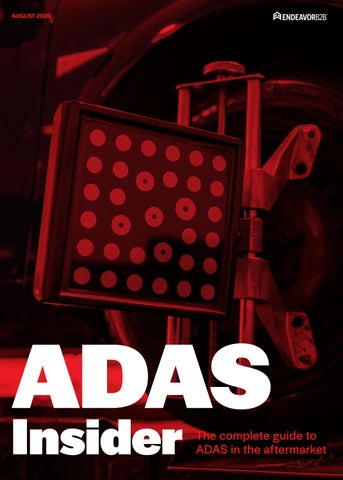
AUGUST 2026
ADAS Insider
The complete guide to ADAS in the aftermarket
ADAS_Template_Mechanical.indd 1
7/23/26 4:41 PM
INTRODUCTION
TABLE OF CONTENTS Introduction..........................................2
What Is ADAS and Why Your Shop Can't Ignore It Anymore Why ADAS calibration is necessary for most vehicles in operation, when it’s needed, and why you need to have a service strategy. BY ROB DEARMOND
Customer Education.........................4
Train Your Team to Sell ADAS Recalibration Educating your team on presenting ADAS calibration to customers in a way customers understand. BY KACEY FREDERICK
Liability & Documentation..............8
On ADAS Calibration: No Room for Chances Why key-to-key documentation is your best legal strategy when performing ADAS calibrations—and how to do it. BY PAUL HUGHES
Sidebar..................................................9 ADAS Documentation—Write it down, take pictures, share your work.
Training & Resources......................12
Where to Learn ADAS (And Where to Skip) From accredited programs to peer networks, here's how independent shops are keeping their technicians ahead of a technology that won't sit still. BY ROB DEARMOND
ROI & Business Planning...............14
Reframing ROI: Why ADAS Adoption Can't Wait A look at the cost of entry and the business case for bringing ADAS calibrations in-house. BY GRIFFIN MATIS Cover photo: Hispanolistic / E+ / Getty Images
2
/
What Is ADAS and Why Your Shop Can’t Ignore It Anymore
From calibration basics to liability risks, here’s what independent shops need to understand about the technology reshaping every repair bay BY ROB DEARMOND
Tom Palermo says there’s no getting around it. Advanced driver assistance systems, or ADAS, are here to stay, and the way things are moving, there’s more to come. “I don’t see how a shop can get away from doing some work in some way, shape, or form with ADAS,” says Palermo, one of the owners of Preferred Automotive Specialists in Philadelphia, Pennsylvania. “If they can do it now, they’re not going to be able to do it much longer because these cars, all these systems are all starting to work together. There’s just no way around it.” ADAS uses software, sensors, cameras, and radar to improve driver safety and reduce driver error.
Why Is ADAS on Nearly Every New Vehicle?
The primary reason ADAS has become a standard feature on new cars is safety, with Palermo saying it touches almost every aspect of a vehicle, including collision avoidance, lane detection, and blind spot detection “at a minimum.” He says ADAS started with things like backup sensors and rearview cameras but has evolved to include self-parking, collision avoidance, adaptive cruise, blind spot detection, and in some cases, semi-autonomous driving. “All of those items … they all just kind of blossomed as the technology and vehi-
cles really exploded over the last, I’d say probably 10 to 15 years, to the point now where just about every new car that’s purchased has some form of assisted driving capability,” Palermo says.
When Is ADAS Calibration Needed?
Palermo says any time things like alignments, suspension work, and windshield replacement are done, it changes the vehicle’s geometry, which requires ADAS calibration. “Even though you may not be modifying the parts, you’re changing them back to closer to what they were when they were new, so you have to calibrate that vehicle to those changes, and it could be minute, but it may not even be something perceptible to the average driver, whereas before, you changed something and maybe the car still feels the same when you drive it,” he says. “The difference is with this you have all these sensors on the car … and to those particular components, a few millimeters in the wrong direction can mean a lot when you’re driving down the road.” He says ADAS calibration may also be needed for repairs that don’t directly involve ADAS sensors, pointing to condenser work as an example. “If you move one of those ADAS parts to get to something and you put it back
ADAS Insider
ADAS_Template_Mechanical.indd 2
7/23/26 4:41 PM
ASphotowed / iStock / Getty Images Plus
on, you have to do a calibration,” Palermo says. “There is no option because you’ve disturbed it from where it was calibrated.”
Do I Need an ADAS Strategy?
Of those who responded to a recent EndeavorB2B’s ADAS Knowledge and Capabilities survey, 61% said their shops don’t have a systematic process to identify vehicles requiring ADAS calibration during intake and service planning, and 38% said their shops had a knowledge gap in understanding the liability and legal implications of ADAS. Twenty-five percent said they’re avoiding ADAS services because of liability concerns. Palermo says it’s essential for shops to have a strategy when it comes to working with ADAS systems. “There’s a liability to this, where if you’re going to be working with ADAS, you have to make sure that you know what you’re doing, and if you don’t have the equipment to calibrate it, you want to make sure you find somebody that does to do it,” Palermo says. “You don’t just want to send the car off into the wild without calibrating it. If you send that car out and something happens to it and you’re the last one who put your hands on it, there could be some liability there, obviously, so that’s critical from a business perspective.”
Are Shops Ready for ADAS? The ADAS Knowledge and Capabilities
August 2026
ADAS_Template_Mechanical.indd 3
Survey showed 39% of shops don’t offer ADAS-related services but are considering it, while 49% don’t have a business plan for ADAS service expansion. Palermo says shops that don’t offer ADAS need to find the right partners to handle the work. “There’s nothing wrong with subletting a calibration to somebody as long as they are qualified, certified, and they’re going to give you a good product for when you hand the keys back to your customer,” he says. Of those who responded to the survey, 47% said their shops had not pursued formal ADAS training, but Palermo says manufacturers of ADAS calibration equipment offer many training options for shops. There are other options for training as well, including ASE certification programs, online courses, and webinars. “It also kind of comes back to the shop has to make sure that their data is right and that they’re able to give the technicians the ability to access the information they need to do the calibrations,” he says. “That comes down to how the shop is run. Access to information is a huge part of what we do.” Only 7% of respondents strongly agreed that their shops have a clear strategy for educating customers on price increases involving ADAS calibration and related services, something Palermo says his shop wants to get ahead of. He says certifications, along with digital vehicle
inspections and pre- and post-scans, help build trust with customers. “Because of the nature of the cost associated with auto repair now and the additional necessity for calibrations at times, it kind of forces us into having that conversation because we have to justify, ‘Hey, we’re going to charge X number of dollars for a recalibration,’” Palermo says.
What’s Next?
Palermo says ADAS technology will continue to progress. “I think you’ll see it start to take more and more control of the driving experience, if you will, which some people might like, some people might not,” Palermo says. Palermo says he expects to see more autonomous driving capabilities in the future, noting he got a glimpse of Waymo’s self-driving technology in action during a recent trip to Atlanta. “It’s kind of weird when you pull up to a light, and you look next to you, and there’s nobody in the driver’s seat, and the thing takes off from the light,” he says. “I mean, listen, the technology’s there, and there were some struggles I’m sure in the beginning, but they seem to be perfecting it, and I think eventually, in the next, I don’t know, probably 10 years, you might be able to hit a button on your car and say, ‘Hey, you know what, I don’t feel like driving. You take care of it.’”
3
7/23/26 4:41 PM
CUSTOMER EDUCATION
Train Your Team to Sell ADAS Recalibration Educating your team on presenting ADAS calibration to customers in a way customers understand BY KACEY FREDERICK
Advanced driver assistance systems, or ADAS, are appearing on more new vehicles every year, making today’s cars more capable but also more complex to repair. The sensors and cameras involved with ADAS often mean more work, which can confuse customers who are already navigating a stressful repair. Ensuring those drivers get the ADAS recalibration they need can mean a balancing act between overwhelming them and not communicating at all. Tom Schearer, president of Schearer’s Sales & Service and coach at ShiftPoint Training Academy, is a 2024 Ratchet+Wrench All-Star Award winner with extensive experience navigating this exact issue. He helps break down the strategies used successfully across the myriad shops he’s worked with.
Helping the Customer Understand
ADAS and its functions are usually tied to important safety features, such as distance sensors, adaptive cruise control, and lane departure systems. Factory/ OE repair information often specifies the need for ADAS recalibration after certain repairs, and insurance companies can require it for a repair to be considered complete on jobs like windshield or bumper replacements. “If the insurance is requiring it, that’s telling us that this is valid, and this is real, and that we have a liability to make sure that we’re doing a repair right,” explains Schearer. “If we’re not doing a proper calibration, there’s a good chance that’s not going to function right—and we just can’t put our name on that.” While shops may understand the importance of ADAS, not every customer will, and some may even view it as
4
/
optional, or an upsell. With 58% of shops sharing that they are not currently educating customers on ADAS, it’s unsurprising that many drivers simply aren’t aware of how crucial it is to calibrate those systems. That knowledge gap can lead to objections over ADAS recalibration. But when you take the time to understand a customer’s concerns and discuss it with them, it’s often the most impactful method to make the sale on a recalibration job. “We absolutely get objections from our clients,” shares Schearer. “Most of it comes from not understanding. Typically, when we are able to go through and properly educate, they’re on the same page with us.” Shops should avoid overwhelming a customer with a barrage of information. That can make them feel more confused. Finding that balance between informing and overwhelming customers is crucial to keeping them on the same page. “Quite honestly, when we first got started, we just made it such a big deal, and it overwhelmed our clients,” says Schearer. “It was almost like we would just scare our customers.” So, how do you communicate the importance of ADAS calibration without inducing anxiety? Schearer and his team changed their strategy by minimizing the emphasis on ADAS. If a repair job requires any recalibration—such as a control arm replacement or an alignment that requires ADAS recalibration—the shop includes the necessary recalibration in the estimate and presents it to the customer alongside everything else, with a brief explanation. If a customer has questions about what it is or why it’s needed, that’s when you
can step back and have that discussion with them. “If the customer has questions, and they’re not understanding, then we kind of step back and go into more of an education mode,” tells Schearer. “We kind of stopped really focusing on so heavily on the education upfront, because we found it overwhelms them.” Additionally, there are subtle ways to help customers become aware of ADAS and what it does. Having literature in your shop, such as a brochure about ADAS, is a great way to give clients access to that information without dumping it on them.
Equipping Your Staff to Educate
Educating the customer can only be possible if your staff is equipped to do so—but just 27% of front-counter staff feel comfortable explaining ADAS. While those working the front counter aren’t expected to have the same skill set as a technician on the shop floor, they need to understand the fundamentals of ADAS and be able to discuss them with a customer. Training your staff can involve teaching them to look for indicators that ADAS is present on the dash, and covering the basics of adaptive cruise control, lane departure systems, and how distance sensors work. Schearer likes to keep it simple for general staff, avoiding things like model-specific differences and focusing on a baseline foundation for understanding ADAS. “It’s really tough to get into the specifics of ‘Honda does this, a Chevy does this, and Audi does that,’” says Schearer. “That’s not realistic to put on our support staff, but the basic operating knowledge is what we’re focused on.”
ADAS Insider
ADAS_Template_Mechanical.indd 4
7/23/26 4:41 PM
Tom Schearer of Schearer’s Sales and Service. RW Archives / Alan Sylvestre Photography
Schearer has a procedure for staff to identify vehicles that may need ADAS upon intake. They’re taught to look for things like sensors in the bumpers, cameras behind the rearview mirror, certain dash warning lights, and other visual identifiers of ADAS. Additionally, if a vehicle has adaptive cruise control, it’s usually a sign of features like lane departure, distance sensors, and advanced braking. Schearer also performs pre-scans at his shops, which identify ADAS components in vehicles before technicians begin working on them. “Every car that we work on gets a pre-scan done on it before we touch and work on the car. And within that prescan, we use a certain company and tool that alerts us whether there is an ADASrelated component or module in that car,
August 2026
ADAS_Template_Mechanical.indd 5
and that helps us to know better what that car is equipped with, and if we need to focus on any calibrations throughout the repairs we’re doing on that,” explains Schearer. Ultimately, ADAS recalibrations need to be part of your standard and accepted as an essential part of repairing the vehicle. Present it as such, and be a guide for the customer who wants to understand why it’s needed. There will always be the occasional client who decides not to pursue it, but most customers aren’t just looking for the cheapest job—they want someone they trust. “Most of the customers really do want to do the right thing. They want to know, they want to understand, so they need somebody to help guide them through the process, and to be an advocate for them,” says Schearer.
Every car that we work on gets a pre-scan done on it before we touch and work on the car.” —Tom Schearer, president of Schearer’s Sales & Service
5
7/23/26 4:41 PM
ADAS_Template_Mechanical.indd 6
7/23/26 4:41 PM
ADAS_Template_Mechanical.indd 7
7/23/26 4:41 PM
LIABILITY & DOCUMENTATION
On ADAS Calibration: No Room for Chances
Why key-to-key documentation is your best legal strategy when performing ADAS calibrations—and how to do it BY PAU L H U G H ES
On ADAS calibration, Paul Foster takes no chances. The COO of Dynamic Automotive, a multi-location family of shops in Maryland, aims for an orderly practice of OEM compliance and documentation in ADAS repair and calibration. It’s a system built on recorded work by trained techs, work that customers can see, and it prevents liability. Any other way threatens customer safety and the shop itself. “Not doing (calibrations) correctly is as bad as not doing them at all,” Foster says.
Liability: The Floor
First, the danger. You can be sued. That’s for starters. In Los Angeles, California, you can also face a Bureau of Automotive Repair complaint or repeat visits from a disgruntled customer. It’s the very real risk of liabilities, plural, for shops doing ADAS work. “The BAR has a $200 million budget,”
says William Ferreira, an automotive industry attorney in Los Angeles. “The regulations here are so numerous, there’s no way I could be perfect enough with every single car that comes in.” Liability always means money, he added, “and there doesn’t even have to be an accident.” Complaints can simply allege the shop put people at risk, or that someone couldn’t use the car to get to work. Ferreira says complaints can get “ridiculous,” asking shops whether they got on the floor with a laser level to check the angle— every time, and specifically for that client. Lawyers have also been known to assert the machine itself was faulty, whether through a failure to calibrate the calibrator or a failure to update systems and software. (See sidebar, “Calibration.”) He says a business insurance policy likely covers a “negligence” standard, but not “gross negligence”—and other parties, which could include your own insurance
company, will always allege the latter. “No policy covers that.” Insurers “have a duty to defend, and plaintiffs’ attorneys want insurance involved because that’s where the money is,” he says. “But insurers will say, ‘What you did was gross negligence, so we don’t cover it.’” ADAS riders are probably available, since most insurance agents will sell coverage for nearly anything. Ferreira recommends seeking one specifically written for this purpose. But shops may still see a denial of coverage, and it won’t necessarily be legally wrong. “With any new technology, the definition of negligence is not well established,” Ferreira says.
Documentation: Your Future
This applies even if you outsource the work. Especially if you do. Ferreira says ADAS calibration outsourcing is growing as mechanical shops remain reluctant to invest in the equipment and
ADAS Calibration: Do This First, and Second, and Third, and … William Ferreira, an automotive industry attorney in California, suggests mechanical shops call someone like him before, not just during, an ADAS-related dispute. Call it an ounce of prevention and preparation. “If all my clients had called me before they started,” with ADAS, he says, he’d have been able to prepare them for what could come as the work continued. “It’s called ‘issue spotting’ (and) it’s what attorneys do.”
BEFORE AND DURING CALIBRATION
Short of that call, consider his rough checklist for what to address before and during calibrations: lighting, adequate space, and a level floor; wheels aligned, ride height, tire pressure, and all fluids at specification; a full fuel tank, a clean windshield, nothing on the dashboard, and nothing hanging from the rearview mirror. Don’t place cargo, items, or extra passengers in the vehicle. Ensure current OEM information and up-to-date manufacturer policies and procedures from your shop system, scan providers, and ADAS software,
8
/
Ferreira says, and attend factory trainings. Get factory- or manufacturer-certified on ADAS wherever it’s offered. Use OEM screens or targets for cameras, radar, reflection, heating, and so on. Dynamic calibration generally requires good weather, clear road lane markings, a flat road with few curves and moderate traffic, road conditions allowing speeds between 30 and 65 miles per hour, and fixed objects, such as rails, poles, or trees, along the roadside for the calibration to work, along with a driver and an assistant to monitor the scanning tool. A vehicle camera even slightly off means it won’t see properly several hundred feet down the road. “It’s such a minimal amount; it doesn’t take much,” says Paul Foster, COO of Dynamic Auto in Maryland. He says shops should perform both static and dynamic calibration. “Manufacturers are moving toward that.”
THE LIABILITY CONVERSATION
Sean Preston, a Massachusetts automotive attorney who works with mechanical shops through
collision repair connections, wrote in an email to Vehicle Service Pros: “Every dollar of ADAS work represents the potential for unlimited liability.” “With ADAS, I need to know how they operate, who pays them, what type of equipment they use, what level of service they’re offering, whether there are any services they’d outsource, who does the work, and how the business entity is set up, collateralized, and insured.” Preston calls these “foundational questions” that lead to issues of payment, marketing, pricing model, and shop niche. There are “different levels of liability (and) different organizations could address this in different ways.” Elements to include in a customer contract are virtually limitless, aimed at avoidable eventualities, and can easily cover a dozen best practices, or more than 50 in all. He says that’s the substance of the attorney-operator conversation: what to ask, and what to answer. “A shop really needs to think about what kind of shop they are, what kind of quality they are going to do.”
ADAS Insider
ADAS_Template_Mechanical.indd 8
7/23/26 4:41 PM
training required to do the work themselves. That doesn’t necessarily make life easier. “Now you’re responsible for them,” he says. “The onus is on the shop to make sure they do it right.” Find a partner that indemnifies its work and follows OEM policy and procedures specific to makes, models, even trim packages. “OEM requirements are mandatory,” Ferreira says. OEM calibration and compliance, along with pre- and post-scans, are foundational tasks on every vehicle. And the software records its own version of the work, right? That’s just the start. Treat documentation like a fine ribeye: It’s hard to have too much. The equipment saves information heavy on results, such as whether the ADAS component passed. But back up that record with process documentation, too: notes, personal video, screenshots, and photos covering every calibration category, including setting up targets, disconnecting and reconnecting cameras and sensors, an overview of the workspace, and every measurement taken. Foster says Dynamic Auto treats this as standard practice. “We take shots of the vehicle in the bay, the dongle in the car hooked up, targets being set up, the calibration when it’s finished, screenshots, digital video inspections,” he says. “Everything all green and good,” despite it being technically redundant. Do this for anything connected to ADAS: alignment, suspension, battery disconnects, steering rack, struts, and any parts removed, replaced, or even jostled. Cameras and sensors are sensitive. A tech might assume that if something isn’t unplugged, it doesn’t need recalibration, but it does. (See sidebar, “ADAS Documentation.”) Keep the evidence “as long as I possibly could,” Ferreira says. In California, that’s three years; your state’s requirement may vary. Calibration happens in the present. Documentation protects your future.
Habit: Customer First
Full OEM documentation, widely shared and saved longer than your kids’ handmade cards, aims for the kind of quality that speaks for itself. But don’t forget the customer in the process. “We’re not getting enough education out there,” Vahid Salalati says. It starts with OEM information: the specs and service bulletins. “Dealers and manufacturers grow education.” Salalati, who with Larry Battison opened the first of 15 planned Bosch Auto Service
August 2026
ADAS_Template_Mechanical.indd 9
franchises in Oklahoma in June, believes customers have heard about ADAS education but haven’t received all that’s needed. “Everyone wants it, but they don’t want to pay for it,” Salalati told Vehicle Service Pros. “My guess (is) maybe 10% know their sensors need to be calibrated. You need to ask, you need to tell.” Dynamic’s Foster says customers visibly recoil when ADAS calibration doubles their costs, or more. When talking with customers, focus on safety and training. Present driver assistance systems as safety systems first, convenience or novelty second, while still sharing in the customer’s fascination with the technology and accommodating their learning curve. “On modern cars, you have to be a lifelong learner, or it’ll pass you by,” says Matt Shepanek, vice president of credential testing programs at the National Institute for Automotive Service Excellence. He was performing ADAS calibrations 25 years ago and never really stopped. Consider a technician like Victor Avila, an ASE World-Class Technician certified in 22 specialty areas. Get certified on ADAS. The organization offers two downloadable study guides on ADAS for vehicles overall and is developing a third for window replacement. I-CAR offers training as well, and MEMA and SEMA are active in ADAS-related work. The Insurance Institute for Highway Safety is involved too, since safety is what driver assistance systems are designed to do. Poorly trained users also create liability, Ferreira adds. ADAS calibration-equipment makers offer product training online and onsite. Integrating ADAS into routine maintenance also helps shops defend themselves in future disputes by showing a consistent record of doing the work correctly. Foster looks to all these resources, including factory training. “We want ASE certification, we want I-CAR.” Dynamic Auto techs trained for ADAS calibration “have demonstrated attention to detail and the capacity to learn.” Build trust, connections, and relationships with customers and your team. Cultivate a culture that prevents issues, guards against liability, and makes ADAS compliance and documentation part of who your shop is, not just what it does. It’s only going to get bigger. “ADAS was an investment in the future,” Salalati says of his and Battison’s Bosch plans. “It’s limited for our use now, but it’s going to grow.”
ADAS Documentation: Write It Down, Take Pictures, Share Your Work Automotive industry attorney William Ferreira has a simple philosophy: show your ADAS work so you don’t have to explain it later. You follow OEM requirements and save your work. You take your own videos, photos, screenshots, and the like. Now, here’s something you might miss: Keep PDFs of the actual requirements themselves. These are always changing, as software updates make clear. But if you complete a repair in August 2026 and what counts as compliance expands after that, you’ll want proof in 2029 that you did the work correctly for the standards in place on the day you did it.
DOCUMENT THE DETAILS
Ferreira points to photos of everything: ride height measurements, OEM wheels and tires aligned, even an empty car. Video of the work being done, shot from multiple angles. Paper printouts, backed up on servers and easily accessible. Every few months, document the work area: LED, shadow-free lighting with no natural light; white, light grey, or beige walls, clear of hot rod posters, calendars, or reflective plastic or glass; and confirmation that a software update has been completed. Check tools and equipment, too, and document this “macro” overview work alongside everything else. “Create a checklist, every so often fill it out, keep it on file. The checklist will grow (and) evolve over time,” he adds. Now the finer details: Document fuel level as “full” and air pressure per manufacturer recommendation, both standard requirements. Remove children’s car seats, boxes, racks, accessories, and other items from the vehicle. This can start to feel like an unrealistic level of demand, Ferreira says, but regular, written documentation can help a shop survive a review.
OEM PROCEDURES RUN THE SHOW
OEM procedures are the baseline, and shops need to be able to show they followed them. “They run the show,” Paul Foster, COO of Dynamic Auto in Maryland, says, adding that specs vary by vehicle, so documentation has to be keyed to each one individually. “Every manufacturer has their own nuance of how they want to do things.”
WHAT CUSTOMERS SHOULD RECEIVE
Customers get copies of everything, Ferreira says: the invoice, the OEM requirements, and the ADAS system results. They also sign an acknowledgment, with disclaimers, confirming that the work was done to OEM standards, that all targets were met, that anything done to the vehicle after the repair can affect performance, and that they’re welcome to bring the car back with any concerns. Together, this documentation shows that the vehicle has ADAS, that it was calibrated, that the customer is now responsible for it, and that the shop stands behind its work. “There is an endless way of ‘proving’ compliance,” Ferreira wrote in an email. “Much of the time my job is to anticipate litigation and be over-protective.”
9
7/23/26 4:41 PM
ADAS_Template_Mechanical.indd 10
7/23/26 4:41 PM
ADVERTORIAL | Hunter Engineering Company
SPACE, LIABILITY & LEARNING CURVE: THE THREE MYTHS HOLDING SHOPS BACK
A
uto repair shop owners on the fence about integrating ADAS into their shop’s workflow can often find themselves at the mercy of common misconceptions: that it takes too much space, that it exposes them to too much liability, and that the learning curve is too steep for their technicians. Ken Sumerlin, owner of Precision ADAS Services in Bend, Oregon, uses Hunter’s Ultimate ADAS ® system daily and wants to encourage shop owners that these myths are unfounded.
Space Requirements Aren’t What Shops Think
A common industry myth surrounds ADAS spacing requirements. Shop owners assume they need a dedicated 30’ by 50’ bay with a level floor, and adequate space cushioning all sides. While nice to have, it’s not required for most forward-facing calibrations; these only require clearance
in front of the vehicle, and roughly 95% of vehicles in operation need only about 10 feet. “We need the proper environment, but it’s nowhere near as daunting as most of us thought in the beginning,” Sumerlin said. In many cases, ADAS calibration work fits neatly inside an existing alignment bay, since forward-facing systems depend on depth, not width. “You need depth. You don’t necessarily need width,” he said. Width only matters for surround-view or blind-spot systems. Uneven floors aren’t a barrier either, since the Ultimate ADAS ® uses advanced gimbals to measure the floor plane and adjust automatically, “so we don’t have to have the perfection of a perfectly flat shop floor.”
and lawsuits. Hunter’s connected system, HunterNet ® 2, links a shop’s alignment equipment, scan tool, and Ultimate ADAS ® system to a central server, so records save automatically in the cloud. That matters most on procedures that don’t involve the scan tool at all, such as Toyota surround-view cameras, many park-assist systems, or Honda blind-spot checks. The Ultimate ADAS ® produces its own validation report any time it’s used for target placement, simplifying the job of the technician. Sumerlin also photographs the vehicle’s license plate at intake as an added safeguard for his shop. “I’d rather give the insurance (and) the customer more information, more documentation than less,” he said.
Liability Runs Both Ways
The Learning Curve Is Shorter Than It Looks
Airtight documentation during the ADAS calibration process is a shop’s best protection against customer accusations
The learning curve, meanwhile, is less of a curve and more a straight line on Ultimate ADAS ®. Guided, on-screen instructions won’t let the technician advance a job until the system verifies that you’ve completed the current step correctly. “The Ultimate ADAS ® takes care of all of that for you,” Sumerlin said. He was skeptical of ADAS himself when it first entered the industry. “I kind of wanted nothing to do with it. It was just something else that was disruptive to the repair field,” he said. Now calibration is his shop’s bread and butter. His advice for shop owners: get hands-on with the equipment before deciding, through free training or an in-person class. “It’s not as hard as it seems,” he said. Through Hunter University, the company’s learning management system, technicians and owners can access tutorials and get certified right through the system to become proficient in calibration and become the next to bust the common myths surrounding ADAS.
Photo courtesy of Hunter Engineering Company
August 2026
ADAS_Template_Mechanical.indd 11
11
7/23/26 4:41 PM
TRAINING & RESOURCES
Where to Learn ADAS (And Where to Skip): The Shop Owner’s Training Guide From accredited programs to peer networks, here’s how independent shops are keeping their technicians ahead of a technology that won’t sit still BY ROB DEARMOND
When it comes to ADAS training, Matt Shepanek and Andy Tirado agree that learning can never stop. “It’s kind of one of those things; it’s like if you step away from it for a little bit, it’s going to pass you by because it’s moving at such a rapid pace,” says Shepanek, who is vice president of credential testing programs at ASE and president of the ASE Training Managers Council. Tirado, a co-founder of the ADAS Network, says there’s no way to cover everything under the ADAS umbrella in a single training. “That’s the biggest challenge with ADAS training,” Tirado says. “There really is no way to cover it all. It has to be continuous.”
Where Can a Shop Get Training?
Tirado and Shepanek say there are several ways shop owners and technicians can get ADAS training. Tirado pointed to Keith Perkins from L1 Auto Training, the Autel Training Academy, Advanced Auto Parts through Carquest Technical Institute, Bosch, and Kaizen Glass Solutions as some options. Shepanek recommends checking out atmc.org, which features a list of accredited training providers, as well as the MEMA Tech Training Hub, but also says there’s no substitute for hands-on training. “We get that feedback all the time on our ATMC Training Benchmark survey,”
12
/
Shepanek says. “The techs love that there are more options to do training virtually and remotely, but what they come back and say (is) … we want more instructor-led training, because that’s where the techs really learn, and they want more time out in the shop.” Inevitably, something will pop up that wasn’t covered in training, with Shepanek saying environmental conditions and lighting can be things that are different back at the shop. In EndeavorB2B’s ADAS Knowledge and Capabilities Survey, 43% of respondents said real-world troubleshooting guidance when calibrations fail is something that would be most valuable to their shops. That’s where a resource like the ADAS Network comes in. Tirado says members can ask questions and get instant support through a forum, as well as a global search. “If you type up a brand, year, make, model, problem, it will automatically show you how many areas (are) in the site, if there’s a video, tech tips or there’s a forum solution, it will take you straight there, and instead of just getting the silver bullet at the very end, you see the full process, or you see what that person went through … what there problem was and what were the steps taken … to achieve the solution,” Tirado says. “We don’t consider ourselves training,” Tirado continues. “We consider ourselves continuous education.”
Shepanek also says when going through training, professional networking can be key, and he encourages those who take classes together to exchange contact information. “I always tell technicians to take advantage of that,” Shepanek says. “Every time you’re in a training class, get to know people, network, because you never know where that’s going to come in handy.”
How Important Is ADAS Training?
Shepanek and Tirado agree ADAS training is critical, particularly when it comes to looking out for the safety of drivers and their families. The survey showed 20% strongly agreed their technicians fully understand the importance of following manufacturer calibration processes exactly as specified, while 20% had no understanding of the liability implications of performing ADAS calibration and diagnostics. “If something’s not calibrated correctly, it puts the customers and the drivers of these vehicles in danger because they’re relying on these things as safety systems on the vehicle, so whenever it’s been in an accident or if you’re removing a bumper, you want make sure that you recalibrate it and put it all back to the way it was supposed to be,” Shepanek says. The survey showed 38% of respondents
ADAS Insider
ADAS_Template_Mechanical.indd 12
7/23/26 4:41 PM
Nikolay Tsuguliev / iStock / Getty Images
cited a gap in knowledge in understanding liability and legal implications with ADAS, while 61% have no systematic process in place to identify vehicles requiring ADAS calibration during intake and service planning. Tirado also says it’s important for shop owners to understand how ADAS impacts their businesses, noting processes, communication, and documentation are essential. “ADAS is very interconnected,” Tirado says. “It’s intrusive. There’s sensor integration throughout other modules. If you don’t do something right, you can get into trouble. We need a better understanding and concept of what’s all happening.” “Understanding what’s connected and how it all works is essential before you take the legally binding commitment with a vehicle, where it ends up costing the shop more money or can create a possible safety hazard on the road,” he continues. Another piece of the puzzle is consumer education when it comes to cost regarding ADAS services. The survey showed 46% of respondents are unclear on a pricing strategy for ADAS services, and only 7% strongly agreed their shop has a strategy for educating customers about price increases related to ADAS calibration on alignments and other routine maintenance. “The knowledge base really is one of the biggest needs when it comes
August 2026
ADAS_Template_Mechanical.indd 13
to the ADAS space,” Tirado says. “The other thing that I would say that’s much harder to accomplish, I think we need very strong consumer education to let the customers understand what ADAS is, how it works, why their alignment went from $70 to $400.”
Can Shops Skip ADAS Training?
With ADAS systems now prevalent on most vehicles, Shepanek and Tirado agree that skipping training isn’t really an option. Shepanek says ASE has an L4 test that covers calibrations and diagnosis for ADAS and is in the process of working on another ADAS test geared toward technicians who deal with a vehicle’s front glass and calibrations. “In order to be a technician in this industry, you need to be a lifelong learner,” Shepanek says. “You need to stay on top of this stuff because the cars are getting so complicated and they’re changing so rapidly. When I first came into the industry, you would get a new model out, and you knew that the electrical systems and the powertrains were going to be relatively stable for a 7-year period, 8-year period. That’s not the case anymore.” “The technology’s moving at such a rapid pace, if you’re not staying current on this stuff, it’s going to pass you by, and then you’re going to have to catch up,” Shepanek says.
The knowledge base really is one of the biggest needs when it comes to the ADAS space.” —Andy Tirado, co-founder of the ADAS Network
13
7/23/26 4:41 PM
ROI & BUSINESS PLANNING
Reframing ROI: Why ADAS Adoption Can’t Wait ADAS calibration is shifting from a nice-to-have to a make-or-break business decision BY G R I F F I N M AT I S
The era of “gravy money” from early ADAS adoption is closing. If you aren’t planning to bring calibrations in-house or formalize your sublet strategy right now, your shop may be running out of time. Between facility updates and equipment costs, auto repair shop owners report that ADAS presents a high barrier for entry, with 49% of owners surveyed for the ADAS Knowledge and Capabilities Survey saying that they have no plans for adding ADAS calibrations to their offerings. Sixty-one percent of owners cite equipment costs as an issue, and 73% say they’ll only add ADAS service if and when the volume justifies it. The issue is that viewing ADAS service solely as a numbers issue is a risk not only to the shop, but to every vehicle that comes through it. As the saying goes, the best time to plant a tree is a hundred years ago, but the second-best time to plant one is right now.
It Isn’t Optional
Keith Perkins, trainer and owner of L1 Automotive Training, says that far too many shop owners are viewing the subject of ADAS calibrations incorrectly. Expecting the equipment to pay off immediately, especially if you’re only just now investing, isn’t going to work out. “I think the part that gets missed every time is if a shop owner was to really stop and think, ‘Well, when does my business insurance pay for itself?’ That’s where ADAS gets looked at as an optional function. Unfortunately, if any shop is thinking that ADAS is something they don’t have to get into, they’re wrong,” Perkins says. “They will be liable at some point in time,
14
/
and most likely just go out of business for not properly repairing vehicles.” Sending a vehicle back on the road without proper calibrations is the same as sending it out with only a handful of lug nuts tightened. From radiator work to brake jobs to simple headlight changes, ADAS is affected by countless factors and components. It simply can’t be ignored. “ADAS isn’t just a thing; it’s the whole system of the vehicle,” Perkins says. “So, when does it pay for itself? The very first time that you use it, you’ve immediately removed the liability of not doing the job properly.”
Taking the First Steps
There are two approaches a shop owner can take to get started: buying piecemeal or buying an all-in-one system. The former requires researching your average vehicle mix and parts orders, which can be accomplished by partnering with your parts distributor or shop management software provider. “Get your mix of (most commonly worked on) vehicles and determine what kind of targets are required for those vehicles. Look up a service procedure; find a calibration for the replacement of a windshield. If you do a lot of windshields, you’ve got to look at cameras. “The other option is to jump in feet first and just buy an all-in-one system. Sometimes you can buy the manufacturer’s individual target for that brand of car way cheaper than you can buy a whole kit. If you determine there are only a couple of models you deal with, it might be way more cost-effective to buy the OEM tooling and target system, which is not always better quality than the aftermarket stuff.”
Dynamic calibrations, which are performed on the road and required for domestically manufactured vehicles, may already be within a shop’s grasp. “If they were to invest in some training and research, they’d find that they probably already have everything to do almost all the dynamics,” Perkins says. “Depending upon their mix of vehicles, they may need a substantially smaller investment—$10,000 or less—to add static targets to that based on what they are seeing.” Perkins points to tools like the TopDon ADAS Radar 3-in-1 Calibration Tools, which have a low price point and targets for most radars on the market, as straightforward options for owners. Static calibrations, which are performed in the shop while the vehicle is stopped and level, can seem expensive and unapproachable due to their facility requirements, but between dealerships, mobile shops, and other subletting options, the work simply can’t fall between the cracks. “At the end of the day for a shop owner, it’s all going to come down to money, when unfortunately that can’t be the case,” Perkins says. “They either need to determine, ‘My building is appropriate for calibrations and we’re going to do them in-house,’ or ‘My building is not appropriate and we are going to sublet every one of them because we know it has to be done properly.’”
The Clock Is Running Out Perkins urges owners to view ADAS equipment in the same way that they view R-1234yf machines: an expensive
ADAS Insider
ADAS_Template_Mechanical.indd 14
7/23/26 4:41 PM
Photo: RW Archives / Corey Miller Photography
initial investment that will quickly become a critical piece of equipment for nearly every single vehicle that comes through the shop. While it may be easy to neglect it at first and avoid the costs, it will soon become clear that turning away work is damaging the bottom line. ADAS calibrations are an even more serious issue. With A/C work, the customer knows immediately if the system is broken. With ADAS, miscalibration is an invisible danger. The car drives away with no warning lights, but a malfunctioning safety system. “In the beginning, when I jumped on board early and made tens of thousands of dollars of investment in it, it quickly paid off for me,” Perkins explains. “But now that people have dragged their feet, it’s dried up and become something where every small mobile company bought the equipment and made all the ‘gravy’ money off it. Now everyone’s fighting for scraps on that.” While the time for easy profit may have passed, shops need to seize the moment to secure future revenue, protect the shop from liability, and reduce the amount of money lost to subletting.
August 2026
ADAS_Template_Mechanical.indd 15
“They’ve put themselves in a position where they have to get it, but soon they’ll be mandated by law to buy the equipment, and there will already be everyone else who has their equipment paid off and has lowered their prices to be competitive because of insurance,” Perkins explains. Making matters worse is the fact that customers don’t always make their decisions based on what would be the safest or most appropriate option for their situation. The longer a shop delays modernization, the worse the competition is going to get. “The problem is we can’t change the public’s perception of our industry enough to get people to stop going to the shops that intentionally don’t care,” Perkins says. “So, the good shops will be fighting the guy down the road who says he’ll do the alignment for $79 and claims that ADAS stuff doesn’t need to be done. No matter how much information you give to the public, if the guy down the road says he can do it for less and says it’s just as good, they’ll trust that person over the person trying to charge them more. Until we turn that around for the public, it’ll be an uphill battle.”
ADAS isn’t just a thing; it’s the whole system of the vehicle.” —Keith Perkins, trainer and owner of L1 Automotive Training
15
7/23/26 4:41 PM
YOUR TOOLBOX JUST GOT AN UPGRADE. We’ve consolidated our individual channels into one authoritative platform — the Vehicle Service & Repair Video Network. Get reviews for the latest tools, master complex repairs, hear interviews from automotive experts and more — all on one channel.
SUBSCRIBE HERE
youtube.com/@VehicleServiceandRepair
VSP-7514_PrintAds_YT.indd 1 ADAS_Template_Mechanical.indd 16
12/12/25 9:28 AM 7/23/26 4:41 PM