• Pause and Monitor Tool (found in the Implementation Guide)
• Personal whiteboard
• Student Pages
• Practice Pages
• Practice Helpers
Suggested Preparation
• Print copies of the Progress Check Tool and the Pause and Monitor Tool.
• Print copies of Student Pages as needed.
• Place copies of Student Pages in whiteboards for Objectives 1, 2, and 3.
• Print copies of the Practice Pages and the corresponding Practice Helpers.
• Ready the following materials:
•
• Personal whiteboard Application Word Problem Cards
• Eureka Math2 cards or a standard deck of playing cards
Solve a Problem Recording Page (optional) Whole Number Divided by a Unit Fraction Game Board Unit Fraction Divided by a Whole Number Game Board Game Instruction Card
Solve a Task Student Page Highlighters (optional)
• •
- Application Word Problem Cards
- Whole Number Divided by a Unit Fraction Game Board
- Unit Fraction Divided by a Whole Number Game Board
- Eureka Math2 cards or a standard deck of playing cards
- Game Instruction Card Print copies of:
- Solve a Problem Recording Page (optional)
- Solve a Task Student Page Gather optional tools such as highlighters.
Concept Guide | Divide with Unit Fractions and Whole Numbers
Addressing Student Misconceptions
Student Misconception
When dividing whole numbers by unit fractions to find the size of the group, students do not interpret the fractional factor as the number of groups and the whole-number factor as the size of the group.
How to Address Misconception
Present a problem with context to support student thinking.
Oka picks apples. She puts 8 apples into a basket. This is 1 2 of the apples Oka picks. How many apples does Oka pick?
Invite students to draw and label a tape diagram and a number line to represent the problem.
Use the following questions to help students interpret the fractional factor as the number of groups and the whole number as the size of the group.
• What fraction of the apples Oka picks is 8 apples?
• To represent all the apples Oka picks, how many more parts do we need to draw?
• What is the unknown in the problem?
• What expression represents the known information in the problem?
Language Support
To support multilingual learners in making cross-linguistic connections through oral discourse, consider using strategic, flexible grouping.
• Pair students who have different levels of mathematical proficiency.
• Pair students who have different levels of English language proficiency.
• Join pairs to form small groups of four.
As applicable, complement any of these groupings by pairing students who speak the same home language. Encourage students to use their home language alongside English to make sense of the directions and the mathematics.
To support multilingual learners in making cross-linguistic connections through written discourse, consider creating cross-linguistic connections anchor charts. The chart should include
• key terminology in the students’ home language that is related to the current concept,
• the same key terminology in English, and
• images to support understanding.
Family Math |
Divide with Unit Fractions and Whole Numbers
Dear Family,
Your student is working on dividing with unit fractions and whole numbers. They draw a tape diagram and a number line to divide whole numbers by unit fractions to find the number of groups and the size of each group. They also draw a tape diagram and a number line to divide unit fractions by whole numbers. You can support your student’s progress by asking the questions in the table below as your student divides with unit fractions and whole numbers.
7 is 1 3 of what number? 21
7 ÷ 1 = 3 21
Where do you see the total in your model? Where do you see the size of each group? The number of groups?
The size of the group is unknown. 1 3 represents the number of groups. The total is 7. I see 3 groups of 7
What multiplication expression can help you find the unknown?
I can use the expression 3 × 7 to find the unknown because I see the tape diagram has 3 units and each unit has a value of 7
I can also think about the problem as 7 is 1 3 of what number and use the multiplication equation
7 = 1 3 × 21.
How can you write a division equation with the size of the group as the quotient that represents the problem?
7 ÷ 1 3 = 21
The number of groups is 1 3 and the size of the group is 21. The total is 7
Matemáticas en familia |
Dividir con fracciones unitarias y números enteros
Estimada familia:
Su estudiante está trabajando en dividir con fracciones unitarias y números enteros. Dibuja un diagrama de tira y una recta numérica para dividir números enteros entre fracciones unitarias para hallar el número de grupos y el tamaño de cada grupo. También dibuja un diagrama de tira y una recta numérica para dividir fracciones unitarias entre números enteros. Usted puede apoyar su progreso haciéndole las preguntas de la siguiente tabla mientras su estudiante divide con fracciones unitarias y números enteros.
¿7 es 1 3 de qué número? 21
7 ÷ 1 3 = 21
¿En qué parte de tu modelo ves el número desconocido? ¿Dónde ves el tamaño de cada grupo? ¿El número de grupos?
El tamaño del grupo es un número desconocido. 1 3 representa el número de grupos. El total es 7. Veo 3 grupos de 7.
¿Qué expresión de multiplicación puede ayudarte a hallar el número desconocido?
Puedo usar la expresión 3 × 7 para hallar el número desconocido porque veo que el diagrama de tira tiene 3 unidades y cada unidad tiene un valor de 7
También puedo pensar en el problema como que 7 es 1 3 de qué número y usar la ecuación de multiplicación 7 = 1 3 × 21.
¿Cómo puedes escribir una ecuación de división que represente el problema en la que el tamaño del grupo sea el cociente?
7 ÷ 1 3 = 21
El número de grupos es 1 3 y el tamaño del grupo es 21. El total es 7.
Concept Mini Lessons
Progression of Mini Lesson Objectives
1 Divide whole numbers by unit fractions to find the number of groups.
Start here if students
•
•
•
• can multiply whole numbers by unit fractions, can divide whole numbers, and can model division by using tape diagrams and number lines, but need support using tape diagrams and number lines to divide whole numbers by unit fractions when the quotient is the number of groups.
Divide with Unit Fractions and Whole Numbers
2 Divide whole numbers by unit fractions to find the size of the group.
Start here if students
• can use tape diagrams and number lines to divide whole numbers by unit fractions when the quotient is the number of groups, but
• need support using tape diagrams and number lines to divide whole numbers by unit fractions when the quotient is the size of the group.
3 Divide unit fractions by whole numbers.
Start here if students
• can divide whole numbers by unit fractions, but
• need support dividing unit fractions by whole numbers.
Objective 1 |
Divide whole numbers by unit fractions to find the number of groups.
10 MINUTES
Summary
Students use a number line and a tape diagram to divide a nonzero whole number by a unit fraction.
Direct students to the number line and tape diagram in problem 1 on the Student Page.
Materials
Personal whiteboard
Objective 1 Student Page
Partition the tape diagram between 0 and 1 into 2 equal parts by using dotted lines while students do the same.
The tape diagram is equivalent to the distance on the number line from 0 to 3, so it shows a total of 3.
Write the following question: How many halves are in 3?
Before we find how many halves are in 3, let’s begin by finding how many halves are in 1. Then we can use the number of halves in 1 to help us find the number of halves in 3.
Direct students to partition the number line into 3 intervals, locate and label 1 on the number line, and then partition the tape diagram in the same locations.
H H HWhat can we do to show how many halves are in 1 on the tape diagram?
We can partition the section of the tape diagram between 0 and 1 into 2 equal parts.
How many halves are in 1?
2 halves are in 1
Let’s continue partitioning to show how many halves are in 3.
Partition the tape diagram between 1 and 2 into 2 equal parts by using dotted lines while students do the same. Repeat to partition between 2 and 3. Gesture to each of the 6 parts one at a time.
How many halves are in 3?
Our tape diagram shows there are 6 halves in 3. We can also think of 1 2 as the size of each group. Let’s label and count on the number line to see how many groups of size 1 2 make 3.
Partition the number line to match the partitions in the tape diagram as students do the same. Starting with 0 2 , label the number line as you count along with students.
Objective 1 | Divide whole numbers by unit fractions to find the number of groups.
10 MINUTES
How many groups of 1 2 make 3? How do you know?
6 groups of 1 2 make 3. We know because we started at 0 2 and counted up to 6 2 , or 3.
Our number line shows that 6 groups of 1 2 make 3. When we divide 3 into halves, there are 6 halves. Let’s write a division equation to represent the tape diagram and the number line. What division equation shows that when we divide 3 into halves, there are 6 halves?
3 ÷ 1 = 2 6
Gesture to the dividend, divisor, and quotient as you say the following.
HHThe total, or dividend, is 3. We divided into groups of 1 2 , so the divisor is 1 2 . There are 6 groups, so the quotient is 6. I ask myself if it makes sense that the quotient is greater than 3. I think halves are smaller units than ones, so it does make sense that there are more halves in 3 than there are ones in 3. There are 2 halves in 1, so there are 3 times as many halves in 3 as there are in 1.
Invite students to turn and talk about how they see the number of halves in 3 in the tape diagram and on the number line.
Teacher Tip
Pairing the number line and the tape diagram supports using both unit language and fraction form to interpret the quantities. Students may begin to find one model more helpful to them than the other. Allow students to transition to drawing one model to represent the situation.
Repeat the process: Use the following problems during Concept Mini Lessons or at another time to provide additional practice as needed.
Consider providing the Objective 1 Practice Helper and supporting students in using the worked-out example to guide their own work.
Analyze Student Progress
Monitor:
• Does the student partition the number line and tape diagram into the correct number of whole-number intervals and equal parts?
•
How does the student label the number line?
• Questions to Advance Student Thinking:
Does the student identify the total, the size of each group, and the number of groups?
• How can you use the number line and tape diagram to find the number of equal parts?
•
How can you count to help you label the number line?
• Plan Future Practice:
Where do you see the total in your model? The size of each group?
The number of groups?
Use Practice Page 1 to support students who need additional practice. Structure the additional practice strategically to allow for teacher support or peer support.
Objective 2 |
Divide whole numbers by unit fractions to find the size of the group.
10 MINUTES
Summary
Students use a number line and a tape diagram to solve problems by dividing a nonzero whole number by a unit fraction to find the size of the group.
Direct students to problem 1 on the Student Page. Read the problem aloud.
H H Tyler walks 2 miles on the path around the lake. This is 1 4 of the distance around the lake. How many miles long is the path around the lake?
Let’s draw something to represent the problem. How far does Tyler walk?
2 miles
Draw and label a tape diagram to show 2 as students do the same.
H H What fraction of the distance around the lake is 2 miles?
2 miles is 1 4 of the distance around the lake.
To help us show 2 miles is 1 4 of the distance around the lake, let’s also start a number line below the tape diagram.
Draw the beginning of a number line below the tape diagram as students do the same.
Materials
Personal whiteboard
Objective 2 Student Page
H Because 2 represents 1 4 of the distance, to represent the whole distance, we need to show a total of 4 parts that are each 2. Our drawing has 1 part where 2 represents 1 4 of a group. How many more parts do we need to draw?
We need to draw 3 more parts.
Draw 3 more parts in the tape diagram and draw and label the corresponding parts of the number line as students do the same.
Then direct students back to the problem.
H H What is the unknown in the problem?
The unknown is the distance around the lake.
We can show the unknown in our drawing by labeling the whole tape diagram with a question mark.
Label the tape diagram as students do the same. Gesture to the tape diagram and number line as you say the following.
Objective 2 |
10 MINUTES
H
Divide whole numbers by unit fractions to find the size of the group.
Our drawing shows that the distance of the path is made up of 4 units and that each unit has a value of 2. What expression can we use to help find the distance around the lake?
4 × 2
What is 4 × 2? 8
Write 4 × 2 = 8 below the drawing.
H What does 8 represent in the problem?
8 miles
8 represents the total distance around the lake.
Gesture to the tape diagram and number line as you say the following.
H I look at our drawing to think about whether a total distance of 8 miles makes sense. I know the distance is more than 2 miles because Tyler only walked part of the distance around the lake, so miles makes sense. 8
Gesture to the equation, 4 × 2 = 8, as you say the following.
H H We used the expression 4 × 2 to help us solve the problem, but that expression does not represent the known information in the problem. Let’s find an expression that does represent the known information in the problem. Earlier we said 2 miles is 1 4 of the distance around the lake. We could think of this as the question, 2 is 1 4 of what number?
We now know that 2 is 1 4 of 8. What equation represents 2 is 1 4 of 8?
2 = 1 × 4 8
Write 2 1 = × 4 8 and gesture to the equation and the drawing as you say the following.
H In a multiplication situation, we can think of one of the factors as the number of groups and the other factor as the size of the groups. In this situation, 1 4 represents the number of groups because we need to finish drawing the groups to see the total distance. 8 is the size of the group because the total distance around the lake is 8 miles.
Language Support
Consider inviting students to turn and talk about how the tape diagram and the number line show that 1 4 represents the number of groups and 8 represents the size of the group. Talking with a peer provides opportunities for students to hear, refine, and use mathematical language.
H We know that 2 = 1 × 4 8 is a multiplication equation that shows the part of the path that Tyler walked. Let’s write a division equation that can be used to find the total distance of the path. Because 8 was the unknown factor, we can write the division equation 2 ÷ 1 = 8. 4 In this equation, 1 4 still represents the number of groups, which means 8 still represents the size of the group.
Write 2 1 ÷ = 4 8 as students do the same.
Objective 2 | Divide whole numbers by unit fractions to find the size of the group.
10 MINUTES
Teacher Tip
Some students might benefit from an additional connection to a wholenumber equation, such as the following example.
This example highlights that the unknown factor of the multiplication equation matches the quotient of the division equation.
Have students complete the statement in problem 1 and write a solution statement for the problem. Invite students to turn and talk about how the division equation and the of statement are related.
Repeat the process: Use the following problems during Concept Mini Lessons or at another time to provide additional practice as needed. Consider providing the Objective 2 Practice Helper and supporting students in using the worked-out example to guide their own work.
• 6 is 1 3 of what number?
• •
3 is 1 5 of what number?
7 is 1 2 of what number?
Analyze Student Progress
Monitor:
• Does the student draw a number line and a tape diagram to represent the problem?
•
Does the student interpret the fractional factor as the number of groups and the whole-number factor as the size of the group? Does the student write a division equation with the size of the group as the quotient?
• Questions to Advance Student Thinking:
•
• Where do you see the total in your model? The size of each group? The number of groups? What multiplication expression can help you find the unknown? How can you write a division equation with the size of the group as the quotient that represents the problem?
• Plan Future Practice:
Use Practice Page 2 to support students who need additional practice. Structure the additional practice strategically to allow for teacher support or peer support.
Objective 3
10 MINUTES
Summary
Divide unit fractions by whole numbers.
Students use a tape diagram to solve problems by dividing a unit fraction by a whole number to find the size of the group.
Read the following problem aloud.
Sana has 6 pounds of birdseed. She divides the birdseed equally among 3 bird feeders. How much birdseed is in each feeder?
Ask students to draw and label a tape diagram to represent the problem. Draw and label as students do the same.
What is the value of each part? How do you know?
I know each part is 2 because 6 ÷ 3 = 2.
Write the division equation to the right of the tape diagram.
What does 2 represent?
It represents the number of pounds of birdseed in each feeder.
If Sana started with 3 pounds of birdseed instead of 6, how would the tape diagram change?
The total would be labeled 3 instead of 6.
Materials
Personal whiteboard
Objective 3 Student Page
How many pounds of birdseed would there be in each bird feeder? Why?
We know each bird feeder would have 1 pound of birdseed because 3 ÷ 3 = 1.
Draw and label a new tape diagram and write the division equation.
If Sana started with 1 pound of birdseed, how would the tape diagram change?
We would label the total 1 instead of 3.
How many pounds of birdseed would be in each bird feeder? Why?
Each bird feeder would have 1 3 pound of birdseed because 1 1 ÷ 3 = 3
Draw and label a new tape diagram and write the division equation.
If Sana started with 1 2 pound of birdseed, how would the tape diagram change?
We would label the total 1 2 instead of 1.
What division expression represents the problem now?
Objective 3 | Divide unit fractions by whole
10 MINUTES
Gesture to the division expressions in the equations 6 ÷ 3 = 2, 3 ÷ 3 = 1, and 1 1 ÷ 3 = 3 .
How is _ 1 ÷ 2 3 different from the other division expressions?
The other division expressions had whole-number dividends and whole-number divisors. 1 2 ÷ 3 has a fraction dividend and a wholenumber divisor.
To find how much birdseed would be in each bird feeder, we need to determine the size of each group.
Sana started with 1 2 pound of birdseed, so we need to divide a unit fraction by a whole number.
Direct students to problem 1 on the Student Page.
How does the tape diagram represent the expression 1 ÷ 2 3?
The tape diagram shows 1 2 divided into 3 equal parts.
Let’s partition the interval from 0 to 1 2 on the number line to represent 1 ÷ 2 3. I can ask myself, How many equal parts do I need to partition the interval into? What do you think?
3 parts
Draw to partition the interval from 0 to 1 3 into 3 equal parts as students do the same.
numbers.
H We need find the value of one unit, or the size of the group. How can we show the size of the group is unknown in our tape diagram?
We can label one unit with a question mark.
Label the first unit with a question mark and direct students to do the same.
HIn the original problem, when Sana had 6 pounds of birdseed, we interpreted the expression 6 ÷ 3 as, 6 is 3 groups of what?
How can we use similar thinking to interpret the expression ÷ 2 3 1 ? 1 2 is 3 groups of what?
HHow does the tape diagram represent 1 2 is 3 groups of what?
The tape represents a total of 1 2 and is partitioned into 3 equal groups.
HWe can use the number line to determine the value of each of the 3 equal groups, or the size of each group. Let’s partition the interval from 1 2 to 1 into 3 equal parts, too.
Draw to partition the interval from to into equal parts as students do the same. 1 2 13
H What fractional unit is the interval from 0 to 1 partitioned into?
Label the tick marks on the number line with sixths while students do the same.
Objective 3 | Divide
10 MINUTES
H I can ask myself, What is the value of each unit in our tape diagram? What do you think?
Each unit’s value is 1 6 .
unit fractions by whole numbers.
Write 1 6 in each unit of the tape diagram.
H
H What is _ 1 ÷ 3 2 ? How do you know?
1 ÷ = 1 2 3 6 . The number line is partitioned into sixths. It shows each unit on the tape diagram has a value of 1 6 .
If Sana divides 1 2 pound of birdseed equally among 3 birdfeeders, how many pounds of birdseed would be in each feeder? Why?
Each feeder would have 1 6 pound of birdseed because 1 2 ÷ 3 = 1 6 .
Gesture to the quotient and the dividend as you ask the following question.
H Does it make sense that the quotient is less than the dividend? Why?
Yes, it makes sense. We started with 1 2 and divided it into 3 equal groups, so each group has to be smaller than the total.
H When we divide a unit fraction by a whole number other than 0 or 1, the quotient is less than the dividend.
Invite students to turn and talk about how they can use tape diagrams and number lines to divide unit fractions by whole numbers.
Repeat the process: Use the following problems during Concept Mini Lessons or at another time to provide additional practice as needed. Consider providing the Objective 3 Practice Helper and supporting students in using the worked-out example to guide their own work.
Teacher Tip
Consider starting each division calculation with the sentence frame is groups of what? For example, for the expression 1 2 ÷ 4, model asking, 1 2 is 4 groups of what?
Objective 3 | Divide unit fractions by whole numbers.
10 MINUTES
Analyze Student Progress
Monitor:
• Does the student interpret the division expression correctly in the sentence frame?
•
Does the student draw a number line and a correctly partitioned tape diagram to represent the problem? Does the student correctly partition the number line to determine the size of one unit?
• Questions to Advance Student Thinking:
•
• What can you draw to represent the division expression? Where do you see the total in your model? The number of groups? The size of each group? How can you use groups of to help you think about dividing a unit fraction by a whole number?
• Plan Future Practice:
Use Practice Page 3 to support students who need additional practice. Structure the additional practice strategically to allow for teacher support or peer support.
Concept Mini Lessons |
Divide with Unit Fractions and Whole Numbers
Answer Key Objective 1 1. 2; 6; 6; model completed correctly 2. 4; 8; 8; model completed correctly
Objective 2
3. Model correctly represents the problem; 9; 9
4. Model correctly represents the problem; 8; 8
Observational Data Recording Sheet
Divide with Unit Fractions and Whole Numbers
Observational Data Recording Sheet
Divide with Unit Fractions and Whole Numbers
Student Edition | Printable Pages for students
Objective 1 | Divide whole numbers by unit fractions to find the number of groups.
Use the model to help you complete each statement and divide.
1 There are ________ halves in 1. There are ________ halves in 3.
2 There are _______ fourths in 1. There are _______ fourths in 2.
Draw a model to find the quotient. Then complete the statements to check your work.
Objective
2 | Divide whole numbers by unit fractions to find the size of the group.
Use the Read–Draw–Write process to solve the problem.
1 Tyler walks 2 miles on the path around the lake. This is 4 1 of the distance around the lake. How many miles long is the path around the lake? of ________ is ________.
Use the model to help you complete each statement and divide.
Use the model to help you complete each statement and divide.
Draw a model to find the quotient. Then complete the division equation.
Objective 3 | Divide unit fractions by whole numbers.
Partition and label the number line. Then write the quotient.
Draw a model to find the quotient.
Progress Check |
Divide with Unit Fractions and Whole Numbers
About the Progress Check Tool
The Progress Check Tool is an assessment that can be used before, during, or after providing direct instruction. It is intended to collect data about students’ proficiency with dividing with whole numbers and fractions and is not designed to be graded. The Progress Check Tool has problems that are sequenced from simple to complex. Problems 1 and 2 involve dividing whole numbers by unit fractions to find the number of groups. Problems 3–5 involve dividing whole numbers by unit fractions to find the size of the group. Problems 6–8 involve dividing unit fractions by whole numbers.
Using the Progress Check Tool to Inform Instruction
When making instructional decisions based on the data collected with the Progress Check Tool, consider the following questions:
• Can the student use a strip diagram and number line to divide whole numbers by unit fractions when the quotient is the number of groups?
| Objective 1
• Can the student use a strip diagram and number line to divide whole numbers by unit fractions when the quotient is the size of the group?
| Objective 2
• Can the student divide unit fractions by whole numbers?
| Objective 3
Teacher Tip
Consider acknowledging and praising students’ achievements. Share the results of the Progress Check Tool with students and celebrate their progress.
Progress Check | Divide with Unit Fractions and Whole Numbers
Progression Towards Proficiency Rubric
Progress Check Tool
Item(s)
Not Yet Proficient
Items 1 and 2
Objective 1
The student may show evidence of beginning to understand how to divide a whole number by a unit fraction to find the number of groups but makes more than one error that leads to an incorrect answer.
Items 3 and 4
Objective 2
The student may show evidence of beginning to understand how to divide a whole number by a unit fraction to find the size of the group but makes more than one calculation error that leads to an incorrect answer.
Item 5
Objective 2
The student may show evidence of beginning to understand how to divide a whole number by a unit fraction to find the size of the group but makes more than one calculation error that leads to an incorrect answer.
Items 6–8
Objective 3
The student may show evidence of beginning to understand how to divide unit fractions by whole numbers, but the answer is incorrect.
Partially Proficient
Proficient
The student correctly demonstrates solid reasoning but makes one calculation error that leads to an incorrect answer, or the student demonstrates some reasoning and has the correct answer.
The student correctly demonstrates solid reasoning but makes one calculation error that leads to an incorrect answer, or the student demonstrates some reasoning and has the correct answer.
The student correctly demonstrates solid reasoning but makes one calculation error that leads to an incorrect answer, or the student demonstrates some reasoning and has the correct answer.
The student correctly demonstrates solid reasoning but makes one calculation error that leads to an incorrect answer, or the student demonstrates some reasoning and has the correct answer.
The student correctly divides a whole number by a unit fraction to find the number of groups and model is completed correctly.
1. 5; 15; 15
2. 12; 12
The student correctly divides a whole number by a unit fraction to find the size of the group.
3. 20; 20 4. 24; 24
The student correctly illustrates the answer clearly in words, numbers, and a diagram.
5. 30 minutes; 15 1 ÷ = 2 30; 1 2 of 30 is 15
The student correctly draws a model and divides unit fractions by whole numbers. 6. 12
D
Check Tool |
Use the model to help you complete each statement and divide.
Draw a model to find the quotient. Then complete each statement to check your work.
1 There are ______ fifths in 1. There are ________ fifths in 3.
Use the model to help you complete each statement and divide.
Draw a model to find the quotient. Then complete the division equation.
Progress Check Tool |
Use the Read–Draw–Write process to solve the problem. 5 Lacy reads for 15 minutes. This is 1 2 the amount of time she reads after school. How many minutes did Lacy read after school? Partition and label the number line. Then write the quotient.
Practice
Practice Pages
Divide with Unit Fractions and Whole Numbers
The Practice Pages are sequenced from simple to complex and align with Divide with Unit Fractions and Whole Numbers Concept Mini Lessons Objectives 1–3. Consider providing the answer key for the Practice Pages. Students can check their work and make corrections, if necessary.
Practice Helpers
Practice Helpers can be used to support students working independently or with a partner to complete the Practice Pages. Each Practice Page has a corresponding Practice Helper with one problem solved that is similar to a problem on the Practice Page. The solutions include questions that represent the thinking required to approach the problem along with sample work. Consider providing Practice Helpers to support the practice of dividing unit fractions and whole numbers.
Practice Page 1
Objective 1 Divide whole numbers by unit fractions to find the number of groups.
Look for ...
• Can the student partition the number line and tape diagram into the correct number of whole-number intervals and equal parts?
•
•
Can the student label the number line?
Can the student identify the total, the size of each group, and the number of groups?
Practice Page 2
Objective 2 Divide whole numbers by unit fractions to find the size of the group.
Look for ...
• Can the student draw a number line and a tape diagram to represent the problem?
•
Can the student interpret the fractional factor as the number of groups and the whole-number factor as the size of the group?
•
Can the student write a division equation with the size of the group as the quotient?
Practice Page 3
Objective 3 Divide unit fractions by whole numbers.
Look for ...
• Can the student interpret the division expression correctly in the sentence frame?
•
Can the student draw a number line and a correctly partitioned tape diagram to represent the problem?
•
Can the student correctly partition the number line to determine the size of one unit?
Practice
| Divide with Unit Fractions and Whole Numbers
Answer Key
Practice Page 1
1. There are 5 fifths in 1. There are 10 fifths in 2; 10; the model is completed correctly.
Practice Page 2
1. Correctly drawn model; 20 1 ÷ 1 = ; 6 120 6 of 120 is 20; Noah has 120 seashells in his collection.
Practice Page 3
1. Correctly drawn model; 1 8
2. Correctly drawn model; 1 9
2. Model correctly represents the problem; 16; 16
2. 32; 32; 32
3. Correctly drawn model; 1 20
3. 27; 27
3. Model correctly represents the problem; 28; 28
4. D
4. Correctly drawn model; Riley drew a model to find the number of groups. She should have drawn a model to find the size of the group.
4. Blake solved the equation 9 ÷ 3 1 . Blake’s quotient doesn’t make sense because the quotient 1 3 is divided into 9 equal groups, so each group must be smaller than the total.
Student Edition
| Printable Pages for Students
Practice Page 1 | Divide whole numbers by unit fractions to find the number of groups.
Use the model to help you complete each statement and divide.
1 There are ________ fifths in 1. There are ________ fifths in 2. 2 1 ÷ = 5
Draw a model to find the quotient. Then complete the statements to check your work.
Which model shows 5 ÷ 1 ? 3
Practice
Page 2 | Divide whole numbers by unit fractions to find the size of the group.
Use the Read–Draw–Write process to solve the problem.
Noah collects 20 seashells. This is 1 6 of his collection. How many seashells does Noah have in his collection?
Use the model to help you complete each statement and divide.
Draw a model to find the quotient. Then complete the division equation.
Practice
Page 2 | Divide whole numbers by unit fractions to find the size of the group.
4 Riley drew a model to solve the problem, but she made a mistake. Read the problem and look at Riley’s model.
Julie brought 5 pages from her science journal to class. This is 1 3 of the pages in her science journal. How many pages are in Julie’s science journal?
Riley’s Work
5 1 ÷ = 15 3
Julie’s science journal has 15 pages.
What mistake did Riley make? How should she have drawn the model?
Practice
Page 3 | Divide unit fractions by whole numbers.
Partition and label the number line. Then write the quotient.
Draw a model to find the quotient.
Draw a model to find the quotient.
Blake completed the division problem. Her quotient is incorrect. Look at Blake’s work.
Work
= 27
What mistake did Blake make?
Practice Helper 1 |
Divide whole numbers by unit fractions to find the number of groups.
Look at the problem. Then look at the work. It shows how to draw a model to divide a whole number by a unit fraction to find the number of groups.
__________
How can you use the number line and tape diagram to find the number of equal parts?
I partition the number line and tape diagram to show a total of 6. I find how many halves are in 1. Then I use the number of halves in 1 to help me find the number of halves in 6.
How can you count to help you label the number line?
I can count by halves to label the number line.
Where do you see the total in your model? The size of each group? The number of groups?
The total or dividend is 6. I see 6 equal parts on the number line and the tape diagram. The size of the group is 1 2 partitioned each part in half on the number line and in the tape diagram. The number line and tape diagram show 12 groups of 1 2 make 6.
Practice Helper 2 |
Divide whole numbers by unit fractions to find the size of the group.
Look at the problem. Then look at the work. It shows how to draw a model to divide a whole number by a unit fraction to find the size of the group.
7 1 is of what number? __________ 3
7 ÷ 1 = __________ 3
Where do you see the total in your model? The size of each group? The number of groups?
?
The total is 7. The size of the group is unknown. 1 3 represents the number of groups. I see 3 groups of 7.
What multiplication expression can help you find the unknown?
I can use the expression 3 × 7 to find the unknown because I see the tape diagram has 3 units and each unit has a value of 7.
I can also think about the problem as the following question: 7 is 1 3 of what number? Then I can use the multiplication equation 7 1 = × 21 3
How can you write a division equation with the size of the group as the quotient that represents the problem?
7 ÷ 1 3 = 21
The number of groups is 1 3 and the size of the group is 21. The total is 7.
7 is 1 3 of what number? 21 7 ÷ 1 3 = 21
Practice Helper 3 |
Divide unit fractions by whole numbers.
Look at the problem. Then look at the work. It shows how to draw a model to divide unit fractions by whole numbers.
1 3 ÷ 3 =
What can you draw to represent the division expression?
I can draw a tape diagram and a number line. I partition the tape diagram and the interval from 0 to 1 3 on the number line to represent 13 ÷ 3. Then I partition the intervals between 1 3 and 2 3 and 2 3 and 3 3 the same way.
Where do you see the total in your model? The number of groups? The size of each group?
The total is 1 . 3 I see the total above the tape diagram and between 0 and 1 3 on the number line. The number of groups is 3, and I see 3 equal parts on the tape diagram and on the number line between 0 and 1 . 3 The size of the group is 1 9 . After I partition the number line, I see each unit has a value of 1 9
How can you use groups of to help you think about dividing a unit fraction by a whole number?
1 3 ÷ 3 = 1 9
I can think of the expression 1 ÷ 3 3 as the following question: 1 3 is 3 groups of what number? The tape diagram represents a total of 1 3 and is partitioned into 3 equal groups. Each group has a value of 1 . 9
Application
| Divide with Unit Fractions and Whole Numbers
Activities, Structures, and Considerations
Use the chart below to determine how to use the Application resources to best meet the needs of your students. The activities provide opportunities for partner or independent work. Use any combination of the activities and structures to engage students in applying their understanding of dividing with unit fractions and with whole numbers.
Read–Draw–Write
Support students as they use this simple, repeatable process to solve problems. The more students participate in reasoning through problems with this systematic approach, the more they internalize these practices and thought processes. The Read–Draw–Write (RDW) process is a way students can make sense of problems, choose and apply mathematical strategies, and solve. Here are the steps students take when using the RDW process.
• Read the problem all the way through. Then reread a chunk at a time. As you reread, ask yourself, “Can I draw something?” Then ask, “What can I draw?”
•
Draw to represent the problem as you reread. Add to or revise your drawing as you uncover new information or discover what is unknown. As you draw, label what is known and what is unknown. When you finish rereading and drawing, ask yourself, “What does my drawing show me?” Let your drawing help you find a way to solve.
•
Write number sentences or equations to represent your thinking. Solve. Then use your solution to write a statement that answers the original question.
Activity Structure(s) Considerations
Solve a Problem Independent Work Partner Work
Play a Game Partner Work
Solve a Task Partner Work
•
•
• Consider providing the Read–Draw–Write Tool to support students as they solve problems involving dividing with unit fractions and whole numbers. Two printable versions of the Read–Draw–Write Tool can be found in the Implementation Guide. Consider inviting students to share their work with a partner. Students can compare solution paths and make connections between different representations. Consider providing students with the Solve a Problem Recording Page as an alternative to working on a personal whiteboard.
• A standard deck of playing cards can be used instead of Eureka Math2 cards.
• Consider providing highlighters and other tools for students to use to annotate the information provided in the task.
Solve a Problem Materials
•
• Personal whiteboard Application Word Problem Cards
Solve a Problem Recording Page (optional)
• Students use the Read–Draw–Write process to solve word problems that involve dividing with unit fractions and whole numbers. Problems 1 and 2 involve dividing a whole number by a unit fraction. Problem 3 involves dividing a unit fraction by a whole number.
Teacher Tip
Consider facilitating one of the Application activities with a small group of students. Facilitating an Application activity enables you to informally monitor progress and provide support as needed.
Play a Game: Whole Number and Fraction
Division Top It
Materials
• Whole Number Divided by a Unit Fraction Game Board
•
Unit Fraction Divided by a Whole Number Game Board
•
Eureka Math2 cards (or a standard deck of playing cards)
•
•
Game Instruction Card
Personal whiteboard
Students work with a partner to play a game involving dividing unit fractions and whole numbers.
Preparing to Play
• Prepare the Game Boards.
• Remove the , J, Q, K, ace, and joker cards. 10
Playing the Game
• Players decide which game board to start with (Whole Number Divided by a Unit Fraction or Unit Fraction divided by a Whole Number).
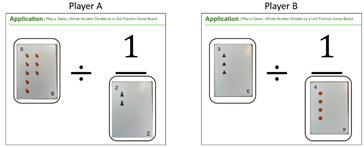
• Each player takes two cards off the top of their pile. On the game board, one card is placed in the denominator of the
fraction and the other card is placed to represent the whole number.
• Each player completes the division and states the quotient. Each player then checks the other player’s quotient. The player whose cards form the greater quotient takes all the cards they played and places them at the bottom of their pile.
• If the quotients are the same, a Top It round ensues. A second round is played and the player with the greater quotient takes all cards played from both rounds.
• The player with the most cards at the end of the game wins.
Solve a Task Materials
• Solve a Task Student Page
• Highlighters (optional)
Students work with a partner to solve a multi-part task that involves dividing unit fractions and whole numbers. They are given important information about the problem and an image to support their understanding of the context. Then students solve three problems related to the given context. The problems require students to think critically about how to use the given information to determine a solution.
Application | Divide with Unit Fractions and Whole Numbers
Answer Key
Solve a Problem
1. Mr. Evans makes 8 cheeseburgers.
Solve a Task
1. The farmer makes 15 portions.
2. The farmer prepares 60 pounds of food in a day.
3. Each person gets 1 9 of the birthday cake.
3. Each pig gets 1 12 of the total amount of food.
2. Sana bakes 48 muffins.
Application | solve a Problem
Word Problem Cards
1 Mr. Evans has 2 pounds of burger meat. He uses _ 1 4 pound of meat for each cheeseburger. How many cheeseburgers does Mr. Evans make?
2 Sana bakes muffins. One tray holds 12 muffins. This is _ 1 4 of the muffins Sana bakes. How many muffins does Sana bake?
3 Eddie has _ 1 3 of his birthday cake left. Eddie and 2 friends equally share the cake. What fraction of the birthday cake does each person get?
Student Edition | Printable Pages for
students
Application | solve a Problem
Use the Read–Draw–Write process to solve the problem on the card. Record the problem number and show your work.
Problem Number
Application |
Play a Game
Game Instruction Card
Whole Number and Fraction Division Top It
What You Need
•
•
• Whole Number Divided by a Unit Fraction Game Board Unit Fraction Divided by a Whole Number Game Board Eureka Math2 cards (or a standard deck of playing cards) with the 10, J, Q, K, ace and joker cards removed. Personal whiteboard
•
How to Play
1. Decide which game board to start with (Whole Number Divided by a Unit Fraction or Unit Fraction Divided by a Whole Number).
2. Mix up the cards. Distribute the same number of cards to each player. Put the cards into a stack facedown.
3. Player A, at the same time as player B, turn over two cards. On the game board, place one card in the denominator of the fraction and place the other card to represent the whole number.
4. Divide and say the quotient. Check the other player’s work.
5. If your quotient is greater, take all the cards played. Put them at the bottom of your stack. Repeat with the other game board.
If the quotients are equal, it is time to Top It! Play another round. The player with the greater quotient takes the cards played from both rounds.
How to Win
The player with the most cards at the end of the game wins.
Application
| Play a Game | Whole Number Divided by a Unit Fraction Game Board
Application
| Play a Game | Unit Fraction Divided by a Whole Number Game Board
Application |
solve a Task
Pig Pantry
• Pigs are omnivores. This means they eat a variety of meat and plants.
• A 100-pound pig eats – pounds of food a day. 57
1 A farmer makes 1 3 pound portions of pig food. How many portions does the farmer make with 5 pounds of food?
Application | solve a Task
2 The farmer prepares 15 pounds of pig food in the morning. This is 1 4 the amount of food he prepares in a day. How many pounds of food does the farmer prepare in a day?
3 The farmer serves 1 6 of the total amount of food he prepares to 2 pigs. Each pig receives the same amount of food. What fraction of the total amount of food does each pig get?