“The future of pro AV is defined by the outcomes it enables”
Rob Lane, Content Director rob.lane@futurenet.com linkedin.com/in/rob-lane-646365a/
As this issue came together, one theme emerged time and again: conversations about the future of pro AV centred not on the technology itself, but on the outcomes it enables.
That is especially evident in our lead retail feature, where the emphasis is increasingly shifting from spectacle to strategy. AI, analytics and networked AV are helping retailers deliver more engaging customer experiences while also providing the operational insight needed to respond more quickly to changing demands.
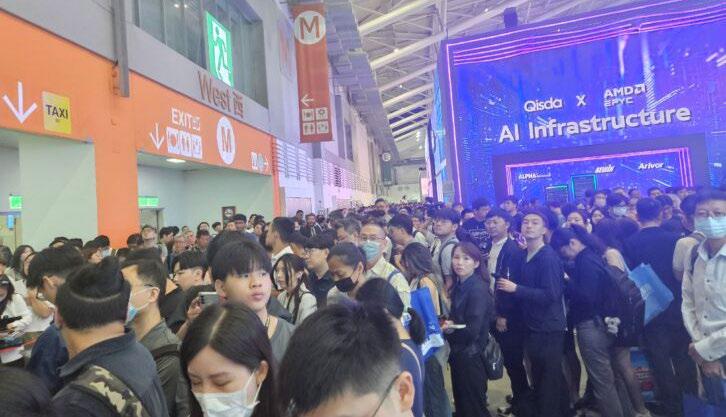
The same principle is evident in our hospitality feature, where AVoIP enables integrated environments that improve both the guest experience and day-to-day operations. Our Computex report also underlines how advances in AI, networking and computing are increasingly shaping the future of pro AV.
Finally, marking ten years of SMPTE ST 2110, we explore how IP has become the foundation for the networked infrastructures underpinning today's pro AV industry, as companies including Atlona and WyreStorm continue to expand their IP portfolios.
FEATURES & INTERVIEWS
Deputy
David
Tech
David
Installation
Danielle
INTERVIEW: NICOLAS QUESNE, VITEC
DEPUTY CEO ON HIS RESTLESS CURIOSITY AND COMPANY PLANS
INSIGHTS & PROMOS
18 Sony promotion: Engaging retail displays
Pro BRAVIA range has been developed to meet the demands of a competitive retail environment, delivering a scalable solution that simplifies deployment and management
21 Crestron promotion: Foundation for meetings
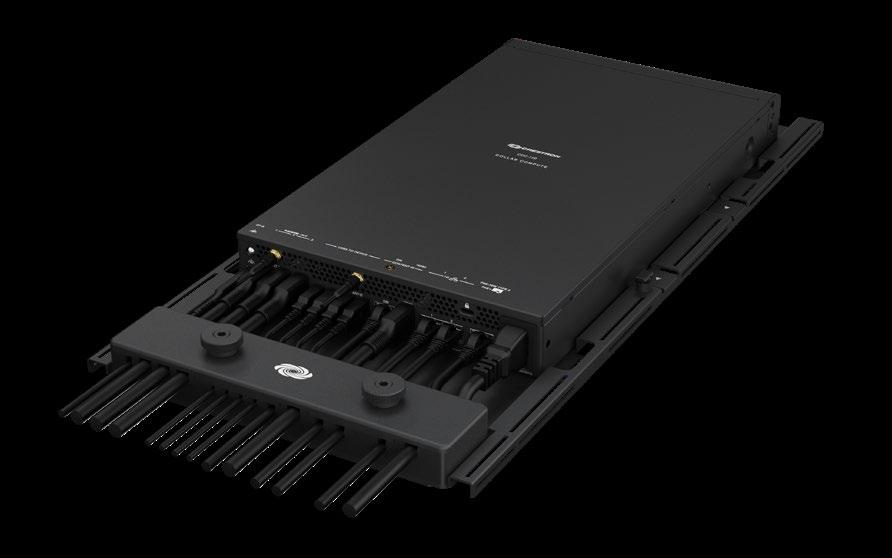
Collab Compute, the purpose-built, AI-ready platform has been designed to deliver the same high standard of performance in every room
28 Insight: Integrating for control
Catherine Koutsaris, product marketing manager at Matrox Video, discusses how IP integration is changing the face of modern control rooms
29 Insight: AVoIP and the guest experience
Kieron Taylor, hospitality specialist at LG Electronics, discusses the innovations enhancing the offering provided by hotels
36 Insight: Digital signage, a new chapter
Pierre Gillet, VP of international sales at BrightSign, discusses the evolution of digital signage in the age of AI
FROM DIGGERS TO DEALS: THE STRATEGIC ENGINEER BEHIND VITEC’S GROWTH
Deputy CEO Nicolas Quesne tells
David W. Smith
how a restless curiosity about tech has taken him from dismantling gadgets to driving VITEC’s expansion through the acquisitions of Exterity
and Datapath
Nicolas Quesne, deputy CEO of VITEC, admits that he can’t sit still, which is why his favourite pastime is undertaking large-scale DIY projects, even during his holidays. At his family home in the countryside outside Paris, Quesne has rewired the electrics, installed smart home IoT systems, repainted all the walls and rebuilt the kitchen from scratch. When the family needed more space, he watched a few videos, hired a mini-digger and built a full extension with his own hands. It took a year rather than the professional estimate of two months and the kitchen was out of action for a fortnight, but his wife Estelle and the children joined in with the painting. “I could never stay still on the beach soaking up the sun. I’m the type of person that has to keep moving,” he explains.
With his restless energy, Quesne is now planning to install solar panels, complete with battery storage and a network controller. The passion for home improvements, he believes, reveals the same love of technology that drives him at work. “At heart, I am very much a technologist,” he says. “What that means is I like to open things up to understand how they work.”
NORTHERN LAD
Quesne was born in the North of France in Normandy, but the family later moved south to the Rhône Valley, where he went to secondary school. But he remains a “northerner” at heart. “I am definitely French, but I much prefer the North of Europe,” Quesne admits. “I like to understand things, so I often ask myself why do I like the North more? Why do I like Scotland more than the South of France? One of the main reasons is that the landscape is so much greener. In Normandy, I think both the countryside and the mentality are a lot closer to England than the Mediterranean parts of France.”
As a young man, Quesne’s technical leanings led him to engineering school at INSA Lyon. Graduating in 1998, he joined
STMicroelectronics in Grenoble, working on semiconductors for televisions and witnessing the huge media transition from CRT to LCD and from analogue to digital TV. But the biggest revelation came from the long product development cycles. Realising it could take years for an idea to become a product on a shelf had a lifelong impact on his strategic thinking.
“My experience in the semiconductor industry has made me think three or four years ahead – what I call a forward-thinking mindset,” he says. “At the same time, technology is always evolving. Every two or three years, there is something new and nobody knows what’s coming. So I do my best to plan what will happen next year, but you also need to be agile, look at all the small signals in the market and listen to the customers”
LIFE-CHANGING DECISION
After Grenoble, Quesne moved to Paris, joining a series of companies focused on imaging technology. He worked on camera IP for smartphones at DxO, and then from 2015, moved into product management at GoPro, responsible for the longterm hardware, firmware, and cloud roadmap. The GoPro years required him to spend two weeks in California every month, which was tough on family life. Despite working for a consumer brand, Quesne also found himself distanced from end users.
He quit, and made a decision he describes as life changing –enrolling at France’s EDHEC Business School for an executive MBA. It was a big gamble as he had to jump off the corporate career ladder without a job to return to. “It was a strong and difficult decision,” Quesne says. “In both my career and in my personality, I like things to go smoothly. So if I have an ambition or an objective, I will take risks to get where I want to go.”
The MBA proved invaluable, but for reasons that surprised him. The greatest lessons about leadership came less from the training and more from informal talks with fellow students,
especially the former senior army officers who were studying alongside the business executives. Their thinking impacted his entire career. “They were colonels, or even higher ranks in the armed forces – and there’s a similarity with managing people at a company. They would speak about the need to give people a vision of why you’re doing things. If people have that overall vision – whether in business or the army – they will understand how to do their jobs.”
By a stroke of good fortune, the MBA was also instrumental in shaping Quesne’s future career at VITEC. As part of the programme, he had to undertake an in-depth strategic business project. Having previously worked with Philippe Wetzel, VITEC’s founder, he asked if he could use the company as his case study. Wetzel agreed, giving Quesne rare insight into company operations. Wetzel was impressed with Quesne’s analysis and offered him a job. “If you had asked me 20 years ago what position I would be in today? Absolutely not this. But here I am!” Quesne says.
TARGETED ACQUISITIONS
Quesne joined VITEC in 2018 as SVP of business integration, tasked with driving external growth through targeted acquisitions. In the years that followed, he led several major mergers and acquisitions that doubled revenues and grew the workforce from 220 to more than 350 people. The most significant early deal was the 2021 acquisition of Exterity, a Scottish company seen as a leading provider of IPTV, digital signage, and user engagement solutions.
It was a deal driven by geography as much as technology. VITEC was a French company generating the majority of its revenue in the US, and the Exterity acquisition gave it a footprint in the UK, Europe, and the Middle East. For Quesne, the connection to Scotland became highly personal, nurturing his preference for green, northern climes. During the integration process, his work demanded a full family relocation to Edinburgh for a year. “My wife stopped working and my three kids went to school there. And they all loved it! If you ask me, where is my second country? It is definitely Scotland.”
The subsequent Datapath acquisition reveals Quesne’s preference for playing the long game. Promoted to deputy CEO (directeur général adjoint) in October 2022, he was already in discussions with the Derby-based video wall and control room specialist while VITEC was still focused on integrating Exterity.
But rather than pursuing another major acquisition immediately, Quesne deliberately slowed down the process and approached Datapath with a different proposal. “I spoke with the leaders of Datapath and said, ’I see a long-term view. The challenge is I cannot integrate Datapath now, so my request is we wait for some time,” he says. “We were so busy with the integration of Exterity, I didn’t want to bother the VITEC teams with another acquisition.”
Datapath officially joined VITEC in late 2025, with 2026 marking the start of its full integration into the business. For Quesne, bringing Exterity and Datapath into the fold represents a long-term goal to evolve VITEC from a supplier of individual video hardware products into a provider of complete, end-to-
end video solutions. “Before, we had excellent individual pieces of the puzzle – specialist video transmission here, digital signage there. Now, by combining VITEC’s IPTV and video streaming portfolio with Datapath’s expertise in video wall controllers, AVoIP, and control room technologies, we can walk into an enterprise corporate environment, a stadium, or a military command centre and provide the entire infrastructure. When our sales agents visit customers now, they expect these complete solutions.”
The evolution of VITEC has transformed not only its product portfolio, but also its leadership. Today, Quesne runs day-to-day operations as deputy CEO, while founder Philippe Wetzel focuses more on tech and innovation. It’s a far cry from a traditional corporate hierarchy. “When you found a company, it’s like your child; it’s your baby,” Quesne says. “On paper, Philippe is my boss because he’s president. In fact, he’s also below me because he’s CTO. It’s a unique organisation.”
Acquisitions have added to VITEC’s product portfolio, but the company is also keen to continue to innovate in-house. Around half of its workforce – over 200 people – are engineers working across silicon design, hardware, GPU technologies and software development. Unlike many competitors that assemble solutions using third-party technologies, VITEC develops its own core technologies. “We have everything,” Quesne says. “Some companies decide they will develop the software and buy the encoder or the set-top box. We like to own the technology because we think it’s more secure for our customers.”
Although his aim is to build a business resilient enough to withstand whatever comes next, Quesne admits uncertainty is the market’s greatest challenge. Geopolitical tensions, supply chain disruption and the emergence of AI have all made longterm planning more complex. “You have a vision of where you want to go, but then you have wars, AI, supply issues, price changes. Two weeks from now, you don’t know what will happen. That’s why uncertainty is our biggest challenge.”
AI FUTURE
But amid that uncertainty, Quesne sees areas where technology itself can help reshape the future. AI, in particular, is already becoming a practical tool across VITEC’s engineering teams, where it supports software development and workflows. In control room environments Quesne believes AI can help operators monitoring thousands of video streams by identifying the feeds that require immediate attention.
Quesne’s willingness to embrace the positive benefits of AI shows the insatiable strategic curiosity that drives everything he does, from rewiring houses to running VITEC. His philosophy will always be to solve the next problem, while never losing sight of the bigger picture. “As a leader, I need to adjust the tactics,” he says. “But the goal is always to maintain a strong vision.”
ALSO AVAILABLE ONLINE:
This thought leader can be read off-page, on the Installation site. Scan the QR code or click here.
FROM SPECTACLE TO STRATEGY RETAIL EVOLUTION:
Whilst spectacle remains integral to many areas of retail, there is a growing emphasis on technologies that deliver operational value as well as customer engagement – from digital signage, AVoIP and analytics platforms to AI-assisted content management, writes David
Davies
In the wake of the pandemic, it wasn’t at all surprising that there was a huge emphasis on reviving footfall. In order to get customers back into physical spaces after a period during which sales migrated significantly to online platforms, it was determined that stores needed to be distinctive and eye-catching – requirements that often translated to the specification of technologies that support immersive and/or interactive environments. Things have moved on considerably since then, of course... Make no mistake – spectacle remains very important to retail, especially in higher-value categories such as fashion and electronics. But over the last year or two, there has also been a growing awareness of harnessing digital signage, AVoIP, analytics platforms, AI-assisted content management, audio systems and sensor-driven environments in order to achieve fully dynamic media installations, where there is frequently a great deal of alignment with the online presence.
In this article we speak to leading vendors about the rise of a more analysis-driven approach to retail and the ways in which AV infrastructure is now facilitating everything from dynamic pricing and audience targeting to operational flexibility and omnichannel brand consistency.
EMBRACING OMNICHANNEL
There is a consensus among vendors that retail – and its relationship to AV – is in the midst of a profound transformation. Davide Quarto, solutions engineering manager at Powersoft, describes it succinctly: “The physical retail store is evolving from a point of sale into a point of engagement. Retailers increasingly view physical locations as owned media channels where they can influence customer decisions in real-time through coordinated audio, video, mobile integration and digital signage.”
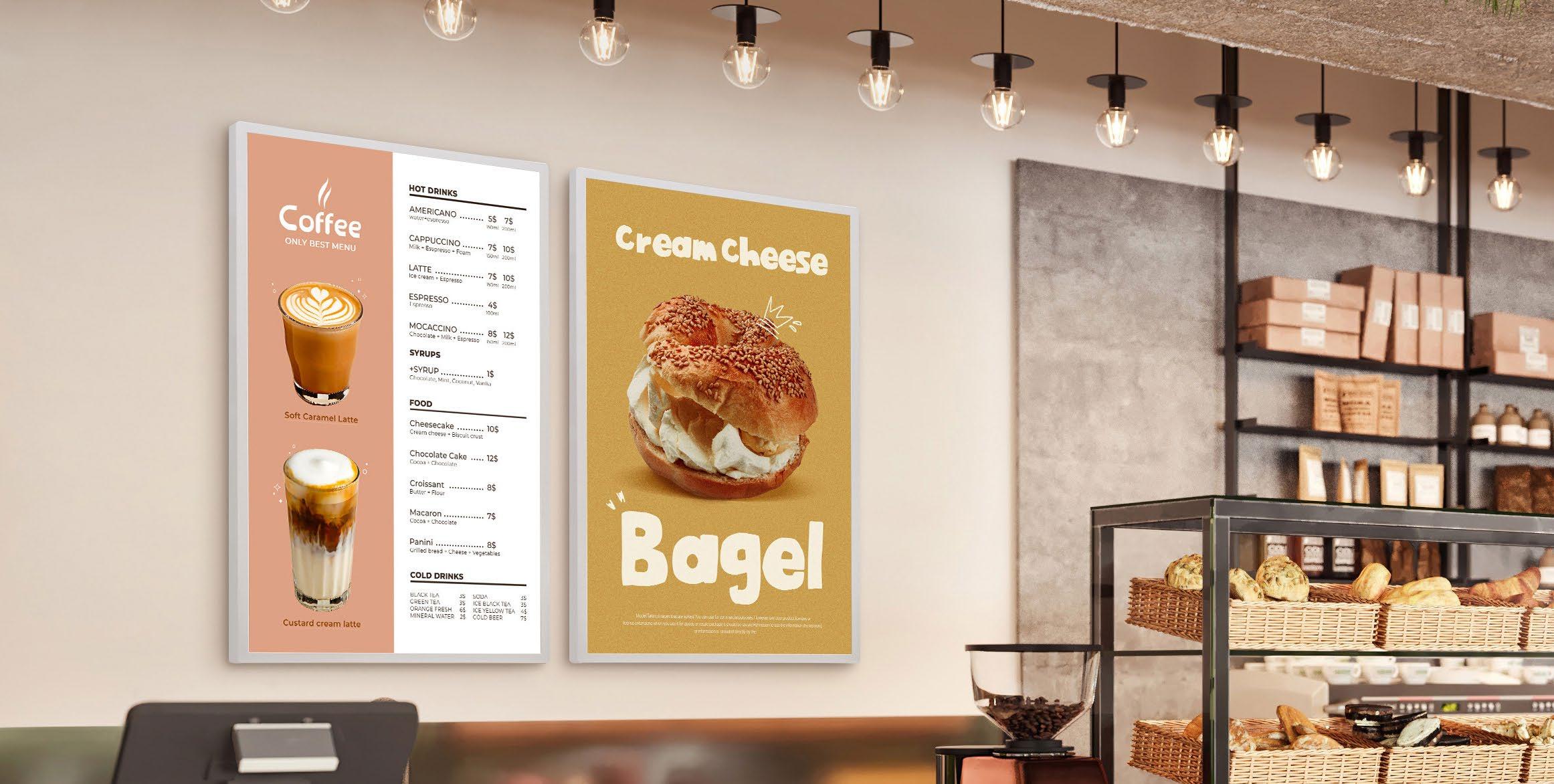
Nevil Botschinsky, business development manager at LG, says that successful shops are “embracing omnichannel”, seeing themselves as live platforms more than fixed environments. “They exist to build a PPDS’Philipsdigital signagedeployed within a fast food environment
relationship with the consumer, communicating messaging with the intention of influencing future revenue, instead of simply focusing on making a sale at that moment,” he says.
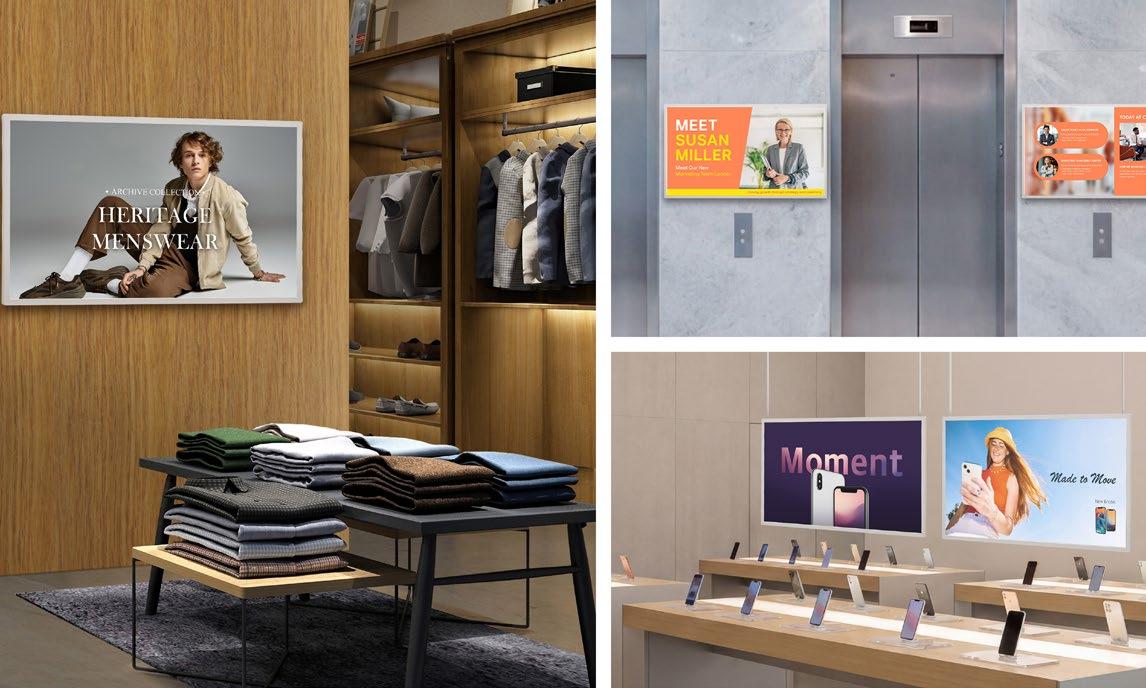
Not surprisingly, this trend is particularly evident in certain categories – including luxury fashion, consumer electronics and automotive – which lend themselves to dynamic content, promotions and brand storytelling that can be adapted in line with audience and time of day. All of this is in the service, notes Quarto, of an era where customers “need to feel the identity and be part of the brand they are choosing”.
SIGNAGE EVOLUTION
One of the most important mediums through which retailers are negotiating this new kind of relationship with customers is digital signage. Far from being geared largely to the straightforward playback of content, modern digital signage platforms can adjust
what they display in accordance with audience analytics, touchless integration, operational monitoring and intelligent wayfinding.
Nils Karsten, business segment lead retail at Sharp Display Solutions Europe, remarks: “The tech that will create sustainable value in retail are the ones tied directly to measurable business outcomes: higher conversion, operational efficiency, better audience targeting, and lower deployment complexity.”
Rather than pursue individual-level personalisation and facial recognition advertising – which Karsten describes as “mostly overrated” – there is an opportunity, not least with dvLED becoming more affordable, to create large-scale experiences based around brand identity. This is especially common in flagship stores where there is a greater focus on digital surfaces to “foster impact and emotions”.
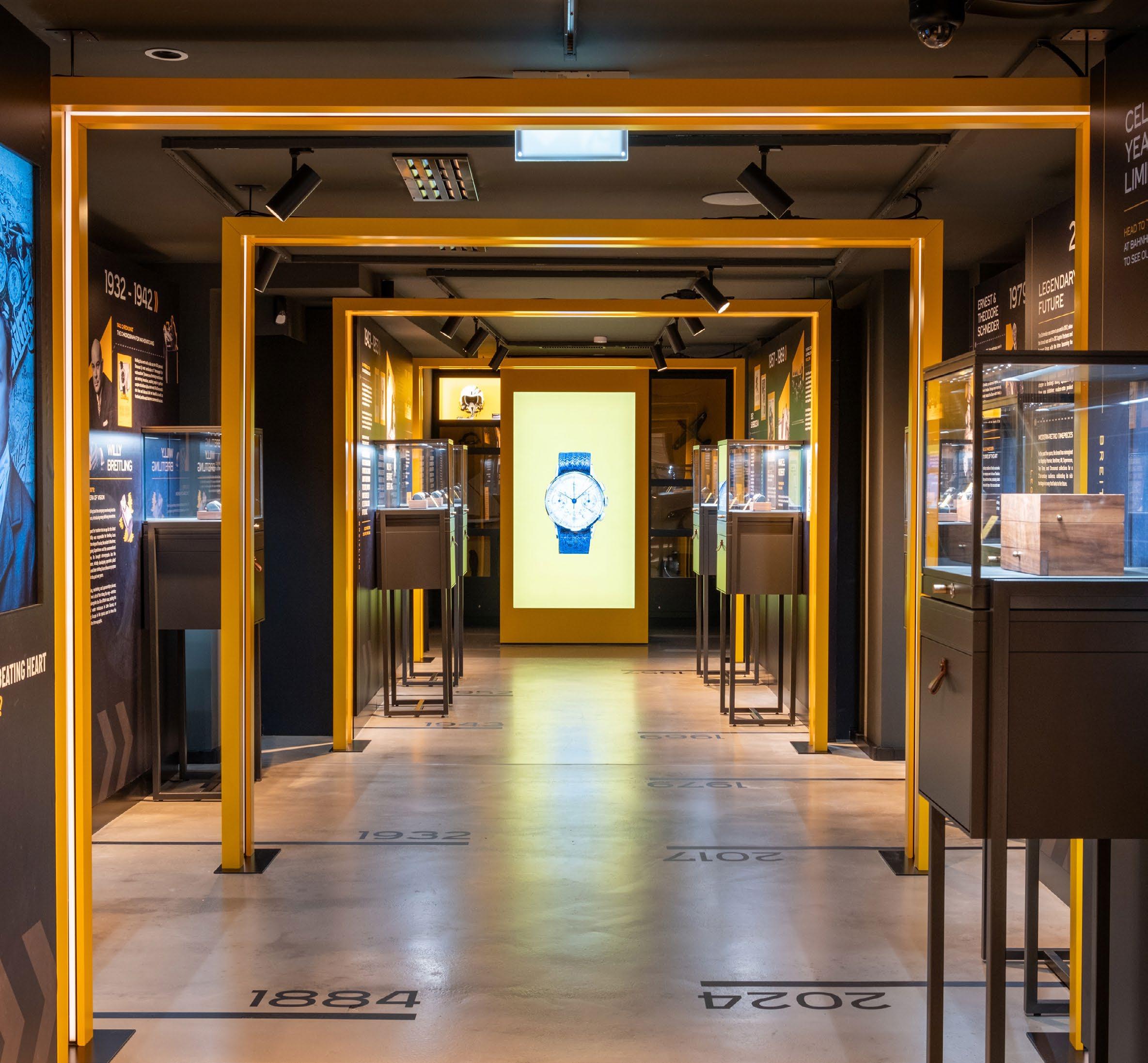
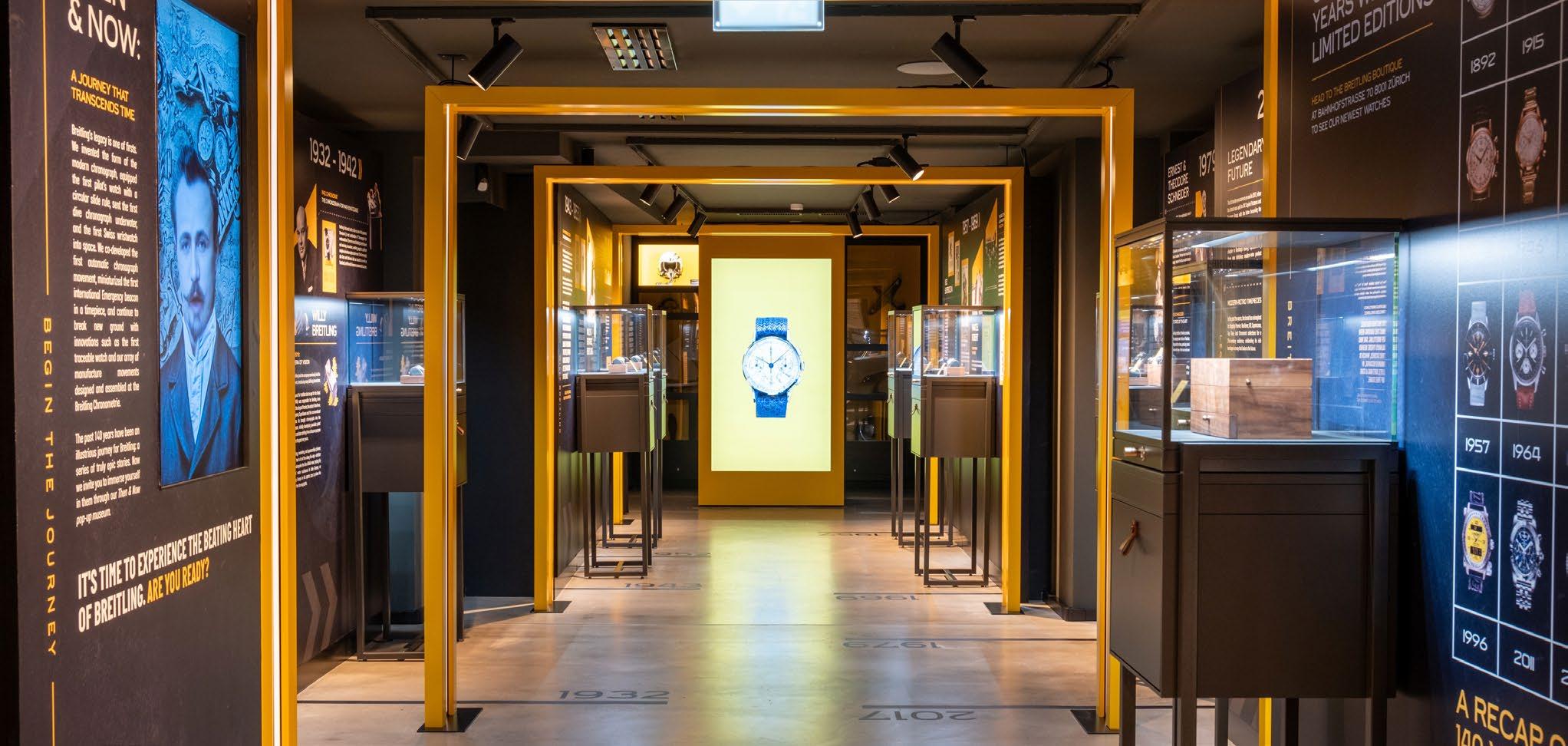
Karsten goes on to cite the example of Sharp’s work with Breitling, the luxury Swiss watch brand, to launch a pop-up activation in Zurich. The interactive ‘Then & Now’ exhibit offered visitors a journey through the history of the brand, so the quality and reliability of the displays, such as a large LED wall, were integral to a successful installation.
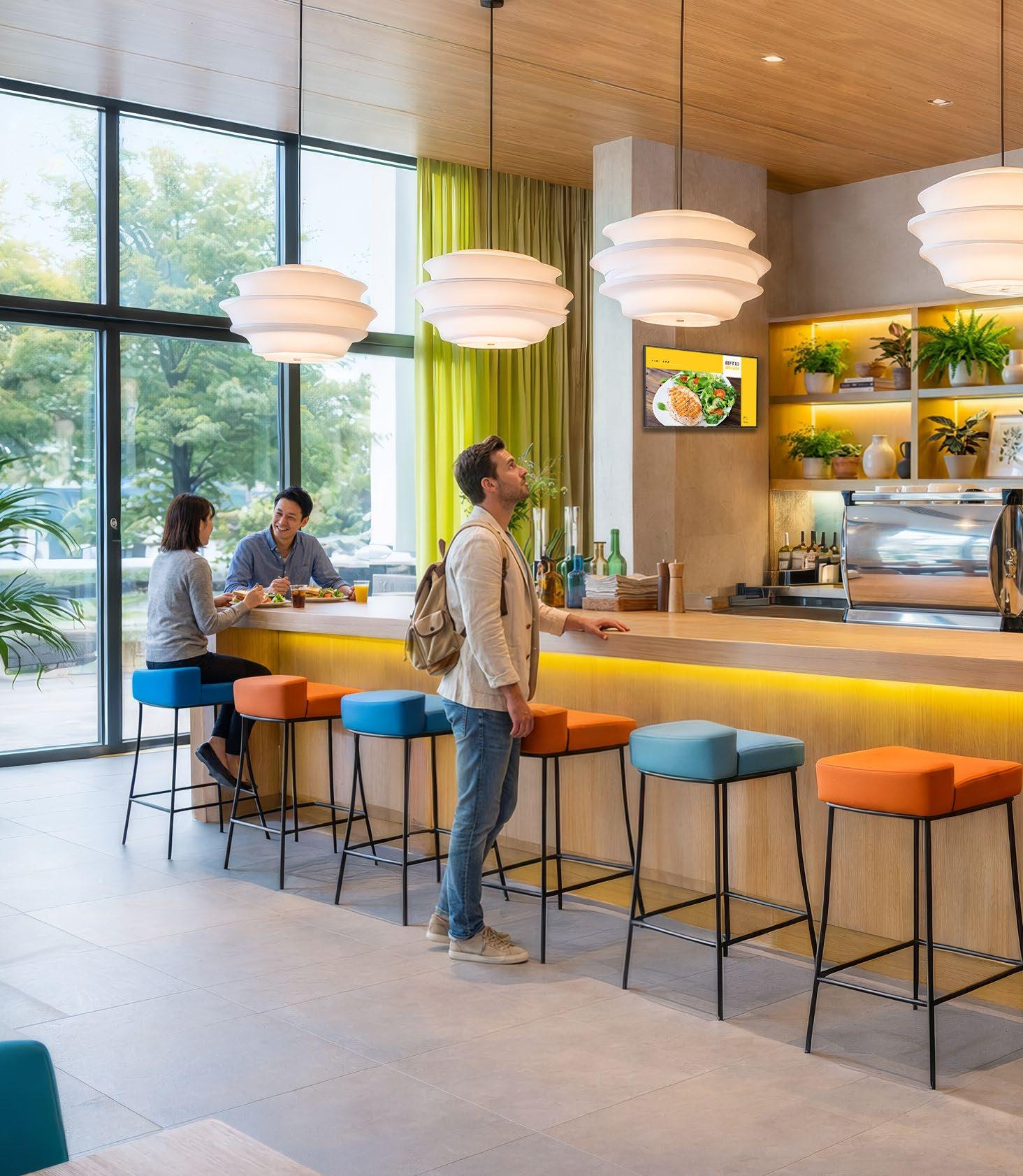
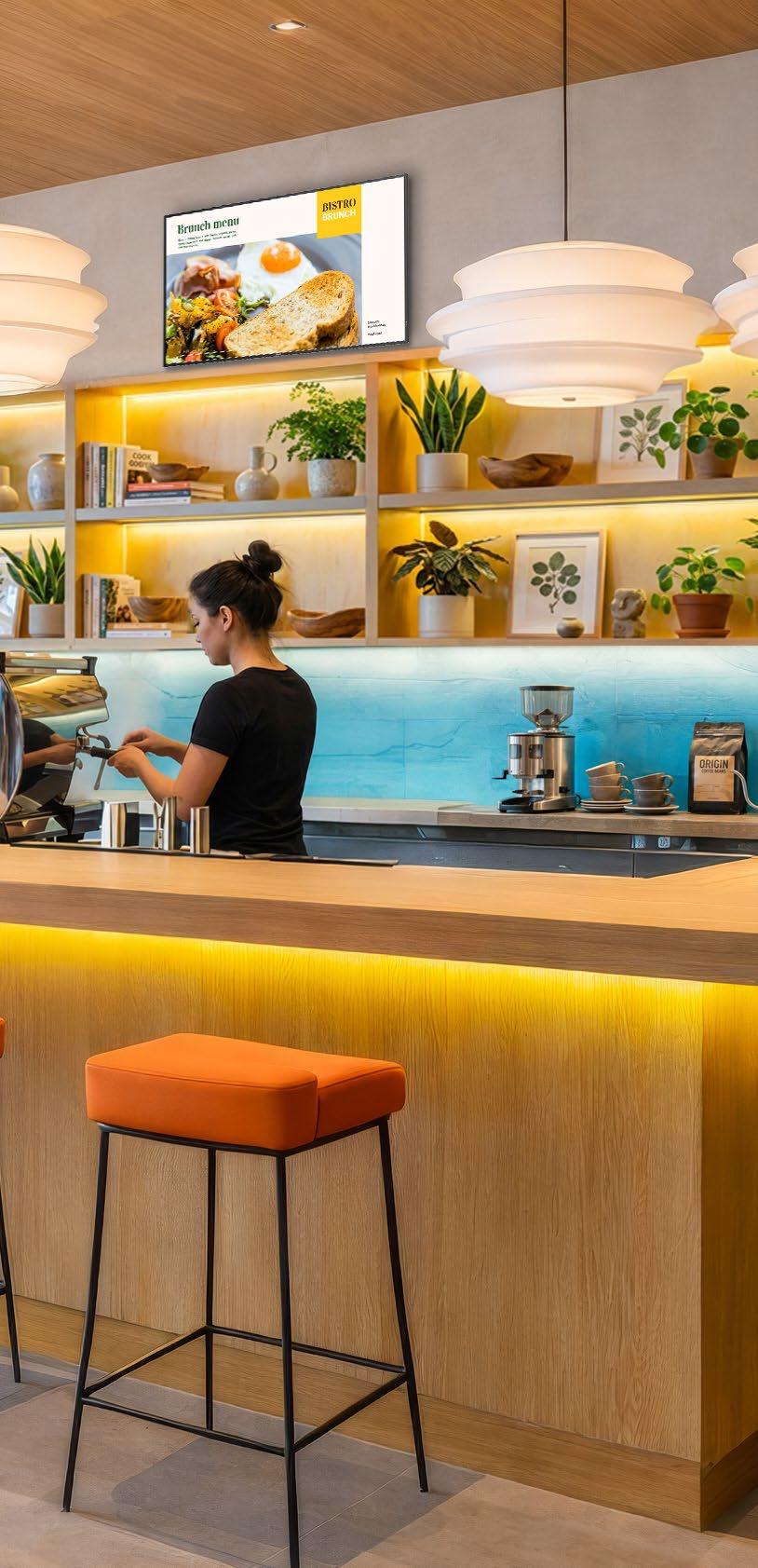
For LG, retail business development manager Phil Clark highlights some other areas of retail where digital signage deployment has also advanced recently. “It’s especially noticeable in grocery and QSR (quick service restaurants), where displays are used to drive supplier campaigns and generate new revenue streams,” he says. “In a typical visit to a QSR, consumers can expect to order on digital menu boards, with promotions fully embedded.”
Left: Shinsegae Simon Busan Premium Outlets walkwayin South Korea withspeakers poweredby Powersoft
Ultimately, digital signage can now be used more effectively than ever before in order to build and retain relationships with customers. Andrea Barbuti, global product manager EMEA at PPDS, remarks: “Using signage displays to provide the best of digital, while also creating unique and personalised experiences, still supported by real people, are crucial for building better brand loyalty and keeping those customers coming back for more.”
MEASURABLE GUESSWORK
Botschinsky offers an especially insightful perspective on the convergence now taking place between signage, analytics and customer insight. For retailers, a core benefit is “the ability to move from guesswork to something more measurable”. Historically, trends like this have been harder to quantify in stores than they have online, he says. “In 2026, retailers can bring in analytics to identify which content is working, where people are engaging, and where they’re not.”
Through deciphering how many people have their attention captured by the screen, retailers can gain a better understanding of customer behaviour, using it to enhance the effectiveness of campaigns, create a more meaningful experience, and make informed decisions about product placement in the store.
Quantifiable data has also allowed core processes to accelerate – a very useful capability in a period when consumer behaviours are more capricious than they used to be. Hence, decisions can be made more quickly, and it’s easier to alter content based on factors such as time of day and location. There is also a boost for maintenance and trouble-shooting, with automated notifications able to be sent when problems occur.
Summing up the primary advantages of the convergence around digital signage and data, Jason Cremins, chief product officer at Navori Labs Group, remarks: “The biggest benefit is that it closes the loop. Digital signage on its own just broadcasts. Add anonymous audience analytics and customer insight and a retailer can establish who is actually in front of a screen, change what plays to suit them, and then check whether it resulted in sales uplift.”
INTENTIONAL AUDIO
Whilst it’s true that a lot of innovation is taking place around visual media, the shift that has taken place with regard to in-store audio should not be underestimated. Once again drawing on wider consumer research and retailers’ own data, there is now greater recognition, according to Davide Quarto,
Above: LG ultra-lowpowerE-Paper 32RS1Q-B displaysin action
that sound “influences dwell-time, customer perception of quality and purchasing behaviour” –hence what he describes as “the transition from background music to intentional audio design”.
As a result, immersive and spatial audio are increasingly popular in flagship stores and environments which wish to create memorable customer journeys. More often than not, this is in conjunction with networked audio platforms that afford considerable flexibility and efficiency.
“The broader transformation is operational,” notes Quarto. “Networked audio and cloud-based management platforms are becoming standard because they allow centralised control, monitoring, and content distribution across hundreds of locations.
This is a clear signal of the IT/AV convergence and is strongly influencing the design phase for all those projects where increasingly the IT department is involved and in charge of it. Scalability, flexibility and operational efficiency are now as important as audio quality itself (and sometimes even more important).”
HUGE PRIORITIES
Meanwhile, some rather more eternal considerations have also come back into sharp focus. Durability and sustainability – both for environmental and economic reasons – are inevitably huge priorities for retailers of all kinds, especially in the post-Covid trading era. The solutions they choose need to be robust and versatile, able not just to last for years but also adjust to evolving requirements. There is also a recognition that retailers’ sustainability credentials and operating principles are now an important factor in many people’s buying decisions, so progress in this area needs to be transparent and frequently updated.
Karsten confirms that sustainability is increasingly “top of the agenda” for decision-makers and includes the entire lifecycle of signage solutions. “Product design increasingly focuses on durability, modularity and repairability to extend hardware lifespan and reduce electronic waste,” he says. “We are prioritising recyclable materials in manufacturing, and now 97.4 percent of the material used can be recycled, which is a real differentiator for Sharp displays in the industry.”
A similar transformation is also underway in audio – an area that could be seen to have something of a
head start, given the always pivotal nature of energy efficiency to products such as amplifiers. Quarto says that sustainability is increasingly “a major design driver”, with smart amplifiers, efficient devices and intelligent sensors helping retailers reduce operational costs and environmental impact, integrating more audio solutions into architecture and interior design to “seek both performance and aesthetic excellence”.
Also with a view to improving efficiency and reducing downtime, there are plenty of signs that retailers are reviewing how they maintain and support their on-site infrastructures. Karsten says:
“Maintenance strategies are evolving through remote monitoring and predictive support, reducing unnecessary onsite service visits and downtime. With a variety of RDM solutions and many supported operating systems, the clients can choose from a respective set of APIs and CEC commands. We give end users many choices to monitor, control and
optimisation. Over the next few years AI’s value is likely to become more dynamic, supporting content adaptation based on live inputs. Retailers will still hold a level of control, especially from a brand point of view, while AI brings ideas and analysis to the customer experience.”
Meanwhile, the underlying technologies will
GOES GREEN
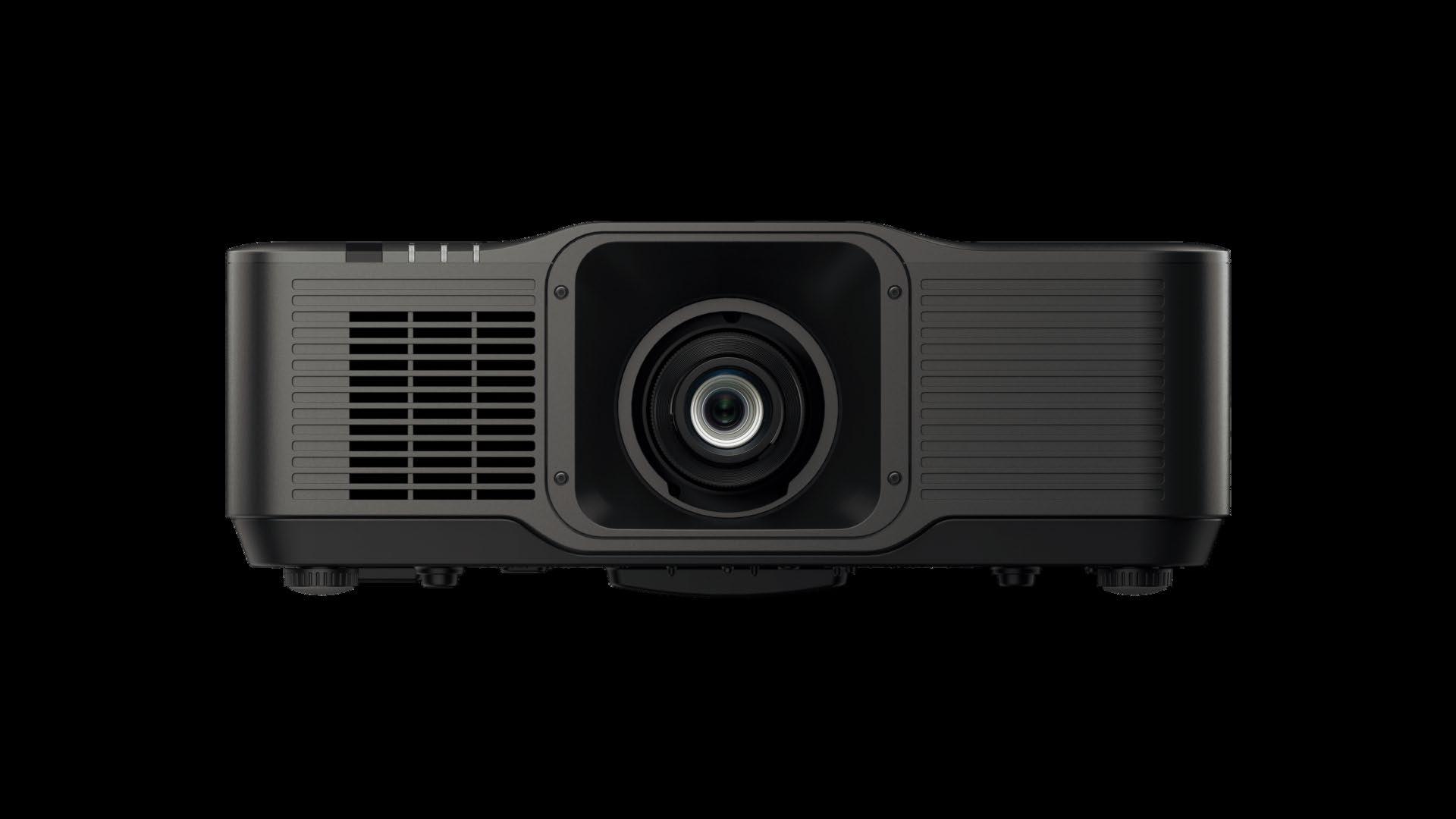
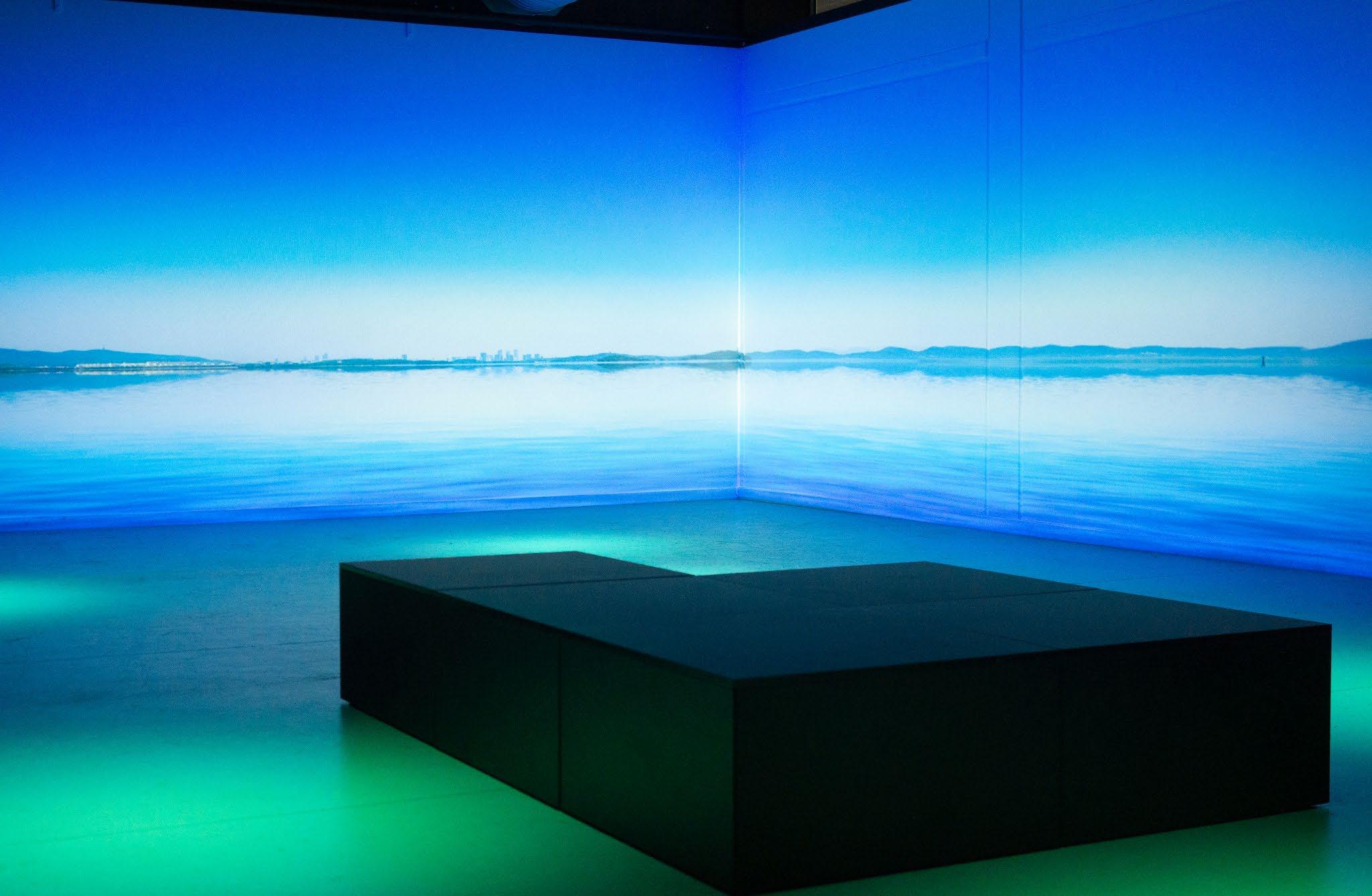
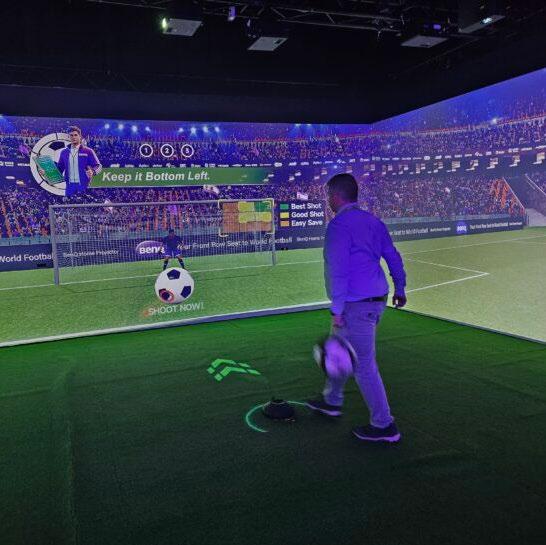
The DK5153Z redefines installation performance - 6,500 ANSI lumens of laser precision meeting breathtaking 4K-UHD clarity. Its 360° projection flexibility, ultra-precise 4-corner geometric adjustment, dedicated golf colour presets and seamless edge blending make it the ultimate engine for immersive golf simulation and the go-to solution for hosting live events like the World Cup.
them ideal for always-on digital signage applications that require continuous operation with minimal heat generation and lower operational costs. Compact embedded systems with integrated NPUs also simplify installation design and reduce the need for additional hardware – and its draw on power.”
Karsten also sees Edge AI as a game-changer for retail: “With cloud AI, information such as video feeds or sensor data is sent to a remote data centre for processing before results are sent back. With Edge AI, the analysis happens directly inside the display or device itself. That difference brings several important advantages such as faster response times, improved reliability and better privacy protection.”
COMPELLING PREDICTIONS
But the future is not all about the advance of AI. Cremins offers three compelling predictions for the coming years: “First, in-store retail media becomes a standard, board-level revenue line rather than a marketing experiment, and more of it trades programmatically alongside the retailer’s online inventory. Second, measurement catches up. Shared currencies for in-store impressions and attention will emerge, because brands won’t fund the channel at scale without them. Third, AI shifts from novelty to plumbing: personalisation, content generation and audience measurement stop being differentiators and
become things everyone is expected to have, so the contest moves to who can run them reliably, at scale and within tightening privacy rules.” Running under all three, Cremins expects retailers to consolidate onto a single platform, with digital signage, e-paper, sensing and media sales managed in one place rather than as separate systems that each answer to different goals.
Whilst there’s no doubt that retail is currently undergoing a profound technological transformation, it is equally clear that the new reality is one of continual change. Powered to varying degrees by AI, the next wave of innovation will almost certainly introduce new experiences. Although high streets continue to face significant challenges, there will always be compelling reasons for consumers to visit physical retail spaces. The retailers that succeed will be those that embrace tech not as an end in itself, but as a means of creating more engaging and memorable in-store experiences. As digital and physical channels become increasingly intertwined, technology’s role will be not simply to make shopping more efficient, but more valuable, enjoyable and ultimately worth leaving home for.
AVAILABLE ONLINE:
This article is also available to read off-page. Scan the QR or click here.
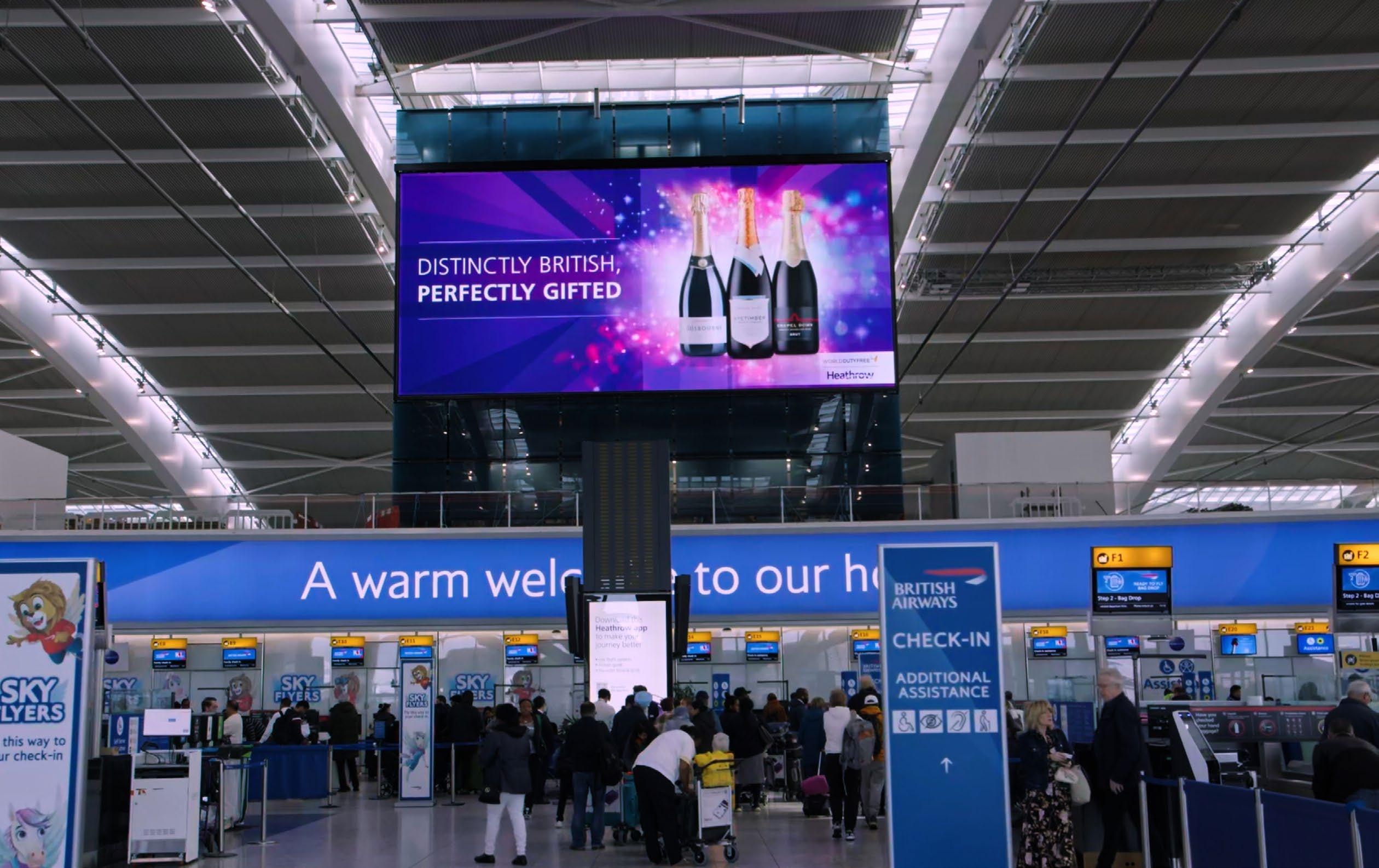
BA check-in desk at HeathrowTerminal5, with aSharpdigital displaypromoting champagne
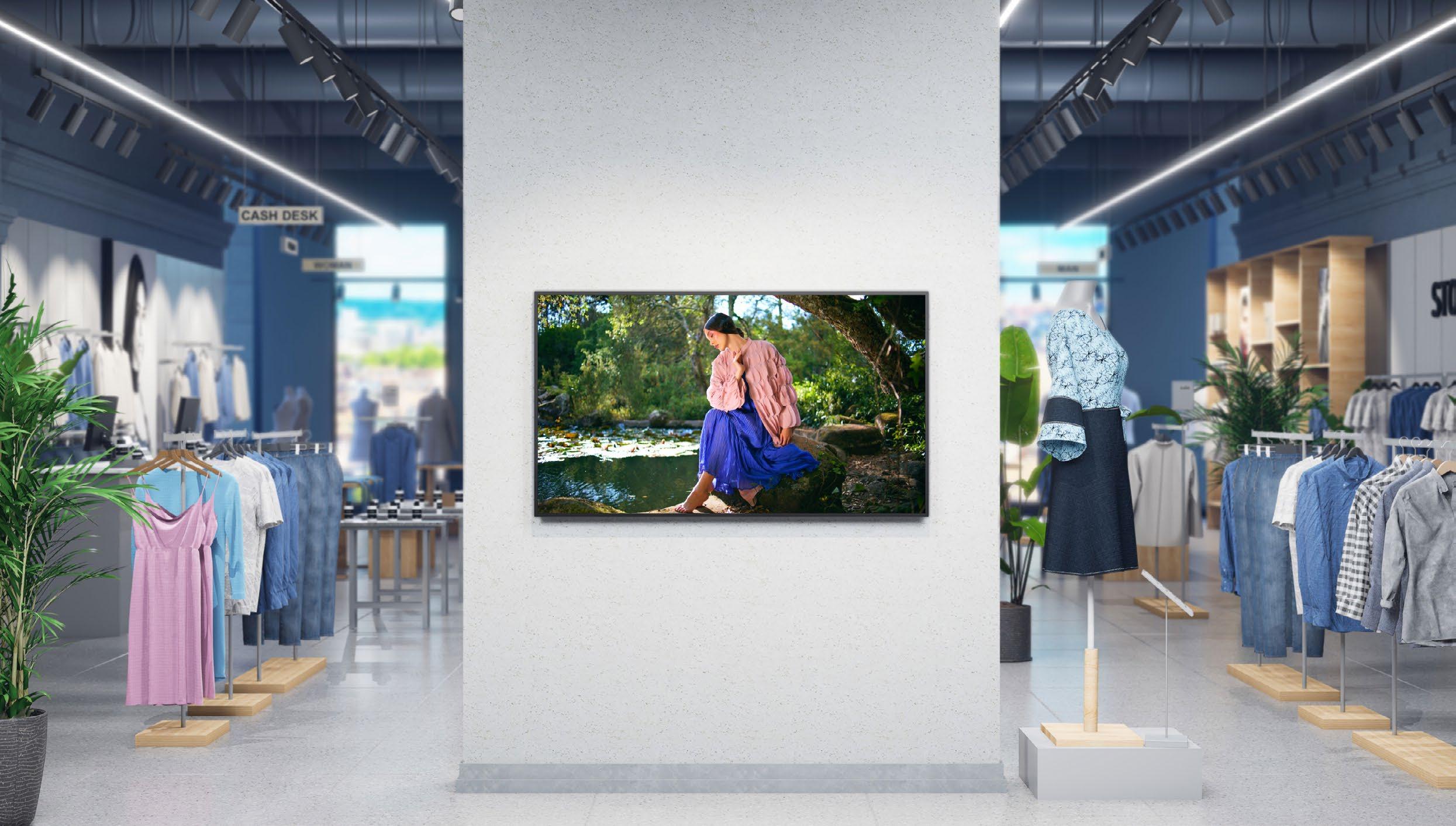
Retail displays that capture attention
Sony’s Pro BRAVIA range has been developed to meet the demands of a competitive retail environment, delivering a scaleable signage solution...
In today’s competitive retail environment, digital signage has become an essential tool for engaging customers, promoting products and creating memorable shopping experiences. From eyecatching window displays and promotional campaigns to wayfinding, menu boards and branded content, retailers need display technology that delivers outstanding visual performance while remaining reliable and easy to manage.
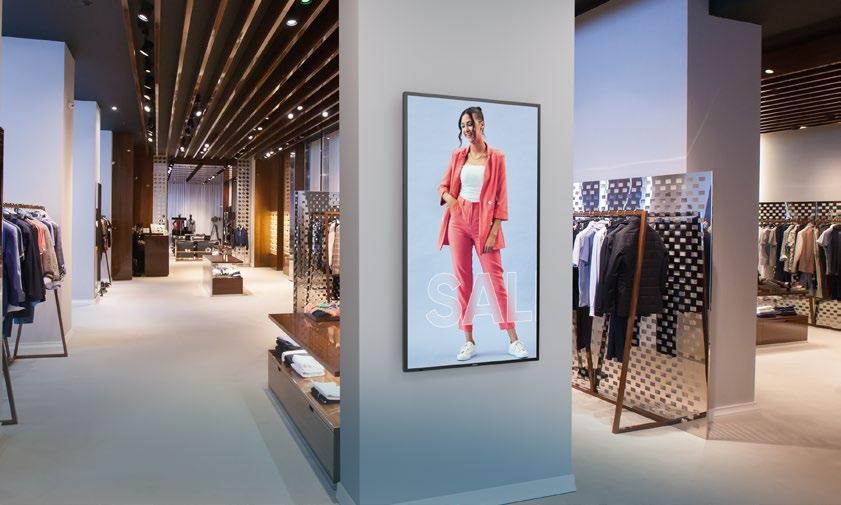
Sony’s 2026 Pro BRAVIA range has been developed to meet these demands. Combining exceptional picture quality, dependable operation and flexible integration, it provides retailers with a scalable digital signage solution that enhances customer engagement while simplifying day-to-day management.
A PORTFOLIO FOR EVERY RETAIL ENVIRONMENT
Every retail space has different requirements, whether it’s a boutique store, supermarket, department store, shopping centre or showroom. Sony’s Pro BRAVIA
portfolio offers the flexibility to match the right display to every application.
At the centre of the range is the new BZ-P series, bringing together Sony’s latest picture processing technologies, installation-friendly features, proven reliability and low total cost of ownership. Alongside it, the EZ20L series provides an affordable solution for standalone signage deployments, while the impressive 98in BZ53L delivers maximum visual impact for large promotional displays, feature walls and immersive brand experiences.
This broad portfolio enables retailers to standardise on a chosen Pro BRAVIA series across their estate, while selecting the most appropriate size and model within that series for each location, ensuring consistent performance, simplified management and a cohesive visual identity.
PICTURE QUALITY THAT STANDS OUT
Retail displays need to perform in bright, challenging environments where lighting conditions constantly
change and customers view content from multiple angles. Sony’s latest Pro BRAVIA displays are engineered to ensure promotional messages remain vibrant, clear and engaging throughout the day.
At the heart of the BZ-P series is the powerful XR Processor with AI-driven scene recognition, working alongside a combination of panel types (eg, IPS) and optical design efficiencies that deliver exceptionally wide viewing angles. Deep Black Non-Glare technology, available with either 25 per cent or 47 per cent haze depending on the model, significantly reduces reflections while preserving deep contrast and vivid colours.
The result is consistently lifelike images with excellent visibility, ensuring product promotions, pricing, video content and brand messaging capture attention wherever customers are in the store.
BUILT FOR DEMANDING RETAIL OPERATIONS
Retail displays often operate continuously for extended trading hours and are installed in busy, high-traffic areas where reliability is essential. Sony has designed the Pro BRAVIA range to withstand these demanding environments while maintaining outstanding picture performance over the long term.
The BZ35P and BZ40P models meet the IP5X dust-resistance standard, helping prevent dust from entering the display and protecting internal components. This reduces maintenance requirements, supports long-term reliability and helps retailers maximise display uptime in supermarkets, shopping centres, transport-connected retail locations and other demanding public spaces.
SMART, CENTRALISED MANAGEMENT
Whether installing a single display or rolling out hundreds across multiple locations, the new Pro BRAVIA BZ-P Series has been designed to simplify deployment and ongoing management.
A redesigned setup wizard enables faster installation, while the streamlined home screen provides quick access to frequently used settings. Sony’s Remote Device Manager allows IT teams to provision, monitor and maintain displays remotely through the cloud, reducing the need for on-site support and making it easier to keep signage networks operating efficiently.
Broad compatibility with leading content management systems (CMS) and remote management platforms (RMS) also allows Pro BRAVIA displays to integrate seamlessly into existing retail infrastructures, protecting previous investments while simplifying future expansion.
LOWER, SUSTAINABLE OPERATING COSTS
Energy efficiency has become an increasingly important consideration for retailers operating large
display networks. Sony’s latest Pro BRAVIA displays have been designed to reduce environmental impact while lowering day-to-day operating costs.
The BZ-P series incorporates intelligent energysaving technologies alongside the use of up to 43 per cent SORPLAS, Sony’s recycled plastic made from recovered water bottles and optical discs. Compared with previous generations, power consumption has been reduced by up to 31 per cent, helping retailers’ lower energy costs while supporting corporate sustainability goals.
These improvements make Pro BRAVIA an attractive long-term investment for organisations seeking to balance operational efficiency with environmental responsibility.
A SMARTER SOLUTION FOR RETAIL SIGNAGE
Sony’s 2026 Pro BRAVIA portfolio delivers everything retailers need to create engaging digital signage experiences: exceptional image quality, dependable reliability, straightforward installation and powerful remote management.
Whether showcasing seasonal promotions in store windows, delivering dynamic product messaging across the shop floor, supporting self-service and wayfinding, or creating immersive brand experiences in flagship locations, Pro BRAVIA provides a range of flexible solutions that grow with retail businesses –enabling retailers to standardise on a single display platform across a range of applications and locations.
Designed to perform reliably every day while keeping management simple and operating costs low, Sony Pro BRAVIA helps retailers communicate more effectively, strengthen customer engagement and maximise the impact of every screen.
is Crestron’s purpose-built, AI-ready platform designed to deliver the same high standard of performance in every room. Here you can find out more
Most hybrid meetings fail for a simple reason. The technology behind them isn’t consistent. Some rooms work beautifully. Others don’t. Performance varies, users lose confidence, and the experience suffers, no matter how good the cameras or displays may be.
That inconsistency usually comes down to one thing: the compute.
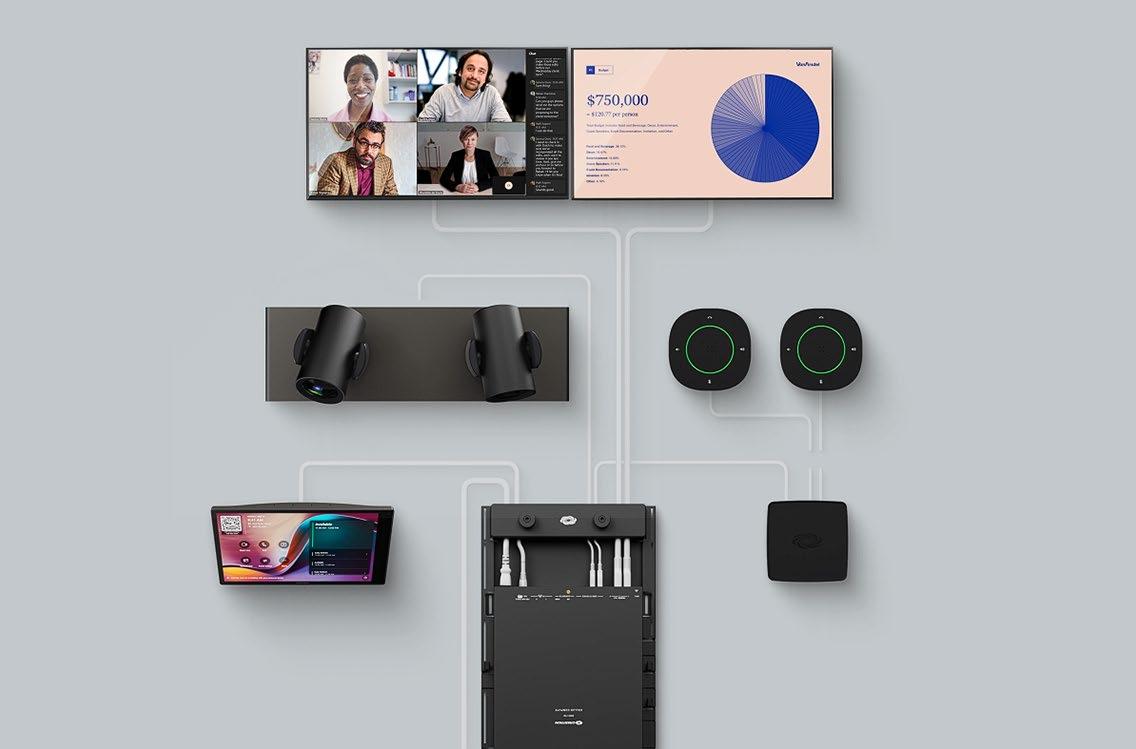
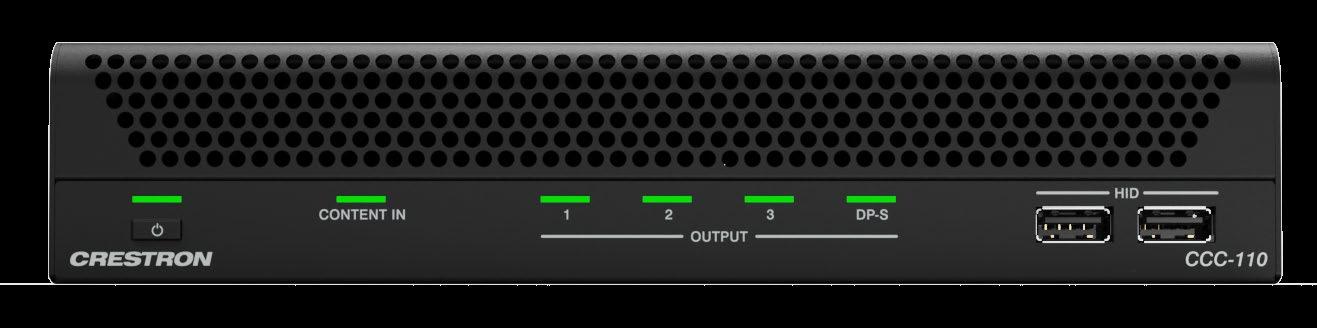
Crestron has addressed this with Collab Compute, a purpose-built, AI-ready platform designed to deliver the same high standard of performance in every room. It is not another component. It is the system beneath the system.
Collab Compute provides the processing power required for today’s collaboration environments, supporting Microsoft Teams® Rooms and Zoom Rooms® software on Microsoft® Windows® operating systems with reliability that holds up across deployment at scale.
This matters more than it sounds.
The demand for modern meeting spaces has changed. Multi-camera views, speaker tracking, intelligent framing, and AI-driven functionality all depend on stable, capable compute. Without it, advanced features become unreliable or are never fully used.
With Collab Compute, they work as intended. Just as important, it standardises how rooms are built and behave. For IT teams, that consistency is invaluable. Deployment becomes simpler. Troubleshooting becomes faster. Support becomes predictable. And for users, the difference is immediate.
Meetings start without hesitation. Systems
respond the same way in every room. The technology disappears into the background, where it belongs.
Crestron has also designed Collab Compute to adapt over time. As collaboration platforms evolve and AI continues to play a larger role, the underlying compute layer is already equipped to support what comes next. That means fewer redesigns. Fewer compromises. And a longer life for every room.
In the end, the quality of a meeting is determined long before anyone joins it. It is determined by the foundation beneath it.
For more on Crestron Collab Compute – The AI-ready foundation for modern collaboration –click here
Above: Crestron has designed Collab Compute to adapt over time
Left: Collab Compute is the system beneath the system...
HOSPITALITY WITHOUT BOUNDARIES
Hotels, bars and leisure venues increasingly need to support multiple functions. As Kevin Hilton discovers, the technology behind that shift is now less about standalone products and more about creating flexible, adaptive environments
Hotels are much more multi-functional than they used to be, and AV is playing a huge role in this. Previously, as well as bedrooms, many boasted a bar and maybe even a restaurant – perhaps serving dinner as well as breakfast. There may even have been a function room for hosting wedding parties, gala dinners, awards ceremonies and conferences, with basic AV kit including a projector and screen, a PA system and lighting.
Today, many hotels accommodate several restaurants offering different types of cuisine, shops, a spa and gym, plus full function facilities, including meeting rooms, work areas and a cinema or entertainment venue. All of these are now likely to have fully integrated sound, video, lighting, projection and LED screens based on IT and IP networks with the option for automated control by non-technical staff.
This is also true for other venues that come under the increasingly broad umbrella of hospitality, including casinos, restaurants, private members clubs and fitness centres. All provide a service, or, increasingly, an ‘experience’. But, behind that, they are businesses in a competitive market looking to make money and set themselves apart from the competition.
“Most venues these days cannot simply rely on one revenue stream,” says Richard McLean, commercial manager of d&b audiotechnik UK, adding that the multi-purpose approach isn’t necessarily a new trend in hospitality: “Larger hotels have always combined entertainment with corporate events. Destination hotels offer anything from fine dining and spas to concerts and conferences.” With venues now
scheduling a wedding one day and a corporate event the next followed by a yoga retreat, McLean stresses that flexible AV equipment is a key requirement, with loudspeaker systems embedded into a hotel’s IT infrastructure.
PRIORITISING RELIABILITY
Because of this multi-purpose, sometimes simultaneous usage, reliability, as Rainer Stiehl, vice president of marketing for Europe at Extron, points out, is a priority for hospitality operators. This is understandable because a reliable system saves time and money on maintenance and repairs. Another consideration is ease of use, with many systems now operated by the house staff – or even the guests –although engineers are still part of the equation. “They want to make sure it’s easy to maintain and operate for their end users, whether that’s their technicians or their customers, depending how they’re setting up the environment,” Stiehl says. “Different hospitality groups have different ways of setting up their base and how they want things to be positioned.”
The way many hotel chains and other hospitality businesses are positioning themselves is to cater for as many events and pastimes within the same premises. “One of the biggest changes we are seeing is spaces that were once designed as standalone presentation environments are now expected to support hybrid participation,” comments Joe Andrulis, executive vice president of corporate development for Biamp. “Spaces that previously required only microphones, loudspeakers and a
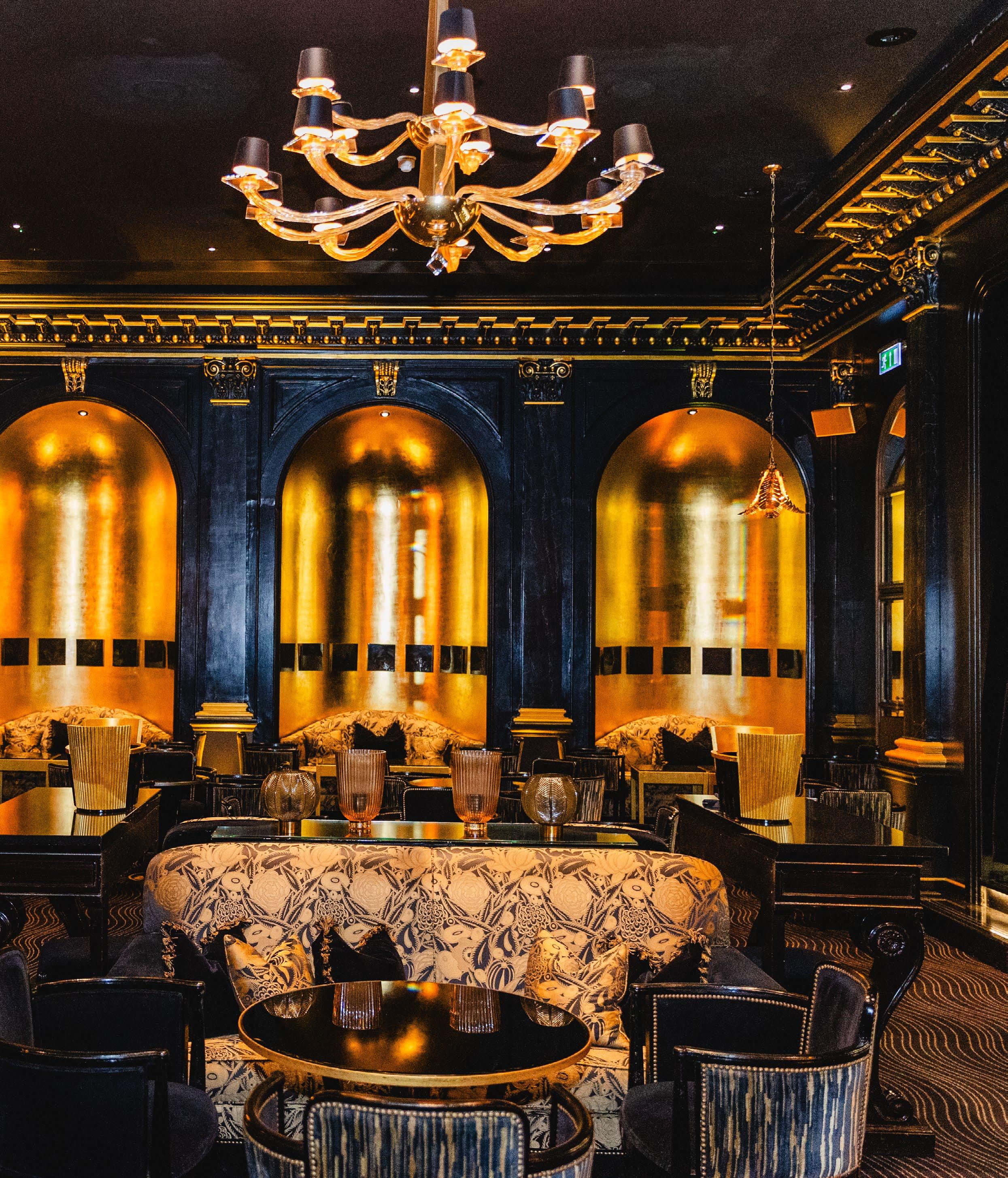
Gold-finish d&b sound system,installedinthe Beaufort Bar at The Savoy,London
projector must now seamlessly support conferencing platforms, high-quality audio capture, video distribution and remote collaboration. The result is a growing convergence of technologies that were once managed separately.”
ACTIVITY CONVERGENCE
The integration of audio, video, lighting and unified communication (UC) systems has been enabled by the convergence of AV with IT through IP networking, which has allowed a convergence of activities to be staged within a single venue. Shawn Watts, vice president, Americas at Bose Professional, says AVoIP has played a “monumental role” in unifying audio, video and control data on to a single standardised network.
Another factor driving multi-functionality across premise-wide networks is the slightly clumsily named new sub-sector, ‘bleisure’. Watts says Bose is seeing “immense growth” for “highly adaptable hybrid environments” that allow business travellers to mix work with leisure. “A lobby that serves as a quiet, professional business area with gentle background audio during the morning must be able to seamlessly transform into a vibrant entertainment or performance space by nightfall,” he explains, adding that “atmosphere is everything”, which calls for scalable systems with intuitive controls and automated settings to switch between applications.
AVoIP and IT backbones are now standardised in hotels not only for entertainment and UC systems but also for in-room facilities. As Richard Jonker, vice president of commercial business development at NETGEAR AV, outlines, a new business hotel of typically 1000 rooms will have a TV screen in each room, which will be IPTV and no longer connected by traditional coax cable. Instead, Jonker observes, everything is streamed and a form of AVoIP, as are the feeds for digital signage providing wayfinding. “That’s not static any more,” he says. “It’s intelligent because digital signage can change language. If it sees four people with phones from, for example, Saudi Arabia, it will show Arabic. And in the bar, where there used to be a remote for each of the, say, ten TVs, now there are monitors with an AVoIP decoder behind them with everything done in software.”
In-room TVs and screens in the bar are expected in any hotel these days. But most guests and visitors would probably put Wi-Fi at the top of their list for vital technology. Today Wi-Fi is available for free in most, if not all, hotels, but many travellers will remember with a shudder when they had to pay hourly or for a whole day to get connected, if the hotel had Wi-Fi at all.
“There’s been a huge shift where not only are hotels saying, ‘We’re giving you free Wi-Fi’, the expectation among guests is that it will be free,” says James
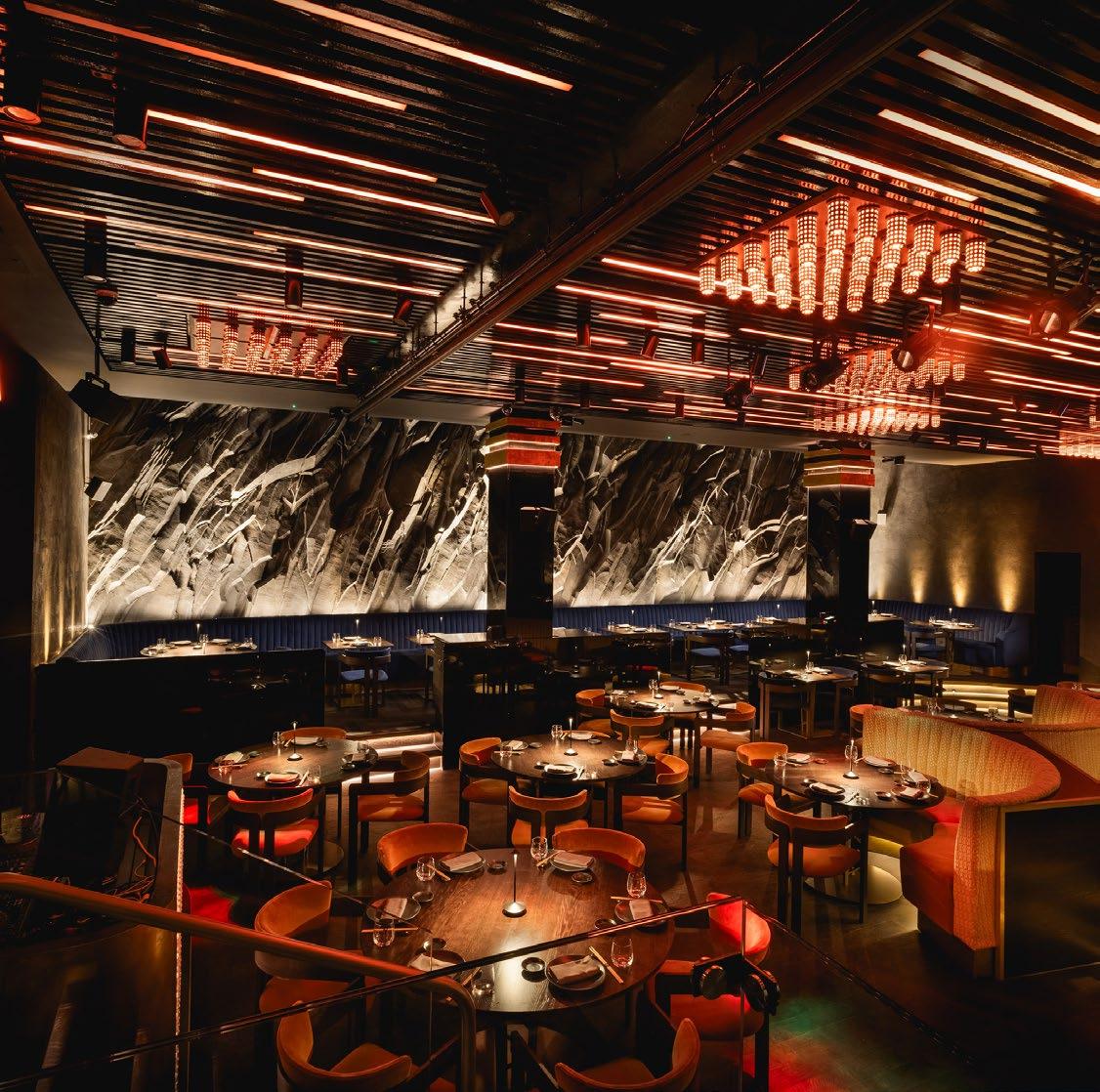
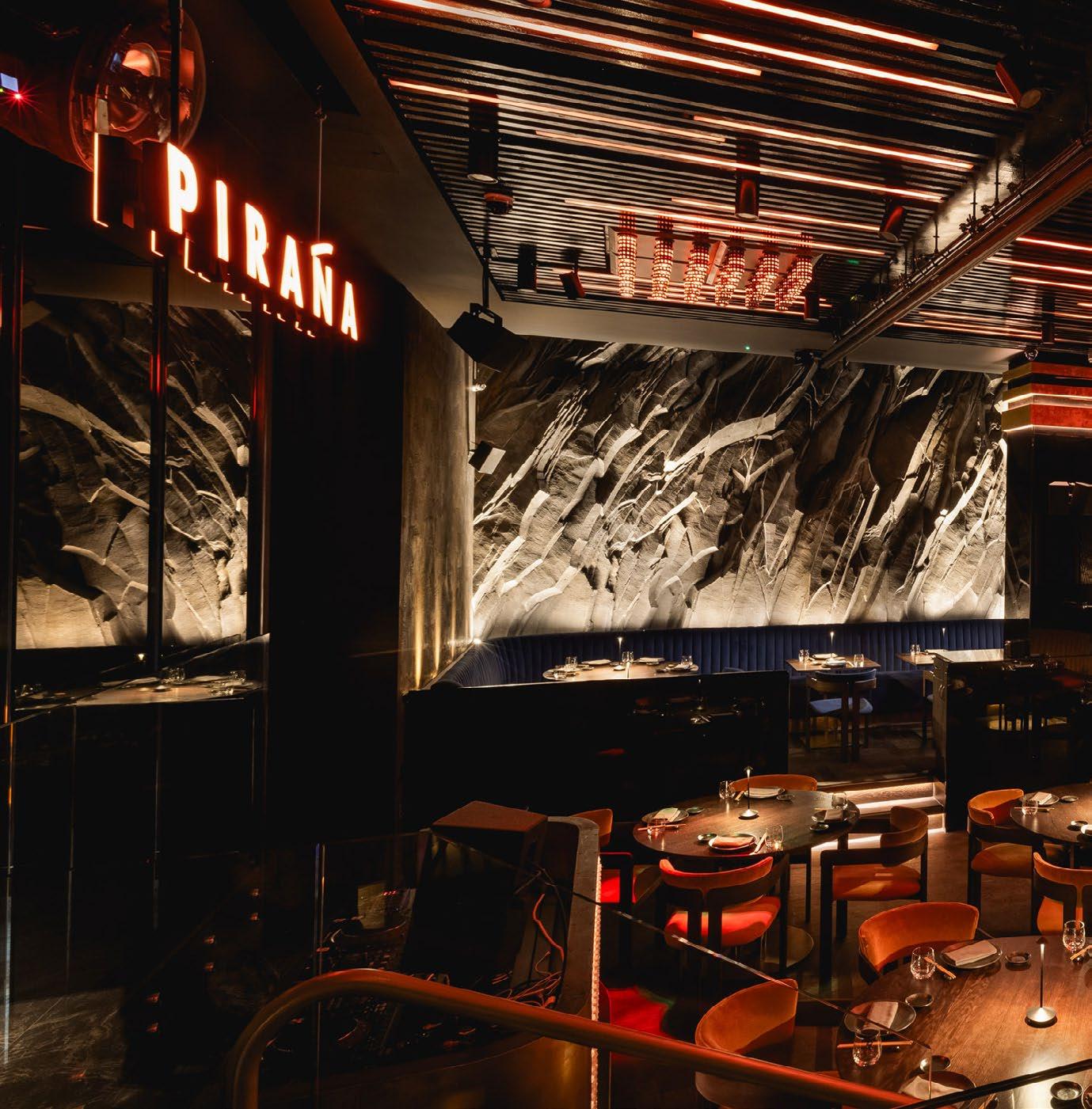
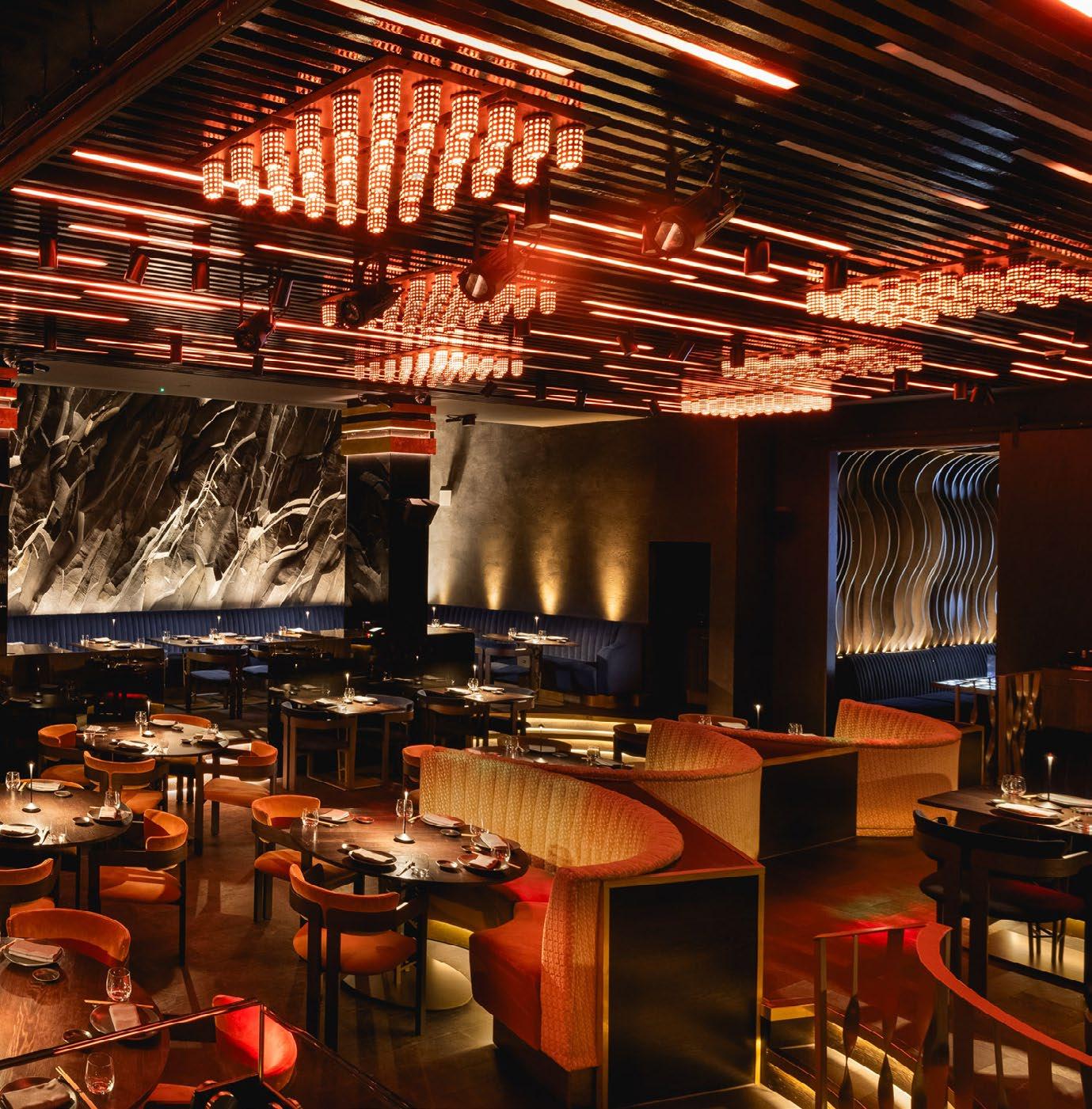
d&bsystematPIRAÑA
London,aluxury
Japanese-Peruvian
Nikkei restaurant
Harrison, founder and managing director of network integrator and IT consultancy Connected Hospitality. He confirms that “the majority” of hotel brands have moved away from being merely “bed shops” to offering hybrid, multi-purpose facilities. “In the US and the Middle East, hotels have become this meeting place, the centre of attention, with conference spaces and multiple restaurants,” he says. “From the technology side we’re no longer just thinking about servicing the guests but also shorter stay visitors who are coming in just for a drink. As a hotelier, you want to ensure you’re driving revenue out of these guests and the number one thing we do is look at how the guest Wi-Fi and digital signage can be used as advertising space for the hotel’s restaurants and other facilities.”
The evolution of both hospitality venues and the technology for them is now making people working in the sector redefine not just technical terms but also how the spaces within a venue are used. A case in point is ‘hybrid’, which Steve Glancey, digital practice leader at systems integrator Diversified, says no longer means a single room used for two separate things but “a large, complex space” where every environment within it has to both work on its own and also add up to one experience.
“The individual rooms flex, too,” he says. “Nobody can afford a ballroom that only earns its keep for eight hours a day. But with the right approach and enabling technology, a space can serve as a conference room in the morning, a wedding venue that evening and the
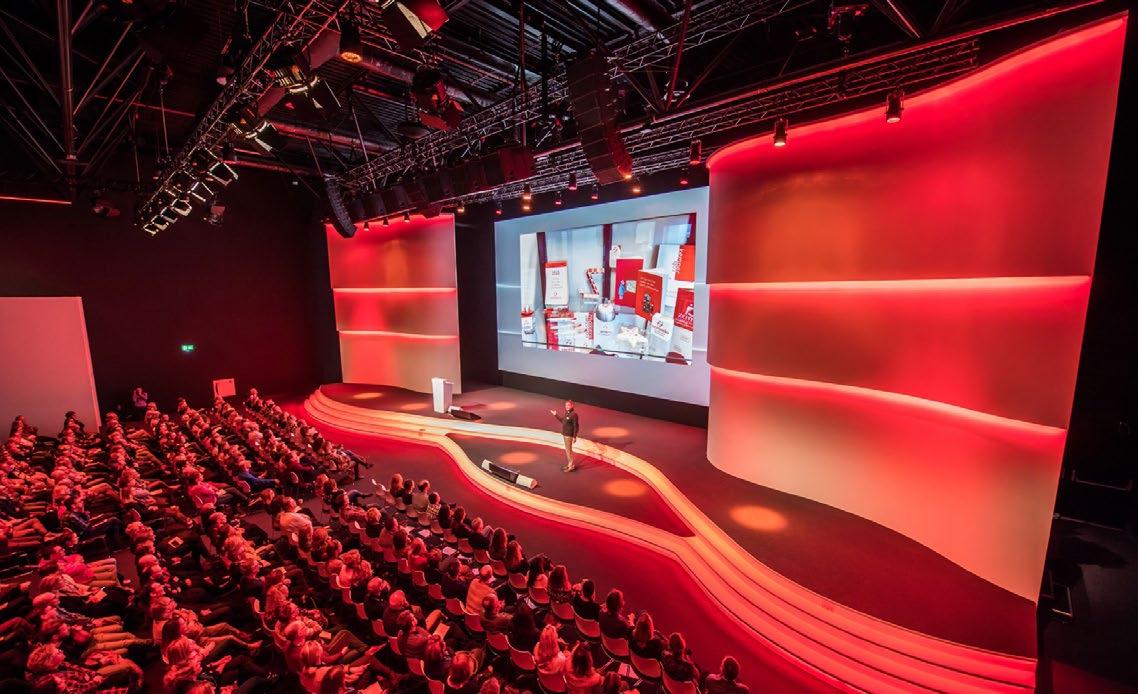
Top right: NETGEAR AVoIP networking in the Grand Hall stage of NBC Conference Centre in the Netherlands
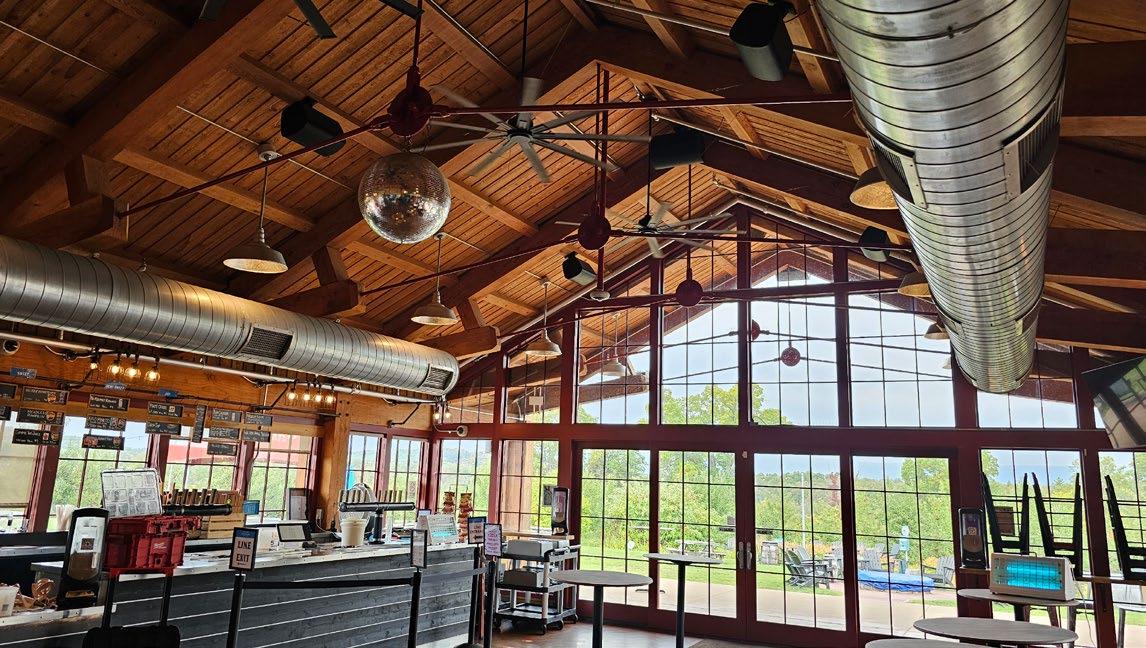
Bottom right: Interior of the Angry Orchard Walden Cider House in Hudson Valley, New York, featuring Biamp Desono loudspeakers
setting for a streamed launch the next day.” He also observes that AVoIP is central: “Putting video on a standard network instead of a fixed matrix lets you send anything anywhere and change your mind later. For the person running the venue, it’s simple.”
It’s to be expected that the perspectives of people working into the hospitality technology market differ, which may suggest that the moves towards full multipurpose hotels and venues are still in progress rather than the norm. Chris Godfrey, senior category manager for EMEA at distributor ADI, says the company is not necessarily seeing a universal shift towards fully hybrid venues, but there is increased demand for flexibility within individual spaces. “Customers want venues that can support multiple use cases simultaneously, for example, a wine bar atmosphere in one zone while hosting live music in another,” he says. “This has naturally driven a convergence of AV, lighting and IT infrastructure, even if it’s not always described that way by clients. The priority is creating zoned environments where different experiences can coexist seamlessly without interference.”
FURTHER EXPANSION
As is now established, the traditional businesses that comprise the broad hospitality sector – hotels, bars, restaurants, members clubs and, increasingly, casinos and spas – have been expanding their activities by offering meeting facilities, live event spaces and generally moving into each other’s markets. But, as Sergio Molho, senior partner and co-chief executive of acoustics and AV technology consultancy WSDG, comments, the sector is further expanding to include sports stadiums. Since the start of the 21st century there has been a steady stream of new stadia opening – including those of Arsenal, Manchester City and Tottenham Hotspur in the UK – that look to rent out VIP and function rooms, as well as staging live concerts, on non-match days and in the off-season.
Whatever the setting, background and other environmental noise is now a major consideration to ensure everyone has an enjoyable stay or meal. “If it’s a hotel, the sound isolation, the acoustics of the room and the technology are already shown in [the brochure],” Molho explains. “In restaurants, noise from open tables is one of the elements that gets higher or lower ratings. Acoustics and technology are all over the place, and we work with those parameters and talk the language of architecture.”
WSDG’s work in AV extends to lighting and curtain shading, which can similarly be controlled as part of an overall IT network. Crestron is involved in this area through automating HVAC (Heating, Ventilation, and Air Conditioning) outputs in conjunction with shading controls. “When a system knows a room is vacant,
Image
Credit: Johnny Stephens Photography
there’s less need for heating or cooling,” comments vice president of hospitality Michelle Guss. “Shading that’s designed to harvest or repel solar gain, depending on climate, season or occupancy, working in tandem with the HVAC, can be a huge saver of both resources and money.”
MANAGEMENT INFRASTRUCTURE
This kind of ancillary control is part of a wider central management infrastructure that many suppliers, including Sennheiser, are seeing being rolled out for hospitality installations. “Instead of one room having a couple of mics and another having a couple, it all comes back to a single processor, be it Q-SYS, Biamp or Crestron,” says Sennheiser technical application engineer Greg Oden. This integration was announced for the TeamConnect Ceiling M Plus microphone at InfoComm 2026. “It’s less of a third-party integration and more that the controller sees our microphone.”
Shure is also seeing more requirements for integrated management of devices to deliver a consistent experience for different types of events. Market development manager Andrew Francis comments that this is achieved through networked technologies on standard IT infrastructures. “Audio has become increasingly network based, allowing microphones, DSPs and other AV devices to integrate more closely with video platforms, control systems and wider IT networks,” he says. “This makes systems
easier to deploy, manage and scale, particularly for venue operators looking to standardise technology across multiple rooms or locations.”
According to Nick Fichte, global business development lead for hospitality, home and yacht at L-Acoustics, the days of audio, video, lighting and IT being separate trades using their own cabling and control are fading. “This is especially in hospitality, where budgets and ceiling space are tight,” he says. “Convergence is being achieved primarily through networking, running everything over standard IP infrastructure – Dante/AES67 for audio, NDI or AVoIP for video and DMX-over-IP or similar for lighting – so it all rides the same backbone and can be managed, scheduled and monitored centrally.”
Hotels are no longer simply places to sleep before heading out to tourist attractions, business meetings or conventions. Increasingly, they have become destinations in their own right, with hotel chains and hospitality venues seeking to offer everything leisure and business travellers might want under one roof. At the heart of this transformation is AV technology, enabled by automation, IT and IP connectivity.
AVAILABLE ONLINE:
This article is also available to read off-page. Scan the QR or click here.
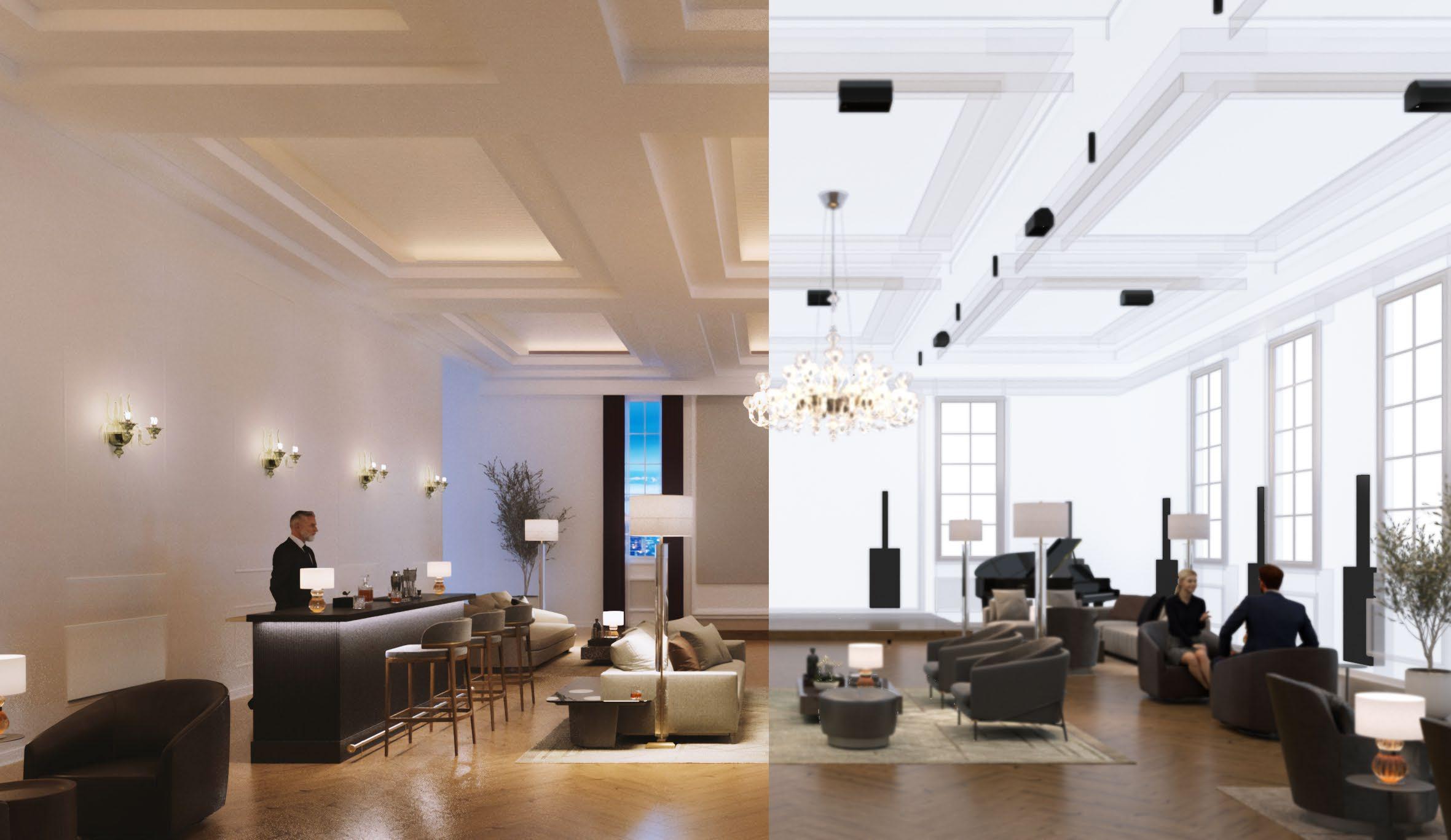
Illustration of the L-Acoustics’ HYRISS audiosystem,featured inahotellobby
Integrating for control
Catherine Koutsaris, product marketing manager at Matrox Video, discusses how IP integration is changing the face of modern control rooms
Wherever control rooms operate, there is growing pressure to update the underlying technology infrastructure. Whether organisations need to build more scalable and flexible systems, simplify how their systems are deployed, or push for greater cost efficiency, there is now a clear shift towards adopting Internet Protocol (IP)-based workflows.
While this gives organisations powerful options to address their control room priorities, it also means that, in many cases, older AV assets must coexist with new IP-based technologies within an integrated hybrid environment. For the people designing and running these systems, the main challenge is how to support both formats without introducing unnecessary complexity or performance issues. Getting IP integration right, therefore, depends on identifying appropriate bridging technologies and selecting standards-based solutions that enable legacy and IP systems to operate side by side.
OPEN STANDARDS
Even though IP adoption offers numerous advantages, implementing it in control room environments is not without challenges. At a high level, many organisations use different device types, such as AV and broadcast systems and IT platforms, while others have adopted IP in inconsistent, often proprietary ways. This can create the kind of fragmentation that undermines interoperability and, by definition, control room efficiency.
The answer lies in adopting open standards, with initiatives such as the Internet Protocol Media Experience (IPMX) gaining popularity in control room settings by providing a common framework for transmitting audio, video, and control signals over IP networks. In particular, IPMX addresses the growing need for a common set of standards and protocols for organisations transitioning to IP infrastructures. It works by providing a single platform where manufacturers can build products that are more standardised and interoperable.
So, how does IP adoption impact control rooms on a day-to-day basis? Fundamentally, it offers powerful options for how control rooms are designed, deployed, managed, and scaled. Within a single control room, for example, organisations want real-time performance and seamless operator control. To maintain responsiveness, they also need minimal compression and high-bandwidth networks, particularly for audio and video switching or real-time decision-making.
INTEGRATED TOOLS
Increasingly, modern control rooms have also integrated tools such as Teams or Zoom, which bring additional content from IT systems directly into control centre AV environments. This means that cross-team collaboration has become more important, particularly in the design and governance of media infrastructure. For example, when video walls or AV displays are used to show content from collaboration tools, those sources must comply with IT security policies and access controls. This means AV systems must now operate within the same frameworks that govern organisational data, also bringing new considerations around issues such as authentication and network segmentation.
While every control room is different, they all share the underlying need to display the right information, at the right time and with maximum uptime. Increasingly, operators also need the flexibility to adapt quickly as workflows evolve, data volumes grow and operational demands become more complex. Across the board, the move to IP offers organisations a clear pathway to deliver on their performance objectives, while also putting them in a strong position to plan effectively for the future.
ALSO AVAILABLE ONLINE:
This thought leader can be read off-page, on the Installation site. Scan the QR code or click here
The role of AVoIP in transforming the guest experience
Kieron Taylor, hospitality specialist at LG Electronics, discusses the technological innovations enhancing the offering provided by hotels
The modern hotel guest is no longer comparing their stay only with other hotels. Their expectations are shaped by the speed of mobile banking, the ease of online shopping and the personalisation of streaming platforms. They expect services to be immediate, intuitive and connected and hospitality is no exception. From the moment they check in to the way they access entertainment, info and hotel services, guests increasingly expect every interaction to feel effortless.
For hoteliers, this raises the stakes: delivering a seamless experience now depends on having the right technology working quietly and effectively in the background.
EVOLVED EXPECTATIONS
Investment in one piece of technology is rarely a silver bullet. Instead, hoteliers should build a technology stack that responds directly to its guests needs and addresses key pain points.
One frequent point of contention for guests is the process of checking in – sluggish reception desks and queues mean that most individuals (71 per cent) now prefer hotels that offer a contactless experience. To solve this gap between expectations and reality, self-service kiosks, capable of taking payment and sending a key to the visitor’s phone, are becoming more and more common. With technology handling the start of the guest’s stay, staff can instead provide hands-on support to those who need it and avoid a backlog.
This level of interaction can continue throughout the stay when the right tools are integrated, instead of being siloed in isolated pockets of tech adoption. For example, without leaving their room, guests should be able to interact with hotel staff, ask questions or order room services, and find out information, like weather updates and details about the hotel.
Access to in-room entertainment is another crucial factor in guest experience scores. As the TVs bought for homes continue
to evolve, visitors will naturally expect a similar standard when on a trip. From vivid picture quality to app access, including streaming services and of-the-minute news, hotel TVs should be easy to use and provide a range of entertainment for every generation.
Tech is most effective when it works behind the scenes to simplify both the guest experience and hotel operations. Cloudbased hospitality management platforms, for example, enable hotels to centrally manage in-room displays, personalise content, and give guests quick access to entertainment, services and hotel information. At the same time, staff can monitor room status, respond more quickly to requests and use operational data more effectively. Solutions such as LG’s Pro:Centric Hub illustrate how these capabilities can be brought together within a single platform, but the wider principle is the same: connected AVoIP technologies help deliver a more seamless and responsive guest experience.
To remain competitive, hoteliers need connected technologies that simplify operations while supporting a more seamless guest journey. As guest expectations continue to evolve, the challenge is no longer whether to invest in technology, but how to create connected systems that work together, giving staff greater visibility of hotel operations while enabling more personalised services. AVoIP provides the foundation for that approach, enabling seamless guest experiences while giving hotels the flexibility to adapt to changing expectations.
ALSO AVAILABLE ONLINE:
This thought leader can be read off-page, on the Installation site. Scan the QR code or click here
10 YEARS OF ST 2110: HAS IP FINALLY COME OF AGE?
A decade on from the first standards that evolved into SMPTE ST 2110, David Davies assesses how they reshaped broadcast and pro AV – and what the next decade of IP media might bring
It is now a little over ten years since the Video Services Forum (VSF) published the TR-03 and TR-04 technical recommendations. Although the seismic nature of these developments may not have been entirely clear at the time, TR-03 (‘Technical Recommendation for Transport of Uncompressed Elementary Stream Media Over IP’) and TR-4 (‘Utilisation of ST-2022-6 Media Flows within a VSF TR-03 Environment’) are profoundly impacting networked media in broadcast, as well as pro AV.
In no small part, that’s because of their subsequent incorporation into the SMPTE ST 2110 suite of standards published by the Society of Motion Picture and Television Engineers (SMPTE). Whilst the IP media revolution was already well underway prior to their availability, it’s not hyperbole to claim that ST 2110 had a galvanising effect in terms of migration away from legacy connectivity formats. By providing a point of unification for leading work from other organisations – the NMOS discovery, registration and control services for IP networks developed by the Advanced Media Workflow Association (AMWA) being a prime example – it was possible to show that migration did not need to be an overly daunting prospect, and that with careful planning and implementation end users could benefit from the flexibility and scalability afforded by IP.
BROADCAST ADOPTION
Given SMPTE’s own focus on broadcast, it’s not surprising that it was in this industry that adoption was initially most pronounced. Cameras and vision mixers were among the critical items of equipment that first gained IP connectivity, and in a fairly short period of time it was not uncommon for broadcasters to be
creating IP workflows – even if, in the early years, it was rare for facilities to fully discard SDI, the main legacy video format, in favour of an ‘all-IP’ solution. As of 2026, however, it would now be pretty rare for a new-build or refurbishment project to not include IP elements – and, in fact, many are now designed from the ground-up to be comprehensively IP-based.
Albeit a little more slowly, the same pattern has gradually emerged in pro AV. Beginning with environments where the appeal of high-quality networked media was immediately apparent – such as conferencing, higher education and medical applications – ST 2110 has become the bedrock of many IP-based installations. More recently, its progress in AV has been further fuelled by the emergence of Internet Protocol Media Experience (IPMX), a set of standards that builds on ST 2110 with a number of additional features geared towards the specific requirements of pro AV users and integrators.
In this article we take a look back on the last decade of progress, including a consideration of whether ST 2110 has fulfilled its original objectives; why the standards suite has had such a major impact where some previous initiatives did not; and how the scope and adoption of the standards might develop in the years ahead.
In terms of identifying one individual to provide an overview of ST 2110’s trajectory over the past decade, you would be hard-pressed to find anyone with more insight than John Mailhot. As well as being systems architect for IP convergence at Imagine Communications, and chair of the Technical Work Group at AIMS (Alliance for IP Media Solutions), he is the long-serving editor of ST 2110 standards. He notes the similarity of ST 2110 to TR-03, in particular, but
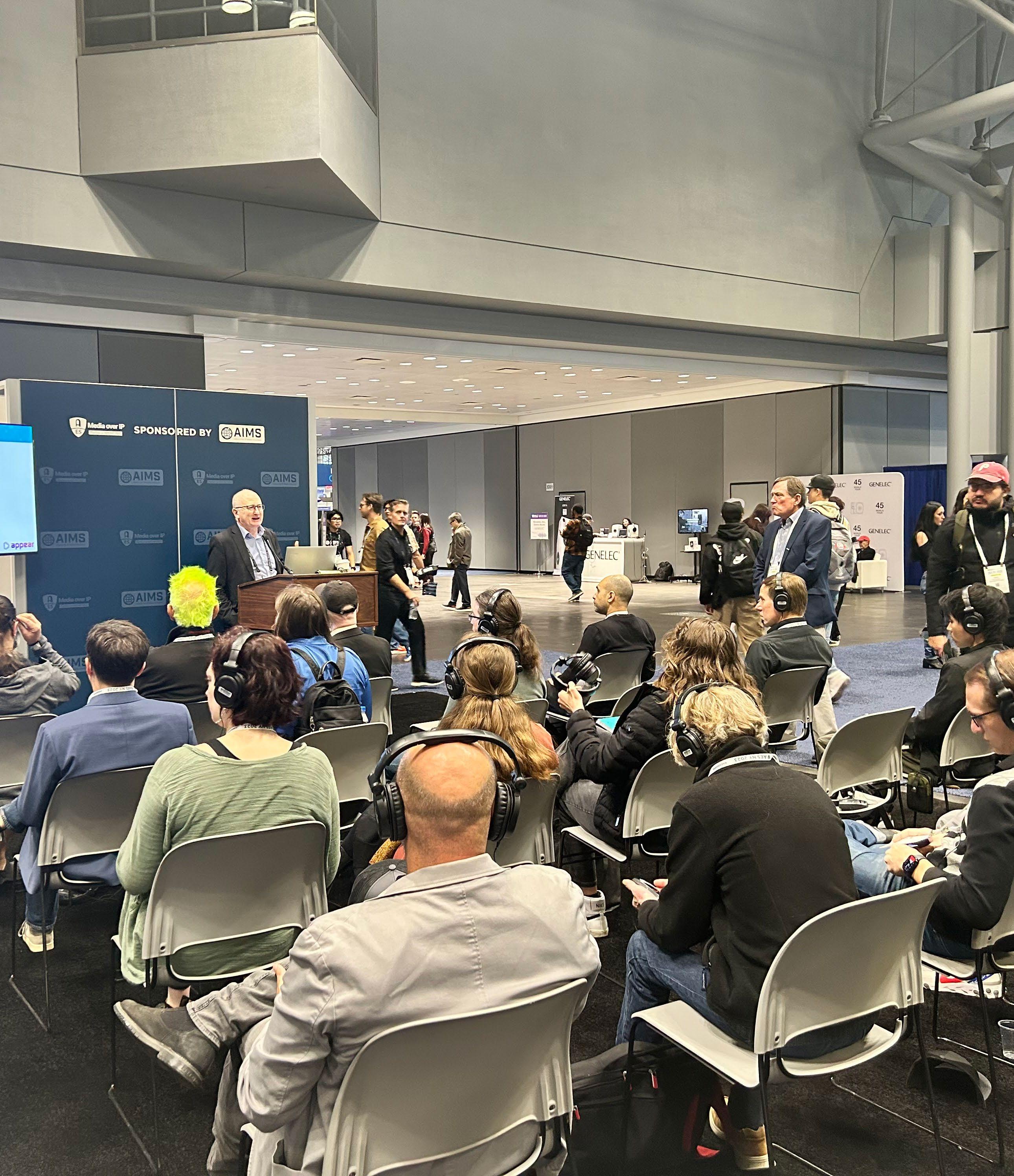
AIMS members meet to discuss ST 2110 interoperability andindustry standardisation progress
says that it was more precisely written and enhanced to cover a wider variety of video formats and use cases. These include alternative samplings, colour spaces and transfer characteristics. Mailhot: “The SMPTE process resulted in a clear family of standards that has stood the test of interoperability worldwide for almost 10 years.”
The introduction of large-scale interoperability testing, via the JT-NM programme, is also perceived to have helped build end-user confidence and understanding about IP as a whole. Jake Dodson, executive director product management at Riedel Communications, suggests that ST 2110 has succeeded because it solved the interoperability that so many customers desired. The JT-NM tested collaboration guaranteed interoperability across multiple competing vendors which opened the way for large-scale adoption, he believes. “Prior to 2110 customers had to decide which vendors’ IP approach they would have to choose with the knowledge that they risked being locked into a supplier’s specific ecosystem. 2110 allowed them to choose best-in-class products in various product verticals, knowing a common network layer could be used,” he says.
MARKET TRACTION
Accordingly, Riedel has closely aligned with ST 2110 and related developments, beginning with AES67 in 2016 and then evolving through TR-03, TR-04 and beyond. Today, all of its major product families –including intercom, audio, video and wireless – have support for 2110, with many thousands of systems deployed around the world.
In addition, it does seem as if it was a case of the right technology at the right time. Joe Davenport, director business development – hyperconverged solutions at Ross Video, confirms: “Timing also played a major role. ST 2110 arrived as network infrastructure matured, with spine-leaf architectures and 100Gb+ switching becoming common, and PTP established as a reliable timing method added to system reliability. Just as important, it enabled gradual adoption –avoiding a rip-and-replace approach, which is critical for budget-conscious customers.”
There is a general consensus that ST 2110 is now the foundation for many larger projects where highresolution/quality video workflows, such as those involving UHD/4K, are a necessity. Therefore, it is not surprising that broadcast studios and venues that deliver live sports video have proven to be particularly fecund territory, although they are by no means the only areas where the SMPTE standards suite has achieved traction.
According to Mailhot, ST 2110 has become the basis of design for most medium-sized and larger facilities worldwide, especially those that aspire to do High Dynamic Range (HDR) and UHD/4K workflows.
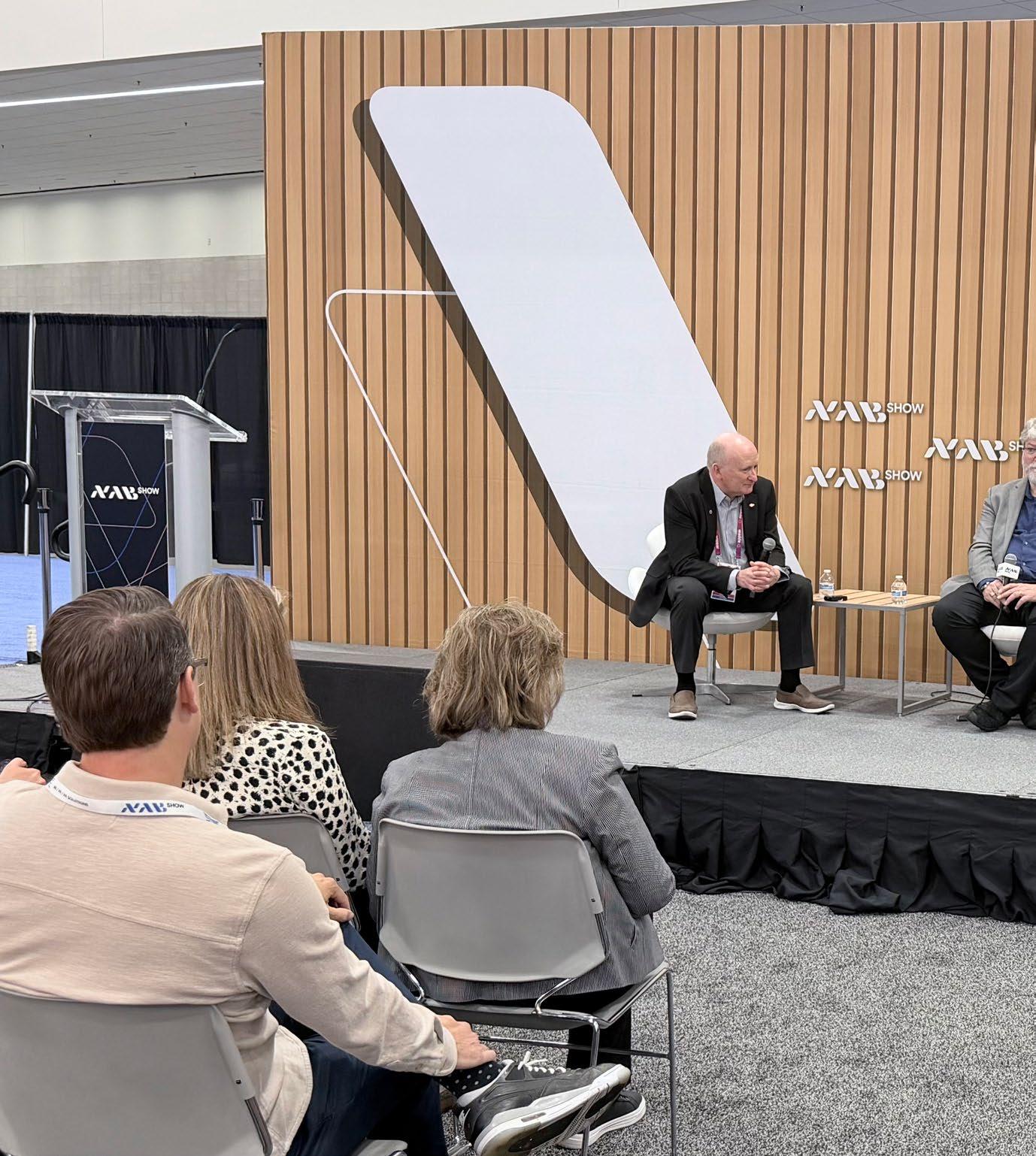
Industrydelegates gatheratanAIMS meetingtoadvanceIP media standards
“While hard numbers for the whole industry are difficult to estimate, at Imagine we’ve shipped well over 200,000 channels of ST 2110-capable encapsulation since the publication of the standard.”
Application-wise, sports venues – where 1080P, UHD and HDR are being deployed as part of fan engagement efforts – have turned out to be a major marketplace for ST 2110 streams. The need for format-flexibility among the assorted users and rights holders involved in sporting applications is well-suited to the deployment of ST 2110, notes Mailhot.
The rise of IPMX has been another critical factor in the longer-term pro AV success story. It was in 2017 that initial conversations took place about presenting a set of open standards and specifications geared towards the pro AV market, enabling the carriage of compressed and uncompressed video, audio and data over IP networks. In 2022, Andrew Starks – board member & marketing workgroup chair at AIMS and director of product management at Macnica Americas – told Installation that “at first the conversation was more about seeing whether we could essentially take ST 2110 as it was and translate it to pro AV”. It was quickly determined that additional features were required if the standards were to reach the greatest possible audience.
Hence the development of IPMX, which is based on the SMPTE ST 2110 suite of standards and related
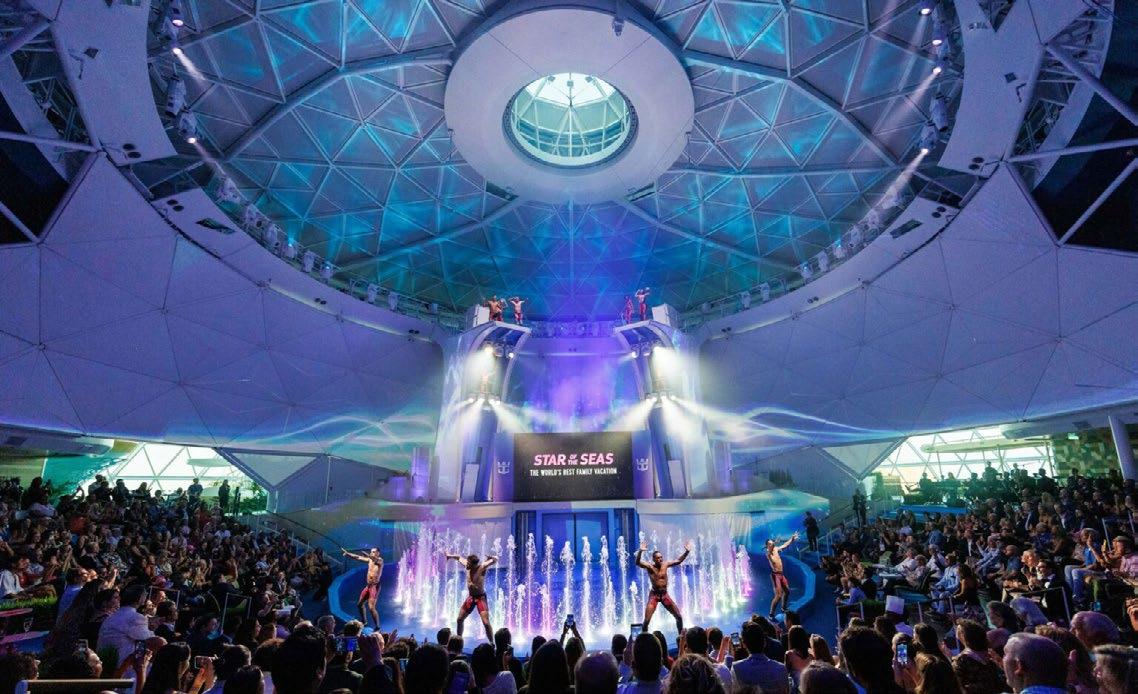
Right: Riedel’s AVoIP solutions deployed aboard the Star of the Seas cruise ship
ST 2110 is now the basis of design for medium and larger facilities
JohnMailhot
AMWA NMOS specifications used in the broadcast industry, but adds specific capabilities for pro AV workflows. These include HDMI support, digital copy protection with HDCP (High-bandwidth Digital Content Protection), NMOS discovery and registration, I/O management, enhanced audio channel mapping, and compressed media using the JPEG XS video coding system.
IPMX’s core capabilities, meanwhile, include the ability to transport and control compressed and uncompressed video and audio, such as 4Kp60 with 4:4:4 colour, over standard 1G networks and with very low latency. It is ready for 8K (or higher) resolutions and can support 10G, 25G, 40G and 100G networks. As such, it has already found favour in pro AV applications where video quality is an absolute priority. The growing adoption of IPMX is also influencing product development across the wider pro AV sector, with platforms such as Atlona’s OmniStream and LumaStream, alongside Matrox Video’s ConvertIP series, reflecting the growing emphasis on IP-based media distribution and interoperability.
Rob Moodey, manager – strategic partnerships at Matrox Video, says: “Technologies like IPMX are extending the principles of ST 2110 into adjacent markets, and the ability to operate across both ecosystems is increasingly important. Our approach has been to support that convergence – not just by aligning with the standards, but by making sure our solutions fit naturally into mixed, evolving infrastructures that will maximise ROI.”
HYBRIDISATION TRENDS
But whilst ST 2110 and now IPMX have spearheaded the growth of IP in broadcast and pro AV, it’s important to note that there is also a simultaneous trend towards hybridisation at present. There are likely to be multiple factors at play here, including a very understandable reluctance to invest too heavily given the general economic uncertainty (and, in broadcast, considerations such as the dramatic decline and fragmentation of advertising revenue). It’s also probable that companies are at different stages of the replace & renewal cycle, meaning that they have equipment with plenty of life left in it.
Davenport notes that adoption levels have varied by region. In addition, while some customers have chosen to move to all-2110 facilities, many deployments remain hybrid, with substantial baseband infrastructure still in service alongside other IP-based approaches like NDI, SRT and JPEG-XS. Plenty of facilities, he says, still rely heavily on SDI and plan to for the foreseeable future, often introducing IP in targeted ways to complement existing signal flows rather than replace them outright. Ultimately, the approach comes down to size and scale requirements for the system as well as budget considerations.
“I think we’ll continue to see growing adoption of IP-based production, with hybrid approaches remaining the norm for most use cases” says Davenport, adding that “across both broadcast and pro AV, customers will benefit from the scalability and flexibility that IP enables”, and noting that Ross offers a complete suite of ST 2110-enabled production tools.
With regards to digital video, Moodey points out that SDI’s continued evolution to A 270 Mbps link associated with SD content at the end of the 1970s was superseded by increased bandwidth of 1.5 Gbps, then 3 Gbps, 6 Gbps and 12 Gbps.Moreover, it is an ongoing story according to Moodey.
“SDI hasn’t stopped evolving either – try putting 24G-SDI into your favourite search engine,” he says. “That one is already standardised by SMPTE – ST 2083. (If you really want to scare yourself, try searching for 48G-SDI!) So those who think SDI is an unchanging technology point of reference need to realise that the landscape around them is moving. The longer they stay put, the bigger the step will need to be when they decide to move.”
As to the more general future of IP, it’s arguable that there are still issues that need to be addressed, not least with regard to the alignment of, and integration with, what might be termed more ‘traditional’ IT infrastructures. According to Dodson, IP network performance is there but at the cost of complexity and specialised IT support. “This is a
general problem we as vendors need to solve. We see growth in live production, sports, broadcast and corporate applications, but if the IT complexity can be solved there are many more possibilities,” he says.
FUTURE ADOPTION
In the meantime, it’s evident that vendors across both broadcast and pro AV are more than willing to address ST 2110 product requirements and ensure that customers have access to the solutions they need –and at the price levels they require. As the examples throughout this article demonstrate, support for standards-based IP media infrastructures continues to broaden, reinforcing ST 2110’s position as the foundation for increasingly flexible and interoperable workflows. “NAB26 featured an exceptional number of new product announcements supporting SMPTE ST 2110,” concludes Mailhot. “Vendors at every position on the value spectrum have embraced ST 2110 as the forward-looking solution for building scalable solutions to meet modern media infrastructure requirements. I expect that the ST 2110 standard will be in widespread use for many years to come.”
AVAILABLE ONLINE:
This article is also available to read off-page. Scan the QR or click here.
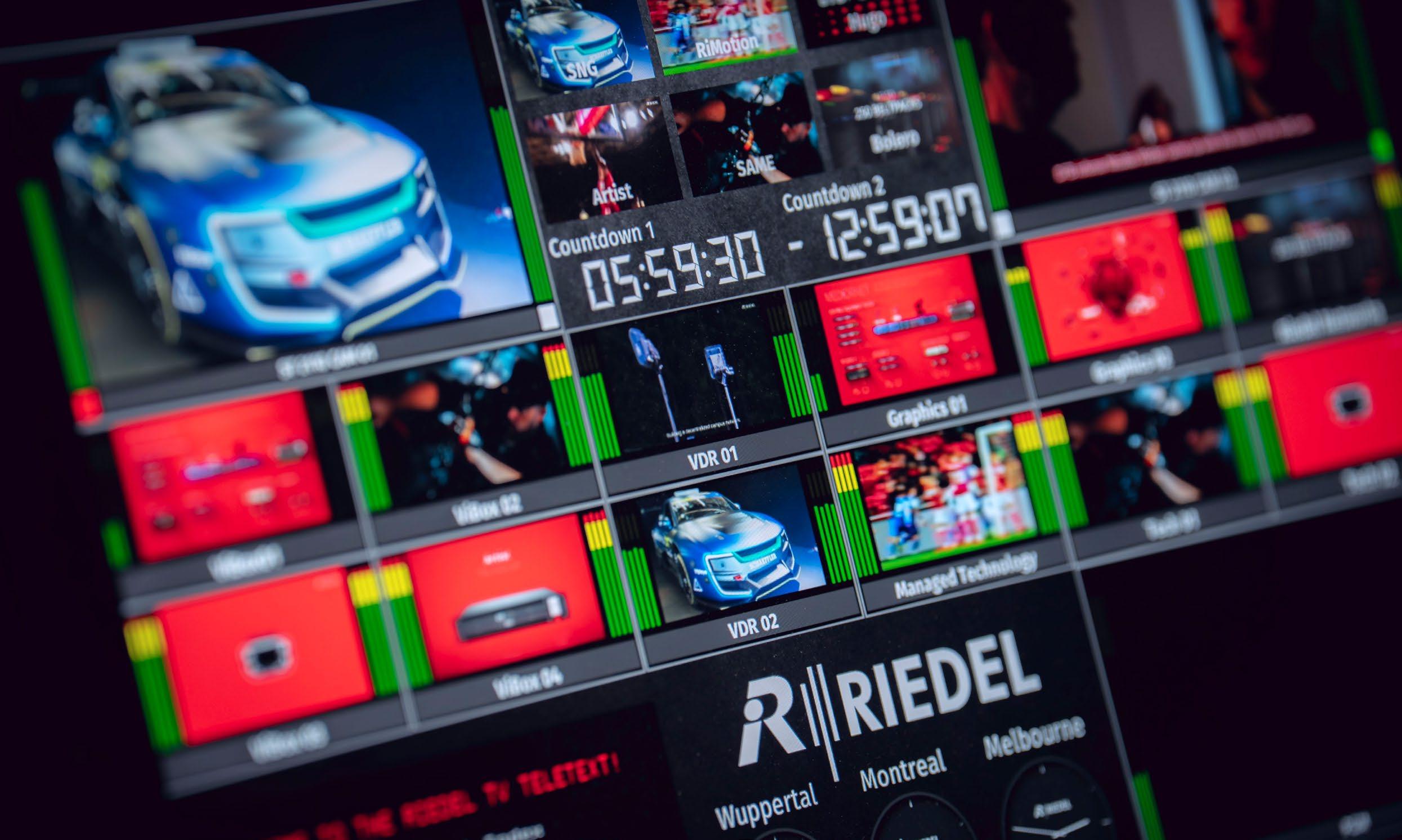
Riedel’s Horizon ST 2110 multiviewer applicationinterface
Stop choosing.
High-quality video.
Ultra low latency.
Bandwidth efficiency.
All of the above.
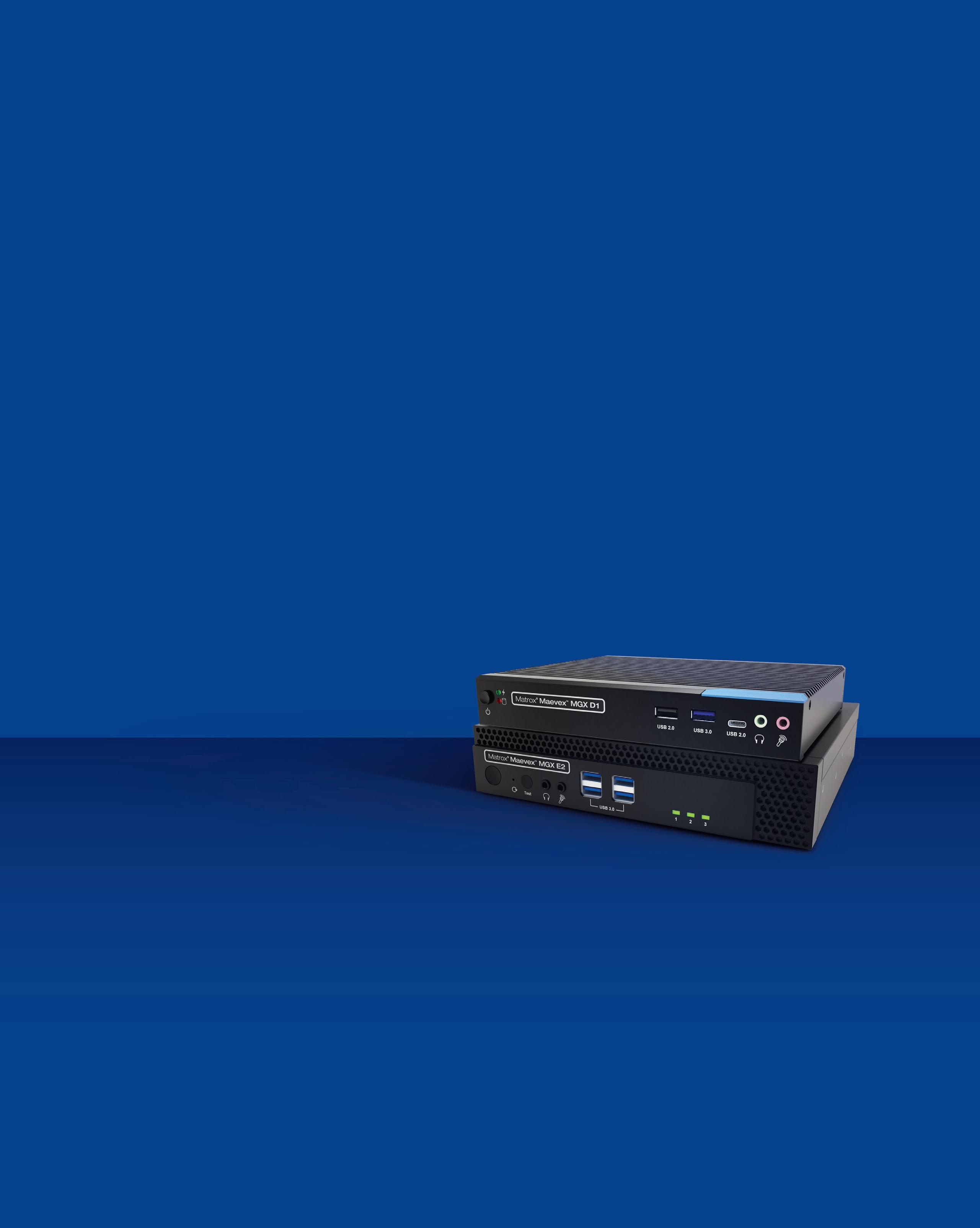
Finally, high-quality video without the tradeoffs. The Maevex MGX Series of encoders and decoders gives you high-quality 4K60 4:4:4 video at just 50 Mbps and as little as one frame of latency on standard 1 Gigabit networks. That’s 1/20 the bit rate of other ProAV codecs. Because performance shouldn’t come with compromise.
Digital signage, a new chapter: AI, experience, & value
Pierre Gillet, VP of international sales at BrightSign, discusses the evolution of digital signage in the age of AI
Digital signage continues to evolve from purely operational static displays into adaptive, intelligent, experience-driven, and fully measurable business platforms. With a majority of consumers expecting personalised interactions, AI at the edge will play a key role in this shift. This will enable organisations to deliver increasingly relevant, responsive, and impactful experiences, while unlocking new opportunities for engagement and growth.
However, digital signage in 2026 is not being defined by AI-driven personalisation alone. Decision-makers are also needing to stay ahead on critical priorities such as purposeful measurement and monetisation beyond proof of play.
AI will enable businesses to reshape how they engage with audiences, turning passive viewers into active participants. By embracing applications that leverage or support AI at the edge, digital signage owners can unlock new levels of interactivity, personalisation, and efficiency.
In practice, AI processing at the edge is not just about personalisation but also about reliability. Most customers we speak to are looking for systems that allow for real-time, local data processing without reliance on cloud infrastructure, reducing latency and safeguarding personal data. Neural Processing Units (NPUs) embedded in digital signage players enable real-time content adjustments based on time of day, location, engagement levels, and environmental conditions, without compromising playback.
TAILORED CONTENT
The opportunity sits in the balance between reliability and personalisation. Organisations are tailoring content to different levels to meet the needs of different buyers, and spaces. From consistent brand-led messaging to contextually relevant, realtime content, signage is becoming a strategic tool for delivering
the right experience that resonates with customers and drives engagement without compromising trust or performance.
We’re seeing the conversation shift from uptime to impact, and how signage supports business goals and improves visitor experiences. The macro layer reflects the overall design and energy of a visit. At the micro level, every digital signage interaction becomes critical. Visitors now look for dynamic, shareable, and personalised touchpoints that elevate their sense of connection. These moments aren’t just extras; they’re part of the growing expectation for an immersive brand journey.
REDEFINING MEASUREMENT
Too often, digital signage is still judged by yesterday’s yardsticks: screen uptime and proof of play. Both matter, but on their own they say little about impact. When measurement stops at whether a screen is on and content is looping, it’s no surprise that signage struggles to register with decision-makers. The result is a channel that looks busy operationally yet underpowered strategically. Redefining measurement is the next step. Businesses must first define the problem digital signage is solving before deployment, and identify what success looks like. That means being deliberate about content, scale and reliability, not defaulting to “more screens, more often”. Reliability and security still matter; digital media players are part of the wider IT stack and deserve the same scrutiny as any other endpoints, but the real step change comes from measuring outcomes, not just uptime.
Metrics should reflect engagement and connection, not just impressions. Measurement will capture the overall value of an experience and its influence on product/brand performance, with data generated at intelligent touchpoints a catalyst for change. This will help to optimise campaigns and refine strategies with far greater precision, while also providing a path
to stronger measurement loops that validate brand, advertising, and sales efforts.
VIEWER BEHAVIOUR
AI-powered digital signage replaces assumption-based metrics with real-time analytics that interpret viewer behaviour. Applications such as real-time motion, object and gaze detection, and audience measurement can deliver immersive experiences when users interact with the display. Operationally, AI also allows businesses to identify which content resonates, measure dwell times, and analyse traffic patterns. Each sector will require tailored KPIs; retail might prioritise dwell time and interaction, while transportation focuses on clarity and reducing frustration. This enables smarter, near-instant decision-making, allowing installers to offer solutions with a clear ROI. Rather than just selling displays, they can provide powerful, data-driven engagement tools. The future of measurement is about aligning data with intent, ensuring every insight drives better viewer experiences.
For years, digital signage success was measured by whether content played reliably, securely and at scale. That benchmark still matters, but on its own it no longer explains who actually saw the content or what impact it had.
The monetisation model for signage is evolving dramatically; we are seeing advertisers start to expect metrics tied to engagement and experience, not just screen time. Value
shouldn’t just be determined on one singular touchpoint, but rather the connection between all different parts of a digital signage journey.
AI will open more opportunities to integrate data to map ideal customer journeys and quantify experiential value. Retail media networks, for example, will leverage these insights to optimise placement, turning signage into a measurable driver of revenue and customer satisfaction.
MATURE ROLE
Digital signage is entering an increasingly intelligent, experienceled phase, shaped by AI at the edge, and a sharper focus on meaningful measurement. The shift from uptime to impact, from impressions to engagement, and from static messaging to adaptive experiences signals a more mature role for signage. This evolution directly influences customer satisfaction, brand perception, and commercial performance.
The next phase will be won by organisations that treat digital signage as part of the customer journey – not a technical asset to be managed, but a responsibility to be justified.
ALSO AVAILABLE ONLINE:
This thought leader can be read off-page, on the Installation site. Scan the QR code or click here
COMPUTEX 2026: AV & IT COLLIDE
Installation reports from Taipei on how AI,
edge computing and enterprise IT are reshaping the future of pro AV
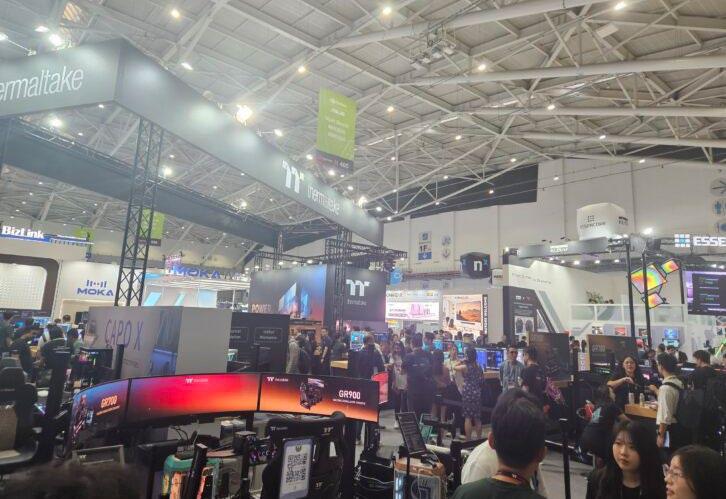
Computex has never been a pro AV show. But as AI processing shifts from the cloud to the edge, and the line between IT infrastructure and AV integration continues to blur, Taiwan’s biggest technology event has become a barometer for where enterprise display, collaboration and signage technology is heading. This year’s theme – “AI Together” – reflected hardware converging around on-device intelligence, with implications for how pro AV systems are designed, deployed and managed.
Installation was invited to Taiwan by BenQ, and its booth was the centrepiece of our visit. The consistent thread running through the company’s range was that AI processing now happens on the device itself rather than in the cloud. A good example is the CP05, BenQ’s latest corporate interactive display, available in 55in and 75in sizes.
Many of the CP05’s features are handled entirely on-device, powered by a dedicated 10 TOPS neural processing unit built on MediaTek’s latest AI architecture. BenQ claims this delivers AI performance up to 3.8 times higher than commonly used alternative platforms. The SummarAI meeting assistant records and summarises discussions without routing audio to an external server, and the 50-megapixel wide-angle camera frames participants intelligently without a cloud connection – powerful selling points where IT security teams are increasingly concerned about data leaving the building.
Speaking to Installation at BenQ’s Taipei headquarters, Claire Huang, head of BenQ’s large display business unit and Cloud Innovation Center, framed the shift in terms of speed and privacy. “Edge
AI can provide a very instant, immediate response, and it can protect users’ privacy,” she said. “Not everything is uploaded to the cloud – especially in education and corporate environments where people are very sensitive about data.”
BenQ believes the CP05’s colour accuracy credentials – Pantone Validated, SkinTone Validated, 95 per cent DCI-P3 – will extend its appeal into creative and medical applications. The 55in model also supports portrait orientation, opening up signage and kiosk use cases. The display recently received a Red Dot Award for product design.
EDUCATION SOFTWARE
Also on show was the RP05 education display and its sibling, the RM05, both carrying the same NPU architecture into the classroom in 65in, 75in and 86in configurations. BenQ’s AI software suite for education includes Lasso Search, which lets teachers circle anything on screen to pull up related content; Ask AI, which surfaces answers without leaving the lesson; EZMath, which converts handwritten equations into clean, editable output; and Circle to Artify, which turns drawings into polished artwork. Huang says around 70 per cent of the underlying functionality is shared between the education and corporate ranges.
LH860ST, a 1080p short-throw laser projector aimed at the sports and golf simulator market. With a 0.5:1 throw ratio and 5,000 ANSI lumens, it’s built for floor- or ceiling-mounted use in compact simulation spaces. BenQ showcased its flexibility with an AI-powered football simulation experience, using sensing technology to track shot trajectories and
BenQ’sScreenBarHalo 2isusedforindividual, desk-levellighting,as distinct from a room’s sharedceilingor ambientlighting
Above right: JC Pan, head of strategic business unit , BenQ Lighting
Below right: Claire Huang, head of BenQ’s large display business unit and Cloud Innovation Center
provide real-time performance analysis and coaching feedback without wearable devices or additional sensors – an extension of technology more commonly associated with golf simulation, where BenQ has established a strong market position. The company combines this with factory-calibrated colour consistency across multi-projector installations, and is exploring deployments in restaurants and sportsviewing venues as well as training environments.
VIVID COLOURS
Huang acknowledged that short-throw projection in simulation environments brings specific challenges around brightness and colour accuracy. “When you simulate a golf course, you want very vivid blues and greens – and with short throw you can lose at least 30 percent of brightness. That’s something we do better than our competitors,” she said.
BenQ’s simulation projection capabilities were showcased in a more spectacular context earlier this year, when its projectors transformed Taipei 101’s
660-tonne tuned mass damper – the pendulum sphere that stabilises the skyscraper during earthquakes – into a giant baseball as part of a Shohei Ohtani exhibition, and ten projectors mapped the irregular spherical surface.
More broadly at Computex 2026, the most powerful impression was that serious local AI computing power is becoming standard equipment rather than a premium feature for enterprises. The headline example is the NVIDIA RTX Spark platform, featured across ASUS’s ProArt creator line. The architecture combines a Blackwell RTX GPU with a 20-core Grace CPU and up to 128GB of unified memory, delivering up to 1 petaflop of AI performance in a form factor that fits into a laptop.
For pro AV professionals, the relevance of RTX Spark is less about the creative workstation use case ASUS was marketing, and more about its long-term implications for office infrastructure. When that level of computing power fits under a desk or in a small rack, it might not be necessary to send AV processing
WHY BENQ BELIEVES LIGHTING BELONGS IN ENTERPRISE AV
As enterprise AV broadens beyond displays and collaboration technology, BenQ believes personal lighting is becoming part of the conversation.
On the same day Installation toured BenQ’s Computex booth, the company also used its Taipei headquarters to showcase a less expected corner of its enterprise ambitions – lighting.
As BenQ strengthens its presence in the enterprise market with its ScreenBar monitor light range, including the newly launched ScreenBar Halo 2, JC Pan, head of strategic business unit, BenQ Lighting, argued personal lighting – dedicated task lighting for individual workspaces rather than shared room illumination –deserves a place alongside displays and control systems in the broader AV conversation.
“Personal lighting in enterprise is very important,” Pan said. “I read a survey that said employee satisfaction with their job comes partly from a sense of control over their own environment, especially the autonomy to adjust their own lighting. Not
everyone likes to work in the same brightness or same colour temperature.”
Pan also argues that personal lighting can reduce overall energy consumption. Rather than relying solely on overhead lighting to illuminate an entire office, targeted task lighting allows ambient lighting levels to be reduced while still delivering the required brightness at each workstation. He suggests BenQ’s ScreenBar design adds a further efficiency gain over traditional desk lamps, which are typically symmetrical and therefore waste roughly half their light output. “Our design doesn’t do that – it angles the light towards your desk instead,” he said. “We can reach the same brightness across the same coverage area, but using half the energy compared with a table lamp.”
SOFTWARE DRIVEN
Pan believes the wider lighting industry, including established commercial players in markets such as Germany, has focused on traditional table lamps rather than
personal lighting designed specifically for desk-based work. On integration with broader building and AV control systems, Pan said BenQ favours open, software-driven approaches over the closed ecosystems that have characterised the lighting industry. Instead of simply switching lights on and off, the company envisages lighting responding intelligently to the software a user is running. Hybrid working, Pan argued, has added a new dimension to the lighting question – not because people spend more time at home, but because home environments typically lack the regulatory minimum lighting standards applied to offices.
On AI, however, Pan struck a more measured note. “AI will bring change, but right now we know the proportion of that happening is almost zero,” he said, pointing instead to more achievable near-term gains such as mini radar sensors capable of detecting stationary occupants –solving a common failure of passive infrared sensors, which switch off if a user in a room stops moving.
Thebusyshowfloorat Computex2026,the biggesttechnology show in Taiwan
Above: Computex crowds gather to welcome Nvidia CEO Jensen Huang, the Taiwanborn business executive
workloads to the cloud. That move towards on-device AI was arguably the defining theme running throughout this year’s Computex. As a result, tasks like real-time transcription, automated camera framing and room occupancy analytics may no longer require expensive dedicated hardware and reliable high-bandwidth internet.
E-paper also provided one of the more forwardlooking product stories, with E Ink and chip partner Airoha Technology jointly debuting what they claim is the world’s first 4.2in Ripple ESL – an Electronic Shelf Label format that uses a wave-like animation effect to smooth out the screen transitions that have traditionally made e-paper feel too slow for dynamic signage. Airoha’s AB161x Bluetooth chip series, built to the BT SIG 5.4 standard, handles the wireless side.
E-paper has been a compelling idea for a few years, but its performance has not always matched manufacturers’ claims, with flickers on page turns a barrier to retail and hospitality deployments. E Ink says the Ripple approach can resolve those issues.
Meanwhile, Installation was also impressed with CAYIN Technology’s presentation of its full enterprise signage portfolio. The range spans three tiers – the Robustie Solution for high-reliability, multi-site installations running industrial-grade hardware; the Flexie Solution for organisations that want full control over their own infrastructure and data; and an E-Paper Solution that speaks to the sustainability angle now appearing in more procurement conversations.
Clearly, Computex is not ISE, or InfoComm – it doesn’t boast room after room of pro AV-specific product launches. But much of the underlying technology on show – including on-device AI, lowpower display formats and increasingly intelligent edge computing – is likely to shape the products and platforms pro AV integrators specify over the next few years. Increasingly, the future of enterprise AV is being defined not only by AV manufacturers themselves, but by the wider computing technologies emerging from events like Computex...
AVAILABLE ONLINE:
This article is also available to read off-page. Scan the QR or click here
INSIDE TRACK
Danielle
Myburgh, UK sales director, Pixel Global AV, on moving from retail into pro AV, why relationships matter more than products, and paddleboarding on the Thames
Where are you originally from, and where do you currently reside?
I came to the UK in 1997. At the time, I was working in the Netherlands for a high-end retailer and was promoted to complete a management apprenticeship here. Though the programme was designed to last 18 months, I finished it within a year. I was then offered a role managing the flagship store back in the Netherlands, but chose to stay in the UK instead, becoming a change manager supporting underperforming stores across the country – early experience that gave me a broad grounding in the business.
What do you enjoy doing in your free time? Any favourite sports or hobbies?
I’m an outdoors person – tennis at weekends, paddleboarding on the River Thames in Summer. And I love travelling, whenever I I get the chance.
My love of sports has extended to joining the new #GirlswithDrive programme, which helps women build confidence on the golf course – an important space for networking and building relationships. Fellow participants include representatives from Absen, Kinly, Samsung, Sharp, Cisco and Pixel Global AV. It’s been fun and a great initiative and we had our corporate graduation day on June 8.
How did you get into the AV industry, and what was your journey to your current role?
I fell into AV in 2013 with no prior experience, joining AVSNet (now part of SCC) as a sales administrator. I progressed into internal sales management, then account management, before realising sales was where I thrived, which led me into business development roles across several integrators. I joined Pixel Global as sales director in July 2025. Titles aside, what’s always driven me is working closely with customers and helping them find the right AV solutions.
What are your thoughts on the future of the industry?
How is your company addressing challenges?
Budgets are tighter, decisions take longer, and clients are far more critical about spend. But AV is no longer an afterthought; it’s part of every company’s budget and plays a role in almost every office. The future belongs to those who move beyond
products to focus on experience, reliability and ongoing support. At Pixel Global AV, we’re a UK-based team with global expertise, focused on long-term partnerships and helping clients get the most from the equipment they already have. We conduct AV audits that give clients a clear, practical view of their existing environments, helping them plan ahead.
Any exciting news you’d like to share upcoming projects, tech developments?
We’re expanding our UK headquarters in Epsom, doubling our space to support growth, with significantly more room for testing, staging and rack builds, plus increased warehouse capacity. We’ll also be announcing an enhanced maintenance and support offering for UK and global enterprises, taking a more strategic partnership approach. It’s lifecycle-led, combining audits, remote monitoring, preventative maintenance and clearly defined SLAs – giving clients confidence their systems are supported consistently across every location.
What excites you most about working in AV?
How fast-moving and ever-changing the industry is – no two days are the same. I love understanding how customers operate and helping transform their workflows through technology. When everything just works and makes people’s lives easier, that’s incredibly rewarding – it’s that mix of people, problemsolving and innovation that keeps me motivated.
If you had to predict one major shift in the AV industry over the next decade, what would it be?
AV will shift fully into a managed service model. Instead of large upfront projects, clients will expect ongoing service, support and predictable costs, delivered and maintained in the same way as IT services. This makes maintenance and support central to the offering, not an add-on – the real value will come from keeping systems running seamlessly and up to date over time.
ALSO AVAILABLE ONLINE:
A longer version of this thought leader is on the Installation site. Scan the QR code or click here