11.21
STRATEGIES & INSPIRATION FOR AUTO CARE SUCCESS
SKY-HIGH NET PROFIT PAGE 29
UNLOCK YOUR VISION TAKE A STEP BACK AND DEFINE YOUR FUTURE PAGE 22
THE FUTURE OF ASA PAGE 12
MARCONI:
DO YOU SELL ON VALUE? PAGE 21
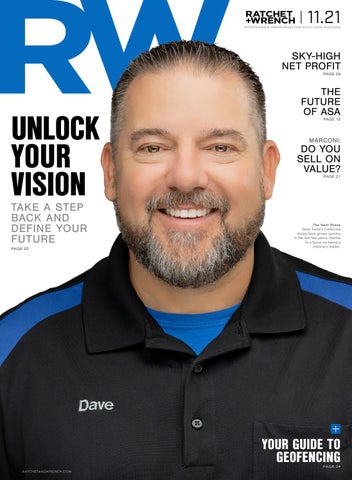
The Next Phase Dave Toole's California shops have grown quickly in the last few years, thanks to a focus on being a visionary leader.
YOUR GUIDE TO GEOFENCING RATCHETANDWRENCH.COM
34 11. 21 / R + W /PAGE 1
Roads are full of cars while bays are low on technicians. That’s why we’re introducing the NAPA AutoCare Apprentice Program. Where graduates receive ASE Certifications and hands-on experience at no added cost to NAPA AutoCare members.
Speak with your NAPA Sales Representative to learn more or visit www.Member.NAPAAutoCare.com 2 / R + W / 11. 21
Honda and Acura Genuine Parts is an online ordering portal for repair facilities to order parts directly from the Honda/Acura Dealer(s) of their choice $0 enrollment fee
Benefits for Repair Facilities:
Quick access to live inventory* in the Honda and Acura Genuine Parts catalog Easy streamlined ordering process saves your employees’ time so they can work on repairing cars *Available through most dealers
GET STARTED! CREATE YOUR ACCOUNT AT: GenuineHondaParts.Honda.com Click on the “My Account” button and then click “Register”. For Account Help, Contact: HondaandAcurapartsportal@ahm.honda.com 11. 21 / R + W / 3
11.21 VO L . 0 9 N O. 11
NOVEMBER 7
8
10
12
15
17
18 Secret to Growth Dave Toole (right) is not an auto repair newbie, but it wasn’t until he made a concerted effort to get out of the day to day of his shop that he was able to grow.
21
EDITOR’S LETTER
The evolving industry
ONLINE
More from the AAPEX show floor
NUMBERS
The effects of 20 Groups
BREAKDOWN
ASA attempts to move forward
SPEED READ
The parts shortage effect
ADAPT
Make time to learn EVs
SHOP VIEW
Old-ish Auto in Ishpeming, Mich.
STRAIGHT TALK
Sell value, not price JOE MARCONI
29 FINANCE+OPERATIONS Sky-high net profit
32 F E AT U R E
HIGH-LEVEL LEADERSHIP
Ready to move out of the day to day? Three visionary shop owners lead the way and share strategies for doing so.
34 SALES+MARKETING
Geofencing for beginners
40 THE FIXER
BY MEGAN GOSCH
PRINTED IN THE U.S.A. COPYRIGHT ©2021 BY 10 MISSIONS MEDIA LLC. All rights reserved. Ratchet+Wrench (ISSN 2167-0056) is published monthly by 10 Missions Media, LLC, 571 Snelling Avenue North, St. Paul, MN 55104. Ratchet+Wrench content may not be photocopied, reproduced or redistributed without the consent of the publisher. Periodicals postage paid at St. Paul, MN, and additional mailing offices. POSTMASTERS Send address changes to: Ratchet+Wrench, 571 Snelling Avenue North, St. Paul, MN 55104.
4 / R + W / 11. 21
Why you can’t hire A-list talent A ARON STOKES
ON THE COVER: DAVE TOOLE, PHOTOGRAPHED AT TOOLE’S GARAGE IN STOCKTON, CA
MCANALLY MOMENTS
22
CASE STUDY
Remote payment pitfalls
INCREASE CAR COUNT AND RETAIN MORE CUSTOMERS WITH
WEEKLY DIRECT MAIL
EASY PROCESS. OUTSTANDING SERVICE.
Call Today For Your Complimentary Market Analysis & Sample Package 610-463-0603 | themailshark.com/autorepair
11. 21 / R + W / 5
O N L I N E
E X T R A S
CLICK ON THE LOGO BELOW FOR PRODUCT INFORMATION
ADAPT
Au toZone
Might y Au to Par t s
WIRED FOR
SUCCESS Ad vance Au to Par t s
Car ter
You’re wired differently and we like that. America likes that.
Americ an Honda Motor Company
Jas per Engines & Trans mi s ons
Visit futuretechsuccess.org and find out how your hands-on talent is the key to an amazing technical career. AUTEL
When Techs Rock, America Rolls ℠ futuretechsuccess.org
Au toli te
KUKUI
Ratchet +Wrench Managem nt
Confer nce
TechForce Foundat ion
FUTURETECH
SUCCESS
Mail Shark
Print & Direct Mail Made Easy
6 / R + W / 11. 21
NAPA
™
Worldpac
EDITOR'S LETTER
EDITORIAL VICE PRESIDENT, CONTENT AND EVENTS Bryce Evans EDITORIAL DIRECTOR Anna Zeck STAFF WRITER Paul Hodowanic SPECIAL PROJECTS EDITOR Nora Johnson CONTRIBUTING WRITERS Joe Marconi, Aaron Stokes, Rissy Sutherland, Megan Gosch, Claire Peterson, Ella Schulte PRODUCTION ART DIRECTOR Zach Pate GRAPHIC DESIGNERS Nicole Olson, Morgan Glisczinski, Emme Osmonson PRODUCTION ARTIST Lauren Coleman SALES VICE PRESIDENT AND PUBLISHER Chris Messer 651.846.9462 / cmesser@10missions.com ASSOCIATE PUBLISHER Andrew Johnson 651.846.9459 / ajohnson@10missions.com MARKETING STRATEGISTS (NATIONAL ACCOUNTS) Marianne Dyal 706.344.1388 / mdyal@10missions.com Bob Marinez 216.533.8747 / bmarinez@10missions.com Martha Severson 651.846.9452 / mseverson@10missions.com Kyle Shaw 651.846.9490 / kshaw@10missions.com Dan Thornton 734.676.9135 / dthornton@10missions.com Sean Thornton 269.449.0257 / sthornton@10missions.com REGIONAL SALES MANAGER Matt Harper 651.846.9551 / mharper@10missions.com SENIOR MARKETING STRATEGIST (REGIONAL ACCOUNTS) Melody Todd 651.846.9468 / mtodd@10missions.com CLIENT SERVICE SPECIALIST Jen George 651.846.9465 / jgeorge@10missions.com 10 MISSIONS MEDIA PRESIDENT Jay DeWitt GENERAL MANAGER AND PRODUCTION MANAGER Mariah Straub BOOKKEEPER AND CLIENT SERVICE SPECIALIST Meghann Moore EVENT PRODUCER Kate Fahlen COMMUNITY DEVELOPMENT ASSOCIATE Meghan Horan SENIOR DIGITAL MEDIA STRATEGIST Tiffany Fowler DIGITAL MEDIA ASSISTANT Nina Kayfes MARKETING COMMUNICATIONS SPECIALIST Kasey Lanenberg ADMINISTRATIVE ASSISTANT Karley Betzler EDITORIAL ADVISORY BOARD Jimmy Alauria, 3A Automotive & Diesel Repair Ryan Hillebrand, Urb's Garage Dwayne Myers, Dynamic Automotive John Miller, Fifth Gear Automotive Bryan Gossel, BG Automotive Rob Choisser, Choisser Import Auto Services
LEAH QUINTO
HOW TO REACH US 10 MISSIONS MEDIA 571 Snelling Avenue North, St. Paul, MN 55104 tel 651.224.6207 fax 651.224.6212 web 10missions.com The annual subscription rate is $72 (U.S.A. only) for companies not qualified to receive complimentary copies of Ratchet+Wrench. BACK ISSUES Past issue single copies are $8. Go to ratchetandwrench.com/backissues LETTERS TO THE EDITOR editor@ratchetandwrench.com ARTICLE REPRINTS For high-quality reprints or e-prints of articles in this issue, call 651.846.9488 or email reprints@ratchetandwrench.com. Opinions expressed in Ratchet+Wrench are not necessarily those of 10 Missions Media, and 10 Missions Media does not accept responsibility for advertising content.
Time for Change BOOM OR BUST? NAH, HOW ABOUT WE JUST EVOLVE?
Hopefully, you’ve followed the news on this, as I’m not going to call out specific companies
and organizations, or deals. But there’s a large shift that has taken place in the automotive aftermarket in recent years, one that appears to be picking up steam month by month: The emergence of private equity, and the gradual consolidation of organizations on both the vendor and shop sides of the industry. If it’s not daily announcements about a sale or acquisition, then it’s at least weekly. And it doesn’t appear to be slowing down any time soon. Now, I had a recent conversation with someone I’ll simply refer to as an “industry leader,” who is very much in the middle of this industry transition; she comes from the shop side of things and has a proven track record of knowing where the industry is heading next. Her message was fairly clear: The next five to eight years will wind up being the most critical in determining the future of the automotive aftermarket—and the long-term success of the independent shop. If you look at the trends, this feels like anything but hyperbole. As the industry continues through its current technological revolution, the day-to-day work of the automotive professional will continue to shift. Are you ready for that? Back in July, we released our 2021 Ratchet+Wrench Industry Survey, which dives into a statistical analysis of the independent shop operator, detailing performance metrics, demographic details, and unique insights on topics ranging from leadership styles to technology investments. Here are a couple jarring stats for you: Only 14 percent of those surveyed said they were equipped to do ADAS work; only 8 percent see ADAS work as a future profit center. According to Auto Care Association data, the average light vehicle on the road today is 12.8 years old, so, sure, most folks aren’t seeing a whole lot of ADAS work coming in the doors today. But this is where that prediction from our industry expert comes back in. What types of vehicles will you work in five to eight years from now? Again, are you ready for that? Another stat from our survey: Fifty-seven percent of those surveyed said that “a shortage of qualified technicians” is the top challenge facing the industry today. Compare that to the rising cost of doing business (12 percent), availability of repair information (10 percent), advanced vehicle design (6 percent) and technology and tool needs (4 percent), and our industry leader friend says you get a pretty clear picture of where everyone’s focus is: the day-to-day operations right in front of them. The worry, she says, is that not enough folks are thinking about the long-term viability of their businesses. The good news, though, is that you have time to change that. This isn’t a “boom-orbust” scenario; it’s time to evolve, she says. At Ratchet+Wrench, we’re committing ourselves to helping you do this. It’s why we try to present this information in the pages of our magazine, on our website, and even at our management conference each September. It’s the entire reason we, as 10 Missions Media, launched the ADAPT: Automotive Technology Summit (adaptsummit.com). So, instead of wondering if you’re ready for this shift today, the real question is what can we do over the next five years to ensure that we are ready? Let’s work through it together.
BRYCE E VA NS, VICE PRESIDENT, CONTENT A ND E VENT S BE VA NS@10MISSIONS.COM AUTOMOTIVE GROUP
11. 21 / R + W / 7
ONLINE 11.21 COMMENTS, DISCUSSIONS, FEEDBACK AND MORE FROM AROUND THE WEB
RADIO
FEATURED TOPIC:
Editorial Director Anna Zeck chats with Brian Sump, owner of Urban Autocare and Avalon Motorsports, about finding a successful balance that will lead to the best business results. Recorded at the 2021 Ratchet+Wrench Management Conference, Zeck and Sump also touch on some of the highlights of Sump’s keynote speech. Find the Ratchet+Wrench Radio episode at ratchetandwrench.com/podcasts.
8 / R + W / 11. 21
FIND US ONLINE
—
Want more Ratchet+Wrench in your life? Follow us at ratchetandwrench.com/facebook for daily news stories, photo galleries, and more that didn’t make it into the print issue. You can even get a behind-the-scenes look at the work the R+W team puts in every month working on the latest issue.
THINKSTOCK, R+W FACEBOOK
FIND YOUR BALANCE
—
B R O U G H T T O Y O U B Y T H E T E A M AT R AT C H E T + W R E N C H
Automotive Technology Summit DECEMBER 57 • NASHVILLE
LAST CHANCE TO REGISTER! SAVE $400 ON YOUR PURCHASE WITH CODE RWMCPROMO ADAPTSUMMIT.COM
THE ADAPT: AUTOMOTIVE TECHNOLOGY SUMMIT IS A THREEDAY EVENT PROVIDING SHOP OWNERS AND OPERATORS WITH A UNIQUE, UNMATCHED OPPORTUNITY TO LEARN DIRECTLY FROM INDUSTRY LEADERS ON THE MOST PROGRESSIVE AND PRESSING TECHNOLOGY TRENDS DISRUPTING THE AUTOMOTIVE AFTERMARKET
2021 ADAPT: AUTOMOTIVE TECHNOLOGY SUMMMIT SPONSORS: PLATINUM SPONSOR: OVERALL PARTS SOLUTIONS GOLD SPONSORS: CTI+WTI, MOTOLOGIC, NISSAN, TECHNET SILVER SPONSORS: ASTECH, AUTOLEAP, AUTOMOTIVE TRAINING INSTITUTE, AUTOVITALS, BROADLY, CARSTAR, FORD MOTOR COMPANY, HUNTER ENGINEERING, KUKUI, MITCHELL 1, NAPA, OPTIMIZE SOCIAL MEDIA, RELIABLE AUTOMOTIVE EQUIPMENT, REPAIRPAL, SHOPMONKEY, SHOPWARE, SOFTWARE STATUS SOLUTIONS, SOLID START, TEKMETRIC, WHI SOLUTIONS 11. 21 / R + W / 9
NUMBERS TRENDS,
ENLIST THE EXPERTS —
AND
METRICS
DRIVING
YOUR
OPER ATION
PEER NETWORKING’S EFFECT ON KPIs
Doesn’t work with a peer networking group
Revenue above $1 million Average repair order above $400 Effective labor rate above $90 Technician efficiency above 100% Technician productivity above 90%
The content you’re looking for,
at your fingertips.
Social icon
Rounded square Only use blue and/or white. For more details check out our Brand Guidelines.
ratchetandwrench.com/twitter ratchetandwrench.com/linkedin
10 / R + W / 11. 21
ratchetandwrench.com/facebook
100%
90%
80%
70%
60%
50%
40%
30%
20%
Works with a peer networking group
While there are plenty of resources shop owners can turn to for business guidance and insight—including business coaches and peer networking groups—a good number of shop owners still aren’t using them, despite proven results. Based on insight from the 2021 Ratchet+Wrench Industry Survey, when it comes to core KPIs, shops that worked with a peer networking group significantly outperformed those who did not. Let the numbers speak for themselves and take advantage of one if you haven’t taken the plunge just yet. For more insight on the power of peer networking head to ratchetandwrench.com/ powerpeernetworking.
10%
TOPICS,
0%
THE
PATENTED ENGINEERED QUALITY From patented design to higher quality materials, Carter engineering sets the standard for fuel pump solutions that meet or exceed OE fit, form and function with best-in-class coverage. The patented module and hanger assembly contain industry exclusive features all designed to provide longer service life and better performance.
Metal clamps
Rubber feet
Prevent blow-offs on the fuel supply hose*
Reduce noise and vibration during operation*
Silver alloy contacts
Guide rod springs
Increase the life of the sender assembly*
Exterior springs provide more durability as the assembly expands and contracts in the fuel tank*
Abrasion sleeve
CleanScreen™ Technology
Helps protect supply hose from premature wear due to friction*
Increases fuel pump life in dirty environments*
Float arm
Over-molded armature
Pre-mounted and calibrated to ensure proper fuel read*
Reduces fuel flow turbulence*
*Application specific
Carbon commutator Eliminates oxidation and high electrical erosion*
Leading coverage with over 95% domestic and import VIO
Engineered in US to OE quality standards for performance and durability
Limited lifetime warranty to provide peace of mind
www.CarterEngineered.com
IATF 16949, ISO 14001 certified; conduct and pass extensive durability and performance testing
J U M P S TA R T
The next right step, or a misstep? Industry opinions are varied on ASA’s latest move. BY PAUL HODOWANIC AND ANNA ZECK
12 / R + W / 11. 21
In early October, the Automotive Service
Association (ASA) announced a change to its membership model with the hopes of creating a “single, unified voice.” Under the new model, existing state affiliate agreements will be dissolved, and a 50-state regional structure will take its place, with ASA-national overseeing the entire operation. The goal of the new direction is to create local ASA chapters in every state, with regional directors overseeing groups of states. The new model will go into effect Jan. 1, 2022.
GETTY
ASA Makes a Play to Regain Association Relevancy
“Our board of directors is taking the necessary steps to ensure the future of ASA and its members. With the changes occurring in automotive innovation and public policy, it’s critical that the automotive repair industry speaks with one voice. ASA is the voice for automotive repair,” ASA Chairman Fred Hules II said. Since the announcement, in interviews with Ratchet+Wrench, Hules, executive director Ray Fisher, and other members of ASA’s board of directors have continued to preach the need for continuity and voiced excitement and anticipation for the shift. However, behind the scenes, several of the industry’s top voices and regional directors within ASA remain skeptical about the new direction, citing ASA’s previous blunders, issues with how the process was carried out and the plan itself. That came to fruition hours after the announcement as ASA-Northwest, the largest ASA affiliate, announced it will leave the organization and join forces with Midwest Auto Care Alliance. MWACA, formerly ASA-Midwest, split off from ASA in 2018. ASA Illinois has since announced it will leave ASA and will join MWACA as well. Officials at ASA-Northwest, which will become the Northwest Auto Care Alliance (NWACA) no later than Jan. 1, 2022, cited a lack of belief in ASA national’s direction and wariness of a national model for the split. But ASA officials remain steadfast that the new model is the next right step for the organization. Others interviewed by Ratchet+Wrench wonder whether it will be the latest in a growing list of ASA missteps? A Complicated History ASA has existed since the 1950s, initially forming from roughly 50 state associations coming together as a group. It launched NACE/CARS, which further grew the organization. However, ASA has weathered a few storms in recent years. In 2013, the board of directors announced it had been the victim of theft by a former employee, causing two
association executives to resign, followed by executive director Ron Pyle electing to not stay on after his term expired. In 2017, after shuttering its sister show, ASA attempted to revitalize the Congress of Automotive Repair Service (CARS). But the event struggled to regain popularity and closed after one year. As a result, former ASA chairman Donny Seyfer, who was brought in to revitalize CARS and re-engage the mechanical repair side of ASA, left to become the executive officer of NASTF. Then, in 2018, the aforementioned split with ASA-Midwest occurred, which, at the time, was ASA’s largest regional affiliate. That year, executive director Dan Risley also resigned in a shroud of controversy. “ASA has stubbed its toe several times,” said Judi Haglin, former executive director of ASA-Colorado and newly appointed ASA national board member. Because of that, Haglin understands the skepticism with ASA making another large pivot. She also admits the future of ASA will depend on the success of this new model. Frustration with ASA’s Process ASA announced its intentions to change the membership model during a meeting with affiliate directors shortly before the announcement. It came as a shock to several regional affiliate leaders, including Kelley and Matt Dougher, executive director of ASA-Ohio. By Monday, ASA made the changes public. Dougher wasn’t at the official meeting Friday due to a family commitment. He learned from a third-party who was at the meeting. It took until Sunday before Dougher got full details about the change. “I think there’s been a strained relationship [between affiliates and national] for a long time,” ASA-Northwest Chairman Bryan Kelley said. “The culture difference of national versus affiliates, they’re two different animals. I wouldn’t say either one of them is right. They’re just drastically different.” Kelley acted quickly, orchestrating ASA-Northwest’s removal from ASA
and following MWACA executive director Sheri Hamilton’s lead, which she reiterated was “clearly the correct choice.” Dougher has no intentions of returning to ASA either. He is formulating a plan to de-affiliate ASA-Ohio from the national organization and create an independent group in Ohio. ASA’s Path Forward ASA’s changes will go into effect Jan. 1, 2022. The new model will consist of six regions. Each region will have a regional director that oversees all local chapters in its region. The ASA announced it is still looking for “various” regional directors. In the previous model, the national organization, for the most part, left affiliates alone. That caused issues, according to Haglin, as some of the weaker affiliates struggled to maintain funding. Haglin credits the success of some affiliates—like ASANorthwest, ASA-Colorado and ASAMidwest—which were able to survive off funding generated from events. Only 50 percent of members in the previous model had a regional affiliate, hence the need to ensure consistent benefits throughout the U.S., Haglin said. Haglin is among the new additions to ASA national’s board, alongside mechanical division director John Firm and Chairman Hules. Still, ASA will need to find a way to differentiate itself, Seyfer, former ASA chairman, said. “If an association can figure out how to bring a value to the member that a magazine article or a standalone trade show cannot bring to the table, then absolutely, it’s got a value,” he said. “There definitely are some models out there that are viable, but it’s a tough, upward battle, and it always has been.” Haglin believes ASA’s lobbying efforts—led by Bob Redding, whose salary is covered by ASA national—set itself apart. Losing that would be a hindrance to the industry, especially in current circumstances with Right to Repair entering the national conversation and the rise of EVs and AVs. 11. 21 / R + W / 13
FREE
OPTIMIZE YOUR STOCKROOM WITH A
INVENTORY ANALYSIS
Many shop owners have up to 50% too much inventory – are you one of them? Mighty’s Inventory Optimization program begins with a free analysis, and then is all-inclusive, consisting of inventory rebalances and ongoing maintenance. An optimized stockroom lets you put the focus on your customers. BE MIGHTIER! Get your free inventory analysis at MightyAutoParts.com/Inventory
Q U A L I T Y PROD U C T S
14 / R + W / 11. 21
IN V ENTORY MAN AGEMENT
B U S I N ES S I N S IG H T
C U S TOM I Z E D T R A I N I NG
J U M P S TA R T
DEALERSHIPS FEELING THE EFFECTS OF TECHNICIAN, PARTS SHORTAGE A new study from Cox Automotive has found dealership service departments are feeling the effects of the technician and parts shortages. Roughly 57 percent of dealership respondents to the 2021 Cox Automotive Service Industry Study said their service department is not fully staffed, and 80 percent expect these labor shortages to continue or worsen in the future. Fifty-eight percent of shops mentioned part delays and 45 percent mentioned labor shortage as their top operational frustration. “The industry is ripe for transforming the consumer experience,” Tracy Fred, vice president of operations for Xtime, said in a statement. “Despite a challenging marketplace, opportunities exist to better leverage digital tools to deliver on and even exceed consumer expectations, while also offsetting some operational challenges. Elevating the entire service experience with a consumer-first mindset and the use of technology can help raise overall profits, capture additional market share and help mitigate the frustrations service departments are currently facing.”
PEXELS
STUDY: EV TRANSITION WILL BE ‘ROCKY’ A new research review in Nature Energy journal revealed the electric vehicle “revolution” will be slow and rocky. The research looked specifically at why electric vehicle adopters decided to switch back to a conventional ICE vehicle. The study found that in a survey of a few thousand California residents who were early adopters of either battery-powered electric vehicles or plug-in hybrids, about 20 percent switched back to gas vehicles. “About one-fifth of people who adopted electric vehicles ditched them. That seems like a lot to me,” said Bradley Lane, research author and associate professor of public affairs and administration at the University of Kansas, “especially given that these were the people most likely and most incentivized to adopt them. Of course, you could also argue that 80 percent of people kept their EV or got a new one. But interestingly, the same things that predicted if people adopted them, if they were dissatisfied with those things, they abandoned their EV.”
Owners who abandoned their batterypowered EVs reported they were most likely dissatisfied with home charging capability and public access to charging stations. Lane later added he believes the transition will be “rocky.”
ASA OPPOSES PENNSYLVANIA EMISSIONS LEGISLATION The Automotive Service Association announced its opposition to a Pennsylvania Senate bill that would exempt vehicles five years and newer from the requirements of emissions inspections. The passage of the bill would hurt the approximately 7,000 emissions stations in Pennsylvania, which would see their customer bases shrink. “This legislation would decimate the Commonwealth’s Vehicle Emissions Inspection and Maintenance program, adversely impact hundreds of Pennsylvania small business owners, and threaten compliance with the federal Clean Air Act,” ASA Pennsylvania President Ross Colket said in a letter to the state senate. “The proposed changes in SB 777 not only put the health, safety, and welfare of all Commonwealth residents at risk but likewise jeopardizes hundreds of millions of dollars of federal funds for violating federal law.”
ASA ILLINOIS LEAVING ASA, JOINING MWACA After having their affiliate terminated by the national office of the Automotive Service Association, the ASA Illinois board of directors voted unanimously to join forces with the Midwest Auto Care Alliance. A Greater Chicagoland Chapter has already been created by MWACA, the organization announced in a press release. Once the ASA Illinois affiliate dissolves on Jan. 1, 2022, the same board leadership and local staffing, with guidance and support from the MWACA executive director and staff, will assume leadership of the chapter. ASA Illinois is the second known organization to formally announce a split from ASA-national as some in the industry remain skeptical about ASA’s newest direction. Shortly after ASA-national’s decision to terminate all current affiliates, ASANorthwest announced it would join MWACA as Northwest Auto Care Alliance (NWACA). ASA-Ohio is also considering leaving ASA. “Our new alliance with MWACA will allow us to deliver so much more value and member benefits, and at a lower cost to the shop owners,” Dave Hinz, board president for ASA Illinois and owner of Mastertek Auto Repair, Algonquin, Ill., said in a statement. 11. 21 / R + W / 15
IA800
ACCURATE ADAS CALIBRATION
MADESIMPLE
IA800 ACCURATE ALIGNMENT PRE-CHECK & CALIBRATION FRAME PLACEMENT
1 PRE-CHECK >
• Perform Alignment Check, Easily Add Confirmation to ADAS Pre-SCAN Report
• Quickly Identify Wheel Alignment Issues Which May Affect Calibration Accuracy
2 POSITION >>
• High-resolution Cameras Eliminate Manual Measurements
• Accurately Position Frame Quickly With 1 Technician • Color Coded Values Indicate Accurate Precise Amount of Frame Movement Required
3 PERFORM >>>
• Calibrate with Any ADAS Capable MaxiSYS Scan Tool
• Easy To Follow, Illustrated, Step-By-Step Instructions Guide the User Through Every Step of the Calibration Process
4 PROVIDEDONE! • Easy-to-Read Report Indicates Wheel Alignment Condition
• Comprehensive Report Provides Proof of ADAS Calibration • Easily Share PreSCAN / PostSCAN Reports with Customers or Insurance Carrier by Print, Digital PDF or Email
POWERED BY AUTEL DIAGNOSTICS POWERFULTOOLS+SMARTERSOFTWARE
TEL: 1.855.288.3587 I WEB: AUTEL.COM EMAIL: USSUPPORT@AUTEL.COM AUTEL.COM FOLLOW US @AUTELTOOLS
16 / R + W / 11. 21
©2021 Autel U.S. Inc., All Rights Reserved
SCAN TO WATCH
TRAINING VIDEOS
YOUTUBE
K E Y I N S I G H T S , T R E N D S A N D S T R AT E G I E S F O R T O M O R R O W ’ S I N D U S T R Y—T O D AY A D A P TA U T O M O T I V E . C O M
A D A P TA U T O M O T I V E . C O M / FA C E B O O K
T W I T T E R .C O M /A DA P T_ AU TO
Seyfer: Shops Have Time to Adjust to New Tech AS TOLD TO NOAH BROWN
GETTY
For a recent episode of the ADAPT Podcast, NASTF Executive Director Donny Seyfer spoke about when shops should start upgrading their equipment to handle new technologies. Autonomous technology isn’t coming right away, and definitely not at the speed that some of the evangelists for autonomous were talking about. When you’re trying to decide when to learn the technology, you have to look at what you’re working on. You have to look at your market. Where there’s opportunities to learn systems, that’s extremely valuable if you’ve got a market. If you’re working on those systems already, then by golly, you better get caught up. When those vehicles start showing up in your shop, you have to be up to speed, otherwise you’re turning away jobs
D E C E M B E R 5 -7 NASHVILLE, TENN.
and you’re turning them away on a regular basis because you’re not equipped. But that’s not going to be an overnight thing. I’m not saying you shouldn’t prepare, because you absolutely should, but it’s incremental. Let your customers drive when you start adopting, or you’re going to have to go out and look for the business to rationalize the tools that will become outdated before they become mainstream. One of the things that having all this technology in the cars will do is the technicians who step up and learn how to do it and do it well will be accepted as the level of professionals that they actually already are. I don’t think this is a big lift for our folks. Head to adaptautomotive.com/seyferadjust to listen to a podcast interview with Seyfer.
Have you snagged your ticket for The ADAPT: Automotive Technology Summit? Head over to adaptsummit.com to register and check out the full two-and-a-half-day lineup.
11. 21 / R + W / 17
J U M P S TA R T
Old-Ish Auto LLC B Y R YA N M C C A N N A PHOTOGRAPHY DANIELE CAROL PHOTOGRAPHY CO.
S H O P S TAT S
A WICKED STORM
Owners: Terry and Naomi Doyen
Back in 2019, after a week of storms that blew in 200-plus inches of snow, the roof of Old-Ish Auto couldn’t take anymore. “The only thing left was the front office,” says coowner Naomi Doyen. “We’re very thankful no one was in the building and that we weren’t open. It happened so fast.” The Doyens’ business was only a year and a half old at the time, and suddenly they faced a rebuild from the ground up. Then, just as they planned to move forward with construction—after navigating challenges with insurance and the weather—the pandemic hit. “It’s a lot of little problems that cause a big headache,” Terry Doyen says. “It’s a lot of things you learn you don’t know. Not unless you go through it.”
Location: Ishpeming, Mich. Staff Size: 2 Number of Lifts: 3 Average Monthly Car Count: 95 Annual Revenue: $250,000
18 / R + W / 11. 21
HAVE AN OUTSTANDING SHOP? Send a few photos and a brief description to submissions@ratchetandwrench.com and we might feature it here.
LOOKING BACK The shop remains in its original footprint. According to The Mining Journal, a local publication, parts of the building date back to 1912 when it was used as a horse and carriage house, before shifting hands to Holmgren Motors in the 1940s, and finally to the Doyens who purchased the building from the Morristen family as Central Pontiac in 2017. Understandably, the building was a staple in the town. “The community was discouraged to see it fall. Now, seeing it come back is really good for the community,” says Terry. After the snow melted and a team cleared out the debris, the couple took the summer to file paperwork and revisit their financial future. “Once fall came, we scrambled for a temporary location to work,” Naomi Doyen says. “Luckily, the tenant in the building behind us cleared out. It seemed like fate. We were able to convert it to a temporary working space.” Instead of looking elsewhere, they decided to stay and rebuild.
REBUILDING WITH VISION From the ground up, the major renovations not only honor the past, but look forward to the future. Naomi Doyen’s favorite part of the shop is an installation she has planned for the office. “I want to put together a tribute for the history of the location of our business,” she says. The Doyens plan to add photos of the people, the site, and the various historical maps that all make up the shop’s unique story. Both owners feel that the shop’s history, connection with the community, and commitment to a clean facility set them apart from other shops in town. “We strive to make sure it’s a place where customers can trust us,” Naomi Doyen says. “We’re honest and straightforward, that’s the character of our business. We’re not another hole-in-the-wall shop.”
11. 21 / R + W / 19
SPONSORED CONTENT
THE MAP OF SUCCESS Utilize the KUKUI dashboard and customer map to drive your marketing decisions
Just about two years ago at MWACA’s VISION Hi-Tech Training & Expo, Jennifer and Mike Baggett saw a presentation on the many advantages of using the marketing tools of KUKUI. Almost immediately after the presentation, the couple began their KUKUI journey at their Illinois shop, Pro Automotive Services. KUKUI has helped to turn the shop’s once self-described “stale” website into a vibrant, easy-to-use marketing tool— helping to bring in new customers and grow the business. The Baggetts are also now able to track their shop's marketing efforts like never before. By utilizing KUKUI’s All-in-One Shop Performance Dashboard and Customer Map, they can see vital shop analytics to aid in their marketing and investment decisions. AN EASY TRANSITION Jennifer Baggett recalls the transition over to KUKUI as a seamless one. They were originally given a point of contact who helped them set up their newly designed website before working directly with their KUKUI account manager. “Having one person whose only job is to help set up new accounts made the entire process very streamline,” she says. Now, whenever they want to update their website with any promotions or new photos, Baggett says she can simply send over any changes to the KUKUI team and the website is updated anywhere between 24 and 48 hours. The new website has garnered far more traffic for Pro Automotive Services than before, and even more importantly, the new traffic is now trackable through the shop’s KUKUI dashboard. KUKUI’s All-in-One Shop Performance Dashboard helps break down the shop’s revenue, car count, customer conversion rate, email address capture rate, and more. By viewing the dashboard, Baggett can get a full inside look at how the shop’s marketing is performing. “Just looking at the data, we have gotten 136 calls in the past three months driven solely from our website,” Baggett explains. “And from those phone calls, our website has brought in around 40 customers.” The proof is in the KUKUI data.
DETAILED TRACKING As a tool to decipher where to send direct mail advertisements, Baggett relies on the Customer Map within KUKUI’s control panel. The map allows her to specify a particular time frame in order to get a geographical look at how much money is being spent at the shop from specific areas. “With KUKUI’s Customer Map, I can look at different divisions and zero in on anywhere from the past 12 months to 15 days in order to see who has been in the shop and how much money they have spent in that time,” she explains. This hyper-focused look at geographic spending offers Baggett a way to get a detailed look at where more advertising efforts should be made. If she notices that a household has been a customer for an extended time and has spent a good amount of money in last few months, she can then focus on targeting their neighbors—who may have similar spending habits and most likely heard about the shop from that neighboring customer. Baggett is also able to identify customer “holes” on the map, and focus on investing in marketing to areas where the shop currently doesn’t have any customers. By delving into the data that the Customer Map offers, Baggett may also decide to stop marketing to specific areas, or even change the advertising medium. KUKUI has the ability to break down the type of advertising that is bringing in which customers and from where. With designated and trackable phone numbers and web addresses, Baggett knows which marketing efforts are working and which she should stop investing in. All working together to help Pro Automotive Services continue to grow.
To s e e h o w K U K U I c a n help your shop, check out kukui.com.
Columns
STRAIGHT TALK Joe Marconi
DON’T APOLOGIZE FOR YOUR PRICES Selling value will always win out over price
MICHAEL HOEWELER
About a month ago, my wife and I went
out for dinner at a local restaurant. We arrived around 7 p.m. and we could sense that something was off. Although restaurants are back to 100 percent capacity, it was obvious that about half of the tables were removed. They weren’t as busy as usual either. The staff appeared somewhat stressed. I then looked down at the menu and I couldn’t believe what was stapled to the front of the menu. It was a large note that said: “We apologize for the increase in prices. With expenses rising, and with the loss of business due to COVID, we have no choice but to raise the price of our meals. We hope you understand and please let us know if you have any questions.” When the server came over to the table to take our order, I asked him what prompted the apology note? He replied, “Hold on, let me get the manager.” A minute later the manager walked over to us, and I repeated the question. He said, “The owner wanted to avoid any issues before customers noticed the price increases.” I asked the manager if anyone had complained about prices before the note? He responded, “Well, no, but we hadn’t raised the prices yet.” I continued, “How many people now complain about the price?” The manager said, “We get a few each night now after they read the note.” This was getting interesting. I had to continue, “How much was the increase in your prices?” He replied, “Just a few bucks on some select meals. Oh, and we removed some of the meals on the menu to help control expenses.” I almost held back, but I had to say it, “So, you increased prices, reduced the choices on the menu and you removed some of the tables due to staffing issues. You had no complaints about your prices before, but now you do. Could it be you
overreacted?” The manager looked confused and said, “What? You think we brought this on ourselves? We had to increase prices.” I replied, “I am not faulting you for raising prices, but it looks like you reduced the value of your services and put the price increase right in everyone’s face. If I were you, I would remove the apology note and focus on the customer experience.” The manager said he would speak to the owner. We went back to that restaurant with friends this past Saturday. The note was still on the front of the menu, the place was nearly empty, and the mood of the entire place was somber, at best. This restaurant, like many businesses, endured hard times due to COVID. The monetary losses had to be overwhelming. This had to influence the owner’s decision to create the apology note, along with removing tables, and reducing meal choices. In his defense, he did not want to lose any more business. However, the decisions the restaurant owner made resulted in hurting the customer experience. By creating an awkward and negative experience, people actually starting to pay attention to the exact thing the owner was trying to avoid: price! Here’s the lesson: No business should ever apologize for its prices. Prices are determined by calculating the cost of sales, operating expenses, and labor costs. Price is also a reflection of your brand and largely determined by the level of value of service you deliver to the customer. When a company delivers on value, price becomes less of a concern to the consumer, especially for your key profile customers. However, when you reduce value, beware. When value goes down, price becomes a big concern. In fact, you will then be judged by your prices.
Joe Marconi has more than three decades of experience in the automotive repair industry. He is the owner of Osceola Garage in Baldwin Place, N.Y., a business development coach for Elite and co-founder of autoshopowner.com. j.marconi@eliteworldwide.com ratchetandwrench.com/marconi
In bad times, it’s normal to react defensively. But we need to resist that. In tough times, it’s better to go back to basics. What makes your company great? Why do people buy from you? I can guarantee you that price is not as important as you think it is. Ensure that each customer has an amazing experience. Focus on your employees too. This is where leadership comes into play. Be careful what you focus on. This restaurant owner obviously focused on his financial losses and his fear of raising prices. This created a negative culture within his company, and employees will always react to the emotions of their leader. It’s far better to remain positive, telling your staff that we’ll get through this. If you are going to raise prices, then make sure the experience you deliver to the customer is in line with your prices. Remember, when value increases, price fades in the mind of the consumer. When value is reduced, expect a reduction in business too. 11. 21 / R + W / 21
Visionary shop leaders share the strategies helping them step away from the day to day BY MEGAN GOSCH
2 2 / R + W / 11. 21
PHOTOGRAPHY BY MCANALLY MOMENTS
t’s safe to say that in his early days at the helm, Brian Weeks, co-owner of two [atc] AutoCenter locations in Georgia, was rarely away from the shop. “I’ll put it this way; I got married on a Saturday and you can bet I was back at work that Monday,” says Weeks. “I didn’t even get close to a vacation until we had our first child years later.” Chances are, Weeks’ experience likely rings a bell for many fellow shop owners. According to 2021 Ratchet+Wrench Industry Survey data (sponsored by AutoZone), the majority of today’s owners are still turning wrenches and identify as leaders who “get dirty on the shop floor and lead by example.” And while building a business requires plenty of time, dedication, and drive, a hands-on approach may not necessarily be the most effective. Survey respondents who identified as “visionary” leaders—those who focus on the big picture and inspiring their teams to succeed—far outshone their hands-on counterparts. Shops led by visionary leaders ran much more efficient, productive, and profitable operations, proving it pays to take a step away from the day to day. But how does the engaged shop owner make that key transition away from the daily shop grind and start working on the business rather than in it? “It won’t happen overnight,” says Weeks, “but the only way out is through.” Here, three seasoned shop owners share the tips and strategies that have helped them pivot away from the bays to cast a vision and set their teams up for success in the process.
Do more than delegate.
I
To get out of the day to day you have to delegate, and to delegate you have to give them room to own their roles, mistakes and all.” Dave Toole, owner, Toole’s Garage
The path to visionary leadership starts and ends with empowering your team, not just delegating, says Dave Toole, owner of two Toole’s Garage locations in San Carlos and Burson, Calif. “There’s just no way around it. To get out of the day to day you have to delegate, and to delegate you have to give them room to own their roles, mistakes and all” he says. While Toole adopted a visionary mindset early on, he finds that he’s like most shop owners in that he still occasionally struggles with what he calls the “rosecolored glasses syndrome”—a “shop owner knows best” mentality that leads owners to believe tasks not done their way will cause problems. “Sure, it feels great to think you never missed a thing and you’ve got all the answers, but it’s not realistic and the sooner you get over yourself, the easier it is to trust your team,” he says. “Once they know they can tackle their work without you over their shoulder, they can fully take ownership of what they’re doing.” Toole’s found that in giving his team space to problem-solve, his staff often comes up with stronger solutions than his own that ultimately drive better results. But how do you empower your team after you’ve stepped out of the way? Toole says clearly defined expectations are key—“high clarity brings high performance”— but he also makes sure he’s available as a resource. “I’m not a crutch or there to do it for them, but they know they can utilize my experience as a tool in their toolbox.” Most importantly? He creates space for his team to speak up. Toole says the open book approach has allowed his team to take initiative, work independently to solve issues as they arise, and build a tight knit team in the process. If his team sees a need, they talk it out amongst themselves to find and carry out solutions because, “they’re not afraid to. They know we want them engaged.” 11. 11.21 21 / R + W / 2 3
LEVEL UP YOUR LEADERSHIP
Through the years, Toole’s also discovered an added perk in building an empowered team—one that’s proven to be vital in transitioning away from the day to day: staff retention. Like most shops, he’s experienced turnover through the years, but says his team’s long tenure has made the process of trusting and delegating to his team much easier.
repair, his team wouldn’t be learning and he’d be working in the bays full time. Instead he’s learned to be deliberate in what and how much he offers up. “If someone asks for the specification of the BMW they’re working on I’m going to tell them to look it up. If they’re asking about a code they’re seeing, I might say, ‘Oh, you know I’m not really sure.’ They know that I know, but it’s an opening to back away, put the ball back in their court, and make sure they’re learning,” Weeks says.
Don’t shy away from setting boundaries.
As shop owners transition away from the day to day, the urge to help out on the shop floor or behind the counter may prove to be the biggest barrier in fully committing to a visionary role. Weeks notes that shift can be especially difficult for owners who got their start under the hood—after all, it’s the natural mindset of a tech to jump in and fix what needs fixing, he says. According to the 2021 Ratchet+Wrench Industry Survey, nearly two-thirds of respondents worked as technicians before moving into an ownership role. Weeks himself began working on cars at the age of 12 and building transmissions by 14. “When you understand exactly what’s happening out on the floor, you have to be so conscious and careful about how you help because you’ll get sucked in in seconds. It’s like a vacuum,” he says. (Occasional) ignorance is bliss. Weeks often thinks back to “Management Time: Who’s Got the Monkey?”, a now iconic 1974 Harvard Business Review article on ownership throughout the problemsolving process. The article is a reminder to Weeks that even the simplest interactions can become openings to unexpectedly wind up with ownership of a problem and its needed solution (or have a “monkey” on his back). One rule that’s helped? Limiting the number of questions he helps his team answer. Weeks has decades of hands-on repair experience but if he were to help answer every question or diagnose every “problem child”
You have to make peace with letting go and knowing that things may not go perfectly and they may not be done exactly your way.” Wayne Watson, owner, Auto Works Automotive Service Center
Ready to Roll Thanks to a leadership shift, Dave Toole’s (center) team has flourished.
24 / R + W / 11. 21
Monitor your accessibility. Weeks is also deliberate in the amount of access he gives his team. He works to limit the amount of time he’s available or at the disposal of his team, but is also diligent in keeping them informed of his availability. Whether he’s anticipating a trip out of town or has a conference call booked, Weeks makes a point of noting his availability (or lack of) on an agenda he now creates for the team that he says helps them feel like they’re informed, know what to expect and how to prepare. “Those are moments for them to step up to the plate and take the reins, but they’re also learning to think ahead and navigate without leaning on me. It’s all building good habits for them and myself.”
Get out. Really.
Toole, Weeks, and Wayne Watson, owner of Auto Works Automotive Service Center in Woodbury, Minn., all agree. The best way to make the leap from hands-on helper to future-focused visionary is to practice actually taking time away from the shop. Building on the work he’s done to set boundaries with his day to day availability, Weeks is no longer struggling to carve out a few personal days here and there. From trips with friends to travelling to see his son compete, Weeks has become more comfortable not just with time away from the shop, but with travelling regularly. While he’s still working to feel comfortable leaving the shop for a full two weeks at a time, he and his team have made progress by setting clear expectations. On a recent trip, Weeks told his team he would not be checking emails, answering texts or picking up calls, and to his surprise he kept his word. Watson has also made progress in taking time away from his shop, and notes that while the move has encouraged his team to work autonomously, the process ultimately requires a leap of faith. “You have to make peace with letting go and knowing that things may not go perfectly and they may not be done exactly your way,” Watson says, noting a 10-day trip he
Leadership Data C o m p i l e d f r o m t h e 2 0 21 R a t c h e t+Wr e n c h I n d u s t r y S u r vey
S p o n s o r e d by :
Number of vacation days shop owners take per year
Shop owners that reported being a previous technician
Impact of business coaching and peer networking groups on KPIs
No
37% 31%
Yes
21%
63% 10% None
Time shop owners spend working on vehicles Every day
Never
27%
31%
1-5
21%
17%
6-10
11-15
16+
Average number of hours shop owners work per week
2021 Ratchet+Wrench Industry Survey Data shows just how impactful the help of business coaches and peer networking can be to a shop’s overall growth and success.
Works with a business coach Doesn’t work with a business coach Works with a peer networking group Doesn’t work with a peer networking group
Revenue Above $1 Million
69% 31%
37% Occasionally
42%
70% 34%
29% 17%
17% Average Repair Order Above $400
The best way to lead?
<40
40-49
50-59
60+
77%
Hands-on leadership may be more popular, but it’s not necessarily the most profitable. Direct Involvement leadership (40% of shop owners identify as this kind of leader)
54% 72%
Shops that regularly track their KPIs 80%
Visionary leadership (23% of shop owners identify as this kind of leader)
64%
Overall net profit margin
10–14% 15–19%
58%
Technician Efficiency Above 100%
59%
49%
53%
35% 37% 36% 17%
Efficiency over 100%
16% GPM on labor > 50%
GPM on parts > 50%
Overall GPM > 50%
11% 22%
ARO >$400
Productivity over 100%
Technician Efficiency Above 90% Annual revenue > $1 million
36%
37% 23% 40% 24% 11. 21 / R + W / 2 5
LEVEL UP YOUR LEADERSHIP
took just before COVID-19 entered the global stage. “I came back and nothing had blown up, no one had quit, they had taken care of things, and were even a bit more energized than before I’d left. Coming back to a good report helps build that confidence to venture out more, but you have to take that leap first.” Watson notes that he more frequently travels for industry and trade events, networking, and training than for personal time, and finds the events were a helpful, more organic catalyst to get him out on the road and learn how to lead away from the shop.
Keep a pulse.
As shop owners begin to venture out and spend less time on-site, Watson, Weeks and Toole note that having specific steps for checking in and measuring shop success can ultimately help them let go and avoid the urge to micromanage from afar. When out on the road, Watson makes a point of monitoring the same core KPIs he tracks in the shop. His management system automatically emails a full report of the shop’s daily stats at the close of each business day so he can easily check in on metrics like total sales, car count, gross profit, and more. He also prefers to maintain ownership of one key daily
Do you work with a business coach? Yes
33%
On the Way As Dave Toole’s California operation has grown, so has his approach to leadership.
No
67%
task: “I’ve always, since day one, called the customer after their repair to make sure everything’s going OK,” he says. His team now uses a CRM system to text customers to check-in (rather than call), but he still prefers to manage those texts, especially when he’s away from the shop. Toole and Watson also lean on staff check-ins to
WHEN FAILURE IS NOT AN OPTION
MORE TECHNICIANS CHOOSE DURALAST PARTS* * Source: Proprietary Consumer Study of Automotive Aftermarket Parts Conducted by The 2019 2 6 NPD / R +Group, W / 11. 21
make sure they’re able to keep tabs on shop operations from a social and cultural standpoint. Toole meets regularly with his leadership team, including his store managers, office staff and HR admin, for updates and to see where he can offer support. Watson not only schedules regular check-ins with his team, but also makes a point to keep an eye out for any signs of tension within the shop. Should an issue arise in the shop, he calls a meeting with all possible staff involved to talk things out right away. “I’ve found that when you sit everyone down at the same time, instead of gathering info from each person individually, you’re getting to the root of the problem much quicker. Those check-ins usually give me an idea of what might be going on and where I do actually need to jump into action.”
Seek out accountability.
The journey from a hands-on to a visionary mindset is filled with trial and error, and for many shop owners the shift is an ongoing, ever-evolving journey as they refine the boundaries that will work best for them and their operations. But who can shop owners rely on when it’s the boss who needs to be held accountable and pushed to progress? For Watson and Weeks, the help of well-versed
Shop owners with scheduled employee check-ins Yes
59%
No
41%
automotive business coaches and reliable peers was vital in their transitions away from the bays. “You can keep working at those goals, but if you have no one to answer to, how far will you really make it?” says Watson. As a repair pro who genuinely loved his work as a technician, Watson struggled to let go of his time turning wrenches, especially as business took off. His shop grew from four to eight bays in just 18 months, and already overwhelmed, he brought in a coach to help define his larger goals. He’s had a business coach ever since. Watson relies on regular check-ins with his coach to keep him on track and ensure he’s reaching his goals, but he’s also come to collaborate and lean on fellow shop owners for feedback and insight—including an Illinois shop owner he met back in 2007 that he’s connected with every few weeks for years. And Weeks has found an industry mentor and role model in Elite president and coach Bob Cooper. As a fellow shop owner, Weeks says Cooper’s insight based on his own experience ultimately helped him transition to a visionary role. But most important to a leadership style shift? Weeks says having a contact at the ready to challenge him throughout the process.
TOUGH ENOUGH FOR THE EXTREME, BUT MADE FOR EVERYDAY DRIVING. DURALAST PARTS ARE ENGINEERED TO MEET OR EXCEED OE PERFORMANCE, AND THEY'RE TESTED TO HOLD UP IN EVEN THE MOST EXTREME CONDITIONS ON OUR PROVING GROUNDS. BECAUSE YOUR REPUTATION DEMANDS IT, AND YOUR CUSTOMERS DEPEND ON IT.
EXPLORE WHY DURALASTPARTS.COM
©2021 AutoZone, Inc. All rights reserved. AutoZone, Duralast, and Duralast Gold are registered marks of AutoZone IP, LLC or ones of It’s affiliates. All other marks are property of their respective owners. All photographic, clerical, typographical, and printing errors are subject to correction.
11. 21 / R + W / 27
2 8 / R + W / 11. 21
T O O L B OX / F I N A N C E + O P E R AT I O N S
Increasing Your Net Profit Margins Driving your shop’s profit can start simple BY PAUL HODOWANIC
GETTY
David Rogers, president of Auto Profit
Masters, has spent more than 20 years advising repair shops. In that time, he’s seen countless businesses that pull in millions of dollars of revenue—but barely any profit. With parts prices increasing and a technician shortage in full swing, that is becoming even more common as the margins get thinner and thinner, he says. According to the 2021 Ratchet+Wrench Industry Survey, roughly 40 percent of shops have a net profit margin between 10 and 20 percent. However, the mark of an excellent operation is above 20 percent, where roughly 20 percent of shops fall, according to the survey.
Daris DeGroot, owner of D’s Auto and Truck Repair in Holland, Mich., was close to giving up on his business about 10 years ago as his shop struggled to maintain much of any net profit. Then just a transmission shop, DeGroot committed to becoming a full service repair shop, and along with that committed to changing his processes and mindset. Now the business is thriving with a gross profit margin of 65 percent and a net profit margin above 20 percent. So what can repair shops do to boost their net profit margins? Ratchet+Wrench spoke with Rogers and DeGroot to find out.
Check numbers daily. When Rogers begins working with a shop that has low profit margins or is looking to increase average margins, the first thing he recommends is measuring KPIs daily. Rogers sees too many shops that don’t look through their numbers until the end of the month or every few months. “So often, a shop is looking backward at a month that’s already over,” Rogers says, which forces shops to become reactionary instead of proactive. And it goes without saying—track your profit margins. Nearly 20 percent of respondents in the 2021 Ratchet+Wrench Industry Survey said they don’t track their 11. 21 / R + W / 2 9
T O O L B OX / F I N A N C E + O P E R AT I O N S
net profit margin at all. Without tracking, businesses have no idea how they are doing, Rogers says. But daily checks should go beyond just profit margin. Rogers wants his clients to check all of their numbers every day—even multiple times throughout the day. Look through all the technicians’ efficiency and productivity numbers. Look at service advisors’ closing rates, and look at the general health of the business. How many cars did the shop see today? How does that compare to yesterday? How does it compare to last week? Establishing this baseline allows the shop to tweak other aspects of the business and fully understand if that tweak made a difference to the profit margins. If a shop is changing things on the fly, looking back over a month isn’t going to tell an accurate story of what worked and what didn’t. DeGroot looks through his numbers quite regularly. For him, a better profit margin came not only when he began regularly tracking, but with what metrics he was looking at. At first, he only looked at what the company spent, and tried to cut costs there to help the profit margins. However, where the tide turned for his shop was not being so concerned about spending, and instead making sure the shop was maximized its efficiency, productivity and car count. That has allowed him to grow his gross profit margin to roughly 65 percent. The increase in net profit margins followed once his mindset shifted toward boosting productivity, not cutting costs. What worked for DeGroot was picking a different metric every month. He’d start with parts gross profit. Once he got that to where he wanted it to be, he’d move on. The next month was labor profit and so on. Slow and incremental growth, he says. Find the right pay plan. Picking the wrong pay plan is one of the most destructive things you can do to your profit margins, Rogers says. What Rogers sees more than anything at shops that are struggling are poorly constructed pay plans. In his experience, big guarantees, salaries and hourly wages hold 3 0 / R + W / 11. 21
shop owners hostage with their profits. “Pretty much every shop I see that is struggling, I can trace it back to the pay plan,” he says. For that reason, Rogers recommends most shops start an incentive-based pay program. Whether it’s a straight flat rate or a mix of flat rate and other incentives, motivating the technicians to complete more work is going to drive up profit margins as more emphasis is placed on productivity and efficiency.
“AS WE IMPROVED OUR CUSTOMER BASE, OUR RATE OF SALE WENT UP. THEN WE WERE ABLE TO PAY MORE PEOPLE AND BUY BETTER EQUIPMENT, WHICH LED TO A GREAT DECLINE IN OUR INEFFICIENCIES.” DARIS DEGROOT OWNER D’S AUTO AND TRUCK REPAIR
DeGroot implements a pay plan at his shop that is basically a standard flat rate system with a few tweaks. The system goes off book time unless something unusual comes across the shop. All the advisors have their own plan. Same for the technicians. Rogers is hesitant to give a onesize-fits-all approach. DeGroot’s strategy might not work for a shop that’s 10 minutes from him. Every shop situation is different, thus the pay plan should be different. And incentive-based pay plans aren’t fool proof. Rogers remembers working with a shop that built a pay plan that didn’t anticipate the large growth it ended up having. A year later, the shop owner asked for Rogers’ help because although his service writers were making $200,000, the shop owner wasn’t taking home anything and his profit margins were suffering. So don’t just take your competitor’s pay plan and expect it to work for your shop, he says.
“You can’t build the perfect pay plan and fix every shop,” Rogers says. “If your goal is to get the best outcome, everything has to be unique.” You should also consider the mental makeup of the staff, Rogers says. What is going to get through to them? Be flexible given an employee’s experience. For example, DeGroot’s plan includes some guarantees for new employees, so they have time to train and learn without having to worry about turning cars right away. As the employee settles in, slowly they transition to a fully incentive-based program. Find your blindspots. Roughly 10 years ago, DeGroot was close to closing his business. In an effort to keep the business alive, DeGroot sought coaching. There, it was recommended to him to begin transitioning from a transmission shop into a full service shop and to begin marketing, for which he had little experience. Through that process, he came to realize what the “right” customer was for his business and began to market to it. The shop went from doing three or four cars per day to now doing about 10 per day. His average repair order also increased. Nowaday it fluctuates between $600 to $700, depending on the work the shop is doing, and DeGroot is on pace to do $1.7 million in revenue in 2021. “As we improved our customer base, our rate of sale went up. Then we were able to pay more people and buy better equipment, which led to a great decline in our inefficiencies,” DeGroot says. That wouldn’t have happened had he not sought out help to identify his blindspots. With someone giving him that 30,000-foot view, DeGroot was able to turn his business around and grow his profit margins. A big step to improving profit margins is understanding that they need improvement, and being able to objectively look at the business to see what needs help, Rogers says. And if you can’t do it, hire someone that can. “A lot of shops are struggling and worried about maintaining revenue with limited help,” DeGroot says. “Use tools that are available to us.”
MISSED RWMC? EXPERIENCE IT VIRTUALLY! IMPLEMENT STRATEGIES ON MARKETING, TECHNOLOGY, LEADERSHIP, AND MORE WITH TIPS FROM THE INDUSTRY’S BRIGHTEST
GE T 2021’S TR AINING VIDEOS AT RWMC2021.RWCONFERENCE.COM
T O O L B OX / C A S E S T U DY
Protecting Remote Payments Remote payments are key for convenience. But they must be done right. BY PAUL HODOWANIC
As the repair industry continues to adapt and invest in the customer experience, convenience remains king, especially when it comes to amenities like the ability to accept remote payments, says Andy Bizub, owner and chief strategy officer for Midwest Performance Cars. Whether utilizing an online portal, a texting system, or some other software, Bizub sees the implementation of new technologies as a pivotal step for repair shops. “The auto industry is behind the times in a lot of ways,” he says. “I’m trying to push that along and do what I can to get the industry up to speed.” But with convenience comes a caveat or two. Shops branching out with amenities like remote payments need to be careful in how they collect those payments to protect their operations, Bizub says.
The Backstory As the owner of a high-performance repair center, Bizub will often get requests for pre-purchased inspections from customers who are going to send their vehicles to him. So for years, Bizub’s shop took payment information over the phone. For a majority of that time, Bizub never ran into many issues. But within the last five years, he’s seen a massive increase in credit card fraud and in chargebacks that he says almost always end up siding with the customer, despite evidence of legitimate work being done. The Problem Bizub clearly recalls one situation that led him to change the shop’s process. The shop received a pre-purchased inspection of a Porsche owned by a real estate agent in Florida. The shop did the work, sent the car back, and documented the entire process. The customer submitted a chargeback request and American Express chose to side with the customer, despite seeing the proper documentation. “It’s crazy. We’re guilty until proven innocent, but the credit card companies don’t care,” Bizub says. “If it’s an 3 2 / R + W / 11. 21
American Express charge, you can forget about it. You’re not getting it back.” But Bizub didn’t want to stop remote payments altogether. He’s seen the added convenience that it gives customers and it’s a necessary part of his business model. The challenge became finding a way to continue remote payments without having to worry about chargebacks. The Solutions Invest in a system. What Bizub hadn’t done, and he sees too many shops continuing not to do, was invest in technology that will protect the shop from fraud. About two years after the Florida incident, Bizub set out to find an online e-signature service that allows the customer to approve repair work remotely and is also legally binding and documentable for the shop. That was a step missed before—there was no paper trail to go back to to prove that the customer approved the purchase. Taking credit card information over the phone is hard to track and easy for the customer to call fraudulent, he says. Bizub landed on Adobe Sign, however there are many other services that offer the same protections for similar prices. Through the system, Bizub sends the
customer an invoice that they sign and send back. Then, the customer also needs to fill out a credit card authorization form. Finally, the shop will then send back an invoice showing a zero balance and that the payment has been processed. Through the process, IP addresses are tracked and timestamps are recorded to ensure the shop is legally covered. “It sounds more complicated than it is,” Bizub says. “But it’s just three components and it’s a lot less steps than having to contest a chargeback.” Bizub is quick to point out that just because there are some additional items, it doesn’t take much time at all. It may add one or two more steps to every purchase, but it’s an important step to ensure the business is covered. And avoiding remote payments altogether isn’t a solution either. It would be a mistake to do so with the way the industry is trending, Bizub says.
MIDWEST PERFORMANCE CARS Owner: Andy Bizub Locations: Chicago, Ill. Northbrook, Ill. Size: Chicago: 8500 square feet Northbrook: 7500 square feet
GETT Y
Lifts/bays: Chicago: 9 lifts, 5 bays Northbrook: 6 lifts, 3 bays Staff: Chicago: 9 Northbrook: 5 Average Monthly Car Count: Chicago: 128 Northbrook: 85 Annual Revenue: Chicago: $1.7 million Northbrook: $700,000
Understand your customers. Despite using the system, Bizub still accepts remote payments over the phone for longtime customers. Bizub prioritizes a relationship-based shop, so for customers that Bizub has worked with several times and knows well, he doesn’t make them go through the process. But for any first-time customers, they always go through the e-signature process. All of the chargeback issues Bizub has ever dealt with have been first-time customers. And with established customers there are still safeguards. Any work over $2,000 requires a deposit and the vehicle isn’t released until the full payment has gone through. Bizub also offers text-to-pay for both types of customers, another piece of added convenience that is trackable. The Aftermath Bizub has not had any issues with charge-
backs since he began using the e-signature service. He hasn’t received complaints from customers and he sees it as another step forward for the industry. Bizub laments the auto industry’s lack of progress. He sees remote and online payments as a way to progress. “We always try to meet our clients in the place they want to be met,” Bizub says. That includes picking up and dropping off vehicles remotely, which requires the use of that e-signature. Now with a taste of that technology, Bizub is going a step further. He is currently researching the possibility of accepting Bitcoin and other alternative types of payment at the shop. “The way the industry is going, it’s going to bifurcate. Shops that do offer these services will thrive, while low and middle-end shops are going to be hollowed out,” he says.
The Takeaway Dealing with chargebacks is a timeconsuming and onerous process, one that can push shops from taking any type of remote payment entirely, Bizub says. But in his mind, if shops want to succeed moving forward, convenience is key. And being able to take payments remotely, whether through an e-signature service, an online portal, or through text will become increasingly important. So in order to capitalize on that convenience, but also protect the shop from fraud, Bizub advises that shops invest in an e-signature service. But it isn’t a rigid system. Just like other parts of the business, processes can be shifted for longtime and trust customers. The technology can be put in place without losing the mindset of a relationship-based shop. 11. 21 / R + W / 3 3
T O O L B OX / S A L E S + M A R K E T I N G
A Beginner’s Guide to Geofencing
More and more auto repair shops are using geofencing to target the ideal potential customer BY CLAIRE PETERSON
to capture the attention of your next potential lifelong customer, but a new marketing tactic is helping shops take a much more targeted approach. Gaining popularity among automotive businesses for its ability to pinpoint specific audiences, shops are embracing the tool to zero in on customers who would likely be interested in an auto repair shop in the geographic locations they’re likely to be in. According to the Pew Research Center, nearly 90 percent of Americans keep location services on their phone, and geofencing uses these services to target ads to people in a specific area. The tool allows you to target a large area or specific businesses, then send your ads to the people who enter those locations and are likely to continue seeing your ads for several days, even after they have exited the “geofenced” area. Geofencing campaigns can analyze how many people walk into your flagged locations, how many click on your ad, and how many customers those ads brought to your business. Troy Kaplan, owner of 19 TGK Automotive locations based in Minneapolis, Minn., has used the marketing technique with great success, noting that his campaigns bring in at least 55 new customers each month with geofencing alone. For more insight on what makes a successful geofencing campaign as shop owners get started with the tool, Ratchet+Wrench checked in with Kapland and marketing pro Megan Williams, 3 4 / R + W / 11. 21
cofounder and digital strategist for Indiana-based 3P Marketing Solutions. Choose your partner wisely. You won’t be able to carry out a geofencing campaign all on your own. You’ll want the help of a marketing firm that specifically services auto repair shops to ensure your partners will know the ins and outs of your business. “You’re looking for someone that understands who you need to be targeting so they can set your campaign up to perform at its best,” Williams says. Not every marketing company that offers geofencing is cut from the same cloth. Some will work with you hand-in-hand while others will execute your campaign and deliver analytics but communicate little else. An ideal marketing partner will manage each step of your campaign, from the ad design to the analytics. “We tried geofencing before with some bigger companies in the industry and it didn’t work because they just set it up and left it,” Kaplan says. “There was no oversight.” Be as specific as possible. Broad, general, and sweeping demographic targets may work well with some marketing tactics, but aren’t necessarily your best bet when it comes to geofencing. Geofenced campaigns can be used to blanket large areas or neighborhoods, including highways, and schools, but
Sale!
V I S I T U S TODAY
they may not reach a high volume of customers looking for auto repair. You may reel in a few, but a blanket approach will likely be a waste of an ad. “The more direct you can be, the better,” Williams says. Kaplan first tried geofencing three years ago, when blanketing an entire area was the norm. He found much better success with a switch to a new, local marketing firm that was able to target specific locations and businesses in the area. “We focused on local businesses that have high traffic in our area instead of
GETTY
In an age dominated by digital marketing , there are plenty of ways
Stay conscious of clickbait. It’s not exactly a trade secret that some of the most successful ads are designed to draw consumers in with visual appeal, but it’s an important universal trend to keep in mind when finalizing a geofencing campaign. Your campaign’s best results may rely on drawing in customers with clicker-happy ads, Williams says, so it’s important to track any increases in traffic to your website and the number of times people clicked on your ads. A lack of traffic boosts could be a sign your ads aren’t visually appealing enough to entice consumers to click through and that it may be time for a change.
!
Y
blanketing a freeway, we went after a specific, physical address, and we got much better results,” Kaplan says. Williams suggests choosing specific locations and businesses that likely attract the same customers that would go to your shop. This could include dealerships, auto body or collision repair shops, or even another local competitor. Keep track of your data. One of the perks of a purely digital campaign? You’re left with plenty of data to track to analyze and gain an understanding of what performed best.
In tracking how many ads are being sent out each month and what percentage of those ads are clicked on, Williams says you want to measure the number of new customers who come to you specifically because of a geofencing ad as well as the locations on your geofencing map that carry the most traffic. “That reporting is what really sets digital marketing apart from every other type,” Williams says. “That monthly reporting is literally telling us how many people saw the ad, clicked on the ad, and then came into your center afterward.”
Be prepared for new business. From global corporations to small momand-pop shops, anyone can benefit from a geofencing campaign. However, it’s worthwhile to avoid committing to a geofencing campaign until you’re ready to grow or looking to expand. “Geofencing is a great fit for a shop of any size, the one thing that you need, though, is to be willing and able to grow, because it’s going to be bringing you more business,” Williams says. If your shop is already operating at capacity and your team is slammed or understaffed, it may be best to hold off until you’re best positioned to service those new clients. Same goes if you’re planning to make new hires or adopt a new shop system. Kaplan only employed a geofencing marketing team when he was ready to start opening new TGK Automotive locations. “We looked into doing it when we started expanding in the Twin Cities. With more locations, we were trying to get in front of more people and fresh eyes,” Kaplan says. “We were ready for that traffic as a part of that next step.” 11. 21 / R + W / 3 5
Technical Training
Repa ir
A ni m
a ti o n
s S er v i
c e I nf
orma
ti o n
Whether you need help with your shop’s business, OEM service information or continuing education for your team, Advance Professional has you covered. Explore industry-leading business and technology solutions at my.advancepro.com/techsolutions.
Come see us at ADAPT: Automotive Technology Summit. DECEMBER 5-7 | NASHVILLE, TN
3 6 / R + W / 11. 21
DIAGNOSTICS
OEM REPAIR DATA
SMARTER SEARCH
WIRING DIAGRAMS
LEADING COVERAGE
100% UNEDITED OEM INFO MODERN PLATFORM
UNEDITED OEM SERVICE INFO AT YOUR FINGERTIPS. MotoLogic gives you quick access to complete, unedited OEM repair and diagnostic information for 99% of vehicles on the road today. Take a test drive at my.advancepro.com/motologic.
11. 21 / R + W / 37
DIAGNOSE THE ISSUE COMPLETE THE REPAIR
REPAIR DATA
INTEGRATED SOFTWARE NOW AVAILABLE THROUGH MAXISYS
• REPAIR PROCEDURES • WIRING DIAGRAMS • DIAGNOSTIC TROUBLE CODES • SPECIFICATIONS • COMPONENT LOCATIONS • MAINTENANCE SCHEDULES • FACTORY TECHNICAL SERVICE BULLETINS & RECALLS
FREETRIAL
* • UP TO 3 MONTHS FREE TRIAL FOR MAXISYS
ULTRA, MS919 & MS909 OWNERS • ACCESS DIRECTLY THROUGH MAXISYS DIAGNOSTICS APPLICATION AND MAXIDATA STANDALONE APP • MUST HAVE AN ACTIVE AUTEL TCP SOFTWARE SUBSCRIPTION
*Applies to registered Autel MaxiSYS Ultra, MS919, and MS909 tablets only. Tablets registered between July 10 and December 31, 2021, are eligible to receive 3 months of MOTOR software access free of charge. Tablets registered before July 10, 2021, are eligible to receive 1 month of MOTOR software access free of charge. Offer expires December 31, 2021.
TEL: 1.855.288.3587 I WEB: AUTEL.COM EMAIL: USSUPPORT@AUTEL.COM AUTEL.COM FOLLOW US @AUTELTOOLS 3 8 / R + W / 11. 21©2021 Autel U.S. Inc., All Rights Reserved
SCAN TO WATCH
TRAINING VIDEOS
Sponsored Content
MOTOR REPAIR DATA ON MAXISYS TABLETS
A
utel has partnered with MOTOR repair data services to enable technicians to access MOTOR’s extensive vehicle systems and repair information directly within Autel’s tablet diagnostic interface.
With the MOTOR subscription, the MaxiSYS user can access the MOTOR information directly after the system scan. All vehicle and code-related information can be instantly reviewed, including detailed diagnostic code analysis, specifications, component locations, repair procedures, colorcoded wiring diagrams, maintenance schedules, and vehicle manufacturer’s technical service bulletins, recalls, and campaigns.
would be hard-pressed to find a tablet that offers more value than any tablet in the Autel MaxiSYS line. But as every technician will attest, diagnostic data and testing will only get you so far; oft-times, technicians need wiring diagraphs, detailed code analysis, and TSBs to confirm initial findings and complete a repair efficiently. MOTOR’s data is seamlessly integrated within the MaxiSYS diagnostic application; the technicians have all the information needed right there on the screen. The database provides technicians with comprehensive repair data for U.S., Asian, and European vehicles, 1996 and newer. Shop management data such as estimated work times and service rates are also available. The MOTOR database is also available for independent research via the Maxi Data icon on the tablet.
MOTOR is available on MaxiSYS Ultra, MS919, MS909, MS908S, MS908SPRO, MS906BT, MS906TS, and MS906S. An active Autel subscription is also required. A free trial of the MOTOR database is available to Ultra, MS919, and MS909 users for a limited time.
Autel’s MaxiSYS diagnostics tablets have for years enabled technicians to perform advanced diagnostics on OBDII-compliant U.S., European and Asian vehicles. The tablets’ diagnostic prowess has met or exceeded technicians’ expectations at every level. Diagnostics is in Autel’s wheelhouse, using a term popular among sports commentators. One
TEL: 1.855.288.3587 I WEB: AUTEL.COM EMAIL: USSUPPORT@AUTEL.COM AUTEL.COM FOLLOW US @AUTELTOOLS ©2021 Autel U.S. Inc., All Rights Reserved
175 Central Avenue, Suite 200 Farmingdale, NY 11735 • USsupport@autel.com • 855-288-3587 • www.AUTEL.com
SCAN TO WATCH
TRAINING VIDEOS
YOUTUBE
11. 21 / R + W / 3 9
Columns
THE FIXER Aaron Stokes
THE LIFE OF THE PARTY On becoming a people person
I have a big personality. If you came to the Christmas party I host for my team, man, you’d know who the host was and you’d have a great time. But it may surprise you that when I’m not comfortable, I’m actually very withdrawn—muted, even. I can come across as very quiet, unassuming, just sitting in the back of the room. Leave it to my wife to be the one to point this out to me. We got home from a family event one night and she said, “Why are you like this every time we go somewhere? You never go out and make friends.” I looked at her, confused, and said, “I don’t do that … Do I?” “You do, and I pick up your slack so no one ever notices.” Huh. Luckily, my marriage is strong enough and she’s encouraging enough that we have the relational capacity for us to actually hear each other without getting defensive. I feel strongly that this is the key to seeing yourself change and grow as a person, and I’ll tell you why. I personally think when you’re recruiting and hiring, you have to notice your natural tendencies and overcome them—which can only be done through self-awareness. My wife tells me I suck at parties, well, all right, let’s start to change that. Learning how to become your best self when it comes to interviewing and recruiting is so important because people don’t want to work for a loser and so you really need to step up your personal game. You have to upgrade your environment and yourself—everything from hygiene to your clothes to the way your store looks—and the only way to do that is by upgrading the people around you. 4 0 / R + W / 11. 21
So, back to the interviewing: I’m meeting a technician at Starbucks. It’s not my turf and I’m not inherently super comfortable because I don’t know him. Now’s the time where I can take what my wife talked to me about and I can apply it. I have to ask myself, how am I being perceived? Here’s my trick: I think of him as a brother. How do I protect him and get him to do the right thing? This guy’s probably thinking, “All right, they’re just trying to get me to work for him because he wants my skillset. He doesn’t actually care about me or my success.” But if I lead with, “Hey, this may be the next great opportunity for you and I just want to have an open and honest discourse right now to see if it’s a good fit for you. If you don’t think this is the right move, that’s cool and we can keep in touch. Can we start with that? So, listen, this is what I’m looking for.” I’m not a big guy, right, so I have to appear strong and confident, while not selling too hard as I try to convince someone to work at my shop. Especially when meeting with technicians, they tend to see everything as broken or fixed. When they’re sitting in front of me, they’re quickly judging, weak leader or strong leader. If you’re sitting there mumbling and stuttering your way through the conversation, well, that makes their judgment pretty clear. So then you’re in a position of being irritated that the tech turned you down when in reality, you weren’t a good interviewer, you didn’t come across as confident, you didn’t prove yourself as a leader, and that’s just the truth. We need to master those skills and if we’re not good at them, we need to be able to admit it to ourselves and ask our No. 2 to take that on. You need to see this. If your
Aaron Stokes grew his business, AutoFix, into a six-shop operation that is widely regarded as one of the top repair businesses in the country. He is also the founder of Shop Fix Academy. aaron@shopfixacademy.com ratchetandwrench.com/stokes
shop is blown out right now and you don’t get that next person for six months, but your competitor down the street does, they’re going to grow. Boom, now they’re always going to be six months ahead of you. I personally think where I learned the most was in practice. I’ve interviewed a lot. Never stop recruiting. Learn to become comfortable around people. Find somebody that’s good at it and go copy them. A lot of us are shy and it may seem like the scariest thing going up to a group of people at a conference or wherever, but learn how to walk up and go, “Hey, I’m so-and-so, I don’t believe we’ve met.” You might be sweating profusely, scared out of your mind, but just do it. Don’t even think about it. You’re not even going to remember that feeling 30 minutes from now! This is a skill we’re talking about and you’ve got to practice. But I promise you, if you work at it, you will get better and you will see the impact.
FUE VANG
If you’ve met me before, you know that
11. 21 / R + W / 41
YOU’RE COVERED Worldpac gets you the right part at the right time.
STEERING SPECIALISTS
®
A/C Components
Automotive
worldpac.com | worldpac.ca Access quality brands, business solutions and technical training all in one place. 42 / R + W / 11. 21