
2026 FORUM INSIGHT S
2026 FORUM INSIGHT S
The 2026 Forum explored how family offices are moving beyond automation into an era of AI-powered operations. Covering technology, data strategy, governance, security, and digital assets, it provided a clear view of the modern operating landscape. Through expert discussion and practical demonstrations, it delivered actionable insight into driving efficiency, managing risk, and enabling more intelligent decision-making.



Keynote:
The State of AI in Family Offices – Why You Need to Fix Your Data Before You Buy AI
Transitioning to a Modern Family Office
From Data to Decisions: The Technology Stack of the Modern Family Office
The Expanding Oversight and Audit Universe: AI, Accountability, and Complete Coverage
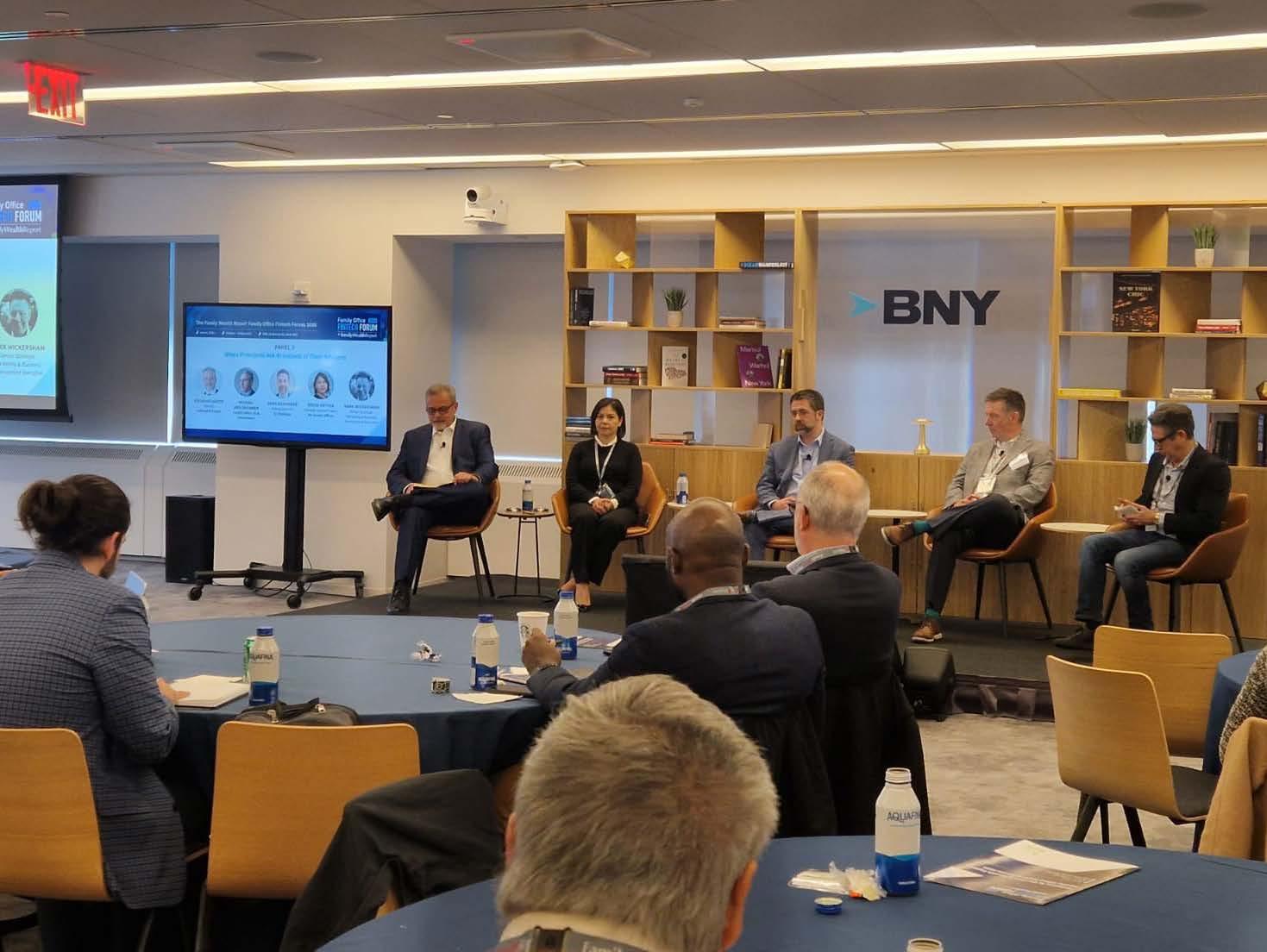
When Principals Ask AI Instead of Their Advisors
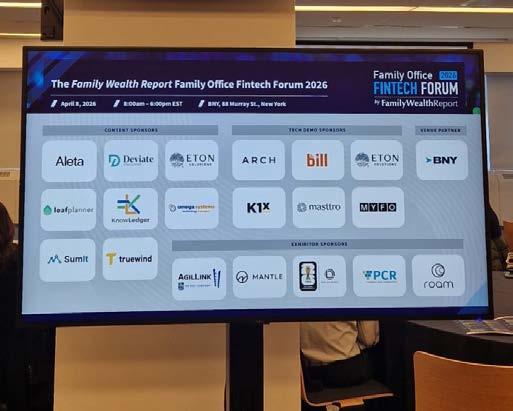
Sponsors & Partners
CHARLES PAIKERT
US Correspondent New York Family Wealth Report April 13, 2026 (published article here)
At our annual Family Wealth Report Family Office Fintech Forum in New York, our US correspondent Charles Paikert explores the rapid evolution of artificial intelligence and what it means for family offices.
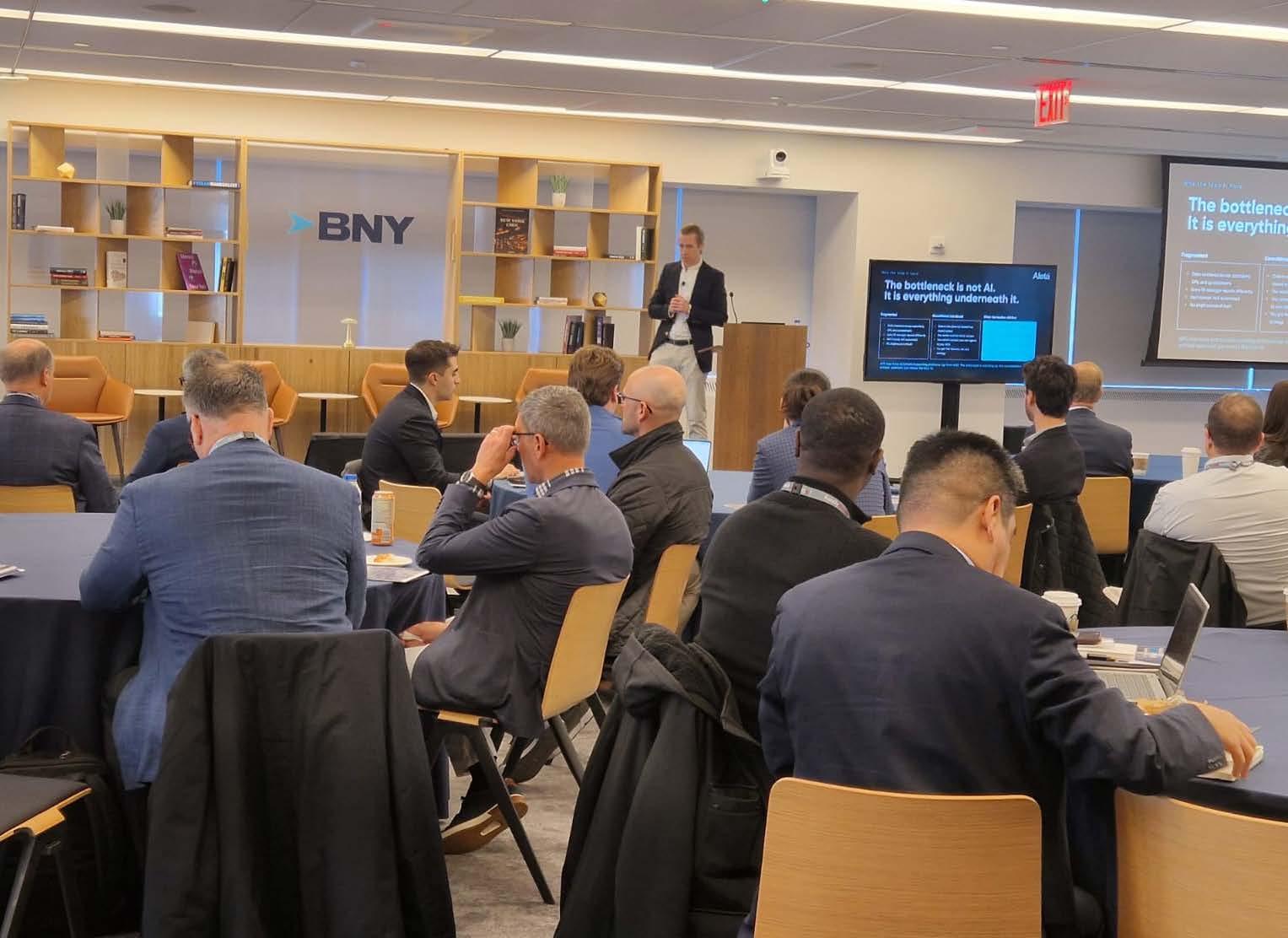
This month at the Family Wealth Report Fintech Forum in New York, Ken Gamskjaer, CEO of wealth management platform Aleta highlighted how artificial intelligence (AI) has gone from answering questions to executing workflows. “Instead of just asking AI what is my workflow? you can now tell it to rebalance, flag tax implications and draft a memo,” Gamskjaer said.
The emerging infrastructure for AI wasn’t even possible six months ago, according to Gamskjaer. Since then, OpenAI, Google, Microsoft, AWS and Anthropic have adopted MCP as the universal protocol for connecting AI to data. Once built, it can be connected to any data model, without vendor lock-in.
Consequently, a host of platforms have opened up in the last six months, as Morningstar, PitchBook, LSEG and Aleta have launched MCP integrations allowing private market intelligence, public markets data and portfolio analytics to be accessible to AI agents.
As data becomes increasingly important and data ownership becomes non-negotiable, family offices will need to deal with their existing systems, Gamskjaer said, which are fragmented, closed and not built for machine-readable output. Then family offices will begin to build their own AI agents on top of their data to align with their specific structures and workflows.
While the family office profile of small teams, complexity, recurring workflows and fragmented source data is optimal

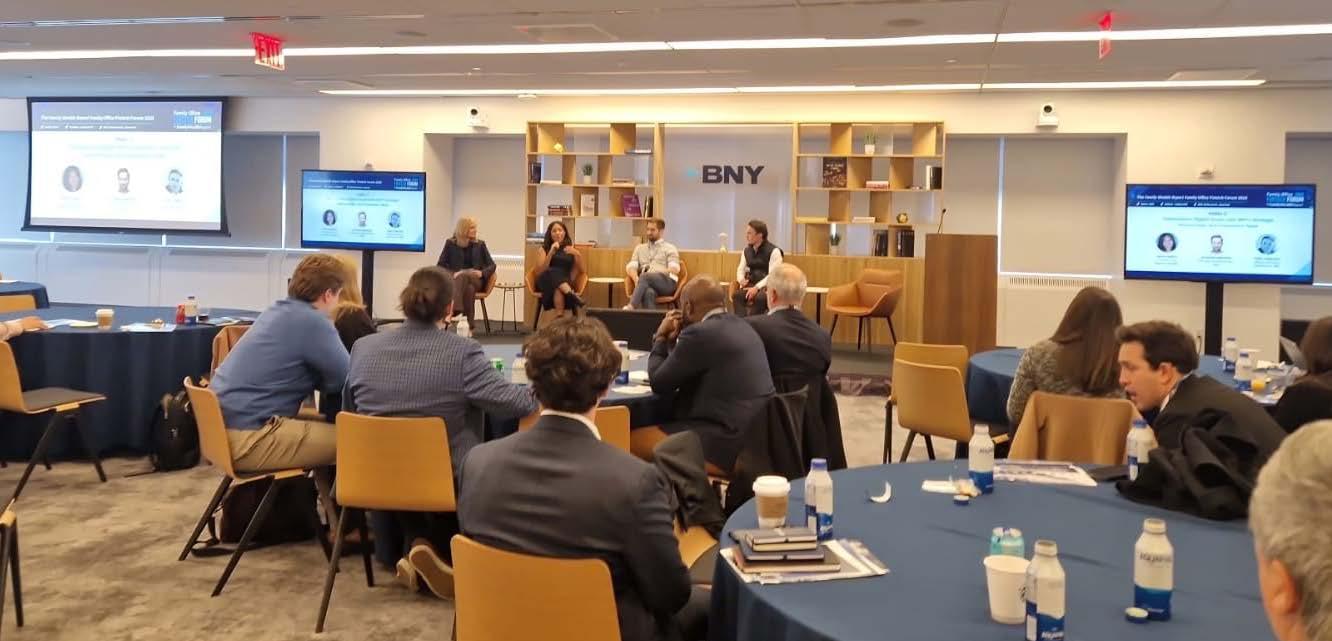
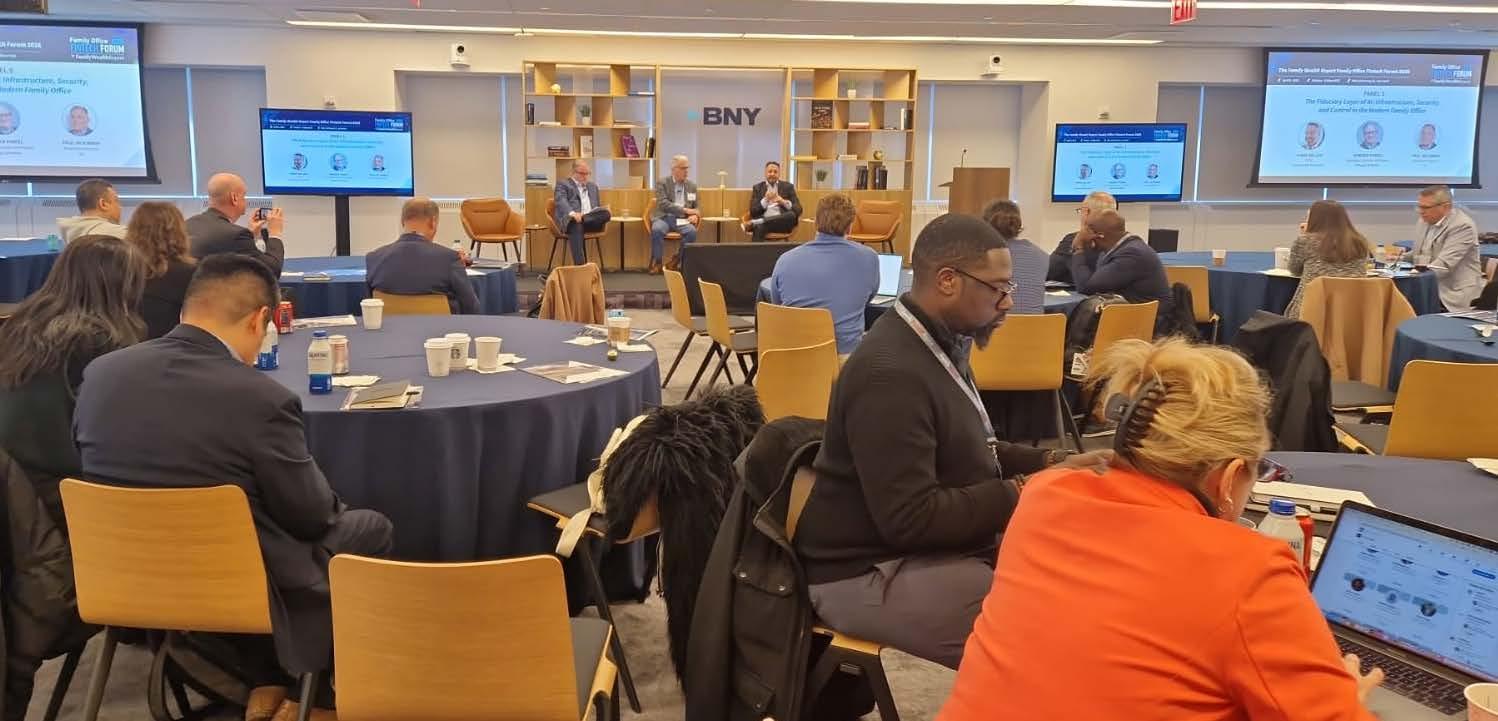

for applying AI agents, the first winning use case is not autonomous decision-making, but supervised preparation work, according to Alex Lee, CEO of accounting software firm Truewind.
Agents can collect relevant source files and data, draft schedules and summaries, map transactions and categories and flag missing support documents. But humans need to approve accounting treatment and thresholds; resolve edge cases and non-standard judgements; accept, reject or escalate open exceptions and own the final decision and accountability.
AI is general ledger agnostic and can help family offices with repetitive manual tasks, recurring workflows, categorization, reconciliation and consolidation. But successful agents “will not replace judgement,” Lee said. “They will reduce preparation.”
As Murali Nadarajah, global head of R&D and AI for wealth AI platform Eton Solutions put it, artificial intelligence has changed from “deterministic to probabilistic.”
Family offices can now safely automate first mile activity, senior strategic marketing and business development executive Mark Wickersham said. For WE Family Offices, AI is a task accelerator, said Rocio Ortega, a firm partner and head of talent.
But conference speakers warned family offices not to use public AI models, and when they purchase proprietary models to ask what data those models were trained on.
Artificial intelligence is also biased to please the user, conference attendees were cautioned. “AI just wants to be like a Golden Retriever and bring you back what will make you happy,” said Greg Kammerer, principal and CFO of multifamily office 61 Holdings. “You have to tell prompts what [the application] can’t do, as well what you’re looking for.”
The family office environment of small teams, high complexity, recurring workflows and fragmented source data make it an ideal incubator for artificial intelligence applications, according to software firm Truewind CEO Alex Lee.
How family offices should go about deploying AI, heed red flags and deal with vendors were major themes at Family Wealth Report’s annual Family Office Fintech Forum.
Structuring data is an ideal starting point and foundational, industry executives agreed. Then see where your needs are, which tasks are repeatable and can be automated. “What are the most manual procedures you’re doing?” said veteran family office executive Danielle Klimek.
Next, outline your strategy. “Why will you be using AI? What is the intent?” said Greg Kammerer, principal and CFO at multifamily office 61 Holdings. “What are your end needs?” said Ryan Kerry, CEO of Knowledger, a digital accounting firm for family offices. “Make your decision with the end in mind.”
After setting parameters for a strategy, family offices should set a policy for security and privacy, said Michael Maffattone, chief information officer and founder of fintech firm MultiMix IT. The policy should include not allow employees to use their own AI devices or public models that the company hasn’t licensed.
When it comes time to pull the trigger and decide what models to work with, don’t rush. “Vet every option, demand proof of concept,” said Janet Welch, managing director of operations for family office Trove. The final selection doesn’t have to be perfect, but make sure it’s at least an MVP (Minimum Viable Product).
Don’t be intimidated by vendors. “A common mistake is to not ask what the system can’t do that you might want it do in the future,” Welch said. “Don’t automate the past,” said Murali Nadarajah, global head of R&D and AI for family office software firm Eton Solutions. “Look to the future.”
Decide if you want an all-in-one software solution or go with individual best-in-breed products. “Ask your software [vendors] if they will work with you as your firm evolves,” Kerry told conference attendees. “Ask what the product can’t do and what their AI roadmap looks like.” Also, inquire “How many of your clients look like me?” added Josh Kanter, CEO of family office fintech firm Leafplanner.
With the application in hand, train staff and encourage them to come up with their own ideas for AI applications, Maffattone said. “You need the team to be fully on board from the beginning,” Welch emphasized. Once the new system is in place, “test for risk levels,” said Mark Aklian, chief information security officer for artificial intelligence platform Chiri.ai.
After careful preparation, WE Family Offices recently began deploying AI for its reconciliation team and advisors, who are using Microsoft Copilot to summarize reports

from their inbox, Rocio Ortega, a partner and head of talent told conference attendees. “Look at your tech stack, and determine what you need,” Ortega said. As Gamskjaer put it, “Be AI ready, not AI dependent.”
Family offices need to get their data in order before beginning to deploy artificial intelligence, according to industry executives at the forum.
Family offices are beginning to rapidly deploy AI, but AI is a tool that “is only as good as the data you have,” said veteran strategic marketing and business development executive Mark Wickersham. “Dirty data means dirty results.”
A family office’s data can be compared to books in a library which need to be organized to be useful and accessible, said Dario Sarmiento, chief information officer at Wilshire Law Firm. Preparing data is more important than adoption rate, according to Sarmiento. When deploying AI, structured data is king, he told conference attendees.
Solving the data problem is key to AI deployment, Gamskjaer said in his keynote presentation. Family offices increasingly want to own their data, instead of ceding control to vendors, as domain knowledge and the
resulting data layer of artificial intelligence becomes more important, Gamskjaer continued. “Fix your data before you buy AI,” he told advisors.
Family offices also need to be really cognizant about data you’re allowing AI to see, Mark Aklian, chief information security officer for artificial intelligence platform Chiri.ai, said. “Determine what your crown jewels are and what you want to keep private,” agreed Paul McKibbin, executive director for consulting firm EY. “And make sure your data can’t be used to train other models.”
To avoid AI bias and mistakes, data must also be verified before it’s inputted, panelists said. The intersection of data and AI has also given birth to tokenized assets, resulting in a “wild new world of digital assets,” Alfonse Mandese, global head of revenue at digital asset trading platform Talos, said. This digital ecosystem will be maturing in the next five years, but legal clarity needs to be established around tokens as an infrastructure develops, according to Toby Thwaites, director of digital assets at BNY. “There’s still a lot of work to do,” Thwaites said.
Data scattered across custodians, advisors and spreadsheets, along with different PE manager reports and data that is half manual and half automated, means that
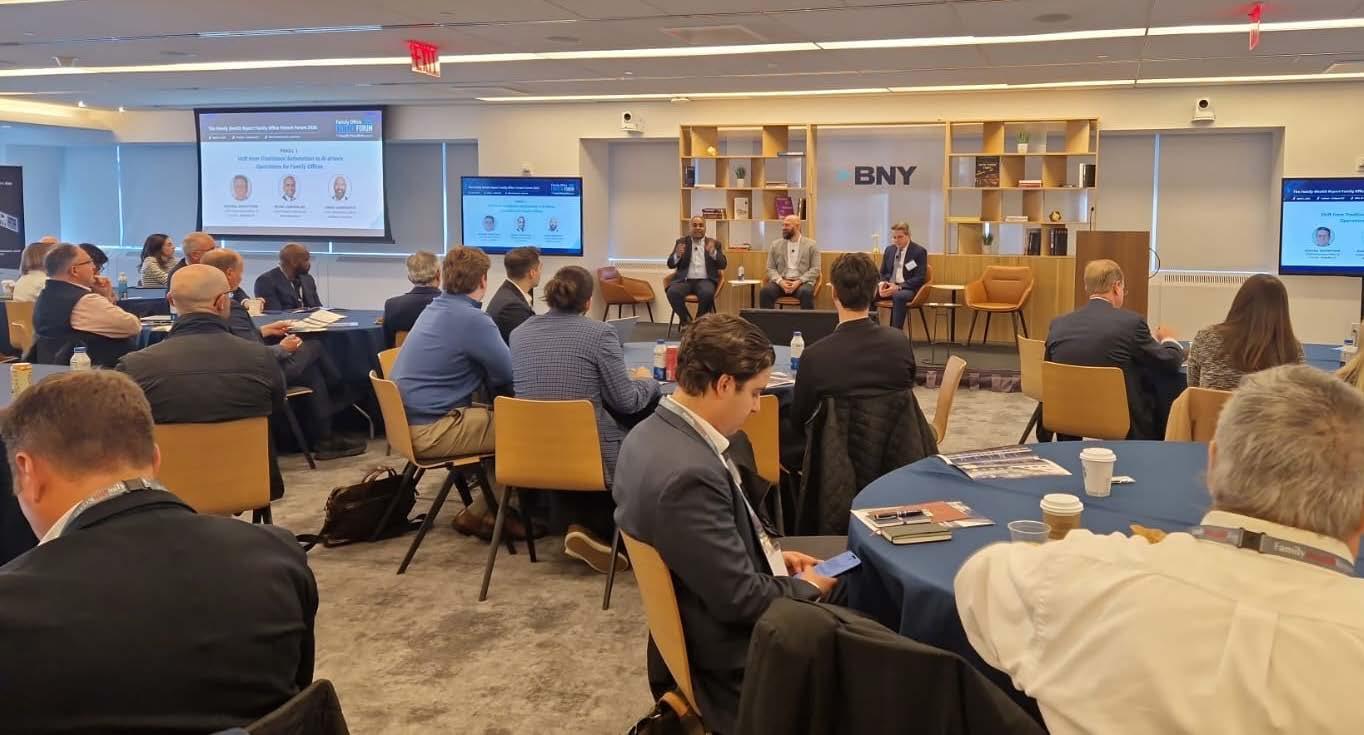
the bottleneck is not AI, according to Gamskjaer. “It is everything beneath it.”
Even if data is consolidated, it may be locked in a closed system controlled by a vendor, leaving family offices unable to connect its AI agents to its own data. As a result, you get the vendors’ features, not your strategy, Gamskjaer said.
Family offices should build one reconciled view across all asset classes and choose open architecture over closed platforms, he advised. AI deployment, Gamskjaer said, should be a leadership decision, not an IT project.
To reach its potential, AI needs to expand geographically and embed in “all employee layers” of companies, according to BNY’s Kevin Shea. AI investors should look for “where the bottlenecks are,” such as data centers, memory manufacturers, chip makers and networking optics. Investors should also make sure they have private exposure to AI-related companies, Shea said.
In addition to panel discussions and fireside chats, Family Wealth Report’s Fintech Forum featured on-site tech demos focusing on how a range of AI applications and platforms for family offices can transform workflow and data management.
Fragmented financial data, documents and stakeholder management for family office advisors can be centralized on an integrated AI platform.
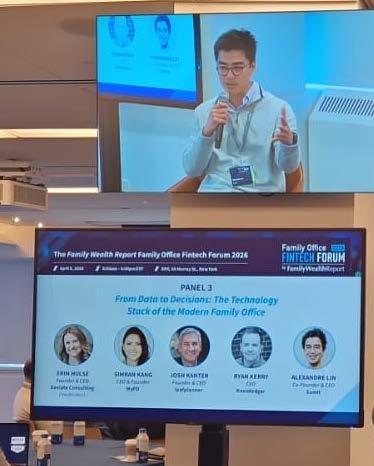
Simran Kang, founder and CEO of MyFO demonstrated how capabilities such as real-time analytics and workflow management can be customized to reduce complexity and drive informed decision- making at scale. Simran spoke on the panel with Ryan Kerry (KnowLedger), Josh Kanter (leafplanner), and Alex Lin (SumIt), moderated by Erin Hulse (Deviate Consulting). Simran’s colleagueElle Herron (MyFO) conducted the tech demo.
Embedded AI can help family offices transform complexity into control.
Eric Switzer, director of sales for Masttro, demonstrated how the company’s platform can turn fragmented documents, alternative investment data and transaction activity into fast answers, cleaner workflows and reporting-ready intelligence.
Manual data entry is nobody’s idea of fun. Krithika Rao, solution engineer for K1x, demonstrated how the firm’s AI aggregator maps data using a collaborative user interface and transfers the data into Excel-based reporting that can used for both tax compliance and client advisory opportunities.
How does AI navigate workflows such as reading documents, triggering processes and executing tasks? Stuart Guidry, vice president of platform consulting for Eton Solutions, demonstrated how a family office platform operates in real time. The EtonAI Web Agent showed how AI can turn a system of record into a system of action.
Operational bottlenecks become inevitable as alternative portfolios become more complex. Kelly Moore, executive director and head of strategic accounts for Arch, demonstrated how the firm’s AI application software automates reporting, reduces error and centralizes data across entities, enabling family offices to scale without adding headcount.
How can a family office’s approvals be simplified, controls strengthened and client relationships deepened? Phil Klopke, account executive for BILL, demonstrated how the firm’s AI platform can streamline the AP process, from bill creation to approvals and payments, and sync with accounting software.

Ken Gamskjaer CEO & Co-founder, Aleta
Ken Gamskjaer is the CEO and Co-founder of Aleta – a next-generation wealth platform built for forward-thinking family offices. Aleta is purpose-built family office software delivering a verified picture of total wealth for the Principal, institutional-grade investment reporting for CIOs and investment teams, and an open data layer with API and MCP access for AI-driven wealth operations. Ken is based out of New York and with 15+ years in wealthtech, he’s worked with numerous family offices to digitize and professionalize their operations. He’s passionate about building future-proof technology for the most forward-thinking family offices and the next generation of wealth owners.
Opening the Family Office Fintech Forum in New York was a privilege. It’s one of the few rooms where the people building the infrastructure of the family office world sit alongside the people who live with it every day. And this year, with AI finally moving from discussion to deployment, the conversations had a different kind of urgency.
I opened the keynote with a simple exercise. I asked how many people used AI tools regularly.
Almost every hand went up. Then I asked them to keep their hand up if their AI was connected to their actual portfolio data. Most came down. Finally, I asked them to keep their hand up if they had an AI workflow that runs without anyone touching it. Almost every remaining hand dropped.
That drop, from curiosity to deployment, is the real story of AI in family offices right now.
Everyone wants in. Very few are actually in.
According to Campden Wealth and RBC, 63% of family offices say they want to use AI in investment reporting, 65% say reporting is still too manual, and only 29% actually use AI for it.
The majority are still sitting between experimentation and real deployment.
After more than 100 conversations with family offices over the past year, I’m convinced that the bottleneck is not AI. It is everything underneath it.
AI is only as good as the data below it. The offices making real progress aren’t the ones with the biggest budgets or the flashiest tools. They are the ones that did the boring work first: cleaning their data, structuring it, making it accessible across systems rather than locked inside each individual platform.
Most family offices today sit in one of two states. Either their data is fragmented - scattered across custodians, GPs and spreadsheets, every PE manager reporting differently - or it’s consolidated but closed, locked inside a vendor’s platform where the vendor controls the AI, not the family office. Consolidation without openness just moves the lock-in.
The leaders did something different: they solved the data problem before the AI problem, built one reconciled view across all asset classes, chose open architecture over closed platforms, and treated it as a leadership decision, not an IT project.
This matters more today than it did six months ago. Back then, the infrastructure simply didn’t exist. Three things have changed. The industry agreed on a standard: OpenAI, Google, Microsoft, AWS and Anthropic have all adopted the Model Context Protocol (MCP) as the universal way to connect AI to data. Platforms opened up: Aleta, PitchBook, Morningstar and LSEG have all launched MCP integrations in the last six months, putting private market intelligence, public market data and portfolio analytics within reach of AI agents. And we moved from chatbots to do-bots. From “what is my exposure?” to “rebalance, flag the tax implications, and draft the IC memo.” From query to command.
The family offices I see succeeding have stopped thinking about AI as a tool and started thinking about it as a stack.
At the bottom: reconciled, machine-readable data across every custodian and asset class. One source of truth. In the middle: an open protocol layer (API and MCP) that lets any AI model access that data securely.
At the top: the agents themselves, handling liquidity briefings, what-if scenarios, PE document processing, IC memos. Many offices try to start at the top. The ones succeeding started at the bottom.
The families making progress are also not the ones with the best answers. They are the ones who started anyway, and who started with the unglamorous things:
1. Fix your data before you buy AI.
2. Treat deployment as a leadership decision, not a tech-team side project.
3. Start with the boring, expensive processes. That is where AI pays off first, not in the impressive-looking use cases.
At Aleta, we sell the foundation AI needs to actually work: reconciled, structured data delivered through open architecture, so families can connect their own agents to their own data and keep full control of it. Our principle is simple: be AI-ready, not AI-dependent.
The hallway conversations after the keynote were very rewarding. Offices are wrestling with the same questions: where to start, how to keep data secure, how to avoid ending up with five disconnected systems that each claim to have AI. There is no shortage of appetite. What people want is a clearer path forward.
If there was one message I hope people carried home from my keynote, it had to be: AI is only as good as the data below it. Fix your data before you buy AI. Treat deployment as a leadership decision, not a tech-team side project. And start with the boring, expensive processes. That is where AI pays off first.
For more information, please contact: Amalie Bonnesen, Aleta - amalie@aleta.io




Senior Vice President, Chief Accounting Officer, Access Industries
Laura Flosi, CPA, is the Senior Vice President, Chief Accounting Officer at Access Industries. She is responsible for the integrity of the firm’s accounting, financial reporting, and control environment across a complex family office and multi-strategy investment firm. In close coordination with the Chief Financial Officer, Global Head of Tax, and Investment MDs, she supports the funding and execution of transactions across the firm’s portfolio globally. She oversees the accounting function for the firm’s investment entities, complex waterfalls, operating structures, and corporate activities, with responsibility for financial close, audits, internal controls, and the accuracy of books and records.
Erin Hulse
Founder & CEO, Deviate Consulting
Erin Hulse is the Founder of Deviate Consulting, LLC, which focuses on software selection, implementation, and accounting services for single and multi-family offices. Erin is a financial and software professional with a diverse background in the alternative investment and private wealth space, including time spent with Plante Moran, Bank of America, and SEI/Archway Family Office Services. Ms. Hulse has been managing Deviate Consulting since 2015 and is based in Indianapolis, IN.
Danielle Klimek Senior Family Office Executive
Danielle Klimek is the CFO for Leo Capital Management LLC, a single family office based in New York City. She grew up in Indiana and moved to New York City in 2009. Danielle has over a decade of experience within the family office industry, spending portions of her career both on the software-consulting side and on the family office client side. She specializes in family office operations including accounting, financial reporting, performance measurement, cash management, income and estate tax planning and vast experience in software and systems implementation.
Managing
Director,
Operations, Trove
With more than three decades of accounting and finance leadership experience, Janet Welch specializes in building and transforming finance functions within complex family office environments. After an 18-year career in corporate accounting, she transitioned into the family office sector, where she has spent the past 12 years leading finance operations for some of the industry’s most sophisticated organizations. Her experience includes running accounting and finance at the Dalio Family Office, serving as Director of Finance for Kenneth Griffin’s family office, and leading Family Office Services at Rockefeller Capital Management. Janet currently serves as Managing Director at Trove. Janet has led multiple ERP and financial system implementations, including Sage Intacct, and is known for driving financial transformation initiatives that enhance transparency, governance, reporting sophistication, and scalability.
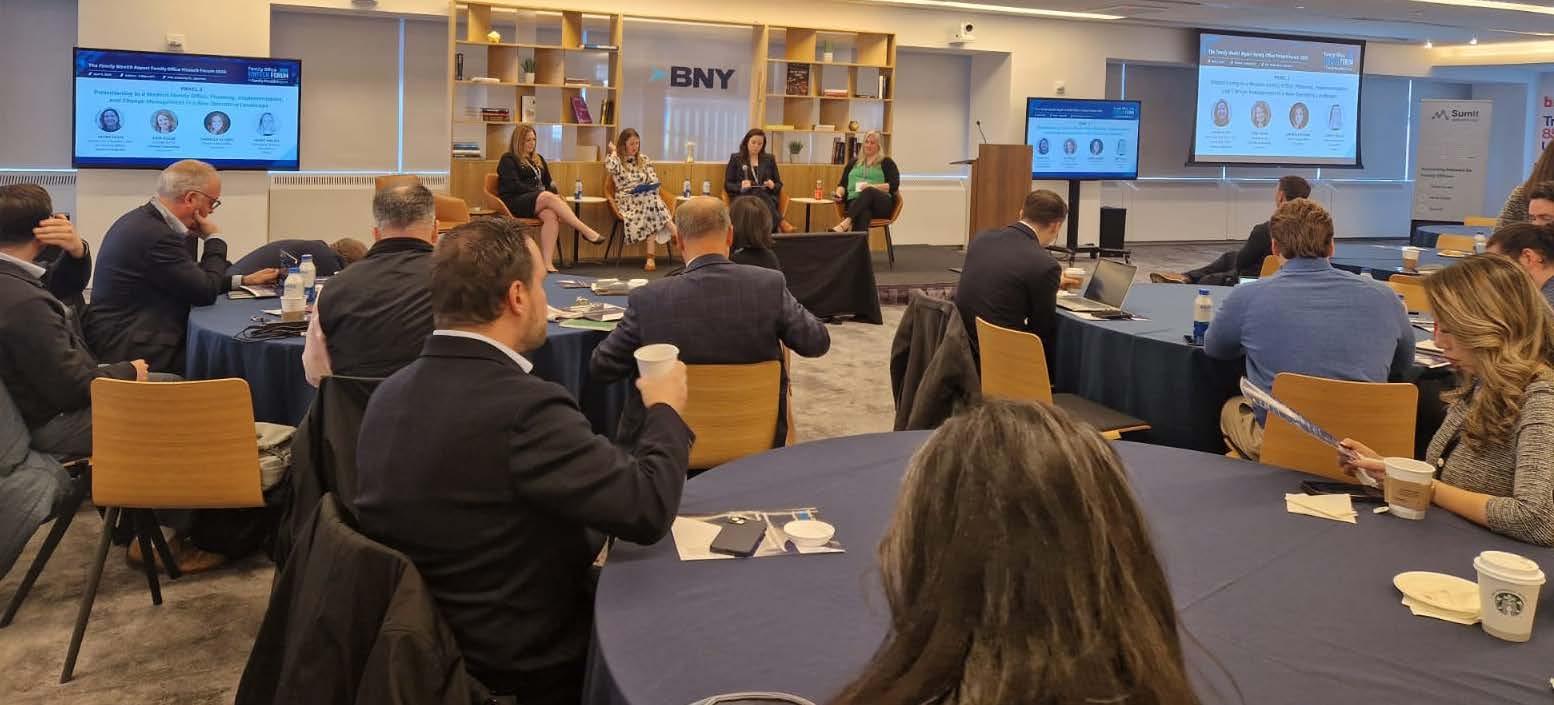
This panel explored what it truly meant to transition to a modern family office in today’s increasingly complex operating environment. Bringing together experienced operators and advisors, the discussion examined the key drivers behind transformation—ranging from growth and generational change to rising reporting demands and operational inefficiencies.
The conversation walked through the full lifecycle of a transformation. It began with planning, where panelists highlighted how successful offices balanced people, process, and technology, while avoiding common pitfalls in system selection and strategic design. It then moved into implementation, offering a realistic view of execution challenges, resource constraints, and the critical decisions that had lasting downstream impact.
A significant focus was placed on change management, emphasizing that technology alone did not drive success— adoption, communication, and cultural alignment were essential. Panelists also addressed the realities of post-golive operations, including unexpected challenges, the importance of continuous optimization, and how often offices should reassess their systems and processes.
Finally, the discussion looked ahead to how the definition of a “modern family office” continued to evolve as complexity increased across entities, asset classes, and generations. The session concluded with practical, experience-based advice on what to do differently, what to prioritize early, and the small decisions that ultimately proved critical over the long term.
For more information, please contact:
Erin Hulse, Deviate Consulting - erin@deviateconsult.com




Erin Hulse
Founder & CEO, Deviate Consulting
Erin Hulse is the Founder of Deviate Consulting, LLC, which focuses on software selection, implementation, and accounting services for single and multi-family offices. Erin is a financial and software professional with a diverse background in the alternative investment and private wealth space, including time spent with Plante Moran, Bank of America, and SEI/Archway Family Office Services. Ms. Hulse has been managing Deviate Consulting since 2015 and is based in Indianapolis, IN.
Simran Kang
Founder and CEO, MyFO
Simran Kang is redefining the future of family offices. As the founder and CEO of MyFO, she has built a platform transforming how families and advisors manage and preserve their financial legacies. Under her leadership, MyFO has become North America’s fastest-growing family office solution, combining innovative technology with a clear vision to simplify and modernize complex family office management. Backed by strategic venture funding, MyFO is scaling at an unprecedented pace. Simran has worked with North America’s most prominent families, seeing firsthand the pain points of UHNW families, insights that now drive MyFO’s innovative foundation. Simran’s leadership and impact have earned widespread recognition.
Founder & CEO, leafplanner
Josh’s passion is to use his education, training and experience in an integrated manner to bring thoughtful, personalized family consulting services to his clients. Alone, or with a team, whether financial, legal, political or familial, he brings deep thought, innovation, drive, integrity, and leadership to add value to every situation he encounters. For nearly two decades, Josh turned this skillset inward and managed his family’s 30+ year income and estate tax controversies. Applying a coordinated, cohesive, strategic approach to the various income tax, estate tax, innocent spouse, collection, and other tax matters involved.
Ryan Kerry CEO, Knowledger
In the late 1990s, Ryan initiated his investment technology career at Advent software. Advancing through roles at Advent, he later joined SEI to oversee their outsourced investment management. With a knack for data management and client service, he established Accusource in 2008, specializing in white-glove operations for family offices and RIAs. Addressing the challenge of transferring investment data to GLs, Ryan founded KnowLedger in 2020. Based near Philadelphia, he harmonizes family life with his love for bicycling.

TAlexandre Lin Co-Founder & CEO, SumIt
Driven by frustration with existing accounting software, Alex founded SumIt to simplify family office accounting. As a second-generation leader of his family’s real estate ventures in France and China, he now dedicates himself to SumIt. Collaborating with 30+ family office advisors, he’s tailored SumIt to meet the unique needs of the sector efficiently. Alex holds an MBA from Chicago Booth and a Master’s from London Business School.
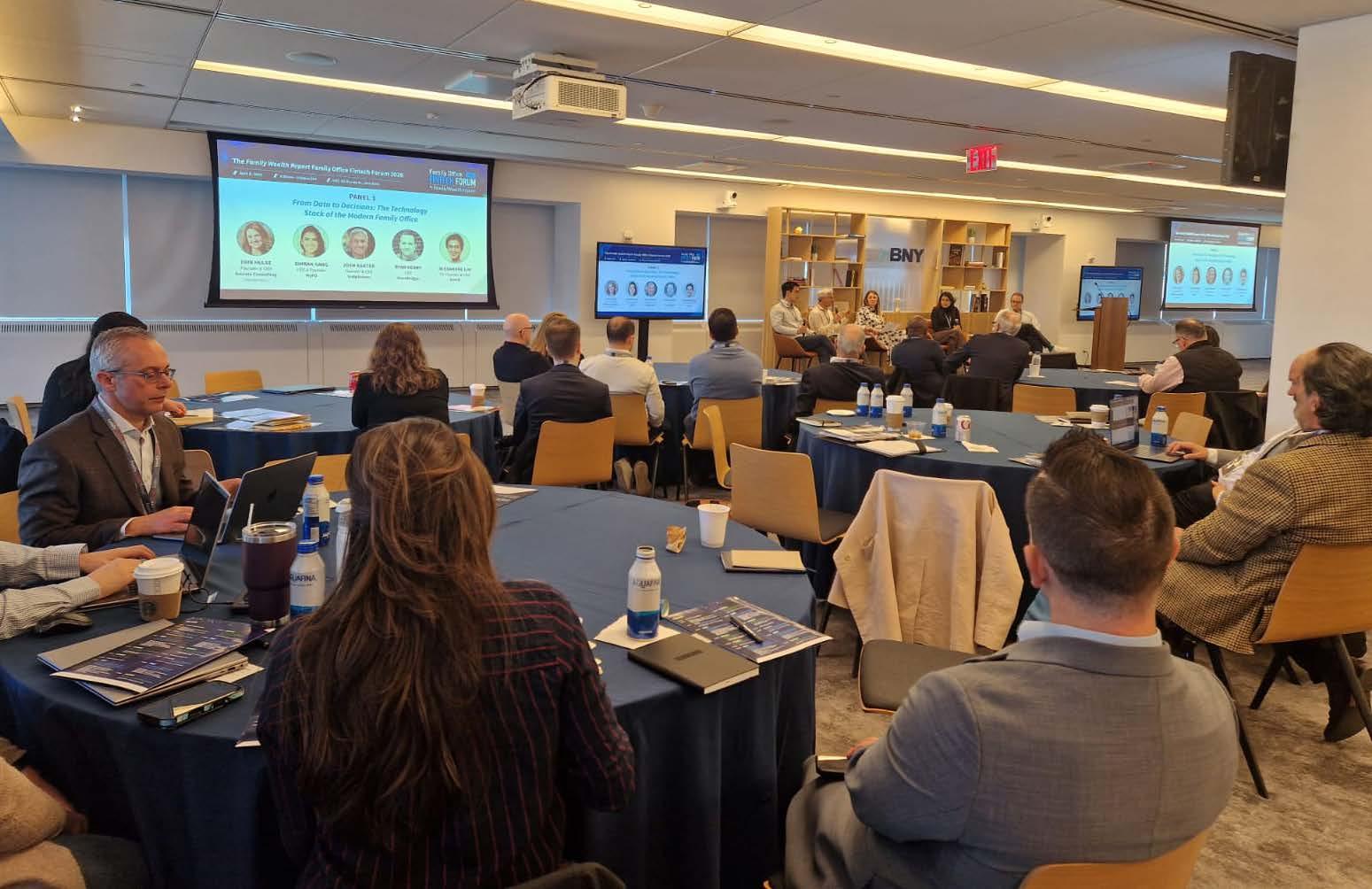
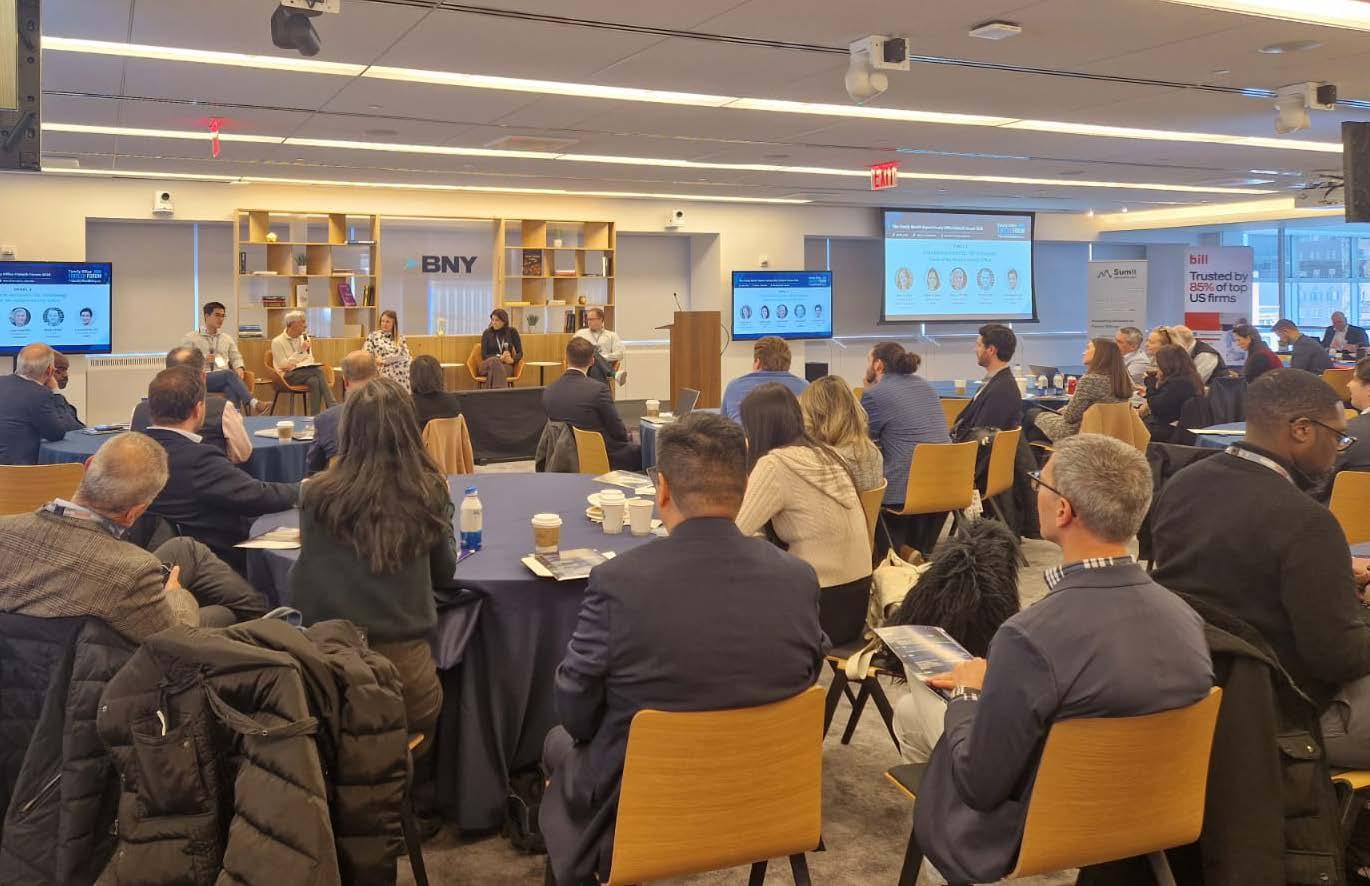
his panel examined how modern family offices navigated the growing complexity of their technology stacks and the ongoing challenge of turning data into actionable decisions. Featuring a group of founders and technology leaders, the discussion began with the origin stories behind their platforms, highlighting the real-world problems that inspired their solutions and the persistent gaps that continued to exist across the family office landscape.
The conversation explored the current reality of family office technology, where fragmentation, disconnected systems, and a continued reliance on spreadsheets remained common despite significant fintech innovation. Panelists shared where data most often broke down across systems and why many offices still struggled to create a cohesive and reliable data environment.
A central theme of the discussion focused on the gap between data availability and decision-making. While family offices had access to more data than ever, panelists emphasized that not all data was equally valuable. The group discussed how to distinguish meaningful insights from noise, and where offices often over-engineered reporting at the expense of usability and clarity.
The panel also addressed the complexities of technology selection, particularly the trade-offs required when no single system met all needs. Panelists highlighted the importance of thoughtful integration and ecosystem design, discussing where integrations typically failed and what effective connectivity looked like across accounting, reporting, and governance platforms. The distinction between purpose-built family office solutions and more generic tools was also explored.
Beyond technology, the discussion emphasized the human and structural elements of the ecosystem. Panelists reflected on how technology must align with governance frameworks, complex entity structures, and the need to communicate effectively with family members across generations. The role of technology in supporting governance, succession planning, and next-generation engagement was a key consideration.
Implementation realities were also a major focus, with panelists noting that execution often proved more challenging than selection. Topics included managing data migration, avoiding unnecessary historical data overload, and addressing the common pitfalls that arise during deployment.
The session concluded with practical frameworks and takeaways, as panelists shared the most important decisions family offices should prioritize when building their technology stack and moving from data to decisions. They also provided perspective on how their platforms were evolving to meet the future needs of increasingly sophisticated family offices.
For more information, please contact:
Erin Hulse, Deviate Consulting - erin@deviateconsult.com
Simran Kang, MyFO - simran@myfotech.com
Josh Kanter, leafplanner - josh@leafplanner.com
Ryan Kerry, Knowledger - rkerry@knowledgerllc.com
Alexandre Lin, SumIt - alex@getsumit.com



Anna Garcia (Moderator) Founder & Managing Partner, Altari Ventures
Anna Garcia is the founder and managing partner of Altari Ventures, a New York-based early stage enterprise fintech fund. Prior to starting Altari Ventures, Anna was a B2B SaaS investor at Runway Venture Partners, a successful angel and a long-time Wall Street executive. Over the course of her 17 year banking career, Anna held senior investment banking and asset management roles at Merrill Lynch, Jefferies and JP Morgan. Anna has been actively engaged in the fintech ecosystem since 2013 and sees enormous and continued opportunity in backing companies modernizing financial services infrastructure, the functioning of the capital markets and institutional processes in financial services and other industries.
Ralph Nanad CEO & Founder, 10clear
Ralph Nanad is the CEO and founder of 10clear, an AI-native financial statement suite for CFOs, accounting firms, and regulators. Ralph spent a decade supporting finance functions navigate risks while enabling growth and has built 10clear to bring AI-driven technology to financial reporting compliance.
Sabrina Palme CEO & Co-Founder,
Palqee
Sabrina Palme is CEO and co-founder of Palqee, where she led the development of Palqee Prisma, an independent AI oversight layer used by financial institutions to strengthen assurance over investigation narratives, contact center decisions, and AI-supported processes by systematically evaluating policy adherence and decision quality. A data scientist by background, she combines deep expertise in AI governance, data protection, and information security with hands-on experience designing production-grade oversight for financial institutions, ensuring that both human-led and AI-supported processes operate consistently and in line with internal policies and risk standards. Sabrina has been recognized among the 100 Brilliant Women in AI Ethics, Inc. Founders 500 List, and contributes to international AI standards development through her work with CEN-CENELEC and ISO/IEC.
My firm, Altari Ventures, invests in enterprise fintech startups modernizing institutional finance infrastructure. I’m particularly drawn to problems absorbing enormous human capital and carrying outsized regulatory risk. Oversight and audit fall exactly into this category: not glamorous but absolutely essential. And right now they are undergoing profound technologically-driven transformation. This is relevant whether you’re running a highly regu-
lated financial services firm, a public company, or a family office looking to apply best-in-class tools and practices to maximize transparency for your stakeholders.
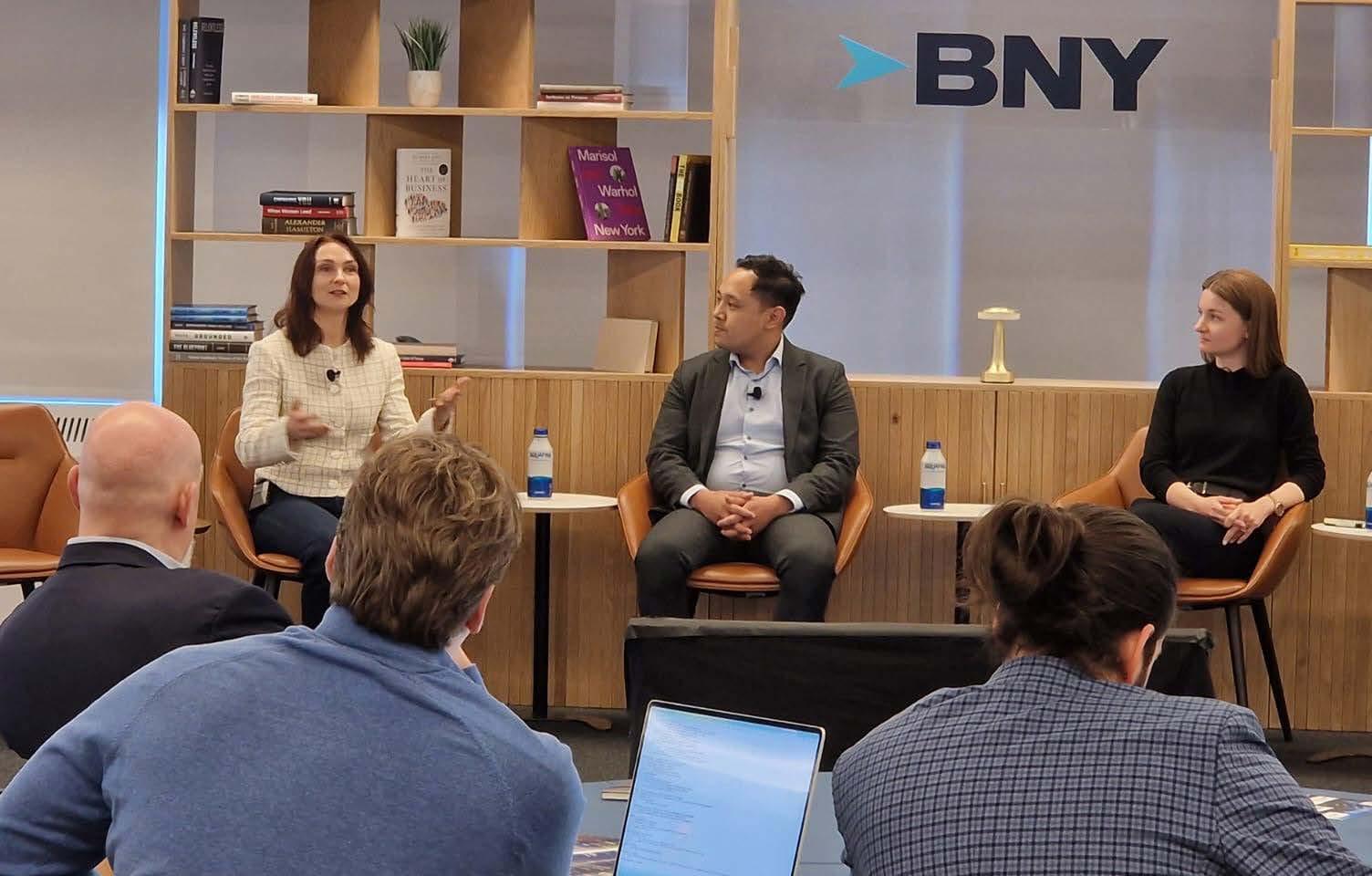
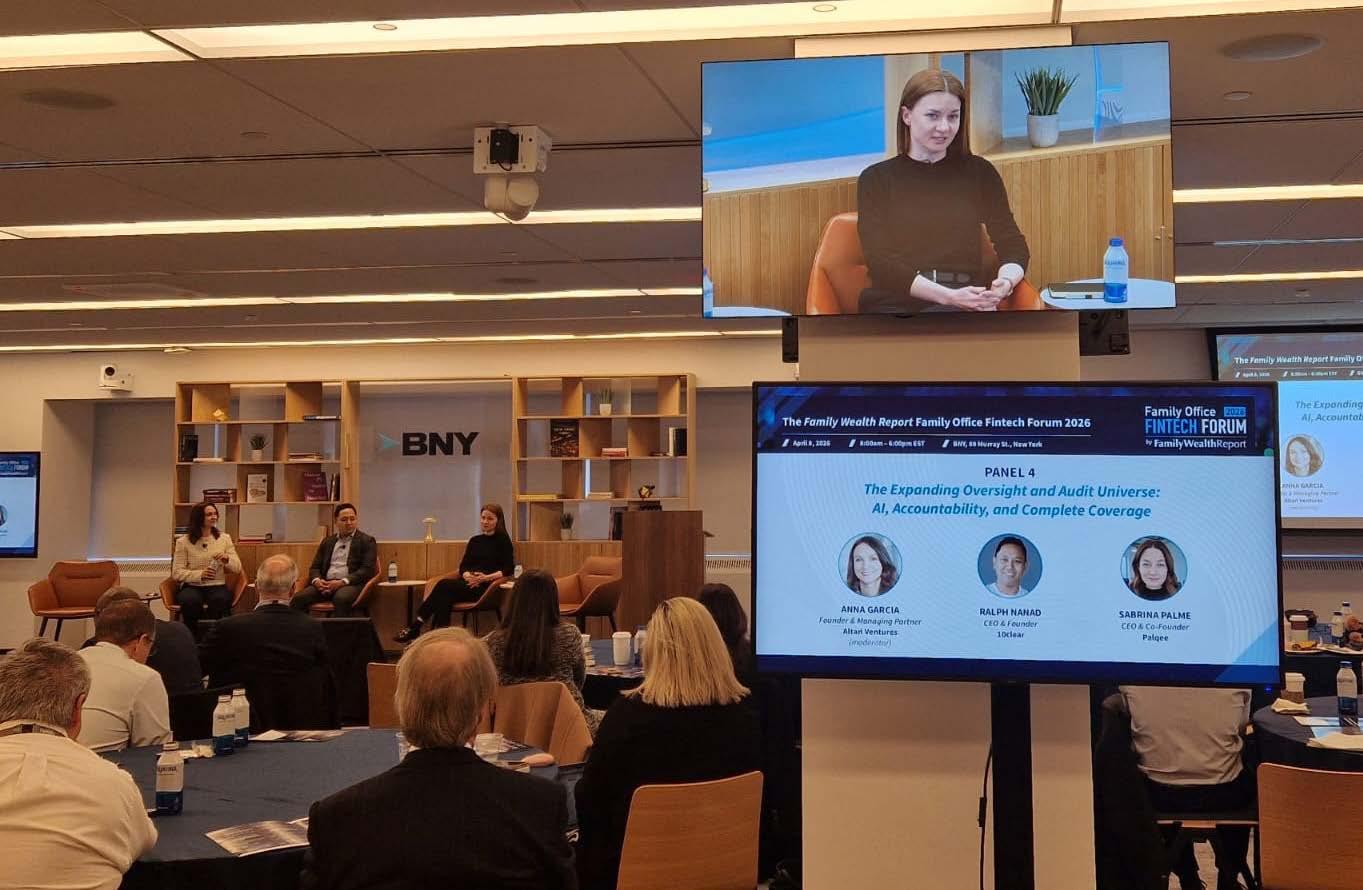
At the recent Family Wealth Report Family Office Fintech Forum, I moderated a panel The Expanding Oversight and Audit Universe: Technology, AI, and Complete Coverage featuring two Altari Ventures portfolio CEOs building this infrastructure:
Sabrina Palme (Palqee) and Ralph Nanad (10clear). Here are the key takeaways:
The definition of audit is expanding — in every direction Until recently, audit focused on financial and operational reviews and was constrained by data availability and human capacity. Now, more granular data is available than ever and complete monitoring is within reach — bringing deeper accountability for everything happening across the business. AI is simultaneously introducing its own oversight requirements, to ensure it doesn’t hallucinate. Those Ralph referred to as “holding the pen” — signing off on representations — face a scope of responsibility that has never been broader.
Sabrina framed this as a governance readiness problem. Institutions spent 2024 experimenting with AI and 2025 committing to implementations with measurable ROI. Many have now reached the implementation phase only to find their governance infrastructure wasn’t architected for what they wanted to deploy. Organizations faring best treated AI governance as a co-equal priority alongside AI implementation from the start.
Ralph introduced a useful distinction between capital-A “Assurance” — third-party attestation that isn’t going away — and lowercase “assurance”: the everyday contract of confidence between an audit preparer and a user. AI disrupts that contract. Once it enters the workflow, the question becomes: do you still trust your own output? Accuracy is nonnegotiable. The moment errors appear even in something small, trust erodes — and AI may be out the door.
Significant grey areas exist across rules and regulations, from GAAP accounting to the interpretation of broader regulatory requirements and their translation into internal policy — so accuracy can mean materially different things at different organizations. Ralph’s advice was direct: ask vendors for evaluations. You’ll encounter the full spectrum — from no measurement whatsoever to claims of 100% accuracy. A vendor who tells you they’re 96% accurate gives you something actionable: build your governance processes around that figure and concentrate human review on the 4% that carries genuine risk.
Sabrina took it further: in generative AI applied to financial services, accuracy is inherently context- and organization-specific. The right question isn’t a vendor’s self-assessed accuracy rate — it’s whether the AI is behaving within the range of expected behavior acceptable for your own policies, risk appetite, and operating context. That framing brings AI oversight into alignment with the same validation logic already applied to human decisioning, which is precisely where regulators are heading.
Regulators are sharply focused on incorporating AI into their own processes as well; the SEC, for instance, has recently mandated evaluating AI use across its operations. The practical implication for those facing audits: your auditor will hold you accountable for the outputs you deliver, and the regulator will hold them accountable for the rigor applied in reviewing those outputs. The answer they’ll be looking for is processes, controls, and governance. Sabrina noted that regulators are actively moving away from accepting random sampling as sufficient — the 1-5% evaluation coverage standard that human-led processes have relied on for years will no longer hold.
Sabrina described Palqee’s “optimized human oversight” model: rather than validating every AI output (which defeats the ROI case) or sampling randomly (which leaves risk undetected), the system flags only interactions that fall outside existing policy frameworks for human review.
Coverage improves, edge cases get surfaced, and the control framework strengthens iteratively over time. Ralph’s framing was simpler: the old discipline was “measure twice, cut once. “With AI, you can measure a thousand times and cut once. Both panelists agreed that all three objectives are well within reach with today’s technology.
Ralph is focused on extending 10clear beyond GAAP financial statements to the full universe of corporate reporting — internal management reports, board presentations, financials — generated at the click of a button with compliance verification built in. Sabrina’s attention is on a market shift already well underway: from measuring AI performance through technical metrics alone toward evaluating AI behavior against an organization’s own policies, controls, and risk appetite. The companies helping institutions navigate that transition are building exactly what the market needs right now.
AI offers organizations a compelling path to significantly expand oversight coverage, reduce compliance cost, and surface risk that sampling-constrained processes have historically missed.
The governance infrastructure to support this transformation is being built right now — and family offices have a timely opportunity to put best-in-class technology to work across their operations.
For more information, please contact: Anna Garcia, Altari Ventures - anna@altariventures.com



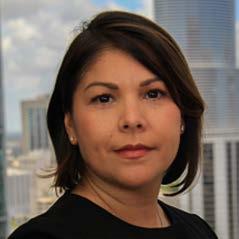
Eduardo “Ed” Arista is an attorney and a certified public accountant (CPA) in Holland & Knight’s Miami and Washington, D.C., offices. Mr. Arista has more than 25 years of experience helping American and multinational families and private companies reduce their tax burden, protect their assets and businesses from legal risks and prepare for the eventual transfer of their wealth. As a partner at the firm, Mr. Arista routinely serves as outside general counsel for his clients and provides comprehensive representation in virtually any legal matter. Mr. Arista is well known in the private client space and is routinely recommended by major financial institutions and professional firms nationally and internationally. His native, professional Spanish fluency and extensive international travel equip him to work more effectively with his foreign clients and their local counsel, drawing on a large and well-established network of professionals throughout the region.
Michael F. Horwitz-Heilbronner works across AI, financial systems, and governance, with a focus on deployment in regulated environments. His background spans capital markets, enterprise AI architecture, and financial infrastructure. Earlier in his career, he worked across trading and arbitrage desks in New York, Paris, and London for several investment banks. Over the past decade, his work has centered on how AI systems are introduced into high-stakes institutional settings, with particular attention to discipline, control, and operational boundaries. He is currently involved with a family office in connection with its U.S. expansion.
Greg Kammerer Principal and CFO, 61 Holdings
Greg is a Principal of 61 Holdings, a family office with interests in real estate, manufacturing, telecom, entertainment, sports, hospitality, health, wellness, aerospace and defense. 61 Holdings provides additional support to its ultra-high-net-worth families with advanced tax planning, strategic advisory, outsourced due diligence with a focus on long-term wealth stewardship.
Rocio Ortega Partner, Head of Talent, WE Family Offices
Rocio Ortega has over two decades of experience in wealth management. She joined WE Family Offices in 2014 and currently serves as a Partner and Head of Talent Development, while continuing to advise select family clients. Rocio takes a holistic approach to wealth management, guiding families through the complexities of their wealth enterprises. Her expertise spans financial strategy—including defining objectives and designing investment portfolios—as well as critical non-financial aspects, such as family governance, next-generation engagement, and education. In 2021, she assumed the role of Head of Talent, leading the firm’s recruitment and talent development efforts to foster a culture that upholds WE Family Offices’ commitment to excellence and fiduciary responsibility.

Mark Wickersham is a senior strategic marketing & business development executive. Mark has over three decades of fintech in the family office and RIA markets. Mark has served in a variety of roles including product management, partnership development, marketing, strategic consulting and business development. He has worked for some of the top firms in the family office market including Fidelity Investments, Family Office Metrics, ByAllAccounts and other family wealth focused technology firms. Mark is based just north of Boston and is a native New Englander. In addition to enjoying Dunkin’ ice coffee all year long, he enjoys mountain biking, hiking, skiing and spending time with his family in Maine. LinkedIn Profile - https://www.linkedin.com/in/markwickersham/
The closing panel of the Family Office Fintech Forum tackled one of the day’s most provocative questions: what happens when AI becomes the first place families turn for advice? Moderated by Eduardo Arista, the session brought together a family office principal, an AI technology builder, a leader from an independent multi-family office, and a senior operator focused on advisor-client communications and adoption. The group was deliberately diverse, chosen to represent every side of the principal–advisor dynamic.
Arista framed the stakes at the outset: the question is no longer whether principals are using large language models and generative AI to evaluate investments, assess legal positions, or pressure-test their advisors’ recommendations. They are. The question is what that means for the advisory relationship, and whether the ecosystem is adapting fast enough.
Arista then asked each panelist to share how principals and families are already using AI as a first resort, grounding the discussion in practice rather than theory. Examples ranged from principals drafting “first-pass” diligence questions and investment memos, to pressure-testing legal and tax scenarios before bringing them to counsel, to using AI to benchmark an advisor’s recommendation for completeness and clarity.
The discussion moved to the risks that emerge when families rely on AI without appropriate guardrails. The panel focused on three distinct failure modes. First, hallucinations and confident-sounding errors: generative AI tools can produce outputs that appear authoritative but are factually wrong, and principals without deep domain expertise may not detect the mistake. Second, the potential destruction of attorney-client privilege: when a principal feeds sensitive legal, tax, or trust information into an AI tool, protections that would otherwise attach to communications with counsel may be irretrievably waived. Third, the “unlearning” problem: the difficulty advisors face in correcting misconceptions a principal has already internalized from an AI-generated response.
The unlearning problem proved to be one of the panel’s sharpest observations. Correcting a confident, AI-informed client requires a different skill set than traditional advisory, one that combines technical authority with the ability to reframe a question the client believes has already been answered.
The panel then turned to a scenario that is becoming increasingly common: a principal receives one answer from a large language model and a different answer from a trusted advisor. How should a family office navigate that conflict? The discussion surfaced the need for a practical escalation framework—a shared understanding of when AI output should be treated as a prompt for further inquiry and when it should be set aside in favor of professional judgment. A simple version emerged: (1) verify the inputs (what data was used, what assumptions were made, and whether any sensitive or privileged information was introduced), (2) validate the output against primary sources and domain expertise, and (3) document the decision path, including what was accepted, what was rejected, and why.
A related thread explored the moment when convenience begins to turn into misplaced authority. As AI tools become more sophisticated and their outputs more polished, the risk increases that families will treat AI-generated analysis as definitive rather than preliminary. The panel cautioned that this is particularly dangerous in complex legal and tax matters, where a technically plausible answer may be incomplete or flatly wrong.
The final substantive segment focused on what families and advisors can do now. The panel addressed the practical question of how to establish guardrails that are rigorous enough to mitigate risk but flexible enough to capture AI’s genuine strengths. Topics included policies around approved AI tools and approved use cases; data boundaries that keep sensitive information out of AI systems; human-in-the-loop requirements for consequential decisions; and auditability, so that when AI contributes to a decision, the inputs, rationale, and handoffs remain traceable.
The discussion also surfaced the cybersecurity and data governance dimensions of AI adoption. Family offices that have invested heavily in protecting client data through traditional information security measures may be inadvertently creating new exposure by allowing principals and staff to interact with AI tools that lack equivalent protections. The consistency of AI-related policies across teams (investment, legal, operations, and family governance) was identified as a governance gap that many offices have yet to address.
The panel closed with each participant offering a key takeaway. The throughline was consistent: AI is not going away, and family offices that ignore it risk falling behind. But adoption must be deliberate, governed, and grounded in an
understanding of what AI can and cannot do. The families that will navigate this transition most successfully are those that treat AI as a tool to augment, not replace, the judgment, relationships, and institutional knowledge that define effective advisory.
The session underscored a theme that ran throughout the day’s proceedings: technology is reshaping every dimension of family office operations, but the families and advisors who thrive will be those who maintain the primacy of human judgment, trusted relationships, and sound governance.
“AI does not eliminate the need for trusted advisors. It raises the stakes for choosing the right ones.”
Written by: Eduardo “Ed” Arista, Esq., CPA - eduardo.Arista@hklaw.com

For over 45 years AgilLink (formerly Datafaction) has focused on solving the pain points of adding the controls needed to offer multi-client bill payment and client accounting. We enable firms to scale their business while putting the proper controls and security in place.
AgilLink provides scale, control and security to family offices, business managers and sports professional firms that offer bill pay and accounting services for their high-net-worth clients. Our secure bill payment and specialized cloud accounting solution incorporates approval workflow, integration with City National Bank, document management and investment data integration.
AgilLink is an RBC company and is an affiliate of City National Bank Member FDIC.
For more information: www.agillink.com
Michael Balt - Michael.Balt@cnb.com

New York-based Aleta offers an AI-ready, purpose-built family office platform delivering a verified picture of total wealth for the Principal, institutional-grade investment reporting for CIOs and investment teams, and an open data layer with API and MCP access for AI-driven wealth operations.
As a next-generation wealth platform for forward-thinking family offices, Aleta brings public, private, and alternative assets together in an award-winning interface recognized for effortless adoption. Aleta is SOC 2 Type II certified and upholds the highest standards of data security and trust. Built for scale and simplicity, Aleta transforms how family offices see, manage, and grow wealth.
For more information: www.aleta.io Amalie Bonnesen - amalie@aleta.io
Arch is the operating system for private markets, streamlining the full lifecycle of alternatives — from collecting K-1s and statements to automating capital calls and delivering real-time reporting in one secure platform.
Arch supports more than 575 asset allocators and advisory firms representing over $445 billion in alternative assets, helping teams save time and unlock hard-to-access insights through automated analysis. We’re trusted by 8 of the top 25 accounting firms, four of the top 20 global banks, 130 RIAs, and 200 single family offices.
Arch recently closed a $52M Series B to expand our product suite and modernize private markets infrastructure today.
For more information: www.arch.com
Jacqueline Thomas - jacqueline@arch.co
BILL (NYSE: BILL) is the intelligent finance platform trusted by nearly half a million businesses and their accountants to manage, move, and maximize their money.
BILL powers businesses ranging from fast-moving startups to growing companies with complex operations. We use AI to deliver strategic finance capabilities in one integrated platform that includes AP, AR, expenses, forecasting, procurement and more. With a member network of more than 8 million, BILL’s platform processes ~1% of US GDP annually.
Headquartered in San Jose, California, BILL is a trusted partner of leading U.S. financial institutions, accounting firms, and software providers. For more information, visit bill.com.
For more information: www.bill.com
Brandi Firestine - brandi.firestine@hq.bill.com
BNY is a global financial services company that helps make money work for the world – managing it, moving it and keeping it safe. For more than 240 years BNY has partnered alongside clients, putting its expertise and platforms to work to help them achieve their ambitions. Today BNY helps over 90% of Fortune 100 companies and nearly all the top 100 banks globally to access the money they need. BNY supports governments in funding local projects and works with over 90% of the top 100 pension plans to safeguard investments for millions of individuals, and so much more. As of Dec. 31, 2024, BNY oversees $52.1 trillion in assets under custody and/or administration and $2.0 trillion in assets under management. For more than 50 years, BNY Wealth has been a trusted partner for family offices, delivering tailored family office services that enhance operational efficiency, reduce risk, and safeguard generational wealth. These results stem from a family office investment strategy built on deep expertise and a collaborative approach that starts from day one. Few family office service providers understand the complex financial and investment needs of wealthy families like BNY Wealth.
For more information: www.bny.com
Girish Massand - Girish.Massand@bny.com

Eton Solutions is an award-winning cloud-based software and services company for wealth management firms, including Single and Multi Family Offices, Business Managers, Trust Companies, Registered Investment Advisors and High Net Worth Individuals. Eton Solutions’ AI-driven cloud-native platform, AtlasFive®, is a fully integrated platform which seamlessly integrates core wealth management functions, from Data Aggregation, Entity Management, Portfolio Management, Performance Reporting, Risk Management, General Ledger (GL), Fund and Trust Accounting, Bill Payment, Transaction Processing, Tax Ledger, Private Loan Management and Client Reporting, eliminating the re-keying of data into multiple systems and the inefficiencies of reconciling data across these products. Eton Solutions also offers Administrative Family Office (AFO™), backed my managed services, to economically address wealth owners with lower AuMs. The Global Technology Center collaborates with clients to manage middle and back-office operations, offering comprehensive services including data aggregation, fund administration, accounting, transaction processing, and compliance support.
For more information: www.eton-solutions.com Pallabi Sen - Pallabi.Sen@eton-solutions.com
Deviate Consulting is a professional services firm that focuses on software selection, implementation, and back-office services for single and multi-family offices.
Deviate is an independent, objective partner serving the best interests of our clients, resulting in successful longterm relationships. Deviate was founded in 2015 in Indianapolis and has a team of 20 consultants throughout the country.
For more information: www.deviateconsult.com Erin Hulse - erin@deviateconsult.com
KnowLedger: Streamlining Investment Data Integration for Accountants
KnowLedger is an innovative middleware business platform that transforms investment data from various sources into journal entries posted into your GL via an API. These journal entries cover a wide range of financial activities found within market based and Private Equity related transactions and evaluations. With its ability to summarize data at the account level or provide granular transactionlevel details, KnowLedger delivers flexibility and clarity in financial reporting.
Designed with efficiency in mind, KnowLedger eliminates the manual processes accountants typically rely on to reconcile data into the General Ledger.
For more information: www.knowledgerllc.com Ryan Kerry - rkerry@knowledgerllc.com
With its patented, AI-powered SaaS automation and collaboration platform, K1x digitizes and distributes IRS Schedules K-1, K-3, and 990 data seamlessly – connecting investors, advisors, tax software, portals, accounting firms, IRS and state taxing authorities.
For more information: www.k1x.io
Haley Whiteman - haley.whiteman@k1x.io
leafplanner is redefining the future of family office technology. As a pioneering WealthTech platform, we transform the way affluent families and their advisors organize, manage, and protect their legacy. Built on decades of wealth advisory and risk management expertise, leafplanner goes beyond traditional tools by integrating both hard data and the emotional intelligence that drives family decision-making.
Our award-winning platform empowers families to stay educated, engaged, and prepared while providing advisors with powerful workflow management, blind spot identification, and succession-of-information capabilities.
With a focus on multigenerational clarity and continuity, leafplanner ensures families and their enterprises are positioned for long-term success and peace of mind.
For more information: www.leafplanner.com
Ryan Hamlin - ryan@leafplanner.com

Mantle is building modern solutions for managing private assets, from cap tables to capital calls. Institutional investors still operate with fragmented manual processes, logging into dozens of GP portals and spending 40+ hours weekly on administrative tasks instead of strategic analysis.
Mantle Portal solves this by automating the collection of documents from all investor portals and emails, using AI to extract critical data, and transforming unstructured information into real-time investment intelligence.
The platform eliminates weeks of manual work, delivering a single source of truth across private and public investment portfolios.
For more information: www.withmantle.com
Sabena Quan - sabena@withmantle.com
Masttro is the global leader in wealth technology for aggregating, visualizing, and managing complex portfolios across all asset classes, jurisdictions, currencies, and entity structures. Offering a single source of accurate, comprehensive data, Masttro empowers wealth owners and their trusted advisors with real-time control, transparency, and insights. The platform utilizes AI to seamlessly aggregate wealth data across all asset classes — including alternative investments, collectibles, and real estate — and is backed by robust cybersecurity infrastructure. With more than 650 proprietary data feeds from leading custodians worldwide, Masttro sets the benchmark for innovation in wealth management technology. Hundreds of leading SFOs, MFOs, RIAs, financial institutions, and professional services firms rely on the Masttro platform to serve more than 10,000 end clients in 40 countries.
For more information: www.masttro.com Vaibhav Vyas - vvyas@masttro.com

MyFO is a Canadian WealthTech company redefining how family offices manage complex wealth. Founded by CEO Simran Kang, the platform centralizes data, reporting, governance, and document management in one secure, intuitive environment, integrating real-time data from over 20,000 sources and onboarding clients in a fraction of the time of competing solutions.
A four-time winner at the 2025 Family Wealth Report Awards, MyFO’s mission is to unlock time and wealth, helping families focus on what matters most: their legacy, their growth, and their peace of mind.
For more information: www.myfotech.com Amrit Kaur - amrit@myfo.tech
As a multi-award-winning managed service provider (MSP), Omega Systems is passionate about delivering the security and compliance expertise today’s businesses need alongside the responsive and reliable managed IT support they deserve.
Omega’s service-driven IT solutions portfolio includes 24x7 managed IT support, cybersecurity risk management, managed detection & response (MDR), backup and disaster recovery, IT compliance services and more. Serving financial firms across the U.S. – including family offices, RIAs, hedge funds, and other investment firms – Omega Systems delivers a superior and satisfying customer experience unparalleled by other MSPs.
For more information: www.omegasystemscorp.com Haleigh Barnhardt hbarnhardt@omegasystemscorp.com

On Location is dedicated to curating premium live event experiences with the goal of creating memories that will last a lifetime for our guests.
With over two decades of experience, On Location has redefined luxury hospitality with unsurpassed access, trusted VIP service, and expertise in event planning, travel, hospitality, and corporate ticket sales, providing seamless convenience, comfort, and elevated entertainment for both personal and corporate clients.
For more information: www.fifaworldcup26.hospitality.fifa.com Jordan Praitano - jpraitano@onlocationexp.com

PCR is a financial data aggregation and managed services firm serving family offices, wealth managers, and financial institutions. The firm specializes in collecting, normalizing, and reconciling both custodial and alternative investment data, including structured feeds and document-driven private markets information.
PCR delivers complete, accurate, and controlled data that powers reporting, performance, risk analytics, and downstream wealth-tech platforms and Family offices.
For more information: www.pcrinsights.com Kristin Steele - kristin@launchpadcreativellc.com

Roam is a Virtual HQ that packs the energy, presence, and velocity of a real office - without the back-to-back meetings, chat overload, and siloed isolation of remote work.
It supercharges culture and productivity with 8-minute average meeting times.
The Roam Super Bundle replaces Zoom, Slack, Calendly, Otter, Loom, Zoom Webinars, and more - all for $19.50/ month. Roam makes remote work.
For more information: www.ro.am
Jon Brod - jon@ro.am
SumIt Software provides intuitive accounting software built for family offices, making it easy to manage financials across multiple entities.
With AI-powered automation, seamless bank integrations, and one-click consolidated reporting, SumIt eliminates complexity so that family offices can save time, improve accuracy, and focus on strategic decision-making.
For more information: www.getsumit.com Alex Lin - alex@getsumit.com

Truewind is a technology company based in San Francisco developing a digital staff accountant. Powered by AI, Truewind is a digital staff accountant that never sleeps, never gets sick, and always does its work. Completely predictable capacity planning. Automate data categorization, supporting documentation collection, and client follow-up. Truewind’s AI agents will follow up on outstanding action items while the accountant can work on strategic tasks. This is fully integrated and unified across your accounting operations. We make it easy to get work done and get visibility into your team’s processes. Trusted by over 100 customers, including accounting firms EisnerAmper and Frank Rimerman, along with fast-growing companies such as Wefunder, SuperAnnotate, StartPlaying and Mozart Data. We’re backed by the industry leaders of accounting and AI, Thomson Reuters Ventures, Y Combinator, and Fin Capital.
For more information: www.truewind.ai
Mercedes Chien - mercedes@trytruewind.com

Sending payments is risky and time-consuming. DoubleCheck® by Walrus Security can help. Developed by a team of experts in computer science, mathematics, and cryptography, DoubleCheck gives security-conscious investment managers peace of mind when collecting payment details for wires, stock, and more.
DoubleCheck’s AI-driven identity verification and validation technology replaces manual confirmation methods that are vulnerable to fraud. Counterparties can easily submit wire instructions and verify their identity online — no logins required. Trusted by leading investment managers across private markets, Walrus Security is proud to provide the most secure and efficient way to collect payment details: DoubleCheck.
For more information: www.walrusfi.com Steven Logan - steven@walrusfi.com