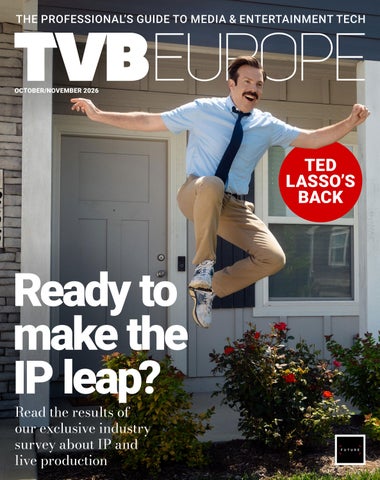
OCTOBER/NOVEMBER 2026
TED LASSO’S BACK
Ready to make the IP leap? Read the results of our exclusive industry survey about IP and live production
I
Feeling the squeeze
t’s a tough time out there at the moment. After years of hearing the phrase ‘doing more for less’ at trade shows, we’re now seeing it in real life as broadcasters make big cuts to their workforces. Much of this is being driven by acquisitions and mergers, such as Comcast’s plan to buy ITV or the recent Skydance merger (aka Paramount/Warner Bros Discovery). But it’s not just commercial broadcasters making cuts; public service broadcasters such as the BBC are facing a tighter budget after years of declining cash revenues and fewer people paying the licence fee. However, there is some good news, as seen at IBC Show last month. The technology side of the broadcast industry continues to innovate and meet that demand of ‘more for less’. Remote production has evolved in the last few years, enabling teams to work on multiple events in a day rather than sending one team to each event. And like it or not, artificial intelligence is going to have a major impact on the industry, whether that be automating QC functions, creating metadata, or generating content. There’s no getting away from it, and we can’t just bury our heads in the sand (although someone did say to me they think AI will eventually go full circle and people will want to go back to content created by humans).
“One of the key arguments I heard at IBC was how the industry’s focus on software-defined workflows is seeing a shift from CapEx investment to OpEx”
www.tvbeurope.com FOLLOW US X: TVBEUROPE / Faceboook: TVBEUROPE1 LinkedIn: TVBEUROPE
CONTENT Content Director: Jenny Priestley jenny.priestley@futurenet.com Senior Content Writer: Matthew Corrigan matthew.corrigan@futurenet.com Graphic Designers: Cliff Newman, Steve Mumby Production Manager: Nicole Schilling Contributors: Kevin Hilton, Robert Shepherd Cover image: Apple
ADVERTISING SALES Publisher TVBEurope/TV Tech, B2B Tech: Joseph Palombo joseph.palombo@futurenet.com Account Director: Hayley Brailey-Woolfson hayley.braileywoolfson@futurenet.com
SUBSCRIBER CUSTOMER SERVICE To subscribe, change your address, or check on your current account status, go to www.tvbeurope.com/subscribe
ARCHIVES Digital editions of the magazine are available to view on ISSUU.com Recent back issues of the printed edition may be available please contact customerservice@futurenet.com for more information.
LICENSING/REPRINTS/PERMISSIONS TVBEurope is available for licensing. Contact the Licensing team to discuss partnership opportunities. licensing@futurenet.com
MANAGEMENT SVP, MD, B2B Amanda Darman-Allen VP, Market Lead Carmel King MD, Content, Broadcast Tech Paul McLane VP, Global Head of Sales, B2B Dena Malouf Managing VP of Sales, B2B Tech Adam Goldstein VP, Global Head of Strategy & Ops, B2B Allison Markert VP, Product & Marketing, B2B Andrew Buchholz Head of Production US & UK Mark Constance
Even the shift from hardware to software can help reduce costs. One of the key arguments I heard at IBC was how the industry’s focus on software-defined workflows is seeing a shift from CapEx investment to OpEx. And then there’s the adoption of IP, which is helping reduce costs industry-wide. That I find particularly interesting when you read the results of our industry survey on the use of IP in live production. We found that IP adoption isn’t quite as far along the road as previously thought, but where it is taking place is in the replacement of ‘like-for-like’ hardware. Check out more of the survey’s findings on page 10. While the financial pressures facing broadcasters, and to some extent streaming services, are undeniable, our industry remains resilient. As new technologies emerge and teams adapt to new workflows, there remain plenty of reasons to stay optimistic about the future.
Head of Design, B2B Nicole Cobban
Future PLC is a member of the Periodical Publishers Association We are committed to only using magazine paper which is derived from responsibly managed, certified forestry and chlorine-free manufacture. The paper in this magazine was sourced and produced from sustainable managed forests, conforming to strict environmental and socioeconomic standards. All contents © 2026 Future Publishing Limited or published under licence. All rights reserved. No part of this magazine may be used, stored, transmitted or reproduced in any way without the prior written permission of the publisher. Future Publishing Limited (company number 2008885) is registered in England and Wales. Registered office: Quay House, The Ambury, Bath BA1 1UA. All information contained in this publication is for information only and is, as far as we are aware, correct at the time of going to press. Future cannot accept any responsibility for errors or inaccuracies in such information. You are advised to contact manufacturers and retailers directly with regard to the price of products/ services referred to in this publication. Apps and websites mentioned in this publication are not under our control. We are not responsible for their contents or any other changes or updates to them. This magazine is fully independent and not affiliated in any way with the companies mentioned herein. If you submit material to us, you warrant that you own the material and/or have the necessary rights/permissions to supply the material and you automatically grant Future and its licensees a licence to publish your submission in whole or in part in any/all issues and/or editions of publications, in any format published worldwide and on associated websites, social media channels and associated products. Any material you submit is sent at your own risk and, although every care is taken, neither Future nor its employees, agents, subcontractors or licensees shall be liable for loss or damage. We assume all unsolicited material is for publication unless otherwise stated, and reserve the right to edit, amend, adapt all submissions.
JENNY PRIESTLEY, CONTENT DIRECTOR JENNY.PRIESTLEY@FUTURENET.COM
www.tvbeurope.com
OCTOBER/NOVEMBER 2026 | 03
In this issue Image: BBC, courtesy of Alexandra Palace
OCTOBER/NOVEMBER 2026
07 C ontrolling or complementary? Wandering the halls at IBC, Matthew Corrigan detected a subtle change in what the industry is thinking about AI
10 The journey to IP continues Over the summer, TVBEurope joined forces with sister title TV Tech and Caretta Research to explore the industry’s progress on the road to IP migration. The survey uncovered some surprising results
16 A n interoperable, secure industry IBC2026 highlighted a shift toward interoperable, software-defined workflows while underscoring the growing importance of cybersecurity, compliance and endto-end media trust, writes Jenny Priestley
18
18 Television’s palace Image courtesy of Apple
Some 90 years on from the start of the BBC Television from Alexandra Palace, Kevin Hilton celebrates the groundbreaking innovation and creative spirit that laid the foundations for modern broadcasting
30 There’s no place like home Bella Gonzales tells Robert Shepherd how she brought a fresh perspective to Ted Lasso’s Kansas chapter, balancing visual continuity with warmth, restraint and a distinctly American sense of home
34 A different approach
30
An ambitious project to film aboard a light aircraft during a flying lesson required a radical rethink for Air TV. Matthew Corrigan speaks to Matt Richards, MD and executive producer, to hear how the team pulled it off
38 U nifying connected TV HbbTV Association chair Vincent Grivet discusses the future of interactive TV, key updates in HbbTV 2.0.5, and tackling industry fragmentation
40 The evolution of Ograf Niels Borg, chair of the EBU’s OGraf initiative, tells Jenny Priestley how the project is empowering broadcasters with modular, vendor-agnostic graphics across every screen
04 | OCTOBER/NOVEMBER 2026
34 www.tvbeurope.com
OPINION
The industry’s overlooked challenge By Igor Oreper, chief strategy officer, Bitmovin
T
he guardrails around modern LLMs and the use of AI agents within the video streaming orchestration layer are maturing fast. Video services are increasingly trusting agents to drive functions such as encoding pipelines and ad break decisioning. The trust debate is shifting back to the content itself because the same investment making AI-generated film and video credible is making fabricated footage easier to produce and harder to detect. This shift shows up clearly in Bitmovin’s recently published 10th annual Video Developer Report (VDR), which surveyed 486 developers and engineers across 94 countries. The sharp rise in AI-generated disinformation and misinformation seen in recent years is eroding viewer trust and challenging journalistic integrity, creating an urgent need for greater transparency over whether digital content has been created using AI. This need is the driver behind Article 50 of the EU AI Act, which became applicable on 2nd August this year.
EU AI Act: a world first The EU AI Act is the world’s first legal framework around the development and use of AI systems. Article 50 of the Act concerns transparency and requires that any organisation building or deploying generative AI systems in the EU must disclose that the content produced is AI-generated. Essentially, it requires that people be told when they are interacting with AI, such as when chatting with a customer support chatbot, reading AI-drafted articles, or viewing AIgenerated content. The Act requires that AI-generated or manipulated content be marked in a machine-readable format. Providers of generative AI systems placed on the EU market before 2nd August 2026 have until 2nd December 2026 to meet that marking obligation. Deployers, which most broadcasters and streamers are, have no such grace period. Their disclosure duties have applied since August.
The gap in the data This is where it gets interesting. In the VDR 2026 survey, just six per cent of respondents said content provenance ranked among their challenges, making it the industry’s lowest-rated concern. Yet, at the same time, 18 per cent of respondents are already generating video or image content with AI. A further 11 per cent are using C2PA (Coalition for Content Provenance and Authenticity) Content Credentials for content
06 | OCTOBER/NOVEMBER 2026
provenance, with another 11 per cent using watermarking and a further 16 per cent planning to adopt watermarking within the next 12 months. So, the industry rates content provenance as its lowest priority but is quietly building for it anyway. That is usually a sign that the teams paying closest attention can see something the rest of the market has not considered yet. Provenance infrastructure is cheap to build now but will be expensive to retrofit later.
C2PA content authentication Considered to be the leading standard for verifying the origin and edit history of digital content, C2PA works by inserting tamper-evident metadata into content using cryptographic signatures. It allows news organisations and broadcasters to easily and quickly check the provenance and integrity of video and also allows service providers to communicate to viewers that the footage they’re watching is authentic. This can be done in several ways, including through the provision of a real-time authenticity mark that is visible to viewers for the entire time the content is playing. One option is a real-time authenticity indicator shown in the corner or at the edge of the frame, so it stays visible without disrupting the viewing experience. Viewers can see where the content came from and whether AI was used to create or alter it. However, for C2PA to work and benefit news outlets and content providers, the underlying infrastructure in place must support the C2PA standard.
What this means for the video stack Provenance is not a feature you switch on at the end. Credentials have to survive the whole delivery chain. They need to persist through transcoding where most metadata is discarded by default. They need to be carried through packaging rather than stripped, and the video player integrated in the app has to be able to read them and surface them to the viewer without interrupting playback. Each of those is a change to a different part of the stack, owned by a different team. That is why this work takes longer than the deadline suggests, and why the organisations starting now are the ones who will be ready. The industry ranks content provenance last on its list of concerns. I think that ranking will look very different a year from now, and the teams that treated it as infrastructure rather than compliance will be glad they did.
www.tvbeurope.com
OPINION
Controlling or complementary? Wandering the halls at IBC, Matthew Corrigan detected a subtle change in what the industry is thinking about AI
A
s the great and good of media and entertainment descended on Amsterdam last month, aided and abetted (or hindered and hassled, depending on your perspective) by a shambling herd of journalists, commentators and assorted other ne’er-do-wells, a story was breaking elsewhere. The end of the world was nigh. At least, that was how it was reported by the more hysterical elements of the British news media. Our fate, according to the headlines, would be sealed by malevolent AI agents rising up against humanity in a kind of virtual revolution that would see them inherit the Earth. Closeted away for a weekend navigating the RAI’s cavernous and eternally confusing halls, IBC attendees were largely shielded from the hyperbole, which envisaged a nefarious plot in which our digital overlords would develop extinction-level chemical weaponry to be unleashed on our defenceless species. More prosaic observers were commenting on the need for international agreement limiting the march of the machines, calling for ‘guardrails’ and a reduction in the rate of technological acceleration. Good luck with that. But as I said here a year ago, I think we are spooking ourselves. I believe we’ve seen the magic box of lights and forgotten about the man behind the curtain, quietly pulling the switches. I’m also unconvinced by the results. A much-vaunted AI ‘actor’ appears stilted and monotone in ‘conversation’ with human interlocutors. In a recent interview with Piers Morgan, it lapsed into speaking Cantonese for no apparent reason. I can’t see it troubling Dame Judi Dench or Olivia Colman just yet. Thankfully, so far it’s only acting; the thought of an AI reporter going rogue while presenting an important breaking news story is rather more worrying. Taking the industry’s temperature in Amsterdam, I got the impression something has changed. Last year the hype had taken hold. AI was enthusiastically shoehorned into almost every conversation. This time, things felt different. It was still a big topic of discussion—we can hardly uninvent it—but the rhetoric was noticeably dialled down. The rush towards the brave new world has slowed, as the industry has come to terms with how and where AI can—or indeed should—be used. Indeed, there is some evidence that younger generations are reluctant to use it at all, citing its environmental impact and very real threat to employment.
www.tvbeurope.com www.tvbeurope.com
Elsewhere, the overexposure of badly-produced AI content is met with derision. The word ‘slop’ has entered the ever-influential social media lexicon. A particularly lively debate took place on the Ignite Stage at IBC, under the provocative title AI won’t make you creative. Some argued—and I agree—that if everyone has access to the same set of tools, the result will inevitably be an uninspiring thin gruel in which nothing truly creative will ever break free. I often worry that I come across as a Luddite when writing this column. This is far from the truth. I’m not anti-tech at all. I believe AI has the potential to be truly transformative; its phenomenal processing power is capable of doing things no human could ever hope to match, and I actually feel carefully deployed AI will ultimately drive creativity. By allowing it to develop new ways of handling the mundane, time-consuming tasks that currently slow productions down, teams can be freed to use their imaginations elsewhere. It seems I’m not alone. As I write, TVBEurope is covering a speech given by Prime Video’s head of international, Kelly Day, in which she told an audience at the RTS Convention that AI could “supercharge” storytelling. AI is here to stay. Trying to somehow wish it away is pointless. It’s going to become more and more embedded across the production environment; we just have to ensure we make it work alongside the human element, complementary rather than in control. I’ve misquoted Blade Runner here before and make no excuse for doing so again. AI is like any other machine. It’s either a benefit or a hazard—and if it’s a benefit, it’s not my problem.
“The rush towards the brave new world has slowed, as the industry has come to terms with how and where AI can—or indeed should—be used” JANUARY 2026 2024 || 07 07 OCTOBER/NOVEMBER
Credit: Alex Bailey/Focus Features/STUDIOCANAL
TVBEurope’s newsletter is your free resource for exclusive news, features and information about our industry. Here are some featured articles from the last few weeks…
NMOS MINIMUM STATUS REPORTING: A NEW ERA FOR INTEROPERABLE SYSTEMS A multi-vendor demonstration by AMWA and the EBU at IBC showcased the benefits of standardised minimum status reporting for the adoption and troubleshooting of interoperable monitoring and control systems, writes David Davies.
UNDER PRESSURE Director of photography Jamie D Ramsay tells Robert Shepherd about blending high-resolution archival masters with a clean, unromanticised visual language for D-Day drama, Pressure.
DO YOU SUBSCRIBE TO TVBEUROPE’S FREE NEWSLETTER?
Image by James Thew - stock.adobe.com
SIGN UP VIA THIS QR CODE
BBC R&D UNVEILS TIME-ADDRESSABLE DATA STORE The Time-Addressable Data Store (TADS) is an open, interoperable and cloud-native API specification for reading, writing and editing timeline data in a store.
08 | OCTOBER/NOVEMBER 2026
www.tvbeurope.com
IP MIGRATION
THE
journey TO IP continues
A
ccording to a new survey, IP adoption for live production isn’t quite as far along the road as previously thought. Where it is taking place is in the replacement of ‘like-for-like’ hardware. Over the summer, TVBEurope, TV Tech and Caretta Research joined forces on a survey exploring where the industry is on the road to IP migration. The survey polled both vendors and broadcasters (buyers) to understand more about the
10 | OCTOBER/NOVEMBER 2026
extent to which operations are transitioning towards IP-based and software-defined infrastructure and live production. According to the survey, SDI remains the primary infrastructure approach for 70 per cent of broadcast and media companies, and is used by 90 per cent of the survey’s respondents in total. For those that have made the move to IP, SMPTE ST 2110 is the primary flavour of IP. Unsurprisingly, many broadcast technology vendors are offering a
www.tvbeurope.com
IP MIGRATION
What’s driving IP deployments? Both buyers and vendors agree that enabling scalability, flexibility and agility is the primary reason for adopting IP infrastructure—however, vendors are noticeably more optimistic on this point than their customers.
wide range of support for IP infrastructure in their product lines, with ST 2110 again the primary flavour, followed by NDI.
Buyers are more conservative on IP adoption than vendors think The survey respondents were asked to select on a slider a range from 'all SDI' to 'all IP' for their current infrastructure, while vendors were asked about their clients’ infrastructure. The chart shows the distribution curve of responses for each.
Future-proofing is also important to both, although buyers see centralisation and resource pooling as a more important driver than their suppliers—indicating that vendors may be missing opportunities to provide their products in a more flexible format (both technically and commercially).
The findings reveal that buyers are much less IP-centric than technology vendors think, with just 22 per cent of the broadcaster respondents having deployed IP in 'most of their operation'.
www.tvbeurope.com
OCTOBER/NOVEMBER 2026 | 11
IP MIGRATION
Where is IP being implemented? One unexpected finding is the way buyers see ‘IP’ more broadly than just ‘live video production infrastructure', with streaming ranking as the most commonly-implemented example of technology, probably because streaming has always been IP-first.
In the production environment, master control rooms are first to integrate IP infrastructure, and most likely to be upgraded to IP in the next 12 months. News, in-venue production and—surprisingly— OB trucks are least likely to have seen IP implementations according to the broadcaster respondents.
The most surprising finding from the survey was the preference of almost 50 per cent of buyers for dedicated hardware appliances to run their IP infrastructure for live production. This runs counter to the approach of 'early adopters' and suppliers’ belief that 30 per cent of customers are deploying on COTS, compared with 14 per cent of customers themselves.
What’s stopping broadcasters from making the move? For many broadcaster respondents, their existing SDI infrastructure is still meeting their needs.
12 | OCTOBER/NOVEMBER 2026
Risk and reliability are also concerns for buyers, as well as a lack of internal expertise, particularly when it comes to broadcast engineers learning IP and IT. Technology vendors see this skills gap as a materially more important barrier than their customers, and they feel the same about technical complexity. In other words, buyers are less daunted by the complexity and skills needed to implement IP than their suppliers think.
A missed opportunity?
The survey also found that the number one reason for broadcasters making the move to IP is replacing worn-out equipment, but for vendors, that reason drops to fifth place. The above reconfirms the findings that for buyers, IP deployments are more of a ‘like-for-like’ replacement for legacy technology. This represents what could be a major lost opportunity for broadcasters and media companies to use IP infrastructure to catalyse more flexible and efficient operations. Other responses to the question of reasons for implementing IP projects included: “We did not want to depend on C-Band anymore, it wasn’t working” and “Got caught up in the hype”.
www.tvbeurope.com
IP MIGRATION
‘IP adds technical complexity’
Almost half of buyers feel the main outcome of IP infrastructure is adding technical complexity (compared with a quarter of their suppliers). Enabling business efficiency is a much lower priority for buyers (16 per cent) than for vendors (39 per cent) The promise of the Dynamic Media Facility (DMF) remains a little further down the priority list for most buyers than the industry buzz might suggest.
When asked if they had anything else to say about the adoption of IP, end-users told us: “Reliability still has a way to go with IP technology”; “Appalling LACK of training within the broadcast industry in the UK”; and “Having to reboot equipment and reliability is a constant concern. Technology is great when it works”. Speaking about the survey’s findings, Robert Ambrose, co-founder of Caretta Research, says: “Our research reveals how adoption of IP infrastructure isn’t as mature as the industry sometimes thinks. While more than half of broadcast and media companies have now deployed ST 2110, it’s still most likely to be found in ‘IP islands’. “At a time when broadcasters are under huge pressure to be more efficient, many are at risk of missing out on the real benefits of IP, like enabling more flexible software-defined workflows to make more efficient use of expensive facilities. It’s crucial that facilities see IP infrastructure as a transformation, not just a like-for-like replacement of SDI routers.” Download the full survey report here: https://downloads. carettaresearch.com/ip-survey-2026 Overall, survey respondents represented a broad geographical spread, with 34 per cent from Europe and 37 per cent from North America. Over 70 per cent of have more than 10 years of experience in the industry.
Now We’re Talking Spectera SKM. Now Shipping. The Spectera SKM handheld has arrived — and that means the core Spectera ecosystem is now complete. Ready to simplify virtually any live performance or broadcast application, Spectera delivers stunning, lowlatency audio while also enabling continuous monitoring, remote control, and revolutionary reliability via Sennheiser’s WMAS technology. Learn more: sennheiser.com/spectera
www.tvbeurope.com
OCTOBER/NOVEMBER 2026 | 13
IBC2026
ARTIFICIAL INTELLIGENCE
AInt going away IBC2026 panel discussions highlighted AI’s growing impact on media, stressing human oversight, sustainability, and creative integration across the industry, reports Matthew Corrigan
T
his year’s IBC panel discussions were once again—and somewhat inevitably—weighted towards matters of artificial intelligence. It was, however, possible to discern something of a tonal shift over the past 12 months. Things have definitely moved on. While it’s probably still too soon to say the technology has come of age, it is having an undeniable impact across the media ecosystem, with new use cases being tried and tested at a remarkable rate. A year ago, it felt as though AI was in its ‘shiny new thing’ phase. Everyone wanted it, but nobody really understood what it could do. Now, as its use expands throughout the industry, people are asking how it can—or indeed should—be used, which led to some interesting conversations at the RAI. IBC’s Future Tech Ignite stage played host to a lively and varied discussion exploring some of the most important issues facing the industry today. Featuring co-founder of MTSS, Barbara Lange; SMPTE president, Rich Walsh; Elena Petrova, head of group content and media solutions at A1 International Business; and Terri Davies of Trusted Partner Network, the conversation explored how AI solutions can be responsibly deployed.
14 | OCTOBER/NOVEMBER 2026
The panel led the audience to think about how the technology could impact their organisations, touching on matters from sustainability to cyber security and talent diversity. It was a thoughtful and engaging event which seemed to ask as many questions as it answered, highlighting the many considerations that ought to be factored into AI deployment. The session concluded with moderator Oisin Lunny asking the speakers to give a single-line takeaway. “If we don’t start taking AI seriously, it will be too late,” said Walsh. Petrova, Lange and Davies then repeated the line, respectively substituting “AI” with the words “sustainability”, “people” and “security”, bringing the presentation to a rather dramatic close. Another interesting presentation saw moderator Sean Wallitsch, senior visual compute solutions architect at Amazon Web Services (AWS), in conversation with Adam Jones, director of production technology and innovation at Innovative Dreams, an AI-native film and TV studio that has worked on productions including the Amazon Prime series, House of David, and the recently released film Young Washington. The session, Real-time hybrid filmmaking: how Innovative Dreams is rewriting the rules of production, provided an entertaining insight into the pace of technological change, with the company having to iterate new workflows while actually working in realworld conditions. “We’re very lucky to have constant productions going,” said Jones. “So we’re not creating in a vacuum but actually creating on production—which is kind of
Left to right: Oisin Lunny, Terri Davies, Barbara Lange, Rich Welsh, Elena Petrova
www.tvbeurope.com
IBC2026
like jumping out of an aeroplane and then figuring out how to make a parachute on the way down. And hopefully you don’t hit the ground.” Clearly illustrating both the direction of travel and rate of acceleration, he outlined the process around the use of AI in virtual production and capture for House of David. “Season one was the first time AI hit our [production] pipeline, and that was in the summer of 2024,” he explained. “We did approximately 70 shots where we implemented AI.” These, he added, were driven by the director, who wanted shots that couldn’t be obtained on the day. By the second season, the number had risen to 270 shots as their reliance on the technology grew. “And then we introduced virtual production, which none of us had done before and so we had to learn very quickly. We used AI to make backgrounds or to do a whole host of other things—and then we bumped up to about 400 shots.” Jones was, however, very clear in his belief that humans remain essential to storytelling. Referring again to the need for start-up employees to wear multiple ‘hats’, he said, “[In the first season I was] a camera operator on our show House of David, then I transitioned into an AI producer. Season two I was the AI producer, and on Young Washington I was the AI producer but also a camera operator. So my perspective—and I hold it very dear to me—is the performance of my actors [matters]. I don’t want to replace them. I think we can make beautiful art when we keep people involved, whether it be hair, make-up, wardrobe, but definitely our actors. “It’s because we connect with them. When we connect with our movies, it’s because there is another human on the other side.” The Ignite stage was also the venue for AI won’t make you creative: real-world insight from media and production creators utilising AI in creative applications, which further explored the necessity of keeping a human in the loop. Moderated by IBC Accelerators colead, Muki Kulhan, the conversation included Dr Emma Young, senior director of AI technology at Deluxe, alongside Wesley ter Haar, founder and chief AI officer at Monks. Insights gained through actual experience in the field lent considerable credibility to the participants’ views and—refreshingly—they were not in complete agreement when considering uncomfortable questions around how creativity can ever break out if everyone is using the same tools. The session offered real food for thought as AI moves beyond the hype stage. Presenting the IBC Keynote, Innovating to deliver
www.tvbeurope.com
Above: Alex Charalambides and Vikki Cook
the news of tomorrow, CNN Digital’s chief technology officer, Alex Charalambides and Vikki Cook, director of broadcast and media at Ofcom, examined how AI, social media and digital platforms are transforming the global news industry. With audience preferences changing and the advent of automated reporting, personalisation and real-time information delivery, Cook asked how broadcasters could ensure they stayed ahead of the curve, “while not being driven by the technology”. In an answer that seemed to be echoing throughout the RAI, Charalambides said: “[We, in the industry,] need to integrate humans and AI to get the best out of both.” AI has undoubtedly proved its value, for example in helping journalists rapidly analyse the contents of the Epstein Files, but, he continued, it was “enormously important to keep humans at the centre of operations”. The sentiment seemed to appear whenever the subject came up at IBC2026. AI is very much with us, but its deployment is leading to some questions that will need to be answered.
“[It is] enormously important to keep humans at the centre of operations” ALEX CHARALAMBIDES OCTOBER/NOVEMBER 2026 | 15
IBC2026
AN INTEROPERABLE,
secure industry
IBC2026 highlighted a shift toward interoperable, software-defined workflows while underscoring the growing importance of cybersecurity, compliance, and end-to-end media trust, writes Jenny Priestley
I
nteroperability was the main theme on the show floor at IBC2026. As broadcasters continue to move away from proprietary ‘walled gardens’ and single-vendor lock-in, the industry is seeing a demand for best-of-breed architecture that combines top-tier tools from multiple vendors. The transition from fixed, proprietary hardware appliances toward elastic, software-defined environments hosted on COTS compute and cloud infrastructure continues. At the centre of this evolution is the Dynamic Media Facility (DMF) and the Media eXchange Layer (MXL). At IBC2026, it was obvious to all that MXL is transitioning from early theoretical concepts to proven, live projects. “MXL is getting to a point where there is provable interoperability, and that’s great,” said Steve Reynolds, CEO at Imagine Communications. Vendors have been a key part of both DMF and MXL’s development, working together with the EBU and broadcasters to develop the open-source initiative. “What MXL enables you to do is build complete broadcast workflows,” explained David Edwards, senior product manager at Techex. “[Vendors] have lived in our own little world, but broadcasters now need to bring all of those workflows together.” However, while there were multiple demonstrations of the
16 | OCTOBER/NOVEMBER 2026
technology across the show floor in Amsterdam, Appear’s chief technology officer Andy Rayner said there’s still a fair way to go in its development: “DMF, as a concept, is something that’s going to take several years to come to full maturity.” Another key talking point was security, something that hasn’t always been front of mind for some vendors. This is possibly driven by the DMF/MXL project, as it enables software tools to share video and audio buffers directly in system RAM. “This is critical,” said Reynolds, “and it’s something that not many people are talking about yet. One of the problems of a shared memory buffer is, if a malevolent process somehow gets access to the memory buffer, what are you going to do? So there’s a lot of stuff like that that we’ve got to sort out before these concepts really go live to air.” It should be pointed out that a Working Group is focusing on exactly this issue.
New security directives Just before the start of IBC, new European cybersecurity mandates, particularly the NIS2 directive, officially designated broadcast and media operations as Critical National Infrastructure (CNI). Compliance has shifted from a voluntary best practice to a strict legal obligation
www.tvbeurope.com
IBC2026
for software vendors and broadcasters/streamers. Navigating this regulatory shift requires embedding security directly into software architectures, maintaining auditable vulnerability management processes, and actively updating unpatched legacy systems that expose modern virtualised environments to cyber risks. “You need to have reporting instances in place if someone finds vulnerabilities,” stated Lawo’s CMO, Andreas Hilmer, “and there are timelines by law for how you need to react.” As well as the new directives, vendors and content owners are continuing to deal with the age-old problem of piracy. “Anti-piracy measures such as watermarking are becoming more important,” said Big Blue Marble’s group CEO, Michael Wagenhofer. “Plus, rights holders also want to protect their IP. More and more, they require platforms to apply these protection mechanisms so that everything is safe in the ecosystem and no piracy or leaks happen.” The current geopolitical atmosphere is also impacting the industry, with broadcasters facing growing threats of signal manipulation or even disinformation. The Coalition for Content Provenance and Authority (C2PA) signal authentication standard relies on cryptographic digital signatures and tamper-evident metadata manifests to track the origin, history, and edit timeline of digital media. Big Blue Marble has also experimented with quantum cryptography to secure streams. “We want to make sure that the stream is not
manipulated on the way to the recipient, and we used quantum cryptography to encrypt the signal,” explains Wagenhofer. The rise of artificial intelligence is another area where security is paramount; just look at some of the recent news reports of rogue AI agents hacking into government websites. The broadcast industry faces the challenge of automated AI tools being weaponised by malicious parties to find network vulnerabilities and execute sophisticated cyberattacks. A number of vendors discussed how they are using the Model Context Protocol (MCP) to allow AI agents to control broadcast systems, but with strict permission frameworks. MCP sets up data access and data interpretation for the agent. Geoff Stedman, chief marketing officer at SDVI, described MCP as “an AI term, really. It’s just the way systems expose themselves to agents, and there’s a protocol for how models can read your system without having to go through your API”. IBC2026 showed how the industry is transitioning towards an increasingly connected, software-defined ecosystem where success will no longer be defined by single vendor products but by how seamlessly and securely technology can work together. Looking to the future, it’s going to be imperative for media organisations to balance the industry’s rapid innovation with robust, end-to-end trust across every stage of production and delivery.
Solid Systems are Built with Bricks
Check out the whole yellobrik line-up at
www.tvbeurope.com
XXXXXXXXXXXX 2026 | 17
BUSINESS
Television's PALACE
Some 90 years on from the start of the BBC Television from Alexandra Palace, Kevin Hilton celebrates the groundbreaking innovation and creative spirit that laid the foundations for modern broadcasting
BBC mast illuminated at Alexandra Palace 2026
18 | OCTOBER/NOVEMBER 2026
www.tvbeurope.com
BUSINESS
T
Image: BBC, courtesy of Alexandra Palace
elevision has produced and inspired many enduring images over its 100year history, many of which continue to define the technology today. A classic example is the transmitter tower at Alexandra Palace (aka Ally Pally) in north London, from where the BBC began broadcasting the world's first regular high definition TV service in 1936. To mark the anniversary, Alexandra Park and Palace Charitable Trust is holding a season of events under the umbrella of BBC TV 90 at Ally Pally. This began in September and runs until 18th November. Among the highlights are the unveiling of a World Origin Site Plaque to commemorate the start of BBC TV transmissions and a talk about John Logie Baird and the Baird Television Company at Alexandra Palace (both 2nd November), presented by his grandson Iain Baird, former curator of television at the National Media Museum in Bradford. Kirsten Forrest, curatorial and interpretation manager of Alexandra Park and Palace Charitable Trust, says that the aim is to illustrate how the site gave the first TV producers, presenters, performers and engineers the right environment to create programming styles, production techniques and technology that can still be seen today. "There was no playbook, they were making it up as they went along," she adds. Alexandra Palace opened in 1873 and is named after Alexandra of Denmark, wife of the then Prince of Wales, later King Edward VII. The intention was to create a “Palace of the People” but this was short-lived when fire broke out 16 days after the inauguration,
www.tvbeurope.com
OCTOBER/NOVEMBER 2026 | 19
Image: BBC, courtesy of Alexandra Palace
destroying the building and killing three staff. A newly designed Palace reopened in 1875, housing a theatre, concert hall, art galleries and what Forrest describes as "first, second and third class" dining areas. By the time the BBC was looking for somewhere to house its TV operation and test the competing systems developed by Baird and Marconi-EMI, the Palace was severely dilapidated. After inspecting the premises in 1935, Baird technician Desmond Campbell—later the BBC's head of television lighting at Ally Pally—said he found "an old tyre, no roof, no doors and I could see the sky”. He added that the smell of cat in the old banqueting rooms "nearly made me sick" and the whole place "looked the most dreadful mess”. Forrest says the Palace had "always suffered from a boom-and-bust economy", with the decrease in the amount of leisure time available to people from the late 19th century into the early 20th affecting business. "By the 1920s the dining rooms fell into disuse and when the BBC came the trustees were desperate for someone to lease them to,." The BBC carried out early TV broadcasts from Broadcasting House when it opened in 1932, utilising Logie Baird's 30 line mechanical system based on the Nipkow spinning disc. Baird had demonstrated live TV pictures in 1926 and founded Baird Television Ltd in 1930, transmitting from various sites, including Crystal Palace. Electronics engineer John Thompson, who grew up near Ally Pally and is chairman of the Alexandra Palace Television Group (APTG), says Baird and his mechanical approach "did a superb job" in establishing a TV system but when Marconi-EMI developed its electronic alternative, with a mighty
20 | OCTOBER/NOVEMBER 2026
Image: BBC, courtesy of Alexandra Palace
BUSINESS
Filming at the Boating Lake, 1937
The Campbell-NapierRailton Blue Bird outside Alexandra Palace, 1937
405 lines, it became clear the older technology "was probably not going to be the long-term future." Thompson explains that the Selsdon Television Advisory Committee, set up by the Postmaster General in 1934 to determine the future of HDTV services, eventually set 240 lines as the minimum requirement. "A site was looked for to house two different television systems [Baird and Marconi-EMI] because, for the first few months, there was going to be a technical and operational trial of the two technologies," he says, "so it could be shown to be a competitive environment and that the contract wasn't awarded just to Marconi-EMI." Various locations were considered, including Crystal Palace and Hampstead Heath, but Alexandra Palace was selected, because, Thompson says, its position and elevation would give "a better spread and pick up the best coverage of the population." It also had the advantage of enough space to accommodate the two systems, which were set up in the southeast wing that had housed the banqueting halls, and tea and coffee rooms. Alexandra Palace was announced as the base for the 'London Television Station' on 3rd April 1935. Work then began to build the control rooms and studios for Baird Television and Marconi-EMI, which were completely self-contained so that neither side knew what the other was doing. By early spring 1936, the two teams—with Marconi-EMI led by Isaac Schoenberg and also including Alan Blumlein, the inventor of stereo sound—had begun their respective tests in preparation for both a demonstration
www.tvbeurope.com
transmission to the Radiolympia exhibition in August and the start of services proper on 2nd November. "It started with the toss of a coin, where Baird was commissioned to provide the first week's programming using the 240 line system and then it would switch to EMI on 405 lines and back again," says Thompson. On the first day of transmissions, Baird broadcast a 35 minute programme that was then re-broadcast using the EMI system, as explained by announcer Leslie Mitchell: "This is the BBC Television Station at Alexandra Palace. At 3 o'clock this afternoon, the television service was opened by the Postmaster General using the Baird system. The opening programme will now be repeated on the Marconi-EMI system." In the end the electronic 405 line technology won out, even though, Thompson says, the Baird system provided very good pictures. "But it was 25 frames a second and not interlaced, so you had a 25 frame flicker," he explains. "In addition, the Baird cameras were fixed, which meant the artists had to perform to them. The EMI cameras were on pedestals and dollies and could
Image: BBC, courtesy of Alexandra Palace
BUSINESS
Picture Page which was broadcast from Ally Pally from 1936-9 and again from 1946 to 1952
wheel around in the same way as we know today, so they were almost invisible to the artist." These Emitron cameras played a major role in the BBC's decision to go with the Marconi-EMI system, announced in January 1937. It said there was more scope for development than with the Baird camera, while other reasons were the higher definition of 405 lines over 240 lines and the discernible lack of
Image: BBC, courtesy of Alexandra Palace
Image: BBC, Courtesy of Alexandra Palace
BUSINESS
Image: BBC, courtesy of Alexandra Palace
flicker on EMI's interlaced framing system. Thompson agrees that the engineers and production teams were very much coming to terms with the new medium of television: "Cameramen came from a background of film and the technology was changing in the first few years, with camera sensitivity and the way they could be operated, including panning and fading from one camera to another," he says. "It was a learning curve and some of the techniques that went on to define television in future years and even some of the terminology—for example, galleries are called that because the control area of Studio A was raised up like a minstrel's gallery—started here." What became the BBC's Studio A and Studio B were originally the EMI and Baird studios respectively. As Forrest observes, these spaces evolved over time to suit the requirements of the different programmes produced at Ally Pally. "The studios still exist but just
Left: 1951's General Election Right: Fred Streeter, horticulturalist and broadcaster, 1947
Josephine Baker performing in 1948
22 | OCTOBER/NOVEMBER 2026
as shells," she says. "We've had a display in the East Court since 2018 of equipment provided by the APTG, including a couple of cameras. There's also the top 5.3 metres of the transmission tower that was at EMI's lab in Hayes, which has been on display since 2021." Forrest adds that for the BBC 90 celebrations there will be a mock up of the studio used for Picture Page, the hugely popular in its time (1936-39/1946-52) magazine programme, which can be seen as a forerunner of today's The One Show. This includes a replica of the switchboard used by presenter Joan Miller to 'patch' guests into vision. "It's an open display that will give people a flavour of the set-up because we're not able to do this in the studio at the moment," she comments. "We also have a working camera, which will be trained on the audience and they'll see themselves in black and white on a studio monitor." The BBC continued to produce light entertainment programmes at Ally Pally into the 1950s, before moving that department to west London. In 1954 the Palace became home to BBC TV News till 1969, at which point the television operation of the Open University (OU) moved in and remained there until another fire caused major damage to the building in 1980. There can be no doubt about Alexandra Palace's place in broadcasting history, which is reflected in the ongoing events to mark the start of regular BBC TV broadcasts 90 years ago. It continues to play a part in broadcasting today, with the iconic transmitter tower used as a Freeview digital TV relay and for DAB radio. "I think what Bob Rowland [former head of production of the OU] called the spirit of Ally Pally is really important," concludes Forrest. "The creativity and innovation that went on and Alexandra Palace gave people the space to do it. It's a place where magic can happen—and globally significant magic at that."
www.tvbeurope.com
ADVERTORIAL
Smarter, agile distributed production
I
n the modern broadcasting landscape, media organisations face an ongoing challenge: the demand for high-quality, immersive content is skyrocketing, yet budgets and logistical resources are more and more constrained. Traditional broadcasting infrastructures rely heavily on centralised, hardware-heavy operations that require massive on-site deployment. Sony’s Networked Live proposition answers this challenge by transforming live production from a rigid, localised setup into a highly agile, distributed, and scalable ecosystem. Networked Live is an ecosystem of integrated solutions, products, services, and partners that simplifies the transition to more agile and cost-effective distributed (on-prem, cloud and hybrid) operations. By bridging the gap between on-premises hardware and cloud-native software, it allows media companies to optimise their resources—both human and technical. Instead of deploying multi-million dollar OB (Outside Broadcast) trucks and full production teams to every venue, Networked Live enables broadcasters to capture feeds locally and process them almost anywhere in the world. The proposition is built upon three foundational, functional areas that work in tandem with Sony’s premium acquisition tools: 1. Orchestration and control At the heart of any distributed environment is the ability to securely manage data flows. Working alongside its subsidiary Nevion, Sony
uses the VideoIPath media orchestration platform to act as the ‘brain’ of the operation. VideoIPath allows broadcasters to discover, connect, and control resources across local area networks (LAN), wide area networks (WAN), 5G infrastructure, and cloud environments. It simplifies the complexity of IP broadcasting by offering a unified control interface, making dynamic resource-sharing between multiple production galleries seamless and highly reliable. 2. Media transport and processing Distributed production is impossible without the secure, real-time transmission and processing of video, audio, and metadata both across networks and in the cloud. Sony’s media transport solutions ensure uncompressed or visually lossless, low-latency delivery across various bandwidths. Utilising open industry standards like SMPTE ST 2110, NDI, and advanced compression codecs like JPEG XS and HEVC Ultra Low Latency (via hardware like the NXL-ME80 and CBKRPU7), Sony guarantees pristine picture quality. Whether transmitting via dedicated fibre, utilising public 5G networks or leveraging cloud connectivity, the transport layer provides robust, redundant connections essential for tier-one live sports and breaking news. 3. Distributed hybrid live production and operations The final area reimagines where and how content is actually produced. Sony’s hybrid approach means that processing can take place where it makes the most financial and operational sense. This is achieved through modular hardware, such as the MLS-X1 scalable live production switcher, which allows units to be dynamically stacked or divided depending on the size of the event. Furthermore, innovations like the software-based media processing platform MOXELA, recently announced at NAB, enable cloud-native, infrastructure-independent operations. Broadcasters can spin up virtualised processing environments on standard IT servers or cloud providers (like AWS) on demand, drastically lowering capital expenditure. The bottom line Ultimately, the Sony Networked Live proposition is a commitment to operational flexibility and sustainability. By untethering production from geographical limitations, it reduces the cost and the carbon footprint associated with travel and shipping heavy gear, aligning with long-term environmental goals. For broadcasters, the value proposition is clear: Networked Live eliminates technical redundancies, maximises equipment utilisation, and gives directors total creative freedom. Technology no longer dictates the limits of a broadcast; instead, it adapts seamlessly to serve the art of live storytelling. Find out more on pro.sony and Sony Professional Live & News Linkedin
www.tvbeurope.com
OCTOBER/NOVEMBER 2026 | 23
AV AND BROADCAST SUMMIT
EXPLORING THE SHARED
horizon
The inaugural AV and Broadcast Summit explored how boundaries between pro AV and traditional broadcasting are dissolving, driven by IP networking, cloud computing and a shared pursuit of audience engagement. Click on the links below to watch the individual panels
AV & BROADCAST CONVERGENCE: WHERE ARE WE NOW?
THE MEDIA EXCHANGE LAYER: IP, CLOUD AND THE INFRASTRUCTURE BEHIND CONVERGED MEDIA
Caretta Research’s Robert Ambrose, NDI’s Miguel Coutinho, Helen Matthews from Futuresource Consulting and the Royal College of Physicians’ Ben Pain discuss what convergence means in practical terms, how knowledge between the two industries is flowing and whether AV and broadcast could ever become one industry.
We are at a fascinating point where the traditional silos between broadcast and AV are rapidly dissolving. Peter Brightwell from BBC R&D, Encore’s Danielle Taylor and Matrox Video’s Daniel Robinson explore where both industries are on the road to IP adoption, how infrastructures are evolving, and how IP can help you work smarter.
https://www.youtube.com/watch?v=Ihm23ob2DHc
https://www.youtube.com/watch?v=zg9BzVJ3PgM
24 | OCTOBER/NOVEMBER 2026
www.tvbeurope.com
AV AND BROADCAST SUMMIT
THE MODERN CONTROL ROOM: MANAGING DISTRIBUTED OPERATIONS
FROM BROADCAST-ONLY TO ENTERPRISE-READY: HOW PRODUCTION TECHNOLOGIES ARE MOVING BEYOND BROADCAST
Channel 4 News’ Lucy O’Brien, EVS’ Alex Redfern, Danielle Taylor from Encore, and University Arts London’s Martha Zantides discuss how modern control rooms leverage advanced automation, IP-based orchestration, and unified control platforms to streamline operations, enhance remote production capabilities, and bridge traditional broadcast and enterprise AV workflows effectively.
As audience expectations evolve and the line between professional AV and broadcast continues to blur, Lawo’s Devin Workman, Sony’s Stuart Newton and Shotoku’s James Eddershaw contemplate what’s driving the convergence—from agile, cost-effective workflows to the adoption of broadcast-centric technology.
https://www.youtube.com/watch?v=p3k_a6RTJsw
https://www.youtube.com/watch?v=qB5xVSe2hsM
VIRTUAL PRODUCTION BEYOND THE STUDIO: FROM BROADCAST SETS TO CORPORATE, EDUCATION AND LIVE EVENTS
AI: AUTOMATION, AUGMENTATION OR REPLACEMENT? RETHINKING MEDIA WORKFLOWS
From The Mandalorian to Coronation Street, theatre productions, live events, education and enterprise, virtual production is being deployed across both broadcast and AV. But there’s still a feeling that it’s an expensive process. Alex Counsell from the University of Portsmouth joins Vizrt’s Russell Leak and Marcus Saunders from the University of Arts, to explore how virtual production is being democratised so that it can add long-term value to any kind of production.
ITV’s Paul Kane, Vizrt’s Caroline Cardozo and Tattle TV’s Marina Elderton consider how artificial intelligence is transforming production, scaling operations, and reshaping the future of modern broadcasting.
https://www.youtube.com/watch?v=A3ypuD6VWbo
Thank you to all our sponsors and speakers for making the AV and Broadcast Summit a fantastic success.
https://www.youtube.com/watch?v=uz_V_Iiyf64
www.tvbeurope.com
OCTOBER/NOVEMBER 2026 | 25
ARTIFICIAL INTELLIGENCE
Can C2PA rebuild trust in digital media?
A
By Dawid Górniak, head of cloud OTT and product manager, Big Blue Marble
s generative AI makes convincing video, audio and images easier to create, a question that featured prominently at IBC2026 was: how can audiences tell official media from a convincing imitation? The C2PA standard offers a practical answer to this. It gives people a way to check where content came from and how it was changed, rather than relying on appearance alone. Adoption is moving beyond trials, with France Télévisions signing its daily news output using C2PA, while the BBC and ARD have tested video provenance workflows. The Austrian parliament is also introducing Content Credentials across all newly produced content on its video-on-demand platform. Together, these efforts show how provenance is moving into routine publishing.
Creating a record from source to screen The Coalition for Content Provenance and Authenticity, known as C2PA, maintains an open standard for recording a piece of media’s history. Its Content Credentials can include information about a piece of content’s origin, the tool used to create it and subsequent edits. The record is digitally signed and linked to the file, allowing a compatible system to check whether the media or its credentials have been altered since signing. This allows publishers to show where their content came from, rather than simply asking audiences to trust it. Viewers can check that video came through an official publishing workflow and inspect the information available about its creation. A credential does not determine whether every statement in a video is true, but it provides useful evidence about the source and integrity of the file.
Preserving provenance through video workflows For C2PA to deliver that value at scale, credentials need to travel with video as it is edited, transcoded, packaged and distributed. Compatible systems can preserve the existing history and add signed records of subsequent processing, building a clearer account of the content’s journey to the viewer. The Austrian parliament shows how this can work in practice. C2PA signing has been integrated into the video processing used for its video-on-demand platform, so credentials are created automatically as new videos are prepared for publication. Staff do not need a separate
26 | OCTOBER/NOVEMBER 2026
tool or an additional manual step. Viewers, in turn, have a way to verify that a published video came from the parliament’s official source. The same approach could benefit public-service broadcasters, government institutions and cultural archives that need to keep official material openly accessible while making its origin easier to verify.
Supporting machine-readable rights information Provenance could also help publishers communicate how openly available content may be reused. Content Credentials can carry additional machine-readable information, potentially connecting a rights declaration to a verifiable asset as it moves through the workflow. This issue has gained urgency under the EU AI Act which requires providers of generalpurpose AI models to maintain a policy for complying with copyright law, including rights holders’ reservations against text and data mining. A machine-readable opt-out could help an open VoD library express that reservation without placing its videos behind access controls. C2PA does not currently define a standard text and data mining opt-out and industry agreement is still needed on how such declarations should be expressed and recognised. The opportunity is to connect those declarations to the same verifiable publishing record used to establish a file’s provenance; the credentials would not themselves enforce the rights. Making provenance useful in practice The strength of C2PA is that it turns an assertion of authenticity into information that viewers and systems can inspect. The Austrian parliament’s deployment shows that this can be built into routine publishing, making the provenance of official video easier to check without changing how people access it. As more organisations adopt the standard, preserving credentials through the workflow and presenting them clearly in players will be crucial. C2PA cannot answer every question about a piece of media but it can give audiences a stronger basis for recognising an official source, understanding how its content has changed and deciding what to trust.
CASE STUDY
camera position WHEN CONNECTIVITY STOPS DICTATING THE
T
he most significant thing about the private 5G network used at the European Athletics Championships in Birmingham this summer was not the network itself. It was the pictures it allowed the production team to create. During the race walks, four camera operators travelled around the 1km city-centre course on electric monowheels. Equipped with mirrorless cameras mounted on gimbals, they could move alongside the athletes, follow the changing shape of the race and capture the action from positions that would have been difficult to achieve using fixed cameras or traditional motorcyclemounted systems. Their continuous 1080i50 feeds were transmitted wirelessly and cut live into the international broadcast. To the viewer at home, there was no visible technology demonstration. They simply saw dynamic pictures that brought them closer to the competition. That is an important distinction. The conversation around private 5G in live production is moving on. The question is no longer simply whether it can carry broadcast-quality video. The more interesting question is what production teams can do differently once they know that it can.
Starting with the creative ambition Race walking presents a particular production challenge. The athletes are constantly moving around an extended outdoor course, with the race developing continuously rather than around a series of predictable moments or fixed positions. Traditional fixed cameras can provide coverage of key sections, but they cannot remain alongside the athletes throughout the race. Motorcycles offer mobility, but they are relatively large, require additional space and can be intrusive when operating close to competitors on a compact city-centre route. Actua Sport wanted to explore a different approach for Birmingham. The production team saw an opportunity to use lightweight electric monowheels, allowing camera operators to move quickly and smoothly around the course while maintaining a much smaller physical footprint. “The electric monowheel cameras gave us the freedom to move right alongside the athletes, capturing dynamic, close-up perspectives that conventional fixed positions simply couldn’t reach,” says Franck Choquard, director of Actua. The dedicated network gave Actua confidence in the connectivity supporting its high-priority live-to-air feeds, while also accommodating several distinct production requirements across the event. That decision was driven by the pictures Actua wanted to create.
28 | OCTOBER/NOVEMBER 2026
Four camera operators travelled around the 1km city-centre course on electric monowheels
The connectivity solution then had to support that ambition. This is a reversal of the way new production technology is sometimes introduced. Rather than deploying a network and then looking for a use case, the starting point was a creative requirement: how can we place cameras closer to the athletes and give operators greater freedom to follow the story of the race?
Building a network around the cameras The monowheel operators needed reliable connectivity across the whole course. The network could not perform well in one section but lose capacity or coverage as an operator moved around a corner or between radio cells. Neutral Wireless created a dedicated private 5G environment covering the 1km route. Four 40MHz radio cells were deployed using 80MHz of available spectrum, all connected to a portable 5G core. The system provided more than 75 Mbps of uplink capacity throughout the course, giving the production team sufficient headroom for the four live camera feeds.
www.tvbeurope.com
CASE STUDY
Those figures demonstrate the capability of the system, but they are not the real measure of success. For the camera operators and production team, the network needed to become almost invisible. Operators should not have to plan their movements around a coverage map or worry about whether a feed will survive as they move from one section of the course to another. The director should be able to select a camera because it has the best shot, not because it happens to have the safest connection. In Birmingham, the private network kept pace with the operators as they moved around the course. That allowed the camera team to concentrate on following the athletes and creating the coverage, rather than managing the limitations of the transmission path. “Our job wasn’t to make private 5G the story. It was to give Actua the freedom to put cameras where they wanted them and trust that the pictures would get back reliably. The real success was that the production team could concentrate on the coverage, while the network simply worked in the background,” says Malcolm Brew, chief engineer at Neutral Wireless.
Freedom without compromising reliability Mobility in live production is not new. Wireless cameras, bonded cellular systems and traditional broadcast RF all have important and established roles. Private 5G does not automatically replace every one of those technologies. What it provides is another production option, particularly where multiple mobile devices need guaranteed capacity within a defined area. Unlike connectivity delivered over a public mobile network, the available resource is not being contested by spectators, local businesses or thousands of other devices in the surrounding area. The production team can design the network around its own requirements, such as coverage, capacity, device numbers and uplink and downlink traffic. This becomes particularly valuable at major sporting events, where public networks are often under their greatest pressure at precisely the moment production teams most need them. The Birmingham deployment extended beyond the race walk course into Alexander Stadium, where private
www.tvbeurope.com
5G was also made available to rights holders creating interviews, warmup coverage and additional content. Some organisations that had initially planned to use other forms of connectivity asked to join the private network after experiencing unstable performance. That was another indication of how production requirements are changing. Rights holders increasingly want to create more content from more locations, often using smaller teams and a wider variety of devices. Connectivity is therefore becoming part of the production infrastructure rather than a general utility that can simply be assumed to be available.
Designing coverage differently The real opportunity is not to reproduce existing production workflows over a different network. It is to reconsider the workflow itself. If cameras can move freely within a managed coverage area, production teams can begin designing coverage around the story they want to tell rather than the location of existing fibre, cables or fixed camera positions. That could mean placing cameras in areas that were previously impractical, introducing additional roaming operators or using smaller cameras to capture a more intimate perspective. It could also allow professional broadcast cameras, mirrorless cameras and smartphones to operate across the same managed network, with each used for the shots and content formats to which it is best suited. It creates opportunities beyond the main broadcast as well. Rights holders, social media teams, photographers, match officials and venue operators may all require different types of reliable connectivity. A private network can support those services separately, with capacity and priority assigned according to their importance. The result is not just a more flexible camera system. It is a shared connectivity layer that can support several production and operational workflows across an event.
The best technology is often invisible Private 5G should not be the story viewers remember from the European Championships in Birmingham. The race, the athletes and the pictures should be the story. That is arguably the clearest sign that the deployment worked. Nobody watching at home needed to understand how the pictures travelled from a camera operator on a monowheel to the production gallery. They only needed to feel closer to the action. For several years, the industry has been proving that private 5G can support live contribution. Birmingham points towards the next stage of that development. The technical questions have been answered. Now directors, producers and camera teams can start asking the creative one: if connectivity no longer dictates where the cameras can go, what pictures do we want to create?
OCTOBER/NOVEMBER 2026 | 29
There’s no place like home
Bella Gonzales tells Robert Shepherd how she brought a fresh perspective to Ted Lasso’s Kansas chapter, balancing visual continuity with warmth, restraint and a distinctly American sense of home
T
ed Lasso is one of those rare shows that can be identified from a single frame. Even when the coach himself is offscreen, the language is unmistakable: tight eyelines, a single-camera intimacy, a world that feels both naturalistic and quietly heightened. For the beginning of season four, that world steps out of Richmond and into Kansas City—or, as the joke goes, Missouri. Bella Gonzales was asked to bring an American sensibility to the opening chapter without losing the storybook quality audiences already know. Director Declan Lowney, with whom Gonzales had worked on other Apple TV+ series, wanted a fresh pair of eyes at the start of the new season. Star/executive
30 | OCTOBER/NOVEMBER 2026
producer Jason Sudeikis and Lowney liked the idea of a different cinematographer shooting the Kansas material, giving the return a fresh perspective while retaining its identity. “I think Declan knew that I would really get into the nitty-gritty and study the show,” Gonzales says, “but then come at it from years later and seeing where Ted came to be.” The brief was not to reinvent the look, but to open a new chapter within the same book.
Kansas, not Kansas Episode one saw Gonzales make the classic mistake the show itself jokes about: she thought she was flying to Kansas. After a couple of weeks of prep and about a week and a half of shooting, the unit worked fast. The
www.tvbeurope.com
PRODUCTION AND POST
Blue skies and sparkling highlights were key to developing how Kansas should look
Bella Gonzales
intention, she says, was to have everything scoped and discussed with Sudeikis so that when the day arrived the team was ready for both the plan and “the magic of what filmmaking is”—the moment actors walk into a room and the scene becomes clear. Sudeikis sent her after physical locations that, to him, are home. Scouting them with the star while Gonzales was herself away from home gave the photography a personal charge. “It felt really appropriate having that experience to shape a show from his point of view,” she says. “Looking at home, and I’m away from home. It felt very innate and real.”
Same camera, different hug Gonzales kept the established camera system: ARRI
www.tvbeurope.com
Alexa Mini LF and Tokina Vista primes. She was offered a change and declined. “I just felt like it wanted to be as if Ted was in another storybook,” she says. “They’re stepping in somewhere else, but it seems relatively familiar.” The difference was in the glass treatment. Gonzales added a warming filter and Bronze Glimmerglass, a choice she traces directly to Juno Temple’s character Keeley stepping out of a car looking like Dorothy in Kansas. The filtration was designed to feel “effervescent and dreamy, like a warm hug,” says the cinematographer. English faces the audience know and love experiencing an American summer for the first time. Rebecca (Hannah Waddingham) in the bleachers in blistering sun. Blue skies, sparkling highlights, dust in low sun. That texture, she says, was pivotal to how Kansas should look.
Tungsten, mats, and a heightened naturalism Outdoors, the Kansas City sun did much of the work: orange, purple, pink. Indoors, Gonzales reached for tungsten whenever she could—Maxi Brutes, nine-lights, small hard hits of sun—because its texture matched that low Midwestern light. Speed forced a lot of LED as well: LiteMat units from LiteGear, SkyPanels, Vortex panels. Soft sources everywhere. Ted Lasso, Gonzales argues, only feels naturalistic. To look natural, it is almost overtly lit. David Rom designed the original series to be shot like a drama that happens to exist as a comedy, and Gonzales kept that principle in mind. In the grocery store, where Ted is an assistant manager slightly out of his element,
OCTOBER/NOVEMBER 2026 | 31
PRODUCTION AND POST
like you have to depart a little bit to come back to those things and feel it as a viewer,” she says.
The airport, the diner and fighting your own taste
Gonzales kept the established camera system: ARRI Alexa Mini LF and Tokina Vista primes
Trust, lookbooks and when to go handheld Autonomy was unusually high. Lowney was still prepping the Richmond block, so Gonzales arrived in Kansas first, built a lookbook from The Wizard of Oz, Casablanca, the locations and conversations with Sudeikis, then went straight into it. “It was a dream for a DP,” she says. “They trusted me and they wanted someone relatively unfamiliar with the full nitty-gritty. They wanted a new vision.” The episode’s writing by Sarah Walker, Brendan Hunt, and Sudeikis is famously intentional. Gonzales tried to match that precision in every unit, filter and lens choice. She retained Rom’s single-camera mentality and close, tight eyelines, departing just enough for the established grammar to have greater impact when it returned. Handheld is rare on the show. Gonzales used it twice. Once in the grocery-store break room, when Ted lectures a younger co-worker in a coaching scene that echoes the football changing room. The second time was in his childhood home, as he looks at his father’s accomplishments and questions whether he did the right thing before sliding into an anxiety attack. That passage needed the show’s original subjective language. “I feel
32 | OCTOBER/NOVEMBER 2026
Restraint as the lesson
The airport scene was shot over five or six hours that had to be cut together as one golden hour
Gonzales comes out of comedy, TV series Pen15 changed the course of her career, but much of that work has been dark, stoner and absurdist. Ted Lasso asked for the opposite: restraint, familiarity and the sense that you are in the room with the characters. She tried to switch off the part of her brain that waits for the “right” time of day or the prettiest position and follow the rhythm of the set instead. Trust with Lowney made that possible. “I couldn’t go off my gut of what I think it should look like, because it’s almost bigger than me. That was really lovely and very freeing. Everything needs a different approach," she states. The set itself was a reunion of families: Richmond veterans, the Big Door Prize crew—producer Sarah Walker, first AD Townson Wells and the script supervisor— and a Kansas City unit making what she calls a love letter to the city. “Everyone was really involved in different ways. It was a beautiful thing to feel that synergy, even though we’re from everywhere.” They laughed a lot, too.
www.tvbeurope.com
All show images courtesy of Apple
she wanted a trace of discomfort: “a stranger in your own home”. When Rebecca tries on a glamorous outfit she would never normally wear, the lighting had to feel natural and a little movie-star.
The biggest logistical headache was the airport: a sunset scene held across five or six hours that still had to cut together as one, continuous golden hour. “That is an almost impossible task,” Gonzales says. Done right, nobody questions it. The Casablanca rhyme is there if you look. The first time the returning cast reunited was for the diner scene, with Ted placed at the edge of the bench so he could leave, while the Richmond family sat deeper in the booth, more at ease in the space than he was. The booths could not be moved. Two women had to be backlit when a DP’s instinct screamed for flattering front light. Story won. “You’re really fighting your DP sensibility to nail story,” Gonzales says. “What’s not the right decision as a DP, but what’s the right decision as a viewer?” The biggest pressure, she adds after thinking about it, was simply the scale of the show after a long break: making people connect with it again.
LIVE PRODUCTION
A DIFFERENT
approach
An ambitious project to film aboard a light aircraft during a flying lesson required a radical rethink for Air TV. Matt Richards, MD and executive producer, tells Matthew Corrigan how the team pulled it off
A
s the company behind Channel 4’s Warplane Workshop and Warner Bros Discovery’s Helicopter ER, Yorkshirebased Air TV is no stranger to the challenges of filming aboard aircraft. Its most recent project, however, was on a different level altogether. In what is thought to be a world first, Air TV streamed live from a Cessna 152 light plane during a flying lesson, aiming to show viewers How to Land a Plane: Live! Matt Richards, MD and executive producer at Air TV, explains how it was done, beginning with an introduction to the company. “Air TV is one of the largest fully independent factual production companies in the UK. Our shows include the classic car auction series Bangers & Cash and Bangers & Cash: Restoring Classics for UKTV, and Warplane Workshop for Channel 4. We also make documentaries and factual entertainment series for the BBC, Channel 5 and Warner Bros Discovery. “We have a new live content and digital-first division, working on our own YouTube channels as well as supporting other organisations with their digital and live event content. Air TV’s team is currently around 30 strong,” he continues. “We are based in a unique location at Leeds East Airport in Yorkshire and are proud to have been named as one of the best places to work in TV for the last six years running.” The idea of filming an actual lesson was an unusual one. Richards explains how and why they did it: “We are always looking at ways of using the latest
34 | OCTOBER/NOVEMBER 2026
technological advances to tell stories in innovative new ways, and this idea came about by merging two distinct thoughts. Our first YouTube Channel First Landings follows the moment when student pilots land a plane on their own for the very first time. Until this point, it had all been recorded on GoPro cameras, edited and then put out on YouTube. [There] was then a conversation with LiveU when we discussed the practicalities of being able to stream a flying lesson live as it happened from a light aircraft… and that was the start of How to Land a Plane: Live!” Monitoring proceedings on the ground
www.tvbeurope.com
LIVE PRODUCTION
Given the company’s catalogue of content, it is no surprise that pushing technological boundaries is something that came naturally to the team. “We’ve always been at the forefront of using specialist cameras in new ways,” Richards continues. “From being one of the first companies to adopt GoPros as body and aircraft cameras for TV filming in Helicopter Heroes and Helicopter ER, to using the latest aviation gimbals for aerial footage for celebratory landscape series, we are always keen to use new camera systems in innovative ways. We now regularly use 360-degree immersive cameras for our medical and aviation series, and live drones for our event coverage. This latest project is the continuation of all this." While Air TV encourages all of the team to get involved, the core group for this project was relatively small, involving some of the most technologicallyminded members. “Our technical manager Andy Dry led on the tech side as he adapted our existing
www.tvbeurope.com
Left to right: Matt Richards, managing director, Air TV; Jo Van Der Linde, UK sales manager, LiveU; Andy Dry, technical manager, Air TV; Alize Akturk, production manager, Air TV; Steven Grainger, sales engineer, LiveU
mobile production unit trailer to work with this new technology while I led on the editorial. Our production team members from Bangers & Cash joined to assist with assistant producer and floor manager roles; we borrowed a cameraperson from Warplane Workshop, and roped in executive producer Morland Sanders to be our in-vision host for the live stream. “We also worked closely with the team at LiveU to get the equipment set up and running properly, and used the specialist skills of our IT consultants JC-IT to ensure all of our connectivity was being used to its full potential.” Filming and streaming from within the confines of a cramped two-seater aircraft took careful planning. LiveU’s bonded cellular system was backed up by a Starlink connection. “We used the LU800 inside the aircraft and then a LiveU receiving server within our mobile production unit. [There were] several GoPro cameras in the aircraft (we used two for How to Land
OCTOBER/NOVEMBER 2026 | 35
LIVE PRODUCTION
Bringing it all together inside the Air TV unit a Plane: Live! but have since extended that to four cameras for a follow-up livestream, A Flight Over Yorkshire," Richards continues. Each GoPro Hero 12 was mounted inside a GoPro Media Mod, allowing the team to power the cameras via USB battery pack stored inside an aviation-certified fireproof bag. “[We had] to add an additional audio source from the plane’s headset/intercom system via a bespoke aviation splitter cable; and [we got] a clean video feed from the camera via the Micro-HDMI port. These cameras were all securely attached to the aircraft using a combination of suction and sticky mounts with secondary tethers for safety."
“We’ve always been at the forefront of using specialist cameras in new ways” MATT RICHARDS 36 | OCTOBER/NOVEMBER 2026
The video sources were then put through Blackmagic HDMI to SDI adapters, with the SDI signals fed into the LU800 unit in the rear of the aircraft. “The system uses a combination of several SIM cards all on different networks to split the signal as efficiently as possible, and this was enhanced by adding a Starlink Mini on a special aviation plan which was suction mounted to the rear window of the aircraft. “These aircraft cameras were then received as bespoke sources by the LiveU server in our Mobile Production Unit trailer, via a fibre internet connection at our Air TV offices at the airport,” Richards continues. “We were able to add these two sources to our Blackmagic Vision Mixer, along with additional cabled cameras from one Sony FX9 presenter camera, two remote-operated Canon CR-N300 PTZ cameras, and various graphics inputs to enable us to add graphics and live flight radar coverage into the livestream.” Everything was captured in a HD 1080p workflow at 25fps and streamed live to YouTube directly from Air TV’s Blackmagic ATEM HD8 ISO Vision Mixer/switcher in the company’s Mobile Production Unit.
www.tvbeurope.com
LIVE PRODUCTION
The LiveU team was involved from the outset, and in fact partly drove the idea. “LiveU’s involvement has been fundamental to the project,” says Richards “They generously loaned us the equipment for several weeks to enable us to test and launch the project. They found it to be a really exciting use case for their product, and really useful to gather data on how the system performed at different altitudes and in different locations.” As well as the challenges that might naturally be expected when live streaming, the project provided some hurdles all of its own for the team to overcome. Aviation safety had to be kept front and centre throughout, as well as problems with connectivity and battery life. “In the aircraft we had up to four cameras, four converter boxes, a Starlink and the LiveU LU800 unit which all needed to be powered for up to two hours,” says Richards. “Working out a sensible and safe powering system for that was a challenge, but one we achieved with a combination of V-Lock batteries, Anker battery packs and a range of USB-powered splitter cables. “Connectivity was then another issue. The mobile phone 4G/5G network is obviously designed to work on ground level so it becomes less reliable at altitude, and can be patchy in parts of North Yorkshire. LiveU’s system is great for being able to constantly adapt to make use of the strongest signals, but it was essential to reinforce this with Starlink for the areas where the mobile signal was less reliable.”
The team with the Air TV mobile production unit
www.tvbeurope.com
The Cessna aircraft featured in How to Land a Plane: LIVE! The main factor throughout the project was safety, adds Richards. Air TV worked closely with Yorkshire Aviation Academy to ensure all of the setup was compliant, safe and didn’t distract the pilots in any way. “We needed to ensure the equipment wouldn’t interfere with any of the aircraft’s systems, and that the mounts and cables were safely out of the way and wouldn’t cause a hazard in an emergency. It was great to work with a wide range of safety advisors to make sure the project could be undertaken safely.” For the team, watching everything come together for the first time was a standout moment. “The first time we followed the landing live as it happened was really exciting for everyone involved,” says Richards. “Seeing the pilots approaching, listening to their calls to the airfield tower and being guided through how they complete their landing was a great moment. There are few things that aren’t enhanced by being live, and we’re really excited to develop this concept further.” Viewer feedback has been encouraging, and Air TV is already thinking of different ways to use the technology. “It’s had a great response for a small YouTube channel with our first live plane broadcasts reaching several thousand views in the first few weeks,” Richards concludes. “It was great to see how well received it was from people both inside and outside the aviation community. And has already led to discussions about exciting future uses for this technical setup, which we’ll be trialling over the next few months.” Watch Air TV’s YouTube channel here: https://www. youtube.com/@First_Landings
OCTOBER/NOVEMBER 2026 | 37
BUSINESS
UNIFYING connected TV HbbTV Association chair Vincent Grivet discusses the future of interactive TV, key updates in HbbTV 2.0.5, and tackling industry fragmentation
What is the HbbTV Association’s role in the industry? Our role is to create and promote a series of open technical specifications which enable rich interactive services on connected TV sets. Our specifications are used by many broadcasters and platform operators across Europe, as it is for them an effective and friendly manner of reaching their audiences with advanced services, competing with the VoD streaming proposals from global platforms. The big added value of HbbTV against alternative vertical technology silos is that it enables broadcasters to deploy services in a unified approach, with one single HbbTV application and distribution chain for all TV brands and all networks across the fragmented landscape of connected TVs. HbbTV is implemented by virtually all TV manufacturers, and we estimate that more than 110 million homes across Europe can be reached with HbbTV services, and 30 million more outside of Europe. HbbTV enables B2C services (such as replay, VoD, voting) or B2B services like addressable advertising or audience measurement, which have a growing importance, especially as HbbTV is the only technology suitable to create these Vincent Grivet features on linear broadcast
38 | OCTOBER/NOVEMBER 2026
channels—and linear broadcast still counts for about 60 per cent of TV viewing in Europe! Earlier this year, you published HbbTV 2.0.5. What is the biggest difference from its predecessor, and what does that mean for the broadcast industry? Maybe the biggest scope or conceptual improvement of 2.0.5 is the inclusion of DRM. As of now, per 2.0.5, an HbbTV receiver must support at least one of the systems referenced in our DRM specification. This became necessary as HbbTV is now increasingly used for premium services where DRM systems are required, and we could not let uncertainty about the interoperability of the HbbTV apps and DRM continue. This loophole is now closed. Additionally, 2.0.5 aligns with certain important modern web technologies like WebAssembly, which includes new security or video codecs. It also reinforces a tight integration with the new DVB-I specification as DVB-I attracts a lot of interest and will soon be launched in several important markets. How do you see the future of interactive TV services? What is the biggest challenge they currently face in the industry? The biggest challenge for the industry is probably fragmentation, as there are now at least a dozen relevant, credible operating systems for Smart TVs. This fragmentation is a major challenge to broadcasters and content publishers, as they need to develop and manage multiple applications and distribution chains, and also multiple contractual relationships, as in most cases these OS also work commercially as closed walled gardens. This is a major challenge to broadcasters, and this is why they increasingly turn to HbbTV, which enables them to address all technical platforms in a unified manner. Incidentally, it is worth observing that DVB-I mirrors this, as it allows broadcasters to hide the network fragmentation behind a unified user interface and service list. Fragmentation is also a challenge for end-users, as they may face situations where some of the channels they want may not be accessible on the TV set they bought, and also for TV manufacturers, who increasingly need to support multiple OS in their product range, which has a cost. Will the above be discussed at the HbbTV Symposium? The technical unification power of HbbTV across the vertical technology silos
www.tvbeurope.com
BUSINESS
will certainly be present at the Symposium, and at least two distinct speakers will directly address it. But the theme is implicitly present across the whole conference programme, and maybe the very reason for players to embrace HbbTV and for people coming to the Symposium is that HbbTV is this unique alternative to the vertical proprietary technology silos.
What other trends are you tracking in the industry at the moment, and how will that be reflected at the event? In the last 1-2 years, we have had growing interactions with the audience measurement community, and it seems this community is facing a major challenge, which I perceive as the need to move from traditional audience measurement towards more precise and realtime insights and analytics, and to consolidate fragmented audience measurement systems for previously distinct audience segments, for instance, consolidating broadcast (where generally audience measurement is based on panel approaches) and digital (generally based on exhaustive data capture). Interestingly, this community has identified HbbTV as one of the levers they can use to achieve this transformation, and we are keen to support this. We just created a new working group dedicated to audience measurement, and the theme will be quite present at the Symposium. What are the main challenges facing HbbTV Association members at the moment, and how are you helping them overcome those challenges? Depends on which members you look at…. If we look at our broadcaster members, their biggest challenge is certainly the competition with the global VoD and streaming platforms, and their progressive loss of prominence on TV sets, leading to the decline in their traditional TV advertising revenues. Helping them to consolidate their presence on connected TVs, so they can retain consumers’ attention, and also to upscale their large linear advertising inventory to addressable. Making it more attractive to advertisers and agencies has always been the core goal of the HbbTV specification, and I think HbbTV offers a great tool to deal with this challenge.
www.tvbeurope.com
Ophélie Boucaud (Dataxis) announcing a jury vote at the HbbTV Awards 2025 ceremony in Istanbul with Angelo Pettazzi (HbbTV Marketing and Education Working Group chair, left) If you think of TV manufacturers, their traditional challenge is to maximise speed and reliability when they develop their products, while controlling costs. This is why HbbTV keeps investing a lot in the Conformance Test Suite to help them overcome this challenge. We are considering adding to our traditional Test Suite, made of unit tests, a new 'Test and Conformance Application' which will further help ensure fast and easy compliance. A new pressing challenge for manufacturers is the increase in memory prices, and the optimisation of usage of memory by HbbTV applications is a new topic for us to consider. And if we finally shift to the many new organisations which discover HbbTV and want to leverage it in their business, like the audience measurement specialists, their challenge is to progressively understand HbbTV and its possibilities, and how they can put it to work for their purposes. We are increasingly investing in our education and developer support activities to help them succeed with HbbTV. You were recently re-elected as chair. What’s your vision for the HbbTV Association’s future? As always, it is a mix of continuity and change. As for continuity, we will keep working on the specification, the tests and all the support we give to the ecosystem to successfully deploy and use HbbTV, so that we remain the trusted and reliable asset that we are for our ecosystem. HbbTV has a track record of being a well-functioning organisation, thanks to the dedication of many committed individuals, backed by the support of their employers, and we absolutely want to keep it like that. As for change, it goes in many directions: attracting new members and promoting HbbTV in new use cases, going to new regions, bringing additional values and tools to the community, and further adapting to an IP-centric world with our future “all-IP” version to be published in the course of 2027. This is definitely keeping all of us busy! The 14th Annual HbbTV Symposium and Awards take place 1819 November. More information is available at https://www.hbbtv. org/14th-hbbtv-symposium-and-awards-2026/
OCTOBER/NOVEMBER 2026 | 39
Images: HbbTV Association/Luca Pettazzi
What is the main focus of this year’s HbbTV Symposium? I would say the Symposium does not have one single main focus, as it is conceived to be more an opportunity to update on all relevant HbbTV aspects, and there is more than one important theme. Key classical HbbTV themes will be present on the agenda, in continuity of previous editions, as they stand at the core of HbbTV, such as HbbTV’s role as a unifying framework in a fragmented CTV landscape, the latest advances in addressable advertising, and the ongoing developments of some of the key HbbTV markets, like UK, Spain, Italy, Germany, with also of course, the classical update on our recent activities and short-term stakes. The important link and synergies between HbbTV and DVB-I are also an important theme. We will also most likely have increased coverage of the adoption of HbbTV in new markets beyond Europe.
LIVE PRODUCTION
THE
evolution OF OGraf Niels Borg, chair of the EBU’s OGraf initiative, tells Jenny Priestley how the project is empowering broadcasters with modular, vendor-agnostic graphics across every screen
I
nitially an Accelerator project at IBC Show, the EBU’s OGraf project aims to enable media organisations to deliver consistent graphics experiences across a diverse range of platforms. Launched on GitHub in 2025, OGraf is now being deployed in live production environments by broadcasters including TV 2 Danmark, Finland’s YLE and Sweden’s SVT. The original idea behind OGraf was developed by Niels Borg, competency leader at TV 2 Danmark, who also chairs the OGraf initiative at EBU, and Ryan McKenna, then executive product manager at the BBC. They had the idea of an HTML-based graphics solution that isn’t dependent on one single vendor. “We wanted to do something that was modular, where you could use your creation tool of choice, your control interface of choice, and your playback engine of choice,” Borg explains. “That modularity was unheard of in the industry at that point. Everyone was kind of locked in with a specific vendor from creation to playback. We wanted to break out of that paradigm, not only because we wanted to be able to choose whatever product we wanted, but also because the end device that we are looking at should be able to display the graphics regardless of where it came from.”
40 | OCTOBER/NOVEMBER 2026
The end goal, says Borg, was to enable the rendering of graphics directly on the viewer’s device, whether that be a traditional TV set or smartphone. “The idea is for the user to be able to resize the graphic. So should they be visually impaired, they would have that flexibility.” The graphics can be delivered as traditional lower thirds, or the new L-shaped format some broadcasters are starting to favour for adverts. “That's where I see the lower third being resizable. You might be watching something in 9:16, but it’s still a 16:9 signal. The viewer
Above: The specification uses modular Web Components and a manifest file to standardise HTMLbased broadcast graphics
www.tvbeurope.com
LIVE PRODUCTION
could drag the graphic outside the video and have it right below it. If you move from horizontal to vertical, the graphics should follow, and it should have the right size depending on how you're viewing it. Having that flexibility is something we were very interested in.” Borg cites areas such as sports as a genre where the OGraf solution could be particularly beneficial, letting viewers see extra stats for a specific footballer; or if it's an election, a viewer might only want to see information that is relevant to where they live. As mentioned above, the OGraf project started out as an IBC Accelerator three years ago, meaning both broadcasters and technology vendors have been involved from the start, leading Borg to describe the collaboration as a “concept of openness”. The specification uses modular Web Components and a manifest file to standardise HTML-based broadcast graphics. “You have a manifest file where you kind of specify the behaviour of the graphic, and then you have a .mjs file that contains the graphic itself. That might link to a set of assets like images, video, etc.” Over the past 12 months, new functionality has been added, enabling users to be ever more creative. “However, as it is based on HTML technology, the focus has been on doing something that is not
www.tvbeurope.com
Above: TV 2 Danmark used OGraf on its coverage of both regional and national elections Below: Niels Borg
dragging us away from that, but expanding what's doable there and keeping the threshold for entry so low that an amateur can start using it,” explains Borg “That's been the mantra from the very beginning. We don't want to do something that's only for the professionals, because the goal is not only to hit the broadcast industry, but also the independent content creators. And if we made it too complex, then obviously they couldn't adopt it.”
Real-life deployment TV 2 Danmark has been leading the charge in terms of adoption. The broadcaster used OGraf on its coverage of both regional and national elections. The graphics team created a touch screen, which let the presenters highlight key votes, areas and other information. “The Danish election system is quite complex, and we have 12 parties in the parliament, so you never have a single-party government; it's always a coalition of parties,” explains Borg. “Prior to the election and during election night, there was a lot of guessing about what parties would work together and form a government. The graphics meant the presenters could click on the various parties, and the numbers would naturally be updated with real-time data. They could tell the audience, ‘If these two parties
OCTOBER/NOVEMBER 2026 | 41
LIVE PRODUCTION
worked together, they could not form a majority, but if they added the Liberals, for instance, or the Conservatives, all of a sudden we have a majority.” OGraf also meant the presenters could use telestration to focus in on specific results. “Even though we have implemented shapes, he wanted to do it organically and use his finger and just draw shapes. Another thing he could do was show poll station results or constituency results. That was linked with live data, and again, he had the ability to do live telestration on top of that. “That's another cool thing about the specification; it doesn't limit links to external data. So we had all sorts of fun graphics that he could talk about. It was all quite organic.” Asked what’s next for the project, Borg says the team is looking at developing the specification for different graphic applications. “Graphics designers have their tool of choice. German company StreamShapers has developed a plugin inside After Effects. So the designer would work in After Effects just like they're used to, and then simply export in OGraf format.” Other companies that have introduced OGraf support include Neton.live and Superfly.tv. Programmers can also use OGraf to write their own code. “I'm a little bit lazy, so I prompted my way through some templates. There's nothing preventing
42 | OCTOBER/NOVEMBER 2026
Above: TV 2 Danmark's presenters used telestration to focus on specific results
you from using AI to do it. There's a company called Loopic which has created a WYSIWYG creation tool. That's another approach to it, and Zero Density has created a free open-source tool for the same purpose. So it's really taking off, and there's a lot of momentum around it right now. “Prior to IBC, we released a control API, which is one way of communicating with whatever render engine you're using. We will continue to develop the specification, but it’s key that we maintain the mantra of making it easy to adopt.”
www.tvbeurope.com
CELEBRATE! Meet some of the winners of TVBEurope’s Best of Show Awards at IBC2026
• Accedo: Accedo Compose • Adder Technology: AIM 6 • AgileTV: AgileTV MerAIdian • Amazon Web Services (AWS): AWS Elemental Inference Contextual Metadata • Appear: Appear ECx400 • Aurora Networks: Streaming Monetization Platform • Avid: Content Core • Big Blue Marble: Inference • BirdDog: O4 • Clear-Com: FreeSpeak Cell • Cobalt Digital: PACIFIC 9992-ENC-INDIGO Encoder with PACIFIC ULL-DEC Decoder • Comcast Technology Solutions: Comcast Media360 • Cuez: Cuez Storydesk • Dalet: Dalia • Dalet: Synthetic Content Detection • EditShare: MediaSilo Media Drives • EON Media: eonARCHIVES AI • Evergent: Evergent Agentic Revenue Orchestration Platform • Evertz: 5800 MSC • EVS: Choreon • Fincons Group: Automatic Contract Import • GB Labs: Core.ONE • Glensound: DARK22M • Grass Valley: AVORA • Haivision: Falkon X4 • Hitomi Broadcast: Spectra • InSync: OG-MCC11 / OG-MCC21 • InterDigital and NHK: VVC Multilayer Coding • Interra Systems: ORION-OTT with Multiviewer • Lawo: Edge One • Leader Electronics: LeaderPhabrix Sx2 • LiveU: LiveU TX1 • LYNX Technik: yellobrik CDE 1923 • Marshall Electronics: CV574-WP • Mediagenix: Mediagenix Schedule Optimization
44 | OCTOBER/NOVEMBER 2026
NEP Europe
Mediagenix
Appear
Leader Electronics
NEOiD
Vizrt www.tvbeurope.com
Riedel
Videndum Production Imaging
TAG Video Systems www.tvbeurope.com
LiveU
Lawo
AJA
• MultiDyne: SilverBack-IP • NAGRAVISION: NAGRA Venturi • NANLUX/NANLLITE: Matrix 2500C • nanocosmos informationstechnologien GmbH: nanoStudio Chroma • NEOiD: NEOiD Trinity i-Series PTZ Cameras • NEP Europe: EU-01 • NETGEAR Enterprise: NETGEAR Align Controller • Operative: BOS (Broadcast Operating System) • Riedel Communications: OnAir Headset Platform • Rohde & Schwarz: R&S TM1 • Ross Video: Ultrix FR30 • Sennheiser: Spectera SKM Handheld • Setplex: Zapflex Video Service Platform • Shenzhen Hollyland Technology: Solidcom H1 • Shure: WAVETOOL 4 • Sony: DWT-B40 and DWR-R40Q • TAG Video Systems: TAG Blue • Techex: tx darwin • Telestream: Pulse • Telos Alliance: Jünger Audio flexAI Platform • ThinkAnalytics: ThinkMediaAI • Videndum Production Imaging: Vinten VEGA • Vionlabs: Vionlabs Agentic Layer • VITEC: Diamond-IP OG • Witbe: Witbe VLMs • wTVision: R³ Engine macOS Edition • XroadMedia: Piloto • Yahoo Studios: SFRM File(less) Workflow • Yospace: Dynamic Ad Insertion with Dynamic Prefetch • Zero Density: OGraf Studio
Haivision OCTOBER/NOVEMBER 20256 | 45
LIVE PRODUCTION
ON YOUR
marks...
Aaron Brady, technical prompting specialist at Autoscript, explains how integrating teleprompting systems for live sports events can help with operational efficiencies
T
he production of live sporting events has undergone a profound transformation over the last two decades. What was once a fully on-site operation which required every member of the production team to travel to venues around the world, has evolved into a hybrid production model powered by IP connectivity, cloud computing, and remote workflows. Among the many technologies driving this evolution, teleprompting systems have quietly become one of the most sophisticated and operationally efficient components of modern live sports broadcasting. Today’s teleprompting platforms are no longer isolated devices positioned beside a camera. Instead, they are deeply integrated into production automation environments, cloud infrastructure, and emerging AI-enabled workflows. As broadcasters face rising production costs, tighter labour markets, and growing pressure to deliver more live content across multiple platforms, integrated teleprompting systems are emerging as a critical enabler of efficiency, scalability, and operational resilience.
Reshaping production workflows at live sporting events Today’s live sports environments operate through hybrid production workflows. Core technical infrastructure typically remains at a broadcaster’s main production facility, while only essential staff travel to the venue. Teleprompting is one of the functions that has successfully transitioned into this remote operational model. Rather than relying on traditional streamed video feeds, modern teleprompting systems transmit script data ahead of time and
46 | OCTOBER/NOVEMBER 2026
synchronise the position of the scrolling text between the production facility and the remote venue. The network conditions are constantly monitored to measure the end-to-end travel time for the network packets being sent and received. This architectural shift significantly reduces latency and improves reliability. This approach became increasingly viable with the introduction of fully IP-based prompting systems in 2017. Since then, production infrastructure has become network-centric. Modern systems can operate over IP, enabling rapid deployment into cloud-based production environments. As a result, broadcasters can now operate teleprompting systems across geographically distributed productions while maintaining the responsiveness often demanded by live sports broadcasting.
Modern sports broadcast teleprompting integrations One of the most significant advantages of integrated teleprompting systems at live sports events is the operational efficiency they create for broadcasters and production teams. Today, operators can work from centralised production facilities. As teleprompting workflows already rely heavily on programme audio, video monitoring, and production cues, the transition from on-site to remote operation has been remarkably seamless. In many cases, teleprompter operators are not on-set with talent, even when both are present at the same venue. As a result, remote prompting workflows are operationally very similar to traditional onsite workflows. The efficiencies gained extend far beyond cost reduction. While
www.tvbeurope.com
LIVE PRODUCTION
broadcasters certainly benefit from lower travel, accommodation, and logistics expenses, the human impact is equally important. Remote sports production enables more stable schedules, healthier working conditions, and improved work-life balance for operators who previously spent a significant proportion of the year traveling between events and time zones. Operating the teleprompter remotely also enables a closer relationship with the newsroom and the journalists, ensuring that script changes can be quickly adapted if unexpected changes occur during the live sports broadcast. For broadcasters facing increasing costs, as well as demands on staffing resources, these efficiencies have become strategically important.
Remote working for live sporting events
behave more like reliable production appliances than experimental AI tools. One of the key innovations in automated voice prompting technologies was the ability to combine talent-driven automation with real-time intervention from the gallery or control room. This proves especially important in live sports broadcasting because it involves substantial improvisation and dynamic timing changes. A typical sports broadcast workflow may involve presenters speaking naturally through bullet-point topics while the automation system advances the prompt dynamically. If production timing changes, the director can instruct the system to jump directly to another segment. Automated prompting systems therefore need both speechfollowing capability and real-time editorial override functionality.
Cloud-based and remote teleprompting systems allow broadcasters to centralise prompting Aaron Brady operations at scale. Large broadcasters increasingly Supporting faster decision making and crisis operate centralised prompting hubs that support multiple management in a live sports environment productions simultaneously across global time zones. Rather than Modern teleprompting systems are tightly integrated into the staffing separate operators at each sports venue, organisations can broader broadcast production ecosystem. At the centre of this assign operators across rotating shifts to support numerous live ecosystem sits the newsroom computer system (NRCS), which sporting events remotely. functions as the operational ‘ground truth’ for live production. The This model creates several advantages, twenty-four-hour coverage newsroom system aggregates scripts, the graphics metadata, any from centralised facilities, consistent staffing schedules, more video assets, the automation commands and efficient allocation of skilled personnel and simplified technical rundown information. management. At the same time, the broader transition to cloud During rapidly evolving live sports scenarios, the control room production environments has accelerated integration opportunities. often receives information before on-air talent does. Production Modern teleprompting accessories and control surfaces are teams must rapidly assemble and execute a new live segment that now IP-native, therefore, broadcasters no longer need specialised may include breaking news graphics, camera transitions, B-roll physical interfaces or serial conversion hardware. Production footage, introductory scripts and updated production timings. systems can connect directly to cloud computing environments, Using integrated teleprompting workflows, the gallery can simplifying deployment and increasing flexibility. The result is a push updated scripts to talent while triggering the corresponding highly adaptable production infrastructure capable of supporting automation cues, graphics, and camera changes. This allows the remote sports broadcasting at global scale. team to respond faster, maintain control of the broadcast, and reduce the risk of confusion on air. Evolving remote prompting operations through automation This underscores the value of synchronising script data over IP A major challenge facing live sports production today is the rather than streaming rendered prompt video. By transmitting script increasing dependence on temporary prompting staff driven by data instead of rendered video, systems can eliminate latency and cost reduction initiatives. Meanwhile, emerging professionals visual interruptions, preserving full-quality prompting locally while are expected to be skilled in several operational roles instead of staying aligned with the central production environment. The overall specialising in a single discipline. This staffing pressure is one of the result is faster response, greater reliability, and better resilience in factors that has accelerated interest in automation. high-pressure live operations. Teleprompting is particularly well suited to automation because prompting is fundamentally linear and predictable. Scripts AI, reliability and cybersecurity in live teleprompting generally progress forward, and the variables involved are relatively sports workflows constrained compared to more complex production functions. AI continues to influence sports broadcast operations, but in Importantly, the AI technologies enabling automated prompting teleprompting, the emphasis remains firmly on reliability and are currently not based on generative AI systems. Instead, they predictability rather than experimentation. Generative AI currently rely primarily on natural language processing (NLP) and speech plays only a limited role in prompting workflows at live sporting recognition technologies that have matured over decades and events. Broadcasters are exploring AI for upstream production tasks
www.tvbeurope.com
OCTOBER/NOVEMBER 2026 | 47
LIVE PRODUCTION
As teleprompting workflows already rely heavily on programme audio, video monitoring, and production cues, the transition from on-site to remote operation has been remarkably seamless
such as script drafting and metadata preparation, but these functions occur before scripts reach the teleprompting systems. Attempts to use machine learning models to emulate specific teleprompter operators or presenter preferences have produced mixed results. While such systems can theoretically learn individual prompting styles, they become overly specific to regional and cultural preferences, can be unpredictable, difficult to explain operationally and aren’t a generalised solution that can scale for all productions. As a result, organisations continue to focus on deterministic NLP-based systems over generative AI models. Security is another critical concern, particularly as productions become increasingly cloud-connected and geographically distributed. One of the major advantages of contemporary teleprompting systems is that the most advanced operate entirely within a broadcaster’s existing infrastructure perimeter. Rather than querying external cloud AI services or transmitting sensitive production data to third-party platforms, these systems process data locally using CPU-based models. Importantly, systems can remain fully operational within existing VPN and broadcast network environments without requiring public internet exposure. This self-contained architecture is particularly valuable for live sports broadcasting, where outages, latency spikes, or data breaches can have immediate operational consequences.
The future of integrated teleprompters at live sporting events The next phase of teleprompting innovation will focus on greater flexibility, mobility, and simplified connectivity. Future systems are
48 | OCTOBER/NOVEMBER 2026
expected to reduce dependence on rigid IT perimeter requirements, enabling sports broadcasters to connect remote prompting assets more securely and seamlessly from virtually any environment. Increasingly, broadcasters are envisioning workflows that enable presenters to become even more adaptable. These include automated formatting for broadcast productions and greater use of smartphones in the field, with the ability to go live from virtually any location. To some extent these capabilities already exist. What is changing is the ease and security with which they can be deployed. As connectivity technologies improve, integrated teleprompting systems will likely become even more portable, secure, and adaptable. This will allow sports broadcasters to scale live production faster and more efficiently than ever before. Teleprompting systems have evolved far beyond their traditional role as simple script-display tools. In the modern broadcasting industry, they sit at the intersection of IP networking, cloud production, and remote sports broadcasting infrastructure. For live sports production, these systems are delivering meaningful operational efficiencies by reducing travel and staffing burdens, supporting centralised production workflows, improving production scalability, enhancing reliability in remote environments, enabling faster response during live events and supporting emerging automation strategies. As remote and hybrid production models continue to mature, integrated teleprompting systems will play an increasingly central role in helping broadcasters deliver faster, more flexible, and more resilient live sports coverage.
www.tvbeurope.com
9000