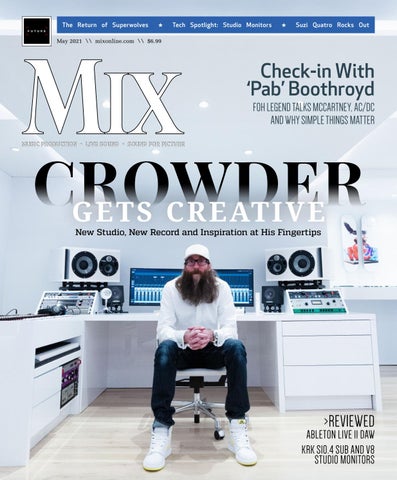
The Return of Superwolves
★
Tech Spotlight: Studio Monitors
★
Suzi Quatro Rocks Out
May 2021 \\ mixonline.com \\ $6.99
Check-in With ‘Pab’ Boothroyd FOH LEGEND TALKS MCCARTNEY, AC/DC AND WHY SIMPLE THINGS MATTER MUSIC PRODUCTION • LIVE SOUND • SOUND FOR PICTURE
CROWDER G ETS C R E AT IV E New Studio, New Record and Inspiration at His Fingertips
>REVIEWED
ABLETON LIVE 11 DAW KRK S10.4 SUB AND V8 STUDIO MONITORS
05.21 Contents
Volume 45, Number 5
24 FEATURES
MUSIC
TECHNOLOGY
8 ‘Superwolves’:
32 Tech Spotlight:
Matt Sweeney and Bonnie ‘Prince’ Billy’s Cult Classic Project Returns BY BARBARA SCHULTZ
14 On the Cover: Crowder Gets Creative: New Studio Designed for Flexibility, One-Touch Recording
11 A Tribute to Engineer Michael Bishop BY HIS FRIENDS
34 New Products: Studio and Live Sound
BY THE MIX EDITORS
36 Review: Ableton Live 11 DAW
BY MARKKUS ROVITO
and V8 Studio Monitor BY MIKE LEVINE
24 Rocking Out With Suzi Quatro: Mother and Son Go Back to the ‘70s to Find ‘The Devil in Me’
42 Back Page Blog:
BY LILY MOAYERI
BY STEVE LA CERRA
BY THE MIX EDITORS
40 Review: KRK S10.4 Subwoofer
BY TOM KENNY
28 Paul ‘Pab’ Boothroyd’s Wild Ride: 40 Years at FOH, From Dick Smith Band to AC/ DC to Paul McCartney
Studio Monitors— The Year of the Sub
DEPARTMENTS
The Monthly Loop; Building Back Muscle Memory
BY MIKE LEVINE AND STEVE LA CERRA
6 From the Editor: Inspiration & Influence On the Cover: Artist David Crowder, pictured in his Atlanta home studio, with acoustics and design by Gavin Haverstick of Haverstick Designs, and integration by mixer and chief engineer of Reach Records, Jacob ‘Biz’ Morris. Photo: Mary Caroline Russell. Mix, Volume 45, Number 5 (ISSN 0164-9957) is published monthly by Future US, Inc., 11 West 42nd Street, 15th Floor, New York, NY 10036. Periodical Postage Paid at New York, NY, and at additional mailing offices. POSTMASTER: Send address changes to Mix, PO Box 8518, Lowell, MA 01853. One-year (12 issues) subscription is $35. Canada is $40. All other international is $50. Printed in the USA. Canadian Post Publications Mail agreement No. 40612608. Canada return address: BleuChip International, P.O. Box 25542, London, ON N6C 6B2.
mixonline.com | M A Y 2 0 2 1 | M I X
3
Vol. 45 Number 5
May 2021
mixonline.com FOLLOW US twitter.com/Mix_Magazine facebook/MixMagazine
Keyboard Presents: the best of the ’80s
The ArTisTs, insTrumenTs, And Techniques of An erA
edited by Ernie Rideout, Stephen Fortner, and Michael Gallant BackBEat BookS No single decade revitalized the keyboard as a focal point as much as the 1980s. Now, the editors of keyboard magazine have culled that era’s most significant articles and combined them with a wealth of insight to create this landmark book. Features 20 interviews with noted players and producers like Jimmy Jam & Terry Lewis, Duran Duran’s Nick Rhodes, Depeche Mode’s Vince Clarke, Peter Gabriel, and The Human League, as well as such visionary pioneers as Herbie Hancock, Chick Corea, and Frank Zappa. 00331932......................................... $19.95
ORDER TODAY! See your favorite retailer or call Music Dispatch at
1-800-637-2852
ADVERTISING SALES VP/Market Expert, AV/Consumer Electronics & Pro Audio Adam Goldstein, adam.goldstein@futurenet.com, 212-378-0465 Janis Crowley, janis.crowley@futurenet.com Debbie Rosenthal, debbie.rosenthal@futurenet.com Zahra Majma, zahra.majma@futurenet.com SUBSCRIBER CUSTOMER SERVICE To subscribe, change your address, or check on your current account status, go to mixonline.com and click on About Us, email futureplc@computerfulfillment.com, call 888-266-5828, or write P.O. Box 8518, Lowell, MA 01853. LICENSING/REPRINTS/PERMISSIONS Mix is available for licensing. Contact the Licensing team to discuss partnership opportunities. Head of Print Licensing: Rachel Shaw, licensing@futurenet.com
www.musicdispatch.com
1018679-ThirdPgSQUAREISHAd.indd 1
CONTENT VP/Content Creation Anthony Savona Content Director Tom Kenny, thomas.kenny@futurenet.com Content Manager Anthony Savona, anthony.savona@futurenet.com Technology Editor, Studio Mike Levine, techeditormike@gmail.com Technology Editor, Live Steve La Cerra, stevelacerra@verizon.net Sound Reinforcement Editor Steve La Cerra Contributors: Strother Bullins, Eddie Ciletti, Michael Cooper, Gary Eskow, Matt Hurwitz, Steve Jennings (photography), Sarah Jones, Barry Rudolph Production Manager Nicole Schilling Managing Design Director Nicole Cobban Design Directors Lisa McIntosh and Will Shum
10/17/11 2:24 PM
MANAGEMENT Senior Vice President, B2B Rick Stamberger Chief Revenue Officer Mike Peralta Vice President, Sales & Publishing, B2B Aaron Kern Vice President, B2B Tech Group Carmel King Vice President, Sales, B2B Tech Group Adam Goldstein Head of Production US & UK Mark Constance Head of Design Rodney Dive FUTURE US, INC. 11 West 42nd Street, 15th Floor, New York, NY 10036
All contents ©2021 Future US, Inc. or published under licence. All rights reserved. No part of this magazine may be used, stored, transmitted or reproduced in any way without the prior written permission of the publisher. Future Publishing Limited (company number 2008885) is registered in England and Wales. Registered office: Quay House, The Ambury, Bath BA1 1UA. All information contained in this publication is for information only and is, as far as we are aware, correct at the time of going to press. Future cannot accept any responsibility for errors or inaccuracies in such information. You are advised to contact manufacturers and retailers directly with regard to the price of products/services referred to in this publication. Apps and websites mentioned in this publication are not under our control. We are not responsible for their contents or any other changes or updates to them. This magazine is fully independent and not affiliated in any way with the companies mentioned herein. If you submit material to us, you warrant that you own the material and/or have the necessary rights/ permissions to supply the material and you automatically grant Future and its licensees a licence to publish your submission in whole or in part in any/all issues and/or editions of publications, in any format published worldwide and on associated websites, social media channels and associated products. Any material you submit is sent at your own risk and, although every care is taken, neither Future nor its employees, agents, subcontractors or licensees shall be liable for loss or damage. We assume all unsolicited material is for publication unless otherwise stated, and reserve the right to edit, amend, adapt all submissions. We are committed to only using magazine paper which is derived from responsibly managed, certified forestry and chlorine-free manufacture. The paper in this magazine was sourced and produced from sustainable managed forests, conforming to strict environmental and socioeconomic standards. The manufacturing paper mill and printer hold full FSC and PEFC certification and accreditation.
Current From the Editor
Influence and Inspiration There’s a scene in the movie School of Rock where the Jack Black character, the temp music teacher at a private school, is walking back and forth between the 5th graders’ desks and asking them repeatedly, with growing exasperation, “What’s the first thing you do when forming a band?” A series of comically typical answers follow until Black finally shouts, “No, no, no! You start by discussing your musical influences!” Then, of course, he starts asking these 10-year-olds to name their musical influences. “Christina Aguilera!” shouts the first. “No!” he yells back. “Puff Daddy!” from the second row. “No!” “Liza Minnelli!” shouts another. Jack Black just stares the kid down, then scans the room and roars in disbelief, “Have any of you ever heard of Led Zeppelin?” Crickets. “AC/DC? Sabbath? Motorhead?” Nothing. This is after he’s taught them the opening riff to “Smoke on the Water” and before Zach, the lead guitar player whose dad won’t let him play electric, writes the rock anthem that they perform at the Battle of the Bands. It’s one of my guilty-pleasure movies, having first seen it with my teenage daughters back in 2003. I happened to flip by it just the other night, so I stopped to watch for a minute…okay, an hour. It still brings a chuckle. The next day it also got me thinking. What else influences an artist’s development, a musician’s songwriting or a new band’s style? What else influences an engineer’s approach to a mix or a producer’s desire to point an artist in a new direction? Certainly other genres of music have influence, but what besides music? What other influences and inspirations do we bring to the creative, music-making process that we might not even be aware of? At the same time all this was all dancing around in my head, I was doing background research on David Crowder for this month’s cover story. While he has played piano since age 10 and majored in music at Baylor, he didn’t pick up a guitar until he was blown away by some “fountain guy” on campus picking and slapping on an acoustic all by himself and bringing out sounds Crowder didn’t know were possible. He didn’t know what a standard tuning was, let alone alternates. But he sure learned guitar, and he credits that moment with opening his eyes and ears to true creative inspiration. Until that point, he had been primarily involved in traditional Contemporary Christian Music, and had earned his first attention for songs he had written for services at the University Baptist Church he helped to found while a student at Baylor. After that moment, he started to add strings of all kinds to the David Crowder Band recordings and performances. Later he would add electronica elements, country,
6
M I X | M A Y 2 0 2 1 | mi x o n l i n e.co m
bluegrass, rock, blues, and more strings. He used drum machines and samples, and, after moving to Atlanta in 2012, he began to groove to hip hop and solidify his passion for low end. Lately, he’s big on the sound of Post Malone. Most of that could be found online. When I called for the interview, I realized that he finds inspiration from so many other places, like a child at play and full of discovery. He’s a lover of modern art and a big fan of architecture. He writes books and has dabbled in poetry. Lighting and mood are important to his process, as are comfort and flexibility. He likes sculpture, history and local flavor. The Arts, with a capital A, contribute enormously to his creative bent, right alongside the church and his relationships within the community. At heart he’s a tech-geek, and that, too, has a place among his many influences, from back in his early MIDI days and way-ahead-of-his-time video and social presence to connect with his fans. Crowder is not unique by incorporating those things that shape his outside life into his musical life, but in his case it is evident, and he approaches the mishmash of influences and inspiration with a playful sense of wonder. So many times over the years I’ve heard engineers and musicians talk about tone, outboard effects or instruments in terms of colors, referring to the “palette” they use to create a “song painting.” I’ve heard others talk of a symphony performance like a fine meal or a fine wine, with the flavors distinct and yet part of the whole. Or the Hollywood mixer who speaks of crafting a scene with the pacing of a Daytona 500 or the quiet of an Emily Dickinson poem. Influence and inspiration run deep, often rising to the surface and sneaking back below without our even knowing it. We all have our original musical influences, some that we cling to just as fanatically as Jack Black and his love for the Gods of Rock. But we all bring so much more to the game. That’s the magic of music.
Tom Kenny Editor
Bonnie “Prince” Billy, left, and Matt Sweeney
Superwolves Matt Sweeney and Bonnie “Prince” Billy’s Cult Classic Project Returns By Barbara Schultz
I
t’s a follow-up album almost 15 years in the making, or at least waiting. Guitarist Matt Sweeney and singer/ songwriter Will Oldham (known as Bonnie “Prince” Billy) made their starkly resonant Superwolf (Drag City) album in 2005, and it became a favorite of critics, college students, and any music lovers with catholic tastes. Fans wondered if the duo would do more. Their wait is finally over, as April 2021 sees the release of Superwolves (Drag City), which expands on the reverberant guitar-and-voice sound of Superwolf.
8
M I X | M A Y 2 0 2 1 | mi x o n l i n e.co m
“We’re just, as a duo, slow,” says Oldham. “We began work on these songs in something resembling earnest in 2015.” Their songwriting process starts with Oldham, who lives in Kentucky, writing lyrics and sending them to Sweeney in New York. After Sweeney composes the music, the two will come together to play, first privately and then in some public setting. “We’ll play someplace like a record store, and by the time we’re done with that we’re ready to go into the studio and let it fly,” says Sweeney.
“But there’s a tremendous amount of work that goes into letting it fly. It’s like getting ready for the biggest show of your life. You work and work and work, and then when you go into the studio, that’s the show.” The studio work started in fall of 2019 in Daniel Schlett’s Strange Weather studio in Brooklyn. “I met Daniel at a show a couple of years ago,” Sweeney says. “Charlie Sexton was in town, and I took Charlie to see Mdou Moctar. Daniel happened to be there with some mutual friends,
PHOTO: Jonah Freeman and Justin Lowe
Music
LIVE AT STRANGE WEATHER The Superwolves recordings started with live duo sessions in Schlett’s main tracking room. “The first day or two was just those guys capturing songs, some acoustic and mellow and some of them with Matt’s electric guitar,” Schlett recalls. He captured Oldham’s vocal with a vintage Neumann U47 into a Neve 1070 mic preamp. Sweeney’s guitar amp was miked up with a U67 into an ADL 670 or UREI Silver 1176 compressor/limiter. “The ADL 670 would have been used on the vocal. Will’s vocal is the only thing I put through a Neve pre,” Schlett says. “Everything else went through the pre’s in our API Legacy console. “It was the third day or so when Mdou’s band showed up at the studio,” the engineer continues. “I had Matt and Will set up in the middle of the big live room, so I put the drums in front of them and set the band up in a circle around the existing setup. I used a couple of gobos, and I stuck some amps in the corner—tried to space it out as much as I could, because we had everybody in one room with no isolation except for headphones.” Mdou Moctar and rhythm guitarist/producer Ahmoudou Madassane appear on the up-tempo song “Hall of Death.” On a few other songs, guests contribute keyboards, drums or bass.
Vocals at the Butcher Shoppe
“With everything coming so quickly, live off the floor, there’s no time for 14 mics on the drums, for example, so I just had a Neumann U48 in front of the kit, a [Shure] SM57 for snare, and an AKG D20 outside mic,” Schlett says. Moctar’s guitar was captured similarly to Sweeney’s. Some of the bass parts were overdubbed because Sweeney played them, but on the full band track “Hall of Death,” Mikey Coltun played live with the band. “He played through an Ampeg B15, and that was probably miked with a 421 or a Neumann M49. I really like those on bass, especially in a live setting,” Schlett explains. ON TO THE BUTCHER SHOPPE Of the 14 songs on Superwolves, Sweeney and Oldham cut five at Strange Weather. They then went back to writing material before decamping to David “Ferg” Ferguson’s The Butcher Shoppe studio in Nashville. That studio actually closed this past June, but in previous incarnations had been owned by Cowboy Jack Clement, and by Ferguson with the late, great John Prine. “I met Ferg working on Johnny Cash records,” Sweeney says. “I got brought in as the new guy in the mix with all of Rick Rubin’s Johnny Cash Circle. I have to say, the second I walked into the studio with them, I knew that Ferg was really the ears there. Ferg worked with Johnny Cash for the last 20 years of his life. He had worked with Johnny for so long and had watched him die and they wanted to make those posthumous Johnny Cash/Rick Rubin records like real love letters to Johnny Cash and that relationship with Ferg and those musicians.” The relationship Sweeney forged with Ferg
brought him to The Butcher Shoppe time and again over a period of 13 years. Superwolves marked his and Oldham’s final visit to the studio, and one of the last sessions to take place there, under the guiding light of Ferg and his longtime engineer Sean Sullivan. Just about everything that happened in The Butcher Shoppe went down live. “I like it when an engineer defaults to live, same-room recording rather than separation/isolation, especially when they don’t make it a ‘thing’ to proceed that way,” says Oldham. “At no point in working with Ferg or with Daniel did I feel like they thought we should go for something preexisting; they’re more than happy to sit back, let the music happen and then make decisions based on what the music calls for.” Engineer Sullivan recalls the setup in The Butcher Shoppe’s 20x25-foot live room: “Whether the song was acoustic or electric, Matt ran everything through two guitar amps. One was an old Musicman that he’s had for forever. It has this weird built-in phaser that’s very resonant, with this nasally whoosh to it. The other amp was from an old Bell & Howell photo projector that got turned into an amp, and that thing had more of a blown-out sound. “The amps were in a separate room about 10 feet away from where Matt was sitting in the cutting room. We would take those two amps and a DI also, so there were three lines and the tracks have sort of a blend of those things.” Oldham sang into a Shure SM7, through a Daking Mic Pre/EQ. “I don’t remember if I used any of the EQ while tracking,” Sullivan says. “But I like using something with an option of a little EQ just in case it’s a little dark or muffled.
mixonline.com | M A Y 2 0 2 1 | M I X
9
PHOTO: Pete Townsend
and we started chatting. Daniel is a sort of highenergy New Jersey guy like me, and we hit it off. We exchanged numbers and then we started emailing each other music that we like—African music and psyche music and whatnot. “Then an opportunity presented itself to do some recording with Will and Mdou Moctar, so we went to Daniel’s and everything went so great,” he adds. “I’d been looking for an engineer who I could work with in New York because I also produce records, but I’m a total Luddite. I’m good at recognizing good performances, but gear isn’t my thing. “Daniel has all of that, but I also find him to be very performance-oriented. His studio is gorgeous and so work-focused. It’s funny because everybody knows where that studio is, but nobody knows it exists. It’s on a busy street, but when you walk in, it’s a complete, beautiful world unto itself, and very classically, a studio. “I recorded there with Iggy Pop, and when he walked in, he goes, ‘This is a real studio!’” Sweeney continues, doing an excellent Iggy Pop impression. “He was like, ‘This reminds me of how studios used to be. It’s like Criteria in Miami!’”
PHOTO: Christian Hansen
“The vibe was very like ’60s folk in that the guitar playing matches the melody of the singing,” Sullivan continues. “So, it was important for them to be able to see each other. When Matt played acoustic guitar, we just plugged it in, put a mic on it, so it was the same setup. A lot of those songs are just one guitar and voice, maybe some harmony, but they’re really sparse.” A few of the songs did include additional live instrumentation, provided by drummer Pete Townsend and/or keyboard player Mike Rojas. Later, a couple of bass parts and some harmony vocals were overdubbed by Ferguson, ever humble about his role in the studio. “Sean carried the weight on the engineering. I was there for Bonnie "Prince" Billy recording Sweeney in Strange moral support and to lend a hand vocals at Strange Weather Weather, Brooklyn however I could,” Ferguson says. “I recommended they use Mike Rojas, but I’m not property were incredibly generous to us. When mixed the tracks he had recorded, with Sweeney you consider what Nashville real estate is like sitting in with Schlett, and Oldham at the Butcher the hero here.” Shack with Sullivan, who recalls he didn’t use a lot Sullivan captured Ferguson’s bass parts on now, they could have sold it a lot sooner.” “It sucks,” Sweeney says, less charitably. of compression or EQ on his part of the project, the songs “Resist the Urge” and “There Must Be a Someone” with a Neumann TLM103 placed “When I think about it, I get that weird, but the reverbs he employed are the plate from near on the low end, and a KM84 on the upper overwhelming feeling that you get when you’ve the Opry and/or an AKG BX10 spring. Schlett also has an EMT 140 that he employed lost something that you really care about and fingerboard. “Sean had everything set up in the main you go, ‘I can’t think about that.’ But at the up in Brooklyn. “One other thing that we used on tracking room so we could all play together if we same time, the two things I love about Nashville Will was a Collins 26-C that we built years ago,” wanted to, but we did it as an overdub because are staying at Ferg’s house and going to The he says. “That was elemental in getting the vocal I didn’t know their songs nearly as well as them Butcher Shoppe. Now The Butcher Shoppe is clarity that we were looking for. There were a and I didn’t want to mess a take of theirs with gone, but Ferg still lives on this incredible kind bunch of other things that I used on his vocal— of compound in the country. And he just moved parallel compression, vocal bus compression—but mistakes,” Ferguson says. when I used the Collins I remember Matt sitting His backing vocals on “There Must Be the studio there.” Ferguson calls his new studio the Butcher on the couch, perking up and saying, ‘What’s a Someone,” captured via the same SM7 that Oldham used, happened almost by accident “I was Shack. It’s a smaller studio—more suitable for happening now? Will sounds really great now.’” In fact, Oldham and Sweeney both sound just singing along to it out in the control room,” mixing and overdubs than live recording—but Ferguson says, “and they said, ‘You want to put there’s no commute, and Ferguson and his gear great, and they’ve finally granted fans’ wishes, thanks to a process where musical and personal are still going strong. that on there?’” “Right after we had to move out, Ferg had trust led the way. “I’m incapable, with my present bag of tricks, everything moved up to a little building on his THE END OF AN ERA Oldham and Sweeney’s recording sessions in property,” Sullivan says. “We had moved the [Sony of making anything that could approach the The Butcher Shoppe took place during mid- 3036] console, the Pro Tools HD rig, Dynaudio beauty or rockingness of what Matt can build, February of 2020. Just a few weeks later, the monitors, and we have an EMT 140 plate reverb musically,” Oldham observes. “In turn, I have a studio was closed temporarily by Covid-19. In that came from the Grand Ole Opry that we handle on creating lyrics and singing them that June, Ferg’s landlords sold the building, shutting bought after the flood in 2010. I think I got is not even on the property of Matt’s wheelhouse. And yet we value, to the point of appreciating the everything working the day before Will came.” the facility down once and for all. cruciality, the role each other’s domains play in “It was a somewhat fitting time for it to end, the creation of a musical world. It’s a relief when with John Prine passing away,” Sullivan says. “We MIX WHAT YOU RECORD had an incredible run and we were fortunate to The mix in Nashville occurred simultaneously each of these songs gets realized; each is a little be there as long as we were. The owners of that with the mix phase in New York. Each engineer dream come true.” ■
10
M I X | M A Y 2 0 2 1 | mi x o n l i n e.co m
Music
news // & notes
M
ichael Bishop, a 10-time Grammywinning engineer and a pioneer in digital and high-resolution recording, long associated with the production team at Telarc Records, passed away on March 29 at his home near Cleveland, Ohio, just a few weeks shy of his 70th birthday. He was technical and musical, and he was a giant, as his colleague Thomas Moore described him on Facebook. While often associated with quality classical recordings through associations with symphonies around the country, Bishop’s credits ranged from Dizzy Gillespie and Wild Cherry, to Pere Ubu and The James Gang. Bishop began his association with Telarc and co-founder Jack Renner in the late 1970s and became chief engineer at the facilities from 1988 to 2008, when Concord Music Group bought the label and shuttered operations. In 2009, Bishop, Moore, a Grammy-winning producer, and Robert Friedrich, a Grammywinning engineer and chief technician Bill McKinney formed Five/Four Productions, where Bishop was still working at the time of his death. Mix asked a few members of the Telarc
PHOTO: Courtesy of Robert Friedrich
Michael Bishop Remembered Excellence in engineering, from left: Michael Bishop, the late Bruce Swedien and Robert Friedrich.
family—and they were a family—about their friend, Michael Bishop.
ROBERT FRIEDRICH ENGINEER, VP FIVE/FOUR PRODUCTIONS Michael was known for being an amazing engineer, and there is no doubt he was among the best. For me he was many other great things, such as a mentor, business partner and most of all, an awesome friend. I am fortunate to have shared many great moments with Michael over the 25 years I knew him. His generosity with his time and willingness to share his knowledge had a huge impact on me and many others in the recording industry. His exceptional sense of humor and his love of laughter made it fun to engage with him. He was a fantastic teacher not only because of his vast knowledge, but also his encouragement in pushing you to find your own style and path. Michael strongly believed that before anyone can be happy with your work, you must be happy with it first. When we started Five/Four Productions, he gave us the confidence and support, like that of a brother, and this is how I describe our 5/4 partnership… a brotherhood. He always had a positive attitude (especially in difficult situations) and was passionate about every project he worked on; he never accepted anything less than excellence. I admire and will always remember his kindness and dedication to family, The original Telarc team at the beginning of all-digital friends and the music he loved to recording. Seated, from left: Bob Woods, Telarc co-founder and president; Jack Renner, Telarc co-founder, chairman and chief work on. We had many conversations recording engineer. Standing, from left: Michael Bishop, Telarc about audio and at least as many on recording engineer; Thomas Stockham, inventor/founder of non-audio related topics, which I will the Soundstream digital recorder; Jim Yates, Telarc tech; Robert Friedrich, Telarc recording engineer. treasure. I miss him dearly.
ANDREW MENDELSON GEORGETOWN MASTERS I am deeply saddened by the loss of Michael Bishop, my longtime friend and one of my first true mentors. Michael transformed my career from the very beginning. I first met Michael as an intern at Telarc in the summer of 1997. While I had limited interaction with Michael at this time, I was exposed to the amazing, cutting-edge surround sound and sound design work he was engaged in. I studied it, soaking it in. It became an inspiration and foundation for my senior thesis when I returned to school. And my exposure to Michael that summer and his work was a first big step in my career. But it didn’t stop there. After returning to Telarc a few years later as a full-time employee, Michael took an active interest in me. In so doing, he helped me develop comfort and confidence in my own skills. During my first year at Telarc, I was moonlighting at a local studio doing mastering work. One day, out of nowhere, he came to ask me my thoughts on one of his mastering jobs. Mastering was just one of the many aspects of audio production Michael could casually do as well as anyone. Here I was, a wet-behind-the-ears kid, being asked to advise this legend of engineering. But that was the beauty of Michael. He wasn’t doing it to make me feel good. He genuinely and truly valued the opinions of others, even when their skills and experience paled when compared to his own. It was not about ego. He was a humble man. And it was not about pride. He cared about getting the best product—always teaching and developing people along the way. He was one of those rare people in our industry who was world-class on a musical, technical and personal level. One of my last working experiences with Michael was at Right Track Studios in New York
mixonline.com | M A Y 2 0 2 1 | M I X
11
Music // news & notes
GUS SKINAS ENGINEER, SUPER AUDIO CENTER Over the past 23 years, I had the pleasure to help Michael out on many recording projects. Telarc was one of the first record companies to produce Super Audio CDs, and Michael Bishop, Jack Renner and Robert Friederich were some of the first engineers in the world to record using DSD technology. In the early days, the equipment was finicky and difficult to use, and because I was involved in developing the gear, I would frequently travel with Michael and assist him, typically as his tape op and editor. Michael always seemed to be living on the cutting edge and accomplishing feats in the recording world that few others had been brave enough to attempt. Living on the cutting edge, sometimes things go wrong. When they did, Michael would remain calm and kind, always put me at ease, which made it easier to deal with trouble. In recent days, I’ve gone through session photos, and I am finding new love and appreciation for having had so many opportunities to work with him. I miss him. ERICA BRENNER ERICA BRENNER PRODUCTIONS Michael and I worked together at Telarc Records for 20 years, and for the last 10 years, both with our own companies. I started out at Telarc as
12
M I X | M A Y 2 0 2 1 | mi x o n l i n e.co m
an editor, and made my way up to producing and became the Director of Audio Production, shepherding all the projects through the audio machine that Telarc was. With only a master’s degree in music performance under my belt, I was hired to learn to edit on the job, so when I first met Michael, I knew nothing about the recording business. As I was the newbie at Telarc, he had ways of “testing me” to see if I was using my ears. Things like pumping up the bass, or adding an extra reverb send to see if I would catch the difference in sound. And then he’d get this twinkle in his eye that let me know he was having fun with me—it used to make me so mad! More than 30 years later, he was still “testing me” every time we’d go into a session together, and I am forever grateful that he did. I don’t remember him ever saying that he couldn’t do something. In fact, he often claimed he could do something he had no idea how to do, but then would go out and figure out how to do it! Then there was his response if you ever told him something was not working quite right; he’d say, “Well, it should be!” Then he’d fiddle around, and it would start working again, without him really admitting anything—ha! You’ll hear this from more than just me. Of course, his sound effects creations were legendary, but what was really fun was how he involved all of us and his friends and family in their creations. I got to be the computer voice on one of the Star Trek albums! It was so much fun. And his sound montages were miraculous compositions, the best example
PHOTO: Courtesy of Robert Friedrich
PHOTO: Courtesy of Robert Friedrich
City on September 11, 2001—yes, that 9/11. We watched in horror as the day’s events unfolded only a few miles from us. It was a frightening experience, and one that I believe bonded us forever. Over the last 20 years we didn’t stay in touch as much as we should have, as much as I would have liked. Everyone was busy with their careers and their lives. But he never failed to take the time to jot me a quick note on September 11, remembering our shared experience, or to offer the type of advice only a mentor and true friend can offer. That is the thoughtful person I remember. I will miss those notes. I already miss my friend.
Bishop exhibiting his sense of humor behind the computer while working on Super Audio CD with Gus Skinas.
Bishop, standing, with Thom Moore, his partner in Five/Four Productions.
being A Touch of Sonic Madness. Michael’s love of animals was amazing. His two dogs hung out in his studio during our mix sessions; he and his wife were lifelong horse lovers, and his horses were stars in many sound effects creations. One of his dogs, Lucas, was the star of a series of hundreds of Facebook posts called “Lucas Drool,” where you’d see Lucas’ eyes and nose looking up over the edge of the table at some delectable culinary creation. There are pictures dating back to 2012! But the thing foremost in my mind about Michael is his love for his family, especially his life partner and wife, Wendy. Michael would always take the last flight out to get to sessions or the first flight back to get home. Wendy was his everything. I’m working on a project right now that we recorded in February. I hear his voice on the recording between takes, and it’s so fresh, it’s so real. I can’t believe the guy I knew I could always rely on for the best of our craft is not there any longer. I can still hear his voice when he would pick up the phone: “Hiya, Erica!” with a genuine “it’s good to talk with you” sound in his voice. For so very many reasons, Michael will be missed. ■ Bishop is survived by his wife, Wendy. On behalf of the family, Thomas Moore and friends have started a GoFundMe campaign to help defray unexpected costs incurred in his death, including airlift and medevac procedures. Please visit the GoFundMe site and search for Michael Bishop.
on the cover
Crowder
Crowder sits in front of the custom clear diffusor, with integrated artwork, on the back wall of his home-based studio.
14
M I X | M A Y 2 0 2 1 | mi x o n l i n e.co m
C
rowder seems to be having fun right now. He just delivered his fourth solo record, Milk & Honey, to sixsteps/ S p a r r o w Records. His n e v e r- e n d i n g tour schedule is picking up again, with larger crowds returning and more stops along the highway. And for the past year, he has been making music—writing, recording and collaborating—in his first real studio since leaving Waco, Texas, and going solo eight years ago. “I’ll be turning in the masters on Friday,” Crowder says from the studio in mid-April, before cutting a few vocal passes later in the day. “I’m at the very end of it, so this week is kind of putting
Gets Creative
New studio designed for inspiration. flexibility and one-touch recording
PHOTO: Mary Caroline Russell
By Tom Kenny the period at the end of the sentence. I love this time. It’s so high-stress, and I thrive on that. The arrow is about to be off the string, now let’s get it done.” Milk & Honey just may be Crowder’s best record yet, reflecting a maturity in the songwriting and a deep and varied mix of musical influences, from country to electronic, bluegrass to rock, with a bit of hip hop adding to the rhythms and filling out the low end. A lot of that has to do with the fact that he’s had time to soak up the culture and finally feel at home in Atlanta. But it also has to do with the fact that for the past eight years, he had done three records on the road—in the backs of buses, in hotel rooms, at studios in towns the bus was passing through, with
mixonline.com | M A Y 2 0 2 1 | M I X
15
A view from the mix position to the keyboard corner and back wall, with one of the thousands of options in lighting for changing the mood to fit the song.
PHOTO: Mary Caroline Russell
“We started working on it in October 2019, and then in March 2020, on the weekend that everything shut down and we had to come home, they were putting in diffusors and finishing up the lighting. They wrapped everything up just in time for me to have this incredible space.” —Crowder
16
M I X | M A Y 2 0 2 1 | mi x o n l i n e.co m
shut down and we had to come home, they were putting in diffusors and finishing up the lighting. They wrapped everything up just in time for me to have this incredible space. I basically lived down here in 2020. It’s been home.” THE WHOLE-HOME STUDIO Only a true musician and recording geek would spend a pandemic year in the basement with a home like Crowder’s just a floor above. It’s a space designed to inspire, filled with the owners’ unique taste in modern art and reflecting the clean lines and light favored by his wife, interior architect Toni Crowder. She knocked out the walls and transformed the flow, the look and the feel of the entire space, from the minute you walk in and are greeted in the foyer by Patsy, an 8-foot, bright
PHOTO: Mary Caroline Russell
big chunks of recording in Nashville when time allowed. A lot of work was done on headphones, he says, “where you could sometimes hear the buzz of the generators on the recording and the wheels rolling underneath you.” For Milk & Honey, however, Crowder created 90 percent of the record in the studio pictured on this month’s cover, in the basement of his home, within a true monitoring environment and a Dante network scheme that allows him to pull up any guitar, synth, amp, keyboard, microphone, plug-in, workstation, drum or stringed instrument with essentially one click and begin recording. “I’m beyond thrilled with how the studio, the whole thing, turned out,” Crowder says. “We started working on it in October 2019, and then in March 2020, on the weekend that everything
Detail of the acoustic/artwork blend along the side wall leading to the back of the studio.
IT WASN’T ALWAYS SO EASY This isn’t Crowder’s first studio, though it’s his first
18
M I X | M A Y 2 0 2 1 | mi x o n l i n e.co m
Crowder, left, with studio designer and acoustician Gavin Haverstick.
A view from the back wall, highlighting the architecture and geometry of the space, with the DJ Station along the front wall to the right.
PHOTO: Mary Caroline Russell
pink sculpture. Down in the basement, there is artwork behind the back wall diffusor and multicolored skateboards (Crowder’s own) over the DJ Booth. Every room of the house, even the spacious outdoor patio by the pool, is wired with Cat6 and can feed the studio downstairs. Likewise, Crowder can project Pro Tools screens and play back high-resolution audio anywhere he likes. Already he has recorded group vocals in the living room, with its 25-foot vaulted ceiling. A guitar-amp room has been set up, offering him up to six different amp-and-mic combinations at any time. When a guest visits, they can plug in their own rig within minutes and join Crowder for a writing or recording session in the studio. “Artists shouldn’t have to be worrying about what input they need to be on or what particular instrument needs a patch—that takes away from their creativity,” says Jacob “Biz” Morris, who, besides designing and integrating the audio network and equipment installation, is chief engineer for the four studios at Atlanta-based record label Reach Records and a Grammy-winning engineer in his own right. (Note: Morris mixed Milk & Honey for Crowder at Reach Records studios.) “In David’s case, I knew that he wanted to have 20-some synths and keyboards on hand,” he continues. “He has guitars, banjos, amps, microphones, and they all need to be turned on at all times and just come up as an input on Pro Tools. That was a huge challenge. I didn’t want to run 60 cables from the back corner where he has his keyboard and synth racks—that would have been crazy inside the wall. So we went Dante, and Tascam was a huge lifesaver. That room wouldn’t be what it is without those Tascam converters. They can do 32 channels of audio through one Cat6 going back and forth. There was a lot of complex programming, but still, it’s amazing what you can now do to make a true hybrid analog-digital studio where you never really have to leave the mix position.” “Getting to make this album in this space, where everything’s just on and functional, was just fantastic,” Crowder adds. “It’s not even plug-and-play; it’s just ‘go play something!’ And with the templates we’ve got set up and the way things are routed, from the guitar amp rooms to all the synths, there’s no hiccup or bump in the creative space. It’s just all flow. I can’t even describe how much fun that is.”
PHOTO: Courtesy of Gavin Haverstick
to be professionally designed and acoustically true. It’s also not the first time that he and Toni have taken a rundown property and turned it into a showplace of art, architecture and inspiration, with a musical backbeat. While in Waco, after attending Baylor in the late 1990s and launching his music career out of the University Baptist Church, which he cofounded with other students, he and Toni bought a rundown, downtown property once owned by the man who invented Dr Pepper. “We got it real cheap and it was really rundown,” Crowder recalls. “But in the back of the house there was a barn, and the locals say that was where they kept Pepper the horse. This is right downtown. We started remodeling. We turned the barn into a studio and cut all but the first two albums that I made with what was
known as the David Crowder Band. That was basically just the church band. We did all those in the in the studio behind the house. It had a nice, rustic feel, with an spacious, A-framed drum loft upstairs, really a great space. When we moved out of Waco, that was the hardest thing to say goodbye to because that’s where I was making music.” Then, a year after moving to Atlanta, he and Toni purchased a home that was voted “ugliest house in Atlanta” by Curbed, a local real estate magazine, a space that Crowder describes as “what you might imagine if Scarface and Miami Vice had a house baby.” Toni worked her magic, transformed the property, and by October 2019 work started on the studio, the last open space left. This time, however, Crowder reached out to
“Getting to make this album in this space, where everything’s just on and functional, was just fantastic. It’s not even plug-and-play; it’s just ‘go play something!’ ” —Crowder
Widen Your Creativity With Stereo Reamping The EXTC-Stereo allows you to connect guitar effects pedals to the inputs and outputs of pro audio equipment such as recording interfaces and mixing consoles, so you can incorporate stereo pedals into your recordings and explore new creative possibilities.
Complete your studio at:
www.radialeng.com/reamp
Jacob, “Biz” Morris—mixer, studio integrator and chief engineer of the studios located at Reach Records—at the well-connected, one-touch, keyboard and synth corner.
PHOTO: Jonathan Hillyer PHOTO: Courtesy of Gavin Haverstick
ThebasementstudiohasdirectDante-networkaccesstoanywherein the home, and Crowder has already made use of the living room for drums and piano.
PHOTO: Jaylon Ashaun
20
M I X | M A Y 2 0 2 1 | mi x o n l i n e.co m
A few of the many guitar amps miked and ready to record from a basement hallway near the studio; each is dialed into the studio, with instant switching and simple swap-outs.
professionals, first Morris, whom he had come to know through mutual friends and events in and around the Atlanta music community. The first thing Morris said back to him was, “Cool. I’d like to work with Gavin on this. You’ll like him. He’s the best acoustics guy out there.” Gavin is Gavin Haverstick, studio designer and founder of Haverstick Designs in Carmel, Ind. He and Morris had worked together on a couple of studios, including Tori Kelly’s in Los Angeles and a church design/install in Atlanta. Morris asked him down to Atlanta to take a look at Crowder’s empty basement space, next to the home theater and down the hall from the entertainment room, not far from Toni’s design office.
“His main goal was to have a professional, creative space that he could write and record in. Since sound isolation wasn’t the main priority, it was honestly kind of refreshing.” —Gavin Haverstick MAKING IT SOUND GOOD “Their entire house is amazing, and when we first stepped in the foyer, I knew that the studio would need to match the rest of the house in some way,” Haverstick recalls. “Obviously, I want any of my rooms to be acoustically solid, but I also want them to be visually striking and be something that’s inspiring to that particular artist. Really, it was me, Biz and Toni just figuring it out, from the cabling in the walls to the artwork behind the back-wall diffusor, which is a real focal feature of the room. “And then Crowder and Toni threw me a curveball right at the beginning of the process when they said, ‘We want it to be completely white,’” he adds with a laugh. “At first I was a little disappointed, honestly, because the rest of the house has a lot of modern, clean lines, pieces of pop art in different areas and some vibrant colors throughout. I thought we could have had a lot of fun with that. But they were right, going with the white color theme allows us to use LED elements in the room to turn it completely pink or blue or green or whatever you want to set the mood for the day, or that one song.“
From the start, Haverstick knew that while it was still important, sound isolation wasn’t the number one priority—flexibility, design and a premium listening space were. On that initial visit, he took measurements, figured out the best way to lay out the room and then returned home to create a first series of renderings “It was a nice, big space for a basement, with good ceiling height,” Haverstick says. “His main goal was to have a professional, creative space that he could write and record in. Since
sound isolation wasn’t the main priority, it was honestly kind of refreshing. So much time and money can be spent on isolating rooms when that might not be what the artist needs the most. For Crowder’s studio, it was all the fun stuff.” As he has on many projects, Haverstick worked with Simplified Acoustics out of West Lafayette, Ind., on all the white stretch fabrics and the installation of the acoustic treatments. The company made use of rare 126-inch-wide white acoustical fabric, allowing for roughly 10
H IT W UM T ING B A AL TS TER URPER AS O Y X M R E E AN E T TH M D AS IR M H T
Full service analog & digital mastering studio located in Detroit.
CLIE NTS INC LUD E: T HE W HITE STR IPES ,
Neumann VMS70 / Lathe, Studio Electronics DJR Variable Pitch-Depth Computer / Sontec 4-Channel Mastering Equalizer and DRC limiter and more...
PRIN CE, JOH NNY CAS H, S HER YL C ROW
All Formats: Vinyl, CD, Digital & Cassette Ship to the pressing plant of your choice.
SUN
THIRDMANMASTERING.COM
RA,
EMI
NEM
, BT
S, P ARL
IAM
ENT
mixonline.com | M A Y 2 0 2 1 | M I X
21
feet between breaks. Haverstick says that even if you look closely, you can’t see the seams. Behind the fabrics, there’s a lot of formaldehyde-free Fiberglas packed around a series of custom-made perforated panels built by Buildhouse to absorb low frequencies and scatter the mids and highs. A couple panels sit on top of the fabric along the back wall, to the left and right of the clear Plexiglas diffusor, that appear slightly recessed into the 8-inch bass trap behind the wall. “That’s so we get the axial mode control from front to back in the room, while also getting the diffusion from the mids and highs that we want,” Haverstick explains. “Then there’s soffit traps around the perimeter between the wall and the ceiling junction to help with tangential modes.
Detail of the DJ Station, with skateboards with artwork from Crowder's last album providing inspiration.
“I’ve never really had a great listening environment. I’m now in a space where I know what I’m getting.” —Crowder
HAPPY AT HOME Crowder works almost entirely in the box, rotating in keyboard and MIDI controllers and working mostly in Pro Tools, Logic and Ableton. His main monitors are a pair of Focal Trio 11s, which he later had painted custom white. It’s what makes him feel comfortable. Inspiration can come from everywhere. “I’ve never really had a great listening environment,” Crowder says. “Now here we are at the end of this album, and I’m checking out the mixes that are being sent back, checking out the mastering. Just to have this acoustically true room is amazing. I’m now in a space where I know what I’m getting. I know what it’s going to sound like when I get in the car because I know what it sounds like down here. That part of it has been a blast., I’m not having to second guess myself anymore!” ■
22
M I X | M A Y 2 0 2 1 | mi x o n l i n e.co m
PHOTO: Mary Caroline Russell
PHOTOS: Jonathan Hillyer
“The cloud above the mix position is also a really nice feature,” he continues. “It’s angled, and it is actually physically attached to that front wall, then it cantilevers out over the desk. We had to get the angle right to get as much clear height as possible. It’s pretty much all absorption, to help with first reflections near the mix position.”
ROCKING OUT
24
M I X | M A Y 2 0 2 1 | mi x o n l i n e.co m
with
Mother and Son Go Back to the ‘70s to Find ‘The Devil in Me’ By Lily Moayeri
PHOTO: Andy Jarvis
T
ock stars don’t retire. If they did, with 56 years in service and counting, Suzi Quatro would have a hefty pension. The 70-year-old multi-instrumentalist and vocalist isn’t close to slowing down, not even during a pandemic. In the midst of extensive media coverage and accolades for her documentary Suzi Q, which was released summer of 2020, Quatro provided video tutorials of her classic basslines—50 in total. She showed up for weekly performances of stripped-back versions of her songs in her “Sunday Specials” on Facebook Live. She also wrote and recorded a new album, The Devil in Me. The Devil in Me is the second full-length Quatro has produced with her son, Richard Tuckey, whose father, Len Tuckey, played guitar in Quatro’s band during her original wave of prominence. Mother and son first worked together on 2019’s No Control. Tuckey proved himself an astute producer with a clear vision for Quatro, which is even more defined on The Devil in Me. “My whole life I’ve watched her rock out live; that hasn’t translated onto an album for a few years,” says Tuckey from the demo studio at Quatro’s home in Essex, England. “I was trying to stay pure to what she really is, which is rock ‘n’ roll. She’s been that since she was 14. She’s not changed. I wanted to try and get her back to that feeling. I wanted to see if I could capture that kind of energy, and I believe we came pretty close.” The Devil in Me is an equal mix of balls-out rockers, such as the rollicking “Hey Queenie,” the jaunty “Betty Who,” and the grinding title track, and heart-tugging ballads such as the Christmas-tinged “My Heart and Soul,” the aptly titled “Isolation Blues,” and the languorous “Loves Gone Bad.” The album is as signature Suzi Quatro as her earliest albums from the ‘70s, which established her as the “Queen of Rock and Roll.” WORKING OUT AT HOME The songs “Do Ya Dance” and “Hey Queenie” were recorded by Tuckey with producer/engineer Noah Booth prior to The Devil in Me. They became the benchmarks for the album’s sound. Quatro came up with another eight or nine songs on the piano, her go-to instrument for songwriting. Meanwhile, Tuckey, an accomplished guitar player, compiled ideas by playing a bassline here, a drum beat there or a rhythm picked out on a keyboard, which he would then present to his mom. In the home demo studio Quatro, Tuckey and Booth create reference recordings for Quatro’s band in Apple Logic X, using Universal Audio Apollo 8 interfaces and monitoring through KRK speakers. At this stage, the idea is to work as fluidly as possible. Everything is set up so Quatro or Tuckey can be recorded at all times: the vocal
mixonline.com | M A Y 2 0 2 1 | M I X
25
microphone, the mics on the guitar amp, the electric piano and the bass DI are always in place. Says Tuckey of the guitar recording: “We took a very similar approach to what my dad and Mike Chapman used to take in the ‘70s—that is, plug your guitar into the amp. We used different guitars for different sounds rather than a lot of pedals and amps. We used a couple of different Telecasters, a Les Paul custom, a 335, and a couple of Stratocasters. We had two amps: Doctor Z MAZ 38 NR with a 2x12 cab with a Celestion Vintage 30 on the top and Greenback on the bottom. We used a 1967 little Fender Vibro Champ amp combo for some stuff, as well.” “We had three mics plugged in a couple of feet away from [Tuckey],” says Booth. “We were getting the tone in the room and matching the guitars to the track and to what’s happening around us. It felt more organic and a lot better to do it that way, instead of miking up an amp and then setting it up through a set of monitors and you’re secondguessing whether it is the monitors or the mic.”
PHOTO: Andy Jarvis
s PHOTO: Andy Jarvi
ON TO RAK STUDIOS After the demo stage, a few days were spent at Quatro’s old stomping grounds, RAK Studios in London. Here, they record bass and drums together, then keyboards and horns on separate days. Engineer Wes Maebe was on hand for these sessions where Tuckey recorded his guitar parts for “Betty Who” using Mickie Most’s original ’58 Stratocaster through a ’67 Vox AC30 with a treble boost. Maebe added a Sennheiser 421 microphone behind the amp for a live take of the sound. RAK is where the inimitable drum sound is captured on a Rogers kit with a Black Beauty snare and a basic mic setup. For the very ‘70s sound of “My Heart and Soul,” Maebe miked the drums with Coles overheads, Sennheiser 421 on the toms and Shure SM57 on the snare top and bottom, recorded into RAK’s API desk. “The mix engineer, Tom Pullen, slammed stuff quite a lot,” says Booth. “He is using quite a bit of parallel compression, bringing it up and down that way and using the actual sound of the room as much as possible rather than using a room emulation. Tim Reyland being the drummer he is made the drums sound the way they sound, and that’s the biggest key point about it. Having Suzi and Tim play at the same time, locking together and locking that groove, that was really
26
M I X | M A Y 2 0 2 1 | mi x o n l i n e.co m
, working The Devil in Me d co-producer on . Quatro’s son an ey ck Tu rd ha Ric dio. s at the home stu parts during demo
out
ing final voca ls
at Rooks Yard
s PHOTO: Andy Jarvi
bass and reco rd
PHOTO: And y Jarvis
Quatro track ing
studio, Lond on
.
Quatro in the co ntrol room at RA K Studios, Lond API console. on, with enginee r Wes Maebe at
PHOTO: Andy Jarvi s
important. That’s how people made records in the ‘70s. They played together, that’s the best part of it.” Both at the home studio and at RAK, Quatro’s trusty Fender Precision bass is plugged in DI more often than not, although Most’s Ampeg was used for the songs that needed amp ambiance. “I don’t always like to do that,” says Quatro, “but some tracks may require it, for instance the ones that should be picked, and I don’t pick. “‘Hey Queenie’ is one of my best basslines ever,” she continues. “There have been two songs in my career that I had to practice playing a song and singing: “She’s in Love With You,” it’s like a machine playing and the vocals are behind it, and “The Girl from Detroit City,” very Motown bassline and the vocal is completely the opposite. “Hey Queenie” is the third. A jazz walking bass part with an abnormal chord sequence, and I’m singing completely against it.” In addition to the P-bass, Quatro uses a fretless Fender Kingman, a gift from Andy Scott of The Sweet, for more atmospheric songs like “In the Dark” and “Love’s Gone Bad.” Says Quatro, “I love that fretless sound because it’s so challenging. You can’t be a millimeter out. You’ve got to be exact.” She also uses a custom Red Heeter Rios bass, as well as a Jazz bass, which is the one that she uses on tour. “I practice and play in the studio with the Precision because it has the widest neck. When you practice with the widest and go on the stage with the little bit slimmer neck at the bottom, you feel the difference. When you’re running around with a bass, it’s a little bit easier. But in the studio. I’m stuck on the Precision. It’s the best sound.”
the
for Tracking horns
at The Devil in Me
ndon. RAK Studios, Lo
LAYING DOWN THE VOCAL The final studio was Rooks Yard near Quatro’s home, where vocals were recorded through the same vocal chain as for the demos, for the most part. The demo vocals were tracked with a Neumann TLM 103 into UA Apollo 8 with a Unison U610B preamp and UAD LA-2A compression, “to keep things upfront and vibey,” according to Booth. For the final vocals heard on The Devil in Me, Quatro sang into a Warm Audio 251 microphone, into a Neve 1073LB preamp, UA 1176LN then Apollo 8. “I usually lay down backing vocals myself,” Quatro says. “I always know which lines need a harmony. I can harmonize with myself. I can sound like an entire choir. I always know which songs I should double-track a chorus. I know my voice. I can double-track with my voice perfectly, never miss a beat. I’m very good at it because I’m from Detroit. Motown is all backing vocals. Everyone can learn from that.” “When [Quatro] is doing her vocals, she wants to hear a full track that sounds good,” says Booth, who added Eventide TVerb to the backing vocals. “She wants to be able to sit in the track. She doesn’t want to imagine the track. When we were doing the vocals, everything was falling in together and you’d quickly realize, ‘This shouldn’t be here, that shouldn’t be there.’ It was done on the fly with everyone.” “If something’s not very good, I won’t beat around the bush,” adds Tuckey. “I expect exactly the same for me. It just gets things done. There’s no harshness. A lot of people will be intimidated to say what they feel. Why beat around the bush, especially in rock ‘n’ roll?” “When I was putting the final vocal on ‘My Heart and Soul,’ at the moment when you’re most vulnerable, people are listening and you’re hoping it’s all coming out right, Richard stopped the tape,” recounts Quatro. “He said, ‘You’re not doing it, Mom.’ I got defensive immediately, even with all my experience. He said, ‘I didn’t get goosebumps and I did before.’ He played me the demo—sometime your demo can be your enemy—and I heard my voice on the demo and he was 100 percent correct. It was sensitive of him to have heard it, and smart of him to know what he wasn’t hearing and how to get it from me. “It took awhile to develop that trust,” she continues. “But Richard said, ‘I know what this album should sound like. I know what you should be doing at this stage of your career. I want this album to be as groundbreaking as the first one.’ You’ve got to trust this guy, don’t you?” ■
mixonline.com | M A Y 2 0 2 1 | M I X
27
40 Years at FOH, From Dick Smith Band to AC/DC to Paul McCartney By Steve La Cerra
S
panning more than 40 years, the career of FOH mix engineer Paul “Pab” Boothroyd reads like a who’s who in the top tier of the music industry—Sir Paul McCartney, Eric Clapton, Paul Simon, AC/DC, Michael Jackson, Eurythmics, Pink, Faith Hill and so many others. It’s an impressive resume that any engineer would be proud to own, but make no mistake—Pab came up through the ranks and paid his dues along the way. “I always credit my success to the fact that I’ve been very lucky,” he humbly begins. “I literally fell into it when I fixed an engine for a friend’s bandwagon. At the time I was a precision mechanical engineer and had a friend who was in a local pub band called the Dick Smith Band. The engine on their bandwagon was knackered, so they asked if I could fix it, which I did. The next question was, ‘Well, what happens if it breaks down and we’re on our way to Scotland to do a gig? Can you come with us just in case it goes?’ “So, I got in the van with them and off we
28
M I X | M A Y 2 0 2 1 | mi x o n l i n e.co m
went, playing gigs and getting influenced by participating in various recreational activities,” he continues, with a laugh. “I must have been around 18 or 19 years old, and that was my introduction to doing a gig on the road. The Dick Smith Band were a great bunch of guys. They taught me a lot about the fundamentals of setting up a P.A., like making sure the phase is correct—fundamentals that people know about but sometimes take for granted. “Back in those days, quality control—the bits and bobs of the way things were wired together—was crude compared to today. It would be quite easy to get a microphone lead that had been repaired in haste and had been out of phase all its life. And you’d never know unless it happened to be in a stereo application, or something like that.” Limited success and the breakup of the Dick Smith Band left Pab without a music gig until about a year later. As he was riding his motorcycle past a local venue, he recalls, “I saw a truck tipping a load of equipment, so I pulled over
PHOTO: Courtesy of Paul Boothroyd
Paul “Pab” Boothroyd’s Wild Ride
and asked what was going on. It was the load-in for a band called Tight Fit [the backing band for Tight Fit was Paul Young and the Q-Tips—Ed.]. I gave them a hand loading in and stayed for the show. That was the first time I was involved in a proper production. A local sound company called Concert Sound was providing the gear, so I met some of the guys, including the engineer who would become my mentor and inspiration to this day, Peter Granger. He was way ahead of his time and was probably best-known for being Dire Straits’ engineer. “Peter was mixing Tight Fit in between Dire Straits tours, and we became good friends,” he continues. “I was invited to watch him do a Dire Straits show, and it was an experience that really hit me. I thought… ‘I want to be him. I want to do that.’ It was just amazing. Through Peter I began an association with Concert Sound in the UK, who furnished equipment for Dire Straits. As the company grew, they took on more people and took me underneath their wing. I worked with and learned from great engineers. Those
PHOTO: Courtesy of Paul Boothroyd
next day because Mike couldn’t make it. I guess I did something right! I’ve been Paul’s longstanding live audio engineer for over 30-plus years now.”
Pab Boothroyd
guys gave me my first touring work.” Pab’s relationship with Concert Sound led to touring work with artists like Tom Jones, Level 42, John Denver and Leo Sayer, then as a P.A. tech on the 1985 Dire Straits Brothers In Arms tour, then as systems tech for the On Every Street world tour. Not too shabby. It also would lead to the gig of a lifetime—front-of-house for Paul McCartney. “Concert Sound used to take care of some of Showco’s UK shows, certainly if it was a one-off,” Pab explains. “I came with the P.A. as Systems Engineer to assist the FOH setup and Paul’s engineer at that time, Mike Ponczek. I had done rehearsals and a warm-up show, and all seemed well. After the show I was approached by management—notably Barrie Marshall, who has been Paul’s Tour Director for 30 years-plus—and asked if I could do the second performance the
ANALOG, DIGITAL, AC/DC, MCCARTNEY Pab has seen a lot of technological developments in his touring years, including the transition from analog to digital mixing systems, yet he still has a foot firmly planted in each world and speaks candidly on the subject. “I use an analog desk for AC/DC because it’s an artist preference,” he says. “I spent a few years running their writing studio—me behind a desk, with Angus and Malcolm writing the songs. And Malcolm’s love of keeping it straight and simple became very apparent. He’d say, ‘Oh it’d be great if we could tour with a Neve and have 1073 preamps...’ Yes, but it wouldn’t last five minutes! “A Midas XL4 is a good analog desk for touring,” he continues. “It’s pretty much bulletproof glass. There are other nice desks out there, but back then, if need be, I could get a spare part for a Midas anywhere in the world, maybe nick a module or power supply from one that’s sitting in a warehouse just to get through a show. When I’m touring with AC/DC I now have a backup desk, which the support band uses. I try to make that a digital console, something that everybody would know, like an Avid Profile. I can also use that for recording the band to Pro Tools for archiving purposes. “McCartney, on the other hand, would more likely say, ‘Whatever you want to use, Pab, you know what’s best so carry on.’ We talk about certain elements, but at the end of the day he trusts me for doing what I do. When I started
PHOTO: Courtesy of Paul Boothroyd
McCartney FOH setup following the switch to an Avid S6L console.
mixing Paul McCartney I had a couple of XL4s with racks and racks of outboard gear. The XL4s were bused together as one console just to boost the input count. I was running around my racks like a lunatic, tweaking the compressor makeup gain or bypassing the gates because the drummer was playing softly… constantly doing this dance, working the sound like a mad professor! It’s a great way to learn because it gives you a full understanding of how dynamics work with outboard processing and gain structure, and I had great results. “I think that most old-school engineers who made the transition from analog to digital would tell you that the first time they got their hands on a digital desk, they used it like an analog desk, without necessarily getting into show files with multiple song scenes and scenes within song scenes, et cetera. You dial up the gain, push up the faders, and mix like you would on any other desk—but they’re capable of so much more. I can press ‘recall’ and be in a whole different world, change all the ‘outboard’ gear and the routing. It’s amazing, and for McCartney it works very well. It’s made my work more consistent because I’m recalling to the same parameters all the time, given that the band are playing the same and are disciplined. I’ve been very fortunate to have that with McCartney and his bands. For example, in ‘A Day In The Life’ where it goes from dry to wet in the dream sequence, in a blink I can switch to all this psychedelic, trippy stuff. To do that manually in the analog world I’d have run around like a headless chicken for about 10 seconds and missed the moment! “Using analog gear requires that you carefully work out exactly what you need to take on a job because you can’t just find another channel without getting another desk. When I co-mixed ‘The Concert for George’ at the Royal Albert Hall, things just kept getting added. ‘Oh, by the way, did we forget to tell you that a 56-piece orchestra is going to come in and play on this song?’ Oh, great, thanks. I’m only exaggerating a little bit. It’s a logistics nightmare for those big shows where you’ve got guest artists walking on and off. Digital helps make that a little bit sweeter, because when it comes to Genesis joining Led Zeppelin on the Moon or whatever, you can recall it and have a good starting point.” HITTING THE CURVEBALLS Mixing FOH for McCartney comes with a unique set of challenges, the least of which is that
mixonline.com | M A Y 2 0 2 1 | M I X
29
shows can take place in rather unusual settings. “Working with somebody like McCartney opens a lot of doors because he’s so revered and respected,” Pab explains. “He has no fear for taking on challenges. “Just recently, we were doing rehearsals for a performance at Grand Central Station in New York City,” he continues. “The worst environment anybody could experience for a show: granite, marble, glass and concrete. Completely reflective, nothing friendly about it. It was an acoustic nightmare. The producer of the show had this idea that we could start the song ‘Let It Be’ with Paul playing this tiny music box piano. They would show a tight shot of Paul’s hand playing the music box for the start of the song, and then Paul would go into the song on his real piano. “We were doing this on a makeshift stage
Sound Advice Obviously, Pab has tons of experience (and more than a few good stories!) so he’s been invited on more than one occasion to share his knowledge with up-and-coming engineers and musicians. “I’ve been lucky to have been asked to talk about my work,” he reveals, “and hopefully I can leave some kind of legacy for the next generation that helps them in their journey. LIPA (Liverpool Institute for Performing Arts, Liverpool, England)—which Paul McCartney helped to found—asked me to come in and give a talk to their kids. I thought, ‘I’ll do that. There won’t be that many people there.’ But by the time it came to fruition, there’s a sea of people, and I’m thinking, ‘What have I got to say?’ “Well, keep it simple. Stay with the
30
M I X | M A Y 2 0 2 1 | mi x o n l i n e.co m
PHOTO: Courtesy of Paul Boothroyd
PHOTO: Courtesy of Paul Boothroyd
Pab at the Midas Pro 40 for an AC/DC gig.
Pab at the Midas XL4, his “office,” on early McCartney tours
that we couldn’t access until a certain time, the idea being that the band would come in, do a quick run-through, and off you go. Not a chance in hell. In that room you can hear a person talking from a thousand yards away because of the acoustics. So we’re going to come out of a rock song, Paul is going to put his guitar down, jump behind the piano, start playing the music box—and the audience need to hear this clearly so they can recognize the start of the song. “I’m thinking, ‘How am I supposed to get this across?’ so I tried a DPA 4099 on the music box and it was so sensitive that you could hear the cogs in the mechanism. I had to back off the mic so that you could hear the notes more than the cog going ‘round. I thought that there was no way I was going to get this above an audience going loopy, but it
fundamentals and don’t lose your grounding. The P.A. has to be correct for the room. Don’t go racing ahead to get the latest digital desk and put all these plug-ins on the channels because that’s what other people say you’re supposed to do. Pay attention to the little things. Why did you use a ’57 on the snare? ‘Well, that’s what everyone uses.’ But did you listen to it? “Don’t forget your basic training. Do yourself a favor: Pick out a bunch of microphones, plug them into a console, put your headphones on and speak into them. Learn how the microphone behaves when you’re on- or off-axis, close or far away, so that when you come to work for an artist you understand what that starting point of sound, whether it’s a microphone or a DI, is doing to your source.” It all starts there at the source. Simple. Get it right there, and your off, rockin’ and rollin’.
worked. We had been using DPA products for a long time, under-miking the cymbals or using the 4061 inside a conga or bongo when Abe (Laboriel Jr., drummer) would play them on his knee. It looked very natural, like they weren’t even miked. Those mics have handled crazy situations in a very amazing way—‘got me out of jail’ many times.” One of Pab’s live sound “tricks” is placing microphones underneath cymbals instead of using the typical overhead placement. “Lots of people have done it for various reasons,” he observes. “With AC/DC, if I set a pair of overhead mics in the typical placement, you’d hear all this noise coming across the stage but you wouldn’t hear the cymbals. I’ve tried different microphones underneath but when the DPA 4099 came out, we used these little clips to place the mics underneath. You have to experiment with the position and get the mic at the fulcrum of the cymbal so that you get less swish and a more controlled window of sound. But bleed isn’t much of an issue. The mic is close to the cymbal so you can gain them down.” HITTING THE BRAKES Not long before Pab and I spoke, he learned that McCartney’s appearance at the Glastonbury Festival scheduled for late June 2021 had been canceled for the second year in a row due to the global Covid-19 pandemic. “I think we did the Glastonbury Festival 20 or so years ago,” he recalls, “and we were supposed to perform at their 50th Anniversary last year, but it was canceled. McCartney had a string of dates that were canceled in 2020, and the virus put a hold on AC/DC, as well. “AC/DC have just come through this sort of resurrection with the reintroduction of Brian (Johnson, lead singer), Phil Rudd (drums) and Cliff Williams (bass). Back in 2016 we were in
the middle of the Rock Or Bust tour, and Brian was basically told by his doctors ‘do one more show and that’s it. Your hearing will be gone.’ Axl (Rose) came in, did a great job, and we got to the end of the tour, but Brian was destroyed and so were the band. It was horrible. “Straight after that tour, Brian was approached by Stephen Ambrose (Founder, Asius Technologies), the guy who invented in-ear monitors. Stephen was working on some new in-ear technology that might make it possible for Brian to return to performing. It wouldn’t cure him, but would make it possible for Brian to do his job. “Long story short, Brian tried it and it worked. I was visiting Brian on a holiday, and Stephen came over to meet me, show me the system and see what I thought. It’s very interesting technology. Right around the same time, the new album (Power Up) came out and the band were doing a video. Their tour manager asked me what I thought about Brian using Stephen’s new in-ear system, and I said, ‘Get all the guys together in a room and turn it up to 11. That’s the only way we can know if this is going to work—whether the guys in the band can still do
their thing, and whether or not Brian can hear and do his thing.’ “These special earpieces were placed inside Brian’s ears. It was incredible. I’ve never seen so many grown men cry because they could hear again. Cliff Williams has Meniere’s Disease and balance problems because of his hearing loss but he put these earpieces in and, ‘Hell, I can hear again.’ Next thing you know we’re doing this little trial… ‘Let’s try a few songs for a short while… lets ease in’… Within a week we’re doing the full show every day in rehearsals, great playing and singing, and we’re talking about loud. I mean—it’s AC/DC! Brian and Cliff had no hearing issues and no fatigue. “We’re all waiting for the technology to be finalized and go into production, but I think it will be a game-changer. If it hadn’t been for the virus, Brian and most of the band would be using these earpieces and we’d probably have started touring last year. [Stay tuned to Mix for more in the future on Ambrose and Asius Technologies—Ed.] THE GREATEST RIDE Working at the top level of the industry can be more than a bit stressful, and Pab admits that
perhaps the intensity of his schedule was getting to be a bit much. “Right before the virus hit toward the end of 2019, I was really getting burnt out and at one point actually doing two tours at once—to the point where my health was starting to suffer,” he says. “I was beginning to think that maybe it’s time to ease off on this, but being away from the industry and being home has made me look at things differently. It’s let me decompress, and I’m actually quite happy to have had quality time with myself, and my family. “I’ve been in the business since 1980, and after 40-odd years, feel like I couldn’t have achieved much more,” he concludes. “I’m privileged to be working with one of the greatest living artists, and then at the flip of a coin I’m working with AC/DC, who top their genre. I have every intention of continuing with those two artists for as long as I can. “I love touring. There’s nothing like standing behind a desk, you unmute, and the house lights go out. You feel that sizzle, the open microphones and all the little buzzes and things. Then boom! You’re off! It’s the greatest ride and the greatest rush. It’s just fantastic.” ■
Tech
spotlight
Studio Monitors: The Year of the Sub Whether it has to do with the pandemic and the demand from engineers for home-studio improvements, or whether it’s just a coincidence, a number of new subwoofers have debuted in the past year. Here’s a look at a few of them, along with a few notable near-fields.
Danley Studio Sub 2 Danley recently introduced the Studio Sub 2, the second addition to its studio monitor line. Compact and self-powered, the Danley Studio Sub 2 is said to deliver the same clarity and impact to all genres of recording situations as earlier iterations of Danley speakers in the installation and live sound markets. Designed by Tom Danley, it incorporates onboard processing and passive synergy crossover technology. With 112 dB SPL continuous and 122 dB SPL peak, the 65-pound monitor is intended for use in any studio environment having analog, digitalbalanced XLR inputs and RCA inputs. The driver complement includes 1 x 10-inch long excursion woofer and 1 x 6.5 co-ax mid/high.
KRK Studio Subwoofers KRK Systems has expanded its range of studio gear with a new generation of powered subwoofers, available in 8-, 10and 12-inch varieties. The S8.4, S10.4 and S12.4 subwoofers deliver tight, accurate and defined bass, while the highly efficient Class D power amplifiers dramatically increase transient response, control and punch. The redesigned cabinets feature a more compact profile, allowing for improved performance and a more professional aesthetic. Additional refinements include improved low-frequency extension, improved porting for enhanced low-frequency phase response and less port noise, as well as a four-position crossover frequency selection switch, making it easy to adjust the subwoofer’s settings to optimally match existing monitors. Connectivity options include XLR, 1/4-inch TRS and RCA inputs and outputs that interface with just about any manufacturer’s studio monitors, mixers and/or audio interfaces. (See Mix Product Review, Page 40.)
Ocean Way Audio S10A Subwoofer The new S10A subwoofer from Allen Sides’ Ocean Way Audio was primarily designed as a low-frequency companion to the company’s HR5 Reference Monitor or as a perfect companion for any high-quality nearfield/ midfield monitoring system. The S10A
32
M I X | M A Y 2 0 2 1 | mi x o n l i n e.co m
features stereo XLR input and output connectors, along with a variety of parameter adjustments, including gain, LF adjust, adjustable crossover and delay, and a 12V trigger input/output for power conservation and other applications. The S10A covers the low-end spectrum with a frequency range of 20 Hz to 120 Hz. It includes a 300W amplifier that can generate 110dB SPL.
PhantomFocus PFM ICE Cube-12 Subwoofer The PFM ICE Cube-12 Subwoofer anchors the sonic footprint of the PhantomFocus System but can be used in any application. Designed with ICE Power amplifier technology developed by Bang & Olufsen, the PFM ICE Cube-12 Subwoofer includes a 12-inch long-throw, audiophile grade paper-coned driver, along with a massive magnet motor structure and cast aluminum frame. The simple design employs a powerful DSP solution for crossover and driver control, as well as maintains a lowdistortion output by preventing signal overload. The cabinet is built with 3/4-inch medium density fiberboard that has been internally laminated with a 1/8-inch aluminum substrate bracing mechanism for ultra-rigidity. Dimensions are 15.75 x 15.75 x 15.75 inches (HWD) and it weighs 55 pounds. Max Continuous SPL is 120 dB; 700 Watts power; Low Pass Filter 40-140 Hz with LFE Bypass; 0-180 Phase Switch; L&R Line Level RCA/PFS Balanced XLR input; black high-gloss finish.
PreSonus Eris Sub8 Subwoofer PreSonus has introduced its new Eris Sub8 subwoofer, intended for use in home recording, gaming and home theater setups. The subwoofer is particularly intended to complement the voicing and frequency response of Eris-series media reference monitors such as the Eris E3.5, E3.5 BT, E4.5, or E4.5 BT. Driven by an onboard 100-watt Class A/B amplifier, the Eris Sub8 delivers low end down to 30 Hz—a full 50 Hz below the Eris E3.5s. It extends the reach of Eris E3.5 or E4.5 monitors in a manner appropriate to smaller rooms. The subwoofer configures to users’ mixing and listening needs, connecting to full-range monitors via 1/4-inch TRS or RCA, with an input level control and a polarity invert switch. It offers a highpass filter switch and variable lowpass filter/crossover control to help ensure the subwoofer starts working at the precise low-frequency point where users’ full-range monitors drop off. The PreSonus Eris Sub8 subwoofer is available now for a U.S. street price of $199.95.
New, Notable Near-Field Monitors ADAM Audio T8V Studio Monitor
JBL 4349 Studio Monitors
The T8V studio monitor, released in Spring 2020, features an 8-inch woofer paired with powerful amplification, while its lower bass extension makes it an ideal choice for project and home studios. Frequency response reaches down to 33 Hz, with an impressive SPL of 118 dB per pair. Its U-ART (Unique Accelerated Ribbon Tweeter) is mated to a sophisticated waveguide with the same dispersion-control attributes as the HPS waveguide in the S Series. The Class D amplifiers for tweeter and woofer offer ample power for the 8-inch woofer, delivering 20 W and 70 W respectively. All T Series models feature a beveled cabinet design, rear-firing bass reflex port, built-in DSP-controlled driver crossovers and equalization, and multi-way analog connections.
In July 2020, JBL debuted its new JBL 4349 Studio Monitor, bringing together a JBL D2415K dual 1.5-inch driver, a large-format, HighDefinition Imaging (HDI) horn and a 12-inch cast-frame, Pure-pulp woofer cone into a monitor intended for both professional and consumer use. The D2415K compression driver features a pair of lightweight, polymer, annular diaphragms with reduced diaphragm mass. The 12-inch (300 mm) woofer and the 3-inch (75 mm) long-throw voice coil in conjunction with dual opposing spider dampers are designed for getting loud while reducing distortion. High-frequency and Ultra High-frequency attenuator controls allow sound to be tailored to the specific environment and listener preference. The controls manage a crossover network design that features air-core inductors, cast wire-wound resistors and low-ESR metallized film capacitors in a multi-cap configuration.
Focal Alpha 50 Evo, Alpha 65 Focal enters the affordable speaker range in a big way with last month’s release of the Alpha 50 Evo and Alpha 65 Evo, offering excellent sound coherence no matter where a user is listening. Each boasts a new 6.35mm TRS input jack, in addition to the XLR and RCA analog inputs, an automatic standby mode that can now be switched off by the user, and inserts for wall and ceiling fastening. Each is also equipped with two class D amplifiers. The monitors feature a 5/8-inch (15mm)-thick MDF cabinet and incorporate internal braces to ensure it is highly robust, even at the highest levels of acoustic pressure. The bass-reflex design has been used to ensure easy acoustic integration in even the most cramped spaces.
PreSonus Eris E7 XT
Genelec 1235A Smart Active Monitor
Yamaha MSP3A Compact Powered Speaker
Last Spring, Genelec released the 1235A Smart Active Monitor, which fuses the sound and heritage of the 1035 main monitor with high-performance 96 kHz processing and the ability to adapt to any space through its tight integration with Genelec’s GLM calibration software. With a short-term SPL of 130 dB and low-frequency extension down to 29 Hz, the 1235A delivers power. The 12.36 cubic foot (350-liter) enclosure matches exactly the dimensions of the 1035, and features dual high-performance 15-inch drivers, dual 5-inch midrange drivers and a low distortion 1-inch throat compression driver. The 1235A’s remotemountable RAM XL electronics module contains power amplification, crossovers and processing, with Class D amplification delivering 2000 W, 800 W and 250 W for the LF, MF and HF drivers, respectively..
The new MSP3A powered monitor builds on the company’s MSP3 model and shares its predecessor’s use of multiple input connectors, controls and compatibility with optional brackets, while adding enhanced audio quality and increased sound pressure levels, straightforward operation and a compact, lightweight cabinet design. The MSP3A is the first Yamaha reference monitor to include the company’s Twisted Flare Port technology, designed to provide overall faithful sound reproduction with clearer and tighter low-end frequencies. A built-in 22W power amplifier is optimized for the speaker unit, comprising a 10cm (4-inch) woofer and a 2.2cm (0.8-inch) tweeter. The cabinet features a refined, simple design and weighs only 3.6 kilograms (7.9 pounds), improving portability and making it easier to reposition the unit in different room configurations.
PreSonus expanded the Eris XT Series in 2020 with the addition of the E7 XT, which employs a 6.5-inch woofer and is intended for use in mid-tolarge studio spaces. The 6.5-inch woofer is housed in a ported enclosure yielding a response rated down to 42 Hz, while the 1.25-inch, silk-dome, high-frequency driver is mounted on the EBM waveguide. The E7 XT is Class AB bi-amplified, with a 70-watt amplifier for the LF driver and a 60-watt amp for the HF driver. Maximum SPL is said to be 104 dB. Rear-panel features include an IEC power receptacle with mains fuse, XLR, TRS and RCA input jacks a power switch, and a series of controls for modifying the frequency response of the monitor.
mixonline.com | M A Y 2 0 2 1 | M I X
33
Tech // new products TASCAM TM-250U USB Condenser Microphone Designed for capturing crisp audio when interfaced with personal computers, the TASCAM TM-250U is a solution for high-quality, direct connection computer audio for podcasting, dialog and vocal recording, music recording, conferencing, and other forms of online audio. Featuring a super cardioid polar pattern and a frequency response of 20 Hz~20 kHz, the TM-250U functions via industry-standard USB-C connectors on the Windows, Mac, and Chrome OS platforms. The microphone makes a direct connection to computers with a USB cable, so no special driver is required. Record voiceover or music directly to the computer’s recording software with stream-optimized 16-bit/48 kHz sampling. The TM-250U provides built-in controls for managing audio, and is equipped with a microphone volume (gain) control, a headphone volume control, and a microphone Mute button that provides additional flexibility for in-the-moment control of audio. The microphone is also equipped with a dedicated headphone output connector (3.5 mm stereo mini jack) for direct monitoring.
Avid VENUE 7 Software Recently, Avid unveiled its next generation of VENUE software, VENUE 7. The update introduces new features and enhancements for all mixing systems in the Avid VENUE | S6L family. One of the highlights of VENUE 7 is the ability to share I/O between three Avid VENUE | S6L consoles. I/O sharing allows addition of a broadcast desk or second monitor desk to an existing system, or can facilitate changeover between consoles during festival applications. Microphone signals can be digitally split over the network, so a system can be built using a single set of I/O racks, which reduces cost and complexity without negatively impacting sound quality. All I/O configurations support Avid True Gain technology for automatic gain compensation, ensuring that proper signal levels are maintained for each engineer. Using a USB flash drive connected to the S6L control surface, VENUE 7 provides onboard 2-track USB recording of 24-bit/96 kHz WAV files and supports playback at any sample rate.
34
M I X | M A Y 2 0 2 1 | mi x o n l i n e.co m
Empirical Labs Arousor Rev 3 Several software manufacturers offer plug-ins that emulate the iconic Distressor compressor, but there’s only one made by Empirical Labs (aka, “ELI”) itself: Arousor Rev 3 (Mac and PC), which introduces some powerful new features. The most significant improvement is the addition of two Opto Modes. ELI says it based them on the time constraints of two different hardware LA-2As—one vintage and one more modern—giving users additional sonic variety. In either of the Opto modes, you’ll see orange text underneath the Attack and Release knobs that indicates default Opto values for those parameters. If you click on the orange number, it will change that parameter to the recommended setting. Pressing the Alt button at the right of the ratio indicators accesses two new ratios: 6.5:1 and 7. The new settings emulate those in the T4 Optocouplers modeled for Opto A and B, but you can use them in any of Arousor’s compression modes. ELI also upped the adjustability—not to mention the “geek factor”—for the Soft Clipping circuit with a new “Expert Button,” which opens up an additional user parameter called 2nd Harmonic Control. With the Expert button pressed, you’ll also see Pre and Post buttons for selecting whether the compressor input is before or after the Soft Clipping circuit.
Peavey Aureus Live Digital Mixer First announced last summer, Peavey Electronics’ Aureus digital mixer is out, offering a 10-inch multitouch display and 59 dedicated controls that provide direct access to most critical functions with a single touch. The Aureus digital mixer, measuring 6.5 inches x 15 inches x 19.5 inches and weighing 16 pounds., offers a selection of presets for channels, EQ, gate, compressor, scenes and shows, and additionally allows users to save and store presets, scenes or even an entire mix onto a USB drive. The onboard dock allows a tablet to be placed as a second screen, so users can monitor the mix while adjusting a specific channel or separate group on the mixer. In all, the Aureus offers 14 dedicated encoders, 9 motorized faders (100mm), and 45 dedicated backlit buttons. It can connect to most audio sources via its 16 XLR-1/4-inch, RCA, Bluetooth (stereolong range) and USB (A/B) inputs. Phantom power (48 V) is available
for microphones on the 16 channels. There are also 14 outputs, including 10 XLR, USB, and AES digital.
Audinate Dante AVIO USB-C Adapter Audinate, developer of Dante AV networking technology, has announced the immediate availability of the Dante AVIO USB-C adapter. The Dante AVIO USB-C adapter allows the latest mobile devices and computers to connect to any Dante audio network for playout or recording. The Dante AVIO family of adapters allow users to easily use non-Dante analog, USB, AES3/EBU or Bluetooth audio equipment with a Dante audio network. The Dante AVIO USB-C adapter connects to devices with USB-C or A ports (cables included) to deliver and receive two channels of audio over a Dante audio network. It requires no additional drivers and works with any application, making it ideal for rapid setup of conference rooms, background music and more. The Dante AVIO USB-C adapter may be powered via USB or PoE. When connected to a PoE Ethernet switch, 7.5 watts of power is available to USB-C compatible mobile devices, enabling smartphones and tablets to remain charged while connected to a Dante network.
Audeze and Embody Reveal+ Virtual Studio Plug-In Audeze and Embody have announced the launch of the remastered Reveal+ virtual studio plug-in. This remastered version of Reveal+ delivers the next breakthrough in harnessing cloud computing and artificial intelligence to mix virtually on Audeze headphones. According to the companies, Reveal+ gives producers a visceral experience of feeling like they’re in a world-class studio without being there. The result is producers can make better-informed mix decisions from their Audeze headphones. Reveal+ is available for download now on Audeze’s website. Features include a more precise personalized HRTF, remastered sound, two new virtual studios designed and operated by Grammy and Multi-Platinum award-winning artist Bob Horn and Erik Reichers, and a refreshed user interface.
Sound Particles Brightness Panner Plug-In The new Sound Particles Brightness Panner plug-in allows you to use brightness, pitch or MIDI notes to control their movement automatically. From traditional stereo to Ambisonics, from 5.1 to binaural, this plugoin is a tool creative artists will want in their collection, from music to sound design and audio post-production. Key features include Brightness Analysis, which analyzes the spectrum of sounds to pan them in 3D; Pitch
Analysis, which identifies the pitch of sounds to pan them in 3D; MIDI Analysis, which pans sounds in 3D based on MIDI notes; Stereo, Surround, Ambisonics, Immersive and Binaural Outputs; Dynamic Movement that sets how the sounds move, from custom points, speaker positions or to specific directions; and a Sidechain function that uses external signals to control the effect of the plug-in, instead of using the track’s sound.
Alliance Lindell Audio 50 Series Plug-In If you’re looking to add the sound of API consoles into your music, the Plugin Alliance Lindell Audio 50 Series is an intriguing option. It offers a selection of modeled API processors in a modular channel-strip format. It’s the latest Plugin Alliance product to employ the Brainworx Tolerance Modeling Technology, which emulates the slight differences between channels in an analog console. The Lindell Audio 50 Series includes 32 different TMT channel emulations. You can open either a Channel or Buss version of the plug-in, in either mono or stereo. Rather than offering just one processor configuration, the Channel version of the Lindell Audio 50 Series plug-in lets you select from several modeled API EQ and compression modules to put between the preamp and expander gate sections. You can mix and match to create custom configurations. The preamp section, which emulates the behavior of an API unit, is on the far left of the GUI. Featuring input gain range of –6 dB to +24 dB, it includes ladder-style VU meters for input and output, an adjustable highpass filter, a –20 dB Pad and a Unity gain switch that keeps the output fixed even if you turn on the Pad. The THD control governs the amount of harmonic distortion, which you can increase or decrease from its default, 12 o’clock position. The next module over is the EQ, which offers three choices, all modeling API 500 Series EQs. The 50A includes three semi-parametric bands. You can toggle the low and high bands between bell and shelving filters, and switch in a bandpass filter.
New Additions to SSL 500 Series Module Solid State Logic has introduced two new modular processors as part of revitalizing its SSL 500 Series module range. The classic G-Comp Bus Compressor, E-EQ and E-Dynamics processing modules have been given a fresh, sleek brushed steel facelift, while a feature-enhanced VHD+ module, brand new stereo Ultraviolet Stereo Equalizer (UV-EQ) and SiX Channel (SiX CH) modules, complete the new-look range. Ultraviolet takes the minimum phase-shift Violet stereo EQ section from the studio-favorite analog processor Fusion, and puts it into the 500 Series format. Over and above Fusion’s Violet EQ, Ultraviolet takes features one step further, adding two dedicated mid-bands, with precision Focus mode for ultimate EQ control. Ultraviolet draws on the SSL legacy of selecting key frequencies and response curves to create a musical and intuitive EQ, designed to quickly dial in the sound of your mix, sub groups and individual instruments. ■
mixonline.com | M A Y 2 0 2 1 | M I X
35
Tech // reviews Ableton Live 11 Workflow Gains, New Instruments and Effects, a Focus on Sound Design By Markkus Rovito
L
ike a sample-based composition, Ableton has built its Live workstation from the ground up as an obscure looping program to—20 years later—a masterpiece of electronic music production and one of the most commonly used DAWs in the market today. Live 11 is a welcome and worthy update, but it is also the polishing of a mature product, a 2021 remaster, if you will. And like many mature people who used to be all about rave music, Live 11 seems Comping in Live 11 combines the best parts of multiple passes of audio. to have turned its attention to cinematic music For MIDI editing, Live 11 now lets users select multiple MIDI and scoring to picture. Don’t get me wrong, Live 11 (and I) still loves dubstep, tropical house and trap, but the new additions clips in a track and work with them simultaneously in the MIDI skew toward a little more sophisticated approach to writing and Note Editor. The Editor window also has two new buttons: Focus recording, with features like track comping, MPE support, and for highlighting a single MIDI clip for editing, and Scale for showing a giant infusion of new instruments and effects, including a which notes in the piano roll are in the selected scale, which you can set to any scale you want. If using Ableton’s Push 2 controller, partnership with Spitfire Audio. its 64 key pads link to this Scale mode. Also new to the MIDI Editor, note Probability sets the chance COMPING & EDITING First on the list of new “big boy” DAW features, we have comping, that MIDI notes will play, and a Velocity probability range injects which Live users have been awaiting patiently as other workstations programmable randomization to notes’ velocities. Both options adopted it years ago. Fortunately, Live 11’s implementation of can help add variation to the timing and feel of repeating patterns. comping works just as smoothly as you could hope. Once you set a loop region and record (either audio or MIDI), Live 11 automatically MPE & MACROS Live 11 joins the MIDI Polyphonic Expression fray, providing the creates as many Take Lanes as you want until you stop recording. To comp takes into the Main Lane, you can toggle playback on extra layers of per-note MIDI control for bends, slides and pressure any of the Take Lanes and simply select + [ENTER] to send regions for use with compatible controllers. Live’s Wavetable, Sampler and to the Main Lane or work even faster selecting takes in Draw mode. Simpler instruments; Drum and Instrument racks; Max for Live You can hide the Take Lanes from the Arrangement timeline when devices (for Live 11 Suite only); and MIDI effects like Arpeggiator all now support MPE, and you can use third-party MPE plug-ins, as finished. Linked-track editing is a handy and even simpler feature well as send MPE data through to external hardware. Live 11 bundles MPE presets for many of its compatible devices where you can edit any number of Arrangement View tracks simultaneously as if they were a single track by linking them and new Live Pack instruments. You can adjust those devices’ and through the track header contextual menu. There can be multiple racks’ response to pressure, slide and pitch from an MPE Control linked-track groups, but each track can only be in one group at a window, and an MPE tab lets you choose how parameters respond time. You can unlink any track from a group whenever you like. to MPE control. MPE tracks also get extra edit lanes in the MIDI This feature can save a lot of time when working with stems, Expression Editor. Old and new users alike should love the additions to Macro multiple percussion tracks, arranging songs, etc.
36
M I X | M A Y 2 0 2 1 | mi x o n l i n e.co m
controls in Live 11. Now instead of the previous eight Macro control knobs, devices and racks can have up to 16 Macro controls. Two new “+/” buttons adjust the visible macros from 1 to 16, and the Push 2 also shows the extra 9-16 from its display, making hands-on adjustment easy. The new Macro “snapshot” button shows selectable sets of Macro variations. You can create and save Macro snapshots within a preset, which effectively stores different, instantly recallable sounds within a single preset, opening up flexible possibilities for performance and improvisation. Also, the “Rand” button randomizes Macro settings, which you can save to a snapshot if you get lucky. Many of the new or updated Live 11 instruments and effects presets already have multiple Macro snapshots built in.
and audio and MIDI Clips. The “glamor” effects in this update make beautiful and bizarreyet-utilitarian sounds, so producers should be reaching for them often. First, there’s Hybrid Reverb, a combination convolution/algorithmic reverb with EQ that sets the affected frequency range. With it, you get very characteristic sounds with a lot of creative potential beyond bread-and-butter reverbs, and your own audio files for the convolution reverb. Two related effects, Spectral Resonator and Spectral Time, produce a range of metallicsounding effects that seem primed for space-y, sci-fi funkiness or utter sound shredding if used in the extreme. Feeding MIDI notes into Spectral Resonator “plays” its reverberant resonances, making them melodic. Whether or not you remember the powerhouse Publison DHM 89 stereo pitch shifter from 1979, Live 11’s digital re-creation of it, Pitchloop89, glitches, echoes and mangles sound to no end, with a lot of potential for sound design and offthe-cuff performance. Cue the band and celebrate, because Ableton is now in the Spitfire Audio business (and vice versa). Spitfire contributes three instrument packs to Live 11, all loaded with the lush realism that makes the company’s reputation stellar: String Quartet, Brass Quartet and Upright Piano. Each pack includes MIDI clips specially made
PRODUCT SUMMARY COMPANY: Ableton PRODUCT: Live 11 WEBSITE: www.ableton.com PRICE: $749 (Live 11 Suite); $449 (Live 11 Standard); $99 (Live 11 Intro) PROS: Excellent comping. MPE support. Slick new effects. Very high-quality new instruments. Great new Macro features. CONS: Uses noticeably more CPU power than Live 10. Tempo Follower would be better if recognizing incoming tempo faster. Short on “must-upgrade” features.
for the instruments, helper utilities (such as Pedal Noise for the piano), and either presets or Macro snapshots to help you settle on a gorgeous NEW DEVICES, SOUNDS, LIVE PACKS sound quickly. Musicians who don’t already own The bulk of Live 11’s bullet-point rundown comes a large collection of big-ticket sample libraries from new effects, instruments and sounds. should especially appreciate the dulcet tones of Generally, the feel of this new haul of goodies the Brass and String quartets. lands on creative sound design and cinematic Finally, four large, themed Live Packs pad composition, although that encompasses a sonic out Live 11’s tools. The multisampled male breadth ranging from evocative drones and and female vocals of Voice Box comprise dynamic ear candy to straightforward orchestral beat-box percussion Drum Racks, melodic instruments. Instrument Racks, and processed and sliced To get all of the following content, you’ll need Effect Racks. The impressive Drove Lab pack the full Live 11 Suite, which now includes a total wraps up instruments, effects, MIDI clips and of 76 GB of Drum Racks, sampled instruments, improvisational Live Sets all for the purpose of making the kind of droning soundscapes that are heard constantly in scores for picture and certain electronic music genres. Excellent for creative sound design or experimental composition, Inspired By Nature includes six Max for Live devices that make complex sounds and patterns based on physical phenomena found in the world. For example, Bouncy Notes outputs notes with the timing of bouncing balls, which can be somewhat chaotic or constrained to play in key, in time, play chords, etc. The pack also includes a granular sample playback device, Emit, and three vector devices—a granular vector sampler, Vector Grain; Vector Delay; and the Vector FM synth. Their displays show particles representing device parameters that interact based on the properties of magnetism and Live 11’s new Macro features and Rack improvements, the Spectral Time effect and two of the redesigned devices, plus gravity. per-track CPU monitoring.
mixonline.com | M A Y 2 0 2 1 | M I X
37
Ableton Live 11’s MPE Device Control screen.
Finally, the Tree Tone organic soundscape generator puts out tones based on a tree growth simulation, yet tends to sound like sci-fi wooshes and hums, or musical rain drops. The Mood Reel pack is the one most clearly made for modern cinematic composition and is large and expansive enough to be its own soundware title. About two dozen artists contributed to Mood Reel’s more than 300 Instrument, Drum and Effect Racks. These sounds cover a wide spectrum: bass, brass, drums and percussion, keys, synth leads, pads, vocals, strings, textured and arpeggiated sounds, and wind, plucked, and mallet instruments. But don’t expect standard sounds for any of those categories. True to its name, Mood Reel colors its instruments with plenty of character, often favoring feelings of foreboding, majesty or apotheosis. Expect these instruments to be coming soon to a streaming service near you. Many of the new devices in Live 11 are intentionally complex. While that results in rich potential for what they can do, many of them also contribute significantly to CPU load. NODS TO PERFORMERS Aside from some look and feel updates like greater contrast in the GUI and more pronounced grid lines, Live 11 adds a few more functions perhaps geared most toward performers. A very welcome addition that could use some tightening up, the Tempo Follower in the main window’s Control Bar dynamically links Live 11’s tempo to the tempo of an external input. This aims at drummers who play backing tracks from Live, for example, or DJs who want to make use of Live’s tempo-based effects on their music. The Tempo Follower worked for me when inputting a signal, but it took a couple of seconds to read tempo changes, and did not react as fluidly as I’d like to gradual, subtle changes.
38
M I X | M A Y 2 0 2 1 | mi x o n l i n e.co m
For artists working in the clip-based Session view of Live, there are some new options for the Follow Actions, which, when turned on, determine what happens next after a clip plays. You can now link Follow Actions to a certain clip length, jump to any other specific clip according to a probability setting, and assign any Follow Actions to Clip Scenes (all the clips in one row) in the Session View Master track. Also in the Master track, any clip Scene can now have its own time signature and tempo assigned. STEADY AS YOU GO While I really appreciate the new editing features, amazing instruments and effects, MPE support, and other new touches to Live 11, it doesn’t quite strike me as the most essential update in the world to the core user base of the software. There aren’t any must-have new capabilities that will change the way you produce music over Live 10. Eventually enough early adopters and third-
Ableton Live 11’s Multi-clip MIDI editing feature
party content creators will have embraced Live 11 to make it a good idea to upgrade just to keep up. However, another reason to hit pause on the upgrade for some users could be the CPU usage. Even when not using the intensive new devices and Live Packs, Live 11 sessions required noticeably more processing power than Live 10 sessions using my 2017 MacBook Pro with a 3.1GHz i7 processor and 16GB RAM running MacOS 10.15.7 Catalina. If an incremental upgrade from Ableton can’t tighten that up, my eventual upgrade to an Apple M1 processor will probably do the trick. That said, Live 11’s workflow improvements like comping and linked-track editing can save a lot of time, and its new instruments and effects inspire thorough investigation. For all Live 11’s emphasis on cinematic sounds, it still needs better video integration to lure composers away from the Logic Pros of the world, but this DAW continues to improve with age. ■
Tech // reviews KRK S10.4 and V8 Studio Monitors A Powered Sub and Speaker Line That Just Makes Mixing Easier By Mike Levine
S
ome mixers swear by subwoofers while others prefer not to use them. But there’s no question that a sub reveals a part of the frequency spectrum that most studio monitors can’t reproduce. If you’re a fan of subwoofers, you’ll be interested to know that KRK recently released the latest update to its powered subwoofer line, featuring 8, 10 and 12-inch models, the S8.4, S10.4 and S12.4. KRK sent a S10.4 along with a pair of V8 (series 4) active studio monitors that were released last year. I’ll cover both in this review. SUB IT OUT The 150-watt S10.4 is housed in an MDF cabinet covered in black vinyl, featuring curved corners similar to those on other KRK monitors. The unit is roughly square shaped (15 x 14 x 16 inches) with a front-firing port at the bottom and loaded with a 10-inch glass aramid composite woofer that’s protected by a rigid metal grille. The S10.4 weighs 39 pounds, and its construction seems quite durable. Connecting it into your system is easy. All the jacks and controls are on the rear panel. You plug the analog output of your audio interface or D/A converter into one of three pairs of input jacks: balanced XLR and ¼-inch, or unbalanced RCA. Then you connect the left and right outputs from the S10.4 to your monitors. The unit reproduces low frequencies down to 34 Hz. KRK equipped the unit with a four-way crossover with settings of 60 Hz, 70 Hz, 8 0Hz and 90 Hz. In addition to the Crossover selector is a Volume knob that controls the subwoofer level only. Once you get this volume control set for your system, you probably won’t need to touch it again. The rest of the controls are in the form of two-way toggle switches that let you choose options for Sensitivity, Polarity, Ground Lift and Stand-By functions. One other jack on the back of note is labeled Sub & HPF Bypass. You can use the ¼-inch port to connect a standard momentary footswitch (you have to supply your own) that will mute the sub when pressed and allow the full range signal to come through your monitors. It’s perfect for A/Bing a mix with and without the S10.4. Using a footswitch to remove the subwoofer signal is easier than the alternative, which is to reach behind the unit and turn down
40
M I X | M A Y 2 0 2 1 | mi x o n l i n e.co m
The S10.4 is part of a new line of subs that includes 8-inch and 12-inch versions, as well.
the Volume knob. Getting it back to the exact spot where you set it is not so easy. (Perhaps a detented volume knob would be a good idea for the next-generation KRK subs?) Investing in a footswitch if you don’t already have a compatible one is probably a good idea for S10.4 owners. GETTING GOING Because low frequencies below 100 Hz are generally omnidirectional, subwoofer placement is not as critical as positioning left and right monitors, although you do have to take phase issues into account. I put the S10.4 on the floor under my desk and pushed it back about a foot to make room for my legs. Even from down there its sound integrated smoothly with that of the monitors. I tried it in a few different spots in the same general area and didn’t notice any sonic differences. Perhaps the most critical part of the setup was getting the Crossover and Volume controls set so that I wasn’t overly boosting the bass. There’s a temptation to crank the sub to the point where you feel the thump of the kick and the bass. While that setting would be fun if you were having a dance party, it’s counterproductive for a mix. You’d be hearing way too much bass and it would end up underrepresented it in your mix. On its website, KRK offers a helpful document that steps you through how to configure a subwoofer into your system. It also offers a download link for test tones to use during the configuration process. I wasn’t able to find an operation manual at the KRK site for the S10.4. The link from the product page takes you to a manual for the 10s, which is a previous model. The features appear to be the same, but the back panel looks different. How hard is it to get the name and images right in the manual? But back to the setup. The document suggests that you start the process by turning on an SPL meter or meter app on your phone or tablet. Then send Pink Noise from the downloaded tones— band-limited above 500 Hz so the subwoofer won’t respond to it—through your monitors in order to get them set at a comfortable listening level.
Next, adjust the Crossover to its highest setting and send band-limited pink noise (lowpassed to 70 Hz) and match the SPL level from the monitors. With the tone still playing, you then flip the Polarity switch on the S10.4 and leave it on whichever setting sounds louder. Finally, put on music you’re familiar with and move the Crossover knob lower, if need be, so that you’re only hearing low frequencies, and no midrange, from the sub. After that, you should be good to go. I’ll return to the S10.4, but let’s turn for a moment to the V8 monitors.
The V8 is part of KRK’s premium monitor line.
A V8 ROCKET KRKs V Series 4 (fourth generation) represents a step up in quality (and price) from the company’s Rockit line. The V8 is a two-way active monitor with an 8-inch woofer and 1-inch tweeter. KRK also makes V6 and V4 models. The V8 is powered by 230 watts in total: 200W in the low end and 30W in the highs. It’s housed in an MDF and aluminum cabinet, and like the S10.4 features a front-firing port at the bottom. It also sports a universal mounting bracket on the back. The V8’s input jack is of the combo variety, allowing for either XLR or ¼-inch TRS connections. One of the major improvements in this V Series generation is the thorough implementation of
user-adjustable parameters for fine-tuning the monitors to fit a given acoustical space. In addition to a level control that lets you attenuate up to -3 dB, you also get seven selectable EQ curves for the Low Control section (low- and lower-mid frequencies) and seven more for High Control section (upper-mid and high-frequencies). The selections use shelving or parametric filters (or both), offered in a variety of cuts and boosts. The cuts are at 75 Hz for the low-shelving filter and 200 Hz for the parametric. The boosts are at 10 kHz for the high-shelf and 3.5 kHz for the parametric. But that’s not all, the V8 also includes five DIP switches to adjust system settings. You can turn on the ground lift, switch the input sensitivity between -10 dBv and +4 dBu, and turn on and off the standby feature, which works the same as on the S10.4. The other two DIP switches let you choose whether the KRK LED logo on the front of each monitor goes on when the power is on, and how bright it will light. The low setting was so dim that I had trouble seeing if the power was on or not. For me, the bright setting was the only choice. PUTTING IT ALL TOGETHER When I first listened to the V8s, the clarity struck me immediately. Everything sounded clean and distinct, but not harsh. Because of the room acoustics, the monitors (without the sub) sounded a little light in the low end. I successfully compensated for that by putting the Low Control to the L6 position, a boost of 1.5 dB at 75 Hz. That was before I connected up the S10.4. After I integrated the sub to the system, the overall sound was not only clear, but more full. Once I got the V8s and the S10.4 configured, I mixed an instrumental. The 2.1 system was my only monitoring source other than headphones for the mix. Between the clarity of the V8s and the thump of the S10.4, I felt like I was hearing everything with excellent accuracy. Not only did the mix sound good in my studio, but it translated well on other systems. With the S10.4 turned on, I got a more accurate picture of the low frequencies than I normally do with my own go-to studio monitors, which have 8-inch drivers. Over a period of a couple of weeks, I did some additional mixing on the V8/ S10.4 system with consistently good results. KRK markets the S10.4 as a product you can also use with other brands of monitors. I was definitely
curious to try it with a set of older Genelec 1029a monitors that I own. I love how they sound, but their 5-inch drivers don’t reproduce enough bottom end to mix on exclusively. Because of that, I only use them as secondary monitors to switch to occasionally for perspective. I’ve long thought about adding a sub to supplement them, but Genelec’s offerings in that department have always been too expensive for me. When I got the S10.4 to review, one of the first things I tried was hooking it up with the Genelecs. I set the sub’s crossover at its highest position (90 Hz). I finally was able to hear the Genelecs with the bottom end filled out. The hybrid setup worked well for me. SUBSTANTIAL SOUND If you’re unhappy with the low-end response of your monitor system, the KRK S10.4 subwoofer (or possibly the S8.4 or S12.4) could be a good solution. It’s well designed, sounds good and is surprisingly affordable. It’s controls are comprehensive, and it’s easy to place and configure. Pair it with any other KRK monitors (except maybe the 10-inch 10-3 G4) or monitors from other manufacturers, and it will allow you to expand your setup into a full-sounding 2.1 system at an affordable price. As for the V8 monitors—whether combined with the S10.4 or on their own—they offer clear and accurate response and abundant EQ options for tailoring them to your studio’s acoustics. They’re significantly more expensive than KRK’s Rockit monitors, but their quality is commensurate with their price. ■
PRODUCT SUMMARY COMPANY: KRK Systems PRODUCT: S10.4 an V8 WEBSITE: www.krkmusic.com PRICE: S10.4: $449, V8: $799 (each) PROS: S.10.4—Good sound. Easy to integrate with any powered monitors. Affordable. Useful Stand-By feature. Footswitch jack for turning the sub on and off. XLR, ¼-inch TRS and RCA I/O. Durably built. V8—Crisp and detailed sound. Myriad room tuning options. Useful Stand-By feature. CONS: S.10.4—Updated manual not available online. Sub on/off footswitch not included. Sub volume control could use detents. V8—Pricey. Hard to see power indicator (lit logo) at its default brightness setting.
mixonline.com | M A Y 2 0 2 1 | M I X
41
Tech // back page blog The Monthly Loop; Building Back Muscle Memory Mike Levine: Mix Technology Editor, Studio
Steve La Cerra: Mix Technology Editor, Live
Loops By Subscription: I have some trepidation about the subscription model for plug-ins and DAWs, as regular readers know by now. But when it comes to buying loops, I think subscriptions are a positive development. First, you get a lot more value than buying individual collections or single loops à la carte. Plus, you don’t have the same potential issues of future access that you do with subscription-based plugins or DAWs. I looked at a few of the major loop sites to see what’s new. Loopcloud provides access to the vast catalog of loops from Loopmasters and offers a tiered subscription system from $7.99, $11.99 or $21.99 per month, which gives you a specific number of points that can be used to purchase samples and loops. It syncs to your DAW, and you can audition a loop in the context of a song before committing to it. Noiiz offers loops and samples and presets for several synth plugins, including Xfre Records Serum, Lennardigital Sylenth1, and Native Instruments FM-8 and Massive, along with its own collection of virtual instruments. Three subscription plans are offered: $5 per month Light Plan, $10 Regular plan and the Unlimited Plan. Sounds.com is Native Instruments’ own loop site, featuring three tiers: $9.99, $19.99 or $20.99 per month. The loops and samples lean toward electronic genres and hip-hop, but you’ll also find loops for cinematic productions, soul and pop. Splice has monthly subscription tiers ($7.99, $13.99, $21.99 or $29.99) that offer a different number of credits for purchasing sounds. A subscription also includes presets for several synths, including Serum, Massive, Sylenth1 and Reveal Sound Spire. Yurt Rock was launched this year by Ryan Gruss, a Nashville-based drummer who previously founded and ran The Loop Loft. Rather than a tiered system, it costs a flat rate of $9.99 a month, with collections mainly based on the work of individual artists.
Building Back Muscle Memory: Sunday, March 28, 2021. I stood there motionless, like some sort of audio zombie. I could see and hear my crew on the stage, but couldn’t speak. My head was in a fog… where was I? What was I doing here? How did I get here? I looked down at the hunk of metal beneath my hands. A fluorescent screen peered back, mocking me, daring me to force this bucket of wire, ICs, switches and faders to make sound. Inside the devious beast, zeroes and ones flowed across a hundred buses, but intelligent information failed to bus across the synapses of my brain. I pressed a button and the faders snapped at me like mousetraps, telling me I had no business attempting to spar with this digital devil. Then I saw a glimmer of hope… a small opening near the screen. ‘I think this accepts a USB flash drive.’ Ah, yes… files that can be stored and recalled at a later time. I popped a flash drive into the slot and struggled to remember what was supposed to happen next. Load, recall… Yes I remember! I can load a file into this mixing console and use it as a starting point for my mix. Where the heck is the load button? Thus began my first gig of 2021, almost exactly three months after the last of the scant schedule of shows I had in 2020. I don’t know if I’ve ever had a break that long between shows since I started doing live sound. What was happening in my brain was definitely not business as usual. Muscle fatigue? Brain fart? Old age? Yikes. Whatever you call it, it was scary for a few minutes. I was mixing on a Yamaha CL5, a console I know fairly well, and yet—at least for a few minutes—I had absolutely no idea how to operate it. After a few minutes of blindly pushing buttons, it came back: how to load a file, how to access the libraries, and even how to deal with gain sharing. Good grief.
Product of the Month: Empirical Labs Arousor Rev 3 Several plug-ins emulate the iconic Distressor compressor, but there’s only one made by Empirical Labs itself: Arousor, now Arousor Rev 3 (Mac and PC). Two Opto Modes have been added, based on the time constraints of two different hardware LA-2As—one vintage and one more modern. Pressing the Alt button accesses two new ratios: 6.5:1 and 7, emulating settings from those in the T4 Optocouplers modeled for Opto A and B. Another addition is a Listen mode that solos the Sidechain EQ. You can drill down further and solo the HP or Parametric EQ sections, too. ■
42
M I X | M A Y 2 0 2 1 | mi x o n l i n e.co m
Product of the Month: Avid VENUE 7 Software One of the highlights of the VENUE 7 update, for all mixing systems in the Avid VENUE | S6L family, is the ability to share I/O between three VENUE | S6L consoles, allowing for the addition of a broadcast desk or second monitor desk, or to facilitate changeover during festival applications. Mic signals can be digitally split over the network, so a system can be built using a single set of I/O racks. One of the coolest processing enhancements is a mix percentage control for the compressor, gate and EQ on the input channels—which permits the percentage of each process to be varied from 0% to 100% for parallel processing without need for additional signal routing. ■
9000