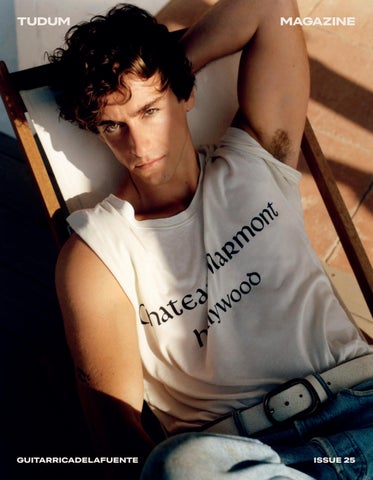
TUDUM
GUITARRICADELAFUENTE
MAGAZINE
ISSUE 25
Guitarricadelafuente as Sebastián in La Bola Negra.
The power of discovery is on full display in the 25th issue of Tudum Magazine — and nowhere is that more apparent than in the latest performances from our three cover stars, photographed across Spain, France, and New York this summer. On the beaches of Barcelona, Jorge Perez Ortiz photographed Guitarricadelafuente, the genre- bending Spanish musician who makes his acting debut in the sweeping epic La Bola Negra. In Brittany’s countryside, we met up with Léa Seydoux and photographer Marie Deteneuille. Seydoux opened up about her “complex relationship with acting” ahead of Gentle Monster, a drama about a woman whose life is shattered by disturbing accusations against her husband. Florence Pugh, who collaborated with photographer Dan Jackson in New York City on the stunning portraits in this issue, brings John Steinbeck’s unforgettable antihero Cathy Ames to life in East of Eden. Pugh approached the role “in a way [she’d] never done before.” Each of these performers finds themselves playing characters standing at the precipice of something unknown, and what they achieve onscreen is revelatory. This issue goes deeper into these worlds and beyond. Our bespoke illustrated special section, “The Art of the Adaptation,” is dedicated to a collection of Netflix’s literary retellings. This includes Tony Award winner James Graham reflecting on how his Fleet Street play INK grew into Danny Boyle’s latest drama, author Jonathan Franzen on The Corrections as the novel marks its 25th anniversary, director Peter Berg on bringing the true story of The Mosquito Bowl to the screen, and so much more. Hope you enjoy, Krista Smith
Issue 25
Table of Contents 05 Queued Up 22 Features
22 Guitarricadelafuente 32 Avedon 38 Ray Gunn 44 THE FURTHER MIS-ADVENTURES OF CLIFF BOOTH 46 Possible Love 52 Florence Pugh 106 Léa Seydoux 114 Ben Affleck 118 A Child of My Own 124 Allison Janney 128 The Gentlemen 132 Monster: The Lizzie Borden Story 136 Netflix House 138 Dinner Party: Hasan Minhaj
62 Adaptations 64 La Bola Negra 72 In Waves 76 The Corrections 78 East of Eden 84 Lord of the Flies 86 The Mosquito Bowl 90 Pride and Prejudice 94 Unaccustomed Earth 96 The Altruists 100 INK 104 Titles on the Way
ON THE COVER
Guitarricadelafuente photographed by Jorge Perez Ortiz. Florence Pugh photographed by Dan Jackson. Léa Seydoux photographed by Marie Detenuille.
Tudum Magazine
46 POSSIBLE LOVE
returns director Lee Chang-dong to cinematic storytelling.
22
GUITARRICADELAFUENTE makes his acting debut in La Bola Negra.
G UI TA R R I CA DE L AF U E N T E WE A R S B LU E A N D R E D S H I RT BY G I M AG UA S A N D PA N TS BY PA RA I S O. F LO RE N C E PUG H WE A RS D RE S S BY Y ’S BY YOH JI YA MA MOTO AND HAT BY HE ATHE R HU E Y. P H OTO O F A L LI S O N JA N N EY BY C LI F TON PR E S CO D.
3
52 32
AVEDON
FLORENCE PUGH explores the legacy of one of photography’s greats.
takes on another literary heroine in East of Eden.
124
finds herself in the Oval Office in The Diplomat.
ALLISON JANNEY
Issue 25
Table of Contents
62 ADAPTATIONS
bring stories of love, loss, and history to the screen.
investigates trust in Gentle Monster.
38 RAY GUNN
is Brad Bird’s latest visionary animated feature. Tudum Magazine
LÉ A S E YD OU X W EA R S LO OK BY LOU I S VU I T TO N .
106
LÉA SEYDOUX
Queued Up P H OTOG R A P H BY K A N E S K E N N A R .
5
08 THE MAP
Follow a group of young footballstars-turned-soldiers across the Pacific in The Mosquito Bowl.
16 SPOTLIGHT
Javier Calvo and Javier Ambrossi direct their most ambitious feature yet with La Bola Negra.
20 THE LEGEND
Catherine Deneuve continues a seven-decade acting career with her latest film, Gentle Monster. Issue 25
Ella Beatty The Breakthrough
Ella Beatty tends to avoid movies and TV shows that feature a lot of violence. “I’m a huge scaredy-cat,” she says. “I don’t even like watching TikToks of people falling down!” You’d never know this after seeing Beatty in her starring role as Lizzie Borden, the infamous woman at the center of Monster: The Lizzie Borden Story, the fourth installation of Ryan Murphy and Ian Brennan’s Emmy-winning anthology series. While in real life, the actor describes herself as “incredibly squeamish,” she lights up the screen as Lizzie with an axe in her hand. She glows almost beatifically, face covered in Jackson Pollock–esque splatters of bright red blood. Like Beatty, many of us are only familiar with Borden through the nursery rhyme: “Lizzie Borden took an axe and gave her mother 40 whacks …” The series offers an introduction to and interpretation of Borden’s life. She was tried and acquitted for the murders of her stepmother and father in 1893, before living out the rest of her days under a cloud of suspicion. “It’s a very disputed case,” says Beatty. “A lot of people have a lot of really Tudum Magazine
different points of view on what could have happened — and even have different points of view about Lizzie herself. That was a really interesting entry point for me as an actor, but mainly I felt my job was to explore the character that Ian and Ryan had created and take all of the source material about the real person’s life, and then translate that into the very fictionalized version of the woman.” Beatty, who’s also appeared in the film If I Had Legs I’d Kick You and Murphy’s Feud: Capote vs. the Swans, was intrigued by playing the first female Monster. She spent a lot of time thinking about what it was like not only to be Lizzie, but to be any young woman at that point in history. “[Lizzie] is the perfect example of a creature of her time,” says Beatty. “I think to be a woman — a young woman, but a woman at all — at that time period in America was to feel confined sexually, spiritually, and emotionally. Your role was pretty small.” Beatty is joined by Monster alums Charlie Hunnam, who plays Lizzie’s father, and Vicky Krieps, who plays the Bordens’ live-in maid, Bridget, who gives Lizzie a glimpse into a world of womanhood beyond the patriarchal
expectations she is bound by. “I knew that Ryan Murphy and Ian Brennan were really interested in exploring the reasons why women kill. They were interested in exploring what brings a woman to the point of violence,” says Beatty. While Beatty knows that viewers will come to their own conclusions, she feels strongly that the series is an “exercise in empathy and an exercise in trying to understand complicated people’s brains and their trauma.” That was certainly a helpful takeaway for her — especially on the days when she had to shoot the murder scenes. “I really don’t like to see people hurt. It upsets me viscerally. And so I definitely felt, going into this project, ‘How am I going to do this?’” she recalls. “But the team of people involved in creating those moments was so incredible — the makeup involved, the costumes, the sets, the body doubles, the stunt doubles. I mean, there’s so much work and love that gets poured into creating moments like that in the show that I felt really lucky and excited to step up to the plate of my little piece of it.” Even if that little piece is covered in blood.
P H OTOG R A P H CO URT E SY O F CO N TO UR BY G E T T Y I M AG E S .
The performer is a bloody delight in Ryan Murphy and Ian Brennan’s Monster: The Lizzie Borden Story. Photograph by Emilio Madrid
7
The Map
The Mosquito Bowl MADISON, WISCONSIN
Bob Baumann (played by Bill Skarsgård) and Dave Schreiner (Tom Francis) are teammates at the University of Wisconsin.
WEST LAFAYETTE, INDIANA
This Midwestern city is home to Purdue University, where star player Tony Butkovich (Ray Nicholson) leads the charge.
PROVIDENCE, RHODE ISLAND
John McLaughry (Nicholas Galitzine) is a linebacker at Brown University, where his father coaches.
PARRIS ISLAND, SOUTH CAROLINA
Berg spent time researching his film at this still-active Marine Corps training facility, where the four men began their brotherhood.
University
Tudum Magazine
Football Game
Training Camp
Railroad Route
Battleship Route
Beach Invasion
Battle
Staging Base
9 In The Mosquito Bowl, director Peter Berg ventures back to World War II to tell the true story of a group of young football players who served as Marines on the front lines of the Pacific Theater. Take a glimpse at the course taken by the men who sacrificed for their country when battle took them far from home.
OKINAWA, JAPAN
After months of preparation, the 4th and 29th regiments go into the Battle of Okinawa, beginning in April 1945.
TARAWA, KIRIBATI
The men come face-to-face with the reality of combat when they storm the beach of this island country’s capital.
GUADALCANAL, SOLOMON ISLANDS
While recouping for a looming battle at Okinawa, the men compete in a morale-boosting football game for the ages.
Issue 25
East of Eden Artifacts
In her limited series adaptation of John Steinbeck’s novel, Zoe Kazan enlisted production designer Grant Major to bring the half-century family saga to life.
1
East of Eden creator, co-showrunner, and executive producer Zoe Kazan credits Academy Award winner Grant Major (The Lord of the Rings: The Return of the King, The Power of the Dog), with bringing the story to life in the details. “He took our conversations and put them in such a profound way into the worlds — so much history in them,” she says of the production designer. “Every one of our collaborators lifted this project so much.” Take a look at some of the objects found in the sweeping epic.
1. PORTRAIT OF CYRUS TRASK A stately portrait of a dishonest man. After the death of their authoritarian father, Cyrus (Tracy Letts), brothers Adam (Christopher Abbott) and Charles (Mike Faist) discover the heroic war stories he clung to are anything but. 2. ADAM AND CATHY’S WEDDING MEMENTO The mysterious Cathy Ames (Florence Pugh) comes into Adam’s and Charles’s lives shortly after their reunion in adulthood. Cathy’s arrival further strains the brothers’ relationship as Adam becomes enamored and decides to marry her, ignoring Charles’s pleas to see the stranger for who she is.
11
3
2
3. TRASK FAMILY FARM Adam and Charles — half-siblings with contrasting temperaments — spent their childhoods on a farm in Connecticut, under the harsh eye of their father, Cyrus. After initially being tasked by Cyrus to maintain the farm when Adam joined the US Army Cavalry, Charles stays behind when Adam and Cathy decide to go explore a new life in the West. 4. CATHY’S TRINKET BOX From a young age, Cathy has kept the baubles and gifts she received from her male admirers in a tin keepsake box. As she ages, she uses it to stash valuables that may offer some freedom, including money she steals from Mr. Edwards (Josh McConville), a brothel owner who takes a liking to her.
4
Issue 25
Artifacts 5. ADAM’S RANCH Once in California, Adam turns to Samuel Hamilton (Ciarán Hinds) to help find him a plot of land where he can set down roots of his own. Taking on many acres alongside a Spanish ranch, Adam hires Lee (Hoon Lee) to help manage the homestead. Lee’s responsibilities with the Trask family start to increase.
9
6. SALINAS VALLEY LETTUCE ADVERTISEMENT Settled into his new life, Adam sees a chance to create a fortune for his family — he buys an ice plant and experiments with refrigerating the valley’s fine produce to export across the country. His sons, Cal (Joseph Zada) and Aron (Joe Anders), lend their efforts to the operation. 7. FAYE’S BROTHEL After leaving her husband and children behind at the ranch, Cathy reinvents herself as Kate Albey when she arrives at the Salinas brothel run by Faye (Martha Plimpton). Faye takes great pride in her fashionably decorated, high-class establishment.
P H OTOG R A P H Y BY K I R ST Y G R I F F I N A N D GE O F FR EY S H ORT.
5
Tudum Magazine
7
6
8. TRASK SALINAS HOME After living in physical and emotional isolation on the ranch, Adam makes the choice to move to the city of Salinas with his sons so they can attend school with other children. With their new yellow house comes a fresh start. 9. ADAM’S AUTOMOBILE Adam’s new business success allows him to buy an automobile, one of the many modern marvels that can be found in town. The extravagant technology wows the Trask men.
8
Issue 25
Playlist Tarik Azzougarh, aka Cilvaringz; The RZA; and Jeremy Waterloo.
The Disciple: A Wu-Tang Fable
Director Joanna Natasegara shares the songs that shaped the documentary. Tarik Azzougarh staked everything on proving himself to his heroes. After being pulled onstage with the Wu-Tang Clan in 1997 at an Amsterdam show, the Dutch Moroccan rapper known as MC Cilvaringz worked his way into the group’s inner circle. Once there, he set out to make a record with them, one built to defy a digital era that reduced music to disposable content. The result, Once Upon a Time in Shaolin, became the Clan’s mythical, single-copy “seventh album.” Recorded over six years, its 31 tracks were pressed exactly once, sealed in a handcrafted silver lockbox, and auctioned off in 2015 for a reported $2 million — a record sum that came with a caveat barring any commercial release until 2103. Tudum Magazine
Director Joanna Natasegara (producer of the Oscar-winning documentary The White Helmets) tells the story of the album’s improbable genesis and controversial reception in her new documentary The Disciple: A Wu-Tang Fable, which premiered at the 2026 Sundance Film Festival. Rather than chase the feuds that have followed the record, the film focuses on the spirituality and ethics beneath the Clan’s art. It covers the conflicted feelings at the heart of Azzougarh’s gamble, a bet that either made his career or ended it — he still can’t say which. Beneath his story lies the philosophical question that drove the album’s creation in the first place: What
is recorded music worth, and who has the right to own it in the streaming age? For all those questions, The Disciple: A Wu-Tang Fable is also a celebration of the music itself. Fitting for a group that built its own sound by championing others, weaving soul, funk, and cinema into a sprawling sonic tapestry. “The Clan represents the celebration of other artists in their own work by sampling numerous other musicians and films,” Natasegara says. “Creating a playlist inspired by them is easy.” So she built one. Here is her curated mix of Wu-Tang essentials, the samples beneath them, and the songs that mark Azzougarh’s improbable path into the group’s world.
15 M E T H O D M A N : A L PE R EI R A / GE T T Y I M AG ES . R Z A : DAV I D C OR I O/ GE TT Y I M AGE S . R A E K WO N : BO B BE RG / G E TTY I M AG E S . I N S PE CTA H D ECK: KE V I N W I NTE R/ G E TTY IMAG E S. ODB : AL P E RE IRA/G E TTY I M AGE S . M A R I A H CA R E Y: R OB VE R H OR ST/ GE T T Y I M AG ES . CH E R : DAV I D H O GA N / G E TTY I M AG E S .
SONG TITLE PERFORMED BY
Wu-Tang Clan “C.R.E.A.M.”
Shabazz the Disciple “Red Hook Day”
Nas (feat. Lauryn Hill) “If I Ruled the World”
MJ COLE “Sincere”
Mariah Carey (feat. ODB) “Fantasy”
The Charmels “As Long As I’ve Got You”
Wu-Tang Clan “Triumph”
Cher “Walking in Memphis”
Wu-Tang Clan “Once Upon a Time in Shaolin…”
“C.R.E.A.M.”
An abbreviation for “Cash Rules Everything Around Me,” this anthemic track from Wu-Tang’s 1993 debut built its hook on a 1967 soul cut, The Charmels’ “As Long as I’ve Got You.” “It’s so hard to pick a favorite from the iconic first album, but ‘C.R.E.A.M.’ is up there,” Natasegara says. “They don’t make them like this anymore.”
“Fantasy”
Mariah Carey engineered this 1995 remix as a deliberate leap into hip-hop, recruiting the Clan’s most unpredictable member, the late, great Ol’ Dirty Bastard, for a verse. The gamble helped kick open the door for decades of pop-rap team-ups. “The perfect, upbeat collab between two big beasts,” Natasegara says. “It hits at the height of the film.”
“Walking in Memphis”
Cher’s heartfelt 1995 cover of Marc Cohn’s 1991 piano ballad is a gospel-tinged Southern travelogue with no obvious Wu-Tang connection at all. “I know this seems like a random track,” Natasegara admits, “but it makes sense in context. The film, like the album it’s about, contains many twists and secrets.” Issue 25
Javier Calvo and Javier Ambrossi Spotlight
Spanish directing duo Javier Calvo and Javier Ambrossi, known popularly as Los Javis, arrived at the 2026 Cannes Film Festival with a collection of critically acclaimed successes behind them — including Paquita Salas, a comedy series about a struggling talent agent; Veneno, a biographical series about transgender TV personality Cristina Ortiz Rodríguez; and La mesías, a thriller series that jumps across time from the 1980s to the early 2010s. Their new film, La Bola Negra, brings them their biggest accolade to date: the Best Director Award from the Cannes jury. A sweeping epic, La Bola Negra takes place across three generations and timelines — 1932, the Spanish Civil War circa 1937, and 2017 — and, as in the directing duo’s previous films, works with themes of identity, sexuality, and inheritance. It’s their most ambitious film yet. “I think this movie represents the peak of our investigation into the past,” says Calvo. “In earlier films, we explored history, but not with the same depth or Tudum Magazine
importance as in La Bola Negra. With this film, the central question is what we do with our past, with our inheritance, with the objects and art that remain, with the traces history leaves behind.” The film, which borrows its title from an unfinished play by Spanish poet Federico García Lorca, stars Guitarricadelafuente, Miguel Bernardeau, Carlos González, and Milo Quifes as men confronting their place in the worlds they each inhabit, from a generation facing life-changing oppression for expressing homosexuality to a modern Spain where acceptance is the norm. “There was this feeling that we don’t always honor the struggles of previous generations of gay men,” says Ambrossi. “Today, at least in Spain, we live with rights that feel stable, but I’m not sure we always acknowledge the fight that made them possible.” Through the lens and words of Ambrossi and Calvo, La Bola Negra brings that fight into the consciousness and celebrates the stories of the men who paved the way for the generations to come.
Directors Javier Ambrossi (left) and Javier Calvo (right) on the set of La Bola Negra.
P H OTOG R A P H BY CA R L A OS E T.
The La Bola Negra directors weave a multi-generational story of pain and desire in their latest film.
17
Issue 25
Jean-Michel Basquiat Jean-Michel Basquiat defined a genre of 20thcentury American art.
1,500 drawings & 600 paintings poured out of Basquiat in his eight years of serious work, spanning from roughly 1980 until his death in 1988 at just 27. That torrent of creation averages out to a new painting nearly every five days, not counting the drawings.
Tudum Magazine
P H OTOG R A P H OF J E A N - M I C H EL B A S Q UI AT STA N DI N G I N F R ON T O F D O N U T R EV E N G E BY M A RI O N BUS C H .
By the Numbers
19 The Basquiat-estatebacked documentary tells the story of his short, explosive career.
Jean-Michel Basquiat, the first documentary backed by the artist’s estate, traces his rise from street art to world fame — and a legacy now woven into global pop culture. The film marks Quinn Whitney Wilson’s feature directorial debut, alongside co-director Viridiana Lieberman, editor of the Oscar-nominated The Perfect Neighbor. Executive produced by Basquiat’s sisters, Jeanine Heriveaux and Lisane Basquiat, who co-administer his estate, the film draws on the family’s never-before-seen
300,000+ B A S QU I AT ’S S K ETCH B OO K ( CA . 1 977 ) A N D CH I L DH O OD FA M I LY P H OTO GR A P H OF LI S A N E , JE A N - M I C H E L , A N D J EA N I N E B A S Q UI AT ( 1 9 67) CO URT E SY OF T H E ESTAT E O F J E A N - M I C H E L BA S Q UI AT.
visitors flocked to “King Pleasure,” the sweeping exhibition Basquiat’s sisters curated across New York and Los Angeles from 2022 to 2024. The family-run show gathered more than 200 rare and never-beforeseen works and artifacts.
EIGHT was Basquiat’s age when a car struck him in Brooklyn, requiring doctors to remove his spleen. During his recovery, his mother gave him a copy of Gray’s Anatomy, a seminal medical text featuring anatomical imagery that would inspire Basquiat’s work for life (and the name of his band, Gray).
1980
marked Basquiat’s first public exhibition at the “Times Square Show,” a round-the-clock effort staged in a vacant sixstory former massage parlor. There, he hung 14 marker drawings under his “SAMO” tag alongside work from other young artists, including Keith Haring, Jenny Holzer, and Nan Goldin. The punk-inflected show was credited with launching the East Village art scene.
archive: home movies, notebooks, photographs, and artworks. “To sit with his output, his discipline, and his intention behind every piece of work at such a young age was mindblowing,” Wilson says. “It reframed what I thought was possible in a single lifetime, let alone in the handful of years he had.” Lieberman marvels at Basquiat’s reach. His art is “everywhere I look,” she says, taking stock of “how many borders it crosses and unifies.” The following numbers bear this out.
$1
was all Andy Warhol paid for a Basquiat postcard in 1979 after the young artist spotted Warhol at a downtown restaurant in New York City — a chance encounter that would grow into their legendary collaboration. Titled “Stupid Games, Bad Ideas,” the collaged card was one of a series Basquiat co-created with artist Jennifer Stein and sold around SoHo to make ends meet.
$110.5M was the record-shattering price that his 1982 painting Untitled — a searing skull against a blue background — fetched at a 2017 Sotheby’s auction. At the time, it was the highest price ever paid at auction for a work by an American artist.
Issue 25
Catherine Deneuve The Legend
Hustle
The Last Metro
Indochine
Gentle Monster
Tudum Magazine
The French icon brings her singular presence to Gentle Monster. Photograph by Alice Rosati There aren’t many stars of the screen with a résumé like that of Catherine Deneuve. Over 150 acting credits. Nearly seven decades from first appearance to latest, with rarely a year that didn’t include a new release. Oscar and BAFTA nominations and countless honors from international film festival juries. Collaborations with visionaries such as Jacques Demy, Agnès Varda, Luis Buñuel, François Truffaut, Hirokazu Kore-eda, and Lars von Trier. And at 82 years old, Deneuve still has the passion and commitment to take on challenging new work. In Gentle Monster, the latest film from Austrian writer-director Marie Kreutzer (Corsage), Deneuve plays Eloise, a mother whose grown daughter Lucy (Léa Seydoux) faces a marital rupture and crisis of trust when her husband is investigated for an unthinkable crime. Deneuve was on Kreutzer’s mind for the role after Seydoux was cast and Lucy developed into a French character — Kreutzer knew it had long been Seydoux’s dream to work with the esteemed actor. Kreutzer recalls her early conversations with Deneuve over coffee in Paris: “She said she was
really fond of the script. She’s a real cineast. She goes to the cinema every week, and the way she speaks about films is just so impressive.” Once filming began, Seydoux relished the opportunity to work with the French legend. “The fact that I’m a great admirer of her work made it easy for me. It felt intimate,” she says. Kreutzer adds, “She’s very kind and calm on set and very relatable. She’s so direct, so she would not ever flatter you. If she tells you something, it’s what she thinks. And I really love that about her.” Those qualities have been honed over decades of acclaimed performances — 14 César nominations and two Best Actress wins among them. (Had France’s Académie des Arts et Techniques du Cinéma been founded before 1975, those numbers would almost certainly be larger, considering some of Deneuve’s most beloved work — including Belle de Jour and The Umbrellas of Cherbourg — debuted years before then.) Seventy years after Deneuve’s first performance, Gentle Monster gives audiences yet another chance to marvel at the talent that continues to captivate.
U M B R EL L A S O F C H ER B OU R G A N D H U ST LE C OU RT ESY O F E V ER E TT C OL L ECTI O N ; TH E L A ST M E TRO CO U RT ESY OF M OV I E STOR E C OL LE CT I ON LT D / A L A M Y L ; I N D O CH I N E CO URTE SY O F M A S H E TE R M OVI E A R C H I VE / A L A M Y; PO RT R A I T C OU RT E SY O F T R UN K A R CH I V E.
The Umbrellas of Cherbourg
21
22
Coming off of his acting debut in La Bola Negra, the singer-songwriter opens up about trading his stage anonymity for the spotlight of Cannes — and finding his way back home. By MADELEINE SAAF-WELSH Photography by JORGE PEREZ ORTIZ Styling by BRAIS VILASÓ
GUITARRICA
DELAFUENTE
24
Tudum Magazine
25
S W EAT E R BY B UE N D I A 0 22 2. S H O RTS BY A LP I N O. BO OTS BY H E R E U.
T
The musician Guitarricadelafuente is taking a moment to catch his breath. Outside the doors of the makeup and styling trailer is a 90-degree Barcelona afternoon, a photographer and crew, and a weathered beach house where he just spent three and a half hours looking down the lens of a camera. Two nights earlier, the 28-year-old singer-songwriter was onstage performing the modern folk songs from his sophomore album Spanish Leather on the 24th night of a tour that spanned three continents. In the middle of this musical odyssey, he made a stop on the French Riviera where he stood alongside Penélope Cruz at the Cannes Film Festival and received a remarkably long ovation for his acting debut. “Watching it there, I wasn’t conscious at all,” recalls the star of the epic drama La Bola Negra as he perches on the chair across from me, hair curling with salt from his dive into the crashing Mediterranean waves at the end of the shoot. “It was the first time I was watching myself playing a character in a movie, and seeing that on the big screen in Cannes was something I couldn’t believe.” Two weeks after the film’s premiere set the Croisette aflame and earned the festival’s Best Director Award, Guitarricadelafuente (Guitarrica for short) played the Primavera Sound Barcelona festival, just a few miles from his home and from where we sit today. He walked onto the stage in a black T-shirt emblazoned with one word: DREAMER. Performing for a crowd like the one at Primavera was something he had dreamed of but maybe wouldn’t have believed could happen; when he entered the music business, he didn’t follow the path of someone fiercely pursuing the spotlight. “The name Guitarricadelafuente was a way of being anonymous,” he says of his pseudonym, which combines his paternal surname with the Aragonese word for “small guitar,” an homage to his heritage and to his grandparents, who lived in a village of 80 people in northeastern Spain’s Aragon region. “My grandfather was a jota singer and musician, and my grandmother used to play piano. Going back to my grandfather’s house, I’d find bandurria guitars all over the place,” he fondly recalls, speaking of discovering music with his cousins. Yet his own music became an introverted exploration: “For me, singing was a very private thing at home — something I did by myself, and not even my parents knew that I sang.”
Under the anonymity of his stage name, Guitarrica posted his first song, “El Conticinio,” to SoundCloud eight years ago, ditching lectures at his architecture degree program in Valencia to record in his bedroom. More songs followed, social media interest grew, and record labels started calling. By 2024, he was onstage at Primavera, singing alongside pop star Troye Sivan. In the audience happened to be Javier Calvo and Javier Ambrossi, the filmmaking duo known as Los Javis. That night, after the performance, Guitarrica ran into the directors, who mentioned a project they thought he might be good for. “I imagined they were going to propose a soundtrack, something related to music,” says the singer, who soon after the initial meeting went down to Madrid to visit Ambrossi and Calvo and continue the conversation. “Instead, they talked about an idea.” The idea was the story of a fated meeting between two soldiers, Sebastián and Rafael, set in 1937 during the Spanish Civil War. This serves as one of La Bola Negra’s three timelines; the film’s other two intertwining stories, set in 1932 and 2017, are inspired by writer Federico García Lorca, in particular the unfinished play he was working on before he was killed, which lends the film its name. Dextrously, the movie connects three generations of men through pain and love, across nearly a century of Spanish history. Calvo and Ambrossi saw in Guitarrica precisely what they needed to bring the poignancy of Sebastián’s 1937 story to the screen. “We were big fans of his work. He can sing with that sensitivity onstage, these beautiful songs,” says Calvo, who was unbothered by Guitarrica’s lack of acting experience. “He can do it, he can act. It’s the same. He’s telling a story when he’s singing.” The directors had envisioned Sebastián as a man with “sad musician eyes.” It only takes a minute in Guitarrica’s presence to know that they cast the right person. “Guitarrica was such an enlightenment when we were writing that we were like, ‘If he’s doing it, we can do it. If not, we cannot,’” says Ambrossi. “Sebastián was that important to us. To find him, it was the core of the movie.” Their early conversations brought Guitarrica closer to the tale — at times beautiful, at times devastating — that he’d be unraveling through his performance. “They were telling me about [Sebastián], this fascist soldier in the Spanish Civil War, and this identity crisis for the character,” he says. In making Spanish Leather, he had already been tapping into the complex ideas and emotions he would need to work with for the character. “For me, there were a lot of things that connected to what I’d been exploring: self-identification, feeling comfortable in your own skin, the significance of Spanish symbols and turning them in your favor, fragile masculinity, showing strength in vulnerability. The way I’ve interpreted my own masculinity, and how I find my place in the world,” he explains. “In every project I work on, something is Issue 25
26
constantly changing in me, because otherwise you stay steady for the rest of your life, and I think that always reflects in the final result. The album was already done, and what I was already breathing I was able to put into Sebastián.” While music was his first passion, film was always in the background, inspiring his creativity. “Growing up, there wasn’t much to do in Benicàssim,” he says of his coastal hometown, about a three-hour drive south of Barcelona. Vacationers came for the summer and the town emptied out for the rest of the year. “I remember every Sunday I’d go with my parents or some friends to the cinema. That was the highlight of the week.” While the local movie theater mostly featured blockbuster fare, in school he was introduced to the classics and auteurs. “I remember we watched Pedro Almodóvar’s Hable con ella (Talk to Her), and in French class we watched a film by Godard. That was my first deep approach to cinema, where I could appreciate it in an aesthetic way,” he says. “That was the first time cinema really drew my attention: the beauty of the colors, why a film is in black-and-white, what the purpose of a shot is. I started questioning films.” Barely a decade later, he was set to star in a film co-produced by Almodóvar. So began the work of developing Sebastián. “There was a big preparation period before we started filming last summer, where I had my first acting exercises with [Los Javis]. I’ve always been guided and accompanied by them,” he says. As the film opens on the Spanish Civil War, we find Sebastián playing trumpet in a village band. They’re getting ready to celebrate the arrival of the Fascist Italian military, which has come to support the Nationalist rebellion against the Second Spanish Republic. Sebastián is relieved when his mother shows up, begrudgingly saluting the planes flying overhead while her son performs. That’s when bombs and artillery drop from the sky, obliterating the town and killing his mother. To convey the shocking intensity of this moment, the directors took an unorthodox approach. “There’s been a very therapeutic, profound discovery in building this character — touching personal things, unveiling things that were covered in dust, to try to bring that emotion to the acting, to what Sebastián is feeling and to connect that with my own reality,” says Guitarrica. “So for [Los Javis], the best idea was to bring my mom in — and kill her, in front of me.” The directors, known for weaving in personal details and cameos to create heightened, authentic emotion in scenes, cast Guitarrica’s own mother in the part. “Even now, when I watch it — that scene — it’s like, ‘Oh, my God,’’’ Guitarrica says. “It makes me emotional.” After Sebastián is picked up by the Nationalist troops and forced to join their ranks, he’s tasked with looking after Rafael, a Republican soldier and prisoner of war, played by Miguel Bernardeau. A bond forms, and through it Sebastián begins to explore his sexuality. “For me, playing this character, it’s shown Tudum Magazine
Issue 25
P R E VI O US S P R E A D: S W EAT E R BY B OR A S , PA N TS BY N AVA LE S , LE GG I N G S BY G I M AG UA S , JE WE LRY BY CA RTI E R. TH I S S PRE A D : S H I RT A ND TI E BY CA MI S A S MANOLO. JE ANS BY L E V I’S.
29
“I STILL HAVE THE NEED TO GO BY THE SEA … TO TAKE A PAUSE … TO GET FOCUSED ON THE MUSIC, WRITING LYRICS, READING, GETTING INSPIRED.”
GUITARRICADELAFUENTE
Issue 25
me that not everyone has the chance to live freely. For Sebastián, he’s a guy raised in this village during wartime, and it seems like if you take the luxury of thinking about anything else besides survival, it can be considered selfish in those times,” Guitarrica reflects. “You need to help your family. Here’s your gun — you need to watch this guy, and if he runs, we’re going to kill you and him too. You need to man up as fast as possible. And that’s mixed with being in the middle of a war, where masculinity is already so aggressive all around you. With Rafael, Sebastián feels peace, and feels humanity.” Sebastián’s inner desires are revealed as he and Rafael get to know each other in tentative, guarded conversations, each unsure how much of themselves to reveal. When he learns Rafael used to work for a theater company, Sebastián says he heard that there are musicians who perform behind the actors onstage. “That’s what I’d like,” he says, “to play in a theater. In a good suit. Being able to see everyone, but let no one see me. As if I was invisible.” Sebastián craves anonymity. Sebastián is a dreamer. His dreams feel closer than ever when he encounters performer Nené Romero backstage at a show she’s put on for the troops. The scene provided an opportunity for Guitarrica to act opposite an international cinematic great: Penélope Cruz. “In Spain [especially], I think for everybody, she’s someone you’ve only ever seen in the sky. Getting to meet her, when we first read the script together, I was so nervous,” he says. Nené acts as a window into another world for Sebastián, dishing out stories of her fantastical pre-war life in Madrid to a rural soldier who hangs on her every word. It is a moment for Sebastián to crack a smile, just as Guitarrica grins softly when he recalls his experience working with Cruz: “She’s been so generous from the start, so helpful with me. In real life, and with Sebastián, she’s been like a mother figure. In the film, she truly shows Sebastián the way — that there’s a way to escape all of this, a sense of hope that we’re going to see each other again in Madrid, with the nightlife and freedom that used to exist. I think she represents the will to live freely, and hope, for him.” When I ask what it meant to be a part of this story, Guitarrica takes a moment, a breath. “Javier Calvo said, ‘This film just makes you want to live,’ to live the way you want to live,” he responds. “And to not hold anything back — to say the things you have to say to that person, to do what you want to do with your life — because at one point you’re going to arrive at the snow, and there’s no way back.” The snow, in this onscreen world as throughout Lorca’s work, is connected with death. In the film’s 1932 timeline, the character Carlos (Milo Quifes) has been blackballed from joining a casino because of his sexuality, and a moving passage where he walks along a snow-covered Sierra Nevada peak is scored by plucky piano notes and a celestial voice singing Spanish lyrics that Tudum Magazine
translate to “I keep my desire hidden away in a locket, a relic from the Andalusian empire.” It is “La Nieve,” Guitarricadelafuente’s latest song, written for the film. “When Los Javis first reached out to me about the role, we were already trading a lot of music references, talking about the album,” the singer-songwriter says. “When I was making Spanish Leather, what really inspired me were a lot of Civil War–era songs from the late ’30s. I even found some by Woody Guthrie — the song ‘Jarama Valley,’ a valley where a big fight took place. It’s this American folk song, talking about a Spanish scenario in an exotic way, that really grabbed my attention.” It was an inspiration closer to the film, the poet Lorca’s unfinished play, that brought the words of “La Nieve” to Guitarrica. “Lorca uses a lot of imagery. Snow appears often in his poetry, almost like flesh. I think he represents folklore in a very magical way, like magical realism, and I wanted to figure out how to make that sound without it being overloaded,” he says. “[It was about] finding the balance between these ultra-powerful words and not making it a super dramatic song, but what the film was actually asking for.” La Bola Negra premiered at Cannes to widespread critical acclaim, and now Guitarrica is starting the process of reflecting on this major chapter of his life and on bringing this meaningful story to the world. “I think it’s gigantic — and for this to happen in Spain … growing up, you wouldn’t see many references like this on television or in cinema. I wish I could have seen this film when I was growing up,” he says. “This acting role was so deep, and so exhausting, so emptying. I consider that when I do something — a song, an album — I put everything of myself into it. And I feel I’ve done that in this film, in the music, in playing Sebastián. Something of me has stayed there.” Now is the brief moment for a breath, for a dip in the sea, to slow down and let new inspiration come his way. “I’ve always had the need to be by myself, to take my time and write. These last two years have been the busiest of my life, and I haven’t really been able to do that — and at the same time, that speed has inspired me in a different way,” he says. “Being in hectic times has made me discover a different way of writing songs, of meeting new people and writing with them. But I still have the need to go by the sea, or to my [grandparents’] hometown in Aragon, to take a pause, analyze what’s going on, and try to get focused on the music, writing lyrics, reading, getting inspired.” He prioritizes making that time and space. After we finish our conversation, Guitarricadelafuente will take a much-needed holiday. He will spend time on the Spanish coast, he will travel inward to Aragon, he will be in water, he will be home. There will be music and family and books and time to be with himself. There, he is Álvaro Lafuente Calvo.
B ELT BY PA R A I S O, DE N I M BY L E V I ’S , BO OTS BY H E R E U, J E WE LRY BY CA RT I E R , T- S H I RT I S STY LI ST’S OWN .
30
31
Issue 25
32
In Avedon, director Ron Howard explores the life of photographer Richard Avedon. By RON HOWARD Portrait by BRUCE WEBER Photography by RICHARD AVEDON
Tudum Magazine
34
DOVIMA WITH ELEPHANTS evening dress by Dior, Cirque d’Hiver, Paris, August 1955
Photographer Richard Avedon spent six decades capturing the world, from culture-shifting fashion and Hollywood royalty to the energy of anti-war protests and the intimate realities of everyday life. In doing so, he transformed not only photography, but the way we see the world itself. Born in New York City in 1923, Avedon possessed a singular eye for beauty, particularly in its contradictions. Now, Academy Award– winning filmmaker Ron Howard turns his lens toward the artist himself in the documentary Avedon. Immersing himself in Avedon’s life and work, Howard found a kindred spirit in the photographer and a shared fascination with the creative process. Here, the director reflects on the journey of bringing Avedon to the screen. Tudum Magazine
35
MARILYN MONROE actress, New York, May 6, 1957
I first came to this project much the same way I did my previous documentaries on Pavarotti, The Beatles, and Jim Henson — with an interest in exploring the creative process of an artist whose work I admired from afar. I am deeply curious about people who create master works over and over again across an entire lifetime. But in the course of making this film, I discovered there was so much more to Richard Avedon’s story than the how and the what of his photographic methodology. Photography wasn’t just his medium, it became his philosophy and impacted his worldview and his very being. This resonated for me in a way I wasn’t expecting, as I began to realize the ways that my films have shaped me over the years as much as I had shaped them. Avedon lived and worked through some of the most volatile and pivotal moments in the 20th century: the post-WWII era of rebuilding, the display of Hollywood glitz in the 1950s, the emergence of youth culture and social activism in the 1960s and ’70s, the rise and fall of the American dream in the 1980s, the arrival of unbridled consumerism at the end of the century, etc. He used his camera
to gain access to people and places where interesting things were happening, for over 60 years, which was quite an astonishing feat in itself. But he wasn’t just capturing the world around him, his images were also changing it. It was his ideas and constructions that influenced our collective consciousness. I found his ability to simultaneously be an observer and a provocateur fascinating. Avedon was also a voracious student of culture, despite never finishing high school. He immersed himself in all the arts: theater, film, music, literature, painting. And because he recognized the greatness in those around him, he became a brilliant collaborator. He found ways to engage those he admired in his own projects and worked closely with writers like Truman Capote, James Baldwin, and Adam Gopnik; choreographers like Twyla Tharp; designers like Christian Dior or Calvin Klein; magazine editors like Diana Vreeland, Carmel Snow, and Tina Brown; and creative collaborators like Marvin Israel, André Gregory, Doon Arbus, and Laura Wilson. He understood the need to turn a creative endeavor into a conversation, and he embraced it. Issue 25
36
JAMES BALDWIN writer, New York, January 9, 1963
As I pushed deeper into his creative motivations and inspirations, I became intrigued by his ability to follow his heart and his gut, even when it seemed at cross-purposes with the trajectory of his career. He had attained great success and notoriety early on through his fashion and more commercial photography, but he was moved by the struggles of those who remained outside the spotlight or were uncomfortable being in its crosshairs. So he found ways to turn his lens to the faces of the people who were doing something brave, saying something important, feeling something deeply: the activists involved in the Civil Rights Movement; the Vietnam War protestors; those struggling with mental illness; the lonely, displaced, or misunderstood; those in the rural West who felt left out of the conversation; and those fighting to preserve democracy in America. He found beauty in their convictions and their passions, and he helped us to see it too. Yet in order to sustain this prolific six decade career, he had to learn to bridge his commercial success and his creative endeavors, using his own resources to underwrite far riskier Tudum Magazine
projects. He figured out how to lean into the popular to make space for the unusual. And because he was able to strike that balance, we now have this treasure trove of incredible images that both flatter us, and lay us bare — all made by the hands of the same artist. In many ways, Avedon defied the idea that there must be a division between art and commerce, highbrow and lowbrow, beauty and brutality. I found his ability to live within this duality very unique, and inspiring — especially when one considers how he stuck to his guns when some of his choices weren’t embraced by the magazines who paid him, the curators who controlled the art market, or the reviewers who failed to understand him. The fact that he didn’t run from these difficult situations but instead used this tension to fuel his craft is what distinguishes his masterful artistry. In his lifetime, Richard Avedon did not want to be completely knowable or neatly defined. He was, at times, elusive and cryptic and complicated. He knew that the person behind the lens is the one who has all the power, so he was careful when he wasn’t the one holding the camera. My producers kept running lists
37
P H OTOG R A P H S BY R I CH A R D AV E DO N © T H E R I CH A R D AVE DO N FO UN DAT I ON .
RONALD FISCHER beekeeper, Davis, California, May 9, 1981
of Avedon’s aphorisms and favorite riddled expressions in an attempt to decode the reason behind the mania across his many decades of work. Eventually we came to understand that the contradictions in Richard Avedon were not problems to be ironed out, solved, or explained. Instead they defined his genius. And this film is a celebration of those complexities and all that we learn by observing them and living within them. The one main challenge we had making this documentary was deciding what to leave on the cutting room floor. With full access to hundreds of thousands of images and countless hours of his recorded musings, we spent a lot of time in the edit room discussing how to choose. How much screentime should we give to the stories behind the most famous and engaging images of some very well-known people (Marilyn Monroe, Charlie Chaplin, the Duke and Duchess of Windsor) versus never before seen images that may be more difficult to look at but offer a clue to some of Avedon’s inner struggles (Harlem in the 1940s, mental institutions, napalm victims in Vietnam, family photos where not everyone is
happy)? Do we focus on the beautiful work, and ride that wave of awe to its highest peaks, or let Avedon’s harsh light knock us down to our knees? If we did our job well, audiences will find a healthy balance of both. Over the course of making this film, I came to see some of myself in Avedon — in ways both big and small. We both, of course, like to be in control on our sets or in our studios, but also believe in the magic of the unexpected moment. We share a drive for excellence, but also a desire for fun and playfulness. We are both “workaholics” but are also deeply connected to the idea of family. But more importantly, I came away profoundly inspired by this man with an insatiably curious spirit and an unquenchable thirst for life, meaning, and artistry. His energy and seemingly limitless creative tenacity is something I hope to emulate as I move forward on my own artistic journey. I am excited for audiences around the world to make their own discoveries and find their own inspirations as they come to know this remarkable artist who changed our understanding of just how much a single photograph can capture. Issue 25
’s he’s m l d l or s. E is fi h w d n an eco ade P H A N L E o c d Bir itions Art Dor de By S T E d Bra amb the ing f -up uild n b w n gro bee
Y A R NN U G S ’ D R I B D A BR
here is an alternate future in which Academy Award–winner Brad Bird (The Incredibles, Ratatouille) never gets to make Ray Gunn at all — a reality where the sci-fi detective noir he conceived before beginning his 1999 directorial debut, The Iron Giant, remains exactly what it was for more than three decades: an elevator pitch nobody would finance. Instead, on Dec. 18, Netflix will release the film that Bird has been carrying with him and pitching, in one form or another, since before Pixar proved computer-animated features were possible. “It’s been, probably, way too long a road,” Bird says with a wry, understandably weary laugh. “I never would’ve believed Tudum Magazine
that it would take this long to get it made, but I’m very happy that it is.” The idea for the film arrived almost by accident. “This one came from misunderstanding a song,” Bird says. The first time he heard the B-52s’ “Rock Lobster,” he mistook its opening for a nod to “Peter Gunn,” Henry Mancini’s famous detective theme. “And then I went, ‘It’s Ray Gunn.’ And then I went, ‘Oh, that’s cool.’” From there, the logline practically wrote itself: “The Maltese Falcon meets Buck Rogers.” A hard-boiled detective story fused with pulpy, space-age science fiction, set in a city where humans and aliens uneasily coexist. It’s the kind of high-concept mash-up that sounds simple in a pitch meeting and proves enormously difficult to finance,
Private eye Ray Gunn (Sam Rockwell) is the latest hero developed by Brad Bird.
especially as an original, non-franchise animated film aimed as much at adults as at children. That’s also, not coincidentally, a fair description of nearly everything on Bird’s résumé. The Iron Giant was about a robot with a melancholy, retro heart. The Incredibles was a superhero spectacle in which the parenting drama was every bit as central as the action. Ratatouille was about a rat who dreams of becoming a chef, a premise so improbable that even Pixar second-guessed it during production, believing it would be difficult to market. Bird has spent his career making risky bets look inevitable in hindsight — and then starting the next one from scratch. “It doesn’t seem to matter how big the previous thing was. It doesn’t make it easier,” he says. “I thought that it would make studios trust me more … but I’ve always had to really sell ideas.”
He points to Christopher Nolan as something close to the only exception in the business: a filmmaker who can finance an original idea on the strength of his reputation alone. “How do you improve on the track record of Chris Nolan?” Bird asks. “I am always trying to do something that is challenging for me, but I never feel that I’m in a position where I can just say, ‘This is what I want to do,’ and somebody will want to do it.” Netflix finally gave Ray Gunn that opportunity, and Bird credits the studio with being willing to take the swing. “I was really happy that Netflix saw potential in this and made it financially possible to make it,” he says. He is candid about the strange moment the movie business is going through right now: An industry that keeps announcing its own death while recognizing that it needs the very Issue 25
The retrofuturist world Bird builds in Ray Gunn is inspired by structures like the Golden Gate Bridge.
S Y A W L A M A I “ TO DO THAT IS RYING THING E.” T OME OR M ird S NG F ad B Br LLENGI CHA
new ideas it’s afraid to gamble on. “They secretly know that they have to [adapt] pretty soon,” he says. “They can’t keep wringing out the same washcloths.” Technology finally caught up with Bird’s idea, too. When he first began developing Ray Gunn, computer animation was barely an option — this was before Toy Story. Decades later, CG has given him tools his younger self could hardly have imagined, particularly when it comes to the quiet, precise performances he wanted from his characters. “Super, super, super microscopic subtle animation is very difficult to do, if not impossible, in hand-drawn,” he says. “You can do it in CG, and people will see it.” That precision extends to Ray Gunn’s Metropia, the city Bird has been designing in his head for years. The world of Ray Gunn began with a question: What if World War II had never happened? The result is a retrofuturist metropolis Tudum Magazine
built in a streamlined, optimistic strain of Art Deco that Bird believes vanished from the culture too soon. He points to the Golden Gate Bridge as a real-world touchstone. “It’s a utopian bridge. You look at it, and it feels like a very positive view of the future,” he says. “I keep wondering, if there was more of it, how would it feel?” In Ray Gunn, there is more of it, in other forms of architecture: mile-high buildings, flying cars, jetpacks, and ultrafast elevators, all layered with the shadows and class tensions of true film noir. Into that city, Bird drops a distinctly Humphrey Bogart–coded hero. Ray, voiced by Sam Rockwell, is a private detective being phased out by machines that have been designed to do his job. He takes cases from an office that has also become his home. His partner is Eyera, a cyclopean alien voiced by Tom Waits, and together they are drawn into a murder investigation connected to Venus Nova, a pop star voiced by Scarlett Johansson, who also sings on the film’s soundtrack. Bobby Cannavale, Michelle Rodriguez, and Kathryn Hunter round out the cast. “You not only want a voice cast to make a convincing soundtrack, but, more importantly, you want something that animators can listen to over and over again and be inspired,” Bird says, noting that an animator might spend three weeks bringing a five-second line of dialogue to life. It is a very grown-up movie, by Bird’s definition of the term — not raunchy or excessively violent, but unwilling to condescend. It’s a distinction he has been arguing for throughout his career, going back to his early days on The Simpsons. “There’s a big chunk of people who don’t see animation … because it seems like it’s too young for them,” he says. “That’s a group I’m anxious to persuade.” Bird is fond of pointing out that Looney Tunes cartoons were not originally made for children. “It was a little treat before the Bogart movie,” he says. “Adult,” as he defines it, means something “you could take a date to, and you wouldn’t feel ashamed.” For a filmmaker who has spent more than 30 years explaining an idea he could already see vividly in his head, the finish line is finally in sight. “I can’t wait for you to see the finished version of it,” Bird says. “It should be a pretty great experience.”
P H OTOG R A P H OF B R A D B I R D BY CA R EL L AUG UST U S . T H E I R ON GI A N T: WA R N ER BRO S . PI CTURE S / C O URTE SY E VE RE TT C O LLE CTI O N . TH E I NCRE DI B L E S : WALT DISNE Y/COU RTE SY E V E RE TT COL L E CTION. M I S S I O N : I M P OS S I B L E- G H OST P R OTO CO L : PA R A M O UN T P I CT UR E S /C OU RT ESY EV E RE TT C O LLE CTI O N . RATATO UI LLE : WA LT D I S N E Y/ COU RTE SY E V E RE TT COL L E CTION.TOMORROW L AND: WALT DISNE Y STU DIOS M OT I O N P I CT UR ES / CO URT E SY EV E R E T T C OL LE CT I O N
43
BRAD BIRD’S BIG SWINGS
The visionary director has built a career on ideas that shouldn’t have worked on paper: a robot with a heart, a superhero family in therapy, a rat with culinary dreams. Each idea has led to some of the most iconic, lasting images and moments onscreen over the last quarter of a century. Here is a look at the risks that paid off along the way.
1999 • THE IRON GIANT
Bird’s directorial debut, a Cold War–era animated tale about a boy and a gentle robot from outer space, remains the clearest blueprint for the melancholy, big-hearted sci-fi Bird still makes today.
2004 • THE INCREDIBLES
2011 • MISSION: IMPOSSIBLE – GHOST PROTOCOL
2007 • RATATOUILLE
2015 • TOMORROWLAND
When Bird reimagined the superhero movie as a story about marriage, midlife, and parenting under pressure, he won the Academy Award for Best Animated Feature and earned a nod for Best Original Screenplay.
Bird’s second film to win Best Animated Feature at the Oscars was not an easy sell to executives, but the beloved odd-couple pairing of Remy the rat and Alfredo Linguini won over audiences around the world.
In his live-action debut, Bird sent Tom Cruise scaling the world’s tallest building and reset the popular franchise, proving his eye for cinematic, character-driven action could translate far outside animation.
The ambitous, original film built around a retrofuturist utopia introduces the visual identity and themes that Bird would carry over to his latest animated feature, Ray Gunn. Issue 25
44
THE FURTHER MIS-ADVENTURES OF CLIFF BOOTH David Fincher and Brad Pitt reunite. By NEV PIERCE
The last time we saw Cliff Booth (Brad Pitt), he was high as a kite, bloody but unbowed, being loaded into an ambulance after killing the Manson family in an alternate version of 1969, as imagined by Quentin Tarantino in Once Upon a Time … in Hollywood. Tudum Magazine
Now it’s 1977: the year of disco, the death of Elvis, and the birth of Star Wars. The sometimes-stuntman is on the fringes of the film industry, working whatever job he needs to get by, when he receives a cold call from agent Karen Crosby (Elizabeth
A R C H I VA L PH OTO G R A P H BY R . K R U B N E R / CL A S S I CSTOC K / G E T T Y I M AG E S .
45
Debicki) requesting he meet her client Charlie Peters (Scott Caan). It seems unlikely that Booth could double for the diminutive TV star, so just what is this job? Behind the camera, the film came together thanks to another unexpected conversation. Tarantino relished writing a script centered on Cliff, but intends to direct only one more film and wants it to feature entirely new characters, so gave his blessing for Brad Pitt to approach his Fight Club collaborator David Fincher. “He
said, ‘Quentin’s not going to direct it, but if you were interested, I think he would go for that,’” recalls Fincher, who was intrigued, as he considers Cliff Booth one of Pitt’s best roles. “I love Cliff Booth. I love the stuntman with a code,” he says. “And I loved this script — I loved the way these characters bounce off each other, seen through the eyes of this guy we already love and know.” And so, a steadfast figure in a changing world, rubbing shoulders with the lowlifes and high rollers of the City of Angels, Cliff Booth is back … Issue 25
Desire, ambition, and class collide in director Lee Chang-dong’s cinematic return. By JENNY CHANGNON
48
F O
R
F I L M M A K E R E E L
the narrative nuances of his first film in eight years begin with its title. “I noticed that people find the title Possible Love more unfamiliar than I expected. I think the reason it can feel rather unfamiliar has to do with how most love stories are about love that is difficult to attain. This is the classic archetype of a love story,” says Lee, the film’s director, co-writer, and producer. “When destiny — such as social class, status, or a Romeo-and-Juliet situation — stands in the way, and the more dramatic the obstacles are, the more compelling the story becomes. But our film is called Possible Love, which can be seen as a paradoxical question. It is a story that asks what kind of love is really possible, and what meaning such a ‘possible love’ truly holds.” In the sweeping yet intimate drama, the lives of two couples from opposite ends of modern Korean society collide in an unexpected encounter. After a chance meeting at a funeral, Mi-ok (Jeon Do-yeon) is approached by documentary filmmaker Ye-ji (Cho Yeo-jeong), who asks if she and her unemployed husband Ho-seok (Sul Kyung-gu) would want to be a part of her latest project, which focuses on the struggles of laid-off workers in Korea. While Mi-ok is open to the friendly Ye-ji and her enigmatic businessman spouse Sang-woo (Zo In-sung), Ho-seok is less impressed by the wellheeled couple. Ho-seok’s cold unwillingness to look back on what led to him losing his job only further fascinates Ye-ji as she angles to make an affecting documentary. Possible Love opens with the phrase “Thou shalt not covet,” and over the course of the film, Tudum Magazine
G,
the foursome must reckon with their unspoken desires — a desire for wealth, for connection, for success, for community, to be seen fully by another person. “In this capitalist world we live in, is this a commandment that can be kept?” posits Lee. Possible Love, which debuted at the 2026 Venice International Film Festival, is the beloved auteur’s first film since 2018’s Burning, which became the first Korean film to make the shortlist for Best Foreign Language Film at the Academy Awards. “I’m not the type of filmmaker who can make movies easily. I ask myself, ‘Does this film have meaning?’ and unless I can answer that with confidence, I simply cannot start production,” he explains. “About a decade ago, there was a mass layoff at a large corporation, which led to a general strike, and the authorities responded in a forceful manner that greatly shocked Korean society — and I thought, ‘I have to make this into a film.’” This story lingered with Lee over the years, and his uncertainty about a project focused on struggling workers subsided as the cultural moment in Korea shifted. “Time passed, and labor issues brought such change not only for Koreans but for human lives in general — such critical change. It felt like labor itself began to disappear, which is also mentioned in this film, and I began to think it is time to tell this story,” says Lee. His co-writer Oh Jung-mi had the idea to weave in the story of a documentarian, which brought even more creative momentum for Lee. “That’s how it became my story. So it’s not just a story of a laborer,
TO P R I GH T P H OTOG R A P H BY J O O JA E - B UM .
C H A N G - D O N
Top: Married couple Ho-seok (Sul Kyunggu) and Mi-ok (Jeon Do-yeon) are subjects of the documentary within the film. Bottom: Mi-ok (Jeon) meets with documentarian Ye-ji (Cho Yeo-jeong).
50
“Your freedom is for you to claim — that’s the kind of feeling I wanted to convey to the audience.” LEE CHANG-DONG
but because I’m a filmmaker, the two stories were brought together, and I started thinking, ‘Ah, I think I can tell this story now,’” he explains. “Along with my self-consciousness, the self-consciousness of a filmmaker, I thought it could become an honest story. That’s how this film began.” Lee turned to trusted collaborators, as well as new ones, to bring these closely observed individuals to life. Jeon, who previously starred in Lee’s Secret Sunshine, and Sul, who worked with Lee on both Peppermint Candy and Oasis, attached themselves to the project when it was just an early idea, and stayed connected to it over the years. The two actors even reunited with Lee on the short film Heartbeat, in 2022, while Possible Love was still simmering in Lee’s creative consciousness. “I was very happy to be able to keep my word to the two of them, and to have them play their parts as was planned,” remarks Lee. “I thought that these two were the only Tudum Magazine
people who could portray Mi-ok and Ho-seok. Both characters needed to be full of life; they needed to show that authenticity, and the two were just the actors capable of doing that.” Cho, an Actor Award winner for her work in Parasite, and Zo also both possessed the innate qualities that made their characters — more complicated than a typical wealthy couple — so intriguing. “It’s not always easy to have both intellect and emotion as an actor, and [Cho] does. This character Ye-ji is not someone you can approach from an analytical approach and just assume, ‘This is probably what she’s like to perform’ — she has to be physically understood and embodied,” says Lee. While Ye-ji grows a genuine bond with Mi-ok and Ho-seok, her storytelling ambitions as a documentarian are sharp, and the complex relationship between an artist and their subjects comes into play. “The nuanced portrayal of how her self-awareness always
L EE CH A N G- D ON G P H OTO G R A P H BY C H A E DA E- H A N .
Ho-seok (Sul), Mi-ok (Jeon), Ye-ji (Cho), and Sang-woo (Zo In-sung).
shows no matter how hard she tries to hide it — she did an amazing job embodying that,” says Lee. Sang-woo mirrors his wife in many ways, even though he is a bystander in the filmmaking process. “He feels like he knows everything, understands everything, while also seeming to be critical of everything he sees, and keeps an objective distance on any issue,” says Lee. Of Zo, the director says, “It was just fun to see him living as the character in front of the camera. He’s hiding power within, but doesn’t show it outwardly at all, and it’s that aspect where the many details of the character come alive. I had a lot of fun with that, and he did, too.” That sense of joy was infused into the rest of the production, as the director notes he felt a creative freedom and refreshed approach to collaboration that made this his “most comfortable production” yet. “A lot of time has passed, and I’ve also changed, and I realized that the way I see filmmaking, as well as my sense
of it, has also changed,” says Lee of returning after this hiatus. “To work with old friends as well as new ones allowed me to reflect on such matters, and the process became a healing experience for me as well.” The deep catharsis Lee felt making Possible Love is matched by the emotional depths explored onscreen as Mi-ok, Ye-ji, Ho-seok, and Sang-woo navigate the uncertainty and thorniness of being alive. “The way we live is changing drastically, and we feel pain and struggle because of that, and sometimes feel frustration and despair. But no matter how much the human condition changes, what allows us to overcome that is the way we think about freedom,” explains Lee. “No matter how capital might define us and deprive us of various conditions of living, we as individuals can overcome that through freedom; your freedom is for you to claim — that’s the kind of feeling I wanted to convey to the audience.” Issue 25
m thy A a C ay st pl k away. u j t ’ o n does et you lo N h g RRE l u P o WA t e Y s c A e n EK re us AIM , Flo and ref by J n g e n i d l Sty er, fE ast o s wit h h SON E K C s JA w rie IEL d se her, gro DA N e t y i b r im phy ogra the l fights fo Phot h t i H T W She SMI By K
A RIST
e s.
55
From the opening moments of the limited series East of Eden it’s clear that Florence Pugh was destined to play Cathy Ames, the enigmatic antiheroine of John Steinbeck’s opus. Throughout her decade-long career, the Academy Award–nominated actor has assembled a collection of singular characters, from Amy March in Greta Gerwig’s Little Women and Dani Ardor in Ari Aster’s Midsommar to Yelena Belova in the Marvel Cinematic Universe and Princess Irulan in the Dune franchise, always challenging any preconceived notions about the women she inhabits. So it feels particularly fated that she would take on the role of one of literature’s most complex female characters, an Eve figure for the 20th century — and now, the 21st. Writer, co-showrunner, and executive producer Zoe Kazan’s rendering of this American epic is a thoroughly contemporary yet utterly faithful adaptation that follows the Trask family as they face the harsh realities of time, lineage, and the inner battle between good and evil. Pugh and an equally fierce ensemble — which includes Golden Globe nominee Christopher Abbott as Adam and BAFTA Award–nominated Mike Faist as Charles in addition to Tracy Letts, Ciarán Hinds, Martha Plimpton, and Hoon Lee — breathe fresh life into a story that has captivated readers and audiences alike since the book’s 1952 publication and the classic film, directed by Kazan’s grandfather Elia, three years later. The younger Kazan takes a closer, and radical, look at Cathy, from her vulnerable girlhood to her reinvention as an independent, liberated madam. Pugh jumped at the opportunity to partner on the project. “I feel like it’s become a bit of a thing Issue 25
of mine to play female characters that were previously unliked in literature, in scripts, in plays, in films, and I think I’ve taken huge pride in trying to find ways to make them human,” says the performer. “This was another example of that: How do we get the audience to pause and think and feel for her in a way that hasn’t been done before?” East of Eden is new territory for Pugh as an actor — as she charts decades of a woman’s life across six episodes — and as a producer. She collaborated with Kazan and the creative team throughout the series’ path to the screen, an experience she describes as empowering. “I can’t even begin to explain to you how that makes a young woman in the middle of her career feel, to be given the opportunity to be listened to in that way,” she says. “That was just exhilarating because I got to be a part of conversations that I’d never been a part of before.” With East of Eden soon to engross audiences once again, Pugh sat down for an interview on Skip Intro with Krista Smith to reflect on her experience evolving alongside Cathy and confronting the material’s thorniness and complexities head-on. Krista Smith: What I always like about your choices as an actor is that you’re always flipping the conventional wisdom about a character on its head. What was it about Cathy that made your decision to be part of this series so undeniable? Florence Pugh: When I read the script [in] 2020, I was already thinking about roles that I would want to play in the future and roles that would require for me to grow up, to better my craft, to allow me to expand. During that time, this Tudum Magazine
fell in my lap, via an email with an invite from Zoe saying, “Can you make this with me? Not only can you act for me, but can you be on this creative journey with me?” That was such an invitation, just to allow myself to be bigger and better and [to be] invited into a conversation to create something from the ground up; [it was a] huge confidence boost. It was all of these elements, it was playing a fantastic character and also showing up for myself as a performer and a creative behind the scenes. That’s why I wanted to do it. Then you just start unpicking the layers of Cathy and who she becomes, and why does she become that way? Why does she make these decisions? It was all very, very exciting and daunting, obviously. What was being a part of that creative process like with Zoe? Pugh: I’m someone who’s always been very opinionated about the roles that I step into. Especially when we’re on set, I will argue in defense of my character. I want to know that character so well by the end that I could argue any fight for her. Being able to start that process even earlier, and try to create something that has the correct texture that you thought of when you read the script, is such a privilege. It’s been six years now since we had our first phone call, and it’s quite bizarre to go back to the woman who agreed to say yes, to the woman who was in prep, to the woman who was filming it. I, much like Cathy, have grown a huge amount, which put an enormous amount of depth and humility into the role because I was aging with her.
ON THE COVER: TOP BY ROISIN PIERCE, HAT BY HEATHER HUEY. OPENING SPREAD: TOP BY ANN DEMEULEMEESTER, SKIRT BY MISS CLAIRE SULLIVAN, AND HAT BY HEATHER HUEY. OPPOSITE: DRESS BY ALEXANDER MCQUEEN, SKIRT FROM NEW YORK VINTAGE, AND UNDERWEAR BY CONTESSA MILLS. F OL LOW I N G S PR E A D : D R E S S BY Y ’S BY YO H J I YA M A M OTO.
56
58
“I, MUCH LIKE CATHY, HAVE GROWN A HUGE AMOUNT, WHICH PUT AN ENORMOUS AMOUNT OF DEPTH AND HUMILITY INTO THE ROLE BECAUSE I WAS AGING WITH HER.” FLORENCE PUGH
It’s interesting to watch Cathy evolve throughout the series. What was that journey like for you? Pugh: I think the most important thing that we were very protective of, especially with Cathy/Kate, is [that] everything that happens to you in your lifetime will cause a knock-on effect somewhere else down the line. Whether you meant to do it, whether you didn’t mean to do it, whether it was done to you by accident or on purpose, there will be a ripple effect in how [everything] affects your choices, your growth, your understanding of life. Cathy is a prime example of that. Something happened to her very young, and it changed the way that she saw the world forever. That’s how I defend her. We’ve now got that in real time when she’s a young woman, we’ve got that when she’s giving birth, we’ve got that when she decides to leave her children, we’ve got that later on when she’s a madam, and then when she’s forced to be face-to-face with her children and the decision that she made years ago, leaving them. She’s forced to look at that decision and that is only possible because we’ve had so much time to view all of these lives and to view all of these decisions. I think one of the most exciting things about discovering her as Kate [is that] she essentially evolves into the true version of herself. It was hugely exciting because it was like I got to have a re-go at this woman, because I believe that’s what would happen to her. I think she’d find her new world and find her new business and then be like, “OK, this is who I am. I am this, I sound like this, I look like this, this is my makeup, I’m this boss.” Tudum Magazine
One of the scenes that’s so riveting and emotional to its core is when Adam comes to see Kate at the brothel. What were your choices as an actor in that moment of confrontation with him? Pugh: This scene was always chilling to read because of what she admits and how comfortable she is, because I think she thinks he’s coming here wanting her again. We see her realize that her backup plan doesn’t want her anymore. I think it’s really hard when you have a script that’s so clear and you go, “Oh, well, she’s obviously the villain in this story,” and you start picking it apart and trying to create reason and you also then realize she can’t have not ever thought about that family. She’s still a mom who had two babies and was committed to a marriage for a short while. She can’t be so coldhearted that she never imagined what life would have been with them. Even if she’s happy in the life that she has, there’s no way in which she hasn’t thought about that possibility still being there. She is figuring out through that conversation that it’s done, and she just loses all her power. She loses everything. She loses the fact that there’s this love that’s been there for years. It’s no longer going to be there anymore. She doesn’t have power over him anymore. He doesn’t find her threats impressive. It was a fascinating scene to shoot because I thought I knew what we were going to do, and it just evolved and changed and it got really buttery. Every time we started the scene, you would be on the ride, on the wave for the whole time, and both of us would be in this weird tension for that entire time, and that builds something in your body towards the end.
61
What did you guys do between cuts? Because it is dark. Was there fun had with this cast? Pugh: Of course we had fun. We were jamming in seven episodes in such a short period of time, and what we needed to shoot was huge. It was an epic adventure to go on, which really meant that we didn’t have any time for fluff in between. So for me, as a performer, it was a really big step up into how I was going to approach this role and shooting this schedule, because I had no time in between. I’m not only talking about heavy subject matter in the scenes, but the language is from a different era, which has a different rhythm. It meant that I had to approach this role in a way that I’d never done before. We did have laughs because Chris Abbott is just so fucking funny, and I had a gorgeous time with Mike. All three of us just felt very lucky to be doing this together. What do you hope the conversation will be about this vision of East of Eden? Pugh: We’re coming up against changes that are happening now that are taking us back miles into our history as women, and I think ultimately the demand for equality, the demand for respect, and the demand for control of our own bodies will never be a topic that we don’t want to talk about. When we make stories that are from a time that feels far, far away, and they mirror things that we are potentially coming up against now, I hope it allows us to ask the question: How far have we actually moved forward? And if we have, how do we hold onto that? And if we haven’t, how do we change that? Issue 25
63
The Art of
Adaptation A cross liter a ry classics , awa rd - w i nn i ng plays , modern m a rv els , a nd ha rd - h i t ti ng reporti ng , th ere ’ s no shortage of gr eat stori es ren dered for th e screen .
F
or those who spend their time perusing their local bookstores, putting debut novels on hold at the library weeks before release, and harboring strong opinions on dog-earring pages, there’s little more exciting than watching beloved characters leap from the page onto the screen. For the authors, playwrights, directors, screenwriters, actors, and craftspeople behind these 10 adaptations, making that leap is the thrill that fuels the creation of new art. Issue 25
La Bola Negra
65
Javier Ambrossi and Javier Calvo turn four pages of Federico García Lorca’s unfinished play into a Cannes-winning epic. By R osa li nd J a na Illustration by M a ría J esús C ontrer as
F
our pages. That’s all that exists of La Bola Negra, the play Federico García Lorca was working on in the summer of 1936. It’s enough to establish the stakes and the unusually daring nature of the story. A young man from an upstanding family tells his father he has applied for membership at a casino in Granada, Spain. The members vote, as is tradition, dropping balls into an urn: white for yes and black for no. The young man gets blackballed. The reason for this is immediately clear — he’s gay, and every vote signals knowledge of this. Lorca, who grew up in Granada, went home that August. The generals had risen in July; the city fell to them almost at once. The right-wing militia took Lorca from a friend’s house and shot him on the road between Víznar and Alfacar. He was 38, and his body was never found. The pages Lorca had written went into a drawer, then into an academic edition of his unfinished work, published in 1987. This collection has yet to appear in English. Now Spanish filmmakers Javier Calvo and Javier Ambrossi — known popularly as Los Javis — have imagined the rest of the play Lorca began. “It’s a what-if,” Ambrossi says. “What if Federico could …” He leaves the sentence open. This story became the film La Bola Negra, which premiered at Cannes earlier this year and won Los Javis a shared directing prize. An intricate puzzle box of a film, it’s a sweeping epic about generations of men bound by pain, desire, and love that spans wars, political unrest, and social norms. “The central question is what we do with our past, with our inheritance, with the objects and art that remain, with the traces history leaves behind,” says Calvo. The film is comprised of three separate stories nestled inside one another, and the connections between each timeline and scenario are slowly and movingly revealed. The movie opens in 1937 in the midst of the Spanish Civil War in a village near Granada, where a trumpet player called Sebastián (musician Guitarricadelafuente in his first acting role) is waiting
with the local band to welcome Italian troops. The troops attack the village from both air and land, killing everyone in sight. This strand of the story lays the groundwork for a wartime love story between Sebastián and the Republican prisoner he’s tasked with guarding, Rafael (Miguel Bernardeau). Only then does the film go back five years, to 1932, to Carlos (Milo Quifes), who is putting himself forward for a casino membership. This is Lorca’s fragment: the four pages faithfully re-created, the rest invented. From there, the story jumps forward to 2017, when an aimless young historian (Carlos González) receives news of a surprise inheritance from an unknown grandfather. These narrative strands are braided together and cut against each other — the casino vote breaks off into the ping of a Grindr notification 85 years later. The film’s momentum is built over a series of sumptuous set pieces: soldiers in white ranged along a wall, a painting platform that turns the casino floor into theater-in-the-round, and nuns picking through mutilated bodies delivered to them in carts. Groups of men recur, at once erotic and fearsome, and their sense of play — swimming naked, raucous at the cabaret — is only one a beat away from violence. As bullets rain down, Sebastián escapes through a church, climbing an enormous toppled statue of his namesake saint, using the arrows as handholds. The scene is an apt allusion: Lorca spent much of the late 1920s thinking about Saint Sebastian and so did Salvador Dalí. The two of them exchanged letters and essays about the martyr — a beautiful young man bound and pierced in front of a watching crowd. Although Lorca is the engine of the film, his presence is often registered in brief nods and sideways allusions: a favored saint, a sonnet on a scrap of paper, a name spoken by other people. When he finally appears onscreen, it’s almost shocking. The poet was born outside Granada in 1898, among irrigation channels and olive trees, and came to writing through music. He played piano
Issue 25
66
Tudum Magazine
67
Carlos (Milo Quifes) awaits the decision on his membership application to a casino in Granada.
seriously enough to want to study composition, abandoning the idea only when his teacher died. In 1922, with composer Manuel de Falla, he organized a competition in Granada for cante jondo, the “deep song” of Andalusia. When Lorca became famous six years later for the book Gypsy Ballads, these influences pulsed through his poems: ballads, lullaby rhythms, and tropes drawn from Romani folklore and reshaped by modernist hands. In the poems, moons, knives, lovers, and doves — familiar items and characters from Andalusian lore — were often prone to strange behavior. A classic example is “Romance sonámbulo,” the well-known sleepwalking ballad many can half-quote, with its vivid (and virid) imagery of green flesh, green wind, and a woman on a balcony who may or may not be dead. Green has many meanings — it can
Issue 25
68
Nené (Penélope Cruz) performs for Nationalist soldiers during the Spanish Civil War.
A night of revelry for the Nationalist soldiers stationed on the Spanish coast.
Tudum Magazine
69
Rafael (Miguel Bernardeau) and Sebastián (Guitarricadelafuente).
Issue 25
70
symbolize the type of desire that’s never consummated but exists as pure longing, at once majestic and ruinous. The color is a connecting thread across Lorca’s whole life: It runs from the ballads of 1928 to the last sonnets he wrote, one of which features prominently in La Bola Negra. By the early ’30s, Lorca was a transatlantic figure — he spent time in New York and was received like a star in Havana and Buenos Aires. But for him, the glitter of literary prestige mattered little compared to making his art accessible to the people: not a figurehead but a transmitter. In 1931, the young republic of Spain supplied Lorca with a truck; he filled it with students and folding scenery, named his theatrical company La Barraca, and drove around Spain’s villages, delivering a repertoire
Tudum Magazine
of classical drama. He did this for free on the principle that poetry belonged to people who couldn’t read it. The theater company’s secretary was an engineering student called Rafael Rodríguez Rapún. Spanish schoolchildren are taught the trilogy of plays that Lorca subsequently wrote. They were about a bride bolting from her wedding (Blood Wedding), a woman destroyed by childlessness (Yerma), and a house of daughters trapped by their mother’s mourning (The House of Bernarda Alba). But the context for Lorca’s preoccupation with confinement and punishment is rarely taught. Bernardeau, who plays Rafael in La Bola Negra, was annoyed by how much had been left out when the plays were taught in school. “Why didn’t they explain his sexuality? How he struggled
PH OTO G R A P H Y BY CA R L A O S ET.
Alberto (Carlos González) searches for family secrets.
71
Isabelle (Glenn Close) is a literary expert on the works of Lorca.
with being homosexual at that time — that would have really made us understand the value of his place and writing, and we didn’t get that information.” “He was used to putting himself into female characters — or talking about homosexuality in metaphors,” Ambrossi adds. “But [in] La Bola Negra, it’s opening with, ‘They are blackballing me because I’m gay.’” In his last years, Lorca’s writing was less ambiguous. It was also, more than ever, about dying — though it always had been. He had been staging funerals since he was a child, and his bestknown ballads are full of expirations and corpses. In Sonnets of Dark Love — poems addressed explicitly to a man, which his family kept unpublished for nearly 50 years — desire and mortality
occupy the same bed. In “El amor duerme en el pecho del poeta,” one man sleeps against another’s chest while a crowd gathers outside in the gardens, waiting to take them both. The crowd comes on horses of light with green manes. In the film, that sonnet is found in the pocket of Rafael, the captured soldier — the real and the invented work in harmony. La Bola Negra’s strength lies not only in its willingness to fill in the gaps and to sit ambitiously in the space of “what if” — it also understands why the gaps were there. Some queer lives leave sparse archives, often by design. What survives is implication — and an imaginative challenge to whoever comes after, which in this film is a young man holding a dead stranger’s papers, working out what they contain.
Issue 25
In
Waves
73
Based on AJ Dungo’s moving graphic novel, director Phuong Mai Nguyen crafts a heartfelt animated coming-of-age film. By N a di ne Z ylberberg Illustration by I br a h i m R ayi nta k ath
F
ive years ago, when Phuong Mai Nguyen began work on In Waves, her first feature film, she imagined the undertaking as her own personal Mount Everest — or, perhaps more fittingly, as standing at the edge of an ocean of uncertainty. “It felt like something insurmountable,” she says. Luckily, the task at hand — bringing AJ Dungo’s beloved graphic novel to animated life — was one she wouldn’t face solo, a fitting approach given the material. “The story is such a unifying one,” she adds. In Waves follows AJ (voiced by Will Sharpe), a young Los Angeles skater and artist who is afraid of the water but desperately likes a girl, Kristen (Stephanie Hsu), who lives for it. In one of their first moments together, Kristen teaches AJ to surf — or at least to find peace in the ebb and flow of the waves. Soon, the teenagers fall for one another. When Kristen suddenly falls ill, they must face it together. Dungo began the book as a history of surfing, but the project evolved into memoir, with the author recalling his first love, who introduced him to the sport and passed away eight years into their relationship. When Dungo first met Nguyen, he knew the filmmaker would do the story justice. “I remember watching her short film Chez moi and I was really captivated by her ability to tell a story with no words but still capture so much with expressions, textures, colors, tone, atmosphere, and visual metaphors,” Dungo says. “She has a real gift for capturing human emotions in subtle ways.” Surfing becomes the backdrop to each and every phase of AJ and Kristen’s romance: trepidation, ecstasy, joy, fear, even grief. “I wanted the film to convey through the characters an urgency to
live and to believe in the future,” Nguyen says. “Sharing this story felt like a necessity to me.” Dungo feels that Nguyen came at the project with an earnestness, humor, and compassion that allowed her to really see the nuances of the story. “For a film about something devastating, there is so much life and humor to be found in the performances, the physical comedy, the timing. I found myself laughing as much as I was crying,” Dungo says. To immerse herself in their world, Nguyen visited the real-life couple’s high school, Kristen’s house, and the beaches where they used to surf. “Those [particulars] that she got to experience firsthand really come alive in the film,” Dungo says. She and Dungo even surfed together, and when the author visited France, Nguyen would make him dinner. All of these experiences lend an earnestness and tenderness to the animated characters and the places they inhabit. In approaching the script, screenwriters Fanny Burdino and Samuel Doux developed a fictionalized version of AJ, but grounded his characterization and experiences in reality, incorporating AJ’s desire to become an artist and his need to process emotions through images. AJ’s own artistic journey — and his book about their relationship — became a story within the story, blurring the lines between fact and fiction. Burdino and Doux would ask Dungo about details of his story that went beyond the book, “things like mine and Kristen’s home lives, what our hopes and dreams were, what we fought about, who our friends were,” Dungo says. “The book is so sparse with details, they needed more backstory to flesh out these characters.” In finding her inspiration, Nguyen, a Vietnamese-born filmmaker based in France, was struck by the distinctive light in California,
Issue 25
74
AJ (Will Sharpe) and Kristen (Stephanie Hsu) connect through art, love, and waves.
a stark contrast to the places where she grew up. She used David Hockney’s paintings as a reference for her interpretation of the Los Angeles sky and sea. In lending her own graphic style, Nguyen found herself drawn to the light, colors, and texture of the ocean. She ultimately used the water as a place to chart the film’s changing moods. “At the beginning of the story, to convey this idea of first love and youth, the colors are very bright and shimmering,” she says. “Then as we approach the end of Kristen’s life, the light turns progressively white and the settings seem to lose their vividness. Eventually, we move toward more muted tones; the waves seem choppy, as if representing the turmoil AJ is experiencing.” The first time Kristen and AJ enter the ocean together, their faces bob up and down amid the water, reflecting the pinks and
Tudum Magazine
oranges of the sky. It’s hopeful, their bodies barely touching under the water. Much later, in the light of a bathroom, AJ washes Kristen’s hair, now short after chemotherapy. The water is white and soapy, but still reflective of their outlook on life. Dungo always loses it when he watches the scene. “When it’s over,” Kristen tells AJ in this moment, “I want to live on through your drawings.” It’s a promise Dungo kept — and one that Nguyen has helped to uphold. The filmmaker says that their story “made me realize that cinema, drawing, or art more broadly can serve to extend the memory of people we’ve lost.” Translating the theme of grief from the graphic novel to the film became a delicate balancing act, especially since the shift in medium necessitated leaving out certain elements and inventing
75
The pinks and oranges of the Los Angeles sky reflect on the surface of the Pacific.
new ones. All the while, Nguyen and her team aimed to keep the true essence of the story intact, with the transformative power of water at its core. “When we talk about surfing, I think it’s important to speak about where it comes from,” Nguyen says. In Waves opens with sepia-toned scenes of Hawaii many years ago, when women and men waded into the water unafraid and discovered a new way to commune with the ocean that surrounded them. Nguyen travelled to Hawaii to meet with historians, anthropologists, and researchers to better understand the rituals and culture around the sport. In the water, to this day, surfers are in constant conversation with nature, with the cycle of life and death, with all the things they can’t control. “I think to surf is to confront something bigger than yourself,”
Nguyen says. “And a way to be humble in the face of nature and to accept events as they unfold.” When the time came to show the families of the real-life couple the finished film, Nguyen was nervous; the screening was the first time that both families had been together since Kristen’s funeral. It proved to be a cathartic moment for everyone. “There were a lot of tears, but it opened the doors for us to share stories and memories,” Dungo says. “It was the greatest gift we could have received, to see Kristen alive again.” In Nguyen’s telling, their story lives on — and it is ultimately centered around joy and optimism. “In a world of hopelessness, it’s powerful to see people so filled with hope after experiencing this beautiful film,” Dungo says. “It’s truly priceless.”
Issue 25
The
Corrections
77
Jonathan Franzen celebrates his landmark novel’s 25th anniversary by revisiting the book for series adaptation. By J en n y C ha ngnon Illustration by I br a h i m A r a fath
A
little more than 25 years ago, Jonathan Franzen was stuck. He had published his second novel, Strong Motion, in January of 1992, but now it was nearly the end of the decade, and the book that would become The Corrections refused to take shape. “I had been suffering with a misconception about what an American novel should look like and what it should try to do,” he says. “[So] I thought, ‘I’m just going to try to write a book that I might like to read, that some ordinary person might like to read. I’m not going to care about the larger social dimension. I’m not even going to care about finding an audience. I’m not going to be ashamed of writing an entire long novel about a woman who wants her family to come for Christmas’ — and that’s what I did. And to my surprise, it was a hit.” Published on September 1, 2001, the National Book Award– winning novel follows the Lambert family: Enid, a Midwestern mother determined to gather her adult children, Gary, Chip, and Denise, for “one last Christmas,” as she calls it, while her husband Alfred’s health declines. Against the backdrop of family drama, Franzen maps the full terrain of American anxiety at the turn of the millennium — bubbling discontent about ambition, infidelity, and capitalism — that feels just as prescient now as it did a quarter-century ago. Now Franzen is ready to write the next chapter of The Corrections: He’s adapting the literary sensation for television. Penning the scripts for the episodic series and imagining how his characters might behave onscreen, he’s reconnecting with the Lamberts with fresh eyes, and has realized he may have portrayed his characters too harshly. “I lost my mother in 1999, so before the book was published. I lost my dad in 1995. I’ve been parentless for a long time. And as the years go by, I miss them more and more, not less and less, and I have an ever-deepening appreciation of what amazing parents they were, so that has filtered into the new project,” he says. “The person working on those scripts is somebody who misses [his mother]. Not that Enid is my mother, but they
share some DNA for sure … I wanted to establish sympathy for Enid early and give her more dimensions, more nuance.” Even as the series script evolves from the novel, the ingredients that make The Corrections so compelling remain the same. “This is a comedy about people who deceive themselves; that has not changed,” he says. “People are running from reality, telling themselves stories that do not correspond to reality, and reality chases them down, and there are corrections.” Exploring how to adapt his own material for the screen has presented a new challenge for Franzen. “The fact that none of my novels have been adapted for a visual medium had become something of a point of pride,” he muses. “And yet, here I am trying to ruin that record. What am I doing? It has a lot to do with a hunch, a hope that there will be dimensions of the book that I'm unaware of that will be revealed by great actors working with a great director.” One of the great actors joining Franzen? Three-time Academy Award winner Meryl Streep, who boards the production as the mighty matriarch Enid. “She was not at the top of the list, she was the only person on the list,” the author says. Franzen’s other creative partners on The Corrections are Emmy-nominated executive producer Mark Roybal (Mare of Easttown) and Academy Award–winning writer and director Cord Jefferson, who has experience bringing ambitious literary material to the screen in the form of his film American Fiction, based on Percival Everett’s novel Erasure. “Cord makes me laugh. I make him laugh. If you’re making a show that is meant to be funny, that gives you a very secure feeling,” says Franzen. In revisiting his work after more than two decades, Franzen is less interested in his own milestone and is more taken with the timeless nature of storytelling. “I can pick up Stendhal, The Charterhouse of Parma ... and I’m suddenly there in Napoleonic Italy,” he says. “That’s the magic of words on a page. That’s the magic of narrative. It has this amazing capacity to remain fresh. ... I am impressed not with the longevity of my books, because that would be unattractive, but the longevity of good novels in general.”
Issue 25
of
Eden
DI T E L I TAT E P E R U M R E R I ST E N DUC I M U S A A D E AT I UM N UM F UG I A S E QU I D I T I S E T AC E S S E C UPTATUR? I D E LE CTI S I TI C O RPO R A S PI C I D U TA M E NI MI L I S QU E NIMI, NE CTI SIM
78
East
79
Zoe Kazan on adapting the novel she’s loved since adolescence — and why its questions feel more urgent than ever. By J en n y C ha ngnon Illustration by M a ría J esús C ontrer as
Z
oe Kazan had spent decades living with John Steinbeck’s East of Eden before finding her own way in. “I fell in love with this book when I was a teenager,” says the writer. “The whole book was really meaningful for me, the intergenerational story and the questions of legacy. What gets handed down, and what are you carrying and how do we reconcile ourselves with our shadow selves?” In her limitedseries adaptation of the 1952 novel, the answers are just as complex as the classic characters Kazan so reverentially renders onscreen. Across seven episodes, East of Eden is the sweeping saga of Cathy Ames and Adam and Cal Trask, spanning the decades between the Civil War and World War I, as they wrestle with the weight of free will. Adapting a novel of East of Eden’s scale, Kazan found her guiding philosophy by diving even deeper into Steinbeck’s own words. Throughout the writing of the book, he wrote letters to his editor, which were published posthumously and became a key resource. “He said very early in the process, ‘It will actually be two books, the story of my country and the story of me,’” Kazan recalls. “I really took that as my credo. It needed to be epic and intimate. It needs to be as personal for me as it was for him.” That balance — between the universal and personal, the mythic and messy — is what Kazan and co-showrunner Jeb Stuart have
chased throughout their adaptation, which comes to life thanks to a spellbinding ensemble, including star and executive producer Florence Pugh, Christopher Abbott, Mike Faist, Ciarán Hinds, Hoon Lee, and Martha Plimpton. Kazan never lost sight of what made the novel irresistible in the first place: its moral weight, its compulsive readability. “It’s so propulsive, almost pulpy and so juicy, and the things the characters do are so unexpected,” says Kazan. “It really makes you feel and it really entertains you. And then hopefully you walk away thinking deeply about what you’ve seen.” Here, Kazan reflects on the yearslong process of crafting her vision of Steinbeck’s masterwork.
From literary classic to series
What’s wonderful about a novel is that there’s no boundary between you and the character. There’s a kind of porousness of thought in Steinbeck’s work where you can, even with minor characters, get very close to their innermost thoughts. That is not a thing you can easily transpose into a dramatic medium. You need to do it through action and dialogue and image. I had to do some inventing. I think it’s a lot, in a weird way, [like] acting for me. Your imagination is taking off from the text and you’re trying to stay true to the text, but you’re also trying to bring yourself to it and your humanity and your understanding of other people and your curiosity about other people.
Issue 25
80
Adam (Christopher Abbott) and Charles (Mike Faist) share a complicated brotherhood.
Shortly after Cathy (Florence Pugh) mysteriously arrives on his doorstep, Adam (Abbott) marries her.
Tudum Magazine
81
Newly arrived in Salinas Valley, Cathy (Pugh) discovers she’s pregnant with twins.
Issue 25
82
The thing that’s most exciting to me about that is that I don’t think the series replaces the book in any way. I think that the book is so full of treasure. The book is so thick with insight, entertainment, joy, and pain. There’s no way that in seven hours of television I could put all of that in. I think even people who see the series first and then go to the book can still have a really independent and exciting experience reading it.
archetype, and I think that really required me to do some unfolding rather than inventing. Basically, everything that’s in the series has at least a root in the book. Imagine a paper fortune teller, and you can unfold it and see all the creases that make it take its shape, and then you can refold it, and you understand it in a different way. That’s what I was trying to do.
The complexity of Cathy Ames
When I first went in to pitch to write this, the only actor that I mentioned was Florence. I had seen her in Midsommar and it had made such a huge impression on me. I didn’t have a backup, I didn’t have another person that I thought would be just as good. Every single day on set, she showed up as a leader. There’s no one more
Cathy is really the character that stayed with me, that I carried around and puzzled over. It was really important to me to stay rooted in the text of the book when it came to exploring who Cathy is. I wanted to make sure that she was a person and not just an
Tudum Magazine
A meaningful collaboration
PH OTO G R A P H Y BY K I R ST Y G R I F FI N A N D GE O F F R EY S H ORT.
East of Eden shows Adam’s (played in his adolescence by Costa D’Angelo) strained relationship with his father, Cyrus (Tracy Letts).
83
Trask twins Aron (Joe Anders) and Cal (Jospeh Zada) go through life without a mother figure after Cathy disappears.
hardworking. She has so much respect for her collaborators. Being her partner in this has been one of the great honors of my life.
The timeliness of timshel
There are two things that really speak to the moment that we’re in, particularly. One of them is this question of timshel, [a Hebrew word Steinbeck uses in the book, which translates to] “thou mayest.” You may triumph over sin. It kind of opens a door and allows us to think about [the fact] that no matter what we’ve done or our ancestors have done or what’s in our past, that we have an obligation to think of ourselves as capable of change. And those terrible things, whatever they may be in our past, those shameful things don’t overshadow our ability to choose now and to learn and change.
The book critiques Adam with his idea of perfection and goodness as much as it does Cathy with her idea of evil and that the world is bad and people are bad. That’s a really powerful thing for us to examine right now. The other thing is, I think, there’s a fear of looking at our own history. Americans in particular can really think of themselves as ahistorical. Everything that’s happening to us right now is so bad — and why is it so bad? I think [there’s power in] grounding yourself in a history that says these things have happened before. We’ve been through terrible times before. And through people’s actions, change happened. And through listening to each other and through acceptance of compromise and acceptance of difficulty, we have been able to change.
Issue 25
Lord of the Flies
85
Jack Thorne and Marc Munden deliver the first television adaptation of William Golding’s landmark dystopian classic. By T roy P ozi rek i des Illustration by M a ría J esús C ontrer as
F
or seven decades, William Golding’s Lord of the Flies has been a fixture of the literature syllabus — a slim, brutal parable about English schoolboys marooned on an island who organize themselves, splinter, and finally turn on one another. It has been adapted for cinema and stage. What it had never been, until now, was a television series. Written by Jack Thorne (His Dark Materials, Help, Adolescence) and directed by Marc Munden (The Sympathizer), the four-episode adaptation of Golding’s 1954 novel premiered in May 2026. For Thorne, the material is personal. “I’ve been reading the book since I was 11 years old, so I’ve been reading it for 35 years,” he says. “It’s a different relationship to any other book that I’ve adapted.” That familiarity shaped his biggest decision. Rather than compress Golding’s work into a single feature, as the 1963 and 1990 films did, Thorne envisioned his adaptation from the outset as a four-part “relay race,” handing the narrative between the central characters, from Piggy (David McKenna) to Jack (Lox Pratt) to Simon (Ike Talbut) to Ralph (Winston Sawyers). “There was a very easy transition from book to screen, because of that structure,” he says. Why return to it now? Thorne argues the novel has never been more relevant: “As a society, we’re having a conversation right now about boys. We’re losing a generation of boys … because of the hate they are ingesting.” He reads Golding’s book less as a horror story than as “a really loving portrait of boys” — “a tender portrait of a lot of very complicated boys having a complicated relationship with their status and anger.” His hope is that the series rescues the story from its own cliché. “‘It’s all gone Lord of the Flies’ is used as shorthand for the most obnoxious things,” he says. “I hope [the series] takes people back to the book.”
Thorne kept the dialogue spare, blending Golding’s words with his own channeling of the author’s voice. “The dialogue used is a mixture of what Golding wrote and what I thought he might,” he says. “Where I felt myself pushing in too much, I pulled back. I didn’t want to hear the voices in my head. I tried to bring out the voices in his.” What the page can only imply, the screen makes visceral. Instead of conjuring the island on a soundstage, production took place in the dense rainforest and on uninhabited islands off Malaysia. Unable to film the young cast after dark, Munden and cinematographer Mark Wolf filmed day-for-night on an infrared camera that turned the green foliage pink and red, imbuing the island with a hallucinatory tone that gives it the ambiance of magical realism. It’s the work, Thorne says, of a director who thinks like a painter: “There is something about the way that he chooses color, and the way that he tells the story, in space, that is so distinctive.” That visual language also lets the story’s savagery land differently than it does on the page. Munden filmed the boys’ descent obliquely, in gesture and silence as much as action; the dress-up clothes they pull from a washed-up suitcase transform, piece by piece, into makeshift tribal armor as their innocence curdles. Even the gravity of Piggy’s death, he and Thorne agree, is revealed most vividly through what goes unsaid among the boys, rather than through spectacle. That restraint is Thorne and Munden’s case for adapting Lord of the Flies for our present moment. “Golding’s brilliance and complexity [are] often dismissed,” Thorne says. The series bets that four hours of faithful, spare, unsettling drama can return a book everyone thinks they know back to what the author actually wrote — “a difficult and dangerous account of who we are and what we’re capable of.”
Issue 25
The Mosquito
Bowl
87
Peter Berg finds truth in the chaos of war — and filmmaking. By J en n y C ha ngnon Illustration by I br a h i m A r a fath
F
ilmmaker Peter Berg strives for authenticity in everything he makes. Whether it’s capturing the epic highs and lows of high school football or soldiers fighting to survive the battlefields in the South Pacific, the director is dedicated to the unvarnished truth. Still, he’s open to the unexpected, which comes in handy when dealing with massive sets and leading a sprawling cast and crew. “For me, the idea of flirting with chaos, it’s a strategy for the whole process of filmmaking,” says Berg. “If you go into a scene and you think you’ve got a plan and things start changing very quickly — actors start acting and behaving as human beings, [yet] not in a way that you necessarily thought they would, weather changes, millions of things are constantly happening — and you try and fight that, it can be very frustrating because you can’t control very much. I’ve tried to move, not only away from controlling everything, but to let things actually become uncontrollable.” This ethos is on view in the gripping The Mosquito Bowl, Berg’s latest film, which examines the brutality of war through an unexpected moment in World War II history. Based on author Buzz Bissinger’s New York Times bestseller The Mosquito Bowl: A Game of Life and Death in World War II, the drama travels back to 1941: College football players John McLaughry (Nicholas Galitzine), Tony Butkovich (Ray Nicholson), Robert Baumann (Bill Skarsgård), and David Schreiner (Tom Francis) are undergraduate
athletes when millions are drafted into World War II. The young men join the Marines, matriculating to Parris Island, a recruitment and training base outside of Beaufort, South Carolina, where they learn their bodies are more than just instruments of sport, before being sent overseas to fight in the Pacific Theater. By the time the 4th and 29th Regiments reach Christmas Eve of 1944, and with the Battle of Okinawa on the horizon, the men have been irreversibly transformed by what they’ve seen and experienced fighting “The Good War.” Morale is at an all-time low. So, when leadership decides that the two athlete-heavy regiments could boost spirits, the young men put on their own bowl game of the ultimate American sport. Berg is no stranger to telling sports or combat stories — his 2012 film Lone Survivor chronicled a Navy SEAL mission during the war in Afghanistan — and adapting Bissinger’s novel was perhaps a no-brainer for Berg. The two storytellers are cousins, and had already established a creative partnership when the director and writer adapted Bissinger’s immersive small-town football follow-along Friday Night Lights: A Town, a Team, and a Dream into a successful movie and long-running television series of the same name. The Mosquito Bowl gave the filmmaker an opportunity to embed himself even further in the worlds he set out to capture on film. “I like a fairly vérité style. I like it to feel real. Sometimes people will say that they watch a film that I’ve done and it felt a little bit like a documentary, but it’s not,” he says.
Issue 25
88
Tony Butkovich (Ray Nicholson) played football at Purdue University.
Berg began researching the project on Parris Island, staying at a motel on a nearby air base. “I’d spend my days on the base with the recruits in the Marine Corps, just absorbing the energy, and then I would go back and I’d read Buzz Bissinger’s book, and I’d sit at the tiny little desk and start writing the movie,” he says. “I believe they call it ‘esprit de corps.’ It’s a spirit that is present in every person that you encounter on this base. It’s a clear-eyed sense of purpose that’s very, very inspiring.” Berg and his ensemble built a supportive camaraderie as they trained for the physical nature of The Mosquito Bowl, going back in time to an unrecognizable era of the sport they’d be depicting. “If you watch football from the ’40s, it was a very different game than it is today,” explains Berg. “We had to learn
Tudum Magazine
about the plays, the style, how the equipment was used, and all the things that made up the truth of football in the 1940s. And we did that.” Berg brought in the figures who currently define the sport, including San Francisco 49ers running back Christian McCaffrey, to help the actors understand the game’s nuances. “I felt it was very important for the actors to understand that the way football was played in the ’40s is the father, maybe the grandfather, of how it’s being played today. The spirit of the brotherhood, and the aggression that the game was played with, and the athleticism in the ’40s maybe wasn’t quite what it is today, but it’s connected.” Depicting the sheer violence in the Pacific Theater with honesty was also important to Berg; anything less than the actualities faced
89
P H OTOG R A P H Y BY K A N E S K E N N A R .
Tony (Nicholson), David Schreiner (Tom Francis), Robert Baumann (Bill Skarsgård), and John McLaughry (Nicholas Galitzine).
by the men would do a disservice to the story he wanted to tell. “The Mosquito Bowl is not a blindly patriotic love letter to the American military. It’s a look at the horrors of war and the horrors of violence and what happens when older men, political leaders declare war — well, who has to go and fight that war? What are the costs of those decisions?” he says. “That frames how I approach the violence. It’s always meant to be a catalyst for thought about what war really is. [It’s] a reminder that there’s no glory in war.” Berg embeds viewers alongside his characters as they head into harrowing action and, ultimately, the Battle of Okinawa, which led to more than 200,000 casualties. Throughout, his signature style makes it impossible to look away from the unending trauma the soldiers experienced. “War is hell. War is horrific.
War is a representation and a result of failed diplomacy and diplomacy should be treasured, valued, and employed way, way, many, many times before war is declared,” says Berg. “In the case of The Mosquito Bowl, war is declared, and Bob Baumann, David Schreiner, Tony Butkovich, and John McLaughry, they went and they [served] for their families, they did it for their country. Just like the Marines on Parris Island today, our leaders declare war, these men and women will go. I think it’s our responsibility to understand where we’re asking them to go and what we’re asking them to do and to care for them when they come home.” For Berg, the responsibility of bringing this story to the screen meant never flinching, never looking away from the devastating reality of what these men faced.
Issue 25
Pride and Prejudice
91
Bestselling author Dolly Alderton and a cast of British screen mainstays bring fresh reverence to Elizabeth Bennet and Mr. Darcy’s slow burn. By B rook i e M c I lvai n e Illustration by M a ría J esús C ontrer as
A
t the age of 20, Jane Austen sat down in her family home of Steventon Rectory in Hampshire, England, and drafted a novel she titled First Impressions. It was 1796; Austen had been writing through her teen years and had already completed a draft of what would become Sense and Sensibility, but the young author had yet to be published. First Impressions was no exception and was rejected by a publisher on first read. It would take 17 years before the novel reached readers’ hands, and when it did, no author was listed on the cover at the time, just “by a Lady,” along with a new name: Pride and Prejudice. It's an unimaginable beginning for a novel that, centuries later, is still beloved, taught in schools across the world, featured on “Great Books” lists by publications like the BBC and PBS, and which remains an inspiration for writers across all forms. It has become a truth universally acknowledged that each generation deserves its own adaptation of Pride and Prejudice, with its own stolen glances between the protagonist, Elizabeth Bennet, and the object of her eventual desire, Mr. Darcy, to swoon over. The next iteration arrives with bestselling author and screenwriter Dolly Alderton’s six-part series, which stars Emma Corrin (The Crown, Black Mirror) and Jack Lowden (Slow Horses, Benediction) as the classic literary twosome.
“Once in a generation, a group of people get to retell this wonderful story, and I feel very lucky that I get to be a part of it,” says Alderton, who won the 2018 National Book Award for her debut memoir, Everything I Know About Love, which she adapted for the screen in 2022. “Jane Austen’s Pride and Prejudice is the blueprint for romantic comedy — it has been a joy to delve back into its pages to find both familiar and fresh ways of bringing this beloved book to life.” Alderton’s take hews closely to the original text, reuniting existing fans with the timeless 1813 novel, while also introducing Austen to a new audience. With Olivia Colman and Rufus Sewell as Mrs. and Mr. Bennet, the cast of acclaimed British actors ushers the story to the screen with reverence for Austen’s work. “Playing Elizabeth Bennet is a once-in-a-lifetime opportunity,” says Corrin, who is no stranger to taking on literary heroines, having starred in a dreamy adaptation of D.H. Lawrence’s Lady Chatterley’s Lover in 2022. “To be able to bring this iconic character to life, alongside Olivia and Jack, with Dolly’s phenomenal scripts, is truly the greatest honor. I can’t wait for a new generation to fall in love with this story all over again.” Pride and Prejudice offers a glimpse into the lives and interior worlds of the young women of Austen’s era, with the Bennet sisters Elizabeth, Jane (Freya Mavor), Lydia (Rhea Norwood), Mary (Hopey Parish), and Kitty (Hollie Avery) representing different
Issue 25
P H OTOG R A P H BY LUD OVI C R O BE RT.
92
Tudum Magazine
93
The Bennet women: Elizabeth (Emma Corrin), Jane (Freya Mavor), Mrs. Bennet (Olivia Colman), Mary (Hopey Parish), Lydia (Rhea Norwood), and Kitty (Hollie Avery).
facets of girlhood, each individual and precise. They fall in love, or push back against romance, disagree with each other and with their mother, make bad decisions, and feel the weight of expectation — all themes pervasive in Alderton’s work, from her memoir to her Sunday Times column to her novels and screenwriting. “The book is a gift to adapt — packed with drama and depth as well as comedy and charm,” says Alderton. “In it lies the opportunity to examine the complexities of love, family, friendship, and society, while aspiring to Austen’s delightfully observational voice. With Euros Lyn directing our stellar cast, I am so excited to reintroduce these hilarious and complicated characters to those who count Pride and Prejudice as their favorite book, and those who are yet to meet their Lizzy and Mr. Darcy.”
Issue 25
Unaccustomed
Earth
95
Madhuri Shekar weaves Jhumpa Lahiri’s short stories into a single, connected family drama. By M a delei n e S a af -Welsh Illustration by I br a h i m R ayi nta k ath
W A DD I T I ON AL R E P ORT I N G BY ST E P H A N LE E .
hen a book debuts in the top spot on the New York Times bestseller list, it’s in rare air. Sharing that accolade with the likes of Lolita, The Da Vinci Code, and The Handmaid’s Tale is Jhumpa Lahiri’s Unaccustomed Earth. The collection of short stories, published in 2008, explores the lives of Indian American characters navigating cultural amalgamation, generational divides, and family obligations, as a search for belonging simmers throughout the vignettes. The beloved book offers engrossing scenes and vivid personalities, ripe for screen adaptation. Written as stand-alone stories, weaving them together into a narrative for the screen was a tall, imaginative order. Enter Madhuri Shekar, the showrunner of the upcoming series inspired by the book. Shekar (3 Body Problem) gathered a team of writers, producers (including executive producer John Wells), and creatives to develop a story bursting with all the passion of Lahiri's world. “It’s the kind of South Asian American community that we’ve never seen on television,” says actor Freida Pinto, who stars in the series. “We haven’t seen it before through this very holistic, culture-embracing way, while also dealing with the complexities of what it is to be this tight-knit community.” Here, Shekar discusses the process of braiding together the lives of these characters while keeping the spirit of Jhumpa Lahiri’s words alive on the screen. When did you first read Unaccustomed Earth? Madhuri Shekar: The book came to me through [writerdirector] Nisha Ganatra in 2020. Her company had just won the very competitive bidding war for Unaccustomed Earth. I had read Interpreter of Maladies and The Namesake, and I was a huge fan of both books. I’d read her short stories in The New Yorker, but I hadn’t read this particular book, and I read it and I fell in love with it madly. It was just so spellbinding. The book has a really complex timeline, but it has the advantage of being able to present this as separate stories. Shekar: This image came to me of all of these characters from
the different stories sitting around the Thanksgiving table together. In the book, the one thing the stories have in common is that they’re all set in Cambridge, Massachusetts. So if all of these people technically live in the same spot, what if they all know each other? And then suddenly these connections started forming. This beautiful community just blossomed. And because all of the characters are so deep and so textured and so multilayered, it was remarkably easy to pluck them out of their stories and put them together in this slightly new context. It gave us all the freedom to use the book as our guide to who these characters are. So much of the fundamental storylines are still there in the show, but they’re just in a new context. The stories of immigrant families are very different in 2026 than in the period they’re set in the book in the ’70s and ’80s. Things are different, but we always use the book as our North Star in the writers room in terms of tone, in terms of literary elevation, in terms of vibe. Whenever there was a question about which story path we should follow, we always thought, “What feels like the book? What feels like Jhumpa Lahiri’s voice?” She’s a genre unto herself, she has a unique tone. There are really specific cultural details in there, but at the same time, it’s incredibly relatable. Shekar: One thing that’s really important is this is not just an Indian American show, this is about a Bengali American family. When we started in our writers room, the way I explained for the people in our writers room who were not Indian was to think of India as Europe, because you would never assume that an Italian and a French person are the same culture, would you? They have very different foods, languages, histories, and ways of seeing the world. That is how you have to think of India. A Bengali person and a Punjabi person have very different cultures. So there are many things that Indians will recognize as, “OK, this really homes in on the specificity of who these people are.” Every part of India has its own history, and that sort of specificity is really important.
Issue 25
The
Altruists
97
Creator Graham Moore tells the intimate story behind Sam Bankman-Fried and Caroline Ellison’s spectacular rise and fall. By J en n y C ha ngnon Illustration by I br a h i m A r a fath
I
n 2024, cryptocurrency-world fixtures Sam Bankman-Fried and Caroline Ellison were each convicted of various criminal fraud and conspiracy charges, with US District Judge Lewis A. Kaplan declaring that the two had committed the “greatest financial fraud ever perpetrated in this country.” The story of their rise and subsequent fall is chronicled in The Altruists, a limited series starring Anthony Boyle and Julia Garner, inspired by New York magazine’s reporting on the collapse of Bankman-Fried’s crypto exchange and hedge fund, FTX. The collapse captivated people far beyond the financial community. How did wunderkinds Bankman-Fried and Ellison, his on-and-off girlfriend and CEO of Alameda Research, go from their shared cause of effective altruism to being accused of stealing billions of dollars? For creator Graham Moore, it was the humanity at the core of the news sensation that felt ripe for narrative exploration. “From the very beginning, I was so fascinated by both Sam’s and Caroline’s real stories. I’m not nearly a good enough writer to create characters as fascinating
as either Sam Bankman-Fried or Caroline Ellison,” says Moore, who won an Academy Award for his screenplay for The Imitation Game. “One of our goals was to show both Sam and Caroline as very real people — real 26, 28-year-olds who were suddenly thrust into this position where there are billions of dollars riding on their every decision.” Moore, alongside co-showrunner and co-writer Jacqueline Hoyt (The Underground Railroad), drew on research, firsthand accounts, trials, and the reporting of journalists Kevin T. Dugan and Jen Wieczner, who consulted on the series. “There’s an exciting challenge in trying to tell a story about a group of people, all of whom have either been convicted of fraud or pled guilty to fraud, because it means that all of our main characters — many of whom we spoke to — I don’t think we could consider any of them unbiased narrators of their own stories,” explains Moore. The result is a relationship drama about the lines that love and ambition can blur, set against a financial empire’s end. Moore reflects on the excitement of capturing a story unfolding in real time, seeing Boyle and Garner bring their characters to the screen, and more.
Issue 25
98
Anthony Boyle as Sam Bankman-Fried.
As you set out on the journey to create this show, what were your north stars? Graham Moore: This form allowed us to tell not just a kind of headline Wikipedia version of the story, but to tell what we believed was the much more fascinating, intimate, personal, deeply heartbreaking story of these two people. We had a rule early on when we started telling the story: If a moment already existed on film somewhere, we weren’t going to show it. We were only going to show you things that by definition couldn’t have been filmed before, which I think helps give it that layer of behind-the-scenes intimacy that we were going for.
Tudum Magazine
What were some of the things during this process that were the most surprising or challenging? Moore: I felt this tremendous responsibility to make sure we were telling these real people’s real story accurately. This was the first time I’ve ever worked on something that happened a couple years ago. That presented some new challenges. It meant that we were just finding new things out every single day over the course of making this. Throughout the production process, through our sources, we were learning new things about these people all the time. I feel lucky that so much of what we learned reinforced the story we set out to tell.
99
A D DI T I O N A L R E PO RT I N G BY K R I ST I N I V E R S E N .
Julia Garner as Caroline Ellison.
What was it like working with Julia Garner and Anthony Boyle? Moore: The first day we put the two of them together in a scene, within about 30 seconds I was in tears. You could just feel it click. They had very different challenges. Sam is one of the most documented human beings of the last six years, so Anthony had almost too much material — a thousand different interviews, TikToks, Instagram stories. Julia had almost the opposite problem — there are only two pieces of audio of Caroline we could find. But something I said to both of them going in was: “I don’t want you to do an impression. I’m much more interested in creating a fully three-dimensional character.”
What does the title The Altruists mean to you? Moore: I genuinely believe that both Sam and Caroline were deeply committed altruists from day one, who set out to do as much good for as many people as they could. Over the course of the years that our show depicts, they talked each other and themselves into committing a number of terrible crimes. That’s so fascinating to me — how people with the best of intentions end up talking themselves into first a little white lie, and then a slightly bigger lie, and then a slightly bigger one. That’s one of the big questions we wanted to ask: If you believe that the ends justify the means, even if you have the very best of ends in mind, is there some point at which that stops being true?
Issue 25
INK
101
Playwright and screenwriter James Graham on expanding the world of his play INK with the help of filmmaker Danny Boyle. By J en n y C ha ngnon Illustration by I br a h i m A r a fath
I
n the first scene of INK, editor Larry Lamb describes the five W’s that make the perfect news story — who, what, when, where, and why — to businessman Rupert Murdoch over dinner. These are the exact questions that screenwriter James Graham set out to tackle in the drama directed by Academy Award winner Danny Boyle and adapted from Graham’s Laurence Olivier– and Tony Award–winning play of the same name. “We shot in the actual Rules restaurant, which is the actual place where the actual Rupert Murdoch actually sat down and decided he was going to change news forever — over actual lobster,” Graham says. INK charts the combustible origins of British newspaper The Sun and the mavericks who disrupted convention to establish it. It’s the fall of 1969 on Fleet Street, London’s historic newspaper hub, when Yorkshire-born editor Lamb (Jack O’Connell) is
approached by Murdoch (Academy Award nominee Guy Pearce). Murdoch reveals his plans to buy fledgling imprint The Sun from current publisher the Daily Mirror and says he’d like Lamb to run it. Lamb’s ambitions (his career at the Mirror has stalled) supersede his reservations (Murdoch’s vision of news is unorthodox), so he accepts the challenge. With a group of editorial renegades at his side, including close confidant Jules Davies (Golden Globe winner Claire Foy), Lamb sprints to create a new product that upends the staid British media’s rules. For Graham, the story started with its setting. “I’ve done a lot of plays, TV dramas, and films set in the world of our institutions, and there was something about Fleet Street [that] completely seduced me,” the writer says. “Almost no other country in the world has their newspapers entirely in one self-contained community.”
Issue 25
102
Newspaper editor Larry Lamb (Jack O’Connell).
Against that backdrop, Lamb and Murdoch fiercely debate the tension between serving readers broccoli and dessert — that is, giving them news they need to know versus appealing to their baser instincts. “I always quite like the idea of two different ideologies battling. This rivalry between The Sun and the Mirror got incredibly intense — sabotage, betrayal, underhand tactics,” Graham says. “The Mirror represents the old world — news that should educate and enlighten and improve. And The Sun was a more populist, radical, questionable vehicle in its tone and its mood, but it captured something in the British people that was incredible.” At the center of the upheaval is Lamb, “a gift as a protagonist,” according to Graham. “It’s almost Shakespearean, or you
Tudum Magazine
might say Faustian. Here’s someone who really wanted to be on the inside of Fleet Street — he was very talented, [with] working-class origins — and was neglected often by the main papers.” One of the insiders unwilling to give Lamb a shot was Mirror chairman Hugh Cudlipp, played by Bertie Carvel in the film. (Carvel originated the role of Murdoch on the West End.) “[Lamb] always felt like he should have been given a chair editing his own paper and wasn’t,” says Graham. “It was Murdoch who took this rejected soul and said, ‘I’ll give you everything that you want.’” That relationship propels the story of INK. “As a writer, to tell relationships of that scale — complete trust, complete agreement, some sense of betrayal. That’s epic stuff.”
103
P H OTOG R A P H Y BY A N T H O N Y DI CK EN S ON .
Rupert Murdoch (Guy Pearce) convinces Lamb (O’Connell) to lead his latest newspaper acquisition.
Graham approached the journey from stage to screen with humility and enthusiasm. Luckily, the amount of time between the two productions was an asset. “We did the play eight years ago now, so I did my first batch of research then. But the great thing about doing a play is people come, and you talk to them in the bar afterward, and you get their number,” says the writer. “So when we did the film, we had this really glorious few weeks with Danny [Boyle] and the team, production designers, researchers — meeting all these people from the golden age of Fleet Street.” Boyle’s collaboration was another crucial element. “I basically needed one of the greatest British directors of all time, his brain, to help me those final few miles into making what I think is going
to be a really extraordinary film,” says Graham. The director was a clear fit for the project, according to the screenwriter. “Danny feels perfect for this because he’s such a director of integrity. He could be off telling all sorts of Hollywood stories, but he has those social, political strands to him. He really wants to understand the world and people.” Some of Boyle’s boundary-pushing work includes Trainspotting, the 28 Days Later universe, Slumdog Millionaire, and Steve Jobs. “INK is [about] a moment in our past that might seem insignificant,” says Graham, “but in its kernel is something so significant about our national character — what it changed about the character of the news, how we receive information, the anxieties we all have as a society. What is truth? [Boyle] recognized that.”
Issue 25
104
Many hotly anticipated adaptations are set to make their mark onscreen soon. Read on to find out which books to add to your nightstand, from allegorical epics and passionate romance to noir-tinged crime and sci-fi punishment.
Find more books to watch at Tudum.com.
Tudum Magazine
The Magician’s Nephew
Enigma Variations
ADAPTED BY Greta Gerwig
ADAPTED BY Amanda Kate Shuman
by C.S. Lewis
STARRING David McKenna,
Beatrice Campbell, Emma Mackey, Carey Mulligan, Ciarán Hinds,
Daniel Craig, and Meryl Streep
Before Lucy Pevensie made her way through the wardrobe and Mr. Tumnus invited her to tea, there were two other children, Digory and Polly, who witnessed the creation of Narnia itself. The Magician’s Nephew is the sixth book published in C.S. Lewis’s Chronicles of Narnia, but chronologically, it’s the first in the narrative, detailing the origins of the realm. As the first adaptation of the novel, Narnia: The Magician’s Nephew will roar to life in IMAX and in theaters on February 12, 2027, and on Netflix on April 2, 2027.
by André Aciman
STARRING Aaron Taylor-Johnson,
Alicia Vikander, Riley Keough, and Devon Terrell
An intimate yet sweeping portrait of masculinity, sexuality, and modern love in a world of endless choices, Enigma Variations asks the question: Will we know when we’ve found the one? Aciman’s book was hailed a “magnificent, living thing” by Paul Lisicky in The New York Times. “Aciman writes arousal so beautifully you miss it when it’s gone,” Lisicky noted. The book, which is set between Italy, New York, and New England, joins a stacked shelf of Aciman’s acclaimed books, including Call Me by Your Name and Room on the Sea.
T H E M AG I C I AN ’S N E PH E W A N D T H E T H R E E- B ODY P R OB LE M I L LUST R AT I ON S BY I BRA H I M RAY I N TA K ATH .
More Titles on the Way
E N I G M A VA R I AT I O N S A N D AGE OF I N N O CE N C E I LLU ST R AT I ON S BY M A R Í A JE S ÚS C O N TRE RA S . A L L T H E S I N N ER S B L EE D I L LU ST R AT I ON BY I BR A H I M A R A FAT H .
105
All the Sinners Bleed by S.A. Cosby
ADAPTED BY Joe Robert Cole STARRING Ṣọpẹ́ Dìrísù,
John Douglas Thompson, Nicole Beharie, Daniel Ezra, Leila George,
Murray Bartlett, and Andrea Cortés
Haunted by his devout mother’s untimely death, Titus Crown, the first Black sheriff in a small Bible Belt county, must lead the hunt for a serial killer who has quietly been preying on his Black community for years in the name of God. According to NPR, Cosby is “one of the best-known names in the new, wonderfully diverse wave of crime fiction writers,” and this Southern noir novel was not only a New York Times bestseller, but also made former President Barack Obama’s summer reading list.
The Age of Innocence
The Three-Body Problem
ADAPTED BY Emma Frost
ADAPTED BY David Benioff, D.B. Weiss,
Kristine Froseth, Ben Radcliffe,
STARRING Jovan Adepo, Rosalind Chao,
by Edith Wharton
STARRING Camila Morrone,
and Margo Martindale
A story of forbidden love and lust in Gilded Age New York society, The Age of Innocence follows a passionate and heartrending will they, won’t they love triangle while exploring themes of freedom, duty, identity, and love in all its forms. Wharton’s novel made history when it was published in 1920: The author became the first woman to receive the Pulitzer Prize for Fiction. Since then, the book has cemented itself in the canon of American literature. The new take promises to be true to Wharton’s novel but will speak to a new generation.
by Cixin Liu
and Alexander Woo
Liam Cunningham, Eiza González,
Jess Hong, Marlo Kelly, Benedict Wong, Saamer Usmani, Sea Shimooka,
Claudia Doumit, and Ellie de Lange
The Three-Body Problem explores how humanity chooses to respond to its gravest threat. When the laws of nature inexplicably unravel, a tight-knit group of brilliant scientists known as the Oxford Five must join forces with an unflinching detective and a mysterious intelligence agency to save the world. In the upcoming second season, as the alien invasion nears, humanity prepares — on Earth and elsewhere.
Issue 25
106
L
É
A In Gentle Monster, the actor finds freedom in constraint.
By BLAINE ZUCKERMAN Photography by MARIE DETENEUILLE Styled by ALEXANDRA IMGRUTH Tudum Magazine
S
E Y
D
O U
I
"I have a complex relationship with acting. Sometimes I find it a bit emotionally demanding,” admits Léa Seydoux, the French actor, in flawless English. It’s an odd statement for the star, whose career spans art-house faves (she won a Palme d’Or for Blue Is the Warmest Colour alongside her co-star, Adèle Exarchopoulos, and director, Abdellatif Kechiche) as well as tentpole franchises (Dune: Part Two; Bond, twice). But Seydoux recognizes the feeling when she’s succeeded in authentically portraying a character, as she does in the new film Gentle Monster, directed by Marie Kreutzer (Corsage). She recalls that state of acting bliss, almost surprised that she’s been able to replicate it so many times: “It’s like a trance; it’s hypnotizing. I love it.” Gentle Monster is the story of a woman who unravels when her husband, and the father of their young son, is accused of possession of child sexual abuse material. And while both the film and Seydoux’s character, Lucy, decisively condemn the act, the idea that we may never fully know those around us is given nuance. The story, told from Lucy’s POV, is muddled and ambiguous. “It’s all in her head,” says Kreutzer. “And that’s how it’s supposed to be for the viewer as well. What we don’t see is even more terrorizing.” While Seydoux needed no preparation to portray a loving mother (she has two sons, aged 1 and 9), she did have to learn German for the role. And although she studied singing as a child and dabbled in piano, she put in hours of music training in order to accurately capture the professional life of Lucy, who sings and plays the piano and armonica (an obscure spinning-glass Tudum Magazine
A L L LO OKS BY LO UI S V U I T TON . A DDI T I O N A L R E P ORT I N G BY M A D EL E I N E S A A F - WE LS H .
108
111
Issue 25
112
instrument). To render Lucy believable as a touring artist, Kreutzer enlisted Academy Award winner Camille (Emilia Pérez) to teach Seydoux and serve as composer on the film. “Léa is amazing because she always manages to be in the moment and in her character,” explains Camille. “She’s always focused on the essentials, and so it looks very natural. A piano player who does it all the time is not focused on the notes and on the keyboard, it’s more about channeling the moment.” Seydoux reframes the task: “I always think of this sentence by Isabelle Huppert, which I love — she always says: ‘You have to find your freedom in constraint.’ That’s what I did to become credible as a pianist and singer, and I enjoyed accomplishing that. I don’t speak German and I had to learn it phonetically. But that part was quite fun. My constraint.” For her part, Kreutzer’s research included studying up on her leading actor. “I read some interviews to learn more about what [Léa] says about how she works,” explains Kreutzer. “She had said in a podcast that she adored Catherine Deneuve and that she wanted to work with her at some point.” Kreutzer cast Deneuve as Seydoux’s mother in the film, producing yet another mesmerizing and believable dynamic. Seydoux recalls of working opposite one of her heroes: “The connection was very natural. It happened just immediately. I didn’t have to build something. Maybe she reminds me a bit of my own mother. Because my mother is also very elegant, fascinating.” In filming, Kreutzer encouraged Seydoux to fully explore the range of emotions that Lucy might experience. “I really liked working with Marie,” Seydoux recalls. “It was interesting, because she never told me, ‘You have to do this or that.’ I felt very free with her.” Kreutzer concurs: “Even though I had written all her lines, I was always a little bit breathless standing next to the camera because, in a very good way, [Léa’s] hard to read. She has something mysterious about her and at the same time very open to [showing] emotion when it arises.” In addition to the technical training, Seydoux and Kreutzer spent time discussing the story’s inspiration. Seydoux explains that the two found affinités: shared affections, or common ground. Through Tudum Magazine
rehearsals over a summer in Austria, the bond between the two deepened. And on set in France, Germany, and Austria, Kreutzer leaned into Seydoux’s openness to exploration. Kreutzer began throwing directorial curveballs to her actors in between takes. “Marie has this game where she gives you little notes on a piece of paper," says Seydoux. "You have to do the same dialogue, but with this new information, for example: ‘She’s your best friend’ or ‘You hate her’ in your mind. It was very playful.” Exploring different techniques is intrinsic to Seydoux’s style of acting. “I don’t come from the conservatoire,” she explains. She didn’t attend a famous acting school, or work with any of Hollywood’s renowned teachers. She learned on the job, which started at the age of 18. “I have my own way, my own mixture,” she says. But being self-taught and deeply feeling is not without its challenges: “Because the thing is that when you act, you have to be connected to yourself.” There are no tricks for Seydoux to avoid the feelings. “Sometimes in the morning you’re like, ‘Oh, fuck, I have to do this scene.’ It’s so intense. It’s so hard,” she continues. “On Blue Is the Warmest Colour, because the director was kind of intense ... I remember one morning, when we had to do the scene when we broke up and I realized that she’s been cheating on me — ‘Oh my God, it’s going to be an awful day.’ Actually, it was more than a day. It was like a few days, because [the director] could spend several days in the same scene.” And while Seydoux admits the process is exhausting, she’s grateful for the ability to let it go when the cameras stop rolling: “When I do something, I’m really in it, but then I can go back to reality.” It makes sense that directors like Wes Anderson and Yorgos Lanthimos clamor to collaborate with Seydoux repeatedly. Her work is, by her own admission, raw and unstudied. And as humble as she is, she’s also gained confidence in her craft. Seydoux appreciates the support around her — her fellow actors, the teachers who’ve taught her obscure musical instruments, and not least of all her directors who trust her. Kreutzer knew when Seydoux was feeling powerful. And at those moments Seydoux would say to her director, “Let me do my thing.”
Academy Award–winning filmmaker Ben Affleck returns with the thriller Animals. By JOHN DILILLO Photography by ALEXIA BARROSO
116
a city where at least as many people speak Spanish as speak English. The movie moves into Spanish-language storytelling, not because it’s a Spanish story or an English story, but because those languages exist in LA, often side by side.
When Ben Affleck first read Connor McIntyre and Billy Ray’s original script for Animals, he knew he had to direct it. “It touched on a really interesting thing,” the Academy Award winner says. “This question of ‘Who are we really? Who are we when our masks come off?’” Animals answers that question in heart-racing fashion. The film follows Los Angeles mayoral candidate Mark Kimball (Affleck), whose campaign is upended when he and his wife, Abigail (Kerry Washington), get a late-night phone call from a man claiming to have kidnapped his son. As the couple struggles to navigate the crisis with the help of a campaign aide (Steven Yeun) and a fixer (Gillian Anderson), everyone’s masks come off. The story of Animals is as much about what the kidnapping brings out in its characters as it is about the kidnapping itself. “What I wanted was for the audience to really want to know more about each of the characters, so that they’re engaged just as much in the reveals about who all these people are as they are in the core plot of it,” Affleck says. “It was difficult, but really rewarding in the end. This is probably the movie I’m the most proud of in my career.” An edited version of the conversation follows. Animals is very much a Los Angeles movie. What appealed to you about that? Ben Affleck: I wanted to make a story that is really true to all of the disparate aspects of this city. It’s like a mosaic. If you’re on one of the tiles, it looks like that tile, but it’s adjacent to something that’s different from it, whether it’s socioeconomically, ethnically, culturally, or linguistically. This is Tudum Magazine
What were you looking for in your actors? Affleck: All of them were people that I really respect and admire. I had worked with Steven Yeun before. I knew Gillian and her work, and she was always my first choice for this. Kerry is somebody I got to know a little bit better through the kind of events that politicians in LA might also go to. And I really was fascinated by how she navigated those things, and how deft she was in how she presented herself. I had seen Luis [Gerardo Méndez] on Narcos and thought, “This guy is an amazing actor.” I actually called him because actors really know who the other good actors are, and I said, “Who’s the Mexican actress that I need for this movie?” He said, “Adriana Paz. There’s no question.” And so I reached out to her, and she put herself on tape. I was blown away. He was right, and I cast her. Tell us about the home in which Animals takes place; it’s very much a character in its own right. Affleck: The house had to speak for who these people are. It’s very expensive, but it’s also decorated in a way that’s trying to be modest in a certain way. It embodied a contradiction I have noticed while living in LA: There’s a tremendous amount of status and money, and part of that status is downplaying it. We found a house that someone was selling that would allow us to shoot, and also rehearse. You had a fair bit of rehearsal time before filming. How does that help your process? Affleck: We did something that’s unusual for movies now, and we rehearsed for a couple of weeks in the actual location before we shot. I wanted it to feel really fluid, and I wanted to know exactly how we were
Iberovit, ut laut vendam quod eum fugitio derro optaspe ratemporeicis, solorporitis sita.
going to shoot it. But I also wanted the actors to feel like they could do whatever they wanted and go wherever they wanted. And the typical shooting schedule doesn’t really allow for that. It meant that I really asked all the actors to contribute. What does that add to the film? Affleck: One of the first movies I ever did is called Dazed and Confused, Richard Linklater’s second movie. He wrote this letter to everybody in the cast that said, “If this script is ultimately produced as written, it will
P H OTOG R A P H BY WA R R I CK PAG E .
Ben Affleck directs the Los Angeles-set political thriller.
be a massive underachievement.” And I saw what that did to everybody in that movie. The actors changed from being actors to being participants — to being filmmakers. Not just “What’s my line and how do I say it?” but “How do I live this character?” That lesson stayed with me. And when I have the opportunity to, I really want to invite people to have a sense of authorship. There were aspects of these characters that I just didn’t understand well enough to write, but I knew the actors would bring them out.
Ben Affleck
Issue 25
A CHILD OF MY OWN
In her latest documentary, Oscar-nominated director Maite Alberdi examines what drove one woman to the extreme in pursuit of motherhood. By JESSICA OLIVA
120
The year was 2009. Eleonor Alejandra Marín Mendoza, a 26-yearold hospital employee, was now at the center of one of Mexico’s most unusual — and surreal — criminal cases. After faking a pregnancy and deceiving her and her husband’s families for months, she was arrested for allegedly stealing a newborn baby from one of Mexico City’s largest public hospitals, using a gift bag. Her transgression, a desperate attempt to become a mother, made headlines across the country. Even though she maintained that she’d reached an agreement with the baby’s mother, Alejandra was sentenced to 13 years in prison for kidnapping. Thirteen years would pass before Chilean filmmaker Maite Alberdi would meet Alejandra, a time that proved pivotal for the story they would eventually tell. Around 2009, the director began capturing the first images of Tea Time, the documentary film that brought her international acclaim and established the intimate, observational style that has come to define her work. Alberdi was recognized as a leading voice in contemporary Latin American cinema: The Mole Agent, which earned her an Academy Award nomination for Best Documentary Feature Film in 2021, a first for any Chilean woman filmmaker, proved a turning point, expanding her international profile. Another Oscar nod followed two years later for her documentary The Eternal Memory, which follows a couple quietly enduring the advance of Alzheimer’s disease. Yet, even at her busiest moments, Alberdi has never lost her instinct for recognizing compelling stories wherever they emerge. Alberdi met Alejandra, then 39, in February 2022 while researching another project at Santa Martha Acatitla women’s prison in Mexico City. The story of that young woman, who had crossed every imaginable boundary in her determination to become a mother, immediately caught her attention. “No matter what project I’m working on, or what stage of my career I’m in, I always try to stay attentive to what’s happening around me and connect with stories that truly speak to me,” Alberdi says. Alberdi saw in Alejandra’s case something beyond the headlines that had dominated the news: an opportunity to explore the expectations, guilt, and social pressures surrounding motherhood. “In Alejandra, I found someone every woman could relate to,” she Tudum Magazine
recalls. “Her story raised questions we’ve all asked ourselves: about the desire to become a mother, how deeply personal that desire is, and how profoundly it is shaped by outside expectations. That became the film’s central concern and the reason I connected with her. It was always about something far greater than the extraordinary circumstances of her story.” Finding a remarkable story does not necessarily equal a film. As compelling as Alejandra’s case was, one obstacle became immediately apparent to Alberdi. Everything Alejandra described had already happened: Her miscarriages, the pressure from her husband’s family, the fabricated pregnancy, and the alleged kidnapping all belonged to the past, a place fundamentally inaccessible to documentary cameras, even when archival footage exists. And in this instance, there wasn’t a lot of it. Alberdi’s films tend to capture lives unfolding in the present, whether following an elderly man working undercover inside a nursing home in The Mole Agent or a beach lifeguard through the routines of his job in The Lifeguard. Although she knew that approach would not work here, as Alejandra was serving the final months of her prison sentence, there would at least still be time to accompany and observe her as she made her return to freedom. But the challenge lay elsewhere: How could the film convey the emotional depth of Alejandra’s past?
P H OTOG R A P H Y BY LU I S A N TO N I O R OJA S .
T
Opening spread, above: Ana Celeste Montalvo as Alejandra. Left: Arturo (Armando Espitia) and Alejandra.
Issue 25
122
“A film begins for me when I discover a cinematic idea, not simply a story,” Alberdi says. “With this project, I only realized I had a film when I understood that Alejandra’s past, her own version of it, could be told through an idea of fantasy, by placing a constructed world in dialogue with concrete reality.” That realization became the film’s defining structure, with A Child of My Own unfolding in two distinct halves. The first is immersed in a carefully constructed retelling of Alejandra’s account of events, inviting viewers to experience the story entirely from her perspective. In this film within a film, Mexican actors Ana Celeste Montalvo and Armando Espitia portray Alejandra and her husband, Arturo, a young couple unable to conceive despite years of trying. Their domestic life resembles that of an ordinary middle-class Mexican family, yet the world they inhabit feels subtly distorted: a projection shaped by the protagonist’s imagination, at times extravagant and dreamlike, as though it had emerged directly from Alejandra’s mind. “To me, it was never simply a reenactment,” says Alberdi, who collaborated with Chilean production designer Estefanía Larraín (No, A Fantastic Woman) to bring this uncanny reality to life. “When we think of reenactments in documentaries, we usually think of reconstructing facts. But what we were staging here was a point of view. Without experiencing events through Alejandra’s eyes, it would have been impossible to connect with her. We would have fallen back on the prejudices surrounding the case, on the way the media told the story, instead of the way she lived it. Every artistic decision was about imagining her reality. I think it’s wonderful that documentary filmmaking now allows for these kinds of formal freedoms.” Drawn entirely from Alejandra’s recollections, these fictional sequences, which unfold in a world washed in shades of pink, follow her emotional pursuit of motherhood as she navigates social expectations and the relentless judgment of her traditional in-laws. After repeated cycles of hope followed by miscarriage, she convinces herself that her body still carries the baby she desperately longs for. Pink is the color of fantasy, of fairy tales and princesses, but it also evokes the conservative ideals surrounding femininity and motherhood. “There is a whole visual imagery that became very important to us,” Alberdi explains. “We looked at everything that culture, advertising, and marketing tell us motherhood should look like. It’s an imaginary place with its own colors and symbols, an entire industry. [It creates] an idealized vision of motherhood that can ultimately become destructive for women.” For Alejandra, it certainly did. The film’s fictional framework borrows from the language of psychological suspense, punctuated with flashes of humor, gradually pushing its protagonist toward the point of no return that culminates at the General Hospital of Mexico. Then, almost exactly halfway through, A Child of My Own takes a startling turn in both tone and form. It leaves behind Alejandra’s imagined reality and shifts into an investigation of the case itself, introducing court records, expert testimony, and the voices of others whose accounts challenge some of the things viewers have just witnessed. Among them is Mayra, the biological mother of the abducted baby, who firmly rejects Alejandra’s claim that she willingly gave up her daughter. “Everything changed for me once I met Mayra,” Alberdi admits. Over the course of the making of the film, she and the rest of the production team found themselves gradually rethinking the Tudum Magazine
Top: Filmmaker Maite Alberdi worked with production designer Estefanía Larraín to re-create Alejandra’s recollections and emotions. Bottom: The reallife Arturo and Alejandra, with Arturo’s child from a separate relationship.
Alberdi behind the scenes with her Alejandras and Arturos, Montalvo, Alejandra, Arturo, and Espitia.
relationship they had initially established with Alejandra’s version of events. Encountering other perspectives, particularly Mayra’s, forced them to step back — not to distance themselves absolutely from their protagonist, but to arrive at a deeper, more compassionate understanding of her. Why did she do what she did? What lies behind her need to tell the story the way she does? Only at the end, after showing 15 years of Alejandra’s life, does the film come close to answering those questions. For Alberdi, allowing a documentary the time it needs to arrive at a genuine point of view is a moral imperative. Rather than charting Alejandra’s transformation, A Child of My Own is structured around the evolution of its director’s own understanding of the story, a four-year process of observing, investigating, questioning, and accompanying her subjects. “Without time, I would never have known where to stand,” Alberdi says. “Without time, documentaries cannot develop a point of view, a gaze.” A Child of My Own is also the first documentary Alberdi has filmed entirely in Mexico, a country she believes shares striking similarities with Chile. The parallels include the way both societies idealize motherhood while simultaneously failing to provide
adequate public care for women. In Mexico, where conservative ideas about gender and family continue to shape public life, Alberdi says psychological support for women who experience miscarriage remains virtually nonexistent. “The situation in Chile is just as precarious,” the director says. “To me, that’s one of the greatest tragedies in Ale’s story. She received psychological support once she entered prison, but not when she was going through her miscarriages. In Chile, it’s still common for women who have lost a pregnancy to share hospital rooms with mothers who have just given birth. It’s deeply traumatic.” In the end, A Child of My Own is not the story of a crime, of an extraordinary act, or of an isolated curiosity. It is the story of women like Alejandra and Mayra, whose lives have been shaped by trauma, loss, gender expectations, and of the profound impact these forces can have on mental health within a system that continues to stigmatize miscarriage and fails to provide adequate care. “This story raised questions about motherhood that felt entirely new to me, questions we rarely have the space to discuss openly. People end up sharing their own experiences [after seeing the film],” Alberdi reflects. “The conversations become a kind of collective catharsis.” Issue 25
124
Two Diplomat seasons, a loose nuke, and a president Allison Janney never saw coming — the actor has never had more fun. By JESSICA SHAW
Photograph by KELIA ANNE
ALLISON JANNEY HAS THE FLOOR
Tudum Magazine
P
Pity the actresses who lobbied to be president. President Grace Penn, that is. In Season 1 of The Diplomat, Penn never appeared onscreen, but she was a major character nevertheless: Then the vice president of the United States, she was rumored to be on the way out of office, and chatter surrounded her potential replacement, titular diplomat Kate Wyler (Keri Russell), the newly appointed ambassador to the United Kingdom, who was busy building bridges with Britain (while definitely not brushing her hair). As The Diplomat geared up for Season 2, Vice President Penn was the subject of a different set of rumors. The texts and calls steadily poured in. Who would be playing this mysterious character? Could [insert name of plenty of actresses you can imagine] get the gig? The Diplomat’s creator Debora Cahn had the perfect response, one that has gifted viewers with one of the most indelible performances on TV: “Janney’s got it.” That’s how Allison Janney remembers it, and sitting in her kitchen two years later, the Oscar- and seven-time Emmy-winning actress is still giddy. “I literally get chills thinking about it,” Janney says, her niece’s dog snuggling up against her. (It’s scientifically proven that dogs can sniff out talent.) “When she called me and suggested I come on, I don’t think I said much other than: ‘Yes, please. When do I start?’” Luckily for viewers, that was the last time anything involving Grace Penn was so simple. For anyone needing a refresher: Late into Season 2, Grace assumed the presidency when her predecessor William Rayburn (Michael McKean) dropped dead during a call with former ambassador Hal Wyler (Rufus Sewell), who also happens to be Kate’s meddling husband. Grace’s bond of mutual respect with Kate hit the skids after the ambassador discovered that the new occupier of the Oval Office had secretly orchestrated the disastrous bombing of the British warship HMS Courageous. Things got messier when Grace chose the morally squishy Hal to be her number two instead of Kate. And, well, has anyone’s jaw come off the floor since the final moments of Season 3, when Kate realized Grace and Hal had teamed up to abscond with a Russian nuclear-armed drone? “There are so many different things going on at the same time. The relationships between the countries, the relationships between the spouses,” Janney says of “the secrets and currents going on under the surface.” She didn’t even know her character would become president until she read the dramatic moment in the script. And she definitely didn’t know she’d have a loose nuke in her future. “It’s a game of chess she plays in every episode. Who knows what? Who doesn’t know? Who thinks this? It’s a huge acting minefield, but a fun acting minefield.” All of Janney’s characters are forces of nature, whether she’s the sarcasm-dripping Bonnie Plunkett on long-running sitcom Tudum Magazine
Mom or the abusive stage mother LaVona Golden in award-winning biopic I, Tonya. “My favorite thing to do is to play women this smart and powerful,” she says. “I mean, I know I’m a smart woman, but I am so shy standing in front of people as myself. Anyone will tell you, at a dinner party I’m the person who’s not saying anything. I like to hide behind these women. It’s such a thrill for me.” To find what makes Grace tick, Janney observed how other political powerhouses (including a certain pantsuit-loving former secretary of state) carry themselves in a public arena that can still be very harsh on ambitious women. As a woman who’s navigated another high-visibility profession for decades, Janney also had plenty of lived experience to draw from. “Grace has come up in the world of politics and has learned how to navigate things. It’s steeped into Debora’s writing, so when I’m playing a scene in a room with five men, I know what to do,” she says. “And I know instinctively how to operate in those rooms. I just do because I’m a woman, I guess, and I’ve had to, in my own smaller ways, be in that situation.” Whatever combustible tension is brewing between the characters onscreen, the chemistry off-camera has been a blast from the start. “I still remember Keri and my first scene together in London because it was immediately fun, immediately laughing in between takes and it’s been wonderful throughout the seasons,” she says. “When you get older, you really appreciate things like this so much.” Getting to reteam with her West Wing co-star Bradley Whitford, who joined up in Season 3 as First Gentleman Todd Penn, was icing on the cake. “Anyone who’s worked with him knows he’s the funniest person on set,” she says. And after nearly three decades of working together, he still makes a point to note his co-star’s talent: “He is so supportive,” she says. “He says, ‘That was great, Janney.’” (Speaking of reunions: Yes, there is still a West Wing group text chain. A certain Josh Malina may or may not have jokingly requested a role in the Wyler-verse.) The Season 3 episode “Amagansett,” in which Grace and Todd host Hal and Kate at their beach house for a top-secret tête-à-tête, was a highlight, for viewers and for Janney. “My God, I just can’t tell you how much fun that was,” she gushes. “All of us were thrilled to get to run lines together where we’re all being polite, but underneath there are so many relationship chinks and holes.” While Janney relished the dialogue, one of her favorite moments of the episode was silently sparring with Whitford after a particularly tense day. “I can’t remember ever seeing a scene like that,” she says. “We don’t say a word but so much is going on. And we get to play out the physicality of being pissed at your partner and he’s constantly in your way and then you get in bed and hug each other.” That episode, written by co-executive producer Peter Ackerman and Cahn, landed an Emmy nomination for Outstanding Writing for a Drama Series. And while we’re on the topic of outstanding, all four of those Hamptons heavy hitters — Russell, Sewell, Whitford, and Janney — also earned acting nominations for the season, while the show snagged a nomination for Outstanding Drama Series. This latest nomination, Janney’s 16th (inching closer and closer to Cloris Leachman’s record of 22), happens to come 26 years after her first. Back then she was briefing the president on The West Wing; now she’s playing one. So who does she hope to be playing in another quarter century? “If I’m lucky enough to be acting 26 years from now,” she laughs, “I deserve to be master of the universe.”
P H OTOG R A P H BY L I A M DA N I E L .
126
127
“ M Y FAV O R I T E T H I N G T O D O I S T O P L AY WO M E N T H I S S M A RT A N D P O W E R F U L .” A LLI SON JA N N EY
Grace Penn (Allison Janney) is sworn in as POTUS under unusual circumstances at the start of The Diplomat Season 3.
Issue 25
Loulou Bontemps, costume designer of The Gentlemen, on Eddie’s Italian era, Susie’s power dressing, and a wedding fit for the mob. By MADELEINE SAAF-WELSH
129
W
hen costume designer Loulou Bontemps returned to work for Season 2 of Guy Ritchie’s British gangster comedy The Gentlemen, she had a cast of returning characters and new European friends (or foes) as her canvas. The script laid out a shooting party, an Italian lakeside wedding, and countless dubious meetings between Eddie (Theo James), Susie (Kaya Scodelario), and their nefarious drug-dealing business partners. Bontemps was inspired by the new opportunities. “The Gentlemen is such a wonderful series to show off costumes because we have so many different types of characters,” says the designer. “You can’t help but notice what they’re wearing because of it.” Eddie and Susie find themselves expanding their underground operations in Season 2, with Eddie venturing into the world of the Mafia through his wedding to mob goddaughter Bella (Benedetta Porcaroli) and Susie dipping her fingers into a powdery product to market. New stakes bring a new perspective on the wardrobe. “In Season 1, Eddie didn’t care too much about clothes, just put them on to wear them. But now he’s making statements and saying, ‘I know how to dress, thank you,’” says Bontemps. “Being a true British gentleman is knowing how to dress for each occasion. Which is what Eddie does so wonderfully in Season 2.” Tudum Magazine
Perhaps there was no better place to start the season than with a “shoot” at Eddie’s family estate — actually the grounds of Ritchie’s real-life property — with everyone decked out in their English countryside best. “It was so important to make sure that each character was dressed true to how that character would actually arrive at a shoot,” says Bontemps. “You can see the ones that are very laissez-faire, that do it all the time. Susie, she’s been to so many of these. She’s throwing the outfit on and just looks cool.” When it came to Lady Sabrina (Joely Richardson), Eddie’s mother and matriarch of the estate, Bontemps brought in a meaningful detail by dressing her in one of Eddie’s coats from Season 1. It’s Eddie who shows off the ultimate country gentlemen fit, wearing wide, baggy below-the-knee breeches that Bontemps, who custom-made the items, calls “plus twelves” (plus fours, which end closer to the knee, are familiar today as retro golfing attire). “People won’t necessarily believe it, but Guy Ritchie really does dress up like this on the weekends,” says Bontemps about the inspiration for Eddie’s look. “People who don’t really know too much of the world would assume to put him in wellies. But of course not, he’s in his brogues. He’s in his socks, he’s got his plus twelves, he’s got his [suspenders] on under there … He just looks so cool, [with] his whiskey and his walking stick.”
131
P H OTOG R A P H Y BY M AT T TOW ER S , S A N N E GAULT, A N D CH R I STOP H E R R A P H A EL .
From English country chic to the glamour of Italian lake living, the wardrobe for The Gentlemen Season 2 packs a punch.
Though Susie doesn’t come from the same aristocratic background, she takes similar pride in her own style. “From the beginning, Susie was this femme fatale gangster. She is that girl in all of us that wants to play dress-up, but [actually] can,” says Bontemps. “It’s a little bit more mature and bougie in Season 2 because she’s doing well and she’s branched out.” For Susie, clothing is about more than aesthetic choices — it’s how she conveys her power. “Every time she gets dressed, she is putting on her armor,” says the designer responsible for Susie’s glamorous, confident sartorial statements. “She really is a powerful woman in a men’s world. So all of her looks, even though they’re fun, are still making a statement: ‘Notice me, pay attention to me, but you’ve also got to respect me.’” Susie sports one of her defining wardrobe pieces on the morning of Eddie and Bella’s wedding: a head-to-toe Dolce & Gabbana leopard-print pajama set, styled with a white bustier top, headscarf, and chunky jewelry. “I’ve put her in head scarves quite a lot this season going to Italy [to evoke a kind of] Monica Bellucci, Mediterranean cool with the big sunglasses, the big earrings, the necklace, the leopard print,” says Bontemps. “This is Susie Glass in Italy dressing up like an Italian mob wife. She’s in her kimono pajamas looking absolutely fabulous.”
With a wedding to plan, Bontemps had a full guest list to dress — both Eddie’s Brits and Bella’s locals. “It was so enjoyable to have that wonderful juxtaposition of the Brits coming and getting all dressed up, with their hats and dresses and little bags and pretty little shoes but with that Mediterranean influence,” she says. “And then you have the Italians who have that fun, casual, practical vibe and definitely darker tones compared to the Brits visiting Lake Maggiore.” Of course it wouldn’t be a Gentlemen wedding without a knockout bridal gown. “Guy really wanted some kind of Godfather moment — big lace and everything,” the costume designer says. “So I tried [Bella] in head-to-toe lace, and she looked like a 12-year-old. It looked so odd!” She ultimately landed on a sleek, long-sleeved, backless dress. “I gave Guy the lace with the veil that was bespoke. It encapsulates her character in the show — mischievous and beautiful and brave and fun.” As for the groom, Bontemps returned to her guiding principle, with an Italian twist. “He’s branching out to explore a different avenue himself, so it’s great fun to be able to do that through the wardrobe as well,” she says. “It’s a little bit more of a relaxed Eddie, a little cocky in Italy.” But whether or not the relaxed, linen-clad Eddie can exist in the brutal world he’s built for himself in Britain is a different, bloody matter. Issue 25
The nursery rhyme remembers Lizzie Borden as a killer. The anthology series Monster: The Lizzie Borden Story asks how she became one. By JENNY CHANGNON
134
“Lizzie Borden took an axe, and gave her mother 40 whacks. When she saw what she had done, she gave her father 41.” So goes the nursery rhyme that remembers the gruesome crimes of the young woman depicted unflinchingly in Monster: The Lizzie Borden Story. In the latest installment of the Monster anthology series from creators Ian Brennan and Ryan Murphy, Lizzie Borden (Ella Beatty) feels trapped at home under the harsh, watchful eye of her stepmother, Abby (Rebecca Hall, Christine), and her father, Andrew (Emmy nominee Charlie Hunnam, Monster: The Ed Gein Story), an undertaker and casketmaker. Despite having an older sister in Emma (Billie Lourd, Scream Queens), Lizzie yearns for some sort of connection as she withers under her stepmother’s insults and demands. Her unmoored state is turned around by the arrival of Bridget Sullivan (Vicky Krieps, Phantom Thread), or “Maggie” as she likes to be called, a well-traveled woman who arrives on the Borden doorstep to serve as a maid. Lizzie and Maggie begin a life-changing friendship — which turns into a romance — that lets Lizzie finally push back against the cruelty she’s suffered and plot a way out for herself. Like the previous installments of Monster, which include DAHMER – Monster: The Jeffrey Dahmer Story and Monsters: The Lyle and Erik Menendez Story, Monster: The Lizzie Borden Story revisits the moments and environment that led its subject to murder. The series is inspired by the real-life Lizzie Borden, who was born in 1860 in Fall River, Massachusetts, about an hour south of metropolitan Boston. Lizzie was born to parents Andrew and Sarah; Sarah passed away three years later. The Bordens were a wealthy family thanks to Andrew’s casket and furniture manufacturing, among other business pursuits. By the time she was an adult, Lizzie, unmarried and still living at home, had a tense relationship with her father and her stepmother, Abby, whom Andrew married when Lizzie was just shy of five years old. Despite spending most of her upbringing with Abby, Lizzie maintained a stilted distance from her. On the morning of August 4, 1892, Andrew and Abby were discovered brutally murdered in their own home, each killed by multiple blows from a hatchet-like weapon. Due to her being home that morning, her rumored strained relationship with her parents, and the question of who exactly Tudum Magazine
Newspapers chronicled the murders of Andrew (played by Charlie Hunnam) and Abby Borden (played by Rebecca Hall).
135
The trial of Lizzie Borden (played in the anthology series by Ella Beatty) captivated far beyond the city of Fall River.
A L L N E W S PA P E R I M AG ERY CO URT E SY O F T H E B OSTO N GLO B E/ N E W S PA P E R S .C OM .
LIZZIE BORDEN TOOK AN AXE, AND GAVE HER MOTHER 40 WHACKS. WHEN SHE SAW WHAT SHE HAD DONE, SHE GAVE HER FATHER 41.
would inherit her father’s fortune, Lizzie was initially the only suspect and was put on trial for the murders in 1893. The trial became a sensation: It was covered extensively by newspapers and became notorious throughout New England and beyond. Despite all the documented evidence and Lizzie’s conflicted memories of her whereabouts the day of the crime (which, in the series, are recounted by Beatty, in character as Lizzie, directly from the transcripts of the period), she was ultimately found not guilty by a jury consisting of all men, who could not conceive of a woman like this wielding an axe against anyone, let alone her own family. Acquitted of any legal wrongdoing, Lizzie still lived as an outcast in the insular community of Fall River when the murders of her parents remained unsolved. She died in 1927, outlasting her family members, and living on in perpetuity as the macabre nursery rhyme echoes. The fourth installment of the anthology considers a monstrous lineage that came before and after Lizzie. As Lizzie and Maggie grow closer, the maid reads to her a book on Elizabeth Báthory (also played by Krieps), a countess from 16th-century Hungary who was accused of torturing and killing young women en masse,
and inspired mysterious tales and folklore like Lizzie eventually would. Monster: The Lizzie Borden Story also spends time with a more recent contemporary, Aileen Wuornos, seen by some as the first female serial killer. Wuornos is played by Emmy winner Sarah Paulson (American Crime Story: The People v. O.J. Simpson), no stranger to a Ryan Murphy production, but making her debut in the Monster anthology. Wuornos killed seven men in Florida between 1989 and 1990, and she was convicted of six of the murders and given six death sentences. Her crimes and resulting court case sparked fascination and debate, much like Lizzie’s a century earlier; Wournous’s childhood was also tumultuous, defined by abuse and abandonment. In Monster: The Lizzie Borden Story, a member of the jury for Lizzie’s trial proclaims, “There’s just no way a woman could have done that.” Throughout the series’ eight episodes, Brennan and Murphy consider all the reasons a woman could be driven to bloodlust — abuse, societal pressure and expectations, repression, monetary gains, a desire for freedom — while also asking the question that carries the anthology, from DAHMER to Menendez to Ed Gein: Are monsters born, or are they made? Issue 25
Pushing the Red Envelope Netflix House brings your favorite shows and movies to life in Dallas and Philadelphia.
137
P H OTO BY J UST I N C LE M ON S .
For more than two decades, you’ve invited us into your homes. Now, we’re able to return the favor by welcoming you into ours. This year, Netflix House opened its doors in two locations: Galleria Dallas and King of Prussia outside Philadelphia. (For those of you who like to plan ahead, a Las Vegas venue is scheduled for 2027.) You’ll know you’ve arrived at the right place when you spot the 1,300-squarefoot red envelope out front — a throwback to Netflix’s origins as a DVD-by-mail company. Netflix House is free to enter and explore. Once inside, you can take a selfie with favorite characters, catch the latest title on the big screen, grab a meal and a cocktail at the Netflix BITES restaurant, and pick up exclusive merchandise from the Netflix shop. You can also purchase tickets for larger- than-life interactive experiences. In Philadelphia, that means discovering your powers and joining forces with your favorite characters to fight Vecna in Stranger Things: The Immersive Experience. You can also play a round of Top 9 Mini Golf, featuring holes inspired by everything from Bridgerton to WWE, and step inside popular Netflix worlds in Netflix V/RTUALS. In Dallas, you can face off against the Front Man in Squid Game: Survive the Trials. And if you need a break after those “near-death” moments, Netflix RePLAY packs 21 arcade games into one room, where you can test your skills at everything from Army of the Dead to Floor Is Lava. And this November, both locations will “Slay the Holidays” with an all-new ticketed experience, KPop Demon Hunters: The Immersive Experience. This experience will give fans of all ages the opportunity to immerse themselves in the world of HUNTR/X — including singing, dancing, and hunting demons — through interactive screens and sets, 3D technology, and a very (fur)real Derpy Tiger. Both Houses also feature seasonal events, fan celebration days, and special programming featuring your newest favorite shows and films. No two visits to Netflix House are the same — so whether you have 30 minutes or 3 hours, fans of all ages will find something to love.
Scan the code to learn more about Netflix House and plan your visit.
Issue 25
138
139
The writer, producer, and star of the upcoming film Best of the Best dishes on his ultimate dinner party lineup, the art of the perfect mocktail, and why Ronny Chieng did NOT make the cut. Illustrations by BARRY FALLS
Hasan Minhaj’s Dream Dinner Party
140
H
Hasan Minhaj takes research for his projects very seriously. Full-on-disguise seriously. “Baseball cap, COVID mask, superthick parka, hood on,” says Minhaj, the comedian, writer, and former Daily Show correspondent, about the days he spent in the stands of Bollywood dance competitions while writing his latest film, Best of the Best. Minhaj’s covert operations began after reminiscing about college with his co-writer, Prashanth Venkataramanujam. “At both of our universities, they had competitive collegiate Bollywood dance teams. We were both cracking up about when we would go to the competitions or to the culture shows,” says Minhaj. “They were filled with such intense drama, but it was also very intense comedy. This group of premed students, engineers, and future investment bankers was taking competitive collegiate Bollywood dance so seriously.” The duo, whose collaboration on Patriot Act with Hasan Minhaj earned a Peabody Award, set out to pen a script that would celebrate the growing pains of young adulthood in the world of Bollywood-fusion dance. With director Lena Khan and actors Maitreyi Ramakrishnan and Priyanka Kedia on board, the world they crafted on the page dances to life. “This is a love letter to the seminal moment when many people from the South Asian community go to college and have a coming-of-age experience in which not only is their culture celebrated, but there’s a specific type of homage to Bollywood dance,” says Minhaj. In the spirit of celebrating culture, Minhaj shares here his dream dinner party, complete with a table of storytellers and a colorful plate of home-cooked deliciousness. Tudum Magazine
If I’m hosting, we’re doing it at our place. But it’s not because of me. It’s because my wife, Beena, is an incredible host. A dinner party is a conduit to great food, but you need great conversation too. And that’s only really possible at someone’s house. Our house is the party house. Every major event happens at our place. Summer evenings are the best for it, because it really doesn’t matter what part of North America you’re in; summer nights are pretty fantastic. A nice, cool, let’s say between 66 degrees and 71 degrees summer evening. Oh my God, chef’s kiss. For a great dinner party, you certainly want great conversationalists, so nobody can be a dud. You have to be able to carry your own. So, that means you’re funny, you have great stories, you’re extroverted, you’re not a Debbie Downer, and you’re not going to do something weird or insane. So Ronny Chieng is definitely out. He will not be included, nor invited. He’s getting a Paperless Post that’s already on “not attending.” There’s no, “Yes, I will attend.” Michelle Buteau could co-host. She’s a supernova of pure joy and hilarity and love. She makes everyone feel so good about themselves. Ilana Glazer — not only is she just silly, funny, and hilarious, but she’ll dive into politics. Let’s chat it up about that. Ramy Youssef would probably bring Basha, his dog. Basha and Ramy kind of look the same, and that’s really adorable and cute. Trevor Noah is just charming, and we could talk about soccer, and that’d be really fun. Someone like Dennis Rodman would be interesting to ask, “What’s cool? What’s happening? What was North Korea like?” And Mindy Kaling — South Asian, comedic genius, icon. She’s the best. We don’t get to spend a ton of time
A DD I T I ON AL R E P ORT I N G BY K E I S H A H ATCH E T T.
141
together, so this would be a really fun opportunity to hang with her. Oh, and Michelle Obama. She’s so down-to-earth, incredibly knowledgeable. She has this maternal wisdom to her. She’s seen every part of the rollercoaster ride of life. Bruce Lee would be great. A cultural film icon that we lost far too soon. Obviously, the movies that he made in Hong Kong were incredible, and they have influenced American cinema for such a long time. It’d be such a great conversation. Also, it would make Ronny really jealous, because it’s someone he would want to meet. And I would hold this over his head, the fact that I got to hang out with the spirit of Bruce Lee and he didn’t. I have a theory that Mexican food is the best food ever. Growing up, in both my house and Beena’s, our parents would make really special enchiladas. Beena makes these green and red enchiladas, which are just pound-for-pound incredible. We would have both of those types of enchiladas, and then the corresponding accoutrements that come with your enchilada plate are just fantastic. So that means you have chips, guac, salsa, and sour cream. It’s also a very egalitarian dish; everybody has an access point to it. It’s a burrito, a taco, and it’s kind of like a soup all at once. You get this gooeyness. With the chips, you get the crunch of a taco. It really doesn’t need an appetizer. If we were going to do an appetizer, a piping-hot tortilla soup is pretty fantastic. And then in terms of drinks, Beena makes these pretty great mint mojito mocktails. I love something that’s crisp and refreshing. We grow mint leaves in our backyard. So our kids just love picking them, and we put them in meals. Take those fresh mint leaves from the backyard and add a little bit of lime and sugar. Go light on the syrup. The club soda is
great for the bubbliness. We have a very specific ice machine that makes nugget ice, so add those in too. The last party we did — I mean, this is going to sound really basic — we did a hot-sundae bar, and it was awesome. I go pretty hardcore with the ice cream. I will get different specialty ice creams. In Connecticut, where we live, there’s a local spot called Gofer Ice Cream. Then I’ll ship in ice cream. I’ll get Mitchell’s ice cream from Ohio. And Jeni’s. Jeni’s is pretty great. I like to bring out flavors that respect everyone’s age. So, obviously, our younger audience is more of a sweeter sherbet type of energy. As I get older, I’ve found I’m slowly becoming my father: Pecan is, for some reason, one of my favorite flavors. Such is life. The big three toppings for me are chocolate fudge, hot caramel, and sliced almonds. It’s got to be sliced. It’s a texture thing. I don’t do crushed. We do crushed peanuts, but sliced almonds. And then store-bought whip. When we do enchilada night at the house and invite people over they ask, “What should I bring?” You can have them bring a side, so they can showcase their ability to put together a pico de gallo or a guacamole; a real reflection of your taste profile. How salty is your guac? How lemony is it? People always say, “Oh, you should try my salsa.” But it’s like, “Well, how hot is it?” You can have a thicker vegetable-y cubed-up pico de gallo, or sometimes people will straight-up get this liquid, magma, volcano-lava-level stuff. Beena grew up in San Jose, which is famous for a super-hot orange salsa at La Vic’s burritos. I’ll do a super-hot salsa, but then I’ll mix it with sour cream to cut the heat. Let’s not create any gastrointestinal issues later in the evening. Issue 25
Contributors ISSUE 25 COVER PHOTOGRAPHERS
Marie Deteneuille
Dan Jackson
Jorge Perez Ortiz
WRITERS & MODERATORS
NETFLIX
PENTAGRAM
PHOTOGRAPHERS
ILLUSTRATORS
Gentle Monster’s Léa Seydoux joined photographer Marie Deteneuille at a centuries-old manor on the Brittany coast, near where Seydoux was spending her summer holiday. The intimate, unhurried setting for the cover shoot suited Deteneuille’s way of working, where she steps back to let her subjects move forward, building each frame from the person outward. Her editorial clients include The Gentlewoman and Harper’s Bazaar France.
Jenny Changnon John DiLillo Henry Goldblatt Kristin Iversen Rosalind Jana Stephan Lee Jessica Oliva Nev Pierce Troy Pozirekides Madeleine Saaf-Welsh Jessica Shaw Krista Smith Blaine Zuckerman Nadine Zylberberg
Kelia Anne Marie Deteneuille Dan Jackson Jorge Perez Ortiz
For one of this issue’s covers, Dan Jackson photographed Florence Pugh in New York City, collaborating with the actor on the creative direction for the shoot, which drew on Pugh’s latest series, East of Eden, and the world of her character Cathy Ames. Jackson is known for applying classical portraiture to fashion photography, moving fluidly between studio, street, and location work, with editorial clients including Vogue, GQ, Elle, and Harper’s Bazaar.
Jenny Changnon Sandra Garcia Shannon O’Connor Madeleine Saaf-Welsh Krista Smith Ryan Smith Blaine Zuckerman
Ibrahim Arafath María Jesús Contreras Barry Falls Ibrahim Rayintakath
Jorge Perez Ortiz shot La Bola Negra’s Guitarricadelafuente at a beach house on Spain’s Mediterranean coast, the day ending with the actor in the sea. Trained in fine art in Milan and at the London College of Fashion, the Barcelona-based photographer favors natural light and a sculptural attention to the body, and has shot for Jacquemus, Loewe, and Louis Vuitton. “I really loved shooting Guitarrica,” he says, “with a lot of freedom to work naturally.”
Nicholas Alguire Patrick Crowley Natalie Do Luke Hayman Brett Hilton Anna LaGrone Mireya Lavender Elizabeth McMann Emily Oberman Virginia Shannon
There’s been a very therapeutic, profound discovery in building this character — touching personal things, unveiling things that were covered in dust, to try to bring that emotion to the acting. GUITARRICADELAFUENTE